The Global Energy Climate: What is the Future of Energy?
What gets lost when systems are forced to move too quickly?
Also inside this issue Fire & Rescue Services: Continually Expediting Public Safety in the UK.
Page 2
Introduction from Sherif Attia, Director of Delivery & Design.
Page 3
People & Communities Home Finding with Clarity.
Pages 4-5
Innovation & Transformation
The 4-Day Work Week, A New Way of Working.
Pages 6-7
Safe & Resilient Services
The Global Energy Climate: What is the Future of Energy?
Pages 8-9
Global & Strategic Outlook
The Best Quality of Care in the World.
Page 10-11
IESE Spotlight Series Fire & Rescue Services: Continually Expediting Public Safety in the UK.
Page 12
Validato Review the Real Value of your Cyber Security Spend.
Editorial Contacts
The Public Catalyst is produced by IESE: www.iese.org.uk enquiries@iese.org.uk @ IESE CIC
Editorial by Nicola Quinn
Artwork by SMK Design (Aldershot)
Views expressed within are those of the IESE editorial team. The Public Catalyst is distributed to companies and individuals with an interest in reviewing, remodelling and reinventing public services.
What gets lost when systems are forced to move too quickly?
The Public Catalyst is intended to be a place for ideas that are grounded in practice, informed by experience, and orientated towards action. Not every contribution offers a complete answer, but each is rooted in the belief that better outcomes are possible for our communities when we take the time to reflect, learn and redesign together.
Working across local government and social care, it is hard to escape the sense that we are asking more of the system than it was ever designed to carry. Demand continues to rise, complexity is the norm rather than the exception, and the pressure on people, practitioners, managers, providers, families, and carers is relentless. Yet alongside this, we continue to see moments of ingenuity, care and quiet determination that remind us why this work matters.
This issue of The Public Catalyst leans into that reality. It focuses more heavily on our health and social care systems, not because it is fashionable to do so, but because it is where many of the most complex decisions and human consequences are playing out right now. Whilst institutions are prevaricating over funding and policy decisions, children are missing their right to an education because there is a lack of suitable provision. Through the articles and reflections that follow, we explore what it means to design services that are not only efficient and compliant, but genuinely humane.
Several contributions in this issue return to a common question: what gets lost when systems are forced to move too quickly? In children’s social care in particular, decisions made under pressure can become procedural rather than considered, with language, risk framing, and financial assumptions quietly shaping outcomes
long before a child is ever placed. Our focus on home finding reflects this reality. Ashleigh Searle’s work on commissioning practice and Home Finding training highlights how small shifts in how referrals are written, how services are specified and, how risk is shared, can fundamentally change decision-making. It is a reminder that precision is not bureaucracy; it is how we protect judgement, improve stability, and commission with intent, even in constrained conditions.
At IESE, much of our work sits in this uncomfortable but necessary space, between our stated ambitions and the realities of front-line delivery. We see first-hand how well-intentioned systems struggle when they are pushed beyond their limits, and how small, practical changes in process, skills and data can have a disproportionate impact. This magazine exists to share those insights honestly. Without oversimplifying the challenges or offering false certainty.
I hope this latest issue resonates with your own experiences, prompts new conversations about how we think, decide and act within our systems, and supports you in navigating the complexity of the work ahead.
Sherif
Attia, Director of Delivery & Design
www.linkedin.com/in/ sherif-attia-a33681b0/
People & Communities
Home Finding with Clarity
Why Language, Perspective and Precision Matter in Home Finding Training - with Ashleigh Searle and CareCubed.
Finding the right home for a child transitioning into care is one of the most consequential decisions any local authority will make when thinking about delivering care for a child. It is not simply a commissioning exercise, or a process. When done well, it has the power to provide stability, safety, belonging and long-term positive outcomes.
Yet Home Finding often takes place under pressure, with common themes across the sector of limited availability, escalating need, time constraints and enhanced financial scrutiny. In this environment, urgency can overtake depth and process can replace perspective.
As part of CareCubed’s onboarding and development offer and commitment to improving practice nationally, Ashleigh Searle (Implementation and Innovation Manager) delivers specialist Home Finding Best Practice training to local authorities across the UK. Her approach combines commissioning expertise with a lens of lived experience integrating a dual perspective to best practice across the sector. The focus is not only on what is being commissioned, but also on the reality of decision making, policy and process for children on the ground.
Commissioning with Visibility and Transparency
In her training sessions, Ashleigh poses a simple but disarming question to commissioners and social workers, putting forward an image of an ‘invisible car’ and asking if there are any buyers.
“ You wouldn’t purchase something in our own lives without understanding exactly what you are getting. You would want to know what is included, and what it really looks like. So why do we often Home Find without the same level of visibility? ”
She puts forward a few key principles for all Home Finders to follow, asking officers to ask themselves; if they know what is core and what is additional, understand the difference between a therapeutic approach and therapeutic intervention, have visibility of background minimum safe staffing ratios to understand how many members of staff are working within homes before agreeing any additionality, and to ask themselves if they have enough information to clearly picture a full day in that service.
Care Quality and then Cost
Benchmarking and transparency tools such as CareCubed strengthen cost analysis whilst ensuring that financial scrutiny is matched by a focus on the quality of care. “Right-sizing” a package is not about reducing spend; it is about ensuring that the level of provision precisely matches the child’s needs, with clarity about what is being delivered and why it is in the best interests of the child. Enhanced transparency does not create bureaucracy; it leads to informed decision-making that enhances working relationships and a shared understanding of need.
Where Effective Home Finding Begins: The Referral
Ashleigh is clear that successful Home Finding starts long before a provider is contacted. It begins with the quality of the referral.
“The first referral is the referral” Ashleigh explains. “And in Home Finding you are the last line of defence. If that narrative is unclear through emotive or ambiguous language, or if the tone is focused on risk aversion instead of risk positivity, it can narrow options before a child has even been considered, which means narrowing the chance that they find the right home.”
Her training explores how language shapes provider response. Ambiguous and emotionally charged descriptors such as ‘manipulative’, ‘intimidating’ or ‘challenging’ often lack behavioural clarity and invoke a response in the reader that makes them reflect on what would make them feel manipulated, intimated or challenged. They do not put forward a need, or a description of a behaviour or how to respond. Without context, they can influence risk perception and reduce the number of people or services that come forward to offer a home.
Ashleigh encourages practitioners to move from interpretation to observable description. The overarching category of need, the presentation of that need or behaviour for that particular child, and a small description of what those that know the child think would best meet that need. This provides the opportunity to move to co-producing care collaboratively with those that may be able to deliver care.
She also emphasises the importance of including the child’s voice meaningfully.
An ‘All About Me’ section should not be a token paragraph, but an insight into identity, preferences, strengths and aspirations. Even in urgent situations, capturing this perspective supports better matching.
Person-Centred, and Future-Focused
Person-centred practice is widely referenced across children’s social care. Ashleigh challenges professionals to apply it with depth.
A person-centred approach in Home Finding is not only about meeting current need; it is about commissioning for progression. It requires clarity about where the child is now, and equally, where they are being supported to move towards.
She cautions against reflexively increasing staffing levels without clear developmental rationale. While safety is paramount, disproportionate models can unintentionally reinforce dependency or escalate perceived risk. Commissioning decisions must balance protection with growth.
“ Are we building a full-time package around a moment in crisis,” she asks, “or thinking of ways we can respond to and manage risk in a shared way with those delivering care? ”
One way she puts forward for all Local Authorities to consider how they risk share is through thinking about building a policy for the use of contingency pots. “A care provider cannot fair cost a service if they feel it is on them along to manage unplanned risks, when you build policy’s that respond they do not have to build into their fee ‘in case of incapacity’ enhancements”
Reform Through Perspective
At a time when the children’s social care system faces scrutiny around sufficiency, cost and quality, enhancing commissioning and Home Finding practice is essential. For local authorities seeking to strengthen Home Finding practice, CareCubed’s training offer provides analytical rigour grounded in human understanding. Because commissioning a placement is not simply about securing a bed. It is about shaping a childhood with intention and clarity.
To learn more about optimising home finding and commissioning processes, visit www.carecubed.org
Ashleigh Searle.
The 4-Day Work Week: A New Way of Working.
The 4-day work week is a recurring topic in the news, with plenty of discourse trying to assess if this format of working is productive or suboptimal. Many organisations are questioning the traditional working week format. With more employers adapting to hybrid and remote working, and a desire for an enhanced work-life balance, many organisations are now considering the 4-day working week.
In2021, a report from Hanley Business School was conducted that looked at how many organisations offered all or some of their staff the option of working a 4-day work week in comparison to 2019. The survey showed an increase of 65% of companies up from 50%, which shows that it is becoming a more valid and popular concept.
The concept of the 4-day work week is simple; employees are able to work four days a week instead of the traditional five. There are two ways in which this can work; depending on the employers approach. This could mean either that the hours worked in a 5-day work week are compressed into 4 days- which means longer days (10 hours a day for 4-days a week). Alternatively, this would involve working fewer hours than the traditional 5-day work week, but with employee pay staying the same.
The Benefits & Disadvantages
fact, a survey conducted by Henley Business School at Reading University found that 68% of companies that offered a 4-day work week found doing so helped them attract more talent for their vacancies.
Furthermore, increases in productivity have been cited as another benefit with employees being happier at work, boosting productivity having a more stable work-life balance. Alongside this, reductions in costs were also cited as a benefit, with a reduction in energy bills, water bills, food and office maintenance.
Employee well-being was also noted as being a perk, with an extra day of rest helping to prevent burnout and providing additional time for employees to manage health. Employees were cited to be less likely to take sick leave by having more time to rest. The 4-day work week has also been highlighted as reducing companies’ environmental impact and may help companies reduce their carbon footprint.
“ Since we introduced that 4-day week, the difference in recruitment and retention has been remarkable... ...Our services are now more consistent, and in many cases, better, and we’re saving hundreds of thousands of pounds by reducing our dependence on external staffing. ”
There are plenty of reasons why this new way of working is becoming so popular. There are many perks to businesses, including a boost in recruitment. As many people have become focused on ‘quality of life’ since Covid-19, a flexible work pattern is likely to increase talent attraction and employee retention. In
The downsides to the four-day work week include that this format of working is not necessarily suitable for all organisations. Industries such as hospitality, transport, and care often require 7-days a week and a four-day work week may be impractical and would lead to staff storages. Furthermore,
The SCDC Lead Cabinet Member for Resources, Cllr John Williams
many organisations express concern around customer satisfaction should they switch to a four-day work week. While technology can support this and mitigate some of the risk, it is not able to support all companies. Additionally, productivity may decrease should a business try to match the productivity of a 5-day work week during a 4-day work week. This may create extra pressure on employees with a drop in quality.
The 4-Day Week in Local Authorities
It was reported in 2025 that South Cambridgeshire District Council (SCDC) had opted to become the first UK Council to permanently adopt a 4-day work week. This came after rigorous independent analysis showed that a majority of the provided services were either maintained or saw significant improvements to employee recruitment and retention.
Happier employees
Increased productivi
Innovation & Transformation
SCDC also announced they had made a yearly saving of £399,263 from adjusting to a 4-day week and switching from agency to permanent staff.
Furthermore, in July 2025, SCDC announced how 21 of their 24 services improved or delivered the same results from this adjustment in working. The areas that saw the most improvements included:
• Calls answered by the Contact Centre.
• The number of days taken to update Council Tax Support and Housing Benefit claims.
• The number of weeks for householder planning applications to be decided.
• The quantity of planning applications (large and small) decided within agreed timescales.
• The percentage of Council house repairs completed within 24 hours.
• The number of complaints responded to on time.
Reduced costs
Fewer sickdays
The 4-day work week adopted by SCDC is modelled to a format where the staff deliver 100% of the work in 80% of the time for 100% of the pay. SCDC have also stated that their officers have been asked to not take on any additional paid work during their scheduled rest day.
The council announced to their residents that the primary reason for their adoption of this framework include:
• Attract and retain talented colleagues in a competitive market.
• Improving services by filling vacant positions permanently, in place of hiring expensive agency staff.
• Cost reductions from reducing agency worker needs, and permanent vacancy filling.
Attractdiversetallent
A statement provided by SCDC regarding the productivity increase occurring from a shift from 5-day to 4-day working, highlights the real difference and where the productivity stems from:
“Some people think we should be able to be as productive over five days as we are over four. This is a bit like saying people running a marathon should run at the same speed as people running a sprint race – we know that’s not physically possible. It’s the same with a four-day week. The key for us is that all of the work is delivered, in 80% of the time. People feel more committed, and so their motivation is greater.”
Council Staff Experience
The number of vacancy applications for SCDC rose by more than 120% during their 4-day week trial period. Prior to this, only 8 in
10 jobs that were advertised would be filled, and occasionally only 5 out of 10. Would be filled. Additionally, the number of workers leaving the organisation fell by more than 40% - helping to provide benefits to the communities through greater stability in the local authority’s services.
The introduction of this working format has also seen more staff say that they intend on continuing working for the council. This is a critical factor in job satisfaction, and for the council in reducing turnover and vacancy rates.
The Overall Impact
SCDC originally ran a 3-month trial period for a 4-day week in 2023 to help ease acute recruitment and retention challenges, however, this was later extended to a year. After this a public consultation was held to determine next steps.
A survey of resident perceptions showed there had been no statistically significant difference in the resident experience of 9 core services, although there was a decrease in three services elsewhere.
Meanwhile, the adoption of the 4-day week has been noted to have other, less obvious perks. As an independent research case was conducted by Cambridge University showed how the 4-day week benefited disabled colleagues, including those with medical conditions and carers. This highlights that this format of working may have benefits in workforce accessibility. The businesses that do choose to adopt this working framework may introduce disability friendly conditions that enhance job access to those who may otherwise have difficulty to do so.
The SCDC Lead Cabinet Member for Resources, Cllr John Williams states: “Since we introduced that 4-day week, the difference in recruitment and retention has been remarkable. We have seen job applications more than double, which means that we are attracting a much wider pool of talent. This means we are not constantly training people or relying on expensive agency workers. Our services are now more consistent, and in many cases, better, and we’re saving hundreds of thousands of pounds by reducing our dependence on external staffing.”
If you are a public sector organisation that has trialled a 4-day work week, we would love to hear your story. Let us know at enquiries@iese.org.uk
The 4 Day Week: What the data reveals.
Safe & Resilient Services
The Global Energy Climate: What is the Future of Energy?
Global energy use has changed drastically in the last 50 years. Historically, the main power sources were coal and oil, and complex green energy technology was a distant sci-fi daydream away. Now, green energy is the pinnacle of a sustainable development that supports Net Zero goals, alongside long-term economic growth. The Intergovernmental Panel on Climate Change (IPCC) 2025 reported on the potential scope of energy, implementation struggles and successes, and how we can support a growing green economy.
The IPCC 2025 Report & Energy Data
The IPCC 2025 Report has defined how successful mitigation of energy systems requires collaborative working with fundamental development goals such as enabling access to modern energy types. While there are varying degrees of accessibility across both developed countries versus developing countries having the economical sustainability to make energy alterations, the goal is universal – have access to clean and modern fuels.
The report also highlighted how developing countries are seeing improvements but are not yet at the ideal level. Despite the progress seen in countries like Bangladesh, Kenya, and India, there were 850 million people globally who did not have access to electricity in 2018, which is a decrease from the 1.2 billion in 2010. In 2019, air pollution had a high probability of being responsible for 1.1 million deaths in Africa. At the current trajectory, it is likely that 2.2 billion people will still be dependent on inefficient and polluting energy sources by 2030.
Phasing Out Coal
Coal was once one of the most widely used energy sources worldwide. Since peaking in 2013, global coal use has been declining, although trends differ by region. Use has fallen in the USA and EU, levelled off in China as renewable energy has grown, and continues to rise in many developing Asian countries.
Although there are many environmental contributors behind the decline in coal usage, the decrease is mostly driven by non-climate factors, and is primarily influenced by regulations to address air pollution, declining renewable costs, and lower natural gas prices.
As coal use declines, different regions have made use of alternative energy sources. In the USA, many coal fleets have been replaced by half gas and half renewables. In the EU, it is mostly replaced by renewables. Coal faces economic decline as green alternatives have more affordability in recent years.
Safe & Resilient Services
Green Energy Sources
The two most notable forms of green energy include solar and wind. Solar has the potential to generate well beyond the total amount of energy need to support use over the current century. Approximately 120,000 Terawatts of sunlight hits our planet continuously, which is around 10,000 times our global energy consumption. When factoring in land use competition there is a potential of 300 petaWatt-hour (pWh) per year for solar, which is still double the current global consumption.
Across the globe, many countries find that the cost of electricity from solar photovoltaic (PV) is less than the cost from electricity generated by fossil fuels. We can see this vary, with some countries seeing particularly low costs, such as China, India, and parts of Europe.
Wind energy has not been as successful as solar so far, but it is becoming increasingly competitive and is now a low-cost option in many places. Since 2015, costs have declined by 18% and 40% on land and offshore respectively, with further cost reductions expected by 2030.
China’s Lead in Green Energy as a Global Objective
China has increased its economic prowess in the last 50 years and is now cementing itself as the global leader in renewable energy. China has been reported to have substantially scaled their renewable energy projects. The total of these two renewable energy projects is double the rest of the world and generates enough energy to power the entirety of South Korea. This scale of renewable construction highlights the nature of China’s determination to excel in renewable energy.
Between March 2023 and 2024, China installed more solar than it had in the previous 3 years combined, and more than
the rest of the global renewable energy market for the whole of 2023.
This massive boom in renewable energy in China is partly due to the growing economy. China’s rising economy has allowed for wide scale developments across newer energy markets, while many developed countries have much of their energy infrastructure built around prior energy economies, making adaptations more challenging. Nonetheless, this innovation generates incentives for other nations to match the success of energy transformation as seen in China.
Energy Sustainability for UK Local Authorities
Increasing the amount of low-carbon and renewable energy used by local authorities helps secure a more sustainable energy supply for the UK and reduces greenhouse gas emissions. It also helps to strengthen investment in new jobs and local business, which would present opportunities for communities and local residents.
Local planning authorities are responsible for renewable and low carbon energy developments below 50 Megawatts (MW) of capacity. While local authorities hold much of the responsibility for low-carbon development, UK Central Government community-led schemes give residents opportunity to propose and progress their own renewable projects. Some of these projects may be eligible through national programmes – thereby offering the potential to share, though not remove, the pressures placed on local authorities. Neighbourhood Development Orders and Community Right to Build Orders can be used to grant planning permissions for renewable energy development. These support community initiatives and requires local planning authority strategic policies that proposals need to consider around renewable energy development plans.
A case study carried out in 2012, published via Science Direct, notes that when it comes to strategic energy planning for local authorities in the UK, there are barriers. Local authorities may find financial, structural, and cultural barriers around the implementation of strategic energy bodies. However, there have been measures implemented by the UK Central Government to enable local authorities to benefit from local energy projects.
There is strain in local authority budgets, and exploration of green energy funding schemes and grants could assist with combating this challenge. Copious quantities of annual budgets are spent on energy, while
energy costs associated with running social accommodations can run high. The fitting of council buildings and social care housing with solar panels in some local authorities has yielded positive outcomes and reduction of cost.
While there are barriers for local authorities implementing green energy schemes, there is scope for future development and planning to become more community based. The main requirement for diving these localised energy planning schemes is funding.
Green technology also has long-term benefits of reducing energy costs, helping lower the impact on annual budgets. Investigating grants and partnerships can also assist in innovation in the energy space, and inspiration from what authorities overseas and nationally are doing to optimise their systems can help idea-generation for what is possible. HVO vehicles are becoming more prominent in local authority fleets. With biowaste fuels, solar panels on council buildings and hydroelectric opportunities for coastal communities there are many ways local authorities can innovate green initiatives in the future.
UK Local Authorities invest in HVO innovations
There is an abundance of global energy innovations that can inspire and drive more enhancements in the UK. Learning from international developments can help us tailor our approach to renewable energy to help secure long-term energy sustainability across the nation. IESE has seen more innovation in the use of Hydrotreated Vegetable Oil (HVO) fleets in IESE Awards nominations in recent years. This highlights how HVO vehicles are an efficient and effective way for councils to make use of green energy schemes to assist with budget management. Hackey Council adopted a 5-year Parking and Enforcement Plan to improve air quality and promote sustainable transport in 2023. Likewise, Brentwood Borough Council also switched their waste and street-ware vehicles from diesel to eco-friendly HVO fuels in 2023, making them the first council in Essex to move to HVO.
If your organisation is innovating with new technologies in the green energy space, please get in touch and let us know about your creative approach at enquiries@iese.org.uk
Global & Strategic Outlook
The Best Quality of Care in the World
The presence of robust health and social care systems is critical to economic success across the world. Countries across the globe are innovating new technologies to optimise their health and social care sectors. The UK is innovating in data, collaboration and benchmarking tools, while other countries explore areas such as hospital capacity, robotics and AI, and accessibility. By learning from the innovations of other nations, we can adapt and create new ways to optimise our health and social care sectors.
Through the examination of countries that lead in health and social care, it is possible for us to learn from their successes and apply insights to enhance our own services.
Commonwealth Survey Rankings for Care Quality
In 2024, the Commonwealth Fund evaluated the healthcare systems of ten countries: Switzerland, Sweden, Germany, France, the Netherlands, Canada, USA, UK, Australia, and New Zealand. This evaluation was based on five core criteria; Care Processes, Access to Care, Equity, Administrative
Efficiency, and Health Outcomes. From this investigation, Australia came out on top, just ahead of the Netherlands and the UK.
• The UK ranked third, performing weakest in Health Outcomes and Care Process but ranking highest in Administrative Efficiency and second in Access to Care.
• Australia performed lowest in Access to Care but ranked first in Equity and Health Outcomes.
The UK ranked eighth in Care Process, this criteria covers prevention, safety, coordination and patient engagement. Regarding Equity, Australia ranked first while
the UK ranked fifth. Yet, when Equity was reassessed to include patient reported unfair treatment and professional perceptions of ethnic bias, the UK ranked second place.
“People’s life expectancy –a summary measure of years of life based on mortality in a given year – varies across different geographical areas within a country. This captures socio-economic inequalities, as differences between places tend to reflect socio-economic characteristics of places (including available amenities and jobs) and populations (such as education and income levels).”
Health Foundation analysis of Office for National Statistics
Australia ranked first in Health Outcomes, meanwhile the USA and UK ranked tenth and eighth respectively. This category measures the outcomes which are most responsive to interventions, including life expectancy at birth, deaths in excess due to COVID-19, deaths which had preventable and treatable causes and further avoidable fatalities.
The UK excels in Administrative Efficiency, which covers funding, insurance, and reporting requirements for providers to report clinical/quality data to government bodies. The UK and Australia are virtually tied in this category. The UK’s publicly funded Health and Social Care sector minimises billing errors and insurance disputes.
Technological advancements can further enhance administrative performance across the world. Tools such as CareCubed enable local authorities and providers to benchmark care and optimise the use of the public purse, therefore increasing how well the UK performs in this category.
Global Health & Social Care Quality
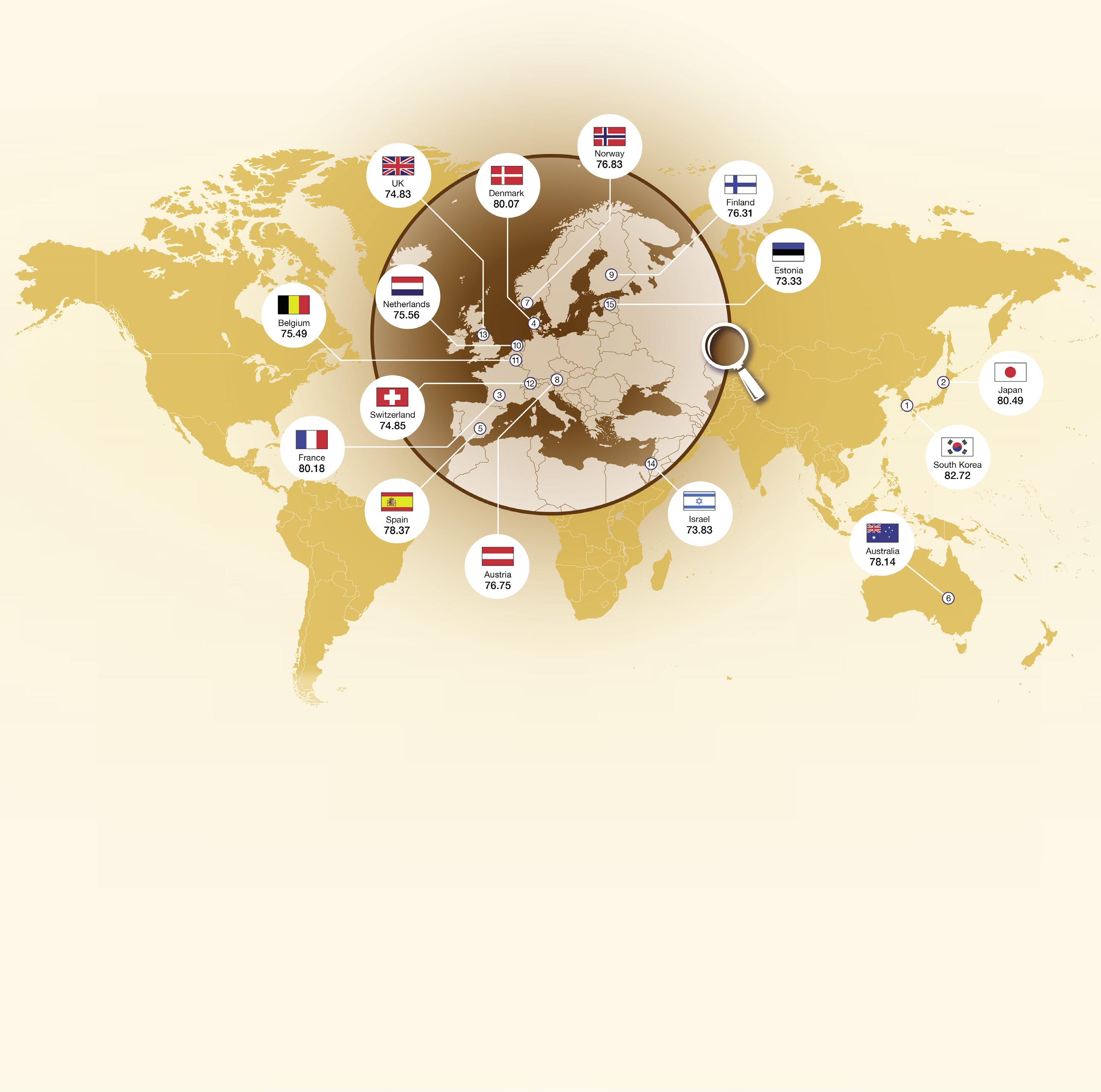
Although the Commonwealth comparisons are useful, global analysis reveals broader opportunities for innovation. Radar Healthcare examined healthcare rankings across some of the most innovative
Global & Strategic Outlook
countries globally. The latest rankings from their analysis placed South Korea and Japan at the top for quality of care.
• South Korea boasts outstanding hospital availability, with 4,133 hospitals service 52. 3 million people (1 hospital per 13,082 people).
• Japan has 8,300 hospitals for 125.5 million people (1 hospital per 15,698 people).
• Australia ranks third, with 1 hospital per 26,069 people.
• The UK ranks tenth with 1,978 hospitals for 68.5 million people (1 hospital per 34,249 people).
These figures highlight the relatively high hospital capacity per facility in the UK, a contributing factor to longer waiting lists and impacting health outcomes and timely social care.
Overall Performance
Two countries stand out for their excellence in health and social care and innovation: Australia and Japan.
Australia
Australia is demonstrating high performance in Health outcomes and equity; and rank second to the UK in Administrative Efficiency. Australia’s healthcare spending is proportionate to its performance reflecting a productive system.
Japan
Although not included in the Commonwealth Fund survey, Japan is recognised for high access to care and preventative services
that reduce social care strain. Japan’s most notable achievement is its innovative use of technology and AI in social care.
Faced with an ageing and shrinking population, Japan has embraced automation—not to replace workers, but to address labour shortages, enhance staff capabilities, and improve efficiency. Japanese social care innovations include:
• IT systems for seamless information sharing across care providers, to enhance administrative efficiency and patient involvement.
• Robotic-assisted mobility for noninvasive support.
• Human-machine interaction tools for elderly care, including robots that reduce stress, promote socialisation, and support communication for individuals with neurocognitive disorders like dementia.
The UK
The UK shows high levels of equity with equal treatment and access for racial and ethnic differences. However, when considering only income-based equity there is some room for improvement. One could say that this could be linked to a requirement for more medical and care accessibility in more deprived areas.
The UK is also exceling in Administrative Efficiency and is looking to level-up our administrative ability further using fair and affordable financial modelling. For example, the use of tools like CareCubed to assist local authorities, ICB’s, and practitioners to obtain transparency we are performing well in this field. With automation coming into play across the NHS and Social Care sectors for administrative takes, it is possible we will see even higher grading in this area in future years.
Finally, the UK is performing well in Access to Care, with low-cost barriers ensuring needs-based access for low-income individuals.
Each country has room for improvement, but there is much to be learned from one another. Equity and Administrative Efficiency is high ranking in the UK. Drawing inspiration from the technological innovations from Japan and the Australian success in Health Outcomes, the UK can further evolve and enhance its health and social care systems.
Fire & Rescue Services: Continually Expediting Public Safety in the UK
Fire and Rescue Services in the UK have been undergoing motivations for sector wide improvements, with services in England undergoing annual assessments by ‘His Majesty’s Inspectorate of Constabulary and Fire & Rescue Services’ to instigate continual improvement and optimisation.
Although much of the public would be aware of Fire and Rescue Services mostly in firefighting, these services provide a significant impact in promoting safety and preventing against harm for the population at a wide scale.
Overall, for the 3rd annual assessment of Fire and Rescue Services in England published on November 5th, 2025, the outcomes were good, with a high proportion of services seeing improvement across the following areas:
• Understanding the risk of fire and other emergencies.
• Preventing fires and other risks.
• Protecting the public health through fire regulation.
• Responding to fires and other emergencies.
• Responding to major and multi-agency incidents.
• Making best use of resources.
• Making the FRS affordable now and in the future.
• Promoting the right values and culture.
• Getting the right people with the right skills.
• Ensuring fairness and promoting diversity.
• Managing performance and developing leaders.
Of all Fire and Rescue Service authorities in England that take part in the annual assessment, the results of the 3rd review showed improvements with 73% achieving adequate, good, or outstanding.
FRS England Round 3 Assessment Grades
IESE Spotlight Series
Fire and Rescue Service Innovation
Fire and Rescue Services are a significant area of ongoing innovation in the UK, with a great deal of innovative technologies being utilised to enhance better response times and reduce the risks to the public, while improving service efficiency. Some of the technology being used include AI use, drones, tablets, and body cameras. The use of 5G technologies and data platforms for enhanced connectivity, and electric vehicles or-high real turrets is also becoming more frequent.
In 2024, Fire and Rescue Services in Shropshire took leaps into digital innovations, with integration of modern technology such as drones, live streaming cameras, and tablets. By mid-way through 2024, live streaming cameras had already been proven significant in tackling serious incidents. In addition, the use of drones has been found to provide additional support to these services. Including:
• Real time reconnaissance from the air to enhance faster situation awareness.
• Enhancements in mapping and visualisation of data to make more informed decisions.
• Faster development for locating missing individuals and addressing potentially hazardous environments.
• Speeding up response times.
Drones and other innovative technologies are making headway in the sector and are improving output for local Fire and Rescue Services.
Additionally, over the last few years, London Fire Brigade have also been focusing on innovative technology to enhance their services. Their goals have been focused on vehicle enhancements such as the expansion of EV use, digital technologies that transform communications and aid intelligent data use, and sprinkler use encouragement.
Kent has also been advancing in their technology, in fact in the last year Kent Fire and Rescue Service have added a firefighting robot to their roster of technological innovation, helping teams manage risk, assess hazards, and assist with firefighting.
This new robot can conduct many firefighting tasks. It helps the teams to optimise their time when in firefighting situations.
Having this assisting robot in place can enhance performance, therefore save lives and prevent hazardous situations from escalating. Fitted with thermal detection capabilities, it can give instructions and it’s fitted with its own water dispersion system. It can assist with removing individuals from dangerous areas using a stretcher. This is reported to be one of the first instances of a firefighting robot use in UK firefighting and has the potential to be a critical development in efficiency and strategic optimisation for Fire and Rescue Services in the UK.
IESE Observations for Fire & Rescue Services
Over the years, IESE has seen fantastic transformation and improvements to service delivery from multiple Fire and Rescue Services.
Over the past ten years, one organisation stood out for their efforts and has achieved positioning in the IESE Hall of Fame. East Sussex Fire and Rescue Service (ESFRS) have worked hard at their development and transformation and have won awards in 2017 and 2022.
ESFRS highlighted how they viewed the opportunity from obtaining Hall of Fame IESE Award status as being an opportunity for sharing ideas and benchmarking.
East Sussex Fire and Rescue Service have been working to collaborate with several GP practices to share patient contact details through data sharing agreements and patient consent. The administrative sharing of data provides GP practices with details of home conditions, especially in instances where home conditions have the potential to risk poorer health outcomes, such as cold and damp homes.
This came after an analysis of the data of those of whom were most at risk, which critically showed that the most vulnerable to fires and need of these services also typically happened to be vulnerable persons who were or had been supported by Adult Social Care services in the surrounding areas.
Through thorough teamwork ESFRS collaborated with East Sussex County Council to arrange data sharing, reaching out to the individuals most at risk for consent of this. This data sharing enables the teams to conduct Home Safety Visits with client consent to do so.
Identifying vulnerable people in this bracket also led to an agreement with Adult Social Care services in the region, who proceeded to change
the questions asked to those receiving social care services and added in a mandatory question about the consent to sharing contact information with agencies (such as FRS) to make them safer.
This pathway was adopted following ESFRS’s assessment that the increased risk of injury or fatality in a fire should not be contingent on pressured services remembering, or having the capacity, to submit a referral to the Fire and Rescue Service. With credible alternative pathways such as information sharing, the process becomes administrative, not transactional and enables fast action and preventative measures.
“ In the period before the visit these patients collectively accounted for 244 visits to the GP. In the same length period following the visit the same cohort accounted for 147 visits to GPs, 97 fewer visits - a reduction of 60%.
Neither the GP Practice nor ESFRS have been able to identify the reason for the reduction, but our home safety visit practitioners felt that it was likely that people felt safer in their home, had felt the visit made them less isolated and built their self-confidence. ”
ESFRS
The new firefighting robot in Kent has its own ‘fire hose’ built in.
your cyber security spend
Across the public sector, cyber security spend has grown steadily in response to rising threats. What’s often less clear is whether that investment is delivering proportional risk reduction or simply adding complexity and cost.
Organisations often have overlapping security tools that provide limited additional protection, while other genuine risks remain unaddressed.
Can you clearly evidence which elements of your cyber spend are reducing risk, and which are simply adding cost?
Validato safely simulates realistic cyber attack scenarios, and provides objective evidence of which existing controls actively reduce risk, what is overlapping, and what is underperforming and bringing a limited return - all without disrupting operations or requiring new tooling.
For you, this means:
• A real-world test on how your current security tools perform in practice, not just in contracts or audits.
• Evidence to redirect budgets toward controls that demonstrably reduce risk.
• An independent, unbiased assurance of return on your existing security investments.
Test what truly protects your organisation today. Created by the sector, for the sector, the CCoE offers cyber security support at discounted rates to public sector organisations. Please contact us at enquiries@ccoe.org.uk or scan the QR code to book a call with us at a time and day that suits you.