R I ALTO RECORD


By Manny Sandoval
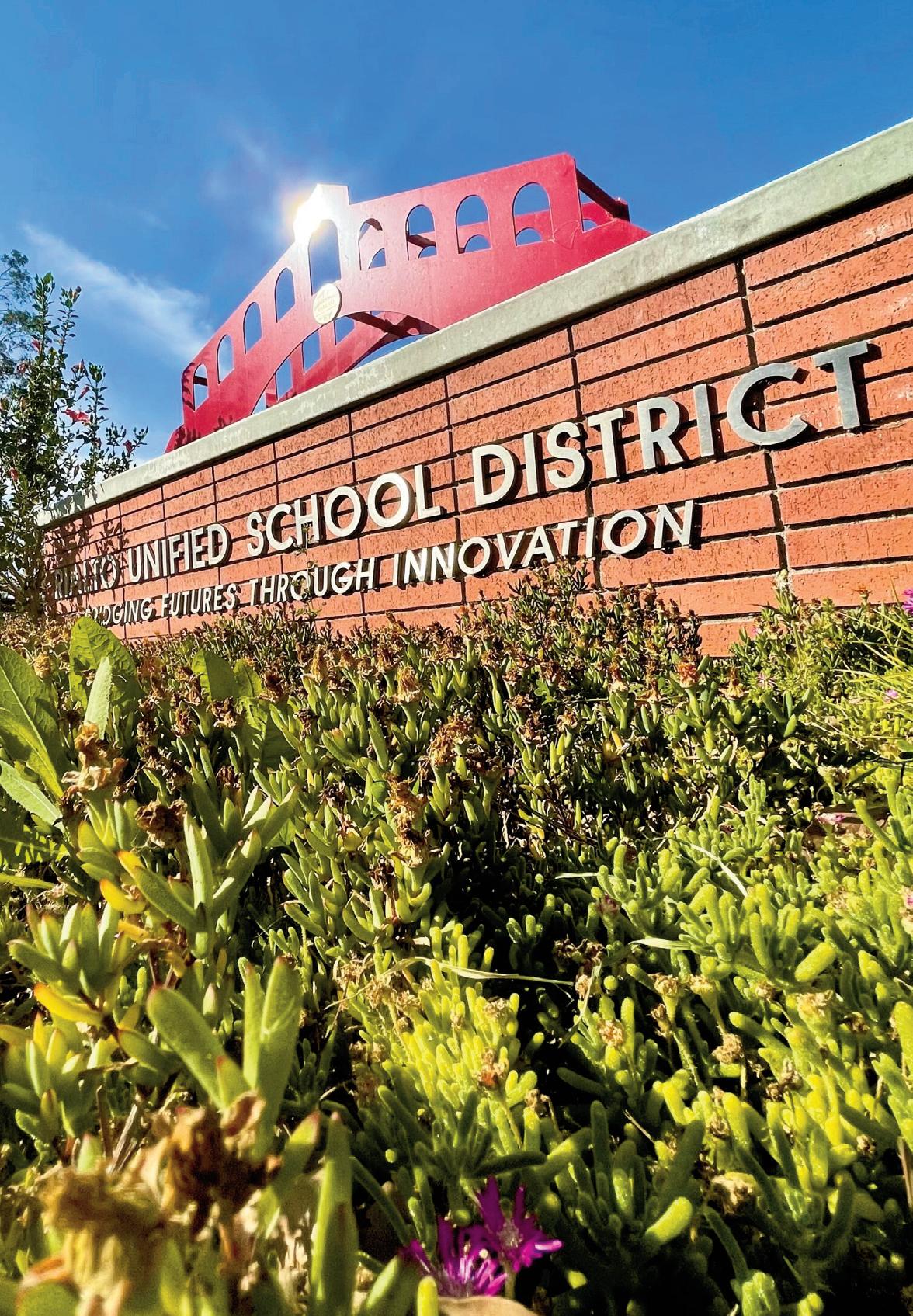
As the largest employer in the City of Rialto, Rialto Unified School District, with over 3,787 employees responded to its teacher/classified unions, with a student-first approach, citing a three percent raise is sound judgment during challenging times to remain fiscally solvent; an approach that the District said will save all staff jobs without sacrificing student programs and keeping health benefits free for its employees.
The District’s top officials responded after a paid editorial by the Rialto Education Association (REA, teachers’ union) was published on last week’s front page of the Rialto Record and shared on social media. The one-and-a-halfpage editorial supplied thoughts from Tobin Brinker, REA president, with the assistance of California School Employees Association (CSEA) classified union president Christina Acosta. The classified union is asking for 3.75 percent, while the district holds at 3 percent for both bargaining units. The sponsored
March 12, 2026
editorial piece reflecting the union’s perspective during negotiations, which has now, according to REA, reached impasse.
Brinker stated, “We have been negotiating with the school district for our contract for almost a year now. Since we first sunshined our proposals, the district has drawn a hard line at a 3% salary increase. We believe teachers should be paid 5%.”... He added, “When districts get money, it's meant to be for the kids who are here right now. What we’ve discovered is that Rialto is not using that money on the kids who are here right now.”
The District’s Deputy Superintendent Rhea McIver Gibbs, who has been in the district for 32 years, refuted Brinker's claims. “The district resources are being used to support students every day through instruction, programs, and services. We have no-cost programs, which is a testament to our commitment to our students.

By Manny Sandoval
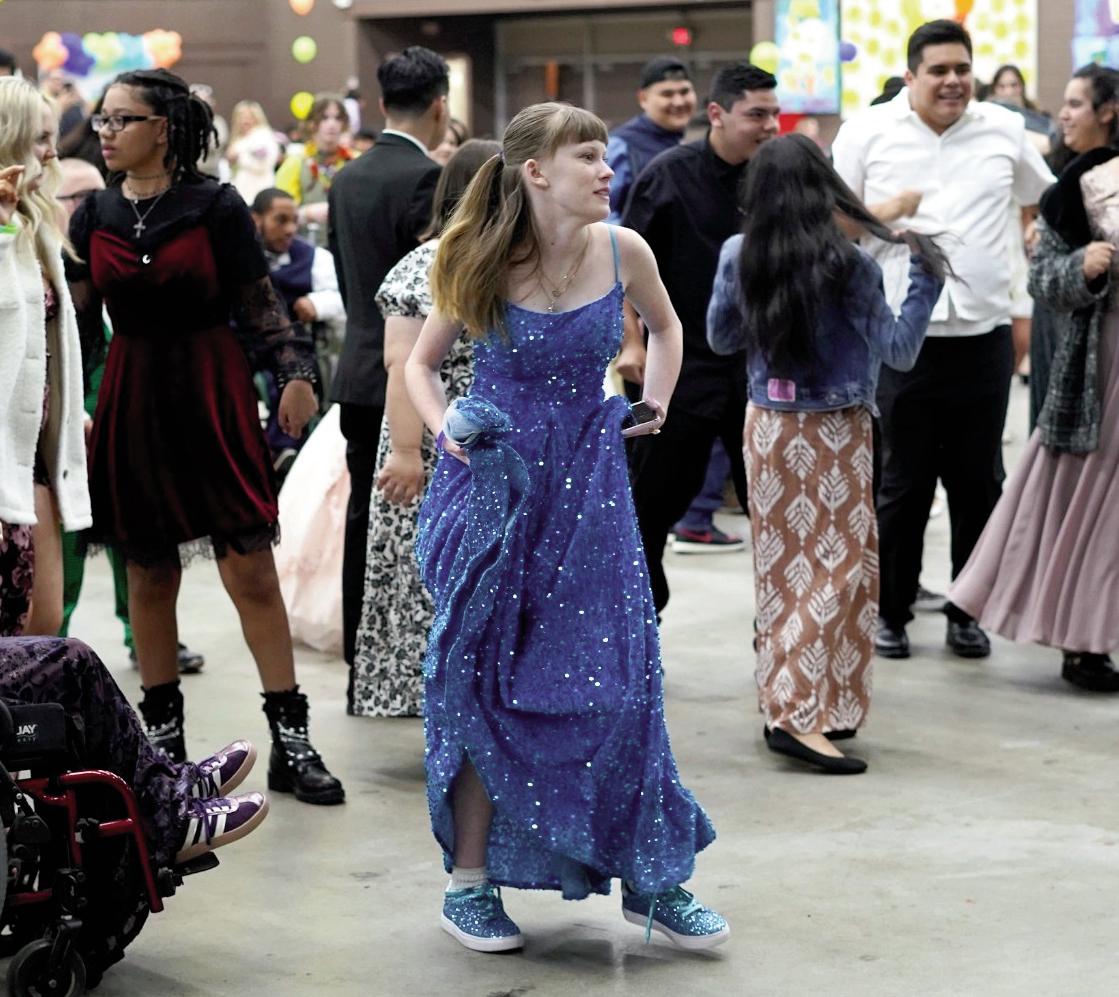
Hundreds of students with intellectual disabilities from across San Bernardino County filled the dance floor at the National Orange Show on March 6 as the annual Best Buddies Prom returned for a night centered on friendship, inclusion and belonging.
The most emotional moment of the evening came when National Orange Show CEO Sheri Raborn stepped onto the

stage and announced that the fairgrounds would donate every dollar from ticket sales back to Best Buddies’ Inland Empire chapter.
"This year, the NOS is going to donate 100% of the Prom ticket revenue received to host the Prom at the National Orange Show back to the Best Buddies Inland Empire Chapter to use as they see fit. That's the least we can do for everything you've done to honor both Dan Jimenez (former NOS CEO) and his daughter Joy
(who passed away in 2012)." Raborn also said the National Orange Show is committed to hosting the event for years to come. The announcement drew cheers and tears from advisors, parents and students gathered inside the event hall — a powerful show of support for a program dedicated to building friendships between students with and without intellectual disabilities.
Founded in 1987 by Anthony Kennedy Shriver, Best Buddies began as a friend-
RUSD Raises cont. on next Best Buddies Prom cont. next pg.
Inland Empire Community News • March 12, 2026 • Page A2 • Rialto Record
RUSD Raises (cont.)
- Some of those include: every elementary student goes on a no-cost field trip, middle and high school students participate in no-cost career exploration and college fairs, and high school students have access to no-cost Advanced Placement exams, PSATs, and SATs. All high school seniors have the opportunity to submit two college applications at no cost to them. In-State and National College Tour opportunities for students at no cost.
She added, “The district has made a concentrated investment in literacy through reading specialists, teacher training through the USC Reading Authorization program, expanded library resources, the Raising a Reader home program, and supplemental instructional tools such as i-Ready Instruction to strengthen student reading outcomes. Additionally, high school athletic programs are funded to allow students to participate at no cost, ensuring Rialto students have access to quality programs. The District has also invested in parent engagement programs to equip families to better support their child’s learning, notably the USC Family Literacy Program and the UCLA Family Math Project.” Brinker had also mentioned that inflation has gone up. “When inflation went up a few years ago, the state put a whole bunch of money into schools to help attract and retain teachers,” Brinker said. “Salaries were already low, and when inflation hit, it really devastated a lot of folks in our profession.”
RUSD Associate Superintendent of Human Resources Dr. Denise Ellis stated, “While salary increases are a key component of negotiations, it is also important to recognize that the District provides one of the most competitive benefits packages in the region, including fully paid Kaiser health coverage for employees and their dependents. The District’s priority is to provide a fair and competitive total compensation package that attracts and retains the best professionals to serve our students. We value our employees and remain focused on reaching an agreement that supports our staff while continuing to meet the needs of the students and families we serve.”
According to various news reports, the Record found that several of the school districts in San Bernardino County Schools have not negotiated free health and benefits compensation. In fact, Rialto Unified School is only one of a handful of school districts (with 33 school districts in County Schools) that still offer its employees free health care.
Although REA had stated that teachers are asking for total compensation, including benefits, with the five percent far salary, according to RUSD Associate Superintendent of Business Diane Romo, benefits often include California State Teachers’ Retirement System (STRS), California Public Employees’ Retirement System (PERS), paid leave, professional development, and step-and-column salary increases.
But both unions claim there is a little over $200 million, and they want it for salaries.
The District says state-supplied money still needs to be allocated and is separated based on where the need is, and because it is public money, the district has to be careful and budget responsibly, since more than 85 percent of the money is spent on salaries.
According to Romo, the total fund balance, which includes restricted, committed, and assigned funds, is not just funds available for salary expenditures. Many portions of that balance are legally restricted for specific programs such as Special Education, State and federal grants, facilities, or capital projects, and pension obligations.
Romos stated that on July 1, 2025, the District’s beginning financial reserves for the 2025-2026 General Fund dollars were $204,605,037; the reserves are comprised of $87,455,279 in unrestricted funds and $117,149,758 in restricted funds that can only be used in compliance with program restrictions. The projected ending fund balance for 2025-2026 is $170,024,052; of this, $68,315,356 is in unrestricted funds and $101,708,696 is in restricted funds that can only be used in compliance with program restrictions. Restricted funds cannot be used to pay for nonprogram expenses, such as districtwide raises.
According to REA, class size has been an increasing issue.
McIver-Gibbs’ email indicated that the average class size of TK-5 is approximately 24 students. All elementary schools maintained 1-2 Reading Specialists to support their students’ growth, beyond their original 3-year commitment made after the COVID19 pandemic.
Romo added, “The District provides training to our teachers on MultiTiered Support System (MTSS) restorative practices, and other instructional strategies that promote engaging classrooms and support safe schools for our students. Only a small portion is truly ‘unrestricted’, which is what can be used for ongoing salary negotiations. “The reported $204 million fund balance includes funds that are legally restricted or committed for specific purposes. The district’s actual discretionary reserve is significantly smaller and must be maintained to ensure financial stability and compliance with State requirements.”
According to District Spokesperson Syeda Jafri, reserves protect students and employees from future financial shocks. “In past school board meeting budget presentations, Mrs. Romo had shared that the cost of running a district, providing raises, and declining enrollment contribute to reduced future state funding,” said Jafri. “She also added that health benefits have to be taken into account, utilities and operational expenses, and economic uncertainty in future state budgets. In California, districts must maintain a minimum reserve (a 3% minimum) under oversight rules from organizations such as the California Department of Education and County Offices of Education.”
Acosta, who oversees custodians, maintenance workers, nutrition, bus drivers, clerks, secretaries, and various school staff who are separate and away from the teachers/nurse/coun-
selor bargaining units, said financial pressures have also pushed many classified employees to work multiple jobs. “I know custodians personally who work two eight-hour shifts,” Acosta said in last week’s editorial piece. “They work nights for Rialto and have a day shift custodial job somewhere else just to make ends meet.”
“The District values all staff members and the work they do every day to support students and schools. We believe they deserve a salary increase that recognizes their contributions while remaining in alignment with what the district can afford,” stated Ellis. “RUSD proposed a total compensation package of 5%, which includes a 3% salary increase and a District contribution of approximately 2% toward the premium increase for health and welfare benefits. This benefit affords staff members and their families ongoing, fully paid Kaiser health care. The District’s proposal provides a salary increase above the state-funded Cost of Living Adjustment (COLA) and is comparable to compensation offered in neighboring districts.”
As the bargaining units aggressively pushed for a five percent raise for 1,286 REA Members, including teachers/counselors/nurses, and 1,297 classified union members pushed for a 3.75 percent raise, the Board of Education had hired a new Superintendent, Dr. Alejandro Alvarez, who took the helm of the district in December 2025.
After a lengthy search last fall filled with multiple stakeholders' meetings and lots of reactions at school board meetings, the Board of Education, with a 5-0 vote, selected Alvarez, bringing stability to the district.
Alvarez is a seasoned school chief who comes from Bassett Unified, serving as a former superintendent. Additionally, he was a deputy superintendent in Compton Unified School District. Hired as a fresh new leader for RUSD, which has more than 23,118 students, 3,787 employees, with a total school budget tipping half a billion dollars, according to Jafri, Dr. Alvarez continues to communicate with his top business and human resources leaders and the Board of Education to look at numbers and find a diplomatic resolution.
Although the superintendent works with the RUSD board of education trustees to find resolutions, generally, they do not serve as a part of the negotiations team.
However, according to Jafri, Alvarez, and the Board of Education are concerned with making sure that fair and affordable compensation is executed.
“There is no doubt that the district deeply values its educators, classified staff, and administrators. We remain committed to reaching an agreement that reflects compassion, integrity, and respect for the hardworking staff who serve our students every day,” Jafri concluded. “Every decision the district makes is guided by our responsibility to provide high-quality education for the students we serve while maintaining fiscal stability that protects programs and jobs longterm.”
Best Buddies (cont.)
- ship initiative at Georgetown University and has since grown into the world’s largest nonprofit organization focused on inclusion for people with intellectual and developmental disabilities.
Heather Lozano, coordinator of the Best Buddies Prom and advisor to the Best Buddies chapter at Cajon High School, said the organization’s core mission is simple: create genuine friendships.
“What the club does is pair students in general education with students in special education,” Lozano said. “What you'll see here tonight is the biggest, most wonderful celebration of students being included and accepted by their general education peers. It's really the most beautiful thing I've ever seen.”
Lozano first brought Best Buddies to Cajon High School in 2001. Today, she said, the chapter has grown into the largest club on campus with roughly 220 students involved.
Each week, students meet simply to spend time together — something Lozano said often leads to friendships that last well beyond high school.
“My daughter's Buddy is still her friend,” Lozano said. “My daughter graduated in 2009, and they still call each other on the phone. That's the whole idea of Best Buddies.”
For many families, the annual prom represents an experience that might otherwise be out of reach.
“Parents say, ‘My student usually can't attend prom,’” Lozano said. “So this is that moment of acceptance — watching their students out on the dance floor with their general education peers. It's just so exciting and wonderful.”
That joy was immediately visible as students walked through the doors and headed straight for the dance floor, filling the room with the Cha Cha Slide, the Wobble and a chorus of singing The YMCA.
Unlike traditional proms, the event focuses less on spectacle and more on comfort
and accessibility. Lights remain steady, parents are welcome to attend, and students requiring additional support are accompanied by teachers and caregivers.
“The kids don't care,” Lozano said. “The DJ just plays the songs, and the kids sing and dance. It's electric.”
The evening also carried special meaning as the first prom held since the passing of longtime National Orange Show CEO Dan Jimenez, who passed away in August 2025 after nearly two decades leading the organization.
Lozano said Jimenez became a passionate supporter of students with intellectual disabilities and helped the event grow by offering larger venues at the fairgrounds.
Each year, students would honor Jimenez’s daughter Joy — who passed away in her early 30s — by holding signs during a tribute while the song “Joy to the World” played.
This year, the tribute was renamed “Dancing with Joy,” honoring both Jimenez and his daughter.
Caroline Van Zant, program manager for Best Buddies in Los Angeles and the Inland Empire, said the prom reflects the organization’s broader mission of inclusion.
“This is a massive celebration of inclusion and the Best Buddies mission that Heather has been building for years,” Van Zant said.
Best Buddies operates more than 200 chapters throughout California, including about 65 across Los Angeles and the Inland Empire, Van Zant said.
The organization continues expanding its reach beyond high schools into middle schools and elementary campuses while also offering leadership training, family support and employment programs for people with intellectual and developmental disabilities. “I would want people to know that there is a Best Buddies program for everyone,” Van Zant said.
Read the complete article at IECN.com.
San Bernardino County Approves Fontana Navigation Center With 200
Community News
San Bernardino County has finalized the purchase of a property from the city of Fontana to establish a regional navigation center that will provide 100 shelter beds and 100 recuperative care beds along with supportive services to help the unhoused community transition to permanent housing.
Today, the Board of Supervisors approved the property purchase and an agreement with partner cities that establishes a framework for operating the facility, including funding contributions toward ongoing operations. This action marks a major milestone in advancing a coordinated regional approach to addressing homelessness in western San Bernardino County.
“The board’s action on this agenda item moves us closer to opening a navigation center that will provide critical support for people experiencing homelessness,” said Board of Supervisors Chairman and Third District Supervisor Dawn Rowe. “It will connect individuals to the resources they need to gain stability and thrive.”
The navigation center will serve people experiencing homelessness in the areas represented by Vice Chair and Fifth District Supervisor Joe Baca, Jr., Second District Supervisor Jesse Armendarez and Fourth District Supervisor Curt Hagman.
“The West End Regional Navigation Center reflects our
commitment to expanding services and creating real pathways to stable housing,” said Baca, Jr. “By aligning our resources and efforts, we’ll be able to deliver a stronger and more comprehensive response that will ensure people experiencing homelessness get the care and support they need.”
“This critical project will make a meaningful difference for people experiencing homelessness in western San Bernardino County,” said Armendarez. “We are proud to advance this work with our partner cities and look forward to the navigation center’s immense impact in our community.”
“I’m pleased we’re moving forward with this vital project to provide essential services to those in need,” said Hagman. “This represents a pivotal moment in our ongoing efforts to help individuals and families gain stability and secure permanent housing.”
Fontana Mayor Acquanetta Warren said the property transfer reflects the city’s commitment to partnering with the county to expand housing solutions for people experiencing homelessness.
“This partnership shows what’s possible when local governments work together toward a shared goal,” said Warren. “It advances our regional efforts to expand housing support and enhance coordination in addressing homelessness.”