1 in 10 Cal State Students Face Homelessness. This Emergency Housing Program Helps
Pg. 4
Fontana Radio Host Stranded in Jalisco Violence After Canceled Ontario Flight
Pg. 5
Highland, San Bernardino YMCA Near Scholarship Goals Ensuring No One Is Turned Away — Give by March 4
Pg. 8
Inland Empire Community Newspapers
Office: (909) 381-9898
Editorial: iecn1@mac.com
Advertising: iecn1@mac.com
Legals : iecnlegals@gmail.com
San Bernardino Residents Demand City End $84K Flock Surveillance Camera Contract
and
By Manny Sandoval
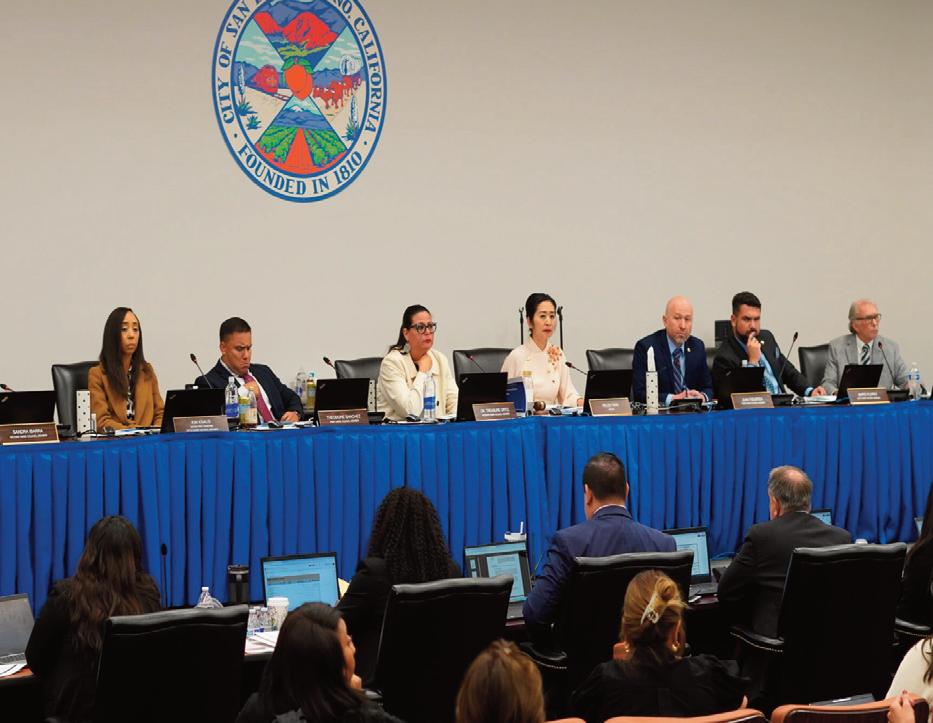
More than 100 residents filled the meeting room at the Feldheym Central Library on Feb. 18, with over two dozen rallying specifically to protest the city’s contract with Flock Safety and urging officials not to renew an $84,000 annual agreement for 28 automated license plate reader cameras.
Public comment on the issue did not begin until about 7:40 p.m. — more than two hours after the meeting started — as the San Bernardino City Council first spent nearly 90 minutes debating a proposed ban on short-term rentals. Several pre-planned speakers left before they were able to address the council.
At one point during discussion of the rental ban, Councilman Fred Shorett said, "I've been very passionate about this short-term rental ban for quite some time.” During public comment, a speaker responded, “Old man Fred needs to be passionate about the homeless shelter and homelessness in this city.”
By the time the council opened the floor, seats were filled with residents and organizers from the Warehouse Worker Resource Center, The People’s Collective for Environmental Justice and Just San Bernardino. Many attendees held signs reading “Get the flock out of SB” in English and Spanish.
The Flock Safety agreement, set to renew March 30, 2026, assists police in identifying stolen vehicles and suspects. The contract is under community scrutiny over privacy concerns and potential data sharing with federal immigration agencies.
Sheheryar Kaoosji, cofounder and executive director of the Warehouse Worker Resource Center, said the cameras are part of a broader surveillance system that disproportionately affects workingclass communities of color.
“These cameras represent a consistent threat to the safety of local communities from federal agents,” Kaoosji told the council. He said residents are concerned that data collected by Flock Cameras, Cont. on next
Car Plows Into Downtown Redlands Crowd; Gunshots Follow, Witness Says
By Manny Sandoval
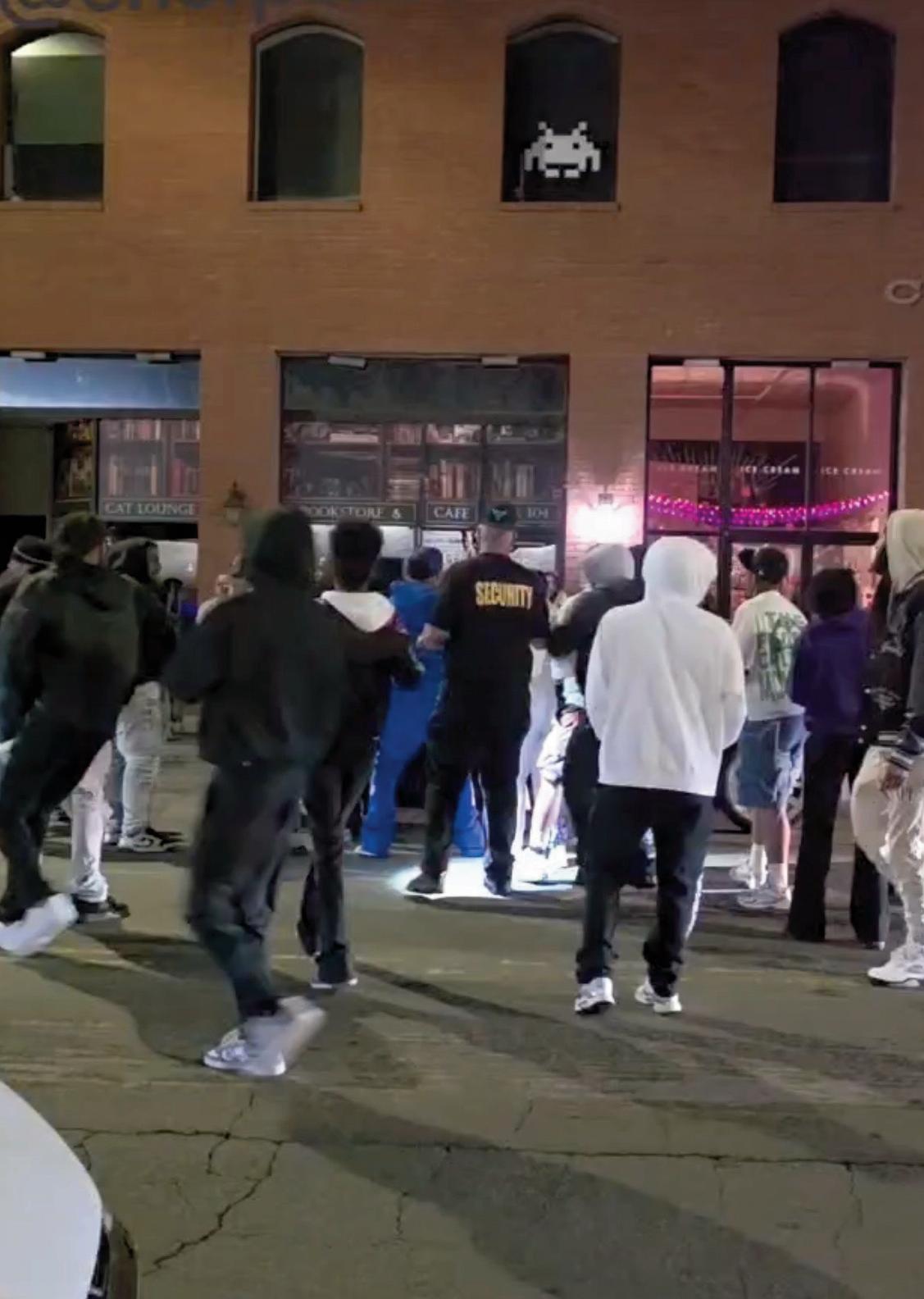
Avehicle drove into a crowd in downtown Redlands early Sunday, Feb. 22, just after 1:30 a.m., and moments later at least six gunshots were fired at the vehicle, according to a witness who recorded the incident.
Crystal Chirpin, who handles media for Cherps Auto and Customs in Calimesa, said she and friends were leaving the area on East Citrus Avenue when they encountered a confrontation outside nightlife venues including The District and The Underground.
“We were all leaving about — it was closer to 2 in the morning, maybe like 1:45 a.m.,” Chirpin said. “People were cleaning up and leaving.”
She said roughly 10 to 15 people were surrounding a vehicle when a female driver got into a blue Tesla and drove off.
About 30 seconds later, the same Tesla circled back.
“It was the same blue car that was there. It had basically circled around,” Chirpin said.
“You can hear it in the video. The car screeches its tires. But no one’s paying attention because it’s super loud.”
Seconds later, the vehicle accelerated into the group.
Chirpin said some of the individuals struck did not appear to be actively involved in the argument.
“The people that she hit weren’t necessarily — I mean, in my opinion — part of the issue,” she said. “There wasn’t any yelling or screaming or anything like that coming from them.”
She estimated those hit were in their 20s. Several people fell to the ground. Some were able to get up and move away, while others remained down.
“There was one on the sidewalk that was moving around, and you could tell his leg was pretty injured,” Chirpin said. “One of them was completely laid out.”
Hit-and-Run, cont. next pg.
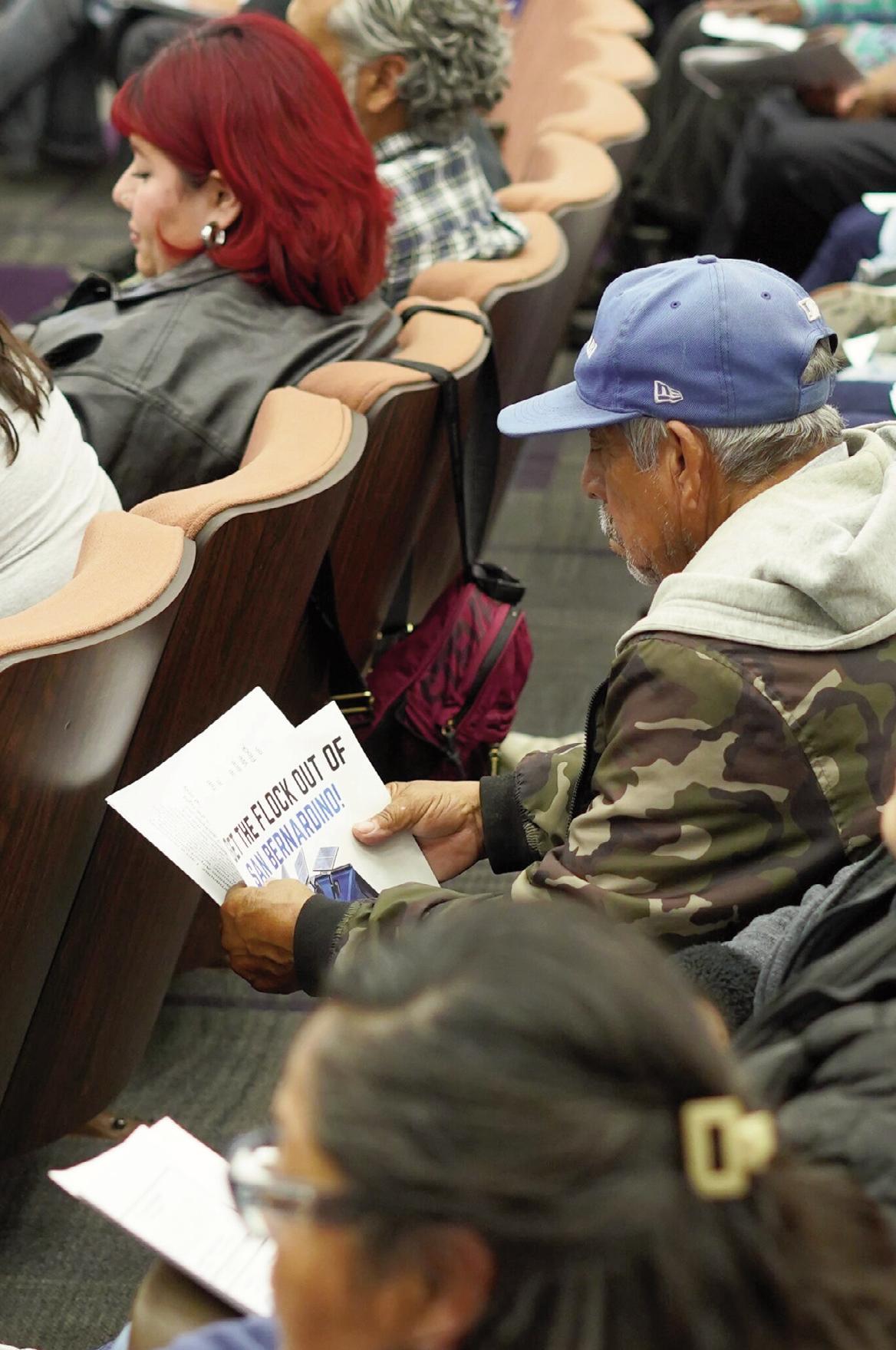
PHOTO MANNY SANDOVAL
A resident
public commenter looking down at his sign that reads “get the flock out of San Bernardino” as the council discussed banning short term rentals for 90 minutes.
PHOTO CRYSTAL CHIRPIN VIDEO SCREENSHOT
A vehicle drives into a crowd in downtown Redlands early Sunday, Feb. 22, moments before gunshots rang out, according to witness video.
Flock Cameras (cont.)
- the cameras “can be used by local and state law enforcement agencies that target black and brown people whose lawful activities should not be recorded and collected.”
Kaoosji urged the council to agendize the contract before its renewal date, asking officials to “take the safety and privacy of its residents into account.”
In a separate statement to IECN, Kaoosji added that canceling the contract would demonstrate that elected officials are prioritizing residents’ safety. “Canceling San Bernardino's contract with Flock is an important way the elected city council can show residents that they truly represent the people and are putting their safety first,” he said. “We don't know who has access to this data and it could be used by federal agents to terrorize residents of San Bernardino. Without an intervention residents are not safe.”
Tania Gonzalez, community organizer and programs coordinator for The People’s Collective for Environmental Justice, criticized the council for the length of the short-term rental debate before public comment began.
“A lot of folks are coming from work to be here so you waste their time for almost two hours talking about rentals,” Gonzalez said. She called on the council to “end your contract with the Flock surveillance camera company,” arguing the cameras “are not here to keep our community safe” and instead “sell our information to government agencies that damage our community.”
Gonzalez urged officials
to redirect funding to infrastructure and other community needs rather than “wasting taxpayer money in a company that's just going to harm your community.”
Miriam Nieto, a Ward 7 resident and organizer with Just San Bernardino, said she does not support her taxes going toward a contract that could aid federal immigration enforcement.
“As a resident of the city, I do not support for my taxes to go towards any contract that will further aid ICE in terrorizing our communities,” Nieto said. “We need to get the Flock cameras out of our city and make sure that they don't come back.”
Ana Cervantes, a leader with San Bernardino Airport Communities, also urged the council to terminate the agreement.
“They can finally do something right and end the Flock contract,” she said, adding that residents feel their concerns have not been prioritized.
As of the meeting’s conclusion, the council had not taken action on the Flock contract. The renewal date remains set for March 30th, 2026, leaving residents questioning whether the issue will be agendized before the agreement automatically renews.
For the dozens who came specifically to oppose the cameras — and the more than 100 residents in attendance overall — the message was consistent: they want the contract reconsidered before time runs out.
The next San Bernardino City Council meeting is scheduled for Wednesday, March 4th with a closed session starting at 4 PM and the regular/open session at 5 PM.
Hit-and-Run (cont.)
- She believes one person may have been struck twice as the driver attempted to turn and reverse before crashing into Bruno Bianchi Body by Design.
“She initially hit him and then she ran into a building,” Chirpin said. “When she backed up, he was still there.”
When the vehicle crashed into Bruno Bianchi Body by Design, windows were shattered. Chirpin said she returned the next morning and saw boarded-up glass.
“They had hit the window and shattered it,” she said. “The window was shattered at the entrance to The District and The Underground as well. Like a bullet had hit the door.” Moments after the collision, gunfire erupted.
“Oh, yeah, six or seven,” Chirpin said of the rounds she heard.
In the video, people scatter as shots
ring out. Chirpin said she was stunned by what was unfolding.
“To be honest, I have no idea what I was thinking,” she said. “If you watch the video, my movements were like a turtle. I think I was just in shock.”
She and a friend moved toward a nearby parking structure as others ran.
“You can hear on that video, my friend says, ‘I’m scared. We need to leave.’ And I go, ‘Okay, let’s go,’” she said.
She said she did not recall seeing police in the immediate area prior to or during the incident.
“I didn’t see any police officers down there,” she said.
Chirpin, who said she rarely goes downtown late at night and was only there because a friend was in town, described the crowd as largely in their 20s and said it appeared many were coming from outside Red-
lands.
“I think there’s a lot of people that are coming from other cities,” she said. “It’s not like it was back in the day.”
She said she hopes no one died as a result of the incident.
“I would like to know about that other guy, just for myself,” she said. “I hope that no one passes away or anything like that. What could you be arguing about that you would do that?”
“That person needs to see justice for sure on that one.”
Four victims from the hit-and-run were transported to a hospital with major injuries. The vehicle fled west on Citrus Avenue.
Anyone with information is asked to contact Detective Thomas Williams at 909) 557-6814 or twilliams@redlandspolice.org.
Hawaiian Fast-Casual Staple L&L Hawaiian BBQ Opens in Colton, Citing Lack of Healthier Fast-Food Options
By Daphne Marquez
L&LHawaiian Barbecue (L&L) has now expanded their franchise to San Bernardino County, debuting their new Colton location with their Grand Opening on February 21 and 22.
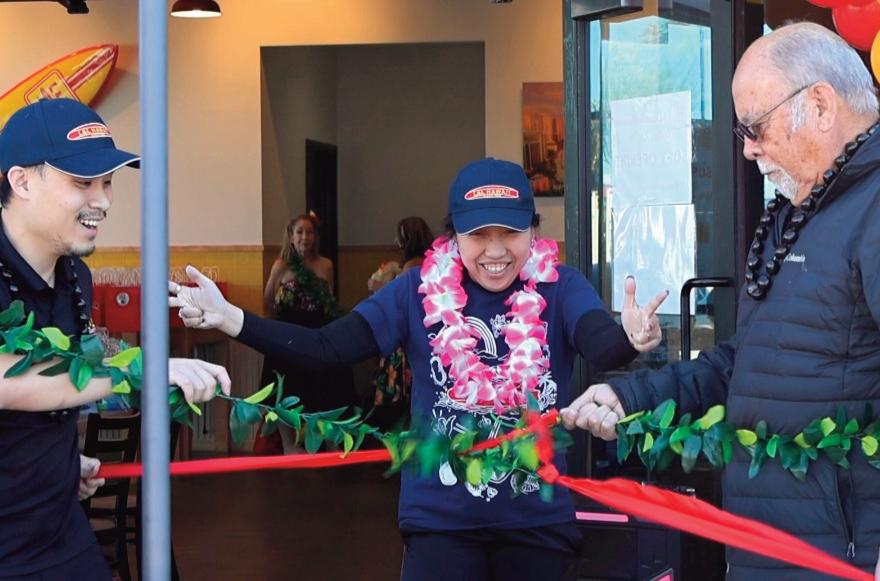
The Grand Opening was led with a Ribbon Cutting by the Colton Chamber of Commerce, Colton Mayor Frank Navarro, and L&L Hawaiian Barbecue’s Store Manager Lam Ngyuen, in which they had first untied a vine, paying homage to Hawaiian Culture, and then proceeding to cut the Chamber of Commerce’s ribbon.
After the ribbon cutting took place, customers got to watch performances by both lion and hula dancers, not only promoting the heritage of the food, but also providing entertainment for the customers who were getting their orders taken while they were in line.
The event had a line that filled the entire parking lot, with customers eager to participate in the giveaways and raffles. On Instagram, L&L had promoted the Grand Opening with giveaways and raffles.
The first 100 guests received a free Hawaiian Favorites plate (excluding short ribs) and a gift bag that contained a free shirt and tumbler which includes free refills for three months. The next 100 guests had also received the same gift bag along with 30% off of their entire order.
One of the customers in line, Danielle Infante said “I used to know L& L from back in the Diamond Bar area, and then to see one come here now as a local in Colton is pretty cool.”
Ngyuen said, “The community is vast here. It's really big, so we want to provide comfort food that we make from authentic food that isn’t
processed.”
As guests entered, they each received a raffle ticket, the raffle was open to customers all weekend. Prizes included: Free Hawaiian BBQ for a year with two winners (limited to one plate per week), an Ipad, two AirPods, and a Nintendo Switch 2.
The decision for the location choice Ngyuen made based on the lack of fast food options that served healthy foods. He said “I used to work in Redlands, and I know there's no store to actually have comfort food besides all the fast food right there. So for L&L, we have a lot of healthy and authentic options with everything made from scratch.”
After a weekend filled with lines out the door, L&L is ready for anyone looking for an authentic Hawaiian plate lunch. The address is located at 1550 W Valley Blvd Suite 131, Colton.
PHOTO MANNY SANDOVAL San Bernardino City Council listening to public comment on Feb. 18, 2026. From left: Councilwoman Sandra Ibarra, Mayor Pro Tem Kim Knaus, Councilman Theodore Sanchez, Councilwoman Treasure Ortiz, Mayor Helen Tran, Councilman Juan Figueroa, Mario Flores, and Fred Shorett.
PHOTO DAPHNE MARQUEZ
L&L and Colton Mayor Frank Navarro pull apart their vine attached to a ribbon to signify their place in Colton.
Op-Eds
Building the Foundation for Regional Investment Requires Partnership
By Matt Mena, Senior Director, IEGO
Three years ago, when I stepped into my role at IEGO, one of the largest and most complex responsibilities before us was clear: we had to manage and strategically deploy millions of dollars in state funding across the Inland Empire.
Through the California Jobs First initiative and in close partnership with the Inland Empire Labor Institute (IELI) IEGO has been entrusted with more than $9 million in state investment to support economic development, workforce innovation, and industry growth in our region. That level of funding is not simply the result of strong proposals. It reflects the state’s confidence in our ability to manage complexity, coordinate diverse stakeholders, and ensure public dollars generate measurable impact.
Managing this process was not straightforward work. These investments require multi-sector collaboration, strict compliance and reporting standards, and the ability to move from planning to implementation quickly while delivering outcomes that matter to workers, employers, and communities. When I began this role, we understood that success would require more than administrative oversight. It would require building trust, establishing struc-
ture, and ensuring every dollar was deployed with intention.
IEGO has approached this responsibility as a regional backbone organization. We do not operate as a standalone program administrator. Instead, we serve as a neutral convener and implementation partner, aligning local governments, educational institutions, employers, labor leaders, and community-based organizations around shared priorities. That alignment allows state investments to be deployed strategically, fill gaps in the regional economy, strengthen priority industry clusters, and direct resources to the partners best positioned to execute.
The $9 million we have managed has supported initiatives across workforce development, cybersecurity, clean and emerging technologies, advanced manufacturing, and community-centered economic development. From day one, our focus has been on integrating these funds with existing regional assets, avoiding duplication, and maximizing long-term impact rather than concentrating resources in a single institution or geography.
The reality is that distributing funds at this scale is complex. It requires careful governance structures, clear partner agreements, performance tracking, and constant communication. It also requires difficult decisions. Our
team worked diligently to ensure compliance with state requirements while maintaining flexibility for partners working on the ground. The balance between accountability and adaptability is one reason the state continues to trust IEGO.
Equally important, we have grounded every investment in employer demand and labor market data. State dollars must translate into tangible results, including businesses choosing to grow here rather than elsewhere, workers accessing quality career pathways, and emerging industries taking root in the Inland Empire.
What I have learned over the past three years is that effective regional economic development is not the responsibility of any single organization. It is about building infrastructure for collaboration. Complex challenges, workforce shortages, technological shifts, and economic transitions cannot be solved in isolation. They require coordinated regional leadership.
IEGO is proud to play that role. The trust placed in us by the state and the partnerships that make this work possible position the Inland Empire not just to compete for public investment but also to deploy it responsibly, strategically, and at scale.
Alex Pretti Murder Shows What Happens When We Fail to Push Back
By Javier Hernandez, Executive Director, Inland Coalition for Immigrant Justice
This is not an isolated tragedy. It is the second fatal shooting by federal immigration agents in Minneapolis in recent weeks, following the killing of Renée Good, and part of a broader pattern under the Trump administration’s sweeping immigration operations. These actions, arrests without transparency, aggressive confrontations, and now deadly force, are tearing at the threads of our social fabric and threatening the very rights Americans are supposed to hold dear.
Unfortunately, the deadly violence we’ve seen in Minneapolis didn’t come out of nowhere; we saw similar tactics here in the Inland Empire when ICE and federal agents shot at a family vehicle with two US Citizens in-
side in San Bernardino, making it clear our communities are either being used as a training ground, or that these violent methods have become standard practice among federal forces.
There is no room for quiet endorsement, for equivocation, for sitting on the fence. The line has already been drawn, and it was drawn by those who would use federal power to terrorize communities rather than protect them. Every time a federal agency fires a weapon instead of deescalating a situation, whether it’s in Minneapolis, Riverside, San Bernardino, or anywhere else, the boundaries of unacceptable state violence shift, and the human cost grows.
Those deaths are not abstract statistics. They are the direct outcome of a political practice that devalues human life and normalizes brute force.
President Trump Should Restore Crucial Trade Wins From
By Jeffrey Gerish, Community Member
President Donald Trump is wasting no time completing the ambitious goals left unfinished after his first term.
Soon, he'll have a rare opportunity to complete another critical piece of unfinished business: ending the exploitation of U.S. businesses by our two largest trading partners, Canada and Mexico.
In the coming months, the United States will undertake a scheduled review of the United States-Mexico-Canada Agreement, or USMCA -- the landmark trade deal reached during President Trump's first term. During that review, the administration will have the chance to restore crucial intellectual property protections that Democrats insisted be dropped after the deal was first negotiated.
I was involved in the negotiation of the USMCA as President Trump's deputy U.S. trade representative. The president's goal was to replace the disastrous North American Free Trade Agreement with a modern pact that would protect American workers, innovators, and businesses. A central part of that was strengthening intellectual property protections.
Yet before the deal could take
His First Term
effect, Democrats in Congress stripped out several key protections. For example, we had secured commitments from Mexico and Canada to provide 10 years of regulatory data protection for certain new medicines. Regulatory data protection provides temporary protection for the confidential information that drug developers share with authorities to prove a medicine is safe and effective before it can be sold.
House Democrats led efforts to remove this provision, claiming that stronger protections would raise drug prices.
That's nonsense. The United States already provides 12 years of regulatory data protection, so the change wouldn't have altered the U.S. market. Removing it has only allowed Canadian and Mexican firms to more easily copy U.S.-made drugs.
Democrats weakened other key IP protections negotiated as part of USMCA, opening the door for Canada and Mexico to undercut U.S. innovators.
Mexico's failures are especially troubling. In the U.S. trade representative's most recent Special 301 Report -- an annual report spotlighting foreign IP violations -- Mexico was placed on the Priority Watch List for "long-standing and significant" concerns, including rampant counterfeiting and piracy.
And Canada has its own shortcomings. It is on the Special 301 Watch List and continues to impose drug price controls that undervalue American-made medicines and exacerbate foreign free-riding on U.S. innovation.
By fixing prices below market value, Canada -- like many wealthy nations -- forces companies to absorb losses abroad, making it harder to fund new research and pushing a greater share of costs onto American patients. President Trump is actively working to resolve this imbalance as part of lowering drug prices for U.S. patients -- and fixing the USMCA is an important place to start.
The needed reforms are straightforward. Create enforceable, verifiable standards mandating respect for IP. Restore the 10-year regulatory data protection standard originally negotiated as part of the USMCA in 2018. Require Canada to abandon price controls and devote a higher, fairer level of spending to new drug development. And enforce full compliance with existing requirements.
The Trump administration now has the opportunity to finish the job it started in the first term on IP protection under the USMCA. For the sake of American workers and innovators, it must not let this opportunity go to waste.
We must push back and we must do it boldly. That means defunding ICE and re-imagining our approach to immigration altogether. Agencies like ICE and the Department of Homeland Security were designed to be machines used against our own communities, now they have become much worse.
There is no middle ground left. It has been consumed by gunfire and chaos, by authoritarian tactics and systemic abuse. The choice before us continues to be crystal clear: stand with humanity, or stand aside as our social fabric unravels.
At the Inland Coalition for Immigrant Justice, we will not stand aside.
1 in 10 Cal State Students Face Homelessness. This Emergency Housing Program Helps
By CalMatters
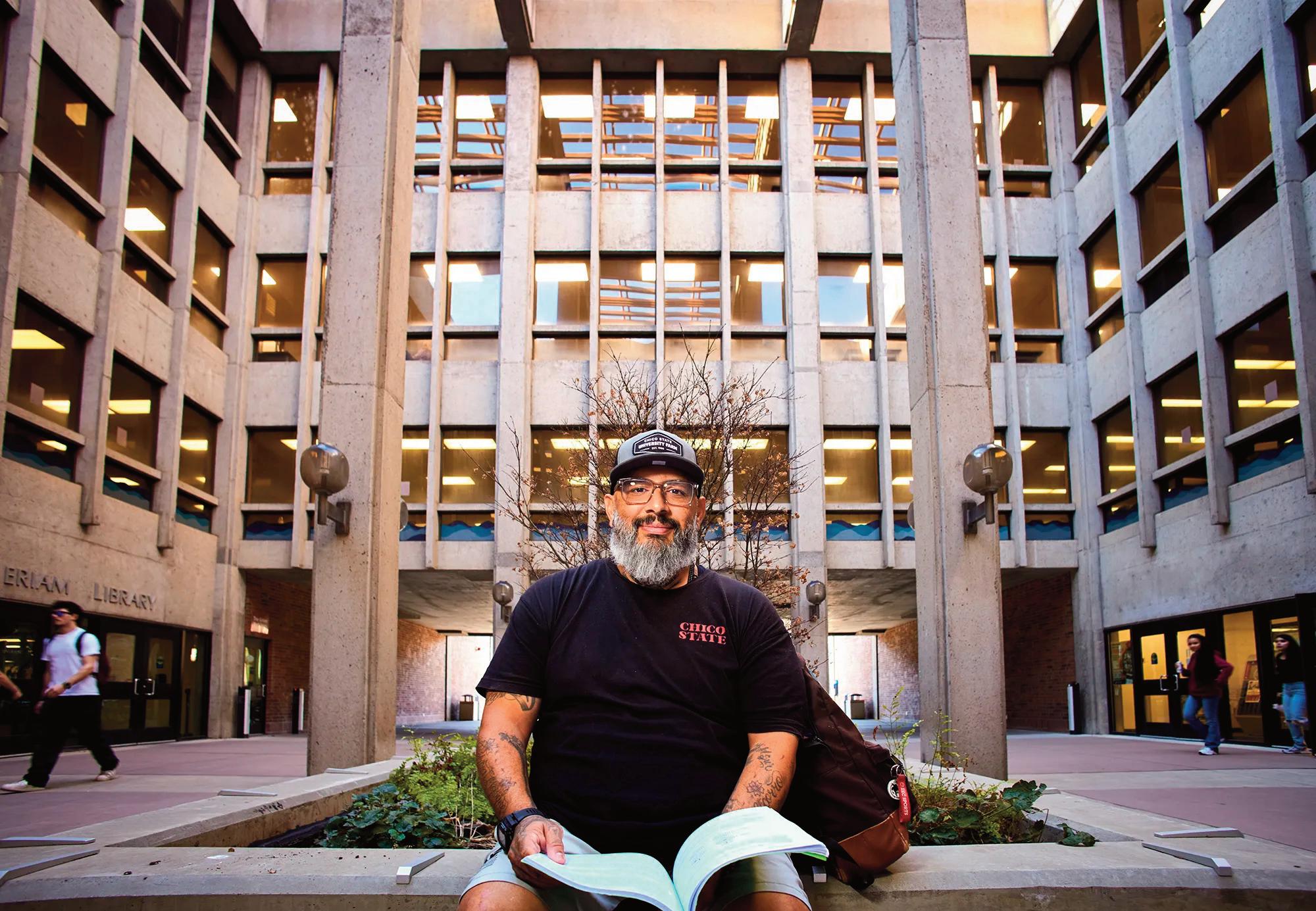
Nineteen hours after leaving Coachella Valley, Oscar Deleon Jr. stepped off a bus with four bags of clothes, $800, admission to Chico State University, and no idea where he was going to live or work. All he knew was that he was taking his agriculture professor’s advice from College of the Desert and transferring to a university to continue his education.
He checked into a hotel. Two days later, at orientation, he learned about the Rapid Rehousing program at Chico State. The program’s community partner, True North Housing Alliance, a nonprofit that addresses homelessness in Butte County, paid for Deleon’s hotel bill. The university transferred Deleon to student housing for the school year and helped him secure financial aid to cover most of the cost.
“When I needed somewhere to go, they were willing to help me out, no questions asked. ‘Let’s get you situated,’ you know? You don’t forget that kind of help,” Deleon said.
Since the program launched in 2020, the College Focused Rapid Rehousing program has helped over 9,000 students facing housing insecurity or homelessness. Through partnering with local community-based organizations, Rapid Rehousing provides students with emergency housing, rental subsidies, case management and advising.
Rapid Rehousing operates at all 10 University of California campuses, 25 community colleges and 18 California State University campuses. Students in the program reported higher GPAs and improved mental health and nutrition, according to an evaluation of the program in 2025 by the Center for Equitable Higher Education at Cal State Long Beach. As of 2025, California spends $31 million annually on Rapid Rehousing programs in higher education.
The governor’s proposed budget for 202627, released in January, also includes $31 million.
Following the 2018 Camp Fire in Northern California, Butte County lost over a third of its housing stock, impacting students at Chico State.
“A whole town was lost of housing,” said Emma Jewett, the senior basic needs case manager at Chico State. “Our students are often struggling to get housing and find sustainable housing as it is, because they don’t have the qualifying factors, such as making three times the rent.”
But students everywhere were having a hard time finding affordable housing. In 2018, 10.9% of 27,805 students surveyed across the Cal State system reported they had experienced homelessness in a Student Basic Needs survey commissioned by the chancellor’s office. In a separate survey of California community college students, 19% of nearly 40,000 respondents had experienced homelessness between 2016 and 2018.
Meanwhile, off-campus housing costs across the state increased by more than 30% between 2018 and 2022, according to California Competes, a research organization focused on higher education and workforce issues.
In response, the state Legislature included $10 million for a rapid rehousing pilot program in the state Budget Act of 2019, with $3.5 million going to UCs and $6.5 million to Cal States. Universities applied within their systems to receive grants to participate.
Chico State was one of the Cal State campuses initially awarded funds in 2020, alongside Long Beach, Pomona, Sacramento, San Diego, San Francisco, and San José. The state expanded the program to include Northridge in 2021. All UC campuses participated in the pilot as well.
Rapid Rehousing felt like a “support system,” said Eli Reyneveld, a third-year communications major and soccer player at Sacramento State. He didn’t always want to be a student athlete, but after playing soccer at Modesto Junior College, the opportunity presented itself. “I scored a lot of goals,” he recalled.
When he received a Division I scholarship offer to cover his tuition at Sacramento State starting in spring 2024, he had just two days to accept. He worried whether he would be able to afford moving from his parents’ house in Modesto.
“I wasn’t ready to move anywhere, but I had to just take the jump,” Reyneveld said.
At first, Reyneveld moved into a house with five guys on the soccer team. He slept in the kitchen and paid $550 a month for his share of the rent.
It felt far from a home. It was hard for Reyneveld to get enough sleep, and there were tensions among his housemates. He moved into a different house shared by more of his teammates, where he slept on a mattress in the garage for $800 a month. A full night of rest was just as hard to get as the sound of cars never stopped.
Being a student athlete required Reyneveld to juggle school, traveling for games, training and maintaining a healthy diet. But his living conditions made it hard to eat and sleep consistently.
He avoided telling trainers and staff about his living situation, recalling being “too prideful to tell anybody,” until his athletic performance deteriorated. By September 2024, his trainer pulled him aside at practice and Reyneveld told him everything.
That week, Reyneveld met with Basic Needs Center staff and, that night, he was transferred into a hotel that Rapid Rehousing fully covered. Three days later, he moved into student housing where he
would pay just $500 a month for five months, meals included.
“As soon as I got moved into a room, I think my coach and trainer could tell you, like, my performance is 180. I was a whole new player,” Reyneveld said.
Reyneveld moved out of student housing in February into his own apartment, where Rapid Rehousing is now paying him $200 a month for five months to help with his rent.
“I was about to turn down the scholarship to a D1 because I didn’t have the necessary means to move, but I just took a risk and (it) ended up working out because people are helping me,” he said.
All campuses with Rapid Rehousing partner with community organizations that connect students to case managers, housing assistance, and academic and mental health support.
Long-term case management makes a big difference, according to Jessica Wolin, a public health lecturer at San Francisco State, who led the Cal State Long Beach evaluation of the program. “Our evaluation showed the more meaningful outcomes for students who are experiencing homelessness is through this longer term, higher touch, more holistic intervention,” Wolin said. “And those needs are not met with (just) an emergency voucher.
At Sacramento State, all students in the Rapid Rehousing program pay $500 per month toward their housing costs until they are ready for the next step. Other campuses, such as Chico State, determine students’ costs based on what they can afford. Oncampus teams also work with financial aid offices to incorporate emergency grants into students’ aid packages.
Read the full story at IECN.com or CalMatters.org
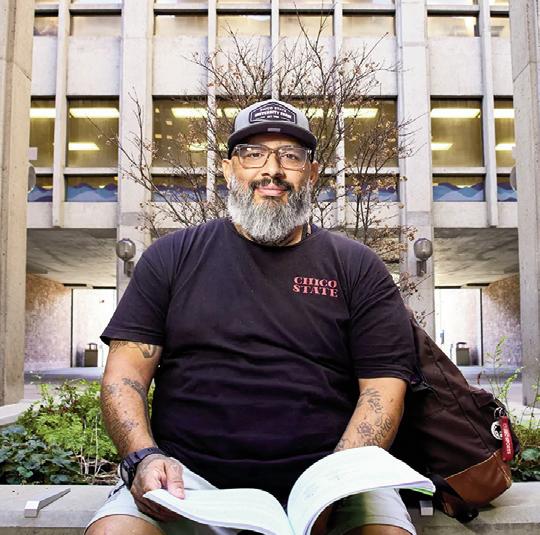
PHOTO SALVADOR OCHOA
Oscar Deleon Jr., a student and Rapid Rehousing beneficiary, sits outside the Meriam Library at Chico State in Chico on Feb. 5, 2026.
Fontana Radio Host Stranded in Jalisco Violence After Canceled Ontario Flight
Quintero
celed flights delayed his
By Manny Sandoval
AFontana radio host and Spanish-language media personality was stranded in western Mexico as escalating violence in Jalisco disrupted highways, triggered flight cancellations to Ontario International Airport and left travelers scrambling for a way home.
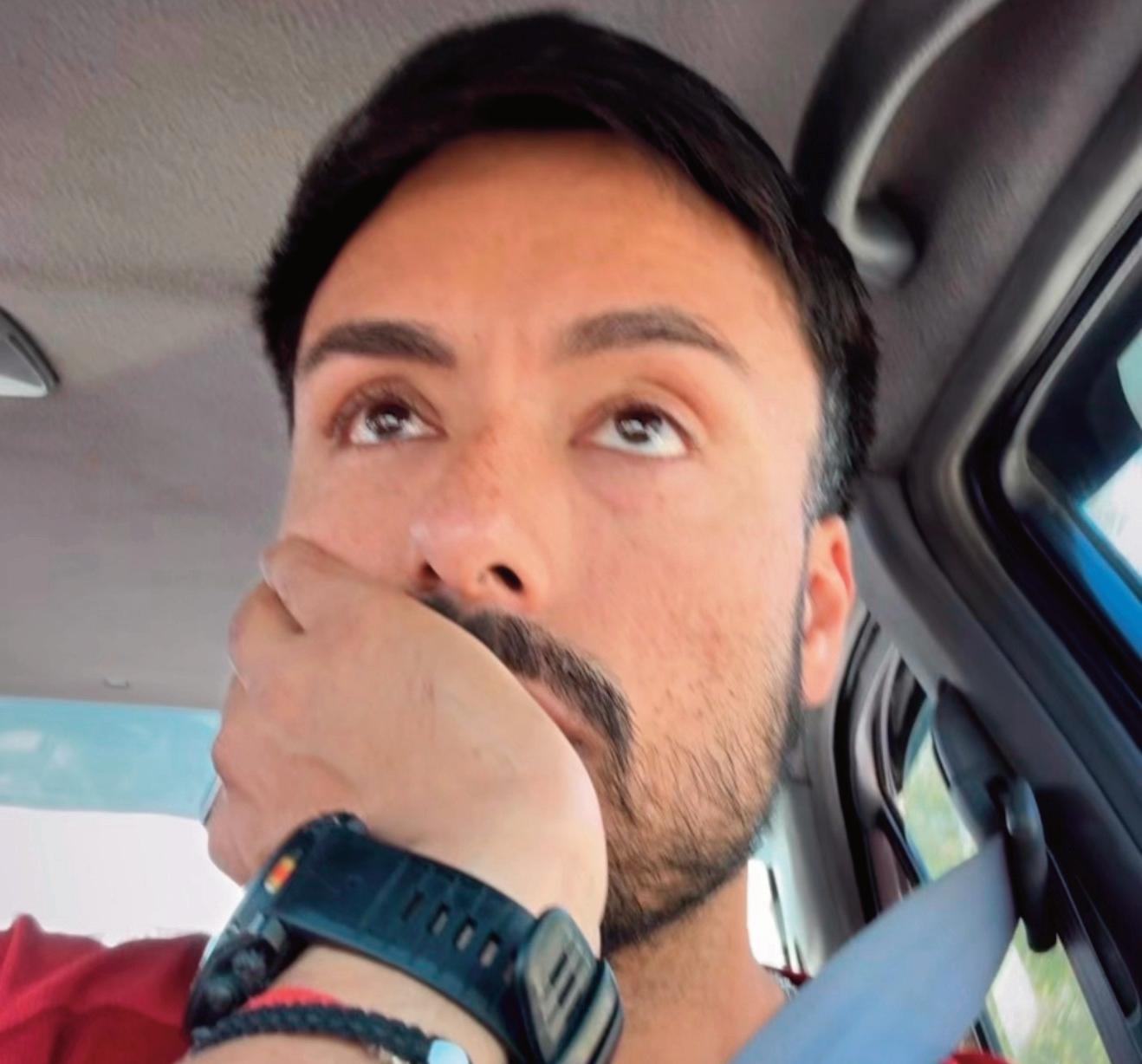
José Quintero — host of “La Vale Show” on CALI 93.9, Los Angeles’ largest reggaeton radio station, and creator of the Echale Podcast — had traveled to Mexico for business and family. He was scheduled to return to the Inland Empire on Sunday evening, Feb. 22.
“I was supposed to land back home Sunday evening at 8 PM at Ontario Airport,” Quintero said.
Instead, his return unraveled as violent unrest spread across Jalisco following the reported killing of cartel leader Nemesio “El Mencho” Oseguera Cervantes on the morning of Feb. 22.
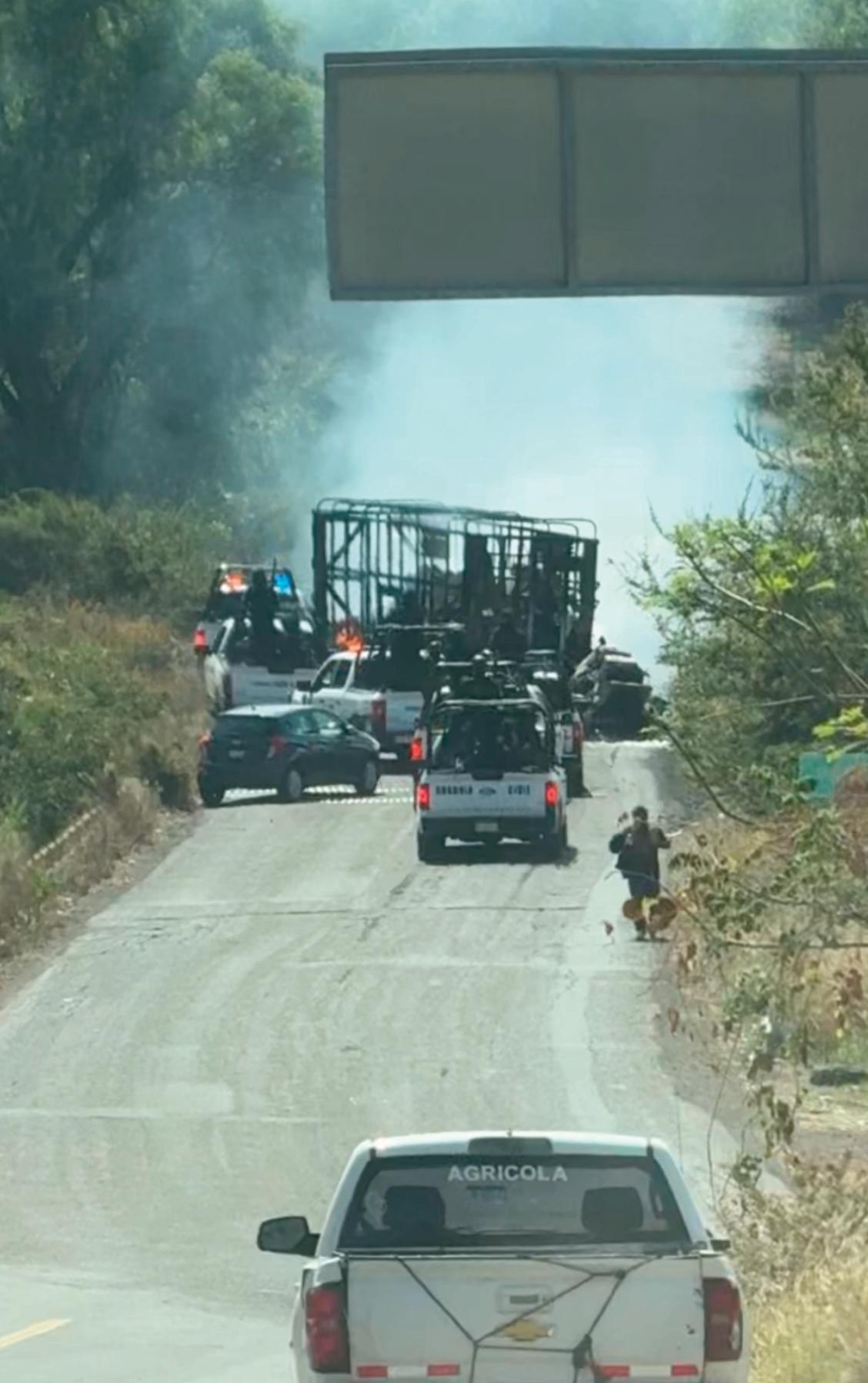
Authorities reported coordinated road blockades, buses and commercial trucks set on fire, targeted commercial properties and efforts to disrupt major transportation corridors in and around Guadalajara.
At least two Ontario International Airport flights to Guadalajara were canceled: Volaris VOI1863 (11:02 p.m., Feb. 22) and VOI1861 (12:42 a.m., Feb. 23). Guadalajara is Ontario’s second-busiest international route, with 217,587 passengers in 2025.
As of the afternoon of Feb. 23, 2026, The Associated Press reported that at least 73 people had died across Mexico in the attempt to capture “El Mencho” and the violent aftermath.
Quintero said travel on the
ground became dangerous almost immediately.
“Saturday morning, I was in Tingüindin, Michoacan, but I had to spend the night in Ocotlán on Sunday because I couldn’t get to the airport — everything was blocked,” he said.
He described the atmosphere as chaotic and frightening.
“It was horror — gun shots at night, buses, big rigs, vehicles on fire,” Quintero said. “Motorists who seemed to work for the cartel were roaming the area and being vigilant.”
Driving between Michoacán and Jalisco, he said he encountered widespread road closures.
“We were very close. Driving from Michoacan to Jalisco, there were over 12 blocked roads that we had to go around. We saw over 20 vehicles burned,” he said.
Beyond the violence itself, Quintero said the struggle to rebook travel compounded the crisis.
“It has been a nightmare with Volaris,” he said. “Our flight was supposed to leave at 6:55 PM Sunday afternoon (Feb. 22), and they didn’t tell us it was canceled until 5 PM.”
He said attempts to rebook online repeatedly failed.
“When trying to book another flight, I kept getting errors,” he said.
Quintero said he contacted the airline’s WhatsApp support and later called customer service.
“I reached out to Volaris’ WhatsApp, and they said they were going to take 30 minutes to get back to me — it took hours,” he said. “I called and waited one hour the first time, and then they hung
up. The second time, the same thing happened.”
On his third attempt the following morning, he briefly reached a representative.
“Third time around 7 AM, I got through to someone after 30 minutes. They tried to help and said the only flights available were until Thursday, and then the call dropped,” Quintero said.
Rather than wait several more days, he purchased a one-way ticket to Los Angeles through Aeroméxico.
“I ended up coming to the airport and booking a flight to Los Angeles via Aeromexico, which has been so easy to work with and cheap,” he said. “If I wanted a one-way ticket from Guadalajara (GDL) to Ontario, it was going to cost $1,200 versus Aeromexico at $400. I noticed the price hike as soon as this incident happened.”
At the airport, he said Volaris counters were overwhelmed.
“When I got to the airport, Volaris lines were immensely long. Thank God I don’t have to fly with them,” he said.
Quintero said locals described the violence as unusually prolonged and widespread.
“From locals, they said it’s the first time they’ve experienced it like this,” he said. “They’ve experienced similar issues before, but those dissolved within hours. This is the first time they’ve felt it worsen to where vibrant cities and towns become ghost towns.”
As of 5:05 p.m. Pacific time Feb. 23, Quintero said he was boarded on his Aeroméxico flight to Los Angeles and waiting to take off — ending what he described as a tense and uncertain journey home.
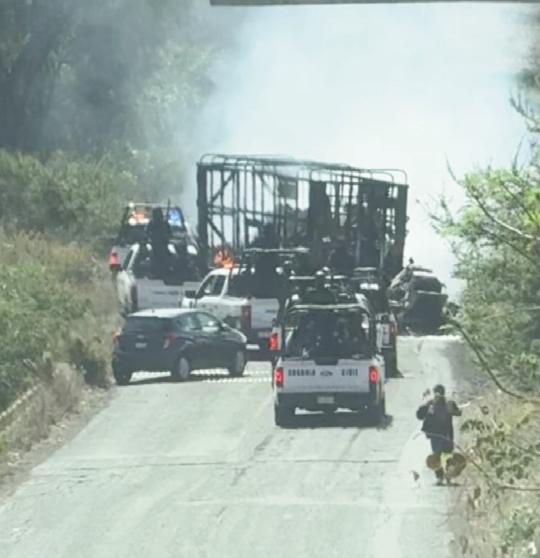
PHOTO COURTESY JOSE QUINTERO
Smoke rises from a burning vehicle blocking a roadway in Jalisco, Mexico, as Fontana resident José Quintero travels toward the airport amid unrest on Feb. 23, 2026.
PHOTO COURTESY JOSE QUINTERO
José
travels toward the airport in Jalisco on the afternoon of Feb. 23 after violent unrest and can-
return to the Inland Empire.
¡APLIQUE AHORA! VALENCIA GROVE II APARTMENTOS
La Autoridad de Vivienda del Condado de San Bernardino (HACSB) está aceptando solicitudes para la lista de espera de Valencia Grove II para dos (2) recamaras Valencia Grove II es una comunidad de nueva construcción ubicada en 103 E. Sharon Rd, Redlands, CA 92374. HACSB busca solicitantes de tres (3) a cuatro (4) personas que cumplan con los requisitos de ingresos mínimos y máximos indicados.
La asistencia de alquiler para esta comunidad se determina según el tamaño de la unidad y los límites de ingresos mínimos y máximos establecidos. Las cantidades de renta se determinan conforme a las guías de asequibilidad y varían según el número de recamaras, como se muestran en la siguiente tabla. El ingreso bruto anual total del hogar debe encontrarse dentro de los limites mínimos y máximos correspondientes al tamaño del hogar.
Numero de Recamaras
Renta del Inquilino* Ingreso Minimo* Ingreso Maximo*
2 $1,762
¿Cómo puedo presentar mi solicitud?
$52,860
$80 550 (3 personas)
$89,500 (4 personas)
HACSB aceptara solicitudes en línea hasta nuevo aviso. Para solicitar o para más información visite nuestro sitio de internet en www.hacsb.com
¿Quién es elegible para solicitar?
Todos son invitados a presentar una solicitud. Los solicitantes serán colocados en la lista de espera según la fecha y hora en que se reciba la solicitud, junto con cualquier preferencia aplicable. El tamaño de la unidad se asignara con base en dos (2) personas por recamara, independientemente de la edad, género o relación.
Todos los adultos del hogar estarán sujetos a una revisión antecedentes penales y verificación de crédito. Los ingresos del hogar se revisarán cuando los solicitantes sean seleccionados de la lista de espera, y la elegibilidad final se determinara antes de que se ofrezca una unidad.
Acomodación razonable: Si usted o un miembro de su familia tiene una discapacidad y piensa que podría q uerer o necesitar una acomodación razonable, puede pedirla en cualquier momento.
Asistencia lingüística: HACSB ofrece asistencia idiomática gratis. Para ayuda, por favor llámenos al (909) 890-9533.
AUDIENCIA PÚBLICA PLANIFICADA PARA EL BORRADOR DEL PLAN DE ADMINISTRACIÓN DE AGUAS URBANAS DE 2025 Y BORRADOR DEL PLAN DE CONTINGENCIA POR FALTA DE AGUA DE 2025
The Metropolitan Water District of Southern California (Metropolitan) llevará a cabo una audiencia pública el lunes 13 de abril de 2026 para recibir comentarios sobre su borrador del Plan de Administración de Aguas Urbanas (UWMP por sus siglas en inglés) de 2025 y su borrador del Plan de Contingencia por Falta de Agua (WSCP, por sus siglas en inglés) de 2025 La audiencia se llevará a cabo durante la reunión del One Water and Adaptation Committee de Metropolitan El lugar de la reunión es: Sede de Metropolitan 700 N Alameda St, Los Angeles, CA 90012 Reunión del One Water and Adaptation Committee
Lunes 13 de abril de 2026 a las 12:30 p m (hora prevista; confirmar 7 días antes) La reunión del One Water and Adaptation Committee se transmitirá en vivo, se grabará y estará disponible aquí: https://mwdh2o legistar co m/Calendar aspx (Consulte este sitio web para la hora definitiva de la
Audiencia Pública) El plan UWMP demuestra la confiabilidad del suministro de agua a largo plazo de Metropolitan en años normales años secos y años secos múltiples y se actualiza cada cinco años para cumplir con ley estatal El plan WSCP detalla los planes de Metropolitan para responder a condiciones actuales de falta de agua en cumplimiento con ley estatal Los borradores de los planes UWMP y WSCP están disponible en el sitio
web de Metropolitan: https://www mwdh2o com/ how-we-plan Animamos al público que aporte sus comentarios cuáles serán considerados antes de finalizar los planes UWMP y WSCP Metropolitan también aceptará comentarios por escrito hasta el 13 de abril de 2026 Para hacer un comentario u obtener más información sobre el plan UWMP y el plan WSCP, por favor comuníquese con David Sumi del Grupo de Administración de Recursos Hídricos de Metropolitan por correo electrónico a uwmp2025@mwdh2o com
CNS-4002570# PUBLISHED EL CHICANO 2/26, 3/5/26 E-188
Notice is hereby given pursuant to sections 3071 and 3072 of the Civil Code of the State of California the undersigned will sell the following vehicles at lien sale at said address(s) at said time(s) on: Monday March 9 2026 to wit: YEAR MAKE VIN LICENSE STATE 14 HUYN
3H3V532CXET182173 24 VANG
5V8VC5328RM416405 To be sold by: Wilson Towing 2424 E 3rd St San Bernardino San Bernardino County, CA 92410 (10:00 AM) YEAR MAKE VIN LICENSE STATE 14 FORD
1 F M 5 K 7 D 8 X E G B 3 7 3 5 3 8LAE820 CA To be sold by: A & G Towing, 591 E 9th Street, San Bernardino, San Bernardino County CA 92410 (10:00 AM)
Said sale is for the purpose of satisfying lien of the above signed for towing storage, labor, materials and lien charges, together with costs of advertising, and expenses of sale
LienTek Solutions Inc P O Box 443 Bonita CA 91908
CNS-4014604# PUBLISHED EL CHICANO 2/26/26 E-191
NOTICE OF PUBLICATION RE: GUARDIANSHIP OF A MINOR NOAH RICHARD SALVADOR
In re the matter of: NOAH RICHARD SALVADOR S1400 GC 202500329
A Petition for GUARDIANSHIP OF A MINOR had been filed in the Superior Court, Yuma County, Arizona If RICHARD SALVADOR and/or --- or any party objects to this Petition for Guardianship an objection shall be filed with the Clerk of Superior Court
This matter is set for hearing on MARCH 30 2026 at 1:30 pm before the Honorable JUDGE REEVES, 250 W 2nd Street, Yuma, AZ 85364
Date: February 16th, 2026 /s/ Dalila Goodrich Petitioner
Published El Chicano 2/26/26 3/5/26 3/12/26 E-192
HOUSING AUTHORITY OF THE COUNTY OF SAN BERNARDINO NOTICE FOR “Request for Proposal RFP PC1453 Janitorial Services HACSB CONTACT PERSON: Qiana Sipe Procurement Housing Authority of San Bernardino 715 E Brier Drive, San Bernardino CA 92408 procurement@hacsb com HOW TO OBTAIN BID DOCS: 1 Access www hacsb com 2 Click onto the “Do Business With Us tab 3 Click on the “Planet Bids link to download and submit Request for Proposal and instructions PROPOSAL SUBMITALL RETURN: Bids submitted through Planet Bids website P R O P O S A L SUBMISSION DATE: April 13 2026 @ 2PM PST
CNS-4015752# PUBLISHED EL CHICANO 2/26, 3/5/26 E-190
Publish your Fictitious Business Name Statement for only $45!
Fee includes 4-week publication and filing of proof with county at the end of publication email your FBN form to IECN at: iecnlegals@gmail com
prices include filing of proof with court or county at the end of publication (per legal requirements)
and reviewed
by
# 4015999
Fictitious Business Name Statement FBN20260000485 Statement filed with the County Clerk of San Bernardino 01/23/2026 The fo low ng person(s) is (are) doing business as: JOY DREAMERS 6128 ASHLEY CT CHINO CA 91710 County of
ness name n violation of the rights of another under federal, state, or common law (see Section 14411 Et Seq , Business and Professions Code) Published 2/5 2/12 2/19 2/26/26 Published in Colton Courier C-780 Fictitious Business Name Statement FBN20260001026 Statement filed with the County Clerk of San Bernardino 02/10/2026 The following person(s) is (are) do ng business as: MILESTONES EDUCATION 8191 CALABASH AVE SPC 3, FONTANA, CA 92335 County of Principal P ace of Business: SAN BERNARDINO Business mailing address: 8191 CALABASH AVE SPC 3 FONTANA CA 92335 Name: MILESTONES TUTORING & ENRICHMENT LLC 8191 CALABASH AVE SPC 3 FONTANA, CA 92335 Inc /Org /Reg No : B20260028077 Th s business is/was conducted by (a/an): LIMITED LIABILITY COMPANY Reg strant commenced to transact business under the fict tious business name or names listed above on JAN 23, 2026 By signing, I declare that al information in this statement s true and correct A registrant who declares as true any material matter pursuant to Sect on 17913 of the Business and Profess ons Code that the registrant knows to be fa se s guilty of a misdemeanor punishab e by a fine not to exceed one thousand dollars ($1,000) /s/ DENISE A CASTILLO, MANAGING MEMBER Notice- In accordance with subd v sion (a) of Section 17920 a fictitious name statement generally expires at the end of five years from the date on wh ch it was filed in the Office of the County C erk except, as provided in Subdivision (b) of Section 17920 where it expires 40 days after any change n the facts set forth in the statement pursuant to Section 17913 other than a change in the residence address of a registered owner A new f ct tious business name statement must be f led before the exp ration The f ling of this statement does not of itself authorize the use in this state of a fictitious business name n violat on of the rights of another under federal state or common law (see Section 14411 Et Seq Business and Professions Code) Published 2/19,2/26,3/5,3/12/26 Published in Colton Courier C-781 Fictitious Business Name Statement FBN20260000032 Statement filed with the County Clerk of San Bernardino 01/05/2026 The following person(s) is (are) do ng business as: VIGOROUS LIFESTYLE APPAREL, VGRS APPAREL 7517 GUTHRIE STREET SAN BERNARDINO CA 92410 County of Principal P ace of Business: SAN BERNARDINO Business mailing address: 25745 BARTON ROAD 619 LOMA LINDA, CA 92354 Name: AL A VERDUGO Th s business is/was conducted by (a/an): INDIVIDUAL Reg strant commenced to transact business under the fict tious business name or names listed above on JAN 05 2026 By signing I declare that al information in this statement s true and correct A registrant who declares
Petitioner or Attorney: Michael David Pina Super or Court of Cal fornia County of San Bernardino 247 W Third St San Bernardino CA 92401 Civil PETITION OF: MICHAEL DAVID PINA FOR CHANGE OF NAME ORDER TO SHOW CAUSE - CHANGE OF NAME Case Number: CIV SB 2603628 TO ALL INTERESTED
PERSONS: Petitioner: MICHAEL DAVID PINA filed a petition with this court for a decree changing names as follows: Present name: MICHAEL DAVID PINA to Proposed name: MICHAEL DAVID TORRES THE COURT ORDERS that all persons interested in this matter appear before this court at the hearing indicated below to show cause, if any, why the petition for change of name should not be granted Any person objecting to the name changes described above must file a written object on that includes the reasons for the objection at least two court days before the matter is scheduled to be heard and must appear at the hearing to show cause why the petition should not be granted If no written objection is timely filed, the court may grant the petition w thout a hearing NOTICE OF HEARING
Date: 4/03/2026 Time: 9:00 am Dept: S24
The address of the court is: same as noted above (To appear remotely, check in advance of the hearing for information about how to do so on the court’s website To find your court’s website go to www courts ca gov/findmy-court htm ) A copy of this Order to Show Cause must be published at least once each week for four successive weeks before the date set for hearing on the petition in a newspaper of general circulation, printed in this county: COLTON COURIER
Dated: FEB 23 2026
GILBERT G OCHOA Judge of the Superior Court Published Colton Courier 2/26/26 3/5/26 3/12/26 3/19/26 C-784
Highland, San Bernardino YMCA Near Scholarship Goals Ensuring No One Is Turned Away — Give by March 4
By Manny Sandoval
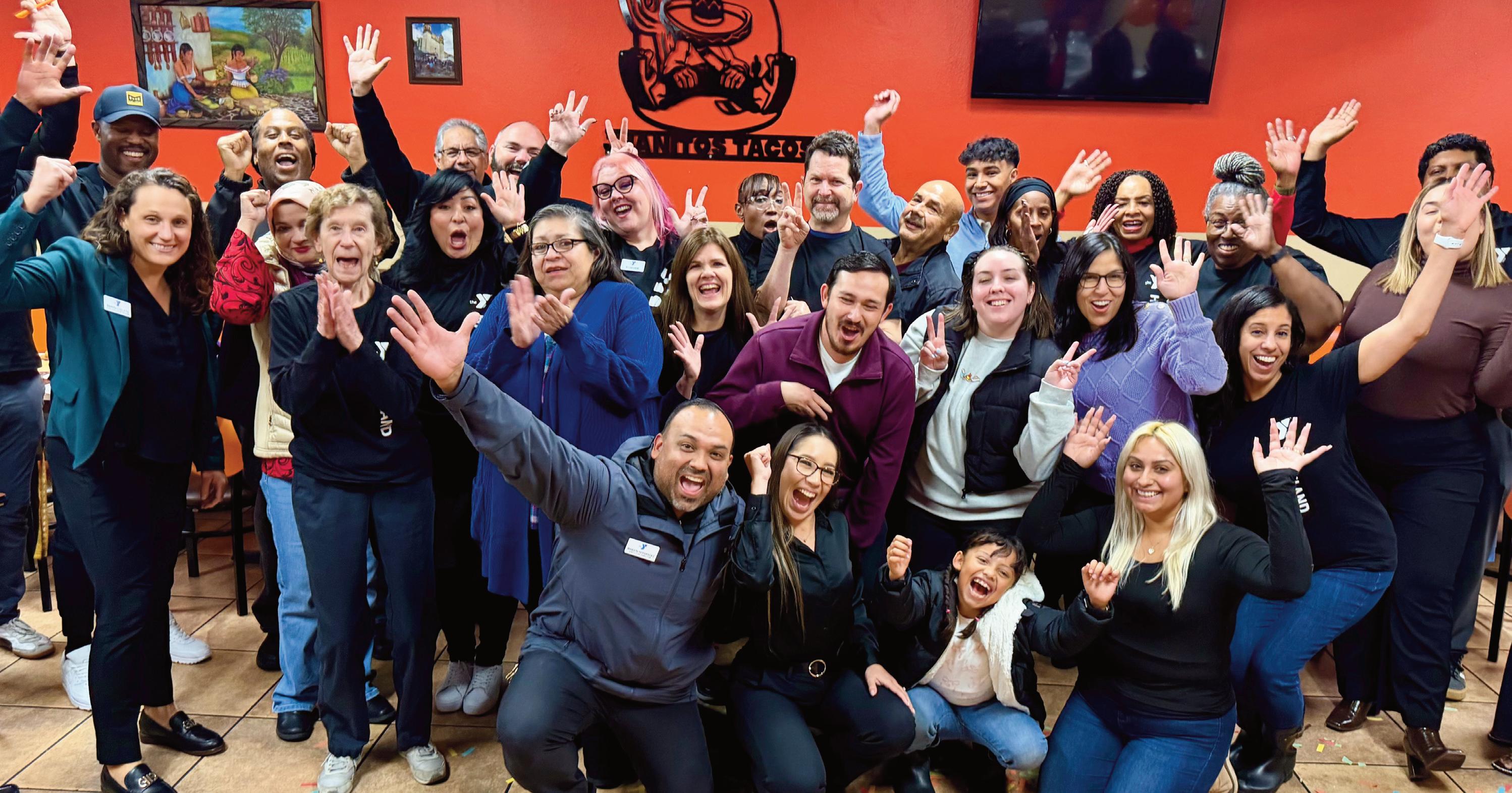
On Feb. 19, the YMCA of the East Valley’s Highland and San Bernardino branches gathered ambassadors, donors and members for their second Report Party of the year — a campaign milestone event focused on updating supporters about scholarship fundraising efforts aimed at ensuring no one is turned away for inability to pay.
Each year, both branches launch community campaigns to fund scholarships so that when a child, family or senior walks through their doors without the means to afford a membership, financial assistance covers the cost.
In Highland, that impact reaches a significant portion of the community.
“We have about 3,000 memberships and from those 3,000 members, one out of every three memberships are through our scholarship,” said Marvin Hernandez, executive director of the Highland Family YMCA.
Hernandez said scholarships are about more than access to facilities — they help shape confidence, relationships and belonging.
“It’s all about being able to have a connection, building relationships, and being able to have self esteem,” he said. “Without the scholarships they wouldn’t be able to have that. It’s a creation of what the next generation is going to be all about.”
Without financial assistance, he said, some families would lose access to programs that provide structure, friendships and positive outlets.
“It’s unfortunate that funds are not there for some families,” Hernandez said. “We are able to create those opportunities for them through our financial assistance program.”
The Feb. 19 event was held at Juanito's Tacos, a family-owned Highland restaurant that has supported the YMCA since before the COVID-19 pandemic. Hernandez said the restaurant will donate 20% of all sales on March 27 to the Highland branch’s scholarship campaign.
The evening also highlighted stories of long-term members whose lives have been shaped by the Y.
One Highland member, originally from Scotland, shared that she and her husband moved to the city 30 years ago without knowing anyone. Seeking connection, they joined the Highland YMCA to become part of the community. After her husband passed away three years ago, she found herself alone, with no nearby family. Remembering how the YMCA had once helped them build community, she rejoined — this time on her own.
Now an ambassador helping raise funds for 2026 scholarships, she said her goal is to ensure others who may not be able to afford a membership can still find connection and engagement through the Y, just as she did decades ago.
In San Bernardino, Executive Director Jennifer Lopez said meeting the scholarship goal ensures families can walk through the doors without fear of being turned away.
“Every person that comes through our door is not turned away for inability to pay,” Lopez said.
“This is how we’re able to help support families to get into swim lessons, into karate classes,” she said. “This is not just for youth, but even for our seniors who are taking silver sneakers or opening a membership to take a water aerobics class.”
At the event, a 10-year-old scholarship recipient, Josleen,
shared how she spends her time at the San Bernardino YMCA participating in gymnastics, swimming and other sports — a reflection, Lopez said, of the campaign’s broader mission.
“It really starts when we talk about impacting youth, cultivating the next generation,” Lopez said. “It really starts with the kids who are starting to become active, who are coming out of their comfort zone to take classes they’ve never taken before.”
Lopez said those early experiences can shape a child’s future. Growing up in San Bernardino, she said programs like these shaped hers.
“It transformed my life growing up in San Bernardino,” she said. “It was a program like this that allowed me to understand that there’s good choices and better choices.”
Now leading the branch, Lopez said she sees herself in the children who come through the doors.
“Any youth and kid that walks through my door, that is me as a child,” she said. “If I’m investing in these kids in our community, they can end up running a whole branch like me.”
Both branches reported they are close to reaching their scholarship fundraising goals. Donations will be accepted through March 4, 2026, at ymcaeastvalley.org/give. Supporters may also contribute in person at either branch and designate their gift for the scholarship program.
“We’re a close niche community,” Hernandez said. “Every single person that lives in this community is about wanting to help others.”
Lopez echoed that gratitude. “Thank you so much,” she said. “Without you, none of this would be possible.”
PHOTO MANNY SANDOVAL
YMCA of the East Valley ambassadors, donors and members celebrate progress toward scholarship goals Feb. 19 at Juanito’s Tacos in Highland.
PHOTO MANNY SANDOVAL
San Bernardino Family YMCA Executive Director Jennifer Lopez and San Bernardino Y Member Jaslenn, a scholarship recipient, popping confetti after announcing how close they are to reaching their donation goal.