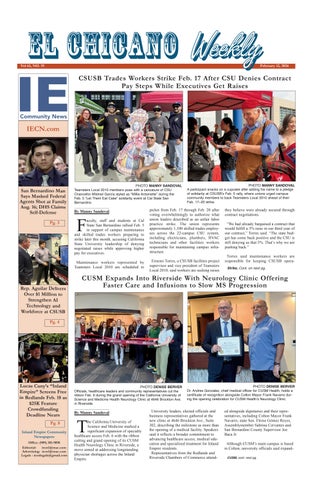
State San Bernardino rallied Feb. 5 in support of campus maintenance and skilled trades workers preparing to strike later this month, accusing California State University leadership of denying negotiated raises while approving higher pay for executives.
Maintenance workers represented by Teamsters Local 2010 are scheduled to
picket from Feb. 17 through Feb. 20 after voting overwhelmingly to authorize what union leaders described as an unfair labor practice strike. The union represents approximately 1,100 skilled trades employees across the 22-campus CSU system, including electricians, plumbers, HVAC technicians and other facilities workers responsible for maintaining campus infrastructure.
Ernesto Torres, a CSUSB facilities project supervisor and vice president of Teamsters Local 2010, said workers are seeking raises
By Manny Sandoval
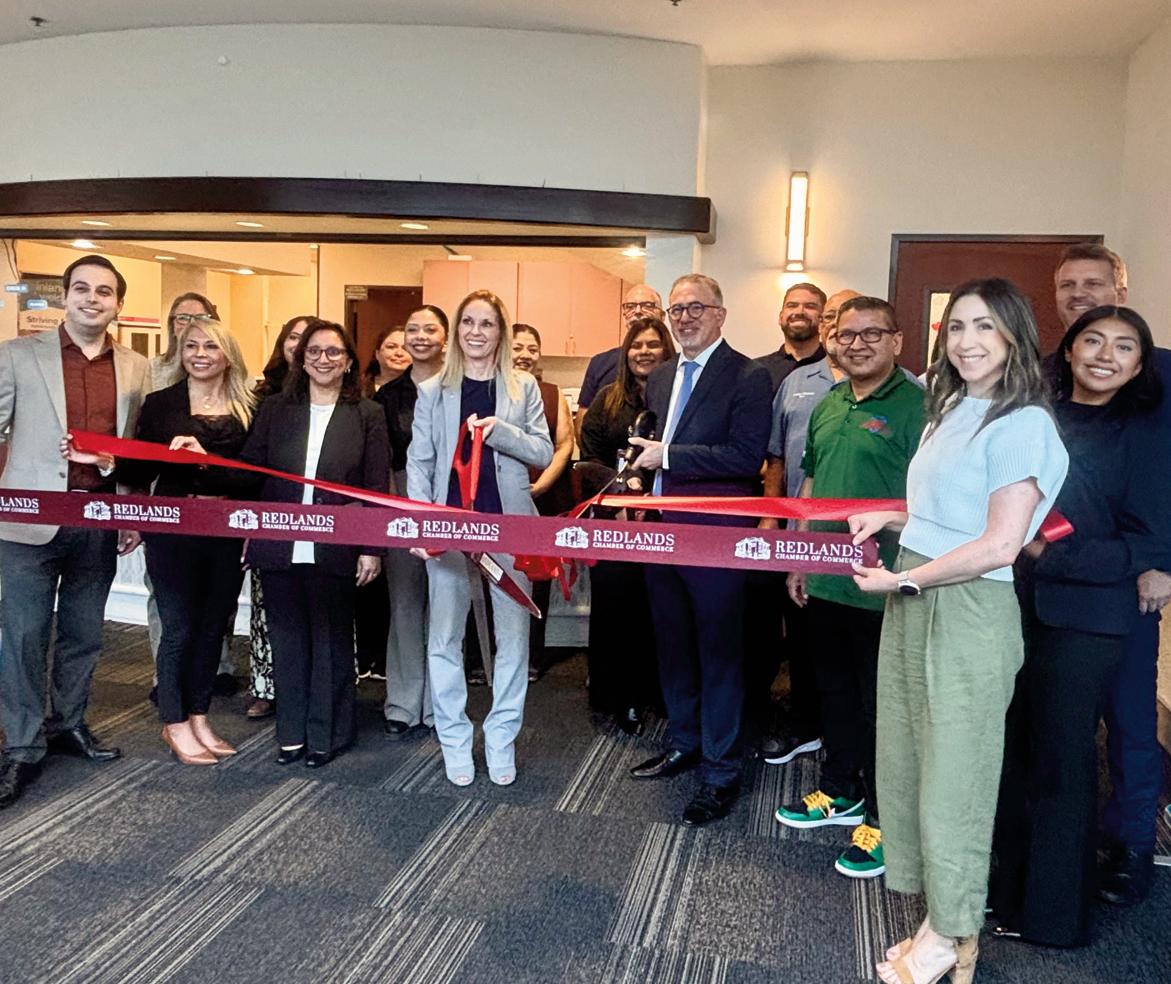
The California University of Science and Medicine marked a significant expansion of specialty healthcare access Feb. 6 with the ribbon cutting and grand opening of its CUSM Health Neurology Clinic in Riverside, a move aimed at addressing longstanding physician shortages across the Inland Empire.
they believe were already secured through contract negotiations.
“We had already bargained a contract that would fulfill a 3% raise in our third year of our contract,” Torres said. “The state budget has come back positive and the CSU is still denying us that 3%. That’s why we are pushing back.”
Torres said maintenance workers are responsible for keeping CSUSB operaStrike, Cont. on next pg.
University leaders, elected officials and business representatives gathered at the new clinic at 4646 Brockton Ave., Suite 302, describing the milestone as more than the opening of a medical facility. Speakers said it reflects a broader commitment to advancing healthcare access, medical education and specialized treatment for Inland Empire residents. Representatives from the Redlands and Riverside Chambers of Commerce attend-
ed alongside dignitaries and their representatives, including Colton Mayor Frank Navarro, state Sen. Eloise Gómez Reyes, Assemblymember Sabrina Cervantes and San Bernardino County Supervisor Joe Baca Jr.
Although CUSM’s main campus is based in Colton, university officials said expandCUSM, cont. next pg.
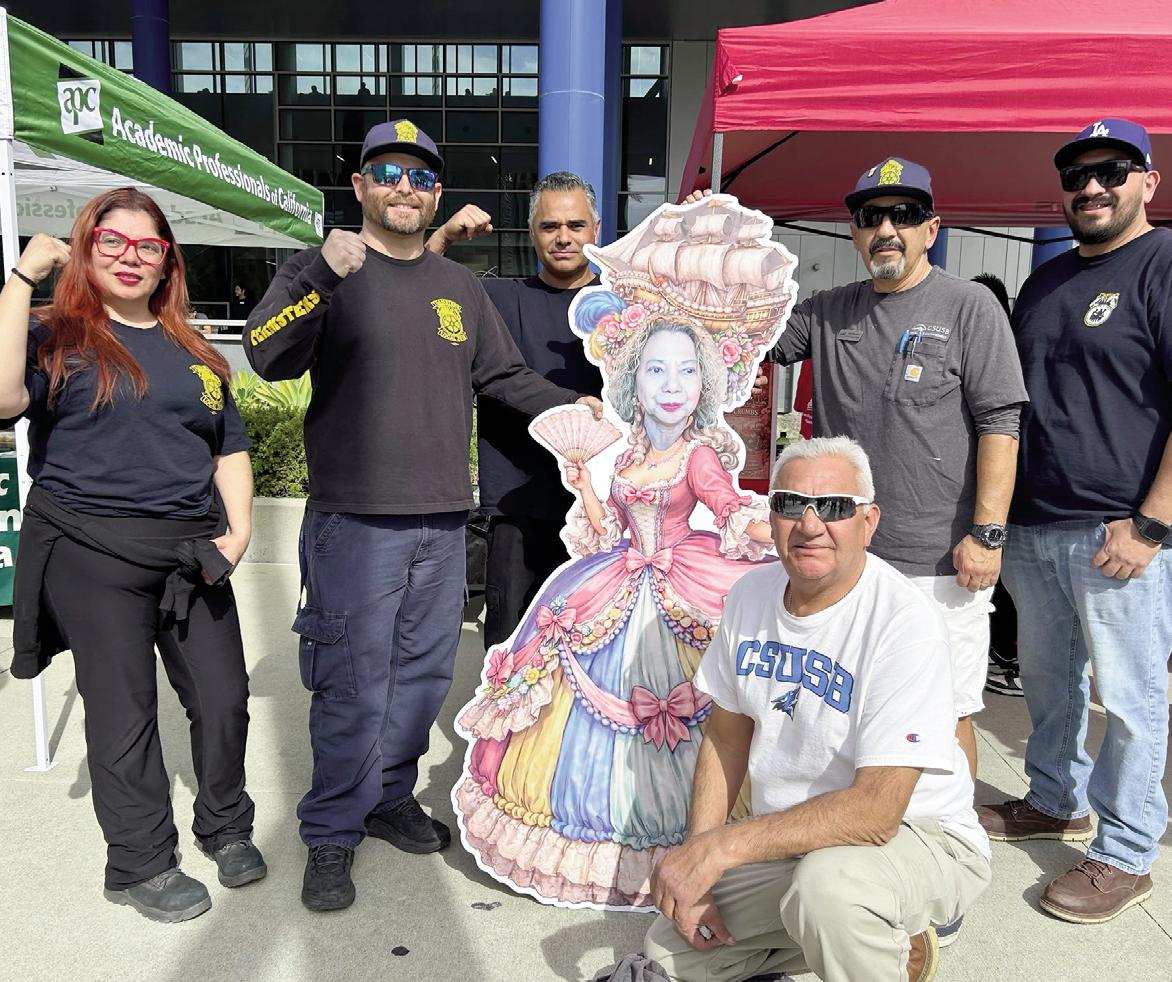
PHOTO MANNY SANDOVAL Teamsters Local 2010 members pose with a caricature of CSU Chancellor Mildred García styled as “Millie Antoinette” during the Feb. 5 “Let Them Eat Cake” solidarity event at Cal State San Bernardino.
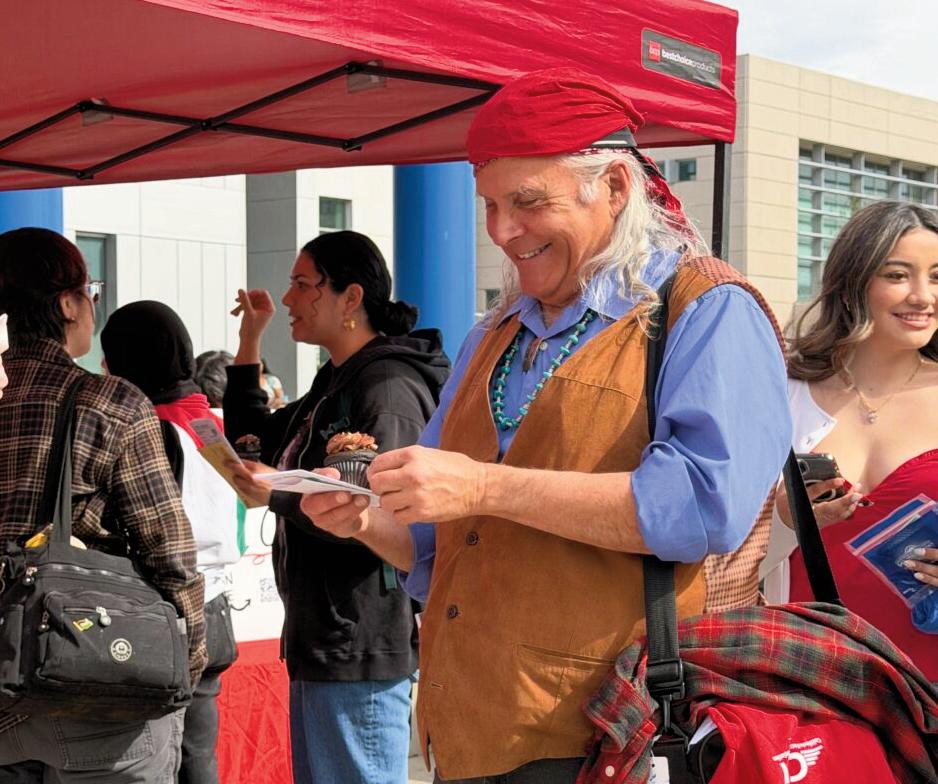
PHOTO MANNY SANDOVAL
A participant snacks on a cupcake after adding his name to a pledge of solidarity at CSUSB’s Feb. 5 rally, where unions urged campus community members to back Teamsters Local 2010 ahead of their Feb. 17–20 strike.
PHOTO DENISE BERVER
PHOTO DENISE BERVER
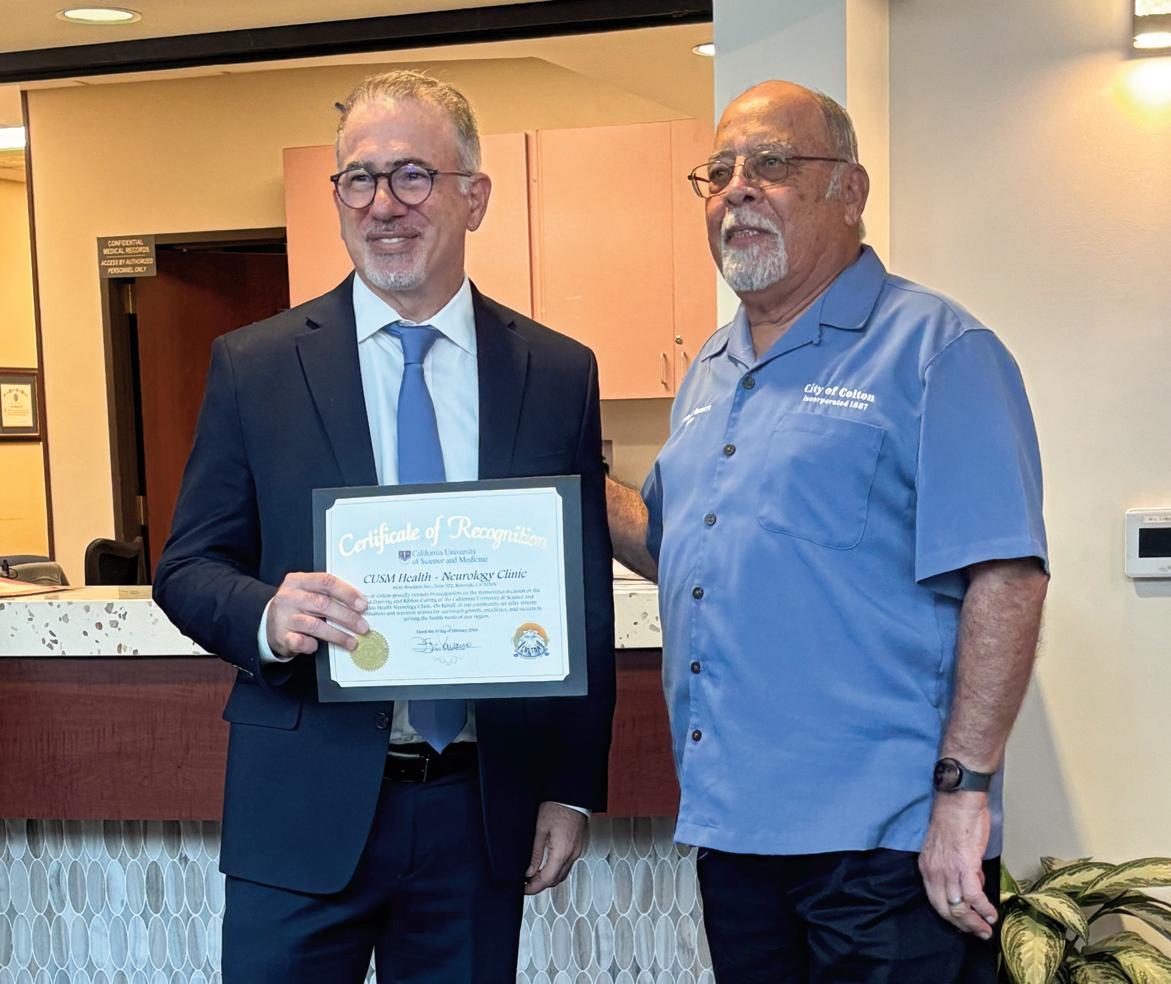
Dr. Andres Gonzalez, chief medical officer for CUSM Health, holds a certificate of recognition alongside Colton Mayor Frank Navarro during the opening celebration for CUSM Health’s Neurology Clinic.
Strike (cont.)
- tional despite limited staffing levels.
“We’re supporting a campus of 400 acres,” Torres said. “We have about 37 members for over 400 acres of land. We’re running on skeleton crews. Still fulfilling the job, still keeping our students safe and still doing our work.”
Maintenance workers perform essential functions necessary for campus safety and operations, he said.
“We have heating and air guys, we have electricians here on campus. We have plumbers,” Torres said. “We keep the lights on. We keep the air conditioning going. We keep the students safe. We keep the whole infrastructure and learning spaces safe for students.”
The “Let Them Eat Cake” event, held along Coyote Walk and organized by the California Faculty Association and Academic Professionals of California, drew attention to the contract dispute and encouraged faculty, staff and students to support the upcoming strike.
Union leaders said the dispute centers on negotiated salary increases that CSU leadership has declined to implement, offering instead a one-time payment.
“They had a negotiated contract with the CSU that Chancellor Mildred Garcia is not honoring,” said Thomas Corrigan, a communication and media faculty member at CSUSB and vice president of the California Faculty Association’s San Bernardino chapter. “What were supposed to be step increases for their contract, they’re not getting those raises, and instead they’re being offered a one-time 3% bonus, which might help in the short run but doesn’t help with longterm salary and affordability issues, doesn’t help with their retirement, it doesn’t help them build toward sustainability and security.”
Faculty leaders said the onetime payment does not provide lasting compensation gains because it does not increase base salaries or retirement benefits.
Tiffany Jones, professor of history and president of the California Faculty Association’s San Bernardino chapter, said the rally was intended to highlight what unions view as disparities between executive compensation and frontline worker pay.
“We have administrators who make massive amounts. Millie Garcia is our chancellor and she makes up to a million dollars a year,” Jones said. “And then we have workers who have negotiated pay increases that she is re-
fusing to give them. They are only offering a 3% bonus, which is not on top of your pay. It doesn’t actually increase your pay.”
Jones said faculty unions are standing in solidarity with maintenance workers ahead of the strike.
“All the unions have rejected that, and we are standing in solidarity with Teamsters 2010 in particular, who are going on strike from Feb. 17 to Feb. 20,” Jones said. “We are here just to say enough is enough and make sure you place the money back with the people who actually make the system work.”
Faculty leaders said maintenance workers’ responsibilities underscore their importance to daily campus operations.
“They’re the ones who keep the lights on. They keep us cool. They keep us warm. They make sure our restrooms are working and clean,” Jones said. “Without them, we could not do our jobs.”
Corrigan said the rally was organized to demonstrate faculty support for workers whose roles are critical to campus safety and infrastructure.
“We’re here at an event called ‘Let Them Eat Cake,’” Corrigan said. “They work on the facilities and maintenance side of the university — things like HVAC, elevators, those sorts of critical needs for campus safety and efficiency, so we’re here to support them.”
The rally featured cupcakes, informational materials and commitment cards encouraging attendees to support the strike and contact CSU leadership and elected officials.
“The public can send emails to Chancellor Mildred Garcia,” Torres said. “They can call their local senate office to keep funding us, to treat us with respect and dignity. We’re not being treated with respect and dignity. Yet we’re here to serve our students every day.”
Faculty leaders also encouraged students, staff and community members to show support during the strike.
“The public can support by talking about the conditions, the working conditions of the Teamsters,” Jones said. “They can not cross the picket line. They can come out and support on the picket line when they are picketing.”
The planned strike is expected to affect CSU campuses statewide and draw attention to ongoing labor tensions between university leadership and maintenance workers responsible for keeping facilities safe and operational.
CUSM (cont.)
- ing into Riverside was a strategic decision to reach more patients across both Riverside and San Bernardino counties, which face persistent gaps in specialty care availability.
Dr. Andres Gonzalez, chief medical officer for CUSM Health, said the clinic focuses on treating complex neurological conditions, particularly movement disorders such as Parkinson’s disease and multiple sclerosis.
“This is twofold,” Gonzalez said. “One is a clinic that provides two specialty services, both in neurology. One is movement disorders. Movement disorders specialize in things like Parkinson’s disease. And the second one is multiple sclerosis.”
The clinic provides treatment for a broad range of neurological conditions, including vascular and stroke-related disorders, epilepsy, memory disorders, neuromuscular diseases and multiple sclerosis. Services include infusion therapy for multiple sclerosis, therapeutic Botox treatments and deep brain stimulation for Parkinson’s disease.
Gonzalez said infusion therapy represents a major advancement in neurological treatment, offering the ability to slow disease progression rather than only addressing symptoms.
“An infusion is really a way to halt the progression of the disease, and that’s really rare in medicine,” Gonzalez said. “Most of the time in medicine, we treat conditions to keep them from getting bad, but usually it doesn’t change the progression of the disease. So with these infusions, we actually change the progression of the disease.”
The clinic currently operates with two neurologists, along with Gonzalez, a nurse practitioner, infusion nurse and administrative staff. The facility includes examination rooms and a dedicated infusion therapy room designed specifically for patients receiving advanced neurological treatments.
Healthcare leaders say expanding specialty care access in Riverside is critical, as the Inland Empire has significantly fewer physicians per capita compared with neighboring regions such as Los Angeles and Orange counties.
“When we compare the number of physicians
per 100,000 people, the density of physicians is half of what it is in LA County and Orange County,” Gonzalez said. “Specialty care usually has about 150 physicians per 100,000 people. In Riverside, it’s 75.”
Those shortages contribute to extended wait times for patients seeking neurological care, often delaying diagnosis and treatment. Gonzalez said the new clinic is designed to significantly reduce those delays.
“Most of the time, if you want to see a neurologist, it takes about three months to get an appointment,” Gonzalez said. “We can get you within one or two weeks.”
The clinic accepts a wide range of insurance providers, including Medicare, Medi-Cal, Inland Empire Health Plan and Blue Cross Blue Shield, expanding access for patients regardless of income or coverage type.
University officials said the clinic also aligns with CUSM’s core mission of training physicians who remain in the Inland Empire, helping address the region’s healthcare workforce shortage.
“We have a medical school right in their neighborhood, in Colton,” Gonzalez said. “The medical school is really focused on two things. One is to bring and create physicians that will stay in the community. The second component is to be able to offer specialty and primary care to our community.”
Gonzalez said limited access to healthcare remains one of the most significant barriers facing Inland Empire residents, particularly in specialty fields such as neurology.
“Ultimately, if you don’t have access to care, you’re not going to be healthy,” Gonzalez said. “The only way to really change the health and well-being of the community is by offering services that are accessible to the people.”
Although the clinic has already been treating patients for approximately nine months, officials held the ribbon cutting to formally mark its opening and recognize its role in expanding specialized care across the region.
CUSM leaders said the new neurology clinic represents an early step in broader efforts to strengthen healthcare infrastructure in the Inland Empire by improving access to advanced treatment while developing a pipeline of physicians committed to serving the community.
By Manny Sandoval
Whenseventh-grader Yanilen Johnson stepped up to the microphone at Rialto Unified School District’s Ethel Kucera Middle School’s first-ever spelling bee, she didn’t feel nervous — she felt ready.
“I wasn’t nervous,” Johnson said confidently. “I felt really amazing and great.”
Johnson claimed first place by correctly spelling the word “warlock,” becoming the school’s first spelling bee champion during the competition held Jan. 26. Fellow Kucera MS Student Jennifer Mateo earned second place after a strong showing, as students competed for the school title and a chance to advance to the San Bernardino County Superintendent of Schools’ Spelling Bee.
The inaugural spelling bee also showcased the academic focus, confidence, and student engagement that recently earned Kucera recognition as a 2026 California and National Schools to Watch honoree.
Both Johnson and Mateo will advance to the county’s Online Preliminary Round on Feb. 24–25, where students will complete an online assessment testing spelling and word meanings in context. The students are currently studying a
list of 450 words in preparation. Those who advance will move on to the county Spelling Bee Competition and Awards Ceremony on March 11.
Kucera Principal Jennifer Cuevas highlighted that the spelling bee embodies the innovative, student-centered approach integral to Kucera's recognition as a School to Watch.
This distinction is achieved by only 4% of the State's 7,200 middle schools annually, acknowledging a school's holistic method for developing the whole child. Key criteria for the award include academic rigor, social equity, responsiveness to the developmental needs of young adolescents, and a pervasive culture of innovation. The Coyotes will be recognized at a State Schools to Watch ceremony and then again at the National award ceremony later this school year.
“You can see the passion from teachers and the students,” Cuevas said. “Spelling bees are not new, but it wasn’t a program that Kucera had. This is an example of the amazing things we do for our students. We are doing things differently — doing it as something new for Kucera and in a way that sets us on a different pathway.”
Read the full story at IECN.com.
Kucera Middle Student Yanilen Johnson Claims Coyotes’ First Spelling Bee Title
San
Bernardino Man
Says
Masked Federal Agents Shot at Family Aug. 16; DHS Claims Self-Defense
By CalMatters
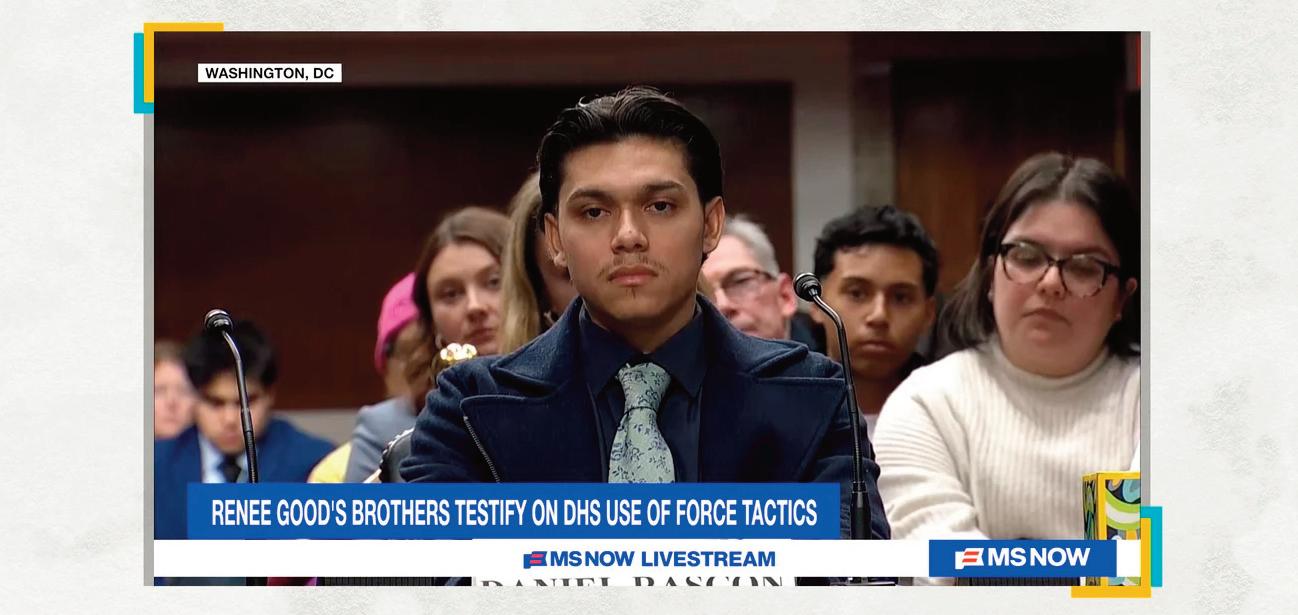
Martin Rascon of San Bernardino gave his first public statements about the Aug. 16 shooting at his family by federal agents in front of a panel of Democratic senators and representatives at a public forum in Washington D.C. yesterday.
Rascon was in his brother-in-laws’ pick up truck, with his father-in-law Francisco Longoria, when federal agents surrounded the truck, smashed a window, and fired shots.
“It felt like we were about to be attacked for no apparent reason, by no law enforcement that was legit. It just seemed like masked individuals. Once they had broken the windows and my father-in-law bravely drove away, and the shots fired into the vehicle, I just thought that one of us would have been killed. I am thankful that we were all OK. And I’m sorry for the victims (of federal shootings) who didn’t survive,” Rascon said.
The forum was hosted by Rep. Robert Garcia (D-Long Beach), the top Democrat of the House Oversight Committee, and Sen. Richard Blumenthal (D-Conn.), of the Senate Permanent Subcommittee on Investigations.
Also speaking were two brothers of Renee Good, who was shot and killed by ICE agents last month, and Marimar Martinez of Chicago and Aliya Rahman of Minneapolis, both victims of federal attacks.
The Department of Homeland Security said that the stop was targeted, and that Longoria drove directly at the officers, hitting and injuring two of them. “In response to this violent act, a CBP officer was forced to discharge his firearm in self-defense,” the DHS wrote.
Rascon, a forklift operator with a commercial driving license and a dental assisting certification, said that he was trying to sleep in when Longoria took him on an errand with Rascon’s brother-in-law, Jonathan. Rascon was sitting in the back, on the passenger side. When they were two minutes away from returning home, two unmarked trucks stopped their car. Rascon, who was on his phone, thought at first that there was a traffic jam.
“To my surprise, I was instead met with four men, with four men in face masks, sunglasses and baseball caps and guns drawn pointing straight at us, walking towards our car. These four men then tried forcing their way into our car when pulling on the handles, pounding on the windows and yelling at us to roll down the windows, all while failing to answer our repeated request for their identification and what they wanted. I did not know who these men were. They were refusing to identify themselves. The only thing I felt I could do, I could control was capturing this event by recording it on my cell phone,” said Rascon.
Longoria drove away through a clear path, and an agent fired shots, Rascon said.
“I will never forget the fear and having to quickly duck my head as the shots were fired at the car, any one of those bullets could have killed me or two people that I loved,” said Rascon.
After making it home safe, the family called 911. Responding officers allowed the federal agents who shot at them to entire their home, Rascon said. They were there for three hours, but did not identify who they were looking for. Rascon said the agents incorrectly identified him as the driver, and denied having taken shots.
After the officers left, two federal agents came to the
house. The Homeland Security Investigations (HSI) officer asked, “Is he here?” but did not identify who “he” was, Rascon said. When told that the family was waiting for the FBI, the agent said, “For all intents and purposes, we are the FBI,” Rascon said.
Twenty HSI and ICE agents gathered in front of the home, along with 30 police officers. They shut down the street.
Two weeks later, at 4 a.m., armed men entered their San Bernardino home with night vision goggles and bright green laser beams. They broke open the front door, and pointed their rifle at Rascon’s pregnant wife. They took Longoria, and charged him with assault of a federal officer. He was held in immigration custody for three months. The charge was dropped at its first hearing in front of a judge.
“Months later, Francisco was released on bond and able to witness the birth of his first grandchild, my daughter. Yet our fight for justice is not over. We will carry this incident with us forever,” said Rascon.
Rep. Pete Aguilar (D-Redlands), who represents Rascon, called for a full investigation the day after the shooting. “It is shocking and inexcusable for immigration authorities to open fire on unarmed civilians,” Aguilar wrote. On Jan. 28, Aguilar called for Department of Homeland Security Secretary Kristi Noem’s impeachment. Attorneys for The Justice Team, a lawyers’ group that represents Longoria and Rascon, called for an investigation immediately following the shooting.
This article was originally published by CalMatters.
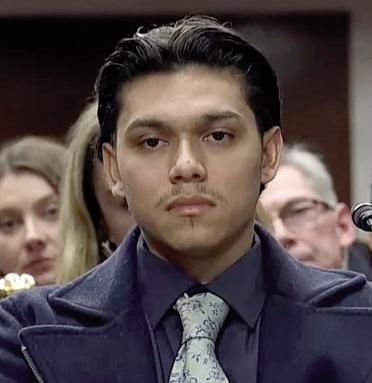
PHOTO MS NOW
Martin Daniel Gascon, a U.S. citizen and resident of San Bernardino, testifies at the U.S. Capitol in Washington, D.C., during a hearing on the disproportionate use of force by federal immigration agents with the Department of Homeland Security on Feb. 3, 2026.
Rep.
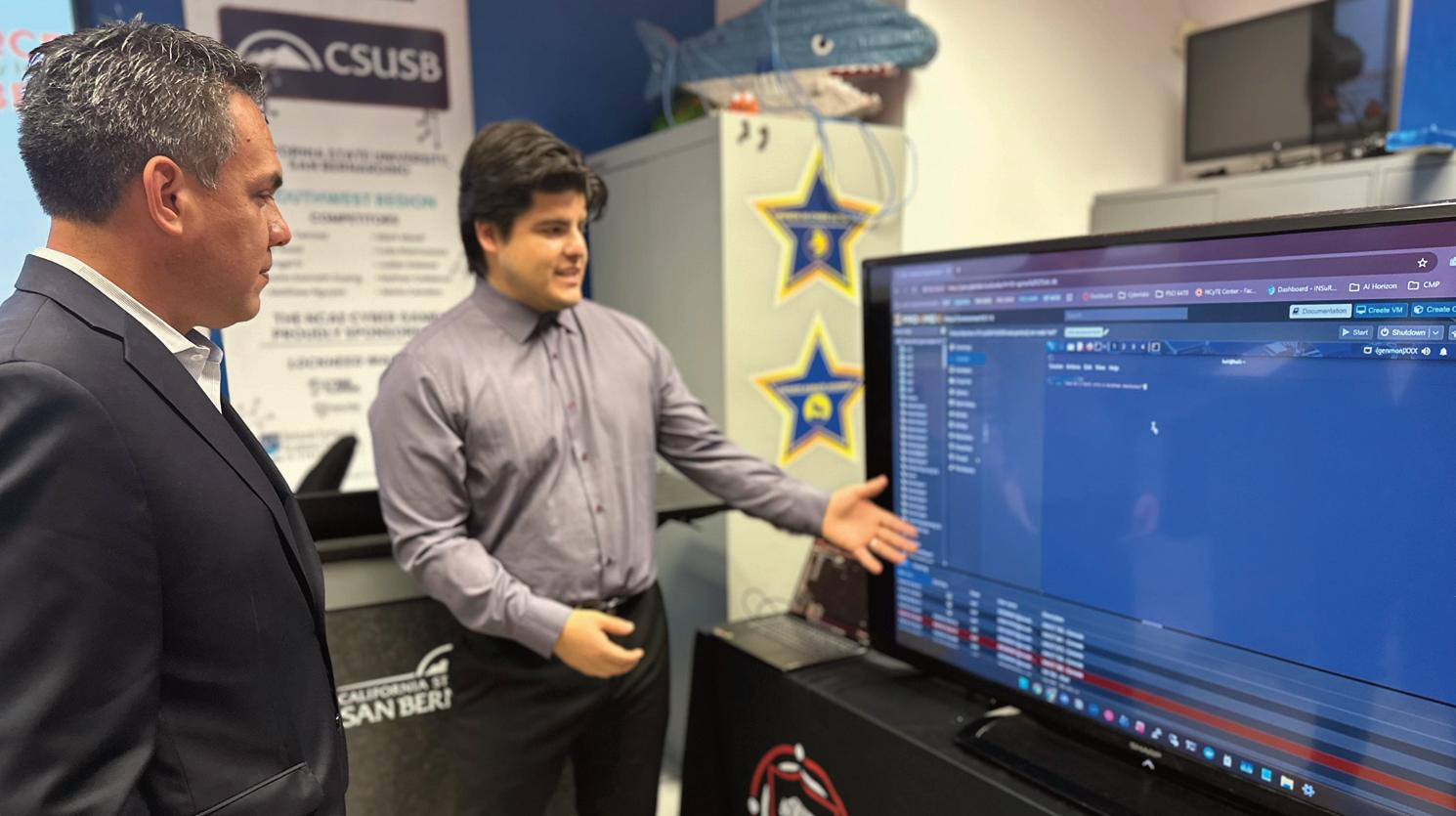
Over $1 Million to Strengthen AI Technology and Workforce at CSUSB
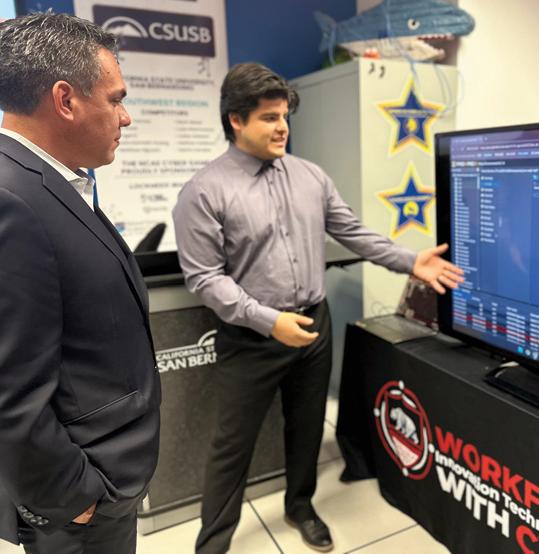
Rep. Pete Aguilar garnering a tour of the cybersecurity programming and donating $1 million in state funding to CSUSB. Community News
On Feb. 5th, Rep. Pete Aguilar (CA-33) announced that he secured $1,031,000 in community project funding for CSUSB’s Artificial Intelligence (AI) and Virtual Reality (VR) Research and Retraining Center, which provides students with opportunities for training with AI and VR technology. This grant funding will expand the Inland Empire’s AI and VR capabilities, strengthening the region’s cybersecurity, supply chain and logistics workforce.
“When I’m in Washington, I’m always working on ways to bring home federal dollars that help empower students, create jobs, and make life better for people in the Inland Empire,” said Rep. Pete Aguilar. “That’s why I am so proud to deliver $1 million in community project funding for CSUSB’s Artificial Intelligence and Virtual Reality Research and Retraining Center to help prepare our next generation for
the new age of technology. This grant funding will strengthen our region’s technology and workforce by providing CSUSB students with opportunities for training in AI and VR technology. This is just the beginning. I’ll continue to fight for more funding to ensure our students in San Bernardino have the opportunities to succeed and build their lives right here in the Inland Empire.”
“We are deeply grateful to Congressman Pete Aguilar for his leadership and steadfast support of Cal State San Bernardino and the Inland Empire,” said Tomás D. Morales, President, California State University, San Bernardino. “This funding accelerates CSUSB’s leadership in AI and virtual reality research while expanding workforce development opportunities that directly benefit the Inland Empire’s growing technology and logistics sectors.”
“It was about a decade ago that I met Congressman Aguilar, and I had the oppor-
tunity to describe what we were trying to do in the Center for Cybersecurity on a local and national scale,” said Dr. Tony Coulson, Executive Director, Center for Cyber and AI, California State University, San Bernardino. “A lot of complexity there, a lot of different things. And he responded very plainly with me: ‘How can I help?’ That was it. How can I help? And what is amazing, having I've been around for a number of years, a lot of people say, ‘How can I help?’ and there's not necessarily a big follow-up with that. But that's not the case here. Rep. Pete Aguilar has done a lot in the area of cybersecurity workforce, and for our community, that cannot be understated.”
“AI is changing everything, everywhere, all at once,” said Dr. Vincent Nestler, Director, Center for Cyber and AI, California State University, San Bernardino. “Some people are going to make out like bandits, and some people are going to find themselves lost and confused. The purpose, re-
ally, of this grant is to try and figure out, what is that transition? What's on the horizon that's coming our way? How do we prepare the Inland Empire for that transition? If warehousing jobs go, where do those people go to work now? How do we transition them to make them successful Our effort is going to be to maximize this money with other things that we are ready to do, and to try and make sure that we're that shining city on the hill that helps folks have a place to go to say, okay, what do I do now? I am grateful that we have a wonderful champion in the federal government like Rep. Aguilar who helps us continue to be successful and to launch people into the future.”
In January 2026, Rep. Aguilar helped pass the Commerce, Justice, Science, Energy and Water Development, and Interior and Environment Appropriations Act of 2026, which included $7.4 million in federal community project funding grants for seven projects in California’s 33rd Congressional District.
PHOTO AGUILAR’S OFFICE
Aguilar Delivers
By Manny Sandoval
Inland Empire filmmaker and San Bernardino Valley College film department chair Lucas Cuny will host a free public screening of his anticipated indie short-film, The Inland Empire, at Ritual Brewing Co. in Redlands on Wednesday, Feb. 18, using the event as a launchpad to crowdfund a feature-length expansion of the story.
The event begins at 7 p.m. at Ritual Brewing Co., 1315 Research Dr., with the screening expected to start around 7:30 p.m., Cuny said. Tickets are free through Eventbrite.
Cuny described the sevenminute film as a “proof of concept” — “an elongated trailer, if you will” — designed to show audiences the tone and potential of a longer project. “The film is about seven minutes long. We’ll have QR codes ready with our donation link at the screening,” he said.
The feature version is already written, Cuny said, with a goal of roughly 90 minutes. “Ready. It’s ready to go…ish,” he said. “It’s just about funding at this point.”
Cuny said the film is scripted and centers on a bail bondsman drawn into a case that begins in the region’s citrus landscape.
“It centers on the main character’s bail bondsman,” he said. “And there’s a murder mystery that starts in the orange groves.” The bondsman is searching for a client who is accused of being involved in the death of a homeless person, he said, and “as the bondsman’s trying to find him, he uncovers a bigger mystery, which is a whole sex trafficking ring going on at a church.”
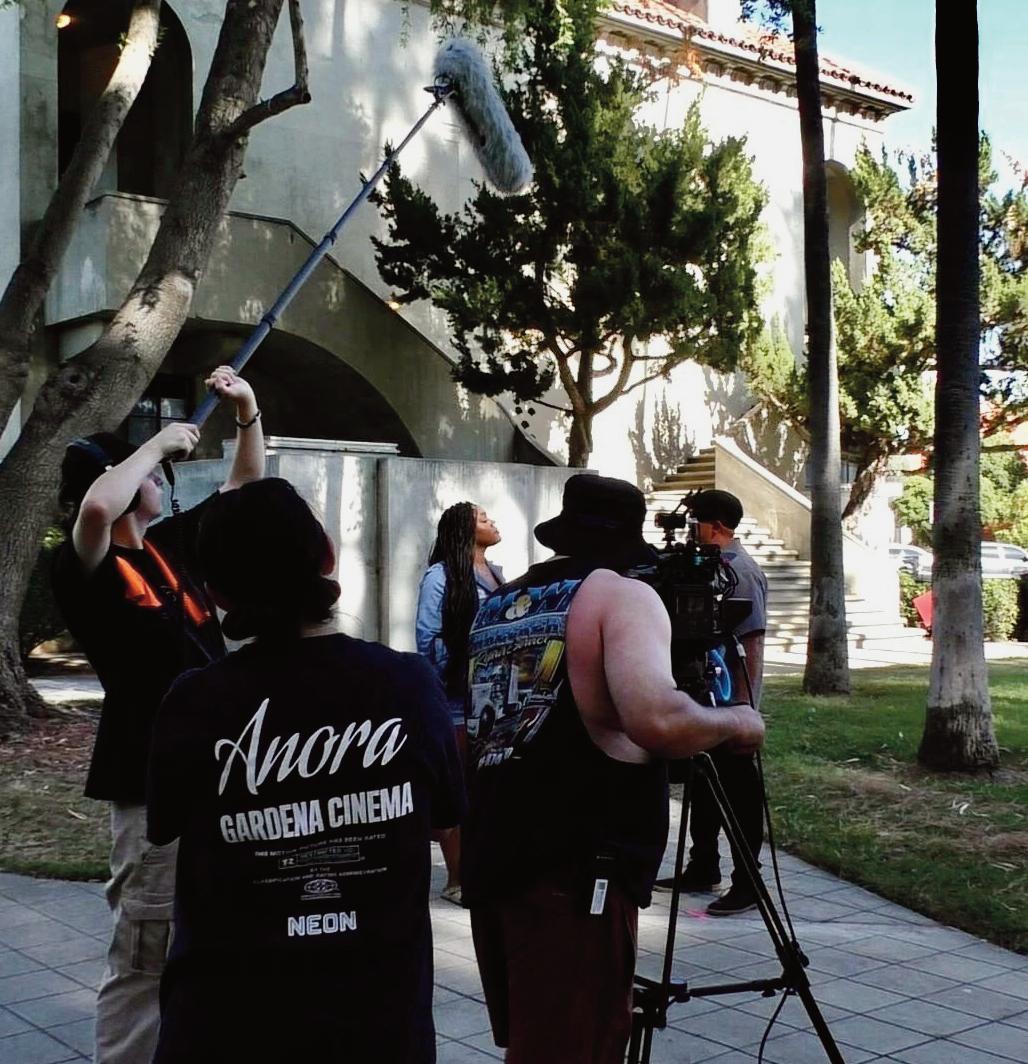
Cuny called the project a “neo noir,” describing it as “those old 1940s and 50s detective movies,” and added, “It’s Chinatown for the Inland Empire.” The short version was filmed last summer over two days, Cuny said, with Redlands loca-
tions including parts of the Orange Blossom Trail, exterior shots outside the Redlands Police Department building downtown, and a grove-like setting created at a park near the Grove School and the Barton schoolhouse. “We shot there because they have a couple rows of orange groves next to the street,” he said.
Cuny said Redlands has been supportive of small productions. “Every time I’ve shot projects in Redlands, the city and Redlands PD has been great to work with,” he said.
The film also doubles as a hands-on training ground tied to Cuny’s teaching role at San Bernardino Valley College.
Cuny said the short film’s cast and crew drew heavily from students and faculty, and the feature would expand that model. “It’s all students and fellow faculty at Valley College,” he said.
He said the fundraising goal is $25,000, with money intended for locations, actors and paid opportunities for students working in key crew positions. “These funds will go towards paying for more locations, the actors, and paying students to work on the crew for the feature length film,” he said.
Cuny said the student roles would not be symbolic. “Well, they’re not just going to be getting coffee on it,” he said. Students will fill “key roles in the camera department, in the audio department, in the production department,” and he listed positions such as assistant camera, second assistant camera, gaffer, key grip and “best boy electric.” He added that post-production would also include student assistant editors.
The premiere is also tied to a broader argument Cuny has made about the Inland Empire’s economic future — and the region’s limited investment in media infrastructure compared with its growth in logistics and warehousing.
“We should have been Albuquerque, New Mexico as a region,” Cuny said, arguing that film and television can be a “more viable long term economic sector than warehousing.” He framed the choice in blunt terms, “Do you want an Amazon warehouse or would you rather have an Amazon studio? I’d rather have an Amazon studio.”
Cuny also criticized what he described as a lack of aggressive outreach from local leaders to attract studios, stages and broadcast investment.
“Politicians in the Inland Empire lead from behind. And I say behind. I’m talking like miles behind,” he said. He added, “I don’t know how you can be an hour away from the entertainment capital of the world and not have a studio out here, not have a post production facility out here, not have an animation studio.”
As a practical pitch, Cuny said the Inland Empire’s value proposition includes lower permitting costs and more space than Los Angeles. “Do you want to save money on daily permit rates? Then you should be filming out here,” he said, estimating that a daily rate locally could be “anywhere from $50 to $200 a day,” compared with “about $2,000” a day in Los Angeles.
At the Feb. 18 screening, Cuny said attendees will have an opportunity to donate and, at certain levels, receive an on-screen credit.
Cuny said his deadline to determine whether the feature can move forward is March 10.
For more information on the crowdfunding campaign, visit Lucas Cuny’s “Inland Empire — A Feature Film” Kickstarter page here: kickstarter.com/projects/lucascuny.
PHOTO SLATE INC
Lucas Cuny, center, confers with his crew while filming orange grove scenes in Redlands last summer for his proof-of-concept short film The Inland Empire.
PHOTO SLATE INC
The Slate Inc. cast and crew shooting a scene at the Redlands Police Department in July 2025.