The Colton City Council has approved an ordinance raising council and mayor pay to $1,600 a month — more than double the current total compensation — after two 3–2 votes and weeks of debate over parity with other cities, fairness to staff and public perception.
The increase, adopted Nov. 18 as
Ordinance No. O-11-25, will not take effect until after Colton’s next regular municipal election on Nov. 3, 2026. It replaces the current structure of a $440 monthly salary plus a $242 automobile allowance — a total of $682 per month per elected official — with a single $1,600 monthly salary for each council member and the mayor.
Both on Nov. 4, when the council directed staff to draft the ordinance, and again on
Nov. 18, when it passed the first reading, the vote was 3–2. Mayor Frank Navarro and Councilmember Dr. G opposed the increase both times.
On Nov. 18, City Manager Bill Smith said the ordinance implements the direction the council gave at its previous meeting.
“This action is the result of City Council
By Manny Sandoval
Under the glow of new stadium lights, Bloomington High School cut the ribbon Nov. 18 on $5.5
softball
“Thank
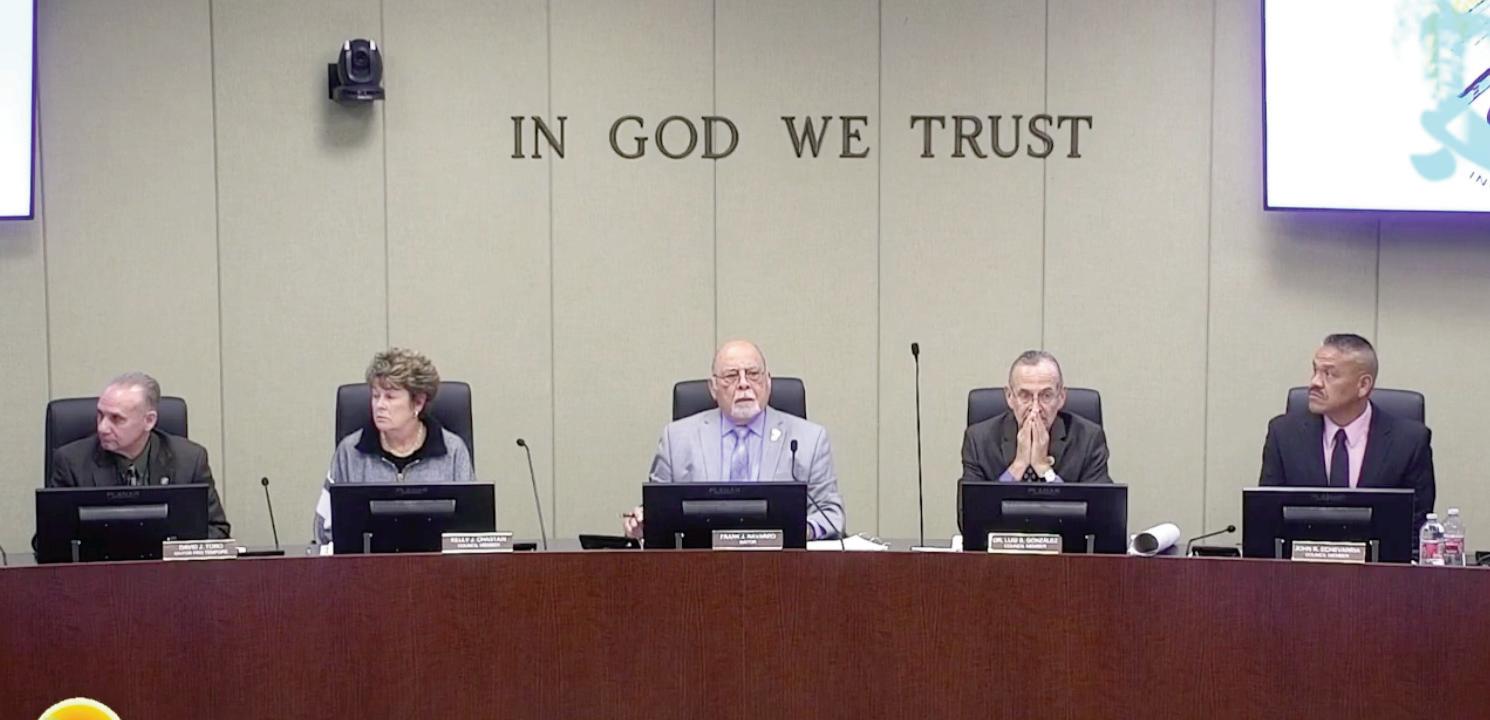
From left, Mayor Pro Tem David Toro, Councilmember Kelly Chastain, Mayor Frank Navarro, Councilmember Dr. G and Councilmember John Echevarria listen as City Manager Bill Smith delivers comments at the Nov. 18 council meeting.
PHOTO KATIE ORLOFF
Supervisor Joe Baca Jr., CJUSD board members, coaches, and Bloomington High softball and baseball players cut the ribbon Nov. 18 to celebrate the school’s $5.5 million renovated ballfields.
Council Compensation (cont.)
- direction at your last regular council meeting of November 4, 2025,” Smith said. “The ordinance before you is consistent with that direction, which was to bring forward an ordinance amending City Council compensation, increasing such to $1,600 per month, all inclusive. This action eliminates the current auto allowance of $242 monthly and increases the salary from $440 monthly to $1,600 monthly. This increase would take effect after your next regular election for any City Council seats, which is scheduled for November 3, 2026.”
According to the staff report, once fully implemented the change represents a net increase of $918 per month per elected official, or $11,016 annually, and would add approximately $63,875 in ongoing General Fund costs each year for salary and related benefits, based on five elected officials.
City Attorney Carlos Campos told the council Nov. 4 that the discussion stems from a recent change in state law.
“In 2023, the legislature amended government code section 36516, which is the government code section that allows councils to provide compensation to the city council and mayor,” Campos said. “And for general law cities like Colton, that compensation limit is set by your population. The 2023 legislation … did provide that going forward for cities the size of [Colton] the council could increase compensation to the maximum amount of $1,600 per month.”
Campos said Colton’s estimated 2025 population of 52,945 places it in the bracket for cities over 50,000 up to and including 75,000 residents, which allows for “a maximum salary of up to 1600 per month.”
He also explained that a 2010 California attorney general opinion requires Colton to treat the flat car allowance as part of total compensation rather than as a reimbursement.
“Currently it’s the compensation. That said as compensation is $440,” Campos said. “There’s an AG opinion that says we need to treat the auto since it’s a set amount as compensation and that is $242, for a total of $682.”
The last adjustment occurred in 2023, when the council raised the base salary from $400 to $440 and the auto allowance from $220 to $242, effective after the November 2024 election.
Councilmember Kelly Chastain, who asked staff to study council compensation earlier this year, said the current base pay dates back decades and now functions as a barrier to service.
Chastain said her concern was that the council had gone roughly 40 years with only a single 10% adjustment on a $400 base, which only bumped the council to $440 a month. “Our base was $400 and it has been that way since 1986,” she said. “And so we go forward, that’s
40 years that we haven't had a raise. And when we did do the raise it was 10%, which was admirable. But 10% of 400, do the math. So now we’re at 440.”
Using figures from the staff report, she said the total $682 monthly compensation works out to only a few dollars an hour when measured against the hours council members actually put in.
“Right now, with our $682 per month in total compensation, our hourly rate is about $5.35 at 30 hours a week,” she said. She noted the staff report lists council members as part time “although we do a lot more than just part time work.” “So you can see how insufficient that is, it has been 40 years since we’ve come forward to talk about this.”
Chastain framed the proposed increase as a way to make local offices accessible to residents who cannot afford to take on what is effectively a second part-time job at below-minimum wage.
“I know it’s supposed to be a volunteer role, or that’s what it was deemed a long time ago,” she said. “But when you have a family and you can get about $20 an hour at Del Taco, it says something that people don’t have the time, nor can they substitute that by coming on to do public service.”
She also argued that the council had spent recent years bringing city employees up to parity with neighboring agencies and should not permanently leave elected officials behind.
“We’ve made it our mission to bring everybody in this organization to where they need to be or should be because they work hard and they do the job really well,” Chastain said. “And I believe that our council does the same thing up here.”
Chastain said she initially considered a more “modest” option — an $800 monthly stipend plus the existing $242 car allowance, totaling $1,042 a month and about $62,500 annually for five council members — but concluded that stopping short of the $1,600 cap could lock the city out of the higher ceiling in the future.
Chastain said choosing a lower amount now could lock the city out of ever reaching the $1,600 ceiling later. “If we make it lower — let’s say we do the thousand or eight hundred dollars a month plus the 242 — that would be set today,” she said. “I don’t think that we would be able to then do the sixteen hundred dollars later or reach that ceiling. Once we make the decision tonight, it’s basically a one and done, other than the 5% or CPI, whatever it is from here on out.”
She also translated the $1,600 figure into hourly pay.
Chastain also tried to illustrate how the $1,600 figure would translate into hourly pay. “In the moderate, modest and the maximum … the maximum, which is the ceiling of 1600. Just calculating that out, that’s about $20 an hour,” she said, adding that at 30 hours per week
the pay would be “about $13.33 an hour.”
Later in the meeting, Chastain moved “that we would do the 1600 per month and do away with the auto allowance and bring back the opting out.” That direction led to the ordinance the council approved on Nov. 18.
Councilmember Dr. G called council pay a “touchy subject” and said his position was shaped by both regional comparisons and recent staff raises.
“I think extra money is always helpful. Sure, I get it,” he said Nov. 4. “However, being that I have to make a decision on behalf of my constituents, I think the way I took the approach is to look at this a little bit more logically.”
He told colleagues he checked what nearby cities pay their elected officials.
Dr. G said he started by looking at what he and nearby cities earn. “Mine is about $880 a month. I just looked at my check. So $880 a month,” he said. “Then I called Grand Terrace and talked with the mayor and they get $990 a month. And then I called Redlands and they get $1400 a month. Banning was $950 — that was online. Loma Linda is $1,066 per month.”
He said he also checked larger cities, citing Rialto at “$1,920 per month,” Ontario at “$2,550” and San Bernardino at “$3,125 per month.”
“Granted, we’re at the bottom of the list here. Okay,” he said. He then pointed back to state law, citing Government Code section 36516 and the bill that raised Colton’s cap.
Dr. G pointed to the section of state law that ties council pay to city size. He said the statute’s “item C” covers “cities between 50,000 and 75,000 people” and “says up to 1600 a month. So, council members, you can go up to 1600, but you can also go less.” He also noted another provision: “No ordinance shall be enacted or amended to provide automatic future increases.”
Given that the council had recently granted employees a 10% raise, Dr. G said he was only comfortable doing the same for council members.“The way I see it, I believe the most reasonable move is to increase the council just 10% and no more. That’s it,” he said. “I feel that’s fair and consistent with employees who worked hard and asked for it and we gave it to them and everybody was fine. It just makes me feel funny to do any more than that, because what’s good for them is good for us.”
Mayor Frank Navarro also pressed for the smaller increase, saying it was inappropriate to compare elected officials’ part-time workloads directly to full-time staff.
Read the full story at IECN.com.
BHS Ballfield (cont.)
- ing with our youth, our young men and women,” Baca said at the ceremony. “Hey, we care about you. We’re willing to invest in you. Invest in our kids. So when other teams come to Bloomington, they’re going to say, I wish our field was like Bloomington. I wish our school district invested just like they did in Bloomington.”
Baca emphasized that the improvements reflect a commitment to equity for girls and boys sports.
“Title IX makes sure that we invest just as much in the girls as they do the boys,” he said. “So I’m very, very proud of the softball team. And you know what? I was a softball coach, varsity coach for nine years. And I hate to say it, I think I like coaching the girls better than the boys.”
He also noted a long relationship with Bruins baseball coach Carlos Contreras and the county’s total stake in the project.
At the ribbon cutting, Baca also presented the baseball and softball teams with their own $3,000 checks.
Coaches said the upgraded facilities are a long-awaited show of support for their programs.
“I would like to give a warm thank you to our softball parents, past and present, as well as Coach Jose, Coach J, and Coach Art for always advocating for these young ladies to be equally supported here at BHS,” Bloomington High School softball coach Rodolfo Sanchez said. “I would also like to thank all the countless softball players who have walked on this campus who have championed our softball program.”
Bloomington High School baseball coach Carlos Contreras said the fields represent a well-earned investment in the team and the wider community.
“This is well deserved for the boys and the community,” Contreras said. “Anytime we hit a foul ball and it hits the netting, what do you guys yell? You yell, ‘Joe Baca!’ Every time the ball hits the net — ‘Joe Baca!’ I just want to say thanks to Supervisor Joe Baca Jr., Mr. Miranda, the entire school board, Mr. Dan Flores, our booster parents and the whole community. This wouldn’t be happening without your support. You treat these boys like champions all the time. They get a lot of good gear, and that’s good stuff for us. The biggest thing is we’re ready to play ball.”
Governing board members
pointed to years of advocacy that led to the moment.
“Thank you to Supervisor Baca and the community because without your help we would not have what we have here today,” CJUSD Board Member Israel Fuentes said.
“As I was walking in I just wanted to throw myself on this turf and I am going to do that when I finish speaking. Congratulations to all of you for making this happen. This is a glorious day and we can now hear ourselves speak over this PA system. Let's play ball!”
Board Member Pat Haro traced the project back more than three years.
“First of all, I just want to say about three and a half years ago, a coach came to me and said, we have a problem. And I said, okay, tell me about what’s going on. And he did and was very eloquent about it and what was needed,” Haro said. “And then we had Bloomington High School’s last graduation here at our stadium,” Haro said. “I saw Mr. Baca and I said, we need to talk. And we did. We walked out to our cars and had a nice little chat. Thanks to him, the money he donated toward this cause spearheaded all of this. I just want to say thank you to the community and thank you to the staff. Thank you to our coaches and our students for being patient. Sometimes things take time, but we’ve got it done. Thank you.”
State leaders also recognized the project’s significance. Sen. Eloise Gomez Reyes’ office, represented by Rep. Michael Towensend, presented a California State Senate Certificate of Recognition.
For families in the stands, the new facilities are already making a visible difference.
“My daughter Angela is a senior here at Bloomington High School. She’s been playing on the softball team — this will be her fourth year now — and the improvements are incredible,” said Marie, a Bloomington High School parent. “Before, we used to have a very small space for the fans to sit. Some of the parents would have to sit outside in the parking lot because it would get too full. The girls now have nicer dugouts; they used to have old, rundown dugouts, and some of the roofs would leak. The field in general just looks really beautiful. So I’m just so happy, and it’s very exciting because it’s my daughter’s senior year — so just in time.”
IECN Community Calendar
Over 3,000 San Bernardino County Students Recognized for Biliteracy
Community News
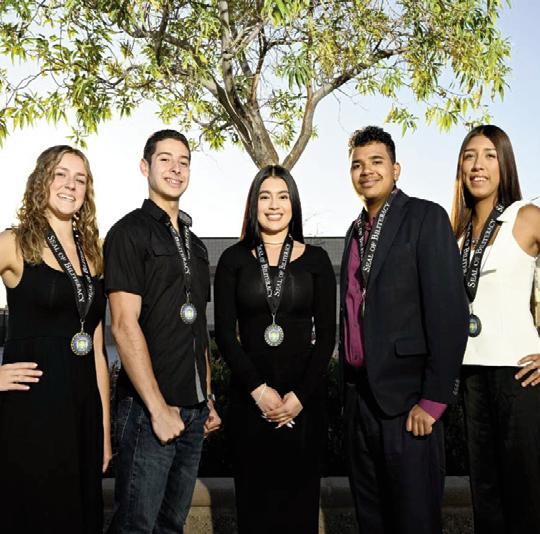
San Bernardino County Superintendent of Schools (SBCSS) celebrated more than 3,000 high school students who are on track to receive the State Seal of Biliteracy (SSB). Marked by a gold seal on the diploma or transcript, the SSB recognizes high school graduates who have attained a high level of proficiency in speaking, reading and writing one or more languages in addition to English.
In total, 3,809 students throughout the County have met the rigorous criteria set by the California Department of Education this year. The number of students qualifying for the SSB has increased by more than 1,200 compared to 2024. In addition to English, over 20 diverse languages were represented throughout this year’s ceremonies with students achieving proficiency in languages such as Hindi, Portuguese, Russian, Spanish, and Vietnamese.
“By learning a second or even a third lan-
guage, thousands of students are opening doors to bigger, brighter and more diverse futures," said County Superintendent Ted Alejandre. "Whether they are applying to college or entering the job market, this recognition gives them a powerful advantage and sets them up for success."
Traditionally, candidates for the SSB were recognized at the end of the school year. However, County Superintendent Alejandre recognized the importance of allowing high school seniors to include this achievement on their college applications.
As a result, SBCSS now holds the ceremony earlier in the academic year. This change enables seniors to confirm their eligibility for the recognition and allows postsecondary institutions to acknowledge the accomplishment and consider it for academic credit.
County Superintendent Alejandre has made it possible for language assessments to be accessible for school districts within the County, so every senior candidate studying a second or third language has a chance to qualify for the SSB.
PHOTO SB COUNTY SCHOOLS
A group of San Bernardino County Students that are recognized for biliteracy in fall 2025.
Half a Million Young Californians Aren’t in School or Work. Most are Men.
By CalMatters
If you ask Jodeah Wilson how his life got off track, he’ll say it’s all about money.
He needs money for November rent. He also needs money to pay back the tuition he owes for the spring semester at Sacramento State University, which would allow him to re-enroll. Until then, he’s stuck in limbo.
“All I need is a goddamn job so I can pay this off myself,” he said. But it’s been months and so far, he’s still unemployed.
To state leaders and researchers, though, it’s more than just money. California has nearly 500,000 young people ages 16 to 24 who are in the same predicament, neither working nor in school. Finding them a job is part of the solution, but it goes much deeper than that. Many are struggling socially and emotionally, too, making it even harder to move forward.
Men are particularly at risk. In July, Gov. Gavin Newsom issued an executive order to address “the alarming rise in suicides and disconnection among California’s young men and boys.”
It’s a “crisis,” Newsom told former President Bill Clinton in an interview at the Clinton Global Initiative last month. “Look at the dropout rates. Look at the depths of despair. Look at the issues around loneliness. Look at every critical category. It’s just blinking red lights for young men.”
Newsom pointed to Charlie Kirk as a model for how to make young men feel heard and get them re-engaged politically, albeit for Trump. Then he slammed Democrats for ignoring these young men and their needs.
Wilson is convinced he’s an exception to these trends and that his unemployment is temporary. He talks fast, speaking in short sentences, repeating himself when needed, like a coach hyping up a team. When he gets excited or gestures for emphasis, a dreadlock falls from his bun and shakes with his words.
“I’ve been persistent,” he said. “You can check Indeed. You can check Glassdoor. You can check my network. You can check how many career fairs I attended, how many internships I’ve acquired.”
His checking account has $76, and his savings account has 8 cents, he said during an interview earlier this month. Despite his persistence, he’s worried about becoming homeless in November if a job doesn’t materialize soon.
Of the roughly 4.6 million Californians between the ages of 16 and 24, more than 10% are considered disconnected, meaning they’re neither working nor in school, according to Kristen Lewis, the director of the research organization Measure of America. The majority are men, and Black and Native American men have higher rates.
The reasons so many young men drop out of school and work are varied. Economists point to rising automation or the loss of male-dominated manufacturing jobs in the U.S. Some of these men have disabilities or are struggling with addiction or mental health challenges. Many are incarcerated — California’s prisons are 96% male. Most of California’s homeless population is male too.
For Newsom, though, it’s not just about men’s role in the economy or education. In the executive order, he points to a slew of other disturbing statistics:
Nearly 1 in 4 men under the age of 30 say they have no close friends, a “five-fold increase since 1990” and “with higher rates of disconnection for Black males.”
Men are four times more likely than women to die by suicide — a disparity that has grown over the past few decades.
Men also have higher rates of cardiovascular diseases and cancer.
Wilson, who is both Black and Native American, said his issues are just a product of the job market. He has been rejected by restaurants, call centers and delivery services over the past two years, representing more than 50 different online job applications on Indeed alone. He’s done some seasonal or temporary work, he said, such as a four-hour catering shift about once a month, but other than that, he’s had little professional luck.
Regardless of the reason, the sole fact that he is neither working nor in school right now could have an impact on his future quality of life, even if he does find a job soon. Lewis, the Measure of America director, pointed to a lon-
gitudinal study of young people in similar situations. It found they’re likely to make less money and have worse health outcomes by the time they reach their 30s. The longer a person is unemployed and out of school, she said, the greater the likelihood of long-term consequences.
No car and no financial aid
In one of Wilson’s communications classes at Sac State, a professor compared adulthood to the experience of climbing a rope, where every responsibility or misfortune is a knife, cutting off those who are too weak to climb any higher.
Wilson said he feels like he’s at the bottom of the rope and about to get cut off.
He started Sac State in the spring of 2024 with $20,000 in his bank account, money that he’d saved by working at Red Robin while attending community college. But one year later, he had spent most of it.
In January, Wilson was driving southbound on I-5 from his hometown of Redding toward Sac State, ready to start the spring semester. Near Arbuckle, he noticed the temperature gauge on his 2002 Honda Accord suddenly swung right. The car was slowing down, even though his foot was still on the gas. He pulled over to the breakdown lane and watched steam pour from the hood. By the time he had towed the car to a mechanic, it was too late, he said — part of the engine had melted.
Without a car, he struggled to find a job, he said. His grades started to slip, too. “I needed to stop focusing on school and focus instead on how the hell I’m going to get this rent and tuition paid.”
For Lewis, who has long studied the struggles that young people face, it’s everyday setbacks — a broken car, failing grades — that often set someone on the path to dropping out of school or abandoning the workforce. “Young people who are out of school and out of work basically need what all young people need,” she said. “They need guidance. They need help. They need understanding. They need a chance to try and fail and try again.”
California offers generous financial aid for the majority of students enrolled at California State University campuses, covering tuition and daily living costs such as food and housing, but Wilson doesn’t qualify. Although he’s 22, he’s still considered a child for the purposes of financial aid, and his father, who owns a construction company, and his father’s new wife, a paralegal, collectively make too much money for him to qualify for state or federal aid, he said.
Wilson’s father helped out a little over the spring semester, sending a few hundred dollars to his bank account when funds were low, but the major costs, such as rent and tuition, have always been Wilson’s sole responsibility. He’s proud of that.
“(My father) supports me where it’s necessary, but in other aspects of my life, he shouldn’t, because I’m a man. I’m supposed to kind of do what I got to do,” said Wilson. Though he finished the spring semester, he owes over $4,000 in missed tuition payments, which he has to pay before he can re-enroll.
Ten years of depression, never seeking help If you ask Will Rose how his life got off track, he’ll say it’s all about mental health.
After dropping out of college 10 years ago, Rose, now 29, always thought he might return, though he never did. He worked retail jobs, mostly for Target, while living at his father’s house in Hermosa Beach. In retrospect, he said he was often depressed, though he wasn’t conscious of it at the time.
At night after working a shift or in the middle of the day, during one of his stints of unemployment, Rose would drive around the corner to the 7-Eleven and return home with a Big Gulp, Cheetos or Takis. “Anything that would overload my senses,” he said.
Over the course of 10 years, he gained more than 60 pounds. When he felt stuck, he would buzz off all his hair as a way to regain control over his body and his life.
As a follow-up to Newsom’s executive order, state agencies submitted a 75-page document outlining the work they’re doing to support young men. The mental health team at California Health and Human Services highlighted a federally funded project run by the state, which helped set up nearly 250 billboards in all of California’s major cities featuring the faces of young men, looking hopeful or determined. Next to each face is the 9-8-8 suicide and crisis number. The goal is to help men see that “it’s OK to not feel OK, and it’s OK to ask for help,” said Ahn Thu Bui, a
project director at the California Health and Human Services Agency.
Her colleague at the agency, Stephanie Welch, added that most mental health professionals are female, which makes it even harder for some men to feel welcome in a therapist’s office. Nationally, suicide is a leading cause of death among men ages 15 to 44 — with more men dying by suicide than cancer, heart disease or homicide. Yet men are less likely to seek treatment for mental health issues than women, Bui said.
Men are also more likely to use drugs and to overdose.
Last year, Rose was working as a contractor, delivering packages for Amazon part time. When he wasn’t working, he was using meth. When the high was good, he felt invincible, infallible, he said, even if he was just sitting on his couch. But when it was bad, he would watch hours of porn.
Once, he spent two full days so high that he couldn’t sleep. He was alone in his room, he said — his thoughts were racing so fast that he couldn’t recognize who he was or that he was even human. His dad was still in the house, though Rose said he felt so “dystopian” that he didn’t even know he needed help. “I was seriously suicidal. I was seriously going to end it.”
In May 2024, Rose admitted himself to a psychiatric ward near downtown Los Angeles.
What’s happening to ‘prime-age’ men?
As a child, Rose was in foster care and lived in roughly 25 different homes, including some where he said he was sexually abused, repeatedly. He only remembers a few of the homes, he said; the rest are a blur. Mostly, he remembers getting adopted at age 10 and moving to his first permanent home in Hermosa Beach.
Sitting in the silence of his hospital room in the psychiatric ward last year, and in the months that followed, Rose said he began to reflect on the impact of his childhood trauma. Bui, a psychiatrist by training, prefers to use the clinical term, “adverse childhood experiences,” to describe what Rose has gone through. Sexual abuse, for instance, is linked to mental health challenges and substance use issues later in life, she said.
This summer, with help from his father, Rose got a new car and finally moved into his own apartment in San Pedro, just a few blocks from the Los Angeles Harbor, as he continued working for Amazon. In his spare time, he began going on short meditative walks.
But soon after moving, he lost his job. “I was cutting corners,” he acknowledged, marking packages as delivered so he could leave work a few minutes early. “With everything being AI-based, they just keep track of everything you do. They’re just so strict.”
At 29, Rose is what economists consider a “prime-age man,” meaning that he’s in the peak age for employment. Since the 1960s, the number of prime age men opting out of the labor force has grown, especially among those without college degrees, according to a recent study by the Federal Reserve Bank of San Francisco. It’s unprecedented, Newsom said in his executive order.
Beyond the usual labor market explanations, such as automation, researchers have analyzed other potential trends. Some point to family dynamics, such as the rising number of men who are living with a parent or serving as caretakers.
One 2017 study found a link between the advent of new and improved video games and the decline in men’s working hours. Today, the average non-working man spends 520 hours a year on “recreational computer time,” most of it video games. For comparison, the average employee works about 2,000 hours a year.
State agency officials say they’re leading a series of education, health and career initiatives aimed at men, including using money from Proposition 1, a state mental health bond that passed last year, to increase the pipeline of male therapists. Last month, Newsom said his office is starting a $5 million grant program to create more mentorship opportunities for young men.
What causes a person to leave school or work varies, and so do the solutions for bringing them back, said Lewis, with Measure of America. “There tends to be a desire for some sort of silver bullet,” she said, such as summer jobs programs or employment assistance.
“I mean, it’s great to get someone a job, but if someone has a traumatic upbringing, and is dealing with a substance use disorder and has mental health challenges, they need other kinds of support.”
Fontana, San Bernardino Unified School Districts Host School Safety Symposium on Fentanyl, Trafficking, Social Media Threats
Community News
Fontana Unified School District Police Department (FSPD), in partnership with San Bernardino Unified, brought together Southern California school district administrators for its Safety Symposium on Nov. 24, providing an opportunity to strengthen partnerships throughout the area and share strategies for maintaining safe and supportive learning environments.
The symposium, last held in 2021, hosted 69 members of the school policing community and school district staff from Indio to La Puente and San Diego, featuring a full day of presentations covering current issues impacting schools, including social media and search warrants, human trafficking, fentanyl safety and identification, cannabis and juvenile laws, and building
relationships with school administration.
The event included a debrief from Rialto Unified School District representatives on incidents that tested emergency response coordination and how a strong collaboration with District staff supports streamlined crisis communication efforts.
“School safety is a collaborative effort,” recently appointed Fontana Unified Police Chief Rich Randolph said. “Bringing law enforcement agencies and school administrators together through events like our School Safety Symposium ensures everyone is on the same page when it comes to student safety, discipline, and emergency response. These partnerships build trust and provide critical training that ultimately keeps our schools secure.”
Beyond the symposium, FSPD also enhances community safety through the Blue Envelope Program, which promotes inclusivity and supports effective communication between law enforcement and individuals with disabilities that may affect communication, including autism, dementia, or anxiety. Participants carry a blue envelope or wear an item with the program logo to alert officers of a special need, with each envelope containing identification, emergency contacts, and notes to guide officers in providing appropriate support and interaction.
The Blue Envelope Program is a collaborative effort, developed in partnership with the Inland Regional Center, Autism Society Inland Empire, and the San Bernardino County Chiefs of Police. FSPD officers receive ongoing training every two months, strengthening their ability to respond appropriately to individuals with special needs.
PHOTO FUSD
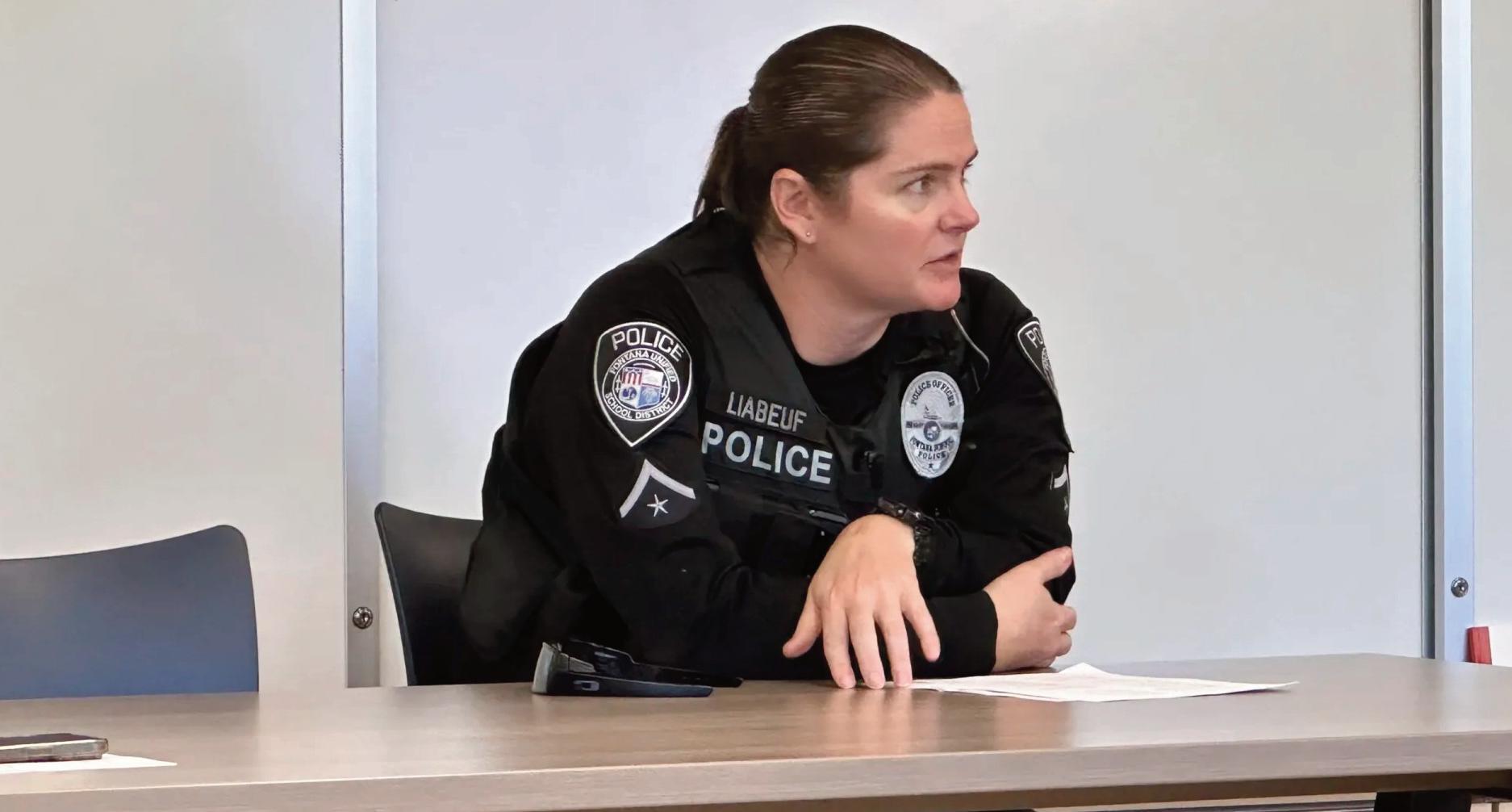
Fontana School Police Department Officer Amanda LiaBeuf, a 1997 Fontana High School graduate, discusses the District’s Youth Court’s processes and successes at the Safety Symposium held on Nov. 24.
PHOTO FUSD
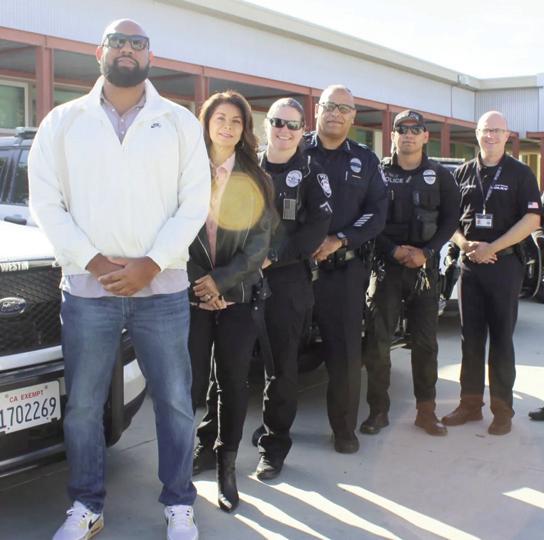
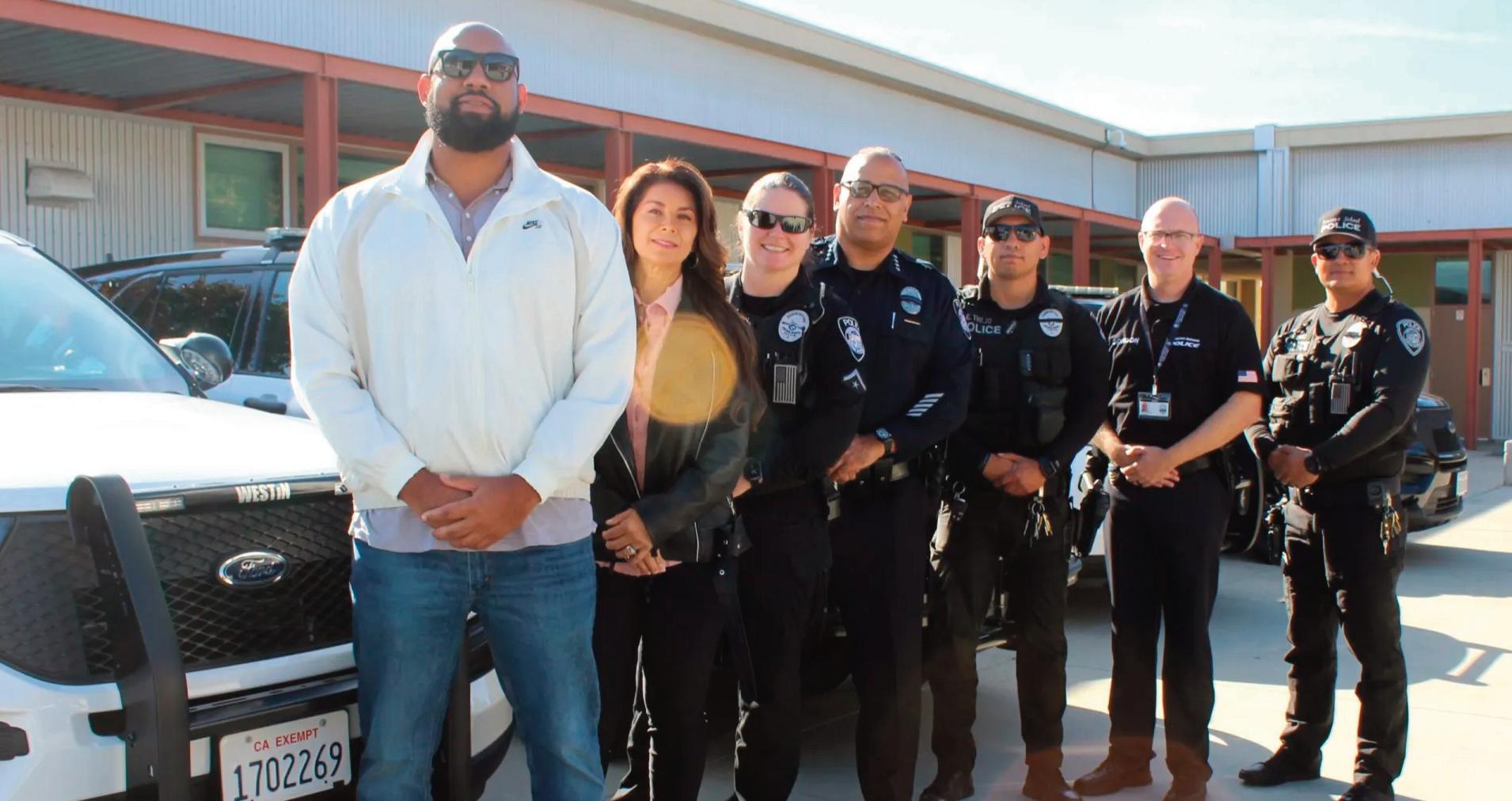
Fontana Unified School District Police Department (members pictured), in partnership with San Bernardino Unified, brought together Southern California school district administrators for its Safety Symposium on Nov. 24.
Redlands Public Market in Historic Packing House Battles Slow First Year
By Manny Sandoval
When brothers and developers Jerry and Ed Tessier first walked into the long-vacant citrus packing house just north of downtown Redlands about eight years ago, it was hard to picture families lining tables under its soaring steel beams.
“It was broken into, vandalized. It was red tagged. It was a shell of a building. It was leaking from the roof. It was, I mean, it was bad,” Tessier said.
Today, after a roughly $11 million restoration and years of delays, that same historic structure has reopened as Redlands Public Market, a food hall and gathering space that Tessier hopes residents will treat as a source of civic pride as much as a place to eat — even as its first year has fallen short of the sales he anticipated.
“We're hanging in there,” he said. “Honestly, it's not doing the sales that we thought to start out with, like we have at our food lab in Riverside.”
Tessier said the pressures the market is feeling mirror what independent operators are facing nationwide as food and labor costs rise and customers become more cautious.
“Definitely, this is a challenging time for restaurants,” he said. “Profit margins are thin. You know, costs are higher. People are watching their wallet, especially in the last six months.”
Portions of the former citrus packing house date back to the 1890s, when Redlands was a hub for orange growers. It is recognized as the city’s last remaining packing house of its kind and part of a larger historic depot district. The city eventually bought the deteriorating building after it shut down and later sold it to Arteco Partners, the Tessier family’s Pomona-based firm, which specializes in adaptive reuse of historic properties.
“My parents started the company under a different name 40 years ago, kind of buying and renovating apartments,” Tessier said. His father built a law office in downtown Pomona in the 1960s, and the family later shifted toward renovating old commercial buildings. “So it was in our blood.”
After graduating from Pomona College with an urban sociology degree, Tessier’s brother, Ed, focused on downtown Pomona’s blight and “urban flight.”
After $11 Million Overhaul
At one point, Tessier said, there hadn’t been a new business license pulled in downtown Pomona for a decade. To get things moving, his brother opened a coffee shop himself.
“The first business in downtown Pomona in 20 years was a coffee shop that he and a partner had to open and operate because no one else would,” Tessier said.
Since then, Arteco Partners has renovated a dozen buildings in Pomona, including the 2,000-seat Fox Theater, and gone on to projects in Claremont, Ontario, Riverside, Corona, Temecula and now Redlands. In 2019, the company opened Riverside Food Lab, which Tessier describes as the Inland Empire’s first food hall.
“Redlands was supposed to be the first food hall, and then this got delayed because the city wanted to go through that RFP process, and then we ended up doing the food lab,” he said.
Redlands’ project required navigating city approvals, state regulators and the National Park Service because of the building’s historic status. Tessier said the city initially asked him to take a look at the property and make a proposal, then decided to issue a formal request for proposals that took about a year. After that came years of design and review.
“It may even be nine or 10 years,” he said of the full timeline from first walkthrough to opening. “We had been working on it for years. And then, you know, COVID-19 happened, so we just put a pin in it and waited it out a couple more years.”
By March 2020, Tessier said, he had a construction loan approved and was ready to start, but the onset of the pandemic forced him to halt the project. Construction ultimately started in early 2023 and took a little more than two years, finishing in March 2025.
“The seismic retrofit itself cost a couple million bucks,” he said. “The first eight to 10 months of the project was just seismic retrofitting. That's just the starting point of having a building, a structure that you can then bring in your utilities.”
Inside, the market preserves the original corrugated metal ceiling, clerestory windows and brick shell while layering in new steel bracing and modern systems.
“The ceiling, as you see, if you look up, you'll see the original corrugated ceiling, the original everything,” Tessier said. “One of the great things about Redlands Public Market is you walk in and you have all that natural light. Kind of feels like you're in an old train sta-
tion.”
Before its restoration, the building had been vacant since around 2000 and owned by the city for roughly a decade when Tessier first saw it. He said there were half-demolished walls, trash, bird carcasses, signs of people living inside and scorched walls that suggested minor fires.
“As horrible as I'm making it sound, it was actually not the worst building that I've walked into and then later purchased and renovated,” he said. “But this building needed everything.”
Local firefighters, he added, have told him they are “amazed this building didn't burn down” during the 20 years it sat empty.
At one point, the building was in escrow with a buyer who planned to demolish it.
“This building was slated for demolition,” Tessier said. “So we were really part of the effort to save the building and not see it demolished. And if it was vacant another couple years, it probably would have burned down.”
He praised Redlands city staff for supporting the vision.
“Honestly, Redlands was one of the best, if not the best cities to work with in this whole process,” he said. “Maybe it was because they wanted to see this project happen, but honestly, it was pretty great working with the city.”
Redlands Public Market opened in March 2025 with about 20 food and beverage businesses, plus a downstairs speakeasy-style bar and a small arcade. Tessier said the mix is heavily weighted toward independent, locally owned operators, many of them first-time brickand-mortar tenants whose experience ranges from farmers markets to food trucks.
“Almost all of our businesses and tenants are startups or they're opening their second location,” he said. “We were dealing with entrepreneurs, local business people, startups, mom and pops.”
“We don't like renting to franchises,” he added. “We've rented a couple times to franchises and almost every time it hasn't worked out for the tenant. So I'm a firm believer in independent, locally owned businesses.”
He estimates that roughly 80% of the company’s tenants across projects are minority- or women-owned.
Read the full story at IECN.com.
PHOTO MANNY SANDOVAL
A bartender at the RPM Bar chats with a customer after serving a craft cocktail.
PHOTO MANNY SANDOVAL
A brisket sandwich from Cornerstone BBQ, an IECN favorite priced at about $15, is served fresh at Redlands Public Market.
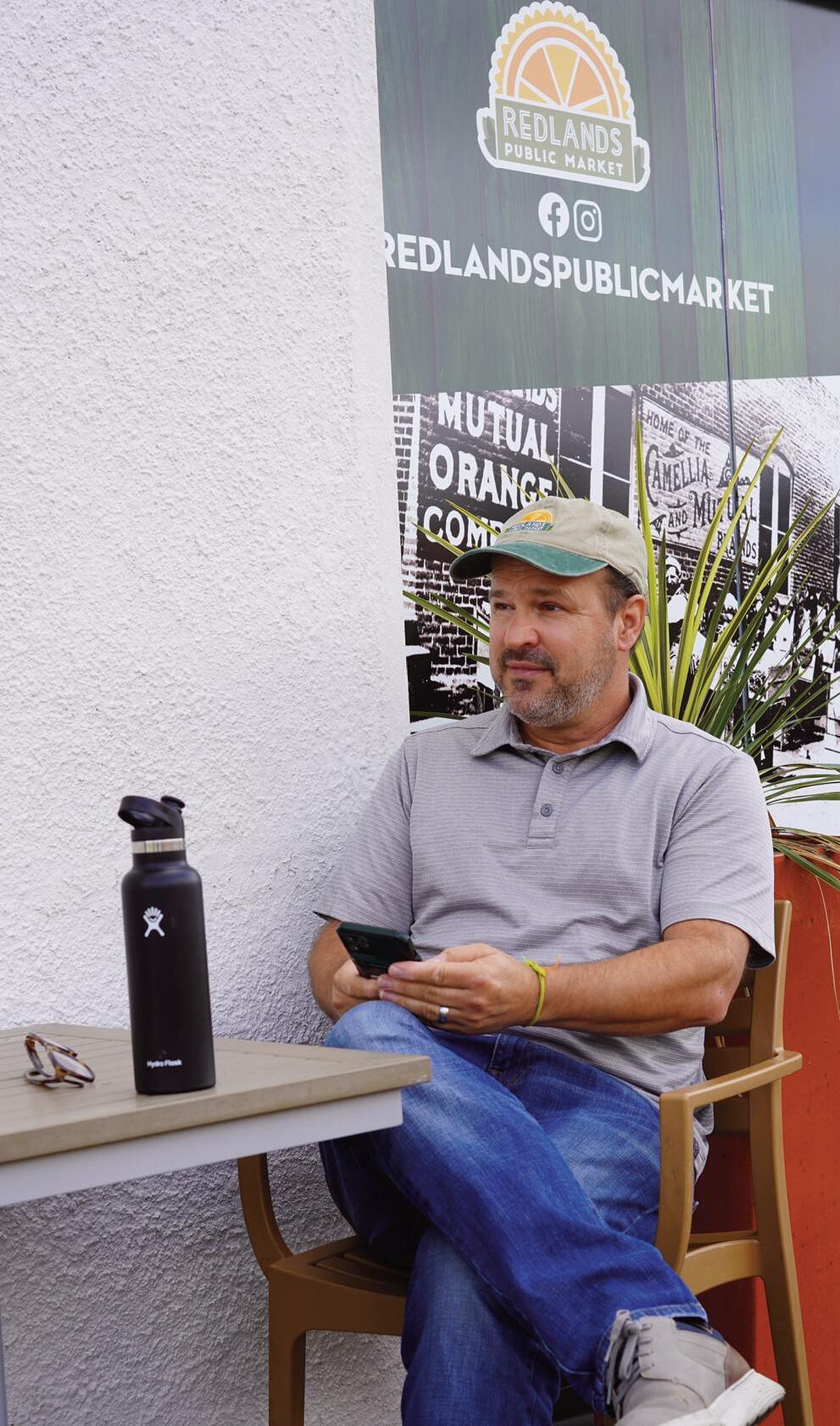
PHOTO MANNY SANDOVAL RPM co-owner Jerry Tessier takes a phone meeting on the outdoor porch overlooking the transit center after being interviewed by IECN on Nov. 17.