Hundreds of Bloomington residents will soon have the opportunity to move away from aging septic tanks and connect to a modern sewer system, a shift officials say will significantly improve public health, protect groundwater and enhance quality of life across the historic community.
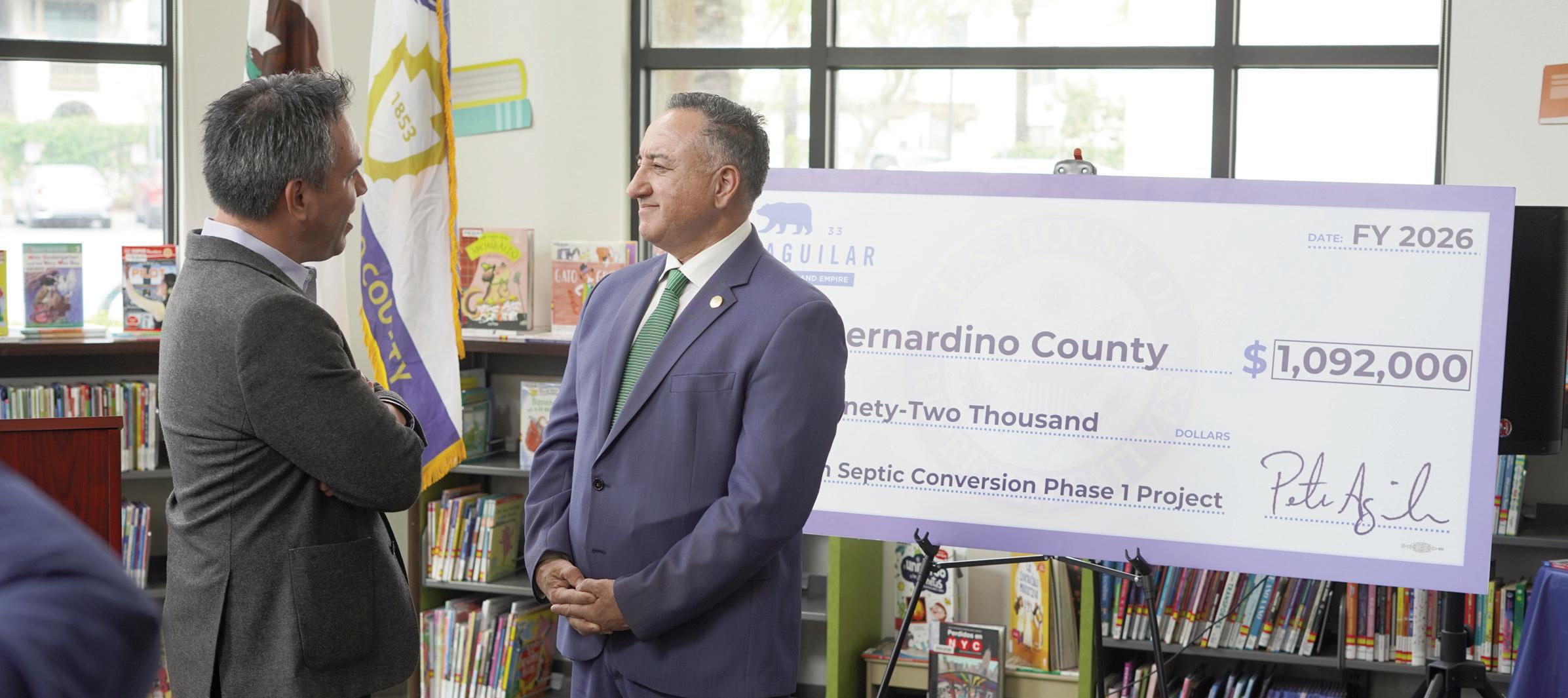
The transformation is being driven by a $1.092 million federal earmark secured by Congressman Pete Aguilar and presented
Jan. 17 at the Bloomington Public Library, funding critical sewer infrastructure that will allow homes to connect to centralized wastewater lines for the first time.
For many Bloomington families, septic tanks have been a costly and burdensome necessity for decades, requiring ongoing maintenance and posing risks when systems age or fail.
“You have to call, you have to get it cleaned, you have to get it changed,” Aguilar said. “For some of these properties,
if they’ve had septic for 50 to 60 years, that tank is nearing its end of use. So this allows them the ability to tie into the mainline sewer system and really help with a quality of life and peace of mind.”
A septic tank is a buried, watertight container designed to collect and partially treat household wastewater on-site. While common in older or rural communities not connected to municipal sewer systems, aging septic infrastructure can allow contaminants, including nitrates, to enter ground-
By Dr.G (Dr. Luis S González), community writer
The City of Colton Youth Council held its February meeting last week, continuing its yearlong program designed to teach local students about leadership, city history and municipal operations. The Youth Council, which begins each
August and meets monthly throughout the school year, focused its latest session on the Colton Electric Department. Electric Utility Director Charles Berry led
dents
known as the Agua Mansa Power Plant (AMPP) — where they observed heavy machinery, large transformers and extensive highpowered cable lines. Students were required to wear hard hats and sturdy walking shoes to navigate dirt, asphalt and gravel surfaces.
“I sure had fun learning about electric
PHOTO DR. G
(L to R): Leah Ornelas, Kaitlyn Torres, Ava Diaz, Samantha Sandoval, and Jasmin Lopez Herrera at the Agua Mansa Power Plant (AMPP).
PHOTO MANNY SANDOVAL
U.S. Rep. Pete Aguilar, left, speaks with County Supervisor Joe Baca Jr., right, beside a ceremonial $1 million federal earmark check supporting Bloomington’s septic-to-sewer conversion project.
Septic (cont.)
- water supplies.
San Bernardino County Supervisor Joe Baca Jr. said transitioning to sewer infrastructure represents a critical public health and environmental improvement for Bloomington residents.
“One of the things that’s very, very important is the health and welfare of our residents,” Baca said. “People don’t realize when people are on septic tanks, what it does, it causes pollutants, nitrates into the drinking water or contamination. But this could improve safety, it could also improve economic development for those that want to come in.”
Beyond environmental and health benefits, the project will give residents access to infrastructure long considered standard in newer communities.
“It really brings a better system for our residences,” Baca said. “People generally don’t understand the difference between septic and sewer. But having sewers is a better quality of life for residents.”
The funding will help construct trunk sewer lines — the backbone infrastructure required to allow homes and businesses to connect to a centralized system. Once completed, residents will have the option to con-
vert away from septic tanks, reducing maintenance burdens and improving long-term property stability.
“This will allow for future connections,” Baca said. “Because it is an underserved community, it will qualify for many state grants. So this will create future opportunities for our residents.”
Aguilar said the project addresses long-standing infrastructure needs while positioning Bloomington for future residential and economic growth.
“It’s a priority because public health is public safety,” Aguilar said. “Creating this infrastructure where people can convert away from septic into the main sewer program is better for public health, it’s better for our groundwater, it’s better for economic development, and it’s better for these residents.”
Reliable sewer access is also considered essential infrastructure for attracting new housing and commercial investment, removing barriers that can delay or prevent development.
“The more we can invest and the more that we can do ourselves in creating these backbone systems, then when new construction comes, new residential construction or new commercial development, they just
plug and play,” Aguilar said. “And that is important, so they can move quickly and so we can benefit from that economic development.”
Construction on initial phases of the sewer expansion is expected to begin within weeks, according to Aguilar, continuing San Bernardino County’s broader efforts to modernize infrastructure in underserved communities.
The investment will benefit both future development and longtime residents, many of whom have maintained septic systems for generations.
“Bloomington is a historic and amazing community,” Aguilar said. “Hundreds of families will now have that option, allowing them that opportunity to plug into the mainline sewer system is very beneficial to them, and it could extend the livelihood of their home and of their property and increase the value of their property.”
Officials said the transition represents more than an infrastructure upgrade — it marks a foundational shift in Bloomington’s future, improving health, stability and opportunity while bringing long-awaited modernization to a community that has relied on septic systems for decades.
Agua Mansa (cont.)
- power in Colton,” said student Ava Diaz. “That huge engine (turbine) was amazing.”
Previous Youth Council sessions have covered youth leadership, community services, the police and fire departments, and the city manager’s office. Students have met with department directors, asked questions and toured facilities related to each topic.
Two sessions remain on the schedule: Public Works and Economic Development. The program will culminate with formal recognition of the Youth Council members at an upcoming City Council meeting.
“It was a privilege meeting our Youth Council. Their commitment to our community’s future is inspiring,” Berry said. In addition to delivering the presentation, he guided students on the AMPP tour.
Youth Council members
include Ava Diaz, Samantha Sandoval, Kaitlyn Torres, Jasmin Lopez Herrera and Leah Ornelas. All attend Colton High School and were selected based on demonstrated leadership skills, academic excellence and teacher recommendations.
The Colton Youth Council was founded in 2016 by Dr. G, who serves as its founder and director.
The program aims to educate and inspire students with strong potential for future community leadership by teaching them about leadership, Colton’s history and civic service.
City officials said they look forward to the students’ continued development and involvement in civic affairs. Participants will be formally recognized in April for completing the yearlong program.
San Bernardino Arts Leaders Rally After Cultural District Bid Rejected
By Lexxie Ayala, Pepper Bough Staff Writer
More than 50 artists, nonprofit leaders and residents gathered Feb. 12 at the Garcia Center for the Arts to chart San Bernardino’s next steps after the city’s bid for state cultural district designation fell short, transforming disappointment into a renewed push for funding, infrastructure and long-term investment in the arts.
The San Bernardino Arts Advocacy Gathering, hosted by the Garcia Center for the Arts, Arts Connection and SB Generation Now, marked both a celebration of progress and a candid assessment of what remains missing after San Bernardino ranked No. 19 among more than 80 applicants for a California Cultural District grant in June 2025 but was not selected as one of 10 districts designated by the California Arts Council for 2026 through 2030.
Cities including Riverside, San Diego and Oxnard were among those awarded the designation, which brings statewide recognition and increased opportunities for arts funding, tourism and economic development.
Community organizer Miriam Nieto of SB Generation Now said feedback from state officials made clear that San Bernardino’s challenge was not a lack of community support, but the absence of formal city infrastructure to sustain a cultural district.
“They told us, ‘you guys had the community, you guys had the organizations, you guys had the spirit. You guys have the people power,’” Nieto said. “But what you guys don’t have yet is that the city, the local government, doesn’t have the actual infrastructure to make sure that we move or give you guys something like the cultural district for you guys to even start to build on.”
Nieto said San Bernardino currently lacks a dedicated arts and culture department and faces limitations in its ability to administer grants or provide sustained support to arts organizations, placing grassroots groups in a difficult position despite growing momentum.
“We need more support,” she said.
“We need concrete support. We’re gonna say, yes, we’re gonna help you, and here’s the funding for it. That’s what we want to get to.”
Arts Connection Executive Director
Alejandro Gutierrez Chavez said the state’s feedback reinforced the need for a unified, community-driven vision backed by tangible investment.
“That next step … was because the city didn’t have its own vision and investment in the arts and culture and creative economy,” Gutierrez Chavez said. “And so now is the time that we come together to begin outlining the vision that has already been said by the community and putting some pressure from the city.”
Gutierrez Chavez also emphasized that reaching the semifinalist stage was itself a milestone, crediting sustained advocacy by artists, nonprofits and community media recognizing Inland Empire Community News’ coverage of the arts.
“The cultural district visit was a huge milestone for our city and for the people who advocated for arts and culture in our city for so long,” he said. “The nonprofits, the businesses, the artists, the leaders, you are all the reasons why we made it to the semifinals.”
Garcia Center for the Arts Executive Director Michael Segura said the cultural district proposal was rooted in months of community listening sessions and focused on the E Street Cultural Corridor, an area anchored by historic and cultural landmarks including the original McDonald’s museum, San Bernardino High School, Sturges Center for the Fine Arts and the Garcia Center itself.
“We said, we need to make sure there’s community foot in this entire plan,” Segura said, noting that organizers hosted six sessions along the corridor to gather input and build a shared vision.
Segura said city officials have expressed support for pursuing cultural district designation and incorporating arts into the city’s broader planning efforts, but warned that planning alone is
not enough.
“Currently, the city is in the process of pushing forward their general plan. So there will be a cultural elements section in there,” he said. “But as you know, just having a plan doesn’t mean that it’s getting funded.”
The two-hour gathering concluded with a collaborative ideation exercise, where participants filled sticky notes answering questions about priorities for the next 24 months, including how arts and culture can foster belonging, healing and accountability, and how to build a comprehensive cultural resource system.
Gutierrez Chavez said the meeting was designed not only to reflect on past efforts, but to develop a clear advocacy agenda moving forward.
“We became semifinalists, but now what?” he said. “We’re gathering here today to figure out collectively–what is next for us for the next 24 months and how we can accomplish it together.”
Organizers said the goal is to align community priorities, strengthen partnerships and advocate for dedicated public funding that can transform San Bernardino’s grassroots arts movement into a permanent cultural infrastructure.
For advocates, the semifinalist designation was not the end of the effort, but evidence that San Bernardino has the foundation to compete — and a roadmap for what must come next.
Individuals Who Prey on Undocumented Victims Could Get Two Years More of Prison Time Under Ramos Measure
Community News
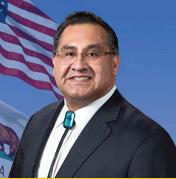
Individuals convicted of grave crimes against undocumented victims could face an added two years of incarceration under a measure, AB 1966, introduced by Assemblymember James C. Ramos (D-San Bernardino).
A qualifying criminal activity would be defined in the bill as crimes listed in the Immigration and Nationality Act and includes more than 28 crimes such as murder, rape, assault, trafficking, kidnapping, witness tampering,
and domestic violence among others. Undocumented individuals are especially vulnerable to becoming victims of crime as they fear deportation or drawing attention to their status. Offenders exploit and intimidate that fear to threaten a call to immigration agencies about the victim.
“This two-year sentence enhancement aims to protect undocumented victims of crime from criminals who would commit extremely serious felonies against a highly vulnerable population, but it is also additional protection for the rest of us from those same felons who prey on the vulnerable. This is a deterrent to such crimes, and an avenue for the undocumented to know legal protections are
available to protect them,” Ramos said.
Ramos’ bill comes amid a tumultuous time as federal immigration enforcement has ramped up across the nation. As threats increase to call Immigration and Customs Enforcement on undocumented individuals to prevent them reporting crimes, Ramos wants AB 1966 to reinforce the message that California will not tolerate such actions and will protect all victims of crime.
Assemblymember Avelino Valencia (D-Anaheim) is a joint author of the bill.
Reyes Proposes Clear Protections Against Secret Recordings Using Wearable Technology
Community News
Senator Eloise Gómez Reyes (D–Colton), today introduced legislation to strengthen privacy protections related to wearable recording devices, such as smart glasses. The Wearable Device Privacy Protection Act or Senate Bill (SB) 1130, would establish clear, enforceable rules to prevent secret audio or video recordings in places of business and ensure that recording lights are always visible to those around such devices.
“Californians have a constitutional right to privacy, and our laws must evolve as quickly as technology, to prevent harm,” said Senator Reyes. “Secretly recording someone under the guise of prescription-style glasses – especially when many people don’t even know this technology exists – has real consequences. We have an obligation as lawmakers to put a stop to it.”
Many wearable devices include small indicator lights to signal when recording is occurring. However, these indicators can be subtle, easily overlooked, or potentially disabled through software or hardware modification. This creates new risks of covert surveillance in semi-private environments such as offices, medical facilities, retail establishments, and other business settings where individuals may share sensitive personal, financial, or health information.
SB 1130 sets straightforward guardrails so the public and businesses know exactly what is allowed and what is not:
Requires explicit consent before any wearable device records individuals or groups inside a place of business.
Prohibits disabling recording indicator lights on wearable recording devices. Holds all parties accountable:
Individuals would violate the law if
they record without consent or disable the recording light.
Manufacturers and distributors would be prohibited from producing or selling devices or kits that would prevent recording indicator light from turning on.
Violations of these provisions would be punishable by fine or imprisonment, consistent with similar privacy protections under California’s penal code.
By clarifying that wearable recording devices must follow the same consent expectations Californians already rely on in other contexts, the Wearable Device Privacy Protection Act closes a growing gap between rapidly advancing technology and long-standing privacy protections.
SB 1130 was introduced on February 17 and will be assigned to policy committees for analysis and hearing dates in the coming days. To learn more about Reyes, visit https://sd29.senate.ca.gov/.
CNS-4012307# PUBLISHED EL CHICANO 2/19/26 E-187
Code)
and
2/5 2/12 2/19 2/26/26 Published in Colton Courier C-766 Fictitious Business Name Statement FBN20260000650 Statement filed with the County Clerk of San Bernardino 01/28/2026 The following person(s) is (are) do ng business as: ST JOSEPH HERITAGE HEALTHCARE, 19333 BEAR VALLEY ROAD, SUITE 101, APPLE VALLEY, CA 92308 County of Principal P ace of Business: SAN BERNARDINO Business mailing address: 15480 LAGUNA CANYON RD IRVINE CA 92618 Name: PROVIDENCE MEDICAL FOUNDATION 200 W CENTER STREET, PROMENADE, SUITE 800, ANAHEIM, CA 92805 State of Inc /Org /Reg : CA Inc /Org /Reg No : 1538558 Th s business is/was conducted by (a/an): CORPORATION Reg strant commenced to transact business under the fict tious business name or names isted above on FEB 09 2021 By signing, I declare that al information in this statement s true and correct A registrant who declares as true any material matter pursuant to Sect on 17913 of the Business and Profess ons Code that the registrant knows to be fa se s guilty of a misdemeanor punishab e by a fine not to exceed one thousand dollars ($1,000) /s/ KATHERINE BRODERICK SECRETARY
provided in Subdivision (b) of Section 17920 where it expires 40 days after any change n the facts set forth in the statement pursuant to Section 17913 other than a change in the residence address of a registered owner A new f ct tious business name statement must be f led before the exp ration The f ling of this statement does not of itself authorize the use in this state of a fictitious business name n violat on of the rights of another under federal state or common law (see Section 14411 Et Seq Business and Professions Code) Published 2/5,2/12,2/19,2/26/26 Published in Colton Courier C-780 Fictitious Business Name Statement FBN20260001026 Statement filed with the County Clerk of San Bernardino 02/10/2026 The following person(s) is (are) do ng business as: MILESTONES EDUCATION 8191 CALABASH AVE SPC 3 FONTANA CA 92335 County of Principal P ace of Business: SAN BERNARDINO Bus ness mailing address: 8191 CALABASH AVE SPC 3, FONTANA, CA 92335 Name: MILESTONES TUTORING & ENRICHMENT LLC 8191 CALABASH AVE SPC 3 FONTANA CA 92335 Inc /Org /Reg No : B20260028077 Th s business is/was conducted by (a/an): LIMITED LIABILITY COMPANY Reg strant commenced to transact business under the fict tious business name or names listed above on JAN 23 2026 By signing I declare that al information in this statement s true and correct A registrant who declares as true
or names isted above on NOT APPLICABLE By signing I dec are that all information n this statement is true and correct A registrant who dec ares as true any mater al matter pursuant to Section 17913 of the Business and Professions Code that the registrant knows to be false
NOTICE OF UNCLAIMED FUNDS
New Cheech Exhibit Traces Chicano Photography From Civil Rights to Now; Muscoy Artist Documents Logistics Threat
By Manny Sandoval
The Cheech Marin Center for Chicano Art & Culture in downtown Riverside opened a new, sweeping exhibition Feb. 7 that traces how Chicana/o/x photographers have used the camera to document their communities, assert identity and challenge power across six decades.
“Chicano Camera Culture: A Photographic History, 1966–2026” is the first major survey to examine the depth and evolution of Chicana/o/x lens-based image-making, bringing together about 150 works by nearly 50 artists. The exhibition moves from the civil rights era of the 1960s into contemporary photography and multimedia installations, highlighting the camera’s role as both a political tool and a means of cultural preservation.
A private opening-night gathering welcomed friends, families and artists into the galleries, with coffee from Mundial Coffee and pastries served as visitors experienced works spanning generations and regions — including voices rooted in the Inland Empire.
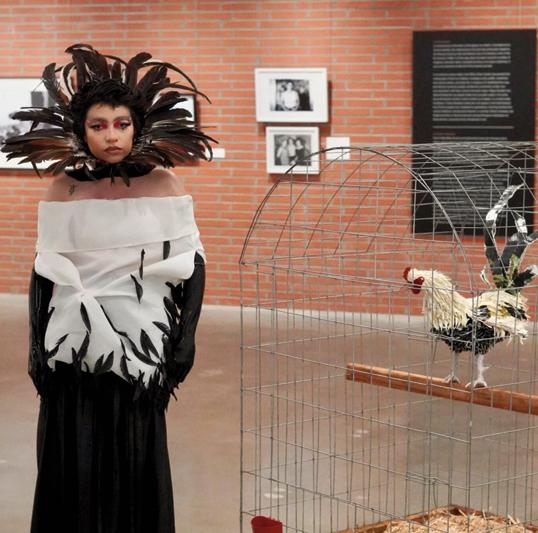
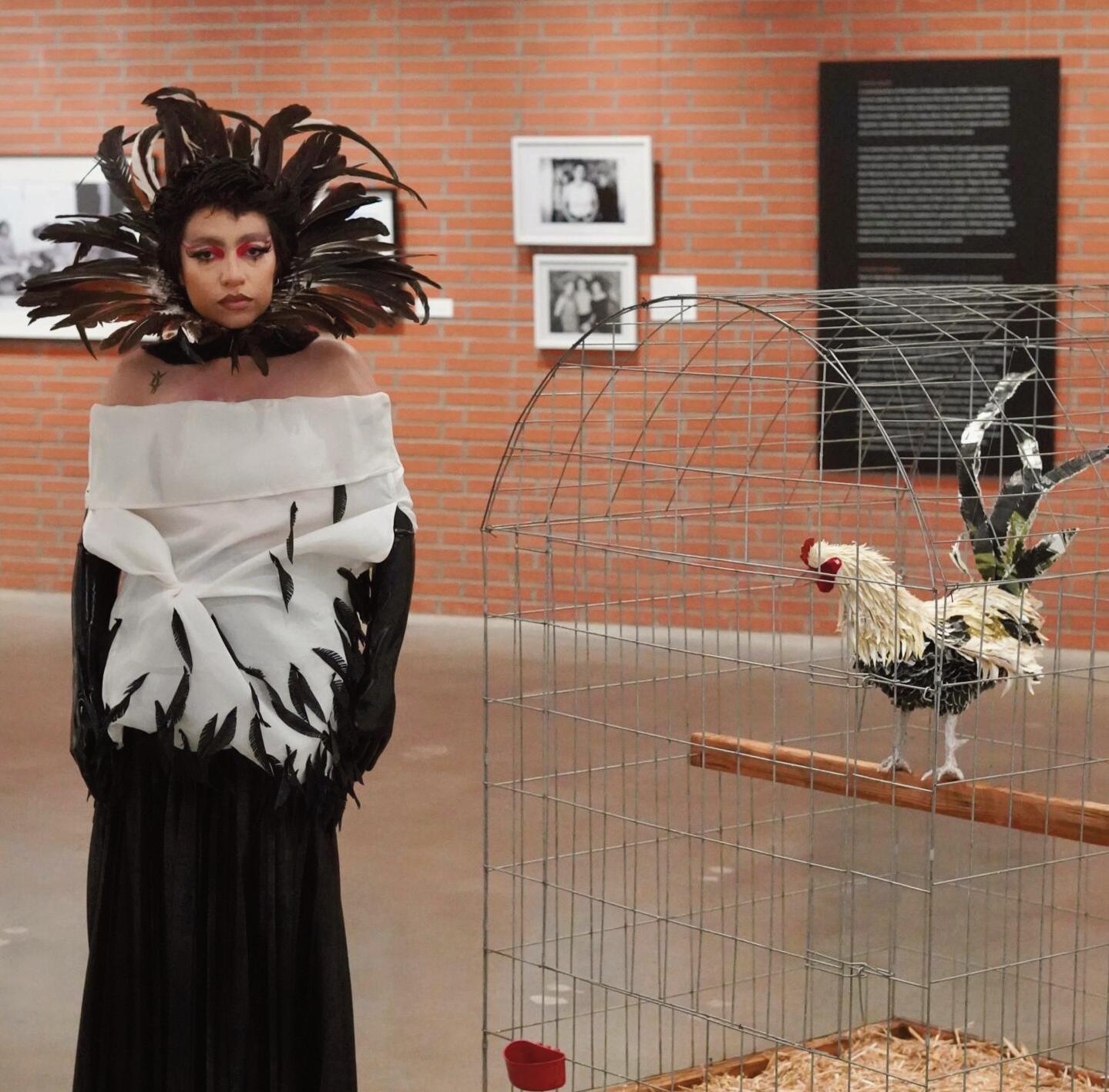
Among them is Yulissa Mendoza, an artist whose installation draws from an archive of photographs taken in Muscoy, the unincorporated San Bernardino community where they grew up.
“My artwork is titled and is an archive of photos from around Muscoy, which is where I grew up,” Mendoza said. “Each feather is a photo and they're all color coded to be the correct colors for the rooster. But they're all photos from my childhood, which includes liquor stores that I would go to. Just things that are happening around Muscoy specifically.”
Mendoza said the piece reflects both personal memory and the rapid physical transformation
they have witnessed.
“I did this because I wanted to showcase the changes that have been happening in Muscoy due to the logistics industry,” they said. “So to me I'm just documenting what is already happening today. So that way we have some sort of an archive for when it's not here, because I know that it's coming.”
They said access to institutional spaces like The Cheech is especially significant for artists from working-class Inland Empire communities.
“I think it's important that I'm in here and that other people from San Bernardino or in the IE are in this exhibit specifically because it shows the scale that we're at,” Mendoza said. “There's so many great, talented artists. Working artists.”
The exhibition also brings together photographers across generations, placing early trailblazers — including Louis Carlos Bernal, Luis C. Garza, George Rodriguez and María Varela — alongside artists who emerged in the 1980s and 1990s, such as Kathy Vargas, Ricardo Valverde, Christina Fernandez and Ken Gonzales-Day, as well as contemporary voices continuing to expand the medium today.
Behind the scenes, museum preparators worked intensively to transform the gallery space in time for the opening.
Eric Martinez, The Cheech’s lead preparer described the exhibition as one that connects historical movements to present-day artistic practice.
“I know that this is the inaugural exhibition for this show,” he said. “The hopes are that it'll plan to tour, but it's a large survey of Chicano photography, starting back with the Civil Rights Movement in the 60s and through today.”
He said the goal of installation work is to ensure the art remains the focal point.
For artist Daniel Ramos, who was born in Chicago and now lives in New York City, participating in the exhibition represents both professional recognition and a continuation of deeply personal work.
“Elizabeth Ferrer actually selected some of my work to be in an exhibition in Woodstock, New York in 2018,” Ramos said, describing how his relationship with the exhibition’s curator began.
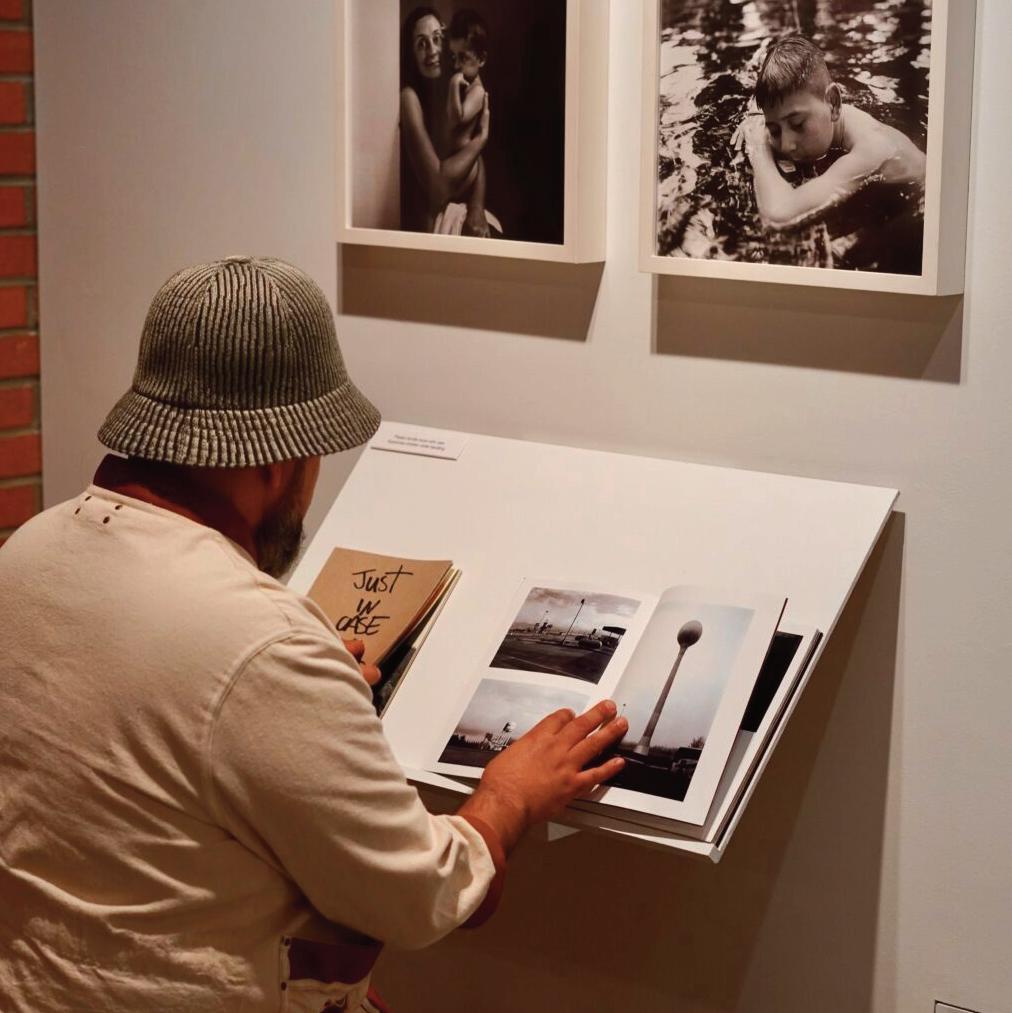
His featured project, “The Land of Illustrious Men,” combines photography, personal artifacts and handmade bookmaking to explore migration, family and identity after he returned to Mexico following his mother’s death.
“So as a photographer, I was like, man, I would be interested to see what the border life is like and make pictures,” Ramos said. “So I said, why do I have to photograph others when I could think about my experience?”
He described the work as an effort to document difficult truths without embellishment.
“My art is a book that tells that story in photographs and also with memorabilia and other stuff that I collected through my family,” Ramos said. “I don't embellish it.”
“Chicano Camera Culture: A Photographic History, 1966–2026” is available at The Cheech from Feb. 7, 2026, through Sept. 6, 2026, with a companion presentation at the Riverside Art Museum through July 5, 2026. The exhibition is supported by a grant from the Henry Luce Foundation.
PHOTO MANNY SANDOVAL
Artist Daniel Ramos views his photographic book installation at The Cheech on Feb. 7, a deeply personal work exploring his family’s migration, identity and life between Mexico and the United States.
PHOTO MANNY SANDOVAL
Artist Yulissa Mendoza stands beside their Muscoy-based rooster installation at The Cheech, built from childhood photographs to document how the logistics industry is negatively reshaping their community.
PHOTO MANNY SANDOVAL
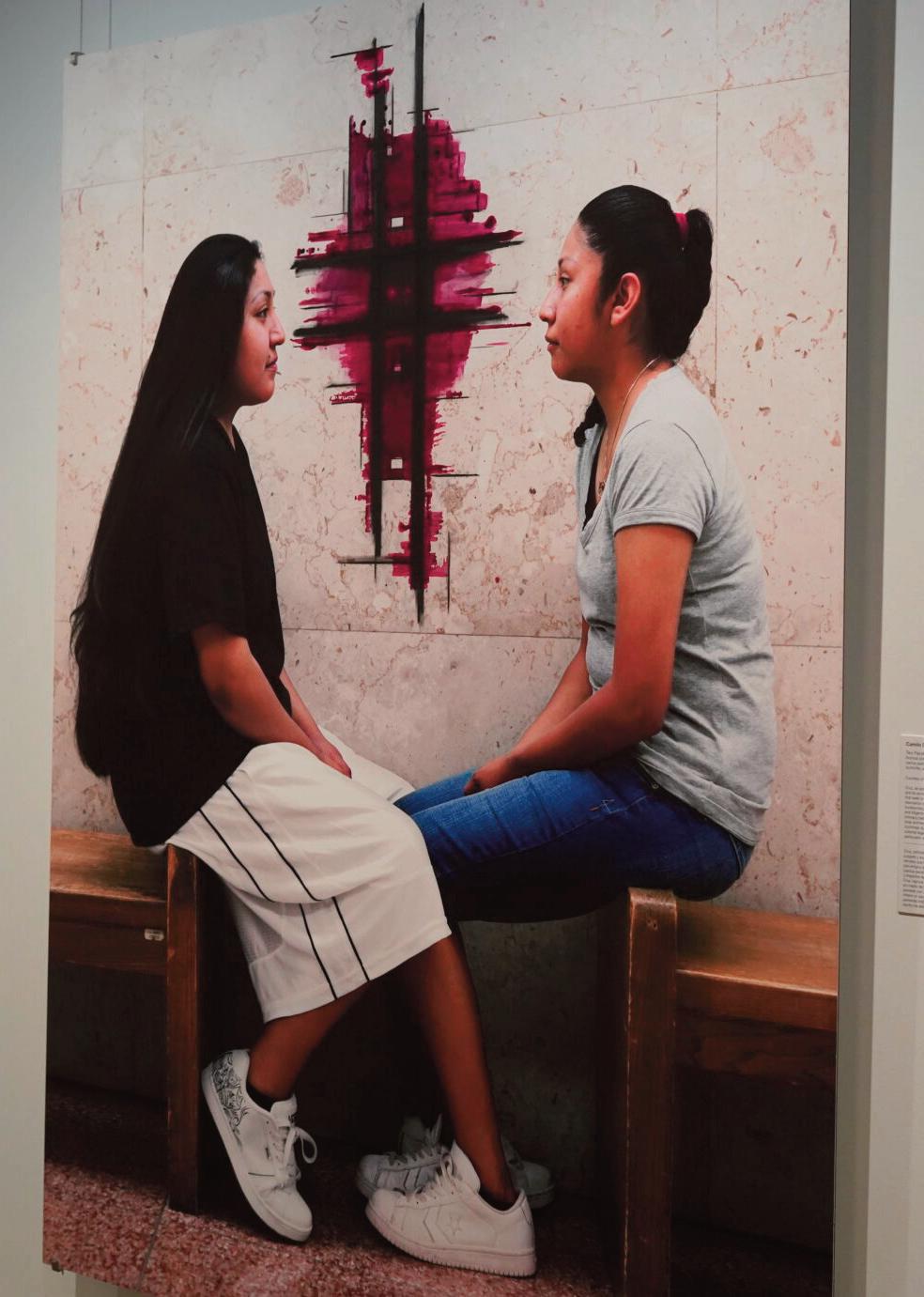
“Two Paiute Sisters, One Is Dead” (2025) by Camilo Cruz uses portraiture and cochineal dye to explore intimacy, loss and the lasting psychological and colonial impact of the criminal justice system on Indigenous and Latinx communities.