IDS
Indiana Daily Student | idsnews.com

By Dalton James jamesdm@iu.edu | @DaltonMJames
Curt Cignetti has made a habit of leading Indiana football fans through chants, whether it be his patented “Go IU!” or the famous “Hoo, Hoo, Hoo, Hoosiers.”
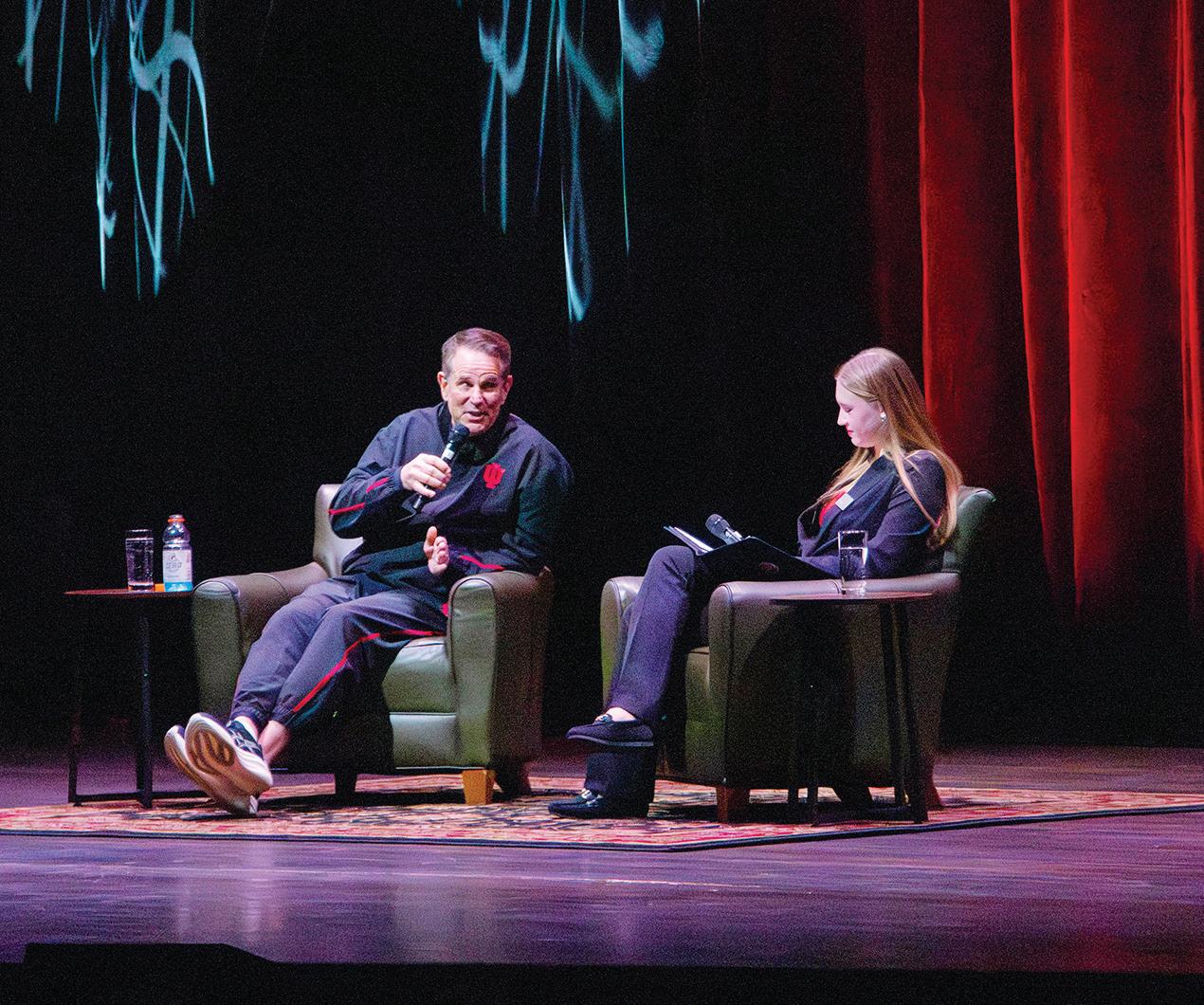
The Indiana football head coach, who completed his second season at the helm in glorious fashion just under a month ago, led a crowd of a few hundred Indiana students through such chants during the Indiana Memorial Union Board’s “A Conversation with Coach Cignetti” on the evening of Feb. 17 night inside the IU Auditorium in Bloomington. Cignetti spoke for nearly an hour about his tenure so far, next season and more. Here are six takeaways from Tuesday’s event:
Hoosier faithful, students were “incredible”
Before Cignetti arrived at Indiana, sellouts were a rarity — just eight in the 21st century — and only occurred against high-profile opponents like Michigan or Ohio State.
However, the Hoosier faithful sold out Memorial Stadium in Bloomington eight times across 15 total home games in the last two seasons. Cignetti said the student turnout and oncampus support has been “incredible.”
“I mean, the student section is sold out every game, and the energy that you bring to the stadium and the momentum that you create, our players feed off that,” he said. Throughout the Hoosiers’ postseason run — including the Big Ten Championship game against Ohio State in Indianapolis — the fans pro-
vided a significant edge.
“I just can’t say enough about how great that fan support was and what that meant to our football team, and how it elevated our play,” Cignetti said. “I don’t think there’s any question about it.”
Indiana sent nationwide message vs. Illinois
Ahead of the Hoosiers’ 2025 campaign, many media pundits deemed Illinois the “year’s Indiana.” The Fighting Illini returned much of their core from their 10-3 season in 2024, and national media projected Illinois to make its first College Football Playoff berth.
Conveniently for the Hoosiers, their conference opener Sept. 20 was slated against the Fighting Illini. The Cream and Crimson were “lurking in the weeds” throughout the offseason, Cignetti said, with their eyes on the matchup.
Indiana pummeled Illinois 63-10, improving to 4-0 and showing the rest of the college football world what it was capable of against a high-level opponent.
“I think we sent a message to the country that night with a lot more games to be played,” he said.
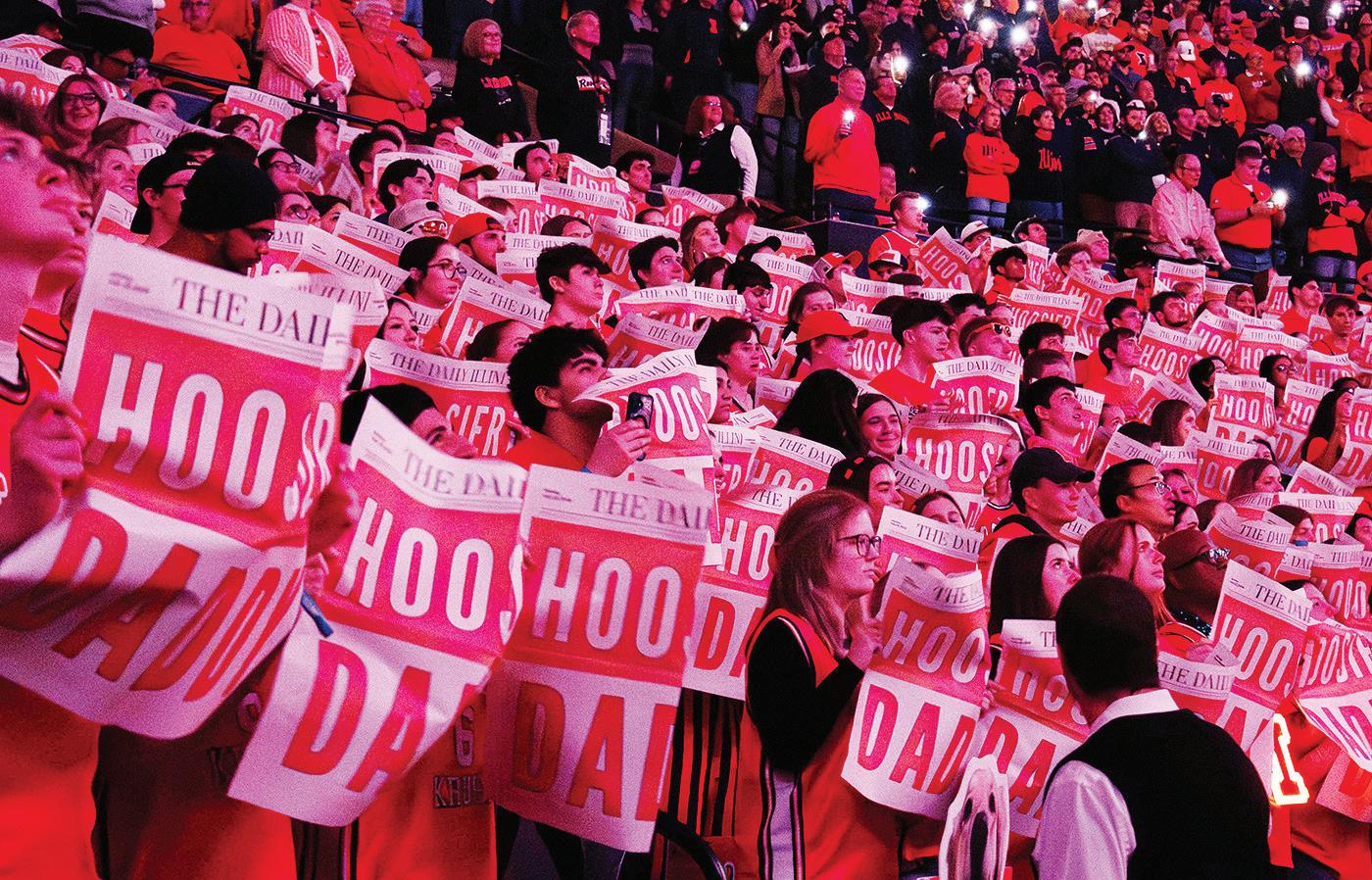
When Cignetti viewed Indiana as “team of destiny” Indiana was in a precarious position against Penn State on Nov. 8, with its unblemished record on the line.
Although the Hoosiers allowed the Nittany Lions to score 17 unanswered points in front of 105,231 fans inside Beaver Stadium, redshirt junior quarterback Fernando Mendoza orchestrated one of the greatest drives in Indiana history to
improve to 10-0.
Mendoza connected with four pass-catchers throughout the possession, ultimately firing a pass to redshirt junior receiver Omar Cooper Jr., who made a miraculous touchdown catch.
Cignetti said Cooper’s score will be remembered as an “iconic” play not only for Indiana, but also in the college football history books.
“It was just the most incredible comeback,” Cignetti said. “I’ve never been a part of anything like that before. After we got that done, in my mind, I was thinking to myself — you win games, and you develop confidence, people start believing in you — but this game, this team might be a team of destiny.”
Leadup to Rose Bowl was biggest coaching job
History wasn’t on Indiana’s side ahead of its CFP quarterfinal matchup against the No. 9 University of Alabama in the Rose Bowl on Jan. 1.
The Hoosiers sought to become the first team with a first-round bye to advance to the quarterfinals in the twoyear history of the 12-team CFP format.
Throughout Indiana’s 19day gap between Alabama’s first-round game and the Rose Bowl, Cignetti said he faced his “biggest coaching job all year long.”
As a result, he said he “wasn’t a very nice person to anybody 24/7.”
“I just felt like that’s what it was going to take to snap this team back into the right mindset and get ready for this game,” he said.
A 38-3 beatdown of the Crimson Tide followed in “The Granddaddy of Them All.” Cignetti 100% tied to
Cignetti’s contract buyout is cut in half.
Although Cignetti has been at the helm of the Hoosiers for just two seasons, he’s signed three contracts — his latest coming in midOctober 2025. With blue-blood programs seeking to poach Cignetti away from Bloomington, IU officials — specifically President Pamela Whitten and athletic director Scott Dolson — sought to be proactive and lock in their head coach.
The duo has upped the university’s commitment to success in football, whether it be in-stadium amenities or financial commitments to retain key assistant coaches. Should either Whitten or Dolson leave Indiana,
“It takes a commitment from the top to make this happen,” Cignetti said. “I am tied to those two, Pam Whitten and Scott Dolson, all the way 100%.”
Cignetti ready to start building foundation
Indiana set all sorts of records in 2025. Whether it was being the first college football team to go 16-0 since Yale University in 1894 or winning the program’s first outright Big Ten title since 1945, Cignetti’s second season yielded what many thought were impossible results.
But the Hoosiers’ storybook season is in the past.
Cignetti and his staff
brought in 17 players via the transfer portal, including presumed starting quarterback Josh Hoover and premier wide receiver Nick Marsh.
The Cream and Crimson have begun their offseason training program in the weight room with new strength and conditioning coach Tyson Brown, who Cignetti hired Jan. 23 after Derek Owings left for the University of Tennessee. Indiana’s attention is on improving every day ahead of the 2026 season, which is slated to begin against the University of North Texas on Sept. 5. "Now,” Cignetti said, “we got to start it all over again and dig that hole for the house and then the foundation.”
By Emerson Elledge eelledge@iu.edu
After President Donald Trump’s “One, Big, Beautiful Bill Act” was signed into law last July, Medicaid eligibility and funding became further complicated for the millions of Americans who qualify for benefits after the program lost almost $1 trillion in funding until 2034. The act went into effect Jan. 1. One of the biggest provisions in the act related to Medicaid was the removal of statewide incentives for Medicaid expansion, making fewer people eligible for the program. Medicaid is a federal program that partners with states to provide some health care cost coverage for those who qualify based on factors like income level and age. Indiana offers four main different variations of Med-
By Mia Hilkowitz mhilkowi@iu.edu
The Department of Jus-
tice’s Civil Rights Division is investigating Indiana University’s scholarship programs in a probe into compliance with federal law.
IU administration directed faculty and staff involved in scholarship processes across the university to preserve all documents, notes, communications and recordings that could be used in the investigation. According to the DOJ’s Dec. 12 letter to IU President Pamela Whitten, obtained by the Indiana Daily Student, the review is investigating if IU’s scholarship programs are compliant with federal law and wheth-
icaid, based on patient qualifications, in addition to traditional Medicaid. Children up to 19 years old and pregnant people are eligible for the Hoosier Healthwise plan. The Healthy Indiana Plan is for low-income adults from 19 to 64 years old. Indiana PathWays for Aging is for members older than 60.
Hoosier Care Connect is for individuals 59 and younger who are blind, disabled or who have other complex medical needs who may not qualify for Medicare. Hoosiers can also opt for traditional Medicaid.
Within each program, customers have the option to select different plans which vary based on cost and overall coverage.
Health care offices are rolling back how many Medicaid patients they accept because the bill reduces reimbursements to facilities
for care given to Medicaid patients.
Here are a few health care facilities in Bloomington that still accept Medicaid:
Hospitals
IU Health Bloomington Hospital accepts Indiana Medicaid for emergency and inpatient services.
Outpatient care like in-home geriatric care or take-home electroencephalograms vary by Medicaid plan. The hospital is open 24 hours, seven days a week.
Primary Care and Medical Clinics
HealthNet Bloomington Health Center is a community health center. Its services include family practice, pediatrics, internal medicine, OB/GYN services and administering vaccines.
The clinic also offers social work and behavioral health services, in addi-
tion to having a space for lab work. It accepts Medicare, Medicaid and Hoosier Healthwise plans, as well as offering a sliding fee scale discount program based on income level.
The clinic is open 8 a.m. to 5 p.m. every Monday to Wednesday. The clinic is open at 8 a.m. to 8 p.m. on Thursdays. New patients must call the office at 317957-2400 to schedule an appointment.
IU Health has three primary care facilities in Bloomington. The Bloomington South location is open every day but Sunday. The facility is open 8 a.m. to 5 p.m. on Mondays, Tuesdays, Fridays and Saturdays. It’s open until 7 p.m. on Wednesdays and Thursdays.
IU Health’s Bloomington East facility is open Monday through Friday from 7 a.m. until 5 p.m.
The third IU Health pri-

mary care facility is on the west side of Bloomington and is open 7 a.m. to 5 p.m. Monday through Friday. All locations accept Medicaid.
Urgent Care WellNow Urgent Care is open 8 a.m. to 8 p.m. daily. It accepts Medicaid, but has some variation based on plan coverage. This list does not include every facility in Bloomington that accepts Medicaid, but rather, is a starting point to community members in need. For further information on more specialized care, search online with the Indiana Health Coverage Programs Provider Locator. Call any office prior to visiting to ensure specific plans are accepted and that the office is accepting new Medicaid clients.
er the university is “discriminating against program participants based on any statutorily prohibited basis.”
As part of the review, the DOJ requested a demographic breakdown of all IU students. It also ordered IU to provide numbers on how many scholarships and total funds the university awarded — broken down by sex, race, ethnicity or national origin — and the evaluation and selection criteria used to determine scholarship recipients.
The DOJ directed IU to provide any policies, agreements, processes, audits, surveys and all communications surrounding its scholarships where “eligibility or selection criteria considered race, ethnicity,
national origin, or sex.” It requested materials and dates for “nondiscrimination training,” as well as any complaints, grievances or appeals filed by students, staff or third parties. These materials include: Emails and voicemails
• Hard copy documents and all attachments
• All text and instant messages
• Hand-written notes
• Printed or electronic databases “Any other hard-copy or electronic document, whether in draft or final form, and whether or not the document appears to be a duplicate of any other document.”
The university was required to respond to the
DOJ’s request within 45 days of when it received the letter, or Jan. 26. The IDS has not obtained any response IU sent to the DOJ, and an IU spokesperson did not immediately respond to a request for comment.
The IU Office of the Vice President and General Counsel sent letters to faculty and staff who have material that could be used in the investigation.
“Effective immediately, you must preserve and refrain from deleting, altering, or destroying any records— whether paper or electronic—related to scholarship administration,” the undated letter read.
The letter said the Office of the Vice President and General Counsel will
work with the University Information Policy Office to preserve recipients' emails and electronic documents, and that all preserved information won’t be accessed “until the need to provide specific records arises.”
The Department of Justice did not respond to a request for comment by time of publication. Under the Trump administration, the DOJ and U.S. Department of Education have launched investigations into and sent letters to many other higher education institutions for a swath of issues, from racebased admissions to handling of antisemitism and the participation of transgender athletes in collegiate sports.
In March last year, the Department of Education sent a letter to IU Bloomington, along with 59 other schools, stating it was investigating antisemitic harassment and discrimination and threatening federal funding. There is no resolution related to this investigation at IU listed on the department’s Office of Civil Rights website. On Feb. 13, the Trump administration sued Harvard University for allegedly not disclosing data in its own DOJ investigation into race-based admissions. The DOJ also opened an investigation in July 2025 into George Mason University for alleged “discriminatory practices” regarding student scholarships.
By Madelyn Hanes mrhaynes@iu.edu
The office still carries traces of Dan Combs.
Old framed photos rest against the walls as staff sort through decades of memories. Two fish tanks — once Combs’ — hum softly near the meeting table at the Perry Township office located at 1010 S. Walnut St. Even now, township staff members come in daily to feed the fish.
Dan Combs, Perry Township trustee since 1986, died Jan. 6. He oversaw township assistance, such as financial help with housing or food, in Perry Township, one of 11 in Monroe County, which includes the southern half of Bloomington.
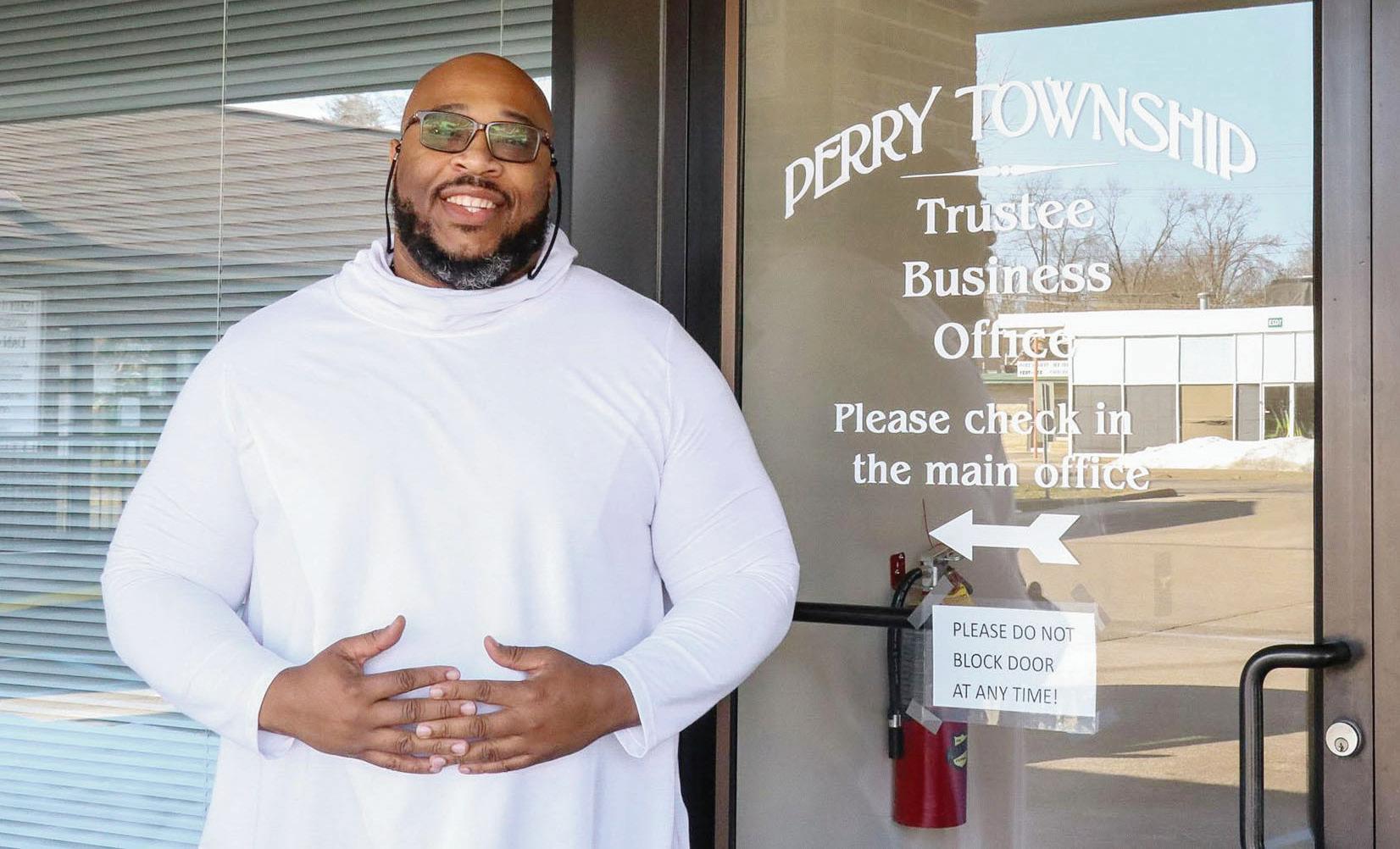
Into the space walks Leon Gordon, the newly appointed Perry Township trustee finishing Combs’ term. The Monroe County Democratic Party selected Leon Gordon as the new Perry Township trustee Jan. 31 through a vacancy caucus.
“My name is Leon Ithream-Fortunatis Gordon,” he said, spelling out the 17-letter middle name his father gave him. “It’s partially from the Bible and then Fortunatis is Latin, fortunate. But it’s a servant of the people. It’s what I would gather in. There’s power in the name.”
As a child, Gordon avoided using it. Now, he embraces it. The name, he said, became something to live up to. Taking up a life of service is the best way to honor both his name and his upbringing, he said.
Gordon said he grew up “a poor kid in the South Side of Chicago,” in neighborhoods where questions about inequality lingered early in his mind.
“Because as a kid, I grew up in the neighborhoods where you look around and you’re like, why is it this way?” he said.
He attended the University of Chicago as an English major on the pre-med track, a Division III football player and track athlete. He took several philosophy courses that reshaped his worldview and graduated in 2007.
By Natalie Chan nkchan@iu.edu
Notes of coffee filled the air as glasses clanged behind the bar at Poindexter just after 2 p.m. Feb. 11. Students — each with a drink by their side — hunched over their laptops, hard at work.
Poindexter is a coffee shop — and now a bar — at the Graduate by Hilton, a hotel at 210 E. Kirkwood Ave. The location was only a coffee shop until July 2025, when it acquired a liquor license and began promoting its bar scene.
The Bloomington location is the largest Poindexter in Hilton’s Graduate Hotels franchise, assistant general manager Matthew Hazen said. It was also the last Poindexter to obtain a liquor license.
Andrew Harris, Poindexter’s general manager in Bloomington, said the business had always wanted a liquor license but found it difficult to acquire due to state laws and the location’s proximity to a religious organization.
Poindexter is about 18 feet from First United Methodist Church, which is located at 219 E. Fourth St. Indiana Code 7.1-3-21-11 restricts alcohol permits for premises, including hotels, if one of its walls is within 200 feet of a church wall. However, if a church representative writes a statement stating it does not object, the business may get a permit.
In August 2024, the Graduate applied to be considered as a historic building with Bloomington’s Historic Preservation Commission, which would allow it to get an alcoholic beverage permit.
The City of Bloomington website states properties should be 50 years old
“Being exposed to philosophy at the University of Chicago changed my life,” he said. “That place changed my life. It brought me into the classics where I read all philosophers from the Enlightenment period and then before, like JeanJacques Rousseau, he’s like my favorite.”
After college, he joined Teach For America, a full time, paid opportunity to teach in under-resourced classrooms, and taught at an all-boys charter school in Chicago. He said he designed curriculum and created a classroom that treated students as “young writers, thinkers and philosophers.”
After teaching, Gordon began to think about whether he needed to stay in education or change gears.
But teaching alone did not feel like enough. “I see all these other things that are influencing it (education). And so, I need to go higher,” he said. “I need to go do more.”
The realization led him into the field of learning sciences at Northwestern University, where he earned his master’s degree in 2010. He later attended Indiana
for consideration of historic designation. At the time, the Graduate had been built only six years earlier.
Bloomington’s Historic Preservation Commission rejected the hotel’s request for historic designation.
First United Methodist Church did not reach an agreement to give the Graduate permission to obtain an alcohol license in 2024.
“2024 wasn’t even really the first attempt,” Hazen said. “When the building was originally built, the plan was to have a bar in here, and the building was built in 2018.”
After a series of negotiations in 2025, the church reached a consensus that allowed the Graduate to pursue a liquor license.
“It’s something that kind of comes up on a regular basis,” Harris said. “I think that we’ve shown ourselves to be good neighbors, and, you know, we’re not going to cause any issues by having either the problems that can come with alcohol and that kind of thing.”
Poindexter then began construction on a full bar. In the meantime, it operated with a temporary coffee shop and bar located in the Graduate’s lobby, across from its usual location on the opposite side of the concierge.
Challenges for the business included relocating equipment and serving customers despite noise disruptions from demolition. The renovations finished in midOctober 2025, Harris said. Harris also said the addition of a bar scene was less of a rebrand for the business but rather a supplementary service. He said Poindexter is available to the entire community, but the bar particularly targets parents of IU students staying at the
University and pursued a doctoral degree in learning sciences, completing all coursework but his dissertation.
He said he met one of his greatest teachers at IU, Phil Carspecken, a now-retired professor in counseling and education psychology. Gordon said he taught critical qualitive inquiry.
While completing his doctorate, Gordon immersed himself in Bloomington’s community work. He started at New Hope for Families, a family shelter that provides emergency shelter and early learning programs, as an overnight site supervisor, cleaning and assisting families experiencing homelessness. Over time, he grew into leadership roles and later stepped in as a senior housing specialist.
Gordon said he later worked with the Bloomington Housing Authority, which provides housing assistance in Monroe County, and other local organizations, building what he calls “circles of influence” around housing stability and development.
Gordon also served on
Graduate.
“We’re still here as the neighborhood coffee shop. We’re still available for students,” Harris said. “What we’re doing here is obviously we want to take advantage of the liquor license to generate additional revenue, and it’s also an additional service to our guests as well.”
Hazen, who has worked at Poindexter for about five years, said Poindexter is not trying to become the most expensive bar in town, but it aims to provide a more elevated experience than one can get from a standard college bar without having to spend heavily.
“It was really about trying to bridge those two gaps because the way we saw it, there wasn’t really something filling that gap in Bloomington yet,” Hazen said.
Poindexter begins serving coffee starting at 6:30 a.m. every day, and alcohol service begins at 4 p.m. The shop closes at midnight from Thursday to Saturday and at 11 p.m. from Sunday to Wednesday, according to its website.
Before Poindexter began serving alcohol, the business closed at 8 p.m., Harris said. The extended hours required increased employment.
“We had to increase staffing levels to account for bartenders,” Harris said. “You serve food until midnight, so that means additional cook labor. We also have some of the barista team on here a little bit later.”
Harris said the business added more entrees, but kept items that were popular before the bar, like the chicken Caesar wrap, on the menu.
The old fashioned and espresso martini cocktails are currently the best-selling
several boards and committees, including as treasurer and secretary for the SouthCentral Housing Network Board, vice chair of the South-Central Community Action Program, vice chair of the Indiana Balance of State Continuum of Care Board and member of the Statewide Capital Projects Initiative Committee for Indiana United Ways.
His life during those years at New Hope mirrored the challenges many families he served were facing, he said. As a graduate student raising four daughters with his partner — his high school sweetheart — Gordon relied on income-based housing and public programs to make ends meet.
“And those are programs that I knew because my mother was able to raise me utilizing them and getting me to the opportunities I have therein by keeping us stable,” he said. That lived experience informs how he approaches policy. Stability, he said, is “the name of the game.”
Gordon said he left his position at New Hope on Feb. 13 to step into the trustee role.
Gordon had been preparing to run for trustee even before Comb’s passing. Friends and colleagues encouraged him to consider running for the next term, beginning in 2027, when they learned Combs planned to retire after his term ended this year.
“I got some ideas,” he said. “I would like to run for that. But I kept it close to the vest because, you know, I just wasn’t quite sure that I wanted to step in that direction or maybe how to or knowing that it was an elected office.”
Rather than making sweeping changes to the township, Gordon said he is there to learn and wants to be supportive. He describes himself as a “learning scientist” who believes effective change requires understanding systems and people within them before trying to reshape them.
“They are the experts,” he said of the township staff, many of whom have worked in the office for decades. “And I hope to just continue to learn.”
At the same time, the township faces uncertainty. New state legislation could
cause small townships to lose their governing independence. Consolidation discussions loom in the Indiana statehouse with proposed House Bill 1315 and Senate Bill 270. Gordon plans to stay attuned to legislative developments and collaborate with other township leaders in Monroe County. He said this week, the Monroe County Township Association will have a luncheon to get together and plan for any legislative changes.
Gordon said his early priorities include strengthening preventative services to keep families from losing their homes due to affordability issues, increasing awareness of available assistance and expanding pantry support.
He said Combs documented the township’s response to a recent tornado, earning recognition in the statehouse. Gordon hopes to continue highlighting the office’s behind-the-scenes work in new ways.
“I’m not coming in a blazing change,” he said. “I want to be able to say I can earn my own term.”
At home, Gordon is a father to four daughters — a college freshman, a high school senior, an eighth grader and a first grader. He speaks of them with pride and humor, from college applications to cheek-pinching that is no longer permitted. Parenthood, he said, keeps him grounded.
Gordons says he plans to run for re-election in the upcoming primary May 5.
“That is my life plan right now, to be here in this office, to finish this term and to build a foundation that defines my term, as trustee here,” he said. Back in the office, the fish tanks remain, tended carefully by staff who knew Combs well. The walls are slowly clearing of Comb’s pictures. Gordon is still settling in, still learning the rhythms of a space shaped by four decades of one man’s leadership. But if his middle name is any indication, Gordon said service isn’t new, it is simply the next step.

drinks, Harris said. Harris said Poindexter surpassed its revenue targets in 2025 and increased its budgets for 2026. He said the business had a good January and is on track for a good February.
To promote the new bar, Hazen said the shop plans on introducing live music events and open mic nights.
Poindexter currently offers weekly events including “Tinis and Tenders Tuesday,” which features mini martini flights and chicken tender baskets from 5 p.m. to midnight, and Wednesday night trivia, a brain teaser game night with prizes beginning at 7 p.m.
“Word of mouth has been our biggest, our biggest thing from a marketing standpoint,” Hazen said. “And you know, I think we’re going to continue to try to push that.”
Isabella Caruso, a soph-
omore at IU, said she was unaware of the shop’s transition to a coffee shop and bar, though she had been to Poindexter in the past.
“I think it’s going to be interesting to see how it changes from more of a study scene to like now they’re allowed to serve alcohol,” Caruso said.
Caruso said she believes the new bar will be a nice addition for the hotel guests, but she hopes the business does not lose its identity as a study space.
For IU sophomore Ava Calabrese, Poindexter was a comforting break from her freshman-year dormitory. Calabrese said she has frequented Poindexter since she moved in at IU.
“It’s just relaxing to study,” Calabrese said. “It’s like, usually pretty quiet, but it’s like, it’s definitely louder by the bar as they put more TVs.”
Lily Fitzgerald, a sophomore who visits Poindexter about three times a week, said she found out about the changes when she was studying last Friday night and saw customers drinking alcoholic beverages at the bar. “I came a lot freshman year. But I also don’t see a difference, because I came during the day,” Fitzgerald said. “The vibe is still the same.” Hazen said with the new bar, he’s noticed fewer people wearing headphones, study sessions not stretching as late into the day and more chatter in the evening as guests socialize. However, he believes the shop has stayed true to its brand.
“Our job is to create an experience that’s so nice that people come with one group of friends, and they go back, tell their friends about it,” Hazen said.






Emma Howard (she/her)
is a sophomore studying cinematic arts.
With the popularization of AM broadcasting in the 1920s, cabinet radios became the focal point of living rooms across the United States. In the 1950s, families gathered around the glow of a boxy television set, rearranging the sofa to face its screen. Thirty years later, the home computer arrived, reigning atop the glorious throne also known as your dad’s cluttered rolltop desk. These devices bonded our entertainment to a specific location in the home. By anchoring our technology into place, this setup gave us what we so desperately need today: media in moderation.
Let’s face it: we’ve all gotten stuck in that vicious cycle of closing Instagram just to open it right back up again. Today, our devices are always in our pockets, ready to access with just a swipe. The portability of phones, tablets and laptops is what makes them so disruptive in our lives. When technology is constantly at our beck and call, we reach to it by default. But what if you had to physically go into another room and log onto a computer to do your scrolling?
You can’t tote around your home computer to use whenever you want to check social media, or hold your television set in bed to binge Netflix until some ungodly hour of the night. Station-

ary technology allows us to come and go with intention, rather than holding us captive by the internet’s ever-looming presence. Designated media zones in the home like entertainment centers, family computers and turntable setups allow us to consume content in shorter, less random bursts. Home computers allow us a time and place for media consumption to fight the automatic impulse to reach
for our phones. They’re also designed in a way that is more engaging for the brain.
In a 2023 study, 87 participants were given PSAs to watch in either a neutral or bent neck position. As they watched, psychophysiological factors such as heart rate, skin conductance and facial electromyography were recorded to indicate any physical stimulation the participants may have experienced. In this case, the big-
ger the reaction, the higher the brain activity. The results concluded that participants in a neutral, or straightforward position had higher levels of brain activity compared to those watching in a flexed position.
When you’re facing a television set or desktop computer, you are in a much more alert state than you would be hunched over a phone or tablet. By design factors alone, station-
ary technology allows us to think more critically about what we see. Smaller, mobile devices are, in contrast, built to pull us in with no way of getting out. In that safe, almost fetal position we assume to scroll on our phones, our brains go on autopilot to handle the mass amounts of information being thrown at us. Home entertainment spaces allow for more tangible, focused interaction with
the media we consume. For example, vinyl record listeners must open the packaging, place the record on the turntable, lower the needle and flip the record over when a side finishes playing. The physical actions required to consume the content create a more engaging experience. Switching dials, pressing buttons and typing on keys all introduce a tactile element to media consumption that creates a more intentional process than tapping on a screen does. The good news is, these little media hubs in our homes could come back. Just this year, Generation Z began the “physical media movement” to reduce our reliance on digital sources for music, television and film. Beginning this January as a sort of New Year’s resolution, the analog movement has gained traction online, where users share their physical media collections and encourage others to build their own, opposed to using streaming services like Spotify and Apple Music. As a result, physical media sales have spiked. While there is a lot of nostalgia driving the movement, this trend is more significant than just retro aesthetics. Bringing back set-ups like home computers would give people access to the media they need, while still granting them the freedom to walk away.
emhowa@iu.edu
Advait Save (he/him)
is a junior studying economics and sociology.
“ICE out!” rang in unison among hundreds of people gathered Jan. 30 outside Bloomington City Hall. Never before in my three years at Indiana University had I seen such a protest. Public anger toward the Trump administration’s deployment of U.S. Immigration and Customs Enforcement in Minneapolis and across the country echoed in Bloomington. Given recent events, like the death of Alex Pretti and Renee Good, it’s unsurprising that such a protest would happen in Bloomington. What is surprising, though, is how the protest unfolded and what it advocated.
I have had a little over two weeks to reflect on my personal experience of the protest, largely as an observer. Even the most charitable interpretations of the ideas expressed at the protest leave me deeply uncomfortable associating with the event.
I arrived at City Hall around 12:30 p.m., by which point hundreds of people who had marched through Bloomington to this ending point had already gathered. I found myself near the back of the crowd, barely able to hear the speeches. After a while, I grew frustrated and navigated through clusters of people until I spotted a friend near the front. I wove my way through a crowd of attendees until I was able to join him and finally hear the speeches.
One of the speakers caught my attention after deriding ideas of reformation and constitutionalism.
Michael Jonelis (he/him) graduated with a Bachelor of Science from IU Bloomington in 2021. He now works as a data scientist in Chicago.
About two weeks ago, Indiana University trustee Sage Steele took to Fox News to demand athletes and musicians “shut up and dribble, shut up and sing,” after some criticized U.S. Immigration and Customs Enforcement and Customs and Border Protection at the Grammy Awards. Her reasoning: “Because you’re super talented, but you don’t know what you’re talking
His ideas then took an internationalist turn.
“Terrorism is not real,” he proclaimed in reference to the administration’s stance on domestic terrorists. This includes labeling Alex Pretti as an “assassin” and “domestic terrorist.” This extremely radical statement was met with applause.
The horrors of the 26/11 attacks, where about 10 members of an Islamic fundamentalist group from Pakistan killed and injured hundreds in my home city of Mumbai, flashed before my eyes amid the loud cheering approval of the crowd. Even though I was with friends, that one moment made me extremely uneasy. The speaker later doubled down on his argument by criticizing the American War on Terror, saying it was illegitimate and completely unwarranted.
My best guess is that the speaker meant the word “terrorism” was linguistically constructed by Western powers to label any and everybody who opposes their interests as such. This interpretation would justify the statement “terrorism is not real” as rejecting American imperialism, rather than downplaying atrocities like the 2008 Mumbai attacks, in which I and thousands of others lost friends and family members.
I am not accusing the protest or the speaker of supporting terrorism. However, the speaker did something very dangerous here: he combined moral absolutism with radical rhetoric.
Such radical rhetoric, even though it was met with applause, threatens our ability to find common ground in an already-polarized po-
about.” Beyond the immediate contradiction — how does one shut up while simultaneously singing? — Steele’s lecture reveals a staggering lack of self-awareness. She seems entitled to act as a moral and intellectual authority, while she has spent her own career as a professional observer, rising to prominence at ESPN by narrating the very talent she now seeks to silence. A profound hypocrisy lies in belittling the group to whom she owes her entire livelihood.
litical climate. Even if we assume that the rhetoric was a product of the event itself, I think it would be foolish to suggest the content was also a product of the event. The leap from criticizing ICE and its actions to American imperialism seems farfetched and unnecessary. It is this unnecessity which is a symptom of populism.
Through the protest, it was clear to me that some participants aimed to construct a classic “us versus them” narrative. That “us” was presented as the completely virtuous majority, while the “them” was the irredeemably malign elite and oppressive governing class acting against the majority’s interest.
Alongside chants such as “ICE out everywhere” and “no more surveillance state” which were focused and topical, some participants described the United States as a “fascist empire,” through chants like “ICE, KKK, IDF they are all the same,” some equated ICE to the Ku Klux Klan and the Israel Defense Forces. In these moments, the focus shifted from a critique of specific policies to broad sweeping condemnation of governance itself.
This meant not working within institutions but rejecting them on an absolutist moral ground. It seemed to me that the speeches and chants made at the protest bred resentment not against an administration but a system of governance. That system being liberal democracy. The absence of talk about reformation and political action through procedure further solidified my intuition. A primary assumption that
If Steele believes fame and talent disqualify one from commenting on social issues, we must ask: What exactly is her qualification to do so? She holds no advanced degrees in policy or law. Her career was built on sidelines and in studios, not in the halls of government. Even her current role as an IU trustee — an office she was appointed to despite having no qualifications in higher education — hardly grants her the right to dictate the boundaries of public discourse. More recently, she dou-

plagues most populist rhetoric is that of homogeneity. It tends to homogenize the moral virtuosity of those they consider “the people” and lay the entire burden of society’s problems on “the elite.”
To justify this stark divide, they appeal to claims like equating ICE to the KKK and calling the United States a “fascist empire.” These arguments flatten complex political and legal realities into absolutes that appeal to a crowd.
Nuance does not create movements; an acknowledgement of a shared injustice does. A three-hour literature review on world wealth inequality would be
bled down. Again appearing on Fox News, she claimed Bad Bunny led “with hate” by choosing to perform in Spanish at the Super Bowl halftime show. She further claimed artists performing in their native language — or expecting locals to learn the lyrics in that language — would not be acceptable in other countries. I’m not sure which artists Steele follows, but in almost every world tour I’ve heard of, the artists use their native language, and the fans sing along. She later tried to catch Bad Bunny in some
unlikely to mobilize collective action as effectively as the Occupy Wall Street Movement did. The problem isn’t acknowledging the injustice; the problem occurs when this acknowledgement turns illiberal.
History teaches us that societies that abandon procedural constraints in favor of absolutist righteousness risk repeating cycles of violence and oppression. Nothing is better evidence of this than the current transgression of liberal institutions and the response to these transgressions being one of revolutions rather than reform.
Liberal democracy is important because it privileges
hypocrisy for taking “our money,” apparently ignorant of the fact Super Bowl performers do not get paid by the NFL. A bit embarrassing, I think, considering she used to work for ESPN. Most troubling is the disrespect her comments show IU faculty. If an IU professor were to tell students or colleagues to “shut up” based on their background or decided that speaking a certain language is “hateful,” they would likely be suspended under university policy stemming from Senate Enrolled Act 202
pluralism over absolutism. It creates avenues for addressing grievances while respecting constraints like individual rights, which tend to protect the most marginalized in a society. If we want meaningful change, we must move away from promoting fringe political philosophies at protests and move toward exploring avenues of reform. We must attempt at relegitimizing the very institutions that now seem to have lost public favor. This can be done first by respecting constitutional constraints and second by demanding administrators do the same.
ausave@iu.edu
— if those laws and policies indeed apply equally to conservatives and liberals. One would think and hope a trustee is held to a standard at least as high as the faculty they oversee. Of course, given her apparent ignorance and lack of basic reasoning skills, I don’t think she could earn a position among the faculty. I would tell Steele to “shut up and podcast,” but I prefer to avoid her brand of logical contradiction. Instead, I’ll simply ask her to be consistent — or shut up entirely.
By Steven Leatherwood sjleathe@iu.edu
What can I say, I’m a sucker for fantastical period pieces featuring Jacob Elordi, such as last year’s “Frankenstein.” So naturally, I was looking forward to Emerald Fennell’s adaptation of “‘Wuthering Heights,’” released in theaters Feb. 13.
I went in expecting a movie with gorgeous production design, cinematography and costumes, and I was not disappointed. I have never read the Emily Brontë novel, so I had no hang-ups about plot or historical accuracy.
From the trailer, I could tell Fennell was going to take this story in a different direction from the book anyway, creating her own version of the dark tale. I am always on board for these types of book-to-movie adaptations such as films done by Greta Gerwig and Guillermo del Toro in particular.
“‘Wuthering Heights’” is set in the late 18th century and is about a girl named Catherine Earnshaw (Margot Robbie) whose father takes in a ward named Heathcliff (Jacob Elordi). They grow up together, but eventually Catherine marries a rich man named Edgar Linton (Shazad Latif), even though she and Heathcliff remain in love.
I found the first half of the movie to be quite engaging.
The first 15-20 minutes followed the younger versions of Catherine and Heathcliff played by refreshingly amazing child actors includ-

ing Golden Globe-winning Owen Cooper, who I’m happy to see in more things after “Adolescence.” I found the two endearing. When we jump to them as grown-ups, I found Robbie and Elordi as great fits for each character individually. But something else just felt off. The two of them together
seemed to have no romantic chemistry.
The adopted sibling dynamic of Catherine and Heathcliff’s relationship makes their sexual encounters quite uncomfortable in my opinion. Consequently, most of my favorite parts of the film were when they were apart.
The montage spanning the several years after Catherine marries Edgar was a standout for me, alongside Charli xcx’s song “Chains of Love.” The sequence really helped the audience feel the length of time that had elapsed since Heathcliff left. I also really liked how pretty much none of the
characters were good people. I love myself a flawed cast of characters, and this film really delivers that. Catherine is extremely selfish and cruel to her ward and friend Isabella (Alison Oliver) after she expresses feelings for Heathcliff. Heathcliff is vengeful and gets way too involved
in Catherine’s marriage. Isabella is incredibly naive and matches Heathcliff’s freak way too easily. And Nelly (Hong Chau) is mysteriously spiteful, loathing Catherine so much that she’s pretty much responsible for her death. And Edgar… I guess his only flaw is that he isn’t good in bed. He was a sweetheart up until the very end, which is understandable since his wife cheated on him.
Another thing I really enjoyed was both Catherine and Heathcliff’s relationship with their father, Mr. Earnshaw (Martin Clunes). You can really see how much of both Catherine and Heathcliff’s twisted nature resulted from Mr. Earnshaw’s abuse. The scene where he died was heartbreaking; we see Catherine lean down to her father and then cut to a shot showing the rest of the room filled with piles of hundreds of liquor bottles. There are many cool characters in this story, but instead of exploring them more, we instead get a barrage of scenes of Catherine and Heathcliff having the most passionless sex ever presented on screen. Heck, even Heathcliff and Isabella had more chemistry in the few scenes they were together. Do I recommend this movie? Well, not to my mother. But if you’re anything like me and you enjoy stylized period adaptations that lean more into fantasy than accuracy, then go for it.
COLUMN: ‘The Moment’ isn’t the conclusion the ‘BRAT’ era deserves
By Josh Baskin joshbask@iu.edu
Nearly two years after the release of electropop album “BRAT,” which took the world by storm, Charli xcx, A24 and director Aidan Zamiri have released a mockumentary film showing Charli dealing with the unexpected fame. While I was not a huge listener of the British singersongwriter’s music in 2024 when her popular album came out, I have added a couple of her songs to my playlists over the years, and I am a big fan of the nightclub aesthetic she has gone for recently. And, after learning that Zamiri, the director of her Grammy-nominated “360” music video, would be writing and directing this film, I could not wait to catch it in theaters.
With Charli playing herself in the starring role, “The Moment” centers around the singer preparing for her arena tour while Johannes (Alexander Skarsgård), a renowned director, attempts to twist the performance into his own vision for a concert film Charli’s label signed on for.
The film’s opening credits immediately caught my at-
tention with flashing strobe lights and aggressive bass sounds, and I figured that this level of intensity would be persistent throughout the film. Surprisingly, though, the rest of the mockumentary ends up much tamer than the beginning. The trailers for “The Moment” cleverly incorporated the thrill of the album’s music, but very few of Charli’s songs were actually included in the film. For an album that was so unique and packed with depth, I was disappointed that Zamiri did not use more of the tracks throughout the film, especially since the record is such a key element of the plot.
The humor in this film caters to Gen-Z audiences, largely because they’re the main listeners of Charli’s album. But this type of humor is extremely difficult to pull off. Relying on dryness, sarcasm and a fine line between harmless and offensive, the film’s jokes require impeccable delivery to make the audience laugh, which Charli simply doesn’t have. This stuck out to me strongly during the Vogue photoshoot scene, where the focus was meant to be placed on Charli’s stylist
making poor decisions with her look, but I was too distracted by her rude tone directed toward all her staff.
As revealed in previous interviews, Charli wants to shift gears toward acting. Unfortunately, her range is very limited, and her line delivery often comes across much flatter than it should. This ultimately makes many of the jokes in the film feel too harsh, and I found myself frequently annoyed with Charli’s character when it’s clear that is not the writer’s intention.
While “The Moment” director and writer Zamiri has directed several of Charli’s music videos, he has no screenwriting experience. This is evident very early on, as none of the characters’ dialogue holds any weight; the conversations instead feel transactional rather than personal.
There are some standout performances, though, which unsurprisingly come from experienced actors Skarsgård and Rosanna Arquette, who plays a record label executive. Almost all my laughs from this movie came from their lines, which I give sole credit to the delivery rather than the jokes themselves.
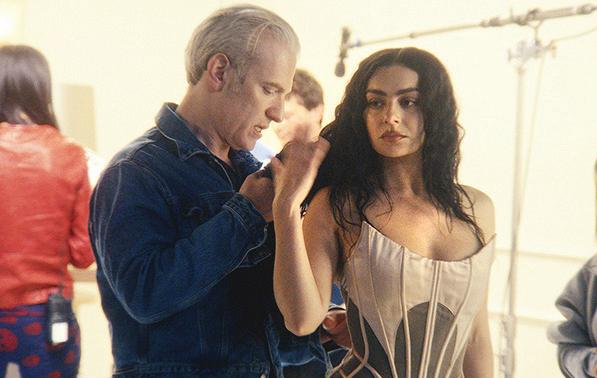
What disappointed me the most about this film was not the overall performances or the humor, but the plot of the movie, which so rarely touched upon the overwhelming success of “BRAT.” Interestingly, the few times the album is explicitly mentioned are when Charli or another character is worried about the longevity of the hype surrounding it.
Stylistically, this film is strangely afraid to commit to
the mockumentary style behind the camera. There are very few points throughout the film that the characters ever address the cameras or make direct eye contact with them, so it rarely feels like the film is meant to evoke the feeling of a documentary at all.
This made a lot of the shots especially frustrating to me, as the camera would be inconsistently placed either behind doors and windows or standing with the actors during their conversations. It makes me wonder if this album and concept as a whole were too much for Zamiri, who’s never taken on a feature-length project. While it’s understandable that Charli would want the person behind the success of her recent music videos to develop her film, Zamiri shows through his mediocre writing and drab directing that his talent lies in shortform content.
By Sophie Albert soalbert@iu.edu
The African American Choral Ensemble is putting on a 50th anniversary concert celebration, bringing together 100 alumni and current members to honor the history and future of the choir. The concert will take place at 7:30 p.m. Feb. 21 at the Musical Arts Center. Raymond Wise, the executive director of the African American Arts Institute and director of AACE, said the ensemble was founded in 1975 due to an outgrowth of the IU Soul Revue, which had been established in 1971. The group had grown significantly in popularity over the years but had limited positions available. The founding director of IU Soul Revue, Portia K. Maultsby, and founder of African American Arts Institute, Herman Hudson, decided they needed to start a new choir, which became AACE. Wise said the ensemble was originally called the Afro American Choral Ensemble and it began its growth and success under the direction of Michael Gordon, IU’s dean of students from 1981-
1991, and Mellonee Burnim, an IU professor of ethnomusicology.
Wise said the choir was distinctive on campus because of its focus on performing choral works composed for, by and about African Americans, a quality the ensemble still embodies today. AACE continues to perform works that span all of African American history, from African music and spirituals to contemporary genres such as blues, jazz, gospels and anthems. Wise said no matter what genre AACE performs, the ensemble conveys a spirit of hope.
“Pretty much everywhere AACE sings, they sing this music which is a music of hope, it’s a music of inspiration,” Wise said. “It has a way of bringing people together, and that’s exactly what AACE has been able to do, from the students who are comprised of all races, all ethnicities, all backgrounds, to the community and the audiences that come, that are from all backgrounds. It’s a group that literally has a way of galvanizing or bringing people together that might not even normally be in the same space, and
they do that through the gift of their song.”
Haylee Ward, a second year master’s student studying environmental science and public affairs, is a current member of AACE and will be performing in the upcoming concert. She said she was a part of a glee club and a gospel choir during her undergraduate studies at U.S. Military Academy at West Point in New York. When she decided to attend IU for graduate school, she immediately started researching choirs in the community and found out about AACE.
She only joined AACE last semester, but she said she’s already enjoyed being a part of the choir.
“I absolutely love it,” Ward said. “I think more so in this choir than my previous ones, I just really feel inspired every time I sing. Like even if I come in tired, like, I just feel so refreshed after our concerts because we were just bringing so much hope through the songs.”
AACE members have already been preparing and rehearsing for the anniversary concert. Wise said the choir was able to digitize
footage of early conductors from throughout the 1970s and ’80s, which will allow them to tie in and honor these conductors as well as older pieces the ensemble performed.
Additionally, Wise said he surveyed alumni about their favorite songs they performed when they were a part of AACE and will be including several of them in the concert’s program.
“It’s so interesting to me because we’ll be in rehearsal and we’ll be singing a song and I’m like ‘well this was something that the other alumni loved and I am also going to love this song,’” Ward said. “Even if we have so many differences, it’s, like, this music connects us.”
The anniversary concert will take place at the MAC, where, Wise said, AACE has not performed since the 1980s, so it feels even more special to the ensemble.
Wise said their catchphrase for the concert is “pack the MAC,” encouraging the Bloomington community to show up for the choir.
“AACE is not gonna turn 50 again,” Wise said. “It’s a once-in-a-lifetime opportunity to come, to see all the
people there, to join in the fellowship and celebrate together.”
Wise said alumni will be coming from over 15 states to reunite with AACE and perform together.
William Robison, a 2023 graduate and current high school mathematics teacher, said he came into college planning to join a choir after participating in choir throughout high school. One of his teaching assistants during his intensive freshman seminar course was a member of AACE who encouraged him to audition, and he never looked back.
Robison said being a part of AACE was a great opportunity for him to get out of his comfort zone after not having much exposure to African American arts growing up.
Robinson said his first concert was a recording at a local church in Bloomington. Though it wasn’t technically a church service, he said it was his first time experiencing many of the things that go on very frequently in the African American church tradition.
Robison said there was no way he was going to
miss the chance to perform alongside other alumni at this anniversary concert.
“AACE gave me so much,” Robison said. “I think it’s only fitting and appropriate for me to give back and to celebrate AACE in this 50th anniversary concert.”
Tickets are $20 for the general public and $12 for students and can be purchased through the Jacobs School of Music Ticketmaster page.
Wise said that when he is asked why the choir still sings after 50 years, he explains that what keeps them singing is the power of music.
“We have always seen that when we sing, and we sing from our hearts, it inspires people, it encourages people,” Wise said. “That’s what we hope people take away as we live in this era, in this particular climate where things are just so tentative and transitional and people are not really treating one another like equal human beings. We have this gift of song that we can use to try to make a difference and bring people together to see each other in a different way.”
If you love this artist, you’ll love this movie
By Lexi Bunting lexbunti@iu.edu
Have you ever finished an album and wished there was a movie that could feel the same way? Across all kinds of media, artists and storytellers have shaped moods, created themes and told stories that stick with us long after the music fades or the credits roll. Music and film regularly influence one another, creating shared emotional and visual languages. As a result of this relationship, your music taste and movie taste are probably more similar than you might think.
So, if you can’t get enough of your favorite artists, here are some films that match their energy:
Frank Ocean
“Waves,” the visually striking 2019 A24 drama, follows a family in southern Florida navigating love, forgiveness and the aftermath of a devastating tragedy and features several songs by popular musician Frank Ocean. In a 2019 interview with Dazed, director Trey Edward Shults said Ocean’s albums “Endless” and “Blonde” were essential to the film’s creative process, and Ocean’s songs “Godspeed” and “Seigfried” appear in the final cut.
Other than the soundtrack, the film’s structure is especially compelling. The story is split into two stylistically-distinct halves, shifting perspectives between siblings: first a brother and then his sister. This choice shows how the same trauma can be experi-

enced differently within one family, a shift highlighted by the music as it moves from anger to acceptance.
Fleetwood Mac It’s hard to watch “Almost Famous” (2000) without thinking of Fleetwood Mac. The film follows a teenage journalist on tour with a fictional rock band in the early 1970s and is loosely based on director Cameron Crowe’s own experiences as a young journalist. The movie captures the excitement and chaos of life on the road while also highlighting
the highs and lows of that lifestyle.
Much like Fleetwood Mac, the film is full of passion, drama and unforgettable moments centered around the power of music and group dynamics. Although there are differences between Fleetwood Mac and the film’s band “Stillwater,” both capture the essence of 1970s rock life and the way music can shape identity and connection.
Beach House “Lost in Translation” (2003) is one of those films
you have to watch multiple times to fully understand the depth of, much like many Beach House songs.
Directed by Sofia Coppola, the film follows two strangers: an actor going through a midlife crisis, Bob Harris (Bill Murray), and a recently graduated, newly married woman, Charlotte (Scarlett Johansson). The two form an unexpected connection while navigating loneliness and cultural disorientation while visiting Tokyo.
Dream pop band Beach House has a dreamy, moody aesthetic that pairs per-
fectly with the film’s atmosphere. They produce songs with ethereal soundscapes and layered vocals that add emotional depth. The film is slow-paced and focuses on the little fleeting moments, and Beach House’s music makes the perfect soundtrack to add intensity and emotional depth to moments like a glance, a small interaction or a drink at a bar with a stranger.
Olivia Rodrigo This pairing was an easy choice for me. “The Edge of Seventeen” is a 2016 com-
ing-of-age story that follows a teenage girl, Nadine (Hailee Steinfeld), navigating the awkward, messy and often painful experiences that come with growing up, as well as dealing with the death of her father. The film balances humor with deeply emotional moments, capturing the struggles many young adults face as they figure out who they are.
Olivia Rodrigo’s poprock musical style, which focuses on raw emotion, fits seamlessly into this story of teenage angst. Her music often mirrors the struggles of young adulthood, like heartbreak, anger and feeling out of place in the world, making the film feel emotionally in sync with her songs.
Halsey
“Someone Great,” a 2019 Netflix original, follows a young woman living in New York City and her journey to rediscover herself after a devastating breakup. The film balances raw emotional honesty with moments of fun, humor and personal growth. It captures the messy, complicated side of love and friendship, showing that heartbreak can coexist with self-discovery.
Similarly, Halsey’s conversational pop music aligns with themes of tumultuous love and personal growth. Her songs pair upbeat pop production with lyricallycharged verses allowing for many emotions like hurt and freedom to coexist in her art. The same mix of emotions runs through “Someone Great” when moments of joy intertwine with moments of pain.
By Lexi Bunting
lexbunti@iu.edul
Charli xcx released her seventh studio album
“Wuthering Heights” as a soundtrack to director Emerald Fennell’s adaptation of “‘Wuthering Heights,’” inspired by Emily Brontë’s 1847 novel of the same name, with both projects debuting Feb. 13. The record is a strong and captivating listen, working beautifully alongside the film. While it may not be her most groundbreaking project, it is filled with standout tracks that highlight her artistic range and versatility.
Marking a shift from her previous hyper-club-driven 2024 release, “BRAT,” this album dives into the dark, gothic and tragic themes of “‘Wuthering Heights.’” The tracks combine theatrical production with synthdriven gothic pop, all tied together by emotionally charged lyrics that linger long after listening.
The album opens with the single “House,” first released last November and featuring John Cale, a Welsh musician and founding member of The Velvet Underground. The track layers a spoken-word poem from Cale over xcx’s vocals and eerie, intense instrumentals, building an almost
overwhelming musical experience. On first listen, the song feels abrupt and unexpected, but after a few plays, I’m convinced it fits beautifully with the film, pulling the listener into the cold, desolate landscape of “‘Wuthering Heights.’” First introduced in the film’s debut trailer, “Chains of Love” was released Nov. 13, and the song quickly became associated with the new film adaptation because of its cinematic sound. Xcx’s vocals are the true centerpiece; they are airy and lushly layered, effortlessly carrying the emotional weight of the song. The song explores a moodier tone, with contrasting her past work, which is much more pop forward and danceable, yet the track still has her signature energy of being bold and inventive. A song on this album I was highly anticipating was “Eyes of the World,” featuring a rare collaboration with Sky Ferreira, an American singer-songwriter who has not released a full album since 2013. While the song was not bad, it did not quite meet the high standards set by Ferreira and xcx’s music individually. Still, xcx delivers strong, evocative lyrics including the line, “I knew you loved me like I’m already dead,” which felt
deeply connected to the dialogue within the film.
“Dying for You” immediately stands out to me as the catchiest track on the album, and it feels the most reminiscent of her previous work on “BRAT.” Xcx sings, “Cause you’re the poison I drink / I drink twice to be sure,” delivering a darklyplayful line that captures the reckless and intoxicating desire so prevalent within the “‘Wuthering Heights’” film. The song’s high energy paired with emotionally-intense lyrics creates a thrilling tension that keeps the listener hooked from start to finish.
My personal favorite track, “My Reminder,” captures one of my favorite aspects of the “’Wuthering Heights,” story, which is the inescapable pull of loving someone you can never fully have, no matter how deep that connection runs.
The lyrics, “I don’t hate you, I love you too much / But I won’t tell you cause we’re just different now,” perfectly reflect the complicated relationship between Cathy and Heathcliff. The production feels like a soft nod to her earlier work, especially her album “True Romance,” which is also very synthheavy and nostalgic.

The final track on the album, “Funny Mouth,” is well worth the wait, rewarding the listener with a carefully constructed buildup to a dramatic peak, ending the album. The production blends experimental, glossy cyber pop with dramatic string arrangements, creating a unique, immersive sound. The lyrics, “Unfunny words from your funny mouth / I take them inside/
Are you man enough to compromise?” depict a relationship overwhelmed by misunderstanding, bringing the album full circle back to the story that inspired it and making it the perfect closing track to the record. Overall, “Wuthering Heights” is a bold and compelling addition to xcx’s discography, highlighting her growth as an artist. From haunting lyrics to highenergy instrumentals, xcx demonstrates her versatility, blending her signature pop sound with a darker, more cinematic edge. The album makes the perfect soundtrack for the film, immersing listeners in the passion, obsession and heartbreak of the story.
By Ripra Gupta riprgupt@iu.edu
College can be one of the most exciting transitional periods in a person’s life, with seemingly endless freedom and opportunity. However, it can also be filled with emotional and academic uncertainty. Throughout these formative years, I have turned to books, specifically memoirs from a diverse range of authors that offer insight into their lives and journeys. These books helped guide me through my own experiences, while also offering an enjoyable escape.
“Make Something Wonderful” by Steve Jobs (2023)
This book presents Steve Jobs’ philosophy, reflections and viewpoints on Apple alongside selected speeches, emails and interviews. It chronicles his journey after founding Apple, including his departure from the company, his work at Pixar and his eventual return to Apple. The book goes beyond a
traditional memoir recounting Jobs’ path through Apple and Pixar. It offers practical insights and advice, especially for young people navigating life and careers. It also features Jobs’ renowned Stanford commencement address and explores how the speech came together, providing inspirational guidance for graduating and college-aged students.
“Make what you love your work,” Jobs said at the end of the commencement address.
I found this quote to be a useful gauge in my search for a company to intern with. The quote emphasizes how we spend so much of our lives working that, if possible, we should find work we love. Overall, this book is a strong starting point for anyone who feels stuck trying to figure out what they want to do for work.
“Educated” by Tara Westover (2018)
This memoir is written by memoirist Tara Westover, who grew up in a survivalist Mormon family. She re-
counts her unconventional childhood, during which she did not attend school and instead worked in her family’s junkyard and sustained life-threatening injuries. She avoided doctors, survived abuse within her family and eventually pursued an education, earning a doctorate from the University of Cambridge.
The book offers a powerful perspective on the importance of education, both academically and emotionally, from someone who was not allowed to attend school and instead had to fight for her education. Westover emphasizes how education shaped her personal development.
“An education is not so much about making a living as making a person,” Westover wrote.
The memoir also evoked strong emotions, leaving me feeling frustrated and confused because it challenged my beliefs about healing and relationships with loved ones. At the same time, this reaction felt meaningful. As students, this period of transition is an important time
to challenge our beliefs, as we are often more open to accepting new ideas. This beautifully-written memoir is a must read.
“Know My Name” by Chanel Miller (2019)
This memoir is written from the perspective of survivor Chanel Miller in the infamous Stanford University sexual assault case and addresses the long-lasting trauma caused by sexual assault. The book responds to the criticism and blame she faced after coming forward. It is notable for taking readers through Miller’s experiences before, during and after the assault and showing how profoundly it affected her life.
Many students have become desensitized when reading or discussing sexual assault, and discussions often center on perpetrators rather than survivors, as Miller points out.
“We force her to think hard about what this will mean for his life, even though he never considered what his actions would do to
her,” Miller wrote. This book helps restore empathy and evokes an emotional response by recalling the trauma and reallife experience behind it. Personally, I found it jarring to read about how Miller was treated in court, by Stanford University and by the perpetrator’s family.
“Becoming” by Michelle Obama (2018)
In her memoir “Becoming,” Michelle Obama recalls the struggles she and former President Barack Obama faced during his election campaign. The book offers a candid perspective on what it is like to live so publicly in the political spotlight. It also explores Michelle Obama’s personal life in greater depth, which is especially compelling. She is open about her struggles with feeling fulfilled by her work, pivoting her career and balancing the demands of being a working mother with a politically active husband in the public eye. This book is particularly important for students
because Michelle Obama shows that becoming your own person is not always a linear process. It was reassuring to learn that an Ivy League graduate working at a top law firm in the country still felt uncertain about what she wanted to do professionally.
“I felt empty doing it, even if I was plenty good at it,” Michelle Obama wrote. “This was a distressing thing to admit, given how hard I’d worked and how in debt I was. In my blinding drive to excel, in my need to do things perfectly, I’d missed the signs and taken the wrong road.”
It is the honesty behind her seemingly perfect life that truly intrigued me. I read each of them at different points in college without really looking for any advice or meaning that I would take away, but somehow these books did leave a lasting impact on me, which is why I want to share these books with you. I hope, whether you are trying to find something or not, these books are a great read!
By Nathan Shriberg naashri@iu.edu | @nshriberg
CHAMPAIGN, Ill.
— Just over 13 months ago, Indiana men’s basketball hosted Illinois at Simon Skjodt Assembly Hall in Bloomington. Illinois dominated throughout, amassing a 30-point lead in the first half, ultimately winning 94-69 a season ago.
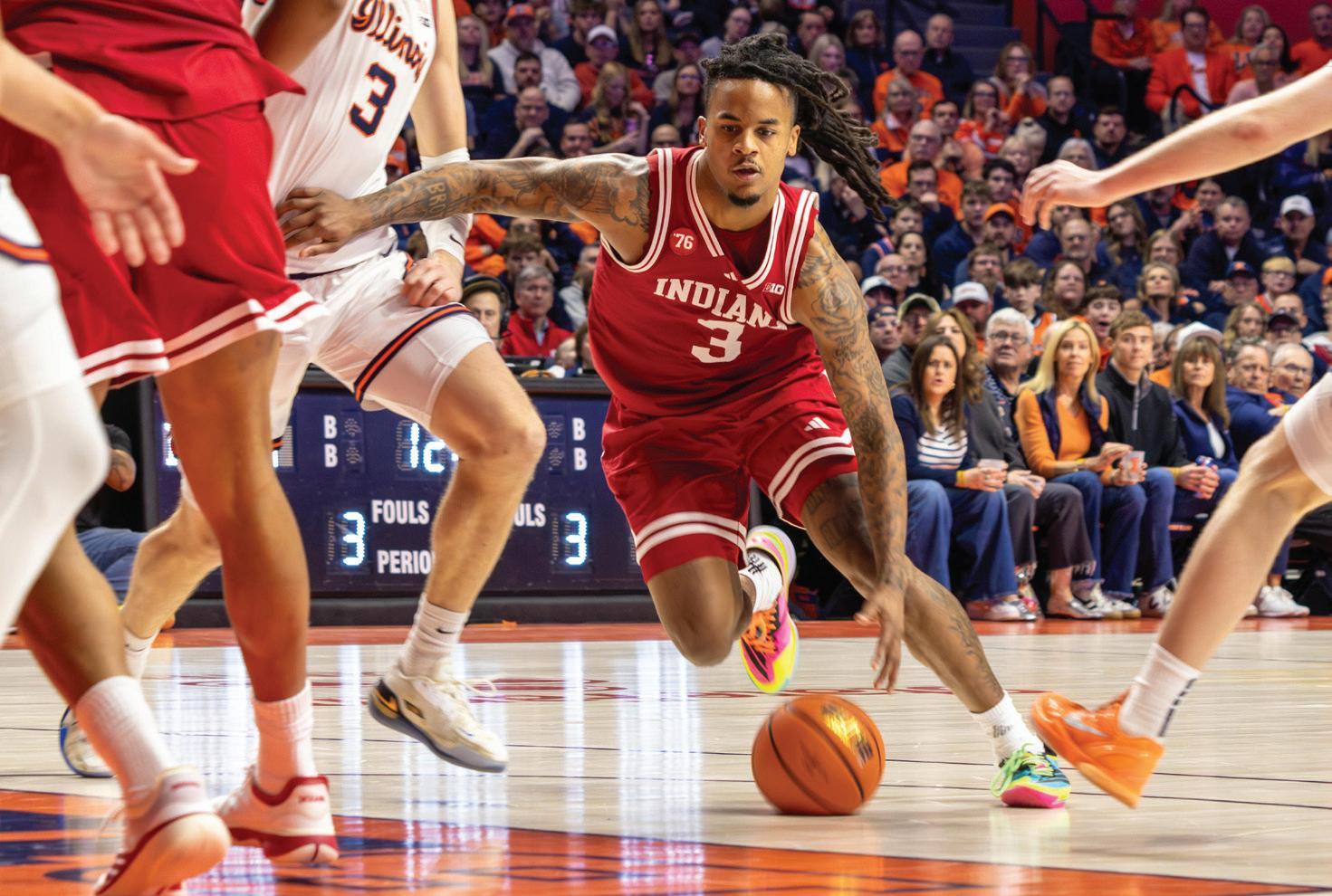
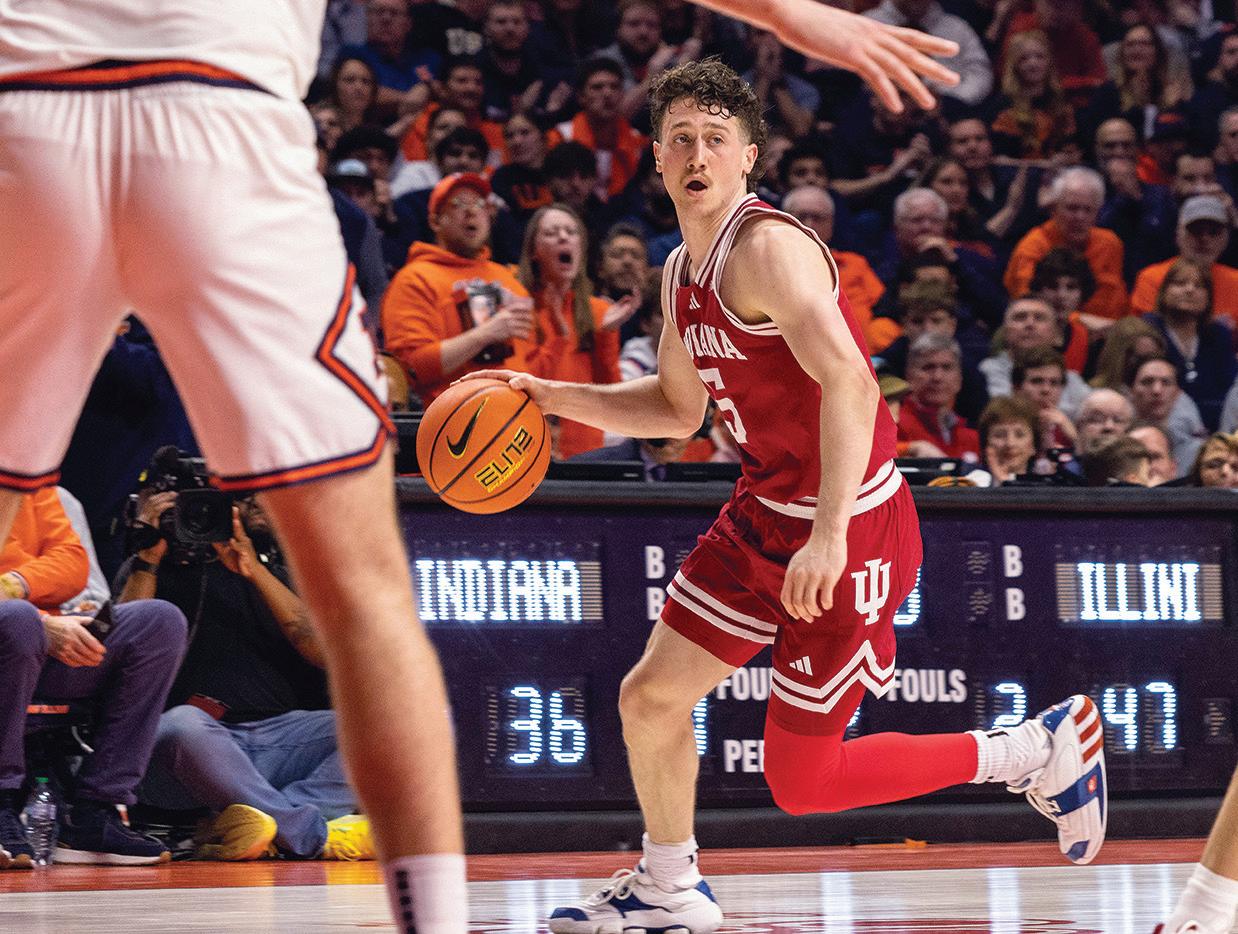
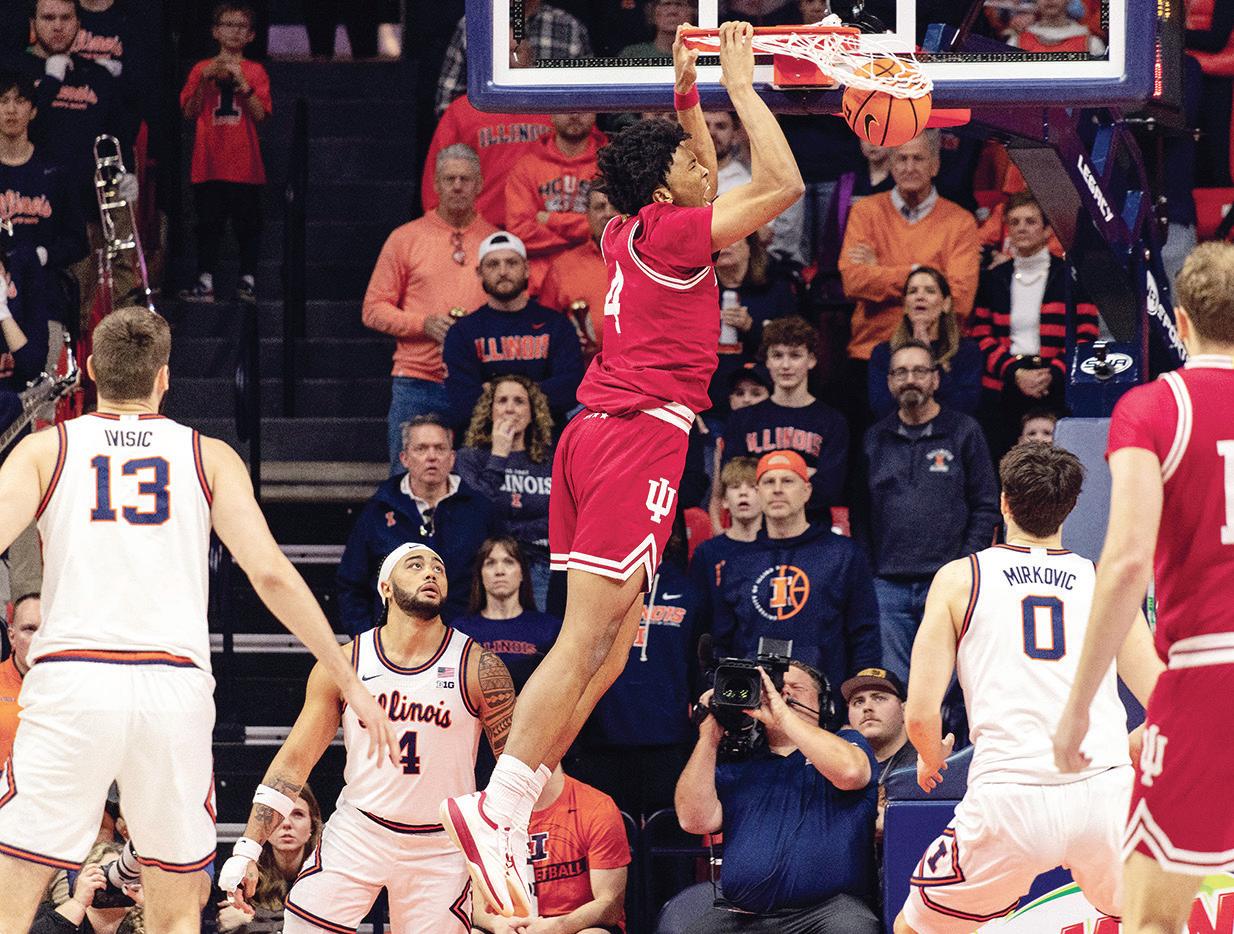
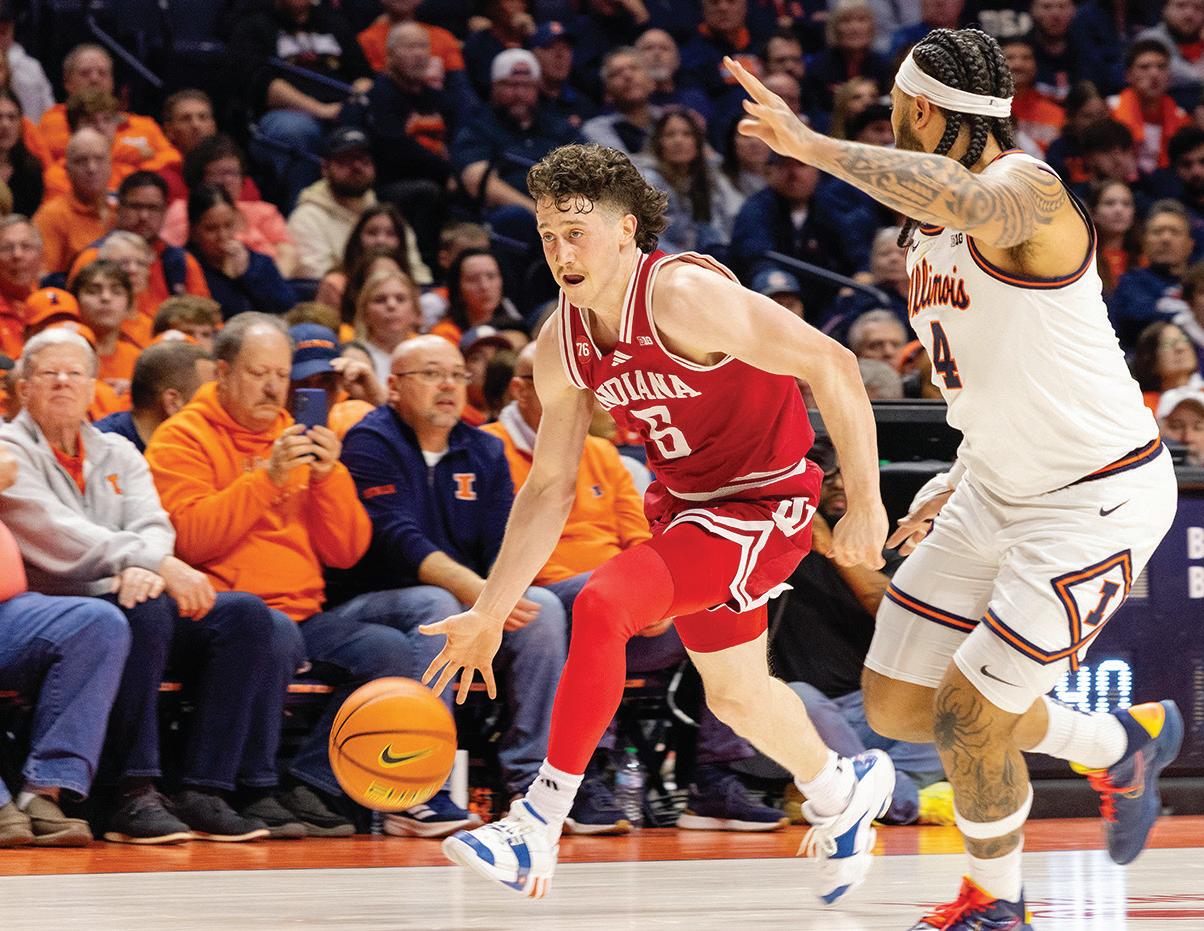
While the Cream and Crimson have since turned over the entire roster and coaching staff, a similar scene took place Feb. 15. Chants of “Hoosier Daddy” rained down in the final minutes as the Fighting Illini trounced the Hoosiers 71-51 inside the State Farm Center in Champaign, Illinois.
Indiana stuck around for the first half, but Illinois drained the life out of the Hoosiers’ typically highpowered offense for the final 20 minutes. The Cream and Crimson notched just 20 points in the closing frame, finishing with a season-low 51 points. Just three Hoosiers accounted for nearly all of Indiana’s production. Fifth-year senior guard Lamar Wilkerson, redshirt senior forward Tucker DeVries and senior forward Sam Alexis combined for 45 of the Cream and Crimson’s 51 points. They hit all but two of Indiana’s field goals.
“You just got to get the shots you want,” Indiana head coach Darian DeVries said postgame. “We’ve got guys shooting them that are good shooters. They just didn’t make them.”
Wilkerson and DeVries made five of the team’s six 3-pointers, as the Hoosiers finished 6 for 24 from beyond the arc while shooting 40.8% from the field. After pouring in 20 3-pointers over a fourgame stretch, junior guard Nick Dorn has shot 4 for 26 from beyond the arc in the Hoosiers’ last four games.
While Indiana had opportunities to score, the

Fighting Illini applied heavy pressure on defense, forcing the Hoosiers into mistakes.
The return of Illinois senior guard Kyan Boswell added an extra dynamic defender to the Fighting Illini’s arsenal, as Feb. 15 marked his first game since Jan. 17.
“I thought he (Boswell) did a really good job of making things hard on Lamar (Wilkerson) a lot of the time, but even on switches and all those things,” DeVries said. “I thought what he brings and adds to the team in his return is just another defensive guy that can really be kind of that shut-down guy.”
As Illinois built its lead, it notched five of its seven
steals in the second half.
The Cream and Crimson recorded nine turnovers while the Fighting Illini only gave it away twice.
Indiana’s turnovers often came at ill-timed moments.
Tucker DeVries had the ball slip out of his hands and out of bounds ahead of what should’ve been an open layup, and an Illinois trap forced another turnover early in the second half as the Fighting Illini took control of the game.
“Turnovers are always a huge deal. I thought ours led to some transition baskets for them, too,” Darian DeVries said. “The ones we did have, I thought we were
just a little careless with it.”
Indiana’s offense is built on knocking down longballs, but Illinois emphasized taking away the open space beyond the arc. Consequently, the Cream and Crimson attempted just 24 3-pointers, five below their season average. Sharing the ball proved challenging amid the Fighting Illini’s swarming defense. Redshirt senior guard Conor Enright managed six assists, but no other Hoosier dished multiple dimes.
Despite holding Illinois to its second lowest scoring total of the season, Indiana fell by 20 points and was largely out of the game for most of
the second half. As the Hoosiers’ offense went cold, the Fighting Illini maintained the momentum, stringing together enough buckets to put the game out of reach without needing much offensive production of their own.
Illinois freshman forward David Mirkovic posted a game-high 25 points and freshman guard Keaton Wagler added 18.
“The problem was we couldn’t get enough stops to withstand it during that time and specifically the offensive rebounding on their end,” DeVries said. “It was really too much for us to overcome. So, we had to clean up the
glass better so we could get our own transition opportunities and stuff.” Indiana was outrebounded 38-25, including 15-4 on the offensive glass. The Fighting Illini tallied 17 second chance points to the Hoosiers’ five. Amid the struggles, Wilkerson continued to spearhead Indiana’s offense. The 6-foot-6 guard put up his 14th 20-point game of the season, and his fifth in a row. Wilkerson shot 8 for 14 while draining two 3-pointers. The Hoosiers will look to return to their recent form in a rematch with No. 13 Purdue at 8 p.m. Feb. 20 inside Mackey Arena in West Lafayette.
By Sean McAvoy semcavoy@iu.edu
Last season, the writer who was in the position I hold now gave Indiana women’s basketball a blueprint to learn from then-No. 1 UCLA. The Hoosiers were outsized but held their own in a 73-62 defeat. However, this season that blueprint wasn’t looked at. It was put through the shredder. Indiana struggled almost all 40 minutes at the Pauley Pavilion on Feb. 15, falling to the second-ranked Bruins 92-48 and a 14-13 overall record. The Hoosiers seemed to fill their hole in the front court, but sophomore forward Zania SockaNguemen has been injured most of the season. SockaNguemen was one of the crucial transfer portal players who Indiana brought in this season. She was also familiar with the Bruins, as Socka-Nguemen played 16 games in Los Angeles last season.
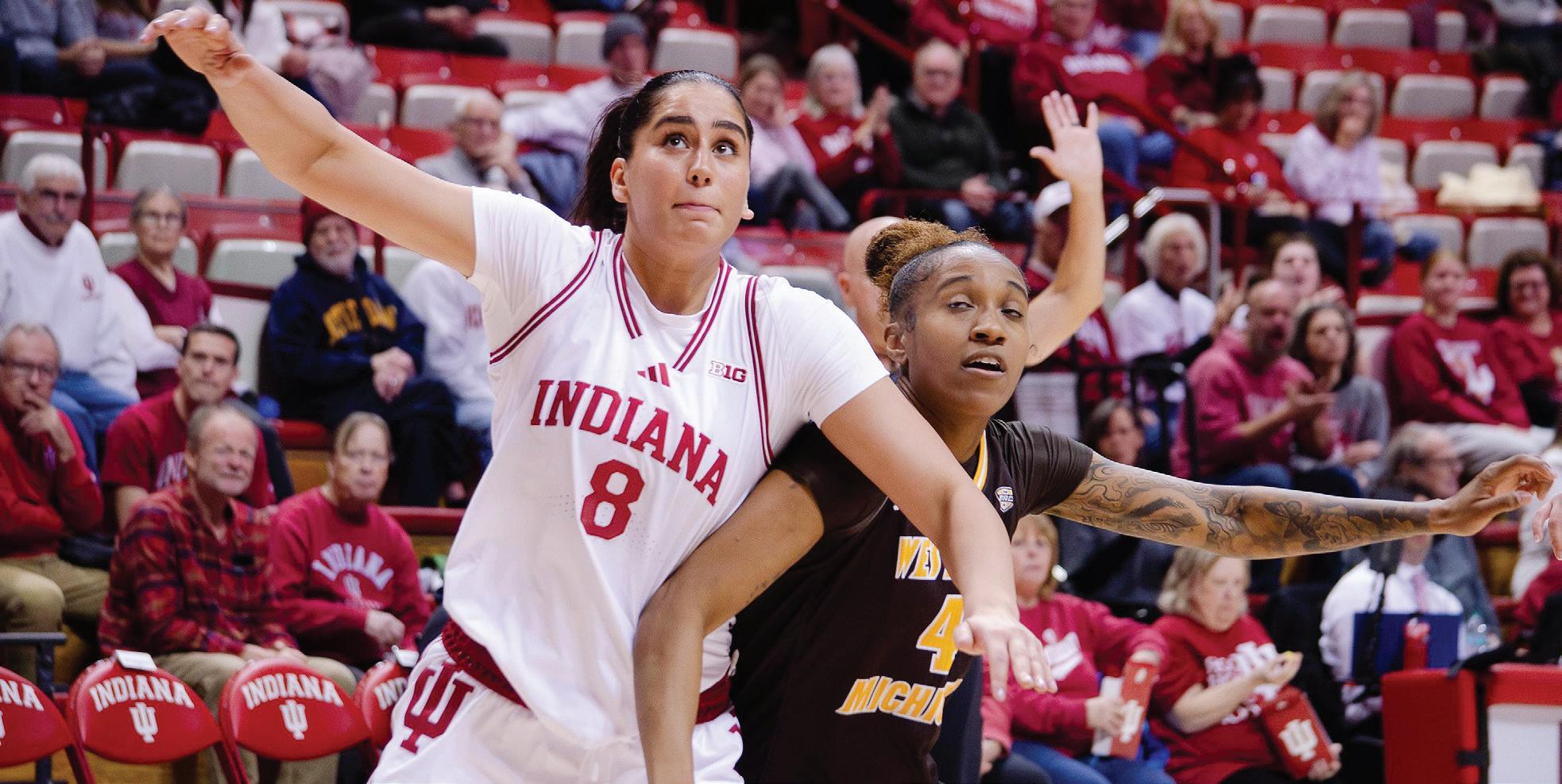
Even with junior forward Edessa Noyan, plus bench pieces in sophomore forward Faith Wiseman and junior forward Jade Ondineme, trying to be physical in the paint, Indiana was no match for UCLA senior center Lauren Betts.
Betts feasted last season at Simon Skojdt Assembly Hall, finishing the game with 25 points on 12 for 16 shooting and 12 rebounds. And Betts did the same Feb. 15, compiling 16 points and 14 rebounds. The only thing that went wrong for her was a 6-for-17 performance from the field. However, the length of UCLA outmatched the Hoosiers on both sides of the court. The 6-foot-7 Betts may be the cornerstone of the paint for the Bruins, but UCLA is tall at every position on the court.
“This is a very, very big
team,” Indiana head coach Teri Moren said postgame.
“Lauren (Betts) is every bit of six, seven, and has great hands and touch ... this is a big basketball team. That’s what makes them so special, and they can score the ball in a lot of different ways.”
Out of the Bruins’ starting lineup, graduate guard Charlisse LegerWalker is the smallest player at 5-foot-10. That’s three inches taller than Indiana senior guard Shay Ciezki, who stands at 5-foot-7. UCLA senior guard Kiki Rice is 5-foot-11, while graduate guard Gianna Kneepkens and senior guard Gabriela Jaquez are both 6-foot. And the difference was evident Feb. 15. The 6-foot3 Noyan tried to anchor the paint for Indiana but was outmatched. Noyan only played nine minutes — as a starter — Feb. 15 after picking up two fouls less than five minutes into the game. The University of Virginia transfer finished with one point and two rebounds.
The trouble didn’t stop there. Wiseman had three
fouls in 14 minutes, and On-
dineme finished with four fouls in 16 minutes. Neither player scored one point, and they finished with one rebound each. Even Indiana’s backcourt appeared out of sync Feb. 15.
Those problems started with the injury to Ciezki in the first quarter. The Big Ten leading scorer — 23.2 points per game — missed Indiana’s 79-73 loss to USC on Feb. 12 with an ankle injury suffered during the morning shootaround. Ciezki appeared to injure the same ankle Feb. 15 after an awkward step sent her falling with 3:13 left in the first frame.
The Hoosiers persevered against USC, but UCLA was a different story. Freshman forward Maya Makalusky had a team-high 13 points, freshman guard Nevaeh Caffey recorded 10 points — all coming in the fourth quarter — and redshirt sophomore guard Lenée Beaumont was 4 for 14 from the field for 11 points.
The problems for Indiana start with how this roster was built this season.
When Ciezki’s out of the lineup — which has only happened twice this season — the Hoosiers don’t have anyone to turn to who can pick up her scoring output consistently.
Makalusky has shown signs of progress this season. The Fishers, Indiana, native has led Indiana in scoring four times — including 29 points against USC. Beaumont also has four games with teamhigh scoring. But the other 19 games rest on Ciezki’s shoulders.
If you look at the other bench, UCLA finished with seven scorers in double figures. Betts, Rice, Jaquez, Kneepkens and even graduate forward Angela Dugalić off the bench have all led the Bruins in scoring this season.
From a roster-building standpoint, Indiana has a massive hole that they need to fill next season. Yes, we’ll most likely see a Moneyballesque recreation in the aggregate of Ciezki’s scoring. But Indiana can look at how the Bruins created their roster for signs on how to compete at the next level in
future seasons. The 2021-22 season for UCLA was a “down” year, which saw the Bruins finish 18-13 and miss the NCAA Tournament. UCLA had a large amount of roster turnover that offseason, as the program lost six seniors.
“This is a big basketball team. That’s what makes them so special, and they can score the ball in a lot of different ways.”
Teri Moren, head coach
However, the Bruins gained four freshmen in the 2022 recruiting class, two of whom are crucial pieces to this season’s team — Rice and Jaquez. Plus, guard Londynn Jones and forward Christeen Iwuala played at least two seasons for UCLA before transferring to USC and the University of Mississippi, respectively.
The Bruins then brought in Betts from Stanford University before the 202324 season and capped off their key pieces with Kneepkens before this
season from the University of Utah. Now, UCLA is 25-1 and 15-0 in the Big Ten with its only loss coming to thenNo. 4 University of Texas at Austin on Nov. 26. And I can see parallels from UCLA to Indiana. The Hoosiers are having a “down” season compared to recent years, but they have a lot of good, young players in the program, not to mention Indiana’s 2026 high school recruiting class.
Beaumont, Caffey and Makalusky getting older will help bring experience, plus incoming freshmen in wing Addison Nyemchek, guard Gigi Battle and guard Ashlinn James have this program projected to become better in the future. I can’t help but mention that UCLA lost all four of its freshmen from last season to the transfer portal. However, I don’t envision that happening to Indiana. The Bruins lost many of those freshmen due to a lack of playing time. But Indiana will most likely have an abundance of playing time for these newer players next season. Yes, one of the biggest complaints about this season’s roster is its lack of experience in the Big Ten and even women’s collegiate basketball in general. But that’s where the portal is crucial to Indiana’s future success.
Moren can’t bring in these younger players who joined the program this season. Finding older, especially experienced Big Ten players, must be the priority for this upcoming offseason.
But Indiana still has three games left in the 2025-26 campaign. The Hoosiers can make something out of a season that felt “lost” three weeks ago. It starts with Oregon on Feb. 22, but Rutgers and Penn State are critical for Indiana’s chances of making the Big Ten tournament.
By Noah Boudouris nboudour@iu.edu
No. 20 Indiana wrestling’s 5-dual home winning streak ended Feb. 15 as the Hoosiers were toppled 34-5 by No. 5 Nebraska. Indiana was 5-0 at Wilkinson Hall in Bloomington entering the meet, while Nebraska came in on a two-dual win streak.
A technical fall in the opening round gave the Hoosiers an early lead. No. 16 graduate student Jacob Moran collected six takedowns against Nebraska redshirt freshman Kael Lauridsen, resulting in a 19-4 victory in the 125-pound bout. Moran’s win would prove to be Indiana’s lone victory in the meet.
The Cornhuskers quickly took control meet after the early deficit. With three escapes and two near falls, No. 9 Nebraska junior Jacob Van Dee made quick work of freshman Gavin Jendreas in the 133-pound bout, defeating the young Hoosier 18-1. The technical fall victory evened the score at five after two rounds.
The third straight technical fall of the afternoon came in the 141-pound bout, following No. 4 Nebraska senior Brock Hardy’s 20-4 performance against No. 25 redshirt junior Henry Porter. Hardy’s round featured six takedowns, including two in each period. The victory by
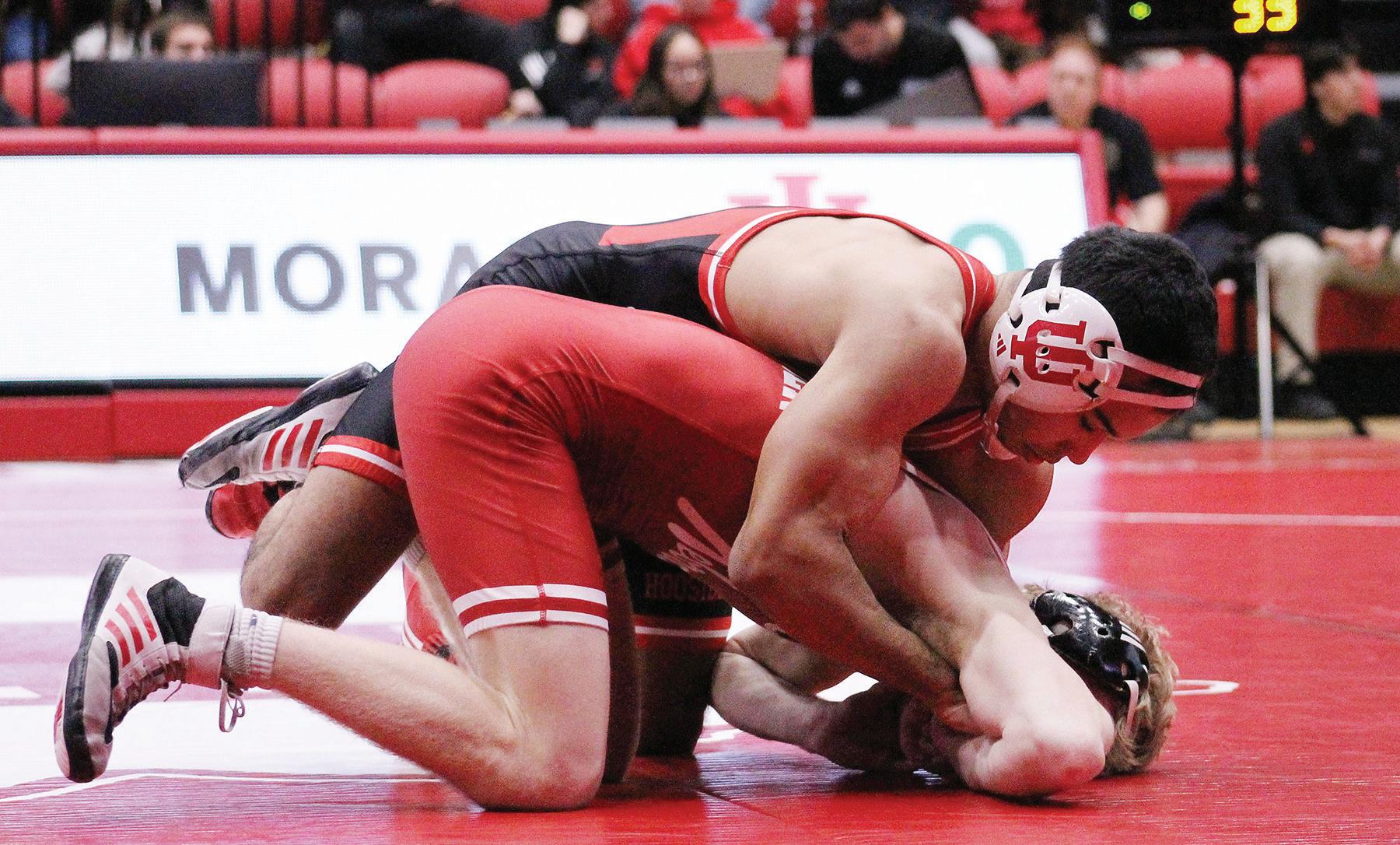
technical fall gave Nebraska its first lead.
While the Hoosiers were down 10-5, redshirt sophomore Joey Buttler trailed Nebraska’s No. 14 senior Chance Lamer 4-0 through the first two periods. Buttler earned a takedown in the third period but was unable to get the win in the 149-pound bout, losing by a final score of 5-3.
Nebraska extended its lead before intermission by way of its third technical
fall victory. No. 2 junior Antrell Taylor lived up to his ranking in the 157-pound bout against redshirt sophomore Bryce Lowery, winning by a final of 21-5.
Taylor earned all his points by way of takedown, tallying seven in the round to seal the victory before the end of the second period. No. 17 redshirt junior Tyler Lillard and No. 7 Nebraska redshirt freshman LJ Araujo remained scoreless after the first
period. Araujo earned seven points in the second period with an escape, takedown and near fall. With his back against the wall in the final period, Lillard persevered with a reverse and two takedowns in the third period for eight points. But the Hoosier surrendered three escapes in the period, resulting in a 10-8 victory by decision for Araujo.
The Cornhuskers’ second straight decision victory came in the 174-pound
bout in No. 4 Nebraska sophomore Christopher Minto’s 7-3 win over No. 30 graduate student Derek Gilcher. Two takedowns for Minto in the first period were all he needed to ward off Gilcher, who earned all his points via escapes and a stall point. No. 15 redshirt freshman Sam Goin was unable to score anything outside of a pair of escapes in the 184-pound bout, as he suffered an 11-2 major
decision loss to Nebraska’s No. 6 senior Silas Allred. Allred rode three takedowns to the Cornhuskers’ seventh straight victory.
With the dual meet out of reach, the 197-pound bout stayed scoreless through the first three minutes. Nebraska’s No. 10 sophomore Camden McDanel took a 2-1 lead over No. 23 redshirt junior Gabe Sollars into the final period and solidified the victory by decision with a takedown in the third. With no chance of winning the meet, the Hoosiers watched the heavyweight bout in hopes of seeing freshman Matt Kawalski’s second dual victory of the season. Kawalski was unable to produce his second win, as No. 4 Nebraska senior AJ Ferrari rallied for a 9-3 victory by decision.
“I thought our team competed hard,” head coach Angel Escobedo said following the meet. “I’m happy with our effort. Obviously, losses suck but we’re going to get better.” Indiana will continue its season with its final dual meet of the season against Purdue at 7 p.m. Feb. 20 at Wilkinson Hall. “One second made a difference, and that’s what we got to learn from this,” Escobedo said. “Now it’s our turn to wrestle one second longer than Purdue is willing to wrestle.”
By Will Kwiatkowski wdkwiatk@iu.edu
With two outs, a 2–1 count and the bases loaded in the bottom of the ninth inning, Indiana baseball was one routine ground ball away from a statement win.
Clinging to a 3–1 lead over 11th-ranked University of North Carolina at Chapel Hill, the Hoosiers watched as the ball rolled harmlessly toward senior second baseman Aiden Stewart. It was the kind of play that ends games and sparks celebrations.
Stewart took a quick shuffle to his left and gathered it cleanly, his momentum already carrying him toward first base. The throw was routine; one he’s made countless times.
But as he reared back to sling it across the diamond, the ball slipped from his hand.
The throw still came, but it never had a chance. It traveled only halfway to sophomore first baseman Jake Hanley before skipping past him into foul territory.
In an instant, two runs crossed the plate to
tie the game.
What should have been a defining win dissolved into disbelief, flipping into heartbreak and new life for North Carolina when Indiana had been a single out away from sealing its first victory of the season. North Carolina went on to win 4–3 in 11 innings in the series finale Feb. 14, completing a sweep over Indiana in Chapel Hill, North Carolina.
Facing a team of North Carolina’s caliber, fielding mistakes are simply not an option. Indiana committed five errors in the series, leaving Chapel Hill winless.
The first of those mistakes proved just as costly. In the first game of the series, a misplayed ball in the field opened the door for North Carolina to string together extra-base hits and break the game open, turning what had been could have been a manageable inning into crooked numbers on the scoreboard with a six-run 6th inning.
The Hoosiers, facing one of the country’s strongest pitching staffs, were unable to recover, losing the first
of three games.
“You’re not saving them by not exposing them early on,” Indiana head coach Jeff Mercer said in a press conference Feb. 4. “By going and doing it, they’ve seen it. They’ll come through it. And when you leave there, you’re a better team for it.”
Three of the errors came off the glove of sophomore shortstop Cooper Malamazian, one in the first game and two more in the second.
Known as much for his reliability in the field as for the strides he’s made at the plate, Malamazian had been a pillar on the left side of the infield last season. He committed just eight errors across 145 chances last season.
Leaving the weekend 0–3, and in the fashion it unfolded, is a brutal start for a Hoosier team already carrying outside skepticism after falling short of the College World Series last season, despite qualifying the two years prior.
But with a devastating loss also comes a simple truth. Tomorrow is a new day.
Hoosier fans have heard

that sentiment recently, often in a far more joyful context.
Head football coach Curt Cignetti delivered a similar message through a stern face following blowout victories in which his team appeared to have little left to fix. The meaning, however, applies just as much in defeat as it does in dominance. For Indiana, the page turns quickly. While the sting lingers, the mistakes are
By Dalton James jamesdm@iu.edu | @daltonmjames
CHAMPAIGN, Ill. — Darian DeVries knew the challenges No. 8 Illinois presented Indiana men’s basketball two days before the two squads faced off Feb. 15. When the Hoosiers head coach sat inside the Simon Skjodt Assembly Hall press room in Bloomington and spoke to reporters over Zoom on Feb. 13, he said there was plenty that concerned him regarding the Fighting Illini.
Whether it was Illinois’ imposing size — which DeVries previously noted — physicality or effort Feb. 15, all three combined to hamper the Hoosiers inside the State Farm Center in Champaign, Illinois. In turn, Indiana fell 71-51 and moved to 1-5 against ranked opponents this season.
The Fighting Illini outrebounded the Hoosiers by 13 and grabbed 15 offensive rebounds to the Hoosiers’ four. Junior center Tomislav Ivisic and senior guard Kylan Boswell each grabbed four offensive boards, leading the hosts.
“We knew it was the number one thing that we had to do a good job of if
we were to come in here and win,” DeVries said postgame. “Illinois is one of the best rebounding teams in the country, and for good reason.”
Freshman guard Keaton Wagler, who entered the matchup averaging 18.5 points, hauled in three offensive rebounds while freshman forward David Mirkovic grabbed two. The former scored 18 points while the latter notched a game-high 25. Not only did the Hoosiers’ inability to corral defensive rebounds provide the Fighting Illini with extra offensive possessions — they scored 17 points second-chance points — it also prevented Indiana’s transition offense from commencing.
The Cream and Crimson failed to score any fast-break points Feb. 15. In all, they scored just 51 total points — six fewer than their previous season-low of 57 against Iowa in mid-January.
Fifth-year senior guard Lamar Wilkerson scored 21 of the Hoosiers’ 51, while five other players accounted for the rest of Indiana’s 30 points.
DeVries thought Indiana’s best offense would come on
a broken floor — when the opponent isn’t able to get fully set to properly defend the offense. Illinois’ size largely prevented the Cream and Crimson’s best dribble penetrators from getting easy looks near the basket.
“The more we could get them moving and playing in space, we thought was our opportunity,” DeVries said.
But the Hoosiers couldn’t convert their plan. Simply, they didn’t execute enough to provide opportunities to do so. And while Indiana’s offense faltered, so, too, did its defense.
Although the Cream and Crimson held the Fighting Illini, the most efficient team nationally, to 71 points, they couldn’t connect on enough shot attempts to form any sort of chance at the upset in enemy territory.
Despite holding Illinois’ offense to its second-fewest total points in a game this season and just 43.9% from the field, the Hoosiers couldn’t overcome the Fighting Illini’s size.
“They’ve done a terrific job of creating those habits of guys going and going with force to go get the ball,” DeVries said. “There’s a few of them where they come off long, and you’ve got 6-10,

7-foot everywhere where they’re able to just grab it over top of you.”
Indiana — a smaller team by an average of almost two inches — received just 26 points and 13 rebounds from its three forwards. Illinois’ two centers and five forwards, however, combined for 44 points and 23 rebounds. The Hoosiers were no match for perhaps a Fighting Illini team bound for a deep NCAA Tournament run next month.
“They are a reason why they’re one of the best teams in the country,” DeVries said, “and I think you saw a lot of that today.” Indiana’s loss doesn’t particularly harm its March Madness resume, but it left Champaign without a victory that could’ve nearly solidified its case for the Big Dance should it win the final three of five games it’s favored in, according to Bart Torvik. Still, the Hoosiers have another opportunity on the
docket in five days: No. 13 Purdue in West Lafayette — the squad they defeated less than a month ago. Feb. 15’s 20-point loss provides Indiana with an opportunity with a firsthand experience to see what one of the nation’s best teams looks like, something DeVries knew two days beforehand. Now, the Hoosiers must continue their positive stretch — winners of five of their last seven — and parlay it into a successful stretch run into March.
Photos by Briana Pace


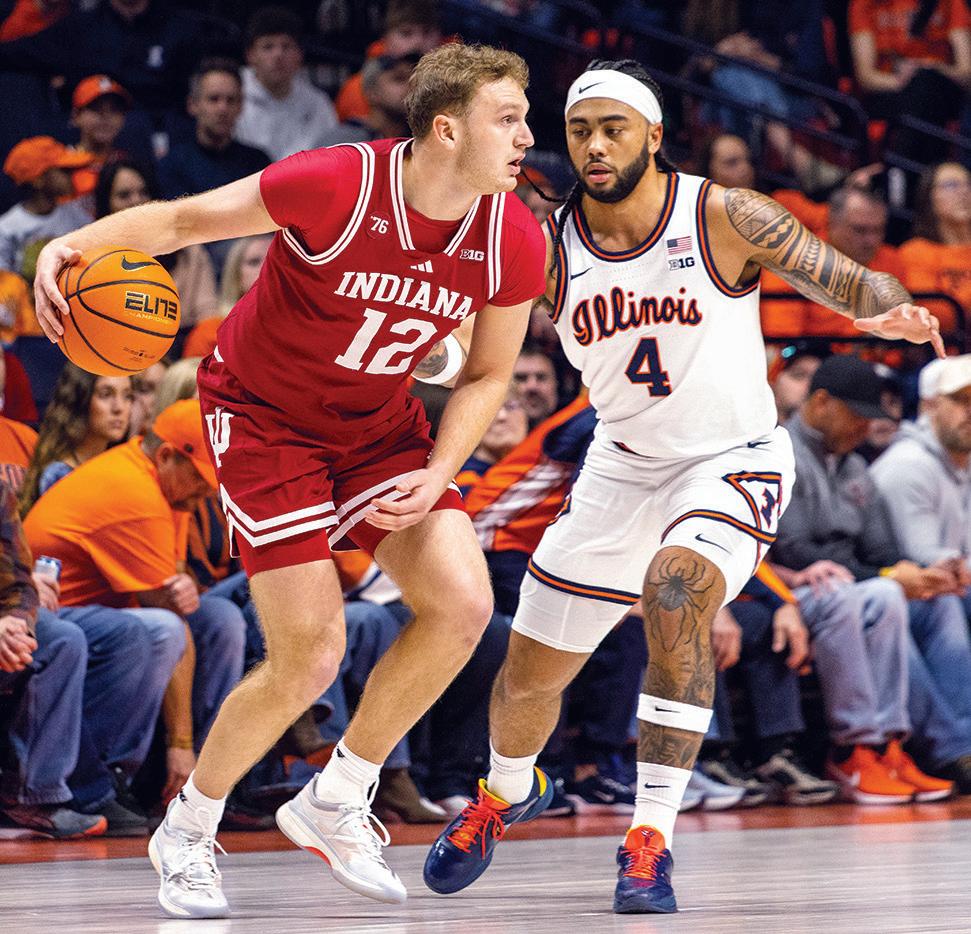
1 2 3 4 5