Medhat Khalil, Director of Professional Education at the Milwaukee School of Engineering.
Publisher’s Note: The information provided in this publication is for informational purposes only. While all efforts have been taken to ensure the technical accuracy of the material enclosed, Fluid Power Journal is not responsible for the availability, accuracy, currency, or reliability of any information, statement, opinion, or advice contained in a third party’s material. Fluid Power Journal will not be liable for any loss or damage caused by reliance on information obtained in this publication.
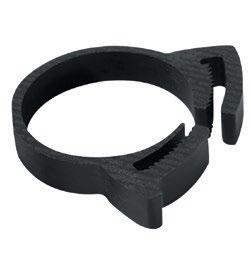
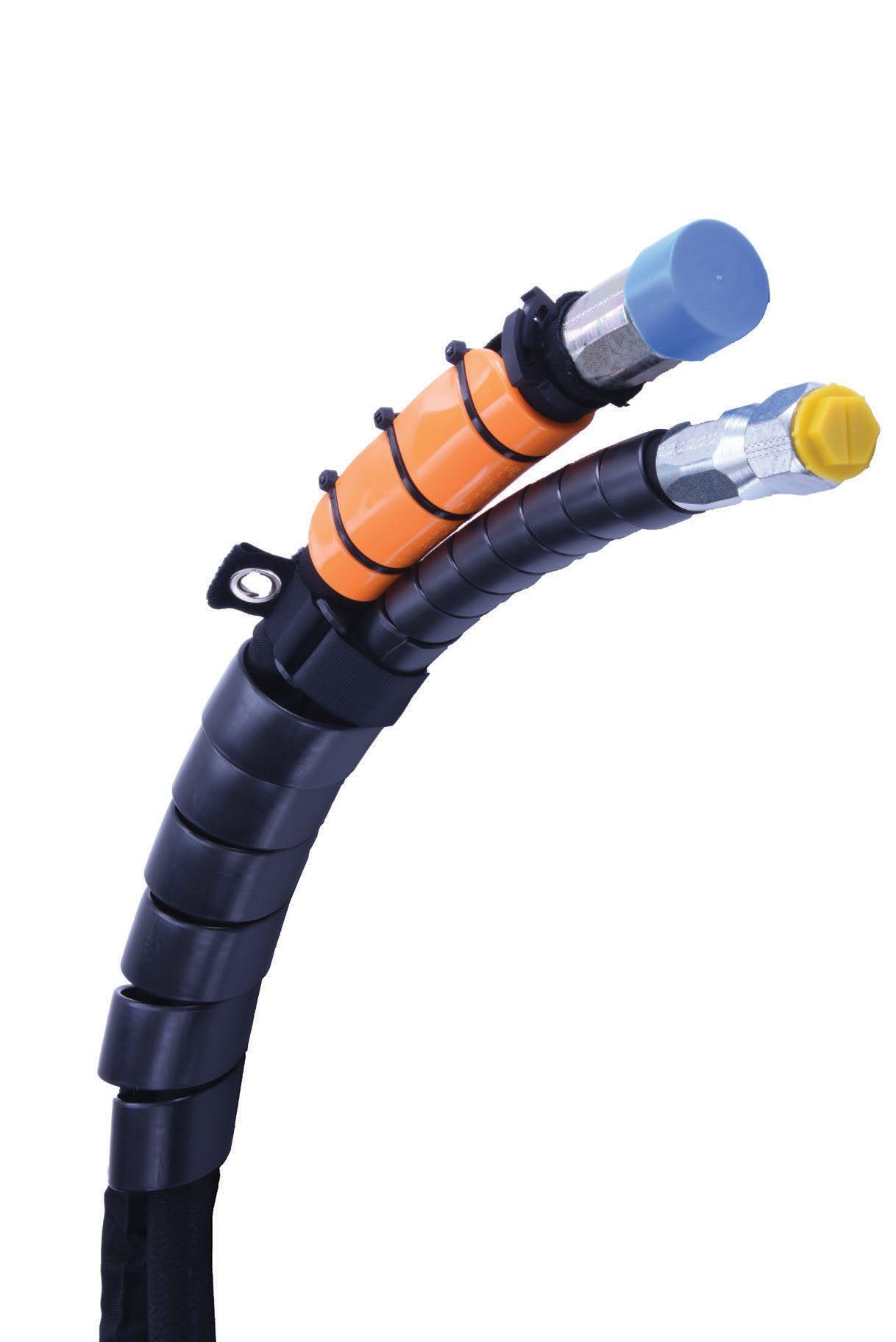
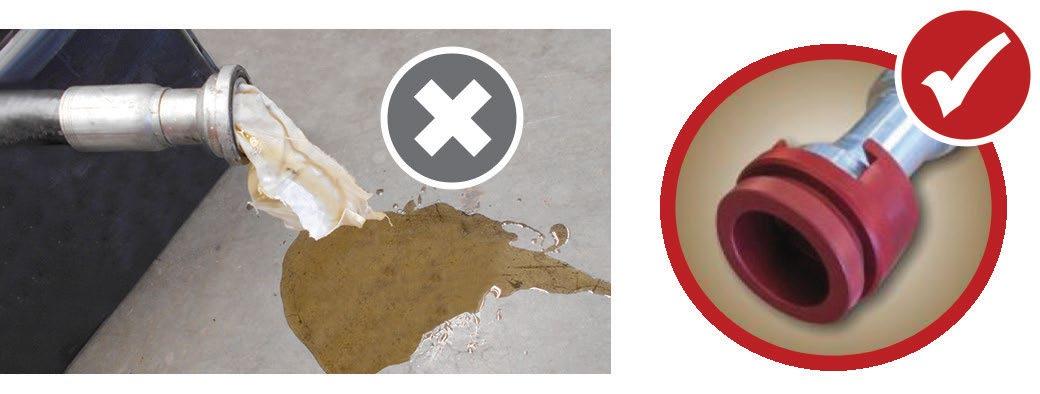
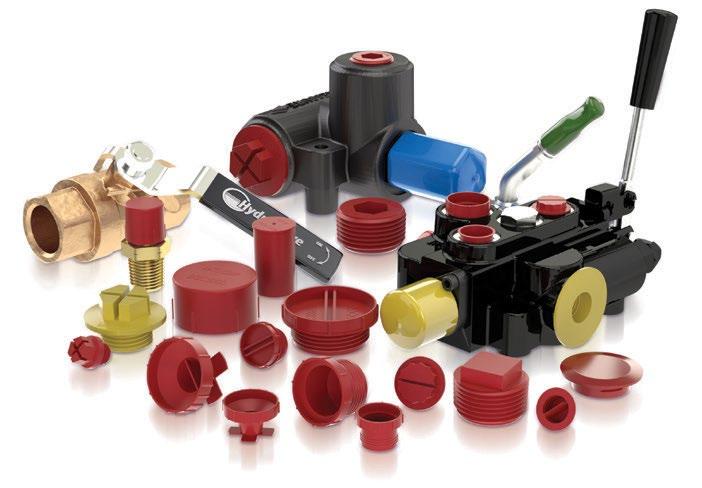
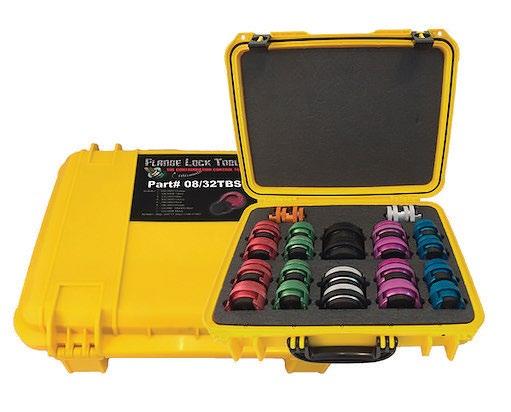
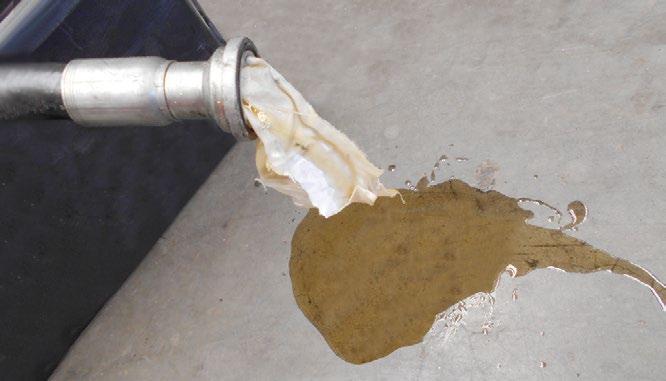
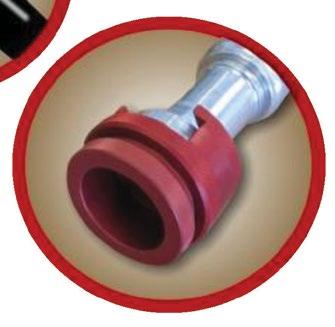
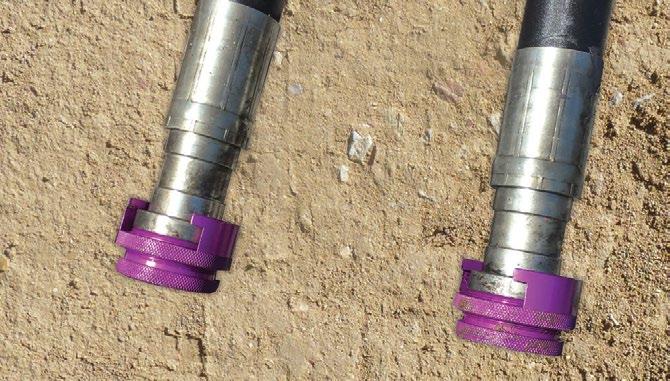
Avoid costly downtime from ruptures, contamination, and damaged ttings by protecting your entire hydraulic hose assembly with Essentra’s complete line of protection products.
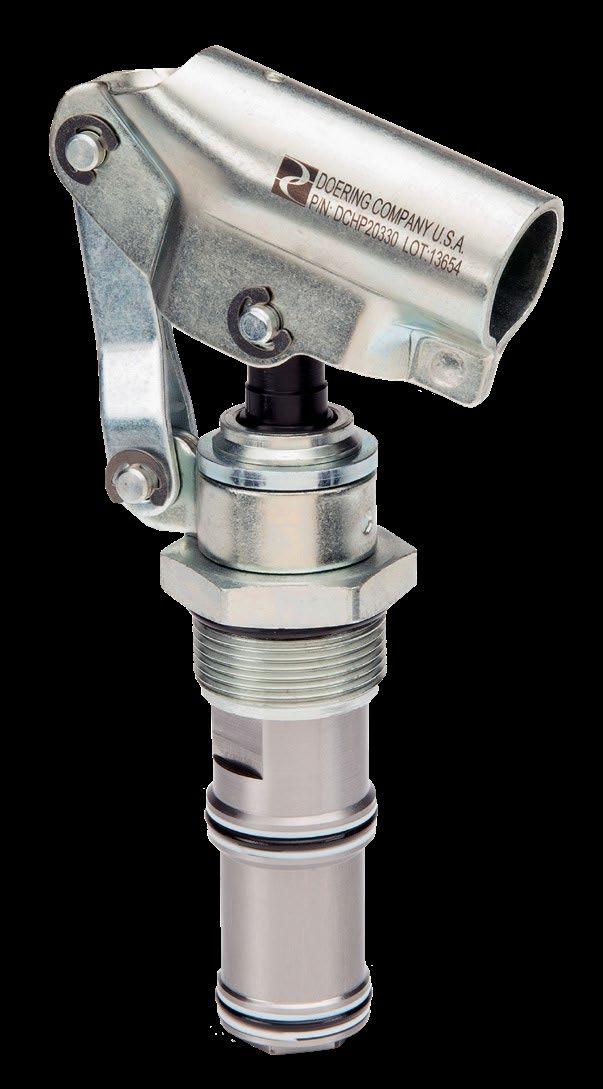
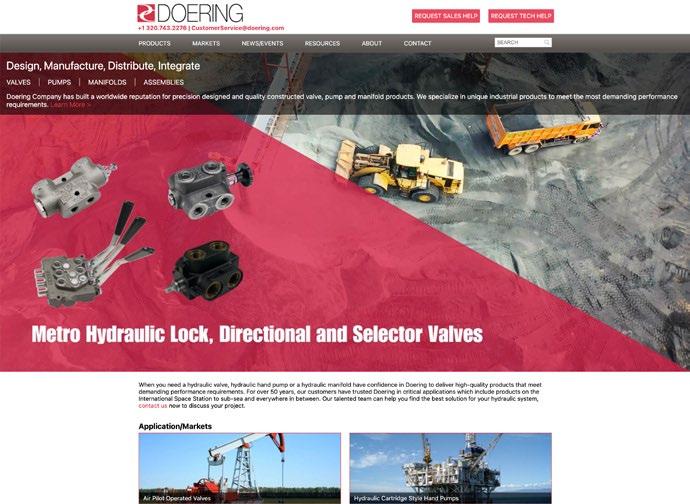
Hydraulic hand pumps play a critical role in system reliability, maintenance and emergency operation. High-performance cartridge-style hand pumps from Doering deliver:
• Up to 10,000 psi pressure capability
• Fast fluid displacement for quicker operation.
• Reduced operating force for easier use
• Compact cartridge design for simplified system integration.
• Dual-acting, high-displacement options up to 6500 psi.
Visit our website to download our newest white paper: Reduce Downtime with HighPerformance Hydraulic Hand Pumps
Elevating People, Performance, and Possibility
By Paul Johnson, President, Aggressive Hydraulics
» IN THE FLUID power industry, precision, reliability, and expertise define success. It can be tempting for organizations to focus solely on measurable outcomes such as shorter lead times, improved on-time delivery, lower scrap, better efficiency, and stronger margins. Although these goals all matter deeply, when a company grounds its entire definition of success on arrival points of specific targets, milestones, or quarterly metrics, it can risk losing sight of a far greater force. An ongoing journey of leadership development drives longterm sustainable excellence.
Leadership, when woven into the culture of an organization, is not a destination to be reached. It is a continuous process of learning, adapting, improving, and becoming. It is the catalyst that transforms skilled employees into empowered contributors, teams into aligned units, and customers into long-term partners.
The nature of our industry makes this journey mindset essential. Whether manufacturing hydraulic components such as cylinders, designing custom power units, repairing mobile hydraulic equipment, or integrating electro-hydraulic control systems, fluid power organizations face constantly changing dynamics. Shifts with advances in technology, changing customer expectations, fluctuating economic conditions, supply-chain challenges, and a tightening labor market. In such a landscape, treating leadership as a static achievement is simply inadequate. Leadership must be lived every day, practiced collectively, and pursued intentionally.
Understanding leadership as a journey transforms the way people work, collaborate, innovate, and serve customers. In a “destination” culture, leadership is often associated with title, rank, or position. Decisions flow
downward. People wait for permission. Innovation is slow, and employee buy-in and participation are low. A “journey” culture, by contrast, turns leadership into a shared responsibility. All team members see themselves as leaders in how they approach challenges, support their colleagues, and serve customers. Taking initiative becomes a natural habit, and engagement becomes intrinsic.
The journey mindset also fosters psychological safety, which is especially important in an industry where mistakes can have real and dire consequences, such as safety risks, equipment damage, costly downtime, or customer dissatisfaction. When employees know their voice matters and that raising concerns are valued and not punished, the organization becomes safer, smarter, and more collaborative.
Fluid power work demands a high degree of skill, focus, and craftsmanship. When the organization treats leadership as a journey, the message to employees is clear: You matter. Your growth matters. Your input matters. And the work you do is essential not only to the company’s success but to the customers who rely on us. This sense of purpose turns the workplace into more than a job. It transforms and becomes a sustainable place where people feel proud to contribute.
The labor challenges facing the fluid power industry are significant. A large portion of the workforce is nearing retirement age, and the next generation is not entering industrial trades or manufacturing roles at the pace needed to replace them. Meanwhile, competition for skilled machinists, welders, hydraulic technicians, engineers, and assemblers has intensified across all sectors. Companies that treat leadership as embedded within their culture position themselves as employers of choice because they offer what people want most, personal and professional growth.
In a fluid power environment where technical capability is highly valued, leadership development reinforces the dignity of skilled work. When a machinist sees that their continuous improvement ideas are implemented, or a technician is trusted to lead troubleshooting discussions, or an inside salesperson is empowered to make decisions that support their customer needs and requirements, employee confidence grows, resulting in significantly increased retention.
The journey mindset also strengthens internal upward mobility. As employees gain experience and leadership skills, it helps
provide the skillset for moves into roles such as lead operator, senior technician, team lead, supervisor, engineer, or manager. This internal growth preserves institutional or tribal knowledge, reduces hiring costs, and builds trust across the organization.
A leadership culture enhances employer branding. Reputation spreads fast in a specialized industry. Skilled professionals talk to one another. Vendors and customers recognize strong cultures. Community college and trade school graduates seek companies known for development, mentorship, and advancement. In an environment where hiring is difficult and turnover is costly, leadership is not a soft skill; it’s a strategic differentiator.
Innovation is not optional in the fluid power landscape. The industry is evolving rapidly; innovation often occurs at the intersection of engineering, operations, and customer-facing teams. Leadership as an all-inclusive way of life strengthens these connections by encouraging shared responsibility and trust. The destination mindset says, “We must innovate.” The journey mindset says, “We are continuously learning, exploring, and improving.” Only the latter produces sustainable innovation.
Customer retention becomes sustainable and a natural outcome. When customers feel cared for and when employees feel empowered to care, relationships evolve from transactional to strategic. The customer begins to see the supplier not just as a source of components but as an essential extension of their own success and a true partner.
The fluid power industry is no stranger to volatility. Economic cycles, supply chain disruptions, commodity fluctuations, and changes in end-user industry demand can challenge even the strongest companies. Organizations that treat leadership as a journey weather these disruptions more effectively and help foster an environment that can be more rewarding as well as provide personal and professional fulfillment. This is a win-win proposition: employees benefit beyond solely improving their career and earning potential, and the act of leadership in their lives is rewarding. Imagine the benefit to the company internally and externally when all employees are participating in some form of leadership and are continuously trained and challenged to achieve greater heights.
Wade Lowe, CFPS - Hydraquip Distribution, Inc. CHIEF EXECUTIVE OFFICER (EX-OFFICIO) Donna Pollander, ACA HONORARY DIRECTOR (EX-OFFICIO) Ernie Parker, Hydra Tech, Inc. CFPAI/AJPP James O'Halek, CFPAI/AJPP, CFPMM, CFPMIP, CFPCCThe Boeing Company IFPS STAFF
Chief Executive Officer: Donna Pollander, ACA
Communications Coordinator: Stephanie Coleman
Director Training/Development: Bradley (BJ) Wagner, CFPAI/AJPP
Instructional Designer & Layout: Chalie Clair Fluid Power Journal (ISSN# 1073-7898) is the official publication of the International Fluid Power Society published monthly with four supplemental issues, including a Systems Integrator Directory, Off-Highway Suppliers Directory, Tech Directory, and Manufacturers Directory, by Innovative Designs & Publishing, Inc., 3245 Freemansburg Avenue, Palmer, PA 18045-7118. All Rights Reserved. Reproduction in whole or in part of any material in this publication is acceptable with credit. Publishers assume no liability for any information published. We reserve the right to accept or reject all advertising material and will not guarantee the return or safety of unsolicited art, photographs, or manuscripts.
IFPS Gifts for Professionals, Graduates, and Supporters
» IFPS GIFTS ARE a great way to recognize achievement, show appreciation, and promote involvement in the fluid power community. Whether you are celebrating a newly certified professional, thanking a presenter or volunteer, or looking for a thoughtful item for a colleague or customer, IFPS offers gift options that are both useful and meaningful. These gifts can help reinforce pride in the industry while also highlighting a connection to professional development and technical excellence.
Available gift options may include gift cards, tumblers, mugs, books, and other branded or professional items that make
great recognition pieces for a variety of occasions. They are ideal for certification graduates, team incentives, event giveaways, or year-round appreciation efforts. For companies and organizations, IFPS gifts can also be a simple way to support employee engagement while encouraging continued participation in training and certification programs.
Whether you are shopping for one person or looking for items for a larger group, IFPS gifts offer a practical and professional way to celebrate involvement in the fluid power industry. To explore IFPS gift options, visit ifps.org/shop-our-store.
Certification Highlight SUPPORT ASSOCIATE CERTIFICATION
» THE IFPS SUPPORT Associate Certification is an excellent entry point for individuals looking to begin or strengthen their knowledge in the fluid power industry. This certification is designed for professionals who support fluid power operations but may not work directly on systems every day, such as sales staff, customer service representatives, distributors, and administrative personnel. It provides a solid understanding of basic hydraulic and pneumatic concepts, terminology, and industry applications. By earning the Support Associate Certification, individuals demonstrate that they understand the fundamentals of fluid power and how these systems are used in real-world equipment and processes. This
knowledge helps support better communication with customers, technicians, and engineers, while also improving confidence when discussing fluid power components and solutions. For companies, having certified support staff can help improve customer service, product knowledge, and overall team effectiveness.
The IFPS Support Associate Certification is a valuable step for anyone looking to build a foundation in the fluid power field and become more engaged in the industry.
To learn more about the Support Associate Certification and how to get started, visit ifps.org/support-associate-certification.
IFPS Training Programs Build Stronger Fluid Power Teams
» AS FLUID POWER systems continue to evolve, ongoing training remains one of the most valuable investments a company can make in its workforce. IFPS training programs are designed to help technicians, engineers, and industry professionals strengthen their understanding of hydraulic and pneumatic systems while building practical skills they can apply in the field. From foundational concepts to more advanced technical topics, these programs support both new learners and experienced professionals who want to sharpen their expertise. Well-trained employees are often better prepared to troubleshoot problems, improve system performance, and help
reduce costly downtime. Training also supports safer work practices and gives teams greater confidence when working with complex equipment and applications. IFPS offers flexible options, including online learning, group training, and customized programs, making it easier for companies to develop stronger teams and support longterm operational success.
Investing in training helps build knowledge, consistency, and reliability across your organization. To learn more about IFPS training programs, visit ifps. org/customtraining.
Newly Certified Professionals FEBRUARY 2026
CONNECTOR & CONDUCTOR
Thomas Agar, The Boeing Company
Peter Belyavskiy, The Boeing Company
Andrew Jang, The Boeing Company
Christopher Johnson, The Boeing Company
Terrance Kieswether, Danfoss Power Solutions
Austin Mosher, Innovative Hydraulics
Luke Munoz, The Boeing Company
Will Ofarrell, The Boeing Company
Eric Spencer, Airline Hydaulics
Johnny Vega, The Boeing Company
ELECTRONIC CONTROLS SPECIALIST
David Ermel, NOV Hydrarig Fort Worth
ENGINEER
Richard Haas
HYDRAULIC SPECIALIST
Dylon Ackerman, Bedford Industries
Luke Altenbach, JM Grimstad
Ali Ardakani, Applied Industrial Technologies
Muhammad Arif, MFP Automation Engineering
Miguel Arroyo, Motion Mexico
Paul Badowski, Cross Company - Mobile Hydraulics and Controls Systems Group
Ibrahim Baig, Hydromotion
Alayna Bennett, MFP Automation Engineering
Glenn Bird, Airline Hydraulics Corporation
John Boerefyn, MacLean Engineering
Crystal Bower, Parker Hannifin
Allister brackett, ESI
Eric Braun, MFP Automation Engineering
Zachary Brown, LHY Powertrain Corporation
Jacob Burrows, Motion industries
Dillon Cavanagh, HAWE Hydraulik
Alejandro Chavez, Motion Mexico
Raymond Edem, Applied Industrial Technologies
Louis Eppich
Nick Frederking, Texas Hydraulics
Andrew Froland
Jack Fryzel, Parker-Hannifin Corporation
Jesus Garcia, Motion Mexico
Matthew Giunta, Sun Hydraulics
Ben Gómez, Motion Mexico
Yavuz Guzelbey, American SpiralWeld Pipe Company
Luther Halvorson, Hansa-Flex USA
Ryan Hartinger, Motion Industries
Jahanzeb Hashmi, Hydromotion
Dave Heiderich, Flodraulic
Brandon Heller, Texas Hydraulics
Guillermo Hernandez, Motion Mexico
Jason Herrera-Diaz
Robert Hydrick, Force In Motion, LLC
Aron Jacquart, Oilgear
James Johnson, Texas Hydraulics
Lily Klein, Parker Hannifin
Michael Klepac, Texas Hydraulics
Aaron Krueger, MFP Automation
Engineering
James Larsen, Texas Hydraulics
Andrew Larson, HAWE Hydraulik
Jared Lorenzana, Motion Mexico
Melinda Lozano, Motion Mexico
Curtis Luitjens, Dakota Fluid Power Inc.
Renaud Marinier, Galtech Canada
Grant McCarter, Parker Hannifin
Jack McKeown, MFP Automation
Engineering
Brian McVey, Oilgear
TJ Mead, MFP Automation Engineering
Derek Meeker, Depatie Fluid Power Co.
Raul Mejia, Motion Mexico
Damon Morgan, Motion Industries
Idris Muhammad, Parker Hannifin
Lynn Nordquist, Skarda Equipment Company
Connor O'Toole, Parker Hannifin
Jason Palmer, Delta Computer Systems
Cory Patterson, Parker
Luke Penning, MFP Automation
Engineering
Jonatan Perez, Motion Mexico
Michael Pogorzelski, Motion Industries
Thomas Reeder, Texas Hydraulics
Nicolas Rodriguez, Motion & Flow Control Products
Chris Romaniuk, Northstar Fluid Power
Brian Sanders, Motion Industries
Matthew Saut
Benjamin Schlueter, Oilgear
Jeremy Shubert, Controlled Motion Solutions
Joshua Stevens, Texas Hydraulics
Kamhong Tan
Melissa Terroni, Motion Industries
Jeff Trasak
Andrew Turcotte, Miller Technology
Jaden Turner, Parker Hannifin
Vamsi Vangipuram, Motion Industries
Evan VanHattum, Donald Engineering
Paul Veenker
Samuel Vollmer, Texas Hydraulics
Olivia Vukovic, Parker Hannifin
Jeff Walerius, Texas Hydraulics
Jackson Wallis, Parker Hannifin
James Warner, Oilgear
Henry Wasoski, Parker Hannifin
Owen Watson, Parker Hannifin
Kenneth Wickham, Hydromotion
Juan Zuniga, Motion Mexico
INDUSTRIAL HYDRAULIC MECHANIC
Curtis Dickens, Coastal Hydraulics, Inc.
Terrance Kieswether, Danfoss Power Solutions
INDUSTRIAL HYDRAULIC TECHNICIAN
Daniel Evans
Jason Evans
Tamara Evans
Terrance Kieswether, Danfoss Power Solutions
Ty Morgan, Hyflodraulic
Mitch Shaw, Hyflodrauilc
MASTER OF INDUSTRIAL HYDRAULICS
Daniel Evans
Jason Evans
Tamara Evans
Terrance Kieswether, Danfoss Power Solutions
MOBILE HYDRAULIC MECHANIC
Jean Acosta Severino, Penske
Ronnie Adams, Florida Power & Light Co.
Paul Albright, The Illuminating Company
Cody Alvarado, Altec Industries, Inc.
Bill Ausin, Altec Industries, Inc.
Laramie Bales, Altec Industries, Inc.
Josue Barrera, AEP
Andrew Beno, The Illuminating Company
Robert Berg, Altec Industries, Inc.
Michael Biggs, Nashville Electric
Gary Boyd, Jr., Virginia Department of Transportation
Cory Boynton, The Illuminating Company
Jason Brown, Altec Industries, Inc.
Brandon Buffington, Baltimore Gas & Electric Co.
Ian Burroughs, Dairyland Power
Adrian Caballero, Southern California
Edison
Michael Cardenas, AEP
Omar Cardenas, Southern California Edison
Brandon Carey, Nashville Electric
Steven Cekov, Florida Power & Light Co.
James Centers, Altec Industries, Inc.
Anthony Collins, JH Fletcher
Noel Colon, Florida Power & Light Co.
Bailey Criner, Altec Industries, Inc.
Jacob Crowder, AEP
Brent Davis, Altec Industries, Inc.
Francis Dillon, Penske
Nicholas Drula, Florida Power & Light Co.
Matthew Durham, Nashville Electric
Joshua Eastman, Altec Industries, Inc.
Justin Eggers, Blue Ridge Energy
Evan Elderkin, BGE
Malcolm Elderkin, BGE
Denver Embrey, Altec Industries, Inc.
Charles Emmons, Penske
Amaurys Firpo, Penske
Trennen Frazee, Altec Industries, Inc.
Adam Gehrke, Florida Power & Light Co.
Kevin Golanski, Pedernales Electric Coop
Brian Goldberg, Penske
Mark Griffey, Florida Power & Light Co.
Dallas Hanna, C. C. POWER LLC
Jeremy Harding, Townsend Tree
Collin Heckel, Pedernales Electric Coop
Scott Hedin, Altec Industries, Inc.
Randall Hillman, AEP
Ken Hunter, Jack Doheny Company
Kenneth Hunter, Jack Doheny Company
Matthew Jennings, Altec Industries, Inc.
Norman Jones, Florida Power & Light Co.
Kenneth Ketch, Sunflower Electric
Terrance Kieswether, Danfoss Power Solutions
Brodie Kjornes, Altec
Greg Koman, The Illuminating Company
Gregory Koman, The Illuminating Company
Jaydn Kowalewycz, Altec Industries, Inc.
Taymen Kues, BGE
Anthony Lamatrice, JH Fletcher
Andrea Lanzetta, Penske
Caleb Larson, Brink Constructors
Dylan Lee, Altec Industries, Inc.
Tyler Long, Farmers Electric Coop
Edwin Marquez, The Illuminating Company
Luke Martens, Altec Industries, Inc.
Clint Mathews, AEP
Matthew Medrano, AEP
Stephen Milliken, Nashville Electric
Trent Modeen, Brink Red
Garrett Molina, Altec Industries, Inc.
Seth Molina, Altec Industries, Inc.
Joshua Moore, Altec Industries, Inc.
John Moses, Penske
Matthew Moss, Florida Power & Light Co.
Douglas Muench, Nashville Electric
Brion Myers, Southern California Edison
Brandon Nagel, The Illuminating Company
David Nagel, The Illuminating Company
Matthew Newell, Altec Industries, Inc.
Greg Nolte, Penske
Blakemore Owens, AEP
Tony Pagnano, Nashville Electric
Leonel Peralez, AEP
Antonio Petit, Altec Industries, Inc.
Connor Pollock, AEP
Andrew Preston, Ozarks Electric
Michael Price, Altec Industries, Inc.
Jackson Puckett, Nashville Electric
John Purcell, Altec Industries, Inc.
Jonathan Redden, The Illuminating Company
Jonah Rieber, Dairyland Power
James Roberts, Altec Industries, Inc.
Eric Roy, Altec Industries, Inc.
Gregory Savol, The Illuminating Company
Connor Schmitz, Brink Constructors
Garrett Sheppard, Altec Industries, Inc.
Martin Shields, Nashville Electric
Norman Silon
William Spencer, Nashville Electric
Michael Steinhour, Altec Industries, Inc.
Bradley Street, Nashville Electric
Jacob Tackett, JH Fletcher
Anthony Tamburo, The Illuminating Company
David K. Tamburo, The Illuminating Company
Steve Tardif, Florida Power & Light Co.
John Tennent, Altec Industries, Inc.
Dalton Tilton, Ozarks Electric
Luke Vinson, AEP
Frank Weitoish, The Illuminating Company
Vincent Wetherell, Florida Power & Light Co.
Spencer Whitted, Brink Red
Anthony Wiles, Florida Power & Light Co.
Jacob Woodworth, Altec Industries, Inc.
Robert Wright, Penske
Dalton Yates, AEP
Billy Young, Nashville Electric
Brett Young, AEP
MOBILE HYDRAULIC TECHNICIAN
Dylan Pierce, Altec Industries, Inc.
PNEUMATIC MECHANIC
Destiny Cruz, The Boeing Company
Hank Santiago
Cody Scott, The Boeing Company
Ian Shuart, The Boeing Company
Dennis Taber-Padilla, The Boeing Company
PNEUMATIC SPECIALIST
Dylon Ackerman, Bedford Industries
Paul Badowski, Cross Company - Mobile Hydraulics and Controls Systems Group
John Duboise, Parker Hannifin Corporation
Michael Ferenc, Husky Technologies
Tyler Goodwin, Hydraulic Supply and Service Company
Luther Halvorson, Hansa-Flex USA
William Kapherr, Altec Industries, Inc.
Curtis Luitjens, Dakota Fluid Power Inc.
Derek Meeker, Depatie Fluid Power Co.
Nicolas Rodriguez, Motion & Flow Control Products
Kamhong Tan
SPECIALIST
Dylon Ackerman, Bedford Industries
Paul Badowski, Cross Company - Mobile Hydraulics and Controls Systems Group
Luther Halvorson, Hansa-Flex USA
Curtis Luitjens, Dakota Fluid Power Inc.
Derek Meeker, Depatie Fluid Power Co.
Lynn Nordquist, Skarda Equipment Company
Nicolas Rodriguez, Motion & Flow Control Products
Kamhong Tan
SUPPORT ASSOCIATE
Crystal Fobbs, Controlled Fluids
Eli Huzyak, Kraft Mobile Systems
Meagan James, Controlled Fluids
Tamara James, Controlled Fluids
William James, Controlled Fluids
Crystal Short
Tarayan Short
Melinda Wharton, Hydrotech Incorporated
Individuals wishing to take any IFPS written certification tests can select from convenient locations across the United States and Canada. IFPS is able to offer these locations through its affiliation with the Consortium of College Testing Centers provided by National College Testing Association. Contact Kyle Pollander at Kpollander@ifps.org if you do not see a location near you. Every effort will be made to accommodate your needs.
Written Certification Test Locations
Alabama Auburn, AL Birmingham, AL Calera, AL Decatur, AL Huntsville, AL Jacksonville, AL Mobile, AL Montgomery, AL Normal, AL Tuscaloosa, AL
Alaska Anchorage, AK Fairbanks, AK
Arizona Flagstaff, AZ Glendale, AZ Mesa, AZ Phoenix, AZ Prescott, AZ Scottsdale, AZ
Sierra Vista, AZ Tempe, AZ Thatcher, AZ Tucson, AZ Yuma, AZ
Arkansas Bentonville, AR Hot Springs, AR Little Rock, AR
TENTATIVE TESTING DATES FOR ALL LOCATIONS
MAY 2026
Tuesday 5/12 • Thursday 5/28
JUNE 2026
Tuesday 6/9 • Thursday 6/25
JULY 2026
Tuesday 7/7 • Thursday 7/23
AUGUST 2026
Tuesday 8/11 • Thursday8/27
California Aptos, CA Arcata, CA Bakersfield, CA Dixon, CA Encinitas, CA Fresno, CA Irvine, CA Marysville, CA Riverside, CA Salinas, CA San Diego, CA San Jose, CA San Luis Obispo, CA Santa Ana, CA Santa Maria, CA Santa Rosa, CA Tustin, CA Yucaipa, CA Colorado Aurora, CO Boulder, CO Springs, CO Denver, CO
Durango, CO Ft. Collins, CO Greeley, CO Lakewood, CO Littleton, CO Pueblo, CO
Georgia
Albany, GA
Athens, GA
Atlanta, GA
Carrollton, GA
Columbus, GA
Dahlonega, GA
Dublin, GA
Dunwoody, GA
Forest Park, GA
Lawrenceville, GA
Morrow, GA
Oakwood, GA
Savannah, GA
Statesboro, GA
Tifton, GA
Valdosta, GA
Hawaii Laie, HI
Idaho
Boise, ID
Coeur d ‘Alene, ID
Idaho Falls, ID
Lewiston, ID
Moscow, ID
Nampa, ID
Rexburg, ID
Twin Falls, ID
Illinois
Carbondale, IL
Carterville, IL
Champaign, IL
Decatur, IL
Edwardsville, IL
Glen Ellyn, IL
Joliet, IL
Malta, IL
Normal, IL
Peoria, IL
Schaumburg, IL
Springfield, IL
University Park, IL
Indiana
Bloomington, IN
Columbus, IN
Evansville, IN
Fort Wayne, IN
Gary, IN
Indianapolis, IN
Kokomo, IN
Lafayette, IN
Lawrenceburg, IN
Madison, IN
Muncie, IN
New Albany, IN
Richmond, IN
Sellersburg, IN
South Bend, IN
Terre Haute, IN
Iowa
Ames, IA
Maryland
Arnold, MD
Bel Air, MD
College Park, MD
Frederick, MD
Hagerstown, MD
La Plata, MD
Westminster, MD
Woodlawn, MD
Wye Mills, MD
Massachusetts
Boston, MA
Bridgewater, MA
Danvers, MA
Haverhill, MA
Holyoke, MA
Shrewsbury, MA
Michigan
Ann Arbor, MI
Big Rapids, MI
Chesterfield, MI
Dearborn, MI
Dowagiac, MI
East Lansing, MI
Flint, MI
Grand Rapids, MI
Kalamazoo, MI
Lansing, MI
Livonia, MI
Mount Pleasant, MI
Sault Ste. Marie, MI
Troy, MI
University Center, MI
Warren, MI
Minnesota
Alexandria, MN
Brooklyn Park, MN
Duluth, MN
Eden Prairie, MN
Granite Falls, MN
Mankato, MN
Mississippi
Goodman, MS
Jackson, MS
Mississippi State, MS
Raymond, MS
University, MS
Missouri
Berkley, MO
Cape Girardeau, MO
Columbia, MO
Cottleville, MO
Joplin, MO
Kansas City, MO
Kirksville, MO
Park Hills, MO
Poplar Bluff, MO
Rolla, MO
Sedalia, MO
Springfield, MO
St. Joseph, MO
New Mexico Albuquerque, NM
Clovis, NM
Farmington, NM
Portales, NM
Santa Fe, NM
New York
Alfred, NY
Brooklyn, NY
Buffalo, NY
Garden City, NY
New York, NY
Rochester, NY
Syracuse, NY
North Carolina Apex, NC
Asheville, NC
Boone, NC
Charlotte, NC
China Grove, NC
Durham, NC
Fayetteville, NC
Greenville, NC
Jamestown, NC
Misenheimer, NC
Mount Airy, NC
Pembroke, NC
Raleigh, NC
Wilmington, NC
North Dakota
Bismarck, ND
Ohio
Akron, OH
Cincinnati, OH
Cleveland, OH
Columbus, OH
Fairfield, OH
Findlay, OH
Kirtland, OH
Lima, OH
Maumee, OH
Newark, OH
North Royalton, OH
Rio Grande, OH
Toledo, OH
Warren, OH
Youngstown, OH
Oklahoma Altus, OK
Bethany, OK
Edmond, OK
Norman, OK
Oklahoma City, OK
Tonkawa, OK
Tulsa, OK
Oregon Bend, OR Coos Bay, OR Eugene, OR
Gresham, OR
Tennessee Blountville, TN
Clarksville, TN
Collegedale, TN
Gallatin, TN
Johnson City, TN
Knoxville, TN
Memphis, TN
Morristown, TN
Murfreesboro, TN
Nashville, TN
Texas
Abilene, TX
Arlington, TX
Austin, TX
Beaumont, TX
Brownsville, TX
Commerce, TX
Corpus Christi, TX
Dallas, TX
Denison, TX
El Paso, TX
Houston, TX
Huntsville, TX
Laredo, TX
Lubbock, TX
Lufkin, TX
Mesquite, TX
San Antonio, TX
Victoria, TX
Waxahachie, TX
Weatherford, TX
Wichita Falls, TX
Utah Cedar City, UT
Kaysville, UT
Logan, UT
Ogden, UT
Orem, UT
Salt Lake City, UT
Virginia
Daleville, VA
Fredericksburg, VA
Lynchburg, VA
Manassas, VA
Norfolk, VA
Roanoke, VA
Salem, VA
Staunton, VA
Suffolk, VA
Virginia Beach, VA
Wytheville, VA
Washington
Auburn, WA
Bellingham, WA
Bremerton, WA
Ellensburg, WA
Ephrata, WA
Olympia, WA
Pasco, WA
Rockingham, WA
Seattle, WA
British Columbia Abbotsford, BC
Burnaby, BC
Castlegar, BC
Delta, BC
Kamloops, BC
Nanaimo, BC
Prince George, BC Richmond, BC
Surrey, BC
Vancouver, BC Victoria, BC
Manitoba Brandon, MB
Winnipeg, MB
New Brunswick Bathurst, NB Moncton, NB
Newfoundland and Labrador
St. John’s, NL
Nova Scotia Halifax, NS
Ontario
Brockville, ON Hamilton, ON London, ON Milton, ON Mississauga, ON Niagara-on-the-Lake, ON
North Bay, ON North York, ON Ottawa, ON Toronto, ON Welland, ON Windsor, ON
Quebec
Côte Saint-Luc, QB Montreal, QB
Saskatchewan Melfort, SK Moose Jaw, SK
Nipawin, SK
Prince Albert, SK Saskatoon, SK
Yukon Territory Whitehorse, YU
UNITED KINGDOM
Elgin, UK
GHAZNI
Kingdom of Bahrain, GHA
Thomasville, GHA
JOB PERFORMANCE TEST LOCATIONS
Arizona California Colorado Florida Georgia
Maine Michigan Minnesota Montana New Jersey Nova Scotia Pennsylvania Texas Washington Wyoming Western Australia
Delaware Dover, DE Georgetown, DE Newark, DE
Florida
Avon Park, FL
Boca Raton, FL Cocoa, FL Davie, FL
Daytona Beach, FL Fort Pierce, FL Ft. Myers, FL Gainesville, FL Jacksonville, FL Miami Gardens, FL Milton, FL
New Port Richey, FL Ocala, FL Orlando, FL
Panama City, FL
Pembroke Pines, FL
Pensacola, FL
Plant City, FL
Riviera Beach, FL Sanford, FL
Tallahassee, FL
Tampa, FL
West Palm Beach, FL
Wildwood, FL
Winter Haven, FL
Cedar Rapids, IA
Iowa City, IA
Ottumwa, IA
Sioux City, IA
Waterloo, IA
Kansas
Kansas City, KS
Lawrence, KS
Manhattan, KS
Wichita, KS
Kentucky Ashland, KY
Bowling Green, KY
Erlanger, KY
Highland Heights, KY
Louisville, KY
Morehead, KY
Louisiana
Bossier City, LA
Lafayette, LA
Monroe, LA
Natchitoches, LA
New Orleans, LA
Shreveport, LA
Thibodaux, LA
St. Louis, MO
Warrensburg, MO
Montana Bozeman, MT
Missoula, MT
Nebraska Lincoln, NE
North Platte, NE
Omaha, NE
Nevada Henderson, NV
Las Vegas, NV
North Las Vegas, NV
Winnemucca, NV
New Jersey Branchburg, NJ
Cherry Hill, NJ
Lincroft, NJ
Sewell, NJ
Toms River, NJ
West Windsor, NJ
Klamath Falls, OR
Medford, OR
Oregon City, OR Portland, OR
White City, OR
Pennsylvania Bloomsburg, PA
Blue Bell, PA
Gettysburg, PA
Harrisburg, PA Lancaster, PA
Newtown, PA
Philadelphia, PA Pittsburgh, PA
Wilkes-Barre, PA York, PA
South Carolina
Beaufort, SC
Charleston, SC
Columbia, SC
Conway, SC
Graniteville, SC
Greenville, SC
Greenwood, SC Orangeburg, SC
Rock Hill, SC
Spartanburg, SC
Shoreline, WA
Spokane, WA
West Virginia
Ona, WV
Wisconsin
La Crosse, WI Milwaukee, WI
Mukwonago, WI
Wyoming
Casper, WY
Laramie, WY
Torrington, WY
CANADA
Alberta
Calgary, AB
Edmonton, AB
Fort McMurray, AB
Lethbridge, AB
Lloydminster, AB Olds, AB Red Deer, AB
EGYPT Cairo, EG
JORDAN Amman, JOR
NEW ZEALAND Taradale, NZ
AVAILABLE IFPS CERTIFICATIONS
CFPAI
Certified Fluid Power Accredited Instructor
CFPAJPP
Certified Fluid Power Authorized Job Performance Proctor
CFPAJPPCC
Certified Fluid Power Authorized Job Performance Proctor Connector & Conductor
CFPE
Certified Fluid Power Engineer
CFPS
Certified Fluid Power Specialist (Must Obtain CFPHS & CFPPS)
Master of Mobile Hydraulics (Must Obtain CFPMHM, CFPMHT, & CFPCC)
CFPMIP
Certified Fluid Power
Master of Industrial Pneumatics (Must Obtain CFPPM, CFPPT, & CFPCC)
CFPCC
Certified Fluid Power
Connector & Conductor
CFPSD
Fluid Power System Designer
CFPSA
Certified Fluid Power Support Associate
Tentative Certification Review Training
IFPS offers onsite review training for small groups of at least 10 persons. An IFPS accredited instructor visits your company to conduct the review. Contact kpollander@ifps.org for details of the scheduled onsite reviews listed below.
HYDRAULIC SPECIALIST
For custom IFPS training inquiries, please contact Bj Wagner (bwagner@ifps.org)
ELECTRONIC CONTROLS SPECIALIST
For custom IFPS training inquiries, please contact Bj Wagner (bwagner@ifps.org).
PNEUMATIC SPECIALIST
For custom IFPS training inquiries, please contact Bj Wagner (bwagner@ifps.org)
CONNECTOR & CONDUCTOR
For custom IFPS training inquiries, please contact Bj Wagner (bwagner@ifps.org).
MOBILE HYDRAULIC MECHANIC
For custom training IFPS inquiries, please contact Bj Wagner (bwagner@ifps.org)
Online Mobile Hydraulic Mechanic certification review for written test is offered through CFC Industrial Training. This course surveys the MHM Study Manual (6.5 hours) and every outcome to prepare you for the written test. Members may e-mail for a 20% coupon code off the list price. Test fees are not included.
INDUSTRIAL HYDRAULIC MECHANIC
For custom IFPS training inquiries, please contact Bj Wagner (bwagner@ifps.org).
INDUSTRIAL HYDRAULIC TECHNICIAN
For custom IFPS training inquiries, please contact Bj Wagner (bwagner@ifps.org).
» For dates, call CFC Industrial Training at (513) 874-3225 or visit www.cfcindustrialtraining.com.
MOBILE HYDRAULIC TECHNICIAN
For custom IFPS training inquiries, please contact Bj Wagner (bwagner@ifps.org).
PNEUMATIC TECHNICIAN & PNEUMATIC MECHANIC
For custom IFPS training inquiries, please contact Bj Wagner (bwagner@ifps.org).
» For dates, call CFC Industrial Training at (513) 874-3225 or visit www.cfcindustrialtraining.com.
By Justin Bitner, Vice President of Engineering, Scott Industrial Systems
MACHINE COMPLEXITY & FUNCTIONAL REQUIREMENTS
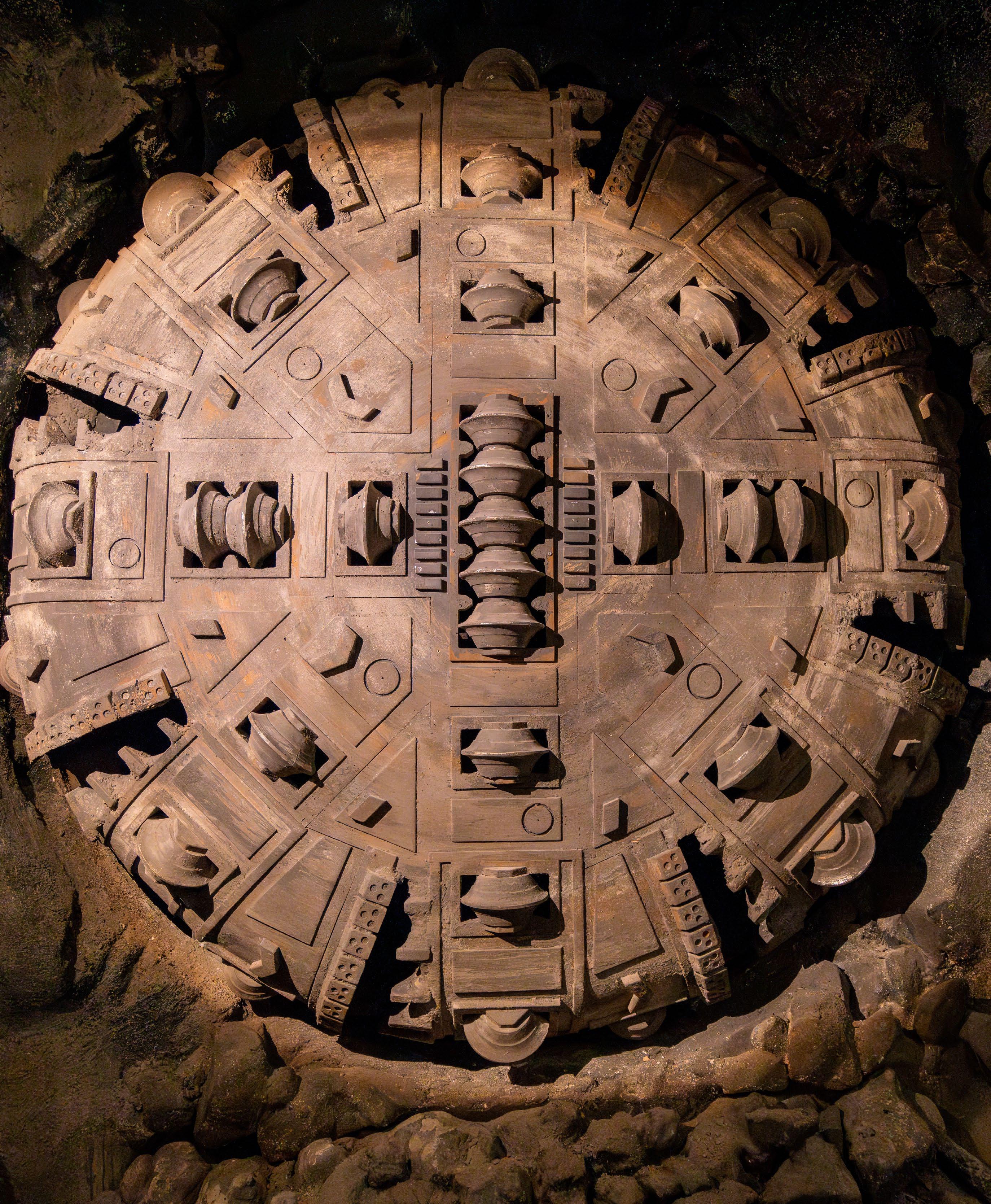
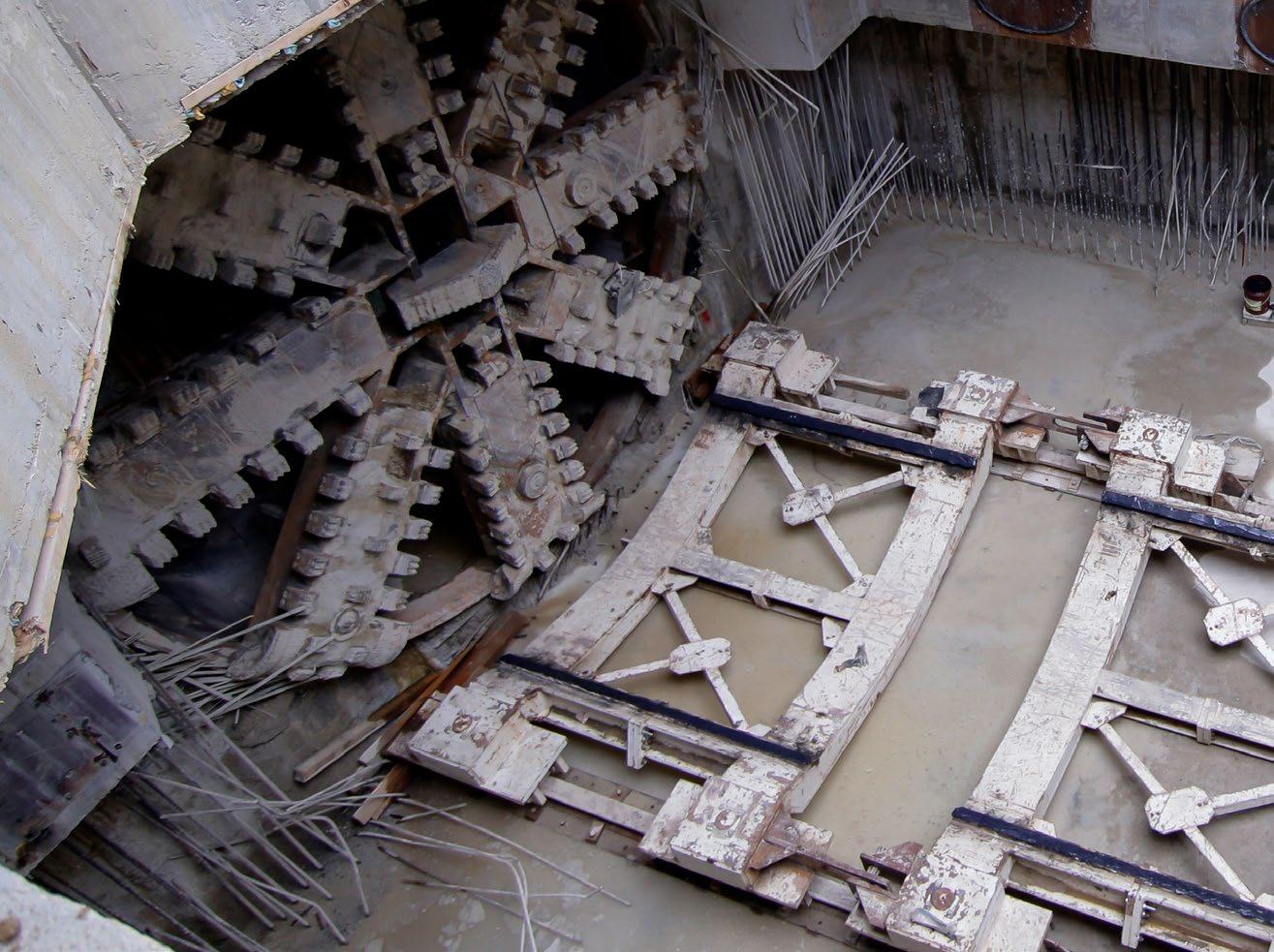
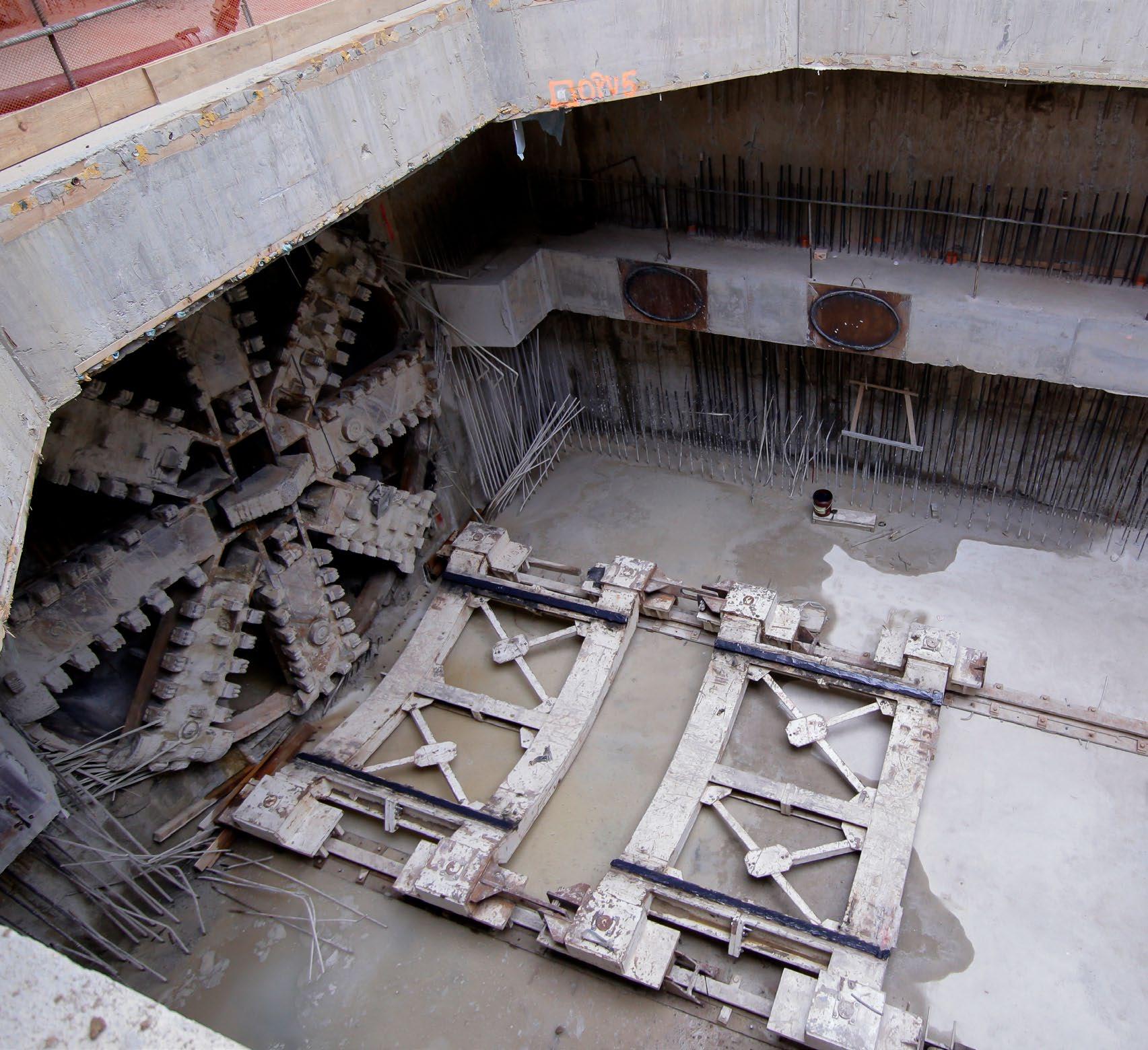
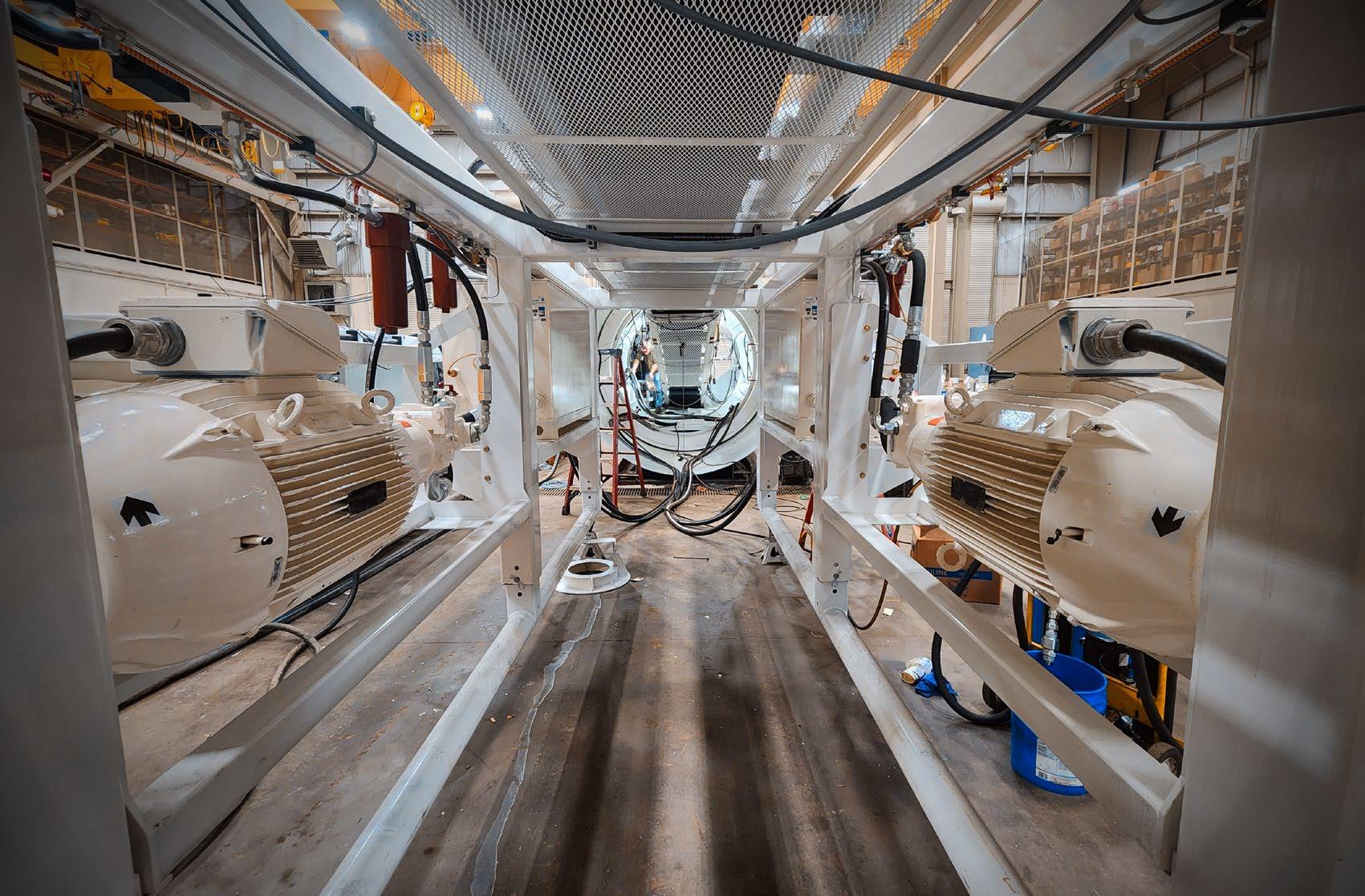
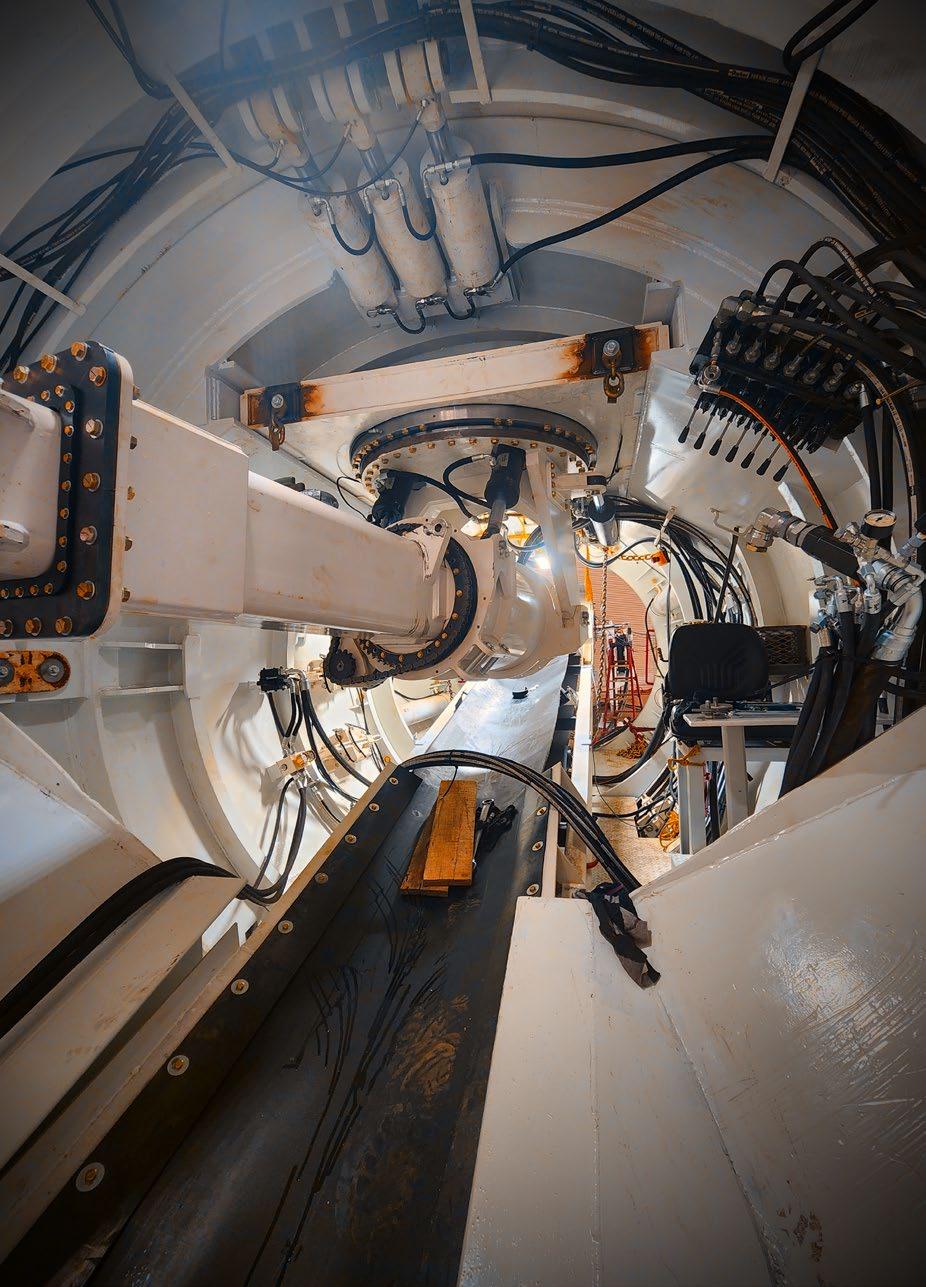
Modern tunnel boring machines operate in demanding, space-constrained environments where precision and reliability are essential. One OEM responded by developing a compact, multifunction machine capable of performing effectively in both soft soil and hard rock. An integrated hydraulic and control solution was selected to simplify processes while maintaining the highest levels of performance and safety. These machines are extremely complex, utilizing hydraulics to control functions including the digger arm, axial hydraulic drum cutter, articulating steering, hydraulic thrust, and the conveyor system.
Project Overview & Partner Collaboration
The OEM partnered with Scott Industrial Systems to design a hydraulic and control system for a 2.9-meter (114-inch) digger shield capable of excavating 378-meter (1,240-foot) tunnel alignments. Engineered for both soft soil and hard rock, the system controlled a total of twenty-one hydraulic actuators and required centralized operator control via radio remote. Previous machines relied on multiple operators. This approach enabled a single operator to safely and efficiently control all primary functions. The combination of a
complex hydraulic system, numerous actuators, and extremely limited space created several challenges that had to be addressed.
Hydraulic Power Unit Design
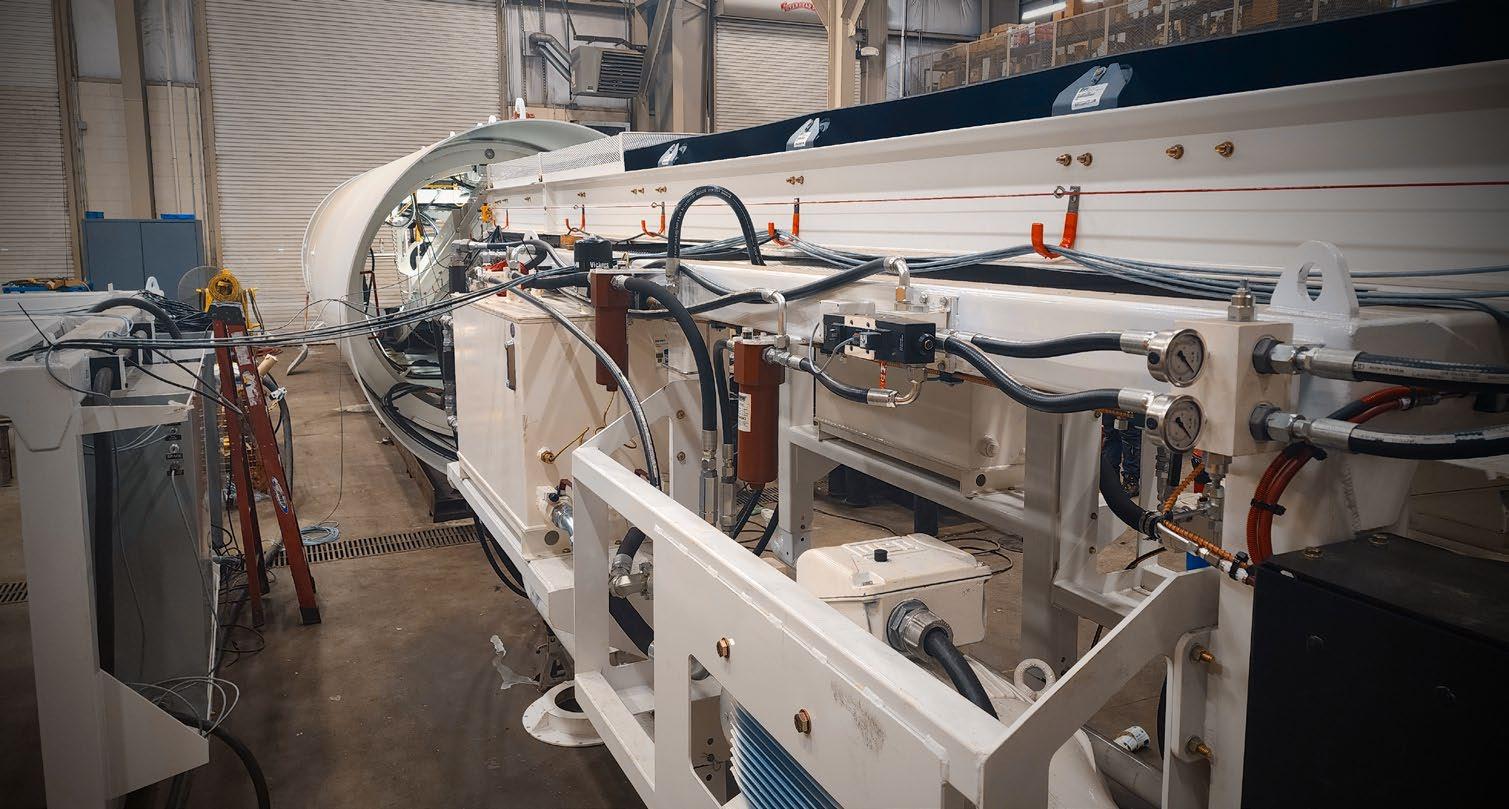
The first challenge was designing a hydraulic power unit that would fit within the machine's frame. The hydraulic system itself was simple: a basic circuit utilizing a pressure-compensated piston pump that supplied 190 lpm (50 gpm) of oil, which ultimately fed all the valves. The 75 kW (100 hp) electric motor and pump assembly had to be installed
remotely within the machine frame, as there was no space on the hydraulic reservoir itself.
Engineers from SCOTT and the OEM developed a custom hydraulic reservoir using solid modeling to fit within the machine frame. This was critical as there was no room for error. A second 75 kW (100 hp) hydraulic system was also required, which was solely responsible for powering the axial hydraulic cutter head and conveyor system.
Valve Selection & Fluid Control Strategy
After the pump and reservoir design, the SCOTT team addressed the complexity of 21 actuators. Several factors needed to be considered when selecting the valves. First, all the hydraulic actuators except for one required proportional control. Second, actuators were distributed throughout the machine, so layout and design were critical to avoid a spiderweb of hoses. Last, but certainly not least, consideration had to be given to which valve actuator to use and, specifically, which control system. Ten of the 21 actuators had to be controlled electronically; the remaining were manually operated valves.
Post-Compensated PVG100 Valve Architecture
The SCOTT team evaluated several options and quickly selected the Danfoss PVG series of mobile valves. The Danfoss PVG valve is a hydraulic proportional (load-sensing) control valve used to precisely control flow, with multiple options available. It is a modular design that can be configured for a wide range of applications, from simple directional control to sophisticated electro-hydraulic machine control.
Danfoss PVG valves are available in both pre-compensated and post-compensated configurations. For this application, post-compensated PVG100 valves were
selected as primary control valves. The post-compensated design enables flow sharing across all actuators when hydraulic demand exceeds pump capacity, ensuring that all functions continue to operate simultaneously. This capability was critical to maintaining consistent performance and enhancing overall machine safety.
The PVG100 valves also offered a unique advantage in their modular design. Although they are compact sectional valves, they can be divided into multiple valve banks and configured with special end covers that allow the load-sense signal to be shared between banks. This approach served 2 key purposes: it enabled the OEM to strategically position valve banks closer to groups of actuators, while still maintaining flow sharing across the entire system. As a result, the distributed valve banks functioned as a single, large post-compensated valve system, despite being separated into multiple sections.
Control Architecture & CAN Bus Integration
After the valves were selected, the next challenge was to determine how to control them. Space constraints made standard PWM control impractical, as it would have required extensive wiring throughout the machine, increasing the risk of installation errors, complicating troubleshooting, and consuming valuable space. The SCOTT team collaborated with Danfoss application engineers and determined that a CAN bus control architecture was the optimal solution. By using CAN bus, a single cable could be routed to each valve bank and daisy-chained across valve sections, significantly reducing wiring complexity while saving space and simplifying installation.
The Danfoss PVED actuators were selected to control the valves. The PVED units are electrohydraulic actuators that use electrical signals to precisely control valve spools. These valve actuators are CAN bus-enabled, which provides advanced functions. They include diagnostic capabilities and selectable flow characteristics and are built to operate under tough environmental conditions, which are required for this application. They are also PLUS+1 capable, a helpful feature when it was time to program the system. After the hydraulic system was fully designed, the next challenge was to determine which control system to use. Given that PVG valves were used throughout the machine, it was a natural fit to choose a complete Danfoss solution.
Machine Control Panels & Central ECU
The SCOTT team designed two separate control panels. Each panel included variable frequency drives to power the two 100hp electric motors. One panel also included a Danfoss MC038 controller, which served as the machine’s central electronic control unit (ECU). The MC038 controller is a programmable ECU designed for industrial and mobile machine applications, providing centralized management and monitoring of both electrical and hydraulic functions.
As part of the Danfoss PLUS+1 platform, the controller offers pre-developed function blocks that integrate seamlessly with other Danfoss components. This significantly streamlined programming and reduced software development time, allowing SCOTT engineers to complete the machine control logic in-house. The MC038 is also CAN bus capable, enabling direct communication with the PVG valves across the machine’s CAN network.
The Last Step: Radio Remote Control System
The final element of the machine design was the radio remote control system. The remote needed to operate multiple hydraulic valves, which led to the selection of the Danfoss IK4 radio remote. The IK4 is a wireless transmitter that enables the operator to remotely control machine functions, improving both safety and efficiency.
Its high configurability enabled the engineering team to develop a custom control layout tailored to the OEM’s application,
resulting in intuitive, effective machine operation. As part of the Danfoss PLUS+1 platform, IK4 also offers ready-to-use function blocks to further streamline software development. Through close collaboration among SCOTT engineers, the OEM, and Danfoss, the team delivered a fully integrated solution that overcame significant space, complexity, and control challenges while providing advanced functionality, simplified operation, and precise machine control.•
EHS, CHS, and the VDPC
By Dan Helgerson, CFPSD, CFPAI, CFPS, and Technical Editor, Fluid Power Journal
Irecently read an article comparing the Electro-Mechanical Actuator (EMA) to the Electro-Hydraulic Actuator (EHA). Both were presented as being superior to a Centralized Hydraulic System (which we will call the CHS, just to keep the acronyms consistent). The mechanical system was reported to have more limitations, lacking the power density and longevity of the hydraulic system. However, both were presented as having advantages over a system that required a large reservoir, extensive plumbing, and directional and throttling controls.
The EHA is a system where a variable-speed, reversible DC electric motor is directly coupled to a fixed-displacement hydraulic pump with its own small reservoir. The assembly is directly coupled to a cylinder or motor actuator whose velocity and direction are controlled by the speed and rotation of the electric motor. There is no need for additional directional or throttle control. The variable, bi-directional DC motor/pump provides the exact flow and pressure required with very little waste. Controlled from a PLC, there is proportional and profiling control. It is a rapidly growing technology with numerous major manufacturers competing to capture their share of the market. The development of the EHA brings to light a couple of things that challenge our traditional thinking. Reservoirs do not have to be that big. When the energy source can supply each actuator with the exact amount of energy needed, there would be little or no need for the reservoir to act as a heat exchanger.
Historically, when operating multiple actuators with varying pressure requirements, a CHS required a relatively large reservoir. The job of the reservoir was to provide good inlet conditions for the pump, allow entrained air to escape, allow particulate matter to settle out, and provide some of the cooling necessary for the fluid. The general rule was that the reservoir should be about 3 times the average pump flow. A 75 lpm (20 gpm) pump would require a 225-liter (60-gallon) reservoir. This is still generally accepted dogma in many industrial applications, while the mobile industry has moved away from using this rule due to space and weight considerations. In any case, a substantial amount of fluid had to be purchased and stored, adding cost and weight, with the potential of a large environmental impact in the event of a spill.
A major benefit of the CHS is that a wide variety of actuators, linear and/or rotary, can be driven from a single power source. However, the CHS must have enough flow and pressure to meet the maximum demands of the system. This requires separate power (flow) control for each actuator, resulting in inefficiencies that are dissipated as heat energy. From the perspective of efficiency of space, energy, and the environment, the EHA seems to be a good choice, but it does have its restrictions. There is a limit to the available power that can be supplied by the electric motor.
Currently (no pun intended), the power available is under 15 kW (20 hp). An electric motor of this size adds substantial weight and bulk when mounted on the actuator. The motor needs a power source, either from the grid or from battery packs. The DC motor requires wiring instead of expensive plumbing, but each motor will also need a starter, which sometimes costs as much as the electric motor. Often, some relatively sophisticated electronic controls are needed for velocity regulation and profiling. If the system to be controlled includes large cylinders or the use of accumulators, there may still need to be a CHS for that portion of the circuit.
A CHS system using the Variable Displacement Power Controller (VDPC) makes it possible to combine the benefits of both the EHA and the CHS. The reservoir is sized, not by pump flow, but by the differential volume of cylinders, thermal expansion, and the fluid stored in accumulators. Energy is generated at the highest practical density, reducing the size of the pump and all the associated plumbing. With large variations in energy requirements, accumulators are used to average out the demands from the pump, further reducing the pump size. Each actuator is given its own VDPC, which transforms the energy density at the source to the energy density needed at the actuator without the inefficiencies of restrictive power controllers.
Let’s consider a system with two actuators: a 100 × 70 × 600 (3.94 × 2.76 × 23.62) cylinder and a 50 cm³ (3.05 in³) hydraulic motor. The cylinder requires 94 lpm (25 gpm) as it reciprocates back and forth with pressures varying from 7 to 21 MPa (1,015 to 3,045 psi). The motor operates continually, requiring 77.5 lpm (20.5 gpm) with pressures varying from 7 to 14 MPa (1,015 to 2,030 psi).
With a peak motor requirement of 18 kW (24 hp), this is barely in the current range of EHA capabilities. With a peak cylinder requirement of 33 kw (44 hp), it may be possible in the future to use an EHA, but it is not available now. The actuators would have to accommodate the large DC electric motors, and relatively heavy wiring would be required. In some applications, it may be worth the energy savings. Speaking of energy savings, the traditional central hydraulic system may seem like a better choice at first glance, but it has some serious drawbacks. The total flow requirement would be 171.5 lpm (45.3 gpm).
With a peak pressure of 21 MPa (3,045 psi), the available power would need to be at least 65 kW (87 hp). The pump would need a displacement of at least 98 cm³ (6 in³) with a prime mover operating at 1,750 rpm. The reservoir size, using current standards, would be 500 liters (136 gallons). But it is energy waste that is the real concern.
For our discussion, assume the cylinder and motor have an average pressure demand that is the average of the two extremes: the cylinder would average 14 MPa (2,030 psi), and the motor would average 10.5 MPa (1,522 psi). The average power demand for the cylinder would be 22 kW (29 hp). For the motor, it would be 14 kW (18 hp). (The average power used by the actuators then is 36 kW (48 hp). The pressure setting of a pressure-compensated pump is typically set 1.7 MPa (250 psi) above the maximum required pressure. Using a PC pump set at 22.7 MPa (3,295 psi), the power consumed by the system would be 65 kW (87 hp). 31 of the 65 kW (39 of the 87 hp) will be wasted as heat. Every bit of the surface area of the reservoir will be needed to dissipate the energy.
If a load-sensing pump was used with stand-by pressures of 1.7 MPa (250 PSI), there would be little or no energy benefit. Load-sensing works best when operating only one actuator at a time. With more than one actuator, the one with the highest-pressure requirement will determine the pressure setting of the LS pump. When the cylinder requires 21 MPa (3,045 psi) and the motor needs 7 MPa (1,015 psi), the pressure at the pump will be 22.7 MPa (3,292 psi). Flow (power) controls will be needed for each actuator to dissipate the extra energy. At its peak inefficiency, 42 kW (56 hp) will be discharged as heat.
A system using the CHS with VDPCs takes a very different approach. Instead of calculating for flow and pressure as two separate entities, the VDPC system combines pressure and flow as Units of Power (UP). Rather than pressure × flow, the VDPC system relies on the pressure/flow relationship. The hydraulic energy at the source must be adequate to meet the needs of the system.
In this case, for the cylinder, the average pressure is 14.0 MPa (2,030 psi) and a flow of 94 lpm (24.9 gpm). Combining pressure and flow, the UP requirement is 1,316 MPa/lpm (50,542 psi/gpm). For the motor, there is an average pressure of 10.5 MPa (1,523 psi) and a flow of 77.5 lpm (20.5 gpm). The average UP is 813.75 MPa/ lpm (31,171 psi/gpm). The total UP for the system is 2,130 MPa/ lpm (81,713 psi/gpm).
Any combination of pressure and flow that equals 2,130 MPa/ lpm (81,713 psi/gpm) would be enough UP for the system. Choosing a PC pump rated for 35 MPa (5075 psi) and operating at 1,750 rpm, the pump would need a displacement of 35 cm³ (2.13 in³). Pump flow would be 61 lpm (16.2 gpm). Using the equation P = Flow × pressure / K, kW = 61 lpm × 35 MPa / 60 = 36. (hp = 16.2 gpm × 5045 psi / 1714 = 48). Contrast this to the 98 cm³ (6 in³) for the traditional system, which would require 65 kW (87 hp).
The reservoir will be sized for the differential volume of the cylinder (rod volume), thermal expansion, and accumulator liquid
volume. The rod has a diameter of 7 cm (2.76 in) and a stroke of × 60 cm (23.62 in). 72 × 0.7854 × 60 = 2,309 cm³ or 2.31 liters (0.61 gallons). Adding 15% for expansion and 20 liters (5.3 gallons) for accumulator liquid volume, the reservoir could be as small as 25 liters (7 gallons). The VDPC supplies only the UP required for the actuator, and so the power consumed will be the power delivered to the actuators, averaging 36 kW (48 hp).
Traditional CHS
CHS using VDPC
This information is based on mathematical models. Actual performance will vary depending on component efficiencies.
The CHS/VDPC system provides energy savings comparable to the EHS. A single electric motor (AC or DC) can be used, reducing the installed cost of the electrical system. VDPCs can be mounted at the CHS or on the actuators. The small reservoir reduces both the weight and real estate required for the CHS.
Explanations of the VDPC can be found in other articles in the Journal, including those from the November and December 2023 issues. You may contact Dan at Dan@Perisseuma.com. •
spotlight on chauntelle baughman women in FluidPower
By Lauren Schmeal, Editor, Fluid Power Journal
In an era of rapid technological advancement and industry evolution, leaders who can navigate change and foster growth are invaluable. Chauntelle Baughman, co-founder and CEO of OneHydraulics, exemplifies this dynamic in the fluid power sector. With a career that began amid a challenging job market, Baughman has not only thrived but has also committed to mentoring the next generation of engineers and professionals.
a thoughtful career choice
LEADERSHIP LESSONS FROM EARLY EXPERIENCES
Baughman’s entry into the fluid power industry was influenced by a strong job market and a desire for challenge and growth. She graduated from college with multiple job offers, and fluid power seemed to offer the most room to grow. Thankfully, she avoided the roofing and siding distribution business when the housing crisis hit in 2008. Her early career experiences shaped her leadership style significantly. “My early career taught me the value of learning from others and always staying open to the possibility of learning something new,” she reflects. Mentorship played a pivotal role in her development, inspiring her to invest in her team at OneHydraulics.
educational foundations & the importance of certifications
Baughman credits her educational background for preparing her for the fluid power industry. “I was fortunate to work with people who shared their knowledge freely and took the time to teach. That modeled the kind of leader I want to be, one who invests in others and builds capability across the team,” she explains. This commitment to education is now a cornerstone of her leadership, as she emphasizes the importance of certification and continuous learning within her company. Her passion for industry certifications, especially from the International Fluid Power Society (IFPS), stems from personal
experience. In earning her CFPHS certification, Baughman states that her certification “has paid dividends ever since. It gave me confidence, opened doors, and shaped my credibility. Because of how much it impacted my career, I joined the IFPS to help others achieve the same growth.”
navigating startup challenges
Scaling OneHydraulics from a startup to a thriving company presented unique challenges. “When you’re a startup, everything is a challenge,” she notes, emphasizing the importance of relationships with vendors, customers, and employees. Baughman has learned to balance multiple roles by acknowledging her strengths and weaknesses. It’s also about trusting her team, being “willing to let others take over in areas where they can do better than I can.”
fostering modernization
To encourage innovation, Baughman implements the Traction method, detailed in the book of the same name by Gino Wickman. It provides structure and a common language for addressing challenges. Baughman emphasizes that, “It has really aligned our goals and strengthened our communication.”
commitment to diversity and attracting new talent
At OneHydraulics, inclusivity is vital. Its training programs are open to everyone, allowing employees from all departments to take initiative and grow. Baughman explains. Outside of the company, Baughman says, “I work with [the] IFPS to support the development of training programs, materials, and certifications that make fluid power more approachable for new professionals.” Baughman believes that attracting women and young people to the fluid power industry is essential for fostering creativity and innovation. “Diversity brings creativity, and creativity drives innovation. We need new voices and fresh perspectives to keep this industry advancing,” she asserts.
embracing growth and technological change
Baughman’s commitment to continuous learning has been vital in overcoming the challenges of entrepreneurship, emphasizing the importance of taking care of employees to sustain business growth. Looking to the future, Baughman sees technology, especially AI, as a game-changer for the fluid power industry. “Artificial intelligence will be to this generation what the internet was in the late 1990s,” she predicts. OneHydraulics is preparing for these changes by closely monitoring emerging technologies and training its team.
company culture and personal vision
Starting OneHydraulics was a significant leap for Baughman. “It was the scariest thing I’ve ever done, but also the most rewarding,” she reflects. She finds satisfaction in watching her employees grow and succeed. “It’s been rewarding to see employees impress me with their initiative and tenacity. It’s a win-win for the company and for them,” Baughman notes. Her personal vision and core values shape OneHydraulics’ culture, guiding decision-making and fostering a creative environment.
engaging the industry
Baughman aims to make the fluid power industry more engaging through humor and a strong social media presence. “Fluid power doesn’t have to be boring,” she insists. Her commitment to a fun and fulfilling workplace culture shines through in OneHydraulics’ approach to business. Her journey in the fluid power industry is a testament to the power of mentorship, continuous learning, and embracing diversity. As Baughman leads OneHydraulics into the future, her vision and dedication to education and innovation will undoubtedly leave a lasting impact on the industry.•
TOFFSHORE TECHNOLOGY CONFERENCE
By Lauren Schmeal, Editor, Fluid Power Journal
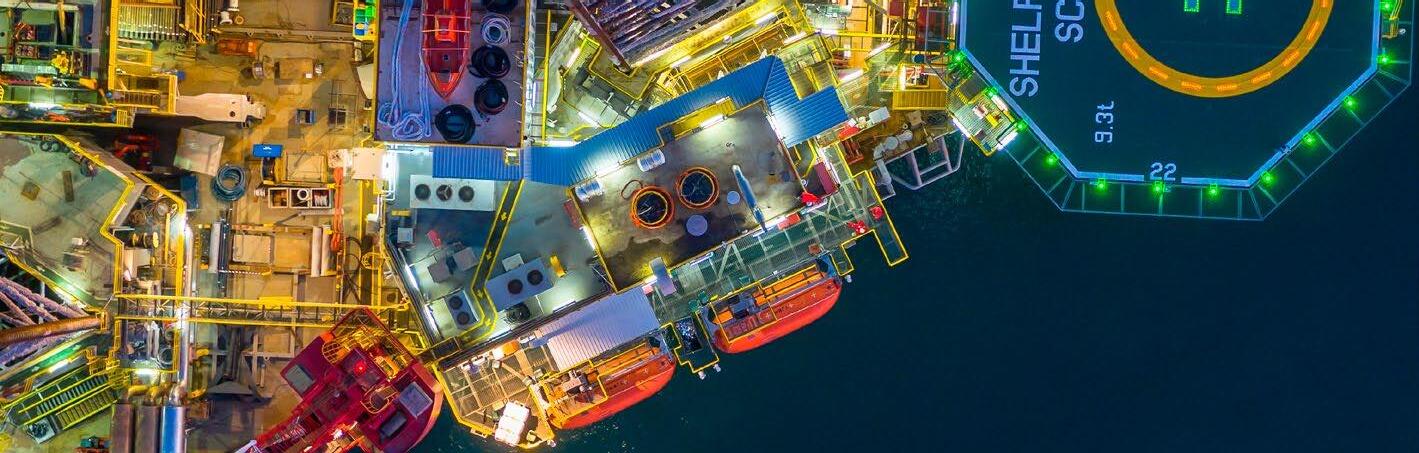
he Offshore Technology Conference (OTC) 2026, scheduled for May 4-7 at NRG Park in Houston, Texas promises to be a landmark event for the fluid power industry, particularly for companies serving the oil and gas, marine, and offshore energy sectors. Fluid power systems are vital to offshore operations, providing reliable power for drilling equipment, lifting systems, and subsea applications. This year’s theme, “Steering Offshore Energy Innovation into the Future,” emphasizes the dual role of traditional oil and gas alongside emerging renewable sources including wind, tidal, and wave energy. Through technical sessions and exhibitions, OTC 2026 will provide a comprehensive view of how fluid power continues to advance offshore operations.
Innovation Showcase: The conference will host a vibrant exhibition featuring the latest technologies and services. Industry professionals will have the opportunity to discover cutting-edge products, and gain insights into sustainable and efficient fluid power applications specific to offshore energy. Attendees
Accumulators, Inc. 3307
Bal Seal Engineering, Inc. 907
Bauer Compressors, Inc. 842
Blue Ribbon Sales & Services Corp. 2431
Bosch Rexroth Corp. 3437
Douce Hydro SAS France 2443
Emerson 1256
Fluidyne Fluid Power 1509
G.W. Lisk Company 1020
2026
can explore cutting-edge solutions and witness live demonstrations at the Energy Evolution Exchange, providing insights into the future of offshore technology.
Skills Enhancement: Specialized workshops and training sessions enhance attendees’ skills and knowledge. These sessions aim to address industry challenges, introduce new methodologies, and ensure that participants stay informed of the evolving industry landscape. A standout for 2026 is “Digital Seas: How AI and Emerging Technologies Are Shaping the Future of Offshore Technology,” a Young Professionals Event.
Networking: OTC allows for extensive networking between professionals, decision-makers, and potential collaborators. Attendees can engage in structured networking events, social gatherings, and business meetings. One of the opportunities is the “Energy4me STEM” student and teacher workshops that allow for meeting and working alongside industry leaders.
Presentations, Speakers, and Discussions: OTC is renowned for its comprehensive panel
2026 OTC EXHIBITORS LIST
GP:50 2431
Hydraulic Technologies 2907
Hydraulics International, Inc. (HII) 1907
IFP Motion Solutions, Inc. 1951 Igus, Inc. 3119
Lenord & Bauer USA 3456
MP Filtri USA, Inc. 2007 Midwest Hose 2719
PMT VALVES PVT LTD 3418
sessions, where experts delve into diverse facets of offshore technology. Keynote speakers will offer strategic insights into current challenges, emerging trends, and the future trajectory of offshore technology. This is an opportunity to gain a comprehensive understanding of the industry's direction. Speakers include Ryan Peay, the Deputy Assistant Secretary of the U.S. Department of Energy’s Office of Resource Sustainability.
Global Engagement: OTC attracts a diverse audience, promoting international collaboration. Participants will have the chance to explore innovations from around the world, fostering a well-rounded perspective on offshore advancements. The event encourages participants from around the world to attend OTC 2026, with an official visa letter available on the event website. •
The 2026 OTC is an immersive and enlightening experience for professionals to stay informed, connected, and inspired by the latest innovations in technology and industry practices.
PacSeal Hydraulics, Inc. 2448
Pneumatic and Hydraulic 3706
ROTOR CLIP COMPANY 2212
Rota Limited 1743
SPIR STAR Ltd. 2300
Sauer Compressors USA 2611
Senior Metal Bellows 3306
Smalley 2637
The Lee Company 1710
IFPS Certification Pathways to Master Designation
CERTIFICATION PATHWAYS
A CUSTOMIZABLE & INDIVIDUALIZED CERTIFICATION JOURNEY
By BJ Wagner, CFPAI/AJPP, CFPE, CFPS, CFPECS, CFPMMH, Director Training/ Development, International Fluid Power Society
IFPS Certification Pathways to Master Designation
Hydraulic Mechanic (IHM)
& Conductor (C&C)
IFPS offers certifications applicable to an individual’s daily job responsibilities, such as Hydraulic Specialist (HS), Pneumatic Specialist (PS), Connector & Conductor (C&C), Mobile Hydraulic Mechanic (MHM), Industrial Hydraulic Technician (IHT), and Support Associate (SA), just to name a few. However, individual certification is not all that is offered. IFPS also offers advanced, or Master-level certifications based on the various certification pathways that are available.
Figure 1 identifies several pathways that can be taken to get to the advanced or Master certifications. For example, if an individual holds both an HS and a PS certification, the individual is then also certified as a Fluid Power Specialist (S), which is a horizontal pathway. Or, if an individual is certified as a C&C, MHM, and MHT, that individual is then also certified as a Master of Mobile Hydraulics (MMH), which serves as a vertical pathway. These example pathways are highlighted in Figure 2.
The unique part about the pathways is that, while specific ones exist to get to an advanced or Master certification, the order or method in which you get to that level is completely customizable. Individuals can customize their own certification journeys based on personal desire, direction, and final goal. The journey taken is completely up to you! A list of all certifications available can be found at https:// www.ifps.org/certifications-offered.
While the pathways exist, there is no specific order that an individual needs to follow. While some may perceive the certifications to have a hierarchy or sequence to follow from easiest to most advanced, all the certifications are standalone with no prerequisites. The order is completely customizable. Some professionals start with a more hands-on focus, such as C&C or Mechanic, and then work toward more math-focused Specialist levels. While others may start at the Specialist and work towards
the more hands-on certifications. While some of the content may be similar across multiple certifications, each certification has its own unique content. As an IFPS member who holds multiple certifications, I can personally share that I’ve learned something from every single certification that I have prepared for. They are all unique and are equally valued based on the focus of the specific certification.
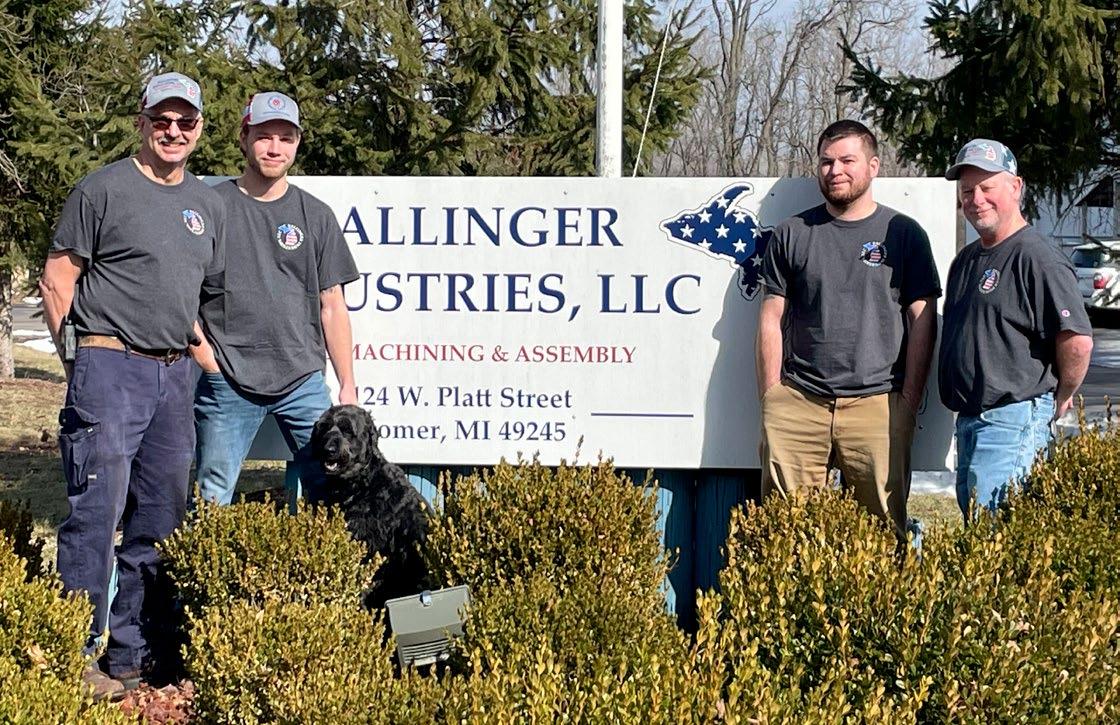
Recently, a Michigan-based company set out on an aggressive certification and education journey that it felt was appropriate for its team. As several other companies have done, Ballinger Industries LLC set a goal for having staff members obtain certification as part of personnel development plans. The team not only focused on a single certification, but also took the focus of obtaining advanced Master certifications using a customized pathway. The unique part of the certification journey at Ballinger was the use of an aggressive timeline and method chosen for completion. They utilized a combination of online instructor-led and in-person certification review training sessions to assist them with their education and certification journey. In less than 2 years, starting in February 2024, the Ballinger team completed a total of 5 certification exams, resulting in 6 certifications and 2 in the application/approval phase.
Here is what LaMar Ballinger, Owner and CEO of Ballinger Industries LLC. had to say about IFPS certifications and why the team chose to follow a unique pathway and aggressive timeline. “We acquired a hydraulic company called Newton Manufacturing Company, LLC. As part of that acquisition and expansion, it was crucial for us to obtain certification in order to support the function of that company and share that knowledge with our customers”. When asked why staff chose to follow the pathway as the goal instead of focusing on a certification, LaMar shared that, “We needed a path to follow that made sense where each class was a building block for the next class with the end goal of becoming Certified Fluid Power Engineers”.
As part of the educational and learning process, “We wanted to obtain as much knowledge as possible. Taking the pathway provided us with a solid understanding of the fundamental principles of hydraulic systems and concepts prior to taking the more in-depth classes of becoming Certified Fluid Power Engineers. I truly believe that we would not have achieved our final goal without the introductory classes like the Fluid Power Fundamentals, as well as the hands-on focus of the Mechanic and Connector and Conductor certifications”.
The team from Ballinger Industries LLC. took its own customized approach, working towards the Certified Fluid Power Engineer (CFPE) and/or System Designer (CFPSD) credentials, using a chosen ordered approach of Fundamentals > MHM > HS > CC > PS > ECS. The team began with a refresher covering the basics and fundamentals. “The
only formalized training that we had was from on-the-job experience and college education. College for me was 35 years ago. On-the-job experiences helped with the commonsense applications, but we needed to understand the theory.”
LaMar also shared that the chosen learning process and certification journey was effective for the team, but “The principles of hydraulic systems were more complicated than what I initially expected. There was a lot of math and a wide variety of components and connectors to understand.” The team’s focus on the end goal and breaking the process into incremental steps was effective. A unique approach to the blended training offerings utilized as part of the journey was also effective. “We opted for the online instructor-led training, followed by the in-person certification review training, and then the test. We are busy with our daily activities, and we felt that the online instructor-led classes would force us to set aside the time needed to go over the material. The week-long in-person training became more of a review session and really helped cement the concepts in our minds.”
Having now completed multiple certifications within a short period of time, “We utilize the information we learned daily. There are so many examples that it is hard to list them all. Identifying hydraulic components and understanding the proper connections and electronic controls are probably the major uses.” LaMar shared that with each of their staff members holding multiple certifications, they not only provide value to their customers by being able to share that knowledge and expertise, but they also have internal value. LaMar shared, “The value in my mind is job security. We can only build what we design, and the more knowledge we have, the better our designs will be. The better our designs are, the more efficient our systems will be. Better systems equate to more sales, and more sales [mean] job security.”
LaMar sought to share his certification experience with others. He shared that, “I would absolutely recommend the IFPS training to anyone who would like to challenge themselves and truly understand hydraulic components, systems, and principles to build the most efficient systems.” I asked him if he had any advice to share with others who may be following the same process of developing a certification pathway or journey. LaMar’s recommendations were to “Study hard and make sure that you truly understand the material. Make sure you ask your trainer all the questions you can until you really understand the principles. I would also recommend training in a group format because another person’s question will make you think and may lead to other questions. Our IFPS trainer was great at answering questions in a way that ensured our entire team understood the principles being taught.”
Ballinger Industries LLC planned out its unique pathway and selected a blend of both online instructor-led sessions and weeklong in-person certification review trainings. The team is well on its way to reaching the final goal of earning Certified Fluid Power Engineer and System Designer credentials. In a little under 2 years’ time, their team now holds certifications of MHM, HS, PS, S, CC, ECS, and are in the process of applying for CFPE and CFPSD qualifications. The team’s collective choice to select a certification pathway, customize its learning process, and develop a plan to reach an end goal was extremely effective, and it can be effective for your team as well. •
If you have any questions about the training options available or want to learn more about the certification pathways, contact IFPS via email, a phone call, or using the chat function of the IFPS website at www.ifps.org.
Selecting and Optimizing Vacuum Cups in Automated Handling Systems
By Daniel Pascoe
This article is intended as a general guide and as with any industrial application involving industrial component choice, independent professional advice should be sought to ensure correct selection and installation. This article is the opinion of the author, Daniel Pascoe of Davasol Inc., an industrial brand management firm. One of Davasol’s clients, Vacuforce LLC, based in Indianapolis, partners with the author on this article. Contact Daniel at dpascoe@davasol.com
» VACUUM CUPS ARE among the most widely used gripping technologies in modern industrial automation. From packaging lines and palletizing systems to robotic pick-and-place applications, vacuum cups allow products to be lifted, moved, clamped, or positioned without mechanical contact. Because they are relatively inexpensive and easy to install, vacuum cups are often treated as simple consumable components. When a cup wears out, the most common approach is to simply replace it with the same model that was previously installed. However, this approach can overlook opportunities to improve system performance. The vacuum cup that happens to be installed may not necessarily be the best choice for the application. In many cases, a careful review of the cup design, material, or size can lead to improvements in sealing performance, durability, or operating cost. Understanding a few fundamental aspects of vacuum cup selection can help engineers and technicians make better decisions when specifying or replacing these components.
COMMON VACUUM CUP DESIGNS
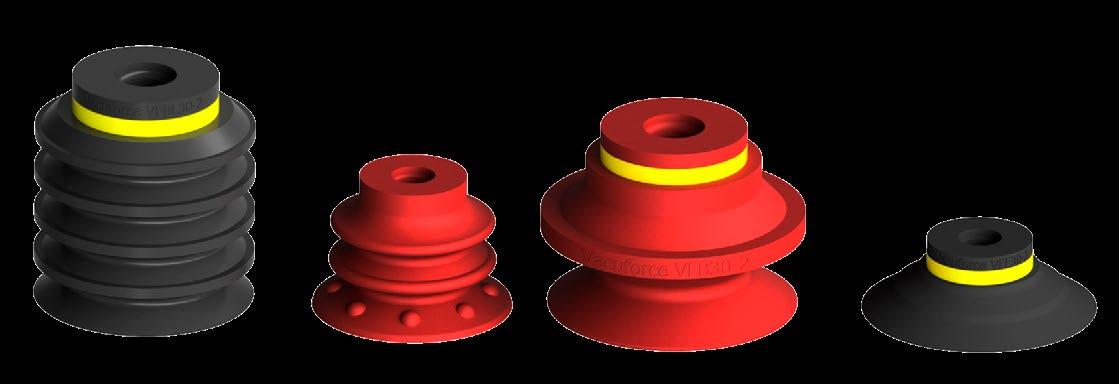
Most vacuum cups used in industrial automation fall into three general categories: flat vacuum cups, bellows vacuum cups, and multi-bellows vacuum cups. The suction cups shown in Figure 1 are the same diameter but represent different cup styles.
Flat cups are typically used in applications where the surface being handled is relatively smooth and consistent. Their simple design provides a strong holding force with minimal vertical movement. Bellows cups introduce flexibility into the gripping system. The bellows section allows the cup to compress and extend slightly, helping accommodate variations in product height or minor positioning differences in automated systems. Multi-bellows designs provide even greater flexibility and vertical travel. These are often used in applications where the surface may be uneven or where products vary slightly in height.
Figure 2
Oval cups on door frame
Round cups on main surface
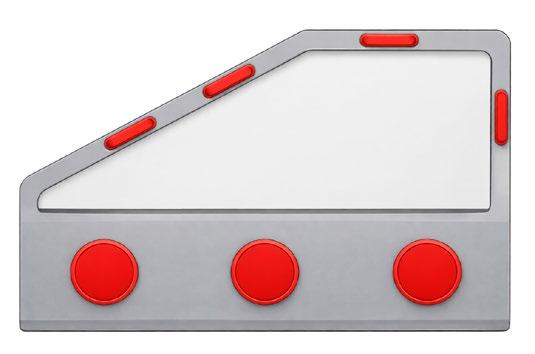
Although vacuum cups are most commonly circular in shape, certain applications may require specialized geometries. For example, elongated parts such as doorframe blanks or structural components may benefit from oval cups that maximize the contact area along the length of the product (see Figure 2). In practice, however, round cups remain the most common choice due to their versatility and widespread availability.
MOUNTING AND FITTING COMPATIBILITY
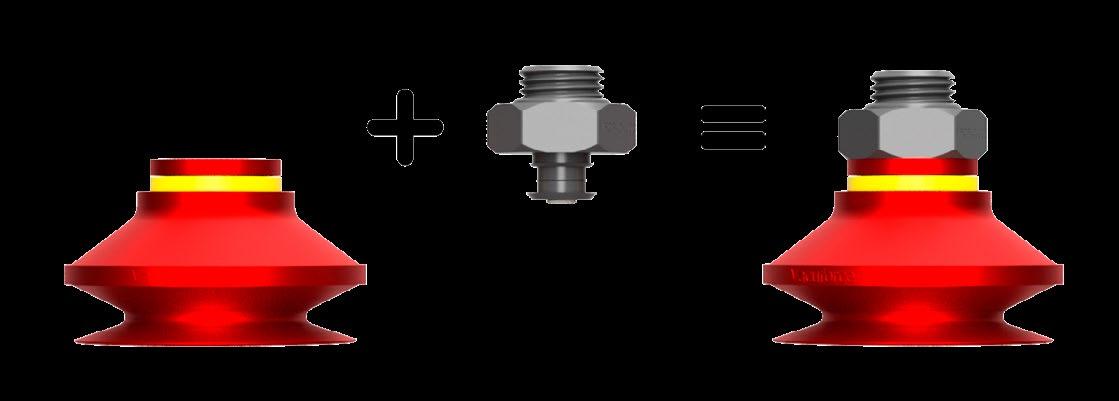
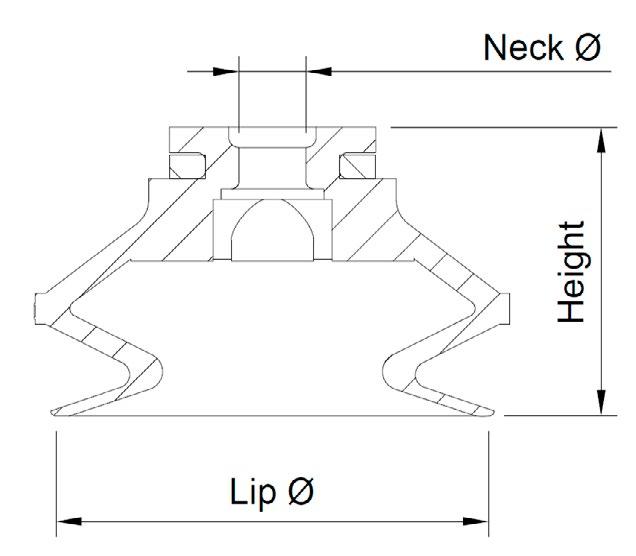
When considering a replacement vacuum cup, the first dimension to examine is the mounting interface, often referred to as the cup neck (see Figure 4). If the new cup fits the existing fitting (see Figure 3), replacement is straightforward. If it does not, the next step is to examine the thread type used on the fitting.
Figure 3
Most industrial vacuum cup fittings use standardized threads such as National Pipe Thread (NPT) and British Standard Pipe Parallel (BSPP). If a replacement cup is available with the same thread specification, the entire assembly can often be exchanged without modifying the machine. If the thread specification differs, replacing the fittings may still be a practical option. In many automated systems, vacuum cups are replaced regularly as part of normal maintenance. If hundreds or even thousands of cups are consumed annually, converting to a different fitting style may still be economically justified if the replacement cups offer lower long-term cost or improved durability.
CUP HEIGHT AND MACHINE GEOMETRY
Figure 4
Another dimension that should be considered during replacement is the overall height of the vacuum cup assembly. (see Figure 4) Automated equipment is typically configured with a precise approach distance to the product being handled. If
Figure 1
a replacement cup is significantly longer than the original, the cup may contact the product earlier than intended. In many situations, this simply requires adjusting the machine’s pickup position. However, it is important to confirm that the equipment allows this adjustment and that operators are willing to make the change if necessary. Even relatively small dimensional changes can affect pickup accuracy in high-speed automation systems.
SELECTING THE CORRECT CUP MATERIAL
Material selection is one of the most important factors affecting vacuum cup performance. Different materials offer different combinations of flexibility, wear resistance, and sealing characteristics. Choosing the correct compound can significantly influence both gripping reliability and service life. One of the most common vacuum handling applications involves cardboard cartons in packaging lines. Because corrugated cardboard surfaces are often uneven, a softer cup material is usually advantageous.
Silicone vacuum cups are frequently used in this type of application because their relatively low hardness allows the sealing lip to conform to irregular surfaces. This helps reduce leakage between the cup and the product and allows the system to achieve higher vacuum levels with less demand on the vacuum pump or generator. The trade-off is that silicone has lower abrasion resistance than nitrile-based rubber compounds, meaning that cup replacement may be required more frequently.
Nitrile materials provide improved durability and wear resistance but typically have a higher durometer than silicone, which may reduce sealing performance on rough or porous surfaces. Some vacuum cups are produced from PVC-based compounds. These materials can offer good durability initially but may gradually “work harden” over time, especially in compressing cup designs such as bellows models. As the material stiffens, sealing performance may decline, and the cup may require replacement sooner. While PVC cups often have a lower purchase price, their overall operating cost may be higher if they must be replaced more frequently.
UNDERSTANDING HOLDING FORCE AND CUP DIAMETER
Cup diameter is often the first specification referenced when selecting a vacuum cup. However, diameter alone does not determine the effectiveness of a vacuum gripping system. Holding force is determined by the vacuum level applied to the cup and the effective surface area of the cup. Even relatively small cups can generate substantial holding force. For example, a vacuum cup with a diameter of approximately 50 mm (2 in.) operating at a vacuum level of 500 mmHg (20 inHg) can theoretically generate more than 110 Newtons (25 pounds) of lifting force.
To calculate the potential holding/lifting force of a vacuum cup, the common equations A=π × r² and F=p × A are used.
Given a vacuum cup with a diameter of 100 mm (3.94 in), an atmospheric pressure of 0.101 MPa (14.7 psia), the potential holding/lifting force would be:
A safety factor of at least 4:1 is typically used in heavy lift applications. In most practical applications, multiple cups are used to share the load rather than relying on a single lifting point. When several cups are distributed across the surface of a product, the total holding capacity increases while also reducing the risk of product deformation. This means that slightly smaller cups may still provide sufficient holding force while offering advantages such as lower cost or improved system flexibility.
EVALUATING CUP STYLE AND BELLOWS CONFIGURATION
The exact style of vacuum cup used in an application is often more flexible than many users assume. For instance, a cup with one and a half bellows may often perform adequately in applications where a 2.5 bellows design was originally used. Unless the application specifically requires the additional vertical travel provided by the larger bellows, a simpler design may be sufficient. Evaluating the application carefully is important when considering such changes. In many cases, testing alternative cup styles can reveal opportunities to improve reliability or reduce component cost. Engineers and sales specialists who carry a selection of cup samples when evaluating applications are often able to identify improvements quickly through simple testing.
PRACTICAL CONSIDERATIONS WHEN REPLACING VACUUM CUPS
When selecting a replacement vacuum cup, several practical questions should be addressed. Does the new cup fit the existing mounting interface? Are the fitting threads compatible with the current installation? Is the cup material suitable for the product surface? Will the cup height affect machine setup? Is the existing cup wearing prematurely or failing at the mounting point? In many industrial environments, a relatively small selection of cup designs can successfully serve most applications. The wide variety of vacuum cups available in the market reflects independent product development rather than strict functional necessity.
CONCLUSION
Replacing a vacuum cup should not just involve ordering the same part number that has always been used. By evaluating cup design, materials, mounting compatibility, and system requirements, engineers can often identify alternatives that improve reliability and possibly reduce operating costs. As with most aspects of industrial automation, the most effective solutions come from understanding the application and selecting components that match the operational requirements of the system.
PRODUCT SPOTLIGHT
Stop The Mess!
• No tools required
• No expensive hardware needed
• No more rags stuffed into hoses
• No more messy plastic caps
• The ultimate contamination control tool
• One hand installation
• Eliminate hydraulic oil spills & clean up
• Quick installation & ease of usage
• Safe for personnel & environment
• Industry acclaimed
For more information, call (203) 861-9400 or email sales@flangelock.com. www.flangelock.com
PSL-CAN is now Explosion-Proof!
HAWE’s proportional directional spool valve PSL-CAN is the ideal entry into CAN bus communication. This proven technology easily connects the valve bank into the CAN Bus along with other sensors and actuators on your machine. And now HAWE offers an explosionproof version of this valve for use in explosion hazardous areas.
Benefits: Simple wiring; preset parameters; and more.
FluiDyne Fluid Power Stocks A4V Piston Pumps & Parts
FluiDyne carries a complete line of A4V piston pumps that are available in displacement of: 40, 71, 125, 180, 250. Our units are used in many different applications: agriculture, forestry machinery, construction, on-highway, commercial vehicles, offshore, marine, wind/ocean energy, automotive and more.
Controls include: DR, DRG, FR, FRG, DFR, and LR2. They are available in SAE or metric. The versatile A4V units carry the industry leading 18 month warranty. Units are fully tested, documented and guaranteed to perform 100% to the original manufacturer’s specification.
Protection for All Things Hydraulic, Pneumatic and Fluid Power
MOCAP manufactures an extensive range of protective closures to guard pipes, hoses, and hydraulic fittings from dirt, moisture, and damage to help maintain equipment reliability. Included are a variety of sizes and styles of Threaded and Non-Threaded plastic Caps and Plugs for Metric, NPT, BSP, JIC and SAE Threaded Connections, Ports and Fittings. These are in addition to MOCAP’s already extensive lines of lowcost Caps, Plugs, Grips, Netting, Tubing and Tapes for general Product Protection, Finishing and Masking. All of our stocked items are ready for immediate shipment and available in Box, Mini-Pack and Micro-Pack quantities. Free Samples are always available for testing purposes.
sales@mocap.com www.mocap.com
PRODUCT SPOTLIGHT
Electric Clutches for Pumps
Ogura produces a wide variety of electric clutches for mobile applications. These clutches provide simple on/off operation for a variety of pumps. Remotely engaging the pump through the clutch reduces drag on engine start-up, increases pump-life and allows multiple pumps to be used off one engine. Various belt types as well as pump shafts can be accommodated.
Watch our video on how they work: https://ogura-clutch.com/video-mobile.php
Ogura electromagnetic clutches provide a quick and easy engagement of a hydraulic pump, winch drives or other marine components. Available torque range is 100 pound feet to 1500 pound feet with single-face friction designs. Multiple disc units can generate torques over 8,000 pound feet. Large bearings, e-coating and a single piece bi-directional spring provide durability in harsh environments.
Watch our video on how they work: https://ogura-clutch.com/video-mobile.php
Ogura Industrial Corp.
100 Randolph Road • Somerset, New Jersey 08873
Phone: 732-271-7361 • Fax: 732-271-7580
www.ogura-clutch.com • info@ogura-clutch.com
Hydraulic Noise and Shock Suppressor
Wilkes and McLean manufactures an In Line Noise and Shock Suppressor for hydraulics and is a stocking distributor of Nacol Accumulators. Our suppressors eliminate pulsations, which greatly reduces noise and vibration from applications from a few gallons up to 200 gallons. We stock all of our suppressor sizes as well as Nacol Accumulators and parts from 1/5 of a pint up to 15 gallons, in our Schaumburg, Illinois facility. 877.534.6445 | info@wilkesandmclean.com | www.wilkesandmclean.com
Don’t Compromise – That hydraulic flange you want may be at MAIN
MAIN stocks 10,000+ hydraulic flanges and manufactures components in 4-7 days in the USA.
SAE J518 Code 61 and J518 Code 62, JIS, DIN, ISO 6162, ISO 6164, and specials with socket-weld, buttweld, ORB, BSPP, etc.; all geometries, flange heads, flange adapters; in carbon, stainless, cupro-nickel, ductile, aluminum, etc. Sixty years’ experience plus SAE and ISO technical committee experience.
MAIN Manufacturing Products, Inc.
800.521.7918
https://mainmanufacturing.com/block-categories
IDENTIFYING HYDRAULIC FLOW CONTROL VALVES FROM SIMPLIFIED & DETAILED SYMBOLS
Figure 10-8 illustrates simplified and detailed symbols for a pressure compensated restrictive type flow control valve (without temperature compensation), with a reverse free flow check valve. The simplified symbol shows an adjustable restriction and an upright arrow, indicating the valve is compensated for changes in pressure caused by load variances. The detailed symbol also shows the adjustable restriction, but the pressure compensator portion of the valve, called a hydrostat, contains a balanced piston throttling valve with pressure taps to both sides of the restrictor valve. The hydrostat is a normally open, self regulating, pressure reducing valve. Notice that the outlet side of the restrictor orifice is connected to the side of the pressure compensator that has the bias spring. Bias spring force is combined with pressure at the downstream side of the flow control orifice to hold the valve open, while upstream pressure is directed to throttle the valve closed. Since both sides of the
compensator spool piston are the same diameter, the pressure drop across the flow control when the valve is operating will just equal the pressure caused by the bias spring. No matter what system pressure is, the pressure drop across the pressure compensator will be constant, usually in the range of 50-150 psi. The pressure compensator valve opens and closes in response to changes from this fixed pressure drop across the throttling
TEST YOUR SKILLS
What determines the pressure drop across the throttling orifice in the detailed symbol shown in Figure 10-8?
a. Load.
b. Throttling orifice.
c. Compensator bias spring force.
d. Upstream pressure.
e. Downstream pressure.
See page 27 for the solution.
orifice. If the flow were to increase, for example if the load were removed from a cylinder that is extending and its velocity increased, this would cause the pressure drop across the restrictor orifice to increase, and the pressure compensator would throttle the flow to restore the constant pressure drop. The outlet pressure caused by the load thus has little effect on the constant pressure drop across the restrictor. •
PROUDLY SERVING THE INDUSTRY FOR OVER 6 5 YEARS
HYDR AULIC FL ANGES D COMPONENTS
* * Stainless
* SAE J518 Code 61& 62
* ISO, JIS, DIN
MAIN’S ADVANTAGES
DEPENDABLE - 65 years of hydraulic experience
INFORMED - Main’s engineers are active on the SAE, NFPA, and ISO tech committees
QUICK - Thousands of Styles and Flange Types STOCKED
Grand Blanc, MI 48439
800.521.7918
info@MAINmfg.com www.MAINmfg.com/fpj
Hydraulic Components Modeling for Application Engineers WEBINAR
By Lauren Schmeal, Editor, Fluid Power Journal
As
presented by Dr. Medhat Khalil, Program Director of Fluid Power at the Milwaukee School of Engineering
Hydraulic systems are at the heart of modern industrial and mobile machin ery. These range from construction equipment and agricultural machines to advanced test rigs and flight simulators. As systems grow more complex, application engineers must do more than size and select components. They also need to analyze dynamic behavior, predict performance, and troubleshoot issues before hardware is built. Modeling and simulation have become essential tools for hydraulic designers.
This summary outlines the main ideas from a week‑long seminar on hydraulic systems modeling and simulation for appli cation engineers offered at MSOE. The goal is to demonstrate how lumped parameter modeling, implemented in common engi neering environments such as MATLAB/ Simulink, can assist engineers in building reusable component models, assembling them into system level simulations, and making informed design decisions using data typically provided by manufacturers.
Defining Requirements and the System Concept
A successful hydraulic system design starts with clearly defined application requirements. Before selecting components, the engineer must gather data that describes the machine’s purpose. This includes identifying whether the required motion is linear or rotary, the type of loads (force or torque; steady or dynamic), and the desired speeds. The engi neer must also determine the steady/peak power needed. Space constraints matter as well. Compact mobile machines with tight envelopes drive different choices than large stationary installations with more space. The number of functions and whether these oper ate in sequence or parallel also influence the hydraulic architecture from the beginning. Taken together, these requirements drive the trade‑offs between working pressure and actuator size, the number and type of inde pendent circuits, and the overall layout of the hydraulic system. A compact mobile machine may favor higher operating pressures to
minimize actuator and line sizes, accepting higher component stresses and tighter filtra tion or cooling requirements in return. A large stationary system may instead prioritize lower pressures, larger components, and a more relaxed layout to simplify maintenance and reduce downtime. System behavior is already being defined at this early stage, long before the first CAD model is opened or the first line is drawn in a hydraulic schematic.
Once the performance requirements are defined, the hydraulic engineer sketches the “skeleton” circuit: the conceptual layout of pumps, valves, actuators, and conductors that can realize the desired sequence of operations. At this stage, no hardware exists; everything is virtual. The primary concern is ensuring safe operation through appropriate pressure‑limitation strategies and relief paths, managing energy use by unloading pumps during idle conditions, and defining the basic paths through which power will flow from the prime mover to the actuators and then to the load. This conceptual circuit becomes both the framework for steady‑state sizing and the backbone for subsequent dynamic modeling.
Steady‑State Sizing and Fluid Selection
With the skeleton defined, the engineer moves into the steady‑state sizing phase. Here, required loads and speeds are translated into working pressures, flow rates, and actuator dimensions. Higher working pressures allow smaller actuators and narrower lines, but at the expense of higher stresses and often more demanding filtration and cooling. Lower pressures reduce stress and may simplify com ponent selection, but require larger actuators, larger pumps, and heavier conductors. Flow rates derived from speed requirements are used to calculate pump displacement and line sizing, and conductor diameters are chosen to keep flow velocities within acceptable limits, maintain laminar flow, and balance pressure drop, noise, and cost.
Once these basics are established, the designer turns to manufacturers’ catalogs to select real pumps, valves, cylinders, motors,
and ancillary components that meet the sizing and performance criteria. At the same time, fluid selection must be made in harmony with the application. Agricultural and envi ronmentally sensitive applications may favor biodegradable fluids, while underground mining or high fire‑risk environments may demand fire‑resistant fluids. More general industrial applications often default to min eral‑based hydraulic oils. Each fluid choice carries implications for viscosity, lubricity, temperature behavior, and compatibility with seals and materials, all of which influence efficiency and component life.
For relatively simple machines, static sizing and catalog‑based checks may be enough to move forward for prototyping and testing. However, for multifunction mobile equip ment, high‑performance industrial systems, or any application where energy efficiency, transient response, and thermal management are critical, the designer needs a deeper view. At this point, modeling and simulation become a necessity rather than a luxury.
System‑Level vs. Component‑Level Modeling
To use modeling effectively, it is important to distinguish between component‑level and sys tem‑level objectives. Component manufacturers often develop highly detailed mathematical models of pumps, valves, motors, and other ele ments. These models may incorporate refined leakage and friction representations, struc tural flexibility, thermal effects, and internal geometry. They are usually built in specialized software platforms, calibrated with extensive test data, and treated as proprietary intellectual property. Their primary purpose is to optimize the component’s design and performance, not to be distributed to end users.
Application engineers, in contrast, are typically system integrators rather than com ponent designers. They assemble systems from commercially available pumps, valves, and actuators, and their main concerns are system‑level performance, stability, energy use, and reliability. These engineers rarely have access to the detailed internal models
used by manufacturers, nor do they need that level of granularity for most tasks. Instead, they need models that reflect the static and dynamic behavior of each component at its ports and interfaces—models that can be combined like building blocks to form a complete system representation.
For this group, a simpler, modular approach is both sufficient and more sustainable. The challenge is how to extract useful models from the static curves and limited dynamic information that manufacturers do make public, without attempting to guess hidden parameters or reverse-engineer confidential design details. Lumped-parameter modeling provides a systematic way to do exactly that.
The Lumped‑Parameter “Block” Approach
Lumped-parameter modeling treats hydraulic components as discrete elements with a finite set of inputs and outputs, rather than as continuously distributed flow and pressure fields. Each component is represented by a “block” that encapsulates its behavior in terms of flow, pressure, and, when relevant, displacement or position. These models are then connected to mimic the actual hydraulic circuit. A useful way to organize blocks is by their role in the energy chain: energy wasting elements such as valves that regulate the power by controlling flow and pressure; energy transmission lines, hoses, and manifolds transmit energy between components; energy consumers such as actuators convert hydraulic energy into mechanical work; and conditioning elements such as accumulators, filters, and heat exchangers adjust the state of the fluid and protect components.
Within this framework, information often propagates in two complementary directions. Flow is assumed to move along the circuit from source to load, while pressures are solved “backwards” from the load or tank toward the source. For a simple loop of pump, throttle valve, motor, and tank, the pump model produces flow that passes through the valve to the motor and then returns to the tank. Pressure is solved in reverse: tank pressure is known, the motor model determines its inlet and outlet pressures, the throttle model determines the pressure upstream given a downstream pressure and flow, and finally, the pump model relates inlet and outlet pressures, and flows back to prime mover torque and power. By encapsulating each component’s equations and parameters inside a block, the engineer can reuse that model whenever the component appears in a different schematic. Changing the system layout does not require
deriving a new set of equations from scratch; it only involves reconnecting existing blocks and updating parameters.
Building Models from Manufacturer Data
The practicality of lumped-parameter modeling hinges on being able to build these blocks using only data typically available from manufacturers. Static characteristics—such as pressure–flow curves, efficiency versus pressure or speed, and valve pressure-drop curves—are usually published in catalogs and datasheets. Basic dynamic information may appear as step responses, frequency-response plots, or general statements about response times.
For a pump, the same modeling framework can support several levels of fidelity, from a simple ideal representation to a constant-efficiency model, to a pressure - dependent efficiency mapping, up to a dynamic model that combines steady-state mappings with a first- or second-order transfer function capturing how flow responds to changing
loads, temperatures, or control strategies, study interactions between subsystems, and debug logic or parameter settings before any hardware is purchased. The same modeling concepts can be extended into real-time simulation for applications such as pilot training simulators, and into hardware -in-the-loop testing where part of the system is physical, and part is is simulated, such in case of prototyping controllers.
No model, however elegant, is useful until it has been validated. For system-level hydraulic modeling, validation usually involves comparing simulation results to measured data at both component and system levels, adjusting parameters within reasonable bounds, and documenting assumptions and limits of applicability. Within the fluid power community, there is growing interest in guidelines and standards for lumped-parameter models of common components so engineers can understand what a given model represents and what accuracy to expect.
commands or operating conditions. Similar strategies apply to valves, actuators, and other components, using static curves, lookup tables, and low-order dynamic elements to achieve the needed realism. The art for the application engineer lies in striking the right balance between model complexity and available data, and in recognizing when additional detail will change system-level conclusions.
Simulation Use Cases and Validation
Hydraulic models created in this way can support several different engineering activities. The most common is offline simulation, where the model runs faster or slower than real time and no physical hardware is involved. In this mode, the engineer can explore system behavior under different
Benefits for Application Engineers
For application engineers, hydraulic lumped modeling offers a powerful way to bridge the gap between simple hand calculations and inaccessible proprietary component models. It provides a structured method to translate published data into reusable component blocks, assemble those blocks into realistic system simulations, and use those simulations to answer practical questions about performance, energy use, stability, and heat generation. By investing the time to learn and apply these techniques, engineers can significantly enhance their ability to design and refine complex hydraulic systems without needing access to every internal detail of the components they specify. •
WEB MARKETPLACE
www.diamondhydraulics.com
Diamond Hydraulics is a veteran owned small business that manufactures, rebuilds, and repairs hydraulic equipment including cylinders, pumps, motors, valves, power units, and much more. We were established in 1999, and have over five decades of experience in hydraulic equipment repair. Diamond Hydraulics provides quality workmanship, extensive industry knowledge, and fast turnaround time on repairs and replacements. All repairs are brought back up to OEM standards and tested with state-of-the-art test equipment.
www.doering.com
Welcome to Doering Company’s web site, manufacturer of quality-built industrial valve, pump and manifold products. We are often referred to as a NICHE product company having manufactured many products otherwise unavailable. Let us show you how our innovative, long-lasting designs and rugged construction stands up to even the most demanding performance requirements.
La-Man Corporation is a leading manufacturer of compressed air filtration products. With over 40 years of experience, we truly understand the importance of protecting valuable machinery, tools, and finished products from dirty, wet, contaminated air. La-Man’s line of products include the patented Extractor Dryer, .01 micron filter, as well as, LA-MAN-Air Breathing Systems™, SuperStar™ Membrane Dryers, and the Refrigerated Extractor/Dryer.
PO BOX 328 • Mazeppa, MN 55956 800-348-2463
www.ultracleantech.com
Ultra Clean Technologies Corp. is a global leader in hydraulic contamination control, providing projectile cleaning systems and Clean Easy® | Seal Easy® solutions that remove debris, protect hose and tube assemblies, and reduce premature failure. Visit ultracleantech.com or call 800-791-9111 for reliable performance, safety, compliance, uptime, quality, and customer trust.
www.essentracomponents.com
Essentra Components is a worldwide leader in the manufacturing of plastic protection products for the fluid power industry. Essentra’s cap and plug manufacturing capabilities in Erie, Pennsylvania are complemented by additional molding facilities in Flippin, Arkansas as well as international locations in Mexico, and Brazil. Essentra also operates two warehouse and sales centers in Canada. With over 45,000 standard products available for immediate delivery and additional custom molding capabilities, Essentra is the expert at making the right product to meet your most demanding requirements.
•
almomanifold.com
» Talk to your account rep or visit fluidpowerjournal.com/advertise
Young Powertech, Inc 1 610-558-0760 youngpowertech.com
Diamond Coatings stands as a beacon of excellence in the chrome coating industry. Diamond Coatings provides precision grinding, CNC machining, metal finishing, mandrel production, hard chrome coating, and phosphate coating services. With over six decades of operation, our business is steeped in a rich history of providing superior quality services.
CONTAMINATION CONTROL
Routine and scheduled maintenance of hydraulic systems are vital to getting the most out of
maintenance plays the largest role in the prevention of unnecessary machine downtime,
to high levels of contamination rapidly decreasing component longevity. The importance
overlooked when performing maintenance due to incorrect practices being used.
THE FLANGELOCK™ TOOL AND CIRCUIT BLANKING CAPS
The FlangeLock™ tool and caps are the ultimate contamination control tools for protecting your hydraulic system. The FlangeLock™ allows for the simple sealing of open hydraulic flanges without tools while the caps can be bolted in place of a flange connection. Easy on, easy off, they offer a leak-proof solution to hydraulic systems and environmental cleanliness. FlangeLock™ tools and caps stop the mess.
HITACHI MAKING CONTAMINATION CONTROL EASY
Hitachi have packaged FlangeLock™ tool and caps specifically for Hitachi mining excavators. The Hitachi customised kits make sure no matter which component routine maintenance is being performed on, you will always have the exact number of FlangeLocks™* and caps to help reduce contamination.
*Note: FlangeLocks™ are not to be used under pressure
Lubriplate’s complete line of ultra high-performance, hydraulic fluids has been designed to provide a wide range of benefits including: extended fluid change intervals, cooler operating temperatures, reduced friction and reduced downtime. Products include...