(ISSN # 1559-1034) is the publication of the International Documentary Association, a nonprofit organization established in 1982 to promote nonfiction film and video and to support the efforts of documentary makers around the world.
Anisa Hosseinezhad /Membership & Individual Giving Program Manager
Katy Hurley / Grants Coordinator
Terence Johnson / Marketing & Communications Coordinator
Keisha Knight / Director of Funds & Advocacy
Justin Nguyen / Awards Competition Coordinator
Janki Patel / Advertising Manager
Gabriella Ortega Ricketts / Artist Programs Manager
Maria Santos / Funds Program Officer
Cielo Saucedo / NAI Funds Program & Access Coordinator
Ranell Shubert / NAI Program Manager
Lilla Sparks / Fiscal Sponsorship Program Coordinator
Abby Sun / Director of Artist Programs
Zaferhan Yumru / Director of Marketing, Communications, & Design
Armando Zamudio / Public Programs & Events Coordinator
IDA Board
Grace Lee / Co-President
Chris Perez / Co-President
Amir Shahkhalili / Secretary
Marcia Smith / Treasurer
Orwa Nyrabia
Alfred Clinton Perry
Bonni Cohen
Chris Albert
Hallee Adelman
Ina Fichman
Maria Agui Carter
Michael A. Turner
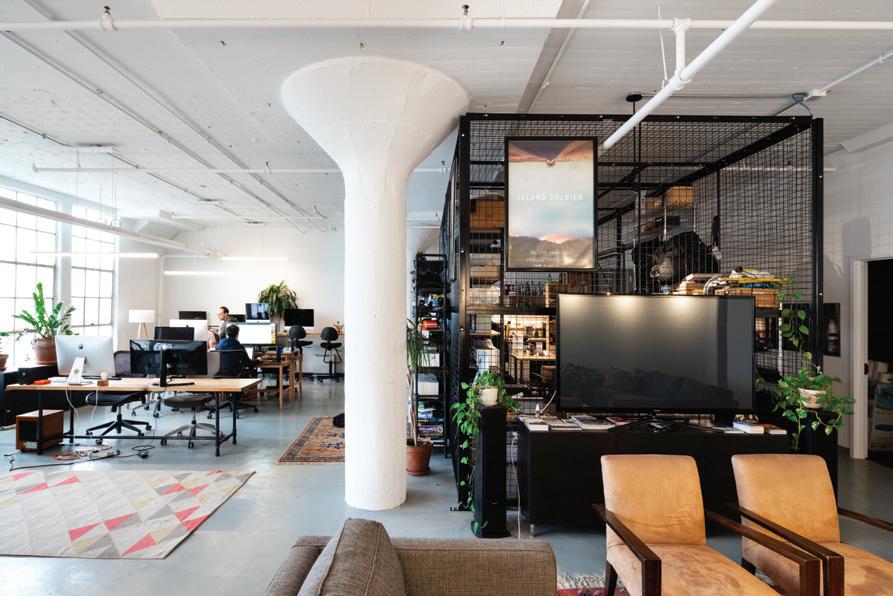
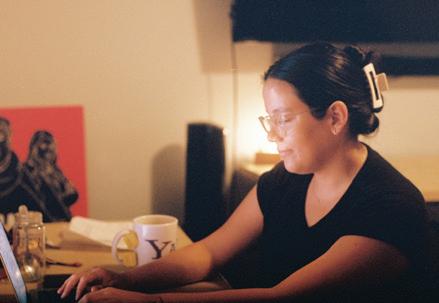
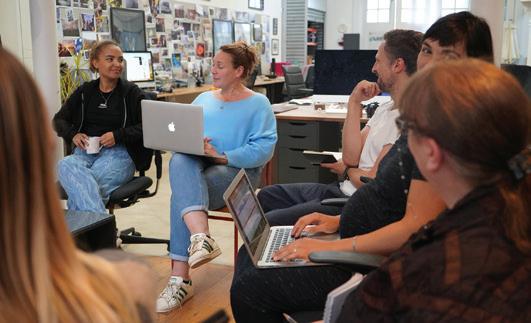
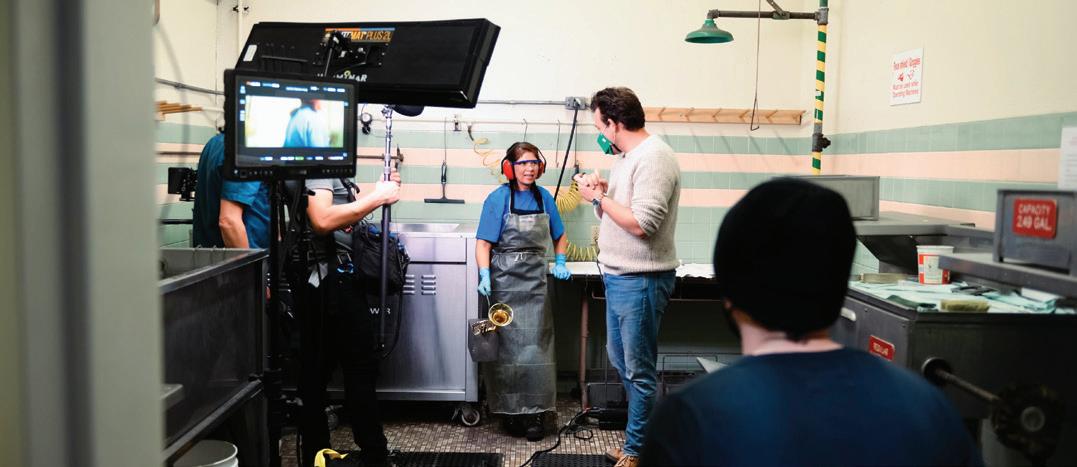
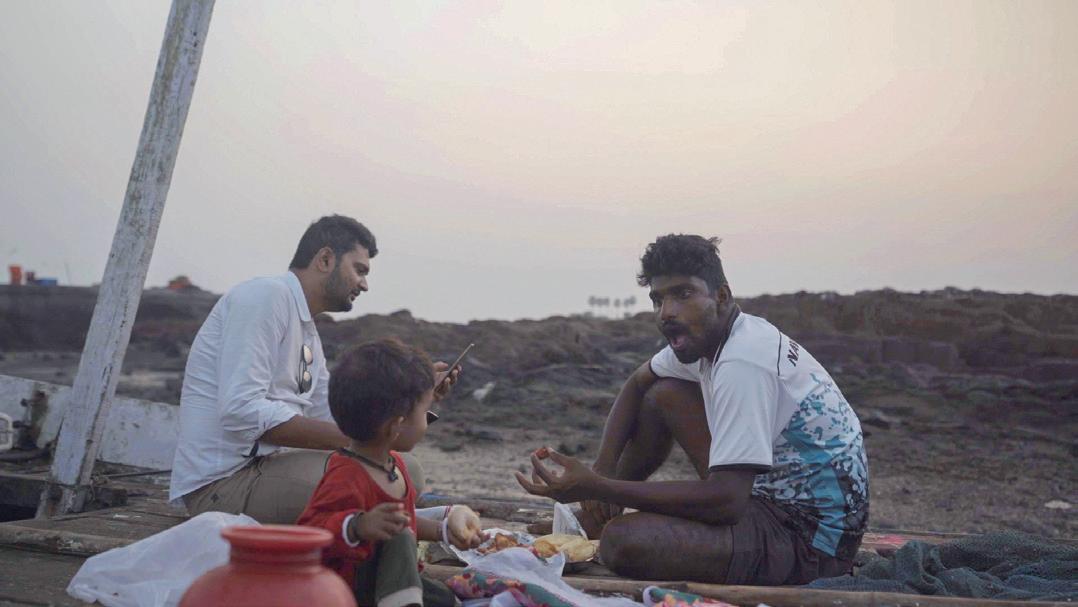
Zara Serabian-Arthur works beside the equipment cage at Meerkat Media. p12 Image by A.E. Hunt
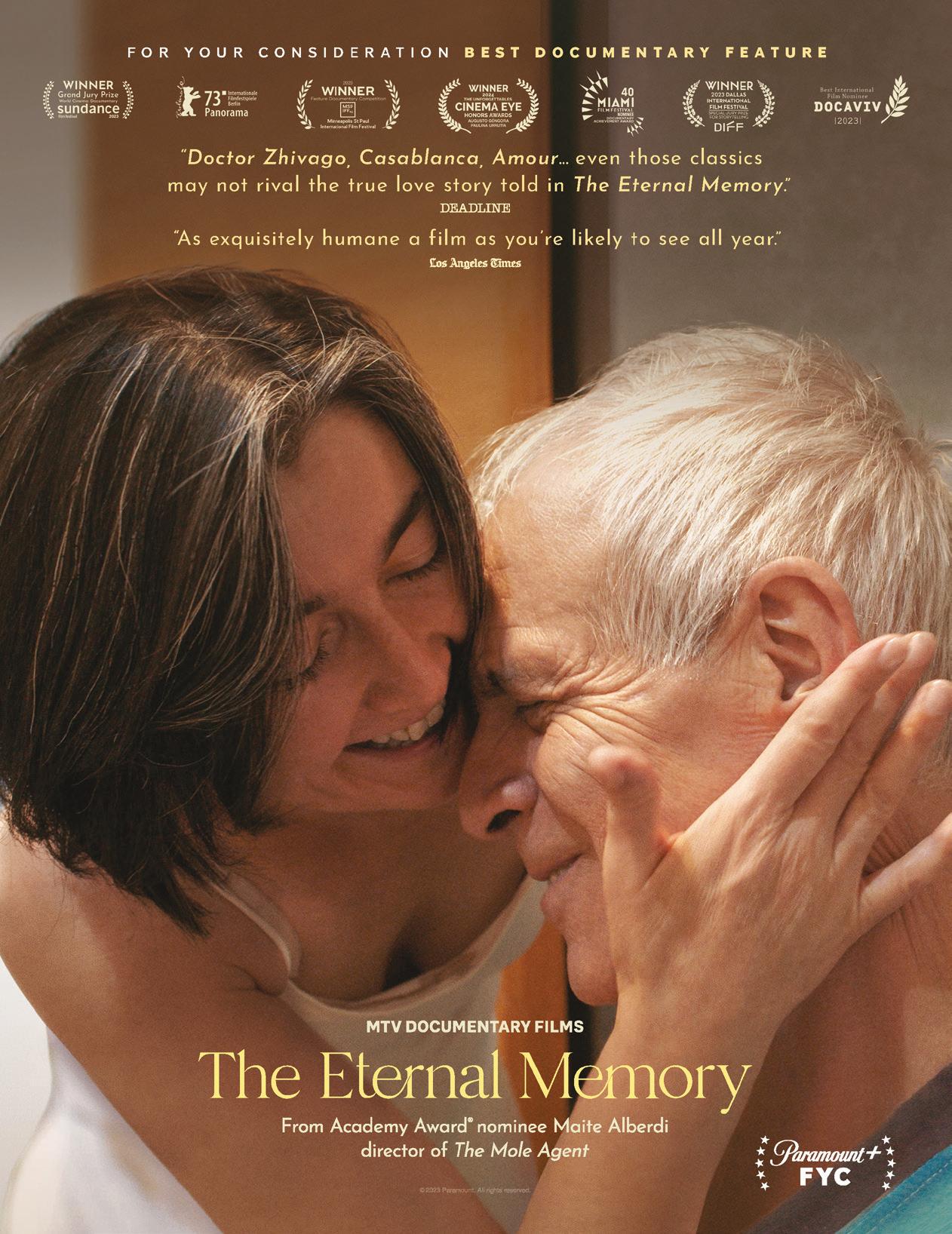
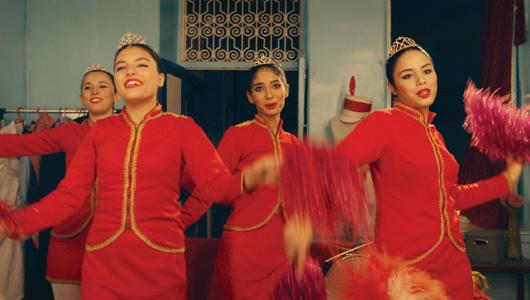
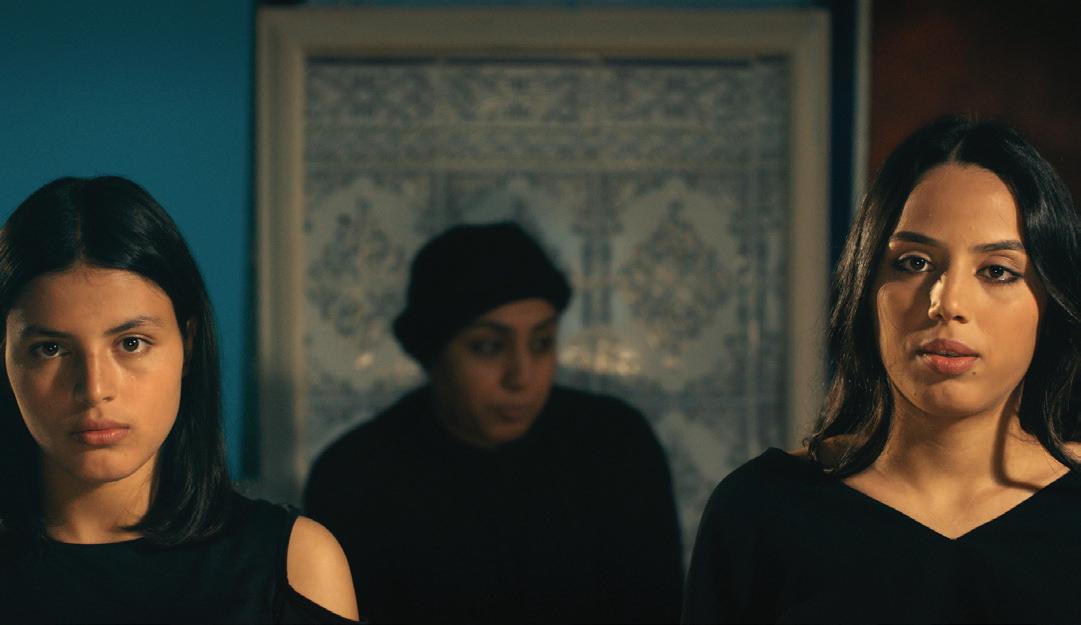
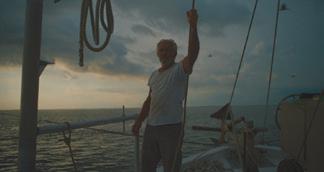
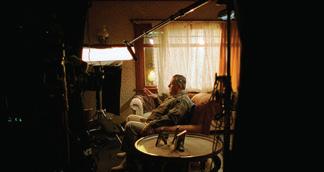
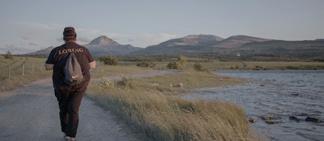
Still from Four Daughters. p33 Courtesy of Kino Lorber
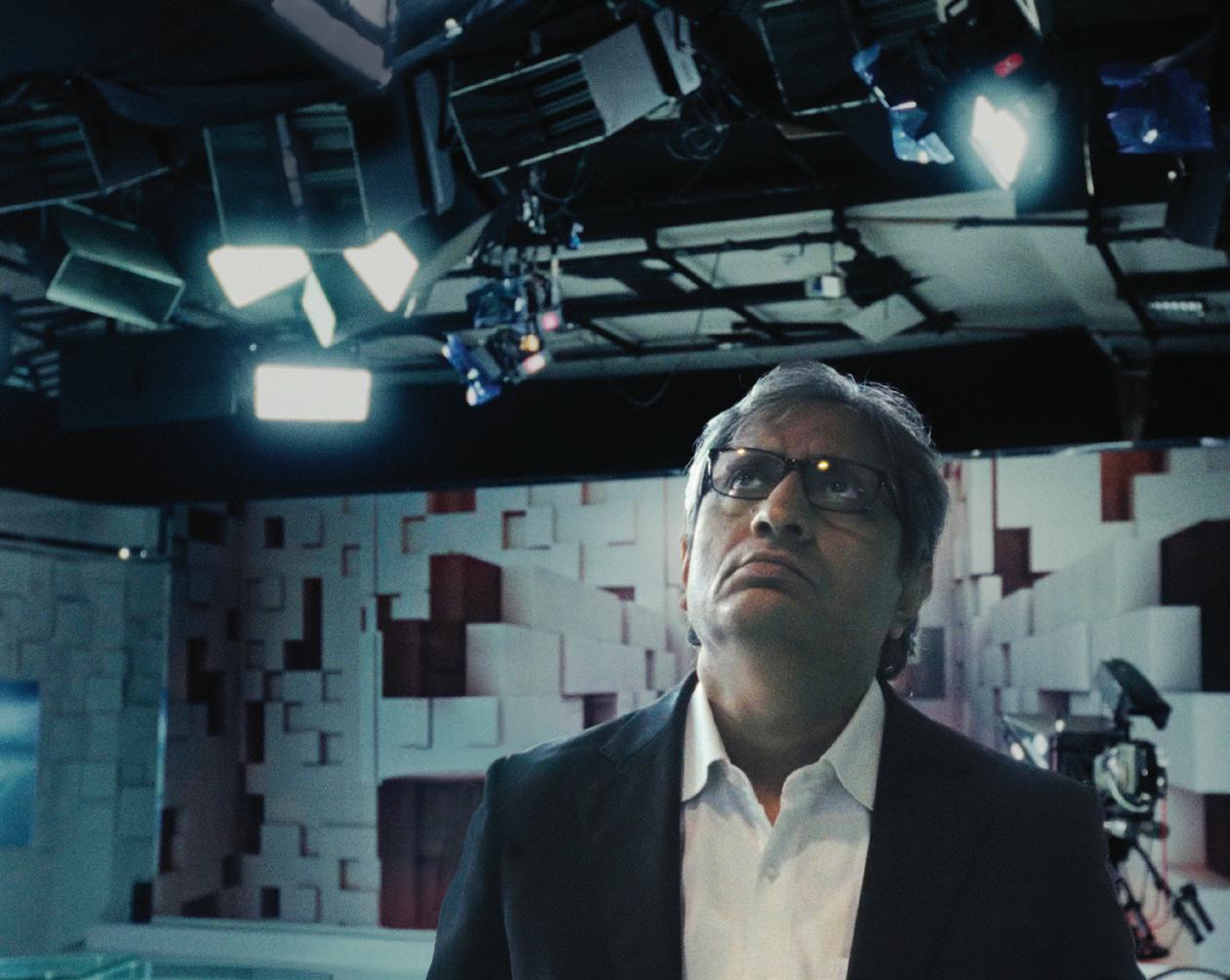
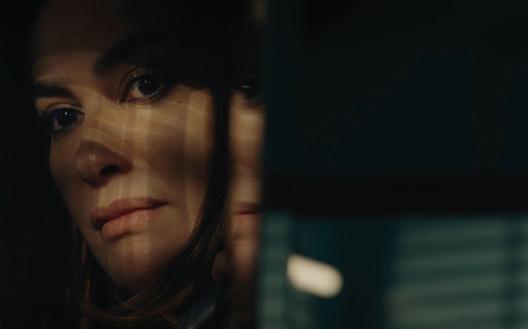
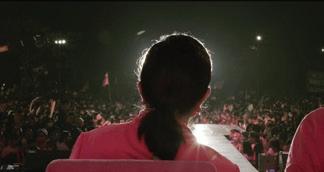
Still from While We Watched. p43 Courtesy of Cinetic Media
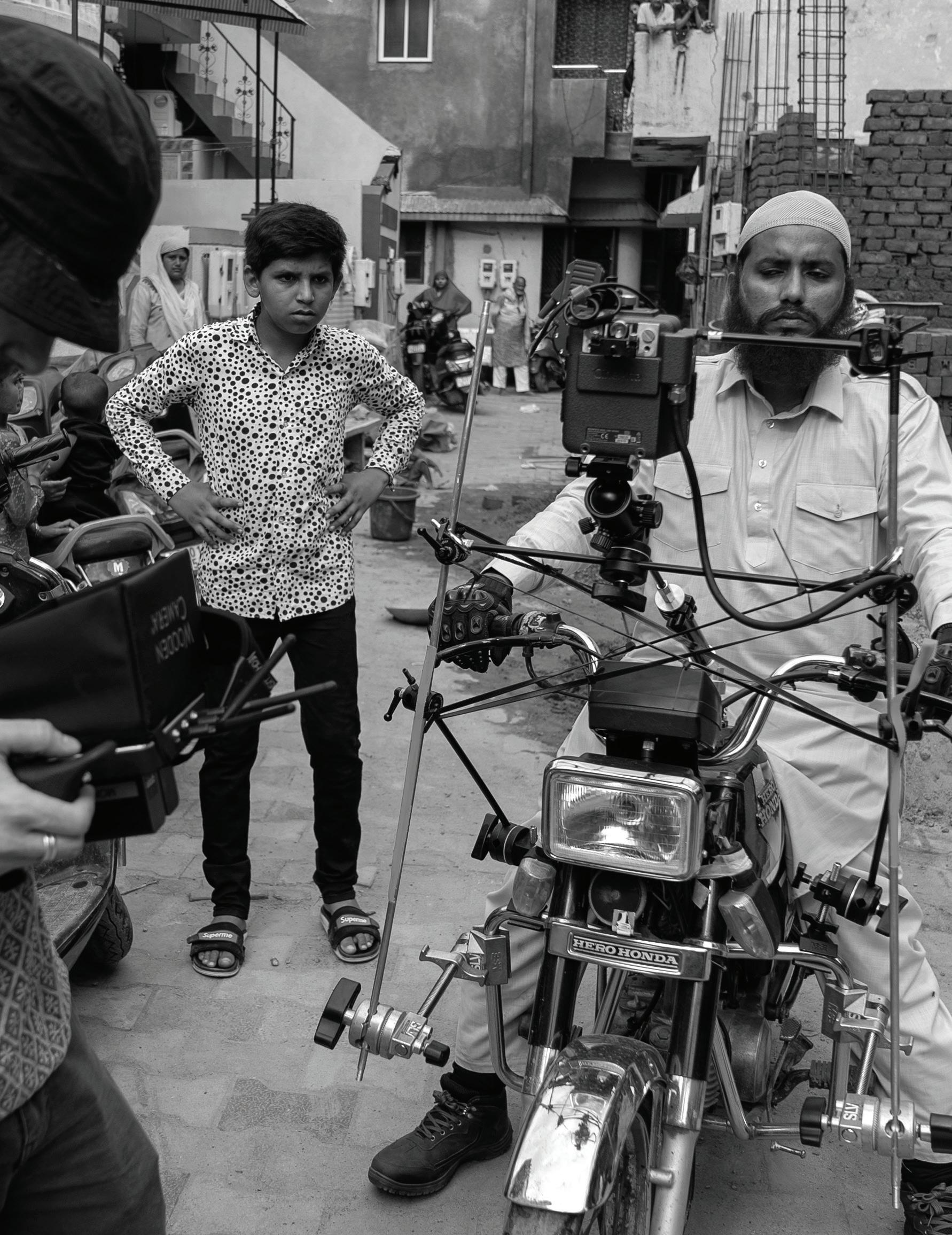
Cover image: Still from While We Watched Courtesy of Vinay Shukla
Dear Readers,
This issue returns Documentary Magazine to print. At first, the time off from printing allowed us to begin to reimagine a print periodical with such a strong legacy as this one. But a few months in, we needed the pause to locate a new printer after the closure of the magazine’s former printer, Boss Litho. How do we keep this magazine from becoming obsolete, like so many other print media? It is clear that Documentary must draw upon what makes documentary films so powerful—an inextricable connection to reality that renders truth, clarity, complexity, and artistry.
In a time of great turmoil facing independent documentary filmmakers, Documentary relaunches with a stronger focus on the business and craft of creative production. Our new strand “Making a Production” profiles extraordinary independent documentary production companies and the different ways those filmmakers are sustaining themselves; for the cover, A.E. Hunt stopped by Meerkat Media, a 13-member film production company that also happens to be a worker-owned cooperative. We are also republishing profiles on the Oscarwinning Breakwater Studios and Grain Media, which are more traditionally run companies contending with major shifts in our field. But even these deep dives don’t feel tethered enough to current events. As this issue goes to press, we are releasing it into a world rent asunder by the ongoing violence in Gaza. We hope for an immediate ceasefire, humanitarian aid to Gaza that adequately addresses the scale of need, and the release of all hostages. And we hear the pain of filmmakers calling film institutions to task for their silence.
Documentary filmmakers, though, have always persisted. Our cover feature is from Ishita Sengupta, whose reporting on the distribution prospects of films like Vinay Shukla’s While We Watched and other recent Indian nonfiction filmmakers at home is an extraordinarily detailed exposé on how commercial and governmental apparatuses can work together to censor political work. We also launch two new columns spotlighting the precarious working conditions of filmmakers. “Field Recording,” first-person accounts from filmmakers at risk, opens with a galvanizing essay from Can Candan, a Turkish documentary filmmaker, beloved teacher, and scholar whose documentation of a university protest against government interference reminds us that academic purges only work with the participation of our peers. “Producer’s Diary” gives us BTS peeks at the production ups-and-downs of independent filmmakers, starting with Theo Schear’s grant-funded indie series, Hard to Swallow.
To encourage discovery beyond awards-season hubbub, the “Screen Time” column now holds capsule-length reviews, written by film critics, on notable new releases, and our final cover feature is a critical essay from Winnie Wang on the uncanny and splashy use of the plot twist in Four Daughters. Finally, Documentary will continue to publish pieces advocating for more globally connected, distributed, and equitable forms of documentary production and circulation—continuing a formidable legacy left by Tom White and the magazine’s prior editors. We hope that you read the features calling for a documentary code of ethics at labs and industry spaces, rethinking documentary history from a Latin American perspective, and a new development lab merging documentary film and theatrical production processes.
A huge thank you to Documentary’s new art director, Maria Hinds, who led a redesign of the print magazine. Drop us a line at magazine@documentary.org if you have suggestions, notes, pitches, questions, jokes, feedback, or kind words. Everything is appreciated.
Thanks for your continued readership and support. Until the next issue,
Abby Sun Editor, Documentary Magazine
Abby Sun
Abby Sun
Dear IDA Community,
We are thrilled for the return of Documentary Magazine. For the past 42 years it has served as a space for dialogue, provocation, and an archive of the documentary form’s power, persistence, and evolution. We want to give thanks to Tom White—who gave shape to the magazine for 22 years—alongside a devoted community of readers and contributors for getting us to this milestone. The magazine was paused for nearly a year following his departure, and issue #2 is presented with Abby Sun as its editor. Abby’s curiosity and intellect are boundless, and we join all of you in anticipation of what future issues will bring.
As we round up our tenure as IDA Board co-chairs, we have been reflecting on the many transitions underway. It hasn’t been an easy path, and we are grateful to everyone who has supported IDA over the past few years. In fact, IDA membership has grown each of the last two years, even as we continue to navigate many changes. Unionization, a majority BIPOC staff and leadership, a Nonfiction Access Initiative centering the disability community, and a renewed commitment to international members are just the beginning. From staff to leadership to the board, we want to give space to examine the questions raised by the work we do.
We are surrounded in today’s world by uncertainty, violence, aggression, and misunderstanding. As we grapple with how we meet one another to focus on humanity and care, we clearly see the need for stories from underrepresented regions, voices, and conflicts. IDA will continue to convene the documentary community, raising questions that reflect the state of our field. Getting Real in April 2024 will focus on access and distribution, and is being co-created with the international documentary community. Can the storytelling economy and the powers driving distribution make room for representation and shared values? We hope you will join us in Los Angeles and online to work through these questions together.
Finally, the release of this issue coincides with the introduction of new leadership at IDA. We welcome our new executive director, Dominic Willsdon, whose history of leveraging art as a vehicle for engagement aligns with our belief that the future of IDA will be determined with our community and by the events and stories that define our times. The nature of this reflexivity demands that the organization continue to undergo change, which we have learned to embrace and eagerly anticipate.
As we move into this next chapter, we hope that you, our readers and community members, actively take part in the programs, convenings, and initiatives that IDA continues to evolve. We encourage you to engage with the ideas brought forth through these pages and to keep the conversations going in the field. We’ve learned that the only way to survive the next 40 years is if we build community and foster healthy communication and mutual respect. We look forward to the future!
Warmest regards,
Chris Perez and Grace Lee IDA Board Co-Presidents
Chris Perez
Grace Lee
We Do Not Accept!
I was dismissed not once, but three times for documenting the Bogaziçi University Resistance
by Can Candan
In July 2021, a letter calling attention to my unlawful and unjust dismissal from my teaching position of 14 years at Boğaziçi University in Istanbul, Turkey, and demanding my reinstatement was circulated internationally. It was signed by many colleagues in the documentary world. I am indebted to them for their support and solidarity. But to really understand what happened to me and to Boğaziçi University, one needs to understand what happened prior and since.
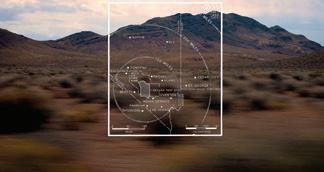
Back in January 2016, I began actively working on my fourth feature documentary film, Nuclear alla Turca, researching, writing, and crowdfunding.
At the same time, together with over 2,200 academics, I signed the Academics for Peace declaration calling on the Turkish government to end the violence and human rights violations against the Kurdish population and resolve the conflict through peaceful means. As soon as this petition became public, the government initiated a campaign to discredit and punish Academics for Peace, calling us traitors and terrorists. There were targeted
hate campaigns, dismissals of signatories from universities, police raids, and judicial investigations. Four members of Academics for Peace were imprisoned for talking at a press conference to call attention to the hate campaigns and threats. That spring, we were busy trying to get our colleagues out of prison. After four weeks in prison, in their first court hearing, they were released awaiting trial.
The End of Faculty Elections
Between 1992 and 2016, Boğaziçi University faculty elected the university’s top administrator from candidates who were our colleagues. This was in line with the Turkish constitution, which specifically protects universities’ institutional autonomy. In the summer of 2016, we had reelected our president, Gülay Barbarosoğlu, to serve for another four-year term, and were waiting for her official appointment by the Council on Higher Education in Ankara. A few days after Barbarosoğlu was elected, a coup d’état attempt by the Islamist Gülen movement shook the country, and a state of emergency was promptly declared by the government.
Can Candan is an Istanbul-based award-winning and internationally distributed documentary filmmaker and an academic who teaches documentary cinema and writes on the history of documentary films in Turkey. He is an active member of the ongoing Boğaziçi University Resistance for institutional autonomy, academic freedom, and democratic procedures.
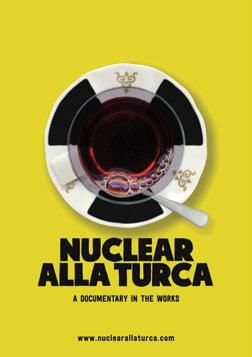
Poster for Nuclear alla Turca Designer: Fevkalade. Courtesy of Can Candan
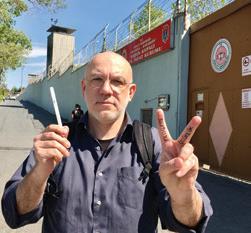
April 15, 2016. In front of Bakirköy Women’s Prison, where my colleague and dear friend Esra Mungan, a professor of psychology at Boğaziçi University, was imprisoned. The writing on my fingers reads: “Freedom for Pens,” meaning freedom for those who express their thoughts in writing, which is a basic right. Courtesy of Can Candan
The Erdogan regime used this opportunity to purge dissident academics who had nothing to do with the Gülen movement or the coup d’état. The universities and the free-thinkers within these universities once again became targets, as they were after the military coup of 1980. University rectors were instrumental in putting the names of their critical and dissident colleagues on long purge lists, and hundreds of academics were dismissed overnight by unconstitutional presidential decrees. Boğaziçi University and a select few other universities were spared from these purges because their rectors refused to name any names.
With another presidential decree, Erdogan gave himself the absolute authority to appoint university rectors. Overnight, rectoral elections at universities became a thing of the past.
During these tumultuous months, it became clear that our elected rector, Barbarosoğlu, would not be approved by the regime. In an effort to compromise and protect the university from further attacks by the regime, she proposed that one of her advisors, Mehmed Özkan, a Boğaziçi University professor, be appointed instead. Because Özkan’s sister was a member of the parliament from Erdogan’s ruling AK Party, it seemed that he would be an
acceptable candidate to the regime. This of course did not sit well with us, as it meant that we were disenfranchised, and protests ensued on our campus. That is when I took the photograph on this page.
As we were getting news of the dismissals of our colleagues at other universities, the faculty began to see Özkan’s appointment as a reasonable compromise under the circumstances, since he was one of us. He had served under the previous administration of a rector who was reelected, but not appointed.
In the fall of 2016, a four-year-long period of compromise and silence began. I refer to this period as akin to a forced marriage, where you are extremely unhappy but cannot think of a way out. The Boğaziçi community chose to accept numerous decisions by the administration, fearing that if we were to object, consequences would be devastating. Slowly but surely we were silenced into submission. We could not do much when two of our international colleagues, historian Noémi Lévy-Aksu and sociologist Abbas Vali, fellow Academics for Peace, were dismissed or when the student LGBTQI+ club was not granted official student club status.
Meanwhile, the persecution of Academics for Peace continued. In 2017, hundreds of
us, including me, were accused of “making propaganda for a terrorist organization” and tried in a heavy penal court. We faced a minimum jail sentence of 15 months. This ordeal and my frequent visits to the courthouse finally ended in the fall of 2019, following the constitutional court’s ruling in favor of freedom of speech. All of my colleagues and I were acquitted of all charges.
With the beginning of the new year in 2020, I was able to bring my team together to resume our work on Nuclear alla Turca The State Theatre Company in Istanbul was staging the Turkish adaptation of the play Radium Girls, and we were filming it for one of the stories in our documentary.
Then COVID-19 entered our lives and everything went online. We paused filming and got back to doing research and meetings online. I continued teaching as well as working on my book Documentary Cinema in Turkey.
Recording Resistance
In 2021, after four years with an unelected rector, the faculty of Boğaziçi University thought that our current rector would be reappointed for another four-year term and we would continue with our lives as is. This illusion was shattered overnight as we celebrated New Year’s Eve under COVID curfew in our homes. We read on social media that overnight Erdogan had appointed somebody named Melih Bulu as the rector of Boğaziçi University.
While under curfew, we quickly organized an online academic forum and discussed our response. Out of that meeting came a short “We do not accept! We will not give up!” declaration calling attention to the fact that it was our responsibility to protect our university’s institutional
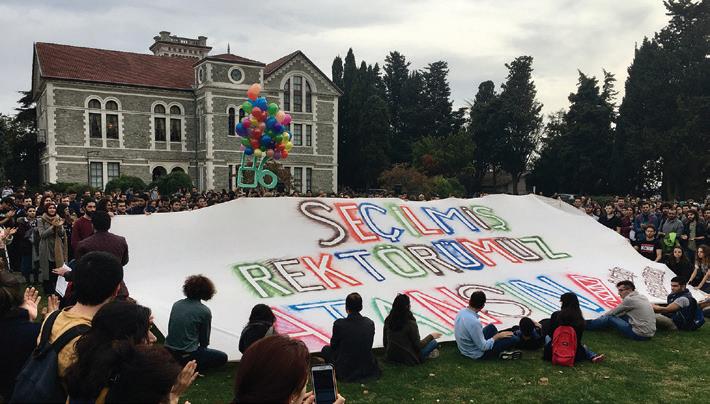
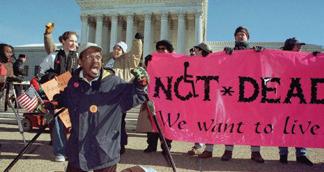
November 8, 2016. Demonstration at Boğaziçi University. Banner reads: “We want the appointment of our elected rector.” Courtesy of Can Candan
autonomy, academic freedom, and democratic procedures. We, as academics, became part of the now well-known Boğaziçi University Resistance.
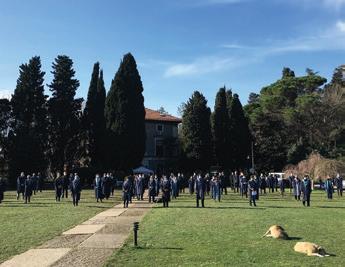
As a documentary filmmaker, I thought my most valuable contribution to our resistance would be to document it in photographs and videos. Because the university was surrounded by police and the press was not allowed in, I also thought that the images and sounds I recorded should be shared with the press and the public. So, almost every day, I took photographs, recorded videos of our daily vigil, and disseminated them. The daily vigil took place at noon, where every day—rain, shine, or snow—the faculty would don their academic gowns, turn their backs to the rectorate building, and stand in silence in a symbolic act of disapproval and defiance.
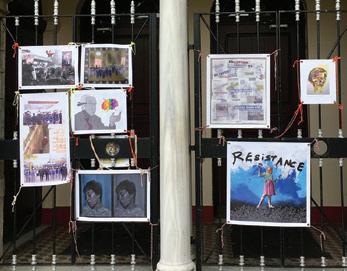
February 2021 began with the closure of the student LGBTQI+ student club, for which I was the academic advisor; the closure of the office of prevention of sexual harassment; and the imprisonment of university students for organizing an oncampus art exhibit in protest of the newly appointed rector.
Even though I received a terminal degree in film and media arts from Temple University in 1999, this degree had not been recognized as a terminal degree equivalent to a PhD in other disciplines by the Council of Higher Education in Turkey. Since my return to Turkey in 2000, I had been denied a tenured teaching position, which meant that my official status was somewhat precarious. In 2007 I had started teaching full-time at Boğaziçi University, and for 14 years I faced no problems with the automatic renewal of my position. But in July 2021, my position was not renewed, and I was dismissed by Mehmet Naci İnci, who had become the appointed interim acting rector after Melih Bulu’s overnight dismissal, which was also a surprise. It was clear that I was targeted for being an active and vocal participant in the resistance, as well as one of the people who were audiovisually documenting and sharing it with the world.
This moment was when a number of solidarity campaigns were organized on my behalf to call attention to my unlawful and unjust dismissal. As far as my colleagues and I were concerned, the decision to keep me away from the
university was illegitimate. As an act of disobedience, I continued to work in my office and document the resistance. I also declared publicly that I would be teaching my courses in the fall as planned. Then, in August 2021, I started a legal battle against the university administration to be reinstated.
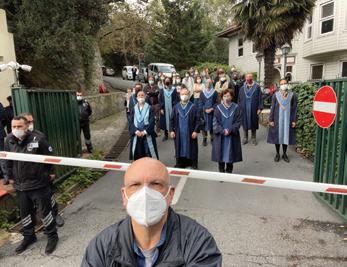
On October 11, 2021, I was ready to give my first public lecture of the semester. When I arrived at the gate of the university, I was denied access. That day the vigil was split into two for the first and only time. While some of my colleagues stood with their backs turned at the rectorate, others stood with me at the gate, albeit on different sides of the barrier.
Since I was no longer present on campus to document the resistance, taking photographs and shooting videos became the responsibility of my colleagues and students. I became an off-site editor and continued to disseminate the images and sounds of our resistance.
Months after I took the university administration to court, the court first issued a stay-of-execution order to reverse my dismissal and subsequently annulled the dismissal decision since it was unlawful. On March 25, 2022, to much fanfare, I was back on campus documenting the vigil.
Center: January 22, 2021. Boğaziçi University faculty vigil. Courtesy of Can Candan
Right: January 29, 2021. On-campus student art collective exhibit. Courtesy of Can Candan
Left: October 11, 2021. At the university gate. Courtesy of Can Candan
Subsequent Dismissals
In July 2022, a few months after I was reinstated per the court order, I was dismissed by Naci İnci for the second time. This time I was forced to empty out my office of 15 years in just three hours.
Once again, I took the university administration to court, got the dismissal decision annulled, and was reinstated for a second time. Eleven months later, I was back on campus and documenting the ongoing resistance.
In July 2023, only a few weeks after I was officially reinstated for the second time, I was dismissed for the third time. Because of the previous court decisions in my favor, I once again took my case to court, and now I am hoping the court will issue a stay-of-execution order, so that I can be reinstated and go back to the university.
As before, I have been unlawfully barred from the campus as a form of extrajudicial punishment. Unfortunately, this is the fifth semester when I am unable to teach.
The resistance at Boğaziçi University passed its 1,000th day on September 30, 2023. For more than 1,000 days, we have been saying that we do not accept the government appointment of rectors at our university and that we will not give up defending the autonomy of our university, academic freedom, and democratic procedures. Of course, we also demand the same for all institutions of higher education in Turkey. And the 1,000+ day communal audiovisual archive of the resistance also continues to grow.
I am not the only faculty member to be targeted by the appointed administration for not obeying. My dear friend and
colleague Mohan Ravichandran, a professor of mathematics, was dismissed in the fall of 2021, in the middle of the semester. Another dear friend and colleague Tolga Sütlü, a professor of molecular biology, was dismissed in the fall of 2022 in the midst of many projects in his lab with his graduate students. Many colleagues have been forced to retire or quit. Courses taught by various adjunct, retired, and emeritus faculty have been canceled.
But as we said for the first time on January 3, 2021, and as we continue to say after 1,000 days: “We do not accept! We will not give up!”
As for Nuclear alla Turca, in its seventh year the film is still cooking. It has become a long-term film project awaiting my time and energy..
Making a Production
Documentary’s new strand of in-depth profiles featuring production companies that make critically-acclaimed nonfiction film and media in innovative ways. These pieces probe the creative decisions, financial structures, and talent development that sustain their work—in the process, revealing both infrastructural challenges and industry opportunities for documentarians.
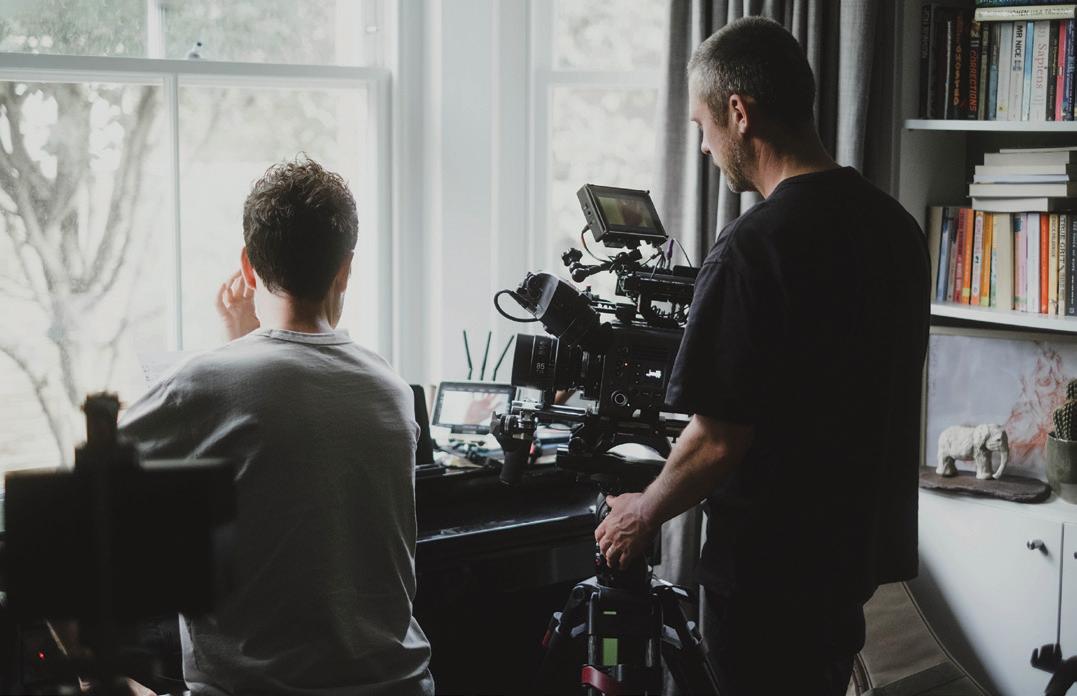
Franklin Dow, director of photography, and Kaushall Naseem, stunt driver, shooting Skateistan: To Live and Skate Kabul Courtesy of Grain Media
A.E. Hunt is a Brooklyn-based filmmaker from Illinois, and a freelance theatrical booker, programmer, and film critic in publications like Criterion, Seen, Sight & Sound, and Rappler. He recently edited a two-volume memoir about writer and director Mike De Leon’s life during the first and second golden ages of Philippine cinema, Last Look Back, and curated a program of new VFX/post-heavy films made by young filmmakers in the Philippines, Paglipas ng Gunaw (When the Apocalypse Is Over).
Meerkat Media
Member-owners
of a unique filmmaking co-op find critical success and long-term sustainability
By A.E. Hunt
One wall of windows feeds light into the Meerkat Media office from the atrium of the Brooklyn Army Terminal, highlighting a prominent black AV equipment cage. The large equipment cage was, early Meerkat member-owner Bryan Chang told me, “always the standout design element.” Its four chain link walls run into the ceiling, but their open weave makes them see-through. In front of Meerkat’s three editing bays, and beside its large group meeting area—three couches facing each other, plus a projection screen—the cage shields some of the incoming daylight from the other half of the room, lending one side a greater sense of privacy and studiousness. Framed posters of Meerkat Media–produced films hang on the walls like certificates: Stages (their first feature documentary, 2010) and Brasslands (Rotterdam 2013) are both cooperatively made, no-frills docs, whereas Dark Money (Sundance 2018) is a sleek POV legal thriller. Meerkat also makes client promo videos and edgier independent docs, narrative shorts, and features.
It is increasingly rare for film companies and organizations to be able to afford and sustain a physical space. But Meerkat Media, a cooperatively owned production company and media arts collective based in New York, has a 15-year lease, paid for out of pocket without any subsidies. The co-op collective seems to be
in it for the long haul. I spent an afternoon at the Meerkat Media office to meet with various member-owners, which is what they call the 13 people who work for the company and collectively own and run it, producing commissions for clients such as Netflix, the New York Times, and large foundations like Ford, Mellon, and Rockefeller. Besides the worker-owned production company, Meerkat Media also encompasses a 15-artist collective who share resources with the co-op and receive a stipend plus a budget for independent work. Member-owners spoke to Documentary to shed light on Meerkat’s unique co-op ecosystem and what happens when it overlaps with the more conventional doc industry.
Making Decisions by Consensus
When I visited, Sana Malik—who became a memberowner in 2021—brought up a new body-worn camera stabilization system during lunch with me and the team. It had a smaller form factor, so drew less attention than, say, an EZ rig, which consists of a vest and an obtrusive “support bar” that hangs over the operator’s head. Other members worried that the new rig Malik described might not accommodate every member’s body size. If they were to spend their next surplus on new camera equipment, there was clearly much left to parse.
Making a Production
This casual debate reflects Meerkat’s consensus-based decision-making process, which they use to allot surplus spending, form company policy, and generally make any decision that significantly affects the co-op collective. That means, in brief, that every member-owner—not most, or all but one—has to agree on each choice made.
To not unnecessarily bog down every step of the workflow with required consensus, decision making for smaller, specific issues is relegated to Meerkat’s “working groups”: HR, finance, development, office and equipment, and branding (the most recently formed). Each memberowner is (1) required to take on the tasks of at least one working group and (2) expected to meet once weekly for updates and once monthly for full-day meetings that tackle bigger-picture issues with all members present.
“Let’s say we want to buy a new couch for the office,” Chang explained, “It’s not a 13-person conversation about the color of the couch. The office and equipment group can do some research and come to a decision. If it’s a big purchase, they’ll come to the group and be like, ‘Hey, this is the one we decided on, or this is the camera we want to get? What does everyone think?’ But smaller groups are empowered to make those decisions.”
For fulfilling co-op obligations, member-owners receive a $300 monthly stipend, a $350 health stipend, and
additional payment for meeting hours. These amounts were also decided upon by consensus—the $300 stipend was the result of a COVID-19 spending freeze and cap on co-op working group hours, which was enacted to ensure Meerkat wouldn’t end up in the red and without docking pay beyond what they knew anyone could afford.
Founded in 2005 as an “informal arts collective” that formally became a worker co-op in 2014, Meerkat Media grew its consensus process over the past decade. Each member rotates as a facilitator. Sometimes the group takes “temperature checks” with hand signals to gauge how for and against a proposal members are. Chang told me, “If we hit a point where it warrants more discussion or we need to gather more information, that’s when we might pause it for the day and say, these one or two people—or this working group—go off and do more research, then come to the bigger group with some more info, or a new proposal.”
Arriving at consensus requires patience and copious time to spare, which can be tricky in an industry production environment with delivery timelines. Malik reflected on her experiences in journalism and doc production prior to joining the co-op: “At more traditional companies, I’ve flagged something that I thought was problematic and was told I had an attitude problem. I think at Meerkat, pushing against the system, when it is done with some solution and
Meerkat Media’s office in Brooklyn Army Terminal, with the equipment cage featured prominently in the middle of the room. Courtesy of Meerkat Media
Making a Production
is not just to be a contrarian, is actually seen as positive.”
Production companies operating in the conventional hierarchy are too spread thin to accommodate selfcritique, let alone field propositions for internal change. At Meerkat, the co-op realizes such reflection and active adaptability are necessary for their collective survival.
Member-owners are encouraged to propose changes. When she first joined, Malik pushed for a rebranding. She did a survey on how everyone envisioned Meerkat’s growth and how that could inform their brand, then conducted research, wrote a proposal, and hired a branding company. “It’s almost two years later, and we’re still in the middle of it. Things are slow because there are so many steps involved, but you have the freedom to push for something. And I have a mix of this creative and strategy brain where I’m constantly trying to think about what and how we can fix something that’s not working. At Meerkat, we really get to flex that in a way that you don’t see in other places.”
This attitude encompasses Meerkat’s newest members, as well. Miasarah Lai had only recently finished the sixmonth trial period during which prospective memberowners work and learn the ropes with a Meerkat mentor. But when I asked her if she had already proposed any changes, she described her successful proposal to move meeting updates to a document, so that more discussion time could be reserved for any flags or questions.
“ This organization has been around for 18 years,” Lai continued, “so it has been changing and reiterating depending on who shows up. But the core group created systems for the organization to change organically based on its needs.”
While Lai’s change is more procedural, Meerkat members have also proposed significant paid family and medical leave policies that the co-op adopted. Soon after Lesley Steele first joined as a member-owner in 2019, she had to request extended leave due to a sudden family emergency. “Meerkat just completely supported me in a way that I’ve never experienced from a group of people
Top: Early member-owner Bryan Chang takes a break from editing in one of the larger editing bays.
Courtesy of A.E. Hunt
Bottom: Member-owner Miasarah Lai after taking a meeting in the smaller editing bay. Courtesy of A.E. Hunt
Making a Production
that I work with,” she said. “Most jobs, you’re lucky to get leave for a week or two. But even that’ll come out of your PTO. Meerkat stuck with me for the six to seven months that I took to heal and make sense of it. They prepared and brought me meals at times. I couldn’t believe the humanity—that they actually would not constrain me to the traditional construct of what it means to be employed.”
I was relieved to learn that a film workspace existed with the capacity to not only give Steele that time, but support her in it too. When requesting time off to grieve, I have always felt immediately abandoned by a job. Even when management can accommodate the length of a leave, their uneasiness over the loss of time, labor, and money is unconcealable. Meerkat Media’s slower consensus process and openness to fundamental changes is what allows such changes to be considered and put into action.
Meerkat members expect such large policy decisions to continue. Malik explained, “What worked for the co-op five years ago is not exactly what’s going to work now. And I think that requires a new buy-in and consensus. That is important because then I do feel like the decisions that were made before me are not being imposed on me without discussion or understanding.”
Starting a Worker-Owned Cooperative
Meerkat Media was started by a group of Sarah Lawrence College graduates. Zara Serabian-Arthur, one of the original founding members, came from a background in ensemble theater and anarchist organizing, both of which inspired Meerkat Media’s model. “Those were the two spaces where I had encountered a lot of collective process and structure. So we brought that into our early filmmaking work, thinking about how those ideas of shared responsibility, shared authorship could function in a filmmaking space.” The six original members were Chang, Serabian-Arthur, Jay Arthur Sterrenberg (now her husband), Jeff Sterrenberg, Eric Phillips-Horst, and Karim Tabbaa, who eventually left the co-op. “We wouldn’t even put our names on the films as directors,” she said, “It was just ‘by the collective’ in our earliest baby days.”
Stages was the first feature documentary “written, directed, and produced by the Meerkat Media collective.” The film follows an intergenerational theater workshop that was held in New York’s oldest community center, in the Lower East Side.
In 2010, members began doing work-for-hire under MKM LLC and funneled profits back into the collective. The co-op was still formalizing in the days of Occupy Wall Street. “There were a lot of conversations about alternatives at that time that were coming more to the forefront, and
worker co-ops was definitely one of them.” Serabia-Arthur said. As she didn’t know of any film co-ops at the time, she began to familiarize herself with worker co-ops in tech and web design, and saw in them a useful organizing mechanism for Meerkat.
“New York is a really amazing place to be in a worker cooperative because there’s a really robust infrastructure of support,” Serabia-Arthur said. “The city actually provides funding for technical assistance organizations that support worker co-ops across many different industries. So I got involved with the NYC Network of Worker Co-ops, and they pointed us to various resources. I went to a legal clinic that they put on for free that helped me develop our initial operating agreement and bylaws. We didn’t see any of this reflected in the filmmaking space. But we figured, why couldn’t it also work here? Particularly because, in the more informal art-making space, that was how we had already been making creative work with our friends.”
I wish I had encountered a collective model or film co-op when I freelanced for seven years in film production, not only because Meerkat’s model felt less manic and more comfortable, but also because I have witnessed so many productions misidentify their problems—and thus also their next maneuver—due to lack of time. The co-op model feels more efficient and effective in both the short and the long run. “Capitalism’s value of moving fast was definitely something that we were pushing against, recognizing that in order to do this more consensus-based work, the most important thing is to build the trust and culture in which that kind of work is possible,” Serabian-Arthur said. “In our dominant culture, we don’t get much opportunity to learn and practice these skills. So it wasn’t something where we could just say, ‘Great, this is our process. We’re going to start doing it. Let’s bring in 10 new people.’”
In fact, Meerkat Media grew their membership deliberately slowly over the past two decades. Though starting in 2005, they waited until 2009 to add more members, 2017 to take on one more, 2019 for another, 2020 for three more, and 2022 for another three. And the impetus behind this growth was to diversify the collective through new perspectives and skill bases, rather than to increase profit. New member-owners bring new styles, critiques, wants, and demands, which ensures Meerkat does not stagnate or become too insular.
Growing With Growing Clientele
Not all of the distributed structure of the original co-op still exists today. Once attributing their films broadly to the collective, Meerkat now distributes its credits and crew roles more traditionally, which its members attribute
Making a Production
to the collective’s financial growth. “In the last decade,” Serabian-Arthur said, “we’ve been much more focused on supporting the individual voices of each artist. We need to make sure that, as we’re working with bigger and bigger firms, companies, and organizations, we work in ways that are efficient and comfortable for them. The way we’re organized has to be legible to them.”
The changes extend beyond crediting guidelines to rates and division of labor, as well. In the early days, collective members were paid the same day rate regardless of the type of labor. Today their day rates are similar, but they attempt to account for and measure differences in labor output across different projects and roles. Chang elaborated on how day rates today prioritize the person who is “producing and holding the mental space of a whole client relation, and is the primary driver on that project. Their rate is a little bit higher than the day rate for somebody who just comes on one shoot day or something like that.” Although egalitarian and radical, member-
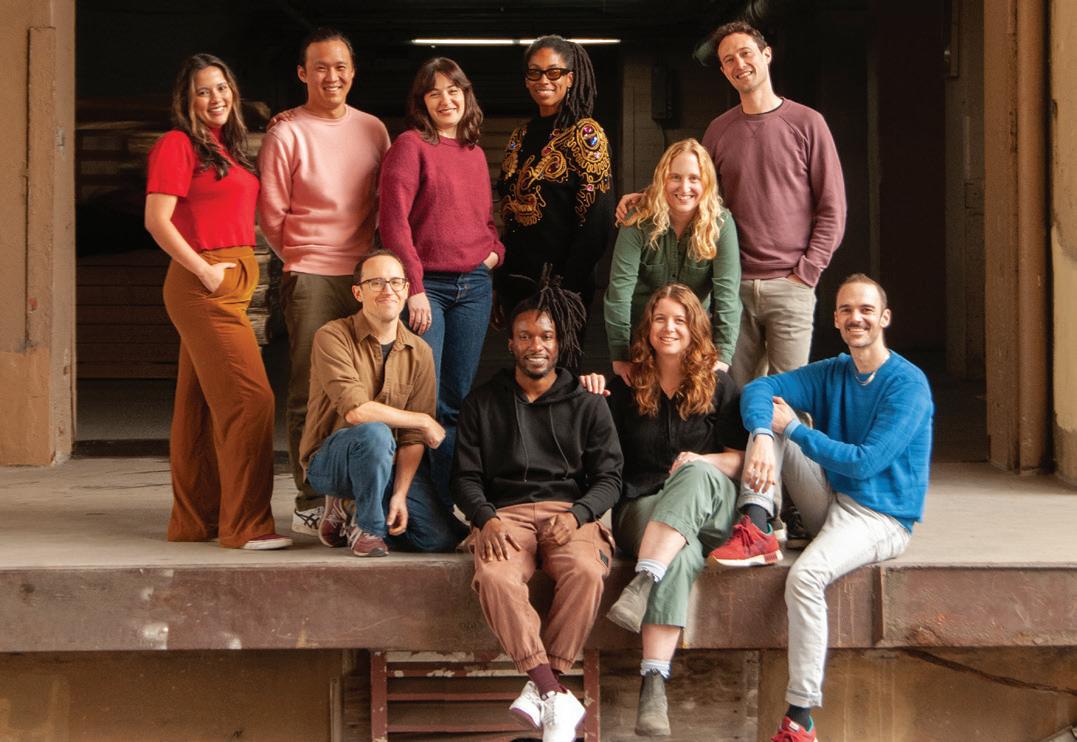
Meerkat member-owners and artist collective members pose outside of their Brooklyn Army Terminal office. From left to right, back row: Miasarah Lai, Bryan Chang, Dara Messinger, Lesley Steele, Zara Serabian-Arthur, Jeff Sterrenberg
Front row: Jay Arthur Sterrenberg, Tristan Daley, Leah Galant, Eric Phillips-Horst Image by Jendaya Dash
Making a Production
owners decided that having the same day rate no longer made sense in the film industry “to protect our members and give everybody a fair wage.”
In other ways, however, the anti-capitalist drive persists. For example, Meerkat members are encouraged to develop proficiency in different crew roles, not just the ones they already are skilled in. On one project, your sound person and your gaffer might have been your producer and your director on the last set. This ethos is baked into Meerkat’s structure. So that members don’t settle into or hog the same positions, the co-op implements three different rotations: project lead (what they call a director/ producer), crew positions, and editing. After you’ve finished a project in a given role, you’re moved to the bottom of the priority list for that role. This system also allows members to gain experience in roles they have less experience in. Lai compared this structurally ensured opportunity to her past freelance experience: “Who will hire you as an editor if you’re like, I’ve only done it X amount of times? But [at Meerkat] there’s this understanding and willingness to help develop each other professionally, which is unlike any other place.”
Project leads are encouraged to crew up in accordance with the rotations, but aren’t totally beholden to them. If they think it’s important to hire based on other projectdependent needs and priorities, they can use their judgment. If there are no member-owners available to fill a role, they can defer to the artist collective or other freelancers. While crewing up for the Emmy-nominated, five-part doc-series Sesame Street in Communities, in which Black and Brown families were interviewed about race, Malik employed freelancers to ensure an all-BIPOC crew.
Standardized rates, new-skill building, and representative crew building feel hardly possible to pull off on most sets but are ubiquitous in the Meerkat Media bubble. I assumed this meant their unorthodox methodology often rubbed up against the expectations of their conventional clientele. In fact, as Serabian-Arthur explained, they’re not always aware of it: “Some of our clients know we’re a co-op, and that’s one of the reasons they like working with us. Many of our clients have no idea. They just think that we’re a really talented production company that creates really high-value, high-quality work for them, because, from the client side, they’re not sitting in on our meetings about how we’re going to spend our surplus.”
So long as they deliver a final product, for the most part Meerkat can internally distribute the client’s budget and structure productions however they please. “How do you reconcile [the consensus model] with the fact that you have to be competitive with other businesses that bake exploitation into their model?” Their prices have to remain
competitive with these traditional production companies. Perhaps it’s worth it to you as a client because you not only get a beautiful film but your money also helps them keep the lights on, covers their overhead, supports the artist collective’s work, and maintains cameras that are used to shoot a variety of independent films. All the while you can know that “there are no people in the back office working under terrible conditions to support the face of the company,” as Serabian-Arthur puts it.
Malik’s long-term rebranding project aims to make Meerkat’s unique assets more immediately clear from the outside. “It’s hard pitching ourselves against other companies to traditional agencies that might be looking for a certain type of director-led vision, and we can do that work. We’ve proven that we can do that work. I want people to be like, ‘Meerkat, they’re kick-ass because they’re doing something different, and with care, in this otherwise very hierarchical industry.’”
In my talk with Bryan Chang, he alluded to a group dynamic theory that cites 12 or 13 people as the “limit for how many people you can have in one room and still get things done, and with all voices heard. Imagine 50 people in a room—it’s not really possible to have a real conversation.” At 13 member-owners, Meerkat Media has hit that theoretical limit.
So what does future growth look like at Meerkat? Everyone I talked with wanted to close the creative gap between client work and independent work. Ideally, the latter could pay the bills. More tellingly, everyone confessed how challenging the consensus process can be, though it is a challenge they prefer to those caused by top-down decision making and the incapacity for transparent communication.
Serabian-Arthur put it this way: “Any challenges we face are just the challenges of surviving in capitalism. And if we were a more traditionally structured business, we would just experience the problem of there not being enough money differently—because we’d be the person not getting paid enough, or the person that got laid off when times get tough. The reason I come back to this model is that we have the power to make decisions about how we’re going to address challenges together. We’re not trying to survive alone. There’s something about knowing that there are 12 other people who are up at night figuring out how are we going to survive this and that we have the power to say, ‘Okay, we’re going to immediately pivot to doing this new thing that seems like it’ll work—and we don’t have to lay off anybody to do that.’”.
Making a Production
Carol Nahra is a documentary journalist and lecturer. She teaches documentary and digital journalism at several London-based institutions, hosts the Bertha DocHouse podcast DocHouse Conversations, is the lead trainer for the Grierson DocLab, and is a trustee for One World Media.
Making a Production Grain Media
Orlando von Einsiedel’s UK-based outfit maintains creative independence despite a tough commissioning environment
By Carol Nahra
It’s a Monday morning in July, and most of the 14-strong staff of Grain Media are huddled together in its open-plan office in a former sculpture studio in Brockley, South London. It’s a weekly meeting to discuss progress across all of the company’s projects, including some 10 features in production and a host of development projects. The staff sit beneath a long narrow shelf heaving with awards—an Oscar, a BAFTA, and a Grierson are on display alongside many others. The awards are testimony to the quality of the films coming from this small indie, headed by 43-year-old Orlando von Einsiedel.
In the crowded landscape of UK documentary production, Grain Media is managing to steer a very difficult path. The company is completely independent and committed to making cinematic films about the issues of our day, films which they unabashedly hope will have an impact and improve the world. In a series of conversations with Documentary, von Einsiedel and his team candidly discussed the ways they work in a climate where budgets are getting much tighter and commissioners are increasingly risk-averse.
The company has worked with many different broadcasters over the years. Within its home country, Grain looks to place projects with a particularly British lens with the BBC. The 2018 BBC feature documentary Evelyn
(available on Netflix worldwide) was a deeply personal film from von Einsiedel, exploring the lasting trauma of his brother Evelyn’s suicide on friends and family—and von Einsiedel himself—15 years on. The team brought their signature cinematic storytelling to the very personal tale, rigging a special camera to track the family’s walks through the United Kingdom.
The idea for Evelyn came from producer Joanna Natasegara, von Einsiedel’s frequent collaborator. Natasegara, who has her own production company, Violet Films, often produces with von Einsiedel directing. Their first collaboration was the eco-thriller Virunga (2014), which told the story of a group of courageous park rangers working in the Democratic Republic of the Congo. Von Einsiedel lived in a tent for months in the Virunga National Park, continuing to film as civil war broke out. The film won more than 50 awards globally, including a Peabody. Natasegara and von Einsiedel’s collaboration on the short Netflix film The White Helmets, which tells the story of Syrian civilian volunteers, earned their first Oscar, in 2017. Their most recent project is the recent five-part Netflix series Heart of Invictus (2023), made with the Duke and Duchess of Sussex.
Making a Production
The Beginning of Grain: Forging Long-Lasting Relationships
As a professional snowboarder in his teens and 20s, von Einsiedel turned to video to make action films of his antics on the slopes. He soon took the camera around the world with his friends, documenting their journey and gathering sponsors on the way.
“You get a bit of extra money every time you’re on a video or a magazine as a snowboarder because you’re sponsored,” he said. “It created this incentive for me and my friends to all learn how to take photos and film each other.”
Von Einsiedel realized he enjoyed making media more than snowboarding, and pivoted to it as a profession. In 2006 he partnered with friend Jon Drever to set up Grain Media. By that time, von Einsiedel was following his passion to make documentaries about neglected regions of the world, while Drever’s focus was more on short-form comedy, branded content, and commercials.
A formative early film, which illustrates how von Einsiedel forges and establishes long-lasting relationships, is Skateistan: To Live and Skate Kabul (2010). The 10-minute film looks inside a skateboarding school that serves as a haven for both boys and girls. Its immediate online reception when von Einsiedel posted it to Vimeo was both astonishing and gratifying, and led to von Einsiedel focusing on positive stories from underreported areas of the world.
The film helped him recognize the importance of popular narrative storytelling when making films with a social purpose. “We found that sports are a great lens to explore much bigger themes. And also it’s a way to get the
audience engaged. A film about kids in Afghanistan on the surface, that’s going to be quite dense material,” he said. “But a film about skateboarding kids in Afghanistan, suddenly that opens up a whole different set of people who might be interested. Then you can bury all the much more serious stuff that we really care about within that film.”
A decade later, when A&E approached the same Skateistan NGO about making a film, the organization’s leaders said they wanted to do it with von Einsiedel. With the film focusing on girls, von Einsiedel started a search for an appropriate director, landing on Carol Dysinger. The resulting film, Learning to Skateboard in a Warzone (If You’re a Girl), earned Grain a second Oscar for short-form documentary, in 2020.
The 2010 Skateistan film was also formative for one of Grain’s longest serving employees, Alice Martineau. Now 31, she first watched it as an 18-year-old, and began pestering von Einsiedel for work experience before she headed off to university. “I ended up coming along to do random stuff, like being in the art department and doing the playback operating,” she said.
After completing a degree in art history, Martineau returned to the company, and over a decade has risen from office manager to development producer. Grain, with its focus on creativity with impact, is her natural spiritual home. During the pandemic, she was embedded in Birmingham’s Queen Elizabeth Hospital’s COVID-19 ward for two and a half months, making the Netflix film Convergence: Courage in a Crisis (2021). “There was the most intense moment on that. I was watching a lady dying from COVID and we were sat with her and her family for about like seven, eight hours, as she just kind of slowly passed away. There is a surreal sort of out-of-body sort of moment where you think, ‘Oh, wow, I’m really seeing this.’ And definitely we felt the sort of historic importance of capturing and honoring it.”
The original Skateistan film also led to a completely different film, when Freddy McConnell, a volunteer in the skate school, approached von Einsiedel saying that he wanted to make a film about trying to get pregnant as a trans man. Von Einsiedel and the team introduced Freddy to the filmmaker Jeanie Finlay, who featured him in her 2019 film Seahorse, which was made with Grain—it was a huge success on the festival circuit before airing on the BBC.
The Grain portfolio is a mix of projects that are generated internally by a robust development team, films brought to them by directors, and other combinations of matchmaking between commissioners, Grain, and the independent production community.
A recent matchmaking example is the Netflix documentary Scouts Honor: The Secret Files of the Scouts of America (2023), which has made the Netflix top 10 list in
A staff meeting at Grain.
From left to right: Ruby Blake, Caroline Willis, Orlando von Einsiedel, Olivia Ballard, and Patricia Petrini. Courtesy of Grain Media
Making a Production
13 different countries. Grain started working with Insight TWI, a longstanding, London-based production company focused on investigative journalism and human rights, on a film about the Boy Scouts abuse scandal. Netflix executives suggested a collaboration with Brian Knappenberger, who had made a short on a similar subject. The film, a co-production with Knappenberger’s company Luminant Media, and Insight TWI, was released in September 2023, with Knappenberger directing.
Grain just released the feature doc The Walk, directed by Tamara Kotevska (co-director of Honeyland, 2019). “I think we just had our fourth picture lock on Friday,” one of the film’s producers, Harri Grace, said at the staff meeting, getting one of many laughs of the day. The film explores themes around migration through the eyes of a young Syrian girl and a giant puppet, a project that originated as a theatrical installation.
The project came about after the creative team behind the theater project approached von Einsiedel about making a documentary. “I remember thinking, oh my God, there’s not enough time to raise the money to get this one to happen. As much as I love this, the timing is just so tight. It’s an impossibility,” he recalled. But, unable to resist, von Einsiedel began joining Zoom calls for supporters of the project. “I joined the Zoom calls and there were just people from all over the world, so much enthusiasm for the project. It kind of swept all of us along. Luckily we found Tamara Kotevska quickly and Tamara was also infected by that passion and said, ‘Yes, I’ll just clear my summer.’”
The film began its festival run at DOC NYC. It’s been independently funded—including a sizable grant from the Ford Foundation—with Participant as a partner. “It’s a beautiful, extraordinary film, but we’re nervous about trying to find a sale for it,” said von Einsiedel. “We’ve got great partners, but after Sundance, we’re all nervous about how it’s going to sell. Nothing sold at Sundance [in 2023].”
A Difficult Climate for Docs
Indeed, the current climate in documentary is tricky, and makes everyone nervous. Grain is finding things difficult across all spaces in commissioning. “Disney’s just gone through this massive upheaval. So, they haven’t been commissioning lots of feature documentaries in the last three to four months,” said von Einsiedel. “And Netflix, who is one of the main players in this space, they’re doing less and less of the riskier observational films. I get it from their point of view, they know that observational narratives can’t be guaranteed, and that eyeballs are more likely to be on a certain type of film. But, you know, that’s tough for the filmmakers that make long-form observational vérité films.”
Grain’s operations director, Adam Mitchenall, said they have seen a real cooling down among postpandemic commissioners. He had a surprising number of freelancers recently come knocking at his door. “In the last week, two editors that we work very closely with have said, ‘We would love to pick your brains about how to network.’ These are people who are usually booked out.”
A number of recent reports confirm the dire state of the UK documentary production sector, with industry watchdog Bectu reporting an “unprecedented lack of work.” The slowdown in the UK has been caused by a perfect storm of factors, including a significant reduction in TV ad spending, the freezing of the BBC license fee, which has led to a slashing of spending, and a narrowing of the factual content that streamers are willing to commission. A recent Broadcast article quoted an anonymous commissioning editor: “The industry at large is dealing with a big set of issues: the cost-of-living crisis and huge inflation. Everything is costing more than it did this time last year— every single production—but the money hasn’t gone up.” Unlike other dry spells, the slowdown shows no sign of letting up soon, according to these reports.
Mitchenall added that when commissions do come through, commissioners are also keeping a closer watch on production costs, limiting the number of filming days.
In difficult times, the company is resorting more and more to a hybrid funding approach to get their films made. This is generally funding a film by thirds, according to von Einsiedel: “One third is funded with UK tax credit and grants that we can apply for. That ranges from Sundance and the BFI and all the different grants in between.”
The second third comes from equity, such as investments from high-net-worth individuals. “They’re not giving us that money as a grant,” said von Einsiedel. “They’re giving us that money as equity that they absolutely expect to get back. But they’re doing it also because they believe in the film, they believe in the story, and they believe the potential impact that the film could have on that issue.”
The last third comes from a sales agent, giving money upfront in exchange for taking on the film afterwards. Von Einsiedel said they have three feature docs in production following that model, including The Walk. According to Mitchenall, this hybrid approach comes at a cost: “It means we can quite quickly get up and running on things but to actually complete the full budget on things is difficult.” Understandably, the company prefers a more straightforward single commission. “The nice thing about a streamer is knowing you’re here for a year or a year and a half,” said Mitchenall.
Making a Production
Mitchenall was brought in eight years ago to work on the company’s brand consultancy. The company used to spread its output between commercial work, comedy, and documentary. These days they have narrowed to documentary output, after the departure of founding member Drever six years ago. “We sort of grew apart creatively,” von Einsiedel said of Drever’s departure. “There just came a point where it made more sense for him to leave, to focus on what he was doing.”
Grain no longer produces the high-energy brand work that was a staple of their early output. “To actually chase that work, there’s very specific sets of relationships that you need,” said von Einsiedel. “And you need to be in tune with the advertising agencies and all that other stuff. We’ve moved away from that, so we don’t have that bread and butter.”
“ We realized it wasn’t possible keeping doing a lot of jobs for 10, 15k budgets,” said Mitchenall.
The company still produces branded content that is more in alignment with their documentary storytelling USP, such as a recent series on Nobel Prize winners.
“Brands have always been interested in telling their stories,” said Mitchenall. “What’s been helpful is that we’ve had a few successful go’s in it. We’re able to say, ‘I’ll make you this documentary—we won’t say your brand name every three minutes throughout, but it will bring a different audience to it.’”
For documentary companies everywhere, relationships with commissioners and broadcasters can make or break them. A trend Grain has noticed in recent years is for development to be quite advanced, only for changes at the broadcaster resulting in no greenlight. Such was the case for a lengthy development for a musical-themed idea for a streamer.
The company also used to make series for Al Jazeera, but significant work has dried up as key staff at the broadcaster changed. “Just getting things commissioned
Bastille music video shoot for the song Hope for the Future.
From left to right: Franklin Dow, director of photography, and Dan Smith, lead singer. Courtesy of Grain Media
Making a Production
is harder,” acknowledged Mitchenall. “The hoops to jump through feel bigger. There are quite a few projects we’ve taken quite far down the road only for commissioners to lose their jobs or change jobs.”
Their focus these days is on trying to develop series that will provide some guarantee of income over many months. After building up a reputation for shorts and features, the company has had to earn the trust of commissioners for series. “They’re all story based and they require the same skills in terms of filming and telling stories,” said von Einsiedel. “But to actually pitch and win them, the networks are looking for different things [than features]. So we’re learning, and we’re getting better at it.”
Grain’s creative director, Anna Murphy, said that they are really focused on the human moments in their storytelling when pitching. “When we pitch, people say they want something as serious as Virunga. But actually, they don’t,” she said. “If we come up with series that are incredibly ambitious and journalistic, they don’t really go anywhere. So, we’ve decided to also explore the just genuinely incredibly heartwarming.” Case in point is one pitch focusing on a real-life beauty specialist competition. In a development meeting after the main staff meeting, the team discusses the need for the deck to have a series of “Oh” moments, to match the tagline: “It’s the Olympics, but with more ‘ohhhhh.’”
In the staff meeting, Murphy recounted how a commissioning editor to whom they were planning to send an interactive deck made it clear, in a passing comment, that they didn’t in fact like interactive decks. “We’re always trying to work out a kind of format beat sheet and how to present that to our commissioner,” said Murphy. They had landed on the idea of an interactive deck to demonstrate the multiple story beats. “We’re just going to work out two options that are going to be great,” said Murphy with a laugh. “That’s just the joy of development.”
Hub Within the Company
Exec Producer Chloe L eland reported in the staff meeting how a social issue–focused feature doc for a major streamer was shaping up. The film is an environmental story shaped into a mystery narrative, designed to capture an audience who wouldn’t normally be drawn to environmental stories.
The film has been in the edit for a few weeks. “The editors have said that there is not one character that you wouldn’t want to watch an entire film about,” Leland reported to the team in the staff meeting. “We’re at that stage where everybody’s really buzzing.”
The film will be the first feature release developed by Grace Labs, a hub within Grain which Leland heads as creative director. Grace Labs was founded, with the financial support of private philanthropist Jorge Villon, to develop projects focused specifically on climate and biodiversity. It’s set up as a separate hub within Grain Media for financial transparency, so that Villon can see exactly where his money is going, according to von Einsiedel.
Before coming to Grain four years ago, Leland had been creative director at Nutopia. She had all but given up on returning to television after time off, until she was asked to interview with Grain. “I came and met these guys and you walked in the door and didn’t feel ashamed of saying, ‘I want to make a difference.’ It sounds a bit culty, but we all really believe in the films we’re making. I don’t think there’s one film on our slate that we all don’t believe has a purpose. So it keeps us really motivated.”
The ethos of Grace Labs is to tell compelling human stories that subtly have an environmental narrative embedded within them. Or, as von Einsiedel relayed, a commissioning editor called it “chocolate-covered broccoli.” Leland described the films as “the antidote to apocalypse fatigue and eco-anxiety. They’re supposed to make you want to act and believe that things are already happening that are changing the way that our future is going to be.”
“Anything that is not really obviously mainstream, t he networks expect us to basically show them a film so that all the risk is taken out of it, almost like we’ve gone a nd spent six months already filming it. And so the sizzles, t hey’re becoming more and more in-depth and more and more expensive to make.”
Making a Production
Guarding Independence
Von Einsiedel says that over the years they have learned when pitching to mask the important social and environmental issues within their films. “It comes from bitter experience from being in meetings with networks when we sort of frame it as an important environmental story and their eyes glaze over,” he said. “Anything that is pitched as an important issue is so not what they want.” Instead, they pitch films as a more recognizable and audience-pulling genre, such as a thriller or a conspiracy film.
Pitching, and developing the sizzles that will greenlight projects, has become a huge time and financial sinkhole for the company. ”We’ve noticed a massive shift. It’s much harder to get projects commissioned,” said von Einsiedel. “I definitely think with the kind of films that we make, there’s always been an extra mile to prove that that film and that story to networks. But we found that that’s become so much bigger.”
He said that you used to be able to approach a network with a teaser for a vérité film and understandable uncertainty about the final content of the film. “We have found the conversations that we’ve been having in the last six months have been no, we don’t just want to see a teaser. Anything that is not really obviously mainstream, the networks expect us to basically show them a film so that all the risk is taken out of it,” said von Einsiedel. “Almost like we’ve gone and spent six months already filming it. And so the sizzles, they’re becoming more and more in-depth and more and more expensive to make because they require us to spend weeks.”
The company has had to find other funding to just get the film into the kind of state it needs before they can take it to the bigger networks. For example, a foundation funded a recent development shoot about a critically endangered species, allowing the team to put together a heartstringpulling sizzle. “We’re trying just to make loads of love stories,” said von Einsiedel with a laugh.
“Through those love stories, you slip in some of your messages,” said Leland. “Oil is threatening this species’ main habitat. So there’s all these stories that come into play; there are all these impact levers that we are constantly pulling.”
The company pulls von Einsiedel into projects when it makes sense, but has to choose sparingly. On the day of the staff interview, they’d got him interviewing an extreme sports athlete for a sizzle tape that will be about the end of the athlete’s career. The team was meeting the athlete after months of discussion, bringing him in from Paris for the day. They were shooting next door at an artist’s house that belongs to another of Grain’s extensive friends-and-family network.
For Heart of Invictus, von Einsiedel directed all five episodes. “You’re running five separate edits and it’s very all consuming,” he said. “But the people we ended up focusing on were just extraordinary and they’ve gone through incredible difficulties in their lives. And it’s just very moving when you follow people who are having to make very difficult choices.”
With all the stresses in keeping staffers employed, many small indies in the UK have sold their independence to a super indie, paving the way for more stability. With a shelf heaving with awards, surely von Einsiedel has had offers?
“We’ve had a few approaches over the years,” von Einsiedel admitted. “I think it’s quite hard for people to actually understand that social-purpose filmmaking is our entire reason to exist. That’s why we all get out of bed every morning. It’s always felt in the end that the partnerships that have come to us haven’t ever felt right. If we had gone down that path, we would have just become a machine.”
As the Monday morning meeting winds down, staff migrate to the attached kitchen, where a weekly delivery of food has just been stashed. Several of the staff have young children, and the conversation drifts to what happened on the weekend. Lunch is provided for free, an incentive to lure them to the outskirts of London, said von Einsiedel, who grew up nearby. But it’s clear that for now, there’s nowhere most of these devoted filmmakers would rather be. .
Gabriel “Gabe” George, from Heart of Invictus. Courtesy of Netflix
Mark Jonathan Harris is a multiple Oscar-winning filmmaker who, for many years, headed the documentary division at USC’s School of Cinematic Arts.
Breakwater Studios
Short films take center stage at Ben Proudfoot’s production company
By Mark Jonathan Harris
Fifteen people crowd into the tiny screening room of Breakwater Studios to listen to its founder, Ben Proudfoot, dissect A Concerto Is a Conversation (2021), the 13-minute, Oscar-nominated short documentary he co-directed with composer Kris Bowers. The new and veteran staff members cram the two rows of reclaimed movie theater seats and spill onto a couch and chairs to hear Ben break down his approach to storytelling, part of his continuing effort to ensure his production team understands the principles of a Breakwater film. “How do we feel about Kris here?” he asks about the composer’s introduction in the movie projected on the screen behind him. “What’s the unconscious question we’re planting in the audience’s mind in the very first shot we see of him? What are we promising the audience?”
Like the film—a dialogue between the composer and his grandfather—this is a conversation, not a lecture. The members of his company eagerly respond to the questions Ben poses. Together, they explore the sound, music, composition, color, and editing choices in the documentary, what Ben calls “the attention to all the small decisions that make a good and elegant film.” It’s clear from his hour-anda-quarter presentation that craft, “the artistry you need to capture what is true and beautiful,” is an essential element of a Breakwater movie. This meticulous attention to detail is
one of the reasons the company has been able to thrive in a rapidly changing media environment where movie theaters are closing, studios are making fewer films, and streaming services and cable channels are reluctant to commission documentaries that don’t involve a celebrity or grisly crime.
Ben started Breakwater in 2012, shortly after graduating from USC’s School of Cinematic Arts, where he was a cinema and media studies student, not a production major. A few of his USC friends helped when needed. Ben named his company in honor of a seawall, “a protectorate against the open ocean,” that he and his father built in his native Nova Scotia when Ben was 12. The name also represented his desire to protect the creative process and “the integrity of the stories we tell,” as well as his aspirations for the company. The father-and-son-constructed seawall survived the powerful storms of the Atlantic and so did the fledgling endeavor. Eleven years later, the 32-year-old filmmaker has become the most prominent practitioner of the short documentary film in the U.S., a category that not so long ago the Academy of Motion Pictures was thinking of eliminating. Today, the genre is experiencing an unexpected revival.
“When I started here six years ago, it was just me and four or five guys in their 20s who were friends at USC,” says Dawn O’Keeffe, vice president of finance, whose own
Making a Production
children were about the same age. “Today we have a fulltime staff of 19 and they look considerably different.”
Dawn attributes the company’s success to Ben’s “unrelenting commitment to excellence and the special quality of the films we do.” Breakwater films have screened at over 130 film festivals, including Sundance, SXSW, Telluride, Tribeca, and DOC NYC, and have been shown on major platforms for short documentaries. The Queen of Basketball (2021), which was widely viewed on the New York Times Op-Docs site, won the Oscar for Best Documentary Short at the 94th Academy Awards, marking the first Oscar for both Breakwater and the Times. The Times pays only a few thousand dollars for the short films it showcases, but the publicity the paper provides, including full-page ads, provides visibility and promotion worth millions. “Breakwater originals are our marketing budget,” says Dawn. “They draw attention from the branded world. But branded content is our bread and butter.”
Fifty years ago, a cartoon or short film often screened before features in movie theaters. They have long since been replaced by ads and coming attractions. Now, the short film is seen as a student format, a test run for a feature. “There’s no longer a tried-and-true distribution path for this kind of film,” says Ben. “So we needed to invent it. In the same way that Pepsi and popcorn have
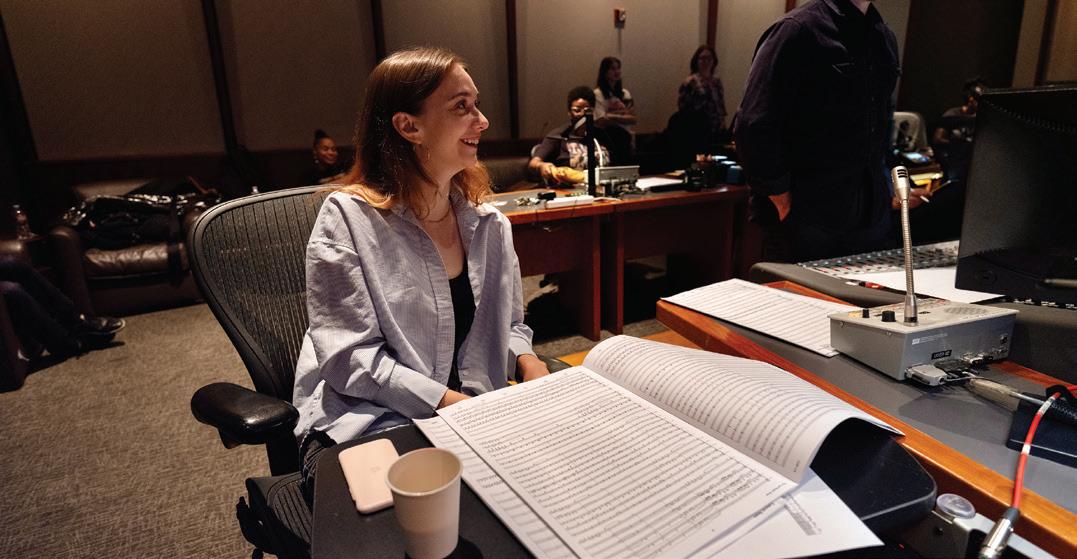
Top: Katya Richardson, 25, is the composer of three original Breakwater scores: The Best Chef in the World, MINK!, and The Last Repair Shop, all recorded with live orchestras, one of the company’s hallmarks.
Image by Molly O’Keefe Courtesy of Breakwater Studios
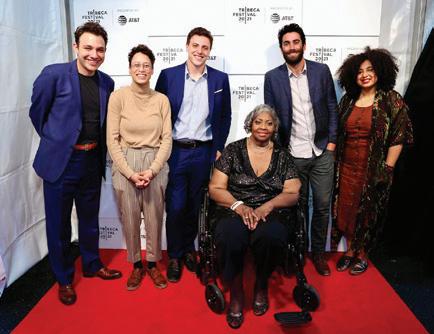
Bottom: Lusia Harris, the star of the Oscar-winning The Queen of Basketball, at the 2021 premiere of the film at the Tribeca Film Festival in New York. She passed away two months before the film would win the Oscar for Best Documentary Short Subject in 2022.
Courtesy of Getty Images/ Breakwater Studios
Making a Production
funded the theatrical movie business, our films have been funded by brands who appreciate what we do. When we take on a project that’s funded by a brand, we try to ask ourselves would we tell the story anyway. We can’t always say, ‘Oh, yeah, I would have flown across the country to tell this story,’ but most of the time I can.”
To better serve the companies that hire him, Ben insists on working directly with his clients, with no advertising agency as an intermediary. Eliminating the middlemen also provides more money for the final product. Whether original or brand-funded, Breakwater films display similar qualities that, in fact, make it difficult to tell them apart.
The quality of Breakwater’s original productions is what attracts its paying clients. Charles Schwab, the financial services company, has been commissioning videos from Breakwater since 2014. “We’re big fans,” says Schwab’s chief of staff Greg Gable, who works directly with Breakwater on Schwab’s digitally distributed films. “Several years ago, we did research on what characterized our clients,” says Greg. “We found they’re pretty engaged in life and their investments. We joke that they have one hand on the wheel.” So, Breakwater produced a series of four to fiveminute films for Schwab about people who possessed these traits, ending with the Schwab hashtag #ownyourtomorrow. Why Not Now: John Henry, a dynamic portrait of a Harlem entrepreneur who went from doorman to mobile dry cleaner to dealmaker, is typical of these films. “To be an investor, you have to be an optimist and have confidence in the future,” Greg says. “Ben’s stories focus on the significant challenges people face and how they overcome them. He
captures the spirit of people engaged in hard decisions in a compelling way. The emotions and values he taps are the values of our company.”
To better serve the companies that hire him, Ben insists on working directly with his clients, with no advertising agency as an intermediary. Eliminating the middlemen also provides more money for the final product. Whether original or brand-funded, Breakwater films display similar qualities that, in fact, make it difficult to tell them apart.
“What makes a Breakwater film?” says Nick Wright, Breakwater’s executive creative director. “Just look at the company values.” They are embossed on a wedding invitation–sized card that the company hands out to clients: optimism, craft, humancentric, bravery, advocacy, inclusivity, and integrity. “And all this because MAGIC chose us…” appears, like invisible ink, in barely discernible print at the bottom of the card. The values are embodied in portraits Ben paid an artist friend to paint and that hang in the Breakwater coffee room: Walt Disney, Harper Lee, Lincoln, Obama, and Shakespeare—past and present figures Ben admires.
Nick started out with the company nine years ago as a freelance editor, fresh out of NYU film school. A few years ago, he joined Breakwater full-time in his new role. “When you go out into the world, you see how special Breakwater is,” he says. “Ben’s approach is unique. The commitment to craft; the attention to music, sound, color; the narrative approach to short documentaries; the lifting of voices of people whose stories haven’t been told before. The emotional depth of all the films.”
Stephen Derluguian, another of Ben’s former USC classmates, agrees that “there’s no other place with a model like this.” Stephen started working with Ben as a cinematographer and jack-of-all-trades on his early films, but eventually became a full-time colorist. Although he continues to color all Breakwater’s films, they constitute only about two percent of his work; the rest is for other clients. Still, Ben lets him use Breakwater’s handsome color studio as an office. The DaVinci Resolve and Apple computers sit in a room lined with floor-to-ceiling mahogany bookshelves filled with cinema books and vintage still cameras. The studio is part of the annex across the street from Breakwater’s main offices, which Ben chose because they were in Walt Disney’s original office building.
“My theory,” Ben says, “is that the environment will shape the product. If you make a film in an impersonal glass and steel office building, you’ll produce one thing. If you make it in Walt Disney’s original office surrounded by cozy nooks with incandescent little lamps and all your favorite colors, it feels like home and you’ll create a different movie.”
Making a Production
“We’re a very scrappy company,” says Stephen. “This is a tough, demanding job. Post-production schedules are rough. Ben reserves the right to tweak until export to achieve the best quality. But look at the results. What the New York Times Op-Docs are to Ben, Breakwater is to me. Working here gives me the publicity of an Oscar.”
The New York Times Op-Docs is one of several new platforms that feature short documentaries. The Los Angeles Times recently established a video site; New Yorker and Atlantic magazines also showcase shorts; and Mother Jones produces videos connected to their reporting. Although the licensing fees—low to mid thousands—don’t cover the actual cost of making these films, these sites provide a great opportunity for filmmakers to interact with viewers.
A few years after he started his company, Ben made a feature documentary, Rwanda and Juliet, about a production of Romeo and Juliet in the aftermath of the Rwandan genocide. The film played at several film festivals but never gained a distributor. His first short films, on the other hand, played on Vimeo and gained hundreds of thousands of viewers, many of whom responded with enthusiastic comments. The immediate engagement and interactive feedback cemented Ben’s decision to focus on short documentaries.
He also connects his decision to a lesson he learned as a teenager who’d fallen in love with magic and rigorously taught himself the craft. After he won a junior sleight-of-
hand competition in Canada, a world champion of magic from Los Angeles told Ben he’d learned a great lesson: “Be the best of one.” All of your tricks were originals, the magician told him. “Everyone else was competing with the same old card and coin tricks. But no one could compete with you because you were doing original work.”
“As I look back over the intervening 17 or 18 years,” Ben says, “that lesson stuck with me and became core to how I approach whatever I do.”
Ben eventually abandoned the idea of becoming a professional magician and transferred his passion to short films, for which he has become a great advocate. He says, “There’s a misconception that young people have been corrupted by television and their iPhones. That we have a short attention span and no taste for quality, that we don’t have patience to deal with things. I don’t think that’s what’s happening. It’s not that that we like films that are ten minutes long. It’s that we conclude much more quickly what’s worth watching. Because we are so media literate. Because we’ve seen so many advertisements, movies, television shows, we can tell immediately if this is what we want or not, if it’s good or bad. We are so well trained— better trained than any other generation—that we quickly make that determination. It’s not because we’re morally bankrupt and we can’t spend three hours in movie theaters. It’s because we have a greater appetite for richer media and information.”
Proudfoot directs brass repairperson Paty Moreno in Breakwater’s latest short documentary, The Last Repair Shop. Courtesy of Breakwater Studios
Making a Production
For Ben, a motion picture is more than a two-hour movie projected on a giant screen. A short documentary can contain the same cinematic ingredients and have as much emotional power. All of Breakwater’s films contain two signature qualities. “We’re artists, right?” Ben explains. “And we have a point of view and a perspective, and we get to choose what we’re creating and what we put out into the world. And my perspective is that optimism is contagious. If you watch A Concerto Is a Conversation and you want to call your grandparents or your parent and connect with them, that’s a good thing. We need more of that. We need more feeling and empathy and building bridges with each other in our increasingly lonely and ostracized world. Those are the optimistic stories and messages I choose to put into the world.”
The second distinguishing quality of a Breakwater documentary is the direct gaze close-up of its subjects. Errol Morris’s invention of the Interrotron, a variation of the teleprompter that allows the interviewee to look directly into the face of the person asking the question, captivated Ben when he first saw it in a Morris film. “It was the perfect marriage of filmmaking and magic,” he says. “I mean, how did they do that? When I Googled it and saw that it was this complicated illusion, I thought, that’s for me. A magic trick of cinema that allows the storyteller and the audience to connect. I’m there; that’s my shtick. Once I set it up, I found it was much better at achieving the intimacy I wanted.”
The direct eyeline interview, which more and more filmmakers are adopting, also led to a different style of cutting. Instead of relying on a B camera for a second angle to condense the interview, Ben shot in 4K and resorted to jump cuts. Punching in even tighter proved better for the format of his films. “All the detail on a person’s face is really the nuance you want to be looking at,” he says. “And because we were putting the films on Vimeo and YouTube, and people were overwhelmingly watching them on their phones, if you do a conventional wide interview shot, the person’s face is like the size of a raisin, and you’re not getting any detail at all. Meanwhile, you’re getting all kinds of information about the paintings on their wall and what their kneecaps look like that’s useless.”
Ben has directed almost every Breakwater film to date, but as the work and company have grown, it has created opportunities for new directors. “Ben believes in investing in people as well as his original films,” says Dawn O’Keeffe. Most of the staff are in their late 20s or early 30s, and are racially and ethnically diverse. Some are recent film school graduates, like the Ghanaian Canadian Nana Adwoa Frimpong, 27, who is chief of staff; others, like the studio manager, 31-year-old Patrick Maclan, have no formal film training. A Filipino American former tour guide at
Warner Brothers, Patrick found getting a start in the film business difficult. But Breakwater has exposed him to every aspect of filmmaking—“you can even give notes”— and he is currently developing a film on Larry Itliong, the Filipino farmworker organizer, that he hopes to persuade Breakwater to make. “The great thing about working here,” Patrick says, “is if you’re eager and put yourself out, then you can be at the table.”
“Honestly, that wasn’t on my radar at the beginning,” Ben says. “After graduating from film school, I was just so consumed about how to become successful and not flunk out of being a filmmaker, I wasn’t thinking about any larger societal idea or my own privilege as a straight white guy. Later, I recognized that privilege and made different decisions about how I was going to build the company and who I wanted to collaborate with. Some of that came naturally, and some of it was an intentional decision, but it’s still very much a work in progress.”
The resulting mix is evident in the monthly Currents meeting, an incubator workshop for the young staff members. They gather in Breakwater’s freshly painted and carpeted new conference room, another sign of the company’s continuing expansion. The ten people have come together outside their normal roles to brainstorm ideas for an original short they can pitch to Ben and his management team to fund. The Beauty President, a documentary directed by Whitney Skauge about a drag queen who ran for president in 1992, was developed in this workshop and is playing on the Los Angeles Times video site; a second Currents-originated film about a female motorcyclist is in production. The group today discusses what makes a good idea, asking the same kinds of questions Ben asked in analyzing A Concerto Is a Conversation. Why should we tell this story? Who is going to tell it? Who is it going to impact? The story has to have three acts, they conclude. There has to be an ultimate shift in the viewer’s perception. The documentary has to capture something that’s surprising or ironic. How come I didn’t know that? And finally, there’s a moment of silence as they search for the ultimate ingredient. Wow! Wow! they say. That’s how a Breakwater film should make you feel.
“The people who work here know there are higherpaying, more secure jobs, easier to explain to their parents,” Ben says admiringtly of his team. “They’re here because there’s an adventure happening. It’s a startup with a bold idea. We’re going to make a business out of the short documentary.”.
Reenactments and Reversals
The plot twist in Kaouther Ben Hania’s Four Daughters, reexamined
By Winnie Wang
We first meet our protagonists seated together on a brightly lit set, their figures visible in the gap between a pair of dark curtains. Two hands come into view and clap together a film slate: Take One, Scene One. “In this film, I will try to tell the story of Olfa’s daughters,” declares director Kaouther Ben Hania, in a voiceover. “The two youngest, Eya and Tayssir, still live with her. The two eldest, Rahma and Ghofrane, were devoured by the wolf.”
Loaded with poetic license, this phrase draws on the figurative to offer a cipher that holds the truth about their fates. Naturally, multiple possibilities come to mind, some more plausible than others: abduction, kidnapping, suicide, murder. This enigmatic recitation swiftly propels the story into the realm of intrigue, marking the beginning of a film that seeks to lure and evade, haunt and confront, by way of its cunning structure.
While the plot twist is more readily observed in narrative fiction, this conceit can be located across the documentary landscape to varying degrees of success in films such as Capturing the Friedmans (2003), Dear Zachary (2008), and The Imposter (2012). At times, this technique can effectively replicate the emotional journey of someone who is confronted with a shocking revelation, providing a valuable viewing experience that brings us closer to the protagonist’s interiority, as in Sarah Polley’s autobiographical Stories We Tell (2012). As a rhetorical strategy, the manipulation emphasizes the position of the documentary subject, reproducing their own feelings of surprise, confusion, grief, and anger to underline whatever the central argument of the film might be. Other works— Three Identical Strangers (2018), for instance—exemplify the use of plot twists for entertainment purposes, inviting viewers to experience thrill, suspense, and even pleasure at the expense of their subjects’ well-being. Shocking, traumatic, or disturbing events are devised as plot points
Winnie Wang is a writer, film programmer, and arts administrator based in Toronto.
Four Daughters, Nour Karoui (back left), Tayssir Chikhaou (front left), Ichraq Matar (center back), and Eya Chikhaoui. Courtesy of Kino Lorber
and blatantly exploited to feed our appetite for salacious fare in an increasingly competitive media environment.
Though dramatic structures from fiction have always extended to documentaries—from casting wildlife animals as heroes and villains in nature series to developing conflict and resolution through editing in vérité films—certain narrative techniques carry additional valence when employed in nonfiction contexts. When “protagonists” and “antagonists” are real people, there are additional ethical implications in distilling their complex motivations and traits into character tropes. Plot twists, to some degree, rely on withholding information or misdirection, compelling the audience to invest in a particular reality for a sustained period before a set of facts is presented to straighten the narrative, unveiling an outcome intended to shock and provoke. A surprise ending can be wildly exhilarating and convincingly affirm the expression that truth is stranger than fiction, but it might equally betray the documentary genre’s objective to inform and present reality.
Ben Hania is well-versed in the very real stakes of documentary form. After the critical success of narrative features Beauty and the Dogs (2017) and The Man Who Sold His Skin (2020), the Tunisian filmmaker returns to her nonfiction beginnings with Four Daughters, a hybrid documentary that skillfully shifts between modes, obliterating the division between fiction and nonfiction through inventive formal techniques. The film premiered earlier this year at Cannes, where it shared the
documentary prize L’Œil d’or with Moroccan filmmaker Asmae El Moudir’s The Mother of All Lies, which similarly employs stylish re-creation strategies. For its extended involvement of actors in dramatic reenactments and its reflexive nature, critics have compared Ben Hania’s latest to the works of Robert Greene, Errol Morris, and Abbas Kiarostami, filmmakers who seamlessly incorporate narrative aesthetics and elements into reality-based projects. Intricately layered and political, the film has also been applauded for its ability to weave historical context into family life, to examine the thorny nature of storytelling and memory.
Inviting unreconciled pasts into the present, Four Daughters unfolds through an assemblage of interviews and reenactments. The temporal distinction that traditionally marks documentary restaging erupts, subjecting excavated memories to active, ongoing interrogation. Olfa’s missing daughters, Rahma and Ghofrane, are portrayed by actors Nour Karoui and Ichraq Matar, whom Ben Hania cast for their resemblance in appearance and behavior to their reallife counterparts. Olfa and her remaining daughters, Eya and Tayssir, perform as themselves, reproducing familiar words and gestures in a controlled environment. For Olfa, the emotional distance is doubly widened by EgyptianTunisian actor Hend Sabry, who is hired to step in when Olfa becomes overwhelmed during reenactments. These reenactments are not offered as substitutes for reality, but as a distinct process of reconstructing memories to form a
Four Daughters, Tayssir Chikhaoui, Olfa Hamrouni, Eya Chikhaoui
Courtesy of Kino Lorber
...this kind of concealment lends itself to a form of legibility and narrativity valued in fiction films, enabling audiences of documentaries to register evocative memories, conventions, or ideas nurtured by previous viewing habits. In narrative dramas and documentaries alike, a plot twist can function as an alluring challenge, inviting viewers to solve a mystery, scrutinize the available clues, and anticipate the reveal.
textured patchwork of experiences that illustrates life under patriarchy as girls, women, and sisters in contemporary Tunisia.
In the first reenactment, Olfa revisits the evening of her wedding, describing the expectation to consummate her marriage to a man she finds repulsive. Sabry, dressed in a white gown and veil, recites her lines and gently resists the advances of actor Majd Mastoura, who plays Olfa’s new husband (as well as all other male roles in the film). Here, Olfa initially holds the responsibilities of a stage director, supplying feedback on Sabry’s performance and inserting details that surface during the rehearsal, but her desire to depict this particular memory with precision prompts her to spontaneously enlist in the scene as an additional character. Olfa repeats the treacherous words of her sister, who enters their bedroom and encourages her husband to complete the ritual despite the bride’s protests, compounding the distress of participating in a bedding ceremony with a violation of trust from a family member. The scene ends, however, in a surprising reversal: Sabry emerges victorious from the brawl with the blood of her husband’s nose on the gown, evidence that sufficiently satisfies the wedding guests outside. This kind of narrative development exemplifies the film’s labyrinthine construction, its propensity for secrecy and twists, while maintaining an elegant, unassuming exterior.
As more reenactments and interviews are conducted, we learn that Olfa has raised her daughters with deeply repressive—and often contradictory—beliefs surrounding gender and sexual desire. She is cruel, punishing, and quick to inflict verbal and physical abuse, yet devoted, protective, and ferociously loving, almost to the point of suffocation. She treats with heightened scrutiny her daughters’ hair, attire, conduct, and interactions with men: a pixelated snapshot of a knee crease innocuously captured on a cellphone sends Olfa into a rage, believing it to be an explicit photo. It is not difficult to understand why her daughters might seek independence as a result of this claustrophobic upbringing. For Rahma, this meant dressing like a goth, wearing black makeup, and listening to heavy metal music as a gesture of rebellion. For Ghofrane, it meant waxed legs, a boyfriend with a motorcycle, and her eventual adoption of the hijab in the aftermath of the 2011 Tunisian Revolution, which reversed former president Zine El Abidine Ben Ali’s banning of face coverings.
Though Ben Hania defines a set of rules concerning the involvement of Olfa, her daughters, and the professional actors in the film, the events captured often dissolve the boundaries of dramatic reenactment, drifting into the territory of therapeutic or artistic exercise. As a performer, Sabry commits to her work, diligently studying her character’s motivations and speech patterns, but equally challenges Olfa’s abusive behavior and hypocrisy as a collaborator of the larger project. In one sequence, Mastoura, as their stepfather Wissem, becomes overwhelmed by Eya’s confrontation of his implied sexual abuse and exits the scene, but the cameras continue recording. Eya calmly describes an emotional catharsis derived from replaying this memory, while Tayssir, in tears,
Four Daughters, Hend Sabri Courtesy of Kino Lorber
explains the importance of proving their victimhood to their mother. The process carves a space for healing that disrupts cycles of trauma and shame, yielding profoundly moving results for the participants. Yet moments like this also reveal the film’s investment in manufacturing sensational displays for its viewers, especially when not all actors and subjects are evenly afforded concern for their emotional and psychological safety.
Clothed in the trappings of a documentary, Four Daughters relies on dramatic structures more commonly employed by narrative films that hope to manipulate viewers with revelations and mystiques. The film consistently invokes reenactments. Shots are composed with captivating cinematic angles, music soars and swells with the rising action, glossy visuals smooth over each scene with decipherability. The eagerness to offer clarity across the film has one telling exception: the fate of Rahma and Ghofrane.
Over most of the film’s nearly two-hour runtime, every time Eya and Tayssir convey heartache and grief at the loss of their sisters, they always frame their expressions with ambiguous language. It is not clear whether this is a product of editing or the sisters’ participation in the film’s conspiracy to conceal. From “the anguish of waking up with the memory of their disappearance” to “the pain of separation,” their choice of wording maintains ambiguity about whether Rahma and Ghofrane’s whereabouts are known or unknown, if the two are alive or dead, and the exact circumstances leading up to their vanishing. Even so, this kind of concealment lends itself to a form of legibility and narrativity valued in fiction films, enabling audiences of documentaries to register evocative memories, conventions, or ideas nurtured by previous viewing habits. In narrative dramas and documentaries alike, a plot twist can function as an alluring challenge, inviting viewers to solve a mystery, scrutinize the available clues, and anticipate the reveal. However, unlike its peers in the true crime genre, Four Daughters distances itself from the tired practice of neatly organizing facts and evidence, instead attending to the fragile interpersonal dynamics that shapeshift from scene to scene.
In the final act of the film, a reenactment that deftly alternates between Olfa and Sabry reveals that Ghofrane left her job in Tunisia as a cleaner “to join the brothers” in Sabratha, Libya. Rahma, who will soon follow her sister, refuses to disclose Ghofrane’s contact information, leading to Olfa’s surrender of her daughter at the police station for Rahma’s allegiance to the Islamic State. Though Rahma proudly admits to jihadist leanings, a law officer releases her. With nothing else to hide, the film finally relaxes its opaqueness, giving way to an archival montage of media coverage that executes the twist: a news anchor reports that the sisters have been labeled terrorists for their involvement with Daesh; Olfa argues that the postrevolution climate established the conditions for religious indoctrination on a discussion panel; Eya and Tayssir recount stories of their older sisters being radicalized in a televised interview. The film concludes with text that explains that Libya sentenced
Rahma and Ghofrane to 16 years in prison in 2023, though their family remains hopeful for their eventual repatriation into Tunisia.
Here, the plot twist operates primarily as a tool for emotional provocation. Ben Hania organizes the film to build prolonged suspense, maximizing the emotional response when the fate of the sisters is revealed. This reorients the focal point of the documentary to a single event, despite the preceding interviews, reenactments, and stories that interrogate the complexities of womanhood, grief, and inherited trauma. Certain critics have contributed to the mythology of the film, referencing “bizarre twists and turns” or an “urgent puzzle” while withholding the reveal, not wanting to spoil readers with what they consider a pivotal moment. Eager to capitalize on the ending, other reviews have invoked “radicalization” and “ISIS” in their headlines, eye-catching terms loaded with connotations that implicate Muslim and Arab communities. While the filmmaker is not directing the film’s critical reception, Ben Hania’s exploitation of the plot twist encourages this kind of coverage, inspiring seductive titles and descriptions that will naturally attract a particular kind of audience.
In fact, the mechanism of the plot twist crucially hinges on its audience for successful execution. For local viewers who had watched the family’s national TV appearances in 2016 or were familiar with Olfa’s story—which, according to the film’s press kit, was commonplace—this film draws out the revelatory moment to little effect. For those who identify Ghofrane and Rahma’s absence from school and preference for the veil as warning signs, the sisters’ decision to join Daesh is not shocking but instead predictable, if not inevitable. With the ending spoiled, the film’s continued attempts to foreshadow become exhausting, even insulting, when the radicalization of the eldest sisters is finally established as the most worthwhile reason to remain invested. For unsuspecting audiences, however, the calculated obfuscation of truth in Four Daughters remains an intriguing narrative device, a formally ambitious and marketable plot twist tailored to elicit emotion and generate discussion.
When Ben Hania first started working on Four Daughters in 2016, she originally shot in an observational mode until she realized that the events that interested her most had already happened. Importantly, these attempts also revealed that the presence of a camera brought forth a performance in Olfa, who seemed to be conditioned to play the role of the grieving mother from previous media appearances. With the desire to surface “emotional honesty,” Ben Hania revisited the project with a new conceit during the pandemic: “a documentary on the preparation for a fake fiction that would never see the light of day.” The film’s interest lies not in carefully exploring memory but in extracting the performance of believability. Given that Four Daughters largely arrives at a penetrating narrative that complicates our understanding of Arab women and gender politics in a postrevolution climate for most of its runtime, the film’s ending instead bares a simplistic drive to sensationalize the sisters’ turn to Islamic extremism..
Ruairí McCann is an Irish writer, programmer, illustrator, and musician. He is co-editor of Ultra Dogme, a contributing editor to photogénie, and a contributing writer to MUBI Notebook, aemi online, Screen Slate, Film Hub NI, and Sight & Sound.
Between Patronage and Rebellion
The creative disassembly of Ebrahim Golestan’s Film Workshop in prerevolution Iran
Ruairí McCann
In his final years, filmmaker Ebrahim Golestan considered the state of exile that began long before he permanently left Iran in 1975, stretching back as far as his youth, to be the defining characteristic of his life. This profound sense of alienation comes from the dissonance between the aspects of his home country’s history and art that he held dear, and the image of Iran cultivated by those who wielded political power.
He aimed to countermand this control through, as the writer and Golestan’s friend Abbas Milani put it, a “republic of letters.” This imaginary country is composed of the many essays, short stories, poems, and novels that Golestan wrote and published over the past eight decades. Writing was his first and last vocation, and the thoroughfare to his extraordinary work as a filmmaker. In the wake of his death in August at age 101, his films were recently screened as part of the most ambitious film series of the year, Iranian Cinema before the Revolution, 1925–1979, which ran at New York’s MoMA from October to the end of November. Beyond just his own work, Golestan’s influence looms across much of this 70-film retrospective. His production company, Golestan Film Workshop (GFW), which was formed in 1957 and closed in 1966, was the first independent film studio in Iran. The company made several short documentaries under conditions set and overseen by the authoritarian regime of the Shah Mohammad Reza Pahlavi, and yet Golestan and his collaborators managed to create a distinctive, critical counterpoint to the Shah’s mediaconscious form of nation building. Through acts of creative disassembly, the GFW’s work became a fundamental part of the construction of a new modern Iran, especially influencing the powerfully dissenting Iranian New Wave of the late ’60s, ’70s, and beyond.
The ingenuity of the GFW begins with Golestan himself. Born in 1922, he grew up in Shiraz in an openminded, bourgeois household. His father, Mohammad Taghi, came from a long patrilineal line of clerics but became the publisher of the secular liberal newspaper Golestan. He was also an outgoing aesthete who regularly filled his house with visiting poets and intellectuals and encouraged in his son an interest in cinema. In the 1950s, Golestan began professionally producing news footage as an in-house correspondent for the Anglo-Iranian Oil Company, while moonlighting as a freelancer for U.S. and other foreign news agencies. He quickly found freelance work more lucrative, both financially and creatively. To stake out his independence while exploring the potential of moving images, he quit his position at the oil company and founded the GFW.
The outfit set up by Golestan in 1957 is often referred to in English as Golestan Film Studio, but that’s not an ideal translation. Golestan wished to consciously avoid the norms of film studios as typically conceived and run by both state and private interests. Instead, according to scholar Hamid Naficy, the Golestan Film Workshop was a synthesis of “an intellectual salon”—with frequent latenight group discussions on cinema, art, and politics—and a “traditional royal painting atelier” with Golestan as the master craftsman. He not only lent his name to the company but served as a leading jack-of-all-trades, working variously as director, writer, camera operator, editor, and narrator. And yet his authorial stamp coexisted with a rich coterie of artists that assembled under its banner.
Golestan’s recruitment ethos purposely avoided established figures within the commercial film industry. He allied himself with family and friends, such as his brother, the cinematographer and director Shahrokh Golestan, but also with writers and workers who either had limited filmmaking experience or were entirely new to the form. Soleiman Minisian, the cinematographer for Golestan’s debut feature fiction film, Brick and Mirror (1964), was a day laborer, while Fereydoun Rahnema, who would go on to create one of the most idiosyncratic bodies of work in Iranian cinema, was a production assistant. Several poets also joined the collective, most notably Forugh Farrokhzad. Possibly the most renowned Persian poet of the last century, she started in GFW as a secretary and was soon working as an editor and director in her own right.
Commissions from Golestan’s former employer helped sustain the Golestan Film Workshop. One of their first major productions, A Fire (1961), was written, directed, and narrated by Ebrahim Golestan, shot by Shahrokh, and edited by Farrokhzad. It charts the eruption of a fire at a refinery near the city of Ahwaz, and the systematic process of quelling the flames that raged for over two months. The film is a work of blistering directness and wry poetics and politics. It could easily have been a straightforward encomium of the oil industry, capital’s domination, and the consumption of nature, but its mix of realist and mythic tones point in different directions: at the frontline workers’ grit and the fire as a remorseless, elemental beast.
Film still from Brick and Mirror. Courtesy of Cineteca di Bologna
Shakrokh’s photography situates us at ground level, so that not only are the different tactics and efforts of the workers made immediate but also the danger. When the fire is at its most intense, this cinema verité approach dissolves into abstraction, as dark figures twist and scurry across an ochre canvas. Farrokhzad’s editing skillfully combines the systematically laid out firefighting process with striking poetic montages, like a close-up of welding, which triggers a montage of fire and water, the human hand extending into the elemental domain. Golestan’s narration is sparser and not as florid as in his later films. Still, it is a text of careful, pointed stylization, didactically explaining the sequence of events, while its delivery and asides modulate between awe at human gusto and unromantic descriptions of a pitiless nature.
The oil industry was a prime subject for the present Iran, but the GFW was also concerned with the country’s past—its intensely rich and infinitely moldable history and cultural heritage. Fereydoun Rahnema’s Persepolis (1960) marked the beginning of his lifelong inquiry into the Achaemenid capital and cinema as twinned conduits for understanding past and present Iran. Its mesmeric sequence shots canvas the imposing beauty of the ruins without eliding the intrusion of the present, such as a wall plastered with fresh graffiti. There’s also the Ebrahim Golestan–directed The Hills of Marlik (1963), in which Minisian’s luscious pastoral imagery and Farrokhzad’s complex montages reframe the relics of antiquity as vital and virile objects.
One of the GFW’s most controversial films, The Crown Jewels of Iran (1965), is history told as a tapestry of precious stones, royal largesse, and rot—reminiscent of Ferdowsi’s epic historical poem Shahnameh but as though its grand scope were boiled down to a biting, bitter pill. The film was a commission from the Central Bank of Iran on the crown jewels, which were amassed during the Qajar Dynasty before being placed in the custodianship of the Central Bank under the Pavlavis. The film begins with these glittering objects of power neatly arranged behind glass displays. We hear words of admiration and awe in Persian and foreign languages, which build to a crescendo. Minisian shoots the jewels in carefully framed, extreme close-ups, always emphasizing their intricacies and the considerable skill of a multitude of artisans. Golestan’s narration provides the counterpoint, beginning as a song of praise but then excoriating the jewels as shiny distractions masking the wild goose chases, corruption, and outright tyrannies of Shah after Shah. The scene shifts from the Central Bank’s cushy mausoleum to a black-box space, a vacuum representing an immense inner vacuity, a “time of empty words.” Golestan contrasts this emptiness with the people the bank supposedly represents, as in an interlude of a farmer tilling his field, an image as lush as any of the jewels we see.
The GFW’s status as a rebellious free agent is complicated by its reliance on state patronage and a web of royal connections. Shahrokh was the Shah’s “official filmmaker,” making numerous newsreels following
the royal family’s travels and in support of the White Revolution and its mission of “syncretic modernization,” wedding Iranian tradition to free-market capitalism. His career would culminate in the feature-length encomium Flame of Persia (1971), documenting the star-studded celebrations surrounding the 2,500th anniversary of the Persian Empire, with rosy narration from Orson Welles. Another notable example is the Farrokhzad-directed The House Is Black (1963), a poetic evocation of a leper colony that was publicly praised by the Empress Farah Diba and given a wide domestic release, but also became a symbol for many artists critical of the Shah and subsequently, the Islamic Republic.
If at first Golestan exploited his connections to the Shah, the oil industry, and American imperialism to his advantage, he found them increasingly difficult to outmaneuver. Unlike his royalist brother, Ebrahim’s politics were further left. He was often an open critic of the Shah’s regime, both in his work and on public record. His membership in the communist Tudeh Party, for which he edited its newspaper Mardom, lasted only a few years in the 1940s and ended in acrimony. But he would remain tethered to leftist ideas and antiauthoritarianism until the end of his life.
Ebrahim Golestan’s decision to close the workshop in 1966 and leave Iran for several years was born out of several factors: (1) grief over his collaborator and lover Farrokhzad’s death in a car accident; (2) frustrations with the film industry: Brick and Mirror, though highly influential in the long run, had poor box office returns and a divisive critical reception; and (3) state censorship, which was the most serious obstacle. The Harvest and the Seed (1965) was banned, and The Crown Jewels of Iran only narrowly escaped the same fate.
In his multivolume The Social History of Iranian Cinema (2010–12), Naficy elucidates the complexities of the state’s involvement in prerevolutionary Iranian cinema. Within Iran’s long tradition of arts patronage, factionalism between the various organizations and powerful individuals involved with the commissioning, production, and
Film still from The Crown Jewels of Iran. Courtesy of Cineteca di Bologna
distribution of cinema created cracks for criticism and artistic experimentation. The Minister of Culture Mehrdad Pahlbod, a draconian figure whom Golestan openly despised, initially banned The Crown Jewels of Iran. The Central Bank and Amir-Abbas Hoveyda—who was Prime Minister from 1965 to 1977 and had a policy of calculated leniency toward many critics and radicals—intervened and allowed the film a limited release.
But Golestan pushed this largesse to the limit. His second feature and final film, The Ghost Valley’s Treasure Mysteries (1974), was a political satire whose dressing down of the country’s elites is so blunt and bitter that the film was quickly banned. Shortly after its suppression, Ebrahim visited his friend Fereydoun Hoveyda, a diplomat, critic, co-editor of Cahiers du cinéma, and brother of Amir-Abbas Hoveyda. When Ebrahim arrived, he was surprised to find Amir-Abbas present. Tensions between them flared when Amir-Abbas mocked Ebrahim’s “disheveled” appearance, with Ebrahim retorting by tearing off his shirt, throwing it at Amir-Abbas and stating, “smell it, it has the sweet smell of conscience… not the stench of someone who has sold his soul.” Later that year, Golestan departed Iran permanently. In the years following the end of the GFW, the Iranian New Wave grew and flourished. These films were also
rooted in documentary or realism, and often took even further the task of critiquing the state that financed them. Prominent examples of this influential work include Kamran Shirdel’s social documentaries Women’s Prison (1965), Women’s Quarter (1966/1980) and Tehran Is the Capital of Iran (1966/1980), all of which were funded by government-affiliated organizations and subsequently suppressed by the government for their exposure of systemic poverty and misogyny. And there’s the Institute for the Intellectual Development of Children and Young Adults, commonly known as Kanoon, a frequent well of support for idiosyncratic artists, including filmmakers Abbas Kiarostami, Amir Naderi, Noureddin Zarrinkelk, and Bahram Beyzai. The seeds of such vital work were planted with the Golestan Film Workshop..
Film still from The House is Black. Courtesy of Cineteca di Bologna
Ishita Sengupta is an independent film critic and culture writer based in India. Her writing is informed by gender and pop culture. She has previously worked with the Indian Express and News9.
A Broken System
Vinay Shukla’s While We Watched and other recent Indian documentaries face challenges
at
home
By Ishita Sengupta
In 2018, like many others in India, filmmaker Vinay Shukla stopped watching the news. Since the rightleaning Bharatiya Janata Party (BJP) came into power in 2014, news channels have transformed into hate-mongering sites that actively propagate an aggressive brand of Hindu nationalism and antiMuslim bigotry. Shukla’s aversion was rooted in wanting to protect his mental health. But he was also eager to understand the mental health of those working in the ecosystem, such as the minority of journalists who still report the truth, instead of being government mouthpieces. The result is While We Watched (2022), Shukla’s urgent work of nonfiction that inspects the eroding state of Indian journalism through the profile of a 48-year-old famed Indian newscaster, Ravish Kumar.
Kumar is known for relentlessly calling out both the misinformation peddled by his colleagues and the Hindutva politics promoted by Prime Minister Narendra Modi’s BJP. The documentary is an intimate rendering of his life between 2018 and 2020, when Kumar braved verbal threats, disillusionment, and understaffing at NDTV, the media company where he spent close to three decades of his career. In 2022, the channel was acquired by a billionaire, allegedly a close aide of Modi, in a hostile takeover. Kumar resigned immediately. Through vérité style of filmmaking and brisk editing, Shukla pieced together a pulsating newsroom drama that refuses to underplay the political oppression journalists in India are subjected to. Thus, While We Watched also functions as a visceral chronicle of a country plagued with diminishing press freedom. The timely concerns foregrounded by the documentary found eager audiences all over the world. Since its premiere in 2022 at TIFF, the film has won awards at major film festivals like Busan and DocPoint (Helsinki). While We Watched secured theatrical releases in the UK and Ireland in July, running for six weeks in theaters. Shukla continues to conduct post-screening Q&As across the UK. This past August, in a year when most indie documentary makers are finding difficulty landing distribution deals and looking at alternative ad-based streaming platforms with uncertain revenue models, the film also
concluded a four-week run at New York City’s IFC Center.
Meanwhile, in India, While We Watched has no takers. “I don’t have any offers from theatrical distributors or a streaming platform,” confirmed Shukla. This absence has compelled him to screen the film in private settings in different cities and journalism schools. The idea, he stated, is to do a targeted impact campaign. The lack of interest from distributors might appear confounding because the documentary was made in the country and for its people. But Shukla is not the only one in such a quandary.
It would be fair to assume that the global success achieved by Indian filmmakers at prestigious film festivals and awards in the last couple of years would translate into commercial triumph back home. But in reality, most of the films are not publicly available to audiences in the country. This is not an oversight but an indication of the broken system contemporary nonfiction makers have inherited.
Rintu Thomas and Sushmit Ghosh’s Writing With Fire (2021), a riveting documentation of a Dalit-led, all-women group of journalists negotiating in the upper-caste, male-dominated bubble of journalism, registered India’s first nomination at the Oscars for feature documentary in 2022. Shaunak Sen’s All That Breathes (2022), a captivating portrait of the precarious existence of Muslims in the country relayed through the precarity of kites—raptors that are struggling to survive in the polluted air of a city—repeated the feat the next year. Both these titles premiered and won jury prizes at Sundance. Sarvnik Kaur’s Against the Tide, an ecological fable articulated through the friendship of two fishermen, continued the winning streak at the festival earlier this year. Outside of the Sundance bubble, Payal Kapadia’s A Night of Knowing Nothing, a lyrical record of student protest against the current regime, won L’Œil d’or award for best documentary at Cannes in 2021.
It would be fair to assume that the global success achieved by Indian filmmakers at prestigious film festivals and awards in the last couple of years would translate into commercial triumph back home. But in reality, most of the films are not publicly available to audiences in the country. This is not an oversight but an indication of the broken system contemporary nonfiction makers have inherited. In India, except for the government-run National Film Awards, which annually honors a wide range of performances, national and regional features, as well as one nonfiction film selected by a national panel, there are hardly any accolades for documentaries. However, international endorsements, especially Oscars, help build local film culture by increasing the reputation of nonfiction.
In India, streamlined distribution networks for documentaries do not exist. Mainstream avenues like theatrical releases are largely reserved for fiction films, and the market is dictated by the star power of the actors involved in them. Shukla admitted it is a pity: “Nonfiction films are made at a fraction of a cost compared to regular fiction films. The returns would be more lucrative.”
In the past few years, India has produced some of the most visually inventive and formally ambitious nonfiction films. Global acclaim culminated with Kartiki Gonsalves’s The Elephant Whisperers (2022), a tender record of two caregivers looking after abandoned elephants, which was the first Indian documentary to win an Oscar. But the momentum had been accruing for a while.
Shukla’s observation, however, runs up against the long-standing lack of a dedicated audience. In the handful of instances where documentaries were released in theaters, the films have not always yielded a profit. This has propelled filmmakers to be evangelists of their own films. In 2013, Hindi-language filmmakers Anurag Kashyap, Vikramaditya Motwane, and Vikas Bahl stepped in to back the theatrical release of Deepti Kakkar and Fahad Mustafa’s
internationally funded Katiyabaaz, an affecting account of the electricity shortage in the country told through the deeds of a man notorious for power theft. Although the film was critically validated, it did not find an audience.
But for Shukla, things have unfolded differently and favorably. His first feature, An Insignificant Man (2016), which he co-directed with Khushboo Ranka, was released in India in theaters and ran for eight weeks. An Insignificant Man is the stirring account of a transformative moment in India’s democracy when a political faction called the Aam Aadmi Party (AAP) formed out of a civil movement in 2011. The filmmakers followed the party’s inception and its run-up to state elections two years later.
Shukla recollected being rejected at that time by many theatrical chains on the grounds that there would not be viewership for documentaries. So he and Ranka approached VKAAO, a screening-on-demand service that allows anyone to book a screening of a film through an app, and works on a crowd-sourced audience model. One of the owners of VKAAO is a giant national exhibition chain, PVR, which facilitates the process. Shukla said, “Starting out, PVR gave us one screening each in four cities. They said if we can sell those, then they will talk.” All four screenings sold out in an hour. After the successful first weekend, the directors were fielding calls from distributors who wanted to release the film in various parts of the country. This remains a landmark moment for
documentaries in India. But the experience of organizing the release utterly drained Ranka and Shukla.
The release of the film was delayed by the bureaucratic process of applying for the censor certificate, which is necessary for any film to be publicly exhibited in India. The Central Board of Film Certification (CBFC), the film certification body entrusted with regulating public exhibition of films under the Cinematograph Act 1952, initially directed Ranka and Shukla to remove references to the other major parties, the BJP, and Congress, and depictions of political figures like Modi, the former Delhi Chief Minister Sheila Dikshit, and AAP leader Arvind Kejriwal without their express permission. Shukla and Ranka challenged this dictat by approaching the Film Certification Appellate Tribunal (FCAT), which was created to hear appeals from filmmakers unhappy with CBFC decisions. The film eventually earned certification without any cuts, but the entire process took eight months. “Who will account for that time?” asked Ranka.
Historically, obtaining certification has proved to be a grueling process for nonfiction makers. Filmmaker Rakesh Sharma’s Final Solution (2004), an archival documentation of the 2002 communal riot in Gujarat, the BJP-led Indian state where Hindu nationalists instigated the killing of Muslims, was also initially banned by the CBFC. It was only after widespread protests against the decision followed that the board reconsidered and passed the film without
Ravish Kumar in While We Watched.
Courtesy of Vinay Shukla
demanding cuts. The Oscar-nominated director Ashvin Kumar faced prolonged harassment from CBFC while getting certification for Inshallah, Football (2010), a touching account of a young boy in Kashmir whose dream of playing for Brazil gets delayed because his father is a former militant. Anand Patwardhan, an early documentary trailblazer and longtime advocate of free speech, has accumulated a distinct legacy of fighting the system. The 73-year-old dutifully applied for censorship certificates for all his films, and when the board dictated cuts—which it inevitably does—Patwardhan sued for his rights in court. Earlier this fall, he premiered his latest, The World is Family, a moving memoir of his own family, at TIFF.
Another adversity Indian documentarians face is the lack of homegrown funding opportunities, propelling many filmmakers to raise money from international grants, broker minority co-productions, and self-finance. For instance, Ranka and Shukla started An Insignificant Man with their own money before receiving a grant from the IDFA Bertha Fund. In the later stages, they also conducted a successful crowdfunding campaign. Shukla admits that it was easier securing funding for While We Watched, but all the financing was sourced from abroad.
Most of the directors also oversee the noncreative aspects of making their films, such as pitching, strategizing, and appraising funding avenues. These responsibilities are traditionally associated with a separate producer, but in the Indian documentary landscape there is a scarcity of people who are trained for such a role, which further overburdens the filmmakers.
There is minimal help from the government. In 1948, a year after India’s independence, the Films Division of India (FDI) was formed to preserve and produce documentaries. Over the years, it has served as an excellent repository of India’s history. Sen’s first film, Cities of Sleep (2015), a triumph of observational filmmaking that examines public spaces of sleep in an urban setting, was made on a grant provided by the division. But in 2023, the FDI lost its autonomy when it became one of the four film-related government agencies to merge with the National Film Development Corporation (NFDC). This move reduced one more source of internal funding for independent documentarians in India.
Alternatives to government-controlled networks like streaming platforms are singlemindedly focused on crowd-pleasing genres like true crime and reality television–inflected nonfiction. “With digital intervention, things
have become both easier and narrower,” said Sen. “There is clearly a lot of space and resources for those, but a creative indie documentary is still languishing in the margins.” Cities of Sleep arrived in the pre-streaming era and is currently unavailable to watch anywhere. Only one streamer informally expressed belated interest, but logistical complications crept up.
The Films Division of India (FDI) was formed to preserve and produce documentaries. Over the years, it has served as an excellent repository of India’s history. But in 2023, the FDI lost its autonomy when it became one of the four film-related government agencies to merge with the National Film Development Corporation (NFDC).
Indian documentarians receive conflicting feedback from streaming platforms on the marketability of their films, which further discourages them. For example, Deepti Gupta’s Shut Up Sona (2019), an insightful portrait of the outspoken Indian singer Sona Mohapatra, premiered at MAMI Mumbai Film Festival and traveled to IFFR and HotDocs. Although the film secured international distribution through a UK sales agent, it was refused by two main streaming platforms back home. “Amazon Prime said they did not have a nonfiction slot and Netflix reasoned that the film did not fit their slate,” Gupta said. Later, it was acquired by Zee5, an Indian video-on-demand and subscription service.
Films that are not available to stream at all include documentaries with heavy political focuses, such as While We Watched, Writing With Fire, and A Night of Knowing Nothing. Currently, Against the Tide is concluding its one-year festival run, but its makers are skeptical about the film’s fate in India. “Sarvnik and I will do whatever it takes to distribute in India, but we are going into this knowing that there are very limited options,” said Koval Bhatia, Against the Tide’s producer (and an IDA Getting Real ’22 Fellow).
There are a few exceptions to streamer disinterest in independent Indian documentaries. Shirley Abraham and Amit Madheshiya’s The Cinema Travellers (2016), a moving paean to an endangered group of showmen who make a living by projecting films in rural areas, premiered at Cannes to much fanfare. Abraham and Madheshiya purposefully rejected offers from streamers because those opportunities did not align with the vibrant, big-screen life they had envisioned for the film. In 2016, Netflix acquired Abhay Kumar’s Placebo (2014), an enthralling dissection of mental health within the confines of an educational institute; a few years later, MUBI picked up Archana Phadke’s About Love (2019), a personal portrait of multiple generations of her family.
The absence of Writing With Fire, While We Watched, and A Night of Knowing Nothing from the streaming roster in India demands
inspection. Unlike Placebo and About Love, these films are politically inclined and antiestablishment. For instance, Writing With Fire spans three years and is bookended by two sets of elections in 2016 and 2019, both of which were won by the BJP. Thomas and Ghosh’s chronicle of journalists doing their job underlined an early moment in the country’s transformation from its pluralist character to a Hindu-hegemony identity. In several scenes, BJP party officials can be seen freely swearing violence against Muslims. In contrast, A Night of Knowing Nothing is formally more daring, held together by fictitious letters exchanged between two film students. But within that innocuous scaffolding, Kapadia recorded prolonged student dissent in 2015 at her alma mater, the Film and Television Institute of India, which was directed against Modi’s appointment of a former actor with expressed ring-wing connections as the new university chairman.
During its tenure, the BJP has created an excessively intolerant environment in which the depiction of anything the party disagrees with results in an immediate, hostile reaction. In 2021, a studio-backed fiction series got mired in legal red tape for its supposed disrespect to the Hindu gods. This is one of the many instances. Arrest warrants are freely threatened and bans are proposed. The current crop of independent filmmakers, with their politically charged work, are holding up a portrait of an India that the
Film still from Against the Tide Courtesy of Koval Bhatia
government doesn’t want its people to see. Only All That Breathes is available in India by virtue of having worldwide rights acquired by the global distributor HBO. “Shaunak’s film would not have been picked up in India,” Bhatia stated.
Sen’s All That Breathes captures the 2019 civil uprising against the Citizenship Amendment Act, a draconian law that accelerated Indian citizenship to persecuted religious minorities from Afghanistan, Bangladesh, and Pakistan, but excluded Muslims. Although the protest is never actively filmed, it rages in the background and leaks on the screen through the fragile existence of the protagonists. The oblique political nature of the film differs from A Night of Knowing Nothing, where the political persecution is clearly on screen—Kapadia’s film includes footage of police beatings and cell phone shots of masked men storming a student campus. Given the current situation in India, one can also argue that the subtle dissenting tone of All That Breathes made it all the more feasible for a global streamer. Sen explained, “I do not know if I can replicate this model. It is truly a culmination of some fortunate circumstances.”
To further hinder documentarians’ artistic freedom, the BJP has systematically dismantled whatever crutches documentary filmmakers had. In 2021, the Modi government dissolved FCAT, the same statutory body that had allowed An Insignificant Man to bypass the draconian demands of the CBFC, with immediate effect. In 2020, when the government placed online portals under the purview of the Information and Broadcasting Ministry, it opened up a pathway for the state to exercise control in spaces that were previously unregulated. “They should just say there is no freedom of expression. At least then people will not make what they want,” said Ranka.
Private screenings thus surface as the most potent, and often the only outlet many makers can afford. Filmmakers like Patwardhan and Rakesh Sharma have long engaged directly with the public through their private screenings. Shukla has a similar desire. He seeks to build a community around the film and create a direct link with his audiences. Other filmmakers have used the same tactics. In August, A Night of Knowing Nothing was shown in a multidisciplinary gallery in Kolkata for two weeks; details were shared on social media and one had to RSVP to attend. Writing With Fire has had almost 50 screenings in Indian schools, colleges, and journalistic institutions. Said Ghosh, “In the absence of digital or theatrical distribution offers, we are finding this film
following the tradition of how independent nonfiction has historically been distributed in this country.”
A pressing question emerges: Does international festival and awards acclaim not translate at all to better domestic distribution prospects for Indian nonfiction? Shukla disagreed. “There is, without a doubt, a massive audience for nonfiction. I know people who are writing emails to streamers and inquiring why my film is not streaming.” Indeed, there has been an exponential rise in awareness about documentaries and documentary filmmakers in India. It is difficult to pinpoint the exact moment when it happened, but international accolades have catalyzed public interest. On social media, any update from Shukla regarding While We Watched is met with a barrage of comments, all of them querying about the availability of the film in India. It is the same story for Against the Tide. In interviews, Sen credited An Insignificant Man as the harbinger.
Slowly but surely, a culture is taking shape among audiences, supplementing the community formed among nonfiction creators. In India, DocedgeKolkata is a singular incubation center that provides nonfiction makers a platform for pitching their ideas to broadcasters and securing finances. NFDC Film Bazaar, one of the largest South Asian markets, which serves as an annual meeting ground of filmmakers, sales agents, and producers for financial collaborations, will expand space for documentaries this year. Its Documentary Co-Production Market could bridge the gap between filmmakers and international producers and financiers.
The global lights shining on the current bunch of Indian documentarians have initiated interest in nonfiction in the country while also highlighting the taxing process they have to undergo to make and show their work. That so many still soldier on, with or without international acclaim, invites comparison to the journalist Ravish Kumar. After resigning from NDTV, he has been working independently. His videos are available on YouTube, and he remains committed to urging a complacent audience to question the government. In interviews, he admits to living a life of exile. For years, nonfiction filmmakers in India have embodied this resilient spirit, and the new generation will continue to do so..
See page 80 for references.
Hard to Swallow November 2016–September 2023
By Theo Schear
Hard to Swallow is an independent docuseries fronted by Tunde Wey, a chef and writer known for projects addressing race and class inequity. I’ve been producing Hard to Swallow with Tunde for more than four years, and this diary recounts incredible highs, devastating lows, and our tumultuous relationship with the television industry. Hard to Swallow is funded by the Ford Foundation and Pop Culture Collaborative, and supported by IFP (now the Gotham) and SFFILM. At the time of publication, we are editing the fourth of twelve episodes and planning a screening tour for 2024.
Before Hard to Swallow, I was making social media videos for my own amusement. My day job still required me to be in an office 40 hours a week, and I was doing freelance videography on the side. As part of the national documentary unit at Detroit Public Television, I worked on PBS documentaries, but I had never attempted my own longform project. I was seeking a nonfiction endeavor to devote myself to.
November 2016: In San Francisco, a friend hosted one of Tunde Wey’s Blackness in America dinners and invited me to be a server. I didn’t meet Tunde that night, but the conversation I heard while serving stuck with me. I had just turned 25.
May 2019: I was seated next to Tunde at a gala. I had made the fundraiser video for the event and he was invited by our mutual
friend. We briefly chatted about the 2016 dinner, and I mentioned a documentary I was starting to develop (but never produced) about Piedmont, California, a tax-haven city within Oakland.
That summer, seeking inspiration for my Piedmont project, I read up on Tunde’s work. Tunde had a portfolio of creative interventions: he charged white people higher prices at food stalls commensurate with regional wealth inequality; he set up blind dates between citizens and undocumented people; and he sold chicken for a deed to a house to counteract gentrification. One article mentioned that Tunde was interested in developing a docuseries about his dinners.
August 2019: I emailed Tunde asking for advice about the Piedmont project, and if some kind of documentary about his work wasn’t already underway, whether he’d be interested in working on that together. We got on the phone soon after and came up with Hard to Swallow. Our mutual friend said it sounded pornographic.
The first treatment I put together imagined a show where Tunde would devise a “reparatory twist” for a dinner event catered to each episode’s location. At first, I created two budgets: a “lean” production for $3,000/episode and a “heavy” production for $8,000/episode. They included pro bono white labor, which felt aligned with the spirit of Tunde’s work. Eventually, we landed on
Schear is a documentary filmmaker from Oakland, California. He was a 2021 SFFILM FilmHouse Resident and a member of Detroit Public Television’s national documentary unit.
a $18,000/episode budget that did not rely on uncompensated labor (to avoid complications with fundraising) and sent it to a few culture funders that Tunde had recently met at a conference.
November 2019: I flew from Oakland to Chicago for about 16 hours to film one of Tunde’s dinners. This footage became central in establishing his character in the project because he has rarely hosted dinners since then. Eight days later, I flew to New Orleans and slept on Tunde’s couch for a week. He put together an ambitious itinerary of 17 interviews over five days. I didn’t understand it at the time, but he was tying the larger story of food gentrification into his own experience opening a stall at the St. Roch Market, a food hall in New Orleans.
Theo
Theo serves guests at Tunde’s Blackness in America dinner in November 2016.
Image by Meaghan M. Mitchell Courtesy of Theo Shear
Producer’s Diary
At that point, I imagined the project as updating Bourdain with critical race theory and uncomfortable confrontations. When I got home from New Orleans, I put together a teaser and we came up with a slogan: “a food show not about food.” Our roles were yet to be defined, but we were effectively co-directors, producers, and everything else. We were looking for a third partner for the project and briefly collaborated with a photographer and writer that Tunde knew, but the synergy wasn’t quite there.
January 2020: Because we considered Bourdain the peak of food programming, our first target was the production company behind Parts Unknown. A producer showed initial interest: “I love the concept of the show and would love to chat with you about it.” But after one phone call, our next many messages went unanswered.
March 2020: We paused our longform ambitions to release short films about the unfolding devastation of the pandemic.
Let It Die, our series of shorts, took its title from an essay Tunde posted on Instagram endorsing the death of the current restaurant industry in favor of a less exploitative model. The first episode followed Reem Assil, a Palestinian restaurateur in the Bay Area who was considering a transition to a worker-owned model. I applied to the ITVS Short-Form Open Call.
April 2020: Tastemade, a food entertainment studio, was the first to offer a shopping agreement for six months, which we negotiated down to three. Together we would pitch the project to streamers and networks, and if greenlit, they would run production services, shepherd the project through its release, and take a large portion of the profit. They told us that “this could be the next Tiger King.” In place of an eccentric zookeeper involved in a murder-for-hire, it was a Nigerian chef investigating twisted but normalized expressions of systemic racism—comparably spectacular,
apparently. I was in favor of accepting their agreement, allured by the thought of creating the next cultural phenomenon, but Tunde saw through the wild comparison and wanted to explore other options first.
May 2020: Tunde was interviewed about his apathy for the restaurant industry in the New Yorker, and the first episode of Let It Die started racking up views. During a quick trip to New Orleans, we invited a new collaborator to become the third partner and eventually created an LLC called Run It Up Productions in which we were three equal shareholders. Deniese Davis, the producer of Insecure who was working within Issa Rae’s HBO overall deal, saw the New Yorker article and messaged Tunde on Instagram offering to pitch our show to HBO.
Tunde interviews juice bar owner Dylan Maisel in New Orleans in November 2019. Courtesy of Theo Schear
We were filming our second short when news broke that George Floyd had been murdered by a police officer. White people (like me) saw buildings burn in Minneapolis and started reading Instagram posts about how to be better white people. We also had our first call with Deniese. She estimated $500,000 per episode. We briskly added more episodes to the pitch deck. Tunde’s previously radical perspective now had mainstream appeal. Was Tunde going to be the next Tiger King after all?
June 2020: A midlevel production company offered $5,000 to option the show for 24 months, meaning they would hold exclusive rights to pitch the project to buyers, but our third partner wasn’t sold on them and we immediately had many more prospects.
It was bizarre to be thriving amidst so much crisis. The country was reeling twice over from a life-threatening contagion and a white-threatening reckoning, but we seemed on the precipice of unimaginable success. Through a mutual friend of our third partner, we were connected to a team of execs at Film45, one of Hollywood’s biggest nonscripted production companies. As a preferred vendor of all the major platforms, they could secure pitch meetings with anyone we wanted. Companies like Issa Rae Productions (IRP) and Film45 typically work within exclusive shopping agreements, but for our project they were willing to collaborate. IRP would cover WarnerMedia platforms such as HBO, HBO Max, and CNN, while Film45 would take on Netflix, FX, Apple TV, National Geographic, and anything else. No shopping agreements were needed.
We were attempting to sell a TV show as first-time filmmakers, and our industry allies suggested that we somehow attach a well-known EP (we never found one). They also told us that independent television is an untrodden trail in the media landscape because studios want to be involved as early as possible to ensure production
standards, among other things. We considered packaging Hard to Swallow as a feature, a limited series, or a returnable series. They said series tend to be more lucrative, and we wanted an ongoing project anyway.
June 9–September 2, 2020: After a few strategic planning sessions with IRP and Film45, their respective assistants scheduled a total of seven pitch meetings. HBO was up first, and Issa would be joining the call as a show of support. In prior times, these meetings happened in Los Angeles, but everything was remote now. With her camera off, Issa shared a few words of encouragement and Deniese gave a strong pitch for the project. Then it was left to Tunde to compel the gatekeepers of America’s most premium television platform. I remember him talking about the stories he was interested in telling. I only said a few words and shivered nervously, nonetheless. The execs gave little indication of their interest and said they’d let us know in a week or two, but Deniese said it went well.
In the liminal state between pitch and verdict, I imagined my glorious new life. This was my first longform project and it felt like a home run off the bat. After this kind of directorial debut, I’d enter the highest pantheon of filmmakers. Maybe I would be the next Tiger King. Two weeks later, Deniese broke the hard news that HBO had passed. I don’t remember why.
The second pitch was HBO Max, HBO’s younger and less traditional sibling. I had a mutual friend with one of the execs, but I didn’t dare waste time with small talk. Each pitch went more or less the same: Deniese or our Film45 reps would offer their excitement for the unique and timely project; Tunde would share the story of his work, the genesis of the show, and what he wanted to do; the buyers would ask a few poker-faced questions and say they’d get back to us. The lead exec at FX gave us hope when she broke into tears about her own struggles that were somehow tangentially related. But every pitch led to the same disappointment: a pass.
Tunde and Theo pitching to HBO with Deniese Davis and Issa Rae in June 2020. Courtesy of Theo Schear
Producer’s
There was much rumination about why the show wasn’t bought. The most common feedback from the commissioners was that they already had similar projects or had filled their food show quota. My assumption is that Tunde wasn’t famous enough, on top of the fact that neither of us have any filmography to lean on. We also speculated that things might have gone differently if even one of the many commissioners we pitched to were Black. Instead of bringing Hard to Swallow to the world, in the following months HBO Max announced a lighthearted food show with Selena Gomez.
July 2020: We heard back from the ITVS Open Call. ITVS greenlit Hard to Swallow at $150,000 for six episodes between 20 and 24 minutes. They told us this was much more than they’d ever funded shortform content, as they typically only funded pilot episodes. They would get one year of exclusive streaming rights and profitsharing that seemed unfavorable, and any derivative work in the next five years would be subject to the same terms. I was again in favor of taking the deal because it was a lot more than nothing, but our ambitions had evolved and my two collaborators wanted to continue testing the waters.
August 2020: Tunde received an email from a senior program officer at the Ford Foundation. They had met at an artist retreat the year before, and the foundation had come up with $300,000 for the project. The funding was completely unrestricted and only subject to a couple of rounds of financial reporting. Just a couple of weeks later, our angels at the Ford Foundation gathered more funding from other departments, bringing the total grant to $450,000.
September 2020: At IFP [now Gotham] Week’s Spotlight on Docs, a four-day (virtual) marketplace that scheduled up to 12 meetings per day for us, I connected with people from Sundance, Netflix, Endeavor Content, Field of Vision, CNN Films, SFFILM, Black Public Media, and many boutique distributors. The meetings yielded valuable connections, including an international sales agent at a boutique agency called Reservoir Docs who gave us an estimate of €177,513 to €410,602 per episode for global sales outside North America.
October 2020: With the Ford Foundation funding, we didn’t need Hollywood anymore—we would do it ourselves. I do wonder what the studio version of this
show would’ve been, but I’m also grateful we had the unadulterated opportunity to explore Tunde’s interests. We spent a couple of weeks in Lake Tahoe for preproduction, turned down the ITVS deal, and submitted to Sundance an episodic program with a deadline extension. The encouragement of our contacts at Sundance had us optimistic about our chances.
November 2020: Our six-week production trip started in Detroit around Thanksgiving. After a jam-packed couple of weeks filming 23 interviews, we flew to El Paso. I received a rejection email from Sundance while on my way to FedEx. Around the same time, our third partner and I were accepted for the 2021 SFFILM FilmHouse Residency.
December 2020: Another $100,000 came from a different funder focused on narrative change, Pop Culture Collaborative. $550,000 isn’t much for a mainstream serial, but for three first-time filmmakers left to our own devices, it was more than plenty. Keeping with the spirit of prioritizing Black folks, we only hired Black freelancers. I kept my day job and didn’t take a salary, but I did reimburse myself $17,834.14 of the roughly $30,000 I had invested in the project before it was funded. Through principal photography, we spent about $100,000 on production.
Near the end of the trip, I tested positive for COVID-19 on Christmas Day at a family gathering in suburban Lagos and things fell apart. Interpersonal issues limited progress for 18 months.
January 2021: The SFFILM FilmHouse Residency started, but we only participated for a few months before I left the project and we dropped out of the residency.
Tunde and Theo interview artist Bryce Detroit in Detroit in November 2020. Image by Alexandre da Veiga Courtesy of Theo Schear
July 2022: Tunde and I reconnected over the possibility of starting new short film projects, but we ended up returning to Hard to Swallow instead.
August 2022: Tunde stayed with me in Oakland for almost four months while we wrote and edited Hard to Swallow into three one-hour episodes. Maybe a little Hollywood structure would have saved us from the drama, but drama is entertainment, so we’ve added behindthe-scenes turmoil and our editing process as a reflexive storyline in the show. It isn’t just about Tunde anymore, it’s also about trying to make an indie TV show.
November 2022: With the new pilot, we hopped over to the UK to attend a television industry conference called Content London. We knew nothing about it, but for Tunde it was on the way back to Lagos, and they offered us a discount on the registration fee. Like IFP Week, we could sign up for meetings with representatives from major entities in the industry, but at Content London you could sign up for a maximum of three 15-minute “Speed Meetings.” Because we signed up late, we only got one meeting with an executive from Fremantle, a multinational production and distribution company. However, through the conference web portal, we could message other attendees, including major television execs from around the world. Tunde employed a signature strategy from his career as a touring chef: nonchalant, provocative email blasts urging the recipient to support his work. By the time an administrator deleted his entire outbox and threatened to revoke his registration, a handful of fellow attendees had already taken the bait, including a couple of high-level Canadian producers.
The trip wasn’t entirely a waste. We’re always praying for a champion on the inside to save us from oblivion, and the Canadian producers were very accomplished and eager to help. They
drafted us a financial plan and made some connections, but so far nothing has come of that either.
January 2023: Through one of Tunde’s old contacts at Eater, we were connected to an unscripted executive at Vox Studios. She was excited by our materials and set us up with the studio heads, but was let go before our meeting due to downsizing. The heads seemed interested in the project, but told us that streamers were trying to get rid of shows, not buy new ones, so they felt it wasn’t viable in the current market.
June 2023: Tunde stayed with me again for two months and we rewrote the show into twelve episodes. Our plan had been to turn it into a feature doc so we started breaking it into acts, but we quickly realized that our ambitions didn’t fit into a feature format. Each episode is now about 30 minutes and driven by lyrical narration and a cinematic score.
August 2023: At an annual artist retreat in New Mexico, where Tunde originally met both of our eventual funders in 2019, we screened the first two episodes of the new Hard to Swallow. It was vulnerable to present a four-year-old project to strangers for the first time, but the response was overwhelming. They validated us with standing ovations and deep engagement at a time when we needed it.
September 2023: We’ve continued to connect to streamers, hoping for the right person to champion our project. Someone at Netflix recently responded, “This approach is slightly too academic and dense for Netflix.” I understand that it’s not Selena Gomez in a kitchen. And it definitely won’t be the next Tiger King
At the retreat in New Mexico, one enthusiastic member of the audience turned out to be a former deputy director of the New Museum, and she was keen on helping. We’ve hired her as a consultant
to design and fundraise for a grassroots screening tour.
I’ve come to appreciate just how narrow the road to distribution is for independent media. The folks leading the documentary division at Endeavor Content (now Fifth Season) once told me that they’re really only interested in valuable IP. So if the subject of your film isn’t already well-known, it’ll take a miracle to find a major audience. The even narrower proving ground for episodic projects at film festivals makes distribution for independent serials almost impossible.
Having tried almost everything twice, we may have to settle for self-distribution, but I’ll be happy as long as we finish editing the whole show. Each new development will be part of an episode someday..
Melissa D’Lando is IDA’s Grants Manager. She has worked as a grant writer for the Association of Moving Image Archivists, and has an academic background in history and film, and experience working as a film archivist.
Seven Reasons Why Documentaries Go Missing And how we can save them
By Melissa D’Lando
In November 2020, a group of filmmakers met via a Directors Guild of America Zoom panel to discuss a harrowing commonality: missing films. On this panel—aptly titled “The Unstreamables”—were several acclaimed filmmakers, including Nancy Savoca, Ayoka Chenzira, and Ira Deutchman. Also present was Amy Heller, co-founder (along with Dennis Doros) of Milestone Films. Founded in 1990, Milestone has been an industry trailblazer in the restoration and distribution of films beyond the scope of mainstream Hollywood, frequently rediscovering films for general audiences. Its catalog is now being handled by Kino Lorber.
For Amy and Dennis, the urgency of the issues in the discussion spoke deeply to the ethos of their life’s work. Why and how were so many contemporary filmmakers losing their films? What were the implications of this loss? What could be done to combat it? Surprising evidence emerged that varied industry stakeholders—including filmmakers, distributors, academics, archivists, and attorneys—knew little about one another and, thus, how they could potentially ally to prevent missing movies. Thus, Missing Movies was born.
Newly a 501(c)(3) nonprofit, Missing Movies is an all-volunteer-run coalition established to call broader attention to the widespread loss of contemporary films. The coalition defines a missing film as one that “cannot be seen by the general public in the most accessible, legally available formats” for reasons that include missing materials, missing rights, and issues with distribution, all of which result in a lack of broad availability for purchase via streaming or home video formats.
Missing Movies has amassed an exhaustive and evergrowing database of at least 1,400 films, which includes many works that used to be broadly available, including The Heartbreak Kid (1972) and I Shot Andy Warhol (1996). Documentaries appearing on the list include awardwinning and Oscar-nominated works by acclaimed filmmakers including Albert Maysles (Christo in Paris, 1991); David Bradbury (Academy Award–nominated Chile: ¿Hasta Cuando?, 1986); Marco Williams (In Search of Our Fathers, 1992); Penelope Spheeris (We Sold Our Souls for Rock ’n Roll, 2001); and Barbara Margolis (Are We Winning, Mommy?, 1986).
To date, roughly 10% of the films cataloged by Missing Movies are documentaries, a percentage Amy believes could be significantly greater.
Why Do Documentaries Vanish?
To date, roughly 10% of the films cataloged by Missing Movies are documentaries, a percentage Amy believes could be significantly greater. For example, My Architect (2003), Nathaniel Kahn’s Oscar-nominated love letter to his renowned architect father, Louis Kahn, experienced a near decade of unavailability after its distributor went bankrupt. The film is now available, but this anecdote underscores the frequency with which these issues impact less-resourced documentarians. Conversation with Amy and Dennis revealed the following seven factors that uniquely and urgently impact why documentary films may go missing:
1. Rights Issues With Archival Materials
Documentary film is far likelier than fiction to incorporate outside footage, which, along with the use of music, can pose a challenge in regard to fair use and obtaining rights. Fair use, which permits the use of copyrighted materials for certain purposes without the need for payment or permission, is now a widely accepted practice within the documentary ecosystem. However, this was not always the case, and the end of the 20th century saw a sharp increase in licensing fees, placing a burden on documentary filmmakers. Even after the films were finished, these filmmakers faced subsequent legal challenges or difficulties with distribution. During the past 20 years, as documentary filmmakers grew increasingly vocal about these challenges, legal experts, including former IDA Board President Michael Donaldson, successfully battled the issue. The landmark 2006 release of This Film Is Not Yet Rated, a documentary critically
detailing the MPAA’s ratings system, successfully deployed fair use law in its usage of more than 300 clips from other films.
Though legal issues have arisen since (notably, the filmmakers of Room 237 [2012]—which examines the ardent fandom of Stanley Kubrick’s The Shining—were unsuccessfully sued by Kubrick’s estate), fair use law has been working in favor of documentary filmmakers. However, prior to its widespread adoption, films were not licensed for perpetuity, and the renewal of rights to certain pieces of footage or music was prohibitively costly, which condemned many documentaries to obscurity.
2. Mass Closures of Film Labs
Kodak’s 2005 discontinuation of several key types of film stock, wrought by the rapid adoption of digital, resulted in the broad closure of film labs. This resulted in stored materials being sent elsewhere, donated, auctioned off, put hastily in storage elsewhere, or completely lost. Because the vast majority of documentaries are produced independently, they were more likely to be stored in smaller, more independent labs to begin with, resulting in a greater volume of loss. For example, the majority of soundtracks for films produced at DuArt, a New York lab frequently used by independent filmmakers that shut down in 2021, were stored at the Sound One lab. The hasty closure of Sound One in 2012 resulted in the disappearance of the original mag tracks for most of these films.
3. Disbanded Ownership and Tax Loopholes
Because documentaries are often made by small production companies, they are more vulnerable to changes in legalities. Documentary films were more likely to have multiple investors, resulting in temporary LLC entity partnerships. These entities, which were typically created for a single production and then dissolved, held copyright to the final product. Decades later, this nebulous ownership increases the likelihood of rights issues because of difficulty in vetting who—or what—has final say or holds the original paperwork.
In addition, tax laws evolved in the 1980s and 1990s, removing a loophole wherein films that didn’t make money could be considered a tax write-off. The loss of this loophole resulted in many smaller production companies immediately ceasing production and the subsequent loss of the opportunity to create small multiple-investor LLC entities. Conflicting interests, in which there is involvement from multiple stakeholders, persists.
4. Obsolete Media Formats
Rapidly evolving technology means video masters must be regularly migrated and updated as formats quickly become outdated. Those without the means to do so might find their work relegated exclusively to obsolete forms of media. Documentary filmmakers in particular were early adopters of video formats including BetacamSP, DigiBeta, U-matic, Portapak, and Pixelvision due to the flexibility these formats offered for filming in lower-light situations,
tighter spaces, and unusual locations. Now, the best or often only existing master for many of these films is in a format too low-resolution for distribution. Moreover, equipment that can successfully transfer these video formats to digital is either challenging to come by or nonexistent. This issue will accelerate in coming years, as a rapid uptick in digital creation has resulted in a vast amount of documentary digital masters being stored on hard drives and cloud services, which will also require future migration and updates.
5. Challenges of Archival Restoration
Because documentaries frequently incorporate varied sources of footage, restoration and preservation needs can be greater in terms of time and financing, often prohibitively. A 2022 Hollywood Reporter profile on the recent rise in documentaries’ streaming popularity specifically noted the “extensive and expensive picture and sound restoration” required of archival documentaries.
6. Limited Educational and Broadcast Rights
Many documentaries have an educational slant. For this reason, educational distributors have accumulated a vast catalog of documentaries that have costly educational licenses and result in a widespread loss of accessibility for the general public. For example, nontheatrical distributors such as California Newsreel, Third World Newsreel, and Women Make Movies typically charge several hundred dollars for DVD or digital licenses. These fees, structured for libraries and classrooms who will screen a single title multiple times, are not suitable for individual or private use like home video sales, and are priced accordingly. Similarly, many documentaries were originally produced for TV broadcast, such as on PBS. These films are simply not as widely available, as the only licensed rights are broadcast. Despite documentaries thriving on streaming services, there is less diversity regarding the content seen by audiences. Broadcasters such as HBO, who formerly released their films on theatrical and home video circuits, have scaled back their operations and slates.
7. Subversive Content
Documentary film is likelier to tackle controversial, subversive, and niche issues—all elements that cause films to either fall into obscurity more easily or, in certain cases, be intentionally buried. A noteworthy example is Fredrick Wiseman’s Titicut Follies (1967), which exposed inhumane conditions in a correctional institution in Bridgewater, Massachusetts. Though it won awards, the film was swiftly condemned due to its harrowing material, with all copies of the film being ordered destroyed by the Massachusetts Supreme Court. It was not seen again by the general public until it aired on PBS in 1992.
Let’s Save These Docs
The reasons a documentary may go missing are many and complex, but under-resourced artists are likeliest to find that their work has been lost. And because documentarians are overwhelmingly likely to be working in the independent sector, struggling to make a living from their craft, they have been overwhelmingly impacted by this loss.
Broadly, the work being done by Missing Movies aims to not only call attention to the vast number of films that are presently unavailable but also arm today’s filmmakers with the tools they need to avoid the same fate. Resources currently available or being developed to continue broadening the Missing Movies community and combat the epidemic of missing films include:
• A website (currently in development) with a step -bystep guide to aid both film audiences and filmmakers in their search for missing films, including both materials and rights.
• Outreach events designed to inspire community growth and cooperation. To date, panels have been held at NYFF, SXSW, Tribeca, TCM Film Fest, and DOC NYC. A webinar has also been held with the Association of Moving Image Archivists (AMIA).
• A repositor y for information on proactive steps filmmakers can take to ensure their films are protected from loss in perpetuity. This will include methods for ensuring proper storage of contracts, rights clearances, and film masters, in addition to tips on planning for the future through the creation of preservation masters and sharing that information with any archives that may be storing their materials. Also available will be continuous updates on the chain of copyright and distribution statuses, so filmmakers can stay abreast of important changes that may impact their work.
• Volunteer opportunities that range from legal to website-building to promotion. As a small, grassroots, all-volunteer-run initiative, Missing Movies relies on volunteers and welcomes the involvement of anyone in the business with expertise to lend.
Dennis noted that he hopes the Missing Movies initiative will gradually connect with more people who have worked on lesser-known works, including regional, independent, and student films, many of which are documentaries. For those in the greater IDA community who have been impacted by the loss of their own work, you are encouraged toreach out at missingmovies.org/join-us/. .
Karen Cirillo is a cultural worker, documentary programmer and producer, and writer. She is currently based in Istanbul, where she creates multimedia work and events, writes, and manages visual projects for UNDP and other organizations.
Kundura DocLab 2023
New crossroads of form, genres, and languages between documentary film and theater
By Karen Cirillo
Like other languages, filmmaking is one that is learned, but also raised in historical, societal, and cultural patterns. As Augusto Boal posits in his book Theatre of the Oppressed, “by learning a language, a person acquires a new way of knowing reality and of passing that knowledge on to others.” In May 2023, Kundura DocLab brought together documentary theater- and filmmakers from Turkey and surrounding countries to explore the intersections of the two practices and encourage new languages.
Connecting Documentary Theater and Documentary Film
An initiative of Beykoz Kundura, an arts and cultural center in Istanbul, the DocLab’s first edition invited ten artists, half in each practice, for a one-week intensive workshop and creative incubator at the center’s campus in Beykoz. The program was designed as a mix of practical training sessions, project sharing, and personal exercises and exploration.
Anthropology has used both film and theater as tools to conduct and visualize research, and so it is fitting that documentary film can take inspiration from theater and vice versa. In the DocLab’s service region, which includes Turkey, Lebanon, Israel, Iran, Georgia, and Romania, strong storytelling language and creativity exists, in addition to histories of conflict, political challenges, and claims for freedom. How do filmmakers preserve their own narratives and creativity when many of the opportunities for funding or distribution expect certain subjects or styles?
Creating opportunities within the region allows filmmakers to explore their creativity in safe spaces without the pressures of always having to be “the other” in an industry, instead shifting the frame of reference to themselves. At a session at Cannes Doc Day, Mehret
Mandefro described “the distinction between the West and the rest being replaced by a multipolar world where the cultural influence of ‘the rest’ is rising.” This space allows for new languages to emerge; Kundura DocLab encouraged the possibilities of a more interdisciplinary approach to making nonfiction work and subsequently, as Boal encourages, new forms of making “thought visible.”
Said artistic director Buse Yıldırım,
We wanted to open a space for peer-to-peer exchange from makers of both genres. The driving force into pursuing research or looking into nonfiction elements of storytelling are common aspects of documentary theater and documentary film. We create neither boundaries nor rigid definitions; we enjoy ambiguity and experimenting at the early phase of developing the projects. Film and theater can be an outcome or a tool or a method to convey stories in documentary art.
Yıldırım has long seen value in the principles of interdisciplinary work. “While I am attending theater festivals, I observe filmic elements in the performances that push me to explore [this relationship] more in depth.” Last year, Beykoz Kundra collaborated with Rimini Protokoll (a leading German artist collective of documentary theater) for Remote Istanbul, an immersive audio walk in the streets of Istanbul where spectators became participants as “the camera/cameraman.”
For the theater side of the workshop, DocLab hosted a performance of Pleasant Island, by Silke Huysman and Hannes Dereere, who also served as mentors for the
dramaturgs. Their piece uses their personal smartphones to navigate the spectator through audio and images from their research on Nauru Island and present them on stage, standing alongside large screens that feature audio, video, images, and messages. None of the Lab’s film participants had been familiar with documentary theater. Participating filmmaker Can Eskinazi was inspired by thinking about the resultant possibilities. He had worked and collaborated with theater before, but “the coming up with ideas, the process of documentary theater was more open-minded in [Silke and Hannes’] approach. They know it’s going to be a play, but not what form it will take until after the research is finished. I learned new ways of approaching a story.”
Lebanese filmmaker Niam Itani agreed that the inclusion of theater allowed the group to think beyond the form itself:
It’s very similar actually—in developing the ideas and then thinking how to stage it or what elements to bring from the field onto the stage. But Silke and Hannes have used a lot of what they brought from the field—voice recordings, videos, and images— and their presence on stage and display was very minimal. So it was in a way similar to documentary film. Their presence was important because they were the link to these other voices and videos. It’s not very different from a [film] process.
Documentary theater and documentary film share the language of reality, and while they take different forms, they are informed by similar approaches to gathering knowledge, investigating aesthetics and style to share experiences. While DocLab was project-based, the goal
Filmmaker Niam Itani presents her work at Beykoz Kundura DocLab, Istanbul, May 2023. Courtesy of Beykoz Kundura DocLab
was to not merely focus on project development but also expand artists’ understandings of methodology and aesthetics in research-led practice. This meant sessions with anthropologists, sociologists, actors, filmmakers, playwrights, and directors of both film and theater as instructors. On the documentary film side, director Nino Kirtadze shared her own techniques, artistic choices, and view of what’s happening in today’s documentary world. As an actress herself, she was excited to create a “crossroads of different sensibilities,” a place where practices and people across a wide spectrum of perspectives can meet. She emphasized her instructions were just tools. “There should be no recipes. Each story needs its own way to be told.”
“I’m interested in finding ways of approaching reality, and then the question is how to reproduce or present them in art,” shared Aljoscha Begrich, dramaturg and DocLab advisor. “The way of looking at reality and how to consider my surroundings is more important than the form in which it is presented later. All these documentary forms are very close to each other. This is also what I like so much about DocLab: the difference between the genres is minimized, while the difference in the way of conceiving the world is maximized.”
Solidarity Across Geography
Despite the national and international success of Turkish documentary films, from makers both based in the country and expatriates, there are still few spaces for learning and sharing. Nonfiction filmmaking communities and industries are by no means absent in the Southwest Asia and North Africa (SWANA) region, but many countries lack film production and distribution infrastructure. Development opportunities are a luxury. Workshops and labs are scarce and often unstable, offered briefly, and abandoned based on unreliable funding priorities and the absence of support organizations. Any lab and workshop opportunities are widely appreciated not only for project progress but also for the building of networks and community.
With scant funding opportunities from within SWANA, many filmmakers must seek support outside their home countries. That means looking mostly towards Western and Central Europe or the Gulf states. Despite the support from industry mentors, sometimes this means being pushed by funders and gatekeepers into boxes—films about politics and national and cultural identities. “For instance, most people want a film from Iran to be related to the ‘real world’ events, but when it’s only timely, it’s soon forgotten, as another conflict arises,” noted Nino. “It often doesn’t take you anywhere; there’s a danger of staying on the surface.” For her, the value comes from finding something “on the side.”
For filmmakers in this region, making films is “about protecting their own cultural heritage,” said Sigal Yehuda, the director of Close-Up, another artist and film development initiative. “With all the complexities, of course they need support from the West, but they also challenge the West to look at them differently.” Close-
Up has run yearly since 2019 (and its previous form, Greenhouse, since 2007). Its very intensive program spans over a year and supports selected directors by focusing on developing their stories and readying the film for the next step. Nino, who is also an advisor for Close-Up, again stressed that this program is not about imposing a European style on the projects, but rather helping the filmmakers to “know better what they want to get out of the film.” The program, originally open to SWANA filmmakers and featuring mentors from both those regions and Europe, has now expanded to include the South Caucasus.
Despite the national and international success of Turkish documentary films, from makers both based in the country and expatriates, there are still few spaces for learning and sharing. Nonfiction filmmaking communities and industries are by no means absent in the Southwest Asia and North Africa (SWANA) region, but many countries lack film production and distribution infrastructure.
The benefit of having an underdeveloped documentary industry could mean that a “language” for nonfiction filmmaking hasn’t yet been set. For filmmakers working outside the box, creative documentary approaches that give them more freedom have been increasingly touted as a moral, financial, and aesthetic alternative to the inundation of a standard form encouraged by the rise of corporate streaming and the so-called “golden age” of documentary. Can noted the proliferation of streaming allows not only for international films to be seen by Turkish filmmakers but for their own films to reach both local and international audiences, providing a new incentive. “In Turkey we can find new solutions and new forms that are both familiar and strange. We can do this in the documentary world now.”
Yıldırım doesn’t believe there is a specific style of storytelling either in the region or that those outside the region expect to see from it. “In DocLab, we create neither boundaries nor rigid definitions,” she said. The regional angle serves more to reinforce transcultural production. But there is still value in developing a lab focusing on artists from a loosely defined region. It’s not just style, it’s also solidarity. This landscape is a complicated geography in terms of people, politics, representation, and positions of power. This affects how makers are seeing each other’s projects, feeling solidarity from similar politics, states of expression, and expectations.
Kundura DocLab staff, said Niam, were tr ying to actually design this in a different way. For example, in the previous labs we participated in, the mentors would be from the North and the participants from the South. So there was always a huge disconnect. For this one, they made sure to pick a specific geographic region for people to apply from and then they tried their best to bring mentors and people to speak who are either from the same region or as close as possible.
In creative industries and practice, artists are often alone. Bringing together artists from similar cultural contexts creates an intrinsically supportive space, where their different disciplines and approaches can challenge each other to think in new ways. While labs don’t directly lead to commercial or critical success and can only serve a handful of makers at a time, the value in their experiences is in artists carrying forth that spirit of new concepts and mentorship. DocLab would like to build an artist community that could potentially collaborate and co-produce interdisciplinary nonfiction work. In the meantime, it will continue to nurture the creative documentary ecosystem with a series of documentary screenings reflecting different styles of nonfiction..
Victor Guimarães is a film critic, programmer, and teacher based in Belo Horizonte, Brazil. He is currently a columnist at Con Los Ojos Abiertos (Argentina). His work has appeared in publications such as Cinética, Senses of Cinema, Kinoscope, Desistfilm, La Vida Útil, La Furia Umana, and Cahiers du Cinéma.
Sur-realism Rethinking documentary from a Latin American perspective
By Victor Guimarães
When we think about the traces we usually identify as “surrealist” in cinema, the main reference tends to be the work of French surrealist artists and thinkers from the 1920s. But what would happen if— in search of an alternative history, unexplored forms of thought, and a different way of understanding some artistic gestures—we redirect our gaze to Latin America? In this essay, I try to follow the footprints of an idea that keep appearing, although mostly in a marginal way, in the writings and films of several Latin American authors throughout the 20th century, in order to rethink some recent gestures in documentary. Surrealism (and I will explain later why this hyphen between sur and realism is so important), as I propose, can be a hermeneutic key to approach the work of some of the most exciting artists working in documentary today.
In one of his manifestos, the main theorist of French surrealism, André Breton, defines the surrealism as “psychic automatism in its pure state, by which one proposes to express— verbally, by means of the written word, or in any other manner—the actual functioning of thought. Dictated by the thought, in the absence of any control exercised by reason, exempt from any aesthetic or moral concern.” In an interview, he contextualizes the emergence of this artistic attitude: “In a violent reaction against the impoverishment and sterility of thought processes that resulted from centuries of rationalism, we turned toward the marvelous and advocated it unconditionally.” In Europe, surrealism was a reaction against an excess of rationalization in modernity; a way of liberating thought from the constraints of a reason overload. But in Latin America, where modern, capitalist rationality never fully established itself—and where the traces of colonial history are still among us—we have to think differently about some of the artistic approaches we usually call “surrealistic,” as if they were derivative resonances of French surrealism.
We can start with some thoughts taken from the writings of Brazilian filmmaker and theorist Glauber Rocha, all of them about the possibility of a Latin American version of surrealism that is distinct from the one that emerged in France. One of the first appearances of that main idea is the script for América Nuestra, a project that
was never filmed by Glauber and mostly became Entranced Earth (1967). At some point, the annotations for the script say, “Juan Morales, the poet. This represents the Latin intellectual duality between romanticism and rationalism; romantic retardation and rational impossibility lead him to a continuous change of pace, the result of which is a neo-surrealism.” Brazilian critic José Carlos Avellar builds on that idea: “Neo-surrealism: the word, especially if read in portuñol [a mix of Spanish and Portuguese], especially if seen as an image, represents with precision the cinema that Glauber dreamed of for Latin America: neo-surrealism, neo-surrealismo [new-southern-realism], neo-surrealism of the south.”
Avellar’s reading of Glauber’s neologism points to an exciting coincidence: when transported to Spanish, the original French prefix sur, which means beyond, becomes a homonym to south. Especially when Avellar breaks the expression into three parts (neo-surrealismo), we can easily appreciate the reference to the geographical region. The second hyphen allows both a provocative deconstruction of the original word and a connection between a specific land and an artistic attitude. If read aloud, the expression maintains its gesture of subverting realism, of surpassing conventional reality, but at the same time, the division provoked by the hyphen reminds us that, in Latin America, sur-realism is a form of realism,
as we will see. I prefer, though, the removal of the prefix neo, because, as we will also see, there is some historical evidence that artistic gestures comparable to what we came to know as surrealism were present in Latin American poetry in the 1910s and early 1920s, at the same time when Guillaume Apollinaire and André Breton were identifying those attitudes in France and coining the expression. Additionally, the roots of our sur-realism are much older, and have to do with Indigenous and Afrodiasporic cosmologies that are still present in this territory we now call Latin America. So it makes more sense to speak of sur-realism instead of neosur-realism.
Glauber Rocha addresses these ideas more precisely in a text called “Tropicalism, Anthropology, Myth, Ideography,” from 1969: “There is a French surrealism and another one which is not French. Between Breton and Salvador Dalí there is a great abyss. And surrealism is a Latin thing. Lautréamont was Uruguayan and the first surrealist was Cervantes. [Chilean poet Pablo] Neruda talks of concrete surrealism. It’s the discourse about the relationship between hunger and mysticism. Our surrealism is not the surrealism of dreams but that of reality. Buñuel is a surrealist and his Mexican films are the first films of Tropicalism and anthropophagy.” First conclusion: our sur-realism would be one that is born not from a reaction to the excess of reason, but from the
Still from The White Death of the Black Wizard Courtesy of Rodrigo Ribeiro-Andrade
impossibility of rationalization in a land that was never fully modern, never fully “Western.”
The specific colonial violence, daily chaos, and mixture of races and cosmologies turn this territory into a land that is propitious to a different kind of surreal art. Here, surreality is not an escape from an overrational reality, but a way of dealing with a material reality that is already surreal.
That is, our colonial history, an incomplete modernity, and continued traces of Indigenous and Afrodiasporic cosmologies in Latin American daily life are precisely the elements of surrealism. As Glauber says in his famous manifesto “Aesthetics of Dream,” delivered for the first time at Columbia University in 1971, “The indigenous and black roots of Latin American people should be understood as the only developed force on this continent. Our middle classes and bourgeoisie are decadent caricatures of colonizing societies.”
And later in the same speech: “The Afro-Indian gods will deny the colonizing mysticism of Catholicism, which is the witchcraft of repression and of the moral redemption of the rich.”
imagination constantly mixes syncretic religious references with historical knowledge and current political analysis, the resulting film builds a masked allegorical figure that is, at the same time, the devil, the landlord, the politician, the businessman, and the Spanish colonizer. In a 1982 interview for the Colombian magazine Arcadia va al cine, Jorge Silva mentions Alejo Carpentier, the Cuban novelist, and his theory of “real maravilloso” (marvelous real) as one of the theoretical inspirations for the film:
While surrealism seeks the wonderful and the unusual, [in] the suprareal, as a suprareality that leaves aside and rejects the surrounding reality, Carpentier discovers the “marvelous real” precisely in the surrounding reality of the American man. That is why Carpentier states: “The marvelous real that I defend is our marvelous real, what we find in a raw, latent, omnipresent state throughout Latin America. Because here, in Latin America, the unusual is an everyday thing.”
Our colonial history, an incomplete modernity, and continued traces of Indigenous and Afrodiasporic cosmologies in Latin American daily life are precisely the elements of sur-realism.
A similar idea appears in the work of Marta Rodríguez and Jorge Silva, the Colombian directors of the masterpiece Our Voice of Earth, Memory and Future (1982). In their film, the documentation of the political struggle of an Indigenous collective is constantly crossed by an allegorical mise-en-scène, full of mythical resonances, which builds upon ethnographic research made by Rodríguez among the Indigenous peoples of the Cauca region in Colombia. Since the Indigenous political
Carpentier was reacting against a misinterpretation of what was called “magical realism” in Latin American literature, but it is important to make some distinctions here. Although there are a lot of connections between the marvelous real in general and the cinematic gesture I’m pursuing here by the name of surrealism (both literature and cinema inhabit the same cosmological territory, after all), there is a fundamental difference when it comes to film. On the one hand, there was some important communication—and even collaboration— between key figures of Latin American literature and cinema: Rodríguez and Silva quoting Carpentier; Glauber Rocha quoting Jorge Luis Borges or Pablo Neruda; Rubén Gámez working alongside Juan Rulfo; Hugo Santiago filming a script by Borges and Adolfo Bioy Casares. But mostly, the references to sur-realism or its variations had an autonomous path within the theory and practice of major film authors like Buñuel, Rocha, Fernando Birri, Tomás Gutiérrez Alea and Fernando Solanas, without much reference to literature. Additionally, I would make that distinction from a theoretical standpoint. The cinematic apparatus is often considered a perfect machine to produce reality effects. And that is why it is so powerful to look at it with sur-realist lenses: in Latin American cinema, being brutally realistic can reach surreal states of art. Sur-realism is not a cinematic version of magical realism, because what it does
is to assume the concreteness, the violence, and the brutality of our reality and turn it into surreal aesthetic experiences through the very materiality of film. In Latin American cinema, surreality begins with a radical immersion in the entrails of reality itself.
Speaking about Luis Buñuel’s The Young and the Damned (1950), in a text called “The Morality of a New Christ,” Glauber Rocha says, “the behaviour of a starving person is so absurd that capturing his real image creates neosurrealism; his morality, like that of the subproletariat, is more metaphysical than political.” Capturing the reality of hunger in a certain way (like Buñuel does) can create sur-realism. It is an artistic gesture that, instead of escaping reality, confronts it critically and builds on the very elements of the concrete reality of Latin America, which is already illogical and absurd. That is why it is so tempting to find connections between sur-realism and documentary. In fact, for those artists and thinkers, the best way to be true to the altered states of the Latin American reality is to create surreal art.
This happens in La fórmula secreta (1965), an extraordinary mix of documentary and allegorical fiction by Mexican director Rubén Gámez with a text by the famous writer Juan Rulfo. The film repeatedly morphs images of work into surreal metaphorical variations on imperialist capitalism. For instance, in one sequence when a worker is eating a hot dog, suddenly the film begins to exaggerate the size of the sausage, spreading it along the city, until it becomes a lasso to catch capitalist pigs in a river. In another sequence, we see a man doing his job at a slaughterhouse, filmed with ethnographic detail. Later on, he is carrying a dead cow through the streets, and an intellectual montage begins to replace the animal body with figures of the employer and his partner. The faces of quotidian Mexican workers, which we see in an observational way, are not only constantly haunted by elaborate, ironic allegories of capitalism, but also by their impossible dreams of resistance. Hunger is very close to delirium. Violence is on the edge of liberation.
Some contemporary artists are following that radical path. We could mention, for instance, the work of Brazilian filmmaker Rodrigo RibeiroAndrade, whose recent short Solmatalua (2022) was shown at MoMA’s Doc Fortnight. Speaking about his previous film, The White Death of the Black Wizard (2020), in an interview with programmer Cíntia Gil for the project Artistic Differences (hosted by Union Docs),1 Rodrigo says that when filming some urban spaces
linked to the history of slavery in Brazil, what he wanted to do was to “shoot the ghosts.” With a special emphasis on sound, his film awakens the ghosts of a haunted past. Ribeiro-Andrade reveals the layers of a violent history, while building a haunting experience for the spectator. In Solmatalua (2022), he develops this approach further. Fugitive images of the Black diaspora are magnetized by sounds of nature, religious chants, poems, snippets of popular music, and the voices of Brazilian antiracist leaders. RibeiroAndrade does not revisit archives to tell a story, but drags buried futures out of each image and galvanizes them through sound. His work confronts the absurdity of everyday violence against Black people in Brazil with a dense spiral of errant movements and powerful evocations, composing a cinematic form of trance.
The second direction I would like to point at is the political substance of our sur-realism. Great artists produced sur-realist art in Latin America as a revolutionary gesture, a way toward liberation, therefore a highly engaged art. But not a didactical one. Not a political art of slogans, of explanations, of watchwords. In a previous text that I mentioned, “Tropicalism, Anthropology, Myth, Ideography,” Glauber Rocha writes, “The historical role of surrealism in the oppressed Hispano-American world was to be an instrument of thought in the path towards anarchic liberation, the only liberation possible. In the present time it’s used dialectically, in a profoundly political sense, in the path towards enlightenment and unrest.” Sur-realism is a way toward a different kind of enlightenment, far away from those formulated in “Western” societies. It is a path toward a profound liberation from not only unjust economic situations but also colonial forms of thought. Buñuel himself (as quoted by Glauber) says about The Young and the Damned:
B ecause I think that I am simply honest with myself, I feel I have to make a film about society. […] But I don’t want to make thesis-films out of social circumstances. I see things which affect me and I want to translate them onto the screen but always with the kind of love which I feel for the instinctive and irrational which can appear in any situation.
For Glauber, the Mexican period of Buñuel’s oeuvre is the source of sur-realism in Latin American cinema. About the master he says, “Yesterday’s surrealist has become
today’s anarchist: he supports the revolution by attacking the foundations of capitalist institutions.” If a film alone cannot change the world, those films can definitely transform our perceptions of it, by hammering at the very foundations of colonial reason.
At first sight, there are at least three major filmmakers in Latin America that followed a path from realism to sur-realism, and in some cases, also from more classic socialist political ideas to anarchic liberation. Glauber himself, who departed from an “aesthetics of hunger” and reached an “aesthetics of dream”; Fernando Solanas, who made (with Octavio Getino) a directly political, militant essay film in The Hour of the Furnaces (1968) and then went on to ghostly sur-real fictions such as The Sons of Fierro (1972) and Sur (1983); and Fernando Birri, who started by making claims for a “national, realist and popular” cinema, but by the time he was making his experimental, irrationalist masterpiece Org (1979), was talking about a cinema that could be “cosmic, delirious and lumpen.” Tomás Gutiérrez Alea also begins (together with Julio García Espinosa) with the realist reenactment El mégano (1955), made with occasional actors to denounce an exploitative labor situation, and by the time he was making A Cuban Fight Against Demons (1971), he was talking of cinema “as an act of personal
liberation, of disalienation, a sort of spiritual fumigation.”
But when we look closely at their work, we can notice that sur-realism was always present, even in their early documentary works. The final sequence in Birri’s Tire dié (1960), with the children running on a train track on top of a bridge, ready to fall at any moment, takes on the absurdity of the real situation, exaggerates it through a furious montage, and creates an unbearable experience for the spectator. In Glauber’s Maranhão 66 (1966), the actual speech of a recently sworn governor, provocatively juxtaposed with documentary footage of the miserable living conditions of the people in the state he is about to rule, builds a paradox between image and sound, critically subverting state-sanctioned logics. In the ending of the first part of The Hour of the Furnaces, tactile camerawork that pursues the faces of people attending a funeral for a victim of starvation creates a haunting form of documentary that intensifies the irrationality of death under neocolonialist capitalism. In El mégano, just as important as denouncing the unfair labor situation is the brutal portrayal (with an emphasis on a very strange sound) of the absurd task of the charcoal workers, who spend hours collecting wet wood from the bottom of a swamp, only to burn it.
Still from Tierra en trance Courtesy of Colectivo Los Ingrávidos
The political aspect of sur-realism also appears in the work of writers like Peruvian mestizo poet César Vallejo, whose avant-garde book Trilce, written during the 1910s and published in 1922, is often considered a Latin American precursor of surrealism. In 1930, living in France, Vallejo would write a violent attack on the late French surrealists: “The surrealists, circumventing the law of the brutal becoming, academized themselves (…) in their famous moral and intellectual crisis and were powerless to exceed it and overcome it with truly revolutionary forms, that is, destructiveconstructive.” For him, the surrealists failed to create a truly revolutionary art because they avoided politics. In his own poetry, instead, Vallejo would reach that dialectic between surreality and engagement. Literary critic Jorge Eliécer Valbuena Montoya calls the surrealism of Vallejo “an engaged surrealism” (surrealismo comprometido):
Vallejo arrived, after knowing many trends and aesthetic possibilities, to accept a surrealism different from that of Paris, which I define here as engaged surrealism […]. From his searches he finds a voice that does not stray from the social phenomenon, the cultural diversity and recognition of the Latin American subject.
That same sur-realist engagement is what Glauber sees in Buñuel, in his text “The Morality of a New Christ”:
The surrealism of Luis Buñuel is the preconscious of Latin man; it’s revolutionary in the manner in which it sets free, by way of imagination, that which is prohibited by reason […]. Buñuel presents, within the absurd scenario which is the reality of the Third World, a possible consciousness: faced with oppression, the police, the obscuring of facts and institutionalized hypocrisy, Buñuel represents liberated morality, the opening of the path to the continuous process of enlightening rebellion. […] The surrealism in his work is the language par excellence of the oppressed man.
We could think of the recent work of the Mexican Colectivo Los Ingrávidos, recently shown at MoMA’s Modern Mondays, as a contemporary continuation of that path. In a film like Tierra en trance (2022), they put into
practice their theory of shamanic materialism, which is “a cinematic and audiovisual process that leads to and entails a political film-trance of agitation in which the agitation would no longer emanate from a coming to awareness or call for mass mobilization, but would consist of placing contingencies and circumstances in a trance, including, in the first place, Reason itself.” Through superimpositions of different spaces and temporalities, building inextricable layers of violence and liberation and making them explode through ritualistic forms of music, the work of Los Ingrávidos transforms historical materialism and builds an entranced experience, where formal experimentation and political engagement are inseparable. Following the path of Luis Buñuel, Glauber Rocha, and Fernando Birri, their work departs from documenting the absurd reality of violence and colonialism in Latin America and goes on to create a liberating, irrational, delirious, and cosmic experience..
See page 80 for references.
Reality Ink
The pioneering American filmmaker William Greaves (1926–2014) produced, directed, shot, and edited more than 100 experimental, documentary, and social issue-based films. His four Emmy nominations cap a lifetime as a successful songwriter, dancer, and actor; he was a member of the Actors Studio and had featured roles in independent, Black-cast movies of the late 1940s. A comprehensive book on the career of this charismatic, multidimensional figure was long overdue. With the help and full cooperation of Greaves’s widow, Louise Archambault Greaves, Scott MacDonald and Jacqueline Najuma Stewart took up the challenge. Even with the pedigree of prolific author and educator MacDonald, the high profile of Najuma Stewart, host of “Silent Sunday Nights” on Turner Classic Movies, and the eagerness of scholars like Henry Louis Gates Jr., who called Greaves “an American master,” it took the editors 10 years to bring William Greaves: Filmmaking as Mission to fruition.
William Greaves: Filmmaking as Mission
Edited by Scott MacDonald and Jacqueline Najuma Stewart Published by Columbia University Press, 2021
By Cynthia Close
Perhaps the breadth of Greaves’s creative endeavors, along with their many firsts, made prior attempts to document his life too daunting. The goal of this book, as MacDonald indicates in the preface, is to “provide scholars with a foundational context for exploring his many films. The book’s structure and design have been conceived in the hope of evoking both the multifaceted nature of his accomplishments and some of the many angles from which these accomplishments can be assessed.” I found this book to be engaging on a very elemental, human level. Combining the diverse voices speaking about Greaves, the voice of Greaves himself, who as a lifelong New Yorker born in 1926 felt the impact of apartheid America of the 1930s and 1940s, and the wonderfully intimate photos from the family albums of Louise Greaves, William Greaves provides many points of accessing this complex and undervalued artist.
In the preface, “William Greaves: Renaissance Man and Race Man,” Stewart and MacDonald describe Greaves growing up in Harlem as one of seven children. An early academic high achiever, he entered City College of New York seemingly headed for a career in science and engineering. He was also blessed with striking good looks. Both attributes, combined with a significant creative drive, led him to drop out of college and try the performing arts. He had several potential career options as a dancer, performing with Pearl Primus at Carnegie Hall, as an actor on Broadway, and as a successful songwriter whose music was recorded by major artists. MacDonald indicates that this aspect of Greaves’s early career still demands more attention than they were able to cover in the book.
William Greaves is a compilation of essays and interviews by those who knew or worked with him, including commentary by New Yorker film critic Richard Brody and analyses of his work by academics like Adam Knee, a dean at Singapore’s Lasalle
Cynthia Close is the former executive director and president of Documentary Educational Resources and former contributing editor for Documentary Magazine. She serves on the advisory board of the Vermont International Film Festival and writes about visual art and culture for several publications.
Courtesy of Columbia University Press
College of the Arts, and Charles Musser, a professor of media and film studies at Yale. In the book’s first essay, Knee and Musser discuss Greaves’s acting career. Although racism was rampant, “Greaves himself moved easily between the white and black worlds. After acting in such [American Negro Theater] productions as Owen Dodson’s Garden of Time and Henri Christophe, he appeared in Finian’s Rainbow, which began a two-year run on Broadway in 1947… [In 1948] he became a member of the Actors Studio alongside Marlon Brando, Shelley Winters, Eli Wallach, and others.” Despite acceptance by his illustrious peers, it was the demeaning roles offered to him (and all Black actors in general) that led him to quit acting in 1950, when he was assigned the stereotypical role of a bumbling porter in the Broadway revival of Twentieth Century. Here is Greaves’s retelling of that pivotal incident:
All I knew was that I had built up a little reputation and my agent said, “You have a part.” So, I reported to the theater. And then I saw this goddamn dialogue which they put in my hand and Ferrer said, “You’re going to be this Uncle Tom type.” I just walked out. Whenever that kind of role came up, I would never play it, because it was just too demeaning. Actually, that was the final straw. That was the thing that made me realize I have to get on the other side of the camera because they were messing with the image of black people with impunity.
By 1952, Greaves had enough of both McCarthyism in America and the exclusionary practices of the motion picture industry, so he moved to Canada, where he encountered John Grierson and made a new home for himself at the National Film Board of Canada. In 1958, under the auspices of the NFB, he directed and edited the 30-minute
black-and-white documentary Emergency Ward. Incorporating a cinema verité approach with more formal elements, this film documents events in a Montreal hospital ER on a typical Sunday night and predates Frederick Wiseman’s 1970 film Hospital. As race relations became the lightning rod for civil disobedience in the United States in the 1960s, Greaves saw it as an opportunity to return to the U.S. and contribute to the movement of Black power and Black identity by making films and television programs that explored Black history and culture. In 1963, Greaves, now accompanied by his wife, Louise, moved back to New York.
Still a Brother: Inside the Negro Middle Class, a 90-minute doc Greaves made in 1967 for National Educational Television (NET), looks at the danger of passive
Greaves, cast, and crew in Central Park during shooting of Symbiopsychotaxiplasm: Take 2 1⁄2 (2003).
Courtesy
of Louise Greaves
acceptance of white-middle-class values by Black people. It aired on PBS in 1968 despite NET execs’ fear of repercussions, receiving an Emmy nomination and other awards. An essay (originally published by Documentary Magazine in 1989) from the filmmaker St. Clair Bourne, whose career began in 1968 when Greaves was executive director at the PBS television series Black Journal, describes some of the internal machinations between the production side and the funding side of their programming. Born in response to the aftermath of the murder of Martin Luther King Jr., Black Journal broke new ground on public television, but internal disagreements and funding cuts led to its demise. Greaves, who had founded his own production company, William Greaves Productions, resigned from the series.
The book positions Symbiopsychotaxiplasm: Take One as the most significant film made by Greaves. Shot in 1968, it remained undiscovered until curator and Hunter College professor Dara Meyers-Kingsley made it the opening film in the Brooklyn Museum’s 1991 retrospective of Greaves’s work. Since then, it has reached cult status, becoming the philosophical center of discussions about the impact of filmmaking on those who make films. As MacDonald explains, “‘Symbiotaxiplasm’ is social scientist Arthur Bentley’s term for any group of people and whatever impinges on them. Greaves wanted to explore the psychology of a cast and crew during the shooting of a film in a public place and inserted ‘psycho’ into Bentley’s term. The title was, at least implicitly, a warning that the film was something new and unusual.” Stephen Soderbergh became a huge fan and secured screenings at New York’s IFC Center in October and November 2005. Soderbergh and actor Steve Buscemi even produced a followup project, bringing together actors and crew from the original production to make Symbiopsychotaxiplasm: Take 2 ½ in 2005. The book includes a complete dossier on both projects.
The strength and power of this volume lie in the prodigious use of Greaves’s own words throughout. At times it feels like a memoir. The second chapter, by Scott MacDonald, titled “Meta-interview with William Greaves (an Audiobiography),” combines “a wide range of interviews— in-print interviews, transcriptions of interviews Bill gave to various institutions—into a meta-interview, an ‘audiobiography.’ Ten of Greaves’s own writings (most never before published) are included, along with the most complete filmography and bibliography.”
The impressive number of historical facts compiled in the 460 pages of this book makes it a must-have for the libraries of every major institution. Alongside Greaves’s own words, interviews with Louise Greaves and their son David Greaves add texture and intimacy.
Included in the book is a powerful essay written by Greaves attacking the lack of truth-telling in American TV programming. Published in 1970 in the New York Times, it opens:
I am a furious Black. Over the last year, in Harlem alone, over 100 teenagers died from overdoses of drugs. I also learned with horror that roughly fourfifths of a major American city’s white population voted for a white candidate whose underworld connections are thought to be extensive rather than see an honorable Black man attain that office... After their second trip into space, a couple of astronauts have reported a progressive deterioration due to pollution of the earth’s atmosphere. Oh, hell, the list is endless.
In the end, Greaves saw a way out of a bleak future if more Black producers could offer a more candid and truthful vision of America via television. Perhaps his vision is in the works today..
William and Louise Greaves celebrate the first-ever New York theatrical engagement of Symbiopsychotaxiplasm: Take One (Wednesday, October 26 through November 1, 2005), presented by Steven Soderbergh, at the IFC Center. Courtesy of Louise Greaves
Capsule
Screen Time
Silver Dollar Road
Dir. Raoul Peck
Theatrical, Oct 13
VOD, Oct 20
After being approached to collaborate on a project spearheaded by ProPublica journalist Lizzie Presse’s reporting on the dispossession of Black landowners in the South, renowned documentarian Raoul Peck boarded a project that resulted in one of his most fascinating subjects yet. In Silver Dollar Road, Peck deviates from his traditional model of documenting historical touchstones and the cultural icons, and instead zeros on chronicling a centenniallong saga of the Reels family. Their waterfront North Carolina property has been in their possession since 1911, nearly one generation after slavery was abolished.
Utilizing talking head interviews, archival footage, court documents, and data mapping, Silver Dollar Road tracks American race relations and the hefty price of land ownership that resulted in the inconceivable 8 year prison sentence of two brothers, Melvin Davis and Licurtis Reels, who refused to give up their land to encroaching real estate developers.
Through the narration of family matriarch
Mamie Reels Ellison and her niece Kim Renee, Silver Dollar Road does an exquisite job at expressing the brutality of the carceral state and the beauty of familial resistance. A documentary brimming with admiration for its protagonists, whose sense of duty, love, and justice cannot be sanctioned.
—Ruun Nuur
Orlando
Theatrical, Nov 10
By Mackenzie Lukenbill
“Drugs, like orgasms and books,” the Spanish gender theorist and public intellectual Paul B. Preciado writes early on in his citation-thicketed auto-theoretical “body-essay” Testo Junkie, “are relatively easy and inexpensive to fabricate. The difficulty resides in their conception and political dissemination.” Movies are a bit more expensive. Preciado’s first film, Orlando, My Political Biography, transposes many of Preciado’s key concerns—the “political fictions” of binary thought and the assignation of gender and names—but it seems a simplified, more digestible version of his punk positing despite its polished production.
The film is literary criticism, imagining an epistolary conversation across the century between Preciado, a host of contemporary genderqueer francophones, and Virginia Woolf, author of the genderbending 1928 novel Orlando: A Biography The members of the cast face the audience, each introducing themselves as “Virginia Woolf’s Orlando,” and freely restage scenes from the novel/ There is a democratic warmth to seeing the frame so thoroughly populated by trans and non-binary subject/performers, intertwining their personal histories with text from the novel, but Preciado seems most comfortable in his expert voiceover: dotting recollections of his own metamorphosis with theory extended from Judith Butler, Leslie Feinberg, and
Lacan. The film’s best moment is a long close-up of one performer, recreating the moments immediately Orlando awakens as a woman in Istanbul, having whitening makeup applied to her face as Preciado gives an Edward Said-esque analysis of why Woolf set the scene in Constantinople. The film hinges its cinematic ambitions on the conceit that gender is a constructed set that must be exited—as one Orlando literally does—but it feels too safe and familiar. I was left wanting Preciado to find a visual style and form as sexy, daring, messy, and post-structural as he finds the human body.
—Mackenzie Lukenbill
Still from Silver Dollar Road. Courtesy of Amazon Studios
Capsule reviews of newly-released notable nonfiction
A Still Small Voice
Dir. Luke Lorentzen
Theatrical, Nov 20
In observing the inner workings of Mount Sinai Hospital in New York City, Luke Lorentzen adheres to a recognizable template that’s developed in documentary filmmaking in medical settings. The camera is at a studied, careful distance, and the soundtrack is dominated by ambient silence broken only by chirping medical devices. Aesthetically, the film does little to distinguish itself from the genre, coming away mostly with familiar observations about the emotional difficulty of working in such an environment, day in and day out.
Lorentzen’s primary novelty is his choice of subject: the hospital’s chaplains. The primary characters are Mati, working on a one-year residency, and her supervisor David. Emotional and spiritual care are the focus, rather than physical treatment. This opens promising thematic potential; medical cinema is often about the objective, taking place as it does in a world governed by rigorous protocol and tested procedures. We see Mati and David speak to each other, therapists, or other help to process their work as much as the work with patients itself. The film is at its most intriguing when their attempts at counsel read more like mutual therapeutic sessions, yet Lorentzen doesn’t follow this thread. Mati’s actual spiritual beliefs are compellingly vague, but not elaborated upon. The film often, and frustratingly, declines to pursue specificity in favor of unsatisfactory ambiguity.
—Dan Schindel
Against the Tide
Dir. Sarvnik Kaur
Theatrical,
Nov 24
Sometimes, simply being allowed into the lives of others can become a transformative experience. In remarkably intimate portraiture, Against the Tide pulls back the curtain on two fishermen as they navigate poverty, debt, and increasingly unpredictable waters off the coast of Mumbai. Rakesh and Ganesh, old friends, are both Koliwada, lower-caste fisherfolk who were the earliest residents of the most populous city in the world. Though from starkly divergent classes, both men are drowning in a vortex of climate catastrophe and economic collapse. In the film, they bond and argue in nocturnal drinking sessions. Their differing approaches to fishing are a microcosm of the changing dynamics in the Kolis’ relationship to the sea.
The sound design—squelching squid, whooshing monsoon—is immediate; the cinematography—mute stretches of mournful sea, a camera bobbing underwater—languorous; the editing— extended periods condensed into moments of intensity—seamless. Mumbai is failing its stewards of the sea, but, Rakesh, clinging to the old ways, remains unwavering: as long as they have boats, no matter how small, Kolis will not go hungry. Against the Tide is a melancholy tone poem mixing tradition and modernity, an ecological fable about the dangers lurking beneath a changing profession, and a humanistic inquiry into the joys and anxieties of birth and rebirth.
—Sudipto Sanyal
Anselm
Dir. Wim Wenders
Theatrical, Dec 8
In his latest documentary Anselm, director Wim Wenders employs stereoscopic imagery to capture the tactility and architecture of Anselm Kiefer’s art works. The German painter and sculptor incorporates numerous gritty materials and metals across his decades-spanning oeuvre, which frequently t taboos surrounding his home country’s genocidal past. Wenders amplifies the architecture of Kiefer’s work in 6K resolution, which, combined with 3D, renders almost tangible certain elements of his art, mainly its edges or stray physical matter. Anselm’s finest moments either feature Kiefer applying his craft, including a sequence where he distresses a painting with a flamethrower, or Wenders playfully flexing his formal skill with the medium through superimpositions, reflections, crossfades, etc. A shot of steam billowing out from the edge of the frame has the capacity to inspire awe.
Alas, Anselm’s diffuse structure deviates from this modus operandi into less compelling areas, like reenactments of Kiefer’s childhood, starring Wenders’s grand-nephew Anton as the young artist. While the film’s obligatory biographical information, conveyed via archival video digitally imposed on an old TV set captured in 3D, surprisingly adds to the overall portraiture, much of these dramatic sequences infuse Wenders’s film with a sentimentality that unproductively clashes with depictions of artistic practice and explorations of literary and historical influence. Save for one shot of the young Kiefer emerging from a field against a superimposed backdrop of his painting The Renowned Orders of the Night, the attempts at personalization feel superfluous when compared to gazing at the work, which exhibits a unique character on its own. —Vikram Murthi
Jane Mote is the editorial consultant for the Whickers film fund and is a regular mentor, jury member, and moderator at film labs and markets across the world, including Docs by the Sea, DMZ, Tokyo Docs, CCDF, and Dhaka DocLab. She started her career at the BBC, setting up and running BBC London, before holding senior positions at UKTV, Current TV, and BBC Worldwide, before consulting for Discovery and Turner Broadcasting.
We Must Address Abuse in the Documentary Industry Calling for an industry-wide ethics code
By Jane Mote
We spend our lives making documentaries or supporting filmmakers to uncover truths. Yet, in our field, there is a startling lack of honesty regarding the very programs that purport to support filmmakers, especially women. The glitzy world of fiction filmmaking has been roiled by public #metoo investigations of high-powered producers, film festival programmers, and influential consultants.
As a frequent consultant for different documentary organizations, I have heard many harrowing stories of filmmakers abused, harassed, and taken advantage of by the very people supposed to be supporting them. A recent tearful exchange shocked me into realizing we can’t simply listen anymore. I have decided to share some victims’ experiences to break this culture of silence.
All the participants in this piece had copy approval on their stories, which were anonymized to protect their identities. Many are not yet ready to openly talk. All the alleged perpetrators still work in the industry.
Once you have read what they have to say, I implore you to join me and others in a debate about how we can safeguard those in our industry. Once you have read what they have to say, I implore you to join me and others in a debate about how we can safeguard those in our industry. I am joining forces with DAE (Documentary Association of Europe) to create an alliance of organizations that want to work for change, and we will have panels at industry events in 2024. You can also write to me at docsafe@daeeurope.org.
“We were only able to edit in the evenings.” “ You end up feeling you can’t trust anyone.”
Filmmaker A was in her 20s when she received the opportunity to join a lab to develop and edit her first documentary idea. The participants were mainly men, with two male mentors. Many of the women came from conservative traditions. She describes both witnessing and being subject to abuse.
“We were only able to edit in the evenings. One of the women went to an edit suite at 8:00 p.m. with her male mentor to work on her film. As she was editing, he snuck up on her, kissed her aggressively on her neck, and started to touch her body inappropriately. When he touched her bottom, she just ran out of the room. She left the workshop that night.
“She was terrified. This could literally have meant death for her if anyone found out she’d been in a room with a man at this time and if they knew he’d touched her. That mentor had a habit of asking us women to stay on after class and go to cafés so he could help us more. If we didn’t go he questioned our commitment.
“One evening the mentor saw me outside and suddenly told me, ‘I’m leaving my wife and I want to be with you. I told him I wasn’t interested, that it was inappropriate to say such things to me. But I didn’t have the guts to say anything to the authorities. I was scared I would be labeled a ‘troublemaker’ in the film world.
“Shortly after, we were in a café with lots of others from the workshop. He took off his shoes and started playing with my feet under the table. I withdrew my feet and pretended nothing had happened. I kept pretending nothing had happened.
“On another car journey, he promised to make me the most famous filmmaker in my country. ‘I will get you places you haven’t dreamed of,’ he told me. I will never forget these things, it shocked me to be in this situation. This time I firmly said no, I was not interested.
“That’s when the revenge started. I was kicked out of the country’s main film body as were other women who’d been abused and bullied. When I later complained to the director he said, in front of other men, ‘You can’t convince me that you weren’t happy about how everything went on the workshops. Even my 13-year-old daughter knows what’s good for her.
“What do you even reply? It was a slap in the face. The mentor involved was also training kids up to 13 years old. He can say and do what he wants but their response to us is to blacklist us.”
Filmmaker B’s story also involves abuses of trust. She was at an international documentary industry event where she won a pitch award.
“It was such a big moment for me, and I didn’t know many people. I was approached by a mentor who had been tutoring at my first pitch forum. He was also a producer and suggested that he may be able to bring in some more funding for my project. He offered to treat me to dinner and said he was only there one night, so it had to be then. I really preferred to be with the other filmmakers but felt I couldn’t say no.
“We had a meal. Then he wanted to see my latest cut. My laptop was in my hotel room nearby. He’d been a mentor at a well-known event, so I trusted him. It didn’t feel strange yet. When we got there, I got out my notebook to record his feedback. He got beer out of his bag. He kept drinking and started to make no sense. I asked him to leave. He wouldn’t. He stayed another three hours just bullshitting. I asked him again to leave but he said he was too drunk to travel and needed to stay in my room. He crumpled up on my bed, drunk.
“I felt so uncomfortable. In the end I told him to sleep on one side of the bed and I lay as far away as I could on the other side. But he kept edging his way over towards me. Eventually, I sat up and shouted at him. I did not sleep and packed in silence the next morning.
“It was the biggest shock. I didn’t think it would happen in my wildest dreams. Throughout my life, I’ve had the best teachers and I look up to male teachers. You end up feeling you can’t trust anyone.”
A few years later she was propositioned by a drunk 60-something programmer from a film festival who had flown into an industry market she was attending. He offered to support her but then suggested she come to his room. When she turned him down, he blanked her at future events.
“Somewhere I sadly lost my innocence and happy-golucky outlook. These incidents were a huge reality check for me. The need to socialize and pressure to fit in can leave first-time filmmakers feeling incredibly vulnerable. No one warned me.”
“I’m convinced my drink was spiked.” We Need an Industry-wide Ethics Code
The festival drinking culture led Filmmaker C into a situation that has stopped her from attending any other festivals.
“I was at this big festival for the third year running. After a day of listening to vulnerable, absorbing, and sensitive stories, with everything being about content, suddenly you are in a large group of people with a lot of drinking going on. It’s difficult.
“It’s hard to piece together what happened. I had a drink and talked to someone, then we got into a taxi to another party. I am a very cautious person this is not something I’d do lightly but we’d been talking for 45 minutes, I felt safe.
“I don’t remember much of the next party, but I discovered I acted very out of character. At one point I wept, which I never do. Then ended up in bed with someone I didn’t know. I would never normally do that, especially as I had my period. The next day he recounted personal things I’d told him that I would never normally share. I am convinced my drink was spiked before l met this guy, probably at the first party.
“I told no one, not even him. In fact, I’ve only spoken about it to three people in five years. And, I haven’t been to a festival since—just one women’s event. At festivals, you feel you must network in the evening. You think people are interested in your work. You’re young, keen and want to part of things. In documentary we assume everyone wants to share stories and is kind-hearted. They’re not.”
I am a mentor, decision maker, and industry participant who has been to countless festivals, labs, and events. I know of many other abuses of power that I do not have permission to write about now.
I have rarely been asked to sign a code of conduct. Participants are seldom assured they are in a safe place or encouraged to speak up should they feel compromised.
I believe we must create an industry-wide ethics code to ensure that no one working in our industry is unsafe. For now, some final words from the women who have spoken to me:
“There is no system in place to air our safety concerns. This harassment is not just sexually motivated it causes a lot of psychological and emotional damage.”
“It’s taken me years to process what happened and I shouldn’t feel like I am the only one. It’s important we hear more stories and learn from them. Film budgets now cover therapists. That doesn’t exist for most of us filmmakers. Something needs to be done. No one has apologized to me, and men are getting away with so much.”
Right before I hit “send” on this article, I mentioned it to a filmmaker I’d just met. He said, “It happens to gay men too. I was assaulted by the head of a film festival, and he is still in power. It needs to be addressed.”
Together, we can call out the reality of our world and make it safer for everyone..
Attendees of the closing night reception at Getting Real 2022. Image credit: Urbanite Media
Acknowledgements
We extend our heartfelt gratitude to all IDA members, donors, and sponsors. Your support is crucial to our ongoing success. Thank you to our members, donors, supporters, and sponsors between January 2022–November 2023.
Institutional Funders and Corporate Sponsors
ABC News VideoSource
A&E Indie Films
Amazon Studios
Apple Original Films
Briarcliff Entertainment
Chiledoc
Donaldson, Calif & Perez, LLP
Firelight Media
Golden Globe Foundation
HBO | Max
Indiewire
ITVS
Jonathan Logan Family Foundation
JustFilms/Ford Foundation
City of Los Angeles, Department of Cultural Affairs (DCA)
Los Angeles County Department of Arts and Culture (LACDAC)
John D. and Catherine T. MacArthur Foundation
Mt. St. Mary’s University
National Endowment for the Arts
National Geographic Documentary Films
Netflix
New York Community Trust
The New Yorker
Onyx Media
Our American Family
Participant
PBS
Showtime Documentary Films
Viewers Like Us
Andy Warhol Foundation for Visual Arts
WME
Organizational, Institutional, and Corporate Members
Aguilar, Claire. “Stop Censorship of Indian Film An Insignificant Man.” International Documentary Association, Jun 23, 2017, https://www. documentary.org/advocacy/stop-censorship-indian-film-insignificantman.
Kapoor, Aekta. “Katiyabaaz: A Movie with a Message and No Audience.” The News Minute, Aug 29, 2014, https://www. thenewsminute.com/archive/katiyabaaz-movie-message-and-noaudience-20288.
Lall, Bhuvan. “Before Bollywood! The Long, Rich History of Documentary in India.” Documentary, 2004 (November), https://www.documentary. org/feature/bollywood-long-rich-history-documentary-india.
Sanyal, Sudipto. “Anand Patwardhan Will Not Give Up Hope.” Documentary, 2023 (Spring), https://www.documentary.org/feature/ anand-patwardhan-will-not-give-hope.
Sen, Shaunak, “154: Oscar-nominated Shaunak Sen on ‘All That Breathes,’” Feb 7, 2023, in Pure Nonfiction with Thom Powers, produced by Thom Powers, podcast, 29:03, https://www.purenonfiction.net/ episodes/154-oscar-nominated-shaunak-sen-on-all-that-breathes.
Shackleton, Liz. “Indian censors give Inshallah, Football an adult certificate.” Screen Daily, Jan 4, 2011, https://www.screendaily.com/ indian-censors-give-inshallah-football-an-adult-certificate/5021968. article.
“Tandav controversy: Here’s everything you should know.” Indian Express, Jan 27, 2021, https://indianexpress.com/article/ entertainment/web-series/controversies-surrounding-tandav-hereseverything-you-should-know-7163727/.
Notes
1. The research for this essay was fueled by the collaboration between Cíntia Gil and me on the program “Ghosts of a Damned Earth,” which was discussed in an online study group as part of the Artistic Differences Project and then had a screening and a discussion in Berlin, as part of Woche der Kritik (Berlin Critics’ Week) in February 2023. I would like to thank UnionDocs, especially Jenny Miller and Christopher Allen, Cíntia Gil, and all the participants of the online and offline discussions around the program. Our exchange of ideas prompted me to continue with this research and write this essay.
References
Avellar, José Carlos. A ponte clandestina: Birri, Glauber, Solanas, Getino, García Espinosa, Sanjinés, Alea—teorias de cinema na América Latina. Rio de Janeiro/São Paulo: Ed. 34 / Edusp, 1995.
Birri, Fernando. “Manifiesto de ‘ORG’. (Manifiesto del Cosmunismo o Comunismo Cósmico).” Lumière, 2023, https://www.elumiere.net/ exclusivo_web/xcentric_23/manifiestoorg.php.
Breton, André. Manifestoes of Surrealism. Translated from French by Richard Seaver and Helen R. Lane. Ann Arbor: University of Michigan Press, 1969.
Breton, André. Quoted in “Radio Interviews With André Parinaud (1913–1952).” In Conversations: The Autobiography of Surrealism. Paragon House English, 1993.
Colectivo Los Ingrávidos. “Thesis on the Audiovisual.” Non-Fiction 03: The Living Journal. London: Open City Documentary Festival, 2021.
García Borrero, Juan Antonio. Otras maneras de pensar el cine cubano. Santiago, Cuba: Editorial Oriente, 2009.
Montoya, Jorge Eliécer Valbuena. “La transculturación poética en la obra vanguardista de César Moro y Carlos Oquendo de Amat.” Thesis for masters degree. Quito: Universidad Andina Simón Bolívar, 2014.
Rocha, Glauber. On Cinema. London/New York: I. B. Tauris, 2019.
Rodríguez, Marta, and Jorge Silva. “Mito y poesía… Memoria popular. Historia, Tierra y Cultura. Ideología y mundo mágico, Cine Documental y ‘Puesta en Escena.’” Interview. Arcadia va al cine, n. 3, 1982, pp. 5–13.
Vallejo, César. “Autopsia del surrealismo.” In Crónicas de poeta, Caracas: Biblioteca Ayacucho, 1996, pp. 87-93.