ICMA Guide to Repo Markets South Africa
As part of ICMA’s objective to promote the development of repo markets around the world, ICMA has published a series of reports by Richard Comotto on individual domestic repo markets outside Europe. These reports cover market infrastructure, types of repo and collateral, market participants, post-trade operations, and the legal and regulatory framework. ICMA continues to expand this series, and this latest publication - the ninth - focuses on the South African repo market.
The South African repo market is by far the most developed on the African continent and has a number of sophisticated features that make it more comparable to developed markets than other emerging or developing markets.
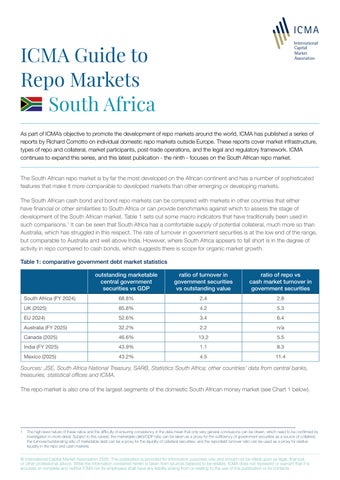
The South African cash bond and bond repo markets can be compared with markets in other countries that either have financial or other similarities to South Africa or can provide benchmarks against which to assess the stage of development of the South African market. Table 1 sets out some macro indicators that have traditionally been used in such comparisons.1 It can be seen that South Africa has a comfortable supply of potential collateral, much more so than Australia, which has struggled in this respect. The rate of turnover in government securities is at the low end of the range, but comparable to Australia and well above India. However, where South Africa appears to fall short is in the degree of activity in repo compared to cash bonds, which suggests there is scope for organic market growth.
Sources: JSE, South Africa National Treasury, SARB, Statistics South Africa; other countries’ data from central banks, treasuries, statistical offices and ICMA.
The repo market is also one of the largest segments of the domestic South African money market (see Chart 1 below).
1 The
Chart 1: domestic money market segments in terms of domestic bank positions, end-2025
Source: SARB.
Note: The data for repo is total bank repo. For CD, it is total issuance by banks of negotiable CD and promissory notes. For T-bills, only bank holdings are shown, as these are more relevant as a measure of the role of T-bills in the wholesale money market than total issuance, given that most investors buy and hold.2
The average daily turnover of repo on the Johannesburg Stock Exchange (JSE) over 2025 was over ZAR 150 billion (about USD 9 billion), while cash trading in bonds (buying or selling) averaged about ZAR 67 billion per day over the year (almost USD 4 billion). See Table 2 below.
Table 2: turnover in the cash and repo markets (nominal value)
Source: JSE.
Note: 2016 data are not available, so have been estimated by interpolation.
Table 2 and Chart 2 below show that repo trading has grown much faster than cash trading since 2017. There have been two cycles of growth since then, the first peaking in 2019 and the second starting in 2021. The intervening relapse in growth in 2020 may have been caused by the outbreak of the Covid-19 pandemic, as well as the downgrading of South Africa’s credit ratings and the consequent retreat of non-resident investors from South African assets. The second burst of growth is likely to have been powered, in large part, by the change in the monetary policy implementation framework of the South African Reserve Bank (SARB) (see the section on Recent Developments).
Chart 2: turnover in the cash and repo markets (nominal value)
Source: JSE, National Treasury.
The outstanding cash value of the repo market as reported by domestic banks to SARB was over ZAR 930 billion (some USD 50 billion) by the end of 2025 (see Table 3). This compares to some AUD 350 billion (USD 240 billion) in Australia.
Table 3: gross end-year repo and reverse repo positions of domestic banks
Source: SARB
Chart 3 compares the evolution of the gross positions of domestic banks in repurchase agreements (repo, reverse repo and their total) with the outstanding value of marketable government domestic debt. The secular trends in both repurchase agreements and government domestic debt are strongly correlated, albeit that the rate of change in repurchase agreements is more variable.
Chart 3: gross end-year repo vs reverse repo positions of domestic banks vs outstanding government domestic debt
Source: SARB.
Repo market turnover grew by +9.6% (compared to +9.1% in cash bond trading), while the aggregate repo and reverse repo positions of domestic banks increased by +14.9%, suggesting a lengthening in the average remaining term-tomaturity. Average deal size increased to a record ZAR 261 million (+8.6%), although the rate of increase decelerated (from +19.2% in 2023 and +16.1% in 2022).
Strengths
The South African repo market has some firm foundations: a liquid cash market in domestic government bonds; and a fixed-income derivatives market which generates demand for margin and, in the case of bond futures, enhances competition by enabling resort to synthetic repo. There is also significant securities-driven trading of repo, which is a strong indicator of market maturity and the key long-term driver of repo market growth and development.3 The market should also benefit from a migration away from buy/sell-backs and into repurchase transactions (sometimes called “classic repo”). This type of repo adds flexibility, by permitting new structures, including floating-rate and open repos, and evergreens and extendibles, as well as new functionality, such as collateral substitution.
The South African repo market also benefits from a supportive legislative framework. Any residual re-characterisation risk has been dispelled by progressive clarification of the legal character of a repo as a sale and repurchase (see the section on Type of Repo). Legal certainty has been further reinforced by the use of the Global Master Repurchase Agreement (GMRA) as the standard domestic legal agreement. In addition, close-out netting against an insolvent counterparty is firmly enshrined in the Insolvency Act.4 5
3 For many financial institutions, particularly commercial banks, there are ready alternatives to repo as a means to borrow and lend cash. Commercial banks are therefore not reliable drivers of the growth and development of a repo market. Securities dealers, on the other hand, have no alternative to repo as a cost-effective source of funding and it is also their preferred means of borrowing and lending bonds.
4 Close-out netting of repo is permitted subject to use of the GMRA, under section 35B of the Insolvency Act 24 of 1936.
5 The resolution regime introduced in 2023 initially created some uncertainty about bail-ins of repo on the books of financial institutions taken into resolution, However, the matter was satisfactorily resolved after the problem was highlighted by the industry (see the section on Recent Developments)
Weaknesses
On the other hand, there are a number of flaws in the South African repo market. A key weakness is the oligopoly held by first-tier banks. As a result, competition and price transparency look sub-optimal.
The exclusion of money market mutual funds is another constraint on the repo market and undermines price discovery. It also deprives the funds of access to what is a natural investment tool for such risk-averse short-term cash investors. There are similar regulatory constraints on pension funds --- in the form of limits on “encumbered assets” --- who consequently make little use of repo, especially when compared to pension funds in similar markets.6
The dominating role of the stock exchange in repo (as well as in cash bonds) is an anachronism that seems to have retarded market development and delayed the modernisation of market infrastructure, not least, by continuing to burden the market with an inefficient transaction reporting and matching system that stifles innovation by excluding new types of repo until such time as the system can be upgraded.
Ultimately, however, the South African repo market is being held back by its modest scale. The size of the market is inevitably a function of the size of the South African economy. However, as noted earlier, international comparisons suggest that the South African repo market is not as active as it could be. In order to realise its full potential, there are a number of changes that could be considered.
One obvious measure, that could significantly increase the size of the repo market in South Africa, would be to allow participation by money market mutual funds. Reforms are now in prospect, subject to certain prudential conditions, such as collateral eligibility requirements.
It should also be possible to expand the repo market by allowing greater participation by pension funds and insurance companies. Pension funds are subject to tight concentration limits and are consequently very modest users of repo. Greater participation will require the reconsideration of the current limits. The relaxation of encumbrance limits on insurance companies in 2024 helped them become active users of repo, even though the new limits are still seen as too restrictive.
However, while the opening of the repo market to money market funds, and the relaxation of encumbrance and concentration limits on insurance companies and pension funds, are likely to boost repo activity, it may be that the cost and inconvenience for non-banks of transaction reporting via the stock exchange will deter some non-bank financial institutions from taking up the opportunity.
As noted, the introduction of repurchase transactions in place of buy/sell-backs presents an opportunity to make repo more flexible and thereby increase its usefulness. In particular, repurchase transactions allow collateral substitution, which facilitates longer-term repo by allowing sellers to use securities as collateral that they may not want to tie up for the whole term of a repo. It is also essential to tri-party repo, in that it allows the automation of collateral allocation.7 However, the ability to exploit the full potential of repurchase transactions is waiting upon the upgrading of the reporting and matching system by JSE.
The market could also benefit from equity repo, for which there is apparent demand, which cannot be satisfied because it would be subject to a punitive securities transaction tax. There is no apparent tax rationale for obstructing equity repo, given that, by obstructing equity repo, the tax precludes the generation of any revenue from such transactions.8
6 Money market mutual funds and pension funds (and to a lesser extent, insurance companies) are subject to limits on “encumbered assets”. Collateral repoed out is considered to represent an encumbered asset, that is, unusable during the life of the repo, even though it remains on the balance sheet of the collateral-giver. The limits on pension funds are imposed by Regulation 28 under the Pension Funds Act.
7 The importance of collateral substitution for tri-party repo is that it allows collateral securities to be allocated without worrying about whether they might subsequently be sold by the holder. If that should happen, they can be retrieved from the tri-party repo buyer and replaced by substitution with another security.
8 Securities lending allows equity to be loaned but such lending is subject to elaborate anti-avoidance regulations (for both equity and bonds) designed to ensure that borrowed securities are passed to the end-user and that loans cannot be indefinite. These regulations are out of line with international practice.
Finally, a number of helpful improvements could be made to the infrastructure supporting the repo market. These include more automation of clearing and settlement to achieve straight-through processing (STP) and a speedy resolution of the delay to the implementation of tri-party repo, which is an important means of facilitating access by non-banks and therefore another way to encourage the broadening of market participation. Potential non-bank users of repo include, not only non-bank financial institutions, but major corporate treasuries seeking higher returns on cash balances. Tri-party collateral management would be required to make equity repo a reality.9 Another infrastructure improvement would be to improve interoperability between the domestic CSD and the ICSDs to reduce the friction in offshore participation in domestic repo.
The historic development of the South African repo market
The origins of the South African repo market lie with firms called discount houses (a type of institution inherited from the London money market). The discount houses traded on their own account, in particular, purchasing securities from banks. They financed themselves by borrowing from commercial banks, building societies and other cash-rich entities, including mining houses, but they could fall back on informal but unlimited refinancing facilities at SARB. The discount houses therefore performed two functions. First, they were a source of contingent liquidity for the banks. Second, their trading transmitted monetary policy from the central bank to the wholesale money market, while keeping banks at armslength from the central bank, thereby minimising moral hazard (in the form of over-reliance on the central bank).
In about 1957, the discount houses started trading undocumented buy/sell-backs (called “carries”, a name still used for repo in South Africa). The tenor of these repos was largely overnight but could go out to one week. Collateral was any security eligible for rediscounting at SARB, initially money market instruments --- negotiable certificates of deposit (NCD), bankers’ acceptances (BA) and Treasury bills --- and short-dated SAGBs. Eventually, longer-dated government bonds were accepted as collateral.
During the 1980s, the cash market in government bonds bifurcated into a wholesale OTC market and a retail market on the Johannesburg Stock Exchange (JSE). The OTC market was between banks and discount houses. Trading relied on information screens and the telephone. There was no central securities depository (CSD) and settlement was by physical delivery against a cheque drawn on a bank. The exchange market was intermediated by stockbrokers, acting as broker-dealers, on the floor of JSE. The largely retail market on JSE was quickly left behind by the burgeoning wholesale OTC market.
By 1991, as in the UK after “Big Bang”, the discount houses, along with merchant banks, had been absorbed by commercial banks. Fixed-income trading was then re-organised by the Bond Market Association (BMA). In 1996, the BMA was converted into the licensed Bond Exchange of South Africa (BESA). In 2009, BESA was taken over by JSE to become JSE Debt Market.
Because it is part of a licensed stock exchange, JSE Debt Market benefits from the obligation on parties --- under section 24 of the Financial Markets Act (FMA), 2012 --- to report all transactions in listed securities to a licensed exchange. JSE has interpreted this obligation as extending to repos against listed bonds. In practice, as no repo trading actually takes place on the exchange, this obligation translates into a post-trade requirement to report these transactions. The cost and inconvenience of this obligation is the subject of persistent complaints by market participants (see the section on PostTrade Infrastructure).
The South African repo market has, in the past, been dogged by legal uncertainty over whether a security given as margin for repo is a transfer of legal title or a pledge. The problem seems to have been a relic of the Roman-Dutch jurisprudence that underlies South Africa law. However, as discussed in the section on Types of Repo, the uncertainty has been resolved in recent years by the accumulation of new case law, although the news may not necessarily have spread to all institutions seeking to use repo.
9
Recent developments
Since 2022, the South African repo market has had to adapt to a shift in monetary conditions from a cash shortage to a cash surplus. Prior to the Covid-19 pandemic, the repo market was net long of bonds and net short of cash. This reflected the use by SARB of a classic “cash reserve” or “shortage-based” monetary policy implementation framework, whereby the central bank ensured a permanent shortage of liquidity in the money market by imposing a reserve requirement on commercial banks. This compelled banks to borrow from the central bank at the desired official repo rate to meet their daily payment obligations and thereby gave SARB some direct control over short-term interest rates and, by extension, influence over inflation.
The advent of the Covid-19 pandemic in 2020, and the consequent economic disruption and financial volatility, prompted SARB to inject substantial liquidity into the system. However, as in other countries, the resulting accumulation of excess reserves in the money market weakened the effectiveness of the monetary policy framework by reducing the need for banks to borrow from SARB, making it harder for the central bank to directly steer short-term rates. In response, in June 2022, SARB transitioned to a “surplus-based” monetary policy implementation framework. This is a system where liquidity is more freely available and the central bank manages interest rates by offering an overnight deposit facility to banks, at a fixed policy rate, to set a floor under money market rates. In order not to damage the repo market, the policy rate drops when a bank’s deposits at the central bank exceed a set quota. In other words, remuneration is tiered.
The impact of the change in the monetary policy implementation framework on the repo market has continued the uptrend in domestic banks’ reverse repo positions which began during the Covid-19 pandemic (see Chart 4a). As the growth in gross repo positions has lagged behind reverse repo, net reverse repo positions have expanded (see Chart 4b). Gross repo only started to grow in 2024. The lag suggests that domestic banks were initially able to draw on other sources to finance increased lending through reverse repo.
Chart 4a: gross end-month repo vs reverse repo positions of domestic banks
Source: SARB.
4b: net end-month repo position of domestic banks with the rest of the market
Source: SARB.
Domestic banks have a smaller net reverse repo position with each other than with the rest of the market, the difference reflecting net lending to the non-banking sector. But net lending between domestic banks jumped in 2020, then again in late 2022, before shrinking from late 2023. The change in direction in 2020 likely reflected banks responding to the “dashfor-cash” triggered by Covid-19 by increasing lending to each other through gross reverse repo. The change in 2022 was probably driven by the new monetary policy implementation framework, which would have required ample central bank liquidity to be actively recycled among banks. The contraction in net reverse repo positions from 2023 reflected a drop in gross reverse repo and, to a lesser extent, growth in gross repo, suggesting that liquidity had become more evenly distributed.
Source: SARB.
There has been a trend increase since 2014 in domestic banks’ net reverse repo positions with insurance companies, almost entirely composed of growth in gross reverse repo (lending to insurers). This trend accelerated after 2022 and again in mid-2023 (see Chart 4d). Easier liquidity (as well as relaxed encumbrance limits) seem to have encouraged insurers to make greater use of the repo market to obtain funding for increased trading.
Chart 4d: net end-month repo position of domestic banks with insurers
Source: SARB.
There has been trend growth since 2010 in domestic banks’ net reverse repo positions with “other financial institutions” and non-residents (see Chart 4e below). The bulk of that activity seems to be with non-residents. There was a significant increase over 2020-21, which was reversed in 2022-23, before growing again over 2024-25. Decreases in the net reverse repo position of banks have been driven by faster growth in their gross repo rather than declines in their gross reverse repo. Recent growth has been boosted by the rally in emerging market debt, including SAGBs. This has reversed some of the damage to repo activity by non-residents suffered in 2020, when South Africa’s credit ratings were downgraded to high-yield status and its bonds were removed from the Citibank World Government Bond Index.
Chart 4e: net end-month repo position of domestic banks with other financial and non-resident institutions
Source: SARB.
Looking ahead, a helpful source of future growth for the South African repo market should be the finalisation in September 2025 of initial margin requirements (Reg IM) for OTC derivatives, particularly as the punitive Grid Method for collateral calculations is expected to result in higher liquidity requirements. In other markets, similar regulations have boosted the use of repo to fund cash margin calls and in collateral transformation to generate eligible non-cash collateral. Indeed, there is already evidence that collateral swaps into eligible non-cash collateral, particularly into US Treasuries, have boosted repo market activity in South Africa.
There have also been a number of important recent developments in the infrastructure that underpins the repo market in South Africa. These include the decision by the Johannesburg Stock Exchange (JSE), in 2022, to build a central counterparty (CCP) for bond and bond repo, with the aim of centrally-clearing repo as early as November 2026. This initiative is discussed in the later section on Post-Trade Infrastructure.
Legal issues have been prominent in the repo market since 2022. One was triggered by proposals to replace the system of “curatorship”, under which SARB would take control of banks in difficulty, with a resolution regime more in line with international practice. Concerns arose that the “bail-in” provisions of the draft legislation would weaken the enforceability of close-out netting in insolvency of repo and securities lending. For some unexplained reason, the new legislation did not extend the exemption from bail-in that had been granted to the ISDA Master Agreement to the GMRA and GMSLA (Global Master Securities Lending Agreement). However, following industry representations, SARB and the government agreed to amend the legislation to protect close-out netting of securities financing transactions by exempting transactions under the other international master agreements from its bail-in provisions.
While the potential problem posed by the resolution regime was speedily resolved, the repo market is still waiting upon progress on other legal and regulatory issues. In particular, efforts to modernise the South African repo market have been held back by the delay, since 2016, in updating the Financial Markets Act (FMA). This is the primary statute regulating financial markets, including financial market infrastructures such as exchanges, CSDs and CCPs. Of special interest to the repo market is section 24 of the Act, from which JSE bases its de facto monopoly of the reporting of bond repo, even though repo is not actually traded on the exchange.
Another regulatory delay is holding back the launch of tri-party repo by Strate. This is for approval of the transaction reporting mechanism for tri-party repo (see the next section).
In September 2025, the Financial Sector Conduct Authority (FSCA) --- which regulates the conduct of financial institutions (see the section on the Regulators) --- began a consultation on a draft Conduct Standard setting out requirements applicable to the use and trading of repo and other securities financing transactions. Work by FSCA’s predecessor, the Financial Services Board (FSB), focused on securities lending by pension funds but FSCA is looking to a more comprehensive regime.
Thus, the draft Conduct Standard is aimed at ensuring that appropriate and effective governance, risk management and internal control frameworks are in place in securities financing transaction participants. There are also additional requirements for securities lending by pension funds. Interestingly, the draft Conduct Standard requires reporting to a “licensed trade repository” (paragraph 11(1)), suggesting that transaction reporting could be moved out of JSE to a specialist agent.
Unfortunately, the transaction reporting requirements of the draft Conduct Standard (what data are to be reported) seem to have been based on the EU Securities Financing Transaction Regulation (SFTR).10 This is a poor precedent, given the deeply flawed nature of that regulation, and the consequent problems and expense that it has created for the European repo market.
10 Among other things, the draft document specifies that repo reports should include a UPI (unique product identifier) to “classify and identify securities asset classes”. In developed markets, UPIs are only required for the reporting of derivatives, as these consist of many distinct classes and sub-classes. Imposing such a system of classification on repo would be impracticable by virtue of the scale and tenor of repo market activity, but is also unnecessary, given that repo is essentially one type of product.
Marketplace
It has been explained that, under the Financial Markets Act (FMA), all trading in securities listed on a licensed exchange in South Africa must take place on a licensed exchange. The Johannesburg Stock Exchange (JSE) is the dominant licensed bond exchange in South Africa. JSE has interpreted the FMA trading obligation as covering both the cash trading and repo of listed securities. In the case of repo, however, there has never been a trading floor or system at the exchange.11 As in other countries where the stock exchange has a historic monopoly on repo trading, but no actual trading, the obligation to trade on the exchange has dwindled into an inefficient transaction-reporting obligation.12 13 This means that the only repo market function of JSE is to provide a type of trade repository.
As repos are negotiated and executed off-exchange, the repo market in South Africa is, in practice, an over-the-counter (OTC) market. JSE has no known plans to extend the central limit order book (CLOB) used in the cash trading of SAGBs to repo. This reflects the limited number of likely users, which in turn reflects the fact that the interbank repo market in South Africa is dominated by the top 4-5 domestic banks, with little repo trading among other banks (the latter are effectively relegated to the status of customers of the dominant banks).
As it is traded on an OTC market, repo is negotiated and executed bilaterally by telephone or on electronic messaging systems such as Bloomberg, either directly between counterparties or after counterparties have been introduced by a voice-broker. In South Africa, a voice-broker is called an “inter-dealer broker” (IDB).14 The IDBs in the South African repo market include Acumen, Equisec, Conticap, SA Money and ICAP Securities.
In addition to the domestic market, there is active involvement in repos by non-resident investors, typically global banks, hedge funds and other leveraged investors. These are important holders of both SAGBs and corporate bonds. They use the domestic repo market to fund these holdings. Exchange controls (see the end of this section) mean there is no offshore repo market. Following the rally in emerging market debt, non-residents have come to account for 38.0% of the repo positions on the books of South African banks over 2025 (having hit a monthly peak of 47% during 2024). Nonresident business is dominated by the IDBs.
The boost to the trading of SAGBs given by the shift to a monetary policy regime of ample reserves, as well as bullish sentiment among non-resident investors, has revived the market in specific issues of collateral. However, specialness has been contained by the abundant supply of bonds, reflecting heavy issuance but also the already large holdings of domestic banks.15
There is an active and growing market in South Africa in collateral swaps in the form of back-to-back repo and reverse repo. One type of collateral is repoed out for cash and the cash simultaneously re-used in a reverse repo with the same counterparty to acquire a different type of collateral. Such “collateral transformation” is often driven by the need to boost stocks of HQLA (high-quality liquid assets) to maintain or strengthen a bank’s LCR (Liquidity Coverage Ratio). Buoyant activity in collateral swaps is reported to have significantly narrowed spreads.
11 In the case of cash government bonds, demands for pre-trade price transparency prompted JSE to introduce an automatic electronic trading system operating a central limit order book (CLOB), the Electronic Trading Platform (ETP), from Q3 2017 but only primary dealers. This is a white-labelled version of the Euronext MTS platform.
12 A similar situation prevails in repo markets in a number of other countries including China, Kazakhstan and Vietnam.
13 The costs of trading repo on JSE --- which include a flat market access fee and transaction fees --- are the subject of complaints by market participants, despite a sliding scale of rebates for larger firms.
14 In other markets, IDBs are matched-principal brokers. This type of broker disseminates prices among dealers and acts as a principal intermediary between the price-maker and price-taker (in other words, transactions are taken onto the books of the IDB). In this way, the IDB provides pre- and post-trade anonymity to both parties (which is why IDBs are also known as “blind brokers”). True IDBs are found only in the repo markets in North America, although there is an analogous type of repo broker in Japan. In contrast to an IDB, a voice-broker disseminates prices among dealers and, if one of them shows an interest in a price, arranges an introduction to the price-maker. A voicebroker does not get involved as a principal to any subsequent transaction. A voice-broker can therefore only offer pre-trade transparency (which is why they are also called “name give-up brokers”.)
15 Specialness is the spread between the repo rate at which a specific bond trades in the repo market and the GC repo rate. Specials trade below the GC rate in order to offer an incentive to holders (in the form of cheaper cash) to repo out these bonds. Because of the lower repo interest received by the buyer of a special in the repo market, specialness can be regarded as an implicit borrowing fee. The degree of specialness reflects the scarcity of and demand for a particular issue. Demand is greatest for the most liquid bond issues, typically benchmark issues or bonds that are cheapest-to-deliver (CTD) in the bond futures market. In this sense, specialness can also be seen as the cost of bond liquidity.
There has long been a close connection between repo trading in South Africa and the market in SAGB bond futures. Futures bring additional liquidity into the cash bond and bond repo markets. Repo can be used to fund or cover bond positions that are being used to hedge futures positions (and also to arbitrage away any deviations from fair value --- basis trading). In addition, bond futures allow the creation of synthetic repo from a short cash bond position and a long futures position to create off-balance sheet financing.
Open interest in the 10-year SAGB futures contract (the most liquid bond futures contract) was almost 11.5% of the outstanding market value of SAGBs at the end of 2025, which is not out of line with some bond futures markets in developed economies. The ratio of 10-year futures to cash market turnover in 2025 was just under 11.5%. This is well below the multiples in active government bond futures markets. But, while such a comparison may be considered unfair, it does suggest that there is significant scope for further development in the South African market.
In parallel with the use of bond futures, there is an active market in bond forwards (the OTC equivalent of bond futures). For example, selling a bond from a portfolio and going long of a three-month bond forward generates funding for three months, while also hedging the short bond position. This type of synthetic repo is more suitable for non-banks than futures, since it does not require membership of the futures market.
The repo market is also connected to FX swaps.16 Repo and FX swaps are analogous transactions, in that they both involve a sale and a subsequent repurchase, which temporarily exchanges either cash for a security (repo) or one currency for another (FX swap). As such, they are both means of borrowing one asset by providing another as collateral, for the purpose of liquidity management. The choice between employing a repo or an FX swap to borrow South African rand usually depends on the cross-currency basis between the rand and the US dollar, that is, whether there is a deviation in forward exchange rates from covered interest rate parity.17 Such deviations can make it cheaper to fund rand by borrowing dollars and swapping them into rand in the FX market, rather than borrowing rand directly. The choice between repo and FX swaps is particularly relevant to non-resident investors. They are often dollar-based or can readily fund in dollars but otherwise have to borrow South African rand through the major domestic banks.
It needs to be remembered that South Africa retains exchange controls, which is why non-resident investors have to fund themselves in the onshore market. The Exchange Control Regulations, 1961, made under the Currency and Exchanges Act, 1933, prohibit South African residents from transferring any assets (including cash and securities) out of South Africa or giving a non-resident a claim against South African assets, without prior approval. Ultimately, approval has to be given by the Financial Surveillance Department of SARB. On a day-to-day basis, however, exchange control is enforced by requiring FX and cross-border transactions to go through Authorised Dealers. These include the main domestic banks. SARB has pre-approved certain transactions, including some repos with non-residents, but exchange controls could still affect margining and might also restrict the set-off of local accruals or liabilities against foreign accruals or liabilities.
Post-trade infrastructure
Clearing and settlement
Strate is the central securities depository (CSD) and the securities settlement system (SSS) for South Africa, for both fixed-income and equity.18 It has operated the clearing and settlement infrastructure for bonds and equity in South Africa since 2003. Strate is primarily owned by the Johannesburg Stock Exchange (JSE) and four major banks.19
In the case of bonds, Strate operates a so-called DVP2 securities settlement model, that is, the delivery of gross quantities of securities during each settlement run against a net payment of cash at the end of that settlement run (grossnet settlement). In the case of money market securities, including Treasury bills, settlement follows a DVP1 model, that is, delivery throughout the day of a gross quantity of securities against a simultaneous gross payment of cash (grossgross settlement). DVP1 therefore combines the delivery-versus-payment (DVP) and real-time gross settlement (RTGS) of securities and cash transfers. For payments, Strate is connected to SARB’s RTGS, SAMOS (South African Multiple Option Settlement), so securities settlement takes place in risk-free central bank money.
Settlement across Strate usually takes place on T+3 for cash equity and bonds (and repo collateral), but bond repo is also settled at T+0. This includes overnight repo against money market collateral, reflecting the fact that money market settlement is at T+0.
Trading with non-resident investors is being held back by cross-border settlement friction between Strate and Euroclear, the ICSD (international central securities depository) which acts as sub-custodian for non-residents. This arises from timing differences in settlement cycles between the two depositories. Strate settles at T+3 but Euroclear at T+5. The result is a higher rate of failed settlements on cross-border transactions, which adds to the cost of cross-border settlement.
Strate has strict controls regarding settlement failures. Trades that are due to fail are referred to the JSE, in its role as the licensed bond exchange, to manage on a case-by-case basis, in order to minimise potential systemic risk. If a customer fails to settle by the cut-off time of 12:00, the JSE member who is the counterparty has to cover the failure and will be subject to a substantial fine.
Transaction reporting
Transaction reporting through JSE is the subject of much dissatisfaction in the South Africa repo market due to the cost, constraints and inconvenience of JSE’s antiquated Nutron reporting and matching platform, for which, no modernisation date has been set. This has led some parties to document their repos as collateralised loans under an ISDA Master Agreement, thereby removing their obligation to report to the JSE.
One of the most serious problems with the current reporting requirements is that the market is not allowed to introduce innovations until they can be reported to JSE. This constraint has held back the use of repurchase transactions, open repo, floating-rate repo, structures such as evergreens and the ability to substitute collateral.20
Another complaint about current transaction reporting requirements is that mandatory reporting of repo through JSE requires non-members to employ a stock exchange broker, which adds to their costs, reduces visibility across the market and suppresses competition.
JSE is also criticised for failing to recycle the market data it collects back into the market.
18 Some major domestic banks and non-banks are Participants in the Strate CSD and operate custody divisions which provide sub-custodial services to clients through accounts at Strate managed by the Participants.
19 Strate (Share Transactions Totally Electronic Ltd) was established in 1999. In 2003, it was merged with other CSD/SSS, UNEXCor (Universal Exchange Corporation Ltd) and CD (Central Depository Ltd).
20 JSE has scheduled the introduction of roll-overs, term extensions, re-rates and collateral substitution by the end of 2027.
It may be that the repo reporting function will be removed from JSE. As noted earlier, the draft Conduct Standard published by FSCA in September 2025 requires reporting to a “licensed trade repository” (paragraph 11(1)), not a licensed exchange. Use of a trade repository would align South Africa with emerging international practice.
Collateral management and tri-party repo
It is best practice in the South African repo market to call for variation margin to hedge any uncollateralised exposure that might arise during the life of a transaction. Historically, this was not the case, reflecting the original undocumented nature of buy/sell-backs. The adoption of variation margining has been encouraged by the provision made in the GMRA and by regulatory requirements (which will be reinforced by FSCA’s forthcoming Conduct Standard). It has been suggested that some banks do not believe that margining is contractually possible for buy/sell-backs and that many margining arrangements consequently take the form of side agreements or non-contractual. In fact, margining is contractually possible for buy/sell-backs under the GMRA.21 JSE is not planning to implement variation margining (nor the processing of manufactured payments) within its proposed CCP (see below).
Collateral haircuts are not a common risk management tool in the South African market, other than in periods of market stress (and often only when trading with international banks) or sometimes for leveraged local clients. JSE Weekly Statistics suggest that, in aggregate, domestic banks gave an average haircut on repo collateral of 3.9% in 2025. The average was higher over 2022-24, peaking at 9.7% in 2023, but was as low as 1.1% in 2019.
Strate has developed a tri-party collateral management service, allowing clients to delegate post-trade collateral management for repo, securities lending and derivatives to the CSD. Such delegation ensures the implementation of more rigorous and standardised risk management practices, and automates collateral allocation, settlement, marking-tomarket, margining, substitution and other transaction management operations. Given that a tri-party service relieves users of the burden of collateral management, it is an important way of facilitating use of the repo market by non-banks. And as explained earlier, it also allows collateralisation with baskets of multiple securities, rather than just one, thereby enabling more efficient use of diversified bond portfolios, which would otherwise be under-utilised. Tri-party collateral management also facilitates collateral substitution, which is an operational challenge for individual firms. Substitution encourages both basket collateralisation and longer-term trades.
The tri-party service has so far been deployed for collateralised loans, derivatives collateral and securities lending. The launch of tri-party repo has been delayed as, following an agreement between Strate and JSE, based on the JSE interpretation of the FMA, that tri-party repo would be reported through the exchange, regulatory approval has had to be sought for changes to the rules of JSE.
Although tri-party repo documented under the GMRA have been delayed, Strate has been able, by means of documenting transactions as collateralised loans under the ISDA Master Agreement, to offer tri-party functionality to the treasuries of banks who are members of the National Payment System to allow them to manage the reserves they hold with SARB and ensure that these remain within the banks’ quotas.22 Accordingly, the collateral eligibility schedule of this Secured Interbank Service is aligned with that of SARB. The annual turnover of the service grew from a modest ZAR 1 trillion in 2021, to a high of ZAR 4.1 trillion in 2022 and averaged ZAR 3.4 trillion per annum over 2023-2025. Given the reserve management function of the service, most of the transactions have been overnight. However, term trades have been observed.
SARB is assessing the use of Strate’s tri-party collateral management for central bank repo, as well as the deposit of securities to meet prudential regulatory requirements. A proof-of-concept has recently been successfully completed. Use
21 The GMRA also offers an optional alternative mechanism to variation margining in which a transaction can be terminated early to be replaced by a new transaction with an adjustment to the cash. This method is called “re-pricing” (see paragraphs 4(j)-(l) of the GMRA).
22 The facility was unsecured until it became part of Strate’s tri-party service in February 2021 and, in September 2022, settlement was also moved to delivery-versus-payment (DVP). The facility is similar to the Optional Settlement period at the ICSDs and the Bilaterally Agreed Treasury Market (BATM) on the European Central Bank’s T2S securities settlement system.
of Strate will release collateral that currently has to be pre-placed and therefore immobilised and isolated at SARB. It will also automate the process of collateralisation, reducing the operational burden on all parties. And the SARB’s example may encourage others to employ tri-party services.
Central-clearing
The idea of a CCP for the fixed-income market in South Africa has been discussed for a number of years.23 The case for a CCP focused on the reduction of systemic risk and the cost of engagement for non-resident investors, given the 100% counterparty risk weight imposed on local bank counterparties under the Basel regime. However, the idea was for some time regarded as economically unviable, given the small size of the South African bond market.
However, a proposal for a cash bond and bond repo CCP surfaced in 2021 and was agreed in 2022. Regulatory approval was granted in September 2022. JSE is planning to launch a repo CCP by November 2026, although this could be delayed until February 2027. Initially, the CCP will only clear buy/sell-backs, even though it is now possible to report repurchase transactions to JSE and it is therefore practicable to trade them. Clearing will be extended to repurchase transactions at a later date, at the same time as cash bond trading starts to be centrally-cleared.
The building of a CCP for the South African repo market is ambitious, given the size of that market. The decision stands in contrast to Australia, which has a larger fixed-income market but has yet to decide on central-clearing. JSE believes the South African market is large enough to achieve meaningful netting. This is despite their judgement that the South African repo market is too small to justify a CLOB-based trading venue. The comparison between CLOBs and CCPs is relevant because of their synergistic relationship in other repo markets. A CLOB allows anonymous prices for centrally-cleared repo to be posted to the market, while a CCP obviates the need for the CLOB to perform credit checks, thereby allowing automatic order-matching. Without a CLOB, anonymity requires true IDBs, that is, matched-principal brokers, as in North America and Japan. The so-called IDBs in South Africa are not matched-principal brokers but arrangers, who do not take transactions onto their balance sheets and cannot therefore protect the identities of the counterparties from each other post-trade (see footnote 5).
Types of repo
Title transfer vs pledge
Under South African law, a transfer of rights in securities is classed as a “cession”. Traditionally, a cession used for security purposes was considered to be a pledge, which required that listed securities remain immobilised in the securitygiver’s account. This caused varying degrees of confusion in the South African repo market until 2022, when case law established that an outright cession is a valid method for giving collateral security, where the parties make clear their intention to transfer legal title, such as by signing a GMRA.24
Title transfer vs loan for consumption
It is argued that a South African court would only re-characterise a repo as a loan against a pledge if the substance of the transaction had more in common with a “loan for consumption” than a transfer of legal title. However, it is difficult to
23 JSE has operated a central counterparty (CCP) for derivatives, formerly called SAFCOM and now called JSE Clear, since 2014. It became South Africa’s only licensed independent clearing house in 2022 and is a Qualifying CCP under Basel III, 24 Cessions can be divided into “outright cessions” (transfers of title), or “cessions in securitatem debiti” (cessions in security). The question of whether parties could validly agree to an outright cession of securities as collateral, or whether such transfers should always be re-characterised as security cessions that were in the nature of pledge (requiring that the securities be immobilised in the pledgor’s account), troubled the South African market for a number of years. The debate was most directly related to margin securities, which under the terms of the GMRA are expressed to be transferred outright. It was thought that the transfer of margin securities was at risk of being re-characterised as a pledge, but with the result that the pledge would have been incorrectly implemented and would therefore have been invalid.
In relation to the repo itself (that is, the sale and purchase of the main collateral securities at the start and end of a transaction, referred to in the GMRA as the Purchased and Equivalent Securities, respectively), the question was sometimes asked as to whether a South African court might re-characterise the transaction as a “loan for consumption”. If the transfer of Purchased Securities was accordingly re-characterised as a pledge that had been incorrectly implemented and was therefore invalid, such a loan would have been at risk of being found to be unsecured. However, this possibility was seen as remote. In 2022, the Supreme Court of Appeal case Engen Petroleum Limited v Flotank Transport (Pty) Ltd settled the question in favour of valid outright cessions of securities as collateral.
distinguish a loan for consumption from a transfer of title. They are economically identical. Thus, under a loan for consumption, one party agrees to deliver to another party an item that can be consumed by the second party over a certain period, or in order to achieve some other purpose, on the explicit basis that the second party temporarily becomes the owner of the item. The second party commits to return an item of the same kind, quality and quantity or, in the case of money, an equal sum in repayment.
Were a repo to be re-characterised as a loan for consumption, problems might arise from the fact that it would legally become a loan, which could be subject to different legal, regulatory and tax treatment. In practice, however, there does not appear to be a difference under insolvency law (because title is still transferred in both cases), meaning there is no incentive for the liquidator to seek re-characterisation. As regards the Securities Transfer Tax applicable to an equity (see the discussion of equity repo below), characterisation as a loan would normally offer exemptions, whereas a sale would invite taxation of both the purchase and repurchase, so there does not appear to be any incentive for the tax authority to seek re-characterisation.25
It is also likely that the court would be influenced by the wide freedom of contract conferred by the common law in South Africa and the established usage of repo as a title-transfer instrument. The risk of re-characterisation of repo as loans for consumption would therefore appear to have become an academic relic of historic South African law.
Buy/sell-back vs repurchase transaction
Repo in South Africa has traditionally been classified as the buy/sell-back form of repo, as opposed to a repurchase transaction (or classic repo).
The origin of this classification lies in the fact that South African repo was originally undocumented (in contrast, repurchase transactions are always documented). In other jurisdictions, this would mean that they were separate contracts, linked economically but not legally. As separate contracts, undocumented buy/sell-backs are not mutual obligations and therefore cannot benefit from close-out netting upon a default. In order to enable the close-out netting of undocumented buy/sell-backs, a similar solution was adopted in South Africa to that employed in the undocumented buy/sell-back markets that used to exist in Italy and Spain. This was to deem the transactions as single contracts where they were registered with a financial market infrastructure. In Italy and Spain, this was the CSD. In South Africa, it has been the stock exchange.
South African buy/sell-backs are now documented under the GMRA and its South African Annex.26 The only substantive intrinsic difference between a documented buy/sell-back and a repurchase transaction is that the latter requires the making of “manufactured payments” from the buyer to the seller, whenever a coupon or similar income payment is paid on purchased securities by the issuer to the buyer.27 28 In contrast, in a buy/sell-back, whether documented or otherwise, parties agree at inception to anticipate any coupon due during the life of the transaction by reducing the repurchase price of the repo by the amount of the coupon plus compensation for the time-value-of-money loss arising from the delay in benefit to the seller.29
25 It should be noted that, even if a repo were to be re-characterised as a conventional loan subject to the Insolvency Act, statutory netting under Section 35B of the Insolvency Act would give rise to a similar result as netting under the GMRA or GMSLA.
26 The South African Annex to the GMRA applies to all repos under the GMRA with a South African counterparty. The Annex changes the governing law to that of South Africa, makes amendments to reflect local insolvency law, adds some Events of Default and subjects the agreement to exchange controls. The Annex dates from 2007 and has not been updated to reflect the myriad legal changes that have occurred since then. Most parties have themselves updated their internal South African Annex templates.
27 “Manufactured payment” is the name commonly used in the European repo market to describe the obligation on the buyer to make an equivalent payment to seller, whenever a coupon is paid by the issuer of collateral to the buyer. A manufactured payment compensates the seller for continuing to take the risk on the collateral during the life of the repo, by having committed to repurchase the collateral at the original sale price (plus repo interest). The buyer receives the coupon from the issuer solely because he is the legal owner of the collateral during the repo. Because the buyer pays the equivalent sum of money to the seller in the form of a manufactured payment, he retains no net income from the collateral, which is economically correct, since the buyer is taking no risk on the collateral.
28 As noted in the previous section, variation margining is contractually possible for buy/sell-backs. The GMRA also offers an optional alternative mechanism, called “re-pricing”, in which a transaction can be terminated early to be replaced by a new transaction with an adjustment to the cash.
29 The disadvantages of this method of compensating the seller for coupon or other income payments on collateral, and therefore a drawback to buy/sell-backs, is that the adjustment to the repurchase price cannot be accurately calculated if the size of a future coupon or other income payment on collateral is uncertain (eg in the case of a floatingrate or index-linked security) and the loss if there is a default by the issuer of the collateral before the repurchase.
The need to adjust the repurchase price to anticipate a coupon on the purchased securities during the life of a repo requires a known repurchase date, a known repurchase price and a known future coupon or other income payment. However, open repos start with no repurchase date and therefore no repurchase price; floating-rate repos start with an unknown repurchase price; and the interest payments on index-linked bonds or floating-rate notes (FRN) may not have been fixed before the start of a repo.
Consequently, buy/sell-backs can only be fixed-term, fixed-rate and against fixed-rate bonds.30 Moreover, collateral substitution, while contractually possible in a buy/sell-back, is problematic, because substitution is almost certain to introduce a security with a new coupon. The consequence is that most buy/sell-backs are short term, as sellers will be reluctant to tie up securities as collateral for longer terms without the option to retrieve them, if required.
Repurchase transactions on the other hand avoid all these problems because they use manufactured payments, which simply pass through, without delay, whatever is actually paid on the collateral. Repurchase transactions are therefore far more versatile than buy/sell-backs. They are also preferred by non-resident counterparties, who typically come from markets where repurchase transactions are the norm.
Prior to 2025, it was not possible to trade repurchase transactions in South Africa because they could not be reported to the Johannesburg Stock Exchange (JSE). This is now possible, but JSE does not plan to enable some of the features of repurchase transactions until 2027 (eg term extensions and re-rates). It should also be noted that manufactured payments (and variation margin) will not be processed by JSE’s planned CCP but will have to be managed bilaterally.
Other legal issues
In 2021, the Financial Sector Laws Amendment Bill of 2021 (FSLAB) was published. This amended the Financial Sector Regulation Act of 2017 (FSRA) to replace the system of “curatorship” by SARB of banks that fall into difficulties. The new sections of the FSRA (the Resolutions Framework) introduced a resolution regime more aligned with international practice and applicable, not only to banks, but also to some other financial institutions. In addition to the Bill, the Financial Stability Department of SARB published a Discussion Paper entitled “Stays in Early-Termination Rights and Resolution Moratoria on Contracts of Designated Institutions in Resolution”. The Bill and the Discussion Paper were seen in the financial sector as posing a threat to the enforceability of the close-out netting in insolvency under the GMRA and GMSLA (Global Master Securities Lending Agreement), as they failed to provide the same exemption from bail-in provisions to repo and securities lending that had been granted to derivatives under the ISDA Master Agreement.
Following industry representations, SARB and the government agreed, in March 2023, to amend the Resolution Framework to protect the close-out netting of repo and securities lending by exempting transactions under all master agreements defined in the Insolvency Act of 1933 from the new bail-in provisions. However, the FSLAB was only due to come into effect in June 2023. Consequently, it was decided to introduce an interim Interpretation Ruling clarifying that SARB, in its capacity as resolution authority, would not interpret its powers to include the ability to bail-in repo and securities lending. The Interpretation Ruling binds SARB in its interpretation of the FSRA, although it does not have the force of law. It was also proposed to make amendments to the Resolution Framework in the long-awaited Conduct of Financial Institutions (COFI) Bill, but the legislative timeline for that bill was judged too slow. In 2024, the required amendments were applied instead to the Draft General Laws (Anti-Money Laundering and Combating Terrorism Financing) Amendment Bill of 2024 (GLAB) (and were retained in the second draft of GLAB, published in December 2025), as this is expected to be passed sooner than the COFI. Once the GLAB comes into force, the Interpretation Ruling will fall away and the Resolution Framework, as amended, will exempt transactions under the ISDA, GMRA and GMSLA from the bail-in provisions of the Resolution Framework.
Notwithstanding the drama engendered by the introduction of the new resolution regime, which has also been seen in other jurisdictions, the South African legislative framework is generally very supportive of the repo market, such that the
30 The restrictions imposed by the buy/sell-back structure led to most of the Italian repo market, one of the largest in Europe and trading only buy/sell-backs, switching to repurchase transactions in 2018.
GMRA (under English and South African laws) is considered to be legal, valid, binding and enforceable in South Africa in all material respects. However, in addition to the usual qualifications about public policy, statutory rights and so on, there are still some potential issues that need consideration, although these are not unique to South Africa.
Equity repo and securities lending
A significant obstacle to the development of the South Africa repo market is the liability of equity securities to the Securities Transfer Tax (STT) levied under the STT Act, 2007. This is a type of stamp duty, levied at a rate of 25bp. Under the STT Act, both the purchase and repurchase legs of an equity repo would be regarded as changes in beneficial ownership for the purpose of the tax. This would make most equity repo uneconomic.
There is expressed demand for equity repo. This is despite the fact that there is an alternative in the form of securities lending under the GMSLA, for which, there are two exemptions from STT.31 Effort is being expended on finding a way to overcome the tax obstacle to equity repo, including by means of characterising equity repo as a collateral arrangement under the ISDA Master Agreement, in order to benefit from the second exemption from STT. However, an amendment to the STT Act in 2023 closed the door on this route by imposing restrictions on the re-use of collateral under such arrangements, which make the structure practically of no use as a means of borrowing securities for the purpose of trading.32
Another approach that has been considered (if not tried) is to create what is known in the UK repo market as a “reverse stock loan”. Under this arrangement, a repo would be characterised as a cash-collateralised securities loan under the GMSLA. However, there are several drawbacks to this structure. One is that the repo desks of some counterparties are unwilling to trade securities loans and there may be insufficient commercial incentive for institutions to sign a GMSLA. Another issue is that such structures may not qualify for the netting provisions of the Insolvency Act, which ties the enforceability of close-out netting against an insolvent defaulter to the use of the standard provisions of specified master agreements, including the GMRA and GMSLA.
Other types of repo in South Africa
It should be noted that repo used by SARB for its open market operations currently take the form of a loan backed by a pledge. However, when dealing commercially (on behalf of the Corporation for Public Deposits), SARB uses true repo (in the form of documented buy/sell-backs).
There is also an exchange-traded synthetic repo available in the South African market. This is a contract called “j-Carries” that is listed on JSE Interest Rate Market, Yield-X. It is a derivative version of a buy/sell-back. Tenors are standardised at one week and 13 weeks. The contract is physically settled at both the start and end. However, this contract never gained traction.
Collateral
The most common class of collateral in the South African repo market is often assumed to be SAGBs. However, domestic bank returns made to SARB show that the largest component of the collateral reversed in by domestic banks is in fact foreign bonds (see Chart 5). There is no data available on the composition of these bonds but some market participants have suggested that they may arise from the use by the major domestic banks of repo to manage their hard-currency liquidity and from market-making and repo activity in other African securities.
31 The first exemption is for a loan of less than 12 months, where re-use of the loaned asset must take place within 10 days (the “lending arrangement” exemption). The second exemption applies to collateral securities (“the collateral arrangement” exemption), provided that the collateral is conveyed by title transfer and is returned within two years.
32 Collateral under collateral arrangements can only be re-used in further collateral arrangements, a transaction with the central bank, for compliance with the asset-spreading (diversification) regulations applicable to pension funds and for securing overnight cash deposits under the Basel Large Exposure rules.
Chart 5: repo collateral held by domestic banks, end-2025
Source: SARB.
Use of foreign bonds jumped in 2020, at the time of South Africa’s ratings downgrade and ejection from the World Government Bond Index (see Chart 6 below). Nevertheless, balances of domestic government bonds (SAGBs) held as repo collateral by banks has been rising faster than foreign bonds since 2014, recently, in the wake of the rally in emerging market securities.
Chart 6: repo collateral held by domestic banks at end-month, 2008-2025
Source: SARB.
The large holdings of repo collateral in the form of foreign bonds may be partially reflected in the share of foreign currency in banks’ gross repo positions. This increased significantly over 2023-25, reaching 22.8%. The bulk is accounted for by bank repos from non-residents (amounting to 86.8% of these positions in 2025). However, as shown in Chart 7 below, interbank holdings of foreign currency have also been building up over the same period (reaching 8.5%).
Chart 7: foreign currency repo positions of domestic banks at end-month, 2013-2025
Source: SARB.
Treasury bills are under-utilised as collateral, because investors in these securities tend to buy and hold (including banks holding treasury bills as HQLA).33
The proportion of repo collateral held by domestic banks in the form of non-government and bank bonds is dwarfed by their holdings of SAGBs. Moreover, securities issues by parastatals (recently estimated at 22% of credit bond issuance) contribute a much smaller share of reverse repo collateral than the share of these issuers in the bond market.34 The negligible share of banks’ holdings of reverse repo collateral in the form of non-financial corporate bonds (14% of credit bond issuance) and municipal bonds reflects the narrow issuer base (which increases concentration risk) and the buyand-hold strategy typical of credit investors.35
There should be no repo market in equity in South Africa, because of the Securities Transfer Tax (STT). While exemptions from the STT were granted to the securities lending and borrowing of equity in 2016, this was not extended to equity repo. Nevertheless, banks report holding an aggregate balance of listed equity of some ZAR 15.0 million of equity collateral at the end of 2025 and a small amount of unlisted equity (typically sourced through their brokerage operations). These are assumed to be the product of bespoke transactions.
SARB repo data reported by banks shows a rate of re-use of collateral (measured in terms of positions rather than turnover) that is high by international standards, although trending down (see Chart 8a).
33 Treasury bills accounted for just under 11% of domestic government debt at end-March 2025.
34 See https://perpetua.co.za/2025/02/the-tug-of-war-in-the-south-african-listed-credit-market/
35 Municipal bonds made up 0.7% of credit bond issuance, while securitised issues (CLN, structured notes and securitisations) constituted
issuers and 2,284 issues in the credit bond market in South Africa in 2025.
It
Chart 8a: rate of re-use of repo collateral by domestic banks
Source: SARB.
The value of re-used collateral has risen dramatically since 2017. This has been driven mainly by banks selling onward collateral that has been received through reverse repo in matched-book trading, rather than by short selling (see Chart 8b below). It suggests that the secular growth in re-use is being driven, to a large extent, by the increased issuance of SAGB since 2017.The need to recycle cash also appears to have contributed. Thus, the growth in the value of re-used collateral accelerated in 2020, probably to help recycle liquidity during the Covid-19 “dash-for-cash”.
However, re-use has grown at a slower rate than the acquisition of collateral through reverse repo, as reflected in the trend decline in the rate of re-use shown in Chart 8a. After the “dash-for-cash”, the rate of re-use flattened, possibly due to easier funding following the introduction of the new monetary policy implementation framework. However, re-use accelerated again in 2025, which may indicate that banks are attempting to make more efficient use of collateral holdings accumulating through the rapid growth in reverse repo.
Chart 8b: re-use of repo collateral by domestic banks
total collateral acquired repoed out sold under repo total re-use
Source: SARB.
Counterparties
The South African repo market is dominated by a handful of domestic banks. These are Absa, Investec, Nedbank, FirstRand (acting through its RMB division) and Standard Bank. At end-November 2025, these banks accounted for 90.6% of all banks’ repo balances (see Chart 9a) and 78.6% of their reverse repo balances (see Chart 9b). Absa alone accounts for 40.5% and 59.0%, respectively. There is little repo trading among other domestic banks.
Chart 9a: South African banks’ repo balances, end-2025
Source: SARB.
Chart 9b: South African banks’ reverse repo balances, end-2025
Source: SARB.
The primary uses of the repo market by the dominant banks are liquidity management by their treasuries and securitiesdriven trading by their primary dealer units. In addition, repo is used to service wholesale customers, in particular, insurance companies and non-resident investors, with RMB, and to a lesser extent Absa, acting as prime brokers (offering a package of services) to leveraged investors such as hedge funds. The IDBs play a key role in the cross-border segment.
The primary dealer units operated by the leading domestic banks use repo to fund bond inventory and cover short positions in both the primary and secondary SAGB markets, and increasingly in the bond futures market. Strong securities borrowing and lending through repo is what distinguishes South Africa from other markets on the continent and are reasons why the South African market is relatively well-developed. Securities dealers --- unlike banks --- have no alternatives to repo as a source of the cheap short-term funding needed to support a low-margin business like marketmaking. Repo can also be used to cover short positions. In contrast, nascent repo markets elsewhere in Africa, and in other emerging or developing markets, are usually structurally constrained by their cash-driven character.
However, as noted already, the dominance of the largest domestic banks is a problem in its own right. They represent an oligopoly that constrains competition and reduces transparency, thereby dampening the efficiency of the repo market.
Partly for this reason, some asset managers make use of synthetic repo, constructed with bond futures, to produce offbalance sheet funding.36
As explained in the introduction, the customer side of the repo market in South Africa has been held back by regulatory restrictions on non-bank financial institutions. Currently, non-life insurers are modest participants in the repo market, but life insurance companies are a significant presence. These entities repo out securities from their annuity portfolios --- in particular, long-term index-linked SAGBs -- to secure funding but occasionally have cash surpluses to employ. Their greater participation has been enabled by the relaxation in 2024 of limits on asset encumbrance, which has helped make insurance companies collectively the biggest class of domestic customer for repo. However, these limits are still seen as overly restrictive and not the best way of ensuring prudent risk management.
Pension funds are currently not significant participants in the repo market. However, these are expexted to be relaxed. Those pension funds who currently use repo do so in order to lend for term from their portfolios of index-linked SAGBs in order to extract a yield pick-up on the cash.
Regulation is also an obstacle for money market mutual funds. These are a major source of cash in many other repo markets (notably, in the US) and repo is seen as an ideal investment for such risk-averse short-term cash investors. Money market mutual funds in South Africa had some ZAR 309 billion of assets under management at end-September 2025. Money market mutual funds are excluded because of Board Notice of 2019 (BN90) issued by the Financial Service Board (FSB), now FSCA (Financial Sector Conduct Authority), under the Collective Investment Schemes Control Act, 2002 (CISCA).37 BN90 does not, however, exclude other collective investment schemes from using repo, at least against securities approved under that Act.38
BN90 is undergoing review and revision by FSCA and the regulator may soon permit mutual funds to access the repo market. However, even if allowed into the repo market, money market mutual funds would face the cost and challenge of collateral management, and operational obstacles in the form of cumbersome settlement processes and the manual processing of variation margin. While such challenges could be mitigated by solutions such as tri-party collateral management, funds would still face the cost and inconvenience of reporting transactions to the Johannesburg Stock Exchange (JSE) through its Nutron portal, including the cost of using a member broker.
Flows
Data on the end-month outstanding balance of banks (see Charts 3b to 3d above) shows that, in aggregate, domestic banks are net borrowers from the rest of the market, including from the interbank market segment, but net lenders to insurance companies. Non-residents use the South African repo market to fund their SAGB holdings but also sometimes borrow securities to cover short positions and deliveries.
Over the last decade, holdings of SAGBs by banks, pension funds, other financial institutions and non-resident investors have converged to within a range of 20-25% (see Chart 10 below). In contrast, interbank repo accounted for 39.4% of average aggregate end-month repo balances reported to SARB during 2025, pension funds for very little, other financial institutions for 11.3% and non-residents for 38.4%. Insurers, who held 7.5% of SAGBs, accounted for just 0.5% of repo balances. Therefore, banks and non-residents financed much more of their SAGB holdings in the repo market than other sectors, while other financial institutions made only modest use and pension funds and insurers very little. In reverse repo, interbank positions accounted for 45.3%% of outstanding balances, other financial institutions (who are assumed to include non-residents) took 33.4% and insurers 9.0%.
36 It is questionable as to whether synthetic repo should be treated as being off-balance sheet. The default position in International Financial Reporting Standards (IFRS) is that these should be booked in the same way as conventional repo. It may be that the advantage of using a synthetic repo is avoiding having to sign a GMRA (for parties that already have an ISDA Master Agreement) and the ability to net the futures position.
37 The exclusion of repos from the portfolio of money market mutual funds arises from the fact that repo is not included in the list of money market instruments in section 5 of Chapter II of BN90.
38 See Chapter I, section 16, of BN90.
Chart 10: SAGB investor base, 2011-2025
Source: National Treasury.
Tenors
Historically, the bulk of repo in South Africa have been overnight, followed by the one-week tenor. The latter reflects importance of the weekly roll every Tuesday, when the main players negotiate roll-overs of the funding of large bond positions for one week for settlement on Thursday (T+2). Recent years have seen more term business, driven by the management of Liquidity Coverage Ratio (LCR) by bank treasuries, but also customer business.
However, in recent years, there seems to have been a move back towards shorter tenors. This may have reflected increased confidence among domestic banks in their ability to renew funding outside the weekly roll, following the introduction in 2022 by SARB of the regime of ample liquidity, and the growing ease of being able to settle repo at T+0. The shift will also have reflected the fact that one-week repo auctions by SARB have dwindled in importance, with the overnight deposit facility taking over as the central bank’s principal refinancing tool.
In terms of remaining term-to-maturity, 73.5% of the average end-month repo positions at domestic banks with all counterparties over 2025 were short-dated (one-month or less), while 13.0% had a residual term of one to six months and 13.5% were longer than six months. The residual terms of banks’ repo positions with other financial institutions and non-financials were mainly short-dated, at 96.2% and 89.4% respectively. Banks’ repo positions with insurance companies extended out to six months, with 40.7% being short-dated and 52.2% between one and six months. Banks’ repo with non-residents was well spread out, with 39.4% short-dated, 30.6% one to six months, and 30.0% beyond six months.
The securities lending market in South Africa runs in parallel to the repo market, but largely in equities. For the borrowing and lending of bonds, repo is preferred, because it is for fixed terms, whereas securities lending is mainly for open term.39
The advent of repurchase transactions will open the door to flexible maturity structures, as soon as these types of repo can be reported to the Johannesburg Stock Exchange (JSE). The main types of flexible maturity structure are evergreens and extendibles.40 These are efficient ways of managing LCR and, in this task, they will supplement the use of collateral swaps into HQLA (high quality liquid assets).
39 The development of an active securities lending market in bonds should not be seen simply as competition for repo. There are strong synergies, arising from the fact that the two markets tend to specialise in terms of the class of asset used, the functions performed and the types of participants engaged. Repo and securities lending therefore often complement each other.
40 An evergreen repo is either (1) an open or fixed-term repo with a termination notice beyond the 30-day horizon of LCR or (2) a fixed-term repo with a maturity beyond the 30-day LCR horizon that, each day until the repo is terminated or matures unexercised, automatically crawls forward by one day. Both types of evergreen ensure that, until the repo is terminated or matured, the seller is certain of at least 30 days’ of cash and therefore falls outside the LCR. An extendible repo has an embedded option allowing the seller to push the maturity date out to a further date in order to ensure that the term-to-maturity remains beyond 30 days.
Repo rates
A legacy of the use of buy/sell-backs is that the South African repo market is almost entirely composed of fixedrate transactions. However, when the Johannesburg Stock Exchange (JSE) follows up the admission of repurchase transactions into its matching and reporting system with the functionality to report re-rates, it should become possible to transact floating-rate repo, which will provide an additional secured investment product for clients (particularly for money market mutual funds, if and when they are allowed to enter the repo market).41
Pricing of repo
In order to analyse the efficiency of the repo market and help understand its evolution, it is helpful to compare market repo rates with money market benchmarks. In South Africa, there are two such benchmarks, both published by SARB.
The first benchmark, which has been in place since 2006, is SABOR (South African Benchmark Overnight Rate). SABOR is a complicated weighted-average overnight index calculated from the 20 highest overnight and call deposit rates paid by banks and the SARB (representing the cost of domestic money market borrowing) plus a 5%-weighted implied FX rate (representing the cost of non-resident funding).
The second benchmark is ZARONIA (South African Rand Overnight Index Average). This was introduced in November 2022 as the post-IBOR transaction-based near-risk-free rate (RFR) for the South African rand. ZARONIA is a trimmed volume-weighted mean of the interest rates paid by commercial banks on unsecured wholesale deposits. SARB also publishes compounded-in-arrears averages and indices for periods of one, three, six, nine and 12 months. The new index is replacing JIBAR (Johannesburg Interbank Average Rate), which was a set of average term rates (for one, three, six and 12 months) based on indicative yields on certificates of deposits (CD) and floating-rate notes (FRN). The move from JIBAR to ZARONIA will align the South African market with global standards.42 43
Theoretically, overnight repo should trade below unsecured deposit benchmarks such as ZARONIA, given that repo is secured against government and other high-quality securities. In practice, however, the overnight repo rate can trade above or below such a benchmark regardless of the efficiency of the repo market. This is usually because of differences in the balance of supply and demand in each market, and limits to deposit-repo arbitrage.44
In South Africa, the overnight market repo rate has generally traded above ZARONIA, which has itself traded below the policy rate (see Chart 12a below). This reflects the fact that banks in all jurisdictions resist increases in wholesale deposit rates, in order to preserve profit margins and to provide an arbitrage against the central bank policy rate. The control exerted by banks is reflected in the constancy of the spread to the policy rate.
Chart 11a also shows that, between 2015 and 2022, repo traded at a positive spread over the SARB policy rate. This was an indication of scarce money market liquidity. The subsequent fall in repo rates back to just above the policy rate reflects the new central bank policy of ample liquidity.
41 In the European repo market, floating-rate repo accounted for 19.5% of outstanding balances in December 2025 according to the latest ICMA survey.
42 Like a number of other jurisdictions (including the eurozone, Japan and the UK, but excluding Switzerland and the US), South Africa has opted to construct its RFR benchmark from unsecured bank deposits, rather than repo. In the case of South Africa, this decision reflects limits on price transparency in the South African repo market.
43 JIBAR will cease to be published at the end of 2026, by when, any outstanding exposures should have been transitioned to ZARONIA.
44 In addition, in South Africa, if lending by a domestic bank through a reverse repo is funded from bank deposits, the repo rate must take account of the imposition on bank deposits of an unremunerated cash reserve requirement (CRR) of 2.5%. This is estimated to add about 22 basis points to the cost of deposit funding. CRR also applies to any borrowing by domestic banks through repo of 31 days or less against a SAGB or South African Treasury bill, and borrowing through repo of any tenor against any other security.
Chart 11a: overnight market repo rate vs ZARONIA and SARB policy rate
Source: FirstRand, SARB.
Note: volume-weighted average; SAGB repo; deal size ≥ ZAR 5 million; settlement ≤ T+4.
Chart 11b below plots the relationship between repo rates and the ZAR interest rate implied from USD/ZAR swaps. As explained earlier, repo and FX swaps are analogous collateralised means of liquidity management. Other things being equal, they should therefore trade at the same or similar rates. In practice, the FX-implied rate has tended to fluctuate either side of the market repo rate.
On numerous occasions, but in particular between 2020 and 2022, the FX-implied rate has spiked above the market repo rate (and occasionally below). Upward spikes reflect exceptional demand for dollars in the FX swap market, often during episodes of market stress, such as the “dash-for-cash” triggered by the Covid pandemic in March 2020 and the aftermath of that crisis.
Chart 11b: overnight market repo rate vs FX-implied interest rate
Source: FirstRand, SARB.
Note: volume-weighted average; SAGB repo; deal size ≥ ZAR 5 million; settlement ≤ T+4.
Another perspective on repo rates became available from September 2022, when DVP settlement was implemented by Strate, who were able to start sharing monthly statistics with market participants, including the average volume-weighted Secured Interbank Service rate relative to SARB’s policy rate. Initially, secured interbank transactions clustered at the policy rate, but have progressively fallen below the policy rate, reflecting the ample liquidity in the money market. Thus, in the last quarter of 2022, 61% of transactions were at the policy rate. This fell to an average of 53% in 2023, then 40% in 2024 and just 10% in 2025. Most transactions are now at the policy rate less 10bp, with an average rising from 22% in the last quarter of 2022, to 44% in 2023, 46% in 2024 and 74% in 2025. Rates have been as high as the policy rate plus 10bp and as low as the policy rate less 25 bp, albeit for a minority of transactions. Further transparency should become available when tri-party repo is launched, particularly if the market is willing to embrace standard collateral baskets.
Regulators
The cornerstone of financial regulation in South Africa is the Financial Sector Regulation Act 2017 (FSRA). This established the so-called “Twin Peaks” model, which replaced the Financial Standards Board (FSB) with the Prudential Authority (PA) in SARB and the Financial Sector Conduct Authority (FSCA). The PA is responsible for prudential regulation, that is, the safety and soundness of individual financial institutions. The FSCA is charged with the bulk of licensing, as well as the regulation of conduct by financial institutions, including the fair treatment of consumers.
The Johannesburg Stock Exchange (JSE) is currently the Self-Regulatory Organisation (SRO) for the listed securities market.
Acknowledgements
The author wishes to thank the following people, who have given generously of their time and expertise. Any errors are entirely those of the author.
Henk Kruger, Ena-Marie Hewitt, Marko Milutinovic and Andrew Tagg at Absa Gill Raine at ASISA
Kelle Gagne at Bowman Gilfillan
Bhulesh Singh and Ivan Ruscic at FirstRand
Thembi Mda-Maluleka at JSE
Limuwani Takalani and his team at Liberty
Naomi Sekgobela at RMB
Edwin Makgopa and his team at the South African Reserve Bank (SARB)
Nicolette van der Merwe and her team at Standard Bank
Jeanne Stegmann and her team at Standard Bank
Farzana Khan and her team at Strate
This guide was made possible through the Special Purpose Reserve Fund of Strate, in the interests of supporting market education and the alignment of South Africa’s financial markets to international best practice.
About Strate
Strate is South Africa’s licensed central securities depository and central collateral platform. For over 26 years, Strate has played an essential role in the country’s financial market infrastructure, entrusted with safeguarding the legal ownership of securities.
Recognised both locally and internationally as a neutral, trusted and resilient financial market infrastructure, Strate operates under South Africa’s Financial Markets Act (2012) and is also designated as a self-regulatory organisation. Governance and operations are guided by global best practices, including the Principles for Financial Market Infrastructures developed by the Committee on Payments and Market Infrastructures and the International Organisation of Securities Commissions (CPMI-IOSCO).
Supported by the Special Purpose Reserve Fund
Regulatory fines in South Africa’s financial markets are reinvested to build skills and support development across the securities industry. Through the Special Purpose Reserve Fund (SPRF), Strate supports special projects and training initiatives that strengthen South Africa’s financial ecosystem. Committed to long-term impact, the fund aims to cultivate a sustainable educational ecosystem that contributes to the financial market’s growth and resilience. Strate is South Africa’s central securities depository, safeguarding the electronic records of shares and other securities. For more information on the SPRF or to apply for funding, visit www.strate.co.za/strate-academy
About the author
Richard Comotto
Richard acts as a Senior Consultant to the International Capital Market Association (ICMA) on repo matters. In that role, he authors the ICMA’s Guide to Best Practice in the European Repo Market and its Repo FAQs. Richard is also director of the ICMA’s semi-annual survey of the European repo market and the ICMA/ASIFMA Asian repo market survey, and delivers training for the ICMA on repo, the GMRA and SFTR in the UK and around the world, including the industry flagship annual Professional Repo and Collateral Workshop.
International Capital Market Association (ICMA)
Zurich | London | Paris | Brussels | Hong Kong
ICMA promotes well-functioning cross-border capital markets, which are essential to fund sustainable economic growth. It is a not-for-profit membership association serving around 640 members in 71 jurisdictions globally. Its members include private and public sector issuers, banks and securities dealers, asset and fund managers, insurance companies, law firms, capital market infrastructure providers and central banks. ICMA provides industry-driven standards and recommendations, prioritising three core fixed income market areas: primary, secondary and repo and collateral, with cross-cutting themes of sustainable finance and FinTech and digitalisation. ICMA works with regulatory and governmental authorities, helping to ensure that financial regulation supports stable and efficient capital markets. info@icmagroup.org www.icmagroup.org