
SCIENCE-BASED TRUTH
Cutting through the supplement industry noise — what the research actually says about Branched Chain Amino Acids and your gains.

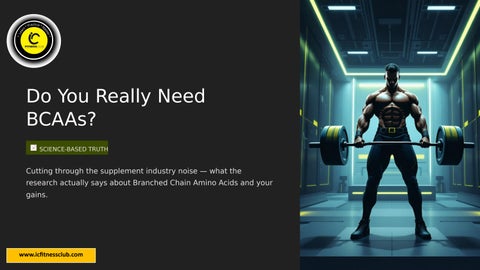
SCIENCE-BASED TRUTH
Cutting through the supplement industry noise — what the research actually says about Branched Chain Amino Acids and your gains.

Leucine
The primary trigger for Muscle Protein Synthesis (MPS). The most anabolic of the three.
Supports glucose uptake into muscles during exercise, aiding energy metabolism.
Valine
Assists in muscle tissue repair and helps maintain nitrogen balance in the body.
BCAAs are 3 of the 9 Essential Amino Acids (EAAs) — meaning your body cannot produce them; they must come from food or supplements.


A complete protein contains all 9 essential amino acids in sufficient quantities — everything your muscles need to grow and repair.

Leucine acts as the anabolic trigger — it activates the mTOR signalling pathway, which directly switches on Muscle Protein Synthesis.

Research shows that ~2–3g of Leucine per meal is the threshold needed to maximally stimulate MPS in trained individuals.
The good news? A single serving of whey protein (~25g) or a chicken breast (~150g) already delivers this amount — no BCAA supplement needed.

1 Stimulus
Resistance training creates micro-tears in muscle fibres, signalling the body to rebuild stronger.
2 Signal
Leucine activates the mTOR pathway — the cellular "on switch" for protein synthesis.
3 Supply
All 9 Essential Amino Acids must be available to complete the building process. BCAAs (just 3) cannot do this alone.
4 Synthesis
With full EAA availability, new muscle protein is built, leading to hypertrophy and recovery.

Taking BCAAs without a full amino acid profile is like trying to build a house with only 3 types of materials. You can start the process, but you cannot finish it.
BCAAs can trigger MPS via leucine
But without the other 6 EAAs, MPS stalls
• Result: wasted supplement spend, suboptimal gains
A 2017 study in Frontiers in Physiology confirmed that BCAAs alone produce a 50% lower MPS response compared to a complete protein dose.
Wolfe, 2017 — Journal of the ISSN
Concluded that dietary protein providing sufficient leucine is equally or more effective than isolated BCAA supplements for stimulating MPS.
Churchward-Venne et al.,
2012 Found that adding EAAs to a sub-optimal leucine dose restored MPS to full levels, proving all EAAs are required — not BCAAs in isolation.
Morton et al., 2015 — AJCN
Demonstrated that adequate total protein intake (1.6–2.2g/kg) already provides sufficient leucine and EAAs, making BCAA supplementation redundant.
The scientific consensus is clear: if your protein intake is sufficient, BCAA supplements offer no additional benefit.
EDGE CASES ONLY

Training on an empty stomach? BCAAs can provide a quick leucine signal and reduce muscle catabolism when no food is available preworkout.
Vegans or those consistently under-eating protein may benefit — though the better solution is always to increase whole food protein sources first.
Certain liver conditions (e.g. cirrhosis) or recovery from surgery may warrant BCAA supplementation under medical supervision.

Research consistently supports a daily protein intake of 1.6–2.2g per kg of bodyweight for muscle growth and maintenance.
Hit these numbers through whole foods + whey protein and you will never need a BCAA supplement.


BCAAs are not a scam — but they are unnecessary for anyone eating sufficient protein. Invest in quality whole foods and a good whey protein instead. Your gains (and your wallet) will thank you. Hit 1.6–2.2g/kg Protein Daily Prioritise Whole Foods First Follow IC Fitness Club Evidence-based fitness guidance — no fluff, no gimmicks.