The International Christian Embassy Jerusalem was established in 1980 in recognition of the biblical significance of Jerusalem and its unique connection to the Jewish people. Today the ICEJ represents millions of Christians, churches and denominations to the nation and people of Israel. We recognise in the restoration of Israel the faithfulness of God to keep His ancient covenant with the Jewish people. Our main objectives are:
* To stand with Israel in support and friendship;
* To equip and teach the worldwide Church regarding God’s purposes with Israel and the nations of the Middle East;
* To be an active voice of reconciliation between Jews, Christians and Arabs and to support the churches and congregations in the Holy Land.
From its head offices in Jerusalem, the ICEJ reaches out to more than 170 countries, with branch offices in over 90 nations.
Our vision is:
* To reach every segment of Israeli society with a Christian testimony of comfort and love, and
* To reach and actively represent to Israel the support of denominations, churches and believers from every nation on earth.
The Christian Embassy is a non-denominational faith-based ministry supported by the voluntary contributions of our members and friends across the globe. We invite you to join with us as we minister to Israel and the Jewish people worldwide by donating to the ongoing work and witness of the ICEJ.
WORD
FROM JERUSALEM CREDITS
ICEJ President Dr. Jürgen Bühler
Senior Vice President David Parsons
VP International Affairs Mojmir Kallus
VP Finance David Van der Walt
VP Operations Richard van der Beek
VP AID & Aliyah Nicole Yoder
Managing Editor/Publications Director Laurina Driesse
Staff Writers Nick Hansen, Nativia Bühler, Naomi Ammon
Additional Writers Howard Flower, Corrie van Maanen, César Folgar
Graphic Design/Illustrator Ryan Tsuen
Administration Jonathan Buker
Photography Adobe Stock, Shutterstock, JAFI, AP Photo, Adobe Firefly, ICEJ Staff, Branches and Projects
The New King James Bible is used for all Bible references unless otherwise noted.
Word From Jerusalem is published by the International Christian Embassy Jerusalem. Reproduction in whole or in part without written permission is prohibited. Word From Jerusalem has no subscription price and is supported through contributions worldwide. All gifts to this ministry are tax-deductible (in countries where this applies). For more information, visit us at www.icej.org
INTERNATIONAL CHRISTIAN EMBASSY JERUSALEM
P.O. Box 1192, Jerusalem • 9101002, ISRAEL
Support our ministry online at www.icej.org
FROM THE DESK OF THE PRESIDENT
Dear friends,
Within hours of the horrendous atrocities committed by Hamas on October 7, the world changed in dramatic and deeply troubling ways. Instead of seeing rallies of solidarity with the embattled Jewish state, we witnessed massive demonstrations of hundreds of thousands of protesters expressing support for the Hamas terror militia.
Just a few days ago, we spoke with a rabbi from the United Kingdom who described how profoundly that day altered the atmosphere for Jewish communities in England. He said they all sensed immediately that things had taken a turn for the worse. Wearing a kippah or a Star of David in public suddenly became too dangerous. Remarkably, some of his Muslim neighbours began warning him that his family was no longer safe there. They kept overhearing discussions in the local mosque that the “Jew” in their neighbourhood could no longer be tolerated. After multiple such warnings, he eventually moved his family and found temporary shelter with a pastor several towns away.
This is just one example of what is happening, not only in the UK but in many other nations. We are witnessing levels of anti-Israel and anti-Jewish hatred unprecedented since the Holocaust.
My greatest concern, however, is for the Church. Will we find our voice in these critical times? Will pastors rise to the challenge, educate their congregations, and stand with the people of God – who are still “beloved for the sake of the fathers,” and whose calling is “irrevocable”? (Romans 11:28–29)
Sensing the urgency of this moment, we feel compelled to act by calling for an emergency summit in Jerusalem. There is no time to delay. One of our friends and prayer leaders at the Global Prayer Gathering, Christine Darg, recently described it poignantly: “It feels as though the Church is hemorrhaging in the emergency room and in desperate need of urgent care.” We pray that from this Jerusalem Summit a clear prophetic voice will emerge – one that helps the Church find direction and courage in these days.
Please pray for the Jerusalem Summit, 9-11 June, and also consider attending in person as well!
Meantime, we continue to bless and comfort Israel in this critical season. At times, we may wonder how much “comfort” is still needed in a nation that has become one of the most successful in the world. Yet it is precisely in these days of global hostility to the Jewish state and people that our friendship and support are needed most. It truly feels that we are called to be here for “such a time as this!”
Every project we support conveys the message that there are millions of Christians around the world who love Israel and care deeply for her people. Whether it is reconstruction in the Gaza border area, caring for Holocaust survivors, assisting new immigrants, or helping others in need – we are here as your Embassy in Jerusalem.
I pray that you will be blessed as you read this magazine. Thank you for your prayers, your faithfulness, and your support.
May God bless you out of Zion!
Dr. Jürgen Bühler ICEJ President
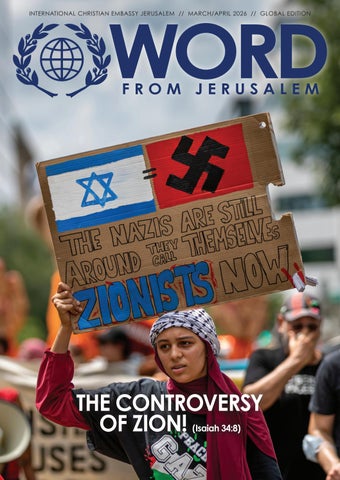
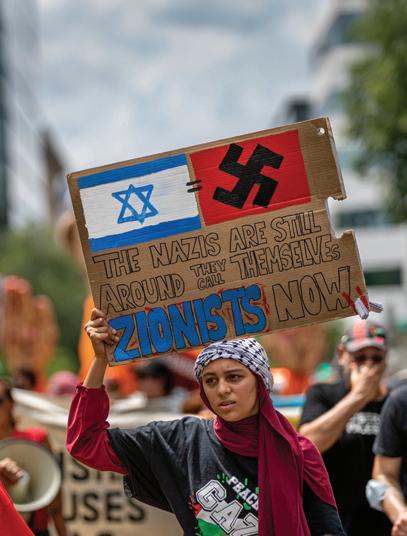
COVER PHOTO: Anti-Israel protest in July 2024 in Washington while PM Netanyahu addressed Congress -AP photo
The JERUSALEM SUMMIT
AN EMERGENCY CALL IN A CRITICAL HOUR
BY DR. JÜRGEN BÜHLER, ICEJ PRESIDENT
We are living through one of the most decisive moments in the modern history of the Church. Since October 7, the world has changed. Across Europe, North America, Latin America and beyond, we have witnessed a surge of antisemitism at levels unseen in generations. Jewish communities feel vulnerable again. Hatred that once hid in the shadows now marches openly in the streets. Israel is judged, isolated and delegitimised—not only politically, but morally and theologically.
In some nations and even in many churches, the word ‘Zionism’ has become a pejorative term. According to the Oxford dictionary, Zionism is “a movement for the reestablishment of a Jewish nation in Palestine (Land of Israel) and the development and protection of Israel.” Today, however. it is globally branded as racism and apartheid. Yet Israel is anything but an apartheid system. It is the most democratic and diverse nation in the Middle East.
The whole concept of Zionism is biblical in its origin.
The whole concept of Zionism is biblical in its origin. It goes back to the very first restoration movement of the Jewish people in Babylonian exile, when the Psalmist sang: “By the rivers of Babylon, there we sat down, we wept, when we remembered Zion.” (Psalm 137:1) Zionism is the ancient belief and hope
of the Jewish people that God will always bring them back from exile to their ancestral homeland, according to His promises in the Bible. But this enduring hope and belief has come under attack.
The prophet Isaiah declares, “For the Lord has a day of vengeance, a year of recompense for the cause of Zion (Isaiah 34:8/ESV).” The King James Version translates this verse as “a year of recompenses for the controversy of Zion”. We live indeed in a year of controversy about Zion, as the millennia-old hope for a Jewish homeland in Israel is under assault worldwide.
While Israel’s future is affirmed by countless biblical declarations, many in the Church are silent and indifferent about the current global wave of antisemitism, uncertain about what the Bible has to say on the Jewish return, or –worst of all – stridently opposed to Zionism.
Isaiah also once cried out: “For Zion’s sake I will not keep silent, and for Jerusalem’s sake I will not be quiet, until her righteousness goes forth as brightness, and her salvation as a burning torch.” (Isaiah 62:1/ESV) In times of moral confusion like now, silence is never neutral. Christians are looking for answers and direction in these days, and it should be found in the church of the living God – which Paul describes as “a pillar and buttress of the truth” (1 Timothy 3:15/ESV). But in far too many churches, Israel and antisemitism and the irrevocable calling of the Jews are ignored altogether. We cannot be silent anymore!
This is why the ICEJ is urgently convening the Jerusalem Summit!
From June 9-11, we will gather in Jerusalem an array of noted Christian leaders, theologians and scholars from around the world to address the burning issues of the current surge of global antisemitism, the historic roots of anti-Jewish views within the Church, and the theological apathy and opposition surrounding Israel’s restoration today. We want to provide Christian leaders and laymen the biblical answers they need to stand up to these daunting challenges now at hand.
Love for Jerusalem is not a sentimental emotion, it is a biblical responsibility based on God’s eternal covenant and calling of Israel.
CONFRONTING THE GLOBAL RISE OF ANTISEMITISM
Love for Jerusalem is not a sentimental emotion, it is a biblical responsibility based on God’s eternal covenant and calling of Israel. Revelation chapter 12 describes how a demonic attack would be unleashed against the woman, depicting Israel. This satanic dragon of hatred has many heads. It can pose as an Islamic fanatic, a university professor, a politician on the left or right, or even a clergyman of the church. The result is seen today in synagogues that must adopt heavy security measures, Jewish students feeling unsafe on university
campuses, and old antisemitic conspiracy theories reappearing in new cloaks that are even peddled by conservative influencers.
The Church cannot live in confusion in such a moment. Revelation 12 also tells us that in the end the Dragon also attacks those who have the testimony of Jesus. It means those doing his bidding will first go for the Shabbat people then the Sunday people. The Apostle Paul also reminds us in Romans 11 that Gentile believers in Jesus have been grafted into Israel’s olive tree. Thus, if the natural branches suffer, how can the grafted branches remain indifferent?
We must equip Christian leaders with theological clarity and moral courage to address antisemitism.
We must equip Christian leaders with theological clarity and moral courage to address antisemitism – not just as a political issue, but as a challenge to the spiritual health of the Church itself, lest we end up cursed and cut off from God’s redemptive purposes. Antisemitism has always been more than prejudice. It is resisting God’s sworn covenant promises. It is an attempt to delegitimize the people through whom God chose to reveal His Word and bring forth the Messiah. If the Church remains silent in this hour, we risk losing our prophetic voice altogether.
ADDRESSING THE NEW PAULINE PERSPECTIVE AND OTHER FORMS OF REPLACEMENT THEOLOGY
For centuries, various theological frameworks have arisen that subtly – or openly – severed the links between the Church and Israel. Replacement theology has taken many forms. In our time, it often appears in more sophisticated academic language, including
what is known as the “New Perspective on Paul.”
Academic discussions have their place. Yet when theological viewpoints lead to the conclusion that God’s covenant with Israel has expired, or that the Jewish people no longer have a distinct calling in God’s redemptive plan, we must return to Scripture itself. Paul asks in Romans 11:1 (ESV), “Has God rejected His people? By no means!”
This is not a minor footnote. It is central to the integrity of the Gospel. The faithfulness of God to Israel is inseparable from His faithfulness to the Church. If God’s covenant promises to Israel can be spiritualised away, what assurance remains for the Church?
The Jerusalem Summit will provide the scriptural foundations for affirming Israel’s enduring covenants, divine election, and Land promise from both Old and New Testament perspectives. We seek to help pastors and other church leaders to responsibly teach clear biblical truths in these days.
REVISITING THE NICAEAN COUNCIL AS A TURNING POINT IN CHURCH HISTORY
Last year marked 1700 years since the First Council of Nicaea, which was a defining moment in Church history. While it clarified essential doctrines concerning the divinity of Jesus, it also cemented the separation of the Church from its Hebraic roots. After Nicaea, this rift between the established churches and the Jewish people only grew.
Most markedly, while the Nicaean Council of 325 AD arrived at powerful truths on the divinity of Jesus, it lacked any recognition that our faith was rooted in the patriarchs and prophets of Israel. The biblical feasts were discarded and replaced by a new Gentile calendar. In a letter to the churches from Nicaea, Constantine proudly declared: “We ought not, therefore, to have anything in common with the Jews… We desire, dearest brethren, to separate ourselves from the detestable company of the Jews…”
The Jerusalem Summit will revisit these historical church decisions and seek to amend certain theological errors concerning the Jewish people. While the Nicaean creed should be fully affirmed regarding
the divine nature of Jesus, we will propose an updated creed that affirms the Jewishness of Jesus.
WHY JERUSALEM?
Jerusalem is not merely a geographic location, it is the crossroads between heaven and earth. Jerusalem was the epicenter of the original church in New Testament times, and it is appropriate to hold such a council again in Jerusalem to resolve issues that are shaking and challenging the Church today. While this gathering is being convened on relatively short notice, the issues are urgent and do not allow for delay. In a recent Global Prayer Gathering, our sister Christine Darg compared the Church with a sick body that is hemorrhaging and needs immediate medical attention. This is true even for many Evangelical churches. And Jerusalem is the emergency room for fixing it.
Jerusalem is where heaven meets earth. God placed His name here forever, and all the redemptive acts of history have and will play out in this city. We trust that God will speak in this critical time through faithful Bible teachers and theologians.
A HISTORIC RESPONSIBILITY AND OPPORTUNITY
If you are a pastor, theologian, ministry leader, educator, or if you simply care about Israel and the Church today, then this is your time to come to the Jerusalem Summit. The issues we face will not disappear through avoidance. They require biblical depth, historical awareness, and spiritual courage.
Today, the credibility of the Church is at stake and Jerusalem is the place for you to come engage, take action, and change the destiny of your church and nation concerning Israel. So, join us this coming June.
I look forward to welcoming you at the Jerusalem Summit!
9-11 June, 2026
JERUSALEM SUMMIT
ICEJ STATEMENT ON CHRISTIAN ZIONISM
In January, an anonymous cleric released a cryptic statement purporting to speak for all the Patriarchs and Heads of the historic churches in Jerusalem which denounced Christian Zionism as a “damaging ideology”. It soon emerged that the statement was not endorsed by all the church leaders in Jerusalem, most notably the Latin Patriarch, Cardinal Pierbattista Pizzaballa. Meanwhile, it was aimed at an Israeli civic association which is seeking to better integrate indigenous Arabic-speaking Christians into Israeli society, outside the supervision of the traditional heads of the churches. Their ‘sin’ was that they had started engaging with Evangelical Christians who support Israel, including US Ambassador to Israel Mike Huckabee. In response, the International Christian Embassy Jerusalem released a statement defending Christian Zionism, which stated in part:
“The International Christian Embassy Jerusalem takes issue with the recent Statement from the Patriarchs and Heads of Churches in Jerusalem … concerning its charge that Christian Zionism is among the ‘damaging ideologies’ being advanced by unnamed local individuals to ‘mislead the public, sow confusion, and harm the unity of our flock.’”
“As Christians, we adhere to a Zionism that is purely biblical in origin, belief, scope and practice – reflecting our sincere faith convictions and
not shifting political objectives. The promised restoration of Israel in modern times enjoys ample biblical credentials in both the Old and New Testaments. The Jewish return to the Land of Israel both reflects and affirms the faithful nature and character of God to always keep His sworn covenant promises, thereby strengthening the Christian faith rather than damaging or undermining it.”
“Further, the promised Jewish return to Zion has been taught and embraced by many devout Christians throughout the Church age, from the original Apostles and some of the early Church fathers to medieval clergymen, right up to the modern-day Protestant and Evangelical church movements. Christian Zionism thus predates Supersessionism and will survive its passing.”
“The respected Catholic prelate Cardinal Christoph Schönborn, Archbishop of Vienna, once expressed his support for Biblical Zionism, maintaining that it was doctrinally important for Christians to recognize the Jewish people’s deep connection to their ancestral homeland, and adding that Christians should rejoice in the Jewish return to the Land of Israel as a fulfilment of biblical prophecy. We could not agree more.”
The CHURCH in the VALLEY of DECISION OVER ISRAEL
BY REV. PETER TSUKAHIRA
The theme of this conference is ‘Israel and Your Church’. Why is Israel important to your congregation? Our generation of Christians has witnessed the implosion of the influence of the mainline Protestant churches in Western society. All over Europe, the loss of numbers and influence of the state-sponsored Protestant churches is breathtaking. Their place was taken in the last generation, especially in the United States, by the Evangelical, Charismatic wing, and by independent mega-churches. Now, there is a real crisis and battle for the future of the Evangelical movement, focused on two big issues: authority and authenticity.
Specifically, where is the authority we read about in the Early Church? Why is it not in the Church today? And how can it be restored? Is it in miracles? In being prophetic? In assigning the right ministry titles? These are symptoms of the lack of authority. Frankly, we see signs of desperation, and may I say of deep disillusionment. It shows in the number of ministry leaders that we love and respect falling from their positions, having been revealed as living double lives for years. It is as if the leaders themselves are disillusioned. And this points to a crisis of authority. What is the authority of the modern Church? And where does it come from?
The other crisis is authenticity. The younger generation are not looking for a religiously defined bubble they can hide in. They are looking for an authentic lifestyle of faith to carry with them everywhere they go, for something that addresses culture and society and personal identity, something more than just songs. They are looking for authenticity, and attendance in Evangelical churches worldwide is waning, and it is not just due to the Covid pandemic.
Young people are not drawn to that scene. The next generation is desperate and hungry for something real in the Christian faith, and they are not finding it in many of the ministries around us today.
Now both authority and authenticity are related to another word –author! An author is the originator of something. The author is the one who should have the authority and authenticity. And for Christians all
over the world, what we know for sure about God is what we find in the Scriptures. Having come to that conclusion, the next step is easy: The authors of the Scriptures are the Jewish people. Not just some of the authors, but all of the authors that God chose to write His word. Everything that every Christian has ever known for 2000 years about the only true God comes from one people group. Is that an accident?
If we want authority about what God said and what He wants, there is one address. If we want authenticity, you have to restore this. It is not optional, because the Church worldwide is in crisis, whether we recognise it or not.
The real issue for the Church is: Where do you stand with Israel? Every church, every ministry leader, every believer, will be forced to make that decision. Multitudes are in the valley of decision. God is calling the Church into this valley. Where do you stand with Israel? Because it is in this valley that the end-time, bride-like characteristics of the Church will be determined. And some will walk out of this valley in victory, and others will be left behind.
So let us take a look at the Scriptures. For example, Romans 11, right in the middle of the New Testament, where Paul – the Jewish apostle to Gentile believers – tells us that Israel’s stumbling over the Gospel brought riches to the Gentiles, while their acceptance will mean “life from the dead” (vs. 11-15). God was powerful and wise enough to turn Jewish rejection of Jesus into a glorious victory for the Gentiles. But how much more will their acceptance be? My congregation on Mount Carmel are Israeli Jews who are coming to the Lord and worshiping Yeshua in his own land, in his own language, among his own people, for the first time in 2000 years. You can come see it with your own eyes, and connect with this very passage in Scripture. It is revelatory, to see it with your eyes and read it in Scripture, and suddenly the penny drops.
That is what the Church needs. Where does the authority come from? Where does the authenticity come from? It is like a spring bubbling out of the ground, life from the dead. That is what your church needs.
[Excerpts from Peter’s message at the ICEJ’s recent Envision pastors’ conference in Jerusalem.]
THE CONTROVERSY OF ZION
BY DAVID PARSONS, ICEJ SENIOR VICE PRESIDENT & SPOKESMAN
Many Christians today are reluctant to stand with Israel and risk being a target of scorn. Indeed, after October 7 there is a clear dividing line on “Zionism”, even within the Church. Amazingly, the prophet Isaiah foresaw this day, proclaiming:
“For it is the day of the Lord’s vengeance, and the year of recompences for the controversy of Zion.” (Isaiah 34:8/KJV)
Surely, it is time to decide which side you are on!
I have found it is so much easier to stand with Israel today if you can grasp two biblical, prophetic truths:
1. The restoration of Israel in these last days is affirmed in the New Testament; and 2. The current conflict is in essence a spiritual battle over Israel’s national redemption.
THE RESTORATION OF ISRAEL IN THE NEW TESTAMENT
The Bible is clear that Israel is promised a last days’ restoration – both a physical return to the Land and a spiritual return to God through their promised Messiah (Ezekiel 36:24ff; Romans 11:25-27).
This two-phased return is in keeping with God’s sworn covenant promises to the patriarchs Abraham (Genesis 17:8), Moses (Leviticus 26:44-45; Exodus 33:14; Hebrews 4:9), and David (2 Samuel 7:12-16; 1 Chronicles 22:7-10).
The Hebrew prophets then came along to tell us something about how God would keep these sworn covenant promises to Israel. Ezekiel 36:24ff is the clearest passage
on Israel’s physical return to their Land and then their spiritual return to God. Amos 9:15 also assured the Jewish people that after two exiles and two returns, they were “never to be uprooted again.” And Isaiah 9:6-7 promised the end result would be the Messiah sitting on the throne of David and ruling the entire world in an everlasting kingdom.
But what does the New Testament say about all this? Some Christians claim the New Testament never mentions a last days’ restoration of Israel. They also say Jesus himself dismissed the restoring of the kingdom to Israel in Acts 1:6-7. Yet he just said the timing of this promised restoration is in God’s hands alone.
Elsewhere, Jesus clearly affirmed both the physical and spiritual restoration of Israel in the last days. In Luke 21:24, he accurately predicted the exile of his people and Gentile rule over Jerusalem “until the times of the Gentiles are fulfilled.” In other words, the Jews’ physical exile from Jerusalem and the land would one day have an end. Then in Matthew 23:39, Jesus also foresaw Israel’s spiritual restoration, saying to Jerusalem: “You shall not see me again until you say, ‘Blessed is He who comes in the name of the Lord’.”
Jesus also assured that Elijah will return and “restore all things” (Matthew 17:11). He further declared that in the “regeneration” – the Messianic Age to come – his closest followers would sit on twelve thrones judging the twelve tribes of Israel (Matthew 19:28). In other words, Israel makes it into the Millennium as a redeemed people!
The Apostle Peter also preached that Jesus will not return until the “restoration of all things” spoken by the Hebrew prophets (Acts 3:19-21).
Everyone listening to these repeated promises of “restoration” knew they all were referring to the great Jewish hope for the restored, everlasting kingdom promised to David and Solomon.
Finally, the Apostle Paul foresaw a time – after the fullness of the Gentiles comes in – when “all Israel shall be saved.” This occurs when a Deliverer comes forth from “Zion” and takes away ungodliness from Jacob (Romans 11:2527). What a ringing endorsement of Zionism and its redemptive purpose!
THE SPIRITUAL BATTLE OVER ISRAEL’S REDEMPTION
The Bible also foresees an intense spiritual battle over Israel’s national redemption. This struggle will eventually draw all nations up to Jerusalem, to be humbled and judged there by God over their mistreatment of Israel (Psalm 2; Isaiah 2; Daniel 2:34-35, 44-45; Joel 3; Zephaniah 3:8; Zechariah 12 & 14).
Consider that in Revelation 12, the Apostle John sees a vision of a woman clothed with the sun, with the moon under her feet, and a garland of twelve stars on her head. This imagery comes straight from Joseph’s dream in Genesis 37:9 and clearly depicts the nation of Israel. She is engaged in a great spiritual battle in the heavenlies with a fierce dragon seeking to thwart her role in God’s redemptive plan. And the burning question is: Why is Satan still seeking to destroy the woman Israel after her son is caught up to heaven? The answer is that Israel still matters to God. And Zionism is all about the completion of God’s redemptive plan for the sake of the whole world. That is worth standing with!
Photo credit: AP - Pro and anti-Israel protesters face off in Washington, DC
ENVISION 2026 GIVES PASTORS FRESH REVELATION ON ISRAEL
BY LAURINA DRIESSE (WITH CONTRIBUTIONS BY NAOMI AMMON)
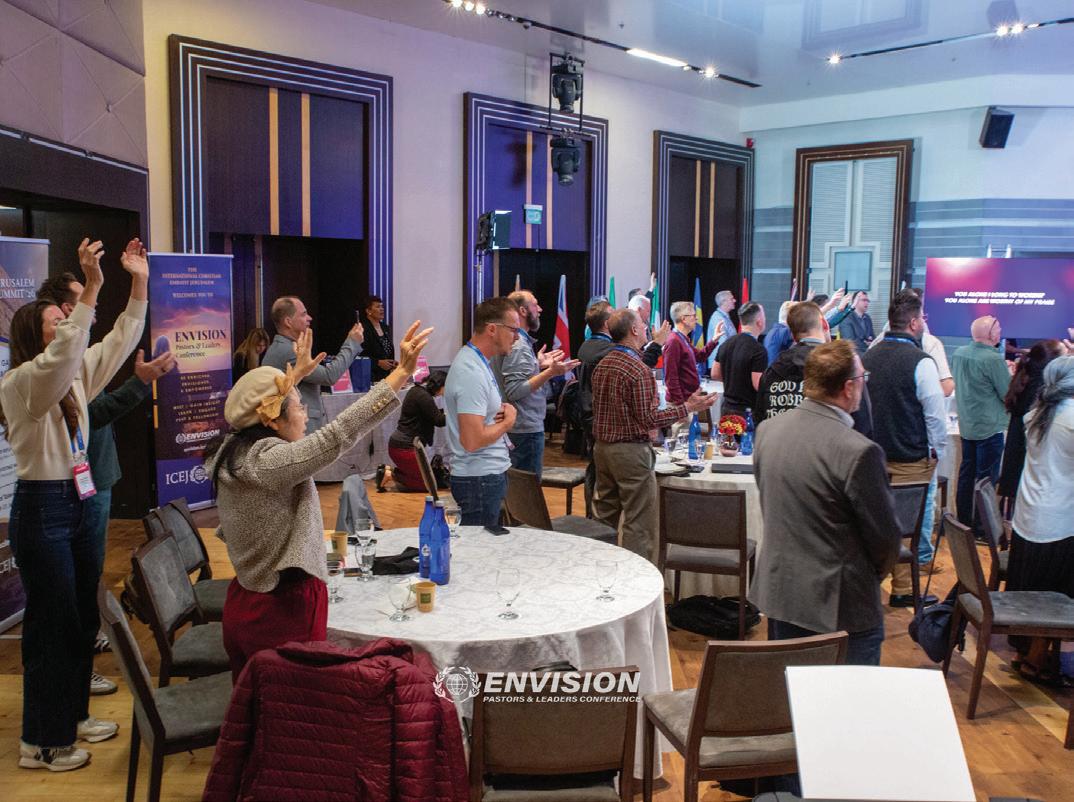
Amid rumblings of renewed war with Iran, over 70 pastors and ministry leaders from 20 nations gathered in Jerusalem in early February for the ICEJ’s Envision 2026 conference. The four-day teaching conference, held under the theme “Israel and Your Church,” offered fresh revelation and biblical understanding on Israel amid the chilling surge in global antisemitism and even denunciations of Christian Zionism from fellow Evangelicals. Delegates heard from an array of Israeli and international speakers, including Bible scholars, diplomats, and security experts.
OPENING CHALLENGE
Rev. Ingolf Ellßel, Chairman of the ICEJ’s Board of Trustees, led out the conference by challenging the pastors to boldly stand with Israel, citing examples in Scripture where Gentiles gave aid and comfort to Israel in ways that pleased the Lord. Looking at the long journey of Israel, Ellßel noted it is a nation that often appears to stand alone. But he pointed to the Persian ruler Cyrus, as well as the Moabite woman Ruth who showed many kindnesses to Naomi, even as her sister-in-law Orpah turned away. This reveals two types of Christians today, he said, those who know about Israel but remain indifferent, and those who choose to truly stand with Israel.
“I don’t want any pastor to miss a blessing of God,” Ellßel concluded, reminding the delegates of the special blessing promised by God to those who stand with Abraham and his Jewish offspring.
DAY TWO: TEACHING AND FAITH DIPLOMACY
The next day featured an excellent lineup of Bible teachers, followed by visits to the Knesset and Israeli Ministry of Foreign Affairs.
Dr. Mojmir Kallus, ICEJ Vice President for International Affairs, opened the morning sessions with a very unique take on Psalm 122 and its call to “Pray for the Peace of Jerusalem!” He used the verses of this beloved Psalm to offer a prophetic picture of how the Church should reflect God’s purposes over Jerusalem as a “house of prayer for all peoples.” He noted how an accurate understanding of Israel today closely connects many diverse Christians together, just as Jerusalem was “built as a city that is compact together.” Dr. Kallus added that the thrones set for judgement in this passage include God’s ultimate judgment of the nations over how they have treated the Jewish people.
Peter Tsukahira highlighted the current crisis of authority and authenticity in the Evangelical church, and urged that we go back to the original Jewish authors of the Bible to remedy this crisis and reconnect with the Church’s Hebraic heritage (see teaching on page 7).
Prof. Gerald McDermott, an Anglican theologian, explained the biblical basis of Christian Zionism and urged a deeper understanding of Israel’s
central, enduring role in God’s redemptive plan. His message focused on the historical and theological importance of the Land promise throughout the Bible, and especially in the New Testament. “It is not just the Old Testament that teaches that God gave the Land of the Canaanites as a permanent gift to the Jewish people. The Land promise is taught and implied throughout the New Testament,” McDermott assured. “Zionism is all over the New Testament.”
pastor John
who
a dynamic young congregation in Dublin, then spoke on contending for the faith of our fathers. He stressed the need for pastors to be well-informed, courageous, and moved by conviction to speak out in support of Israel and the Jewish people. “If you love the God of the Bible, you love the people of the Bible… Israel still factors in God’s eternal plans”, he proclaimed. Ahern added that Israel is central to our Christian faith and history, and that the Church must stand with Israel today despite societal pressures to the contrary.
Irish
Ahern,
has
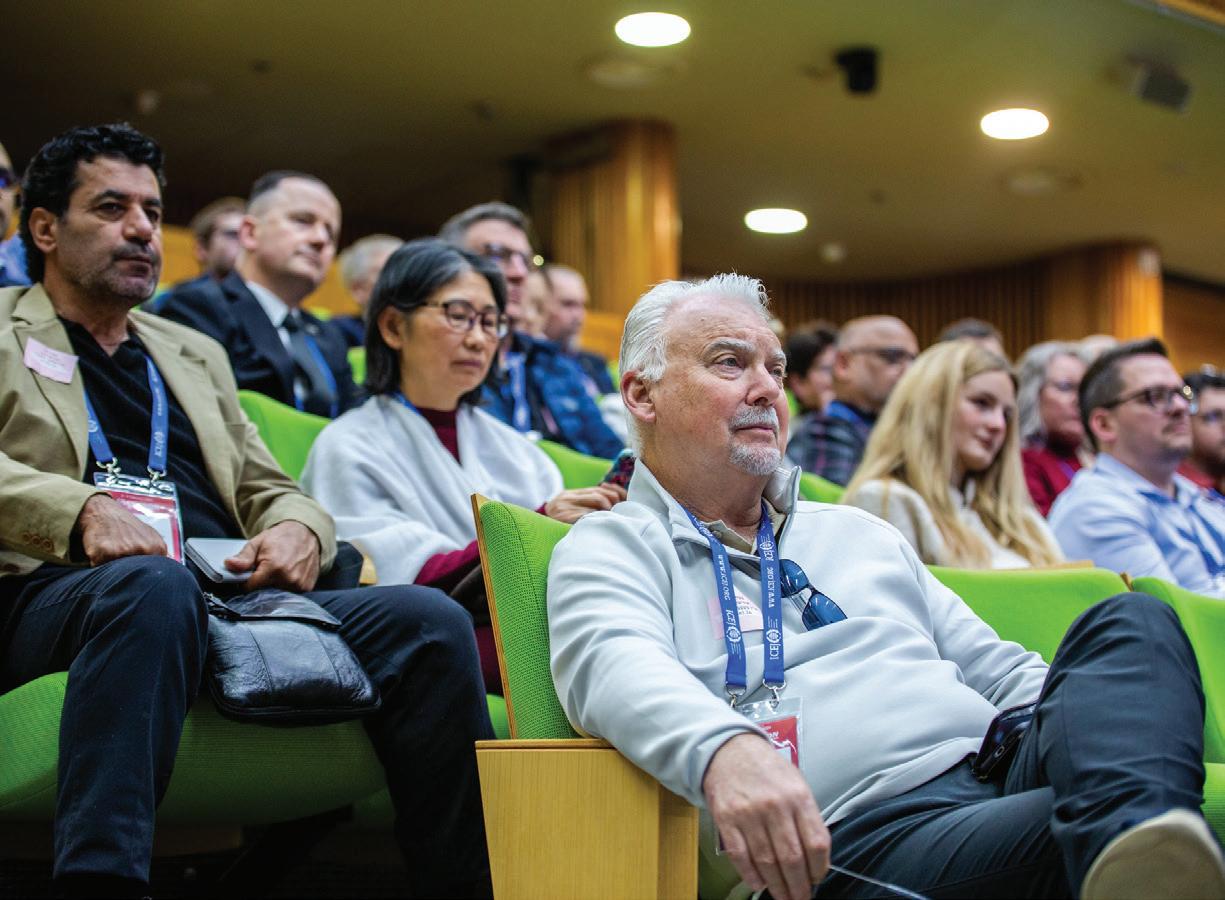
Envision pastors taking notes during the conference sessions.
Envision delegates listen to Pastor Peter Tsukahira during Day Two of the conference.
Rev. Ingolf Ellßel
In the afternoon, Envision delegates were hosted in the Knesset, Israel’s parliament, and at the offices of the Foreign Ministry.
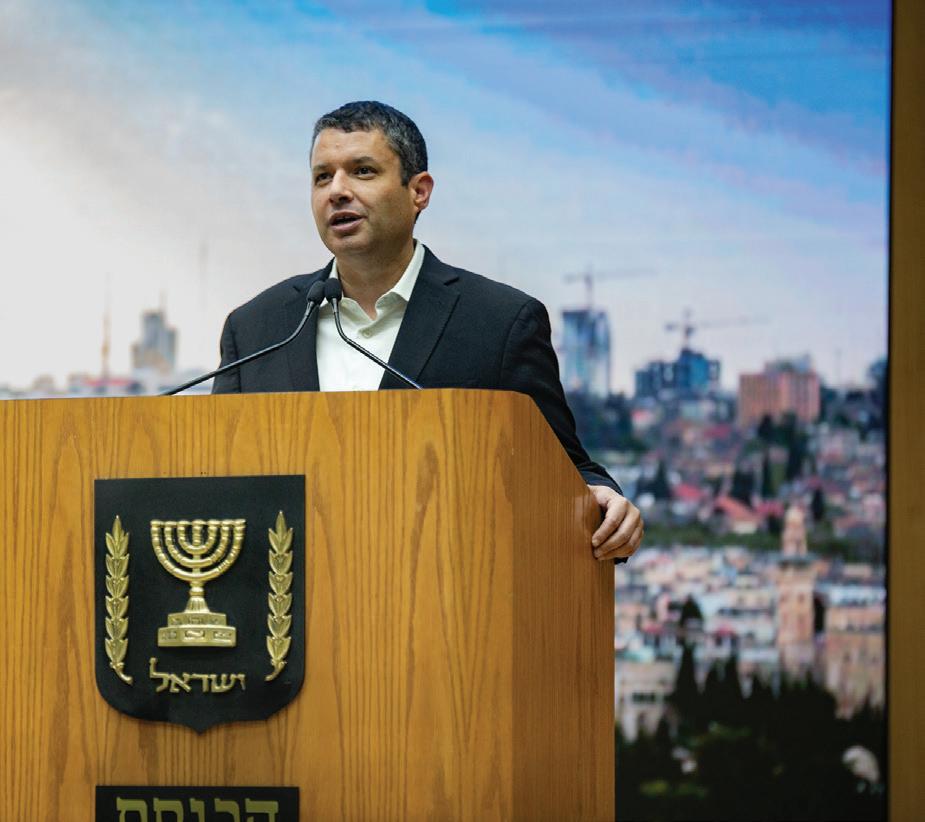
Josh Reinstein, Director of the Knesset Christian Allied Caucus, welcomed the pastors to the parliament of the only true democracy in the Middle East. “The Knesset is the only place where you can come, speak your mind, there’s freedom of speech, you can say what you want, and you can pray,” said Reinstein.
“Here, we have the judicial branch, the legislative branch, and the executive branch all represented in one person, as only God can be trusted with all three roles of governance”, he explained. “We have to split them up and have checks and balances on power, which is the basis of our constitutional democracies. This is part of our JudeoChristian heritage and Israel deserves the credit for giving it to us, not Athens or Rome.”
He also shared that the idea behind establishing the Christian Allies Caucus in 2004 was to build direct lines of communication and cooperation with Christian leaders around the world.
“We realised during the second intifada that it was Christians, not countries, which were standing with Israel,” Reinstein recounted. “We knew we had to build a new relationship between Jews and Christians, and that’s why we partnered with the ICEJ. The Christian Embassy always has a place at the table.”
“Today, the KCAC is connected to sister pro-Israel caucuses in the parliaments of 64 countries around the world”, he continued. “What we do is faith-based diplomacy, when people take their biblical support for Israel and turn it into real political action.”
Knesset member Moshe Tur Paz, co-chairman of the KCAC, told the Envision delegates that these days faith-based diplomacy is sometimes the only diplomacy that works around the world.
Envision delegates listen intently during presentations at the Israeli Knesset.
“Community and faith-based connections have always been something very essential for me,” he said. “Some people connect through buildings, some people connect through time, but really, faith-based people connect through their beliefs.”
David Parsons, ICEJ Senior Vice President & Spokesman, explained that many Westerners think our modern democratic systems and values came from Greco-Roman culture, when actually they derive from Israel and the Bible. Parsons noted that Isaiah 33:22 says: “For the Lord is our Judge, the Lord is our Lawgiver, the Lord is our King.”
Afterwards, our entourage was hosted at Israel’s Foreign Ministry and heard from four senior diplomats – including three ambassadors. They gave overviews of Israel’s current challenges worldwide, including the rising wave of antisemitism, the Trump plan for rebuilding Gaza, and the unyielding threat posed by Iran.
That evening, Parsons delivered a message on “The Controversy of Zion”, speaking from Isaiah 34:8 about the biblical credentials for Israel’s modernday restoration and God’s impending judgment of the nations for opposing this redemptive process (see teaching on page 8).
DAY THREE: ISRAEL’S PRESENT AND FUTURE
The next day began with ICEJ-Denmark national director Nick Hansen discussing the importance of integrating Israel into our pastoral teachings. He shared a fascinating study with statistical evidence of powerful nations down through history rising and falling in economic strength based on their treatment of Israel and the Jewish people.
Hansen also drew a thought-provoking analogy between the sufferings of Job and the critical responses of his friends in comparison to how Christians have always tended to look down on a suffering Israel. “When Israel suffers, what does the Church say?” he asked. “Too often, we behave like Job’s friends in Israel’s time of persecution, critiquing and advising, not comforting and serving.”
Ramin Parsa, an Iranian Christian now living in Jerusalem, shared his transformative journey from Islam to Christianity while still in his native Iran. He also called for urgent prayer for Iran’s freedom today. He insisted that the Iranian people are hungry for the Gospel. “They’ve heard that Islam is a fraud and are coming to the Lord,” he said.
IDF Lt. Col. Ihab Shlayan, the highest-ranking officer from the indigenous Christians in Israel, then shared about the challenges faced by the local Arabic-speaking Christian community, and his efforts to fully integrate them into Israeli society. Ihab said he proudly considers himself a “Zionist” because he supports the state of Israel as the historic homeland of the Jews and a welcoming place for all its minority peoples.
Next, IDF Brig. Gen. Amir Avivi gave an excellent strategic briefing on Israel’s current security challenges, the failures and fallout from the October 7 war, and the still looming threat of Iran’s missiles and nuclear program. He assessed that a US-led attack on Iran is still likely,
Josh Reinstein, Director of the Knesset Christian Allied Caucus
ICEJ Senior Vice President David Parsons
and urged that it aim for a decisive victory. If Israel can consolidate its victory against Iran and its proxies Hamas and Hizbullah, he expects a surge in Aliyah to Israel by Jews from around the world.
The afternoon and evening sessions saw further presentations by Prof. McDermott, and Israeli pastors Israel Pochtar from Ashdod and Daniel Yahav from Tiberias, as well as a time of prayer led by Joshua Gooding, head of the ICEJ’s Prayer Department. In addition, Envision attendees heard from local Israeli believers Daniel and Ruth Lischinsky about the heart-rending story of their son Yaron, who was the promising young Israeli diplomat gunned down with his fiancée by a terrorist in the streets of Washington, DC last year.
DAY FOUR: SEEING IS BELIEVING!
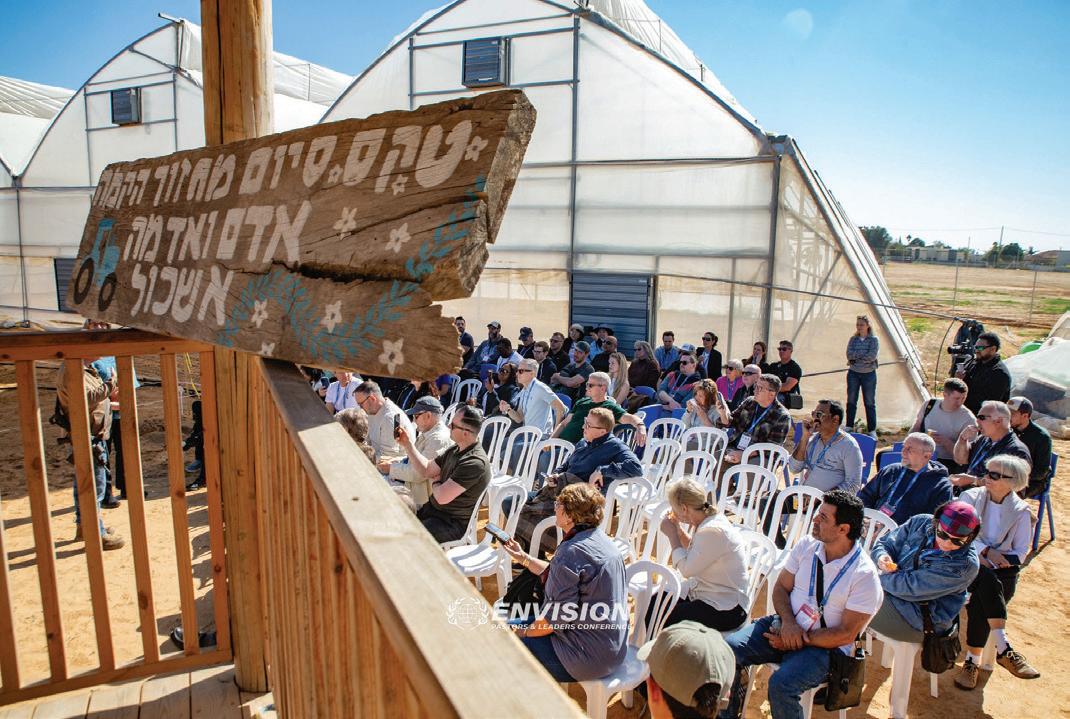
The last day of Envision featured a field trip to Israeli communities along the Gaza border which suffered the brunt of the Hamas terror attack on October 7. There, the Envision pastors visited an innovative new Agro-Tech high school which the ICEJ has helped launch by providing funds for a large experimental greenhouse and a four-classroom learning center. The school’s faculty shared how the vision for the school was born out of the tragic events of October 7. Several students also gave impressive explanations for why they were drawn from across Israel to study at this unique high school (read more about this project visit on pages 14-15).
Then it was on to the site of the Nova music festival, which has become a national memorial for the hundreds of victims massacred and kidnapped on October 7. The Envision delegates were deeply moved by the way Israelis are honouring those who fell there on that dark day.
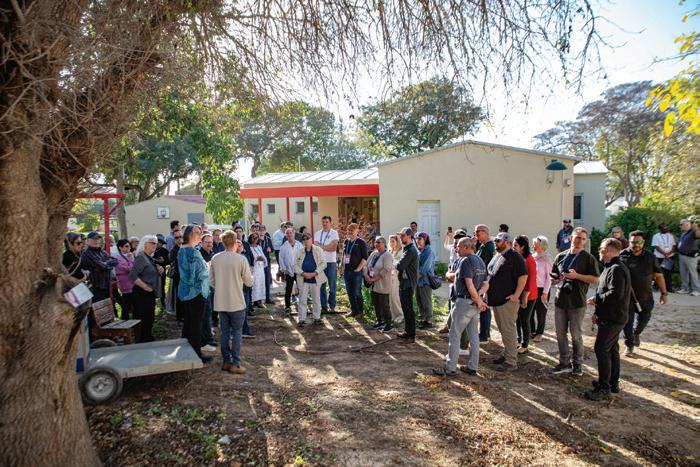
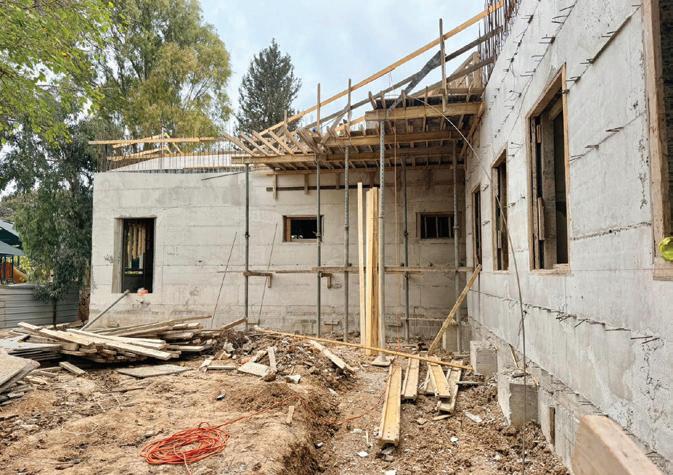
The next stop was Kibbutz Be’eri, where the group toured the damaged and burnt homes left in the wake of the Hamas invasion and heard the personal story of a survivor of the attack while standing in what was once his home. At Kibbutz Be’eri, the ICEJ has embarked on three major building projects, including a dental clinic, an activity and trauma care center for the elderly, and an after-school activity center for the youth, which delegates could see is now under construction (read more about the visit to Kibbutz Be’eri on page 13).
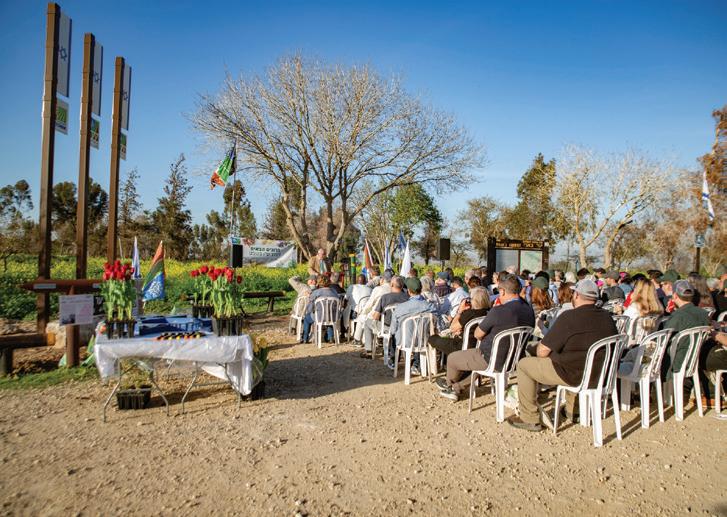
The afternoon ended with a memorial ceremony hosted by the Jewish National Fund and the planting of an olive tree and dozens of red and yellow tulips at the entrance to Kibbutz Be’eri in memory of those lost on October 7. Before the sun set, the Envision pastors also made a quick bus ride to see the Christian Embassy Nature Park, located right on the border with Gaza. The ICEJ is sponsoring the replanting of this area with oak trees and other native species, and it was exciting to see all the new green growth brought out by this winter’s ample rainfall.
PASTORS SHARE ON THE IMPACT OF ENVISION
“It is really life-transforming to have feet on the ground and to be hearing the things we are hearing and visiting the places we have gone to. Just listening to different people from different nations and the transformation that God has brought into their lives, and how He is connecting truth dots; and when those truth dots come together, how people become so passionate and almost unstoppable for the things of God and His Kingdom.”
Trisha from South Africa
“Everything has been so good. I am teaching a class at my church on why to stand with Israel and the messages here are answering the questions I am getting.”
Arlene from Canada
“Including all the great teachings, I was really moved by the authenticity of the ICEJ leaders and how well they are respected. You are good news to the Kingdom. I just want to say I honour you. This was my first conference, and it definitely won’t be my last. I’m going home to organise for some people to come visit next time. I just want to say thank you. Your love for Christ is very obvious and is shown through your works.”
Harold from the United Kingdom
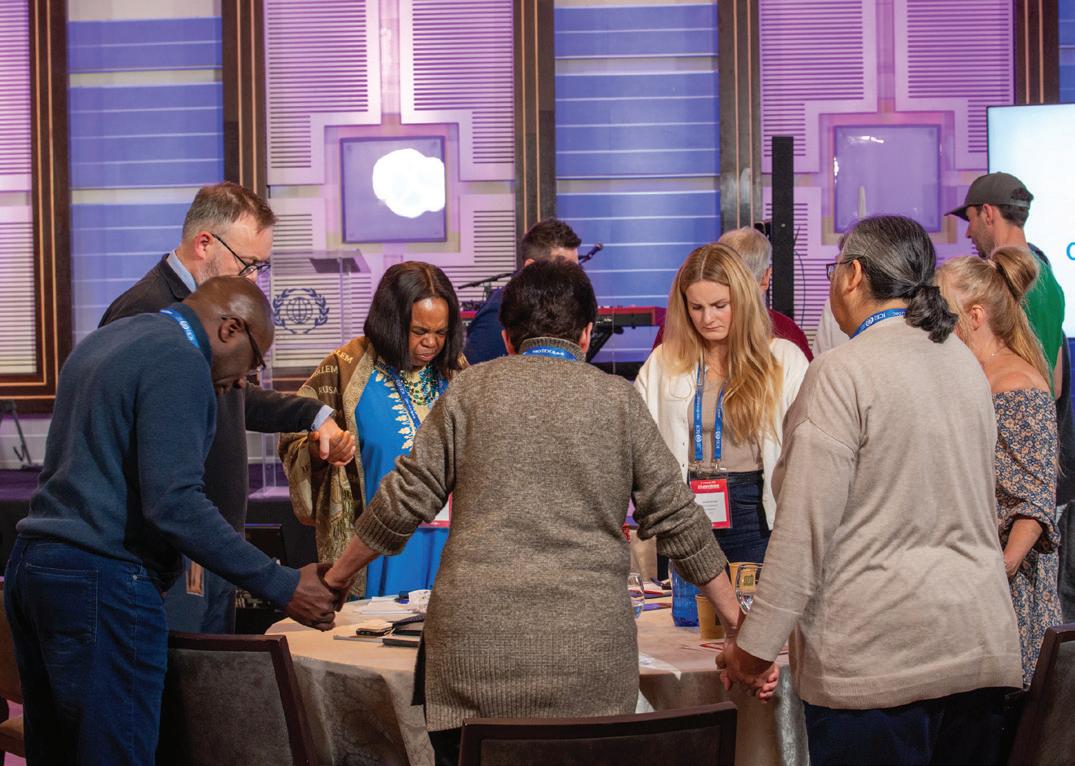
Envision pastors engage in prayer on the afternoon of Day Three of Envision.
ICEJ-Germany National Director
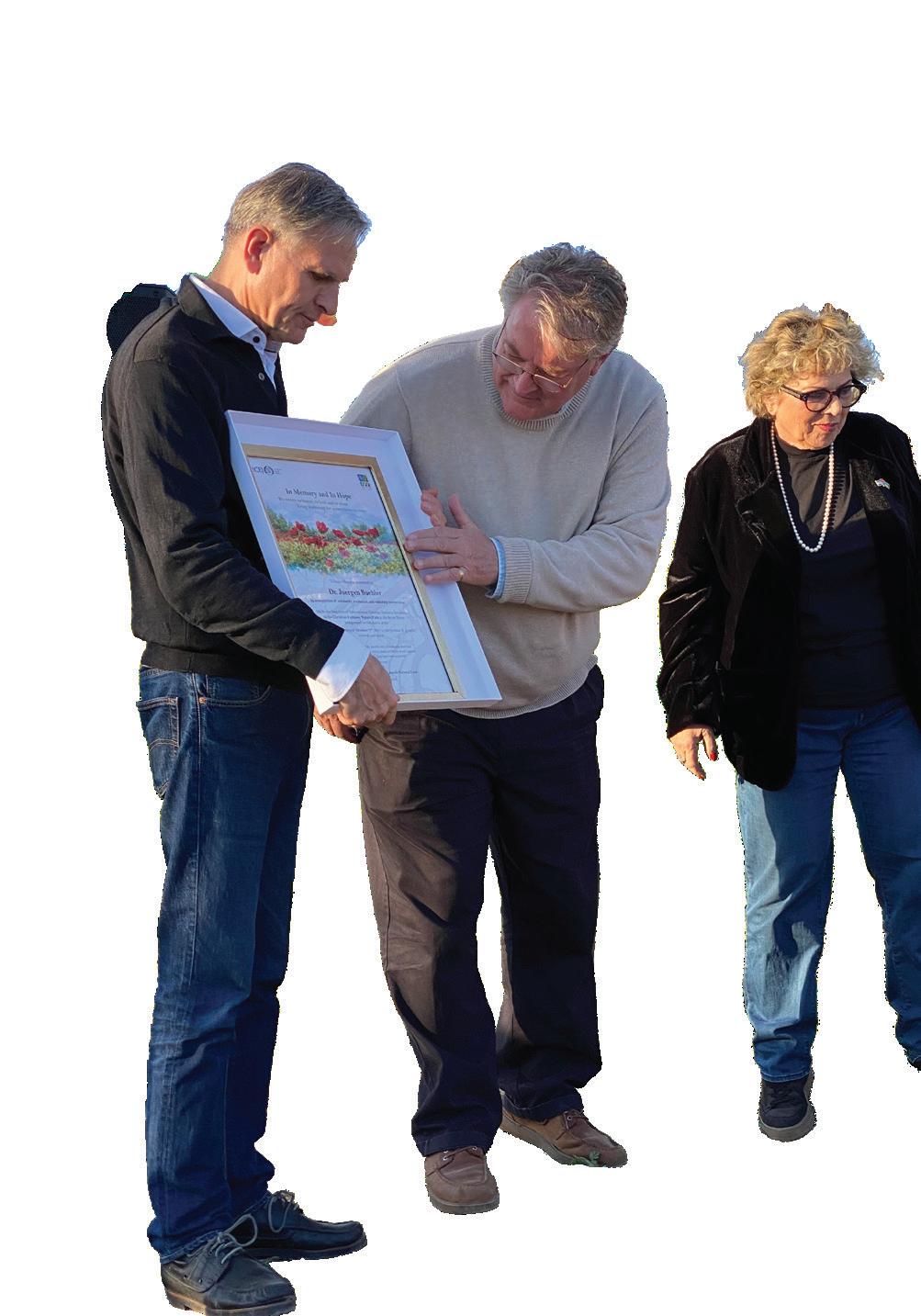
Gottfried Bühler and ICEJ Senior Vice President holding a special plaque from KKL-JNF.
Envision delegates at the Be’eri Forest.
Tulips that were planted at the Be’eri Forest.
ICEJ LEADERS JOIN MAJOR PRO-ISRAEL CONFERENCE IN WASHINGTON
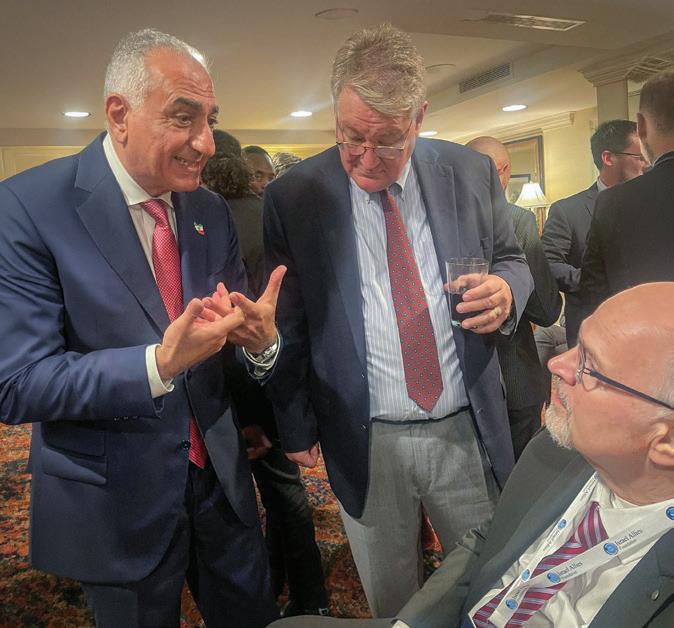
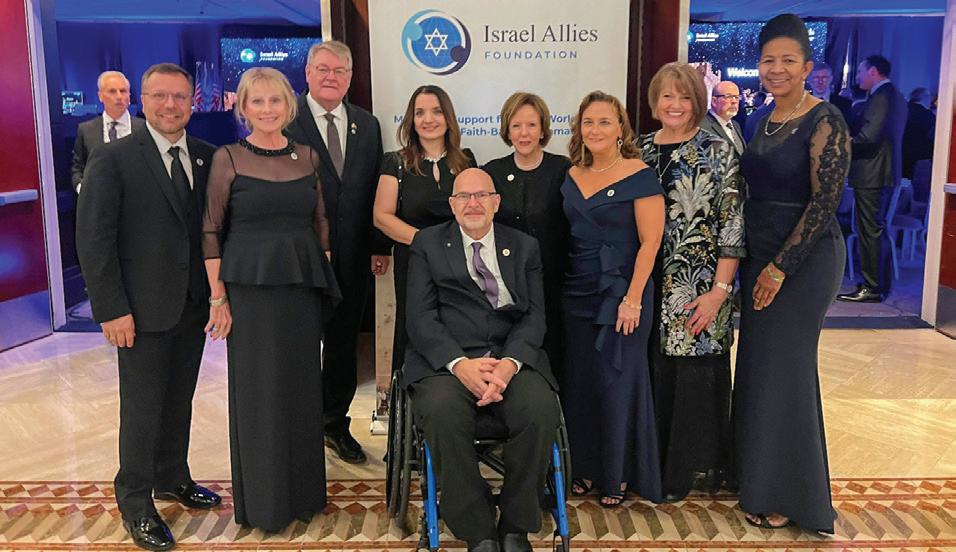
Recently, ICEJ President Dr. Jürgen Bühler and Senior Vice President David Parsons travelled to Washington, DC to represent the Christian Embassy at the annual Chairmen’s Conference of the Israel Allies Foundation, which we help to sponsor. They were joined there by ICEJ-USA national director Dr. Susan Michael and other key members of her team. This year’s IAF gathering drew dozens of lawmakers from pro-Israel caucuses in over 60 national parliaments worldwide. The conference included briefings at the White House by senior Trump administration officials and a gala banquet to honour the US President for his strong stand with Israel. Dr. Bühler addressed the opening session of the IAF conference, and at a reception and dinner later on Capitol Hill, he and David Parsons were able to engage in a lively discussion with special guest Crown Prince Reza Pahlavi, son of the former shah of Iran. Pahlavi explained his plan for transitioning his native country to a more free, democratic system should the people finally be able to topple the oppressive clerical regime in Tehran. This would include a shift to much friendlier relations with Israel under what many now refer to as the Cyrus Accords.
Honoring Corrie for dedication par excellence!
BY LAURINA DRIESSE
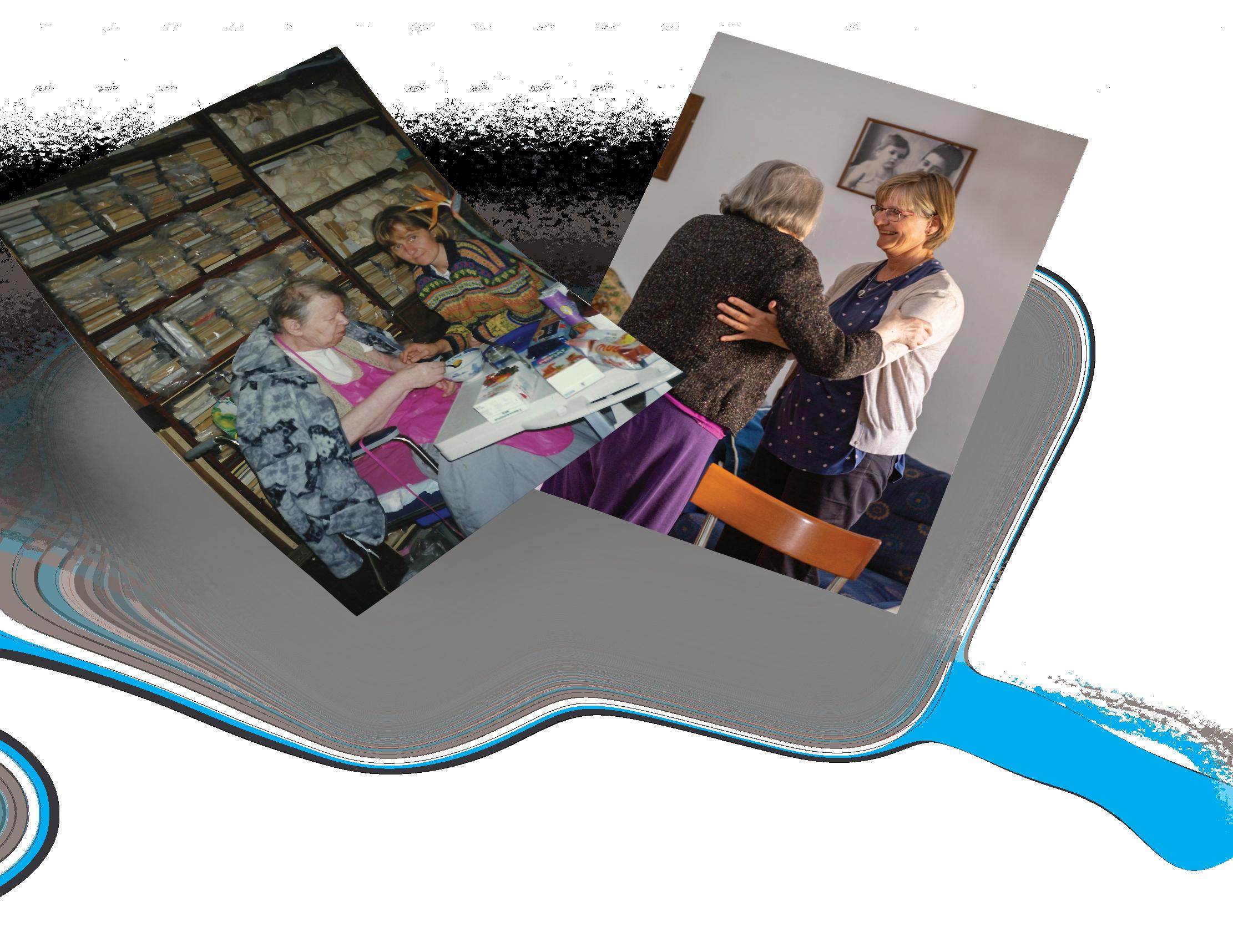
When ICEJ Homecare nurse Corrie van Maanen arrived at the ICEJ thirty years ago, she had no idea how her role would unfold and the impact she would have on the lives of those around her. But she knew she was called to Israel to serve and comfort elderly Jewish immigrants in need of nursing care. She has been fulfilling that calling in amazing ways, not only in Jerusalem but around the country.
In January, our Jerusalem staff celebrated with Corrie her 30th work anniversary of dedicated service with ICEJ. The gathering was a special time of reflection, sharing memorable moments, offering prayers, and receiving gifts, followed by a delicious lunch.
ICEJ President Dr. Jürgen Bühler recounted that the ICEJ’s founding mandate in 1980 is taken from Isaiah 40:1 – “Comfort My people!” – before adding that “Corrie lives and breathes this every day!”
ICEJ Deputy Aid Director Yudit Setz came from Haifa to celebrate this moment with Corrie, having worked closely together with her for three decades now. Yudit explained about their shared Dutch heritage and similarities.
“Corrie has been doing her work quietly, and she has impacted so many lives,” Yudit said. “God has given a lot of wisdom to Corrie, and she is extremely faithful and loyal… She not only walks the extra mile but does it together with the Lord.”
ICEJ Senior Vice President David Parsons noted that our biblical mandate includes the calling to “speak tenderly to Jerusalem” and then told Corrie: “You’ve been able to speak tenderly about the love of God to a lot of lives here in Israel.”
When it was time for Corrie to respond, she expressed her love for the staff and thanked God for enabling her to stand and serve so many elderly people under her care who came to Israel from the former Soviet republics.
“Homecare is actually rooted in Aliyah,” explained Corrie. “It’s grace from God, and a time for thanksgiving to Him that He has helped me and sustained me, and that He gives me the wisdom I need to help all these precious people.”
Dr. Jürgen Bühler and David Parsons with special guest Crown Prince Reza Pahlavi.
Dr. Jürgen Bühler and Senior Vice President David Parsons at the annual Chairmen’s Conference of the Israel Allies Foundation with Dr. Susan Michael and other key members of her team.
Corrie receives prayer from fellow ICEJ staff.
WITNESSING SCARS, FINDING HOPE AT KIBBUTZ BE’ERI
BY NICK HANSEN
“He heals the broken-hearted and binds up their wounds.” (Psalm 147:3)
Amain highlight of the ICEJ’s Envision pastors’ conference in February was a deeply moving visit to Kibbutz Be’eri, one of the worst-hit Gaza border communities invaded by Hamas terrorists on October 7, 2023.
Located in the western Negev just two kilometres from Gaza, Kibbutz Be’eri was the scene of a horrific massacre in which 101 civilians and 31 security personnel were killed and dozens were taken hostage by Gazan terrorists. Entire neighbourhoods were devastated, and more than two years later much of the kibbutz still stands empty and in ruins, with burned out buildings standing as silent witnesses to that dreadful morning.
Envision delegates hear testimony from October 7.
For many Envision participants, this was their first visit to Israel, and seeing the tangible aftermath of October 7 with their own eyes left an unforgettable impression. Local kibbutz guides led us from site to site, entering even the scorched, bullet-ridden homes where families were brutally murdered, and recounting the haunting stories that unfolded there. The experience was sobering and deeply impacting.
Pastor Wayne Sandeman from South Africa, a first-time visitor to Israel with the ICEJ, was moved by the guide’s personal testimony. Leading the group into his own bullet-ridden, burned-out home where he and his family had fought to survive for 16 hours on that horrific day. Slowly, he revealed the full reality of that dark moment.
“It put you right face-to-face with Hamas, the beast that it is”, recalled Pastor Wayne. “That heartless, cold hatred to walk into a civilian neighbourhood and do such things.”
activities, counselling and community life –helping them recover from trauma and rediscover joy and belonging.
Youth activity center under construction.
A second major project is the construction of a modern dental clinic in one of the hardest-hit parts of the kibbutz. Also built from the ground up, this new facility aims to restore dignity, physical well-being, and normalcy in everyday living.
The ICEJ is also assisting in the renovation of an elderly care center in the kibbutz, giving seniors a welcoming place for fellowship and medical attention. For residents who lost homes and years of memories, these community hubs represent a path toward healing that goes far beyond bricks and mortar.
For the pastors who came to Israel to deepen their understanding of Scripture and the enduring spiritual significance of this nation, seeing these aid projects was a profound reminder that faith and compassion must translate into visible examples of love in action.
Standing in front of the new buildings, ICEJ’s Vice President of Aid and Aliyah, Nicole Yoder, explained that “this represents a hug from the nations… It’s our tangible expression of love.”
Pastor Wayne later reflected on the experience in the kibbutz.
Yet, amid the stark testimony of pain and destruction, the visit also shone with hope and renewal. As part of the field trip on the last day of Envision, participants were introduced to several key rebuilding projects being sponsored by the ICEJ that are helping to restore life and purpose in Be’eri and neighbouring communities.
One such initiative is the new Be’eri youth activity center. Completely destroyed on October 7, the original facility is being rebuilt from the ground up with ICEJ funding. When finished, it will provide children and teens with safe space for recreational and educational
“The one word that stands out is the word resilience”, he said. “These people keep choosing life. They’re going to rebuild. They’re going to make it better than before.”
The visit to Be’eri was also a rare moment in time. With plans underway to demolish the remaining destroyed homes and clear the site for new construction, this was one of the last chances for visitors to witness the original aftermath of the October 7 assault before renewal reshapes the landscape.
The ICEJ remains committed to walking with these communities, helping to build not just structures but hope, resilience and opportunity. This is possible because of your support in bringing healing and life where there has been brokenness and loss. Please continue to support the ICEJ’s Israel in Crisis fund.
Envision pastors visit the AgroTech high school in Sde Nitzan.
DICEJ DONATES CLASSROOMS FOR ISRAELI AGRO-TECH SCHOOL
BY LAURINA DRIESSE
uring the ICEJ’s recent Envision pastors’ conference, delegates toured Israel’s southern region and visited an innovative new Israeli Agro-Tech high school based in Sde Nitzan, where young students are planting roots deep into the Land.
Entering the school campus, delegates learned that prior to the October 7 attacks, foreign workers played a vital role in Israeli agriculture. But following the Hamas terrorist invasion, many of these workers left the country, severely cutting farm production.
In response, local educators and community leaders decided to establish a special AgroTech school project near the Gaza border. Its goal is to equip the next generation of young Israelis with farming skills to help rebuild the local agriculture sector, foster innovation, and strengthen their connection to this special corner of the Land of Israel. It is located in the Eshkol Valley, where the twelve Israelite spies once found the region flowing with milk and honey and much fruit (Numbers 13).
By July 2024, the foreign workers’ living quarters were renovated into student dorms and the search for teachers began. By September, 30 students from across Israel left their families to start studying at the Agro-Tech school even though it still lacked classrooms. Initially, the urgent need was to build a greenhouse classroom, and the ICEJ swiftly stepped in to sponsor this. Later, the ICEJ committed to providing four needed classrooms. During our visit, we were very pleased to find the four prefab classrooms and a larger learning center being set in place to soon host classes.
Ofek, the school’s principal, shared his journey of coming from the north to help establish the Sde Nitzan Agro-Tech school.
“We just realised this was needed to bring hope, to build, to educate young people to be connected to the Land,” shared Ofek. “Last year we opened the first class with 30 students, and today 50 students are enrolled in grades 10 to 12.”
Ofek noted that many of Israel’s early visionary leaders were farmers and ranchers. The school stresses hard work and character development to cultivate future leaders.
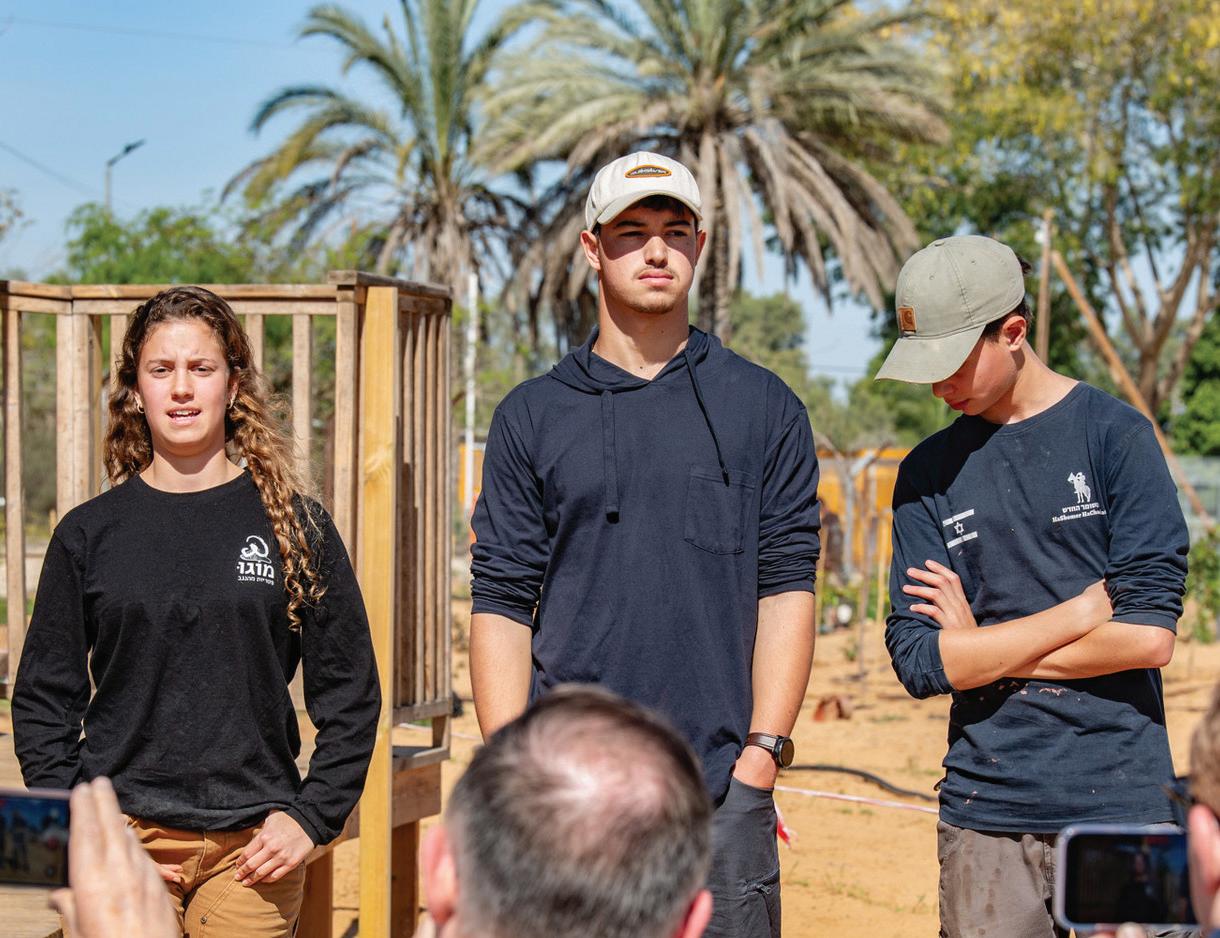
Three students shared their daily routines and motives for attending the school. Their day begins at 5 AM to work on nearby farms, return home to have lunch, then study intensively for 4-5 hours until early evening. Despite the demanding schedule, the students have a strong sense of purpose and community.
“Every day I wake up with a sense of meaning, which is something I searched for, and that is why I came here. Every day I wake up with a feeling that I’m rebuilding…” shared Roi, now 16. “It is really important to me to work the Land of Israel.”
Natan, 15, related how he has now worked on many different farms,
picking lemons, oranges, flowers, avocados, tomatoes and lettuce.
“I personally really love the farms we work in as I really feel I am doing something meaningful,” expressed Natan. “Helping them and re-establishing this area [after October 7] really gives me a good feeling… Every day when I go to sleep, I feel like I’ve done something good.”
Tamar, 16, shared that her mother is a mushroom farmer, but after October 7 they were evacuated and her mushroom business collapsed.
“I understood how much hard work it takes to be a farmer and how much help is needed, so I decided that I want to do something meaningful with my teenage life”, said Tamar.
Students Tamar (L), Roi and Natan shared their experience and motivation for being at this special school.
Envision
“I came here and saw that the kids are doing this all by themselves and that the teachers are just here for help. You learn to be a leader.”
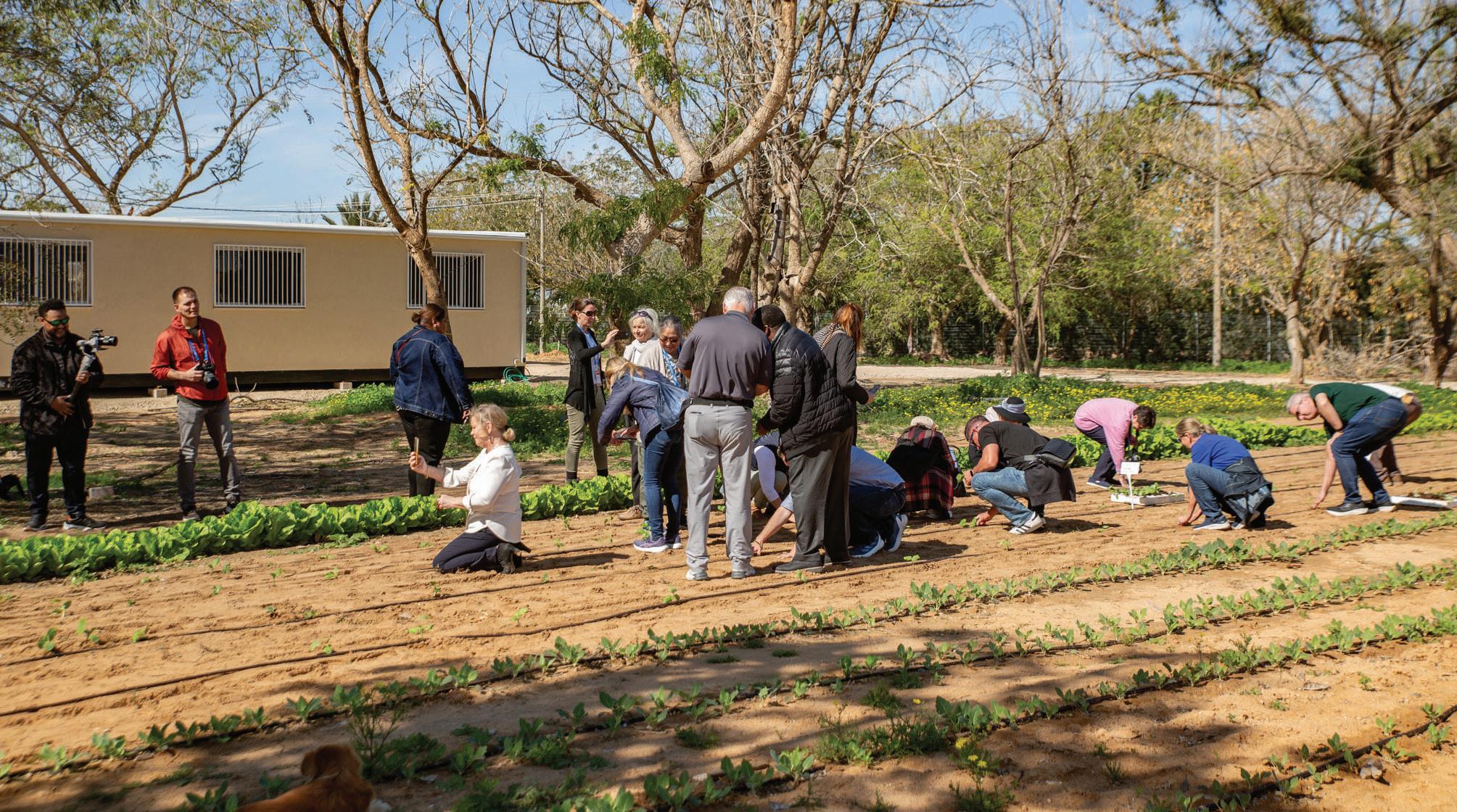
Omri, the school’s agronomist, told the visitors about key research underway at the school, including integrated pest management (IPM) for onions, growing carrots in salty water and increasing oyster mushroom yields. The greenhouse also explores hydroponics and algae cultivation. The onion research alone could revolutionise pest control worldwide. As the visit ended, the school leaders thanked the ICEJ for our support, with special nods to the donors from Germany, Switzerland and the USA. The Envision delegates were then invited to plant pumpkins and zucchinis in the field before leaving.
Your support of our Israel in Crisis fund is helping Israelis rebuild in the aftermath of October 7. Please give today at: help.icej.org/crisis.
ACTIVITY KITS HELP BEDOUIN CHILDREN OVERCOME FEARS FROM WAR
BY NATIVIA BÜHLER
In times of national crisis, the quietest victims are often the youngest. When Iran fired massive missile barrages at Israel last year, fear gripped every home. This especially included Arab and Bedouin families in the Negev who live near IDF bases that were being specifically targeted by the radical regime in Tehran.
In the remote Bedouin communities of southern Israel, most families do not have access to proper bomb shelters, leaving them feeling totally exposed. For the children, normal life of school and play time came to an abrupt halt, replaced by long, uncertain hours stuck inside four thin walls.
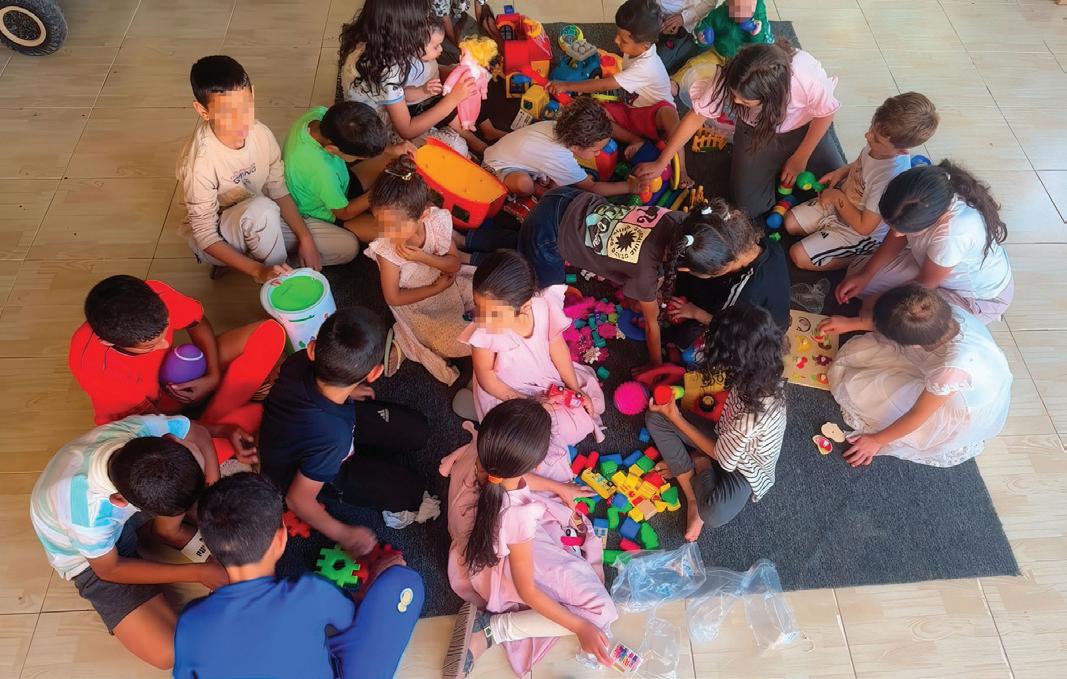
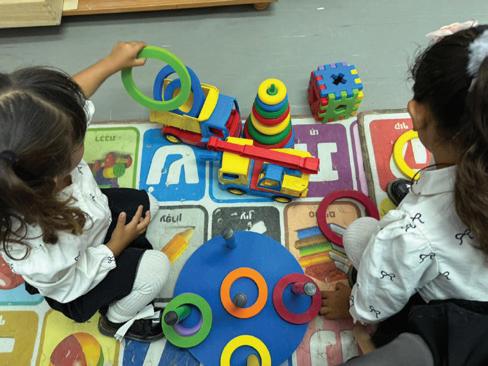
When an urgent request for help came in, the ICEJ responded out of the belief that every child in Israel deserves a childhood. We quickly distributed youth activity kits to Arab and Bedouin families in the Negev to assist the children in coping with their fears. The kits had already been assembled and stored in advance, so we were able to begin handing them out the moment the IDF Home Front Command’s emergency protocols were activated. And the activity kits proved vital in helping these vulnerable families deal with the difficult circumstances.
The contents of the youth activity kits were selected by specialists to both support their emotional needs and make learning fun. Designed to serve small groups, they ended up benefitting a total of 640 children across the region. The kits included:
Drawing supplies, vibrant oil pastels, and playdough to help children turn their energy into art, providing a healthy outlet to ease their tensions.
Educational books and magnet blocks kept young minds engaged and curious, ensuring that development did not stop due to the war.
Small sports balls, card games, and dice games transformed tense rooms into spaces of laughter and interaction.
The activity kits also helped provide a routine that gave worried parents some relief from their own tensions.
An added value of this initiative is its longevity. As the acute period of the conflict subsided, the impact did not. Many of these kits have remained with the families, continuing to serve as tools for growth and development. Others were redirected to local daycares and children’s centers, strengthening the educational infrastructure of these municipalities for the long term.
The ICEJ remains deeply committed to the well-being of all of Israel’s citizens. By supporting these Arab and Bedouin families during these hardest of times, we are investing in the future harmony of Israel’s diverse society.
Support our Future & Hope projects by donating at: help.icej.org/future-hope
ALIYAH FROM THE EAST
BY HOWARD FLOWER, ICEJ ALIYAH DIRECTOR
“In those days the house of Judah shall walk with the house of Israel...”
(Jeremiah 3:18)
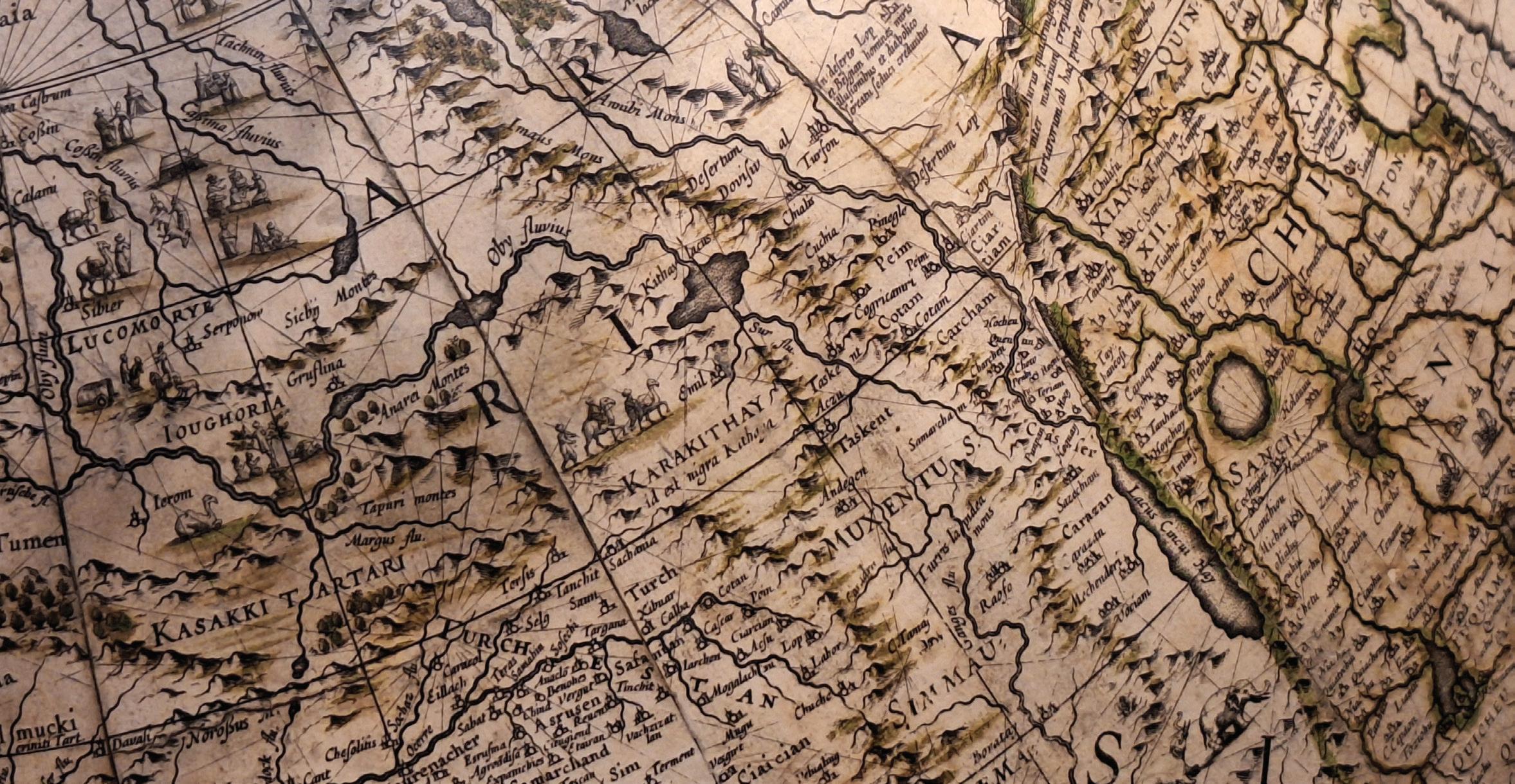
Look at a map of the ancient Silk Road, and you will see the well-worn pathways of human commerce and conquest. But look with eyes of faith, and you will see something more – the route of Israel’s exile and prophetic return foretold long ago. For centuries, scattered Israelite tribes dwelt in the far reaches of this vast region, from the steppes of Central Asia to the walled cities of China and misty hills of India.
Today, that exile is starting to end with the return of the Bnei Menashe tribe to Israel. The International Christian Embassy Jerusalem has had a key role in helping to facilitate this modern-day miracle of the great Aliyah from the East.
This is no mere story of migration, it is the actual fulfilment of Scripture. When Isaiah proclaimed God would “bring your descendants from the east” (Isaiah 43:5) and gather them from the “land of Sinim” (China – Isaiah 49:12), he was speaking about our day.
When he spoke of a great shofar sounding for those “lost in the land of Assyria” (Isaiah 27:13), he was referring to communities like the Bnei Menashe, whose exile began with the Assyrian conquest 2,700 years ago. That means we are not just observers of history, but participants in Bible prophecy.
Our practical involvement in this special ingathering of the exiles began when doors opened after the fall of the Soviet Union. As we started to aid Bukharan “Mountain Jews” in Central Asia, in 1998 a team from ICEJFinland drove a bus all the way to Uzbekistan to help bring them to airports and Aliyah seminars. When China opened further, we reached out to the ancient Chinese Jewish community of Kaifeng, helping the first family make Aliyah in 2000. These were not just logistical triumphs, they were moments of profound biblical confirmation.
But the heart of this ongoing story is the return of the Bnei Menashe. Here is a community that never forgot their heritage. Through 27 centuries – from Assyria to Persia, China and India – they kept Shabbat, rejected unclean foods, and sang an ancient song that unmistakably echoes the Exodus. When ICEJ began sponsoring their flights in 2012, we were joining a prophetic story written by God. We have now helped bring over 1,300 of them home. To see a Bnei Menashe village in northeast India empty out and leave for Zion is to witness a biblical miracle.
by positive tests, their dreams put on hold. But the Christian Embassy donated funds for shelter, food and medicine until the way re-opened. Why? After they had waited to return for 2,700 years, we had no choice but to help see them through the last hurdles on the way home to Israel.
Now, another remarkable moment has arrived. Late last year, the Israeli government launched Operation Wings of Dawn (Kanfei Shahar), a state-funded, five-year plan to bring every last Bnei Menashe – some 5,800 children of Israel – home by 2030.
While the state of Israel is taking the lead, the need for Christian support remains vital. Our challenge is to now partner with Christians worldwide in this final, glorious chapter by sponsoring Aliyah flights, helping with absorption costs, and offering a warm embrace of Christian love for Israel’s returning children. Some 1,200 Bnei Menashe are expected to arrive this year, starting with the first flight of 180 in March. The ICEJ will be sponsoring Aliyah flights for 100 of them.
The difficulties and delays of recent years have tested their resolve. During the COVID pandemic, we helped them through obstacles at the New Delhi airport, when families approved and packed for Aliyah, were left stranded
Imagine the scene: a plane lifts off from New Delhi, carrying descendants of the ancient tribe of Manasseh. Beneath them the land of their exile fades; ahead lies the land of their forefathers. They are the literal fulfilment of God’s tender promise: “I will bring them back, because I have mercy on them. They shall be as though I had not cast them aside.” (Zechariah 10:6)
The Aliyah from the East is reaching its Godordained ending. You can be a part by standing with us in this prophetic cause. Let us be the ones who help these precious exiles come home.
ALIYAH
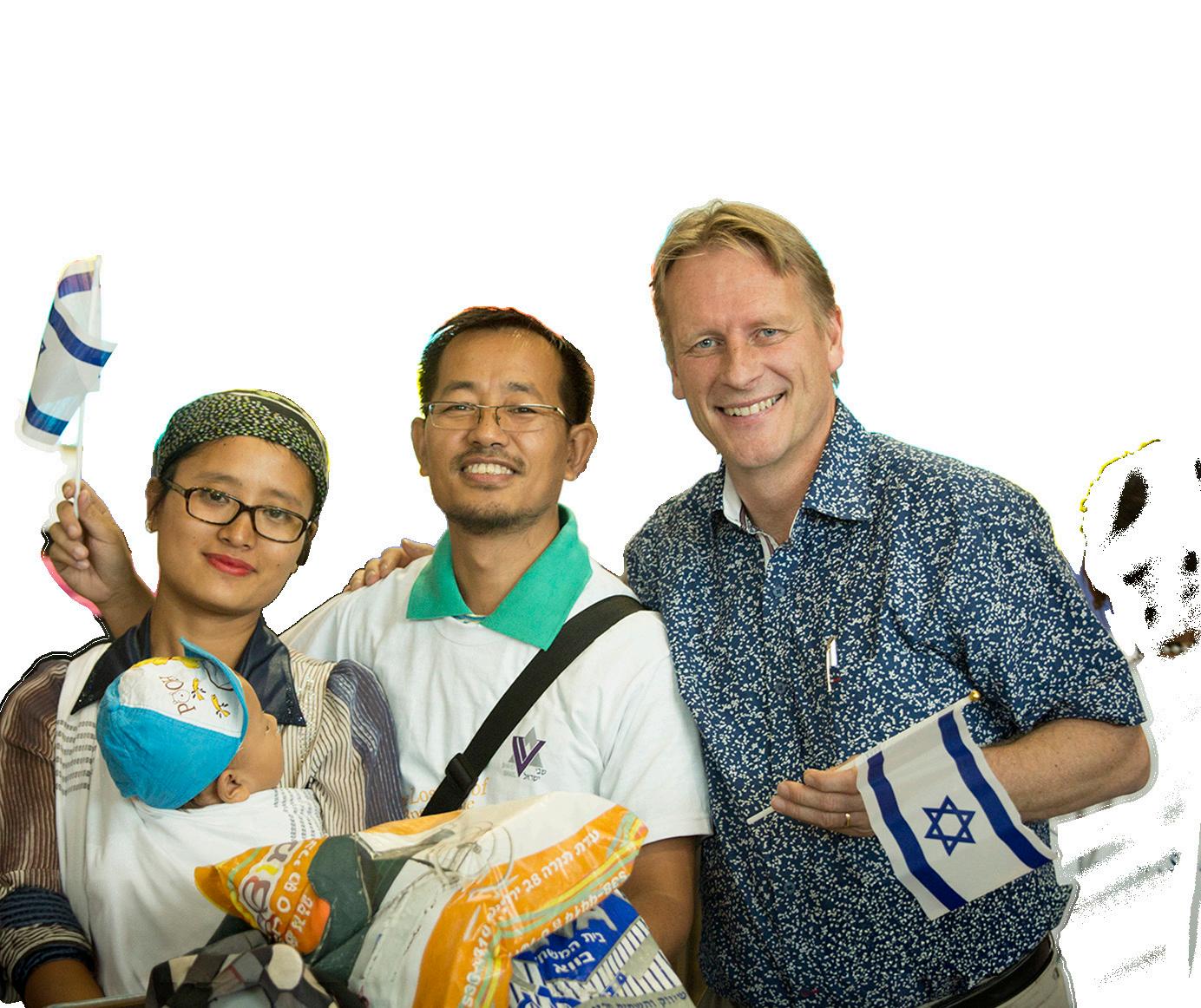
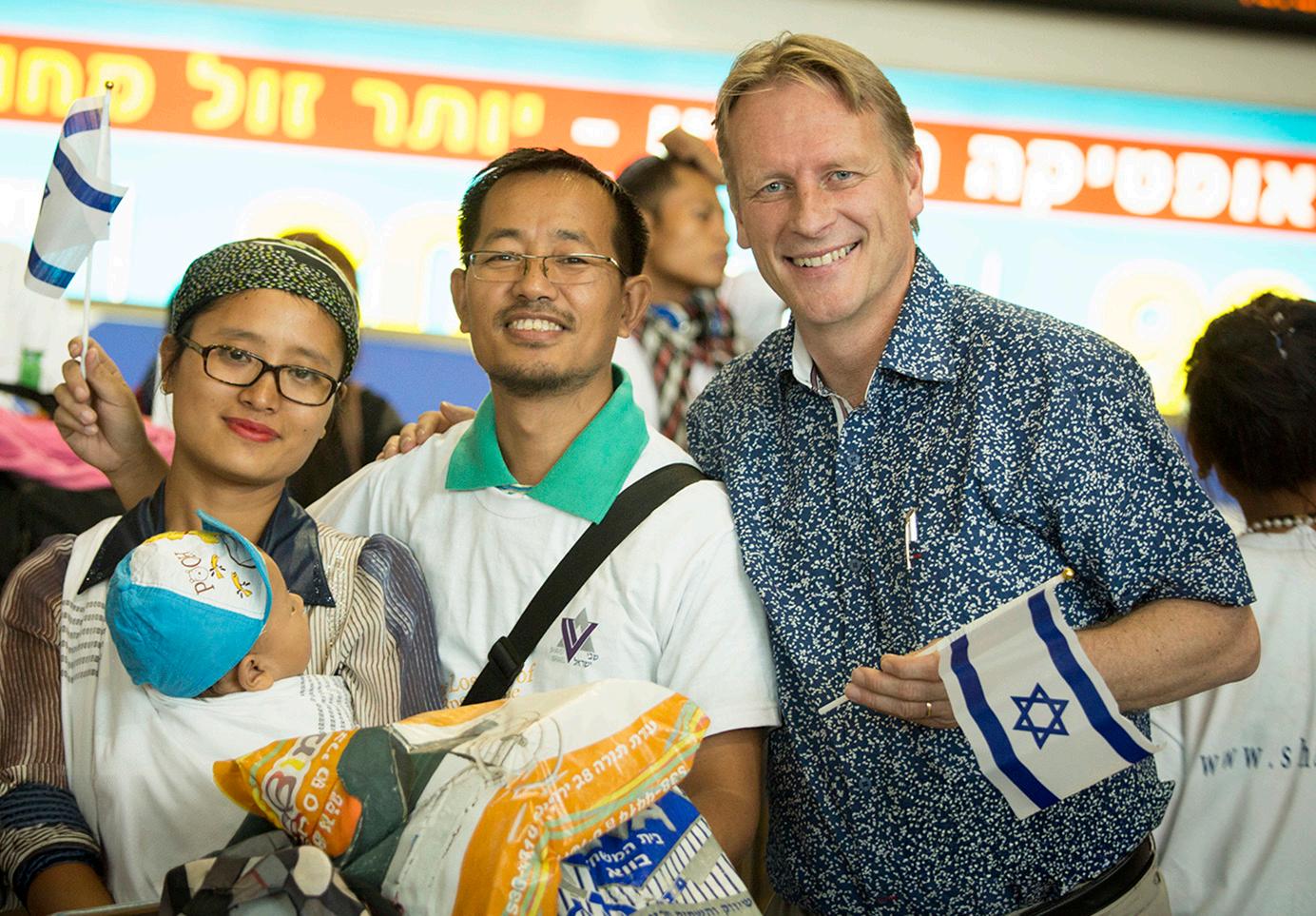
Former ICEJ International Director Juha Ketola welcomes an ICEJ-sponsored Bnei Menashe family upon their arrival in 2014.
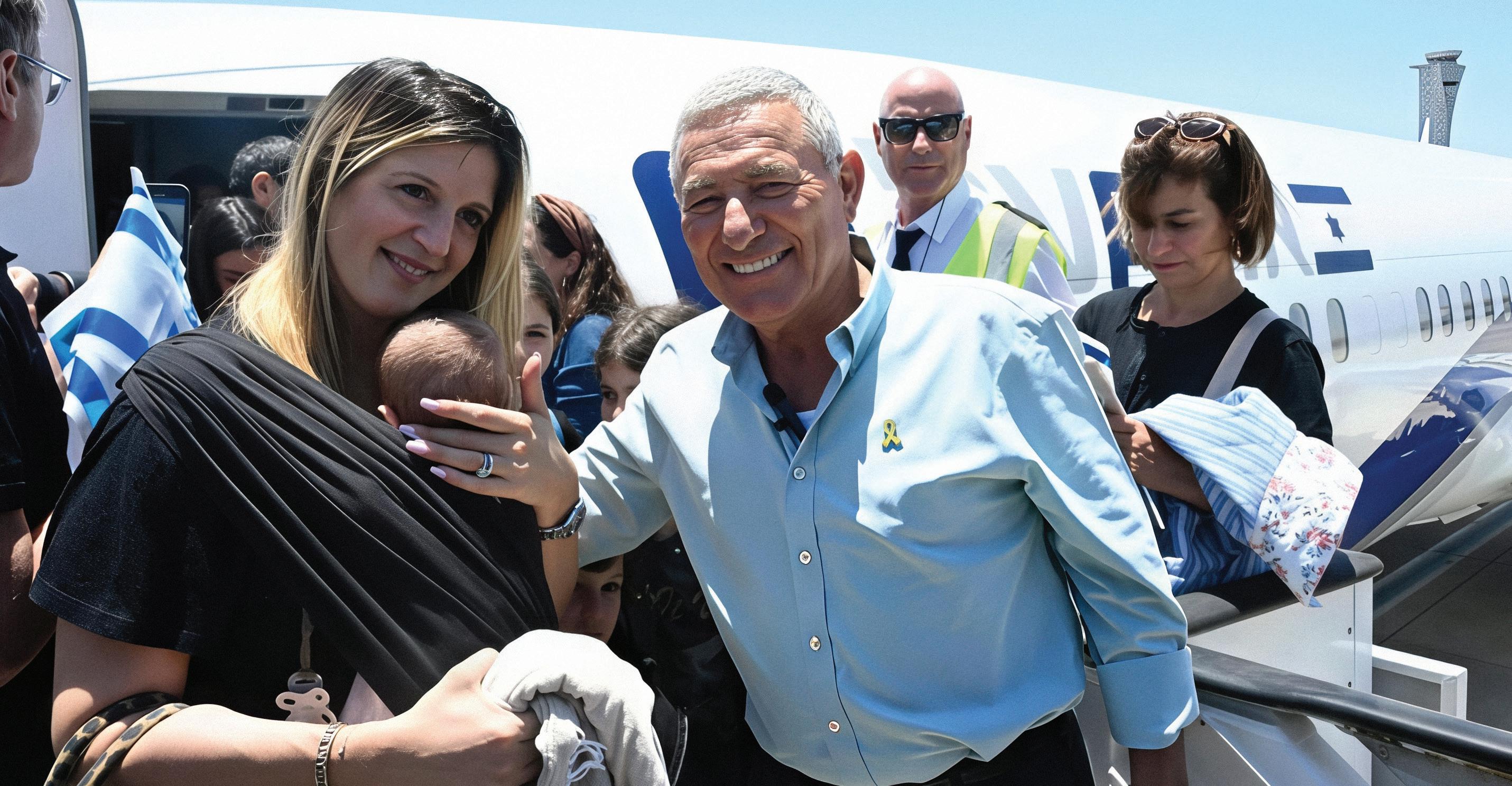
Chairman of The Jewish Agency for Israel, Doron Almog, welcomes Jewish immigrants from France. (Credit: JAFI)
ALIYAH FROM THE WEST Jews Returning in Record Numbers from Europe, Americas
BY HOWARD FLOWER, ICEJ ALIYAH DIRECTOR
As we look back at 2025, we witnessed something remarkable. Global Aliyah numbers shifted, as Jewish immigration to Israel from Western nations surged to historic levels. Jews from France, Britain, Germany and beyond are coming home to Israel in numbers not seen in years – and the ICEJ is standing alongside them on their journey, faithfully working in partnership with The Jewish Agency for Israel.
According to JAFI’s official figures, Aliyah from many Western countries has grown dramatically over the past two years. The numbers tell an inspiring story.
From Western Europe, total immigration reached 5,103 in 2025 – a remarkable 138% increase since 2023. France leads this wave, with 3,357 French Jews making Aliyah in 2025, more than triple the 1,051 who came in 2023. This 219% surge reflects both the troubling rise in antisemitism in France and a renewed desire among French Jews to build their future in the Jewish homeland. Great Britain followed suit, with 890 olim (newcomers) arriving in 2025 – up 136% from 2023. Germany also showed steady growth at 34%.
Israel. With rising antisemitism across Europe and North America, we expect this trend to continue strongly in 2026.
The ICEJ also is assisting with immigration programs for Jewish families from Latin America. Argentina remains the largest source country in the region due to its sizable Jewish community. The ICEJ is currently assisting families from Argentina and other Spanishspeaking countries through a mentoring and integration program, but significantly more support is needed to meet the rising demand due to increasing antisemitism.
From North America, the numbers continue to climb. The United States saw 3,638 new immigrants in 2025, a 45% increase since 2023. Canadian Aliyah grew 51% over the same period, reaching 447 new arrivals.
Combined, Western Europe and North America accounted for over 9,000 new immigrants in 2025 – nearly double the 4,954 who arrived in 2023. This 85% increase demonstrates that despite the challenges Israel has faced, Jews worldwide are choosing to come home.
Recent surveys indicate that approximately 38% of French Jews –around 200,000 people – are now considering to make Aliyah to
The prophet Isaiah envisioned a time when Gentile nations would actively assist in the return of the Jewish people to their homeland.
“Thus says the Lord God: ‘Behold, I will lift My hand in an oath to the nations and set up My standard for the peoples; they shall bring your sons in their arms, and your daughters shall be carried on their shoulders.’” (Isaiah 49:22)
The imagery of carrying sons and daughters in our arms suggests a tender and nurturing role, as Gentiles support and facilitate Aliyah. That time is today!
The ICEJ is poised to help even more Jewish immigrants come home from the West in 2026. Your support funds flights, pre-Aliyah preparation, Hebrew classes, and integration assistance for families starting new lives in Israel. Thank you for partnering with the ICEJ to fulfil the biblical promise of the Jewish return to their ancient homeland.
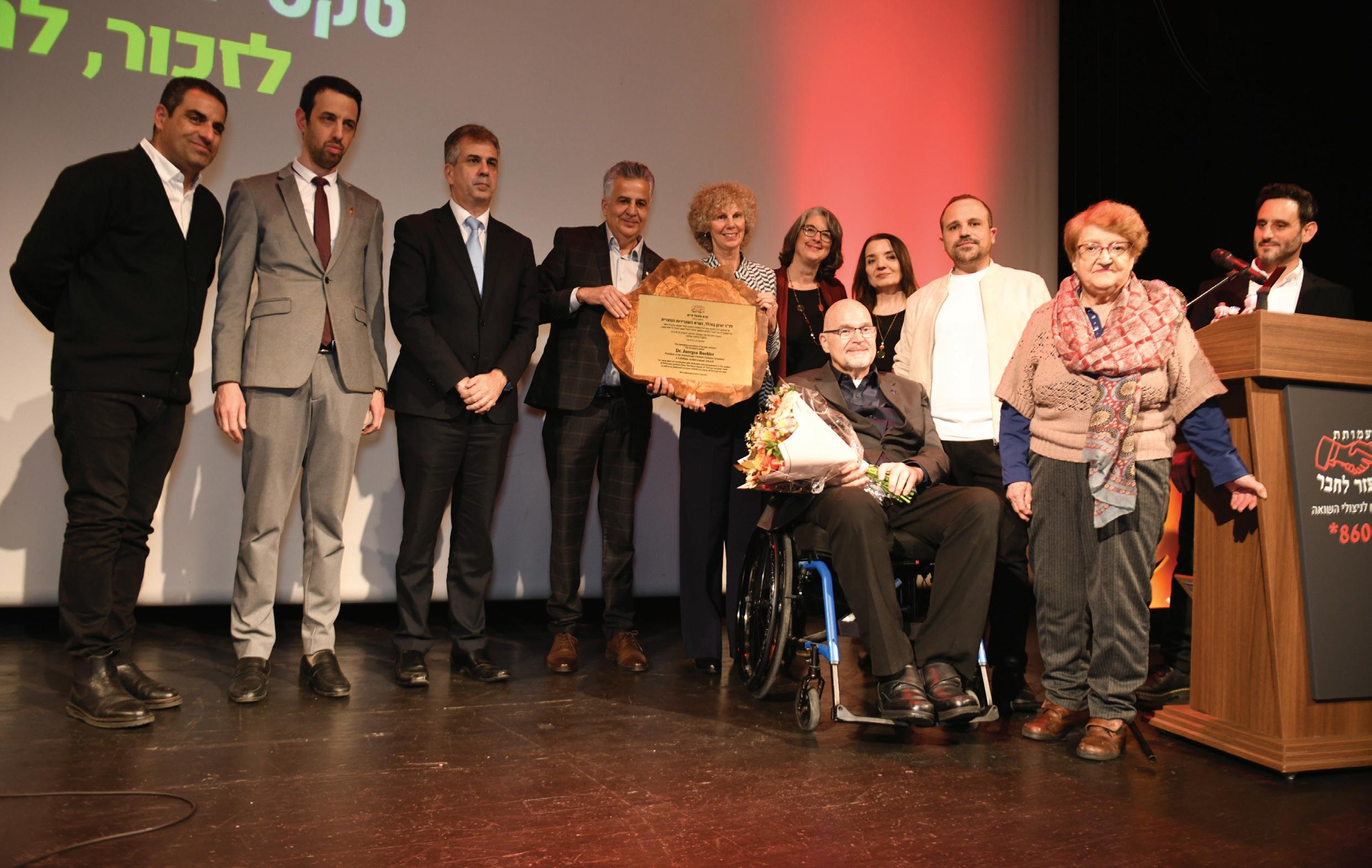
Honouring Dr. Jürgen Bühler & ICEJ with the Lifetime Achievment Award.
REMEMBRANCE, RESILIENCE AND HOPE How Christians
are standing with Holocaust
Survivors
Here is the latest update from the ICEJ team at our Home for Holocaust Survivors in Haifa.
INTERNATIONAL
HOLOCAUST REMEMBRANCE DAY
The 27th of January marked the 81st anniversary of the liberation of the Auschwitz-Birkenau death camp in Poland. As the world paused on this UNdesignated day to remember the six million Jewish victims of the Shoah, the ICEJ Haifa Home for Holocaust survivors marked the occasion with a deeply moving ceremony at a local cultural center.
As we arrived, a bus full of our residents entered the event hall. It was a powerful scene to see these Holocaust survivors, many now using walkers or leaning on the arms of young volunteers, sitting together in conversation.
BY YUDIT SETZ
These are the faces of people who survived the ghettos, the camps, the death marches, and much more. You could see them leaning toward one another, speaking in Hebrew, Russian and Yiddish, sharing a bond that few others can fully understand.
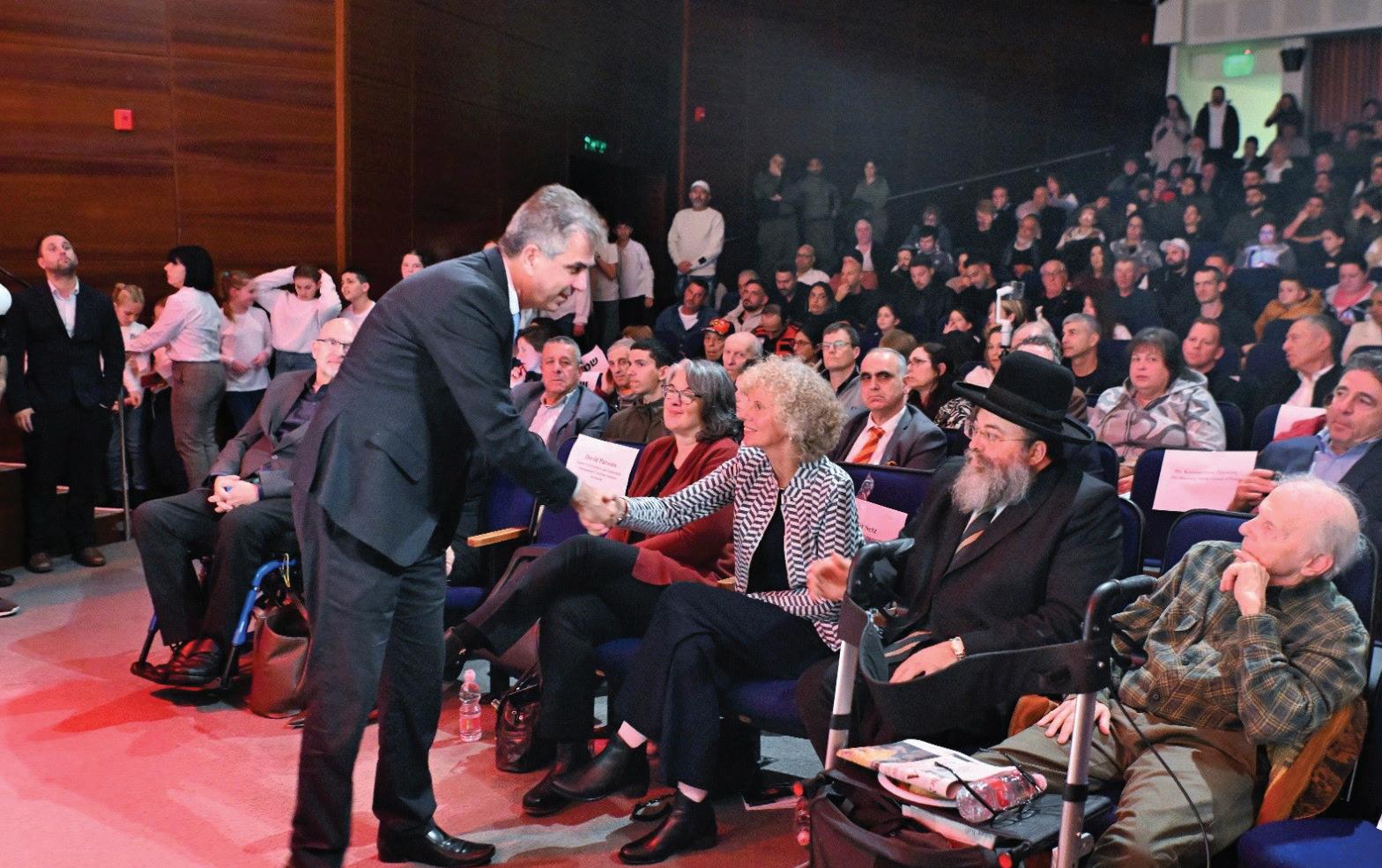
They were joined by a large, diverse crowd. Next to the survivors were young IDF soldiers, local schoolchildren, and families spanning several generations. Dignitaries and officials, including Israel’s Minister of Energy, Eli Cohen, and representatives from various foreign embassies, also filled the room.
The program was a solemn event, including traditional memorial prayers. The speakers at the podium did not just look back to the dark times of World War Two, they also spoke with urgency about the current global climate. A primary focus of the evening was the sharp
rise of antisemitism worldwide. For the survivors listening to these speeches, these were not abstract concerns, but reminders of the same hatred they witnessed decades ago. Despite the heavy subject matter, the presence of so many different groups standing in support of the Holocaust survivors created a powerful atmosphere of solidarity.
At the end of the ceremony, there was a special presentation honouring ICEJ President Dr. Jürgen Bühler for the Christian Embassy’s decades of dedicated care for Holocaust survivors. In his response, Dr. Bühler drew from that week’s Torah portion in Exodus 17.
He recalled how Joshua fought the Amalekites while Moses held up the staff of God. As long as Moses’ hands were raised, Israel prevailed; when they grew heavy, the enemy gained the upper hand. Aaron and Hur stepped in to support his arms until the victory was won.
“We as Christians represent Aaron and Hur,” Dr. Bühler shared. “We are here to hold up the hands of Israel in prayer and practical support as they face those who seek their destruction.”
The ceremony closed with elementary school children on stage and the rest of the audience singing Israel’s national anthem HaTikvah (“The Hope”). Their young voices acted as a soothing balm, reminding everyone that the people of Israel are indeed alive, and we are
Yudit Setz shakes the hand of Israel’s Minister of Energy Eli Cohen at the ceremony.
privileged to witness God’s faithfulness to His Word in our time.
FACTS ON HOLOCAUST SURVIVORS:
As of January 2026, there are 111,000 Holocaust survivors currently living in Israel (Ministry of Welfare).
Israel is home to just over 50% of the estimated 196,000 Holocaust survivors still alive worldwide.
Some 37% of Holocaust survivors living in Israel come from the former USSR.
The average age of Holocaust survivors today is 87-88 years old.
HOPE AND HEALING BEYOND SURVIVING
The trauma of the Holocaust did not end with the Allied liberation of Nazi camps. Its scars remained deeply embedded in survivors and were often passed down to the next generation. Research shows that many children of survivors bear invisible wounds, higher levels of anxiety, depression, and even PTSD, shaped by growing up in homes marked by loss, fear and survival.
At the Haifa Home, we see this reality every day. Yet we also witness something powerful: when survivors are surrounded by dignity, joy and a loving community, there is healing that extends far beyond them, touching their children and grandchildren as well.
Noa Eldar Zakai understands this deeply.
Once a week, Noa leads music-based movement sessions for our residents using the Ronnie Gardiner method of rhythmic exercises that activate the body and the brain.
“Every time they finish, they leave smiling,” Noa told us.
Noa’s love for Holocaust survivors is deeply personal. Both her parents survived – her
father by fleeing Yugoslavia, her mother emerging from Auschwitz. She was only 17 when she was deported to the camps. None of her family returned.
Although Noa’s parents rebuilt their lives in Israel, the trauma never fully loosened its grip. Her mother battled deep depression for years and died by suicide when Noa was only ten.
“It left a hole in my life,” Noa shared. “I was angry, jealous of families that felt normal – and heartbroken for what my mother endured.”
Years later, a visit to her parents’ hometown with her father and older sister revealed stories of her mother’s courage and strength, but also of the unspeakable atrocities she endured in Auschwitz.
This past summer, Noa began working at the Haifa Home.
“I had lived in Haifa for years and never knew this place existed. It opened a whole new world for me,” she said.
What struck her most was the very concept of the Haifa Home. On one hand, residents living along a few adjoining streets in Haifa, in their own homes, are able to enjoy conversations with different younger neighbours, hear children playing and laughing daily in nearby schools, see cats wandering the streets, celebrate birthdays, share holidays, and be embraced with genuine love. This stands in stark contrast to many of the fancy, expensive elderly homes, where senior citizens have everything but are completely cut off from society.
In our case, the concept of an Israeli charity working closely together with a Christian ministry representing foreign Gentiles – the ICEJ – has amazed her in many ways.
“Discovering that Christians around the world love Israel and stand with us has filled me with hope”, Noa related. “As an Israeli Jew, I always believed that everyone hates us, so it gives me much joy that there are Christians who love
Israel. I can only hope that there will be more people like you who will not hate us so much and understand us a bit more.”
“After the trauma of the recent war, I understand without a doubt that my place is in Israel”, she continued. “The survivors continue to strengthen me in this belief and understanding despite all the wars and difficulties.”
By caring for Holocaust survivors with compassion and dignity, we are not only honouring the past, but we also are helping to heal generations.
TU BISHVAT – THE JEWISH NEW YEAR FOR TREES
The Jewish holiday of Tu BiShvat falls on the fifteenth day of the Hebrew month of Shvat and is celebrated in Israel by planting trees and enjoying dried fruits, a beautiful reminder of renewal and God’s provision through the land. It is still mid-winter in Israel, but the life of Spring is not far behind.
In our art therapy class, Tu BiShvat songs filled the room, creating a joyful and peaceful atmosphere. Together, we reflected with gratitude on the fruit of this land and the winter rains that allow nature to blossom once again.
Each resident received a flowerpot to decorate in the spirit of the holiday, using colours that represent life, light and love.
“I always come when you do something special in this class”, Chaya told our art therapist, Nancy.
“Every time you create something beautiful, the atmosphere is so pleasant and respectful. I love coming, even though I cannot see very well.”
At the end of the session, the residents left with a small gift bag of dried fruits and their decorated flowerpot, complete with a colourful plant to bring a bit of Spring into their homes.
Support our work with Holocaust survivors by donating at: help.icej.org/survivors
A photo of Noa with her mother.
Noa leading a music-based movement session for our residents.
THE STORY OF HOMECARE
BY CORRIE VAN MAANEN
“…that you may know the way by which you must go, for you have not passed this way before.” (Joshua 3:4)
Sometimes God leads His people into ways unknown. He reveals the first step along a certain path, and it is not until much later that we look back and see how He brought different paths together. That is the story of Homecare.
When the world witnessed the dramatic fall of the Iron Curtain in 1991, it also opened the gates for one million Soviet Jews to pour into their ancestral homeland of Israel.
Prophecy came true before our eyes. “Behold, I will bring them from the north country, and gather them from the ends of the earth. Among them the blind and the lame, the woman with child and the one who labours with child, together; A great throng shall return there.” (Jeremiah 31:8)
In response to the some 5,000 Jewish immigrants arriving per month, the ICEJ’s Soviet Jewry Department became an exciting new chapter in the Christian Embassy young history.
In addition, Dutch Christians volunteering in Israel recognised that the new arrivals had needs and initiated a program to offer basic nursing care to elderly new immigrants in their homes. In 1996, this God-given initiative was adopted by ICEJ under the same name of “Homecare” and became an essential ministry of our Soviet Jewry Department.
Thus, the pathways merged! The new ICEJ Homecare team was formed from Dutch and Finnish nurses who enjoyed a wonderful bond of unity in providing ongoing care for Russian immigrants, including the elderly, infirm, Holocaust survivors and young families.
A CAR EQUALS THANKFULNESS
The Homecare team initially took the bus for our daily visits, which had its joys but took extra time. So, ICEJ-Finland eventually provided a vehicle for the nursing work, expanding our reach. The Homecare car became a key tool for extending Homecare’s ministry to many more Jewish homes nationwide. From weekly home visits in Jerusalem, we began to span Israel from north to south. For many elderly immigrants facing loneliness, our Homecare visits became a highlight.
Starting my work in Homecare among Russian immigrants, I decided to begin learning Russian. It was not easy, but I experienced that language mistakes could bring a laugh and brighten up a lonely heart. I learned to trust the Lord to even use my mistakes for good. I also learned the language of our heart speaks the loudest – a language not of words, but deeds.
Since those humble beginnings, Homecare has been ministering with compassion, making a difference one life at a time!
“They didn’t help me out of obligation, but they helped me with the heart”, one lady from Ukraine said of ICEJ Homecare.
After 30 years of this work, choosing a favourite story is nearly impossible, as every person is special and every story is unique.
I remember weekly visits to a lonely, elderly Russian Jewish woman in a nursing home. One day, she told me about the war, as it was Liberation Day in Russia, marking the end of WWII. Her brother died as a soldier, and her grandparents were shot and buried in a mass grave. She has endured so much; who can comfort more than the Lord? When I asked, she said, “I know He does.” When I inquired further, she replied, “Because He sent you to me today.” Suddenly, the visit became more meaningful.
As word spread that Christians from many countries were there to help, requests for assistance began to arrive. The ICEJ’s founding mandate of “Comfort, comfort My People,” found another practical means of fulfilment.
SIXTEEN YEARS WITH SARA
The Homecare team also supported Sara and her mother for sixteen years. At first, they were withdrawn and trusted no one, only allowing foot washes before shower help. After the mother, an upright Jewish woman, died at 97, Sara was left deeply confused. They had lived together for 72 years. I continued to visit her in an elderly home, and she was always glad to see me.
Then suddenly, she fell ill and was hospitalised for several difficult weeks. One evening before she passed away, I sat by her bed, holding her hand and reflecting on our sixteen years. I felt Sara embodied the heart of Homecare, reaching out to the unseen. That night, Sara died and was buried, having fulfilled her dream of returning to Israel.
A FULL LIFE FOR SIMA
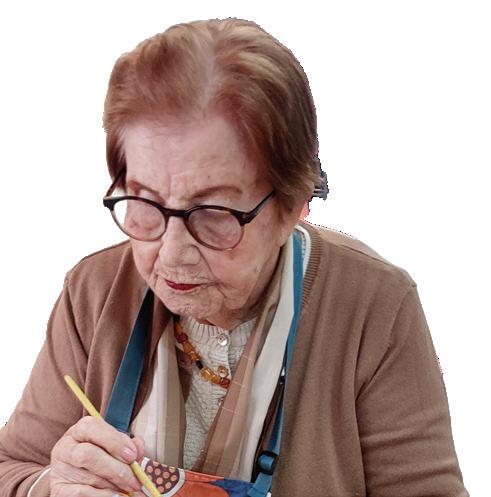
I also think of Sima, who lives together with her daughter in Jerusalem. It was a beautiful wintry day when I paid her a visit. I brought a few roses from the garden for Sima. When I entered, she was sitting by the kitchen table, and I felt welcome that she had been waiting for me. It was Sima’s birthday, and she was one hundred years old!
Sima was born in czarist Russia, before the Revolution of 1917. But she grew up under Communism, suffered in the Second World War, and was seriously ill. She knew what it means to survive with the daily worries of providing food for her family. Her husband died at a young age. At an advanced age, she came to Israel with her daughter.
Sima lived to enjoy the love of her children, grandchildren and great-grandchildren. When I asked her what made her the happiest in life, she did not need long to think. Where her children are, there she is happy.
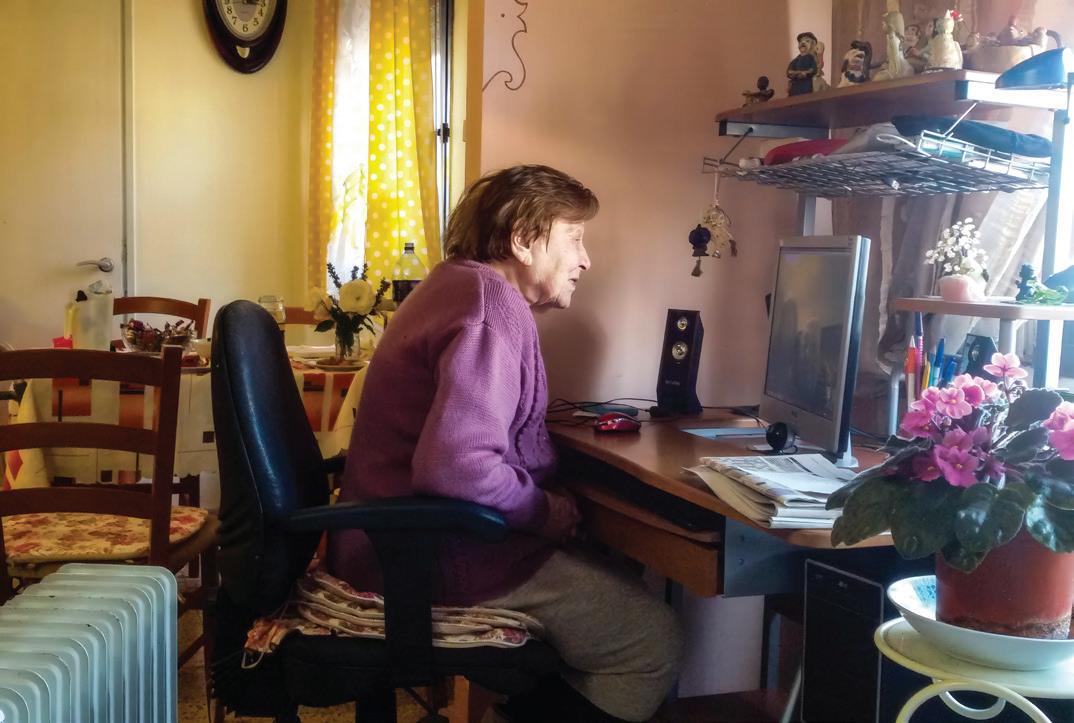
A bit later, the computer rang from someone calling her on Skype. She shuffled with her walker over to the computer and quickly entered an animated conversation with a nephew in Ukraine. From the Russian Revolution to a conversation by Skype in Israel, Sima has had a life full of experiences. Though she still struggled with Hebrew and paying bills on time, she felt at home in Israel. And I am often aware how our Homecare work is woven in with the incredible life journeys of those we care for and their life-changing Aliyah to the Jewish homeland.
MARIA AND THE MICE
I once visited a single Russian mother who lives with her children in a poor neighbourhood along Israel’s coast. Maria knew I was coming and was happy to see me. It took a moment to get used to the clutter – no closets, just piles of folded clothes against the grey walls, paint peeling from the ceiling. A cat slept close to Maria on the couch.
“This one is good at catching mice,” she said. I asked, “Did you have trouble with mice?” She shook her shoulders in disgust, insisting “It was awful.”
Maria felt ashamed about her appearance and dire situation. Comfort comes not with words or advice but by sharing tea, with the cat on the couch, and stacks of clothing against the wall. I listened to her story, to her heart and her needs.
Homecare has paid toward dental treatment for Maria, and she said she is beginning to feel human again. Her self-respect is returning, and she has begun to bring order to the house. Hope is rising in a situation that seemed so helpless.
HOLIDAY GIFTS FROM THE HEART
Another meaningful aspect of our Homecare work is to remind these elderly immigrants of their Jewish heritage. Coming from a communist system, many had been cut off from their faith and arrived in Israel knowing little about the Bible. During the Jewish holidays, we have touched many lives with our personal delivery of special gifts, traditional food items, and a beautiful card with a Bible verse. Some keep those cards and bring them out in lonely moments.
When Zacharia, a survivor of a ghetto and concentration camp, received a supermarket voucher and holiday card last year, he carefully examined them and said, “The voucher is a help for me, but the card touches my heart.”
There are many more stories to tell about ICEJ Homecare’s impact in brightening the lives of the elderly and infirm immigrants under our care.
Please support this vital ministry in prayer and by donating at: help.icej.org/homecare.
Sima at her computer on a Skype call with her nephew.
Zacharia, 100, sits with Corrie during a Homecare visit.
ICEJ BRANCHES MARK HOLOCAUST REMEMBRANCE DAY WORLDWIDE
BY ICEJ STAFF
Amid the surge of global antisemitism, numerous ICEJ branches worldwide held events marking International Holocaust Remembrance Day on 27 January, which this year fell on the 81st anniversary of the liberation of Auschwitz.
In Germany, our ICEJ team hosted Holocaust survivor Eva Erben for another successful tour speaking before schools and churches across the country. The German youth embraced Eva as she recounted surviving the Terezin ghetto, Auschwitz and a death march. She also drew a direct connection between the Nazi cruelty
she faced as a child and the actions of Hamas on October 7.
In Denmark, the ICEJ branch organised a Holocaust Memorial Concert that brought together Christian and Jewish community leaders, and the Israeli ambassador to Denmark, Zvi Tal. The concert included performances by high school students and ICEJ-led musical teams from Denmark and the Faroe Islands.
In the Philippines, ICEJ supporters took part in the ‘Light for Tomorrow’ Holocaust
ICEJ-PERU CELEBRATES THEIR NATION’S STRONG BOND WITH ISRAEL
BY PASTOR CÉSAR FOLGAR, ICEJ-PERU NATIONAL DIRECTOR
Peru and Israel are developing closer relations through faith diplomacy and bilateral cooperation. The work of the ICEJ-Peru branch is guided by the principle that Israel matters. We are rising up to comfort, support and pray for the people of Israel, as the Bible directs (Psalm 122:6).
In November, Dr. Mojmir Kallus, ICEJ Vice President of International Affairs, paid a visit to Peru to attend several events organised by our Peruvian branch together with the Peru–Israel Friendship League, led by Congressman Javier Padilla Romero. Their presence added great
Remembrance Day event in Cavite City, featuring Israeli Ambassador Dana Kursch.
And in Cyprus, ICEJ Middle East Coordinator Tom Craig attended a Holocaust remembrance event with Israeli officials and the local Jewish community.
weight to the gatherings, which celebrated 67 years of ties between Israel and Peru.
The meetings began with a pastors’ conference hosted by Pastor Sergio López in his Palabra Viva Church in the city of Huaral. The 120 pastors in attendance exceeded our expectations, showing that interest in Israel is growing. We addressed the subject of “Israel and the Church”, explaining the role of the Church toward Israel in our day and its importance for Christians. The host fellowship was recognised as an “Israel-Friendly Church”, including the formal presentation of an Israeli flag as a symbol of its support for the Jewish state and people.
The next day, we gathered at the municipal hall in the capital of Lima to mark Peru–Israel Friendship Day, together with MPs Padilla Romero and Milagros Jauregui de Aguayo. They were joined by the Israeli ambassador to Peru, Eran Yuvan, and the deputy mayor of Lima. Dr. Kallus spoke on “Why Israel Matters”, while local Messianic Pastor Eduard Claudiu and his family performed a song in Hebrew.
That evening, local officials, community leaders, pastors and friends of Israel gathered at Casa del Padre church for a time of reflection, prayer, and fellowship. The event was supported by the Israeli Embassy in Peru, and recognised Israel as a unique nation named and chosen by God.