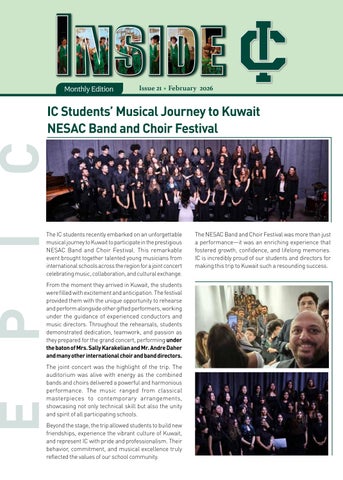

IC Students’ Musical Journey to Kuwait NESAC Band and Choir Festival

The IC students recently embarked on an unforgettable musical journey to Kuwait to participate in the prestigious NESAC Band and Choir Festival. This remarkable event brought together talented young musicians from international schools across the region for a joint concert celebrating music, collaboration, and cultural exchange.
From the moment they arrived in Kuwait, the students were filled with excitement and anticipation. The festival provided them with the unique opportunity to rehearse and perform alongside other gifted performers, working under the guidance of experienced conductors and music directors. Throughout the rehearsals, students demonstrated dedication, teamwork, and passion as they prepared for the grand concert, performing under the baton of Mrs. Sally Karakelian and Mr. Andre Daher and many other international choir and band directors.
The joint concert was the highlight of the trip. The auditorium was alive with energy as the combined bands and choirs delivered a powerful and harmonious performance. The music ranged from classical masterpieces to contemporary arrangements, showcasing not only technical skill but also the unity and spirit of all participating schools.
Beyond the stage, the trip allowed students to build new friendships, experience the vibrant culture of Kuwait, and represent IC with pride and professionalism. Their behavior, commitment, and musical excellence truly reflected the values of our school community.
The NESAC Band and Choir Festival was more than just a performance—it was an enriching experience that fostered growth, confidence, and lifelong memories. IC is incredibly proud of our students and directors for making this trip to Kuwait such a resounding success.


Learners’ Adventure in Discovering Shadows
The learners embarked on an interactive exploratory experience to discover the concept of shadows. Through hands-on activities, they were able to directly observe the relationship between light and shadow. During the experiment, they developed careful observation skills and analytical thinking as they explored how the size and shape of a shadow change depending on the position of the light source.
They demonstrated the Inquirers attribute through the questions they raised about the reasons behind changes in shadows and their nature. They also showed the Thinkers attribute through their ability to analyze the relationship between the position of the light source and the characteristics of the resulting shadow, linking their observations to conclusions in a clear and organized way.
This experience provided a valuable opportunity to promote inquiry-based learning and to nurture scientific thinking within an engaging and stimulating learning environment.


Quand les enfants de PSA deviennent créateurs de jeux !
Les enfants de PSA se sont engagés avec enthousiasme dans des expériences de jeu riches et porteuses de sens. En explorant leurs préférences personnelles dans le jeu, ils ont appris à exprimer leurs idées et leurs choix, faisant preuve de profils communicatifs et réfléchis. Grâce à une utilisation créative des matériaux, ils ont fait preuve d’audace en imaginant, créant et fabriquant leurs propres jeux à partir de matériel de récupération. Tout
au long de ces moments de jeu, les enfants ont également développé le sens des responsabilités, en prenant soin du matériel, en respectant les règles et en collaborant avec leurs camarades. Cette démarche a permis aux élèves de passer à l’action, en transformant leurs idées en réalisations concrètes, tout en renforçant les relations et le plaisir d’apprendre ensemble.


Connecting Art, Music, and Poetry in Grade 3 B
In Grade 3B, we conducted an interdisciplinary session titled “Art, Music, and Poetry.” During this activity, students listened to energetic music while expressing their emotions through watercolor painting. The music served as inspiration, encouraging them to translate what they felt into colors, shapes, and movement on paper.
This session intentionally integrated visual arts, music, and language arts. After completing their paintings, students participated in a gallery walk. Each child visited their classmates’ artwork and left a Post-it note with a descriptive word inspired by the painting. These words included verbs, nouns, and adjectives that reflected their interpretations and emotional responses.
At the end of the activity, each student collected the words their peers had written about their artwork. Using all of these contributed words, they created an original poem. This step transformed visual and musical inspiration into written expression, reinforcing vocabulary development and creative writing skills.
This learning experience highlighted the deep interconnectedness between art, music, and poetry. It encouraged emotional expression, peer collaboration, and creative thinking. By moving from sound to image to words, students gained a richer understanding of how different art forms can inspire and enhance one another, ultimately supporting their ability to create meaningful poetry, applying the ATL skills and Learner Profile Attributes.

Young Scientists
To mark the end of the unit “How the World Works,” Grade 4 students delivered a scientific presentation in front of their parents, demonstrating their genuine understanding of the concept of mixtures and their ability to apply what they had learned in a practical way. They conducted experiments in which they mixed different substances such as water and sugar, oil and water, and salt and water. With clarity and confidence, they explained what happens when these materials are combined, highlighting the difference between homogeneous and heterogeneous mixtures. They did

Elementary School - Ain Aar
not simply observe the results; they interpreted them using precise scientific vocabulary and answered the audience’s questions with confidence and awareness.
Throughout the preparation and presentation, they showed strong collaboration, sharing roles with a true team spirit. This was not a classroom activity, but a vibrant learning experience that reflected their scientific curiosity and their ability to observe and draw conclusions. Their enthusiasm for exploration was clearly evident.


Elementary School -


Celebrating Identity, Culture, and Global Citizenship

Exploring Beirut’s Cultural Side
As part of our commitment to experiential learning and cultural exploration, Grade 9 students took part in a rich cultural trip to Beirut that included visits to The Sursock Museum, District 7 Theater, and Metropolis Cinema. This trip offered students a meaningful immersion into Lebanon’s artistic and cultural landscape, allowing them to engage directly with visual arts, theater, and cinema. The experience strongly complemented their French classes, where students explore themes of culture, expression, and identity through francophone texts and media. Seeing these concepts come to life helped deepen their understanding and appreciation of how language, art, and storytelling intersect.
A Performance of LOVE
In a celebration of expression and imagination, Grade 9 students also experienced what happens when language meets creativity, culture and heart.
The journey began last November on Independence Day, when students launched a unique project combining their love for French with art, values, heritage, and intercultural learning, all culminating in an unforgettable drama performance.
Over the months, students explored Lebanon’s rich
cultural tapestry, discovering its artists, traditions, and stories. They practiced French not only through exercises, but through expression, dialogue, and storytelling, giving the language real meaning and purpose.
This journey came together in a truly special celebration: “A Love Letter to Lebanon”. The performance paid tribute to our heritage and beautifully illustrated how language, art, and shared values can unite students in a meaningful and creative experience. From heartfelt lines in French to vibrant visual art and powerful messages about community and culture, the students’ work was a joyful reminder that learning can be expressive, engaging, and deeply connected to who we are. Of course there was a special place reserved for Zajal. Grade 9B/3eme B students in AFL class practiced and then performed Lebanese Zajal and puns.

Entre mots et images: liens entre art, langage et poésie
Orphée inspire nos poètes en herbe de 4ᵉ
Cette année, les élèves de 4e ont relevé un défi aussi exigeant qu’inspirant : écrire un poème à partir du mythe d’Orphée. À travers ce travail d’écriture, ils ont découvert l’univers de la poésie lyrique, cette poésie qui donne voix aux émotions, aux sentiments et aux élans du cœur.
Le mythe d’Orphée, figure légendaire de l’amour et de la musique, tente de ramener Eurydice des Enfers grâce à la puissance de son chant. Amour, douleur, espoir, perte : autant de thèmes qui ont permis aux élèves d’exprimer leurs propres émotions. Ce projet a montré que la poésie n’est pas un exercice figé ou lointain, mais un espace de liberté et de création, où chacun peut mettre des mots sur ce qu’il ressent. Les élèves ont ainsi découvert que la poésie lyrique, loin d’être réservée aux poètes du passé, est toujours bien vivante lorsqu’elle naît d’une émotion sincère.
À travers Orphée, les élèves de 4e ont compris que la poésie peut, elle aussi, faire descendre aux Enfers… et toucher les cœurs.
Explorer la poésie autrement grâce à la différenciation…
En classe de 4e, les élèves ont vécu une expérience littéraire fondée sur la différenciation pédagogique, explorant la richesse des mots, des images et des émotions à travers la poésie. Répartis en petits groupes, ils ont travaillé sur trois poèmes majeurs : Il pleure dans mon cœur de Paul Verlaine, Je vis, je meurs de Louise Labé et Le Pont Mirabeau de Guillaume Apollinaire. Chaque groupe a abordé les textes selon des objectifs variés : ressentir les émotions, analyser les figures de style et interpréter la musicalité des vers. Dessins, écriture créative, mise en voix et échanges ont donné vie
aux poèmes, permettant aux élèves de développer leur sensibilité, leur créativité et le plaisir de lire autrement. Une belle occasion de découvrir que la poésie est aussi un espace de partage, d’expression et de beauté.
Les calligrammes des 5ᵉ : quand les mots deviennent images
Dans le prolongement de leur découverte de la poésie, les élèves de 5e ont donné une forme nouvelle aux mots à travers l’art du calligramme. Après avoir écrit un poème de deux quatrains, ils ont façonné leurs vers pour dessiner un objet ou un élément de la nature qui les faisait rêver.
Soleils, oiseaux, vagues ou étoiles ont ainsi pris vie sous leurs plumes, mêlant images poétiques, émotions et imagination. Cette activité a permis de réinvestir les apprentissages poétiques tout en invitant les élèves à explorer le lien entre écriture et création artistique.
Exposés au collège, ces calligrammes offrent aux lecteurs un regard sensible et lumineux sur la poésie.
Dans le même contexte, les élèves se sont penchés sur l’art, mais cette fois-ci en arabe.


Early Chilhood - Ras Beirut
How the World Works - From Inquiry to Action: STEAM challenges and the 3Rs (Reduce, Reuse, Recycle)
As part of the unit of inquiry How the World Works, MS students explored how materials are used, transformed, and selected in everyday life while developing curiosity, critical thinking, and research skills. Through hands-on exploration, observation, experimentation, and problem-solving, students made meaningful connections between the properties of materials and their real-life applications.
Classroom investigations, school-based observations, STEAM challenges, and learning about the 3Rs (Reduce, Reuse, Recycle) deepened their understanding and gave purpose to their learning. This learning culminated

in a meaningful action phase connected to the Levant Championship educational garden project, where students applied their knowledge in authentic ways.
Students designed and built a scarecrow to protect the garden, constructed an insect hotel to support biodiversity, created storage containers using reused materials to organize classroom resources, and recycled paper by producing new paper from used materials. These projects highlight students’ ability to plan, make thoughtful choices, solve problems, and take responsible action by transferring their learning into purposeful, real-world applications.

Early Chilhood - Ras Beirut


Learning Story: Inquiry into Birds – From Observation to Action
Under the transdisciplinary theme Sharing the Planet, Pre-K students explored how animals adapt to survive in their environment. During the Making Conclusions phase, the students showed a strong interest in learning more about how birds adapt. Following the research cycle—Observe, Wonder, Research, Record, and Share—they extended their inquiry through meaningful investigations.
The learning began with authentic observations of birds in the classroom and around the campus, sparking curiosity and thoughtful discussions. Through these observations, students explored factual questions about birds’ physical features, habitats, food, and sounds, drawing on their prior knowledge and experiences.
As their thinking deepened, students extended their inquiry into conceptual questions about how birds live, stay safe, move, and respond to changes in weather. Their curiosity led to a powerful student-
driven question: What happens to birds when it rains? They also wondered how humans can help animals and what makes a place safe for birds. These thoughtful questions reflected their growing curiosity, observational skills, and emerging understanding of the needs and behaviors of living things.
In response, students proposed a caring and creative solution—building a birdhouse to support birds in their environment. They observed the construction process, contributed ideas about design and purpose, and collaborated with adults to bring their plan to life.
The inquiry will culminate in decorating and installing the birdhouse during a nature walk, providing an opportunity for authentic student action. This learning journey nurtured curiosity, collaboration, creativity, and a growing sense of responsibility toward the natural world.


Young Changemakers: Leading the Way Toward a Sustainable Future
At ESRB, everything we do is anchored in our EPIC goals:
Excel Academically, Promote Wellbeing, Inspire Service Learning, and Champion Leadership.
These goals guide our students’ growth — academically, socially, and ethically — and reflect our belief that true education shapes both the mind and the heart.
At the elementary level, the Primary Years Programme (PYP) provides the framework that brings this vision to life. Through inquiry-based learning, students explore real-world issues, build deep conceptual understanding, and are encouraged to take meaningful action. In the PYP, action is not optional — it is a natural and expected outcome of authentic learning.
Our Grade 5/CM2 students recently demonstrated this beautifully through their Unit of Inquiry under the transdisciplinary theme How the World Works, focused on energy and sustainability.
Understanding Energy in a Real-World Context
Throughout the unit, students explored different sources and forms of energy, energy efficiency, and the global and local impact of energy consumption.
They examined how sustainability requires responsible choices and innovative thinking.
As part of this learning journey, students attended a session with a representative from Lebanon of Tomorrow, who highlighted the urgent need for renewable energy solutions in Lebanon. Students gained deeper insight into the national energy crisis and how it affects essential services and vulnerable communities. This experience helped them see that sustainability is not an abstract concept — it is a pressing and personal reality.
Designing the Cities of Tomorrow
To apply their learning, students worked collaboratively to design and construct 3D models of eco-friendly cities. Their creations — with inspiring names such as Eco-Zoom, Eco Haven, and Ecotopia — showcased wind turbines, solar panels, green spaces, and efficient transportation systems.
Through this hands-on project, students:
• Integrated renewable energy sources into urban planning
• Explored ways to minimize environmental impact

• Strengthened collaboration and problem-solving skills
• Made responsible design choices grounded in sustainability principles
Their colourful models reflected thoughtful infrastructure planning and a clear understanding of energy-efficient city development.
As a celebration of learning, Grade 5 students presented their models to Grade 4. The younger students engaged in a “one glow, one grow” feedback protocol, offering constructive reflections that highlighted strengths and areas for improvement. This peer exchange fostered communication, reflection, and leadership — hallmarks of the PYP learner.
From Inspiration to Impact: Taking Action
Inspired by their inquiry and the session with Lebanon of Tomorrow, students felt compelled to act.
They organized a fundraising initiative to support the NGO’s project to install solar energy systems for the Beirut Fire Brigade in Beirut. The initiative specifically supports the installation of two solar water heating systems, each composed of 36 tubes, providing 1,000 liters of hot water. This project will serve 30 permanent personnel and supply 10 bathrooms used daily by firefighters returning from missions.
And here is the most inspiring part: Our students exceeded their fundraising goal.
Their enthusiasm and genuine spirit of giving were remarkable. Many students made the spontaneous decision to contribute from their personal allowances — a powerful testament to their empathy and social responsibility.
As Martin Luther King Jr. once said: “Life’s most persistent and urgent question is, ‘What are you doing for others?’”
Our Grade 5/CM2 students answered that question with action.
EPIC in Action
This initiative reflects our EPIC goals in meaningful and measurable ways:
• Excel Academically: Students developed a strong conceptual understanding of energy systems and sustainability through inquiry, research, and applied design.
Elementary School - Ras Beirut


• Promote Wellbeing: Their project supports the comfort and dignity of firefighters who serve and protect our community.
• Inspire Service Learning: Students moved beyond awareness to authentic, community-centered action.
• Champion Leadership: They collaborated, presented their learning, partnered with a local NGO, and led a successful fundraising effort.
We are immensely proud of our Grade 5/CM2 students for embodying the values we strive to cultivate every day. Their journey demonstrates that when learning is purposeful and connected to real life, students become compassionate changemakers capable of creating meaningful impact. Their work is a powerful reminder that even young learners can help build a more sustainable and hopeful future.
The “Courthouse” Project On the novel Tuck Everlasting
Following their reading of the novel Tuck Everlasting, Grade 6 students in the English section took part in a courtroom role-play project where they put the main character on trial and defended her actions using logical evidence and argumentation based on the novel. Working in groups, students assumed different roles such as lawyers, witnesses, judge, and defendants, and witnesses, and presented logical arguments supported by facts and figurative language from the text.
This project was a great embodiment of the school’s vision to unlocking one’s potential where students excelled academically by analyzing themes and character motivations, promoted wellbeing by exploring moral choices and emotions, championed leadership through collaboration and public speaking, and inspired service learning by reflecting on justice, responsibility, and ethical decisionmaking.
Along with enlightening learning, students practiced important values such as empathy, integrity, respect, and responsibility, and reflected on how they can be global citizens who think critically and act thoughtfully.


Middle School - Ras Beirut


Middle School - Ras Beirut

Le lien indissociable entre l’ Histoire et la littérature
Il existe un lien indéniable avec le contexte historique lorsqu’il s’agit de textes littéraires engagés, pour la simple raison que le texte n’est que l’écho littéraire de l’Histoire. L’auteur engagé est celui qui joue un rôle essentiel dans la société en s’impliquant dans la vie sociale et politique de son époque. Le mot auteur est à prendre au sens large puisqu’il englobe les artistes comme peintres , sculpteurs, caricaturistes …
C’est ce que les classes de 3èmes ont appris à l’occasion de la séquence sur la poésie engagée qui s’est déclinée en 3 parties :
1- Introduction : Le contexte historique de la 2ème Guerre Mondiale ( PP. joint)
2- Analyse d’un poème engagé : Ce coeur qui haïssait la guerre- R. Desnos Liberté-P. Eluard
3- Clôture de la séquence : Travail de groupe sur un corpus de textes.
Pour introduire la séquence, une présentation du contexte historique rappelle les événements de la 2ème Guerre Mondiale, et plus spécifiquement le cas de la France. La première diapositive montre la défaite de la France avec la visite d’ Hitler à Paris en 1940 et la dernière, la remontée des ChampsElysées par le Général De Gaulle qui célèbre la libération de Paris en 1945. Il s’agit d’un rapport d’opposition entre ces deux diapositives. Ainsi, cette introduction apporte un éclairage qui permet d’aborder les textes et de les comprendre puisqu’ils sont les enfants de l’Histoire.
Elie Hayek

A Classroom Visit That Reflects Modern Learning
Visiting classrooms is always an eye-opener. During a recent visit to Ms. Hanane Whaibi’s chemistry classes, Ms. Malda Halawi, Assistant Principal and Head of the Lebanese Program, was told that she was a curious learner as she continued asking questions about the experiments being conducted with the students, acoustic levitation, Chladni’s plate, and the exploration of resonance using tuning forks. She was left in complete awe, the kind that reminds one why learning is such a beautiful thing.
Ms. Halawi later shared that the comment stayed with her long after she left the room. It prompted her to reflect on how this is exactly how the school strives to shape its students: curious, thoughtful, and lifelong learners. She expressed how it never ceases to amaze her how students learn today compared to the past. They do not simply listen; they experience. They engage their minds, their hands, and all their senses.
She noted that teachers no longer merely deliver knowledge; they open doors guiding, inspiring, and
challenging. Students, in turn, observe, question, debate, discuss, and explore. In her view, this is what academic excellence looks like in today’s world: teaching Gen Z in high school while preparing for the incoming wave of Gen Alpha.


Learning Through Energy and Collaboration
Another memorable learning moment was shared following a class visit led by Ms. Rania Jurdi and supported by Mr. Tony Aoun. Upon entering the classroom, a Snakes and Ladders game was displayed on the interactive board, and the vibrant energy in the room was immediately noticeable. Students were working in groups, racing to find answers, collaborating, laughing, cheering, and even playfully attempting to distract the opposing team.
Behind the excitement, however, meaningful learning was taking place. Through gamification in chemistry, students were balancing redox reactions in a way that transformed a challenging topic into a shared adventure. They were not simply solving equations; they were thinking collectively, learning collaboratively, and genuinely enjoying the process.

It became evident that this is what learning should feel like, engaging, dynamic, and joyful.

“We Love PE” Mural!
Building something great take time!
Collecting all those priceless photos took almost a month, and organizing them into categories was timeconsuming, yet incredibly heartwarming. As I framed all pictures, I found myself visualizing the colorful mural and imagining the enthusiastic reactions of students discovering their own photos among so many others. Throughout this time, I also gave each class a preview at the beginning of every session, introducing the different categories and disciplines that would be displayed. The excitement was palpable—everyone was eagerly waiting to see it come to life.
The installation itself took two full days, and the result was truly impressive: a mural bursting with color, movement, and energy. As students entered the PE court, something almost magical drew them straight toward it. The first ten minutes of every session turned into a joyful outpouring of proud and happy comments.
Students moved back and forth, scanning the mural, pointing, recognizing themselves and their friends, calling others over to look, and sharing spontaneous stories about their training experiences.
This mural was indeed worth the wait. It has become a vibrant focal point of our PE court, and I am confident that in every session, students will continue to gather


around it—proudly sharing memories, stories, and smiles.


In-Service Day at IC From Big Thinking to Brushstrokes
Today at IC was an in-service day dedicated to what matters most behind the scenes of great learning: our people.
Faculty and staff came together for a full day of professional growth, connection, and wellbeing, an intentional pause to deepen knowledge, strengthen bonds, and recharge together.
The day opened with a welcome address by IC President Toby Wait, who shared key priorities, ongoing initiatives, and exciting projects on the horizon.

Grounded in vision and purpose, the presentation set the tone for the day, thoughtful, forward-looking, and, true to form, infused with humor. In a lighthearted moment that had the room smiling, President Wait couldn’t resist engaging a few IC colleagues in a playful “telephone” game on stage, reminding everyone that learning is at its best when joy is part of the process.
Alongside wellness, the day placed a strong emphasis on innovation in teaching and learning. Sessions explored art integration, leveraging AI in assessment, and the practical use of AI and digital tools to enhance student learning experiences. These workshops encouraged participants to think critically and creatively about how emerging technologies can support learning while remaining aligned with IC’s values and pedagogical goals.
Building on this spirit of growth and exploration, the day also created space to focus on wellbeing and connection. Faculty and staff engaged in a variety of wellness-centered activities, including sip and paint, poetry, photography, and sports, offering opportunities for creativity, reflection, movement, and meaningful connection beyond the classroom.
Throughout the day, one theme remained constant: investing in educators is an investment in students. By creating space for collaboration, experimentation, and wellbeing, IC continues to nurture a culture where learning is dynamic, human-centered, and future-ready. Today was not just a day away from the classroom, it was a reminder of the collective purpose that brings the IC community together and propels it forward.
Season 2

Season 2 has been truly outstanding, highlighted by steady growth and impressive accomplishments across a range of competitions. From hosting international events to securing championship titles, our student-athletes continue to set higher standards and embody the IC spirit with pride.
NESAC Season 2 in Basketball & Soccer:
Although we were away from our beautiful home facilities, we delivered the same energy, intensity, and level of organization while proudly hosting the Varsity Basketball NESAC Championship in Istanbul.
As our Varsity basketball teams competed in Istanbul, our JV Soccer teams were simultaneously competing in Qatar. The following week, the JV Basketball teams and the Varsity Soccer teams took to the field and court in Abu Dhabi and Bahrain, respectively.
NESAC Highlights/Results:
- Basketball:
• 1st Place - Varsity Girls / Back to back champions
• 2nd Place - Varsity Boys
• 1st Place - JV Boys / Back to back Champions
• 1st Place - JV Girls / Back to back Champions
- Soccer:
• 1st Place - JV Boys / back to back champions
• 3rd Place - JV Girls
• 2nd Place - Varsity Boys (Penalties)
• 5th Place - Varsity Girls
In addition to our International tournaments, our students were competing locally in different tournaments across various disciplines.
USJ Tournament Results:
• Basketball: Our Varsity basketball girls secured their status as back to back champions
• Cross Country: Our JV Track & Field athletes dominated the race and Carine Bawab earned an impressive 2nd place overall finish, While Amer Bawab finished 4th place overall.
• Swimming: Our JV swimmers Noor Chehadeh & Michel Sarru both finished 3rd place in the 50m breaststroke event.
Ministry of Education & Higher Education Tournament:
• MEHE Basketball: 2008 Girls and 2011 Boys advanced to the Finals and are set to compete soon.
• MEHE Volleyball: Varsity boys were crowned MEHE Beirut Champions of the tournament.
Shada Nasr Play it Forward X ACS Basketball Tournament:
Our athletes didn’t just shine on the international stage, they also made their mark locally. Before departing for NESAC, our JV and Varsity Basketball teams delivered
outstanding performances once again. Both the JV Girls and JV Boys dominated the tournament and were crowned Champions, with Sarah Al Achkar and Justin Nabbout earning the Tournament MVP titles. Meanwhile, our Varsity teams secured a well-deserved 3rd place finish.
Ski Trips MS:
While our High School teams were competing internationally, our Middle School students were enjoying the snowy slopes of Laklouk and Mzaar. The ski trips offered memorable experiences beyond the court and the field, bringing fun, adventure, and bonding moments. More than 460 Middle School students from Ras Beirut and Ain Aar took part in the trips.
Jr. NBA X LAU:
We’re back in the Jr. NBA League as we look to defend our title in the Girls Tournament.
Athletes from both the Ras Beirut and Ain Aar campuses
proudly participated in the Jr. NBA Draft Event 2026 held at the Lebanese American University.
Our Boys team will compete under the name Utah Jazz, with their first game scheduled for Sunday, February 22. Meanwhile, our Girls team will compete as the Phoenix Mercury, with their tournament set to tip off at the beginning of March.
AA & RB Middle school friendly games in basketball & soccer
Our Middle School Cubs and JJV student-athletes from both Ras Beirut and Ain Aar campuses took part in friendly basketball and soccer matches against SMOC, ISC-Choueifat, and Besançon, promoting sportsmanship, healthy competition, and athletic growth.
UA Tournament Results:
JV student-athlete Seanne Bou Abboud won 2nd place in the Antonine University Badminton Tournament.


Upcycling for a Sustainable Future (MS/KG1)
As part of their unit of inquiry “How the World Works,” our Moyenne Section (MS) and Kindergarten 1 (KG1) learners in Ain Aar explored the different types and properties of materials. Through hands-on investigations and creative experimentation, they discovered how materials can be manipulated and transformed for various purposes.
As their understanding deepened, students began to recognize that the way we use materials matters. They learned that responsible use of materials plays a key role in protecting the environment and reducing waste.
Inspired by this awareness, our young inquirers moved from learning to meaningful application. They collected recycled materials from home and school and worked collaboratively to give them a second life. Using plastic water bottles and other reusable items, they designed and built functional classroom tables, proudly decorating them with paint and personal touches.
This authentic, hands-on experience strengthened their understanding of reuse and sustainability, demonstrating that even small, thoughtful actions can have a positive environmental impact. Most importantly, it nurtured a sense of responsibility and agency, helping students see themselves as caring global citizens committed to protecting our planet.


From Energy Inquiry to Sustainable Impact (CM2/Grade
5)
As part of their unit of inquiry “How the World Works,” CM2 and Grade 5 students in Ain Aar and Ras Beirut engaged in a meaningful exploration of the concept of energy: its sources, transformations, uses, and its environmental and social impact. Through this exploration, they examined how rising energy demands and unequal access to resources can generate both pressing challenges and opportunities for innovation.
To enrich their learning, students on both campuses welcomed Mr. Edgard Abou Rizk, from the “Lebanon of Tomorrow” NGO, who shed light on Lebanon’s ongoing energy crisis and its consequences on vulnerable communities, while presenting sustainable and practical alternatives such as solar energy solutions.
Building on this awareness, students translated their learning into meaningful action in collaboration with the NGO. Ras Beirut CM2 and Grade 5 students organized a successful bake sale, raising funds to support the installation of two solar water heating systems (36 tubes each) that will provide 1,000 liters of hot water to the Beirut Fire Brigade in Tariq El Jdideh, benefiting 30 permanent personnel who rely daily on these facilities after returning from missions.
In Ain Aar, students will organize a bake sale to also install solar water heating systems at La Felouque School (a school that welcomes children and adolescents with intellectual disabilities),

providing hot water to 15 resident students and around 100 non-resident students, improving daily living conditions through a clean and sustainable energy source. Stay tuned as our young changemakers turn learning into a lasting impact.

Exploring and Preserving Biodiversity
(CM2/Grade 5)
As part of their unit of inquiry “Sharing the Planet,” CM2 and Grade 5 students in Ras Beirut are diving into the fascinating world of biodiversity, exploring how it supports the delicate balance of ecosystems. To enrich their understanding, they welcomed Mrs. Rita Hajj, IC’s Sustainability Program Chairperson, who introduced them to the importance of biodiversity and the threats it faces, with a special focus on Lebanon’s unique ecosystems.
Next, the students are expected to visit Miel de Miel, where they will learn about the essential role bees play in pollination and sustaining biodiversity. This handson experience promises to spark curiosity and deepen their appreciation for the delicate balance of nature. Stay tuned as our learners prepare to take meaningful action to make a real difference in their environment!

Save the Forest (6ème/Grade 6)
After completing their interdisciplinary inquiry across various subjects (Science, English, French, Arabic, Social Studies, Art, and more) since November 2025, 6ème A and B students at Ain Aar embarked on the next stage of their “Save the Forest” project. They welcomed Ms. Mary-Helen Gholam, our CCSL Coordinator, for a dynamic brainstorming session designed to translate their learning into meaningful action. During the session, students explored and proposed a variety of initiatives, ranging from direct and indirect actions to
advocacy efforts and research-based projects. Working collaboratively, they reflected on how their voices and choices can generate real impact. This experience strengthened their sense of agency and leadership, empowering them to take ownership of their ideas.
The Grade 6 classes will soon participate in the same process, after which all proposed actions will be put to a vote to select a collective initiative for implementation.
Stay tuned to discover which action they choose!

Forests: Natural Wealth, Urgent Responsibility (5ème/Grade 7)
As part of their AFL unit on forests, 5ème and Grade 7 (Standard Level) students welcomed Ms. Perla Naaman, Project Director at Alpha Association, and Mr. Joseph Bechara, Program Manager at the Lebanon Reforestation Initiative. The guest speakers immersed students in the world of forestry through engaging experiments, demonstrations, games, and interactive presentations. Students explored the importance of

ecosystem goods and services provided by forests, examined the human impact on forest ecosystems, and discussed concrete remediation and conservation measures. This enriching encounter connected classroom learning to real-life environmental action, empowering students to better understand their role in protecting Lebanon’s forests.


Upcycled Fashion: Creativity Meets Sustainability (IB1)
As part of their Art curriculum, IB1 students are currently collaborating with the Modern Fashion Academy over several weeks to design and create upcycled fashion items. These pieces will be showcased on March 13, 2026, during the Environmental Fair and Dialogue Forum on Sustainable Waste Management in Lebanon at IC Ras Beirut. The project focuses on developing sewing techniques, sustainable fashion
design skills, material exploration, and creative reuse of textiles. By the end of the project, students will have learned innovative ways to transform discarded materials into wearable art, developed practical skills in sustainable fashion, and produced unique upcycled fashion items
French Gardens and Sustainable Living (Grade 7)
As part of their interdisciplinary project “Cultivating Connections”, in FLE, Grade 7 students explored some of the most famous French gardens as living examples of the relationship between nature, culture, and society. Through this project, they reflected on the environmental value of green spaces in urban settings and their role in promoting biodiversity, well-being, and sustainable living. Each student selected a renowned garden, such as the Jardin du Luxembourg, Parc Monceau,

or the Château de Versailles, and created a detailed poster presenting its location, natural elements, and possible activities. They shared personal impressions, highlighted an interesting fact, and encouraged others to visit and appreciate these green spaces responsibly. While strengthening their written and oral expression in French, the project fostered environmental awareness and a deeper appreciation of sustainable landscapes.

IC Advises on Education for Sustainable Development
IC took its first step advising the Ministry of Education of Mauritania on Education for sustainable Development.
Environmental Sustainability Chairperson, Mrs. Rita Hajj and Director of Outreach, Mr. Richard Bampfylde met with two senior members of MoE Mauritania, developing from UNESCO Arab States collaboration in Beirut last October.
Watch this space for the pilot of around six public schools benefitting from IC’s ESD leadership and expertise.


Food Safety and Cooking Training for Grade 10
An optional Food Safety and Cooking Training was organized for Grade 10 students from both the Lebanese and French Baccalaureate sections, with more than 40 students attending. The session focused on the importance of keeping food safe and preventing foodborne illnesses.
Students learned the basic rules of food safety: clean, cook, chill, and separate. They explored proper

handwashing steps, correct fridge organization, the “danger zone” temperature (5°C–60°C), and ways to prevent cross-contamination.
The training concluded with a quiz including MCQs and True/False questions to assess their understanding.
The session helped students develop practical life skills and a stronger sense of responsibility toward health and hygiene.


Akle w Bassme: Cooking with Compassion
The Akle W Bassme project, organized in collaboration with Caritas, was a meaningful service-learning experience for 2DE G students, who worked together to cook savory dishes, bake cakes, and serve hot meals to 100 individuals from less privileged communities. Throughout the project, students developed essential life skills such as teamwork, time management, organization, food safety awareness, and basic cooking techniques. They learned how to plan tasks

efficiently, divide responsibilities, and support one another to ensure that every meal was prepared with care and quality. Most importantly, the core values of empathy and responsibility were clearly reflected in their dedication and positive spirit. Their strong sense of responsibility was evident in their commitment to completing the project successfully, proving that civic engagement can nurture both practical skills and heartfelt social awareness.


Voices United Through Purpose

What began as a meaningful visit became a powerful lesson in empathy, initiative, and community.
Earlier this term, our Ain Aar Grade 6 and 6ème students visited the School of the Blind in Baabda, where they connected with students through music and conversation. During their visit, they discovered that the choir was in need of a musical instrument to support their rehearsals and performances. Moved by the experience, our students decided they wanted to make a difference.
Taking initiative, they organized a bake sale, mobilizing their peers and teachers in support of the cause. Thanks to their collective effort and generosity, the
funds raised were used to purchase an organ for the blind and deaf students, a gift that will continue to support their choir for years to come.
The most meaningful moment came when both groups of students gathered to sing together once again. It was a beautiful reminder that education extends far beyond the classroom. When students are empowered to act with compassion and purpose, they do more than learn, they lead.
Through this experience, our Grade 6 and 6ème students demonstrated that small actions, rooted in empathy, can create lasting impact and harmony within our community.
Lebanese Traffic Law & Civic Responsibility Workshop
Grade 12 students attended a workshop on Road Safety and Lebanese Traffic Law in collaboration with the NGO “KUNHADI”. Building on the general awareness session previously delivered, this workshop provided a more practical exploration of the topic.
Students examined essential road safety habits, gained insight into Lebanese traffic laws, and reflected on the responsibilities of young drivers.
The session was interactive and engaging, featuring active participation and a Kahoot quiz that dynamically reinforced key concepts.
Organized under the Capacity Building component of the CCSL program, the workshop highlights our commitment to equipping students with practical knowledge and civic awareness, empowering them to become responsible and active members of their community.

STEAM Without Borders
On Wednesday, February 11th, IC welcomed to the STEAM Innovation Center 22 students and three teachers from Al Maymouna Education’s two schools in Akkar and Hermel. This three-hour activity is the first of five outreach sessions this year for Maymouna students to benefit from the teaching and resources in the labs. This session focused on building an electrical circuit and also identifying plant and animal stems using digital microscopes. Thank you to Yassine Zein, Samar Kandil, Nivine Aziz and Rawan Afra. By providing access to the labs on Wednesdays through outreach activities, IC is helping to close the gap towards education equity for as many learners as possible in Lebanon.


From Our Shelves to Many Classrooms
As part of the school’s outreach support of the IB PYP Public Schools initiative in Lebanon, the RBES has been very busy indeed! Student class representatives, across grades 4 and 5 English and French Streams, accompanied by a class buddy each, visited the Library over several days to help arrange an extraordinary book donation. The students were guided by Teacher Librarians Luna Freidy and Mona Soubra towards preparing, in total, around 80 large boxes that were filled with library resources, sorted into the three languages, and into fiction and non-fiction. A couple of boxes were also set aside for textbooks and other class instruction material. The students were extremely committed over their lunch breaks, ensuring a smooth operation for this community service initiative, whilst having a lot of fun at the same time! Many IC teachers and staff were involved in the project, really making it a whole school activity. Thank you to Principal Kathy Khayatt, PYP Coordinator Layal Tayara, Dean of Students Doha Berjawi, Ms. Luna Freidy and Ms. Mona Soubra, the
ERC and Physical Plant in particular. In the words of President Wait, IC’s outreach programme is helping to ensure ‘no child is left behind’ and these resources, distributed by the Hariri Foundation based on their needs assessment, will make a very positive impact on the teaching and learning for these 11 PYP candidate schools.


The Anxious Generation Book Study
From the Wellbeing Coordinator
The research is startling. The mental health of our children is declining. These numbers have risen sharply since 2012 which marks the time when smart phones became accessible to all. And the youngest generation is suffering the most. Our children feel more lonely than other generations, and report that they feel that life is not worth living. In addition, our children are suffering from higher cases of anxiety, depression, and ADHD.
A 2025 study from the U.S. shows that children who spend more than 4 hours per day on screens showed:
• 65% higher risk of depression
• 45% higher risk of anxiety
• 21% higher risk of ADHD symptoms.
It is not only what they are watching, but what this time on screens is replacing. Our children have less physical play, irregular sleep, and constant dopamine surge (lack of boredom). Their brains are overloaded, and they have no time to reset or calm their nervous system.
This is a global problem and a world-wide epidemic.
To address this problem, IC has introduced Book Studies on both campuses to discuss “The Anxious Generation.” This book highlights the world-wide epidemic of the effects of smart phones, social media

and gaming for children.
Why is this happening?
First, there is a decline on play-based childhood. Instead of going outside to play, children are spending large amounts of time on their devices. Free play helps children develop their brains as they grow to prepare them for adulthood. When adults do not allow children to engage in unsupervised play, they deprive children to overcome natural fears and anxieties, test limits and how to judge risks.
Secondly, smart phones give children access to any and all information on the internet. Younger children are playing games not intended for “under 18.” An
adult can pose as a child and engage in inappropriate conversations. Additionally, ads and visuals pop up that immediately imprint on the child’s memory. Social media such as Tik Tok and Instagram, are causing teens to create negative self-images and unattainable comparisons with the use of filters.
The author, Jonathon Haidt, claims that this has produced “The Great Rewiring of Childhood.” Most adults did not understand what was happening in the virtual worlds while the “real world” was becoming increasingly safe in the 1990s. Additionally, we all lacked the knowledge to protect them from tech companies that design their products to be addictive.
For this reason, as the author states: “we ended up overprotecting children in the real world while under protecting them in the virtual world.”

These are some of the issues that we have been discussing in the book club. We look forward to continuous discussion to create Collective Action within our homes, school, and community to create a healthier childhood for all.


