
IATEFL Conference Programme 2026

Page 1


Welcome to the 59th IATEFL International Conference & Exhibition

What is IATEFL?

IATEFL is an international professional membership association for English language teaching professionals, founded in 1967, and run by members for the benefit of members. It is a non-profit organisation and also a UK registered charity supporting teachers around the world through a wide range of initiatives. At it’s heart IATEFL is a global professional community. We offer a range of services, benefits and training opportunities for English language teaching professionals, and provide a platform where they can offer their views, exchange research and teaching experiences and learn from each other.

Why join IATEFL?

• discounted rates at all IATEFL events, including the annual international conference.

• discounts on English language teaching resources, publications, products, services and courses from a range of companies.

• IATEFL Voices, our bi-monthly publication, delivered to you online, plus the chance to get your work published in it.

• Conference Selections, our peer-reviewed publication following the annual international conference each year.

• monthly webinars and certificates for those you attend.

• regular online support sessions for those beginning in their teaching career.

• searchable archive of articles, publications, interviews and webinars.

• build your professional network, volunteer on one of the committees, vote on who leads the association and have your say!

• and much more!

How to contact IATEFL

Social media: Search ‘IATEFL’on Facebook, Instagram, LinkedIn and YouTube

Email: info@iatefl.org

Telephone: 0044 (0)1795 591414

Websites: www.iatefl.org and www.iateflconference.org

Welcome from the IATEFL President

Dear friends,

The warmest IATEFL welcome to Brighton and our 59th annual conference, from the trustees, our head office team, and our fantastic volunteers. We hope you have a great time learning, sharing ideas, and socialising. And yes, socialising and catching up with people is an important part of the event.

Please use this programme to plan your time. There are so many talks, daytime and evening events, as well as the exhibition to keep you engaged, but planning is the key as you can’t do everything! For me, one of the most enjoyable aspects is to jump out of my comfort zone and go to talks about aspects of our profession that are new to me. The IATEFL conference is a unique opportunity to do this.

If you are a member of IATEFL please do come to our Annual General Meeting (AGM) on Wednesday at 13.05 in Syndicate 3. It is an opportunity to hear more about IATEFL, how we operate and our plans for the future. We also encourage members to share their ideas about IATEFL and our activities.

We could not run the conference without the support of our sponsors and exhibitors. Discover all that’s new in the world of English language teaching by visiting their stands in our major exhibition, which is spread between two floors this year. You’ll find new books and materials, online platforms, professional development courses, assessment and testing platforms and much much more.

The evening social programmes are always fun, so do come and unwind, and make new friends. If this is your first IATEFL conference, and you don’t know many people, then approach other delegates, say hello and where you are from and conversations will follow - we are a pretty friendly bunch! I’d also recommend that you join our first timer meet up on the first morning of the conference, and any other of our professional ‘meet ups’on the IATEFL Stand which apply to you, whether you’re a school teacher, manager, materials writer, university lecturer or online tutor.

Do also find time to explore Brighton, it’s a fascinating, fun and eccentric city – just look at the Pavilion and you’ll see what I mean. Some delegates go swimming apparently, but I think the water is as cold as it looks!

As well as our sponsors and exhibitors, on behalf of my fellow trustees I would like thank all our volunteers and the team at the Brighton Centre, and give a massive round of applause to our head office team. And thank you too for joining us, we all appreciate it.

Warm regards,

Who’s who at the IATEFL Conference

IATEFL Patron and Trustees

IATEFL Patron

Jan Blake

Treasurer Bethany Cagnol

Special Interest Group (SIG)

Representative

Andy Hockley

IATEFL Ambassadors

Syke Annamma Kumaran

President Christopher Graham

Secretary Maria-Araxi

Sachpazian

Digital Committee Chair

Georgia Papamichailidou

Vice President Aleksandra Popovski Golubovikj

Membership Committee Chair

Tyson Seburn

Associates’ Representative Jean Theuma

This information is correct as of 1 March 2026. For a complete list of who’s who in IATEFL, please visit: www.iatefl.org/about/whos-who-iatefl

Abbreviations at the IATEFL Conference

AGM Annual General Meeting

AL Applied Linguistics

BE Business English

CALL Computer Assisted Language Learning

CEFR Common European Framework of Reference

CELTA Certificate in English Language Teaching to Adults

CLIL Content and Language Integrated Learning

ConfCom Conference Committee

CPD Continuing Professional Development

DELTA Diploma in English Language Teaching to Adults

DigiCom Digital Committee

EAL English as an Additional Language

EAP English for Academic Purposes

EFL English as a Foreign Language

ELF English as a Lingua Franca

ELT English Language Teaching

ESL English as a Second Language

ESOL English for Speakers of Other Languages

ESP English for Specific Purposes

EYL English for Young Learners

FE Further Education

GEN General

GI Global Issues

HE Higher Education

IBT Internet Based Test

IELTS International English Language Testing System

INSETT In-Service Teacher Training

IPSEN Inclusive Practices & Special Educational Needs

L1 First Language

L2 Second Language

LA Learner Autonomy

LAM Leadership & Management

LGBT Lesbian, Gay, Bisexual, and Transgender

LIT Literature

LMS Learning Management System

LT Learning Technologies

MaW Materials Writing

MD Materials Development

MemCom Membership Committee

Other key people

Conference Committee

Aleksandra Popovski

Golubovikj

Sanja Bozinovic

Colm Downes

Metin Esen

IATEFL Conference

Selections Editor

Deborah Bullock

IATEFL Voices Editor

Derek Philip-Xu Scholarship Committee

Christian Ludwig

Wiktoria Allan

Ben Beaumont

Blerta Mustafa

Nora Tartsay-Nemeth

Eric Baber

For details of our current Special Interest Group (SIG) Coordinators, please see pages 23-26.

MOOC Massive Open Online Course

NGO Non-Governmental Organisation

NQT Newly Qualified Teacher

PLN Professional Learning Network

PRON Pronunciation

PubsCom Publications Committee

RES Research

SDG Sustainable Development Goals

SEL Social and Emotional Learning

SEN Special Educational Needs

SIG Special Interest Group

TA Teaching Association

TBL Task-Based Learning

TBLT Task-Based Language Teaching

TBT Task-Based Teaching

TD Teacher Development

TEA Testing, Evaluation & Assessment

TOEFL Test of English as a Foreign Language

TTEd Teacher Training & Education

YLT Young Learners & Teenagers

Evan Frendo Harry Kuchah Kuchah
Sarah Mercer Sandy Millin George Pickering

Non-standard grammar or just plain wrong? J. Hird

Career pathswhat choices are there... R. McLarty

Re-inventing conventional pronunciation techniques for the intelligibility-based...A.Kirkova-Naskova Looking back on 40 years: A selection...G.

Motivating Teens Through Meaningful Formative Assessment I. Prysiazhniuk

Empowering Marginilized Girls: A Classroom Success StoryA. Thapa If you could change one thing about... M. Hughes

to Foster the 4Cs for... G. Yeritsyan From Experiments to Expressionshow to... A. Levshun From Lesson Plans to People: Teaching Real... A. Plaksiienko

Isolation to

Educators in Low-Res... P.Ibiapina

Collaborative Writing in Action: Classroom Simulations and... N. Ahmed Collecting

From concrete to abstract: designing memorable training...L. Otavio Barros

The magic of doing projects with young... M. Ngote

Post-method lesson planning: affordances and authenticity at... N. Belousova

Rethinking Assessment: Exploring Ungrading in EAP Pathways...J. Riviere Wine, Women and Song: Practical Pathways to... U. Tadema Small Changes, Big

Participation, progression, partnership: Fostering natural intelligence C. Kunschak

Upsetting the ClassroomUsing taboo topics... A. Shapiro

for

Motivate yourself to motivate your students R.Stewart Implementing portfolio writing assessment in the new... M.McCormack Building the Writing Habit; Helping Students Improve... A.Abufara

Varol 7 decisions you must consider to turn... C. Eduardo Eulálio Martins

Synergy of assessment and autonomy: a unified... I. Mendis

Teaching as bridgebuilding: creating safe spaces for...G.Pelikhova

Engaging all learners: creative task... K Schneider, K Harder

From phonics to symbols: guiding you... N Yuzawa

The wor(l)ds we see on the page: Ext... A Tsatsaki

Creating space for peer talk –What... B Reber, N Aebli

Effective Strategies to Enhance Stud... Z Marin

about reading in English: vo... G Hardy-Gould

Positive Discipline in Action: Activ... M Kang Building emotionalintelligence in t... M Gevorgyan

8 AI in EFL Teaching: Practices and Vi... P Sobkowiak Reimagining English Language Teacher... D Sanjel How to Deliver a Workshop Effectivel... N Liashko

Learning to feel: Placing emotion re... C Gkonou Tribute Session

The good, the bad and the ugly: Prac... D Nakaya

Cool business English lessons begin... K Zew

Same classroom,different needs: tea... M Carvalho

Framework for training GPT to improv... M Li

Locally producedmaterials to cater... I Boas

From IQ to EQ: Rethinking Leadership... P Argyris

Critical Thinking in Multicultural E... G Nepal Teaching for well-being: Quick and p... B Ademi, N Zuçaku

Voices that Teach: Storytelling thro... R Mukerji

From Group to Team: A Coaching Appro... P Byers

Evaluating ChatGPT’s reliability in... P Dong From Campus to Classroom: Reforming... M Seviour

What if your students helped design... K Mathioudaki Meeting Room 9

From Primary to Secondary: How Young... P Kletzenbauer, M Gruber Belief and Growth: acknowledging pri... C Lewis

Burnout as a turning point: Restarti... A Dranishnikova Office 11

Letting LearnersDiscover Grammar: A... P Torres

Transforming English teaching in Cen... N Suleimenova, K Ganiev, N Penner, N Isamukhamedova

Revisiting the EL teacher knowledge...N Raud, O Orehhova

Using speechrecognition tools and A.. J Ekanayake

Navigating theintersection: a Musli... F Taha

Upcycling through English: a key to... H Nersesyan

Rethinking the T-in-T Journey: Obser... U Akhtar

Believing that you can do it: How se... P Kordik

Bridging English for Work classroom... K Wiebe Joys and sorrows of a small school o... I Ozola

Managers, Trainers, Teachers –how t... K Hill An Alternative Approach to Observati... B Butler

“No Politics” silences classroo... T Ahmed Letters and Link-ups:

Hidden Assets, Empowered Learning: The ABCD Framework...N. Phan Le Hai

Teaching English and raising gender awareness: Training... A. Zayas Tamayo, Y. Landrove, Z. Domínguez Gómez

Developing online teaching standards to meet the... K. Martinkevich From pixels to people: Building rapport in... M. Teresa Fernandez How to implement selfregulated learning strategies in...S. Sirin Dulger Interdisciplinarycommunication: when speaking English is not... M. Porras-Chaverri Intercultural competence in ELT/BELT classroom J. Perisic

8 Bridging Worlds: Integrated content and EAP teacher... S. Dunton Critical interculturalorientation workshops for newly-arrived students... C. Liu Fostering feedback literacy –with & without... C. Sanders

Designing talk in placements tests:

Forum on Use of AI in Academic Writing C. Murphy, M. C. M. Cheng, P. Davidson

The development of teacher self-efficacy in the use of drama for building EFL oral skills C. Taylor

Motivation, Critical Thinking, and AI: Rethinking Teacher... M. Hidalgo

Should master’s students in TESOL and Applied... S. Mohammadi, N. Bremner

Strengthening face-to-face communication for the digital ageJ. Harte

The role of professional knowledge and growth... V. McDonagh

Filling the holes: adapting the Swiss Cheese... J. Pym

Using Agentic AI to create reusable classroom... A. Ledsom, T. Fernandez Martin

Enhancing critical thinking with AI integration N. Khafagi

Positive Impact of Incorporating Gamification and ChatGPT... A. Darwish

motivation with a browser-based Serious Game M. Urmston, X. Zhu Assessing language lexically L. Selivan

Assessing IELTS Academic Writing Task 1: a... S. Philpot

Fear or Flair: English teachers’ CPD in... C. Au

Spot an AI-generated paper when you see... S. Lesniewski AI chatbots and social emotional learning:opportunities...A. Tovmasyan

The Inclusive TeacherBritish Council SEND... A. David McMullen

Protecting your most valuable assetreputation... G. Lysaght

Sustainability in Focus: A Guidance Model for... J. Blue, C. Peter Downes

Teacher educators’ knowledge of second languageacquisition:...D. Xerri, M. Done

Meeting Room 1a

Meeting Room 1b

Meeting Room 1c

Room 1d

Session following L. Patsko's plenary Social media as an ESP educational and... A. R. Scott-Monkhouse

Connecting STEM and EAP Faculty in an... H. Ali

Teaching Against Erasure: LGBTQIAPN+ Inclusion in ELT... E. Domingos da Silva

Beyond Borders: Enhancing Business English with Cultural. R. Blăgescu

Reimagining Crowcroft Park, Manchester: Using literacy to.. Y. López Gándara

Strengthening inclusive teaching through 21stcentury skill development N. Shakhsuvaryan

Teacherpreneurship as a disruptive force: Mobility, equity,...R. Story

Using andragogy principles and the KASA Framework... R. Heredia

Q&A

Listening First: how learners can improve all... A. Green

How Language Learning Shapes Personality and Emotional... P. Vampoula

Meeting Room 3

Global Values in the Language Classroom:... S. Eraldemir Tuyan

Embedding

Unlock the magic of STEAMpowered EAL with... E. DellOsa

English curricula in East Asia: curriculum comparisons... K. Halley

Meeting Room 5

Harnessing

Positive Psychology for Teacher WellBeing and... H. Sandhu

How Chinese pre-service English teachers perceive the.. X. Wu

Sowing seeds: fostering a growth mindset in... J. Douglas, A. Douglas

The Language of Trauma and Resilience: Reframing... Y. Fedoriv, I. Pirozhenko

Preparing learners for global communication through ELFaware... N. Tsantila, A. Georgountzou

Maps

Help Young ELT Learners Comprehend... C. Linse

Happy Students, Active Learners: Harnessing Positive Emotions... J. Vaisviliene

Empathy in Language Education: Teachers' and Students'... L. Tzampazis, S. Giorgou Tzampazi

Creativity for 4-8 Year Olds: From Curiosity... C. Umagiliya

Moving from teaching to training and the... M. Jones

Empowering teachers and learners: leadership for AI... L. Gabrielyan

Personalised feedback in a group class: the... M. Dolgacheva

From observation to action: teaching with awareness... Y. Gorbenko

Liberating Creativity and Speech through Multimodal Group...C. Dias, C. Wilson, K. Moran

Turning data into dialogue: Building whole-schoolstrategies...O. Onal

Mirrors, Windows, and Pathways: Rethinking Reflective Practice D. Natalia Martinez

Unlocking Language: Exit Games and Problem-Solving in... C. Loder Story

Think! Leadership and the lost art of... M. Riley

Meeting Room 6

Meeting Room 8

Meeting Room 9

Meeting Room 10

Office 11

Meeting Room 15

Frequently asked questions

Where can I go if I have a question?

If you have a question about the conference, go to the Registration Desk in the ground floor foyer, where IATEFL staff and stewards will be on hand to answer your questions. The Desk will be open at the following times:

Monday: 0800-1800

Tuesday: 0730-1730

Wednesday - Thursday: 0800-1730

Friday: 0800-1400

Do I need my delegate badge every day?

Yes, you won’t be able to enter the venue without your delegate badge sponsored by IELTS. A replacement badge will cost you £10.

Where can I collect my certificate?

All delegates will be emailed their certificates, sponsored by Macmillan Education, after the conference. Please note, this could take up to two weeks to arrive.

Is there a Conference App?

Our Conference App, sponsored by Duolingo English Test, is where you can view the abstracts for each session in the academic programme To access the app, download conf.app from your App Store or Google Play and then scan the QR code on the front cover of this programme.

Can I take photos and videos?

Delegates are welcome to take their own photos throughout the Conference, but please be aware that filming in sessions will not be allowed without consent from both IATEFL and the presenter(s). IATEFL photographers and videographers will be in all areas of the venue taking photos of delegates and conducting video interviews. If you do not want to be included in the photos or videos, please let the photographers and videographers know. Photos and videos taken at the conference on behalf of IATEFL will be used by IATEFL for journalistic and marketing purposes, including on social media. IATEFL’s privacy policy can be found on our website: www.iatefl.org/about/key-documents.

Is there somewhere I can leave my coat?

There is a cloakroom located in the ground floor foyer. The cost is £2. Please note, the cloakroom can only take cash payments. To pay by card go to the Registration Desk. Suitcases cannot be accepted and should not be brought into the venue.

Where can I purchase food and drink?

You will find catering points in the Exhibition. During breaks there is free tea, coffee and cold drinks, as well as

snacks for sale. At lunchtime you will be able to purchase hot and cold meals. There are also water coolers available around the venue for your use.

Is there somewhere I can go for quiet reflection?

Located in Meeting room 7, on Level 4, there is a prayer room set aside for reflection. It is for people of all faiths and none. You can also visit the Oxford Wellness Park, sponsored by Oxford University Press located next to the cloakroom.

When and where is the IATEFL AGM?

We invite all IATEFL members to attend the IATEFL Annual General Meeting at 1305-1405 on Wednesday 22 April in Syndicate 3. The agenda is available for IATEFL members to view in their dashboard on the IATEFL website.

Where can I find the IATEFL Stand?

The IATEFL Stand is in the ground floor foyer near the Registration Desk. On the stand you will be able to find out more about IATEFL or attend one of our networking meet ups:

Tuesday

1015-1050 | First time delegates | Sponsored by IH World Organisation

1135-1205 | Freelancers

1320-1350 | Meet the IATEFL Scholarship Committee

1620-1650 | Managers, directors and academic leaders, sponsored by Macmillan Education

Wednesday

1000-1035 | Meet the IATEFL Special Interest Groups

1150-1220 | One-to-one and online teachers

1305-1335 | Primary and secondary school teachers

1545-1615 | Materials writers, proof readers, editors, publishers | Meet the IATEFL Voices Editor

Thursday

1150-1220 | Meet the IATEFL Special Interest Groups

1305-1335 | University and College lecturers

1520-1550 | National and regional Teaching Associations

Friday

1205-1305 | Teacher trainers

What ‘How to…’ sessions are running?

Attend one of our morning ‘How To’sessions, presented by experienced practitioners. These sessions aim to build confidence, inspire experimentation, and support continuous professional development across the ELT community.

Wednesday

How to write for IATEFL Voices with Derek Philip-Xu | Meeting room 1A

How to get the best out of LinkedIn with Peter Panayotou | Meeting room 1B

How to move from being a teacher to becoming a teacher trainer with Matthew Ellman | Meeting room 1C

Thursday

How to make research part of my professional practice with Sarah Mercer | Meeting room 1A

How to be a more sustainable teacher in a more sustainable organisation with Christopher Graham | Meeting room 1B

Canva in ELT with Clare Hayward | Meeting room 1C

Friday

How to Maximise Your IATEFL Membership, ChooseYour-Own-Adventure Style with Tyson Seburn & Colm Downes | Meeting Room 1A

How to work to support New Teachers through Effective Mentorships with Aleksandra Popovski | Meeting room 1B

What evening events are taking place?

Have some fun whilst meeting new people and attending one of our social programme events at the end of the day. More information about each of these events can be found at the end of each day of the Presentations section of this Programme.

Monday

Welcome Reception | 1730-2000 | Empress Suite at The Grand hotel, sponsored by Pearson

Tuesday

Introduction to Brighton | 1845-1945 | Syndicate 2

Music Night | 2000 - 2200 | Syndicate 1

Wednesday

Sharing Stories | 1900-2030 | Syndicate 2

Thursday

International Quiz | 1945-2200 | Syndicate 1 & 2, sponsored by International House World Organisation

Do you have IATEFL merchandise for sale?

This year we have a great range of products available for sale at the Registration Desk in the ground floor foyer. These include notebooks, key rings, pin badges, water bottles, electrical adaptors and much more.

For more information visit www.iatefl.org/scholarships

Meet the IATEFL Brighton 2026 sponsors

Your experience at the IATEFL Conference matters greatly to us. We continually look for ways to improve the event, and this would not be possible without the generous support of our sponsors. Their contributions help make the conference possible and enhance your experience. We extend our sincere thanks to all our sponsors.

Headline Sponsors

Signature event:

Tuesday 21 April @ 1050-1135 | Auditorium 1 Fair, Fast, and Secure: The Duolingo English Test Pop-up Presentation:

Wednesday 22 April | 1015-1030

The DET: Transforming Testing for Good Stand #18

Signature event:

Wednesday 22 April @ 1220-1305 | Auditorium 1

The 5 Stages of a Teacher Pop-up Presentation:

Thursday 23 April | 1200-1215

Tune in with the Happy Toons Stand #51

Signature event:

Thursday 23 April @ 1220-1305 | Auditorium 1

Learning Integrity in the Age of AI: Can Formative Assessment Keep Up?

Pop-up Presentation:

Tuesday 21 April | 1030-1045

Eight years of English. Thirty seconds of silence. What if the most important speaking practice happened when you weren’t watching? Stand #32

The Duolingo English Test is a secure, efficient, accessible English proficiency exam used by thousands of institutions worldwide.Learn more about our work, our research, and our mission on the DET blog:https:// blog.englishtest.duolingo.com/

And don't miss your chance to win a prize by sharing your DET score!

Through tested, research-informed materials, learning with Express Publishing is engaging, flexible and impactful.

Our dedicated team of consultants helps teachers and schools make the most of our resources, guiding you every step of the way with complete solutions, custom approaches and a variety of support options, including onboarding sessions, webinars and free resources. We help you make the most of it – your way.

Pearson returns to IATEFL 2026 with a focus on how learning can progress with clarity, integrity, and impact in a rapidly evolving educational landscape. Throughout the conference, we will share perspectives on assessment, AI, and learner development, highlighting how the Global Scale of English connects teaching, learning, and outcomes worldwide. Join us across our live sessions with Sharon Hague (President ofEnglish Language Learning, Pearson)and Mike Mayor (Senior Director, Global Scale of English)to explore practical ideas, meaningful conversations, and innovative approaches shaping the future of English language education.

Conference Sponsors

At IATEFL 2026, discover how IELTS supports progression to higher education and global migration. Trusted by 12,500+ organisations worldwide, IELTS sets the standard for academic English assessment. Develop your teaching skills by joining our sessions on critical reading, academic language development, pronunciation insights, and boosting performance in IELTS writing. Learn more about teaching IELTS: https://ielts.org/teachers

LANGUAGECERT is a leading provider of CEFR-aligned English tests for study, work, and migration, trusted by over 3,000 institutions and governments worldwide. LANGUAGECERT Academic is part of our strategy to support international admissions to higher education with a secure, reliable, and fit-for-purpose test. This high-stakes, fourskill, multilevel test (CEFR B1 to C2) assesses a student’s ability to understand, use, and communicate effectively in English within an academic setting. It is available online 24/7/365 or at test centres globally. Stand #27

Oxford University Press take pride in being at the heart of the English Language learning community and we’re thrilled to sponsor IATEFL 2026.

Visit our stand to learn about our Teaching and Learning Resources, Assessment, and Professional Development solu�ons. Join us for talks on trending topics, including Digital Pedagogy, the use of Genera�ve AI in Assessment, and more! As the official wellbeing sponsor, we are hos�ng mindfulness sessions and the Oxford Wellness Park, a dedicated space for you to recharge. Stand #28

General Sponsors

Plenary sessions

Tuesday 21 April | 0900-1015 | Auditorium 1

English language - the coloniser. A black female leader's response

Patricia Angoy

English is just one language in which we think, learn, ideate and develop egalitarian communities with others. How then do leaders in International Schools honour ancestral heritage and engage with the colonial harms of the past and present? This plenary session will focus on one experience of international school leadership, across three continents; Latin America and the Caribbean, Europe and Africa.

About Patricia:

I am an international educator, philanthropist, activist and writer, born in Georgetown, Guyana during the colonial period. My early academic study was in the UK at the universities of London and Warwick. Later, at Harvard and Johns Hopkins in the USA on their post- graduate programmes, and finally at the University of Exeter where I was awarded my doctoral degree. My thesis (2022) is titled: Decolonising Leadership in International Education – one black life: one perspective.

I first started teaching in 1979 in the East End of London, then as a volunteer in rural schools in coastal Ecuador before moving to Chile where I worked extensively in British and international schools; at primary, secondary and university levels. My last post was as Head of School at Waterford Kamhlaba UWCSA, from which I retired in December 2022. In the intervening years I have led educational teams in Chile, Togo, Cuba, Ecuador and Luxembourg.

Wednesday 22 April | 0900-1000 | Auditorium 1

Emergent language: how we see it and what it can be

Richard Chinn and Danny Norrington-Davies

The term emergent language has firmly embedded itself in ELT discourse since it appeared as a key tenet of Dogme ELT. Emergent language refers to working with the unexpected language needs of learners, but does it mean the same thing to everybody? In this session, we explore how our understanding of emergent language has evolved through conversations with teachers in various contexts, showing that however the term is understood, the learners should always be at the forefront of the conversation. We will focus on the dynamic nature of emergent language and consider its potential in supporting learners’language development.

About Richard and Danny

Richard is a teacher educator working between International House London and King’s College London, where he currently contributes to the MA TESOL programme. He has taught English and supported teachers in a wide range of global contexts, including Asia, Central and South America, Europe, and Africa. He is co-author of the ELTons finalist book Working with Emergent Language (Pavilion). His current research focuses on classroom interaction, teacher education, and teacher development.

Danny is a teacher and teacher-trainer working at International House London. He has worked in several countries, and his interests in ELT are emergent language, authenticity, materials design, creativity, and ways of looking at grammar. His first book, ‘Teaching grammar: from rules to reasons’was published by Pavilion in 2016. He is also the co-author of the book ‘Working with Emergent Language (2023), also by Pavilion. Both books were ELTONs finalists for teaching innovation. When he’s not in a classroom, you can find him on his allotment trying to grow things.

Thursday 23 April | 0900-1000 | Auditorium 1

Reimagining language education for peace in our divided world

Larisa Kasumagić Kafedžić

This plenary explores the use of peace pedagogies in language education within polarized communities, conflict-ridden global settings, and politically militarized environments. It will explore how politicalideological shifts shape new realities for language classrooms and assert the necessity of prioritizing preservice and in-service language teacher education in reform efforts towards peace education. The central argument claims that language classrooms must become spaces for (re)humanizing education against political fragmentation, normalization of violence, commercialization of childhood and technocratic approaches to learning and teaching, by ensuring learners gain values required for peace communication

and nonviolent conflict transformation through social interactions and engaged transformative learning. The lecture will conclude with specific examples of integrating children’s and young adult literature and arts to effectively teach sensitive issues and controversial topics across diverse levels and cultural settings.

About Larisa

She holds an MPS in International Development and Education from Cornell University and a Ph.D. in English Language Pedagogy and Intercultural Education from Sarajevo University. Professor Kasumagić- Kafedžić is an associate professor at the University of Sarajevo’s Department of English Language and Literature in the Faculty of Philosophy. For 25 years, she has been active in the field of peace education, language and culture teaching, youth development programs, and the study of nonviolence and intercultural pedagogy. She is the founding president and a member of the Peace Education Hub established at the University of Sarajevo in early 2020.

Friday 24 April | 0900-1000 | Auditorium 1

5 things I wish I’d known when I started teaching

Laura Patsko

I’m approaching 20 years in ELT and have had quite a ‘squiggly’career path, moving back and forth between teaching, training, materials development, research, writing, learning experience design… When I pause and reflect on that journey, there are many things I wish I’d known when I was just starting out – about language, about professional development and about the huge diversity of human beings behind the labels ‘teacher’ and ‘learner’. In this plenary, I’ll focus on just a few to share with you!

About Laura

Laura Patsko is a learning experience designer, consultant, researcher, teacher and trainer. After a BA in Linguistics, she began her ELT career with a CELTA, then a Delta, later becoming a teacher trainer herself and gaining an MA in ELT & Applied Linguistics. She has worked on a wide range of projects in a wide range of contexts, and nowadays has a portfolio career comprising mainly training, research and learning design. She specializes in ILXD (inclusive learning experience design), in teaching/learning in low-resource contexts, and in language learning and communication in diverse cultural and international settings, particularly the pronunciation of English in lingua franca contexts. Outside work, you’ll probably find her doing crafts, hiking up mountains, learning a new language or training her awesome little dog, Hero.

Friday 24 April | 1430-1530 | Auditorium 1

Teaching at a turning point

Rachael Roberts

Language teaching has entered a period of rapid change, as tools, institutions and learner expectations shift around us. Yet the greatest risk to our profession may not come from technology or markets, but from the ongoing and increasing pressures that lead teachers to stay quiet, adapt endlessly, and undervalue their expertise. This plenary examines how these dynamics develop across different contexts, and how greater awareness of our value, impact, and professional judgement can support a future in which language teaching remains respected, sustainable, and deeply human.

About Rachael

Rachael Roberts has worked in English language teaching for more than thirty years, in roles including teacher, teacher trainer, academic manager and materials writer, across a wide range of contexts in the UK and internationally. She has authored a number of ELT courses, and has trained and mentored teachers at different stages of their careers. Today, through Earn Learn Thrive, she runs a coaching and professional development practice supporting freelance and selfemployed language teachers and trainers to develop sustainable ways of working and build businesses that honour both their expertise and their learners’needs.

Additional Sessions

How To presentations

Attend one of our morning ‘How To’ sessions, presented by experienced practitioners. These sessions aim to build confidence, inspire experimentation, and support continuous professional development across the ELT community.

Wednesday 22

08300850 Meeting Room 1A

08300850 Meeting Room 1B

How to write for IATEFL Voices

We will explore ideas for articles and review guidelines in terms of content, length and style. We will also look at some recent articles and discuss what makes them successful.

Speaker: Derek Philip-Xu

How to get the best out of LinkedIn

With LinkedIn now becoming the premier professional networking tool, and a valuable platform for job seekers and sales professionals alike, it is imperative that you optimise your LinkedIn profile to present yourself in the best possible way and get it working for you.

This presentation and Q & A session, by top CV writer Peter Panayotou, covers all the main features of LinkedIn to get your profile into shape, plus a few clever and lesser-known tips and tricks to help get you noticed.

Speaker: Peter Panayotou

08300850 Meeting Room 1C

How to move from being a teacher to becoming a teacher trainer

Making the change from teaching to teacher training is an exciting career prospect but it can be difficult to know where to begin. Join this session to discover if it's the right move for you, how teacher training differs to teaching, (and how it doesn't), and to find out how you can get started as a teacher trainer.

Speaker: Matthew Ellman

Thursday 23

08300850 Meeting Room 1A

How to make research part of my professional practice

In this workshop, we will reflect on how we define research and expand our understandings of what it can mean for us as teachers. We will look at core components of doing research and consider how to make these actions sustainable parts of our regular practice. We will see how engaging in this kind of research can be beneficial for us and for our learners. The aim is for participants to leave the session with a sense of agency and the possible identity as a researcher.

Speaker: Sarah Mercer

08300850 Meeting Room 1B

08300850 Meeting Room 1C

How to be a more sustainable teacher in a more sustainable organisation

This session revolves around ten practical things that we can do to be more sustainable teachers in more sustainable organisations. Based around the UN Sustainable Development Goals, five of these relate to your classroom and five to the wider institution. That's two minutes per point - bring some coffee!

Speaker: Christopher Graham

Canva in ELT

Canva isn’t just a design platform, it’s a very valuable digital tool that enhances pedagogical approaches in the language classroom. How can we get the best out of Canva? I’ll share practical classroom examples and insights so you leave ready to use Canva with clarity, confidence, and purpose.

Speaker: Clare Hayward

Friday 24

08300850

Meeting Room 1A

08300850 Meeting Room 1B

to Maximise Your IATEFL Membership, Choose-Your-Own-Adventure Style

Your IATEFL story turns a page here. As the protagonist, you decide which page to turn to: pursue new skill‐building challenges, explore community‐building paths with like‐minded colleagues around the world, or choose member‐exclusive adventures that add meaningful boosts to your CV. Attend this session to discover the branches and plot twists your membership offers, and choose the story-line that unlocks the next chapter of your professional narrative.

Speakers: Tyson Seburn & Colm Downes

How to work to support New Teachers through Effective Mentorships

Effective mentors facilitate growth through trust by offering constructive feedback, sharing subjectspecific expertise, and modelling a positive professional culture. We will explore the three essential pillars of successful mentoring — goal-setting, ongoing professional dialogue, and emotional support — all of which foster trust and long-term development.

Speaker: Aleksandra Popovski

Pop-up Presentations Stage

The Pop-up Presentation Stage is back again for 2026, where you will be able to listen to a variety of interesting short talks during break times. Why not grab a free hot drink from the Exhibition and make your way to the Pop-up Presentation Stage located on the East Landing, between the Exhibition and Auditorium, to hear all about these interesting topics!

Tuesday 21

10301045

Pearson

Eight years of English. Thirty seconds of silence. What if the most important speaking practice happened when you weren't watching?

A student can spend eight years in English classrooms and still fall completely silent the moment it matters. Her teacher never finds out... This is a story about what classrooms can and cannot provide. Research tells us clearly what speaking development requires: sufficient practice volume, low-anxiety conditions, and feedback that actually changes behaviour. The pedagogy has been settled for decades. The space to deliver it has never existed until now, outside the classroom. Pearson's Speaking Tutor is that space: an AI speaking practice platform built around these three principles, giving students somewhere safe to practise and teachers the visibility to act on what they find.

Speakers: Aslihan Ozsen, ELL Product Manager, Pearson

13301345

14001415

Trinity College London

Life skills for a transforming world: Language learning beyond the classroom

Discover how Trinity supports teachers and learners develop the transferable life skills needed in today’s transforming world. This session explores practical classroom and CPD resources (including NoteLab English, skills development guides, lesson materials and coursebooks) that help build communication, creativity, collaboration and critical thinking. We’ll also show how Trinity’s language exams and qualifications, including GESE and ISE, enable learners to demonstrate these skills authentically.

Speakers: Martin Oetegenn - Senior Marketing Manager - Language & TESOL

Cambridge University Press & Assessment

Why Climate‐Only Sustainability Fails Our Learners

Many ELT ‘sustainability’lessons focus solely on environmental topics. But there are other aspects such as social sustainability, which considers the skills needed for ensuring healthy and equitable communities for present and future generations. By exploring key issues like social justice and inclusivity, we can positively impact learner engagement and motivation.

This session, using the Cambridge Sustainability Framework for ELT, reframes sustainability through the human lens, and will offer practical ready-to-use activities that explore how socially sustainable teaching creates more inclusive and empowering classrooms. You will leave with concrete strategies and activities for making sustainability relevant to your learners.

Speakers: Cecília Harmer and Rory Ruddock

Wednesday 22

10151030 Duolingo English Test

The DET: Transforming Testing for Good

The Duolingo English Test (DET) leverages AI to personalize itself in real-time to every test taker, honing in on their true proficiency more efficiently and securely.

Speakers: Sophie Wodzak

12001215 University of Birmingham

How to apply for a PhD at a UK University

In this presentation I will outline some of the best ways to apply for a PhD in the humanities at a UK University.

I will try to answer these questions:

- What is involved in studying for a PhD in the UK?

- Do I apply to the University, or do I find my supervisor first?

- How do I find a supervisor?

- Funding, supervisor, university – which or who do I look for first?

- Do I need to prepare a research proposal?

Speaker: Crayton Walker

13151330 British Council

Making the most of TeachingEnglish for your continuing professional development

This pop‐up presentation introduces the range of open‐access professional development resources available on TeachingEnglish.org.uk and shows how they align with the British Council’s CPD framework for teachers and its accompanying self‐assessment tool. Participants will explore how TeachingEnglish courses, articles, teaching resources and practical guides map onto the professional practices within the framework to support reflective practice, scaffold progression and enable teachers to plan and embark on their own CPD journeys. Attendees will leave with practical guidance on navigating the site and making effective use of the free resources available to support teacher professional development.

Speaker: Joanna Gore

Wednesday 22 continued

1550-1605

Avallain

Do language teachers need their own, specialist AI tools?

With tools such as Gemini, Copilot and DeepSeek widely available, there is no shortage of generic AI. But do these technologies really meet the needs of language teachers and institutions?

In this session, we will demonstrate how TeacherMatic, an AI toolkit specifically designed for language teaching, delivers quality materials and support that teachers and schools can trust. You will see firsthand why TeacherMatic is the AI platform chosen by International House World Organisation and others to streamline lesson planning, delivery, school administration and more.

Speakers: Ian Johnstone, VP Partnerships, Avallain and Stephen Madden, Senior Business Development Manager, Avallain

Thursday 23

10151030

Repeated session

Avallain

Do language teachers need their own, specialist AI tools?

With tools such as Gemini, Copilot and DeepSeek widely available, there is no shortage of generic AI. But do these technologies really meet the needs of language teachers and institutions?

In this session, we will demonstrate how TeacherMatic, an AI toolkit specifically designed for language teaching, delivers quality materials and support that teachers and schools can trust. You will see firsthand why TeacherMatic is the AI platform chosen by International House World Organisation and others to streamline lesson planning, delivery, school administration and more.

Speakers: Ian Johnstone, VP Partnerships, Avallain and Stephen Madden, Senior Business Development Manager, Avallain

12001215

13401355

Express Publishing

Tune in with the Happy Toons

Step into the magical world of Happy Toons, Express Publishing’s brand-new primary course. Discover lovable characters, catchy stories, and truly child-centred tasks that turn every lesson into playtime with purpose. Happy Toons seamlessly blends vocabulary, phonics, and values education in a flexible package that fits real classrooms, offering teachers a fresh, engaging solution for today’s young learners. A series that tunes students and teachers into happiness!

Speaker: George Kokolas

TESOL International training center

Designing an International ELT Model from an Emerging Market

What does it take to design an international ELT model from outside traditionally dominant educational centres? This session explores the strategic development of a UK-aligned teacher training structure operating from Central Asia. In many emerging ELT contexts, access to internationally recognised qualifications, structured quality assurance systems, and standardised teacher development pathways remains limited. Rather than viewing these constraints as barriers, they can become catalysts for intentional design. The presentation outlines how a locally established training centre transitioned from delivering standalone methodology courses to implementing a structured, scalable model aligned with international standards.

Speaker: Nargiza Khushbokova

Tuesday 21

1050-1135

Auditorium 1

Duolingo English Test

Fair, Fast, and Secure: The Duolingo English Test

This session introduces the Duolingo English Test (DET), an innovative, computer-adaptive English proficiency test designed for today’s global learners. Attendees will gain an understanding of the DET’s item types and test structure, as well as the rigorous security measures—such as AI-assisted proctoring, secondary camera monitoring, and plagiarism detection—that ensure score integrity.

The presentation will also spotlight the DET Access Program, which provides free tests to displaced and underserved learners, and share recent test taker trends that shed light on where, how, and why students around the world are choosing the DET.

Speaker: Sophie Wodzak

Wednesday 22

1220-1305

Auditorium 1

Express Publishing

The 5 Stages of a Teacher

Nobody is a teacher by nature. In this presentation, we will look at the phases of a teacher's career to understand their demands and implications, as well as the skills required and acquired.

Speaker: Jenny Dooley

Thursday 23

1220-1305

Auditorium 1

Pearson

Learning Integrity in the Age of AI: Can Formative Assessment Keep Up?

As genera�ve AI increasingly becomes part of English language classrooms, though not in every context yet, teachers face new challenges in maintaining learning integrity. This session explores how forma�ve assessment can evolve to support genuine skill development, using insights from new Pearson research.

Panellists debate authen�c evidence of learning and share prac�cal task designs that promote reflec�on and original thinking.

Speaker: Panel event moderated by Mike Mayor with panel of experts including Sharon Hague

Special Interest Group (SIG) Showcases

If you are interested in a particular SIG area, you have the opportunity to follow a track of selected sessions for a day. Many of the SIGs will host an Open Forum as part of their Showcase. This is an opportunity for you to find out more about the SIG, its events and meet the committee. You can see the full details of each session within the presentation pages.

Tuesday 21 April

Business English (BESIG)

Coordinators: Marjorie Rosenberg & Silke Riegler | Meeting Room 1a

1.1 Helping business English learners set achievable professional goals Marjorie Rosenberg

1.2 From ideas to impact: Applying the Theory of Change in a Business English classroom

Kira Dunton

1.3 Analysing language training priorities in the corporate world: Who needs it and what do they need? Ian Badger

1.4 AI in business education: Enhancing communication skills with generative AI tools

Sue Ashley, Anna Szathmári

ESOL (ESOLSIG)

1.5

Two to tango: Pronunciation as Business English's perfect partner Tetiana Lesyk

1.7 When AI misses the tone: navigating pragmatics in business emails Alexandra Covell

1.8 BESIG Open Forum

Coordinator: Vivi Bairami | Meeting Room 3 (and Syndicate Room 2)

1.1 Syndicate Room 2 “Help, I can’t translanguage!”Jason Anderson

1.2 Making ESOL provision practical and efficient in challenging economic contexts

Ben Lowes-Smith

1.3 Reimagining English Language Teaching through a Transnational Translingual Lens

Vinita Abichandani

Learner Autonomy (LASIG)

1.4 The Woman in White meets ESOL: a graded reader adventure in integrated skills teaching Meagan Gaskell, Noel Ensoll

1.5 Building confidence: teaching reluctant writers with bite-sized lessons Afrah Ali

1.7 ESOL SIG Open Forum

1.8 Mediation in ELT classroom: skills through reallife scenarios

Olena Molodek, Myroslava Loboiko

Coordinator: Sandro Amendolara | Meeting Room 9 (and Syndicate 1)

1.1

Syndicate Room 1

Fostering learner autonomy through collaboration with AI

Peter Lucantoni, Emir Aydin

1.2 When AI needs to step back and let students do the work Le Phuc Ha Tran

1.3 Let Them Take the Wheel: Practical Pathways to Student Agency Tugba Gencer Varol

Pronunciation (PronSIG)

Coordinators: Gemma Archer & Adam Scott | Syndicate 3

1.1 Re-inventing conventional pronunciation techniques for the intelligibility-based classroom Anastazija Kirkova-Naskova

1.2 Looking back on 40 years: A selection of pronunciation teaching ideas from PronSIG´s Speak Out! Gemma Archer, Kristýna

Červinková Poesová

1.3 PronSIG Open Forum

1.4 Fostering Prosodic Skills in French Caribbean EFL Learners through Games: An Action Research Study Frank Bardol

1.4

7 decisions you must consider to turn beginners into confident speakers

Carlos Eduardo Eulálio Martins

1.5 Rethinking Assessment: Exploring Ungrading in EAP Pathways Programs Janine Riviere

1.6 Wine, Women and Song: Practical Pathways to Assessment and Retention Uma Tadema

1.5 Constructing English voices: identity, performance, and TikTok voice in EFL classrooms

Marisol Hernández

1.6 Improving Intonation for Sensitive Professional Communication through Voice Visualisation

1.7

Ioana Cretu

Gamifying speaking: Student-led strategies for confident communication Salsabeel Budeir

1.8 The ultimate pronunciation battle: vowels versus consonants Leandro Paladino

Teacher Training & Education (TTEdSIG)

Coordinator: Clare Hayward | Pavilion

1.1

1.2

Teacher Educators Talk: Challenges, changes, and what comes next

TTEdSIG

Teacher confidence and managing expectations when training experienced teachers

Sandy Millin

1.3 Hiring with a Blind Spot: The Online CELTA Bias

1.4

Panagiota Giaouri

Beyond the Black and White: How AI Can Empower Students and Preserve Human Pedagogy Alexandra Covaci

Day 2 - Wednesday 22 April

English for Specific Purposes (ESPSIG)

1.5

1.6

1.7

1.8

Micro, Meso, and Macro Decision Making in Developing Translanguaging Pedagogy

Kandharaja K M C

Enriching pre-service teachers practices: a professional development approach

Sandra Ojeda

Designing for Reflection: Promoting Reflective Practice in Teacher Education and Development

Luis Carabantes

AI and SEL: Building Resilient Teachers and Learners with Technology Lamis Omoush

Coordinators: Milena Tanasijević & Blair Matthews | Meeting Room 3

2.1 EMI: Exploring Collaboration Between Subject Experts and ESP Practitioners

Caroline Hyde-Simon, Katalin Egri Ku-Mesu

2.2 When ELT meets EMI, good things happen.

Kathy Watson

2.3 Making business English tasks mirror real business life Ana Paula Petrosino

2.4 A virtual foreigner needs your help: designing motivating scenarios for ESP Barbora Chovancova

Global Issues (GISIG)

Coordinator: Varinder Unlu | Pavilion

2.1 When 'No Politics' silences classrooms

Taghrid Ahmed

2.2 Letters and Link-ups: Bringing Young Voices

Together Safaa Al-Awour

2.3 Shared Voices, Shared Humanity

2.5

2.6

2.7

Designing a Clinical Communications Teacher Training Programme: Lessons Learned

Ros Wright

Shared Experiences and Challenges in EAP/ESP Contexts Ana Laura Vega Umana

Project Based Learning - increasing learner autonomy in ESP

Małgorzata Witczak, Magdalena Lokwenc

New Pronunciation, Identity, and Global Citizenship in ELT.

Juliana Andrade Feiden, Nick Costa, Rachel Dede

2.6

Haneen Jadallah 2.4

2.7

Navigating identity in ELT leadership

Fatima Taha

Teaching EFL in Gaza Ahmed Kamal Junina

2.8 GISIG Open Forum

Inclusive Practices & SEN (IP&SENSIG)

Coordinators: Aysen Deger & Giovanni Licata | Skyline

2.1 What your Autistic learners want you to know

Anne Margaret Smith

2.3 Gender bias in ELT

Jessica Mackay

2.4 Physics mysteries and classrooms

Giovanni Licata

2.5 Teacher stories in training

2.7

2.8

Rose Aylett 2.6

Queers (not) in class

Elizabeth Coleman

Supporting third agers

Aysen Cem-Deger

Queer coursebook research

Thorsten Merse

Learning Technologies (LTSIG)

Coordinator: Maria Diakou | Syndicate 1

2.1 Unseen Insight: Teacher Reflection with AI

mentoring Shaun Wilden

2.2 Beyond Tools: Pedagogy, Well-Being and the Promise of Technology Maria Diakou

2.3 Let's 'BLENDIT' with AI: A Practical Model for Digital Language Learning Design

Hanaa Jaber

2.4 Understanding EFL students' use of ChatGPT outside the classroom Marilia Lemos

Literature (LitSIG)

2.5 Yes, writing still matters in an AI world (but we need to teach it differently) Sophia Mavridi

2.6 Crafting the future: how can we harness generative AI to support item creation in assessment? Anoushka Uzum

2.7 Navigating narratives: using AI to create storybased and gamified materials

Laurens Lamberts

2.8 Strategies and practical tasks to address multiple GenAI issues

Vicky Saumell, Belen Albarracin

Coordinator: Gerhard Finster | Meeting Room 6 (and Meeting Room 1a)

2.1 Teaching social and cultural complexities with contemporary post colonial novels

Barbara Lapornik

2.2 Neurons and Narratives: Exploring Frankenstein Through Brain-Based Interdisciplinary Teaching

Sofia Lakovidou

2.3 The Other Gaze: Feminist Literature in the EFL Classroom

Eugenia Carrión Canton

2.4 Teaching Black Culture in the EFL Classroom: Creative Approaches through Music, Film, and Literature Martin Moling

Day 3 - Thursday 23 April

Leadership & Management (LAMSIG) Coordinators: Barbara Craig & Mike Riley | Pavilion

3.1 Managing the TikTok Generation (Without Losing Your Mind)

Georgia Papamichailidou

3.2 Sustaining ELT Leadership in Under-Resourced Contexts Marwan Abdi

3.3 Repeatedly using the C-word and other ways of dealing with difficult people

Lucie Cotterill

3.4 Transforming practice through Collaborative Learning Communities: reflection to action research Paula Dimmell

Materials Writing (MaWSIG)

Coordinator: Heather Buchanan | Syndicate 1

3.1 Merhaba my amigo! Creating materials for pedagogical translanguaging in ELT

Holly Hanson Guvenli

3.2 Researcher practitioner collaboration in developing an ELT textbook for middle schools in Shanghai Lin An

3.3 Queering the ELT curriculum: teaching for a more inclusive world

Savannah Davis

2.5

Beliefs about reading in English: voices of advanced level readers

Geoff Hardy-Gould

2.6 EThe wor(l)ds we see on the page: Extensive Reading’s effects on Social-Emotional Learning

Aikaterini Artemis Tsatsaki

2.7 Meeting Room 1a What should materials for using literature in EFL look like?

Amos Paran

2.8

Meeting Room 1a LitSIG Open Forum

3.5 LAMSIG Open Forum

3.6 A Change is Gonna Come Andy Hockley

3.7 From conference to classroom: sharing IATEFL experiences with our teams Frederick Gordon

3.8 Managing with emotional intelligence: inspiring teams and impacting learning

Vladlena Tcherkachina

3.5 Ctrl + Alt + Create: What it's like to be a writer in 2026 Damian Williams

3.6 MAWSIG Open Forum

3.7 Full title Contextualising ELT materials for lowresource classrooms in Cameroon

Vanessa Chi Sirri

3.8 The author–editor relationship ten years on: how has it changed?

Penny Hands

Day 3 - Thursday 23 April continued

Research (ReSIG)

Coordinator: Ernesto Vargas Gill | Meeting Room 3

3.2 Shaping critical thinking: The role of AI in graduate literature review

3.4

3.5

Wei-Yan Li, Chih-Jou Hu

Socio-emotional strategies in multicultural language classrooms

Marisol Guzman Cova

Cultivating teacher-led research: a sustainable professional development model Li Liu

Teacher Development (TDSIG)

Coordinators: James Taylor & Cecilia Lemos | Syndicate 2

3.1 Building Sustainable Teacher Development: Lessons from a Peer- Led Approach

Tereze Rozlapa

3.2 Wrong answers or wrong questions? Reclaiming teacher development

Alastair Grant

3.3 Practical tips for teacher professional development Graham Stanley

3.4 TDSIG Open Forum

3.6

3.7

3.8

Exploratory action research enhancing social‐emotional skills of pre‐service teachers

Elyanora Menglieva, Dilafruz Sarimsakova

Mentoring teacher-research mentors in the South: two online experiences, Thailand and Cameroon Ana García-Stone

ReSIG Open Forum

3.5 Why ELT Teacher Development should be CLIL in action

Thom Kiddle

3.6 5 Things I’ve learned hosting TDSIG’s Professional Development Podcast Helen Slee

3.7 The Sustainable Teacher Development Ecosystem Model: A Replicable Framework for Underserved Regions

Chuxin Guo, Lijuan Lu

3.8 Turning to one another in the age of AI: developing social skills through ELT Margit Szesztay

Testing, Evaluation & Assessment (TEASIG)

Coordinators: Maria Davou & Joanna Wrzesinska | Meeting Room 9

3.1

Designing talk in placements tests: How examiners tailor talk to diverse learners

Katherina Walper

3.2 Designing talk in placements tests: How examiners tailor talk to diverse learners

Tugce Temir

3.3 TEASIG Open Forum

3.4 AI-Driven Assessment for High School English Classes Shaghayegh Hosseini

Young Learners & Teenagers (YLTSIG)

3.5

Assessment Transparency Through Collaboration: A Case Study of Rubric Development Eric Ho

3.6 TBLT + AI + authentic assessment = a language development course for teachers

3.7

3.8

Bruno Albuquerque

Promoting Assessment as Learning: Shifting Assessment Culture in Nigeria

Estelle Oghenekevwe Ejoh

From Activities to Assessment: Embedding Visible Learning in the Primary Classroom and Beyond Anju Moses, Indunil Udani De Silva

Udawala Hewage

Coordinators: Leticia Moraes and Leandro Paladino | Meeting Room 1c

3.1 YLTSIG Open Forum

3.2 Redefining Agency in Language Education for Very Young Learners Grzegorz Śpiewak

3.3 Using metacognitive strategies to develop learner autonomy with Early Years

Clare Louise Gowran

3.4 Making Vocab Stick: Enhancing English Acquisition in Young Learners

Rebecca Adlard

3.5 Consciousness, Well Being & CLIL: Combining Ethical and Linguistic Development in the AI Era

Marcela Harrisberger, Luciana Barros

Azevedo

3.6

3.7

3.8

Finding My Voice in English: A Learner’s HandsUp Project Journey

Haya Orouq

Classroom Walls: A Tool for Student Engagement, Data Gathering and Teacher Development Leandra D Meddings

From conflict to connection: calling-in skills for inclusive ELT classrooms Verónica Higareda

Using the Programme pages

The following pages contain details of each session of the conference. The abstract of each presentation can be found on the Conference App.

Please check the App or visit www.iateflconference.org/ cancellations for changes and cancellations

Key to Content Focus abbreviations

AL = Applied Linguistics

BE = Business English

EAP = English for Academic Purposes

ESOL= English for Speakers of Other Languages

ESP = English for Specific Purposes

GEN = General

GI = Global Issues

IPSEN = Inclusive Practices & SEN

LA = Learner Autonomy

LAM = Leadership & Management

Session number and type(s)

LIT = Literature

LT = Learning Technologies

MaW = Materials Writing

MD = Materials Development

PRON = Pronunciation

RES = Research

TD = Teacher Development

TEA = Testing, Evaluation & Assessment

TTEd = Teacher Training & Education

YLT = Young Learners & Teenagers

Types of Conference session

Forum

A 75-minute session made up of three talks on a related topic.

Lightning Talk

A 45-minute session where six to eight speakers each have three minutes to present.

Panel

A 75-minute session where four or five people present on a single topic.

Plenary

A chance for all delegates to join together to listen to world class experts. Each plenary will have a question and answer session later the same day.

Poster

A visual display of research or theory and practice.

SIG Open Forum

An opportunity to get to know a SIG better.

Signature Event

A showcase of expertise and state-of-the-art thinking from one of our Headline Sponsors.

Talk

A 30-minute session relating to theory and practice.

Workshop

A 45-minute interactive session with audience participation.

The first number tells you the day, the second number tells you the position in the day. Session 1.2 is the second session of Day 1. Day of the session

Room name

This session has been chosen by one of our Special Interest Groups (SIGs) to feature in their Showcase (see pages 22-26)

This session contains the promotion of a product

Auditorium 1

Talk GEN ProdProm

Syndicate 1 Talk GEN

Syndicate 3 Talk PRON

PronSIG Showcase

Syndicate 2

Talk GEN ProdProm

To check for any changes or cancellations, scan this QR code or visit: www. iateflconference.org/ cancellations

Recaps and Trailers: Practical activities for revision and preparation

Lindsay Clandfield (Freelance)

The English tenses (abridged)

Bruno Leys (VIVES University of Applied Sciences)

Looking back on 40 years: A selection of pronunciation teaching ideas from PronSIG´s Speak Out!

Gemma Archer (University of Strathclyde) & Kristýna Červinková Poesová (Charles University)

Free and fun video resources for learners at lower levels

Neil Edgeller, George Banks & Georgie Thorman (BBC Learning English)

Charlotte 1205–1320

Forum

GEN, EAP, ESP, LT

Forum on Feedback by AI Versus Teachers

Humans or machines? Exploring graduate students’engagement with teacher vs AI feedback

Anna Poghosyan (American University of Armenia)

Is your reviewer even human?

Teaching peer review in higher education in the era of AI

Elizaveta Tikhomirova (Skolkovo Institute of Science and Technology)

Empowering Tertiary Students Through Differentiated AI Curriculum Integration

Selda Gumus (Ozyegin University)

Speaker name(s) and place(s) of work

To see the session abstracts, use our Conference App. Details on how to access the app can be found on page 11 of this programme.

Following the list of session details you will find:

Areas of interest (pages 72-81)

Index of presenters (pages 89-92)

Day 1 - Tuesday 21 April

Today’s schedule and highlights

0730-1730 Registration opening times

0800-1730 Exhibition opening times

0815-0845 Mindfulness session Skyline - sponsored by Oxford University Press

0900-1015 Plenary session English language - the coloniser. A black female leader's response - Auditorium 1

1015-1050 Break Free drinks will be served in the Exhibition

Pop-Up Stage: Eight years of English. 30 seconds of silence. What if the most important speaking practice happened when you weren’t watching - Pearson - 1030 - 1045

Meet-Up: First time delegates - IATEFL Stand

1050-1135 Session 1.1 Signature Event: Fast, fair and secure - the Duolingo English Test - Auditorium 1

Teacher Training and Education SIG Open Forum - Pavilion

1135-1205

Break Free drinks will be served in the Exhibition

Poster Presentations: East Bar

Meet-Up: Freelancers - IATEFL Stand

1205-1235 Session 1.2

1250-1320 Session 1.3

Pronunciation SIG Open Forum - Syndicate 3

1320-1420 Lunch Pop-Up Stage: Life skills for a transforming world: Language learning beyond the classroom - Trinity College London - 1330 - 1345

Why Climate-Only Sustainability Fails Our Learners - Cambridge University Press and Assessment - 1400 - 1415

Meet-Up: Meet the IATEFL Scholarship Committee - IATEFL Stand

1420-1450 Session 1.4

1505-1535 Session 1.5 Plenary question and answer session - Meeting Room 5

1550-1620 Session 1.6

1620-1650 Break Free drinks will be served in the Exhibition

Poster Presentations: East Bar

Meet-Up: Managers, directors and academic leaders - IATEFL Stand

1650-1720 Session 1.7 ES(O)L SIG Open Forum - Meeting Room 3 ELTJ Debate - Auditorium 1

1735-1820 Session 1.8 Business English SIG Open Forum - Meeting Room 1A

1845-2200 Evening events

Introduction to Brighton - Syndicate 2 - 1845 - 1945 Music Night - Syndicate 1 - 2000 - 2200

Auditorium 1 English Language - The Coloniser: A Black Female Leader’s Response

Patricia Angoy

Break 1015-1050

Free drinks will be served in the Exhibition

IATEFL Stand

Pop-up Stage 1030-1045

Tuesday 21

First time delegates meet up

Eight years of English. 30 seconds of silence. What if the most important speaking practice happened when you weren’t watching - Pearson

Session 1.1 - Workshops

Auditorium 1

Signature Event Fair, Fast, and Secure: The Duolingo English Test

Sophie Wodzak

Syndicate 1 Workshop LT, LA

LASIG Showcase

Syndicate 2 Workshop GEN

ESOLSIG

Showcase

Syndicate 3 Workshop PRON

PronSIG

Showcase

Syndicate 4 Workshop YLT ProdProm

Skyline Workshop EAP, MaW

Meeting Room 1a Workshop BE

BESIG Showcase

Meeting Room 1b Workshop LA, EAP

Fostering learner autonomy through collaboration with AI

Peter Lucantoni & Emir Aydin

(Cambridge University Press & Assessment)

“Help, I can’t translanguage!”

Exploring opportunities for translanguaging in sub-optimal contexts

Jason Anderson (University of Warwick)

Re-inventing conventional pronunciation techniques for the intelligibility-based classroom

Anastazija Kirkova-Naskova (Ss. Cyril and Methodius University in Skopje)

Pre-primary learners and ELT - how to avoid 'schoolifying' them?

Sarah Hillyard (OUP)

Writing exercises for academic reading texts

Dorothy Zemach (Independent)

Helping business English learners set achievable professional goals

Marjorie Rosenberg (IATEFL BESIG Joint Coordinator)

From transcript to classroom task: strategies for IELTS Listening Part 4

Marijana Petrovic (Team IELTS)

Meeting Room 1d Workshop LT

Meeting Room 3

Workshop

TTEd, GI

Meeting Room 5 Workshop IPSEN, YLT

Meeting Room 6 Workshop GEN

Meeting Room 8

Workshop TTEd

Meeting Room 9

Workshop YLT, MaW

Tuesday 21

AI as a Debate Tool and Debater: Supporting Speaking, Argumentation, and Critical Thinking

Sondes Gharbi (CPD and AIintegrated ELT)

English + coding + Astro Pi computers = AI + diversification + decolonisation + democratisation

Karen Thomas (Sound English Academy)

Managing young learners’sensory needs to create supportive learning environments

Caroline Door (British Council)

Safe spaces for speaking: reducing language anxiety in adult classes

Ihab Badr (British Council)

Motivate yourself to motivate your students

Robyn Stewart (ITI Istanbul)

Let’s reimagine output in the Young Learner classroom

Katy Kelly (Freelance)

Meeting Room 10 Workshop GEN Empowering ESL Learners in Cameroon through English Language Forum

Office 11

Workshop GEN

Meeting Room 15 Workshop GEN

Mispa Mua Mbi (CAMELTA)

Game-based learning made practical for busy teachers

Karine Kostanyan (Yerevan N143 Basic School After M.Khorenatsi)

From Reluctant to Engaged: Motivating Students to Read Evelina Miscin (RIT Croatia Zagreb)

Pavilion

Open Forum

TTEdSIG Showcase

Charlotte Workshop GEN

TTedSIG Open Forum

Teacher Educators Talk: Challenges, changes, and what comes next

Exploring our visual impact in lessons and materials

John Hughes (National Geographic Learning)

Empress Workshop TD, LT ProdProm

Finding Their Drive: Authentic Learning for AI-Savvy Students

Joanna Szoke (Macmillan Education)

Alexandra Workshop GEN Fighting oblivion in Gaza: we ask you to tell our stories to the world

David Heathfield (Heathfield Creative English Coaching)

Break 1135-1205

Free drinks will be served in the Exhibition

IATEFL Stand Freelancers meet up

East Bar Poster presentations (these will be repeated 1620-1650):

4 GEN Game on! Sex differences in learning English through games: voices from the classroom

Anca de Vries (Aeres University of Applied Sciences), Nikki Fortova (Masaryk University)

7 ESOL, AL

Pedagogic Routes: Bridging global issues and local concerns towards Decolonial Praxis

Barbra Sabota (State University of Goiás)

16 GEN

19 GI, AL

Tuesday 21

The Wellbeing Barometer: English proficiency as foundation of international student success

Roshan Patroo (IELTS)

EFL Made in Brazil: Towards a Critical–Decolonial Praxis

Viviane Silvestre (State University of Goias, Brazil)

Session

Auditorium 1

Talk

GEN

ProdProm

Syndicate 1 Talk GEN

Syndicate 2

Talk

GEN

ProdProm

Syndicate 3

Talk

PRON

PronSIG Showcase

Syndicate 4 Talk

GEN

Skyline

Panel discussion

Hornby Trust Session

Recaps and Trailers: Practical activities for revision and preparation

Lindsay Clandfield (Freelance)

The English tenses (abridged)

Bruno Leys (VIVES University of Applied Sciences)

Free and fun video resources for learners at lower levels

Neil Edgeller, George Banks & Georgie Thorman (BBC Learning English)

Looking back on 40 years: A selection of pronunciation teaching ideas from PronSIG´s Speak Out!

Gemma Archer (University of Strathclyde) & Kristýna Červinková Poesová (Charles University)

From Fluency to Agency: Empowering Learners through Values-Based Tasks

Fannie Daou (Express Publishing)

Hornby Scholars' Panel Discussion

Supporting TESOL Teachers in Unlocking Collaborative Agency

Imadeddin Almadhoun, Ngwa Bichearline Akwanwi, Zhananur Kassimova, Anna Kuznetsova, Farida Ladipo-Ajayi, Abdelakher Madany, Rogerio Pereira, Phaw Phaw Eal Wah, Christian Saavedra Cabrera, Thanh

Tam Ngo

Meeting Room

1a

Talk

BE

BESIG

Showcase

Meeting Room

1b

Talk

EAP

Meeting Room

1c

Talk

TEA, YLT

Meeting Room

1d

Talk

GEN

ProdProm

From ideas to impact: Applying the Theory of Change in a Business English classroom

Kira Dunton (De Vinci Higher Education)

Accelerating academic success: EAP and EdTech for adult learners

Halyna Miasoid (Global Banking School)

From theory to practice: designing listening tests for classroom assessment that actually work

Zeynep Urkun & Merve Selcuk (PQS Global)

Building resilience and critical thinking through the lens of social justice

Joanna Gore (British Council TeachingEnglish)

Meeting Room 3

Talk

ESOL

ESOLSIG

Showcase

Meeting Room 5

Talk

TEA

Meeting Room 6

Talk

GEN

Meeting Room 8

Talk

TEA

Meeting Room 9

Talk

LT, LA

LASIG Showcase

Meeting Room 10

Talk

LAM , EAP

Office 11

Talk

RES , AL

Meeting Room 15

Talk

IPSEN , TD

Pavilion

Talk

TD , TTEd

TTEdSIG

Showcase

Making ESOL provision practical and efficient in challenging economic contexts

Ben Lowes-Smith (Tyne Metropolitan College)

The Effects of Learning Oriented Assessment on Improving Students' Academic Speaking

Esra Topuz (ITU TRNC)

From Isolation to Innovation: Empowering Educators in LowResource Contexts

Patricia Ibiapina (International House Yangon-Mandalay)

Implementing portfolio writing assessment in the new AI world: Lessons learned

Maria McCormack (Columbia University)

When AI needs to step back and let students do the work

Le Phuc Ha Tran (iLEARN)

Collaborative Mission Writing: Articulating Goals and Values in Higher Education

Robin Foggo (MEF University)

Applying Transactional Strategies

Instruction in EFL High School Context to Improve Reading

Oderay Quijada (Universidad de Panamá)

Supporting neurodivergent learners in the EFL classroom

Maddy Reeve (The London School of English)

Teacher confidence and managing expectations when training experienced teachers

Sandy Millin (IATEFL Ambassador / Take Your Time DELTA)

Charlotte 1205–1320

Forum GEN, EAP, ESP, LT

Forum on Feedback by AI Versus Teachers

Humans or machines? Exploring graduate students’engagement with teacher vs AI feedback

Anna Poghosyan (American University of Armenia)

Is your reviewer even human? Teaching peer review in higher education in the era of AI

Elizaveta Tikhomirova (Skolkovo Institute of Science and Technology)

Empowering Tertiary Students Through Differentiated AI Curriculum Integration

Selda Gumus (Ozyegin University)

Empress Talk MD, LAM

Alexandra Talk GEN ProdProm

From Gaza to Cairo: Building a School in Times of Conflict

Sulaiman Ewaida (The Hands Up Project)

Teaching the 'Whole Learner': Creativity, Confidence, and Social Emotional Learning in ELL

Nur Ozge Kaya & Donatella Fitzgerald (Pearson Education / Pearson Italy)

Session 1.3 - Talks, Forums and Panels

Auditorium 1

Talk

GEN

ProdProm

Syndicate 1

Talk

GEN ProdProm

Syndicate 2

Talk

30 practical tips, suggestions, flashes of wizardry and dead ends in 30 minutes

Jim Scrivener (Cambridge University Press & Assessment)

Unlocking ELT potential: Practical digital solutions for inspired teaching

Dagmar Taylor (DELTA Publishing)

GEN AI for Teacher Development: Practical Applications within the British Council’s CPD Framework

Nik Peachey (PeacheyPublications)

Syndicate 3

Open Forum

PronSIG

Showcase

Syndicate 4

Talk GEN

Skyline

Panel discussion Hornby Trust Session

Meeting Room

1a

Talk

BE

BESIG Showcase

Meeting Room

1b

Talk

GEN

Meeting Room 1c

Talk

GEN

Meeting Room

1d

Talk

GEN

Meeting Room 3

Talk

ESOL, TTEd

ESOLSIG

Showcase

PronSIG Open Forum

Happy Birthday PronSIG: How far we have come

Incidental learning: opening up English classrooms for learners and teachers

Ulla Fuerstenberg & Jennifer Schumm Fauster (University of Graz)

Hornby Scholars' Panel Discussion

Continued

Analysing language training priorities in the corporate world: Who needs it and what do they need?

Ian Badger (Business and Medical English SVS)

From ego to eco: Teen coresearchers' insights on critical AI use in greenwashing counter-ads

Armanda Stroia (Cluj Teachers' Training Centre)

Voices in Motion: Poster Presentations to build up Oral Communication

María Aguilar (Universidad Técnica

Federico Santa María)

Teaching Modality: A Corpus Informed Approach

Crayton Walker (University of Birmingham)

Reimagining English Language

Teaching through a Transnational Translingual Lens

Vinita Abichandani (George Mason University)

Meeting Room 5

Talk

GEN

Meeting Room 6

Talk

GEN

Meeting Room 8

Talk

GEN

Meeting Room 9

Talk

LA LASIG Showcase

Meeting Room 10

Talk

GEN

Office 11

Talk

ESP

Meeting Room

15

Talk

GEN

Pavilion

Talk

TTEd, LAM

TTEdSIG

Showcase

Learning language and science through picturebooks in the EFL classroom

Soren Hattesen Balle, Kirstine Jordan & Merete Olsen (Absalon University College)

Empowering Educators to Foster the 4Cs for 21st-Century Classrooms

Gayane Yeritsyan (Vanadzor Basic school #20, Armenia)

Building the Writing Habit; Helping Students Improve Their Writing Stamina.

Amr Abufara (Ministry of Education, Jordan)

Let Them Take the Wheel: Practical Pathways to Student Agency

Tugba Gencer Varol (ODTU GV Schools)

Teaching as bridge-building: creating safe spaces for different nationalities in conflict

Galina Pelikhova (Freelance)

The English for Medical Purposes testing in Cuba: insights from inside

Eduardo Garbey Savigne (Universidad de Ciencias Medicas de La Habana)

From“What’s in it for me?”to "What’s in it for us?" The positive impacts of volunteer work

Catarina Pontes (Serendipity Language Services)

Hiring with a Blind Spot: The Online CELTA Bias

Panagiota Giaouri (International House London)

Empress Talk

TEA, LT

When AI speaks and humans assess: a trusted hybrid for highstakes in-company speaking tests

Veaceslav Cusnir (EPAM Systems, Inc.)

Food will be available to purchase in the Exhibition

IATEFL Stand

Pop-up Stage 1330-1345

Pop-up Stage 1400-1415

Meet the IATEFL Scholarship Committee

Life skills for a transforming world: Language learning beyond the classroom - Trinity College London

Why Climate‐Only Sustainability Fails Our Learners - Cambridge University Press & Assessment

Session 1.4 - Talks and Forums

Auditorium 1

Talk

GEN

Syndicate 1 Talk

TEA, EAP

Syndicate 2 Talk

TEA, IPSEN

Syndicate 3 Talk

PRON PronSIG Showcase

Syndicate 4 Talk

GEN

Skyline Talk

RES

Hornby Trust Session

Meeting Room

1a

Talk

BE, LA

BESIG Showcase

Meeting Room

1b

Talk

TTEd

Meeting Room 1c Talk

GEN

Creating a framework for lexicallydriven language learning and teaching

Andrew Walkley (Lexical Lab)

Reformulating the testing of listening for academic life

Andrew Fleck (Trinity College London)

Listening to voices of accessibility: Lessons for inclusive language assessment

Ananda Senel (Oxford University Press)

Fostering Prosodic Skills in French Caribbean EFL Learners through Games: An Action Research Study

Frank Bardol (Universite des Antilles Martinique)

Creative use of corpora in grammar teaching

Oystein Heggelund (University of South-Eastern Norway)

Connecting communities in Latin America through conversations on teacher research

Gloria Romero (RICELT/Universidad de Santiago de Chile)

AI in business education: Enhancing communication skills with generative AI tools

Sue Ashley (HU University of Applied Sciences Utrecht)

Adapting CERF as a curriculum organizer in English Didactics

Carie Smith Batson (University of Las Tunas)

From Participation to Ownership: Rethinking Long-Term Teacher Development

Aysen Güven, Arife Kizil, Ayşe Zambak

& Burcu A. Ekinci (British Council / Ministry of National Education)

Meeting Room 3

Talk

GEN

ESOLSIG

Showcase

Meeting Room 5

Talk

LT, TTEd

Meeting Room 6

Talk

GEN

Meeting Room 8

Talk

GEN

Meeting Room 9

Talk

LA, TD

LASIG Showcase

Meeting Room

10

Talk

GEN

Office 11

Talk

ESP

Meeting Room

15

Talk

GEN

Tuesday 21

The Woman in White meets ESOL: a graded reader adventure in integrated skills teaching

Meagan Gaskell & Noel Ensoll (Grammar Gnomes)

Empowering teachers through lowtech digital tools

Ramkishan Baburao Bhise (SIES Graduate School of Technology)

From Experiments to Expressionshow to merge SCIENCE projects with LANGUAGE learning

Anna Levshun (Private Institution Gymnasium 'Prostir')

Post-method lesson planning: affordances and authenticity at work

Natalia Belousova (ELephanT Teacher Training Solutions)

7 decisions you must consider to turn beginners into confident speakers

Carlos Eduardo Eulálio Martins (English Mastery)

Synergy of assessment and autonomy: a unified approach to YL progress development

Indeewari Mendis (British Council, Vietnam)

Pedagogical insights and results from a scientific and legal language report-based ESP project

Gloria Regina Sampaio (Pontifical Catholic University of São Paulo)

Supporting trainees to teach students with SEN

Andreia Zakime (Oxford TEFL Barcelona)

Pavilion Talk

ESOL, TTEd

TTEdSIG Showcase

Charlotte 14:20–15:35

Forum

GEN, EAP, TTEd

Beyond the Black and White: How AI Can Empower Students and Preserve Human Pedagogy

Alexandra Covaci (University of Salento, Play&Learn English)

Forum on Critical Perspectives in EMI Education

Situated Linguistic Capital Theory: Understanding the Dynamics of Trust in EMI

Dylan Glyn Williams (Queen Mary University of London)

Critical language policy-making as key competence in EMI lecturer training: A curricular case study

Jennifer MacDonald (Jennifer MacDonald Education)

Understanding EMI Lecturers’ English Language Competence and Concerns

Saida Akbarova (Westminster International University, Tashkent)

Empress 14:20–15:35 Forum

AL, TD, GEN

To check for any changes or cancellations, scan this QR code or visit: www.iateflconference. org/cancellations

Alexandra 14:20–15:35 Forum

GEN, YLT, MaW

Forum on Feedback Techniques Exploring Feedback Strategies through the Lens of Classroom Interactional Competence

Meral Servi & Rana Yildirim (Cukurova University)

Teaching grammar through feedback on speaking

Yulia Efremova (Freelance)

Making Feedback Stick: Guiding Learners from Reflection to Action

Zarina Zhakhanova (Turan University)

Forum on Content and Language Integrated Learning (CLIL)

Strengthening CLIL practice in schools: insights from France and Europe

George Wilson (British Council)

Culturally Relevant CLIL: Enhancing Learning Through Kazakh Context

Tamara Jumabayeva (KazAELT)

Investigating Young Learners' Engagement with AI-Powered Virtual Tutors within ELT Classrooms

Tatiana Kozlova (Sapienza University of Rome)

To see the session abstracts, use our Conference App. Details on how to access the app can be found on page 11 of this programme.

Auditorium 1

Talk

GEN Cruel Optimism? ELT Materials

Writers in the Age of Generative AI

Nicky Hockly (TCE - The ConsultantsE)

Syndicate 1

Talk

GEN

ProdProm

Syndicate 2

Talk

EAP

Syndicate 3

Talk

PRON, AL

PronSIG

Showcase

Syndicate 4

Talk

TD

Skyline

Talk

GEN Hornby Trust

Session

Meeting Room

1a

Talk

BE, PRON

BESIG Showcase

Meeting Room 1b

Talk

LAM, TD

Meeting Room 1c

Talk

IPSEN, AL

Meeting Room

1d

Talk

YLT, MD

Meeting Room 3

Talk

EAP, ESOL

ESOLSIG

Showcase

Break out of boring lessons: unlock learning (and fun) with escape games and adventures

Rhona Snelling (Rhona Snelling ELT)

Using Academic Viewing Circles to teach language and skills

Ian Pemberton (University of Warwick)

Constructing English voices: identity, performance, and TikTok voice in EFL classrooms

Marisol Hernández (Universidad de Belgrano/Freelance)

Amplifying Teacher Voices: Strategies for Growth in Challenging Contexts

Mu'taz Hmaid (Palestinian Ministry of Education)

Rhyme as a possible tool for recovery: insights from a teacher training project in Malaysia

Addy Ahmad (A.S. Hornby Educational Trust)

Two to tango: Pronunciation as Business English's perfect partner

Tetiana Lesyk (Lesyk English)

Collaborative Reflection: An AIAssisted Peer Development Model

Siavash Bakhtshirin (Istanbul Nişantaşı University)

Inclusive Foreign Language

Learning: Supporting Students with Autism Spectrum Disorder

Panagiota Kotsoni (Brainy HubKotsoni Language School)

AI solutions for differentiated English instruction in China

Lei Yao (Foreign Language Teaching and Research Press)

Meeting Room 5

Talk

GEN

Meeting Room 6

Talk

GEN

Meeting Room 8

Talk

YLT, TD

Meeting Room 9

Talk

EAP, LA

LASIG Showcase

Meeting Room 10

Talk

EAP

Office 11

Talk

TEA, YLT

Meeting Room 15

Talk

EAP, MD

Pavilion

Talk

MD, TD

TTEdSIG Showcase

Question & answer session relating to Patricia Angoy's plenary session

Patricia Angoy

From Lesson Plans to People: Teaching Real Language in Real Classrooms

Anna Plaksiienko (EF Education First)

The magic of doing projects with young learners

Mounia Ngote (American Language Center Rabat)

Rethinking Assessment: Exploring Ungrading in EAP Pathways Programs

Janine Riviere (New College, University of Toronto)

Upsetting the Classroom - Using taboo topics to broaden discussion

Ann Shapiro (University of Birmingham)

Young learners’self-assessment: dream or nightmare?

Gabriela Marcenaro Bonsignore (Instituto de Profesores 'Artigas')

Giving Voice to EAP: Bridging the Gap in Academic Speaking

Serpil Öz (Sabancı University)

Micro, Meso, and Macro Decision Making in Developing Translanguaging Pedagogy

Kandharaja K M C (IIITDM Kancheepuram)

Charlotte Forum Forum on Critical Perspectives in EMI Education continued

Empress Forum Forum on Feedback Techniques continued

Alexandra Forum

Forum on Content and Language Integrated Learning (CLIL) continued

Building confidence: teaching reluctant writers with bite-sized lessons

Afrah Ali (Arab Open UniversityBahrain)

Auditorium 1

Talk GEN

Syndicate 1

Werkbook, my very Queer-centred podcast and materials project for all our learners

Tyson Seburn (University of Toronto)

Talk GEN What should good lesson planning look like in 2026?

Matthew Ellman & Sally Moore (Cambridge University Press & Assessment)

Syndicate 2

Talk

GEN

Syndicate 3

Talk

ESP, PRON

PronSIG

Showcase

Syndicate 4

Talk GEN

Skyline

Talk

GEN

Hornby Trust

Session

Meeting Room 1b

Talk

“Living English Around Us”: promoting openness to learning and creativity in teaching

Vera Cabrera Duarte (Pontifical Catholic University of Sao Paulo)

Improving Intonation for Sensitive Professional Communication through Voice Visualisation

Ioana Cretu (Cretu R Ioana PFA)

Academic literacies and AI: Teachers giving guidance and fostering agency

Mark Smith (Wimbledon School of English)

Greening Minds: Linking Language Learning with Environmental Action in Mali

Patrice Kané (CAP Dioïla Association of Teachers of English)

GEN Adapting Assessments and Practices for Inclusive Foreign Language Learning

America Bustamante (Universidad Autónoma Metropolitana-Iztapalapa)

Meeting Room 8

Talk GEN

Meeting Room 9

Talk

LAM, LA LASIG Showcase

Meeting Room 10

Talk

EAP

Meeting Room 15

Talk

GEN

Pavilion

Talk

TD, TTEd

TTEdSIG Showcase

Charlotte Talk

TEA, LIT

Empress Talk

GEN

Alexandra Talk

LT, TEA

From concrete to abstract: designing memorable training sessions

Wine, Women and Song: Practical Pathways to Assessment and Retention

Uma Tadema (English in Emden)

Participation, progression, partnership: Fostering natural intelligence

Claudia Kunschak (Ritsumeikan University)

Boosting literacy in Primary with great planning

Tracey Chapelton (British Council)

Enriching pre-service teachers practices: a professional development approach

Sandra Ojeda (Autonomous University of Entre Rios)

Beyond grades: How e-portfolios support reflective learning and autonomy in EFL

Paraskevi (Vivi) Bairami (Global Prep)

Making the pieces fit: creating sustainable educational change

Alan Pulverness (TransformELT)

Technology-supported learner journeys: from placement to recognition

Meeting Room 1c

Talk

GEN The power of the team: Revolutionizing Assessment with TBL.

Marisol Castillo (Universidad Técnica Federico Santa Maria)

Meeting Room

1d

Talk

GEN

Meeting Room 5

Talk

Using Global Citizenship Education pedagogy to engage and challenge learners

Sarah Quinn (British Council)

GEN Using Documents from International Organisations as a Source of EFL Learning Materials

Qing He (Lanzhou University)

Meeting Room 6

Talk

GEN Empowering Marginilized Girls: A Classroom Success Story

Ambika Thapa (Bijeshwori Gyan

Mandir Sainik Mahavidhyalaya)

Michelle Lopez (Bridge Education Group)

Free drinks will be served in the Exhibition

IATEFL Stand

Managers, directors and academic leaders meet up East Bar Poster presentations (see page 30)

Session 1.7 - Talks

Syndicate 1 Talk

GEN

Syndicate 2

Talk

GEN

Syndicate 3

Talk

PRON, LA

PronSIG Showcase

Syndicate 4

Talk

GEN

Skyline Talk

TTEd, TD

Hornby Trust Session

Meeting Room

1a

Talk

BE, ESOL

BESIG Showcase

Meeting Room 1b

Talk

EAP, TTEd

Auditorium 1

Debate

AL

To be or not to be, AI is the question.

David Squirrell (Hamilton House Publishers)

Career paths - what choices are there in ELT?

Robert McLarty (Modern English Teacher)

Gamifying speaking: Student-led strategies for confident communication

Salsabeel Budeir (United Nations)

How can a connected teacher navigate and be successful in an Emergent theory environment.

Chris Watts (Halton District School Board)

Teaching practice mentoring: Insights from a teacher development workshop in Cameroon

Anestin Lum Chi (Ministry of Secondary Education, Cameroon)

When AI misses the tone: navigating pragmatics in business emails

Alexandra Covell (Michigan Language Center)

Coaching Conversations in Student Feedback Tutorial Meetings

Angeliki Apostolidou (Durham University - affiliate)

ELT Journal Debate

This house believes that the claims of academic research are less useful to teachers than their insights from personal experience

Richard Smith & Lina Mukhopadhyay (Convenor: Alessia Cogo)

1650-1720

Meeting Room 1c

Talk

TTEd, IPSEN

Meeting Room 1d

Talk

GEN

Meeting Room 3

Open Forum

GEN

ESOLSIG Showcase

Meeting Room 5

Talk

GEN

Meeting Room 6

Talk

GEN

Meeting Room 8

Talk

GEN

Meeting Room 9

Talk

TTEd, TD

Meeting Room

10

Talk

YLT

Office 11

Talk

GEN

Tuesday 21

Learner variability, inclusive communication and reasonable adjustments in teacher education

Erica Lindley (St Giles International)

Effective Tunisian Ministry of Education Toolkits for Developing Students' Language and Soft Skills

Hana Kotti (British Council)

ESOLSIG Open Forum

EMI through Indigenous Parents’ Socioeconomic Lens

Nabaraj Neupane (Tribhuvan University, Prithvi Narayan Campus)

If you could change one thing about the way coursebooks present conditionals, ...

Michael Hughes (University of Leicester)

Collaborative Writing in Action: Classroom Simulations and CEFR Perspectives

Nayeem Ahmed (University of Applied Sciences Technikum Wien)

Small Changes, Big Impact: Practical Routines to Lead Teacher Growth

Pelin Işin (ODTÜ GV Schools)

Encouraging Kindness in the Primary English Classroom

Vanessa Reilly (Freelance teacher and teacher trainer)

How is learning changing?

Maria-Araxi Sachpazian (Secretary IATEFL Board of Trustees)

Session 1.7 - continued 1650-1720

Meeting Room

15

Talk

TD, TTEd

Pavilion

Talk

MaW, TTEd

TTEdSIG

Showcase

Charlotte Talk GEN

How learner autonomy, teacher development and student achievement can work in tandem

Piet Murre (Driestar University)

Designing for Reflection:

Promoting Reflective Practice in Teacher Education and Development

Luis Carabantes (Queen Mary, University of London)

This is not an AI talk

Maria Davou (Glossomatheia)

To check for any changes or cancellations, scan this QR code or visit: www.iateflconference. org/cancellations

Tuesday 21

Empress Talk GEN Embedding virtual exchanges in the curriculum: Guidelines for online intercultural learning

Susana Galante (Freelance)

Alexandra Talk ESP, EAP

Bridging the gap and breaking barriers: collaborating when working in Further and Higher Education

Hannah Tucker-Bloom (Brunel University)

To see the session abstracts, use our Conference App. Details on how to access the app can be found on page 11 of this programme.

Auditorium 1

Debate

AL

Syndicate 1 Talk GEN Inclusive Practices & SEN

Syndicate 2 Talk GEN

Syndicate 3 Talk PRON

PronSIG Showcase

Syndicate 4 Talk GEN

Skyline Talk

IPSEN, MaW

Meeting Room 1a

Open Forum

GEN

BESIG Open Forum

Meeting Room 1b

Talk GEN

Meeting Room 1c

Talk

GEN

Meeting Room 1d

Talk GEN

Meeting Room 3

Talk

TD, ESOL

ESOLSIG

Showcase

ELT Journal Debate continued

Meeting Room 5

Talk

EAP, TEA

Meeting Room 6

Talk

Children’s Drawings as a Valuable Tool for English Language Learning

Lucy Crichton (The Secret Garden English School)

Non-standard grammar - or just plain wrong?

Jon Hird (Freelance / University of Oxford)

The ultimate pronunciation battle: vowels versus consonants

Leandro Paladino (Colegio York)

Activities for developing student fluency

Urs Kalberer (Sekundarschule Landquart)

Designing Accessible Digital Content for Inclusive English Classrooms.

Andrea M de Matos West (Blended Learning Designs)

BESIG Open Forum

Your Mental First Aid Kit for Teaching and Beyond

Stefania Vaclavikova (Bowei Strategy)

Bringing English to Life with the Action-Oriented Approach

Monica Leon, Ana Garcia de Paredes & Zuleika Zapateiro (QLU Quality Leadership University / Panama TESOL)

Smart stories in EFL: blending Kamishibai tradition with AI innovation

Sanja Bozinovic (Osnovna skola Nikole Hribara)

Mediation in ELT classroom: skills through real-life scenarios

Olena Molodek & Myroslava Loboiko (Chernivtsi Lyceum 7 / Andrey Sheptytskyi Stryi Lyceum)

Beyond linkers: boosting Coherence and Cohesion in IELTS

Writing

Daniella Di Mambro (Team IELTS)

GEN Motivating Teens Through Meaningful Formative Assessment

Iryna Prysiazhniuk (Gymnasium A+, Kyiv, Ukraine)

Meeting Room 8

Talk

GEN

Meeting Room 9

Talk

EAP, ESOL

Meeting Room 10

Talk

GEN

Office 11

Talk

GEN

Meeting Room 15

Talk

GEN

Pavilion

Talk

TTEd, TEA

TTEdSIG Showcase

Charlotte

Talk

YLT

Empress Talk

GEN

Alexandra Talk

GEN

Collecting student feedback on your teaching: case studies

Vera O'Connor (Freelance)

Identity maps in an EAP course as a springboard for expression and acculturation

Taehee Park (Speak Your Mind English)

Using poetry to decode and enhance comprehension skills amongst young learners and teenagers

Unnati Ved (Eager Readers)

Enhancing critical thinking and media literacy through AI-powered multimodal learning

Jūratė Budvydienė (Lithuanian Association of Teachers of English)

Coaching for creativity – practical ideas to help you and your learners manage study challenges

Jana Jilkova (ICVKH & PedF Charles University / ATECR)

AI and SEL: Building Resilient Teachers and Learners with Technology

Lamis Omoush (Ministry of Education -Jordan)

Global Literacy in Practice: Strategies for the Young Learner Classroom

Ellen Setterfield (National Geographic Learning)

Teaching with video in 2026

Jamie Keddie (Hands Up Project)

Mapping the academic manager customer journey, making improvements and identifying career pathways

George Pickering (IATEFL Ambassador)

Day 2 - Wednesday 22 April

Today’s schedule and highlights

0800-1730 Registration opening times

0800-1730 Exhibition opening times

0815-0845 Mindfulness session Skyline - sponsored by Oxford University Press

0830-0850 ‘How to’ sessions How to write for IATEFL Voices - Room 1A

How to get the best out of LinkedIn - Room 1B

How to move from teacher to teacher trainer - Room 1C

0900-1000 Plenary session Emergent language: how we see it and what it can be - Auditorium 1

1000-1035 Break Free drinks will be served in the Exhibition

Pop-Up Stage:

The DET: Transforming Testing for Good - Duolingo English Test - 1015 - 1030

Meet-Up: Meet the IATEFL Special Interest Groups (SIGs) - IATEFL Stand

1035-1105 Session 2.1

1120-1150 Session 2.2

1150-1220 Break Free drinks will be served in the Exhibition

Poster Presentations: East Bar

Pop-Up Stage: How to apply for a PhD at a UK University - University of Birmingham -1200 - 1215

Meet-Up: One-to-one and Online teachers - IATEFL Stand

1220-1305 Session 2.3

1305-1430 Lunch

1430-1500 Session 2.4

1515-1545 Session 2.5

Signature Event: The 5 stages of a teacher - Express Publishing - Auditorium 1

Pop-Up Stage: Making the most of TeachingEnglish for your continuing professional development - British Council - 1315 - 1330

Meet-Up: Primary and secondary school teachers - IATEFL Stand

IATEFL Annual General Meeting (AGM) - Syndicate 3

Plenary question and answer session - Syndicate 3

1545-1615 Break Free drinks will be served in the Exhibition

Poster Presentations: East Bar

Pop-Up Stage: Do language teachers need their own, specialist AI tools? - Avallain1550 - 1605

Meet-Ups:

Materials writers, proof readers, editors and publishers - IATEFL Stand

Meet the IATEFL Voices Editor

1615-1645 Session 2.6

1700-1730 Session 2.7

1745-1830 Session 2.8

GISIG Open Forum - Pavilion

LitSIG Open Forum - Meeting Room 1A

Tribute Session - Meeting Room 9

1900-2030 Evening Event Sharing Stories - Syndicate 2

to the

Plenary session 0900-1000 (doors open at 0830) Wednesday 22

Auditorium 1

Emergent language: how we see it and what it can be

Danny Norrington-Davies and Richard Chinn

Break 1000-1035 Wednesday 22

Free drinks will be served in the Exhibition

IATEFL Stand

Pop-up Stage 1015-1030

Session 2.1 -

Auditorium 1

Workshop

GEN

Syndicate 1

Talk

TD, LT

LTSIG Showcase

Syndicate 2

Talk

LAM

Syndicate 3

Talk

ESOL, MaW ProdProm

Syndicate 4

Talk

TEA, RES

Skyline Talk

IPSEN

IPSENSIG Showcase

Meeting Room 1a

Talk

GEN

Meeting Room

1b

Talk

TTEd, TD

Meet the IATEFL Special Interest Groups (SIGs)

The DET: Transforming Testing for Good - Duolingo English Test

Talks and Forums

Using Video for Multimodal Learning

Adam Salkeld (Digital Learning Associates Ltd)

Unseen Insight: Teacher Reflection with AI Mentoring

Shaun Wilden (International House World)

What’s going on? 5 tools for ELT manager learning

Martyn Clarke (Norwich Institute for Language Education)

Developing an Open Educational Resource (OER) Advanced ESL

Writing Textbook: A Primer

Mary Elizabeth Wilson-Patton (Nashville State Community College)

Towards better communication: Responding to non-practitioner needs in language test reporting Hubert (Zhixin) Zhang (Trinity College London)

What your Autistic language learners would like you to know

Anne Margaret Smith (ELT well)

The 'Heart' of Change: The Human Touch in Teaching and Leading

Sinem Atamsoy Koşar (Neurolanguage Coach - InspirED Minds)

Exploring the Professional Development Assignment in intensive DELTA courses

Annie Thomson (International House London)

1035-1105

Meeting Room 1c

Talk

YLT, TD

Meeting Room 1d

Talk

TD, LAM

Meeting Room 3

Talk

EAP, ESP

ESPSIG

Showcase

Meeting Room 5

Talk

TEA

Meeting Room 6

Talk

GEN

LitSIG Showcase

Meeting Room 8

Talk

GEN

Meeting Room 9

Talk

LT

Meeting Room 10

Talk

GEN

Office 11

Talk

GEN

Wednesday 22

Unlocking creativity in the classroom

Julia Mena Dobson (Freelance)

Towards empathy and creativity: teacher development through book clubs

Marcela Cintra (Freelancer)

EMI: Exploring Collaboration Between Subject Experts and ESP Practitioners

Caroline Hyde-Simon (Zurich University of Applied Sciences); Katalin Egri Ku-Mesu (University of Leicester)

Assessing Adult English Language Learners: A Competency-Based Model in a Brazilian Context

Angela Minella (Casa Thomas Jefferson)

Teaching social and cultural complexities with contemporary postcolonial novels

Barbara Lapornik (Independent ELT Consultant and Researcher)

AI in EFL Teaching: Practices and Views from Poland

Pawel Sobkowiak (Adam Mickiewicz University, Poznań, Poland)

Evaluating ChatGPT’s reliability in grading IELTS Writing Task 1 Phuong Linh Dong (University of Limerick)

From Primary to Secondary: How Young EFL Learners Find Their Voice

Petra Kletzenbauer (Private University College KPH Vienna), Marie-Theres Gruber

Bridging English for Work classroom learning into the workplace

Karin Wiebe (University of British Columbia)

Session 2.1 - continued 1035-1105

Meeting Room 15

Talk GEN

Pavilion Talk GI, MD

GISIG Showcase

Empress Talk

GEN

Alexandra Talk

YLT, ESOL

Managers, Trainers, Teachers – how to help staff/ students through peri +menopause

Katherine Hill (International House London)

When“No Politics”silences classrooms: providing spaces for students to express their opinions

Taghrid Ahmed (ES London)

Are we neglecting the role of phonology in reading success?

Mike Budden (Freelance)

Quality over quantity: advanced speaking isn’t a simple chit-chat

Vitaly Galkin (El Altillo International School)

Charlotte 10:35–11:50

Forum GEN, LA, TD

Wednesday 22

Forum on Project-based Learning Project-based language teaching: how to select, sequence, and assess tasks

Marcos Benevides (J. F. Oberlin University)

The Myth of the U.S. Achievement Ideology: Fieldwork in Action

Maggie Sokolik; Margi Wald (University of California, Berkeley)

Bridging Theory and Practice: Community Involvement in ELT Teacher Education

Nazan Doğruer; Ipek Menevis, Ramadan Eyyam (Eastern Mediterranean University)

Session 2.2 - Talks and Forums 1120-1150

Auditorium 1

Talk GEN

Syndicate 1

Talk

LT, YLT

LTSIG Showcase

Syndicate 2 Talk

GEN

Syndicate 3

Talk

GEN

Syndicate 4

Talk

GEN

Meeting Room

1a

Talk

GEN

Meeting Room 1b

Talk

TEA, YLT

3rd person‘s’and the state of ELT

Scott Thornbury (Cambridge University Press)

Beyond Tools: Pedagogy, WellBeing, and the Promise of Technology

Maria Diakou (Cyprus Ministry of Education)

Secondary school stress: is SEL the answer?

Fleur Yerbury-Hodgson (Oxford University Press)

Authentic talk, authentic learning: a data-driven approach to teaching interaction

Michael Stephenson (Newcastle University International Study Centre)

We still need to talk about sexism in ELT

Carol Lethaby (San Francisco)

Positive education for wellbeing in the classroom and beyond

Valerie Coutinho (British Council)

More than a grade: rethinking assessment for teenage learners

Leticia Moraes (Troika - IATEFL YLTSIG)

Meeting Room 1c

Talk

GEN

Meeting Room 1d

Talk

TD, YLT

Meeting Room 3

Talk

TTEd, ESP

ESPSIG

Wednesday 22

Mind the Gap: Pragmatics Research and Classroom Practice

Andreas Grundtvig (Examinations Centres - Nord & Grænselandet)

Playtime or Pedagogy? Where’s the Methodology in Early Years ELT?

Jen Dobson (Freelance)

Showcase When ELT meets EMI, good things happen

Meeting Room 5

Talk

GEN

Meeting Room 6

Talk

GEN

Meeting Room 8

Talk

YLT, TD

Kathy Watson (Adelaide University)

From courses to value: reframing ELT products for stronger impact and visibility

Elena Kuznetsova (Interlingua Foreign Language School)

Neurons and Narratives: Exploring Frankenstein Through Brain-Based Interdisciplinary Teaching

Sofia Iakovidou (London Calling School of Languages)

Reimagining English Language

Teacher Development through Participatory Action Research

Dinesh Sanjel (British Council / Kathmandu University)

Session 2.2 -continued 1120-1150 Wednesday 22

Meeting Room 9

Talk

TTEd, TD

Meeting Room 10

Talk

TD

Office 11

Talk LAM

Meeting Room 15

Talk

LAM, TD

From Campus to Classroom: Reforming the Preservice ELT Practicum in Kyrgyzstan and Turkmenistan

Martin Seviour (Nottingham Trent University)

Belief and Growth: acknowledging principles in teacher development

Chris Lewis (EC English)

Joys and sorrows of a small school owner in Latvia

Ivita Ozola (Language School BaltImage)

An Alternative Approach to Observations

Ben Butler (The London School of English)

Pavilion

Talk GI, YLT

GISIG Showcase

Empress Talk

ESOL, MaW

Alexandra Talk GEN ProdProm

Charlotte Forum GEN, LA, TD

Letters and Link-ups: Bringing Young Palestinian and Global Voices Together

Safaa Al-Awour (The Hands Up Project)

Human Writing in Transition: Multimodal Life-Writing Practices in the EFL classroom

Sylvia Karastathi (LANGUAGECERT)

Swipe, Stream, Learn: Rethinking ELT through Consumer Behavior

Alex Tamulis (Macmillan Education)

Forum on Project-based Learning continued

To check for any changes or cancellations, scan this QR code or visit: www.iateflconference. org/cancellations

To see the session abstracts, use our Conference App. Details on how to access the app can be found on page 11 of this programme.

Break 1150-1220 Wednesday 22

Free drinks will be served in the Exhibition

IATEFL Stand

Pop-up Stage 1200-1215

One-to-one and online teachers meet up

How to apply for a PhD at a UK University - University of Birmingham

East Bar Poster presentations (these will be repeated 1545-1615):

5 GEN Anti-Racist Education in English Language Teaching: A Brazilian Experience

Ariovaldo Lopes Pereira (State University of Goiás, Brazil)

8 ESP, GI Sustainable engineering solutions: a cross-cultural ESP project

Birte Horn (Hamm-Lippstadt University of Applied Sciences)

11 LA, ESP Resilient Voices Across Cultures: Virtual Exchange in English Education

Andreas Hövener (FH Münster University of Applied Sciences), Dr. Jirajittra Higgins (Chulalongkorn University)

Session 2.3 - Workshops

Auditorium 1

Signature Event

Syndicate 1 Talk GEN LTSIG Showcase

The 5 stages of a teacher Express Publishing

Let’s‘BLENDIT’with AI: A Practical Model for Digital Language Learning Design

Hanaa Jaber (Lebanese University / ITAT)

Syndicate 2 Workshop GEN Keeping it Real: teaching teens

Syndicate 3 Workshop EAP, TEA ProdProm

Syndicate 4 Workshop TD, AL

Katherine Stannett (National Geographic Learning)

Building Confidence in lower level

IELTS learners: Effective Strategies for Success

Els Van Geyte (HarperCollins)

More human than machine: Exploring AI through a humanistic lens

Phil Dexter (Pilgrims Teacher Training); Stefania Ballotto

14 GEN How difficult is teaching English as a foreign language?

Oriana Onate (Universidad de La Frontera)

17 GEN Teaching Without Borders: LINKing Autonomy, Culture, and Collaboration

Silke Riegler (HAW Landshut/ Germany), Shweta Paropkari (NGIT)

1220-1305 Wednesday 22 Skyline Workshop

GI, IPSEN IPSENSIG Showcase

Meeting Room 1a Workshop GEN

Meeting Room 1b Workshop TTEd, TD

Meeting Room 1c Workshop TD, TTEd

Gender bias in ELT: implications for managers, teachers and learners

Jessica Mackay (EIM, Universitat de Barcelona)

The Case for Silence

Alan Maley

AI pedagogy-based approaches to teacher training

Mirela Cristina Manea Gultekin (Gaziantep University)

Why is burnout often the elephant in the classroom?

Barbara Roosken (Fontys University of Applied Sciences)

Meeting Room 1d

GEN Lightning Talks

Textual genres in English and German as a foreign language

Slavka Pogranova (UNIGE University of Geneva)

GEN Cognitive Ability as Predictor of Pupils' Achievement in English Language

Josephine Akabogu (University Of Nigeria Nsukka)

TEA How international exams have influenced the way we teach?

Fernando Sartori (Agostiniano Mendel)

ESP, TD

Transforming ESP: Short Story Writing in Postgraduate Teacher Education

Paula Romero (UNEM. Samuel Robinson)

GEN How Chilean Children Use Gaming to Learn English?

Pia Tabali (Universidad Autónoma de Chile)

GEN AI crowding out others: Rethinking literacies balance in English language teaching

Mohammad Etedali (LAB University of Applied Sciences)

Meeting Room 6

Workshop

LIT, ESOL

LitSIG Showcase

Meeting Room 8

Workshop

TD, TTEd

Meeting Room 9

Workshop GEN

Meeting Room 10 Workshop LAM, TTEd

Office 11 Workshop GEN

Meeting Room 15 Workshop GEN

Pavilion Workshop GI GISIG Showcase

The Other Gaze: Feminist Literature in the EFL Classroom

Eugenia Carrión Canton (FAAPI‐UNPAZ‐UNTDF‐AIF)

How to Deliver a Workshop Effectively

Natalia Liashko (Freelancer)

Voices that Teach: Storytelling through Audio Prompts

Ron Mukerji (LANGEXPERT)

From Group to Team: A Coaching Approach for Academic Managers

Pablo Molina Byers (Generación Futura)

Upcycling through English: a key to a sustainable future

Hasmik Nersesyan (European School in Armenia)

Believing that you can do it: How self-efficacy can improve your teaching and learning

Polina Kordik (Polina Kordik School of English)

Shared Voices, Shared Humanity: Youth Performing Care, Solidarity and Resistance Across Borders

LT

Meeting Room 3

Workshop BE, ESP ESPSIG Showcase

Meeting Room 5

Workshop

GEN

Creativity-Centered EFL in the AI Era: A Response to Digital Disengagement

Henry Huang (Kings Brighton)

Making business English tasks mirror real business life

Ana Paula Petrosino (EmbassyBusiness English)

Capsulingo: Digital Time Capsules for Long-term Language Learning Retention

Henrique Ribeiro (Lusófona University) To check for any changes or cancellations, scan this QR code or visit: www.iateflconference. org/cancellations

Charlotte Workshop IPSEN, YLT ProdProm

Empress Workshop YLT, TTEd

Alexandra Workshop GEN

Haneen Jadallah (University of Warwick)

The‘Buddies’system: empowering primary EFL students to navigate their learning journey

Nina Lauder (Freelance ELT & CLIL); Cristina Quincy

How to develop global skills through storytelling with young children

Carol Read (Freelance)

Beyond Prompts: The Great Experiment with Agentic AI

Beatrice Segura Harvey (ELT Specialist)

To see the session abstracts, use our Conference App. Details on how to access the app can be found on page 11 of this programme.

Food will be available to purchase in the Exhibition

IATEFL Stand Primary and secondary school teachers meet up

Syndicate 3

1305-1430

Pop-up Stage 1315-1330

IATEFL Annual General Meeting

Making the most of TeachingEnglish for your continuing professional development -British Council

Session 2.4 - Talks and Forums

Auditorium 1

Talk

LAM, TD

ProdProm

Syndicate 1

Talk

LA, LT

LTSIG Showcase

Syndicate 2

Talk

TTEd, MD

Syndicate 4

Talk

PRON, TD

Skyline Talk

IPSEN, TD

IPSENSIG

Showcase

Meeting Room

1a

Talk

GEN

Meeting Room

1b

Talk

GEN

Meeting Room 1c

Talk

GEN

What makes great teachers stay?

The professional development link every leader should make

Ed Dudley (Oxford University Press)

Understanding EFL students’use of ChatGPT outside the classroom

Marilia Lemos (Escola Comunitária / University of Exeter)

Teaching English in Indigenous Brazilian Communities – Decolonial Pedagogies from the Ground Up

Edna Rutkowski (Pearson Education)

Approaches to address the model elephants in the intelligibilityfocused pronunciation classroom

Adam Scott (Sensations English / PronSIG)

The Greatest Mysteries in Physics— And What they Teach Us About Classrooms as communities of practice

Giovanni Licata (Università di Firenze)

Building EFL students’exam confidence in writing and speaking

Ruby Vurdien (White Rose Language School)

Creating Meaning and Enjoyment through L2 Reading: Challenges and Achievements with Young Learners

Aurora Varona Archer (Universidad Veracruzana)

Metacognition in the age of AI: the competence we can’t afford to ignore

Maria Eugenia Ianiro (DGCyE)

1430-1500

Meeting Room 1d

Talk

GEN

Meeting Room 3

Talk

ESP, BE ESPSIG

Showcase

Meeting Room 5

Talk

GEN

Meeting Room 6

Talk

GEN

LitSIG Showcase

Meeting Room 8

Talk

GEN

Meeting Room 9

Talk

GEN

Meeting Room 10

Talk

LAM

Meeting Room 15

Talk

TTEd

Wednesday 22

Teaching English creatively to waraffected children in Gaza

Ashraf Kuhail (Ministry of Education –Palestine)

A virtual foreigner needs your help: designing motivating scenarios for ESP

Barbora Chovancova (Masaryk University Language Centre)

Community and classroom: 'It's a locomotive that runs on us!'

Camilla Heath (IVKO)

Teaching Black Culture in the EFL Classroom: Creative Approaches through Music, Film, and Literature

Martin Moling (University of Zurich)

Positive Discipline in Action: Activities & Routines to Encourage a Collaborative Classroom

Moon Kang (Kiddom Edu)

Locally produced materials to cater to glocal needs

Isabela de Freitas Villas Boas (Cultura

Inglesa São Paulo)

From IQ to EQ: Rethinking Leadership in ELT

Panos Argyris (CLAN Language Schools)

Rethinking the T-in-T Journey: Observations, Reflection, and Scaffolding in CELTA Courses

Usman Akhtar (EC London)

Session 2.4 - continued 1430-1500 Wednesday 22

Empress Talk

GEN Developing oracy through collaborative group projects in EFL classrooms

Daniel Man‐Hon Tse (Freelance –British Council Italy)

Pavilion 14:30–15:45 Forum

GI, PRON

GISIG Showcase

Alexandra Talk GEN ProdProm

AI‐Assisted Material Development for Teenagers: Cultivating Thinking Competency

Gao Huaying (Foreign Language Teaching and Research Press)

Charlotte 14:30–15:45 Forum

TTEd, GEN

Forum on a New Pronunciation, Identity, and Global Citizenship in ELT.

Talking the Talk, Missing the Point: Pronunciation and Global Citizenship

Juliana Andrade Feiden (HAN University of Applied Sciences)

Unmuting Voices: Rethinking Pronunciation, Identity, and Global Citizenship in ELT

Rachel Dede (HAN University of Applied Sciences)

Decolonize Your Ears: Rethinking How We Teach Pronunciation

Nick Costa (HAN University of Applied Sciences)

Forum on mentoring: inclusive, collaborative, and reflective practices

Katalin Hubai & Anna SzegedyMaszák (ELTE Eotvos Lorand University)

Situated mentorship in Uruguay’s SEN schools supporting inclusive English learning

Lucia Crescionini (CEIBAL)

Mentoring in novice teachers’ induction: Some lived challenges and implications for future Irene Rahmaniar (Aston University)

To check for any changes or cancellations, scan this QR code or visit: www.iateflconference. org/cancellations

To see the session abstracts, use our Conference App. Details on how to access the app can be found on page 11 of this programme.

Session 2.5 - Talks and

Auditorium 1

Talk

GEN

Syndicate 1

Talk

LT, TTEd LTSIG Showcase

Syndicate 2

Talk

GEN

Syndicate 3

Plenary Q&A

Syndicate 4

Talk

GEN

Skyline

Talk

TTEd, IPSEN

IPSENSIG

Showcase

Meeting Room

1a

Talk

GEN

Meeting Room 1b

Talk

LAM

Meeting Room 1c

Talk

GEN

Meeting Room

1d

Talk

RES, TTEd

Navigating the Digital Avalanche in ELT

Laura Broadbent (Freelance)

Yes, writing still matters in an AI world (but we need to teach it differently)

Sophia Mavridi (De Montfort University, UK)

Evolving Life Competencies in ELT: From Oracy to Global Citizenship

Cecilia Lemos Harmer (Cambridge University Press & Assessment)

Question & answer session relating to Danny Norrington-Davies and Richard Chinn's plenary session

Crossroads of Authenticity: Enhancing CLIL Pedagogy through Real-World Content

Maria Diavati (GLOBAL ELT)

The power of teachers’stories: human libraries in EFL teacher training and development

Rose Aylett (Freelance)

Low-Prep, High-Impact: The Power of Retrieval Practice

Paulina Dolęga (Kielce University of Technology)

What Women Leaders Wish

Fari Greenaway (Freelance)

Guiding the unemployed but experienced teacher through a once-known, now unrecognisable, job market

Stephen Reilly (Freelance)

Lesson planning with generative AI: Fostering AI literacy in pre-service EFL teacher training

Larena Schäfer (University of Vechta)

Meeting Room 3

Talk

ESP, TD

ESPSIG

Showcase

Meeting Room 5

Talk

GEN

Meeting Room 6

Talk

LIT, RES LitSIG Showcase

Meeting Room 8

Talk

GEN

Meeting Room 9

Talk

MaW, MD

Pavilion Forum

GI

Charlotte Forum

Empress Talk

YLT, IPSEN ProdProm

Alexandra Talk

GEN

Designing a Clinical Communications Teacher Training Programme: Lessons Learned

Ros Wright (englishformedicine.net)

The Landscape of EMI: Navigating the Contexts and Shaping the Future

Sajan Chaudhary (Bhadgaun Sinuwari Multiple Campus)

Beliefs about reading in English: voices of advanced level readers

Geoff Hardy-Gould (Book Club School)

Building emotional intelligence in the English language classroom

Margarit Gevorgyan (American University of Armenia)

Framework for training GPT to improve cultural inclusiveness in materials

Muying Li (Foreign Language Teaching and Research Press)

Forum on a New Pronunciation, Identity, and Global Citizenship in ELT continued

Forum on mentoring: inclusive, collaborative, and reflective practices continued

Universal Design for Learning (UDL) for inclusive lesson planning in Primary ELT

Michelle Worgan (DELTA Publishing)

Pre-service trainees’mental health: an intervention programme and its impact on students

Fruzsina Szabo (University of Debrecen, Hungary)

To check for any changes or cancellations, scan this QR code or visit: www.iateflconference. org/cancellations

To see the session abstracts, use our Conference App. Details on how to access the app can be found on page 11 of this programme.

Break 1545-1615

Free drinks will be served in the Exhibition

IATEFL Stand

Pop up stage 1550-1605

Wednesday 22

Materials writers, proof readers, editors, publishers meet up | Meet the IATEFL Voices Editor

Do language teachers need their own, specialist AI tools? - Avallain

East Bar Poster Presentations (see page 45)

Session 2.6 - Talks and Forums

Auditorium 1

Talk GEN

Syndicate 1 Talk

TEA, LT LTSIG Showcase

Syndicate 2 Talk

GEN

ProdProm

Syndicate 3 Talk

GEN ProdProm

Syndicate 4 Talk

GEN

Skyline Talk

GI, IPSEN IPSENSIG Showcase

Meeting Room 1a

Talk

LAM, GI

Meeting Room 1b

Talk

BE, TD

Meeting Room 1c

Talk

GEN

Meeting Room 1d

Talk

TEA, LA

Your best lesson (every single day!) –A framework for student-centered teaching

Gabriel Diaz Maggioli (Universidad ORT Uruguay)

Crafting the future: how can we harness generative AI to support item creation in assessment?

Anoushka Uzum (Oxford English Assessment, OUP)

The Power of Role-Modelling for Young Language Learners

Lulu Campbell (National Geographic Learning)

When books and AI work together: How to unite pedagogical tradition with digital innovation!

Julia Silvere (inlingua International)

Teaching for tomorrow: Staying relevant in the age of AI

Mike Mayor (Pearson)

Absent referents: Queers (not) in class

Elizabeth Coleman (Istanbul Medipol University)

Leading with vision: Developing future-ready leaders in language education

Federico Espinosa (Lingoda)

From primary to business English and back – lessons learnt from primary teachers

Choreanne Frei (IH OTTI / Freelance)

How Not to Teach Upside Down: Towards Fluency-Led ELT

Neil McCutcheon (ELTeach)

Teaching IELTS Writing: Classroom Practices Using Multiple Model

Answers

Inna Manitsyna (NCG Liverpool)

1615-1645

Meeting Room 3

Talk

EAP, ESP

ESPSIG

Showcase

Meeting Room 5

Talk

GEN

Meeting Room 6

Talk

LIT, YLT LitSIG Showcase

Meeting Room 8

Talk

GEN

Meeting Room 9

Talk

IPSEN, LAM

Meeting Room 10

Talk

GEN

Office 11

Talk

TD, TTEd

Meeting Room 15

Talk

GEN

Wednesday 22

Shared Experiences and Challenges in EAP/ESP Contexts: A Scoping Review of Teacher Identity Research

Ana Laura Vega Umana (University of Lille)

Beyond the Screen: Building Belonging in a Digital-First Teacher Community

Daniella Seong Hui You & Marcello Lasco (Cultura Inglesa)

The wor(l)ds we see on the page: Extensive Reading’s effects on Social-Emotional Learning

Aikaterini Artemis Tsatsaki (LANGUAGECERT)

Effective Strategies to Enhance Students and Teachers’Wellbeing!

Zenaida Marin (Freelance)

The good, the bad and the ugly: Practical strategies for the classroom from a teacher with ADHD

Douglas Nakaya (The London School of English)

Same classroom, different needs: teaching grammar vs vocabulary

Monica Carvalho (Winner Idiomas)

Revisiting the EL teacher knowledge base: Insights from ELT practitioners

Nina Raud & Olga Orehhova (University of Tartu)

Using speech recognition tools and AI to improve ESL/EFL learner pronunciation

Janitha Nishan Bandara Ekanayake (Sri Lanka Institute of Information Technology)

Session 2.6 - continued 1615-1645

Pavilion Talk

LAM, GI

GISIG Showcase

Charlotte Talk TTEd

Navigating the intersection: a Muslim woman’s journey into ELT leadership

Fatima Taha (British Council)

Teacher Activity Groups: a sustainable model for professional development in Viet Nam

Davide Guarini Gilmartin (British Council)

Empress 16:15–17:30

Forum

GEN, LT, TTEd

Alexandra Talk LA, YLT

Session 2.7 - Talks and Forums

Auditorium 1

Talk YLT

Syndicate 1 Talk

MaW, LT

LTSIG Showcase

Syndicate 2

Talk

GEN

Syndicate 3

Talk

GEN

Syndicate 4

Talk

GEN

Skyline

Talk

IPSEN, LA

IPSENSIG

Showcase

Unboxing potential: Engaging young learners through social interaction

Helen Kenyon (Cambridge University Press and Assessment)

Navigating narratives: using AI to create story-based and gamified materials

Laurens Lamberts (Question Gamification)

How to say it: improved classroom

English for enhanced student learning

Eric Nicaise (HELHa University College / UCLouvain)

Narrative driven problem based learning

Maria Kulakovskaia (Oxford House)

Rethinking learner understanding: Inclusivity, Autonomy, and Innovation in ELT

Vicky Bagheri (BEBC)

Supporting third agers in developing learning strategies to tackle age-related challenges

Aysen Cem-Deger (Freelance)

you to the sponsors

Wednesday 22

Forum on AI with Purpose: Practical Frameworks for Language Classrooms

Integrating AI in English Language Instruction in Higher Ed: A Practical, Classroom-Tested Framework

Nazlı Deniz Barutçuoğlu (MEF University)

Beyond the App: Designing AIAligned Learning Tasks with TPACK and the SAMR Ladder

Rasha Halat (Lebanese International University)

Grounding AI use in the EFL classroom through pedagogical design

Imre Fekete (Budapest University of Economics and Business)

Stories of extraordinary learning from Gaza

Nick Bilbrough (The Hands Up Project)

1700-1730

Meeting Room 1a

Talk

LIT, MaW

LitSIG Showcase

Meeting Room 1b

Talk

GEN

Meeting Room 1c

Talk

TTEd, LAM

Meeting Room 1d

Talk

GEN

Meeting Room 3

Talk

ESP, LA

ESPSIG

Showcase

Meeting Room 5

Talk

GEN

Wednesday 22

What should materials for using literature in EFL look like?

Amos Paran (UCL Institute of Education)

The at-risk TESOL teacher collaborative strategies for maintaining scholarly publication

Awad Alhassan (Dhofar University)

Teaching beyond CELTA

Clare Webster (International House London)

How to build safety and trust in your classroom

Elena Peresada (Enraid Language Centre)

Project Based Learning – a way to increase learner autonomy and motivation in ESP

Małgorzata Witczak & Magdalena Lokwenc (Warsaw University of Technology FLC)

Training High School Students on Summary Writing

Noriko Kurihara (Nagoya University of Commerce and Business)

Session 2.7 - continued 1700-1730

Meeting Room 6

Talk PRON

Meeting Room 8

Talk RES

Meeting Room 9

Talk TTEd

Meeting Room 10

Talk GEN

Office 11

Talk GEN

From phonics to symbols: guiding young EFL learners’pronunciation journey

Nobuo Yuzawa (Utsunomiya University)

Creating space for peer talk – What students say helps them speak more

Brigitte Reber & Noemi Aebli (PHBern)

Learning to feel: Placing emotion regulation at the heart of language teacher education

Christina Gkonou (University of Essex)

Cool business English lessons begin with hot starts: turning small talk into real talk.

Karina Zew (FV Languages)

Critical Thinking in Multicultural EFL Classrooms: Remote or Rooted?

Guna Raj Nepal (NELTA / Sukuna Multiple Campus)

Session 2.8 - Workshops

Auditorium 1

Workshop

GEN

ProdProm

Syndicate 1 Workshop

LT

LTSIG Showcase

ProdProm

Syndicate 2 Workshop

GEN

ProdProm

Syndicate 3 Workshop LT

Syndicate 4 Workshop

GEN

Skyline Workshop GEN

IPSENSIG

Showcase

The challenge: writing human-shaped methodology in a techno-shaped world

Jeremy Harmer (Betterlate Publishing)

Strategies and practical tasks to address multiple GenAI issues

Vicky Saumell & Belen Albarracin (Freelance / Bayard School)

Your Next Step; A quiz-led journey to CPD

Jo Gakonga (ELT-Training.com)

Using Pinterest to Promote Collaboration in EFL/ESL Classrooms

Bichearline Ngwa (Douala, Cameroon)

Using mediation to overcome the language barrier in CLIL classes

Hanna Kryszewska (Pilgrims Teacher Training)

Navigating the tightrope walk labyrinth of queer and empirical coursebook research

Thorsten Merse (Universität DuisburgEssen)

Meeting Room 15

Talk

GEN

Pavilion Talk

RES, GI GISIG Showcase

Charlotte Talk

Wednesday 22

Transforming English teaching in Central Asia through teacher-led CPD

Nursulu Suleimenova Khusan Ganiev, Natalya Penner, Nodira Isamukhamedova (BMG UpSkill / Orleu / WIUT)

Teaching EFL in Gaza: resilience amid war, displacement, and starvation

Ahmed Kamal Junina (Al-Aqsa University, Gaza)

GEN Setting up cross-disciplinary Teacher Activity Groups to jointly support learners

Olha Shumska & Ulyana Shvayenko (Bodnariv Lyceum / Lyceum 16 IvanoFrankivsk)

Pavilion Forum

GEN, LT, TTEd

Alexandra Talk GEN

Forum on AI with Purpose: Practical Frameworks for Language Classrooms continued

Using Ipsative Assessment to support student learning

Philip Nathan (University of Durham)

1745-1830 Wednesday 22

Meeting Room 1a

Forum

Meeting Room 1b

Workshop

ESOL, EAP

Meeting Room 1c

Workshop

PRON, TD

Meeting Room 1d

Workshop

GEN

Meeting Room 3

Workshop

GEN

Meeting Room 5

Workshop YLT

LitSIG open forum

Beyond Band Scores: Teaching IELTS as Real-Life Communication

Gulnar Bakhshaliyeva (Dream Language School LLC)

Unlocking Pronunciation Teaching: From Cinderella to Classroom Star

Ana Paula Biazon Rocha (ELTC, University of Sheffield)

How to help students avoid TAD (Translation-app Dependence)

Anna Lyons (International House London)

Reflect to improve: DIGPA cycle for teacher and student growth

Anush Papyan (Vanadzor School #18)

Building comprehension and collaboration in CEFR A1 – A2 young learners through reciprocal reading.

Lidelba Janet Valdez (Hiram Bingham International School of Lima)

Session 2.8 - Workshops - continued 1745-1830 Wednesday 22

Meeting Room 6 Workshop YLT

Engaging all learners: creative tasks for mixed-ability classrooms

Katrin Schneider & Katrin Harder (Charlotte-Salomon-Grundschule Berlin / Freie Universität Berlin)

Meeting Room 8 Workshop GEN What if your students helped design the test? Flipping exams to empower learner voice

Konstantina Mathioudaki (Aegean College, ACS Athens)

Meeting Room 9 Tribute session

Meeting Room 10 Workshop GEN

Burnout as a turning point: Restarting your school and yourself

Anastasiya Dranishnikova (Network of Bilingvenok Language School)

Office 11

Workshop GI, TTEd

Meeting Room 15

Workshop GEN

Teaching for well-being: Quick and practical classroom strategies

Blerta Ademi & Nderim Zuçaku

Letting Learners Discover Grammar: An Inductive Approach

Using Ur’s Five Features

Paulo Torres (BRAZ-TESOL)

Pavilion Forum GI SIG open forum

Empress Workshop GEN Using Coaching in Pedagogy to enhance the learning!

Rachel Paling (CWRU Weatherhead School of Management)

Alexandra Workshop YLT, TD ProdProm

To check for any changes or cancellations, scan this QR code or visit: www.iateflconference. org/cancellations

The FunSongs Method

Charles Goodger (FunSongs Education)

To see the session abstracts, use our Conference App. Details on how to access the app can be found on page 11 of this programme.

Day 3 - Thursday 23 April

Today’s schedule and highlights

0800-1730 Registration opening times

0800-1730 Exhibition opening times

0815-0845 Mindfulness session Skyline - sponsored by Oxford University Press

0830-0850 ‘How to’ sessions

How to make research part of your professional practice - Room 1A

How to be a more sustainable teacher in a more Sustainable organisation - Room 1B

How to get the best out of Canva in ELT - Room 1C

0900-1000 Plenary session Reimagining language education for peace in our divided world - Auditorium 1

1000-1035 Break Free drinks will be served in the Exhibition

Pop-Up Stage: Do language teachers need their own, specialist AI tools? - Avallain1015 - 1030

1035-1105 Session 3.1

1120-1150 Session 3.2

Young Learners & Teenagers SIG Open Forum - Meeting Room 1C

1150-1220 Break Free drinks will be served in the Exhibition

Poster Presentations: East Bar

Pop-Up Stage: Tune in with the Happy Toons - Express Publishing 1200 - 1215

Meet-Up: Meet the IATEFL Special Interest Groups (SIGs) - IATEFL Stand

1220-1305 Session 3.3

Signature Event: Learning integrity in the age of AI - can formative assessment keep up? - Pearson - Auditorium 1

Testing, Evaluation and Assessment SIG Open Forum - Meeting Room 9

1305-1405 Lunch Free drinks will be served in the Exhibition

Pop-Up Stage: Designing an international ELT model for an emerging marketTESOL International Training Centre - 1340 - 1355

Meet-Up: University, college and training college lecturers - IATEFL Stand

1405-1435 Session 3.4

1450-1520 Session 3.5

Teacher Development SIG Open Forum - Syndicate 2

Plenary question and answer session - Meeting Room 5

Leadership and Management SIG Open Forum - Pavilion

1520-1550 Break Free drinks will be served in the Exhibition

Poster Presentations: East Bar

Meet-Up: National teaching associations - IATEFL Stand

1550-1620 Session 3.6

1635-1705 Session 3.7

1720-1805 Session 3.8

Materials Writing SIG Open Forum - Syndicate 1

Research SIG Open Forum - Meeting Room 3

1945-2200 Evening Event International Quiz - Syndicate 1 - Sponsored by International House World Organisation

Auditorium 1

Plenary

Break

Reimagining Language Education for Peace in our Divided World

Larisa Kasumagic Kafedjic

Free drinks will be served in the Exhibition

Pop-up Stage

1015-1030

Do language teachers need their own, specialist AI tools? - Avallain

Session 3.1 - Talks and Forums

Auditorium 1

Talk

GEN ProdProm

Syndicate 1

Talk

MD, MaW MaWSIG Showcase

Syndicate 2

Talk

GEN TDSIG Showcase

Syndicate 3

Talk

GEN

Syndicate 4

Talk

GEN

Skyline

10:35–11:50

Panel discussion

GEN

Meeting Room

1a

Talk

TD, TTEd

Meeting Room

1b

Talk

ESP, BE

Dictionaries in a crowded online space: reliability, relevance, and accessibility

Julie Moore (Cambridge University Press & Assessment)

Merhaba my amigo! Creating materials for pedagogical translanguaging in ELT

Holly Hanson Guvenli (International House La Spezia)

Building Sustainable Teacher Development: Lessons from a PeerLed Approach

Tereze Rozlapa (De Vinci Higher Education)

How cultures come into ELF

Rudi Camerer (elc – European Language Competence) Judith Mader (ELTAF Frankfurt)

Teaching catch-up talk, chitchat, gossip: Importance of interpersonal TL interaction

Gerrard Mugford (Universidad de Guadalajara, Mexico)

International English Language Teaching Associations: Critical Conversations, Challenge, Opportunity

Debra Suarez, Aleksandra Popovski, Beatrix Price, Georgios Kormpas

Challenging teacher training trainees: raising their awareness, targeted feedback and staying sane

Anna Wierstra (International House Rome Accademia Britannica)

Teaching Intercultural Communication in ESP: Practical Strategies for Global Classrooms

Beatrice Birkhahn (Hamm-Lippstadt University of Applied Sciences)

1035-1105

Meeting Room 1c Forum

Meeting Room

1d

Talk

IPSEN, TTEd

Meeting Room 3

Talk

BE, TEA

Meeting Room 5

Talk

GEN

Meeting Room 6

Talk

ESOL

Meeting Room 8

Talk

GEN

Meeting Room 9

Talk

TEA, RES TEASIG

Showcase

Meeting Room 10

Talk

GEN

Meeting Room 15

Talk

EAP, MD

Thursday 23

YLTSIG Open Forum

Thursday 23

Using narrative psychology and literature to build resilience in English language teaching

Alicja Galazka (Trinity College London)

Beyond Language: Measuring NonLinguistic Impact in ELT

Dries Debackere (De Taalsector)

Practical Timesavers for Lesson Planning and Delivery

Alena Vasileva (The Russian School of Abu Dhabi)

The Boy, the Mole, the Fox and the Horse: developing social and emotional skills in EFL classrooms

Ana Branco (Colégio Bandeirantes)

Bridging Worlds: Integrated content and EAP teacher training programmes in EMI contexts

Simon Dunton (Oxford EMI)

Designing talk in placements tests: How examiners tailor talk to diverse learners

Katherina Walper (Newcastle University, UK)

Becoming the‘all-rounder’teacher: A self-reflective discovery

Gabriel Casey (International House London)

Designing for structure: embedding discourse-structure awareness into L2 reading curricula

Christopher Collins (Columbia University)

Session 3.1 - continued

Pavilion Talk

GEN LAMSIG Showcase

Charlotte Talk GEN ProdProm

Managing the TikTok Generation (Without Losing Your Mind)

Georgia Papamichailidou (IATEFL Trustee)

20 Ways to support learners with ADHD

Rachael Harris (ETAS Switzerland)

1035-1105

Empress 10:35–11:50

Forum

YLT, TTEd, LT

Alexandra Talk GEN

Session 3.2 - Talks and Forums

Auditorium 1

Talk GEN ProdProm

Syndicate 1

Talk MaW

MaWSIG Showcase

Syndicate 2

Talk

TD, TTEd

TDSIG Showcase

Syndicate 3

Talk GEN ProdProm

Syndicate 4

Talk

GEN

Skyline 11:20–11:50

Panel discussion

Meeting Room 1a

Talk

GEN

Myths, magic numbers and language load

Hugh Dellar (Lexical Lab)

Researcher-practitioner collaboration in developing an ELT textbook for middle schools in Shanghai

Lin An (Shanghai International Studies University)

Wrong answers or wrong questions? Reclaiming teacher development

Alastair Grant (Alastair Grant Teacher Training)

Beyond inclusivity: three neurodivergent communication features every ELT teacher should know

Gemma Williams (Sussex University / Sensations English)

Extensive Reading – From A Troubled Past To A Brighter Future?

Grant Kempton, Pearson; Agnese Gromova-Ķūrena; Inga Linde (Latvian Association of Teachers of English / University of Latvia)

Panel Discussion continued

CELTA in Context: Whose Standards, Whose Needs?

Varinder Unlu (Stafford House London)

Thursday 23

Forum on Literacies for the AI age: Digital citizenship education for young learners

Literacies for the AI age: Digital citizenship education for young learners

Annkristin Schwalb (LudwigMaximilians Universität München)

Literacies for the AI age: Sociocognitive mindfulness in the English language classroom

Anna LeFevre (LMU Munich)

Literacies for the AI age: Narrative digital games as culture, text and task in the EFL classroom

Michelle Stannard (LudwigMaximilians Universität München)

Isolation, identity and polarisation. The changing face of human contact: Teaching for tomorrow Thom Jones (Express Publishing)

1120-1150 Thursday 23

Meeting Room 1b

Talk

EAP, ESP

Meeting Room 1c

Talk GEN YLTSIG Showcase

Meeting Room 1d

Talk

TD

Meeting Room 3

Talk

EAP, RES

ReSIG Showcase

Meeting Room 5

Talk GEN ProdProm

Meeting Room 6

Talk GEN

Meeting Room 8

Talk GEN

Beyond Language Didactics: Tapping Hidden Research for ESP and EAP Teaching Christiane Lauschitzky (UAS Technikum Wien)

Redefining Agency in Language Education for Very Young Learners Grzegorz Śpiewak (REJ Foundation)

PODMAP to podcast: Structuring emergent language into a visible, reverse-engineered syllabus. Lewis Jaquest (wordsmithery.elt)

Shaping critical thinking: The role of AI in graduate literature review Wei‐Yan Li (National Taiwan University); Chih‐Jou Hu (Academic Writing Education Center)

From native-speakerism to transspeakerism: Developing global teachers of Englishes (GTEs) Takaaki Hiratsuka (Ryukoku University)

The reflective learning loop: from goal-setting to growth and action Ahisha Haneef (British Council Colombo)

Critical intercultural orientation workshops for newly-arrived students to UK universities

Chang Liu (Newcastle University, UK)

Session 3.2 - continued 1120-1150

Meeting Room 9

Talk RES, TEA

TEASIG Showcase

Meeting Room

10

Talk GEN

Office 11

Talk GEN

Meeting Room

15

Talk EAP, TTEd

Pavilion Talk

LAM, TD

LAMSIG

Showcase

Learning-Embedded Dynamic Assessment of Speaking in AIMediated Interactions

Tugce Temir (University of Turkish Aeronautical Association)

Communicative Tasks or Situational Grammar Activities? Rethinking Communicative Competence

Vinicius Nobre (The ILSC Education Group)

The Importance of Self-Confidence in Teachers’Professional Competence

Yoshihito Sugita (Meiji Gakuin University)

Teaching Under Uncertainty: Building Resilience and Adaptability in Future Educators

Blerta Mustafa (University of Prishtina)

Sustaining ELT Leadership in Under-Resourced and Post-Conflict Contexts

Marwan Abdi (TESOL Kurdistan)

Thursday 23

Charlotte Talk GEN What have we done? ELT, global destruction and a more transformative model

Steve Brown (University of Glasgow)

Empress Forum Forum on Literacies for the AI age: Digital citizenship education for young learners continued

Alexandra Talk

GEN

ProdProm

Embracing World Englishes in English language teaching –supporting an inclusive approach

Colette Thomson (Sensations English)

Break 1150-1220

Free drinks will be served in the Exhibition

IATEFL Stand Meet the IATEFL Special Interest Groups (SIGs)

Pop-up Stage 1200-1215 Tune in with the Happy Toons - Express Publishing

East Bar Poster presentations (these will be repeated 1520-1550):

3 GEN Mind the Gap: Participation, Power, and Communication in the Business English Classroom

Alexia Schemien (Berliner Hochschule für Technik (BHT))

6 LA Humanistic Psychology Revisited: Identity, Equality, and Wellbeing in ELT

Azra Uslu (Bilkent University)

9 GEN Innovative Approach to Teaching Essay Writing Using a Comic Mannerism

Chinelo Nwokolo (Federal University of Petroleum Resource Effu)

To check for any changes or cancellations, scan this QR code or visit: www.iateflconference. org/cancellations

12 ESP, MD

15 TTEd, LT

18

EAP, TD

Thursday 23

Stories of Expertise: FREP in ELT

Gilberto Diaz-Santos (Community College of Vermont)

Using AI to foster learner autonomy in EFL students

Pınar Sekmen (Professional Support in Education)

Guidelines for a more focused performance in interpreting IELTS

Academic Writing Task 1 chart types

Tram Nguyen (Viet Anh School)

To see the session abstracts, use our Conference App. Details on how to access the app can be found on page 11 of this programme.

Session 3.3 - Workshops

Auditorium 1

Signature Event

Syndicate 1 Workshop GEN MaWSIG

Showcase

Syndicate 2 Workshop TD, TTEd TDSIG Showcase

Syndicate 3 Workshop TD, IPSEN

Syndicate 4 Workshop

MaW, TTEd

ProdProm

Meeting Room 1a Talk

GEN

Meeting Room 5 Workshop GEN

Meeting Room 1c Workshop

YLT, LA

YLTSIG Showcase

Meeting Room 3 Workshop TD, LT

Learning Integrity in the Age of AI: Can Formative Assessment Keep Up Pearson Signature Event

Queering the ELT curriculum: teaching for a more inclusive world

Savannah Davis (University of Malta)

Practical tips for teacher professional development

Graham Stanley (British Council)

Teaching to Reach Everyone: Universal Design for Learning (UDL)

Marta Rosińska (Macmillan Education)

Creativity in the Language Classroom

Jill Hadfield (Freelance)

From Traditional Approaches to Gamified Creative Writing

Serhii Petrenko (Taras Shevchenko National University of Kyiv)

Poetry as a Tool for Mediation in ELT

Malamati-Ioanna (Matianna) Naka (Music School of Larisa)

Using metacognitive strategies to develop learner autonomy with Early Years

Clare Louise Gowran (British Council, Hong Kong)

Design AI assistants to cut admin and support learner-centred teaching

Anna Lipina (EP Dublin, RANEPA)

1220-1305

Meeting Room 6

Workshop GI

Meeting Room 8

Workshop GEN

Meeting Room 9 Open forum

Office 11 Workshop GEN

Meeting Room 15 Workshop EAP, TEA

Pavilion Workshop LAM LAMSIG Showcase

Charlotte Workshop GEN

Empress Workshop GEN ProdProm

Alexandra Workshop GEN

Lunch 1305-1405

Free drinks will be served in the Exhibition

IATEFL Stand University, college and training college lecturers meet up

Pop-up Stage 1340-1355

Thursday 23

Ideas for building‘cultural intelligence’with teachers or learners

Kim Beadle (British Council)

Fostering feedback literacy – with & without generative AI

Christopher Sanders (MEF University)

Celebrating 40 years of TEASIG TEASIG Open Forum

Creative drills: making repetition joyful with drama-based techniques

Barbora Muller Dockalova (Charles University in Prague)

Developing academic language for IELTS writing and university life

Louisa Dunne (British Council IELTS)

Repeatedly using the C-word and other ways of dealing with difficult people

Lucie Cotterill (Freelance Consultant)

Instant Engagement: Warmers Your Students Will Love from the Get-go! Kasia Warszynska (EV Teacher Training, Poland)

A little more conversation and action please: Overcoming biases for teacher wellbeing

Aysu Şimşek (Oxford University Press)

Teaching for Tomorrow: FutureReady Skills in the English Classroom

Alex Warren (National Geographic Learning)

Thursday 23

Designing an international ELT model for an emerging market - TESOL International Training Centre

Auditorium 1

Talk

BE, EAP

Syndicate 2 Open forum

Syndicate 3 Talk GEN

Insights into CEFR mediation descriptors: informing English language assessment

Bronagh Rolph (Cambridge University Press and Assessment)

TD SIG open forum

Classical studies or Exam Prep class? Lessons in student engagement from ancient Greece and beyond

Steve Tulk (Stafford House School of English)

Syndicate 4 Talk

GEN

Skyline Talk

GEN

Meeting Room 1a

Workshop

GEN

Meeting Room 1b

Talk

ESP, EAP

Meeting Room 1c

Talk

YLT, ESOL

YLTSIG

Showcase

ProdProm

Meeting Room 1d

Talk

IPSEN, GI

Meeting Room 3

Talk

RES

ReSIG Showcase

Unpacking Linguistic landscape tasks: agency, autonomy, and attitudes in focus

Lilit Hakimian (University of St Andrews)

The Strengths and Weaknesses of Neurodiverse Language Teachers

(Based on a global survey)

Boelo van der Pool (Dyslexia Smart Programs)

Developing countries don’t need saving—they need support

Mandana Arfa Kaboodvand (Freelance)

Agile Learning for Agile Care:

Embedding Micro-Credentials in ESP for Healthcare Students

Bahar Kızıltunalı (Izmir University of Economics)

Making Vocab Stick: Enhancing English Acquisition in Young Learners

Rebecca Adlard (Collins)

Meeting Room 5

Talk

GEN

Meeting Room 8

Talk

TD, LT

Meeting Room 9

Talk

LT, TEA

Meeting Room 10

Talk

ESP, PRON

Office 11

Talk

GEN

Meeting Room 15

Talk

GEN

Pavilion Talk LAM, TD LAMSIG

Showcase

Charlotte Talk LT, LAM

Empress Talk

GEN

Alexandra Talk within a Forum

GI, IPSEN

Paws for Thought: The Use of Reading Therapy Dogs in the English Classroom

Michelle Muñoz (Wiltshire College)

Socio-emotional strategies in multicultural language classrooms

Marisol Guzman Cova (University of Southampton)

Decolonising the curriculum: Learnings from a praxis initiative in Applied Linguistics

Eric Ekembe (Higher Teacher Training College ENS Yaounde)

Developing online teaching standards to meet the demands of a new reality

Katherine Martinkevich (British Council)

AI-Driven Assessment for High School English Classes

Shaya Hosseini (Monash University)

ESP - English for Sporting Purposes. Case Studies with Pro Football Coaches : In-Person + Video-Call

Jon Pettigrew (International House London)

Strategies for Teaching English to Language Diversity Students in Nepal

Madan Kumar Mandal Dhanuk (NELTA Nepal)

From Teacher-Centered to LearnerDriven: Empowering Students Through Collaborative Assessment

Yéssica Aguilera Fuentes (Universidad Tecnica Federico Santa Maria)

Transforming practice through Collaborative Learning Communities: reflection to action research

Paula Dimmell (Adelaide University)

Helping Students and Teachers

Navigate Gen-AI

Susanna Wright (Wimbledon School of English)

Teacher Intelligence: Still The Smartest Tool in the Room

Rob Howard (IATEFL Poland)

Forum on Every Learner Matters

Inclusion in action: giving voice to marginalized learners

Rana Shebl (Ministry of Education Egypt)

Meeting them where they are : Truly individualized Education for Autistic minds

Safinaz Hussien (Ministry of Education Egypt)

A multi-tiered RTI model to enhance dysgraphia in elementary students

Muhammad Azzaz (Al-Azhar AlSharif)

Multisensory English Learning for Autistic Non-Native Children (Al-Azhar Al-Sharif)

Auditorium 1

Talk

GEN

Syndicate 1

Talk

MaW

MaWSIG

Showcase

Syndicate 2

Talk

GEN

TDSIG Showcase

Syndicate 3

Talk

TTEd, TD

Syndicate 4

Talk

GEN

Skyline Talk

12 strategies for running a successful university English language programme

Ben Knight (Oxford University Press)

Ctrl + Alt + Create: What it’s like to be a writer in 2026

Damian Williams (Freelance)

Why ELT Teacher Development should be CLIL in action

Thom Kiddle (Norwich Institute for Language Education)

Changing times & evolving values: Revising teacher qualifications

Ben Beaumont (Trinity College London)

How do we learn? And therefore, how should we teach? The Silent Way’s answers to these questions

Roslyn Young (Pronunciation Science Ltd)

GEN Lexical pragmatics and vocabulary teaching

Peter Grundy (Durham University)

Meeting Room 1b

Talk

ESAP

Meeting Room 1c

Talk

YLT

YLTSIG

Showcase

ESP for Healthcare: Using Writing Elements for Reading Purposes in ESP

Najd Al Muhanna (PAAET Kuwait)

Consciousness, Well-Being & CLIL: Combining Ethical and Linguistic Development in the AI Era

Marcela Harrisberger (Wirtschaftsschule Seligenthal);

Luciana Barros Azevedo (Sphere International School)

Meeting Room 1d

Talk

GEN

Meeting Room 3

Talk

GEN ReSIG Showcase

Meeting Room 5

Q&A

Meeting Room 6

Talk

BE, ESP

Meeting Room 8

Talk

To Pre-teach or not to Pre-teach: that is the Question

Kerstin Sandstrom (University of Toronto)

Cultivating teacher-led research: a sustainable professional development model

Li Liu (Foreign Language Teaching and Research Press)

Question & answer session relating to Larisa Kasumagić Kafedžić's plenary session

Hyper-Personalized Corporate ELT: Needs Analysis, AI, and the GSE in Action

Nelly Segura (Bridge Education)

GEN From pixels to people: Building rapport in online ELT classrooms

Meeting Room 9

Talk

TEA

TEASIG

Showcase

Meeting Room 10

Talk

GEN

Office 11

Talk

GEN

Meeting Room 15

Talk

TTEd

Pavilion

Open forum

LAMSIG

Charlotte Talk

ESP, EAP

Maria Teresa Fernandez (Freelance)

Assessment Transparency Through Collaboration: A Case Study of Rubric Development

Eric Ho

From Feedback to Dialogue: Mediation in Formative Assessment for Language Learning

Ayşegül Sallı (Eastern Mediterranean University)

Teacher agency: what it is, why it matters, and how it is applied

Amir Esmaeili (CB Centres)

Teacher perceptions of engaging with the casebook method in language teacher education

Gary Barkhuizen (University of Auckland)

Leadership & Management

Special Interest Group (LAMSIG) Open Forum

AI in the Classroom: From Shortcut to Learning Partner

Alena Hradilová (Masaryk University Language Centre)

Alexandra Forum on Every Learner Matters

continued

Break 1520-1550

Free drinks will be served in the Exhibition

IATEFL Stand

National and regional Teaching Associations meet up East Bar

Poster presentations (see page 58)

Session 3.6 - Talks and Forums 1550-1620

Auditorium 1

Talk

GEN

Syndicate 1

Open forum

MaWSIG

Syndicate 2

Talk

TD, TTEd

TDSIG Showcase

Syndicate 3

Talk

TD

ProdProm

Syndicate 4 Talk

PRON, IPSEN

Skyline

Talk

LT, RES

Meeting Room

1a

Talk

GEN

Crafting Characters through Language Learning

George Kokolas (Express Publishing)

MAWSIG open forum

5 Things I’ve learned hosting TDSIG’s Professional Development Podcast

Helen Slee (Freelance)

Chinese Perspectives on Teacher Development: The FLTC Framework and FLTRP’s Teacher Training System

Zihan Dong (FLTRP)

From Monotone to Melody: Intonation as a Pathway to Confidence and Self‐Expression

Chris Kunz (Anglia Examinations, England)

Possible Contributions And Challenges Of Using Chatgpt In Learning And Teaching English

Ayşe Kalyon (Istanbul Technical University)

Can Critical Thinking Survive in the Age of AI?

Laila Kamal & Mona El Saady (The American University in Cairo)

Meeting Room 1b

Talk

GEN

Meeting Room 1c

Talk

RES, YLT YLTSIG Showcase

Meeting Room 1d

Talk

GEN

Meeting Room 3

Talk

RES, TTEd ReSIG Showcase

Meeting Room 5

Talk

MD, MaW

Meeting Room 6

Talk

LAM, LT

Meeting Room 8

Talk

LA

Thursday 23

Thursday 23

Pathways to Inclusion: Pedagogical approaches to teaching students with autism in the EFL classroom

Dimitra Fanara

Finding My Voice in English: A Learner’s HandsUp Project Journey

Haya Orouq (The Hands Up Project)

Bridging the Gap: Practical English for Academic Purposes Strategies from IELTS, TOEFL & SAT Classrooms

Zhala Bahramova (Shane Azerbaijan LLC)

Exploratory action research enhancing social‐emotional skills of pre‐service teachers

Elyanora Menglieva; Dilafruz Sarimsakova (University of Warwick / Uzbekistan State World Languages University)

The design of Welsh for Adults materials – course books and digital learning platform

Helen Prosser; Mair Lenny Turner (The National Centre for Learning Welsh)

From isolation to connection: building a metaverse virtual community for remote teachers

María Paola Sviatschi; Lucia Esperanza (ES Argentina)

How to implement self‐regulated learning strategies in English language teaching

Selen Sirin Dulger (Özyeğin University)

Session 3.6 - continued 1550-1620

Meeting Room 9

Talk

TEA, TD

TEASIG

Showcase

Meeting Room 10

Talk

IPSEN

Office 11

Talk GEN

TBLT + AI + authentic assessment = a language development course for teachers

Bruno Albuquerque (ELT in Brazil)

Differentiation within limits: inclusive teaching in high‐stakes ELT for diverse higher ed learners

Christian Berlin (De Vinci Higher Education)

The Art and Neuroscience of Teaching: Bridging Creativity and Practical Aesthetics

Lusine Stepanyan (Anania Shirakatsy Lyceum)

Pavilion Talk LAM LAMSIG Showcase

Charlotte Talk EAP, TD

Empress Panel discussion

IPSEN

Thursday 23

A Change is Gonna Come Andy Hockley (IDLTM)

Alexandra Talk GEN

Novice and expert EAP teacher cognition about Written Corrective Feedback in the age of AI

Lee Fairclough (University of Leicester)

The power of inclusion: fostering effective learning for all

Andrea Vinkler, Ben Goldstein, José Alberto Costa & Sarah Mercer (Cambridge University Press & Assessment / University of Graz)

When does the learning happen?

Piers Messum (Pronunciation Science Ltd)

Auditorium 1

Talk

LT, TD

Syndicate 1

Talk

MD, MaW

MaWSIG Showcase

Syndicate 2

Talk

TD, TTEd

TDSIG Showcase

Digital Pedagogy – are the principles of good teaching different in a digital world?

Charlotte Murphy (Oxford University Press)

Contextualising ELT materials for low-resource classrooms in Cameroon

Vanessa Chi Sirri (SAMEMA Secondary and High School Complex)

The Sustainable Teacher Development Ecosystem Model: A Replicable Framework for Underserved Regions

Chuxin Guo & Lijuan Lu (Foreign Language Teaching and Research Press)

Syndicate 3

Talk

TTEd, TD

ProdProm

Syndicate 4

Talk

GEN

Skyline Talk

BE

Meeting Room

1a

Talk

GEN

Meeting Room 1b

Talk

ESOL, LT

Designing AI-Focused Communities of Practice in Teacher Education

Ülker Sirin Soyoz Yılmaz (British Council)

Lexis that Lasts: Brain-Inspired Classroom Practice

Yuliia Kuzenko (Education Expert)

Poetry, advertising and AI - why poetry belongs in BE Katarzyna Kowalczyk (Freelance)

From Baudrillard to Bowie: Rock, Sense & Subversion in Philosophical Approaches to English Language

Natassa Manitsa (EdSkills Academy)

AI as a Cultural Bridge in the Language Classroom

Nazirakhon Nasimova (Presidential School in Fergana)

To check for any changes or cancellations, scan this QR code or visit: www.iateflconference. org/cancellations

Meeting Room 1c

Talk

YLT, TD

YLTSIG

Showcase

Meeting Room 1d

Talk

GEN

Meeting Room 3

Talk

RES

ReSIG Showcase

Meeting Room 5

Talk

GEN

Meeting Room 6

Talk

GEN

Meeting Room 8

Talk

GEN

Meeting Room 9

Talk

TEA

TEASIG

Showcase

Meeting Room 10

Talk

EAP, LT

Classroom Walls: A Tool for Student Engagement, Data Gathering and Teacher Development

Leandra D Meddings (Wimbledon School of English)

What will you do when AI does (almost) everything?

Ridha Mejri (University of Applied Sciences Worms)

Mentoring teacher-research mentors in the South: two online experiences, Thailand and Cameroon

Ana García‐Stone (MenTRnet)

Leverage Imagined Communities and Identities to Foster Language Learning Investment

Anh Vu Luong (TESOL Simple Education)

Teaching English and raising gender awareness: Training Cuban teachers to face the challenge

Alberto Zayas Tamayo; Yailet Landrove; Zoe Domínguez Gómez (University of Matanzas / British Council Cuba)

Interdisciplinary communication: when speaking English is not enough

Mariela Porras‐Chaverri (University of Costa Rica)

Promoting Assessment as Learning: Shifting Assessment Culture in Nigeria

Estelle Oghenekevwe Ejoh (Bedford College)

Rethinking EAP Practice: Lessons from Online Pre-sessional Emergency Remote Teaching

Karla Kerlley de Lima Guedes (University of Southampton)

To see the session abstracts, use our Conference App. Details on how to access the app can be found on page 11 of this programme.

Session 3.7 - continued 1635-1705

Office 11

Talk

GEN

Pavilion

Talk

LAM, TD

LAMSIG

Showcase

We are storytellers in the land of English language: ideas and projects

Maria Estela Ribeiro Jardim Rondon (Freelance)

From conference to classroom: sharing IATEFL experiences with our teams

Frederick Gordon (Speak Up London)

Session 3.8 - Workshops

Auditorium 1

Workshop

GEN

Syndicate 1 Workshop

MaW

MaWSIG

Showcase

Syndicate 2 Workshop

TD, TTEd

TDSIG Showcase

Syndicate 3 Workshop

GEN

Syndicate 4 Workshop

TTEd, MaW

ProdProm

Skyline Workshop

YLT, IPSEN

Meeting Room

1a

Workshop

TD, TTEd

Language play and games in English language teaching

Penny Ur (Cambridge University Press & Assessment)

The author–editor relationship ten years on: how has it changed?

Penny Hands (Freelance)

Turning to one another in the age of AI: developing social skills through ELT

Margit Szesztay (ELTE University)

Use AI and 'taskify' texts to increase learners’reading engagement and decrease teachers’workload

Cornée Ferreira (Driestar University)

Applying, adapting and authoring materials for teacher education

Briony Beaven (Norwich Institute for Language Education)

Inclusive Behaviour Management: Dialectical Training to Support ADHD and All Learners’Success

Dagmara Tańska (Octoschool Gdansk)

ProdProm From Feedback to Fluency: Language and Communication Coaching for Groups

Meeting Room 1b

Workshop

LT, EAP

Barnaby Griffiths (Barnaby Griffiths Language Consultancy)

Beyond skimming and scanning: developing critical reading for IELTS

Leila Tehrani (British Council IELTS)

Charlotte Talk

GEN

Empress Panel discussion IPSEN

Alexandra Talk

GEN

1720-1805

Meeting Room 1c

Workshop

IPSEN, YLT

YLTSIG

Showcase

Meeting Room 1d

Workshop TD

Meeting Room 3

Open forum

Meeting Room 5

Thursday 23

Language centres at university: What is our mission in life?

Ian Michael Robinson (University of Calabria)

The power of inclusion: fostering effective learning for all continued

Seven Deadly Virtues of ELTRethinking what we think works

Duncan Foord (OxfordTEFL)

Thursday 23

From conflict to connection: calling-in skills for inclusive ELT classrooms

Verónica Higareda (Porcupine Communication)

The Art of Recycling: Engaging Strategies for Revision in the Language Classroom

Anna Dubets

From teaching to inquiry: celebrating 35 years of teacher-led research, learning and impact

ReSIG open forum

Workshop GEN Visualising Professional Communication: A Task-Based Tool for ESP Needs Analysis

Paul Talbot (University of Applied Sciences Technikum Wien)

Meeting Room 6 Workshop GEN Hidden Assets, Empowered Learning: The ABCD Framework Revealed

Ngan Phan Le Hai (CPE)

Meeting Room 8 Workshop GEN

Meeting Room 9

Workshop

GEN

TEASIG

Showcase

Meeting Room 10

Workshop PRON

Intercultural competence in ELT/ BELT classroom

Jelena Perisic (Mentor English Courses)

From Activities to Assessment: Embedding Visible Learning in the Primary Classroom and Beyond

Anju Moses; Indunil Udani De Silva

Udawala Hewage (British Council, Sri Lanka)

All Ears, All Hearts, All Brains: Inclusive Pronunciation for ALL

Stella Palavecino (Universidad del Salvador)

Office 11

Workshop EAP

Meeting Room 15

Workshop GEN

Pavilion Workshop LAM LAMSIG

Showcase

The power of one sentence: corpusinformed ways to teach thesis statements

Donika Elezkurtaj Bërveniku (University of Prishtina)

Vladlena Tcherkachina (MEF University) Session 3.8 - continued

Brain Breaks and Beyond: Using Neurobreaks to Boost Language Learning

Diana Bauducco (International House London)

Managing with emotional intelligence: inspiring teams and impacting learning

To check for any changes or cancellations, scan this QR code or visit: www.iateflconference. org/cancellations

Charlotte Workshop BE, ESP ProdProm

Make it matter: Case-based training for effective communication

Stephanie Ashford (DELTA Publishing)

Empress Workshop GEN Your secret weapon: Making the most of teacher’s guides Niki Joseph (eflwriters)

To see the session abstracts, use our Conference App. Details on how to access the app can be found on page 11 of this programme.

Day 4 - Friday 24 April Today’s schedule and highlights

0800-1300 Registration opening times

0800-1315 Exhibition opening times

0815-0845 Mindfulness session Skyline - sponsored by Oxford University Press

0830-0850 ‘How to’ sessions

How to maximise your IATEFL membership - Room 1A

How to work to support new teachers through effective mentorships - Room 1B

0900-1000 Plenary session 5 things I wish I’d known when I started teaching - Auditorium 1

1000-1035 Break Free drinks will be served in the Exhibition

1035-1105 Session 4.1

1120-1205 Session 4.2

1205-1305 Lunch Free drinks will be served in the Exhibition Meet-Up: Teacher trainers and teacher educators - IATEFL Stand

1305-1335 Session 4.3

1350-1420 Session 4.4

Morning plenary question and answer session - Meeting Room 3

1430-1530 Plenary session Teaching at a turning point - Auditorium 1

Auditorium 1 Plenary 5 Things I wish I'd known when starting teaching

Laura Patsko

Session 4.1 - Talks

Auditorium 1 Talk BE , ESP

Syndicate 1

Talk

TEA

English as a business lingua franca (BELF) in reality: Looking at the evidence

Evan Frendo (Freelance), Virginia

López Grisolía (APIBA, Argentina)

Grade less, learn more: a teacher’s guide to smarter language assessment

Graham Seed (Cambridge University Press & Assessment)

Syndicate 2

Talk

GEN Creating safe learning spaces through trauma-sensitive strategies and social-emotional learning.

Anna Hasper (TeacherTrain)

Syndicate 3

Talk

LT, RES

ProdProm

From research to reality: building a new digital ELT experience

Louise Wilks & Susanna Goldschmidt (Macmillan Education)

Syndicate 4 Talk LT

Skyline

Talk

TD, TTEd

Meeting Room 1a

Talk

EAP

Meeting Room 1b

Talk

IPSEN, TD

Meeting Room 1c

Talk

Boosting motivation with a browser-based Serious Game

Matthew Urmston (Vienna University of Applied Sciences) Xiaoming Zhu (FH Wien der WKW)

Fear or Flair: English teachers’CPD in AI using critical incident inquiry in a post-digital age

Cherry Au (INTO Manchester)

Spot an AI-generated paper when you see one

Sebastian Lesniewski (Bloomsbury Institute London)

The Inclusive Teacher - British Council SEND teacher development

Andrew David McMullen (British Council)

GEN Protecting your most valuable asset - reputation management in a world of social media

Gerard Lysaght (Freelance)

Meeting Room 1d

Talk

TTEd, TD

Meeting Room 3

Talk

GEN

Meeting Room 5

Talk

GEN

Meeting Room 6

Talk

GEN

Auditorium 1

Talk

GEN

Syndicate 1

Workshop

TEA

ProdProm

Syndicate 2

Workshop

GEN

Syndicate 3

Workshop

TD, LT

Syndicate 4

Workshop

GEN

Skyline Workshop

EAP, TEA

Meeting Room

1a

Workshop

GEN

Teacher educators’knowledge of second language acquisition: from theory to classroom practice

Daniel Xerri (University of Malta) Matt Done (University of Malta)

How Language Learning Shapes Personality and Emotional Intelligence

Panagiota Vampoula (Glossomatheia Language Institute)

English curricula in East Asia: curriculum comparisons unpacked

Katie Halley (British Council)

Empathy in Language Education: Teachers' and Students' Perspectives Through Reflective Practices

Leonidas Tzampazis & Stella Giorgou Tzampazi (University of Bedfordshire)

Meeting Room 8

Talk

TTEd, TD

Meeting Room 9

Talk

GEN

Meeting Room 10

Talk

EAP, GI

Office 11

Talk

GEN

Meeting Room 15

Talk LAM

Unlocking the power of TED to improve communication skills

Paul Dummett (Freelancer)

Route recalculated: Navigating exam preparation

Charlotte Rance (Oxford University Press)

What’s going on in the mouth?

From mystery to agency

Adrian Underhill (International Consultant)

Surfing the AI Wave: How to prepare for tomorrow’s teaching and learning in a fast-changing world

Kirsten Holt (Creativity Sown)

Assessing language lexically

Leo Selivan (ETAI / AMIT Network)

Assessing IELTS Academic Writing

Task 1: a new approach to using band descriptors

Sarah Philpot (Team IELTS)

AI chatbots and social emotional learning: opportunities and challenges

Ani Tovmasyan (Chatschool / Secondary School N130)

Moving from teaching to training and the impact on both Marianne Jones (International House London)

Personalised feedback in a group class: the lexical view

Marina Dolgacheva (Teachers Teach Teachers)

Liberating Creativity and Speech through Multimodal Group Projects

Cristiana Dias, Cameron Wilson & Katherine Moran (EFREI Paris)

Mirrors, Windows, and Pathways: Rethinking Reflective Practice

Daiana Natalia Martinez (Instituto Saenz - Modern School)

Think! Leadership and the lost art of doing nothing

Mike Riley (NILE)

Meeting Room 1d

Workshop

GEN

Meeting Room 3

Workshop

GEN

ProdProm

Meeting Room 5

Workshop

YLT

Meeting Room 6

Workshop

GEN

Meeting Room 8

Workshop

TD, YLT

Sustainability in Focus: A Guidance Model for Visuals in ELT

Jade Blue & Colm Peter Downes (Freelance Consultant)

Listening First: how learners can improve all EFL skills by actively exploring the sounds of English Anthony Green (voicebooks.cloud)

Unlock the magic of STEAMpowered EAL with YL

Eugenia DellOsa (Plan UpEducational Advisor)

Happy Students, Active Learners: Harnessing Positive Emotions in Lower-Level EFL Classes

Julija Vaisviliene (Kings Brighton)

Creativity for 4–8 Year Olds: From Curiosity to Confidence

Cherie Umagiliya (U.K. Training Academy)

Session 4.2 - continued

Meeting Room 9

Workshop GEN

Meeting Room 10

Workshop

Empowering teachers and learners: leadership for AI integration and learner autonomy

Lilit Gabrielyan (Université française en Arménie (UFAR))

GEN From observation to action: teaching with awareness and impact

Yuliya Gorbenko (Polyglot Training Centre: UA029)

Food will be available to purchase in the Exhibition IATEFL Stand Teacher trainers meet up Lunch

Session 4.3 - Talks

Syndicate 1

Talk

GEN

Syndicate 2 Talk

Teaching grammar lexically in six simple steps

Alex Walls (Alex Walls ELT)

GEN Behind the curtain: what AI in language testing can teach classroom teachers

Syndicate 3

13:05–14:20

Forum AL, GEN

Office 11

Workshop TEA

Meeting Room 15

Workshop LIT, YLT

Friday 24

Turning data into dialogue: Building whole-school strategies in K–12

Ozge Onal (Goal Testing B.V)

Unlocking Language: Exit Games and Problem-Solving in the Young Learner and Teenage EFL

Classroom

Conny Loder (European School Munich)

Syndicate 4

13:05–14:20

Forum

EAP, AL, ESP, LT

Philip Horne (Trinity College London)

Forum on teaching listening for second language learning and interaction Factors in second language listening and teaching strategies for supporting learners

Christine Goh (National Institute of Education NTU Singapore)

Beyond comprehension: What listening skills learners need in spoken interactions

Daniel Lam (University of Glasgow)

Teaching listening and enhancing metacognitive knowledge in young learners

Kiren Kaur (Nanyang Technological University)

Use of AI in Academic Writing

From Sentences to Essays: How AI Scaffolds Writing for University Success

Claire Murphy (American University of Sharjah)

Prompting Precision: Guiding EAP Students to Narrow Essay Topics

Using GenAI

Man Ching Mary Cheng (The Hong Kong Polytechnic University)

A framework for integrating AI into the writing process

Peter Davidson (Zayed University)

Skyline Talk

RES, YLT

Meeting Room 1a

Talk

EAP, TD ProdProm

Meeting Room 1b

Talk

TTEd, TD

Meeting Room 1c

Talk

GEN

Meeting Room 1d

Talk

GEN

Meeting Room 3

Plenary Q & A

The development of teacher selfefficacy in the use of drama for building EFL oral skills

Catherine Taylor (Moreland University)

Should master’s students in TESOL and Applied Linguistics struggle with their assignments?

Sedigh Mohammadi (University College London) Nicholas Bremner (University of Exeter)

The role of professional knowledge and growth in teacher identity construction

Vanessa McDonagh (University of Glasgow)

Using Agentic AI to create reusable classroom material

Alex Ledsom & Teresa Fernandez

Martin (Lingoda)

Positive Impact of Incorporating Gamification and ChatGPT on Teenagers

Amira Darwish (British Council)

Question & answer session relating to Laura Patsko's plenary session

Meeting Room 5

Talk

GEN

Embedding Global Values in the Language Classroom: Character Education in Practice

Seden Eraldemir Tuyan (Cag University)

Meeting Room 6

Talk

GEN

Meeting Room 8

Talk

TTEd, TD

Meeting Room 9

Talk

TTEd, TD

Meeting Room

10

Talk

GEN

Office 11

Talk GEN

Harnessing Positive Psychology for Teacher Well-Being and Better Learning Outcome

Harisimran Sandhu (Chandigarh)

How Chinese pre-service English teachers perceive the NTCE: Insights from a large-scale survey

Xinyi Wu (University of Warwick)

Sowing seeds: fostering a growth mindset in English language teachers

Jacqueline Douglas (Freelance)

Alastair Douglas, Anglia Ruskin (University Cambridge)

The Language of Trauma and Resilience: Reframing Crisis

Experience

Yaroslava Fedoriv (National University of Kyiv-Mohyla Academy) Iryna Pirozhenko (National University of Kyiv-Mohyla Academy)

Preparing learners for global communication through ELF-aware teaching

Natasha Tsantila (Deree-The American College of Greece) Anastasia Georgountzou (NKUA) Session 4.3

Meeting Room 15

Talk

YLT, ESOL

Syndicate 3 13:05–14:20

Forum

AL, GEN

Story Maps Help Young ELT Learners Comprehend Stories

Caroline Linse (Handy Crafts, Belfast)

Forum on teaching listening for second language learning and interaction

Factors in second language listening and teaching strategies for supporting learners

Christine Goh (National Institute of Education NTU Singapore)

Beyond comprehension: What listening skills learners need in spoken interactions

Daniel Lam (University of Glasgow)

Teaching listening and enhancing metacognitive knowledge in young learners

Kiren Kaur (Nanyang Technological University)

Syndicate 4 13:05–14:20 Forum

EAP, AL, ESP, LT

Use of AI in Academic Writing From Sentences to Essays: How AI Scaffolds Writing for University Success

Claire Murphy (American University of Sharjah)

Prompting Precision: Guiding EAP Students to Narrow Essay Topics Using GenAI

Man Ching Mary Cheng (The Hong Kong Polytechnic University)

A framework for integrating AI into the writing process

Peter Davidson (Zayed University)

Session 4.4 - Talks 1350-1420 Friday 24

Syndicate 1

Talk

GEN

Syndicate 2 Talk GEN

Syndicate 3 Forum

Syndicate 4 Forum

Meeting Room

1a

Talk

GEN

Meeting Room 1b

Talk

GEN

Meeting Room 1c

Talk GEN

Meeting Room 1d

Talk

EAP, LA

The hidden rules of word order: intriguing patterns we all obey without realising

Jennifer Lowe (Jennifer Lowe School of English)

Creating psychological safely, in the classroom and in project teams

Jo Sayers (LearnJam) Rinda Saleh, (British Council)

Forum on teaching listening for second language learning and interaction continued

Forum on use of AI in Academic Writing continued

Motivation, Critical Thinking, and AI: Rethinking Teacher Training

Mariana Hidalgo (CIEDA / Inglés en la UTN - INSPT)

Strengthening face-to-face communication for the digital age

Jo Harte (Trinity College London)

Filling the holes: adapting the Swiss Cheese Model for critical incident-based reflective practice

Jude Pym (Independent Researcher)

Enhancing critical thinking with AI integration

Noha Khafagi (The American University in Cairo (AUC))

Plenary session

Meeting Room 3

Talk

EAP, ESP

Meeting Room 5

Talk

GEN

Meeting Room 6

Talk

IPSEN

Meeting Room 8

Talk

GEN

Meeting Room 9

Talk

ESOL, RES

Meeting Room 10

Talk

AL, GI

Office 11

Talk

GEN

Meeting Room 15

Talk

GEN

Social media as an ESP educational and a professional tool

Anila R. Scott-Monkhouse (University of Parma)

Connecting STEM and EAP Faculty in an EMI Context Through Communities of Practice Model

Holi Ali (UTAS-Rustaq College of Education, Oman)

Teaching Against Erasure: LGBTQIAPN+ Inclusion in ELT amid Anti-DEI Narratives

Elivelton Domingos da Silva (CNA)

Beyond Borders: Enhancing Business English with Cultural Awareness for Future Leaders

Roxana Blăgescu (Bucharest)

Reimagining Crowcroft Park, Manchester: Using literacy to transform social spaces

Yiyi López Gándara (Universidad de Sevilla)

Strengthening inclusive teaching through 21st-century skill development

Narine Shakhsuvaryan (Bagratashen Basic School #2)

Teacherpreneurship as a disruptive force: Mobility, equity, and professional identity in ELT

Rachel Story (Bridge Education Group)

Using andragogy principles and the KASA Framework to design more relevant lessons for adult students

Rubens Heredia (What is ELT?)

1430-1530 (doors open at 1420) Friday 24

Auditorium 1 Teaching at a Turning Point

Rachael Roberts

To check for any changes or cancellations, scan this QR code or visit: www.iateflconference. org/cancellations

To see the session abstracts, use our Conference App. Details on how to access the app can be found on page 11 of this programme.

Areas of interest

All sessions are listed alphabetically under their area(s) of interest. A session number will tell you the day of the session and the order it appears in the day. So, session 3.2 is the second session on day 3. Session listed as P1, P2 or P3 are poster presentations and the day they will be presented

Applied Linguistics AL

Applying Transactional Strategies Instruction in EFL High School Context to Improve Reading.

Beyond comprehension: What listening skills learners need in spoken interactions

Constructing English voices: identity, performance, and TikTok voice in EFL classrooms

EFL Made in Brazil: Towards a Critical–Decolonial Praxis P Exploring Feedback Strategies through the Lens of Classroom Interactional Competence

Factors in second language listening and teaching strategies for supporting learners

From Sentences to Essays: How AI Scaffolds Writing for University Success

Inclusive Foreign Language Learning: Supporting Students with Autism Spectrum Disorder

Pedagogic Routes: Bridging global issues and local concerns towards Decolonial Praxis P

More human than machine: Exploring AI through a humanistic lens

Strengthening inclusive teaching through 21st-century skill development

This house believes that the claims of academic research are less useful to teachers than their insights from personal experience

Business English BE A virtual foreigner

Analysing language training priorities in the corporate world: Who needs it and what do they need?

Beyond Language: Measuring Non-Linguistic Impact in ELT

English as a business lingua franca (BELF) in reality: Looking at the evidence

From ideas to impact: Applying the Theory of Change in a Business English classroom

for Academic Purposes EAP

English for Academic Purposes continued

Social media as an ESP educational and a professional tool

Spot an AI-generated paper when you see one

Teaching Under Uncertainty: Building Resilience and Adaptability in Future Educators

The power of one sentence: corpus-informed ways to teach thesis statements

Upsetting the Classroom - Using taboo topics to broaden discussion

Using Academic Viewing Circles to teach language and skills

Writing exercises for academic reading texts

English for Speakers of Other Languages

ESOL

AI as a Cultural Bridge in the Language Classroom.

Beyond Band Scores: Teaching IELTS as Real-Life Communication

Beyond the Black and White: How AI Can Empower Students and Preserve Human Pedagogy

Building confidence: teaching reluctant writers with bitesized lessons

Developing an Open Educational Resource (OER)

Advanced ESL Writing Textbook: A Primer

Human Writing in Transition: Multimodal Life-Writing Practices in the EFL classroom

Identity maps in an EAP course as a springboard for expression and acculturation

Making ESOL provision practical and efficient in challenging economic contexts.

Making Vocab Stick: Enhancing English Acquisition in Young Learners

Mediation in ELT classroom: skills through real-life scenarios

Pedagogic Routes: Bridging global issues and local concerns towards Decolonial Praxis

Quality over quantity: advanced speaking isn’t a simple chit-chat

Reimagining

for Specific Purposes

General GEN

Motivation, Critical Thinking, and AI: Rethinking Teacher Training.

Myths, magic numbers and language load

driven problem based learning

Navigating the Digital Avalanche in ELT

Navigating the tightrope walk labyrinth of queer and empirical coursebook research

Neurons and Narratives: Exploring Frankenstein Through Brain-Based Interdisciplinary Teaching

Non-standard grammar - or just plain wrong?

Pathways to Inclusion: Pedagogical approaches to teaching students with autism in the EFL classroom

Personalised feedback in a group class: the lexical view

as a Tool for Mediation in ELT

Positive Discipline in Action: Activities & Routines to Encourage a Collaborative Classroom

Positive education for wellbeing in the classroom and beyond

Positive Impact of Incorporating Gamification and ChatGPT on Teenagers

Post-method lesson planning: affordances and authenticity at work

learners for global communication through ELFaware teaching

Project-based language teaching: how to select, sequence, and assess tasks

Protecting your most valuable asset - reputation management in a world of social media

Queering the ELT curriculum: teaching for a more inclusive world

Recaps and Trailers: Practical activities for revision and preparation

Redefining Agency in Language Education

The Wellbeing Barometer: English proficiency as foundation of international student success P

The Woman in White meets ESOL: a graded reader adventure in integrated skills teaching

This is not an AI talk

To be or not to be, AI is the question.

To Pre-teach or not to Pre-teach: that is the Question

Training High School Students on Summary Writing

Transforming English teaching in Central Asia through teacher-led CPD

Understanding EMI Lecturers’English Language Competence and Concerns

Unlocking ELT potential: Practical digital solutions for inspired teaching

Unlocking the power of TED to improve communication skills

Unpacking Linguistic landscape tasks: agency, autonomy, and attitudes in focus

Upcycling through English: a key to a sustainable future

Use AI and “taskify”texts to increase learners’reading engagement and decrease teachers’workload

Using Agentic AI to create reusable classroom material

Using andragogy principles and the KASA Framework to design more relevant lessons for adult students

Using Coaching in Pedagogy to enhance the learning!

Using Documents from International Organisations as a Source of EFL Learning Materials

Using Global Citizenship Education pedagogy to engage and challenge learners

Using Ipsative Assessment to support student learning

Using mediation to overcome the language barrier in CLIL classes

Using poetry to decode and enhance comprehension skills amongst young learners and teenagers.

Using speech recognition tools and AI to improve ESL/EFL learner pronunciation

Using Video for Multimodal Learning

Visualising Professional Communication: A Task-Based Tool for ESP Needs Analysis

Voices in Motion: Poster Presentations to build up Oral Communication

Voices that Teach: Storytelling through Audio Prompts

We are storytellers in the land of English language: ideas and projects.

We still need to talk about sexism in ELT

Werkbook, my very Queer-centred podcast and materials project for all our learners

What have we done? ELT, global destruction and a more transformative model.

What if your students helped design the test? Flipping exams to empower learner voice

What should good lesson planning look like in 2026?

What will you do

Inclusive Practices & SEN IPSEN

Us About Classrooms as communities of practice

The Inclusive Teacher - British Council SEND teacher development

The power of inclusion: fostering effective learning for all

The power of teachers’stories: human libraries in EFL teacher training and development

Universal Design for Learning (UDL) for inclusive lesson planning in Primary ELT

Using narrative psychology and literature to build resilience in English language teaching

What your Autistic language learners would like you to know.

Learner Autonomy LA

7 decisions you must consider to turn beginners into confident speakers

AI in business educa�on: Enhancing communica�on skills with genera�ve AI tools

Bridging Theory and Prac�ce: Community Involvement in ELT Teacher Educa�on

Enhancing cri�cal thinking with AI integra�on

Fostering learner autonomy through collabora�on with AI

From transcript to classroom task: strategies for IELTS Listening Part 4

Gamifying speaking: Student-led strategies for confident communica�on

How to implement self-regulated learning strategies in English language teaching

Humanis�c Psychology Revisited: Iden�ty, Equality, and Wellbeing in ELT

Let Them Take the Wheel: Prac�cal Pathways to Student Agency

Project Based Learning - a way to increase learner autonomy and mo�va�on in ESP

Resilient Voices Across Cultures: Virtual Exchange in English Educa�on P

Rethinking Assessment: Exploring Ungrading in EAP Pathways Programs

Stories of extraordinary learning from Gaza

Suppor�ng third agers in developing learning strategies to tackle age-related challenges

Wri�ng:

Leadership & Management LAM

A framework for integrating AI into the writing process

AI & music in ELT: harmonizing engagement and creativity P

AI as a Cultural Bridge in the Language Classroom.

AI as a Debate Tool and Debater: Supporting Speaking, Argumentation, and Critical Thinking

AI-Driven Assessment for High School English Classes

Beyond skimming and scanning: developing critical reading for IELTS

Beyond Tools: Pedagogy, Well-Being, and the Promise of Technology

Boosting motivation with a browser-based Serious Game

Crafting the future: how can we harness generative AI to support item creation in assessment?

Creativity-Centered EFL in the AI Era: A Response to Digital Disengagement

Design AI assistants to cut admin and support learnercentred teaching

Developing online teaching standards to meet the demands of a new reality

Digital Pedagogy – are the principles of good teaching different in a digital world?

Evaluating ChatGPT’s reliability in grading IELTS Writing Task 1

Finding Their Drive: Authentic Learning for AI-Savvy Students

Fostering learner autonomy through collaboration with AI

isolation to connection: building a metaverse virtual community for remote teachers.

From research to reality: building a new digital ELT experience

Grounding AI use in the EFL classroom through pedagogical design

Helping Students and Teachers Navigate Gen-AI

Literacies for the AI age: Narrative digital games as culture, text and task in the EFL classroom

Literacies for the AI age: Socio-cognitive mindfulness in the English language classroom

Navigating narratives: using AI to create story-based and gamified materials

Possible contributions and challenges of using ChatGPT in learning and teaching English

Prompting Precision: Guiding EAP Students to Narrow Essay Topics Using GenAI

Materials Writing MaW

Surfing the AI Wave: How to prepare for tomorrow’s teaching and learning in a fast-changing

Teacher Development continued

Creativity in the Language Classroom

Critical language policy-making as key competence in EMI lecturer training: A curricular case study

Designing AI-Focused Communities of Practice in Teacher Education

Designing for Reflection: Promoting Reflective Practice in Teacher Education and Development

Empowering teachers through low-tech digital tools

English + coding + Astro Pi computers = AI + diversification + decolonisation + democratisation

Enriching pre-service teachers practices: a professional development approach

Exploratory action research enhancing social-emotional skills of pre-service teachers

Exploring the Professional Development Assignment in intensive DELTA courses.

Fear or Flair: English teachers’CPD in AI using critical incident inquiry in a post-digital age

From Campus to Classroom: Reforming the Preservice ELT

Practicum in Kyrgyzstan and Turkmenistan

From Feedback to Fluency: Language and Communication Coaching for Groups

From Group to Team: A Coaching Approach for Academic Managers

Hiring with a Blind Spot: The Online CELTA Bias

How Chinese pre-service English teachers perceive the NTCE: Insights from a large-scale survey

How learner autonomy, teacher development and student achievement can work in tandem.

How to Deliver a Workshop Effectively

How to develop global skills through storytelling with young children

variability,

Lesson planning with generative AI: Fostering AI literacy in pre-service EFL teacher training

Literacies for the AI age: Digital citizenship education for young learners

Literacies for the AI age: Narrative digital games as culture, text and task in the EFL classroom

Literacies for the AI age: Socio-cognitive mindfulness in the English language classroom

Mentoring in novice teachers’induction:

Index of presenters with their session number(s)

A. Ekinci, Burcu

Vinita

Abufara, Amr

Blerta

Adlard, Rebecca

Aebli, Noemi

Aguilar, María

Aguilera Fuentes, Yéssica

Taghrid

Muhanna, Najd

Muhammad

Badr, Ihab

Gulnar

Nick

Roxana

Budden, Mike

Budeir, Salsabeel

Budvydienļ, J¹ratļ

Cabrera Duarte, Vera

Aysen

Poesová, Kristýna

Tracey

Sajan

Cheng, Man Ching Mary

Anestin Lum

Sirri, Vanessa

Chinn, Richard

Chovancova, Barbora

Marcela

Clandfield, Lindsay

Clarke, Martyn

Cogo, Alessia

Collins, Christopher

Costa, José Alberto

Costa, Nick

Cotterill, Lucie

Coutinho, Valerie

Covaci, Alexandra

Covell, Alexandra

Crescionini, Lucia

Cretu, Ioana

Crichton, Lucy

Cusnir, Veaceslav

D Meddings, Leandra

Fannie

Amira

Davidson, Peter

Davis, Savannah

Davou, Maria

de Freitas Villas Boas, Isabela

de Lima Guedes, Karla Kerlley

de Vries, Anca

Dries

Dede, Rachel

Dellar, Hugh

DellOsa, Eugenia

Dexter, Phil

Chinelo

Orouq, Haya

Öz, Serpil

Ozola, Ivita

Paladino, Leandro

Palavecino, Stella

Paling, Rachel

Papamichailidou, Georgia

Papyan, Anush

Paran, Amos

Park, Taehee

Paropkari, Shweta P

Patroo, Roshan P Patsko, Laura Plenary 5

Peachey, Nik 1.3

Pelikhova, Galina

Pemberton, Ian

Penner, Natalya

Pereira, Ariovaldo Lopes P Pereira, Rogerio

Peresada, Elena

Perisic, Jelena

Petrenko, Serhii

Petrosino, Ana Paula

Petrovic, Marijana

Pettigrew, Jon

Phan Le Hai, Ngan

Phaw Eal Wah, Phaw

Philpot, Sarah

Pickering, George

Pirozhenko, Iryna

Plaksiienko, Anna

Poghosyan, Anna

Pogranova, Slavka

Pontes, Catarina

Popovski, Aleksandra

Porras-Chaverri, Mariela 3.7

Price, Beatrix 3.1

Prosser, Helen

Prysiazhniuk, Iryna

Pulverness, Alan

Pym, Jude

Quijada, Oderay

Quincy, Cristina 2.3

Quinn, Sarah 1.6

Rahmaniar, Irene 2.4

Rance, Charlotte 4.2

Raud, Nina 2.6

Read, Carol 2.3

Reber, Brigitte 2.7

Reeve, Maddy 1.2

Reilly, Stephen 2.5

Reilly, Vanessa 1.7

Ribeiro, Henrique 2.3

Riegler, Silke P Riley, Mike 4.1

Riviere, Janine 1.5

Roberts, Rachael Plenary 4 & 4.3

Robinson, Ian Michael 3.7

Robinson, Nick 3.7

Rolph, Bronagh 3.4

Romero, Gloria

Romero, Paula 2.3

Olga

Rondon, Maria Estela Ribeiro Jardim 3.7

Exhibition map

List of exhibitors by stand number (S) for Conference Sponsors

Ground floor foyer

6 Amazy

10 Atlas English Ltd

19 Avallain

25 BEBC - Books for Education

23 Black Cat Publishing

11 Bridge Education Group

24 British Council

1 Corinium Academic Solutions Limited

2 DC Teacher Training

18 Duolingo English Test (S)

14 ELAO – Language Assessment

21 ELT Council Malta

13 Global ELT

20 Hamilton House Publishers

29 Helbling English

30 IATEFL ASSOCIATES

8 International House World Organisation (S)

27 LANGUAGECERT (S)

15 Macmillan Education (S)

22 MM Educational Group

12 Multilingual Matters

7 NILE

28 Oxford University Press (S)

32 Pearson (S)

5 Question Gamification

4 SLANGMAN® Publishing

3 University of Nottingham Ningbo China

First floor in Auditorium 2

57 Anglia Examinations

40 Bilkent University

Ground floor

Introducing Zone Career Development Zone Catering

First floor

50 Cambridge University Press & Assessment

37 Collins

34 DELTA Publishing

38 Eli Publishing

55 English Speaking Board (International) Ltd.

51 Express Publishing (S)

42 Garnet Education

57a Kaplan Test of English

58 Kings College London

56 LanguageMate Ltd.

36 Macenta Publishing & Digital Solutions

54 ME Education Publishing

43 National Geographic Learning

45 PQS Global

52 The University of Birmingham

35 Trinity College London

39 VTCT Skills

53 York Press

The Exhibition brings together the latest resources, services and publications from international course providers, publishers, digital innovators, and more. A popular feature of the conference, it offers an excellent opportunity to discover new ELT products and services while connecting with a diverse range of organisations. Throughout the Exhibition, colour-coded fascias highlight first-time exhibitors as well as those focused on Career Development, helping you easily find organisations that can support your next professional step.

Kate Bodrova kate@amazy.uk

+44 (0) 794 0159 774 amazy.uk

Bayramyan

ari.bayramyan@anglia.org

+44 (0) 792 2273 333 anglia.org

(0) 790 7026

Exhibition opening times

Tuesday 08.00 - 17.30

08.00 - 17.30 Thursday 08.00 - 17.30

08.00 - 13.15

Elif Kantarcioğlu kutevu@bilkent.edu.tr

+90 312 2905 079 for.bilkent.edu.tr

Vecchiotti

daniele.vecchiotti@ blackcat-cideb.com

+39 335 1601 531 blackcat-cideb.com

Story tefladmissions@bridge.edu +00 130 3777 7783 bridge.edu/tefl

Johnstone Ijohnstone@avallain.com

+44 (0) 770 2131 692 avallain.com

Edwards nick.edwards@bebc.co.uk

+44 (0) 754 0111 301 bebc.co.uk

Karen Cleland

Karen.cleland@britishcouncil.org

+44 (0) 778 7514 510 britishcouncil.org

Howard PhD a.howard@coriniuminternational.com +44 (0) 786 6925 720 corinium-international.com

Connor O’Donoghue info@dcteachertraining.com

+44 (0) 121 2278 566 dcteachertraining.com

Saskia Wan Hussin contact@deltapublishing.co.uk +49 711 6672 1907 deltapublishing.co.uk

Wodzak wodzak@duolingo.com 740-777-8153 englishtest.duolingo.com

juan.ellul@gov.mt

+35 62 5981 240 eltcouncil.gov.mt

Brierley alan.brierley@esbuk.org

+44 (0) 771 8002 675 esbuk.org

co.uk

Nehme marwan.nehme@ garneteducation.com +39 327 0169 831 garneteducation.com

Maxime Van Gorp maxime@learnstudio.be +32 (0) 438 78666 elao-test.com

Lawrence Mamas orders@globalelt.co.uk

+44 (0) 127 3688 232 globalelt.co.uk

com hamiltonhousepublishers.com

Mellauner marketing.elt@helbling.com helbling.com/english

membership@iatefl.org

+44 (0) 179 5591 414

iatefl org/iatefl-associates

IATEFL

info@iatefl org

+44 (0) 179 5591 414 iatefl org

Katja Preston

advice@ihteachenglish com

+44 (0) 207 3946 580 ihteachenglish com

Peter Coulam

peter coulam@kaplan com

+ 44 (0) 791 7328 880 k aplanenglishtest com

LANGUAGECERT

Dr Martin Dewey

mar tin.dewey@kcl.ac.uk kcl ac uk/research/centre-forlanguage - discoursecommunication

Sam Whittam

sam@macenta com tr

+90 (0) 539 669 0814 macenta com tr

help@macmillaneducation com macmillanenglish com

Mark Evans

markev70@hotmail com

+44 (0) 746 9735 118 meeducation net info@mmpublications.com mmpublications com

info@languagecert org

+30 210 3729 100 languagecer t.org

Laura Hermann

Global.relations@ languagemate io

+ 44 (0) 753 3554 420 languagemate io

Elinor Robertson

Elinor@multilingual-matters com

+44 (0) 117 3251 290 multilingual-matters.com

Lucy Constable

Luc y constable@cengage com

+ 44 (0) 126 4332 424 eltngl com/emea

Lucy Oram

registrar@nile-elt com

+44 (0) 160 3664 473 nile - elt com

(0) 782 5073 287 pearson.com

+44 (0) 20 7820 6100 trinitycollege.com

+44 (0) 746 7898 490 pqsglobal.org

Crayton Walker

calpg-comms@contacts.bham. ac.uk

birmingham.ac.uk/about/ college-of-arts-and-law/ postgraduate-courses/study/ postgraduate-linguisticscommunication

70 151 017

Turn static files into dynamic content formats.
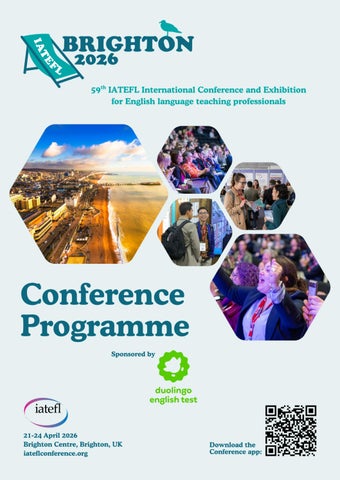
Create a flipbook