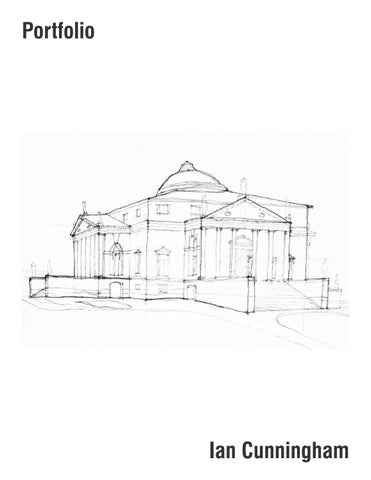
Portfolio

Page 1


Portfolio

Rocky Butte Commons

Fall 2022 - Spring 2023

Project Location: Portland, Oregon

Instructor: Gerry Gast

Rocky Butte Commons is an exploration of how architecture can facilitate the creation of places where people can go to socialize and play, meet people with shared interests, build community and feel a sense of belonging. It exists as part of a network of educational resources available to all in the spirit of the public library - learning webs with nodes throughout neighborhoods; hubs where learners, their peers, and teachers can connect with each other and freely access educational resources.

These places would serve the unique needs of their community through shared facilities, tools, and activities based on the interests of community members. A variety of spaces are provided for social activities common across cultures, such as socializing and playing, sharing and discussing ideas, cooking, and eating and drinking, as well as more specialized solitary pursuits, such as experimenting with tools and creating things, reading and writing, music practice, and quiet contemplation and reflection.

Realizing the vision of Rocky Butte Commons requires the creation of a series of spaces organized within an architectural framework, providing the community with a range of spaces where they can be, and where myriad activities can take place over time. This requirement for flexibility for different

uses can be met through providing universal space, which possesses various qualities which may suit some activities better than others, but which do not insist on a particular use. These are spaces that can adapt to multiple functions, while retaining a sense of place.

Initially, the architectural program for Rocky Butte Commons was developed through studying Alder Commons, a community center and hub for selfdirected education in northeast Portland, as well as innovative public libraries being built throughout the United States, and researching the demographic makeup of the community and existing resources in the vicinity to assess specific needs.

Site Location
Above: Site Context Map Left: Model Photo

Site Description

of its central location on Northeast 82nd Avenue, with good access to public transit and in close prox imity to a high school, a neighborhood park, and its namesake, Rocky Butte. The site’s position on a south-facing slope gives it an ideal solar orientation and affords it excellent views of the forested hills to the south and Rocky Butte to the east. The existing structures on the site date from the middle of the twentieth century and include a former bowling alley, a vacant lot which once housed an athletic club, and a motel. The aging and increasingly obsolete nature of the existing uses creates an opportunity for site repair on a site directly across from an existing civic institution.

Architectural Concept

The architectural response to the site and program consists of two linear structures of different widths connected by steps interlaced with a ramp conforming to the slope of the site. Dividing the program across two structures in this way creates two outdoor spaces between them; a plaza facing onto 82nd Ave, and a more enclosed courtyard facing east to Rocky Butte, with a light, transparent volume in between, enabling a visual connection between the two spaces. This long space between the two bars acts as an axis, visually and symbolically connecting Rocky Butte with the artery which serves as both the central spine of the neighborhood and a major dividing line between Central and East Portland.

Butte Commons

To the north of the building, a new pathway connects 82nd Ave with Rocky Butte by the Dharma Rain Zen Center and through a forested natural area with a wetland. To the south, a woonerf-like shared street serves as a drop-off area, and a space for food trucks and markets on weekends and holidays. To the east, a spiraling landform rises to a viewpoint at the high point of the site, while down the slope an inverted landscape feature spirals down forming a stormwater retention pond which will offer a natural habitat to wildlife, a peaceful oasis for nearby residents and a place for children and dogs to play in the water and observe nature.

The form of the roof takes inspiration from traditional curved roofs in East Asia, often used in Buddhist temples and other important civic buildings. Wood scissor trusses made up of

curved glue-laminated members give the roof its distinctive shape, while simultaneously providing the opportunity for toplighting through north-facing clerestory windows. Generously high ceilings in the upper floors give a spacious, light and airy feel to the more public communal spaces, while the bottom floor rests partially underground, sheltered by the earth, providing space for more private, individual, utilitarian uses.

Above: North-South section with Rocky Butte in background Left: Annotated site plan

Facing onto the plaza, a large gathering space for events housing up to 300 people and a cafe are the public face of the building. In between the plaza and the courtyard is the main vertical circulation, acting like a central spine. Single-loaded corridors wrap the courtyard and act as a buffer between the inside and outside, as well as a tunable interstitial space, akin to the engawa in a traditional Japanese house. In the north wing, the lounge and kitchen on the level of the main entrance form the social heart of the complex. Next door, a dedicated hangout space for teenagers gives them a chance to explore their identities and enjoy some independence. A balcony facing onto the courtyard allows for natural surveillance of the children playing below, without encouraging too much adult intervention.

On the second floor are the more quiet, introverted spaces, such as a library and co-working space, a quiet room for rest that could serve as a yoga studio or meditation room, an art gallery, and arts and crafts room. On the bottom floor there is a workshop for tinkering and making things, offices for staff, a media lab for photography and video, music practice rooms, and a recording studio. In the south wing are spaces for playing and performing, including the main event space, a rehearsal space for ensembles, a play room for young children, and a dance studio.

Of course, these are only suggestions. In practice, the community would decide what to use a given space for and it is the reason it is critical to design an architectural framework that allows spaces to be adapted for multiple functions over time. As there

Top Left: Perspective from NE 82nd Ave

Top Right: Perspective from SW showing courtyard

Bottom Right: Concept Diagram

are a variety of sizes of spaces, in area, height, and volume, as well as various orientations and daylighting conditions and each space is adjacent to a service core and is subdividable into smaller spaces, this allows for greater flexibility in function over the life of the building, so as to better meet the changing needs and desires of the community.

Sustainability Strategy

Natural light enters through north-facing clerestory windows on the upper levels, and the building’s slim form allows light on two sides of most rooms. The building’s orientation maximizes exposure to both north and south light, reducing glare and the need for shading devices. The building follows the slope to prevent overshadowing, ensuring direct sunlight and creating space for a roof terrace with views and room to grow food. A large south-facing roof provides an ideal spot for photovoltaic panels, potentially enabling net-zero emissions.

The single-loaded corridor layout allows crossventilation in each room, while clerestory windows along the roof’s ridge facilitate stack ventilation. The corridor in the north-facing section acts as a buffer zone between interior and exterior spaces, functioning as an indoor-outdoor area with a tunable façade.

Thermal mass is harnessed through concrete flooring, which absorbs heat during the day and releases it at night, stabilizing temperatures during

the Pacific Northwest’s large diurnal swings. Earth sheltering reduces heat transfer, minimizes temperature fluctuations, and provides sound insulation from external noise like traffic.

Stormwater is collected in cisterns and a retention pond, used for irrigation and greywater applications, and serves as an emergency water supply. The building is constructed from sustainable materials, including locally sourced wood and stone, which have lower embodied energy than industrial materials like concrete and steel.

Designed for adaptability, the building minimizes future structural interventions. By offering shared community space, Rocky Butte Commons reduces individual consumption, strengthens social ties, and builds resilience to environmental, economic, and social challenges.

Tectonics

The tectonics of the structures are based on a desire for simplicity, flexibility, and legibility. Mass timber frame was chosen as the structural system because of its ties to regional identity, need for acoustic isolation, lightweight, easy to assemble nature, adaptability over time, the reduced number of required columns allowing for large, open spaces, and the ability to leave the structure exposed, while retaining a high fire-resistance rating. CLT forms the floor plates and service cores, which provide shear strength to resist lateral forces.

Criteria for selecting a structural system and materials:

• Acoustic separation

• Desire to leave the structure exposed while retaining a high fire-resistance rating

• Shallow floor plate suggests one-way spanning system

• Desire for open, flexible layout supported by a structural system requiring fewer columns and which allowing for larger spaces uninterrupted by columns

• Adaptability to different uses over time

• Lightweight

• Potential for prefabrication

• Ease of assembly

Material Pallette

Standing Seam Metal Roof

Rigid Insulation Board
3 x 6 Tongue and Groove Roof Deck
Glulam Scissor Truss
Glazing
Wood Column 8 x 8
Rigid Insulation, 2”
Wood Rainscreen Cladding
Furring Strips
2 x 6 Stud Wall
Hydronic Distribution Lines
3-Ply CLT Floor w / 2” Concrete Topper
Radiant Concrete Slab
Glulam Beam, 5.5” x 21”
Stone Retaining Wall

Physical Model

Folly

Summer 2017

Project Location: Rural Oregon

Instructor:

The synthesis of design exercises responding to the elements - earth, water, sun, and air - this structure was conceived of as a folly, with no program specified other than as a place to enjoy an Oregon product - hazelnuts, in this case.

To contrast with the sloping site, a series of concrete walls of uniform height stand parallel to one another with the distance between them varying to create a range of different spatial experiences as one descends towards the tasting room and then into the hillside to the roastery.

Portfolio
Ian Cunningham Synthesis
Above: model photos
Below: concept sketch
Portfolio
Ian Cunningham Synthesis
Cunningham
Above: plan and section
Below left: photos of maquettes
Below right: parti diagram

Alberta Street Library

Fall 2017

Project Location: Portland, Oregon

Instructor: Peter Keyes

Located in the rapidly gentrifying Alberta neighborhood in Portland, this design for a library and community center attempts to create an oasis of repose amidst the hustle and bustle of the city for the enjoyment of reading as well as creating an active space for community events.

Key elements of the design include the dramatic exposed structure of the roof of the toplit double-height reading room, the importance of establishing a strong presence on the corner of Alberta Street and 15th Avenue, while being mindful of the residential scale, and the public plaza in front of the entrance and the community room.

Above: perspectives of the street, reading room, community room, and plaza.

Below: site context map

Above left: exploded axonometric of the structure. Above right: floor plans (ground floor at the bottom)
Below: sections and elevations

Eugene Suzuki Music School

Winter 2018

Project Location: Eugene, Oregon

Instructor: Don Corner

The project brief called for the design of a community music school indepedent from, but connected to the University of Oregon, with shared spaces for teaching, practicing, and performing including a recital hall, ensemble room, private studios, classrooms, offices for graduate teaching fellows, and a lobby for mingling before or after lessons or performances.

Taking inspiration from Tokyo Opera City concert hall, the recital hall’s asymmetrical hipped roof enhances acoustics and references the Hacker-designed HEDCO building across the way. In addition to functioning as the heart

of the school and connecting to the existing building, the south-facing courtyard functions as an outdoor concert venue in the warmer summer months.

Above: sectional model of recital hall
Below: site context map
From top to bottom: north-south section, west elevation, east-west section
Left: ground floor plan. Above right: second floor plan. Below right: basement floor plan

Section through classroom and lobby

Section through recital hall and ensemble room

Shinobazu Pond Cultural Promenade

Spring 2019 Tokyo, Japan

Instructors: Hiro Sasaki + Manuel Tardits

Undertaken during a semester abroad at Meiji University in Tokyo, Japan, this cross between an architecture and an urban design studio was comprised of two sections: the first entailed group work focusing on crafting a vision for the area around Ueno Park, one of the most important vestiges of cultural heritage in the megalopolis, having survived the Great Kanto Earthquake in 1923 and the allied bombing raids during World War II that devestated most of Tokyo.

Our group chose to envision an Ueno Park Cultural Heritage district, where culturally significant places are called attention to and made visible to the public. The second half of the studio, I chose to focus on the area next to Shinobazu Pond, and proposed a tea house and a floating stage for outdoor kabuki performances.

Above: site plan
Below: site section through floating stage

Vicenza Civic Center

Spring 2018

Project Location: Vicenza, Italy

Instructors: Megan Haight + Don Corner

While studying abroad in Vicenza, our task was to design an art gallery, archival library, and market hall on a prominent site facing onto the main piazza and directly adjacent to the Palazzo Ragione, with its Palladio-designed arcade.

The result is an attempt to replicate the features of a beautiful civic building, a thriving piazza, and the harmonic relationship between the two; examples of which we analyzed during our travels throughout Italy. The scale and proportion of the massing and outdoor spaces were intended to complement the surroundings.

Above: photo of model showing urban context
Below: Nolli map of site
Above: sectional model of gallery
Below left: section through double-height gallery
Below right: photo of model showing campanile
Above (left to right): ground floor plan, first floor plan, second floor plan
Below left: east-west section cutting through courtyard
Below right: north-south section showing Venetian columns in elevation

Refugee Housing

Fall 2018

Project Location: Portland, Oregon

Instructor: Hajo Neis

Located in the Buckman Neighborhood on SE 12th Avenue, the dividing line between an industrial and residential zone, the site contains a group of mature trees which, from the outset of the project, were deemed to be worth preserving. As the demand for refugee housing and the origin of future refugees is unknown, I decided to keep the design culturally non-specific and to design some of the units to be flexible to changing household sizes and types. Positive outdoor spaces are shaped by the buildings to create areas with various levels of privacy and liveliness. Live/work units front onto NE 12th Avenue with shops on the ground floor and dwellings above.

Above: perspective of digital 3D model from NW corner
Below: site map
Above: perspective of digital 3D model from SE showing rowhouse type

Above: East-West section Below: ground floor plan

Above left: third floor plan
Below left: second floor plan
Right: prototype flexible rowhouse unit floor plans

Colegio Roble Morado

Winter 2019

Project Location: El Bosque, Barranquilla, Colombia

Instructor: Gerry Gast

The school is a tree rooted in the community. Each ‘branch’ represents a stage in educational development - nursery, primary, and secondary. The central courtyard and community building serve as the ‘trunk’ and each ‘branch’ is further subdivided into clusters of three classrooms, with two clusters per ‘branch.’ The classroom buildings consist are broken up into smaller volumes and grouped together like a village under a big sheltering roof. Three classrooms share a central outdoor space where group activities can take place.

Above: photo of maquette
Below: site map

The roof is raised up with slender steel columns above the concrete classroom buildings. It provides shade for the spaces below, keeping it cool and allowing a breeze to flow through underneath. The roof unifies the design, tying the clusters of classrooms underneath into a whole. The community building at the west end of the complex, contains all the facilities that the three branches share and which can be opened to the community outside of regular school hours, including the library, assembly hall, kitchen, computer lab, administration, music room, art room, health clinic, and workshop.

1. Music
2. Balcony
3. Classroom
4. Laboratory
5. Kindergarten
6. Toilets
Parti diagram
Upper level floor plan
Kitchen 2. Community Room
Classroom 4. Laboratory
5. Kindergarten
6. Toilets
North-South site section
Lower level floor plan

Section through learning neighborhood

Ground floor plan of learning neighborhood

Turn static files into dynamic content formats.

Create a flipbook
Portfolio by Ian Cunningham - Issuu