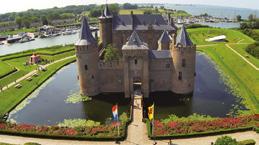
Moving to another country is not a small step you take. It has a huge impact on you and your family. We know how that feels. Relocation isn’t just a question of finding a house or a school. It’s all about creating an enjoyable life in a brand new culture. For you and your family. We’ll make sure you do. Wherever you go, we’ll be there with you.
WELCOME TO THE NETHERLANDS!
Moving abroad is an exhilarating, life-changing experience. That is, once the practical aspects are settled. It first can be a daunting process while you try building a new life in an unknown language and culture. Where do you begin?
The Expat Survival Guide assists your first essential steps: finding a home and job, organising permits, setting up finances and healthcare, and enrolling in education. It offers practical information on getting started in the Netherlands and directs you to the people, companies and institutions that can help you along the way.
As the growing pangs subside, www.expatica.com complements this guide with relevant news in English, weekly features from experienced expats, and essential lifestyle information for getting out and about in the Netherlands. You’ll find plenty of support with our housing and job search tools, ask-the-expert service, free classifieds, A–Z listings, events, expat dating, and a thriving online community. Our goal is to provide all the information you need to settle with ease into your new Dutch lifestyle.
ENJOY living, working and studying in the Netherlands!
“i am not a tourist” team
This guide is published by “i am not a tourist” Fairs & Events in cooperation with Expatica.com.
I Am Not A Tourist BV – Saturnusstraat 60- unit 89, 2516 AH Den Haag www.expatfair.nl
The Hague International Centre: +31 (0)70 353 5043 internationalcentre@denhaag.nl | www.thehagueinternationalcentre.nl
2
4
6
14
INTRODUCTION
SURVIVAL CHECKLIST
RELOCATION: What kind of residence permit? Expat centers; Relocation service providers;
SPECIAL NEEDS
HOUSING: Renting; Buying; Popular expat locations: Amsterdam, Amstelveen, Maastricht, The Hague, Eindhoven, Rotterdam Utrecht and Twente.
35 SETTING UP HOME: Utilities: gas, water, electricity; Communications: telephone mobile,internet. TV; Post offices; Emergency numbers.
37 EMPLOYMENT: Work permits; Employment law; Working culture; Finding a job.
52 EDUCATION: Primary, secondary and higher education; International schools.
63 HEALTHCARE: Health insurance; Healthcare system; Having a baby; Health services.
71 FINANCE: Bank accounts; Tax; Insurance; Financial and tax advisors.
78 FAMILIES: Family reunification permits; Au pairs; Childcare; Child benefits and allowances; Family Activities, Leisure, Maturnity
85 TRANSPORT: Driving; Public transport.
88 EMERGENCY NUMBERS
89 PUBLIC HOLIDAYS
90 LISTINGS
100 ADVERTISERS INDEX
All rights reserved. No part of this publication may be reproduced or transmitted in any form or by any means, electronically or mechanically, including photocopying, recording or any information storage or retrieval system, without prior written permission from the publisher. Requests for permission should be addressed to I Am Not A Tourist BV, Saturnusstraat 60-unit 89, 2516 AH Den Haag, The Netherlands.
I Am Not A Tourist BV makes great effort to ensure the accuracy of information contained in this guide. However, we do not take responsibility for errors or omissions or any damages, howsoever caused, which result from its use, and make no warranty of claims as to the quality or competence of businesses or professionals mentioned. Users are advised to take care when selecting professional services and to use common sense when adjusting to new life in a new country.
INTRODUCTION
The Netherlands consistently ranks among the top places in the world to live and work.
It may be a small country in size, but certainly not in impact. The Netherlands is famed for its liberal social policies, maritime trading traditions, battles to hold back the sea, robust multiculturalism and leading technological communications, making Dutch lifestyle a mosaic of cultural intrigue.
Living standards consistently rank high in the 2017 OECD’s Better Life Index, and the Netherlands has the third best work-life balance and high levels of employment and household wealth. Dutch children, likewise, are ranked as the happiest in the developed world, topping two surveys conducted by UNICEF.
To newcomers, Dutch society might seem open and informal, but some complex social rules are at play. Ostentatious behaviour is frowned upon, egalitarianism is valued and Dutch people ‘like to be as normal as possible’ according to Martijn de Rooij, author of The Dutch I Presume? The Dutch saying ‘doe maar gewoon dan doe je al gek genoeg’ (just act normal, that’s crazy enough) is an anthem against eccentricity.
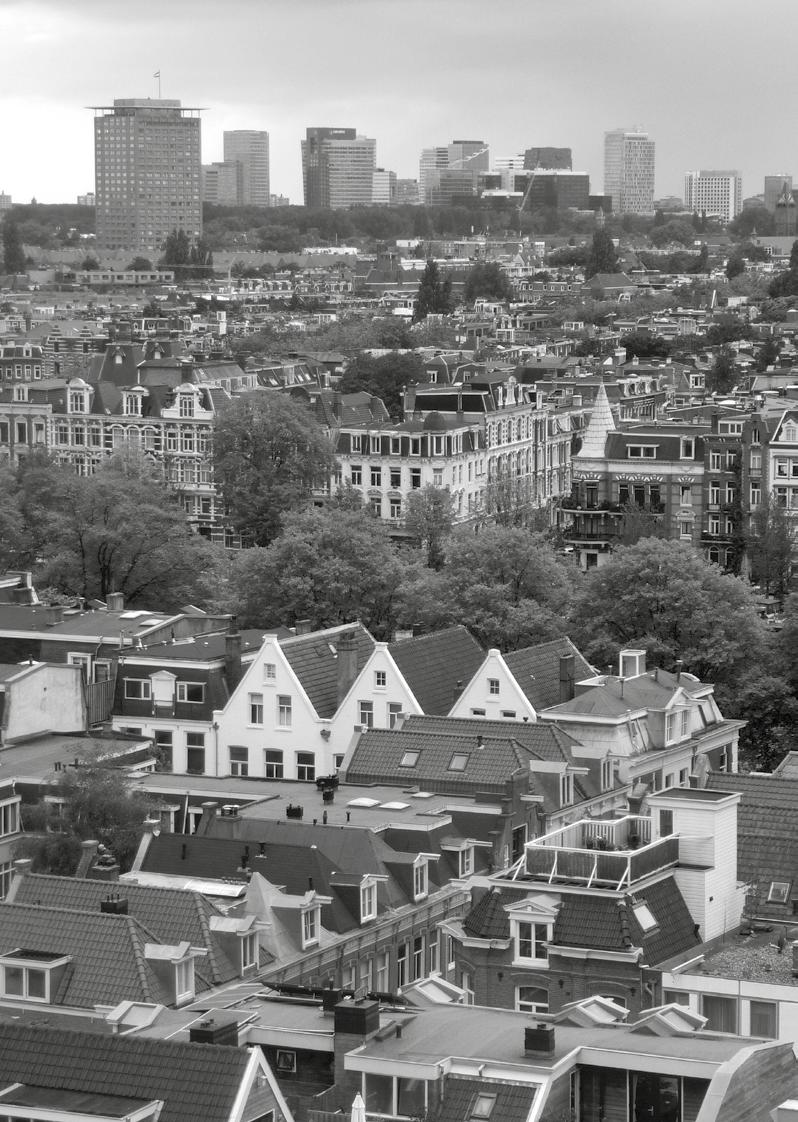
No Dutch city outside Amsterdam has yet reached a million inhabitants and each retains a unique character and architectural style. The capital is something else entirely, and in terms of atmosphere and attitude,
Amsterdam and the Netherlands could be two different countries.
International residents tread a well-worn path to the ‘Lowlands’. Out of a population of some 17 million people, more than three and a half million have a foreign background (cbs.nl). This multiethnic characteristic of the country’s population has historic roots stretching back several hundred years, though most rapid changes in population demographics have come about in the last 40 years.
Foreign policy has impacted domestic politics in recent years, and influenced two government
• Population: 17 million
• Density: 488/km2 (the highest in the European Union in 2017)
• Administration: The constitution dates mostly from 1848, and revisions undertaken in 1983. Parliament consists of an upper chamber (eerste kamer) of 75 members elected by provincial councils and a lower chamber (tweede kamer) with 150 members elected every four years by proportional representation. The cabinet is the executive body and its constituents cannot be members of the cabinet and parliament at the same time.
• Monarchy: The House of Oranje-Nassau has governed the Netherlands since 1815. King Willem-Alexander, born 1967, was crowned in 2013, along with his Argentinean wife Maxima, who serves as the queen consort.
• Landscape: A fifth of the Netherlands is reclaimed from the sea (polders) and about a quarter of the country is below sea level. There are 20 national parks and a few modest hills, with the country’s highest point reaching 322 metres in Limburg.
• Agricultural facts: Tiny Netherlands is the world’s second largest exporter of agricultural products, including mostly cereals (wheat in particular), feed crops (such as fodder maize) and potatoes. The Dutch cow is a revered milk machine, producing 35 litres a day.
• Media and culture: The Netherlands has the highest museum density in the world with nearly 1,000 institutions. The television program Big Brother is a Dutch invention.
• Design: Dutch icons of style are nurtured in the revered Design Academy Eindhoven and the Rietveld Academy in Amsterdam, attracting large ratios of international students. Dutch design is admired for its minimalist, quirky and often humorous qualities.
collapses in the space of around two years. The Dutch government’s traditional reliance on a coalition of two or more parties has earned it the nickname ‘the land of compromise’. The Netherlands strengthened its stance on austerity with large gains achieved by pro-European parties, the liberal VVD and D66, and the Christian parties CDA and ChristenUnie. With Mark Rutte continuing as prime minister, this coalititon gives the current Dutch government a small majority. In the realm of royalty, the Netherlands’ biggest nation-wide party celebrates King’s Day on April 27 for the current King Willem-Alexander’s birthday, the ubiquitous oranjegekte
(orange madness) still takes over, where people wear orange shirts, hats, dresses and wigs to celebrate while enjoying the annual free market (vrijmarkt), as it’s the one time when people can set up shop without a trading licence.
Culture and quality living combined make the Netherlands an attractive place for expats, who are an intrinsic part of the country’s knowledgebased economy. The Dutch people are generally receptive, curious, cultured, and friendly. English is widely spoken – a survey by Education First ranked the Netherlands as second in the world for English proficiency as a
second language – but this can be a drawback for those learning Dutch. With many international companies headquartered in the Netherlands, there are plenty of employment opportunities.
SURVIVAL CHECKLIST
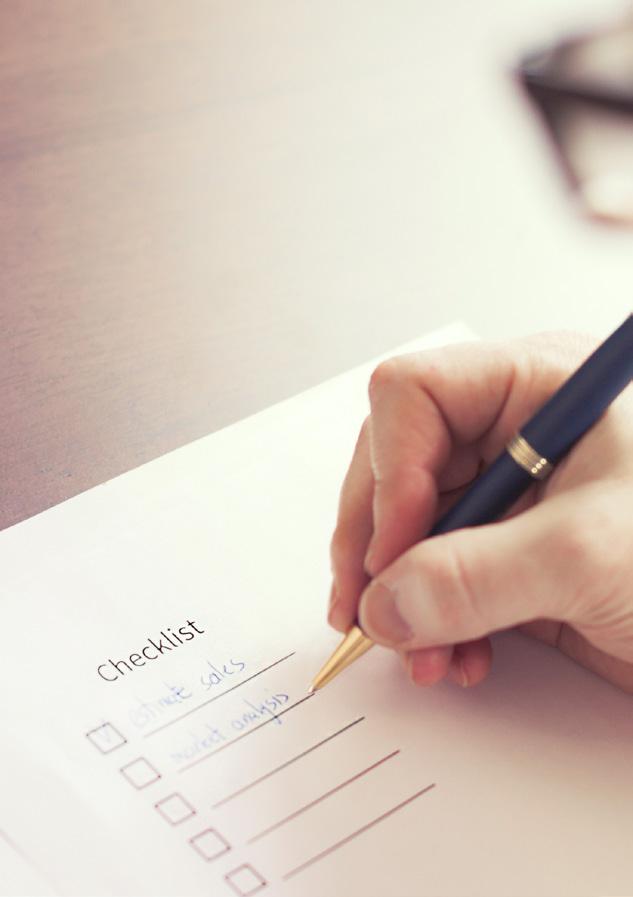
Before the fun of exploring begins, there are some essential tasks to take care of when you first land in the Netherlands.
Use this checklist alongside the information set out in this Expat Survival Guide to help set up your new life in the Netherlands. More information is provided on Expatica.com.
REPORT TO IMMIGRATION
You must register with the BRP at your local town hall within five days of arrival. If you need a residence permit, make an appointment with the IND quickly. Get ready for lots of paperwork and make sure your documents have all the right stamps.
EXPAT BENEFITS
Find out if you are eligible for the Dutch 30 percent ruling for taxes and use the services of the various expat centres to help you cut through the red tape.
OPEN A DUTCH BANK ACCOUNT
Opening a Dutch bank account will make your life easier. You’ll need your passport and/or residence permit, burgerservicenummer (BSN), proof of address, and evidence of income, such as an employment contract or payslip.
FIND A HOME
Our Housing section will help you decide whether to rent or buy, and offers tips on dealing with housing agencies and where to live in the Netherlands.
HOME BASICS
After finding your home, you’ll need to sort out a broadband connection and water, electricity and gas utilities. We list the major suppliers and several useful websites to help you get connected.
EDUCATION
Should you send your child to a local or international school? What learning opportunities are available to expats? Get the lowdown on education (onderwijs) in the Netherlands in our Education section.
JOB HUNTING
If you’ve got a work permit (or don’t need one), you’re ready to begin. Sign up with agencies that specialise in finding work for expats or start your search online. We offer job-hunting tips and information on Dutch labour law.
HEALTH
Did you know it is compulsory for residents to take out the Dutch health insurance basisverzekering? Our Health section guides you through the Dutch healthcare system, and explains what to do in an emergency and how to find a hospital, doctor or midwife.
GETTING AROUND
Before you drive, find out about Dutch road regulations, if you need to exchange your driving licence, and how the Dutch public transport system works.
MEETING THE COMMUNITY
If you’re finding everything a little overwhelming, take heart: many others have been in the same position and made it through. Get out there, get active, and read about groups and clubs for meeting new people.
Settling in, simply.
We’re here to make it easier for internationals to work and register in the Amsterdam area. Qualifying companies can start the paperwork before arrival and a single visit to International Newcomers Amsterdam (IN Amsterdam, formerly called the Expatcenter Amsterdam) will complete the process. What’s more, our website has loads of valuable information on a wide range of topics including education, taxes, healthcare and housing.
The cities of Amsterdam, Amstelveen, Almere, Diemen, Haarlem, Haarlemmermeer, Hilversum and Velsen are working with the Immigration and Naturalisation Services (IND) to bring you the IN Amsterdam services.
To learn more please visit: www.inamsterdam.com
RELOCATION
The Netherlands is a bureaucratic country and proud of it.
Be prepared for paperwork, appointments, and organizing documents during your time planning a stay in the Netherlands:
• Ensure documents are in order before approaching the BRP and IND.
• BRP: the office where to register your details into Dutch system
• IND: the offive that implements immigration policy and makes decisions on residence permits.
• Check that your passport is valid for the period of your stay (and expires later than six months from registration).
• Collect yourm arriage and birth certificates, and they must be translated into Dutch, English, French, or German.
• All documents must be ‘legalised’ with an Apostille – an extra stamp on certify foreign papers. See the Apostille section of www.hcch.net.
COMPULSORY REGISTRATION IN THE BRP APPLIES TO EVERYONE
The Municipal Personal Records Database (Basisregistratie Personen in Dutch) holds details of everyone that lives in the Netherlands; registration is free.
• All who intend to stay for over four months must register at the BRP within five days of arrival.
• Information shared at BRP is shared with other government platforms to reduce duplicate registrations and perform public tasks like determine charges for water and refuse collection, eligibility for social housing, and so on.
The burgerservicenummer (BSN) is initiated here; helps to open a bank account, start work, and claim benefits. After completing the process, you can get a printout of your details to prove your residence and rights.
• Documents required for registration include: passport, rental contract (in your name), employment contract (if applicable), birth and marriage certificates of all family members (see above for legal format).
• To register, you need to make an appointment, and all members of your family (regardless of age) must be present at the first interview.
• Once you’re registered, contact the IND to make an appointment regarding your residence permit (if required).
If you move, you can visit a local office (stadsdeelkantoor) to update your details.
• If leaving the Netherlands, you can deregister and give back your residence permit to the IND.
IND
• Immigratie-en Naturalisatiedienst (IND) implements immigration policy including applications for residence permits, Dutch citizenship, visas, and asylum requests.
• The website has extensive information in English, a Residence Wizard for specific circumstances, and downloadable brochures and forms.
• Appointment must be made before visiting an IND desk, sticker will be placed in passport.
• To collect a permit, you must come in person; if you have received a letter stating that it is ready, no appointment is necessary.
• Renewal forms are automatically sent to you. Office locations can be found on the IND website (www.ind. nl) or call +31 (0)88 043 0430 (call charges apply).
RESIDENCE PERMITS
A residence permit is related to the purpose of your stay.
WHAT KIND OF RESIDENCE PERMIT?
• Eligibility and the type of residence permit (verblijfsvergunning) you need depends on a variety of factors (age, income, country of origin, and so on).
• Temporary residence permits are renewable and issued for a set period for up to five years. They usually last the length of your stay (work contract, study program, etc.).
• After 5 years of legal, continuous residency, you can apply for permanent residence or consider citizenship.
EU/EEA/SWISS NATIONALS AND RELATIVES
• For EU/EEA/Swiss nationals your passport or ID proves your right to live and work in the Netherlands.
• Nationals must register at a local municipality, get a social number (BSN), and take out Dutch health insurance.
• Any non-EU/EEA/Swiss family members must apply for a certificate of lawful residence and show proof of their relationship to the national. Croatians can also
apply for this certificate if needed –but it is not compulsory.
• After five years of residency, all EU/EEA/Swiss nationals and family members (who have lived with them) are eligible to apply for ‘permanent residence for EU citizens’.
NON-EU/EEA/SWISS
• Also called “third country” nationals need residence permit to stay over three months and possibly temporary permit (MVV) to enter the Netherlands.
• MVV and residence permit can be applied for with one application called the Entry and Residence Procedure (TEV).
• Sponsors – employer or family members – can apply for the permit on national’s behalf before arrival.
MVV (MACHTIGING TOT VOORLOPIG VERBLIJF)
• a sticker placed in a passport -valid for six months -- Authorizes temporary stay for migrants intending to stay longer than 90 days; can only be applied for while outside of The Netherlands.
• An exam covering Dutch language and society (Civic Integration Examination Abroad) is given unless entering The Netherlands for for employment or studies.
WHO DOESN’T NEED AN MVV?
• If applying for residence permit, an MVV is not needed.
• Nationals from EU/EEA/ Switzerland (and their family members), Australia, Canada, Japan, Monaco, New Zealand, South Korea, US and Vatican City do not need an MVV.
• Citizens with a ‘long-term residence permit EC’ issued by another European Community (EC) state are also exempt.
CIVIC INTEGRATION ACT
• Integration exam is required before applying for MVV; exemptions are listed on www.ind.nl
• Those coming for work, study, exchange, under 18 years old, and pension aged, are exempt from exam while on temporary permits.
• Official self-study packs are sold by www.naarnederland.nl. The IND links to an online registration form to book your exam. The exam is undertaken at a Dutch embassy
Feeling at home abroad
offer a complete range of services and support for foreign nationals coming to live and work in The Netherlands. Our services are based on flexibility, individual attention and unrivaled experience.
Schoutenlaan 62-2215 ME Voorhout -The Netherlands
E info@pasbms.com
T +31 (0)252-347876
I www.pasbms.com
t +31 (0)297 272784
e info@relocaid.com i www.relocaid.com
or consulate in your country (if none, at the nearest Dutch mission).
• The civic integration (inburgering) requires foreigners to pass exam that tests for knowledge of Dutch language, culture and society. EU/EEA/Swiss citizens and their families are exempt. For information, check en.inburgeren.nl.
HIGHLY SKILLED MIGRANT SCHEME (KENNISMIGRANTEN)
• There are obtained via an authorised employer listed by IND and can admit highly skilled migrant applicants with this scheme.
• The visa all depends on salary. The salary band does not apply to medical specialist training, or academic positions.
• Sponsors of highly skilled migrants apply for a residence permit (and MVV if necessary) on the worker’s behalf before they arrive.
• Employees can begin work once they receive their residence permit or ‘residence endorsement sticker’ (verblijfsaantekening) from the IND.
GRADUATES/HIGHLY EDUCATED
• Foreign students who have completed higher education can file with IND to remain in the country for a year to look for a job; separate work permit for employment not needed.
• Permission also applies to those who obtained a degree in the last three years from a university listed in the top 200 of the most recent Times Higher Education World University Rankings, QS World University Rankings, or Academic Ranking of World Universities.
• Visa is non-extendable; graduate must apply for new residency permit when work is found or register as self-employed.
RESIDENCY COSTS (2018)
These rates are a base only, and are subject to individual circumstances and frequent change. Refer to www.ind. nl for details.
• Join a family member/partner: EUR 237 (EUR 51 children)
• Work in paid employment/highly skilled migrant (with/without MVV): EUR 926
• Study/scientific research: EUR 633
• Working holiday schemes: EUR 51
• Au pairs/exchange/graduated persons’ orientation year: EUR 633
INDEPENDENT PERMITS
• A non-EU national who has a residence permit based on a relationship (a Dutch partner, for example) can apply for a permit in their own right (continued residence permit) after five years of holding a Dutch permit, or less in certain situations on which the IND can advise.
CHANGING PERMITS
• To switch permit types, you must apply for a new permit with the IND, with supporting documentation.
• Workers can change jobs without requiring a new residency permit, however, the IND must be notified and a new work permit obtained.
IDENTIFICATION
• All residents over the age of 14 must carry an ID that shows their residence status (for EU/EEA nationals, a passport).
Laan van Meerdervoort 70 – 1st floor, 2517 AN Den Haag
The Hague Inernational Centre: Spui 70, 2511 BT Den Haag ECU - Expat Centre Utrecht: Stadsplateau 1, 3521 AZ Utrecht IN Amsterdam: I-Tower, ground floor (entrance via zuidplein), Strawinskylaan 1767, 1077 XX Amsterdam
Expat Centre Leiden - VVV Leiden (Tourist Information Centre): Stationsweg 26, 2312 AV Leiden
• Santa Fe Relocation H. Kamerlingh Onnesweg 3, 2408 AX Alphen aan den Rijn | +31(0)172 44 7979 amsterdam@santaferelo.com | www.santaferelo.com | @SantaFeRelo
SPECIAL NEEDS
A wide array of organisations assist people with special needs in the Netherlands.
• The Netherlands has legislation protecting the rights of people with a physical, mental, emotional, or sensory impairment that ensures equal access to social, economic and transport systems and encourages full participation in society.
TRANSPORT
• Old Dutch cities with narrow, uneven streets and bikes parked everywhere are not brilliant terrain for those in wheelchairs, but access is improving.
• Help is available getting to/through Schiphol airport (www.schiphol. nl) and railways (www.ns.nl), and there’s a bureau for disabled travellers (call 030 235 7822 or register online) to request journey assistance.
• Your gemeente site will give local information, often in English, for the location of disabled parking places and other access issues, or look up zorg en welzijn and gehandicapten
EDUCATION
• Children are encouraged to attend mainstream primary schools under the ‘Going to school together’ policy.
• The Inclusive Education Act (Wet Passend Onderwijs) requires all schools to provide equal learning opportunities for every child.
• Parents can opt for a special school, whether a speciaal basisonderwijs (SBO) for learning and behavourial support or a speciaal onderwijs (so) for specific special needs.
• The language of instruction is Dutch, but children from a nonDutch background can sometimes be taught in their mother tongue to help them settle in.
• You will find SEN teachers at international schools where the language of instruction will be English, but you may have to fund the assistant.
• The school of their choice – special or mainstream – will receive funding to cater for their needs, and the school will arrange assistance as required.
• For higher education, ‘education and disability’ visit (www.onderwijsenhandicap.nl).
FUNDING
• There is also financial support for individual families, such as additional child benefit, healthcare and carer allowances, and adaptations to home or transport.
• Search the government welfare site www.svb.nl to see if you qualify for a carer’s allowance (TOG) or a personal budget (PGB) to cover support costs.
GOING OUT AND HOLIDAYS
• A combination of wheelchair accessible activities and accommodation can be found at www.accessibletravelnl.com, and restaurants from several sites (for example, www.dinnersite.nl).
• Good sources for sporty types include Stichting Resa (www. stichtingresa.nl) or www. fondsgehandicaptensport.nl.
• Amsterdam has a dedicated site detailing accessible buildings: www.toegankelijkamsterdam.nl.
• Some campsites such as De Ruimte (www.campingderuimte.nl) cater especially for children with special needs.
• Find out about accessible nature reserves and recreation areas at Staatsbosbeheer (www.staatsbosbeheer.nl).
• For farther travels, organised group trips are available at www. gehandicaptenreizen.nl.
• Accessible Travel Netherlands (www.accessibletravelnl.com) is a local tour operator specialising in holidays for anyone with special access needs.
ASSISTANCE ORGANISATIONS (LINKS MOSTLY IN DUTCH)
• ANGO: General Dutch Disability Organisation +31 (0)33 465 4343
• MEE: Support and help for living with a disability +31 (0)900 999 88 88 | www.mee.nl
• Ieder(in): Network for the chronically ill and disabled (Formally known as CG-RaaD) +31 (0)30 720 0000 | www.iederin.nl
• Accessibility Foundation: Accessible internet for all +31 (0)30 239 82 70 www.accessibility.nl
• Valys: Regional assisted transport +31 (0)900 9630 | www.valys.nl
• Handilinks: A useful portal with lots of related links www.handilinks.nl
• Down Syndrome Foundation (SDS): www.downsyndroom.nl
• Deaf/blind support: www.doofblind.nl
• Children/teenagers support: www.nsgk.nl
HOUSING
Finding the perfect home is not easy in the densely populated Netherlands. Here’s how it works.
RENT OR BUY?
• If you’re here for more than five years and paying EUR2000 per month on rent, you are better off buying a house in the Netherlands.
• Buyers who want to rent their home in the future should make sure they are permitted to
• Only interest payments for full-repayment mortgages over 30 years are tax deductible, and the maximum tax rate for deductibility will be reduced by 0.5 percent per annum until 2040.
FINDING A HOME
• Properties to rent (te huur) and to buy (te koop) can be found on online property portals and agency websites like www.funda.nl, the national database of the Nederlandse Vereniging van Makelaars (NVM), or the Dutch Association of Estate agents.
• There are many agencies specialising in expats (be wary of those that charge a registration fee), which can steer a path through the local market.
• The downside of using an agency is the commission or finder’s fee. A month’s rent (plus 21 percent tax) is the going rate.
• On the other hand, using a reputable agent can help you to avoid renting an illegal apartment, not recovering your deposit, being bound by an unreasonable contract, or paying too much.
• Baffled by real estate terminology? Search for English language postings on housing.expatica.com.
• Rental properties that have less than EUR 710.68 (in 2016) base rent will fall under social housing restrictions, and most will not qualify for these properties as they either earn too much or have no required link to the area.
• The sellers’ market is hot in the Netherlands, and housing is in demand.
• Competition for attractive housing in popular areas is fierce, so be ready to bid high and sign quickly.
• Expats are advised to buy only if they will be in the Netherlands for five years’ minimum
• If you are only here for a few years, renting is likely your best option.
EXPAT BROKER
RENTING
USING AN AGENT
• A good agent should be able to tell you about the market, city, price, quality of housing and restrictions that apply to expats, as well as arrange visits for you, negotiate with landlords, and provide a contract in English.
THREE HOUSING SECTORS
• Social Housing Sector: The dominant distribution sector has rent-controlled social housing, and income status plays its part in allocation. Restrictions are applied by the local authority.
• Social housing is split into two sectors, depending on whether the property is privately owned, or owned by a housing corporation (woningcooperaties).
• Housing corporations: A good value, but with many restrictions regarding who may live in them. Waiting lists of up to 10 years or more are not uncommon. Only those with a total income of less than EUR 35,739 and valid residency will be eligible.
• Owner-occupied sector: You can only rent in this sector when your total taxable household income is EUR 43,000 or less. Landlords are free to find their own tenants, and as such, residency status does not apply.
• Liberalised sector: The government regulates baserents up to EUR 710.68 a month (2016) and anything over this price is in the ‘liberalised’ sector (assuming it has the correct points/price ratio), where rent prices are not restricted.
• Most expats end up renting accommodation in the Liberalised sector because there are fewer restrictions and housing is easier to rent.
RULES AND REGULATIONS
• Base rents (kale huur) are controlled by a ‘points’ system, woningwaarderingsstelsel, which scores everything from the floor space and heating system to location and property type to determine a rental value.
• The reality is that there are too few rental properties, which puts upwards pressure on some types of accommodation. Check what your property’s rent should be at www.huurcommissie.nl.
• Signed the contract but now think you are paying too much? Contact a local huurteam or initiate a rental review on www.huurcommissie.nl within six months of signing the lease.
• Generally, income conditions apply for cheaper housing.
• Be cautious of sub-lets when searching solo. You may have problems registering.
COSTS AND CONTRACTS
Your rental contract should cover:
• Status: is the property furnished, semi-furnished or empty? There may be an inventory and/or photos.
• Duration of lease.
• Notice period and stipulations about how notice should be provided.
• Service charges (check ‘all-inclusive’. What portion is rent?).
• Utilities (apportioned how?). If you agree to a monthly fee, including an advance for utilities, then make sure that utility use is metered for your property. Your landlord should show you an account (eindafrekening) of payments and real costs at least once a year.
• A diplomatic clause if you have to leave because your employer has relocated you elsewhere. You need to be clear on when and how this clause can be used to allow you to escape your rental obligations.
• Expect to pay one or two months of rent as deposit –one month’s rent in advance to the landlord, and one month’s rent if you use an agent.
TIPS
• Discuss your needs explicitly with your agent.
• Select one, at most two, agencies: “We all talk to each other.”
• Arrange viewings three weeks before you need to move in, no earlier.
• Be ready to move quickly.
• If the agent commission seems too much, find property on your own, but be ready to put in lots of legwork.
• Most of all, you will need luck and timing is important.
• Post a notice in the housing section of expat forums.
• Steer clear of anyone asking for a cash payment or commission.
• Respond quickly to adverts and take someone along with you when viewing.
• Always check that you can register with the BRP.
• The standard NVM (Dutch estate agent association) contract has an English version for comparison.
STUDENTS
• Universities try their best to help students with housing but there are serious shortage issues.
• There are non-commercial agencies for students, housing corporations and antikraak (anti-squat) agencies that rent out accommodation.
• Check the city housing department for more information about low-priced housing.
• You can find useful internet sites for renting a room or student accommodation, like www.kamernet.nl.
SHORT-TERM HOUSING OPTIONG
• Many cities in the Netherlands have aparthotels for corporate clients, which can sometimes be less anonymous and cheaper than hotels.
• Websites aimed at tourists – like AirBnB – are great for a private apartment for a couple of months.
• Short-stay regulations in Amsterdam make it ‘illegal’ to rent the majority of properties for less than six months, but many properties listed for less than six-month stays regardless.
LIVING ON THE WATER
• Tempted by life on a houseboat or Dutch barge?
• The houseboat market is a very close-knit community so personal references will go a long way.
• There are many rules and regulations regarding permits and mooring conditions. Track down a specialist agent to steer you through the procedures.
• Useful sites include www.waterwonen.nl and www. botentekoop.nl (which includes all kinds of boats for sale).
BUYING
• It is common to appoint a real estate agent, or a makelaar, to do much of the legwork.
• A makelaar will track down appropriate houses, arranging viewings, suggesting areas where there’s room for negotiation, and advising on potential pitfalls.
• A makelaar also knows which property will come on the market shortly.
• The agent’s commission will be one or two percent of the purchase price.
• You can hunt on Funda (www.funda.nl) to get ideas of prices in particular areas or scour the pages of newspaper housing supplements.
• When buying, proximity to work, schools and amenities all play their part.
• Be aware of the costs involved in renovating older property to current building standards or the quality required for renting.
• For leasehold properties, check out the ground rents.
• Tax is also levied on the deemed property value (WOZ), evaluated by the local municipality each year.
• See www.nvm.nl for useful information in English.
ARRANGING A MORTGAGE (HYPOTHEEK)
• There are many different types of mortgage and the tax issues are complex. The general conditions for a mortgage up to four or five times your salary are:
• You have a permanent residence permit (depending on nationality and employment contract, this may not be applicable).
• You have a permanent employment contract or a continuation statement from your employer.
• If self-employed or a contractor, you have certified accounts for the last three years and forecasts for the following year.
• Maximum mortgage obtainable was reduced to 102 percent of the purchase price in 2016, and will be lowered further by 1 percent per annum until it reaches 100 percent in 2018.
COSTS
• The buyer generally pays costs (kk – kosten koper) but some costs are tax-deductible.
• Allow for around six percent on top of the purchase price.
• Once your offer has been accepted, a written agreement is mandatory, and a 10 percent deposit should be paid.
• Make sure your finances are in place first (ie. that a mortgage lender will lend the required amount).
• On completion, both parties sign a transfer contract (akte van levering) and a notaris must register the property at the Land Registry (www.kadaster.nl).
• Notary fees can range from EUR 1,000 to EUR 3,000, so it pays to look around.
• An accredited translator must also be hired if one or more of the parties is not a Dutch citizen.
• The whole process can take just two to three months.
IMPORTANT TERMS
• Pre-sale agreement (koopovereenkomst): prepared by vendor’s agent or lawyer (notaris) with a 72-hour ‘cooling off’ period. It will include details of when the 10 percent deposit should be paid, or when the bank guarantee has to be arranged.
• Valuation (taxatierapport): designed for mortgage purposes; not a survey.
Looking to buy a home in the Netherlands?
Buying a home is an important step that comes with many complex decisions. Mister Mortgage is here to help and provide you with advice and brokerage that is independent, transparent and always in your interest.
Contact us for a free informational meeting about applying for a mortgage as an international resident.
• Transfer or conveyancing tax (overdrtachtsbelasting): 2 percent of the purchase price (reduced from the former 6 percent by the government).
• Deed of transfer: transportakte.
• Mortgage deed: hypotheekakte.
• Agent commission: (makelaarscourtage): generally 1–2 percent, if applicable. A full structural survey is sensible; possibly fees for translation, plus 21 percent VAT on the total.
• Parental gift tax: In 2016 homebuyers can still receive up to roughly EUR 45,000 euros as a tax free gift to buy a property.
G&D&Y Housing takes complete and personal care of your relocation. Professionally run by former expats itself, G&D&Y Housing has years of experience in making you feel right at home.
We offer:
• Free search, based on your own personal preferences,
• One point of access to extensive network of all real state agents,
• Personal representation,
• Off-hours flexibility,
• No cure, no pay.
How to buy a house in the Netherlands.
Save time and trouble.
Buying a house can be a smart move for expats. Interested in knowing more about tax benefits, mortgage types and monthly costs? We’ll be happy to help. Read more on abnamro.nl/house and schedule a free orientation meeting with one of our mortgage advisers. At our International Client Desks we can help you in English. Or 25 other languages. So you feel at home in the Netherlands. Contact us any time. We’re here for you 24/7.
AMSTERDAM
The Dutch capital is a highly prized location with a diverse and international population.
• 3.5 million - the number of foreign visitors annually
• 2 million - the combined number of kilometres cycled by Amsterdammers daily
• 1 million - average number of bikes in Amsterdam
• 30,000 - amount of bikes found in Amsterdam canals each year
• 872 - bridges in Amsterdam
• 170 - the number of different nationalities in Amsterdam
• 100 - how many kilometres of canals in Amsterdam
• 3.2 - average cups of coffee consumed in Amsterdam daily
CENTRE AND CANALS
In the centre, apartments veer towards old and snug rather than spacious. Prices on the canal ring (grachtengordel) lined with 17th- and 18th-century houses are vertiginous, although many expats enjoy the ‘typically Dutch’ experience in grandeur surrounds.
JORDAAN
The Jordaan is an exceptionally desirable neighbourhood of beautiful canals and quirky, narrow streets occupied by a mixture of yuppies and expats, with a core of young family and business owning locals. The bordering district
of Westerpark is an up and coming area with a large park, trendy eats, and a young family vibe.
DE PIJP
Directly south of the centre lies the regenerated ‘Pijp’, or so-called Latin Quarter, which is a vibrant neighbourhood that has rising housing prices that reflect its newfound status as a desired neighbourhood among Dutch college students, professional creatives and artists.
SOUTH (OUD-ZUID)
Oud-Zuid is a popular upmarket location for expats with easy access to international schools, the Vondelpark and spacious, privately-owned housing. As a wealthy party of the city there is a leafy, gracious-living feel with cafes and shopping streets to match.
EAST (OOST)
Oost and Indische Buurt is undergoing a wave of gentrification by young professionals and creatives introducing trendy cafes and shops, and spiked rental and housing prices. The bonus of the Amstel river, newly-renovated Oosterpark and its proximity to nature reserves and rivers make the area very appealing to internationals, young families and older generations, ethnic minorities and long-time residents.
WEST (OUD-WEST)
Oud West is similar to Oost in demographics and development, where housing is cheaper (and smaller) and a little more urban and edgy than Oud-Zuid. As an up-and-coming area of the city it’s an exciting place to be as bars and shops make way for renovations and new neighbours.
ZEEBURG AND NOORD
Zeeburg (which comprises Oostelijk Havengebeid, the Indische Buurt and the new islands of Ijburg) offers architecturally interesting surroundings in one of Amsterdam’s hottest development areas. It’s a little less family friendly, but a growing area. The most appealing
spot for new families is the fast-growing Amsterdam Noord and its eco-conscious NDSM development surrounded by growing green parks and waterfront areas.
KNSM AND DOCKLANDS
Further west and growing in popularity are KNSM Island and the Eastern Docklands. This former working port established on four artificial island peninsulas is becoming home to locals and expats who enjoy their modern accommodation options with a twist of traditional Dutch streetscapes and buildings. The area offers more space for your housing budget, while remaining easily accessible to central Amsterdam.
• Population: 811,185 (www.os.amsterdam.nl)
International schools
• Amsterdam International Community School: www.aics.espritscholen.nl
• Annexe du Lycée Français Vincent van Gogh: www.lyceevangogh.nl
• British School of Amsterdam: www.britams.nl
• International School Amsterdam (in Amstelveen): www.isa.nl
• The Japanese School of Amsterdam: www.jsa.nl Links
• www.amsterdam.nl
• www.iamsterdam.com (English site)
AMSTELVEEN
As a suburb of the capital with more family-style housing.
• 4.5 million - the number of yearly visitors to Amsterdamse Bos, Amstelveen's large forest and park
• 12,000 students are in primary and secondary Amstelveen schools
• 3,000 - amount houses are estimated to be built between now and 2023
• 1,000 - students from over 50 countries at International School of Amsterdam in Amstelveen
• 80 - percentage of housing built after 1960
• 44 - the amount of square kilometres that makes up Amstelveen
• 18 - the number of schools in Amstelveen
Amstelveen has many green areas, and excellent shopping and local amenities, particularly for sporty types. The extra space means parking is not a problem and many homes have garages. Amstelveen’s population is booming, expected to reach almost 86,000 citizens by 2020. Close proximity to both Schipol airport and Amsterdam make Amstelveen attractive for international companies, and high living standards appeal to a growing expat community. The area is flanked by Amsterdam’s largest park, the Amsterdamse Bos, and the CoBrA Museum adds of a dash of culture.
HET OUDE DORP
‘The Old Village’ is the historic hub of the original settlement (1278) with the Amsterdamse Bos to the west and the town centre to the east. There’s a mix of older detached houses, farms, terraced houses, and apartments.
WESTWIJK
Westwijk is modern, spacious and lined with small canals. A central shopping zone in the centre of the neighbourhood preserves the feeling of a residential area. Larger detached family homes and villas are available here, in green and tranquil settings that offer a lot of individual privacy at premium prices.
ELSRIJK
Directly north of the town centre, this is considered classic Amstelveen with its wide streets, huge trees and post-war housing next to small parks. There are terraces, semidetached houses and villas.
PATRIMONIUM
Running along the Amsterdamse Bos, there’s a mix of housing, shops and businesses in a variety of styles and periods. The Prinsessenbuurt in the north west of Patrimonium is known for large open spaces and detached houses, set among some of the oldest small parks in the area.
• Population: 89,321 International schools
• International School of Amsterdam: www.isa.nl
• Amity International School Amsterdam: www.amityschool.nl Links
• www.amstelveen.nl
• www.amstelveenweb.com
EINDHOVEN
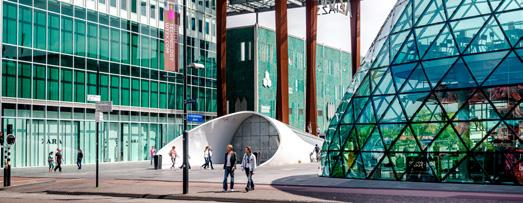
Well connected with a selective business and design expat community.
Philips and Eindhoven go hand-in-hand but the city has a lot more to offer. The region accounts for around half of the country’s R&D (research and development) investment and is officially known as ‘Brainport’. Aimed to be among the top 10 regions by 2020 in terms of technology and economy, Eindhoven is a hub for start-up companies and employment opportunities. The city is well connected with the railway station close to the centre and the airport offers cheap international access from airlines like RyanAir and WizzAir.
CENTRE
People living in the centre have plenty of facilities, including a shopping mall and scores of international restaurants. Accommodation is pricey and popular with single expats and couples. International schools (attended by children from Den Bosch and Tilburg) and the PSV football stadium are also located here.
NORTH (WOENSEL)
The area north of the centre is divided by wide, tree-lined boulevards, and is mainly residential in nature. Housing is mostly newbuild, with apartments and terraced houses for all budgets. Woensel South is cheaper and there’s a great market for ethnic shopping.
EAST
Situated around the Karpendonkse Lake and Eckart Forest, the area has a range of housing including some exclusive detached properties.
SOUTH
The Philips High-Tech Campus is situated at Gestel along with the International Primary School, the Open-air Museum and the Tongelreep International Swimming Complex. Expats also gravitate towards Stratum, with its wide range of modestly priced to exclusive housing.
VILLAGES
The villages closely surrounding Eindhoven’s centre are popular with expat families. International schools are still within cycling distance, and the sense of community is greater. Nuenen was home to Vincent van Gogh (1883–1885) and the older centre stretches around a leafy village green. There’s some detached housing; outer areas are newer and mid-priced. Veldhoven is virtually a southwest suburb (the other side of the A2 from Eindhoven).
Housing is modern and in a range of price bands. Best is a contemporary, well-planned village with good access, while more rural retreats can be found in Waalre, which is surrounded by large areas of forest. The twin towns of Son and Breugel are usually mentioned in a single breath, and popular with expats. Son has a pleasant old centre but the majority of housing is located in newer, greener (and more expensive) districts.
• Population: 221,402
International school
• International School Eindhoven: www.isecampus.nl
Links
• www.eindhoven.nl
• www.eindhoven.eu
THE HAGUE (DEN HAAG)
The international city of peace and justice has a friendly and relaxed atmosphere. With 11 kilometres of beaches and a lively international community, it is a great place to live.
• 10,000 – the number of people who "polar bear plunge" into the icy North Sea every New Years Day at The Hague Beach
• 1913 – the inauguration year of the Peace Palace in The Hague
• 200 – the number of international organisations in The Hague
• 4 – the number of seasons the weather is perfect for surfing at The Hague Beach
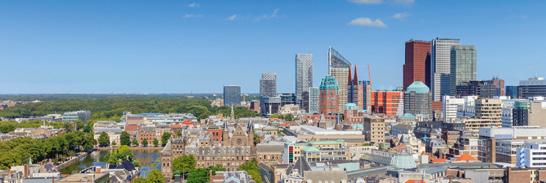
Many internationals choose The Hague as their new hometown. The city is a mixture of modern skylines with a historic city centre and sandy beaches. Its scenery and activities are as diverse as its residents. With the Peace Palace as its icon, The Hague is known as the international city of peace and justice. But the city is also the seat of the Dutch government and home to the Dutch royal family.
Career opportunities in The Hague are exceptionally diverse. Cooperation between NGO’s, business, government and knowledge institutions lead to new knowledge and innovative products. For example, in The Hague Security Delta or in The Hague Humanity Hub. Combining affordable real estate with a high quality of life, The Hague is a great place to live for young professionals and families. It is the only large Dutch coastal city: within 15 minutes by bike or public transport you travel from the city centre to the beach. The large number of attractive neighbourhoods, each with its own character and atmosphere, offers multiple housing opportunities. Whether you’re renting or buying, property prices in The Hague are relatively low compared to other big cities.
CENTRE
The city centre is known for the Binnenhof (seat of the government), Hall of Knights and the Royal Palace. It offers a wide range of housing, from stately canal houses and 17th-century courtyard houses to modern apartments and high-rise buildings. Parking space is limited, but residents enjoy the proximity of shops, restaurants and nightlife, museums and beautiful public gardens. Thanks to its easy accessibility both by car and on public transport, the city centre is well connected to other cities, like Amsterdam, Brussels and Rotterdam.
ARCHIPELBUURT/ WILLEMSPARK
Close to both the city centre and the beach are the Archipelbuurt and Willemspark: cosy, monumental and quiet neighbourhoods surrounded by lively canals and parks. Residential properties vary from large homes dating from the end of the 19th century and courtyard housing to new homes. Day-to-day shopping, lifestyle, design, antique, beauty and fashion retailers and many charming cafes and restaurants are nearby. Residents enjoy the friendly and international atmosphere.
SCHEVENINGEN (THE HAGUE BEACH)
Scheveningen is a lively neighbourhood with dunes, beaches and the sea within walking distance. It features many houses that date back to before 1916, but there is also a lot of 1930s and 1980s architecture. Scheveningen consists of the Dorp (Village), Haven (Harbour) and Bad
(Bath) areas, each with their own distinct character. The district boasts an array of wonderful eateries, cafés, restaurants and shops.
GEUZEN-
EN STATENKWARTIER
This is the heart of the International Zone in The Hague, many international organisations are based here such as the ICC, Europol and OPCW. But it is also a very popular residential area with spacious and elegant 19th-century homes. Broad avenues run through the district, interspersed with charming squares and pleasant streets. Close to one of The Hague’s main shopping streets, restaurants and the Gemeentemuseum (Municipal Museum). The Hague Beach and beautiful parks are just around the corner.
ZEEHELDENKWARTIER
This historic and lively district is very popular amongst ‘Hagenaren’. The district has its own character and exudes a certain energetic feeling and creativity due to the many young entrepreneurs and residents. It has attractive streets, beautiful canals, sunny squares and stunning art nouveau architecture. The majority of the homes are from before 1916. The area has a mixed character with both affordable and expensive homes, large mansions, charming little upstairs-downstairs dwellings and even a few courts.
OTHER NEIGHBOURHOODS
Benoordenhout is a quiet neighbourhood with a green, luxury personality. It features many large single-family homes and semi-detached homes. The gated villas of Wassenaar house diplomats and upmarket expats. Van Stolkpark/Scheveningse Bosjes is a stately, green villa neighbourhood with long, winding streets. It is characterised by its many historic properties. Most of the villas today are occupied by embassies. Westbroekpark & Duttendel is a green neighbourhood with large houses built before 1916, but also modern homes.
• Population: 520,745 International schools
• The American School of The Hague: www.ash.nl
• The British School in the Netherlands: www.britishschool.nl
• Deutsche Internationale Schule: www.disdh.nl
• The European School of The Hague: www.eshthehague.nl
• Haagsche Schoolvereeniging (Dutch international primary school): www.hsvdenhaag.nl
• The International School of The Hague: www.ishthehague.nl
• Le Lycée Français Vincent van Gogh: www.lyceevangogh.nl
• Sekolah Indonesia: www.sekolahindonesia.nl
• Oekraïense School: www.oekraienseschool.nl
• Polish School: www.szkolahaga.org Links
• www.thehague.com
• www.thehagueinternationalcentre.nl
• www.access-nl.org.com
• www.thehagueonline.com
MAASTRICHT
The city that combines top technology with a high quality of life in an international environment.
• 500 - the year BC Maastricht was settled, one of the oldest in the country
• 49 - the elevation in metres makes Maastricht one of the highest points in the Netherlands
• 45 - percentage of students coming from abroad to study at the international Maastricht University.
• 5 - the amount of languages commonly spoken in Maastricht (Dutch, Limburgish, French, German, and English)
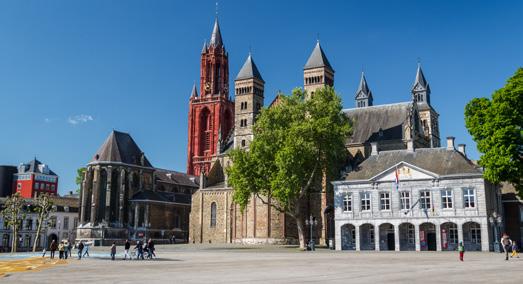
Maastricht is located in the very south of the Netherlands, but right in the heart of Europe, bordering to Germany as well as Belgium. Aachen, Cologne, Frankfurt, Brussels, Antwerp, Paris as well as Luxemburg are around the corner. Its impressive history is reflected in the historic centre and location along the Meuse river. In the hilly countryside new technologies on chemicals and new materials, life sciences and smart services are booming. The three Brightlands campuses in the region are at the heart of global innovation.
CITY CENTRE
Historic buildings jostle with shops, cafes and restaurants. Encompassing the city walls, university buildings and the Stadspark, the Jekerkwartier has an artistic slant that entices creative types and students.
RIGHT BANK
Across the river, Wyck has an old-town feel, while the new Ceramique district, a renovated industrial ceramic area, offers modern accommodation favoured by expats who like inner-city living with full amenities and services.
BASSIN AND BELVEDERE
The inner-city harbour ’t Bassin, on the northwest side, has grown into a residential and commercial village since redevelopment started in 1999.
SINT PIETER AND SURROUNDINGS
A green residential area along Jeker valley and St Petersberg Hill, yet within walking distance to the centre or Belgium.
• Population: 121, 906 International schools
• United World College: www.uwcmaastricht.com Links
• www.maastricht.nl
• www.maastrichtregion.com
ROTTERDAM
Rotterdam is one of the most dynamic, booming cities in the Netherlands, with a growing expat population and a strong progressive city identity.
• 51,480 - the number of seats in Rotterdam's football arena nicknamed "The Tub"
• 30,000 - the approximate number of buildings destroyed by German bombers in May 1940
• 802 - the total length in metres of Rotterdam's famous cable-stayed bascule Erasmus Bridge
• 3 - the number of professional football clubs in Rotterdam (Feyenoord, Excelsior and Sparta)
• 2 - Rotterdam's port is ranked the second largest in the world after Shanghai
Most of Rotterdam was destroyed by heavy WWII bombing, yet rather than rebuilding traditionally the city has took the contemporary route. Impressive modern architecture influenced Rotterdam’s place on the New York Times and Rough Guide’s must-see cities. Rotterdam’s employment opportunities are being driven by increased international investment, with more than 100 international companies setting up base in Rotterdam in recent years. Expats tend to settle around the city centre or in one of Rotterdam’s scenic green suburbs.
CENTRE
The city centre offers characteristic buildings dating back to about 1900 alongside minimalist new build in various guises: simple buildings with shared staircases, spacious villas, and modern apartments, some with water views. Parking is limited but residents enjoy close proximity to a range of museums, shops and restaurants. The area around Central Station is also a hotspot, and close to the Rotterdam International School.
KRALINGEN
If you’re young, single or ‘dinky’ (two incomes, no children), the neighbourhood of Kralingen is likely to appeal. Fifteen minutes east of the centre, Kralingen’s multi-million-euro mansions stand cheek by jowl with student digs and council housing. Near a lake and woods, the area has a very international feel and a huge variety of affordable to upmarket housing.
KOP VAN ZUID/ NIEUWEWERK
Also favoured by young expats, Kop van Zuid (‘Head of South’) is the trendy extension of the city centre on the southern bank of the Nieuw Maas; great for executives wanting to get to work quickly in the mornings. Like London’s Docklands, it’s a mix of renovated old warehouses and smaller, newer housing and apartments. Similar luxury and renovated housing can be found on the opposite bank in NieuweWerk and the Maritime Quarter (Scheepvaartkwartier).
HILLEGERSBERG
Rotterdam’s jewel is Hillegersberg, a leafy suburb on the northeast of the city. The area escaped wartime bombing, leaving the old village centre and elegant residential streets intact. Homes in Hillegersberg are expensive but enduringly popular, and is home to several of the international schools. A few minutes on your bike brings you out of the city to meadows or the river Rotte. Hillegersberg is located around two fair-sized lakes, where there is endless boating and sailing in the summer, and skating in the winter.
OTHER SUBURBS
Schiebroek (west of Hillegersberg) and the newer, up-and-coming Prinsenland are becoming favoured expat sites. Prinsenland is more affordable than downtown living and close to international schools, but still a bustling area, as is multicultural Oude Westen, a lively and bohemian neighbourhood near Central Station. It is relatively easy to find family accommodation at reasonable prices in child-friendly Ommoord (in the northeast), with a peaceful atmosphere and green spaces.
• Population: 624,799 International schools
• Rotterdam International Secondary School: www.riss.wolfert.nl
• American International School of Rotterdam: www.aisr.nl
• Japanese School of Rotterdam: www.jsrotte.nl Links
• www.rotterdam.nl
• www.weownrotterdam.nl (event guide)
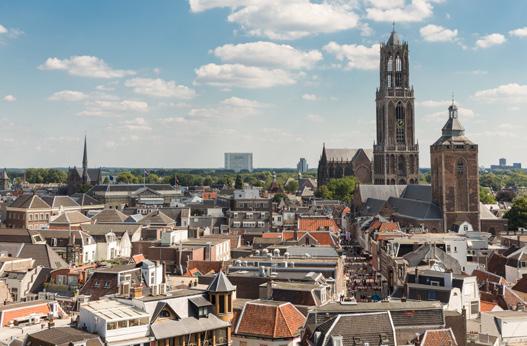
UTRECHT
Utrecht attracts expats and foreign companies with an educated workforce in a laidback university town.
• 50.000 - an approximate amount of objects to peruse at Utrecht's 1924 De Stijl Rietveld Schröder House, a UNESCO's world heritage site
• 30,374 - student body population for Utrecht University, the largest university in the Netherlands
• 1674 - the year Utrecht's massive St. Martin's Cathedral collapsed due to a tornado ripping apart the nave (it has not yet been rebuilt)
• 112 - the height in meters of Utrecht's gothic-style Dom Tower, the tallest church tower in the country
Arriving in Utrecht by train, you emerge into the country’s largest shopping mall, but don’t let that put you off. Utrecht’s medieval centre is a delightful place to live, with its unusual sunken canals and cellar bars. The vibe gets particularly lively at night due to the huge student population. Utrecht attracts international companies and expats alike, having the Netherlands’ most highly educated workforce and second-best standard of living. Transport links are excellent, particularly by train, and it is an easy commute to Amsterdam (25 minutes by train) and the service is regular.
IJSSELSTEIN
Twenty minutes down the motorway is the popular suburb of IJsselstein, complete with a car-free medieval city centre and castle (now a museum). There are fast train connections to Utrecht and Nieuwegein, and good cultural amenities. Nature lovers can enjoy the green heart of the Netherlands with bike trails through scenic countryside and along the river Lek. New housing was completed in 2012, and zoning has been approved for more. The centre is expected to get new retail and housing stock by 2016.
LEIDSCHE RIJN
Officially part of the city of Utrecht, Leidsche Rijn consists of the two small villages of Vleuten and Meern and includes the entire agricultural area between those villages and Utrecht itself.
Considered the largest new development in the Netherlands, some 30,000 houses and new space for industry and companies are being built in Leidsche Rijn. In effect, this means that a medium-sized town, which will house 100,000 people, is being built out of nothing. Great effort is being made to create an environmentally friendly town with high quality housing. An underground motorway is the pride of the project.
NIEUWEGEIN
Lying 7km south of Utrecht, Nieuwegein was a new town created in 1971 to cope with the expanding population of Utrecht. There is a variety of housing styles from classic Dutch brick homes to modern high-rises, and if you need to drive to work, easy access to nearby motorways (A2, A12 and A27).
To the east is Houten, a fast-developing town, where some third of its population is under 20.
DE VECHSTREEK
This beautiful area is north west of Utrecht and close to the Loosdrechtse Plassen lakes. Popular with young families and retirees, Breukelen and Maarssen are connected to Utrecht by local rail and bus services. Older
villages include Oud-Zuilen (built around a castle) and Maarssen-Dorp. Maarssenbroek contains newer housing estates with local amenities and services in place.
• Population: 330,772
International school
• IS Utrecht, www.isutrecht.nl Links
• www.utrecht.nl/expatcenter
• www.iwcu.nl
Minervaplein
+31 30 888 21 31 utrecht@hometorent.nl
Herengracht
+31 20 30 80 206 amsterdam@hometorent.nl
The entrepreneurial high tech region.
Twente is the entrepreneurial high-tech region in the east of the Netherlands. It has an innovative network with a powerful technological profile and international ambitions. Its economic agenda is focused on the High Tech Systems and Materials (HTSM)sector, which creates plenty opportunities for locals and expats looking for jobs. The sector suits the DNA of the Twente region which has been traditionally shaped by the manufacturing industry. Twente consist of 14 municipalities all with their own charm. Looking for a bigger city visit Enschede, Hengelo or Almelo. But also a lot of smaller townships with their own identity as for example Ootmarsum, Delden or Borne belong to this charming, green area. With the unique combination of high tech, international focus and green environment, Twente is the perfect region to live and work.
ENSCHEDE
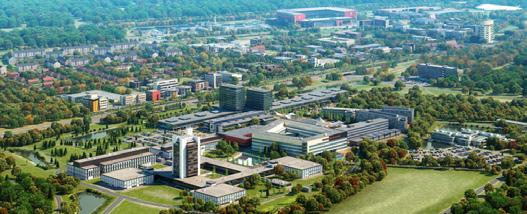
With almost 160.000 inhabitants, Enschede is the largest city in Twente. It’s a city of knowledge and education. The university campus of the University of Twente is unique in the Netherlands and located in the western outskirts of the city, it’s a green area where students follow their classes and also live and play sports. Together with ‘Kennispark Twente’ (lt. Knowledge Park Twente, a business area with high tech companies, the renowned Nano Lab and an incubator for startups) and Saxion University of Applied Sciences they’re internationally acclaimed for their ability to transfer theoretical knowledge into high and practical applications. A city with these universities, a conservatory, a pop academy, an international school and an art academy is an epicentre to music and culture in the east of the Netherlands. The splendid range of shops and boutiques are all centered around the most convivial public square in the Netherlands; de Oude Markt (lt. Old Market Square) which is surrounded by several cafés, restaurants and clubs.
HENGELO
You like cities that have the atmosphere of a village? Then Hengelo is the right place for you. With one of the best open air markets in the Netherlands, beautiful neighbourhoods and a compact area with terraces, Hengelo has a cozy feeling. The city is known for many open air concerts in spring and summer in the city center and parks. Hengelo has 81.000 inhabitants and is known as ‘City of Metal’. This doesn’t refer to the local alternative rock scene, but to the old industries of the city. Companies in metal and machinery flourished in the early 20th century, which led to a central logistic infrastructure. Modern high tech and oil&gas related companies connected to this history are still based in Hengelo. The city is a main point of the Dutch and German railroad and highway system and centrally located in the Twente region. And of course you’ll find World Trade Center Twente and the main office of Expat Center Twente in this city of business.
ALMELO
Almelo has about 72,000 inhabitants in the middle of the rolling countryside of Twente, with the industrial centres of Enschede and Hengelo as close neighbours but also with tourist towns like Ootmarsum, Delden and Markelo only a bicycle ride away. Almelo is one of the only cities in the dry-lands of Twente where you will find water in the city centre. Lakes invite the recreational sailors. There are beaches, a yacht marina and an international rowing course. Make sure you visit Almelo only for its beauty and don’t end up in jail. The only court in Twente is based in the city and makes Almelo the juridical centre of the region.
Dutch regulations make it easy for residents to choose and change suppliers.
UTILITIES
• If you are paying an inclusive rent, check your contract carefully for what is covered in the monthly sum.
• In many cases, the utilities (gas, water and electricity) will already be connected to you home and you just need to transfer them into your name.
• You can connect all your utilities online at www.mijnaansluitingen.nl (in Dutch), or www.utility-provider.nl offers a free service to connect expats with the best deal (in English).
WATER
• There are two elements of water payments: a consumption charge based on actual water usage (which is estimated if you don’t have a meter) and a municipal tax for services (sewage, maintenance, etc.).
• To see which water company covers your area, visit www.vewin.nl and enter your postcode in the box, or ask at your local gemeente
• Amsterdam: Waternet 0900 9394
• Den Haag/Leiden: Dunea 088 347 4747
• Rotterdam: Evides: 0900 0787
• Utrecht: Vitens 0900 0650
• North Holland: PWN Waterleidingbedrijf 0900 405 0700
ELECTRICITY AND GAS
• The energy market is liberalised, so you are able to choose (or change) suppliers.
• Energy companies now have ‘green’ options, where energy is bought from alternative sources such as sun, wind, water and biomass.
• The Netherlands Authority for Consumers and Markets (www.acm.nl) provides a list of gas and electricity suppliers on their website, or you can use their consuWijzer (www.consuwijzer.nl) to compare prices or seek advice.
• On www.energievergelijken.nl, you can compare prices in English and connect your services online.
Main suppliers:
• Budget Energie: www.budgetenergie.nl
• Electrabel: www.electrabel.nl
• Eneco: www.eneco.nl
• Energie Direct: www.energiedirect.nl
• E.ON: www.eon.nl
• Essent: www.essent.nl
• Greenchoice: www.greenchoice.nl
• Nederlandse Energie Maatschappij: www.nle.nl
• Nuon: www.nuon.nl
• Oxxio: www.oxxio.nl
• United Consumers: www.unitedconsumers.com
COMMUNICATIONS
• There is a huge range of options from many suppliers with combination deals for telephone (bellen), internet (surfen) and TV, charged under a single monthly fee.
TELEPHONES
• KPN is the main supplier for landlines, while Ziggo and UPC offer phone connection via cable networks.
• Often the easiest way to connect a landline is to visit a KPN winkel (shop) with appropriate identification and they can set it up, while some cable networks allow you to sign up online.
• There are many additional services such as discounts for favourite numbers, or combination deals with internet and TV.
MOBILE TELEPHONES
• The cheapest deal for a mobile is via a contract (abonnementen) with one of the main suppliers. You can compare the latest rates on www.bellen.com (in Dutch).
• You’ll need proof of identity, address, income and a bank account to sign a deal. A prepaid phone is more expensive but easier to get; you can top it up with cards from supermarkets.
• If your phone is unlocked, you can buy a Dutch SIM card. Every phone has a unique IMEI serial number (enter *#06# to find out yours). You’ll need this when reporting a stolen phone.
• Calling 0800 numbers are toll free, whereas 0900 numbers are charged (per call or minute, depending on the business).
INTERNET
• Connectivity in the Netherlands is among the highest and fastest in Europe.
• Dial-up, ISDN, ADSL, and cable options are available, and can be combined with telephone and TV deals.
• Fiber cable (glasvezel) is available, but you may need to get your building connected; carriers generally install it free.
• Compare prices and packages at www.internetten.nl. It is possible to opt for a TV option from one
supplier and telephone/internet from another.
• There are internet cafes dotted about, and many cafes and restaurants have WiFi.
TELEVISION
• Cable TV is cheap and main providers include Ziggo and UPC. Included in the standard package are BBC 1, BBC 2, BBC World, and CNN alongside Dutch channels, which include the governmentowned Nederland 1, 2 and 3 and RTL 4, 5, 7, and 8. You’ll also receive Veronica and Net 5 (quality films and drama including popular US serials), plus National Geographic, the Discovery Channel and popular children’s channels. Local TV channels are another option. For Amsterdam, it is AT5.
• Subtitling, rather than dubbing, is used except for children’s TV. For more films, sport or other interests, you can select different options for extra payment.
• Check out www.digitelevisie.nl for coverage in your area (by postcode) or compare combination packages at www.internetbestellen.nl or at any of the suppliers.
• You get a media box and then pay for your chosen option. CanalDigitaal is a provider of satellite TV but you will need to be able to fix a dish facing east and check there are no restrictions on satellite placement with your gemeente.
Internet / phone
/ TV suppliers
• CanalDigitaal: www.canaldigitaal.nl
• Fiber Netherlands: www.fiber.nl
• KPN: www.kpn.com
• Online.nl: www.online.nl
• Stipte: www.stipte.nl
• Tele2: www.tele2.nl
• Telfort: www.telfort.nl
• T-mobile: www.t-mobile.nl
• UPC: www.upc.nl
• Vodafone: www.vodafone.nl
• Xs4all: www.xs4all.nl
• Ziggo: www.ziggo.nl
POST OFFICES
• Post offices are marked with an orange sign that says postkantoor or PostNL, and are generally located inside shops, newsagents or tobacconists (postagentschap).
• Stamps (postzegels) can be bought in all of the above places and in some of the larger supermarkets, or printed online at www.postnl.nl.
• Post-boxes are red and scattered throughout shopping areas and neighbourhoods. On the post-box there are two slots: the right (streekpost) is for ‘local’ delivery and you’ll see a list of postcodes that indicate the areas included; the left (overige bestemmingen) is for everywhere else, including international destinations.
• PostNL aims to deliver locally within 24 hours, otherwise spoedservice guarantees local delivery by 10am the next day and next day delivery to Europe.
• See www.postnl.nl for online postal services, or call 0900 0990 (45ct) for customer service.
FURNISHING YOUR HOME
• Hema (www.hema.nl) is a Dutch institution for all household matters. Blokker is cheap (www.blokker.nl) and Ikea (www.ikea.nl) has many branches across the country.
Expats are an essential component of the Dutch workforce, and office life has its cultural quirks.
• The Dutch workforce is internationally oriented, highly educated and multilingual.
• Unemployment is at 4.6 percent (July 2017).
• Demand for highly skilled workers remains high, and incentives for international employees include the 30 percent ruling tax benefit and a fast-track immigration programme for the highly skilled and entrepreneurs.
• The GVVA (gecombineerde vergunning voor verblijf en arbeid) is a single permit that combines the residence and work permit into one so employers no longer need to apply for a separate work permit for labour migrants.
• Under the ‘Modern Migration Policy Act, if a worker needs a Dutch entry visa (MVV) and/or residence permit, their employer in the Netherlands can apply while they are still abroad, with fast-track applications possible (visit www.ind.nl).
WORK PERMIT CONDITIONS
• If you are a non-EU/EEA/Swiss national, your employer will likely need to apply for a separate work permit (tewerkstellingsvergunning or TWV).
• The TWV permit is specific to the job and employer, and is issued for up to three years.
• TWVextensions can be applied for (www.ind.nl)
• You can start work once your employer has been issued a work permit and applied for a residence permit.
• You do not need to wait for the IND to approve your residence application, but you must get a ‘residence endorsement' passport sticker from the IND.
• If the residence permit application is rejected, the work permit is no longer valid.
• After three years of employment on a Dutch work permit, other employers can hire you without needing a separate work permit.
• When you renew your residence document, your new labour market position will be mentioned as ‘Arbeid is vrij toegestaan. TWV niet vereist’ (free to work, no work permit required).
WHO DOESN’T NEED A WORK PERMIT?
• EU/EEA/Swiss nationals (except Croatians).
• Highly skilled migrants.
• Self-employed workers (eligibility is assessed by the IND).
• Workers on short assignment (performers, musicians, guest lecturers, journalists etc.).
• Those with a residence permit or passport sticker stating ‘Arbeid is vrij toegestaan. TWV niet vereist’ (free to work, no permit required).
PARTNERS: WHO CAN WORK?
• If your spouse, partner or relative has permission to work then generally you can work without needing an additional work permit.
• It is advisable to file the residency applications for you and your partner at the same time.
APPLYING FOR A WORK PERMIT
• If you qualify for the single GVVA residence and work permit, you or your employer must apply to the IND.
• All other cases, work permits are initiated by employers who apply to the UWV WERK bedrijf (www.werk.nl).
• Your employer has to submit supporting evidence to show that EU/EEA/Swiss nationals cannot occupy the position: copies of advertisements, postings on the internet, or statements from agencies.
• For a company to apply for a work permit, the candidate must be between 18 and 45 years old.
UNDUTCHABLES: FOR INTERNATIONAL BUSINESS JOBS
Looking for international career opportunities in the Netherlands? Fluent in one or more languages other than Dutch? Seek international business experience or already have it? Whether you’re an enthusiastic starter or an experienced executive, we’ll match your talents with challenging jobs in the Netherlands. Grow your job search in international business today: www.undutchables.nl
Undutchables, your recruitment partner for international jobs in the Netherlands.
EMPLOYMENT
• If a visa and residency permit is required, your employer can initiate your Entry and Residence Procedure (TEV) on your behalf before you arrive (with a copy of your passport and education qualifications).
HIGHLY SKILLED MIGRANTS
• To employ expats under the highly skilled migrant scheme, employers must sign an IND statement to become a ‘recognised sponsor’.
• An employer applies for your residence permit, which will be issued for the same period as the work contract, or up to a maximum five years for indefinite contracts.
• With the highly skilled migrant residency, your employer does not need a separate work permit (TWV) to hire you.
• If your residency permit is not ready when you arrive, you are allowed to work in the interim period if you visit an IND desk and get a passport sticker (verblijfsaantekening).
• Partners of highly skilled migrants can work without a work permit, though they do require a residence permit before commencing work.
SELF-EMPLOYED/ENTREPRENEURS
• For residency based on self-employment (for non-EU/ EEA/Swiss), your business activities must ‘serve an essential Dutch interest’ which is assessed by a point system.
• Personal experience, a business plan and what you plan to offer (innovation, job creation, investment, etc.) are taken into account.
• You will also need to prove you have the appropriate qualifications to carry out your business.
• With the self-employment residence permit, you can still work as an employee provided the UWV WERK bedrijf has issued a work permit to your employer.
• Freelancers can also apply for this permit, but proof of assignments in the Netherlands is a must.
DUTCH AMERICAN FRIENDSHIP TREATY
• American citizens who wish to start a business in the Netherlands can apply under this scheme.
• Register your business at the Chamber of Commerce (Kamer van Koophandel, www.kvk.nl) to qualify.
• You must have financial accounts verified by a qualified accountant, plus a business plan and substantial capital investment of EUR 4500.
• Japanese citizens under the Treaty of Trade and Navigation can also apply to this treaty.
STUDENTS
• There are no work restrictions for students who are EU/EEA/Swiss nationals (except for Croatia).
• Croatian citizens must abide by labour rules and will need a work permit.
• All other nationalities can only work part-time throughout the year for a maximum of 10 hours per week, or full-time seasonal work in June, July and August.
• The employer or agency must obtain a work permit from the UWV WERK bedrijf which will be valid for the same period as the university registration.
• Students do not need a work permit for internships.
WORKING HOLIDAY SCHEMES
• Those between the ages of 18 to 30 from Australia, Canada, and New Zealand can apply to live and work in the Netherlands for one year (with proof of a return ticket or funds to buy one).
• Candidates can apply in their home country or once they arrive in the Netherlands.
Karen Gordon helps expats successfully navigate the international job market in the Netherlands and provides HR and recruitment expertise—all with a multicultural understanding.
Karen’s result-driven process includes:
• Identifying where to look for your ideal job and which local networks to tap into.
• Highlighting your experience and strengths to make your CV, cover letter and/or job application stand out from the rest.
• Refining your interviewing & communication skills with an experienced, native English speaker to gain an edge in a very competitive market.
Email karen@kgtconsulting.nl to schedule a free intake & discuss which services you need. www.kgtconsulting.nl
CHANGING JOBS
• Any changes in your work or partnership status must be reported to the IND within four weeks (unreported changes will be penalized).
• If you change jobs you don’t necessarily need a new residence permit, but the same rules will apply as for the first permit you were granted.
• If you worked as a highly skilled migrant, your new employer needs to be eligible to apply under the highly skilled migrant scheme, and will need to prove to the IND that you still meet the requirements of the highly skilled migrant scheme.
• If applying to extend a residence or work permit, your circumstances will be assessed again according to the original application; the main exception is that after three years working on any given residence permit that allowed you to work, you no longer need a separate work permit.
• Highly skilled migrants can also change their purpose of stay into ‘labour’ after three years, which allows them to work without a work permit.
• Apply for a new residence permit before the old one expires (the IND will notify you in advance) or else risk being ineligible for permanent residency.
CONTRACTS AND EMPLOYMENT LAW
• Employment laws in the Netherlands vary, and your personal contract will determine your pay and specific conditions.
• Dutch legislation covers key areas such as trial periods, holidays, notice and dismissal, minimum wages, health and safety, and equal treatment.
• In most cases the employer needs permission from the UWV WERK bedrijf or the court to fire you.
• Useful information regarding working practices, employment law and the minimum wage can be found on the Ministry of Social Affairs and Employment website (www.szw.nl) or the UWV WERK bedrijf website (www.werk.nl).
• If you want to check the market rate for your salary or calculate bruto/netto rates (before/after tax and social security deductions), try www.loonwijzer.nl.
• It is standard practice to get extra wages as a ‘holiday allowance’ plus four weeks of paid leave.
• Sanne van Ruitenbeek of Pallas Advocaten provides the following important information:
• If you work in the Netherlands, Dutch law is partly and often fully applicable to your employment, even if the law of another country is declared applicable in your contract.
• The number of succeeding employment contracts for a fixed term is limited to three; the total duration of fixed term contracts is limited to two years.
• If the duration of the contracts or the number of fixed contracts exceeds the legal limit, it will automatically become a contract for an unlimited term.
• If the contract is for less than two years, the trial period cannot be longer than one month. The maximum duration of a trial period is two months. Trial periods in contracts for less than 6 months are invalid.
• During the trial period, both employer and employee can terminate the contract with immediate effect. The notice period for the employee is usually one month.
• If the notice period for the employee is extended, the notice period for the employer should be double the notice period of the employee.
• Employment contracts for an unlimited term can only be terminated by the employer with consent of the employee, the labour office (UWV WERKbedrijf) or the Court.
• If an employer gives notice of termination without obtaining prior approval, the employee could nullify the termination. This rule is not applicable in the case of summary dismissal (such as fraud or theft by the employee).
• Courts are very reluctant about accepting summary dismissals; it is very important to contact an employment lawyer immediately if you are fired on the spot.
• The legal minimum number of holidays per year is four times the weekly working time. This means 20 holidays in the case of a fulltime employee working a five-day week.
• It is common practice in the Netherlands for a fulltime employee to be entitled to approximately 25 holiday days per year in addition to Dutch public holidays.
• By law, there is an expiration date of six months for taking the legal minimum number of holidays; employees must take all their holidays within six months after the year in which the holidays were accrued.
• Should the employee not take the holidays on time, the holidays will lapse without any compensation or payment.
• The expiration date of six months is not applicable to the holidays that the employee is entitled to on top of the legal minimum number of holidays; these extra holidays will not lapse until after a period of five years.
COLLECTIVE LABOUR AGREEMENT (CAO)
• This is a written agreement covering working conditions and benefits drawn up by employers, employers’ organisations and employee organisations (such as unions).
• A CAO are often more generous than statutory requirements.
• It should state in your contract whether a CAO is applicable; you don’t have to be a member of a union to benefit.
• If no CAO applies – all must be registered – you will need to negotiate your own terms and conditions.
SOCIAL SECURITY
• The Dutch social security system is one of the most comprehensive in Europe. There are three strands:
• National Insurance administered by the social insurance bank (www.svb.nl), which includes old age pension (AOW) and child benefit (AKW).
• Employee Insurance administered by UWV (www.uwv.nl), including unemployment benefits, long-term disability (WIA) and sickness (ZW).
• Social Assistance administered by municipalities (www.rechtopbijstand.nl).
• Specific conditions apply to each benefit. Check that your residence rights are not affected if you apply for benefits.
• Official documents will need to be in good order. Consult the Ministry of Social Affairs and Welfare website (www.szw.nl) for more information.
UNEMPLOYMENT BENEFIT (WW)
• Your employment history will determine the amount and duration of payments. For the first two months you get 75 percent of your last earned salary, and thereafter 70 percent.
• Must have worked 26 out of the previous 36 weeks before the first day of unemployment (or less for those not in regular employment).
• You apply for benefit online at www.werk.nl or at a local office of UWV WERK bedrijf.
VOLUNTARY WORK
• A volunteer is a vrijwilliger and there are many opportunities depending on your skills.
• Expat advice centre ACCESS is always on the lookout for volunteers in its offices in Den Haag (www.access-nl.org).
FINDING A JOB
• Expats seeking a new career challenge in the Netherlands will find ample opportunities. The Dutch employment market is sophisticated and boasts an impressive array of local and international companies spread across the country. It also has a vast network of specialist and generalist recruitment firms. Many newcomers take the recruitment agency route for speed and convenience, but there are many job hunting streams that foreigners can tap into.
JOB HUNTING
• Recruitment agencies are big in the Netherlands, and several specialise in recruiting non-Dutch nationals. Explore engines like www.intermediair.nl, www.toplanguagejobs.nl or www.monsterboard.nl, or even sector-specific sites (architecture, biotechnology, finance etc.).
• The UWV WERK bedrijf portal (www.werk.nl) also has a useful list, as does EURES, the European job mobility portal (www.eures.info).
• Expat community sites, such as Expatica, have extensive employment listings for foreigners (jobs.expatica.com).
We are successful in recruiting for permanent and temporary positions in: administration, secretarial, logistics, finance, HR, marketing and customer service.
We also offer a network and assignments for Freelancers, coaching and trainings and work in flexpools.
EURES European matchmaker
EURES the Netherlands offers support in the field of living and working conditions in Holland.
• Vacancy (vacature) advertisements are covered in all Dutch newspapers and senior positions at international companies are often placed in English.
• The list of companies that are eligible for applying for highly skilled migrants is a useful source and can be found on the IND site (www.ind.nl).
SKILLS IN DEMAND
• Expats with French, German, Flemish, and Scandinavian language skills are always in demand, according to expat job agency Undutchables.
• The job market is also strong for experienced professionals in finance and IT, sales and (online) marketing, and customer service.
CULTURALLY CORRECT CVS
• Concise, direct and professional communication is the style for job applications in the Netherlands. One or two pages maximum in this order:
• Personal details (address etc., sometimes a photo);
• Education (courses, not results);
• Work experience (the most recent first). Include job responsibilities.
• In your cover letter, include more about your motivation for the job, but keep the tone professional.
CULTURAL COMPETENCY
• Many international companies have headquarters in the Netherlands.
• Cross-cultural competency’ tests may be part of the selection procedure for international assignments.
• There are standard personality analysis programmes, such as the Meyers Briggs Type Indicators that analyse personality traits that could affect performance in a new cultural environment.
• Top firms are looking for executives who are openminded, flexible, mature, and show respect for, and interest in different cultures.
WORKING WITH AGENCIES
• Agencies openly advertise their services on websites geared to expats, and they are frequent advertisers on job boards and leading publications. But how do you find an agency that is both tuned into the local market and to your personal needs?
Jamf is the world leader in macOS and iOS management with offices in Minneapolis, Eau Claire, Cupertino, New York, Amsterdam, Sydney, Hong Kong, Katowice and Tokyo. We deliver, support and service the solution for Apple management needs in education and business.
We are growing and actively building our team in Amsterdam. Be sure to visit the Careers section on www.jamf.com/jobs/ to learn more about all of the open positions we’re looking to fill.
Helping organizations succeed with Apple
Jamf Amsterdam Antonio Vivaldistraat 56, 1083 HP Amsterdam, The Netherlands
EMPLOYMENT
• Maintain an up-to-date curriculum vitae (CV) in English that fully reflects your skills, education, work experience and personal profile, and try to keep it as short as possible. If you really want to stand out, have a version translated into Dutch, which some companies will appreciate.
• Always support any application with a clear overview or motivation letter setting out your primary work requirements, personal qualities and career objectives.
• Follow up any application if you hear nothing back within five days.
• Always try to meet your agent in person, and make sure that your CV does not get sent anywhere without your permission.
• Be clear about your work preferences and present yourself in a positive and personable light.
• Stay flexible and be ready to attend interviews as opportunities emerge, but remain patient while your agent scours the market for the right opportunity.
• Keep your agent informed of any personal developments that might affect the work they are doing on your behalf.
THE INTERVIEW PROCESS
• Once you’ve set yourself up with your preferred agencies and the enquiries begin, prepare yourself for interviews.
• Avoid using jargon or colloquial expressions. Be wellpresented, enthusiastic and well-informed.
• Research the company in advance. Self-preparation is equally important.
RECRUITMENT AGENCIES
• Projob
Van Baerlestraat 63–65, 1071 AR Amsterdam +31(0)20 573 8383 | welcome@projob.nl www.projob.nl
- Achter de Dom 14, 3512 JP Utrecht +31 (0)30 238 2228 | utrecht@undutchables.nl www.undutchables.nl
• Always attend an interview with a list of relevant questions.
• When you receive a job offer that fully matches your expectations, your agent will help you to assess the various aspects of the offer (salary level, benefits, career development, etc).
• Allow yourself two or three days to consider all of the angles.
• The Dutch are tuned into working with foreign nationals -- be reassured that your new co-workers will be supportive of their new ‘international’ colleague.
• Make an effort to learn some Dutch – it will payoff in the long run.
WORKING CULTURE
• Work life and home life are kept separate.
• Office hours are strictly observed.
• Newcomers are often surprised by the informal working relationships, horizontal management and frequent meetings.
• Colleagues often lunch together at the canteen.
• Flexible working is common, particularly for families with children.
• UWV EURES the Netherlands La Guardiaweg 116, 1043 DL Amsterdam workinthenetherlands@uwv.nl | www.werk.nl/eures @EURES.NEDERLAND
• XPat Media / The XPat Journal Van Boetzelaerlaan 153, 2581 AR Den Haag +31(0)70 306 33 10 | +31(0)650234125 | www.xpat.nl Magazine: magazine.xpat.nl | @xpatmedia
By Diane Lemieux and Anne Parker
10 FUN FACTS ABOUT THE NETHERLANDS
1
More than a quarter of the Netherlands is below sea level
In addition to that, 50% of its land lies less than one meter above sea level. Schiphol is actually 4.5 meters below sea level. Luckily, the Netherlands is not in a tsunami-prone part of the world.
2
Dutch people are the tallest in the world
With an average height of 184 cm for men and 170 cm for women, Dutchies are the tallest people in the world. Scientists say it’s because of their DNA, nutrition and welfare, others say it’s because of their copious consumption of dairy.
3 The Netherlands is the most densely populated nation in Europe
With 504 inhabitants per square kilometer, the Netherlands has the highest population density of any European country with more than 1 million inhabitants.
4 Flat as a pancake
The Netherlands is a very flat country. The Vaalserberg is the highest point in (the European part of) the Netherlands. It’s only 322.7 meters high and located in the south-easternmost edge of the country in the province of Limburg. You could also say the Netherlands is as flat as a pannenkoek.
5 Amsterdam is built entirely on poles
Because Amsterdam’s soil consists of a thick layer of fen and clay, all buildings are built on wooden poles that are fixed in a sandy layer that is 11 meters deep on average. The Royal Palace at Dam Square is built on no less than 13,659 wooden poles.
6 Turkish Tulips
Tulips, tulip fields and flower bulbs are typically Dutch. Yet, tulips do not originate from the Netherlands. The first tulip bulbs were imported from Turkey to the Netherlands, where they proved to grow extremely well in Dutch soil.
7
About 13% of all Dutch babies are born at home
In many countries, it’s customary to give birth in a hospital. Not in the Netherlands: about 13% of all Dutch births happen at home.
8
Dutchies love their coffee
After Scandinavians, the Dutch are the world’s biggest coffee drinkers. They drink no less than 140 liters of coffee a year on average. That’s 3.2 cups a day!
9
86% of Dutchies speak English as a second language
All Dutch kids learn English in school and visitors to Amsterdam are often impressed with the fluency with which the Dutch speak English.
10 The Nederlands is the largest beer exporter in the world
In 2001, Dutch beer companies exported an astonishing volume of 1.3 billion liters of beer abroad. Half of that was shipped to the U.S.!
Source: www.awesomeamsterdam.com
DISTANCES BETWEEN MAIN CITIES
EDUCATION
The Netherlands is committed to choice in education.
• The OECD international rankings for school systems puts the Netherlands as one of the highest in performance annually.
• The Netherlands is among the world’s top countries for equity in education opportunities.
• Compulsory education under Dutch law applies to children of all nationalities from 5 to 16 years who are residing in the Netherlands.
• Children are leerplichtig (under a learning obligation) at 5 years old for 12 years of full-time education, and one or two years part-time (until achieving a diploma).
CHOOSING A SCHOOL
• International education is available at both Dutch and private schools throughout the country. Nineteen schools follow a pilot programme for bilingual education.
• By law, all Dutch schools are obliged to start teaching English as a subject by “group 7” (about age 10) the latest. More and more schools have decided to start earlier - many from group 1. These schools are called VVTO (early foreign language teaching) schools.
• Schools following particular religious or pedagogic principles have had equal state funding as public schools since 1917.
LOCAL OR INTERNATIONAL?
• Your finances, location, the age of your children, and how long you are likely to stay in the Netherlands are factors to consider when selecting a school.
• Many companies reimburse international school fees as part of your relocation package, and
• reimbursement could be exempt from income tax.
• TIP: While teenagers might appreciate the educational and social continuity provided by an international school, younger children might get a greater sense of belonging by attending a local school if you plan to stay for a while.
• If you choose a Dutch school, children aged 6 and older are usually required to follow a Dutch immersion programme (schakelklas or nieuwkomersklas) before starting a regular school. 4 and 5 year olds may usually start at a regular Dutch school straight away.
UNDERSTANDING THE DUTCH
Working and living abroad as an expat is exciting and challenging for you as a professional as well as for your family. Learning the Dutch language and getting to know the customs of the country will help you understand the Dutch and integrate smoothly. not
At Regina Coeli, we offer top quality tailor-made language courses which include a touch of culture. Our intensive individual training courses at our institute in Vught are well known because they offer the ideal combination of personal trainers, methods that work and a perfect environment.
Visit our website for information not only on our Dutch language courses but also on our Chinese, English, French, German, Italian, Portuguese and Spanish courses. More information at www.reginacoeli.com or call us at +31 (0)73 684 87 90.
Education for International Understanding
For over 50 years, the International School of Amsterdam (ISA) has been a global leader in the international education community fostering curiosity, creativity and a passion for learning.
Serving 1200 students from over 50 countries, ISA combines a rich cultural heritage with world-class faculty and staff, inspiring students to look beyond simple answers and facts and to pursue a genuine understanding of the world.
We have built a tradition of excellence by pursuing innovative, research-based approaches to teaching and learning, such as our long-standing partnership with Harvard University's Project Zero. At ISA, we develop students' thinking skills and help them learn how to learn.
EDUCATION
APPLYING FOR A SCHOOL
• State-run (openbare) schools technically are not allowed to refuse admission, unless full. Still, register your child as soon as possible at the school of your choice.
• Every city/town has its own school application policy. Inquire as soon as you can with the municipality and/ or school of your preference how it works in your area. In most cities the schools work with a waiting list and you’ll need to sign up as soon as possible.
• On the schools’ websites they announce when you can visit the school (open day/info session).
• School inspection reports can be viewed online at www.owinsp.nl under Zoek en vergelijk (enter the name of the school and/or town). The visual representation of green (good), orange (weak), and red (very weak) will give some idea of performance. Note that this applies to state schools and Dutch international schools only. On www.scholenopdekaart. nl you can find more information about the schools, as well as their results.
Costs
• Good education is accessible to everyone. Parents are only asked to pay a voluntarily contribution to certain special activities and events, which is usually below 100 euros per year.
• Additional payments include lengthier school trips, lunchtime supervision (tussenschoolse opvang/ overblijven), and after-school care (buitenschoolse opvang), which the school usually sub-contracts to an external daycare organisation.
• There are also a few private primary and secondary schools. Their fees start with €10,000 per year.
Education policy
• The Ministry of Education, Culture and Science sets quality standards, attainment targets and social objectives.
• Individual schools ‘fill in the details’ of the curriculum and budget allocation.
• Education policy includes bilingual opportunities, connecting education with the job market, and raising the quality of schools that do not meet the Education Inspectorate’s standard..
We are a Primary and Secondary school offering international education in English. We cater for students aged 4-19 and offer a highly reputable school programme called the International Baccalaureate (IB). Our school strongly believes in high quality and accessible education and we are able to offer our programmes at a highly competitive rate. We are located in Amsterdam and -as a community school- make good use of its educational opportunities.
• The International Primary Curriculum (IPC) for children aged 4 - 10 years
• The International Baccalaureate Diploma Programme (IBDP) for children aged 16 - 19 years
• The International Baccalaureate Middle Years Programme (IBMYP) for children aged 11 - 15 years
• Dutch language lessons
School holidays
• Major holidays for state schools are set nationally, but with staggered start/finish times between three regions.
• Private international school holidays can be different. For school holidays per region check page 89 of the guide or look up schoolvakanties on www.rijksoverheid.nl (in Dutch), or see www. schoolvakanties-nederland.nl.
TYPES OF SCHOOL
State-run (openbare) schools
• State-run schools provide secular education, but they can also offer teaching around specific philosophic or pedagogic principles (Montessori, Dalton, Waldorf/ Steiner, etc.).
• State-run schools are governed by the municipal council or a public legal entity or foundation set up by the council.
Special (bijzondere) schools
• Most private schools are denominational (Catholic, Protestant, Islamic, Jewish, Hindu, etc.) or follow specific philosophic principles.
• About two-thirds of all children attend a special school. These schools are governed by a board or the foundation that set them up.
• Financially, they have the same status as public schools.
• Special schools may decide themselves how much parent contribution they ask, but it is rarely higher than 800 euros per year, per child.
International schools
• International schools offer education for global students of any nationality.
• Dutch International Primary Schools (DIPS) and Dutch International Secondary Schools (DISS) provide international education at reasonable fees because of subsidies from the Dutch government. They are designed for non-Dutch families living in the Netherlands for a limited time, and Dutch families returning from, or preparing for, an overseas assignment.
• These schools offer the International Primary Curriculum (4 to 11 years), the IGCSE (11 to 16 years), or the International Baccalaureate programmes at
PASSIONATE ABOUT LEARNING
The International School Haarlem offers a positive learning environment where students (4-18 years) are encouraged to realise their full potential.
Through internationally respected and recognised programmes (IPC, IBMYP and IBDP) we involve our students in meaningful learning.
International School Haarlem Schreveliusstraat 27, 2014 XP Haarlem info@internationalschoolhaarlem.nl www.internationalschoolhaarlem.nl
By Gregory Shapiro
The American Netherlander
The questions that SHOULD be on the Dutch citizenship exam, according to an American Netherlander who’s been in the country for 20 years
Illustrated paperback – 134 full color pages
ISBN 978 94 6319 015 2 – Price € 12.95
Available at the major book store and on Amazon
www.howtobedutch.nl
INSPIRING, CHALLENGING AND SUPPORTING CHILDREN TO SUCCEED
Mozartlaan 27
4837 EH Breda
The Netherlands
T + 31 76 560 7870
F + 31 76 560 7871
E info@isbreda.com
Coordinated programmes for 4-18 year olds:
• International Baccalaureate Primary Years Programme
• International Baccalaureate Middle Years Programme
• International Baccalaureate Diploma Programme
Emmastraat 56 1213 AL Hilversum The Netherlands
T +31 (0) 35 672 99 31
F +31 (0) 35 672 99 39
E ish@atscholen.nl
Learning through diversity
primary (4 to 11 years) and middle years’ level (11 to 16 years). All DISS teach the IB-Diploma programme (16 to 19 years).
• A new curriculum, IBCC, offers an alternative to the IB-DP in the final years (www.ibo.org/ibcc).
• Private International schools: These schools teach an international curriculum or a specific country’s national curriculum: American, British, French, German, Japanese, Korean, Indonesian, Polish, etc. (sometimes in the native language).
Special needs schools
• Special schools should not be confused with "speciaal onderwijs", which are special needs schools that teach pupils with more severe or complicated learning difficulties.
• The national ‘Appropriate Education’ (Passend Onderwijs) policy is designed to enable as many children with minor learning difficulties as possible to be educated in mainstream schools.
www.ishilversum.nl
• Lighthouse Special Education in the Hague caters to the internationalspecial needs children providing extensive assistance in English (entry is by referral).
DUTCH PRIMARY EDUCATION
(PRIMAIR ONDERWIJS OR BASISONDERWIJS)
• There are eight years of primary schooling. Children usually start “group 1” the day after their 4th birthday, and move up a group every year; after the summer vacation
• In group 8, the last year of primary school, the pupils take the ‘Central End Test for Primary Education’ (Centrale Eindtoets Basisonderwijs/Cito test).
• Before the end test takes place, the group 8 teacher assesses what level of secondary school education would fit each pupil best. They base their recommendation on various factors including the pupil’s test scores from their whole school career, their intelligence, their attitude towards learning, their eagerness to learn, their interests, and their motivation.
• Based on the outcome of this end test and the opinion of the teacher, the pupils get a recommendation for the appropriate level of secondary school education. The assessment of the teacher is the decisive factor.
DUTCH SECONDARY EDUCATION
(VOORTGEZET ONDERWIJS)
• From 12 years of age, pupils choose between vocational or pre-university programmes based on their abilities and interests.
• In the first years all pupils study the same subjects (to different academic levels), known as the basisvorming, followed by a second stage (tweede fase) in which students choose a specialist profile.
• VMBO: A four-year prep school for vocational secondary education. Those who achieve the highest level (theoretische leerweg) can enter HAVO studies. Must continue studying until age 18, or until they obtain a basic qualification (minimum MBO level 2).
• MBO: Secondary vocational education. MBO programmes vary from one to four years. If a student has successfully completed the Dutch VMBO, or
✓ English (General & Academic) all age groups
✓ Business English ages 16+ A Cambridge University diploma can be obtained
✓ Dutch basic ages 18+
✓ Inburgering ages 18+
✓ Employability ages 18+
✓ Homework support ages 7+
Lessons given at the following locations: Bladel, Eersel, Vessem and Eindhoven
the international middle school programmes IGCSE, or IB-MYP, but is not admitted to the IB-Diploma Programme, the MBO can prepare pupils for work or professional studies (HBO) if level 4 is achieved. A number of English-language programmes are offered.
• HAVO (five years): Senior general secondary education. Provides entrance to higher professional education (HBO) atuniversities for applied sciences’, or 5 VWO.
• VWO (six years): Pre-university education. Prepares students for academic studies at a research university (WO). VWO schools can be athenaeum, or gymnasiuma difference being that Ancient Greek, Latin and Classical Studies are core subjects in gymnasium programmes.
IGCSE, IBDP
Admission Information Tel: +31 (0)10 890 77 43 Email: admin.riss@wolfert.nl
EDUCATION
BILINGUAL EDUCATION (TWEETALIG ONDERWIJS TTO)
• In 2016 there were over 130 bilingual secondary schools with a TTO bilingual stream, most of them being offered at VWO level. Only students that master the Dutch language at an appropriate level will be admitted. (www.europeesplatform.nl/tto).
HIGHER EDUCATION
• Third-level education is offered at a vocational level (HBO, a ‘university of applied sciences’ or hogeschool) and at an academic level (WO, at a universiteit).
• Bachelor’s and Master’s degrees are available at both HBO and WO institutions, but only universities offer PhD programmes. Nuffic (Netherlands organisation for international cooperation in higher education; www. nuffic.nl) includes extensive information about the Dutch higher education system.
• There is a small, third branch of higher education offering international education (IE), comprising advanced courses suited to international students.
• Institutions are either government funded or government approved.
HBO
• Nearly half a million students are enrolled at ‘universities of applied sciences’ or hogescholen that which provide practical-based four-year programmes.
• Here, students prepare for particular professions in one of seven sectors: agriculture, engineering and technology, economics and business administration, healthcare, fine and performing arts, education/ teacher training and social welfare.
• For more information visit www.hbo-raad.nl.
WO
• There are over a dozen government-funded research universities offering international degrees and short courses via intensive, academic studies (visit www. studyin.nl).
Dutch for Expats:
Learn Dutch fast in Amsterdam!
o Group courses on all levels
o Daytime Courses
o Evening Courses
o Weekend Courses
o Preparation on the State Examination NT2
o Preparation on the Civic Integration (Inburgering) Exam
o Private Lessons
o Lessons per Skype
o Corporate Lessons (In-Company)
o Monthly free Language Pub!
www.katakura-wblc.nl
Or contact us by email: katakurawblc@gmail.com
International
School Eerde offers boarding opportunity to expat children
Mr. Rascher (USA) relocated to Amstelveen last year and was searching for a suitable school for his16-year-old son, Max. Mr. Rascher has to travel frequently and therefore a boarding school would match his demands perfectly and he found the solution with International School Eerde. Max is now a full-time boarder and Cambridge secondary student at Eerde. Mr. Rascher appreciates that Max is able to come home at weekends and the attractive campus with the astonishing Castle of Eerde were part of his considerations as well. However, the main reason to choose for Eerde, without a doubt, was the further educational opportunity for Max to continue in the IB programme (international Baccalaureate).
For more information contact Ms. Pooi-Ji Hang (application@eerde.nl) or visit our website www.eerde.nl
Mr. Rascher is happy with Max’ improvements. Although school is tough at times and boarding rules can be strict, Max is gradually growing into a more disciplined and well-balanced young adult. The small class sizes and personal attention is also contributing positively to Max’ developments.
‘I value good quality education with high international standards where he [Max] is challenged to improve’.
International education is in high demand in the Netherlands and schools in the major cities have long waiting lists. So secure the future of your child and let Eerde assist him/her to grow, develop and become a well-rounded global citizen.
EDUCATION
COSTS
• Fees depend on your nationality and age.
• The fee for EU/EEA nationals is set by the Dutch government (just over €2,000 for school year 2017-2018).
• Tuition fee loans are available.
• The fees at private institutions can be substantially higher.
HOW TO APPLY
• Over 90,000 international students study in the Netherlands, and information on fees, qualifications and study programmes is widely available in English.
• Contact the institutions – they will specify what education qualifications are required for admission. Places are allocated by a lottery.
• You can apply online for third-level courses that are subsidised by the Dutch Ministry of Education at www.studielink.nl
UNIVERSITIES
• University programmes consist of a Bachelor’s or undergraduate phase lasting three years.
• A master’s or graduate degree takes between one to two years.
• Many Dutch universities have partner institutions in other countries, so students can study part of their course abroad.
QUALIFICATION ACCREDITATION
• Diplomas and certificates awarded overseas need to be accredited by the Dutch authorities. (Often the school where you have applied takes care of this.) The IDW Internationale Diplomawaardering (www.idw.nl) also offers this service for a fee.
• Non-native English speakers are required to pass an English language test at a specified level, most commonly the TOEFL, IELTS or Cambridge Test.
EDUCATION LINKS
Information on the Dutch education system
• Ministry of Education, Culture and Science www.government.nl/ocw
• Government policy | www.government.nl/policy-areas/educationculture-and-science
Independent education consultant for international families in the Netherlands
• New2nl | Annebet van Mameren | www. new2nl.com/educationservices/
UvA Talen Language Centre
• Language courses
• Translations
UvA Talen is the independent academic language centre of the University of Amsterdam, serving countless expats from around the globe.
• Language services
International schools Educaide
• The Professional Helpdesk for International Education in the Netherlands | PO Box 96911, 2059 JH Den Haag
Saturnusstraat 60, Unit 89 • 2516 AH Den Haag • The Netherlands • T. +31 (0)70 33 55 113 • info@expatfair.nl • www.expatfair.nl
Medical care in the
Netherlands
HEALTHCARE
is of a high standard but non-interventionist in nature.
• It is mandatory for everyone living in the Netherlands to purchase a basic level of health insurance (basisverzekering) from a provider (zorgverzekeraar).
• Health insurance (zorgverzekeringen) must come from a Dutch insurer within four months of arrival or once you have registered with the IND or obtained your residence permit.
• Certain students, employees and work arrangements can be exempt from this requirement, but you should check carefully whether your situation qualifies.
• Children under 18 are included in their parents’ insurance at no additional cost, unless the child begins working.
• A Dutch insurance company cannot refuse to cover you for the basic package, regardless of your age or state of health.
• The standard coverage is set by the government, although providers vary in cost and how they deliver these requirements. If your income is under a fixed minimum level, you can apply for a healthcare allowance (zorgtoeslag) from the tax authorities.
• You can get free advice from the independent organisation www.zorgverzekeringslijn.nl.
• Find a list of insurers (zorgverzekeraars) at www.zn.nl, or compare insurance policy costs at www.kiesbeter.nl, www.independer.nl, or www.zorgwijzer.nl.
BASIC INSURANCE
• Cost is about EUR 100 a month to cover: general medical care, hospital stays, ambulance services, IVF and maternity care, dental care for children up to age 18, most prescription medicine, and various appliances.
• Extra coverage counts for anything the government considers your responsibility, like adult dental care and physiotherapy. This can be from a separate insurance company (aanvullende packet).
• The basic insurance covers general medical care (visits to the doctor, for example), hospital stays, ambulance services, IVF and maternity care, dental care for
children up to age 18, most prescription medicine, and various appliances.
• Health care plans are renewed every 1 January
• Check if your healthcare supplier is registered with your insurer before starting treatments.
• If you work at a company, it is worth checking whether there is a collective scheme that provides health insurance at a discount.
• The standard insurance package includes a mandatory excess or deductible that you must pay towards your insurance claims.
• Insurers normal pay in full for family doctor visits, obstetric and postnatal care, national screening programmes, flu vaccinations and some chronic illness treatments so the insurer ordinarily pays those expenses in full.
DOCTOR
• Huisarts is a family doctor. Most speak English. Visit www.zorgkaartnederland.nl/huisarts (in Dutch) for doctors in your area.
• Register with a doctor when you arrive in the Netherlands. Some doctors will refuse registers because their practices are already full, or will place you on a waiting list.
• Dutch doctors tend to not hand out prescriptions lightly.
• Non-urgent medical treatment from a hospital or specialist requires a referral from your primary doctor.
• For urgent matters, your family doctor can alert the hospital. For instance, if he/she thinks your ankle is broken, he/she can schedule an X-ray there.
DENTIST
• A dentist (tandarts) can also be located via your insurance company; some policies require an annual check-up.
• Dental care also requires registration; dentists are of short supply so many practices may not take on new patients.
• Dental care for those under 18 is covered in basic insurance, as is dental surgery and dentures.
• Expats may find anaesthesia is less forthcoming than in their own country, although this varies between dentists. If you feel that your procedure requires it, it’s helpful to request this.
• Almost all dental practices in the Netherlands are private with one dentist and one assistant. Oral surgeons are usually affiliated with a hospital, and orthodontists usually have a private practice.
• It is common to take out additional insurance that can cover up to 75 percent of costs for visits and dental care.
Excellent healthcare: Easy & Cheap
Looking for a Dutch healthcare insurance?
Dutch consumer collective
UnitedConsumers offers you the best deal of the country, at one of the largest healthcare insurers of the Netherlands: VGZ. If you choose the UnitedConsumers health insurance you will get the maximum discount of 10% with excellent health care coverage.
Free advice with English speaking customer service experts
Expats get € 25,00 extra discount on additional coverage
Highest discount allowed in the Netherlands 10%
Choose your own, doctor, dentist, hospital etc..
We will arrange everything for you
We welcome everybody
Join us or calculate your monthly premium at www.unitedconsumers.com/healthcare or call us at +31 40 255 81 11
ORTHODONTICS
• Ortho requires extra insurance.
• If you have orthodontic gear on before arriving to the Netherlands, some research will be done to see which orthodontist can continue the care.
HEALTHCARE FOR CHILDREN
• All aspects of children’s growth and development up to 18 years old is covered by the GGD GHOR municipal health service and regional medical assistance (Gemeentelijke Gezondheidsdienst and Geneeskundige Hulpverlening Organisatie in de Regio).
• Search for your local centre on www.ggd.nl
• Inoculations and checks from birth to age four take place at the consultatiebureau, which is usually part of the GGD. Expect a big check-up just before starting school.
• For childhood immunisations, you may wish to check whether the Dutch immunisation scheme is the same as the one from your home country.
HOSPITALS
• At the hospital, accident and emergency is “SEH” (spoedeisende hulp) “EHBO” (eerste hulp bij ongelukken) for first aid.
• The emergency service phone line is 112.
• For a hospital admission for non-emergency treatment, keep your insurance company informed and check your policy.
PHARMACIES
• Pharmacists can give advice for minor complaints.
• Drogists supply over-the-counter remedies, while apotheek handle prescription drugs.
• Once you have located a huisarts, you need to locate a nearby pharmacy (apotheek) for prescriptions.
• If this pharmacy deals with your particular insurance scheme, you won’t have to pay bills directly. Pharmacy services vary, so look for one that has the services you need.
• Pharmacies in the Netherlands take your contact and insurance information and then consider you a long-term client (although it is possible to fill prescriptions elsewhere, if needed).
• If you have been treated at a hospital, you can sometimes fill your prescription at an onsite pharmacy. They can also be ordered online at www.apotheek.nl.
HAVING A BABY
• The Netherlands has a strong tradition in prenatal care and natural childbirths. Your insurance company will automatically send you a special package for giving birth at home.
• A midwife -- an independent medical practitioner -- will generally be your sole care provider during your pregnancy and delivery. There are also increasingly more doulas available these days – you can find one at www.doula.nl.
• Expectant mothers with certain sorts of medical conditions or complications will be handled by an obstetrician (gynaecologist), which will automatically take place in the hospital.
• Should you prefer a hospital birth, let your midwife know within the first few months of your pregnancy.
• Some hospitals have birth centres or nearby birthing “hotels”, where the environment is made more ‘homely’.
• If you do deliver your baby in a hospital, you can often be back at home the same day for postnatal care.
• Regular check-ups take place with the primary caregiver (midwife or obstetrician). Prenatal testing and genetic screening are not routine for women under 35 unless there is some medical history that puts her or the baby into a higher risk category.
• The routine prenatal testing recommended in the Netherlands is different from the guidelines in some other countries.
• There are many types of birth preparation classes, some of which are offered through local homecare (thuiszorg) organisations. ACCESS (www.access-nl.org) can provide more info.
FINDING A MIDWIFE OR OBSTETRICIAN/ GYNAECOLOGIST
• Most women giving birth in Netherlands are cared for by a midwife (verloskundige or vroedvrouw).
• Gynaecologists/obstetricians are part of the care process for women who have (or are expected to have) complications or multiple pregnancies.
• You should register with a midwife early in your first trimester; huisarts can recommend one to you or visit the website of the Royal Dutch Association of Midwives (www.knov.nl).
• It is important to let your caregiver know your feelings about pain relief, as it is infrequently offered in the Netherlands but can be arranged for hospital births.
• Once your baby has arrived, you will be given assistance at home by a maternity nurse (kraamverzorgster); costs usually covered by your insurance.
• It is important to register for kraamzorg early in your pregnancy, as the nurses are sometimes in short supply. (www.kraamzorg.nl in Dutch).
MATERNITY LEAVE
• New mothers are entitled to 16-weeks minimum paid leave in the Netherlands.
• Fathers can take the day of birth plus two (paid) days after the birth, after one year working in a company.
• During leave, mothers are entitled to 100 percent of their earnings paid out by their employers or the Uitvoeringsinstituut Werknemers Verzekeringen (UWV).
• Pregnant women must take pregnancy leave (zwangerschapsverlof) from four to six weeks before their due date.
• Self-employed mothers are equally entitled to paid leave, but the amount depends on the hours worked in the last 12 months.
• Parents are also allowed to take increments of unpaid parenting leave (ouderschapsverlof) totalling six months, until a child is 8 years old. As part of this, fathers are increasingly taking one day a week for child care, known as “Daddy day (papadag).
Midwifery Clinic Ultrasound Centre
Continuity
Choice
One-on-one
care we offer we want you to feel fully supported and guided through what is an exciting but sometimes also an anxious time, especially when abroad. We place emphasis on safety and quality as well as ensuring mothers-to-be to have the most enjoyable pregnancy and memorable birthing experience possible. All our midwifery services are covered by basic health insurance
At our ultrasound centre Echo Amsterdam we provide the complete spectrum of pregnancy scans in a relaxing and professional environment. Our highly experienced ultrasound experts take plenty of time to beautifully portray your baby. They will explain everything they see using the latest high end diagnostic ultrasound equipment producing 2D, 3D and 4D ultrasound scans. We offer a much wider range of scans than the standard scan to determine the estimated due date and anomaly scan offered by your health insurance. You may want to know the gender of your baby, perhaps you’ve had a previous miscarriage and need reassurance. We offer gender scans from as early as of 14 weeks pregnant and 3D/4D baby scans giving you a unique opportunity to glimpse precious images of your unborn child. Whatever your requirement, we offer the most extensive range of scans to choose from at various times during your pregnancy and all come with pictures.
Please feel free to call email of visit the practice to ask all questions you may have.
• Before you open a Dutch bank account, you should have no problem obtaining cash from an overseas account using an ATM.
• If you want to exchange cash, services can be found at the Post Office (postkantoor) or a GWK exchange office.
• The Netherlands is on the euro, and paper denominations are EUR 5, 10, 20, 50, 100, 200 and 500; coins come in denominations of EUR 1, EUR 2, and 5, 10, 20 and 50 eurocents. One and two euro cents have been discontinued.
• All major credit cards are accepted but not everywhere. Hotels, restaurants, large department stores and tourist attractions present no problem, but you can’t use a credit card in the supermarket.
• Cash is still widely used, but the most common method of payment is pinnen, using a debit card with a PIN code.
FINANCE
Money matters can be complex, and the Dutch tax system is anything but simple.
OPENING A DUTCH BANK ACCOUNT
The main Dutch banks are:
• ABN-AMRO: www.abnamro.com
• ING Bank: www.ing.nl
• Rabobank: www.rabobank.nl
ABN-AMRO has the most information in English online and a special expat package but you should generally have no problem conducting business in English at any of them. At most banks you will also find financial providers aimed specifically at expat clients, with extensive English-language services.
Documents generally required:
• Valid ID, plus residence permit if applicable;
• BSN burgerservicenummer, which you’ll get when you register with the BRP or direct from the tax office;
If you want to open anything other than a savings only account you may also need evidence of income, such as an employment contract or payslip.
• The credit rating of new clients may be checked with the Central Credit Registration Office (BKR). An account can be opened in your name and your partner’s (they will also need identitydocuments).
• A private bank account is a privérekening. Various cards are on offer but the bankpas is standard. You can pick up the card personally with ID.
• A four-digit PIN code (pincode) will either be posted separately or given to you on pick up, but it can be changed at a bank. When you pay by pin, you swipe your card
through the machine and punch in your four-digit number. It’s the most commonmethod of payment used in shops, supermarkets, bars and restaurants.
CREDIT CARDS
• Credit cards are generally more expensive, which are encouraged to be paid of quickly. Most commercial banks use MasterCard or Visa – best for pre-existing users.
INTERNET BANKING
• Online banking is common in the Netherlands.
• Pay bills directly or set up auto payments. Steps are in English but you can get a guide from the bank.
IBAN ACCEPTGIRO
• A common bill paying method are yellow payment slips attached to an invoice to enter bank details and sign.
• This method is only acceptable with IBANs (International Bank Account Numbers)
OFFSHORE BANKING
• This is an account held outside of your country of residence; offers benefits for those who wish to reduce tax liability.
• Foreign banks are required to share account information of U.S. citizens with the Internal Revenue Service (IRS)
• Non-residents in Netherlands pay tax on Dutch-Sourced income.
• U.S. citizens or green card holders with 30% ruling can be considered non-resident taxpayers – which brings extra offshore banking benefits.
• Pensions, investments and savings with fixed or variable interest rates can be arranged through a bank or licensed independent financial adviser (IFA).
• Risks in depositing offshore vary and should be consulted with an adviser to ascertain your ‘Risk Profile.
• TIP: Before choosing a bank, ask yourself: Which bank is my money in, who owns it, what is its credit worthiness, and which jurisdiction does it fall under?
TAX
• The Netherlands is a socially inclined regime; high taxation system is used and modifiable depending on your personal situation.
• If filing taxes in your home country and the Netherlands, financial specialists can help as you enter these double taxation agreements.
• The Ministry of Finance publishes a guide on the Dutch Taxation System (www.rijksoverheid.nl). The tax office is the Belastingdienst (www.belastingdienst.nl) and their website has information in English.
• Taxes are completed online, and must be filed in year of migration by July 1.
• Tax returns are due April 1.
• Use a digital signature, DigiD (www.digid.nl), or tax consultant to file a return. The DigiD is a personal login used for all government agencies.
• Particularly in the year of arrival and the year of departure, filing a tax return may result in a substantial rebate. Tax returns can be completed retrospectively for a period of five years.
• Resident taxpayers must show demonstrable ties to the Netherlands and taxed on worldwide assets.
• Non-resident taxpayers are those who live abroad and receive taxable income. They can apply to be treated as residents for tax purposes, such as 30 percent ruling.
THE BOX SYSTEM
Different categories of income are treated differently for tax purposes on the tax return and there are three types of taxable income:
• Box 1: Income from profits, employment and home ownership. This includes wages, pensions, social benefits, company car, and WOZ value of owner-occupied property (maximum 52 percent)
• Box 2: Income from substantial shareholding (5 percent minimum holding – 25 percent rate)
• Box 3: Taxable income from savings and investments. Income from property for instance, owned but not lived in as a main residence, is taxed here: not the actual income but the value of the asset (fictitious return: 4 percent taxed at 30 percent = 1.2 percent).
• Calculating tax: the amount of tax payable is calculated by applying the various tax rates to the various taxable incomes in the boxes. The amount calculated is then reduced by one or more tax credits.
TAX CREDITS AND ALLOWANCES
• All are entitled to general tax credit based off income and social security element.
• Employers use this information for wage withholding taxes.
• You can report other allowances when filing your return.
PARTNERS
• Partners usually are taxed individually.
• With one working partner, the other is entitled to tax credits as well.
• Details are listed on www.belastingdinst.nl
30 PERCENT RULING
• This is the well-known tax incentive for employees recruited from abroad.
• The ruling gives employer sum to cover up to 30 percent of sum of wages and allowances incurred by expat.
• Applications (completed by both employer and employee) should be made to the Belastingdienst Limburg Kantoor Buitenland in Heerlen.
MORTGAGES AND TAX IMPLICATIONS
• When arranging a mortgage, look for the following: interest, cost of life insurance, savings plan and invest accounts.
• If sub-letting, you may pay substantial part of the mortgage for permission from the lender.
• When your interest rate comes up for renewal, it is important to check that it is still competitive.
TAX IMPLICATIONS INCLUDE:
• Interest payments are taxdeductible if the property is your primary residence and the loan is used for acquisition of the house.
• There is no capital gains tax in the Netherlands but increases in the value may impact your mortgage relief if and when you use the profits to buy another house in the Netherlands.
• Tax is levied on the deemed rental value of the house (WOZ) determined by the local authority. Expenses in financing the purchase of a house are taxdeductible.
INSURANCE
• Insurance can be arranged through employer or private company.
• Medical instance is required by everyone, and selfemployed patrons must have a specific insurance.
• National insurance schemes that are available for all residents are explained at www.svb.nl.
HOUSE AND HOME INSURANCE (WOONHUISVERZEKERING)
• Standard policies cover fire, storm, flooding and theft.
• Houseboat owners come under separate conditions.
• If buying an apartment, the Association of Owners (VVE) takes out house insurance that is paid together equally among other apartment owners in the building.
CONTENTS INSURANCE
• Annual household contents policy, known as inboedelverzekering, starts at EUR 20 depending on coverage.
• Higher priced items are individually valued and insured separately.
DRIVERS INSURANCE (ALLRISKVERZEKERING)
• You must have at least third-party insurance for your car.
• Insure policy includes theft, fire and damage/injury to yourself and vehicle.
LIFE INSURANCE
• Life insurance is known as levensverzekering, and it is similar to schemes in most other countries.
OTHER TYPES OF INSURANCE
• Third-party liability insurance (aansprakelijkheidverzekering) protects individual goods damaged on accident; it usually comes in combo packages for homeowners or tentants.
• Legal insurance (rechtsbijstandverzekering) guarantees cheaper access to legal advice; protects against cost of lawsuits and personal and labour disputes.
• The national association of insurers is Het Verbond van Verzekeraars (www.verzekeraars.nl)
• If you need advice, call the Dutch Association of Insurers on (070) 333 85 00 or speak to your bank or financial advisor.
BELASTINGDIENST
• The website for the tax authority (www.belastingdienst.nl) has extensive information in English and downloadable forms and brochures. There are separate offices for resident and non-resident taxpayers. Call house are Monday to Thursday: 8am – 8pm, Friday: 8am – 5pm.
DIGID
• For electronic tax filing and other official forms, you need a DigiD registration number.
• The website www.digid.nl has an English section.
GOVERNMENT
• The Ministry of Finance provides details of the Dutch Government’s financial policies including the 30 percent facility at www.rijksoverheid.nl.
CUSTOMS
• The Belastingdienst webpage www.douane.nl has extensive information in English regarding duties payable and procedures for individuals and businesses. If you move to the Netherlands from outside the EU or if you wish to bring your car, you can download an application form from the website forexemptions on ‘removable goods’.
Ranked top in the world for children’s well-being by UNICEF, the Netherlands is great for families.
• The applications for both the entry visa (MVV) and residence permit are streamlined into one Entry and Residence Procedure (TEV), which can be granted before arrival.
• Family immigration policies have been reformed, making it easier and less costly.
• Partners or relatives can apply for permits on behalf of family member(s) who live abroad.
• Partners do not need to be married to receive residency (under certain conditions).
• It is important to visit the IND website (www.ind.nl) for the most recent changes in rules and permit feed. The ‘Residence Wizard’ and news sections are recommended.
EU/EEA/SWISS NATIONALS AND FAMILY MEMBERS
• Register in the Municipal Personal Records Database (BRP) and get your social number (BSN).
• Next, make sure you have all the paperwork together: passports, a marriage certificate and birth certificates with an Apostille stamp (if required from your country). Work permits are not required.
How to choose a daycare centre?
Discover the ultimate checklist
When you’re looking for a daycare centre, you want to make sure you choose the best. A warm and loving environment with people who pay personal attention to your baby. A place where he feels at home and discovers the world through play. Together with his peers...
• And be sure those paperwork documents are translated into Dutch, English, French or German.
• Any family members not an EU/ EEA/Swiss national? Submit a mandatory ‘verification against EU law’ to the IND for a certificate
Have a look at our checklist on www.partou.nl/daydare and find out which daycare centre is the best match for your baby. This way, you feel assured when you take your child to the centre.
Partou kinderopvang turns every day into a special day!
Visit www.partou.nl/daycare or call +31 88 235 75 00.
A
HIGH-QUALITY PERSONAL APPROACH TO LEGAL ISSUES
As one of the largest family law firms in the Netherlands, our office is home to high-quality, well-renowned attorneys and divorce mediators. We offer a personal approach to legal services across a whole spectrum of family law and/or inheritance law disputes, both to international, as well as Dutch clients.
Every day we advise and represent our clients in family and inheritance law matters; that is our core business. We have the interests of our clients at heart during some of the most difficult and uncertain times in their lives. Our services are based on a personal approach, never losing sight of the human dimension of a case.
If you are interested in no-nonsense advice on obtaining a decent out-ofcourt settlement or a court decision, we look forward to hearing from you. For more information on one of attorneys or their professional background, please visit our website.
of lawful residency good for five years.
• Visit www.ind.nl for conditions.
NON-EU/EEA/SWISS NATIONALS
• Non-EU/EEA/Swiss nationals must have their own, separate, residence permit.
• This application fee depends on your personal situation and permit type.
• TIP: Partners and family members generally receive the same conditions as the relative they are joining in the Netherlands.
• Rates are subject to frequent change, so it is best to refer to www.ind.nl.
SIGNIFICANT CONDITIONS
• Want to bring a family member to the Netherlands? Sponsor them: sign a declaration, meet certain
obligations, and prove you can support your spouse or relative (www.ind.nl has a table of required income levels).
• If you, along with your family, come to the Netherlands as a highly skilled worker, your contract will be sufficient to meet the requirements regardless of the length of employment.
AU PAIRS
• Bringing an au pair to the Netherlands? One of the key rules is that the au pair cannot have previously worked for your family abroad.
• Only a recognised au pair agency can submit a permit application on behalf of au pair.
• Au pairs can stay in the Netherlands for one year as a “cultural exchange” who cannot
work outside his or her agreed au pair duties.
• No previous Dutch residence permit for exchange purposes can be on your record if wanting to au pair.
• An au pair must be over 18 and under 31.
• Light, domestic duties in exchange for bed and board are the norm. Eight hour work day are the maximum (30 hours per week), with two days off weekly.
• As a sponsor, have sufficient income to support family and au pair. And make a daily schedule for the au pair agreed upon in writing.
• www.ind.nl has a list of conditions for au pairs who wish to come to the Netherlands, as well as conditions for what an au pair is allowed to do.
Welcome to Cricket
to CRICKET
The Netherlands holds a small but vibrant cricket community. The season starts in May and continues until mid-September. Local clubs have a social calender for members, friends and families throughout the summer. The diversity in Dutch cricket is reflected in events such as an India Day, African Braai or barbeque. Both Dutch and English are main languages in our clubs. The national governing body KNCB welcomes and supports club cricket, community cricket in the park and indoor tapeball events of expat communities.
CHILDCARE (KINDEROPVANG)
It is never too early to register your child for daycare, for instance, when you are pregnant. Government policy can be found on www.rijksoverheid.nl (in Dutch).
OPTIONS
• Kinderdagverblijf: Public daycare for children aged six weeks to four years old. Find a local one at www. kinderopvang.net. Urban areas have a shortage so expect long waiting lists.
• Private daycare: In large cities, private facilities offer flexible options up to 24-hour care, international nurseries and preschool establishments.
• Pre-school/playgroups (peuterspeelzalen): Activities and play for two- to four-year-olds, and usually more social than proper daycare, but sufficient if you intend to work part-time.
• Employers: Some employers have their own daycare arrangements or local daycare places, which can be cheaper.
• After-school care: Some daycare centres provide this for children up to 12 years old, see www.kinderopvang.net (in Dutch).
CHILD BENEFIT
• Parents living or working in the Netherlands with children under 18 are entitled to the kinderbijslag, a quarterly contribution to the cost of raising children from the Sociale Verzerkerings Bank (SVB).
• The amount depends on age, special needs, etc., but is not income-related.
• This contribution can sometimes be paid into a foreign bank account (see www.svb.nl for a list of offices)
CHILDCARE ALLOWANCE
• Parents working (or studying) in the Netherlands are entitled to the childcare allowance (kinderopvangtoeslag) for children under 12 to help cover the cost of childcare, and can reduce costs up to 90 percent depending on income and number of children.
• Childcare allowance depends on a household’s (joint) income,.
• Childcare allowance for highincome households is capped at a certain percent of costs, depending on income.
• Parents must be employed to claim allowances.
• In the event of sickness, holiday, parental leave, extra training or part-time unemployment benefit, the number or hours ‘worked’ remains unchanged, as does the number of hours of childcare allowance granted.
Meet the Family Nanny…
An ideal solution for busy (expat) families in The Netherlands!
A Family Nanny makes life easier for parents and children. We understand the importance of finding the right nanny for your family’s needs. Our long -standing experience in childcare allows us to offer you affordable, tailored solutions for the continued support of your family
Family Nanny always provide experienced, professional, reliable and organized nannies who will meet your childcare needs, assist you with most of your common questions about Dutch living and ensure that your household is running smoothly!
Family Nanny
Lindelaan 106, 1231CN Loosdrecht
+31 (0)35-5826035
info@familynanny.nl
Amsterdam Castle Muiderslot
Boezemvriend is the go-to shop for all your needs and desires during pregnancy and baby-time.
Services, courses and professional advise on breastfeeding, carriers and the latest trends on baby products.
• Childcare allowance is also capped to a set of maximum hourly rates (230 hours max per month), depending on the type of care. Both can be calculated on the government site www.government.nl.
• Parents cannot claim allowances if they look after each other’s children or relatives provide care.
FUN TIPS FOR FAMILIES
• Fun for free – visit a children’s farm or kinderboerderij These city farms often have educational and recreational activities during the week.
• Cultural fun – Dutch museums often have audio guides for kids available in several languages. Hit the beach – the Netherlands has 451 kilometres of coastline accessible by car, bike, boat and public transport.
Dutch theme parks – De Efteling is a huge park offering exciting rides for older kids and a Disney-esque experience with folkloric touches for younger ones.
• Your Personal Swim Coach Amsterdam, Den Haag, Diemen, Eindhoven, Leiden, Rotterdam, Voorschoten, Zoeterwoude | +31 (0)6 1946 8131 | info@your-personal-swim-coach.nl www.your-personal-swim-coach.nl | @Your.Personal.Swim.Coach
TRANSPORT
Conditions apply to foreigners driving in the Netherlands, otherwise there’s an excellent public transport system.
• To drive in the Netherlands you must have a valid licence recognised by Dutch law, be at least 18, and have third party insurance
EXCHANGING A DRIVING LICENCE
• You can use your existing driver’s licence for 185 days after becoming a resident.
• During those 185 days, you need to take the CBR theory and driving tests.
• You can take both the theory and practical exam in English.
• Tourists or short-term visitors are considered nonresidents and do not need a Dutch driving licence.
• Still, non-EU nationals should check with their Dutch embassy if an international licence is required.
• Dutch licences are generally issued for 10 years.
• Foreign licences from EU/EFTA countries can be used in the Netherlands for 10 years from the date of issue.
• You may want to exchange it anyway: it is a valid proof of identity in many cases.
LICENSES THAT CAN BE EXCHANGED:
• To exchange (omwisselen) your existing national driving licence (rijbewijs) for a Dutch one, you must fit into one of the categories below:
Fantastic new place
“A new job for which we had to live abroad. It all went so fast. Wouldn’t we forget anything? Luckily we found a company that was involved in the whole process and helped reduce our worries. Thank you KHZ Movers!”
www.khz-movers.com
• Your licence is from: Austria, Belgium, Bulgaria, Croatia, Republic of Cyprus, Czech Republic, Denmark, Dutch Caribbean, Estonia, Finland, France, Germany, Greece, Hungary, Iceland, Ireland, Italy, (States of) Jersey, Latvia, Liechtenstein, Lithuania, Luxembourg, Malta, Isle of Man, Monaco, Netherlands Antilles, Norway, Poland, Portugal, Romania, Slovakia, Slovenia, Spain, Sweden, Switzerland, and UK.
• Specific licenses from Taiwan, Israel, Japan, Singapore, Andorra, South Korea, Canadian Province of Quebec.
• Residents with the 30 percent ruling status (whatever nationality).
• Expat employees may also be eligible to exchange their foreign licence if the tax office considers them to provide specific knowledge that is either unavailable or rare on the Dutch labour market.
• To exchange, apply at a municipal office for an ‘Aanvraag omwisseling voor Nederlands rijbewijs’ form (or download it prior from www.rdw.nl) after being registered in the municipality database for 185 consecutive days.
• Non-EU/EFTA nationals must additionally present an ‘Eigen Verklaring’ (a CBR statement of health).
• If you are 75 years or over you’ll need a medical examination, which the CBR may request for non-EU/ ETFA/Swiss nationals also.
• If you are applying under the 30 percent ruling you will need a statement from the tax office’s international department.
• Check with all departments if additional documentation is required for your certain situation, and if any document requires translation or authentication.
• You will generally forfeit your original licence (unless applying under the 30 percent ruling).
• You need a special licence for a bromfiets (moped), snorfiets (light moped), or brommobiel (mobility car) (unless you have a licence of the A or B category) and you must be 16 or over to get one.
• For all information on driving licences and tests visit www.rdw.nl or www.rijbewijs.nl.
REGISTERING AND OWNING A CAR
• The hefty hindrance for bringing a car into the Netherlands is the private motor vehicle and motorcycle tax (BPM) -- levied as a percentage of the value of the car.
• Exemption certificates are dealt by customs (www.douane.nl).
• There are many implications affecting car tax calculations: consult the website www.belastingdienst.nl for full details (in English).
• Also note that as a Dutch resident you may not drive in a vehicle with foreign registration plates – you will be considered as evading the import duty on the vehicle and road tax, and risk heavy fines.
• All cars must be registered with the RDW (Rijksdienst voor het Wegverkeer). If you bring your vehicle from abroad, it must first be reviewed at an RDW inspection station, after which registration plates are handled through the same office.
• To register ownership of a Dutch-registered car, go to any post office or RDW–TV (Tenaamstellen Voertuigen) certified company with: identification documents, certificate of ownership, vehicle registration documents, statutory liability insurance (WA) and safety certificate (APK).
• For second hand vehicles, there is a transfer certificate (overschrijvingsbewijs). A seller should ensure their previous ownership certificate has been officially invalidated.
• After registering your car, you will receive a bill for road tax (motorrijtuigenbelasting) from the tax office.
• The vehicle’s registration card (kentekencard, or bewijs) and the certificate of ownership (tenaamstellingsbewijs) must be in the car at all times when on the road.
Why Dekker Driving School?
If you or your partner need a Dutch license and you have to pass the Dutch driving test, Dekker is the driving school for you.
We are the oldest driving school in The Netherlands with extensive experience, as you can imagine.
Also we have guarantees and a very high customer satisfaction rate. We also do have special discounts on our packages so we’re financially the best choice too.
Let yourself be informed in one of our free intakes We’ll give you the best advice and solutions to be well prepared for the Dutch driving test.
www.rijschooldekker.nl
TIPS: TRAFFIC AND PARKING
• Unless otherwise marked, the speed limits are 50 km/hr in the city, 80 km/hr on other roads and 100, 120, or 130 km/hr on motorways.
• Traffic is an issue (www.trafficnet.nl) and so is parking, for which you generally need a permit.
• Options for paying for parking are cash, chip or via your mobile phone. See www.parkmobiel.nl, www.park-line. nl or www.yellowbrick.nl.
• Many Dutch drivers are members of motoring organisation ANWB (www.anwb.nl), which can provide breakdown cover (wegenwacht) at home or abroad.
• There are park and ride (P+R) schemes in most cities and the car-sharing scheme Green Wheels is a popular option (www.greenwheels.nl).
CONTACTS
• The Department of Road Transport: www.rdw.nl, 0900 0739, or +31 (0)59 839 3330 (abroad)
• Information on driving licences: www.rijbewijs.nl
• Theory and driving tests: www.cbr.nl, 0900 0210
• ‘Road Traffic Signs and Regulations’ brochure: do a search on www.government.nl to download
• Common traffic offences: www.verkeershandhaving.nl
PUBLIC TRANSPORT
• The swipecard payment system OV-chipkaart is the official public transport payment system for the metro, bus and tram throughout the Netherlands.
• There are two types of OV-chipkaarts: anonymous, which anyone can buy from the OV-chipkaart machines or station; or personal, which you can apply for online.
• Your pass can be loaded from one of the OV-chipkaart machines strategically placed at train and metro stations, or you can arrange for your personal card to ‘load’ automatically from a bank account. You pay for the distance travelled by swiping it upon entering and leaving your transport station.
• Personal products, such as season or discount tickets, can be loaded to your personal OV-chipkaart and you are automatically eligible for discounts.
A. van Leeuwenhoekweg 50, 2408 AN Alphen aan den Rijn +31 (0) 172 449976 | info@khz.nl | www.khz-movers.com | @KHZMovers
• Passies International Movers Broekermeerstraat 136, 2131 AT Hoofddorp | +31 (0)23-561 5955 | info@passies.nl www.passies.nl/en/ | @PassiesVerhuizers
• The OV-chipkaart website (www.ov-chipkaart.nl) also has an English language section where you can find lines of action should you lose your card or forget to swipe out. Helpline: 0900 0980 (EUR 0.50/min) or @OVchipkaart on social media.
• Infrequent travellers can buy a single-use chipkaart ticket per trip (EUR 2.90).
TRAIN
• The Nederlandse Spoorwegen (www.ns.nl), or NS, is the national train company and offers season tickets and discounts for off-peak travel (dal voordeel abonnement), which include up to 40 percent discount off the price of your tickets and up to three people travelling with you.
• Either buy a single tickets at a kiosk, or use your OV-chipkaart to travel on the NS. Make sure you have a minimum EUR 20 uploaded on your OV-chipkaart (EUR 10 if you have a discount pass), and that you swipe out on arrival or your travel costs could triple. If you forget to swipe out, you have up to six hours to go back and check out, otherwise you must claim back the added costs. Call 030 751 5155 for help with claims.
• For certain cities, you can organise the NS Zonetaxi when you buy your train ticket. This is a door-to-door taxi service at fixed prices, for up to four people (starting at EUR 6).
EMERGENCY NUMBERS
The emergency number for police, fire or ambulance is 112.
• The pan-European 112 emergency operators will speak English. You will be asked for the address and city where you are calling from and the nature of the emergency.
• For information on emergency situations (noodsituaties) in the Netherlands, visit the government site www.denkvooruit.nl.
• Residents can also subscribe to the government mobile alert service (www.nl-alert.nl), which will send a text message regarding any emergencies in your area.
POLICE
• The non-emergency number is 0900 8844. You will be connected to your local police station.
• If your passport has been stolen, contact your embassy immediately for instructions as to what to do next. You generally need to make a statement at a police station to start any kind of official procedure (insurance, applying for a new passport etc.).
• Visit www.politie.nl for information.
FIRE
• You can find information on Dutch fire services at www.brandweer.nl.
AMBULANCE
• In emergency medical situations you can call an ambulance.
• You can also visit A&E but if a doctor could have treated the situation, you may be charged for this or refused treatment without a referral.
• For non-threatening issues, you should first contact your local doctor or find your closest out-of-hours medical clinic (huisartsenpost).
GAS AND ELECTRICAL EMERGENCIES
• If you suspect a gas leak (gaslucht) or have a power problem (stroomstoring) you can call the national line 0800 9009; for serious emergencies posing a public threat, call 112.
• See www.gasenstroomstoringen.nl for details.
WATER EMERGENCY
• Contact your local gemeente for serious (sewage) issues.
• If the problem is in the length of pipe between the street and your house, this is the local water board’s responsibility; find yours at www.vewin.nl by typing your postcode in the box under Uw drinkwaterbedrijf
• For other situations that are your responsibility, search the yellow pages (gouden gids) for a loodgieter (plumber).
SIREN
• Each municipality tests their siren the first Monday of every month at 12pm.
• For acute danger, a siren will sound in the affected area(s) and signals for people to head indoors. Information about the disaster or emergency will be published on www.crisis.nl.
HELPLINES
• ACCESS
Invaluable resource for all international residents. 0900 222 2377 (20ct/min) | www.access-nl.org | helpdesk@access-nl.org
• Staffed by Dutch volunteers but many speak English. www.sensoor.nl | 0900 0767 (5ct/min)
PUBLIC HOLIDAYS
Many activities exist for the Netherlands’ thriving expat community.
There are a few regional variations for Dutch public holidays, except for the orange madness of King’s Day, which takes over the whole country. Carnival is also celebrated in February and March in Catholic areas.
PUBLIC & BANK HOLIDAYS
• Sinterklaas [Not an official holiday] 5 December 2017 (Sint arrives in the Netherlands on Saturday, 18 November)
• Christmas Day (Eerste Kerstdag) 25 December 2017
• Boxing Day (Tweede Kerstdag) 26 December 2017
• New Year’s Day (Nieuwjaarsdag) 1 January 2018
• Good Friday (Goede Vrijdag) [Not an official holiday] 30 March 2018
• Easter Sunday/Monday (Pasen) 1/2 April 2018
• King’s Day (Koningendag) 27 April 2018
• National Remembrance Day (Dodenherdenking) [Not an bank holiday] ................................ 4 May 2018
• Liberation Day (Bevrijdingsdag).
. 5 May 2018 [Bank holiday every 5 years. Next: 2020]
• Ascension (Hemelvaart) 10 May 2018
• Whitsun (Pinksteren) 20/21 May 2018
SCHOOL VACATION HOLIDAYS
The Netherlands school districts are divided into three regions. Some school vacation breaks are taken at the same time, others are split into regions to help spread the seasonal flow of vacationers.
North (Noord): Provinces Groningen, Friesland, Drenthe, Overijssel, Flevoland (except Zeewolde), Gelderland (Hattem only), Utrecht (and former Abcoude), and Noord-Holland.
Middle (Midden): Flevoland (Zeewolde), Utrecht (except Eemnes and Abcoude), Gelderland areas of Aalten, Apeldoorn, Barneveld, Berkelland, Bronckhorst, Brummen, Buren, Culemborg, Doetinchem, Ede, Elburg, Epe, Ermelo, Geldermalsen, Harderwijk, Heerde, Lingewaal, Lochem, Montferland (except Didam), Neder-Betuwe (except Dodewaard), Neerijnen, Nijkerk, Nunspeet, Oldebroek, Oost-Gelre, Oude IJsselstreek, Putten, Scherpenzeel, Tiel, Voorst, Wageningen, Winterswijk and Zutphen; Zuid-Holland and Noord Brabant (Werkendam and Woudrichem, not Henk and Dussen)
South (Zuid): Gelderland areas of Arnhem, Beuningen, Doesburg, Druten, Duiven, Groesbeek, Heumen, NederBetuwe (Dodewaard), Lingewaard, Maasdriel, Millingen a/d Rijn, Montferland (Didam), Nijmegen, Overbetuwe, Renkum, Rheden, Rozendaal, Rijnwaarden, Ubbergen, Westervoort, West Maas and Waal, Wijchen, Zaltbommel and Zevenaar.
• Maastricht School of Management Endepolsdomein 150, 6229 EP Maastricht +31 (0)43 387 0808 | info@msm.nl | www.msm.nl
• Maastricht University School of Business and Economics Tongersestraat 53, 6211 LM Maastricht + 31 (0)43 387 0808 | info@maastrichtmba.com www.maastrichtuniversity.nl
• The Hague University of Applied Sciences Main campus at Johanna Westerdijkplein 75, 2521 EN The Hague Delft campus at Rotterdamseweg 137, 2628 AL Delft Laan van Poot campus at Laan van Poot 363, 2566 DA The Hague Zoetermeer campus at Bleiswijkseweg 37, 2712 PB Zoetermeer www.thehagueuniversity.com
• For more information about your specific situation, you can contact the following:
• College for Health Insurances: 020 797 8555.
• Sociale Verzekeringsbank: www.svb.nl Under contact, type your postcode and get the phone number for your area and specific situation (for questions regarding social security).
• National line for information on all medical services: 0900 1515 (24/7)
DENTAL EMERGENCIES
• You can call one of the helplines below to find an out-of-hours dentist, or call your own dentist and a recorded message will inform you what to do. Many dentists provide their own emergency services. Find a dentist at www.tandarts.nl
• House of Bols: The cocktail and genever experience Opposite Van Gogh Museum, Paulus Potterstraat 14, Amsterdam | +31 (0)20 570 8575 info@houseofbols.com | www.houseofbols.com
• Reypenaer Cheese Tasting Room Singel 182, 1015 AJ Amsterdam | +31 (0)20 320 6333 info@reypenaer.nl | www.reypenaer.nl
MUSIC, THEATER, FILM & COMEDY
• Amsterdam Magic Show
Paleis van de Weemoed, Oudezijds Voorburgwal 15, 1012 EH Amsterdam | hi@amsterdam-magic.com www.amsterdam-magic.com
We understand the highs and lows of living internationally and offer tailor-made, compassionate care with a strong focus on quality of life. Our experienced team of psychiatrists and psychologists provide mental health care to internationals of all ages.