BSMAR19
MARCH 31 – APRIL 2, 2026 | SACRAMENTO, CA
MARCH 31 – APRIL 2, 2026 | SACRAMENTO, CA
GOLD SPONSOR
SILVER SPONSORS

HERMAN BOUWER AWARDS LUNCH SPONSORS RECEPTION SPONSOR
LUNCH SPONSOR
BREAKFAST SPONSOR
BREAK SPONSOR
FIELD TRIP SPONSOR

LANYARD SPONSOR

EXHIBITORS






CORPORATE SPONSORS
EVENT SPONSORS








COMMUNICATIONS SPONSOR

TUESDAY, MARCH 31
7:30 AM – 5:00 PM
Registration
7:30 AM – 9:00 AM
Continental Breakfast
9:00 AM – 9:30 AM
Welcome & Keynote Speaker
9:30 AM – 9:45 AM
Break with Our Exhibitors
9:45 AM – 11:15 AM Panel
11:15 – 11:45 AM Break
11:45 AM – 12:45 PM
Herman Bouwer Awards Lunch
12:45 PM – 1:00 PM
Break with Our Exhibitors
1:00 PM – 2:40 PM
Breakout Sessions: Tracks 1&2
2:40 PM – 3:10 PM
Break with Our Exhibitors
3:10 PM – 4:50 PM
Breakout Sessions: Tracks 1&2
5:00 PM – 8:00 PM
Reception & Poster Presentations
WEDNESDAY, APRIL 1
7:30 AM – 5:00 PM
Registration
7:30 AM – 8:30 AM
Continental Breakfast
8:30 AM – 10:30 AM
Breakout Sessions: Tracks 1&2
10:30 AM – 11:00 AM
Break with our Exhibitors
11:00 AM – 12:40 AM
Breakout Sessions: Tracks 1&2
12:40 AM – 2:00 PM
Keynote Luncheon
2:00 PM – 3:40 PM
Breakout Sessions: Tracks 1&2
3:40 PM – 4:00 PM Break with our Exhibitors
4:00 PM – 5:40 PM Breakout Sessions: Tracks 1&2
5:40 PM – 7:00 PM
Networking Reception & Dinner on Your Own
THURSDAY, APRIL 2
7:30 AM – 8:00 AM
Registration & Breakfast on Your Own 8:30 AM – 12:30 PM Field Trip (Registration Separate)
Æ Managed Aquifer Recharge
Æ Aquifer Storage & Recovery
Æ Advance Modeling & Data Processing
Æ Stormwater Capture & Use
Æ Groundwater Infrastructure Rehabilitation, Design & Operations
Æ Advanced Water Treatment
Delivering Data Driven Sustainable Groundwater Solutions woodardcurran.com

TUESDAY, MARCH 31
7:30 AM – Registration and Continental Breakfast
9:00 AM – Welcome & Opening Keynote
Welcome to the 2026, 19th Biennial Symposium on Managed Aquifer Recharge! Come join us for our morning remarks and outstanding Keynote Session –Navigating the Growing Pains and Prospects of Managed Aquifer Recharge, with Keynote Speaker, Dave Owen.
9:30 AM – Morning Break and Networking with our Exhibitors
9:45 AM – Morning Panel – Partnerships to Facilitate and Incentivize Managed Aquifer Recharge Managed aquifer recharge has the science — but scaling it demands something harder: the right partnerships. This opening panel brings together leaders from the US Army Corps of Engineers, City of Tucson, California DWR, and Westlands Water District to explore how federal, state, and local agencies can structure the collaborations, incentives, and financing mechanisms needed to move MAR from plan to practice. Expect candid conversation, audience engagement, and a challenge to the room to think bigger. Our panel members are Will Logan - MAR Leader, US Army Corps of Engineers; Asia Philbin - Chief Hydrologist, City of Tucson; Joel Metzger - Deputy Director, Statewide Water Resources Planning CA Dept of Water Resources; Peter Maraccini - Supervisor of Resources, Westlands Water District; and our moderator is Christy Kennedy - Sr. Vice President, Woodard & Curran; GRA Immediate Past President.
11:15 AM Break
11:45 AM Herman Bouwer Awards Luncheon
The Herman Bouwer Awards Luncheon honors Herman Bouwer, a globally respected pioneer in managed aquifer recharge whose research and leadership helped shape modern groundwater science. A survivor of World War II and longtime Director of the U.S. Water Conservation Laboratory in Phoenix, Dr. Bouwer was also deeply committed to supporting the next generation of water professionals. The Herman Bouwer Award will be presented to an individual or organization that have significantly advanced the understanding or application of managed aquifer recharge. Come join us to see this year’s distinguished awardee.
12:45 PM – Mid-Day Break and Networking with our Exhibitors
1:00 PM – Breakout Sessions | Choose a Track!
TRACK 1: ENGINEERING DESIGN
• Managed Aquifer Recharge: Comparison of the infiltration capacity of infiltration trenches and basins in Dresden, Germany by Thomas Grischek - University of Applied Sciences Dresden, Division of Water Sciences
• Use of Horizontal Injection Wells to Efficiently Enhance Groundwater Replenishment by Michael Taraszki - WSP USA, Inc.
• The Alexander Valley On-Farm Recharge Initiative: Motivating, Planning, Designing and Engineering Phase 1, Pilot-At-Scale by Thomas Hammond - Abundance Agricultural Engineering, Santa Rosa, CA
• Lessons Learned from 18 Years of Recharging Highly Purified Recycled Water by Ben SmithOrange County Water District
• Designing a Managed Aquifer Recharge Pilot You Can Measure: A Methods Playbook from the Mojave Water Agency Oeste Pilot Demonstration Project by Mike Milczarek and Eros BilyeuGeoSystems Analysis, Inc. and Hydro-Geologic Solutions, Inc.
Bringing together law, policy and business acumen to solve your toughest challenges.


TRACK 2: POLICY, PLANNING, AND REGULATORY PATHWAYS
• MAR and Water Quality Permitting Considerations by David Fairman - California State Water Resources Control Board
• Proposed Urban and Industrial Stormwater Infiltration Policy Update by Kelly Rodman - California State Water Resources Control Board
• Don’t Waste a Wet Year: Deploying CA Water Code Section §1242.1 by Austin Miller - Sacramento County Department of Water Resources
• Overview of Flood Diversion Threshold Analysis under Water Code §1242.1 by Bryan Thoreson - GEI Consultants, Inc.
• California’s Flood Diversion and Recharge Enhancement Initiative: Origin Story, Accomplishments, Lessons Learned, and What is Next - Erika Haight, California Department of Water Resources
2:40 PM – Afternoon Break and Networking with our Exhibitors
3:10 PM – Breakout Sessions | Choose a Track!
TRACK 1: FLOOD-MAR AND AGRICULTURAL RECHARGE
• Modeling the impact of agricultural managed aquifer recharge (Ag-MAR) on soil water and nitrogen dynamics of the growing season by Helen E. Dahlke - Department of Land, Air and Water Resources, University of California Davis
• Water Quality Monitoring of Flood-Managed Aquifer Recharge on Vineyards near Wilton, CA by Amelia Vankeuren - Sacramento State University Geology Department
• Assessment of Salinas River recharge rates within the Somavia Reach, Monterey County, California. by Mark Woyshner - Balance Hydrologics
• Addressing the Critical Limiting Factor for Taking Flood-MAR To-Scale Across California by Jason Wiener - Environmental Science Associates (ESA)
• Mojave Water Agency West Victorville Groundwater Banking Pilot Test by Stephen TurnbullGeoscience Support Services, Inc.
• Creative Approaches in Assessment and Recharge to Enable Multi-Land Use by Mike BusbyLODCO Inc
• Did We Select the Right Locations? Recharge Screening Meets Practice in the Yakima Basin, Washington by Maria Daugherty, PhD, LG - American Aquifers
• Unlocking Recharge Potential: Multi-Benefit Projects and the Path to Prop 4 Funding by Kristyn Lindhart - EKI Environment and Water, Inc.
• Planning for Recharge in Northern California: Practical Challenges and Lessons Learned by Garrett Rapp - West Yost
• Mapping California’s Managed Aquifer Recharge: A Statewide Inventory and Case Studies on Implementation by Jelena Jezdimirovic - UCLA Luskin Center for Innovation/UC Davis
5:00 PM – Evening Mega Reception!
Join us for the reception to end all receptions! Unwind and celebrate with carnival-style games, friendly animal encounters, festive drinks, and a lively showcase of poster presentations all in one unforgettable evening. Come ready to mingle, play, and toast to great science, great people, and a seriously fun finale to the day!

Groundwater
Hydrogeologic Investigations
Subsidence Evaluation and Mitigation
Seawater Intrusion Analysis
Municipal Well Design
Regulatory Compliance
Water Accounting Frameworks

WEDNESDAY, APRIL 1
7:30 AM – Registration and Continental Breakfast
8:30 AM – Breakout Sessions | Choose a Track!
TRACK 1: GEOPHYSICS AND ADVANCED SITE CHARACTERIZATION
• Characterization of Streambed Infiltration Dynamics and Microbially-Induced Bioclogging using Temperature Profiling Sensors Adjacent to a Riverbank Filtration Facility. by Stephen Maples, PhD, PE - Sonoma Water
• Evaluating the long-term behavior of drywell recharge in a deep vadose zone using geoeletrical monitoring by Gordon Osterman - US Department of Agriculture, Agricultural Research Service
• MAR Investigations in Urban Environments: Geophysical Opportunities, Challenges, and Lessons Learned by Max Halkjaer - Geophysical Imaging Partners
• Applied Geophysics for Managed Aquifer Recharge Projects by Kristen Marberry - Collier Geophysics
• From Problems to Potential: Lessons Learned from Managed Aquifer Recharge Implementation by Laura Foglia
• Optimizing Geochemical Characterization for MAR by Getting Every Last “Drop” of Data by Kelly Donahue - Brown and Caldwell
TRACK 2: DECISION SUPPORT, MODELING, AND AI TOOLS
• A new tool to quantify groundwater recharge rates based on isotope analyses and a hybrid model for water ages by Ate Visser - Lawrence Livermore National Laboratory
• Formulating Recharge Probability Rankings for Subsurface Recharge in Turlock Irrigation District by Chris Petersen and Bryan Thorsen - GEI Consultants, Inc.
• Current Approaches and Status of Managed Aquifer Recharge Suitability Mapping in the United States by Timothy K. Parker, PG, CEG, CHG - Ramboll
• A CONUS-Wide Screening Tool for Evaluating Relative Regional Suitability for FloodMAR by Daniel Siegel - Earth Genome
• Environmental Assessment of Managed Aquifer Recharge in Coastal Istria (Croatia): Insights from BLUE RECHARGE project by Diana Mance - University of Rijeka
• Evaluation of Managed Aquifer Recharge Suitability in the Upper Santa Ana Valley Groundwater Basin - Jenny Pensky, USGS California Water Science Center
10:30 AM – Morning Break and Networking with our Exhibitors
11:00 AM – Breakout Sessions | Choose a Track!
• What is the Required Setback Distance to Protect Supply Wells from Virus Contamination? by Scott Alan Bradford - United States Department of Agriculture, Agricultural Research Service, Sustainable Agricultural Water Systems Unit
• Demonstrating Site-Specific Virus Removal in Groundwater During Water Recycling by Julio Polanco, Ph.D. - Orange County Water District
• Regulatory Challenges to Appropriately Addressing Virus Inactivation and Adsorption in Managed Aquifer Recharge by Bill Alley
• Microplastics Analysis Methods and Testing by Bijan Jafari - Eurofins Environment Testing
• Geogenic Contaminant Mobilization in the Unsaturated Zone During Flood Managed Aquifer Recharge by Kira Zalis Waldman - University of California Davis
At LWA, we understand that groundwater is vital for California’s water future. We’re here to help communities manage this precious resource wisely and in line with state regulations.
Davis, CA | 530.753.6400
with regional offices in Berkeley, San Diego, San Luis Obispo, Santa Monica, Seattle, Ventura, and Yreka

Related Services
Water Resources Modeling
Managed Aquifer Recharge
Interconnected Surface Water Analysis
Groundwater Dependent Ecosystems
Subsidence Analysis
Stormwater Management
PFAS
Sustainable Groundwater Management
Groundwater Quality
TRACK 2: SAN JOAQUIN FLOOD-MAR WATERSHED STUDIES
• Testing Water Banking Policy Settings to Secure Drought Water Supply in Semi-Arid Areas With a Changing Climate by Adam Hutchinson - Orange County Water District
• Development of a Headwater-to-Groundwater Integrated Modeling Toolset – Insights from the San Joaquin Watershed Studies by David Arrate - CA Department of Water Resources
• Assessing Climate Vulnerability in the San Joaquin Flood-MAR Watershed Studies by Wyatt Arnold - CA Department of Water Resources
• Enhancing Climate Resilience through Adaptive Flood-MAR Strategies – Insights from the San Joaquin Watershed Studies by Karandev Singh - CA Department of Water Resources
• San Joaquin Basin Flood-MAR Watershed Studies Next Steps - Getting to Implementation by David Arrate - CA Department of Water Resources
12:40 PM – Luncheon & Keynote Speaker
Join us for the Keynote Luncheon, featuring an engaging talk from our keynote speaker, Paul Gosselin, that brings together insight, experience, and forwardlooking perspectives on the future of our field. This luncheon offers an opportunity to pause, connect with colleagues, and be inspired by ideas that will help shape the work ahead.
2:00 PM – Breakout Sessions | Choose a Track!
TRACK 1: CLIMATE RESILIENCE,
• California trees seasonally tap imported water: isotope evidence for managed recharge benefits in a groundwater dependent ecosystem by Jory Lerback - Lawrence Livermore National Laboratory
• Building Watershed Resilience with Managed Aquifer Recharge: Early Lessons from the Pajaro River and Ventura River Watershed Resilience Programs by Kiernan Brtalik - Rincon Consultants
• Sustainable Aquifer Management: Planning for a Deep Well Aquifer Recharge Demonstration Pilot for Subsidence Mitigation, Central Valley, California by David K Smith - INTERA
• Optimizing MAR Investments in Complex Environments by Anthony Daus - GSI Environmental, Inc and Brian Partington - WRD
• Targeted MAR to Support Groundwater Dependent Ecosystems: Integrating MIKE SHE Modeling with Field Characterization and Site Optimization by Jason Keller - GeoSystems Analysis, Inc.
• Elevating Aquifer Recharge Strategies with Next-Gen Airborne Geophysics by Colby LubanowskiSkyTEM Canada Inc.
• A Local Perspective: Using DWR’s Basin Characterization Tools to Improve Recharge Efforts by Kassy Chauhan - Fresno Irrigation District and North Kings Groundwater Sustainability Agency
• Advancing Groundwater Recharge Understanding in the San Joaquin Valley: Insights from the North Kings and Madera Local Investigation by Steven Springhorn - California Department of Water Resources
• Analysis of Geophysical and Satellite Data to Identify Potential Recharge Sites by Rosemary KnightDepartment of Geophysics, Stanford University
• Leveraging Aquifer Recharge Potential Analyses to Advance Managed Aquifer Recharge Planning and Water Resources Management by Mesut Cayar and Nicole Jacobsen - Woodard & Curran
3:40 PM – Afternoon Break and Networking with our Exhibitors
▪

4:00 PM – Breakout Sessions | Choose a Track!
• Aquifer Storage Recovery (ASR): Lessons Learned and Looking Ahead by R. David G. Pyne - ASR Systems LLC
• Downhole Fiber Optic Distributed Sensing as a Tool for ASR by Matthew W. Becker - Department of Earth Science, California State University, Long Beach
• Aggravating Water Quality Changes During Aquifer Storage and Recovery, Examples from Select Pilot Tests in Northern California by Chris Petersen - GEI Consultants, Inc
• Leveraging Artificial Intelligence for Enhanced Aquifer Storage and Recovery: Innovations in Predictive Modeling, Optimization, and Risk Mitigation by R. Jeffrey Davis - Integral Consulting Inc.
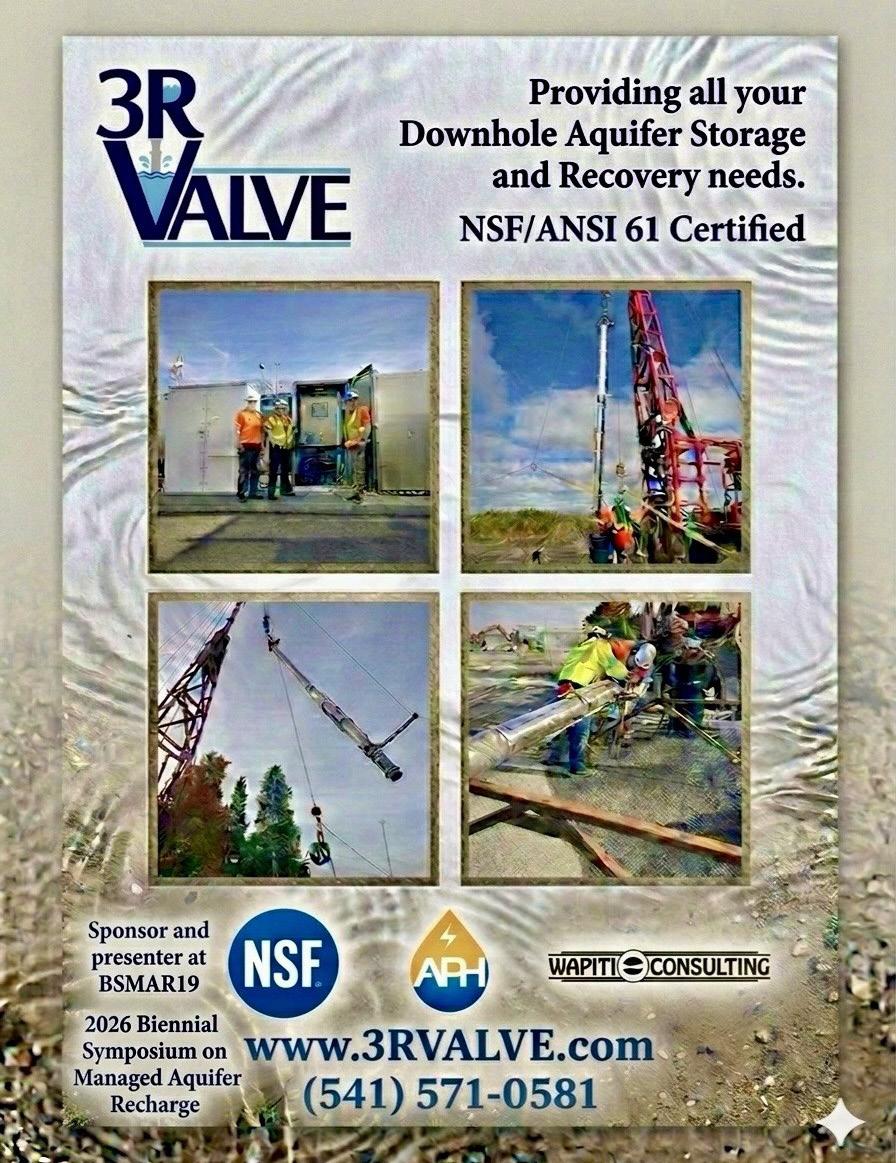
• Reclaiming High Volume Low Quality Winter Flood Flows for Peak Season Demand Using AR and ASR Systems by Kent Madison - 3RValve LLC
• Implementing an Indirect Potable Reuse Tracer Study in a Coastal Water Supply Aquifer by Pete Dennehy - Montgomery and Associates
• A Comprehensive Plan for Using Tracer Techniques to Evaluate MAR Performance at Valley Water Facilities by Ate Visser
• Tracing Subsurface Recharge Flows Using Distributed Temperature Sensing by Andy Campbell - Inland Empire Utilities Agency
• Tracer Studies in Practice: Technical and Regulatory Strategies for Indirect Potable Reuse by Everett Ferguson, MBA, PG, CHG - Water Replenishment District of Southern California
• Integrating High-Resolution Imaging and Multilevel Monitoring to Optimize Managed Aquifer Recharge by John Sankey - Blue Technologies, Inc.
5:40 PM – Evening Networking Reception
Join us for an informal Networking Reception and take time to relax, mingle, and connect with colleagues in the hotel bar. Grab a drink, enjoy easy conversation, and make new connections as we wind down together in a casual, welcoming setting.
THURSDAY, APRIL 2
7:30 AM – Registration & Breakfast on Your Own
8:30 AM – Field Trip (Registration Separate)



and Surface Water Modeling to evaluate:
- Saltwater Intrusion and Barriers
- Interconnected Surface Water
-Recycled Water Recharge
- Safe Yield
-Aquifer Storage and Recovery
• Risk and Uncer tainty Analysis
•Aquifer Characterization
•Well Design and Construction Oversight
• Title-22 Permitting and Regulatory Support
• Air Quality Permitting, Modeling, Greenhouse
Gas Quantification and Reduction Contact one of our California water resource
Abhishek Singh, PhD, PE asingh@intera.com 424.275.4055
Trey Driscoll, PG, CHG tdriscoll@intera.com 760.415.1425

Geosyntec combines hydrogeology, engineering, and modeling expertise to guide clients toward SGMA compliance and lasting water resilience.
With 17 offices serving California communities, we deliver:
SGMA implementation support
Groundwater Policy and GSA Support
Multibenefit project planning, permitting, and design
Basin characterization and data visualization
Groundwater and surface water modeling
Groundwater monitoring and aquifer test analysis
Surface water interaction studies - Managed aquifer recharge siting, engineering and design
Source water protection
Groundwater-dependent ecosystem evaluation
Groundwater trading and accounting
Amer Hussain, PE amer.hussain@geosyntec.com
James Gonzales, PG, CHG james.gonzales@geosyntec.com
geosyntec.com

Tara Rolfe, PG, CHG tara.rolfe@geosyntec.com Celebrating 46 Years!

Modeling Software Development
Hydrogeological Modeling ▪ Geochemical Investigation & Modeling ▪ Contaminant Fate & Transport ▪ Water Supply Evaluations ▪ Aquifer Storage & Recovery ▪ Managed Aquifer Recharge
▪ Monitoring Well and Pump Performance Optimization
▪ Remediation Engineering for Soil, Groundwater, and Surface Water ▪ Sampling and Field Services ▪ Expert Testimony & Litigation Support