SAFETY REGULATIONS
GENERAL NOTES
Kohler engines are built to provide safe and longlasting performances, but in order to obtain these results it is essential that the maintenance requirements described in the manual are observed along with the following safety recommendations.
The engine has been built to the specifications of a machine manufacturer, and it is his responsibility to ensure that all necessary action is taken to meet the essential and legally prescribed health and safety requirements. Any use of the machine other than that described cannot be considered as complying with its intended purpose as specified by Kohler, which therefore declines all responsibility for accidents caused by such operations.
The following instructions are intended for the user of the machine in order to reduce or eliminate risks, especially those concerning the operation and standard maintenance of the engine.
The user should read these instructions carefully and get to know the operations described. By not doing so he may place at risk his own health and safety and that of anyone else in the vicinity of the machine.
The engine may be used or mounted on a machine only by personnel suitably trained in its operation and aware of the dangers involved. This is particularly true for standard and, above all, special maintenance work. For special maintenance contact personnel trained specifically by Kohler. This work should be carried out in accordance with existing literature.
Kohler declines all responsibility for accidents or for failure to comply with the requirements of law if changes are made to the engine’s functional parameters or to the fuel flow rate adjustments and speed of rotation, if seals are removed, or if parts not described in the operating and maintenance manual are removed and reassembled by unauthorized personnel.
WARNING
In addition to all other machine specifications, ensure that the engine is in a near horizontal position when starting. lf starting manually, ensure that the necessary operations can be performed without any risk of striking against walls or dangerous objects. Rope starting (except for recoil rope starting) is not permitted even in emergencies. Check that the machine is stable so that there is no risk of it overturning.
Get to know the engine speed adjustment and machine stop operations.
Do not start the machine in closed or poorly ventilated environments. The internal combustion process generates carbon monoxide, an odourless and highly toxic gas, so spending too long a time in an environment where the engine discharges its exhaust products freely can lead to loss of consciousness and even death.
The engine may not be used in environments containing flammable materials, explosive atmospheres or easily combustible powders, unless adequate and specific precautions have been taken and are clearly stated and certified for the machine.
To prevent the risk of fire, keep the machine at a distance of at least one metre from buildings or other machines.
Children and animals must be kept at a sufficient distance from the machine to prevent any danger resulting from its operation.
Fuel is flammable, so the tank must be filled only when the engine is turned off. Dry carefully any fuel that may have spilled, remove the fuel container and any cloths soaked in fuel or oil, check that any sound-absorbing panels made of porous material are not soaked with fuel or oil, and make sure that the ground on which the machine is located has not absorbed fuel or oil.
Before starting, remove any tools that have been used for carrying out maintenance work to the engine and/or the machine and check that any guards removed have been replaced. In cold climates it is possible to mix kerosene with the diesel fuel to make the engine easier to start. The liquids must be mixed in the tank by pouring in first the kerosene and then the diesel fuel. Consult Kohler technical office for mixture proportions. Petrol may not be used because of the risk of it forming flammable vapours.
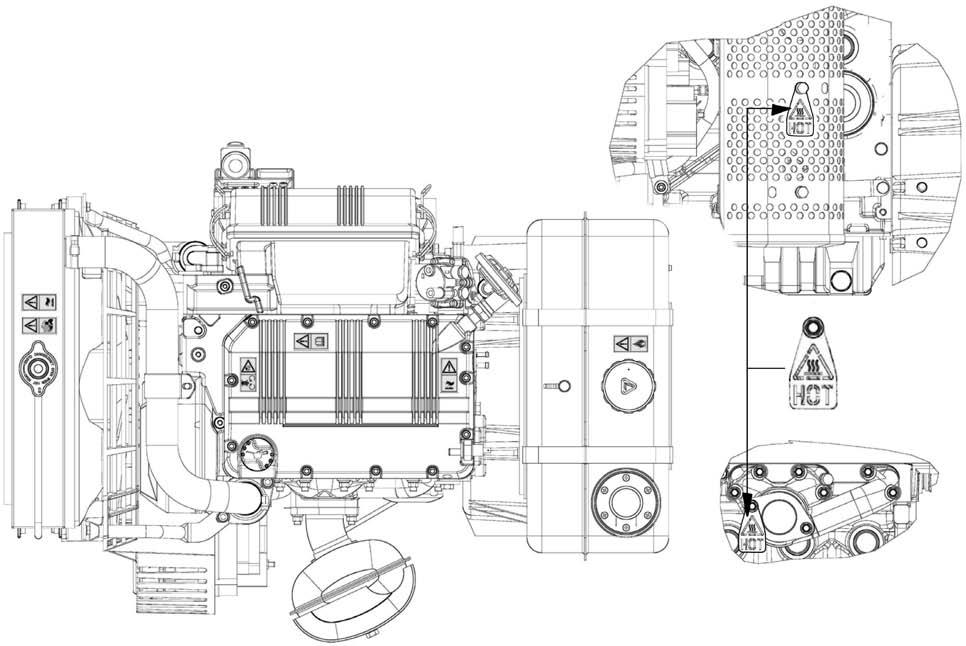
During operation the surface of the engine reaches temperatures that may be dangerous. Avoid in particular all contact with the exhaust system.
The liquid cooling circuit is under pressure. Do not carry out any checks before the engine has cooled down, and even then open the radiator cap or the expansion tank cautiously. Wear protective clothing and glasses. lf there is an electric fan, do not approach the engine while it is still hot as the fan may come on even when the engine is not running. Clean the cooling system with the engine turned off.
While cleaning the oil bath air filter, check that the oil is disposed of in such a way as not to harm the environment. Any filtering sponges in the oil bath air filter should not be soaked with oil. The cyclone pre-filter cup must not be filled with oil.
Since the oil must be emptied out while the engine is still hot (approx. 80°C), particular care should be taken in order to avoid burns. In any case make sure that oil does not come into contact with your skin because of the health hazards involved.
Fuel vapours are highly toxic, so fill up only in the open air or in well ventilated environments.
During operations which involve access to moving parts of the engine and/or removal of the rotary guards, disconnect and insulate the positive cable of the battery so as to prevent accidental short circuits and activation of the starter motor. Check the belt tension only when the engine is turned off.
IMPORTANT
To start the engine follow the specific instructions provided in the engine and/or machine operating manual. Do not use auxiliary starting devices not originally installed on the machine (e.g. Startpilot systems which utilise ether etc.)
Before carrying out any work on the engine, turn it off and allow it to cool down. Do not perform any operation while the engine is running.
Check that the discharged oil, the oil filter and the oil contained in the oil filter are disposed of in such a way as not to harm the environment.
Close the fuel tank filler cap carefully after each fílling operation. Do not fill the tank right up to the top, but leave sufficient space to allow for any expansion of the fuel. Do not smoke or use naked flames while filling.
Take care when removing the oil filter as it may be hot. The operations of checking, filling up and replacing the cooling liquid must be carried out with the engine turned off and cold. Take particular care if liquids containing nitrites are mixed with others not containing these compounds as this may give rise to the formation of nitrosamines which are a health hazard. The cooling liquid is polluting, so dispose of in a manner that does not damage the environment.
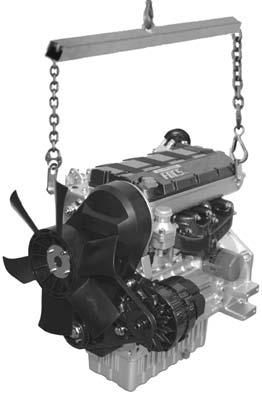
In order to move the engine simultaneously use the eyebolts fitted for this purpose by Kohler. These lifting points are however not suitable for the entire machine, so in this case use the eyebolts fitted by the manufacturer.
GENERAL SAFETY DURING OPERATING PHASES
– The procedures contained in this manual have been tested and selected by the manufacturer’s technical experts, and hence are to be recognised as authorised operating methods.
– Some tools are normal workshop ones, while others are special tools designed by the Manufacturer of the engine.
– All tools must be in good working condition so that engine components are not damaged and that operations are carried out properly and safely.
– It is important to wear the personal safety devices prescribed by work safety laws and also by the standards of this manual.
– Holes must be lined up methodically and with the aid of suitable equipment. Do not use your fingers to carry out this operation to avoid the risk of amputation.
– Some phases may require the assistance of more than one operator. If so, it is important to inform and train them regarding the type of activity they will be performing in order to prevent risks to the health and safety of all persons involved.
– Do not use flammable liquids (petrol, diesel, etc.) to degrease or wash components. Use special products.
– Use the oils and greases recommended by the manufacturer. Do not mix different brands or combine oils with different characteristics.
– Discontinue use of the engine if any irregularities arise, particularly in the case of unusual vibrations.
– Do not tamper with any devices to alter the level of performance guaranteed by the manufacturer.
SAFETY AND ENVIRONMENTAL IMPACT
Every organisation has a duty to implement procedures to identify, assess and monitor the influence of its own activities (products, services, etc.) on the environment.
Procedures for identifying the extent of the impact on the environment must consider the following factors:
- Liquid waste;
- Waste management;
- Soil contamination;
- Atmospheric emissions;
- Use of raw materials and natural resources;
- Regulations and directives regarding environmental impact.
In order to minimise the impact on the environment, the manufacturer now provides a number of indications to be followed by all persons handling the engine, for any reason, during its expected lifetime.
- All packaging components must be disposed of in accordance with the laws of the country in which disposal is taking place.
- Keep the fuel and engine control systems and the exhaust pipes in efficient working order to limit environmental and noise pollution.
- When discontinuing use of the engine, select all components according to their chemical characteristics and dispose of them separately.
TROUBLE SHOOTING
THE ENGINE MUST BE STOPPED IMMEDIATELY WHEN:
1) - The engine rpms suddenly increase and decrease;
2) - A sudden and unusual noise is heard;
3) - The colour of the exhaust fumes suddenly darkens;
4) - The oil pressure indicator light turns on while running.
TABLE OF LIKELY ANOMALIES AND THEIR SYMPTOMS
The following table contains the possible causes of some failures which may occur during operation. Always perform these simple checks before removing or replacing any part.
TROUBLE
POSSIBLE CAUSE
Clogged fuel pipes
Clogged fuel filter
Air or water in the fuel circuit
Tank cap breather blocked
Faulty fuel pump
Lack of fuel
Glow plug fuse burned
Faulty glow plug control relay
Flat battery
Unclear or mistaken cable connection
Faulty starter switch
Faulty starting motor
Faulty glow plugs
Clogged air filter
Prolonged operation at idle
Incomplete run-in
Overloaded engine
Excessive valve clearances
Absence of valve clearances
Incorrect speed governor leverages
Speed governor spring broken or disengaged
Idle low
Worn out or stuck rings
Worn out cylinders
Worn out valve guides
Bad valve seal
Bearing shells of bearing cap - piston rod - rocker worn out
E.G.R. valve blocked open
Governor leverages not running
Cylinder head gasket damaged
Faulty timing system
Supplementary starter spring broken or disengaged
TROUBLE
POSSIBLE CAUSE
High oil level
Low oil level
Dirty or blocked pressure regulation valve
Worn oil pump
Air to the oil suction hose
Faulty manometer or pressure switch
Oil in sump suction hose blocked
Oil in sump drainage pipe blocked
Faulty spray nozzles (Turbo engines only)
Damaged injector
Damaged injection pump valve
Incorrectly calibrated injector
Worn or damaged pumping element
Incorrect injection pump delivery setting (delivery equalisation)
Hardened pump/injector control rod
Cracked or broken pre-combustion chamber
Incorrect adjustment of the injection systems (delivery equalisa- tion advance)
Insufficient refrigerant fluid
Defective fan, radiator, or radiator cap
Defective thermostatic valve
Loss of refrigerant fluid from the radiator, hoses, engine crankshaft or water pump.
Inside of radiator or coolant lines obstructed.
Defective or worn water pump
Alternator fan drive belt loose or torn
Heat exchange surface of the radiator clogged
TECHINICAL SPECIFICATIONS
ENGINE TYPE
Cylinders Bore Stroke
Displacements
Compression rate Rpm
Maximum power
Maximum torque *
Maximum Torque Available @ N° 3 PTO 3600 Rpm
Specific fuel consumption**
Oil consumption ***
Dry weight of engine
Combustion air volume at 3600 Rpm
Cooling air volume at 3600 Rpm
Axial load allowed on crankshaft (both directions)
Max tilt
* At NB power
Instant operation (up to 1 min)
Intermittent operation (up to 30 min)
Permanent operation
** Referred to NB power
*** Measured at NA power
**** Depends on application
• At 3600 Rpm
•• Measured at NB power
KDW 702
KDW 1003 KDW 1404
PERFORMANCE DIAGRAMS
N (DIN 70020) Automotive rating, intermittent operation with variable speed and variable load.
NB (DIN 6270) Rating with no overload capability, continuous light duty operation with constant speed and variable load.
NA (DIN 6270) Continuous rating with overload capability, continuous heavy duty with constant speed and constant load.
C (NB) : Specific fuel consumption at NB power
Mt : Torque at N.
a : Range of application for continuous operation. In case of application outside this range please contact KOHLER.
The above power values refer to an engine fitted with air cleaner and standard muffler, after testing and at the environmental conditions of 20°C and 1 bar. Max. power tolerance is 5%. Power decreases by approximately 1% every 100 m di altitude and by 2% every 5°C above 25°C.
Note: Consult KOHLER for power, torque curves and specific consumptions at rates differing from those given above.
Important
Non-approval by KOHLER for any modifications releases the company from any damages incurred by the engine.
KDW 702
KDW 1003
KDW 1404
OVERALL DIMENSION KDW 702
1003
COPPA OLIO STANDARD IN LAMIERA - CARTER D’HUILE EN TÔLE STANDARD - SHEET METAL STANDARD OIL SUMPSTANDARD BLECHÖLWANNE - CÁRTER DE ACEITE STANDARD EN PLANCHA - CÁRTER DE ÓLEO STANDARD EM CHAPA
(20.3)
DIMENSIONS mm (in.) - DIMENSIONI mm - MESURES mm - EINBAUMAßE mm - DIMENSIONE mm - DIMENÇÕES mm A B C
COPPA OLIO MAGGIORATA IN ALLUMINIO - CARTER D’HUILE SURDIMENSIONNÉ EN ALUMINIUM - OVERSIZE ALUMINIUM OIL SUMP - VERGRÖSSERTER ALUMINIUMÖLWANNE - CÁRTER DE ACEITE SOBREDIMENSIONADO EN ALUMINIO - CÁRTER DE ÓLEO AUMENTADO - EM ALUMINIO
DIMENSIONS mm (in.) - DIMENSIONI mm - MESURES mm - EINBAUMAßE mm - DIMENSIONE mm - DIMENÇÕES mm
KDW 1003 with EGR circuit, Gear-box and CVT (Continuous Variable Transmission)
A 350,2 F 87 K 152,9 P 218 U
B 177 G 129,3 L 641,8 Q 89 V 25 A1 703,5
C 534,5 H 54,8 M 701,7 R 151,5 W 300,5 B1 86
D 72,9 I 58,8 N 685,7 S 59,6 X 176,5 C1 93
E 359,1 J 215,9 O 328,7 T 145 Y 330,5 D1 329
COPPA OLIO MAGGIORATA IN ALLUMINIO - CARTER D’HUILE SURDIMENSIONNÉ EN ALUMINIUM - OVERSIZE ALUMINIUM OIL SUMP - VERGRÖSSERTER ALUMINIUMÖLWANNE - CÁRTER DE ACEITE SOBREDIMENSIONADO EN ALUMINIO - CÁRTER DE ÓLEO AUMENTADO - EM ALUMINIO
ROUTINE ENGINE MAINTENANCE
Important
Failure to carry out the operations described in the table may lead to technical damage to the machine and/or system.
ORDINARY MAINTENANCE
AFTER THE FIRST 50 WORKING HOURS
Engine oil replacement. Oil filter replacement.
EXTRAORDINARY MAINTENANCE
FREQUENCY x HOURS
CHECK
OPERATION DESCRIPTION
ENGINE OIL LEVEL
COOLANT LEVEL
AIR FILTER (DRY-TYPE)
RADIATOR EXCHANGE SURFACE
VALVE CLEARANCE ADJUSTMENT
FAN / ALTERNATOR
BELT STRETCH
COOLING LIQUID HOSES
SETTING AND INJECTORS CLEANING
FUEL PIPES
RUBBER INTAKE HOSE (AIR FILTER AND INTAKE MANIFOLD)
INTERIOR RADIATOR CLEANING
ALTERNATOR AND STARTING MOTOR
ENGINE OIL
OIL FILTER
FUEL FILTER
ALTERNATOR BELT
COOLANT
FILTER ELEMENT PANEL AIR FILTER
FUEL PIPES
REPLACEMENT
COOLING LIQUID HOSES
RUBBER INTAKE HOSE (AIR FILTER AND INTAKE MANIFOLD)
TIMING BELT
DRY AIR CLEANER EXTERNAL
CARTRIDGE
DRY AIR CLEANER INTERNAL
CARTRIDGE
PARTIAL
OVERHAUL
TOTAL
STANDARD OIL SUMP
ENHANCED OIL SUMP
EVERY 4000 HOURS
AFTER 6 CHECKS WITH CLEANING
AFTER 3 CHECKS WITH CLEANING
(*) - In case of low use: every year.
(**) - In case of low use: every 2 years.
(***) - The period of time that must elapse before cleaning or replacing the filter element depends on the environment in which the engine operates. The air filter must be cleaned and replaced more frequently In very dusty conditions.
(°) - Once removed, the timing belt should be replaced even if its scheduled motion period is not over.
LUBRICANT
SAE Classification
In the SAE classification, oils differ on the basis of their viscosity, and no other qualitative characteristic is taken into account.
The first number refers to the viscosity when the engine is cold (symbol W = winter), while the second considers viscosity with the engine at régime.
The criteria for choosing must consider, during winter, the lowest outside temperature to which the engine will be subject and the highest functioning temperature during summer. Single-degree oils are normally used when the running temperature varies scarcely.
Multi-degree oil is less sensitive to temperature changes.
SAE- Grade
SAE 20W* SAE 30* SAE 40*
SAE 10W-30**
SAE 10W-40**
SAE 10W-60**
SAE 15W-40 **
SAE 15W-40 **
SAE 20W-60 **
SAE 5W-30 ***
SAE 5W-40 ***
SAE 0W-30 ***
* Mineral base
** Semi-synthetic base
*** Synthetic base
International specifications
They define testing performances and procedures that the lubricants need to successfully respond to in several engine testing and laboratory analysis so as to be considered qualified and in conformity to the regulations set for each lubrication kind.
A.P.I : ( American Petroleum Institute )
MIL : Engine oil U.S. military specifications released for logistic reasons
ACEA : European Automobile Manufacturers Association
Tables shown on this page are of useful reference when buying a kind of oil.
Codes are usually printed-out on the oil container and the understanding of their meaning is useful for comparing different brands and choosing the kind with the right characteristics.
Usually a specification showing a following letter or number is preferable to one with a preceding letter or number. An SF oil, for instance, is more performing than a SE oil but less performing than a SG one.
ACEA Regualtions - ACEA Sequences
PETROL
A1 = Low-viscosity, for frictions reduction
A2 = Standard
A3 = High performances
LIGHT DUTY DIESEL ENGINES
B1 = Low-viscosity, for frictions reduction
B2 = Standard
B3 =High performances (indirect injection)
B4 = High quality (direct injection)
HEAVY DUTY DIESEL ENGINES
E1 = OBSOLETE
E2 = Standard
E3 = Heavy conditions (Euro 1 - Euro 2 engines )
E4 = Heavy conditions (Euro 1 - Euro 2 - Euro 3 engines )
E5 =High performances in heavy conditions (Euro 1 - Euro 2 - Euro 3 engines )
API / MIL Sequences
PETROL
specifications PRESCRIBED LUBRICANT
AGIP SINT 2000 5W40
API SJ/CF ACEA A3-96 B3-96 MIL - L-46152 D/E
In the countries where AGIP products are not available, use oil API CF/SH for Diesel engines or oil corresponding to the military specification MIL-L-2104 C/46152 D.
ENGINES OIL CAPACITY
OIL VOLUME AT MAX LEVEL
(OIL FILTER INCLUDED)
OIL VOLUME AT MAX LEVEL
(WITHOUT OIL FILTER)
* With dynamic balancer
Sheet STD oil sump.
ENHANCED aluminium oil sump.
Litres
Sheet STD oil sump.
ENHANCED aluminium oil sump.
Litres
Important
If you are using oil of a quality lower than the prescribed one then you will have to replace it every 125 hours for the standard sump and every 150 hours for the enhanced sump.
Danger – Attention
- The engine may be damaged if operated with insufficient lube oil. It is also dangerous to supply too much lube oil to the engine because a sudden increase in engine rpm could be caused by its combustion.
- Use proper lube oil preserve your engine. Good quality or poor quality of the lubricating oil has an affect on engine performance and life.
- If inferior oil is used, or if your engine oil is not changed regularly, the risk of piston seizure, piston ring sticking, and accelerated wear of the cylinder liner, bearing and other moving components increases significantly.
- Always use oil with the right viscosity for the ambient temperature in which your engine is being operated.
Danger – Attention
- The used engine oil can cause skin-cancer if kept frequently in contact for prolonged periods.
- If contact with oil cannot be avoided, wash carefully your hands with water and soap as soon as possible.
- Do not disperse the oil in the ambient, as it has a high pollution power.
COOLANT
Danger – Attention
- The fluid coolant circuit is pressurized. Inspections must only be made when the engine has cooled and even in this case, the radiator or expansion chamber plug must be unscrewed with the utmost caution.
- If an electric fan is installed, do not approach a hot engine since the fan itself could start up even when the engine is at a standstill.
- Coolant fluid is polluting, it must therefore be disposed of in the correct way. Do not litter.
The anti-freeze protection liquid (AGIP ANTIFREEZE SPEZIAL) must be used mixed with water, preferably decalcified. The freezing point of the cooling mixture depends on the product concentration in water, it is therefore recommended to use a 50% diluted mixture which guarantees a certain degree of optimal protection. As well as lowering the freezing point, the permanent liquid also raises the boiling point.
Prescribed coolant.
50 % AGIP ANTIFREEZE SPEZIAL
50 % Water
Coolant refueling
ENGINE TYPE
(Litres)
For information concerning the capacity of KOHLER radiators, please contact KOHLER directly
The total volume for refilling the cooling liquid varies according to the type of engine and radiator
FUEL RECOMMENDATIONS
Purchase diesel fuel in small quantities and store in clean, approved containers. Clean fuel prevents the diesel fuel injectors and pumps from clogging. Do not overfill the fuel tank. Leave room for the fuel to expand. Immediately clean up any spillage during refueling.
Never store diesel fuel in galvanized containers; diesel fuel and the galvanized coating react chemically to each other, producing flaking that quickly clogs filters or causes fuel pump or injector failure.
High sulfur content in fuel may cause engine wear. In those countries where diesel has a high sufur content, its is advisable to lubricate the engine with a high alkaline oil or alternatively to replace the lubricating oil recommended by the manufacturer more frequently. The regions in which diesel normally has a low sulfur content are Europe, North America, and Australia.
PRESCRIBED LUBRICANT
Fuel with low sulphur content
Fuel with high sulphur content
FUEL TYPE
For best results, use only clean, fresh, commercial-grade diesel fuel. Diesel fuels that satisfy the following specifications are suitable for use in this engine: ASTM D-975 - 1D or 2D, EN590, or equivalent.
FUELS FOR LOW TEMPERATURES
It is possible to run the engine at temperatures below 0°C using special winter fuels. These fuels reduce the formation of paraffin in diesel at low temperatures. If paraffin forms in the diesel, the fuel filter becomes blocked interrupting the flow of fuel.
Fuel can be: - Summer up to 0°C
- Winter up to -10°C
- Alpine up to -20°C
- Arctic up to -30°C
BIODIESEL FUEL
Fuels containing less than 20% methyl ester or B20, are suitable for use in this engine. Biodiesel fuels meeting the specification of BQ-9000 or equivalent are recommended. DO NOT use vegetable oil as a biofuel for this engine. Any failures resulting from the use of fuels other than recommended will not be warranted.
AVIATION FUEL
Aviation fuels suitable for use in this engine include JP5, JP4, JP8 and, JET-A (if 5 percent oil is added).
Important
- Before removing the engine from the vehicle on which it is installed, disconnect the power supply, detach the fuel and coolant supply, and all connections including the mechanical ones.
- Attach the engine to a suitable lifting device (lifting beam).
- Hook the lifting device in the engine lifting points, as shown in the figure.
- Before lifting, make sure the weight is correctly balanced by checking its barycentre.
- Close all engine openings accurately (exhaust, intake, etc.), then wash the outside and dry with a jet of compressed air.
Use protective gloves when handling the engine
Important
The bracket of the lifting points have been designed to lift the engine only. They are not intended nor approved to lift additional weights. Do not use different methods to lift the engine than those described herein. In case different methods are used, no warranty shall be granted for any consequential damage.
RECOMMENDATIONS FOR DISASSEMBLING AND ASSEMBLING
Important
To locate specific topics, the reader should refer to the index.
– Besides disassembly and reassembly operations this chapter also includes checking and setting specifications, dimensions, repair and operating instructions.
– Always use original KOHLER spare parts for proper repair operations.
– The operator must wash, clean and dry components and assemblies before installing them.
– The operator must make sure that the contact surfaces are intact, lubricate the coupling parts and protect those that are prone to oxidation.
– Before any intervention, the operator should lay out all equipment and tools in such a way as to enable him to carry out operations correctly and safely.
– For safety and convenience, you are advised to place the engine on a special rotating stand for engine overhauls.
– Before proceeding with operations, make sure that appropriate safety conditions are in place, in order to safeguard the operator and any persons involved.
– In order to fix assemblies and/or components securely, the operator must tighten the fastening parts in a criss-cross or alternating pattern.
– Assemblies and/or components with a specific tightening torque must initially be fastened at a level lower than the assigned value, and then subsequently tightened to the final torque.
RECOMMENDATIONS FOR OVERHAULS AND TUNING
Important
To locate specific topics, the reader should refer to the index.
– Before any intervention, the operator should lay out all equipment and tools in such a way as to enable him to carry out operations correctly and safely.
– The operator must comply with the specific measures described in order to avoid errors that might cause damage to the engine.
– Before carrying out any operation, clean the assemblies and/or components thoroughly and eliminate any deposits or residual material.
– Wash the components with special detergent and do not use steam or hot water.
– Do not use flammable products (petrol, diesel, etc.) to degrease or wash components. Use special products.
– Dry all washed surfaces and components thoroughly with a jet of air or special cloths before reassembling them.
– Apply a layer of lubricant over all surfaces to protect them against oxidation.
– Check all components for intactness, wear and tear, seizure, cracks and/or faults to be sure that the engine is in good working condition.
– Some mechanical parts must be replaced en bloc, together with their coupled parts (e.g. valve guide/valve etc.) as specified in the spare parts catalogue.
Danger - Attention
During repair operations, when using compressed air, wear eye protection
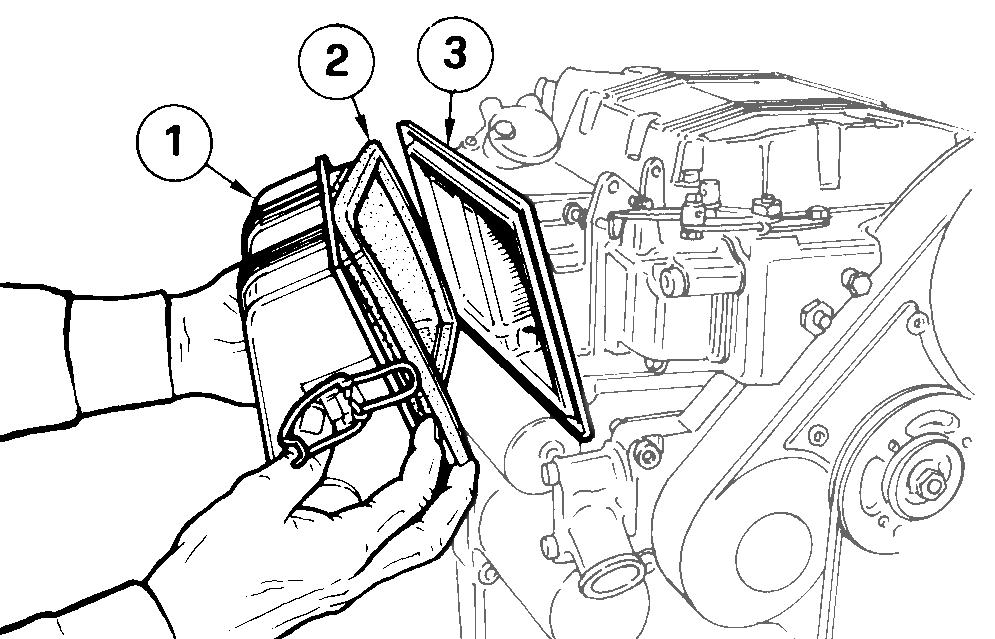
Dry type air filter
Danger - Attention
Never clean the filtering element with highly flammable solvents Danger of explosion!
Important
Blow compressed air crossways over the external part and inside the cartridge at a pressure no greater than 5 atm or if necessary knock the front of the cartridge repeatedly against a flat surface.
Components: 1 Cover 2 Filter element 3 Support
Air filter specifications:
Filtration level = 13÷14 µm.
Filtration area = 4470 cm² for 702, 1003
Filtration area = 7150 cm² for 1404
See page 32 for periodic maintenance details.
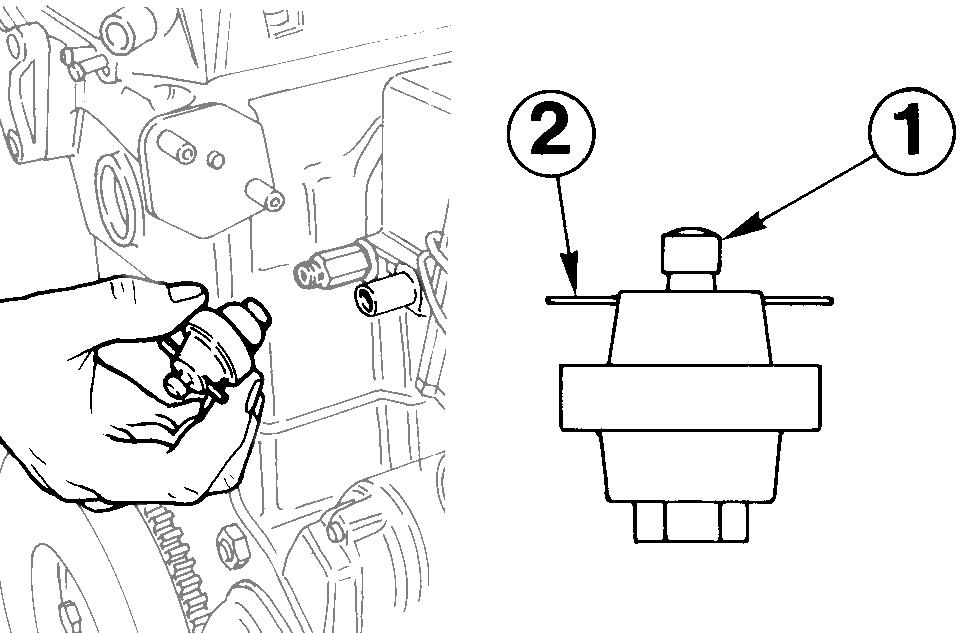
Air restriction switch
Components:
1 Reset buttione
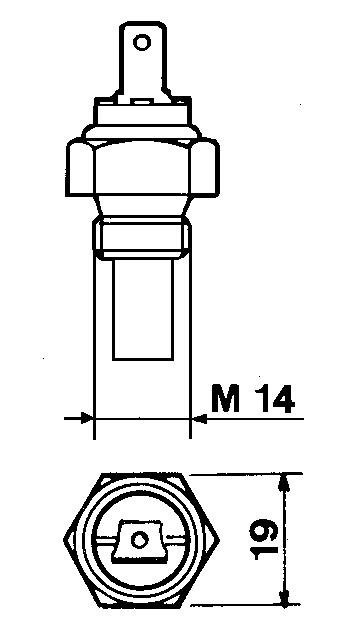
2 .25" Tab connection
Note: The indicator is calibrated at 600÷650 mm of water column for KDW 702, 1003, 1404.
Oil bath air cleaner (on request)
Important
Check the sealing rings regularly.
Replace the sealing rings if hardening or damage is noted
1 Upper Housing
6 Oil level reference mark 2 Diaphragm Seat 7 Reservoir bowl 3 Diaphragm 8 Outer seal ring 4 Polyurethane upper element 9 Inner seal ring
5 Metal wool lower eleme
Note: Carefully clean the reservoir bowl and both elements with clean diesel fuel. Blow the lower element dry with compressed air. Dry the upper element by squeezing out excess diesel fuel, then drying with suitable cloths. Fill the reservoir with clean engine oil to the reference mark.
See page 32 for periodic maintenance and replacement details.
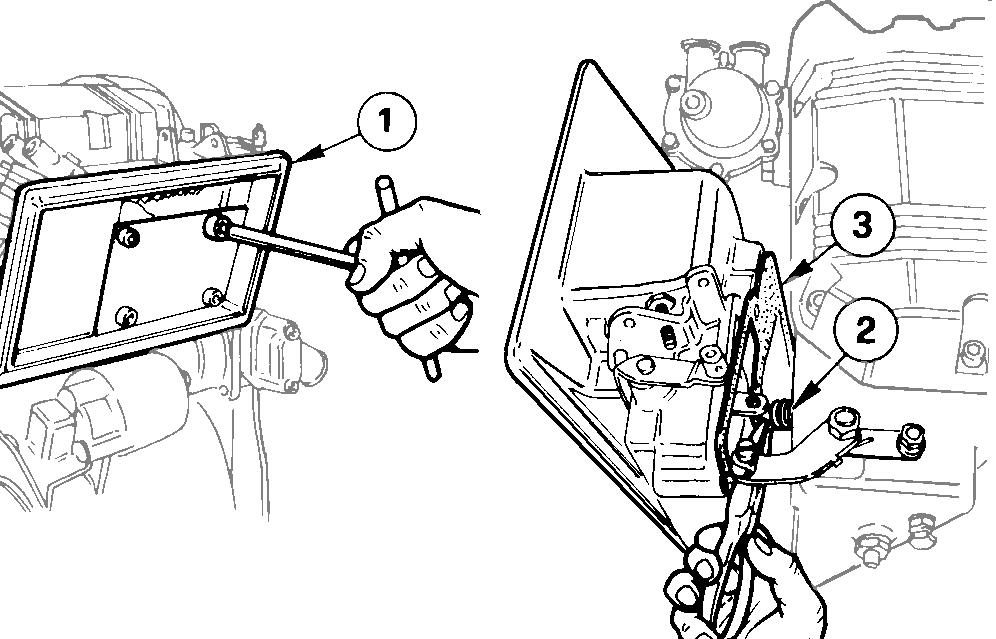
Air filter support
Disassembly / Reassembly
The support for air filter 1 incorporates the intake manifold and the accelerator control box.
Remove all bolts that secure the air filter support 1 to the cylinder head. Carefully pull the air filter support from the cylinder head. Using suitable pliers, release the governor spring 2 from the air filter support assembly.
Replace the gasket 3
Intake manifold – Remote air filter
Unscrew the the fastening screws 1 that fix the intake duct to the intake manifold unit.
Unscrew the two fastening screws 2 of the intake manifold from the engine crankcase.
Lift the intake manifold and disengage the hook of the min/max cylinder from the same manifold (fig. 212).
Components:
1. Exhaust manifold
2. E.G.R. Pipe
3. E.G.R. Valve
4. Vacuum pump
5. Three way union
6. Vacuum pump pipe
7. Thermovalve – vacuum pump connection pipe
8. Vacuum valve – thermovalve connection pipe
9. Vacuum valve - E.G.R. connection pipe
10. Thermovalve
11. Vacuum valve
12. ON-OFF sensor control cam
13. Intake duct
Operation
The main function of the E.G.R. (Exhaust Gas Recirculation) system is the reduction in emission of NOx (nitrogen oxides), gases harmful to people and the environment, via lowering the combustion temperature. The system takes a certain quantity of exhaust gas from the exhaust manifold 1 via the E.G.R. pipe 2 to the E.G.R. valve 3 This valve is opened by the vacuum (created in pipes 6, 7, 8 and 9 by vacuum pump 4) only when: a) thermovalve 10 placed in contact with the engine refrigerant fluid reaches a temperature of 40 °C; b) the on-off sensor control cam 12 opens the vacuum valve 11 at a determined accelerator position. Once the E.G.R. valve is opened, the exhaust gas enters the intake manifold 13 via the intake flange. The same logic controls the closure of the E.G.R. valve.
Disassembly / Reassembly
E.G.R. Circuit
Disassembly:
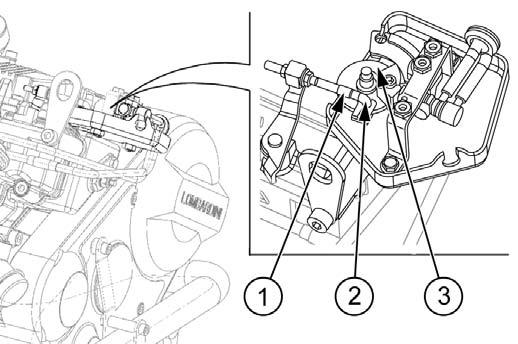
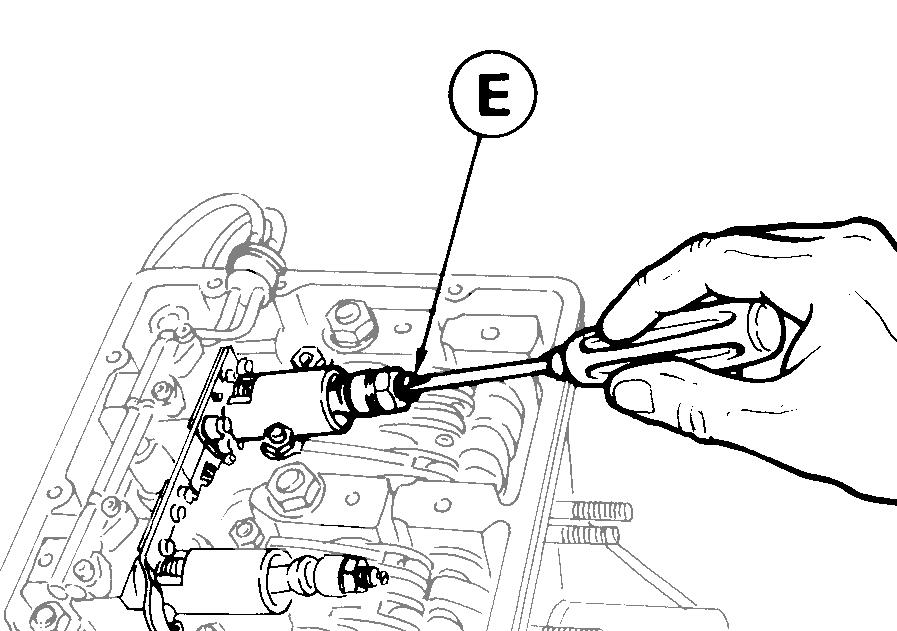
- Disengage the control rod catch 1 with a screwdriver from the accelerator control rod 2
- Disconnect the accelerator control rod 2 from the accelerator control lever 3
- Disconnect the thermovalve – vacuum pump connection pipes (7, fig. 8) and vacuum valve – thermovalve connection pipe (8, fig. 8) from the thermovalve.
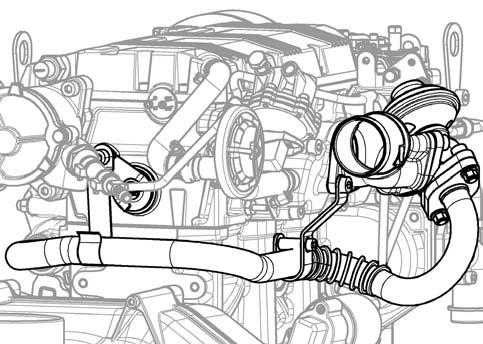
- Unscrew the two fastening screws 5 that fix the E.G.R. pipe 6 to the E.G.R. valve 4 (figures 10, 11 and 12).
- Remove the intake manifold. See "Intake manifold – Remote air filter" on page 39 (Figure 7).
- Unscrew the fastening screw of the E.G.R. pipe support bracket (9, fig. 10) from the engine crankcase and disengage the E.G.R. pipe from the exhaust manifold.
Reassembly:
When reassembling pay attention to the repositioning of the gaskets and to the precise connection of the pipes (6, 7, 8, 9, fig. 8).
These pipes should be carefully fitted on the appropriate connections.
Tighten the screws to specified torque, see "Table of tightening torques for the main components" on page 110-111.
For the calibration of the E.G.R. system see "E.G.R. calibration" on page 107.
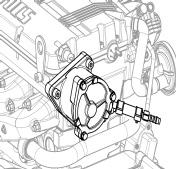
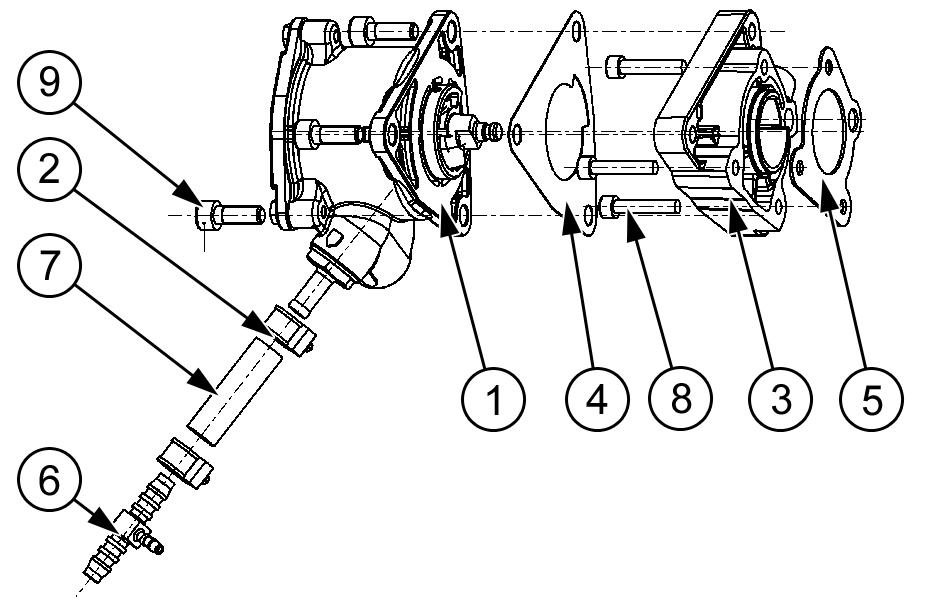
Vacuum pump and vacuum pump flange
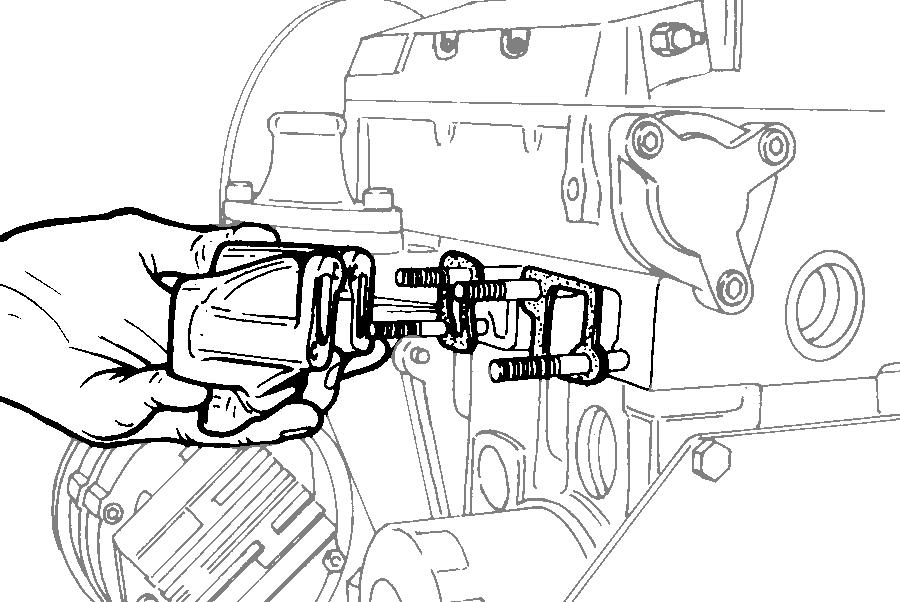
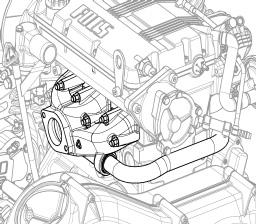
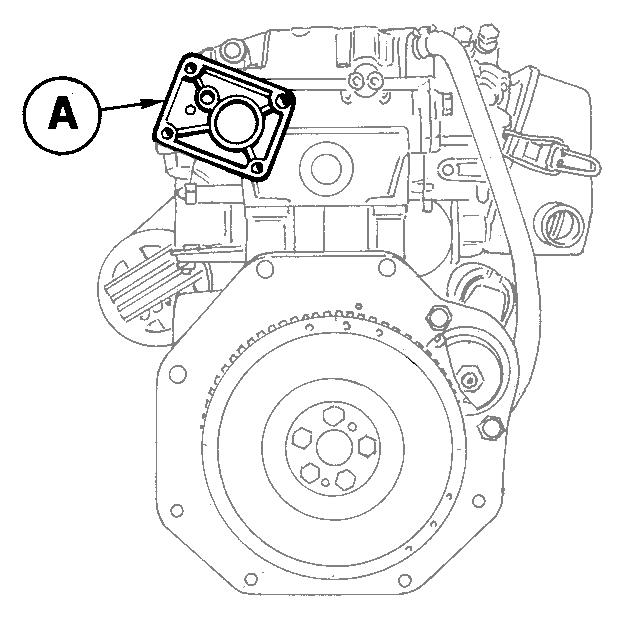
Unscrew the three fastening screws 1 that fix the vacuum pump to the flange and remove the vacuum pump.
Unscrew the fastening screws that fix the flange to the engine crankcase and remove it.
Components:
1. Vacuum pump
2. Clic clamp 86-50
3. Vacuum pump flange
4. Vacuum pump gasket-
5. Vacuum pump flange gasket
6. Three-way union for vacuum pump
7. Vacuum pump pipe
8. Screw
9. Screw
When reassembling, tighten the screws 8 that fix the flange to the cylinder head to the specified torque of 10 Nm, and the screws 9 that fix the vacuum pump to the flange at the specified torque of 15 Nm.
Exhaust manifold
Danger - Attention
Let the exhaust manifold cool before dismounting to avoid scalds and burns.
When you dismount the exhaust manifold check that the inside is properly clean and free from cracks or breaks. Replace gaskets every time you remove the manifold.
Tighten nuts at 25 Nm.
Exhaust manifold - engines with EGR
Remove the E.G.R. pipe 1
Unscrew the locking nuts 2 and remove the exhaust manifold and the seal.
Caution – Warning
When reassembling the exhaust manifold, check that the inside is properly clean and free from cracks or breaks. Replace the gasket each time the manifold is reassembled.
Tighten the nuts at the prescribed torque of 25 Nm.
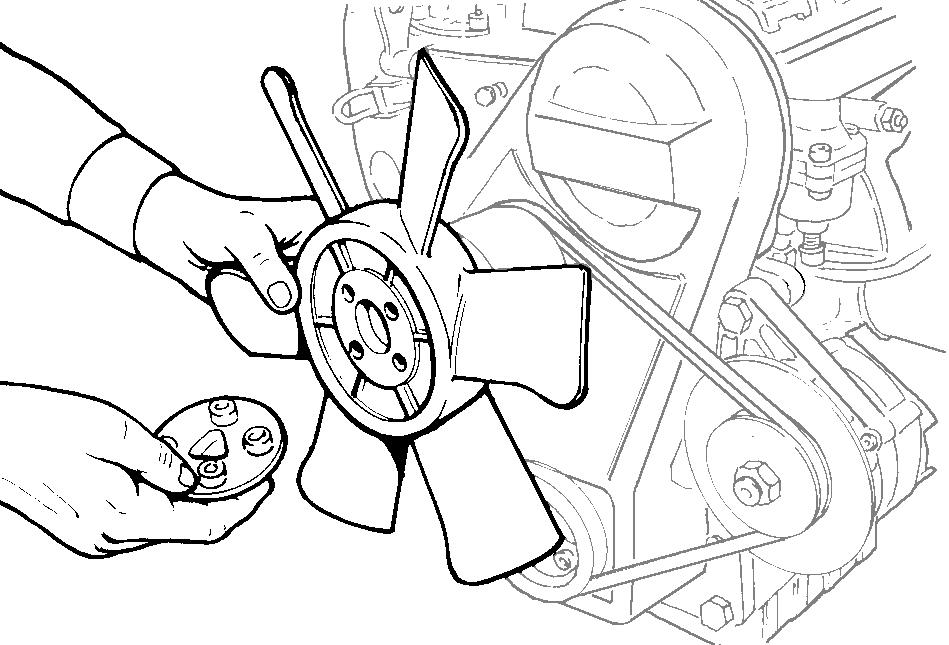
Cooling fan
Disassembly / Reassembly
Danger - Attention
Carry out the cooling fan disassembly, only after isolating the positive battery cable to prevent accidental shortcircuiting and, consequently, the activation of the starter motor.
Carefully clean and check all blades. Replace the fan even if there is only a single damaged blade.
See pages 20-21 for cooling air flow volume.
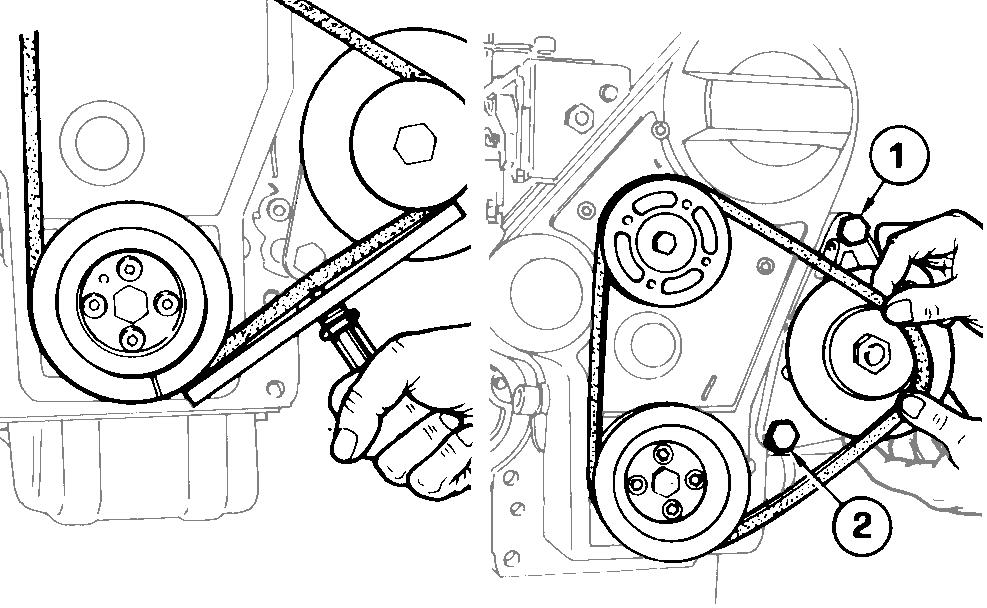
Alternator/Cooling fan belt drive
Danger - Attention
Check the belt tension only with the engine off.
Tension adjustment. Loosen screws 1 and 2
Adjust the belt tension so that a 100N force at the midpoint of the belt center (as shown) results in a 10-15mm deflection.
See page 32 for periodic maintenance details.
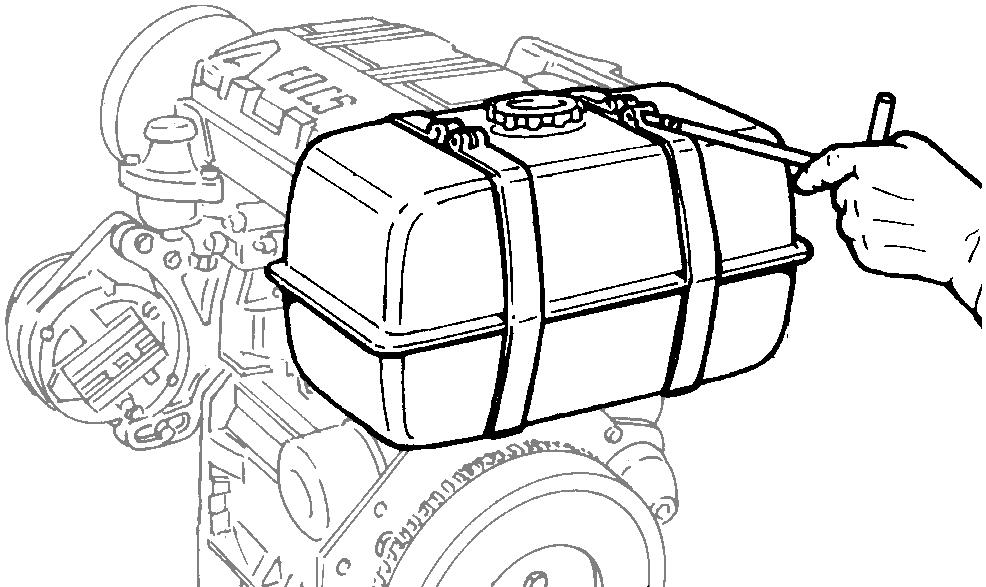
Fuel tank (optional)
Danger - Attention
To avoid explosions or fire outbreaks, do not smoke or use naked flames during the operations.
Fuel vapours are highly toxic. Only carry out the operations outdoors or in a well ventilated place. Keep your face well away from the plug to prevent harmful vapours from being inhaled.
Dispose of fuel in the correct way and do not litter as it is highly polluting.
After disconnecting the fuel pipes unscrew the anchoring brackets' screws and remove the fuel tank.
Completely empty the tank and check that no impurities are found inside.
Check that cap breather hole is not clogged.
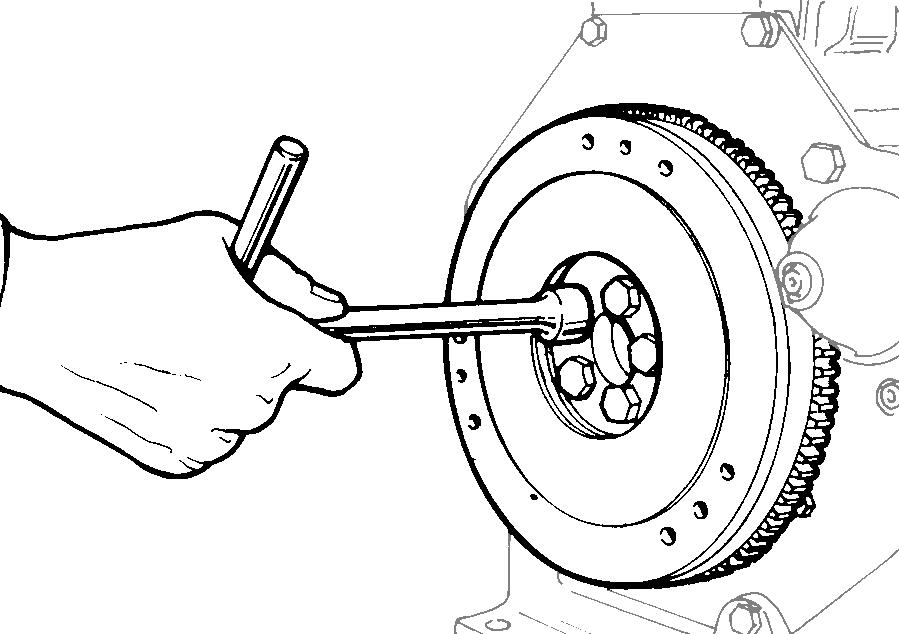
Flywheel
Danger - Attention
During dismounting be particularly careful not to let the flywheel fall, as this can be very dangerous for the operator. Use protective goggles while removing the starter ring gear.
Unscrew the screws that fasten it to the crankshaft.
In order to replace the ring gear, it is necessary to disassemble the flywheel.
Cut the ring gear in several places using a chisel and remove it. Heat the new ring gear uniformly and keep it at a temperature of 300°C for 15÷20 minutes.
Insert the ring gear into its seat and place it carefully on the rim of the flywheel.
eave to the ring gear to cool gently before reassembling the flywheel.
When refitting tighten the screws at 80 Nm.
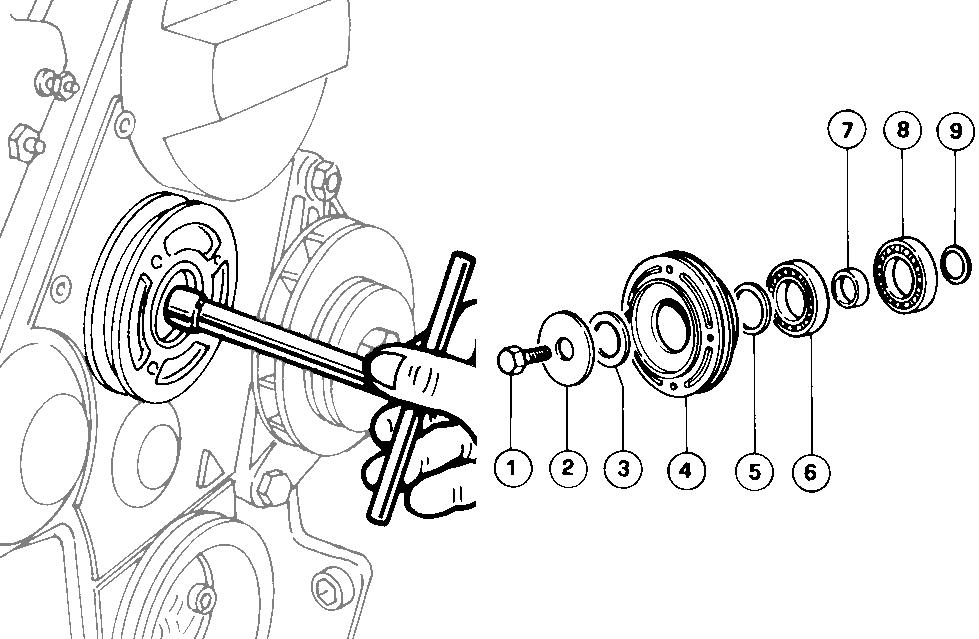
Return pulley
Remove the center bolt 1 and slide the pulley from the engine.
Components:
1 Bolt
2 Washer
3 Spacer
4 Pulley
5 Snap Ring
6 Bearing
7 Spacer
8 Bearing
9 Snap Ring
On remounting thoroughly clean out the threads of screw 1 and tighten at 25 Nm.
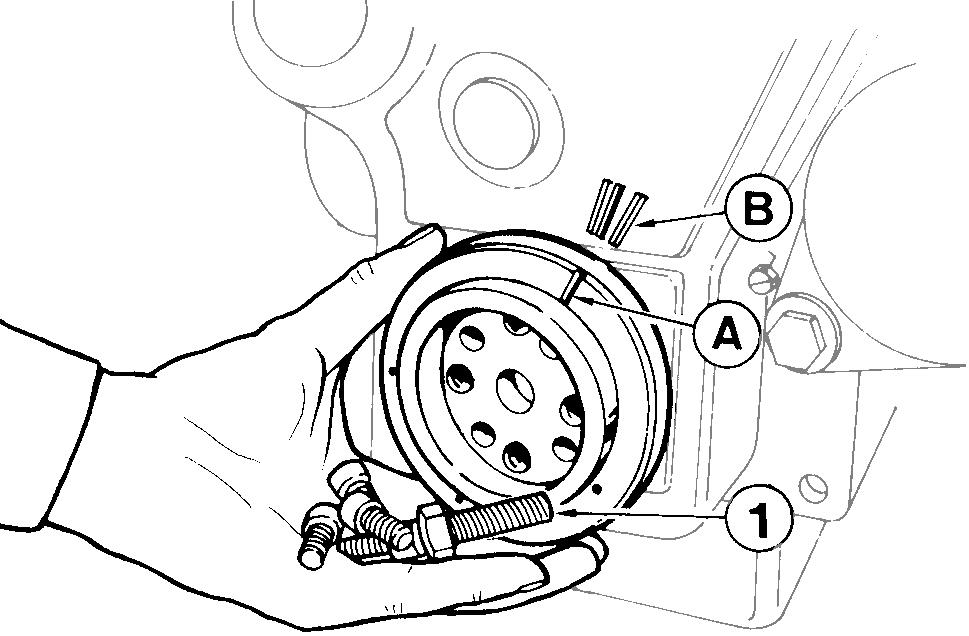
Driving pulley
Important
To loosen or screw in screw 1 at the set torque you must always stop the crankshaft and not other parts of the engine.
Locking the crankshaft: remove the engine starter and installing the fixture tool 1460-051.
Remove the pulley, after having unscrewed central screw 1 and proceed with the four lateral screws. The central bolt 1 is left-handed.
When reassembling, apply some Moly-slip antiseizure compound on the screw 1 thread and tighten at 360 Nm.
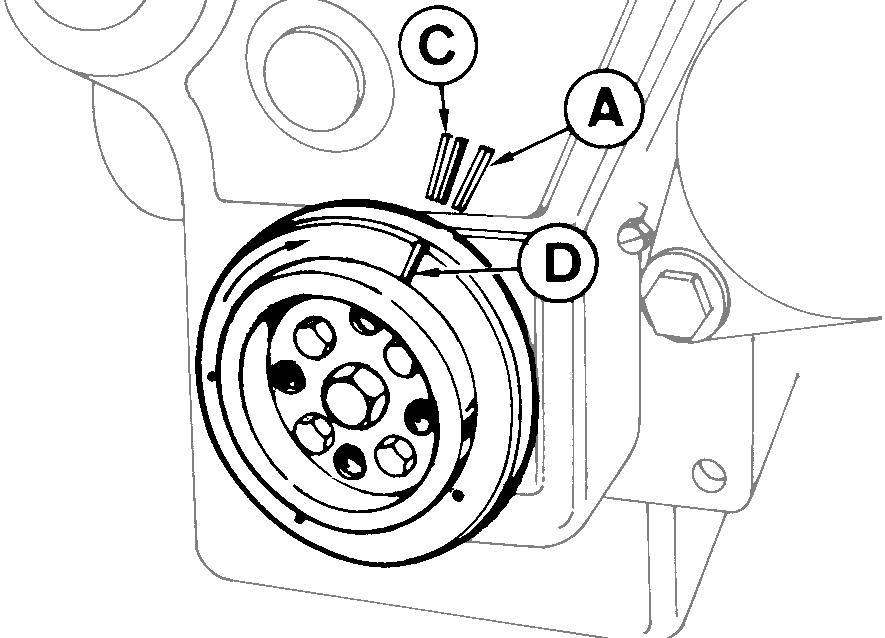
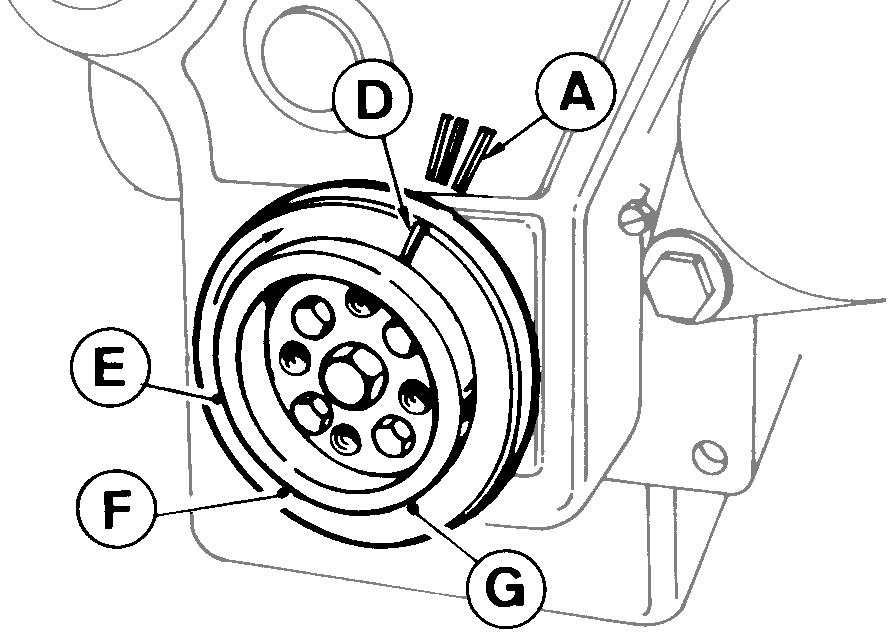
Note: When pulley reference mark A aligns with the timing cover reference mark B, the flywheel side piston is at (TDC).
Disassembly / Reassembly
Ringfeder-type rings on KDW 1404
It is possible to draw ¾ of the power from the second drive of KDW 1404 engines.
If you want to draw the entire power it is necessary to mount the Ringfeder rings on the crankshaft handle.
Components:
1 Puleggia appropriata 6 Ringfeder external ring
2 Screw M6 7 Spacer flange
3 Screw M16 x 1,5 8 Shoulder plate
4 Ringfeder internal ring 9 Crankshaft
5 Screw M8
Ringfeder-type rings on KDW 1404 - Assembly
Refer to figures 25 and 26.
Clean and oil the parts involved in the mounting with engine oil. Insert into pulley 1, the internal ring 4 and the external ring 6, then flange 7 by tightening it temporarily with its screws.
Before assembling the pulley 1 in the crankshaft taper, insert shoulder ring 8
Lock the crankshaft using tool 7107-1460-051.
Tighten the screws 2 at a torque of 10 Nm.
Tighten the screws 3 at a torque of 360 Nm.
Tighten the screws 5 uniformly in criss-cross pattern in three distinct phases:
1° phase = 15 Nm
2° phase = 35 Nm
3° phase = torque check.
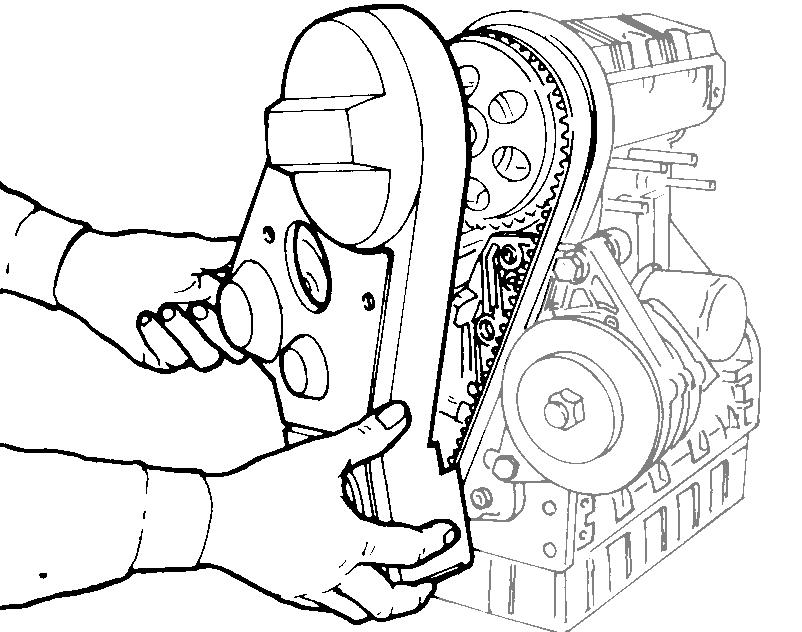
Timing belt cover
Loosen the five screws and remove the cover.
When rifitting tighten the screws at a torque of 10 Nm.
Check the peripheral rubber sealing gasket and the two dustprotection rings of the two pulleys, if mounted.
/ Reassembly
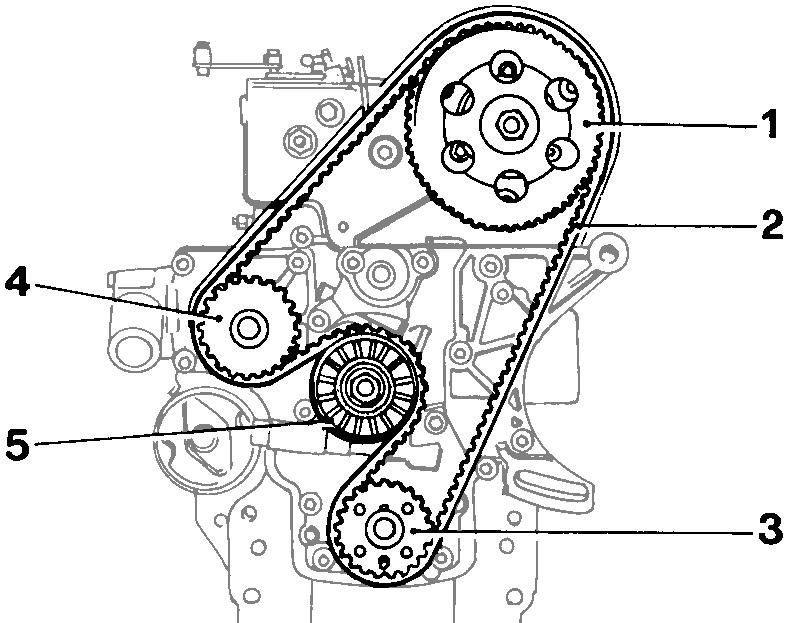
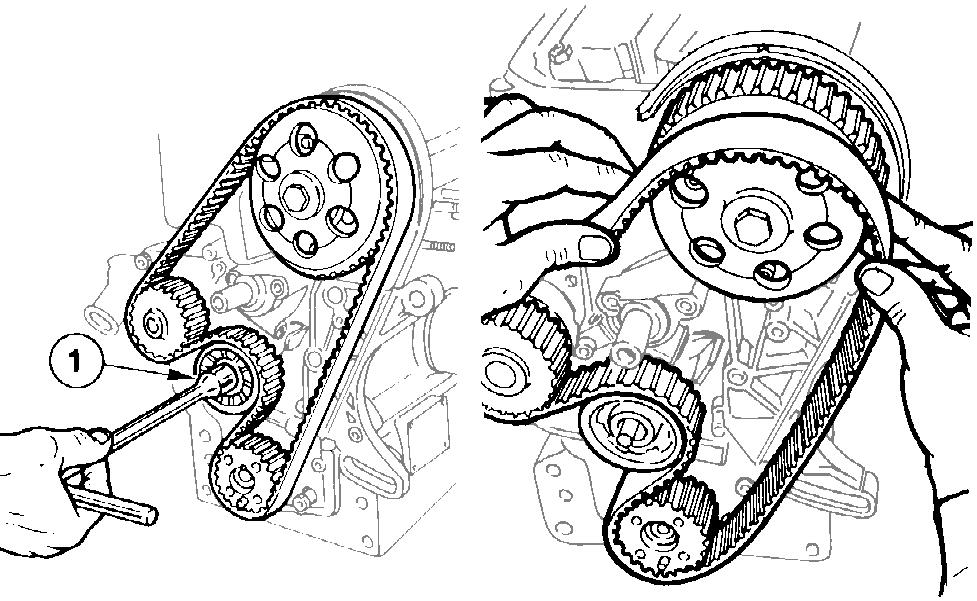
Timing belt / Timing pulley arrangement
Components:
1 Camshaft pulley
2 Timing belt
3 Crankshaft pulley
4 Coolant pump pulley
5 Belt tensioner pulley
Timing belt removal
Caution – Warning
When you remove the distributor belt replace it even if its prescribed operation time has not expired yet.
Danger – Attention
Always check that the positive pole of the battery is insulated.
Remove the belt tensioner 1
Remove the timing belt off the timing pulley.
For assembly see fig. 36.
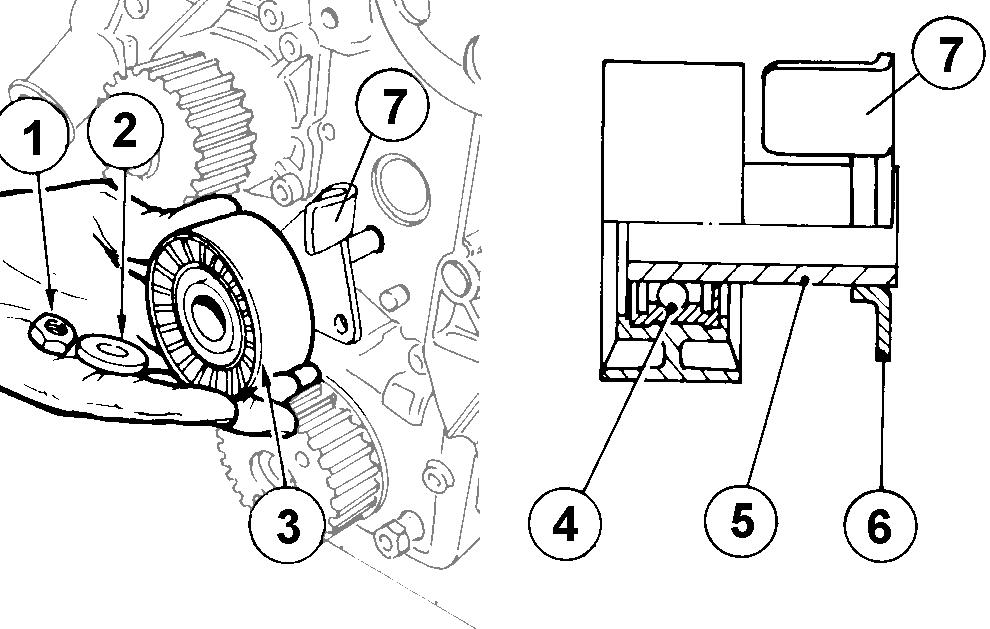
Tightening pulley
Components:
1 Nut
2 Washer
3 Pulley
4 Bearing
5 Shaft/Support
6 Mounting plate
7 Tensioning lever
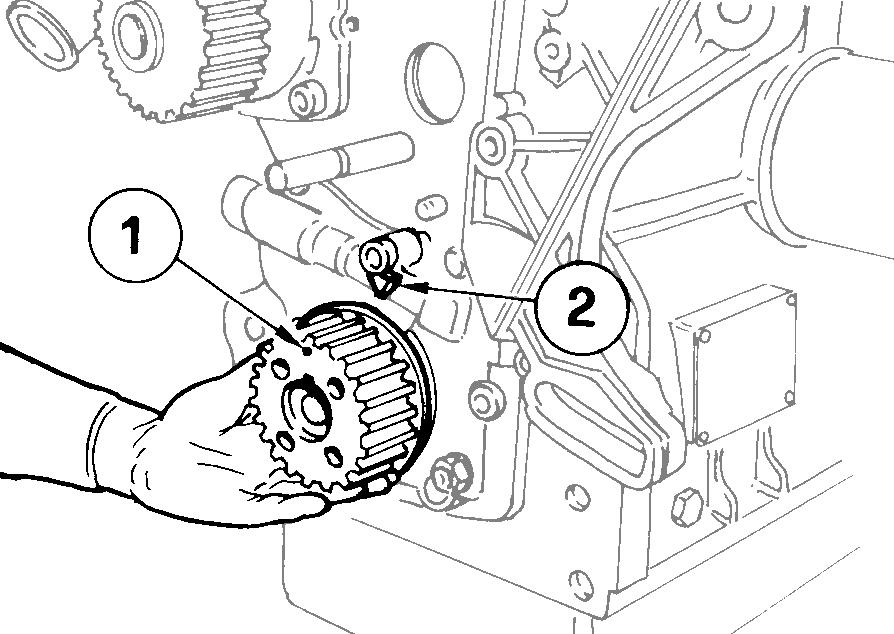
Crankshaft timing pulley
Important
When reassembling, make sure that the key remains inserted in its place.
Note: Reference mark 1 on the crankshaft timing pulley and reference mark 2 on the oil pump housing are timing marks. When aligned, No. 1 piston (flywheel side) is at TDC.
Disassembly / Reassembly
Camshaft timing pulley
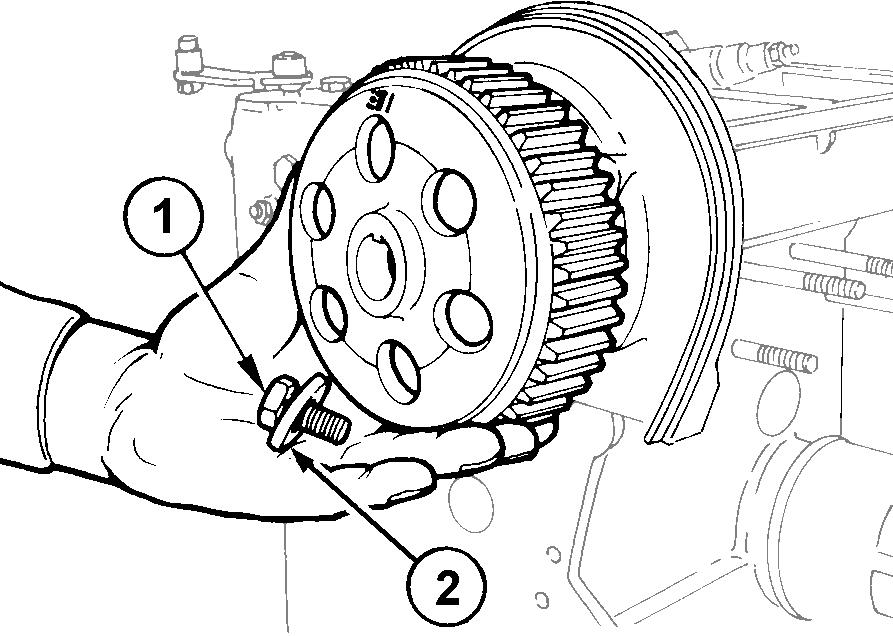
Camshaft timing pulley - Disassembly/Assembly
Unscrew screw 1 and remove the pulley. No extractor is needed.
When refitting tighten the screw at a torque of 80 Nm.
Note: Assess any wear caused by the lip of the seal ring on the pulley tang.
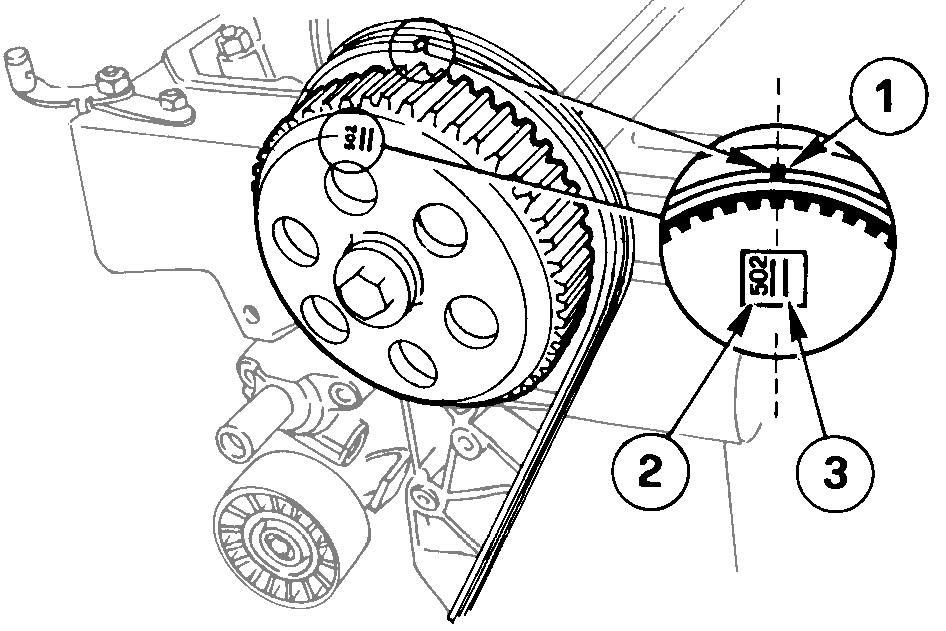
Camshaft timing pulley - Reference marks
1 Timing reference mark on cylinder head.
2 Camshaft pulley timing mark
3 Camshaft pulley timing mark, for KDW, 702, 1003, and 1404 engines.
Camshaft timing
Camshaft timing - Belt Reassembly
Important
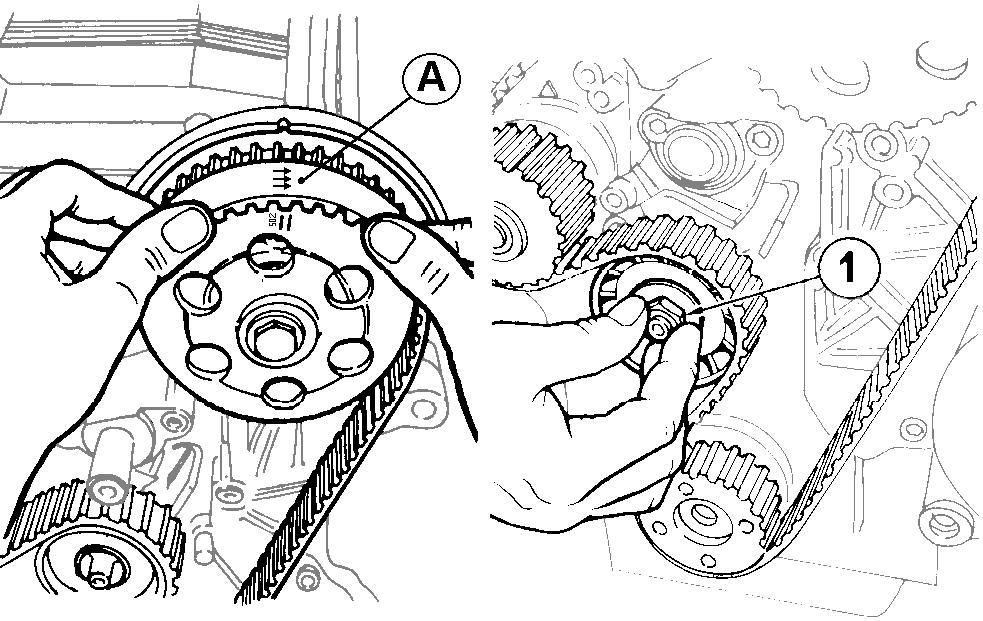
Remove the distributor toothed belt from its protective wrapping only when mounting it.
Make the connections for toothed belt fig. 33 and that of pulley fig. 34 fit together.
Insert the belt (as in figure 35) taking account of the direction of the arrows A impressed on it (direction of rotation).
Tighten the nut 1 by hand until the belt tightener rests on surface of the crankcase.
Start by mounting the camshaft pulley belt, then mount crankshaft’s pulley.
Do not mount driven belts.
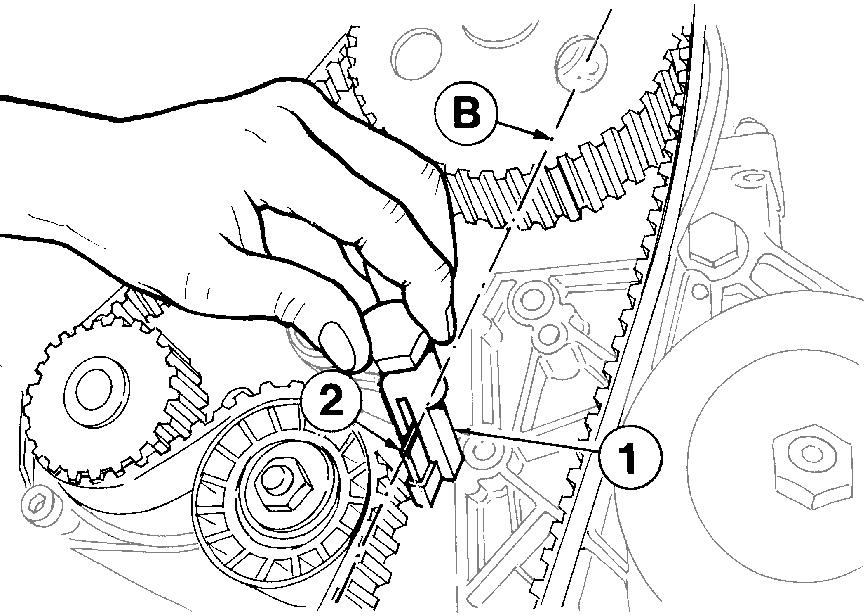
Camshaft timing - Belt tightening tool
Position belt preload tool 7107-1460-049 1 over the timing belt idler adjustment ear 2
See "Camshaft timing - Belt Tightening and Fastening".
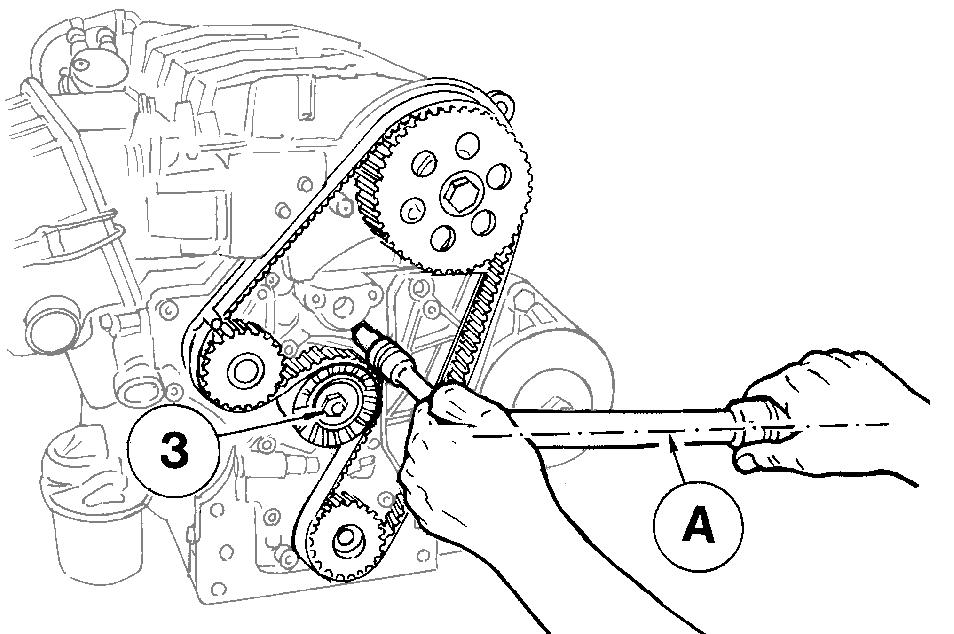
Camshaft timing - Belt Tightening and Fastening
Insert the torque wrench in the suitable tool so that the A axis of the key fig. 39 is at 90° to the B axis of the tool in fig. 38. Tighten in clockwise direction at 20 Nm.
Remounted the drive pulley.
Maintaining the belt tension, tighten nut 3 with another torque wrench at 40 Nm,
Rotate the crankshaft a few times and check that the tension is as described above.
The check must be carried out with the appropriate Nippon Denso tension measuring instrument (halfway along the longest section of the belt), the value for a cold engine must be 15±2Kg.
Valve timing check
A = Intake valve
B = Exhaust valve
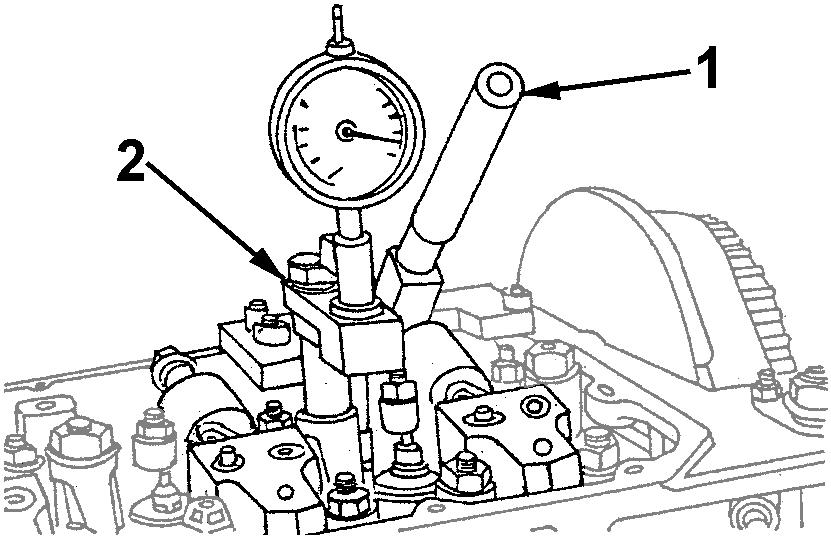
Rotate the engine in the normal direction of rotation until the No. 1 piston (flywheel side) approaches TDC- compression stroke
Check the balance of intake and exhaust valves A and B placing the two micrometers testers on the valve collars.
Disassembly / Reassembly
Valve timing - Angles
The angle values are determined by turning the driving shaft clockwise
S = Piston at top dead centre
I = Piston at bottom dead centre
a = Intake valve open
β = Intake valve closed
γ = Exhaust valve open
δ = Exhaust valve closed
Timing angles for operating purposes (valve clearance = 0.25 mm)
a = 16° before S
β = 36° after I
γ = 36° before I
δ = 16° after S
Timing angles for checking puposes (valve clearance = 2 mm)
a = 21° after S
β = closes in I
γ = 2° after I
δ = 20° before S
Speed governor
The weight-type mechanical governor, is driven directly by the camshaft and is housed with the cylinder head.
Components:
1 Thrust washer
2 Spool
3 Flyweight assembly
Note: In engines with the minimum/maximum (see fig. 49) the weights are lightened by 25%.
Speed governor components
Governor springs
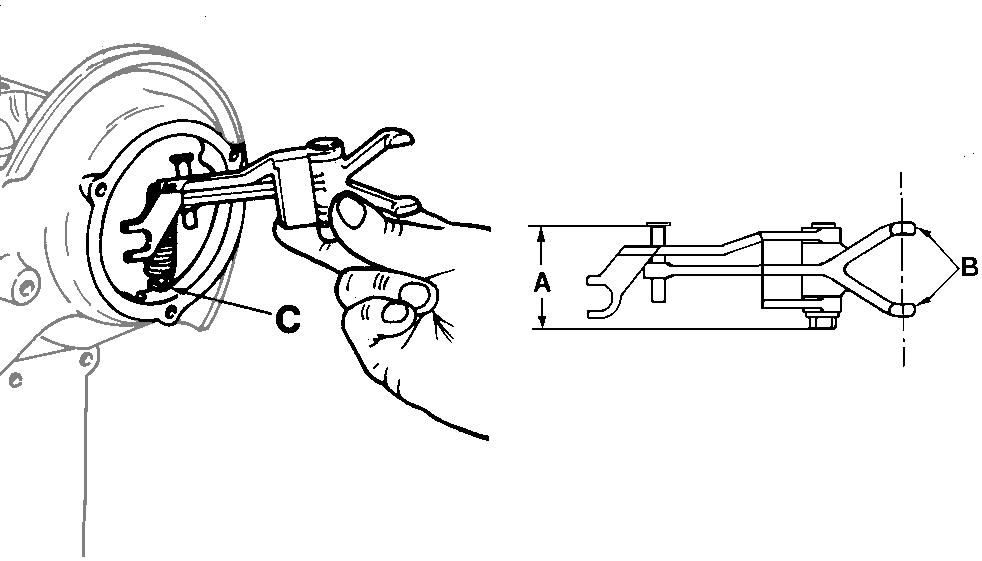
Unscrew the pin that attaches it to the cylinder head. To remove it as shown in the figure it is necessary to dismount the camshaft. It could also be removed from the accelerator box side by unscrewing the torque gearing device. Before reassembling it, check value A (45 to 46 mm) and the parallelism of the two levels B that must not exceed 0.05 mm.
Note: There are 5 different types of regulator springs C. These change according to the engine adjustment: standard spring for 3,600 rpm, for 3,000 rpm, for 2,400 to 2,600 rpm, for 1,800 rpm and for 1,500 rpm.
Governor springs for Gensets
In the section view of the leverages the 4 ball bearings A are highlighted. They are mounted on engines for generator sets adjusted at 1,500÷1,800 rpm and on other particular applications on request.
Disassembly / Reassembly
Speed governor - Limiting speed governor
With applications for the automotive sector the regulator spring (C fig. 45) is replaced by a device (plunger barrel) that only enables a constant speed at the minimum and maximum rpm rating.
Components:
1 Nut
2 Idle speed spring
3 Max. speed spring
4 Case
5 Register
6 Spring ring
7 Actuation rod
Note: There are six maximum springs in a different colours, to distinguish them from the six respective adjustments.
Red color for ........................ 3000 giri/1'
No color
Black
Orange
3200 giri/1'
3600 giri/1'
3750 giri/1'
White 4200 giri/1'
Green
Brown
4300 giri/1'.
4500 giri/1'
Speed governor - Reassembly
Caution – Warning
While reassembling, check the integrity of the components and check that they operate correctly.
Bad operation of the speed governor can cause serious damage to the engine and to people being near to it.
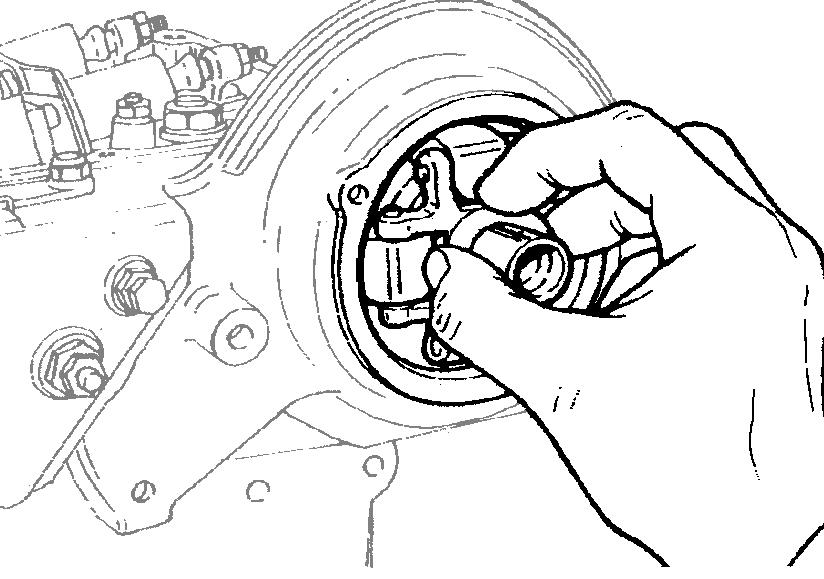
Remount in reverse order to Fig. 44.
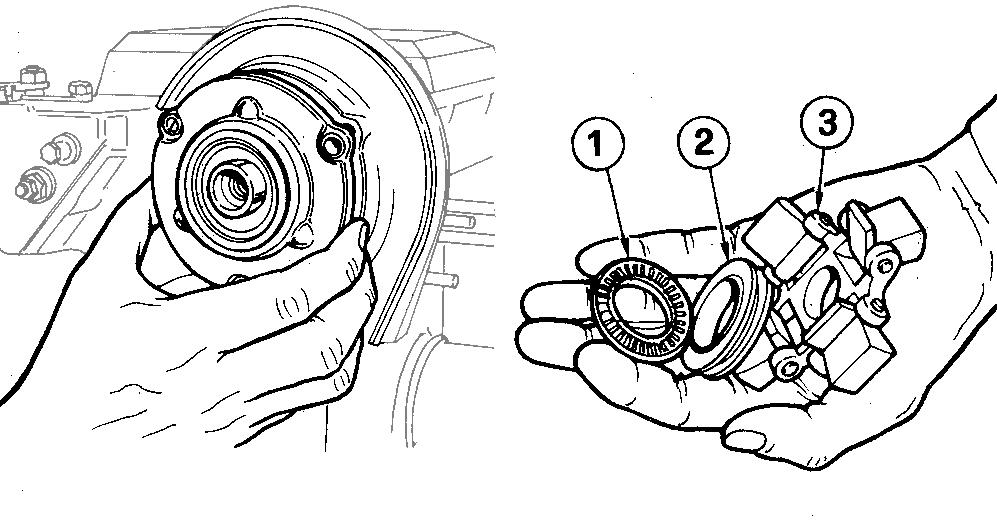
When inserting the bearing in the camshaft, do it so that the four blocks enter opened, so that they can receive the hose and close over it.
Check the integrity of the sealing rings of the cover.
Tighten the three screws at a torque of 10 Nm.
Note: With the speed governor mounted the camshaft axial clearance should be zero.
Oil pump
Oil pump - disassembly
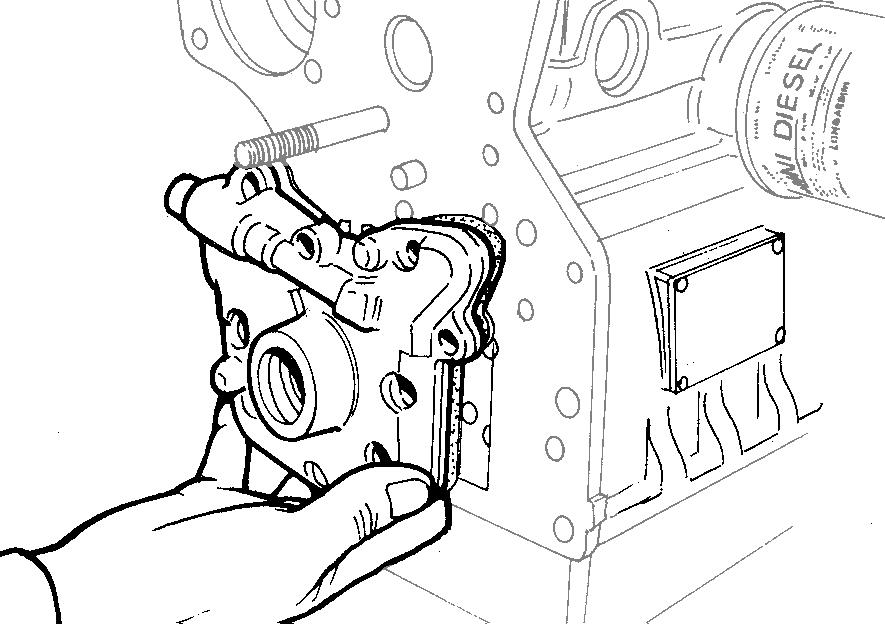
KOHLER therefore recommends that the oil pump be handled as an assembly from a service standpoint KOHLER does not recommend that the oil pump be disassembled, then reassembled for purposes of installation on the engine except during emergency situations.
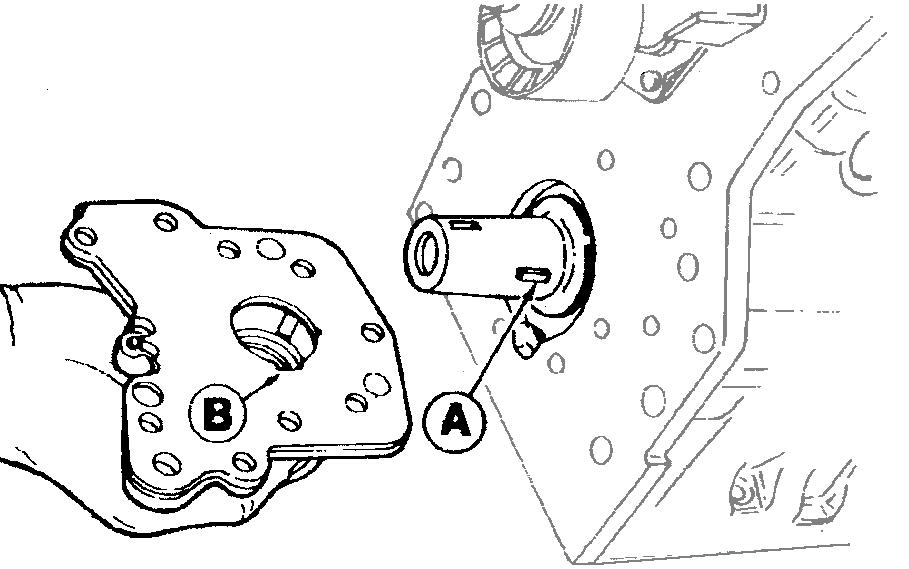
Rotate the crankshaft until the crankshaft timing pulley keyway is vertical as shown. Remove the oil pump assembly retaining bolts. When the crankshaft timing pulley keyway is vertical, the oil pump drive keyway A will be at 3:00 o’clock allowing removal of the oil pump assembly via relief B.
Oil pump - Reassembly
The pump rotors should be coupled on the same side, see references 2 and 3. Replace the O-ring 1
Tighten the fastening screws to the crankcase at 25 Nm and those of the plate at 10 Nm.
See page 79 for technical details.
Rocker arm cover
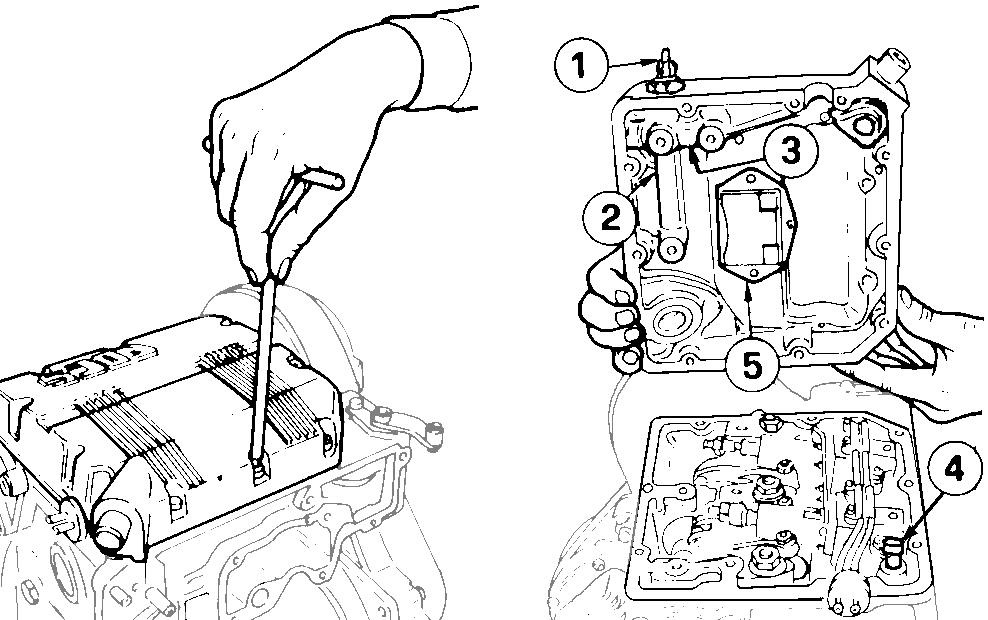
The engine control components are all on the cylinder head. The cover contains part of the lubrication duct of the camshaft and of the rocker arms, as well as part of the engine vent system.
Components:
1 Oil preassure switch
2 Camshaft lubrification port
3 Rocker arm lubrification port
4 Oil exhaust hose from sump vent system
5 Air valve with oil decanting wire gauze
Important
During remounting be careful with oil exhaust hose 4 that needs to be properly inserted into its housing on the cylinder head.
Disassembly / Reassembly
Rocker arm cover gasket
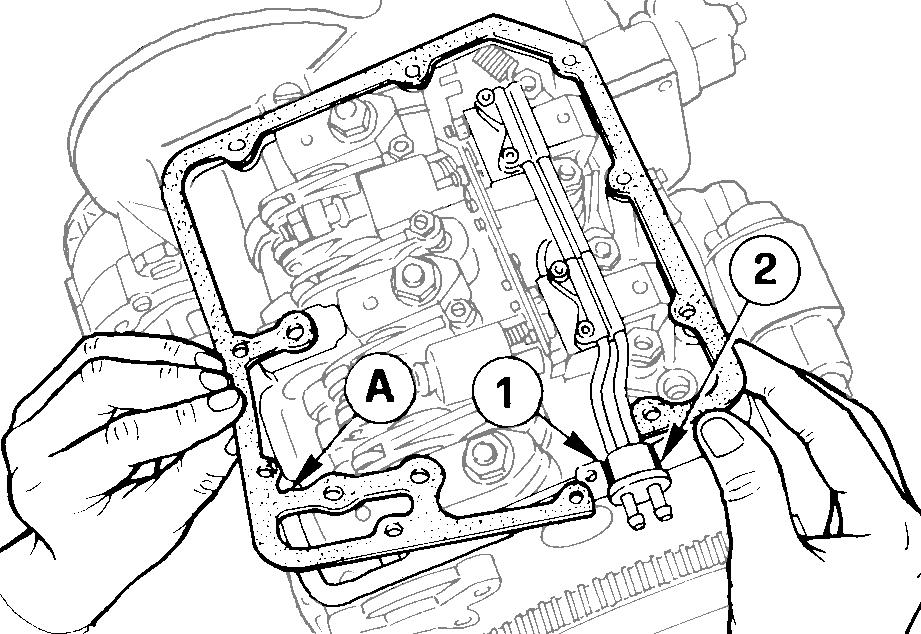
The rocker arm cover gasket A ensures the seal of the lubrication circuit for the camshaft and rocker arm shaft. Always replace it and mount it with especial care above all in zones 1 and 2 where, for greater safety, it is advisable to apply a few drops of silicon sealant.
Tighten the rocker arm cover screws at a torque of 9 Nm.
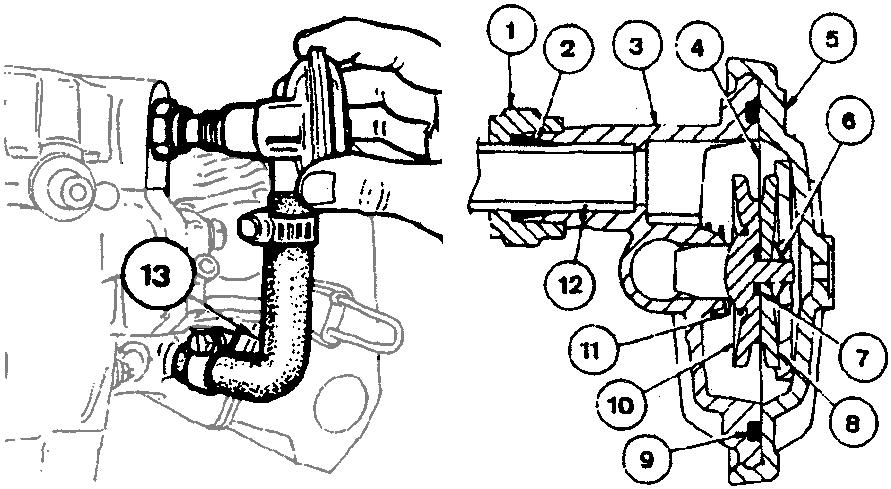
Crankcase vacuum regulator valve
Components:
1 Gland Nut
2 Bushing
3 Body
4 Diaphragm
5 Cap / Cover
6 Clip / Lock
7 O-Ring
8 Washer
9 O-Ring
10 Valve
11 Spring
12 Tube
13 Hose
The vacuum relief valve is an engine safety device. Its function is that of limiting the vacuum whenever it tends to increase.
Without this, should the air filter be clogged, the oil contained in the carter may be sucked back into intake manifold causing the condition for engine runaway.
Crankcase breather
For KDW 702-1003-1404 engines, the exhaust gases exit from the cylinder head cover (see Fig. 53, 54).
Remove the cover, check the integrity of the air valve and oil decanting wire gauze.
Valve / Rocker arm clearance
Important
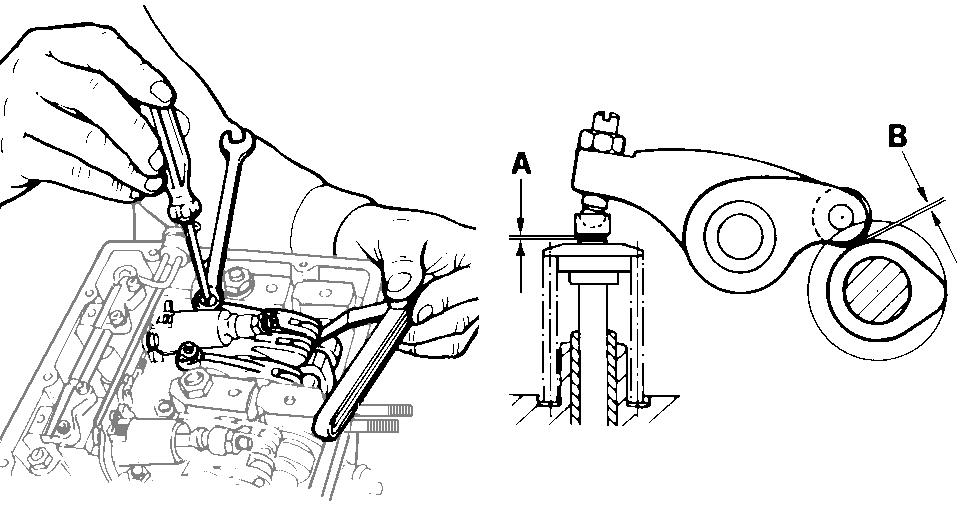
Setting should be performed when the engine is cold.
Bring each cylinder piston to top dead center on the compression stroke and set clearance A at 0,20 mm for both the intake and exhaust valves.
For greater convenience, clearance check B is accepted. In this case the value is 0.15 mm.
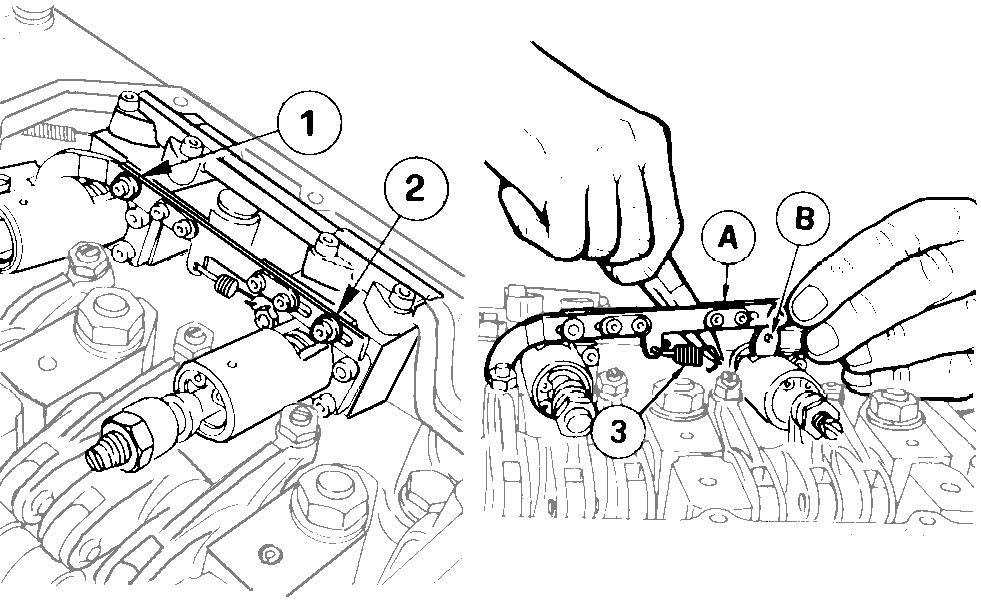
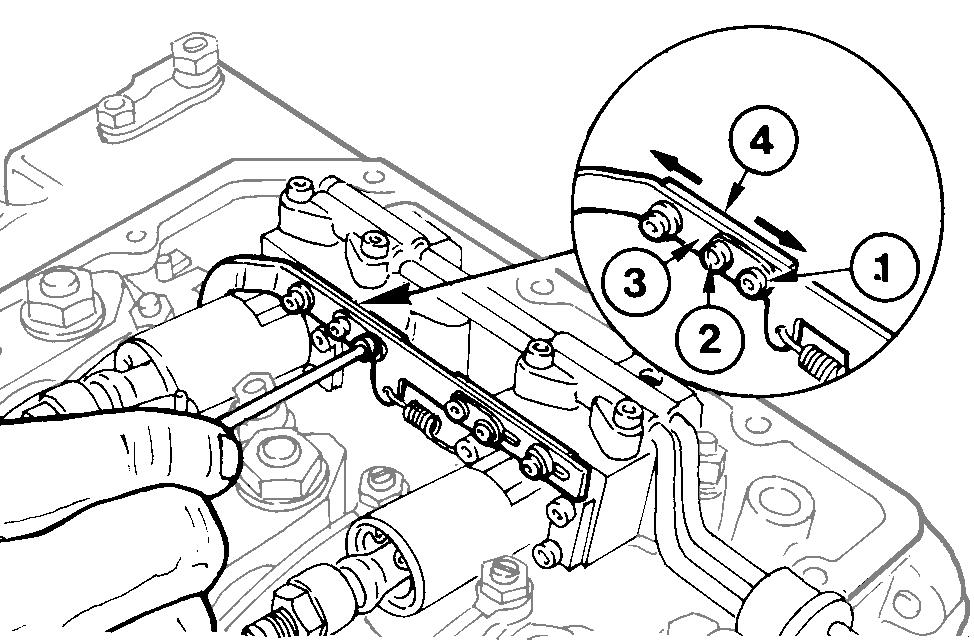
Injection pump control rod
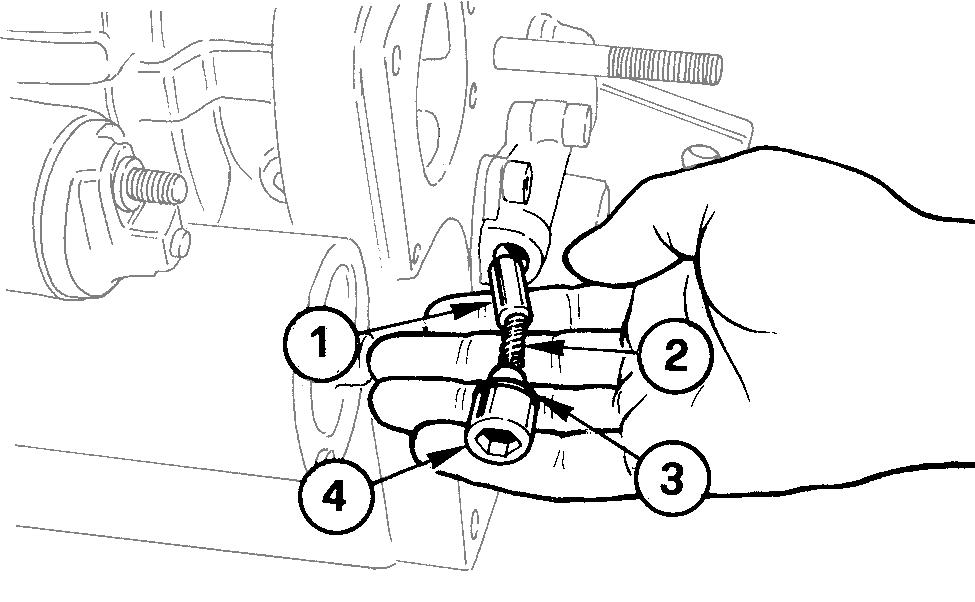
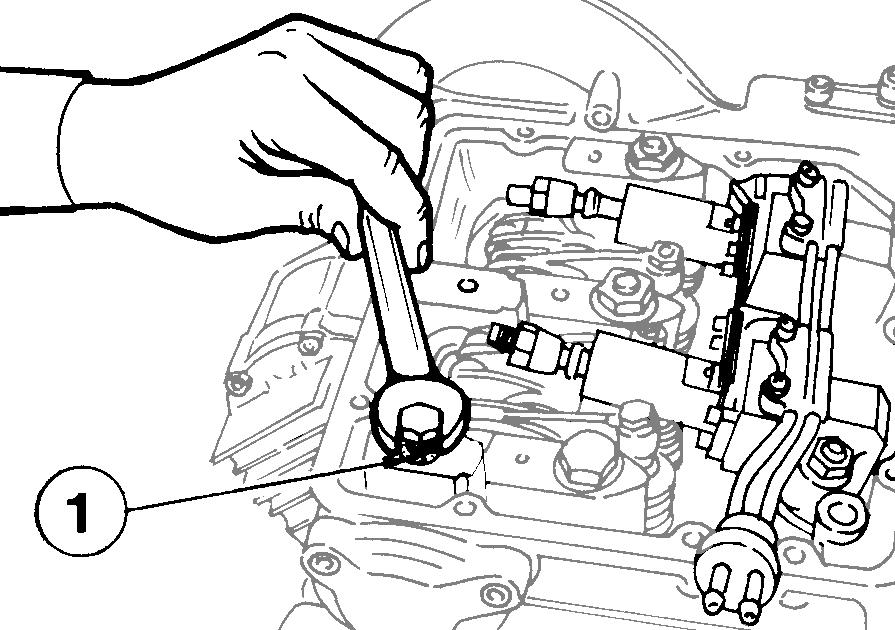
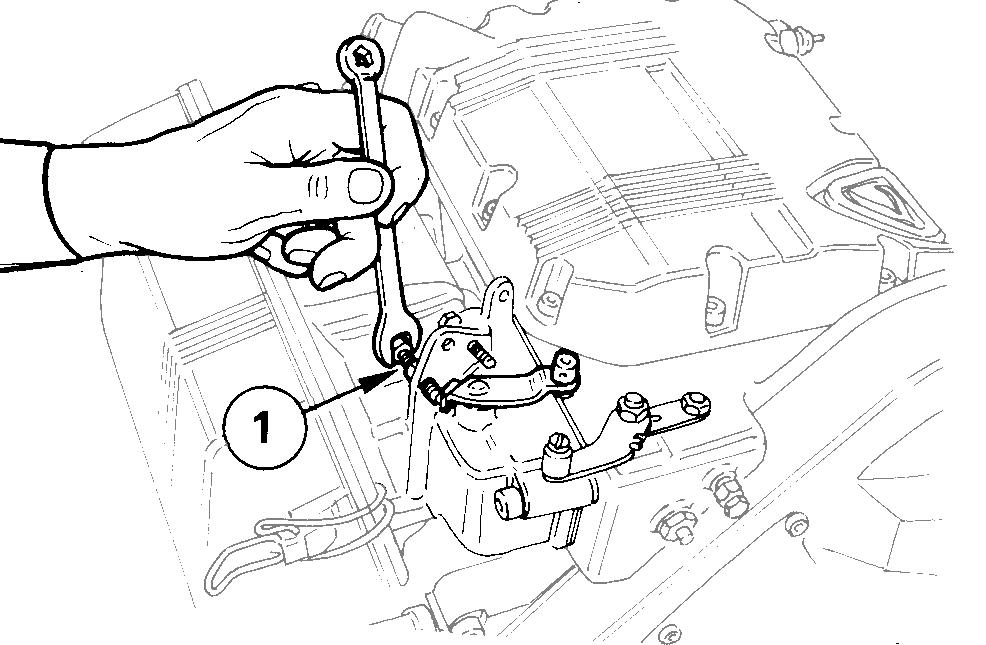
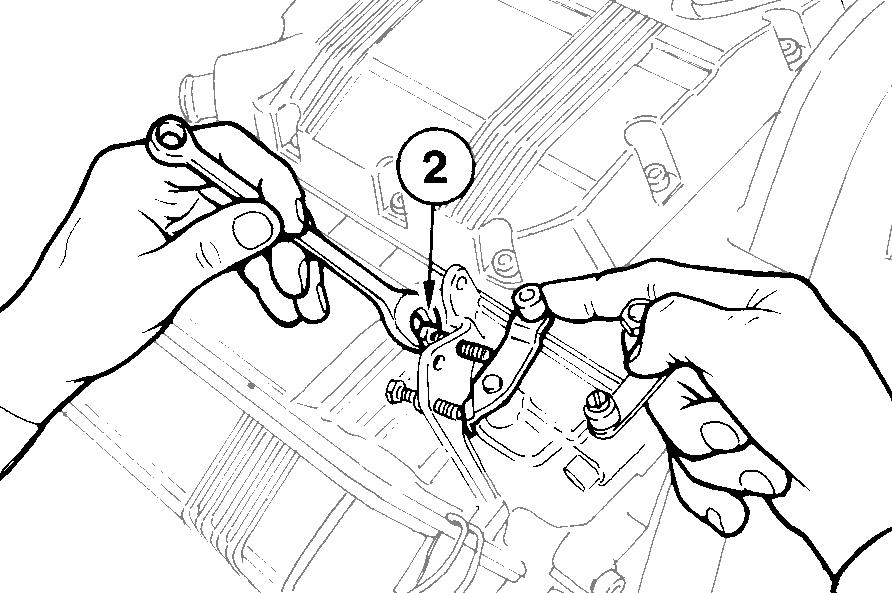
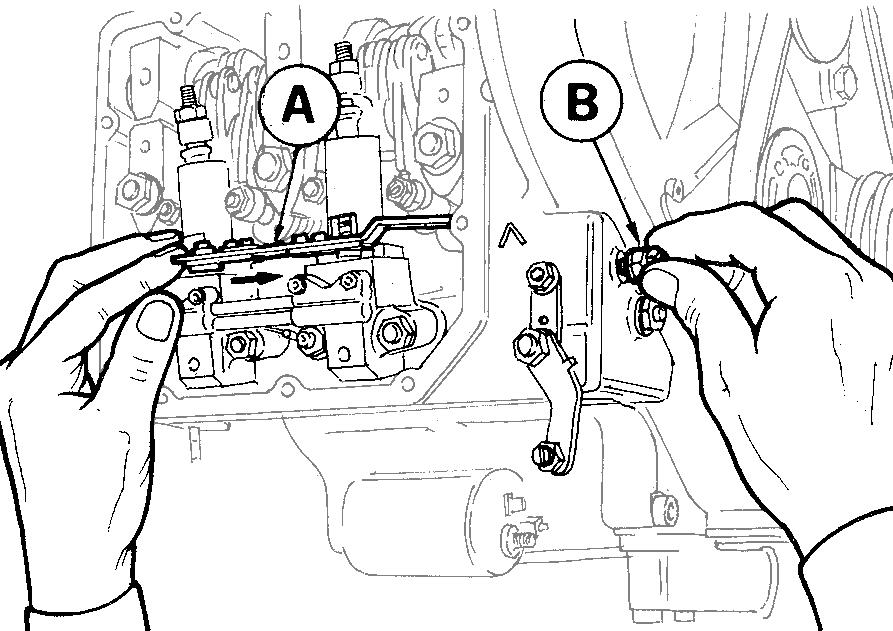
Depending on the engine model, the injection pump control rod will link two, three, or four injectors to the engine governor. Screws 1 and 2 are pivoted on the delivery control lever of each pump/injector B, unscrew the screws and remove spring 3 When refitting tighten the screws 1 and 2 at a torque of 1,1 Nm and make sure that they stop on lever B of each pump/injector and not on rod A
To carry out the delivery equalisation of the injection pumps see page 93.
To carry out the timing of the injection pumps and speed governor see page 105
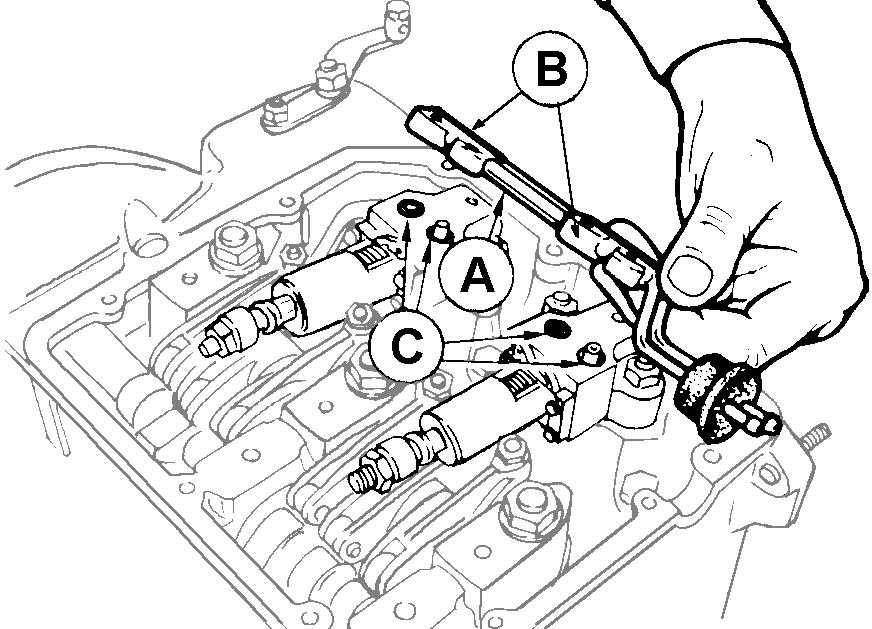
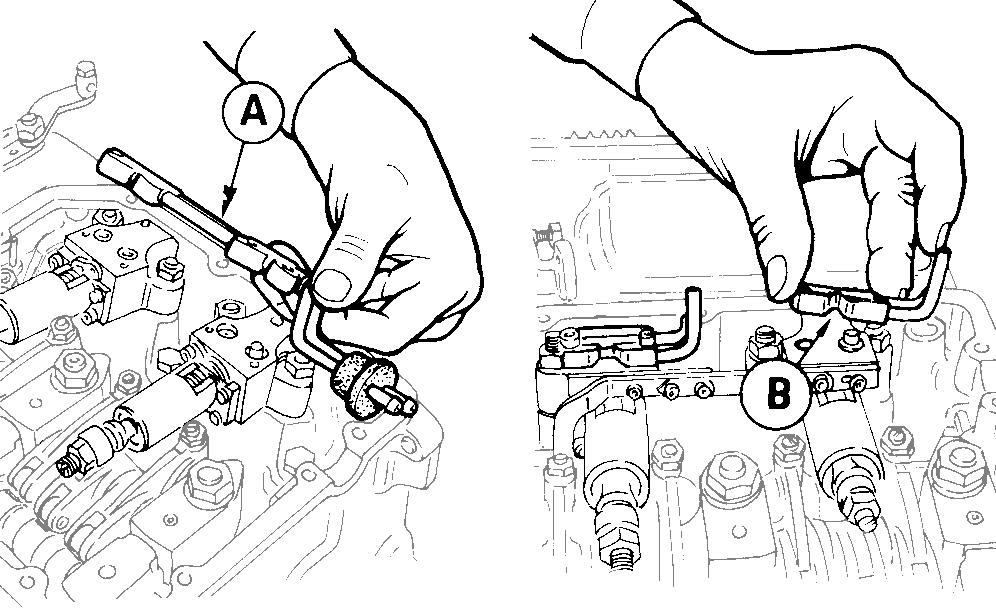
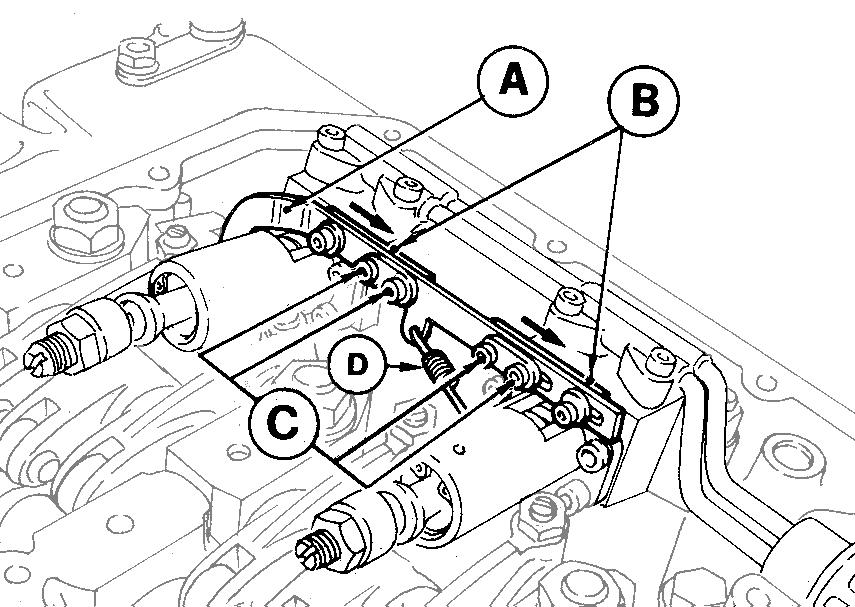
Fuel rail
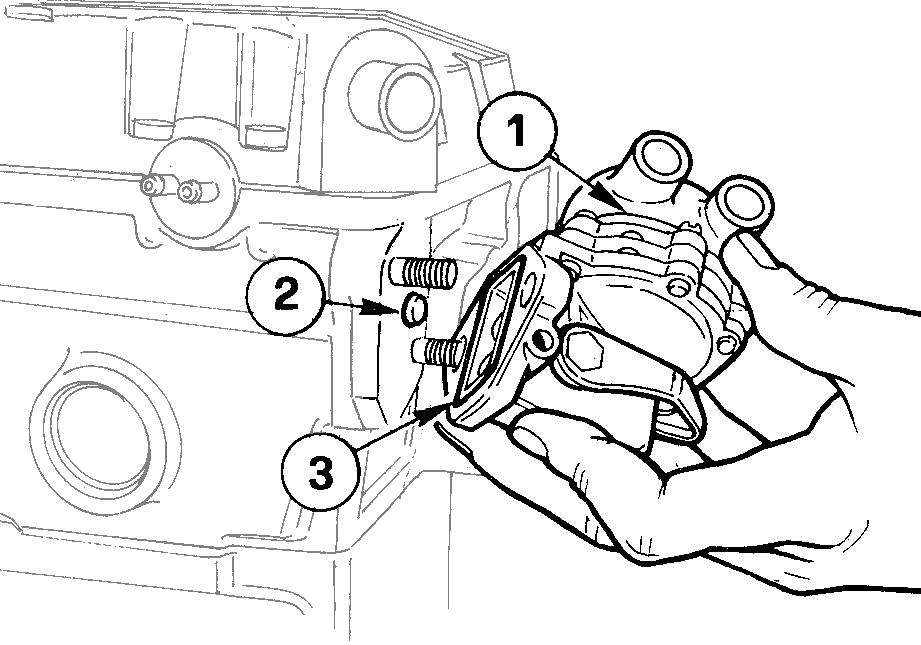
When removing the fuel feeding pumps A, with the rail holders B, pay attention that the sealing O-rings C remain in their seats.
When refitting tighten the rail holder screws at a torque of 4 Nm.
Disassembly / Reassembly
Pump/injector unit - non-return valve
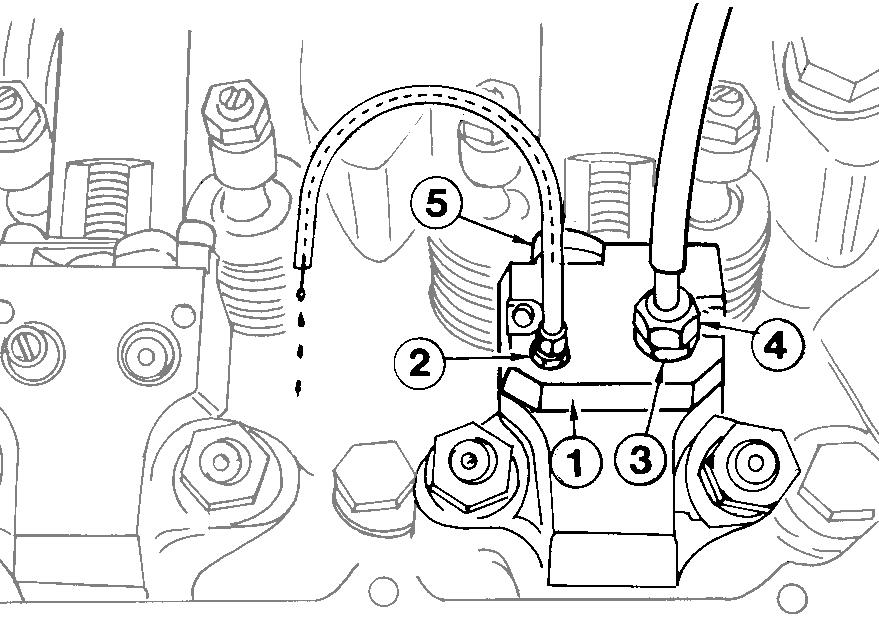
Non-return valve A immediately stops the engine whenever the stop is activated.
Note: If the value of B is not achieved, the two rings C are not subject to enough compression to ensure the seal; any fuel loss would contaminate the lubrication oil and consequently damage the engine, F = metal gasket.
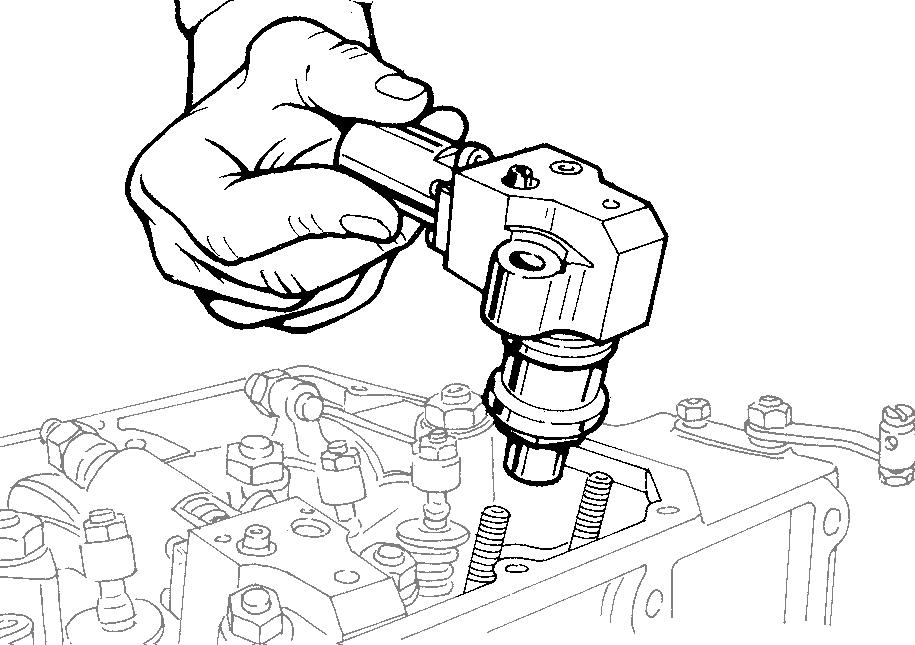
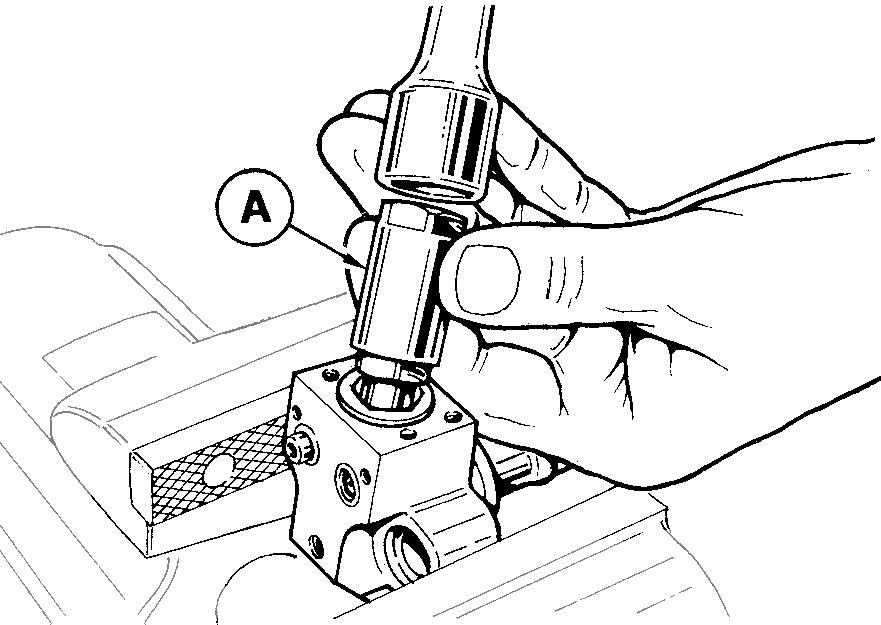
Pump/injector unit - Disassembly
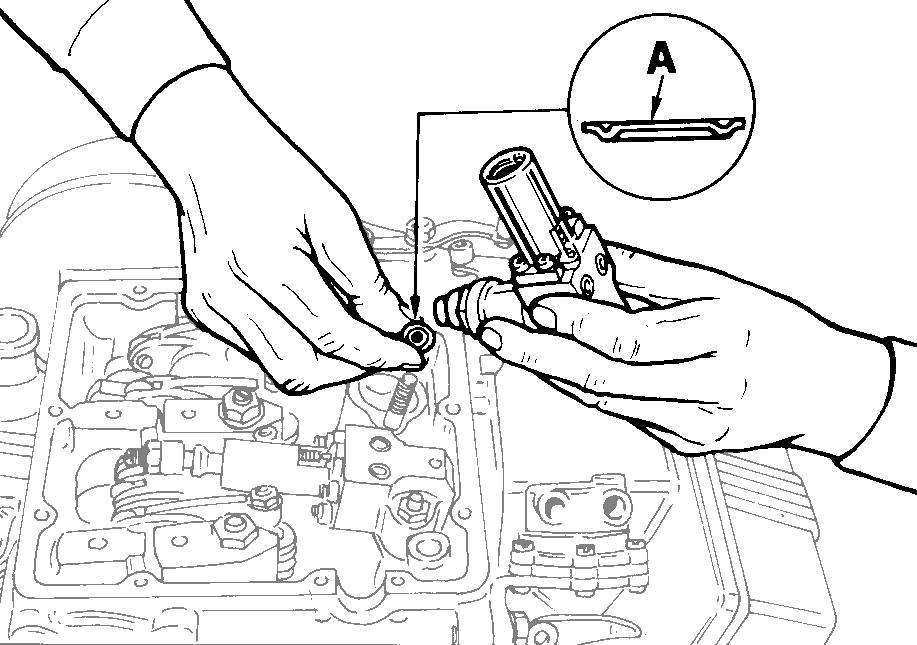
When the removal (but not replacement) of a unit injector is required the following procedure may be used to avoid the need for other adjustments:
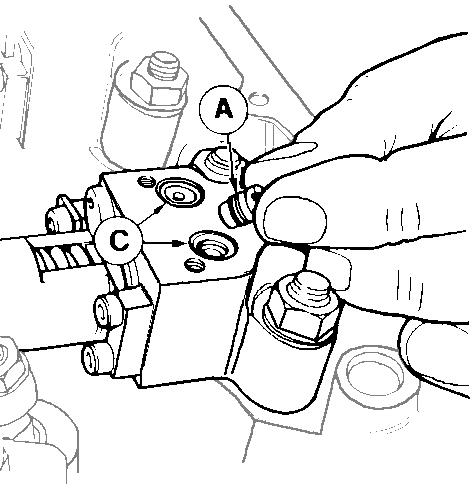
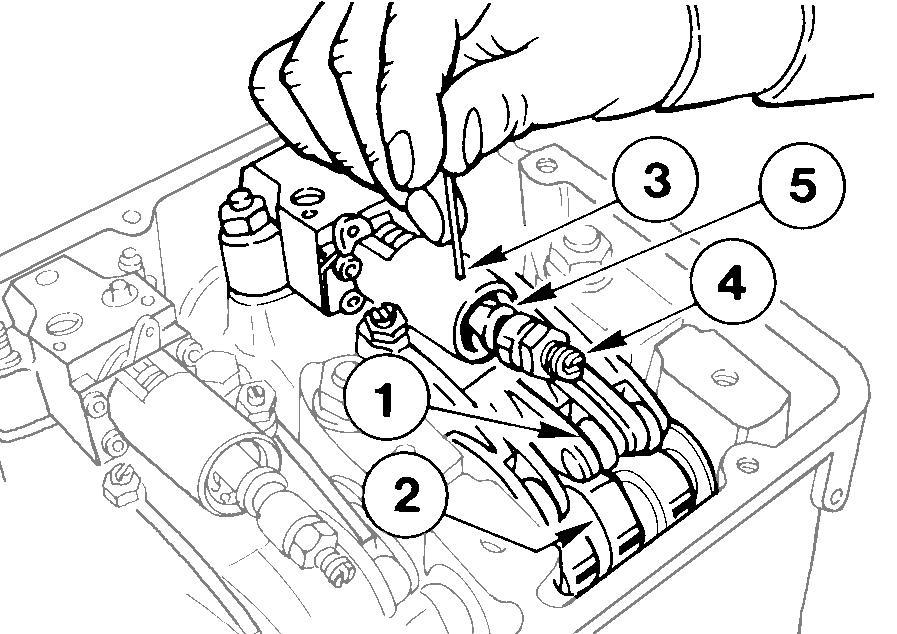
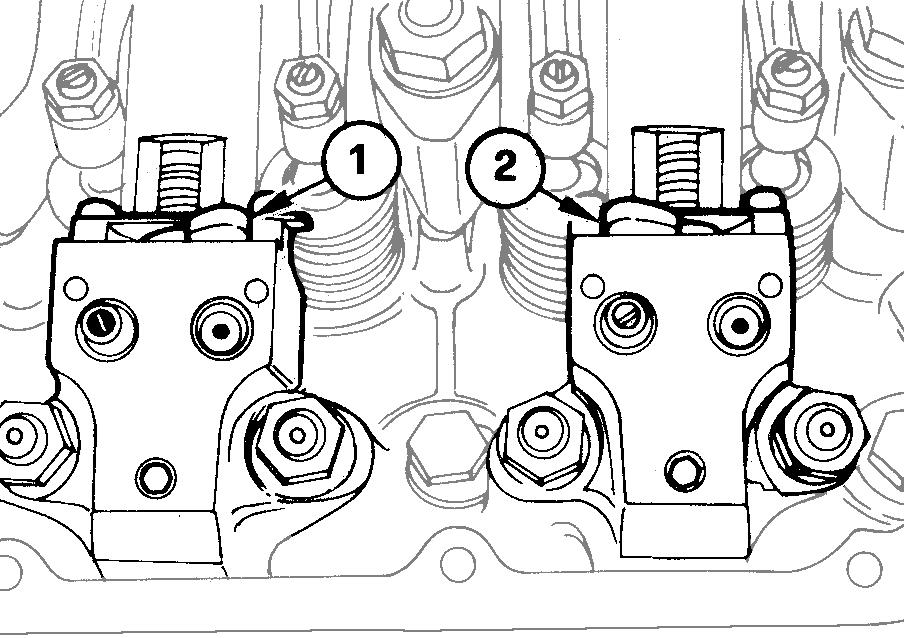
Rotate the engine until the unit injector cam lobe 2 forces the cam follower 1 to the highest position, then insert a suitable sized (hardened) pin into the hole 3 and rotate the engine until the cam follower 1 is at the lowest position. In this way the injection advance regulator 4 remains calibrated.
Important
If you dismount more than one pump/injector unit, make sure to reinstall them in the appropriate housing (with relative drive rod 5); before mounting lubricate the drive rod at its two ends with MOLYSLIP, AS COMPOUND 40 type. Rocker arm assembly
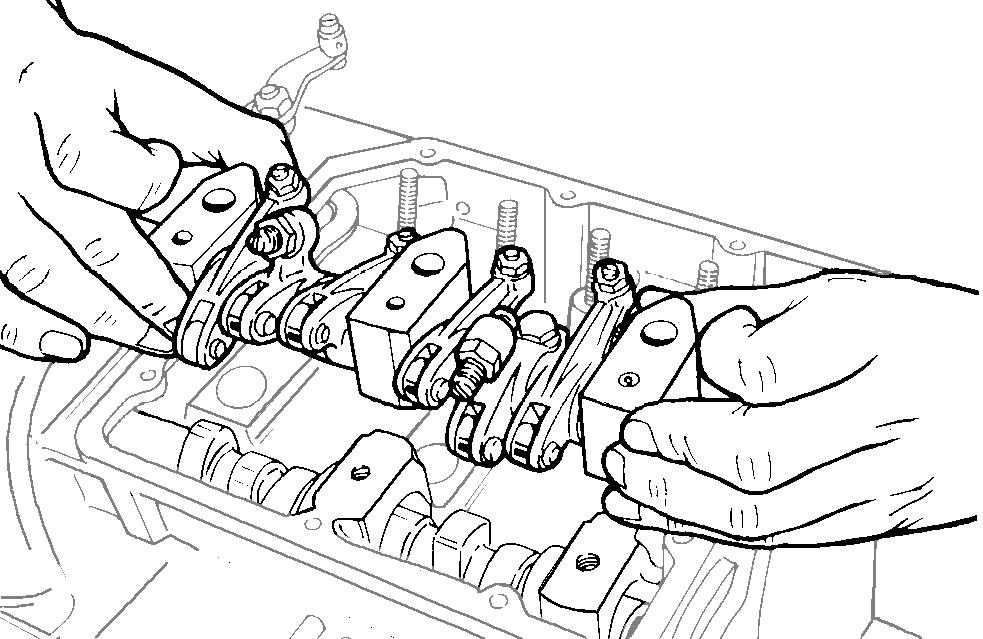
Remove the nuts attaching the rocker arm assembly to the cylinder head.
When refitting tighten the nuts at a torque of 40 Nm.
The pin, that is hollow inside to allow lubrication, is closed at its ends by two caps.
Note: The rocker arm assembly may be removed without removal of the unit injectors.
Rocker arm pivot, dismounting and remounting
To remove pivot 1 from the support 2 it's necessary to drill out pin 3 using a 4mm drill bit.
On remounting insert a new pin and reinsert it in bearing surface A (0 to 1 mm).
Check the rod’s state of wear and tear (diam. B) and that of the rocker arm holes (diam. C).
Remove the closing caps 4 at the end and carefully clean inside.
Dimensions (mm):
A 0÷1,00
B 17,989÷18,000 0,015÷0,041 0,090
C 18,015÷18,030
Camshaft, disassembly
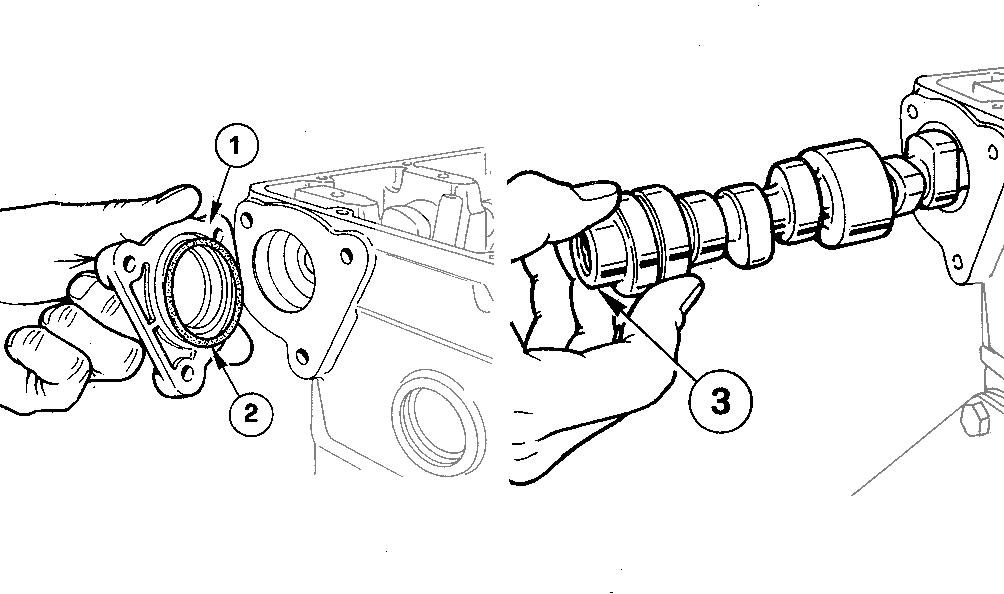
Loosen the screws and remove the cover 1
Check gasket ring 2 for integrity.
Remove the drive rod from the fuel pump.
Gently remove the camshaft, slight rotations may be required to avoid binding the camshaft lobes against the camshaft bearing surface bores.
Note: The lift pump drive eccentric 3 is included on the flywheel end of the camshaft and fixed with a screw.
In case of replacement tighten the eccentric screw at a torque of 80 Nm.
Camshaft, journal and housing measurement
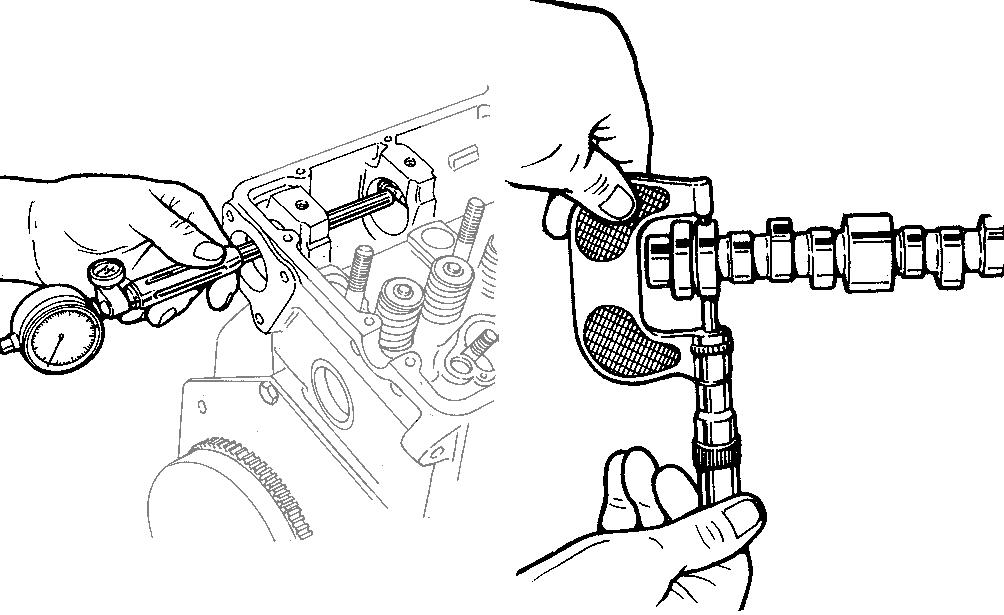
Use an inside micrometer gauge for housing diameters and an outside micrometer gauge for journal diameters.
Disassembly / Reassembly
Camshaft journals and housings - Dimensions (mm)
Note: The camshaft journal and cylinder head camshaft bore dimensions are identical for all KDW-FOCS series engines limit value
36,975÷37,000 0,035÷0,085 0,170
Camshaft lobe measurement
Use an outside micrometer gauge.
Intake / Exhaust / Injection camshaft lobe height
All engines in the series have intake exhaust and injection cams with the same height of H and H1
If wears on the cams exceeds by 0.1 mm the minimum value given H and H1, replace the crankshaft.
CYLINDER HEAD, removal
Important
Do not remove the cylinder head when hot to avoid deformation.
lf cylinder head is deformed by more than 0.10 mm, level it off by removing a maximum of 0.20 mm.
For the cylinder head tightening procedure see page 67.
Valves
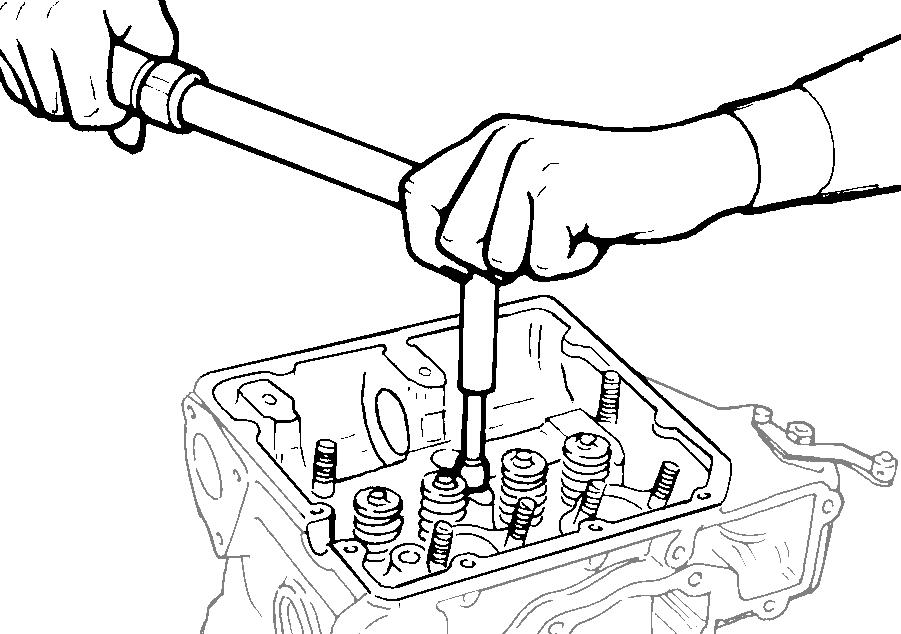
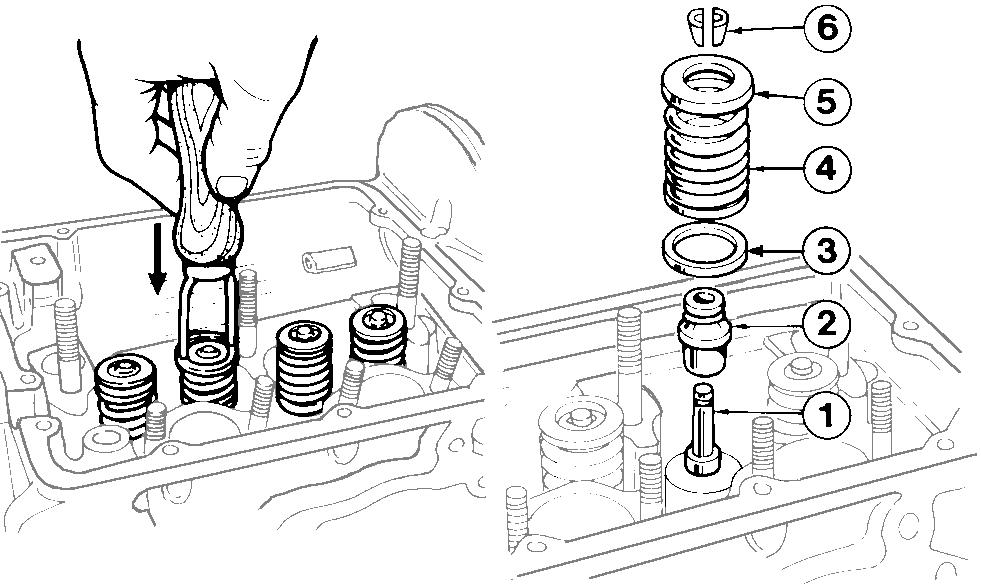
To remove the valves it is necessary to remove the collets; place a spacer under the valve head, press strongly on the spring cap as shown in the picture.
Components: 1 Valve stem
2 Valve stem seal ring
3 Spring seat
4 Spring
5 Spring cap
6 Collets
Valve stem sealing rings - Reassembly
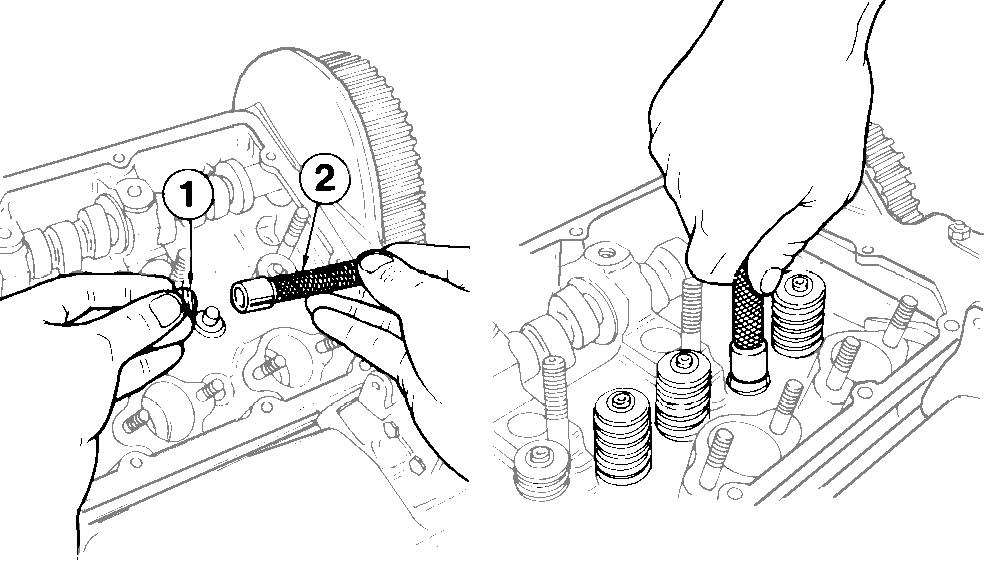
To prevent deformation of the sealing ring 1 as it is inserted onto the valve guide, insert it onto tool "7107-1460-047" 2 (after lubricating the sealing ring) and proceed as shown int the picture ensuring that gasket 1 is completely fitted.
Valve springs
Measure free height with a gauge.
Free height A = 46 mm.
Note: If the free height A is less than 43,5 mm replace the spring.
Disassembly / Reassembly
Valve, specifications
Exhaust valve A
Shaft and head are made of 2 different materials.
2 Welded joint
3 Chromium-plated joint
4 Portion made of: X 45 Cr Si 8 UNI 3992
5 Portion made of: X 70 Cr Mn NI N 216 UNI 3992
702-1003-1404 a1
Intake valve B
Material: X 45 Cr Si 8 UNI 3992
1 = Chromium-plated joint
702-1003-1404 a1
Valve guides and valve guide housings
Both intake and exhasut valve guides are identical dimensionally and are made from phosphoric gray iron with a pearlitic matrix:
Dimensions (mm):
36,4÷36,6 11,045÷11,054 11,000÷11,018 5,80÷6,20 9,75÷9,85
Note: Valve guides are supplied in finished form, further machining is prohibited
Valve guides with outside diameter B increased by 0.5 mm. are available.
Valve guide insertion
Fit the guides with a punch taking account of value A in relation to the cylinder head surface.
Dimensions (mm):
39,5÷40,0 7,005÷7,020 6,960÷6,990
Clearance (mm): (B-C) = 0,015÷0,050 (B- C) limite usura = 0,10
Valve seats and housings - Dimensions
KDW 702-1003-1404 mm α α1
A 35,220÷35,245
B 35,306÷35,315
C 31,220÷31,241
D 31,308÷31,316
44° 53' ÷ 45° 59° 53' ÷ 60°
Press valve seats into the housings
Note: Valve seatsare supplied in finished form, further machining is prohibited
Valve recess and seat sealing width
Dimensions (mm):
KDW 702-1003-1404 mm
Grind valve seats with fine emery paste. After grinding check the valve recess D relative to the cylinder head surface and the seat sealing width S
Disassembly / Reassembly
Pre-combustion chamber
Components:
1 Pre-combustion chamber
2 Pre-heating glow plug
3 Pre-combustion chamber ring nut
4 Cylinder head
The pre-combustion chamber does not normally require removal or service, if service is necessary follow the procedure described below.
Pre-combustion chamber ring nut removal
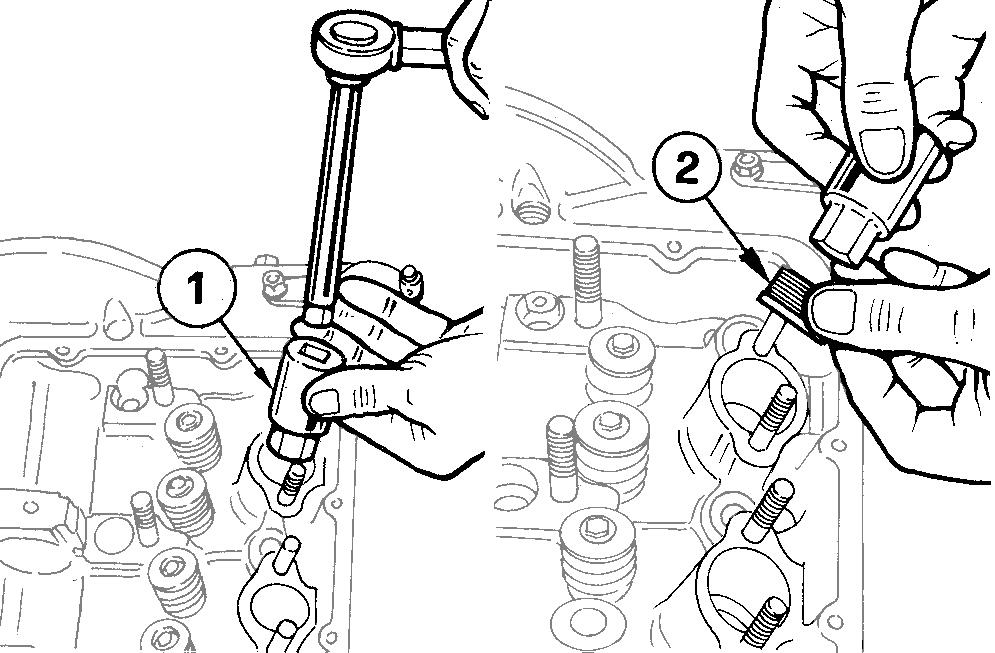
The pre-combustion chamber is fixed to the cylinder head by a ring nut, so before removing the pre-combustion chamber it is necessary to unscrew the pre-combustion chamber ring nut. Use the special tool "7107-1460-027" 1 to romve the ring nut 2
Pre-combustion chamber, removal
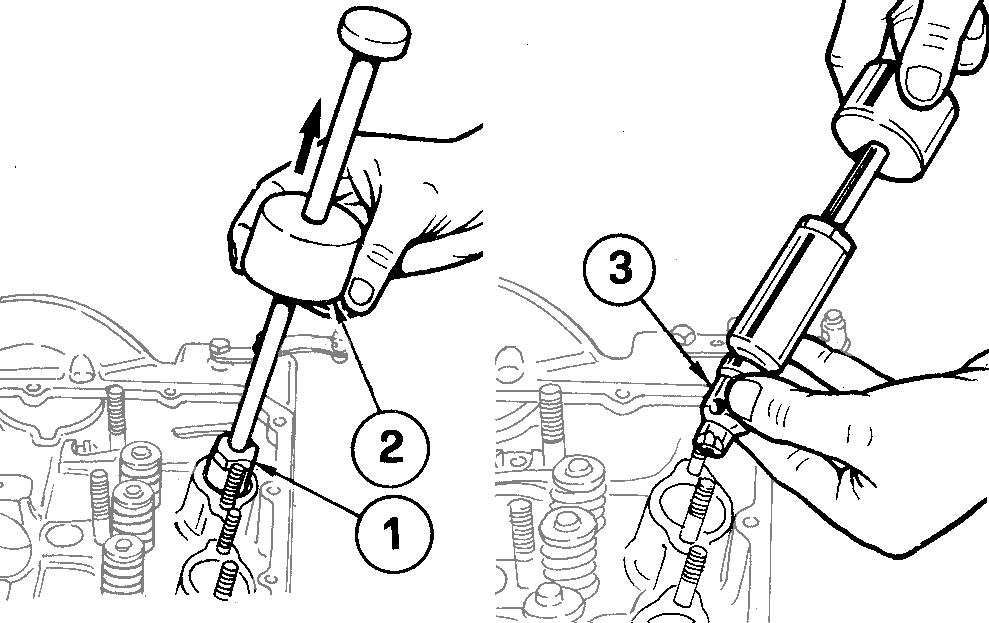
Before proceeding with removing the pre-combustion chamber it is necessary to remove the pre-heating glow plug. Screw special tool "7107-1460-030" 1 into the pre-combustion chamber.
Carefully, but sharply, slide the slide hammer 2 up the special tool shaft until contact is made with end of the tool. The hammer effect of the special tool will extract the pre-combustion chamber 3
Note: There are many types of precombustion chambers for the various engines described as follows.
- KDW 702-1003-1404.
Pre-combustion chamber, installation
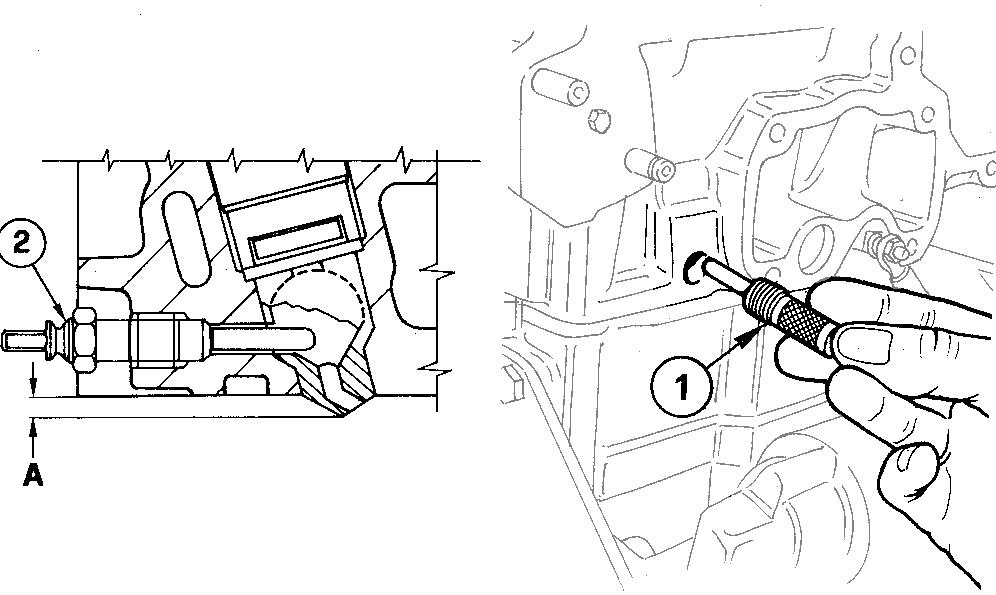
The pre-combustion chamber has a hole on the side where the pre-heating glow plug 2 must be inserted.
When re-fitting introduce the the new pre-combustion chamber into the cylinder head so that the side hole of the precombustion chamber aligns with the glow-plug hole.
To make sure that both the holes align appropriately use tool "7107-1460-031" 1 inserting it into the glow-plug hole.
Tighten the ring nut twice: 1st tighten at a torque of 100 Nm, 2nd tighten at a torque of 180 Nm.
Chack that clearance A is 3,68÷4,1 mm.
Oil pan, removal
Danger - Attention
- The used engine oil can cause skin-cancer if kept frequently in contact for prolonged periods.
- If contact with oil cannot be avoided, wash carefully your hands with water and soap as soon as possible.
- Do not disperse the oil in the ambient, as it has a high pollution power.
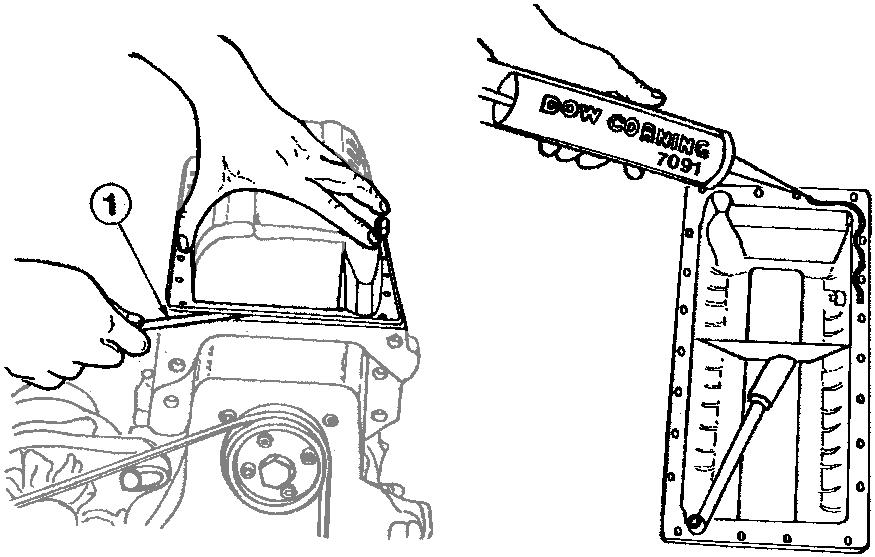
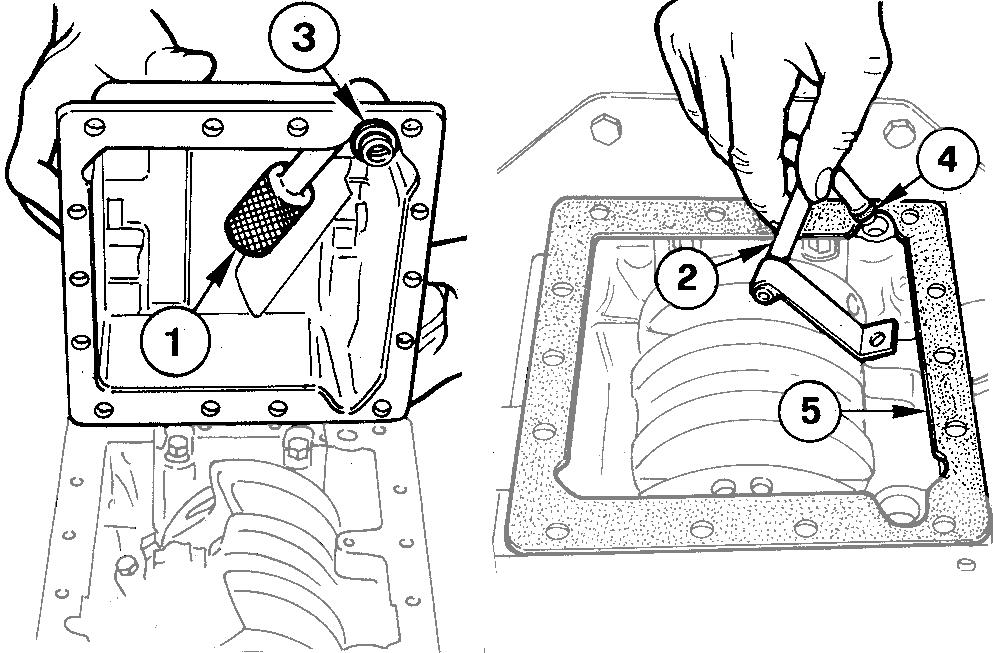
Remove the fixing screws. Insert a spacer 1 in the forward and rear main bearings. Detach the silicon from the main bearing rubber bulb seals.
When re-mounting apply Silicone " Dow Corning 7091" as shown in the picture.
Tighten the screws at a torque of 10 Nm.
Before starting the engine make sure that:
1) the oil drain plug is tightened correctly
2) the engine has been refilled with the prescribed quantity of oil (see page 34).
PISTON
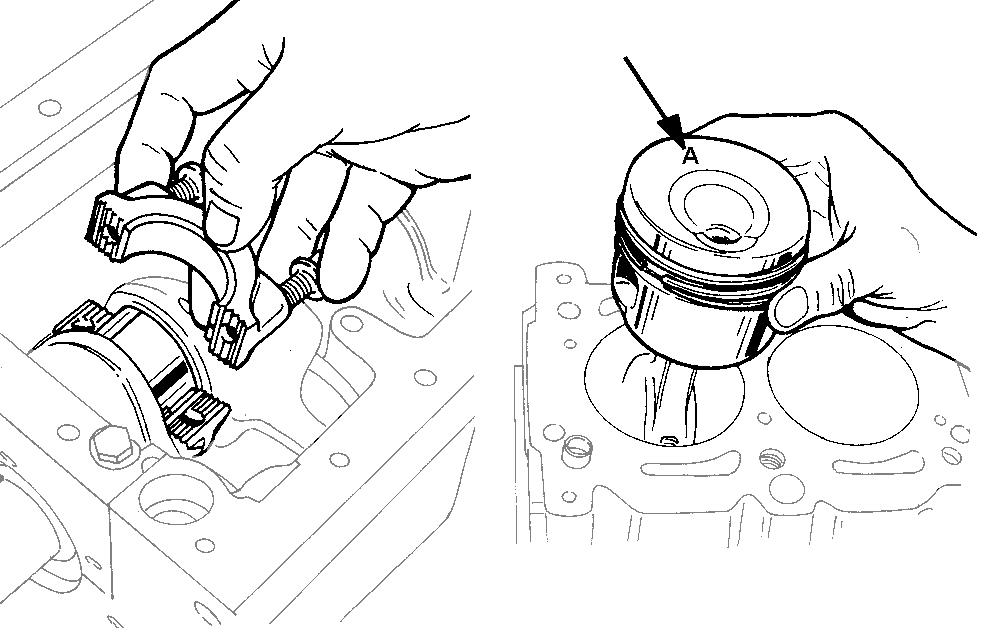
Remove the connecting rod big end cap. Remove the piston-connecting rod assembly.
Note: The Ricardo type of combustion chamber is used for KDW 702-1003-1404 engines.
Stop pin rings, dismounting and remounting
Extract the ring inserting a pointed tool in hollow A
On remounting, insert rings with the points turned downwards inside the corners ( a = 15°).
Disassembly / Reassembly
Piston, disassembly and inspection
Remove the stop rings and remove the pin, see fig. 101. Remove the piston rings and clean the slot.
Measure diameter Q at height A from the base of skirt (A = 9 mm).
If the diameter is worn more than the 0.05 mm minimum given value, replace piston and rings.
Note: The provided oversize elements are of 0.50 mm and 1.00 mm
Piston, class
The pistons are subdivided according to their diameters into categories: A, B, C. These references, are shown on the top of the piston (see fig. 100).
A 74,990÷75,000 74,930÷74,940 0,050÷0,070
B 75,000÷75,010 74,940÷74,950
C 75,010÷75,020 74,950÷74,960
Piston supply:
Pistons at the nominal diameter are only supplied in category A Pistons oversized by 0.50 and 1.00 mm are supplied with reference to the increased level on the piston crown: Ø 75.5 – 76.0 for KDW 702-1003-1404 engines.
Piston, weight
Weigh pistons when replacing them in order to avoid unbalance.
Important
The difference in weight should not exceed 4 g.
Piston rings - End gaps (mm)
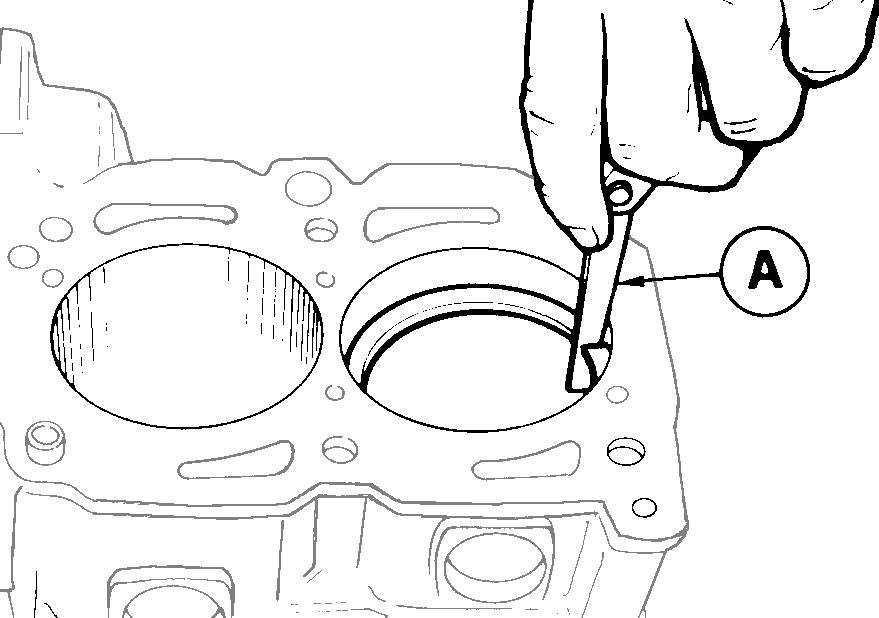
Place piston rings squarely into the unworn part of the lower cylinder and measure the end gap A.
Piston ring
limit value
Piston ring, Clearance between grooves (mm)
0,090÷0,125
0,050÷0,085
0,040÷0,075
Disassembly / Reassembly
Piston ring, mounting order
A = 1° ring (internal tapered and torsional)
B = 2° ring (internal tapered and torsional)
C = 3° Oil control ring
D = Chrome-plated area
E = Chrome-plated area
Note: When there is writing on the surface of a piston ring, mount that surface with face upward.
Piston, assembly
Important
Before re-mounting lubrificate the piston pin, piston, cylinder and conncecting rod big end bearing.
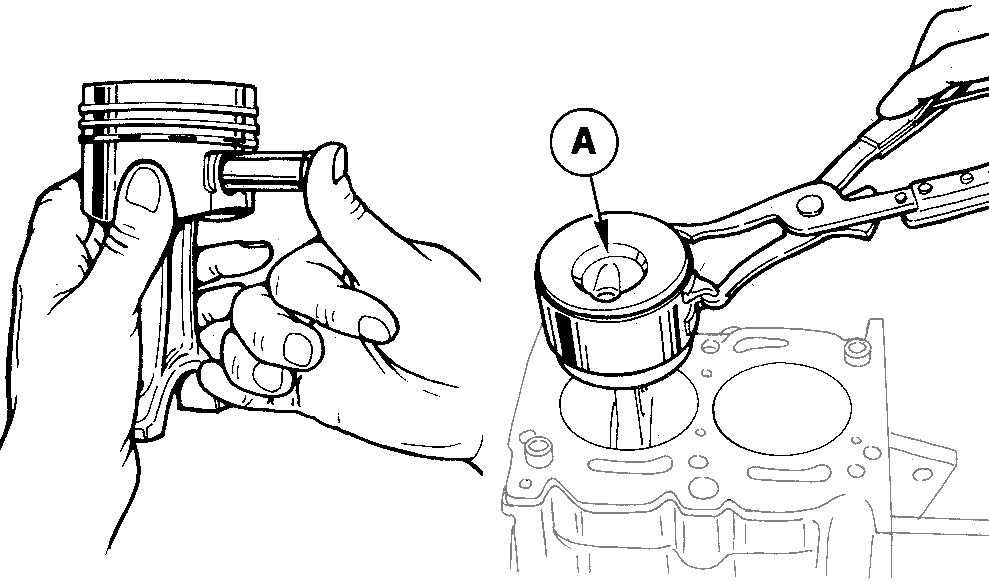
Couple the piston to the connecting rod inserting the pin, after lubricating it, just via thumb pressure.
Insert the two pin stop rings and check that they are properly housed in their seats (see fig. 101).
Using piston ring compression pliers, introduce the piston into the cylinder so that combustion chamber A is directly under the precombustion chamber parallel to the head.
Couple the piston/connecting rod to the crankshaft.
For tightening the head/connecting rod see fig. 115-116.
Piston clearance
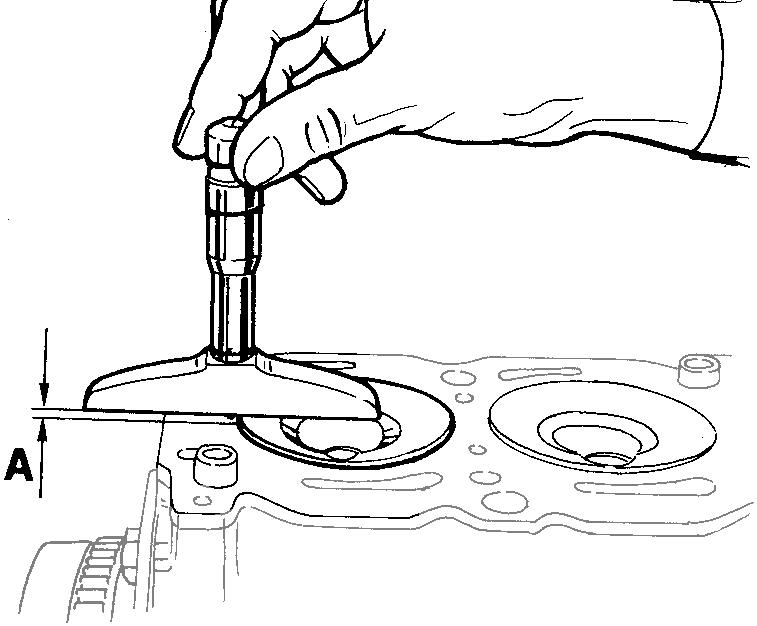
The piston in the TDC (top dead centre) position may extend or be short of the upper surface of the cylinder.
Determinare the clearance of each piston using a dial indicator to measure the difference between the two surfaces (piston crown and upper cylinder surface).
To determine the piston clearance and, by consequence, which copper gaske is most suitable it is necessary to consider the A value of the piston that projects furthest.
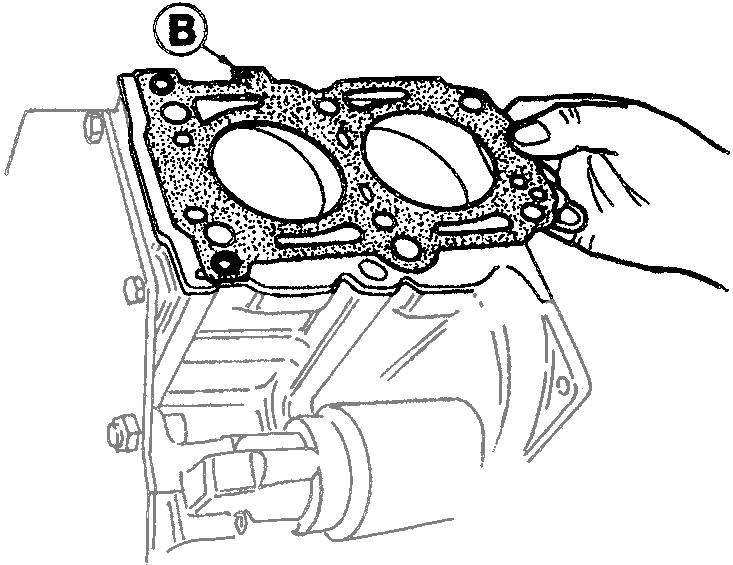
Head gasket
Important
Remove the cylinder head gasket seal from its protective covering only when you are going to mount it.
The gasket thickness is identified by the number of notches located in point B
Choose the appropriate gasket considering that each A value on the table corresponds to a gasket with: no hole, one hole, two holes, or for the 1404 one notch, two notches, three notches. The A value relates to figure 111.
Each time you dismount the head you must replace the gasket.
A(mm)
0,82÷0,91
0,90÷1,01
1,02÷1,10
A(mm)
0,82÷0,91
0,92÷1,01
1,02÷1,10
KDW 702-1003
N° of holes
1 hole
2 holes
3 holes 1 notch
KDW 1404
N° of notches
2 notches
3 notches
Piston clearance
0,54÷0,63
0,55÷0,63
Piston clearance
0,52÷0,61
0,53÷0,61
Disassembly / Reassembly
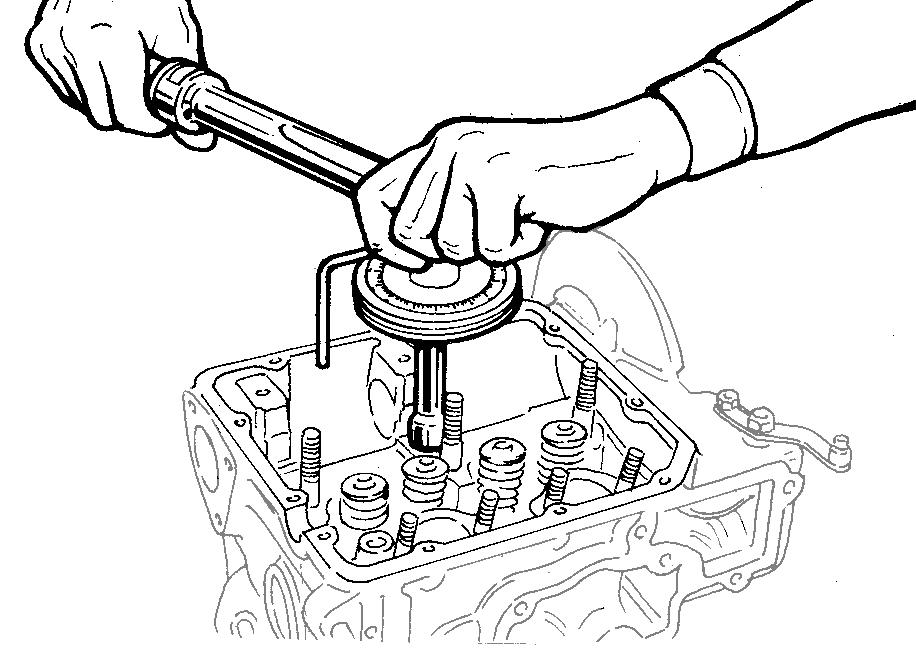
Cylinder head assembly
Use a torque wrench equipped with a device for angular tightening.
Measure the length of each screw (normal length = 89.5÷90.5 mm). Replace it if it exceeds 92 mm.
Proceed as follows.
Cylinder head tightening procedure KDW 1003
Important
Once the head has been correctly tightened, it should not be retightened except if it is disassembled again.
A = For KDW 702 models
B = For KDW 1003 models
Following the numerical order shown in the diagram, the bolts must be tightened in three phases:
1st phase = 50 Nm
2nd phase = Rotate the wrench 90° in a clockwise direction. 3rd phase = Rotate the wrench again 90° in a clockwise direction.
Cylinder head tightening procedure KDW 1404
Following the numerical order shown in the diagram, the bolts must be tightened in three phases:
1st phase = 50 Nm
2nd phase = Rotate the wrench 90° in a clockwise direction. 3rd phase = Rotate the wrench again 90° in a clockwise direction.
CONNECTING ROD
Caution – Warning
While reassembling the big end bearings, we suggest cleaning all parts thoroughly, as well as proper greasing in order to avoid risks of seizure at the first start.
Big
end bearing
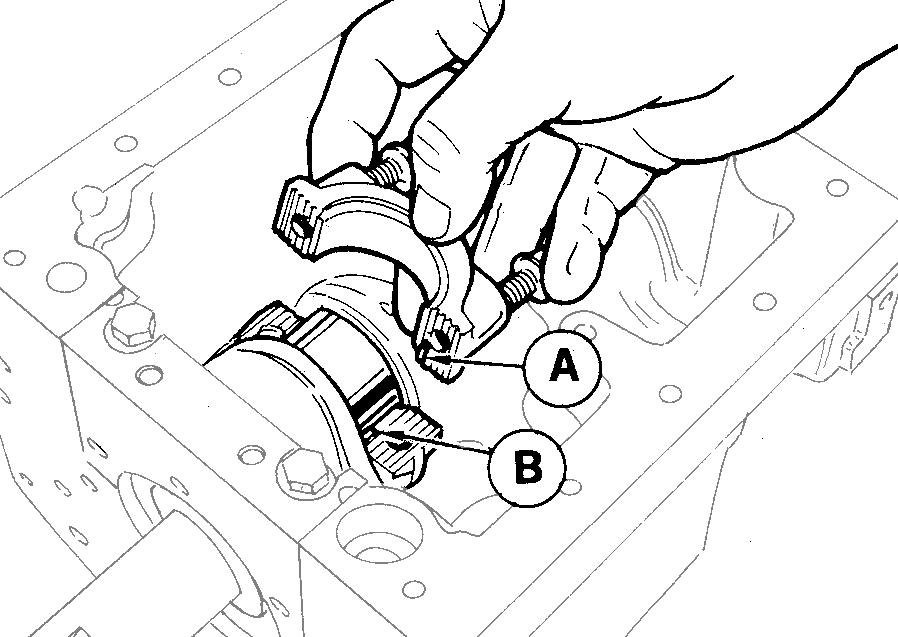
After connecting rod from crankshaft disconnection, check the following.
While reassembling, be sure the two centring notches A an B are on the same side.
Tighten the connecting rod big end cap screws simultaneously at a torque of 40 Nm.
Note: The big end bearing is supplied both at the nominal value and undersized by 0.25 and 0.50 mm.
Connecting tod, weight
Important
Weigh connecting rods when replacing them in order to avoid unbalance.
The difference in weight should not exceed 10 g.
The difference in weight of the pre-assembled connecting rod, piston and pin must not exceed 14 g.
Connecting rod with bearings and pin
Dimensions (mm):
A = 126,48÷126,52 (for KDW 702-1003-1404)
B = 20,015÷20,025 (for KDW 702-1003-1404)
C = 40,021÷40,050 (bearing tightened at 40 Nm)
D = 19,996÷20,000 (for KDW 702-1003-1404)
E = 54,000÷55,100 (for KDW 702-1003-1404)
(B-D) = 0,015÷0,039 (B-D) limit value = 0,060
Nota: When driving the small end bearing make sure both oilholes are aligned.
Disassembly / Reassembly
Connecting rod alignment
Use of a size corresponding with the surface plate or as a comparator in the figure.
Check the alignment of the axes using the piston pin, the gap A = 0.015 mm. Limit 0.030 mm.
Small deformations can be corrected in a press acting with gradual efforts.
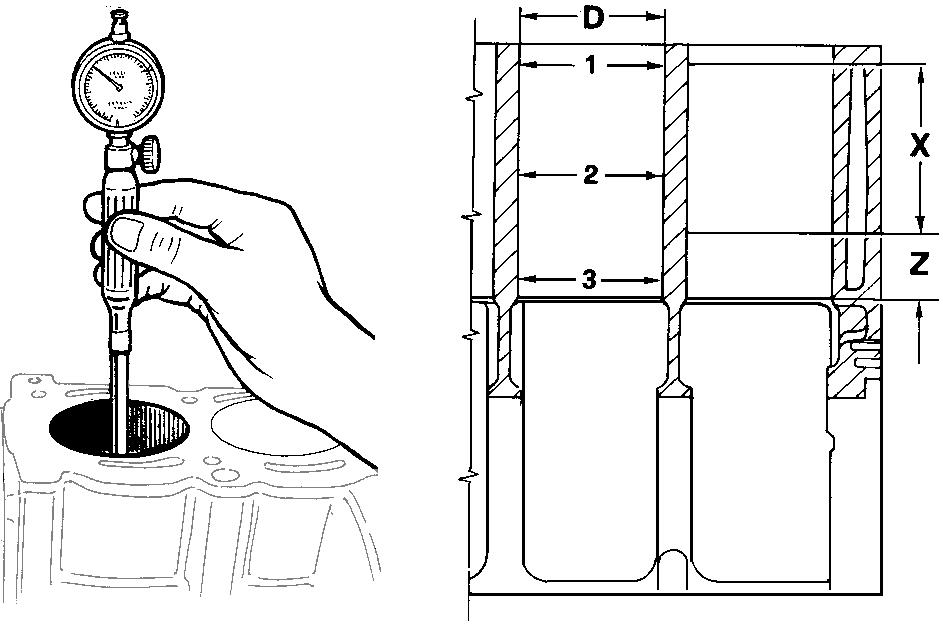
CYLINDERS
Reset the dial gauge with a calibrated ring: check the diameter D in points 1, 2 and 3; repeat the same operation rotating the dial gauge by 90° at the same heights.
Check any wear in zone X where the piston rings operate and if it is greater than the 0.05 mm max limit given adjust the cylinder to the next increased value.
75,000 mm for KDW 702-1003-1404 engines.
Cylinder, class
The pistons (A, B, C) locations are shown on the piston crown while those for the cylinders are found on the crankcase in the points shown by the arrows, see picture.
Note: The cylinders are not to be changed.
Cylinder roughness
Caution – Warning
Do not treat the cylinder’s internal surfaces with an emery cloth.
The angle of the crossed processing marks must be between 45° and 55°. These must be uniform and distinct in both directions.
Average roughness must be between 0.5 and 1 µm.
The whole surface of the cylinder affected by contact with the piston rings must be rendered with the plateau method.
Central main bearing caps
The central support caps are marked with locations that can be numbers as in the diagram or dots.
The same locations are given on the crankcase.
Couple the caps with the same references and on the same side. In any case locate the bearing’s two centring notches that are to be found on the same side.
Tighten the screws simultaneously at a torque of 60 Nm.
Rear and forward main bearing caps
Important
Before the final tightening, check the coplanarity of the two levels with a ground bar
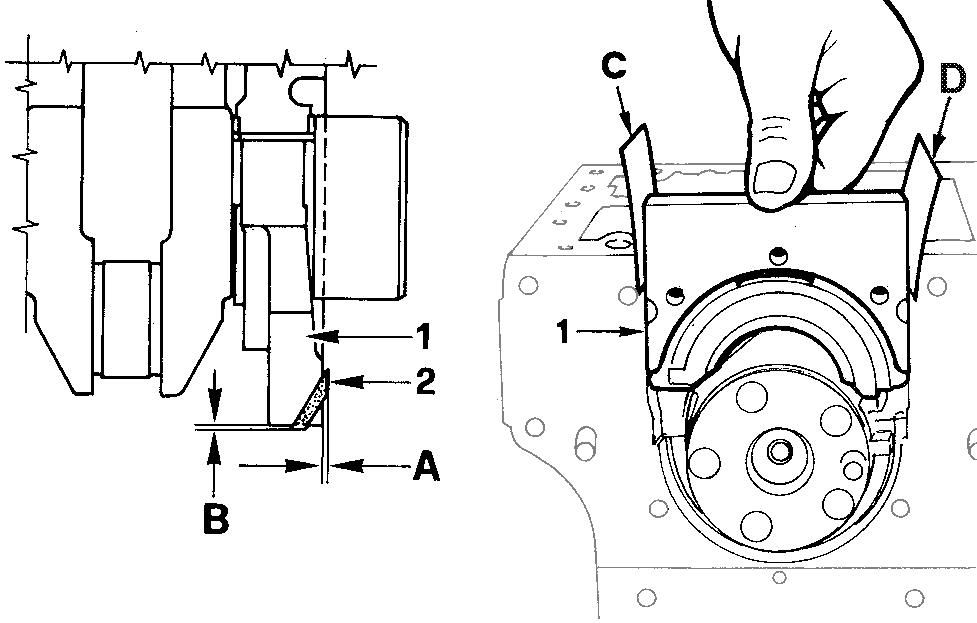
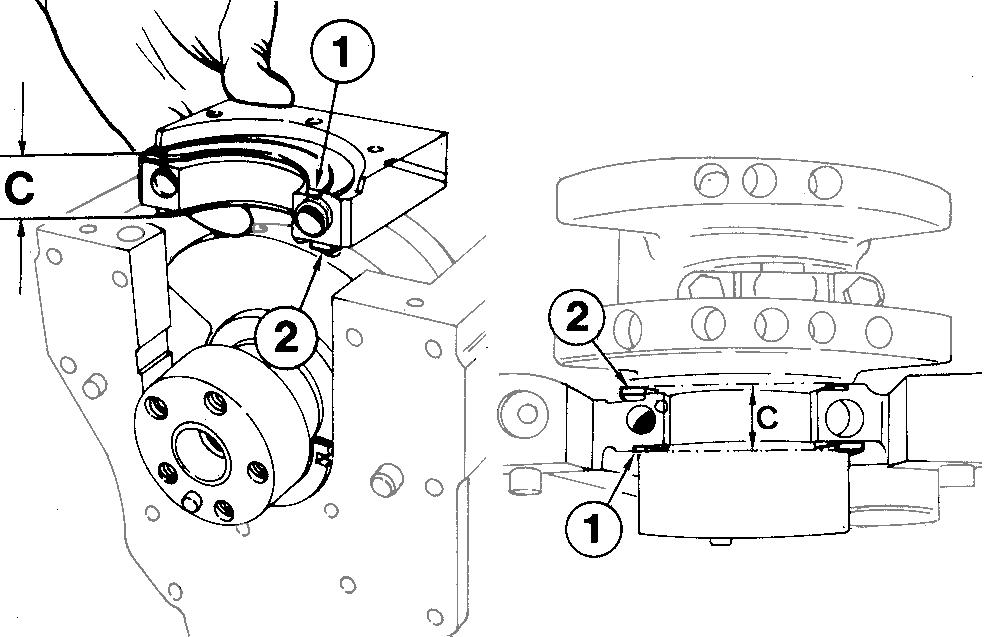
On remounting the rear main bearing cap 1 replace the lateral rubber gaskets 2, keeping in mind that projections A and B of the support must be 0,5÷1,0 mm; cut off any exceeding portions. Do the same with the front bearing cap.
Before reintroducing the bearings in the crankcase, place between their surfaces two plates C and D - 0.1 mm thickse.no.7107-1460-053.
Tighten the screws at a torque of 60 Nm.
Note: It is advisable to apply a few drops of silicon sealant on the surface of the gasket slot 2
Check the clearances between the bearings and the journal
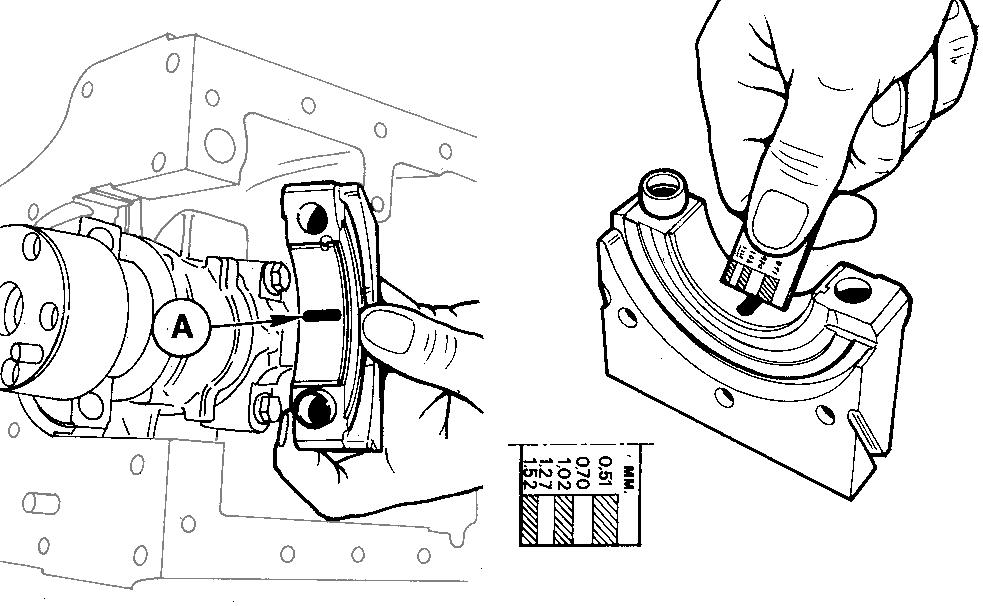
Use the ”Perfect Circle Plastigage” type calibrated wire A and put it at the centre of the bearing with a bit of grease.
Tighten the screws at a torque of 60 Nm.
Find out the clearance value checking the wire’s compression with the appropriate graduated scale supplied in the same pack and available on the market.
For clearance values between the journals, connecting rod pin and the relevant bearings see page 74.
Disassembly / Reassembly
Piston coolant nozzles
Caution – Warning
The piston has a recess so that during up-down movements and vice versa it cannot come into contact with the nozzle.
When remounting the nozzle be careful that it is placed so that when the piston goes past it is in the centre of the recess
Components:
1 Washer
2 Nozzle
3 Washer
4 Joint (tighten to 12Nm)
5 Valve (opening pressure = 1÷1.2 bar)
6 Spring
Characteristics (mm):
34 150 16 5°
Shoulder half rings
So as to keep them in their seats during assembly, put a bit of grease.
The half-rings must be assembled with the slots A as in the figure.
Thickness of half-rings is equal to 2.31÷2.36 mm. They are supplied as spare parts as increased thickness 0.1 and 0.2 mm, see below.
Crankshaft axial clearance
After tightening the main bearings measure the axial clearance A between the crankshaft flywheel side shoulder and the main bearing half rings.
Ref Clearance
If the clearance is not within the given value check value B If need be, fit oversized half rings, see below. Limit value
0,5
23,50
Shoulder half rings, oversized elements
Dimensions (mm):
STD 22,787÷22920 23,050÷23,100
1a 22,987÷23,120 23,250÷23,300
2a 23,087÷23,220 23,350÷23,400
3a 23,187÷23,320 23,450÷23,500
* A of Fig. 134.
** B of Fig. 135.
0,130÷0,313
Grinding B as per relevant table, you can mount the following half rings:
1st Oversized element
Half rings 1 and 2 + 0.10 mm on both sides of the bearing
2nd Oversized element Half rings 1 and 2 + 0.10 mm on one side of the support and + 0.20 mm on the other side.
3rd Oversized element Half rings 1 and 2 + 0.20 mm on both sides of the bearing.
Crankshaft front and back oil seal rings
Caution – Warning
An ambient temperature below -35°C may damage the rings.
The front oil seal ring 1 inserted into the oil pump cover and the back one 2, in the flywheel side flange.
If warped, hardened, or cracked, replace them.
For the replacement:
- Carefully clean the housing
- Keep the ring immersed in engine oil for about half an hour
- Drive it into its housing with a buffer exercising a uniform pressure on the whole front surface. Be sure that the two surfaces A and B meet on the same level.
- Refill the interior hollow with grease and lubricate the seal lip with thickened oil.
Note: Before major engine overhaul, in case of oil leakage in the seal area of rings 3 and 4, you can remedy this by replacing the rings and pushing them about 2 mm deeper with respect to the previous ones.
If the rings are black it means zones 3 and 4 of the crankshaft are tempered. In this case it is necessary to remount a ring of the same colour.
If the rings are brown it means that zones 3 and 4 of the crankshaft are not tempered. In this case it is necessary to remount brown coloured rings.
Disassembly / Reassembly
Crankshaft, lubrication lines
Caution – Warning
During repairs, when compressed air is used it is important to wear protective goggles.
B = Crankshaft KDW 702
Put the crankshaft in a bath of crude oil.
Remove the caps and clean lines 1 and 2 or 3 and 4 with a bit; blow with compressed air.
Reposition the new caps in their seating and check the seal.
Engines produced after 2001 do not have plugs for the lubrication ducts.
Simply use a bit and compressed air to clean the ducts.
Crankshaft, check journals and crank
Use a micrometer for the outsides.
Journal and connecting rod pins diameters
Dimensions (mm):
Disassembly / Reassembly
Main bearings and connecting rod big ends diameters
Dimensions (mm):
KDW 702-1003-1404
Ref. Tolerance Limit value
C (mm) 51,023÷51,059 51,098
D (mm) 40,021÷40,050 40,100
The dimensions given refer to tightened bearings.
For tightening torque see figures 116 e 126.
Clearances between the bearings and corresponding pins
See figures. 143 ÷ 144.
Dimensions (mm):
KDW 702-1003-1404
Ref. Tolerance Limit value
C-A (mm) 0,023÷0,078 0,200
D-B (mm) 0,021÷0,066 0,130
Nota: Both for crankshaft bearings and for connecting rod big end bearings internal diameter are undersized by 0.25 and 0.50 mm.
Disassembly / Reassembly
Hydraulic pump drive
A = Third drive
You can mount a 2P hydraulic pump on the third drive with Bosch flanging, or a 1 PD type one.
You can draw 7 KW of power from the third drive corresponding to a 37 Nm torque at 3600 rpm (engine revolutions). Drive ratio, engine revs/pump revs = 1:0.5.
Third drive, components
1 Splined sleeve
2 Toothed pinion
3 Seal ring
4 Flange for 1 PD hydraulic pump
5 Seal ring
Note: Sleeve 1 also includes the fuel pump control cam and is fastened with the same standard cam screw, with a tightening torque of 80 Nm + 90°.
Tighten pinion 2 to the hydraulic pump at 45 Nm
Turbocharger components
Corpo turbina
Anello seeger
Chiocciola compressore
Spessore
Dado
Controdado
Albero con turbina
Deflettore olio
Manicotto reggispinta
O-ring 20 Cuscinetto reggispinta
Anello reggispinta
Cuscinetto
Anello seeger
Anello seeger
Supporto cuscinetti
Turbocharger pressure testing
Install a 0-2bar pressure gauge at position A after removing the existing plug.
Start the engine and operate at low idle for five minutes to allow warm-up.
Increase the engine speed to 3000 r/min or 3600 r/min (depending on engine specification while applying full Nb load to the engine).
See page 10 for the power output curve.
The gauge pressure, at full speed, full load, should be 0.87-0.91 bar (655÷685 mm Hg).
If the pressure setting does not reach specification, adjust the turbocharger waste gate 8 as is defined on page 48.
Turbocharger west gate adjustment - Regolazione corsa asta comando valvola " Waste gate "
Disconnect westgate tube 7 from the turbocharger compressor side.
Using a T-joint connect a pressure gauge 4 (scale 0 to 2 bar) and with the compressed air network pipe complete with reducer 5
The network air supply pressure must be from 1.5 to 2 bar. Make a hole B in the pressure gauge pipe of 1.55 mm in diameter.
This will help bleeding some air and stabilizing pressure in the pressure gauge.
Set up a dial gauge 6 so that the feeler is rested on terminal 2 Via the pressure reducer 5 convey some air to the actuator so as terminal 2 is pushed forwards by A (A=1 mm).
The pressure read in the pressure gauge must be 830÷890 mm Hg (1.11÷1.19 bar).
If the pressure is lower than the given value proceed as follows. Unscrew locknut 1
Remove split pin 9 and disconnect rod 8, “waste gate” control valve.
Keeping the rod steady tighten terminal 2 until you reach the calibration pressure.
During the rotation of terminal 2, the rod should not undergo any torsion
Danger – Attention
- The engine can be damaged if allowed to operate with insufficient oil. It is also dangerous to add too much oil because its combustion may lead to a sharp increase in the rotation speed.
- Use suitable oil in order to protect the engine. Nothing more than lubrication oil can influence the performances and life of an engine.
- Use of an inferior quality oil or failure to regularly change the oil will increase the risk of piston seizure, will cause the piston rings to jam and will lead to rapid wear on the cylinder liner, the bearings and all other moving parts. Engine life will also be notably reduced.
- The oil viscosity must suit the ambient temperature in which the engine operates.
Danger – Attention
- Old engine oil can cause skin cancer if repeatedly left in contact with the skin and for long periods of time. Wear protective gloves to avoid touching used oil.
- If contact with the oil is unavoidable, you are advised to wash your hands with soap and water as soon as possible. Dispose of old oil in the correct way as it is highly polluting
LUBRIFICATION CIRCUIT
Internal oil filter and oil sump return pipe
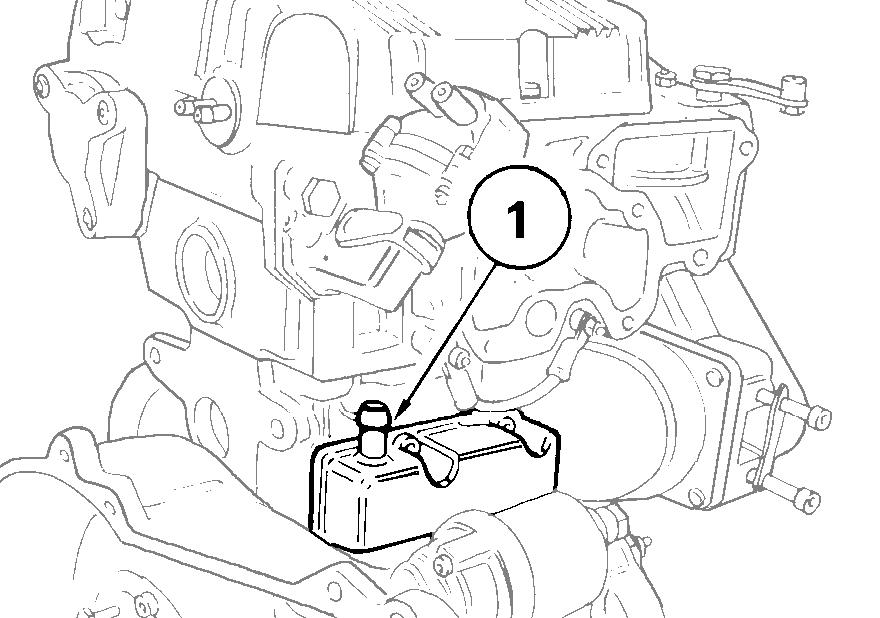
Clean with petrol the internal oil filter 1 and oil sump return pipe 2, blow also some compressed air.
Replace sealing rings 3 and 4
Tighten oil drain plug at a torque of 40 Nm.
Oil pump
Delivery test at 3600 rpm with an oil temperature of 120°C.
Oil pump, clearance between rotors
Measure the clearance A between teeth as in figure; the maximum value is 0.171 mm.
Clearance wear limit should be 0.250 mm.
See page 52 for assembly and disassembly.
Oil pressure regulating valve
Components:
1 Valve 2 Spring
3 Gasket
4 Screw cap
Spring length = 27.50÷27.75 mm
Blow the valve’s seating with compressed air and carefully clean all the components before remounting them.
Nota: The valve begins to open at a pressure of 4.5÷5.5 bar.
Oil filter cartridge
Components:
1 Gasket
2 Plate
3 Rubber element
4 Spring
5 Filtering element
6 By-pass valve
7 Spring
Characteristics:
Maximum operating pressure: 7 bar
Maximum bursting pressure: ................................. 20 bar
Degree of filtration: 15 µ
By-pass valve calibration: 1,5÷1,7 bar
Total filtration surface: 730 cm2
Oil pressure check
Important
Once remounted fill the engine with oil, fuel and coolant.
Remove the pressure switch, fit a union and connect a 10 bar pressure gauge.
Start the engine and check how pressure is affected by oil temperature.
Nota: With a maximum operating temperature of 120°C at 900 rpm the oil pressure must not be less than 1 bar.
Danger – Attention
- The coolant circuit is pressurised. Do not check it before the engine has cooled down and, also in that case, open the radiator cap or expansion tank plug with caution.
- When there is an electric fan do not approach a hot engine because it could also come on with the engine off.
- The liquid coolant is a pollutant and therefore must be disposed of with care according to environmental provisions.
COOLANT CIRCUIT
Radiator and compensation, check and seal tank cap.
Remove the cap from compensation tank cap and check that the liquid is at the correct level.
Replace the cap with a new one provided with hand air pump socket.
Compress air at a pressure of 1 bar for about two minutes. Check that there are no drips in the radiator.
The tank cap is supplied with a vacuum relief valve 1 and an overpressure valve 2
Overpressure valve opening pressure of 0.7 bar.
Coolant circulation pump, components
1 Rotor
2 Front seal gasket
3 Pump casing
4 Exhaust hole
5 Bearing
6 Pulley
7 Shaft
Note: The pump for KDW 1404 engines is different from the one of the other series (fig. 148) due to the presence of a ring between rotor 1 and gasket 2
Thermostatic valve
1 - Stainless steel or brass casing
2 - Wax bulb
3 - Air relief hole
Characteristics:
Opening temperature: 83°÷87°C
Max stroke at: 94°C = 7 mm
Liquid recycling: 30÷80 l/h.
Fuel feeding / injection circuit
Components:
1 Fuel Tank
2 Fuel filter
3 Fuel feeding tube
4 Fuel lift pump
5 lnjection pump
6 Injector
7 Fuel rail passage rubber joint
8 Injector exhaust pipe
9 Fuel tank cap
10 Solenoid valve
Note: The tank complete with filter is supplied on request.
Fuel filter detached from the tank (on request)
1 Air relief valve
2 Bearing
3 Cartridge
4 Rubber element
5 Filtering element
Cartridge characteristics:
Filtering paper:.................................. PF 905
Filtering surface: 2400 cm2
Degree of filtration: 2÷3 µ
Maximum operating pressure: 4 bar
See page 32 for periodic maintenance details.
Fuel lift pump
Components:
1 Fuel lift pump
2 Push rod
3 Seal ring
The fuel pump is membrane type. It is driven by camshaft cam via a drive rod.
It is equipped with an external manual fuel lever.
Characteristics:
With the control cam at 1500 rpm the delivery rate is 75 l/hours and the self-adjusting pressure is at 0.55 to 0.65 bar.
Fuel pump drive rod projection
The protrusion A of drive rod 2 from the cylinder head surface is 1.66÷2.18 mm.
The check must be carried out with cam 1 idle as in the figure.
Block the two fuel pump fastening nuts simultaneously at 24 Nm.
Check the length of the drive rod and if it is not the right size, replace it.
Drive rod length = 153.15÷153.35 mm.
Pump/injector unit
Designed by KOHLER, the pump/injector is exclusive to KDW 702-1003-1404 series engines.
The injection system includes two, three, four identical pumps/ injector units, each one of which feeds a cylinder.
Note: On pumps/injector units of recent construction (for serial numbers and references see the table on page 88) the pump has been modified (see fig. 174).
Following to this modification and others like the elimination of cap 20 of (fig. 169) the method of checking the static injection advance has changed as well, (fig. 187-188) as that of injector setting (fig. 178).
Pump/injector unit, components
Tappet
Ring nut
O-ring
Cap screw (old type)
Metal gasket (new type)
When remounting the injector tighten ring nut A at 70 Nm
Plunger barrel ring nut assembly/disassembly
To disassemble ring nut (9 fig. 169) use the suitable wrench A se.no. 7107-1460-029
When refitting tighten it a torque of 34 Nm.
Injection pump assembly/disassembly
Disassemble the unit following the progressive order of fig. 169. Reassemble following the same steps in reverse order. During reassembly, turn the plunger spiral L towards the nonreturn valve 19, as follows.
Plunger injection pump reassembly
To be able to insert the plunger in its barrel press with a finger and at the same time slowly rotate lever (8 fig. 171) until guide M of the plunger (fig. 172) enters the lever seating.
Note: If by mistake the plunger is mounted with the spiral in the wrong direction the pump won’t function (there is no danger that the engine runs away).
Pumping element (old-type injection pump)
1 Plunger
2 Upper plunger section
3 Plunger barrel
4 Delay notch
5 Control slot
Dimensions (mm):
5,5
10,00
9,6
0,7
Pumping element
1 Plunger
2 Upper plunger section
3 Plunger barrel
4 Delay notch
5 Control slot
INJECTION PUMP Dimensions
Pump/injector unit se.no. 6590.285 control data.
1 Delivery control lever on stop position.
2 Delivery control lever on maximum delivery position.
Injector setting pressure: 140÷155 bar * Rpm rating is that of the crankshaft.
KOHLER injection system is being steadily implemented, seeking the best performance of its engines. For this reason the pump injector body has been modified three times in the course of its evolution. Three different pump injectors are shown in the top figure.
Old type injector pump: it is characterised by its high pressure hole
Intermediate injector pump: is characterised by not having the high pressure hole (the hole can be there but it is only used to control the injector and injection advance) and by the locating peg between inlet and outlet holes.
Current pump injector: it is characterised by its offset inlet and outlet holes. These are also oversized, due to the absence of the high pressure hole.
REFERENCE
702 - 1003 - 1404 8° ÷ 10° < 2999 g/min 12° ÷ 14° 3000÷3600 g/min 13° ÷ 14° > 3600 g/min
Injector, setting (old type)
Connect the injector to a hand pump after removing cap screw (20 fig. 169).
By means of the tool - se.no. 7107-1460-028 - check that the setting pressure is 130÷145 bar.
Adjust, if necessary, by changing the spacer located under the spring.
There are eleven different spare part spacers from 1 to 2 mm. When you replace the spring, the setting should be made at a pressure higher than 10 bar to compensate for adjustments in operation.
Check the needle seal by slowly actuating the hand pump for 10 seconds, until you reach abt. 130 bar.
If the nozzle drips, replace it.
Setting of injector according to current pump/injector unit
Remove the non-return valve leaving its metal gasket and fit a cap screw in its place, that is part of tooling 7107-1460-074.
Mount then head 1 and coupling 2
Then connect a hand pump as shown in the picture. The pressure setting must be 140÷155 mm bar.
Injector, nozzle projection
To avoid excessive compression of the spark arrester (A, fig. 181), check projection B of the nozzle (fig. 179).
B = 6.80÷7.05 mm.
If this measure is larger put spacer 2 between ring nut 1 and copper gasket 3
0.25 mm thick spacers are available.
Injector, spark arrester
Important
Every time you remove the pump/injector you must replace the spark arrester, the copper gasket, the oil O-ring, as well as the 2 fuel O-rings.
Insert the spark arrester in the injector housing with surface A pointing upwards.
Tighten simultaneously both nuts that fasten it to the head at 20 Nm.
For engines with the injectors fixed with self-locking nuts, tighten the nuts at 23 Nm.
See page 32 for periodic maintenance details.
2.468
2.205
1.956
1.721
1.501
1.296
1.105
0.930
0.769
0.623 8° 0.793 7° 0.378
6° 0.277
Injection advance control and regulation
- Dismount the rocker arm cover (see page 52).
- Position the device on the head, in contact with cylinder no. 1.
- Mount the dial gauge on the valve controlled by tool ref. 1460.048.
- Via lever 1 of the tool, open the valve until it comes into contact with the piston.
- Then rotate the crankshaft until the TDC is read in the dial gauge. Then reset the hundredths.
- Remove the fuel pipes.
- Remove the O-ring in contact with the non-return valve and replace it with the appropriate gasket - equipment component part ref. 1460.074. Once the check has been completed, remove the gasket and refit the O-ring.
Connect tool 1460.074 on pump n° 1. This will automatically position the control lever to the maximum delivery. The tool is provided with 3÷4 couplings for connection to a tank that must be not lower than 30 cm from the pumps level. Coupling 2 is equipped with a plastic pipe 5 with internal drip collecting wire.
- Put cylinder 1 under compression and open the tank tap. Fuel diesel will start to flow out from coupling 2
- Slowly rotate the engine towards TDC 1 until the diesel fuel stops leaking out.
- At this point with lever 1 (of fig. 182) move again the valve until it touches the piston and read on the dial gauge how many hundredths are missing from the previously reset value (TDC).
- To convert hundredths into degrees, consult the table below.
- Repeat the operation on the other cylinders.
Injection advance for currently used pump/injector unit
Static injection advance tuning
If the injection advance value found does not correspond to the previously described value, adjust the screw E and repeat the test.
Rotating screw E by ½ turn will change the injection advance by 5°. If turned clockwise, injection is advanced.
In the opposite direction, injection is delayed.
Injection advance references on timing belt protector
The method of checking injection advance is essentially the same as that described in fig. 182 with one difference: instead of using the device se.no. 7107-1460-048 with which you measure piston lowering with respect to the Top Dead Centre, you use references A and C on the timing belt protector and reference D located on engine pulley.
When D coincides with A the piston has reached its TDC.
When D coincides with C the piston is in injection advance position.
TDC (Top Dead Center) references
D coincides with A = TDC of 1st cylinder of all series engines, of 4th cylinder KDW1404.
E coincides with A = TDC of the 2nd cylinder KDW 1003.
F coincides with A = TDC of 2nd cylinder KDW 702, of 3rd and 2nd cylinder KDW 1404.
G coincides with A = TDC of 3rd cylinder KDW 1003.
Note: Following the arrow’s rotation direction, the combustion order for KDW 1003 is D, G, E (1st - 3rd - 2nd cylinder respectively. As to KDW 1404 the sequence is D, F, D, F (1st– 3rd– 4th and 2nd cylinder).
Tester and special coupling for injection advance control (Old-type injection pump)
1 Special coupling. Serial number: 7107-1460-028
2 Injection advance tester. Serial number: 7271-1460-024.
Remove the cap on the pump/injector casing and in its place screw on coupling 1
On this coupling tighten the tester 2
Note: When reassembling the cap on the pump/injector unit, check its seal.
Static injection advance regulation
Fill the tank and operate the fuel pump.
Set the pump/injector delivery control rod (ref. A fig. 187) at halfstroke.
Bring the piston to the top dead centre of compression. Fit a 13 mm hexagon wrench on the injection advance adjusting screw lock nut. By turning the wrench forth and back you prime the injection pump, thus enabling the tester to be drained.
With the piston at its TDC, operate lever 2 (fig. 188) and bring the drain valve into contact with the piston. Then reset dial gauge.
Go back ¼ of a turn moving the crankshaft anticlockwise. Then turn forward again very slowly observing the fuel level inside the tester. As soon as the level changes, then stop. You reached the static injection advance. By actuating lever 2 check piston lowering with respect to the TDC.
The table on page 90 shows both piston lowering expressed in mm, with respect to the TDC, and the corresponding rotation of the crankshaft, expressed in degrees.
The static injection advance in degrees a = 11° to 13° refers to all engines for adjustments from 1500 / 3600 rpm.
Preliminary steps to pump/injector unit delivery balancing test
Closing the oilhole
To perform this test you must remove the rocker arms cover and close hole 1 with an M 8x1.25 or M 10x1.5 screw (on latest model engines) not longer than 8 mm. Also remove the copper gasket.
If the camshaft and rocker arms are dry, lubricate them with engine oil.
Note: If you only want to check the nozzle it is not necessary to balance the deliveries; provided that when you dismount the rod you do not loosen adjusting screws (1 and 2 ,fig. 193).
Test head B assembly
Remove fuel pipe A and mount one test head B in its place per pump/injector.
The test heads complete with pipes are supplied together with instrument ref. 7104-1460-069.
Instrument connection
Place the instrument 1, se.no. 7104-1460-127 at least 20 cm above the pump/injector level.
Connect pipe A (outlet from every instrument test piece) with pipe A (inlet of every pump/injector) and pipe B (return to the instrument) with pipe B (outlet from the pump/injector).
Open tap 2 and 3 of each pipe and fill the instrument with diesel. Start the engine and bring it to 1500 rpm idle running.
Close the fuel supply to the engine from the instrument’s tank using lever 4 and after 1 minute observe the levels in the test piece.
If a level goes down more than the others it is necessary to decrease the delivery of the corresponding pump (see below) and vice versa to increase the delivery if the level increases.
Injection pumps delivery balancing
In case the balancing error read on the test pieces is greater than 2 cm³/min, then injection pumps deliveries should be adjusted.
Plate 4 and rod 3 are blocked by screws 1 and 2. Loosen them. Move plate 4 rightwards with respect to rod 3 if you want to increase delivery.
If moved leftwards delivery decreases. Make very small movements with the plate.
Tighten screws 1 and 2 at a torque of 1,1 Nm.
Important
Each time a pump/injector is replaced it is necessary to balance the deliveries.
ELECTRIC CONTROL PANEL WITH AUTOMATIC ENGINE STOP (UPON REQUEST)
AUXILIARY TERMINALS
Brown-black = Signal for H2O temperature instrument (6.3)
Orange = Signal for electric rev. indicator (6.3)
White = Oil pressure ON/OFF signal (6.3)
Purple = (+) Positive under key (6.3)
Yellow-green = (-) Negative - Earth (6.3)
Yellow = Protected socket available for engine stop in an emergency (6.3)
White-blue = Socket available for emergency indicator light (6.3)
Alternator, 14V 33A
Nominal voltage 14V
Nominal current output 33A
Maximum Rpm 12.000 giri/1'
Maximum peak Rpm 13.000 giri/1'
Voltage regulator AER 1503
Rotation (viewed at puley end): Clockwise
Tighten nut 1 at a torque of 35÷45 Nm.
Alternator, 14V 33A - Performance Curve
The curve was obtained at room temperature of +25°C with 13 V battery voltage.
Note: The rpm shown on the table are referred to the alternator. Engine rpm/alternator rpm ratio, with driving pulley diameter:
85 mm = 1:1,23
105 mm = 1:1,52
112 mm = 1:1,62.
assembly we recommend a battery with the following characteristics, see table below.
Alternator 14V 45A - 65A
Characteristics:
Nominal voltage = 14V
Nominal current output = 45A - 65A
Maximum Rpm = 14000 giri/1'
Maximum peak Rpm (for 15') = 15000 giri/1'
Bearing, Pulley End = 6203-2Z
Bearing, Voltage Regulator End = 6201-2Z/C3
Voltage regulator = RTT 119 A
Rotation (viewed at puley end): Clockwise
Note: Use only high temperature grease when servicing bearings
Tighten nut 1 at a torque of 60 Nm.
Alternator, 14V 45A - Performance Curve
The curve was obtained at room temperature of +25°C with a costant 13 V battery voltage.
P1 = Power Output (KW)
I = Current Output (Amps)
η = Efficiency
Note: The RPM shown is that of the alternator. The value of the rpm axis must be multiplied by 1000.
Alternator speed is a function of engine speed and the crankshaft pulley diameter. If the engine pulley diameter is :
85 mm = 1:1,3
105 mm = 1:1,6
112 mm = 1:1,72.
Alternator, 14V 65A - Performance Curve
The curve was obtained at room temperature of +25°C with a costant 13 V battery voltage.
P1 = Power Output (KW)
I = Current Output (Amps)
η = Efficiency
Note: The RPM shown is that of the alternator. The value of the rpm axis must be multiplied by 1000.
Alternator speed is a function of engine speed and the crankshaft pulley diameter. If the engine pulley diameter is :
85 mm = 1:1,3
105 mm = 1:1,6
112 mm = 1:1,72.
Alternator battery charger curve 12V 30A (two cables at output)
This curve is obtained at 20°C.
The statistical charging output of the flywheel alternator is +10% to -5% of the values shown.
Note: Battery 3 not supplied by KOHLER, for battery characteristics see page 96. Yellow Red Red Green Brown
STARTER MOTOR - Bosch DW 12V 1,1 KW
Rotation: Clockwise
A = 17,5÷19,5 mm (distance from starter mounting flange to ring gear face)
Note: Please refer to your local BOSCH distributor for service parts, repair criterion and warranty service.
Starter motor, Bosch DW 12V 1,1 KW - Performance Curve
The curve was obtained at room temperature of -20°C with a fully charged 66Ah battery.
U = Starter Motor Voltag
n = Armature r/min
I = Absorbed Amperage
P = Starter Output Power (KW)
M = Starter Output Torque (Nm)
Starter motor, Bosch 12V 1,6 KW
Rotation: Clockwise
A = 29,50÷31,5 mm (distance from starter mounting flange to ring gear face)
Note: Please refer to your local BOSCH distributor for service parts, repair criterion and warranty service.
Starter motor, Bosch DW 12V 1,6 KW - Performance Curve
The curve was obtained at room temperature of -20°C with a fully charged 88 Ah battery.
U = Starter Motor Voltag
n = Armature r/min
I = Absorbed Amperage
P = Starter Output Power (KW)
M = Starter Output Torque (Nm)
Pre-heating glow plug
Characteristics:
Nominal voltage ................................ 12,5V
Current absorption 12A÷14A after 5 seconds
Sheath surface temperature 850°C after 5 seconds.
Components:
1 Sheath
2 Primary Heating Coil
3 Secondary Heating Coil
When remounting tighten at a torque of 20 Nm.
Pre-heating plug control unit with coolant temperature sensor
To avoid white smoke immediately following start-up post-heat for about 5 seconds, see table
Thermistor input
Resistance (ohm)
Coolant temp. °C
Glow-plug heat time (sec.)
Pre-heat
Post-heat
Heating stop
For electrical connections see figures 196-199-203.
System
Electric System
Temperature sensor for control unit
In engines fitted with the above-mentioned type of control unit, the introduction of the glow plugs depends on a temperature sensor that varies preheating temperature in relation to the coolant temperature.
Characteristics:
Temperature range -30 ÷ +50°C
Voltage range 6÷24 V
Temperature max. 150°C
Max. tightening torque. 30 Nm.
Oil pressure switch (Fig. 215)
Characteristics:
Opening pressure: 0,15÷0,45 bar (for gen-sets: 1,4 bar).
Tightening torque 25 Nm.
Coolant high temperature lamp sensor (Fig. 216)
Characteristics:
Circuit single pole
Voltage range 6÷24 V
Max. Power Absorption 3 W
Closing temperature 107÷113°C
Tightening torque 25 Nm.
Pre-heating water temperature thermistor and Water temperature indicator thermal contact
T1 thermal contact features:
Circuit unipolar
Contact opening temperature >
Supply voltage ............................................ 12÷24 V
Thermocontrol max power 3 W
T2 thermal contact features:
Tightening torque MAX 30 Nm.
Nero
Electric
Black
SPEED SETTINGS
Setting the idle minimum (standard)
After filling the engine with oil, fuel and coolant, start it and let it warm up for 10 minutes. Turn the screw 1 to adjust the idle speed at 850 to 900 rpm. Tighten then the locknut.
Note: If you loosen screw 1 speed decreases. To the opposite direction speed increases.
Setting the idle maximum (standard)
After setting the idle speed turn screw 2 and regulate the idle maximum at 3800 rpm. Block then the locknut. When the engine reaches its setting power, the maximum rpm will stabilise at 3600 rpm.
Note: If you loosen screw 2 speed increases. To the opposite direction speed decreases.
Pump injection delivery standard setting without dynamometric brake
This adjustment must be performed with the dynamometric braked engine. Without this, the regulation is approximate In this case proceed as follows:
- Unlock the maximum flow limiter lock nut.
- Fully screw in flow limiter C
- Run the engine to the maximum speed, that is 3800 rpm.
- Loosen flow limiter C until the engine revs start to decrease.
- Screw flow limiter C by 2.5 turns.
- Tighten the lock nut.
Note: If the engine under maximum load emits too much smoke unscrew C. Tighten C if at this load there is no smoke and if the engine does not reach its maximum power.
Injection pump flow limiter and engine torque gearing device
Flow limiter C has the function of limiting the injection pump’s maximum delivery.
The same mechanism acts also as a torque gearing device. Indeed, under torque, spring N operating lever L overcomes the resistance of spring M located in the plunger barrel.
The stroke H that the torque gearing device allows to be carried out by lever L, will increase the injection pump delivery and the torque will hit its maximum value.
Important
The stroke H varies depending on which engine torque gearing device is fitted on the engine.
Setting the stop
Remove the rocker arms cover and completely unloosen screw B. Push rod A to the right and keep it in this position; see figure. Tighten screw B until it touches rod A
Release rod A and tighten again screw B by a 0.5÷1.0 turn. Tighten the lock nut.
Pump/injector unit timing with speed governor
- Loosen the screws C of each pump/injector unit.
- If it is not connected, connect spring D to rod A (with this operation the speed governor blocks are closed).
- Move plates B of each pump/injector unit rightwards; see figure (with this operation the pumps/injector unit are at their maximum delivery).
- Tighten screws C at 1.1 Nm. Re-balance the deliveries.
Note: Spring D is the start-up fuel supplement spring: with the engine stopped pull rod A to the right by bringing the pump/injector unit delivery to the maximum value, until the speed governor comes into operation with the engine running
Pump/injector unit delivery setting with braked engine
1) Run the engine to the maximum speed.
2) Screw flow limiter C (see fig. 219).
3) Load the engine up to the power and number of revs required by the application’s manufacturer.
4) Check that consumption is within the values allowed for in the settings table (see below).
If consumption is not within the given figures, it is necessary to change the balance conditions shown to the brake, altering the load and the speed governor. Redo the consumption check on the stabilised engine.
5) Unscrew limiter C until the engine rpm start to decrease. Lock the limiter using the lock nut.
6) Completely release the brake and check the rpm at which the engine stabilises.
The performance of the speed governor must meet the class required by the application’s manufacturer.
7) Stop the engine.
8) Recheck the valve clearance with the engine cold.
E.G.R. calibration
Mount a T-branch on vacuum valve - E.G.R. valve connection pipe 1, and connect it to a vacuum pressure gauge with 1 bar bottom scale so as to be able to read the degree of vacuum within the pipe.
Note: It is also possible to use a mercury column, 1 metre long, since the maximum suction pressure exerted by the vacuum pump is 720 mmHg.
Adjust the position of the accelerator lever via the regulator block, so that the internal adjusting nut 2, is about 5 mm from the end of the thread.
Accelerate the engine up to 3.600 rpm (with valve closed: this means that the value showed on the vacuum pressure gauge or on the mercury column should be 0.
In case it is different from zero, adjust the regulator block nuts to move it, in relation to the rod 3, in the direction that goes from the flywheel to the timing.
With the brake at a braking curve N=constant, “load” the engine slowing it down to 2.800 rpm.
Acting on the accelerator look for the E.G.R. valve closing point (pressure of the vacuum pressure gauge or mercury gauge equal to zero).
Note: Pay attention to determine the precise closing point: by slightly accelerating the engine the vacuum value in the E.G.R. operation pipe should immediately increase.
Measure the engine consumption in order to calculate the mm3/ stroke value.
If the calculated value is less than 18.8 mm3/stroke, adjust the adjusting nut making it closer to the end of the rod 3 to “increase the calibration”.
When the required value of 18.8 mm3/stroke has been reached (and a power of around 7 KW) tighten the adjusting nuts.
ENGINE STORAGE
- When the engines are not for more than 6 months, they have to be protected performing the operations described in the following pages.
- If the engine is not to be used for extensive periods, check the storage area conditions and the type of packaging and make sure that these are suitable for correct storage. If necessary, cover the engine with a proper protective sheet.
- Avoid storing the engine in direct contact with the ground, in environments that are humid and exposed to bad weather, near high voltage electric lines, etc.
Important
If, after the first 6 months, the engine is still not used, it is necessary to carry out a further measure to extend the protection period (see “Protective treatment”).
PROTECTIVE TREATMENT
1 - Pour in the engine housing AGIP RUSTIA C protective oil up to the maximum level.
2 - Fill up with fuel containing 10% AGIP RUSTIA NT.
3 - Make sure that the coolant is up to the maximum level.
4 - Start the engine and keep it idle at minimum speed for some minutes.
5 - Bring the engine to ¾ of the maximum speed for 5÷10 minutes.
6 - Turn off the engine.
7 - Empty out completely the fuel tank.
8 - Spray SAE 10W on the exhaust and intake manifolds.
9 - Seal the exhaust and intake ducts to prevent foreign bodies from entering.
10 - Thoroughly clean all external parts of the engine using suitable products.
11 - Treat non-painted parts with protective products (AGIP RUSTIA NT).
12 - Loosen the alternator/fan belt.
13 - Cover the engine with a proper protective sheet.
Caution - Warning
In countries in which AGIP products are not available, find an equivalent product (with specifications: MIL-L21260C).
Important
Maximum every 24 months of inactivity, the engine must be started up by repeating all "Engine Storage" operations.
PREPARING THE ENGINE FOR OPERATION AFTER PROTECTIVE TREATMENT
After the storage period and before starting up the engine and preparing it for operation, you need to perform certain operations to ensure maximal efficiency conditions.
1 - Remove the protective sheet.
2 - Remove any sealing devices from the exhaust and intake ducts.
3 - Use a cloth soaked in degreasing product to remove the protective treatment from the external parts.
5 - Inject lubricating oil (no more than 2 cm3) into the intake ducts.
6 - Adjust the alternator/fan belt tension.
7 - Turn the engine manually to check the correct movement and smoothness of the mechanical parts.
8 - Refill the tank with fresh fuel.
9 - Make sure that the oil and the coolant are up to the maximum level.
10 - Start the engine and after some minutes bring it to ¾ of the maximum speed for 5-10 minutes.
11 - Turn off the engine.
12 - Remove the oil drain plug (see “Oil replacement”) and discharge the AGIP RUSTIA NT protective oil while the engine is hot.
13 - Pour new oil (see "Table of lubricants") up to the maximum level.
14 - Replace the filters (air, oil, fuel) with original spare parts.
15 - Empty the cooling circuit completely and pour in the new coolant up to the maximum level.
Caution - Warning
Over time, a number of engine components and lubricants lose their properties, so it is important considering whether they need replacing, also based on age (see Replacement table).
Important
Maximum every 24 months of inactivity, the engine must be started up by repeating all "Engine Storage" operations.
POSITION
Injection pump control rod
Connecting rod ****
Union for the nozzle
Glow-plugs
Oil filter cartridge (M 20x1,5 union)
Camshaft bearing (M 6 screws)
Rocker arm cover
Main bearing caps
Oil pan
Camshaft bearing support screw
Glow-plug cable nuts
Fuel lift pump nuts
Belt tensioner nut
External Stop control lever nut
Pump/injector unit fixing nut
Rocker arm assembly support nut
Fuel pump cam
Flywheel side oil seal ring flange
Pre-combustion chamber ring nut
Vacuum pump fixing screws
Belt tensioner
Crankcase
Speed governor lever screw
Driving pulley
Camshaft timing pulley
Oil pressure switch
Oil drain plug
Cylinder headù
Injection pipe
Flywheel
Table of tightening torques for the main components
- p. 103 152÷153 - p. 79 113÷115 - p. 67 64- p. 54 21 - p. 44
M 3 spec. 8x1 8x1,25 12x1,25 20X1,5 6 6x1 M 10 M 6 M 6 5x0,8 8x1,5 M 10 8x1,25 M 8 M 10 10x1,25 M 6 30x1,5 10x1,25 10 12x1,5 6x1 16x1,5 sin. 10x1,25 12x1,5 12x1,5 18 TCEI 4x1,5 10x1,5
* Tighten the two nuts that fasten each pump/injector unit at the same time. For engines with the injectors fixed with selflocking nuts, tighten the nuts at 23 Nm.
** Tighten these in two phases: the first phase at 100 Nm, the second phase at 180 Nm. See page 51, figures 95-96.
*** See page 57
**** Aluminium connecting rod with 35 Nm tightening torque.
Table of tightening torques for standard screws (coarse thread)
Resistance class (R)
Quality/ Dimensions
Diameter
Table of tightening torques for standard screws (fine thread)
Resistance class (R)
Quality/ Dimensions
Diameter
SPECIAL TOOLS
DESCIPTION
Injection pumps delivery balancing instrument
Precombustion chamber extractor
Injection pump static injection advance tester(old type)
Sheet metal for insertion of main bearings in the crankcase
Ring nut wrench for fastening pump/injector pumping element
Precombustion chamber wrench
Precombustion chamber adjusting rod
Coupling for static injection advance control and setting of old-type injection pumps injector
Device for mounting valve guide gasket, intake and exhaust side
Valve lowering device for injection advance control
7107.1460.053 7107.1460.029
7107.1460.027
7107.1460.031
7107.1460.028
7107.1460.047
7107.1460.048
Timing belt tightening tool
Crankshaft clamping tool
Tool for injection advance control and setting of injector for pump/injector unit: se.no. 6590-272
Tool for injection advance control and setting of injector for pump/injector unit: se.no. 6590-285, 6590-307, 6590-290
7107.1460.049
7107.1460.074
Translated from the original manual in Italian language.