Program Note
Composer Chen Yi is widely recognized for her unique and masterful integration of traditional Chinese and Western classical music Her personal creativity grew out of early performance training in Western classical idioms She studied piano and violin through the works of Mozart, Beethoven, and other Western masters, which formed a foundation that would remain integral to her musical language later as a composer.
During the Cultural Revolution, Chen Yi was sent to the countryside as a teenager. Removed from her formal musical study, this period proved to have a profound and pivotal change in the trajectory of her musical vision. She was suddenly exposed to a different sonic environment shaped by regional speech, folk song, and communal musical practices. Difficult as this period was, it marked a lasting shift in her artistic awareness. In later years, she would reflect on this experience as a turning point in her search for an individual voice rooted in cultural memory.
Following her return to the Central Conservatory of Music in Beijing, Chen Yi began to engage more deeply with Chinese musical traditions, collecting folk materials and exploring their expressive possibilities. Later, her studies at Columbia University expanded her musical language toward a synthesis of Chinese and Western traditions. Exposure to both modernist compositional techniques such as twelve-tone serialism, and comparative studies in Chinese and Western aesthetics encouraged her to merge contemporary methods with her native cultural heritage, which, in return, inspired her to seek out ways to embrace aspects of herself formed by the cultures of her second home. In her mature compositional voice, folk idioms, modernist devices, and philosophical concepts of East and West coexist equally comfortably.1
1 Chen exposure to Chow Wen-chung’s teaching at Columbia University introduced her traditional Chinese philosophies such as Daoism and the Yijing (Book of Changes), whose principles of yin-yang balance, cyclical transformation and natural motion profoundly shaped her aesthetic outlook. These ideas resonate with Western modernist ideals of structure and motivic process, forming the philosophical foundation of her intercultural musical language.
The works presented in this recital reflect these evolving perspectives. However, the program is not arranged as chronological order, but in a sequence that requires shifting modes of listening. In some works, folk elements are represented simply by inclusion of the original folk song; in others, they are absorbed into rhythm or some other broader sonic aspects or structure in a much more abstract fashion Heard together, these pieces invite the audience to move between different ways of listening, and to experience how musical meaning may emerge, transform, and resonate across contexts.
Variations on “Awariguli” is Chen Yi’s earliest large-scale work for solo piano, based on a lyrical Uyghur folk song from Xinjiang named for a young woman. The original song carries a strong sense of longing and devotion, shaped by a vocal style that is considered directly expression. Rather than preserving the melody in the original fixed form, Chen Yi places it within a series of variations that gradually reshape its role
Compared to her later piano works, the harmonic language of this piece remains relatively tonal, and the melodic contour often stays close to the original song. As the variations unfold, lyrical moments alternate with passages of rhythmic vitality and expanding texture, allowing the familiar melody to seamlessly weave through different musical landscapes. Familiar material returns again and again, yet each return brings a different perspective.
Heard as a whole, the piece traces a progression, from intimacy toward transformation. Vocal expressiveness coexists with dance-like motion and instrumental gestures. The concluding section broadens the musical space, bringing the work to a sense of arrival and emotional closure.
Serving as the opening work of this recital, Variations on “Awarigul”' offers a compelling introduction to Chen Yi’s early compositional voice one that remains grounded in folk lyricism while already utilizing variation technique as a means of structural exploration and expressive depth, offering listeners an early glimpse into her later works, which are more abstract in entirety.
Duo Ye (1984)
Following the lyrical variations of the opening piece, Chen Yi’s Duo Ye shifts the musical focus to a vibrant, primal communal celebration. Written in 1984, the piece grew directly out of the composer's field research trip in the remote Guangxi Zhuang Autonomous Region of China, where she witnessed a centuries-old song-and-dance ritual of the Dong people. In this tradition, participants gather in a circle around a bonfire, stepping slowly in unison. A village leader improvises verses of welcome or storytelling, while the crowd answers with a repeating, rhythmic refrain. The warm, vivid energy of this ritual left an indelible impression on Chen Yi and became the core for this work.
The work is anchored by a melody derived from a signature three-note Dong folk motif, paired with a driving, percussive ostinato a relentless repeating pattern that vividly mimics the steady stomp of dancers’ feet and the crackle of the bonfire. In the opening Allegro section, Chen contrasts the communal rhythm with lyrical, improvisatory melodic lines, creating a thrilling calland-response structure that perfectly captures the dynamic interplay between individual voice and collective unity. This vibrant energy eventually subsides into a haunting Adagio middle section, where the driving pulse gives way to free-flowing, introspective melodies. Later, the communal dance inevitably returns, accelerating into a fiery and virtuosic climax that brings the ritual to a spectacular close.
This masterful translation of an ancient ritual into modern pianistic language quickly made Duo Ye one of Chen Yi’s most celebrated works and later led to its orchestral version.
Ba Ban (1999)
Commissioned by Carnegie Hall in 1999, Ba Ban (Eight Beats) takes its title and structural inspiration from a cornerstone of traditional Chinese instrumental form deeply rooted in the "silkand-bamboo" repertoire. Rather than simply quoting the ancient folk melody, Chen Yi translates its underlying rhythmic framework and spiritual essence into a highly virtuosic, contemporary piano landscape.
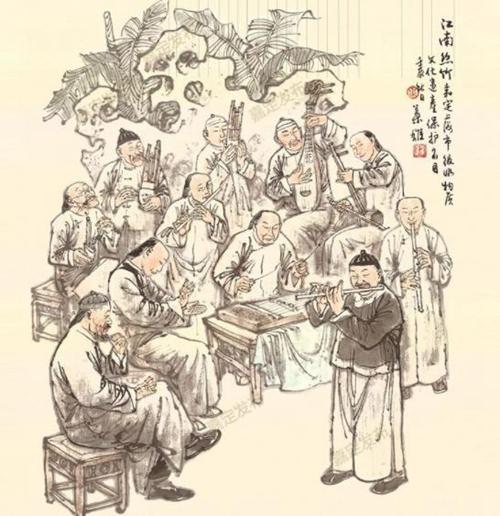
Throughout the piece, the piano is transformed to imitate the unique timbres and sharp attacks of traditional Chinese plucked instruments, such as the pipa and guzheng Chen achieves this by embellishing pentatonic melodies with biting dissonances, rapid grace notes, and wide, resonant registral spacing. Musically, the work traces a dramatic arc: it opens with sparse, meditative sonorities of rural mountain songs, gradually builds into a complex web of layered rhythms and fiery bursts of energy, before dissolving into a distant, whisper-quiet coda that vanishes into the air Ultimately, Ba Ban stands as a striking testament to Chen Yi’s ability to fuse ancient Eastern aesthetics with the bold, percussive power of the modern piano.
Song of Spring Outing (2022)
Among Chen Yi’s recent solo piano works, Song of Spring Outing beautifully integrates poetic inspiration with structural clarity. Inspired by Wang Ya’s Tang-dynasty poem, the piece evokes vivid imagery of apricot blossoms by the riverside, shifting colors in a wind-swept garden, and shimmering reflections on green water. However, rather than painting a literal picture of this scenery, Chen translates the poem's sense of springtime renewal into a highly expressive musical language.
The work opens with a striking gesture a prominent leap of a seventh that directly echoes the dramatic instrumental style of Beijing Opera. This bold interval settles into a pentatonic framework, driving a melody that favors the flexible, speech-like cadence of vocal declamation over sustained lyricism. Structured as a hybrid of rondo and variation forms, these core themes continually return and transform with each iteration Instead of relying on conventional tonal development, the music drives forward by gradually expanding its sonic space across the keyboard, ultimately retrograding its opening material to capture the vital, awakening energy of a blossoming spring.
Guessing (1989)
Guessing draws its core inspiration from Cai Diao (guessing tunes), a folk tradition from southwest China where singers trade teasing, riddle-like verses. In bringing this playful game of wits to the piano, Chen Yi focuses not on quoting fixed melodies, but on capturing the pacing of the game itself. The music unfolds through fragmented, questioning ideas that rarely settle.
Motives appear, pause, and retreat, while sudden leaps and rhythmic displacements repeatedly delay and redirect the listener’s expectations.
Just as the ear grows accustomed to this fragmented banter, the piece unexpectedly opens into a warm, continuous lyrical section a brief moment of direct, unguarded emotion. Yet almost as soon as it appears, this singing line withdraws, and the original teasing game resumes. Rather than driving toward a firm conclusion, Guessing ultimately leaves the listener suspended in a delicate balance between concealment and disclosure.
Bamboo Song (2020)
In Chinese cultural symbolism, bamboo is associated with integrity, resilience, and quiet strength. Chen Yi’s Bamboo Song draws on this imagery as a point of departure, shaped by her admiration for artists who are disciplined, sincere, and steadfast. The work derives its basic material from the Ba Ban tune of Jiangnan silk-and-bamboo ensemble music, though the source is not directly quoted. Instead, a simple melodic cell undergoes continuous variation, gradually expanding into a deep, spacious sonority. Resonant lower-register writing often anchors the texture, creating a sense of vertical depth and inward stillness.
Toward the end, this stillness gives way to an extended span of uninterrupted rapid figurations, a gesture she associates with bamboo-flute performance in traditional-ensemble settings. Rather than suggesting agitation, this sustained motion functions as an image of persistence, carrying the music forward through continuity of pulse and touch. In this
way, Bamboo Song transforms folk-derived material and cultural symbolism into a sound world shaped by endurance, restraint, and quiet intensity.
Bamboo Dance (2014)
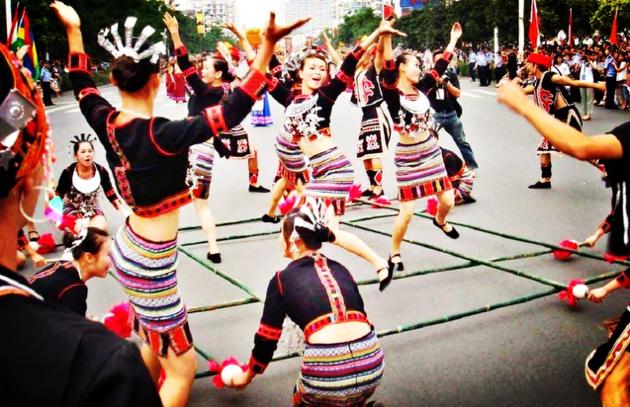
Although it shares the same bamboo-related material, Bamboo Dance predates Bamboo Song by seven years. Drawing on the energy of an ancient village ritual of southern China, the piece evokes pairs of performers striking long bamboo poles in a steady pulse while dancers weave between them. The music captures this atmosphere by sharp attacks, sudden registral leaps, and hand-crossing gestures, mirroring the dancers’ swift changes of direction.
The pitch material of the piece is drawn from a folksong of Li People in Hainan Island where the Bamboo Dance is popular. Rather than a lyrical narrative, the music is built on rhythmic insistence and spatial motion. A folk-derived pitch cell, centered on a descending seventh, anchors the texture, but it is the articulation and dynamic volatility that vividly reflects scene. What emerges is not a literal depiction, but a kinetic soundscape in which the piano becomes both instrument and ensemble, embodying the collective pulse and ritual intensity of the dance.
Northern Scenes (2013)
Chen Yi’s Northern Scenes (2013) is a single-movement solo piano tone poem that embodies the composer’s decades-long exploration of Chinese shanshui landscape aesthetics, merged with rigorous Western contemporary compositional practice. The work is anchored in Chen’s own written evocation of its core creative vision: “In the north, the vast and magnificent blue mountains, boundless, desolate, and indistinct.”

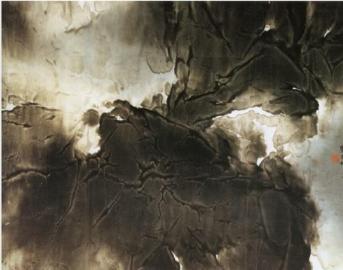
The piece draws its direct visual inspiration from two ink landscape works by Liu Guosong, a contemporary artist celebrated for capturing the monumental scale of northern Chinese mountains and an ethereal sense of suspended space in his art. Rather than splitting the work into discrete sections to correspond with the two paintings individually, Chen Yi weaves their shared sense of grandeur and spatial depth into a single, unbroken musical landscape.
From the work’s opening gesture, marked (Freely♩=80) in the published score, the piano’s extreme registers are deliberately and starkly separated. Dense, widely spaced sonorities in the low register, often sustained across long spans through careful pedaling, build a grounded, immersive sonic foundation. Against this deep, resonant backdrop, isolated pitches in the high register and rapid ascending figures emerge and fade, leaving lingering resonance suspended in the performance space. This core contrast between sonic mass and ephemeral detail, physical weight and atmospheric distance, defines the work’s distinctive spatial character.
Dynamic shifts throughout the piece are equally sharp and unanticipated: bold, assertive musical statements give way to sudden, extreme restraint, and textural layers expand. The work
avoids conventional tonal development and extended melodic continuity, unfolding instead through calibrated shifts in register, resonance, and vertical density. As the piece progresses, dramatic intensity builds not through traditional thematic development and motivic transformation, but through the gradual layering of sonic material and the steady widening of the piano’s registral range. What remains consistent throughout the work is its overarching commitment to spatiality: an expansive, boundless sonic field in which individual sounds emerge, hover, and recede, much like mist and light shifting across a mountain landscape.
China West Suite, for two pianos (2008)
Serving as the grand finale of tonight’s recital, China West Suite stands as a brilliant culmination of cross-cultural musical dialogue. Commissioned by Germany’s Klavier-Festival Ruhr in 2008, this masterful work for two pianos explores the rich folk traditions of Western China, drawing its authentic melodic materials from four ethnic groups: the narrative ballad Gadameilin and Pastoral of the Meng (Mongolian) people; Ashima of the Yi people; Du Mu and Amaliehuo of the Zang (Tibetan) people; and Dou Duo alongside the vibrant lusheng (mouth organ) ensemble music of the Miao people.
Rather than a simple medley of these traditional tunes, the suite unfolds as a cohesive and dramatically paced four-movement journey It opens with a broad, resonant first movement, Introduction, where pentatonic melodies and Western harmonies interweave to evoke the vast, solemn landscapes of the region. This spaciousness gradually gives way to the lyrical second movement, Meng Songs, channeling the unmetered, highly ornamented urtiin duu (long song)
tradition to paint the quiet stillness of the grasslands. This moment of lyrical repose, however, is soon swept away by the driving rhythmic vitality of the third movement, Zang Songs. The robust energy of Tibetan folk dances takes over, propelling the music forward with sharp, syncopated momentum. The excitement reaches its absolute peak in the final movement, Miao Dances Fueled by brilliant call-and-response writing and a vivid, percussive emulation of traditional lusheng ensembles, the two pianos rush toward a fiery, spectacular climax.