That fall, the fall of 1968, Tommy the Traveler first appeared in Geneva in the company of Cornell University S.D.S. leaders, presumably in the hopes of organizing an HWS chapter. During one of the first meetings of the Hobart Student Movement—an HWS student coalition against the Vietnam War—Tommy “tried to make himself a political mentor of the new group, urging it to adopt more militant tactics,” Donner writes. “We weren’t taking him seriously,” Wardell says. “He told us he was an S.D.S. organizer, wanted to start a chapter on campus. That didn’t go over well. Having discussed it, our general feeling was, we may organize around our own issues and oppose the war, but we didn’t imagine ourselves ‘true revolutionaries.’” “Tommy was always telling us that we were not political enough,” says Clarence Youngs ’72, “that we should do something that would really get the administration’s attention. Take over a building, blow up something. As president of the United Black Students at Hobart, I told him that that was not our agenda and we had our own plans.” “From the start, I simply did not trust him and made it a point to stay away from him,” says Sean Campbell ’70. “He SEAN CAMPBELL ’70 approached me on several occasions, with differing stories of who he was and what he was doing there. None of what he said made any sense and I just dismissed him as a wanna-be.” In an interview from the 1971 short documentary “The Revolutionary Was A Cop” (directed by Marc Weiss ’70), one student says that several times Tommy claimed to be a Keuka College professor, and when confronted about his lie, Tommy replied that that story had been a guise; that he was actually “a member of the royal family of Thailand…exiled from his country…and over here working against the government.” According to the Associated Press story that ran July 13, 1970, he in fact is distantly related to Thai royalty. …born Momluang Singkata Thomas Tongyai N’Ayudhya on Jan 14, 1944, in Anniston, Ala. His father, a native of Bangkok, Thailand, was serving in the Army at the time. The title N’Ayudhya designates royalty, but seven or eight generations removed.
Tongyai would use this distant royal connection many times in contacts with student revolutionaries, saying he wanted to lead a revolution of his own people.
By 1968, Tommy was known around the Cornell and Syracuse University campuses through the Peace and Freedom Party and the local chapters of the S.D.S., as an unofficial regional organizer. He turned up at Alfred, Wells, Corning. In “The Revolutionary Was a Cop,” an Auburn Community College student says that one afternoon on the Auburn campus, Tommy entered an emptying classroom, flashed a card and said, “I’m Tom Thomas from the FBI.” The student “freaked and [Tommy] laughed a lot and gave me a cigarette and said he was just kidding and that he was the regional traveler from Buffalo for S.D.S.” Tommy told other students he was with the Cornell chapter. Whichever chapter he was initially affiliated with—if any—he was eventually elected to the S.D.S. steering committee at the University of Rochester. --------
In 1956, the FBI launched the Counter Intelligence Program, COINTELPRO, “a series of covert action programs directed against domestic groups,” which remained in effect until 1971, when it was disbanded under the threat of public exposure. From the Church Committee Reports, Book III: In these programs, the Bureau went beyond the collection of intelligence to secret action designed to “disrupt” and “neutralize” target groups and individuals. The techniques were adopted wholesale from wartime counterintelligence, and ranged from the trivial (mailing reprints of Reader’s Digest articles to college administrators) to the degrading (sending anonymous poison-pen letters intended to break up marriages) and the dangerous (encouraging gang warfare and falsely labeling members of a violent group as informers)….Many of the techniques used would be intolerable in a democratic society even if all of the targets had been involved in violent activity… The unexpressed major premise of the programs was that a law enforcement agency has the duty to do whatever is necessary to combat perceived threats to the existing social and political order.
In a 1970 interview with the Geneva Times, Tommy said he’d “always had very strong feelings for this country and for its government. I would do anything to uphold its security…I feel some people on the Hobart and William Smith campus present a very real threat to the security of the United States.” --------
“...I WOULD DO ANYTHING TO UPHOLD ITS SECURITY…I FEEL SOME PEOPLE ON THE HOBART AND WILLIAM SMITH CAMPUS PRESENT A VERY REAL THREAT TO THE SECURITY OF THE UNITED STATES.”
1969
Days of Rage, . Chicago—again Chicago—just a year and change removed from the violence of the Democratic Convention. “Bring the War Home!” say the Weathermen. “Whatever it takes, we’ll do!” “An outrage against the community,” says Mayor Richard J. Daley. Protesters in football helmets. Pipes, chains, slingshots, baseball bats. Bank windows smashed, smoke and teargas billowing on the Gold Coast, blood in streets in the Loop, while on the West side, factions of the S.D.S, the Black Panthers, and the Young Lords march peacefully, side-by-side through the city’s working class neighborhoods. A few weeks earlier, during an “orientation meeting at [HWS] in early September, 1969,” Donner writes, Tommy distributed “thousands of pamphlets
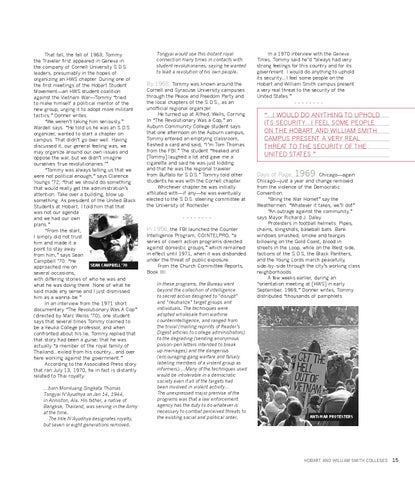
ANTI-WAR PROTESTERS
Hobart and William Smith Colleges
15