An accreditation team from the California Association of Independent Schools (CAIS) visited the Middle and Upper School from Mar. 2-4 to evaluate the school as part of its re-accreditation process. The team consists of 10 volunteer educators, staff members and administrators from independent schools in California. The accreditation follows the school’s submission of a self-study report that evaluated itself in 16 different categories. President Rick Commons said the objective of the accreditation team is to verify and confirm the report the school already wrote.
“It’s a guided feedback system and it will result ultimately in a report that will come in the summer that will re-accredit Harvard Westlake with recommendations which we essentially have written ourselves in the self-study,” Commons said. “We have pointed out things that we’re concerned about and they may say, ‘we actually think that what you have as secondary should be primary,’ but they’re probably not going to come up with things we haven’t already pointed out.”
Head of Upper School Beth Slattery said the accreditation process is more procedural than consequential for the school.
“For a school like us, not to say that we shouldn’t be always thinking about how to get better, but there’s not a real fear that we won’t get accredited,” Slattery said. “It’s like, ‘we just need to make sure that you are actually doing the things that you said that you’re doing.’ It’s a little bit of a hoop to jump through.”
Chief Financial Officer David Weil ’93 said the main benefit of the accreditation process comes from the reflection that occurs when creating the selfstudy report.
“The accreditation process is meant to be something that encourages a tremendous amount of self-reflection,” Weil said. “It’s being introspective, thinking about the future of the school and where we are today and how those line up. In some sense, before the visit even takes place, we have already gained the benefit of the process. The results are the icing on the cake.”
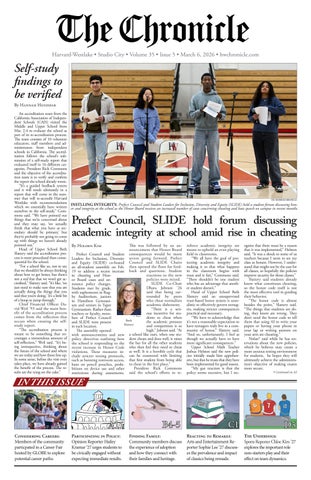
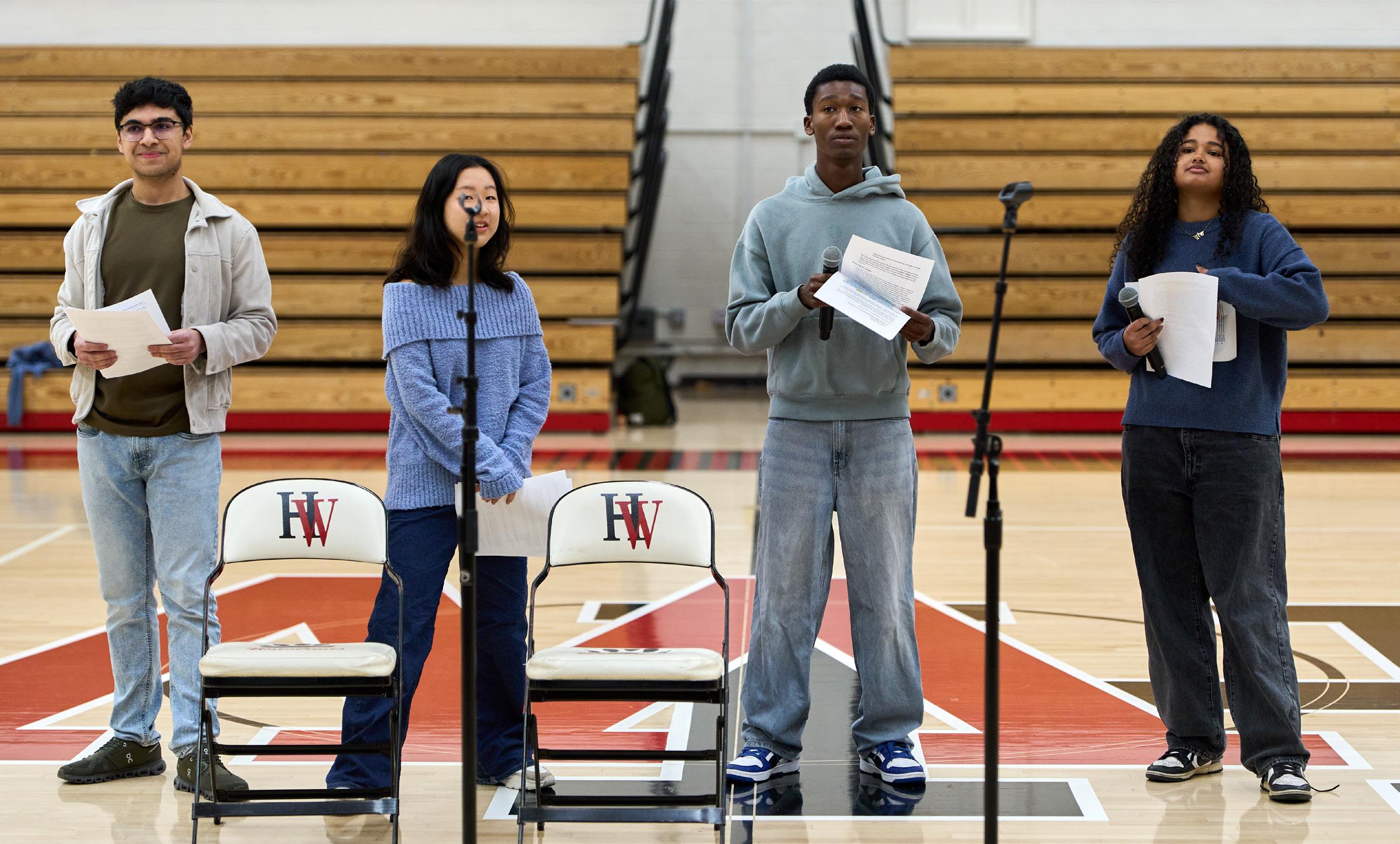
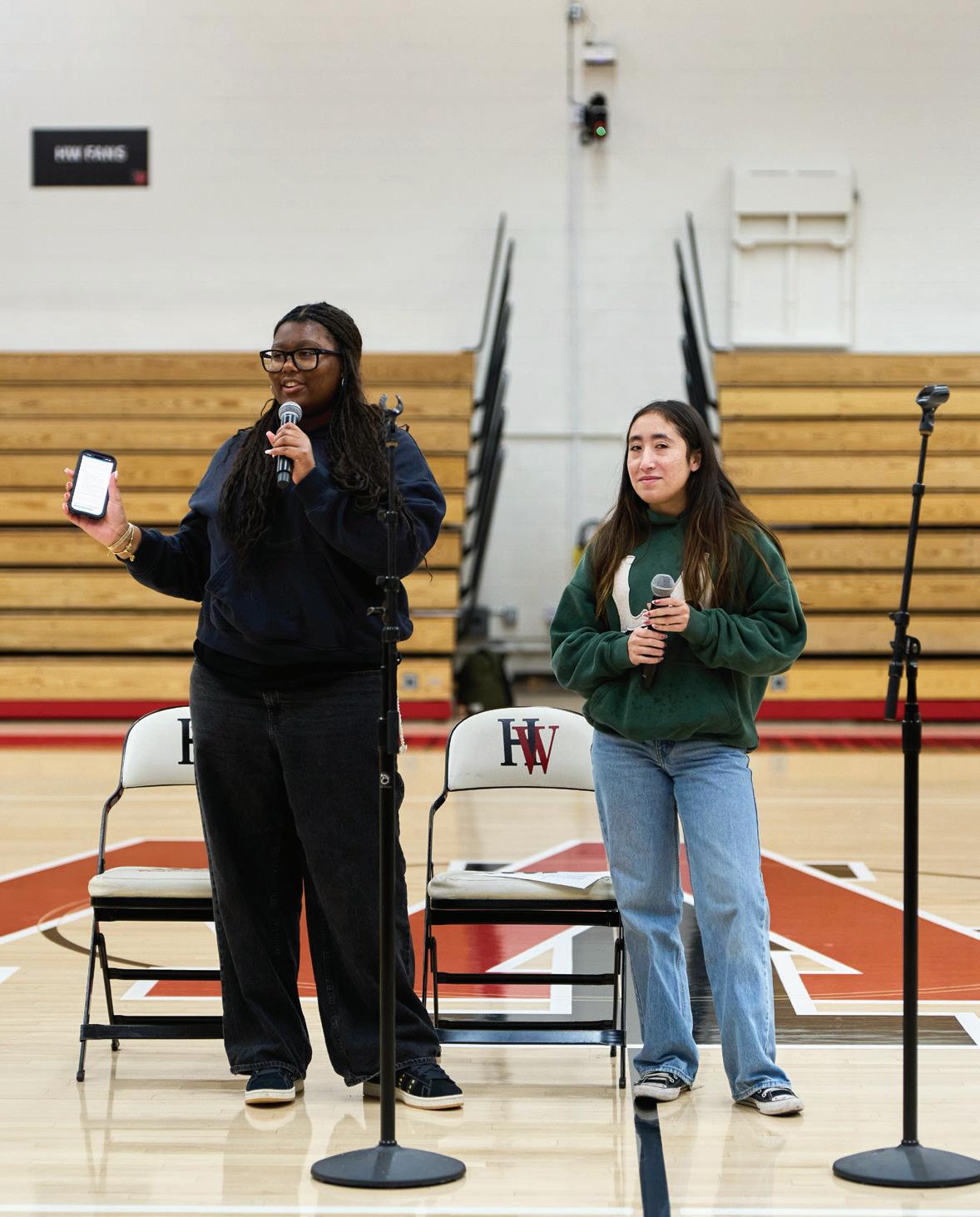
INSTLLING INTEGRITY: Prefect Council and Student Leaders for Inclusion, Diversity and Equity (SLIDE) held a student forum discussing honor and integrity at the school as the Honor Board receives an increased number of cases concerning cheating and
Prefect Council, SLIDE hold forum discussing academic integrity at school amid rise in cheating
By Holden Kim
Prefect Council and Student
Leaders for Inclusion, Diversity and Equity (SLIDE) co-hosted an all-student assembly on Feb. 19 to address a recent increase in cheating and Honor Board cases and announce policy changes.
Students met by grade, with sophomores in Rugby Auditorium, juniors in Hamilton Gymnasium and seniors in Taper Gymnasium. Rather than teachers or faculty, members of Prefect Council and SLIDE were present in each location.
The assembly opened with announcements and new policy directives outlining how the school is responding to the recent increase in Honor Code violations. These measures include stricter testing protocols, such as banning restroom access, bans on pencil pouches, prohibitions on device use and other restrictions during assessments.
This was followed by an announcement that Honor Board consequences would be more severe going forward. Prefect Council and SLIDE Chairs then opened the floor for feedback and questions. Student reactions to the new policies were mixed.
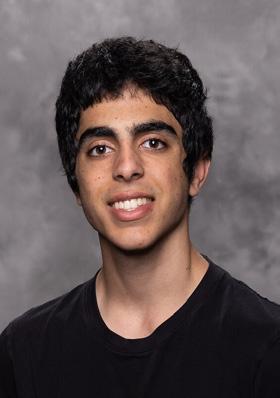
SLIDE Co-Chair Dhara Jobrani ’26 said that being surrounded by peers who cheat normalizes academic dishonesty.
“There is a serious incentive for students to cheat when the academic pressure and competition is so high,” Jobrani said. “At a school like ours, when one student cheats and does well, it raises the bar for all the other students who then feel they need to cheat as well. It is a horrible cycle that can be countered with limiting that first student from being able to cheat in the first place.”
President Rick Commons said the school’s efforts to re-
inforce academic integrity are meant to uphold an even playing field in classrooms.
“We all have the goal of protecting academic integrity and making it so that what happens in the classroom begins with trust and is fair,” Commons said. “There shouldn’t be one student who has an advantage that another student doesn’t.”
Head of Upper School Beth Slattery said an unsupervised trust-based honor system is unrealistic to effectively govern teenagers, making stricter consequences practical and necessary.
“We have to acknowledge that it’s not a reasonable expectation to have teenagers truly live in a community of honor,” Slattery said.
“And so, unfortunately, I feel as though we actually have to have more significant consequences.”
Upper School Math Teacher
Joshua Helston said the new policies initially made him apprehensive, but that he trusts that they have been implemented for good reason.
“My gut reaction is that the policy seems excessive, but I rec-
ognize that there must be a reason that it was implemented,” Helston said. “It was a shock to some of us teachers because I seem to see my class as honest. However, I understand that might not be the case for all classes, so hopefully the policies improve security for those classes.” Slattery said students already know what constitutes cheating, so the honor code itself is not the most effective tool in guiding their behavior.
“The honor code is almost besides the point,” Slattery said. “The things that students are doing, they know are wrong. They don’t need the honor code to tell them that using AI to write your papers or having your phone in your lap or writing answers on your arm are cheating.”
Nolan* said while he has reservations about the new policies, which he believes may create a more anxious testing environment for students, he hopes they will ultimately achieve the administration’s objective of making exams more secure.
hate speech on campus in recent months.
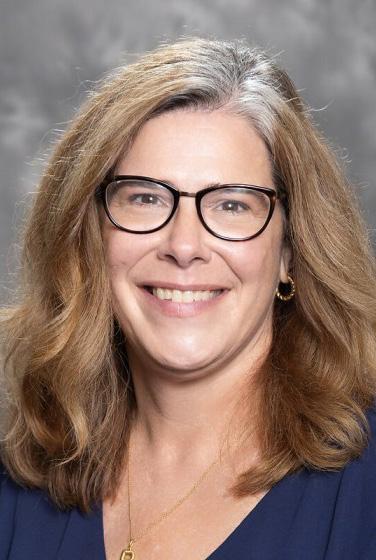
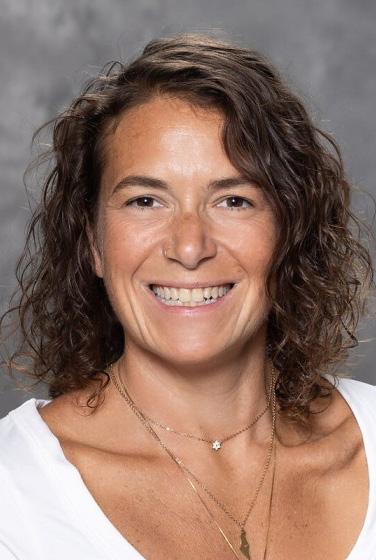
L. Wood Beth Slattery
Councils facilitate class talks
• Continued from A1
“I believe that the new testing policies will initially increase student stress,” Nolan said. “Being in a testing environment with increased security will make things more nerve-wracking. I think this view is shared by a lot of peers, which helps explain why the student assembly received mixed reception. However, I like to see the bright side of things, and I do hope that these policies accomplish their goals.”
Commons said the policy changes are protective, not punitive, and that by establishing clear expectations and meaningful consequences, the school provides students with guardrails to make better choices.
“To use a clumsy and familiar metaphor, if there were no speed limit on the highway, sometimes I would drive too fast,” Commons said. “And knowing that there’s a speed limit and that there is a consequence if I am caught driving too fast, it causes me to be safer. It’s important for us to do things that encourage students to make the choice that I believe most students want to make. I don’t believe that students start out the day saying, ‘I’m going to cheat today.’ It is the responsibility of the school to put things in place that help students to make good decisions.”
Jonah Gaetz ’27 said he encourages student representatives to pivot away from consistently advertising leniency, arguing that doing so erodes the purpose of the Honor Board.
“If the point of student representatives on the Honor Board is to get students out of trouble, then why do we have this institution at all,” Gaetz said. “If there’s going to be an institution where students can have a say in how punishments are divvied out for cheaters, then they have to be pursuing it with something resembling fairness. You can’t always give out the nicest punishment.”
ASiA celebrates Lunar New Year at school with vibrant festivities to honor culture
By Alexander Ahn
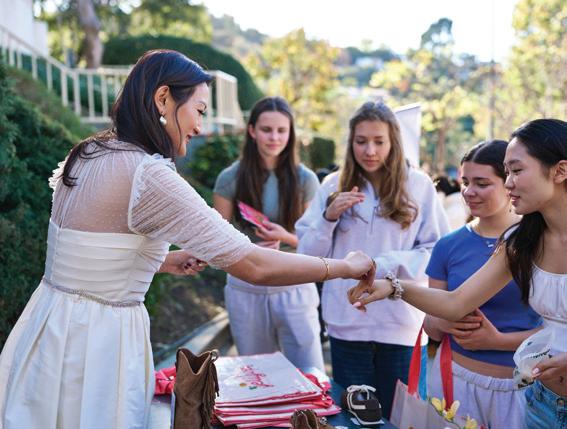
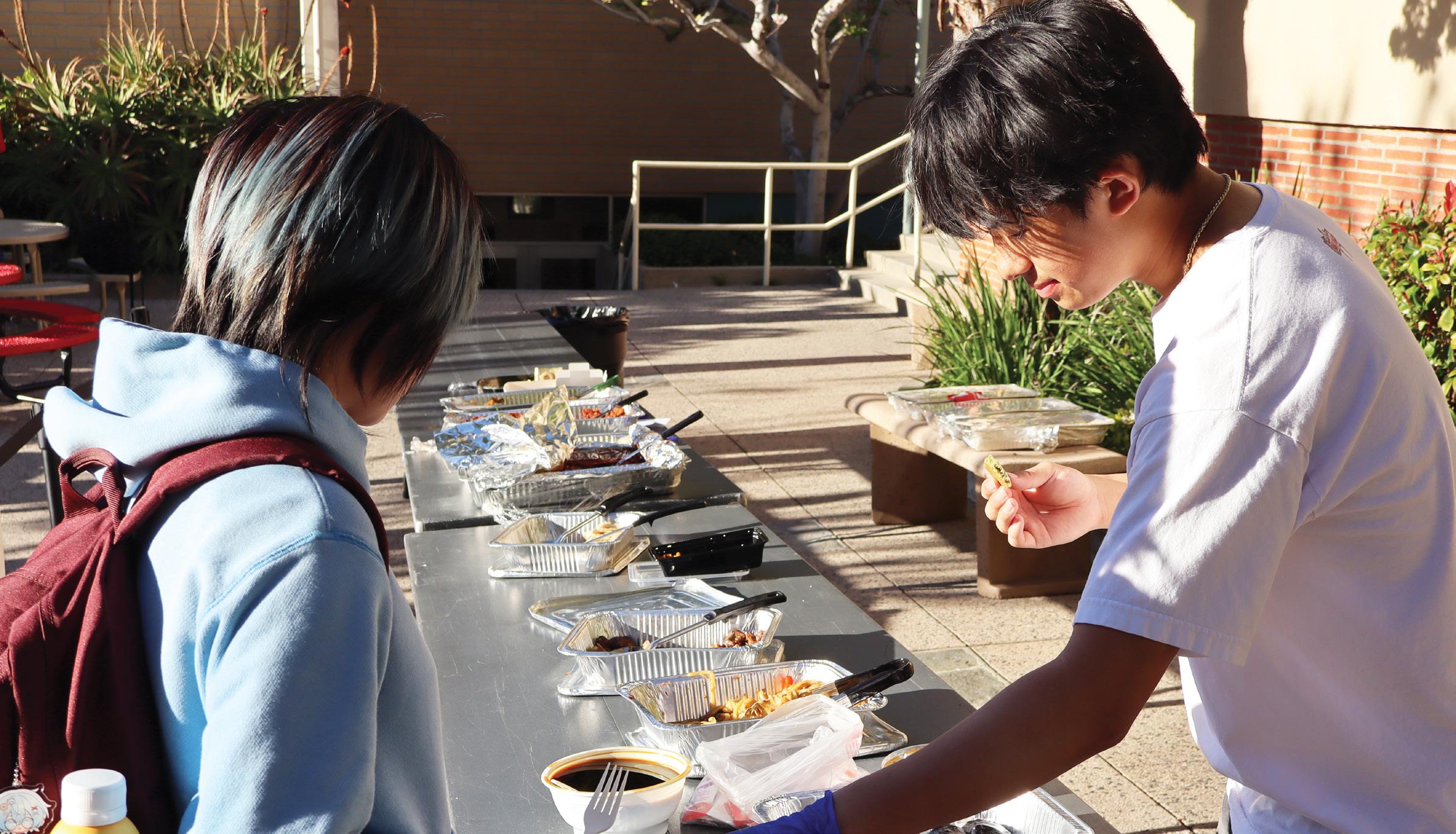
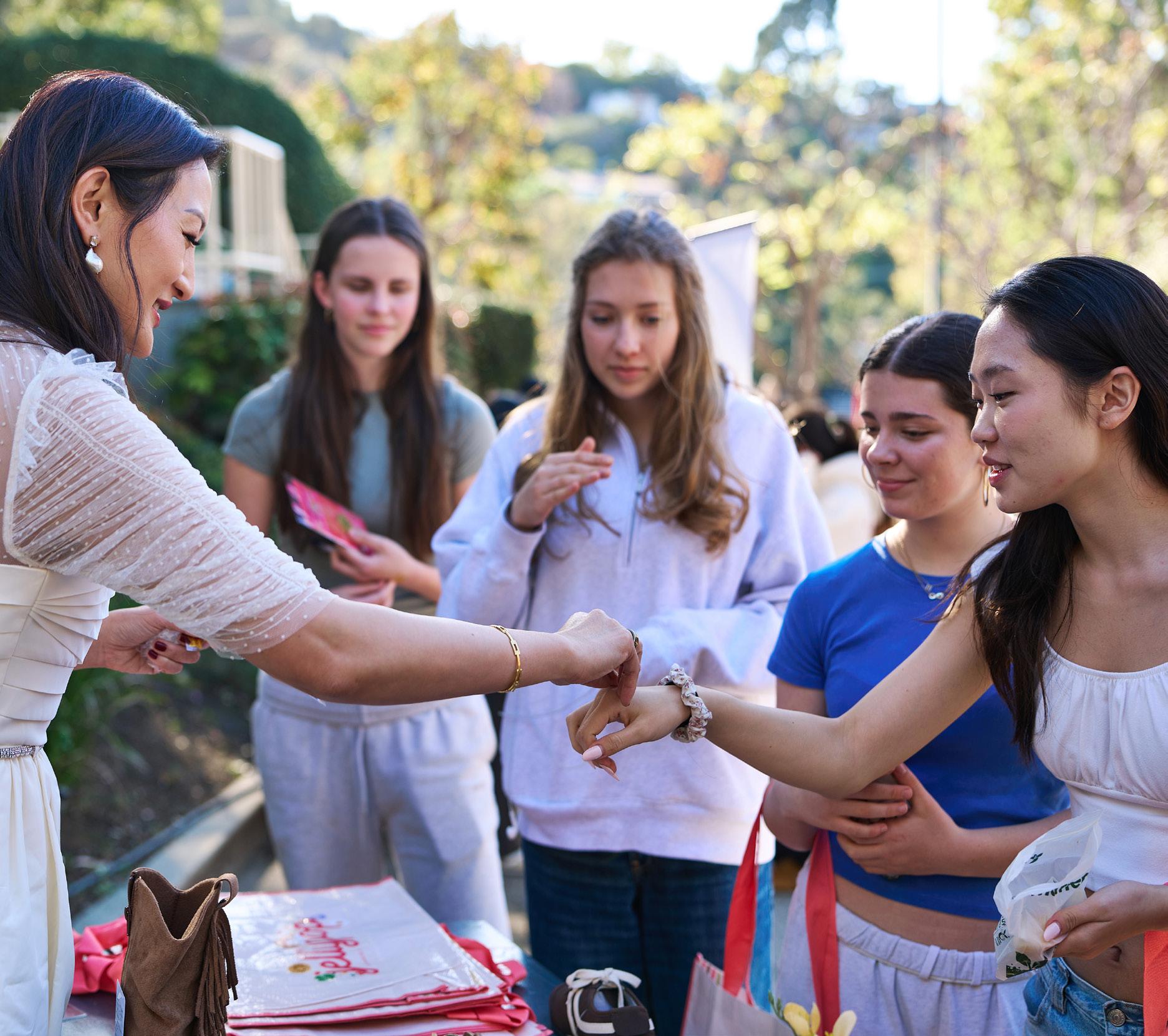
Asian Students in Action (ASiA) hosted its annual Lunar New Year celebration after school on the Quad on Feb. 23. The event featured a variety of food donated by parent affinity groups available for purchase, interactive games and prize opportunities for students to enjoy. Attendees gathered to celebrate the holiday through cuisine and community engagement. All proceeds from the event were donated to Asian Americans Advancing Social Justice, an organization that advocates for civil rights and provides legal and community support for Asian American and Pacific Islander communities.
ASiA Co-Leader Hansen Liao ’27 said club leaders wanted the event to extend beyond entertainment and encourage deeper engagement with both heritage and
advocacy efforts.
“My main goal is that students leave our celebration not only thinking about the cause we are supporting, which is immigration [rights] for Asian Americans, but also with a renewed passion for learning more about Asian culture,” Liao said. “That includes learning about the different foods each culture eats and understanding the nuances and differences between them.”
ASiA Co-Leader Emma Calista Lee ’27 said preparation for the event began well in advance and required coordination with families and community partners.
“We’ve been planning for at least two months by reaching out to parent affinity groups to help us with the food donations as well as researching what organization to donate to,” Lee said. “We are really grateful to the parent affinity
groups every year for being so generous with the food.”
Liao said holding the celebration on campus provided a meaningful space for connection, especially for students who may not be able to gather with extended family.
“It’s especially important to celebrate on campus and not just at home because international tensions involving countries like China have made it difficult for some families to connect in person the way traditions were originally practiced,” Liao said. “Without their full family community, we as the Asian American affinity group want to serve as that community at school.”
Grace Ge ’28 said she was curious about how the event would compare to her previous experiences of similar events.
“I attended the Lunar New
Year celebration this year mostly because I was pretty curious about what it would be like at the Upper School versus my experience at the Middle School,” Ge said. “The best part of the celebration was definitely the food, especially the variety of Asian cuisines like kimbap, spam musubi, pork dumplings and honey walnut shrimp.”
Judy Law ’28 said she attended the celebration to support Asian American immigration rights and connect more deeply with the campus community.
“I feel proud that I’m able to participate in such a meaningful event and do what I can to help other people,” Law said. “It enhances the sense of belonging for Asian students in the community because we see that we are represented. It was nice that foods from multiple cultures were being served.”
SLIDE hosts annual Town Halls
By Kara Jazeri
Over the month of February, Student Leaders for Inclusion Diversity and Equity (SLIDE) have hosted Town Halls. Town Halls serve as an opportunity for students to hold discussions about issues and developments pertaining to specific affinity groups.
SLIDE advisor Reb Limerick said Town Halls are essential to cultivating Diversity, Equity and Inclusion at the school.
“Town Halls are an opportunity for students of marginalized identities at the school to have their voices centered,” Limerick said.“Importantly, the anonymized notes from these town halls are brought to the SLIDE directed study, and then the students in the class compile those notes, highlight what they think is most pertinent and pressing for this year and then prepare a formal presentation to upper administrators. We’ve had a lot of concrete ideas that have come from the town halls and they have been addressed by administration.”
Olivia Davidov ’28, who attended the Middle Eastern Student
Association (MESA) x South Asian Student Association (SASA) town hall said town halls provide a crucial space for otherwise potentially uncomfortable conversations.
“As a sophomore, it was my first town hall, and I honestly thought it was really interesting,” Davidov said. “I liked hearing everyone’s different perspectives, especially from student leaders and how they handle different situations regarding identity. Everyone seemed comfortable speaking, which was really important, and the conversation felt honest. I think more meetings like this would be beneficial to the school.”
SLIDE Co-Chair Ivy Wang ’26 said Town Halls have undergone changes this year.
“Because the clubs have to meet during lunch now, there’s more crossover in terms of group collaboration,” Wang said. “Our discussions have also become more specific. For example, this year in our town halls we have a section on community response, which pertains to any complaints over how the school has reacted to certain events recently.”
Michaella Armour ’27, who attended the Black Leadership Awareness and Culture Club (BLACC) x Jewish Club Town Hall, said she enjoyed the collaboration aspect of this town hall specifically.
“It is incredible that there is a space on campus for students to be able to share and voice their opinions on what’s happening in our community,” Armour said. “Not just that, but town halls are an opportunity to discuss what students would like to do in order to create change and provide an environment to share their experiences in general. It’s great that SLIDE brings together two minorities and two perspectives to see our differences and similarities.”
SLIDE Co-Chair Nikhil Sarvaiya ’26 said a goal of SLIDE is to ensure Town Halls switch affinity group pairings each year.
“As a group, we try to mix up from year to year which groups collaborate for these discussions,” Sarvaiya said. “In doing so, we can ensure students in attendance are able to get different perspectives.” •
BUILDING COMMUNITY: SLIDE hosted February Town Halls to encourage open discussion and strengthen inclusion
LUNAR LIGHTS: Asian Students in Action (ASiA) hosted their annual Lunar New Year celebration on the Quad on Feb. 23. Students gathered to enjoy food, games and cultural activities, with all proceeds donated to Asian Americans Advancing Social Justice
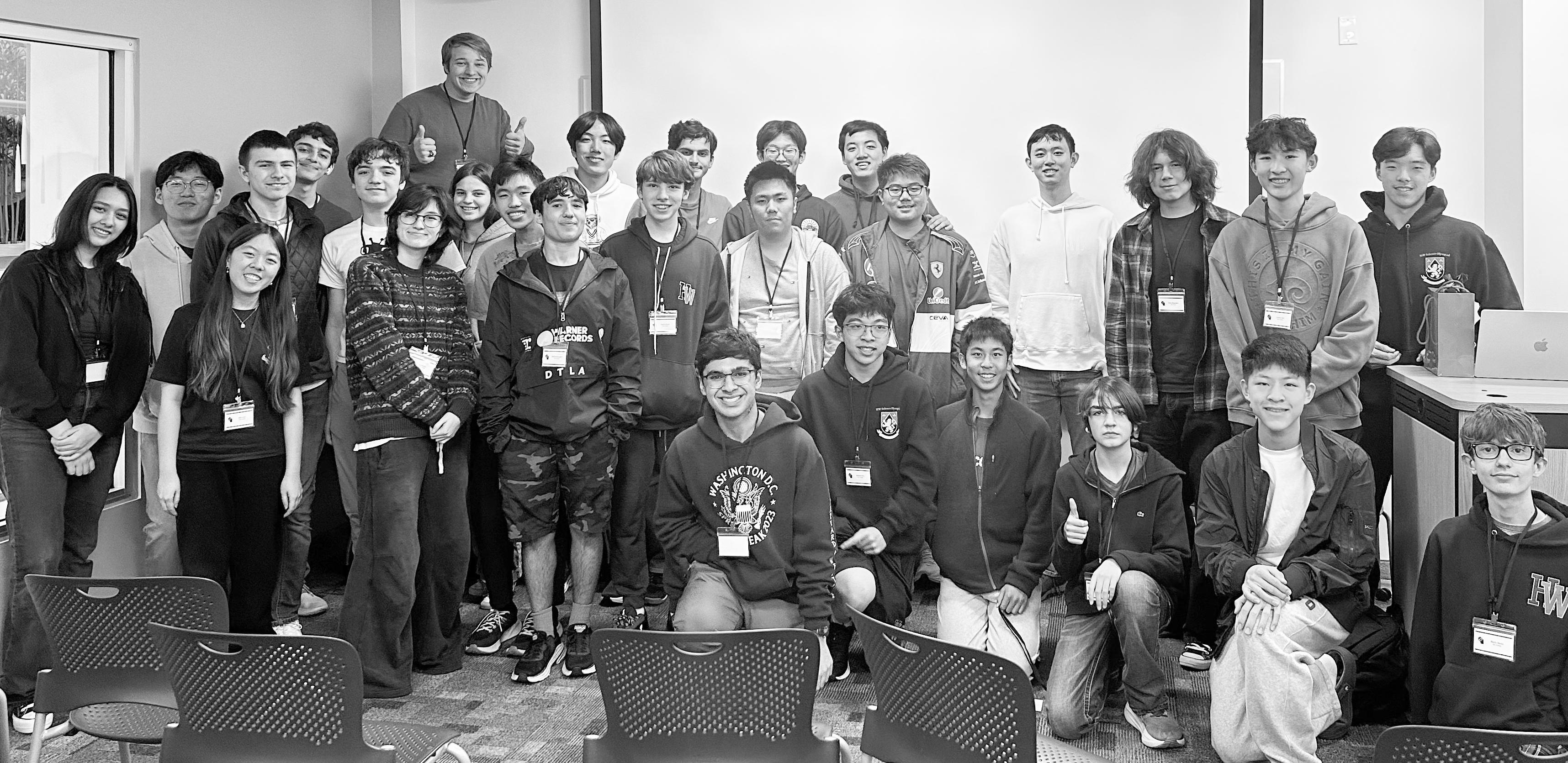
PLAY MODE ON: HackHW participants pose together after a weekend spent turning ideas into interactive worlds. Middle and Upper School students teamed up in Mudd Library to brainstorm, design and ultimately build original games during the club’s annual overnight coding challenge.
Students partake in game design challenge at HackHW’s yearly overnight Hackathon
By Claire Lee
HackHW hosted its 11th annual Hackathon in Mudd Library on Feb. 16 and 17. Students stayed at the Upper School overnight to create a playable game in 36 hours.
HackHW leader Joshua Bie ’28 said the event was a chance for students to develop coding skills while having fun.
“[Hackathon] was a great opportunity for students who are interested in coding and making their own game,” Bie said. “A lot of people learn coding just for a class and don’t know how to use it for making a real game. Hackathon was a fun event where you could make new friends while learning and developing new skills.”
Hackathon chaperone and Math Teacher Andy Stout said the event united students across the two campuses.
“Hackathon brought together the computer science community in Harvard-Westlake,
both across the Middle School and the Upper School,” Stout said. “The middle schoolers were able to get a preview of what’s to come when they come up here to the Upper School.”
HackHW leader Ellie Liou ’26 said the leaders aimed to provide younger participants with the same support they had received in the past.
“Many of HackHW’s current leaders attended their first Hackathons in eighth or ninth grade,” Liou said. “It was at those events that we found guidance from older HackHW leaders, encouragement from chaperoning teachers and inspiration from upperclassmen who were participating as well. We hope to pass on these experiences to encourage continued exploration of computer science and game development, as well as a new generation of HackHW leaders.”
Boyan Manolov ’28 said he found collaborating with friends to develop a game very
fulfilling and gratifying.
“The most rewarding part of my Hackathon experience was getting to work on a game with my friends and learning what their opinions on games were and what they focused on in games,” Manolov said. “It was also great to have a cool, fun, finished game at the end.”
HackHW leader Andrew Jo ’26 said alumni working in technology and gaming industries returned to serve as judges.
“The most interesting part of preparing for Hackathon was reaching out to alumni of the school who work in various tech or gaming industries,” Jo said. “We have some people like Josh Glazer [’96] who come back nearly every year. They bring back their experiences in professional industries and then pass along to current students what they learned in college and their careers.”
Stout said he encouraged artistic students with no experience in computer science to
YEH holds lunch packing event
By Kara Jazaeri
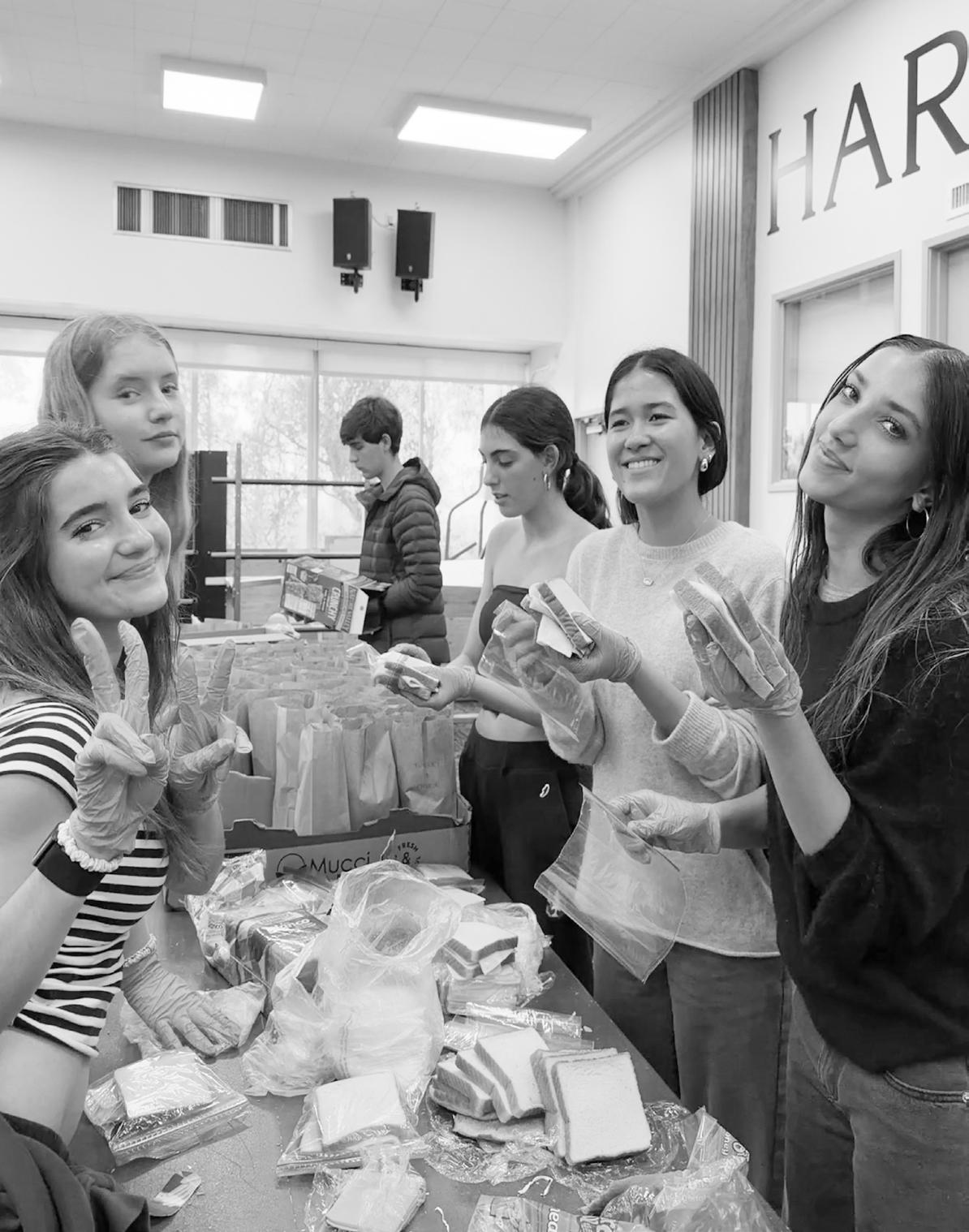
Youth Ending Hunger (YEH) Club held their fourth lunch packaging event of the year in Chalmers Lounge on Feb. 12.
YEH leader Talia Hannani ’26 said YEH works directly with nearby organizations.
“The purpose of Youth Ending Hunger is to serve our local unhoused community in Studio City,” Hannani said. “Every other week, we package 90 meals and we send them to North Hollywood Food Home Alliance. This packaging event in particular had a good turnout. We were able to complete the sandwiches and packing in 30 minutes. It was super efficient, and our assembly line worked perfectly.”
Volunteer West Flynn ’28 said YEH packaging events are an easy yet effective way to help others in need.
“The lunch packings have been amazing,” Flynn said. “It’s so fulfilling to work as a team with my peers, especially when it’s for such a great cause. I’m
so grateful that we as a school community have the ability to take such a short time out of our day to make a huge impact. Each meal we pack really makes a difference.”
Flynn said that participants meet beforehand to prepare for each event.
“We have club meetings proceeding the meal packings to prepare bags and get ready for the event,” Flynn said. “Then we meet up and pack about 100 meals with care all in the span of one hour.”
Volunteer Gali Kreiz ’28 said YEH is working on expanding their participation and packing more lunches.
“While the largest goal of YEH is to continue making lunch packs for the less fortunate and help as many people as we can, another big goal is to get as many people to help contribute as possible,” Kreiz said. “The most recent event has been at school where we made around 95 lunches for underprivileged people. We made turkey and cheese sandwiches,
gave hard boiled eggs, a dessert of some kind, granola bars and other snacks.”
Volunteer Ozzie Gray ’28 said the events help educate others on the importance of giving back.
“The goal of YEH is, as youth, to step up and help fight food insecurity by spreading awareness and taking action,” Gray said. “The club has impacted people that can’t afford food and live in rough conditions by making meals accessible to them. It’s also impacted those in our community by helping spread awareness of food insecurity. Not everyone is fully aware of the struggles that some people face just to have food on their plate, and now they want to help out.”
Gray said he hopes more people will volunteer and make a difference.
“The participation has been good, but there can always be more,” Gray said. “The more people that come, the better the lunches will be and the more people we can feed.”
Ethics Bowl team advances
By Tali Gurule
The Ethics Bowl team is set to attend the National High School Ethics Bowl tournament at the University of North Carolina, Chapel Hill from April 10-12. The team advanced to its final round of competition after performing well in the regional tournament and the divisional playoffs rounds.
Captain Esther Goldman ’26 said the team found success this year because of its cohesion.
“Our team is special because we focus on collaborating with each other and listening to each other’s ideas,” Goldman said. “We are quick thinkers. When we are in a situation we haven’t prepared for, we can adapt.”
Captain Caroline Cosgrove ’26 said that the team’s ability to approach issues from various perspectives gives them an advantage in competitions.
join the Hackathon.
“One nice thing about the game jam is that the games inevitably need art assets like characters and backgrounds,” Stout said. “I recommended that every team tries to find someone who doesn’t necessarily need to know any programming or computer stuff at all, but knows how to make art.”
Kai Nantamanasikarn ’28 said Hackathon was meaningful because it was a great chance to de-stress and socialize with students who are also interested in computer science.
“It’s not often that I get to work on side projects outside of school because homework and studying are really demanding,” Nantamanasikarn said. “This time, when I can take time to relax and spend time with others, is really nice. In addition to other groups like Video Game Design Club, this was just another great place for me to interact with people who share similar interests.”
“Our team is strong because we welcome disagreement,” Cosgrove said. “By anticipating different counterpoints, we can identify weaknesses in our own opinions.”
Team member Dylan Williams ’28 said that he has learned about various global issues in Ethics Bowl that he would not have otherwise encountered before.
“Ethics Bowl encourages me to think about topics that I wouldn’t have considered in other parts of my life,” Williams said. “We have researched prison systems, the ethical impact of artificial intelligence and social dynamics, and I can now apply that knowledge outside of my work with the team.”
Williams said that he is confident the team’s younger members, himself included, will carry on the seniors’ legacy.
“As a new member of the team, watching and participating in our competitions has helped me be ready for the future,” Williams said. “The seniors have been so supportive, and they have helped all the underclassmen improve and prepare for the years to come.”
PACKED WITH PURPOSE: Maia Blackman ’28, West Flynn ’28, Sophia Jeon ’28 and Gali Kreiz ’28 wrap lunches together with care.
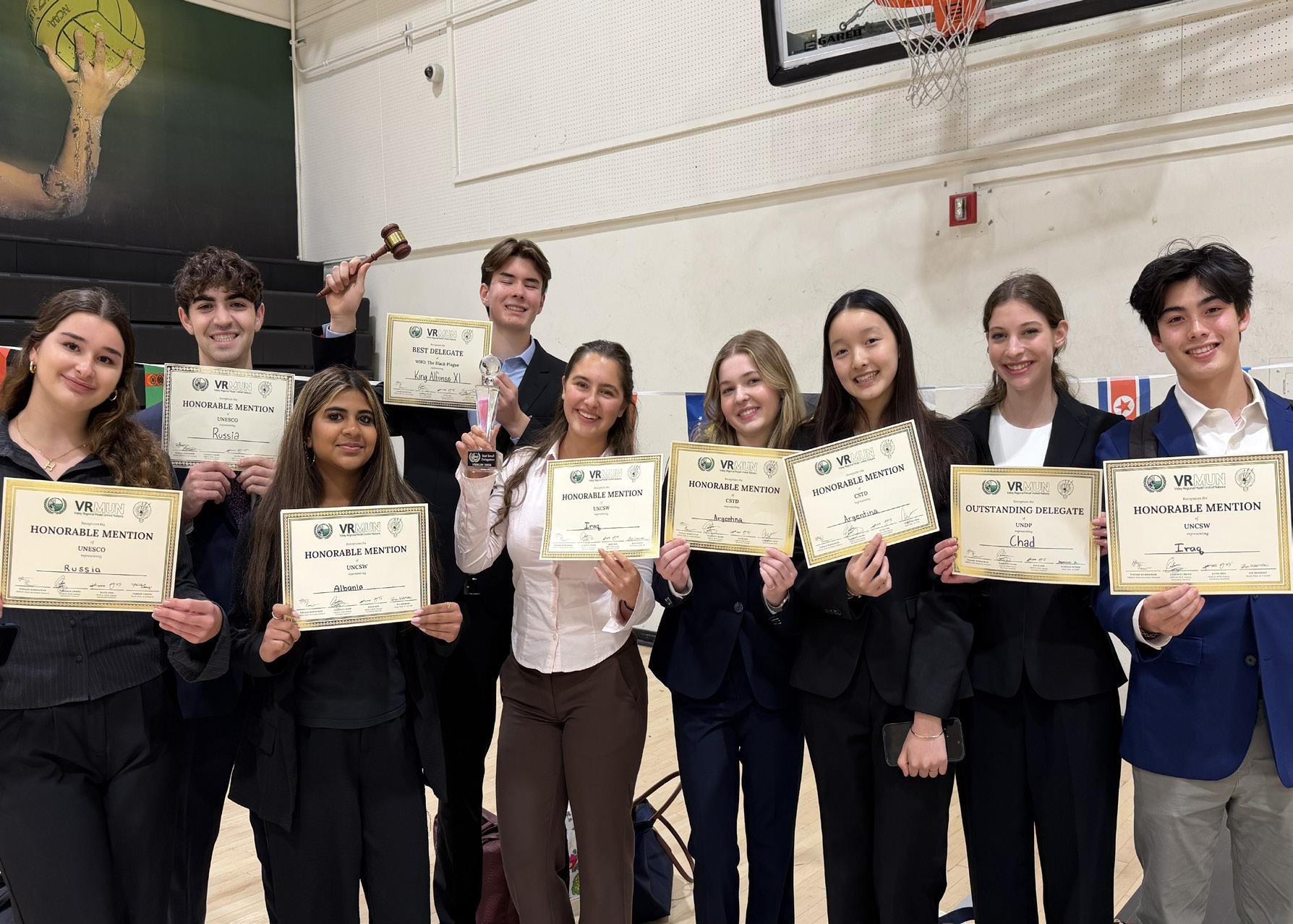
Model United Nation team performs well at a local school tournament
By Donna Enayati
The school’s Model United Nations (MUN) team competed at the Valley Regional Model United Nations (VRMUN) tournament at Grenada Hills Charter High School on Feb. 7. 12 delegates from the school competed, with the team winning “Best Small Delegation” and delegates winning six individual and partner awards. Jake Barr ’28 won “Best Delegate.” Opinion Reporter Hailey Kramar ’27 won “Outstanding Delegate.” Dhara Jobrani ’26, Sonali Muthusamy ’28, Features Reporter Donna Enayati ’27, Jonah Greenfield ’27, Hayley Ross-Settineri ’27, Jack Fener ’27, Isabella Chiang ’28 and Ella Hammelman ’28 received an honorable mention.
Delegate Isabella Chiang ’28 said she is glad she won an honorable mention award at the conference and enjoyed competing with her partner.
“My experience at the conference was great,” Chiang said.
“My partner and I had a lot of fun working together. It felt really good to win, especially because it was only our second time at a conference. We were happy that all of our hard work paid off.”
MUN Secretariat Dhara Jobrani ’26 said he enjoyed mentoring a newer member of the team.
“VRMUN is always a great conference, and, this year especially, I really liked it,” Jobrani said. “I had a great time because I was also partnering with a rookie, someone who I’d never worked with before, and she was great.”
School hosts annual Career Fair on Quad
By Angel Song
Global Leadership Organization of Business & Education (GLOBE), an affiliate of HW Works, hosted the annual Career Fair on the Quad after school on Feb. 13. Students were able to visit each of the booths where organizations including Beacon in the Cosmos, H Foundation for the Arts, HOM, Joy Market, Project Releaf and Two Ten were tabling. The Career Fair was meant for students to learn about various career paths and explore potential internship opportunities with both school clubs and local companies.
GLOBE President Katelynn You ’26 said she enjoyed working with the rest of the leadership team and experienced fulfillment watching students interact with professionals tabling at the fair.
“Other than getting to be part of a team that consists of some of my favorite people,
my favorite part was seeing students genuinely engaged in conversations with professionals,” You said. “Watching people ask thoughtful questions and exchange contact information made all the planning so worth it. It felt incredibly rewarding to see connections forming in real time.”
Joy Market Leader Abbie Her ’27 said she initially hoped to gauge sophomore interest in her club, which is seeking to address local food insecurities, through the Career Fair.
“Mr. He reached out to me regarding a spot in the Career Fair after he saw me advertising for Joy Market at the Activities Fair,” Her said. “My initial goal was to get more students, specifically incoming sophomores, exposed to our club after the leaders — Max, Reagan, Sebastian, Barron and I — discussed the future of our club post-graduation.”
Board Game Club hosts Upper School’s fourth ever board game night
By Madison Shen
The Board Game Club (BGC) hosted its fourth board game night on Feb. 20 from 3-8 p.m. in Mudd Library. The event created a space for students to relax and have fun after school, and included a wide variety of board games along with Joe’s Pizza and snacks.
BGC leader Joshua Massey ’26 said he was inspired to begin hosting board game nights on campus after hosting parties at his own home.
“After hosting parties at home where we invited people over and played a bunch of board games, we realized that we could do something like this,” Massey said. “We could do what we normally do at home, but [on campus] with funding and a better location.”
expected. These usually get decent turnout, but nothing on either end of the extremes.”
Massey said he enjoys hosting board game night because he can play his favorite board games.
“My favorite game that I repeatedly play is Seven Wonders,” Massey said. “I try to teach [my friends], but it’s a little complicated, so they refuse to learn. The thing about my favorite game is that I win and nobody wants to play with me twice.”
Board game night participant Sophia Cohen-Pelletier ’26 said she attended board game night to hang out with friends and meet new people.
Sonali Muthusamy ’28 said she liked meeting people from different schools.
“This was the first award I ever won, which was really exciting for me,” Muthusamy said. “Going in, I was thinking even if I don’t get an award, it’s going to be fun because I’m going to try my best and when I won I was super happy.”
Chiang said she practiced skills that she plans to carry with her outside of Model United Nations.
“I learned a lot about public speaking skills and how to speak confidently in front of others.” Chiang said. “I also learned how to lead conversations with other delegates and make sure everybody’s voices were heard.”
• Continued on hwchronicle.com
Since hosting their first board game night in 2024, attendance has grown and more students have shown interest in playing board games.
“We always get twice the amount of people relative to how many people go to the club,” Massey said. “Last year, about eight people went every day, but, this year, 12 people come to the club every day. We expect about 24 attendees based on the RSVPs.”
Student Library Advisory Committee (SLAC) member Barron Linnekens ’ 26 said SLAC helped plan the event and that the turnout met their expectations.
“I assume that, if Board Game Club continues next year, we will host a game night again,” Linnekens said. “The event was about what we had
“I’ve been going to board game club for three years now and have a lot of friends that go as well,” Cohen-Pelletier said. “I decided to attend board game night because I wanted the chance to have a night off, spending time with my friends. Board game night is a really good opportunity to relax and have fun with your friends. You might also end up playing games with people you don’t know as well, and bond through those games.”
Board game night participant Sally Ramberg ’26 said she enjoys being a part of BGC.
“I know that when I go to college next year, my life will be sad, empty, dry, miserable and I’ll feel nothing but sadness knowing that never again will I attend Board Game Club,” Ramberg said.
BGC meets every Day 3
DELEGATES DOMINATE: Students of the school's Model United Nations team pose for a photo holding awards after a strong performance at the Valley Regionional Model UN tournament at Grenada Hills Charter High School.
L. Wood Joshua Massey '26
Empower hosts a Valentine’s Day “kissing booth” event on Quad to raise awareness around consent
By Kara Jazaeri
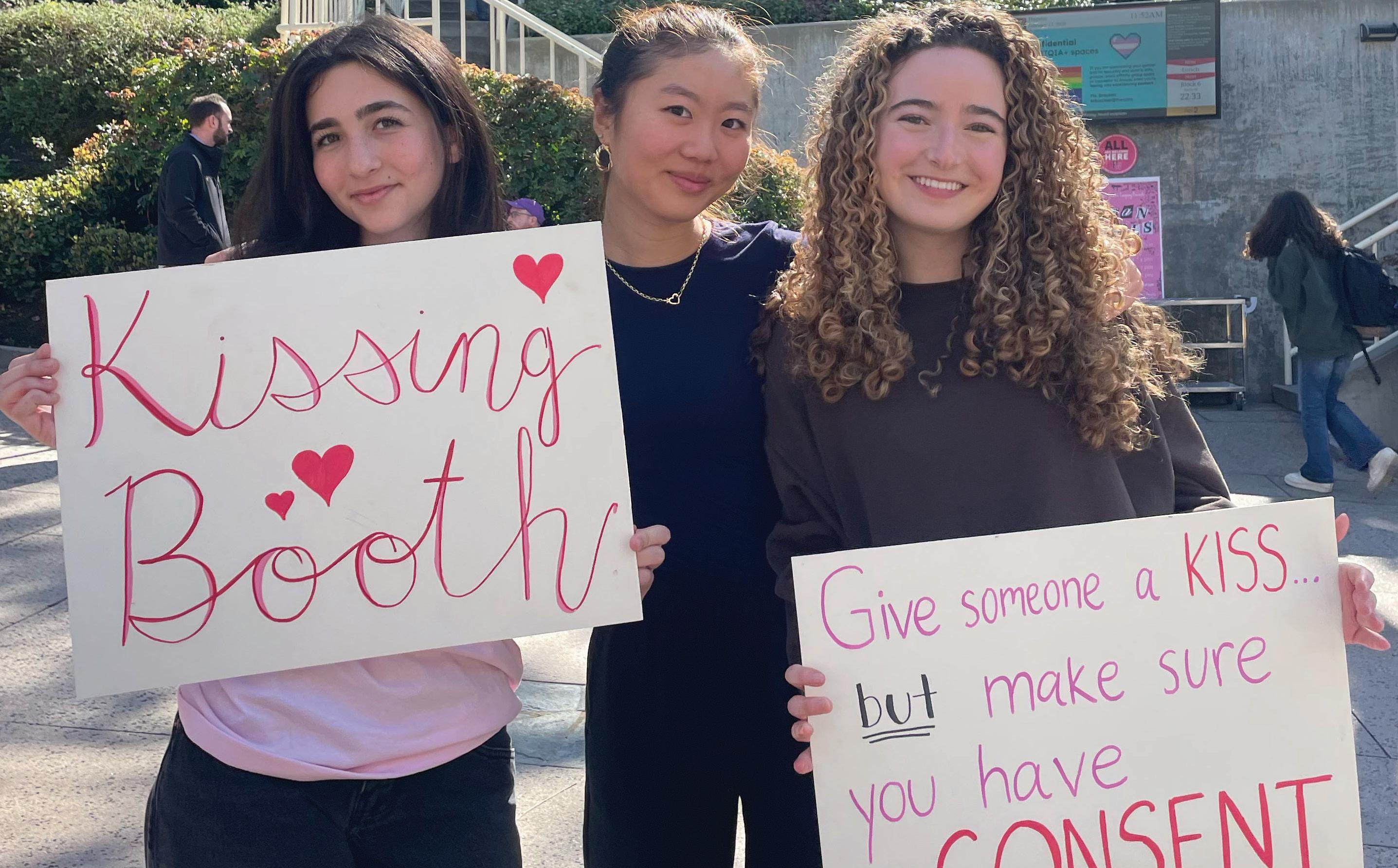
The Empower affinity group held a “kissing booth” event on the Quad to raise awareness around the importance of consent on Feb. 12.
Empower Advisor Nicole Stahl said the event was an interactive way to remind students of the importance of consent.
“The purpose of holding the ‘kissing booth,’ an event where Empower handed out chocolate kisses while practicing mutual consent, was to playfully remind their peers about the serious issue of gaining consent prior to engaging in any physical interaction,” Stahl said.
Empower leader Agatha Davies ’26 said the leaders took engagement into consideration when planning the event.
“We thought it was important to have a visual demonstration of what true enthusiastic consent looks like and how it can be employed in relationships,” Davies said. “Especially in high school, it’s really important that people know what consent looks, sounds and feels like. There’s a very clear line between what is consent and what is not, so raising awareness about that issue was the larger significance of the event.”
“
lessons but also in the wider culture of high school.
In high school, it’s really important that people know what consent looks, sounds and feels like.
”
Agatha Davies ’26
Wellness Director Marci Reichert said the idea of consent is something that should be implemented not only in health
“High school is a critical window,” Reichert said. “National data consistently shows that a significant number of sexual assaults occur between the ages of 15 and 24, and the transition to college can be an especially vulnerable time. If students leave high school without a strong understanding of consent, communication and bystander responsibility, we’ve missed an important opportunity to prepare them. Talking about consent once isn’t enough. Repeated conversations help stu-
Student Mental Health Alliance hosts its Valentine’s self-love event on the Quad
By Abby Ryan
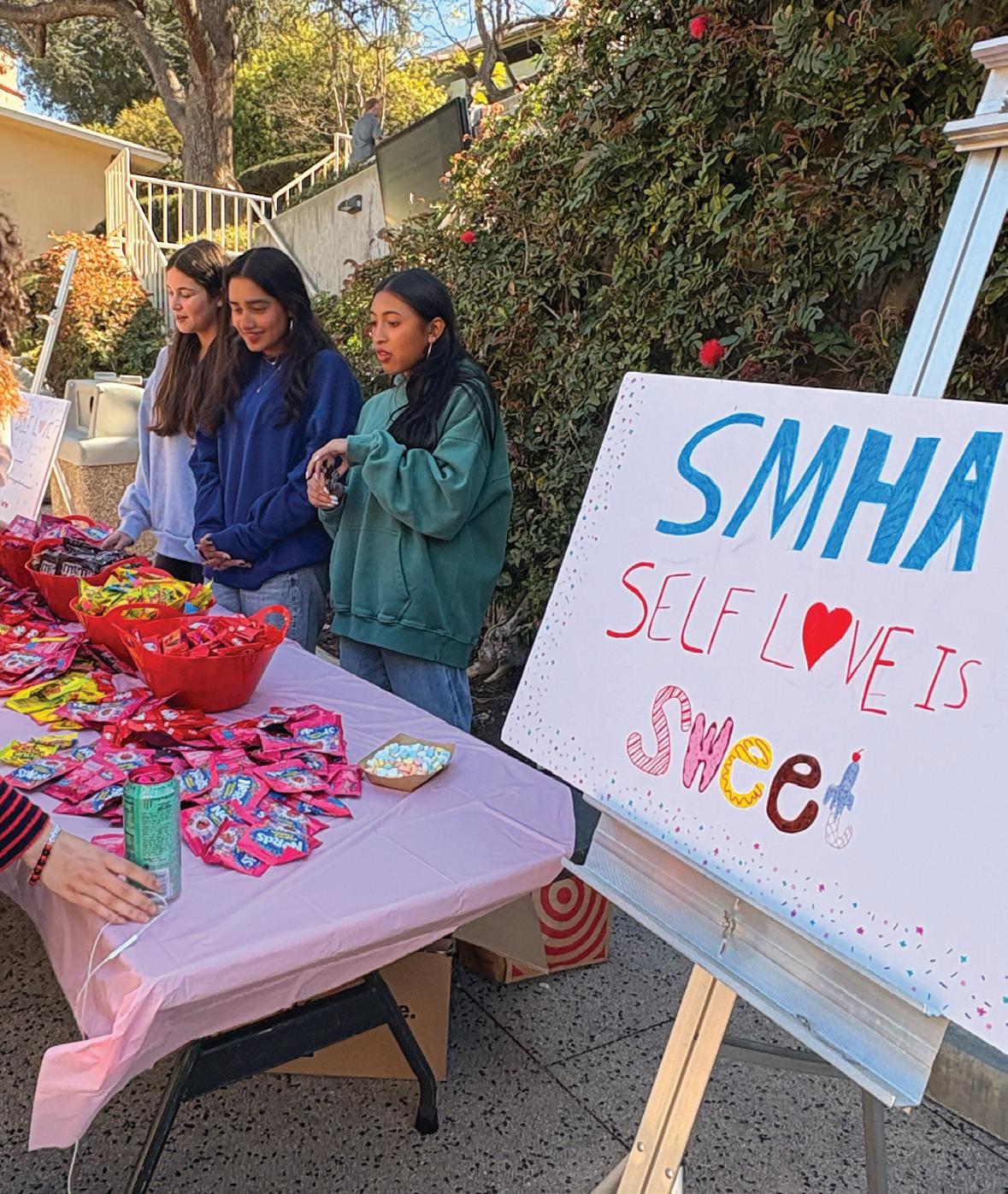
The Student Mental Health Alliance (SMHA) hosted a selflove activity on The Quad on Feb. 13. Students wrote qualities about themselves that they love on notes and received free candy from a candy station.
SMHA member Sophie Chang ’27 said she appreciated how the activity gave people the opportunity to take a moment to acknowledge their value.
“My favorite moment of the event was just seeing the responses to what everyone loved about themselves,” Chang said. “It was great to see everyone kind of take that moment for themselves because self-love is often overlooked and it’s a really important form of love.”
SMHA member Simren Bindra ’27 said she liked seeing how excited people got when they saw the candy.
“I helped plan this event by organizing what candy we would be having at our candy bar,” Bindra said. “Seeing people love the fact that the candy was free and also writing something they love about themselves was really sweet. In the end, we basically ran out of candy and had a wall of paper filled with little cards of what people love about themselves.”
SMHA Publicity co-leader Mattin Tasbihgoo ’27 said the activity was successful.
“The event went really well overall,” Tasbihgoo said. “We had a lot of people write things that they loved about themself. The paper with all the notes about something they love about themself was massive. I was worried that we almost didn’t have enough space.”
School Counselor and SMHA club adviser Michelle Bracken said the point of the event was to
promote self confidence.
“Mental health isn’t just about psychological disorders or depression,” Bracken said. “Taking care of ourselves and loving ourselves is actually really important and is part of our mental health as well.That was the main message and that’s what came across to students.”
Bindra said she enjoyed seeing the trade of candy for notes, and how it got teachers and students to think about themselves positively.
“My favorite moment of the event was when me and some other members of SMHA began handing out little bags of candy and, in exchange, asking people on The Quad to write something they love about themselves,” Bindra said. “Additionally, we got a lot of teachers to write what they love about themselves, and seeing the joy of them receiving a bag of candy was really sweet.”
BLACC hosts law professor
By Holden Kim
The Black Leadership Awareness and Culture Club (BLACC) welcomed Howard University School of Law Professor Lucious Outlaw III to Mudd Library for a speaker event on Feb. 18. Outlaw discussed the treatment of hip-hop and rap artists in the American criminal justice system in front of 18 students and faculty.
Outlaw described what he called a troubling intersection between artistic expression and American justice, pointing out that prosecutors across the country have introduced musicians’ lyrics as evidence against them in court, treating creative work as evidence of criminal character or intent. This practice, Outlaw argued, invites juries and judges to infer character, and even culpability, from an artist’s creative output rather than from conduct. Outlaw warned this may skew proceedings and tilt cases toward unjust prosecutions.
dents build confidence, practice language and internalize expectations. When consent becomes part of everyday dialogue — not a one-time assembly — students are better equipped to make healthy choices, support their peers and enter college and adulthood with a strong foundation for respectful relationships.”
Summer Park ’27 said the event helped normalize conversations about consent.
“By drawing students in with the ‘kissing booth’ idea and Hershey Kiss chocolates, it helped make the topic feel approachable rather than awkward or uncomfortable,” Park said. “It went well because it successfully grabbed attention, got people to stop, engage and spread awareness in a positive, memorable way.”
BLACC Leader Morgan McGinnis ’27 said many students connected with Outlaw’s presentation because some of the music and courtroom battles he cited involved artists and stories they followed in real time.
“Outlaw used statistics from recent studies examining how hip-pop is perceived by juries,” McGinnis said. “This resonated with students, especially because of hip-hop’s strong influence and relevance in our lives. On social media, we see rappers’ legal struggles and imprisonments widely discussed.”
BLACC Leader Sacha Wiley ’26 said the event reflected one of the club’s wider aims of bringing timely conversations to campus while boosting engagement from a diverse audience.
“I hope events like this will increase our engagement and draw in more crowds with different interests,” Wiley said.
CONSENT MATTERS: Empower leaders Mira Goldman ’27, Isla Saperstein ’27 and Summer Park ’27 pose with signage from Empower’s most recent event centered on consent. Students took a Hershey Kiss and practiced asking their peers for consent during this Valentine’s Day themed event.
Science Olympiad team earns spot at state-level contest
By Alexander Ahn
The Science Olympiad Team
A, the Axolotls, qualified for the Southern California State Tournament after placing third at the Los Angeles Pasadena City College Regional on Feb. 7.
Science Olympiad is a national Science, Technology, Engineering and Math competition in which teams compete in a series of studybased, lab-based and engineering build events across various subjects including biology, chemistry, physics, earth science and engineering. Teams earn points based on their final places in each event, and the highest-scoring teams are ultimately able to advance to the state tournament.
ing closely with her partner strengthened her understanding of the material ahead of competition day.
“ That moment felt incredibly rewarding, and celebrating our shared success as a group made all the work feel worth it.”
Carina Wu ’27
“I competed in Designer Genes at regionals,” Wu said. “I prepared for the competition by studying through the guide with my partner and also making a new guide for the words we didn’t understand. We came up with examples to further our understanding and also did practice tests to properly prepare.”
Science Olympiad leader Mark Dai said effective collaboration and structured preparation were critical to the team’s performance at the competition.
First-place winners included Mark Dai ’26 and Mike Dai ’26 in both Boomilever and Helicopter, Amelia Zhang ’26 and Brandon Hui ’26 in Designer Genes and Troy Goodgame ’26 and Mira Goldman ’27 in Materials Science.
Second-place winners included Goodgame and Donovan Brown ’28 in Astronomy, Mark Dai and Matthew Ren ’26 in Electric Vehicle, Goodgame and Brown in Remote Sensing, Deen Sattar ’28 and Samuel Wang ’28 in Robot Tour and Zhang and Emma Tran-Lee ’26 in Water Quality.
Fourth-place winners were Zhang and Hui in Anatomy and Physiology, Mark Dai and Ren in Bungee Drop, Carina Wu ’27 and Olivia Zhu ’28 in Disease Detectives and Mark Dai and Ren in Engineering Computer-Aided Design.
Fifth-place winners included Jackson Sunwoo ’27 and Brown in Dynamic Planet and Mark Dai and Ren in Hovercraft.
Sixth-place winners included Goldman and Tran-Lee in Chemistry Lab, Sunwoo and James Corman ’27 in Entomology and Wu and Zhu and Mike Dai in Experimental Design.
Isabelle Wu ’28 said work -
“What contributed most to our success was the strong connections between partners and our ability to work well together,” Dai said. “Frequent practice tests allowed us to consistently train within competition environments, so the feeling of stress and pressure did not come as a surprise. Through these moments, members and partners learned how to divide work, focus on efficiency under time constraints and perform effectively through communication, practice and accountability.”
Carina Wu ’27 said the awards ceremony felt meaningful to her, considering the months of preparation and practice that took place before touranment day.
“It truly hit when the tournament director said ‘Harvard-Westlake,’ and our team stood up together, gathered and walked up to receive the recognition,” Wu said. “That moment felt incredibly rewarding, and celebrating our shared success as a group made all the work feel worth it.”
Following their performance at the regional competition, the Axolotls will be advancing to the Southern California State Tournament taking place at the California Institute of Technology (Caltech) on Apr. 11.
Students receive complimentary chocolate in Chocolate Day event
By Hailey Kramar
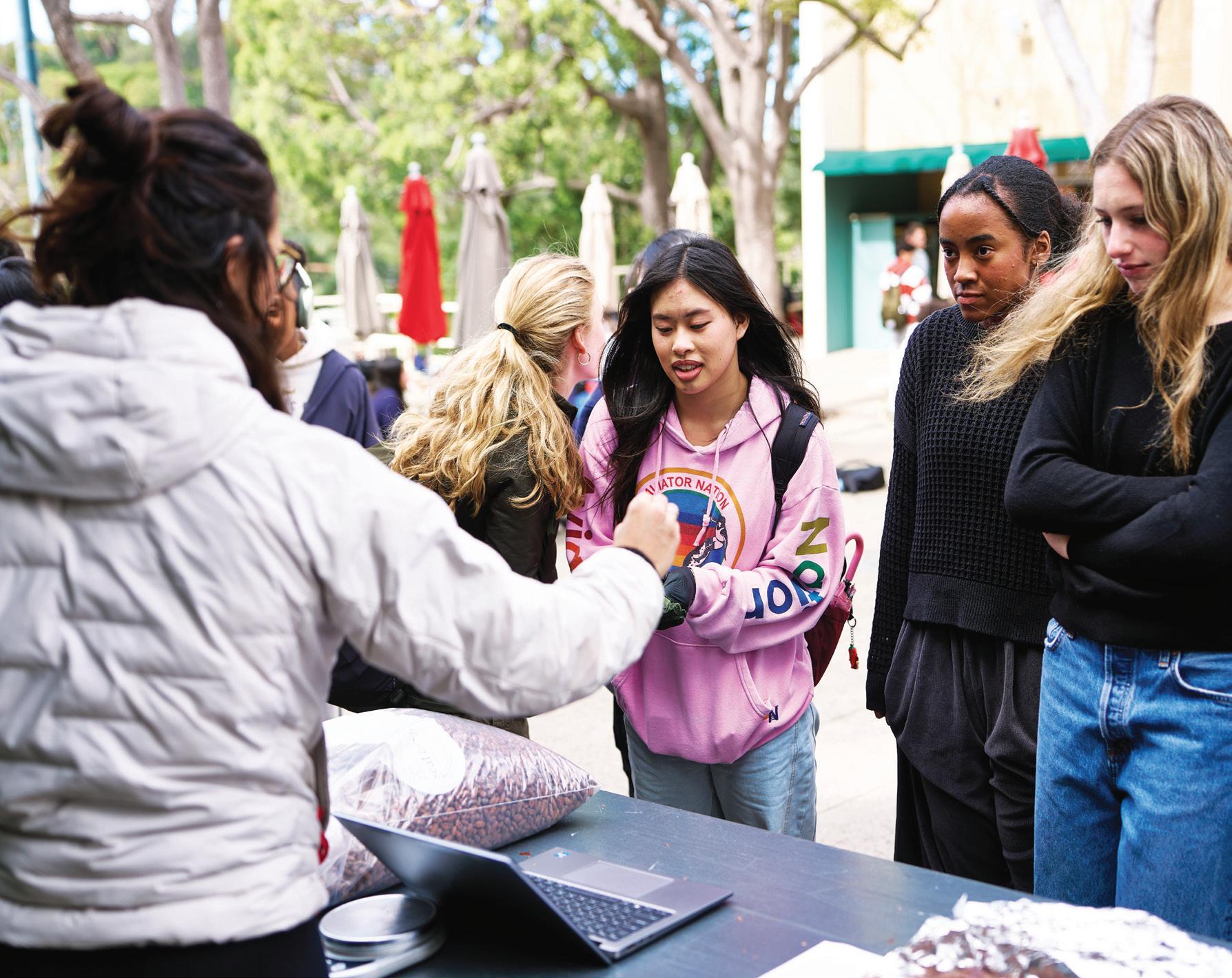
The Interdisciplinary Teaching Cohort organized an event called “Chocolate Day,” where classes from different departments incorporated chocolate into their lessons for the day. Additionally, there were interactive tasting stations hosted by faculty on the Quad on Feb. 19-20.
World Languages Chinese Teacher Bin He said this day prepared students to use multiple subjects in future jobs by incorporating chocolate into various classes.
“We want to give our students a little bit of experience of how it exactly feels to learn different subjects under one theme,” He said. “Like when you go to real work or start your job, subjects are always combined.”
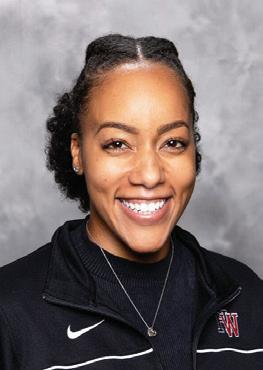
Athletic Director and Diversity and Equity and Inclusion Specialist Chelsea Heyward said that chocolate was used as the pilot because it is applicable to many subjects.
“If they were to do a history event, it might be hard to find a connection through science or through visual arts,” Heyward said. “But chocolate is something kind
of universally known and appreciated by most.”
He said the faculty chose chocolate as the first topic because it can be added into different classes.
“It should be a theme for different classes,” He said. “This way, teachers can easily use those items to start the class to incorporate it into their classes.”
Math Teacher Andrew Theiss said the repetition of learning about chocolate in multiple classes can engage students.
“Teachers can still teach to the best of their ability,” Theiss said. “It will hopefully give the students a more harmonious experience for a couple of days because they’re all going through class and hearing the same topic in every class.”
“We need to spice this up because in life, we are all touching each others’ topics.”
Heyward said she has worked to include athletics in the event and to raise awareness of the interdisciplinary aspect of the day.
“I’ve been helping with getting athletics involved,” Heyward said. “I’m working on a one-pager to have at the table for the activities, so that people know all the ways that chocolate intersects with the different departments at this school. Heyward said that students can participate by providing feedback about what topics would be exciting for future interdisciplinary events.
Theiss said that everyday life requires multiple skills from different classes, and that by teaching students in this way, they will become more committed.
“Education moves at a glacial page and everyone has been teaching this way forever,” Theiss said.
“Students can get involved by sharing more feedback with the teachers and faculty and staff about what would be helpful or what fun topics might be engaging in the future,” Heyward said. “Also, students should share if they have any ideas on how to improve it.”
Presidential scholar candidates out
By Angel Song and Nicole Um
Six seniors were recently named as candidates for the Presidential Scholars Program. Established in 1964, the program recognizes graduating seniors nationwide who demonstrate exceptional performance in academics and leadership. While the majority of students receive recognition based on standardized testing scores, students may also be selected based on their scholarship in the arts or the career and technical education fields. The candidates this year are Lisa Cheng ’26, Kai Kuklinski ’26, Nikhil Sarvaiya ’26, Jiaqi Wu ’26, Darren Yilmaz ’26 and Amelia Zhang ’26. Following this candidate announcement, approximately
650 students will be named as semifinalists and forwarded to the next step of the program’s scholar selection process.
Zhang said she was initially caught off guard by the news because of the unexpected nature of the recognition, but is still thankful for the honor.
“I was not sure how to react,” Zhang said. “I was surprised that my [standardized test scores] were considered to be that high, and I did not know I was a candidate until someone told me. Nevertheless, I am quite pleased.”
Kuklinski said he is appreciative of the acknowledgment, as he views it as a meaningful byproduct of his academic endeavors throughout high school.
“I felt pretty gratified knowing that I got selected because of my [standardized test score],”
Kuklinski said. “It’s not that big of a deal to me, but knowing there can be unintended results of your hard work makes me feel good.”
Sarvaiya said he is still grateful to have received the unexpected recognition from the program.
“I hadn’t heard of the Presidential Scholars Program until I received a letter,” Sarvaiya said. “Regardless, I am happy to have been nominated.”
Zhang said she views the honor to be closely tied to her standardized test results.
“As I understand it, this is an extension of my standardized testing score,” Zhang said. “Since I already received my standardized testing scores, I don’t really have a lot of emotions about this recognition.”
CRAZY FOR CHOCOLATE: Sophie Chang ’27, Kale’a Tindal ’26 and Dylan Fischer ’26 receive free chocolate. Teachers part of the Interdisciplinary Teaching Cohort incorporated chocolate into their curricula for Chocolate Day.
L. Wood
Chelsea Heyward
School hosts second-semester club fair for students on Quad to show new organizations
By Abby Ryan
Prefect Council hosted the second semester Club Fair on the Quad on Feb. 24. Club leaders set up booths to encourage students to join new clubs.
Prefect Alex Yang ’28 said he asked to host another club fair following the first semester club fair after realizing how many new second semester clubs there were.
“We had a club fair in the fall, and with all the new sophomore clubs, I thought we should definitely have another club fair,” Yang said. “I proposed the idea to Mr. Church, and he thought it was a great idea.”
Founder of Future Health Professionals Club Kirana Tjoe ’28 said the most difficult part in preparing for the event was adapting to schedule changes.
“I prepared by purchasing baked goods to make my table more appealing, and made a trifold,” Tjoe said. “A challenge was the rescheduling, as it was supposed to be the week before, but it got rained out, so I had to plan around it.”
Riley Romans ’27 said she liked finding new students with the same passions as her.
new people.”
Margaux Schlumberger ’27, who attended the event, said she enjoyed being able to see all the new clubs and interact with their members.
“
We had a club fair in the fall, and with all the new sophomore clubs, I thought we should definitely have another club fair.”
“My favorite part of the club fair was seeing everyone’s hard work come to life through all the new clubs and creative ideas,” Romans said. “It was also great to reconnect with familiar faces while meeting so many
Alex Yang ’28
“The secondsemester club fair was fun to walk around in because it was a smaller event,” Schlumberger said. “Because there were fewer clubs, you had the chance to really look at each of the tables and talk to the leaders about their goals.”
Tjoe said she admired how many people wanted to find out more about her club and signed up.
“My favorite part of the club
Chinese New Year luncheon held
By Emmeline Chan and Madison Chen
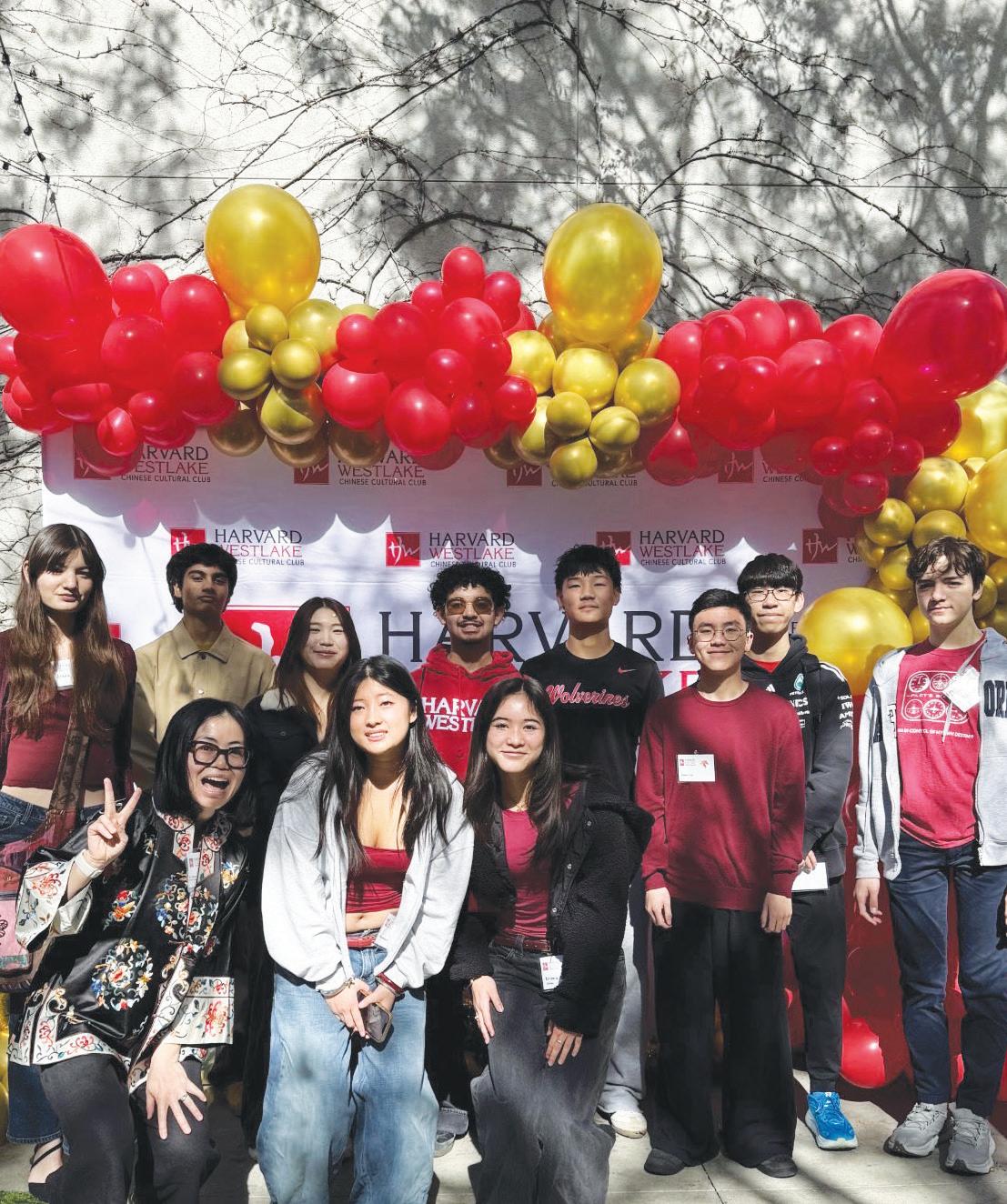
The Harvard-Westlake Chinese Cultural Club (HWCCC) hosted its annual Chinese New Year Luncheon to celebrate the Year of the Horse on Feb. 22 at Luxe Hotel in Brentwood. The event included a traditional Chinese dragon dance and student performances from each Chinese language class, featuring singing, dancing, and informational videos. HWCCC, a Chinese affinity group composed of teachers, administrators and parents, host events throughout the year to bring the community together. The luncheon was previously held at the Skirball Center, but this year was switched to the Luxe Hotel.
World Language Teacher Li Sun said the location was changed with the intention of making the event more intimate.
“The Skirball venue is a little too big, and [the committee] wanted a smaller venue to make
the experience feel more close and personal, and also to better utilize the space,” Sun said. “The catering setup at Skirball was getting a little complicated, so we have a new venue this year.”
Sun said the luncheon is the biggest event hosted by HWCCC in the school year, allowing the community to come together and celebrate the New Year by participating in different activities.
“At the event there are different booths set up to play games to win prizes of whatever zodiac animal that year is,” Sun said. “There are lion dances and the leaders of the parent group make a speech. Then the students’ performances start.”
Owen Fua ’28 said he had fun performing a song with his classmates in Chinese II, Chinese III and Honors Chinese III.
“We performed [Moonlight] by [Cindy Wong],” Fua said. “I really enjoyed performing with my friends because we could celebrate our shared Chinese heritage through performance. I got to
watch and experience a variety of videos and dances, specifically the traditional lion dance.”
Sarah Huang ’27 said she felt a genuine sense of togetherness at the luncheon.
“I think the collaborative work of all classes form a strong sense of community,” Huang said. “This event is a great way to celebrate the new year with friends and a group of people I feel like I belong with. The venue might have been different, but the great experience stays the same.”
Upper School Dean Jamie Chan said she thoroughly enjoyed the luncheon and was glad to see a wide range of students who take Chinese.
“The decorations were on point, the food was delicious as always and the performances really showed off students’ Chinese language talent,” Chan said. “I could see the fruits of labor of the teachers, and I liked how students were having fun with the language and each other.”
HWPA holds senior appreciation
By Alexander Ahn
The Harvard-Westlake Parents Association (HWPA) organized a Valentine’s Day themed Senior Appreciation event during lunch on Feb. 11 on the Quad, serving Panda Express and distributing heart-shaped boxes of candy to seniors. The event was one of several Senior Appreciation lunches planned throughout the year by parent volunteers to celebrate seniors and recognize their hard work. Parents set up the event with music, food and treats in an effort to make seniors feel special during their final year at the school.
Senior Appreciation events take place once a month and are organized by a team of parent volunteers. The committee is made up of seven parent chairs, along with additional volunteers, who plan nine lunches during the school year as well as other senior activities, including Grad Night and the Senior Send Off.
Senior Appreciation team parent Landon Coleman (Jim ’26) said the purpose of the monthly events is to recognize seniors during an important transitional year.
fair was learning about all the people who want to pursue medicine and being able to interact with the school community,” Tjoe said. “The club fair helped because I got 56 sign-ups, but I’m not sure how many people are genuinely interested in coming to my club.”
Yari Milakin ’27 said the fair allowed him to find clubs that he did not know about before, and he hopes to make a difference through them.
“I joined the Go Gold Club,” Milakin said. “I never knew before this activity fair that there was an organization on campus fighting against cancer. This activity fair made me realize that there is and there’s a way I can get involved with the school community and actually try and make a change happen.”
“Senior year is a significant rite of passage,” Coleman said. “The Senior Appreciation Days are a time to celebrate our amazing seniors and honor them for all their hard work, hoping to make them feel special during this big milestone.”
Coleman said the planning committee works throughout the year to organize lunches and other senior activities that help make the year memorable.
“When planning each event, we try to serve foods we know are popular among the class, such as Raising Cane’s, Joe’s Pizza, shaved ice, boba tea and Panda Express,” Coleman said. “Parent volunteers serve the food, which we set up outside Chalmers, along with music. We hope these events give seniors something fun to look forward to during a busy year.”
ACTION FOR AMNESTY: Amnesty International Club Leader Lulu Aridi ’27 (right) encourages students to get involved with the school’s chapter of the organization. Amnesty International is a global human rights movement with over 10 million members in over 150 countries and territories. YEAR OF THE HORSE: Students gathered for the annual HWCCC Lunar New Year luncheon, which had activites and student performances.
Crazy for Crosswords
Aven Son ’26 and Jessica Ferrie ’26 have created The Chronicle’s crossword puzzle for this issue. See if you can use the clues to solve the enigma.
ACROSS: 1. At a distance 5. Tennis star Naomi 10. Impatient people have a short one
Sea or sky color 15. Alysa Liu won a gold one at the Winter Olympics 16. “Understood” 17. Actor Michael of “Scott Pilgrim vs. The World” 18. Mixes with a spoon 19. Skating locale
20. Tummy patting animals of Instagram
22. Lore
23. Fixes
24. What you might do after drinking a Red Bull?
27. Noah’s ship
30. What we breathe
31. Singer DiFranco
32. Tom Brady has seven
38. The fort with the gold
39. Caesar’s 52
40. Baby kangaroo
42. Relatively bland carbonated beverage
47. Astronaut Jemison
48. Before, poetically
49. Sounds of thought
50. Two-week period many students are awaiting, and a description of the circled letters in 24A, 32A, 42A
55. Burr of “Hamilton”
56. “___ Yu” (collection also known as “The Analects of Confucius”)
Chron-nections
57. “What goes around comes around”
61. You, in Shakespearean
62. Cash that’s being spent overseas?
64. Fruit that’s a homophone of what one does to prepare it
65. Dad’s sister
66. Large, at Starbucks
67. Animal hide
68. Squirrel’s home
69. Charli XCX origins
70. Pub orders
DOWN:
1. The basics
2. Run away
3. It can be farmed or lost
4. Rational or irrational numbers, not imaginary
5. Meditation sounds
6. Ready to rock?
7. Vowel-heavy starting word for Wordle players
8. Gold purity measure
9. Lou Gehrig’s Disease, for short
10. Kai in “Ninjago”
11. Taking advantage of
12. Fully commits to, like a sketchy left
13. Sounds of fright
21. Practice boxing
23. 5 x 5 crossword
25. Part of a cage?
26. Sun Tzu’s art?
27. Inquire
28. Baseball scores
29. ___ Demon Hunters
33. Driver’s license test path
34. Nintendo console sounding like a pronoun
35. Writing found in a CD booklet
36. Dark aesthetic
37. Appear to be
41. Twelve-mo. periods
43. It falls from the clouds
44. Ryan Gosling’s role in “Barbie”
45. Test for college seniors
46. Not strong
50. Tung Tung Tung ___
51. Accident-___ (susceptible to mishaps)
52. Sticks together
53. What a candle does after being lit
54. Greek K
55. Star Wars walker the Empire destroyed on Hoth
58. Short-form content on Instagram
59. Follower of Alpha or Sigma
60. ___ and crafts
62. She was cast out of Eden
63. It precedes seven
Editor-in-Chief Kayla Graff ’26 created the Chron-nections for this issue. Find four groups of four words sharing a category. Each word belongs to one category. Good luck puzzling away!
Presentation Managing Editors: Luca Gonzalez, Lydia Gugsa, David Rothbart
Executive Editors: Ella Jeon, Ellika LeSage, Andrea Ricabal
Digital Managing Editors: Colin Ho, Eila Shokravi
News Editor: Luca Gonzalez
News Reporters:
Emmeline Chan, Kara Jazaeri, Holden Kim, Abby Ryan, Angel Song
Opinion Editor: Audrey Kim
Opinion Reporters: Jack Fener, Hailey Kramar
Features Editor: Lydia Gugsa
Features Reporters: Mila Detmer, Donna Enayati, Tali Gurule, Hannah Hendifar, Riya Iyer, Rebecca Vitti
A&E Editor: Annabelle Cheung
A&E Reporters: Audrey Herrera, Sophie Lee, Nicole Um
Sports Editor: David Rothbart
Sports Reporters: Charlotte Fowkes, Jackson Hubbard, Chloe Kim, Jean Park, Jack Turetzky, Jake Yoon
Satire Editor: Lyla Kavanagh
Satire Reporters: Jack Fener, Charlotte Fowkes
Business Manager: Yuna Jeon
Art Director: Annabelle Cheung
Photography Director: Nicolas Monroe
Directors of DEI: Andrea Ricabal, Eila Shokravi
Marketing Director: Hannah Hendifar
Senior Reporters: Wynne Davis, Analeigh Nava, Connor Merrihew, Max Nam
Don’t Become Desensitized to Violence
Illustrators: Emma Bing, Annabelle Cheung, Audrey Herrera, Emma Lutsky, Tehmina Malholtra, Elliot Murphy, Anika Norton, Eila Shokravi, Nicole Um, Angel Song
Layout Assistants and Staff Writers: Leica Achache, Alexander Ahn, Kiran Amin, Ila Bakaya, Hannah Bayat, Emma Bing, Isabella Chiang, Grace Choen, Rowan Green, Philo Hornby-Simmons, Sophia Jeon, Leela Kandavel, Halyn Kim, Katelyn Kim, Lauren Kvamme, Claire Lee, Lucas Lee, Radha Malhotra, Freddie Mandel, Violet Martin, Brendan Park, Jihan Park, Matteo Rabizadeh, Ollie Rauch, Avery Resnikoff, Birdie Reynolds, Sage Seltzer, Madison Shen, Sally Straus, Phoebe Sun, Avery Thompson, Nick Waller, Maddy Wynholds, Andrea Yu, Vicky Yu, Gyan Zinn
Director of HW Media: Jen Bladen
Chronicle Adviser: Billy Montgomery
Publication Information:
Founded in 1990, The Chronicle is the Harvard-Westlake Upper School’s student-led newspaper. Now in its 36th year, The Chronicle strives to report stories accurately and to uphold its legacy of journalistic integrity. The newspaper is published eight times per year and distributed to students, parents, faculty and staff. We are members of the California Newspaper Publishers Association and the Private School Journalism Association. Be sure to check out the HWMedia+ app for more content from our publications.
When students open their phones to unwind on Instagram Reels after a long day, they might be met with a loud, violent video of U.S. Immigration and Customs Enforcement (ICE) agents detaining a man in Minnesota while a crowd of people watch. Before the weight of it settles, they’ll scroll past to the next reel waiting for them. An influencer shares her makeup tutorial while on an all-expenses-paid trip to a tropical island. Next they’ll scroll to a family begging for donations to their GoFundMe in a war-torn country. Then a relatable slideshow. A funny joke. This is how violence exists now: wedged discreetly between entertainment so that none of us feel as touched and distraught by it as we should.
As young people with unlimited internet access, we have the world at our fingertips. While that means we can pursue our curiosities and interests without bounds, it also means we have complete and total access to so many of the horrors occurring today. Wars across the world unfold in real-time via 30-second clips. Police body cameras and bystanders whose phones are their only defense record brutality that trends for a week. Videos of raids, bombings and disasters garner online attention without having any real impact on their audiences. Even some of the most popular video games are centered around killing and gore. We as a generation are far too desensitized to the extreme violence happening in our world and broadcasted on our screens every day.
When this sort of violence comes to us in the same medium as memes and fleeting trends, it loses much of its impact. Violence becomes no different than all the other reels we see while scrolling
about us
DIVERSITY, EQUITY AND INCLUSION:
The Chronicle strives to be a diverse and inclusive community that welcomes all who wish to contribute. Our Diversity, Equity and Inclusion committewwe works to ensure that every member of the Harvard-Westlake community is recognized, included and given a voice.
The Chronicle's publications will aim to represent this diverse community and provide a variety of perspectives on the topics that they cover.
EDITORIALS:
Unsigned editorials represent the majority opinion of staffers and are written by the Editorial Board, which is composed of the Editors-in-Chief, Managing Editors and Section Editors.
ADVERTISING:
Looking to place an advertisement in our paper? Questions pertaining to advertisements may be directed to The Chronicle's Business Manager Yuna Jeon at yjeon1@hwemail.com. Publication of an advertisement does not imply endorsement of the product or service by the newspaper or school.
through our feeds. The brain processes them quickly and moves on, just as we have learned to do with all short-form content. There is barely enough time to react before the video ends, and your brain tells you to keep scrolling. Shock, fear and disgust all have a shorter shelf-life when they are forced to compete with algorithms designed to keep us mindlessly scrolling.
Desensitization to violence can be a slow and subtle process, making it all the more dangerous. We might react intensely the first time one of these videos shows up on our phones, but after the 10th or 15th, they start to become less disturbing and more familiar. Without paying attention, they turn into background noise. The real risk with this is not that we see too much, but that we start to feel detached from it. Just because violence appears frequently does not make it acceptable. The repetition and pattern of extreme violence create the illusion of normalcy, and when violence feels normal, what should be outrage dissolves into indifference. Real people and tragedies are reduced to clips. If we sit and watch without a genuine reaction, we blur the line between witnessing injustice and consuming it for entertainment.
Staying human in our world takes true intention. If everything begins to feel normal, especially violence, we will lose something essential to our humanity. We cannot protect ourselves from witnessing the atrocities of the world, but we can force ourselves to think more deeply about each piece of content we consume, pause and reflect before scrolling and speak out when injustice arrives on our home page.
LETTERS TO THE EDITOR: Letters may be submitted to chronicle@ hw.com or mailed to 3700 Coldwater Canyon Ave., Studio City, CA 91604. Letters must be signed and may be edited to conform to Chronicle style, space and format. We are committed to uplifting the voices of marginalized or underrepresented individuals and groups in accordance with our efforts to promote diversity, equity and inclusion.
PUBLICATION
UPDATES AND CORRECTIONS:
Though we always strive to be as accurate as possible, staff members identify inaccuracies and receive feedback from readers.
The Chronicle publishes corrections when we discover a factual error within a piece. We will continue to uphold transparency even in the face of mistakes following the publication of each issue.
MEMBERSHIPS:
WCFix California before campaigning
By Riya Iyer
hile flipping through the latest issue of Vogue magazine, rife with the usual perfume advertisements, archival looks and celebrity interviews, I stumble across a story profiling California Governor Gavin Newsom. The article describes his “Kennedy-esque charm” and “artsy temperament,” yet omits an inconvenient truth: Newsom has failed to deliver on the promises he campaigned on, instead opting to curate his public image in hopes of securing the 2028 Democratic ticket, creating a harmful standard that normalizes inaction for presidential hopefuls. Instead of making a preemptive presidential campaign through his media presence, Newsom needs to focus on domestic issues within California and demonstrate effective governance before turning to the national stage.
During his 2018 gubernatorial campaign, Newsom pledged to build 3.5 million units of new housing by 2025, implement a single-payer healthcare system and address rampant homelessness, according to CalMatters. However, he has failed to deliver on all three of these central promises, leaving a
The Kramar Lens: Practice democracy
By Hailey Kramar
hills crawled down my spine as I stood outside the California State Capitol facing a mountain of discarded clothing. Pants and shirts with tags still attached spilled out of torn garbage bags. The pile surpassed the barriers meant to contain it, creating a visible monument of waste. Pedestrians slowed. Some stopped to take photos. Others simply stared. The display highlighted the 1.2 million tons of textiles Californians throw away each year, roughly 3% of our annual landfill waste, according to California's Department of Resources Recycling and Recovery.
I traveled to Sacramento to advocate for the Fashion Environmental Accountability Act (AB 405), a proposed California bill that would hold major fashion companies accountable for their environmental impacts. The global fashion industry is responsible for significant greenhouse gas emissions and water consumption, according to the United Nations Environment Programme. AB 405 would require large apparel companies to disclose and reduce hazardous chemicals in their supply chains, according to the Legislative In-
formation database. But what I learned inside the Capitol mattered more than the outcome of the bill itself.
When schools equate civic engagement with standard extracurriculars, they reduce democracy to a theory, misunderstanding democracy entirely. Civic education is incomplete without real participation — not because participation guarantees victory, but because participation exposes power dynamics and allows for personal development. Democracy cannot be mastered through textbook readings; it is sustained by participation, which exposes unequal power, competing interests and the limits of idealism.
Leading up to the capitol visit, I helped to garner support from constituents through phone calls and email efforts, encouraging them to contact lawmakers’ offices in support of the bill. Inside the Capitol, lobbyists shuffled binders in hallway corners, calculating which lawmaker to approach next. Democracy was not an abstract concept; it was competing narratives, pressure cooker situations and strategic access.
I was one of the youngest lobbyists. My age became an advan-
tage, intensifying the power of my voice. Legislators engaged with me differently when they recognized that I represented the generation that would inherit the consequences of their decisions.
Ultimately, AB 405 failed after pushback from major fast fashion companies. I had assumed data and public support would be enough. Instead, I witnessed how organized corporate resistance can eclipse grassroots momentum. While students organize calls and emails, industries deploy professional lobbyists and spend billions influencing legislation each year, according to OpenSecrets. Inside the Capitol, democracy's inherent imbalances were impossible to ignore.
Some argue that teenage advocacy is symbolic at best and without the right to vote, teens should focus on academics and leave politics to adults. But if we are only taught how democracy functions without being encouraged to participate in it, we are only practicing rote memorization rather than fully understanding the implications of policy. Insulating students from civic engagement does not protect democracy; it weakens it.
trail of ineffective bureaucracy and civic incompetence in his wake. In 2023, new home construction was 87% below the target, and an audit revealed that 24 billion dollars was spent on homelessness, but the state had failed to track spending and results to ensure that the money was used properly, according to the Hoover Institution of Stanford University. Both homelessness and affordability remain critical issues during his tenure as governor and a failure to implement promised infrastructure demonstrates a clear disconnect in campaign promises and feasible implementation. Moreover, California’s cost of living is the third highest in the nation and stands nearly 42% higher than the national average, according to the World Population Review. This dire reality has resulted in an exodus of people leaving California and moving to more affordable states such as Texas and Florida that offer lower costs of living. Beyond this economic strain, he also faltered on his promise of a singlepayer healthcare system — which initially gained him the support of the more progressive branch of the Democratic Party — shifting to a
more gradual expansion of the Medi-Cal program for all low-income residents, regardless of immigration status. While this is a positive step in guaranteeing health coverage for all California residents, his retreat on this issue is just one example of his ideological pandering to accrue votes while failing to enact meaningful reforms for constituents.
The three critical issues that Newsom campaigned to reform remain unattended to, showing that he has much to reform within California before even considering a presidential run. In fact, 54% of registered voters believed that Newsom was more focused on the White House than governing the state, according to a poll conducted by UC Berekley.
Rather than prioritize empty political maneuvers on a national scale, Newsom should recenter his focus on California residents. He should establish a centralized, non-partisan commission that allocates funds to homelessness, ensuring that an independent authority oversees the proper allocation of taxpayer dollars. He should focus on converting existing unused properties into housing.
Diminish honors stress
By Holden Kim
Asenior in high school sits across from a college interviewer who asks them to describe a time they failed. Countless memories surge through the student’s mind: the mismanaged group project, the fractured friendship that was never repaired, the moment they stayed silent when they should have spoken up. Each incident produced meaningful character growth and lasting lessons. And yet, sharing them would expose flaws. After a quick internal calculation, the senior dismisses these moments as too risky and instead offers up a polished account about how they once over-committed to too many extracurriculars. This response is met with a polite, noncommittal nod before the interviewer moves on.
In a world of digital permanence and unforgiving evaluation systems – where curated polish is rewarded while visible missteps, even childhood posts, can always be exhumed and ridiculed – we live life in defense mode, optimizing for reputational safety over true courage or raw honesty. The costs of this defensive behavior are not just personal; at scale and over time, they ripple outward, reshaping how we speak, test assumptions and how we act and choose to take initiative. Ultimate ly,
if we become a generation of risk-averse status optimizers, this will leave us unable to face big challenges or champion the new ideas that drive progress. Whether in college interviews or classroom discussions, students are often asked to grapple with difficult questions. However, rather than answering candidly, they worry: “How will this land?” Original thought and vulnerability has become high-risk, low-reward. In today’s performance culture, Gen Z’s behavior is understandable, even rational. It’s no wonder that one in three members of Gen Z feel immense pressure to be “perfect,” according to a 2024 ABC News segment. And as perfectionism rises, so do the costs. Our own community is no exception. At a school where achievement is so celebrated, students often feel pressure to excel and maintain the appearance of excellence in every domain. When course selection season comes around, we are encouraged to select classes based on genuine interest and appropriate rigor, yet many students still enroll in courses they feel will most reliably yield high grades and signal rigor to colleges. Curiosity and passion become irrelevant factors.
ILLUSTRATION BY AUDREY HERRERA
ILLUSTRATION BY AUDREY HERRERA
Continued on hwchronicle.com
D o retouched photos belong on social media? Embrace authentic photos
Normalize image editing
By Donna Enayati
Buzz. Buzz. Buzz. Once again, my notifications are rampant as my friends argue about which photos we should post from our dinner last night. One of my friends is insistent on including our group photo in the post, while my other friend argues her acne is especially obvious in it. After what feels like hundreds of messages, the debate ended by deciding to blur my friend’s acne using FaceTune, a photo-editing application that allows users to digitally alter their appearance on their cellphones.
My friend is one of the 90% of young women who report using a filter or editing their photos before posting with FaceTune and other similar apps, according to Science Daily. My first instinct is to judge her for editing the photo, but upon further reflection, I realize that social media is about how people choose to present themselves. If creating that image of herself does not negatively impact anyone else, why should that invite criticism?
At the end of the day, if what a person posts on social media makes them happy and does directly hurt anyone else, others should not rob them of their happiness by judging them.
Women are constantly being told how they should appear: their hair, their outfits and their makeup, not to mention which body type is trending is constantly shifting. With the popularity of GLP1-s and weight loss drugs rising in popularity, skinny is now trending, push-
STATS AND FACTS
ing all other body types aside. With near impossible standards to keep up with, photo editing apps become an accessible way to instill confidence in women when posting on social media. In a society where women are constantly judged for the smallest of actions, we should move toward not further restricting women, including if that applies to photo editing apps. While teaching people not to judge so harshly can be important, using photo editing apps is a practical way to manage the pressures people, especially teenagers, inevitably face. This argument is not unique to women, with the rise of peptides and steroids and trends such as “looksmaxxing’’ creating similar pressures among young men. Moreover, social media is an inherently shallow and inauthentic platform. 77% of teenagers who use social media agree people are less real on social media than they are offline, according to a study conducted by Pew Research. Though efforts to be more authentic can add a sense of realism to the platform, social media is not designed to showcase unflattering parts of people’s lives. By removing the stigma surrounding editing photos, people are more likely to realize they should not compare themselves to other’s social media feeds. Instead of shaming people for curating their feeds, people are more accepting of editing photos, given the era of unrealistic expectations we are living in.
By Mila Detmer
While scrolling through my Instagram feed, I’m met with an endless stream of poreless skin, impossibly tiny waists and perfectly lit beach photos. In one post, a girl stands in front of the ocean in a revealing bikini. At first glance, it’s aesthetic. Zoom in, though, and the water ripples unnaturally on either side of her waist, warped around curves that seem almost too perfect. It quickly becomes apparent that her body has been digitally reshaped.
No one should be ashamed of editing their photos. The issue is not the individual choice, but the culture that makes that choice feel necessary.
For many, editing has become a routine normalized in posting. Waists are now cinched, blemishes erased and skin smoothed in an attempt to conform to the unattainable beauty standards enforced by social media trends and personalities which are constantly consumed. It’s easy to defend this as harmless self-expression, but when people digitally alter themselves, they aren’t just enhancing their appearance. They’re presenting versions of themselves that don’t exist. When everyone participates in that illusion, it changes what normal looks like.
Nearly half of adolescents aged 13–17 report that social media makes them feel worse about their body image, according to the U.S. Department of Health and Human Services. When beauty standards are shaped by filtered photos instead of real faces, it’s no surprise that
Are you self-concious about your appearance on social media?
Yes: 74.3%
No: 25.7%
Harness fashion for political activism
By Kara Jazaeri
Historically, fashion has been used as a mode of social and political messaging in some of the country’s most transformational movements. During the homespun movement of the 1760s, colonists boycotted imported goods from the British and instead wore simple clothes crafted from local materials as an act of defiance. Throughout the Civil Rights movement, political parties like the Black Panthers intentionally selected their uniforms, sporting berets as a military and party symbol and afros as a rejection of assimilation.
In the 2000s and early 2010s, designers used their platforms to advocate for social justice causes. In 2013, the Vivienne Westwood flagship store in Milan displayed mannequins in their storefront covered in black and blue bruising, highlighting the importance of speaking up against domestic violence. The campaign gained major traction globally. Similarly, in the 2014 Par-
is Fashion Week, Chanel staged a protest on the runway, with models carrying signs reading phrases like “Boys should get pregnant too” and “Ladies first.” Pulling inspiration from the women’s movement in the 70s, Karl Lagerfeld, creative director of the brand, wanted the show to come with a message.
Designers should use their platforms as opportunities to raise awareness around relevant issues.
A study conducted by Bentley University and Gallup News in 2024 showed that only 38% of adults in the U.S. believe businesses should take stances on political issues. This is a decline of about 10% since 2022, a sentiment that has been reflected in designers’ runways and collections over the
so many young people feel as though they aren’t good enough.
When perfection becomes the expectation, reality starts to feel like failure.
Approximately 90% of young women report using beauty filters or editing apps to alter their photos, according to a study conducted by the National Library of Medicine. While young women statistically use filters at higher rates, the impact on boys is real as well. Around 62% of young men reported that body dissatisfaction was influenced by social media, according to the Butterfly Foundation Body Kind Youth Survey. Some are left resorting to unhealthy behaviors in an attempt to attain the hyper-muscular ideal they see online.
Some argue that editing is empowering and that it gives people control over how they present themselves. But when confidence relies on altering reality, it becomes dependence.
While social media may never be fully authentic, that doesn’t mean we shouldn’t strive for healthier norms where people feel valued for who they truly are, not how closely they match an algorithm’s ideal. When perfection becomes the expectation, reality starts to feel like failure. The real glow-up isn’t smoother skin or sharper jawlines. It’s putting down our phone before we forget what we look like in real life.
Do you edit photos of yourself before you post on social media?
Yes: 8.0%
No: 92.0%
Is it misleading to post an edited photo of yourself on social media?
Yes: 74.5%
No: 25.5%
*108 students polled
News Reporter Kara Jazaeri ’27 argues that designers and popular cultural icons should use fashion for political advocacy and to raise awareness about causes they support.
past decade. Last week’s London Fashion Week 2026 exhibited little to no mention of current political movements, compared to a decade ago when Fashion Week shows campaigned for various causes, including Black Lives Matter and environmental activism.
As a medium of art that people spend their lives in, fashion can be influential if intentional. It is unique in the manner in which it combines design with performance in a way no other art form does. In the same way, members of the entertainment industry are able to
advocate for political causes. Even when involved in business matters, designers should use their platforms as opportunities to raise awareness around relevant issues. With influence as strong as theirs, designers have the capacity to instigate change through the medium of design.
Community
Metro extends D Line further into West Los Angeles
By Hannah Hendifar
The Los Angeles Metro is expanding its subway system with the D Line extension, which will service west along Wilshire Boulevard, according to Metro. The new line is separated into three different sections: Koreatown to the Wilshire/ La Cienega area, west through Beverly Hills and Century City and into Westwood. The project aims to improve travel between Central and West Los Angeles by creating a reliable, high-capacity transport option. The project is estimated to be complete sometime between winter of 2026 to fall of 2027.
Natalia Crystal ’28 said, although she won’t use the metro system, she thinks its expansion is beneficial.
“I don’t know whether I’ll use [the Metro] because I’m gonna be able to drive soon, but it’s pretty cool that L.A. is finally getting a good public transportation system,” Crystal said. “It definitely will be helpful for the community.”
Lulu Aridi ’27, who lives in Westwood, said although the traffic that results from the building of the Line D is an inconvenience, she understands it serves a greater purpose.
“[The Metro building] definitely has affected my dayto-day schedule in the sense that there’s a lot of traffic on Wilshire,” Aridi said. “I have to take roads around it to avoid the traffic there because construction is going on pretty much at all times of the day. It’s annoying, but at the end of the day, it’s L.A. traffic. It does not make me upset because I understand that there is a long process to building it and that it’s the making of something better for the future.”
Upper School Math teacher
Kathleen O’Connor said she enjoyed using the Orange Line on the Metro, which goes through the valley, but wished the metro system was more like the Bay Area Rapid Transit (BART) system due to its accessibility.
“I’ve used the Orange Line in the valley,” O’Connor said. “It was a good experience. I’ve never used the Red Line, the underground one. That’s mostly because I don’t know how to use it and I have a car. I wish we had something more like the BART in the Bay Area. The trains come really quickly, so you don’t have to wait a long time and it’s really easy to use.”
If your household meets certain income requirements, you are eligible to receive 20 free metro rides a month, according to the Metro. Abby Juarez ’26 said she is eager to utilize this opportunity for the expanded metro system.
“When I was a kid, I used the metro a lot,” Juarez said. “I’m really excited because I heard that if you go to the nearby community center you can get a metro card and some free rides. It’s really good.”
Gian Ngo-Willis ’26 said L.A. would benefit from a transportation system more similar to the Metro in New York City because of its vast expanse.
“New York City’s public transportation system is insane,” Ngo-Willis said. “It’s crazy how you can get through the huge city in an hour, maybe two hours. The expanded metro system will be very beneficial. L.A. is known for being huge and spread out, so a better public transportation system will benefit a lot of people.”
Reagan Shibuya ’27 said the homeless population on the metro makes it a less desirable mode of transportation to the average person.
“Overall, I still think L.A. is not a city where public transportation is always the best, so I don’t know how helpful it will actually be,” Shibuya said. “Part of it is the type of crowd that lives here. There are a lot of unhoused people, which can definitely be a little bit daunting and intimidating for the average person. Also, right now, [the metro] is just really not reaching a lot of areas where you would actually need more public transportation.”
Ngo-Willis said more people would use public transportation if action was taken to markedly decrease homelessness.
“Public transportation goes in line with homelessness because a lot of people in L.A. are kind of scared to take the metro or the bus because of the homeless population and the stigmas around it being dirty, unsafe and unfit,” Ngo-Willis said. “In the new mayoral race, Nithya Raman’s selling point is getting homeless people off the streets. The action taken to help less fortunate people get off the streets will change how people view the homeless and ultimately result in a better experience and more enthusiasm about the public transportation in L.A.”
Shibuya said she likely won’t use the metro because of these safety concerns.
“I still don’t think it’s gonna be safe to go on,” Shibuya said. “I don’t think my parents would want me to go on it, and I don’t think that I really want to go on it because there are a lot of unhoused people and not really any security. You just don’t know what’s going to happen.”
Upper School Physics teacher Steve Yang ’08 said having more people use the metro will make it safer.
“In the last few years, there’s been a lot of concern about
crime on the metro systems,” Yang said. “That’s one of the main [reasons] why a lot of people don’t want to use it. But, one of the ways to make it safer is to have more people using it. If you just have more eyes and more bodies on these things, then it tends to be safer in the long run for everyone.”
Upper School History teacher Lilas Lane said she was unaware of the metro expansion as she’s been more focused on national and international news.
“I hadn’t really heard anything about the expansion of the metro, [which] makes me feel like I am not looking at the
city news enough,” Lane said. “Maybe I’m paying too much attention to the other crazy news that’s out there globally, and I haven’t been paying enough attention to what is happening locally.”
Yang said expanding transit options can increase foot traffic to less popular areas, helping businesses thrive.
“In general, having more paths to link more destinations together is always a good thing,” Yang said. “It helps reduce traffic and can help bring more foot traffic to other areas as well, [which creates] more business for those areas.”
ON THE RIGHT TRACK: A construction wall along the street closure announces the future Westwood/UCLA D Line Station, part of L.A. Metro’s subway expansion toward West Los Angeles. While the project has caused traffic delays during ongoing construction, many say the long-term goal of improving access and easing congestion across the city makes it worth it.
TUNNEL VISION: Along Wilshire Blvd, a large construction crew works to build the underground extension pushing towards Westwood.
Students and faculty reflect on women in STEM and how sexism in male-dominated fields can be addressed in the future.
By Riya Iyer
Taking a deep breath, Upper School Mathematics teacher Andy Stout steps in front of the expectant crowd, placard in hand, ready to present the Computer Science award to a member of the senior class. He announces the name and proudly congratulates the student as the crowd erupts in applause. However, his joy is quickly overshadowed when he receives notice that a parent of a male student in the same class would like to meet with him. In the meeting, the parent begins questioning Stout, asking whether the female student received the prize only because she is a girl.
Stout said the incident relates to a broader trend of female students experiencing self-doubt about being in a class like high level science, technology, engineering and mathematics (STEM) classes like Computer Science.
computer science already knowing how to code than girls,” Kirman said. “When I talk to people about feeling a little behind, it is mostly girls. But, the way that both Advanced Computer Science and Honors Design and Data Structures are set up accounts for the transition at the beginning of the year, and the assignments are worth more as you progress.”
50% of women in STEM jobs say they have experienced a form of discrimination in the workplace due to their gender, according to the Pew Research Center. Milly*, who was previously a member of the robotics team, said there were gender biases present on the team that directly impacted her experience and leadership opportunities.
“In my experience, because of the gender disparity that already exists in the class, girls are more likely to experience feelings of not belonging and [lacking] confidence,” Stout said. “These feelings exacerbate uncertainty that comes from being the minority to begin with because it’s very rare that there is an equal number of girls and boys in the class.”
Historically, women were excluded from higher education and the workforce, with a formal ban on gender discrimination practices being enshrined in law as recently as the 1960s, according to the National Women’s History Alliance. Even now, women remain signficicantly underrepresented in STEM roles, comprising only 28.2% of the STEM workforce compared to 47.3% in non-STEM sectors, according to the World Economic Forum.
Elle Kirman ’27 said although male students often come in with more prior knowledge in computer science, the curriculum addresses the discrepancy through a transition period.
“I noticed more guys coming into
“In robotics, there was generally a toxic culture of sexism and an assumption of female inadequacy, which was harmful to women like me on the team,” Milly said. “In particular, there was sexism and bias that influenced the decisions for student leadership. The culture is definitely a function of the fact that robotics is so heavily male-dominated. A lot of guys are drawn together and become very friendly, which leads to a very ‘bro’ culture, which makes it hard for a woman to break into.”
47% of students feel that female students are underrepresented in Honors-level STEM Classes, according to a Chronicle poll. Women in STEM Club Co-leader Rebecca Lee ’26 said although she has not faced any blatant sexism, there is more that needs to be done to properly represent women in STEM subjects.
“I haven’t found the experience of women in STEM at the school to be notably different from men,” Lee said. “However, I’ve noticed a slight gender gap, especially in some of my more rigorous STEM courses at the school. Broadly speaking, there’s definitely more that can be done when it comes to pay gaps and a general attitude toward women in the workforce or male-domi-
nated fields and industries.”
Kirman said she has not personally noticed any difference in how female and male students are treated overall in Computer Science.
“I’m treated as an individual with my own skill set, so I’ve never really experienced different treatment [based on gender],” Kirman said. “I don’t see a big gender treatment gap and have never seen any sexism or anything of the sort within Computer Science.”
Genevieve Watson ’27, a former member of the robotics team, said the embedded lack of respect for women within the robotics contributed to the imbalanced gender dynamic overall.
“It was really a leadership problem for both the coaches and the upperclassmen,” Watson said. “There were very few girls in leadership positions, and even the girls in leadership positions weren’t respected in the way the boys were and treated.”
“colleagues, according to Harvard University. Watson said robotics at the Upper School created an unfair environment where boys were disproportionately rewarded by leadership.
“Especially at the Upper School, robotics started getting very exclusionary,” Watson said. “Oftentimes, girls wouldn’t be given the same attention or opportunities as the boys from other leaders and the coach, so I felt like I was coming to practice every day to just sit there passively and watch other people do things.”
Milly said in general, women are held to a different code of conduct than men.
“Women are unfortunately expected to be nicer and more accommodating and held to a different standard than men,” Milly said. “So, they’re put into this impossible choice where you either shut up and keep your head down or be more pushy and be disliked.”
Women are given the impossible choice to either shut up and keep your head down or be more pushy and be disliked.”
Milly*
50% of women in technology fields leave by age 35, largely driven by non-inclusive, unsupportive or toxic company cultures, according to a joint study conducted by Girls Who Code and Accenture. Joshua Massey ’26 said male students who are involved in STEM-related extracurriculars tend to exclude girls due to a lack of personal belonging and self-confidence.
“From what I’ve observed, guys who participate in [STEM-related] extracurriculars are often not traditionally popular and are more likely to have experienced not belonging and being ostracized,” Massey said. “So, when they finally find a group of people to whom they feel connected, they make it exclusionary because they’ve found something that is uniquely theirs and end up projecting their own experiences.”
Studies conducted in the corporate workplace show that women are less likely to be promoted than their male
Stout said girls are often hesitant to point out sexism while enrolled in a class.
“I find that girls rarely phrase their complaints as sexism until they’re finished taking the class,” Stout said. “Usually, it will be about how a specific person in their class is putting them down. But when I speak to a student six months later, and I’m no longer teaching them, they’ll be more forthcoming about how they feel that the boys make girls feel like inferior programmers to make themselves feel superior.”
Milly said that while the lack of representation derives from embedded issues, more visibility for women is crucial to improving the experience of women overall.
“It is a fairly systemic issue because there’s obviously a larger issue of many women in America being excluded from STEM, which perpetuates a vicious cycle,” Milly said. “However, I do think that within robotics, leadership has the potential to make the team better. There’s a subtle, pervasive culture that leadership needs to be able to appreciate the nuances of, and adults need to be trained.”
*Names have been changed.
L. Wood Genevieve Watson ’27
The Red Wave
Students discuss whether the student body has shifted towards conservatism, and what factors, including the school, may have influenced the change.
By Donna Enayati
After staying up late to watch the Presidential election results the night before, Mikaela Ebrahemi ’28 steps off the bus onto the middle school campus and notices a cluster of red hats. As she gets closer, she realizes several students are wearing “Make America Great Again” (MAGA) hats to celebrate President Donald Trump’s victory in the 2024 presidential election. Ebrahemi said seeing people wearing MAGA hats was unexpected.
“I was pretty surprised to see the amount of students who were wearing MAGA hats,” Ebrahemi said. “Overall, there were mixed reactions about the election.”
conservative viewpoint or a more offensive viewpoint, not to say those are always the same thing. There’s a wide range between saying ‘I believe in a small government’ and making racist comments, but the rise to conservatism and the rise of bigotry have coincided.”
Parker Rockwell ’27 said students are more willing to share their political views than they were in the past, leading to the illusion of a rise in conservatism.
39% of students at the school reported personally becoming more conservative in recent years, while 47.5% of the student body reported that the general student body has become more conservative in recent years, according to a Chronicle poll. Barron Linnekens ’26 said he attributes the shift to a lack of inclusivity from the liberal party.
“People at the school are starting to understand their future looks better with conservative leadership of the state or country,” Linnekens said. “The left is so extreme that even if you agree with some of the things, if you don’t agree with all of them, the left pushes you away. ”
Leader of Gender and Sexuality Awareness Club (GSA) Hudson Phillips ’27 said she has observed a rise of conservatism as the nation shifted towards the Republican Party with the election of President Trump.
“The school, its faculty and the way it is run pushes back against conservatism and pushes a very progressive belief system,” Rockwell said. “A lot of people were more conservative, but they were not as open about it because of that, but that’s changed. People are more willing to make their stance on politics more public.”
Head of Upper School Beth Slattery said she has seen a shift towards liberalism as the school has become more diverse.
“[The school] has become more liberal.” Slattery said. “When I got here in 2005, the vast majority of people were coming from traditional sending schools. We had a larger population of white students, who tend to be more conservative than students of colors. We had fewer students on financial aid, and wealthier families tend to be more conservative. As we have seen a shift to becoming a more diverse school, I have not noticed a dramatic political shift.”
Conservative students are a part of a larger Gen Z shift towards conservatism. A panel of teenagers aged 13-17 years old found 14% of Gen Z teens say their views are “more conservative” than their parents’ views, compared with just 7% of millen-
Aidan Elson ’27 said people are now challenging their parent’s political beliefs and there has been increased political discourse.
“People didn’t talk about politics as much when they were younger,” Elson said. “People are affected a lot more by their parents’ opinions when they’re younger, so it’s a lot harder for kids to have that initial momentum to actually talk about it. When you’re in seventh grade, what do you know? We’re in 11th grade, what do we still know? We’re still not living out in the real world, experiencing life. As we get older, we’re having more and more political discussions. I don’t think there’s been a necessary shift in demographic, but there definitely has been more of a willingness to engage in political discussions.”
community, lead people to feel like all SLIDE initiatives and initiatives to make the school more inclusive are useless.”
Slattery said the school attempts to remain as bipartisan as possible and chooses to comment selectively on political issues.
“ The school administration is actually pushing towards conservatism because they’re pushing progressive ideas.”
Parker Rockwell ’27
Rockwell said he blames the school’s administration for the shift towards liberalism.
“The school administration is actually pushing towards conservatism because they’re pushing progressive ideas,” Rockwell said. “The younger generation likes to push back against control from the older generations and people who are superior to them. In our case, that would be the school administration. People want to rebel and not have to listen to these people, so pushing stronger progressive ideals has the opposite effect.”
Phillips said she blames unpopular messaging associated with liberalism for the shift to conservatism.
“[The shift] is not necessarily because of liberal views, but the things that feel pointless to the student body,” Phillips
“We have tried to [remain bipartisan].” Slattery said. “We try to be a place where students can express their view points, whatever that may be. There is a perception that we have taken a stance on things, but we do not feel we have taken a stance on things so we try not to get super involved. People get mad when we don’t put out a letter every time something happens in the world. Usually, it has to be something that a critical mass of people at the school have to be affected by.”
A private school education can double the chance of a person voting conservative, according to The Guardian. Rockwell said students tend to adopt the perspectives of teachers they respect and reject those of teachers they dislike.
“Teachers definitely have an impact on people’s beliefs,” Rockwell said. “If you have a good teacher who you find interesting, then you’re more likely to absorb their beliefs versus a teacher that you don’t like in general, who you’ll instinctively disagree with their politics.”
Elson said students are often unwilling to share their political beliefs in class because of fear of judgement from their teachers.
“Kids are a little bit intimidated by the political take a teacher has so much so that they are unwilling to oppose that in class,” Elson said.
“No matter what that might be, a lot of times, a one-minded political view will emerge in discussion in class because people want to stay aligned with what their teacher would be, whether that’s
Some students have seen a rise of prejudice as a sign of a rise in conservatism. Philips said said hate toward LGBTQ students and people of color has intensified, contrasting from inclu-
“There’s definitely been a rise in racism and homophobia,” Phillips said. “Specifically, there’s an assumption that when a queer person walks into a room, they’re going to be a weird gay kid, whereas previously we were moving towards a more accepting worldview. But we moved very fast towards that around 2020, so that pushback and the swinging of the politi-
L. Wood Aidan Elson ‘27
Gotcha,
Adopted students reflect on being born abroad, connecting with the cultures of their birth countries and searching for their biological families.
“I just stood outside the breakfast hall crying,” Plurad said. “My biological mom was 17 years old when she gave birth to me in South Korea, and my father left us immediately after I was born. My mom tried to raise my older sister and me, but she just couldn’t do it. She gave us up for adoption and, even though I was so young, the experience traumatized me. My [adoptive] mom tells me I used to crawl away from her as if I was trying to run away. When I first met my adoptive parents, I apparently bit them because I was so scared. Now, though, I am at peace with my past, and I’ve developed a deeper understanding of the circumstances
Plurad is one of several students who were adopted from a foreign country as a baby.
Latham connect with her Ethiopian and Black heritage. Latham’s family often visited Little Ethiopia when she was younger. Latham and her mother are also currently members of Jack and Jill of America, a national organization dedicated to supporting young Black leaders. Latham said her parents want ed to make sure she was confident in her racial identity.
L. Wood
Tess Latham ’27
The number of international adoptions in the United States reached a high in 2004 with 22,988 cases, but has since declined by 94% to 1,275 cases in 2023, according to the Pew Research Center.
Tess Latham ’27, who was adopted from Ethiopia in 2009, said she has encountered questions about her unique past, but her adoptive family’s constant support has made her feel secure.
“A few times, I’ve told my friends that I’m adopted and I’ve gotten weird responses like ‘Oh, are you really sad about that?’ or ‘Does your family love you?’” Latham said. “I could have internalized those ideas and begun to wonder whether I was out of place in my own family. Instead, my family always talked openly about my adoption, so that never became an issue.”
To fully piece together their personal identities, many adopted students learn about the ethnicities of their birth country, research their biological parents or explore their sibling relationships, according to the National Council for Adoption.
Transracial adoption has been prevalent in the United States for decades, specifically with the American adoption of Korean children in the 1950s and Vietnamese children in the 1970s, according to the University of Nevada, Reno. Between 1999 and 2016, 78,257 children were adopted from China by American parents because of the country’s onechild policy implemented to curb population growth, according to The Center for Public Integrity. Latham’s parents are both white, but they strive to help
“My family didn’t want to adopt me, move me here and forget where I came from,” Latham said. “They wanted to make sure I never felt any type of self-hate. It was important I never thought I needed to change the way I acted or did my hair based on what other people were saying about me.”
Olivia Roosa ’26, who also has two white parents, was adopted from Vietnam in 2008. Roosa said her parents did not foster a connection to her Vietnamese heritage.
“My parents weren’t trying to separate me from my culture, but it wasn’t on their minds,” Roosa said. “I remember asking them if we could visit Vietnam when I was younger, and my mom said we could go when I was 18 years old. If I had more Vietnamese culture in my life growing up, maybe I would be a different person than I am now.”
Latham said she would not have known how to connect with her Black identity if her parents had not supported her.
“If my parents hadn’t celebrated my Black culture when I was younger, I would have been a lot more uncomfortable embracing it now,” Latham said. “I wouldn’t have been able to sit here and have this conversation. I would have wondered why I had any right to discuss something that I had abandoned.”
Adopted children often want to meet their birth parents because they are curious about traits they inherited or why they were put up for adoption, according to UConn Health. Licensed Clinical Social Worker Rachel Pompas said understanding how certain genetic traits manifest in themselves is often central to an adopted person’s identity.
“Adoptees need to fill in the gaps in their story,” Pompas said. “When they get older, they start to ask, ‘Why do I look the way I do?’ ‘Why do I have certain personality characteristics?’ and ‘Why am I good at art but not good at sports?’ or vice versa. Meeting their birth parents helps adoptees develop how they see themselves and how they carry themselves through life.”
Latham’s family hired a professional in Ethiopia to research her biological parents, and he located Latham’s birth mother along with several of her biological cousins. Though Latham can now contact and form a relationship with her birth family, she has chosen to delay the reunion. Latham said connecting with
Baby!
eating food and talking to people. This sounds cold, but my biological family are complete strangers, and I don’t feel connected to them.”
Plurad said his interest in meeting his biological parents has grown over time because he is now able to understand why he was put up for adoption.
“
When I was younger, I wasn’t fully conscious of why my birth parents gave me up, and I used to think they had abandoned me.”
“The older I get, the more I want to meet my birth parents so I can see who they grew into and they can see who I grew into,” Plurad said. “When I was younger, I wasn’t fully conscious of why they gave me up, and I used to think they had abandoned me. Now, I understand that my biological mom was 17 years old and had no money, two kids and no husband or child support. Putting us up for adoption was probably the best decision she could’ve made, and I fully support her in hindsight. I mostly want to meet her to say thank you for the life she let me live.”
Pompas said that though it is important to meet biological parents, adoptees must be ready to accept the unexpected details they could learn.
“Sometimes, adoptees find out their parents didn’t always make the best choices,” Pompas said. “The experience could trigger a lot of unprocessed emotions, so adoptees have to make sure it’s the right time in their lives to handle the new information. That can be when they are 10 years old, 15, 20 or even 40.”
Plurad said it would be difficult to discover that his mother did not put him up for adoption with his best interest at heart.
“If I learned my biological mom just abandoned me and dropped me on a doorstep, that would affect me drastically,” Plurad said. “There’s a difference between your biological mom saying ‘I want to take care of you, but I just don’t have the money’ and her wanting to get rid of you because she had sex for fun and had kids for fun. It would be devastating to hear that someone just didn’t want you.”
years older than me, and it was always hard for us to bond because of our different stages in life. When she is in Los Angeles, she goes to Chinatown often, and I’ve been trying to explore my Vietnamese culture more, but our disconnect is not necessarily because we are both adopted and we don’t share a common heritage.”
Parker Plurad ’27
Latham has an adoptive brother who is ten years older and who is her parents’ biologi cal son. Latham said her brother welcomed her into the family.
“My parents brought me home, and Max was my brother straight away,” Latham said. “I’ve never thought of him as anything but my brother, and there was never any doubt on his part. Everybody in my family was so open to my adoption and immediately ready to accept me.”
Though Plurad does not have any adoptive siblings, his biological half-sis ter lives with her adoptive family in San Diego. The two families planned meet ings for the half-siblings when they were younger, but Plurad said he and his sis ter have recently fallen out of touch.
“I don’t even remember the last time I texted my sister, which is pretty con cerning,” Plurad said. “I don’t know if I could make a trip all the way down to San Diego to see her, but I think we should get past the bare minimum of talking to each other. We already have a special connection because we are relat ed, and it’s important for us to be there to support each other if we need it.”
Plurad said he would have appreciated spending his childhood with his half-sister.
“I wish I had stayed in the same fami ly as my sister,” Plurad said. “I’ve grown up as an only child, and I’ve never gotten to experience having an actual sibling in the house. Sometimes when I’m scroll ing online, I’ll see videos of two broth ers or sisters with a dog. They get along, entertain each other and look like they’re having the best time together. I would have en joyed having an older sibling there to play with when I was younger and to advise me now.”
Before Plurad was adopted, his parents attempted to have a biological child, but the baby did not survive. With a 25% chance the same
Students and professionals reflect on the usage of porn and its psychological, social and cultural impacts on today’s adolescents.
By Hannah Hendifar
Teen line volunteer and listener Alli Fir-
tel ’27 sits slumped at her desk, halfway into her six hour shift. When the sharp ring of the phone cuts through the silent room, she straightens instinctively and immediately picks it up. Listening intently in the dim and air-conditioned room, she discovers that the young man on the other end of the line is calling for help with his internet pornogra phy addiction. He mentions that he is a victim of sexual abuse, and she saddens, knowing that is likely the cause of his current strug gle. Firtel said she advises the numer ous callers struggling with porn use to seek professional help.
“I’ve seen a lot of peo ple calling in specifically about growing to have a porn addiction,” Firtel said. “A lot of these porn addic tions actually stem from trauma earlier on in their lives. I try to see if they have any school counselors or even professional therapists that they can talk to. ”
adolescent well-being and family education. Reichert said when boys go through puberty, they experience a heightened sense of arousal that can cause frequent masturbation.
“If you think about when people first go through puberty, their sexual response cycle is going overload, especially for people assigned male at birth,” Reichert said. “They are producing sperm at such a high rate that their body is constantly having erections because it’s the only way to get the sperm out of the body. It’s not uncommon for teenagers, especially boys, to masturbate multiple times a day.”
John* said he watches porn less now than when he was first
“When I first discovered it, in like seventh grade, I used to watch it a lot,” John said. “Definitely three times a day for a little bit. It feels addictive. It’s a fake dopamine rush and you want it to happen more. But then it obviously went down after. Now, I haven’t watched in two months.”
Glasner said that porn can be used as a tool to explore sexuality, so frequent use in youth does not necessarily indicate addiction.
but being able to break an unhealthy habit is always good. Overall, I feel more energized and my skin is cleaner and everything.”
Jonah Greenfeld ’27 said in recent years he has found porn to be less appealing due to personal experience and realizing how produced porn is.
“I watched a lot more porn when I was younger, like in middle school,” Greenfeld said. “But in the past couple of years, I personally have found the majority of porn to be a turn off rather than a turn on. Being in relationships with girls and hooking up with them changed my perspective. It made the super produced stuff just seem wrong and made me gravitate toward more natural stuff.”
Rosen said some men with frequent porn use have trouble orgasming in sex.
“A lot of times, the young men that I work with realize in their late teens and early 20s that sex with a person doesn’t compare to porn, and they’re having a hard time climaxing because they’re used to the porn climax,” Rosen said. “They have to actually completely detox themselves from porn.”
ed, and the only way [some girls] know how to be desired, or liked, is to emulate this picture that is kind of porny.”
Caspian said while porn has the potential to contribute to the objectification of women, it does not inevitably do so.
“Some people could say that [porn] teaches young men to objectify women,” Caspian said. “Unless they are true porn addicts, this is not true. If you’re [masturbating] twice a day or more, that’s what I consider addicted, and that’s where you can’t function in normal society because you’ll just sexualize every girl you see. But I don’t think porn turns young men into sexual demons. It is a tool for that, and it can do that, but you have to allow it to.” 36% of daily porn users report feeling lonely “all or most of the time,” compared with 20% of those who consume porn rarely or never, according to a survey by The Institute for Family Studies. Caspian said he struggled with guilt and shame surrounding his pornography use and often felt isolated in dealing with it.
University of California Los Angeles Principal Investigator Suzette Glasner-Edwards, Ph.D., is a licensed clinical psychologist who specializes in addiction and co-occurring mental illness treatment. Glasner said behavioral addictions are less studied in part because they are harder to measure and often rely on self-reporting.
“When it comes to behavioral addictions, people tend to minimize how much they’re doing things that they feel ashamed of, so we can’t really objectively verify it,” Glasner said. “It probably becomes less prioritized in terms of research dollars, because of the fact that it may not take the same kind of measurable toll on somebody’s health and well-being as a substance addiction that’s going to adversely affect their liver. You’re just behaving in a way that’s out of control.”
Excessive use of porn is one of the main features of those diagnosed with compul sive sexual behavior. For those with the condition, watching porn triggers brain activity similar to the effect of drugs on a drug addict’s brain, according to a study by the University of Cambridge. Addiction Counselor Douglas Rosen, who has expe rience in teaching sex education at middle schools, said porn is not generally part of the curriculum due to parent concerns and the immaturity of the kids.
“A lot of the parents don’t want it brought up,” Rosen said. “They don’t want it discussed in middle school. It’s taboo. They don’t want their kids educated on it. With middle schoolers, if you mention sex and porn, they kind of get giggly and uncomfortable.”
Caspian* said when he used to mas turbate to porn more often, other boys were doing the same, normalizing the behavior to him.
“Freshman year, I would [masturbate] definitely every day, sometimes twice a day,” Caspian said. “I wouldn’t feel as bad about it because I would talk to other guys, and they would say the same thing, if not worse. I remember talking to a guy who once said he [masturbated] eight times in one day. When I was what I would today consider an addict, I would talk to other guys who were in the same exact position, if not worse.”
Director of Wellness Marci Reichert pre viously worked with Planned Parenthood of the Great Northwest, where she supported
“There are people for whom use of pornography is going to kind of represent a phase of their sexual curiosity,” Glasner said. “Even if they’re doing it a lot at a certain point, like in middle school, it’s not necessarily a marker of them forming an addiction to it. The ones who continue to do that through high school are people who are vulnerable to developing addiction for other reasons that are not tied specifically to the use of pornography itself.”
Caspian said he used porn to help identify his sexual orientation.
“Porn played a large role in my life back then because it was how I figured out that
Reichert said conventionally attractive bodies tend to be the ones shown in porn, raising concerns about body image.
“I [also] worry about body image,” Reichert said. “When you think about pornography, the sole purpose is to make money. And so they’re going to pick people with the biggest breasts and the biggest penises. They’re going to go out there and pick body types that are going to be more likely to sell their product.”
Research shows that frequent porn consumers are more likely to objectify and dehumanize others sexually and more likely to support violence against women, according to research cited by Fight the New Drug. Chloe Min ’27 said the over-sexualization of
“Every time you do it, you feel so guilty,” Caspian said. “You’ll just end up feeling bad about yourself, and you’re just like, ‘Oh, f***, am I doing something wrong? Am I evil?’ I wish there were people that I could talk to about it because it’s not something you really talk about with your friends.”
Reichert said she is working to make porn part of the sex ed program at the school because it deals with the important skill of media literacy.
“[Porn] should be part of any good comprehensive sex education program,” Reichert said. “As we think about the curriculum, we really need to [emphasize] media literacy. It is one of the skills that the Centers for Disease Control and Prevention recommends, especially because your generation is so impacted by influencers and messaging. We’ve all had media our whole lives, but it looks
L. Wood Alli
Firtel ’27
Keep it in the Circle
Students reflect on the cultural and social dynamics of dating within friend groups, exploring how they reshape group dynamics.
By Rebecca Vitti
The boys’ hysterical laughter instantly drops the second Mary* nears the lunch table, as an awkward silence covers up the tension. She forces herself to approach the group, pretending nothing has changed until her eyes lock with the boy who was her boyfriend just yesterday. Despite the clear sides the guys have already taken, Mary’s girl friends greet her with familiar smiles. The friend group desperately clings onto their old dynamic, but neither Mary nor her ex know how to return to friends. Mary said breakups within friend groups often create tension between the group.
“Breaking up when dating in a friend group is much harder because there’s a sense of split loyalties and it can make things complicated,” Mary said. “People who were closer to my ex before I started dating him feel more loyal to him afterward, [and] it makes things awkward.”
Despite the discomfort, Mary said she would rather confront the awkwardness than allow it to damage her friendships.
“I like hanging out with his friends more than I care about things being awkward,” Mary said. “I would rather push into awkwardness to stay friends with his friends than just isolate myself because I think things might be weird. When you share the same friend group, you have to stay friends with [your ex partner] to an extent. You need to be civil. But if you were friends with the person before, you should be able to stay friends with them afterwards. The friendships you have with other people should not be lost just because you don’t have the maturity to talk to each other in person.”
groups, or have drama between each other,” Johnson said. “If dating is the entirety of the dynamic, it’s not gonna last for a long time. I wouldn’t really call it a friend group, it’s just a dating pool.”
Mary said she agrees that the presence of a couple can subtly alter the atmosphere, but that this shift depends on the couple’s awareness.
“When there’s a couple in a group hangout, you can tell,” Mary said. “It’s noticeable, and it definitely does change the vibe, but it’s also the responsibility of that couple to make things stay normal. When there is a couple in a friend group, public display of affection (PDA) is really gross because it makes everyone uncomfortable. For couples, separating a group hangout from a date is really important.”
17% of people in a study said they are friends with all of their exes and 37% are still friends with at least one, while 44%, have lost those friendships, according to a study done by yougov.com.
Jasiri Johnson ’27 said he often notices conflicts in friend groups that date each other, with groups splitting over time due to relationships.
“Most of the friend groups that I’ve seen that have lots of couples within the friend group have disbanded into smaller friend
Elise Kennedy ’27 said the structure of high school social life naturally encourages relationships to form within existing friend groups.
“When you spend a lot of time around the same people it produces a small school feel, even though there’s a lot of people,” Kennedy said. “You get relationships in the same group, even though there’s the potential for cross-group relationships. I’ve seen relationships form out of friendships because people are looking to experience that. High school is the time to have the last just-for-fun relationship, even if it’s born out of proximity and desire to experience that.”
Psychologists refer to this as the “propinquity effect,” the tendency for people to form relationships with those they see most often. Repeated exposure such as sharing classes, lunch tables or extracurriculars significantly increases the likelihood of attraction, regardless of deeper compatibility, according to The Encyclopedia of Human Relationships.
Johnson said people often date within their own social circles, with students forming relationships in their own cliques.
“People date in their own cliques,” Johnson said. “There’s certain people that you would not see going out with each other. I don’t see a girl who does robotics dating a baseball boy, for example. I feel there’s not
an actual social hierarchy at the school, but a lot of people still feel as though there is. They don’t want to date someone who’s less than their social quo.”
Brianna Ebrahimi ’27 said the structure of student life at the school naturally pushes dating inward, making friend groups the most convenient.
“People are more likely to date within their friend groups because everyone is so busy with work that they take what they can get,” Ebrahimi said. “At our school in particular, no one has time to meet people beyond their friend group.”
Most romantic relationships begin within existing social circles rather than through strangers or dating apps. In one study, about two-thirds of couples reported starting out as friends and said they preferred that path over other ways of meeting, according to The Society for Personality and Social Pyschology. Mary said tension often surfaces when those relationships fall apart.
“Guys are worse about taking sides than girls,” Mary said. “When there was a breakup, the guys were really mean to my friend who ended things with their friend, despite having been friends with her for several months. It becomes a maturity issue when some guys can’t respect the boundaries of their girl friends, whereas girls do not care as much when a guy ends things with a girl.”
vary from person to person, requiring clear communication.
“There have been conflicts of girl code that have been detrimental to friendships,” Mary said. “I feel like who’s off limits is something that’s personal and dependent on the girl, not necessarily the label of the former relationship. At the same time though, it’s not on your friends to assume what your boundaries are. If your friend comes to you and says ‘I talked to this guy and I know it wasn’t serious, but I don’t want anyone else talking to him,’ then it’s important you respect that. Likewise, if you feel that way about one of your exes, it’s on you to say that to your friends.”
Kennedy said clearly established expectations in a friend group can support relationships within the friend group.
“Breaking up when dating in a friend group is much harder because there’s a sense of split loyalties and it can make things complicated.”
—Mary*
“The lines get more blurry when everything is tangled with your best friends and a romantic relationship,” Kennedy said. “It can be difficult to establish boundaries across genders when friendships have already existed for a long time. To have established bro code and girl code can help maintain the respect, as you already have that trust in someone that they’ll recognize and appreciate your desires and boundaries. It can make your friends respect the relationship more because they know both people better and want to make them feel comfortable.”
Known colloquially as “girl code,” the informal expectation that friends avoid each other’s exes and romantic interests still influences how students navigate relationships. Johnson said girls are more likely to hold onto past relationships within a friend group.
“Guys are more chill about it than girls are,” Johnson said. “I hear a lot of drama with girls, when one of their friends even thinks about liking that same guy they dated sophomore or freshman year and suddenly it’s a giant issue. Then I hear about guys who date the same girl in like a twomonth span, and it’s fine.”
Mary said when it comes to girl code, expectations about who is off-limits
“Dating someone within your friend group does come with greater risks than dating someone outside of it,” Mary said. “Before diving into that, you have to seriously consider the possibility that you might lose not just that friendship, but multiple friendships in the process.”
Despite these social risks, teen romantic relationships support social and emotional development such as communication, empathy and conflict resolution. These experiences often support teens to have healthier relationships later in life, according to actforyouth.org.
*Name have been changed.
• Continued on hwchronicle.com
L. Wood Elise Kennedy ’27
SEMETIC SENTIMENTS
Members of the Jewish community discuss the effects of Antisemitism on how they view themselves and their place in the world.
By Jack Fener
On a brisk Saturday morning, Raphael’s* grandmother strolls along the side path of the restaurant at her country club. She is a longtime member, and has experienced nothing but hospitality for as long as she can remember. Suddenly, she overhears a fellow member say on a phone call, “Of course he did that, he’s a k***.” The words are delivered with hate, condemning the supposedly “crooked” business dealings of Jewish people. Immediately shaken but filled with anger, Raphael’s grandmother voices her offense, obtaining a hasty apology. Raphael said the ongoing conflict in the Middle East has boosted antisemitism.
“With the start of the war in Gaza, and with social media and people reading stuff about what’s going on about the war, it has kind of just blended into this total wave of antisemitism, where I hear it constantly at school,” Raphael said. “People who are anti- Israel are now bringing that view into their daily life and just spewing constant casual antisemitism.”
tial attack and the resulting conflict has interfered with their relationships, according to The American Jewish Committee. Evan Daneshrad ’27 said the war in Gaza has exacerbated existing antisemitic prejudices, and made them more visible.
“Before what happened in Gaza, there was still a lot of antisemitism,” Daneshrad said. “People were making jokes. But afterwards, it became a lot more mainstream for people to make fun of Jewish people. There are jokes about your homeland being bombed and exploding, and kids being held as prisoners of war. For all Jewish people, it’s just become something that is part of their normal life.”
“ It became a lot more mainstream to make fun of Jewish people. It’s just become something that is part of thier normal life.” - Evan Daneshrad ’27
Raphael said many of the classic negative stereotypes that are associated with Jewish people have been likewise normalized.
“Sometimes I’ll do something like offering to split a check or paying for something,” Raphael said. “People automatically fire jokes like: ‘Oh, you’re so Jewish. You’re being a Jew.’”
A third of all Jew
have been the specific and person al target of notable antisemitic comments in 2024, according to The State of Antisemitism in America 2024 Report. Jonah Greenfeld ’27 said antisemitism often man ifests itself in events of casual humor.
“I personally can’t count the amount of times Jewish jokes have been made either near me or about me.” Green feld said. “People will say things like ‘Oh you’re so Jewish’ if I ask how much something costs. Little comments like those highlight the daily antisemitism members of the Jewish community face.”
Raphael said hostil ity from those outside the Jewish community has allowed him to more closely connect with his Jewish identity.
“Honestly, in my personal experi ence, it makes me feel more connected with my Jewish roots, and I feel our responsibility,” Raphael said. “Because of Jewish identity.
ists belonging to the Palestinian mil itant group Hamas attacked civilian settlements inside the Gaza envelope of Southern Israel. The immediate death toll totaled almost 1200, and an additional 250 were kidnapped and taken as hostages of Hamas inside the Gaza strip, accord ing to The Human Rights Watch. 64% of American Jews said political discourse surrounding the ini
“I don’t want to downplay that antisemitism occurs, or antisemitic incidents happen,” Rapaport said. “Those are things we all know are happening in different various ways and modalities. But I wouldn’t say it’s impeded that ability [to celebrate Judaism]. It’s interruptive. I have only so much time and so much bandwidth, so sometimes those fires or those concerns come to the forefront of what is prioritized because you’re dealing with an issue that needs to be supported.”
Even in a safe environment beyond fear of reprisal or hatred, the lingering effects of antisemitism still take a toll on engagement with Jewish culture. 60% of American Jews said they have felt unsafe displaying or engaging with an aspect of their Jewish identity, according to the 2024 survey of American Jewish Opinion. Additionally, incidents of recorded antisemitism have risen consistently in the past decade, totaling an increase of 893% since 2015, according to a survey conducted by the Anti-Defamation League. Furthermore, the report states that the frequency of these indicents increased by 240% in the year after the 2023 attacks. Rapaport said she has to be more aware of how she professionally and personally presents her Jewish identity due to the growing prevalence of antisemitism.
“I have seen the normalization of antisemitism, both personally and professionally, and certainly on social media and internet spaces,” Rapaport said. “I would say that I am more careful of how I show up in the world in ways that I didn’t used to think about. I’m more cautious with what I share about who I am or my political views.”
*Names have been changed
L. Wood Sarah Rapaport
Remakes Gone Astray
By Sophie Lee
Abby Landres ’26 stands up and walks away from the movie theatre, feeling unsettled as the credits start to roll. She just finished watching the new “Wuthering Heights” live action adaptation of Emily Brontë’s classic novel. Leaving the theatre unsatisfied, Landres reflects on the romantic relationship between the main leads. Landres said the film left an unnerving impression on her through its glorification of harmful relationships.
“My main issue was that it romanticized abuse, both physical and emotional,” she said. “The movie was very vulgar, but between the end of the film, constant reminders of the characters love and the Valentine’s promotions around the movie, it felt like it was promoting horrible relationships.”
There was another choice in this adaptation that frustrated her, which was the casting of Jacob Elordi as Heathcliff. In Brontë’s original novel, Heathcliff’s racial ambiguity and outsider status are central to his characterization. With Elordi playing Heathcliff, this characterization is glossed over in the film adaptation, according to the New York Times. Landres said the casting erased an important part of Heathcliff’s identity.
“It was made obvious in the original novel that Heathcliff wasn’t white,” Landres said, “There is just no reason to be erasing someone’s identity in the media for the sake of popularity or a certain aesthetic.”
However, not all viewers shared this sentiment. Upper School Video Art teacher Mx. Limerick said she enjoyed Emerald Fennell’s adaptation of “Wuthering Heights” despite not being familiar with the original novel.
“I absolutely loved Emerald Fennell’s Wuthering Heights adaptation,” Limerick said. “I haven’t read the book, so I didn’t have any connection to the original source material. I found myself having a blast in the theatre, enjoying the sweeping, overthe-top romance and melodrama paired
Students weigh in on live action remakes of classics and reflect on Hollywood ’s growing trend of directly recreating previous films.
with the beautiful and grotesque stylistic details. I didn’t even realize it was a tragedy, so the ending caught me completely off guard, and I was sobbing in the theater.”
Limerick said although she enjoyed the film, she later recognized flaws in its casting choices.
“I later learned that Heathcliff is written as a person of color, which made casting Jacob Elordi feel like a missed opportunity to give the role to a Black or brown actor,” Limerick said. “Remakes can sometimes serve as a second chance to cast actors who are more culturally aligned with the character, like when Rachel Zegler, who is of Colombian descent, was cast as Maria in the West Side Story remake. So, I do recognize the overlooked opportunity.”
In recent years, live action remakes have been produced at a rapid pace but with criticism. Both “Pinocchio” (2022) and “Snow White” (2025) faced box office failures, with the latter causing Disney to lose an estimated $170 million, according to Forbes.
A 2019 study analyzing Metacritic scores found that in 91% of cases audiences responded more negatively to live action remakes than to the original films, according to the Washington Post. Moreover, Rotten Tomatoes’ Top Critics ratings for Disney animated movies averaged 37 points higher than the average rating for the live action adaptations, according online entertainment publication ScreenRant.
Jackson Sunwoo ’27 said that the appeal of live-action remakes lies in their reliance on nostalgia.
“People like revisiting movies they grew up with and seeing them in a new format,” Sunwoo said. “It’s more about reliving something familiar and trying to live in the past. There’s also that impressive factor of seeing something animated turned into live action.”
Sunwoo said he dislikes the remakes because they are driven by financial gain and just rehash the original story without nuance, which harms innovation in the movie industry.
“A lot of the time, the remakes feel like studios are financially motivated and just trying to grab a big market instead of actually making something meaningful,” Sunwoo said. “Studios utilize a name that’s already popular and use it to try to sell something seemingly different, but [the adaptation] is not actually anything new or special. Because they’re relying on that nostalgia factor, they don’t have to be as innovative. That ends up making the industry less creative overall, since we’re just redoing ideas that were already innovative the first time.”
Genevieve Watson ’27 said recent live action adaptations such as “Snow White” have disappointed her with their vapidity and lack of spirit.
“‘Snow White’ was Disney’s first animated feature and it had so much spirit,” Watson said. “On the other hand, the remake felt dull and flat. The acting wasn’t great, the songs didn’t have the same energy and it didn’t feel like anyone was passionate about making it. Unfortunately, the film appeared to be a watered-down version of something that, originally, was really special and had a lot of heart.”
“of their beloved animated film because it just feels like they are recycling their intellectual property,” Romano said. “I have seen that all over the internet in forums, movie blogs and social media, there is a broad consensus that Disney should move beyond their bland live action remakes and towards original animated stories.”
Sunwoo said what makes the remakes feel unsettling is the uncanny computer-generated imagery (CGI), along with the fact that their primary selling point appears to be nothing more than their live action format.
“In the live action ‘Lion King,’ the characters were not very expressive,” Sunwoo said. “Animation allows for exaggerated facial expressions and emotion, but when you try to make hyperrealistic animals act like humans, it can feel strange or stoic. It seemed like they needed better technology to accomplish what they were aiming for. Additionally, it felt like the main selling point was ‘look, it’s a real lion singing’ or ‘we rendered this in 3D.’ A remake shouldn’t be marketed just because it’s live action.”
If they deviate from the source material in a thoughtful way, it can offer interesting new insights."
Genevieve Watson ’27
Watson said she would prefer it if remakes deviated from the original to offer a unique and distinct interpretation.
“I prefer when remakes take a different approach,” she said. “If they deviate from the source material in a thoughtful way, it can offer interesting new insights. I would much rather see that than a direct recreation every single time. The original usually does what it does really well, so if you want to make a remake be interesting or meaningful, you have to offer a different insight to make it worth watching.”
Haley Romano ’27 said Disney live action adaptations have disappointed her.
“Disney has been particularly criticized the most for their uninspired adaptations
Romano said, in the future, Hollywood should place more attention on the plot of movies.
“In order for Hollywood to lure more people into the theaters, they really should focus more on the stories,” Romano said. “Recently, we’ve been seeing an increase in tools such as artificial intelligence (AI) and virtual production, which creates extraordinary visuals. However, there has been less of an emphasis on plots. This makes movies feel flat because even though people love stunning visuals, having a good story is equally as important. In the future, I hope Hollywood will be able to create more unique stories, take risks on stories that are unconventional, while also including more voices and varying perspectives.”
Performances in Every Medium
Students participate in chamber instrumental concert
By Nicole Um
“I was so happy to have it off my chest and display our efforts,” Lee said. “The hardest parts of our pieces went well, so I was proud of that. Many people were cheering, and I was glad to see that everyone enjoyed our hard work just as much as we did.”
Chamber orchestra violinist Halyn Kim ’28 said performing in a small ensemble heightened both the pressure and the stakes of the performance given the technical demands of the repertoire.
“We got a number of opinions and feedback from around four different teachers and our classmates when we played for them,” Kim said. “[Our piece] has three movements total, so we were focused on trying to make everything sound unique and lively.”
Performing Arts Teacher Neli Nikolaeva said the concert revealed the distinct and unique
ways each ensemble measured its progress and fulfillment throughout the evening.
“Every group defined its own success,” Nikolaeva said. “For some groups, it was an instantaneous bubbling of energy, and for others, a journey of deepening their appreciation of the performance. For me, seeing how the kids would react excitedly backstage as they finished made this concert special.”
Kim said the concert’s collaborative nature made the experience meaningful and broadened her perspective as a musician.
“Overall, I’m glad and grateful that I was able to play with my friends, who are two outstanding musicians,” Kim said. “It was also a fun, new experience playing music with peers who were not in my age group, since that is what I’m more accustomed to.”
Lee said keeping audience engagement over the course of an extended piece required them to utilize intentional musical expression and dynamic interpretation.
“Because the piece unfolds over such a long arc, you can’t rely on volume or speed alone to keep the audience with you,” Lee said. “If we aren’t actively telling a story through our piece with intention, the music can start to feel static. Sustaining engagement means constantly asking ourselves what emotional direction the passage is moving in and shaping towards and making sure the audience feels that journey with us.”
Nikolaeva said the intimacy of ensembles creates a transformative environment for performers.
“Chamber music is one of the greatest gifts to musicians,” Nikolaeva said. “It provides opportunities for students to truly bond.”
Dance concert showcases student-choreographed works
By Nicole Um
Students in Contemporary Dance Methods and Dance Performance and Production Class performed choreography in the “Away” Concert in Rugby Auditorium on Mar. 6-7.
Dance Performance student Summer Park ’27 said performing on stage after weeks of rehearsal brought a mix of pride and bittersweet reflection.
“I feel very proud, but I do feel a sense of sadness as well because the dance concert is something we’ve been working towards since August,” Park said. “There’s also a sense of accomplishment because we dedicated lots of hours filled with sweat and sacrifice into the show.”
Dance Performance student Jojo Gott ’28 said the performance was fulfilling because of
the strength she received and gained from dancing alongside her companions.
“It was rewarding for me to dance with my peers,” Got said. “There’s a huge difference between practicing and performing because, while having an audience can give you the encouragement you need to go full out, it is scary to have so many eyes on you at once. I’m glad I got to dance with my friends because it made the entire experience less daunting and more worthwhile and meaningful.”
Dance Performance student Yiwen Cheng ’28 said the experience served not just as a joyful milestone but also a learning opportunity shaped by mentorship and helpful guidance from older dancers.
“It was an amazing experience, and I had so much fun
along the way,” Cheng said. “All the juniors and seniors taught me a lot, whether on dance techniques or how to become a better dancer overall. Moreover, through them I learned the importance of body language and facial expressions when it came to authentically expressing myself to the audience.”
Gott said her peers helped her acclimate to performing at the Upper School.
“I’ve never performed at the Upper School before, so this was a whole new experience for me,” Gott said. “However, my team helped me gain confidence and supported me throughout the whole process.”
Cheng said the transition from lower school to upper school performances introduced new challenges that tested her adaptability as a performer.
“The biggest challenge was how different it felt from the middle school concerts,” Cheng said. “At the Middle School, the time in between each performance was long, so I had time to change and chat with friends. At the Upper School, we had fewer people and less time in between pieces, so it was difficult to rapidly transition to the next performance and memorize to the best of our abilites.” Park said the concert ultimately strengthened the community and camaraderie within the dance program.
“After the showcase, I developed new relationships, and the relationships that I already had strengthened,” Park said. “Because we spend a lot of time with each other, we became close, and my respect for my companions grew.”
Student musicians perform in annual Jazz Combos Concert
By Emmeline Chan
The Jazz Combos Concert was held in Rugby Auditorium on Feb. 20 and 21. Each jazz combo selected and rehearsed repertoire that highlighted different styles and featured a range of soloists.
Performing Arts Teacher Chris Sullivan said he and his jazz students began preparing for this concert in mid-January and everyone worked very hard.
“Our students play a big role in determining the arrangement of any given song, which means making decisions about style, tempo, intros and outros, interludes and the order of soloists,” Sullivan said. “We spend time listening to recordings for inspiration and often take ideas directly from others. Jazz is similar to cooking in that we are constantly borrowing ingredients from other sources while creating something of our very own.”
Sullivan said that going into the concert, he hoped students
would embrace the spontaneity and have fun with the music.
“My main goals were for students to perform with confidence, communicate effectively as small ensembles and demonstrate growth in improvisation and small group interaction,” Sullivan said. “This music is very flexible and is never played the same way twice, which is part of the magic.”
Trumpeter Christian Indelicato ’27 thought his and the other jazz musicians’ hard work to individualize each piece during class paid off.
“To prepare for our performance, we rehearsed together and contributed ideas for the intro, outro and solos to make our own unique arrangement,” Indelicato said. “Our hopes were high going into the concert. We spent over a month preparing and we felt ready. Now that it is over, I think the performance was a success. I feel happy with the work that we put in and the results
from the concert.”
Drummer Chloe Hsu ’27 said she was nervous in the beginning, but felt very happy and satisfied with how the performance turned out in the end.
“I was worried about my solo, so I made it my goal to practice and not make mistakes,” Hsu said. “I think the concert went very well. The trio sounded really good, and my combo and I felt like we did the best run through of our set when we were on stage.”
Sullivan said he believed the students and his teams achieved his goals and successfully pulled off special as well as effective performances for the audience.
“The students showed strong musical chemistry and took creative risks in their solos,” Sullivan said. “There was clear growth in their listening skills and responsiveness to one another. I was proud of the students’ focus and professionalism. Live performance always comes with unpredictability, but the students han-
dled those moments with poise and adaptability. It was rewarding to see their diligent preparation translate into confident and extremely engaging performances.”
Sullivan said he has aspirations for future concerts and is anticipating the rest of the year and its upcoming performances.
“Looking ahead, I want to continue pushing the combos toward deeper stylistic understanding and even greater freedom in improvisation,” Sullivan said. “I would also like to expand the range of repertoire and give students more opportunities to compose and arrange their own work.”
Students in Symphony and Chamber Orchestra performed in the “One Day, Two Concert” Chamber Instrumental Concert
in Rugby Auditorium on Feb. 24. Chamber orchestra violist Alice Lee ’27 said the concert’s conclusion brought a sense of relief after successfully navigating the performances’ challenging sections.
NICOLAS MONROE/CHRONICLE
NICOLAS MONROE/CHRONICLE
FROM LEFT TO RIGHT: Evan Daneshrad ’27, Adrian Drouin ’26 and Noah Ramsey ’27 show their jazz musical abilities in front of an audience.
CHAMBER CADENCES: Students perform musical pieces in front of an audience without the help of a conductor, relying solely on their hours of practice.
By Audrey Herrera
The film succeeds as a model for writing, performance and direction. The storyline focuses on deeply human, flawed characters and complex relationships. What takes it to the next level is how the film balances the complicated emotional moments with action-packed sequences. The plot can linger on the drama without ever feeling boring, setting the film apart from other nominees.
Chalamet brings authority to the screen, imbuing even the film’s most restrained scenes with emotion and unresolved tension.
The result is a portrayal with a natural, strong presence that anchors the film.
Coogler’s film earned widespread critical acclaim for its seamless blending of genres and its richly drawn, diverse characters all within the scale of a blockbuster spectacle. His direction distinguishes itself through striking visual composition and immersive worldbuilding. If victorious, Coogler would make history as the first Black filmmaker to win the Academy Award for Best Director.
Buckley carries “Hamnet” with her emotional performance throughout the film, acting as the emotional core for the story. Buckley put extensive preparation into her portrayal of Agnes Shakespeare, allowing her to embody the character strikingly on screen. Her role in “Hamnet” stands out as a defining moment in her career, demonstrating her impressive abilities as an actress.
Students prepare for annual Westflix film festival
By Audrey Herrera
The 23rd annual Westflix Film Festival will take place at Paramount Pictures Studios on March 13. The event brings together high school filmmakers from across California for a student-run celebration of film. The festival is organized by Harvard-Westlake students with support from faculty advisors.
The event will include a red carpet, film screenings and an awards presentation. It will include 14 short films, created by students from 13 different schools and programs across the state, will be screened. Selected filmmakers will be invited to the upper school campus on March 14 to participate in a Filmmakers’ Workshop,
where industry professionals will offer individualized feedback on their films.
Each year, the festival features guest speakers to give students a glimpse into the professional film industry. Past speakers have included alumni Jake Gyllenhaal ’98 and Jamie Lee Curtis ’76.
Westflix advisor and Visual Arts Teacher Reb Limerick said she looks forward to the event every year.
“I love being an advisor because I love film, event planning and encouraging student leadership,” Limerick said. “Westflix combines all three of these features. It’s the most magical night of the year. This will be my seventh time dressing up for the Westflix red carpet and celebrating young filmmakers from all over California.”
Westlfix Director of Design Anika Norton ’26 said a variety of awards are offered at the end of the festival.
“After the films are screened, we hand out awards for different categories,” Norton said “The categories include Best Overall, Best Cinematography and many others. We also feature a Humanitarian Award given to a film that is related to social justice.”
Westflix Director of Submission and Judging Scout Manuel ’26 said many factors contribute to creating a good film for the competition.
“The factors we consider include things like clear audio, interesting camera work, good acting and more,” Manuel
said. “However, most important is an interesting plot with dialogue. A successful film should communicate a meaningful story with well-thought-out characters.”
Norton said she is excited for the award ceremony at the end of the festival.
“I am most looking forward to presenting the awards to student filmmakers,” Norton said. “At Westflix, you’re able to see the immense talent and dedication of student artists.
When I first went in ninth grade, it made me realize the potential I as an aspiring filmmaker could have.”
Best Actor: Timothée Chalamet
Best Actress: Jessie Buckley Best Director: Ryan Coogler
Best Picture: “One Battle After Another”
Kayla G (@mit_bouse)
- Really good at STEM
- Needs academic rigor in dinner date discussions
- Aroused by Lewis Dot Structures
Lydia G (@lyddieslife_)
- First date in Ms. Miller’s office
- Can echolocate you with her loud laugh - Doesn't live in LA County
Ella J (@citygirllll) - 1st date Youth Ending Hunger - Future Behavioral Economist
Analeigh N (@seniorreporter1)
- Is on Chronicle, apparently
- Camps in Weiler 104
Nic M (@cameraman)
- Will have the best soft launch
photos
- Has clipped half of the school
- Not related to Marilyn Monroe
Satire
The seniors spent Valentine’s Day trapped in Weiler working on last issue. We decided they needed some romance. Everyone get swiping!
Sienna D (@hbic)
- Really bad at STEM
- Selected “male” on her Barnard application to stand out - Will lower your Media grade
Audrey K (@ao3user6789)
- Passionate about U.S. political figure fanfiction
- Played Minecraft during her UPenn interview
Annabelle C (@chronvangogh)
- Indefinite growth stunt
- She doesn’t want to do your art
Connor M (@seniorreporter2)
- “Plays” baseball
- Has he ever laid out a page?
Max N (@namfamilycafeteria)
- Will send his driver to pick you up
- Must explain to him that going exclusive means you can’t get with other people
Colin H (@uneedtostoppp)
- Ladies Man
- First word was “Harvard”
- Public transit special interest
- Does he run @overheard_hw?
Erin R (@WiSTEM)
- Spiritually third Tang twin to Justin and Connor Tang ’25
- Taken by her love of the joyful pursuit of educational excellence
Ellika L (@ditchingmyday1s)
- Did you know she’s taken? -Favorite position: Executive Editor
Wynne D (@seniorreporter3)
- First student to ever get an A- in HW Media
Yuna J (@womaninbusiness)
- What does the Business Manager even do?
- Is unable to locate Weiler on a campus map
Eila S (@weilerismyhome)
- Retired Chron-cester
- “Having a boyfriend is sooo embarrassing” - Has a boyfriend
Luca G (@niche2hollisfan)
- He finna be in the pit - In a secret relationship with Opinion Reporter Jack Fener ’27 - Metrosexual
Alex R (@goblue)
- Will ghost you just like she ghosts Chronicle layout
- Did you know she’s going to the University of Michigan?
K (@bookclubfounder)
- She’s not like other girls. She reads books.
- Dating Prerequisite: being in her friend group
David R (@callmedaddy)
- Single father of six sports reporters
- “His new haircut looks really good” -Sports reporter Charlotte Fowkes ’27
Andrea R (@loveshackfancy)
- Won’t let you buy anything that’s not pink
- Spiritually a Sports Reporter
Puzzle Solutions
1) Words with "link"
Sneaky, Chain, Inter, In bio
2) Rice cooker brands
Cuckoo, Zojirushi, Ninja, Tiger
3) Types of clocks
Wall, Alarm, Digital, Grandfather
4) Synonyms for assemble Band, match, group, link
Lyla
WOMENS INJURIES | NCAA PREVIEWS | NON-STARTERS | BRANDEN WONG
RECOVERY ROAD TO
When research fails female athletes
By Charlotte Fowkes
As a through ball is passed behind the last defender, varsity girls soccer forward Shaili Betesh ’27 begins her run to meet the ball at the corner of the penalty box. As her cleats dig deeper into the grass with each step, the player marking her slowly falls further behind. The ball rolls only yards away from her as she thinks about the tied scoreless game and her first opportunity at a goal during the showcase. Just when the ball comes within reach, Betesh extends her left leg to lunge toward the ball. As her left foot slides forward, her right knee crashes into the ground. Betesh said she knew then that she tore her anterior cruciate ligament (ACL).
“[The fall] was no contact and I instantly heard it.” Betesh said. “It was just a classic textbook ACL tear.”
Betesh’s injury would be the seventh ACL tear within the school’s girls soccer program in the last four years, while the boys soccer program has had one ACL tear during that time. Female athletes are up to eight times more likely to tear their ACL than male athletes, according to Cedars-Sinai, nearly replicating the exact proportions in the school’s soccer programs.
the research is able to be used.
“When we analyze research, we are making sure the groups and the control groups are as equal as possible,” Samimi said. “One of the main criticisms of medical research in the past is if the groups aren’t similar, then you have to take the results with a grain of salt. For example, the age, sex and other medical comorbidities are all a variety of factors that make each individual different and make them more susceptible or not.”
Samimi said anatomical differences and hormonal changes are two factors that affect the higher prevalence of female ACL tears.
“Because women have wider hips and more of an increased heel angle at the knee, when they land or when they are hit, there’s more of a valgus force on the knee, and it puts them at higher risk of injuring their ACL,” Samimi said. “So, that’s one hypothesis. The other is that the changes in the adolescent female with hormonal changes make their ligaments somewhat more susceptible.”
Before the National Institutes of Health (NIH) Revitalization Act of 1993, there was no requirement to include women in medical studies, so research was done with the male body as the norm. For decades, women were systematically excluded from research, and medical observations were generalized between genders despite injury and disease patterns differing between the sexes. These inequalities in medicine would not end in 1993; in fact, 20 years after the act was passed, the NIH revisited the act and found that the number of minority and female patients enrolled in clinical trials was still considerably lower as well, according to the NIH. Less than 10% of current medical research is specifically focused on female health, according to the Women’s Health, Sports & Performance Institute.
Only recently has female-specific sports research been prioritized. In 2025, FIFA funded a study at Kingston University to investigate why female athletes are more predisposed to ACL tears by looking at female anatomy and physiology during the menstrual cycle. This study comes in response to the abundance of ACL tears in womens soccer.
Orthopedic Surgeon Babak Samimi said inefficiency of medical research on a wide range of people can affect how
Samimi said research specifically on female ACL tears can help medical professionals make adjustments to lower risk potential.
“[Anatomical differences and hormonal changes] are the two areas of focus,” Samimi said. “One of the things we are trying to do to counteract that is to continue to do more research to see if there is a certain time in a women’s cycle where the ligaments are more susceptible and, if so, can we make modifications to their game schedule, when they could play, what they should do or how they can do it to mitigate any potential increased risk from that.”
One in four youths who suffer an ACL injury will suffer a second ACL injury in their athletic career, with the contralateral injury rate being higher than the ipsilateral graft re-tear injury rate, according to the American Journal of Sports Medicine. This can be due to a tendency to shift weight to the uninjured leg during recovery and developing landing mechanics that favor the uninjured leg. The school’s girls soccer team was led by three senior captains, who have a combined six ACL tears. All captains’ second injuries were contralateral injuries where they tore their ACL in the opposite knee.
Captain Sophia Waters ’26 said the shared injuries created an understanding and appreciation among the three.
“All of us being captains who have torn both of our ACLs made a good environment because we all know what each other have been through,” Waters
said. “We are all so proud of each other for having accomplished what we have and being able to push through. It was really sad when it happened, but it has been a very supportive system.”
Waters said the two injuries were time-consuming and strenuous to recover from.
“Those two injuries were a big part of my soccer career,” Waters said. “The recovery, the rehab and just getting back to playing took a lot of time. Going through it twice was mentally challenging, and being able to pursue returning to soccer and keep pushing was definitely difficult.”
The psychological impact of ACL tears makes it difficult for an athlete to return to the field. Athletes often pivot to more calculated and guarded movements when playing. Captain Madi Holly ’26 said returning to the field after her first ACL tear was difficult.
“It was very much a mental block,” Holly said. “When I first got cleared to go back to practice, I was really excited, but once I actually got to do it, I was nervous to be back again.”
“Sports Medicine Athletic Trainer Tiara Wells said when the high school season begins, the program ACL tears are less compared to during club season.
“[Outside of school season], the players are with their club teams, which is not something we necessarily have control over,” Wells said. “Control meaning minutes and how many games they are playing. So in that time frame of when we are actually in the high school season, we have had three ACL tears in the last five years. Have people in the program torn their ACL during the club season? Absolutely, and that number is a lot higher.”
Wells said sports medicine and sports performance have come together to revisit their prevention program and make it prioritize strength building.
“We are all so proud of each other for having accomplished what we have and being able to push through. ”
Holly said the recovery process was long and finds it upsetting how many other female players go through it.
“We have re-amped our warm-up program in the last couple of years,” Wells said. “We are using a lot more from the strength and conditioning room. Jeff, Hannah and myself all looked at what the warm-up used to be, and we edited it to really make sure we’re hitting the muscle groups we need to activate.”
Sophia Waters ’26
Wells said the contact injuries are out of their control, but it is the noncontact injuries that they want to find the reasoning behind.
“After my first tear, I didn’t start playing again until 13 months post-op, and then with this tear, I am still not playing after seven months,” Holly said. “Recovery is a very long process, so I think it's definitely disheartening to know how prevalent it is, especially in girls sports.”
There is strong evidence for the efficacy of ACL injury prevention programs, demonstrated by a risk reduction of 52% in the female athletes and 85% in the male athletes, according to the Journal of Bone and Joint Surgery. Stretching activates muscle groups and specific training components for athletes participating in prevention programs are important.
Betesh said her team did not have a prevention program during club season.
“My club team wasn’t doing [preventative warmups],” said Betesh. “Some teams in our club do band work, but my team did not.”
From December to early March, girls soccer is in high school season. During this time, the athletes are only allowed to practice at the school, are training in the weight room two or three days a week and have priority access to sports medicine trainers. During this period, the team undergoes prevention exercises for ACL tears.
“It is a contact sport, so there are the injuries where the ACL is torn because of contact, and you can’t really do anything about that,” Wells said. “Then there are the non-contact ones, and those are the ones that we want to figure out why they happened.”
In January, the Women’s Health, Sports & Performance Institute funded a $50 million study to prevent injuries in female athletes. The Institute hopes to allow female athletes to benefit from research designed for them. Launches of studies like this and of FIFA’s ACL research, holds promise of more information in the future for female athletes.
Samimi said most of the understanding of why female athletes are more prone to ACL tears is theorized, and research can help lower the rate of tears.
“Right now it's a more theory-based hypothesis as to what might be the reason [behind female ACL tears], but we don’t really have good science to understand it and understand how we can prevent it,” Samimi said. “Having the ability to study it and look at more specifics will allow us to be able to better manage and come up with a better preventative strategy in order to mitigate some of the rates we are seeing.”
L. Wood Shaili Betesh ’27
NCAA PREVIEWS
Perry prepared to lead Bruins into tournament
By Jackson Hubbard
UCLA sophomore Guard Trent Perry ’24 and the Bruins have been one of the Big Ten’s most interesting teams all season, sitting at 19-9 overall and 11-6 in conference play. The Bruins have showcased their classic playing style under Mick Cronin, with physical defense and disciplined possessions, yet they lack consistent performance, keeping them hardly within the field of the 68 schools that will compete in March Madness. Volatility has defined UCLA’s season. The Bruins have had an incredible win against Purdue, the fourth ranked team in the nation. Perry contributed 11 points and four rebounds, and the win was ultimately sealed by a go-ahead three pointer from senior forward Tyler Bilodeau within the final eight seconds.
However, in early February the Bruins struggled, losing to Ohio State by 12, Indiana in overtime at home, and had dropped two games in a row to Michigan by 30 and Michigan State by 23. Since then, the Bruins have secured two good wins, one on a buzzer beater against No. 10 Illinois and another against their rival USC. Perry started at point guard for the Wolverines for three seasons, leading them to two state championships in his time at the school. Perry played 11 minutes a game his freshman year. Still, he stayed with the Bruins, and has evolved into a consistent starter for them. Perry is averaging 12.7 points, 2.9 rebounds and 2.6 assists in 28 minutes, while shooting 46% from the field. Perry’s highest scoring game came on the road against Penn State, dropping 30 points on 82% true shooting, carrying the Bru -
Ivy rivals chase single ticket to March Madness
By Jake Yoon
Harvard University sophomore Guard
Robert Hinton ’24 and Princeton University junior Forward Jacob Huggins ’23 represent two Ivy League teams fighting for a spot in this year’s March Madness tournament. Because the Ivy League receives only one automatic bid, only the winner of the Ivy League Tournament, which includes the top four teams in the regular-season standings of the Ivy League, goes to March Madness. From there, they would need to win two games in the Ivy League tournament to clinch the league’s spot in the March Madness tournament.
Hinton has been the offensive engine for Harvard all season long. The dynamic guard is averaging around 17 points per game while contributing nearly five
rebounds and two assists per game, establishing himself as one of the most versatile scorers in the conference according to ESPN. He can create his own shot at all three levels and has delivered multiple 20+ point performances, carrying the Crimson in tight Ivy League games. His efficiency of shooting 50% from the field and ability to take over late in games makes Harvard a dangerous opponent if they can make it into the top four. On the other hand, Huggins plays a different but important role for Princeton. The forward gives size, rebounding and an interior defensive presence and averaging roughly five points and four rebounds per game. Although he is not a primary scorer, Huggins’ impact shows up in defensive rotations, physical screens and creating open looks for his teammates to score on. For
Princeton, battling in the middle of the Ivy standings, contributions from players like Huggins could play a significant role in their postseason positioning. With the regular season coming to an end, the pressure for both teams increases, with Harvard being the second seed and Princeton being the seventh seed currently. For Hinton and Huggins, the path to March Madness runs through the Ivy League Tournament, which only sends one team to the NCAA Tournament. If they do qualify, they would likely need to beat higher-seeded teams such as Yale to win the trip to March Madness. Should either team complete that run, they would almost certainly enter the tournament as a 15-seed, a common seed for Ivy champions, tasked with facing a top seed in the opening round.
ins to a 71-60 win. Since then, Perry has had multiple huge games, including a 25 point and 7 rebound performance against Indiana University that featured a Perry three pointer with two seconds left to send the game to overtime, and a 23 point game to secure a win against Washington University. With the postseason approaching, UCLA’s recent wins have moved them up from a play-in game. Now ESPN’s most recent Bracketology projects them to be a 10 seed in the tournament. UCLA has three games left in their regular season, including a game against 12th ranked Nebraska University. If Trent Perry and the Bruins can have a strong finish, they will secure their spot in the tournament as a team with a proven ability to pull off an big upsets behind big games from Trent Perry.
Khamenia emerges as key player for Blue Devils
By Jack Turetzky
Since joining Duke University for the 2026 NCAA season, former standout Shooting Guard and Small Forward Nik Khamenia ’25 has made notable contributions for the top-ranked Blue Devils, averaging 5.7 points, 2.9 rebounds and 1.1 assists in 18.4 minutes per game.
At the school, Khamenia helped lead the team to back-to-back CIF Open Division state championships in 2023 and 2024. As a senior, he was named the Mission League Most Valuable Player after averaging 18.0 points, 8.6 rebounds, and 7.6 assists per game for the school. Khamenia, a five-star prospect who was ranked fourth in the state and 15th nationally in 2025, accumulated several awards and accolades throughout his high
school career, according to 247Sports. Khamenia was most notably named a McDonald’s All-American in 2025 and made three All-Mission League teams from 2023-2025, including one first team and two second teams.
In his collegiate debut against the University of Texas-Austin, Khamenia recorded four points, three rebounds and two assists in 18 minutes on Nov. 4. His highest-scoring games have been against Louisville University and Syracuse University, when he scored 14 points on Jan. 26 and Feb. 16. He scored 10 points and recorded nine rebounds in 34 minutes against Michigan State University on Dec. 6.
Duke currently holds a 24-2 record and a 13-1 conference record, the best in the Atlantic Coast Conference (ACC). The Blue Devils are considered locked for a top
Saint Louis looks to Dunlap for March success
By Jackson Hubbard
Saint Louis University redshirt sophomore Guard Brady Dunlap ’22 is off to a great start. The Saint Louis Billikens are off to a 25-3 start this season, 13-2 in A-10 conference play and sit at 23rd in the AP top 25 poll. Dunlap’s team has scored 90.8 points per game, which is fourth in the nation, while holding opponents to just 67.3 points per game. The team’s identity comes from the perimeter both offensively and defensively, shooting 41% from three while their opponents have shot just 27%. The Billikens started 24-1 with their only loss against Stanford University on a last-second buzzer beater, until they dropped two of their last three games to Rhode Island and Dayton in A-10 play.
Saint Louis is still considered a team
that should be in the NCAA tournament, even if they are unable to earn an automatic bid in the A-10 tournament, according to ESPN, which is very rare for a school from a mid-major conference like the A-10.
Dunlap was able to redshirt his Sophomore year at Saint John’s due to injury after playing just 10 games. Coming off of injury as a redshirt Sophomore, he decided to transfer to Saint Louis, where he could take on a crucial role for a mid-major team. Dunlap has fulfilled his role, averaging eight points and 2.5 rebounds in under 18 minutes per game, while shooting over 46% from three on the year, helping to enable such a surprising and successful season for the team.
A 6’7 200 lb forward, Dunlap has found his stride as the first man off the bench with 17 minutes a game, bringing a mix of de-
fense and sharpshooting to the team. His best game of the year came on Feb. 3rd against Davidson, with 22 points and five rebounds, shooting a perfect 6-6 from beyond the arc, leading the Billikens to a 9182 win.
The Billikens have three games left on their A-10 schedule before beginning their postseason journey. Though many hold their subpar strength of schedule against them, the Billikens are projected to be an eight seed in March, though they have since dropped a game to Dayton. Still, if the Billikens win out they will be the highest ranked mid-major team in the tournament this March. For Dunlap, a return to March would mark a major milestone after his injury and transfer, further establishing his role in one of the nation’s most efficient offenses.
seed in the upcoming NCAA Tournament and have ranked No. 1 in the East Regional bracket for several weeks in the ESPN men’s basketball polls. Duke has been projected as the No. 1 seed in the East bracket in most rankings since November, according to ESPN Bracketology.
Khamenia has provided Duke with length and versatility off the bench, allowing the Blue Devils to maintain defensive intensity when rotating lineups. As postseason play begins, Khamenia’s experience in high-pressure games with the Wolverines could make him a valuable contributor in key tournament moments. Despite being a freshman, Khamenia should play some significant minutes throughout the tournament, though his overall production will likely drop as the competition increases.
Wolverines To Watch
Sports Reporters choose their picks for spring athletes to spotlight. Here are their opinions on which players have been performing exceptionally this year.
By Jackson Hubbard
Entering his junior year, outfielder Ira Rootman ’27 has already made an impact this season for the baseball team. The University of Texas at Austin commit hit two home runs and drove in six runs in the team’s first two games against Southlake Carroll High School (TX) and Marcus High School (TX) on Feb. 19 and 20. Rootman put together a strong freshman season in 2024, being named the only freshman on either All-Mission League team. In 2025, Rootman hit two home runs, four doubles and a triple, driving in 17 runs and stealing 13 bases in 29 games. He recorded the third-highest on base plus slugging percentage (OPS) on the team and hit .333 with a .471 on-base percentage
and a .487 slugging percentage. He also earned his second All-Mission League team. He is now ranked the number two outfielder and number seven player in California, according to Prep Baseball Report’s class of 2027 rankings.
Gideon Ames By
Charlotte Fowkes
Singles player Gideon Ames ’27 placed third in the Mission League Individuals Singles Tournament and was named All-League last season. A varsity player since freshman year, Ames has been a constant part of the team’s singles success over the past two years, with important wins against Torrey Pines High School and Palisades High School during the 2025 Open Division CIF Regionals. He demonstrates
strategic match play, as he is consistently able to figure out how to get through difficult situations and is able to force his opponents into uncomfortable rallies. Ames is able to hit into open space to create opportunities for himself and uses his speed to chase down every ball. During the off-season, Ames has made improvements in his shot tolerance and ball placement. As the team begins matchplay, Ames’ speed and court awareness give him the potential to make a major impact in the league and the postseason.
Sarah Huang By Chloe Kim
Sarah Huang ’27 has been on the wrestling team since her freshman year and joined the varsity team as a sophomore. Since last year, many female wrestlers have
left the team due to injuries and health issues, which leaves Huang as the only girl on the team. Although she had doubts about continuing to compete, Huang was determined not to throw away her years of hard work. As a result, she began training regularly with the boys and new girls wrestling Coach Gianna Anaya, focusing on both technique and her personal game plan. Despite these changes, Huang has been able to showcase her growth by placing first in the Maramonte League Tournament, third in the California Interscholastic Federation-Southern Section (CIF-SS) Individual Championship and qualifying for the CIF Masters Championship in the 155-pound weight class. Overall, despite not having fellow female teammates, her effort and commitment reflect the school’s values.
Lee
Barron
By Jean Park
Track and field runner Lee Barron ’27 competes on the school’s varsity team. After Henry Winn ’27’s departure from the program following his sophomore year, the team made adjustments to its lineup. Barron moved up within the varsity roster and took on a larger role in team competitions. Barron competes primarily in middle-distance events. Last season, he recorded times of 2:30.21 in the 800 meters and 4:48.04 in the 1600 meters. He also posted a time of 10:26.07 in the 3200 meters. Barron’s 3200 times rank in the top 10 for the whole track and field team. As the season progresses, he will continue running in scheduled competitions.
Barron Riady
By Jake Yoon
Golfer Barron Riady ’27 has emerged as a promising contributor for the school’s boys golf team
this season. Competing in key league matches and invitationals, he has consistently posted competitive scores while continuing to refine his short game and putting. Notably, Riady averages an impressive 305 yards off the tee, giving him a huge advantage on longer par fours and par fives. His length off the tee, combined with improving accuracy, allows him to attack courses aggressively while still playing smart golf. Teammates know him as a dependable presence in the lineup and a player capable of producing good numbers in important matches. Beyond individual scores, Riady contributes to the team’s culture with his preparation and hard work. As the Wolverines move deeper into the season, his continued development, power and consistency will play a key role in the team’s success in league competition and post-season play.
Sam Plant By Jack Turetzky
Outside hitter Sam Plant ’26 has filled a hole in the boys volleyball team’s roster and has contributed much to their early success. The Palisades High School transfer has been a setter all throughout his high school career, but will move to the outside hitter position this season after both of the school’s starters graduated last year. Plant is a versatile player, as he is one of the team’s best passers in serve-receive, a goto big hitter out on the left pin and is also able to deceive the opponent’s defense with tricky tips and roll shots that find the floor in precise locations to earn the Wolverines a point. With Plant starting at the outside hitter position, the Wolverines are off to a 3-0 start in regular season play and look to continue their success with Mission League play starting next week.
The impact of non-starting players on a varsity team’s success
By Chloe Kim
A notification with the title “Starting Lineup” pops up on his phone. His hands are shaking, heart is pounding and heat rises to his head. Tanner Benjamin ’28, a side attacker on the boys varsity water polo team, opens the email and quickly realizes he once again was not chosen to start in his upcoming game. Months of hard work flash through his head. Benjamin said he feels stuck when it comes to progress but pushes himself to train more as he believes that improvement is approaching.
“Oftentimes, I’ll feel like I’m not getting any better,” Benjamin said. “A belief that I always hold on to is that I am about to have a skills growth spurt. I’ll double down and lift more often, swim more often and try harder than I had in the past.”
The school offers a total of 95 sports teams across 28 different sports, according to the school’s River Park website. Many of these sports are big teams that select designated starters, while other teams members serve in different supporting roles and do not start.
Dominic Fontenette ’27, a forward on the boys varsity basketball team, said although he is not a starting player, his role involves challenging the starters in practice, helping them prepare for games and continuing to develop his own skills and leadership.
“My role on the team is to make the starting lineup better by bringing competition to practice everyday, helping them out and making sure they get the proper tools and repetitions they need for upcoming games,” Fontenette said. “My goals for the season are to not only improve the team, but improve my own skills to prepare for next year when I am a senior. I have improved most with my leadership skills, being a voice on the team and lifting up the younger players while holding them accountable and showing them what it takes to play on varsity.”
Josh Aftergood ’26, a catcher on the varsity baseball team, said while he is not on the list of starters, he contributes to the team by assisting pitchers in practice by helping them warm-up for official games.
“Even though I’m not one of the defensive starters on the field, I play a role that’s incredibly vital to the success of the program,” Aftergood said. “So much of a baseball team’s success, when it comes to winning and losing games, depends on the strength of the team’s pitching. We have a lot of depth at the pitching position, which requires a staff of multiple catchers to work with them in the bullpen during practices, and also during in-game warm-ups prior to the pitchers going into the games. So, while there is only one catcher on the field at any given time during an actual game, all of the catchers on the team are working extremely hard, day in and day out, to help ensure that our pitchers are always ready to go.”
The role of bench players is often overlooked, but are crucial to a team’s success, according to an article from softball media platform Extra Inning Softball. Anthony Springer, a softball coach at The University of Texas at Tyler, said non-starter players help make in-game adjustments, show commitment and prepare to step in when needed.
“Bench players are the unsung heroes of softball,” Springer said. “Their energy and readiness not only provide crucial depth but also empower coaches to make strategic decisions when it counts. Their commitment to being prepared for any opportunity transforms the dynamics of the game, proving that every role is vital to the team’s success.”
While the article focuses on softball, the idea applies to other sports as well. Fontenette said that there are frequent misperceptions that non-starters lack skill, emphasizing that every teammate contributes in their own way.
“Some common misconceptions about non-starters is that they are not skilled or don’t care about playing,” Fontenette said. “Everyone on the team is valuable and has their own role, and is capable of stepping up when the moment calls for them.”
Benjamin said bench players are usually perceived as less dedicated than other players on the team, but he emphasizes his own experience that does not reflect that assumption.
“A lot of people think bench players are less committed to the team,” Benjamin said. “That is not the case because I know from my own experience that there are days when I am the first one to arrive and last one to leave. Another thing people think is that we do not contribute to the success of our team. The work we do to provide and support our teammates is critical for our in-game success.”
Fontenette said not starting can be disappointing, but that he remains motivated by committing to practices, supporting teammates, communicating through challenges and focusing on team cohesion.
“
“The hardest part about not being on the starting lineup mentally is the feeling that you are lower than the players that get more playtime,” Fontenette said. “I try to stay motivated by practicing my hardest and being selfless by helping out the team, even when I don’t get a starting position. I handle disappointment and frustration, not by taking it out on my coaches or teammates, but rather communicating with them and trying to find a solution. I believe the most important part of the team is our morale and connection, so sticking to my role this year is what keeps me committed and valuable to the team.”
Even though I’m not one of the defensive starters on the field, I play a role that’s incredibly vital to the success of the program.”
Josh Aftergood ’26
“Even though I didn’t start on the team this season, I still felt like I was a part of it in many aspects,” Tenser said. “I went to every game and put in all of my effort, whether I got to play or when I was out on the bench. As a newer member of the team, I’ve also grown in skill and I have learned so much from my coaches and teammates. Every practice is beneficial, for both training and spending time and making memories with everybody. Being on a team, we all go through everything together, easy or hard. This was my first season playing high school and my experiences really did help me grow and explore parts of myself that I hadn’t touched on before.” Benjamin said despite having limited playing time as a bench player, he has improved his skills over the years by making himself familiar with strategic plays, building resilience and embracing his individual role.
Aftergood said the team has spent a significant amount of time together traveling to games and practices, which has strengthened the team connection.
“The baseball team is made up of an unbelievable group of guys that I’m honored to call my friends,” Aftergood said. “We’ve spent countless hours with each other at O’Malley Family Field, on buses back and forth to places like Orange County and Riverside and on planes across the US. We all have a common goal and are working in unison to get there, whether it’s during the seven-inning games or the hours of practice time we’ve all invested.”
Shiri Tenser ’29, a wing and driver on the girls varsity water polo team, said she has gotten to learn a lot by observing her teammates even if she was not playing.
“Although I’m still at the back of the pack, I have made progress,” Benjamin said. “My strongest skill is my game knowledge and memorizing plays. That comes more easily to me than scoring a goal. Being a bench player has helped me grow in so many ways. learned how to always find a role even if there isn’t one outlined for me, I learned the value of selflessness in a shared goal and I learned perseverance in the ways I keep going without a guarantee of success.”
Aftergood said his experience with the baseball program has been meaningful in helping him grow into the person he is today both on and off of the baseball diamond.
“Harvard-Westlake baseball has a world class coaching staff from whom I’ve been blessed to learn the game of baseball for the last four years,” Aftergood said. “Just being able to spend dozens of hours each week with Coach [Jared] Halpert and his team during games and practices has developed me not only into a better baseball player, but into the person I am today. I wouldn’t trade it for anything.”
’28
School partners with Nike
By Charlotte Fowkes
The school’s sports performance program partnered with Nike to do a “Friday Night Lift Club,” where teams had a weight-training session with Nike trainers. The program had three sessions: girls volleyball and boys tennis on Feb. 6, boys and girls track and field on Feb. 20 and boys water polo and girls tennis on Mar. 6. Each session hosted about 30 athletes and ran them through a workout led by Nike. As part of the program, Nike gave each athlete who participated a pair of weightlifting shoes, a backpack and a shirt.
Director of Sports Performance Jeff Crelling said the sessions will be an enjoyable opportunity to give athletes experienced lifting.
“Nike reached out to us, amongst other schools, and wanted to do a ‘Friday Night Lift Club,’” Crelling said. “They get athletes from one team, or various teams, with Nike trainers once every week to create a really fun environment and a great atmosphere for the kids to have a good experience in the weight room.”
Crelling said the session will let the athletes train with new staff in a positive environment.
“[The athletes] get to learn and be coached by somebody different, so that variation of who they are hearing from and a different perspective will be a good learning experience,” Crelling said. “There is good energy and the athletes get to be with their friends. It's going to be somebody coaching them not from [the school], so there is no sort of pressure to perform a certain way.”
Volleyball player Ruby Sampson ’27 said the program sessions brought her team closer together while introducing new types of coaching and getting prepared for next season.
• Continued on hwchronicle.com
DRIBBLING AWAY: Guard Amir Jones ’26 pushes past his St. John Bosco counterpart during their Nov. 22 game. The boys basketball game took place at UCLA's court and marked the team's first loss of the season after starting their first game play on Nov. 18. St. John Bosco ranks eleventh in the state.
Boys basketball advances to the CIF-SS finals against Sierra Canyon after victory on Feb. 24
By Jean Park
The boys basketball team holds a 26–5 overall record following its 71–57 win over La Mirada High School at home on Feb. 24. The Wolverines are currently 5–2 in Mission League play as they continue postseason competition. Despite maintaining a strong overall record, the Wolverines did not secure the Mission League title this season, ending a seven-year streak of league championships.
Guard Pierce Thompson ’27 said the result was disappointing.
“Not winning Mission League was really disappointing and frustrating, because we’ve won it the past seven years,” Thompson said. “It felt like we let down that streak and the teams before us. We really wanted to keep it going and win our eighth in a row.”
The team opened playoffs with an 83–62 win over Santa Margarita on Feb. 17, followed by a 49–46 home victory against Crespi on Feb. 20 and a 71–57 win over La Mirada on Feb. 24 to advance to the championship game.
The Wolverines were down 4-11 at the end of the second quarter and made a 16-12 comeback by the end of the third quarter.
Center Barron Linnekens ’26 said the team made some adjustments earlier in the season following setbacks.
“After we lost to Crespi, we knew we had to change something,” Linnekens said. “We switched our mindset and approach to our games, and since then we’ve been starting to hit our stride. We’re shooting better and playing stronger defense.”
Linnekens said managing adver-
Girls soccer focuses on team growth
By Chloe Kim
The girls soccer team lost to Notre Dame 3-1 in the CIF Southern Section Championshipon Feb. 18. The team finished their season and placed second in the mission league, with an overall record of 12-5-4 and 6-2-2 in Mission League play.
Midfielder Sylvie Graines ’27 said the year was competitive and developmental.
“We had a really fun and competitive season,” Graines said. “Although we had some losses, we were resilient and learned a lot from them.”
One of the defining moments came on the road during the regular season against Notre Dame. Trailing 2-0 and later 3-1, the Wolverines created a comeback that changed the team’s confidence moving forward, tying the game 3-3. Graines said the victory was crucial in showing the team that they were capable of coming back from a disadvantaged position, even mid-game.
“Our comeback game against Notre Dame at their home field defined our identity,” Graines said. “It helped build our confidence for the rest of the season and showed us what we are capable of.”
Goalkeeper Sasha Selvaggio ’27 said the team’s first playoff game against San Clemente was another key performance.
“Our first playoff game against San Clemente really defined our team’s identity because we came out strong, set the tone early and earned a big win,” Selvaggio said.
A major emphasis this season was the team’s “webbing” technique, a system in which three to four players aggressively attack balls in the air to secure possession. Graines said the approach played to the team’s athleticism.
“Our coaches emphasized ‘webbing,’” Graines said. “It’s helped us get so many balls in the air, and because we have a really fast and athletic team, webbing has been especially productive.”
While strategy played a key role, both players emphasized that
chemistry ultimately helped the team’s progress. Selvaggio said the connection between upperclassmen and underclassmen improved performance on the field.
“Our biggest strength has been how close we are on and off the field,” Selvaggio said. “That helps us trust and support each other.”
Graines said that the chemistry evolved throughout the season.
“At the beginning, we didn’t have as much team chemistry and it was really individuals working for the team,” Graines said. “But toward the end of the season, we started connecting really well and playing as a unit.”
Notre Dame and Chaminade stood out as tough league opponents this season, with the Wolverines losing 1-0 and tying 3-3 to Notre Dame while losing 2-1 and tying 0-0 to Chaminade during the season. However, Graines said that the close matches allowed her to keep her focus on opportunities compared to discouragement.
• Continued on hwchronicle.com
sity became a defining challenge.
“The biggest challenge this season was battling adversity when it hit us,” Linnekens said. “Losses are never easy, but we had to stay together and respond instead of letting setbacks divide us.”
Thompson said the roster's turnover also required players to assume larger responsibilities.
“The biggest challenge this season has been filling the void left by the seniors we lost last year,” Thompson said. “New players had to step into bigger roles, and that adjustment process was something we had to navigate early on.”
Head Coach David Rebibo said the team experienced growth across multiple areas throughout the season.
“The season is going well, and we have had a great group,” Rebibo said. “Over the course of the
year, the team has improved its defensive and offensive rebounding, which was something we identified as an area of emphasis early in league play.”
Rebibo said the team’s approach has included a greater focus on possession control.
“We are also doing a good job of taking care of the ball and limiting turnovers,” Rebibo said. “Those elements become especially important during postseason competition.”
Thompson said the team has embraced a different mentality during its playoff run.
“We’re taking it personally that people are counting us out because we didn’t finish first in Mission League,” Thompson said. “We’re playing with a different type of grit, and our hard work is starting to pay off.”
PREPARING TO SCORE: Defense Sabrina Puathasnanon ’28 plants her foot, preparing to pass the ball to her teammate for a goal across the field.
Girls basketball loses in first round
By Jean Park
The girls basketball team lost to Bishop Montgomery High School 38-42 in the California Interscholastic Federation Southern Section (CIF-SS) playoffs on Feb. 12, ending their season with a 15-10 overall record and a 7-3 Mission League record.
Guard Ale Collins ’27 said the team entered the season with high expectations, but some standards were not met.
“We set our goals really high this season and expected to go further in the playoffs,” Collins said. “Even though we didn’t reach that point, the season was still valuable. We learned a lot as a team, grew together and improved individually.”
Collins said that the team adapted to new changes made during the offseason.
UP THE SHOT: Left-handed singles player Zach Figlin ’27 loads up to hit a forehand shot from the baseline in a Mission League match against
High School. Led by Figlin’s dominant performance, the Wolverines beat the Cubs by a score of 16-2 early in the 2025 season.
Boys tennis starts season with win over Van Nuys
By Charlotte Fowkes
During the 2025 season, varsity boys tennis went 12-4 and ranked second in Southern California. They made it to the California Interscholastic Federation
Southern Section (CIF-SS) and CIF Regional finals, losing to University High School both times in close matches.
Doubles player Aaron Chung ’28 said the losses to University High School were tough and feels that better focus could have changed the match dynamic.
“The main thing that hurt about the losses was that it felt like we really could have won if we had prepared a little better,” Chung said. “It was more about what we could have done in the past rather than how we performed in that moment. We gave it all we had, but if we had just prepared a little better and had a couple more
serious practices, then we could have pulled it off.”
University High School has won four consecutive CIF-SS Open Division titles, beating the school two of those years in playoffs.
Singles player Zach Figlin ’27 said he believes it will be between the two schools to win an Open Division Championship.
“[University High School] is our biggest rival,” Figlin said. “It’s going to be us and them at the first and second spots, so beating them would be big.”
Going into a new season, Program Head Bo Hardt has emphasized team practices and commitment to the sport. Hardt said his priority as head coach is to develop his team as people and change his players’ mindset away from tennis being an individual sport.
“In my opinion, a good young man is somebody who knows how
to work with a team and isn’t a selfish human being, so we use the tennis team as a tool to teach and to enforce that into their personalities,” Hardt said. “A lot of the players have never been a part of a team before. Showing up to practice, showing up to matches, showing up to support their teammates and communication are all valuable parts of teaching young men, which is ultimately my job. Winning is great, but it is not the main goal here.”
Chung said Hardt and the players are stressing effort and dedication to the team.
“We are focusing more on team engagement,” Chung said. “We are really doubling down on people showing up to practice and making sure we are getting the
can’t just win while everyone is off doing their own thing and going off to their own practices. He would rather have a team that wins through teamwork than everyone being separated.”
The team will feature a significantly different starting lineup after four of nine starters from last year graduated.
Chung said the seniors last year set the expectations for the rest of the team, and now that will be the responsibility of the current seniors.
“The seniors played a really big role last year because they were not only our best players, but they were also our captain and co-captain,” Chung said. “Every practice depended on them to decide how the practice went, whether it was a lazy practice or we actually made
• Continued on hwchronicle.com
“We got a new coach, and that required buying into a new culture and understanding new expectations,” Collins said. “We built a strong foundation for the future in terms of our team dynamic and culture.”
Collins said their team chemistry was an important part of the season.
“Our team chemistry this year was really strong,” Collins said. “Everybody supported each other, and we were all genuinely happy when others succeeded.”
Forward Lucia Khamenia ’29 said the team’s defense was a key area of growth.
“The team improved the most on defense,” Khamenia said. “That was our main focus this year, and it showed on the court as we were able to hold teams to lower scoring totals.”
Key players returning next season for the school include Collins, Khamenia, forwards Oyinkansola Iriafen ’27 and
Boys soccer’s season ends in first round of playoffs
By Jack Turetzky
Coming off of a successful 2025 campaign in which they won both the California Interscholastic Federation Southern Section (CIF-SS) Division II Championship and Division III Regional Finals, the boys soccer team lost to Sierra Vista High School in the first round of the Division IV playoffs.
The Wolverines finished the season with a 17-2-3 record and won the Mission League after going undefeated with a 9-0-1 league record. The team finished its season ranked No. 87 in the state and No. 284 nationally, according to MaxPreps.
The Wolverines opened their season with a 2-1 win over Panorama High School on Dec. 3. The team’s highest-ranked opponent was Arlington High School, ranked No. 57 in the state, losing 2-0 on Dec. 15. Their highest-ranked win came against Cleveland Magnet High School, No. 111 in the state, in a 1-1 overtime shootout game on Dec. 30. Their longest win
streaks of the season were six games, spanning from Dec. 29 to Jan. 13, when they outscored opponents 12-1, and Jan. 21 to Feb. 2, when they outscored opponents 19-2.
The team went undefeated 11-0 against teams with losing records. They played five games against top 200 teams in the state, earning a 2-2-1 record.
Midfielder Jack Lee ’27 said the team’s work ethic made them successful this year.
“The most important [part] of the team’s success is our commitment to get better every day,” Lee said. “We’re committed to improving the small details that can decide games.”
Lee said the players’ close relationships also contributed to their success on the field.
“Everyone is willing to fight for each other on the field,” Lee said. “We all feel like family.”
After ending their regular season with a 17-1-3 record, the Wolverines were eliminated by Sierra Vista in the first round of the CIF-SS Division IV playoffs. The game remained scoreless through
the first half, but the team allowed two goals in the second half while only scoring one.
team’s lack of focus during some plays hurt its performance.
in [our] last game of the season was that we shut off for a few plays,” Romans said. “That’s when the other team scored. In a close playoff game like that, every play matters.”
to work on staying engaged in the game into the second half and beyond.
ery second, we’re not gonna be able to win,” Romans said. “Next year, we can improve by staying focused the entire game and com municating better so we don’t lose focus in key moments.”
season for the Wolverines include Lee, Romans, striker Landon Marks ’27, goalkeeper Jackson Friedman ’27, midfielders JT Chen ’28, Jack Purdy ‘28, Truman Kim ’28 and defender Brady George ’29.
LINING
Loyola
WOLVERINES ONLY WOLVERINES ONLY
BY BRANDEN WONG Branden Wong
As a young kid in elementary school, I never would have thought that picking up a golf club would lead me to where I am today. Whether it was the people I’ve met or the places I’ve traveled, I never expected golf to take me on so many unique paths.
At a young age, my parents signed me up for soccer, tennis and basketball. I continued to play basketball up until sixth grade, but I never truly had a connection to any of those sports. The one thing the sports had in common were the friends that I made. I always enjoyed hanging out with them, but never truly enjoyed the sport. That was until one day, when one conversation would change my life.
On a summer day when I was six years old, one of my mom’s friends reached out asking if I wanted to attend a free golf camp for a week at Santa Anita Golf Course. That week, I felt something different. I actually enjoyed participating and competing since I wasn’t just mindlessly running around after a ball. I had never felt that way with any of the other sports I played. On the final day of the camp, I placed third in a competition wearing a shirt with a tie printed on it and my favorite Planes hat. It was my first time feeling real success. I didn’t realize it then, but that was going to be the first medal of many.
Every Saturday morning, I would be awake before my parents. I always found a cartoon or a show on the Disney Channel to occupy myself until they woke up. One Saturday following the golf camp, I turned on the TV to see The Golf Channel. I had never watched any golf before, and even though many people thought it was boring, it was entertaining to me. The moment my dad walked out, he asked “Why are you watching golf? You normally watch cartoons.” I didn’t have an answer for him, but all I knew is that it was the start of something new.
In elementary school, my grandpa would pick me up from school every Tuesday. After I started to express my enjoyment for golf, he
began taking me to a golf academy called the First Tee. This was where I learned the basics of golf, everything from swinging a golf club to etiquette on the course. There were different levels to the academy, and I still remember the feeling I had when I leveled up. The experience at the First Tee was a major stepping stone toward being a better golfer. More importantly, I remember the enjoyment that my grandpa felt watching me improve week by week in a sport that he played throughout his life. It was the start of a stronger relationship with him on and off the course.
Soon after the First Tee, I started attending classes at Tregnan Golf Academy. Tiger Woods learned how to golf there, which always encouraged me to keep playing. Looking back at the time I had there, I am so grateful for the amazing memories and lessons I had there. I met two of my best friends there, but also received the coaching I needed to continue to refine my game. After a few years, I moved on to taking lessons privately and began playing tournaments.
Moving from public to private school was a big change for me. I didn’t realize how challenging it was going to be to balance homework, practice and tournaments. I started to see that I had no free time. I saw my friends hanging out and playing video games, while I was just struggling to find time to get to the course. I had to remember that I chose this life, and I had to make sacrifices to get to the level that I wanted. I was chasing a different goal than they were; I was chasing my dream of playing Division I golf.
Not only was it difficult for me to keep a balance in my life, but it was even more of a challenge to stay mentally strong through the rough patch of results I had throughout my freshman and sophomore years. I had wanted to play on a high-level Division 1 golf team ever since I started golfing. During the first week that I was allowed to talk to college
coaches, I was surprised by who reached out to me. Many of the schools I had dreamed of playing for showed interest in me, but as a few months passed, reality set in that my results were just not consistent enough. It’s quite an undesirable feeling when you see someone else taking the spot on a team that you had always dreamed of. I kept telling myself that it just wasn’t meant to be, and that I would eventually end up at a place that suited me best.
Fast forward to today. I’m thrilled to say that I will be playing Division 1 golf at the University of California, San Diego in the Fall of 2026. The journey to this point took a long time, but I would say that it was well worth it. All of the hours — long drives, practice sessions, failures, successes and time sacrificed — led me to this point. To be able to have an opportunity to play at the highest level is all that I have worked for. What makes it even more special is that I will be on the same team as one of my best friends from Tregnan, the golf academy where I took lessons. I can’t thank my family, friends and coaches enough for their support throughout all of the ups and downs. I’m glad to say that the voice inside of my head was right. I found the right place.
I can confidently say that golf has taught me so much. No matter if it is the scores that I shoot in tournaments or the amount of balls I hit on the range, I have learned that consistency is key. I’ve also learned to cherish the highs. In any sport, but especially golf, success doesn’t come often. It is an indescribable feeling of joy and a sense of accomplishment. This feeling is what drives me to continue to strive for excellence.
Looking back, it still amazes me how hitting such a small white ball into a cup hundreds of yards away has allowed me to be on this path. I wouldn’t trade anything for the experiences and people that I have met so far, and I can’t wait to see how much further this path takes me.