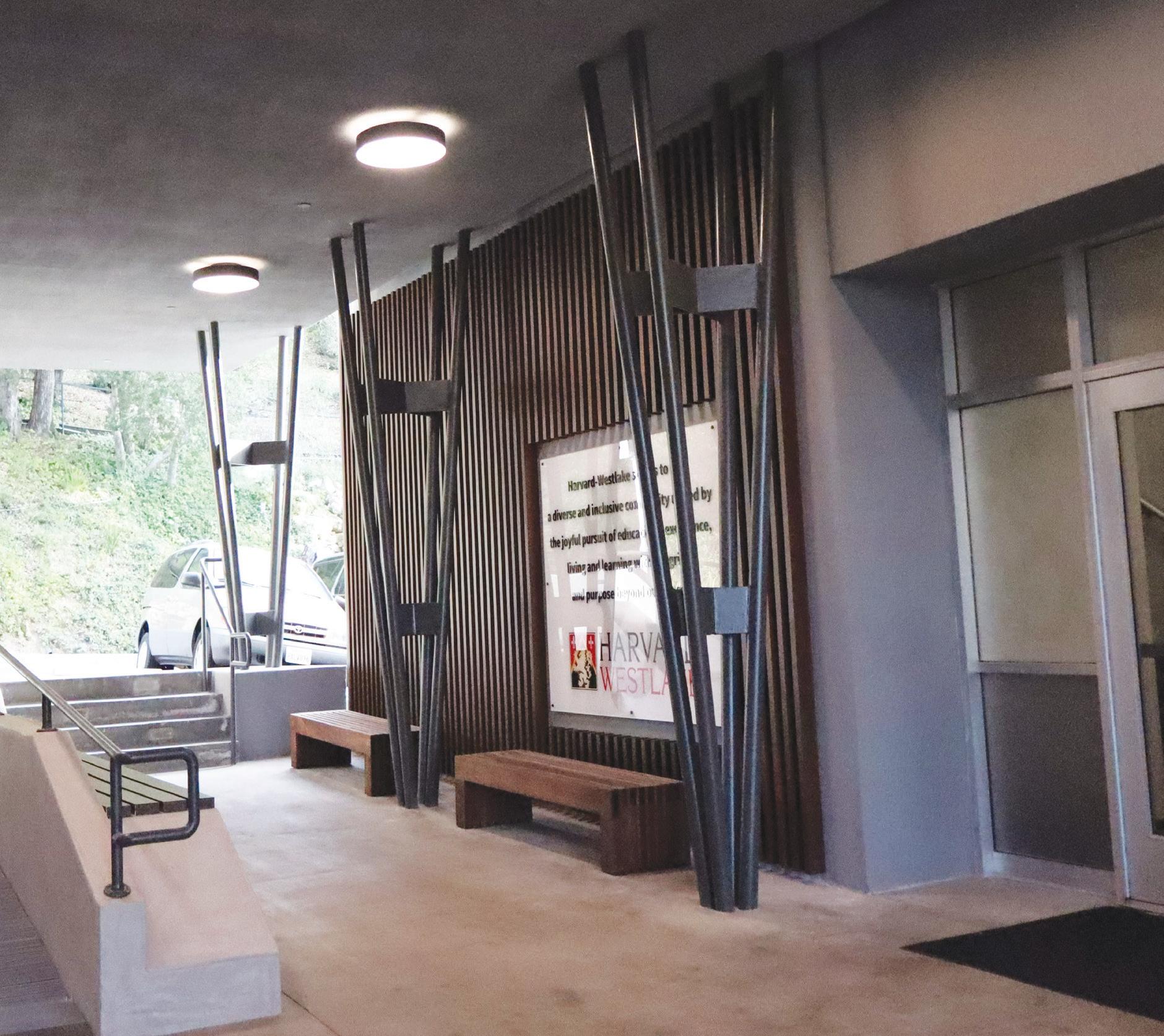
After several months of construction, the second floor of the Seaver building reopened when classes resumed post-winter break. The goal of the project was to create a Wellness Center that could allow students to easily access counselors, in contrast to their previous location near the dean’s offices in the Chalmers building. The history department, which had its office in the Feldman-Horn Gallery for the duration of construction, moved into a new office in the recently remodeled building. The primary faculty who were involved with the construction were President Rick Commons, Head of School Laura Ross, Head of Upper School Beth Slattery and the Director of Operations Jeff Gin.
Construction has only recently reached an end, so interior furnishing has not yet been completed. Commons said he was satisfied with the overall results of the construction but still wishes to improve the interior elements.
“It was a success in the design,” Commons said. “I would say it needs to be warmed up and lived in a little bit, and we need to figure out what needs to be adjusted. We’re 90% of the way to where we need to be, but not all the way yet.”
Upper School History Teacher Sandra Brasda said that the current improvements to the interior of the building are being carried out collaboratively by faculty.
“We’re all working really hard to make it a warm, comfortable and welcoming environment where students can come and hang out, and teachers can work appropriately,” Brasda said. “[Some things] are missing right now, but there are things that we are actively working on very hard, on all levels. It’s kind of a work in progress still.”
Students protest Immigration and Customs Enforcement in walkout
By Angel Song
Students participated in an organized walkout in accordance with nationwide protests to stop funding U.S. Immigration and Customs Enforcement (ICE) on Jan. 30. The nationwide shutdown encouraged individuals to miss a day of work or school and refrain from shopping to protest ICE and their involvement with mass deportations and the recent killings of Alex Pretti, Renée Good, Keith Porter Jr. and Silverio Villegas González.
Head of Upper School Beth Slattery sent an email to parents and guardians regarding the walkout prior to it taking place. The email, titled “Possible Student Walk-Out Tomorrow,” acknowledged that parents will be required to submit an attendance note for students planning to participate in the walkout.
Slattery said that although the school is not endorsing the walkout, it will not stop any students from leaving during lunch.
“As you may be aware, some
students have indicated that they plan to participate in a walkout at 11:45 A.M. tomorrow to protest ICE,” Slattery said. “The school is not officially supporting this walkout, but students will not be physically prevented from leaving campus should they choose to participate in the protest.”
This email was sent after increased discussion regarding a potential walkout and the creation of two Instagram accounts, @hwprotest and @walkoutjan30, promoting the walkout and sharing anti-ICE resources.
The owner of @hwprotest said they created the account after noticing a lack of movement regarding the Jan. 30 shutdown, but closed it down after feeling pressure.
“I didn’t want to lead it, but I just wanted [the walkout] to happen,” they said. “I didn’t see anyone starting it, so I decided to do it myself. But the next day, I decided it was too vulnerable and too much pressure, so I took it down. I’m glad somebody else stepped up and used the materials that I made
to get people to participate, and it turned out really well.”
In a follow-up email to parents and guardians after the walkout, Slattery said some students participated in a peaceful protest during the lunch break, while others decided to miss school entirely.
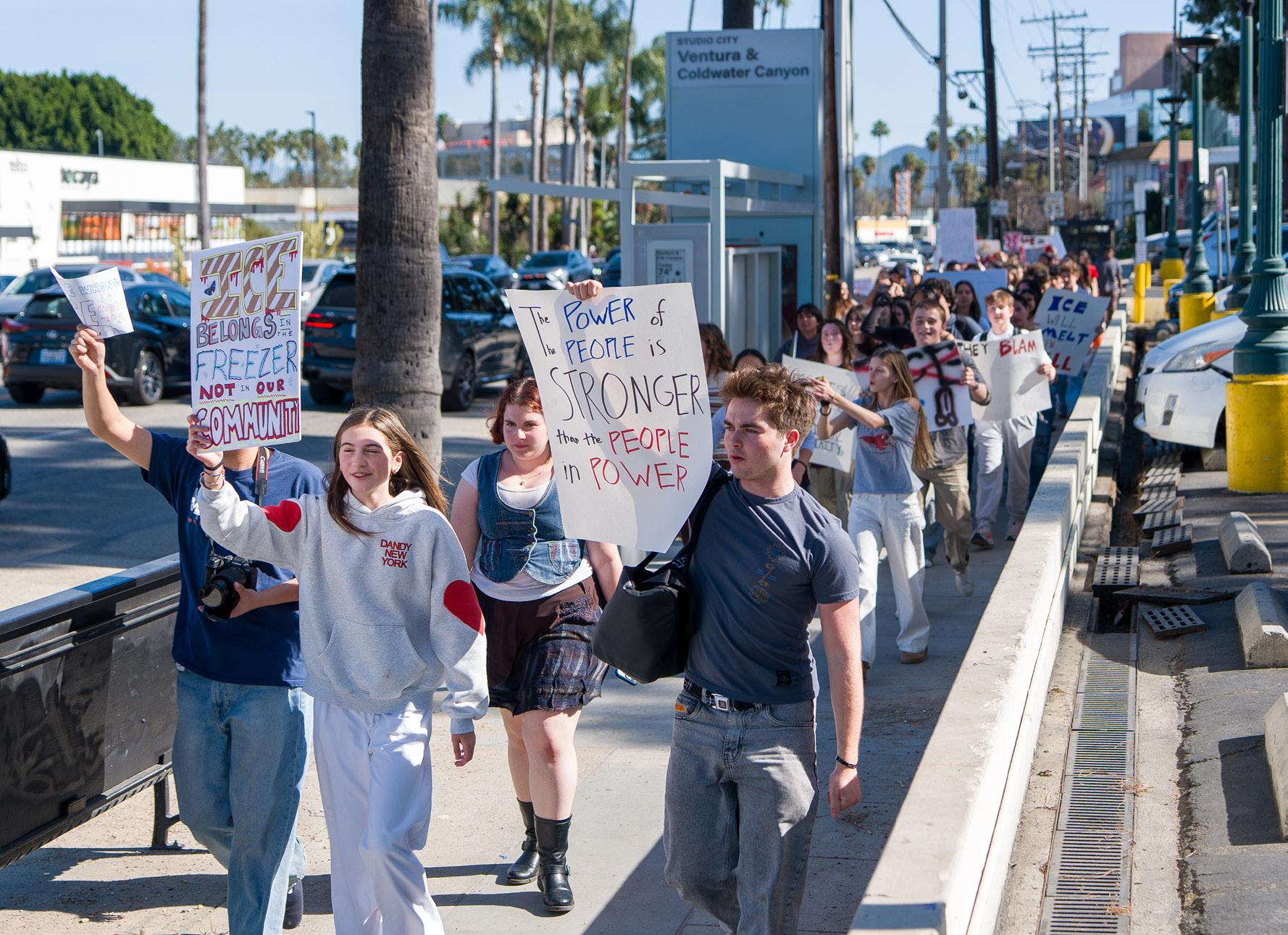
“We estimate that 100-125 students participated in the walkout, with another handful of students choosing not to attend school at all today,” Slattery said. “The students who participated walked down Coldwater Canyon Avenue and Ventura Boulevard, carrying signs in peaceful protest.”
Hayley Ross-Settineri ’27 said she walked out to express her concern over recent ICE activity in the nation.
“I am horrified by what ICE is doing and wanted to show my support,” Ross-Settineri said. “If I am being honest, I hope there are impacts made due to these protests, but I am not expecting any huge change. I just view it as a way to show support and sympathy.”
Required service hours raised
By Madison Shen
Beginning in the 2026-2027 school year, the school’s student community service requirement will increase from 12 hours to 16 hours in an attempt to provide students with more flexibility in completing their requirements. In accordance with this change, a wider range of volunteering opportunities will be permitted to fulfill the requirement. When submitting their outreach hours, students are required to complete a handson work component, describing the work they completed, how it benefited their community. The updated requirement has already been applied to the middle school campus and is set to take effect next year for the Upper School.
While students currently primarily receive credit for handson volunteer service, by increasing the number of required community service hours, Community Council advisor and counselor Michelle Bracken said she hopes students can continue to volunteer with their selected organizations while also finding a chance to interact face-to-face with others.
“We would like to be able to give people hours for doing certain things,” Bracken said. “Lots of people work and volunteer on boards for certain organizations, and right now you don’t get hours for doing that. You only get the hours when you’re actually interacting face-to-face. So, we thought, if we increase the hours, we could give people opportunities to still do those things if they want to do them and still be able to get handson hours.”
Bracken said the school discussed updates to the community service requirement at length to make it both manageable and reasonable for students.
“It’s something we’ve been talking about for years that we wanted to do,” Bracken said.
PROTESTING FOR PEACE: Amid increased immigration enforcement across the country, students at the school staged a walkout along Coldwater Canyon Avenue during lunch opposing violence towards immigrants.
NIC MONROE/CHRONICLE
Outcomes from Earl y Decision
From applications to decisions, students in the Class of 2026 and faculty reflect on the results of this year’s early admissions round.
By Alexander Ahn and Holden Kim
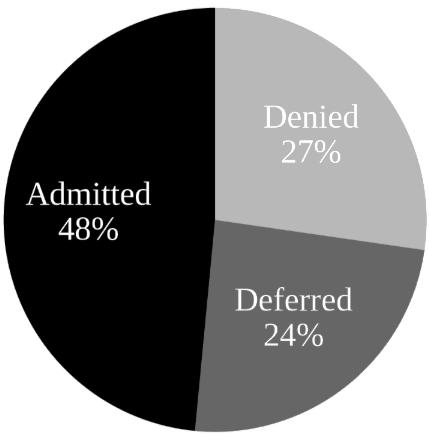
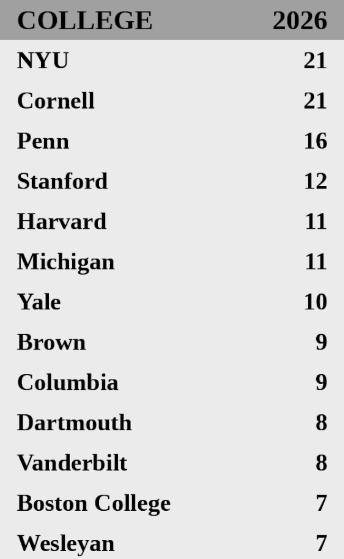
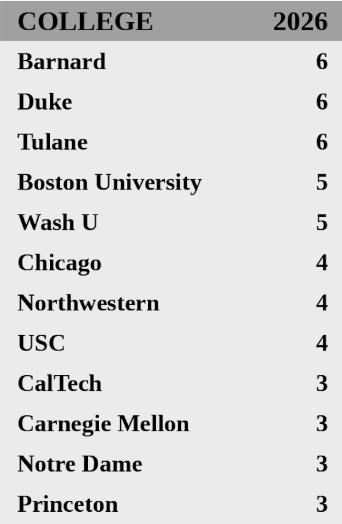
The Class of 2026 received early college admissions decisions in December, with most students applying to schools through Early Decision (ED) and Single-Choice Early Action (SCEA), according to school administrators. Of those applicants, 48% were admitted – a rate nearly identical to those of the Class of 2025 and among the strongest early admissions outcomes of the past five years with 27% rejected and 24% deferred. These outcomes followed months of preparation that began well before December, as students refined their lists and determined their early application targets. Among the 302 students in the Class of 2026, 242 ED and SCEA applications were submitted, according to Upper School Dean Sharon Cuseo. The 25 colleges that received the most early applications included the eight Ivy League schools, Stanford University, Barnard College, Boston College, Boston University, Carnegie Mellon University, Duke University, University of Michigan, Northwestern University, New York University, Smith College, Tufts University, Tulane University, University of Chicago, University of Southern California, Vanderbilt University, California Institute of Technology, Washington University in St. Louis and Wesleyan University.
Cuseo said this year’s senior class performed well in the early admissions round despite the trend of many students applying to highly selective schools.
“The class did extremely well in the early process this year,” Cuseo said. “We were nervous about the lack of variety and the appearance of being overly ambitious, but the results are comparable to last year in terms of acceptances, which is a very good thing. It aligns with the most successful results in the past five years.”
In terms of strategy, Cuseo said the class followed an ambitious but relatively conventional blueprint, with early applications concentrated among familiar schools.
“I’m not sure I would characterize the Class of 2026’s approach as strategic,” Cuseo said.
“It definitely seems to have been ambitious and fairly traditional, not venturing too far from the ‘usual suspects’ of selective college admissions. A higher percentage of the Class of 2026 applied to Ivy League schools plus Stanford than in previous years. Nearly one-third of the class applied early to those nine schools.”
Administrators noted that this year’s results stood out against the context of longer-term trends the school has tracked. President Rick Commons said he is surprised but impressed that the Class of 2026 defied the school’s usual “pendular swing,” referring to a pattern in which odd- and even-numbered
graduation years tend to alternate between applying more heavily to highly competitive schools and opting for relatively less selective choices.
“I was surprised by the results because we’ve heard of the pendulum, and this year it swung in our favor a little bit more,” Commons said.
“The Class of 2026 defied the usual pendular swing. The magic number for the deans is when about 50% of the class is getting good results early. Overall, it was a pleasant surprise.”
Head of Upper School Beth Slattery said she is thrilled by the class’s impressive performance, particularly amid earlier concerns that student success might have been limited due to a high concentration of applications to a few selective schools.
“My impression is that it was a pretty successful year,” Slattery said. “[The administration and dean team] had talked in the past about concerns because there was so much clustering at a certain set of schools, but it appears that we were equally successful at those most selective schools as we have been in the past. It also appears that compared to last year, we were more successful at the next tier of schools. There were a lot of schools that took a lot of our kids, and that helped to bolster things. Similar to other years, a very large percentage of this class is done, which is great.
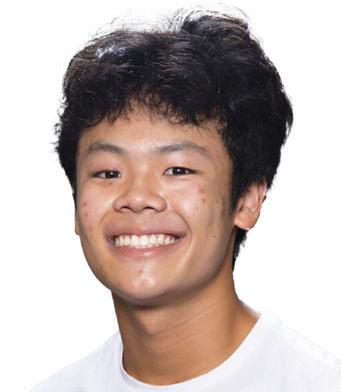
Dean Kim ’26 said he attributed the class’s favorable early outcomes to hard work and a willingness to take risks in the application process.
“A lot of people in our grade had the confidence to really shoot their shot this year,” Kim said. “Looking at last year’s results gave people reassurance, and our class worked really hard
overall. There were definitely some surprises and disappointments, but everyone applied to different types of schools and brought something unique, which is why so many people ended up with good outcomes.”
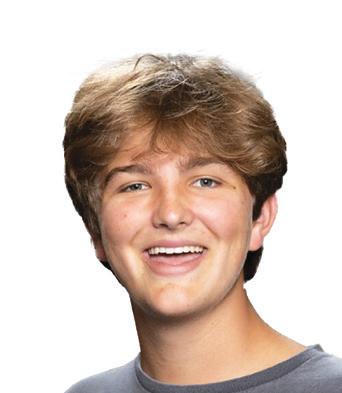
Beyond the statistics, several students emphasized the mentors and support systems that helped them navigate the application process. Aidan Usher ’26 said his dean provided him and his family with critical, holistic support.
“My dean, [Chris Jones], was an amazing mentor,” Usher said. “My parents were always stressing about the college admissions process, and he would always try to help them in any way possible. He was also a source of mental support and kept me stable. He always had my back the whole time.”
their involvement in the admissions process was really an extension of the support they’ve always given me.”
As underclassmen begin to think about their own early applications, seniors urged the importance of thoughtful preparation focused on individual school fit. Will Rosen ’26 said he encourages future students to carefully research colleges to ensure their early choice is truly their top pick and a school they would attend without hesitation.
“ The class did extremely well this year, and it aligns with the most successful results in the past five years.”
— Sharon Cuseo Upper School Dean
Daniel Baek ’26 said his parents’ steady guidance also played a key role in his success.
“My parents helped me a lot in researching and figuring out what qualities I looked for in a school,” Baek said. “They helped me when I procrastinated a bit with my essays and provided emotional support throughout the entire process. I owe a big majority of who I am because of their effort and dedication, so it only made sense that they’d be the ones guiding me through one of the biggest decisions of my life so far. They know me better than anyone else, so
“Applying early is a great option for those who have a firm idea of a first-choice school,” Rosen said. “In addition to extensively researching, make sure to apply ED somewhere that you would have absolutely no regrets.” Administrators echoed the seniors’ advice, reminding students to maintain breadth and fit while building a list. Cuseo said she encourages students to keep an open mind during the college search process.
“Visiting as wide a variety of schools as possible is always good advice,” Cuseo said. “You don’t know what’s possible or what might click for you if you haven’t seen it. You will always be happier if you can find some realistic options that you might consider in the early process. Even if you don’t apply early to one of these, you can feel better about taking a chance early if you have options you know you will like later on.”
Early Application Data: Top 25 Colleges Applied to ED/REA for the Class of 2026 242 ED/REA applications were submitted by the class of 2026 according to the deans’ office.
Beth Slattery
Rebuilding Our Community
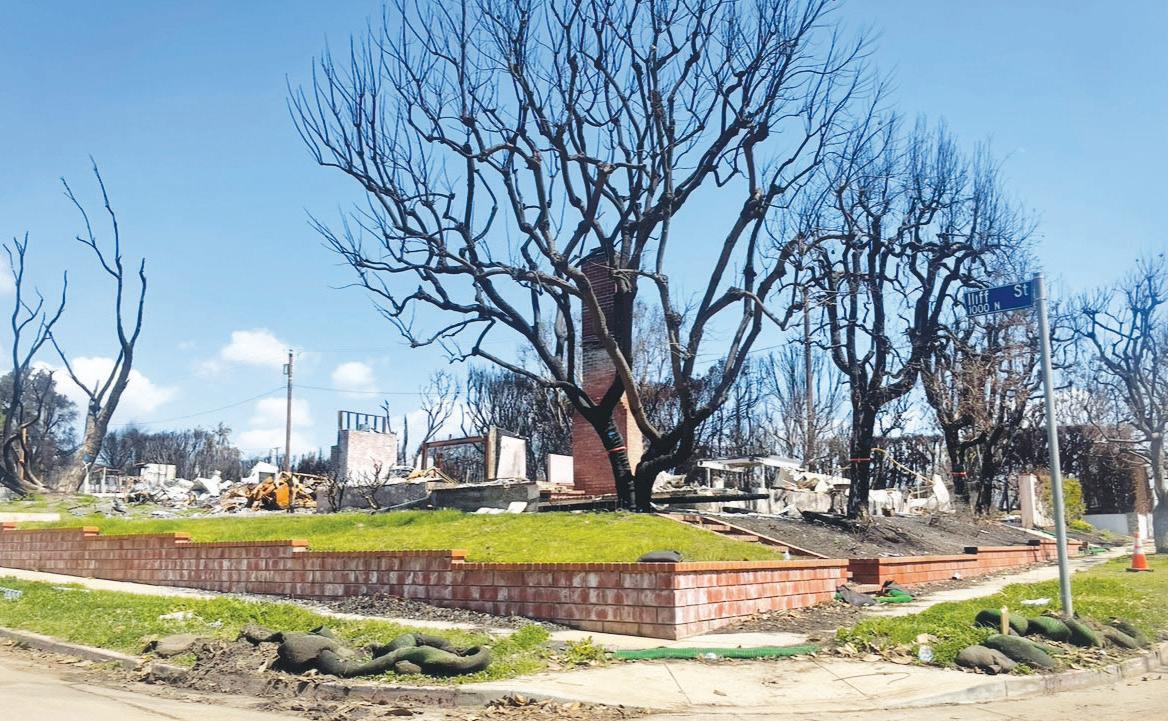
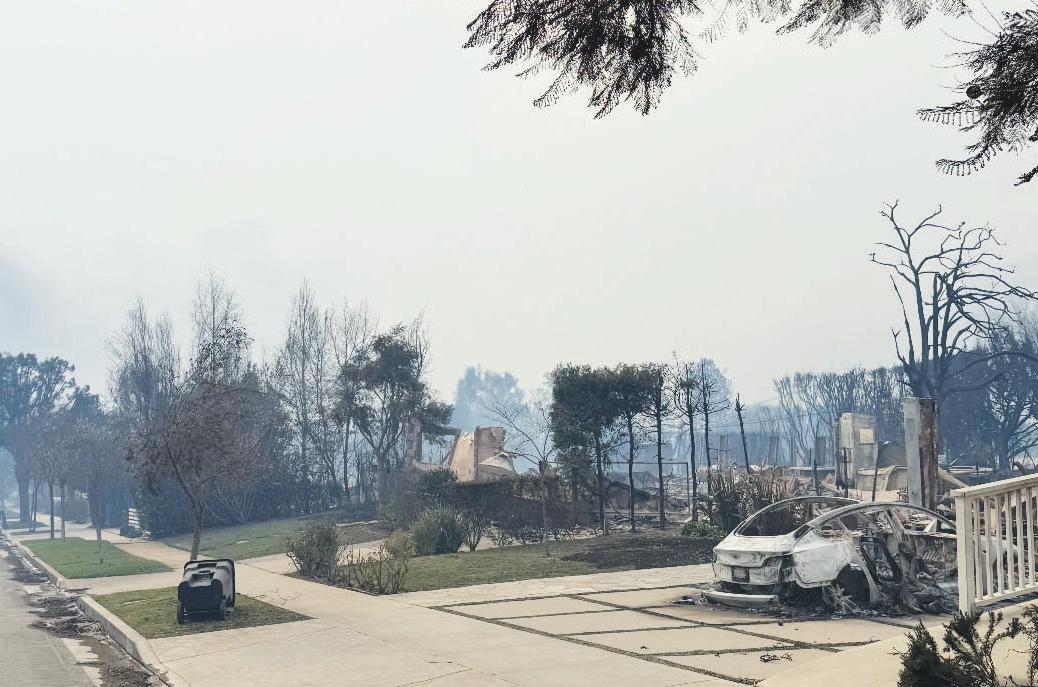
One year since the LA fires, students and faculty describe what recovery looks like now, the support systems that helped, and what gaps still remain.
By Holden Kim and Donna Enayati
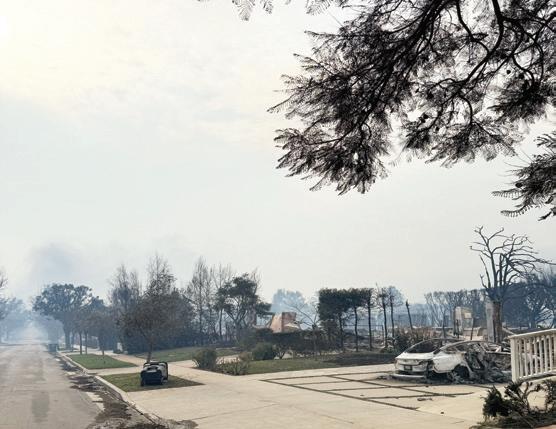
Jan. 7 marked the one-year anniversary of the Southern California wildfires, a disaster that destroyed or damaged more than 18,000 structures and displaced over 100,000 residents. Widely considered the second-most destructive wildfire event in California’s history, after the 2018 Camp Fire, the Los Angeles Fires deeply impacted the school community. More than 50 school families and four faculty members lost their homes, and hundreds more were temporarily evacuated. A year later, the community continues to reflect on loss, resilience and the ways families and staff are rebuilding their lives together.
Barron Linnekens ’26 said the first day of the fires began like any other before a phone message turned everything upside down.
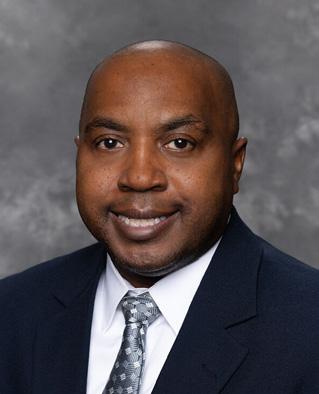
ger arrived not through a message or alert, but what they could see outside their own windows. Science Teacher Nate Cardin, who lost his Altadena home in the Eaton fire, said he evacuated despite never receiving an official warning. Cardin said he left because he saw the flames advancing and trusted his instincts.
“It was just an ordinary school day at first,” Linnekens said. “Then, I got a text from my mom saying, ‘There’s a fire at home. You might not be able to come home tonight.’ They weren’t letting people come back, so I stayed with a close friend who lives near campus. After that, I spent a night at my aunt’s house and then at another friend’s house. I only had my car, my credit card and a small amount of clothes.”
For some, the key signs of dan-
“My husband and I were at home when our power had gone out,” Cardin said. “Then, just off in the near distance, we could see that the mountains were completely on fire. We made the executive decision at that point to evacuate. We lived in the part of Altadena west of a street called Lake, which is traditionally a redlined neighborhood. It’s historically a lower–income neighborhood, and not unrelatedly, anyone west of Lake never got an evacuation notice. So, we didn’t evacuate because we got a notice. We just evacuated because it felt like the smart thing to do.”
In the weeks and months that followed, many said that the hardest part was not the chaos and shock of the immediate evacuation itself, but what came after.
Evan Vourakis ’27, who grew up in Pacific Palisades, said while he has adjusted to the destruction of his childhood home, memories still resurface and the aftermath of his loss continues to linger.
“You’re never going to fully overcome that pain inside of you
knowing that you lost everything until you accept it,” Vourakis said. “For me, I was fairly quick with that. I accepted it and decided to move on. But even now, a crazy thing is that when I dream, I imagine myself at my old house, so the pain is still lingering inside of me.”
Over time, community members pointed to a range of supports that aided their recovery and helped restore a sense of equilibrium. Like Vourakis, Natalia Crystal ’28, who transferred to the school after losing her former school to the fires, said the shock of the fires followed her long after the immediate danger had passed, but that the school community has played a major role in her healing process.
“It was a bit of a rocky transition, but I’m grateful that the school was willing to take me in and also accommodate what I needed at the time,” Crystal said. “Everyone was super welcoming, and I quickly found new friends.”
Cardin said that alongside the steady presence of community care and solidarity, therapy has also been an integral part of his recovery, helping him work through the fires’ lasting mental and emotional toll.
“I can’t advocate for therapy enough, and the school’s health insurance is great at supporting that,” Cardin said. “Really early on, I got connected with a therapist who specializes in post-trauma kind of situations, and that’s been super helpful. I’m doing better, and part of it is because of therapy.”
Others pointed to daily routine and extracurriculars as sources of
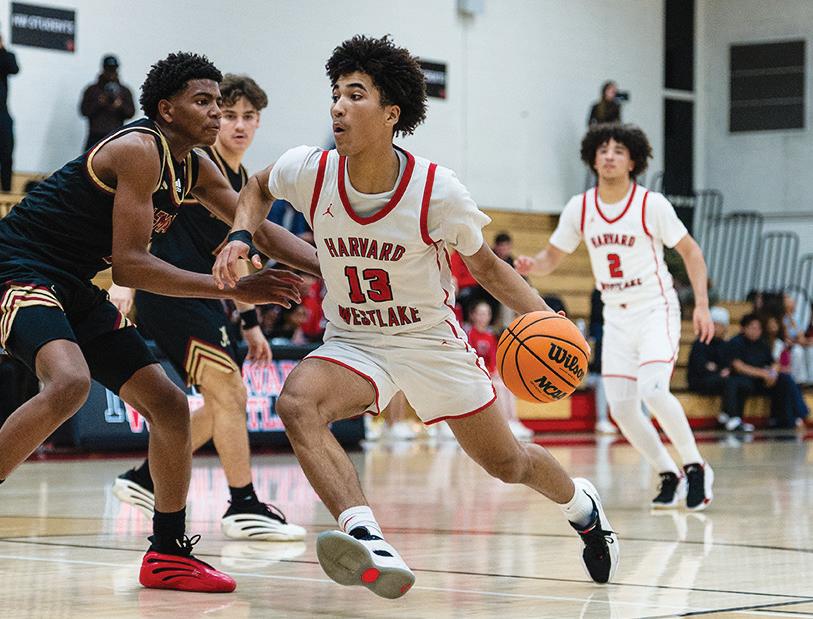
stability. Linnekens said basketball became another crucial anchor in his recovery, restoring structure, surrounding him with teammates and providing a busy schedule that helped take his mind off the fires.
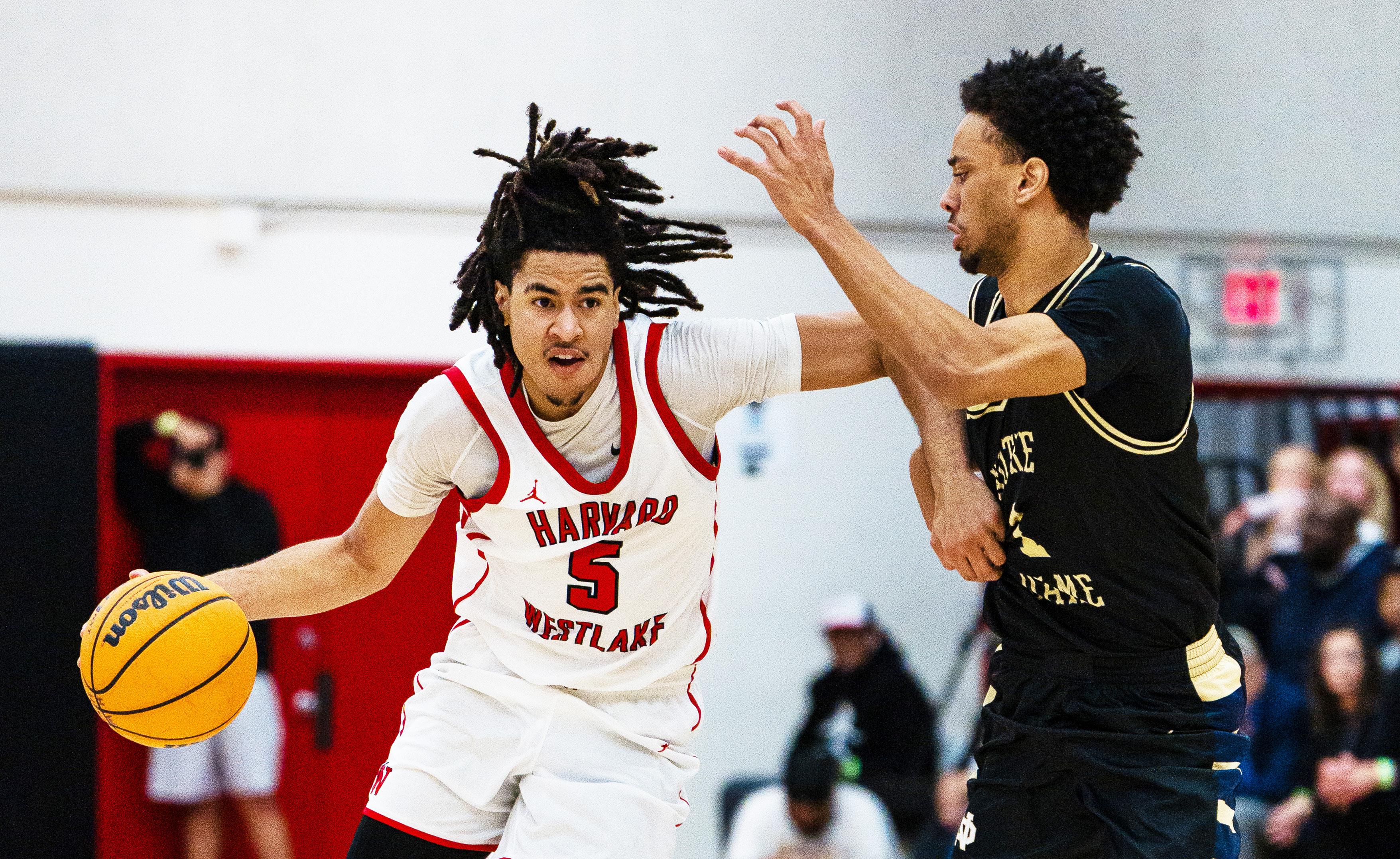
“One of the biggest resources I had to heal was basketball,” Linnekens said. “Our basketball program is demanding to the point where we’re on campus from 7:30 a.m. through 10:30 p.m, so there wasn’t really a ton of time for me to think about the fire. The way that I usually deal with things like this is just put my head down and control the controllable. That was how I dealt with the aftermath of the fires. I realized that the crazy things around me I couldn’t control. Therefore, I couldn’t let it control me.”
“more resilient. On the one-year anniversary of the fires, I recently felt pretty inspired and optimistic, not that the trauma has completely gone or that we’ve even achieved what we’ve wanted to achieve. We’re in phase one of rebuilding, and I feel a really strong sense of community support and excitement about what the next chapter in Altadena could look like.”
There is nothing truly better than sharing a difficult experience with a whole community.”
— Neli Nikolaeva Performing Arts Teacher
Where Linnekens found steadiness in the structure of his athletic commitments, Visual Arts teacher Conor Thompson said his inner resilience played a major role in helping him navigate the trauma of the fires, and that he remains optimistic about the future.
“Different people respond to tragedy in different ways,” Thompson said. “My motherin-law likes to say that I have what’s called ‘rallied,’ which means when times get tough, I just snap into action. Because of this, I’ve learned to become
Several teachers described recovery not only as endurance, but as a sense of purpose. Upper School Symphony Teacher Neli Nikolaeva said her work as a teacher and strengthened family bonds have provided clarity and focus, helping her find peace in the present.
“Personally, I find a lot of joy and fulfillment in what I do and giving to a community that’s so special,” Nikolaeva said. “My family is strong, maybe even stronger than before. I am not dismissing the hardships, but my gratitude is also at an alltime high.”
Vourakis, whose family is rebuilding their home, said focusing on the future has been a main source of comfort, and he encouraged others still struggling to move forward to take a similar approach.
L. Wood
Nate Cardin
School program hosts 12th annual debate tournament on campus
By Claire Lee
The school hosted its 12th annual debate tournament, Harvard-Westlake Debates, from Jan. 17-19. Approximately 300 competitors and judges traveled to the upper school from across the country to participate.
The debate tournament featured three events: varsity Lincoln-Douglas, novice Lincoln-Douglas and World Schools. Lincoln-Douglas is a two-person debate event focused on ethical and philosophical issues, while World Schools consists of a mix of prepared and impromptu topics debated between teams of three to five people.
The Middle School debate team competed in the novice Lincoln-Douglas event, but the Up-
per School Debate team did not enter the varsity Lincoln-Douglas category due to concerns regarding fairness in judging. Instead, members of the Upper School Debate team served as judges throughout the tournaments.
Debate Program Head Scott Phillip said the tournament offered a unique opportunity to debate with top competitors nationwide and participate in the World Schools division.
“Students got a chance to compete against the best debaters from across the country, many of whom they don’t normally see or debate against at Southern California tournaments,” Phillip said. “We also had an in-person World Schools division, which is a rarity, since most of those tournaments are held online.”
Reconstruction of Seaver now finished
Continued from A1
Since the initial planning for the construction began, the former Director of Operations Dave Mintz retired. The necessary transitions from this event, along with other factors, contributed to the difficulty of the project. In spite of this, Head of Upper School Beth Slattery said she is excited for the opening of the Wellness Center.
“I’m excited, particularly for the Wellness Center, when it really is available and fully open and when the counselors are all moved up there,” Slattery said.
Ethan Kang ’27 said that any major improvements to the building were not as noticeable, yet the addition of the Wellness Center is a positive one.
“The new building definitely has noticeable differences, but I don’t really see any major improvements when comparing it to the one from last year,” he said. “It is nice that they redid the Well-
ness Center to make it easier for students to relax.”
Phoebe Sun ’28 said that she was unable to make a comparison because she did not see what the building looked like before this year’s remodeling.
“As a sophomore, I didn’t see the building before construction, so my perspective is different from juniors and seniors who can compare both versions,” Sun said.
“For me, this just feels like the normal campus, while for them the changes are probably more noticeable and impactful.”
Sun said that the history department’s move from the Feldman-Horn gallery back to the Seaver building was beneficial for art students.
“One benefit of the construction being finished is that the history teachers were able to move back to their old offices, which allowed visual art students to have the gallery spaces back,” Sun said.
“It also makes the campus feel more normal again.”
Language department holds second annual World Language Week
By Claire Lee
The World Language Department hosted its second annual World Language Week from Jan. 26-30. This year’s theme, “Opt 4 Joy,” emphasized cultural appreciation through a week of dressup themes and performances representing different cultures and traditions.
Upper School Spanish teacher Sephora Escarpeta-Garcia, who organized World Language Week, said there were many performances representing a diverse community on the Quad to share the diversity in our community.
different languages like Spanish and French,” Kim said. “I believe that partaking in these activities firsthand is always a good way to immerse yourself in the countries that you are trying to learn about.”
Programs Coordinator Kacie Cox said planning World Language Week began months ago.
Jacob Waxman ’27, a member of the Upper School Debate team and a judge for the novice Lincoln-Douglas event, said his role as a judge included taking organized notes and providing feedback for the participants.
“[Being a judge] involves being both an impartial adjudicator whilst also being a good educator and ensuring the safety of a space,” Waxman said. “On a more specific level, I have to take notes, called a flow, throughout the round of all the arguments made by both sides. After the conclusion of the round, I then take time to think about, write and disclose my decision and my explanation for it. Then I give feedback and answer questions from the competitors in the round.”
• Continued on hwchronicle.com
“World Language Week is celebrated through different cultural activities in our classrooms,” Escarpeta-Garcia said. “On the Quad, we offered something new and different for every day. In our partnering with Performing Arts Teacher Zanaida Robles, choral student performed in English, French and Spanish. There were also dances by affinity groups such as SASA, BLACC and LAHSO, as well as performances from students taking Chinese. Through these fun activities, we were able to expose cultural diversity to the whole community, especially since not everyone takes a language.”
Chrissy Kim ’28, who perfrmed as both a choral singer and a Spanish class singer, said the performances helped bring World Language Week to life.
“The performances were a great way to showcase what each language department has been learning, and it was a wonderful idea to combine music with the
“World Language Week planning started in early October,” Cox said. “It started with meeting with the language department to talk about their goals for the year. This year, the department wanted to bring joy, which inspired the theme ‘Opt 4 Joy.’ We brainstormed things that worked in the past, and what might encourage more people to sign up for language classes.”
Escarpeta-Garcia said the event was an engaging form of cultural immersion for the whole Upper School community, regardless of their involment with the language department.
“The purpose of World Language Week was to promote culture and diversity,” Escarpeta-Garcia said. “It was a fun and relaxed way to bring the community together.”
Cox said she anticipated students to gain exposure to cultures they may not have been familiar with.
“I hope the students took away acknowledgement of culture different from our own,” Cox said. “It’s so important to expose ourselves to experiences that outside of what we already know and to learn about new languages, countries and traditions. I wish students took away a greater curiosity and love for learning about different cultures.”
CONSTRUCTION ZONE : Seaver went under construction this past summer that carried over into the start of the school year. The addition included a redesign of the History office, mail room and Wellness Center.
KARA JAZAERI/CHRONICLE
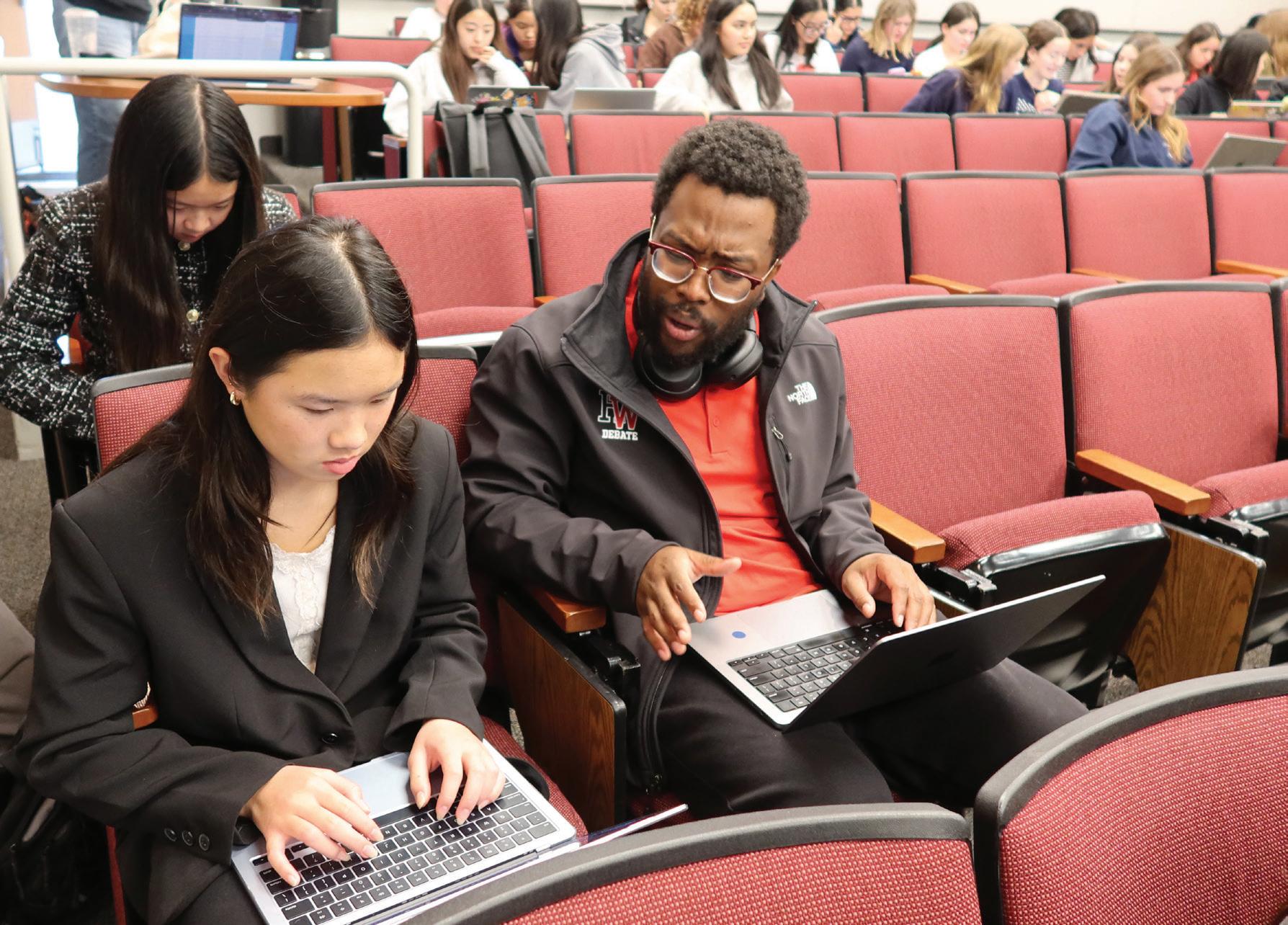
PREPPING THE ARGUMENTS : Upper School Debate Coach Khamani Griffin helps a school debater prepare prior to a round in Ahmanson Hall at the 12th annual Harvard-Westlake debate tournament.
ANNY DU '29/SPECTRUM
Wood
Sephora Escarpeta-Garcia
All-school assembly celebrates Martin Luther King Jr.
By Emmeline Chan
The Community Time Leadership Committee (CTLC) organized the Martin Luther King Jr. celebration during an all-school assembly on Jan. 22. “At the Table with Dr. King,” a multifaceted, live performance, used music, poetry, historical video footage and Dr. King’s own words to teach students about the American Civil Rights movement and valuable lessons of equality and respect. The hour-long show was performed by professionals from More than Music, a nonprofit organization of professional musicians that uses music as both a model and catalyst for connection, cultural exchange and service.
CTLC member Ivy Wang ’26 said they had a long brainstorming meeting back in December to plan multiple community time events in January that build upon each other to celebrate MLK.
“We had multiple ideas, but ultimately we came down to these two events – ‘At the Table with Dr. King’ on Jan. 22 and posters and stands on the field, as well as a community picture on Jan. 30,” Wang said. “We did this to maximize people’s attention span as well as educational opportunities.”
said. “It was quite moving and inspiring how so many people had to go through such hardship to achieve their dreams. As a sophomore who is new to the Upper School, all-school assemblies and events are a great way for the whole community to come together and learn about new things.”
Lawrence Zhao ’28 said that the event felt like more than just an assembly.
“I loved how unique it was,”
Zhao said. “It wasn’t just a presentation, but like a whole concert that we were all attending together for fun.”
Sarah Huang ’27 said that she was pleasantly surprised by the speaker event and found it very enjoyable.
“ I loved how unique the celebration was. It wasn’t just a presentation, but a concert that we were all attending together.”
Lawrence Zhao ’28
Wang said their main goal was for the event to be more interactive and engaging in contrast to previous guest speakers who would only lecture.
“We really wanted it to be an immersive experience for everyone,” Wang said. “We also wanted it to have a profound, long-term impact, which is why we separated it into two events in two weeks.”
Aarush Merla ’28 said he appreciated the special, innovative performance as well as community time events in general.
“The combination of video, music and information had a profound effect on me,” Merla
“Honestly, I was expecting this assembly to be just like any other – someone lecturing on a podium with limited crowd participation,” Huang said. “But, I really liked how the jazz band tossed that all aside and really memorialized him in a more interesting way by playing music and singing songs based on the different periods of his life. Also, the clapping and snapping were very good ways to get the crowd to interact.”
Wang said she was very happy with how the assembly turned out and thought all the planning paid off.
“It was amazing,” Wang said. “Obviously, there’s always going to be people complaining about their time being taken up, but I think it is a necessary, important event for students to learn about. It was delivered in such a nice form, and so it was completely worth it.”
Huang said she looks forward to more interactive speaker events like this one.
“Community Time events have experienced an upward trend in quality,” Huang said. “I hope to see more like this where everyone is engaged and genuinely interested in the content being taught.”
Video Art students put together videographic gallery showcase
By Holden Kim
Students enrolled in Honors Senior Seminar: Video Art (HoSeSem) displayed their artwork in the Feldman-Horn Gallery during its annual exhibition from Jan. 10-30. Organized by Upper School Visual Arts Teacher Reb Limerick, the gallery showcases works by 32 students who examined identity, memory and artistic experimentation through the diverse videographic techniques.
In his project, featured artist William Lin ’26 imagined a post-apocalyptic home built inside a discarded training dummy, where a lone person seeks quiet refuge in the lower body while an invasive, pulsing heart above embodies an inescapable presence that disrupts any sense of peace. Looking back on his growth as a videographer, Lin said it feels deeply rewarding to be a featured artist in the gallery.
“To have my work displayed in the gallery is very surreal, and it means so much to me,” Lin said. “I’ve been in Video Art since freshman year, starting in
Video Storytelling II, and being able to grow my video skills over time and eventually bring them all the way to HoSeSem feels unreal. Getting the chance to take ideas and expand them into a full installation, something people can physically walk around and experience, is just crazy in the best way.”
The project “Viscerality” featured artist Henry Wain ’26’s aims to elicit an instinctive reaction from his audience, who are given full control over the viewing apparatus and environment through which observers experience his work. Wain said he particularly appreciates the opportunity to display his work in-person, rather than as content viewed through a digital device.
“It’s nice to have a permanent and physical place to display my work,” Wain said. “Usually, it’s just a file on a computer, and someone would have to access it through me. Now, there’s open and easy access.”
Limerick said she hopes that those who visit the gallery will experience videography not as just passive entertainment mediated through the confines of a smartphone screen, but rather as a form of art that ultimately rewards sustained attention and merits genuine, deep emotional engagement.
“We, as a culture, are watching shows, movies and videos on very small screens like on our phones,” Limerick said. “I would hope for people to see video and film as part of the art world and an experiential, emotional experience that you can have with art and a gallery. My hope is that people coming to the gallery really immerse themselves, watch the videos till they loop and then have conversations about it. I hope that they think a little differently about what video as a time-based art medium can do, the stories it can tell and the various emotional impacts it can have.”
Interfaith memorial held in Chapel
By Holden Kim
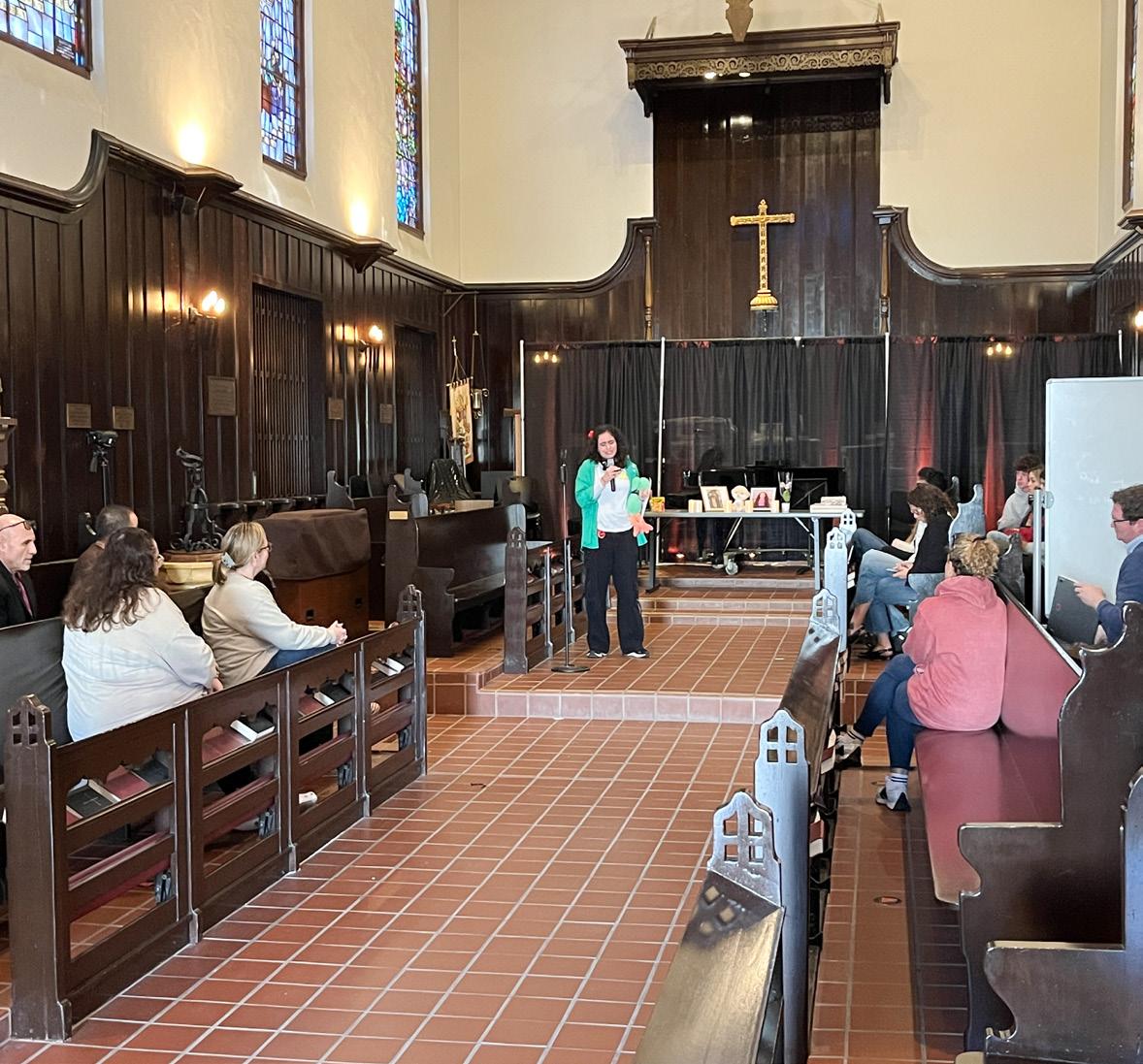
The Interfaith Action @ HW club hosted a memorial in remembrance of Hind Rajab and other children lost to the conflict in Gaza in the St. Savior’s Chapel on Jan. 29. Candles and portraits of Rajab were placed on the altar, creating a place for the school community to pay their respects. Students and teachers of various faiths gathered together in the Chapel to share a moment of silence and pay respect.
Club leader and organizer of the event Isabel Erlic ’27 said the gathering was intended to remember and honor the victims, not to facilitate political discourse.
“I wanted today’s memorial to not be a place for debate about current issues,” Erlic said. “We are
here to honor the life of a little girl who was lost due to the cruelty of the world, and I think it’s important that we have spaces like this to gather for everyone.”
Luella Reynolds ’28 said she valued the diversity of voices at the event and the way in which the memorial brought the overall community together.
“I appreciated the representation of so many different religions and how so many people felt empowered to speak about such a personal issue,” Reynolds said. “Events like these are good for the broader HW community because it really unites a lot of religions and cultures around a collective grief and collective loss.”
Upper School History teacher Naqib Shifa, who shared a reading of Surah Al-Fatiha from the
Qur’an, said the gathering provided an essential space for reflection.
“Events like these are very healthy, cathartic and human to have,” Shifa said. “There’s an academic side to the human experience, an athletic side and a spiritual and emotional side that also needs its own space as well. This is especially true when people read the news and then they want an outlet where they can come together and just mourn or deliver their own thoughts.”
Miro Katan ’28 said the memorial underscored the importance of uniting around a shared goal and that he hopes future events will have the same effect.
“There should be more gatherings such as this, as it would humanize politicized conflicts.”
BEYOND THE SCREEN: The Feldman-Horn Video Art gallery was displayed from Jan. 10-31 for all to visit. Art works by Eze Baum ’26, Sabrina Simek ’26, Anika Norton ’26 and Rachel Cipriano ’26 are featured here.
HOLDEN
L. Wood Henry Wain ’26
UNITED LIGHT: Interfaith Action @HW hosted a memorial centered on shared humanity, collective mourning, and respectful presence across faiths.
Students compete in yearly Wharton stock competition
By Abby Ryan
The Wharton Investment Competition was hosted on Dec. 12. The competition is an experimental investment challenge in which teams of four to six students team up with a teacher on an online stock market simulator. The top 50 teams were announced on Jan. 27.
Faculty advisor of two teams for this year’s competition and Independent Research Teacher Rob Levin said the goal for this year’s competition was to develop a concrete plan and invest money in a scenario.
“This Investment Competition challenges teams to take on a real-world-based case and develop an investment plan to propose to the case’s client,” Levin said. “This year, the client was Connor Barwin, a Wharton and NFL alumnus. His goal was to invest money for ongoing community recreation programs and longterm facilities construction.”
ed in it because it allowed me to work with some of my close friends on something that we are all passionate about.”
Chloe Min ’27 said she heard about the competition from upperclassmen and decided to participate as it was an opportunity to explore a new discipline of her interest.
“I heard about the competition from older friends who were able to advance in it,” Min said. “I wanted to see if investing was something I’d be interested in for the future, even though I really didn't think I would, I figured it wouldn’t do any harm.”
Levin said he helped teams as little as possible, but when he did, he tried to only offer advice to ensure students were doing most of the work and learning from the process.
“I provided as much or as little guidance as students wished,” Levin said. “When I did help, I served as a loyal skeptic, questioning and testing strategy. I also taught opportunistically, introducing key team processes, business practice and investment principle ideas when the moment was right.”
Noah Shallman ’27 said he wanted to join the competition because it allowed him to experiment with his ideas in a situation similar to reality.
“I was motivated to participate in the Wharton Competition because it gave me the opportunity to try and test some of the theoretical ideas I’ve had about financial markets in a fun and risk-averse space,” Shallman said. “I was also interest -
Shallman said the most meaningful part of the process was the collaboration and leadership positions he took on while preparing for the contest.
“The most rewarding part of the competition was the team meetings we had during the trading period,” Shallman said. “I was the leader of our team for the competition, where I formulated the idea for our strategy and programmed our model. I was also in charge of scheduling our meetings.”
Min said she helped assure that the clients’ wants were the focus of the portfolio.
“My role in this competition was to be a mediator,” Min said. “I really looked in on the case study and made sure the clients’ needs were being met and our portfolio aligned with their personal morals and priorities.”
Levin said he enjoys advising student teams every year for this competition and seeing the students cooperate while growing individually.
“Last year, I was also gratified to have advised a team which earned a semi-finalist position which means they were in the top 50 teams out of 5,000,”
Levin said. “[I enjoy] watching talented, opinionated and assertive individuals invest the hard work and flexibility necessary to work well together as a team.”
Assembly held by Community Time Leadership Committee
By Alexander Ahn
An all-school Community Time assembly planned by the Community Time Leadership Committee was held in Taper Gym on Jan. 13. Community Time assemblies take place monthly to bring students together through performances, announcements and reflection. The assembly opened with a musical introduction by the Chamber Orchestra, followed by welcome remarks from Head of Athletics Terry Barnum. Students then participated in a Student Leaders for Inclusion, Diversity and Equity (SLIDE)-led icebreaker titled “Jeopardy Supreme,” followed by Asian Students in Action (ASiA)’s presentation on the Lunar New Year celebration. The assembly included an arts feature focused on photography, featuring Nic Monroe ’26 and several YoungArts winners.
Barnum said his remarks during the assembly were meant to help
Annual alumni luncheon hosted
By Holden Kim
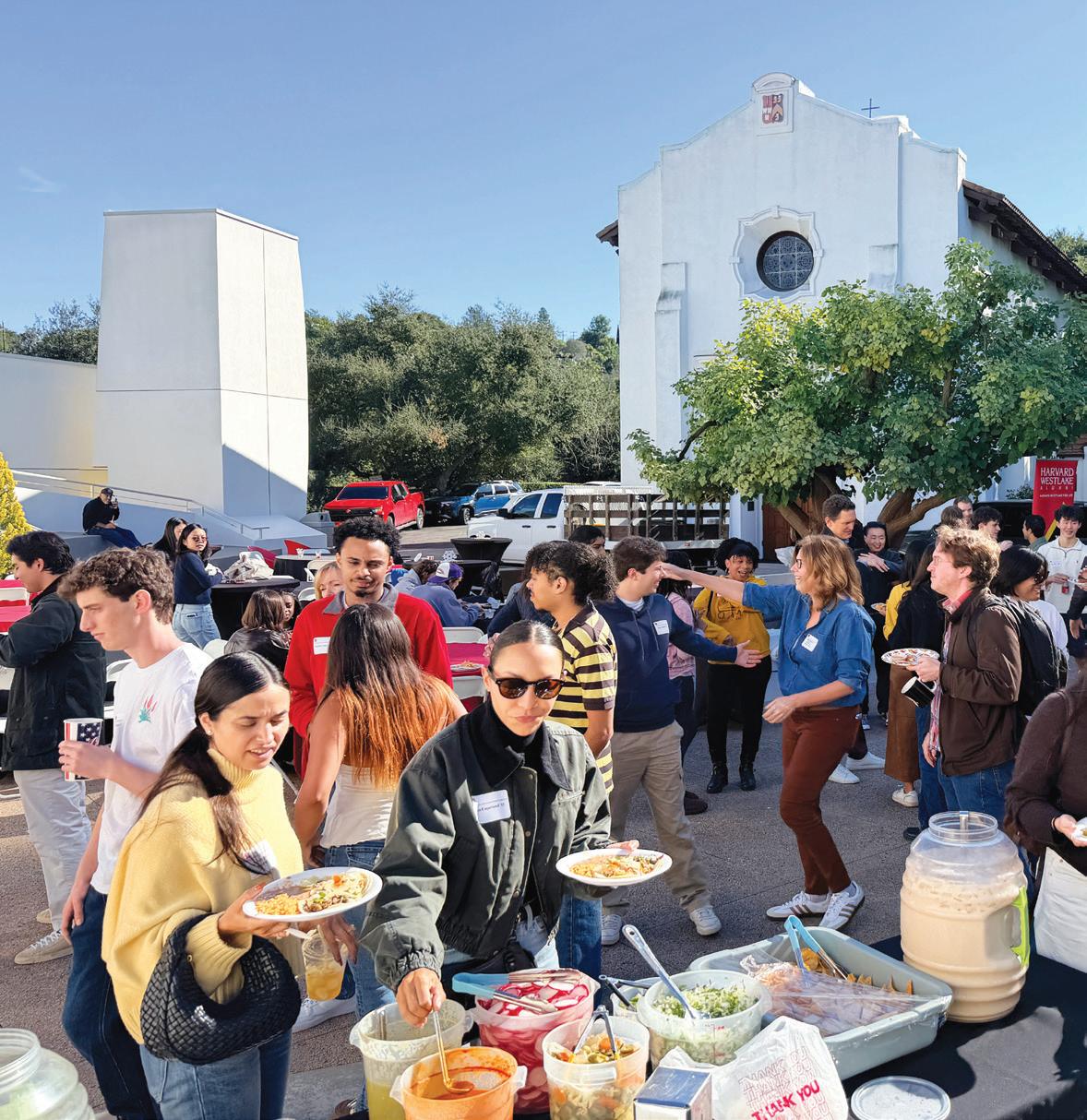
The school hosted its annual alumni reunion event in Feldman-Horn on Jan. 7. This year’s event featured a new schedule designed to maximize participation. Organizers moved the gathering from after school to the lunch period, providing returning graduates with an opportunity to revisit campus and reconnect with the school community during a regular school day. This adjustment proved successful, with the event attracting 61 alumni and 78 faculty members. While the classes of 2024 and 2025 had the highest turnout, alumni from other graduation years also attended. Director of Alumni Relations
Sam de Castro Abeger ’07 said the luncheon is part of a wider goal seeking to strengthen community engagement through programming that ensures con-
nections remain tight between past graduates and the school.
“Alumni events are a core component of how we build and sustain long-term engagement,” de Castro Abeger said. “They are the primary way we bring alumni together in person, but they are part of a broader strategy that also includes communications such as HW Life, social media, the alumni newsletter, career mentorship programming through HW Works and volunteer opportunities. These efforts ultimately help foster a lasting sense of connection, community and belonging.”
Owen Kim ’23 said he appreciated that the campus had not significantly changed since his time as a high school student and that reconnecting with the general school community was one of the main highlights of his visit.
“Returning to campus defi -
nitely feels nostalgic because I remember walking down these exact buildings,” Kim said. “The physical campus hasn’t changed too much since I graduated, so most things felt familiar. In particular, it was nice to see all my former teachers and classmates.”
Micah Parr ’25 said he appreciated re-experiencing the school’s friendly and welcoming environment, which hadn’t changed from his days as a student at the school.
“For how competitive this school is, one of the things that really stood out to me was that there were always people willing to support you, and I still feel that when I came back on campus,” Parr said. “Returning didn’t feel distant or icy. People were very welcoming. That is something I was really happy to see had remained the same.”
• Continued on hwchronicle.com
students see administrators as people and strengthen connection.
“I decided to focus on my vest because it’s something I’ve worn for years and I figured people had questions about it,” Barnum said. “I wanted to explain how I began wearing it and why. A lot of students have not spoken to me or don’t know me well, so leading the assembly gives them an opportunity to get to know me not just as an administrator, but as a person. I hope they realize that their teachers and coaches were once high school students and understand what they are going through.”
group of students from the Chamber Orchestra, an ensemble of talented and experienced musicians who represent our orchestral program,” Nikolaeva said. “Performing requires courage, vulnerability, discipline and countless hours of practice. I hope this performance helps students recognize how special it is that artistic expression is a vital part of learning, belonging and being human.”
Chrissy Kim ’28 said the performance created a greater sense of connection.
Performing Arts teacher Neli Nikolaeva said the opening performance was meant to reflect the school’s commitment to artistic expression and creativity.
“Because of amplification constraints, we featured a smaller
“The performance was very moving, and it was a great sight to see the instrumentalists play together to make beautiful music for the school,” Kim said. “The collaboration between the artists stood out. Their teamwork was inspirational and reminded me of the community at school.
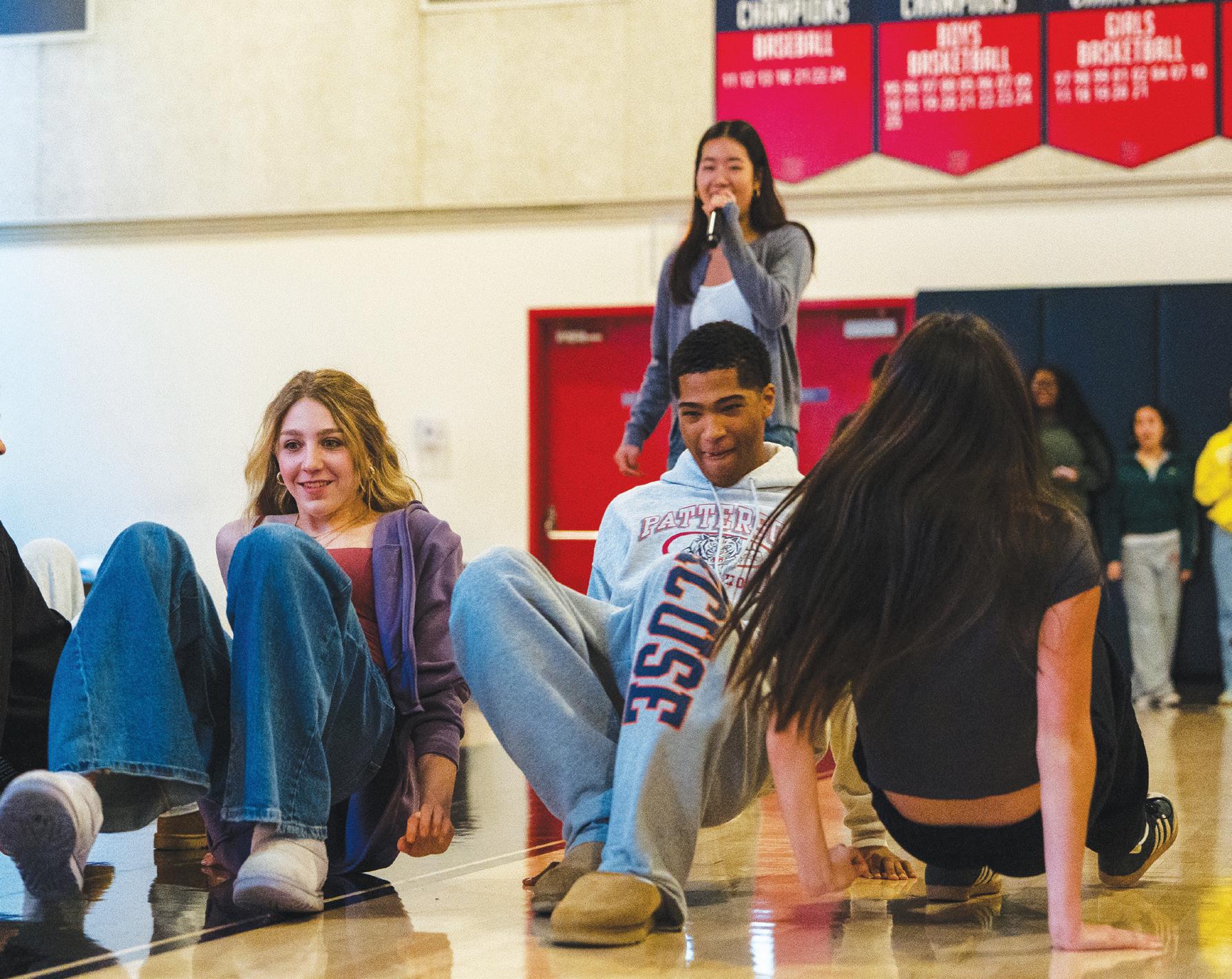
CRAB-WALKING INTO THE NEW YEAR: Marlowe Kohn ’27 and Alex Hudlin ’26 compete in the race hosted by ASiA during the assembly. Community Time assemblies are held monthly to foster a sense of community.
L. Wood Chrissy Kim ’28
L. Wood Chloe Min ’27
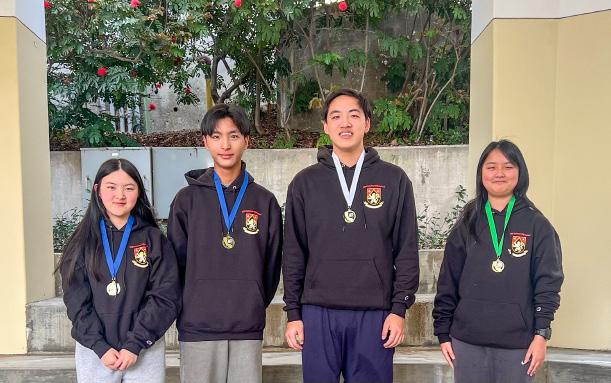
SCHOLARLY SCIENTIST: Amelia Zhang ’26, Mike Dai ’26, Olivia Zhu ’28 and Alexander Ahn ’28 earned top placements as the Science Olympiad team participated in the University of Southern California Invitational on Jan. 17, strengthening the team spirit and cooperation.
Science Olympiad team excels competing at annual USC Science Olympiad Invitational
By Claire Lee
The Science Olympiad team competed in the University of Southern California (USC) Science Olympiad Invitational on Jan. 17, marking the program’s first in-person competition of the academic year. The competition, hosted at USC, included more than 3,000 students, 41 of whom were from the school.
Amelia Zhang ’26 placed fifth in Designer Genes C, Mike Dai ’26 won second place in Boomilever C and Olivia Zhu ’28 and Staff Writer Alexander Ahn ’28 earned first place in Disease Detectives C.
Science Olympiad is an interscholastic STEM competition consisting of 23 team events in each division. Teams participate in a mix of study-based, lab-based and build events that
span various subjects in science such as biology, chemistry, physics, earth science, anatomy and engineering.
Science Olympiad leader Mike Dai ’26 said students took mock exams and acquired necessary materials for the build events before the invitational.
“To practice, we’ve been taking tests from past invitational competitions to get familiar with the format and managing time in our individual subjects,” Dai said. “In the build events, we’ve purchased the required materials and planned to spend weekends building models for Electric Vehicle, Helicopter and other events. I personally competed in Boomilever and Helicopter.”
Team B co-leader Jackson Sunwoo ’27 said the USC invitational brought the team together which gave newer
members a chance to adjust to in-person competitions and provided a positive experience for the program overall.
“It was at this USC invitational that the program came together as a collective, and we felt like we were all part of the same team, sharing in each other’s victories,” Sunwoo said. “This invitational also allowed newer members to get accustomed to the in-person competition format leading up to our participation in the regional competition this spring. All in all, the USC invitational was an incredible growth experience for both newcomers and veterans.”
Evelyn Liang ’28 said preparing for her three events expanded her knowledge in science and built important study skills.
“I competed in the Anatomy and Physiology, Astronomy and Disease Detectives events,” Liang
Vox Populi welcomes a speaker to explore new film set designs
By Angel Song
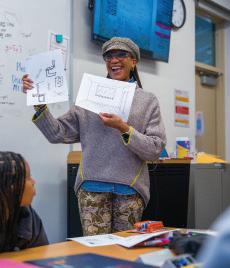
Vox Populi hosted speaker April Jones-Sellers to learn about behind-the-scenes set design and film in Weiler Hall on Jan. 22. After a presentation about the job opportunities related to set decorating, Vox Populi members could design a paper set of their own. Jones-Sellers is an assistant set decorator and buyer who has worked for “Winning Time: The Rise of the Lakers Dynasty” and “The Runner.”
Jones-Sellers said her job involves acquiring props for sets based on a predetermined budget.
“The production designer tells the set decorator what they want, and then the set decorator tells me to go out and find it,” Jones-Sellers said. “I go to prop houses, I go online and I go to stores everywhere. I can go anywhere I want, as long as our budget allows for it.”
Jones-Sellers said that an exciting part of her work is reaching out to various contacts for specific props.
“At the last show I worked on, the executive producer wanted a specific artist,” Jones-Sellers said.
“I didn’t have his phone number, but I reached out to my contacts. The day that I called her to ask about him, he was in the car with her. And she was like, ‘Well, why don’t you just ask him right now? He’s in the car.’ That was probably the most exciting.”
Tess Latham ’27 said she appreciated learning about the teamwork that goes into set decorating.
“My biggest takeaway was that every single one of the positions [in set decoration] we learned about is so important in the making of the movie,” Latham said. “I didn’t fully realize the impact each role has and how every position has to work with each other to make it run smoother.”
Vox Populi Editor-in-Chief Chloe Kim ’27 said she appreciated learning about new career opportunities in film while taking a break from working on the yearbook.
“[Jones-Sellers] taught me new things about the film industry that I never knew about before,” Kim said. “It was nice being able to learn about set decorating, which isn’t something you get to experience every day. This opportunity was a nice break from the constant effort that goes into making the yearbook.”
Latham said she enjoyed participating in an interactive activity during the event and is motivated to attend more events offering similar opportunities.
“One part of the event I liked was the drawing part,” Latham said. “I thought it made it so much more engaging for us to try and create our own sets.”
Model UN competes at tournament
By Hannah Hendifar
The school’s Model United Nations (MUN) competed at Santa Monica High School MUN on Jan. 24. 16 delegates from the school competed, with 11 winning awards. News Reporter Kara Kazaeri ’27, Hayley Ross-Settineri ’27 and Miro Katan ’28 won Best Delegate. Features Reporter Donna Enayati ’27, Ethan Chen ’26, Chase Mayer ’26 and Miro Katan ’28 won Research Awards. Yari Milakin ’27, Opinion and Satire Reporter Jack Fener ’27 and Junior Prefect Chase Rudoy ’27 won Outstanding Delegate. Camille Ahart ’27 received an Award of Commendation.
The conference hosted keynote speaker Ambassador Derek Shearer, an Emeritus Chevalier Professor of Diplomacy and World Affairs at Occidental College in Los Angeles. Miro Katan ’28 said he appreciated Shearer’s speech and its connection to current events.
“The guest speaker was pretty interesting,” Katan said. “He was the former U.S. ambassador to Finland. He was talking about his experience with the UN and how it connects to the issues that are going on today.”
said. “I learned new formulas for astronomy, information about the nervous system for anatomy and the symptoms of different types of diseases. For the competitions, we need to make cheat sheets, so I learned how to prioritize important information and how to structure the cheat sheet.”
James Corman ’27 said the Team B co-leaders are working to foster a sense of belonging within the team.
“This year, we are working to create more of a community within the team,” Corman said. “Science can seem like an independent pursuit, but the sciences have always been a team sport. [Sunwoo] and I are trying to foster a more spunky and quirky atmosphere at practices. This is because if the team can laugh together, the team can win together. And win we will.”
Hayley Ross-Settineri ’27 said she appreciated attending a smaller conference where the stakes were lower.
“The only other two [MUN competitions] I’ve done are national conferences, so this one was a little bit smaller,” Ross-Settineri said. “It felt like more of a community event, and I honestly liked it better because it seemed like there was a lot less pressure.”
Chase Rudoy ’27 said the smaller committee size gave him more opportunities to speak, work with others and judges who were more attentative.
“My committee had fewer people than the previous Model UN conferences I was at,” Rudoy said. “Although it was a little less competitive, I got more opportunities to speak.”
Snow’s-a-Melting
Jessica Ferrie ’26 has crafted up The Chroni- cle’s crossword puzzle for this issue. See if you can find all the words down and across!
20. Winter duel
23. Casual greeting
24. Poetic pasts
25. “Just so you know” in text
26. Extreme ending?
27. Christmas tree
28. Pampering place
Separate the strands of,
Attribute, as a source
31. Decorated holiday treat
35. Sandwich shop
37. __ Lanka
38. Air force?
39. Edible sweet treat containers
44. Putting grp.
45. Sharer’s word
46. “___ Miserables”
47. Lifesaving procedure that uses 30-down
48. Perspective
50. Many a language suffix
53. Winter weather characteristics, or what the starts of 20-across, 31-across,
Chron-nections
39-across require
56. French cheese
58. Mistletoe occurrence
59. Satellite’s path
60. It’s farmed on a roof, or lost
61. Poker bet
62. Sister’s daughter
63. Nerdy acronym
64. “Shoo!”
65. Passover feast
DOWN :
1. “Be quiet!”
2. Tube-shaped pasta
3. Metal mixture
4. Cabbage salad
5. “Perhaps”
6. Walk leisurely
7. Markets
8. Since
9. California beach view
10. Japanese rice cake, or alternative container to 39-across
11. Army division
12. Instinct’s origin
13. Opposite of NNW
21. They can be fine?
22. Greek sandwich
26. Cartman of South Park
27. Bank acct. guarantors
28. Snow sport pair
29. ATM code
30. Device used with 47-across
31. Pet peeve?
32. Romanov ruler
33. “__ actually”
34. Has debts
35. Quick swim
36. Heart chart, for short
40. Clue weapon
41. Epiphany exclamations
42. Fashion designer Cassini
43. Force units
47. Whipped beverage topping
48. Outlook
49. Map within a map
50. Implant
51. Cinnamon, ginger, nutmeg, e.g
52. Two armed carbonyl interrupted by oxygen in organic chemistry
53. Source of winter warmth
54. Brass component
55. Least Lake?
56. Many college degs.
57. Dull routine
Charlotte Fowkes ’27 designed this issue’s Chron-nections. Find four groups of four words that share a common category. Each word belongs to only one category. Have fun!
Layout Assistants and Staff Writers: Leica Achache, Alexander Ahn, Kiran Amin, Ila Bakaya, Hannah Bayat, Emma Bing, Isabella Chiang, Grace Choen, Rowan Green, Philo Hornby-Simmons, Sophia Jeon, Leela Kandavel, Halyn Kim, Katelyn Kim, Lauren Kvamme, Claire Lee, Lucas Lee, Radha Malhotra, Freddie Mandel, Violet Martin, Brendan Park, Jihan Park, Matteo Rabizadeh, Ollie Rauch, Avery Resnikoff, Birdie Reynolds, Sage Seltzer, Madison Shen, Sally Straus, Phoebe Sun, Avery Thompson, Nick Waller, Maddy Wynholds, Andrea Yu, Vicky Yu, Gyan Zinn
Director of HW Media: Jen Bladen
Chronicle Adviser: Billy Montgomery
AI Policies for Students and Teachers
In recent years, artificial intelligence (AI) has quickly become one of the most controversial tools in education. Schools across the country have responded by setting rules for students: no AI on essays or homework, no AI assistance without citation and harsh consequences for violations. Yet, in many classrooms, there is an uncomfortable double standard. Teachers freely use AI, oftentimes without disclosure. If students are expected to meet standards regarding AI usage, teachers should be held to those standards as well.
AI can be a powerful educational tool when used responsibly and in technology like calculators and spellcheck. The problem arises when transparency and accountability are expected only from one side of the classroom. Research tells us that the use of AI undermines learning, critical thinking and academic integrity. If that is true for students, it must also be true for educators.
Students deserve to know when a teacher utilizes AI-generated materials. A discussion post prompt written by generative AI may lack nuance, originality or alignment with the specific course. These are, ironically, the same issues cited by teachers when accusing students of AI use. Holding teachers to the same standards would encourage thoughtful, intentional use rather than quiet dependence. Giving full disclosure fosters trust, which is foundational to any effective learning environment.
This issue is also fundamentally a matter of fairness. Students are required to submit original work that reflects their own thinking, often under tight deadlines and high pressure. When teach-
about us
DIVERSITY, EQUITY AND INCLUSION:
The Chronicle strives to be a diverse and inclusive community that welcomes all who wish to contribute. Our Diversity, Equity and Inclusion committewwe works to ensure that every member of the Harvard-Westlake community is recognized, included and given a voice.
The Chronicle's publications will aim to represent this diverse community and provide a variety of perspectives on the topics that they cover.
EDITORIALS:
Unsigned editorials represent the majority opinion of staffers and are written by the Editorial Board, which is composed of the Editors-in-Chief, Managing Editors and Section Editors.
ADVERTISING:
Looking to place an advertisement in our paper? Questions pertaining to advertisements may be directed to The Chronicle's Business Manager Yuna Jeon at yjeon1@hwemail.com. Publication of an advertisement does not imply endorsement of the product or service by the newspaper or school.
ers are not required to disclose AI use, it sends a troubling message that integrity is optional: it is expected from students but not from authority figures. Faculty should be modeling the values they enforce, not contradicting them.
Furthermore, equal standards would create better conversations about ethical AI use. Instead of instilling a sense of fear in students, schools should shift toward clearer guidelines, deciding when AI is appropriate, how it should be cited and how it can support human efforts. Teachers, as the professionals, should lead by example.
The school does not currently have specific regulations around general teacher AI usage, but rather rules tailored to each department, according to an interview with President Rick Commons. This laissez-faire approach can be concerning, especially as AI continues to grow. There is a risk that the integrity of the educational process could be compromised. By not setting clearer, more transparent regulations, the school is missing an opportunity to lead by example in creating ethical standards that can successfully balance technological innovation with academic integrity.
Education works best when expectations are mutual. If schools want students to engage honestly with their work, teachers must do the same. Applying consistent AI standards across the school helps establish practices of integrity, transparency and accountability, preparing everyone to navigate a world driven by AI.
LETTERS TO THE
EDITOR:
Letters may be submitted to chronicle@ hw.com or mailed to 3700 Coldwater Canyon Ave., Studio City, CA 91604. Letters must be signed and may be edited to conform to Chronicle style, space and format. We are committed to uplifting the voices of marginalized or underrepresented individuals and groups in accordance with our efforts to promote diversity, equity and inclusion.
PUBLICATION
UPDATES AND CORRECTIONS:
Though we always strive to be as accurate as possible, staff members identify inaccuracies and receive feedback from readers.
The Chronicle publishes corrections when we discover a factual error within a piece. We will continue to uphold transparency even in the face of mistakes following the publication of each issue.
SRecognize the injustices of microplastics
By Hailey Kramar
As she looked at her whimpering child in the cold, brisk air, a mother used a plastic bag as fire starter without a second thought. The flimsy, liquified plastic poison dropped into the deep reds of the fire that became her stovetop, and her child did not have to go to bed with an empty stomach. The thick fog clouding her vision and sitting in her lungs seemed insignificant. This scene was presented to me in my Environmental Science class where we learned about the dangers of microplastics from the documentary “A Plastic Ocean.”
Watching the scene unfold, I realized that microplastics are not just an environmental issue, but also a demonstration of whose health is prioritized and whose livelihood is devalued.
Microplastics, invisible to the human eye, are particles of plastic that never fully decompose, contaminating every habitat and resource on our planet. They infect the atmosphere, oceans and food chains, eventually biologically accumulating in humans. In 2020, 2.7 million tons of microplastics were released into the environment, a number that
Preserve friendships through technology
By Lauren Kvamme
treetlights still shine, but no longer dictate the limits of connection. That light has been replaced by the glow of the screen and the ability for kids to stay connected in ways that fit their modern lifestyle.
Every generation loves to believe it has the last real version of friendship. Today’s teenagers hear repeated criticism about how adults spent quality time together when they were kids. Back then, streetlights were the curfew, not screen notifications. Phones stayed on the wall, not in our back pockets. However, this doesn’t mean that our friendships are less valuable. Adults often describe us as disconnected, detached and scold us by saying that we are not ready for the real world. These accusations overlook modern changes that reflect a more contemporary and digital approach to friendships, which are not necessarily harmful to teenagers.
Today’s teenagers are inundated with activities, from the rigors of our academic curriculum to participating in sports, leadership roles and volunteer work. Leisure time is not often afforded to students trying to keep up with the demands
imposed upon them. This leaves little space in a teenager’s schedule for long hours of socializing. Most of their physical interaction with their friends occurs during the school day during lunch periods, free blocks and moments spent working on homework together. After school, students are too busy with work and extracurricular activities to connect with friends for extended periods of time.
Technology’s modern role in reshaping relationships reflects this shift. Utilizing software like Voice Notes, FaceTime, shared photo albums and iMessage allows friends to connect when they cannot be together in person. While these interactions may appear shallow at first, they accumulate to build a meaningful pattern of accessibility and connection that adapts to teenagers’ busy lives.
Hangouts and long conversations have been replaced by intentional interaction and short check-ins. Technology has played a key role in this transformation. The use of modern communications has helped teenagers to become more emotionally aware. They are more open to discussing stress, de -
pression and vulnerability because it feels less intimidating through text than in person. Digital communication does not strip emotion from these conversations. Facial expressions on FaceTime, voice tone in calls and even emojis and tone indicators allow teens to express emotion in ways that still feel human. Some students point out that in an environment where everyone is constantly stressed and worried about something, peers often lean on one another because they share similar pressures.
The relationship between technology and connections may be complicated, but that does not mean it is damaging according to a study by the Institute of Digital Media and Child Development. While passive screen time can contribute to isolation, its use to maintain existing friendships and provide emotional support is positive. The concept of screens is not the problem; how they are used is what matters.
Most teens are aware of the drawbacks of digital life and acknowledge that social media
is expected to double by 2040, according to the United Nations Environment Programme (UNEP).
Microplastics containing and carrying toxic chemicals such as phthalates and BPA have detrimental health impacts. Microplastics are linked to inflammation, hormonal disruption, reproductive harm and increased risk of cancer, according to the National Institute of Health.
Affluent people may limit their exposure to microplastics because they have the luxury to look beyond basic survival needs. They can choose to reduce their usage of plastic and recycle and upcycle waste. Additionally, wealth can contribute to technological advancements, which in turn can help the environment. However, because wealthy people have more money to buy consumer goods, they unfortunately disproportionately produce more waste.
Within developed countries, low-income and marginalized communities are unjustly affected by microplastics. Plastic production plants, waste sites and recycling facilities are often located near underserved communities, increasing local exposure, according to the UCLA
Luskin Center. Also, people of lower socioeconomic status may not have the time, awareness and resources to voice concerns about pollution. Unfortunately, this pattern exemplifies environmental racism, according to the UNEP. Another way that poor communities are disproportionately impacted is through their diet. Fishing and coastal communities ultimately ingest higher levels of microplastics because their food is contaminated. After plastic is swept into the ocean and starts to separate, the microplastics bioaccumulate in fish. Then, when humans consume these fish, the pollutants biomagnify in them, according to the National Library of Medicine (NLM). In addition, low-cost consumer goods contain microplastics, and because of their affordability, lower-income communities are forced to rely on them over higher priced, environmentally sound alternatives, according to the NLM. Despite developing countries contributing less to plastic consumption, they still bear a significant burden of
Reform Global Ruling
By Angel Song
Ona summer morning in 2023, the first headline I noticed in my daily news digest contained some surprising information: the United Nations (U.N.) Security Council had ju st rejected two draft resolutions seeking to renew cross-border humanitarian operations in Northwest Syria. Unfortunately, this is only one many historical instances of botched U.N.-sponsored humanitarian operations. When geopolitical conflicts occur, the world usually turns to the U.N. to resolve the situation. The U.N. has maintained this global peacekeeper status since its creation in 1945, contributing to the resolution of numerous conflicts. In recent years, however, the U.N. has been losing credibility and efficacy in addressing humanitarian conflicts, with critics ac cusing the body of bureaucracy and a lack of adaptability, thus making a reconstruction of the organization inevitable. To remedy these issues, the U.N. must reduce its skewed power dynamic by restructuring the Security Council and gain financial independence by generating profit.
The U.N. faces internal issues w ith its Security Council, one of its six major organs tasked with maintaining international peace and sec urity. As such, the 15 countries that
make up the Security Council have immense authority over fellow member states, possessing the ability to impose sanctions and author ize military intervention. The five permanent member states – China, France, Russia, the United Kingdom, and the United States (U.S.) – ar e endowed with a special ability to veto any substan tial resolutions brought to the table. Unfortunately, the veto power often proves to be more harmful than beneficial for political conflicts. As of September 2025, the U.S. had vetoed six resolutions regarding a Ga za ceasefire, according to Amnesty International. For one resolution, while 14 members voted to adopt , the U.S. stood alone with its veto, hindering U.N. efforts at providing the Gaza strip with humanitarian aid. However, the U.S. is not the only country plagued with this veto problem. Since 2014, Russia has vetoed all draft resolutions created in response to R ussian aggression towards Ukraine, according to a press release from the U.N. As such, the veto power has increasingly become a weapon for blocking humanitarian operations and peacekeeping missions, hindering the U.N.’s efforts in ending political conflicts.
ILLUSTRATION BY AUDREY HERRERA
IBy Hannah Hendifar
get home from a date at Jon and Vinny’s, slip off my shoes and run upstairs. In the familiar warmth of my bed, I open my phone and go on TikTok. I am immediately bombarded with videos of people telling me if I continue things with my date, I will end up a mindless prude with no female friendships, life goals or identity. After all, it is early November of 2025 and Chante Joseph’s British Vogue Article “Is having a boyfriend embarrassing now?” has just gone viral. As I scroll past hoards of influencers on TikTok, each scrambling to project relevance and authority, I can’t help but think that these videos are a waste of breath and harmful to the perception of women and romantic relationships. Relationships are a natural and healthy part of life. As human beings, we crave connection, and romantic relationships are one aspect of that. Positive emotions like love and passion are important benefits from being in an intimate relationship, according to 95% of participants in a study published by the National Institute of Health (NIH). They are not signs of dependence, as many like to claim, but rather a reflection of the common positive effect of increased emotional well-being when in a relationship. Being in a committed relationship, when it involves sexual relations, can lead to better sex with health and emotional benefits. Having sex as part of a loving re-
Boyfriends are dignified STATS AND FACTS
lationship stimulates the release of oxytocin and other mood-boosting hormones more so than masturbation, according to Nicole Cirinio, M.D., associate professor of psychiatry at OHSU’s Center for Women’s Health. Furthermore, 86% of participants rated receiving “sexual satisfaction” to be a top benefit, with many viewing “safe sex” as very important in the study by the NIH. At a time when hookup culture is so prevalent and idealized, it is important to note the emotional benefits of having sex with just one person that you are meaningfully committed to.
But this conversation is not just about the health and emotional benefits of having a boyfriend. It is also about women getting to live their lives however they want, without having to hear constant discourse about it. There is no reason something as ordinary and normal as having a boyfriend should be labeled as “embarrassing,” a word with a negative connotation that reflects badly on the person experiencing it.
Ultimately, while embarrassment is a valid emotion, it has morphed into something a lot bigger and more significant in today’s world – a constantly feared fate for those who don’t act cool enough. Embarrassment stems from the anticipation of others judging us negatively, threatening the social image we want to project, according to the social evaluation model by Rowland S. Miller
• Continued on hwchronicle.com
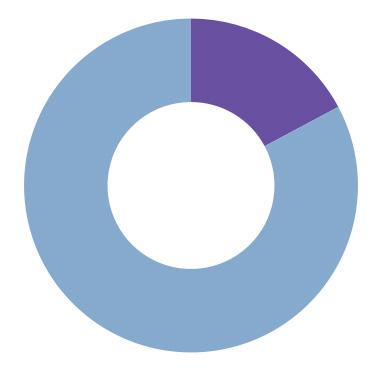
Do you think having a boyfriend is embarrassing?
Yes: 17.2%
No: 82.8%
*128 students polled
Do you want a significant other?
Yes: 71.3%
No: 28.7%
*122 students polled
By Eila Shokravi
As cavemen, companionship was used purely for survival and procreation. During the time of Jane Austen’s Pride and Prejudice, a husband was a way to build financial security and social authority. And from the classic film noir era, Casablanca portrays romance as a beautiful, bittersweet triumph. As the years go on and society modernizes, having a boyfriend now carries an unexpected side effect: embarrassment – an almost dramatic humiliation and persistent self-consciousness. Modern culture increasingly celebrates strength, independence and professional ambition as defining markers of success, particularly for young women. Growing up, self-sufficiency is framed not just as admirable, but essential, with emotional expression being rebranded as weakness, and romance a mere consequence. Wanting companionship risks being seen as feeling unfulfilled in one’s academics or career. This expectation demands flexibility and personal branding, leaving little room for attachments that imply an emotional and financial dependence. As a result, romantic partnerships are not seen as something complementary to a fulfilling life, but a dilution of independence. This outlook creates a societal standard, framing companionship as embarrassing. Living in an era of nonchalance, modern social capital is built on restraint: not caring too
much or revealing attachment. Choosing to remain single is a performance of control, and having a boyfriend disrupts that image. This is especially evident in how emotional expression is judged. Women who display emotional openness in romantic contexts are more likely to be perceived as less competent or authoritative in professional and academic settings, according to a study conducted by the American Sociological Association. As a result, romance becomes something to compartmentalize or avoid entirely, as it threatens a curated image of independence and composition. Having a boyfriend implies vulnerability, and although widely praised in theory, remains socially penalized.
Today, there are fewer young couples with just 34% of U.S. adults in their twenties reporting being in a committed relationship, and 48% considering themselves single, according to the Pew Research Center. This is a sharp change from previous decades. Now, being in a relationship is no longer the default, but a visible separation from your peers. When most of one’s community is single, having a boyfriend whom you attend events with, reference as “we” or appear online with becomes an unintentional and constant announcement. This connection makes women no longer feel accomplished, but attached indefinitely. Especially in a community
Prioritize nuclear power as the future of global energy production
By Jack Fener
At current rates of consumption, global oil and liquid fossil fuel reserves are only expected to properly meet demand through 2050, according the United States Energy Information Administration. This demand is only going to increase, and reliance on fossil fuels as the base of world industry will be an increasingly untenable position. This issue necessitates innovation into alternative fuel sources, so discussion around energy demand has become focused not only on what methods can keep up with requirements, but which are capable of doing so in a way that is safe, affordable and viable long into the future. Attempts have been made, with some success, to convert parts of the global electricity production system to alternate energy sources such as wind, solar and hydroelectric. However, these sources have proven unfeasible to implement on a large scale that would truly satisfy demand, leaving the current world economy almost totally dependent on fossil fuels. This is an intolerable state of affairs, especially considering that another viable option already exists: nuclear power. Modern nuclear power is the most viable option currently available to avert an energy crisis. It is extremely efficient, which boosts its generation capacity and makes it more affordable. Furthermore, it is surprisingly safe, even without being compared to obviously harmful fossil fuels. Nuclear power is currently the world’s best option for energy production and must be prioritized in
future legislation and investment.
Nuclear power is efficient for two main reasons: first, the resources it requires are capable of generating large amounts of electricity relative to their cost, and second, the method of power generation itself is simple. The fissionable materials that produce nuclear power are mainly Uranium, Plutonium and Thorium. These are all elements that, while not nearly as plentiful in mass as coal and oil, are able to generate vastly more energy even relative to their scarcity. For example, the enriched Uranium 235 that is used for fission is about three million times more efficient for power creation than coal, according to euronuclear.org. Thorium is even more impressive, able to produce over 3.5 million times more electricity relative to mass than both coal and oil, according to The United States Department of Energy.
The large gap in efficiency means that nuclear power plants need to process a fraction of the material that coal and other fossil fuel plants require to generate the same amount of electricity. Once the fissionable material is obtained, the process by which it is used is almost as simple as that of fossil fuels. First, a controlled fission reaction needs to be started inside the plant core. Next, the heat it generates is used to boil water, the steam from which spins a large turbine. This simplicity means that the innate advantages nuclear already has over other types of energy make its implementation even less of an economic burden on
both producers and consumers.
As well as being superior in power generation capability, modern nuclear plants constitute little in terms of harmful immediate emissions, future safety risks and ongoing operational hazards. The only by-product produced by nuclear reactors in the short term is steam from the boiling water, a totally benign substance that is released from the top of the plant towers.
In comparison, burning fossil fuels constantly releases toxic fumes that pollute the air and contribute to climate change. The worst byproduct of the nuclear process is the hazardous solid waste that is created when fissionable material is used up. Fortunately, there now exists multiple methods by which this waste can be neutralized and permanently stored, such as burying it in stable rock or even recycling. Even the most hazardous nuclear material can be repurposed into medical isotopes, depleted Uranium metal or advanced batteries.
Lastly, the risk of nuclear meltdowns has become almost negligible as advancements in safety and monitoring technology have massively improved the safety of ongoing nuclear power operations, according to The United States Nuclear Regulatory Commission. Thorium powered plants, for example, are capable of shutting down their fission reactions almost instantly by removing the starter plutonium, which is required for them to function. The industry has simply progressed past the ar-
chaic and unsafe systems responsible for early nuclear disasters such as Chernobyl and Fukushima.
Evaluated purely on its merits, nuclear power appears to solve many of the problems that continue to hold back renewables and make fossil fuels so problematic. It delivers consistent, zero carbon emission energy at a scale no non-fossil fuel source can come close to matching. Given those clear advantages, nuclear power’s more marginal status in current energy production is all the more illogical and frustrating. The reason for its sidelining has little to do with its complications, cost or feasibility, but in the decades of political lobbying, public misinformation and regulatory decisions that have made it less profitable to adopt. The only reason it has not already solved global energy demand is because it has been economically disincentivized, politically side-
lined and deliberately fear-mongered to destroy public support.
The fossil fuels lobby has, through the funding of anti-nuclear campaigns, both managed to make the general public terrified of nuclear power and framed its opposition as an environmentalist opinion. Because of these efforts, much of the general populace believes that nuclear energy is still prone to disaster and is directly connected to the production of nuclear weapons. Lobbying has also convinced lawmakers to keep their energy subsidies devoted to propping up current fossil fuels or placed into renewable projects that will inevitably not meet demand. All of this is done with the goal of keeping coal, oil and natural gas as the only economically viable forms of large scale energy production despite their lower efficiency and clear environmental risks.
with
People meet in Westwood to protest Islamic regime
By Kara Jazaeri
Members of the Iranian community and supporters gathered for a protest in front of the federal building in Westwood, Los Angeles (L.A.) on Jan. 11. Opposed to the brutality of the Islamic Regime in Iran, over 50,000 people marched in the area for three hours.
Iranian-American student Mattin Tashbihgoo ’27 said the marches were a much needed way for the Iranian diaspora to unite and show their support.
“The protests going on in L.A.
are necessary to remind the world about the absolute tragedy and, at this point, almost genocide of the people of Iran at the government’s hand,” Tashbihgoo said. “The people protesting in L.A., like my mother, want to ensure the world remembers Iran and stand in solidarity with the people of Iran. They want to help them and support them even thousands of miles away, to encourage them to keep fighting and keep fighting and keep fighting. The people of Iran are strong.”
Prior to the Iranian Revolution
the country was ruled by the Pahlavi monarchy until 1979 when the Islamic regime overthrew the Shah. Many have debated the implications of the change in leadership, specifically surrounding topics like how religion and rule connect, human rights, and class divide.
Upper School History Teacher Dror Yaron, who teaches the Middle East Studies class, said he is hopeful in regard to the future of Iran.
“The current leaders of Iran are focused on formulating a new Shiite hegemonic construct in the
Students reflect on fire protest
By Abby Ryan
Members of the Pacific Palisades community gathered at the American Legion Veterans Post to commemorate the one-year anniversary of the Palisades Fires and memorialize the 12 people who passed away on Jan. 7.
Calia Trachtenberg ’27 said although she did not attend the protest, she understands the message it aimed to promote.
“I decided not to attend due to the timing, as I was still in school when the main protest was happening,” Trachtenberg said. “The main message during the protests was ‘They let us burn.’”
Trachtenberg said that there is growing dissatisfaction toward those in authority.
“People, especially in the Palisades, feel leadership didn’t help enough during the fires, and due to a lack of funding, things were made worse,” Trachtenberg said. “People are upset at how slowly the rebuilding is going along with the fact that our elected officials didn’t help as much as they could.”
Hal Craig ’27 said he chose not to take part due to a lack of information about the demonstration.
“I wasn’t sure who the protest was directed at or what specific change people were hoping for,”
Craig said. “That uncertainty made me hesitant to participate. There are class action lawsuits happening, and my family is involved in some of them. To me, that feels like a more concrete way to push for more accountability.”
Malena Atluri ’27 said she was not prepared for the fires or the grief that followed.
“The fires were so out of the blue, and honestly, a crazy experience,” Atluri said. “No one was prepared for how fast everything changed. People’s houses were burning down, and that left a lot of emotions behind. It wasn’t just physical damage. It affected people deeply. Even people who didn’t lose their homes still felt affected. Everyone knew someone who had been impacted.”
Atluri said people protested to make their own concerns and opinions heard.
“The protests were a way for people to cope with everything that happened,” Atluri said. “It gave people something to do with all those emotions. The protest was also about visibility and making
voices heard. People wanted to feel like they were part of something bigger than themselves when everything else felt helpless.”
Craig said he did not participate because he did not think it was the best way to enact change.
“Sometimes protests work, and sometimes they don’t,” Craig said. “A public rally is not always the most effective way to create change. For me personally, my time felt better spent actually finding out what happened. I wanted answers instead of just expressing anger.”
Craig said he hopes to design a project about his findings on what happened during the fire.
“I want to ask high-ranking officials why the LAFD was so unprepared and why the water supply was so unprepared, ” Craig said. “I’m going to publish everything I find in the form of a podcast so people can know what I know. Education about how this was allowed to happen is what really matters.”
Trachtenberg said she does not think leadership did all they could to help during the fires.
“People feel that our elected officials didn’t help as much as they could have,” Trachtenberg said.
Middle East, rather than really nurturing what should be one of the top of the line countries, and, dare I say, a first world order, with the extent of their population, their size, their resources, their strategic location and the variegated nature of their population,” Yaron said. “Iran was a historical force, a cultural icon, a definer of civilizational output [before the revolution], not just Islamic. Even when it was Islamic, it was much more sophisticated and even tolerant than what the Iranian revolutionary republic has been the last
47 years.” Iranian-American student Olivia Davidov ’29 said the protests offered support for the Iranian diaspora in L.A. during this time.
“The Westwood protests reflect how deeply personal and emotionally charged the situation in Iran is for many people, especially within diaspora communities, which are large within L.A.,” Davidov said. “I see them as an expression of frustration and solidarity, but I also think it is important that they remain informed and respectful.”
WAVES OF FREEDOM: Protestors stretched a massive Iranian flag across the streets of Westwood on Jan. 11, as crowds gather to oppose Iran’s current regime. The demonstration transformed a busy city block into a visual display of solidarity,
participants using flags and chants to call attention to human rights abuses abroad and demand real change.
KARA JAZAERI
ACADEMIC ADDICTION
FOCUS FOR SALE
Commmunity members discuss the prevalence and impact of unprescribed Adderall and other stimulants to enhance academic performance at the school.
By Donna Enayati
Arlo* anxiously picks at his nails as his teacher walks around the classroom passing back their midterms. After studying for seemingly endless hours, the result of this exam would be the difference between a B or a C in the class. When Arlo flipped over the paper and saw an “A” written with an enthusiastic “Good Job!” scribbled in the corner, he anticipated the familiar rush of pride or relief that usually followed after endless hours of hard work. Instead, he felt nothing, no satisfaction, no excitement and no sense of accomplishment. Arlo realized he was experiencing emotional bluntness, a side effect associated with a prolonged or high-dose use of Adderall, a stimulant commonly prescribed for Attention Deficit Hyperactivity Disorder (ADHD). Arlo, who takes Adderall without a prescription, said Adderall can have effects like reduced sociability.
“[Adderall] makes you more anti-social,” Arlo said. “If you use it for too long, over time it can cause emotional bluntness, which is not that bad of a thing. I’ve had it once. Nothing really feels real. You just go about your day without any emotions.”
The use of Adderall usually leads to increased physical energy and greater focus, according to the American Addiction Center. Arlo said he and some of his friends use the drug without a prescription to enhance performance.
“I would guess probably around 20% of the student body uses Adderall,” Arlo said. “It puts the students that take Adderall at a much stronger advantage because it makes you perform intellectually at a very high level for a very long time.”
Head of Peer Support and Upper School Counselor Tina McGraw ’01 said she has not observed unprescribed Adderall use in the student body.
“The vast majority of high school students do not misuse stimulant substances,” McGraw said. “It’s more of an issue in colleges from what I know. I’m not aware of it being a widespread problem at the school.”
In 2020, survey data showed that 7.3% of high school seniors had misused an amphetamine or stimulant drug at least once. 4.4% of high school students reported using Adderall without a prescription, according to data from the National Library of Medicine. According to a Chronicle
poll, 62.1% of the student body knows someone who uses Adderall without a prescription and 6.7% of students have used Adderall themselves.
Harwin*, who has used unprescribed Adderall several times to complete assignments or study for difficult exams, said he began using the drug to meet the academic expectations of his teachers.
“My junior year was an extremely stressful time period,” Harwin said. “I was taking several honors courses and felt that I could not complete the work that was required of me in the allotted time, so I turned to Adderall, and it helped my grades improve exponentially.”
In addition to us -
ing Adderall, Arlo uses Vyvanse, another stimulant drug that has a similar profile to Adderall. However, its effects often last much longer and are considered to be less harsh. Arlo said the use of Adderall and Vyvanse has made him significantly more academically and financially successful.
“I would genuinely accredit 90% of my school success and my work success to Adderall,” Arlo said. “It’s a literal cheat code. Without Adderall, I honestly don’t think my company would have made as much money. I was taking Adderall every day for about four months, and I made really good progress. I bought my dream cars and was able to maintain some solid B’s and A’s.”
Hudson Barber ’27 said she went through the process of getting accommodations and was eventually prescribed extended-release Adderall.
“I’m on extended-release Adderall, which has balls inside of the Adderall,” Barber said. “Some get released immediately and then after about five or six hours, the rest of the balls get released, so it has a 12hour type effect.”
“feels way harder.”
Snorting Adderall can increase chances of addiction to stimulant drugs and can cause inflammation of the nostrils, nasal passages and sinuses, according to American Addiction Centers. Arlo said he consumes Adderall through intranasal administration.
“Sometimes, if I have to study for a very long period of time, I’ll even snort the Adderall, because it hits a lot harder and it dies a lot quicker,” Arlo said. “I know a lot of other guys at school that snort Adderall as well.”
I would genuinely accredit 90% of my school success and my work success to Adderall. It’s a literal cheat code. ” Arlo*
Barber said she had trouble with concentration, prompting her to go through the accommodations process.
“I’ve always struggled with time management and focus issues,” Barber said.
“During the summer before ninth grade, I realized I needed some sort of testing done to get these accommodations, and I was diagnosed with ADHD. I’ve gotten 50% extended time, small group testing and quiet space testing, so sometimes I need to go into a different room to test.”
Emma Lee ’27 was diagnosed with ADHD and receives extra time accommodations, however she is not prescribed Adderall. Lee said she has experienced hyperactivity since she was young.
“Ever since I was super young, I was hyper, but I don’t know if that was the ADHD or not,” Lee said. “When I was taking tests, I couldn’t focus and I would keep thinking about other stuff. I would have one thought and then, before I could finish it, another thought would come in and I would get super sidetracked. Now, I get extra time for all my tests, which is really helpful.”
Research suggests that youth stimulant misuse often shows up alongside other substance use and is linked with higher overdose risk, according to the National Library of Medicine. Moreover, teenage and child non-medical prescription stimulant use is associated with later illicit stimulant use, though researchers emphasized that they still do not fully understand this link. McGraw said the use of unprescribed Adderall can lead to an escalation of drug use in the future if that person cannot find more healthy ways to cope with stressful situations.
“There’s a lot of evidence that people who are willing to use drugs illegally in high school often end up escalating into other forms of drug abuse,” McGraw said. “What’s scarier is that it’s used as a poor coping strategy. It tells me that a person has poor coping strategies, which means they are probably more susceptible to other poor coping strategies too.”
Arlo said he is a supporter of unprescribed Adderall use because it helps him to focus on his goals.
“I personally love it,” Arlo said. “Adderall’s great. It’s a good thing because it keeps you away from other drugs as well. There are some kids in my grade that are starting to do stuff like cocaine, and I would never do that. Adderall is such a weird thing. It makes you not want to do anything except lock in.” McGraw said unprescribed drug usage including adderall can have negative short-term and long-term effects that students may not be aware of.
Barber said her accommodations improve her academic performance, although they do not entirely fix the issues she faces.
“[My accommodations] are effective,” Barber said. “I honestly don’t know how I used to do tests without the extra time. It’s definitely helpful to have that as a fallback, but I still find myself running out of time on tests.”
Since 2004, the average attention span on any screen has decreased from two and a half minutes to 47 seconds in the last five years, according to the American Psychological Association. Harwin said constant exposure to social media makes it increasingly challenging to concentrate on school.
“A lot of students have short attention spans because of apps like TikTok or Instagram,” Harwin said. “It makes it a lot more difficult to focus for long periods of time. You get so used to scrolling and moving on after a few seconds, so doing homework without checking your phone
“Using any kind of medication that changes your brain chemistry leads to changes in your ability to function over the long term,” McGraw said. “For stimulants, your brain starts to shut down some of its dopamine receptors, and over time, your baseline gets lower and lower, so you feel worse and worse in the morning. If you’re using them a lot, you might even have withdrawal symptoms. In the short term, you might feel agitated, irritable or have trouble sleeping.”
Lee said she struggles to be productive at home and is interested in getting a prescription for Adderall, but is afraid of the stigma surrounding medication.
“Extra time accommodations really help when I’m at school taking a test, but at home I can’t focus,” Lee said. “I go home and don’t get anything done until around 10 p.m., which ends up preventing me from getting enough sleep and makes it harder to focus the next day. Medication could really help with daily life, but I’m scared to bring it up to my parents or my grandma because of how they view ADHD. They already have certain ideas about it, and especially about medication, I worry they’ll see it as something much more serious than it actually is.”
*Names have been changed.
L.Wood
Tina McGraw ’01
A ssessing Access
Students with physical challenges reflect on campus accessibility, finding support in the school community and their resulting journeys of personal growth.
By Tali Gurule
Teenage girls from around the country flock to Oceanside, California for the start of a weekend-long soccer tournament. It is the day after Thanksgiving, and by 2:00 p.m., the 2025 San Diego Surf College Cup Showcase is in full swing. When Shaili Betesh ’27 lunges to kick the ball from a defender on her tail, her right knee gives in and collapses with a sickening pop. Betesh said she tore her anterior cruciate ligament (ACL) when she fell.
“I immediately knew what I was going through,” Betesh said. “The way my knee popped, felt loose and turned inward was a textbook example of an ACL injury.”
After tearing her ACL and lateral meniscus, Betesh underwent an operation to reconstruct her knee. Now, she uses crutches to navigate a school campus where 83% of students report climbing seven or more flights of stairs per day, with 21% of students climbing over 12 flights per day, according to a Chronicle poll. Betesh said she strives to keep a positive mindset about her injury despite the difficult recovery journey ahead.
a class to help a student access the room more easily. Nothing is off the table.”
Parker Rockwell ’27, who broke his ankle during spring break of his sophomore year, was on crutches until summer vacation. Rockwell said he witnessed the school’s commitment to accommodating his injury when it shouldered some of the cost of taking an Uber to school each day.
“I didn’t know how I would get to school because I hurt my right foot and couldn’t drive,” Rockwell said. “My par ents were at work, and the bus wasn’t an option because my an kle was too fragile to go up and down the steps of the bus. My dean suggested Uber, and the school ended up paying most of the cost to travel every day. There was so much to figure out, but the school did a lot to help.”
The security team often facil itates an injured student’s move ment on campus by assigning ac cessible parking spots, allowing parents to drive their children directly to class and transporting the student in the security cart. Head of Upper School Se curity Earl Saunders said the team will do as much as possible to help an in jured student travel with ease.
Kit said their friendships are integral to having a balanced high school experience that makes sense for them.
“I have a lot of good friends who make an effort to understand my situation,” Kit said. “After hanging out once, I feel exhausted, done for the week. It’s really nice that my friends are understanding of what I can and can’t do. Even though I definitely don’t have the
yesterday.’ It’s hard for people to understand exactly what it’s like to be in my position. It took me a year and a half to even get a diagnosis, but this entire situation has taught me how strong I really am.”
Betesh said her experience has uncovered a determination that she had never before seen in herself.
“I am much stronger than I ever
“After such an intense knee surgery, I try to stay optimistic by reminding myself that I’ve been through the hardest part of this process,” Betesh said. “It’s almost impossible to get around school without encountering at least a few flights of stairs. No matter what I tell myself, the path ahead of me is still extremely challenging.”
The map of the upper school campus shows an elevator in Munger Science Center and another in Chalmers Hall, according to hw.com. The map recommends contacting security for assistance, acknowledging that the school is built on a hillside and navigating the campus often requires several flights of stairs.
Sahana Narang ’28, who fractured her foot during rehearsal for the upcoming school musical, said managing an injury while also completing a standard school day is overwhelming.
“Even with everyone here to help, I dread coming to school because all I can think about is having to walk uphill while handling crutches,” Narang said. “A backpack full of books, binders and notebooks only makes it more of a struggle.”
Kit* ’27, who has a permanent condition that limits their mobility, said the school supports its students who need help navigating campus.
“There’s not much that anyone can do about the campus being on a hill,” Kit said. “There are days when the geography exacerbates my condition, but the school has been helpful in trying to minimize that.”
The school employs a range of strategies to minimize the physical challenges students face. Community Health Officer Milo Sini said the school will do whatever is necessary to ensure a student is able to participate on campus, including relocating a class if someone is unable to climb the stairs.
“We use every possible way to accommodate our students,” Sini said. “We may email their teachers, ask another student to help carry their books, set up a system so the student can Uber to school each day, or, in one case, move
“If there are no elevators or if a student is going from one side of the campus to another, we’ll come over, pick them up and drive them from point A to point B,” Saunders said. “We’ll take as many trips as we have to make to help the student get around with less of a struggle.”
Rockwell said he enjoyed getting to know Saunders last year.
“Earl was nice company,” Rockwell said. “I still talk to him about football in the mornings, and I’ve always thought it was cool that he has a motorcycle.”
Saunders said he loves to learn more about the students when they travel across campus together.
“We talk about their day, the sports they’re involved in or how they got hurt,” Saunders said. “I ask about their fu ture, what school they want to go to, what they want to study and even their long term goals. Maybe they want to be a doctor or a lawyer or a similar kind of profession. We become friends. I have a lot of grandkids, and I look at them as another kid in my family.”
Betesh said she has val ued friendship while manag ing her injury, relying on the people she loves to keep her situation in perspective.
“Immediately after my surgery, all of my friends reached out and some of them came over to my house for a couple of hours,” Betesh said. “It made me so happy to see them, and it took away the pain. Even though I was sitting in bed injured, they helped me focus on the positive parts of the moment.”
L.Wood Shaili Betesh ’27
COST OF
Students and faculty re5ect on the prevalence of colorism within ethnic communities and how it translates into everyday life and media.
By R iya Iye%
Sitting in a circle with her family, Maylie Macias ’26 draws a card in Lotería, a Mexican board game similar to Bingo. e card depicts a black man as an entertainer, with the name “El Negrito.” After reading out the name, her family members all turn to point at her aunt, one of the darker-skinned members of the family. As her family jeers at her aunt, Macias sits in silence, acutely aware of the blatant colorism that is playing out in front of her. Macias said colorism is a result of persistent colonial beliefs that trickle down into everyday life.
“Colorism [manifests] through families and parents teaching their kids through small microaggressions like ‘don’t go in the sun’ or the comments about the Lotería cards, ” Macias said. “It’s the small stu that gets ingrained in us about seeing Spanish genes and Spanish culture as more superior because our Indigenous ancestors were wiped out by them. If we want to equate ourselves to something bigger than ourselves and something victorious, we usually equate that to the Spanish DNA.”
Colorism is de ( ned as prejudicial or preferential treatment of same-race people based solely on their color, according to Pulitzer Prize Winner Alice Walker, who coined the term in 1982. Upper School History Teacher Erik Wade said colonial history directly impacts the elevation of fair skin in certain cultures.
“Prehistory will show that di erent color tones were embraced, but that completely changes when we get to colonization by European nations,” Wade said. “Once there is contact with Europe, European beauty standards essentially dominate and their expectations become a part of the hegemonic presence.”
Black Leadership and Culture Awareness Club (BLACC) Leader Morgan McGinnis ’27 said the treatment of darker-skinned women as a result of colorism has impacted her self-worth.
“Socially, darker-skinned women are not treated as well as lighter-skinned women,” McGinnis said. “It truly diminishes and damages my con(dence as a [darker-skinned] Black girl because it is horrible to feel like I will never be pretty enough because am not lighter. For me, there was a moment of realization when I was little that no matter what I did, I would never be the ideal woman. It totally decimates you and it’s just the worst feeling in the world to know that because of your skin color, you will never be seen as beautiful or worthy enough.”
Wade said he has experienced certain privileges due to being fairer-skinned within the black community.
“More than anything, I receive the bene (ts of being a little fair-skinned within the black community,” Wade said. “During a [National Association
for the advancement of Colored People (NAACP)] student union meeting at our university, we were having conversations about colorism. At one point, my best friend turns around in the seat to point at me and he says ‘You’re part of the problem because you are lighter skinned and I’m not.’ I had the privilege of not having to think about my skin color, so I unconsciously bene (t a lot more than darker-hued people do.”
An analysis of three major facial recognition programs showed a 0.8% error rate when prompted to identify the gender of a light-skinned man, compared to a 34.7% error rate for dark-skinned women, according to a study conducted by Massachusetts Institute of Technology. University of California Los Angeles (UCLA) African-American and Gender
Studies Professor Dr. Sa (ya Noble said social media draws from preexisting hierarchies and ingrained beauty norms to promote content on social media.
“ e most common digital media platforms are advertising technologies, and
they are optimized to draw attention to products, services, ideas and even propaganda,” Noble said. “We live with a long-entrenched dominant beauty standard based on the historically majority population, and algorithms are trained on data that is not inclusive of the rich ethnic and racial diversity of the American people. Machines ‘learn’ through repetitive optimization and normalization of the U.S. beauty standard, a standard that is mostly represented by lighter skin tones and European facial and body types and hair textures, perpetuating signi (cant algorithmic colorism.”
As smartphone use has become increasingly ubiquitous, social media has become a primary source of pressure around physical appearance in adolescents’ lives, according to a study cited in the Cambridge Press.
Chinese-American student Hannah Yang ’28 said colorism is perpetuated more through digital content online than traditional familial pressure and stress.
“Colorism mostly permeates through
the media, whether it be through advertising or celebrities,” Yang said. “It’s less of parents telling their kids that they need to get paler and more of young people seeing these things on their phones and their computers, and conforming to that on their own.”
Within the entertainment industry, the number of onscreen portrayals of white perpetrators of crime were found to be similar to that of Black people on television, despite white people constituting a larger portion of the population, according to a study conducted by the National Institutes of Health (NIH). Macias said stereotypical depictions of darker skin colors on television shaped colorist perceptions in Latin America.
“Growing up, a lot of the movies that I saw that had people of color in them were gang stories and stu about being from ‘the hood’ and bad neighborhoods of LA,” Macias said. “ ose darker skin tones were then related to being ghetto and not being a good representation of your culture. at’s de ( nitely part of why there’s a culture within Latin American communities, like Dominicans, to position themselves to be as far away from darker skin tones as possible.”
In the 1920s, tanned skin became an emblem of wealth and leisure after Coco Chanel popularized the look while vacationing on the French Riviera. However, by the 1990s, awareness about the health risks associated with tanning grew, leading to a decline in tanning during the 2010s before its recent resurgence through social media, according to Vogue Magazine.
South Asian Student Alliance (SASA) leader Mylo Patel ’27 said the renewed popularity of tanning trends can have contradictory implications for people who have darker skin tones.
“Tanning can be both a good thing and problematic at the same time,” Patel said. “Golden brown skin has always been a trend, starting in the 1900s with the popularity of suntanning and the creation of that ideal to aspire to.
Nowadays, while I’m grateful that my skin is perceived as beautiful where it was previously seen as inferior and is becoming more accepted, I still (nd it odd that people change their skin tone to make it something they weren’t born with.”
Noble said modern social media algorithms have been trained to reward the a )uence associated with the ability to tan outside.
“In modern history, tanning signals leisure time, access to vacations and warmer climates, especially in the winter, as opposed to working-class or working-poor people, who might have to work or labor outdoors or in facto -
COLOR
ries,” Noble said. “In more recent times, tanning has been popularized as a status symbol of health and vitality, as part of the American beauty standard. Social media content, particularly that of inuencers, often trades on these images as part of the American beauty standard that is based on a uence and access to vacations, luxury items and leisure.”
McGinnis said the motivations for fairer-skinned women to tan are extremely contradictory for women of color.
“It’s absurd how many light-skinned women tan, but then turn around and call darker-skinned women slurs or too dark,” McGinnis said. “It’s so twisted because their beauty standards are based on women of color, but they also don’t want to be women of color.
“ It truly diminishes my con dence as a Black girl to feel like I will never be pretty enough because I am not lighter.”
people try to transition racial boundaries with the way they darken themselves,” Patel said. “Especially in a place like LA where there are many people with darker complexions, it can be questionable, but as long as it’s coming from a good place of heart, I can try to understand. I like to give people the bene t of the doubt because we have a tendency nowadays to label things when people might be trying to enjoy something in their own right. However, I still think it’s important to be cautious because it’s a ne line.”
Morgan McGinnis ‘27
ey just cherry-pick parts of how we look and adopt it for convenience. Overall, it’s con icting and confusing because it gives us women of color mixed signals about what is valued in society.”
Wade said the in uence of colorist beauty standards such as the desire to appear white extends beyond traditional gender norms.
“A lot of times we think of correcting for beauty standards within the context of women, but men lighten their skin as well to feel more attractive or match the beauty standards,” Wade said. “Sammy Sosa, for example, who is of Afro-Dominican ancestry, bleached his skin to appear whiter after his career in baseball. It seems like he viewed his beautiful, brown skin as something that needed to be changed, and he had the money to do it.”
e term “black shing” was coined by journalist Wanna ompson in 2018, who described it as when white public gures do everything in their power to appear Black by tanning their skin excessively in an attempt to achieve ambiguity and wearing hairstyles and clothing trends that have been pioneered by Black women, according to CNN. Patel said tanning to replicate certain skin tones is problematic, but that he is open to the practice as long as the desire to tan comes from a good place.
“Tanning can be a euphemism for potential racial targeting when
Using data from the NIH, a 10% increase in income increases tanning bed usage by 8.23%, according to an article in the Journal for Applied Economics. Yang said while pale skin used to be a marker of the upper class, the trend has shifted as tanned skin is equated with more privilege and status.
“In the past, rich people or those who were of a higher class had more opportunities to stay indoors,” Yang said. “ eir duties never took place outside, which is why they remained pale and why fair skin became a marker for your social standing. Now, in Western countries, there’s a new trend towards tanning
among the upper class because they have the leisure time to go and tan outside for long periods of time.”
50% of female respondents said lighter skin makes women look younger, wealthier or more professional and were more likely to use skin lightening products than women who did not share the same association, according to a study conducted by Columbia University. McGinnis said colorism is still extremely ingrained because of the negative association that has been attached to darker skin tones.
“Colorism is still so pervasive because of how entrenched it is across multiple communities,” McGinnis said. “It’s so ingrained that it will take a long time before we make the necessary reparations to move forward and truly progress. e myth that
lighter is more beautiful was and continues to be deeply rooted in the minds of the older generation, who have since passed it down to younger generations.”
Macias said eradicating colorism requires addressing the root cause of harmful beauty standards.
“Amending colorism starts with rede ning what we consider beautiful,” Macias said. “Once we separate that from whiteness and European beauty standards, then I think we start to shift culture. When comments are made, you have to actually stand up and say something. When I was little, I didn’t understand what my family was saying about my aunt, but now that I’m older, I can point it out and say, ‘Hey, that’s not right.’”
major plans, minor pay
Students and faculty grapple with choosing between passion and practicality when thinking about their future careers and selecting a college major.
By Hannah Hendifar
Upper
School History Teacher Lilas
Lane sinks into the worn white couch in her apartment in Sherman Oaks, eager to unwind after a long day as an actress trying to make it big in Hollywood. Lane turns on the TV to see her face staring back at her, boasting about the newest developments made to the Dyson Vacuum. She turns the TV off and stares at her reflection in the black screen, questioning if this was still the life she wanted for herself. Lane, who pursued acting professionally in Texas and California before becoming an educator, said she would not have been fulfilled following a traditional career path at that point in her life.
“ College is all about focusing on what you care about, with the hopes of applying it to your life someday.”
71% of adults believe job satisfaction is extremely important to living a fulfilling life, according to the Pew Research Center. Luke Rascoff ’27, who wants to study political science and pursue a career in politics, said while his potential earnings are pertinent to the discussion of his future career, the purpose he finds in his passion is more important.
- Mattin Tasbihgoo ’26
“At that moment, I wouldn’t have been happy having a conventional life where I just went and got a house in the suburbs and worked a job,” Lane said. “That would not have sat isfied me. I really did enjoy playing a role, getting into character and the adven ture of being on set.”
Despite her genuine pas sion, Lane said she felt mis led on what constituted a reasonable career path.
“The era that I grew up in, [during] the ’70s, ’80s and ’90s was very much ‘pursue your dream’ and ‘live your passion’,” Lane said. “This idea of having a normal life where you’re just taking care of yourself and happy wasn’t seen as something to aspire to. Not everyone can become a big movie star. That’s just not reality. I feel like my genera tion was sold a bill of goods about what’s realistic.”
The predicament of choos ing a career path that balances passion and profit is one that consumes many. 48% of Ameri cans reported feeling high levels of pres sure to make the right decision when it came to their college major, according to a study done by Grand Canyon Univer sity. When asked which factors affected their decision, 90% of Harvard-West lake students selected passion and 76% said potential income, according to a Chronicle poll.
People with computer science de grees have an unemployment rate of 7.5%. In comparison, only 3% of art history degree graduates are unem ployed, according to the Federal Re serve Bank of New York. Mattin Tas bihgoo ’27, who plans to major in his passion, computer engineering, said it is incredibly important to be interested in what you’re studying.
“If you want to study something you’re not passionate about, then you’re just wasting four years of your life,” Tasbihgoo said. “You have to go to four more years of school for something you don’t even care about. College is all about focusing on what you care about, with the hopes of applying it to your life someday.”
“My impression so far is that the potential positions that I would be interested in are not particularly well paying,” Rascoff said. “The idea that I could reach a pinnacle of career success but not have the financial success that my peers might have definitely does factor into my thinking. It’s not fantastic, but I think that, at the end of the day, it’s gonna [come down to] if I have a passion that is significant enough for me to be
able to override all of that, and I think that I do.”
Joshua Massey ’26, who is committed to Wesleyan College and plans to major in education, said he wants to be a history teacher. Massey said he values personal fulfillment in his career.
“If I become a teacher, I’m not going to be living large, but there’s nothing I feel I could really buy that would make up for having a bad career,” Massey said. “I will live with my work. It will be how I spend most of my time.”
Barron Linnekens ’26, who is committed to the University of Washington in St. Louis and plans to major in Business, holds a different set of priorities. Linnekens said it is important to choose a career that will allow you to provide for the people in your life that depend on you.
ing where their dinner will come from that night, I think you have to pick the first option every time,” Linnekens said. “Your life is about you until you bring in other people. Then, you have to provide for other people. And once you have to do that, doing what makes you happy becomes less important.”
L. Wood Barron Linnekens ’26
“If you are presented two worlds where it’s do a job that you hate, but be able to provide for your family and you get
The average American appears to prioritize money similarity, with approximately 60% of Americans that chose a degree based on their passions feeling regretful, according to Grand Canyon University. If given a do-over, 68% of graduates would get a degree with better career prospects, according to a survey from the American Institute of CPAs. 56% of Harvard-Westlake students said they worry that they will regret choosing the college major they do, according to a Chronicle poll. Linnekens said he is prioritizing functionality in his decision
“The vast majority of degrees fall into one of two categories: super niche or useless,” Linnekens said. “I obviously wanted to stay away from those. Because I don’t have a clear [career] goal, I thought that a versatile degree would be better than a niche one. It’s a reliable thing that will keep producing. These days, people focus a lot more on what they want to do and what they enjoy as opposed to production. That’s not something I want to fall into.”
Lulu Aridi ’27 said although she originally wanted to major in something she was passionate about, she has become more logical in her career choices.
“My whole life, I’ve been interested in creative writing and thought it was something I wanted to pursue,” Aridi said. “Now, my plan is to major in business or entrepreneurship, and then maybe take a course in creative writing. I’m not really planning on pursuing it anymore because a degree in creative writing doesn’t mean that you’re going to become a New York Times bestseller. Business is way more stable and it’ll give Lane said despite never thinking it would happen, her priorities changed as she got older, and she started desiring different things for her life.
“I imagined that the desire to be free, that desire for adventure and to pursue my passion would always be strong and prevalent, and it wasn’t,” Lane said. “At a certain point, I was like, ‘I want stability. I want a place where I feel safe and secure, and have the time to devote to my garden’. Those things that were anathema to me when I was young, all of a sudden started to become reality. You change as you get older. Remember that you might not always feel how you feel right in this moment, and make sure you’re setting yourself up to be free and not stuck.”
Fresh Outta Freshman Year
By Rebecca Vitti
Naya Budhiraja ’28 desperately looks for her classroom while she gasps for air nearing the top of the seemingly endless staircase. She scans the campus for familiar faces, instinctively searching for the comfort of her friends, but the walkways stretch wide, blurring into one another. It is her first day at the Upper School, and between the growing weight of her workload and the vast sprawl of campus, she feels completely alone.
Budhiraja said the upper school campus immediately felt like a step up in responsibility.
“I was so nervous going to the Upper School because I thought it was a lot more serious and intimidating,” Budhiraja said. “The first month was pretty hard in terms of the pickup in schoolwork and independence. There was a lot more reading and homework than I expected. I found that teachers obviously will help you if you go to them, but you have to be more independent and help yourself. Also, the stairs were a big difference.”
Brianna Ebrahemi ’27 said the transition to the Upper School felt real once grades were released.
Members of the school community reflect on the cultural and social shift students experience moving from freshman to sophomore year.
cy of accountability for students who cheat at the Middle School.”
Callum MacLachlan ’26 said students have to adjust to higher expectations as the Upper School places greater responsibility on students to manage their own work.
“When you come to the upper school campus, you’re definitely treated a little bit more like an adult high schooler instead of babied,” MacLachlan said. “It’s another step toward college, where teachers won’t force you to put in more work than you are. They’re gonna let you do what you want to do, and if you don’t pay any attention and don’t study, you’re gonna have to deal with the consequences.”
Ellingson said an important part of his role is to prepare students for college by increasing their responsibility.
“I had a reality check in the first quarter when I got my grades back,” Ebrahemi said. “I was like ‘Oh, shoot! I’m in high school.’ I didn’t realize how much work I had. I always had to go to silent study to make up for the work I wasn’t able to finish and my sleep [schedule] was really bad, which made me realize I couldn’t procrastinate anymore.”
Over 50% of students felt nervous transitioning to the Upper School, and 63% immediately experienced a culture shock, according to a Chronicle poll.
Upper School Science Teacher Ryan Ellingson said accountability involving academic integrity marks one of the biggest academic shifts on the campuses.
“One of the biggest differences between the campuses with respect to academic expectations seems to be accountability surrounding academic honesty,” Ellingson said. “We have an Honor Board at the upper campus, but there is no consistent poli-
“An important part of my role is to help prepare students for college,” Ellingson said. “I try to set high expectations. [But also], I provide support to guide students who may struggle to meet those expectations, and hold students accountable for putting in the effort to build their academic skills.”
Budhiraja said the Upper School requires a more independent approach to studying.
“Studying became harder because we had to be a lot more self-sufficient,” Budhiraja said.
“When I was preparing for an assessment, I met with my teacher, but I didn’t get that much information from that meeting. I could tell that he wanted me to do it on my own. In middle school, if I met with my teacher before a test, they would help me prepare a lot more.”
Ebrahemi said when she was adjusting to the Upper School, she noticed many social differences because of the campus layout.
“In tenth grade, I immediately noticed a lot more stairs and that my endurance was really bad,” Ebrahemi said. “There were so many older kids it felt a little intimidating, but everyone was nice. The toughest thing was how hard it was to find people throughout the day because [the campus] is so big.”
Ellingson said the dramatic shift in changing campuses can make academic expectations feel more intense.
“I don’t think there should be a bigger jump from ninth to tenth grade compared to other grade levels, but I can understand why students perceive a big jump there,” Ellingson said. “They’re going from the oldest class at the Middle School to the youngest class in the Upper School, so that dramatic change in the environment might make it seem as though academic expectations on them as individuals have increased more than they really have.”
While the beginning of the year felt overwhelming for many students, most gradually adjusted to the campus and began to value the transition as an opportunity for growth.
Keilani Carter-Osterberg ’27 said the differences in the atmospheres of the campuses ultimately made the transition more positive.
“Immediately, when coming to the Upper School, I liked the atmosphere a lot more,” Carter-Osterberg said. “My friend group definitely shifted after moving to the upper school campus. The possibility of having classes with students who are older than you or in different grades allowed me and a lot of my friends to develop friendships outside of just our grade. It actually felt like high school whereas being a ninth grader on the middle school campus still felt similar to middle school.”
experiences for students.
“I didn’t really have a friend group freshman year, and I definitely got one established in sophomore year,” MacLachlan said. “The new campus inspires different friendships. Some people are like ‘That was socially the worst year for me.’ While some people say, ‘It was socially the best year for me.’”
75% of students experienced big shifts in social groups sophomore year, according to a Chronicle poll. Students looking back on their transition to the Upper School pointed to lessons they wished they had learned earlier.
Amanda Shu ’27 said her advice to her middle school self would be to focus on healthy routines rather than daily stress.
“I had a reality check the first quarter when I got my grades back. I was like 'Oh, shoot! I’m in high school.'”
Brianna Ebrahemi ’27
“If I spoke to my middle school self, in preparation for the Upper School, I would say to not be too hard on myself and stress over daily assignments, but instead come up with good daily routines that allow me to prioritize sleep,” Shu said. Budhiraja said adapting to the Upper School meant rethinking how she prepared for classes and assessments.
MacLachlan said having a space at the upper school campus specifically for sophomores made him feel closer to his grade.
“I liked having a sophomore cafeteria because it’s like freshman dorms in college,” MacLachlan said. “You hang out, but you know everyone there is in your grade.”
Budhiraja said the move to the Upper School became easier once she became familiar with the new environment.
“The adjustment period at first was hard, but once you adjust, it’s totally normal,” Budhiraja said. “The impressions I had at the Upper School didn’t stand out, because at the end of the day, it just feels like normal high school. You even have more freedoms at the Upper School, I feel like the Middle School is a lot more isolated and closed off.”
MacLachlan said the switch to the Upper School brought a wide range of social
“In chemistry or history, studying earlier has helped me retain information earlier,” Budhiraja said. “Every other day, going back through my notes to remember what I learned in class, rather than piling it all into one or two days before the test, has helped me prepare independently.”
MacLachlan said the transition to the Upper School brings both pressure and a greater sense of maturity.
“You’re in a new environment, so people are a little bit on edge and stressed out,” MacLachlan said. “When you get to the upper school campus, you’re no longer the oldest, you’re the little guy again. But at the same time, you’re older and feel more mature. I know I did. It felt like my actions had consequences, so I had to be careful about what I did. It’s a cathartic difference that shapes people as they age, and there are both good and bad parts.”
L. Wood Naya Budhiraja ’28
New Year, Same Me
By Mila Detmer
In the quiet of his dorm room, former Presentations Managing Editor Nathan Wang ’25 pauses mid-scroll, staring at the list on his phone that he had written weeks earlier. What once felt motivating now feels heavier, each goal weighing on him more than he expected. Still, Wang said he continues to make New Year’s resolutions, though the goals themselves have shifted toward balance rather than a fresh start.
“My New Year’s resolutions had a lot to do with health, family and friends,” Wang said. “I really wanted to prioritize finding some new hobbies this year, making more friends and keeping my current relationships strong.”
Members of the school community reflect on New Year’s resolutions, goal setting and the pressure to improve and how those expectations affect students’ mental health.
tured approach. Sophie Chang ’27 said her experience with resolutions has shifted in contrast to years prior, as she discovered a strategy for maintaining New Year’s resolutions.
After completing his first semester of college, Wang said the new year felt less like a fresh start and more like a moment of reconsideration.
“After my first semester of college, I had a much better idea of the person I am and the person I want to be,” Wang said. “I had a more realistic way of going about my resolutions this year. I think that’s something college helps you real ize, especially for the first semester and first year in gener al. In high school, I set some crazy expectations, like running a mara thon or doing an Iron Man.”
Nearly half of people who set New Year’s resolutions stop actively pursuing them by the end of January, according to the American Psycho logical Association. Wang said by the end of last year, his Janu ary expectations did not match reality.
“I didn’t even run a half-marathon,” Wang said. “But af ter college, I under stood that and had a better idea of what I would be realistically able to accomplish.”
Jonah Greenfeld ’27 said he was not compelled to make any New Year’s reso lutions for 2026, but instead prefers to let goals happen naturally rather than forcefully.
“I don’t believe in New Year’s reso lutions,” Greenfeld said. “I should be try ing new things with myself organically. It’s a nice concept, but I feel like 99% of them last about two weeks. Doing it just as a symbolic thing isn’t for me, I’d rath er organically keep trying to improve throughout the year.”
Other students take a more struc
“Last year, I made a New Year’s resolution to stop procrastinating on my work, and I would say it worked at first, but it faded by the third month,” Chang said. “In order to follow through with your goals, you have to make sure it’s something achievable. Smaller goals could be easier to accomplish, but if you have one big goal, you can break it down into smaller goals or smaller steps together. This year, my goals will be more achievable because I can quantify them a little bit better.”
Wang said time constraints have shaped how his goals evolve and how he maintains New Year’s resolutions amid a busy schedule.
“College is a very busy time, especially the first semester, but I still made sure last year’s goals were very similar to this year’s, like staying healthy, eating well and exercising,” Wang said. “But college is a very busy time. I can speak for everyone on that. And
Instead of written lists, Chang said she uses visuals to track her goals.
“I do more vision boards than anything,” Chang said. “I start by writing down the smaller goals that I have in my notes app. I’ll make them a photo, and then I’ll do a little collage moment, maybe add a few quotes that I really want for the new year. I’ll put it on my laptop and phone screen so that, when I wake up in the morning, it’s the first thing I see. I try to be very intentional with my vision boards.”
“Wang said despite some of his goals beginning to slip, he does not believe self-worth should be tied to the upkeep of resolutions.
cally competitive settings, according to the Journal of Adolescent Health. Upper School Mathematics Teacher Joshua Helston said this pattern is especially visible in high-achieving environments.
“Resolutions could be useful, but I don’t think you need more high-pressure in a high-achieving environment,” Helston said. “If you make mistakes, whether on tests, in classes or with resolutions, it doesn’t mean you’re failing. If you don’t keep your resolution, it’s not the end of the world.”
If you make mistakes, whether on tests, in classes or with resolutions, it doesn’t mean you’re failing.”
“There’s not a real consequence to not completing your New Year’s resolutions,” Wang said. “Having resolutions, in general, is a good way to keep yourself in check throughout the year, but they also give you something to work toward. They’re entirely personal, so you can set goals that you think are realistic.”
Dr. Helston Mathematics Teacher
Gym attendance and new memberships typically surge in January as people act on New Year’s fitness resolutions, but commitment tends to drop off sharply by mid-February as motivation decreases, according to Gitnux Gym Attendance Statistics. Helston said his own approach to resolutions has evolved.
Research found that students who as-
“My New Year’s resolution is to close all three rings on my activity app every day in 2026,” Helston said. “So far, 21 days in, I’ve completed my tasks. If you keep meeting your goal, the app increases it, and that has already happened once, but I’ve still been able to keep up.” Research on habit formation suggests that daily, behavior-based goals are more likely to be maintained than outcome-based resolutions, particularly when progress is visibly tracked, according to Psychological Science. Helston said his approach to goal-setting has evolved as he has grown older.
“New Year’s resolutions have changed,” Helston said. “I remember telling myself, I’m going to read six novels this year or I was going to try to get my weight down to a certain number. I felt like there were goals that I set for myself and I was never able to complete, which made me disappointed. It’s good to have them, but I’m trying to turn over a new leaf. Maybe another one of my New Year’s resolutions is to keep my New Year’s resolution.” Wang said success is not measured by completion alone either.
“A successful year is if you can look back on it and not be able to name a single thing you regret,” Wang said. “You do a lot of things in a year, you meet a lot of people, and you accomplish many goals. But I think not being able to identify anything solid you regret is a good sign that you did everything right, and the things you might have done wrong are pretty inconsequential.”
L.Wood Sophie Chang ’27
Arts & Entertainment
By Alexander Ahn
Black artists have played a major role in shaping creative and cultural expression throughout American history. The careers of Aretha Franklin, Jean-Michel Basquiat and Ryan Coogler show how visual art, music and film can create new opportunities and reshape ideas of success for Black artists. Their careers provide insight into how different forms of art have developed over time.
Assistant Head of School for Community and Belonging Janine Jones said including Black artists in historical discussions helps create a more complete understanding of the country’s past and present.
“American history has often been told through a narrow lens,” Jones said. “Centering Black artists helps correct that by amplifying voices that have historically been marginalized or erased. Their work documents lived experiences, resistance, joy and resilience, all of which are essential to understanding the full truth of this country’s past and present.”
Aretha Franklin was a songwriter, singer and pianist whose career helped illuminate rhythm and blues (R&B) and modern soul music. Born in Memphis, Tennessee, and raised in Detroit, Franklin started performing gospel music during her childhood before moving into popular music in the 1960s. After she signed with Atlantic Records, Franklin released hit songs, including “Respect,” “Chain of Fools,” “Think” and “(You Make Me Feel Like) A Natural Woman.”
Franklin earned 18 Grammy Awards and became the first woman to be inducted into the Rock and Roll Hall of Fame. She was also awarded the Presidential
A spotlight on the influence, cultural impact and lasting legacy of a few prominent African-American artists and creatives.
Medal of Freedom. Franklin’s music became closely connected to the Civil Rights Movement, especially through songs like “Respect,” which was widely embraced as an anthem of dignity and equality. She also supported the movement beyond music, maintaining friendships with civil rights leaders like Martin Luther King Jr. and using her platform to advocate for racial justice. Franklin remained active in the music industry for decades, performing at major national events and presidential inaugurations. She was an active performer for decades and continues to be recognized as one of the most influential singers in American music history.
Jones said Black artists should be discussed as part of American history, not only in conversations about art and entertainment.
“Black artists are not only creators of culture,” Jones said. “They are also historians, truth-tellers and social critics. Their work reflects the political, economic and social realities of their time and often responds directly to systems of power and exclusion. To relegate Black artists solely to art or entertainment conversations is to miss how deeply their work is embedded in the broader American story. It also adds fuel to the harmful idea that Black people are solely here to entertain others.”
Jean-Michel Basquiat became an influential figure in contemporary art during the late 1970s and 1980s. Born in Brooklyn, New York to a Puerto Rican mother and Haitian father, he was exposed to art, language and history from an early age. As a teenager, he gained attention in Lower Manhattan for graffiti art created under the name “SAMO,” which he used to display short, poetic pieces and social commentary in
public spaces. By the early 1980s, Basquiat transitioned from street art into painting and mixed media, where his work quickly attracted interest from galleries, collectors and critics.
Basquiat’s artwork consisted of bold colors and expressive figures, such as crowns and skeletons. His art referenced history, race, identity and power, drawing from both personal experience and broader social themes. He became one of the youngest artists to gain recognition in major galleries within the New York art scene of the 1980s and collaborated with other major artists of the time, including Andy Warhol, which brought further attention to his work in the international art world. Basquiat produced hundreds of paintings and drawings that remain widely studied and displayed in museums and studied in discussions of race, representation and modern art. He pushed back against stereotypes and forced the art world to confront issues of race and representation. Basquiat gained significant recognition during his lifetime, but his work reached even wider fame and value in the artistic market after his death.
Ryan Coogler is a filmmaker known for combining character driven storytelling with studio filmmaking. From Oakland, California, Coogler studied film at the University of Southern California School of Cinematic Arts, where he created several short films before entering the film industry. He debuted in 2013 with his film, “Fruitvale Station” and premiered at the Sundance Film Festival. The film received recognition from both critics and audience members, winning both the Grand Jury Prize and the Audience Award at the festival, which
helped establish Coogler as a director with a strong interest in storytelling. At the 2013 Cannes Film Festival, “Fruitvale Station” won the Prix de l’Avenir in the Un Certain Regard section. The Avenir Prize, also referred to as the “Prize of the Future,” is given to a film in the Un Certain Regard category to recognize emerging talent and support works that show originality through film. In 2015, Coogler directed “Creed,” a continuation of the “Rocky” film series that he helped expand with new characters while connecting to the earlier films. In 2018, he directed “Black Panther,” which became one of the highest-grossing films and marked a significant moment in the filmmaking industry. The film received significant recognition, earning multiple Academy Award nominations, including Best Picture and was nominated for several Golden Globe Awards and won three Oscars for Best Costume Design, Best Original Score and Best Production Design. “Black Panther” was known for its cast, setting and portrayal of African culture. The film was recognized for its cultural impact, specifically for bringing Afrofuturism and African traditions into the film and expanding representation in Hollywood. Through films like “Black Panther,” he also expanded representation in Hollywood by portraying African cultures with depth and complexity, challenging long-standing stereotypes in mainstream media. Coogler continued working on the series with “Black Panther: Wakanda Forever,” and continues to contribute to projects focused on identity and community. He is also known for collaborating with actor Michael B. Jordan across several films, including “Fruitvale Station,”
“Creed” and “Black Panther,” creating a creative partnership that has become a notable part of his career. In addition, Coogler co-founded production company Proximity Media. Through this company, he has helped produce other films, including “Judas and the Black Messiah.”
Coogler most recently directed the horror film “Sinners,” a thriller set in the 1930s Mississippi Delta that has attracted critical and awards attention. The film earned a record-breaking 16 Academy Award nominations, more than any movie in Oscar history, including Best Picture, Best Director and acting nominations for Michael B. Jordan and Wunmi Mosaku, securing major nominations at the Golden Globe Awards as well. “Sinners” also won multiple critics’ and film awards, including Best Motion Picture at the Astra Film Awards and was named Best Film of 2025 by the African American Film Critics Association. It has been listed among the top films of the decade by several publications because of its cultural impact and storytelling.
Jones said Black creatives across generations have used their work to challenge dominant cultural narratives and shape important social conversations.
“Across time periods, Black artists have used their platforms to challenge dominant narratives, confront injustice and imagine new possibilities,” Jones said. “Whether through music, visual art or film, they have pushed audiences to question whose stories are valued by society, whose lives are protected and what justice should look like, often well before those conversations entered the mainstream sphere and culture.”
CULTURE CORNER
2026 Trends Predictions
By Nicole Um and Audrey Herrera
Fashion
Long Live Lace
Lace is showing up layered over tanks, under hoodies or paired with baggy jeans for contrast. It’s less about looking delicate and more about mixing soft textures into everyday outfits.
Cropped Puffers Are In
Even in warm weather, cropped puffers are worn unzipped or slung over the shoulders as part of the outfit. They are treated like an accessory rather than a functional jacket.
Big Sunnies
Oversized sunglasses are worn low on the face or pushed up into hair, adding drama to even simple outfits. They are paired with casual clothes to balance bold looks.
Aesthetics Cosmetics
“Low-Effort” Hairdos
Messy buns and slick-back ponytails are styled to look undone but still intentional. These hairstyles are worn to make casual outfits feel put together without looking over styled.
Cool-Tone Craze
Cool-toned makeup shows up in subtle silver lids, icy highlighter and muted pink blush. These tones are often paired with neutral outfits for a clean, wintery look.
Glitter Galore
Glitter is worn as a small accent on the eyes or cheeks, or layered heavily for nights out. It’s used to add dimension rather than completely dominate the look.
Athletic Diva-core
Matching athletic sets are worn beyond the gym, styled with jewelry, slick hair and trendy sneakers. They have become a go-to for busy days when comfort still matters.
2016 Is Back
Throwback pieces like wedge sneakers and bold animal prints are worn ironically or mixed with modern basics. The result feels nostalgic without fully committing to the era.
Whimsy Palettes
Bright and playful colors are being worn in small pops or full monochrome outfits. Students are pairing unexpected hues to make everyday outfits feel more expressive.
Students show perfoming arts talents in showcase
By Nicole Um
Students in Acting I hosted the Acting I Showcase in the Drama Lab on Jan. 22–23. The event consisted of a Henry V Shakespearean prologue, six monologues and improv.
Performing Arts Teacher Michele Spears said it was fulfilling to see her students express their talents in their self-written monologues.
“We used original pieces [this showcase],” Spears said. “It’s satisfying to see students express their own personal truths and turn that into a monologue that they performed. You get to see their individualities.”
Calia Tractenberg ’27 said the performances displayed a variety of mood dynamics and provided an inviting atmosphere for the audience.
“The acting showcase is a place where actors can come together and specifically show off emotional sides of their performances,” Tractenberg said. “Even with emotional performances, we maintained a light relationship with the audience, and tried to be friendly, upfront and honest.”
Veronica Mnatsakanian ’26 said that while she was initially anxious before performing, she became assured by the audience’s reactions.
“It was nerve-wracking, especially since I was messing up my lines before the showcase,” Mnatsakanian said. “But, hearing everyone laugh and enjoy helped to grow my confidence.”
David Garcia ’28 said the students’ hard work enabled the m to bring about a satisfactory performance.
“It took us a while to get to the point
of being coordinated and our performances being seamless,” Garcia said. “All the effort we put into practicing and memorizing paid off in the end.”
Tractenberg said she enc ountered some difficulties while preparing for the showcase.
“I had to rewrite [the script] five different times,” Tractenberg said. “[Garcia] was struggling to come up with ideas, so I was helping him, which added to the workload.”
Mnatsakanian said that the performance had last-min ute alterations that created difficulties for the students.
“In the actual showcase, there was a change in where our props were located,” Mnatsakanian said. “It took me a bit to get used to that transition. Plus, we had to change props in the dark. The change in location and the darkness created an additional challenge of not messing up.”
Spears said the obstacles leading up to the showcase were a combination of time constraints and academics.
“There’s always the challenge of time,” Spears said. “The students also have to juggle preparing for their pieces alongside all of their tests.”
Spears said that she felt gratified because the students stepped outside their comfort zones to perform in front of multitiudes of people.
“I am gen uinely moved and proud when I see our students put themselves out there in a showcase,” Spears said. “It’s a very brave thing to step up in front of an audience, especially in front of family and peers.”
Now in Theaters
Marty Supreme hits the mark
By Audrey Herrera
Director Josh Safdie is back on the big screen with the release of his newest highly anticipated film, “Marty Supreme,” released on on Dec. 25. The film succeeds as an energetic, beautifully filmed drama grappling with the dangers of strong ambition. The main protagonist comes across as highly unlikeable, which feels appropriate because the film functions as a character study rather than the classic heroic sports drama. However, the movie does feel repetitive at times, and the lack of character development leaves the ending of the story feeling unsatisfactory.
Set primarily in post World War II New York, “Marty Supreme” follows Marty Mauser [Timothée Chalamet], a gifted but unstable ping-pong hustler determined to dominate the world of table tennis. Rather than framing his rise as inspirational, the film portrays ambition as something corrosive. Mauser’s talent opens doors, but his arrogance and impulsiveness repeatedly sabotage his progress. Safdie avoids the familiar underdog hero arc, instead presenting success as something that can burn bright but short. The film is based loosely on the real-life ping pong champion Marty Reisman, yet it diverges from the traditional biopic for more creative liberty. Resiman’s family was not consulted for the creation of the script or production of the film, taking pressure off of the creative team to portray Mauser in a positive light. This portrayal distinguishes the film from more conventional sports dramas,
which often soften their protagonists for a more heroic depiction.
Chalamet delivers a committed performance that leans into Mauser’s contradictions. His portrayal of Mauser is charismatic and sharp, yet frequently difficult to sympathize with. He demands a lot of admiration but acts with little empathy towards others, framing every relationship as either transactional or competitive.
The film has a bold visual style that serves to reflect Mauser’s internal restlessness. Tournament scenes are shot with close framing and rapid movement, emphasizing tension over spectacle. Between matches, Safdie lingers on back rooms, seedy bars and improvised games, grounding the story in environments shaped by cutthroat hustle rather than institutional success.
However, the film’s pacing may challenge some viewers as it moves quickly through key moments in Mauser’s career, often prioritizing personal moments over the sport itself. Supporting characters tend to drift in and out of the narrative with limited development, which can make Mauser’s relationships feel underdeveloped. While this approach reinforces the film’s focus on Mauser’s isolation, it creates a lack of narrative cohesion throughout the story. Additionally, by the end of the film, Mauser exhibits seemingly very little character development. His poor treatment of others and his highly self-obsessed nature go unpunished throughout the movie, which creates an unsatisfactory ending.
• Continued on hwchronicle.com
Avatar reigns over theaters
By Audrey Herrera
“Avatar: Fire and Ash” was released in theaters as the third installment to the popular “Avatar” saga on Dec. 19. The film, created by prolific director James Cameron, grossed $450 million in its first week in theaters. However, the film seemed to be popular because of its connection to the “Avatar” franchise rather than quality of the individual movie. The film itself felt quite repetetive at times with seemingly little character growth. Additionally, the long run time makes the movie hard to sit through as it is not the most engaging. The “Avatar” trilogy is now the highest-grossing film trilogy of all time, according to the Walt Disney Company. The newest installment has 45 total award nominations and 17 wins, including Academy Award nominations for best special effects and best costume design, according to IMDB. The film stars Sam Worthington and Zoe Saldaña, as they reprise their roles of Jake Sully and Neytiri respectively in the franchise.
Set several years after the previous film “Avatar: The Way of Water,” the movie follows Sully and Neytiri as they confront a new Na’vi clan shaped by volcanic landscapes and rigid ideologies. Known as the “Ash People,” the new clan takes a much more aggressive approach as they strive to dominate Pandora. The emotional core of the film rests on Neytiri and Sully as they navigate life after the loss of their son Neteyam. Neytiri begins to foster a deep hatred for humanity, leading her down a possible path of vengeance and destruction.
Visually, the movie continues the franchise’s commitment to immersive world-building, but its palette is notably harsher. Ash-covered terrain, scorched skies and suffocating interiors replace
the fluid openness of the oceans seen in the previous installment. The unique landscapes are mesmerizing to watch on the big screen. The CGI world-building was a highlight of the film, especially when viewed in 3D, which is the intended screening format.
However, plot-wise, the film felt very underwhelming and very slow in terms of pacing. At over three hours, the film was hard to sit through. Many moments began to feel repetitive, and not at all engaging. Cameron introduces a wide array of new characters and political dynamics, some of which receive limited development before the story moves on. The film’s new antagonist, Varang, is initially presented as a promising villain before taking a disappointing step back to a secondary character at best. The film’s romantic tension between Spider and Kiri also felt quite poorly done. The dynamics were underdeveloped and also at times very uncomfortable, considering that they are adopted siblings.
Ultimately,
“Avatar: Fire and Ash” functions less as a standalone spectacle than as a transitional chapter. The film fits well into the series, acting as the third chapter of a planned five part story. The movie felt too similar to its previous installments, and the long runtime made it hard to maintain interest. The lack of emotional development for the characters made their struggles less heartfelt and overall less engaging. Returning fans of the “Avatar” franchise will appreciate the film as a continuation of the series. However, new fans will need extensive knowledge of the franchise to appreciate the movie. Most of the characters throughout are introduced in prior movies and little context is provided by the third film.
Satire
2026 Resolutions
By Satire Staff
Now that we’ve all failed last year's resolution, it’s time to set some more realistic goals for the New Year. If you’re looking for a more responsible, more peaceful and less productive year, take inspiration from my own resolutions.
1. Only use ChatGPT in core classes: Elective classes are for the joy of learning — ChatGPT has no place on The Chronicle.
2. Boycott @hwwaterassassins2026: I already blocked them. There’s no way in hell I’m funding someone’s Europe/Coachella trip.
3. Dry Weekdays: Dry January was too much? Try Dry Weekdays. Except Fridays. And Mondays when it’s a 3 day weekend. And when there’s a late start day the next morning. And hump days.
4. Buy an Unlimited CorePower Membership: Pay $199 a month to flop around in downward dog while an old man grunts and sprays sweat onto your mat.
5. Self-ban on Alfreds, Civil and Philz: self-explanatory.
6. Get posted on an HW Instagram account: Quadstagram is preferable, but I’ll take hwparking if necessary.
7. Overthrow Prefect Council, SLIDE and Community Council: Put the entire budget into fixing the central heating in Chalmers. And the weird smell in Rugby. The leftovers can go to River Park!
8. Find my future husband: I’ve been working on this one. I’ve
already been to Keys, Rocco's Westwood and Bar Lis. No luck.
9. Get a tattoo: With all the scavenger hunts happening, I can’t imagine it’ll be that hard to find a reason.
10. Go to the beach in winter: We live in LA goddamnit.
11. Learn to surf: I was born and raised in LA goddamnit.
12. Get Honor Boarded: Is the honor board a game show? Do the prefects actually defend you? Why did Mr. Church ban prefects from talking to The Chronicle about what really goes on in those classrooms?
13. Start a Blog: Because my journal entries need to be public.
14. Update your Instagram: Become the most LA piece of sh*t (POS) of all time to prepare for rushing a sorority in the midwest. Fill the feed with captions like, “Meet me at the Do LaB” and “Obligatory Euro summer dump.”
15. Thrift Coachella Outfits: Working on a shoe string sized budget and wardrobe. If you don’t have to block your parents, extended family and former teachers from viewing your Instagram story, you’re doing something wrong.
16. Find a summer job: Bite that bullet and start cold emailing your friends’ parents. Make HW Works Director Kwaisi France proud!
17. Listen to more underground artists: I recently started messing with Charli XCX, ever heard of her? She’s a real up and coming artist.
Puzzle Solutions
Trend Prediction: Ins and Outs
By Jack Fener
The new year has arrived! The time has come to take a look at the next twelve months of our lives and carefully consider just what is going to be cool this year and what is woefully, unbelievably, unquestionably worth distancing from at all costs. That’s why I’ve decided to make a comprehensive list of 2026 Ins and Outs, coupled with explanations in case you might make the mistake of doubting me. Now without further ado, I will dictate all of your opinions.
Ins:
The patriot games: The most exciting teenage athletic event since running from Jeffrey Epstein! Instead, join the great American tournament hosted by his best friend. First prize wins a Trump campaign hat and a date with Kristi Noem.
Opal: Opal has done so much good for this school that it’s impossible to ignore. What other app has the bravery to make me wait seven whole seconds to turn it off every day, singlehandedly solving the student mental health crisis and entirely eliminating smart-
phone use? Keep collecting those precious focus gems!
Ozempic: Wow, I get to look like a “Wicked” cast member AND eviscerate my digestive system at the same time? Sign me up!
Disorganized local music shows: No more empty Friday nights! The first step is to head downtown into the most disgusting building you can find. If you make it in without catching something, chances are there will be a stage set up featuring a gaggle of unwashed, skinny opening acts that just can’t seem to coordinate who goes first. Order a $20 watered down drink, grab a hard stool and try to figure out if the guy begging for money is collecting charity or just homeless.
Country club sports: It’s a dress code, not a uniform. I’ll have you know golf and pickleball are very serious business. I participate for the deep competitive spirit, not for the vague sense of generational wealth that comes with it. Now, if you’ll excuse me, I’m gonna loiter and underage drink while waiting for my turn with the horse.
Outs:
ChatGPT boyfriends: We simply can’t abide this level of degeneracy anymore. You are literally confessing all of your deepest secrets and desires directly to sexy Sam Altman himself. It’s time to close that chat forever, babe! Just try not to rebound and hookup with Google Gemini.
Designer reps: You don't have to tell me how important it is to be dripped out. I get it. That said, if I see one more pair of Margiela GATs with decimals on the numbers tag, I might have to buy a Chinese sweatshop and start making those babies myself.
SLIDE: Since their number one contribution to campus life is unfunny skits, including SLIDE on this list is frankly a moral obligation. And they thought no one would notice if they just rearranged DEI to IDE. Please.
The former government of Venezuela: This one isn’t really my decision, but we’ve all seen Maduro flexing his Nike Tech and blindfold in those sick CIA fit pics. U.S. interference in South American regimes, on the other hand, is now back in!
3) Things that are yellow Sun, Pineapple, Bus, Star
4) Gym related Bench, Weight, Bar, Water
1) Things filled with water Swale, Swamp, Marsh, Bog
2) Snow Storm, Ball, Man, Cap
A PATH PAVING
ALI RILEY | LAYLA ANANI | ALEX FLOYD
Ali Riley: Carving the path to professional soccer
By Charlotte Fowkes
In 2006, Ali Riley ’06 ran onto the field in her Harvard-Westlake jersey with her captain’s band tight around her arm as she led the school to the CIF Southern Section final. Nearly two decades after that game, Riley would wear her captain’s band one last time as she took the field for Angel City in her final game as a professional player. Starting and ending her career in Los Angeles, Riley was the school’s first professional womens soccer player, leaving a legacy within the school’s program that would be carried on by Alyssa Thompson ’23 and Gisele Thompson ’24.
Riley loved soccer from a young age, but growing up, there was no professional womens league she was able to aspire to be in. At 11, her love for the sport deepened after attending the 1999 Womens World Cup, where she saw female athletes being celebrated for athletic achievement for the first time. However, her ultimate inspiration to pursue soccer came from those she played alongside at the school. As the only freshman on varsity, Riley played alongside many players committed to Division I schools, notably midfielder and forward Gina Farias-Eisner ’03, a then senior committed to Stanford University. During her own senior year at Stanford, Riley was named Pac-10 Womens Soccer Scholar-Athlete of the Year and AllPac-10 first team. Riley said she looked up to Farias-Eisner and hoped to follow in her athletic and academic success.
SS final her senior year. Under Head Coach Stacy Schwartz ’95, Riley said she felt supported in both her development as a soccer player, but also as a person.
“I had great club coaches, but club was very serious,” Riley said. “[Club soccer] was year-round and so much about being scouted for college, whereas in high school I felt I got to be myself. Because it was connected to school, there was a larger understanding of how rigorous and stressful the academics were. [Schwartz] taught me so much about leadership and balancing school and sport.” Riley played for the Stanford Cardinals from 2006 to 2009. During her time at Stanford, she played alongside Kelley O’Hara and Christen Press, who both went on to play for the U.S. National Team. Riley chose Stanford despite it not being one of the top soccer programs at the time. Coming from a family that emphasized academics and being a female athlete when soccer could not yet be a career, Riley said her primary goal was to find a school that would allow her to excel both athletically and academically. Riley would be part of the transition of making Stanford’s womens soccer program one of the best in the country and three time national champions in 2011, 2017 and 2019 and four time finalists. Riley said she and her teammates were playing soccer because they loved it, but they did not know it would be a possitbility to pursue it as a career option.
10th pick in the first round by FC Gold Pride. She played in both America and Europe from 2010 to 2022 before landing in L.A. Riley said she valued playing at home because it gave her the opportunity to give back to her community while also being in a city where the growth of womens soccer was so prominent.
“
“Being able to represent my city and the communities that have supported me and believed in me my whole life was important to me,” Riley said. “Living out this dream of seeing womens soccer become so popular and undeniable, and to do all of that at home, is something a lot of athletes do not get to do.”
missed the 2024 Paris Olympics. Despite doctors telling her she would never be able to play again, Riley said she was determined to return to the field and play again.
I am just amazed when I think of Harvard-Westlake and the athletes and people who have come out of the school.”
Being born in the U.S. to a father from New Zealand, Riley represented New Zealand’s national womens soccer team for nearly two decades, serving as captain from 2017 to 2025. Riley said playing for the team was one of the most impactful experiences of her career, as she was able to learn about her heritage and represent a country she had pride in.
Ali Riley ’06
“[Playing in the 2025 season] was very important,” said Riley. “It was something I wanted to prove to myself,” Riley said. “I wanted to give back to all the people who helped me, my family, all the medical professionals and my strength coach. But [returning to playing] became less and less important the closer it got because it was not in my control. I am a person and I want to be a mom. I am a wife, a daughter and a friend, and that is the person I wanted to heal. That is the person I really tried to rehab. It was not just about returning to the field again.”
“I was surrounded by these amazing older players who were going to play in college,” Riley said. “That was when it became my dream to play at a Division I college.That was as far as I thought I could take the sport. My motivation for soccer and academics was to be like [Farias-Eisner] and go play at Stanford.”
Although Riley was a defender her whole professional career, in high school, she was a midfielder, earning various awards and acolades including being named All-CIF-SS Division I first team and leading the school to a CIF-
“We were playing because we loved it and we were good at it, but there was no guarantee we would ever be able to make a career out of it,” Riley said. “I chose Stanford because I wanted to be the best athlete, but also the best person, leader and scholar I could be. To go to that school, to be part of that shift and to see Stanford be so successful makes me really proud.”
In 2010, Riley was drafted as the
“Playing for New Zealand really changed my life,” Riley said. “I was able to represent a country at the World Cup and at an Olympics which are the pinnacle events of the sport. I also got to know my dad’s home country, a whole side of my family and a part of me that I did not know a lot about. To do that when you are able to play and sing a national anthem, as you are going out there representing an entire nation of people, is such an honor. It really makes you feel like you are part of something so much bigger than yourself.”
Riley suffered chronic nerve issues in her left leg after a fall during a training session in late 2023. She was sidelined for much of the 2024 National Women's Soccer League (NWSL) season and
After retiring in 2025, Riley intends to embark on a new chapter in her life. She and her husband hope to start a family, and she hopes to continue to announce womens soccer games. Riley has already started broadcasting with CBS News, covering the Womens Champions League, but also hopes to cover NWSL in the future. Riley said she hopes to stay close with Angel City while also starting to broadcast their games.
“My biggest goal would be to cover the game and share stories,” said Riley. “Just keep growing [the sport] so the current and future athletes can have more than anything I have ever had. Eventually women athletes will be paid all that they deserve and be able to live the lives they deserve.”
Riley said she takes great pride in being an alum of the school and is impressed with the accomplishments of the students and athletes who recently graduated.
“I am just amazed when I think of the school, the athletes and people who have come out of the school,” Riley said. “I am really proud to have been at the beginning of some of these legacies, but what the athletes coming after me have been able to do is amazing.”
Chronicle’s Sports Takes
Sports Reporters give their thoughts on the school’s ticket allotment process, the use of analytics and athletes playing after committing.
Tickets should be earned through a point system
By Jake Yoon
Harvard-Westlake basketball games are always packed, with students signing up early in the raffle and scrambling to find tickets to watch famous rivalry games against Sierra Canyon and Notre Dame. While that level of enthusiasm is an impressive show of school spirit, it has also created issues of fairness and access. Many students who want to attend big games are shut out because of the gym’s limited capacity. Meanwhile, only few people show up to support other Harvard-Westlake teams, even those competing for championships. The school would benefit from implementing a point-based ticket system similar to the University of North Carolina (UNC), rewarding students who always support a variety of school sports, no matter how popular they are.
Under the UNC point system, students can earn points by attending games for different sports, which later give them priority access to high-demand tickets. If the school applies this policy, they can reward students for showing up for the school as a whole rather than only coming to a se-
lect few games. Basketball games should not become events for a small group of students who only show up for the biggest games. Instead, ticket access should be given for students who show genuine support year round.
The current imbalance in student attendance is obvious. The gym is packed for basketball games, while stands for sports like field hockey and track are half-empty despite high-level competition. These athletes practice just as hard, represent the school with pride and compete at high levels, but they rarely get the same student support in the crowd. A point-based system would encourage students to show up for everyone, creating a more unified culture rather than a culture centered around a single sport.
Some may argue that this system is unnecessary or too complicated, but demand for tickets already exceeds capacity. Basketball games are packed because the games are exciting, but the issue of limited seats requires a fair method of distribution. Unlike the current system of lottery based distribution, a new system like UNC’s rewards continual support. A simple digital check-
Analytics should be taken advantage of more
By Jackson Hubbard
In Niche’s 2026 high school ranking, the school fell from No. 11 to No. 40 nationally. Nearly every category was an A+; academics, teachers, diversity, college prep and clubs were all still graded nearly perfect. Despite a $100 million investment into Riverpark, the only category that wasn't an A+, was athletics. Although a small difference, it highlights an opportunity for change. The school prides itself on academic rigor and innovation, and the same forward-thinking should apply to its athletic program. One clear way to apply those standards is through an expanded use of sports analytics.
Sports analytics, or the use of statistics to evaluate performance, strategy and development, has completely transformed athletics at both the professional and collegiate levels. As seen in basketball teams shifting towards taking almost exclusively dunks and threes, analytics are helping to evolve sports as teams try to gain any advantage they
can over their competitors. The school should do the same. Though analytics have already been in use for the baseball program, utilization of data should not be limited to just one sport. Analytics should become common practice for the entire athletics department in order to maximize every team and sports competitive potential.
Sports analytics are about enhancing decision-making. With the help of analytics, coaches are able to pick the perfect lineup for a given situation, create drills to work on areas that analytics suggest need work or draw up the optimal play to uniquely suit a players strengths and weaknesses. For example, if the data suggests that a certain midfielder on the opponent’s soccer team is a liability when running back to defend a counter attack, the coach can prepare team before the game to target that player when on a counter attack in order to capitalize off of those opportunities.
In addition, analytics allow the athletes to study their strengths and weaknesses and be better in the future. A player can
learn what areas on the playing field they are most efficient from, in what quarter of a game they thrive in and what moves are most successful in order to master how, where and when to strike. Analytics should be used not just in the most popular sports, like basketball or football, where analytics are becoming necessary for success, but in every sport throughout the school. The best advantages gained from analytics are from true innovation, something the school prides itself on. In sports like fencing or field hockey, analytics hardly exist at the high school level. Being among the first to look into the statistics sheet beyond goals scored can lead to groundbreaking success in the form of both championships and public recognition for the school’s innovation.
Data analysis provides the perfect opportunity for the school to reclaim their A+ and cement themselves amongst the elite athletic schools. Most importantly, it also allows the school to display their innovation and set the standard for high school sports for years to come.
in process at the games to award points for watching would make ticket distribution accessible for all students.
However, a downside to a point-based ticket system is that it could encourage students to show ingenuine support just to earn points. Some students might go to games briefly, show little interest and leave early once their attendance is counted for points. But, even partial attendance still brings more students into gyms and stands, increasing support and energy for athletes who usually play in front of small crowds. Over time, larger exposure to different sports can transform casual or point-driven attendance into meaningful support, pushing students beyond their usual sport preferences.
While athletes at the school give significant time and energy to representing the school, student support often focuses on a few big events despite all teams being deserving of community attendance. If the school adopted a UNC-style point system, this would reward loyalty, increase attendance across all sports and create a more balanced and fair ticketing process.
Athletes should stick with their high school teams
By Jake Yoon
When a high school athlete commits to play a sport in college, it should mark a milestone in their career, not the moment they stop competing in that sport for their high school team. Often, committed athletes leave their school teams to focus on club competition or private training. High school athletes should continue playing for their school teams after committing, respecting their teammates and their programs. While the decision to quit might seem reasonable at first, it undermines the values that high school sports should promote.
High school teams are built on commitment and trust. When an athlete leaves a team after committing, it disrupts team chemistry and morale. Teammates who have practiced together for years rely on each other during the season and leaving the team after getting a college offer implies that individual success is more important than team responsibility. High school sports are
not meant to be abandoned once personal goals are met; instead, they should be played through the end, especially during the playoffs when leadership matters most.
When student-athletes choose to stay and play for their high school teams after committing to college, they show loyalty to the school that helped them get their offer in the first place. For example, Harvard-Westlake has great coaching, top-tier competition and a strong athletic culture that helps develop student-athletes on and off the field. For many high school athletes, their performance in league matches, rivalry and postseason games got the attention of college recruiters. If they leave the school program after committing, they disrespect the energy and trust of coaches and teammates who helped them achieve that success and who supported the athlete before they received college offers.
While some athletes think that quitting their school team after committing to play in college can prevent injuries, this idea is
often overstated. Injuries can happen at any time, whether this is during club sports, personal training or simply exercising. When a student-athlete plays for their school, they are given great coaching, competition and high stakes, which are not experienced with private training sessions. A student-athlete should learn to balance the risk of injury with real competition. It is an important part of athletic development and preparation for the next level at college, where athletes are expected to play through long seasons under pressure.
Committing to a college program is a commendable accomplishment, but it should not be the end of an athlete’s high school journey. High school sports are about more than exposure and advancement, as they are about community, competition and character. By staying to play after committing, athletes respect their teammates and uphold the integrity of high school sports. Commitment should represent loyalty, not quitting.
Jake Yoon Sports Reporter
Jackson Hubbard Sports Reporter
Wolverines To Watch
Jake Yoon
Sports Reporters choose their picks for Winter athletes to spotlight. Here are their opinions on which players have been performing exceptionally this year.
Alex Floyd
By Jackson Hubbard
Guard Alex Floyd ’27 has played a crucial role in the varsity boys basketball team‘s success this season. Floyd came to the school as a freshman, playing his first year in the program on the freshman team and his sophomore year on the JV team. After the JV season ended, Floyd was called up to varsity for the playoffs. In his first full season on varsity, Floyd has been the second man off the bench for the Wolverines. Standing at 6-foot3, Floyd is a three-level scorer, a threat from the midrange beyond the arc and at the rim, providing spacing and scoring for the Wolverines. Defensively, Floyd is fast on his feet, able to stay in front of whoever he is guarding and consistently trusted to guard any one of the opponent‘s best play-
ers offensively. As the Wolverines begin their postseason journey, Floyd continues to provide value both offensively and defensively.
Lucia Khamenia
By Charlotte Fowkes
Lucia Khamenia ’29 has followed in the footsteps of her older brother, Nikolas Khamenia ’25, by beginning a successful basketball career at the school. Khamenia has excelled under girls basketball Head Coach William Burr, who has a history of developing high-level players. Coming to the school this year, Khamenia is one of two freshmen on the varsity girls basketball team, and has adapted to the high school level quickly. She consistently impacts the game with her playmaking and interior defense on the court and by supporting her teammates. Khame-
nia’s interior presence left a mark on the game through her blocks and defense in one of her strongest performances against Notre Dame High School on Jan. 8. Using her height of 6’ 2”, Khamenia is able to compete for rebounds with any competitor. As the team goes into the playoffs, Khamenia’s size and versatility give her the potential to make a big impact.
Paige Lowrie
By Chloe Kim
Paige Lowrie ’28 is in her second year as a varsity girls soccer player. During the 2024-2025 season, she was a center back, a defensive position that involves stopping opposing attackers and preventing goals. However, at the beginning of this year, she was suddenly asked to play as center forward, a completely different
position that focuses on scoring. Despite these changes, Lowrie has been able to contribute to the team on many different occasions. Notable moments include the game against Notre Dame High School, where Lowrie scored a goal against the Knights to tie the game on Jan. 9. Another highlight occurred when the Wolverines went up against Marymount High School during The Blizzard, when Lowrie scored a hat trick. Overall, Lowrie’s new position and achievements set her up to make big impacts in upcoming games.
JT Chen
By Jean Park
Midfielder JT Chen ’28 has played a pivotal role in the varsity boys soccer team’s success this season. Chen made varsity as a freshman, immediately establishing himself as a key contributor in the program. In his first year, he helped lead the Wolverines to a Division II championship, marking the first Division II title in Harvard-Westlake history. Now in his sophomore season, Chen has taken on an even larger role, becoming the first sophomore captain in program history. While on the field, Chen contributes on both sides of the ball, combining the ability of controlling buildup for goals and consistent defensive pressure. His vision and control help direct the pace of play, while his work flow allows him to support both the attack and the back line. As the Wolverines continue their postseason push, Chen remains a central presence in the midfield and a leader on the field.
Nelson LaBombard
By Jake Yoon
Wrestler Nelson LaBombard ’27 has been a dominant presence for the varsity wrestling team this season. LaBombard joined the team in the 2023-2024 season
and has developed into a reliable competitor through consistent work in practice and competition. With LaBombard competing in the 165-pound weight class, he has a record of 14–7 this season while consistently facing tough opponents. LaBombard is known for his physicality, discipline and composure on the mat as he wrestles with control, looking to manage position and capitalize on opportunities. Defensively, LaBombard is difficult to break, making opponents earn every point. In November 2025, LaBombard placed fourth at the Spartan Kickoff event. Besides his individual matches, he brings value to the team environment, making an example with his work ethic and commitment. As the Wolverines move deeper into the season, LaBombard continues to excel through hard performances and willingness to play against tough competition.
Landon
Jack Turetzky
Marks By
After joining the boys’ varsity soccer team for the 2025-26 season, striker Landon Marks ‘27 has been a key offensive contributor for the Wolverines, helping them to a 15-1-3 record through their first 19 games. Despite this being his first season, Marks has been one of the team’s top scoring options. In the Wolverines’ season opener, he scored the team’s first goal in the 53rd minute, helping the team to a 2-1 win over Panorama High School on Dec. 3. Marks scored two goals during the Valley Classic Tournament vs. Chatsworth and Cleveland on Dec. 27 and 30. In Mission League play, Marks has two goals and an assist, scoring against Notre Dame on Jan. 9 and Chaminade on Jan. 13. In total, Marks has scored seven goals on the season.
Mission League winter sports stats and standings
BOYS SOCCER STANDINGS
GIRLS BASKETBALL STANDINGS
MISSION LEAGUE
GIRLS WATER POLO STANDINGS
NIC MONROE/CHRONICLE
Jackson Hubbard
Charlotte Fowkes
Chloe Kim Jean Park Jack Turetzky
HALL OF FAME
JENNIFER WONG ’93
ALI RILEY ’06 WHO’S NEXT?
Athletes reflect on the impact of the school’s athletic
By Jean Park
The Harvard-Westlake Athletics Hall of Fame recognizes alumni, coaches and contributors whose involvement in school athletics is formally recorded as part of the school’s athletic history. Individuals selected for the induction are officially documented by the athletic department. Inductees are listed on the school’s website and are also displayed on a physical board located in the hallway of Taper Gym, where each name appears with the individual’s graduation year, sport and role within the athletic program.
The Hall of Fame includes individuals from a range of sports, including track and field, baseball, soccer, basketball, water polo and equestrian. New inductees are announced annually and formally introduced during halftime at the Homecoming football game, where they are recognized in front of students, families, faculty and alumni.
go to school with the inductees.”
The Hall of Fame committee is made up of athletics coaches and staff members who have each served at the school for a minimum of 10 years. This group meets annually and votes on eligible candidates each May. According to Barnum, a candidate must receive at least 50% of the total votes casted by the committee in order to be elected into the Hall of Fame.
“The committee members can vote for half of the candidates on the ballot,” Barnum said. “In the case where there are an odd number of candidates, the committee members can vote for one more than half.”
The nomination and selection process is overseen by members of the athletic department, according to Upper School Head of Athletics, Terrance Barnum. Barnum said that these department members are responsible for managing the procedures involved, including reviewing nominations and coordinating the selection process.
“Nominations are taken primarily from athletics coaches and staff, but anyone in the school community can nominate someone if they want,” Barnum said. “Ultimately, all nominations are vetted by the athletic directors, and the most deserving candidates are put on the ballot.”
Barnum said eligibility requirements are one reason the Hall of Fame is more familiar to alumni and parents than to current students.
“You must have been out of Harvard-Westlake for at least five years before you can be eligible to be elected to the Hall of Fame,” Barnum said. “Most of the current students did not
Once elected, inductees are notified and formally inducted during Homecoming in October.
Barnum said if an inductee is unable to attend Homecoming in person, the induction gets postponed.
“Once an athlete is officially inducted at Homecoming, the school’s website and the display in the hallway in Taper are updated,” Barnum said.
Last fall, during the Homecoming halftime, alumni walked onto the field as the newest class of Hall of Fame inductees was introduced. One of the inductees was alumni Ali Riley ’06.
Riley said although she wasn’t sure about the specific standards used to select the Hall of Fame members, she acknowledges her contributions to the school’s athletics program as part of the reason for her induction.
“I actually don’t know what the selection or what the criteria are to be nominated,” Riley said. “But I think that I had a very, very long and impactful career [at Harvard-Westlake] that helped tremendously.”
Riley said her career involved competing internationally.
“I was able to represent New Zealand at five World Cups and four Olympics,” Riley said.
Barnum said the Hall of Fame is intended to recognize individuals whose contributions to athletics can
be evaluated over time.
Track and field and cross country athlete Charles Abemayor ’26 has been on the team since his freshman year, said he first noticed the Hall of Fame display in Taper Gym.
“I’ve seen [the display] in the hallway of the gym, and I remember people being inducted at homecoming,” Abemayor said. “The entire school celebrating their achievements and recognizing the hard work that led to their success was very cool to see.”
Abemayor said many athletes are more focused on their own goals rather than being in the Hall of Fame.
“I think athletes are more focused on their personal and team advancement and on getting to compete either at the next level or compete better at the current level,” Abemayor said. “I don’t think their main end goal is the Hall of Fame.”
Hall of Fame
has to offer to our community.”
In 2024, Barnum said the school established an additional committee to address past omissions.
“We established the HW Hall of Fame Legends Committee,” Barnum said. “This group works to select individuals who have been away from the school for a minimum of ten years. These candidates are deserving of being in the Hall, but have been overlooked in past elections.”
Riley said that throughout her career at the school, she focused on using her position in athletics to support and uplift those around her.
“ I
think the school could do a better job of acknowledging the athletes that have been inducted”
—Gideon Ames ‘27
Riley said she hopes other athletes associate her career with how she approached leadership and teamwork.
“I hope that it was my leadership and the type of teammate that I was.” Riley said, “That, along with the way I used my platform, made the biggest impact on people when they think about me and my career.”
Water polo athlete Harry Siafaras ’27 said the Hall of Fame is not frequently discussed among current athletes and students at the school, but he said if there were changes to how inductees are recognized it could increase awareness.
“Putting the inductees in a more public place at the school rather than just in Taper or featuring them in assemblies once in a while would increase recognition,” Siafaras said.
Barnum said the Hall of Fame includes people that aren’t just athletes such as coaches and volunteers.
“While most of the members are athletes, coaches and special volunteers have also been honored,” Barnum said. “The Hall of Fame should represent the best that HW Athletics
“I was able to have a long and successful career,” Riley said. “But what I did with that career was to empower the people around me.” Abemayor said he hopes to guide others as an example for other athletes in his program.
“I hope to inspire other athletes to be dilligent and have a good balance of the other aspects of their lives while maintaining a high level of their sport,” Abemayor said.
Tennis singles player Gideon Ames ’27 said increased acknowledgment of inductees could affect how current athletes engage with the Hall of Fame.
“The school can do a better job of acknowledging the athletes that have been inducted,” Ames said. “Announcing them in all-school assemblies or in mass emails could motivate athletes to push harder.”
Riley said improving opportunities in sports, particularly for women and girls, was a priority for how she approached her career.
“[It] was always [my] goal to make sports a better place for women and girls,” Riley said.
The Athletics Hall of Fame continues to be updated on an annual basis following Homecoming, with new inductees added each year. Alumni involvement in the school’s athletics program is documented through both the Hall of Fame’s online listing and its physical display located in Taper Gym.
L. Wood Terrance Barnum
Wrestling team ends league play
By Jackson Hubbard
After falling to Bishop Alemany High School on Jan. 26, the varsity wrestling team’s record stands at 1-3 in the Mission League competition.
The season began with strong individual performances at several early tournaments, including the Spartan Kickoff on Nov. 15. Nelson Labombard ’27 finished fourth, the best finish by a student in the last five years. Labombard, individually, has gone on to have a 14-7 record in matches, with a 3-0 record in league play.
The team began Mission League play in early December with a loss against Chaminade High School before bouncing back with a victory over Crespi High School on Jan. 7. Since then, they have dropped two matches in a row to Bishop Amat High School and Bishop Alemany High School. The team will compete in the Mission League Individual Finals on Feb. 7.
Labombard said the team’s youthful character has shaped their development and mentality throughout the season.
“Our team is really young,” Labombard said. “We only have one senior and a ton of freshmen, so a lot of guys are still figuring out how to compete at this level. We have a super high potential as a team.”
Labombard said, despite a disappointing season, he is optimistic about the program’s trajectory.
“Even though we’re just 1-3 in league right now, we’re only going to keep getting better,” Labombard said. “Everyone is going to get more wrestling experience and I see a very bright future in this team over the next couple of years.”
Labombard said the team still has high hopes for the postseason.
“Our goal as a team is to qualify for state to keep our season going and make the podium there,” Labombard said. “Personally, I want to focus more on the process and let go of the outcome of a match.”
• Continued on hwchronicle.com
OFF: Cole Holden ’27 fends off his Notre Dame counterpart during their Jan. 24 game. The boys basketball game was part of the
Blizzard winter sports event and marked the team's second loss of the season after beginning Mission League play on Jan. 7.
Boys basketball vies for Mission League title after season of taking on nationally recognized teams
By Jack Turetzky
The boys basketball team holds a 21-3 regular season record as their season nears its end. Their only losses have come against St. John Bosco, ranked second in the state; Owyhee, ranked second in Idaho; Sierra Canyon, ranked first in the state; and Notre Dame, ranked sixth in the state, according to MaxPreps. They have defeated the first, fourth and fifth ranked teams in Nevada, as well as the third ranked team in Hawaii. The school is currently undefeated in eight home games, ranked fifth in the state and 64th in the country, according to MaxPreps.
Guards Amir Jones ’26 and Joe Sterling ’26 were both named to the Iolani Classic All-Tournament Team, with
Sterling making the most three-point shots throughout the four-game tournament.
On Dec. 26, Sterling reached 2000 points in his high school career with Crespi (20222023) and Harvard-Westlake (2024-2026).
After beginning Mission League play on Jan. 7, the Wolverines are 5-2, losing to Sierra Canyon on Jan. 21 and Notre Dame on Jan. 24.
Despite the school leading Sierra Canyon 12-7 through the first quarter, Sterling was forced to sit most of the second quarter after picking up three fouls early. Sierra Canyon’s five-star shooting guard Brandon McCoy ’26 held Sterling to just five points on 1-8 shooting. Once the Trail Blazers took the lead, they led for the rest of the
Girls soccer stresses team cohesion
By Chloe Kim
The girls soccer team won 3-0 against Sierra Canyon School at Ted Slavin Field on Jan. 27. The victory brought their overall record to 9-3-4.
Girls Soccer Program Head Richard Simms said the team focused on having positive attitudes, supporting each other and acknowledging that teamwork off the field improves performance on the field.
“We made a big emphasis on the energy that we come with every day,” Simms said. “We spent a lot of time on bringing positive energy and being encouraging, supportive and being a good teammate. We want to be really high-functioning in the way we interact and the way we show up, because we know that if we do the work with soccer, that's going to help us be high-performing. We’re going to be a championship team if we are both high-functioning and high-performing.”
Goalkeeper Sasha Selvaggio ’27 said she enjoys seeing the team build better chemistry, with younger players taking initiative and making contributions.
“My favorite moment this season has been watching us grow and become closer as a team,” Selvaggio said. “This is a really exciting year for us, and our energy on and off the field has been amazing. I’m proud of how our underclassmen have really stepped up this season. We’re a young team, and the younger players have found ways to contribute and make a real impact.”
Simms said the team made progress by working together, something they struggled with at the beginning of the season.
“The major improvement for us has been cohesion,” Simms said. “We had a lot of individuals who were not on the same page in the early part of the season, either not executing the game plan or not communicating effectively. Some showed signs of stress or frustration, which came out in a
negative way, where they’re getting irritated with a teammate, or withdrawn and not performing to the best of their ability. It’s a team sport, so our ability to be cohesive is critical, and we’ve grown a lot in that area.”
Wingback Riley Romans ’27 said she initially struggled to communicate with her teammates but realized it was necessary for growth.
“The biggest challenge was improving my heading and communication,” Romans said. “Those aren’t my strongest skills, but I knew I needed them to help the team. I worked on both in practice, and I’ve definitely gotten better.”
Co-Captain Simone Puthasnanon ’26 said she wants the team to continue improving and aim for the CIF championship.
“For the rest of the season, I just want to continue down this path that we are on,” Puthasnanon said. “We are really coming together both on and off the field, and hopefully we can win the league as well as CIF.”
game, though the Wolverines came close at one point, trailing just 36-33 with less than two minutes left in the third quarter. McCoy scored 20 points, and Small Forward Brannon Martinsen ’26, the fifth-best uncommitted senior in the state according to 24/7 Sports, scored 16 points for the Trail Blazers. Guard Pierce Thompson ’27 scored 14 points for the Wolverines. Amir Jones ’26 and UCI signee center Dominique Bentho ’26 each had 11 points.
Thompson said the team felt in control during the first quarter but ultimately could not keep up the momentum.
“If we finished our plays, we all knew we could have won,” Thompson said. “The game was definitely ours in the beginning.”
Tensions were high as both the school and Sierra Canyon contend for another Mission League title. After rebounding a missed free throw on defense in the fourth quarter, Sterling was triple-teamed, leading to an altercation under the basket. Alex Floyd ’27 said it was minor and simply a result of a highly competitive game between top teams.
“There weren’t any words exchanged by anyone on either side,” Floyd said. “There was just some shoving, but nothing got out of control.”
The team lost back-to-back games for the only time this season, losing to Notre Dame 71-66, though the Wolverines ended the regular season with a 90-56 win over St. Francis on senior day on Jan. 27.
FACING
school's
Notre Dame ranks sixth in the state.
IN CONTROL: Shyla Haqq ’26 works to keep the ball away from a Sierra Canyon defender on Jan. 26, the girls soccer team's senior night.
By Chloe Kim
The girls basketball team won 55-47 at a home game against Notre Dame High School on Jan. 24 and 5829 against Louisville High School on Jan. 28. The two victories brought their overall record to 14-8.
Forward Lucia Khamenia ’29 said the team has made steady progress by coordinating their movements and mindset both on and off the court.
CASTING FORWARD: Attacker Charlotte Engelberg ’28 looks around the pool for her teammates, getting ready to pass the ball during a game against Arnold O.
High School on Dec. 18. The Wolverines defeated the Patriots with a final score of 10-8, improving their record overall.
Girls waterpolo heads into CIF playoffs with 4-1 score
By Charlotte Fowkes
Girls water polo will advance to CIF playoffs, following 29 consecutive league championships, after their final Mission League match on Jan. 26.
The team headed to Newport Beach to compete in a SoCal Invite where they went 2-2 on Jan. 23 and 24. They won against Los Alamitos High School and Alta Loma High School, and lost to Corona Del Mar High School in overtime.
Center Keisari Penman ’27 said close-game wins have boosted her confidence heading into playoffs.
“We had some very competitive games this weekend,” Penman said. “That is a very exciting thing for our team, knowing that we are going into CIF next week.
Center defender Amelia Won ’28 said the team’s tournament
performance shows how prepared they are for the playoffs.
“This tournament went well, with some competitive games,” Won said. “It was great to see how we stand for CIF.”
The team will head into the CIF playoffs, likely competing in Division 1, the week of Feb. 2nd. They will be highly seeded in their division, and they will be in the same bracket as teams they have previously faced both in the preseason and season.
Penman said she is hopeful for the rest of the season and knows the team can defeat teams they lost to previously.
“The team and I are very excited to go into playoffs because there is a lot of potential for us to win CIF,” Penman said. “A lot of the teams that will end up in Division 1 are teams we either lost by one or
won by one. If we tighten our game and limit our mistakes, we can beat some of the teams we lost to.”
Peman said the atmosphere of playing at home will boost the morale of the team.
“Because water polo is a winter sport and not very known, playing a CIF home game at Harvard-Westlake and having everyone there to support us would be so exciting,” Penman said. “That’s definitely motivating our team to make it far enough in CIF to host a game.”
Goalie and field player Emma Gonzalez ’29 said the team’s preparation and work are translating into their final practices before playoffs.
“Recently we had a team meeting where we basically talked about our goals for training and
for playoffs, and how we can be our best as a team,” Gonzalez said. “I think we’ve been doing a really good job at applying that into practice. All of the girls are working really hard and we are definitely going to put our all into the end of season”
Penman said she is excited to implement a new game plan during playoffs.
“The team is really hyped for playoffs,” Penman said. This season we had a lot of close games to top teams. We are going to use a lot of strategies depending on if a team has a more dominant center or attackers, and hopefully us being prepared we let us thrive during our games.”
On Jan. 26, the team played against Marlborough for the league championship. Both teams entered the game undefeated in the league.
“The season is going really well so far,” Khamenia said. “We’ve played some tough games that have most definitely helped us grow defensively and offensively. The team has definitely gotten better throughout the time we’ve had playing together, and I think that really shows when we are on the court.”
Guard Jamie Chung ’28 said the group has grown closer together, especially during their team holiday party.
“We’re a very close group and have developed a lot throughout the course of the year,” Chung said. “My favorite moment so far was our team holiday party because it demonstrated how our team is like a family.”
After former Girls Basketball Program Head Melissa Hearlihy announced her retirement last year, the team was led by Boys Basketball Assistant Coach Alexander Nailes as an interim coach. Soon after, current Girls Basketball Program Head William Burr officially filled in the coaching position in May 2025.
Co-captain Madison Gillett ’26 said the team initially struggled adjusting to Burr’s playing style but have since adapted to it and hopes to advance to playoffs.
• Continued on hwchronicle.com
Girls varsity soccer game against Marymount gets canceled Basketball improves to 14-8
By Tali Gurule
The varsity girls soccer game against Marymount High School was cancelled after Marymount received a threat to their campus, went into lockdown and evacuated on Jan. 29. The game was originally scheduled for 3 p.m. at Marymount but was postponed to Feb. 4 at the Upper School’s Ted Slavin Field. The athletics department did not receive any information specifying why the original game was cancelled, according to Head of Athletics Terry Barnum.
In an email to families at the school, Marymount said the Los Angeles Police Department (LAPD) responded to the threat and evacuated the school.
“Earlier, Marymount received a suspicious phone call,” the email said. “Out of an abundance of caution, we immediately contacted the LAPD and implemented our
safety protocols, followed by an evacuation as directed by law enforcement. During this time, LAPD conducted a precautionary sweep of campus and found no credible threat.”
Marymount parent Tricia Manalastas, who has a daughter on the school’s JV soccer team, said she wishes her children did not have to confront such stressful ordeals.
“I hope whoever made the phone call knows the gravity of what they did and how many lives it affected,” Manalastas said. “Unfortunately, my other kids who go to two different schools have experienced similar threats on campus. School administrators and teachers are being trained to manage the situations, but it’s sad that kids have to grow up so familiar with threats to their daily routines and their learning.”
Defender Stella Jurado ’27 has club soccer teammates who attend Marymount. Jurado said she was concerned about her teammates and
thankful when she discovered out the threat did not escalate into a larger incident.
“I debated whether to text my teammates or not, because I didn’t know if it was safe for them to get a notification,” Jurado said. “When I contacted them after the situation was over, I was so happy to hear they were okay.”
Girls Soccer Program Head Richard Simms said the day’s events indicated the team can adjust to different situations.
“One of my personal and coaching values is the ability to adapt to changing circumstances,” Simms said. “When we predict something, and we are wrong, we need to know how to handle the situation. That skill will lead us through life. If we freak out when something is different from what we expected, it’s unlikely to go well.”
Jurado said the coaches and players appreciated each other’s flexibility.
• Continued on hwchronicle.com
maximize our energy to finish
tween the two schools marked the end of the team’s regular
Beckman
WOLVERINES ONLY WOLVERINES ONLY
BY LAYLA ANANI
After our first couple of games this preseason, my entire team came together to talk about values. Though, the talk we had wasn’t really about soccer. It was about what we value in the sport, and more importantly, what parts of it will stay with us 10 years from now, long after the games are over. We were asked to think beyond wins and losses, and instead, reflect on what soccer has taught us as people.
At the end of the day, almost every athlete is expected to learn hard work, discipline and commitment. What I have taken away from soccer is deeper than that. Soccer has taught me how to persevere when progress is unclear, how to adapt when control is taken away and how to stay committed even when the outcome is uncertain. Those are the lessons that will stay with me long after I stop playing.
Over the past two years, I have been tested in ways I never expected to be, and the lessons I learned through soccer have played a key role in overcoming those challenges. In the middle of my junior year, I was diagnosed with multiple stress fractures in my back. I played through the constant pain, often pushing myself to keep going even when every movement reminded me of my injury. What had once felt natural and freeing about soccer became physically and mentally draining. Still, stepping away never felt like an option. Soccer became something I fought to hold onto because it had been such a defining part of my life. Each practice and game required me to perform, but I had to navigate how to handle discomfort and uncertainty while still showing up for my team. I was forced to confront the reality that effort does not always lead to immediate results, and that commitment sometimes means pushing forward without clarity or reassurance.
Simple daily activities like sitting, standing or sleeping became painful and mentally taxing. The physical discomfort was difficult, but the mental toll was just as heavy. There were many moments of frustration and doubt, especially about the future because there were never any
clear answers on exactly what I should do. That uncertainty was the hardest part of it all. There was no roadmap, no timeline and no perfect solution, only the understanding that healing would take a lot of time. Some days, I would wake up and be perfectly fine. Other days, I could barely get out of bed. This constant fluctuation forced me to let go of control and accept that recovery couldn’t be rushed. I had to be patient since time was the only real path forward. In doing so, I learned that mental toughness isn’t always visible; it’s the quiet persistence of choosing to keep going when answers are unclear.
The summer before my senior year, after trying all non-surgical options, I underwent back surgery. For the first time in years, soccer was completely removed from my daily routine. There were no practices to attend, no games to prepare for, no constant movement dictating my life. Recovery forced me to slow down and confront something I hadn’t fully considered before. I had to figure out who I am without the sport that had defined so much of my life.
That absence was difficult. Soccer had always been the structure around which everything else revolved. It dictated what I did after school and on the weekends, but also what I did in the summers. I spent every Thanksgiving and Winter break at soccer tournaments and long weekends traveling to showcases. Now, without all of that, this absence created free time, something I haven’t had in years. When you play both club and high school soccer, there is almost no downtime. Practicing three to four times a week for nearly every week of the year becomes normal. That pace leaves little room for much else.
With time to reflect, I began thinking about how much I had given to soccer and why I had spent so many years so deeply committed to it. I realized that I didn’t play simply because I loved winning or competition, though that definitely played a part. It was ultimately because soccer gave my life structure and meaning. It was where my effort felt purposeful and where, with time, I
Layla Anani
could see my improvements. Soccer became the place where I learned how to measure progress through consistency, but it also gave me a break from school. Success wasn’t determined by your grade on a test, but instead the individual and collective effort it takes to win a game. It offered me a sense of identity and belonging, something that was steady regardless of anything else in my life. Even when it became painful and uncertain, I stayed because soccer had taught me how to endure discomfort in pursuit of growth, and walking away felt like abandoning the values that had shaped me and a space I couldn’t find anywhere else.
Before my injury, success was strictly tied to performance. After my injury, success was defined by little wins, like being able to walk or sit without pain. Soccer taught me that progress doesn’t always look dramatic and that sometimes growth doesn’t have a tangible outcome. For example, not having to take multiple breaks when trying to do homework after I had surgery was huge, even if it seems like a natural thing for others. Even being able to focus in class without being distracted by the pain was something that changed dramatically between my junior and senior years.
Looking back, soccer didn’t just prepare me to make a specific play in a game or run for 90 minutes; it prepared me to adapt. It showed me that setbacks don’t erase progress, and that growth often happens when plans fall apart. I may not remember every game or final score, but I will remember the challenges I endured and the lessons learned from them. Some days I downplay the pain I went through, but the physical reminders from surgery never let me forget what I overcame: an experience marked by pain, uncertainty and hardship, yet one I survived. It reshaped my perspective, making setbacks like a poor test grade feel temporary in comparison. So in 10 years, when the details fade, what remains is what soccer demanded of me and the challenges it showed I could survive.