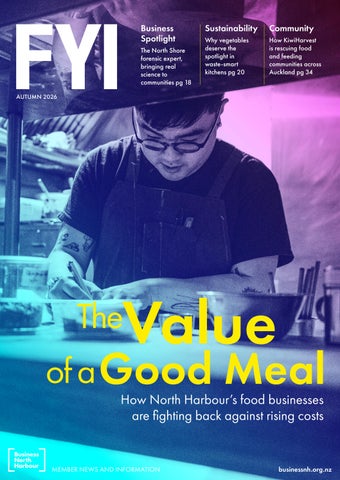
The North Shore forensic expert, bringing real science to communities pg 18
Sustainability
Why vegetables deserve the spotlight in waste-smart kitchens pg 20
Community
How KiwiHarvest is rescuing food and feeding communities across Auckland pg 34
of a Good Meal Value
How North Harbour’s food businesses are fighting back against rising costs
Business North Harbour provides a voice for your concerns, networking opportunities for your business development, and access to key stakeholders and decision makers who may affect your investment.
Crime Prevention
We support our members by managing the contracted nightly security patrols of our Business Improvement District area, 365 days of the year. We conduct safety, security, and communications briefings with the North Shore Police.
Advocacy
We provide an advocacy voice to local and central government for our members’ concerns on local, regional, and national issues, and provide access to key stakeholders and decision makers who may affect your investment.
Traffic, Transport & Roading
We work with all council-controlled agencies to develop initiatives that address access and environmental concerns, including congestion reduction. We also provide information on alternative modes of transport.
Sustainability
We provide the resources and operational support to encourage business sustainability by enabling members to access food waste and inorganic waste collections along with pallet and cardboard box swaps.
Events
Our events programme provides members with an extensive range of networking, mentoring, wellbeing, training, and educational opportunities.
Member Communications
Members are kept informed of relevant news, updates and events and are provided with useful business support resources and information.
Business Directory
Our online Business Directory provides free listings for businesses operating within our Business Improvement District and allows businesses to update and manage their listing information online.
Other Services
Members can take advantage of more benefits and activities, such as our Showcase North Harbour business expo, One Day Sale, candidate employment and internship opportunities along with complimentary member hireage of the Business North Harbour training room.
Business North Harbour General Manager Kevin O’Leary kevin@businessnh.org.nz
Advertising Debbie Cannon comms@businessnh.org.nz
Editor Michelle Beard and Aaron Beard michellebeardnz@gmail.com
Design Lewis Hurst lewis@hurstdesign.co
Printer PrintLounge
Welcome from the GM
FOLLOWING OUR ONLINE version of FYI last November, I’m delighted to welcome you all back to the more traditional version of the magazine.
I hope that you’ve had a positive start to 2026 despite any ongoing financial challenges which we all had hoped would become a thing of the past last year. There’s certainly a more positive outlook for our economic recovery at the moment, with both business and consumer confidence showing an upward trend in the latest poles. However, recovery is predicted to be slow and we’re still facing other challenges that are putting a dampener on this positivity. Unfortunately, there are still some concerns regarding unemployment figures, particularly in Auckland where our level is considerably higher than the national average. Added to this, although the Reserve Bank Of New Zealand (RBNZ) kept the Official Cash Rate (OCR) at 2.25 per cent in February, there are still concerns about the higher-than-expected rate of inflation which could trigger an increase in the OCR sooner than expected. If this is the case and the OCR is increased, then no doubt interest rates will follow suit, reducing peoples’ discretionary spending as they navigate the ongoing cost of living challenges. Hopefully, any increases will be a while coming, small and short-lived.
Food is the theme of this edition and we’re all aware of the challenges that the hospitality sector has faced in recent years. In our cover story we look at how food businesses are managing rising supply costs and the strategies that North Harbour’s eateries are using to stay profitable without sacrificing quality. We have some great local eateries who could do with your custom, so please think about supporting local when you can.
The Community page features KiwiHarvest, a food rescue organisation who have a branch within our Business Improvement District. They do outstanding work redistributing excess food to those in need and reducing the harmful impact of food waste on our environment.
The BNH Team and I wish you well for the coming year and look forward to our continued engagement with you and your Team across our wide-ranging programmes and services.
Kia kaha
Kevin O’Leary General Manager, Business North Harbour
Eating well for mood and wellbeing
WHAT YOU EAT affects not only your physical health but also your mood and mental well-being. While sleep, stress management, relationships, and physical activity are important for feeling good, food plays a key role too. Your brain needs the right fuel to function well, and improving food choices is linked to a better mood.
Eating more whole, nutritious foods and fewer processed foods can support mental health. Gut health is especially important: your gut microbiome, made up of billions of microorganisms, influences brain function through the gut–brain axis. Foods that support healthy gut bacteria can improve mood and well-being.
Eating patterns such as the Mediterranean diet are linked to a lower risk of depression. These focus on vegetables, fruits, wholegrains, fish, legumes, nuts, seeds, and lean meats, while limiting foods high in sugar, salt, and unhealthy fats.
Helpful habits include eating regular meals, choosing healthy fats (especially omega-3 fats from oily fish, nuts, and seeds), including protein at each meal, drinking enough fluids, and eating a variety of colourful fruits and vegetables. Limiting caffeine, alcohol, and highly processed foods can reduce anxiety and sleep problems. Vitamin D, mainly from sunlight, also supports brain function and mood.
Moana Pasifika Set for Busy 2026
Campaign at North Harbour Stadium
AS THE 2026 DHL Super Rugby Pacific season unfolds, Moana Pasifika is gearing up for an exciting programme of fixtures that will see the Pasifika-led franchise take on some of the biggest teams in the competition. After their most successful season yet in 2025, the side enters the new year with fresh momentum, new leadership and plenty for fans to look forward to.
Moana Pasifika have already been sharpening their skills in pre-season action, including a Waitangi Day clash with the Highlanders in Queenstown. Moana played their first home game at Pukekohe’s Navigation Homes Stadium on 27 February against the Force, and then they were back to North Harbour Stadium against the Crusaders on the 21st of March.
Moana Pasifika have seen a massive increase in support at their new home, North Harbour Stadium, during last year’s breakout season. The season also promises individual and team milestones. William Havili, the team’s most-capped player, reached 50 appearances for the franchise, underlining his importance to the team’s identity and performance.
Meanwhile, new leadership dynamics are emerging with Miracle Fai’ilagi captaining the side and experienced addition Augustine Pulu returning to Super Rugby, bringing leadership and depth to the squad.
Come along to North Harbour Stadium and support the team in their pursuit of further growth and success:
• Fri 27 March, 7.05pm kick off
Moana Pasifika vs Highlanders
• Sat 2 May, 7.05pm kick off
Moana Pasifika vs Blues
• Sat 9 May, 7.05pm kick off
Moana Pasifika vs Hurricanes
• Sat 23 May, 4.35pm kick off
Moana Pasifika vs Reds
Te kainga pai e ora pai ai te wairua me te hauora
Emerging Supplier Forum Series Returns
AFTER A SUCCESSFUL February Emerging Supplier Forum, Foodstuffs North Island is again inviting aspiring food and grocery producers to take part in its Emerging Supplier Forum series, culminating in a forum on 9 September 2026 in Auckland. The event series, run in partnership with the New Zealand Food Innovation Network, aims to help small and emerging suppliers understand what it takes to get products onto the shelves of New World, PAK’nSAVE and FourSquare stores across the North Island. Each forum brings together Foodstuffs specialists, industry experts and customer insights professionals to walk attendees through key topics such as how Foodstuffs works with suppliers, what retailers look for in a product and partner, and the latest trends shaping
customer demand. Participants also have the opportunity to connect with other small businesses, building networks and regional support as they navigate their retail grocery journey.
The Emerging Supplier Forum reflects Foodstuffs’ broader commitment to supporting local innovation and supply chain growth. By sharing practical insights and creating direct engagement opportunities, the series seeks to make the path to supermarket success clearer and more accessible for emerging brands.
The Auckland session on 9 September will be held at the Foodstuffs North Island Support Centre in Māngere, giving businesses one of their final chances this year to participate in the forum series and gain valuable guidance.
For more information visit foodstuffs.co.nz/partnering-withus/emerging-supplier-forum
Upcoming World Food Days
No matter your industry, these food celebrations offer the perfect chance to spark engagement, inspire creativity, and connect with fellow foodies. 1 Apr
FOOD LOVERS, MARK your calendars! The months from April to June are packed with delicious global celebrations, from sweet treats to savoury favourites. Whether you’re planning content, promotions, or simply looking for an excuse to indulge, here are some of the most exciting upcoming World Food Days to celebrate and add to the calendar:
AI for Business Conference
Fire Safety Workshop
23 February 2026
Fire Safety Session with Fire & Emergency Waitematā
BNH MEMBER NEWS
Take Advantage of the Food Waste Collection Service
REDUCING FOOD WASTE doesn’t need to be complicated; it starts with one simple step. By registering interest in our food waste collection service, members begin an easy, supported process that includes a personalised visit from the Business North Harbour team.
We assess your needs and provide a right-sized complimentary lunchroom bin, along with a free external collection bin, collected weekly, making sustainable action effortless for your team.
Clear and Simple Guidelines
Each bin is supported with clear “YES” and “NO” signage, helping staff confidently separate waste:
YES
• Fruit and vegetables
• Pasta and rice
• Meat and dairy
• Bread and grains
• Eggshells, nutshells and egg cartons
• Coffee grounds
• Teabags and filters
• Certified compostable bags and packaging
• Paper towels (including bathroom) and paper napkins
NO
• Plastic food containers or plastic wrap
• Plastic condiment packaging
• Latex or rubber gloves
• Bottles or jars
• Aluminium or metal cans
• Polystyrene or foam
• Plastic or plastic-lined cups
• Nappies or used tissues
Thanks to funding from the Upper Harbour Local Board, this service is available to members, removing barriers and making it easier than ever to divert food waste from landfill.
When many businesses take small, practical steps, the collective impact is powerful, transforming everyday waste into measurable environmental progress for our community.
Collections That Make a Difference
Through our partnership with Green Gorilla, food waste is collected weekly using specialised vehicles designed to support a cleaner, more sustainable future. The process is seamless, reliable and environmentally responsible.
To help businesses take the first step, new members receive their first six collections completely free. After that, weekly collections remain affordable, with costs based on bin size, typically between $15.61 and $20.42 plus GST.
It’s a simple, accessible way to reduce landfill, lower your environmental footprint and be part of a collective movement that is turning food waste into lasting community impact.
FYI Advocacy March 2026
BEFORE I SHARE recent advocacy with you, I need to bring to your attention that Auckland Council’s Annual Plan (Budget) 2026/2027 is open for consultation from 27th February to 29th March. Whilst BNH will make a formal submission on behalf of Members, it’s imperative that you have your say individually. I would encourage you all to make a submission, voicing your opinions on how the Mayor is planning to spend your rates, which he is proposing should increase by 7.9%. Use this link https://www.aucklandcouncil.govt. nz/en/plans-policies-bylaws-reports-projects/our-plans-strategies/budget-plans/ annual-plan-2026-2027/mayoral-proposal-annual-plan-2026-2027.html to find out more and have your say.
In recent months, I have spent some time providing further feedback to the Retail Crime Ministerial Advisory Group (MAG) on a wide range of topics regarding which the MAG have been developing recommendations for Governmental consideration. Topics included Personal Safety and Security Powers, Anti-Social Behaviour, Smarter
Technology and changes to the Crimes Amendment Bill. Whilst these proposals are retail-oriented, if some of them come into being, we will all benefit indirectly from their introduction.
In addition to my regular informal advocacy to Auckland Transport, Upper Harbour Local Board and other key stakeholders, I submitted a formal submission on Proposed Improvements To Council’s Waste Bylaw And Controls, which is available here https://businessnh.org.nz/formal-submissions/ along with all previous submissions.
Sandra and Dave have spent a considerable amount of time advocating on behalf of members regarding parking issues on Tawa Drive and Paul Matthews Road with varied success. Vehicles that were permanently parked on Tawa Drive have been removed, freeing up those spaces for local employees, but sadly, Parkable have rejected all of their requests to remove the recently installed paid parking rules on two parcels of land on Paul Matthews Road. In more positive news, I have been informed that
Bar Savannah Welcomes New Owner Mani: A Fresh Chapter for Albany’s Beloved Bar
IN A BIG moment for one of the North Shore’s favourite social hubs, Bar Savannah (once known as Bar Africa), ushered in a new era with the arrival of its new owner, Mani. The bar has evolved even further under his helm in just one year of business.
Full of energy, even after a late-night hosting, Mani spoke to me about hospitality with genuine passion. His journey into the industry wasn’t planned; in fact, it began with a phone call.
“I was in Australia, I was 21 years old. I had never been to a restaurant or bar in my life. I was a very naive 21-year-old, working on family farms, and then my dad (a taxi driver of 20 years) called and said that he, mum and uncle had bought a bar.” That first bar was in
Matamata, and from day one, Mani was thrown in at the deep end.
What started as a trial by fire soon became a calling. And a new venture became reality up in Auckland when a liquidated restaurant became an opportunity, and in March 2025, Bar Savannah opened its doors.
But the early days weren’t without nerves, “On our first Saturday here, we sold five beers all day, 50 bucks we made,” he laughs. “We expected to take a loss for the first six months, but we haven’t made a loss yet. It’s going well, and we’ve been selling consistently over 50 steaks every Wednesday on our steak nights!”
His response has been simple, but strategic at Bar Savannah: consistency, value
construction of Rosedale Bus Station will commence by mid-year, prior to which, in collaboration with BNH, AT will hold a public meeting to keep affected businesses informed of their project plans and timelines.
BNH will continue, whenever possible, to advocate for members by encouraging people to keep supporting local businesses by buying local and utilising locally available services, all of which I hope continue to reap rewards for some of our members.
Kevin O’Leary GM, Business North Harbour
and community engagement, offering incredibly affordable specials every single day of the week with the tag line ‘Come Hungry, Leave Happy’.
Located on William Pickering Drive in Rosedale, the venue’s menu blends classic pub favourites with modern flavours, all served in a relaxed, welcoming setting. The space also hosts
functions, corporate events and special occasions, making it a go-to destination for both business and social gatherings.
With Mani at the helm, Bar Savannah is stepping confidently into a new chapter, one that honours its place in the local community while embracing fresh ideas and renewed energy.
BNH MEMBER NEWS
Platinum Partner Ember Korowai Takitini, a leading NGO in Mental health and Addiction, supports many smaller organisations and Special Interest groups in their mahi and kaupapa to improve the lives of others. One such organisation is Eating Disorders Carer Support NZ (EDCS), Sarah Roland Co-founder and Chair takes up the story...
Hidden in Plain Sight: Food, fitness,
Food and Exercise as Social Currency Walk into almost any social setting and it won’t take long before food or exercise comes up. A new eating plan. A training goal. A food ‘challenge’. A fitness fundraiser. Increasingly, which weightloss medication someone is using - or considering.
Diet and body talk has become social currency, signalling discipline, self-control and health. Most of these conversations are well-intended. Yet they often centre on restriction, endurance, or body transformation as markers of success.
When Weight Becomes the Proxy for Health
Over the past decade, through my sector involvement and lived experience - both personally and as a parent - I’ve seen how weight has increasingly come to stand in for what many assume health looks like. At the same time, weight-loss medications are presented as routine solutions. The underlying message is subtle but powerful: bodies require constant management.
What receives far less attention is the mental health impact of this culture. Eating disorders and disordered eating are common, serious, and frequently hidden in plain sight.
For some, dieting and exercise are neutral or positive. For others—particularly young people, neurodivergent individuals, or those with trauma histories—the same messages can tip into harm.
Hidden Harm: Disordered Eating and Malnutrition
Disordered eating rarely begins dramatically. It may show as rigid food rules, anxiety around eating socially, excessive exercise framed as discipline, or constant self-monitoring.
Malnutrition can also remain invisible. Someone may appear a ‘normal’ size or live in a larger body, yet experience fatigue, poor concentration, irritability, sleep disruption, or low mood. Early restriction can even produce a temporary sense of calm or control, masking physiological stress.
and what we’re not talking about
Over time, these patterns can become compulsive. The pull to restrict, over-exercise, or obsess over food can feel difficult to interrupt. When weight is treated as the primary indicator of wellbeing, eating disorders and malnutrition can remain undetected for long periods - especially in children and young people.
Weight-loss medications add further complexity. While they may suit some individuals, appetite suppression and rapid weight change can pose risks for those vulnerable to disordered eating. Focusing narrowly on weight without exploring a person’s relationship with food may overlook deeper difficulties.
“Weight has increasingly come to stand in for what many assume health looks like.”
Early Vulnerability and the Role of Caregivers
Parents and teenagers often share concerns about skipped school lunches or uneaten meals. Regular nourishment is fundamental for growth, cognitive development and emotional regulation. Against a backdrop of strong cultural messaging about restriction,
Food, Family, and Connection: Questions to Reflect On
• How can school lunches and shared meals become spaces of curiosity rather than pressure?
• In what ways do our conversations about weight influence children or peers?
• How can we support picky eaters without moralising their choices?
• Are our community food practices inclusive, celebratory, and mentally nourishing?
missed meals can quietly contribute to emerging problems.
Vulnerability begins early. Maternal nutrition, breastfeeding support and early feeding experiences shape lifelong relationships with food. Children labelled as ‘picky eaters’ are frequently pressured, yet patient, curious support can prevent distress and power struggles. Mums and babies deserve thoughtful care; the early years lay important foundations.
Primary Care and Early Intervention
Eating disorders often begin quietly: a GP appointment focused on weight, a comment at school, sporting environments emphasising leanness, or a well-meaning attempt to “eat better”. Behavioural changes - anxiety, low mood, withdrawal - can be as significant as shifts in eating patterns.
GPs are commonly the first point of contact, yet many receive limited training in eating disorders. In brief appointments, weight-focused advice can seem the most straightforward response. Embedding eating-disorder-informed dietitians within primary care would strengthen early intervention, allowing concerns about food, growth or weight to be recognised before crisis develops.
Reclaiming Connection and Celebration
Across cultures, food has long been central to celebration, ritual and belonging. Community gatherings and family meals are not indulgences; they are protective. When eating becomes moralised - good, bad, clean, guilty - we risk distancing ourselves from those shared spaces.
Even small shifts - supporting a picky eater, valuing school lunches, broadening conversations beyond weight - can ripple outward.
What might you do in your own community or family to help meals be spaces of connection, curiosity and wellbeing, rather than stress or restriction? Reflecting on these questions is a step toward a more thoughtful and connected approach to food.
Sarah has over a decade of lived and sector experience supporting people with eating disorders and their families. She draws on her personal experience as a parent alongside professional advocacy, education, and community engagement to promote early intervention, thoughtful care, and greater public understanding of eating disorders in New Zealand. www.edcs.co.nz www.ember.org.nz
of a Good Meal ValueThe
How
North Harbour’s food businesses are fighting back against rising costs
NORTH HARBOUR’S FOOD scene has seen major suburban, retail and commercial growth from the 1990s onward, including Westfield Albany (opened in 2007), expanded shopping, and a more diverse mix of cafés, restaurants and eateries, from cozy cafés serving specialty coffee to bustling restaurants drawing diners from across the North Shore. But behind the scenes recently, many local food businesses are wrestling with a challenge that’s far less appetising: rising supply costs.
From global disruptions in shipping to increased prices for local produce, the cost of running a kitchen has been squeezing margins tighter than ever. Yet food operators are responding with creativity, resilience, and community-focused strategies that offer insights not just for hospitality, but for all small business sectors.
“There is a range of cost challenges for hospitality businesses” said Kristy Phillips, Chief Executive of Hospitality NZ. “Throughout 2025, sharp increases were seen for butter, beef
and lamb, electricity and gas. Labour and operational costs continue to be major factors, and it’s unlikely these will change for 2026.”
The Cost Crunch: What’s Driving Price Increases?
Across Aotearoa, food prices have been rising and there’s no single cause. Instead, a mix of global and domestic pressures is pushing up the cost of ingredients, production and the final price on the shelf or menu.
For owner SK of ‘No1 Pancake’ in Rosedale, the past few years have been a lesson in adaptability with rising costs. “Over the past year, key ingredients including dairy, meats, eggs, vegetables, and cooking oil have risen noticeably, along with higher operating costs such as utilities and repairs”, SK says.
For Li-Yen, who owns the bakery ‘Wen & Yen’ in Rosedale, “Ingredients the most significant - have been butter, chocolate, meat and coffee”, she said.
One of the biggest drivers is global supply chain disruption. Natural disas-
ters, geopolitical tensions and continued aftershocks from the pandemic. These have all affected the flow of goods and services. Delays and shortages increase shipping and freight costs, which are often passed on to food producers and, ultimately, consumers.
Weather and climate events also play a major role. Adverse conditions, from drought to floods, impact crop yields and livestock production, reducing supply and driving up costs for farmers. When farm input costs rise (like feed, fertiliser or fuel), these increases ripple through the supply chain.
Another key factor is input cost inflation. Fuel, fertiliser and packaging have all seen significant price increases in recent years. These rising costs affect every stage of production, from growing and harvesting to processing and distribution. The pressure is being felt across the industry.
Labour shortages and wage pressures are contributing as well. With many sectors competing for workers, wage costs in food production, processing and
hospitality have risen. While better pay supports workers, it also adds upward pressure on prices.
For Li-Yen, the increases have been widespread, but making sure her staff are looked after is a huge priority. “We are also mindful that as our prices increase, it does too for our staff, so we try our best to make sure our staff are taken care of” says Li-Yen.
Lastly, currency fluctuations are impacting the cost of imported goods. New Zealand relies on a wide range of imported food products and inputs, and a weaker Kiwi dollar makes these imports more expensive — contributing to higher retail prices.
Menu Engineering: It’s About Smart Design
Menu tweaks aren’t just about changing prices, they’re about carefully rebalancing cost and appeal without eroding the customer experience. As food and labour costs remain tight, many hospitality businesses are turning to smarter menu engineering rather than acrossthe-board price hikes.
In practice, this often means simplifying and refining menus without compromising on quality. At No.1 Pancake, owner SK says recent changes were driven by the need to manage volatile ingredient costs. “Instead of compromising on quality, we simplified parts of the menu,” SK explains, noting that
“Throughout 2025, sharp increases were seen for butter, beef and lamb, electricity and gas,” says Kristy Phillips
Chief Executive of Hospitality NZ
extreme price fluctuations in vegetables, including cabbage, made it difficult to continue offering the popular Vege Cheese option.
Rather than reducing choice, the business focused on substitution and smart innovation. To maintain variety, Pineapple & Cheese and Corn Cheese options were introduced, while ingredient use across the menu was streamlined. Customisation also became a key lever.
“We are also mindful that as our prices increase, it does too for our staff, so we try our best to make sure our staff are taken care of” says Li-Yen of Wen & Yen.
“We expanded customisation options for each menu item at realistic price points,” SK says, with add-ons such as jalapeños and onions for savoury pancakes, extra ingredients like potatoes or ham, and even two scoops of ice cream for $2.50 on sweet options.
This approach reflects a broader industry trend toward portion rebalancing, cross-utilising ingredients to reduce waste and complexity, and highlighting higher-margin add-ons, such as sides and desserts, that quietly lift profitability without diners feeling the pinch.
Smart Sourcing: Shopping Around, Quality Always
As food prices continue to climb across Aotearoa, small business owners are finding new ways to manage rising costs without compromising on quality.
For Li-Yen of ‘Wen & Yen’, adapting the sourcing strategy has become essential to keeping the bakery running sustainably.
“I have changed how I source ingredients. Where I used to rely mainly on deliveries from Bidfood, Gilmores and Davis Food Ingredients and trying to ask for the best prices from them, I now double check against the price of Costco and Pak n Save” says Li-Yen, “Most of the time I do end up getting a better price from Pak n Save and Costco. The downside is now I have to go and get them myself and I go after my hours at the shop, so there is an added workload for myself but at the end of the day the cost savings are significant”.
While wholesale suppliers once offered convenience and consistency, fluctu-
Wen & Yen bakery
ating prices have pushed some operators to compare every dollar. For Li-Yen, the shift means longer days and more hands-on purchasing, but the savings help absorb rising ingredient and labour costs without passing the full burden on to customers.
Communication With Customers: Transparency Wins Loyalty
Rather than quietly absorbing all cost increases, many food businesses are choosing honest, upfront communication with their customers. In a climate of rising prices, transparency has become a key tool for maintaining trust and longterm loyalty.
‘Ultimately, a food business cannot exist without its customers”, notes SK, “if trust is lost or the relationship breaks down (whether in quality, taste, price, or service), the business cannot survive.” Clear communication helps customers understand that price changes are not arbitrary, but a response to genuine pressures behind the scenes.
Having implemented a price increase in 2021, owner SK says explaining the reasons openly made a meaningful difference. “It was a difficult step for both us and our customers, but we
Sustainability isn’t just environmental, it’s practical. Smart redistribution of surplus goods reduces waste, recovers revenue, and builds customer goodwill.
saw it as a shared effort to sustain the brand,” SK explains. By framing the change as a way to protect quality and consistency, the business reinforced its commitment to customers rather than undermining it.
SK agrees, adding that protecting customer trust must always come first. “A restaurant owner should never compromise the invisible trust built with customers over the fundamentals of food,” SK says, noting that doing so only creates bigger challenges in the long run.
For many hospitality businesses, honesty isn’t just good communication; it’s good business.
How Sustainability Can Reduce Costs in the Kitchen
As food prices and operating expenses continue to rise, sustainability is no longer just an environmental consideration; it’s becoming a practical business strategy. For many small food operators, reducing waste is proving to be
one of the most effective ways to protect margins while maintaining quality.
Li-Yen, owner of Wen & Yen, has found that small operational changes can make a noticeable difference to the bottom line.
“We use a food waste app called ‘Foodprint’”, she says, which is a mobile app focused on reducing food waste and saving money by connecting users with surplus or imperfect food from local eateries at a discount. “It helps us sell our end-of-the-day items at a discounted rate to reduce wastage.”
Instead of throwing away unsold baked goods at closing time, the bakery lists them on the app for customers to purchase at a reduced price. The result is a win-win: customers access quality products at a lower cost, while the business recovers revenue that would otherwise be lost.
Food waste is one of the highest hidden costs in commercial kitchens. Ingredients that are over-ordered, over-prepared or left unsold directly impact profitability. By planning carefully, monitoring demand patterns and using digital tools to redistribute surplus, businesses can reduce both waste disposal costs and lost income.
Sustainability initiatives can also strengthen customer loyalty. More consumers are choosing to support businesses that demonstrate environmental responsibility. By visibly reducing waste and embracing smarter systems, operators not only cut costs but also build goodwill within their community.
Why Networking Matters for Auckland’s Small Food Businesses
For small food businesses in Auckland, networking is a vital ingredient for survival and growth. In a sector facing rising costs and intense competition, strong local connections help businesses build visibility, share knowledge and adapt more effectively.
As
ingredient, labour and energy costs rise across Aotearoa, food businesses are responding with creativity, resilience and smarter sourcing to stay
profitable without compromising quality.
Networking provides practical support, from navigating council regulations to discovering local advertising and promotional opportunities. It also helps food businesses embed themselves in their communities, driving referrals and foot traffic through trusted local relationships.
For No.1 Pancakes owner SK, a simple connection made a meaningful difference. “What started as a simple enquiry about footpath advertisement regulations through ‘Business North Harbour’ later
led to effective local advertising opportunities, including promotion through plinth signage based on BNH’s advice,” SK says. “This support was especially important after we relocated from the city to Albany, at a time when we were making strong efforts to let local customers know we were here in an increasingly challenging business environment.”
Ultimately, networking strengthens more than individual businesses. By sharing opportunities and collaborating locally, small food operators help build a more resilient and connected hospitality food ecosystem across Auckland.
And For Those Who Are Just Starting Out
For business owners just starting out in New Zealand’s hospitality industry, the journey begins in a landscape shaped by economic pressure, rising costs, and changing consumer expectations. Many new operators are launching cafés, bars, and restaurants at a time when careful financial management is not optional but essential. From rent and wages to food and energy costs, keeping a close eye on inputs while still delivering quality
experiences has become a defining challenge for newcomers.
“Those who started their hospitality businesses in the last few years understand the pressures of a recessionary environment and have entered the market at a time when it is critical to focus on managing their input costs and
“If trust is lost or the relationship breaks down (whether in quality, taste, price, or service), the business cannot survive.”
balancing setting their prices and guest expectations,” says Kristy Phillips, Chief Executive of Hospitality NZ. For first-time owners, this balance often means being creative, streamlining menus, negotiating with suppliers, and finding ways to stand out through service and atmosphere rather than price alone.
Despite the headwinds, there are positive signs. “We still have new venues opening and it’s encouraging to see
the passion remains for great hospitality experiences. So, while headwinds are still present for the industry, we’re cautiously optimistic about what the next 12 to 24 months holds,” Phillips adds. That optimism reflects the resilience of new hospitality entrepreneurs who are entering the industry with fresh ideas, strong community focus, and a clear-eyed understanding of the realities they face.
Looking Forward into 2026 and Beyond
Rising supply costs show no sign of disappearing overnight, but food entrepreneurs are turning pressure into opportunity. Through local sourcing, smart menu design, operational tech, and transparent communication, they’re redefining sustainability, not just environmentally, but economically.
For food businesses and the broader North Harbour business community, the lesson is clear: adaptability, local connection, and strategic thinking aren’t just competitive advantages; they are essential ingredients for long-term success.
Clockwise from top left: No.1 Pancake, owner SK, a note left by a happy customer, owner Abby.
In Control of Your Event. Confident in the Outcome.
TRULY EXCEPTIONAL EVENTS are never accidental; they are composed with intention, supported with precision, and executed without compromise. From the first welcome drink to the final toast, service flows, guests move naturally, and the atmosphere builds without interruption.
At Insphire, we provide hire solutions designed to elevate your special occasion:
• Tables & furniture
• Linen
• Serving ware & tableware
• Bar & beverage equipment
• Catering equipment & refrigeration
When the right equipment is in place, you can stay focused on your event's intentions, and everything else falls into line. Because exceptional events
aren't accidental, they are expertly supported. From high-volume corporate functions to intimate private gatherings, we deliver with consistency and care with reliable service, quality products and fair pricing.
You focus on delivering the experience, and we ensure the foundation performs flawlessly. From large-scale corporate functions to intimate private occasions, we supply with precision, consistency, and care.
Insphire
Request a quote: www.insphire.co.nz
Call us: 09 475 9500
Visit our showroom and warehouse: 2 Civil Place, Rosedale, Auckland
Exceptional events aren't improvised. They're built on dependable support.
Forensic Insight: The company operating at the intersection of science, law and education
FROM SHERLOCK HOLMES to CSI: Crime Scene Investigation, crime and forensic science continue to capture the public imagination. In Auckland’s North Shore, however, forensic science isn’t fiction; it’s a thriving local business.
Based in Rosedale, Forensic Insight Ltd is the consultancy founded and led by Thomas Coyle MNZM, one of New Zealand’s most experienced forensic practitioners. After beginning his career as a teenage fingerprint examiner at Scotland Yard and later serving with the New Zealand Police, Coyle established Forensic Insight to bring decades of expertise into the private sector and into the community.
Through Forensic Insight, Coyle provides specialist expert witness services and CPD-accredited webinars for
members of the legal profession. Lawyers across New Zealand and internationally rely on his independent reviews and impartial court evidence, built on decades of experience in fingerprint examination and crime scene analysis.
The company also provides certified fingerprint and palm print capture for immigration applications, international police clearances, visa processing and overseas employment checks. For families relocating abroad, professionals pursuing overseas careers, or migrants completing documentation, having a trusted specialist in the Albany area can mean avoiding costly delays or rejected applications.
Crime Scene Science for Kids Forensic Insight’s work doesn’t stop at the courtroom door. It also extends into
classrooms across the North Island.
As official facilitators for the Ministry of Education, Coyle and his wife, Allie, deliver interactive workshops tailored to students from Year 2 through senior secondary levels. Full-day sessions include all materials and equipment, with lesson plans designed to continue the learning long after the workshop ends.
The workshops also fit seamlessly into school timetables, and Teacher Only Day sessions are available to help educators integrate forensic science into their curriculum.
The inspiration behind the programme came from a desire to show students science in a completely new way. “Too often, forensic science is only seen through television, and I wanted to replace fiction with reality,” explains Coyle. “I wanted students actively involved — thinking critically, handling real equipment, and working through thought-provoking, hands-on activities that simply aren’t available in a standard school environment. If one student leaves the classroom thinking, ‘I never knew that existed — and I want to learn more,’ then the visit has done its job.”
Workshops include fingerprint analysis, DNA science, and the study of trace evidence. Students explore real crime scene techniques while developing key science capabilities: gathering and interpreting data, critiquing evidence, interpreting representations, and engaging with science.
One of the most popular activities is developing fingerprints with a magna wand and specialist magnetic powder. “When a hidden fingerprint suddenly appears on what looked like a blank surface, it genuinely blows their minds,” says Coyle, “that moment — when they lift and preserve their own print — is where the spark happens”.
Forensic science works so well with young learners because it taps into their natural inquisitiveness. By combining biology, chemistry, physics, and critical thinking within a mystery to solve, students see that science isn’t just theory, “science isn’t just something in a textbook, it’s something they can see, touch and apply,” says Coyle.
Thomas Coyle MNZM and Dame Cindy Kiro
Making “The Dead Speak”
TOM COYLE HAS brought his extraordinary career to the page with his 2026 memoir, The Dead Speak: My Life in Forensics.
The book takes readers behind the police tape into real crime scenes, revealing how the smallest fragment of evidence can uncover suspects, motives and identities. It also explores the emotionally demanding world of disaster victim identification, from the 2004 Indian Ocean earthquake and tsunami in Thailand to the 2011 Christchurch earthquake.
Growing up on a council estate after Coyle’s father left, his childhood life was hard at times, with violence set upon his young self by a violent stepdad. Using humour and even trying his
hand at theatre, he survived and enjoyed secondary school, became a baker’s assistant, enlisted in the navy, and then finally found his place after a grilling police recruitment job interview set him apart from 400 other applicants.
Described as detailed, empathetic and at times wryly humorous, the book offers a raw and honest look at forensic reality, far removed from television drama. It should also be noted that the section on the Christchurch earthquake is a sobering and sometimes confronting read for those who experienced the day in real time, either in Christchurch or watching from afar. However, the section is thoughtfully written with the emotions of the unprec-
edented destruction and loss of life interwoven with Coyle’s DVI deployment down to Christchurch to be on the ground to undertake the solemn duty of identifying the victims.
The public response has been strong. The book is available in all good bookshops, online and through local libraries, with demand
already high, including more than 100 holds for physical copies and dozens more for the eBook through Auckland Libraries.
The Recovery Edge Powering North Shore Athletes at Hyperbaric Health
ON AUCKLAND’S NORTH Shore, ambition runs deep, from grassroots competitions to national tournaments. Increasingly, local athletes and officials are turning to hyperbaric oxygen therapy (HBOT) to help them train harder, recover faster and perform at their peak.
Long trusted by more than 100 professional sports teams worldwide, including franchises across the NFL, NBA and English Premier League, HBOT has built a reputation as a powerful recovery tool. Research shows it can improve muscle recovery by up to 33 per cent while significantly reducing post-exercise inflammation. By delivering concentrated oxygen under pressure, the therapy enhances circulation, accelerates tissue repair and boosts mitochondrial energy production, helping the body rebound more efficiently after physical stress.
On the North Shore, Hyperbaric Health is bringing that same elite-level support to the local sporting community. Led by founder Samantha Winters, a New Zealand-trained physiotherapist with more than 30 years of clinical experience, the clinic works with athletes
across a range of disciplines. Winters, a graduate of Auckland University of Technology who has worked in hospital and musculoskeletal settings, including North Shore Hospital, established the clinic to make advanced recovery accessible closer to home.
Recent clinic updates highlight its community focus. Two North Harbour softball umpires preparing for the Heartland tournament in Manawatu underwent treatment to support sharper focus, reduced fatigue, joint resilience and injury prevention as they worked toward their Level 5 umpiring badge. A young New Zealand and North Harbour representative softball player also received HBOT following tournament play to help clear metabolic waste, reduce inflammation, speed muscle recovery and promote deeper sleep.
Once reserved for elite professionals and divers, hyperbaric oxygen therapy is now helping North Shore sportspeople pursue bigger goals, whether that’s faster return from injury, improved match-day performance or simply the resilience to keep competing at their best.
BNH MEMBER NEWS
Making Vegetables the Hero: A Smarter Approach to Food and Waste
MAKING VEGETABLES THE hero of the plate is not only a cost-effective and flavour-driven choice, but it also aligns strongly with the principles championed by Love Food Hate Waste. By valuing vegetables as central to meal planning rather than an afterthought, households and businesses alike can reduce food waste, make better purchasing decisions, and get more value from the food they buy.
Traditionally, vegetables have been relegated to a supporting role alongside meat and carbohydrate-heavy staples such as rice, potatoes, or bread. While included for health reasons, they are often overlooked in planning and preparation. When vegetables are prioritised first, meals become more colourful, flavourful, and nutritionally rich, while also helping to ensure that produce is used before it spoils.
Choose In-Season to Reduce Waste
One of the core messages of Love Food Hate Waste is buying what you need, when you need it. Choosing in-season vegetables supports this approach. In-season produce not only delivers better flavour and quality, but it is also more affordable and readily available, making it easier to plan meals around what is fresh.
Out-of-season vegetables are more likely to be expensive, flavourless, and discarded unused. By shopping seasonally, consumers are more likely to enjoy what they buy and less likely to throw it away.
Plan Meals With Shelf Life in Mind
Food waste often happens not because food is unusable, but because it’s forgotten. Whether it’s a weekly supermarket shop or a mixed produce box, vegetables arrive with different storage needs and lifespans — and planning meals around those timelines can make a big difference.
“When we plan meals with vegetables at the centre, we’re not just eating well, we also reduce food waste,” Juno Scott-Kelly.
“When we plan meals with vegetables at the centre, we’re not just eating well, we’re also giving ourselves the best chance to use what we buy before it goes to waste,” says Juno Scott-Kelly from Love Food Hate Waste NZ. “Small shifts
in how we shop, cook, and store produce can save households money and make a real impact on food waste in Aotearoa.”
Leafy greens and softer vegetables are best used earlier in the week, while sturdier produce such as carrots, capsicums and leeks can be scheduled for later meals. By matching meals to a vegetable’s shelf life, households can reduce waste without changing what they eat, when they eat it.
This simple planning step, strongly encouraged by Love Food Hate Waste NZ, helps ensure every item purchased has a clear purpose and a place on the plate, not in the bin.
Use What You Know, Then Build On It
Reducing food waste does not require a complete overhaul of family favourites. Familiar vegetables can remain staples, while small adjustments introduce variety and prevent boredom. Trying a new spice blend, cooking method, or adding an extra vegetable to a well-loved dish, such as nachos or pasta, can make a significant difference.
As confidence grows, households naturally become more flexible and creative with vegetables, making it easier to use what is already in the fridge rather than discarding it.
Cook for Flavour, Cook With Intention
How vegetables are cooked has a direct impact on both flavour and food waste. Boiling can sometimes strip flavour and reduce appeal, increasing the likelihood that food will be left uneaten. Roasting, pan-frying, or grilling enhances natural sweetness, improves texture, and often leads to higher consumption.
The use of herbs, spices, oils, vinegars, and simple sauces can transform surplus vegetables into appealing meals. Roasted cauliflower with cheese sauce, carrots sautéed in garlic oil, capsicum and leek roasted with spice rubs, or quick-pickled cucumber are all examples of how thoughtful preparation can prevent vegetables from being wasted. Every vegetable behaves differently, but finding reliable cooking methods helps ensure produce is used and enjoyed. By treating vegetables with care and creativity, households can support the Love Food Hate Waste mission, saving money, reducing waste, and getting the most from every meal.
lovefoodhatewaste.co.nz
Love Food Hate Waste: Mushroom and Lentil Stroganoff
Original Recipe by Bunny Eats Design
TRANSFORM SOUR CREAM on the edge of its best into something magical. This vegetarian stroganoff is creamy, comforting, and a delicious way to save food from the bin.
Ingredients
• 2 tablespoons oil
• 1 onion, diced
• 400g mushrooms, sliced
• 1 yellow capsicum, diced
• 2 tablespoons butter (30 grams)
• 4 garlic cloves, sliced
• 1 tablespoon smoked paprika
• 2 tablespoons plain flour
• 1 can brown lentils, drained and rinsed
• 1 tablespoon Dijon mustard
• 1 tablespoons Worcestershire sauce
• 1 vegetable stock cube dissolved in 1 cup hot water
Method
1. Place a large frying pan on medium-high heat. Once hot, add oil and onions. Fry onions for 3 minutes, stirring occasionally to cook evenly.
2. Add the mushrooms and capsicum and fry for 7 to 10 minutes until mushrooms are golden, stirring occasionally to cook evenly.
3. Add the butter, garlic and paprika and cook for 2 minutes until fragrant.
4. Stir in flour, lentils, Dijon mustard, Worcestershire sauce and vegetable stock. Bring to a simmer. Simmer for 5 minutes, stirring occasionally until the sauce is thick.
5. Remove from heat. Season with salt and pepper. Stir in the sour cream until completely incorporated.
6. Garnish with chopped parsley and serve on your choice of pasta, mashed potatoes or rice.
For this and other Love Food Hate Waste recipes, visit lovefoodhatewaste.co.nz/home/ our-recipes/
Go Green Expo Comes to Auckland This May
AUCKLAND IS SET to host one of Aotearoa’s most engaging sustainability events this May, with the Go Green Expo returning to Eventfinda Stadium in Wairau Valley for a weekend dedicated to eco-friendly living and conscious consumerism.
The Go Green Expo is a vibrant celebration of sustainable products, practices and ideas, bringing together exhibitors from across the country to showcase solutions that help Kiwis live greener, healthier lives. From renewable energy and waste-reduction tools to organic food, natural health products and eco-smart home solutions, the event offers something for everyone interested in making positive environmental changes.
Visitors can expect a lively atmosphere where they can explore stalls featuring sustainable fashion, low-waste kitchenware, green cleaning products, water-saving technologies, and more. For many, shopping at the Expo presents a chance to discover innovative, planet-friendly alternatives to everyday purchases, often with show-only deals and demonstrations.
But the Go Green Expo is about much more than shopping. It also serves as a learning hub, where attendees can tap into practical knowledge through workshops and talks on topics like composting, home energy efficiency, sustainable gardening and reducing household waste. Experts and passionate community leaders provide tips that range from simple lifestyle tweaks to bigger sustainability commitments.
The event attracts families, individuals, business owners and sustainability advocates alike, offering inspiration for how small changes at home and work can contribute to a larger environmental impact. With climate action and conscious living gaining momentum, the Go Green Expo provides a timely platform for education, connection and positive action.
Whether you’re already on your sustainability journey or just starting to explore greener choices, the Expo promises an enlightening and enjoyable experience for all.
Go Green Expo - 16 & 17 May 9am-4pm
For more information and tickets visit www.gogreenexpo.co.nz/tickets/
Crime Stays Low in the BID —
BUSINESS NORTH HARBOUR has experienced a small number of crime-related incidents across our Business Improvement District (BID) during December 2025 and January 2026. A recent meeting with NZ Police confirmed that none of these involved serious incidents affecting our local businesses.
The positive results we’re seeing can be attributed to a strong combined effort, including:
• Increased police presence, with both vehicle and foot patrols across the area
• Vanguard Security Ltd, providing approximately 10 hours of night patrols every night
• Security signage displayed on roadside signs throughout our business community
While reported crime remains very low, we encourage all businesses to continue reviewing and maintaining their own security measures. Staying vigilant ensures we do not give opportunists the chance to target our area.
Stay safe, and enjoy the rest of the summer weather.
BNH is here to help protect you, your team, and your property. Visit our Crime Prevention page, have a chat with Dave Loader on 021 560 287 or email david@businessnh.org.nz
Have your vehicle registration plates secured for FREE with tamper proof screws. Plates are stolen for petrol drive-offs and other criminal activity.
Ex-Lease & Used: ~30% Lower Monthly Payments
When times are tight and uncertainty looms, smart business owners look for clever ways to get the right vehicles without draining precious capital.
THAT’S WHY SO many are leasing ex-lease & used vehicles. It’s a hidden secret that solves 3 big problems...
1. Cash Preservation
Right now, conserving capital is crucial. With ex-lease & used vehicle leasing, you’ll enjoy monthly payments around 30% less than new vehicles, giving you a buffer against whatever comes next.
2. Stock Shortages
With long wait times on many popular new vehicles, ex-lease & used vehicles
are the perfect solution. You get what you need now rather than waiting up to 6+ months.
3. FBT Savings
Leasing a 2-4 year-old vehicle means the capital value is lower and your FBT costs are significantly reduced.
Real Numbers, Real Savings
A recent Driveline client wanted a Ford Ranger XLT 4×4 Double Cab ute. They’re $1,069/month to lease new. Same model 3 years old with 65k on the clock: $744/month.
Annual savings: $3,900. FBT savings: $2,400 p.a. Total savings over 4-year term: More than $25,000!
FOUNDED IN AUCKLAND in 2017, Orange PR is a bilingual marketing and communications agency that bridges New Zealand and China through storytelling.
We believe that the most powerful campaigns are born from genuine cultural understanding. Our team of strategists, creatives, and event specialists crafts brand stories that resonate across borders — helping Kiwi brands speak authentically to Chinese-speaking audiences both locally and internationally. Over the past eight years, Orange PR has proudly partnered with leading
brands, including Partridge Jewellers, Comvita, DFS, Cloudy Bay, Zealong Tea, and Honda NZ. From brand launches and influencer collaborations to international trade events, we deliver strategy with substance and creativity with heart.
Recognised with the NZ Chinese Business Awards – Entrepreneurship Award (2024), Orange PR Marketing continues to champion excellence in cross-cultural communication.
Beyond campaigns, our mission is to celebrate the spirit of connection — between East and West, brands and people, stories and emotions. We believe every great idea deserves to travel further and touch more hearts.
Orange PR
Head Office: Auckland, New Zealand
Email: info@orangepr.co.nz
www.orangepr.co.nz
A Cleaner Pond, A Healthier Planet: simple solutions that
AT PARKLAND, WE believe that working for good starts with the environment we all share. Whether it’s the corner of a backyard or a community green space, clean water matters. That’s why we’re proud to support an innovative, eco-friendly way to restore pond health — one without chemicals, costly treatments or heavy maintenance.
Many homeowners and community groups struggle to keep ponds clean. Algae build-up, bad smells, and murky water can turn a once-beautiful spot into an eyesore. But there’s a better way. One that’s safe for pets, wildlife and native plants.
The Healthy Ponds 3-Step Solution uses 100 per cent biodegradable packs filled with beneficial microbes that restore
natural balance to the water. Just toss it in. No measuring, no machinery, and no disruption. It’s the easiest way to bring a pond back to life. It is already making a difference in homes and community spaces across Aotearoa.
The 3-Step Solution contains a biodegradable cleaning sphere, a supplement pouch, and a natural dye. Combined, they clear organic matter, reduce excessive nutrition, and lower water temperature while leaving a picture-perfect pond.
We’re proud to be the exclusive distributor of Healthy Ponds in New Zealand and to support environmental wellbeing in both private and public spaces.
Gausium’s robotic cleaners take care of repetitive cleaning tasks so your team doesn’t have to. Designed for commercial environments like warehouses, offices, and retail spaces, these autonomous machines deliver a consistent clean at a fraction of traditional labour cost.
A once-in-a-generation chance to fix planning, if we get the details right
By EMA Head of Advocacy and Strategy Alan McDonald
AFTER MORE THAN three decades, New Zealand is finally on the brink of replacing the Resource Management Act with something better.
Having worked alongside other peak bodies for the best part of eight years, across three governments, the Employers and Manufacturers Association (EMA) strongly supports the direction of travel represented by the Planning Bill and the Natural Environment Bill.
These reforms promise a system that is simpler, faster, more certain and less costly. The old RMA became a victim of its own complexity. Applied inconsistently across 78 councils, layered with multiple plans and local rules, we ended up with a consenting system that was slow, expensive and unpredictable.
The EMA has recently submitted to the Environment Select Committee on the Planning Bill and the Natural Environment Bill. We believe the new framework will take the country in a much better direction. Cutting more than 1,000 plans down to just 17 regional spatial plans is a genuine simplification. Fewer zones, stronger national direction and clearer rules should reduce compliance costs and make it easier to understand what can be built, where, and how.
The stated ambition to significantly reduce the total number of consent and permit applications is exactly the kind of reset the system needs, even if the headline figure of 46% proves optimistic.
The more permissive approach to development, particularly for critical infrastructure, housing and social assets, should help bridge our considerable infrastructure gaps and finally get projects moving at the speed New Zealand needs.
Any development changes land use. The real question is how impacts are managed and offset, not whether change can occur at all. Without a clear hierarchy or framework for resolving these tensions, we risk pushing the hardest decisions back to the courts, exactly as happened under the current RMA.
The same problem appears with vague terms like “unreasonable”, “significant risk” or “more than minor”. We have been here before. This language invites litigation, uncertainty
The move to identify and protect significant natural features, waterways, coastal environments and cultural sites upfront is a sensible way to reduce conflict and latestage objections.
While the EMA supports the direction of travel of this legislation, there are real risks in the detail. If these are not fixed, we could end up recreating some of the very problems these reforms were meant to solve.
The first is purpose and priorities. At the moment, the two bills each have their own goals, and some of those goals pull in different directions. For example, the Planning Bill seeks to support and enable economic growth, while the Natural Environment Bill talks about “no net loss” of indigenous biodiversity.
“These reforms are a once-in-a-generation opportunity to fix a system that has held New Zealand back.”
and delay. Our view is that the two bills need a single, unifying purpose, a clear ordering of goals, and much tighter definitions and constraints around these slippery concepts.
The second concern is ministerial power. There is a place for a minister to break deadlocks or deal with councils that are slow or obstructive. But history shows that poorly constrained ministerial interventions can cause real harm. We have seen whole sectors caught out by last-minute changes made without proper testing or independent advice. If we want a stable system that gives investors and communities confidence, then big calls should come with strong guardrails, transparency, and a requirement to consider independent expert advice or peer review.
Third, spatial planning will only work if the right voices are at the table. Business and development interests must be involved in shaping regional spatial plans. If spatial plans are meant to guide how our regions grow over the next 30 years, then the people who create jobs and build infrastructure must be part of that conversation. The relationship between spatial plans and the proposed Combined Territorial Boards also needs clarification.
We also support the new focus on regulatory takings and property rights. When planning decisions strip value from someone’s land for a wider public benefit, that cost should not fall solely on the individual owner. A clear, nationally consistent framework for compensation or regulatory relief will lead to fairer outcomes and better decision-making by councils.
Finally, none of this will work without strong monitoring and enforcement. We need to track how councils perform on consenting, especially in the early years, and we need consistent, national oversight of compliance with consent conditions. A strengthened national agency, coupled with better sharing of best-practice mitigation and compliance tools, would lift standards across the board. These reforms are a once-in-a-generation opportunity to fix a system that has held New Zealand back. The direction is right.
Now we need to get the details right and, just as importantly, make sure the culture of decision-making shifts from risk-averse obstruction to enabling efficient delivery. If we do that, we can finally have a planning system that protects what matters and builds what we need.
Get to know your local Rothbury broker
WHEN YOU’RE LOOKING for support
you can rely on, having a trusted local expert by your side can make all the difference. That’s where Rothbury Insurance Brokers North Harbour ILG comes in.
Based right here in Albany, Simon Helm, Tom Nixon and the North Harbour ILG team are helping local businesses and individuals find insurance solutions that genuinely fit their needs. With a strong understanding of the local community, they’re committed to providing advice that’s practical, clear, and tailored. Never one-size-fits-all.
A broker who puts people first What truly sets Rothbury North Harbour ILG apart is their focus on long-term relationships. The team takes the time to understand your goals and challenges before recommending cover. Whether it’s looking after your family home, supporting a growing business, or planning for the unexpected, their approach is always personal and proactive.
Want quality insurance advice from a local?
Leave it to us.
Rothbury North Harbour ILG 09 414 2563
simon.helm@rothbury.co.nz rothbury.co.nz
Local knowledge you can trust Rothbury North Harbour ILG continues to strengthen its team with the addition of Tom Nixon, a Domestic Broker bringing a strong commitment to client service and relationship-led advice.
Tom grew up in Albany, playing club football for Forrest Hill and representing his school in both football and rugby. Those experiences helped build the
strong community focus and team-driven approach he brings to his work today. Based in Albany, the branch supports clients throughout North Harbour, the North Shore, and the wider Auckland area. The team brings together specialist commercial and domestic brokers, experienced support staff, and dedicated claims advisers to provide end-to-end support across the entire lifecycle of every policy.
Free Alarm Monitoring
VANGUARD SECURITY IS offering BNH area commercial premises an exclusive, limited-time security upgrade:
• FREE alarm system connection
• FREE professional monitoring for the first 6 months
• 24/7 alarm monitoring services
• Designed for offices, retail units, warehouses & industrial sites
Protect your assets, staff, and operations with a professionally monitored alarm service from a trusted local security provider — with no upfront connection costs.
Why commercial clients choose Vanguard
• Continuous 24/7 monitoring by trained security professionals
• Reduced risk of theft, damage, and operational downtime
• Systems configured to meet commercial and insurance expectations
• Reliable service aligned with industry best practices
ACT NOW — limited availability
This offer is strictly limited to qualifying BNH commercial customers and subject to site assessment and service availability.
Contact Vanguard Security today to arrange your free security assessment and secure 6 months of monitoring at no cost.
Secure your premises. Protect your business. Stay compliant. Vanguard
NEW ZEALAND’S DRIVER licensing system has long been a point of frustration for young people, parents, and road safety advocates. The process was often slow, expensive, and, in the view of many experts, out of step with modern international standards. Now, a major overhaul of the Graduated Driver Licensing System (GDLS) marks the most significant shift in how new drivers are trained and assessed in decades.
At the heart of the reform lies a major change: the removal of the full licence practical test. For years, New Zealand stood out as one of the few countries requiring two separate on-road tests before granting full driver status. While the intention was to improve safety, the second test often added pressure and cost without delivering the intended benefits. From 2027, this final test will be replaced with a more structured, education driven development pathway.
Importantly, this shift does not mean lowering standards. Instead, the new system prioritises genuine learning and real driving experience, particularly for young drivers. Those under 25 will spend longer on their learner and restricted stages, with pathways to reduce this time only through recognised driver education or verified supervised driving hours. This evidencebased approach reflects long-standing research proving that time and experience on the road are far more effective than simply ticking off administrative requirements.
The reforms also introduce stronger consequences for risky behaviour. Restricted drivers who accumulate demerit points will see their restricted period extended, reinforcing that safe driving is an expectation, not a box
Streamlined
digital licensing, eyesight checks, and modernised processes bring New Zealand’s driver system in line with international best practice.
to tick. At the same time, streamlined eyesight checks and expanded digital licensing services will modernise a system that has historically lagged behind other government services.
Collectively, these changes aim to strike a smarter balance between accessibility and accountability. They acknowledge that while young drivers need support and clear guidance, they also need space to build confidence and competence in real driving environments. Equally, they reinforce that driving
is a privilege that comes with significant responsibility.
As the new system comes into effect, its true impact will be measured not on paper but on the road. If it leads to safer outcomes, more confident drivers, and a licensing process that feels fair, up-todate, and genuinely effective, then the reforms will have succeeded. For now, the message is clear: Aotearoa is moving toward a more modern, evidence-based approach to developing capable, responsible drivers.
Increase to public transport fares and paid parking
AS OF 1 February 2026, Auckland Transport (AT) has implemented its annual fare and parking price adjustments. The changes are part of a weighted average increase of 5.1% to help cover rising operating costs. AT continues to offer capped fares and concession options to help keep public transport accessible.
Toyota Aqua Tops NZ’s Most Stolen Cars List for 2025
THE TOYOTA AQUA has been named Aotearoa’s most stolen vehicle for the fourth-year running, according to new data from AMI Insurance [1]
AMI received more than 9,000 vehicle theft and attempted theft claims in 2025, covering over 760 different makes and models. The Toyota Aqua accounted for 8% of all theft claims, followed by the Toyota Corolla (7%) and Nissan Tiida (6%). Aquas are disproportionately targeted, with a theft rate nearly four times higher than the country’s most insured vehicle, the Corolla.
For every 1,000 insured Toyota Aquas, 54 were stolen, compared with 15 per 1,000 Corollas. Auckland recorded the highest number of thefts, followed by Canterbury, Waikato, Wellington and the Bay of Plenty.
AMI Executive General Manager of Claims Steph Ferris says overall vehicle theft claims have remained lower than
the 2023 peak. “Lower crime rates, improved security systems in newer vehicles, and New Zealanders adopting security practices - including being more mindful about where they park - likely play a part in this.”
Toyota models continue to dominate the rankings, with five Toyota vehicles appearing in the top nine. Nearly 90% of stolen vehicles were more than 10 years old, reflecting the lack of modern security features in older cars.
While hybrids feature prominently at the top of the list, they make up just 5% of total vehicle thefts, with petrol and diesel vehicles accounting for the majority. Around 64% of stolen vehicles are recovered, though many are written off.
AMI is encouraging drivers to use antitheft measures such as alarms, immobilisers, steering wheel locks and secure parking to help reduce the risk of theft.
New Public Transport Fares
Standard adult fares for those using an AT HOP card or contactless payment have increased as follows:
Bus and Train: Trips have increased by 10 to 25 cents per journey.
1 Zone: $3.00 (was $2.80).
2 Zones: $4.90 (was $4.65).
3 Zones: $6.50 (was $6.25).
4+ Zones: $7.90 (was $7.65).
Ferry: Trips have increased by 40 to 60 cents per journey.
Inner Harbour: $7.80 (was $7.40).
Mid-Harbour: $10.40 (was $9.90).
Outer Harbour: $13.80 (was $13.20).
Parking prices across most of Auckland have increased by 50 cents per hour for on-street parking and AT carparks, with areas that saw price changes in the past year excluded. Despite the rise, key affordability measures remain in place, including the $50 weekly fare cap for AT HOP users, a $20 daily cap for contactless payments, and ongoing concession discounts for children, seniors, Community Services cardholders and tertiary students, who continue to receive 40% off fares.
AT Group Manager Parking Services
John Strawbridge said public parking
Is your car on the list?
The AMI top 10 stolen cars list [2]
1. Toyota Aqua (=)
2. Toyota Corolla (=)
3. Nissan Tiida (=)
4. Mazda Demio (=)
5. Toyota Vitz (+2)
6. Toyota Hilux (=)
7. Subaru Impreza (+1)
8. Mazda Atenza (-3)
9. Toyota Mark X (=)
10. Mazda Axela (=)
The most frequently stolen vehicle in each region (regions ranked by claims volume)
• Auckland - Toyota Aqua
• Canterbury - Toyota Aqua
• Waikato - Toyota Corolla
• Wellington - Toyota Corolla
• Bay of Plenty - Toyota Corolla
• Manawatū - Nissan Tiida
• Northland - Toyota Corolla
• Hawke’s Bay - Mazda Atenza
• Gisborne - Mazda Demio
• Taranaki - Toyota Corolla and Nissan Tiida
• Otago - Toyota Aqua
• Southland - Suzuki Swift
• Nelson - Nissan Tiida
• Tasman - Mazda Demio and Toyota Corolla
• West Coast - Toyota Hilux
• Marlborough - Honda Jazz
[1] Data sourced from the largest general insurance dataset in the country; IAG’s private and commercial motor claims and policy data, from the 2025 calendar year.
[2] Cars are ranked from highest frequency of theft to lowest. Symbols indicate rank movement compared to 2024.
rates were adjusted based on demand, economic conditions and operating costs, plus future technology investments.
“With the funding received from parking, AT is continuing to invest in technology that improves the way we manage Auckland’s parking services, allowing our teams to respond to more requests for assistance and keep our road network moving”.
You can read more at at.govt.nz/ about-us/news-events/mediacentre/2026-media-releases/smallincrease-to-public-transport-fares-andpaid-parking-following-annual-review
Looking for Premises?
Let’s Talk Rent
WHEN YOU’RE LOOKING for new premises, rent is usually the first number people focus on, but it’s not always as straightforward as it seems. One of the most common misunderstandings I see is the difference between face rent, effective rent, and what’s meant by market rent.
Face rent is the headline figure written into the lease. Effective rent is what you actually pay over time once any incentives are taken into account.
Incentives might include a rent-free period or a contribution to fit-out costs. For example, a landlord may offer three months rent-free on a longer lease. The face rent stays the same, but the effective rent is lower once that incentive is averaged over the lease term. It’s worth noting that Outgoings (Opex) are usually still payable during any rent-free period.
Incentives aren’t automatic. Whether they’re offered depends on things like
the lease term, the size of the space, vacancy levels, and demand in that location. Generally, the longer the lease, the more flexibility there may be - but in strong markets, landlords don’t always need to offer incentives at all.
Market rent is another term that’s often misunderstood. It’s not an asking price, and it’s not what the tenant next door is paying under an old lease. Market rent is based on recent leasing evidence for comparable buildings, taking into
account size, condition, location, car parking and lease terms.
Finally, remember that rent is only part of the picture. Outgoings, car parks, fit-out costs and timing all impact the true cost of occupation. Looking beyond the headline rent and understanding the effective rent and true market evidence puts you in a much stronger position to secure premises that genuinely work for your business over the full lease term.
Janet Marshall is a Director at Colliers North Shore, a business mentor at BMNZ and board executive with BNH and TBBA Business Associations. Contact Janet on 021 684 775 or email janet.marshall@colliers.com for sales or leasing enquiries.
Accelerating success.
61 Constellation Drive, Rosedale
Star on Constellation Drive - Offices 150 - 580 SQM
Looking for professional office space in the popular Constellation Drive area? Various high quality office options available - excellent opportunities for your head office.
Very efficient layout and lift in the building, plus café on site and next to the Northern Busway park and ride. Easy access to East Coast Bays, motorways North, CBD and Western. These are exceptional office opportunities.
A premium 2,300 sqm standalone commercial building is now available for lease, with flexible uses (subject to resource consent). Take 650 sqm, 1,290 sqm, or 2,300 sqm. Features include ground floor space with rear roller door access and 100+ carparks available.
Located minutes from the CBD and Takapuna, the premises suits office, retail, medical, retirement, or accommodation, and also offers an on-site café and competitive rental.
With Secure Business Router, you can optimise your business today to transform tomorrow
SPARK’S SECURE BUSINESS ROUTER is a business-grade router designed to enhance small to medium organisations. It provides monitoring, alerting, reporting, and management of your on-premises network.
Plus, there’s a user-friendly control centre to help manage your business network security, manage applications and devices – all with plugand-play convenience.
Add Secure Business Router to an eligible business wireless or fibre broadband plan from just $49 a month (excl. GST).
Get in touch
Ready to optimise your business network?
Contact us today for a personalised quote or to learn more about the benefits a Spark Secure Business Router can offer your business.
Manage apps and devices
Control network access and prioritise bandwidth to your most important applications with an easy-to-use dashboard.
Guest WiFi for customers
Connect your customers to a separate WiFi network. Gather useful contact info for database marketing.
Enterprise-grade security
Block threats before they reach you with malware protection, intrusion detection, and content filtering.
Priority Service
If your business is having connectivity issues, Priority Service lets you jump the regular queue when calling Spark for broadband support.
Rescuing Food, Feeding Communities: How KiwiHarvest Connects Surplus to Support
ON ANY GIVEN day, a van from KiwiHarvest pulls up behind a supermarket, grower, or food manufacturer to collect surplus food that would otherwise go to waste. You may have seen them driving around the North Shore streets in their trucks emblazoned with illustrations of food items, such as fruit, vegetables, bread, and other pantry staples, reinforcing their food rescue mission.
Within hours of pick up, that same food is being delivered to community organisations supporting families, seniors, and
individuals doing it tough. It’s a simple idea with powerful results: rescue good food before it’s thrown away and redirect it to people who need it most.
Across New Zealand, thousands of tonnes of edible food are discarded each year, even as many households face increasing pressure from rising living costs. KiwiHarvest operates at the intersection of these two challenges, bridging the gap between surplus and need. By collecting excess fresh produce, dairy, bakery items and packaged goods, the
organisation ensures quality food reaches charities, food banks, schools and community groups instead of landfill.
The impact of rescued food reaches far beyond a single meal. For community organisations on tight budgets, it frees up funds that can be redirected to counselling, education, and emergency support, while ensuring families have access to fresh, nutritious food and dignity during difficult times.
Demand continues to rise. As AnneMarie Friis, Head of Fundraising &
“We can do miracles with the money!” says Anne-Marie Friis, highlighting how even small donations rescue food and feed communities.
Marketing at KiwiHarvest, explains, “Unfortunately, it just seems to grow. Over the last three years, we’ve gone from rescuing 2 million kilos to 4 million kilos.” Ministry of Health figures for 2024/25 show more than 20% of children live in households that sometimes or often run out of food, a sobering statistic in a country that produces enough food to feed 40 million people.
With more families needing support, and for longer periods, food rescue is playing an increasingly vital role in strengthening
community networks and connecting donors with those who need it most.
While the community impact is clear, KiwiHarvest’s model also depends heavily on business partnerships. Supermarkets, growers, manufacturers and hospitality operators donate surplus food that is still safe and edible but can no longer be sold. On the North Shore, key contributors include Woolworths, New World, Pak’nSave, Southern Paprika (SPL), the country’s largest capsicum grower, and Reso Fine Foods in Rosedale. Their newest Corporate Partner, Amazon Web Services, who operate out of Rosedale, will soon also have staff out on the road alongside the Food Rescue Drivers across the Shore, actively contributing to the collection and redistribution of rescued food within the community.
For businesses, the benefits are practical, cultural and strategic. Donating surplus stock reduces waste disposal costs and supports sustainability and ESG (Environmental, Social and Governance) goals, transforming potential landfill into a measurable community impact. Plus, staff take pride in contributing to a meaningful cause, strengthening corporate social responsibility and local community ties. Food safety remains
paramount, with KiwiHarvest operating under strict handling guidelines to ensure all redistributed food meets required standards, giving businesses confidence to get involved.
The work is not without its challenges. Rising fuel costs, increased demand, and the logistics of collecting and distributing perishable goods require careful coordination and ongoing support. As food insecurity pressures continue, the need for both food donors and financial backing remain strong.
Donations are what truly power KiwiHarvest’s ability to do more. As AnneMarie Friis puts it, “We can do miracles with the money!”
A business committing just $100 per month can make a remarkable difference. Each month, that support enables:
Every business has a story.
BEHIND EVERY STOREFRONT, startup pitch, family enterprise, and global expansion plan, there is a journey shaped by risk, resilience, reinvention, and vision. Too often, those stories go untold, not because they lack impact, but because the people living them are too busy building, leading, and solving the next challenge.
In every issue, we strive to spotlight businesses and leaders who are redefining industries, founders who are navigating uncertainty with courage, and teams who are building cultures that
• 120kg of food to be rescued
• 265 meal equivalents to be distributed to people in need within their community
• The recovery of food with a retail value of $825
• The prevention of 360kg of CO₂ equivalent emissions
At its heart, KiwiHarvest represents a powerful collaboration between commerce and compassion. Every rescued crate of produce or tray of bread tells a story of connection, from the loading dock to the dinner table. In a time when both environmental responsibility and community resilience matter more than ever, turning surplus into support may be one of the simplest and most effective solutions available.
KiwiHarvest welcomes donations, both regular and one-offs, from bulk contributions of fresh fruit and vegetables from growers and farmers, to smaller donations such as canned or frozen goods collected through an office food drive.
To arrange a donation or find out more, go to www.kiwiharvest.org.nz or email - hello@kiwiharvest.org.nz
people are proud to be part of. But the business landscape is vast, and there are remarkable stories unfolding every day that we have yet to hear.
That’s where you come in. If you have a story to tell about your business, whether it’s a breakthrough moment, a hardearned turnaround, a bold pivot, or a community impact you’re proud of, we want to hear from you. Your experience could inspire another entrepreneur to take the leap, help a leader rethink their strategy, or remind someone why they started in the first place.
Business is not only about numbers and quarterly results. It’s about people, purpose, and prog-
ress. It’s about learning from one another and building a stronger, more connected community of leaders and innovators.
So, consider this an open invitation from your friendly local magazine editors to Business North Harbour Members: please feel free to reach out. Share your journey. Tell us what you’ve built, what you’ve learned, and where you’re headed next.