SPARK Issue #15

Page 1


Land

Acknowledgement

Humber Polytechnic is located within the traditional and treaty lands of the Mississaugas of the Credit. Known as Adoobiigok [A-doe-bee-goke], the “Place of the Alders” in Michi Saagiig [Mi-Chee Saw-Geeg] language, the region is uniquely situated along Humber River Watershed, which historically provided an integral connection for Anishinaabe [Ahnish-nah-bay], Haudenosaunee [Hoeden-no-shownee], and Wendat [Wine-Dot] peoples between the Ontario Lakeshore and the Lake Simcoe/Georgian Bay regions. Now home to people of numerous nations, Adoobiigok continues to provide a vital source of interconnection for all.

Listen to an audio recording of Humber’s Land Acknowledgement (humber.ca/indigenous/truthreconciliation-audio-video)

“If we allow the students to do work which they see as theirs, they feel much more engaged and willing to participate and more invested in it.”
–DOUG THOMSON, FACULTY OF SOCIAL & COMMUNITY SERVICES, PG. 12, “AND THEN IT WENT HORRIBLY WRONG!”

22 Educate Enable Engage

Shaping a Better Tomorrow: Humber Sustainability Vision Launch 28 Cultivating Green Skills: Preparing Tomorrow’s Sustainable Workforce

SPOTLIGHT

32 AI at Humber: Discover how a Humber student used AI to create a podcast

Shaping a Better Tomorrow: Humber Sustainability Vision Launch

38 Develop Your Spark

Quips and Quotes

Masthead

On the cover:

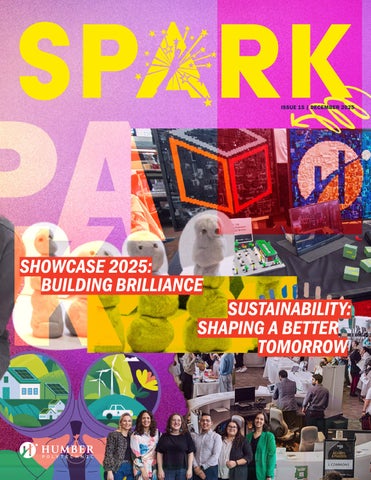
Images from Humber’s 2025 Showcase and the Office of Sustainability’s Sustainability Vision Launch.

December 2025

SPARK is published by Humber Polytechnic Press, housed in the Office of the Senior Vice-President, Academic at Humber Polytechnic. The opinions and views expressed in SPARK are those solely of the interviewees and do not necessarily reflect the views of Humber Polytechnic.

Since its inception in 2021, SPARK has been a two-time awardwinning publication with the Canadian Online Publishing Awards.

Published by Humber Polytechnic Press, Office of Senior Vice-President, Academic, Humber Polytechnic 205 Humber College Blvd., Toronto, ON M9W 5L7 humberpress@humber.ca

Connect with us

humberpress.c a jipe.ca humberpress@humber.ca linkedin.com/showcase/humber-research/

Editorial Team

MANAGING EDITOR

Anju Kakkar

GRAPHIC TECHNOLOGIST

Andrea Chan

PROJECT COORDINATOR

Marlee Greig

Disclaimer

Humber Polytechnic Press strictly adheres to Humber Polytechnic’s Brand Guidelines. In instances of style conflicts, Humber Polytechnic’s guidelines will take precedence. On request, this document is available in alternate e-formats.

MORE THAN AN EDITOR’S NOTE

THE LAST ISSUE, NOT THE LAST STORY

INSTITUTIONS ARE LIVING SYSTEMS THAT CONTINUE TO EVOLVE.

Every magazine is built on a quietly radical belief: that if you gather enough stories in one place, something in the world shifts. A conversation begins, a question lingers, someone sees a version of themselves they did not know was possible. When I assumed the editorship and authorship of Humber Polytechnic Press, SPARK was born from that belief and Issue 1 arrived: coffee-fuelled interviews, transcripts covered in several coloured highlighters, yes, literally, and the cursor blinked patiently on at times an empty page and other times pages with excess words. It was, in many ways, a leap of faith.

Over the many following issues, SPARK, initially virtually, wandered through almost every corridor of Humber life, often with a notebook in one hand and a question in the other. Some issues leaned into creativity, some into ethics and equity, some into global learning, and some into the slow work of building capacity; yet together, they formed a single through line. Each one asked, in its own way, how a polytechnic community learns, unlearns, relearns, experiments, and chooses to show its work to the world.

The truth, of course, is that a magazine is never just a magazine. It is a classroom, a hallway, a kitchen table of the institution, all folded into paper or pixels. It is the place where we test language for the future. We experimented with that language issue after issue: polytechnic, innovation ecosystem, sustainability, equity, applied research and accessibility. We asked how to tell complex stories without losing their heart. We discovered that metaphors travel faster than policy documents and that a well-placed student quote can say more than a threepage report.

Along the way, there was humour and humility. We learned that a “short article” rarely arrives under 1,000 words, that deadlines are aspirational, and almost everyone secretly enjoys seeing their work framed by beautiful design.

So why a final issue now? Institutions are living systems that continue to evolve. Humber Polytechnic Press has been evolving too, taking on a broader role in academic storytelling for Humber Polytechnic. With that evolution comes the need to focus our time and care. As SPARK closes this chapter, our attention turns more fully to the Journal of Innovation in Polytechnic Education (JIPE), Humber’s academic journal, to continue scholarly dialogue and for new ways to support knowledge sharing across the polytechnic landscape.

The thread that continues: JIPE

If SPARK was the café conversation, JIPE is the seminar room: quieter, more structured, and deeply committed to rigour. JIPE is where ideas are carefully tested, where methods are probed and references multiplied, where peer reviewers play the essential role of critical friend, just as the JIPE editorial desk serves as the screener, facilitator, and at times, mentor. The journal continues to welcome submissions, to refine its editorial practices, and to build a community of scholars and practitioners who care about polytechnic education and its impact.

In other words, the storytelling does not stop. It simply changes format!

A farewell issue invites gratitude, and there is a lot of it. To the interviewees who took a risk and said yes to being interviewed, profiled, or gently nudged into final edits: thank you for trusting my team and me with your work. To the students who let us into their projects and their lives: you reminded us of what all of this is for. To the designers who turned rough drafts into luminous layouts, to the teams and leaders who believed that a magazine mattered in the middle of competing priorities: SPARK exists because you did not treat storytelling as optional. To our readers, both the faithful and the accidental: those who clicked, skimmed, printed PDFs, shared links with colleagues and celebrated us on LinkedIn, or read on their phones between classes, meetings, or bus stops. You are the quiet centre of this work. A magazine is only as alive as the conversations it sparks.

What happens next?

SPARK will live on in the archive, a fifteen-issue time capsule of what it meant to build polytechnicresearch, innovation, and teaching excellence in this particular moment. Humber Polytechnic Press will continue to steward JIPE and to champion the kind of knowledge sharing that takes time, care, and peer review. That means strengthening our reviewer community, welcoming more submissions from within Humber and across the polytechnic and post-secondary sector, and continuing to champion research that is grounded in practice and pointed toward impact. It means treating peer review not as a gatekeeping exercise but as an act of care for the work and the people who do it.

Personally, I will carry SPARK with me as a verb, not a noun: to spark curiosity, to spark connection, to spark courage in communities trying to do something harder and kinder than the day before. A magazine can end without the work ending. In many ways, the best proof of its impact is that the conversations it started no longer need its name to continue, conversations with interviewees who became our ambassadors and friends.

Thank you for reading, for cheering us on, and sometimes for gently reminding us that file sizes do, in fact, matter. Thank you for every email, every “I saw that piece in SPARK,” every story idea scribbled on a sticky note or whispered at the back of a conference room.

Keep noticing. Keep questioning. Keep telling the stories that only you can tell.

We will see you in the pages of JIPE and in all the bright, ordinary places on campus where the next spark is already waiting.

The platform is changing. The purpose is not!

With gratitude, curiosity, and a heart full of fifteen issues,

Anju Kakkar, the storyteller Managing Editor, Humber Polytechnic Press Office of the Senior Vice-President, Academic Humber Polytechnic

At Lakeshore Campus on June 5, Showcase 2025 brought together more than 270 faculty, staff and student collaborators for a full day of teaching, learning and connection.

Organized by Innovative Learning, it has become a yearly gathering place where the Humber community’s ideas move from room to room, conversations spill into hallways, and small sparks of practice grow into something larger across the college.

Centred on the theme Building Brilliance and its three focus areas Reimagining Learning, Forging Deeper Partnerships and Driving Impact, the day invited us to look at our work with fresh eyes. From Innovation of the Year Award stories and Dane Jensen’s keynote on personal resilience, to concurrent sessions, exhibits and posters, participants explored how to design learning that is more inclusive, more collaborative and more responsive to the world our learners are entering.

For Humber’s teaching and learning community, events like Showcase do more than celebrate what has already been built. They create space for camaraderie, curiosity and courage, and remind us that brilliance is something we build together, one experiment, one conversation and one learner at a time.

SPECIAL THANKS to Fiona Tudor Price and Jesse Agar for photos. All video interviews conducted and edited by Fiona Tudor Price.

PRESENTATION NAME

“And then it went horribly wrong!”

INTERVIEWEE:

FACULTY/DEPT:

A key lesson in Doug Thomson’s thesis course is that it’s okay when things go wrong.

“One of the things I found over the years of teaching this course is that students get very, very scared about doing research,” said Doug Thomson, a professor of Criminal Justice in the Faculty of Social and Community Services. To combat this, his students engage in experiments designed to make the stress of research manageable and to build community within the classroom.

“[Students] feel overwhelmed or try to take on too much and think that it should be perfect,” said Thomson, adding that research “never, ever, ever goes as planned.”

At Showcase, Thomson and five of his former thesis students demonstrated one of these experiments. Participants were split into three groups and tasked with building as many figures as possible out of clay, with a twist that one group’s figures would be repeatedly destroyed. At first, the team whose figures were crushed got angry and started to build faster but eventually they got discouraged and quit.

“How many assignments do we give students [that are] like taking their work and just crushing it and putting it back in their lump of clay again,” he said noting that when students feel a lack of agency over their work, they tend to get frustrated and give up.

“If we allow the students to do work which they see as theirs, they feel much more engaged and willing to participate and more invested in it.”

WATCH NOW

Watch the video: “And then it went horribly wrong!” (youtu.be/u9iQguRe9Rw)

Watch the video: From Admin to Researcher: A FirstTime Journey of Professional Growth (youtu.be/iRjndYKchoQ)

PRESENTATION NAME

From Admin to Researcher: A FirstTime Journey of Professional Growth

INTERVIEWEE:

FACULTY/DEPT: Research & Innovation

Tanya Perdikoulias went from supporting research administratively to conducting it.

Perdikoulias, the Associate Director of Operations in the Office of Research & Innovation, shared her journey as a first-time, non-traditional researcher at Showcase 2025.

The research project was inspired by her work as a family portrait photographer. When she began to write a book based on her observations as a photographer, she realized there was a lack of research.

“I had anecdotal pieces but I didn’t have research,” she said.

She wanted to explore how people feel when they’re featured in photos displayed in personal spaces or on social media and, in contrast, how they feel when they’re left out.

“I was on a quest to find out how people really felt,” said Perdikoulias.

She hopes her story can help administrators and non-academic staff see research as a valuable avenue for personal and professional growth.

“If they have a question and they are interested in the answer and they go looking for the answer, they are a researcher.”

1. Ranya Khan and Sara Mazroeui at Innovative Learning’s table.

2. Sarah Wilkinson, Marilyn Morson, Natalie Mota and David Neumann held a session on virtual experiential learning.

3. “A Smart City Development Platform Built with LEGO Bricks” by Adam Thomas, Ahmed Sagarwala in the Exhibit Hall.

4. Student Panel in the Well-being in Learning Environments session.

5. Attendees re-imagining learning by touring the Idea Lab.

6. A faculty member plays Dixit at the Game On! Session.

7. Tanya Perdikoulias shared her journey as a first-time, non-traditional researcher.

8. Jennifer Ball and her colleagues previewed their interactive digital dashboard depicting the health of the Humber River.

9. Michelle Ng, Laura Facciolo and Wenyangzi Shi speak about building a better PLAR process.

Game On! Playful Pedagogy and Learning Through Board Games

INTERVIEWEE:

Usman Malik and Arvind Kang

FACULTY/DEPT:

Guelph-Humber Library and Humber Polytechnic Library

The Humber Library’s Showcase session highlighted its’ new board and video game collection, demonstrating how games can be powerful tools for both learning and leisure. After an overview of the development of the collection, participants broke into small groups to play board games.

“By centring [on] play this showcase, I really hope that we illustrated that the elements the library can encompass and champion go beyond what people usually think the library is for,” said Usman Malik, Liaison Librarian for the Kinesiology, Psychology, and Business programs at Guelph-Humber.

The collection, which includes over 80 board games as well as Nintendo Switch and PlayStation 5 titles, serves as a tool to support classroom learning while simultaneously providing students and staff access to recreational materials.

“Faculty can incorporate board games, potentially video games, in their classrooms as a way for students to meet their learning outcomes,” said Malik, noting there are many

pedagogical applications for gamebased learning.

The games span a range of topics— from women’s suffrage to the social determinants of health to Truth and Reconciliation—inviting players to engage with social issues through play.

Arvind Kang, Liaison Librarian for FLAS and FMCAD at Humber North, points to a collaboration with the Arboretum as a prime example.

“We played this game called Daybreak to spotlight the International Day for Clean Energy. It is a collaborative board game that is about working together through the difficulties of solving climate crises in the world,” said Kang.

Reflecting on the broader purpose of this initiative, Malik adds that the goal extends beyond workforce preparation.

“It’s not just about preparing students for the workforce but, in general, being informed citizens who are able to engage with the world at large,” he said.

WATCH NOW

Watch the video: Game On! Playful Pedagogy and Learning Through Board Games (youtu.be/WIn3PyOH5uo)

Watch the video: Challenges in E-textile for Bio-Potential Monitoring (Maryam) (youtu.be/c5-rNOETOkg)

Watch the video: Challenges in E-textile for Bio-Potential Monitoring (Sonya and Salvador) (youtu.be/lJDpcM1n9Bs )

PRESENTATION NAME

Challenges in E-textile for Bio-Potential Monitoring

INTERVIEWEES:

Maryam Davoudpour, Sonya Patel, Salvador Estrada Ramos

FACULTY/DEPT:

Faculty

of Applied Sciences & Technology

Smart fabrics took center stage at Showcases 2025, where Maryam Davoudpour, PhD, and her students demonstrated how technology and design intersect in the next generation of wearable devices.

During the session, Davoudpour’s team presented an array of E-textile projects from the electronics prototype lab. E-textiles are fabrics embedded with electronic components that can monitor biopotential signals generated by the body.

“Our students are very talented, and they bring different ideas,” said Davoudpour, a professor in the Faculty of Applied Science and Technology, noting that sharing their work gives students a sense of pride.

“They were so excited about presenting, just showcasing what they learned. Students can gain some self-confidence, which is very important,” she said.

In the last five years, the electronic and mechatronic departments have hired over 30 students and

worked with six industry partners. These projects provide students with hands-on experiences that will prepare them for real-world challenges.

Sonya Patel, an Electronics Engineering Technology student, worked on a device to help with muscle monitoring and stimulation for ICU patients.

“The part that excites me the most is that I’m able to combine both electronics and biomedical sciences together,” said Patel. “I wanted to do something behind the scenes where you can create something that helps people.”

Salvador Estrada Ramos, a Mechatronics Engineering student, worked on a project to develop a wearable to detect sleep apnea.

“When I first stepped into the sleep lab, at that moment, I was like, ‘OK, this is serious,’ he said. “What we are building here at Humber, at the lab, is something that can make an impact in people’s lives.”

The goal of Humber Polytechnic is to achieve net-zero emissions in 2029, working with students who are prepared to influence a more sustainable future in all facets of the workforce.

Humber’s Sustainability Vision and Action Plan, which is based on the three pillars of Educate, Enable, and Engage, integrates climate action into the curriculum and establishes a living model for how a polytechnic can address the climate crisis. The Vision places a strong emphasis on equipping students with the innovative skills necessary for a world that is changing.
More than 750 students, faculty, staff, and community members collaborated to create this vision through discussions, surveys, and consultations, ensuring that what is written down reflects what is important on campus and beyond. Its core message is straightforward but impactful: Together, We Are Shaping a Better Tomorrow.

In this discussion, Lindsay Walker, the Director of Sustainability at Humber Polytechnic, welcomes us into that dynamic vision. She talks about the collaborations that drive significant initiatives, the faculty champions and student ambassadors who are embedding a climate action and sustainability mindset into their program, and the routine behaviours that subtly alter culture.

You are encouraged to think about how you can contribute to this collective effort to create a better future both on campus and wherever your path takes you.

VIDEO: Shaping a Better Tomorrow with Director of Sustainability Lindsay Walker (youtu.be/WIvJ_e3wtO4)

SHAPING A BETTER TOMORROW: HUMBER SUSTAINABILITY VISION LAUNCH

In early February 2025, I attended Humber Sustainability’s “Shaping a Better Tomorrow: Sustainable Vision Launch.” I sat in an audience of over 135 other students and faculty in the bright atrium of the Barrett Centre for Technology Innovation.

The event began with an opening speech from Humber’s CEO and President AnnMarie Vaughan, followed by presentations from Elizabeth Bagley from Project Drawdown, and Lindsay Walker, Director of Sustainability at Humber Polytechnic.

As a Humber student, I found it an excellent opportunity to learn about the past, present and future sustainability initiatives happening at and beyond Humber. Here are my key takeaways:

EVERY JOB IS A CLIMATE JOB

Elizabeth Bagley, managing director of Project Drawdown, called in from Alaska to deliver a keynote speech about sustainability in the workforce. She stated, “Every job can and should be a climate job,” explaining that everyone can engage in sustainability initiatives, regardless of their field. It all starts with finding a problem you want to solve.

Project Drawdown is a non-profit organization that collaborates with a broad network of researchers and scientists to provide climate change solutions. Bagley defined the term ‘Drawdown’ as, “the future point in time when the levels of heat and gases in the atmosphere stop climbing and start to decline steadily.”

Bagley explained that the organization operates based on the “Three S’s”: Sources, Sinks and Society

SINKS

Supporting natural “sinks,” which decrease levels of heattrapping gases.

Project Drawdown has several resources, reports and programs available on their website to help you get involved in climate action.

EDUCATE, ENABLE, ENGAGE

Lindsay Walker, Humber’s Director of Sustainability, presented the three pillars of Humber’s new sustainability vision: Educate, Enable and Engage. Similar to Project Drawdown’s “Three S’s,” the three pillars draw direct inspiration from the United Nations’ 17 Sustainable Development Goals, creating a structured approach to apply global ambition to institutional action.

Each pillar is associated with a different set of initiatives planned for this year.

SOURCES

Stopping the sources of heat-trapping gases.

SOCIETY

Supporting communities to collaboratively create an inclusive, sustainable future.

Educate:

x Launch a free, open course on climate action.

x Continue to integrate sustainability mindsets and green skills into all curricula.

Enable:

x Continue forging toward Humber’s goal of reaching net-zero by 2029.

x Focus on waste reduction, sustainable transport, and creating a healthy landscape and biodiversity strategy and standard.

Engage:

x Getting the Humber community involved in sustainability on campus.

x Increase the number of sustainability learning opportunities through field trips.

x Launch Sustainability Youth Advisory Forum.

x Integrate sustainability principles into the applied research process.

THE HISTORY OF SUSTAINABILITY AT HUMBER

During her presentation, Walker also detailed the many sustainability milestones Humber has reached over the years. She highlighted the importance of measuring success, stating, “right after you measure, that’s when you can start doing really targeted action.”

Just to name a few milestones:

1998

In 1998, Humber completed its first lighting retrofit, reducing energy use by 35%.

WHAT THE HUMBER COMMUNITY IS DOING TO ENGAGE IN SUSTAINABLE PRACTICES—

“I highlight sustainability initiatives through archival work, exhibitions, and activations across Humber. By preserving, collaborating, and sharing the achievements of our students and community, I help document impactful sustainability stories to celebrate our progress, and inspire future innovation. I deeply value the Humber Sustainability Vision as an industry-leading initiative, introducing the opportunity and example of meaningful action at every level.”

2007

In 2007, Humber’s Centre for Urban Ecology became one of the first buildings in Toronto to acquire LEED® Gold certification.

“I consistently advocate for the Friendlier reusable container program, aiming to minimize single-use waste and foster a sustainable mindset throughout campus. Sustainability is a key focus in my daily work, as I’m always looking for creative and practical ways to incorporate eco-conscious practices within food and retail services. From cutting down on packaging to partnering with local suppliers and testing greener options, I’m proud to contribute to Humber’s broader sustainability vision.”

KATIE EVANS, MANAGER, CAMPUS DINING & RETAIL SERVICES & THE CENTRAL EVENTS OFFICE

2019

In 2019, Humber was rated STARS Gold by the Association for the Advancement of Sustainability in Higher Education (AASHE).

2020

In 2020, Humber students, staff and industry partners collaborated to launch the “Humber Learning Outcomes,” which are now implemented into every program: Sustainability, Equity, Diversity, Inclusion & Belonging (EDIB) and Indigenous ways of being, knowing and doing (IWBKD).

2023

In 2023, the Food Strategy and Vision, and the Green Building Standards were launched.

Walker refers to the vision as a north star: “It does not have a start and an end date. It is about the institution that we are and want to be, and it is focused on our students.” She stated, “Youth are leading the charge. They are taking governments to court. They are walking out. They are standing up. As they continue to lead this, we will keep supporting their education so they can be empowered to keep going.”

GROWTH AT HUMBER’S GREENHOUSE

The plants and flowers that decorated the atrium for the event were from Humber’s greenhouse. As a special gift, attendees could select a potted tulip to take home. It was announced that the greenhouse is currently having its lights retrofitted, allowing it to grow food from September to December to help relieve student food insecurity.

Everything on Humber’s sustainability timeline can be found on their new website, along with information on the three pillars, and ways to get involved.

The event concluded with students and faculty sharing their personal connections to climate action, followed by a celebratory all-vegan lunch. “Shaping a Better Tomorrow” was an uplifting and informational launch. I left inspired and excited to watch Humber Sustainability’s plan unfold.

CULTIVATING GREEN SKILLS: PREPARING TOMORROW’S SUSTAINABLE WORKFORCE

As we continue to find new ways to implement climate solutions and sustainability practices into our workforce, green skills have never been more relevant. But what exactly are green skills, and how can they be cultivated in a learning environment?

WHAT ARE GREEN SKILLS?

The Conference Board of Canada defines green skills as a wide range of skills integral to developing and promoting sustainability. There are three categories of workplace green skills:

Green knowledge and values are about understanding and being able to apply environmental principles and sustainable values to essential services. These services include sewage management and water and electricity supply. Green knowledge and values can come from various bodies of knowledge, including Indigenous ways of being, knowing and doing.

Monitoring and Compliance Skills are required to hold organizations accountable when it comes to maintaining sustainability initiatives. These include assessing organizations’ adherence to eco-friendly criteria and ensuring compliance with legal standards are being followed.

Technical and operational skills are associated with developing technology and managing projects. In the context of green jobs, they relate to the ability to perform these tasks in an environmentally friendly way. Technical skills include designing, building, and assessing technology. Operational skills include project life-cycle management, waste reduction, and the ability to collaborate with external partners.

Post-secondary institutions are well-positioned to adjust their programs to foster green skill learning.

WHY GREEN SKILLS ARE ESSENTIAL NOW

Green job postings are rapidly increasing alongside the global focus on reducing the use of fossil fuels and other initiatives for fighting climate change. However, the number of workers with the required green skills for these jobs is still fairly small. According to LinkedIn’s 2024 Global Green Skills Report , global demand for workers with green skills rose 11.6% from 2023 to 2024, while supply rose only 5.6%. That said, candidates with green skills are being hired “at a global rate 54.6% above the economy-wide hiring rate” (LinkedIn 2024).

Canada’s hiring demand for green skills is especially high in Ontario, Quebec, Alberta and British Columbia. The number of green job postings compared to other jobs was highest in Ontario and British Columbia because of their aggressive pursuit of green initiatives, particularly in renewable energy and urban planning.

Green skills can be applied to almost any job in some capacity. “The top 10 occupations with the highest hiring demand for green skills account for just 10 percent of the overall demand” (Conference Board of Canada, 2024).

THE ROLE OF POSTSECONDARY INSTITUTIONS

Post-secondary institutions play an essential role in equipping workers with green skills to meet the demand. While diploma and certificate programs primarily focus on technical and operational skills, and degree programs focus on green knowledge and values, all programs have the ability to teach valuable green skills and create qualified candidates.

Post-secondary institutions are wellpositioned to adjust their programs to foster green skill learning. Possible adjustments include adding industryspecific green skills training to existing programs, promoting cross-department collaboration for sustainability projects, prioritizing industry partnerships for work-integrated learning, and establishing feedback loops with students, alumni and partners to ensure training is up-to-date.

Providing hands-on experience in climate action skills and equipping Humber community with the tools to live sustainably.

FOSTERING GREEN SKILLS AT HUMBER

At the launch of the new sustainability vision, alongside the announcement of the 2029 net zero goal, Humber announced that sustainability mindsets will be integrated into all curricula by 2030.

Humber aims to empower students through the three Es:

Educate: Providing access to climate education and instilling sustainability mindsets. Humber currently implements green skills learning for students going into fields such as architectural technology, horticulture, international development, and industrial, interior and landscape design, and is working to embed green skills across all programs.

Enable: Teaching green practices by creating a sustainable campus experience. Humber will be improving its food strategy, its waste management systems, and its sustainable transit partnerships and will continue to ensure campus landscapes support biodiversity. Humber will maintain its FairTrade campus designation and is currently developing a procurement strategy for sustainable purchasing practices.

Engage: Providing hands-on experience in climate action skills and equipping Humber community with the tools to live sustainably. Humber will secure climate action partnerships to involve students and staff. Students can strengthen their green skills through the Sustainability Ambassadors volunteer program. Additionally, Humber’s Sustainably Champions group provides opportunities for students and faculty to learn how to integrate sustainability practices into their teaching and learning.

Humber currently has over 500 sustainability-related courses and six sustainability-related programs. In Spring 2025, an open course on climate action was launched to provide all students the opportunity to learn about sustainability, equity and Indigenous ways of being, knowing and doing. Humber measures its progress through the ASSHE (Association for the Advancement of Sustainability in Higher Education) Sustainability Tracking, Assessment & Rating System (STARS). The polytechnic received a STARS Gold in its last two ratings (2022 and 2019), and aims to achieve STARS Platinum by 2029.

AI AT HUMBER: DISCOVER

HOW A HUMBER STUDENT USED AI TO CREATE A PODCAST

In Spring 2025, Humber’s Bachelor of Commerce –Digital Business Management program launched Trends in Tourism, a podcast that explores emerging trends shaping the tourism and hospitality industry, in collaboration with Anke Föller-Carroll, professor in the Longo Faculty of Business, and her students in the Hospitality and Tourism Operations Management Grad Certificate program. The podcast features expert insights and student-driven research.

In this video, Janice Francis Wiyanto, a Digital Business Management student, reflects on the experience of using AI, the skills developed in creating the podcast and the most enjoyable parts of the process.

Watch: AI at Humber: Discover how a Humber student used AI to create a podcast (youtu.be/I600QeeAJwo)

Check out the Trends in Tourism Podcast!

FROM THE EDITORIAL DESK OF JIPE — LOOKING AHEAD TO 2026

As we wrap up Volume 7, we invite readers to revisit a year of dynamic insights, innovative thinking, and impactful scholarship—now available to explore in full.

Exciting things are on the horizon for 2026. JIPE is now accepting submissions on a rolling basis for Volume 8. We have three special issues bringing fresh research and concepts to our readers. We are also currently accepting submissions for our upcoming supplementary Teaching Excellence Program (TEP) issue, giving faculty an additional platform to share their learnings and research completed in the Teaching Excellence Program with Innovative Learning.

Lastly, we are offering Q&A sessions. Invite us to speak in your classroom, Communities of Practice (CoP), or events!

Stay tuned, stay connected and be part of what’s next at JIPE!

SHOWCASE YOUR RESEARCH. GET PUBLISHED.

Humber’s academic journal, Journal of Innovation in Polytechnic Education (JIPE), is accepting papers on a rolling submission. Open to faculty, researchers, practitioners, students and staff.

JIPE is a peer-reviewed, open-access journal (with four peer-reviewed and two nonpeer-reviewed categories), publishing bold ideas and practical insights from Canada and beyond. We accept original research papers, review articles, brief reports including case studies, auto-ethnographic papers, capstone reflections, innovation spotlights, book reviews and presentation summaries.

Submit or learn more at jipe.ca.

jipe.ca/index.php/jipe/Authors

DEVELOP YOUR SPARK

WE ASKED ATTENDEES OF SHOWCASE 2025 WHAT THEY WERE READING, HERE ARE SOME OF THEIR PICKS—

TITLE: In The Upper Country

AUTHOR: Kai Thomas

ABOUT: Kai Thomas’s debut novel In the Upper Country is a national bestseller. The fates of two unforgettable women intertwine in this sweeping, deeply researched work of historical fiction, set in the Black communities of Ontario that were the last stop on the Underground Railroad. The novel won 2023 Writer’s Trust Atwood Gibson Prize, and received numerous accolades including the 2023 Governor General’s Award For Fiction (shortlist) and the 2024 Walter Scott Prize for Historical Fiction (longlist).

TITLE: Mood Machine: The Rise of Spotify and the Costs of the Perfect Playlist

AUTHOR: Liz Pelly

ABOUT: Mood Machine chronicles journalist Liz Pelly’s investigation into Spotify’s origins and influence on music. The bestseller draws on over one hundred interviews with industry insiders, former Spotify employees, and musicians. Building on her years of wide-ranging reporting on streaming, Pelly details the consequences of the Spotify model by examining both sides of what the company calls its two-sided marketplace: the listeners who pay with their dollars and data, and the musicians who provide the material powering it all.

TITLE: Women’s Work: The First 20,000 Years

AUTHOR: Elizabeth Wayland Barber

ABOUT: Released for its 30th-anniversary, Women’s Work is a pioneering work in the fields of archaeology and textiles. Named one of American Scientist’s “100 Books that Shaped a Century of Science”, this historical account reframed the understanding of women’s lives in pre-industrial societies. With an innovative approach to ancient remains, Barber examines ancient textiles from Stone Age string skirts and ancient Egyptian sleeved tunics to intricate Neolithic Swiss linens and colourfully patterned Minoan dresses, offering a captivating glimpse into the daily lives of women through the cloth they made and wore.

TITLE: Babel, or The Necessity of Violence

AUTHOR: R. F. Kuang

ABOUT: Babel, a 2022 work of speculative fiction by R. F. Kuang, is set in a fantastical version of Oxford in 1830s England. The novel grapples with student revolutions, colonial resistance, and the use of language and translation as the dominating tool of the British empire. It debuted at the top spot on The New York Times Best Seller list, and won the Nebula Award for Best Novel, the Locus Award for Fantasy Novel and the British Book Award for Fiction.

show•case

shoh-keys, noun

1. a glass case for the display and protection of articles in shops, museums, etc.

2. an exhibit or display, usually of an ideal or representative model of something.

3. the setting, place, or vehicle for displaying something on a trial basis.

“I not only wanted to showcase lyrical skills but also continue to drop knowledge on the hiphop community. I’m looking to elevate through my music, and through my music I educate.”
—Talib Kweli

SPARK YOUR THINKING

Sustainability challenge

Below is a seven (7) day challenge to jump start living sustainably.

DAY 1. BUY NOTHING DAY

Try not to purchase anything all day; pack your lunch, walk, reuse.

DAY 2. GO MEATLESS

Try a plant-based diet for the day.

DAY 5. PICK UP SOME LITTER

Sometimes you have to pick up other people’s trash.

DAY 3. BUY LOCAL Support and strengthen your community by buying local.

DAY 6. SPEND TIME OUTSIDE

Enjoy time outside, immerse your senses— what do you hear, see, smell, feel?

DAY 4. REDUCE SINGLE-USE

Try to avoid single-use plastic or re-use a container.

DAY 7. UNPLUG EVERYTHING FOR THE DAY

Power off and unplug your devices around your workplace and/or home.

A SPARK OF WISDOM

“If you’re brave enough to say goodbye, life will reward you with a new hello.”

PHOTO BY ROBERTA SANT’ANNA ON UNSPLASH
We won’t have a society if we destroy the environment.
Margaret Mead

QUIPS AND QUOTES

Look after the land and the land will look after you, destroy the land and it will destroy you.

Aboriginal Proverb

We are on Earth to take care of life. We are on Earth to take care of each other.

Xiye

Bastida

No one who achieves success does so without acknowledging the help of others. The wise and confident acknowledge this help with gratitude.

Alfred North Whitehead

Earth provides enough to satisfy every man’s needs, but not every man’s greed.
Mahatma Gandhi

To leave the world better than you found it, sometimes you have to pick up other people’s trash.

Bill Nye

Don’t it always seem to go That you don’t know what you’ve got Till it’s gone They paved paradise And put up a parking lot

Joni Mitchell

Keep noticing. Keep questioning. Keep telling the stories that only you can tell.

ANJU KAKKAR, THE STORYTELLER, MANAGING EDITOR, HUMBER POLYTECHNIC PRESS, OFFICE OF THE SENIOR VICE-PRESIDENT, ACADEMIC, HUMBER POLYTECHNIC

Turn static files into dynamic content formats.

Create a flipbook
Issuu converts static files into: digital portfolios, online yearbooks, online catalogs, digital photo albums and more. Sign up and create your flipbook.