LISA KRON
BREAKING NEW GROUND WRITING ABOUT OUR LIVES, WINNING BIG ON BROADWAY
I
whole political side of it — what gay marriage has done — that allows these audiences to apprehend this in a way they would have been unable to, even two or three years ago.
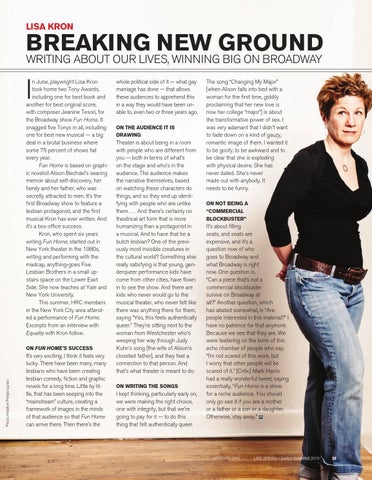
n June, playwright Lisa Kron took home two Tony Awards, including one for best book and another for best original score, with composer Jeanine Tesori, for the Broadway show Fun Home. It snagged five Tonys in all, including one for best new musical — a big deal in a brutal business where some 75 percent of shows fail every year. Fun Home is based on graphic novelist Alison Bechdel’s searing memoir about self-discovery, her family and her father, who was secretly attracted to men. It’s the first Broadway show to feature a lesbian protagonist, and the first musical Kron has ever written. And it’s a box office success. Kron, who spent six years writing Fun Home, started out in New York theater in the 1980s, writing and performing with the madcap, anything-goes Five Lesbian Brothers in a small upstairs space on the Lower East Side. She now teaches at Yale and New York University. This summer, HRC members in the New York City area attended a performance of Fun Home. Excerpts from an interview with Equality with Kron follow.
ON THE AUDIENCE IT IS DRAWING
Theater is about being in a room with people who are different from you — both in terms of what’s on the stage and who’s in the audience. The audience makes the narrative themselves, based on watching these characters do things, and so they end up identifying with people who are unlike them. … And there’s certainly no theatrical art form that is more humanizing than a protagonist in a musical. And to have that be a butch lesbian? One of the previously most invisible creatures in the cultural world? Something else really satisfying is that young, genderqueer performance kids have come from other cities, have flown in to see the show. And there are kids who never would go to the musical theater, who never felt like there was anything there for them, saying “Yes, this feels authentically queer.” They’re sitting next to the woman from Westchester who’s weeping her way through Judy Kuhn’s song [the wife of Alison’s closeted father], and they feel a connection to that person. And that’s what theater is meant to do.
Photo: Heather Phelps-Lipton
ON FUN HOME’S SUCCESS
It’s very exciting. I think it feels very lucky. There have been many, many lesbians who have been creating lesbian comedy, fiction and graphic novels for a long time. Little by little, that has been seeping into the “mainstream” culture, creating a framework of images in the minds of that audience so that Fun Home can arrive there. Then there’s the
ON WRITING THE SONGS
I kept thinking, particularly early on, we were making the right choice, one with integrity, but that we’re going to pay for it — to do this thing that felt authentically queer.
The song “Changing My Major” [when Alison falls into bed with a woman for the first time, giddily proclaiming that her new love is now her college “major”] is about the transformative power of sex. I was very adamant that I didn’t want to fade down on a kind of gauzy, romantic image of them. I wanted it to be goofy, to be awkward and to be clear that she is exploding with physical desire. She has never dated. She’s never made out with anybody. It needs to be funny. ON NOT BEING A “COMMERCIAL BLOCKBUSTER”
It’s about filling seats, and seats are expensive, and it’s a question now of who goes to Broadway and what Broadway is right now. One question is, “Can a piece that’s not a commercial blockbuster survive on Broadway at all?” Another question, which has abated somewhat, is “Are people interested in this material?” I have no patience for that anymore. Because we see that they are. We were teetering on the brink of this echo chamber of people who say, “I’m not scared of this work, but I worry that other people will be scared of it.” [Critic] Mark Harris had a really wonderful tweet, saying essentially, “Fun Home is a show for a niche audience. You should only go see it if you are a mother or a father or a son or a daughter. Otherwise, stay away.”
WWW.HRC.ORG
LATE SPRING / EARLY SUMMER 2015
25