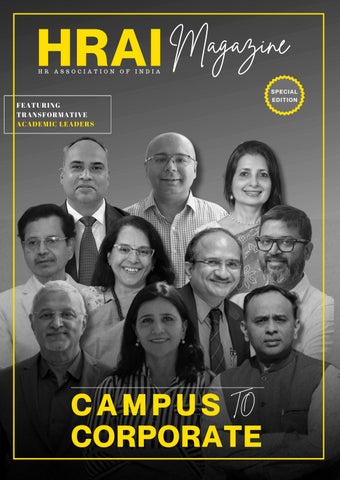
C2C MAGAZINE

Page 1


FEATURING TRANSFORMATIVE ACADEMIC LEADERS

CAMPUS TO

At HRAI, we believe that the bridge between academia and industry is the foundation for building a future-ready workforce. By fostering collaboration between educational institutions and the corporate world, we can empower students with the skills, mindset, and resilience needed to thrive in a rapidly evolving workplace.

Welcome to this special edition of our Campus to Corporate Magazine a platform that brings together the insights of senior academic leaders to explore how education can meet industry demands

This edition celebrates the visionaries who are shaping the next generation of talent individuals who inspire innovation, embrace change, and cultivate learning that prepares students for the challenges of tomorrow

Their perspectives remind us that shaping future-ready talent is not just an academic exercise; it is a collective mission to transform aspirations into action and potential into impact

As you turn these pages, we hope you gain inspiration, insight, and optimism for a future where education and industry unite to create meaningful opportunities.

08

22

DR. ARVIND KUMAR DIRECTOR, PLACEMENT CELL; PROFESSOR & FORMER DEAN, JAWAHARLAL NEHRU UNIVERSITY

DR. NIRJA SHARMA CHIEF TALENT & SKILLS OFFICER MICA

14

38

46

PROF (DR.) S. JEELANI DIRECTOR UNIVERSITY OF HYDERABAD CENTRAL UNIVERSITY, HYDERABAD

23

DR. MALINI V. SHANKAR VICE-CHANCELLOR INDIAN MARITIME UNIVERSITY

64

DR. SAURABH BHATTACHARJEE

ASSOCIATE PROFESSOR OF LAW AND DEAN – ACADEMICS NATIONAL LAW SCHOOL OF INDIA UNIVERSITY (NLSIU), BENGALURU

32

56

PROF. SNEHAL SHAH

PROFESSOR, ORGANISATION AND LEADERSHIP STUDIES SP JAIN INSTITUTE OF MANAGEMENT AND RESEARCH (SPJIMR), MUMBAI

72

PROF. SANTOSH KUMAR PATR ASSOCIATE PROFESSOR, ASSO DEAN – ACADEMICS MICA

DR. RAMAN RAMACHANDRAN DIRECTOR & DEAN K J SOMAIYA INSTITUTE OF MANAGEMENT, MUMBAI

DR. SRINIVASAN R. IYENGAR PROFESSOR & FORMER DIRECTOR JBIMS – JAMNALAL BAJAJ INSTITUTE OF MANAGEMENT STUDIES

PROF. V RAMGOPAL RAO VICE-CHANCELLOR, BITS PILANI

I

Te HR Association of India (HRAI), founded in 2020 is an esteemed non-profit organization that has been playing a pivotal role in shaping the HR landscape in India. Their primary focus is on exploring, discussing, and promoting the latest business scenarios, market trends, change management, and leadership in the HR industry. HRAI is dedicated to creating a community of professionals, learners, and mentors who share their insights and learn from each other to elevate the standard of HR practices in the country.

HRAI's success is attributed to its commitment to excellence and tireless efforts in facilitating interactions between HR professionals and subject matter experts. Through its initiatives such as panel discussions,

In addition to their educational initiatives, HRAI also recognizes organizations' best practices and individual contributions through awards and conferences These events celebrate the achievements of exceptional professionals and organizations that have made significant contributions to the HR industry in India. Over the years, HRAI has featured more than 1,000 experts and leading minds in the fields of HR, IT, Marketing, Finance, and more, making it a hub for learning and networking.

For HR professionals in India, HRAI offers unparalleled opportunities to connect with like-minded peers, learn from experts, and gain recognition for their hard work and achievements. By joining HRAI, HR professionals can stay updated on the latest trends, best practices, and strategies that can help them take their careers to the next level

HIGHLIGHTS:

HRAI, founded by Dr. Ankita Singh, drives industry initiatives and organizes prestigious awards for organizations, emerging leaders, and trailblazing women leaders. Notable participants include Blue Star Limited, Reliance Retail, Landmark Group, Oracle, Birlasoft, Vedanta and more.

Our commitment to excellence is reinforced through partnerships with the Great Managers Institute and top 100 great managers, who have taken masterclasses and featured in Forbes Magazine.

Elite leaders like Dr. TV Rao, Harjeet Khanduja, and Prasenjit Bhattacharya have graced our one-on-one talk shows, enhancing our members' knowledge base.

Our article initiative showcases thought-provoking articles by eminent leaders from organizations like BCCL, Bajaj Energy, TimesPro, Jio, Welspun Group, Great place to work and Accolite Digital.

The 23 Of 2023 Initiative recognizes exceptional leaders and entrepreneurs based on a predetermined theme. Featured leaders include those from Adani, Reliance, IBM, Infosys, KPMG, as well as notable celebrities.

DR.ARVIND KUMAR

Q:Howdoyouseetheroleofacademicinstitutions evolving in preparing students for the corporate world?

Academic institutions have shifted away from a model focused mainly on the dissemination of theory to an emphasis on employability, up gradation of skills and innovation. With an ever changing environment of continuous disruptions, the need to reskill in combination with practical exposure and the capacity to work through difficult times is preferred bycorporate.

Academic institutions should focus on the overall development of the students that involves a combination of technical skills, digital fluency, emotional intelligence and real-world corporate exposure. Institutions being an integral part of this transition, from the classroom to the corporate boardroom, through experiences such as internships, apprenticeship, live projects, industry mentorship and workshopsvettedbyindustryexperts

Q: What are the major trends shaping higher educationandemployabilitytoday?

The higher education landscape is shifting from an emphasis on a degree for employment purposes to a focus on developing capabilities for life The skills required for corporate today have been changing constantly due to innovations in the ecosystem so our institutions should be prepared to supplement these changes with appropriate learning environment to bridgethegapfurther.

Employers are placing due importance on academic excellence as well individual qualities such as adaptability, collaboration and emotional intelligence. Communication skills, problem-solving, leadership qualities, interpersonal skills and, empathy have arguablybecomeasimportantcompetencyindefining successinanyprofession

Higher education institutions are preparing students appropriately with project-based learning, hybrid classrooms and partner links to industry that support learningtogetherwithpracticalexperience Oneofthe recent trends is that after completing one terminal degree, students are also acquiring another degree for better employability for example IIT graduates going formanagementcoursesinIIM’s

DR.ARVINDKUMAR

INSIGHTS: DO’SAND DON’TS

Q: From your perspective, what are the do’s and don’ts for students transitioningfromcampustocorporatelife?

Dos: Beadaptableandeagertolearn

Communicateeffectivelyandcollaboratewithteams. Takeownershipanddemonstrateprofessionalaccountability. Focusoninterpersonalskills

Don’ts:

Don’tcarryasenseofentitlementintoyourfirstjob. Don’tresistfeedback;embraceitasatoolforgrowth. Avoidcomplacency,thelearningcurveneverends. Don’thesitatetoaskforguidance

Q: What vision do you hold for your institution in terms of industry–academiacollaboration?

We aspire to develop a living bridge that connects academia and the industrybasedontrust,curiosity,andasharedpurpose

There needs to be multiple MOU’s)with corporate and industry partners such as NHRD Network, CII, FICCI, DICCI, Assocham, PHD Chamber of Commerce in terms of industry academia collaboration There’s also the need to have consistent coordination with corporate partners about the upgradationanddesignofthecurriculum

Together we can equip students to step into their professional lives with confidence and compassion. As I frequently remind my students, education is not about makingaliving;itisaboutmakingadifference

Together we can equip students to step into their professional lives with confidence and compassion. As I frequently remind my students, education is not about making a living; it is about making a difference

Q: What challenges do you see in aligning academic curriculum with corporate expectations?

The greatest hurdle in harmonizing academic curriculum with the needs of the corporate world is the rate of change The idea of rigor is different in academia than in the corporate world as the insights from academic research are applied in the corporate world.

The biggest hurdle in academia is that the curriculum needs to be set on a generic understanding of the subject and not for industry specific or sector Specific Corporation. Though there are domain specific institutions as well such as Gati Shakti Vishwavidyalaya, Shri Vishwakarma Skill University, Shri Lal Bahadur Shastri National Sanskrit University, NLU’s etc. The lack of participation from corporate in academic/ institutional workshops may further broaden this gap.

The synergy can further be improved between educators and professionals by adopting dynamic academic structures, while also developing mentoring plans which will further enhance the quality of education altogether

Q: What opportunities can colleges leverage to make their students more industry-ready?

Real life industry exposure through industry visits and engaging workshops with industry experts need to be leveraged Industry sponsored projects and competitions with real life problems can further enhance the capabilities of the students in institution that have a chance to work on real time data. Alumni connect needs to be an integral part of the academia industry interface across various sectors to make them industry ready

Applied capabilities and an innovative approach are acquired through institutionally run collaborative research projects. Incubators support, problem-solving, innovation and an entrepreneurial mindset which should be another avenue that can be leveraged by the institutions Multiple opportunities for work experience, mentorship programs, and other such ongoing engagement with industry needs to be the new normal.

Q: What are your expectations from corporate when it comes to engaging with campuses?

The need for increased engagement with corporate partners, through mentorship programs, workshops, and internships (summer and winter )/apprenticeships that would allow students to learn about the corporate environment, culture, expectations, and industry dynamics. In addition to more conventional training, we also expect activities such as industry-led Hack-a-thons, Case study competitions, project-based collaboration, and mentoring to create outreach opportunities Industry stalwarts can join as Professor of Practice on the relevant subjects.

Recruiter feedback is a prominent influencer in the continuous development of curriculum and preparation training Ultimately, increased engagement will assist with the transition from campus to corporate life.

Q: What are your expectations from students to succeed in the corporate world?

Our expectations from the students remain to be committed, diligent, be a global citizen when it comes to knowledge, and be prepared to work in

diverse sectors of the corporate world. In order to succeed in the corporate world, students must develop curiosity, discipline, and emotional intelligence Technical skills and non-technical skills both matter significantly to employers Employers want professionals who think critically, problem-solve, and communicate effectively. A critical differentiator will be resilience, the ability to cope withchangewhilemanaging

Q: How is your institution currently enabling students to bridge the gap between academics and industry requirements?

Our university is very actively bridging the gap between academia and industry. We engage in continuous skill development, including aptitude training, mock interviews and communication workshops while also including lectures on the importance of teamwork, leadership and collaboration We also work closely with companies, allowing students real-world experience through live projects, internships and industrial visits. Through consistent dialogue with industries and professional bodies which again contributes to bridging this gap Apart from these corporate initiatives, our university, and school like Atal Bihari Vajpayee School of Management and Entrepreneurship and Atal Incubation centre also nurturing budding entrepreneurs under the guidance of industry experts By combining academic learning with practical experience and soft skills, we provide an assured opportunity for students to transition confidently into the corporate world as competent professionals

Q: In your view, how do academic institutions contribute to the larger national talent ecosystem and the future of India Inc.?

Academic institutions form the backbone of India's human capital, which shapes the talent that drives this growth There has been a significant increase in the number of India- based companies and unicorns and we remain committed to the goal of India becoming a developed nation full of unicorns by 2047

Our contribution to this eco system has been in the form of providing employable individuals to join the workforce as well as become pioneers and start their entrepreneurial journey hiring other people. Therefore the institutions help forging the future of this country

by equipping them with the right skills, adequate knowledge and the highest ethical standards.

Q: Is there anything else you would like to add or share your views on, that has not been covered above?

The future of employability will depend on authentic collaboration among students, educators, industry leaders, and academic institutions. Institutions also have an obligation to prepare not only skilled professionals, but compassionate, ethical, and visionary global citizens who will lead with empathy, integrity and innovation Our goal is to prepare students not just for their first job, but to contribute to society, nation and the globe.

ABOUT THE AUTHOR:

Professor (Dr). Arvind Kumar is a former Dean at the Atal Bihari Vajpayee School of Management and Entrepreneurship (ABVSM&E) Jawaharlal Nehru University, New Delhi He has more than 27 years of experience in academics and industry He is a certified entrepreneur educator from Stanford University, USA. He earned his postgraduate and Ph D in management He is the recipient of a Post Doctoral Fellowship in USA He has supervised several M Phil and Ph.D. students. He is a keen researcher, and his current research interests are CSR, Academia-Industry Interface Consumer Affairs, and Social Entrepreneurship He has several research papers / articles published in national and international journals of repute He has several books, monographs, and research projects to his credit. He has participated as an expert in national, international conferences, seminars, and workshops and has been part of various panel discussions and also chaired sessions.

ABOUTTHEAUTHOR

Dr. Malini V. Shankar, Vice-Chancellor of the Indian Maritime University, is a 1984-batch IAS officer with over 40 years of distinguished service.

She has held key positions, including Director General Shipping at the rank of Secretary to the Government of India, and currently chairs the National Shipping Board while serving on the IL&FS Board

A doctorate in Institutional Economics from IIT Madras, she also holds degrees from AIM Manila and Mount Holyoke College, USA A trailblazer in the maritime sector, she is the first Indian woman to re

INDIAN MARITIME UNIVERSITY

Q: How do you see the role of academic institutions evolving in preparing students for the corporate world?

Academic institutions play a crucial role in shaping industry-ready graduates Beyond imparting theoretical knowledge, we must ensure that curricula remain aligned with evolving industry requirements and market trends. Integrating case studies, live projects, and experiential learning allows students to apply classroom concepts to real-world challenges. Engagement with industry experts through guest lectures, workshops, and mentorship sessions provides exposure to workplace expectations and emerging skill needs.

Additionally, guiding students in résumé building, interview preparation, and securing internships ensures they transition confidently from campus to corporate life, equipped with the skills, mindset, and professionalism required to succeed.

Q: What are the major trends shaping higher education and employability today?

A significant trend in higher education is the integration of Artificial Intelligence (AI) skills alongside essential soft skills. As industries adopt AI-driven tools and processes, graduates must be comfortable with emerging technologies and data-driven decision-making However, technical expertise alone is not enough Employers increasingly seek individuals who combine digital capabilities with strong communication, adaptability, critical thinking, and collaboration There is also a growing recognition that a degree alone does not guarantee employability Institutions must focus on holistic skill development, experiential learning, and real-world exposure to prepare truly industry-ready graduates.

Q: From your perspective what arethe do and don’ts for the students transitioning from campus to corporate world?

In my view, students should remain humble and open to learning as they transition to corporate life. Organizations value individuals who listen, adapt, and contribute meaningfully, regardless of academic achievements. Students should approach every task with sincerity and ownership, recognizing that the organization invests in them for the value they bring. Conversely, assuming that a degree alone guarantees success can be detrimental By balancing confidence with curiosity, demonstrating respect, and committing to continuous learning, students can navigate this transition smoothly and make a lasting, positive impact in their workplace.

“Employers increasingly seek individuals who combine digital capabilities with strong communication, adaptability, critical thinking, and collaboration.”

Q: What vision do you hold for your institutions in terms of industry-academia collaborations?

Industry-academia collaboration is a cornerstone for the growth and relevance of academic institutions In applied fields, students benefit from exposure not only through internships but also by engaging in problem-solving projects and consultancies with industry partners

These initiatives help students apply theoretical knowledge to real-world challenges while fostering innovation and critical thinking. Our vision is to build sustainable partnerships that go beyond placement-driven interactions

By co-creating projects, research opportunities, and training programs that address actual business needs, we ensure that students graduate with solid academic foundations, hands-on experience, and adaptability to thrive in a dynamic corporate landscape

Q: What challenges do you see in aligning academic curriculum with corporate expectations?

One major challenge is the rapid pace of technological advancements and evolving management practices From AI innovations to shifts in supply chain and digital marketing, the industry landscape is constantly changing. Curriculum updates, however, often move more slowly due to regulatory processes and the need to maintain academic rigor, creating a gap between what students learn and what the industry requires Addressing this requires agile curriculum frameworks, regular industry input, and continuous dialogue with corporate partners Increasing faculty exposure to industry practices and encouraging collaborative projects further ensures students are equipped with relevant, up-to-date skills

Q: What opportunities colleges leverage to make their students more industry ready?

Colleges can enhance students’ industry readiness through multiple avenues Engaging professors of practice faculty with significant industry experience brings practical insights into the classroom Alumni outreach allows experienced graduates to mentor students, share industry trends, and guide career development

Organizing colloquiums, workshops, and collaborative forums with peer institutions and industry partners creates platforms for experiential learning, networking, and exposure to real business challenges By leveraging these opportunities, colleges integrate practical learning, mentorship, and industry insights into their programs, equipping students with the knowledge, adaptability, and confidence required to thrive in the corporate world.

Q: What are your expectations from corporates when it comes to engaging with campuses?

While I cannot speak on behalf of corporates, it is clear that professionals often face significant time constraints due to demanding schedules To facilitate engagement, campuses must design initiatives that are concise, meaningful, and well-structured. Virtual sessions, focused workshops, guest lectures, and short-term mentorship programs can provide students with industry exposure while respecting professionals’ time.

Efficiently planned engagement opportunities maximize the value of corporate interaction, offering insights and practical learning for students while enabling busy industry experts to contribute effectively

Q: What are your expectations from students to succeed in the corporate world?

Students must cultivate a holistic blend of skills and attitudes to succeed in the corporate environment They should be wellread, curious, and passionate about continuous learning, staying updated on developments in their chosen fields Awareness of emerging trends, technologies, and best practices enables meaningful contributions from day one.

Equally important is an all-round personality strong communication, adaptability, teamwork, and critical thinking are essential for navigating complex workplace challenges By combining knowledge, learning agility, and personal growth, students can excel professionally, contribute effectively, and adapt to the evolving demands of their careers.

Q: How is your institution currently enabling students to bridge the gap between academics and industry requirements?

At the Indian Maritime University, we actively work to bridge the gap between academic learning and industry needs. We offer microcredit courses in emerging areas, provide opportunities for dual degree programs, and encourage students to take courses on platforms such as SWAYAM and NPTEL. Beyond academics, students are encouraged to engage in research, intellectual pursuits, and extracurricular activities that foster creativity, leadership, and critical thinking This holistic approach ensures that graduates emerge not only as competent professionals equipped with industry-relevant skills but also as well-rounded, considerate individuals ready to contribute meaningfully to society and the workplace.

Q: In your view, how academic institutions contribute to the larger national talent eco system and future of India inc?

Academic institutions serve as the foundation of the national talent ecosystem by nurturing individuals who will drive innovation, productivity, and inclusive growth By aligning education with emerging industry demands, institutions ensure that graduates possess not only technical competence but also the critical thinking, creativity, and ethical grounding necessary for sustainable progress

COLLABORATIONS

When academia fosters interdisciplinary learning, research, and entrepreneurial mindsets, it helps build a workforce capable of solving complex societal and business challenges

Furthermore, collaborations between universities, industries, and government bodies enable the creation of knowledge networks that strengthen India’s competitiveness on the global stage.

Through skill-based education, incubation programs, and industry-integrated initiatives, academic institutions are shaping the future of India Inc. one that thrives on agility, innovation, and social responsibility

Q: Is there anything else you would like to add?

Education, in its truest sense, extends beyond employability. It is about shaping responsible citizens who contribute to the growth of both organizations and society

As educators, our role is to inspire curiosity, resilience, and integrity in young minds qualities that sustain success in any domain. By fostering collaboration between academia and industry and emphasizing lifelong learning, we can ensure that every graduate becomes not just a skilled professional but also a thoughtful changemaker contributing to India’s growth story

ENABLETHE

CREATION OF KNOWLEDGE NETWORKSTHAT STRENGTHEN INDIA’S COMPETITIVENESS ONTHE GLOBAL STAGE.

BEYOND PLACEMENTS: THE EMPLOYABILITY EVOLUTION

Why Skills Are the New Currency

The definition of employability has expanded it’s no longer just about a job offer, but about career readiness and adaptability.

Recruiters now prioritize problem-solving, communication, and learning agility over rote expertise.

Institutes are embedding industry projects, live case studies, and mentorship programs into their curriculum.

Soft skills such as empathy, leadership, and teamwork are being treated as essential competencies.

Students with internship experience and digital exposure have significantly higher success in placements.

Continuous learning and self-upskilling have become the new expectation from both students and institutions.

CENTRAL UNIVERSITY OF HARYANA (CUH)

PREPARING STUDENTSFORTHE CORPORATEWORLD

Q: How do you see the role of academic institutions evolving in preparing students for the corporate world?

The role of academic institutions in preparing students for the corporate world has become more critical than ever because the workplace itself is changing so rapidly. Academic institutions must shift from delivering pure knowledge to orchestrating capabilities Since the corporate world is unpredictable, teaching how to learn is more valuable than teaching only fixed content Encouraging curiosity, research orientation, and comfort with ambiguity ensures students remain agile. Preparing students not just for jobs but also to create jobs through entrepreneurship cells, incubation centers, and innovation labs.

MICA has completely overhauled its curriculum design by incorporating industry inputs to stay relevant to evolving business needs It is preparing students by combining applied labs, industry cocreation (live briefs, capstones), portfolio building, internships, and continuous micro-credentialing so graduates arrive with demonstrable projects, practical experience, and ethical judgement, not only theory The practical exposure helps students apply theory to real-world contexts Further the Industry interactions in form of Guest lectures, corporate mentoring, and case studies deepen applied understanding. The curriculum at MICA, is integrating creativity, cultural intelligence, digital literacy, data orientation and AI fluency with core management fundamentals

Q: What are the major trends shaping higher education and employability today?

Higher education worldwide is undergoing a profound transformation. The needs of the corporate world, rapid technological advances, and evolving student aspirations are reshaping the way institutions prepare learners for the future of work What was once a linear path from campus to career is now a dynamic, lifelong journey Several key trends are defining this shift that are being practiced and implemented at MICA are:

From Degrees to Skills: Employers today increasingly value what graduates can do rather than what degree they hold. While academic credentials still matter, the focus has shifted to practical, demonstrable skills. Micro-credentials, digital badges, and certifications in areas such as AI, design thinking, data analytics, and digital marketing are gaining traction MICA has embedded these into the curricula to ensure students are trained to be “employable” and graduate “career-ready ” Employability is a core metric

Digital and Hybrid Learning: The pandemic accelerated the adoption of online education, and its legacy remains Blended learning models combining classroom teaching with online flexibility are becoming the norm Universities are using simulations, virtual internships, MOOCs, and AI-driven adaptive platforms to enhance engagement and accessibility, making education more personalized and globally connected MICA has devoted efforts to building a very strong presence in its online programs

Industry–Academia Convergence: The gap between theory and practice is narrowing MICA is

increasingly co-creating programs with industry partners, ensuring that curriculum evolves alongside workplace demands Interships, live projects, immersion programs and co-delivered courses bring corporate realities into the classroom MICA has redesigned its career services, mentoring programs, and alumni networks to support holistic professional growth.

The Rise of AI and Automation: Automation is changing the employment landscape by replacing routine tasks. This is driving demand for distinctly human skills critical thinking, creativity, ethical judgment, and leadership MICA has reworked its vision & mission to ensure that students are being prepared not just for the jobs of today, but for roles that don’t yet exist, equipping them with agility and resilience.

Higher education is no longer about producing degree-holders it is about nurturing adaptable, ethical, and globally minded professionals. With widespread increasing AI augmentation of roles; demand for cross-disciplinary T-shaped skills; gig and creator-economy career paths; microcredentials and stackable learning; employer expectations for demonstrable work (portfolios, simulations); remote/hybrid internships; and stronger industry-academia co-design for fastchanging skills is the need. The future belongs to those institutions that evolve into ecosystems of continuous learning blending academic rigor, industry relevance, digital innovation, and human values.

Q: From your perspective, what are the dos and don'ts for students transitioning from campus to corporate life?

Transitioning from campus to corporate life requires a shift from freedom to responsibility. Success depends on professionalism, adaptability, ethical conduct, and the ability to continuously learn and collaborate Dos: (a) curate a demonstrable portfolio (projects + metrics); (b) practise professional communication and stakeholder storytelling; (c) embrace a learning mindset- continue micro-learning (AI tools, domain platforms); (d) show curiosity and adaptability; (e)

maintain reliability and accountability in all tasks; (f) Build meaningful professional relationshipsnetwork effectively, seek mentorship, and foster collaborative relationships; (g) Exercise caution in digital presence: maintain professionalism on social media; avoid negative commentary about work or colleagues

Don'ts: (a) treat campus classroom learning secondary to real-world experiences; (b) overspecialise too early without breadth; (c) neglect soft skills listening, collaboration and accountability matter; (d) expect onboarding to teach basics arrive prepared; (e) Do not exhibit or demand entitlement- always approach responsibilities with humility; recognize that learning and growth precede advancement; (f) Avoid casual attitudes toward deadlines, meetings, and workplace interactions; (g) neglect work-life balance.

THE VISION:

Q: What vision do you hold for your institution in terms of industry-academia collaboration?

MICA is attempting to be a co-creation hub where industry, creators and faculty design curricula, live

projects, and research agendas. The vision is “To establish MICA as a globally recognized thought leader and talent incubator by fostering deep, meaningful collaborations with industry that co-create knowledge, drive innovation, and prepare graduates for the future of work.”

Strategic Pillars of our Vision:

Curriculum Co-Creation and Relevance: Collaborate with industry leaders to design programs that reflect current and future business needs.

Introduce specialized tracks, certifications, and applied projects in emerging domains like AI in marketing, data-driven decision making, digital communication, and sustainability

Experiential Learning and Industry Exposure: Expand internships, live projects, and industry residencies across sectors Enable students to work on real-world challenges, integrating theory with practice.

Research and Thought Leadership: Partner with corporations on applied research, market insights, and innovation labs. Position MICA as a hub for actionable knowledge in marketing, communications, and business strategy

Mentorship and Talent Development: Establish structured mentorship programs connecting students with senior industry professionals Facilitate workshops, bootcamps, and masterclasses that develop both technical and leadership skills.

Innovation, Entrepreneurship, and Incubation: Strengthen incubation centers to foster startups and entrepreneurial ventures Encourage industry-sponsored competitions, hackathons, and ideation labs to translate ideas into market-ready solutions

Global Collaboration and Benchmarking: Build partnerships with international organizations and corporates for global exposure. Benchmark MICA’s programs against leading global institutes to ensure international relevance and competitiveness.

Sustainable and Inclusive Collaboration: Embed ESG, diversity, equity, and inclusion principles into collaborative initiatives Through our CDMC , we encourage projects that create social impact d ibl b i i

Q: What challenges do you see in aligning academic curriculum with corporate expectations?

The key challenge is a dynamic misalignment academic systems are designed for stability and depth, while corporate needs are fast-changing, practical, and context-specific. Some of the other challenges are:

-Diversity of Industry Expectations: Different sectors, companies, and roles require highly specialized skills. Designing a single curriculum that meets the varied demands of multiple industries is difficult.

These “non-technical” competencies are difficult to teach, assess, and embed systematically in traditional curricula. Academics often focus on conceptual knowledge and frameworks, while corporates value practical problem-solving skills and immediate applicability So students expect academic programs to guarantee employability, while corporates expect graduates to “hit the ground running ” Limited exposure to real-world business challenges can leave students unprepared for workplace ambiguity

-Measuring & evidencing competency: Exams and grades often reward rote learning rather than problem-solving creativity or critical thinking s

Q: What opportunities can colleges leverage to make their students more industry-ready? How is your institution currently enabling students to bridge the gap between academics and industry requirements?

Colleges today have a unique opportunity to bridge the gap between academia and industry by creating a more holistic, skill-oriented learning environment Some of the initiatives taken by MICA to make our students more industry-ready are:

Co-Creation of Curriculum with Industry: We have partnered with corporates to design programs aligned with current and future business needs

We have proactively introduced specialized tracks, certifications, and elective modules in emerging domains like AI, data analytics, digital marketing, ESG, and design thinking We are building interdisciplinary labs that incorporate AI × storytelling × analytics

Experiential Learning Opportunities: At MICA the focus has always been on mandatory internships, live capstone projects, and inviting industry practioners to teach We have incorporated case studies, simulations, and problem-solving exercises that reflect realworld business challenges. We regularly encourage field visits and immersion programs to operational and strategic functions in organizations We run hackathons, innovation challenges, and industry-sponsored competitions to foster creativity and practical problem-solving. We encourage students to work on live industry problems, contributing actionable insights while gaining hands-on experience Some of our much recognized initiatives are the AI and analytics labs, Rural Immersion and fieldwork, portfolio and storytelling courses, and an emphasis on assessment that includes employer and external expert review Faculty-run incubators and creator-economy electives further connect students with market realities.

Mentorship and Networking Programs: We try and connect our students with industry mentors for guidance, skill-building, and career advice We regularly facilitate alumni-industry engagement, guest lectures, and expert panels Our Alumni play a very important role as mentors and placement partners and guide the students

Career Readiness and Placement Support: we provide structured career services, including resume building, interview preparation, aptitude assessments, and personality development programs The coaching on professional ethics, -workplace etiquette, and organizational expectations helps prepare the students to successfully face the interview and selection process.

Q: What are your expectations from corporates when it comes to engaging with campuses?

The main focus is on expecting corporates to help higher education Institutes like MICA to create immersive, hands-on, and forward-looking experiences where students can act, innovate, and solve like professionals even before entering the workforce These could be well-scoped live projects

and internships with meaningful mentorship; access to data and tools for student work, participation in curriculum advisory roles; joint evaluation of capstones; and support for faculty development (guest teaching, joint research)

At MICA, we would like the corporates to provide us with opportunities like:

-Reverse Mentorship Program: Encourage our students to mentor industry professionals on digital trends, social media, emerging tech, and Gen Z consumer behavior. This will help build confidence in students while giving corporates fresh perspectives

-“Corporate Problem Sprint” Labs: Provide us with short, intensive 1–2 week labs where students tackle real industry challenges under corporate guidance. These could be focused on speed, innovation, and out-of-the-box solutions mirroring startup agility within an academic setting This will offer authentic exposure to workflows, decision-making, and organizational culture.

-Simulated Corporate Ecosystems: This will help to create a simulated company or functional departments where students operate end-to-end (finance, strategy, IT marketing, operations, HR etc). The students can engage with real clients, NGOs, or startups to develop negotiation, communication, and leadership skills This offers immediate feedback from “real-world stakeholders ” and the students will learn accountability, teamwork, deadlines, and cross-functional integration in a safe but realistic environment

-Co-Creation of IP & Research with Industry: Encourage students and faculty to develop solutions, insights, or prototypes jointly with companies which may even lead to patents or marketable innovations. This will help bridge practical application, research, and entrepreneurship

-Future-Readiness Challenges: Host challenges on AI ethics, sustainability, circular economy, or digital transformation, requiring students to anticipate future trends This will encourage strategic foresight, critical thinking, and innovation mindset

Q: What are your expectations from students to succeed in the corporate world?

Success in the corporate world is no longer just about technical skills it’s about impact, adaptability, strategic thinking, and purpose Students who cultivate these traits are better positioned to thrive, innovate, and lead. Students must be proactive learners: build evidence (projects, measurable outcomes), learn to work in cross-functional teams, be fluent with relevant tech tools (especially AI-assisted workflows), show ethical judgement, and commit to lifelong learning.

They should also develop a public, curated presence (portfolio, channels) that signals capability Some of the traits that students should imbibe and demonstrate are stated below:

Trait

Value Creation Mindset

Learning How to Learn

Cross-Functional Thinking

Comfort with Ambiguity

Storytelling Ability

Digital & Data Fluency

Entrepreneurial Thinking

Network Intelligence

Purpose-Driven Orientation

Self-Awareness & Reflection

Success in the corporate world is no longer just about technical skills it’s about impact, adaptability, strategic thinking, and purpose.

Students who cultivate these traits are better positioned to thrive, innovate, and lead Students must be proactive learners: build evidence (projects, measurable outcomes), learn to work in cross-functional teams, be fluent with relevant tech tools (especially AI-assisted workflows), show ethical judgement, and commit to lifelong learning

They should also develop a public, curated presence (portfolio, channels) that signals capability Some of the traits that students should imbibe and demonstrate are stated below:

What It Means

Go beyond assigned tasks to identify opportunities and add measurable impact

Rapidly upskill, unlearn outdated methods, and stay ahead

Understand business holistically and connect departmental dots

Make informed decisions despite incomplete information

Present insights and ideas compellingly to influence stakeholders

Interpret data, generate insights, and understand business implications

Identify opportunities, innovate, and take initiative even within a defined role

Build and leverage professional relationships strategically

Align personal goals with organizational mission

Understand strengths, weaknesses, and growth areas

Impact in the Workplace

Drives business results and innovation

Ensures continuous relevance in dynamic environments

Enables better decision-making and problem-solving

Builds resilience and adaptability in uncertain situations

Enhances persuasion, alignment, and leadership presence

Supports evidence-based decisions and strategic thinking

Encourages proactivity and intrapreneurship

Facilitates collaboration, mentorship, and influence

Promotes engagement, motivation, and meaningful contribution

Drives continuous improvement and leadership development

Q: In your view, how do academic institutions contribute to the larger national talent ecosystem and future of India Inc.?

Institutions are talent architects: they provide domain-ready, ethically conscious leaders, seed innovation through applied research and start-ups, and distribute skills geographically via online modules and alumni networks

By embedding societal impact (rural immersion, inclusive design) and AI literacy, they help India scale quality talent for both domestic transformation and global roles

Q: Is there anything else you would like to add or share your views on, that has not been covered in the above questions?

Two practical priorities:

(a) make assessment and credentialing more transparent and competency-based (AoL mapping to employer rubrics);

(b) create a continuous faculty-industry exchange program so teaching stays current and research stays applied. For MICA, the unique leverage is combining creative craft + strategic management + AI. We standardise pathways for the creator economy, brand strategy, and humancentred AI so students lead emergent markets.

Degrees can open the door, but it’s the adaptability, resilience, and integrity shaped in academic institutions that keep students relevant in the corporate world.

The corporate world doesn’t just need employees who know; it needs professionals who can learn, unlearn, and relearn and that’s the real mission of academia

DR.RAMANRAMACHANDRAN

A B O U T T H E

A U T H O R

Dr. Raman Ramachandran retired as Chairman & Managing Director of BASF India Ltd (https://www india basf com/), Head of BASF group companies in South Asia and subsequently lead PI Industries Ltd (https://www piindustries com/) as its Managing Director and CEO During his stint of nearly three decades with global chemicals major (BASF), Raman held many positions of responsibility across Research, Regulatory, Marketing and Business leadership. He has global experience having worked for 11 years based in Singapore with Asia Pacific regional responsibilities. He was a member of BASF’s Asia Pacific Business Board and Executive Management Team of Agricultural Products Division of BASF; Vice-President, Crop Life Asia and Chairman of Confederation of Indian Industries, Chemicals and Petrochemicals industry group He has a PhD from University of Adelaide, South Australia and subsequently pursued his research interests with International Organizations in Kenya, Philippines and at University of Wisconsin, Madison, USA. Raman was Robert S McNamara Fellow of the Economic Development Institute of World Bank in the year 1990 He was awarded FICCI's Chemical and Petrochemical sector's "Lifetime Achievement Award for contribution to Agrochemical Industry” in November 2021

He is currently non-executive Chairman on board of Calibre Chemical Pvt Ltd (https://www.calibrechem.com/) and Independent Director of Proklean Technologies (https://proklean.in/) and Godavari Biorefineries. He is certified coach from Newfield Certified Executive Coach and Coaching Federation of India (CFI) and coaches several senior level executives in Corporate and non profit sector Raman is passionate about Management Education particularly in the context of helping practising managers to be successful by combining his years of corporate experience with academic experts at K J Somaiya Institute of Management. He plays competitive Table Tennis and is an amateur bird photographer.

Q: How do you see the role of academic institutions evolving in preparing students for the corporate world?

Academic institutions and the degrees they offered were a passport to the corporate world, which was based on textbook teaching that imparted knowledge It was left to the organisations and the graduates to unlearn and learn the skills and competencies required to succeed. Today, such an approach is redundant as knowledge is ubiquitous, and with the advent of Gen AI, answers to most questions are available in seconds So academic institutions should shift their focus on building capabilities such as critical thinking, adaptability, learning agility and other life skills in students.

At KJSIM, we have responded to these changing needs with our purpose statement, enabling the transformation journey of individuals to become value-based and purposedriven leaders who build a better world. This is a recognition that the beginning of any academic program has to be the start of a transformation journey and not the start of a transaction Our programs, curriculum and pedagogy are designed to live this purpose and include a significant experiential learning component, in collaboration with the industry and an emphasis on activities that build character and collaborative skills

Q: What are the major trends shaping higher education and employability today?

There are three skills that are shaping higher education and employability:

a) Integration of technology and AI in learning: Digital literacy is the table stake in higher education. The rapidly evolving Gen AI technology is an excellent tool that can increase the learning outcomes of students considerably if used wisely

Ourvisionisto enrich management educationand studentlearning outcomesthrough industry-academia collaboration.

Higher education should prepare students to think critically while using these tools to understand data, ethics, the orresponding regulatory framework and its consequent impact on organisations Employability, today and in future, will depend on the ability to work with intelligent systems.

b) Organizational designs will be based on skills and not job profiles, as in past To cater to these future needs, higher education institutions should include micro-credentials and industryled certifications as a part of the program and curriculum. At KJSIM, students are no longer evaluated only on marks in different subjects but on a comprehensive student progression index where industry-led certifications and micro-credentials have a significant weightage

c) Human-centred capabilities have become even more important Competencies such as collaboration, agility, adhering to values and principles, learning and researching, communication skills, and an attitude of meeting and exceeding expectations are what employers are looking for

These competencies were identified in Deloitte and McKinsey’s reports on building a future-ready workforce. At KJSIM, all students undergo psychometric tests where their strengths and developmental needs are assessed against these competencies

The reports are shared with them at the beginning of our MBA programs to enable their transformation journey

Q: From your perspective, what are the dos and don’ts for students transitioning from campus to corporate life?

Discipline, a respect for time and timelines, is nonnegotiable. Demonstrating an attitude of going the extra mile to get things done, and the value and pursuit of excellence are key to early success in corporate life Students transitioning from campus to corporate should also recognise that opportunities to stand out from the crowd are not frequent. When given the opportunity, they should be prepared to seize it and create an impact. Most students transitioning to corporate life are often daunted by office politics Being aware of it, not being a catalyst, but at the same time being assertive, are important characteristics that one would do well to develop Last and perhaps most important is to look at the early years in the corporate world as learning opportunities and not earning opportunities. Staying with organisations to learn and create impact before moving on are qualities that will serve well in the long haul

Q: What vision do you hold for your institution in terms of industry–academia collaboration?

Our vision is to enrich management education and student learning outcomes through industryacademia collaboration.

KJSIM is continuously engaging with the industry to meet the changing needs of employers in skills and competencies Our emphasis on experiential learning through the capstone and live projects, summer internships, master classes from industry experts and visiting lecturers from industry provides ample collaborative opportunities for both students and staff for collaboration

Our flagship Executive Education program is another platform that facilitates collaboration as industry participants upskill, while our faculty benefits from the practitioner’s perspective Perhaps our proudest accomplishment in industryacademia collaboration is the recent launch of the MBA Marketing Communications programme in partnership with Jio Creative Labs (link)

where students spend three days in the classroom at KJSIM and two days at Jio Creative Labs. We believe this is a first-of-its-kind program, which is a powerful blend of classroom learning and industry immersion We are looking for similar partnerships with industry associations and companies to design educational programs that will graduate highly employable individuals

One of the key reasons behind this growing disconnect is an outdated and often irrelevant curriculum that fails to keep pace with the rapidly evolving business landscape. There is also a lack of meaningful collaboration between academia and the industry, which is fueled by misconceptions at both ends

The industry sees academia as out of touch, while academia sees the industry as interested in commercial outcomes. While internships are a usual avenue for collaboration, from my experience in the industry, they are often seen as free labour and assigned tasks that contribute little to the learning outcomes. Conversely, students also see these internships as a checkbox to fulfil academic requirements. KJSIM is trying to address this issue with the help of Capstone projects, where students get a prolonged exposure to corporate settings for the duration of six months Additionally, we have a mandate that states that a certain percentage of classes be taught by either an industry expert or an alumnus

“Employability, todayandinfuture, willdependonthe abilitytoworkwith intelligentsystems.”

Q: What challenges do you see in aligning academic curriculum with corporate expectations?

One of the key reasons behind this growing disconnect is an outdated and often irrelevant curriculum that fails to keep pace with the rapidly evolving business landscape. There is also a lack of meaningful collaboration between academia and the industry, which is fuelled by misconceptions at both ends The industry sees academia as out of touch, while academia sees the industry as interested in commercial outcomes While internships are a usual avenue for collaboration, from my experience in the industry, they are often seen as free labour and assigned tasks that contribute little to the learning outcomes Conversely, students also see these internships as a checkbox to fulfil academic requirements. KJSIM is trying to address this issue with the help of Capstone projects, where students get a prolonged exposure to corporate settings for the duration of six months Additionally, we have a mandate that states that a certain percentage of classes .

be taught by either an industry expert or an alumnus.

Q: What are your expectations from corporate when it comes to engaging with campuses?

Corporations need to allocate resources for academic engagement initiatives. They can partner with academia for research, which will help facilitate mutual growth Compared to our international counterparts, these collaborations are rarely seen in the Indian context. Academic institutions can explore creative initiatives such as faculty sabbaticals in corporate settings and, conversely, having industry professionals as consultants and lecturers in academia The new NEP and UGC guidelines also have clauses for professors of practice that enable and facilitate such collaborations. Further, each party has to be very clear about their expectations in terms of outcomes so we can work towards a fruitful collaboration

Q: What are your expectations from students to succeed in the corporate world?

Students should approach their early days in a corporate environment as a crucial phase of learning rather than as an immediate test of competence These initial experiences help them observe, adapt, and understand how their roles contribute to the larger organisational vision. Aligning personal aspirations with organisational goals is essential, as growth becomes truly meaningful when individual ambition drives collective success They must also recognise that collaboration, agility, and discipline are fundamental to thriving at work. The ability to work well with diverse teams, respond to changing demands, and maintain consistency in performance often defines longterm success more than technical knowledge alone. At the same time, corporate life is not always fast-paced or glamorous many tasks can be routine or mundane What distinguishes promising professionals is their ability to innovate, bring fresh perspectives, and find

smarter, more effective ways of accomplishing everyday responsibilities

t a l e n t e c o s y s t e m

Q: In your view, how do academic institutions contribute to the larger national talent ecosystem and future of India Inc.?

Academic institutions play a pivotal role in shaping the national talent ecosystem and, by extension, the future of India.They serve as the bridge between knowledge creation and industry application, nurturing students with not just technical expertise but also critical thinking, problem-solving, and leadership skills.

By embedding industry-driven curricula, encouraging research, and fostering entrepreneurial mindsets, institutions ensure graduates are equipped to meet evolving market demands. In this way, academic institutions are not just educating individuals but actively powering India’s economic and global positioning

Shaping Future-Ready Humans

The future of education is rooted in purpose, empathy, and responsibility.

Students increasingly seek meaningful careers aligned with sustainability, ethics, and social good.

Institutions are integrating well-being, inclusion, and environmental awareness into academic programs.

Community engagement and social innovation projects are redefining student impact.

Success is no longer measured by placement numbers alone but by how graduates contribute to society.

The most progressive campuses will build leaders with conscience — not just credentials.

Q: How do you see the role of academic institutions evolving in preparing students for the corporate world?

Academic institutions today are catalysts for employable talent Beyond traditional teaching, students need exposure to hands-on projects, internships, and lab-based exercises to understand real-world challenges. Integrating technical knowledge with critical thinking, communication, and collaboration equips graduates to contribute effectively from day one

Faculty development programs, mentorship initiatives, and industry residencies strengthen teaching quality while ensuring alignment with corporate expectations

Structured experiential learning, coupled with portfoliobuilding and applied problem-solving, allows students to transition seamlessly into professional environments, fostering adaptability, innovation, and leadership.

Q: How do you see the role of academic institutions evolving in preparing students for the corporate world? What are the major trends shaping higher education and employability today?

"Employability today is about agility, adaptability, and continuous learning." Higher education is being reshaped by technology, globalization, and evolving industry demands. Digital fluency, artificial intelligence, data analytics, and specialized sector skills are increasingly essential Multidisciplinary programs, outcome-based learning, and continuous curriculum updates maintain relevance. Experiential learning through internships, live projects, and capstones ensures practical application of knowledge Micro-credentials, stackable skill minors, and flexible credit systems allow acquisition of competencies tailored to industry requirements Soft skills, problemsolving, and cross-cultural collaboration complement technical expertise, preparing graduates to thrive in dynamic corporate environments

Q: From your perspective what arethe do and don’ts for the students transitioning from campus to corporate world?

Students should embrace adaptability, curiosity, and practical learning. Building portfolios, documenting projects, and engaging with mentors enhances readiness Participation in internships, industry projects, and co-

curricular activities provides real-world exposure. Overconfidence, procrastination, and expecting immediate perfection are pitfalls to avoid. Combining knowledge with initiative, resilience, and responsibility ensures a smooth transition Early engagement in industry-aligned projects helps students understand workplace dynamics, refine problem-solving skills, and develop professionalism key factors for long-term career growth.

Q: What vision do you hold for your Center in terms of industry-academia collaborations?

The vision is to create a roadmap where academic learning and employability go hand in hand. Strategic partnerships with industries facilitate cocreated curricula, capstone projects, labs, and internships that expose students to real challenges Faculty residencies and advisory boards help align programs with evolving market needs. Flexible pathways, micro-credentials, and work-integrated learning prepare students for immediate contribution The aim is to produce graduates who are employable, adaptable, and capable of leadership, ensuring institutions contribute meaningfully to the national talent ecosystem

Q: What challenges do you see in aligning academic curriculum with corporate expectations?

Challenges include constant upgradation of curriculum, slow revisions, and low interdisciplinary integration. Many programs

Industry-academia collaborations

focus on theory over applied learning. creating a gap with industry needs Faculty upskilling is often inconsistent, and research priorities can overshadow pedagogy.

Technical skills alone are insufficient; collaboration, applied problem-solving, and human skills are essential. Bridging this gap requires continuous curriculum review, industry co-created programs, embedded experiential learning, faculty residencies, and flexible credit systems to produce graduates who are immediately productive and adaptable.

Q: What opportunities colleges leverage to make their students more industry ready?

Embedding live projects, internships, and capstone programs provides hands-on learning. Co-created curricula define rolespecific competencies Micro-credentials, flexible credit systems, and stackable skill programs allow specialized skill acquisition.

Faculty development ensures teaching remains current, while portfolios and proofof-work demonstrate tangible outcomes. Interdisciplinary programs, mentorship, softskills studios, and career advisory services enhance readiness. Engagement with startups,MSMEs, and government frameworks scales experiential learning opportunities.

"Institutionsareno longerknowledge transmitters;theyare careerarchitects."

Campus to Corporate

Q: What are your expectations from corporates when it comes to engaging with campuses?

Corporate involvement should extend beyond recruitment drives to mentorship, curriculum co-creation, and live project sponsorship

Advisory boards with industry leaders guide program updates and align skill requirements.

Industry partnerships with clear deliverables such as internship-to-job conversions, rolealigned projects, and skill assessments strengthen collaboration

Faculty development programs and workshops ensure teaching reflects industry standards

Active corporate participation reduces skill gaps, builds a strong talent pipeline, and contributes to national workforce growth

Q: What are your expectations from students to succeed in the corporate world?

Students must be proactive, adaptable, and committed to continuous learning. Building practical skills, portfolios, and proof-of-work validates competence

Interdisciplinary knowledge, mentorship engagement, and receptiveness to feedback complement communication, collaboration, and problem-solving skills. Combining these qualities ensures smooth professional transition and longterm career growth

Early engagement in industry-aligned projects develops workplace understanding, while professionalism, responsibility, and continuous improvement reinforce success in dynamic corporate ecosystems

Q: How is your Center currently enabling students to bridge the gap between academics and industry requirements?

Bridging the academic–industry gap involves workbased learning, live projects, and capstone courses Faculty externships, industry-led workshops, and portfolio-building exercises strengthen applied learning Micro-credentials and skill badges validate competencies, while mandatory internships provide real-world exposure.

Advisory boards guide curriculum updates to align with industry needs. Soft-skills studios, communication labs, and mentorship programs prepare students for professional environments Flexible credit systems and interdisciplinary programs allow personalized pathways, ensuring graduates are ready for immediate contribution and equipped to navigate evolving workplace challenges.

Q: In your view, how academic institutions contribute to the larger national talent eco system and future of India inc?

"Institutions are key enablers of India’s talent and economic growth."

Today, AI technology is playing a vital role in every domain. By producing skilled graduates, fostering research, and nurturing innovation, institutions strengthen national competitiveness. Partnerships with industry, government, and startups facilitate targeted skill development

Pathways in emerging sectors and entrepreneurship support economic growth With over 65% of India’s population under 35, leveraging young talent is critical. Aligning learning with industry needs produces graduates who are capable, versatile, and ready to lead in dynamic corporate environments, fueling India Inc ’s growth

economic grow

ABOUT THE AUTHOR

Prof. Dr. S. Jeelani, M.Sc., Ph.D. (Pharma), is a distinguished academician and administrator with over 35 years of teaching, research, and leadership experience He currently serves as Professor & Director, CDVL, University of Hyderabad He has held key positions including Registrar (I/C) and Controller of Examinations at MANUU, Regional Head at UGC, and was earlier appointed as Vice Chancellor of ICFAI University, Raipur

With 57 research publications, 11 books, and sixteen registered patents, he is a prolific scholar. A recipient of multiple national and international awards, Prof. Jeelani is widely recognized for his contributions to higher education, research, policy, and various educational committees

Building Bridges Between Academia and Industry

The boundary between classrooms and boardrooms is fading collaboration has become the foundation of modern education.

Institutions are forming strategic partnerships with companies, startups, and global organizations to align learning with real-world needs.

Live projects, mentorships, and co-created curricula are preparing students to apply theory in dynamic environments.

This exchange between academia and industry fosters innovation, agility, and relevance the hallmarks of future-ready professionals.

True growth today is collective built through shared knowledge, connected communities, and collaborative impact.

FEATURED INSTITUTE

In 1973, the Department of Business Economics, under the prestigious University of Delhi, pioneered a Masters Program in Business Economics called MBE, combining fundamentals of economic analysis with the practical aspects of business. Over the years, the Department has evolved into a mature management institute with national reputation, imparting high-quality education to the students. In the year 2015, the Department awarded the Industry with its new, robust and comprehensivecourse–MBA(BusinessEconomics)withanewupdatedsyllabus.

Rising to the occasion again in 2019, the Department's flagship course MBA (BusinessEconomics)becameanintegralpartofTheDepartmentofFinanceand Business Economics. An eclectic and erudite group of faculty, researchers and professionals,withtheirvastpoolofmanagerialexpertise,givestheDepartmentits distinctive edge and an exalted stature. In addition to its MBA programme, the DepartmentalsoadministersPh.D.programmeinvariedbusinessandeconomics research fields In its illustrious history of 51 years, the Business Economics programme has held pride of place in training business leaders and academicians. Over the years, the Department has fostered strong alliances with corporate houses and consolidated its position as their preferred recruitment destination.

DR. SAURABH BHATTACHARJEE

ASSOCIATE PROFESSOR OF LAW AND DEAN – ACADEMICS, NATIONAL LAW SCHOOL OF INDIA UNIVERSITY (NLSIU), BENGALURU

Q: How do you see the role of academic institutions evolving in preparing students for the corporate world?

Academic institutions are undergoing a fundamental transformation from traditional knowledge repositories to dynamic skill incubators that prepare students for the complexities of the corporate world. This entails equipping students with the ability to critically on their feet and adapt to a fast-changing world with new emerging domains and technology.

More specifically, institutions have to movie beyond theoretical learning to experiential education through industry partnerships, live projects, and real-world problem-solving. National Law School has been ahead of the curve in India in this regard. Experiential learning through clinical courses, simulation exercises and internships have been a part of the curriculum of the National Law School from its inception in late 1980s

Further, given the continuously evolving nature of law and emergence of new branches of law, one of the core values of the institution is to ensure that students are taught not just specific legal doctrines but also how to think like a lawyer and navigate new terrains with the help of first principles We are also committed towards making our curriculum and pedagogic methods more agile and focused on developing both technical competencies and soft skills that define workplace success

Q: What are the major trends shaping higher education and employability today?

Several major trends are reshaping higher education and employability today, driven by rapid technological advancements and changing economic landscapes The Fourth Industrial Revolution, driven by artificial intelligence and big data analytics is fundamentally reshaping the employment landscape.

, the job capabilities l intelligence, by integrating ills that ology while ng that AIhift toward hybrid alternative s to quality bal audiences rriers. National e have also ammes through hybrid ning h content at ocial and mpus life and don'ts for rate life?

raduates must inuous es evolve at an written and success and ertise ntaining genuine professional relationships can create valuable opportunities for young professionals towards career advancement.

Similarly, seeking mentorship opportunities allows new professionals to learn from experienced colleagues who can provide guidance and industry insights

However, there are crucial pitfalls to avoid in early career development New graduates shouldn't expect immediate senior responsibilities but should instead respect the learning curve whilst demonstrating their commitment to growth

It is also essential not to neglect soft skills development in favour of focusing solely on technical competencies, as both are equally valuable in today's collaborative workplace One should also not hesitate to ask questions or seek clarification when uncertain, as this demonstrates engagement and a commitment to excellence rather than weakness.

Q: What vision do you hold for your institution in terms of industry-academia collaboration?

Building upon National Law School's foundational legacy as India's first institution born from collaborative vision between the judiciary, bar, and academia, our vision encompasses strengthening this academic ecosystem where the legal profession and academia function as integrated partners in developing practice-ready legal professionals.

This includes expanding clinical legal education, externships and internships, research centres cosponsored by law firms, corporate legal departments, and government, implementing curriculum that reflects evolving legal practice areas and emerging regulatory frameworks, and creating pathways for facultypractitioner knowledge exchange through fellowship, visiting and adjunct faculty positions

The goal is to develop students who are not just barready but practice-adaptive, capable of contributing meaningfully to legal teams from day one while understanding both traditional legal principles and contemporary challenges like technology law, regulatory compliance, and cross-border transactions This collaboration should extend beyond placement activities to include joint research on legal policy reform, collaborative development of legal technology solutions, and creating innovative approaches to access-to-justice challenges.

The ultimate vision is an institution that continues its pioneering tradition of judiciary-bar-academia collaboration, serving as both a talent pipeline for the legal profession and an innovation catalyst for legal

Q: What challenges do you see in aligning academic curriculum with corporate expectations?

The central disconnect lies in differing tempos and incentives: academic programmes operate on multi-year cycles focused on doctrinal depth and foundation, while corporate legal needs shift quickly and demand applied, interdisciplinary skills

Furthermore, industry expectations vary significantly across sectors and company sizes, making it difficult to create universally applicable programs The challenge of measuring and validating soft skills development also remains significant That is why Universities must have more industry-taught electives, practical pedagogy, clinical work, simulations, and experiential learning.

Q: What opportunities can colleges leverage to make their students more industry-ready?

Colleges can leverage several opportunities including implementing industry mentorship programs where professionals guide student projects and career development and creating flexible curriculum modules that can be updated regularly based on industry feedback.

In addition, strong alumni networks can be drawn on to provide real-world insights and opportunities through guest lectures, workshops, and site visits and creating internship programs that provide meaningful work experience rather than just exposure

National Law School has made take several strides in establishing externship programmes in which our students are placed across major firms and law offices as part of their elective course work for an academic term Externships help students gain verifiable competencies and make them more practice-ready, better at translating doctrine into client solutions, and more attractive to a range of employers

Q: What are your expectations from corporates when it comes to engaging with campuses?

Corporate partners must treat campus engagement as a strategic, long-term collaboration rather than a transactional recruitment exercise.

Corporates should offer transparent hiring timelines, clear role descriptions, and realistic expectations about candidate profiles so that students and faculty can prepare meaningfully and align training with employer needs.

More than that, they must become active partners in education They ought to invest in sustained skill-building initiatives on campus: sector-specific workshops, accredited certification programmes, practicum-based modules co-designed with faculty, and hands-on training in legal technologies and compliance frameworks Practitioner-led clinics,

transactional labs, and case competitions supported by corporate experts translate doctrinal learning into commercial problem-solving.

Finally, corporates should support research partnerships, sponsored clinics, and innovation initiatives that allow students and faculty to work on real regulatory and transactional problems Such investments deepen the school’s capacity to produce practice-ready graduates while generating practical insights for industry.

“Institutions must prepare students not just for existing jobs but for creating new opportunities and addressing societal challenges through innovation and entrepreneurship.

Q: What are your expectations from students to succeed in the corporate world?

Intellectual curiosity and a commitment to continuous learning throughout their careers are essential for succeeding in any profession This must be married to critical thinking habits and sharp professional communication Students must also show initiative and an ownership mindset by volunteering for responsibility, tracking outcomes, and following through on deliverables.

As lawyers, a working knowledge of basic business concepts and commercial drivers is necessary to translate legal advice into value for employers and clients. Doctrinal mastery must be paired with practical skills: drafting clear client facing documents, preparing transaction memoranda, and conducting targeted legal research with commercial orientation

Q: How is your institution currently enabling students to bridge the gap between academics and industry requirements?

National Law School enables students to bridge the gap between academic training and industry requirements by combining rigorous doctrinal teaching with practical, practice oriented interventions The school aligns learning outcomes to professional competencies, integrates interdisciplinary perspectives, and creates sustained engagement channels with the legal profession. These measures aim to produce graduates who can translate legal theory into commercially relevant advice and accountable work products.

The curriculum pairs core doctrinal modules with applied components such as transactional labs, capstone projects, and assessed clinics that carry credit Experiential learning through clinical courses, simulation exercises and internships have been a part of the curriculum of the National Law School from its inception in late 1980s.

Elective courses cover emerging topics such as data protection, fintech regulation, and compliance. Assessment methods include simulations, supervised drafting assignments, and competency rubrics so that students are evaluated on demonstrable skills as well as doctrinal understanding

Students receive targeted support in professional skills including orientation to professional life, drafting clinics, oral advocacy courses, among others.

Clinical programmes and legal aid clinics place students on supervised matters where they engage with real cases. Transactional workshops and mock negotiation exercises simulate corporate workflows and decision points Structured externships and internships also allow students to ger industry-ready

The National Law School also maintains formal ties with law firms, in house legal teams,

regulatory bodies, and legal tech providers through externships, and visiting teaching arrangements, especially through its very robust alumni networks.

Q: In your view, how do academic institutions contribute to the larger national talent ecosystem and the future of India Inc ?

Academic institutions serve as the primary talent factories for India's economic growth, producing skilled professionals across sectors from technology to manufacturing to services They contribute to research and innovation that drives competitive advantage in global markets. Academic institutions like the National Law School also play a crucial role in social mobility by providing opportunities for economic advancement regardless of background Through research partnerships and technology transfer, they contribute to intellectual property development and technological sovereignty. Institutions also preserve and develop cultural and linguistic diversity while preparing students for global opportunities, thereby maintaining India's unique position in the global talent marketplace.

Q: Is there anything else you would like to add or share your views on, that has not been covered in the above questions?

The future of education lies in creating learning ecosystems that are responsive, inclusive, and globally relevant while maintaining local cultural values

We must address the digital divide that affects access to quality education and ensure that technological advancement benefits all segments of society Mental health and well-being of students must also be integrated into institutional planning as work-life balance becomes increasingly important in corporate environments. Sustainability education must become central to all programs as environmental consciousness becomes a business imperative.

Finally, institutions must prepare students not just for existing jobs but for creating new opportunities and addressing societal challenges through innovation and entrepreneurship. The goal is developing not just skilled professionals but responsible global citizens who can contribute positively to society

(Emotional Intelligence, Ethics & Empathy as Career Catalysts)

As automation and AI redefine roles, emotional intelligence has emerged as a true differentiator in the workplace.

Employers are prioritizing empathy, adaptability, and ethical decision-making as essential leadership traits.

Students who can balance tech fluency with human understanding will drive inclusive innovation.

The ability to listen, collaborate, and connect authentically is now as valuable as technical skill.

The future belongs to those who combine digital expertise with emotional depth and moral clarity.

GTU - SCHOOL OF MANAGEMENT STUDIES

Gujarat Technological University (GTU) established its Post Graduate Schools in 2017-18, marking a new chapter in advanced education and research. Among them, the GTU –School of Management Studies (GTU-SMS) began with programs like the M.Phil. in Business Management and a Post Graduate Diploma in Digital Marketing. It brought together five PG research centres — focusing on Global Business, Financial Services, Marketing Excellence, Governance Systems, and Business Ethics & CSR — to strengthen interdisciplinary learning.

Professor & Former Director, JBIMS

Perspective

Q: How do you see the role of academic institutions evolving in preparing students for the corporate world?

In a globalized and competitive world, extracurricular activities and job-related knowledge (technical, non-technical, and soft skills) generate extra interest among recruiters.

Higher educational institutions play a significant role in students’ employability skills development and need to provide hands-on experiences on challenging, technological, and soft skills. Institutions also provide knowledge about critical thinking, digital skills, and global awareness, preparing students to adapt to changes in the job market and succeed in their career. .

Q: What are the major trends shaping higher education and employability today?

Modern societies are becoming more multicultural and international, and the global work situation is changing dramatically Technology frequently impacts human experiences and behaviors Due to the rise of globalization, the emphasis on employability in the educational system is increasing.

Employability skills enable individuals to adapt to a rapidly changing global market A country’s higher education system typically .aims to increase people’s knowledge, develops attitudes, personalities, and values by empowering individuals in communication, problem-solving, and teamwork capabilities, allowing them to remain relevant for the job

Q: From your perspective what are the do and don’ts for the students transitioning from campus to corporate world?

Students moving from campus to corporate life should focus on professionalism, continuous learning, and adaptability They should build confidence in communication, teamwork, and problem-solving, while respecting organizational culture and values.

Do take feedback constructively, be punctual, and demonstrate responsibility in every task

Don’t assume that academic success alone guarantees workplace success avoid overconfidence, resistance to change, or neglecting soft skills Maintaining humility, openness to learning, and a proactive approach are essential for long-term growth.

Q: What vision do you hold for your institutions in terms of industry-academia collaborations?

My vision is all academic Institutions should actively connect with industry stakeholders, facilitating students’ partnerships, internships, networking, and practical training. Moreover, Institutions’ career services, career counseling, job placement services, mentorship programs,

research programs, and co-curricular activities play crucial roles in achievingSustainable Development Goal for Quality Education and preparing students for the job market

Q: What challenges do you see in aligning academic curriculum with corporate expectations?

Outdated curriculum, inappropriate learning grounds, a poor budget, a lack of counseling, a shortage of university-industry collaboration and career services, that weakens student commitment Expansion of education has also brought the graduates receiving lower employment in positions than their educational level, demotivating them from higher education Besides, many students only concentrate on honing their academic talents, creating a knowledge vacuum in extracurricular activities, interpersonal skills, communication, training, and experience

Q: What opportunities colleges leverage to make their students more industry ready?

Colleges can leverage multiple opportunities by strengthening experiential and practical learning Industry internships, live projects, workshops, and industry certifications help students gain real-world exposure. Guest lectures, mentorship programs, and alumni interactions provide valuable insights into career pathways Colleges can also establish incubation centers, encourage innovation and entrepreneurship, and integrate emerging technologies into the curriculum. By actively collaborating with industry partners and focusing on skill-based training such as digital competencies, leadership, and global awareness institutions can prepare students to seamlessly transition into the corporate world.

Q: What are your expectations from corporates when it comes to engaging with campuses?

The development of industry-ready student talents has become a key priority to meet the evolving demands of the job market, innovative approaches are required to equip students with the necessary skills and competencies

Collaborations and partnerships between industries and businesses together can gain access to realworld experiences. This can create a win-win situation, leading to successful and mutually beneficial outcomes.

Q: What are your expectations from students to succeed in the corporate world?

“Myvisionisall academic Institutions shouldactively connectwith industry stakeholders, facilitating students’ partnerships, internships, networking,and practical training.”

The main skills demanded by future employers, including cooperation, professional skills, ICT skills, problem-solving, innovation, self-awareness and self-regulation.

Five soft skills that companies currently expect creativity, persuasion, teamwork, adaptability and time Management These skill sets are valuable from a strategic foresight perspective: creativity, adaptability and team work are forward-looking, time management bridges strategic and operative landscapes, while persuasion supports execution.

Q: How is your institution currently enabling students to bridge the gap between academics and industry requirements?

The persistent mismatch between higher education outputs and industry expectations has become a critical concern Higher education institutions have to update courses often in consultation with industry partners. Including required internships, real-world projects, and guest lectures by industry professionals helps to close the gap between theory and practice Strengthening Experiential Learning Opportunities, such as cooperative education programs, capstone projects, simulations, and case studies, should be mandatory components of degree programs to

Enhance practical exposure Digital literacy has emerged as a fundamental requirement across industries (World Economic Forum, 2020) Basic digital skills are no longer sufficient; employers demand competencies in data analytics, digital marketing, cybersecurity, and cloud computing

Q: In your view, how academic institutions contribute to the larger national talent eco system and future of India inc?

India is leading the world in finding solutions to global challenges by virtue of the talent and capability of its youth. India's youth, today, is progressing towards becoming job provider rather than job seeker. India should become active stakeholders in country's journey on the path of 'Vikshit Bharat Indian higher educational institutions must go beyond traditional teaching methods and actively foster creativity and problemsolving among students By encouraging research, entrepreneurship, and collaboration with industry, these institutions can play a pivotal role in driving India's growth in science, technology, and knowledge-based sectors.

ABOUT THE AUTHOR:

Dr. Srini R. Iyengar, Professor & Former Director at Jamnalal Bajaj Institute of Management Studies (JBIMS), University of Mumbai, is a distinguished academic leader with over two decades of experience in teaching, research, and institution building. A PhD in Management from the University of Mumbai, he is acclaimed for his expertise in Strategic Management, International Business, and Consumer Dynamics. A prolific author of over a dozen textbooks with McGraw Hill, Macmillan, and Himalaya, he has also guided multiple PhD scholars Honored with the Rajiv Gandhi Award and several national accolades, Dr. Iyengar is a visionary educator, mentor, and thought leader

SYDENHAM INSTITUTE OF MANAGEMENT STUDIES, RESEARCH AND ENTREPRENEURSHIP EDUCATION

SYDENHAM INSTITUTE OF MANAGEMENT STUDIES, RESEARCH AND ENTREPRENEURSHIP EDUCATION

PROFESSOR,ORGANIZATION ANDLEADERSHIPSTUDIES,SP JAININSTITUTEOF MANAGEMENTAND RESEARCH(SPJIMR), MUMBAI

ADAPTABILITYTO CHANGE

Q: How do you see the role of academic institutions evolving in preparing students for the corporate world?

The world of work has changed dramatically over the past decade. It seems a bygone era when we prepared students for structured decision-making and strategic frameworks that stood the test of time Today, stability is gone Agility and adaptability are the new currency of leadership success that academic institutions need to prepare students for.

Interestingly, in sharp contrast to the notion of building a T-shaped competency focused on breadth of knowledge coupled with depth in one area, institutions are called upon to build a ‘Vshaped’ skillset for their students – depth in at least two areas that integrate to deliver value

Institutions have to come to grips with the harsh reality that India has over 800 million youth under 35, yet the Graduate Skills Index 2025 tells us only 43% of graduates are job-ready Reskilling, upskilling, and redesigning the curriculum for employability continue to be critical priorities for educational institutions across the country.

“DEGREES USED TO LOOK GOOD ON A CV; NOW IS THE ERA OF DEMONSTRABLE SKILLS AND ADAPTABILITY.”

Q: What are the major trends shaping higher education and employability today?

Let’s reflect on the macro trends that act as drivers for higher education and employability today

A 2025 joint report published by People Matters and Acumen points to three broad areas – rising economic volatility, digital transformation and the changing nature of work and employee expectations They, in turn, shape major trends in higher education and employability. First, shifting skillset requirements due to technology disruption. While McKinsey estimates 70% of Indian jobs are at risk of automation by 2030, the World Economic Forum (WEF) predicts 92 million jobs will vanish or transform into something else This means jobs aren’t disappearing; they’re shifting in a way that employability skills always remain a moving target. Second, there is a career awareness gap in young adults

Recent data suggests that 93% of students between Classes 8 and 12 are aware of about seven careers, mostly doctor, engineer, and lawyer, when thousands of different pathways are available to them Finally, the digitisation of learning – anywhere and everywhere While EdTech firms have democratised access, most platforms operate with a textbook curriculum and an evaluative mindset. In my view, the bottom line is that higher education needs to become skills-first, not ‘degree’-first Degrees used to look good on a CV; now is the era of demonstrable skills and adaptability

Q: From your perspective, what are the dos and don'ts for students transitioning from campus to corporate life?

Having interacted with thousands of students at different stages in their career journey, I provide the following guidance to the students making the transition from campus to corporate:

Continuous learning is the name of the game. Keep upskilling and be open to learning that is tangential to your core area of expertise

Seek out opportunities to step out of your comfort zone – develop a growth mindset to embrace new experiences and exposure.

Ask for help. Demonstrate intellectual humility in doing so Mentors can help navigate culture and politics at work, which is as important as technical competence

My views on the don’ts: Don’t rest on your success It is good to pat yourself on the back when you achieve milestones, but don’t let that become the hubris that feeds your ego.

Plan as much as you can but then go with the flow. AI is already automating 30% of tasks in many job profiles The students who thrive are those who adapt quickly and learn new tools with a positive mindset.

Q: What vision do you hold for your institution in terms of industry-academia collaboration?

In my view, it is the need of the hour to develop a deeper partnership between industry and academia for designing a relevant curriculum that caters to the challenges of the industry.

At SPJIMR, our mission has long been to influence practice and promote value-based growth through teaching, research, and engagement with industry and society. What we envision going forward is strengthening collaborations in a variety of ways:

Actively engaging with different stakeholders to add value through our Centres of Practice (CoP), such as the Wise Innovation Studio for Emerging Technologies (WISE Tech), Centre for Family Business & Entrepreneurship (CFBE), Centre for Impact in Sustainable Development (CISD), and the Centre for Wisdom in Leadership (CWIL) Inviting guest speakers from the industry and the social sector to expose students to the practical challenges of the real world, potential solutions and likely consequences of their actions and inactions

Engaging with corporates and industry leaders to enhance thought leadership through co-creating case studies that are relevant and impactful inside and outside the classroom.

BRIDGINGACADEMIA ANDINDUSTRY

Another core part of our vision is ‘wise innovation’ where innovation is

p j p g g for its quick response time and keeping up to speed with changes in the academic curricula, academia has its own rhythm of defining, studying, data collecting, analysing, and publishing cycles Such a cycle time may not align with speedorientated industry expectations Second, access to data, mainly proprietary in nature, that can be converted to academic outputs. There is a felt need for greater interdependencies and for building mutual trust between industry and academia

Q: What opportunities can colleges leverage to make their students more industryready?

First, meaningful internships FICCI–EY reports show students with work-integrated learning have 30–40% higher employability scores. Second, career awareness early in students’ educational journeys – it needs to start from schools and undergraduate colleges Current data shows that only 7% of students receive formal career counselling Third, effective collaboration between EdTech and higher secondary institutions to provide real-world skill certifications. Fourth, multidisciplinary learning aligned with NEP 2020 so that engineers learn management and liberal arts and managers understand technology And lastly, fostering soft skills as the fundamental skills required for employability. At SPJIMR, we have implemented such initiatives through experiential pedagogy to make our participants future-ready with the right knowledge, skills and attitudes

EXPECTATIONS FROMCORPORATES

Q: What are your expectations from corporates when it comes to engaging with campuses?

From corporates, we would like them to be more than our recruitment partners They can join hands with us throughout the student journey to co-create curriculum, teach alongside us, offer meaningful internships and help enrich the industry-academic connection For example, SPJIMR runs immersive programmes such as Abhyudaya and Development of Corporate Citizenship (DoCC), where students work with communities and social enterprises, and corporates can add tremendous value by mentoring, offering live projects, and codesigning case studies

“THE MOST IMPORTANT SHOT IS THE NEXT ON.”

Data supports this: FICCI–EY reports show students exposed to live corporate projects have a 35% higher employability index Corporates can

“Agilityand adaptabilityarethe newcurrencyof leadershipsuccess thatacademic institutionsneedto preparestudents for.”

share with us their future skill needs whether in AI, sustainability, or digital transformation so academia can prepare in advance. Finally, companies should view campuses not just as talent pools but as idea partners Co-creating research, innovation labs, and sustainability projects is where real impact lies

Q: What are your expectations for students to succeed in the corporate world?

I have one simple message for them – be humble but have the self-confidence to conquer the world. And do it in a way that makes the world a better place. To follow this path, having the right mindset is crucial I would like to spotlight certain features of this mindset – stay curious, stay adaptable

Second, develop soft skills: communication, teamwork, and empathy

In FICCI’s employer surveys, these consistently rank above technical skills in hiring priorities

Third, demonstrate integrity and value-based decision-making, something SPJIMR emphasizes through our non-classroom learning initiatives. And lastly, embrace change with AI automating up to 30% of tasks in many, agility is a must Students who balance humility to learn with confidence to contribute thrive and prosper

Q: How is your institution currently enabling students to bridge the gap between academics and industry requirements?

At SPJIMR, we believe in our mission of influencing practice through value-based growth. In action, it means the following – we have consciously built bridges between classroom theory and corporate practice

For example, our Global Fast Track (GFT) takes students to leading international schools in the US and Europe for exposure to cutting-edge research Our summer internships are industrylinked and designed to immerse students in live projects before they return to campus for deeper reflection.

On campus, initiatives such as Abhyudaya (mentoring underprivileged children) and DoCC (working with NGOs) develop empathy, resilience, and real-world problem-solving.

Beyond that, our Centres of Practice whether in family business, sustainability, or technology directly involve industry partners in curriculum and research.

The result is that SPJIMR graduates consistently do well in employability indices We see ourselves not just as educators but as co-creators of talent with industry.

Q: In your view, how do academic institutions contribute to the larger national talent ecosystem and future of India Inc.?

From corporates, we would like them to be more than our recruitment partners They can join hands with us throughout the student journey to co-create curriculum, teach alongside us, offer meaningful internships and help enrich the industry-academic connection

For example, SPJIMR runs immersive programmes such as Abhyudaya and Development of Corporate Citizenship (DoCC), where students work with communities and social enterprises, and corporates can add tremendous value by mentoring, offering live projects, and codesigning case studies

Data supports this: FICCI–EY reports show students exposed to live corporate projects have a 35% higher employability index. Corporates can share with us their future skill needs whether in AI, sustainability, or digital transformation so academia can prepare in advance Finally, companies should view campuses not just as talent pools but as idea partners. Co-creating research, innovation labs, and sustainability projects is where real impact lies

Q: Is there anything else you would like to add or share your views on that has not been covered in the above questions?

I would only add this: Our role as educators is to expand horizons, to prepare young people not for the jobs of yesterday but the careers of tomorrow. Let us – industry, academia, social enterprises, the EdTech ecosystem and all the allied partners –work together to develop leaders who are ethical, empathetic, and grounded as they solve hard and difficult problems of the world. At SPJIMR, we call this balance ‘wise innovation’ innovation with purpose, sensitivity, and values

If we can nurture that blend of competence and conscience, then I believe India will not only meet its corporate talent needs but also build the kind of leadership the world looks up to.

Snehal Shah is a Professor of Organisation and Leadership Studies at S.P. Jain Institute of Management & Research (SPJIMR)

She holds a Ph.D. from the Heinz College of Information Systems & Public Policy, Carnegie Mellon University She has 24 years of diverse experience in academia, industry, coaching, and consulting in the US and India. Her research has been published in renowned FT-50 and international journals such as JOB, JAP, JMIS, DSS and others. Her industry experience covers various topics such as HR Strategy & Analytics, Senior Leader Talent Assessment through Coaching, Leadership Development, Talent Management & Succession Planning Her scholarly work has been recognised at domestic and international conferences. In her senior academic advisor capacity and executive roles, she is on the Dean’s Advisory Council at Heinz College, Carnegie Mellon University, the National Human Resource Development Network (NHRDN), and on various curriculum boards of studies

Snehal’s research interests include Diversity & Inclusion, Eastern Wisdom Traditions, Leadership Development, and Behavioural Theories as a lens to explore the intersection of technology and society.

(From One-Time Education to Continuous Evolution)

The traditional concept of education as a one-time phase is giving way to a lifelong journey of upskilling.

Rapid technological shifts are demanding constant learning agility and a growth mindset.

Institutions are reimagining their role from degree providers to lifelong learning partners.

Micro-credentials, online certifications, and selfpaced modules are reshaping how professionals stay relevant.

In the new world of work, curiosity isn’t just a trait it’s a survival skill.

Foroversevendecades,XLRI–XavierSchoolofManagement,Jamshedpur,has stoodasapioneeringforceinmanagementeducation,globallyrecognizedfor shapingethical,people-centeredleaderswhodriveimpactforthegreatergood. Establishedin1949,XLRIisIndia’soldestbusinessschoolandathoughtleaderfirstin LabourRelations,theninthefieldofHumanResourcesandBusinessManagement thathasnurturedyoungmindsbecomingintogloballyrespectedcitizens. XLRIalumnitodayleadacrosscontinentsinFortune500companies,publicpolicy institutions,academiaandsocialenterprises,exemplifyingintegrity,innovationand inclusion.TotakeXLRI’slegacyforward,theinstitutionhasdedicatedcentressuchas Peace,Sustainability,Ethics,therebybridgingindustryandacademia,fostering dynamicpartnershipsinresearchcollaborations,corporateconsultingandexecutive education,allforthegreatergood.

Q: How do you see the role of academic institutions evolving in preparing students for the corporate world?

Academic institutions must go beyond imparting knowledge The real task is to build problem solvers who can think critically, work in teams, and apply their learning in realworld contexts.

With technology disrupting every sector, the ability to adapt and learn continuously becomes more valuable than static knowledge. At BITS Pilani, for example, we emphasize experiential learning through Practice School, undergraduate research, and startup pathways

This gives students the confidence to translate classroom theories into practical outcomes. Institutions must also instill values of ethics and empathy so that graduates do not just become employees, but responsible professionals capable of shaping society.

Q: What are the major trends shaping higher education and employability today?

Three trends stand out. First, technology is redefining both how we teach and what we teach. Generative AI, data sciences, and intelligent systems are becoming foundational. Second, employability is increasingly tied to lifelong learning. Careers will span multiple domains, so reskilling will be a necessity. Third, industry is looking for people with interdisciplinary exposure, engineers who understand management or managers who appreciate technology. Institutions that blur disciplinary boundaries and embed flexibility into their programs will remain relevant Those that do not will risk producing graduates unsuited for the jobs of tomorrow.

PERSPECTIVE VISION&

Q: From your perspective what are the do and don’ts for the students transitioning from campus to corporate world?

Do approach your first job with humility and a learner’s mindset. Your degree is only the beginning, not the end of your education. Take responsibility, meet deadlines, and respect team dynamics. Soft skills are often more visible than technical skills in your early years Do not assume that grades or pedigree alone will guarantee success. The workplace rewards initiative, adaptability, and perseverance. And never shy away from asking questions. Every leader I have interacted with values curiosity and problem-solving far more than rote knowledge.

Q: What vision do you hold for your institutions in terms of industryacademia collaborations?

My vision is to create a seamless ecosystem where industry and academia co-create solutions. This means not limiting engagement to internships or placements but building joint research, co-funded PhD programs, industry-mentored courses, and startup incubation At BITS Pilani, we already have corporate-sponsored doctoral programs with companies like Wipro and joint PhDs with international universities The future lies in scaling these models, where industry invests not just in hiring talent but in shaping the curriculum, supporting labs, and mentoring students

“Institutions must also instill values of ethics and empathy so that graduates do not just become employees, but responsible professionals capable of shaping society.

Q: What challenges do you see in aligning academic curriculum with corporate expectations?

The main challenge is the pace of change

Corporate skill requirements evolve every two to three years, while academic curricula often take years to revise. Another challenge is that industries look for domain-specific expertise, while universities are mandated to provide broad foundational training. Balancing the two is not easy Faculty must also be trained continuously, else there is a disconnect between what is taught and what is needed Finally, academic integrity and long-term vision should not be compromised to meet short-term industry trends. The alignment has to be dynamic but not reactive

Q: What opportunities colleges leverage to make their students more industry ready?

Colleges can leverage their strongest asset, the energy and creativity of young minds Offering pathways for students to engage in real projects through practice schools, hackathons, or startups makes them industry-ready.

Alumni networks are another underutilized strength, since alumni can provide mentorship, internships, and even seed funding. Collaboration with corporates in designing problem statements for student projects also bridges the gap. The key is to embed learning by doing across the curriculum rather than treating it as an addon. Students who graduate with a portfolio of real-world work will always have an edge.

Such deep engagement ensures both sides benefit, with industry gaining fresh ideas and academia staying aligned with realworld challenges

Q: What are your expectations from corporates when it comes to engaging with campuses?

Corporates must see campuses not just as talent pipelines but as partners in innovation. I expect corporates to invest time in mentoring, to bring real-world problems into classrooms, and to support faculty development. Corporates can also co-invest in research and infrastructure, ensuring that students work on frontier technologies A culture of sustained engagement is needed. Too often, engagement is limited to recruitment season. If corporates engage throughout the year, the outcomes are richer for both sides.

“My vision is to create a seamless ecosystem where industry and academia co-create solutions.”

Q: What are your expectations from students to succeed in the corporate world?

Students must recognize that success is less about the first salary and more about longterm growth Employers expect reliability, professionalism, and the ability to learn on the job. Students must be open to feedback and should see failures as stepping stones

They should also learn to communicate clearly, both in writing and speaking, since this is a critical skill in any domain. Above all, they must stay curious and never stop learning. The moment one stops learning, obsolescence begins

Q: How is your institution currently enabling students to bridge the gap between academics and industry requirements?

At BITS Pilani, bridging the gap is central to our DNA. Our Practice School model places every student in a corporate environment for months, making it part of the academic curriculum rather than an optional internship. We have also launched industry-sponsored doctoral programs, alumni-led startup accelerators, and online offerings through BITS Digital. Partnerships with corporates are shaping new curricula in emerging fields like AI and intelligent systems These initiatives ensure that our graduates are not only job-ready but futureready.

Q: In your view, how academic institutions contribute to the larger national talent eco system and future of India inc?

Academic institutions are the bedrock of India’s demographic dividend. They shape the engineers, scientists, and entrepreneurs who will drive the nation’s growth By focusing on excellence, equity, and expansion, institutions can ensure access while maintaining global standards. They also nurture values of ethics, resilience, and social responsibility that are vital for sustainable growth. As India aspires to become a developed nation by 2047, academic institutions must not just produce employees but nation builders This is the larger purpose of higher education.

Q: Is there anything else you would like to add?

One final point is that mental health and well-being of students deserve equal attention. In our pursuit of excellence, we must not lose sight of the pressures students face. Institutions must create support systems that allow students to thrive both academically and personally. A healthy, confident, and compassionate graduate is the best gift academia can give to industry and to society

LocatedintheheartofGurgaon’scorporateecosystem, GreatLakesInstituteof Management, Gurgaonisaforward-lookingbusinessschoolaccreditedbyAMBA, UKand recognisedbyAICTE. Itsstrategicorientationisnotmerelyaboutclassroomlearning it’s aboutdevelopingleaderswhoaregroundedinvaluesandreadyforbusinessreality

ValuesinPractice

GLIMGurgaonarticulatesitscorevaluesasfollows: respectfortheindividual; integrityand ethicalbehaviour; promotionofdiversity; transparencyinallactions; equalopportunity; socialequityineducation; empowermentofindividuals; andcommitmenttobothlearning outcomesandacademicfreedomThesevaluesformthebackboneoftheinstitute’smission tofostermanagerialexcellenceandhumancapitaldevelopmentinawaythatserves businessandsocietyalike

ProgrammesThatDeliver

GLIMGurgaonoffersaportfolioofmanagementprogrammesdesignedwithcareerreadinessinmind: theone-yearMBA/PGPMforseasonedprofessionals, thetwo-year MBA/PGDMforrecentgraduates, anonlinePGDMforworkingprofessionals, andtargeted ManagementDevelopmentProgrammes (MDPs) forcorporatesponsorships Eachofthese programmesiscraftedtoalignwiththeinstitute’svalues transparency, equalopportunity, andexperiential, ethicallearning

PlacementOutcomesThatReflecttheValueCommitment

Theinstitute’splacementrecordspeakstoitscommitmenttoproducebusiness-ready leaders:

● ForthePGDM (two-year) batchof 2025, theaverageCTCreached ₹11.8 LPAwhilethehighest packagestoodat ₹22 7 LPA

● ForthePGPM (one-year) programmein 2025, theaverageCTCwas ₹15 1 LPA, achieving notablegrowthinashortspan

● Recruitmentspansawidespectrumofindustries IT/ITES ( 26%), consulting ( 25%), BFSI ( 23%) amongPGDMstudents.

● AconsistentpresenceofmarqueerecruiterssuchasDeloitte, KPMG, Infosys, HCL Technologies, BankofAmericaunderscoresthereachandrelevanceofthestudentcohort

TheseoutcomesreflecthowGLIMGurgaonembedsitscorevalues particularlyequal opportunityandempowerment intotangibleresults Studentsbenefitfromdiversified roles, ethicaltraining, andtheinstitutionalinfrastructurethatalignswithreal-world demands

TheValue-DrivenEdge

Whatsetstheinstituteapartistheinterplaybetweenitsvaluesystemandoutcome orientation Respectfortheindividualandempowermentmeansstudentsaresupportedin theiruniqueness Integrity, transparencyandsocialequitymeanthetrainingisnotjust abouttechnicalskills, butaboutleadershipwithpurpose Andthestrongplacement outcomesreflectrealisationofthatpurpose wheregraduatesaresteppingintorolesthat makebusinesssenseandsocietalsense

Asorganisationslookforleaderswhoareequippedtounderstanddigitalstrategy, analytics, sustainability, andglobalmarkets, GLIMGurgaon’spositioningmakessense: itisnotsimply teachingmanagement itisnurturingmanagerswhoactwithintegrity, makeinclusive choices, anddeliverbusinessresults

Turn static files into dynamic content formats.

Create a flipbook
Issuu converts static files into: digital portfolios, online yearbooks, online catalogs, digital photo albums and more. Sign up and create your flipbook.
C2C MAGAZINE by HRAI MAGAZINE - Issuu