
Special Program | Chanticleer

Page 1


InTUNE

The

Houston Symphony Magazine

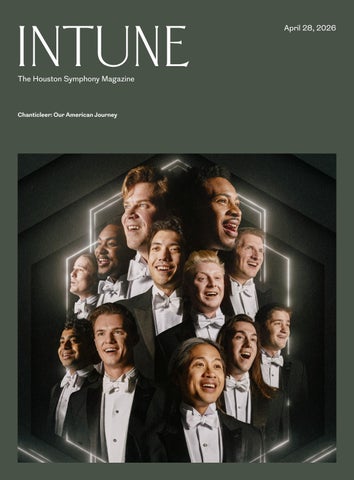
Chanticleer: Our American Journey

ORCHESTRA ROSTER

Juraj Valčuha

Music Director

Roy and Lillie Cullen Chair

FIRST VIOLIN

Yoonshin Song, Concertmaster

Max Levine Chair

Vacant, Associate Concertmaster

Ellen E. Kelley Chair

Boson Mo, Assistant Concertmaster

Qi Ming, Assistant Concertmaster Fondren Foundation Chair

Tong Yan

Ferenc Illenyi

Si-Yang Lao

Christopher Neal

Sergei Galperin

James Gikas+

Tianxu Liu+

Samuel Park+

Timothy Peters+

Arutyun Piloyan+

Teresa Wang+

SECOND VIOLIN

Vacant, Principal

Vacant, Associate Principal

Amy Semes

Annie Kuan-Yu Chen

Mihaela Frusina

Jing Zheng

Anastasia Iglesias

Tina Zhang*

Yankı Karata!

Hannah Duncan

Alexandros Sakarellos

Zubaida Azezi+

Hanna Hrybkova+

VIOLA

Joan DerHovsepian, Principal

Wei Jiang, Acting Associate Principal

Samuel Pedersen, Assistant Principal

Paul Aguilar

Sheldon Person

Fay Shapiro

Keoni Bolding

Jimmy Cunningham

Meredith Harris+

Yvonne Smith+

CELLO

Brinton Averil Smith, Principal

Janice H. and Thomas D. Barrow Chair

Christopher French, Associate Principal

Jane and Robert Cizik Chair

Anthony Kitai

Louis-Marie Fardet

Je rey Butler

Maki Kubota

Xiao Wong

Charles Seo

Jeremy Kreutz

COMMUNITY-EMBEDDED MUSICIAN

Lindsey Baggett, Violin

LIBRARIANS

Ali Verderber, Associate Librarian

Megan Fisher, Assistant Librarian

DOUBLE BASS

Robin Kesselman, Principal

Timothy Dilenschneider, Associate Principal

Steven Reineke, Principal POPS Conductor

Andrés Orozco-Estrada, Conductor Laureate

Anthony J. Maglione, Director, Houston Symphony Chorus

Gonzalo Farias, Associate Conductor

Andrew Pedersen, Assistant Principal

Eric Larson

Logan May

Burke Shaw

Donald Howey

Avery Weeks

FLUTE

Vacant, Principal

General Maurice Hirsch Chair

Matthew Roitstein, Acting Principal

Judy Dines

Kathryn Ladner

Douglas DeVries+

PICCOLO

Kathryn Ladner

OBOE

Jonathan Fischer, Principal

Lucy Binyon Stude Chair

Anne Leek, Associate Principal

Vacant

Adam Dinitz

Pablo Moreno+

ENGLISH HORN

Adam Dinitz

Barbara and Pat McCelvey Chair

CLARINET

Mark Nuccio, Principal

Bobbie Nau Chair

Vacant, Associate Principal

Christian Schubert

Alexander Potiomkin

Ben Freimuth+

E-FLAT CLARINET

Vacant

Ben Freimuth+

BASS CLARINET

Alexander Potiomkin

BASSOON

Rian Craypo, Principal

Isaac Schultz, Associate Principal

Elise Wagner

Adam Trussell

CONTRABASSOON

Adam Trussell

STAGE PERSONNEL

Vacant, Stage Manager

José Rios, Assistant Stage Manager

Nicholas DiFonzo, Head Video Engineer

Justin Herriford, Head Audio Engineer

Connor Morrow, Head Stage Technician

Giancarlo Minotti, Audio Production Manager

HORN

William VerMeulen, Principal

Mr. and Mrs. Alexander K. McLanahan

Endowed Chair

Robert Johnson, Associate Principal

Nathan Cloeter, Assistant Principal/Utility

Ian Mayton

Barbara J. Burger Chair

Brian Mangrum

Spencer Bay+

TRUMPET

Mark Hughes, Principal

George P. and Cynthia Woods

Mitchell Chair

John Parker, Associate Principal

Robert Walp, Assistant Principal

Richard Harris

TROMBONE

Nick Plato , Principal

Bradley White, Associate Principal

Phillip Freeman

BASS TROMBONE

Phillip Freeman

TUBA

Dave Kirk, Principal

TIMPANI

Leonardo Soto, Principal

Matthew Strauss, Associate Principal

PERCUSSION

Brian Del Signore, Principal

Mark Gri th

Matthew Strauss

HARP

Allegra Lilly, Principal

KEYBOARD

Vacant, Principal

LIBRARIAN

Luke Bryson, Principal

*on leave + contracted substitute

PERFORMANCE CALENDAR

2025-26 se a son

S Chanticleer: Our American Journey A p r il 28

S Disney & Pixar’s Toy Story in Concert

May 2 & 3

J o s h u a B e l l R e t u r n s :

T h e El e m e nt s i n C on c e r t

M ay 7, 9 * & 1 0

T h e P l a ne t s

V i o li n C o n c e r t o + Tcha i kovs k y ’s

M ay 1 5 , 1 6* & 1 7

Chamber Music Series: Ethereal Transformations

May 17

Val č u h a C on du c t s M a hle r 9

M ay 2 2 , 2 3* & 24

L i g h t s ! C am e r a ! M u s ic !

1 0 0 Ye a r s o f E p i c

Fil m S c o r e s

M ay 2 9, 3 0 * & 3 1

S Lyle Lovett with the Houston Symphony

June 5

S

Distant Worlds: music from FINAL FANTASY

June 6 & 7

S The Music of Queen

June 19 & 20

S Harry Potter and the Order of the Phoenix™ in Concert

June 26 & 27

S Opening Night: Isabel Leonard Sings Gershwin

September 19

Simply the Best: A Tribute to Tina Turner

September 25, 26* & 27

Rachmanino f Festival: Rachmanino f ’s Second Symphony

October 2, 3* & 4

Rachmanino f Festival: Rachmanino f ’s Piano Concerto No. 3

October 9, 10* & 11

SOCIETY BOARD OF TRUSTEES

OFFICERS

Barbara J. Burger President

John Rydman** Board Chair

Chair, Artistic & Orchestra A airs

Barbara McCelvey President-Elect Chair, Development

Mike S. Stude** Chair Emeritus

Paul Morico General Counsel

EXECUTIVE COMMITTEE

Brad W. Corson Chair, Governance & Leadership

Carey Kirkpatrick Chair, Marketing & Communications

Evan B. Glick Chair, Popular Programming

Sippi Khurana, M.D. Chair, Education & Community Engagement

GOVERNING DIRECTORS

Gary Beauchamp

Eric Brueggeman

MK Campion

John Cassidy, M.D.

Khoa Dao

Lidiya Gold

TRUSTEES

Christopher Armstrong

David Balderston

David J. Beck

Carrie Brandsberg-Dahl

Nancy Shelton Bratic

Terry Ann Brown**

Ralph Burch

John T. Cater**

Robert Chanon

Heaven Chee

Michael H. Clark

Virginia Clark

Andrew Davis, Ph.D.

Denise Davis

Tracy Dieterich

Joan Du

Kelli Cohen Fein

Je rey B. Firestone

Lindsay Buchanan Fisher

Mary Lynn Marks Chair, Volunteers & Special Events

Robert Orr Chair, Strategic Planning

Jesse B. Tutor** Chair, Audit

Leslie Nossaman^ President, Houston Symphony League

Jonathan Ayre Secretary Chair, Finance

Janet F. Clark^ Immediate Past Chair

Steven P. Mach^ At-Large Member

James H. Lee^ President, Houston Symphony Endowment

Juraj Valčuha^ Music Director Roy and Lillie Cullen Chair

Joan DerHovsepian^ Musician Representative

Mark Hughes^ Musician Representative

Bobby Tudor^** At-Large Member

Gary Ginstling^ Executive Director/CEO

Margaret Alkek Williams Chair

Claudio Gutiérrez

David J. M. Key

Cindy Levit

Isabel Stude Lummis

Cora Sue Mach**

Rodney Margolis**

Eugene A. Fong

Aggie L. Foster

Kate Dearing Fowler

Julia Anderson Frankel

Aoife French

Carolyn Gaidos

Andrew Gould

Lori Harrington

Pablo Hernandez SchmidtTopho

Je Hiller

Grace Ho

Gary L. Hollingsworth

John W. Hutchinson

Brian James

Matthew Kades

I. Ray Kirk, M.D.

David Krieger

Matthew Loden

FOUNDATION FOR JONES HALL REPRESENTATIVES

Janet F. Clark

As of February 26, 2026

Brad W. Corson

Meredith Marshall

Elissa Martin

Leslie Nossaman

Chris Powers

Brittany Sakowitz

Ed Schneider

Kirby Lodholz

Michael Mann, M.D.

Nancy Martin

Jack Matzer

Jackie Wolens Mazow

Diane Morales

Aprill Nelson

Tim Ong

Edward Osterberg Jr.

Gloria G. Pryzant

Miwa Sakashita

Ted Sarosdy

Andrew Schwaitzberg

Helen Sha er**

Becky Shaw

Robert B. Sloan, D.D., Theol.

Jim R. Smith

Miles O. Smith**

Quentin Smith

Barbara McCelvey

Jeremy Kreutz^ Musician Representative

Mark Nuccio^ Musician Representative

Justin Stenberg

William J. Toomey II

Betty Tutor**

Robert Weiner

Margaret Alkek Williams**

Tad Smith

Anthony Speier

Tina Raham Stewart

Nanako Tingleaf

Terry Thomas

Margaret Waisman, M.D.

Gretchen Watkins

Fredric A. Weber

Vicki West

Steven J. Williams

David J. Wuthrich

Ellen A. Yarrell

Robert Yekovich

EX-OFFICIO

Alejandro Gallardo

Reverend Ray Mackey, III

Frank F. Wilson IV

Fredric Weber

LEADERSHIP GROUP

Gary Ginstling, Executive Director/CEO

Margaret Alkek Williams Chair

Elizabeth S. Condic, Chief Financial O cer

Vicky Dominguez, Chief Operating O cer

Rolanda Gregory, Chief Marketing O cer

Jennifer Renner, Chief Development O cer

Mayenne Minuit, Executive Assistant

DEVELOPMENT

Leanna Aldis, Manager, Foundation Relations

Sarah Bhalla, Board Relations Associate

Lauren Buchanan, Development Communications Manager

Alex Canales, Manager, Donor Services

Jessie De Arman, Development Associate, Gifts, Records, & Research

Timothy Dillow, Senior Director, Individual Giving

Amanda T. Dinitz, Director, Principal Gifts & Endowment

Vivian Gonzalez, Annual Giving O cer

Kamra Kilmer, Manager, Corporate Relations

Karyn Mason, Institutional Giving O cer

Hadia Mawlawi, Endowment & Planned Giving O cer

Meghan Miller, Development Associate, Special Events

Emilie Moellmer, Membership Manager

Megan Mottu, Annual Giving O cer

Gavin Reed, Major Gifts O cer

Tim Richey, Major Gifts O cer

Katie Salvatore, Director, Annual Giving & Membership

Phillip Smith, Special Events and League Liaison O cer

Lena Streetman, Director, Development Operations

Stacey Swift, Director, Special Events

Sarah Thompson, Donor Events Manager

Christina Trunzo, Director, Institutional Giving

EDUCATION | COMMUNITY ENGAGEMENT

Olivia Allred, Education Manager

Allison Conlan, Senior Director, Education & Community Engagement

Austin Hinkle, Education & Community Engagement Coordinator

Jazmine Olwalia, Community Engagement Manager

Sheridan Richard, DeLUXE K!ds In Harmony Site Manager

Community-Embedded Musicians (CEM):

Lindsey Baggett, Lead CEM

Lucinda Chiu, CEM Teaching Artist

David Connor, Senior CEM Teaching Artist

Rainel Joubert, Senior CEM Teaching Artist

Bensen Kwan, CEM Education Specialist

Brittany Leavitt, CEM Teaching Artist

Bianca Lozano, CEM Teaching Artist

Alexis Mitrushi, CEM Teaching Artist

Adrian Ponce, CEM Teaching Artist

Lauren Ross, CEM Teaching Artist

Jaya Varma, CEM Teaching Artist

FINANCE | ADMINISTRATION | IT | HR

José Arriaga, Systems Engineer

Henry Cantu, Finance Accountant

Kimberly Cegielski, Sta Accountant

Heather Fails, Database Administrator

Ronin Jackson, IT Intern

Joel James, Director of Human Resources

Tanya Lovetro, Director of Budgeting & Financial Reporting

Freddie Piegsa, Help Desk Technician

Morgana Rickard, Controller

Gabriela Rivera, Senior Accountant

Pam Romo, O ce Manager/HR Coordinator

Lee Whatley, Senior Director, IT & Analytics

MARKETING | COMMUNICATIONS

Bryan Ayllon, UX & Conversion Specialist

Rachel Cheng, Marketing & External Relations Assistant

Bella Cutaia, Manager, Patron Services

Kathryn Judd, Director, Marketing

Priya Kurup, Senior Associate, Group Sales

Caroline Lawson, Patron Services Representative

Lien Le, Patron Experience Coordinator

Yoo-Ell Lee, Graphics & Media Designer

Milow Lozano, Ticketing Systems & Marketing Operations Specialist

Ciara Macaulay, Creative Director

Ashley Martinez, Patron Services Coordinator

Mariah Martinez, Email Marketing Coordinator

Casey Pearce, Graphic Design Manager

Aracely Quevedo, Patron Services Representative

Eric Skelly, Senior Director, Communications

Christian Sosa, Web Experience Director

Lily Townsend, Patron Services Representative

Alexa Ustaszewski, Manager, Revenue and Audience Insights

Sophie Volpe, Digital Content Specialist

Leecia Whatley, Patron Services Representative

Jenny Zuniga, Director, Patron Services

OPERATIONS | ARTISTIC

Stephanie Alla, Associate Director of Artistic Planning

Becky Brown, Associate Director of Orchestra Personnel

Juan Pablo Brand, Artistic Assistant

Ryan Diefenderfer, Concert Operations Assistant

Megan Fisher, Assistant Librarian

Michael Gorman, Director of Orchestra Personnel

Julia Hall, Assistant Director, Houston Symphony Chorus

Parker Hart, Concert Operations Manager

Adrian Hernandez, Concert Media Production Manager

Giancarlo Minotti, Audio Production Manager

José Rios, Assistant Stage Manager

Brad Sayles, Senior Recording Engineer

Nathan Trinkl, Artistic Assistant & Assistant to the Music Director

Ali Verderber, Associate Librarian

Meredith Williams, Director of Concert Operations

Rebecca Zabinski, Senior Director of Artistic Planning

April 28, 2026

Chanticleer: Our American Journey

Chanticleer, vocal ensemble

Tim Keeler, music director

GUTIÉRREZ DE PADILLA – “Deus in Adiutorium Meum Intende”

LIENAS – “Lamentatio in Coena Domini”

BILLINGS – “Kittery (Our Father Who in Heaven Art)”

JOHNSON – “Je"erson (Glorious Things of Thee Are Spoken)”†

GLANTON – “My Home Above”

WESTON – “Happy Shore”

Commissioned by Chanticleer and Spivey Hall (Clayton State University, Morrow, GA) with the generous support of Marilyn Altman and Dan Gaylord in 2025.

Arr. JENNINGS –“ There Is a Balm in Gilead”†

Arr. MURPHY –“ Wade in the Water"

DAVIDS –“ The Un-Covered Wagon”† Commissioned by Chanticleer in 2002

THOMSON – “My Shepherd Will Supply My Need” Commissioned by Chanticleer in 2021 with generous support from Alan Benaroya

WOODS – “close[r], now ”†

TWINING – “Hee-oo-oom-ha”

Arr. BARNETT – “American Folksong Medley ”†

BERLIN/Arr. JENNINGS – “Blue Skies”†

RAJU /Arr. MAHAL – “Brahmamokate”

LAWSON/WALLER/YATES/Arr. JENNINGS – “Calling My Children Home”†

SMALLS/Arr. GRAVELEY – “Home”

SEEGER/HAYS/Arr. WARD – “If I Had a Hammer ”

BRUMLEY/Arr. KEELER – “I’ll Fly Away ”

FOSTER/Arr. PUERLING – “Jeanie with the Light Brown Hair ”†

FRIEND/Arr. WARD – “Lovesick Blues”

ACOSTA/Arr. GUZMÁN – “Paraiso Soñado”

BLANE/MARTIN/Arr. GRAVELEY –“ The Trolley Song ”

Tuesday, April 28

About the Music Program

Notes

Jones Hall

7:30 p.m.

This season, we celebrate the 250 th anniversary of the independence of the United States of America by revisiting Chanticleer’s 2002 album, Our American Journey. In April 2025, this album was inducted into the National Recording Registry of the Library of Congress, which describes it as “inclusive in its celebration of the varied spirits and history of America.” We carry on today where we left off, continuing the voyage and filling in some missing gaps along the way. We showcase the diverse voices, songs, harmonies, and rhythms of our shared musical heritage, exploring how those voices influenced each other and how they impact the present day.

The focal point of the first half of our program is “ The Un-Covered Wagon” by Brent Michael Davids. The 1923 silent film, The Covered Wagon, follows the journey of an 1848 wagon train traveling across America. Told from the perspective of the pioneers, the film is a romanticized portrayal of their courage. These settlers certainly endured many hardships, but their story is not the only one we should hear. “The Un-Covered Wagon,” which Davids wrote for Chanticleer in 2002, challenges the notion that pioneers spread across an uninhabited landscape. Davids writes, “As I thought about time and space, and the differences in American Indian life in this regard, I was struck by how one-sided this American expansion is, not only for the old era of black-and-white film, but in today’s America, too.” Davids (Mohican/Munsee-Lenape) describes himself as “a professional composer, and a music warrior for native equity and parity, especially in concert music where there is little Indigenous influence.” He is one of America’s most celebrated composers, with works commissioned and performed by many of America’s top organizations and ensembles throughout his 50-year compositional career. In 2006, the National Endowment for the Arts named Davids among the nation’s most cherished choral composers in its project “American Masterpieces: Three Centuries of Artistic Genius.” In 2015, the prestigious Indian Summer Music Festival awarded Davids its Lifetime Achievement Award.

Indigenous American attitudes towards music are very different from those brought over by European settlers in the 1500s. Brent Michael Davids points out that “Indigenous cultures see music like giving birth, so that each new song event is a new creation. The song being sung might be a time-honored song, but when performed it is newly reborn; it is not considered the same song.” In contrast, a classical European perspective generally favors a written tradition, with notated music preserving a melody and intent for each successive performance. Thus, we find the earliest evidence of European Renaissance and Baroque polyphony in the New World in manuscripts from colonial Spain. Choirbooks with Latin motets and Mass settings to accompany Catholic liturgies have been found in Missions and Cathedrals from Mexico to California. Although details of his life are scant, it is likely that the 17th-century composer Juan de Lienas was a Native American who grew up in the Catholic church. His works survive in two manuscripts from Mexico City: the Newberry Choirbooks, which contain compositions in a florid, polychoral style, and the Codex del Convento del Carmen, in which we find the more reserved, stile antico, four-voice “Lamentatio in Coena Domini.”

Born in Málaga, Spain, Juan Gutiérrez de Padilla moved to Puebla, Mexico in the early 1620s, where he eventually became maestro de capilla at the Puebla Cathedral. The Cathedral provided him with instrumentalists, choristers, and resources on par with any Continental establishment, and Padilla’s hundreds of extant works, like his polychoral motet “Deus in Adiutorium Meum Intende ,” demonstrate a talent and ambition that rival any of his contemporaries.

Program Notes

One hundred years after Padilla and Lienas, the English colonies in North America began to develop their own distinct choral sound. Protestant colonists wanted little to do with Latin motets. In fact, Puritans banned choral music altogether from their church services. The surviving repertoire of the 13 original American colonies comes to us from New England hymnals and songbooks written in the mid to late 1700s. The composers writing at this time, often referred to collectively as the First New England School, or Yankee Tunesmiths, were largely self-taught. William Billings, perhaps the most recognizable name from this tradition, was the first American to publish a book of entirely original compositions, The New England Psalm Singer, with a frontispiece engraved by none other than Paul Revere (1770). The part-writing in these early works, with titles derived from locations or people, like “Kittery,” often disregards rules of formal counterpoint, featuring plenty of parallel perfect intervals and irregular doublings and spacings.

This early American style came to be adopted by other singing communities throughout the new nation. Because of their simplicity and pedagogical nature, many of those first New England tunes were adopted into the burgeoning shape note singing tradition of the early 19 th century. In an effort to spread music literacy, shape note tunebooks, like The Sacred Harp (1844), use distinct noteheads for each movable “do” solfège syllable. Thus, instead of memorizing 12 different keys and all their nuances, an amateur singer using a shape note tunebook needs only to memorize a handful of symbols in order to participate in choral singing. Alexander Johnson published his collection of shape note tunes, The Tennessee Harmony, which includes the song “Jefferson,” in 1818.

These early American shape note songbooks are primarily the product of White publishers and composers, even though the tradition of African American shape note singing dates back to at least the 1870s. It wasn’t until 1934 that Judge J. Jackson self-published The Colored Sacred Harp, a collection of 77 shape note songs written by Black composers, including “My Home Above.”

Another type of American early music was developing in Black communities at the same time as shape note singing and Protestant hymnody: the African American spiritual. The origins of the spiritual are hard to pinpoint; firsthand accounts from formerly enslaved people describe the spiritual as “the progeny of the Black collective rather than the individual composer” (Burnim, African American Music, 50). What is certain is that this art form coalesced at the end of the 18th century as a unique synthesis of African musical styles and Christian themes and traditions.

It is clear from firsthand descriptions that there existed a distinct African musical repertory in the Americas independent of White and European customs. This repertory, and its performance practices, shaped and changed the concurrently developing American Protestant hymn tradition. In 1801, for example, Richard Allen compiled a new hymn book for his independent African Methodist Episcopal (AME) congregation. While some tunes in this book came from the standard Methodist hymnal, Allen wrote and changed many texts, added choruses, and likely composed some of the melodies himself. His goal “was to generate congregational participation and assure freedom of worship for his members” (Burnim, African American Music, 57). In “Happy Shore,” a new commission for Chanticleer’s 2025-2026 season, Trevor Weston takes a fresh look at this early American musical landscape. “My goal,” he writes, “was not to compose a new spiritual,” but instead to create “a choral work that imagines the transformation of a Western European Protestant hymn with traditional African American vocal and choral traditions. [...] After choosing an Allen hymn text, I composed my own 19 th-century Protestant hymn, then generated material considering the musical characteristics of spirituals and other African American religious choral music. Text from the original hymn is adapted and altered to reflect the more active, hortative nature of traditional African American choral music. I have always been fascinated by the Church Moans and the Long Meter Hymn singing in African American choral traditions. Both performance practices influence parts of ‘Happy Shore.’” Dr. Weston is the chair of the music department at Drew University, where he teaches theory and composition.

We conclude the first half of our program with two African American spirituals, which act as the culmination of our journey through American early music. “ There is a Balm in Gilead ,” arranged by Music Director Emeritus

Program Notes

Joseph H. Jennings, describes the healing grace of salvation through the love of Jesus. In 2014, Jennings was the first recipient of Chorus America’s Brazeal Wayne Dennard Award, acknowledging his contribution to the African American choral tradition. His 25-year tenure with Chanticleer as singer and Music Director transformed the group, and his gospel and spiritual arrangements became integral to Chanticleer’s identity. We are honored to maintain and continue that legacy today.

“ Wade in the Water ” is a not-so-coded instruction for escaping enslaved people to leave the road and move into the water to avoid sniffing dogs and slave catchers. The arranger, Stephen M. Murphy, is a graduate of Oakwood University, where he studied with Jason Max Ferdinand, and Middle Tennessee State University, where he studied with former Take 6 baritone Cedric Dent. Murphy writes that, in this arrangement, his “desire was to capture the urgency in the message of this song. A starting point for me in which to achieve this was to provide a more rhythmic driven aspect than I had prior been used to hearing. In addition, as a lover of vocal jazz, […] I embarked on an endeavor to lift the text off of the paper by experimenting with, and incorporating, expanded harmonies throughout the piece.”

Classical American choral music found its footing in the 20 th century, with many composers drawing inspiration from traditions and sounds of the past. Composer and critic Virgil Thomson often wove hymn tunes and American folk songs into his orchestral music. Thomson first set the shape note tune “My Shepherd Will Supply My Need” as an orchestral accompaniment for The River, a film sponsored by the U.S. Government and intended to raise awareness for the erosion of topsoil along the Mississippi River due to farming and timber practices in the 1930s.

American classical choral music followed the shape of American society into the 21st century by continually pushing the boundaries of form, style, and subject matter. At the height of the COVID-19 pandemic, we commissioned the Chicago-based composer Ayanna Woods to write us a piece that touched on some of our shared experiences during that time. The text for “close[r], now ” is an erasure poem created by Woods. The source material is an L.A. Times editorial from March 2020 detailing the reasons why theaters and the performing arts should “close, now.” Woods restructured and resampled the article to create a new text full of questioning and yearning. She closes the piece with an imperative for the world: “come back to life.” Ayanna Woods is a Grammy Award-winning performer, composer, and bandleader from Chicago. Her music explores the spaces between acoustic and electronic, traditional and esoteric, wildly improvisational and mathematically rigorous.

In “Hee-oo-oom-ha ,” American composer Toby Twining challenges our preconceptions about singing with extended vocal techniques like vocal fry, yodeling, and rhythmic panting. He combines these striking sounds with polyrhythms, mixed meters, and open harmonies to create a joyful celebration of song. Raised in Texas with family roots in country-swing and gospel, Twining has moved from playing in rock and jazz bands, to singing Renaissance motets, to performing and composing experimental music. He moved to New York City in 1987, initially writing for modern dance choreographers who wanted the sounds of a new choral music. His group, Toby Twining Music, recorded many of his compositions on the albums Shaman (Sony Classics 1994), Chrysalid Requiem, and Eurydice (Cantaloupe Music 2002, 2011). His music has been performed and recorded internationally by solo artists and groups including the National Youth Choir of Great Britain, Young People’s Chorus of New York City, and Roomful of Teeth. He is the recipient of Guggenheim and Pew fellowships and a Foundation for Contemporary Arts 2013 Grants to Artists award. Twining lives in the Shenandoah Valley, where he works with student dancers, actors, and musicians at James Madison University.

The remainder of our program explores American popular music in many forms, from folksongs (“American Folksong Medley,” “I’ll Fly Away”), to protest songs (“If I Had a Hammer”), to the Great American Songbook (“The Trolley Song”), to musical theater (“Home”), to parlor songs (“Jeanie with the Light Brown Hair”), to bluegrass (“Calling My Children Home”), to country (“Lovesick Blues”). Also included are songs written or arranged by first or second-generation immigrants, who help to keep our American cultural fabric rich and vibrant (“Blue Skies,” “Paraiso Soñado,” “Brahmamokate”).

Program Bio

Chanticleer, vocal ensemble

countertenor

Tavian Cox*

Luke Elmer*

Cortez Mitchell*

Bradley Sharpe

Logan Shields

Adam Brett Ward

tenor

Vineel Garisa Mahal*

Matthew Mazzola

Andrew Van Allsburg

baritone and bass

Andy Berry*

Jared Graveley

Matthew Knickman

Tim Keeler, Music Director

Known around the world for its eclectic repertoire and dazzling virtuosity, the Grammy Award-winning vocal ensemble Chanticleer—under the leadership of Music Director Tim Keeler—has been hailed by The Boston Globe as “breathtaking in its accuracy of intonation, purity of blend, of color and swagger of style.” Founded in San Francisco in 1978 by singer and musicologist Louis Botto, Chanticleer quickly took its place as one of the most prolific recording and touring ensembles in the world, an “orchestra of voices” performing thousands of live concerts and selling more than one million recordings. Rooted in the Renaissance, Chanticleer’s repertoire has expanded to include a wide range of classical, gospel, jazz, and popular music. With a deep commitment to the commissioning of new compositions and arrangements, Chanticleer foregrounds American repertoire and a distinctively American sound, complementing the group’s signature diversity in terms of membership and genre. The ensemble has dedicated much of its vast recording catalogue to

†These pieces have been recorded by Chanticleer.

these commissions, garnering Grammy Awards for its recordings of Sir John Tavener’s Lamentations and Praises and the ambitious collection of commissioned works entitled Colors of Love.

Chanticleer is the recipient of Chorus America’s Dale Warland Commission Award and the Chorus America/ASCAP Award for Adventurous Programming. The group’s Music Director Emeritus, Joseph H. Jennings, received the Brazeal Wayne Dennard Award for his contribution to the African American choral tradition during his 25-year tenure as both singer and Music Director.

Chanticleer—named for the “clear-singing” rooster in Geoffrey Chaucer’s Canterbury Tales—was named Ensemble of the Year by Musical America in 2008 and inducted into the American Classical Music Hall of Fame. The group’s award-winning education programs were recognized with the 2010 Chorus America Education Outreach Award, and have engaged tens of thousands of students since the ensemble began. 

*Andy Berry occupies The Eric Alatorre Chair, given by Peggy Skornia. Luke Elmer occupies The Ning G. Mercer Chair for the Preservation of the Chanticleer Legacy, given by Ning and Stephen Mercer. Vineel Garisa Mahal occupies The Tenor Chair, given by an Anonymous Donor. Cortez Mitchell occupies The Cortez Mitchell Chair, given by James R. Meehan.

Anne Heinrich, the loving wife of the late pianist, composer, entrepreneur, and software developer Dan Timis, has sponsored countertenor Tavian Cox’s full-time position for Chanticleer’s 2025–26 season.

Turn static files into dynamic content formats.
Create a flipbook