

If one of your clients is facing IRS trouble, call or email me anytime. I’ll answer your questions, walk you through the process, and help you decide how to handle the case.
If one of your clients is facing IRS trouble, call or email me anytime. I’ll answer your questions, walk you through the process, and help you decide how to handle the case.
Tax problems are legal matters that require advocacy before the IRS. Your client doesn’t need a CPA. They need an advocate who knows how the IRS actually works.
Tax problems are legal matters that require advocacy before the IRS. Your client doesn’t need a CPA. They need an advocate who knows how the IRS actually works.
All we do is Tax Controversy—Federal and State, civil and criminal. We know the rules, the procedures, and the people inside the system.
All we do is Tax Controversy—Federal and State, civil and crimi nal. We the syste m.
You can call just to talk through a client’s situation, or refer the case if it’s more complex. Either way, I’m glad to help. Building relationships with other lawyers is a win-win and how I serve our community.
You can call just to talk through a client’s situation, or refer the case if it’s more complex. Either way, I’m glad to help. Building relationships with other lawyers is a win-win and how I serve our community.
At your service,

At your service, Download My Contact Info
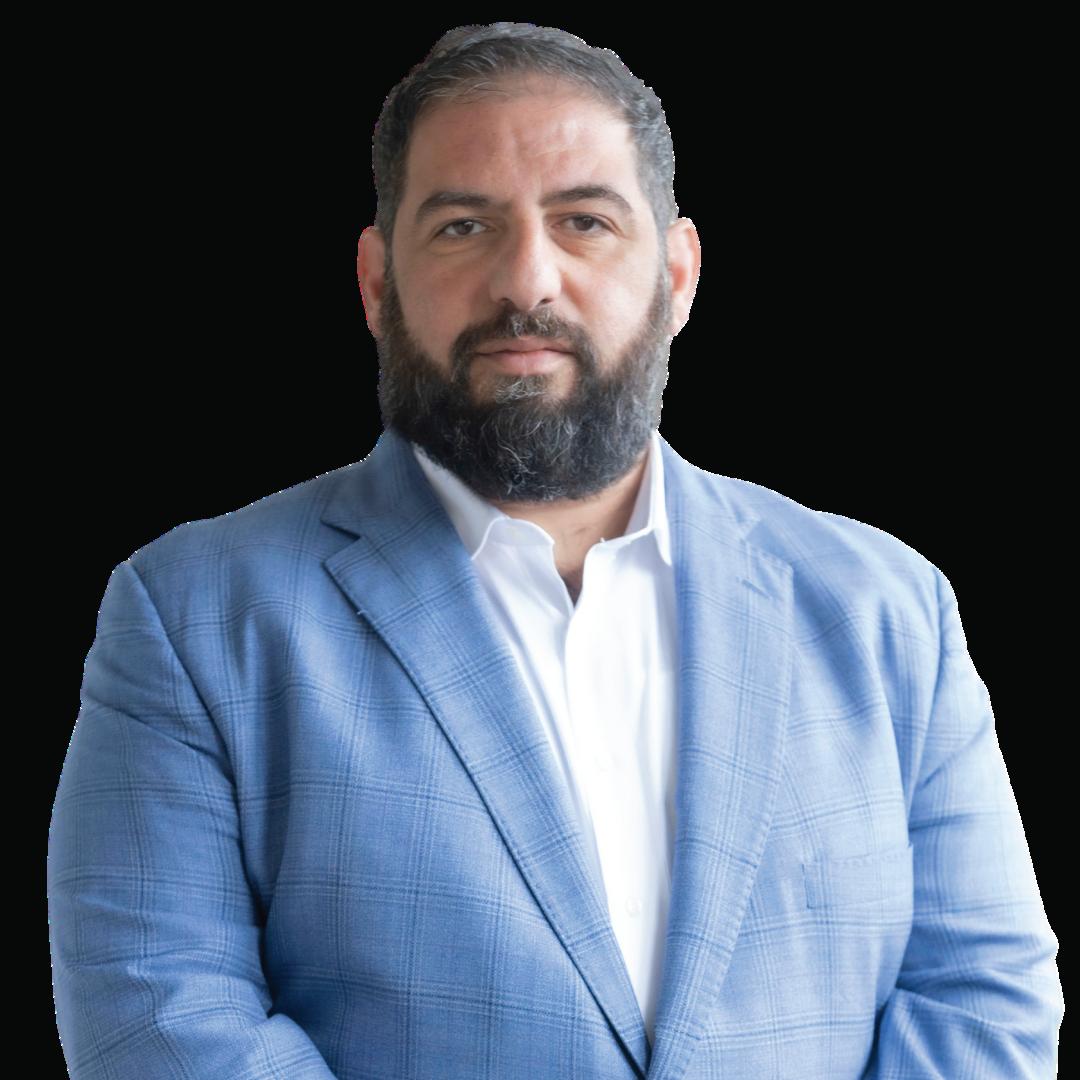
Venar Ayar, JD, LLM (Tax) Founder, Ayar Law
Venar Ayar, JD, LLM (Tax) Founder, Ayar Law













OAKLAND COUNTY BAR ASSOCIATION
1760 S. Telegraph Road, Suite 100
Bloomfield Hills, Michigan 48302-0181
(248) 334-3400 • FAX (248) 334-7757 www.ocba.org
PRESIDENT
Sarah E. Kuchon
PRESIDENT-ELECT
Aaron V. Burrell
VICE PRESIDENT
Kari L. Melkonian
TREASURER
Victoria B. King
SECRETARY
Syeda F. Davidson
EXECUTIVE DIRECTOR
Jennifer Quick
LACHES EDITORIAL BOARD
Victoria B. King
Syeda F. Davidson
Coryelle E. Christie
Lanita L. Carter
THE MISSION
DIRECTORS
Julie L. Kosovec
Emily E. Long
Jennifer L. Lord
Moheeb H. Murray
Kimberley Ann Ward
Layne A. Sakwa
Silvia A. Mansoor
Stephen T. McKenney
James A. Martone
Jennifer J. Henderson
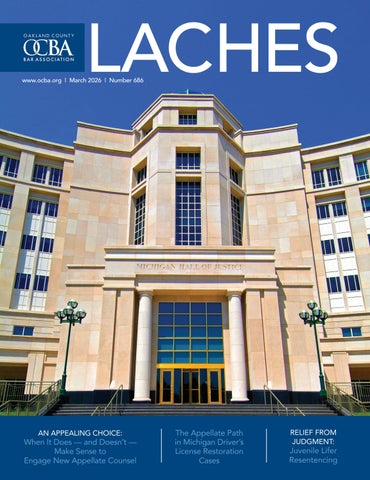
MARCH 2026
Relief from Judgment: Juvenile Lifer Resentencing Neuroscientific insights are opening the door for youth to move beyond their worst mistakes. ByRobertM.Goldman
An Appealing Choice: When It Does — and Doesn’t — Make Sense to Engage New Appellate Counsel
Should you bring in new counsel, maintain continuity with trial counsel, or adopt a hybrid approach?
The Appellate Path in Michigan Driver’s License Restoration Cases
Helping clients regain driving privileges begins with this oft-misunderstood process.

Thamara E. Sordo-Vieira
Xavier J. Donajkowski
Vincent C. Sallan
Articles and letters that appear in LACHES do not necessarily reflect the official position of the Oakland County Bar Association, and their publication does not constitute an endorsement of views that may be expressed. Readers are invited to address their own comments and opinions to:
LACHES | Oakland County Bar Association 1760 S. Telegraph Rd., Ste. 100 Bloomfield Hills, MI 48302-0181
Publicationandeditingareatthediscretionoftheeditor.
James W. Low LACHES
writing to Oakland County Bar Association, 1760 S. Telegraph, Ste. 100, Bloomfield Hills, MI 48302-0181.

For many, January feels like a reset. The start of the year offers an opportunity to evaluate, prioritize, and begin again with intention. It brings hope, optimism, and a sense of possibility. In those early weeks, motivation is strong, and meaningful change seems possible. We set resolutions. We resolve to exercise more, eat better, save money, change habits, or find balance. The intentions are sincere, and the desire for change is real.
However, as the weeks pass, many of us find ourselves slipping back into familiar patterns. By the time you read this, we are roughly two months into the New Year, and that early momentum has likely faded. This is not a personal failure. It is human nature. We are biologically wired for instant gratification. Our brains seek quick rewards and immediate feedback. When those rewards are delayed, motivation naturally declines.
Further, even the best-laid plans can be disrupted by circumstances beyond our control. Illness, unexpected demands at work, family responsibilities, or financial stress can interrupt routines and drain energy. When life intervenes, progress often slows, not because our intentions were flawed but because conditions changed. Meaningful change generally does not happen quickly. It requires time, repetition, and consistency. These conditions challenge a brain wired for quick rewards. As enthusiasm wanes, routines slip, and the habits we hoped to change quietly return. Many New Year’s resolutions fade not because the desire for change was insincere but because intention alone is not enough. This is where SMART goals offer a practical bridge between intention and success.
A resolution is an expression of intention. At its core, a resolution reflects our desire to resolve something we perceive as problematic. It is our hope to change a pattern, undo a habit, or release something that no longer serves us. In that sense, a resolution is forward-looking and hopeful, but it remains internal. It names
By Sarah E. Kuchon
A goal, by contrast, is not simply an expression of intent. It is a commitment to action. A goal is the end toward which effort is directed, like moving a ball down the field, each action gaining ground toward the goal line. Where resolutions articulate aspiration, goals define behavior. They move us from reflection to execution. This distinction matters because intention alone does not produce results. Action does.
SMART goals provide a practical framework for translating intention into sustained, measurable action. They give structure to our values and direction to our effort. They create a bridge between what we want to change and what we are willing to do to achieve the results we want. Without this shift from intention to action, resolutions remain well-meaning thoughts rather than lived results.
The SMART model was created by George T. Doran. Its purpose was to improve goal-setting by making objectives clearer and, in turn, more achievable. SMART is an acronym for specific, measurable, achievable, relevant, and time-bound. This five-element framework turns a vague aspiration into a workable plan.
Specific: Action requires clarity. Vague goals create hesitation and stall progress by leaving too many unanswered questions. If the intention is to exercise more, the brain is immediately tasked with a series of unresolved decisions: What kind of exercise? Where and when will it happen? When will it start, and how long will it last? Alone or with a partner? This level of uncertainty can create anxiety and drain motivation before action ever begins. By contrast, specific goals invite an action plan, such as “walk for 30 minutes after work on Mondays, Wednesdays, and Fridays.”
Measurable: Measurement creates feedback. It allows us to assess progress and adjust along the way. Our brains seek feedback. They want to know that effort is producing results. When progress is undefined, motivation often erodes.
Measurement offers clarity. It answers the question “Is this working?” and gives us a way to measure forward movement, even when change feels slow.
Returning to the exercise example, “exercise more” offers no feedback. But tracking something concrete like minutes walked, days completed, or workouts per week creates a visible record of effort. Measurement turns action into data, and data helps us stay accountable to ourselves. Over time, that feedback loop sustains action, and sustained action produces results.
Achievable: Goals that are overly ambitious often stall not because of a lack of commitment but because they demand too much too fast. When the bar is set unrealistically high, hesitation and avoidance follow.
Achievable goals acknowledge the realities of time, energy, and competing responsibilities. They invite realistic, incremental changes that can be repeated and sustained. This matters because consistency, not intensity, is what produces lasting results.
Achievability also leaves room for life’s unpredictability. Goals that are realistic can be adjusted when circumstances change without being abandoned altogether. When goals are designed to bend rather than break, temporary disruptions are less likely to derail progress entirely. A goal that fits realistically into one’s schedule is far more likely to be acted upon. Achievability is not about thinking small. It is about thinking strategically.
Relevant: Sustainable action is easier when it is meaningful and aligned with our values. A goal may be specific, measurable, and achievable, but if it does not connect to what matters, we will struggle to stay motivated. Relevant goals are rooted in values rather than external pressure. When a goal aligns with personal priorities, effort feels purposeful rather than forced.
Relevance also requires honesty. Not every goal we set truly belongs to us. Some are inherited from cultural norms, professional expectations, or someone else’s definition of success. Goals that lack relevance may look admirable on

SPECIFIC
A well-defined goal provides a clear direction.
MEASURABLE
Track your progress with milestones to see how far you’ve come.
ACHIEVABLE
Set attainable goals to help you stay motivated.
RELEVANT
Make sure your goals align with your larger objectives and values.
TIME-BASED
Deadlines will keep you accountable and ensure you’re making steady progress.
—University of Arizona [@uazglobalcampus]
paper but feel heavy in practice. Over time, that misalignment erodes follow-through. When a goal is relevant, action feels congruent. is alignment allows e ort to endure beyond the initial burst of enthusiasm. Goals that matter are the ones we return to, even when progress is slow, because they serve something deeper than the outcome itself.
Time-Bound: Without a time frame, even well-de ned and meaningful goals are easily postponed. When there is no end point or review date, intention remains open-ended, and action is perpetually deferred to “someday.”
Time-bound goals create momentum. A deadline focuses attention. It transforms a goal from an abstract plan into a present commitment and creates a natural opportunity for re ection. It allows us to assess what worked, what didn’t, and what needs to be adjusted. Rather than viewing a deadline as a pass-fail test, we can treat it as a checkpoint and a chance to recalibrate if necessary. Time frames provide structure without denying reality. ey allow for reassessment rather than resignation when plans are interrupted.
When goals are time-bound, action becomes deliberate. E ort is paced, progress is observable, and momentum builds. Over time, these periods of focused action turn intention into execution and execution into results.
SMART goals work because they acknowledge how people change. ey o er a practical framework for translating intention into action over time. By reducing guesswork, they lessen decision fatigue and create opportunities for small, measurable wins that reinforce progress. ey allow for accountability without self-judgment and shift the focus from perfection to consistency. Rather than asking us to feel motivated every day, SMART goals provide a plan we can return to, even when motivation fades.
If your New Year’s resolutions have already fallen away, you are not behind. You are simply encountering the limits of motivation. e solution is not greater willpower. It is a better plan. e calendar does not determine when change is possible. February, March, or any ordinary weekday can be a powerful place to begin again, this time with a structure that supports follow-through.
SMART goals o er that structure. ey honor our intentions while recognizing how humans change. When motivation fades, structure remains. And with structure, progress becomes not only possible but lasting, moving us steadily toward success.

Sarah E. Kuchon is the president of the Oakland County Bar Association.


















By Jennifer Quick
Each year, I take the opportunity to highlight the OCBA’s Sustaining Member program — not only to recognize the members who generously participate, but also to underscore the critical role this program plays in advancing the mission and long-term vitality of our organization. As we move into 2026, the impact of Sustaining Member support has never been more evident.
Established in 1987, the Sustaining Member program was designed to provide dedicated funding for technology and infrastructure improvements, as well as special projects at the board’s discretion. At least half of all funds raised each year are earmarked for these purposes. Over the decades, these contributions have supported major initiatives, including upgrades to District Court Case Evaluation software and the OCBA member database, renovations to the OCBA o ces, and enhancements to the audiovisual capabilities in the Learning Center. e funds also played a critical role in launching the OCBA Mediation Service.
Sustaining Member support also allows the OCBA to respond to unforeseen needs — such as replacing aging technology — while continuing to keep membership costs accessible for our community.
In 2026, Sustaining Member support will also allow the OCBA to honor the past by reinstating a long-standing tradition: the installation of judicial memorial plaques at the Oakland County Circuit Court. is year, ve memorial plaques will be installed in honor of Judges Gene Schnelz, Alice Gilbert, Jack McDonald, Edward Sosnick, and Richard Kuhn — recognizing their service and preserving their legacy within our courthouse and legal community.
is combination of innovation, responsiveness, and respect for tradition exempli es the value of the Sustaining Member program. ese contributions remain essential to ensuring that the OCBA continues to deliver meaningful services, adapt to change, and uphold the standards of excellence our members expect.
Jody L. Aaron
Ann MacDonald Acheson
Phillip G. Adkison
Joseph A. Ahern
Patrick Joseph Alandt
Kelly A. Allen
Matthew P. Allen
Margaret C. Alli
Peter M. Alter
David Carl Anderson
David Christopher Anderson
Hon. Martha D. Anderson
Nicholas S. Andrews
Brooke Lauren Archie
Hana Marie Attar
Alexander A. Ayar
Andrew Babnik Jr.
Lisa Rae Baker
Melinda Ann Balian
Brandon Robert Barlog
Eric C. Bartley
Laura C. Baucus
Dirk A. Beamer
Thomas A. Benhamou
Mark B. Berke
Caroline Bermudez Jomaa
Raed Roy Berry-Makki
Robert S. Bick
Thomas W. Biggers
Roberto Alejandro Bihar
Michael J. Black
Jordan Seth Bolton
Sherri L. Bono
Joshua Matthew Borson
Kenneth M. Boyer
Alison Brandt
Steven D. Brock
Keefe A. Brooks
Erica Grand Brown
Malcolm D. Brown
Charles D. Bullock
Charity A. Burke
Marty A. Burnstein
Aaron Vaughn Burrell
Donald F. Carney
Jennifer S. Carney
Russell G. Carniak
Robert M. Carson
Meghan W. Cassidy
R. Christopher Cataldo
J. Matthew Catchick Jr.
In recognition of their support, Sustaining Members receive:
• Special acknowledgment at OCBA events.
• Prominent listing on the OCBA website.
• Periodic recognition in LACHES
• Invitations to an exclusive recognition event held each fall.
We invite you to join more than 350 Sustaining Members who make this vital work possible. For the remainder of the 2025-26 bar year, you can become a Sustaining Member for just $50 — half the normal cost.
Your support helps ensure that the OCBA remains Michigan’s premier voluntary bar association, equipped to serve its members today while building a strong foundation for the future.
To join the program, you may contact Katie Tillinger at ktillinger@ocba.org or (248) 334-3400 or complete the application found at ocba.org/ sustaining

Jennifer Quick is the executive director of the Oakland County Bar Association.
Gerald P. Cavellier
Thomas R. Charboneau
John P. Charters
Michael S. Clawson
Howard H. Collens
Peter L. Conway
Mark E. Crane
Thomas W. Cranmer
Cristina M. Crescentini
Tanya Nicole Cripps-Serra
R.J. Cronkhite
Hon. Jacob James
Cunningham
James P. Cunningham
John Joseph Cunningham
Joseph W. Cunningham
Judith K. Cunningham
Jalal J. Dallo
Brad A. Danek
Rebecca S. Davies
Thomas J. Davis
Preston Denha
James G. Derian
Mark B. Dickow
Joseph Anthony Doerr
Lawrence R. Donaldson
Larry T. Dressell
Brian D. Einhorn
Sue Ellen Eisenberg
Salam F. Elia
Harry Steven Ellman
Marjory W. Epstein
Richard C. Eriksen
Ernest J. Essad
Brian E. Etzel
Walid Y. Fakhoury
Robert Z. Feldstein
Julie I. Fershtman
David H. Fink
Nathan J. Fink
Timothy Patrick Flynn
Nicole R. Foley
Patrick A. Foley
Audra Alaine Johnson Foster
Matthew Aaron Fraiberg
Jonathan B. Frank
Thomas B. Fraser
Hon. Bernard A. Friedman
Bradley J. Friedman
Mary Sheila Garin
Karen R. Geibel
Derrick Edward George
Maggie George
Jack A. Gibson
Randall J. Gillary
Randi P. Glanz
Gerald J. Gleeson II
Hon. Elizabeth Gleicher (ret.)
Joel S. Golden
Brandon Thomas Goldstein
Barry J. Goodman
Dean M. Googasian
George A. Googasian
Deborah L. Gordon
Judith S. Gracey
Paul Green
Sandra U. Green
Jennifer M. Grieco
Kenneth L. Gross
Renee K. Gucciardo
Lisa J. Hamameh
David L. Haron
Michelle C. Harrell
Andrew M. Harris
Miles D. Hart
Hon. Brian C. Hartwell
Charles A Hayden IV
Shawn H. Head
Harvey R. Heller
Heather M. Herbert
Starr M. Hewitt Kincaid
Michael S. Hohauser
Albert L. Holtz
Ethan R. Holtz
Christine Hoppe
William H. Horton
Vivian Attisha Howell
Thomas H. Howlett
Kristin Andrea Hughes
Ryan A. Husaynu
Robert S. Iwrey
Michael F. Jacobson
Debra S. Janicki
Keela P. Johnson
Lindsey R. Johnson
Ven R. Johnson
J. Steven Johnston
Yasmeen Alexandria Kaddouh
Shirley A. Kaigler
Lawrence Aniss Kajy
Alan M. Kanter
Chui Karega
Kaveh Kashef
Deanna L. Kelley
Klint Khalid Kesto
Amanda Ann Kill
Jason D. Killips
Victoria B. King
Hon. Maureen Kinsella
Channelle Kizy-White
Steven A. Kohler
Richard Kollins
Gregory M. Kopacz
Julie Lyons Kosovec
Hon. Kelley R. Kostin
David A. Kotwicki
Mark L. Kowalsky
Gary Alan Krochmal
Sara M. Kruse
Sarah E. Kuchon
Nicholas E. Kyriakopoulos
Robert B. Labe
Gregory R. Lane
Thomas J. Langan
Hon. Denise Langford Morris (ret.)
Joseph A. Lavigne
Hon. David M. Lawson
Tracey Lee
Veronica R. Leonard
Dani K. Liblang
Susan S. Lichterman
Eric A. Linden
Arthur Y. Liss
Charles Lobert
Emily E. Long
James W. Low
Ashley E. Lowe
Betty L. Lowenthal
Elizabeth L. Luckenbach
Dov W. Lustig
John J. Lynch III
Nicole H. MacWilliams
Michael W. Maddin
Frank Mafrice
Arjan Malushi
Silvia Alexandria Mansoor
Chiara Mattieson
Emily Maureen Mayer
James M. McAskin
Michael J. McCarthy
Patrick M. McCarthy
Hon. Julie A. McDonald
Donald E. McGinnis
Hon. Maureen M. McGinnis
Megan R. McGown Holms
Donald G. McGuigan II
Lesley Erin McIntyre
Brian J. McKeen
Deborah H. McKelvy
Stephen T. McKenney
Donna Marie Medina
Kari Leigh Melkonian
Irika N. Mellin
David Mendelson
Regina L. Meo
Roger P. Meyers
Keri Middleditch
David A. Mollicone
Monica Demko Moons
Brian M. Moore
Robert Joseph Morad
David M. Moss
John Mucha III
Wolfgang Mueller
Timothy J. Mullins
Melissa Murray
Moheeb H. Murray
Gregory S. Narsh
Gregory K. Need
Jeffrey T. Neilson
Julie A. Nelson-Klein
Kenneth F. Neuman
Henry M. Nirenberg
Morton L. Noveck
Michael Oblizajek
Hon. Colleen A. O’Brien
Mary Margaret O’Donnell
Brian D. O’Keefe
Jules B. Olsman
Brenda M. Orlando
Linda M. Orlans
Amy Osterbeck
Daniel V. Padilla
Susan E. Paletz
Anthea E. Papista
Edward H. Pappas
Jessica Dawn Parker
Donna Foster Pearson
Eric J. Pelton
Lauren C. Penrod
Lawrence S. Pepper
Julia A. Perkins
Ryan Lee Perry
Evon Pervan-Keller
Jerome P. Pesick
*Sustaining Members listed above are as of December 30, 2025.
Alisa A. Peskin-Shepherd
Dennis J. Pheney
Edward D. Plato
David E. Plunkett
Hon. Wendy L. Potts (ret.)
Michael Todd Price
Jason Brian Puscas
Daniel D. Quick
Annette T. Raczkowski
Sara G. Rajan
Harshitha Ram
Sarah A. Ramsey
Jeffrey G. Raphelson
Adele Rapport
Richard D. Rattner
Steven D. Reinheimer
B. Andrew Rifkin
Dan Ringo
Wanda J. Roberts
Kristen L. Robinson
Carlton R. Roeser
Carol A. Rosati
James W. Rose
David M. Rosenberger
Marcia C. Ross
John A. Ruemenapp
Alexandra Helene Rumschlag
Daniel Rustmann
Thomas J. Ryan
Ralph R. Safford
Daryle Salisbury
Tami Salzbrenner
Moneka L. Sanford
Andrew M. Saperstein
J. Bradley Sargent
Tina Saxon
John F. Schaefer
Thomas M. Schehr
Michael D. Schloff
Dawn M. Schluter
Michael F. Schmidt
Kurt E. Schnelz
Craig S. Schoenherr Sr.
Laura Ann Schreiner
John J. Schrot
Jonathan H. Schwartz
Melissa A. Schwartz
J. Randall Secontine
David S. Senawi
Patrick G. Seyferth
Tova Shaban
Anthony D. Shapero
Daniel N. Sharkey
Robert A. Shaya
Aaron H. Sherbin
Vadim Sigal
Kenneth F. Silver
Soosmita Sinha
Lynn Capp Sirich
Stephanie A. Smart Tovar
Matthew D. Smith
Phillip T. Smith
George M. Smrtka
Michael J. Solner
Robert M. Sosin
William L. Spern
Paul J. Stablein
R. Keith Stark
Todd Stearn
Christine Helen Stephens
Lisa D. Stern
Mark A. Stern
William S. Stern
Steven H. Stilman
J. Paul Sugameli
Michael J. Sullivan
Steven Susser
Susan M. Sutton
James E. Tamm
Hon. Angelena Marie
Thomas-Scruggs
Elizabeth C. Thomson
Douglas A. Tull
Matthew J. Turchyn
Michael R. Turco
Hon. Victoria A. Valentine
J. Marc Vezina
Donna J. Virkus
Hon. Cynthia Thomas
Walker
Marilyn D. Walker
Kimberley Ann Ward
Donald K. Warwick
Christopher J. Webb
Jeffrey M. Weber
Dionne Elizabeth Webster-Cox
Stewart C. W. Weiner
Harvey R. Weingarden
Paul James Whiting III
David W. Williams
James J. Williams
I. W. Winsten
Scott A. Wolfson
Steve M. Wolock
Randolph M. Wright
Jenna Wright Greenman
Keith A. Wuotinen
Naim G. Younan
Hon. Joan E. Young (ret.)
Robert S. Zawideh
Please Note: The dates listed below were sent to the publisher on December 30, 2025. It is possible that some of the events listed below have since been altered. Please check ocba.org/events for the most up-to-date schedule of events.
Our virtual bench/bar luncheon series continues with a unique opportunity to meet and hear from three of the Oakland County Circuit Court’s visiting judges, Hon. Wendy Potts (ret.), Hon. James Alexander (ret.), and Hon. Amy Ronayne Krause (ret.). They will share tips, insights, and preferred courtroom protocols from their many years behind the bench. Bring your questions and join us for an informal discussion of legal topics and practice issues. Space is limited, so register today at ocba.org/events
Join several local and affinity bars and their guest judges as we compete to see which bar can raise the most for its charity of choice. Attendees will vote for their favorite bar association by donating cash “tips” to the association’s “tip jar.” All tips will go to the charities selected by each respective bar association. The bar association that receives the most tips will win the challenge and receive an additional donation to its charity! All net proceeds from the event will be split between all the charities. Join us and help your favorite affinity bar association to victory! Register at ocba.org/abcc
Learning What You Don’t Know as a District Court Practitioner
Our highly anticipated biennial Bench/Bar Conference is back — an unmatched opportunity to strengthen connections between the bench and the bar while elevating your practice. This year’s program is designed to expand your knowledge, sharpen your skills, and keep you ahead of the curve as a district court practitioner. From mastering the essentials to exploring best practices for cutting-edge tools like AI, this conference offers practical, actionable insights you can apply immediately. Sessions will cover civil practice strategies, landlord-tenant case guidance, competency hearings, mental health referrals, effective advocacy in criminal cases, and valuable legal aid resources to help support your clients. Whether you’re a seasoned attorney or looking to refresh your skills, you’ll leave better prepared for the complexities of district court practice. Don’t miss this chance to learn from judges, experienced practitioners, and experts in the field. Learn more and register at ocba.org/dcbb
Join us for an evening of networking, exceptional food, and refreshments at this annual event, proudly hosted by the New Lawyers Committee. This highly anticipated gathering offers a unique opportunity to connect with members of the judiciary in a relaxed and collegial setting. Judges from the Oakland County District, Probate, and Circuit courts have been invited, along with judges from the Michigan Court of Appeals, Michigan Supreme Court, U.S. Bankruptcy Court, and U.S. District Court for the Eastern District of Michigan. In addition to meaningful networking, be sure to explore the exciting items available in this year’s silent auction. Proceeds from the auction will benefit a local charity, making this event both impactful and memorable. Register at ocba.org/meet-judges
The 27th annual Signature Event, a highlight of the season for many members of the association and foundation, will return to the beautiful Orchard Lake Country Club. With exceptional food, a stunning lakeside setting, and the opportunity to connect with colleagues, this event promises an unforgettable networking experience. Best of all, the proceeds will support the Oakland County Bar Foundation, helping fund vital programs for numerous deserving organizations. Tickets are limited, so be sure to secure yours today. Sponsorship opportunities are also available for those wishing to show their support for the OCBF. For more information, contact Katie Tillinger at ktillinger@ocba.org or (248) 334-3400. To learn more, visit ocba.org/signature-event.
•
•
•
•
•
•
•













Expand Your Knowledge with These Great Seminars!

District Court Bench/Bar Conference (8 a.m. – 1 p.m.)
Learning What You Don’t Know as a District Court Practitioner
A special professional development event
Special Guests: Justice Noah P. Hood, Michigan Supreme Court, and Hon. Christopher M. Trebilcock, Michigan Court of Appeals
Our biennial Bench/Bar Conference returns with a unique opportunity to connect with the bench and bar while strengthening your district court practice. Gain practical insights on civil and criminal advocacy, landlord-tenant matters, competency hearings, mental health resources, legal aid, and emerging tools like AI. Don’t miss this chance to learn from judges, experienced practitioners, and experts in the field. See the full lineup and register at ocba.org/dcbb

21 20 25
Main plenary session and two criminal sessions are worth up to 3 hours of criminal training credit for appointed counsel.
Appellate Advocacy: Insights from the Bench (Noon – 1 p.m.)
A seminar from the Professional Development Committee
Judicial Panelists: Hon. Sima G. Patel, Hon. Christopher M. Trebilcock, and Hon. Adrienne N. Young, Michigan Court of Appeals
Join this one-hour virtual program featuring three Michigan Court of Appeals judges sharing practical insights on effective written and oral appellate advocacy. The panel will discuss how appellate practice differs from trial work, what persuasive techniques help or hinder arguments, and common pitfalls they continue to see. Attendees will gain actionable guidance to improve issue selection, brief writing, and oral argument.

Too Small to Be a Target? Cybersecurity Readiness and Litigation Fallout for Law Firms (Time TBD)
A seminar from the Professional Development Committee
Speakers: Rob Cote, Security Vitals, and Mark St. Peter, Certified Service Professionals
Many smaller law firms assume they are unlikely targets for cyberattacks — but attackers often see them as easy marks. This seminar offers both preventive and post-incident perspectives. Our expert presenters will address cybersecurity risks for smaller firms, practical safeguards, training, and the role of cyber insurance. They will also examine what happens after a breach, including how forensic findings and security systems become evidence in discovery disputes, expert reports, insurance coverage fights, and potential malpractice claims. Attendees will leave with practical guidance on reducing cyber risk and managing the legal consequences of an attack.

MRE Chapter 6: Character and Competency (5:30 – 7:30 p.m.)
A seminar for criminal defense appointed counsel
Presenter: Michael J. McCarthy, Michael J. McCarthy P.C.
This seminar will provide a focused, practical exploration of Chapter 6 of the Michigan Rules of Evidence, Witnesses, with particular attention to two important provisions: MRE 608, governing a witness’s character for truthfulness or untruthfulness, and MRE 609, addressing impeachment by evidence of a criminal conviction. In addition, the program will examine the chapter as a whole, highlighting the rules that shape how examinations are conducted and the threshold competency requirements a witness must meet to testify, equipping practitioners with guidance they can apply directly in court. Worth 2 hours of criminal training credit for appointed counsel.










Wachler & Associates represents healthcare providers, suppliers, and other entities and individuals in Michigan and nationwide in all areas of health law including, but not limited to:
•Healthcare Corporate and Transactional Matters, including Contracts, Corporate For mation, Mergers, Sales/Acquisitions, and Joint Ventures











•Healthcare Corporate and Transactional Matters, including Contracts, Corporate For mation, Mergers, Sales/Acquisitions, and Joint Ventures
•Medicare, Medicaid, and Other Third-Party Payor Audits and Claim Denials
•Medicare, Medicaid, and Other Third-Party Payor Audits and Claim Denials
•Licensure, Staff Privilege, and Credentialing Matters
•Provider Contracts
•Licensure, Staff Privilege, and Credentialing Matters
•Billing and Reimbursement Issues
•Provider Contracts
•Billing and Reimbursement Issues
•Stark Law, Anti-Kickback Statute (AKS), and Fraud & Abuse Law Compliance
•Physician and Physician Group Issues
•Stark Law, Anti-Kickback Statute (AKS), and Fraud & Abuse Law Compliance
• Regulatory Compliance
•Physician and Physician Group Issues
•Corporate Practice of Medicine Issues
• Regulatory Compliance
•Provider Participation/Ter mination Matters
•Corporate Practice of Medicine Issues
•Provider Participation/Ter mination Matters
• Healthcare Litigation
• Healthcare Investigations
• Healthcare Litigation
•Civil and Criminal Healthcare Fraud
• Healthcare Investigations
•Civil and Criminal Healthcare Fraud
•Medicare and Medicaid Suspensions, Revocations, and Exclusions
•Medicare and Medicaid Suspensions, Revocations, and Exclusions
•HIPAA, HITECH, 42 CFR Part 2, and Other Privacy Law Compliance
•HIPAA, HITECH, 42
Part 2, and Other Privacy Law Compliance

By Robert M. Goldman
Criminal law, like many areas of legal practice, is prone to reformation as our individual and societal understandings evolve. When statutes and precedents grow inconsistent with such developments, change is inevitable. Recent developments in criminal law, specifically related to sentencing those who committed serious offenses at the age of 18, sharply highlight this principle.
Perhaps the clearest example of law and procedure evolving to our modern science and sensibilities is the seismic shift in practice and rights with respect to individuals who were mandatorily sentenced to life without parole for offenses committed at 18 years old.
On July 28, 2022, the Michigan Supreme Court, sitting in the matter of People v. Parks, 510 Mich. 225; 987 NW2d 161 (2022), issued a landmark ruling whereby the state’s highest court found that the mandatory sentence of life without the possibility of parole for those convicted while 18 years old at the time of their offense violates the Michigan Constitution’s ban on “cruel or unusual” punishment. Parks’s sentence of life without parole was then vacated, with the matter remanded to the trial court for resentencing proceedings.
The sentence of life without the possibility of parole is a condemnation to a slow death while incarcerated. Kenneth Hartman, a former California inmate, writing for The Marshall Project, described such a sentence as “the sense of being dead while you’re still alive, the feeling of being dumped into a deep well struggling to tread water until, some 40 or 50 years later, you drown.” As a result of the ruling in Parks, defendant Parks and as many as 600 incarcerated individuals were given the opportunity for a new lease on life. The ruling provided consideration for resentencing consistent with the Michigan Supreme Court’s opinion in Parks, focusing on the attributes of youth and rehabilitation ability.
Such a drastic change was not made on a whim but rather upon deep and meaningful consideration of the evolving body of science with respect to late-adolescent brain development and mitigating characteristics of youth. This article further examines the history and grounds driving this change and what it means for practitioners and the community moving forward.
While a significant departure from state precedent, the decision in Parks follows a trend in both federal and state courts to distinguish adolescents from adult offenders with respect to sentencing. Many criminal practitioners are familiar with the United States Supreme Court case of Miller v. Alabama, 567 U.S. 460 (2012), which, in 2012, first held that a sentence of mandatory life without parole for juveniles in homicide cases is unconstitutional and such offenders must be afforded individualized sentencing considerations. In its consideration, the Miller court noted that juveniles have diminished culpability and greater potential for rehabilitation. The Miller court would go on to state the importance of considering youth as a mitigating factor, finding that only
“rare” juveniles justify life without the possibility of parole, keeping the focus on an individual’s ability to rehabilitate and reform. Several years thereafter, the United States Supreme Court would further rule in Montgomery v. Louisiana, 577 U.S. 190 (2016), that the decision in Miller is given retroactive effect.
Following Miller, the Michigan Legislature adopted the understandings and principles of that case by enacting MCL 769.25, which placed a burden on a prosecuting attorney to seek a sentence of life without the possibility of parole for certain offenses if the defendant was less than 18 years old, by filing a motion to conduct a “Miller” hearing as part of the sentencing process to determine whether the factors outlined in Miller support a sentence of life without the possibility of parole for an adolescent offender — or more appropriately support a term of years sentence. While this provided significant protections for those defendants with cases pending at the time, it did not address the circumstances for the scores of defendants mandatorily sentenced to life without the possibility of parole at age 18.
“ EACH OF US IS
MORE THAN THE WORST
THING WE’VE EVER DONE.”
Bryan Stevenson, civil rights lawyer and founder of the Equal Justice Initiative
Michigan Constitution, as his sentence lacked proportionality for failing to account for mitigating characteristics of youth and late-adolescent brain development at the time he was sentenced. But how exactly did the court reach such a conclusion in the year 2022, when such sentences essentially felt routine?
Upon seeking leave to appeal in the Michigan Supreme Court, an additional briefing was ordered to specifically address whether the United States Supreme Court’s decisions in Miller and Montgomery should be applied to defendants who are over 17 years old at the time they commit a crime and are sentenced to mandatory life without parole for the conviction of murder under the Eighth Amendment to the United States Constitution; Const. 1963, art. 1, § 16; or both.
To answer this question, the Michigan Supreme Court relied heavily on defense counsel, neuropsychologist, psychologist, and criminal-justice scholar amici submissions to reach an understanding the court described as clear consensus: “Late adolescence — which includes the age of 18 — is a key stage of development characterized by significant brain, behavioral, and psychological change. This period of late adolescence is a pivotal developmental stage that shares key hallmarks of adolescence.” Parks, at 249.
In support of this finding, the court noted that the key characteristic of the adolescent brain is exceptional neuroplasticity. The brain is constantly rewiring itself as it undergoes developmental processes in furtherance of cognitive development, directly influencing a young adult’s behavior. Such cognitive development has a direct impact on adolescents’ ability to make decisions, exercise self-control, or appreciate risks and consequences, as well as their susceptibility to outside influences or peer pressure. Considering the foregoing, 18-year-olds are considered to be at the peak of their risk for criminality because of neuroplasticity compared to older adults.
Fast-forward to 2022, when defendant Kemo Knicombi Parks brought the issue to Michigan’s Supreme Court on direct appeal, arguing that his mandatory sentence of life without parole for the offense of aiding and abetting a murder while age 18 violated both the United States and Michigan Constitution’s ban on cruel and unusual punishment. The Michigan Supreme Court, while denying the argument of violation of the United States Constitution, did find Parks’s sentence to have violated the
This application of enhanced scientific understanding guided the Parks court’s finding that Miller and Montgomery are applicable and persuasive to the extent they held that juveniles are constitutionally different from adults for the purposes of imposing life sentences without the possibility of parole. Where the Parks court breaks from the United States Supreme Court, however, is in drawing a line at 17 years old, where the science here shows little to no distinction between adolescents age 17 or 18 for purposes of mandatory sentencing to life without the possibility of parole.
Prior to the decision in Parks, the mandatory sentencing structure in effect completely failed to consider whether any 18-year-old offenders were irreparably corrupt, whether they have capacity

to reform, or whether they have su cient brain development to understand their actions or consequences. In delivering such a ruling, the Parks court, and the progeny of cases since, made clear that a mandatory sentence of life without parole lacks proportionality for failing to consider those mitigating characteristics of youth and thus violates the Michigan Constitution’s ban on “cruel or unusual” punishment.
Following Parks, Michigan has extended these understandings and protections to those ages 19-20, as the science relied upon in Parks holds that neuroplasticity and brain maturation continue to age 25. e expansion of the Parks principle to o enders ages 19 and 20 similarly provided a new opportunity for those adolescents who failed to receive individualized sentencing considerations before submitting to a sentence of life without parole.
While the foregoing may explain the di erences in adolescents and adults with respect to development and understanding, it doesn’t alone explain why a mandatory sentence to life without the possibility of parole for an 18-year-old is cruel and unusual punishment. For this, we turn to the practical reality of what such a sentence means.
Mandatory life without parole is the most severe sentence available in Michigan and, across the nation, is the most severe sentence available with exception of the death penalty. e United States Supreme Court and Michigan Supreme Court have stated that life without parole shares characteristics of the death penalty, as it is imprisonment without the hope for release during a person’s natural life and, as such, an irrevocable
forfeiture. Adolescents sentenced to such a term inevitably spend a greater percentage of their lives incarcerated than adult o enders. e Michigan Supreme Court found the length of time incarcerated to be a relevant consideration in determining the constitutionality of mandatory life without parole sentences.
In perhaps its most striking statement, the Michigan Supreme Court opined, “Beyond the condemnation to spend nearly the entirety of one’s adulthood behind bars, the unique characteristics of 18-year-old brains make this penalty even more severe. Because of the dynamic neurological changes that late adolescents undergo as their brains develop over time and essentially rewire themselves, automatic condemnation to die in prison at 18 is beyond severity — it is cruelty.” Parks, at 258.
Simply put, failing to consider individualized circumstances, youthful characteristics, and cognitive development e ectively casts all 18-to-20-year-olds into a single lot, that being irreparably damaged, with no potential for rehabilitation. e science shows those ages 18-20 show development and maturation more similar to a juvenile than an older o ender; as such, the law was in dire need of evolution to account for such distinctions. Our modern sensibilities and psychology highlight the cruelty of mandatory sentencing without proportionality to the individual.
For many, it can be di cult to separate the consequences of o enders’ actions from their potential for rehabilitation. However, the Law O ces of Robert Goldman, PLLC, has been fortunate to work with several individuals who were a orded an opportunity for resentencing consideration in light of Parks. One such individual, “AL,” completely changed our perspective underlying this work.
We rst met AL as an incarcerated individual serving a sentence for the o ense of premeditated murder committed when he was 18 years old, for which he entered incarceration in May 1995. We met AL in 2021, after he had served 26 years of the mandatory sentence of life without the possibility of parole. In the course of our e orts to seek post-judgment relief, the decision in Parks was delivered by the Michigan Supreme Court, and our e orts focused in on this signi cant change of law.
We worked closely with our client to understand his life, noting details such as his childhood and upbringing, mental and physical health as a youth, and the many, many rehabilitative e orts he engaged in while incarcerated over 25 years. e results of these e orts produced a vivid picture of one’s personal journey to growth, rehabilitation, and reform. It became patently
clear that the individual presenting to the court then was far removed from the adolescent who had appeared before the court in 1995, in every meaningful respect.
In furtherance of resentencing consistent with Parks, we focused on e orts such as obtaining a GED while incarcerated, as well as countless certi cates and awards for developmental courses in life skills, career and technical development, and mental health-focused e orts on anger and substance abuse. Ultimately, in April 2024, AL was recognized for those youthful characteristics that were never considered at the time of sentencing and rehabilitation. is led the ird Circuit Court to issue an order vacating AL’s mandatory sentence of life without parole and sentencing AL to a term of years of 30-60 years, which saw him eligible for parole upon credit application and time served.
Following his release on parole, AL has gone on to obtain his own apartment, a vehicle, and a cellphone. He has enrolled in community college courses to advance his education and begin a meaningful career. ese are things we often take for granted, but for AL, they are so much more signi cant. When AL rst entered incarceration, iPhones, Uber, and DoorDash did not exist. Release from incarceration brought him into a foreign world compared to life in 1995. He possessed the ability to reform and rehabilitate, but the law did not consider that when he was sentenced. We continue to speak with AL on a regular basis, as we love to learn of his progress and contributions to society. AL has gone on to accomplish much in a short time and has set a model example for others to reintegrate upon release.
We note AL’s case here not to boast a successful outcome, but to highlight the importance of this signi cant change in law and opportunity for those to amend such a sentence. We often say that had we not known AL was an incarcerated individual, we would never have guessed his conditions because of the genuineness in his commitment to reform and rehabilitate, as well as his focus on making amends for the transgressions of his youth. We drew inspiration from AL: Regardless of our circumstances, we are not our worst mistakes when we meaningfully seize the e ort and opportunity to reform.
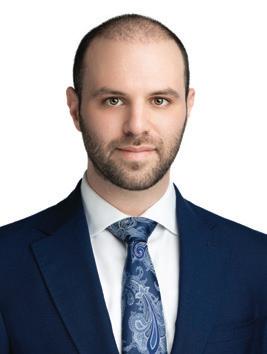
Robert M. Goldman is a solo practitioner and founder of the Law O ces of Robert Goldman, PLLC, in Bloomeld Hills. His practice focuses on criminal/tra c defense, driver’s license restoration, and expungements. Goldman is an active member of the OCBA’s New Lawyers Committee and Criminal Law Committee, as well as the State Bar of Michigan.

By Andrew Goetz
Appellate practice is not trial practice. Your record is fixed, and your audience differs. You must now persuade a three-judge panel, focused not just on the outcome of your case but on whether and how the panel’s decision might affect other cases. The questions that matter on appeal are often narrower than those that dominated the trial proceedings. They include whether the alleged error was preserved, what the standard of review permits, whether the error was harmless, and whether the relief sought is institutionally permitted and practically available.
Against that backdrop, trial counsel and clients face an important choice: Should they bring in new counsel to handle the appeal, maintain continuity with the trial counsel, or adopt a hybrid approach? No single answer fits every case. The decision is strategic, rooted in the case’s posture, the complexity of the appeal, the available budget, and the strengths and weaknesses of the team already in place.
A fresh appellate perspective is most useful in unsettled areas of law, high-stakes cases, or cases involving procedural or jurisdictional land mines. Appellate counsel’s familiarity with a particular court can also add value, both in navigating the nuances of appellate procedure and in considering how best to frame and present certain arguments. Especially for parties seeking to overturn an adverse decision, new appellate counsel can be the difference between winning and losing.
“When a party comes to us with nine grounds for reversing the district court, that usually means there are none.”1 The Sixth Circuit isn’t the only appellate court frustrated with parties taking a scattershot approach to their cases. Most appellate judges will tell you that a brief that raises too many issues, or merely copies and pastes from the filings below, is a sure sign that the party has a weak case.
New appellate counsel generally cannot and should not raise new issues, but appellate counsel can prioritize and reframe the issues that were preserved below. Particularly after an intense trial, the perceived injustices at the heart of the case and the battles that consumed the parties’ attention before the trial court can sometimes overshadow quieter but more significant errors. Someone approaching the record with fresh eyes is more apt to spot those errors, even if the trial team might have deprioritized or forgotten them. New appellate counsel can also recognize when the standard of review or harmless error hamstrings an apparent “silver bullet” and therefore recommend pivoting to issues that offer a cleaner path to victory. And appellate counsel can better recognize when an argument is not only technically correct but also leads to a rule that the court is willing to adopt.
That fresh perspective can benefit the appellee just as much as it does the appellant. Most appellate courts may affirm the trial court’s decision on any ground supported by the record,2 and the best ground for affirmance isn’t always what the trial court relied on. Likewise, for fact-driven issues, some of the best support for affirmance can be buried in testimony or other evidence that

largely went unnoticed below. A new advocate, attuned to those issues but unwedded to trial-phase theories or strategies, can stake out the best route to success.
Every appellate court has its quirks. Even apart from the minutiae in the Michigan Court Rules, Federal Rules of Appellate Procedure, and various local rules, experienced appellate advocates are often familiar with the appellate process in ways that occasional litigants are not. For instance, does the court often grant interlocutory or discretionary review, and if so, on what types of issues?
How are specific judges likely to view a particular argument? What court-specific traps or pitfalls, either written or unwritten, often trip up new advocates? What should you do if your client needs to request an expedited decision or a stay of the proceedings below? How should you frame the requested relief? How long does the court typically take to schedule oral argument? Or to issue its decision? Experienced appellate counsel can help you answer and navigate these questions. Familiarity with a particular appellate court can also shape the brief’s tone, structure, and authorities. Different courts have different personalities. Repeat players absorb those differences and tailor their briefing and arguments to
resonate with the court. ey develop a sense of what arguments are battle-tested losers in that forum and what arguments can capture the votes needed to win. It’s the equivalent of bringing in local counsel, but for a particular stage of the proceedings.
Familiarity with the court isn’t the only reason that brie ng and oral argument can bene t from bringing on new appellate counsel. Most appellate counsel spend a lot of time writing — more than most trial counsel do. And they have experience tailoring briefs to the institutional concerns that appellate judges share, such as procedural regularity, delity to statutory text, scrupulous adherence to the record below, and the implications of the court’s reasoning for other cases. Like any skill set, drafting appellate briefs is something that becomes better with practice.
e same is true of oral argument. Appellate argument has some key di erences from most trial arguments: a shorter clock, an increased likelihood of a hot bench, and intrapanel dynamics that sometimes change your focus. With a three-judge panel, for instance, your response to one judge’s hostile questions is often less about persuading that judge and more about persuading his or her two remaining colleagues. And the likelihood that you’ll be able to talk uninterrupted, rather than face immediate questioning, varies signi cantly by court and judge. Especially with a hot bench, your case will often bene t from someone who’s been there before and is comfortable answering questions concisely under re, conceding nonessential points, and pivoting back to the key arguments.
Resource Allocation
An underappreciated reason for bringing on appellate counsel is resource allocation. Especially in smaller or midsize rms, or with a one- or two-person trial team, it’s tough to balance a heavy trial docket with the time needed to handle an appeal well, especially with a complex appeal or compressed schedule. Bringing on a dedicated appellate counsel can relieve that resource pressure. While trial counsel handle post-judgment motions, parallel proceedings, or other matters entirely, appellate counsel can take primary responsibility for reviewing the record, identifying key issues, and brie ng and arguing the case. In taking that approach, trial counsel can remain involved in big-picture decisions and provide input based on their knowledge of the record while delegating most of the work to someone who’s more comfortable with it.
Despite the bene ts, bringing on new appellate counsel is not cost-free, and some appeals don’t justify it. ose appeals usually fall into a few buckets.
Relatively straightforward appeals: When an appeal is largely fact-bound or involves straightforward legal issues, trial counsel may be well-positioned to handle it. ese cases often turn on the application of settled law to the speci c facts of the case, rather than complex or novel legal questions. Because they are already deeply embedded in the case and familiar with the record, trial counsel can e ciently craft arguments without the need for extensive additional research or brie ng. In those circumstances, the marginal bene t of hiring specialized appellate counsel may not justify the added expense.
Budgetary constraints: Di erent clients and cases have di erent budgets, and those budgets sometimes become more limited after a lengthy trial. If the potential upside of the appeal is modest — such as when the amount in controversy is relatively small or the likelihood of success is low — it makes sense to conserve resources by having trial counsel continue with the appeal. In these cases, the decision often re ects a pragmatic balance between legal strategy and economic reality.
Logistical constraints: Overlapping with budgetary constraints is the reality that a new attorney must invest signi cant time into learning the case history, reviewing the trial record, and understanding the strategic decisions that were made during litigation. is onboarding process can lead to ine ciencies and duplication of e ort, especially when deadlines are tight. For clients prioritizing speed and continuity, avoiding that delay and sticking with trial counsel can sometimes be the most e cient path forward.
One option that should be — but often isn’t — considered is a hybrid approach, by which the trial counsel brings in an appellate counsel in a review or consultative role. Many government and large institutional organizations operate in this way, particularly when handling a signi cant volume of appeals. e United States Department of Justice, for instance, requires United States Attorney’s O ces to ensure that all “appellate brief[s] … led in the court of appeals” are rst “reviewed and edited by the AUSA supervising appellate matters, an appellate AUSA, or another AUSA with signi cant appellate experience.”3 Both of the United States Attorney’s O ces in Michigan follow that model as a general matter while
assigning more signi cant appeals to dedicated appellate counsel. at approach works well in integrating appellate expertise into a high-volume caseload in the most e cient way possible.
Hybrid approach as a strategic compromise: Retaining appellate counsel in a consultative or review capacity, rather than handing over full responsibility for the appeal, allows trial counsel to maintain control of the brie ng and argument while bene ting from the specialized perspective of an appellate lawyer. Appellate counsel can provide targeted input on framing arguments, re ning the legal analysis, and navigating compliance with appellate rules and standards while the trial counsel stays in the driver’s seat. is compromise can be particularly valuable when the appeal involves nuanced legal questions or when trial counsel want to strengthen the quality of the brief without incurring the full cost of outsourcing the appeal.
Additional bene ts of review and collaboration: Engaging appellate counsel in a review role can also help identify weaknesses or missed opportunities before ling. In approaching the case with fresh eyes and an understanding of the appellate court’s perspective, new appellate counsel can spot structural or strategic improvements that trial counsel might overlook and partner with trial counsel to implement them. is collaborative model preserves e ciency — the trial counsel remains the primary drafter and already knows the record — while adding a layer of expertise that increases the odds of success. For some clients and cases, the hybrid approach o ers a balanced solution: enhanced advocacy without the expense of a full hando .
Andrew Goetz is an appellate practitioner at Miller Johnson, advising clients on complex appeals and litigation strategy. He previously served as the appellate chief for the United States Attorney’s O ce for the Eastern District of Michigan, where he argued more than 35 cases before the United States Court of Appeals for the Sixth Circuit. Goetz brings deep expertise in constitutional and statutory interpretation and serves on the Sixth Circuit’s Advisory Committee on Rules.
References:
1. Fifth Third Mortgage Co. v. Chicago Title Insurance Co., 692 F3d 507, 509 (CA 6, 2012).
2. Wausau Underwriters Insurance Co. v. Vulcan Development, Inc., 323 F3d 396, 403-04 (CA 6, 2003); Groves v. Department of Corrections, 295 Mich. App. 1, 13 n.3; 811 NW2d 563 (2011).
3. DOJ Manual 2-5.112, Review of Appellate Briefs.

By Paul Shkreli
Many of us have memories of getting our licenses, whether they’re of taking a road test or the bar exam. We are taught that a license is a privilege, not a right. For most Michigan residents, the ability to drive is an assumed part of daily life that is easily taken for granted. However, when driving privileges are revoked or denied because of alcohol- or substance-related offenses, the process for regaining those privileges is governed by a complex administrative and appellate framework. Although much attention is placed on the initial restoration hearing, the appellate process that follows an adverse decision is equally significant and often misunderstood.
Driver’s license restoration hearings are conducted by the Michigan Secretary of State Office of Hearings and Administrative Oversight, commonly referred to as OHAO. These proceedings are evidentiary in nature and impose a demanding burden of proof on petitioners. If a hearing results in denial or limited relief, Michigan law allows for appellate review in the circuit court. While this review is narrow and deferential to the findings of the initial examiner, this step serves as an important check. Indeed, recent appellate decisions emphasize the importance of effective advocacy throughout the license restoration process.
Judicial review of driver’s license restoration decisions is governed by the Michigan Vehicle Code, MCL 257.323. Under Subsection (1), a person aggrieved by a final determination of the secretary of state may seek review in the circuit court for the county of residence or, if the petitioner resides outside Michigan, in Ingham County. The appeal must generally be filed within 63 days of the secretary of state’s final determination, although limited extensions may be granted for good cause.
The statute defines the scope and limits of judicial review. Under MCL 257.323(4), the circuit court may affirm, modify, or set aside the decision if it finds that the determination is not supported by competent, material, and substantial evidence on the whole record, is arbitrary or capricious, or constitutes an abuse of discretion. This standard recognizes both the principles of Michigan administrative law and legislative intent to balance agency expertise against judicial oversight.
“Substantial evidence” means evidence that a reasonable mind would accept as adequate to support a conclusion. In Davis v. Secretary of State, 195 Mich. App. 170, 172 (1992), the Court of Appeals explained that while the standard is deferential, it does not permit courts to abdicate their review function when the record fails to support the agency’s decision.
The OHAO serves as the administrative tribunal for contested matters under the authority of the secretary of state, including driver’s license revocations, restorations, and restrictions. Older case law and practice materials may refer to the Driver License Appeal Division or other predecessor entities, but OHAO is the current designation.
License restoration hearings are evidentiary proceedings in which the petitioner bears the burden of proving eligibility through clear and convincing evidence.1 Among other require-
ments, petitioners must demonstrate that substance-use problems are under control through letters, medical records, and other evidence. After the hearing concludes, the o cer then issues a written decision that includes ndings of fact and conclusions of law.
Pragmatically speaking, clearing this evidentiary and procedural barrier can feel onerous. Even when a petitioner prevails before the OHAO, the relief granted is often limited. Initial restorations commonly result in restricted driving privileges, conditioned on employment-related driving and the installation of a breath alcohol content ignition interlock device. Full, unrestricted driving privileges are typically granted only after additional periods of demonstrated compliance.
Attorneys are permitted to represent petitioners at OHAO license restoration hearings and may actively participate in the proceedings. e petitioner’s counsel may present evidence, examine witnesses, make legal arguments, and raise objections when appropriate. While the Michigan Rules of Evidence do not strictly apply, administrative hearings are governed by principles of fundamental fairness and due process.
Objections at the OHAO level serve an important dual function. First, they ensure procedural fairness during the hearing itself. Second, and more critically, they preserve issues for appellate review. Judicial review under MCL 257.323 is generally con ned to the administrative record. An issue not raised before the hearing o cer is unlikely to be considered by the circuit court. If the hearing o cer ignores relevant treatment records, discounts corroborating testimony without explanation, or applies an incorrect burden of proof, those issues should be raised to preserve them for appeal. Likewise, it is important that hearing o cers articulate their reasoning su cient to permit meaningful review. A decision that merely announces an outcome without evidentiary analysis or statutory authority may undermine the appellate process.
Although appellate review is deferential, circuit courts possess broader remedial authority than is often assumed. Under MCL 257.323, a circuit court may return a driver’s license immediately, shorten the length of a suspension or revocation, grant a restricted license for work or other lawful purposes, or deny relief entirely. In appropriate cases, the court may modify the secretary of state’s determination rather than simply a rm or reverse it.
is authority stands in contrast to the
typical relief granted at the OHAO level. While OHAO hearing o cers often follow a graduated restoration model, circuit courts are not bound to incremental remedies when statutory grounds for relief are established. When a decision is unsupported by substantial evidence or rests on legal error, the circuit court has the power to grant substantive relief consistent with the statute.
At the same time, courts may not substitute their judgment for that of the hearing o cer on matters of credibility or reweigh competing evidence. In Boyd v. Civil Service Commission, 220 Mich. App. 226, 234 (1996), the Court of Appeals rea rmed that judicial review does not permit a court to decide how it would have ruled in the rst instance. e court’s role is to evaluate whether the decision falls within the range of principled outcomes supported by the record.
e limitations of appellate review are signicant. e administrative record is closed on appeal, and new evidence may not be introduced. Improvements in sobriety, additional treatment, or new support letters obtained after the hearing cannot be considered by the circuit court. is constraint reinforces the importance of thorough preparation and complete presentation at the OHAO hearing stage.
As expected in other avenues of appellate practice, appeals that merely reargue the merits of sobriety or rehabilitation are unlikely to succeed. E ective appellate advocacy comes from the analysis of whether the hearing o cer applied the correct legal standard, articulated adequate ndings, and based the decision on evidence that reasonably supports the conclusion reached.
e Michigan Court of Appeals’ persuasive decision in Delmotte v. Secretary of State, No. 370273 (February 25, 2025), provides a recent and instructive example for attorneys. In Delmotte, the OHAO hearing o cer granted the petitioner a restricted license with an interlock device but denied full restoration. e decision o ered limited explanation despite evidence suggesting long-term sobriety and a minimal risk of relapse.
On appeal, the circuit court declined to grant relief, concluding that it lacked authority to return the license outright. e Court of Appeals vacated the circuit court’s decision and remanded the case while emphasizing that circuit courts are required to conduct a meaningful review of administrative decisions and may not defer re exively to the secretary of state when statutory standards are not satis ed.
Delmotte underscores two important points. First, hearing o cers must articulate the basis for their decisions to permit judicial review. Second,
circuit courts possess both the authority and obligation to evaluate whether the determination is supported by substantial evidence and consistent with law. It similarly demonstrates the importance of e ective appellate counsel.
Attorneys frequently expect to manage client expectations. Representing clients in license restoration appeals is no di erent. An appeal is not a second hearing or an opportunity to present new evidence. It is a legal challenge to the su ciency and lawfulness of the administrative decision. Clients should know at the onset that appellate relief is limited and that, in some cases, preparing for a future restoration petition may be the more practical — and perhaps a ordable — course.
Nevertheless, appeals remain an essential safeguard and mechanism for correction when hearing o cers misapply statutory standards, fail to articulate ndings, or render decisions unsupported by the record.
Driver’s license restoration appeals in Michigan present a specialized area of practice that sits at the intersection of administrative procedure, statutory standards, and appellate advocacy. While the OHAO is imperative in the initial adjudication of restoration petitions, circuit courts retain meaningful authority to correct errors and grant substantive relief under MCL 257.323. When properly navigated, the appellate process serves as an important check on administrative decision-making and a vital remedy for clients seeking to regain their footing as a member of society.
As attorneys, we know a license is a privilege. Likewise, the ability to help quali ed candidates restore their license is — like the ability to drive a motor vehicle — a privilege in its own right that should not be taken for granted.
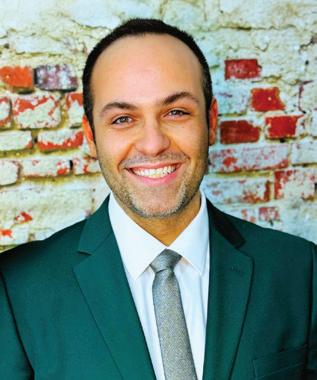
Paul Shkreli is an attorney and the founder of Shkreli Legal PLLC. His practice focuses on insurance disputes, criminal defense, and mediation. Shkreli is known for practical, client-centered advocacy. In his spare time, he enjoys writing about legal issues as well as parenting in the all-encompassing digital age. He can be reached at paulshkreli.com.
Footnote: 1. Relevant statutory provisions include MCL 257.303 and MCL 257.322.

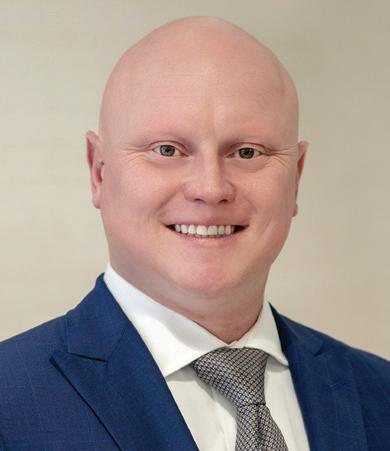
Cody R. Ellwanger recently joined Plunkett Cooney as a member of its Transportation Law practice group. Ellwanger focuses his practice primarily on the defense of claims involving bodily injury and Michigan no-fault personal injury protection.
Ellwanger represents national insurers, their agents, and policyholders in first- and third-party motor vehicle liability matters, as well as uninsured and underinsured motorist, breach of contract, and intentional torts claims. He has successfully defended his clients in cases involving fraud by policyholders, failure to provide reasonable proof of loss, and other violations of insurance contracts. Ellwanger also has experience resolving premises liability, medical malpractice, criminal enterprises, and negligence law claims.
In addition to his transportation law practice, Ellwanger has the distinction of serving as an attorney magistrate in the 52-1 District Court in Novi, where he presides over small claims trials, landlord-tenant proceedings, informal hearings for traffic infractions, and criminal arraignments for defendants charged with misdemeanors and/or felonies.
Ellwanger is a 2021 graduate from Western Michigan University Thomas M. Cooley Law School, cum laude. He received his undergraduate degree from Northwood University in 2016.
is proud to share the following announcements:
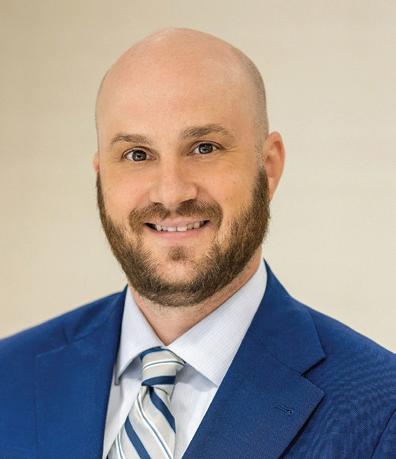
Plunkett Cooney’s senior tax attorney Joseph A. Peterson was recently named to the State Bar of Michigan (SBM) District I Character and Fitness Committee.
Appointed by the board of commissioners, Peterson began his two-year term on January 1. In his role as a committee member, he will support the work of the SBM, conducted under the direction and authority of the Board of Law Examiners and Michigan Supreme Court, by investigating the character and fitness of candidates for admission to the bar association.
Peterson serves as the Tax Law practice group leader in Plunkett Cooney’s Bloomfield Hills office. He primarily focuses his practice on the resolution of individual and business tax controversies, including audit defense, collections, and litigation involving the Internal Revenue Service and/or state of Michigan governmental entities.
In addition, Peterson has extensive experience with the Employee Retention Credit program (ERC) and Paycheck Protection Program forgiveness. He also consults with clients to safeguard against any future ERC audits conducted by the IRS related to the program.
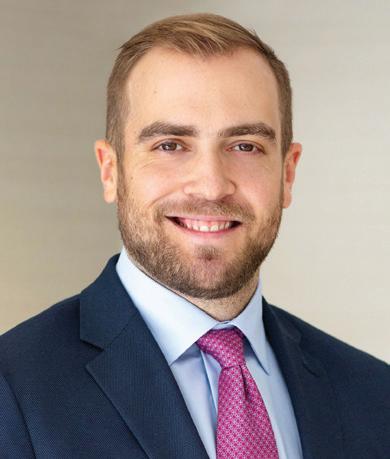
Michael D. Hanchett was recently named one of Plunkett Cooney’s newest partners. Hanchett serves as co-leader of the firm’s Governmental Law practice group and is a member of its Labor and Employment Law practice group. His public-sector experience is expansive and includes general counsel services for municipalities. He also represents their interests in state and federal courts when government liability disputes arise.
Hanchett has particular expertise defending police liability litigation, including search and seizure, use of force, pursuits, and corrections law. In addition, he has experience representing municipalities in employment law, including claims of alleged discrimination and retaliation and civil rights claims brought under state and federal laws.
A member of the firm’s Bloomfield Hills office, Hanchett has the distinction of being honored by Best Lawyers in America as “One to Watch” in municipal law since 2021 and by Michigan Lawyers Weekly as a 2024 “Up & Coming” lawyer. He graduated from the University of Toledo College of Law in 2016 and received his undergraduate degree from Ferris State University in 2013.
Let us share your great news here in Laches and on social media. Simply send a short announcement or press release to jquick@ocba.org along with a high-resolution photo. Inclusion in In Pro Per is free and exclusive to OCBA members.
*The OCBA does not publish announcements about recognition in Super Lawyers or “best of” lists due to the large number of members who earn that recognition each year. Other exclusions may apply.
The mission of the Oakland County Bar Association is to serve the professional needs of our members, enhance the justice system, and ensure the delivery of quality legal services to the public. We fulfill our mission through our 29 committees, regular networking events, and numerous educational programs for both OCBA members and the public. We work hand in hand with the OCBA volunteer board directors and members, and we partner closely with the courts.
Below are recent examples of the OCBA at work in service to the bar and the community.
In December, the following OCBA committees celebrated the 2025 holiday season:
• The Paralegal Committee participated in the Farmington Hills Senior Secret Santa program, helping nearly 600 older adults experiencing isolation during the holidays. Committee members fulfilled wish lists and delivered gifts to the Costick Center for distribution. The season concluded with a committee social on December 16 at Dick O’ Dow’s in Birmingham.
• The New Lawyers Committee supported the Snowpile program through Children’s Hospital of Michigan by collecting gifts for hospitalized children and their siblings. Members also joined Corewell Health William Beaumont University Hospital’s Moonbeams for Sweet Dreams event on December 15, waving flashlights to bring comfort and connection to young patients during the holidays.
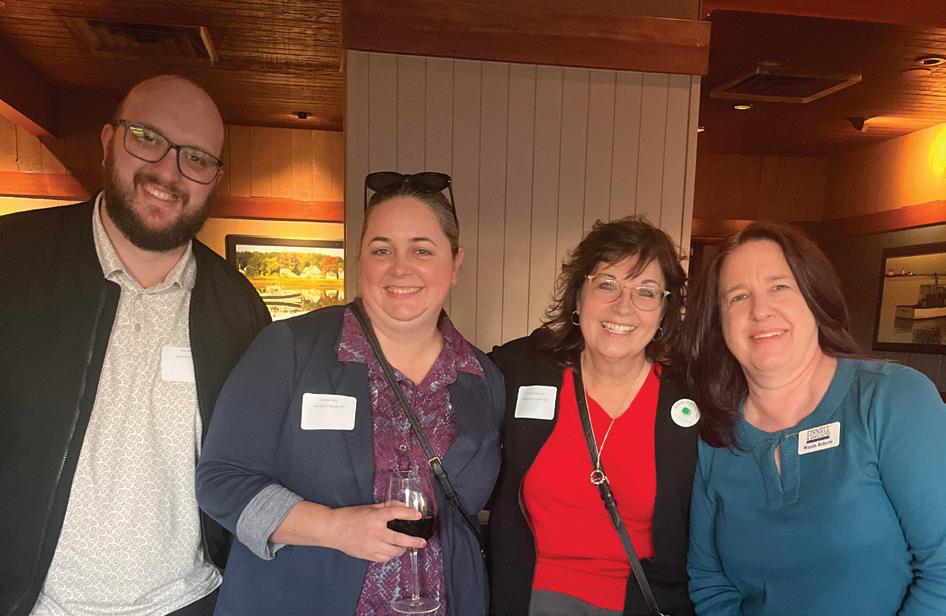




• Probate and Tax Law Committees: The annual Wills & Gills holiday reception was held on November 13 at Red Lobster in Waterford. Approximately 25 attendees, including committee members, probate court staff, and members of the judiciary, gathered for a heavy appetizer reception. Probate Committee Chair Julie McCowan and Tax Law Committee Chair Eric Gould welcomed guests and expressed appreciation for the court’s ongoing service and collaboration with the OCBA.
• The Family Court Committee hosted its annual holiday gathering on November 13 at Dick O’ Dow’s in Birmingham. Twenty-eight members, along with members of the judiciary and OCBA board leadership, attended the event. The evening provided an opportunity for informal networking, relationship-building, and discussion among family law practitioners and court partners in a relaxed setting.
• Providing Access to Legal Services Committee members met on December 16 at MEX in Bloomfield Hills for a holiday dinner focused on connection and celebration. In addition to socializing, members reflected on the committee’s ongoing efforts to expand access to justice through pro bono legal advice and public education programs, including expungement clinics, Ask a Lawyer, and Senior Law Day.

















By Richard Lynch
Isuspect that you have heard the above quote attributed to Mark Twain. Depending upon the day and circumstances, you may nd it quite apropos. If you are like me, the accretion of numbers we encounter each day may fail the de nition or technical analysis presented in an undergraduate statistics class but, depending upon the circumstances, may o er value.
Do you recall the terms average, mean, median, correlation, population sampling, binomial distribution, standard deviation, condence interval, base rate fallacy, chi-square curve, and so on? In our data-driven society, we encounter information presented in a numerical format wherever we turn. At what point does a number, a series of numbers, or a combination of numbers based on a particular subject qualify as a statistic or move beyond a data point to an informative interpretation of data? Even when the numbers qualify as statistics, what is the value of the measurement presented to us?
For example, in 1972, Don Kessinger had a .687 on-base percentage (OBP) when batting left against left-handed pitchers born in January. Okay, I made this number up. Kessinger did have a batting average of .274 and an OBP of .351 in 1972.1 But the example highlights the question; throwing numbers about without context means little.
So, what rabbit hole do I propose to drag you down today?
Data! More accurately, trial court-related data resources that you may nd helpful, perhaps even relevant, to your practice. ese resources touch upon caseloads, problem-solving courts, even how trial courts are viewed by those who use them.
Michigan courts o er several data repositories monitoring many aspects of the courts. Accessible reports include caseload reports, the interactive court data dashboard, judicial resources recommendation reports, performance measures data, program reports, and public satisfaction surveys.2 Individually
or combined, the reports o er insight into speci c or general operations for Michigan trial courts. e only limitation on the reports is that they o er aggregated court numbers, not discrete docket information for particular judges.
Other than those interested in the administrative details of courts, political scientists, or court administrators, who would voluntarily delve into this information? Let’s say you have a client who may qualify for one of the state’s problem-solving court programs. What options exist for the client, and will they address your client’s needs? How do the programs work? Are the participants in the programs successful? What are the recidivism rates for program participants? is includes those who graduate, those who participate but do not successfully complete the program, and any control groups.
Or perhaps you are considering ling a civil case that seems likely to go to trial and you wonder how cases like yours progress through a particular court. Do many go to trial? How often does the court grant summary disposition? Using the interactive court
data dashboard, one can look at the overall numbers for the speci c court and break it down by case group and/or case code. One can evaluate methods of disposition and evaluate case age. One can compare the trends for incoming versus outgoing caseload numbers and evaluate pending caseload trends for the speci c court.3
For example, if one considers ling a medical malpractice case for a client in Kalamazoo County, one may wish to know that 21% of medical malpractice cases in the court resolve within the initial guidelines of 364 days from ling, and 68% of cases resolve within the nal guideline period of 728 days from ling.4 I would learn that there were 251 new cases led during the reporting period of 2006 to 2024.5 Or that of the 274 disposed medical malpractice cases during the reporting period, 27 jury trials and three bench trials occurred, while the court dismissed seven cases.6
Perhaps you are concerned about whether the court has the resources to handle your case. Should you consider arbitration or, perhaps, removal of an eligible case to federal
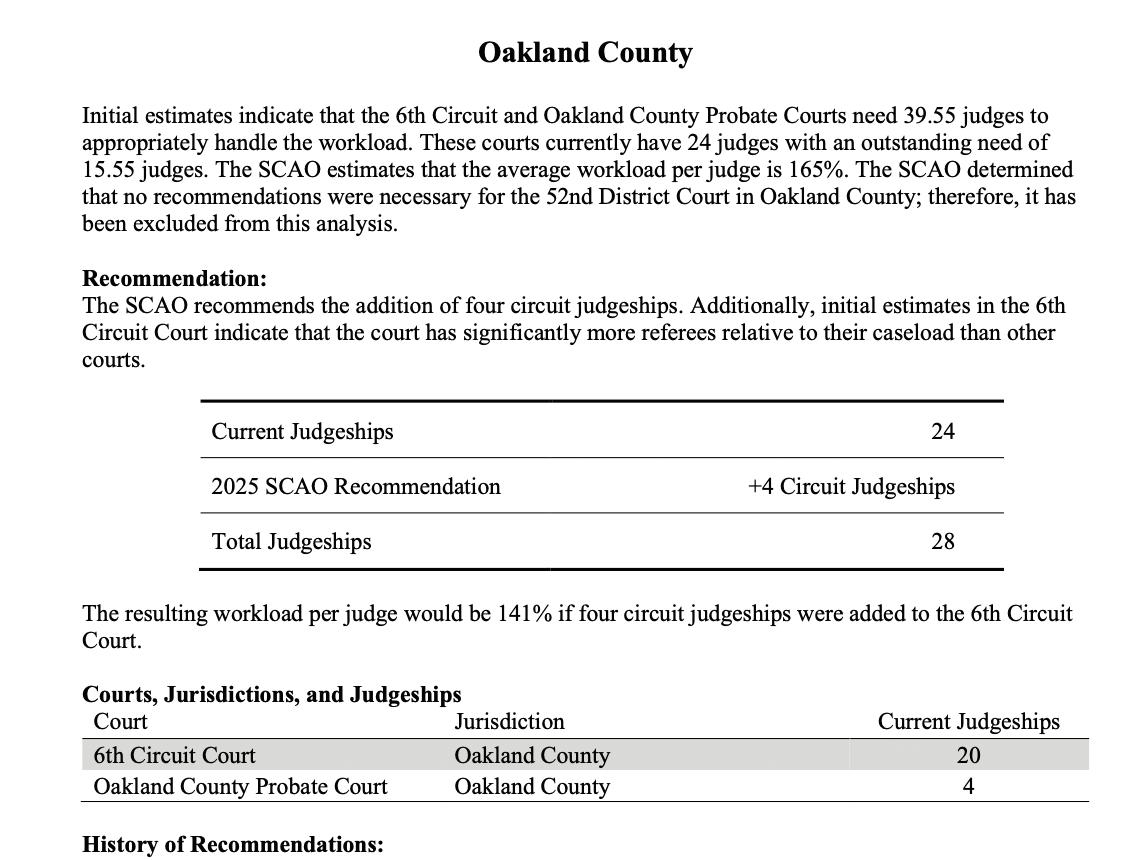
court? By now, you have probably heard that the Supreme Court released its Judicial Resources Recommendations in December 2025.7 e report evaluated the needs of each trial court based upon judicial and sta time reports to determine whether the courts are adequately sta ed. e report found that the Sixth Circuit and Oakland Probate courts have a judicial need of 39.55 judges.8 With current sta ng between the two courts of 24 judges, this leaves a need of 15.55 judges.9 e report recommends the creation of four new circuit judgeships.10 If, when, and how this need will be addressed is an issue for the Michigan Legislature and Oakland County Board of Commissioners. For now, please note that there will be one open circuit and one open probate seat on the November ballot as Judges Martha Anderson and Daniel A. O’Brien retire.
Perhaps you have wondered about the workload of judges in a particular court. Using these resources, you can see the gross docket numbers for any of Michigan’s trial courts, the breakdown by case type, and whether the docket numbers are rising,
falling, or remaining constant. You can also see how cases resolve within the court either generally or by case type.
Have you ever considered how those called for jury duty view the legal process? e Public Satisfaction Survey Dashboard provides feedback on this and related subjects. For example, if you are preparing to try a criminal case in the Sixth Circuit, you might like to know that 50% of respondents, reporting as jurors, indicated that they were neutral on the statement “I understand what happened in the case,” while 50% strongly agreed with the statement.11 Adjusting the variables, one would learn that 80% of criminal defendants who responded either agreed or strongly agreed with the statement.12
In short, the Michigan Supreme Court, through the State Court Administrative Ofce, provides a wealth of information on the operation of Michigan’s trial courts. e use of this information determines its value. For a court administrator like me, it goes to the heart of how the court operates and identi es areas for improvement. For practitioners like you, the various reports may provide value or


merely a storm of numbers.
Richard Lynch is the court administrator for the Oakland County Circuit Court.
Footnotes:
1. baseball-reference.com/players/k/kessido01.shtml, last accessed December 23, 2025.
2. courts.michigan.gov/administration/offices/statisticalresearch, last accessed December 23, 2025.
3. courts.michigan.gov/publications/statistics-and-reports/interactive-court-data-dashboard, last accessed December 23, 2025.
4. courts.michigan.gov/publications/statistics-and-reports/interactive-court-data-dashboard, last accessed December 23, 2025.
5. Id
6. Id
7. courts.michigan.gov/4afb74/siteassets/reports/ judicial-resources/jrr_2025_final.pdf, last accessed December 23, 2025.
8. Id. at p. 18
9. Id.
10. Id.
11. courts.michigan.gov/publications/statistics-andreports/public-satisfaction-survey, last accessed December 23, 2025.
12. Id

















Since the rollout of MiFILE, the probate court’s e-filing system, last year, we have been working tirelessly to improve our processes, provide greater court access, and enhance our overall efficiency. E-filing is required when filing documents for all matters in the probate court, with the limited exceptions of emergency mental health transport petitions, petitions and orders for assignment (small estates), deposit of original wills, and payment of the inventory gross estate fee. These matters may be filed in person or by mail.
To file documents using MiFILE, visit the probate court website, oakgov.com/probate. Creating an account is free. In the event you don’t have the ability to e-file from your home or office, the probate court has an e-service room for public use.
Below are some fundamentals of MiFILE:
• Filings that are submitted up to 11:59 p.m. will be accepted as of that business day. Filings submitted after 11:59 p.m. on a Friday, during the weekend, or on a holiday will be accepted on the following business day.
• If “Service” is selected during file submission, service on the selected parties is made at the time of submission. The system will generate a proof of service document that will be filed into the court file.
• Payment is applied to the filer’s credit card at the time of submission. Statutory filing fees are subject to a credit card transaction fee of 3%.
• Documents submitted for e-filing are reviewed, and if not accepted, the submission will be rejected. To avoid the rejection of documents, be sure all forms are completed and signed and all necessary boxes are checked.
By Barbara P. Andruccioli
• If rejected, the reason for rejection will accompany the notification. If the filing had a filing fee, it will be refunded; however, the nonrefundable 3% transaction fee will be charged to the filer’s account.
The court’s website should be checked often for information and updates to specific e-filing procedures, including the following:
When filing a seven-day order or objections to a seven-day order, pursuant to MCR 2.602(B) (3), check the emergency box on the TruFile page to route the documents to the proper queue. The Emergency Petition Supplemental Form (PEMH 1137) is not required. When filing objections to a seven-day order, the filing fee is $20.
Letters of authority and copies may be requested in person, by mail, or online from the probate court’s website via Court Explorer. Certified documents will contain electronic seals, pursuant to MCL 565.232.
All filers are required to protect personally identifiable information (PII). When documents containing confidential information (e.g., death certificates) are being submitted through MiFILE, the PII document should be submitted separately but in the same bundle. The case file number should be added to the top of confidential documents before they are scanned.
Your hearing may be held either in person or remotely, depending on the matter and the assigned judge. Please be sure to check your notice of hearing.
When filing an emergency petition, the petitioner should check the emergency box on the TruFile page. The Emergency Petition Supplemental Form (PEMH 1137) is required, which must be filed separately and captioned as a miscellaneous document. The word emergency must be typed on the comment line. Once the filing is reviewed by the assigned judge, the petitioner will be contacted by the judge’s chambers, who will instruct the filer if/when the emergency hearing will be held.
If you are appointed temporary guardian, special conservator, or special personal representative, after the order is entered, you must file your Acceptance of Appointment and Addendum to Protected Personal Identifying Information (API/MC 97a) form to obtain your letters of authority, which can be done online or in person at the probate counter. Once the acceptance and API/MC 97a forms have been filed, you may purchase your letters of authority at the counter or through the court website via Court Explorer.
When filing into an existing case, the format of the file number should include the year (4 numbers), file number (10 numbers, including four zeros), and suffix (two letters), formatted like 2025-0000123456-GA
The Criminal Search Request Form (PEMH 1148) is available on the court website. When submitted, the form should be coded as a miscellaneous document with ICHAT typed in the comment line to be routed to the proper queue. Be sure to check the confidential box when submitting.
Once the annual report, annual account, or notice of continued administration has been filed and accepted by the court, the letters of authority will be available for purchase from the probate court’s website via Court Explorer. Please allow 24 hours to process the letters of authority.
After the hearing, the order of appointment will be e-filed by the court. Once the order is accepted, the appointed fiduciary must e-file their Acceptance of Appointment (PC 571) and the Addendum to Protected Personal Identifying Information (API/MC 97a) forms. Once the forms have been accepted by the court, copies of the letters of authority will be available for purchase from the probate court’s website via
Court Explorer. Please allow 24 hours to process the letters of authority.
Certi ed letters of authority will contain electronic seals, pursuant to MCL 565.232.
Please note that if multiple duciaries are appointed, letters of authority cannot be issued until all duciaries have e- led both their Acceptance of Appointment and MC 97a forms. All qualifying documents must be led at the same time.
When ling objections, check the emergency box on the TruFile page to route the documents to the proper queue. e Emergency Supplement Form (PEMH 1137) is not required; however, the Objection Form (PC 694) is required as the initial page to the objections. e ling fee for the objection is $20.
If paying for a matter in an existing le by cash or check, the individual may pay in person at the court using MC 514, Receipt of Prepaid Filing Fees for MiFile Transactions, which can be
obtained in the e-service room.
If the case is a new le, the ler must complete form MC 514, Receipt of Prepaid Filing Fees for MiFile Transactions, which can be obtained in the e-service room. e probate sta will enter the ler’s information and give the ler a case number to pay for the ling. e ler will then le the MC 514 form with their documents in the e-service room.
To reopen a case, the ler must le the documents into the existing case using the original le number. If the case has been closed for more than 10 years, before ling the reopening documents, the ler must contact the probate court by phone at (248) 858-0260 or by email at probatecourt@oakgov.com to access the existing le number.
When the requester is not a current party but wants e-service for future lings (i.e., attorneys entering limited appearances, interested parties, etc.), the individual must complete form
MC 507. e ler must be a registered MiFILE user. ere is no ling fee. e form must be used in conjunction with an “Add Party to Case” request in TruFile to create the connection between the party in MiFILE and the court’s case management system. Once added, the ler will be electronically served at the email address on their MiFILE account.
If you have e- ling questions for the probate court's sta , please call (248) 858-0260. For technical support, please call TrueFiling customer care at (855) 959-8868 or email mi le@ imagesoftinc.com
Barbara P. Andruccioli is the Oakland County Probate Court register.
“Spring is when you feel like whistling even with a shoe full of slush.”
—Doug Larson

The Oakland County Bar Association’s Lawyer Referral Service (LRS) assists people with finding legal representation.
By joining the OCBA’s LRS, you can maximize referrals to your firm or practice. Callers in need of legal help are referred to members of the LRS who practice in the area of law that serves the client’s need.




It was 1991, and I, along with my seventh grade classmates from Derby Middle School in Birmingham, was on a class trip to Washington, D.C. It is 35 years later, but I still have vivid memories from the trip — the Smithsonian museums, the Lincoln and Je erson memorials, the best-ever pizza by the slice, and the $7 Georgetown basketball T-shirt I bought from a street vendor with my best friend. What resonates most, however, was our trip to the Vietnam Veterans Memorial, honoring the service members of the United States Armed Forces who served in the Vietnam War. e black granite walls, almost 500 feet combined, solemnly list over 58,000 soldiers who died or remain missing in the con ict from 1959 to 1975. e minimalist design (which I did not understand then) elicits a sentiment of everlasting gratitude for the ultimate sacri ce given by so many and the social tumult the war created for our country.
ere is a separate memorial — admittedly of much less national signi cance and military valor, but nonetheless deeply meaningful in our legal community — displayed prominently in our Oakland County Circuit Court: the Oakland County Bar Foundation’s Fellows plaque. Before describing the plaque’s history and its recent upgrade, it is worthwhile to mention more about the foundation’s esteemed Fellows.
e Fellows represent a group of several hundred professionals who provide critical support for the foundation’s programs. e current list of Fellows (available at ocba.org/fellows) is limited to less than 10% of the total active
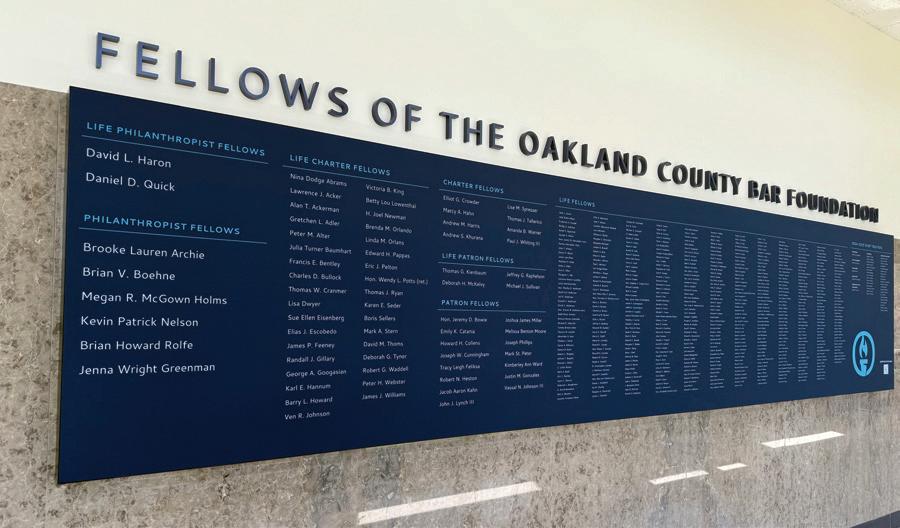
By Andrew M. Harris
membership of the State Bar of Michigan who practice within Oakland County (although you do not have to be an attorney to be a Fellow). ere are four classes of Fellows, who have di erent contribution levels. ey are Fellow ($1,000), Patron Fellow ($2,500), Charter Fellow ($5,000) and Philanthropist Fellow ($10,000). ( e Patron and Philanthropist categories were added more recently.) ese nancial obligations can be made on an annual basis, and Fellows receive “Life” status once their nancial obligation is satis ed.
Membership within the Fellows requires nomination by a current Fellow and includes the following bene ts (in addition to the greatest value of all: critical support to the foundation): (a) inscription on the Fellows plaque at the Oakland County Circuit Courthouse (see below), (b) an invitation to the exclusive annual Fellows Reception in January of each year, and (c) a commemorative Pewabic tile to display. e foundation’s Fellows plaque dates back almost 20 years under the leadership of prior foundation volunteers, when it involved a modest four wooden inserts honoring roughly 400 Fellows. Over the years, space on the plaque grew, which forced the foundation to amend its bylaws within the past decade to include only the “Life” members. When the foundation added the Patron and Philanthropist categories within the past few years, however, it knew the plaque required updates. Delayed by the COVID-19 pandemic and a vendor purchase, the plaque eventually received its current update, residing on the rst oor of the south side of the Oakland County Circuit Court. It is the product of multiple design-work rms who found a way to achieve feasible updates, overseen by the foundation’s sta and the Fellows Committee. e newly designed plaque is much larger, allowing the foundation to honor not just the Life Fellows but the existing Patron, Charter, and Philanthropist Fellows. Additionally, the foundation can now update the plaque on an annual basis to recognize new Fellows and Fellows who have achieved Life status.
e newly renovated plaque is, to so many,
not just an aesthetic marvel in perhaps the most important building for our profession in the county; it is in honor of those who sacri ce to help the foundation’s laudable goals of ensuring access to justice and an understanding of the law. No, it is not the same level of sacri ce honored by the Vietnam Memorial, but there is commonality in investing in art to honor service to others — perhaps the most honorable characteristic we can embody in the courtroom, the o ce, and all the places we as attorneys interact within our profession, with our clients, and with our colleagues.
Service to others is what the foundation does best, and if you are not already a Fellow, you can contact an existing member to be a part of this special group. Plus, there are probably many of us who don’t mind seeing our names beautifully honored in a public setting!
Andrew M. Harris is a shareholder with Maddin, Hauser, Roth & Heller, P.C. in South eld, Michigan, where his practice includes business litigation, commercial real estate, estate planning, probate work, and property tax services. Harris is also a licensed civil mediator. He lives in Birmingham (where he was once mayor) with his wife (Ti any), two teenage sons (Roger and Russell), and two dogs (Maizey and Blue).

The Oakland County Bar Foundation’s mission is to ensure access to justice and an understanding of the law in our community. It is dedicated to:
— Improving and facilitating the administration of justice in Oakland County and throughout the state of Michigan;
— Ensuring to the fullest extent possible that legal services are made available to all members of the public;
— Promoting legal research and the study of law as well as the diffusion of legal knowledge;
— Promoting the continuing legal education of lawyers and judges; and
— Educating the public as to their legal rights and obligations, and fostering and maintaining the honor and integrity of the legal profession.
If you know an organization that could use assistance to pursue these goals within Oakland County, please refer them to ocba.org/ocbfgrants, where they can find information about applying for a grant from the foundation.

Anderson
2024-206894-CH
Fred Bender v. Heron Bay Homeowners Association
12/8/2025
Anderson
2025-293972-FC
People v. Hammonds
12/1/2025
12/15/2025
Matis Matis
Matthews
12/16/2025
12/8/2025
12/8/2025
12/8/2025
12/16/2025
O'Brien
Warren
Potts - Visiting
Judge
YoungVisiting Judge
YoungVisiting Judge
2025-292581-FH
People v. Sides
2024-207007-NO
Renee Jasgur v. Guss
Carry Out Walled Lake Inc.
2025-294242-FH
People v. Smith-Grant
2025-292110-FH
People v. Schooley
2025-294792-FH
People v. Franklin
2024-206689-NO
Anica McMahon v. Johnathan Zaidan
2024-208585-NI
Michael Durecki v. Carlryk Kyles
2024-209862-CK
Kecalf Franklin v. Charles McKelvie
Shawn Desai
Scott Farida
Evan Alexander
Sumeet Aggarwal
Mahira Musani
Nichole Smithson
Todd Stearn
Sandra Densham
Zachary Houchin
Adam Clements
Qamar Stamos
Romi Mezy
Alec D'Annunzio
Carl Jordan
Charles Ebel
Paul Dwaihy
Adam Nael
Kyle Smith
Mark Richard
Ashley Turner
Michael Arnhold
Gregory Jones
Barbara Urlaub
Ct. 1 AWIM, Cts. 2, 4 Weapons FF 3rd/Sub. Off., Ct. 3 Weapons FA-Poss. by Prohibited Person
C/S Del./Manf. Ecstasy, Poss. C/S U/25 Grams
Jeffrey Quas Housing & Real Estate Felonious Assault
Personal Injury Animals - Abandon/Cruelty 25 or More Animals
Personal Injury
Ct. 2

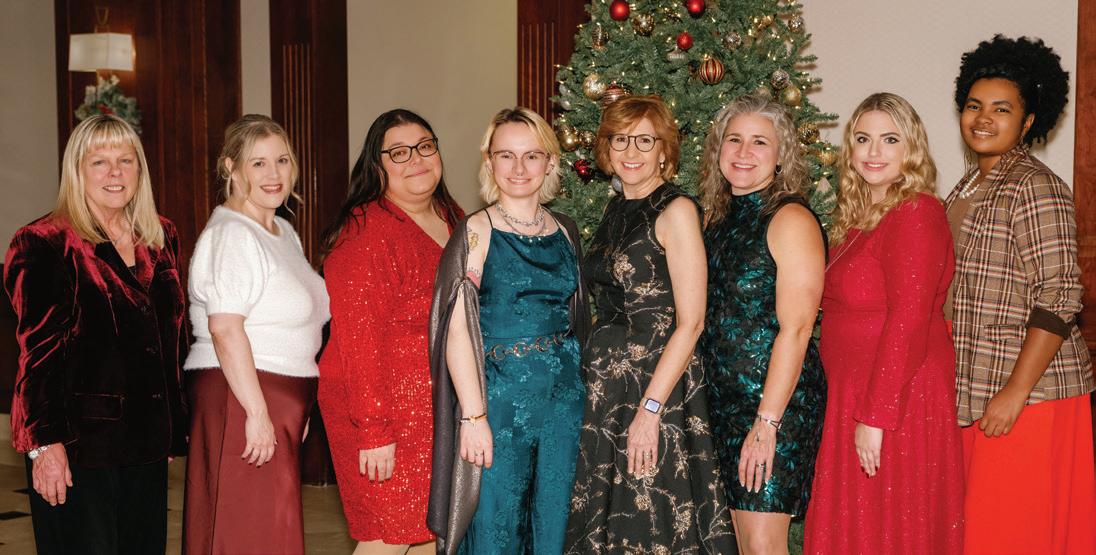
Executive Director
Jennifer Quick (jquick@ocba.org)
Deputy Director
Katie Tillinger (ktillinger@ocba.org)
Finance Director
Susan Maczko (smaczko@ocba.org)
Programs Manager
Cristin Doble (cdoble@ocba.org)
Court and Public Services Manager
Janise Thies (jthies@ocba.org)
Marketing Communications Specialist
MB Cairns (mcairns@ocba.org)
Marketing Associate
Alexa Enders (aenders@ocba.org)
Bookkeeper
Mayly McRae (mmcrae@ocba.org)
Laches and Foundation Administrator
Lori Dec (ldec@ocba.org)
Programs Administrator
Victoria Smith (vsmith@ocba.org)
Court and Public Services Administrator
Melak Mardo (mmardo@ocba.org)
Unless otherwise indicated, please call (248) 334-3400 for assistance.
Address Changes
Billing
Board of Directors
Case Evaluator Applications
Committees
District Court Case Evaluation
Mayly McRae
Mayly McRae
Jennifer Quick
Janise Thies
Katie Tillinger
Janise Thies
Event Photos ...................................................................
Finance ......................................................................
Inns of Court
Judicial Candidate Fora
Laches Magazine
Lawyer Referral Service – (248) 338-2100
Member Illness & Death Notification
Membership
New Lawyer Admissions
News Releases
Oakland County Bar Foundation
OCBA Mediation Service
OCBA Policies
Pro Bono Mentor Match Program
Professional Development/CLE
Room Rental Reservations
Speakers Bureau
Volunteer Opportunities
Website

Lippitt O’Keefe, PLLC has private o ce space available for lease within its professional suite.
Rent includes dedicated receptionist to greet clients and manage calls, full access to multiple furnished conference rooms for client meetings and presentations, o ce supplies and a professional environment in a prime Birmingham location.
This space o ers the benefits of a fully equipped o ce without the burden of managing overhead.
For additional information or to schedule a tour, please contact Vanessa Kari at tel: 248-646-8292 or email: vkari@lippittokeefe.com
ce
MB Cairns
Susan Maczko
Cristin Doble
Janise Thies
Jennifer Quick
Victoria Smith
Katie Tillinger
Katie Tillinger
Katie Tillinger
MB Cairns
Katie Tillinger
Janise Thies
Jennifer Quick
Janise Thies
Cristin Doble
Mayly McRae
Janise Thies
Janise Thies
Jennifer Quick
Ariel Applebaum Bauch
Carey Aubrey-Martinez
Monika Bashyam
Daniel Ritter Vaughn Bernhard
Brian J. Bourbeau
Sydney Kristen Carmoney
Ariel Drissman
Cody Ellwanger
Carol Winter Grombala
Justine Guliana
Jessica Habel
Samuel Hall
Farah H. Joni
Syed Kazmi
Nicole Keeley
David A. Kotwicki
Nadeen Makhzoum
Hon. Joseph Patrick McGill
Claire Montgomery
Heather Muir
Lara Neshewat
Keith E. Phillis
Jessica Pierce
Leslie Ellen Posner
Anaria Rambus
Elliot Lannon Rattner
Dan Ringo
Dannie Smith
Kathryn Smith
Chanel Stevanovich
Theodore Stueber
Justin Charles Trimachi
On December 4, 2025, the OCBA hosted an elegant evening of camaraderie, celebration, and holiday cheer at its annual Holiday Gala, held at The Townsend Hotel in Birmingham. Nearly 400 members and guests gathered for the premier social event of the season, enjoying an unforgettable night of connection and festive spirit. With lively music, a chef-attended carving station, decadent hors d’oeuvres, and delightful holiday sweets, the evening offered the perfect way to toast the season alongside friends and colleagues in the legal community.