











OAKLAND COUNTY BAR ASSOCIATION
1760 S. Telegraph Road, Suite 100
Bloomfield Hills, Michigan 48302-0181
(248) 334-3400 • FAX (248) 334-7757 www.ocba.org

PRESIDENT
Sarah E. Kuchon
PRESIDENT-ELECT
Aaron V. Burrell
VICE PRESIDENT
Kari L. Melkonian
TREASURER
Victoria B. King
SECRETARY
Syeda F. Davidson
EXECUTIVE DIRECTOR
Jennifer Quick
LACHES EDITORIAL BOARD
Victoria B. King
Syeda F. Davidson
Coryelle E. Christie
Lanita L. Carter
DIRECTORS
Julie L. Kosovec
Emily E. Long
Jennifer L. Lord
Moheeb H. Murray
Kimberley Ann Ward
Layne A. Sakwa
Silvia A. Mansoor
Stephen T. McKenney
James A. Martone
Jennifer J. Henderson
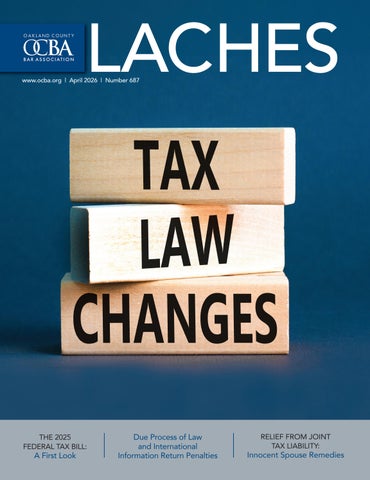
The 2025 Federal Tax Bill: A First Look With the One Big Beautiful Bill Act comes a slew of taxrelated changes affecting both individuals and law firms.
ByEricJ.Gould 10
Due Process of Law and International Information Return Penalties
The violation of a taxpayer’s Fifth Amendment rights can prove a powerful defense in contesting tax penalties.
ByStephenJ.Dunn 12
Relief from Joint Tax Liability: An Examination of Innocent Spouse Remedies
Three types of relief can release divorced clients from tax liability related to a former spouse’s conduct.
ByStephenA.Weisberg 18


James W. Low
Thamara E. Sordo-Vieira
Xavier J. Donajkowski
Vincent C. Sallan
THE MISSION OF THE OAKLAND COUNTY BAR ASSOCIATION IS TO SERVE THE PROFESSIONAL NEEDS OF OUR MEMBERS, IMPROVE THE JUSTICE SYSTEM AND ENSURE THE DELIVERY OF QUALITY LEGAL SERVICES TO THE PUBLIC.
Articles and letters that appear in LACHES do not necessarily reflect the official position of the Oakland County Bar Association, and their publication does not constitute an endorsement of views that may be expressed. Readers are invited to address their own comments and opinions to:
LACHES | Oakland County Bar Association 1760 S. Telegraph Rd., Ste. 100 Bloomfield Hills, MI 48302-0181
Publicationandeditingareatthediscretionoftheeditor.
writing to Oakland County Bar Association, 1760 S. Telegraph, Ste. 100, Bloomfield Hills, MI 48302-0181.

Practicing law is demanding — long hours, unforgiving deadlines, and high stakes. Most lawyers expect those pressures as part of the calling. Conflict is also inherent to the work. However, incivility and unprofessionalism should not be. Such conduct adds a weight that should never be part of the job. We understand that disagreement and advocacy are part of the profession, but what should be professional disagreements too often become personal attacks, and what should be intentional advocacy can become performative. As professionals, we must reconsider what zeal in advocacy actually requires.
It is easier to see incivility in someone else’s conduct, but the only behavior lawyers can control is their own. Culture shifts one lawyer at a time, through the thousands of choices we make and how we show up in our professional work each day. Have you ever walked out of a conversation wishing for a do-over? Perhaps it was a curt reply, an email sent too quickly, or a defensive explanation. These moments remind us that incivility and unprofessionalism can be subtle and unintentional, shaped by pressure more than malice. One of my favorite quotes is from psychiatrist and Holocaust survivor Viktor Frankl, who wrote, “Between stimulus and response there is a space. In that space is our power to choose our response. In our response lies our growth and our freedom.” Frankl reminds us that there will always be events that trigger us. Our power lies in pausing and considering our choice: Will we react impulsively or respond with reflection and intention? This practice, repeated one lawyer and one moment at a time, is how our profession grows in civility and professionalism.
A critical difference exists between reaction and response. A reaction is immediate and driven by the nervous system’s urge to reduce tension. Reaction narrows options and can escalate conflict. A response, on the other hand, includes a pause for reflection and con-
By Sarah E. Kuchon
sideration of objectives, tone, and long-term consequences. Response widens options and better serves the client’s interests.
The “space” Frankl describes is what psychology calls “the window of tolerance,” a framework developed by psychiatrist Daniel Siegel that describes our capacity to pause, think clearly, regulate emotions, and act in alignment with our values. Outside of that window, we move into fight, flight, or shutdown, and our response yields to our survival reflex. Legal practice routinely pushes lawyers to the edges of that window with contentious hearings, demanding clients, and relentless deadlines. Without awareness, reaction can become our default.
The phrase “zealous advocacy” has taken on a life of its own in legal culture. Many lawyers
have come to hear “zeal” as permission for aggression, hostility, or winning at any cost, often at the expense of civility and professionalism. However, the Michigan Rules of Professional Conduct never use the term “zealous advocate.” The comment to Rule 1.3 on diligence states only that a lawyer should act “with commitment and dedication to the interests of the client and with zeal in advocacy on the client’s behalf.”
Zeal, by ordinary definition, means eagerness and enthusiastic interest in pursuit of a cause. Advocacy is the act of supporting a cause. Considered together, zealous advocacy is simply the enthusiastic pursuit of a client’s cause. That pursuit exists within the framework of ethics and professionalism. Within that framework, civility is not a courtesy but a professional discipline, and ethics calls us to choose intention over impulsiveness. When

Zeal, by ordinary definition, means eagerness and enthusiastic interest in pursuit of a cause. Advocacy is the act of supporting a cause. Considered together, zealous advocacy is simply the enthusiastic pursuit of a client’s cause. That pursuit exists within the framework of ethics and professionalism.
zeal is misunderstood as aggression rather than enthusiasm, self-interest can replace client interest. at posture is not advocacy. It is reaction misnamed as zeal.
A pause does not betray diligence. It protects it by preventing errors, aligning action with client objectives, ensuring competent representation, and promoting thoughtful execution. As lawyers, our ethics are guided by the Michigan Rules of Professional Conduct, which encompass core principles such as competence, diligence, candor, and fairness. ese duties require professional judgment. A pause supports that judgment by creating space to consider obligations, options, and consequences and to notice whether we are serving the client’s interests or protecting our own comfort and image. e standard in our rules is reasonable promptness, not immediacy, and certainly not impulsive promptness. e canon implies deliberation. Incivility and unprofessional conduct often grow from reactivity rather than re ection. e pause helps us meet our ethical obligations. e challenge is learning how to widen the space when pressure narrows it.
Creating space is a practical skill. We widen our window of tolerance through ongoing awareness, re ection, and practice. We can practice in small, ordinary ways: delaying an email rather than pressing send in the heat of the moment, pausing to ask whether our conduct serves the client’s interests, using a brief recess to allow emotions to settle before
proceeding, and, when all else fails, pausing to breathe. Slow, steady breathing signals safety to the nervous system, calming the stress response and allowing the thinking parts of the brain to come back online. One e ective breathing technique to try is box breathing: inhale for four counts, hold for four, exhale for four, and hold again for four, like tracing the four sides of a box. Even 30 seconds of intentional breathing can change the course of an interaction.
Leadership in law is rarely dramatic. More often, it looks like steadiness in ordinary moments. It is the discipline to remain calm when provoked, the resolve to do what is right rather than what is easy, and the wisdom to know when to speak and when to remain silent.
Lawyers shape the tone of litigation, courtrooms, and negotiations through their conduct. at in uence calls us to be pillars of the profession, leaders who bring enthusiasm to their work while meeting pressure with professionalism, fortitude, and response over reaction. is form of leadership models true zeal in advocacy.
Harper Lee’s character Atticus Finch in To Kill a Mockingbird exempli es zealous advocacy in action. When he sits outside the jail to protect his client, he is calm, collected, and unwavering in the face of threats. His courage is not theatrical; it is regulated and principled. e jail scene is only one of many moments in which Atticus demonstrates zealous advocacy — from his careful preparation to his respectful engagement — and unwavering delity to the rule of law. His conduct demonstrates what zeal in advocacy rightly means: advocacy anchored in enthusiasm, civility, and professionalism.
When we choose response over reaction, we show colleagues, clients, and young lawyers that zealous advocacy is not loud, hostile, or aggressive. We model that strength can be calm, that professionalism can be rm without being harsh, and that passion for a client’s cause can coexist with respect for everyone involved. Our profession needs more people like Atticus Finch, advocates who prove day after day that true zeal is deliberate, principled, and humane.

Sarah E. Kuchon is the president of the Oakland County Bar Association.


















By Jennifer Quick
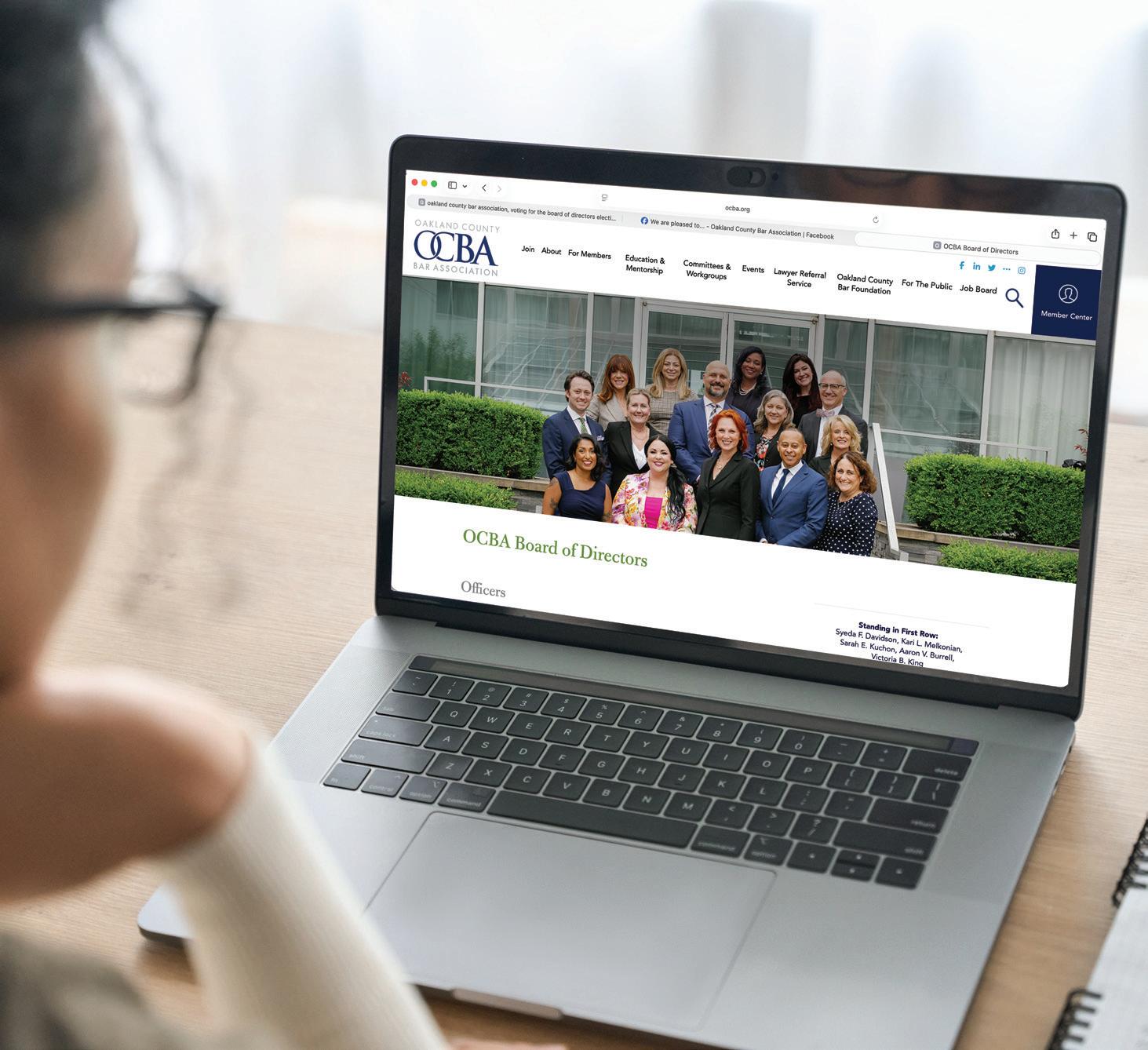
On April 30, eligible OCBA members will receive a link to the online ballot to vote in the OCBA Board of Directors election. is is your chance to play an active role in guiding the future of our association — and your participation truly matters.
To help make the voting process simple and accessible, I’ve addressed a few common questions below.
HOW DO I ACCESS THE BALLOT?
e OCBA board election is conducted entirely online. When voting opens, the ballot link will be available on our website and emailed directly to all eligible members. Reminder emails will also be sent to those who have not yet voted before the ballot closes.
I’M ELIGIBLE TO VOTE BUT DIDN’T RECEIVE A BALLOT. WHAT SHOULD I DO?
Occasionally, email lters or outdated contact information can prevent delivery. If you don’t receive your ballot, please contact me at jquick@ ocba.org or (248) 334-3400. I’d be happy to resend the link using an alternative method or assist you with casting your vote manually.
I DON’T KNOW ALL THE CANDIDATES. HOW CAN I LEARN MORE?
All candidates have submitted a biography and pro le outlining their quali cations and experience with the OCBA. e Nominating Committee works diligently to present a diverse slate of candidates, taking into account practice areas, rm sizes, and other factors that re ect the breadth of our membership. Even if you’re familiar with only some of the candidates, you’re encouraged to vote for those who best align with your priorities.
DOES MY VOTE REALLY MAKE A DIFFERENCE?
Without question. In my eight years overseeing OCBA board elections, many races have been decided by just a handful of votes.
As a reminder, voting opens at 8 a.m. on April 30 and closes at 5 p.m. on May 8. Ballots will be delivered by email on April 30. e OCBA has partnered with Association Voting, a trusted third-party provider, to ensure a secure, e cient, and user-friendly election process. e online ballot is easy to navigate and includes the candidates’ photos and bios, making it simple to cast your vote with just a few clicks. roughout April, we’ll share a series of emails introducing the candidates and highlighting their backgrounds and qualications. Once voting begins, reminder emails will be sent to eligible members who have not yet voted — casting your ballot is the



easiest way to stop the reminders. Our association is strengthened by the wide range of perspectives represented by its members. As with any democratic process, thoughtful participation and open dialogue are essential, and your vote helps ensure that all voices are represented. Each candidate has demonstrated a strong commitment to the OCBA and is eager to serve on your behalf.
Please take a moment to vote in support of a strong board, a thriving association, and a vibrant legal community in Oakland County.
Jennifer Quick is the executive director of the Oakland County Bar Association.





Shane




Emily E.





Biographies and statements from each of the candidates can be found at ocba.org/board_elections.
Please Note: The dates listed below were sent to the publisher on February 2, 2026. It is possible that some of the events listed below have since been altered. Please check ocba.org/events for the most up-to-date schedule of events.
Join us for an evening of networking, exceptional food, and refreshments at this annual event, proudly hosted by the New Lawyers Committee. This highly anticipated gathering offers a unique opportunity to connect with members of the judiciary in a relaxed and collegial setting. Judges from the Oakland County District, Probate, and Circuit courts have been invited, along with judges from the Michigan Court of Appeals, Michigan Supreme Court, U.S. Bankruptcy Court, and U.S. District Court for the Eastern District of Michigan.
In addition to meaningful networking, be sure to explore the exciting items available in this year’s silent auction. Proceeds from the auction will benefit a local charity, making this event both impactful and memorable. Register at ocba.org/meet-judges
The 27th annual Signature Event, a highlight of the season for many members of the association and foundation, will return to the beautiful Orchard Lake Country Club. With exceptional food, a stunning lakeside setting, and the opportunity to connect with colleagues, this event promises an unforgettable networking experience. Best of all, the proceeds will support the Oakland County Bar Foundation, helping fund vital programs for numerous deserving organizations. Tickets are limited, so be sure to secure yours today. Sponsorship opportunities are also available for those wishing to show their support for the OCBF. For more information, contact Katie Tillinger at ktillinger@ocba.org or (248) 334-3400. To learn more, visit ocba.org/signature-event
Spring into great conversations at our quarterly Bar Night Out mixer at Smokehaus BBQ in Ferndale, happening from 5:30 to 7:30 p.m. Connect with fellow OCBA members, grow your professional network, and enjoy a selection of delicious hors d’oeuvres in a relaxed social setting. This event is free for OCBA members, but space is limited — so secure your spot today at ocba.org/events
OFFICE CLOSED IN OBSERVANCE OF MEMORIAL
Join the OCBA as we salute outstanding leaders in law and celebrate another amazing year. Spend time with judges, OCBA leadership, and other OCBA members at this annual celebration.
During the event, we will recognize the 2026 OCBA award recipients, members celebrating 40 years of legal practice in Michigan, and those who have been members of the OCBA for 50 years. Plus, outgoing OCBA President Sarah E. Kuchon will pass the gavel to incoming President Aaron V. Burrell, who will be sworn in as the bar’s 94th president. The ceremony will be followed by a strolling reception on the beautiful terrace of the Community House in Birmingham. Tickets are now on sale at ocba.org/annual-meeting







Too Small to Be a Target? Cybersecurity Readiness and Litigation Fallout for Law Firms (Noon – 1 p.m.)
A seminar from the Professional Development Committee
Presenters: Rob Cote, Security Vitals, and Brandon Fannon, Axis Discovery, LLC
8 19 16 21
Moderator: Linda D. Kennedy, Panagos Kennedy PLLC
Many smaller law firms assume they are unlikely targets for cyberattacks — but attackers often see them as easy marks. This seminar offers both preventive and post-incident perspectives. Our expert presenters will address cybersecurity risks for smaller firms, practical safeguards, training, and the role of cyber insurance. They will also examine what happens after a breach, including how forensic findings and security systems become evidence in discovery disputes, expert reports, insurance coverage fights, and potential malpractice claims. Attendees will leave with practical guidance on reducing cyber risk and managing the legal consequences of an attack.

MRE Chapter 6: Character and Competency (5:30 – 7:30 p.m.)
A seminar for criminal defense appointed counsel
Presenter: Michael J. McCarthy, Michael J. McCarthy P.C.
This seminar will provide a focused, practical exploration of Chapter 6 of the Michigan Rules of Evidence, Witnesses, with particular attention to two important provisions: MRE 608, governing a witness’s character for truthfulness or untruthfulness, and MRE 609, addressing impeachment by evidence of a criminal conviction. In addition, the program will examine the chapter as a whole, highlighting the rules that shape how examinations are conducted and the threshold competency requirements a witness must meet to testify, equipping practitioners with guidance they can apply directly in court.
Worth 2.0 hours of criminal training credit for appointed counsel

Using Your Time Off and Enjoying It: An Essential Part of a Balanced Career (Noon – 1 p.m.)
A seminar from the Professional Development Committee
Presenter: Savanna Polimeni, Practice Management Counsel, State Bar of Michigan
This virtual seminar will explore how attorneys can intentionally use their time off to recharge without sacrificing client service. Participants will learn strategies for reframing time away from the office as a benefit to both their well-being and their clients, along with practical tips for planning ahead, managing workloads, and fully unplugging during leave. The program will also address how thoughtful preparation can make time off more restorative and productive.

Misdemeanor Sentencing: The Rebuttable Presumption for Nonserious Misdemeanors and Other
Practical Considerations (Noon – 1:30 p.m.)
A seminar for criminal defense appointed counsel
Presenters: William S. Nahikian, Will Defend You, PLLC
This informative Zoom seminar tailored to criminal-appointed attorneys will explore the complex and continually evolving landscape of misdemeanor sentencing. Experienced practitioner Will Nahikian will provide practical insights into sentencing trends, strategic considerations, and the important rebuttable presumption against jail or probation for nonserious misdemeanors. Attendees will gain valuable knowledge to better advocate for their clients and navigate sentencing challenges with confidence.
Worth 1.5 hours of criminal training credit for appointed counsel











Wachler & Associates represents healthcare providers, suppliers, and other entities and individuals in Michigan and nationwide in all areas of health law including, but not limited to:
•Healthcare Corporate and Transactional Matters, including Contracts, Corporate For mation, Mergers, Sales/Acquisitions, and Joint Ventures












•Healthcare Corporate and Transactional Matters, including Contracts, Corporate For mation, Mergers, Sales/Acquisitions, and Joint Ventures
•Medicare, Medicaid, and Other Third-Party Payor Audits and Claim Denials
•Medicare, Medicaid, and Other Third-Party Payor Audits and Claim Denials
•Licensure, Staff Privilege, and Credentialing Matters
•Provider Contracts
•Licensure, Staff Privilege, and Credentialing Matters
•Billing and Reimbursement Issues
•Provider Contracts
•Billing and Reimbursement Issues
•Stark Law, Anti-Kickback Statute (AKS), and Fraud & Abuse Law Compliance
•Physician and Physician Group Issues
•Stark Law, Anti-Kickback Statute (AKS), and Fraud & Abuse Law Compliance
• Regulatory Compliance
•Physician and Physician Group Issues
•Corporate Practice of Medicine Issues
• Regulatory Compliance
•Corporate Practice of Medicine Issues
•Provider Participation/Ter mination Matters
•Provider Participation/Ter mination Matters
• Healthcare Litigation
• Healthcare Investigations
• Healthcare Litigation
•Civil and Criminal Healthcare Fraud
• Healthcare Investigations
•Civil and Criminal Healthcare Fraud
•Medicare and Medicaid Suspensions, Revocations, and Exclusions
•Medicare and Medicaid Suspensions, Revocations, and Exclusions
•HIPAA, HITECH, 42 CFR Part 2, and Other Privacy Law Compliance
•HIPAA, HITECH, 42
Part 2, and Other Privacy Law Compliance

By Eric J. Gould
INTRODUCTION
On July 4, 2025, Public Law 119-21, 139 Stat. 72, went into effect. Commonly referred to as the One Big Beautiful Bill Act, the law has no official name. The act spans approximately 870 pages and includes a wide range of policy, tax, funding, and regulatory changes. Of particular importance, the act addresses numerous federal tax provisions that were scheduled to expire at the end of 2025. This article highlights several tax-related changes likely to be of interest, with an emphasis on provisions most relevant to individuals and managing law firm operations. Effective dates vary by provision and are noted where applicable.
The act permanently extends several provisions that were previously scheduled to expire on December 31, 2025. These include the preservation of existing individual income tax rates, the increased standard deduction, the elimination of personal exemptions, the elimination of miscellaneous itemized deductions, limitations on deductions for personal casualty losses, and the increased estate and gift tax credit exemption.
Charitable contributions have traditionally been deductible only by taxpayers who itemize deductions. Because the increased standard deduction results in fewer taxpayers itemizing, many taxpayers have received no tax benefit from charitable giving.
Effective January 1, 2026, taxpayers claiming the standard deduction may also deduct cash contributions made to qualifying charitable organizations. The maximum deduction is $2,000 for married taxpayers filing jointly and $1,000 for all other filers. Contributions exceeding these limits may not be carried forward to future tax years.
Existing substantiation rules apply. Taxpayers must receive and retain contemporaneous written acknowledgments for contributions of $250 or more. For lesser amounts, acceptable substantiation includes bank records or written confirmation from the organization showing its name, the contribution date, and the amount contributed.
The act creates a new temporary deduction of $6,000 for taxpayers age 65 or older. The deduction is phased out for taxpayers with modified adjusted gross income between $75,000 and $175,000. For married taxpayers filing jointly, the phaseout range is between $150,000 and $250,000.
The deduction applies for tax years 2025 through 2028 and is independent of the existing additional standard deduction available to taxpayers who are age 65 or older or blind.
The act introduces a temporary deduction for qualified overtime compensation. The deduction is limited to $12,500 for single taxpayers and $25,000 for married taxpayers filing jointly. The deduction is not available to married taxpayers filing separately.
The deduction is phased out for taxpayers with modified adjusted gross income between $150,000 and $400,000. For married taxpayers filing jointly, the phaseout range is between $300,000 and $550,000. The deduction applies
only for tax years 2025 through 2028.
Quali ed overtime compensation must be separately reported on the employee’s Form W-2. If a taxpayer’s 2025 Form W-2 does not separately report overtime compensation, the taxpayer should retain nal pay stubs or other payroll records to substantiate the amount of overtime pay received.
e act creates a new temporary deduction for interest paid on loans used to purchase vehicles whose nal assembly occurred in the United States. Up to $10,000 of interest may be deducted for qualifying loans used to purchase new vehicles.
Qualifying vehicles include cars, minivans, vans, sport utility vehicles, pickup trucks, and motorcycles with a gross vehicle weight rating of less than 14,000 pounds. e deduction applies to vehicles purchased between January 1, 2025, and December 31, 2028, and does not require itemization.
e deduction is phased out for taxpayers with modi ed adjusted gross income between $100,000 and $150,000. For married taxpayers ling jointly, the phaseout range is between $200,000 and $250,000.
For taxpayers who itemize deductions, the act increases the SALT deduction cap from $10,000 to $40,000 for tax years 2025 through 2028. For married taxpayers ling separately, the cap increases from $5,000 to $20,000. e increased cap will rise by 1% annually.
e increased SALT cap is phased out for taxpayers with modi ed adjusted gross income between $500,000 and $600,000. For married taxpayers ling separately, the phaseout range is between $250,000 and $300,000. e phaseout reduces the bene t of the increased cap but does not reduce the allowable SALT deduction below the original $10,000 (or $5,000) limitation.
Employers must now separately account for and report quali ed overtime compensation. Employees cannot claim the overtime deduction without this separate reporting. Quali ed overtime compensation is limited to overtime required under the Fair Labor Standards Act and does not include overtime required solely by state law or other laws and ordinances.
Quali ed overtime compensation must be reported on the employee’s Form W-2. For 2025, employers may use a reasonable approximation method. Employers should expect new income

tax withholding and reporting procedures for tax years 2026 through 2028.
e act increases the information reporting threshold from $600 to $2,000 beginning in 2026. is amount will be indexed annually for in ation. e increased threshold also applies to reporting for pay card transactions and third-party network transactions.
e Internal Revenue Code contains two provisions allowing taxpayers to deduct the full cost of certain depreciable assets rather than depreciating those assets over time. ese rules generally apply to both new and used property, provided the taxpayer did not previously use the property.
Section 179 allows for the expensing of a limited amount of qualifying property placed in service during a tax year, with the deduction reduced if total qualifying purchases exceed a speci ed threshold. A separate provision allows for “bonus” depreciation of remaining costs. e act increases the Section 179 deduction limit from $1,220,000 to $2,500,000 and increases the phaseout threshold from $2,500,000 to $4,000,000. Both amounts are indexed for in ation. e act also permanently increases bonus depreciation from 40% to 100%.
Section 179 deductions may reduce taxable income to zero, with any excess carried forward to future years. Bonus depreciation is not limited by taxable income and may create a net operating loss. For law rms, qualifying assets include o ce furniture, computer equipment, software, law books, and videoconferencing equipment. Firms should avoid letting tax considerations override sound business decisions and should coordinate asset purchases with their tax advisers.
Under prior law, NOLs could be carried back to prior tax years or carried forward to o set future taxable income. e act continues the current framework, under which NOLs may
only be carried forward. In addition, NOL carryforwards may o set no more than 80% of taxable income in any future year.
Owners of law rms formed as S corporations, partnerships, or limited liability companies may qualify for a deduction based on their share of the rm’s quali ed business income. is deduction is subject to phaseout based on the owner’s individual taxable income. e act makes this deduction permanent. e current phaseout range is between $394,600 and $494,600 for married taxpayers ling jointly and between $197,300 and $247,300 for all other lers. Because eligibility depends on individual income, the bene t of this deduction will vary among members of the same rm.
At its core, the federal tax system is conceptually simple: Income is taxable unless speci cally excluded, and expenses are not deductible unless expressly allowed. Complexity arises from the numerous exclusions, allowances, general rules, exceptions, and exceptions to exceptions. e act continues this pattern by extending certain provisions, creating new deductions, and modifying existing rules. Lawyers and those managing law rm operations should remain attentive to these changes and coordinate planning strategies with quali ed tax professionals. In other words, do not let the tax tail wag the dog.

Eric J. Gould, an attorney with Cohen, Lerner, Silvenis & Gould, P.C., assists clients with tax planning, business planning, and estate planning. He received his LL.M. in taxation from the University of Florida. Gould is a clinical professor of tax and business law at Walsh College and currently co-chairs the OCBA Tax Committee.

By Stephen J. Dunn
The author appreciates the comments of Kimberly Butlak Tyson, Esq., on this article.1
In this article, I review defenses generally against Federal tax penalties. Then, I consider the defense that the assessment of tax penalties upon notice, without affording the taxpayer an opportunity to be heard in a fair proceeding, violates the taxpayer’s right to due process of law guaranteed by the Fifth Amendment to the United States Constitution.
The first time a taxpayer is subject to a penalty under 26 USC (IRC) § 6651(a)(1) for failure to timely file a tax return, IRC § 6651(a)(2) for failure to timely pay tax, or IRC § 6656 for failure to timely deposit tax, the taxpayer may seek firsttime abatement of the penalty as provided in the Internal Revenue Manual.2
Reasonable cause is the most promising ground for penalty relief. Nearly every federal tax penalty has a reasonable cause exception. Failure to pay will be considered due to reasonable cause to the extent that the taxpayer makes a satisfactory showing that they exercised ordinary business care and prudence in providing for payment of their tax liability and were nevertheless either unable to pay the tax or would suffer an undue hardship if they paid on the due date. In determining whether the taxpayer was unable to pay the tax despite the exercise of ordinary business care and prudence in providing for payment of their tax liability, consideration will be given to all the facts and circumstances of the taxpayer’s financial situation, including the amount and nature of the taxpayer’s expenditures in light of the income (or other amounts) they could, at the time of such expenditures, reasonably expect to receive by the date prescribed for the payment of the tax.3
Medical, cognitive condition: A medical condition preventing the taxpayer from complying with the law is the best reasonable cause; cognitive reasonable cause is the gold standard. A claim of medical reasonable cause should be as specific and graphic as possible, explaining what the taxpayer suffered (including its duration and severity) and how it prevented them from complying with the law. A claim of cognitive reasonable cause should be supported by a letter from the taxpayer’s physician stating when the taxpayer’s cognitive impairment was first diagnosed and at least suggesting that the taxpayer was laboring under the condition when the compliance in question was due.4
The taxpayer did not know what the law required: “Ignorance of the law is no defense” has no place in tax law. Our tax laws are complex. That the taxpayer did not know what the law required of them — and that they could not reasonably be expected to know, given their education and work experience — is a complete defense against Federal tax penalties.5
Reliance upon a tax professional: That the taxpayer retained and reasonably relied upon a tax professional who failed to advise them, or better yet affirmatively misinformed the taxpayer about what the law required of them, is also solid ground for reasonable cause relief.6
IRC § 6751(b)(1) provides that “[n]o penalty under this title shall be assessed unless the initial determination of such assessment is personally approved (in writing) by the immediate supervisor of the individual making such determination or such higher-level official as the Secretary may designate.” This reflects Congress’ intention that IRS employees shall not unilaterally make penalty assessment determinations. IRC § 6751(b) (1) is thus an important aspect of due process of law in the assessment of penalties. IRC § 6751(b) (2) excepts from § 6751(b)(1) penalties assessed under §§ 6651 (failure to timely file a tax return or pay tax), 6654 (failure to deposit estimated tax), 6662(b)(9) (charitable contribution deduction in excess of cash contributions up to $1,000 by nonitemizer), 6662(b)(10) (qualified conservation contribution by a partnership in excess of 2.5 times each partner’s relevant basis in the partnership), or “any other penalty automatically calculated through electronic means.” IRC § 6751(b)(1) thus applies to penalty assessments involving judgment of the taxpayer’s conduct, such as penalties under IRC § 6662 (negligence) or 6663 (willfulness). But once the taxpayer contests a penalty — any penalty, even one automatically calculated through electronic means — the IRS must obtain written supervisory approval of the penalty before sustaining it.7 This is one reason why a taxpayer should always interpose written objections to penalty assessments.
The IRS often does not obtain written supervisory approval of penalties. To determine whether it has been obtained, counsel should procure, by direct release8 or formal Freedom of Information Act9 request, the IRS administrative file for the penalty and review the file produced. If the required written supervisory approval of the penalty has not been obtained, the penalty was unlawfully asserted and cannot be sustained.10
The Origins of Due Process
When I graduated from law school, I did not understand due process of law. In fact, I did not begin to have a good understanding of it until I had been in practice for about 30 years.
The earliest expression of due process of law in Western jurisprudence is in the Magna Carta (1215). My wife and I were at Runnymede, England, on June 19, 2015, with an American Bar Association contingent for the commemoration of the 800th anniversary of the sealing of the Magna Carta. Present were Queen Elizabeth II, representing (of course) the Crown; Prime Minister David Cameron, representing the barons; and Archbishop of Canterbury Rowan Williams, representing the mediator of the original Magna Carta, Archbishop Stephen Langton. This event
prompted me to read more about the Magna Carta.
The Magna Carta was about taxes and due process of law. All lands in England were held in the name of the king. King John had been prosecuting a war to recover ancestral lands in Normandy and Brittany. To finance the war, King John had been imposing upon his tenants-inchief, the earls and barons, taxes and knights’ service. The barons could pay an additional tax called a “scutage” in lieu of posting knights for service.
The king appointed judges to adjudicate cases. The judges followed the royal court around. (This is the origin of the modern term “court” of justice.) When the king’s interests were at stake, the king himself was often present for trial, and the case was undoubtedly decided for the Crown.11
The barons had had enough of King John. They began raising armies in Yorkshire and East Anglia. They seized London, except for the tower. King John was smart enough to realize that he would lose a war with the barons, so he parlayed with them. After negotiations, the sides met at Runnymede, on the banks of the River Thames, midway between Windsor and London, on June 19, 1215, to solemnize their treaty, the Great Charter (“Magna Carta”).
Inscribed on parchment made from sheepskin, the Magna Carta was written in classical

Latin — perhaps a few hundred people in the entire country could have read it. The first letter of the first word of each article was enlarged and emboldened. There are no article numbers in the original Magna Carta; article (“cap.”) numbers were added by Blackstone in 1759.12
Between seven and 13 originals of the Magna Carta were sealed and sent to bishoprics around the country for display,13 just as our Founding Fathers signed multiple originals of the Declaration of Independence for display throughout the 13 colonies. Four originals of the Magna Carta survive.14
King John did not sign the Magna Carta — there is no evidence he could write.15 King John did not even seal the treaty; the sealing of charters was the task of the spigurnel, a member of the chancery staff.16
The Magna Carta subjected the king’s ability to impose taxes, knights’ service, and scutage to the authority of local common councils:
12. No scutage or aid is to be levied in our kingdom, save by the common counsel of our kingdom. …
14. And to have the common counsel of the kingdom for an aid to be assessed … or for a scutage to be assessed, we will cause to be summoned archbishops, bishops, abbots,
earls and greater barons, individually by our letters and in addition we will cause to be summoned in general, by our sheriffs and bailiffs, all those who hold from us in chief, at a specified day, namely at a term forty days distant at least, at a specified place; and in all the letters of that summons, we will express the cause of the summons; and thus, the summons having been made, the business is to proceed on the assigned day, according to the counsel of those who are present, although not all those summoned come.
15. We will not grant henceforth to anyone that he may take an aid from his free men. 17
Magna Carta caps. 39 and 40 require due process of law:
39. No free man is to be arrested, or imprisoned, or disseised, or outlawed, or exiled, or in any way destroyed, nor will we go against him, save by the lawful judgement of his peers or by the law of the land.
40. To no one will we sell, to no one will we deny or delay, right or justice.18
Magna Carta cap. 52 provides that if any person
is “disseised or dispossessed without lawful judgment of his peers, of lands, castles, liberties or his right, we will restore these to him immediately.”
Magna Carta cap. 55 provides that all financial penalties (“fines” and “amercements”) collected “unjustly and against the law of the land, are to be completely remitted.”
Section 8 of the Virginia Declaration of Rights of June 12, 1776 — the foundation of our Bill of Rights — adopts Magna Carta cap. 39 nearly verbatim: “[T]hat no man be deprived of his liberty except by the law of the land or the judgment of his peers.”
“Law of the land” means due process of law.19 It does not require trial by jury in all cases.20
So what is due process of law? At a minimum, it requires affording a person notice and opportunity to be heard in a fair proceeding before dispossessing them of any property or right.
Amendment V to the U.S. Constitution guarantees due process of law: “No person shall … be deprived of life, liberty, or property, without due process of law.”
If the IRS proposes a deficiency with respect to a taxpayer, it will allow IRS Appeals to attempt settlement of the case unless there is insufficient time on the assessment statute of limitations.

Congress imposes the deficiency procedures of IRC §§ 6211-6216 to provide due process of law in Federal tax assessments. If the IRS determines a tax deficiency, it will, under IRC § 6212(a), send a notice of the deficiency to the taxpayer.21 The term “tax” for this purpose includes penalties.22 Within 90 days (150 days if addressed to a person outside the U.S.) after the IRS mails a notice of deficiency to a taxpayer, the taxpayer may petition the U.S. Tax Court for review of the proposed deficiency.23 If the tax court sustains the deficiency, the taxpayer may appeal to the U.S. Court of Appeals. If the taxpayer fails to timely petition the tax court, or if the tax court sustains the deficiency, the assessment is made. Once an assessment is made, the IRS has 10 years to collect it24 by lien25 or levy.26
Once the IRS issues a notice of intent to levy with respect to an assessment, the taxpayer may seek IRC § 6330 collection due process review by filing Form 12153, Request for a Collection Due Process or Equivalent Hearing. If the taxpayer requests review within 30 days after the IRS makes the assessment, the taxpayer may have a collection due process hearing in the IRS Appeals Office. If, after this hearing, IRS Appeals sustains the assessment, the taxpayer may petition the U.S. Tax Court for review within 30 days after the Appeals Office decision. If the taxpayer requests collection due process review more than 30 days but not more than one year after the IRS issues the assessment, the taxpayer may have an equivalent hearing in the IRS Appeals Office without the opportunity for tax court review.27
The advantage of litigating in tax court is that the taxpayer does not first pay the assessment as a condition of litigating its lawfulness. Alternatively, after paying an assessment and filing a refund claim, according to the provisions of law therefor and IRS regulations established in pursuance thereof,28 a taxpayer may sue for a refund in U.S. District Court29 or in the U.S. Court of Federal Claims.30 A jury trial is available for corporations and individuals in refund litigation in U.S. District Court.31
If, in any court proceeding, a taxpayer introduces credible evidence with respect to any factual issue relevant to ascertaining the taxpayer’s liability for income tax or estate, gift, or generation-skipping transfer tax, the IRS shall have the burden of proof with respect to such issue.32 Notwithstanding any other provision of the Internal Revenue Code, the IRS shall have the burden of production in any court proceeding with respect to the liability of any individual for any penalty.33
Once a case is docketed in U.S. Tax Court, if the case has not already been referred to IRS Appeals, the IRS refers the case to IRS Appeals to attempt settlement.
If you raise due process of law with an appeals officer, they will not know how to deal with it; you will knock them back on their heels. It will
make your reasonable cause argument look really good
The Internal Revenue Code’s definition of the term “tax” includes additions to tax and penalties.34 Thus, the IRS must follow deficiency procedure before assessing return-related penalties.
IRC § 6039F(a) requires a taxpayer to report gifts or bequests aggregating more than $10,000 received from foreign persons during the tax year. The $10,000 is indexed for inflation. Currently, the IRS requires the reporting of foreign gifts and bequests aggregating more than $100,000 received from foreign persons during the tax year. The reporting is done on Form 3520.
IRC § 6039F(c) provides in part: (c) Penalty for failure to file information.
(1) In general: If a United States person fails to furnish the information required by subsection (a) with respect to any foreign gift within the time prescribed therefor (including extensions)—
(A) the tax consequences of the receipt of such gift shall be determined by the Secretary, and
(B) such United States person shall pay (upon notice and demand by the Secretary and in the same manner as tax) an amount equal to 5 percent of the amount of such foreign gift for each month for which the failure continues (not to exceed 25 percent of such amount in the aggregate).
(2) Reasonable cause exception: Paragraph (1) shall not apply to any failure to report a foreign gift if the United States person shows that the failure is due to reasonable cause and not due to willful neglect.35
The italicized language purports to authorize the IRS to impose the § 6039F penalty upon notice and demand (i.e., without deficiency procedure). A few years ago, the IRS began imposing, upon notice and demand — without an opportunity to be heard in a fair proceeding — penalties for failure to timely report on Form 3520, Part IV, gifts from foreign persons. Such assessments violate the taxpayer’s right to due process of law guaranteed by the Fifth Amendment.
Form 3520, Parts I-III, and Form 3520A require U.S. persons to report information concerning their interests in foreign trusts. IRC § 6048(a) authorizes such reporting. Similarly, IRC § 6677(a) provides penalties for U.S. persons’ failure to perform such reporting. IRC § 6677(e) purports to excuse such penalty assessments from deficiency procedures: “Subchapter B of chapter 63 (relating to deficiency procedures for income,
estate, gift, and certain excise taxes) shall not apply in respect of the assessment or collection of any penalty imposed by subsection (a).” The imposition of such penalties upon notice and demand — without affording the taxpayer an opportunity to be heard in a fair proceeding — violates the taxpayer’s right to due process of law guaranteed by the Fifth Amendment.
And what of 31 USC § 5321(a)(5), purporting to authorize the secretary of the treasury to “impose” certain civil penalties for failure to timely file an annual FinCEN Form 114, Report of Foreign Bank and Financial Accounts (FBAR), without mention of notice or an opportunity to be heard? A penalty so “imposed” would also violate the account holder’s right to due process of law. Accordingly, the U.S. Treasury imposes 31 USC § 5321(a) penalties by judgment. A taxpayer who owes delinquent FBARs should not wait for the government to begin working up a penalty case against the taxpayer but voluntarily file the delinquent FBARs as soon as possible.36 But a taxpayer need only file delinquent FBARs for the last six years, as the assessment statute of limitations on an FBAR penalty is six years, and it begins to run when the FBAR is due, whether or not it has been filed.37
Post-assessment procedure did not cure the constitutional infirmity in United States v. Sagoo. 38 There, the U.S. assessed upon notice a penalty against a taxpayer for willful failure to timely file FBARs, then sued in U.S. District Court to collect the penalty. The taxpayer asserted that assessment of the penalty without allowing her an opportunity for a jury trial on it violated her right to a jury trial guaranteed by the Seventh Amendment to the U.S. Constitution. The district court agreed that requiring the taxpayer to pay a penalty in the amount of $1,020,922.50 and then sue for a refund as preconditions to a jury trial violated her Seventh Amendment rights and granted the taxpayer’s motion to dismiss the assessment.
A taxpayer could apply Sagoo by analogy to argue that post-assessment procedure does not prevent a penalty issued upon notice, without affording the taxpayer an opportunity to be heard in a fair proceeding, from violating the taxpayer’s right to due process of law. Requiring a taxpayer to pay a penalty and then sue for a refund is unduly burdensome. Nor does collection due process under IRC § 6330 cure the constitutional deficiency, as upon review of a tax penalty assessment, a Federal tax lien arises by operation of law, encumbering all of the taxpayer’s interests in property, and the Federal tax lien remains during the pendency of collection due process procedure.39 The Fifth Amendment protects interests in “life, liberty, or property.” These issues must await litigation.

at assessment of a penalty against a taxpayer upon notice, without a ording the taxpayer an opportunity to be heard in a fair proceeding, violates the taxpayer’s right to due process of law guaranteed by the Fifth Amendment to the U.S. Constitution can prove a powerful defense in contesting tax penalties.

Stephen J. Dunn has represented taxpayers in civil and criminal controversies for more than 40 years. Since 2009, he has assisted taxpayers in becoming compliant with United States laws concerning foreign income, accounts, and entities and defended them against penalties for alleged noncompliance. He also performs estate planning and administration for high-net-worth individuals. He writes and speaks frequently on his practice areas and is an adjunct professor at the University of Detroit Mercy School of Law. His law rm, Dunn Counsel PLC, has o ces in Troy.
Footnotes:
1. Ms. Tyson is the managing partner of K. Tyson Law, PLLC, Charlotte, North Carolina. She is a veteran of nearly 20 years in the IRS Office of Chief Counsel (Large Business & International), where she was a subject matter expert for the IRS Exam Penalties Practice Network, advising and training revenue agents and attorneys nationwide on penalty issues.
2. IRM 20.1.1.3.3.2.1. True to its name, such relief is available to a given taxpayer only once.
3. 26 CFR (Treas. Reg.) § 301.6651-1(c)(1). See also Internal Revenue Manual (IRM) 20.1.1.3.2.(5).
4. IRM 20.1.1.3.2.2.1(1).
5. IRM 20.1.1.3.2.2.6.
6. IRM 20.1.1.3.2.2.5(1)(a).
7. Treas. Reg. § 301.6751(b)-1(a)(3)(vi); IRM 20.1.5.2.3.
8. IRS personnel should make appropriate information available to taxpayers or their authorized representatives by direct release, without directing them to the FOIA. Under IRC § 6103(e), taxpayers have the right to receive information from their files to the extent it will not impair tax administration. By working together to promote public trust through government transparency, IRS personnel enhance the integrity of tax administration. “Freedom of Information Act Obligations and Transparency,” March 7, 2019, Memorandum of Edward T. Killen, Chief Privacy Officer, Internal Revenue Service, Tax Notes Document 2019-10488.
9. 5 USC § 552. See generally irs.gov/privacy-disclosure/ irs-freedom-of-information-act. The taxpayer should request production of the penalty approval sheets in electronic (native source) format rather than as flattened PDFs.
10. E.g., Chai v. Commissioner, 851 F.3d 190, 223 (2d Cir. 2017).
11. D. Carpenter, Magna Carta (Penguin Classic 2015) (Carpenter) 220-21.
12. Id., 23. “Cap.” is an abbreviation for “capitulo,” or “chapter.”
13. Id., 10-11.
14. Id., 11.
15. J.C. Holt, Magna Carta (3rd ed. 2015, G. Garnett, J. Hudson, Cambridge University Press), 223.
16. Id.
17. Magna Carta (1215), caps. 12, 14, 15.
18. See also Magna Carta caps. 17 (“Common pleas are not to follow our court but are to be held in some specified place”) and 38 (“No bailiff is henceforth
to put anyone to law on his sole accusation without trustworthy witnesses brought forward for this”). You read cap. 40 right: In a given case, a baron could purchase “justice” by payment of a sum to the Crown. Carpenter 221.
19. Wynehamer v. New York, 13 N.Y. 378, 12 How. Pr. 238, 251-53 (1856), and cases there cited.
20. Zylstra v. Corporation of Charleston, 1 S.C.L. (1 Bay) 382, 385 (1794), and authorities there cited.
21. IRC § 6212(a).
22. IRC § 6665(a).
23. IRC § 6213(a); Treas. Reg. § 301.6213-1(a).
24. IRC § 6502. The collection statute of limitations is tolled during any period that the IRS is prohibited from collecting by levy or by a proceeding in court, for 60 days thereafter, IRC § 6503(a); while the taxpayer is outside the United States if such period of absence is for a continuous period of at least six months, IRC § 6503(c); and for the period the IRS is prohibited by IRC § 6331 from making a levy. IRC § 6331(i)(5). There shall be no levy during any period that an offer-incompromise is pending from the taxpayer under IRC § 7122 or for 30 days after rejection of such offer. IRC § 6331(k)(1). Nor shall there be a levy against a taxpayer while an offer for an installment agreement under IRC § 6519 is pending from the taxpayer, IRC § 6331(k)(2)(A), or for 30 days after rejection of such offer. IRC § 6331(k)(2)(B). Nor shall there be a levy against a taxpayer while an installment agreement is in effect with the taxpayer, IRC § 6331(k)(2)(C), or for 30 days after the IRS terminates such installment agreement. IRC § 6331(k)(2)(D).
25. IRC §§ 6321, 6322, 6323.
26. IRC § 6331.
27. Treas. Reg. § 301.6330-1(i), A-17. For equivalent hearing procedure generally, see Treas. Reg. § 301.6330-1(i).
28. IRC § 7422.
29. IRC § 1346.
30. IRC § 1491(a).
31. E.g., American Boat Co. v. United States, 583 F.3d 471, 478-86 (7th Cir. 2013).
32. IRC § 7491(a)(1).
33. IRC § 7491(c).
34. IRC § 6665(a).
35. IRC § 6039F(c) (Emphasis added).
36. See generally irs.gov/individuals/international-taxpayers/delinquent-fbar-submission-procedures
37. United States v. Williams, 489 Fed. Appx. 655, 657 n.4 (4th Cir. 2012); United States v. Horowitz, 361 F.Supp.3d 511, 516 (D. Md.), aff’d, 978 F.3d 80 (4th Cir. 2020); Moore v. United States, 2015 WL 1510007, at *2 (W.D. Wash. 2015); United States v. Bussell, 2015 WL 9957826, at *6 (C.D. Cal. 2015).
38. 2025 WL 2689912 (N.D. Tax. 2025).
39. IRC § 6321. The IRC § 6502 collection statute of limitations is tolled during the pendency of § 6330 collection due process hearing, IRC § 6330(e)(1), though not during the pendency of an equivalent hearing. Treas. Reg. § 301.6330-1(i), A-13.
• Wrongful discharge cases, including breach of employment contract, discrimination, harassment and retaliation
• Non-payment of compensation disputes, including commission, bonus and incentive compensation arrangements, and FLSA violations
• Enforcement of equity award agreements and minority shareholder rights
• Defending against mobility-killing non-compete and non-solicitation contracts
• Separation agreement reviews and severance negotiations
• Drafting employment contracts
• HR counseling, defending against government investigations
• Serious workplace injury and death cases








•
•
•
•













By Stephen A. Weisberg
Clients believe the financial chapter of their marriage ends when they receive a divorce decree. Homes are sold. Retirement accounts are divided. Businesses are valued and divided, debts are allocated, and child and marital support is calculated.
Still, sometimes years later, those clients find themselves with an IRS notice demanding payment for taxes they weren’t aware of, had nothing to do with, and, importantly, don’t believe they should be liable for.
Here’s why: Joint tax debt survives divorce, even if the divorce decree has already addressed it.
Any time a married couple files a joint tax return, the liability is joint and several. Each spouse is legally responsible for the entire liability, not just half. The IRS cannot collect the debt twice, but it can collect debt in full from either spouse. A divorce decree doesn’t change that. Family courts can enforce a judgment in which one spouse indemnifies the other or is specifically assigned, but the IRS is not bound by it.
This is why the IRS often catches divorced people off guard with a notice years later.
After the divorce is finalized, the IRS may audit the joint returns filed during the marriage and determine that income was either underreported or unreported or deductions were reduced. In other cases, the return is accurate, but the tax was never paid.
That’s when a divorce attorney receives an angry message from their client stating, “I had nothing to do with this. My spouse was supposed to be handling the taxes. Why is the IRS coming after me now?”
In this article, we’ll discuss innocent spouse relief under IRC 6015, an underused but powerful remedy that can release the divorced client from tax liability in the event it’s related to a former spouse’s conduct. We’ll delve into the three distinct types of relief, diving into how the IRS evaluates each and why the differences matter.
My intention is to help family law attorneys and other professionals understand the options available under IRC 6015 and how innocent spouse relief can materially change the outcome in their clients’ favor.
INNOCENT SPOUSE RELIEF: THREE DIFFERENT REMEDIES
Innocent spouse relief is often thought of as a single concept. It’s not. There are multiple facets.
IRC Section 6015 provides three distinct avenues for relief from joint and several tax liability:
1. Innocent Spouse Relief (§ 6015(b)).
2. Separation of Liability (§ 6015(c)).
3. Equitable Relief (§ 6015(f)).
Each is based on a different theory of fairness and generally applies to different fact patterns, sequences of events, and circumstances. Innocent spouse relief may be denied not because the spouse doesn’t qualify but because it’s not the appropriate type of relief.
TRADITIONAL INNOCENT SPOUSE RELIEF (§ 6015(b))
“The client didn’t know — and reasonably could not have known.”
Traditional innocent spouse relief applies when an audit finds an understatement of tax that can be attributed to one spouse (e.g., they omitted income or took improper deductions).
To obtain relief, the requesting spouse must prove that they did not know and had no reason to know there was an understatement of income when signing the return and that it would be inequitable to hold them liable for the associated taxes.
This “reason to know” standard is crucial to the analysis.
Importantly, a spouse who signs a tax return is generally determined to have had constructive knowledge of the contents therein. Claiming they failed to review the return or realize income was understated is not enough. The discussion focuses on whether the spouse was aware of the facts that gave rise to the tax associated with the understatement of income. If the spouse ignored obvious warning signs, innocent spouse relief will not be approved.
The IRS and courts evaluate specific factors, including the requesting spouse’s financial sophistication, their involvement in the couple’s finances, whether the spouse’s lifestyle aligned with the income reported, and whether the other spouse was deceptive.
An important consideration is whether the requesting spouse benefited beyond normal support due to the understated income. Ordinary household bills are treated as normal support, but an accumulation of new assets or an elevated lifestyle resulting from the omitted income is seen as a significant benefit.
Maria and John were married for a decade. John owned a contracting business and handled all of the couple’s finances. Maria was not involved with the business, but she claims that she signed the joint returns each year without reviewing them. She relied on both John and her accountant. Maria never connected her lifestyle to the income reported on her returns.
After John and Maria got divorced, the IRS audited prior joint returns and assessed an additional $45,000 on income she had no idea wasn’t reported. Maria sought traditional innocent spouse relief. She stated that she had no involvement in the business and did not know that the income was understated.
The IRS denied relief. It determined that Maria had no actual knowledge of the understated income, but she had access to joint bank accounts, signed the joint returns every year, and enjoyed a standard of living that was more extravagant than the reported amount could reasonably support. According to the IRS, she had reason to know that the income wasn’t reported.
The decision sounds harsh, and maybe it is,
but it illustrates how traditional innocent spouse relief is rejected when lifestyle and access to joint finances implicate that the spouse should have thought twice about how she was living in light of the amount of income being reported on the returns.
Traditional innocent spouse relief seems straightforward, but many times, it’s the most difficult remedy of the three in cases where there’s a closely held business, relatively transparent finances, and a lifestyle that doesn’t match reported income.
(§ 6015(c))
“Allocate the deficiency based on responsibility.”
Separation of liability relief allows a divorced spouse to separate liability for a deficiency decided pursuant to an audit, determining the amount of tax owed as if the parties had filed separate returns.
The requesting spouse must be divorced, legally separated, or living apart from their spouse for a minimum of 12 months. If your client wins on this, liability is allocated pursuant to erroneous items attributed to each spouse.
A significant difference between separation of liability and traditional innocent spouse relief is the knowledge standard. Section 6015(c), related to separation of liability, requires that the spouse lack actual knowledge of the facts surrounding the erroneous items on the tax return attributed to the other spouse. Section 6015(b), related to traditional innocent spouse relief, requires they did not know and had no reason to know. Separation of liability has a more lenient standard of knowledge.
Additionally, under separation of liability, the burden shifts from the spouse requesting relief to the IRS, which bears the burden of proving actual knowledge. Actual knowledge is truly difficult to prove under certain circumstances. A perfect example is when one spouse owns a business and the non-owner spouse has no access to records and no role in reporting.
Erin owned and operated a medical practice and controlled all aspects of the business’s finances. As an employee on a salary, David was not involved in the practice or its accounting. David and Erin filed joint returns during their marriage.
After the divorce was finalized, the IRS audited Erin’s practice, disallowing multiple deductions, resulting in a large tax debt. David requested separation of liability relief. He claimed he had no knowledge or understanding of the business’s accounting practices nor any improper deductions or misstated income.
The IRS granted relief and allocated the
resulting tax debt to Erin. The standard for separation of liability relief focuses on whether the requesting spouse had actual knowledge, rather than whether they should have known; since there was no evidence that David knew the deductions were erroneous, there were no grounds to deny him the relief he sought. Section 6015(c) is often granted where there’s a business involved that was fully controlled by one spouse.
For family lawyers, separation of liability relief aligns closely with the concept of responsibility within divorce.
(§ 6015(f))
“Even if the other provisions don’t apply, it’s still unfair.”
Equitable relief serves as a catchall form of innocent spouse relief. It applies when relief under traditional spousal or separation of liability is unavailable, but when considering the facts and circumstances, it would be inequitable to hold one spouse liable.
It can apply to unpaid taxes, including amounts beyond audit deficiencies. Unpaid tax controlled by one spouse is common in divorce cases.
Certain requirements must be met before the IRS will consider the situation from a perspective of fairness. The request must be timely, there must be no fraudulent transfers, and the spouse must not have knowingly participated in a fraudulent return.
Once those thresholds are satisfied, the IRS will evaluate multiple factors concerning the spouse seeking relief, including marital status, whether requiring the spouse to pay the tax debt would create an economic hardship, the spouse’s knowledge of the tax debt, whether the spouse received significant benefit from the failure to pay, and the spouse’s health. No single factor controls. The determination is based on an all-encompassing review of the circumstances.
Although the IRS is not bound by the divorce decree, equitable relief applies to divorce-related facts that are significant, such as financial control, hardship, and post-divorce obligations. Abuse and coercion are also considered.
Lisa and Mark filed joint returns, leaving tax debts unpaid for three years. Mark controlled the household finances and continually assured Lisa that he was handling the tax obligations. Lisa knew there was a balance due but had very little understanding of their finances, and she did not have access to bank accounts to do anything about it. For all practical purposes, she had no way to make the payment.
The balances owed remained unpaid after the divorce decree, and the IRS began sending collection notices to Lisa. She requested equitable
relief, emphasizing that she had no control over the nances during the marriage, that the divorce decree assigned nancial responsibility for the tax debt to Mark, that she was unable to pay, and that the collection would create signi cant economic hardship.
e IRS granted Lisa equitable relief. She was aware that the tax had not been paid, but the IRS determined that it would be inequitable to collect from her given the nancial dynamics of their marriage, her post-divorce nancial circumstances, and Mark’s legal obligations pursuant to the divorce decree.
When there’s unpaid tax rather than a nding of hidden income, equitable relief is generally the best path to pursue for an aggrieved spouse.
Traditional innocent spouse relief and separation of liability relief must be requested within two years after the IRS begins collection activity. When collection activity commences, however, has a speci c regulatory meaning. is de nition does not encompass every type of IRS notice.
Equitable relief allows for a broader time window, generally allowing for relief to be requested as long as the IRS can legally collect
the tax.
Relief is requested using IRS Form 8857, during an audit examination, in tax court, or during a collection due process hearing. If relief is not granted, the requesting spouse is able to request an administrative appeal, after which tax court review is available.
When a divorce decree is entered, clients leave the proceedings believing everything is resolved, including nancial responsibility. Later they discover that federal tax law operates separately. It doesn’t recognize divorce judgments, indemni cation clauses, or negotiated debt allocations pursuant to a divorce decree.
Congress created innocent spouse relief because it understood that joint and several liability can create unfairness, especially when nancial control was uneven within a marriage. However, relief depends on identifying the correct theory, developing a persuasive narrative of the circumstances and facts, and operating procedurally.
Innocent spouse relief is not a magic loophole. It’s a statutory provision that recognizes that power surrounding nances within a marriage is not always evenly shared. When used appropriately, it can ensure that post-divorce tax
Congratulations to OCBA member and Diversity, Equity and Inclusion Committee Chair Shane R. Kolo and to OCBA Past President and Legislative Committee Co-Chair Sheldon G. Larky, who were recently elected chair and secretary, respectively, of the West Bloomfield Township Zoning Board of Appeals.
Sheldon Larky is a graduate of the University of Michigan and took master’s classes in personnel administration at Wayne State University before receiving his law degree from the University of Detroit Mercy School of Law in January 1970. While in law school, Larky clerked for Oakland County Circuit Court Judge Arthur E. Moore.

After he became an attorney in June 1970, he was a partner at two law firms before opening his solo practice in June 1983. Since then, Larky has been involved as a mediator, arbitrator, and facilitator of civil cases. Larky was appointed a magistrate in the 45th District Court in April 2005 and served in that position until June 2015. He then served as a part-time magistrate in the 52-4 District Court until this past year.
Shane Kolo is an assistant prosecutor with the Oakland County Prosecutor’s Office. Prior to that, Kolo served as an assistant prosecuting attorney for the Wayne County Prosecutor’s Office and then as judicial staff attorney for Honorable Jacob J. Cunningham.

Kolo earned his Bachelor of Arts from the University of Michigan and his Juris Doctor from Thomas M. Cooley Law School. He is currently pursuing a master’s degree in public administration with a criminal leadership concentration from Oakland University.
liability does not destabilize support arrangements, a ect asset sales, and most importantly, undermine the nancial division the divorce decree was supposed to create.


Stephen A. Weisberg is the founder and lead attorney of e W Tax Group. His practice focuses on representing individuals, businesses, and business owners nationwide in IRS and state tax debt matters and complex tax controversies, including payroll tax liabilities, trust fund recovery penalty assessments, and audits. He regularly collaborates with other attorneys, including bankruptcy attorneys when clients face tax debts that are not dischargeable in bankruptcy and family law attorneys assisting clients with tax debt issues before and after divorce.
References
• IRC § 6013(d)(3).
• IRC § 6015(b), (c), and (f).
• IRS Form 8857.
• IRS Publication 971.
• Rev. Proc. 2013-34.
• Reg. § 1.6015-2(d).
Plunkett Cooney proudly announces that partner Frank T. Mamat recently joined National Arbitration and Mediation (NAM) as a hearing officer. NAM is one of the nation’s leading full-service providers of alternative dispute resolution services. As a member of its esteemed panel, Mamat will be available to arbitrate and mediate cases throughout Michigan.
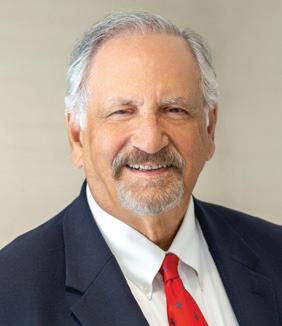
Mamat utilizes his more than 50 years of experience to help companies, contractors, employers, lawmakers, and trade associations resolve union matters. His expertise includes contract negotiations, elections, union avoidance, and labor arbitrations. He also advises clients on noncompete agreements, unfair labor practice litigation, harassment suits, wage and hour issues, OSHA-MIOSHA safety matters, and entertainment law. He is also a registered lobbyist.
In addition, Mamat’s experience includes the resolution of National Labor Relations Board matters, attempted union organization, mass picketing and violence, and secondary boycotts and pressure. His clients also rely on his counsel and advice on ERISA trust funds and related fiduciary liabilities.
Mamat received his undergraduate degree from the University of Rochester in 1971 and his law degree from Syracuse University College of Law in 1974.
Ihave to start this month’s article with an admission: I am the only male I know who regularly listens to e Mel Robbins Podcast. For those of you who are unfamiliar with this podcast (more likely to be males), it is one of the top 20 most-downloaded podcasts in the United States, focusing on self-improvement, neuroscience-based techniques, and expert interviews. e podcast is hosted by Mel Robbins, who is not only a Michigan native and attorney but also a bestselling author of multiple books, including e Five Second Rule, Stop Saying You’re Fine, e High 5 Habit, and, most recently, e Let em eory about emotional boundaries and self-control.
While walking my dogs recently, I listened to a podcast episode during which Mel interviewed Dr. Karl A. Pillemer from Cornell University. Dr. Pillemer is an expert gerontologist, sociologist, and professor who spent decades studying thousands of octogenarians, nonagenarians, and even centenarians. During these interviews, he asked his subjects about their biggest regrets and

The Oakland County Bar Foundation’s mission is to ensure access to justice and an understanding of the law in our community. It is dedicated to:
— Improving and facilitating the administration of justice in Oakland County and throughout the state of Michigan;
— Ensuring to the fullest extent possible that legal services are made available to all members of the public;
— Promoting legal research and the study of law as well as the diffusion of legal knowledge;
— Promoting the continuing legal education of lawyers and judges; and
— Educating the public as to their legal rights and obligations, and fostering and maintaining the honor and integrity of the legal profession.
If you know an organization that could use assistance to pursue these goals within Oakland County, please refer them to ocba.org/ocbfgrants, where they can find information about applying for a grant from the foundation.
By Andrew M. Harris
what they would tell their younger selves. As Dr. Pillemer identi ed during the episode, this age cohort is often wrongly overlooked. Whereas in past generations, older citizens were essential to survival, they are increasingly wrongfully dismissed as out of touch in a fast-paced, technologically driven society.
So many takeaways from Dr. Pillemer’s research remain in the front of my 48-year-old brain several weeks after the episode, including the following:
• “Life is short” is the furthest thing from a hollow cliché; it is stone-cold reality. erefore, middle-aged adults should not put things o for retirement or otherwise delay their happiness. If you want to do something, try to nd a way to do it now. In short, life cannot be deferred.
• True happiness isn’t usually the product of positive things happening to you or the avoidance of negative things. Instead, happiness is largely a choice — a decision to appreciate your relationships and what you enjoy rather than lament what you do not have or what did not come true.
• An overwhelming number of subjects regretted wasting so much time and energy worrying about things like “How will the children turn out?” “Will I get promoted?” “Will so and so be nice to me?” or “How long will I live?” Either the stressful worries never came to fruition or, when they did, they were dealt absent signi cant damage. Moreover, most of what we worry about is outside of our control, so why worry about what you cannot change?
• To promote marital harmony, don’t lament spousal interests that don’t come easily to you (examples cited were opera for men or fantasy football for women) but embrace them in an e ort to have more shared experiences.
• Unsolicited advice, especially to family, has a much higher chance of alienating someone than helping.
• As you age, optimize what you have over what you’ve lost. For example, if you used to be able to run a marathon and can now only nish a 5K, just celebrate that you are still running rather than wistfully looking at a photo of your marathon nish from years ago.
• When given the chance to have a new experience or pursue an opportunity, try at all costs to avoid nding an excuse to say “no.” Dr. Pillemer’s subjects regretted saying “no” far more than saying “yes” to something that did not pan out well.
• While making people whom you love happy is important, don’t make pleasing someone else your primary reason for doing anything.
• A humorous but useful piece of advice: Don’t ever get into an argument if you are hungry. ere were additional research ndings from Dr. Pillemer that made me think more about the work we do for the foundation. ey related to nding a deep purpose in your life’s work and acting with integrity (because your life’s narrative means so much more toward the end of the story). ere was regret surrounding the absence of investing in other people, and — shockingly from a statistical perspective, given how many were interviewed — nobody regretted not accumulating things or more money.
Why do these additional research ndings make me think of the foundation? Because it is nothing without its attorneys and other professionals who decide to devote their limited time and energy not to accumulating things but to nding a purpose and serving others (a hallmark of integrity). I think those of us involved with the foundation — like so many in Dr. Pillemer’s ndings — will look back when our careers are nished and admire most of what we did for others (not for ourselves), especially those whom the foundation seeks to help most directly: our brothers and sisters who need the protections of our legal system and who may otherwise be unable to receive its bene ts.
I’ll use my workday as an example: It started early with nal deposition preparation, a fourhour deposition over Zoom, a conference call on estate administration, interminable email tra c, and many other obligations (you all understand). e day, however, concluded with a foundation meeting, during which we discussed our recent Fellows Reception, reviewed our nances, and planned for the future — very busy professionals devoting time and e ort not to accumulating things for ourselves but to sustaining a foundation to support others.
Someone recently showed me a phone app that ages your appearance in seconds (yikes). e app, however, is without the wisdom from Dr. Pillemer’s study — in other words, your older face does not provide you with any sage advice on how to live your younger life. I suspect, however, that if it did, the old face would nod approvingly at those involved with the foundation.
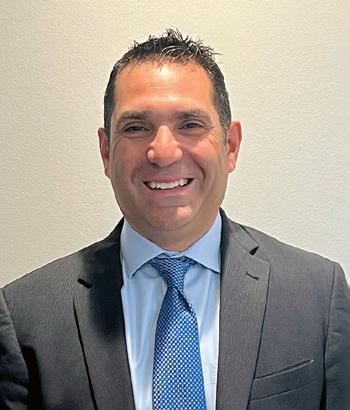
Andrew M. Harris is a shareholder with Maddin, Hauser, Roth & Heller P.C. in South eld, where his practice includes business litigation, commercial real estate, estate planning, probate work, and property tax services. Harris is also a licensed civil mediator. He lives in Birmingham (where he was once
e mission of the Oakland County Bar Association is to serve the professional needs of our members, enhance the justice system, and ensure the delivery of quality legal services to the public. We ful ll our mission through our 30 committees, regular networking events, and numerous educational programs for both OCBA members and the public. We work hand in hand with the OCBA volunteer board directors and members, and we partner closely with the courts. Below are recent examples of the OCBA at work in service to the bar and to the community.
On the evening of Saturday, January 17, the New Lawyers Committee organized an outing for OCBA members and guests to watch the Detroit Pistons take on the Indiana Pacers at Little Caesars Arena. e event combined networking with entertainment — o ering attendees a chance to build camaraderie while expanding their professional connections — and an exciting Pistons win. More than 70 people attended, enjoying the game from a reserved seating area. As a bonus on a snowy winter night, all participants received a complimentary Pistons winter hat.




e Professional Development Committee hosted a lunchtime Zoom seminar on January 14 that drew 58 attendees seeking practical guidance on courtroom procedure and litigation strategy. Designed for attorneys at all experience levels, the program focused on insights participants could immediately apply in their practices.
e panel featured Derek Howard of Doerr MacWilliams Howard PLLC; Victoria King, judicial sta attorney for the Sixth Judicial Circuit Court; and Christopher Smith, manager of the criminal/civil division for the Sixth Judicial Circuit Court. e speakers examined court rules, highlighted common pitfalls, and addressed recurring discovery challenges, o ering strategies to help attorneys avoid unnecessary disputes and delays.
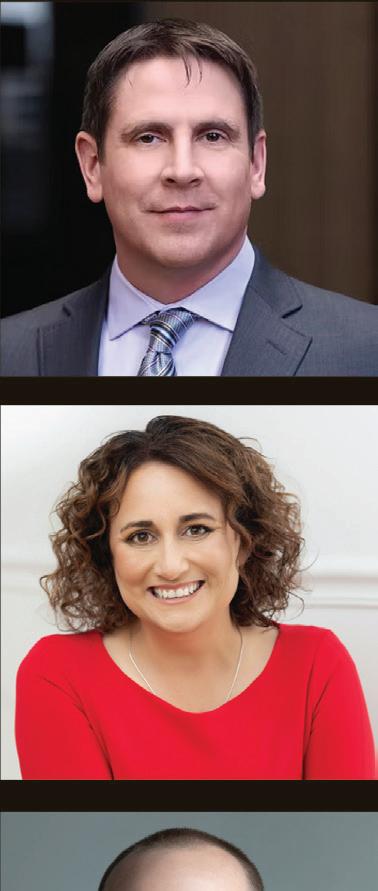

Despite challenging driving conditions, Team 3 of the OCBA’s chapter of the American Inns of Court had a fun time delivering a dynamic presentation at the January Inn of Court meeting. e team explored the topic “Big-Box Clients,” highlighting the unique demands of representing large corporate clients, including meticulous attention to detail, strong negotiation skills, and the ability to navigate complex internal approval processes.
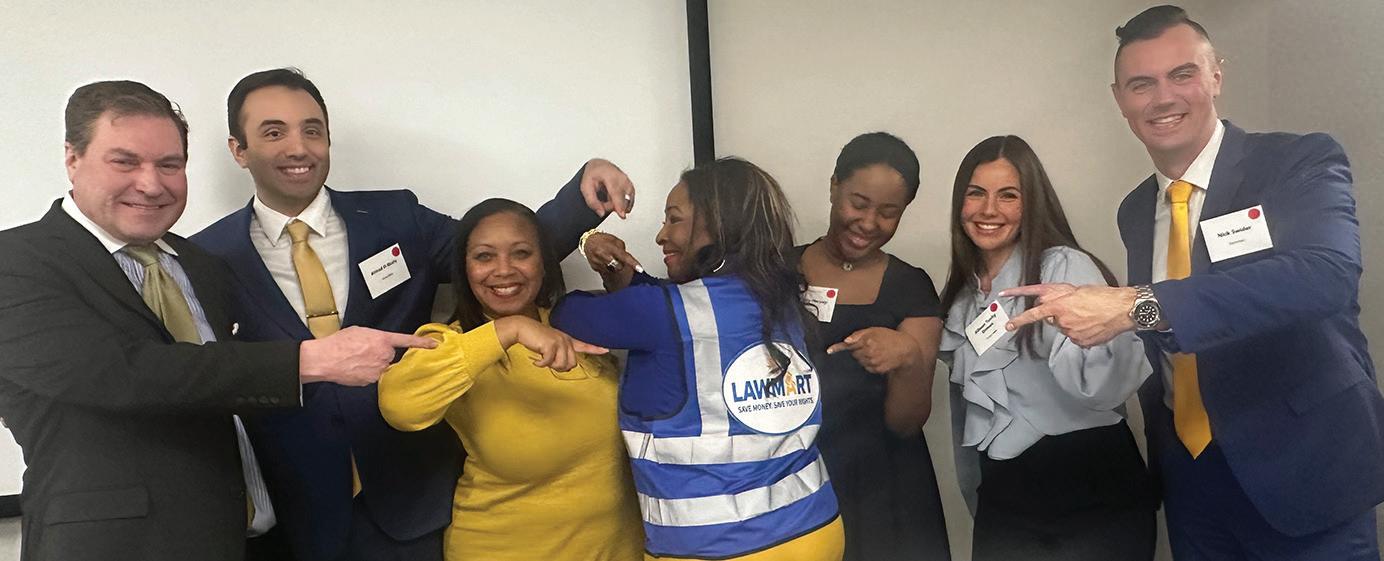

As a new attorney in 2017, I quickly learned that success in the legal eld requires more than just a deep understanding of case law, impeccable research skills, and skilled courtroom advocacy. e courtroom, after all, is a human institution, and a professional network of trusted colleagues and mentors is just as vital as legal knowledge. My experience with the Oakland County Bar Association — particularly at events organized by the New Lawyers Committee — has been instrumental in this realization.
e transition from the academic world of law school to the professional reality of practice was formidable. Suddenly, the theoretical problems of a moot court exercise were replaced by the very real stakes of my clients’ lives. e OCBA, however, o ered a lifeline: a community already navigating this world, ready to o er guidance and camaraderie.
Connecting with the OCBA’s New Lawyers Committee is an absolute must for attorneys starting their careers in Oakland County. is group understands the unique challenges we face — from learning Oakland County’s many local rules and nuances to building the relationships that become the foundation for developing a practice and a reputation — and provides targeted resources to ease that steep learning curve. But its most invaluable o ering is the structured opportunity to network outside of the highstress environment of litigation.
One event in particular stands out as a true cornerstone of my networking journey: the annual Meet the Judges reception. is is not merely a formality; it is a genuine, popular event designed to bridge the gap between the bar and the bench.
I remember walking into the event for the rst time in 2017 and feeling initially intimidated. e room was lled with experienced practitioners and some of the most respected judicial gures in Michigan, including judges from the Oakland County District, Probate, and Circuit courts, as well as the Michigan Court of Appeals, Michigan Supreme Court, U.S. Bankruptcy
By Jacob Simon
Court, and U.S. District Court for the Eastern District of Michigan.
e genius of the event, put on by the New Lawyers Committee, is its relaxed, social atmosphere. Over drinks and hors d’oeuvres, the opportunity to have an unscripted, human conversation with members of the judiciary, their sta , and colleagues is unparalleled. It demysti es the bench and allows new lawyers to understand the judicial perspective not just on law but on practice, professionalism, and courtroom civility. I was able to discuss my speci c practice area with seasoned judges and gain invaluable insight into their preferences for case presentation.
More than the legal insights, however, the sense of community resonates. e event shows that beneath the robes and suits, we are all part of the same professional community, striving for the fair and e cient administration of justice. e event also underscores the OCBA’s commitment to the community at large. e silent auction, which accompanies the reception, is a wonderful tradition, with proceeds supporting important causes: is year’s Meet the Judges event will sponsor Oakland County Foster Closet. is dual focus — professional development and civic responsibility — rea rms the kind of lawyer I aspire to be.
For a relatively new solo or small- rm attorney like me, a strong network is the lifeblood of my practice. It is not just about referrals; it’s about all the intangibles we receive from this organization:
• Mentorship and Counsel: My network provides a sounding board for complex ethical or procedural questions. When faced with a novel legal issue, I can save hours of research and prevent costly mistakes by calling a seasoned attorney.
• Reputation and Professionalism: Bar association events allow me to build my professional reputation on a foundation of competence and cordiality. When the opposing counsel knows me, the working
relationship is often smoother and more collegial, which ultimately bene ts my clients.
• Judicial Familiarity: Networking events like Meet the Judges o er you the chance to be a known, professional entity to the courts. While it certainly doesn’t guarantee a favorable outcome, showing up as a respectful, engaged member of the local bar is crucial to e ective advocacy.
• Collegial Support: e practice of law is demanding. Connecting with peers through the OCBA helps combat the isolation that can often plague new attorneys, providing a critical support structure for managing stress and celebrating success.
My experience with the OCBA’s New Lawyers Committee and its events, speci cally the Meet the Judges event, has been more than just a calendar entry; it has been a formative part of my early career. It transformed the abstract concept of “professionalism” into a practical, engaged relationship with the Oakland County legal community. To any new attorneys nding their footing, I o er this simple but profound advice: Your network is your greatest asset. Get involved with your local bar association, show up to events, and invest in the community — that investment will yield returns for the entirety of your legal career.
is year’s Meet the Judges event will take place on ursday, April 16, at 5:30 p.m. at the Birmingham Community House, and registration is available at ocba.org/meet-judges
Jacob Simon is a solo practitioner in Birmingham who focuses exclusively on family law. He also teaches family law at the Michigan State University College of Law, regularly contributes to the Institute of Continuing Legal Education, currently serves as chair of the OCBA New Lawyers Committee, and previously served as chair of the OCBA Family Court Committee.

















By Richard Lynch
Let the buyer beware. Sage advice regardless of the product or service one wishes to purchase. I suspect that many of my readers have enjoyed the experience of a client or prospective client’s guiding them through the use of ChatGPT, Esq., or Counselor Google. e annoyance one feels when a client questions their professional judgment with generalized statements, sometimes of questionable accuracy or authority, merits our attention as we consider the challenges confronted by language professionals.
Let’s be honest about language. We expect, rationally or otherwise, people to speak, read, and understand English in Michigan. Indeed, while the United States does not have an o cial language, Michigan courts do. MCR 1.109(D) (1)(a) mandates that documents submitted for ling in Michigan courts “must be legible and in the English language.” Given that more than 11% of Michigan residents age 5 and older speak a language other than, but perhaps including, English,1 the likelihood of encountering a person with limited English pro ciency (LEP) falls within the range of probability in most of our careers.
Practically, what does this mean? For sel sh reasons, I intend to limit the scope of this article to LEP interaction with the courts. MCR 1.111 establishes the procedural rules for the appointment and use of foreign language interpreters in Michigan courts.
Before we proceed, permit me to make a brief aside. I draw this distinction because the subject of interpreters for deaf, deaf blind, and hard-of-hearing (deaf) court users falls under MCL 393.501 et seq. Deaf participants in legal proceedings, including courts, should receive a Michigan Certi ed Interpreter at Standard Level 3.2 Depending upon the type of certi cation, the interpreter may need a legal endorsement with the certi cation. If you go to the Michigan Online Interpreter System, you can take a quick survey of the deaf interpreter resources available within the community.3 is will ensure that you retain a properly quali ed interpreter if the need arises.
As referenced above, for LEP individuals in court proceedings, MCR 1.111 governs the process. Let’s cover the basics of the rule. If your matter is in court, the court should make a nding of whether an interpreter is needed. is may begin with the request of a party or counsel. See MCR 1.111(B)(1).4 A simple way to initiate this process is with SCAO Form 81, Request and Order for Interpreter. When the court learns that a request has been made, it will appoint an interpreter. MCR 1.111(B)(3). If no request is made, the court may engage the individual to determine whether an interpreter is needed. Id. Ideally, a certi ed interpreter is available to facilitate communication. See MCR 1.111(F)(1). If not, the court may consider a quali ed interpreter, depending upon the gravity of the proceedings. Id. If neither a certi ed nor quali ed interpreter is available, and depending upon the gravity of the proceedings, the court may consider an interpreter after voir dire of the person’s ability to convey information to the LEP individual. MCR 1.111(F)(2).
Counsel should familiarize themselves with these requirements because of the limited availability of certi ed and quali ed interpreters in Michigan. Given that limited number, here are some thoughts to consider when you need to retain an interpreter for a non-court matter or the o ered interpreter is not certi ed. First, bilingualism is not enough! Does the pro ered interpreter possess the subject matter of English and the subject language to competently interpret communications between the two? is language specialization requires mastery of both languages and the nuances of dialect, subject matter, and culture.5 Does the pro ered interpreter have interpretation experience in a legal setting? Is the pro ered interpreter prepared for the type of hearing before the court? Is the interpreter familiar with the various forms of court interpreting: sight translation, consecutive interpreting, and simultaneous interpreting?6 Is the interpreter familiar with and does the person agree to abide by the Michigan Code of Professional Responsibility for Court Interpreters?7 By asking these
questions, one increases the likelihood that a competent language professional will provide the interpretation services, thereby enhancing the likelihood of e ective communication.
By the time this article appears, it is possible that the Michigan Supreme Court will have acted on ADM File No. 2025-03, Proposed Amendment of Rule 1.111 of the Michigan Court Rules.8 e comment period expired on March 1. If adopted, the rule will eliminate the provision permitting courts to seek reimbursement for the cost of interpretation from those LEP individuals who possess the ability to pay. Speci cally, the proposed language in MCR 1.111(F)(4) reads, “Interpretation costs are at no charge to the individual receiving the services, and reimbursement to the court is prohibited.” e rule currently permits courts to order reimbursement in civil cases, if a party is found nancially able to contribute to part or all of the cost of services. MCR 1.111(F)(5).
So how does caveat emptor come into play with this article? I mentioned at the start the irritation or frustration that many of us have encountered with individuals who use the internet or, perhaps, a friend or some other resource to help guide counsel in their representation of the client in a legal matter or case. Now imagine that the interpreter retained for your client lacks the skills of a certi ed professional but is the equivalent of an arti cial intelligence interpretation, complete with likelihood of hallucinations and the need to produce an answer regardless of its accuracy. Or perhaps the interpreter possesses a fundamental understanding of both English and the subject language but lacks the expertise, experience, and training to e ectively interpret the nuances of a complex business transaction involving the transfer of intellectual property. Would you feel professionally competent in the legal advice that you provided to this LEP client or the information obtained from the LEP witness? Compounding this challenge is the likelihood that counsel falls within the 88.9% of Michiganders age 5 or above that speak only English and, as a consequence, is unlikely to
verify the accuracy of the language interpretation or, as a result, the understanding of the LEP individual.
With this in mind, one needs to evaluate the needs of the LEP individual and work to obtain a certi ed interpreter. What do I mean here? ink about your own career. Odds are you are a college graduate. You completed a three-to-fouryear course of study at an accredited law school. You passed one or more bar exams. You engage in professional development in your practice area(s). Even with these accomplishments, I suspect that you recognize your practice limits and, in line with the Michigan Rules of Professional Conduct, only accept les or cases you are professionally competent to handle. is is not the case with all language interpretation. e State Court Administrative O ce (SCAO) publishes a resource for certi ed and quali ed interpreters on its webpage.9 If you review the page, you will notice several things. First, the small number of certi ed and quali ed interpreters on the lists. Second, the fact
that several certi ed and quali ed interpreters reside outside of Michigan. ird, while the listed court interpreter rms on the website may have competent interpreters, if you reach out to an agency, you are not guaranteed to receive a certi ed interpreter. Instead, before retaining an interpreter from an agency, you should con rm whether the interpreter is certi ed by SCAO or at least quali ed to interpret the issues involved in the speci c legal matter.
As I said at the start of this article, caveat emptor
Richard Lynch is the court administrator for the Oakland County Circuit Court.
Footnotes:
1. data.census.gov/table?q=Michigan+languages, last accessed January 25, 2026.
2. Michigan Certified Interpreters Minimum Standard Levels, michigan.gov/lara/-/media/Project/Websites/ lara/bchs/QI/new-QI/Website-updates/CertifiedInterpreter-Minimum-Standards-Chart-BCHS-QI. pdf?rev=1873a108899d445984c3e8edd1f379bb&h
ash=4567B2C0525346B1C113D7A2642DD347, last accessed January 25, 2026.
3. MOIS, apps.lara.state.mi.us/InterpreterSearch, last accessed January 25, 2026.
4. Please note that the appointment of an interpreter is not limited to a party or a witness. See MCR 1.111(B) (2).
5. See American Translators Association article, “Am I Ready for the Exam?”; atanet.org/certification-exam/ am-i-ready-for-the-exam, last accessed January 27, 2026.
6. SCAO offers a useful document addressing the skills needed to be a good interpreter: courts.michigan. gov/49f6c9/siteassets/court-administration/accesstemporary/foreign-language/courtinterpreterqualifications.pdf, last accessed January 27, 2026.
7. courts.michigan.gov/4a3ef5/siteassets/court-administration/access-temporary/foreign-language/codeofprofessionalconduct.pdf, last accessed January 27, 2026.
8. courts.michigan.gov/4ad943/siteassets/rules-instructions-administrative-orders/proposed-and-recently-adopted-orders-on-admin-matters/proposed-orders/2025-03_2025-11-26_formor_propamdmcr1.111. pdf, last accessed January 25, 2026.
9. courts.michigan.gov/resources-for/judges-court-staff/ interpreters, last accessed January 25, 2026.
Cunningham
Poles
Ronayne KrauseVisiting Judge Cunningham
Ronayne KrauseVisiting Judge
2024-210872-NI
Megan Hickcox v. Varad
Kamble
2024-287870-FH
People v. Breen
2024-288108-FC
People v. Rouser*
2024-290002-FC
People v. McDonald*
202-294493-FC
People v. Clark
2025-293456-FH
People v. Massey
2024-209103-NI
Hayvin Bolton v. Christopher Wright
2023-283209-FC
People v. Amerson
2024-290567-FH
People v. Johnson
2025-292552-FH
People v. Banas
2025-293311-FH
People v. Galloway Jr.
2023-198743-NO
Patrick Underwood v. Oakland Physicians Med
2024-291676-FH
People v. Haley
2024-208019-NO
Corinne MacNeill v. Clawson City
2025-292058-FH
People v. Jackson
Stuart Fraser V Jeffrey Smythe
Andrea Ajlouni
Meagan Stamell
Devon Schulz
Andrea Ajlouni
Patrick Nyenhuis
Devon Schulz
Andrea Ajlouni
Neil Rockind
Robert Novy
Andrew Mikos
Nichole Smithson
Darcey Jacobs
Romi Mezy
Matthew Koss
Parisa Gold
Christopher George
Lindsay Abramson
Endrit Topalli
Edward Martell
Endrit Topalli
Kayla Miller
David Hutson
Cameron Bell
Ali Koussan
Michelle Czapski
Alec D'Annunzio
Patrick Nyenhuis
Alexander Waldman
Renis Nushaj
Lydia Mikail
Jordan Zuppke
Personal Injury/Auto Negligence
Ct. 1 Homicide - Murder 1st Degree Premed., Cts. 2, 4, 6, 8, 10 Weapons FF, Cts. 3, 5, 7, 9 AWIM
Ct. 1 Homicide - Murder 1st Degree Premed. Juvenile Dft, Cts. 2, 4, 6, 8, 10 Weapons FF, Cts. 3, 5, 7, 9 AWIM
Homicide - Murder 2nd Degree
Common Law OffenseMisconduct in Office
Personal Injury/Auto Negligence
Guilty of the Lesser Offense of Voluntary Manslaughter No Cause
Home Invasion 1st Degree, Police Officer Aslt/Res/ Obst
Other Personal Injury
Other Personal Injury

Executive Director
Jennifer Quick (jquick@ocba.org)
Deputy Director
Katie Tillinger (ktillinger@ocba.org)
Finance Director
Susan Maczko (smaczko@ocba.org)
Programs Manager
Cristin Doble (cdoble@ocba.org)
Court and Public Services Manager
Janise Thies (jthies@ocba.org)
Marketing Communications Specialist
MB Cairns (mcairns@ocba.org)
Marketing Associate
Alexa Enders (aenders@ocba.org)
Bookkeeper
Mayly McRae (mmcrae@ocba.org)
Laches and Foundation Administrator
Lori Dec (ldec@ocba.org)
Court and Public Services Administrator
Melak Mardo (mmardo@ocba.org)
Unless otherwise indicated, please call (248) 334-3400 for assistance.
Address Changes
Billing
Board of Directors ....................................................
Mayly McRae
Mayly McRae
Jennifer Quick
Case Evaluator Applications .........................................
Committees
District Court Case Evaluation
Event Photos
Finance
Inns of Court
Judicial Candidate Fora
Laches Magazine
Lawyer Referral Service – (248) 338-2100
Member Illness & Death Notification
Membership
New Lawyer Admissions
News Releases
Oakland County Bar Foundation
OCBA Mediation Service
OCBA Policies
Pro Bono Mentor Match Program
Professional Development/CLE
Room Rental Reservations
Speakers Bureau
Janise Thies
Katie Tillinger
Janise Thies
MB Cairns
Susan Maczko
Cristin Doble
Janise Thies
Jennifer Quick
Melak Mardo
Katie Tillinger
Katie Tillinger
Katie Tillinger
MB Cairns
Katie Tillinger
Janise Thies
Jennifer Quick
Janise Thies
Cristin Doble
Mayly McRae
Janise Thies
Volunteer Opportunities ...............................................
Janise Thies
Website ....................................................................
Jennifer Quick

Lippitt O’Keefe, PLLC has private o ce space available for lease within its professional suite.
Rent includes dedicated receptionist to greet clients and manage calls, full access to multiple furnished conference rooms for client meetings and presentations, o ce supplies and a professional environment in a prime Birmingham location.
This space o ers the benefits of a fully equipped o ce without the burden of managing overhead.
For additional information or to schedule a tour, please contact Vanessa Kari at tel: 248-646-8292 or email: vkari@lippittokeefe.com
Sumeet K. Aggarwal
Valene Ayar
Lara L. Caschera
Steffani Chocron
Rebecca M. Decoster
Teodor Dhespollari
Elizabeth Donoghue
Arnold Finkelstein
Breanne Gilliam
Dr. Regina C. Goshorn
Caroline A. Grech
Andre Hage
Michael J. Hamblin
Jasmyn Anise Hester
Nicolette Paige Hysni
Tracey Kane
Rebecca A. Kelley
Sandy Kollinger
Carly Kolo
Mark Andrew Laws
Adam LeRoy
Jody B. Lipton
Kevin C. Majewski
Kelly Erin O’Donnell
Thomas Pascaris
Hon. Lita Masini Popke (Ret.)
Marcileen Catherine Pruitt
Krista Ranta
Kim Rattet
Patricia C. Schabath
Jacob Schwarzberg
Charles R. Shaw
Kelly Ann Sheehy
Gregory Ray Sheena
Kennedy F. Simerau
Fadi F. Toma
Bruce L. Townley
Nicholas Gregory Waelchli
Avraham Weiss
Jason Q. Wilson
Matt W. Zeigler
On Thursday, February 12, the OCBA Membership Committee hosted an evening of networking and Mexican cuisine at MEX in Bloomfield Hills. The well-attended event drew more than 45 members for a lively opportunity to connect with colleagues and strengthen professional relationships.
Attendees enjoyed a festive atmosphere while mingling and building connections, making the gathering a standout networking opportunity. The event was sponsored by Bank of Ann Arbor.