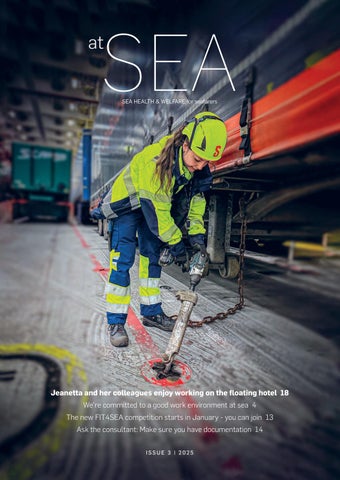
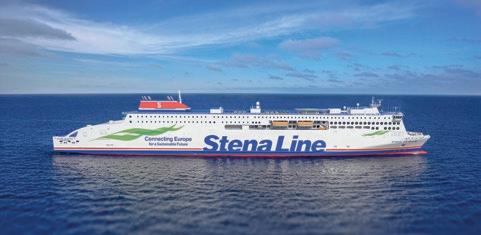
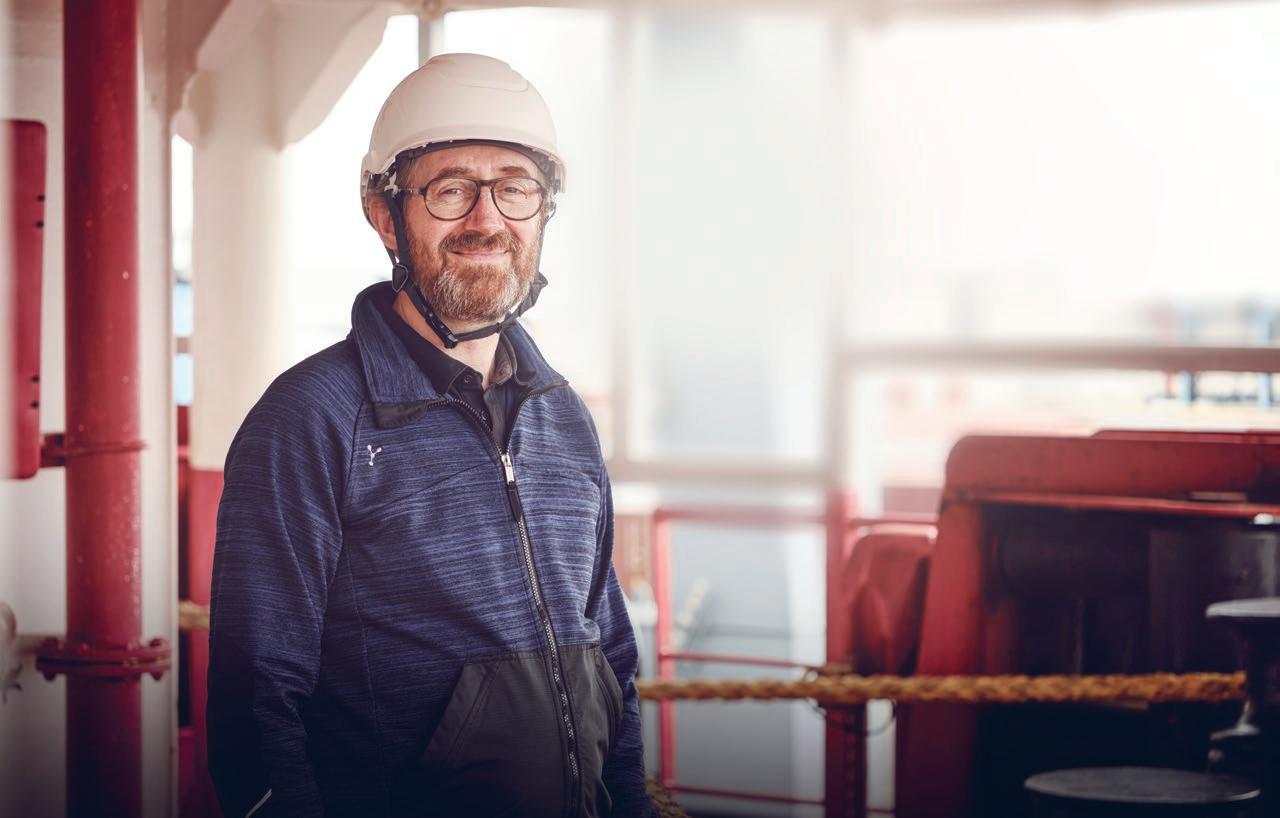
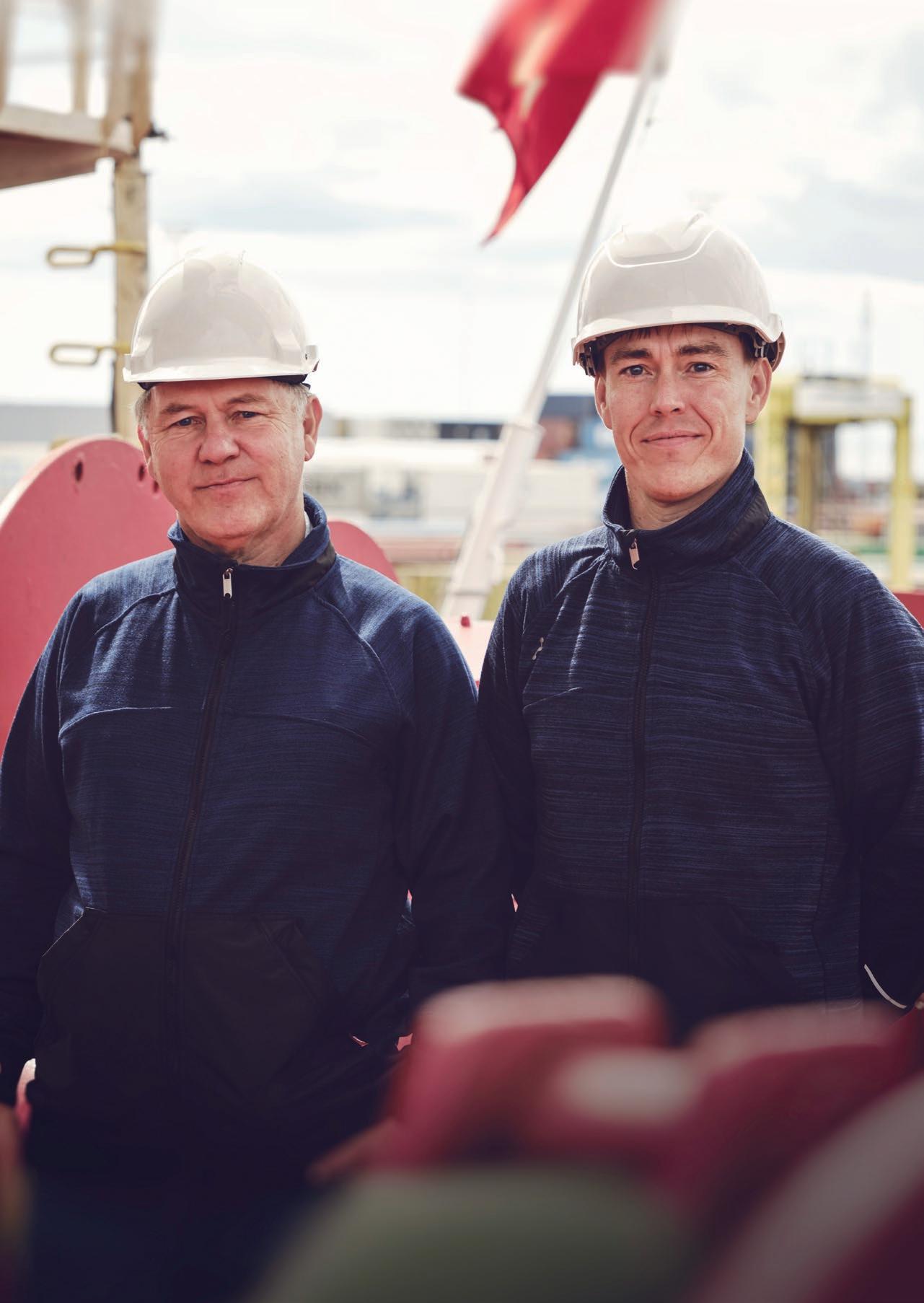
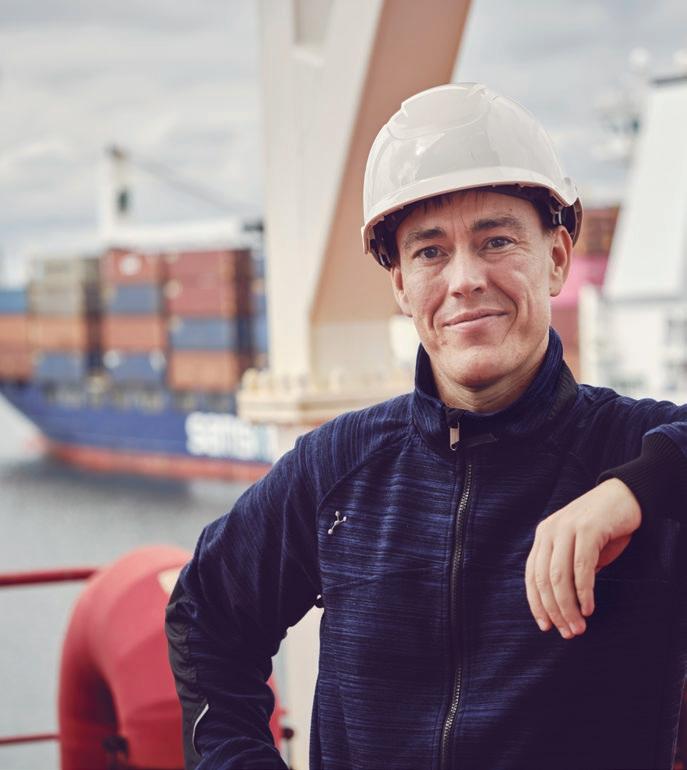
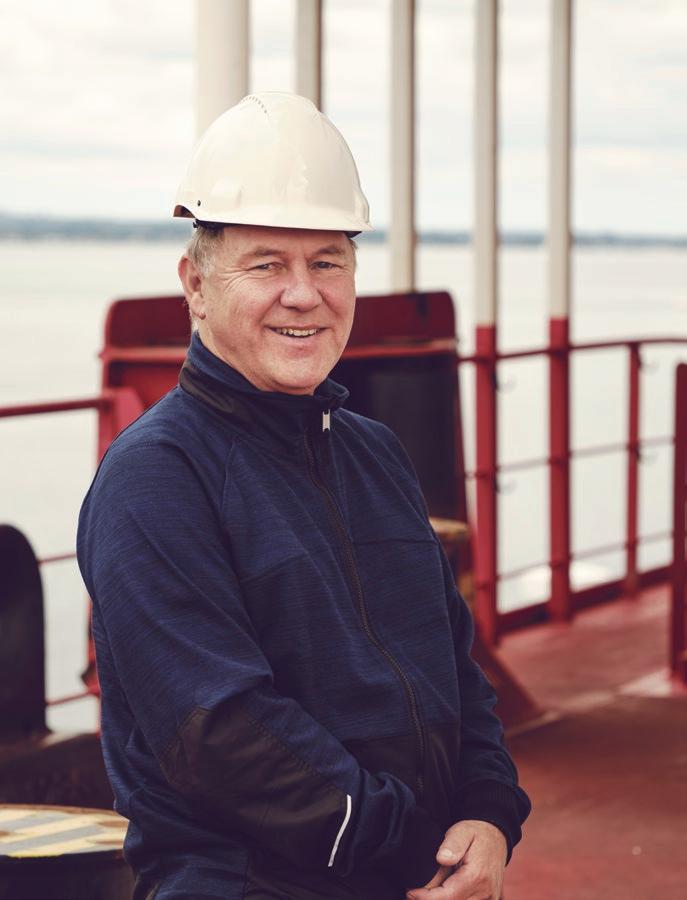
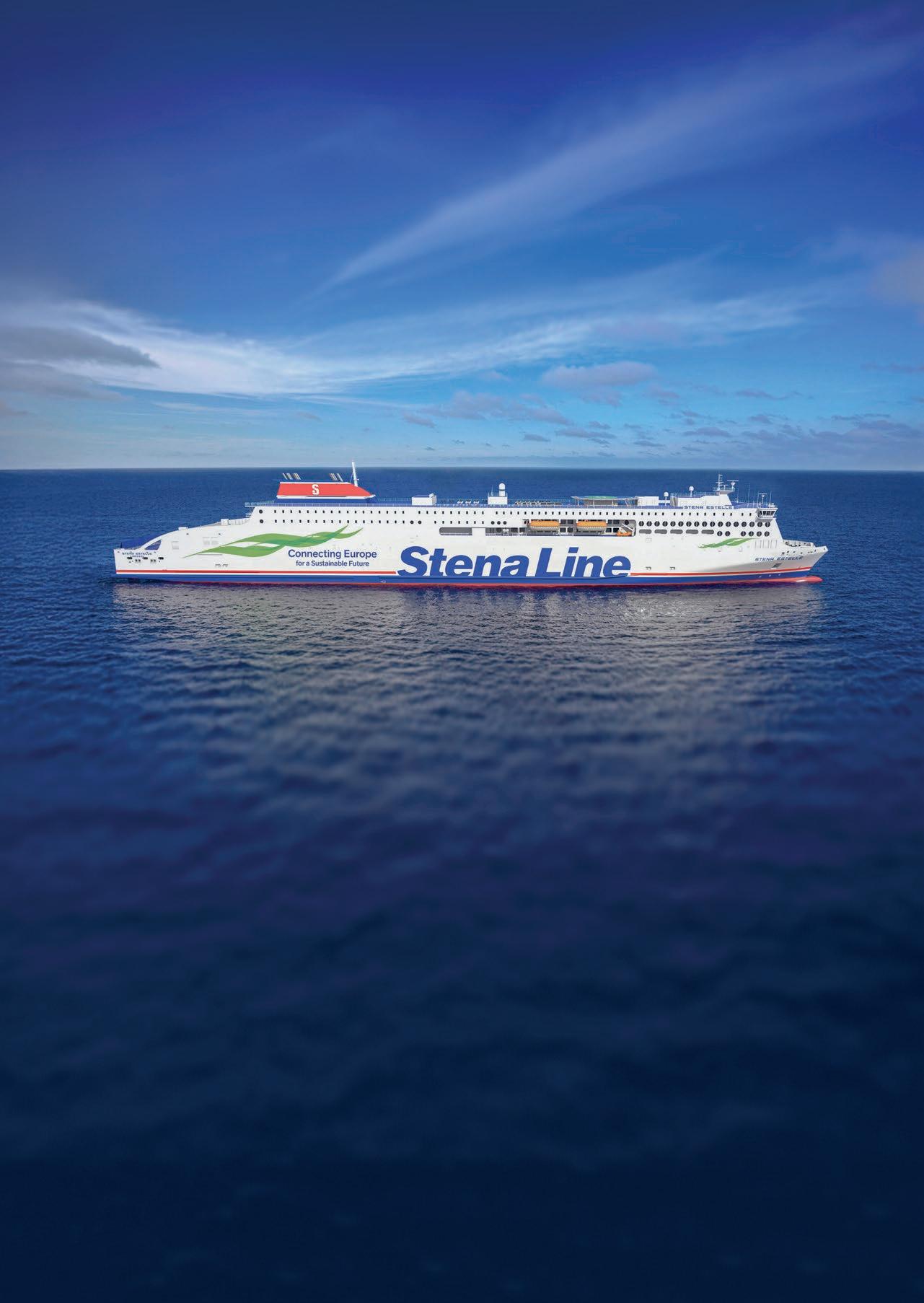
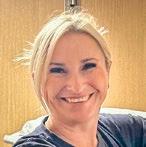
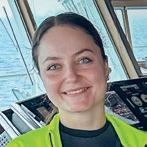
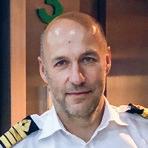
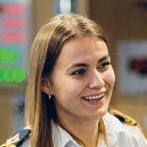
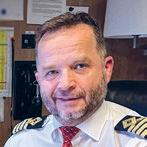
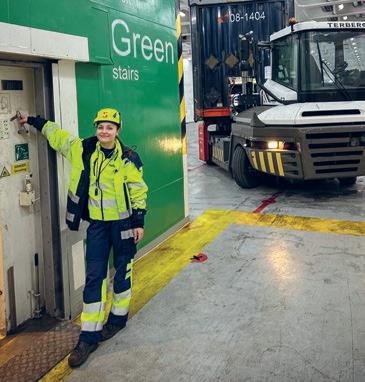
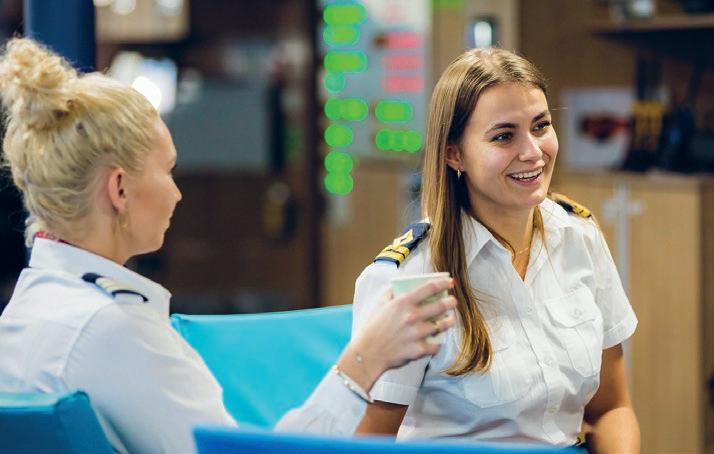
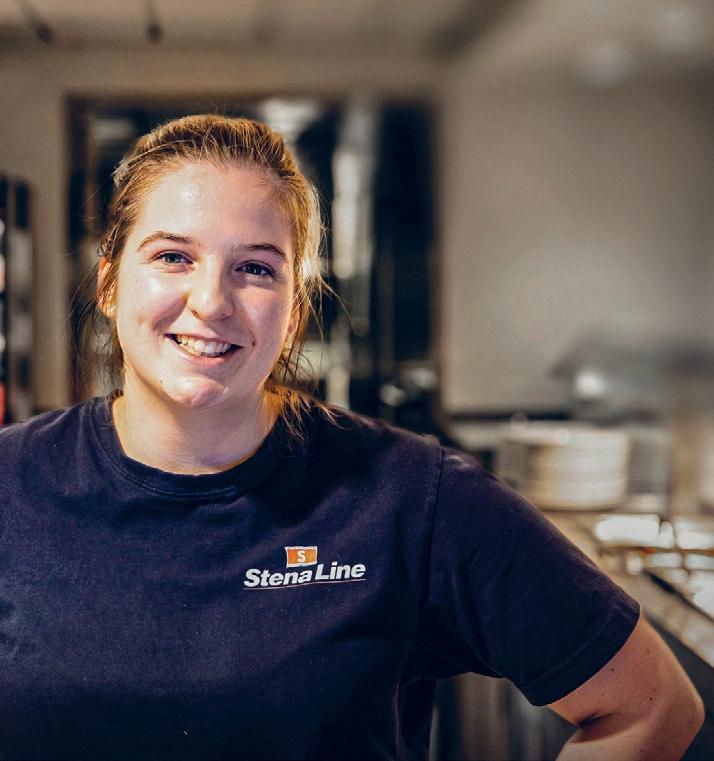
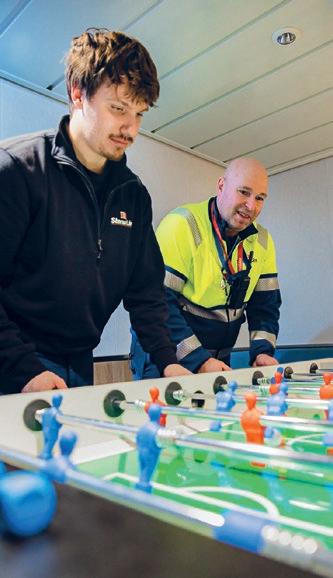
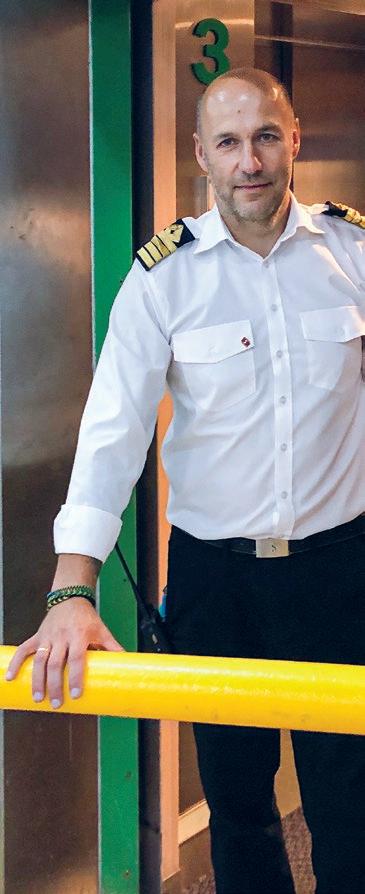
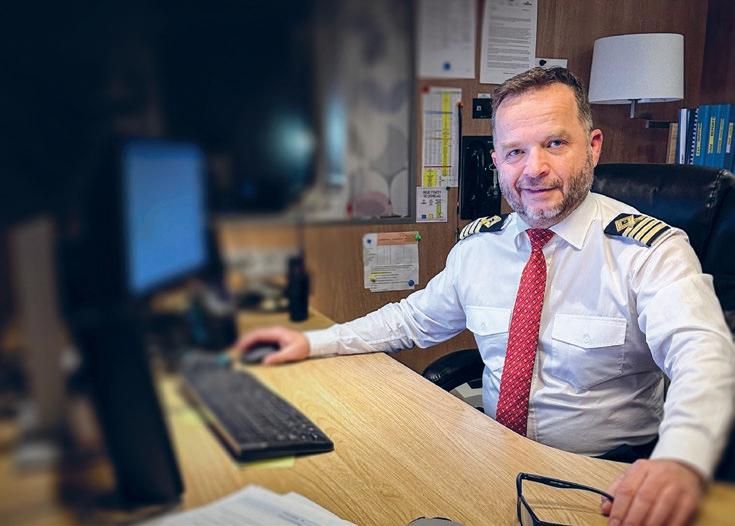
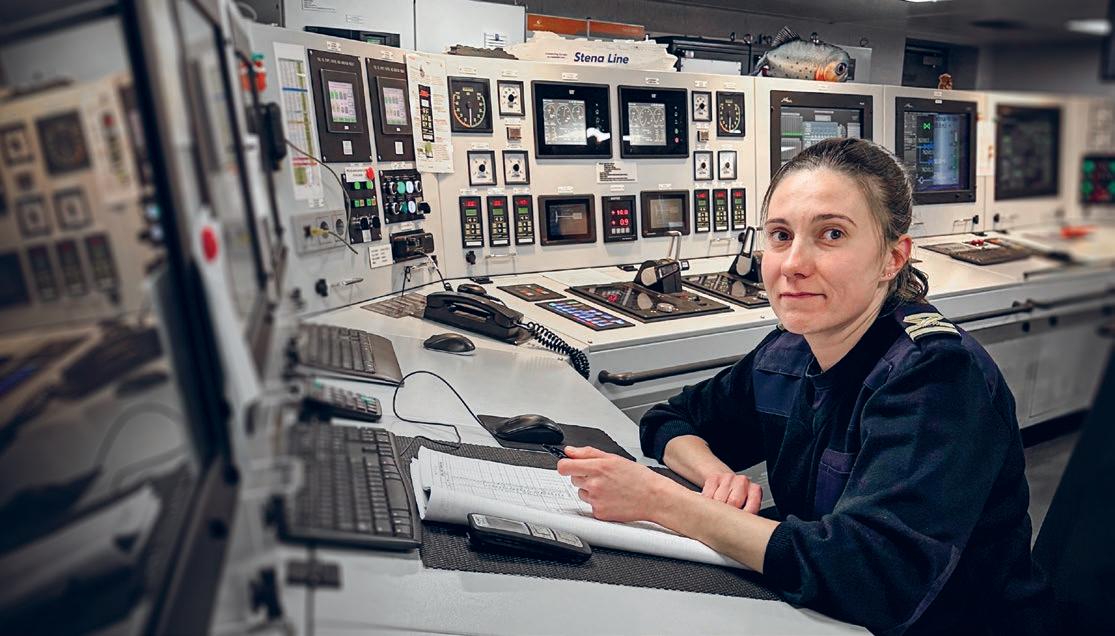
Jeanetta and her colleagues enjoy working on the floating hotel 18
We’re committed to a good work environment at sea 4
The new FIT4SEA competition starts in January - you can join 13
Ask the consultant: Make sure you have documentation 14
Højnæsvej 56
2610 Rødovre, Denmark
Editor in chief
René Andersen
Executive editors
Jacob Christensen
Torsten Mathias Augustsen
Contact Troels Leth, tle@shw.dk / +45 2469 3081
Authors Kirstine Thye Skovhøj, Pernille Nordstrand Sass-Nielsen, Rolf J. Trap, Ester Ørum, Irene Olsen and Troels Leth
Design and Graphic Production
Kailow A/S, CSR & Environmental & OHS certified
Print run 3.000
Published three times a
Subscribe/unsubscribe: tle@shw.dk
Front cover: Crew Member, STENA
A SHARED DIRECTION TOWARD GREATER WELL-BEING:
New Initiative to Strengthen the Psychological Work Environment at Sea
The Danish Maritime Work Environment Inspection has initiated a new, central task: conducting targeted work environment assessments on board Danish-flagged ships, with a specific focus on the psychosocial work environment.
By Kirstine Thye Skovhøj, journalist
Every day, on Danish-flagged ships, safety meetings are held, equipment is checked, and safe work procedures are documented. Physical safety is a given. However, how crew members speak to and about one another, how they collaborate, and how they thrive within a hierarchical system play an equally important role in ensuring a good work life at sea — and have become an increasing focus area for the entire maritime industry.
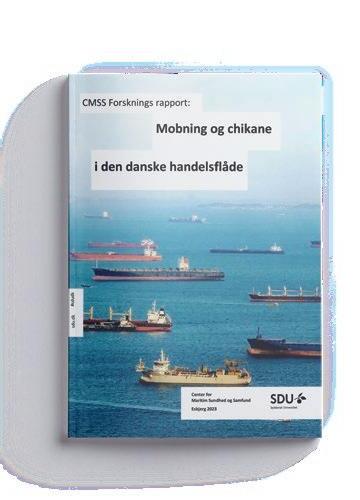
This became abundantly clear in 2023, when a study from the University of Southern Denmark documented that one in six seafarers had experienced bullying and one in ten had experienced harassment.
The study also showed that young seafarers and those with short seniority were particularly vulnerable, and that the problems were often linked to the industry's specific conditions — the strong hierarchy, the gender imbalance, and the international context where different cultures and norms meet.
At SEA HEALTH & WELFARE (SHW), dialogue with the industry about the psychological work environment had begun as early as 2016. At that time, it became clear that more knowledge and concrete guides and tools were needed — tools the shipping companies could use in practice. SHW therefore started building expertise and developed, among
other things, a Mental Health Toolbox — a collection of guidance materials on mental well-being that has been in use since 2018 and is continuously updated.
Although SHW has been addressing psychological work environment issues for several years, the effort is now becoming more formalized and systematic.
This is explained by Head of Department at SHW, Mathias Augustsen:
“The results of the 2023 report were expected, but it has given the industry a shared language for what we need to change. It confirmed that there are systematic patterns we must address: harassment that often follows the rank structure, where superiors harass subordinates, and bullying, which typically occurs among peers. This is exactly the kind of behavior we need to prevent and address. We can now work even more purposefully on this in collaboration with shipping companies and seafarers.”
From knowledge to action
Shortly after the report’s publication in 2023, the Minister for Industry, Business and Financial Affairs, Morten Bødskov, asked the Danish Maritime Authority and partners in the maritime sector to propose measures to prevent and address bullying
"It is not only about solving problems but about building a shared culture where wellbeing and safety go hand in hand — for the benefit of maritime workers everywhere, in Denmark as well as internationally,” says Mathias Augustsen
and harassment on Danish-flagged ships. The aim was to create a unified industry effort toward a safe and respectful work environment at sea.
The result was eight specific measures, published by the Ministry of Industry, Business and Financial Affairs at the end of 2024, the outcome of extensive dialogue between the Danish Maritime Authority and maritime sector partners.
One of the new measures reads as follows — and is an initiative handled by the Danish Maritime Work Environment Inspection, a counselling unit under SHW that helps shipping companies and seafarers prevent and improve work environment issues: “The Danish Maritime Work Environment Inspection will actively support the industry’s efforts, including through a work environment consultant with relevant experience in the psychological work environment.”
With this new measure, the Work Environment Inspection gains a clearer and more proactive role in addressing the psychological work environment at sea:
“It is new for us to work so directly and proactively with the psychological work environment. We have always focused on prevention and counselling, but now we must increasingly engage with ships,” explains Mathias Augustsen.
The work is carried out in close cooperation with shipping companies, and the intention is that all Danish-flagged ships should receive a visit. This enables the collection of knowledge and the taking of measurements on psychological well-being, in addition to providing ships with guidance on how to strengthen the psychological work environment.
Continued on page 6
Head of Section at SEA HEALTH & WELFARE, Mathias Augustsen, emphasizes that SHW and the Danish Maritime Work Environment Inspection are not an authority, but an advisory body: "We come on board with a dialogue-creating approach. We speak with management, the safety organization, and the crew to get an overall picture of daily life on board." Photo: Michael Berg
A closed loop creates trust and honesty
When a ship is selected for a work environment assessment, the Danish Maritime Work Environment Inspection contacts the shipping company to arrange a meeting.
The process is always planned together with the individual company. The Work Environment Inspection presents the task and agrees on how the visit can be conducted most effectively in relation to the ship’s operations.
The purpose is not control, but dialogue: to gain insight into how the crew perceives the work environment and to provide concrete recommendations for prevention and well-being.
Mathias Augustsen emphasizes that SHW and the Work Environment Inspection are not an authority, but an advisory body:
“We come on board with a dialogue-driven approach. We speak with management, the safety organization, and the crew to get an overall picture of daily life on board. When we leave the ship, we aim to have had a productive dialogue and to provide our assessment of the current situation, along
with suggestions on how they can strengthen the work environment and address the challenges. We also have an advisory department that can help companies move forward with new initiatives,” says Mathias Augustsen.
Trust and confidentiality are crucial for honest dialogue
At the core of the initiative is a new type of work environment assessment, where the Work Environment Inspection conducts interviews with the crew and assesses the work environment — particularly in relation to bullying, harassment, and sexual misconduct.
The collected answers are anonymized and converted into data that, over time, will provide a comprehensive and nuanced picture of the psychological work environment in the Danish-flagged merchant fleet — without identifying individual persons or ships.
The work is based on mutual trust and confidentiality. The information collected during a ship visit remains confidential and is shared only among the Work Environment Inspection, the ship, and the shipping company.
“It is crucial that everything takes place within a closed loop. That is the precondition for people to speak honestly,” says Mathias Augustsen.
The anonymized data will be used for both preventive initiatives and the annual report to the Danish Ships Inspection Council.
“Our goal is to provide an accurate picture of conditions across large and small shipping companies, large and small vessels. As our experience grows, the picture becomes more precise and nuanced. The better we understand the patterns, the better we can help companies work strategically with well-being and safety at sea,” he says.
What is the Danish Maritime Work Environment Inspection?
The Danish Maritime Work Environment Inspection is an advisory unit under SEA HEALTH & WELFARE, serving as a link between authorities, shipping companies, and seafarers.
The service was established to enhance the safety and health of seafarers on Danish-flagged ships and is grounded in Danish legislation.
The Danish Maritime Work Environment Inspection conducts, among other things, work environment assessments on board, focusing on both the physical and psychological aspects of the work environment. The service plays a central role in conducting these assessments, advising shipping companies, and supporting well-being and safety at sea.
As an advisory body, the service has no regulatory authority but helps shipping companies translate rules and knowledge into concrete practice at sea.
See more at amtj.dk
The core of the effort is a new type of Work Environment Assessment on board, where the Danish Maritime Work Environment Inspection conducts interviews with the crew and assesses the work environment—particularly in relation to bullying, harassment, and sexual misconduct.
Photo: Michael Berg
When someone needs help here and now
Even though the Work Environment Service works preventively and as an advisor, consultants may encounter seafarers in acute situations during a ship visit. In such cases, action is taken immediately.
If a seafarer reports experiences of bullying, harassment, or other serious incidents, the consultant and the individual assess together how the matter is best handled. SHW also has a confidential Helpline for Seafarers, where seafarers can speak anonymously with a counsellor or psychologist — independent of the shipping company and of the Work Environment Inspection’s other tasks.
“The most important thing is that no one is alone. When we are made aware of something serious, we take it seriously — and help the seafarer move forward in the
way that makes the most sense for their situation. We always make that assessment together with the person,” says Mathias Augustsen.
A
Danish contribution to a global movement
The work on the psychological work environment at sea does not stop at Danish waters. Internationally, the topic has also risen on the agenda. The International Maritime Organization (IMO), the UN agency that sets global standards for safety, the environment, and working conditions in maritime transport, has also put the psychological work environment on its radar.
IMO’s revision of the so-called STCW Convention (Standards of Training, Certification and Watchkeeping for Seafarers) places increased emphasis on the psychological work environment and seafarers’ mental well-being as part of maritime
Report on Bullying and Harassment on Danish Ships
In 2023, the University of Southern Denmark published a comprehensive report mapping the extent of bullying and harassment on Danish-flagged ships. The report was commissioned by the Danish Maritime Authority on behalf of the Ministry of Industry, Business and Financial Affairs.
The investigation showed that one in six seafarers had experienced bullying, and one in ten had experienced harassment. Young seafarers and those with short seniority were particularly vulnerable, and the problems are often linked to the sector’s hierarchical structure, gender balance, and cultural differences.
The results gave the industry a shared foundation for action. As a follow-up to the 2023 report, the Ministry of Industry, Business and Financial Affairs, the Danish Maritime Authority, and maritime partners presented eight initiatives in January 2024 to strengthen the psychological work environment at sea:
Eight initiatives for a safe work environment at sea
1. Campaign: A shared message that bullying and harassment are unacceptable.
2. Best practice scheme: Effective whistleblower systems and clear complaint procedures.
3. Strengthened Work Environment Inspection: The Danish Maritime Work Environment Inspection under SEA HEALTH & WELFARE supports the effort with expertise in the psychological work environment.
4. Focus on ferry operations: Prevention of harassment from passengers on municipal ferries.
5. Review: Revision of the rules for the psychological work environment at sea.
6. Education: Strengthened training in the psychological work environment and the prevention of bullying and harassment.
7. Stricter sanctions: Possibility of revoking the right to serve in cases of conviction for violence or similar offences.
safety culture. The STCW Convention is an international regulatory framework that sets minimum requirements for training, certification, and watchkeeping on ships worldwide.
For SHW, this increased focus on the psychological work environment at sea is a natural development — and a sign that both Danish and international efforts are moving in the same direction.
“At SHW, we see it as a tremendous strength that the entire industry stands together — authorities, shipping companies, and organizations working from a shared foundation. It is not only about solving problems but about building a shared culture where well-being and safety go hand in hand — for the benefit of maritime workers everywhere, in Denmark as well as internationally,” concludes Mathias Augustsen.
8. Enhanced oversight: Clearer frameworks for management and crewing companies.
Follow-up: The Danish Ships Inspection Council conducts an annual review of the effort and evaluates the effect of the eight initiatives. The Danish Maritime Work Environment Inspection prepares an annual report to provide an overall picture of the psychosocial work environment at sea.
Source: The Danish Maritime Authority, www.dma.dk
The Danish Maritime Work Environment Inspection takes the temperature on well-being at sea
When Claus Hassing and Peter K. Petersen from The Danish Maritime Work Environment Inspection board Danish-flagged ships in the coming years, the purpose is not control, but rather dialogue and support to promote well-being and mental health. The Work Environment Inspection has been tasked with conducting assessments of the psychological work environment, focusing on well-being and prevention, while collecting anonymized data to provide an overall picture of conditions at sea.
By Kirstine Thye Skovhøj, journalist
Are you getting enough sleep? Do you ever find yourself being talked about behind your back? Are there rumors about you or some of your colleagues?
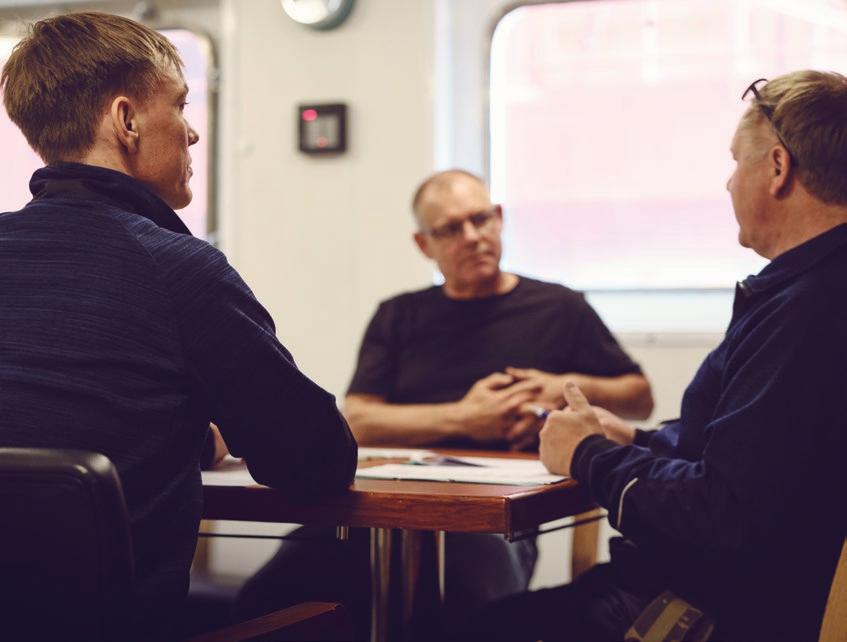
These are some of the questions that consultants from The Danish Maritime Work Environment Inspection ask when visiting a ship to conduct a Work Environment Assessment on board.
The task of assessing the psychological work environment on Danish-flagged ships is relatively new, although the Danish Maritime Work Environment Inspection, rooted in Danish legislation and operating under SEA HEALTH & WELFARE (SHW), has been addressing mental work environment issues for several years. The fact that the Work Environment Inspection will now visit all Danish-flagged ships to assess the psychological work environment is a new initiative that is already underway.
The initiative stems from a comprehensive 2023 report, launched by the Minister for Industry, Business, and Financial Affairs, which renewed political and industry-focused attention on the psychological work environment at sea. The study, conducted by the University of Southern Denmark, documented significant challenges to well-being across the Danish merchant fleet.
Based on the results, the Danish Maritime Authority and the maritime sector jointly developed eight specific initiatives aimed at strengthening prevention and creating a safe, respectful, and inclusive work environment on board. One of these initiatives is The Danish Maritime Work Environment Inspection’s new task of conducting systematic Work Environment Assessments on Danish-flagged ships and advising and guiding shipping companies on well-being and the psychological work environment.
In other words, the Danish Maritime Work Environment Inspection must directly assess the psychological work environment on ships and collect anonymized data. The goal is for the Work Environment Inspection’s two consultants to visit all Danish-flagged ships (approximately 600–700) to assess well-being and cooperation, and to support management, crew, and shipping companies in working towards the prevention of harass-
ment and bullying, as well as strengthening the psychological work environment in practice.
“The 2023 report is based on responses from around 3,500 seafarers – but almost 17,000 seafarers work in the Danish merchant fleet. Those are the ones we need to reach in the coming years and ask how they are doing. We will do this through interviews with everyone on board, from top to bottom.”
So says Claus Hassing, one of the two Occupational Health Consultants at SHW, who visit Danish-flagged ships when they are in port.
“We have been on board the first ships, but it is still very new. Before we can board a ship, a considerable amount of preparation is required. We are already in dialogue with many shipping companies, ships, and seafarers to plan and prepare ship visits,” says Claus Hassing, elaborating:
“We experience curiosity when we contact the shipping companies, and in some cases, we are also met with a certain degree of caution. The psychological work environment remains a relatively new focus area for many companies, and particularly for organizations with foreign management, which may be unclear about what a visit entails. There can be some nervousness at first, but once we explain that it is not about control, but about dialogue and prevention, tension quickly subsides.”
His colleague, Occupational Health Consultant Peter K. Petersen, also finds that shipping companies respond cooperatively when he reaches out:
“We emphasize very clearly that we are not an inspection checkpoint, but a partner. Once the purpose is clear, most shipping companies are pleased that attention is being directed towards well-being and the work environment on their ships.”
Thorough planning is required before a ship visit
A ship visit begins long before the consultants set foot on deck. The Work Environment Inspection contacts the shipping company, identifies which of its ships will call at port and when, agrees on a suitable time
that aligns with the ship’s operations, and clarifies who on board needs to be informed and contacted.
Once the visit has been scheduled, further information is sent out so that both management and the crew understand why the consultants are coming and how the process will unfold.
“We aim to share information at all levels on board, so no one is caught by surprise when we arrive. We plan the visit in close dialogue with the shipping company, so we respect their operations while also ensuring we have the necessary calm for the confidential conversations once we are on board,” explains Peter K. Petersen.
The shipping company is also requested to provide the latest safety meeting minutes, the company’s policy on the psychological work environment, and a crew list that includes rank and nationality. With this, the consultants can plan interviews so that they reflect the entire ship — officers and ratings, men and women, international and Danish seafarers.
“If we receive a crew list before boarding, it allows us to form a picture of whom we would like to speak with. It’s about getting a representative sample of the ship,” says Peter K. Petersen.
A ship visit loaded with questions
On the day of the visit, which typically lasts between two and four hours, the consultants always begin with a conversation with the captain and the ship’s management. Here, they outline the purpose and structure of the visit. After that, the occupational health consultants meet with the ship’s safety organization — typically a group of 4–6 people — to assess the level of cooperation, communication, and well-being on board.
This is done using a structured interview guide based on the questions from SDU’s report. The guide includes questions about cooperation, loneliness, bullying, harassment, conflict management, well-being, and whether seafarers are aware of the company’s policy on bullying and harassment.
Continued on page 6
This is followed by individual interviews with crew members, typically lasting 30–40 minutes. These also follow a specially developed question guide. The consultants ask about perceived support from management and the balance between work and rest. The conversations are always confidential and carried out with respect for differences in rank, nationality, and culture.
“We begin with some questions that are disarming and help build trust. It allows people to relax and leads to a more natural conversation. We may start with something less sensitive, such as sleep, company policy, or legislation, and then gradually become more specific about topics that can be difficult to talk about — such as loneliness, bullying, harassment, and violence,” explains Peter K. Petersen.
On a medium-sized ship, five to seven seafarers typically participate in individual interviews to provide a representative picture of life on board, while ensuring anonymity.
“We will never force anyone to talk about something they do not want to discuss. If a seafarer does not wish to answer a question, that is completely fine. We are there for the conversation — to gain an impression of what life is like for seafarers on board, not to pressure anyone,” Peter K. Petersen emphasizes.
Both consultants fully understand that some seafarers may feel uncertain or fear getting into trouble if they speak negatively about management or colleagues.
“That’s why our most important task is to build trust and ensure they fully understand that they participate anonymously. We meet them at eye level, and we find that they quickly open up and feel safe once they understand why we are there. It also helps when they realize we are seafarers ourselves and understand the realities they work in,” says Claus Hassing, adding:
“If we meet someone who clams up completely, it’s a sign that there may be an issue we need to identify. And if everyone on board refuses to talk, it would be natural to conclude that the company has a problem that needs attention.”
Cultural understanding builds trust Claus Hassing and Peter K. Petersen acknowledge that culture and nationality have a significant impact on the development of conversations. On Danish-flagged ships, seafarers from all over the world often work side by side. In some cultures and nationalities, speaking openly about personal or conflict-related issues may be uncomfortable or sensitive.
“We have experience with crew members from all over the world, so we are aware of many cultural differences. In some cultures, people do not talk openly about what is difficult. This is why trust and credibility are crucial for us in the Work Environment Inspection,” says Peter K. Petersen.
“What is crucial in such cases is trust and decisiveness. No one should stand alone. When we are made aware of something serious, we take it seriously — and help find the best solution here and now,” says Claus Hassing.
For the two occupational health consultants, the task is to ask questions in a way that suits the situation and the individual — and to create a space where everyone feels safe speaking openly, even about sensitive or taboo topics.
“For many seafarers, it is a relief to speak with someone from outside who understands life at sea and does not represent the shipping company. We can tell them that they don’t have to endure and accept poor well-being, only to return home completely drained. Improving mental well-being is worth the effort — and that is what we are committed to helping with. That reassures them,” says Claus Hassing.
When something requires immediate action
Although the Work Environment Inspection’s main role is to collect data and help shipping companies prevent poor well-being, the
consultants may also encounter seafarers in acute difficult situations. In those cases, they act immediately.
“If a seafarer reports bullying, harassment, or other serious incidents, we evaluate together how it should best be handled,” says Peter K. Petersen, emphasizing:
“We do everything we can to help the seafarer move forward — either by encouraging them to use the company’s own channels or through our confidential helpline, where they can speak anonymously with an occupational psychologist independent of the company.”
Depending on the situation, the ship’s management and the shipping company are also involved to ensure the matter is handled responsibly.
“What is crucial in such cases is trust and decisiveness. No one should stand alone. When we are made aware of something serious, we take it seriously — and help find the best solution here and now,” stresses Claus Hassing.
From dialogue to data and prevention
The information collected by the Work Environment Inspection during a ship visit is anonymized and treated confidentially. The data is used to create an overall picture of the psychological work environment across the Danish-flagged merchant fleet — without identifying individual people or ships.
“We register various data about the visit, including ship type, age groups, and whether we speak with an officer or a rating. The point is to identify patterns and trends — without compromising anonymity,” explains Peter K. Petersen.
The collected data is used both to advise individual shipping companies and in an annual report to the Danish Ships Inspection Council, which provides an overview of trends and developments in the field.
“We need to be able to see where things are going well and where action is needed. As we complete more visits, we hope to start identifying patterns — for example, in relation to ship types or manning — allowing us to target efforts more effectively for the benefit of seafarers and companies,” says Peter K. Petersen.
If specific issues arise during a visit that require attention from the shipping company, management, and the safety organization, they receive concrete recommendations and the option for follow-up sparring and guidance from the Work Environment Inspection.
“We are not an authority, but advisors. We exist to assist the ships — and we do so completely free of charge. So, it’s just a matter of making use of it. When we leave the ship, we provide management with something concrete to work on — and we are ready to assist further if they want us involved,” says Claus Hassing, adding:
“At SHW, we have, for instance, developed a dilemma board game that highlights the officers’ responsibility for well-being. A good psychological work environment ultimately comes down to relationships and leadership — not just procedures. That’s why we’re happy to help companies create dialogue and prevent conflicts before they grow.”
A collaboration that pays off For some shipping companies, a visit may be sensitive, but experience shows that any skepticism quickly fades.
“When they understand what we do, their shoulders drop. Prevention takes time, but accidents and poor well-being cost far more,” says Claus Hassing, continuing:
“For shipping companies, this effort is an investment that benefits both well-being and the bottom line. A well-functioning psychologically safe work environment means fewer conflicts, less stress, and better cooperation — leading to higher safety and efficiency. Prevention costs a little, but accidents and poor well-being cost much more. A good work environment doesn’t just create happier crews — it creates better ships.”
The two consultants expect that it will take several years to visit the approximately 700 Danish-flagged ships. Vessel operations, locations, and weather conditions make planning complex, but the work is already well underway. Along the way, the approach is adjusted and developed based on insights gained from the visits.
Position: Occupational Health Consultant. The Danish Maritime Work Environment Inspection.
Background: Trained as an able seaman. Peter began his career at sea at the age of 20 with ESVAGT, where he worked for eight years, advancing from ordinary seaman to boatswain. Later, he came ashore and worked as a customs officer for the Danish Customs Agency, where he inspected ships from around the world and gained in-depth knowledge of both international crews and various onboard work environment conditions.
Experience: Has worked with the work environment and safety throughout his entire career, from the deck to the regulatory level. He helped launch the new initiative on assessing the psychological work environment at sea. He developed the methods and procedures that the Work Environment Inspection now uses to conduct Work Environment Assessments on board.
Motivation: ”I find it meaningful to contribute to a safer and more respectful work life for seafarers. When you work on a ship, it’s like being on a small island — so it is crucial to have an environment where you can thrive and speak openly about what is difficult,” he says.
Continued on page 12
Profile: Peter K. Petersen
Photo: Michael Berg
Michael Berg
Profile: Claus Hassing
Position: Occupational Health Consultant. The Danish Maritime Work Environment Inspection.
Background: Trained navigator with more than 10 years of experience from the Danish Maritime Authority, as well as several years in private shipping companies. He has also lived and worked in Greenland for four years and currently teaches navigation to both young and adult seafarers.
Experience: Broad maritime experience combined with insight into regulations, safety, and the work environment. Employed at SEA HEALTH & WELFARE since May 2025, where he has helped develop the methods and tools used to assess the psychological work environment at sea.
Motivation: “I’m driven by a desire to make a tangible difference for seafarers and to create greater openness about mental well-being on board. It can be difficult to try something new, but you can actually make a difference. Ships perform better when onboard relationships work,” he says.
Get in Touch!
Need to contact the Danish Maritime Work Environment Inspection?
Read more at amtj.dk
You are also always welcome to contact Peter or Claus:
In 2023, a report from the University of Southern Denmark documented that one in six seafarers had experienced bullying and one in ten had experienced harassment.
The figures confirmed earlier studies from, among others, VIVE, showing that psychological strain, power imbalances, and destructive behavior have major consequences — both for individuals and for workplaces:
› Up to 200% more sick leave among those affected
• 25% lower performance and 45% fewer ideas among witnesses to bullying
• When employees feel included and psychologically safe, efficiency increases by 56%, engagement by 76%, and willingness to recommend the workplace by 167%
(Source: VIVE 2021 / CMSS 2023)
Photo:
GET IN SHAPE WITH FIT4 SEA
FIT4SEA is SEA HEALTH & WELFARE’s annual sports competition, where seafarers and vessels in the Danish merchant fleet compete to log the most kilometers and hours within a year across the disciplines of running, walking, cycling, cross-training, rowing, and weight training. You can participate in as many disciplines as you like. Both your training results on board and at home count towards the competition.
BENCHMARKS: Cycling: 500
km // Running: 250 km // Rowing: 250 km
Cross: 250 km // Walk: 250 km // Weight training: 25 hours
Prizes and extra recognition
When you hit one of the benchmarks above, the FIT4SEA platform lets us know – and we’ll proudly send you – via your shipping company – one of our popular FIT4SEA T-shirts as a well-deserved reward for your dedication. You can only win one T-shirt per year, regardless of how many disciplines you complete the benchmark in.
The three top-performing vessels in each discipline will also receive special prizes that help celebrate your teamwork and the impressive results you’ve achieved together throughout the year.
We send T-shirts and vessel prizes to your company, port agents, or a distribution center where you usually receive mail.
And once the FIT4SEA year comes to a close, we honor all participating seafarers and vessels on our social media channels and website.
How to get started
The FIT4SEA sports year runs from January 1st to December 31st — but you’re welcome to join whenever you’re ready.
To take part, you must be employed on a Danish-flagged vessel.
Create your profile with your vessel on the FIT4SEA website fit4sea.shw.dk and log your activities. You can follow your results throughout the year.
Remember to update the ship’s name Your at-home training is credited to the vessel you most recently served on.
If you move to a new vessel during the year, remember to update your profile.
Students are welcome to join FIT4SEA Students can now join FIT4SEA all year round — not only during internships at sea.
We’re excited to have you onboard! Simply sign up by selecting your school instead of a vessel. Students can also earn a FIT4SEA T-shirt by completing a benchmark.
Join us on Social Media
Share your training moments with us! Tag #shwsocial or #FIT4SEA on Instagram or Facebook, or send your photos to fit4sea@shw.dk.
We look forward to following your training - give it all you've got!
Photo: SHW
Photo: SHW
ASK THE CONSULTANT
Dear SHW
Last month, one of our ships on a long voyage was visited by the local authorities. They wanted to see documentation of the crew's instructions, training, and chemical education.
Unfortunately, we were not aware that we were required to document the crew's training and education. Can you advise us on how best to meet these documentation requirements? Is there an easy and straightforward way to do this?
Kind regards, Sigurd Gunnerson Dear Sigurd
There are various documentation requirements for training, instruction, and education, depending on which products you use on board.
Generally, for most chemical products, there is a requirement that the crew watch our chemical safety film, "Chemicals – Take Care of Yourself and Others," and the film "Less risk of cancer - It's not serious is it?," before working with chemicals. In addition, the supervisor is required to read the relevant chapters in the accompanying booklets. It is the supervisor's responsibility to provide detailed instructions to crew members who will be working with chemical products before they begin.
There is freedom of choice in terms of documenting that seafarers have watched the chemical film and read the material. We recommend that you ensure documentation, both in a physical document that you create yourself and electronically, with a signature. The overview can then be sent to the shipping company, which can note the training and education as completed in the personnel files.
Crew members who are to perform welding work on board must also watch the film "When welding on board." This must be documented accordingly.
Since 2023, there have been stricter requirements for crew members' training, instruction, and certification, which must be renewed every five years, when working with products containing epoxy and isocyanates. Please note that there is an extensive instruction regarding these products that must be completed. This must also be documented on board.
The documents for completed training, instruction, and education can be placed on the @SEA platform under e-publications in the local library, if you wish.
Please feel free to write again if you need more information.
Best regards,
Ester Ørum, arbejdsmiljøkonsulent, SHW
JOIN THE PHOTO COMPETITION AND WIN CASH PRIZES
Send us your best photos
The 2025 photo competition for seafarers will close at the New Year, so remember to send us your best photos before then! You can win great prizes worth up to DKK 5,000 – even as an amateur photographer.
If you don't manage to submit your photos in time to participate in the 2025 competition, you can participate in the 2026 photo competition. Either way, we would love to receive your best photos.
We will crown winners in four categories and designate one photo that stands out from the other winners:
- Photo of the Year (simply the best photo of the year)
• Nature (bad weather, sun and clouds, the sea, animals and birds)
• The Maritime Environment (the ship, the harbor, wind turbines, etc.)
• Life On Board (both leisure and work time).
The judges will also award a prize for one photo that stands out from all the others but is not one of the winning photos.
The competition is open to current seafarers of any nationality working on Danish-flagged vessels. You can submit up to 15 photos. The deadline for submission is December 31, 2025.
Read more about the competition rules and how to submit your photos on our website www.shw.dk under Welfare..
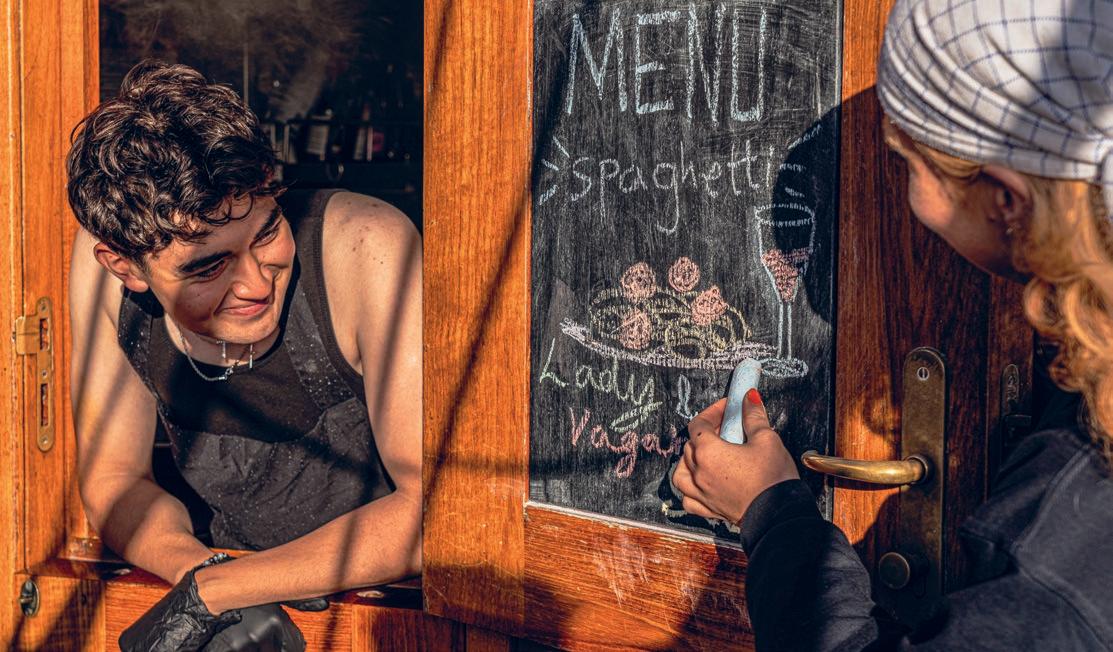
Picture of the Year/Life on Board. Photographer: Third Mate Frederic E.H. Vernersen, GEORG STAGE. Title: “Lady and the Tramp”
Nature. Photographer: Chief Engineer Rune Pedersen, MALERAQ ARCTICA Title: “The World at My Feet”
The maritime environment. Photographer: Chief steward Flemming Hemdorff, GEORG STAGE. Title: “The meeting”
The photo that stands out/The wild card. Title: “Cramped conditions”
Photographer: Second mate Esben Fræer, MALIK ARCTICA
Give your entire crew access to useful knowledge and inspiration
Today, more than 700 ships utilize the @SEA program to access the chemical database and safety data sheets, as well as to register and manage risk assessments. But the program offers much more than these features.
“That's why we encourage ship management on vessels licensed for the @SEA program to give all crew members read access to it. That way, the ship and the shipping company get much more out of the program,” says Rolf J. Trap, consultant at SEA HEALTH & WELFARE and administrator on the @SEA-@SHORE platform.
In addition to being able to search for information on risk assessments and chemical data related to their own tasks, the program also provides access to:
• A comprehensive library of guidelines and other relevant and useful documents in E-PUBLICATIONS
• Daily news from multiple countries through the DAYROOM module
• Recipes and inspiration for a healthy diet for the Chief Steward
• A wide range of other features with relevant and valuable information.
How to create reader access
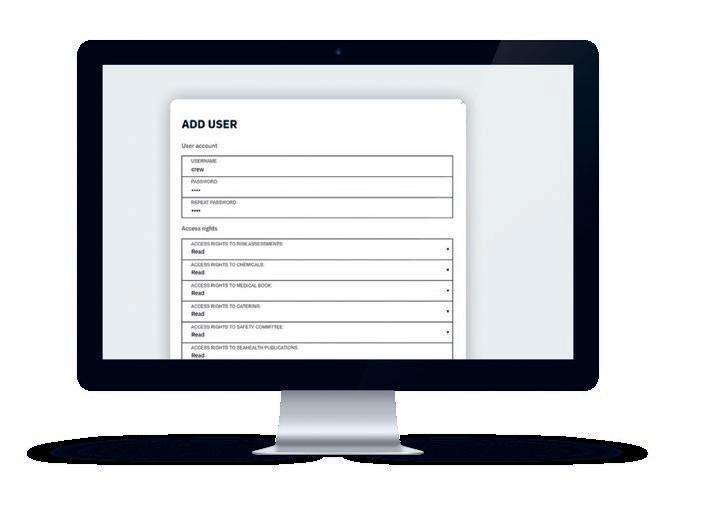
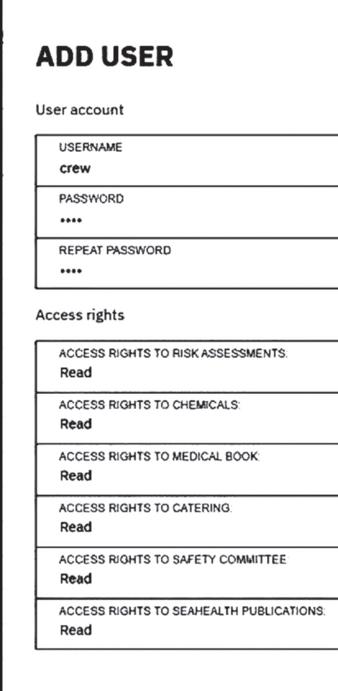
When creating user accounts, you can assign the USER role without write permissions. This is done via the dropdown menus at the bottom of the user creation page. So, as a supervisor, you don’t need to worry about any accidental and unauthorized changes to risk assessments or the chemical list.
Important:
Make sure that all modules are set to read to ensure access works as intended.
Hint:
To make things easier, you may also choose to create a shared login for the entire crew — for example, with the username “Crew”. See the form on this page.
To create a new user group use this form in @SEA. We suggest that you fill in the fields as shown in the image. Illustration: SHW
Do you have any questions?
Send a message to Rolf J. Trap: support@shw.dk Read more at shw.dk/seashore
Photo: Sisse Stroyer
24 HOURS ON THE FLOATING HOTEL
The crew of the roll-on/roll-off passenger ferry STENA ESTELLE is dedicated to ensuring that all guests have a safe, relaxed, and efficient journey between Sweden and Poland. SEA HEALTH & WELFARE followed the crew closely for 24 hours, providing an insight into their varied tasks and the small and large aspects of life at sea that impact their well-being on board.
By Troels Leth, SEA HEALTH & WELFARE.
The wind has died down, but darkness is thick and rainy as STENA ESTELLE docks in Karlskrona, Sweden, late one evening. The ROPAX ferry is a few hours late, but the crew and guests are not bothered by this. Trucks, trailers, and cars are loaded quickly and efficiently, and foot passengers settle in. Just like in a hotel on land, you are a guest on STENA ESTELLE, not a passenger.
The ROPAX ferry STENA ESTELLE was delivered in 2022 and put into service on the route between Sweden and Gdynia with two daily departures. A crossing takes 10.5 hours.
Crew members work two weeks at a time and have two weeks off. On the ferry, they typically work 12 hours a day, adhering to their regular routines. Despite the hustle and bustle, there is always time to greet colleagues and smile at guests on board. The guests include truck drivers, Eastern Europeans traveling to or from work in Scandinavia, and tourists embarking on new adventures.
During the winter months, around 80 seafarers work on the ferry – 32 of whom are women – and they are generally all from Poland. Here, a few of them talk about themselves and life at sea.
MEET STENA ESTELLE'S CREW MEMBERS
PAGE 20 – 27
FACTS
ROPAX FERRY BUILT IN 2022 / SHIPPING COMPANY: STENA LINE
Route: Karlskrona-Gdynia. Three Danish-flagged ferries serve the route.
Crew: 80-90
Passengers: 1.200 Cabins: 265
Length: 240 meter
Speed: 22 knob
Flag: Denmark
KARLSKRONA
GDYNIA
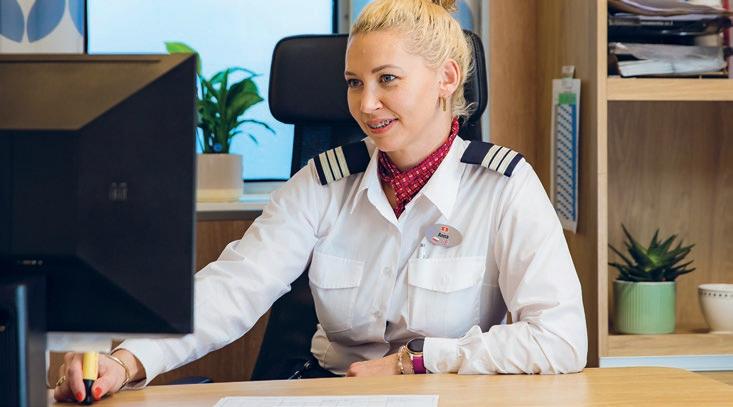
Anna – passionate about both employee well-being and guest satisfaction
As Assistant Service Manager, Anna is responsible for all passenger-related services and facilities during the crossing. Together with her manager and supervisors, she plans the work of the On-Board Service Assistants who prepare cabins and public areas between voyages. She also handles hotel department administration, budgeting and finance from the office side.
The role demands excellent overview, flexibility and in-depth operational knowledge – all qualities Anna has developed over nearly 16 years with the company. She is modest and always stresses that teamwork has been the foundation of her career, which began at the age of 19 with a summer job on a ferry between England and the Netherlands.
“I settled in very quickly. At home, I had learned to clean, help out, and take care of each other – and the people I worked with shared exactly the same values. Today my team and I are the ones who teach new colleagues everything from scratch. At the same time, we teach them to radiate energy and professionalism from the moment they wake up – and, of course, to have fun,” she says with a smile.
Since that first summer job, Anna has combined work at sea with university studies and now holds a master’s degree. In January 2026, she will be temporarily promoted to Service Manager and tasked with setting up a completely new On-Board Services department on a smaller cargo ferry chartered by STENA LINE, with a predominantly Polish crew. She will be seconded to the project for 3 to 4 months.
"I'm really excited about the appointment. It’s a fantastic opportunity, and I love new challenges. It’s not often we get an extra ship like this. I feel ready, and luckily, I have the full support of my colleagues. My only condition was to keep the same shift pattern I have now – though in the beginning I’ll probably have to spend a bit more time on board,” says Anna.
On the ESTELLE, Anna has a combined cabin/office with a bed, desk, and a large window. She truly appreciates the view of the sea and sky, especially since she spends so much of both her working and leisure time there.
Sleep and healthy food are non-negotiable for her well-being.
“Getting enough sleep gives me the energy I need to be there for my team and our guests, so I prioritise it. The food on board simply has to be healthy and varied – that’s a basic requirement.”
Many crew members say good Wi-Fi is crucial for them. Anna sees both sides:
“Wi-Fi makes it easy to stay in touch with my daughter and family ashore. On the other hand, I notice that many of the younger crew members spend their free time in their cabins streaming movies or playing PlayStation. I do miss the social atmosphere we used to have on board before streaming became available.”
Besides delivering excellent guest service, Anna’s biggest passion is taking care of her team. Her colleagues elected her as their representative on Stena Line’s European Works Council, where she actively promotes their interests.
“I really try to read my team’s mood and needs. Insuring they feel appreciated, fairly paid, and valued is my top priority. I give them the space and support they need to overcome everyday challenges – not only as employees, but also as people who live and work in the same space. Being caring and reliable is our service promise to guests, so it’s only natural that we take care of each other too.”
The Council consists of employee representatives from various international departments at STENA LINE, who meet to discuss cross-border issues with senior management. It is an EU requirement that international groups with activities in several European countries either establish such a committee or engage in other forms of international consultation with their employees.
Photo: Micke Olsson
It’s an easy 10 km during a 12-hour shift
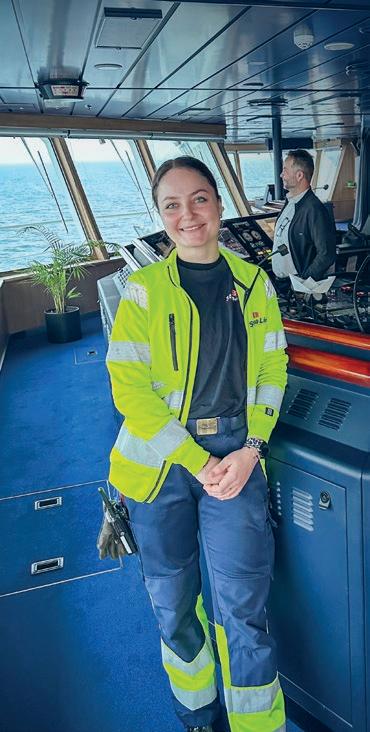
Jeanetta's shift begins early in the morning, several hours before the STENA ESTELLE arrives in Gdynia. She takes her place at the helm and steers the ferry towards the port, accompanied by a mate and the Captain.
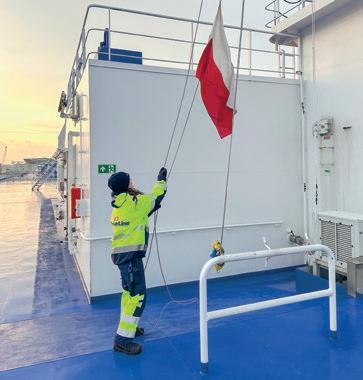
A few hundred meters from the terminal, the captain takes over the helm to sail the ESTELLE on the last stretch. Jeanetta then has to hurry on to her next job of the morning: hoisting the Polish flag on deck 10.
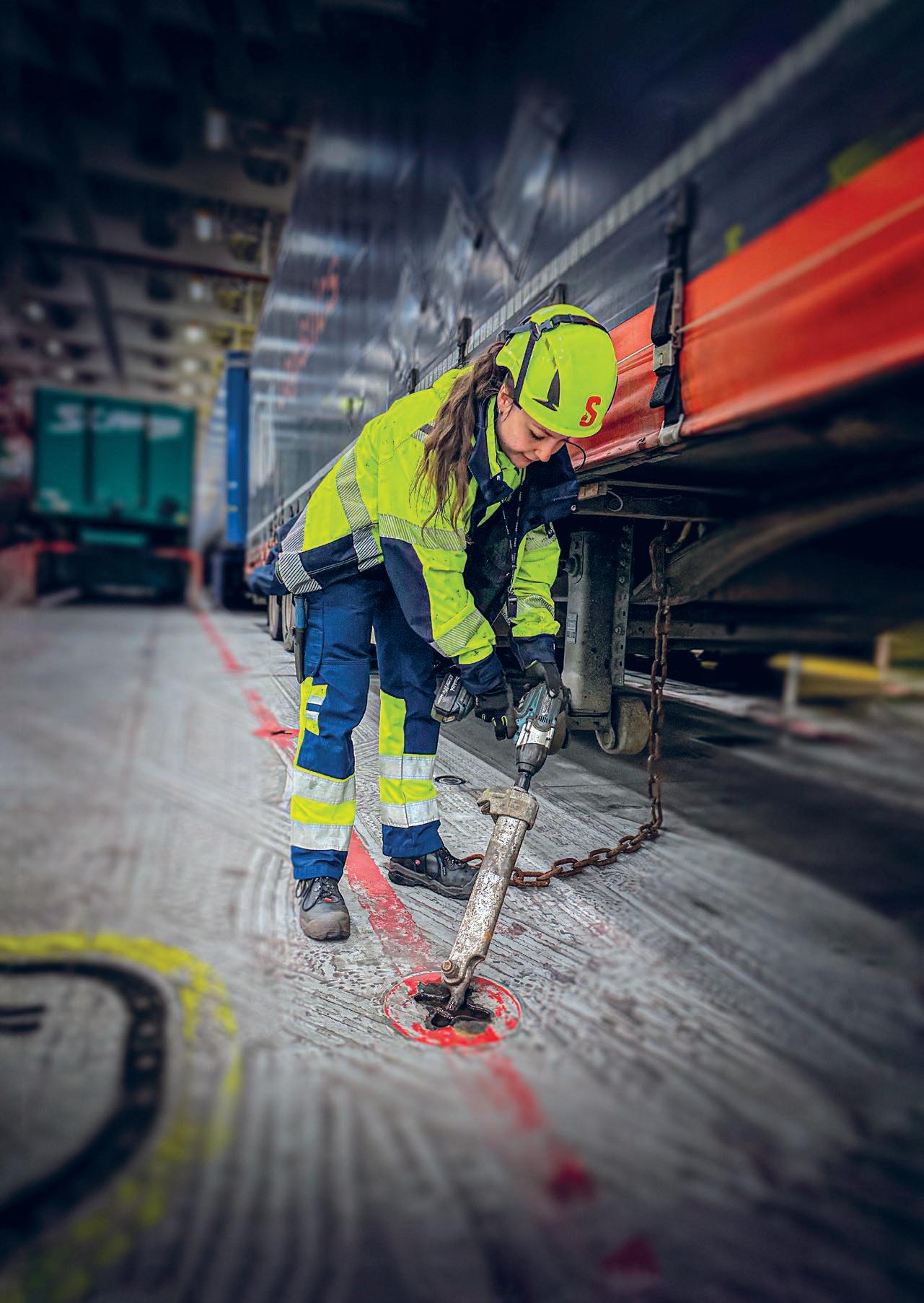
With the red and white flaga Polski fluttering in the wind, Jeanetta immediately heads for the bottom of the ferry – on the way, she picks up her helmet and a powertool. Now she has to remove the chains
that have secured the parked truck trailers during the crossing. They are parked on the lower vehicle deck, which is below the waterline.
"I'm used to doing lots of different tasks without a break. I don't think it's hard; on the contrary, I really enjoy it. I also do fire watch, so I easily walk 10 km or more every day," says Jeanetta, who will complete her training as a navigator in March 2026.
Photos: SHW
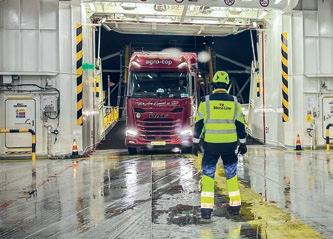
Jeanetta removes the last chain a few minutes before the ramp from the deck above is lowered. It takes a few more minutes for the stevedores to arrive in their tractors and bring the trailers ashore. Before that, Jeanetta's colleagues had emptied the other vehicle decks. This is the last task of the day for Jeanetta, 25. Her two-week voyage on ESTELLE is over; she has packed her uniform away and is now ready to go home and take some time off.
Jeanetta's interest in a maritime career was established in her childhood.
“My grandfather worked for a shipyard at the port, and he told me all about ships. I never forgot that, and when it came time to choose an education, it was clear that I wanted to work at sea. I like math and navigation, and I also enjoy traveling and meeting new people,” she says.
However, Jeanetta cannot imagine spending the rest of her life working on a ship.
“It's possible that I'll be ashore in ten years. I'm taking classes on offshore wind turbines at the university. It's also an exciting field that I might want to work in in the future,” says Jeanetta.
She is happy to be at ESTELLE because she gets to experience a variety of different tasks.
"I first worked on a container ship with 12 crew members, where I learned a lot about safety, for example. It was a nice stay, but it was also very different. I was the only woman, and I could feel lonely. I missed having a good friend to talk to. And there was no internet," says Jeanetta, who finds it easier to work on a large ferry.
“Yes, because there are many more of us on board, and there are many women, especially in the OSS department. I don't think anyone can feel lonely here. When I finish work, I like to go to the mess and be with the others. But after a few hours, I need some time to myself and need to sleep.”
“I feel secure knowing that I can express my opinion.”
Sometimes it's small coincidences that lead to big decisions. Like when Magda's father showed her a newspaper article about a ship captain one day.
"I wasn't very old, but that article sparked my interest in working as a ship's officer. I decided to study at a maritime university to become a navigator. No one in my family has any connection to the maritime world, and my father was shocked by my choice of education. He doesn't remember the article that started it all," says Magda, 29.
On the STENA ESTELLE, Magda serves as Navigational Officer and is responsible for navigating the vessel to its destination port and supervising cargo operations on deck. She is also responsible for maintaining the navigational equipment on the bridge.
Occasionally, Magda also serves as Safety Officer, maintaining the firefighting and LSA equipment, as well as the crew certificates and other safety-related documents.
“I am very keen to create the framework for good teamwork with my colleagues. It
is essential for my well-being that we work well together and that I know I have the support of my bosses on board to express my thoughts. Of course, we sometimes have our discussions, but they’re always constructive and genuinely helpful — and always kept professional, never personal.”
She finds that the crew is concerned about their personal safety and wants to use personal protective equipment.
“It's important that everyone knows who to go to when it comes to safety on board. “I really appreciate seeing both my younger and more experienced colleagues taking PPE more seriously and becoming more responsible. It’s really encouraging, and it feels great to know I can play even a small part in that by helping raise their awareness,” she says.
Plenty of space on board
STENA ESTELLE can accommodate a large number of vehicles. If the ferry were at full capacity, the queue would stretch for 3.5 km if the cars and trucks were lined up in a single row. With 263 cabins and several designated quiet areas, there is a place for all guests to rest.
The Fitness room gathers no dust
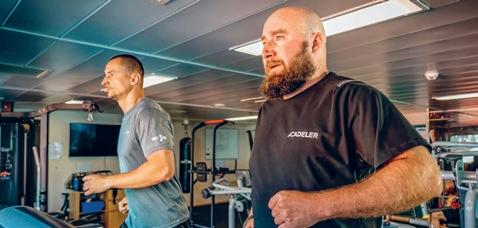
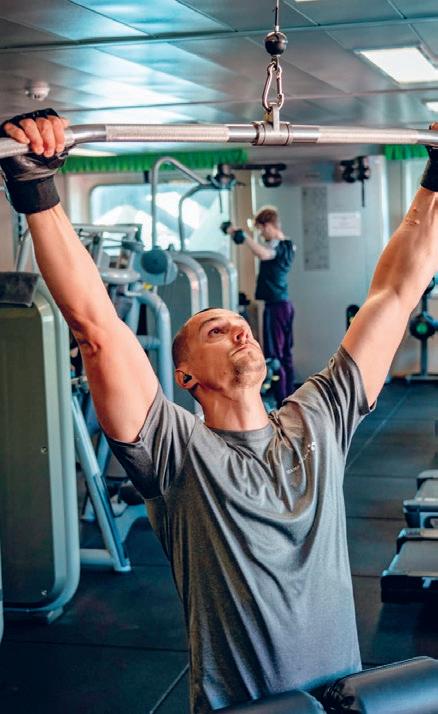
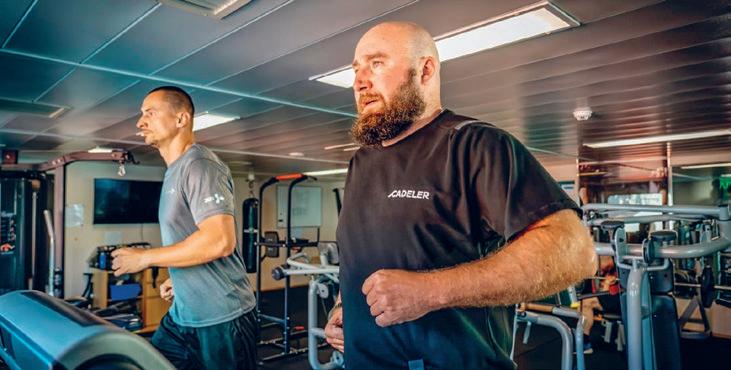
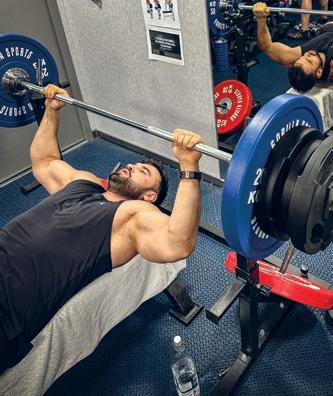
AB Jarek is one of several crew members on ESTELLE who regularly use the equipment in the onboard fitness room. The equipment is so popular, in fact, that some of the machines have been moved to the crew's lounge to make more room for weight training.
“When there are three big guys in here, we take up a lot of space. That's why we've moved the CrossFit machine and exercise bikes into one of our lounges, so we have more room to train,” explains Jarek.
Photo: Micke Olsson
Photo: SHW
Photo: SHW
You can always find someone to talk to
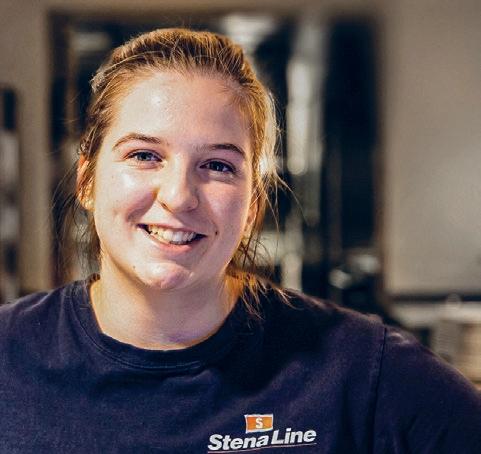
24-year-old Patrizia works as an Onboard Service Assistant in the crew mess, where she prepares food and does the dishes. She also helps with cabin preparation and other tasks as needed.
“I studied at a tourism school and then applied for a job at STENA because working at sea sounded exciting. My father also worked for the shipping company, so I already had some knowledge of the maritime world,” she says.
During her work, Patrizia meets and talks to almost all her colleagues when they come to eat or relax in the crew mess. That's why she often needs to be completely herself when the workday is over.
“I never feel lonely; there's always someone here who wants to talk,” she says and continues:
“Some days, I just need to be myself and completely unwind after a long day at work. I also enjoy playing games with others and drinking coffee with a colleague. I have a few colleagues on board with whom I can talk about personal matters. I appreciate that because it makes it easier to work together daily.”
Working here is an adventure
I never feel lonely; there's always someone here who wants to talk,” says Patrizia
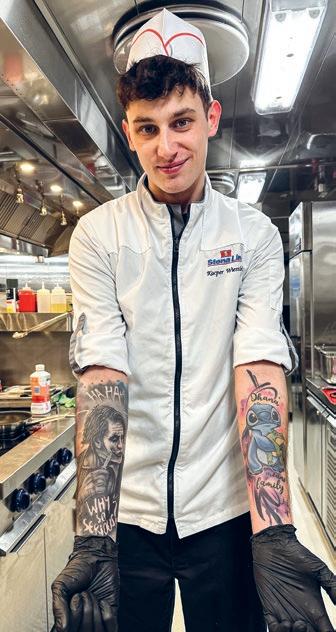
Kacper, 22, has his permanent workplace in the large kitchen on STENA ESTELLE, where he helps prepare meals for guests and crew. He feels right at home when he's cooking.
"I love my job. Food is my hobby and passion. I became interested in cooking when I was 12. My mother liked my food, and so it continued. I still cook at my mother's house when I have time off. For me, working here is an adventure.”
“When I heard that STENA was looking for new chefs, I was fascinated, but I thought it would be hard to work on a ship. However, I sent an application and was invited to a test that took place on another ferry. Fortunately, they offered me a contract," says Kacper with a big smile.
Photo: Micke Olsson
Foto: SHW
All jobs have their pros and cons
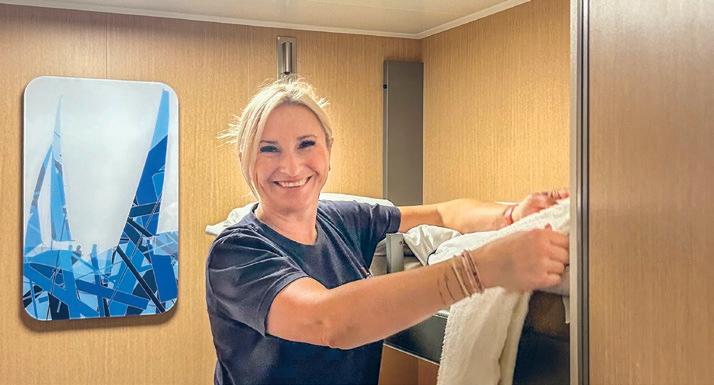
Service assistant Tatiana and her colleagues in the hotel department on STENA ESTELLE work efficiently and systematically when preparing cabins for the next guests. With a total of 265 cabins, this can mean a lot of bed-making during a working day.
“All jobs have their pros and cons. But the most important thing for me is working with people who have good energy and a good attitude. In general, I really like people, and I like diversity,” she says, continuing:
“I have several colleagues whom I feel I can talk to about personal things. It's essential to have someone to talk to and to be able to support each other, especially if you've had a bad day. We're only human, and it's important to be able to talk about both the good and bad days,” says Tatiana
Tatiana has previously worked with cosmetics and has a degree in psychology. Tatiana got a job on STENA ESTELLE three years ago after working on another ship for a short time. It is relatively new that Tatiana chose a maritime career. The idea came about almost by chance.
“I was talking to a friend about working on a ferry. She was considering applying for a job on a ship, but her husband wasn't very keen on the idea. But I was curious. I wanted to get out and see a bit of the world, so I
decided to apply for a job on a ferry,” says Tatiana.
Tatiana is 48 years old and has two teenagers: a 16-year-old daughter and an 18-year-old son. The two-week work, two-week off schedule gives her time to travel and be with her family. She really appreciates the ship's Wi-Fi, which makes it easy for her to stay in touch with her children at home.
In her free time on board, Tatiana enjoys reading psychology books. It has been five years since she completed her psychology degree, and she is very interested in the subject.
“One of my teachers had a saying that I have taken to heart: ‘We are perfectly imperfect.’ I have always been interested in people. I want to try to understand what people are thinking when they behave in a certain way. That interest comes from my father. He taught me that all people have something beautiful inside them. It's just a matter of finding it.”
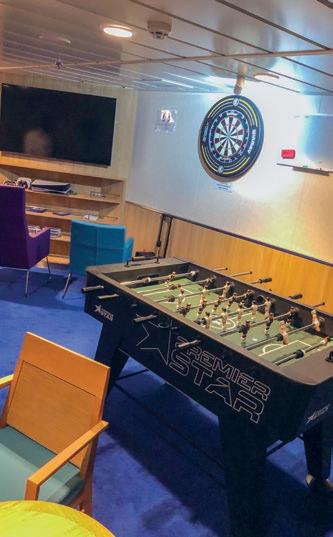
Social activities
In their free time, crew members gather in their common room to play games and socialize. They can play table football and table tennis and watch TV. There is also a selection of books and board games, such as chess.
On the wall hangs a large banner that was made when 10-12 crew members participated in a soccer tournament in Gothenburg, Sweden, in 2024, organized by the local seamen's club. The participation was arranged by Captain Greg Pasternak, who played himself.
Photo: SHW
Photo: SHW
Photo: Micke Olsson
Investing in increased safety on board and reducing environmental impact
Like shipping companies around the world, STENA LINE has invested heavily in sustainability and safety for guests, crew, and the marine environment for several years.
In the last two years alone, Captain Greg and his colleague, Captain Wojciech, have spearheaded the implementation of several initiatives. This is a task that comes naturally to Greg, as he himself spends a lot of time outside in his spare time.
“I love sports, particularly mountain biking, hiking in the mountains, and traveling in Scandinavia. I'm 52 years old, but I still feel young,” says Greg
Here are some examples of initiatives and investments in sustainability and safety on STENA ESTELLE since 2023:
• Improved garbage segregation in cooperation with Karlskrona stevedores.
• Organized extra training for deck crew, such as forklift and cherry picker lifts.
• High-voltage connection in Ports during lay-by, reducing emissions.
• Extra personnel are available during embarkation to assist passengers on each deck and staircase.
• Frequently exercises with SAR, helicopter landing, Fast Rescue Boats rescuers boarding, simulation of injured person evacuation, etc.
Captain thrives in mentor role
Captain Wojciech is one of two captains responsible for STENA ESTELLE. He believes in delegating responsibility and attaches great importance to being an attentive mentor to his crew. With education and training, going to work is both more enjoyable and safer, he points out.
"What matters most to me is having a well-trained crew. Everyone knows that I am the captain, but I am also very keen to be a good mentor to everyone on board. It makes my job easier that I feel confident that everyone can perform their tasks and that they know they can always ask me for advice. It also helps to increase safety for everyone on board," he says.
“My colleague Greg and I are both keen to talk to the crew and build relationships. We also organize tournaments. Greg is into soccer, I'm more into table tennis,” says Wojciech.
Photo: SHW
Photo: SHW
It’s important to me that the guests feel at home on board
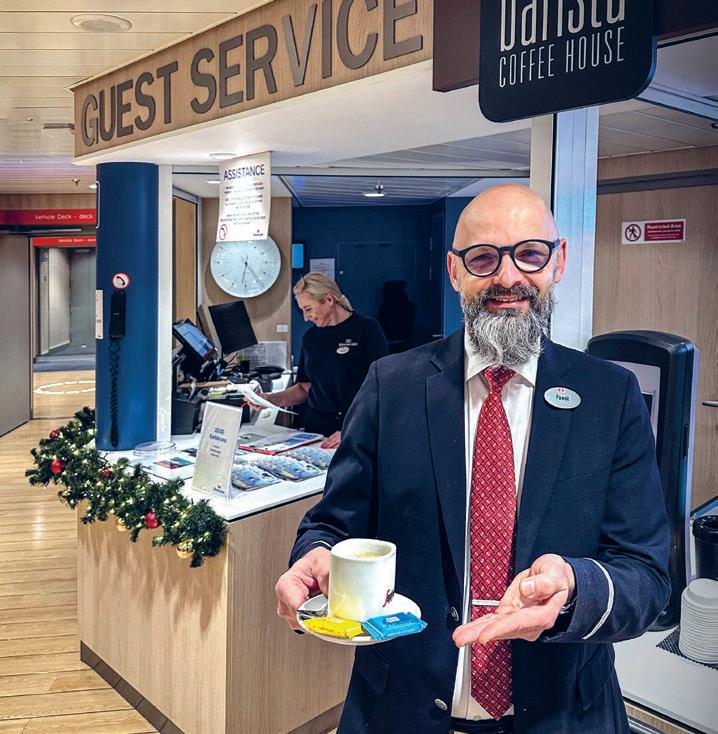
“Welcome aboard. May I offer you a cup of coffee?”
One of the first faces guests see on STENA ESTELLE is Pawel’s, who works at the Guest Service desk on board. No matter who the guest is or what mood they are in, Pawel is always ready with a friendly smile, a few words of understanding, and a cup of coffee.
"It's always a special feeling for me to meet guests and chat a bit about their journey. Sometimes I meet guests who are frustrated or tired. We are prepared to deal with that as well, and we do our best to help everyone relax and enjoy the journey. The best thing about the job is when a
guest like that comes up to me, maybe an hour before we reach port, and thanks me for listening to them," says Pawel, 48.
Pawel has worked for STENA LINE for 24 years in various guest-facing roles and on four different ferries. In 2022, he helped bring STENA ESTELLE into service as part of the Guest Services team.
“I'm on a first-name basis with some of our guests who often travel with ESTELLE. It's nice to greet them again and maybe hear a little about their family. I think it's something very special to create that kind of
relationship with the guests,” says Pawel.
Pawel also has the task of training new colleagues in the Guest Services department. He is ready to help them with sound advice so that they settle in nicely on board.
"It can be challenging, especially for young people who get a job here, to be on board the ship for two weeks straight. As soon as they start, they begin counting the days until they get time off again. I try to teach them to see the weeks on the ship as part of life and that it's important to be able to relax and have fun together while we live and work here," explains Pawel.
“It's also something our guests notice,” he adds.
“They like to see that the crew gets along well, smiles, and tells jokes. That we're like a family here on the ferry.”
Pawel acknowledges that his job is challenging because of the reception's opening hours. They affect his ability to get a good night's sleep.
"I have a pretty tight schedule. In the morning, I open Guest Services at 5:30 a.m. and close at 11:00 a.m. We open again at 5:00 p.m. and close at 11:00 p.m. So, I get a few hours of sleep at night and then again for a few hours during the day. I also want to spend my free time reading, eating meals, and socializing with colleagues. So sometimes I don't get enough sleep. When I come home after two weeks, I can feel fatigue. However, it's a condition I've chosen to live with because the job gives me so much else. If you can't handle it, you get frustrated, and that's not good for anyone," says Pawel.
Photo: SHW
I belong in the engine room
In the engine room on STENA ESTELLE, 3rd engineer Dorota is on night duty. She is responsible for the engine and the equipment and keeps an eye on the engine temperature, among other things. It is also her job to start the engine before the ferry can leave the quay.
"I am happy to work here. I think the engine room is where I belong on the ESTELLE. You need strong nerves to work in the engine room. And you really have to appreciate that you're dealing with large machines," she says.
In 2019, Dorota, 32, started as an engine cadet, became a motorman, and is now a 3rd engineer. She is the only woman working in the control room and engine room on STENA ESTELLE. But she is used to that. She was also the only woman in the engine room on her previous ship. She knew in advance that very few women applied for positions in the engine room on a ship.
“My uncle is also a marine engineer. However, he wasn't happy when I told him I wanted the same career as he did. He pointed out
that it's a physically demanding job and therefore not suitable for women. But I stood my ground, and now he understands and respects my decision. It just took a little time,” she says.
Dorota would like to continue her maritime career and perhaps become a Chief Engineer at some point.
“I am committed to doing my job well; that is my focus. Maybe one day I will become a chief engineer—that is probably my ambition, but it is not something I think about very much.”
Dorota says she has a good relationship with her boss, her colleagues in the engine room, and the crew on the ship.
"I feel that there is a good atmosphere among all the crew members. Everyone needs to talk, laugh together, and share stories. We all have a lot of pressure at work. Having fun together makes it easier to work together and take it easier. Then we feel confident that everything will be fine."
During this signing on, Dorota is on the night shift. For two weeks, her shift starts at midnight and ends at twelve noon.
“At that time, I'm usually very tired, but I can't just lie down and fall asleep right away. I need to wind down before I can sleep. I usually work out in the gym or in my cabin, or I read a book before I'm ready to go to sleep.”
Photo: SHW
Magazines for everyone
Do you like reading magazines? Then you must check out the Libby app.
Read here, how to get the most out of this free app.
In the Libby app, the digital version of The Seafarers Library, syou have free access to approx. 4,200 magazines – both magazine series and a lot of exciting special issues.
Attention: To be able to borrow magazines and books, you need a library card. Read how to get a library card on the next page. When you are connected to the internet, you have unlimited access to all journals. You can also download your favourite magazines, etc., and read them when you are offline.
By Irene Olsen, Librarian and Head of The Seafarer’s Library
Most magazines are in English, but you can also find magazines in other languages.
When you have internet access, you have unlimited access to all magazines. You can also download issues and read them when you are offline. You have access to a downloaded magazine for seven days. If you’re not finished reading, you can borrow it again.
You can also subscribe to your favorite magazines. Then the issue you've downloaded will stay on your shelf until the next issue is published. You must subsequently download the new issue if you want to read offline.
Once you have downloaded Libby and registered your library card, you have access to these magazines, and many more:
• 262 titles about News & Politics
• 233 titles about Health & Fitness
• 189 titles about Travel & Outdoor
• 177 titles about Tech & Gaming
• 376 titles about Food & Wine
• 130 titles about Cars & Motorcycles
• 284 titles about Home & Garden
• 28 titles about Hunting & Fishing
• 148 titles about Crafts (E.g., model trains, model planes, and model boats, needlework, woodwork).
Enjoy reading
At SEA 2023: 3
Kom godt i gang med Libby – de søfarendes digitale bibliotek
Get started with Libby - the seafarers' digital library
Søfartens Biblioteks digitale bibliotek ligger i app’en Libby. Her kan du låne e-bøger og e-magasiner, lydbøger og sprogkurser. Biblioteket er for alle om bord uanset nationalitet.
Sådan kommer du i gang:
1: Få et lånerkort
Send en mail til bibliotek@shw.dk med nedenstående information:
• Navn
• Personlig e-mail
• Pinkode (personlig pinkode på fire bogstaver/tal)
• Navnet på det skib, du er påmønstret
• Rederi
• Ønsker du at modtage information fra biblioteket? Ja/nej
Vi sender dig en mail, når dit lånerkort er op rettet.
1 / Get a library card
Send an email to bibliotek@shw.dk with the following information:
• Full name
• Your personal email address
• Pin code (personal 4-digit pin code)
• The ship that you are signed on
• Name of shipping company
• Do you allow the library to send you information regarding the library? Yes/no We send you an email when your library card is created.
2 / Download the Libby app from your app store Search for “Libby, by OverDrive”
3 / Open Libby and register:
• First question: Do you have a library card?
– Press Yes
• Go to: You can look up your nearest library by name, or city, or zip code Press: Search for a Library
• You can search for your library by name or branch location
In the box, type: "The Seafarers’ Library” – and choose the library shown in the box
• Press: “Sign in with my card”
• Enter your email address
• Enter your pincode
• Press: Next
Now you are ready to browse, download, and read!
2: Download Libby fra din app store Søg efter “Libby, by OverDrive”
You need to be online while downloading then you can read offline.
3: Åbn Libby og registrer dig:
• First question: “Do you have a library card? – Tryk: Yes
Books are available for 28 days. Magazines are available for 7 days, but you can “re-borrow” all magazines and issues without any limitations.
• Gå til: You can look up your nearest library by name or city, or zip code Tryk: Search for a Library
• You can search for your library by name or branch location Skriv i boxen: The Seafarers’ Library” – vælg biblioteket
• Tryk: “Sign in with my card”
• Indtast e-mailadresse
You can use Libby on your phone and tablet.
• Indtast pinkode
• Tryk: Next
Nu er du klar til at browse, downloade og læse!
If you want to use your PC, go to www.libbyapp.com and log in.
➔ Du skal være online imens du downloader, herefter kan du læse offline.
Unfortunately, it is not possible to read via Kindle.
➔ Bøger lånes i 28 dage. Magasiner lånes i 7 dage, men du kan genlåne alle magasiner og numre uden begrænsning
➔ Du kan bruge Libby på din telefon og tablet.
➔ Hvis du vil bruge din pc gå til www.libbyapp.com og log ind.
➔ Desværre er det ikke muligt at læse med Kindle.
Navigating the app In the footer
Navigation i appen I sidefoden
• Tap Search to search for titles.
• Tryk på for at søge efter titler:
• Tap Library
• Tryk på biblioteket for at åbne den bibliotekssamling, du senest har været inde i. to open the library collection you were most recently browsing.
• Tap Shelf to see your loans, holds, magazines and tags for all your libraries.
• Tap Watch to see your timeline.
See your options in the menu :
• Tap Settings to customize your experience in Libby.
Here you can choose the language you want to see in Libby.
• Tap Get some help to search for answers to your questions, find solutions to common problems, or suggest an idea.
You are also always welcome to contact the library at bibliotek@shw.dk This applies both if you have problems with Libby or if you would like to read that is not available in the library.
ALL OF US AT
SEA HEALTH & WELFARE
WISH YOU A
Merry Christmas and a Happy New Year
This year, we celebrate the start of unified service for all seafarers on board Danishflagged vessels. On 1 December 2015, Seahealth and the Danish Government’s Seamen’s Service relocated together to Højnæsvej 56 in Rødovre, Denmark.
A few years later, the merger was completed under the name SEA HEALTH & WELFARE.
It has been a decade of continuous effort to reach and inspire as many seafarers as possible. To this end, we have, among other things, established a presence on social media and engaged in mutual collaboration with maritime schools, shipping companies, and Seaman Centers in Denmark and abroad.
Many seafarers enjoy the FIT4SEA web page and register their training on the ship or at home. Today, many vessels utilize the @SEA@SHORE platform to streamline their chemical data and create and update risk assessments, among other tasks.
We would like to thank our maritime partners in Denmark and abroad for their valuable cooperation regarding seafarer wellbeing and safety. We congratulate every seafarer on their efforts in maintaining a strong and effective maritime sector worldwide, which we hope will continue to create new career opportunities for people around the globe.
We look forward to working with you and for you in 2026 and beyond. Stay safe and take care of each other.