Why Is Cuevas Medek Exercise Considered the Most Effective Form of Physical Therapy for Infants and Children? Did you ever hear about Cuevas Medek Exercises or CME therapy? You might have heard that it is one of the most effective forms of physical therapy. But, you don’t have any idea about the reason for such consideration? To make things clear for you, below are some facts mentioned, let’s take a thorough look through them! Cuevas Medek Exercises – What Are They? Cuevas Medek Exercises also known as CME is a pediatric physiotherapy approach that is used to stimulate postural and dynamic motor control in infants or toddlers who have, or are at risk for, developmental abnormalities or delays. CME primarily aims to provoke the absent but motivates normal automatic motor responses. Cuevas Medek Exercises (CME) are a powerful method of eliciting improvements in Balance, Posture, and motor control, for children mainly with physical disorder conditions like cerebral palsy and developmental delays. This is a type of physical therapy practice that is developed back in 1972 by Ramon Cuevas, a Chilean Physical therapist working at a special needs school in Venezuela. Ramon Cuevas developed this physiotherapy technique primarily based around three principles: 1). Expose the child to the effects of gravity and allow them to respond, 2). Support them as distally as possible, 3). Assist them to move on surfaces or in methods that are more challenging than they normally encounter. Cuevas Medek Exercises (or CME) offers very concrete guidelines to stimulate babies and children to learn how to control their body in a more efficient and effective method. This form of physical therapy mainly challenges the child’s neuromuscular system to force the development of postural reflexes and motor control.
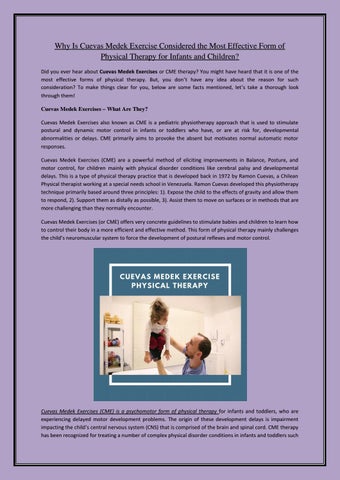
Cuevas Medek Exercises (CME) is a psychomotor form of physical therapy for infants and toddlers, who are experiencing delayed motor development problems. The origin of these development delays is impairment impacting the child’s central nervous system (CNS) that is comprised of the brain and spinal cord. CME therapy has been recognized for treating a number of complex physical disorder conditions in infants and toddlers such
as cerebral palsy, developmental delays, Spina Bifida, Seizure disorders, the risk of motor delay related to premature birth and/or hypoxic brain injury, genetic disorders, to just name a few. How Does CME therapy Works? Cuevas Medek Exercises (CME) mainly focuses on the brain and its natural recovery potential. Generally, human beings possess a genetic blueprint that not just determines each of the individual’s physical features such as hair and eye color but also drives the brain’s motor control system. While the interaction of this genetic blueprint in humans develops with the aging process, the potential of the brain to naturally recover will allow the child with CNS impairment to develop, CME practitioners strongly believe that high-quality neuromuscular stimulation is needed to allow these children to achieve their maximum level of motor independence. The overarching objective of Cuevas Medek Exercises is to develop functional motor control in order to achieve the maximum level of motor independence. However, to reach milestones like independent sitting, standing and walking, a child must first possess the ability to extend their body against gravity. The practitioners of Cuevas Medek Exercises works to develop antigravity extension each child by maximally challenging the neuromuscular system. This goal is reached by providing the most distal point of contact on the child’s body that is tolerated at each moment. By doing so the body segments are exposed to the influence of gravity and the brain’s automatic responses are provoked to form new motor functions that the toddler or infant is not able to control previously. You can simply say that provoking the absent motor functions by the use of distal support is integral to CME therapy. Intervention using Cuevas Medek Exercises can be a challenging process as the age of the child matters a lot that how this therapy will be initiated. However, development of the brain structures often get influenced by activity, so early assessment and intervention is the ideal move. The therapists performing CME therapy on children often use different fun-filled activities to engage the child in the process, and aims to reach the goals of the therapy using that method. Children often found performing Cuevas Medek Exercises a great fun. Where to Find Quality Assistance with Regard to CME Therapy? There are many places, where you may get assistance with regard to CME therapy. However, some of the top pediatric neurorehabilitation centers in Dubai are known for offering impeccable assistance with regard to Cuevas Medek Exercises. These medical centers are so known because they have the best and the most advanced state-of-the-art equipment needed for the therapy and the specialists offering the service are also very experienced and highly trained. These neurorehabilitation centers have earned quite a good reputation among their clients. Their therapy camps are organized from time-to-time for making quality CME therapy assistance reachable to all.