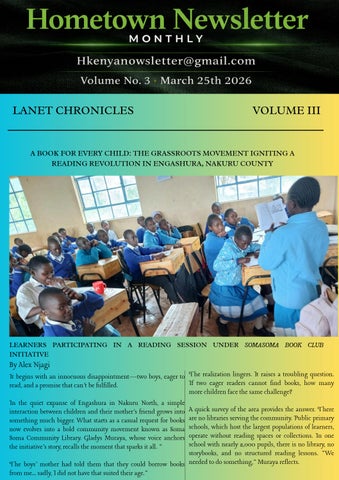

LANET CHRONICLES VOLUME III
A BOOK FOR EVERY CHILD: THE GRASSROOTS MOVEMENT IGNITING A READING REVOLUTION IN ENGASHURA, NAKURU COUNTY
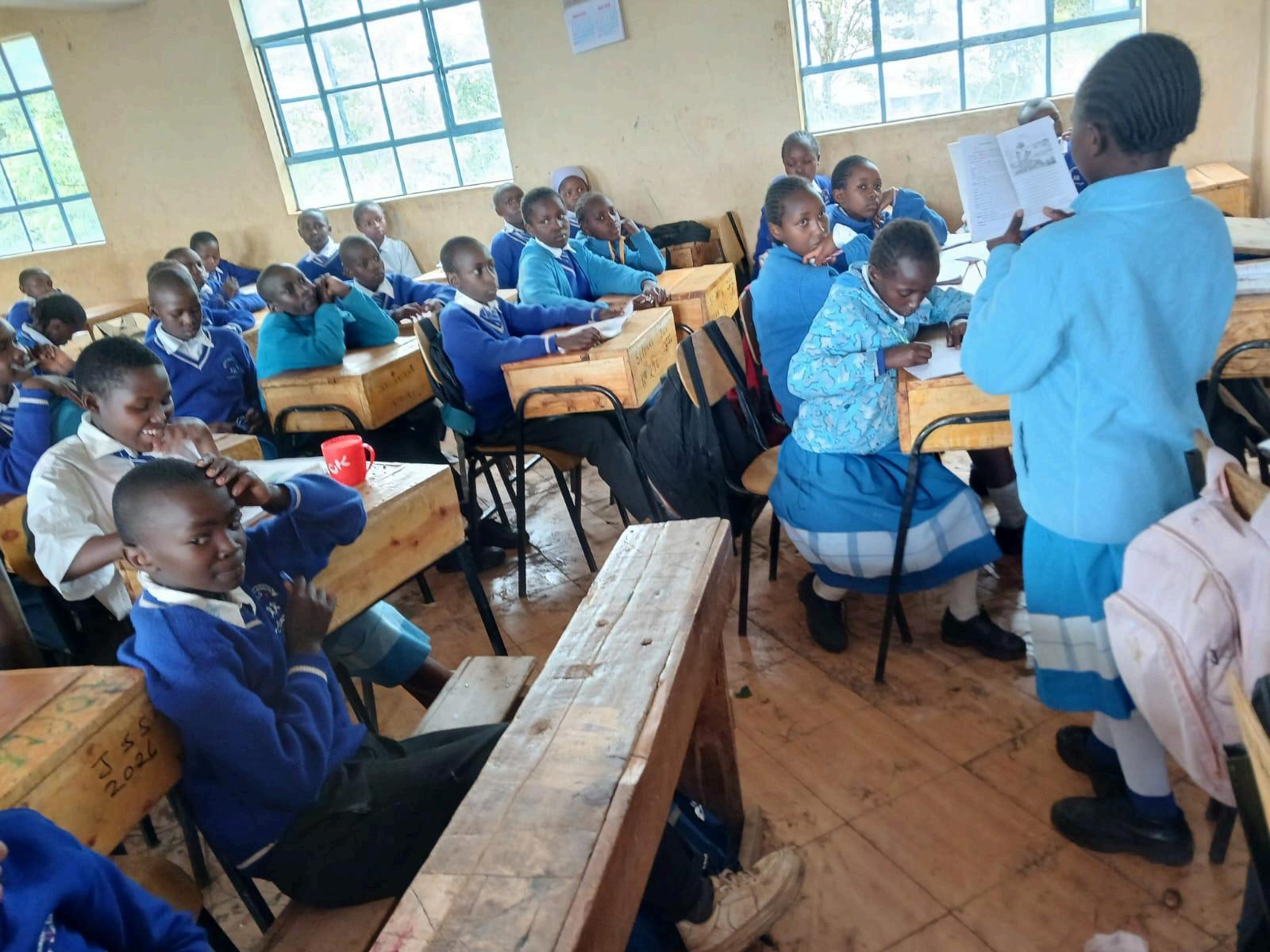
LEARNERS PARTICIPATING IN A READING SESSION UNDER SOMASOMA BOOK CLUB INITIATIVE
By Alex Njagi
It begins with an innocuous disappointment two boys, eager to read, and a promise that can’t be fulfilled
The realization lingers It raises a troubling question If two eager readers cannot find books, how many more children face the same challenge?
In the quiet expanse of Engashura in Nakuru North, a simple interaction between children and their mother’s friend grows into something much bigger What starts as a casual request for books now evolves into a bold community movement known as Soma Soma Community Library. Gladys Muraya, whose voice anchors the initiative’s story, recalls the moment that sparks it all. “
The boys’ mother had told them that they could borrow books from me… sadly, I did not have that suited their age. ”
A quick survey of the area provides the answer There are no libraries serving the community Public primary schools, which host the largest populations of learners, operate without reading spaces or collections. In one school with nearly 2,000 pupils, there is no library, no storybooks, and no structured reading lessons “We needed to do something,” Muraya reflects
The response is immediate, though resources remain scarce. Instead of waiting for a full library, the founders started small. They introduced book clubs. Two public primary schools became the testing ground
At the first school, a weekly reading session begins. Only 50 to 60 pupils can participate The demand quickly overwhelms the organizers Dozens of children want to join Many must be turned away. “Most of them wanted to join… just watching the desire they had to come and read made us realise that we were onto something,” Muraya says.
The second school adopts a different approach Each week, a new class takes part in the reading session. No child is excluded The rotation ensures wider participation But as the sessions unfold, another challenge emerges Many learners struggle with reading fluency. Some hesitate over simple words Others cannot read at all
Yet the initiative is never just about books
Children begin reading aloud. Their classmates listen. Confidence grows slowly Public speaking skills develop Feedback becomes part of the learning process The sessions transform into more than literacy exercises. They build voice They nurture self-belief
Support begins to gather around the effort Schools open their doors and provide moral encouragement Some teachers become champions of the idea, incorporating reading into their lessons Friends and well-wishers respond to appeals, donating books whenever the call goes out
The vision continues to expand. The long-term goal remains clear: a fully functional community library For now, the focus shifts to creating smaller libraries within schools Preparations are underway for a major book drive scheduled for April 2026 The hope is to scale the model across more public schools in the region
“If we can replicate this in all the public schools… it would be an absolute gamechanger,” Muraya notes
At its core, Soma Soma Book Club, is guided by a simple but urgent mission to nurture a reading culture, one child at a time. In an era dominated by screens, the founders push back against a quiet but significant decline in reading “We cannot afford to sacrifice knowledge, critical thinking and other beautiful things that come from reading,” Muraya emphasizes.
The determination is evident The movement grows steadily. One session at a time. One child at a time. One book at a time
And the story is still being written. Those with books gathering dust on their shelves can place them in eager hands.
Volunteers can step forward to read, mentor, and inspire. Communities can rally around the simple power of stories Because sometimes, changing a life begins with something small a single book placed in the right hands, shaping an eager, curious, and growing mind


AMERICANVISABREAKDOWNEVERYYOUNG KENYANNEEDSTOKNOW
ByKingGeorges
You probably have heard people around you say, “Nataka kuenda Marekani,” but the real question is which visa are you actually applying for?

Immigrant Visas (Permanent Residence)
Many young people in Kenya don’t realize that American visas fall into two main categories, and choosing the wrong one can waste time, money, and opportunities. Understanding the difference is the first smart move before you even start filling out forms
American visas differ primarily between nonimmigrant (temporary) and immigrant (permanent residency/green card) categories. Non-immigrant visas are for specific purposes like travel, work, or study, requiring you to return to your home country Immigrant visas allow permanent residence in the United States
These are the most common options for students, travelers, and young professionals:
Non-Immigrant Visas (Temporary)
B-1/B-2: Business, tourism, or medical treatment
F-1/M-1: Academic or vocational students
H-1B/H-2B: Specialty occupations (degree required) or temporary non-agricultural work
J-1: Exchange visitors, including au pairs and trainees
L-1: Intracompany transferees
O-1: Individuals with extraordinary ability
These visas lead to a green card and long-term stay: Family-Based Visas: Immediate relatives of US citizens or lawful permanent residents.
Employment-Based Visas: EB-1, EB-2, and EB-3 for workers with specific skills
Diversity Lottery: Green card lottery for countries with low US immigration numbers
Immigrant visas are issued by the United States Citizenship and Immigration Services (USCIS) to qualified applicants who wish to reside in the US Applicants abroad apply at US consular offices, and after entry they become legal immigrants Some students, temporary workers, and refugees already in the US may adjust status to permanent residency.
Key Differences
Duration: Non-immigrant visas are temporary; immigrant visas allow permanent residency
Intent: Non-immigrant applicants must prove they will return home; immigrant applicants plan to stay
Cost: Immigrant visas are generally more expensive
Kenyan applicants should also note that while there is a Visa Waiver Program allowing some countries to enter the US without a visa for up to 90 days, Kenya is not part of this program