Volume 10 • Issue 4 • Fall 2020
No Bones About it Thank You, 2020
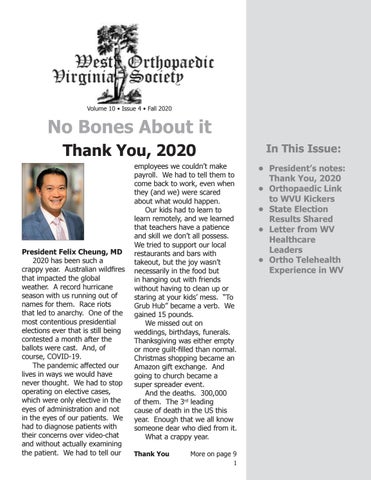
President Felix Cheung, MD 2020 has been such a crappy year. Australian wildfires that impacted the global weather. A record hurricane season with us running out of names for them. Race riots that led to anarchy. One of the most contentious presidential elections ever that is still being contested a month after the ballots were cast. And, of course, COVID-19. The pandemic affected our lives in ways we would have never thought. We had to stop operating on elective cases, which were only elective in the eyes of administration and not in the eyes of our patients. We had to diagnose patients with their concerns over video-chat and without actually examining the patient. We had to tell our
In This Issue:
employees we couldn’t make payroll. We had to tell them to come back to work, even when they (and we) were scared about what would happen. Our kids had to learn to learn remotely, and we learned that teachers have a patience and skill we don’t all possess. We tried to support our local restaurants and bars with takeout, but the joy wasn’t necessarily in the food but in hanging out with friends without having to clean up or staring at your kids’ mess. “To Grub Hub” became a verb. We gained 15 pounds. We missed out on weddings, birthdays, funerals. Thanksgiving was either empty or more guilt-filled than normal. Christmas shopping became an Amazon gift exchange. And going to church became a super spreader event. And the deaths. 300,000 of them. The 3rd leading cause of death in the US this year. Enough that we all know someone dear who died from it. What a crappy year.
Thank You
More on page 9
1
• President’s notes: Thank You, 2020 • Orthopaedic Link to WVU Kickers • State Election Results Shared • Letter from WV Healthcare Leaders • Ortho Telehealth Experience in WV
By WVOS Executive Director Diane Slaughter, CAE, APR, Fellow PRSA
Orthopaedic Link to WVU Kickers
If the WVOS had an “official number,” it would have to be 48.
If the West Virginia Orthopaedic Society had an “official number,” it would have to be 48. To understand that statement, you just need to talk with member Paul Legg, West Virginia OrthoNeuro, and Secretary Treasurer Manny Molina, Orthopedic Healthcare Associates. After that conversation, you’ll know that both doctors have sons who have worn that number as kickers for the West Virginia University (WVU) Mountaineer football team. However, their sons arrived on Mountaineer Field by very different routes. Casey Legg, currently a WVU redshirt sophomore (and academic junior), came from sports other than football. Legg played soccer and basketball at Cross Lanes Christian School, serving as captain for both teams as a junior and senior. He also played for the West Virginia Futbol Club that won the state championship in 2017. During his senior year in high school, Casey decided he wanted to try football. Dad Paul knew that then-Arthrex rep Michael Molinari was a former WVU kicker. Molinari agreed to meet Casey at Laidley Field and was impressed by his natural talent. That winter, Molinari
2
accepted a job with WVU football, and he remembered Casey and his natural talent. Also that winter, Casey spent days in sunshine, rain and snow learning and practicing kicking. He worked out in Ripley with Brian Johnson, a former University of Kentucky kicker. Casey went to summer school at WVU and practiced with the team. That fall of 2018 he dressed for the Baylor game. With WVU in the lead, he handled a kickoff and made the tackle on the same play! In addition, that year, Casey made the Academic All-Big 12 Rookie Team. In 2019, as a redshirt freshman, he made the first field goal of his career, a 30 yarder, against Texas Tech.
He is now the starting kicker as a redshirt sophomore following a season-ending injury to kicker Evan Staley. As this story is written on Thanksgiving weekend, Casey has made five field goals, the Number 48
More on page 6
By WESPAC Chairman Joe Prud’homme, MD
State Election Results Shared
WESPAC Chairman and WVOS’ AAOS Councilor Joe Prud’homme, MD, has announced the outcome of WESPAC’s endorsements for the Nov. 3 election. Of the 13 endorsements made for West Virginia Senate races, 70 percent of the endorsed candidates were elected, including five Republican incumbents, three Democrat incumbents and a Republican newcomer. Four Democrat newcomers were unsuccessful. Of the 47 endorsements made for West Virginia House of Delegates races, 68 percent of the endorsed candidates were elected, including 13 Republican incumbents, ten Democrat incumbents, five Republican newcomers and three Democrat newcomers. Seven incumbent Democrats, five other Democrats and three Republicans were unsuccessful. WESPAC is a voluntary, bi-partisan, unincorporated organization and is a separate segregated fund established by the WVSMA. The goals of WESPAC are to: work with elected officials to make sure they understand the many facets of our healthcare system; organize the physician community into a powerful voice for quality healthcare in West Virginia; and preserve the vital relationship between you and your patients by educating legislators on healthcare issues. The successful endorsed candidates for Senate and House of Delegates are listed
below (“i” means incumbent candidate): WV Senate District Endorsed 1-R i Ryan Weld 2-R i Mike Maroney 3-R i Donna Boley 4-R Amy Grady 5-D i Robert Plymale 8-D i Glenn Jeffries 13-D Mike Caputo 15-R i Craig Blair 17-R i Eric Nelson WV House of Delegates 1-R Mark Zatezalo 3-R i Erikka Storch 5-D i Dave Pethel 10-R i Vernon Criss 12-R i Steve Westfall 13-R i Joshua Higganbotham 17-D i Chad Lovejoy 18-R i Evan Worrell 19-D Ric Griffith 22-R i Zach Maynard 26-D i Ed Evans 27-R i Joe Ellington 30-D i Mick Bates 32-R i Kayla Kessinger 32-R Austin Haynes 33-R i Roger Hanshaw 34-D i Brent Boggs 35-R i Moore Capito 35-D i Doug Skaff 35-R Larry Pack 36-D Jim Barach 37-D i Mike Pushkin 39-R Dana Ferrell 43-D i Cody Thompson 48-R i Danny Hamrick 48-R i Ben Queen 50-D Joey Garcia 51-R Joe Statler 51-D i Danielle Walker 66-R i Paul Espinosa 67-D i John Doyle
“We are more than pleased with the success of our endorsed candidates in the 2020 general election and thank you for voting!” - Dr. Joe Prud’homme
3
Letter from WV Healthcare Leaders
We trust the COVID-19 vaccine.
West Virginia has experienced landmark days in the pandemic response this past week as the U.S. Food and Drug Administration (FDA) granted Emergency Use Authorization for a COVID-19 vaccine. As we write this, thousands of COVID-19 vaccine doses are being loaded and shipped to states across our nation, including ours. As healthcare and public health leaders in the Mountain State, we are breathing sighs of relief because we are confident that this vaccine is safe, effective, and is our best hope for ending the current pandemic. You might be wondering whether you should trust a COVID-19 vaccine. The COVID-19 vaccine development process has been the fastest we have seen to date because the entire medical, scientific, and public health communities building upon prior research technology mobilized like never before to end this pandemic. Clinical trials with tens of thousands of people showed that vaccination is highly effective in preventing COVID-19 and caused no serious adverse effects. We watched Thursday as the FDA’s advisory committee livestreamed their discussion of the evidence leading to their decision to authorize its use. We tuned in again on Friday and Saturday as the Advisory Committee on Immunization Practices (ACIP) 4
met to review the data and provide recommendations for use of the vaccine. These expert committees agree that this vaccine has met rigorous, scientific standards of safety and quality, and should be made available for use by the public. We want to be clear: We will get vaccinated as soon as it is our turn, and we will recommend it as soon as possible to our family members and patients based on guidance from the ACIP. We trust the process, and we think you should, too. We have wept with the families we care for and serve, watching them struggle with severe illness and even death. Some have only had the opportunity to say final goodbyes on the phone. These images and memories will stay with us for our lifetimes. But today we are hopeful, because the COVID-19 vaccine can help end this pandemic, protect the health and wellbeing of our communities, and get our economy moving again. We will each personally receive the COVID-19 vaccine as soon it becomes available to us. We will do this because getting vaccinated not only protects us, but the people around us—particularly those at risk of severe COVID-19 illness. When large numbers of people in a community are vaccinated, fewer people get sick, saving Open Letter More on page 10
By WVOS Vice President Shafic Sraj, MD, Shari Cui, MD and Paul Legg, MD
Ortho Telehealth Experience in WV Dr. Sraj: What has been your experience with telehealth and when/how did it start? Dr. Cui: Our Spine center has over a decade of experience using technology as a triage method for new referrals. Using asynchronous orthopaedic telehealth visits (OTV), we review online intake questionnaires, results, and images and refer non-operative patients to our non-operative colleagues. This process has improved surgical clinic wait times (for new patients) from 2.5-8 months down to 0.5-12 weeks. (Reference) The COVID pandemic led us to expand utilization to include face-toface interaction. Dr. Legg: I have used OTV primarily for review of advanced imaging results such as MRI. I also did some postop follow-ups early in the pandemic. I was not completely satisfied with this type of follow-up, so we focused more on streamlining our office processes to allow and safe and efficient office visits. Dr. Sraj: What barriers limit the implementation and expansion of telehealth? Dr. Legg: The main barriers we faced were scheduling during the office day and the patient’s access to technology. The expansion of telehealth services requires a level of efficiency that involves changes to patient check-in processes
which also affects regular clinic visits. Patients can have a difficult time using their devices to allow adequate visualization of a wound site or extremity. This is especially true when they try to get the correct angle using their phones. Most of our patients used their phones and it proved to be difficult for them. Dr. Cui: The major issue in WV is limited internet access. Besides, new technology comes with a learning curve and growing pains. Patients must obtain the necessary software and secure login, and get familiar with the interface. Physicians must also learn the technology, means of virtual examination, and the necessary documentation to meet reimbursement criteria. Dr. Sraj: What impact did you see when you started using telehealth? Dr. Cui: OTV can be effective for routine established patient visits and for new patients with non-urgent complaints. Imaging studies done at community hospitals can be pushed into our servers prior to OTV and guided selfexam can be done during the encounter, saving patients both travel time and expenses. Having said this, a screening mechanism mustbe in place to appropriately select patients for OTV. Dr. Legg: The benefits I have seen have been with Telehealth More on page 8 5
These physicians agree that one of the major barriers to telehealth for West Virginia’s population is patient access to technology and limited internet access.
Number 48
WVAOE How do is you honoring get to a WVU Joshua football Tuck’s game legacy during with aa
More from page 2
longest of which was 45 yards. In five games this year his 21 kickoffs have totaled 1,177 yards and he’s scored nine points after touchdowns (PAT). Dad Paul played high school football at Woodrow Wilson in Beckley, including as a kicker, but never played soccer. Paul said he and his wife, Leigh, have been to all WVU games, both home and away, since Casey’s been dressing for games. They are pictured below with Casey. Paul’s joke is, “How do you get to a WVU football game during a pandemic? Be the kicker’s dad.”
scholarship. pandemic? Be You the can kicker’s contribute dad.”to keep - Paul thisLegg, goingMD for the future!
Now that’s a good punchline. Michael Molina, like his father and grandfather before him, grew up playing soccer before starting elementary school. ”He was fast,” Manny says of his son. “He’d get in front of the ball and no one could catch him.” Manny’s dad, a urologist in Huntington, only saw the injuries from 6
football and wouldn’t let Manny play football and didn’t want his grandchildren to play it, either. As a freshman in high school, Michael begged his father to be allowed to play football and Manny says he relented only if he was the kicker (since there were rules protecting kickers). “He still had ortho injuries nearly every year, so kicking didn’t keep him safe,” Manny recalled. Michael’s folks weren’t tall, so he was never going to be 6 feet tall and weigh 210 pounds. His other cousins, both a girl and several boys, were all football kickers. Michael also knew football had a bigger following than soccer did. WVU offered him a preferred walk-on spot, and he took it. He gained 33 pounds in his first three semesters and it was muscle. Although initially a walk-on player, he did get a scholarship when one became available. He started at WVU in 2013 and became a starter in 2016, following an injury to the player ahead of him. He lead the team in scoring with 96 points and had a career long 50-yard field goal against Baylor. Number 48
More on page 7
Number 48 More from page 6 He was a starter in the 2017 season, as well. In his senior season, Michael made five field goals, had a 48-yard kickoff and scored 40 PATs. His dad said it was obviously more fun watching the game when his son was playing. “Watching from the perspective of Michael’s kicking range was a different way to watch the game,” Manny said. He recalls going to all WVU home games, even though Michael was only on the field for warm-up drills the first two years. His most ironic memory was of the University of Texas - Austin game, where Manny had trained during his medical education career. “The last time I was there, it was for the Texas side,” Manny recalled. “A good friend was the Texas team doctor, so we texted during the game.” Patients would often ask if Michael was Manny’s son. “I became my son’s father, rather than Michael being Dr. Molina’s son,” he said with a laugh.
“I became my son’s father, rather than him Michael is now an Arthrex rep working our of Cabell Huntington Hospital in Huntington and King’s Daughters Medical Center in Kentucky. The two fathers often text during WVU games, especially when the kicker is involved. It’s obvious both WVOS dads are so proud of their own number 48.
7
being Dr. Molina’s son.” - Manny Molina, MD
These physicians also agree that this is yet another tool for you to use when evaluating your patients.
Telehealth More from page 5 my patients who are unable to travel to the office, unable to wear a mask, have been restricted by contact tracing and who fear coming to any doctor’s office because of COVID-19. Dr. Cui: Along the same lines, we taught our surgical patients who live hours away how to remove their sutures and staples which allowed us to convert postop visits to OTV. Dr. Sraj: What challenges face Orthopaedic Telehealth in WV? Dr. Legg: Making telehealth a more efficient part of our day continues to be a challenge. We have a nurse to place the initial contact with the patient and confirm all appropriate identification and then the physician sees the patient via OTV. Dr. Cui: Internet access limitations and poor patient proficiency in is more frequent in WV than other states. Telehealth does not replace in person visits when a hands-on physical exam is necessary. On the physician side, we, Orthopaedic surgeons, are the masters of the physical exam. We have to adapt in this virtual age while understanding limitations. For some pathologies, there is no replacement for a handson exam and must be ready to convert OTV to an office physical visit. Certain findings can only be caught when we lay hands and eyes directly on the patient. Dr. Sraj: What future do you expect for telehealth and what do we need to 8
realize it? Dr. Legg: The future of telehealth will probably support the expansion of outpatient joint replacement surgery. Telehealth services can connect us with the patients who do not live in our immediate area for postoperative education and instructions. West Virginia
patients are still limited in many areas by poor and unreliable broadband service. Improving broadband service in our state will help us expand telehealth services.
Dr. Cui: Telehealth will continue to augment routine evaluations and can replace routine postoperative visits, but does not replace such encounters and pathologies that require the hands-on exam. A more integrated network of imaging servers is needed for better remote workup and access to imaging to augment the video visit. Telehealth is a good augment and addition to practice, but should not be the only encounter preceding surgical decision making. Dr. Sraj: Any last thoughts to share? Dr. Cui: It is surprising how much can be done during an OVT. Patients can address many of their questions virtually, and I can even highlight the pathology on their screen by rotating my camera! OVT has provided us an intermediate means of assessment/communication for routine complaints with the added convenience of obviating travel for the patients. Dr. Legg: I think this is valuable information and it’s timely discussion for WVOS members to engage in.
Thank You More from page 1 But there have been good things too. We had some time off. We reconnected with our spouses and children. We spent more time with them than ever before and discovered maybe they were growing up and not as annoying as we thought. (My children are still very annoying.) We got to enjoy our hobbies and develop new ones. We discovered there were other activities to do on a fall Saturday afternoon that wasn’t occupied with the cancelled football games. We discovered how much we longed for live music. We made vows to enjoy those things with our friends when this was all over. And the anticipation made us happy. We worked on ourselves. We became healthier, smarter, calmer. We learned to listen to our patients and remembered they just wanted to tell us their story before we told them what they needed. We communicated better, set expectations better, were more present with each (infrequent) case. We developed protocols for same day discharge, and became creative at outpatient management of diseases. We discovered empathy for the administrators who were struggling at keeping everything going (not too much empathy, though!). We witnessed one of the greatest scientific achievements in my lifetime, developing a vaccine in eight months to combat the virus.
But the lesson we learned the most was to be grateful. For our family for still loving us, and reminding us what is really important. For our friends, despite us complaining a lot more about work. For our staff, for understanding the stresses of running the practice and for rolling with the punches. For our patients, for sticking with us and understanding the changes to their plan. I’m thankful for us. For commiserating with each other. For helping each other out. For participating in food bank drives, journal clubs, Zoom meetings. For getting us though this together. I believe the House of Orthopaedics will come out of the pandemic stronger than before, with more cooperation and collegiality because of our shared experiences. And our patient care will improve because of it. Thank you. No Bones About It is published four times a year by the West Virginia Orthopaedic Society (WVOS). Felix Cheung, MD, President Diane Slaughter CAE, APR, Executive Director WVOS reserves the right to determine suitability of advertisements and content. Send correspondence to: WVOS • PO Box 13604 • Charleston, WV 25360 wvos@frontier.com No Bones About It is a member service of the WVOS and may not be reproduced without permission. WVOS © 2020. 9
The lesson we learned most was to be grateful.
We will continue to do our part to end the spread of COVID-19 by getting vaccinated ourselves and encouraging patients and others to do so.
Open Letter More from page 4 lives, ensuring that the healthcare system can continue to meet the needs of those it is intended to serve, and getting us back to normal lives as soon as possible. Each of us must continue to do our part to prevent the spread of the virus. Stopping a pandemic requires using all the public health tools we have available, and vaccination is likely our strongest tool yet. As medical and public health experts, we take our duty to protect our patients and our communities very seriously. We will continue to do our part to end the spread of COVID-19 by getting vaccinated ourselves and encouraging our patients, friends, and neighbors to do the same when the vaccine is available to them. Sincerely (listed alphabetically), • Joanna Bailey, MD President, WV Academy of Family Physicians • Anne Banfield, MD, FACOG Young Physician-AtLarge American College of Obstetricians and Gynecologists Director Women’s Health Services, Davis Medical Center • Sven T. Berg, MD, MPH, Chief Executive Officer, Quality Insights • William Burns, MD President, WV Chapter of the American College of Surgeons • Felix Cheung, MD President, WV Orthopaedic Society • Lisa M. Costello, MD, MPH, FAAP, President, WV Chapter American Academy of 10
Pediatrics • Scott Davis, PT, MS, EDD, OCS President, WV Physical Therapy Association • V.J. Davis, RS, MS President, WV Association of Local Health Departments • Laura Davisson, MD, MPH, FACP Governor, American College of Physicians WV Chapter • Matthew Delph, MD President, WV State Society of Anesthesiologists • Ben Deuell, DO, FACEP President, WV College of Emergency Physicians • Shawn Eddy President, WV Health Care Association • Sherri P. Ferrell CEO, WV Primary Care Association • Elie Gharib, MD, FACC President, WV Chapter of the American College of Cardiology • Suzanne Gharib, MD President, WV Rheumatology State Society • P. Bradley Hall, MD President, WV State Medical Association • Melissa Jensen, MSPA, PA-C President, WV Association of Physician Assistants • Robert Johnstone, MD, FASA Director, American Society of Anesthesiologists • Katie Kacmarik, PharmD President, WV Pharmacists Association President • Jim Kaufman President and CEO, West Virginia Hospital Association • Sharon L. Lansdale, RPh, MS President/CEO, Center for Rural Health Development • PS Martin, MD, FACEP, FAEMS President, National Association of Emergency Open Letter More on page 11
Open Letter More from page 10 Medical Services Physicians WV Chapter • Kara Piechowski, PharmD, BCPS, BC-ADM, CTTS President, WV Society of Health System Pharmacists • Joe Prud’homme, MD, FAAOS Christopher Cline Endowed Chair in Orthopaedic Surgery, Assistant Dean for Outreach, Chief, Division of Hand and Upper Extremity Surgery, WVU School of Medicine • Matthew Rafa, PharmD Vice President, WV Pharmacists Association • Michael Robie, DO President, WV Osteopathic Medical Association
• Angie Settle, DNP, APRN, BC, FNP CEO/Executive Director, WV Health Right, Inc. • Lauren W.M. Swager MD Division Director, Child and Adolescent Psychiatry WVU Medicine, Department of Behavioral Medicine and Psychiatry • Jason Turner, PharmD Owner/Pharmacist Moundsville Pharmacy New Martinsville Pharmacy Pine Grove Pharmacy Sistersville Pharmacy • Matt Walker Executive Director, WV Independent Pharmacy Association • Joyce Wilson, APRN, MSN, BSN, RN FNP-C President, WV Nurses Association
11
The reach of this letter is critical.
President
Felix Cheung, MD Huntington, WV 304.691.1262 cheungf@marshall.edu
Vice President
Shafic Sraj, MD Morgantown, WV shaficsrajmd@gmail.com
Secretary-Treasurer Manuel Molina, MD Charleston, WV manmo99@aol.com
Immediate Past President Stanley Tao, MD Huntington, WV totalsportscare@comcast.net
At-large Members
Karim Boukhemis, MD Huntington, WV 25702 kboukhemis@scottorthopedic.com Christopher Courtney, DO Bridgeport, WV ccourtney48@hotmail.com Ryan Murphy, MD Morgantown, WV tmurphy@hsc.wvu.edu Vivek Neginhal, MD Huntington, WV 304.525.6905 vneginhal@hotmail.com Rajesh Patel, MD Beckley, WV RajeshVPatel@yahoo.com
AAOS Councilor
Joseph Prud’homme, MD Morgantown, WV 304.293.2779
Advocacy Chairman Joseph Prud’homme, MD Morgantown, WV 304.293.2779
Owners Committed to Making a Difference As an independent insurance agency, our employee-owners deliver tailored coverage solutions from top-rated carriers for the West Virginia Orthopedic Society and Orthopedists throughout West Virginia. Our extensive history in the healthcare industry means we understand the business of practicing medicine and can identify the unique risks faced by orthopedists. Experience the difference of working alongside owners devoted to your success.
Legislative Chairman Richard (Ret) Topping, MD Elkins, WV 304.637.4509
Membership Chairman Tony Majestro, MD Charleston, WV 304.343.4691
Program Chairman Jack Steel, MD Huntington, WV 304.525.6905
Ex Officio Members
Sanford Emery, MD, MBA Morgantown, WV 304.293.1210 Ali Oliashirazi, MD Huntington, WV 304.697.7114 Lunden Ryan, MD Morgantown, WV 304.293.1168 LeeAnne Torres, MD Huntington, WV 304.631.1262
Contact Risk Advisors, Gregg Moore and Steve Brown at (800) 445-4408 today for a free no-obligation review of your medical professional liability insurance policy.
Executive Director
Diane Slaughter, CAE, APR, Fellow PRSA PO Box 13604 Charleston, WV 25360 304.984.0308 wvos@frontier.com
www.profrisk.com | info@profrisk.com | (800) 318-9930
12