
I wanted to be open about something I’m new to experiencing- something that I’ve recently learned is a huge issue in our society today. Loneliness.
I thought it was just me and was just a feeling I was getting after burnout and grief from the last few years. I used to love my time alone painting, singing, and finding restoration in the time spent between holidays, get togethers and community events. Except one major thing… I wasn’t bouncing back after alone time. In fact, I found myself getting sadder every day. Since my family has largely moved or split and my besties live out of the area, I’d often find myself feeling out of place. Sometimes I’d turn to social media and see visions of everyone living their best lives. I really wanted to solve this problem of feeling alone and left behind… but I didn’t know how.
While this sadness has been simmering for awhile, something else has been growing- a yearning for change. To do something different. A few months back I told myself this is it! Sign up for the event. Attend the concerts. Go to lunches, coffees and anything you get invited to that you can. So I… DID!
So far this year I have fell in love again with local theater. I’ve attended the pumpkin patches, Art Walks and a few live music shows. I’ve gone to many open mics and karaoke nights. I’ve introduced myself to many musicians hoping to build a new soul band. I’ve tried a few churches, participating in a Garlic Gauntlet and had quite a few coffee and lunches with friends. I went to comedy night, Pride Fest and the farmer’s market. If people were there, I showed up!
The number one thing I’ve learned from all of this is that loneliness lives in the past. It craves the idea that you don’t belong or that things need to look a certain way for you to be a part of something. Not true. I’ve learned that it’s all the opposite. And as someone who has social anxiety and tends to isolate, the truth is everyone is just as weird and awkward as you… some are just better at hiding it. I know the holidays can seem so sad when you put yourself up against a huge, united family, or see the large group of friends who are seemingly perfect. Just because it looks like everyone else has found their place doesn’t mean you haven’t. The other important thing is to accept love as it comes and believe you are worthy of it. People are always so kind to me about the magazine or projects I’m working on but it’s difficult for me to actually allow the good feelings they send me to permeate. Learning to let yourself be happy and be a part of something is a huge eliminator of loneliness.
The other thing that helped me feel a sense of belonging the very most is volunteering my time to help others. I don’t care what it is- be it donating food, helping an animal or talking to someone else who is feeling lonely, it just heals my soul to be of service. That’s why it’s important to learn how to receive as well… sometimes you find your self in need of what you so freely give to others.
When the nights feel cold and a little too quiet and you can’t shake the feeling of being alone, I want you to know I’m there in your heart. You’re not alone. Maybe you’re missing your spouse, or the family you always dreamed you’d have. Maybe you’re in a hospital or just feeling separate in a crowded room. I see you. Don’t let the blues convince you that you’re unworthy or all alone. Some of the most beautiful chapters in life unfold after dark or dreary times. And trust me, even if you feel you have nothing to give, wish upon a star for someone else. Volunteer an hour at the food bank. Invite your neighbor out to coffee. YES it might feel weird. Moments pass. You’ve got to give yourself time to grow into your new life! Friends come in all shapes, sizes and forms. Say hello to the trees, bake some fudge for a care center. Say yes to new experiences and soon enough, you’ll see the world around you change. Just promise me you’ll hold the door for the next person to walk through.
With love, peace and the warmest of holiday wishes,

Heather Niccoli Editor-In-Chief Home&Harvest Magazine


I was in my high school’s production of Fiddler on the Roof a few decades ago. As a townsperson, the song Tradition was one I was a part of and I can’t hear the word without thinking of this song, even now! I hear us all belting out, “Traditiiiiiiioooon. Tra.Di.Tion.” a few times over and ending with our fists pumped into the air with one last proclamation, just in case you weren’t sure what kept the village going: “TRADITION!”
That’s what the whole play is about - generations of people carrying out traditions because the generations before them did the same. Well, that and a few sisters who wonder if things could be different. It’s a performance worth seeing, if you haven’t already, because it’s relevant, still, to our lives now.
I grew up in a town not so different from, in a family not so different from the one in Fiddler. I took the steps I was supposed to and followed the cultural traditions pretty close to perfect. And when I got married, my husband and I combined our traditions as best we could and kept things going on the same trajectory, except we moved away - like New York to Washington state away! My now-ex-husband was in the Navy and so we lived away from our families and our small town and that was enough to see that, in some places, traditions are different.
Even knowing that things could be different, we still clung to what we knew and recreated what we could. It took a long time for me to see that I could change - or better said, perhaps, that I could recognize and be true to myself. Once I saw myself differently, though, I couldn’t do things the way they’d always been done, just because they’d always been done that way. Enter one pottery making social media presence who likes to remind me, and anyone who watches her content, that it’s all made up. All the traditions are made up. No matter how long they’ve been handed down for, there was a time when they were a new idea. So, they can change. Not only can I change, but so can traditions. Oops, I just lost a few of there, didn’t I? I know, don’t mess with tradition. Stay with me, though. Hear me out, please. I know that sometimes traditions provide our framework. They’re the stability in life as everything adjusts and changes around them. I get it, that for some of you, as life outside your comfort zone gets prickly or icky feeling, you depend on the practices and routines you’ve always known to help you feel safe or even sane. I also get that some traditions are ones you might love or really enjoy.
I am not suggesting, in any way, that we just toss all traditions to the side. In general, I don’t promote just doing anything. I’m a big fan of slowing down and being intentional when and where we can. With that in mind, can you admit that while there may be reasons you don’t want to touch certain traditions, that you’re choosing that very intentionally? And if it was more of a gut reaction than a calm, metered, thought out response? Well, we’ll get to that later.

For now, though, hopefully you and I are on the same page - that I’m not suggesting we yank beloved traditions from your grasp and force you to create a new way of doing all the things. I am saying, though, that those traditions began some time before you - with your parents, grandparents, ancestors you never met, maybe they were even as a cultural practice. And, while it’s possible that you’re still decorating the Christmas tree in the same way your family has forever, I’m going to guess that some things have changed. Maybe you don’t string popcorn like Grandma used to. Or maybe you didn’t used to but started to again with your own children. I know it’s a simple example, but one that can help you see that even long standing traditions can change. If you can see that holiday traditions can adapt to new situations, then let’s talk about other reasons, at least some of them, that might call for adjustments to the way it’s always been done. The brand your mom and grandmother used isn’t sold anymore. That doesn’t mean the family recipe needs to be buried with Great Aunt Betsy!
It’s just too expensive to pay for a real 8’ Christmas tree for the foyer this year. Could you create your own non-traditional tree? Get a smaller one? Invest in artificial? Hang a fresh wreath on the wall instead?
You’re getting married and your father can’t walk you down the aisle - for any number of reasons. Can your mother? Your brother? Maybe you want to do it yourself?
You’ve gotten divorced and certain traditions still sting, but your kids love them. Can you ask your ex to host those traditions while you start new ones? Can you figure out the kids’ favorite part of the tradition (it might not be what you assume it to be) and work that into something that feels less like what used to be for you and more like the life you’re building?
Maybe you’re just tired or want to simplify things or don’t actually like the family tradition or don’t like the family. There are so many reasons why you might consider taking a look at the way things have always been done and wondering how you could do them differently? And, if you’re ready for it, that can include not taking part in the tradition at all.
I want to note a few things here. Change can be complicated emotionally. It can be hard. It can be wanted and still be complicated and hard. Change can also be forced upon you with any old pulling out of the rug situation that might happen and in that case, maybe you want to hold on with dear life to some stodgy tradition that you really hate because at least it’s something you recognize in a landscape that is full of things you don’t. Wherever you might be in this tangle of feelings and thoughts and realizations - it is okay. Be gentle with yourself. Ignore the naysayers who might be telling you that you should be doing something different, even if they mean well in urging you one way or another. This is your life and these are your decisions. If you can reconnect with the long-lost tradition of believing in yourself, that’s the one to enjoy again and again!
So, are you still with me?
1.Traditions can be great, unless they’re not, and if they’re not, you can change them.
2.You can want to change something about a tradition but not want to change it yet, and that’s okay too.
3.How you participate, or don’t, in traditions is up to you. These are my rules. Like traditions, I made them up. Yup, rules are made up too and can be changed. I’m just full of mind-blowing fun today, aren’t I?
I know, ‘rules’ is a very broad term and could refer to a whole host of different things. What I’m specifically speaking to are the rules you have for how you live your life. They are made up by your parents, extended family, teachers, peers, the culture at large. As you learn and grow the voices and stories they tell you, or that you feel, repeat themselves in your head until they become rules you live by. They’re made up…so you can change them! You can make up different rules to live by. (Fun little aside…as I was typing, instead of live I typed love…different rules to love by. What if you lived your life by the rules you love by? What would that feel like?!)
Here’s an example from my life. The rule I’d always believed was that I’m not a bad driver, but I’m not the best either, and I definitely can’t tow a trailer. Last summer I changed that rule. I claimed that I am a good driver and I can tow a trailer. Not only have I taught three kids to drive, all of whom are also good drivers, but I also towed a trailer over 300 miles and I backed it up too! My life. My rules.
So, what rules do you want to change? What needs rewriting? What are you tired of hearing in your head? What do you want to try or claim or improve? What do YOU want to do? WHO do YOU want to BE?
I’ll tell you that with the example I gave, there were a lot of times I brushed off compliments or didn’t try something because I believed I wasn’t going to be able to do it. I said, “Oh, it’s okay, I’m not a great driver” so much that others believed it too. My oldest son, who was only five or six at the time once commented, after seeing a delivery truck back into a curb, “Mama, he’s almost as bad a driver as you.” Everyone got a chuckle and that became a story that we continued to share as a family, only confirming my rule and the way I needed to act to follow it. How did I change that rule? Well, the rug got pulled out from under my life. There was no normal for me to hold onto or go back to, so, I decided that since I was rebuilding my life, I was going to create the life I wanted, including making my own damn rules. Even though I’d been making little adjustments to traditions for decades, my divorce and everything that happened to bring me to it were the catalyst to monumental change. That is where I started changing who I was, not just what I was doing. Messing with traditions is an uncomfortable step for a lot of people, true, yet the nitty gritty is messing with the rules you live your life by. That gets to the core. One doesn’t necessarily need to come before the other in any particular order, but I definitely think that doing one will lead to the other and both will improve your life, your joy, and your love - for yourself and others - in ways you can’t imagine.
As I say often, and if you’ve read anything I’ve written in the last few years, you’ve read this: I hope you can find a way to learn from my experience without having to go through something so traumatic. If anything in this article is raising the hairs on your arms, causing you to nod along, making you feel seen, or even upsetting you - there’s something there to look at. And, as I said a few paragraphs ago, be gentle with yourself.
Remember the bottom line is - it’s all made up. Whether traditions or rules, don’t let them be the boss of you. You can reshape them, recreate them, unlearn and remake them. And maybe that little typo wasn’t so off - love. Live your life with love and love the life you’re living. If your rules and/or traditions don’t support that, maybe they don’t really rule at all.

Presented by The Pullman Chamber of Commerce Presented by The Pullman Chamber of Commerce


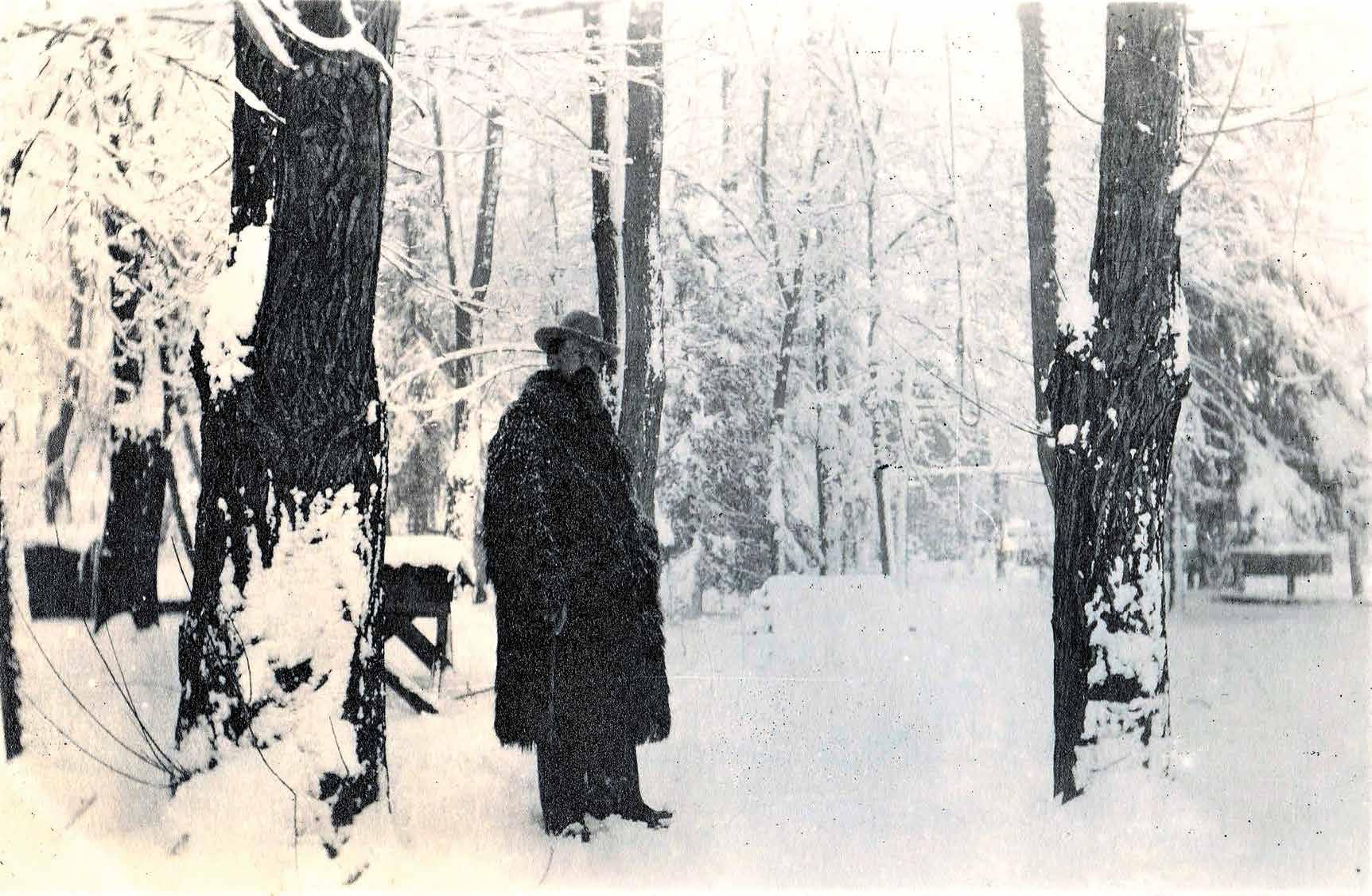
by Diane Conroy
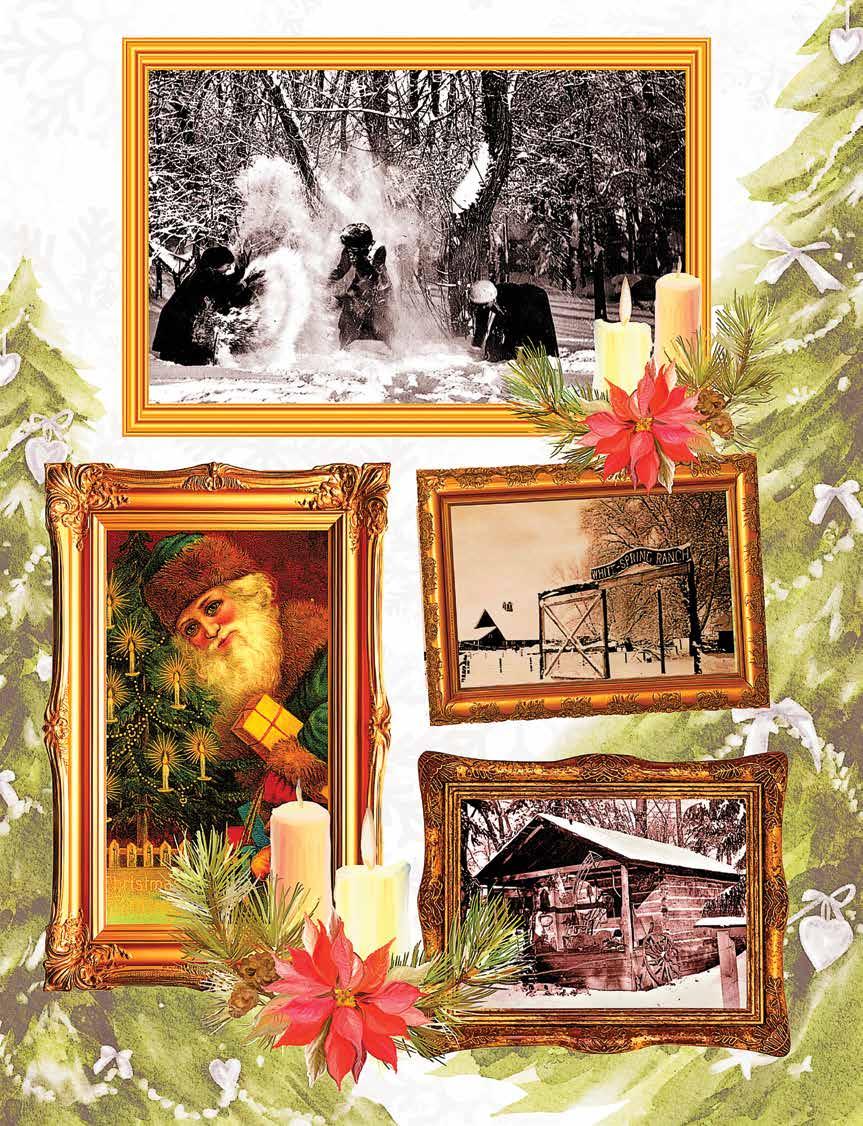
One of the fascinating projects we have at White Spring Ranch is to send out early Genesee Newspaper pages, letters and journals to WSU and U of I students. These students can then type these into a Word document all online.
Everyday, as I am checking their work, I am transported through time over the last 120 years. Stories of struggles and triumphs of this American experiment push forward through writings to be experienced again by imagination. It’s all very interesting. Stories are related through the language of the day, which is more varied than I had any idea of.
I would like to present this Christmas Through Time as an example of this unique voyage taken directly from Genesee News and letters and journals found here.
1907 A common occurrence in the early part of the last century was a sick child. There was real cause for celebration when the “fever broke” as in this storyline excerpt;
“In the Hour of Need”
“ Well, to be short about it, fer eight weeks you kep’ a gittin’ weaker an’ weaker, an’ we kep’ a feelin’ more ‘n’ more hopeless. It was a sad Christmas in our home that year. Your ma was jest wore out with watchin’ an’ tryin’ to do her work between times, an’ I was so nigh sick with trouble an’ discouragement I used to go around by the barn an’ jest cry like a baby. But I never let on to your ma though, ner she to me. We tried t’ encourage each other though we knowed in our hearts ’t all our cheerful words was lies, an’ each one knowed it too.
“ Well, jest th’ night before New Year’s Doc called us outside your room. Oh, how my heart sunk then! ‘I don’t want to hold out any false hopes to you people,’ he says, ‘but I think with proper care from now on, your little girl is goin’t’ git well.’





1917, Before Henry Lorang went to war, he had found his girl, Marguerite Tobin.
“Marguerite, your note and photograph were received this morning. With a pack of mail consisting of cards, photos and parcels, that I could hardly manage up the stairs.“--Henry
“Dearest Henry, Now my fingers are frozen stiff, so I don’t know if you can read this or not. Now Listen. I don’t want you to stay up until 11:45 writing to me anymore. That is too hard on you when you have to work the next day. It would be better to write a little bit each day until you have a letter finished. Only don’t keep it too many days. Katie and the boys are playing cards now. The boys are planning a sleigh ride in Moscow. Yesterday the G.H.S. basketball team played in Johnson and three sleigh loads went up to help them win. The mail carrier is coming, so I will close. -your Marguerite. P.S. I will write tonight another letter. “
1918, “Our Christmas Stock of Books, Cut Glass, Silverware, Ivory, and Fancy Box Papers Is Now on Display. W. J. Herman Co. The boys should have a pair of “Billy Buster” school shoes to wade the snow and mud with.”
As WWI broke out, packing Christmas gifts and mailing them soon enough was mentioned each week in the news:
1918, from “Somewhere”
Harold Haymond has written his parents, Mr. and Mrs. A. A. Haymond, that he received his Christmas package on Mothers’ Day, May 12. He found everything in good shape except the cake. (The package was mailed to him last November with the expectation that it would reach him before leaving Long Island for over-seas service.)
Mary Lorang to Private Henry Lorang, 1918
“Dear Son Henry!
It’s been about two weeks since your last letter and I am getting quite anxious to hear from you again. It always taks about a month for a letter to come across until it reaches you and Oh Glorry! We are genuinely glad to hear from you. The girls are fixing something up for you and we hope you have a Merry Christmas, and we wish you a Happy Year and soon Peace. That would mean your return home and so many more boys that would make many a mother happy, which we wish in this 1918.
The girls wrote every week two letters and for 3 weeks they wrote everyday. They were bound that you should get lots of letters. Excuse my letter, I wrote fast. The mail carrier comes about 3:00 in the afternoon and brings the afternoon mail. Mama”
John Lorang to Pvt. Henry Lorang, 1918
“This morning the 23rd it is snowing and it has snowed all last night. It is a most beutyfull scene to look out and see the snow on the trees. It is about the nicest I ever saw….this is something you can’t see now.”
Pvt. Henry Lorang to Marguerite Tobin, 1918
“I wanted to go out today to gather some mistletoe to and send you an armful of it. For I can get nothing else to send you as a rememberance”


1919, Soldier’s letters continued in the News into 1919 until they finally reached home.
“Letter from the Front, in France. Boys expect to have Christmas dinner at home in 1919.

J. Smith is in receipt of a letter from his son, C. W. Smith, December 3rd, from bar Sur Arube, France,: “at the present time I am about 20 miles from Paris. I have only been here three days as we came from the Verdun and Meuse front. I was up there about 2 1/2 months. I expect we will come home after peace is signed, or shortly after. I would like to get home for Christmas but guess there is not much chance of that. I had my Thanksgiving dinner at Souilly, France, about 12 miles from Verdun.”
1919, “Mr. And Mrs. A. J. Eikum of Lewiston, former Genesee residents, have received letters from their son, John, Feb. 3 from Commercy, France;
‘This will probably be the last letter I will write from this place as we will be moving in a couple of days, presumably toward the coast. It may be that we will be on the Atlantic by the time you receive this. I sent you a little present a few days ago – a pillow top – as a souvenir of France. I wish to thank you for the Christmas package which I received before New Year’s. Tomorrow is the last day they will take any mail. There is some sickness among the boys here, confined mostly a cold with a few cases of pneumonia. I am feeling fine.’
1921, Each Genesee News included filler jokes…
“A Merry Christmas, old man. But why are you limping” “That pestiferous boy of mine set a trap for Santa Claus.”
1928, Or the News would find items from elsewhere.
“Used to think that Christmas was nothin’ but a day for getting a lot of presents and to give a lot away; Shouted “Merry Christmas” and helped to trim the trees; Just a day of Christmas was all that I could see. Holly in December and violets in May and Christmas came to our house an’ never went away. Used to think that Christmas was nothin’ but a date. Till I learned that truly you would never have to wait; But that it’s the spirit that never stays apart, if you let it find you and keep it in your heart. Since I found that Christmas is more than just a day. Christmas came to our house an’ never went away.” Always Christmas By William D. Nesbit, in Missouri Farmer magazine.
1931, the middle of the Depression, when Christmas decorations were very difficult to afford.“December is a sparkling month, When silver snowflakes fall; And shining glassy icicles hang all along the wall. December is a sparkling month– I know she’s decorating the earth in singing, trimming for our Christmas celebration!”
1931, Depression era prices were still hard to afford when no one had any cash in hand, Most bargains were done by trade… “For Sale — Christmas Trees, 25c to 50c. Lester C. Hayden”
1943, Christmas mail for Marines
“Post office has special handling of letters and packages to get them to men overseas before the holidays. Hundreds of packages are lost daily because senders do not wrap them strongly enough to withstand handling through numerous postal centers and the heat of a ship’s hold. “
1943, “OVERSEAS XMAS PACKAGES MAY BE MAILED ON SEPT. 15
The vast distances that the parcels must travel to reach our men at war fronts and stations the world over; frequent transfers of thousands of men which means forwarding of the mail, giving preference to arms, munitions, medicine and food in shipping space, which often means that gifts must wait. Those with relatives or friends in the service should remember that we have men in Alaska, Greenland, Iceland, England, Sicily, Africa, Australia, South Pacific islands, India, China, South America, and other areas. Every officer who has inspected our army and navy postal facilities overseas has reported that thousands of fighting men disregard mess call when it conflicts with mail call, and get their letters first. “
1948, Sentiment of the 1940’s was palpable. This generation knew what was important…
“It’s “Merry Christmas” time, so the Genesee community joins in wishing everyone a joyous occasion. Little doubt remains today about a “white Christmas” for northern Idaho and eastern Washington, not to mention most of the northern part of the United States. Most people of the United States promised themselves a few years ago that every Christmas would be a happy and merry one, if only the war would end. Those who did not come home, gave their lives that your Christmas could be happy. Those who have an abundance of everything might be lacking real happiness for the Christmas Day. Perhaps sharing a bit of the world’s goods at this time would provide that happiness. “
1953, “Santa Has Great Time Greets Children Here Snow was missing for the pre-Christmas treat for the children, but they enjoyed meeting Santa Claus, who had a treat for each one. He was assisted by members of the fire department, who transported him to the east of The Electric Shop where there is a lighted tree. The tree was transplanted for an event last winter, and has been doing nicely. It has been moved with sufficient earth by the Merchants Association.. Santa was about the size of Fred Magee.”
1955 “This Week… By Bill Roth Winter is supposed to be edging out, as snow continued to be dumped in ever-increasing amounts around the Genesee area. The only individuals not complaining are the children, who are having the time of their lives on their sleds.”
1956, “Fruit cakes keep well in a home freezer, home economists advise. The cakes made in Autumn and stored under refrigeration will keep until the Christmas Holidays.”
1967, “May all the joys of the Christmas holiday reach every heart and home. Carl L. Scharnhorst”
White Spring Ranch Museum/Archive Library has created a Christmas book, finally. You can find it in the local libraries and by inter-library loan.
by Nancy Hampel

Why I decided to sell my house and 90% of my stuff. Swapping robin’s nests to travel full-time.
In 2016 I lived in a unique 2400 square foot barnwood home on 20 acres in Idaho. There were robin’s eggs in a nest built in a hanging basket on my deck. Birds built nests on the eaves every year and woodpeckers ‘knocked’ on my door so often I couldn’t tell if people or birds were knocking. I lived there four years alone and loved much about that living. My house peeked through a magical winding walkway lined with yellow leaves in autumn. A small spring-fed stream runs through the aspens behind the house. You could hear it rushing in spring on the deck.
The Land
It was quiet and simple living. I adored the land. Two streams (one seasonal) were near the house. And there are three eco-systems; a pine forest, an aspen grove by the spring-fed stream and meadow grasses, plus a couple of hills with wildflowers and round stone outcroppings. Magic. I was there alone in a 2400 square foot house with my Great Pyrenees, Zeus, and my rescue cat, Miss Merlin. Somehow an orange tomcat made it through forests with owls and coyotes to find her and we had kittens. I let her raise them naturally with no interference. It was a joy to watch. I loved the land and became friends with the wind and the sounds of coyotes and owls.
Once I heard coyotes at night 15 feet from me. Great horned owls flew overhead so close I could hear their wings. I had a daytime stare-down with a barn owl sitting in a pine tree. Weird that it was out during the day. Do you know if the coyotes go quiet when there is wolf passing through? I couldn’t figure out why I hadn’t heard coyotes yipping at night for a month and asked my neighbor. “Oh that’s because the wolf is coming through. A lone wolf comes through here every year and the coyotes know to keep quiet”.
My house was built entirely of reclaimed barnwood from local barns and massive beams from 100 year-old sawmills. I had a landline. I did not have WiFi or TV. The cell phone reception was poor and I was glad about that. I read a lot and wandered a lot and looked and communed with most everything…the trees, my herbs, the birds, the snow, the wind and the stars. People came to visit me and I went to town often.


For a time I slept outside on a pad directly on the ground. There were plumbing problems and stinky sewer gasses in the house. I made makeshift shelter from cement blocks, wood and a piece of tin roof. It snowed on me a few times, but I was snug and warm and could see all the stars through the trees that surrounded me. I looked straight up to see the deep night sky filled with stars through a circle of tall pine trees. You can smell the pine needles in the clean, crisp night air. I loved that time. This is when I heard the coyotes crying at night only 20 feet or so from me. It was a little scary, but only a little. Coyotes don’t hurt people and I knew it. So I just stayed and listened.
We get real winter here in Idaho. Feet of snow. It was hard but beautiful. I shoveled snow on my long and steep driveway. I had a snowblower. I had a 1990 red Ford F150 truck. I loved that truck! It gave me power and a sense of stability. I could haul lots of stuff and get out in the winter. It was satisfying to know you arranged to get the best wood, split a cord yourself over the summer, and made the fire in the stove daily from the kindling you chopped. The fire in my soapstone woodstove was my friend in the winter. Sometimes I made homemade soup with bones and veggies and herbs and let it slowly cook on the woodstove.
Monster hollyhocks came up as volunteers from some soil I brought with me from my previous garden. I created experimental food-forest gardens for veggies and flowers. I also tried hugulkulture (you bury a log with a ton of soil and plant on top of it) and other cool things. My gardens produced food with minimal effort after they were created. I planned and even bought fencing to get a couple goats. And I had great plans for a strawbale greenhouse/chicken house.
In summer I hired Travis and D’Wayne, self-proclaimed rednecks with chainsaws. They bushwhacked, cleared trucklouds of debris and routed out a family of packrats in my barn. They treated my place with respect and kind of ownership. They probably couldn’t hold down regular jobs due to PTSD issues, but they knew how to do all the things I needed done and took pride in their work. They loved Zeus. They came up with ideas. We got a lot accomplished and I was happy in the summers.
Winter was beautiful. Stunning at times. Hard. And lonely. I did not realize how lonely I had become until I left and went to Tulum, Mexico for a month. I actually rode a bike around talking to people every day! I had forgotten how it felt to be that happy on the daily. I was wilting in my house and unable to make all the things happen that I dreamed about. The personal energy wasn’t there, by myself, to do projects that would bring people to me, like an Airbnb cabin, community cider pressings and garden workshops.
But I wasn’t aware of my very sad soul…I just felt vaguely tired and unhappy. Until one day.
“You don’t even want to be here” That’s what my outspoken bodyworker said to me out of the blue. I was surprised and didn’t get it. “What? What are you even talking about?” “Nancy, you just said these words, ‘I don’t even know what I am doing here since Dad passed’. I really had spoken those words without even realizing it.
I was deeply lacking a feeling of community and vibrant living. Even though I knew a lot of people in town, I had changed. The town had changed also since I first moved there. I needed badly to have new experiences, meet new people, be in places where meeting and talking and sharing were daily activities.
I realized if I sold everything, I would be free. Free of the burden of trying to figure out how to make the house work financially and emotionally. Free to go where I pleased, when I pleased.
Once I decided to become nomadic, I was ready to leave in six months. I did all of this in six months: Fixed up the rest of my house and sold it. Gave away/sold 90% of my belongings. Found loving homes for my cats and dog. Created a financial plan for myself, moved some belongings to my cousin’s house in Texas and left for Canada in my Honda Fit.
I was prepared to live with my dog even after selling my house until I found a wonderful place for him. But I found a loving family with goats for him to guard and dogs to be with. My cats went to my longtime friend and neighbor. I would never have put him or my cats in a shelter. This was very important to me.
Now it is almost 6 years later. I am writing from a friend’s house in northern California, in a little mining town in what they call ‘gold country’. I have been traveling based on my intuition. If I am invited somewhere and it feels right or if somewhere is calling me, then I go. I have just gotten back from 5 1/2 months in Morocco and France. Before that I spent 1.5 years in the Okanagan Valley in Canada, two months in New Orleans and many other places in the US and Europe.
Slow traveling means, for me, settling into places. Walking and talking and absorbing the land and the people. After writing this I realized that I was slow living in the country…paying attention to the small things that mattered to me, that made my heart sing.
Now I do that kind of slow living in different cities and different countries. It is such a joy! At this writing I am preparing to return to Tangier, Morocco and stay one year, which is a first for me since I lived in Idaho. I will be nesting for a while. That’s it for now. I leave you with the mental picture of my “graceful ladies” at my Idaho country house on Lenville Road; the small aspen grove of seven slim beauties with white bark and yellow and green leaves standing tall against a vibrant blue sky.










By Tony Niccoli
Don’t you just hate it when things find a way to slip through the grates of your grill and end up as a messy charcoal remnant that sticks to the bottom? I’ve lost whole asparagus, thinly sliced veggies, fries, and assorted other diminutive items to the charcoal or gas flame below many times over the years. It has made me a better griller. Taking the time to carefully think out prep and sizing, or grabbing a simple grill basket go a long way. But what about the most difficult item imaginable – something that truly should not ever be grilled? Maybe soup. I got thinking about this concept a long while ago, mostly as a joke, and quickly decided that getting a cauldron and making a hearty soup over an open flame, outside in the chill fall air, sounded too fun to pass up.
Some of my long-time readers might remember that I had been coveting a large and sturdy Dutch Oven for quite some time but hadn’t found a perfect model. It had reached a point of Goldilocks assessment with one being too big another too small, or the depth being out of proportion to the volume. And then then Heather found a lovingly restored hundred-year-old model that was just right and she surprised me for my birthday. I went an entire year writing only articles about camp fire or backyard cooking with my new favorite accessory, and I have continued to use it regularly ever since. But now, facing the challenge of soup on the grill is now seen as an opportunity for the little oven that could to return to center stage! And what is the perfect soup for the weather and occasion – well, French Onion of course!
There are few things in this world more delicious than a slowly brazed onion. To me, having a sautéed onion is one of the pinnacles of elevated burger cuisine. Slow cooked in pot with a perfectly rendered roast is even better. But the ultimate form that an onion can take on is to be delicately brazed and allowed to cook in its own juices as it softens up into a mellow but rich flavor. A perfectly cooked onion remains sweet, and yet is still savory – it loses the pungent bite that it offered when raw and instead caramelizes into a shimmering excellence of deep and meaty flavor that never fails to bring an impact to any dish. In fact, it is such a wonderful delight that a braised onion can almost stand entirely on its own. When eating a pot roast, a bite that misses the beef, carrots and potatoes, and comes back with a fork loaded with onion alone is still a treat.

I would be pleased as punch to slowly savor a big bowl of just the onions and broth, but why stop there? Since we are going to make soup on the grill, and chase after a perfect wintery comfort food, I say we add a little (or a lot more than a little) melty cheese and use it to create an adorable winter cap for our soup to wear. And now that we’ve brought cheese into the discussion, wouldn’t it feel wrong to leave bread out of the picture? Something hearty and just a little rustic, crusty but soft inside and ready to nearly melt into the simmering cauldron of onions and broth, a bread that is fluent in French flavor – of course I’m talking about a baguette. A healthy dose of beef broth and just a little effort to season and we have a divine concoction that is guaranteed to warm on even the coldest and most blistery of winter days. You have loved it restaurants, craved it a home, and now you get to take it to the next level by donning your adventurous spirit and cooking soup outside on the grill. BYOM – bring your own mittens – I have the perfect recipe ready to go.
I’m going to start with a quick aside for any vegetarian gourmands that might find their mouths watering, but beef stock a bridge too far – just swap it for a vegetable stock and be prepared to add just a little extra salt (I promise you will hardly notice a difference if you try this). If you really want to simplify, this will be delicious with just the stock of your choice, two pounds of onions, half a baguette and some cheese. But for maximum elevation and pampering on a cold night, go ahead and follow the rest of my recipe and wow your family with one of the best soups they’ve ever had.
We want to start by getting the grill up to temperature – remember that if the collar on your coat is turned up to block autumn wind, or you just brushed snow off the top of your grill cover, this is going to take longer than expected, but it will not need to be as closely monitored throughout the cook. We just want to shoot for a consistent temp somewhere near 400 F with an option to leave the lid open as long as we stay within about 15 degrees. I normally like to remind fellow grillers that those lid-mounted thermometers don’t offer much assistance when cooking something down on the grates below – they are simply too high up and too inaccurate to be trusted. You might find them to be off by 50-100 degrees because of the way heat traps and air flows in your grill, so normally knowing how to time, hand test for temp, or using a probe thermometer is king. But with something as easy as caramelizing onions and bringing forth the complex flavors of soup we don’t need to be as precise as we would when grilling a steak or chicken breast.
Since I am cooking in a Dutch Oven, it acts like an oven within an oven when I close the lid of the grill. Wind becomes a non-issue and temperatures stay incredibly well regulated because the cast iron soaks up and then consistently delivers back all of that stored heat. If you are using a large metal pot instead of Dutch Oven just expect a lot more temperature fluctuation when adding cold ingredients, and a longer cook with a bit more attention paid to keeping the grill up to temp.
We want to get our stock pot or the base of the Dutch Oven over the direct heat and let it start warming up before adding the onions. Classic yellow onions are the most commonly associated with this recipe, but I like to add a large Walla Walla to bring in just a little extra sweetness.
You want about 2 ½ pounds total and that should be two large yellows and one Walla Walla. Slice them thin and add 1/3 cup olive oil to the bottom of the pot as they go in. As soon as this starts to simmer and fry a little, we want to add 2 tablespoons of finely chopped thyme, fresh black pepper to taste and plenty of salt. Here comes the cold part – you are going to gently stir with a wooden spoon or silicon spatula for about 25 minutes. You can move on to the next step when the onions are medium golden and have completely softened. The active stirring stops them from burning or gluing to the bottom and is key to getting the maximum flavor. Don’t get lazy here or run inside, just mitten up and take it!
“Don’t get lazy here or run inside, just mitten up and take it!”
We can now add a ½ cup of red wine. If you skipped that Walla Walla, maybe use something just a little sweeter – otherwise feel free to keep it French and try a Burgundy. Remember, it’s only a ½ cup into the soup and the rest to your table so don’t feel too bad about using something more elevated than you would normally cook with. I close the lid here and wait inside a bit, but that is optional. We want to bring the base to a boil and let it run for 5 minutes before adding our beef stock. The temp will drop a bit, so let it have time to get back to a boil again and then get ready to move off the direct heat and drop in the bread.
I like a medium-thick slice of the baguette with a few pieces cut in half to make sure I can cover every inch of the surface. Arrange them neatly and then cover the tops with 1 cup of grated Gruyere (or Swiss) and dust that with 3 tablespoons of Parmesan for a little extra bite. Salt and pepper to taste and then bake that until the cheese is golden-brown and bubbling. With the Dutch Oven this can be done in place provided that you kept the lid up to temperature on the grill. For a standard stock pot, you might want to head inside to a broil in the oven.
It should be allowed to cool for at least 10 minutes before you serve, so you have just enough time to get the table ready and pour the rest of that bottle of wine. Happy Holidays dear grill master – you just faced the wintery cold made soup on a grill! I hope you enjoy it – and feel free to brag just a little about being able to grill ANYTHING.


There’s something about the holidays that makes the kitchen feel alive. Maybe it’s the smell of cinnamon and cloves wafting through the house, or the hum of conversation as people gather around a pot of something warm. Whatever it is, food this time of year always feels like more than just food — it’s a perfect blend of togetherness, memories in the making, and Aunt Bethany saying Grace before the meal.
When you dig into what’s on your table, you realize that many of our favorite holiday foods have been on quite a journey to get there. So, grab a mug (preferably a moose mug), pull up a chair, and let’s wander through a few of the dishes and drinks that have been bringing people together for centuries.
Oh, and keep an eye out for some quick and easy tips to make your holiday feasts festive and fun.
The Toast Heard ‘Round the Village: Wassail
Long before anyone popped a bottle of champagne at midnight, folks in medieval England gathered around steaming bowls of something called wassail. The word itself came from “Waes hael,” meaning “be in good health.”
The drink itself was typically a blend of ale, hard cider, or wine heated with sugar, apples, and spices such as nutmeg, cloves, and cinnamon. It was served in a large communal bowl passed among guests, symbolizing fellowship and goodwill. I’m not sure about you, but that sounds like a party I want an invite to. By the 13th and 14th centuries, wassailing had grown into a popular English custom. Villagers would go from house to house singing and offering blessings in exchange for drink or food. This practice blurred the lines between charity, revelry, and community ritual—an early forerunner to caroling.
It wasn’t just about the drink — it was about a true connection. At the heart of it was fellowship, clinking mugs and hoping the year ahead would be a good one.
You can keep that spirit alive by making a batch of your own. Just simmer apple cider with cloves, cinnamon, and orange slices, and maybe a splash of rum if you’re feeling old-fashioned. When you serve it, raise your mug high and shout a good hearty “cheers” — or if you really want to honor the old ways, try “Waes hael!”


Eggnog and the Founding Fathers
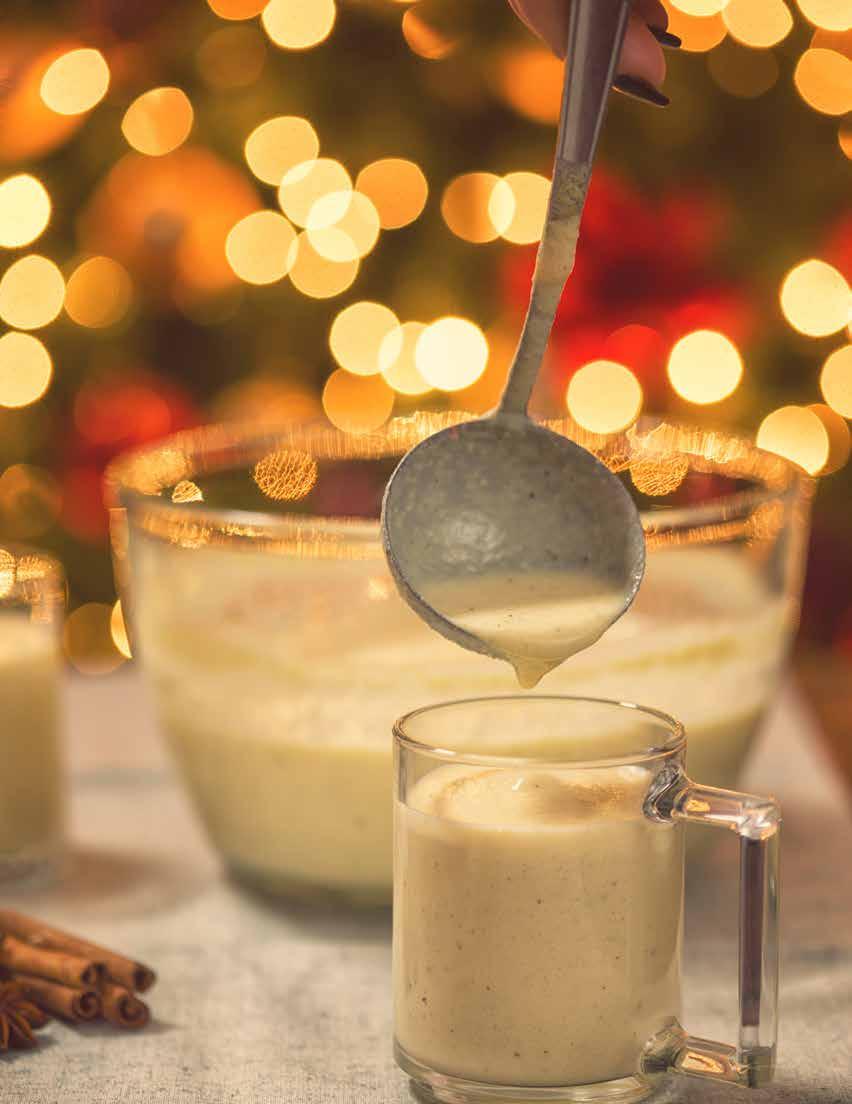
Eggnog might be the most nostalgic of all holiday drinks. It’s thick and creamy with a nice shot (or two) of booze at the end. Its ancestor was a medieval English concoction called posset, a warm mix of milk, ale, and spices that the wealthy sipped from silver cups.
By the 17th century, British aristocrats toasted holidays and special occasions with posset-like drinks spiked with brandy or sherry. When English settlers carried the recipe to the American colonies, rum—cheap and plentiful from Caribbean trade—replaced the European spirits. Colonists embraced the drink, especially in the South, where farm-fresh eggs, cream, and spirits made it a festive staple.
In the 18th and 19th centuries, eggnog became synonymous with Christmas, its warmth and richness fitting perfectly with winter festivities. Legend says that George Washington even had his own potent recipe, famously heavy on rum, whiskey, and sherry. As it spread across North America, regional variations appeared— bourbon in Kentucky, brandy in the Northeast, and even nonalcoholic versions for family gatherings.
If you’re making it today, try keeping it simple: good bourbon, fresh nutmeg, and a splash of vanilla. Serve it in cute little glasses and toast to the new year - one that is brimming with possibility and hopeful beginnings. Don’t forget the moose mugs!
The tradition of serving roasts at Christmas dates back to medieval England, when great feasts marked the Twelve Days of Christmas. In noble households, the centerpiece was often a boar’s head, symbolizing bravery and abundance. As time passed, other meats took its place—oftentimes roast goose.
Every great feast needs a centerpiece, and for most of history, a roast sits at the center of the table. In the great halls of Europe, whole animals turned over open fires while musicians played and people danced. By the time settlers made it to America, turkey took the crown.
There’s something deeply comforting about that slow roast smell filling the house. Whether you’re basting a turkey, glazing a ham, or roasting a prime rib, you know the upcoming meal will be amazing and it will be shared with those you love.
Just remember one thing - please don’t overcook it.
Fruitcake’s story begins in ancient Rome, where early versions combined pomegranate seeds, pine nuts, and raisins mixed with barley mash and honeyed wine—a practical way to preserve fruit and fuel soldiers.
By the Middle Ages, bakers added spices and spirits, making it rich enough to last all winter. Come Victorian times, fruitcake was a mark of wealth — packed with expensive imported fruits and drenched in brandy to keep it fresh. Even Queen Victoria was said to let her fruitcake “mature” for a year before serving it. When European settlers brought the recipe to America, abundant ingredients and spirits transformed it again. Rum-soaked fruitcakes gained popularity in the South, where they could be made-
-months ahead and “aged” for flavor. By the 19th century, fruitcake was a holiday staple, mailed across great distances thanks to its legendary shelf life.
Fruitcake has been the butt of more jokes than it probably deserves (who are we kidding? It totally deserves it!), but it’s one tough dessert.
For your holiday spread, try making mini fruitcakes soaked in bourbon or amaretto, or go for an Italian panettone — lighter, airier, and every bit as festive.
Cranberries are one of the few foods truly native to North America, and they’ve been part of winter feasts long before the first Thanksgiving. Indigenous tribes used them in medicine, dye, and food, often mixing them with dried meat and fat for survival food called pemmican.
Cranberries’ association with Christmas grew stronger in the 19th century. They were used not only in sauces but also as decorative garlands for Victorian Christmas trees. Cookbooks of the era began pairing cranberry sauce with traditional roasts, linking the berry’s jewel-like hue and seasonal availability to the holiday spirit.
Settlers took to the tart little berry quickly, turning it into sauces and relishes. By the early 1900s, cranberry sauce was a staple at American holiday tables — especially once it started coming in those famous cans.
Be sure it is spiked and your family will thank
you
Canned cranberry sauce is great, but nothing beats homemade. Boil up some fresh cranberries with maple syrup, a little orange zest, and maybe a splash of port wine, and you’ll have a sauce that’s as bright as a Christmas ribbon and twice as sweet with history. Or if you prefer, grab a “slice” from the can.
Plum Pudding with a side of Charles Dickens
If you’ve ever read A Christmas Carol, you can almost smell Mrs. Cratchit’s plum pudding blazing in the kitchen. Despite the name, it doesn’t actually have plums — just raisins, which the English used to call “plums” many moons ago. Despite the name, “plum” didn’t refer to actual plums but to any dried fruit. Over time, the mixture thickened into a dense, boiled pudding bound with suet, breadcrumbs, sugar, and eggs, often soaked in ale or brandy. By the 17th century, plum pudding had become a fixture of Christmas feasts,-
-symbolizing prosperity and unity—each ingredient representing blessings of the coming year.
This pudding goes all the way back to medieval “frumenty,” a thick porridge of beef, wine, and dried fruit (yes, beef!). Over the centuries, it became a rich, spiced dessert steamed in cloth and soaked in brandy.
Traditionally, every family member stirred the pudding for good luck, and a silver coin was hidden inside — whoever found it was said to have prosperity in the coming year. Wait. Whose idea was it to put coins in food? Isn’t that why we can’t have Kinder Surprise Eggs in the US?
You can keep that tradition alive with individual puddings, or make a big one for the table and light it with a splash of brandy. If you try to be this fancy, be sure to have a fire extinguisher nearby and the fire department on speed dial.
Few things say “holiday warmth” like a pot of mulled wine simmering on the stove. The Romans were the first to spice and heat their wine, a custom that spread across Europe over centuries. By the time it reached the snowy villages of Scandinavia, it was known as glögg; in Germany, glühwein.
During the Middle Ages, mulled wine took on medicinal and festive roles. Spices like cinnamon, cloves, and nutmeg were prized for their supposed health benefits and status as luxury imports. Recipes appear in 14th-century English cookbooks such as The Forme of Cury, where it was called Ypocras, named after the physician Hippocrates. It was served at banquets and winter feasts to aid digestion and symbolize hospitality. By the Victorian era, mulled wine had become firmly tied to Christmas. Charles Dickens’s A Christmas Carol helped popularize “Smoking Bishop,” a version made with port, red wine, citrus, and sugar—reflecting the era’s love for warm, spiced beverages shared among friends.
To make your own, simmer red wine with cinnamon sticks, cloves, and a bit of orange peel. Add a splash of brandy for good measure, and serve it in mugs while sitting by the fire. It’s a drink that literally tastes like Christmas.
At the heart of every holiday feast — whether it’s a humble potluck or a grand dinner — there’s always been the same goal: to share warmth, laughter, and good food with the people we love.
So, when you fill your table this season, remember you’re part of a story that’s been unfolding for hundreds, even thousands, of years. The recipes might change, the ingredients might evolve, but the feeling — that sense of togetherness — never goes out of style. Every family has their own Aunt Bethany just waiting to make a jello mold for your holiday party. Let her bring it and serve it with a glass of eggnog. Be sure it is spiked and your family will thank you.
If you are unfamiliar with some of my references, watch Christmas Vacation and A Christmas Story ASAP!
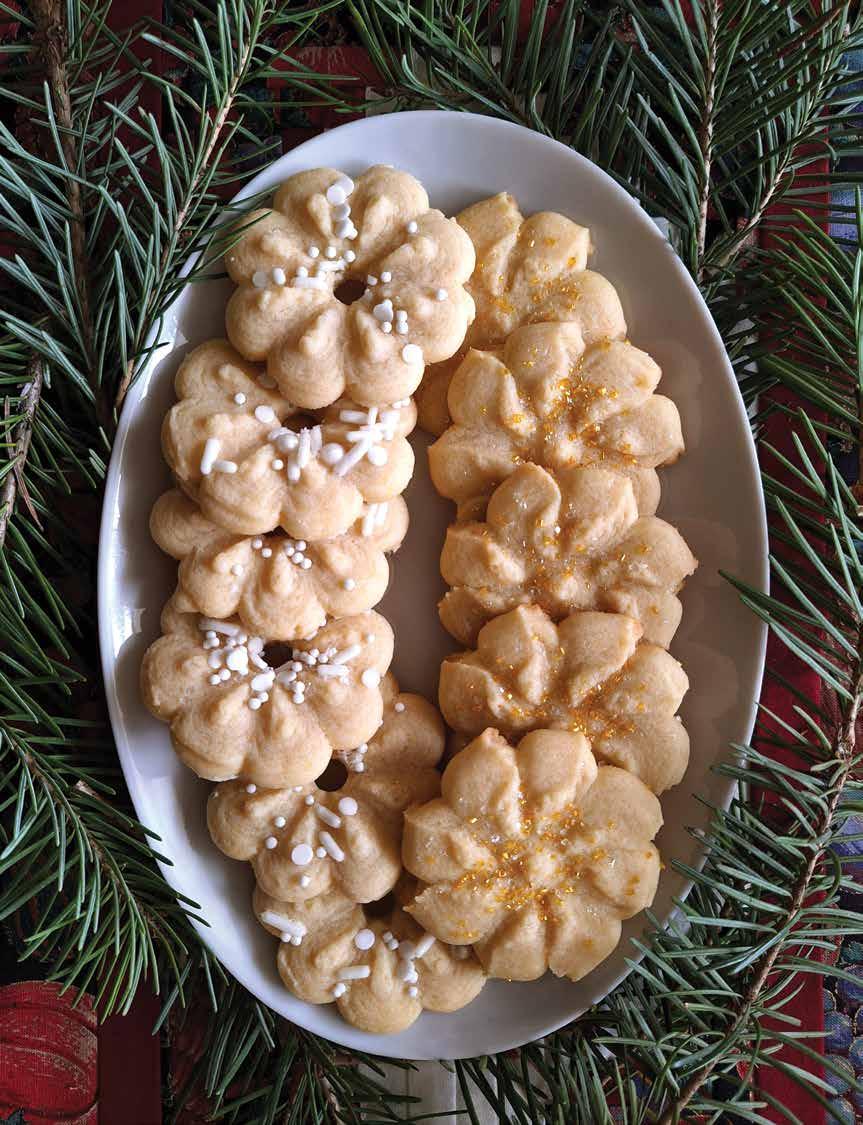
2 sticks unsalted butter
1 ¼ C granulated sugar
1 egg + 1 egg yolk
2 tsp vanilla extract
1 tsp almond extract
2 ½ C flour
1 tsp salt
STEPS
Preheat oven to 350° fahrenheit. Meanwhile, in a large bowl cream the butter and sugar for 3-5 minutes or until well incorporated with a fluffy texture; this can be done with a whisk by hand or using an electric mixer on medium speed. Add the egg, egg yolk, and extracts – stir until just combined.
In a separate bowl, whisk together the flour and salt. Gradually combine the flour mixture into the butter mixture. If using a cookie press, do not refrigerate the dough – follow press instructions to load and extrude the dough onto an ungreased cookie sheet. Decorate with sprinkles if desired. Bake for 6-8 minutes or until lightly golden brown.
If shaping dough by hand, chill 1-2 hours. Roll the dough into one inch balls and place on an ungreased cookie sheet. Use a fork to flatten dough slightly; decorate with sprinkles if desired. Bake for 8-10 minutes or until lightly golden.
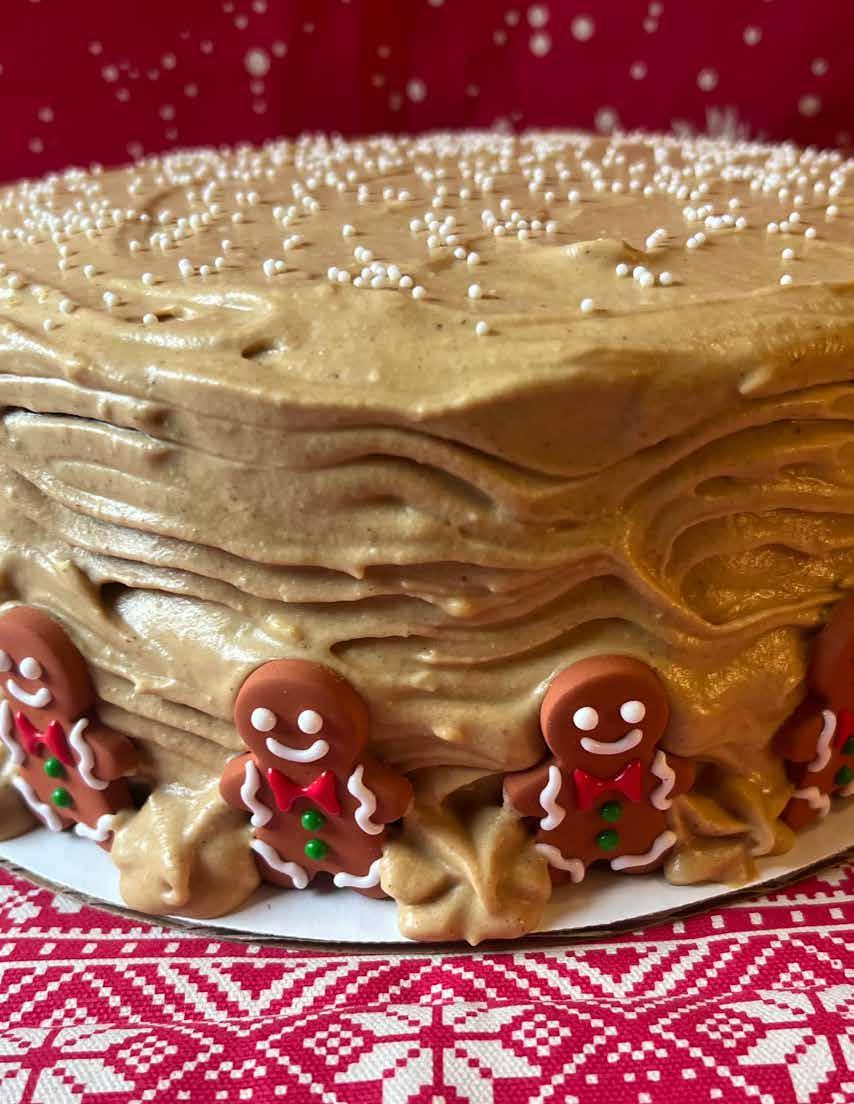

Cake:
2 ¼ cups all-purpose flour
1 tsp baking soda
1 tsp ground cinnamon
1 tsp ground ginger
½ tsp ground nutmeg
¼ tsp ground cloves
½ teaspoon salt
½ cup unsalted butter, room temperature
½ cup granulated sugar
½ cup dark brown sugar, packed
½ cup molasses
1 large egg, room temperature
1 cup buttermilk, room temperature
Cinnamon Molasses Frosting:
8 ounces cream cheese, room temperature
½ cup unsalted butter, room temperature
¼ cup molasses
2 tsp ground cinnamon
3 ½ cups powdered sugar
1 tsp vanilla extract
STEPS
Preheat your oven to 350°F. Grease and flour 2 - 8 inch round cake pans or line with parchment for easier removal. In a medium bowl, whisk together flour, baking soda, cinnamon, ginger, nutmeg, cloves, and salt. In a large bowl, beat the softened butter, granulated sugar, and brown sugar until light and fluffy (about 2–3 minutes). Beat in the molasses and egg until well combined. Add the flour mixture in three parts, alternating with the buttermilk in two parts. Begin and end with the dry ingredients. Mix just until combined to avoid over mixing. Pour the batter into the prepared pans and smooth the top. Bake for 20-25 minutes, or until a toothpick inserted in the center comes out clean. Let the cake cool in the pan for 10–15 minutes before turning out onto a wire rack to cool completely.
Frosting
Beat cream cheese and butter together until smooth and fluffy. Add molasses, cinnamon, and vanilla extract and beat again. Gradually beat in powdered sugar until the frosting is thick but spreadable. Once the cake is fully cooled, frost the cake and decorate. I used Wilton gingerbread men, but you can use gingerbread cookies as well.
2 sheets of ready-rolled puff pastry, thawed
½ cup Nutella
1 egg, whisked
Powdered sugar
Wooden skewers or cake pop sticks
Small star-shaped cookie cutter
STEPS
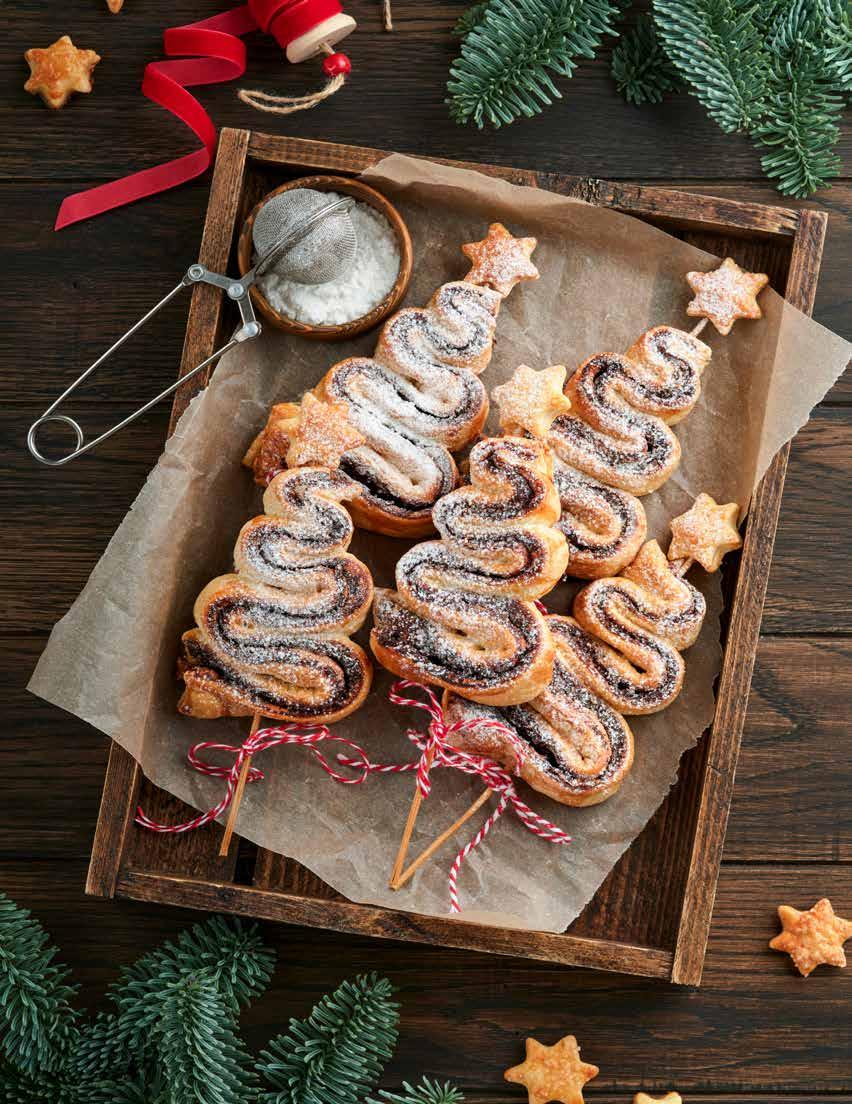
Preheat your oven to 375°F. Line a baking sheet with parchment paper and unroll a sheet of puff pastry onto a lightly floured surface. Spread a thin layer of Nutella over the pastry sheet, fully to the edges. Be careful to use an even layer so it doesn’t seep out too much. Cover with another layer of puff pastry. Gently seal the layers by pressing down. Using a knife or pizza cutter, cut your pastry into about 10 even, 1 inch strips. Fold each strip into an accordion, with the larger folds towards the bottom to create a tree. Insert the skewer through the middle and leave enough room for a puff pastry star if you choose! Place them on a baking sheet and brush the sides, bottom and top with your egg wash. Bake for 20-25 minutes, or until your pastry is puffy and golden. Dust with powdered sugar and serve warm!
1 package puff pastry
4 oz goat cheese
1 tbl butter
1 medium shallot
½ c sundried tomatoes
⅓ c parmesan cheese
1 egg, whisked
Chives to garnish
If frozen, completely thaw puff pastry. Remove goat cheese from fridge 30 minutes prior to cooking to ensure it is at room temperature. Preheat oven to 400° fahrenheit; place oven rack in the bottom third of the oven. Melt the butter in small pan over medium/low heat. Finely dice the shallot and cook in the butter until lightly browned, about 3-4 minutes. Season with salt and pepper.
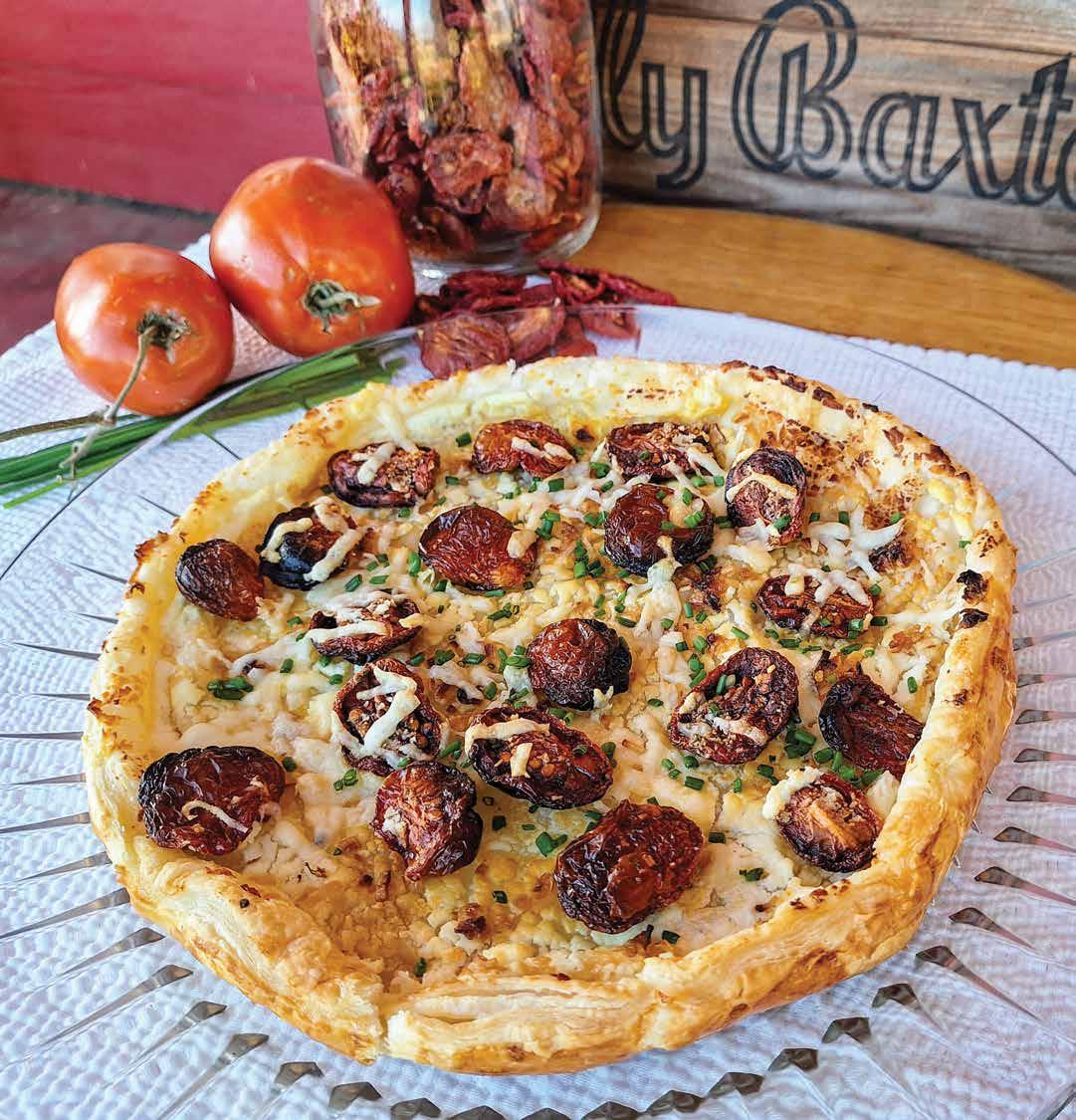
Roll out puff pastry onto lightly floured surface and use a large bowl and sharp knife to cut the pastry into a large circle. Place the pastry on a lightly greased baking tray and using a fork or knife, poke the pastry so that it doesn’t bubble during baking. Spread goat cheese on the pastry leaving a ½ inch border around the edges. Evenly distribute the cooked shallot atop the goat cheese. Place the sundried tomatoes on next, followed by the parmesan cheese. Slightly fold the edges of the pastry inward and brush with the egg.
Bake for 20-30 minutes, or until the bottom of the tart is golden brown. Remove from oven and garnish with chives. Serve warm.

2 sticks unsalted butter
1 1/3 cup granulated sugar, plus extra for rolling
4 large egg yolks, room temperature
2 tsp vanilla extract
5-10 drops green food gel coloring
2 1/2 cups all-purpose flour
1 tsp baking soda
½ tsp fine salt
24 red heart sprinkles
Green decorative sugar
Preheat the oven to 350°F, and line a baking sheet with parchment paper. Combine the flour, baking soda and salt in a bowl, set aside. Melt the butter in a mixing bowl in the microwave, and then stir in the sugar, egg yolks, vanilla extract and 5-10 drops of the green food coloring (you want the color to be deep green, it lightens up while baking). Stir very well to combine. Add flour mixture and stir until combined. Scoop dough out. Roll each dough ball in your hands, roll lightly extra granulated sugar and then green decorative sugar, and then space evenly on the prepared baking sheet. Bake for 10-11 minutes, until they spread, start to crackle and appear dry on top. Once you remove the cookies from the oven, quickly press a single red heart sprinkle into each cookie top. Let the cookies rest on the baking sheet for 2 minutes before moving them to a wire rack to cool completely.
A few years ago my grandmother gave me a gift that still amazes me to this day. It was something that cannot be bought, no matter the cost. You see, my grandmother was a painter, specializing in tole and rosemaling. In her heyday she taught classes, published and maintained numerous painting publications, and personally painted hundreds of pieces that made it into other people’s homes. Her work was beautifully done, following the tradition of those who long came before. Over time she studied and collaborated with leading Rosemaling and Tole painting artists, eventually making a name for herself within elite artistic social circles. As you can imagine, when she handed me all of her old teaching templates, I felt nothing but absolute joy! From the paint colors she used and the detailed instructions on how to make each individual stroke, to her designs and personal notes from classes, it’s all there. As someone who also paints in various mediums, I was- and am still- simply in awe. Rosemaling (translated from Norwegian as “flower painting”) is a form of traditional folk art that originated in Norway in the 1700’s. Characterized by ornate flowing strokes, stylized flowers, scrollwork, and vibrant colors, rosemaling first gained popularity in rural areas and was influenced by the Baroque and Rococo styles of Europe. There are three main styles of Rosemaling: Telemark, Hallingdal, and Rogaland. Each of these styles are distinctive to their region and hold significance within the art form. Telemark is the most recognized and popular style, featuring asymmetrical designs, flowing scrolls, and fantasy flowers, while Hallingdal is known for its symmetrical design with flowers, leaves, and scrolls. Rogaland (also known as Ryfylke) is unique in that it forgoes symmetry and a bright color palette, instead focusing on details and clean designs. Despite these differences, all three main styles of Rosemaling rely on the basic “s” and “c” stroke. Simply put, the true artistic magic that defines this artwork comes from being able to load the brush with different colors and being able to move your hand in a very specific way as you lay the paint down onto your art piece. It takes a fair amount of practice to achieve the correct patterns, color saturations, and designs. Traditionally, rosemaling was done on wood and often adorned households throughout Norway. In fact, as the artform grew in popularity, often peasants would travel around the countryside, painting in exchange for room and board. This resulted in many houses being covered in these amazing and intricate designs. Everything from furniture like benches, chairs, and tables- to decorative items such as wooden hat boxes, bowls, and trunks were painted, often brightening up homes and dark Scandinavian winters. Even the ceilings and walls of some traditional Scandinavian Stave Churches have been painted in these designs, adding a bit of color to otherwise austere décor. In addition to achieving the perfect c and s strokes, Rosemaling artists often combine intricate brushwork with the layering of colors to achieve the amazing depth and texture that so vividly defines the art form. Tole painting on the other hand, had a broader European reach and was brought to America mainly by German and English immigrants by way of Pennsylvania. The technique as we know it today, originated in the Welsh town of Pontypool in the 1660’s and quickly became a popular way to spruce up even the most basic of household items. As many families could not afford fine china, everyday tole painted objects like bed frames and headboards, trays, and boxes became colorful heirlooms that could be passed down through generations. The word “tole” comes from the French term “tole peinte de lac” which translates to “painted tin.” Thus historically, tole painting is a folk art that you typically see on tin antiques (although it was often later practiced on other metals as well as wood).
As tin became more prolific, artists focused on their craft- and much like Rosemaling, different regions produced different results and various styles. Some of the more well-known styles include Pennsylvania Dutch, Victorian, Country Primitive, and Modern. Pennsylvania Dutch, inspired by folk art traditions, features bold colors, geometric patterns, and whimsical motifs while Victorian style is defined by delicate floral designs, intricate scrollwork, and soft pastel hues. Country Primitive is known as rustic and charming, celebrating simple designs, natural colors, and distressed finishes while Modern tole painting style is characterized by abstract patterns, geometric shapes, unconventional materials, and artists who push the boundaries of what is accepted as the artform. While similar to Rosemaling as an art form, tole painting designs were often simpler, focusing on flowers, fruits, and everyday objects. Using techniques like layering, stenciling, and repetition, tole painting quickly took hold in the United States and has evolved over time the same as Norwegian Rosemaling.
My grandma was a master in both styles, and her artistic legacy is still evident today. Her house has always been adorned with pieces that she has personally painted, and I can even remember being a young child and amazed by her “hand painted house.” Her artistic flair covers both everyday objects such as hat boxes and handheld mirrors as well as wall art and bigger, more extravagant furniture pieces like wooden benches and cabinets. To walk into her house feels like entering a cross between a museum and an art gallery. I have always been in awe, and as an artist myself, I have always admired her work. As I now work in museums, I often enjoy researching and learning more about the material objects that represent unique and different aspects of history. As it turns out, we have in a good amount of Rosemaling pieces in our collection that have been donated over the years. As guests come in and ask questions about our pieces, I am always compelled to tell them about my grandmother- and the legacy of painting that she has created. For me, it’s a beautiful and natural intersection of my life’s passion and work, and something that resonates with me emotionally. To be able to share her story and artwork with strangers in such an interesting and beautiful way is amazing, in that it gives it new life and brings it to a new audience. As she ages, it is my goal and privilege to keep her artistic legacy relevant.
While I was beyond excited about receiving her painting materials, I must also say that I have been intimidated by them as well. While I have painted my whole life, the skill necessary for this artform (hello perfect s and c strokes!) is something that has not come naturally to me. As such, the notebook full of templates she gifted me, has admittedly seen very little action- and has instead sat in my closet for a very long time. On one occasion I tried to teach myself the basic strokes and color patterns, and deeming my outcome to be disastrous, never attempted it again. However, as the holiday season approached this year, I decided to skip my usual store-bought Christmas cards and send something a little more personal- something intentional. It always feels amazing to be able to give something that I have created, and I know firsthand how special it is to receive something hand made by someone else. For my cards this year, I wanted to do something that I had to pour my time and energy into. Something authentic. Something that challenged me and pushed me outside of my comfort zone.

So, I did just that. I busted out the notebook full of art templates and got to work. As I worked through creating my own Christmas designs, I realized that sometimes it’s more about finding inspiration from something special than being able to copy it perfectly. Specifically. I was able to take my grandmother’s art templates and make something more modern and meaningful to me, weaving a bit of my own personality into the final product. As I worked with her designs, I got to experience the grandmother I have always known- but through a different lens. As she is 90 years old now and no longer paints, it has been a wonderful opportunity for me to connect with her in a new and tangible way. My grandmother was well into her career as an artist by the time I was born, and many of the templates that I inherited are certainly older than I am. But I think wholeheartedly that their age and story is what has made them even more special to me. To hold her patterns in my hands and feel not only what it was like to take classes from her- but also what it is like to bring her beautiful vision to life in a new and extraordinary way- is something that even the most amazing store-bought gift could never fully duplicate. This year as I have lovingly put my handcrafted Christmas cards into the mail, I know that they will inevitably bring joy to all who receive them. I know that each individual card carries my grandmother’s artistic spirit and flair, and now- also my own. I am also deeply honored that she chose me to gift these items to, therefore entrusting me to bring new vision and life to something so traditional. It is my distinct hope to someday be able to share them- along with my own art- with my children in the same meaningful way.

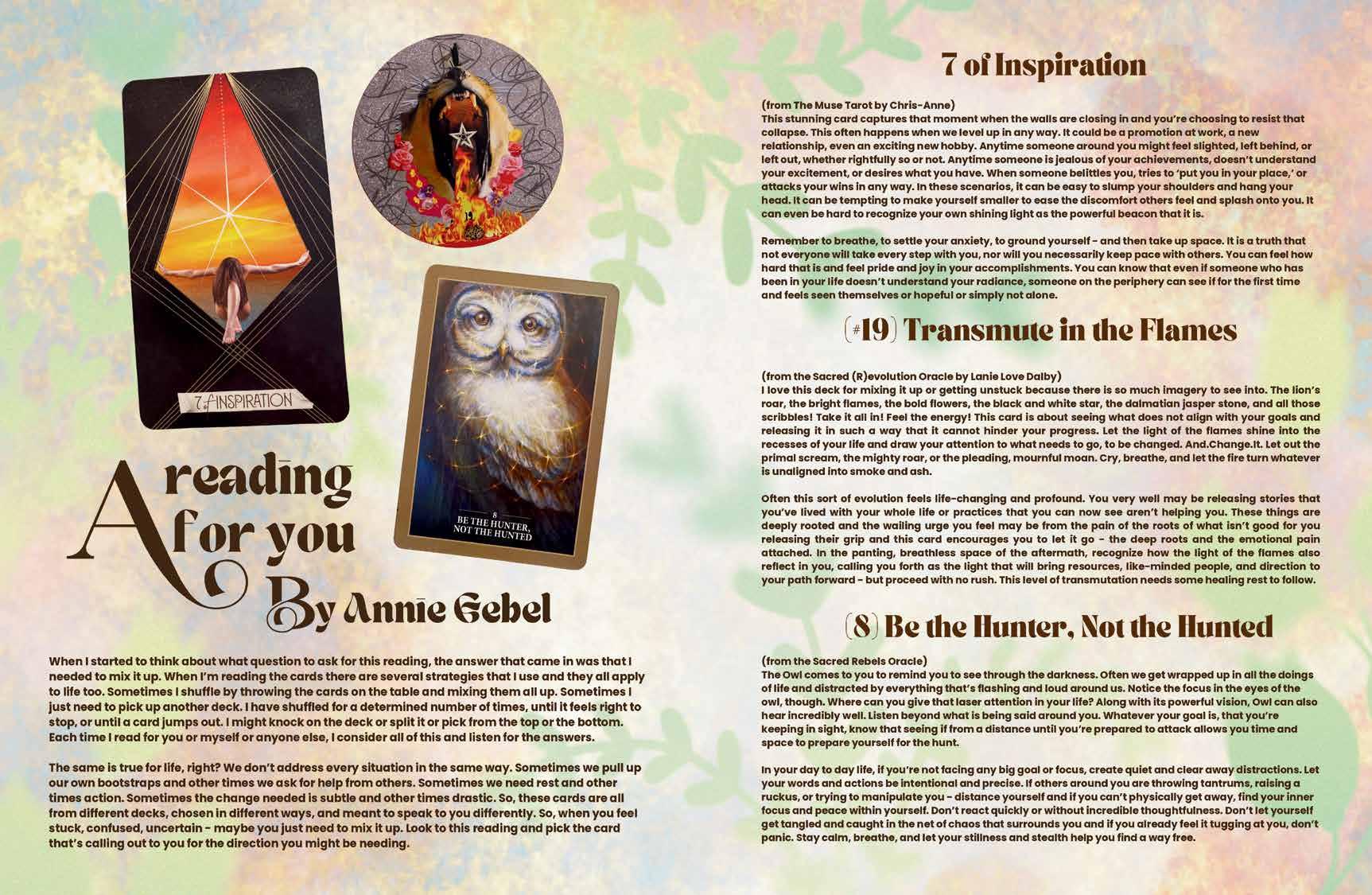
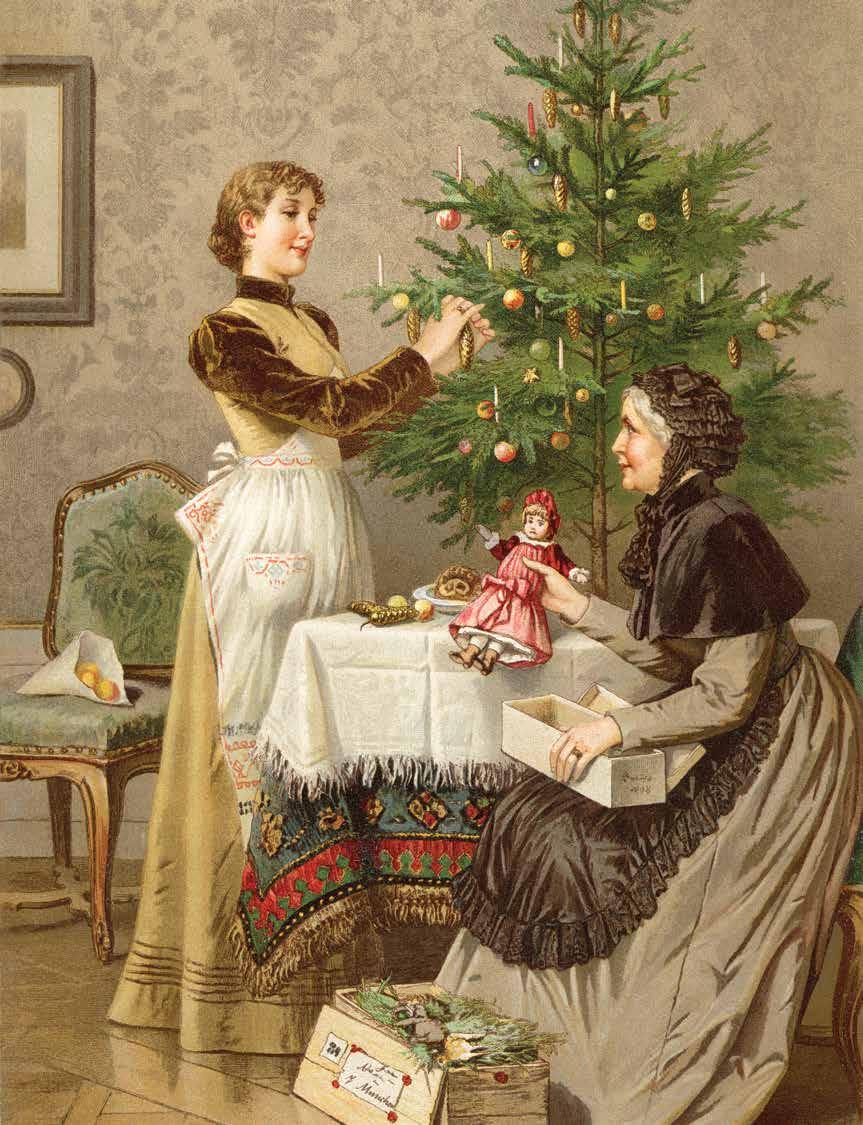
(They are rockstars. They succeeded in life without Google!)
By Laura L. Morgan
Fourteen-year-old Laura sat transfixed, with her cassette tape recorder on “record.” Her grandfather— Grandpa Swanson to her—was regaling her with tales from his childhood on the streets and hills of San Francisco. She was a bit shocked to discover he was quite naughty in school and had a lot of independence at home. Nearby rested his palm-leaf cowboy-style hat he was known for wearing as he captained his Cadillac. He was wearing his typical western snap-up shirt and a bolo tie. One of the most impactful stories was about why he had four names that came before his surname of Swanson. His parents lived in the “old country” as he referred to Sweden. Six children, three boys and three girls, were in the family. Within the space of a couple of years, all but one had died of whooping cough and other now-preventable childhood diseases. Isak and Maria Sophia decided to move to America, and they boarded a ship for the long ocean voyage. Once in America, they made their way to California. A year passed, and Maria Sophia became extremely homesick, wishing to see her family one more time. She and her remaining daughter sailed back to Sweden. While there in the old country, the daughter became ill and she, too, passed away. What an unimaginable sorrow. After returning to California, Maria Sophia and Isak had six more children. Laura’s grandpa was the first-born of those, and his parents honored the boys born before him as well as giving him his own name. Now Laura knew why her grandpa’s name was Edward Viking George Alphonse Swanson. That was a sad tale, but one that was impactful in Viking’s life and that helped mold his character.
Moving on to her grandmother Mildred, Laura recorded her recounting the family story of Effy Duff Roseberry, Mildred’s mother, who lived through the infamous 1906 San Francisco earthquake. She not only lived through the destruction, fires, and loss of life, but she actually pushed against the dinnerware hutch and saved the family’s china set from breaking! Laura imagined the fear Effy must have felt and admired her bravery.
Asking grandparents to tell stories and reminisce about exciting times not only serves as a connection across generations, but also exercises their powers of recall, strengthening their brain’s function. Some may find it difficult to relate to the elderly, even if they are relatives, but these connections are so important for both parties. I am so thankful I took the time to hear my grandparents’ stories before it was too late. Another cool thing was my Grandpa Swanson taught me “The Lord’s Prayer” in Swedish. I still have it written on a piece of paper, a special piece of my ancestral culture and language. I can say “I love you” in Swedish, and for some strange reason, I also know how to say, “Please come to the table.” We lived a very long road trip away, but when we visited, it was a good time to ask to hear a story. My grandma and I wrote letters back and forth regularly, even though she had arthritis in her hands. Letters are also a great way to make connections with older family members. Especially around the holidays, those who are advanced in years may feel alone and irrelevant. Our elders should be an important part of our society but are sometimes shunned rather than revered for their contributions and wisdom. Relatives or not, everyone needs human connection, so how can we do that?
The first step, honestly, is awareness. Realize there are those elderly people out there who are craving the joy and comfort of relationships. We should make respecting our elders a universal language of humanity.
I still remember, even though I was only three or four at the time, my mother taking my older sister and I to visit a lady who was in a nursing home. We would color pictures, and my mom would occasionally bake her some goodies. She would sit and they would talk. I’m thinking my mother knew this lady through church, but at any rate, we adopted her and went to visit. If you feel awkward about making conversations, try beginning by asking them to tell stories from their lives. A veteran’s home would also be a place to hear some amazing life stories. What if they don’t want to share? Come prepared with a list of possible questions for conversation starters.
What is the most interesting job you’ve ever had?
Tell me about a moment that was so simple yet so beautiful. Tell me about your family.
What is the most courageous thing you’ve ever done?
What was a big decision you made in life that worked out for the best?
What was an embarrassing moment that still makes you laugh to this day?
What is the most adventurous thing you’ve ever done?
What was the best year of your life and why?
What is your best quality?
What is your favorite place you’ve been and why?
Listening to stories and having conversations (you share, too!) are so important to make our elders feel valued. If you are unable to visit, place a phone call. You can still have those uplifting conversations.
I’ve mentioned in previous articles about the idea of adopting an elderly person. We lived near a widow who was still able to live at home but was in declining health. My daughters and I would go sit and talk to her and share photos. When Mrs. S wasn’t feeling well, I’d ask her if she needed groceries since I was heading to the store. In the winter, Trent and I and the kids would all pitch in and shovel the snow from her driveway. Those are all little, yet big, things to do for the elderly. Regardless if you know the person or not, you can still be a blessing. If an elderly person is struggling to get an item off a shelf in the store, offer to grab it for her. If one looks frail and has bags of groceries, offer to help carry them for her, then take care of the shopping cart afterward. Yes, even helping an “old lady” cross the street, or lending an arm on an icy sidewalk is still appreciated. Being aware of needs and meeting them is a best practice for humanity.
Taking the time to play a card or board game with a senior citizen is much appreciated. For my public speaking class I taught, I used to require students put in two hours of community service. They would then do a speech based on their experiences. I invited a liaison from the local veteran’s home to come give my students information on how to volunteer at their facility. She told us that sitting with a resident and playing a game or doing a puzzle had a tremendously positive impact, but that those who are in a care center can be “out of sight/out of mind.”
If a senior is able, going for a walk outdoors is a great activity. Getting fresh air and exercise is, of course, so healthy. My husband, Trent, is the legal guardian for a gentleman with dementia. He is mostly confined to a wheelchair now, but Trent will wheel him around outside.
His elderly friend sadly doesn’t always remember things, but they both love gardening. At his facility, there is a small garden space for the residents to use, so Trent does some gardening with his friend in the spring and summer months. This brings both of them joy. Find a common interest like this and do it together. If their cognitive capacity is sufficient, ask a senior citizen to teach you something. This may be baking, wood crafting, etc. They feel valued for their knowledge and experience, and you gain the same knowledge and experience. Maybe you both enjoy arts and crafts. What a great way to spend a few hours on a rainy fall or winter afternoon.
You may be the only one to care that day.
Perhaps you are a reader. Reading a book out loud to the elderly can be an enjoyable way to spend a few hours a week. This is especially enjoyable for those whose eyesight is failing. Watch out because you may have a crowd by the time you’re half-way through the book. If you are a writer, you could gather the stories they tell and write them down. If that seems too daunting, how about gathering their favorite recipes and the stories behind them to create a scrapbook-esque cookbook. For a more manly idea (I know some guys like to cook!) you could do the same idea with tools. Maybe they have their grandfather’s hammer he used to build a homestead, or a saw that bit into virgin forest trees, or some pruning shears used in the family orchard. How special that would be to preserve that history through stories and photos.
As this holiday season approaches, remember to think about the elderly. It would be a shame to leave them feeling lonely and abandoned, especially during a time traditionally full of family gatherings. Perhaps you feel called to share a Thanksgiving meal with some older folks who don’t have family nearby. Thanksgiving focuses on being grateful. Write a note or card to a senior citizen, telling them why you are grateful for him or her. Around Christmas, bake cookies, wrap some simple gifts, and surprise them with an early Christmas. While you’re with them, bring a few decorations to put up. Christmas celebrates the joy of Jesus’ birth. Be a blessing and bring someone else joy.
In a society that often feels too busy and too divided, we can shine a bright light, extending love, gratitude, and support to the elderly. Remember that, above all, we are all part of the human race, and therefore, worthy. If we step outside of ourselves and put ourselves in the proverbial others’ shoes, we have more empathy. Suddenly, taking an hour or two out of your week for someone else doesn’t seem like such a chore. Audrey Hepburn is credited with saying, “As you grow older, you will discover that you have two hands, one for helping yourself, the other for helping others.”
If nothing else, when your path crosses someone who is your elder, smile a genuine smile, look them in the eye, say hello, and ask them how they are doing. You may be the only one to care that day. Bring joy when and where you can.
by
The air is turning crisp, the leaves are changing, and football is common weekend entertainment. Autumn is here, and for many, that means hunting season. Latah County, and Idaho, have a rich history of hunting and recreating outdoors. In the county’s early days, Native tribes, homesteaders, and townspeople all relied on hunted game to supplement their diet. That practice continues today, although many now view hunting as a hobby rather than a necessity for survival. The ecology of our region means that historically north central Idaho is home to diverse wildlife from big game like deer and moose, to upland birds and waterfowl, to smaller game like coyotes. Indigenous peoples like the Nimiipuu see the land and all it provides as sacred. According to Nimiipuu ethnographer Josiah Pinkham, hunting is his culture and an act of prayer. In an Outdoor Life he remarked, “The Nez Percé are constantly trying to refine and reevaluate their value structure in this modern time. And hunting is a core part of that because we wouldn’t be here without animals.” Alice Henry Jackson recalled going with her family to gather camas and hunt deer. Dried venison fed her and her family throughout the winter. Exercising hunting and fishing treaty rights and stewarding natural resources are ways that Nimiipuu members connect to their ancestral traditions. Today, Latah County is comprised of 97% dryland agriculture, but early in our history, more forested areas and less private land meant more access for hunters. At the turn of the century, Bovill was touted as a “hunters’ paradise,” according to a 1934 Moscow News Review article by Perry Culp Jr. According to Culp, Hugh Bovill visited what would become the townsite Bovill in 1900 and was treated to herds of deer walking down future main street. Bovill established his hotel and resort there in Warren Meadows, catering to folks looking for outdoor adventures in the relatively secluded wilderness. Soon the timber business came to town, with the railroad not far behind. The increased activity led to the Bovill family relocating in 1911, but the town of Bovill, continued to see increased demand for outdoor recreation from vacationers and new homesteaders in the area.
Early homesteaders were drawn to the abundant land and relied on hunting to complement their agrarian diet. Norla Callison remarked that her grandparents moved to American Ridge in 1888 and “lived a pretty simple life; they done a lot of fishing and a lot of hunting. And they used to hunt antelope and prairie chickens.”
Arthur Bjerke was just five years old when his family homesteaded near Deary after emigrating from Norway in 1891. He recalled in a 1973 oral history learning to hunt growing up, and getting his first gun, a .22, at age fifteen. Bjerke remembers spending much of his free time in pursuit of deer, coyotes, and birds. To alleviate boredom while herding cattle, he would practice his shot. He relayed a particular story about getting off work and spotting a cow in a field on his way home, near Deary.
I said, “Now whose damn cow is in the field up there.” I stood and looked at her a little bit, it was getting pretty late in the evening, getting kind of dusk. But I could see her good in the sky light over there. And I looked and I said, “By god, that ain’t a cow, that’s an elk!” So I got the gun out of the pickup, and I started in shooting. I shot nine times and I got two elk up there.
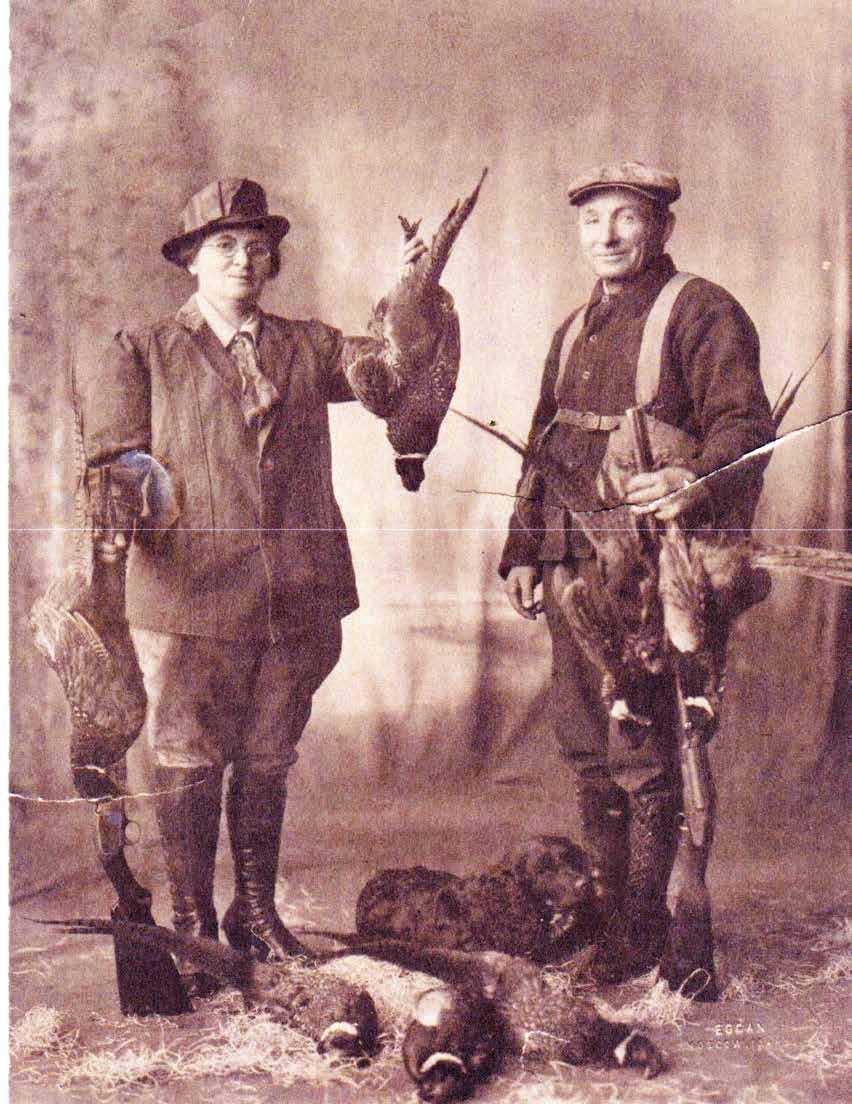


And it was late in the evening, Melvin Peterson lived over here… and he come out of the barn with a lantern. And I hollered at him, “Come on down here, I got some job to do.” And Edwin Magnuson was over there, he come down, we went up and I had two elk up there…Well I give Melvin and Edwin—they both had family—the big elk, and then I kept the little one and I kept a half of that, and give the other half to another neighbor.
Bjerke also recalled large herds of elk, deer, pheasants, and grouse that roamed the countryside, but overhunting diminished those numbers. George Schmaltz recollected that most homesteaders did not pay attention to seasons, while people coming from town were more likely to abide by management policies. Homesteaders hunted year-round and “they got it whenever they could. And they, by god, they were entitled to it.” During the 1930s, Schmaltz stated that “we just practically lived off when we were in the depression. But in those days, the town guys generally paid attention to the hunting season, but the homesteaders didn’t, they hunted year-round.” Hunting was pivotal to survival when food was scarce and grocery stores were miles away, but that also led to unregulated overhunting.
George Schmaltz and Arthur Bjerke both remember elk shipped by railroad from Yellowstone. Hunting bans in Yellowstone and excessively large elk herds meant that shipments were made throughout the country. Idaho received over 1,000 elk from Yellowstone from 1915 to 1946. Bovill and Moscow both received one shipment each in 1930, with support from local chapters of the Izaak Walton League. The degradation of natural resources across the country led to the founding of several organizations, like the Izaak Walton League, to champion conservation and clean up waterways and wildlife areas. Many of those organizations still exist today, furthering the conservation and stewardship mission.
The second half of the twentieth century saw more management and regulations to address the prior deterioration of natural resources. Wildlife species bounced back and legislation addressed some of the harm inflicted on native species. The 1950s and later also saw more people traveling to hunt thanks to increased marketing campaigns touting Idaho’s vast hunting opportunities. The language evokes untapped wildlife just waiting for hunters: “much of it, just as it has been for thousands of years. Unspoiled by man. Hundreds of square miles of timberland. Majestic snowcapped mountains.
Awe inspiring formations and colors. Numerous clear, cold lakes,” according to the 1953 edition of Idaho’s Golden Road to Adventure, published out of Kooskia. Publications like these advertise the offerings for hunters and anglers and promote guides and packers for hire, drawing out-of-state hunters and advertising Idaho as a hunting destination.
The outdoors continue to draw people to Idaho, and our public lands access is seen as one of the top appealing resources to locals and tourists alike. As more and more people moved to Idaho in the latter half of the twentieth century, habitats have had to contend with increased development, including housing and agriculture, putting stress on wildlife populations. In the 1980s, farmers discovered that allowing deer, antelope, pheasants, and other game on their land and charging hunters access to their property was more profitable than producing crops. This was thanks to the Conservation Reserve Program, part of the 1985 Food Security Act. This program addressed the need for farmers to retire critically eroding acres, put the land into a 10-year conservation reserve, and receive federal cost-share for planting permanent groundcover.


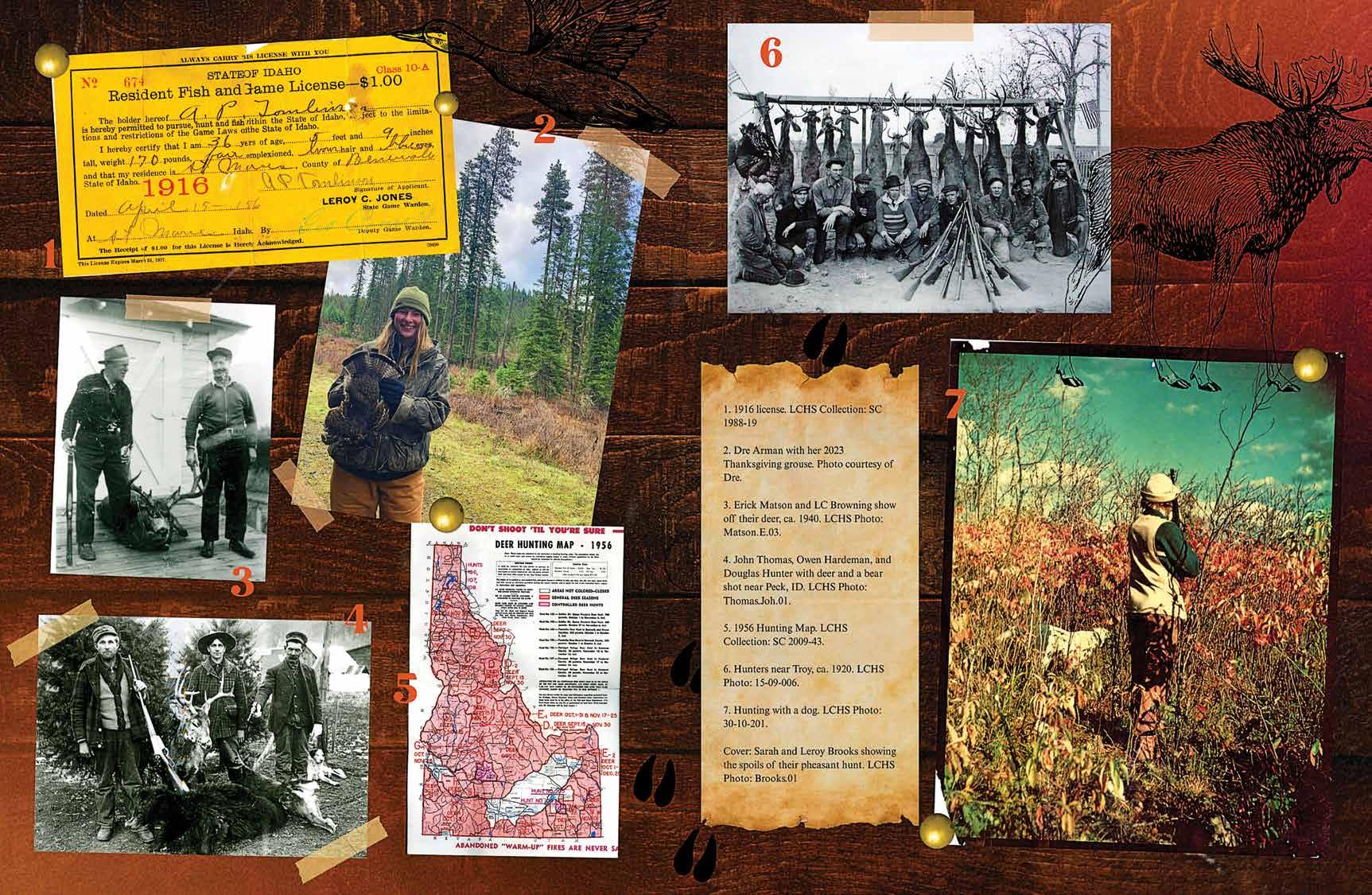

The program is still in existence and has helped reduce soil erosion, improve water quality, and benefit bird populations. Historically (and presently), some believed that hunting was a masculine endeavor to conquer nature. History shows that that is not the case. Women have participated in hunting activities for millennia, as burial evidence shows anthropologists that the long-believed gendered division of labor in forager societies is incorrect. Naomi Boll Parker remembers her mother teaching her brother how to shoot and all of them going bird hunting. According to Dre Arman, with Backcountry Hunters & Anglers, women are the fastest growing demographic of new hunters nationally. Arman also pushed back on the stereotypical depiction of hunters conquering nature. In her opinion, the majority of hunters have a deep respect for the landscape, deep respect for wildlife, and participate in being part of the natural cycle. She believes that hunters are the backbone of modern conservation: supporting Idaho Fish and Game through license dollars, participating in citizen science efforts, like monitoring deer for Chronic Wasting Disease, and paying taxes through the Pittman-Robertson Act to support wildlife management. Today hunting remains a favorite fall pastime and still a way to supplement diets, even with the abundance of grocery stores. Arman stated, “My diet is almost 100% wild game protein, which is really privileged and really cool. And something that our public lands allow for me to participate in here in Idaho.” She has also found community and connections while hunting that are hard to find elsewhere. She detailed:
There’s a level of storytelling that goes along with it, too, right? There’s just so much lore attached to hunting and fishing that I think it creates enthusiasm and connection, and that community outreach and education component too. When you can connect those stories of adventure and stories of dinners had, harvested, and connect that to science and the needs on the ground and the threats on the ground, I think that’s just such a powerful mechanism to conservation.
Regardless of background, one of the few things that unites people in today’s divided society is access to our shared public land. That reverence for the outdoors is baked into life in the Pacific Northwest, with 96% of Idaho voters wanting public lands to remain in public hands. With support for that access, Idaho continues to attract both in-state and out-of-state hunters each year for a chance to see rare wildlife. Arman recalled that recently while out turkey hunting she witnessed a moose, a common sighting in Idaho, but a once-in-a-lifetime opportunity to draw a tag to hunt in Idaho.
How cool is it to go out to the woods and try to bring a turkey home for Thanksgiving. Or you know, to maybe go to a different state like Arizona and do a wild hog hunt, to bring home a Christmas ham. I just think those opportunities are so unique and in other countries, like those in the UK, to go bird huntingit is a rich man’s game. And that is something that is so uniquely American and so uniquely Idahoan, to a certain extent. To have that opportunity available to everyone - whether you want to participate or not. The opportunity is there for you.
Hunting’s deep roots to our past and present, and its legacies are all around us from our food to our modern conservation efforts, to our connection with the land and all it provides. This holiday season let’s celebrate all that Idaho and her public lands have to offer and give thanks for the beautiful planet we call home.

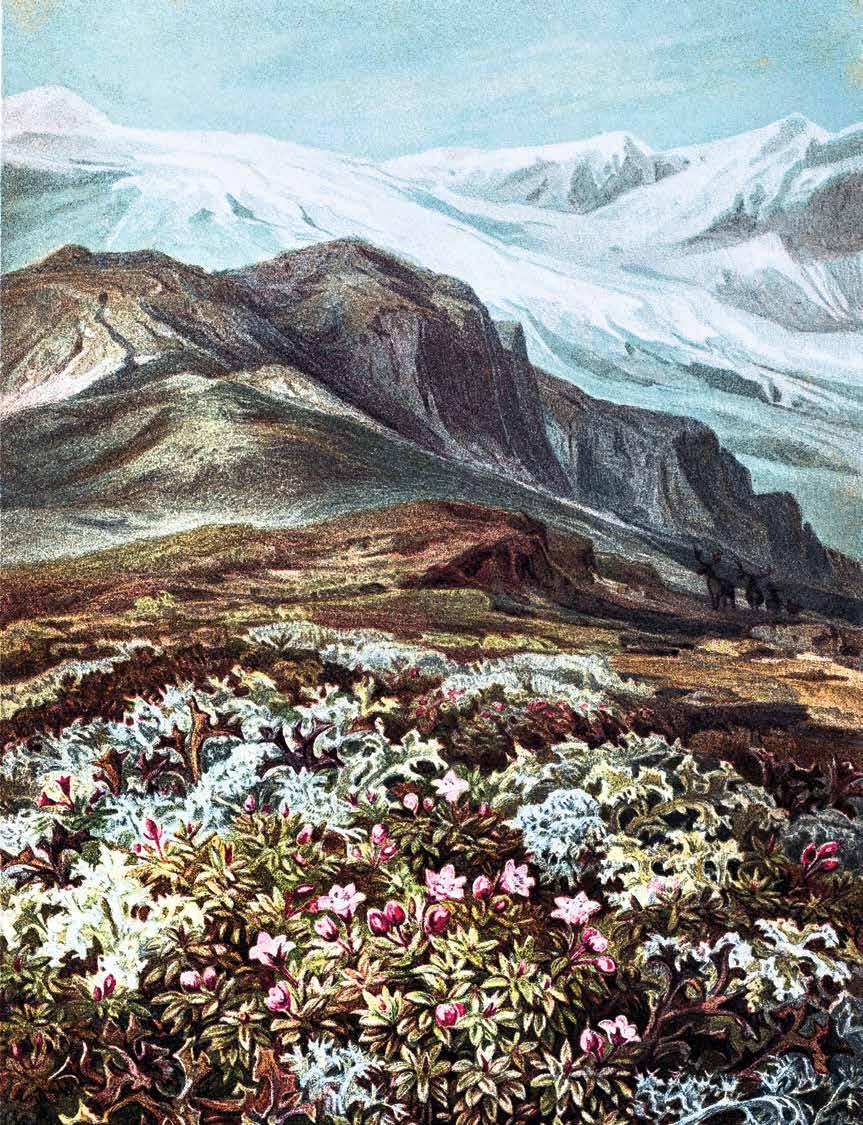
by trent morgan
Welcome, winter.
Let the cold wind blow and swirl snow like so many memories and reflections that appear and then slip past for parts unknown. Winter is a time for stories and reflections, fresh memories of recent adventures or apparitions reminiscent of more distant times. What a gift it is to archive rich memories and stories to share. I bet you have some too! My grandmother always provided tales and useful books for such moments. As my grandchildren grow, I realize this is a uniquely grandparent role. One of her most treasured books was a writing of Nez Perce People’s legends called Nu Mee Poom Tit Wah Tit. It weaves stories, oral traditions and sacred accounts passed down by the Nimiipuu People. My wife and I have shared these written stories with our girls on road trips throughout our region, reading and sharing a different culture; mysterious and rich with memories from a past different than ours. I recently spoke with a young Nimiipuu student named Raven at LC State where I work, and we discussed the story, “The Heart of the Monster.” I was jealous as he shared the oral traditions he has been gifted from elders with rich variations of the tale where Iceye’ye, the coyote, saved the land and animals by his cunning and trickery and in so doing created The People. Such moments of connection bring intersection among us all for we are all on similar journeys to find purpose through common humanity. What an honor to share stories and heritages across cultures and spans of history or places. Humanity has so much more in common than our differences.
I’m going to be honest and admit that in our world today conflict and division are all around us. Sometimes we can feel the weight of it. Mid-September I was in that difficult place, wrestling with myself and our world. It was then I heard a voice in my head. It was the famous words of the mountaineer John Muir: “The mountains are calling and I must go!” The allure of casting off the turmoil of civilization over a weekend for the solitude in the cool mountain air and the whisper of a breeze in the pines had me planning in the next few seconds. We are fortunate to live in a place where, on a whim, you can load up your rig or side-by-side and quickly be on the road to solitude and pristine nature. There are still many places on my bucket list to explore, so after calculating the weather and consulting my bestie, we had a plan. We were off to Paradise!
Idaho’s great spaces beckon like Sirens of Greek mythology to dangerous and remote places with names like Hell’s Half Acre, Dead Man Saddle, Poet Creek, and Lonely Mountain. All of these met my mood half-way as I quickly planned and looked over my well-used Nez Perce National Forest map, noting destinations surrounding our hastily planned ride from Elk City to Montana’s Nez Perce Pass on the Magruder Corridor. I made sure to gas up the Honda Pioneer and stash extra fuel for the remote trek to the Idaho-Montana border. “Team-Morgan” had us prepped and packed in two hours; I could not wait to get away from all of humanity. Who knows, maybe we could just stay lost in the mountains! But of course, this tale has an unexpected turn, or I should say about a thousand turns… let’s go for a ride!
The first promising eastern rays of sun that had streamed over the Lewiston Orchards two hours before were now snuffed out by thick grey clouds spitting rain on our dusty windshield as I searched for a good turnout on FR # 468, otherwise known as Magruder Road Corridor. I wanted out of the truck and to feel the wind in my face, so I pulled into the first big turnout despite a camper parked directly in the center of the large multi-use spot…slightly annoying. A rough-looking man with what appeared to be a similar sentiment glared out from the open door of his truck camper. I questioned his intent as he stared at us while I backed the truck and trailer well off the road and unloaded our side-by-side. “I can’t wait to find some solitude,” I sighed to my wife as we finished loading the last of our gear, and we were off.
“but what has changed except my life’s accumulation of cynicism… HMM”
The cool drizzle was a blessing, a knock-down punch to summer’s prolonged parched hold on the forest and a quenching thirst for the well-used dusty road. We whistled along, leaving trouble behind, eastward, gaining elevation toward the divide between two pristine wilderness areas: the Frank Church River of No Return to the south and the Bitterroots to the north. This is an ancient route, once used by the Nimiipuu and other indigenous peoples for trade, connecting coastal and river resources of the West Coast with the food resources of the Great Plains, though the actual original trail is slightly north of the current road. The well-used trail was also used by early settlers to move people, resources, and gold. And thus, the horrific tale for which the road gets its name. Many in our region know of Ladd Hamilton’s This Bloody Deed: The Magruder Incident. It is a book you could add to your winter reading list. It tells the deadly story of a man and his companions whose riches and lives were taken on this route by murderous scoundrels. I will not spoil the saga for you but suffice it to say, the thought of it made me think—Not much has changed in our world. What else has not changed is the sheer breathtaking beauty as you gear down and grind over one ridge after another of this expansive place. We had just reached such a private vista when around a corner I had to brake hard for a vehicle in the roadway. As I slowed, I could hear the high-pitched throb of a chainsaw. Here we were, sneaking into the wilderness and there is a guy blocking the road with a trailer, cutting firewood. He offered only a hurried glance as I geared down and shifted into 4-wheel drive differential lock to keep from sliding off the mountain jostling for room to pass. Just as my mind was clearing, back to reality! This time though, I offered a fake wave, and I think it surprised the hurried sawyer as I might have seen a quick smile before he dug into the next round of burned-out lodgepole; the chips flew! I drew another deep breath of fresh air and remembered where we were headed, after all. Paradise! Keep going…
Paradise is an actual place. I learned of it years ago when I first hiked into Moose Creek Ranger Station on the Selway…that was an epic backpacking trip! A couple of the nurses and docs I worked with at St. Joes had our wives drop us off at the headwaters of the Moose Creek drainage near Shoemaker, Montana. It was a brutal five-day hike to reach Moose Creek from the east but remote and breathtaking. Once on the Selway, I could not believe the number of rafters floating past. I wondered where in the world all these boats launched. Turns out it was from a camp and ranger station in the wilderness called Paradise. The Magruder Corridor has become somewhat of an Idaho 4-wheeler and road adventurer “must-ride”; legendary, so much so that more than locals now know about it. Sadly, the road has been improved to the point where there are no real hazards keeping out flatlanders, out-of-state hunters, wide trailers and campers; it can feel like a dusty highway in peak summer season. I had hoped with summer officially ended we would find some solitude but every mile or so, we would be passed by thrill-seeking ATVer’s or come across groups of hunters trying to beat the competition in setting up camp. Yet, something about being outdoors in such a place, the thoughtful conversation with my best friend syncopated with long stretches of the pleasant drone of the Honda’s engine winding up for a hill climb or revving for a burst of speed on a rare smooth stretch, was indeed the medicine my soul needed. I began to anticipate the next trail encounter on the narrow one-lane, rocky road. People still like to travel in groups after eons of civilization. ATVer’s use their own language to communicate. After the chainsaw encounter, we met our first big group, a man and woman in a flashy, well-kitted-out red Razor with big tires. They nodded and smiled as we passed feet apart and he held up four fingers; ATVer’ code for there are four more coming. I smiled and nodded a response in code with a thumbs-up then a closed fist to indicate is was just us. Each ATV in succession had a couple who all looked to be having a great time, enjoying their experience on the same road as us. Though we were heading in different directions, we were all out for the same reasons, on the same journey. We stopped to rest, and another group passed. The last in the train had high seats facing backward in the cargo compartment with grinning boys chattering away. They were coated in dust and mud and to me looked the iconic definition of boys living adventure on the edge. They reminded me of my youth Jeeping with my best friend Jeff in his dad’s CJ4 complete with an unattached rumble seat facing backward. We knew to keep our feet braced against the rickety tailgate to keep from pitching out when Jeff’s dad got heavy on the gas pedal. Those were simpler times, I thought, but what has changed except my life’s accumulation of cynicism… HMM. We came to Poet Creek at about 18 miles in. As Laura took some time to snap pictures, I explored the campground. Nearing the last campsite I heard talking. “Hello in the camp,” I said as I rounded a bend to find four guys drinking around a campfire ‘midst an impressive array of hunting rigs and gear. They were friendly. I learned in my youth from Louis L’Amour novels that you ALWAYS announce yourself when approaching someone’s camp unless you want to get filled full of lead. They had come from the Montana side and were reliving their harrowing night prior on the Magruder. To hear them tell, you would think they had clawed their way down the ridge from Mount Everest to get here to hunt. I listened and nodded-













-with interest. They offered me a beer, but I declined. Turns out they were here for the first time from Pennsylvania which explains their surprise at Idaho mountains. As I walked back to the side-by-side, I thought; more people, on the same road as me with such different pasts, experiences and reasons for being here, yet, on the same road.
Riding again, we next met two lean and very physically intense looking guys riding mountain bikes. We said hello in passing and they greeted us with thick German accents. I thought, WOW, not my idea of a good time but they must be living their best life and experience here on the Magruder too. I wondered how long they had planned for such a trip. Shortly after passing them on a steep rocky switch-back incline I had to brake hard for a motorcycle on its side. The armored rider was crouched over the bike, tinkering where engine oil oozed, leaving a dark spot on the light-colored granite. His buddies were huddled around and asked if I had some high-heat silicone to plug the hole that had been punched in his oil pan by a hard fall. I apologized that I did not and felt guilty I could not help. After all, we were on the same journey—in this together!
“...the monster had been focusing too much on the bad in this world”
And so, we traveled on with similar encounters. Hurried hunting guides with determined faces, towing wide trailers of pack mules, groups of day-trippers and others looking to be set up for long-term camping until we finally saw the sign to Paradise. I would like to say it did not disappoint but it was nothing like its name or what I had created it should be in my mind. We found a wonderful, secluded place to set up camp where the Selway gurgled past and the stars could be seen. And, I could think. The next morning, we packed up and finished the trip east to the Montana-Idaho border to glimpse Hell’s Half Acre from a safe distance, walk a few paces on the Nez Perce Trail, and awe at the grit of those who traversed this path eons of time before us. On the ride back to Elk City I reflected on our encounters over the past few days. I realized the 172-mile trek was metaphorical to life and our experiences with humanity. I acknowledged anew that while we can be influenced by those with motives to divide us into, say, wood cutter, ATV’er, camper, hunter, bicyclist, thrill-seeker, or guide, all looking for different experiences and different convictions, we are all ON THE SAME ROAD.
Back home, I felt a fresh outlook. I thought of the story again of “The Heart of the Monster” and Raven’s pleasure in having heard different versions of it. It gave me permission to wonder if, for me, the monster had been focusing too much on the bad in this world and allowing it to devour my joy, which is what the monster does. It robs us of the collective power of the shared human experience. There is no paradise, at least here on earth, that I should be looking for; rather, it is in the awareness and respect for fellow sojourners where we find joy. We are all in it together to offer an ear, a wave, a smile, or a helping hand. Happy travels.

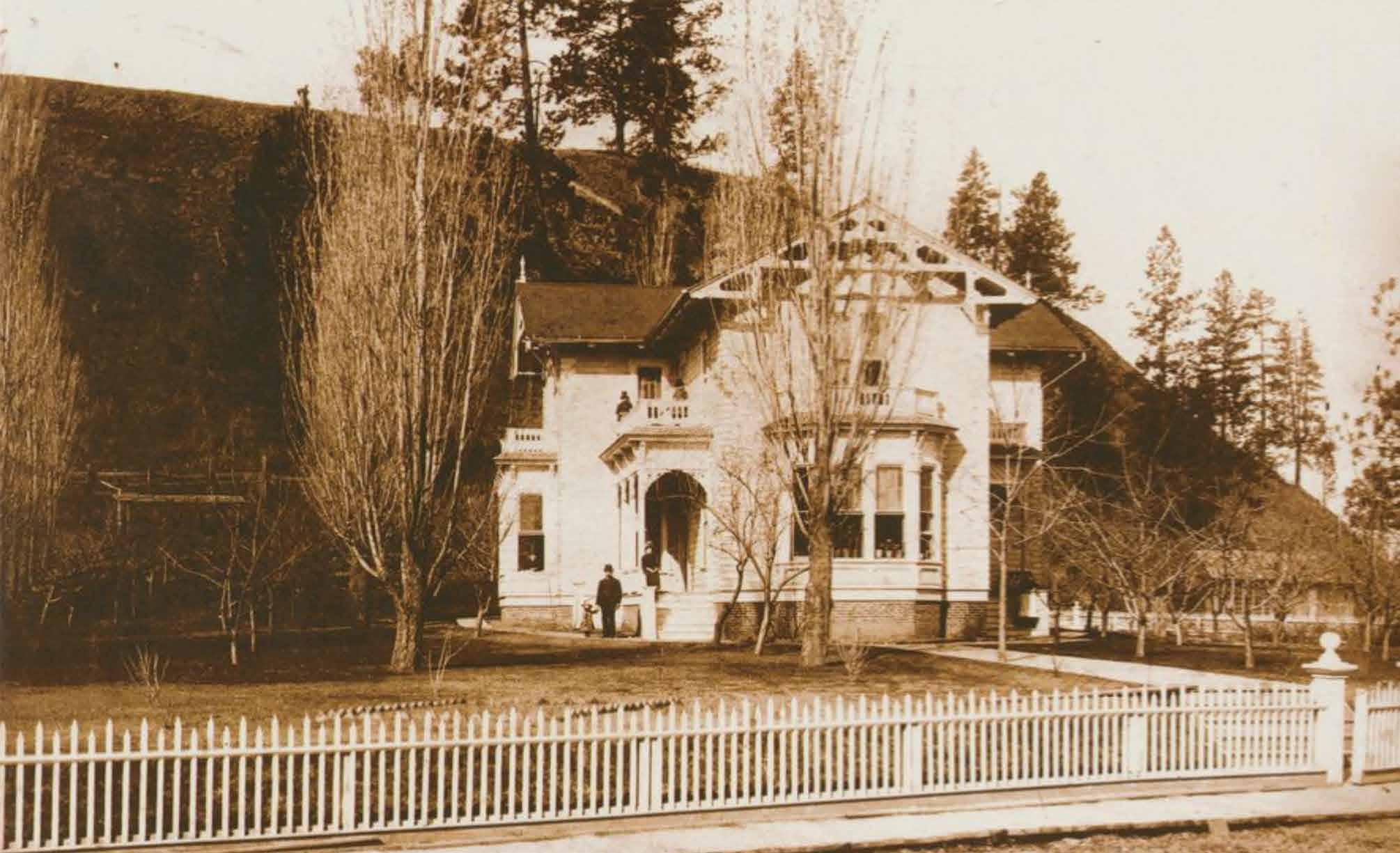
AAs the holiday season is upon us, it’s natural to gravitate spending more time with family. And maybe your gatherings are like mine, where stories from the past are regaled and we learn more about our heritage. The past is a treasured legacy unique to each family. The stories handed down from generation to generation is important and define us and it goes back to biblical times of what tribe you came from.
For this article I am honored to share how one man became the “Bill Gates of Eastern Washington” as Jill the tour guide explained and thus, put Colfax, Washington on the map. The story shared here is from my chats with the tour guides, Jill Gfeller, Nancy Rothwell and Frank White, as well as researching items online and from personal accounts written in 1983 by the Perkin’s granddaughter, Jane whose mother was Stella.
It all starts with a dream and the wherewithal to persevere and seek a new destiny. And that is exactly what happened when a young man named James Perkins became disenchanted with his family’s farming way of life and set out to seek a new start in 1870. The Homestead Act that allowed people to own 160 acres of land was appealing to James. He built a small cabin to fulfill the stipulation that he must live on the land and notably that cabin is still standing today. Owning a piece of property was just the start of his vision for his future. James had financial backing from a rich man named Anderson Cox and James and his business partner Hezekiah Hollingsworth built a water driven sawmill on the north fork of the Palouse River and started turning the huge pine trees that covered the valley back then into lumber, an extremely valuable commodity. This activity attracted other settlers, and soon the town of Colfax was born. One of the first area settlers was James Ewart (pronounced Yart), a retired U.S. Calvary officer who also wanted to make a new start for his large family. He moved a few miles South and started his own town called Ewartsville. One of the captain’s children was an attractive young woman named Sara Jane, also called Jennie. James was a frequent visitor to the Ewart home, and soon a romance bloomed and the two were wed April 6, 1873, the first legal marriage in Colfax.
Jane, the granddaughter, recalled that her grandfather had first named the town “Belleville”. It was rumored that this name was after an old girlfriend. It was later renamed Colfax in honor of Vice President Schuyler Colfax, although it was reported that his new wife wasn’t too thrilled to be living in a town named after an old flame. And as a married man, he understood the concept many married men already knew, “happy wife, happy life” … the name of the town was changed in 1873. And Colfax became the county seat when it became incorporated in 1879.
The newlyweds moved into the cabin that James had built earlier and to show his love for his new wife, he built a kitchen onto the cabin over a well so she could have the luxury of indoor water. The couple had 3 daughters and 1 son, Minnie, Myrtle, Stella and Sumner, all born in the cabin.
An excerpt from his granddaughter, Jane’s memoir: “Grandpa Perkins was a promoter, a builder, an entrepreneur and a visionary. When farmers needed a method of getting their grain to market, he organized a railroad to come through Colfax, giving up some of this land free. That is why today the train goes close by the house. Whatever the town needed, he helped arrange and finance. Everyone prospered. One time there was a bad season when, with bumper crops, the price bottomed out. He financed many farmers who could not now pay. When times picked up, Uncle Sumner wanted to collect what was owed and Grandpa said no, they will pay when they can, and if they don’t it is my fault for trusting the wrong men. Some men never did pay.”
As per historian/guide, Frank White, “As the town grew Perkins’ fortune grew with it. He sold his interest in the sawmill and used the money to expand. He got into real estate and insurance and became a notary and a banker and a venture capitalist, funding new businesses and civic organizations. He was, for instance, on the board of directors for the Baptist run Colfax School, which later grew into the Colfax College, even though he was a Plymouth Congregationalist. By the 1880’s he was one of the richest men on this side of the state. He was also Mayor of Colfax four times, once winning without a single vote being cast for his opponent.
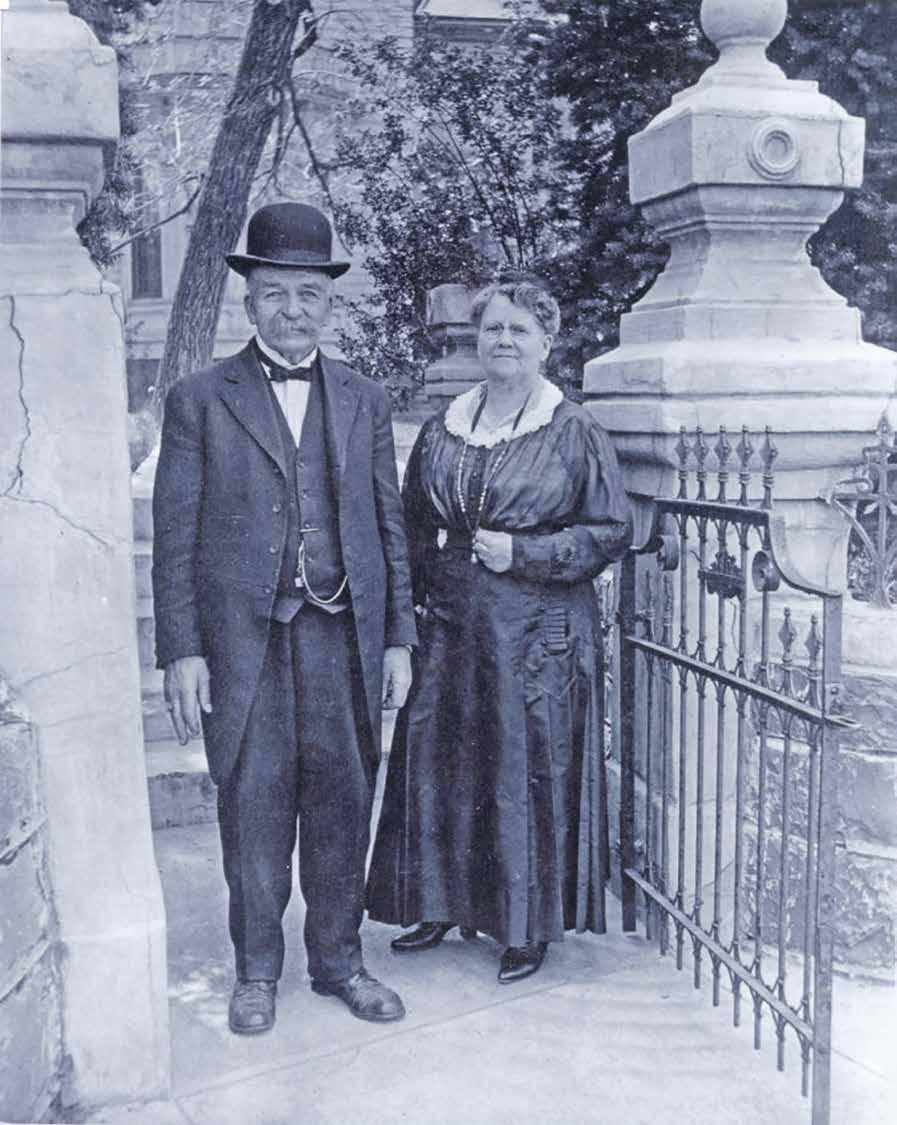

He was a dedicated Republican and important in the state party, a major committee member and speaker, and was twice a delegate to the Presidential nominating conventions, a signal honor. There were frequent attempts to get him to enter statewide politics as a Senator, and once the party tried to draft him to run for Governor. Given the dominance of the Republican Party post Civil War, his election to any of these positions would have been assured. But he declined all such opportunities, preferring to stay in his town with his family.
James Perkins’ mother Margaret was a displaced Southern Belle from Kentucky, and she raised him with the manners of a southern gentleman. He is remembered as a man of civility and honor. And also a forward thinker. The Perkins Mansion was built several years before electricity was available in Colfax, but Perkins could see it was coming – other cities were electrifying as opportunity and resources permitted – so he had the place built wired, and the electric lights and chandeliers already installed. Until the power started flowing, the Perkins family got by with candles and kerosene lanterns like everyone else. And of course, when the Colfax Electric Company, DID start providing power, Perkins was one of its founders and directors.
And he was a practical, frugal man as well. He saved money even when he was rich, by for instance resoling his own shoes. In the Perkins House, if you lift the carpets, you can see he had the floors finished only up to the parts that wouldn’t be covered by carpets. After the House was completed it was painted white because that was the cheapest paint available. ”
As this was the biggest and most ornate home for miles, it became the central hub for social and pollical gatherings. As granddaughter Jane recalls, women normally didn’t hold jobs outside of the home, except if they were employed as servants. Jenny like most other women joined the ladies aid of their church to do community outreach, and it also gave them a chance to enjoy the comforts of women friendships and chat about kids, or whatever else. Ladies also gathered together on a designated day to come visit, it was a formal affair, with appropriate day dresses, tea and goodies were set before the guests. Then it was customary for each woman to leave her “calling card” with her name, picture and address on it at the hostess’s house.
Jennie Perkins was known for her sense of humor, and one time for an April Fools joke on her lady friends, she invited them over, but as a joke pretended to not be at home. One year her sister Frances, who also lived in Colfax, decided to try the same trick on Jennie and some of their friends, inviting them to her home for a supposed party, but locking up her house and leaving before they arrived. Unfortunately, Frances didn’t secure all the entrances, and the ladies found an unlocked window and broke into her house and had the party in her absence. The dozen or so women adorned the tables with nice linens, silver and flowers, while others were searching the larder, others used the telephone to order ice cream, cake and other confectionaries, all charged to Frances! The ladies barred the doors and windows and proceeded with a merry party absent the hostess. After enjoying the food, the ladies then went onto play games and selecting prizes of pretty china from the closet. When Frances arrived home, the party guests wouldn’t let her in. The home was turned topsy turvey and when the guests departed, they left Frances a memento in the form of a card which said, “he who laughs best, laughs last”. This must have been quite the talk of the town because there was a newspaper article written about this antic. In my mind’s eye, I can envision how it played out.


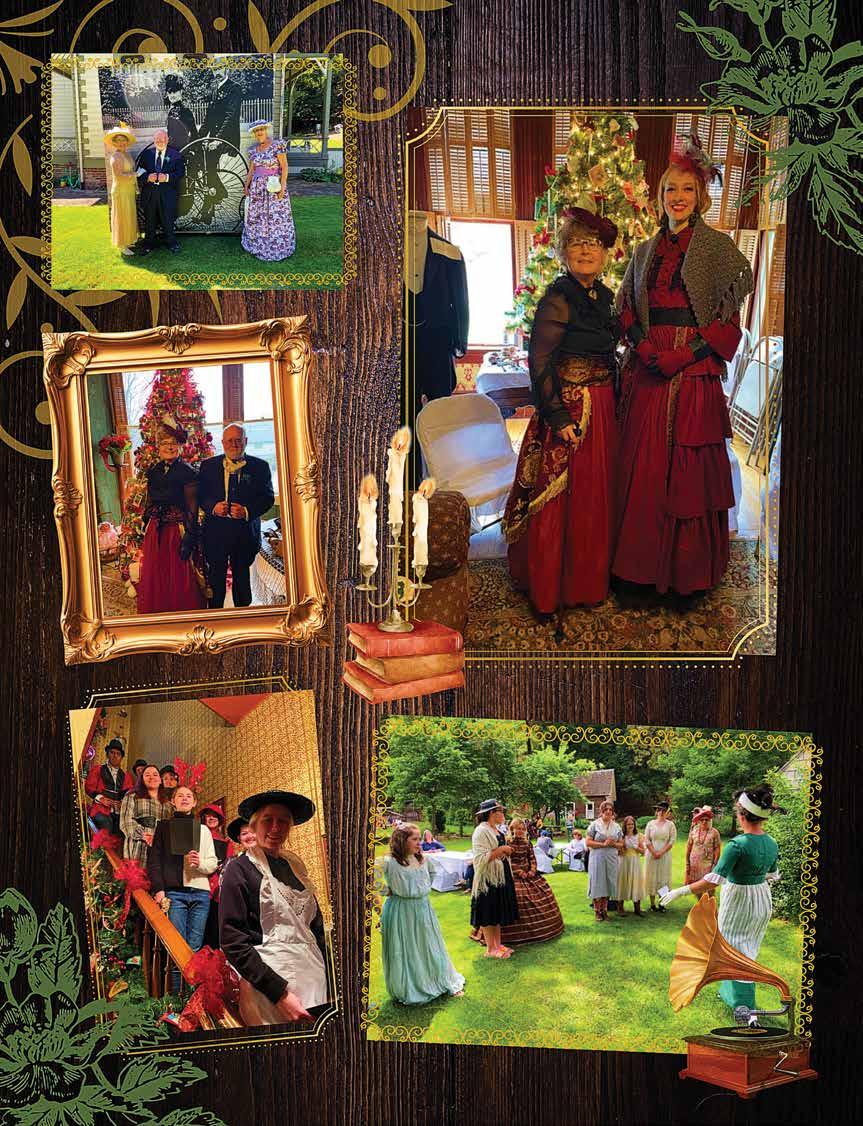


Join TriState Health Foundation for our Fund Our Future MediaThon! Together, we can support the TriState Family Medicine Residency Program, bringing physician training to our community and helping prepare the next generation of doctors to care for rural areas like ours. Every dollar makes a di erence in the future of local healthcare!
Visit the Foundation’s new space on December 10, and meet our team. Together, we can ensure that high-quality care continues right here at home.
online: TSH.org/FundOurFuture






Mind you that these women were the “upper crust” of society, all prim and proper. So imagine these ladies thinking they are going to a formal party only finding out they were duped again as an April Fools joke, and that they took it upon themselves to check the windows. Can’t you just see Jennie saying to one of her friends, “hey Ethel get on all fours so I can stand on your back while I hike up my dress and crawl through this window!” Hilarious.
In 1920, granddaughter Jane recalls that the town was gearing up for a big fifty-year celebration and that Grandpa Perkins was the star attraction. As Jane wrote, “ it was not to be. First Mother’s (Stella) death put a pall on the proceedings. Then about a month or six weeks later grandpa, tired, old and heart-broken came home from the office one night, had dinner, sat in the kitchen while grandma cleared up, said he heard beautiful music and was gone.” Although the obituary noted a different version of his death in June of 1920. It reported that Mr. Perkins had not felt well all day, however after work he did work a bit in the garden and the evening progressed as normal, then he got up around 1:00am, sat down in a chair by the window and passed away at age 78.
As granddaughter Jane recalls, “And there was Grandma, living alone in her house, needing people around her. She moved upstairs, made a kitchen out of one of the bedrooms, where she stayed the rest of her life. Uncle Sumner and Aunt Ethel and Jimmy moved in downstairs to await baby-to-be. Louis arrived a few weeks later. “
After Sumner passed away, his wife Ethel lived there until 1967 until she entered a nursing home. And as the house was abandoned, it fell into disrepair. It was reported that teenagers would break in and have parties in the house. By 1972, it looked like the house and cabin would be condemned and torn down. That was when Norma McGregor stepped in, formed the Whitman County Historical Society, and they raised funds and bought the house and grounds for around $14,000 and renovations began. The interior was refurbished and furnishings have been replicated as close as possible, with some original furniture being donated back to the home. Jill Gfeller has taken on a special interest in sourcing furniture, finishings and clothing dating back to the period. Today tours are available Saturday and Sunday, 10:00am-2:00pm during the months from March – December. When I took the tour, Jill was the tour guide and likes to dress in period costume, so you definitely get a feel for life back then. And what is unique about the Perkins House is that it is a hands-on tour, where you can touch everything as well as enter all the spaces. Jill noted that the house can be rented for functions and that they have hosted baby and weddings showers and once a wedding outdoors. All the tour guides that I spoke to, Jill, Nancy and Frank have a true passion for sharing this amazing history. I highly recommend going, you will not be disappointed.
And for the holidays, the house will be decorated to the nines, volunteers will be dressed in costume for the annual Vintage Holiday event held the first Saturday in December. For more information, www.whitmancountyhistoricalsociety.org/ or call 509-553-9729. Address is 623 N. Perkins Avenue, Colfax, WA
And in closing, what a true testament of one family’s heritage that is an immersible gift that continues to grow and benefit generation after generation.


the Shenanigans Otis! Oh,
“Guys, my mom and dad are hosting a New Year’s Eve party at the Grange, and said I could invite my friends,” Fertis shared with Otis and Clark as they made their way down the hallway toward the band room. “I’m sure they invited your parents, too. Wanna come?”
“Sure,” Otis said. “Beats staying home.”
“Yeah,” Clark agreed.
“Cool!” Fertis said. “Uh, there’s one thing you should know,” he added with hesitation. “You gotta bring a date. It’s a dancing party. For couples.”
“What?!” Otis shot back. “A date? I barely know how to dance, let alone dance with someone else. Do I gotta wear a tux, too?”
“I think slacks and a sport jacket will work,” Fertis replied.
Otis rolled his eyes.
“Dudes, you know what this means?” Clark said and smiled. “A whole room of girls of all ages, dressed up and ready to dance.”
Otis and Fertis laughed. He had a point.
“Who is your date, Fertis?” Otis asked.
“I’m going to ask Angela,” he answered. “I thought maybe you could ask Carla.” He directed his comment to Otis. “Ohhhh noooo,” Otis said. “I’m not asking her. No way, no how. She’s always thought there’s some big romance between us, and I don’t even like her that way. I’ve never given her any reason to think I like her that way. It’s all I can do not to yell at her and tell her to buzz off.”
Fertis giggled. “So sensitive. You sure you don’t like her?”
Otis glared at his friend. “Watch it, or I won’t come at all.”
“Come on, Otis,” Fertis relented. “I’m just teasing. You can ask whoever you want.”
“I know who I want to ask,” Otis said. “I just don’t know if I have the guts to do it.”
The boys entered the band room and went about the business of taking out their instruments and taking their seats. Otis sat in between Fertis and a talented eighth grader, Ronnie, and quickly arranged his music on the stand in front of him. Licking his lips, he blew into his trumpet and a few smooth notes flowed out from the horn. Four months prior, he’d drug his feet about joining the junior high band, but peer pressure from Fertis, Clark, and even Ronnie had won out. Now, here he was, sitting as second chair in the trumpet section, next to first chair Ronnie, feeling more and more confident about his ability to play.
Fertis, trumpet third chair, started to say something, but Otis suddenly straightened up, head turned toward the classroom doorway. She had just walked into the band room. He watched her gracefully remove her clarinet case from the big wooden storage cabinet and go through the motions of getting ready to play. First, she placed a reed into her mouth to soften it up, then she fit the pieces of her clarinet together. Suddenly, she looked up and stared right at Otis. A smile spread across her face, and she shyly looked down. He kept his gaze on her as she walked down to the lower front row section where the clarinets and flutes sat.
“Put your tongue back in your mouth,” Fertis quipped and nudged Otis.
Otis pulled himself back from staring at her long enough to breath out quietly, “She’s gorgeous.”
Lovennia Slater hailed from somewhere “back east.” Otis couldn’t care less where she used to live. All he knew is that she’d joined his seventh-grade class two months ago as the “new kid in school,” and he’d been smitten ever since. She was the most beautiful girl he’d ever seen. Her wavy hair was a mixture of brown and red, and it hung down past her shoulders. Her teeth sparkled white like the first winter snow, and her laugh made him weak in the knees. She wore horn-rimmed glasses, like him, and staring out from behind her lenses were beautiful, big green eyes.
“Mr. Swan, do you think you can join us for class today,” Mr. Lingle, the music teacher, said, swinging Otis’s thoughts back into focus.
“Uh, yes, sir,” Otis stammered, as the rest of the bandsters giggled.
Fertis whispered. “He wants you to start playing.”
“Oh, yes, yeah, my solo,” Otis said, as if he’d been paying attention the whole time. “Yeah, sure. Want me to stand?”
“It seems only right since that’s how you’re going to do it at this evening’s concert,” Mr. Lingle replied.
Otis looked at him, embarrassed that he’d been daydreaming. He wasn’t the only one who thought Mr. Lingle was the coolest teacher in the whole school, and he conveyed a silent, respectful apology.
Mr. Lingle returned a warm smile of encouragement and then tapped his podium with his baton. “Here we go. Ana one, ana two, ana one, two, three, and …”
Otis gently blew into his trumpet, and it responded with warm, rich notes, as a prelude to Silent Night. His solo was only about two dozen notes, but he’d perfected each of them to the point of almost making his mother, Mavis, tear up when he rehearsed it at home.
The rest of the band joined in and played the Christmasy song. They immediately roared into a jazzy version of Jingle Bells, and then a soulful rendition of Oh, Holy Night, where Otis had a small duet in the middle of the piece with, of all people, Carla playing clarinet. He wasn’t fond of the pairing. She always hit a squeaky note or two. Plus, well, it was Carla.
The group finished the song, and Otis blew the spit out of his trumpet. He glanced up to the front row up to catch a glimpse of Lovennia, only to find her looking right back at him. The heat started in his neck, then crept into his ears, and then his cheeks. He smiled shyly, looked away, and then looked back again. She was still staring!
“Okay, people, let’s focus on O, Holy Night a minute,” Mr. Lingle instructed. “This time I’d like Lovennia to play the duet with Otis. Shake things up a little.”
Shake things up? A wave of whispers filtered through the students with the speed of wild fire at the odd turn of events so late in the game. The concert was tonight, and Lovennia hadn’t played the duet before.
Otis couldn’t believe this was happening. It was almost too good to be true. He glanced over at Clark in the trombone section and then over to Fertis. They communicated without words. This was a big deal. Otis’s palms started to sweat. He glanced down to Lovennia, who looked over her shoulder and winked at him! She winked! At me! Otis’s tummy flip floped. It’s a Christmas miracle!
Mr. Lingle said, “Let’s start two measures before the duet.” When the time came, Otis stood to begin his solo. Lovennia stood, too. And Carla, who sat next to Lovennia, turned toward Otis. If looks could kill, he’d be out, flat, dead.
Not caring about Carla’s look, he blew into his horn, and Lovennia blew into her clarinet. Honk!
Otis’s trumpet emitted an enormous clunker, bringing both him and Lovennia to an abrupt stop.
“Wow, Otis,” Mr. Lingle said. “That stunk up the room.”
The whole band laughed, including Otis. “Uh, sorry about that,” he stammered.
Mr. Lingle smiled. “Okay, here we go. A one, a two…” Lovennia hit a perfect pitch, and Otis hit another foul note.“Phew! Stinky!” Mr. Lingle teased, and waved his hand in front of his nose like he was waving away a foul smell. Again, laughter rippled through the band room.
Otis felt frustration take hold. He blew the spit out of his horn, licked his lips, and when cued, he slowly blew out a melodious note in harmony with Lovennia’s. She turned, and they locked eyes, playing the duet as if they’d practiced together a million times.
“Perfect!” Mr. Lingle praised them after two more runs. “Lovennia, I’d like to have you play the duet tonight. Carla, I’m switching your solo to our Jingle Bells number …”
Carla’s eyes shot daggers at Otis, but instead of noticing, he floated on a cloud of excitement and anticipation to play a duet with his crush.
Five minutes before the class bell, the students went to put their instruments away, and a gossipy hum filled the air. The seventh and eighth graders were never a group to miss a good drama brewing.
“Man, that girl is in your head,” Fertis teased Otis. “You better not look at her tonight before you play, or you’ll stink up the whole gym.”
Otis’s ego answered, “Oh, I’ll be fine. I’ll nail that part, and she won’t be able to resist me.”
“You better nail it,” Ronnie said as he walked by the boys.
“Clunker notes will keep you out of first chair. I was hoping you’d take it next year when I move on to the high school band.”
He winked at Otis. “Buddy, she’s just a girl. Don’t let her mess with your awesome playing.”
Receiving a complement from an eighth grader ranked in the top ten cool things that could happen to a seventh grader, and Otis blushed again.
“Oh, man, you made him blush like Lovennia does,” Clark chimed in as he put his trombone in its case.
“Did someone say my name?” Lovennia’s sweet voice carried over the ruckus. She walked over to Ronnie, Otis, Clark, and Fertis. “Hi. What’s up?”
Otis felt butterflies form in his stomach, and his hands immediately started to sweat.
“Hi, Lovennia,” Fertis said. “We were just talking about how great it is to have a new clarinet player among the other girls. You deserve that solo you’re playing tonight.”
Otis glared at his friend’s blatant flirting with the girl he liked. “Thanks, Fertis,” she said. “I enjoy hearing the horn section behind me.” She looked right at Otis. “Even when there’s a clunker or two.” Her giggles sent Otis’s heart pounding.
“I, uh,” Otis stammered. “I, uh, kinda hit a few bad ones today, huh?”
“Oh, Otis, even your bad notes are wonderful,” she said with a smile. “See you later!” She flounced out of the room with some of the other seventh and eighth grade girls.
Clark punched Otis in the arm. “Seems like she’s interested.” Joy surged through Otis. Lovennia thought he was wonderful! ***
Otis hustled his family to the gymnasium extra early that evening so he would have time to warm up and make sure all the flat, sharp, and distasteful notes had gotten out of his system If he didn’t nail the solos, the whole town would laugh at him,-
-and worst of all, Lovennia would think he was ridiculous. He raced into the band room the second Mr. Lingle unlocked the door and hurriedly put the mouthpiece on his trumpet. He blew a few raspberries to warm up his lips, and then began playing scales. He faced the back wall so he wouldn’t get distracted, especially by her when she walked into the room.
“Hi, Otis,” a voice came from behind him.
Otis cringed. He knew that voice. He stopped playing, sighed, and slowly turned around. “Hi, Carla.”
“I just came over to say how fun I think it is that Lovennia is playing my solo with you,” she gushed with fake flamboyance. “I sure hope you don’t hit any rotten notes, like you did this morning. Lovennia is a perfectionist and wouldn’t appreciate you ruining her chance to show everyone how well she can play.”
“Uh, yeah, thanks,” he said, wishing she would go warm up someplace away from him.
“I heard Fertis’s parents are hosting a New Year’s Eve party,” she said.
Otis instantly knew what she was up to and put up his guard. He had to make sure he didn’t say anything to resemble an invitation to go with him.
“Uh, yeah,” he answered.
About that time, Clark showed up and pushed between Otis and Carla. “Hey,” he said, knowing he’d just saved his friend.
To Otis’s surprise, Clark turned toward Carla.
“Wanna go to Fertis’s New Year’s party with me?”
Otis couldn’t believe what he was hearing. Talk about a friend taking a bullet for another friend.
“I, uh, well, uh,” Carla stuttered. She looked over Clark’s shoulder at Otis.
Otis took his opportunity. “I’ll leave you two alone.” He whirled around only to find Lovennia standing there. “Oh! Hi.”
“Hi, Otis,” Lovennia said smiling. “Good luck tonight. I know you’ll do awesome.”
“You, too,” Otis answered. He glanced over his shoulder to see Carla glaring at him. He looked back at Lovennia and knew it was now or never. “So, Fertis’s parents are hosting a New Year’s dance at the Grange. Would you like to come with me?”
He’d never asked a girl out on a date before. His heart raced, and his legs started to feel rubbery. It was then horror struck. What if she said no? He began to feel sweat trickle down the back of his neck. What is all this sweating?!
“I would love to go with you,” she said. “I’ll just need to make sure it’s okay with my parents. But I’m sure it will be.”
Otis let out the breath he’d been holding. She said yes!
“Everyone, it’s time!” Mr. Lingle yelled above the din of seventh and eighth graders. “Line up and follow me into the gym. Good luck! Otis, are ya ready to kick us off?”
“Ready as I’ll ever be,” he replied. He looked at Lovennia and then to Clark and Carla as they all got into line. Lovennia smiled back, Clark smiled and gave Otis a thumbs up, and Carla gave him the most hate-filled look Otis had ever seen.
“Oh, Otis!” Lovennia gushed. “You were amazing! You nailed every note!”
“Gosh, thanks, Lovennia,” Otis said. “You sounded pretty good yourself.”
The students filtered into the band room to return their instruments to their cases. The feeling of elation zipped through the air; the concert was a success.
“We make a good duet,” Lovennia smiled and started to put her-



-clarinet away.
The students eventually all milled their way out to the multipurpose room with the intention to eat copious amounts of Christmas cutout cookies and wash them down with bright red punch.
Otis, Fertis, Clark, Angela, Laurie, Carla, and Lovennia, along with several other classmates, formed a quasi-circle, eating and making small talk. Suddenly, someone yelled from the hall corridor, “Snowball fight!”
The students looked at each other, dashed down the hallway, and flew out of the door into the cold, crisp winter air to partake in the annual tradition of band kids having a massive snowball fight in the parking lot after their concert.
Snowballs flew past them from all directions. “Save yourselves!”
Fertis yelled. He grabbed Angela’s hand and ran to take cover behind a parked station wagon. Clark and Carla ran in opposite directions, grabbing snow and forming balls as they scooted along. This left Otis and Lovennia.
“Well, come on, Otis!” she said and enthusiastically grabbed his hand. They ran and took refuge behind a dumpster. The melee was mainly out in the center of the parking lot, and no one else had retreated to this particular spot. They were alone.
“Should we make some snowballs and run out there to fight?”
Otis asked, suddenly shy and nervous.
“Yeah,” Lovennia said. “But can I say something first?”
“Sure,” Otis said.
“Otis, I’ve only been here for a few months, but ever since I got here, you’ve been so nice,” she said. “You helped me find my locker that first day and told me to watch out for the spinach at hot lunch. That means a lot to me, you know.”
Otis felt the blush start to rise in his neck, his ears, his cheeks. And yep, here comes the sweat. “Uh, well,” he stammered. “I just wanted you to feel welcome.”
“Oh, Otis, I do!” she said. “And Otis? I, uh, well, I like you.”
“I like you, too,” he replied.
“No, I mean I like like you,” she said.
Otis’s heart rate sped up. “Well, I like like you, too.”
Lovennia smiled. “Good. Then this won’t be weird.” She came in hot and planted her lips on Otis’s.
Otis had never been kissed like this before. He closed his eyes and kissed her back, even though he had no clue what he was doing. Thhhhwaaap!
A snowball smacked both of their faces. They quickly pulled apart, snow crammed underneath the lenses of their glasses. Otis quickly tore off his glasses and wiped the snow from his face as he looked for the perpetrator. Carla.
“Why’d you do that?!” he spouted.
Carla stood about fifteen feet away with a look of crazed satisfaction plastered all over her face. An arsenal of snowballs rested next to her feet, and she picked up two of them and smiled devilishly. “You two are sooo cute, I can’t even stand it!” And with that, she launched the two snowballs with the force of a nuclear bomb. Smmmack! Thhhhwaaap!
The snowballs made purchase with Otis’s and Lovennia’s faces. “Carla, knock it off!” Otis shouted.
“Make me,” Carla retorted, sending two more snowbombs toward him and Lovennia. Otis raced over to a large pile of snow and quickly formed a ball as Carla sizzled three more at him. Pop! Pow! Pop! Otis launched a rounded zinger back at her. Blap!
The game was afoot.
Carla ran toward a pile of snow and frantically started forming balls. Otis quickly formed three snowy rounds and ran straight for her, throwing with all his might.
Swap! Pap! Ping!
All three connected, but Carla returned the favor by throwing an icy heater and smacked Otis in the head. “Ouch! That hurt!”
“You deserve it, you big jerk!” she shouted. Zing! Another one to Otis’s arm.
Thwump! He returned one to her hair. “I’m not a jerk!”
“You!” Whomp! “Are!” Whump! “Too!” Whap! Three more connected with Otis’s midsection.
Otis stopped, breathing heavy. “Why am I a jerk?”
“Because you like her and not me!”
Otis walked toward her, ready to dart and dodge if she threw more snowballs. But she didn’t. He stopped about eight feet from her. They squared up in a temporary cease fire.
“Carla, I …”
But Otis couldn’t finish. A sudden barrage of snowballs—dozens of them—pelted Otis and Carla in their arms, legs, stomachs, backs, everywhere. They scrambled to put up a good defense— them versus the mob—firing off a few snowballs, but soon dissolving into two hysterically laughing heaps in the snow, defeated.
“Oh, Otis, I do!”
“Uncle!” Otis yelled. “I give up!”
“Me, too!” Carla yelled.
The snowballing stopped, and Otis and Carla sat up to see their attackers. Fertis, Clark, Angela, Laurie, Lovennia, and even Ronnie stood in satisfaction. Puffs of steam came out of their mouths, evidence of the workout it took to get Otis and Carla to stop pummeling each other.
“You guys need to knock it off,” Clark ordered.
Ronnie added his eighth-grade wisdom, “You’ve been friends too long to be at each other like that.”
“Deal with it or no deal on coming to my party,” Fertis said.
“C’mon, guys. Now that we’ve whipped these guys into shape, let’s go get everyone else!”
With that, the group ran off to throw more snowballs at all the other kids still in the heat of a snowy battle. Otis and Carla still sat next to each other on the snow pile, picking icy bits out of their hair and off their clothes.
“Carla, I’m not a jerk,” Otis said.
“Well, you are, but that’s nothing new,” Carla answered. “I know you don’t like me, but it didn’t feel so great when I realized how much you do like her. And that she likes you back.”
Otis didn’t know what to say. It’s like the minute Fertis mentioned the party, everything went into a frenzy. Figuring out girls was harder than any math problem or science project seventh grade could throw at him.
Carla wore a wistful look as she stared up into the clear winter sky dotted with twinkling stars. “Can I at least have one dance with you at Fertis’s party?”
“Sure,” Otis said. He stood up, brushed some more snow off his pants and sweater, then extended a hand to Carla. “Friends?”
Carla took his hand and instead of hoisting herself up, she yanked so hard, Otis went face-first into the snow pile. She stood, laughing hysterically. “Friends.”



Trusted skin care, focused on prevention and peace of mind for adolescents and adults. Opening late Fall.
Your skin tells the story of your health, experiences, and journey. Our dermatology team at TriState Health is committed to keeping that story a healthy one. We believe in not only treating skin conditions but also building lifelong relationships. With a strong focus on cancer prevention and early detection, our dermatology team is here to help you maintain healthy skin for life.
Choosing TriState means you're choosing comprehensive, collaborative, and patient-centered care for you and your family, right here in the Lewis-Cark Valley. Sta ed by Carol Chandler, APRN-BC, a trusted, expert provider with decades of experience caring for our community, so you can focus on living your life with confidence.