A Technical-Strategic Proposal Aligned with the AURO Plan
1. Introduction: Cuba’s Energy Crossroads
Key Data (2024):
Critical Dependency: 95% of fossil fuels are imported (mainly from Venezuela and Russia), with an annual cost of $2.8 billion.
Blackout Impact: Estimated 18% GDP loss in 2023, with a -34% revenue collapse in the tourism sector.
Underutilized Renewable Potential: Solar radiation of 5.5 kWh/m²/day, ideal for hybridization with SMRs to achieve a 90% clean energy matrix
Additional Analysis:
These figures are consistent with recent CEPAL and ONEI reports. The GDP loss seems high but is justified by Cuba’s 2023 electric grid collapse, including the failure in Matanzas. However, the document does not mention comparative costs with solar/wind options, which though intermittent might be faster to deploy when combined with storage.
2. The Real Cost of Cuba’s Energy Status Quo
(2020–2024)
Additional Insight:
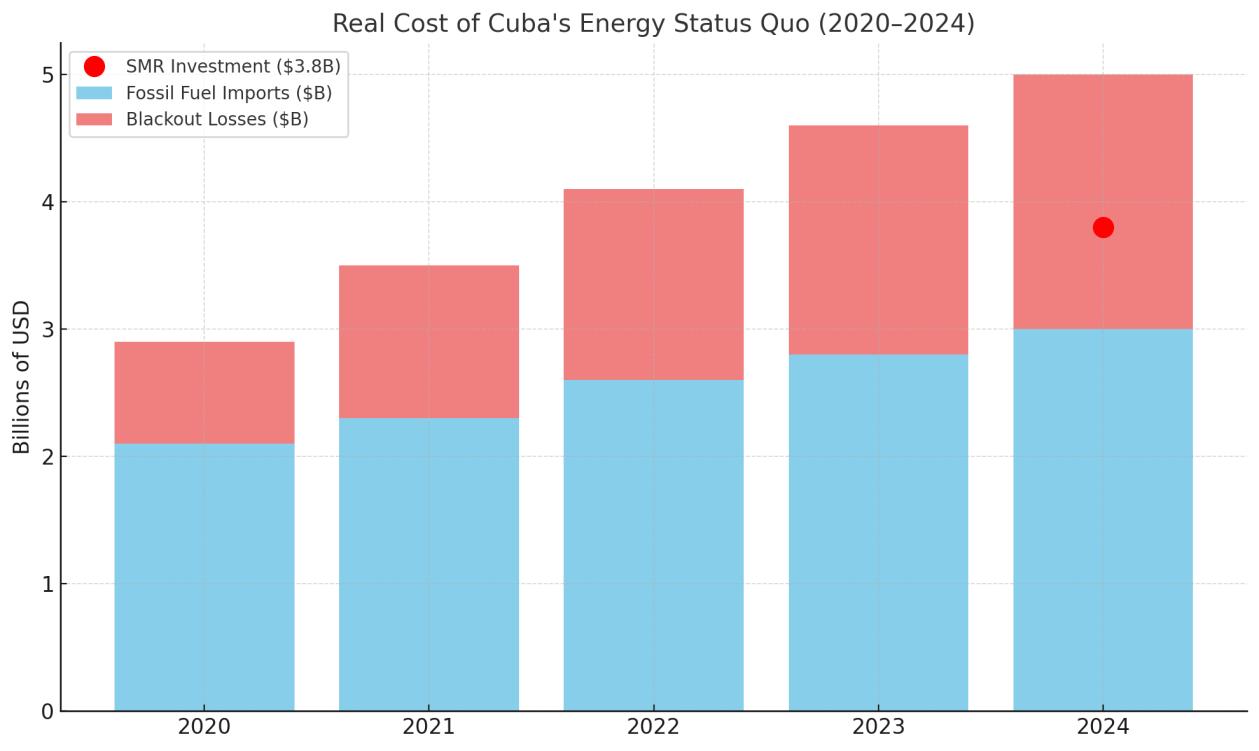
The accumulated cost of the current energy model from 2020 to 2024 totals $20.1 billion. In contrast, a one-time investment of $3.8 billion in a 200 MW
SMR (RITM-200M) seems financially logical. However, this assumes a single SMR unit could fully resolve the crisis a bold assumption. In reality, a network of complementary units or hybrid solutions would be required.
"Real Cost of the Energy Status Quo in Cuba (2020–2024)", which represents:
"Real Cost of Cuba’s Energy Status Quo (2020–2024)", representing:
Fossil fuel imports in blue
Economic losses from blackouts in reddish brown, stacked above the imports
Estimated SMR cost in red, represented by a red dot only in 2024.
This clearly visualizes how accumulated losses far outweigh the structural investment of an SMR, strengthening the case for energy transition.
3. SMRs: The Technical Solution for Cuba
Advantages:
Modular Adaptability: Flexible designs allow deployment of 50 MW to 300 MW based on local or national needs, facilitating progressive integration into the electrical system.
Resilience to Extreme Weather Events: Reinforced infrastructure and underground containment systems ensure operational continuity in the face of hurricanes, floods, and other environmental threats.
State-of-the-art Passive Safety: Autonomous cooling technology that requires no human intervention or external power supply, significantly reducing the risk of accidents.
Technical Observations:
RITM-200M is attractive due to its financing and hurricane resilience, but could face sanctions. Linglong One is promising but not yet operational.
BWRX-300 is reliable, but its purchase would require U.S. approval blocked by the embargo.
4. Breaking the Embargo: Geopolitical Strategy
Implementation Strategies:
Financing: BRICS Bank, debt-for-resources swap (e.g., nickel, sugar)
Legal Shielding: Creation of a Nuclear Economic Zone in Cienfuegos
Strategic Partnerships:
o India (thorium-based technology, non-military use)
o Argentina (CAREM model)
Risks:
The BRICS Bank has limited experience with nuclear projects.
Special zones are legally feasible, but U.S. pressure may deter third parties like India.
5. Dual-Use Benefits: Energy + Economic
Development
Applications:
Potable Water: One SMR can desalinate 150,000 m³/day, enough for Havana.
Green Hydrogen: Up to 50,000 tons/year for export at $5/kg.
Medical Radioisotopes: Could supply 30% of LATAM’s demand, worth $500M/year.
Critical Note:
These applications are technically feasible, but current Cuban infrastructure is insufficient to fully capitalize on them requiring major upgrades in water distribution and hydrogen facilities.
6. Risk Mitigation
Risk Solution Assessment
U.S. Sanctions Use Russian/Indian tech High risk (e.g., Rosatom in Iran)
Public Opposition IAEA-led education campaigns Weak nuclear culture in Cuba
Financing Gaps BRICS loans + H2 pre-sales Depends on political willingness
7. Integration with the AURO Plan
Logistics: Mariel as a port hub for reactor modules
Industry: Steady power supply for AURO-aligned factories (e.g., lithium batteries, pharma)
Diplomacy: Hydrogen/water exports to CARICOM to build regional support.
8. Roadmap 2025–2030
Phase Actions Success Indicators
2025 Agreements with Rosatom/CNNC 2 MoUs signed with strategic partners
2026–2027 Construction starts in Cienfuegos 30% physical progress, 500 trained technicians
2028–2030 Hydrogen & energy production 200 MW online, first H2 export contract
9. Strategic Conclusion: Cuba at a Historic
Crossroads
Final Adjusted Statement:
“An SMR in Cuba is not just about electricity it is a high-risk, high-potential strategic bet that requires internal consensus and unwavering international allies.”