1
EXECUTIVE SUMMARY Beyond Hegemony: How the Americas Hold the Key to U.S. Strategic Survival in a Multipolar Era. By Horacio J. Téllez O., PhD Beyond Hegemony argues that the United States is facing the most important strategic crossroads since the end of the Cold War. The unipolar moment has ended; global power is now distributed across multiple centers, and the assumptions that once sustained American dominance no longer hold. In this new landscape, the greatest threat to the U.S. is not external competition; it is strategic inertia. The book presents a bold but pragmatic thesis: The future stability of the United States depends on the creation of a self-sufficient, integrated, and resilient Western Hemisphere a Megamérica capable of navigating the multipolar century. Drawing from thirty years of scientific and geopolitical observation from Europe, the author shows that the Americas possess every resource required to achieve continental autonomy: energy, food, logistics, industrial depth, demographics, and unmatched geography. What the hemisphere lacks is not potential it is a doctrine and an institutional framework capable of aligning sovereign nations toward common goals. The proposed solution is the AURO Framework, a modern continental architecture designed to replace obsolete hegemonic reflexes with cooperative, sovereigntyrespecting mechanisms. AURO provides tools for energy integration (including SMRs), food security, logistics corridors, technological autonomy, and long-term governance through the AURO Forum, a neutral, permanent platform insulated from electoral cycles. 2
The book demonstrates, with technical rigor and geopolitical clarity, how the U.S. can shift from decline to stability by anchoring its strategy in the Americas rather than in distant theaters. It outlines three scenarios for 2030 and beyond fragmentation, bipolar competition, or continental unity and shows why only the third offers a viable path forward.
3
EDITORIAL SYNOPSIS Beyond Hegemony: How the Americas Hold the Key to U.S. Strategic Survival in a Multipolar Era By Horacio J. Téllez O., PhD
Overview In Beyond Hegemony, physicist and strategic thinker Horacio J. Téllez O. delivers a sweeping, deeply argued re-evaluation of American power in the 21st century. The book confronts a fundamental truth: the United States is losing strategic margin not because it is weak, but because it is misaligned with the realities of a multipolar world. The central claim is uncompromising: If the United States wishes to remain a relevant global actor, it must reorient its strategy toward continental stability and build a selfsufficient Megamérica. Far from abstract theory, this book provides a fully articulated, technically grounded blueprint the AURO Framework that transforms the Western Hemisphere into a resilient, high-capacity system capable of withstanding global volatility.
4
The Argument 1. The End of the Easy Century.
The opening chapters dismantle the myth of permanent U.S. primacy. The unipolar moment masked internal weaknesses: short political cycles, fragmented institutions, industrial erosion, symbolic exhaustion, and a reactive foreign policy incapable of long-term design. 2. The Silent Strategic Loss Decline, the author argues, is often quiet. The U.S. has suffered a strategic loss not through defeat, but through absence—ceding influence in the hemisphere to competitors simply by failing to show up with consistency and vision. No case illustrates this more than the U.S.–Cuba embargo, described as the longestrunning, most counterproductive policy in modern hemispheric history. The book quantifies the economic and geopolitical cost of this self-imposed rigidity.
3. The Continental Alternative. The heart of the book is the AURO Framework—a doctrine built on sovereignty, mutual advantage, institutional continuity, and continental complementarity. AURO provides mechanisms for: • Energy integration, including deployment of Small Modular Reactors (SMRs) • Food sovereignty and agricultural planning • Logistics corridors forming a hemispheric spine • Technological autonomy and digital sovereignty • Disaster resilience and supply-chain redundancy
This doctrine balances independence and cooperation, offering a modern counterpart to obsolete hemispheric concepts like the Monroe Doctrine.
5
Governance and Implementation The book introduces the AURO Forum, a permanent hemispheric institution for coordination, designed to survive U.S. electoral cycles and to ensure predictability for all partners. This is the first governance model in which: • No country surrenders sovereignty • Incentives replace pressure • Long-term stability replaces short-term improvisation • The U.S. gains credibility rather than imposing hierarchy
The Forum is supported by technical commissions, crisis coordination units, and investment mechanisms that make continental cooperation structurally viable.
Scenarios for 2030 and Beyond The final chapters lay out three futures: 1. Fragmentation – U.S. irrelevance by 2040 2. Bipolar tug-of-war a hemisphere trapped between great powers 3. Megamérica a self-sufficient, resilient continental ecosystem capable of supporting U.S. stability for decades
The book argues that Megamérica is the only viable strategic pathway for the United States in a multipolar century.
6
Why This Book Matters Beyond Hegemony offers: • A doctrine for U.S. foreign policy after the collapse of global dominance • A continental alternative grounded in science, engineering, and geopolitics • A blueprint for stabilizing the Americas as a unified strategic space • A practical roadmap for turning vulnerability into resilience
It speaks simultaneously to policy makers, strategic planners, academics, investors, and citizens concerned with the future of the hemisphere.
More than a book of analysis, it is a manual for redesigning American power and transforming the Western Hemisphere into the most stable region of the multipolar world.
7
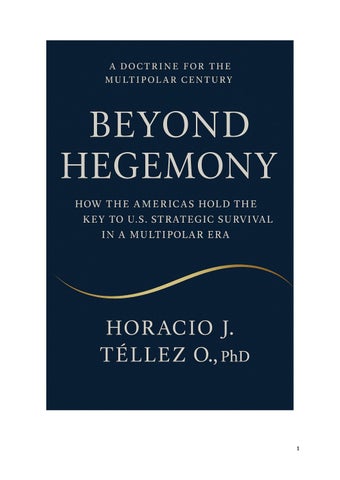
1. Title Page BEYOND HEGEMONY How the Americas Hold the Key to U.S. Strategic Survival in a Multipolar Era By Horacio J. Téllez O., PhD Charleroi, Belgium Autumn 2025
2. AUTHOR’S PREFACE Why I Wrote This Book. I am approaching sixty. I was born in Cuba, the son of a man I consider wise—an artist of rare versatility, a painter, sculptor, choreographer, and at the same time an athlete of extraordinary physical strength, a sportsman without limits, a weightlifter whose discipline shaped my earliest understanding of effort. And I was raised by my mother, a woman who took her time to explain the “why” behind things, offering a spiritual vision of the world that has accompanied me ever since. I grew up facing the quiet waters of the Gulf of Guacanayabo, and for the past thirty years I have lived in Belgium, immersed in the world of science and surrounded by some of the hardest materials humanity knows how to create. Living in the geographical heart of Europe has given me something unexpected: a vantage point. From here, at a distance from my birthplace and from the continent I still call home, I have been able to observe the geopolitical and geoeconomic transformation of the world not only as an analyst, but as a witness to its acceleration. With age, and with the long memory that history offers to those who listen, I have come to sense something unmistakable: we are entering a new world—one that cannot be shaped by the old reflexes of power. Yet within this emerging order, I see the possibility of a renaissance for the entire American continent. Not a romantic
8
dream, not ideology, but a practical path toward stability, shared prosperity, and a calmer global equilibrium. This book was born from that realization.
9
Personal Note from the Author Patience has taught me more than force. Observation has revealed more truths than noise. Coherence in action has always been a form of silent strength. And above all, listening truly listening, has proven more powerful than imposing. These are the tools of a different kind of power, one that does not break but builds. A power worthy of a continent. A power capable of stabilizing a world that desperately needs calm, foresight, and cooperation rather than confrontation.
Who Am I in This Story? If I had to place myself somewhere, it would be in the stands of a baseball game. You sit, you watch, you follow the rhythm of the players, and suddenly you see what others do not: someone is stealing third base. You shout. You warn. But sometimes the ball has already left the pitcher’s hand. Still, the game is not lost. There are innings left to play. There are possibilities that remain alive. I write from that place, not from authority, but from awareness; not from certainty, but from responsibility.
Why This Project Exists Because history demands it. Because America the whole of it, north to south cannot afford to miss the last strategic opportunity before the global order settles into patterns difficult to reverse. Because the Western Hemisphere holds, in its geography, its resources, and its people, everything needed to create a stable future. AURO was my starting language for this reflection. This book is the bridge that translates that framework into a broader, continental doctrine.
10
What Led Me to Study This Topic Simply this: I have seen, again and again, that there are better ways to do things— ways that would benefit all sides. I have seen the waste, the misunderstandings, the inertia, and the false assumptions that keep the continent divided. And I have also seen the extraordinary potential that lies dormant, waiting for a strategy capable of awakening it.
Why I Am the One Writing This Book If I am honest, I am not certain I am “the one.” But certainty is overrated. What I do know is that I carry a rare combination of perspectives: • I was born in one part of the continent, where my curiosity for science took root and where the first steps of my professional life began. • I was forged and grew professionally in another, • And now I observe the world from here, from a third vantage point altogether. I understand both the promises and the wounds of the Americas. I understand science, systems, failure modes, and stability with all its inconsistencies. And I have no loyalty other than to the truth as I see it and to the hope that this continent can reach its potential. Perhaps I am not the ideal person to write this book, I know I am not. But the need for the book is undeniable, it is imperative. And sometimes, history doesn't wait for perfection; it simply needs someone to write it in stone.
Charleroi, Autumn 2025 Horacio J. Téllez O., PhD 11
EXECUTIVE SUMMARY.................................................................................................2 Beyond Hegemony: How the Americas Hold the Key to U.S. Strategic Survival in a Multipolar Era...............................................................................................................2 EDITORIAL SYNOPSIS...................................................................................................4 Overview........................................................................................................................4 The Argument...............................................................................................................5 Why This Book Matters....................................................................................................7 Beyond Hegemony offers:.............................................................................................7 1. Title Page.......................................................................................................................8 BEYOND HEGEMONY How the Americas Hold the Key to U.S. Strategic Survival in a Multipolar Era......................................................................................................8 2. AUTHOR’S PREFACE..................................................................................................8 Why I Wrote This Book................................................................................................8 Personal Note from the Author..................................................................................10 Who Am I in This Story?.............................................................................................10 Why This Project Exists..............................................................................................10 What Led Me to Study This Topic...............................................................................11 Why I Am the One Writing This Book........................................................................11 3. INTRODUCTION........................................................................................................16 Beyond Hegemony......................................................................................................16 From AURO to a Continental Vision..........................................................................19 What This Book Proposes..........................................................................................20 A Book about Power and Responsibility....................................................................20 PART II – DIAGNOSIS OF DECLINE...........................................................................21 Chapter 4 – The Silent Strategic Loss........................................................................21 Chapter 5 – The Cost of Distance: Cuba, the Embargo, and Self-Paralysis.................25 5.1 The Embargo as a Strategic Relic.........................................................................25 5.2 The Helms–Burton Trap......................................................................................26 12
5.3 Lost Economic and Logistical Opportunities......................................................26 5.5 The Opportunity Cost for Continental Strategy...................................................27 5.6 The Embargo as a Mirror of U.S. Paralysis.........................................................28 PART III – A CONTINENTAL ALTERNATIVE............................................................29 Chapter 6 – The AURO Framework: Foundations of a Modern Continental Strategy .....................................................................................................................................29 Chapter 7 – Energy Architecture for a New America................................................32 Chapter 8 – Logistics, Corridors, and Industrial Depth...........................................35 Chapter 9: Food Sovereignty and Agricultural Complementarity................................37 Chapter 10 – Technological Sovereignty and Digital Autonomy..................................39 10.1 Why Technological Autonomy Matters..............................................................39 10.2 Strategic Technology Poles.................................................................................40 10.3 Education, Talent, and the Continental Brain...................................................40 ⭐⭐⭐................................................................................................................................41 PART IV – GOVERNANCE, SCENARIOS, AND LONG-TERM STABILITY...............41 Chapter 11 – The AURO Forum: A Governance Architecture for the Hemisphere..41 11.1 What the AURO Forum Is (and Is Not)...............................................................41 11.2 Why Governance Matters More Than Strategy..................................................42 11.3 The Institutional Skeleton...................................................................................43 11.4 The Rule That Changes Everything: Sovereignty First......................................44 11.5 Why the United States Needs This More Than Anyone.....................................44 Chapter 12 – Lessons from Perestroika and Other Transformations...........................45 12.1 Perestroika as a Warning, Not a Model..............................................................45 12.2 The American Parallel.........................................................................................45 12.3 The Lesson from China’s Rise............................................................................46 12.4 Latin America’s Historical Teachings................................................................46 Chapter 13 – Electoral Cycles and Continental Strategy...............................................47 13.1 The Incompatibility of Electoral Time and Strategic Time................................47 13
13.2 How AURO Insulates Strategy from Domestic Politics....................................48 13.3 What the Hemisphere Gains..............................................................................48 Chapter 14 – Scenarios for 2030 and Beyond...............................................................49 14.1 Scenario 1: Fragmentation and Decline..............................................................49 14.2 Scenario 2: Bipolar Tug-of-War.........................................................................49 14.3 Scenario 3: Megamérica.....................................................................................50 Chapter 15 – Final Strategic Recommendation: Pragmatism Over Ideology...............51 ⭐⭐⭐PART V – ANNEXES AND TECHNICAL FOUNDATIONS................................52 Annex A – Strategic Balance: The Economic Cost of the Embargo vs. the AURO Framework......................................................................................................................52 A1. Direct U.S. Economic Losses................................................................................52 A2. Geopolitical Costs (Structural, Not Cyclical).......................................................53 A3. AURO’s Economic Counterweight.......................................................................53 Annex B – Legal and Institutional Architecture: From Helms–Burton to Continental Sovereignty.....................................................................................................................54 B1. The Problem: Helms–Burton as a Self-Imposed Straitjacket.............................54 B2. Legal Pathways for Updating the Framework.....................................................54
B3. AURO Compatibility Requirements..............................................................55
Annex C – SMR Deployment Scenarios in Cuba and the Caribbean...........................56 C1. Why SMRs Are Ideal for the Caribbean Grid.......................................................56 C2. Cuba Deployment Scenario (2030 Horizon).......................................................56 Annex D – Comparative Tables and Economic Projections.........................................58 D1. Logistics Comparison: with Embargo vs. AURO................................................58 D2. Energy Architecture Comparison........................................................................58 D3. Food Sovereignty Indicators................................................................................59 Annex E – Continental Risk Matrix...............................................................................60 E1. Natural Risks........................................................................................................60 E2. Economic Risks....................................................................................................60 14
E3. Geopolitical Risks.................................................................................................60 Annex F : Implementation Roadmap (2025-2040)......................................................61 F1. Phase I (2025–2030): Foundations.....................................................................61 F2. Phase II (2030–2035): Integration......................................................................61 F3. Phase III (2035–2040): Consolidation................................................................61 ANNEX: Early Reflection Document (2021).................................................................62 Letter to the President:...............................................................................................63 A First Warning about Continental Decline..............................................................63
15
3. INTRODUCTION Beyond Hegemony For most of the late twentieth century and the first years of the twenty-first, the United States lived inside an implicit narrative: history was moving in its direction. Globalization seemed to speak English. Markets, institutions, and alliances appeared to orbit around Washington. Power felt less like something to be earned and more like something assumed.
That era is over. The world has not collapsed, but it has rearranged itself. Power has migrated into new configurations regional blocs, technological ecosystems, financial architectures, and political coalitions that no longer recognize a single center. The term “multipolarity” has moved from academic speculation to daily reality. The United States remains a formidable nation, but it is no longer alone on the strategic stage. It must now negotiate, adapt, and reconsider the foundations of its own global presence. The central argument of this book is simple: If the United States wants to remain strategically relevant in a multipolar era, it must rebuild its foundations not in distant theaters, but in the Americas themselves. From Alaska to Patagonia, the Western Hemisphere contains a concentration of resources, demographic potential, agricultural capacity, energy reserves, and geographic continuity unmatched anywhere else on Earth. And yet, this hemisphere has never been organized as a coherent strategic space not for the benefit of the United States, nor for the region as a whole. Instead, the Americas have been managed as a series of disconnected bilateral relationships, ideological battlegrounds, and tactical improvisations. Trust has eroded. Opportunities have been missed. While new global blocs emerge, the hemisphere that should be America’s natural anchor remains structurally underused. This book argues that such a situation is not only dangerous; it is unsustainable. 16
From Dominance to Vulnerability The decline of U.S. hegemony is not a dramatic collapse; it is a slow erosion. It has unfolded through: The fragmentation of industrial capacity and supply chains. Increasing distrust among regional partners. Overreliance on the dollar and military projection as substitutes for long-term strategy. The rise of alternative centers of power—BRICS+, China’s presence in Latin America, new regional agreements that exclude the U.S. entirely. At the same time, internal constraints have become more visible. Short election cycles, polarized politics, and fragmented policy continuity make it difficult for the United States to commit to long-term projects, especially those that require deep cooperation and patience. Hegemony—understood as unquestioned primacy—is no longer a realistic framework for U.S. strategy. But irrelevance is not the only alternative. Between dominance and decline lies another path: stability, built on balanced, mutually beneficial relationships rather than unilateral control.
Why the Americas Matter The Americas offer something that no other region can provide to the United States: Geographic proximity and natural logistical corridors. Complementary economic structures from technology and capital in the north to critical resources, biodiversity, and demographic dynamism in the south. Cultural and historical connections, however complex and painful they may sometimes be. Shared vulnerabilities in energy, food security, climate risk, and migration.
17
In a world of weaponized interdependence and volatile supply chains, building reliable, resilient, and sovereign continental systems is not idealism; it is survival strategy.
18
This book proposes a simple but profound shift: instead of treating Latin America and the Caribbean as peripheral to U.S. interests, place the Americas at the heart of U.S. strategic planning. The United States must learn to see the hemisphere not as a backyard, but as a shared house in which its own stability depends on the strength of its neighbors.
19
From AURO to a Continental Vision The ideas presented here grew out of a concrete framework: the AURO Operation, originally conceived as a strategic response to the U.S. embargo on Cuba and as a broader proposal for reindustrialization, regional partnership, and sustainable renewal. AURO began as a technical and geopolitical project. It examined: How to rebalance trade through calibrated tariffs, How to integrate Cuba into hemispheric logistics and production chains, How to create win–win mechanisms for both the United States and its regional partners, How to transform a policy of isolation into a policy of constructive engagement. But as the analysis expanded, a deeper pattern emerged: the challenges facing the U.S.–Cuba relationship were not isolated. They were symptoms of a larger structural issue the absence of a coherent hemispheric doctrine adapted to a multipolar world. This book is, in a sense, the doctrinal translation of AURO into a broader continental language. It takes the lessons, numbers, scenarios, and proposals from that framework and weaves them into a strategic narrative that goes beyond one policy, one country, or one negotiation.
20
What This Book Proposes Beyond Hegemony does not ask whether U.S. hegemony can be restored. It assumes it cannot and argues that this is not necessarily a tragedy. Instead, the book proposes: 1. A realistic diagnosis of U.S. structural vulnerabilities in a multipolar context. 2. A continental map of opportunities in energy, logistics, food systems, technology, and governance. 3. A framework for hemispheric cooperation that respects full sovereignty and avoids ideological imposition. 4. Scenarios for 2030 and beyond, highlighting the cost of inaction and the gains of intelligent adaptation. Rather than nostalgia for the past, it offers a design for the future.
A Book about Power and Responsibility Ultimately, this is a book about power—but not only in the traditional sense of armies, GDP, or financial instruments. It is about the power to create stability in a world that is becoming structurally unstable. The United States still has a choice:
It can cling to an outdated model of hegemony, gradually losing influence while exhausting its resources and credibility.
Or it can adopt a new posture: that of a continental partner, willing to share benefits, respect differences, and build long-term structures of cooperation across the Americas.
21
This book is written in the belief that the second option is still possible— and that the window to pursue it is closing.
22
PART II – DIAGNOSIS OF DECLINE Chapter 4 – The Silent Strategic Loss Decline does not always come as an explosion. Sometimes it arrives quietly—through slow shifts in perception, missed opportunities, and the accumulation of unresolved contradictions. The United States has not suffered a dramatic collapse; rather, it has experienced what might be called a silent strategic loss: a gradual erosion of influence, margin, and coherence, visible not in one crisis but across decades. This loss is subtle, and therefore more dangerous. Nations react quickly to disasters; they often sleep through declines. In this chapter, we examine how the U.S. has ceded ground—not because others conquered it, but because it allowed strategic drift to replace strategic design.
4.1 When Power Stops Being Self-Explaining There was a time when U.S. leadership required no justification.
Nations aligned because it seemed inevitable.
Markets flowed toward American institutions by default.
Global norms emerged in English because alternatives lacked weight.
That period is finished. Today:
China offers infrastructure where the U.S. offers lectures.
BRICS+ provides financing where the IMF imposes rigidities.
Europe creates regulations that outperform Washington’s diplomatic statements.
Meanwhile, Latin America and the Caribbean—once considered the United States’ natural strategic neighborhood—operate increasingly in a mixed system of pragmatic multipolarity, open to whoever brings tangible benefits. Influence now has to be earned, not assumed. The U.S. was slow to internalize this shift. 23
4.2 The Penalty of Neglect The core of the silent strategic loss is not confrontation but absence. While other powers invested structurally in the hemisphere:
The U.S. oscillated between episodic engagement and long pauses.
Domestic politics repeatedly interrupted foreign initiatives.
Diplomatic capital was consumed by distant wars instead of hemispheric projects.
Industrial decline diminished America’s ability to offer partnership through production rather than promise.
Nature, and geopolitics, abhor a vacuum. The vacuum in the Americas did not remain empty.
4.3 Erosion of Trust: The Hemispheric Memory Problem The United States has many strengths, but memory institutional continuity is not among them. Policies are launched and abandoned with the rhythm of elections. Partners adapt by lowering expectations. In Latin America, this creates a recurring calculus: “Why commit deeply to a country whose long-term policy depends on who wins the next election?” This doubt weakens every agreement even the well-intentioned ones. It also opens the door for external actors who offer either:
greater predictability,
fewer ideological conditions,
Or simply more patience.
In diplomacy, reliability is often more valuable than power. The U.S. has lost reliability without noticing the cost.
24
4.4 The Costs of Symbolic Exhaustion Soft power once multiplied U.S. influence. Today:
Its universities remain strong, but their political climate divides audiences.
Hollywood still shapes global culture, but less uniformly.
Democracy as a model is admired selectively, not universally.
Domestic polarization damages credibility abroad.
This symbolic exhaustion has strategic consequences:
When U.S. initiatives are interpreted as self-serving, even beneficial ones face skepticism.
When Washington speaks of the rule of law, others recall episodes of selective application.
When it promotes human rights, partners remember inconsistencies.
None of this eliminates U.S. power; it dilutes it. Symbolic legitimacy is no longer the force multiplier it once was.
25
4.5 The Paradox of Power Without Strategy The
U.S.
remains
extraordinarily
powerful—militarily,
technologically,
and
financially. Yet power is not the same as strategy. A hammer without a plan is still a hammer. But it cannot build a continent. For two decades, the U.S. has responded to crises rather than shaping environments. This reactive pattern:
Cedes initiative to rivals.
Forces allies into hedging strategies.
Prevents the creation of long-term continental structures.
Turns the hemisphere into a space of improvisation rather than design.
The result is a paradox: too strong to be ignored, too inconsistent to be central.
4.6 A Hemisphere Drifting Toward Multipolarity Without the U.S. While the U.S. was distracted or divided, the hemisphere evolved:
China is now the top trading partner for much of South America.
Russia and Iran maintain points of influence disproportionate to their size.
Cuba, Venezuela, and Nicaragua articulate their diplomacy through anti-U.S. networks—even when their citizens desire broader horizons.
Mexico,
Brazil,
and
Argentina
pursue
multi-vector
strategies
independent of Washington. This does not constitute an “anti-American” hemisphere. It constitutes a post-American one fluid, pragmatic, and increasingly shaped by whoever shows up consistently. The silent strategic loss is precisely that: a region no longer waiting for Washington. 26
Chapter 5 – The Cost of Distance: Cuba, the Embargo, and Self-Paralysis No relationship in the hemisphere illustrates U.S. strategic paralysis more clearly than the one with Cuba. This chapter is not about judging the island’s political system nor idealizing its government. It is about understanding a fundamental reality: The U.S.–Cuba standoff is the longest-running, most strategically counterproductive frozen conflict in the hemisphere. It is a policy that harms the U.S. more than Cuba, and the hemisphere more than both. For
a
global
superpower,
the
embargo
is
not
a
show
of
strength.
It is a display of inertia.
5.1 The Embargo as a Strategic Relic The embargo was born in a Cold War world that no longer exists. For decades it was justified as a tool:
to pressure Havana,
to influence reforms,
or to signal ideological distance.
It failed in all three. Meanwhile:
China filled the economic space.
Russia maintained influence at minimal cost.
Latin America saw the U.S. policy as a symbol of stubbornness and outdated logic. 27
The embargo is no longer a geopolitical instrument. It is a monument to the refusal to update strategy.
28
5.2 The Helms–Burton Trap The Helms–Burton Act locked U.S. foreign policy into a domestic political box:
It removed flexibility from the Executive Branch.
It transformed a bilateral issue into a legislative dead-end.
It made the embargo self-reproducing, independent of results.
This rigidity is unique. No other major U.S. foreign policy is legally prevented from evolving. The message to the hemisphere is unmistakable: “The U.S. cannot adapt even when adaptation is in its own interest.” This weakens confidence in American leadership far beyond Cuba.
5.3 Lost Economic and Logistical Opportunities The cost of the embargo is not ideological; it is material.
Cuba sits at the crossroads of key maritime routes.
It is ideally positioned for continental logistics.
It could function as a stabilizing node in energy architecture, data cables, and industrial corridors.
Instead:
The U.S. excludes itself from an island 150 km from Florida.
Other powers gain influence at minimal cost.
The hemisphere loses an essential link in a potential integrated chain.
The embargo does not isolate Cuba. It isolates the United States from the hemisphere’s geography. 29
5.4 The Diplomatic Cost: Perception of Hypocrisy From a hemispheric perspective, the embargo is interpreted not as firmness but as:
An outdated punitive reflex
A lack of strategic imagination
A contradiction between rhetoric and practice
Countries across Latin America repeatedly express that the embargo:
undermines U.S. claims to moral leadership,
sabotages regional unity,
and reveals a U.S. inability to reset obsolete policies.
Even U.S. allied governments criticize it openly. Such unanimity is rare and revealing.
5.5 The Opportunity Cost for Continental Strategy The embargo blocks not only U.S.–Cuba relations; it blocks the architecture of the future.
Integrated Caribbean logistics? Impossible.
Energy corridors involving LNG, SMRs, cables? Severely constrained.
Agricultural and disaster-response coordination? Fragmented.
Trust-building exercises for a hemispheric forum? Compromised.
The United States treats Cuba as an isolated problem. But strategically, Cuba is not a problem, it is a key. A key the U.S. has chosen not to use.
30
5.6 The Embargo as a Mirror of U.S. Paralysis Cuba is the example. The real issue is U.S. rigidity. The embargo persists because:
No administration wants to pay the domestic political cost of change.
Congress is structurally locked.
Bureaucracies reproduce the status quo.
Rivals benefit from U.S. inaction.
The cost of maintaining the embargo is invisible.
Until it is too late.
Cuba reveals the deeper truth: The United States is not declining because others are rising. It is declining because it cannot adapt.
31
PART III – A CONTINENTAL ALTERNATIVE Chapter 6 – The AURO Framework: Foundations of a Modern Continental Strategy A world in transformation demands a strategy equal to the transformation. The United States cannot regain stability by returning to the past, nor by doubling down on patterns of dominance that no longer function. It must design something new, something capable of navigating multipolarity without collapsing into chaos or nostalgia. This chapter presents the AURO Framework, the conceptual backbone of a continental alternative for the twenty-first century. AURO is neither an alliance nor a bloc; it is a strategic architecture grounded in pragmatism, sovereignty, and longterm stability. It seeks not to control the hemisphere, but to allow it to function as a coherent, mutually reinforcing system. The premise is simple: A stable United States requires a stable hemisphere. A stable hemisphere requires structures, not slogans. AURO provides those structures.
32
6.1 From Hegemony to Shared Stability For decades, U.S. policy in the Americas oscillated between interventionism and indifference. Both approaches failed:
Interventionism generated distrust.
Indifference generated vacuum.
AURO rejects both extremes. It proposes a middle path:
neither domination nor withdrawal,
neither ideology nor isolation,
but continental interdependence managed through institutions and shared incentives.
The United States cannot impose stability. It must co-create it.
6.2 Guiding Principles of AURO AURO rests on six foundational principles: 1. Full Respect for Sovereignty: No country must sacrifice political identity or autonomy. 2. Mutual Advantage: Every mechanism must generate clear, measurable benefits for all participants. 3. Institutional Continuity: Agreements must survive electoral cycles and ideological changes. 4. Continental Complementarity: Strategy must leverage different strengths across the hemisphere. 5. Energy and Food Resilience: Stability begins with the secure pillars of survival. 6. Non-Ideological Cooperation: AURO is a technical and economic doctrine, not a political project.
33
These principles differentiate AURO from historical doctrines. Where Monroe implied control, AURO implies cooperation.
6.3 Why a Framework, Not a Bloc? Blocs require alignment. Frameworks allow diversity. The Americas are too complex for a rigid alliance. They need:
interoperable infrastructure,
harmonized regulations,
crisis coordination mechanisms,
shared standards for energy and logistics,
predictable long-term commitments.
AURO provides a flexible architecture in which each nation can participate at its own pace.
6.4 The Continental Strategic Logic AURO is built around the recognition that the hemisphere contains:
the energy base needed for U.S. industrial renewal,
the agricultural capacity to ensure food sovereignty,
the demographic dynamism to sustain growth,
the logistical geography to replace fragile global supply chains,
the diplomatic space where trust can be rebuilt.
In a volatile world, this is not optional, it is indispensable.
34
6.5 A Doctrine for the Multipolar Age The unique contribution of AURO is its doctrinal shift: moving U.S. strategy from an outward global focus to a continental anchor. In practice, AURO proposes:
a reorientation of U.S. strategic thinking toward hemispheric resilience,
long-term mechanisms immune to partisan rotation,
and a shared continental identity based on mutual stability rather than hierarchy.
This is a doctrine for what comes after hegemony a model for how a powerful nation adapts to a world where power is distributed.
Chapter 7 – Energy Architecture for a New America Energy is the first pillar of continental stability. Without secure, affordable, resilient energy flows, no industrial strategy can endure and no geopolitical influence can last. The twenty-first century exposes the fragility of energy systems built on distant dependencies and ideological blind spots. This chapter proposes an integrated continental energy architecture, rooted in the fundamental truth that: Energy is destiny - and - continental energy is continental destiny.
7.1 The Continental Energy Paradox The Americas contain:
enormous oil and gas reserves,
vast renewable potential,
some of the world’s strongest hydro resources,
nuclear capabilities in the U.S., Brazil, Argentina, and Canada,
ideal geography for transmission corridors,
critical minerals for battery and SMR production. 35
And yet, the hemisphere remains energetically fragmented. The paradox: the region with the most energy diversity also has the least integration.
7.2 The Role of Small Modular Reactors (SMRs) SMRs represent a historic opportunity for the hemisphere:
scalable, safe,
ideal for island and coastal grids,
adaptable to industrial clusters,
useful for desalination and stable baseload power,
geopolitically neutral.
Cuba, in particular, is a natural candidate due to:
geographical position and grid size,
infrastructure needs,
and its role as a future logistics hub.
SMRs are not a technological luxury; they are the foundation for a continental decarbonized infrastructure.
7.3 Energy Corridors and a Hemispheric Grid AURO envisions:
North–South electricity corridors,
LNG and hydrogen export routes,
integrated grid reliability systems,
mutually reinforcing redundancy hubs,
and special zones for cross-border industrial clusters.
36
This reduces vulnerability to:
external shocks,
shipping disruptions,
and geopolitical manipulation.
A hemisphere that shares energy shares destiny.
7.4 Energy Autonomy as Strategic Survival The U.S. cannot base its future on:
imported critical minerals from unstable regions,
unpredictable global oil markets,
fragile transoceanic supply chains.
The Americas offer a self-sufficient ecosystem. AURO’s energy doctrine transforms that potential into a functioning system.
37
Chapter 8 – Logistics, Corridors, and Industrial Depth Geography is not destiny, but it is the raw material of strategy. The Western Hemisphere’s geography contains the DNA of a future continental prosperity that has never been activated. This chapter outlines how AURO transforms geography into power.
8.1 The Continental Spine The idea is simple: From Alaska to Tierra del Fuego, the hemisphere becomes one logistical space. Not a political union an infrastructural civilization:
synchronized ports,
rail corridors,
smart highways,
industrial clusters,
digital and data cables,
energy nodes,
emergency response networks.
This integration is the equivalent of creating the hemisphere’s “internal market.”
8.2 Cuba as a Maritime Hub AURO rejects the idea that Cuba is a strategic liability. Instead, Cuba is a logistical keystone:
central to maritime routes,
ideal for transshipment,
essential for disaster response, 38
part of the shortest paths between northern and southern trade arteries.
39
When the U.S. excludes Cuba, it weakens its own logistical geometry.
8.3 Industrial Complementarity The hemisphere contains:
high-tech capacity in Canada and the U.S.,
mid-tech hubs in Mexico and Brazil,
resource-rich territories in South America,
growing manufacturing bases throughout Central America,
island states critical for maritime stability.
Industrial depth is not evenly distributed, but it is complementary. AURO organizes that complementarity into:
“continental supply chains,”
“value corridors,”
and “co-development zones.”
8.4 Beyond China and Beyond Fragility Much has been said about reducing dependence on China. AURO reframes the issue: The goal is not to move factories from China to the U.S. The goal is to build continental autonomy that does not rely on distant shockprone networks. The Americas are the only region capable of offering this.
40
Chapter 9: Food Sovereignty and Agricultural Complementarity Food security is the most underappreciated strategic variable of the century. Climate change, water scarcity, supply chain volatility, and soil degradation threaten global stability. The Western Hemisphere, however, contains:
some of the world’s most fertile land,
the largest renewable freshwater reserves,
agricultural climates spanning all seasons,
biodiversity unmatched by any other region.
Food sovereignty is possible. AURO explains how.
9.1 The Continental Food Equation A hemispheric food architecture would allow:
redundancy between regions,
coordinated production planning,
stabilized prices,
guaranteed emergency stocks,
investment in climate-resilient crops,
and shared research platforms.
The U.S., Brazil, Argentina, and Mexico become pillars. The Caribbean and Central America gain stability instead of vulnerability.
41
9.2 Water as a Strategic Asset The hemisphere holds:
the Amazon basin,
the Guaraní aquifer,
North America’s Great Lakes,
glacier-fed systems from the Andes.
This water is the future. AURO proposes mechanisms to preserve and share its benefits without infringing sovereignty.
9.3 The New Agricultural Diplomacy Food becomes:
a stabilizer,
a diplomatic tool,
and a continental safety net.
This replaces the reactive humanitarian model with predictive cooperation.
42
Chapter 10 – Technological Sovereignty and Digital Autonomy No strategy is complete without technology. In the multipolar world, technology is:
infrastructure,
security,
diplomacy,
and identity.
The Americas must build their own technological ecosystem.
10.1 Why Technological Autonomy Matters Dependence on foreign data networks, cloud infrastructure, microchips, and AI systems exposes the hemisphere to:
espionage,
manipulation,
supply disruptions,
and coercion.
AURO proposes a continental “Digital Shield”:
interoperable data protections,
regional cloud hubs,
common cybersecurity standards,
digital corridors between major population centers.
43
10.2 Strategic Technology Poles AURO envisions:
a technology hub in North America,
innovation corridors in Mexico and Brazil,
biotech clusters in the Caribbean,
applied industrial research in the Southern Cone.
These poles do not compete—they complement each other.
10.3 Education, Talent, and the Continental Brain The
hemisphere
cannot
depend
on
external
tech
giants
forever.
It must:
train talent,
retain it,
and integrate it into continental networks.
A shared education program becomes the backbone of long-term prosperity.
44
⭐⭐⭐ PART IV – GOVERNANCE, SCENARIOS, AND LONG-TERM STABILITY. Toward a Self-Sufficient Megamérica
Chapter 11 – The AURO Forum: A Governance Architecture for the Hemisphere A
doctrine
is
only
as
strong
as
the
institutions
that
carry
it.
The Western Hemisphere has no structural mechanism capable of sustaining longterm cooperation across electoral cycles, ideological shifts, or geopolitical turbulence. The OAS is politically fragmented. CELAC lacks institutional permanence. MERCOSUR and USMCA are partial and economically narrow. What the hemisphere lacks, what it has never possessed, is a neutral continental coordination mechanism designed explicitly for stability. AURO proposes such a mechanism: The Continental Forum for Cooperation and Strategic Stability, or simply, the AURO Forum.
11.1 What the AURO Forum Is (and Is Not) The AURO Forum is:
a permanent hemispheric coordination structure,
a neutral platform,
an economic and infrastructural alignment mechanism,
a crisis-response body,
a strategic consultation network, 45
a technical governance engine for the continent.
46
It is NOT:
a political union,
a supranational government,
a military alliance,
an ideological bloc,
an attempt to recreate past doctrines.
AURO is a governance instrument, not a geopolitical flag.
11.2 Why Governance Matters More Than Strategy A strategy without governance is an idea. A governance structure without strategy is bureaucracy. A continent without both is vulnerable. The AURO Forum solves the central structural problem of the hemisphere: How can sovereign nations coordinate long-term projects without sacrificing autonomy? By creating:
stable channels of permanent negotiation,
legally binding but sovereign-friendly frameworks,
technical commissions insulated from political oscillations,
and a synchronization interface for energy, food, logistics, and digital systems.
This is governance as engineering, not ideology.
47
11.3 The Institutional Skeleton The AURO Forum consists of:
✔ A Steering Council
Rotating membership among all nations
Rules based on parity, not hierarchy
✔ Technical Commissions
Energy
Food and agriculture
Logistics and transport
Digital and cybersecurity
Disaster response
Each commission operates with expert-level autonomy.
✔ A Secretariat for Continuity
Small but permanent
Ensures the Forum survives elections
Maintains the continental agenda
✔ A Crisis Coordination Unit
For pandemics, hurricanes, cyberattacks, and supply disruptions
✔ A Continental Investment Platform
Co-financed projects
Public–private partnerships
Infrastructure aligned with AURO principles 48
The structure resembles the pragmatism of ASEAN, not the rigidity of the EU.
49
11.4 The Rule That Changes Everything: Sovereignty First The AURO system is designed around one iron rule: No member surrenders a single centimeter of sovereignty. This is the antidote to hemispheric trauma.
The U.S. gains stability,
Latin America gains agency?
and the hemisphere gains coherence.
11.5 Why the United States Needs This More Than Anyone A self-sufficient Megamérica is impossible without the U.S. but the U.S. cannot achieve continental stability on its own. The Forum gives Washington:
continuity beyond its electoral cycles,
legitimacy through shared ownership,
credibility through institutional humility,
and influence through constructive incentives.
It is the platform where the U.S. becomes, not a hegemon, but a continental architect.
50
Chapter 12 – Lessons from Perestroika and Other Transformations Continental transformation requires historical clarity. The world is full of examples where powerful systems attempted reform and either succeeded or collapsed. The U.S. must understand these lessons to avoid repeating failures. This chapter looks at Perestroika, not to compare political systems, but to analyze systemic stress, inertia, and adaptation.
12.1 Perestroika as a Warning, Not a Model Perestroika revealed three universal truths: 1. Systems decay internally before they collapse externally. 2. Late reform is expensive reform. 3. No nation can survive long-term without aligning its strategy to its resources. The United States is not the Soviet Union. But no empire in history decayed for the same reasons. The lesson is structural, not ideological.
12.2 The American Parallel The U.S. faces:
structural economic contradictions,
political stagnation,
institutional inflexibility,
loss of symbolic authority,
erosion of regional influence.
51
These do not predict collapse, they predict redesign.
52
The U.S. must reorganize its external strategy around:
resilience,
proximity,
energy autonomy,
supply-chain stability,
hemispheric partnerships.
The AURO doctrine offers this redesign.
12.3 The Lesson from China’s Rise China’s ascent teaches:
consistency beats speed,
infrastructure beats discourse,
strategic patience outperforms tactical brilliance.
The U.S. has tactical brilliance. AURO gives it strategic patience.
12.4 Latin America’s Historical Teachings From Mexico to Argentina, the continent teaches:
centralized models fail,
integration works only when sovereignty is respected,
ideological blocs collapse under their own weight,
regionalism thrives when incentives align.
AURO is built exactly on these lessons.
53
Chapter 13 – Electoral Cycles and Continental Strategy This chapter addresses the core structural challenge facing U.S. strategic continuity. The United States operates on short political cycles, but continental integration requires multi-decade consistency. No strategy can survive if it resets with every administration. AURO solves this by creating continuity outside electoral volatility.
13.1 The Incompatibility of Electoral Time and Strategic Time Electoral time:
2–4 years
reactive
emotional
media-driven
Strategic time:
20–40 years
infrastructural
cumulative
geopolitically anchored
The U.S. currently attempts long-term strategy using short-term instruments. This is structurally impossible.
54
13.2 How AURO Insulates Strategy from Domestic Politics AURO relocates strategic continuity into:
permanent technical commissions,
binding frameworks,
cross-administration investment platforms,
continental institutions that do not depend on party rotation.
In practice, this means: The U.S. government changes. The AURO agenda does not.
13.3 What the Hemisphere Gains
Predictability
Stability
Trust
Investment certainty
Reduced geopolitical vulnerability In short: the hemisphere becomes investable, governable, and strategically meaningful.
55
Chapter 14 – Scenarios for 2030 and Beyond Scenarios are not predictions; they are tools to see the consequences of choices. This chapter outlines three continental scenarios:
14.1 Scenario 1: Fragmentation and Decline (If nothing changes)
The U.S. loses regional primacy.
China becomes the leading investor in Latin America.
Migration pressures intensify.
Political cycles become more unstable.
Industrial decay accelerates.
The hemisphere becomes strategically irrelevant.
Outcome: The United States faces global irrelevance by 2040.
14.2 Scenario 2: Bipolar Tug-of-War (If the U.S. reacts without redesign)
The hemisphere becomes a competition zone.
No country trusts Washington.
Development remains uneven.
Crises multiply.
No continental identity emerges.
56
Outcome: The U.S. stabilizes some influence but loses strategic autonomy.
57
14.3 Scenario 3: Megamérica (If AURO is adopted) This is the positive scenario: a unified, self-sufficient, resilient hemisphere. Features:
Continental energy grid
Food sovereignty
Industrial complementarity
Autonomous supply chains
Digital and technological sovereignty
Coordinated climate and disaster response
A stable U.S. backed by continental structures
Megamérica becomes a civilizational alternative in the multipolar world.
58
Chapter 15 – Final Strategic Recommendation: Pragmatism Over Ideology This book closes with a simple truth: The United States does not need to dominate the hemisphere. It needs to integrate with it. AURO is not a dream. It is the only realistic path to:
long-term U.S. stability,
continental prosperity,
hemispheric sovereignty,
and global balance.
The world is entering a century without guarantees. The nations that survive are those that adapt. The nations that lead are those that collaborate. The United States can still be one of them, but only if it embraces the continent that holds its future. Only a Megamérica self-sufficient can protect the U.S. from the turbulence of the multipolar world. Only a continental doctrine, not a hegemonic one, can anchor American power. Only AURO can turn fragmentation into stability. This is not merely a proposal. It is a warning. And an invitation. The window is open. Not for long.
59
⭐⭐⭐PART V – ANNEXES AND TECHNICAL FOUNDATIONS The Engineering of a Self-Sufficient Megamérica
Annex A – Strategic Balance: The Economic Cost of the Embargo vs. the AURO Framework This annex provides the quantitative foundation for one of the book’s central claims: the embargo is not merely obsolete, it is economically self-destructive. While precise numbers vary depending on methodology, the strategic cost comparison is overwhelming in every scenario.
A1. Direct U.S. Economic Losses Tourism and Services Sector
Estimated losses: $2.5–3 billion annually
Opportunity cost of U.S.–Cuba cruise and air corridors
Lost revenue from U.S. hospitality and maritime sectors
Agricultural Exports
The U.S. is geographically the natural supplier
Lost market share to: o Brazil o Spain o Vietnam o European agri-networks
Net annual loss: $800 million–$1 billion
60
Energy and Maritime Logistics
Cuba’s location is ideal for LNG, SMR, and maritime transfers
Exclusion increases U.S. shipping costs
Lost logistical efficiency: $3–4 billion per decade
A2. Geopolitical Costs (Structural, Not Cyclical) 1. Loss of trust in Latin America: Seen as a symbol of rigidity and contradiction. 2. Opening for China and Russia: Their influence costs Washington nothing because Washington created the vacuum. 3. Fragmentation of continental supply chains: A non-integrated Caribbean disrupts the hemisphere’s geometry. 4. Inhibits contingencies and disaster response: Hurricanes, blackouts, and emergencies become costlier.
A3. AURO’s Economic Counterweight AURO demonstrates:
Hemispheric energy integration = $10–12 billion annual savings
Food sovereignty and shared planning = 10–15% price stabilization
Continental logistics = 30–40% reduction in freight volatility
SMR deployment in the Caribbean = baseload stability for 50 years
Conclusion: Every dollar spent maintaining the embargo destroys three to five dollars of potential continental efficiency.
61
Annex B – Legal and Institutional Architecture: From Helms–Burton to Continental Sovereignty This annex clarifies the legal pathways for the U.S. to evolve its Cuba policy without political destabilization.
B1. The Problem: Helms–Burton as a Self-Imposed Straitjacket Helms–Burton:
Transfers foreign policy power from the Executive to Congress
Locks the embargo into statutory rigidity
Imposes extra-territoriality rejected worldwide
Creates mistrust in Latin America
Is incompatible with AURO’s continental logic
B2. Legal Pathways for Updating the Framework Option 1: Executive Reinterpretation (Most Feasible)
Expand general licenses
Reopen full remittances and air–maritime links
Allow energy, logistics, tech operations under humanitarian and environmental provisions
Use “national interest” clauses for continental stability
62
Option 2: Sunset Mechanism Proposed Through the AURO Forum The Forum creates a multilateral review framework enabling:
staged rollback,
verification mechanisms,
and compliance guarantees.
Option 3: Legislative Partial Repeal Possible but unlikely without a continental consensus first.
B3. AURO Compatibility Requirements
AURO requires:
Non-interference clauses
Respect for internal political systems
Economic frameworks based on reciprocity
Multilateral verification, not bilateral policing
Legal stability for 20–30 years
63
Annex C – SMR Deployment Scenarios in Cuba and the Caribbean This annex provides the technical backbone for the energy pillar.
C1. Why SMRs Are Ideal for the Caribbean Grid SMRs offer:
50–300 MW modular power
High safety margins
Seawater desalination capability
Low transmission loss
Decarbonization and baseload stability
Compatibility with hurricane-resistant designs
Independence from oil supply volatility
C2. Cuba Deployment Scenario (2030 Horizon) Step 1: Stabilization (Years 1–3)
1 SMR installation (100–150 MW)
Grid reinforcement
Industrial cluster retrofit
Port adaptation for heavy modules
Step 2 : Expansion (Years 4–7)
2–3 additional SMRs
Desalination plant integration
Hydrogen pilot projects 64
Interconnection with continental grid corridors
65
Step 3 — Continental Loop (Years 7–15)
Cuba becomes an energy–logistics node
U.S.–Caribbean redundancy network
Industrial resilience hub for hurricanes and climate risk
Economic impact: Stabilization alone reduces Cuban vulnerability by 70%, and continental shipping gains up to 15% efficiency.
66
Annex D – Comparative Tables and Economic Projections This annex contains the comparative numerical frameworks referenced in earlier chapters.
D1. Logistics Comparison: with Embargo vs. AURO Criteria
Status Quo
AURO Scenario
Shipping routes
Fragmented
Integrated Caribbean hub
Costs
High volatility
Stabilized 30–40%
Investment
Discouraged
Continental pools
Disaster response
Slow and bilateral
Coordinated hemispheric
D2. Energy Architecture Comparison
Parameter
Current
AURO Integration
Hemisphere Grid connectivity
Minimal
North–South continental corridors
Renewable
Uncoordinated
complementarity
Seasonal balancing across regions
Nuclear baseload
Localized
Distributed SMR network
Vulnerability
High
Redundant,
continent-
wide resilience
67
D3. Food Sovereignty Indicators Indicator
Today
AURO Projection
Price stability
Low
High
Supply-chain resilience Fragmented
Continental redundancy
Water security
Unequal
Shared continental strategy
Nutrition autonomy
Vulnerable
Strong
68
Annex E – Continental Risk Matrix This annex discusses risks and the mitigation architecture AURO provides.
E1. Natural Risks
Hurricanes
Earthquakes
Flood cycles
Droughts
Wildfires
AURO establishes joint early-warning and coordinated emergency response.
E2. Economic Risks
Commodity shocks
Debt spirals
Food inflation
AURO integrates buffers and stabilization tools.
E3. Geopolitical Risks
External pressures
Supply-chain coercion
Disinformation networks
AURO provides shared intelligence and resilience systems.
69
Annex F : Implementation Roadmap (20252040) How to Build Megamérica
F1. Phase I (2025–2030): Foundations
AURO Forum established
Cuba reintegrated into continental logistics
SMR pilot projects
Continental food strategy
First digital corridors
F2. Phase II (2030–2035): Integration
Continental energy grid loops
Logistics spine operational
Multilateral investment bank
Coordinated climate response unit
F3. Phase III (2035–2040): Consolidation
Self-sufficient hemisphere
Industrial autonomy
Digital and technological sovereignty
Megamérica as a global stabilizing bloc 70
71
ANNEX: Early Reflection Document (2021) Letter to the President: A First Warning About Continental Decline (October 2021 — Early Document) Editorial Note This letter, written in October 2021, marks the earliest stage of the author’s strategic reflection that would eventually evolve into the AURO Doctrine and the book Beyond Hegemony. It was composed at a moment when the geopolitical shifts of the Western Hemisphere, the U.S.–Cuba deadlock, and the global transition toward multipolarity were becoming increasingly visible. Although deeply personal in tone, the letter represents the first warning the author articulated about the structural risks facing the United States if it failed to realign its policies within the Americas. It is reproduced here as an early document of intellectual formation the seed from which the broader continental analysis emerged.
72
Letter to the President: A First Warning about Continental Decline President Joseph R. Biden Jr. The White House Washington, D.C. October 2021 Mr. President, I write these lines not as a politician or a public figure, but as a scientist, a citizen of the Americas, and someone who has spent decades observing our hemisphere from both near and far. My intention is not to criticize but to warn respectfully, sincerely, and with the gravity that the current moment demands. The United States stands at a crossroads. The global order that once guaranteed its stability is shifting, and the Western Hemisphere the natural foundation of long-term American strength remains fragmented, wounded, and strategically underused. For too long, policies rooted in the past have prevented the Americas from becoming a coherent, resilient community capable of withstanding a rapidly changing world. Among those policies, the embargo on Cuba persists as a symbol of paralysis: a relic that no longer serves American interests, harms ordinary people, weakens regional trust, and isolates the United States from its own geography. It projects rigidity where adaptability is needed, distance where engagement would bring stability. The challenges we face are not ideological. They are structural, and they require structural solutions. The Americas possess the energy, food systems, logistics, industrial potential, demographics, and geographic advantages necessary to weather the storms of a multipolar century but only if the United States leads with vision rather than habit, partnership rather than pressure, coherence rather than improvisation.
73
I ask you, respectfully, to consider that the future of the United States will not be secured in distant conflicts or global rivalries. It will be secured here, in the hemisphere
74
that surrounds it a hemisphere that has waited for decades for a sign of renewal, reconciliation, and shared purpose. Lifting outdated barriers, healing old wounds, and embracing continental cooperation would not only benefit Cuba; it would strengthen the United States itself. It would restore its credibility, rebuild trust across the Americas, and anchor its longterm stability in the only region where true strategic depth is possible. This is not a plea. It is a warning and a hope. A warning that inertia carries a cost. A hope that leadership can still shift the destiny of a continent. With respect, and in the belief that renewal is still possible, Horacio J. Téllez O., PhD October 2021 Charleroi, Belgium
75