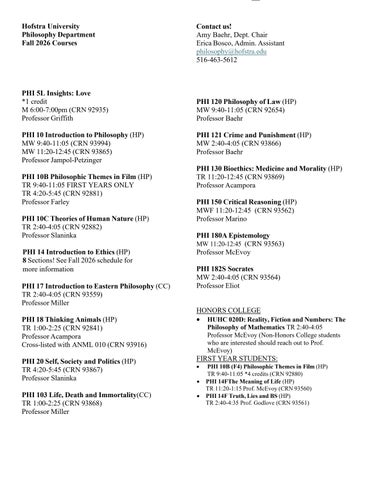
Hofstra University
Philosophy Department
Fall 2026 Courses
PHI 5L Insights: Love
*1 credit
M 6:00-7:00pm (CRN 92935)
Professor Griffith
PHI 10 Introduction to Philosophy (HP)
MW 9:40-11:05 (CRN 93994)
MW 11:20-12:45 (CRN 93865)
Professor Jampol-Petzinger
PHI 10B Philosophic Themes in Film (HP)
TR 9:40-11:05 FIRST YEARS ONLY
TR 4:20-5:45 (CRN 92881)
Professor Farley
PHI 10C Theories of Human Nature (HP)
TR 2:40-4:05 (CRN 92882)
Professor Slaninka
PHI 14 Introduction to Ethics (HP)
8 Sections! See Fall 2026 schedule for more information
PHI 17 Introduction to Eastern Philosophy (CC)
TR 2:40-4:05 (CRN 93559)
Professor Miller
PHI 18 Thinking Animals (HP)
TR 1:00-2:25 (CRN 92841)
Professor Acampora
Cross-listed with ANML 010 (CRN 93916)
PHI 20 Self, Society and Politics (HP)
TR 4:20-5:45 (CRN 93867)
Professor Slaninka
PHI 103 Life, Death and Immortality(CC)
TR 1:00-2:25 (CRN 93868)
Professor Miller
Contact us!
Amy Baehr, Dept. Chair
Erica Bosco, Admin. Assistant philosophy@hofstra.edu 516-463-5612
PHI 120 Philosophy of Law (HP)
MW 9:40-11:05 (CRN 92654)
Professor Baehr
PHI 121 Crime and Punishment (HP)
MW 2:40-4:05 (CRN 93866)
Professor Baehr
PHI 130 Bioethics: Medicine and Morality (HP)
TR 11:20-12:45 (CRN 93869)
Professor Acampora
PHI 150 Critical Reasoning (HP)
MWF 11:20-12:45 (CRN 93562)
Professor Marino
PHI 180A Epistemology
MW 11:20-12:45 (CRN 93563)
Professor McEvoy
PHI 182S Socrates
MW 2:40-4:05 (CRN 93564)
Professor Eliot
HONORS COLLEGE
• HUHC 020D: Reality, Fiction and Numbers: The Philosophy of Mathematics TR 2:40-4:05 Professor McEvoy (Non-Honors College students who are interested should reach out to Prof. McEvoy)
FIRST YEAR STUDENTS:
• PHI 10B (F4) Philosophic Themes in Film (HP)
TR 9:40-11:05 *4 credits (CRN 92880)
• PHI 14FThe Meaning of Life (HP)
TR 11:20-1:15 Prof McEvoy (CRN 93560)
• PHI 14F Truth, Lies and BS (HP)
TR 2:40-4:35 Prof. Godlove (CRN 93561)
PHI 005L Insights: Love (1 credit)
In this course we will be exploring love in all its complexity and nuance. We’ll use various sources ranging from bell hooks’ All About Love to Plato’s Symposium, in order to come closer to an understanding of what love is and the different forms love can take. Some of the questions we’ll face are: (1) What is the nature of familial love? (2) What is the nature of erotic/romantic love? And (3) what does it mean to love yourself? Since we all express our understanding of love differently, students will have the freedom to pursue which medium best expresses their understanding of love, and thus the final assignment may be in the form of a paper, presentation, art project, song, or video essay.
PHI 10 Introduction to Philosophy (HP) (3 credits)
An introduction to some of the major questions in philosophy like: Are my actions determined? Or can I make free choices? Do I have a mind that is distinct from my brain? What makes me me? Could robots ever be conscious? Do animals think? Was there a beginning of the universe? Does God exist? If so, why is there evil in the world? Can I know anything with certainty? And what, if anything, is the meaning of life?
PHI 10B Philosophic Themes in Film (HP) (3 credits)
An introduction to various philosophical issues that arise in contemporary films like Ad Astra, Arrival, Ex Machina, Her, Beautiful Boy, Silence, A Serious Man, Edge of Tomorrow, Inception, and The Matrix. Some of the issues examined include the problem of skepticism, the mind-body problem, personal identity, artificial intelligence, free will and determinism, moral dilemmas, and the meaning of life.
PHI 10C Theories of Human Nature (HP) (3 credits)
Examination of classical and contemporary theories of human nature. Considers persons as moral beings, as seekers of knowledge, and as social and political animals. Emphasis on the connection between theories of human nature and conceptions of the natural world.
PHI 014 Introduction to Ethics (HP) (3 credits)
This course focuses on critical reasoning about ethics. It reviews major approaches to ethical values and examines the bases for why some conduct (like killing, deceit, fraud) is wrong, and why some things (like freedom, fairness, compassion) are valuable. The course also examines the relationship between ethics and society, with focus on contemporary issues. For example: ethics in professional or business contexts, health and medical contexts, ethics in personal relationships, and environmental ethics.
PHI 14S The Meaning of Life (HP) (4 credits) FIRST YEAR STUDENTS ONLY
This class pursues questions about the meaning of life through discussions and readings.
PHI 14S Truth, Lies and BS (HP) (4 credits) FIRST YEAR STUDENTS ONLY
In his little book, On Bullshit, Harry Frankfurt says, “One of the most salient features of our culture is that there is so much bullshit.” Most of us would agree. Why is this? We want to know the truth, don’t we? Why, then, are we surrounded by so many lies, falsehoods, and nonsense? Many people feel that we are in a “post-truth” era an era dominated by such things as alternative facts, fake news, echo chambers, information silos, confirmation bias, science denial, conspiracy theories, disinformation, and distrust of expertise. How can we cope with, or even remedy the post-truth condition? What is so great about truth anyway? And what, if anything, comes after ‘post-truth’? Readings taken from ancient, modern and contemporary philosophers.
PHI 17 Introduction to Eastern Philosophy (CC) (3 credits)
Introduction to the major schools of Indian philosophy, along with the Japanese School of Zen Buddhism and the Chinese philosophy of Taoism.
PHI 18 Thinking Animals (HP) (3 credits) CROSS-LISTED WITH ANML 010
This course explores the ways human beings have thought about and treated animals. Focus is on 1) how humanism especially the idea that human beings are fundamentally different from other animals and should be at the center of concern – has functioned to legitimize the oppression of other animals; and 2) the post-humanist movement away from, and beyond, this species prejudice.
PHI 20 Self, Society and Politics (HP) (3 credits)
Introduction to the philosophical study of society and politics, with a focus on justice, rights, democracy, freedom, equality and power.
PHI 103 Life, Death and Immortality (CC) (3 credits)
This course examines the concepts of life, death and immortality as represented in religious and literary texts from a range of cross-cultural sources: western and non-western monotheistic traditions, eastern traditions (e.g., Tibetan and Indian), middle-eastern (e.g., Turkish), African, and Native American. It also examines the encounter between a native tradition and a western colonial, typically Judeo-Christian presence. Discussion as well of the implications of these concepts for such issues as abortion, euthanasia, and suicide.
PHI 120 Philosophy of Law (HP) (3 credits)
This course explores prominent answers philosophers have offered to the question ‘What is law?’ Along the way, we explore the idea of the rule of law, the relationship between law and the moral value of justice, the relationship between law and power, the centrality of rules and principles to the law, and the nature of legal reasoning.
PHI 121 Crime and Punishment (HP) (3 credits)
This course explores the question whether criminal punishment in principle, and our criminal justice system in particular, can be justified by canvassing standard philosophical views: deterrence theory, retributivism, and the moral education theory of punishment. Along the way, we explore criminal defenses, proportionality, attempts, alternative sanctions (for example shaming), mercy, rehabilitation and atonement. We also discuss the moral limits of the criminal law, and whether criminal punishment can be justified after appreciating recent advances in brain science. The main aim of the course is to empower students to understand and evaluate our practices of criminal punishment; this is of great importance because the criminal justice system is among the most coercive and potentially destructive domestic uses of state power.
PHI 130 Bioethics: Medicine & Morality (HP) (3 credits)
An investigation of moral theory as applied to the traditional and modern practices of medicine, including techniques informed by recent developments in biological science. Meaning and value of health and disease, life and death will be explored. The course will be especially helpful to philosophy majors or minors concentrating on ethics and to any students preparing to become healthcare professionals
PHI 150 Critical Reasoning (HP) (3 credits)
This course is a study of reasoning and argument as they appear in ordinary usage. The aim of the course is to increase the student’s skills in critical thinking: how to recognize unsupported assertions, how to analyze and assess arguments encountered in everyday life, and how to formulate and present cogent arguments of one’s own.
PHI 180A Epistemology (WI) (3 credits)
Are all your experiences caused by an evil scientist electronically stimulating your brain, which he keeps in a jar in his laboratory? Do we have any evidence to believe that the sun will rise tomorrow? If a reliable psychic told you that you were going to die tomorrow, but admitted that she had no evidence for this claim, should you believe her? Epistemology –the study of knowledge – raises these and other fascinating questions about our beliefs and knowledge. This course examines answers various philosophers have offered to these, and other, questions.
PHI 180S Socrates (3 credits)
The person who, more than anyone else, originally defined “philosophy” was an Athenian named Socrates. He defined it even more by living and acting in certain ways than by producing ideas. Surprisingly, he left no written work. So, everything we know about him comes through other ancient writers, chiefly Plato. In this course, we will try to understand what Socrates did and who he was, by reading both ancient and current depictions of his activities and conversations. We will identify and then wrestle with ideas he is depicted as having expressed and arguments he is depicted as having made. Finally, we will examine his legacy and influence, both ancient and present including what he might mean for us.
HUHC 020D Reality, Fiction and Numbers: The Philosophy of Mathematics
Interested students who are not in Honors College should reach out to Professor McEvoy. Imagine trying to explain the American Electoral College system without using numbers. Imagine telling scientists they couldn’t use mathematics in their research, or telling mathematicians that they weren’t studying anything real. Everyday language, scientific language and mathematical language all talk about numbers as if they are real things. Well then, what kinds of things are numbers? Are they physical objects? If so, exactly where is the number 12? How much does it weigh? If they’re not physical objects, are they non-physical objects? Whatever could that mean? Are numbers just something we made up? If so, just what are mathematicians doing? And why would something we just made up be so useful in describing and explaining the physical world? This course is a non-technical introduction to the Philosophy of Mathematics. We will discuss the work of both contemporary and historical writers. No mathematical ability is assumed or required.