ECOSOC Background Guide - 2026 Model UN - Hofstra University
Hofstra University
Model United Nations Conference 2026
Economic and Social Council (ECOSOC)
Sydra Daniyal, Co-Chair Joe Falco, Co-Chair
Dear Esteemed Delegates,
Welcome to the Hofstra University Model United Nations Conference (HUMUNC) 2026! It is with great pleasure that I extend a warm welcome to each and every one of you as we gather for this year's conference.
I am honored to be one of your Economic and Social Council (ECOSOC) chairs this year and I am greatly looking forward to not only meeting all of you, but to hear your wonderful ideas throughout this committee sessions. I am thrilled to have the opportunity to guide and facilitate meaningful discussions on critical global issues.
During the ECOSOC sessions, we will engage in insightful debates, negotiate resolutions, and work collaboratively towards finding innovative solutions to the challenges that our world faces.
In our committee, you will focus not only on social and humanitarian matters but also on issues that deeply impact the culture and environment of societies worldwide.
As Co-Chair, my role is to ensure a fair and productive environment where every voice is heard, and every delegate has the opportunity to contribute to the shaping of impactful resolutions. I am here to support you in navigating the intricacies of procedure and to guide the committee towards consensus and progress.
I look forward to witnessing your passion, dedication, and innovative thinking as we tackle these important issues during this conference. Together, we have the chance to make a real difference and inspire positive change on a global scale.
Once again, welcome to the Hofstra Model United Nations ECOSOC Committee 2026! Let us embark on this journey with a shared commitment to fostering understanding, cooperation, and meaningful solutions.
Best regards,
Sydra Daniyal Co-Chair, ECOSOC HUMUNC 2026
Dear Delegates,
It is a great pleasure to meet all of you. My name is Joseph Falco Jr., and I am a senior at Hofstra University. I have been studying Computer Science and Cybersecurity, and it has been a blast so far. Most importantly, I am your Co-Chair for the upcoming ECOSOC committee during this HUMUNC conference.
I first experienced Model UN during my first year at Hofstra University. Although I had no experience beforehand, the concept immediately captured my interest, and from there, I participated in this club as much as possible. My experiences have led to me participating in several competitions from different colleges, where I have learned a great deal and had fun while participating. This will be my second time serving as a Co-Chair, so you can trust that I’ll be able to deliver on making this a wonderful experience.
Besides my involvement in Model UN, I am a huge fan of video games. I enjoy RPGs and platformers, but I generally enjoy any genre of video games as long as they are fun. It is difficult to choose my favorite game, but at this time, it is Persona 3 Reload. Aside from that, I enjoy acting and the amount of work involved in creating a character and narrative. Plays and musicals are among my favorite acting genres, so much so that I often get involved in school productions whenever I have the opportunity. One more thing, I am a huge fan of dogs. It does not matter what dog it is; I guarantee you I will love it from the bottom of my heart.
I am hoping that through this introduction, I might lessen your nerves for this competition. I have been in your place before, and I know that sometimes it can feel stressful to prepare for a Model UN competition. However, the main priority for this competition is for you all to have fun. After all, why put all your effort into something if you cannot enjoy it? Let us find the answer to this question together and make this a fantastic experience. Have fun and get ready for this amazing opportunity! I look forward to meeting all of you soon.
Sincerely,
Joseph Falco Jr. ECOSOC Committee Co-Chair HUMUNC 2026
Introduction to ECOSOC
Entering its eightieth year in 2026, ECOSOC, one of the six main organs in the United Nations, values “multilateralism, inclusivity, and global solidarity” in its work as a highlyintegrated fulcrum:
at the heart of the United Nations system [working] to advance the three dimensions of sustainable development – economic, social and environmental. It is the central platform for fostering debate and innovative thinking, forging consensus on ways forward, and coordinating efforts to achieve internationally agreed goals.1
ECOSOC functions as a coordinating body, meeting annually to coordinate the work of UN entities through “regional economic and social commissions, functional commissions facilitating intergovernmental discussions of major global issues, and specialized agencies, programs and funds at work around the world to translate development commitments into real changes in people’s lives.”2
Topic 1: The Global Housing Crisis and Urban Inequality
A global crisis in housing — which can be defined as inadequate access to housing, habitable land, and services to provide for habitable domiciles, buildings, and communities — is an issue that has increasingly become the subject of domestic and international politics. “The UN’s urban development agency estimates that an astonishing 2.8 billion people worldwide lack access to adequate housing, secure land, and basic water and sanitation services – that’s around 40 per cent of the global population.”3 In addition to inadequate access to formal housing, lack of housing also remains a significant issue, as there are “more than 1.12 billion people living in slums or informal settlements. An additional 300 million face absolute homelessness, lacking any form of stable shelter, UN-Habitat estimates.”4
In more recent decades, housing issues were identified as a rising threat taking place primarily in the developing world. More recently, access to affordable housing or development of new housing in wealthier countries has also become a concern as populations increase and existing habitable areas have become too pricey for low-income or young families to live and work. Consider a nation like New Zealand, which is relatively well-off based on its GDP. The current state of its housing market reveals the struggle that many people living in New Zealand must manage. “New Zealand’s house prices started rising rapidly around 1980 and have since gone from twice average incomes to nine times”, a price far too large for many to pay.5
The United States, a country with one of the highest GDPs in the world at $29.18 trillion, is struggling with an extremely similar situation as New Zealand, where a noticeable percentage of the population does not have access to housing. In 2024, the housing market is heavily behind where it should be, needing “as many as 3.8 million more homes to meet the demands of homebuyers”.6 Independent of these nations’ financial status and development, citizens are facing housing issues, preventing them from being able to ensure their access to safe shelter. This issue is not limited only to these nations, as places such as Japan, Australia, the Netherlands, and many more all find themselves dealing with a housing market seemingly opposing the needs and demands of the people living in them.
One problem central to the housing crisis is the affordability of housing for most people. In a study conducted in 2019, it was discovered that “90 percent of the 200 cities around the globe that were polled were considered to be unaffordable to live in, based on average house price in relation to median income.”7 Housing in cities has become nearly inaccessible for many citizens due to the average price of these houses falling vastly out of scale the working class incomes. This already prevalent issue only became worse with the COVID-19 pandemic, which
resulted in an increased demand that raised the price of housing overall. During the period at the start of the pandemic in the second half of 2020 and the first half of 2021, prices in the American housing market increased “by 11 percent during the period, the fastest pace in 15 years, while in New Zealand, house prices were up by 22 percent.”8
Contributing to the increase in prices even further is the rise in inflation in recent years, which has swelled already outlandish housing prices even further, limiting market accessibility for many people. In addition to the effect of the price of a finished house, inflation also has an indirect impact on constructing new houses prices due to increasing costs of building materials like lumber.9 As these costs rise, owners have to raise the cost of houses they own to make a similar profit to what they initially paid, ultimately raising the price of homes across the board, making the purchase of both new and existing houses excessively difficult
Another major contributing factor to this crisis is the influence of urban inequality, the disparity in opportunities and resources between different social groups. These groups are often treated differently based on aspects such as race, religious views, gender, and wealth. Urban inequality is felt by homeowners in the form of insufficient access to resources that make living possible, even if construction is otherwise complete. One example includes running water, also known as “plumbing poverty”. In the period following the 2008 global financial crisis, homeowners in the fifty largest cities in the United States were found to not only face lower accessibility to running water, but in particular, households of people of color were disproportionately affected in twelve out of fifteen of the largest U.S. cities.10
The issue of urban inequality is applicable across the world and for many different groups of people. In India, the inequality in circumstances between the wealthy and the middle class is extremely large and common. Ten percent of India’s population holds approximately seventy-
seven percent of the total national wealth, while ordinary Indians struggle with an inability to access or afford education or healthcare.11 These are only some examples of urban inequality, with the deficit leaving many citizens across the world without access to vital resources. The United Nations has identified these larger threats as the inability to access “proper health care, good schools, sanitation, piped water, employment opportunities and adequate housing among others.”12
On the policy level, it is important to ask: how did international organizations, national governments, and even local municipalities fail to make policies to mitigate these crises?
Inflation and material prices might be more affected by cyclical economic factors, but the deficits of resources in urban areas seem harder to explain. The United Nations points to four strategies that can help level the playing field “to address the spatial, economic and social aspects of the urban divide and promote inclusive urbanization, including in rapidly growing cities”13
These four strategies include:
Establishing land and property rights, with a special focus on ensuring people living in poverty can maintain residence;
Improving availability of affordable housing, infrastructure and basic services and access to these services including transportation infrastructure;
Facilitating access to education and sustainable employment for urban residents;
Creating more inclusive decision‑making processes that facilitates transparency on public spending and build trust in monitoring systems.14
Even though this issue has been prevalent for years and has been clearly identified by the United Nations, there exists no direct and agreed-upon solution to this issue. For a long time, the only substantial ideas available were the Sustainable Development Goals, a group of seventeen
goals that would enhance living circumstances across the board. Only recently have there been any large collaborative efforts to address and resolve this issue. On May 29-30, 2025, UNHabitat, a United Nations forum focused on addressing sustainable urban development, hosted a discussion meant to develop solutions to the global housing crisis.15 This assembly heavily pushed the adoption of UN-Habitat’s Strategic Plan for 2026-2029, which focused on promoting adequate and accessible resources.16
The UN-Habitat Strategic Plan sets out three focus areas for global policymakers to address the housing crisis, including:
Equitable and inclusive prosperity for poverty eradication: Adequate housing opens the path out of poverty, giving people access to opportunities and a stable foundation to thrive across generations while serving as a powerful economic asset for communities and countries.
Environment and climate action: Sustainable housing design, construction materials and land use have the power to significantly reduce cities’ carbon footprint and enhance resilience to environmental shocks, positioning urban areas as engines of climate action and ecological sustainability.
Preparedness, response, recovery, and reconstruction: Better access to adequate housing, basic services, land, and property rights for affected, migrants, refugees, and internally displaced persons – integrated into urban and territorial planning –are essential for preventive risk reduction, effective post-crisis response and inclusive long-term recovery.17
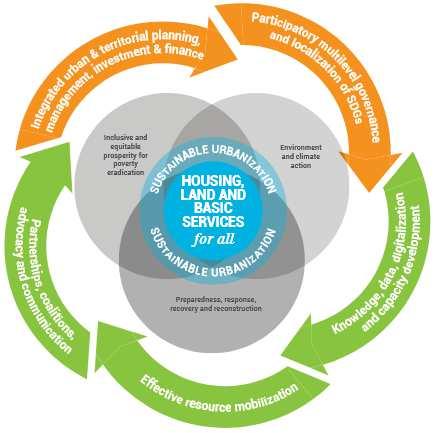
Alongside of identifying these focus areas, the UN Habitat Strategic Plan identifies five priorities for implementing the plan, in line with the UN Sustainable Development Goals and Urban Agenda. Figure 1 illustrates the five interrelated priorities.
Figure 1: UN-Habitat’s five main priorities to implement the strategic plan18
However, even with a solid foundational plan, this assembly ultimately identified a need for strengthened collaboration between the other United Nations agencies for this plan to succeed. This is where ECOSOC comes into play for this upcoming committee. You and your fellow delegates will take into account past developments alongside long-standing issues to develop a plan for resolving the global housing crisis. Through hard work and debate, you’ll be expected to work with each other and develop a realistic and actionable plan for reducing the impact of the crisis and bettering the lives of millions across the globe.
Case Study 1: Identified Relationship Between Housing Instability and Mental Health
While the standard physical effects of the global housing crisis are fairly evident, there remains a more subtle effect that the housing crisis has through its impact on the mental health of those affected. Poor mental health can result in people struggling with anxiety and depression in already stressful circumstances, in addition to facing the possibility of losing the security of home and shelter. Additionally, those suffering from addictions have to face the constant threat of losing their homes while feeding into a loop of satisfying their addictions. The types of mental health challenges, along with many others, result in some homeowners struggling to maintain a stable level of wealth and happiness for themselves. A study of housing in Turkey noted that, those with existing mental health issues or addictions are at the highest risk of becoming homeless, especially if they are unable to access the help they sorely need.19
Case Study 2: Immigrants Struggling to Find Suitable Living Conditions
It is estimated that 96,000 homes would need to be built every day to accommodate the three billion people estimated to need them by 2030.20 One group of people who have been substantially impacted by the global housing crisis is immigrants, refugees, and the displaced. These groups already have to adapt to the new countries where they have arrived in various ways, but the current housing crisis has made it harder for them to have secure housing.21
In October 2023, approximately 110 million people had been displaced from their home countries. However, discriminatory practices have made it extremely difficult for these migrants to find proper housing in their new countries. These practices are based on negative perceptions of the immigrants and beliefs that they would ruin the economies of the places they move to. However, this is far from the truth, as for example, “immigrants in the United States created $3.7
trillion in housing wealth, helped stabilize costs in urban areas that might otherwise have declined, and revitalized less desirable neighborhoods” in the period between 1970 and 2010.22
Immigrants typically face unfair treatment in the housing market that makes secure living nearly impossible. A study of Venezuelans who migrated to Colombia during recent instability found that migrants were granted only temporary housing or will be forced to pay above-market rates.
Discrimination from their neighbors is another problem that they must deal with. These issues can be seen anywhere in the world, but they have become even more prevalent after the Ukraine-Russia conflict. The number of refugees from Ukraine has spiked, resulting in more facing housing issues. Early waves of these migrants, including many women and children, were temporarily housed in private homes or large shelters. As the conflict has dragged on, people in European countries have experienced “solidarity fatigue” and are less willing to help privately and also see large government spending as a less welcome option.
In the United States, the arrival of a large number of asylum seekers at its border in 2022 created a crisis when they were sent to large cities unprepared to deal with housing them. With New York City’s policy to provide shelter for all who need it, it found itself struggling to find adequate housing for the influx of asylum seekers. The median cost of rent rose to $3,795 by 2023, despite only 1.4 percent of rental housing having vacancies. Additionally, sheltering options have been established to address their living circumstances, with the number sent to homeless shelters greatly increasing. The city even tried controversial moves like offering oneway tickets to other destinations to offset the asylum seeker population in its care.23
While this issue is large and grave, nations across the globe have been working to provide solutions to help their migrants. The United Kingdom established a Housing First approach
designed to link migrants to immediate shelter. This provided a useful template when the war between Russia and Ukraine began, as the United Kingdom adopted a Homes for Ukraine plan to connect Ukrainian refugees to resident sponsors.24
The U.S. government provided financial support in 2022 for the Church World Service to develop quality, affordable houses for refugees, alongside its Refugee Housing Solutions program. One innovation introduced by the program was the use of a mobile app with information on housing in several languages to allow housing seekers and managers to better communicate during the housing search process. Australia has its own approach, directing migrants to live in rural and non-traditional areas due to them typically having more available and affordable housing.25
Guiding Questions
1. What mandates should be established to reduce the cost of housing as a whole?
2. How can more viable living spaces be created without heavily overdeveloping the remaining development area?
3. What are the essential rights that each homeowner should have access to?
4. What are the steps that need to be taken to eliminate discriminatory practices from the housing market?
5. How can the process of home development be made cheaper while retaining a similar level of quality?
Topic 2: Establishing Ethical Guidelines
for the Use of Biometric Data and Surveillance
Technology
Biometrics is the automated recognition of people's biological and behavioral traits for distinguishing individuals and may include such methods as fingerprint scanning, iris scans, facial recognition, and more. Governments are adopting biometrics to prevent illegal entry, detect and deter terrorist attacks, and manage public safety. Currently, biometrics are used in law enforcement, commercial applications, migration control, civil identification, healthcare, and more.26
While biometrics can be a powerful tool for detecting and preventing threats, the potential infringement of civil rights and freedoms, potential security risks in the event of a data breach, and privacy and ethical concerns make serious discourse and regulation necessary. Airports, border patrol, law enforcement agencies, and even humanitarian aid organizations have assisted in the development of technologies such as voice and facial recognition. While these innovations may seem to improve outcomes in identity verification, enhancing nations’ security, and potentially preventing fraud, these developments have gone largely unregulated and lack adequate protections. Given the rapid rate of deployment of these technologies, international ethical frameworks are needed to ensure proper use and protection of citizens’ freedoms while maintaining these resources as tools against dangerous situations.
At the international level, there are no specific treaties or conventions that address biometric data and privacy concerns exclusively. However, general data protection principles would apply through those set out by the Organization for Economic Co-operation and Development (OECD), the first internationally agreed-upon privacy principles. The Guidelines
on the Protection of Privacy and Transborder Flows of Personal Data, adopted in 1980, provide “general guidance concerning the collection and management of personal information”27 but have not been updated substantially since 2013.28 The Guidelines play a major role in “assisting governments, businesses, and consumer representatives in their efforts to protect privacy and personal data, and in obviating unnecessary restrictions to transborder data flows, both on and offline.”29
In their original form, the guidelines underline the basics of consent, scope and limitation, and security safeguards regarding the handling of personal data, but with its last major revision over one decade ago, the agreement added little to no guidance on the handling of biometric information. The guidelines primary emphasis concerns the need to mitigate unauthorized access, data breaches, and any misuse of collected information. Perhaps new negotiations conducted in this committee, with a better understanding of modern biotechnological advances, can solidify standards for privacy, security, management, and processing of collected biometric data.
In addition to the entities described earlier, the general public has inadvertently become an integral part of recent developments in biometric collection used in law enforcement surveillance worldwide, sparking ethical concerns. Currently, more than 360 million houses around the world have transformed into “Smart Homes,” and the number rises each year. Many of these smart homes have security and/or doorbell cameras,30 which law enforcement could potentially access as part of a broader public surveillance network to aid in investigations.31 The public is generally unaware of law enforcement’s use of personal information in AI tools. A growing number of law enforcement agencies worldwide regularly use AI technology, including biometric surveillance such as facial recognition and license plate readers.32 From the United
States33 to the United Arab Emirates,34 China35 to Argentina,36 the United Kingdom37 to Japan,38 South Africa39 to Brazil,40 AI assistance in the criminal justice system is near ubiquitous.
This, naturally, raises concerns about informed use and consent. Unlike personal data traditionally used, like a social security number, biometric data is, by its very nature, more sensitive because it comes directly from the individual; therefore, the threshold for consent must be very high. Most private citizens do not think about the full extent of what happens to biometric data that they hand over for the sake of convenience, such as unlocking a smartphone or gaining access to a secure building, particularly when it is collected for what seems to be innocuous purposes. In other words, people only become concerned about this data when there is a breach or identity theft. This heightens concern about the mechanisms in place to ensure informed consent and to ensure that people are aware of how their data will be used, stored, and safeguarded. Delegates should be prepared to debate the need to balance security, privacy, and the methods by which this biometric data information is being collected and justified.
In 2021, military grade spyware called Pegasus, created by an Israeli firm called the NSO Group, was purchased by some governments with the intended purpose of tracking terrorists and criminals. It was later discovered that it was also used to hack phones belonging to journalists, human rights activists, and many others. The NSO Group insisted that its product is only intended to “collect data from the mobile devices of specific individuals, suspected to be involved in serious crime and terror.” 41 Pegasus, allowed operators to remotely install spyware undetected on target devices, giving the operators complete control of the device, including access to encrypted messages and the ability to activate cameras and microphones.
Investigations revealed the wide misuse of the program, which included at least 180 journalists as targets in multiple countries, including India, Mexico, Morocco, Hungary, and
France. It is also suspected that human rights defenders, lawyers, doctors, diplomats, politicians, and several heads of state could also have been subject to surveillance using Pegasus.
In the transparency report published in June 2021, the Israeli company stressed that Pegasus was ‘not a mass surveillance technology’ [and was] used only where there [was] a legitimate law enforcement or intelligence-driven reason.’ Yet, more than 10,000 phone numbers were selected for surveillance by NSO Group’s Moroccan client alone over a two-year period.42
Rightfully so, this incident has raised questions about business groups selling their data and technologies to authoritarian regimes (as was the case with the NSO group and Azerbaijan) as well as safeguards to prevent misuse of cyber weapons like Pegasus. The year after the abuses of Pegasus were revealed, Amnesty International observed, “The Pegasus Project offered a wake-up call that action was urgently needed to regulate an industry that is out of control. Shamefully, governments worldwide are yet to step up and fully deal with this digital surveillance crisis.”43
Another example of powerful, private sector surveillance technology being used by a government occurred in 2007, when Libya allegedly purchased systems from a French company, Amesys, which:
allegedly permitted the interception of all country-wide, online, and phone communications, and the subsequent processing of collected data. Under the Regime of Muammar Gaddafi, the technology became a weapon that facilitated the targeting, arrest, and imprisonment of thousands of people in Libya. In 2011, the International Federation for Human Rights (FIDH) and La Ligue des Droits de l’Homme (LDH) brought a criminal case against Amesys for complicity with human rights abuses committed by the Gaddafi regime in Libya because they provided surveillance equipment to the regime. Subsequent revelations revealed a contract concluded by Amesys – then Nexa Technologies – with the Egyptian regime, in 2014. FIDH and LDH, with the support of the Cairo Institute for Human Rights Studies (CIHRS), filed a complaint. A judicial investigation was opened one month later, in December 2017.44
The pace of technological advancement since the turn of the century has been astronomical, and the OECD has been unable to keep pace with relevant standards on data
privacy. As modern surveillance stretches with unparalleled reach and even DNA becomes data,45 new questions about privacy surface. No technology is purely positive or purely negative. Recent advances have the potential to fight crime and terror attacks, but they can also be abused to crack down on dissent. It will be up to the delegates in this committee to find the balance between security benefits and privacy concerns.
Case study: Rohingya refugee population in Bangladesh
The Rohingya are an ethnic group who live in Myanmar who have been subjected to violent attacks and ethnic cleansing by government forces of Myanmar since 2016, forcing more than 900,000 to flee to neighboring Bangladesh to become refugees.46 At first, the Bangladeshi government took in the numerous refugees, but when Myanmar tried to state that Rohingya were really from Bangladesh and had no right to return, the government of Bangladesh sought to keep the path for the return open for the Rohingya because they opposed permanent resettlement.
Human Rights Watch issued a report in 2021 that detailed potential abuses of Rohingya’s personal data, intentional and unintentional, that could have exposed them to further abuses of their rights. According to the report, in 2018, biometric data collected by UNHCR and other humanitarian organizations for was shared with the Bangladeshi government to facilitate aid distribution. The Bangladeshi government also sought to supplement the UNHCR efforts with additional collection of biometric data to make a more comprehensive identity profile of the Rohingya who signed up for aid.
The Bangladesh government attempted to sign up Rohingya to use identification cards, known as “Smart Cards,” to facilitate access to aid. The Bangladeshi government aimed to use personal data, “including analog photographs, thumbprint images, and other biographic data”47 to
submit to Myanmar to evaluate the possibility of repatriating some refugees, despite refugee protections eligible to them by international law and administered by UNHCR.
UNHCR was aware that the information could be used to repatriate the Rohingya back to Myanmar, where they could potentially face more persecution, although UNHCR felt that obtaining secure documentation “would help protect the refugees’ right of return.” In a meeting with Human Rights Watch, UNHCR said officers asked the Rohingya for permission to share their data for these repatriation efforts, explaining that a Smart Card will still be issued to those who did not agree. At the time, the UNHCR staff publicly stated that the data was not linked to repatriation, notably on a Rohingya community radio show and in international media. When a group of twenty-four Rohingya refugees were later interviewed as part of an investigation, they indicated that UNHCR staff did not explain to them the possibility that the biometric information they shard to obtain a Smart Card could potentially be used by any actor in the future to evaluate their status and enable repatriation to Myanmar.
Rohingya refugees then staged protests on concerns that data collection would be used to facilitate forced returns. Smart Card enrollment was required to receive aid, and there was no mention of data sharing with Myanmar or its linkage with repatriation efforts. The official report concluded: “UNHCR in this case did not seek free and informed consent, which would have required making certain that the refugees knew and understood the risks of sharing their and their family’s data with Myanmar, that they had the ability to opt-out without prejudice, and that they could get the Smart Card even if they did not agree.”48
As a result of this incident, between 2018 and 2021, the Bangladesh government was able to provide approximately 830,000 names of Rohingya refugees to Myanmar along with biometric and other identifying data for each person, which could be used for repatriation
eligibility assessments. Of the twenty-four refugees interviewed, twenty-one ended up on lists of those eligible for repatriation, although at the time of the report, none were forced to return.
According to Human Rights Watch, “UNHCR’s policies provide that the agency should never directly link registration or other verification exercises with registration for voluntary repatriations.”49 In this incident, they did not clearly explain the data collection process to the Rohingya refugees, or its results, sufficiently. This example illustrates how sensitive biometric data can be, and that if an entity asks a person to submit it, there must be stringent rules about its collection, handling, and future use, or the people who can be most hurt are those who submitted their information and then lost control of how it is used.
As of now, laws codifying data privacy exist in 144 nations and protect about eighty-two percent of the global population.50 The EU has established itself as a global leader in protecting data and upholding ethical technological standards. The General Data Protection Regulation (GDPR) has established a global standard for privacy rights, imposing stringent limitations on biometric systems and other high-risk technologies, demonstrating that there can be rules that prioritize citizens’ rights, and curb data harvesting by private corporations.51 While Europe still has the most data privacy laws of any continent, Asian and African countries have been accelerating their work on legislation in recent years. Nearly seventy-two percent of African countries and seventy-three percent of Asian countries are covered by some form of data privacy protection laws.52
Guiding Questions
1. What types of consistent ethical guidelines on surveillance technologies can be developed to prevent authoritarian practices that may disproportionately impact marginalized communities within a society and undermine trust in democratic institutions?
2. How can nations ensure free, informed, and meaningful consent when collecting biometric data, especially in contexts where people may feel coerced (e.g., refugees, aid distribution, border crossings)?
3. Should certain biometric technologies—such as facial recognition or remote spyware— be restricted or banned due to their inherent risks?
4. What mechanisms can prevent governments from using biometric technologies to monitor dissidents, journalists, or minority groups?
5. How should countries balance national security needs with privacy and human rights protections when deploying biometric systems?
6. Should there be an international licensing system that restricts the sale of high-risk surveillance technologies, similar to weapons export controls?
3 “UN searches for solutions to global housing crisis.” United Nations. May 25, 2025. https://news.un.org/en/story/2025/05/1163851
4 Ibid.
5 Kohler, Alan. “The Housing Crisis Is Global. What Are Other Countries Doing about It? | Alan Kohler.” The Guardian, Guardian News and Media, 28 Sept. 2024, www.theguardian.com/books/2024/sep/28/the-housing-crisisis-global-what-are-other-countries-doing-about-it
6 Lane, Terry. “Why Is the U.S. Housing Market Short by Nearly 4 Million Homes?” Investopedia, Investopedia, 31 Mar. 2025, www.investopedia.com/why-is-the-u-s-housing-market-short-by-nearly-4-million-homes-11695334
7 Keffler, Natalie. “Solving the Global Housing Crisis.” World Finance, www.worldfinance.com/infrastructureinvestment/solving-the-global-housing-crisis. Accessed 3 Jan. 2026.
8 Ibid.
9 Nguyen, Joseph. “How Inflation Affects Home Prices: Key Insights for Buyers.” Investopedia, Investopedia, 3 Dec. 2025, www.investopedia.com/ask/answers/correlation-inflation-houses.asp.
10 Meehan, Katie, et al. “Urban Inequality, the Housing Crisis and Deteriorating Water Access in US Cities.” Nature News, Nature Publishing Group, 19 Dec. 2024, www.nature.com/articles/s44284-024-00180-z
12 “Urbanization: Expanding Opportunities, but Deeper Divides.” United Nations, United Nations, www.un.org/en/desa/urbanization-expanding-opportunities-deeper-divides
13 Ibid.
14 Ibid.
15 “Habitat’s Strategic Plan 2026–2029.” UN, unhabitat.org/un-habitats-strategic-plan-2026-2029 Accessed 3 Jan. 2026.
16 “UN Searches for Solutions to Global Housing Crisis | UN News.” United Nations, United Nations, 29 May 2025, news.un.org/en/story/2025/05/1163851
17 “UN Habitat Strategic Plan 2026-2029.” United Nations Human Settlement Programme. https://unhabitat.org/sites/default/files/2025/10/sp_brochure17.pdf
18 Ibid.
19 Çalıyurt, Okan. “The Mental Health Consequences of the Global Housing Crisis.” Alpha Psychiatry, U.S. National Library of Medicine, 1 Nov. 2022, pmc.ncbi.nlm.nih.gov/articles/PMC9797748/.
20 Solf, Benedicta, et al. “Global Affordable Housing Shortages Can Harm Migrant Reception and Integration.” Migration Information Source, 20 Mar. 2024, www.migrationpolicy.org/article/housing-crisis-immigrantsintegration
21 Ibid.
22 Ibid.
23 Ibid.
24 Ibid.
25 Ibid.
26 “Biometrics”. United States Department of Homeland Security. August 28, 2025. https://www.dhs.gov/biometrics#
27 “OECD Guidelines on the Protection of Privacy and Transborder Flows of Personal Data.” OECD. February 12, 2002. https://www.oecd.org/en/publications/2002/02/oecd-guidelines-on-the-protection-of-privacy-and-transborderflows-of-personal-data_g1gh255f.html
28 “Explanatory Memoranda of the OECD Privacy Guidelines.” OECD Digital Economy Papers, No. 360. October 2023. https://www.ospi.es/images/documentos/archivos/OCDE_Privacy_Guidelines_Explanatory_Momoranda_2023en.pdf
29 “OECD Guidelines on the Protection of Privacy and Transborder Flows of Personal Data.” OECD. February 12, 2002. https://www.oecd.org/en/publications/2002/02/oecd-guidelines-on-the-protection-of-privacy-and-transborderflows-of-personal-data_g1gh255f.html.
30 Wells, Tom. “The Growing Number of Smart Homes: 360 Million and Counting.” Marketing Scoop. November 27, 2023. https://www.marketingscoop.com/small-business/number-of-smart-homes/
31 Gallaga, Omar. “Amazon's Ring Cameras Push Deeper Into Police and Government Surveillance." CNET. Oct. 18, 2025. https://www.cnet.com/home/security/amazons-ring-cameras-push-deeper-into-police-and-governmentsurveillance/
32 Wong, Daniel. “AI and Privacy: Balancing Technology and Compliance in Law Enforcement.” Veritone. March 13, 2025. https://www.veritone.com/blog/ai-and-privacy-balancing-technology-and-compliance-in-lawenforcement/
33 Chow, Andrew R. “Police and Courts Are Turning to AI. Is the System Ready for It?” Time. July 30, 2025. https://time.com/7306226/ai-criminal-justice-police-courts-cops/
34 “AI-Enhanced Criminal Justice Processing.” Lex and Strategy. July 18, 2025. https://lexandstrategy.com/articles/ai-enhanced-criminal-justice-processing
35 “China.” Oxford Institute of Technology and Justice. September 2025. https://www.techandjustice.bsg.ox.ac.uk/research/china
36 Alexander, April. “Argentina plans to use AI to "predict future crimes and help prevent them.” CBS News. August 1, 2024. https://www.cbsnews.com/news/argentina-plans-to-use-ai-to-predict-future-crimes-and-helpprevent-them/
37 “Press release: AI to help police catch criminals before they strike.” Department for Science, Innovation and Technology and The Rt. Honorable Peter Kyle MP. August 15, 2025https://www.gov.uk/government/news/ai-tohelp-police-catch-criminals-before-they-strike
38 “A Novel Solution to Public Security: Japan’s AI-Based Crime Prediction.” Kizuna. June 7, 2024. https://www.japan.go.jp/kizuna/2024/06/japans_ai-based_crime_prediction.html
39 “South Africa.” Oxford Institute of Technology and Justice. September 2025. https://www.techandjustice.bsg.ox.ac.uk/research/south-africa
40 “Brazil.” Oxford Institute of Technology and Justice. September 2025. https://www.techandjustice.bsg.ox.ac.uk/research/brazil
41 Albergotti, Reed; Birnbaum, Michael; Dwoskin, Elizabeth; et al. “Takeaways from the Pegasus Project.” The Washington Post. Updated February 2, 2022. https://www.washingtonpost.com/investigations/2021/07/18/takeaways-nso-pegasus-project/ https://forbiddenstories.org/about-the-pegasus-project/
42 Ibid.
43 “The Pegasus Project: One year on, spyware crisis continues after failure to clamp down on surveillance industry” Amnesty International. July 18, 2022. https://www.amnesty.org/en/latest/news/2022/07/the-pegasus-project-oneyear-on-spyware-crisis-continues-after-failure-to-clamp-down-on-surveillance-industry/
44 “Understanding Private Surveillance Providers and Technologies.” Geneva Centre for Security Sector Governance. December 2022. https://www.dcaf.ch/sites/default/files/publications/documents/DCAF_Understanding%20Private%20Surveillance_ WEB.pdf
45 "The Evolution of DNA Evidence in Law Enforcement: A 20-Year Perspective." Law Offices of John D. Rogers. January 14, 2024. https://johndrogerslaw.com/the-evolution-of-dna-evidence-in-law-enforcement-a-20-yearperspective/
46 Hodal, Kate. “UN put Rohingya ‘at risk’ by sharing data without consent, says rights group.” The Guardian. June 15, 2021. https://www.theguardian.com/global-development/2021/jun/15/un-put-rohingya-at-risk-by-sharing-datawithout-consent-says-rights-group
47 “UN Shared Rohingya Data Without Informed Consent.” Human Rights Watch. June 15, 2021. https://www.hrw.org/news/2021/06/15/un-shared-rohingya-data-without-informed-consent
48 Ibid.
49 Ibid.
50 “Data protection and privacy laws now in effect in 144 countries.” IAPP. January 28, 2025. https://iapp.org/news/a/data-protection-and-privacy-laws-now-in-effect-in-144-countries
51 Wolford, Ben. “What is GDPR, the EU’s new data protection law?” GDPR.EU.https://gdpr.eu/what-is-gdpr/
52 “Data protection and privacy laws now in effect in 144 countries.” IAPP. January 28, 2025. https://iapp.org/news/a/data-protection-and-privacy-laws-now-in-effect-in-144-countries