

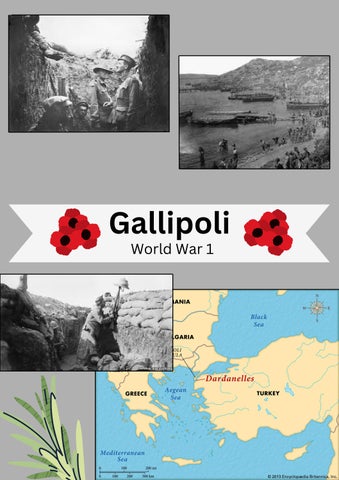


WW1 started during 1914 following the assassination of Archduke Franz Ferdinand. The assassination did not cause WW1, but it was a starting point of war between the European counties. Then in June of 1914, Franz Ferdinand’s assassination was published in the Australian newspaper and talked about the outbreak of war. Once German soldiers entered Belgium, a neutral county on the 4th of August, Britian declared war on German. Australians joined the war to help aid our mother country, Britain.

World War I Alliances were one of the main contributing factors leading to the outbreak of WWI. There were two major alliances leading up to World War One: the Triple Alliance, which included Germany, Austria-Hungary and Italy. Militarism is the belief or the desire of a government or a people that a state should maintain a strong military capability and to use it aggressively to expand national interests and/or values. Through the use of direct military force, economic spheres of influence, and annexation, European countries dominated the continent of Africa. Nationalism was a significant factor in the outbreak of WWI, as many nations believed that they were entitled to selfrule and sought to expand their power and influence. This led to competition and tensions between nations.
On the 25th of April 1915, under the protection of darkness, the Anzacs eagerly hopped out of the battleships and onto boats to get to land, where they were bombarded with heavy gunfire. Few men died on the boats while most made it to the land where they either made it to the bottom of the steep hill or were shot with shrapnel. The soldiers who made it up the hill had to show bravery and take out the enemy in the first trench and claim it for themselves. They then sat in a trench for a long time while many soldiers grew trench foot from this.


Many different soldiers faced the horrors of Shell shock (which is now known as PTSD). Shell shock was developed by the loud and continuous noises of gun fire and bombs going off on the battlefield, throughout the day and night. Symptoms of shell shock that the men showed was uncontrollable shaking of limbs, foaming the mouth and some other stuff. Australian soldiers at Gallipoli faced death in battle on the frontline, but there were also serious health issues which forced soldiers to come home early. It was a struggle to “hang on” when surrounded by filth, illness, disease, and death and constantly threatened by enemy fire. Troops in Gallipoli, having left their homes in search of excitement and perhaps glory, found themselves living in small dug-outs, constantly digging and tunnelling, and filthy and dirty.


James Martin, also known as Jim Martin, was the youngest Australian soldier to ever join the war. He was planted in the 4th platoon and was sent to Gallipoli to fight. .

James was 14 when he enlisted, enlisting on the 12th of April 1915, he didn’t go to war until over a month later on the 28th of June when he embarked on a battleship to Gallipoli where he battled until the 25th of October 1915 where he unfortunately died on service. James was eager to enlist in the AIF (Australian Imperial Force), his father was previously rejected from service and Jim, the only male child of his family, was keen to serve in his fathers place. James was born on the 3rd of January 1901 and was born in Tocumwal, New South Whales. He enlisted into the AIF in Melbourne , Victoria and earned no achievements for his service in the AIF
April

Second Attack on Anzac Cove 27th to 29th April Battle for Baby 700 2nd to 3rd May
The second Battle of Krithia, 8th May
Third Attack on Anzac Cove 19th May

Acton, Crescent. “Gallipoli Landing | National Museum of Australia.” Nma.gov.au, 27 Sept. 2022, www.nma.gov.au/definingmoments/resources/gallipoli-landing, https://www.nma.gov.au/definingmoments/resources/gallipoli-landing.
corporateName =Department of Veterans’ Affairs; address=21 Genge St, Civic/Canberra City. “Early Battles for the Anzacs on Gallipoli 1915 | Anzac Portal.” Anzacportal.dva.gov.au, anzacportal.dva.gov.au/wars-andmissions/ww1/where-australians-served/gallipoli/early-battles.
Esri Australia Education Program. “Australia’s Involvement in WWI.” ArcGIS StoryMaps, 24 May 2022, storymaps.arcgis.com/stories/487b208cd36643a5b73d6991c7d5d1ca.
“James Charles (Jim) MARTIN.” Vwma.org.au, 2019, vwma.org.au/explore/people/71799.
“Life on the Western Front.” BBC Bitesize, www.bbc.co.uk/bitesize/articles/z2xb46f#zkqfb7h. Accessed 9 June 2024.
Michelle Negus Cleary. “Flies, Filth and Bully Beef: Life at Gallipoli in 1915.” The Conversation, 10 Apr. 2015, theconversation.com/flies-filth-and-bullybeef-life-at-gallipoli-in-1915-39321.
National Archives of Australia. “Home Page | Naa.gov.au.” Naa.gov.au, 2019, www.naa.gov.au/.
“Mutilation and Disfiguration | International Encyclopedia of the First World War (WW1).” Encyclopedia.1914-1918-Online.net, encyclopedia.1914-1918online.net/article/mutilation and disfiguration#:~:text=They%20were%20oft en%20shredded%20as%20a%20result%20of. Accessed 9 June 2024.

 Written by Chayce Goodwin