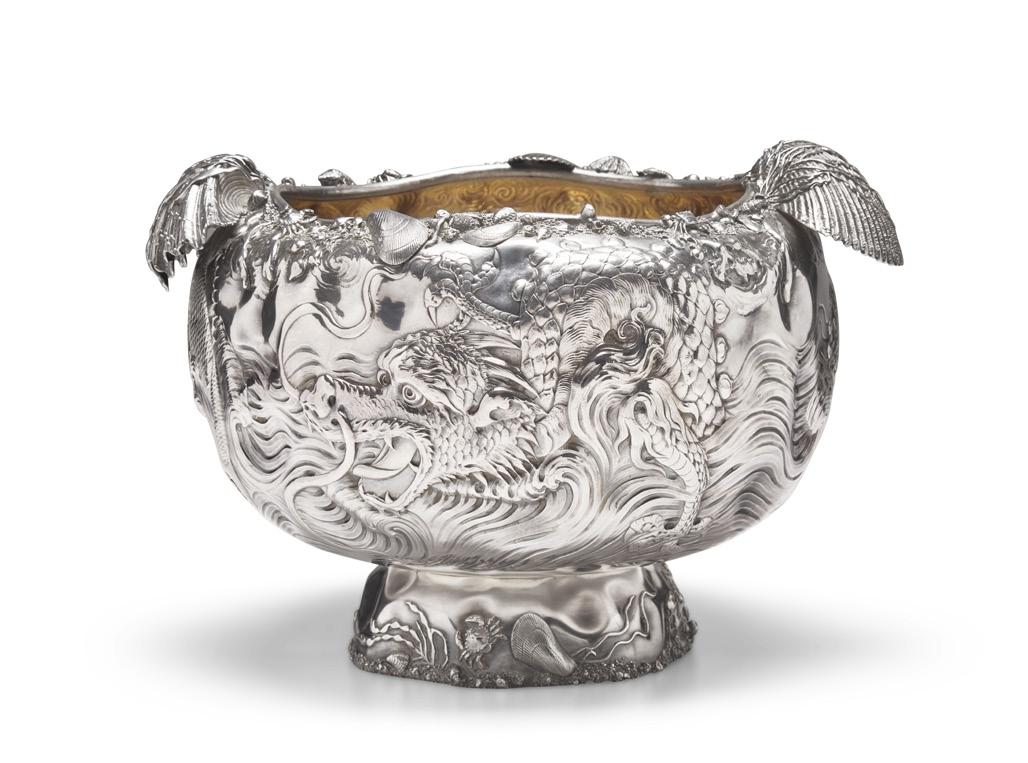
A Rare and Monumental Sterling Silver Japonesque Punch Bowl Gorham Mfg. Co., Providence, Rhode Island, Date Mark for 1885
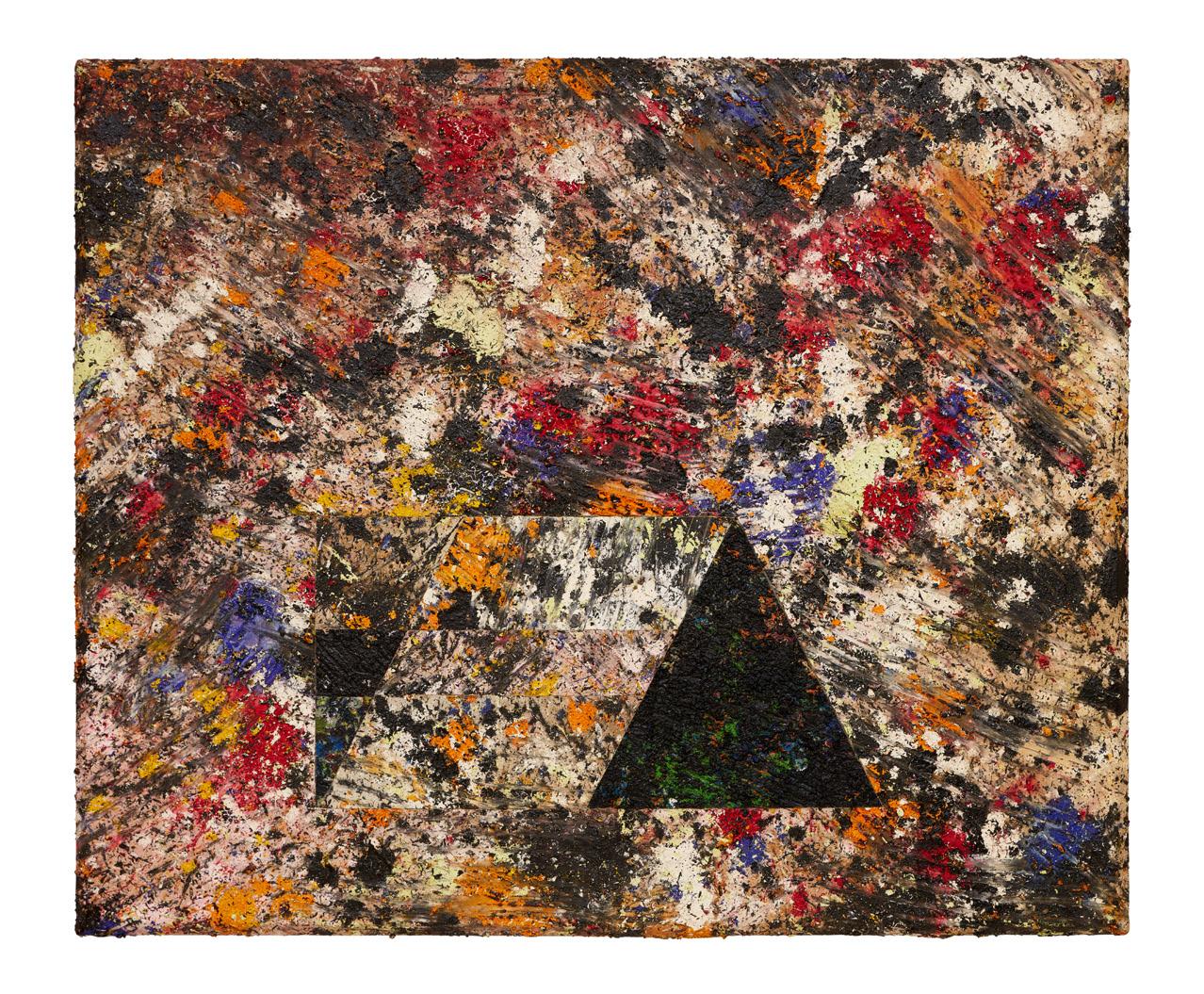
Sam Gilliam (American, 1933-2022) Dorothy's Mondays, 1977 Property from an Important Private Collection, Silver Spring, Maryland NEW YORK SOLD FOR $197,350
NEW YORK SOLD FOR $281,600
Zhang Daqian (Chinese, 1899-1983) Landscape Collection of Hui Yihan (20th Century) and thence by descent in the family.
OFF THE TRACK: EDWARD TROYE’S JOURNEY EAST
BY TIMOTHY LONG, VICE PRESIDENT, MUSEUM BUSINESS DEVELOPMENT AND CORPORATE CLIENT SERVICES
This painting by Edward Troye (1808-74) was consigned by Bethany College and ultimately achieved a result that far exceeded expectations at auction. While the work carried strong provenance and exhibition history, the enthusiastic response from collectors also reflected the enduring appeal of Troye’s most recognizable subject matter. Horses sit at the center of his legacy, and collectors continue to respond strongly to paintings that showcase his mastery of equine form.
Troye is widely regarded as the premier American painter of thoroughbred horses in the nineteenth century, building his reputation on portraits that celebrated the beauty, power, and prestige of elite bloodstock. Yet the present work represents a fascinating departure within his career. In 1855 and 1856, Troye traveled through the Middle East with the Kentucky horseman Alexander Keene Richards (1827-81) in search of Arabian horses. The journey proved transformative, and during it he produced a small group of works that moved beyond the racetrack portraits for which he was best known. Instead, he recorded landscapes, architecture, and scenes of daily life while maintaining the careful attention to horses that defined his work.
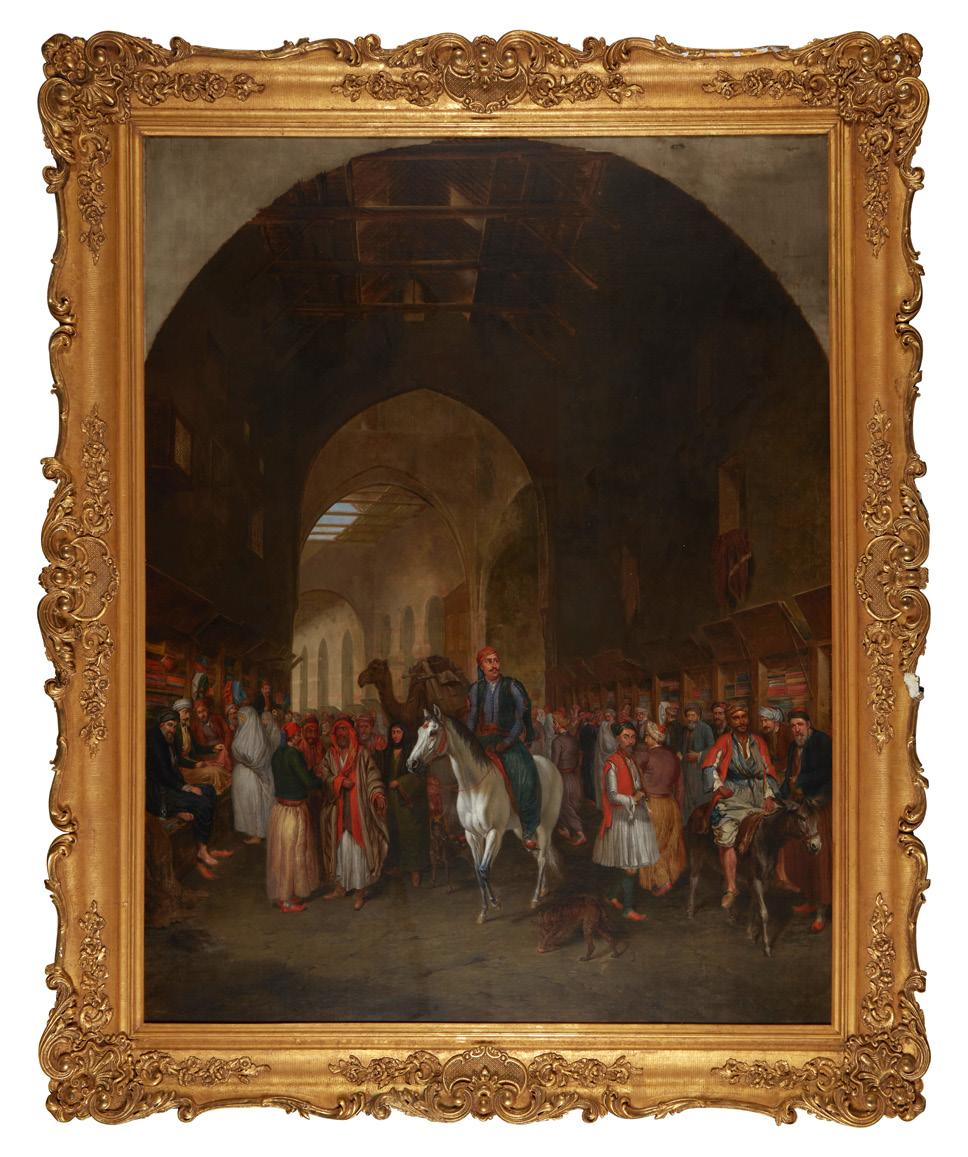
Here, the artist depicts a lively bazaar scene in Damascus, set before the entrance to the Umayyad Mosque. At the center of the composition, an Albanian officer sits astride a striking white mare named “Lulie,” surrounded by the vibrant movement of a marketplace. Rich color, layered detail, and carefully observed figures draw the viewer into the rhythms of the scene, blending travel narrative and Orientalist atmosphere with Troye’s unmistakable equestrian focus.
Provenance and exhibition history also contributed to the painting’s strong reception. The work descended from Alexander Campbell (1788-1856), founder of Bethany College, establishing an early and distinguished provenance. More recently, it was featured in the exhibition Faithfulness to Nature: Paintings by Edward Troye at the National Sporting Library & Museum, where the painting’s scale and vivid detail helped illuminate this unusual chapter of the artist’s career.
Edward Troye (American, 1808-1874)
A Bazaar in Damascus, 1856 Property from Bethany College Sold for $254,500
Results such as this highlight how the market for historical works of art is shaped by more than aesthetics alone. A compelling story, strong provenance, and museum exhibition history all help deepen collector interest. At Freeman’s, our role is to bring those elements together through careful research and presentation, ensuring that both the historical significance and market potential of a work are clearly understood.
Whether this result proves to be an outlier or part of a broader shift in the market for Troye remains to be seen. What is certain, however, is that when rarity, scholarship, and subject matter intersect, collectors continue to respond with enthusiasm.
REFLECTIONS FROM THE SIGNATURE EDIT: PROPERTY FROM THE TOWBIN COLLECTION
BY KRISTIN VAUGHN, SENIOR VICE PRESIDENT, TRUSTS, ESTATES & PRIVATE CLIENTS, SOUTHEAST REGION
TANNER BRANSON, AVP, HEAD OF DEPARTMENT, LUXURY HANDBAGS & COUTURE
What happens when decades of impeccable taste meet the auction block? Kristin Vaughn, Senior Vice President of Trusts, Estates & Private Clients for Freeman’s Southeast Region, sits down with Tanner Branson, Associate, Vice President and Head of Luxury Handbags & Couture, to reflect on the recent Signature Edit Auction featuring The Towbin Collection. Held in Palm Beach during the height of the season, this single-owner auction showcased jewelry, fashion, and luxury accessories curated with exceptional taste and foresight. In this conversation, Kristin and Tanner explore how collectors’ vision translates to market impact, offer guidance for managing and planning clients’ luxury collections, and underscore why early planning is key to preserving both value and legacy.
Kristin Vaughn (KV): How does a personal wardrobe evolve into a single-owner auction?
Tanner Branson (TB): Many luxury wardrobes start with personal taste, but the Towbin Collection shows a collector’s eye at work. Over time, the Towbins gravitated toward designers whose work embodies craftsmanship, heritage, and a recognizable design language. They focused on pieces that would remain relevant well beyond seasonal trends. That intentional approach created the cohesion that defines the collection today, making it especially compelling as a singleowner sale.
KV: So, it’s less a wardrobe and more a narrative—a story of designers and moments in fashion.
TB: Exactly. You can see that in the designers represented. Demna Gvasalia’s tenure at Balenciaga starting in 2015, for example, reinterpreted Cristóbal Balenciaga’s couture
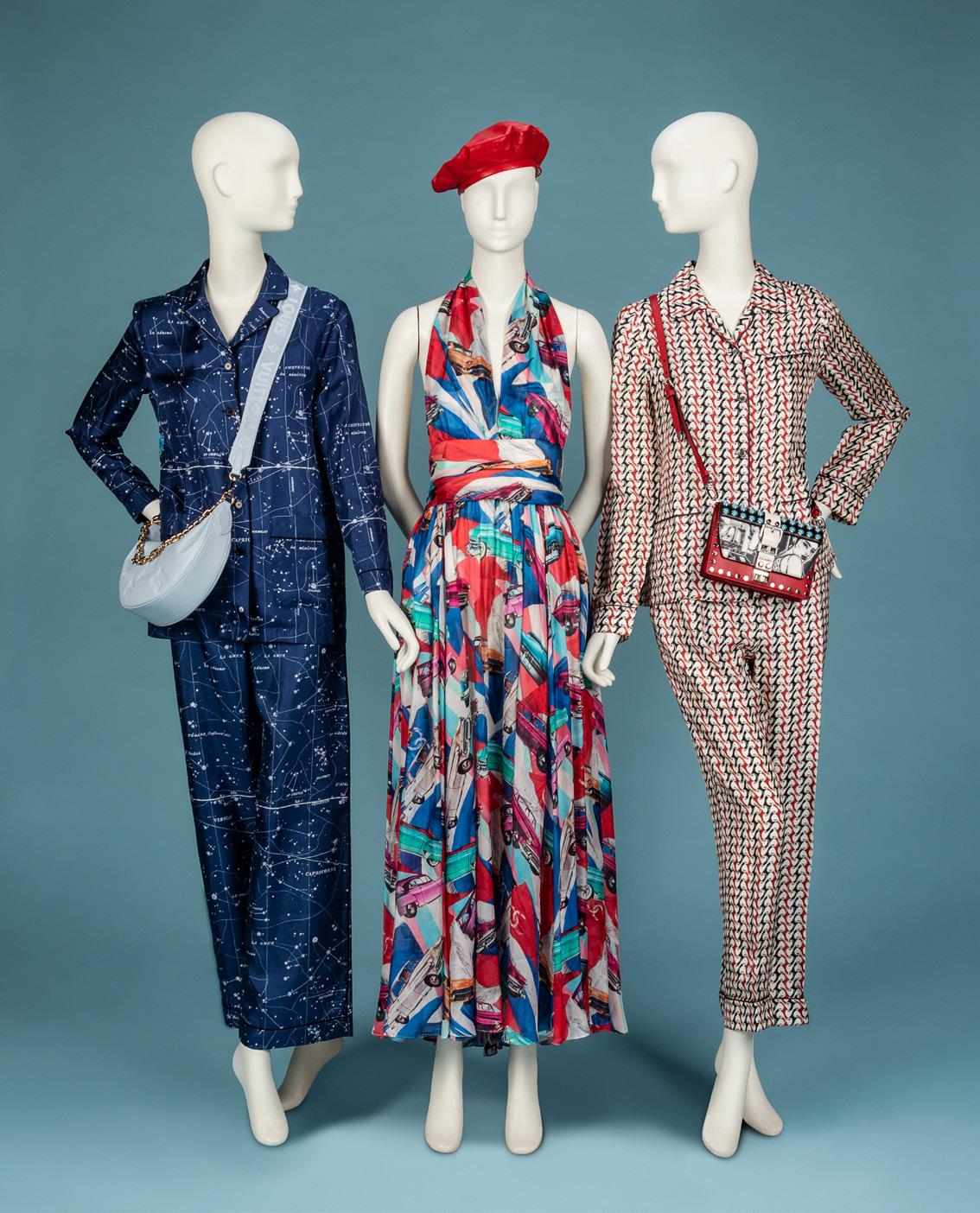
Couture from the Towbin Collection including a Chanel Car-Print Halter Dress (center) that sold for $1,170
legacy through a modern lens, blending streetwear with luxury craftsmanship. Alessandro Michele’s years at Gucci also brought a distinctive, layered aesthetic rooted in romanticism and historical reference. His designs celebrated individuality and maximalism, drawing inspiration from Renaissance art, vintage jewelry, and 1970s bohemian style. Gucci handbags became canvases for bold colors, intricate embellishment, and revived archival motifs like the interlocking G and horsebit hardware.
KV: Fascinating—collectors today really see those eras as defining moments in modern luxury.
TB: Absolutely. These pieces reflect both personal style and an awareness of pivotal contemporary design movements.
KV: And what did the market reveal through the sale?
Article continues on the next page
TB: The Towbin Collection shows how buyers respond to a clear collector’s vision. When material reflects careful stewardship and thoughtful selection, it resonates strongly. Vintage and archival fashion has grown in demand, with collectors seeking pieces notable not just for craftsmanship but also for their place in fashion history. Garments documented through runway shows, editorial coverage, or archival references often draw particular interest.
KV: I imagine estimating couture with few comparables must be tricky.
TB: It is. Specialists weigh designer significance, condition, and provenance. Exhibition history or publication references can elevate a piece further, especially if it marks a turning point in a designer’s career.
KV: And online bidding has really changed the game, hasn’t it?
TB: Definitely. Digital platforms now allow collectors worldwide to compete in real time, creating dynamic bidding environments. At the same time, established collectors
remain highly active, particularly when rare pieces from influential collections appear.
KV: The Towbin Collection also raises a bigger question for collectors—how important is estate planning for couture collections?
TB: It’s critical, yet often overlooked. Many collectors spend decades assembling extraordinary wardrobes without considering how the pieces will be preserved, managed, or brought to market.
KV: Which makes early planning so key, right?
TB: Exactly. Starting conversations during a collector’s lifetime allows for understanding market trends, maintaining documentation, and making informed decisions about preservation and storage. Proper planning ensures a collection’s significance—and its story—can be preserved and thoughtfully presented when the time comes.
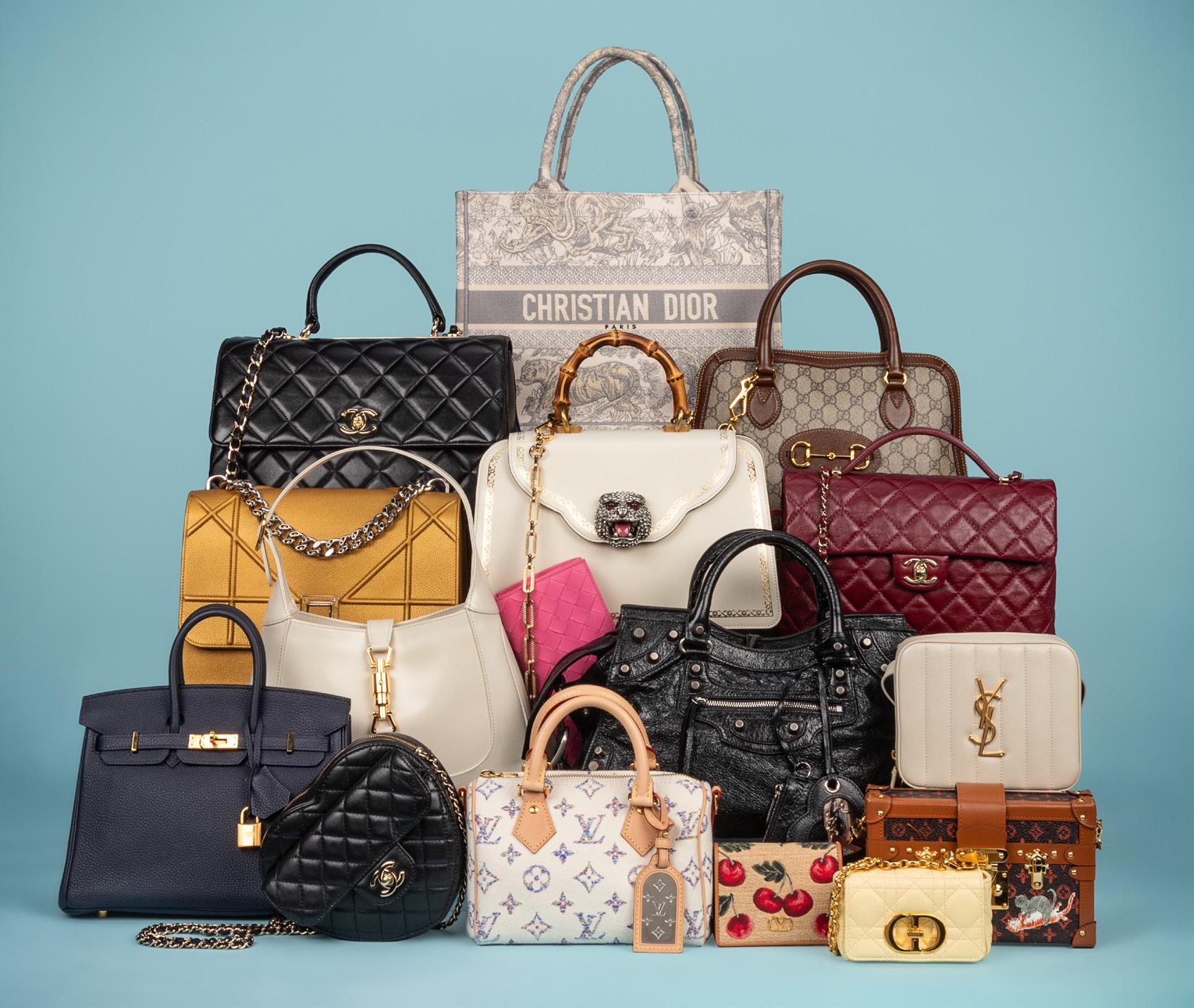
Handbags from the Towbin Collection including a Hermès, Birkin 25 in Togo Bleu Nuit that sold for $16,900
A BOLD DEBUT: FREEMAN’S WOMEN’S WORK AUCTION SHINES
BY ADRIANNE WOLKENBERG, ASSOCIATE SPECIALIST, FINE ART
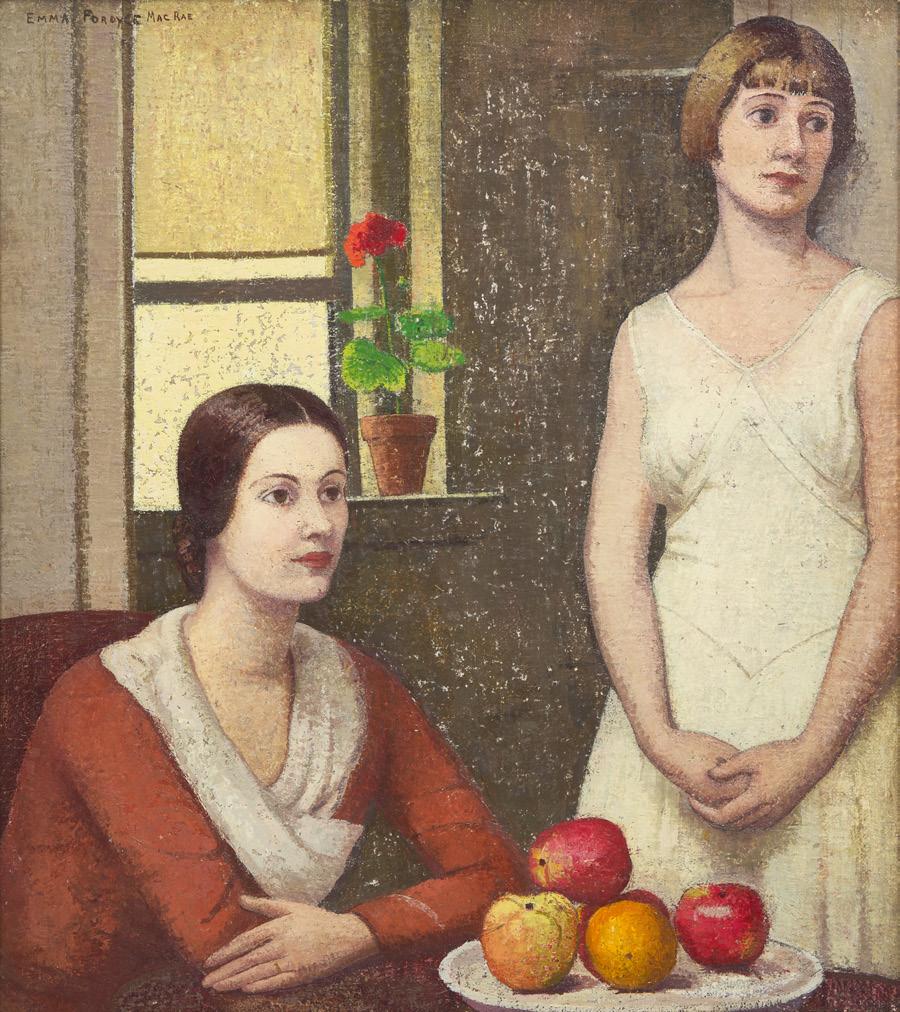
Freeman’s inaugural auction dedicated to women artists, Women’s Work, on March 25 celebrated Women’s History Month while highlighting the strong market for creative production by women. Featuring fine art, design, books, couture, and jewelry, the sale brought together Freeman’s Specialist departments in a new way, creatively juxtaposing works across different time periods, nationalities, and mediums and appealing to collectors across the board. Freeman’s has championed works by Sonia Delaunay, Emma Fordyce MacRae, and Fern Coppedge throughout its history, and works by these artists again proved to attract competitive bidding, achieving results well above their pre-sale estimates. For instance, the MacRae painting The Decision (The Red Geranium) achieved a result of $51,200 against its estimates of $8,000-12,000.
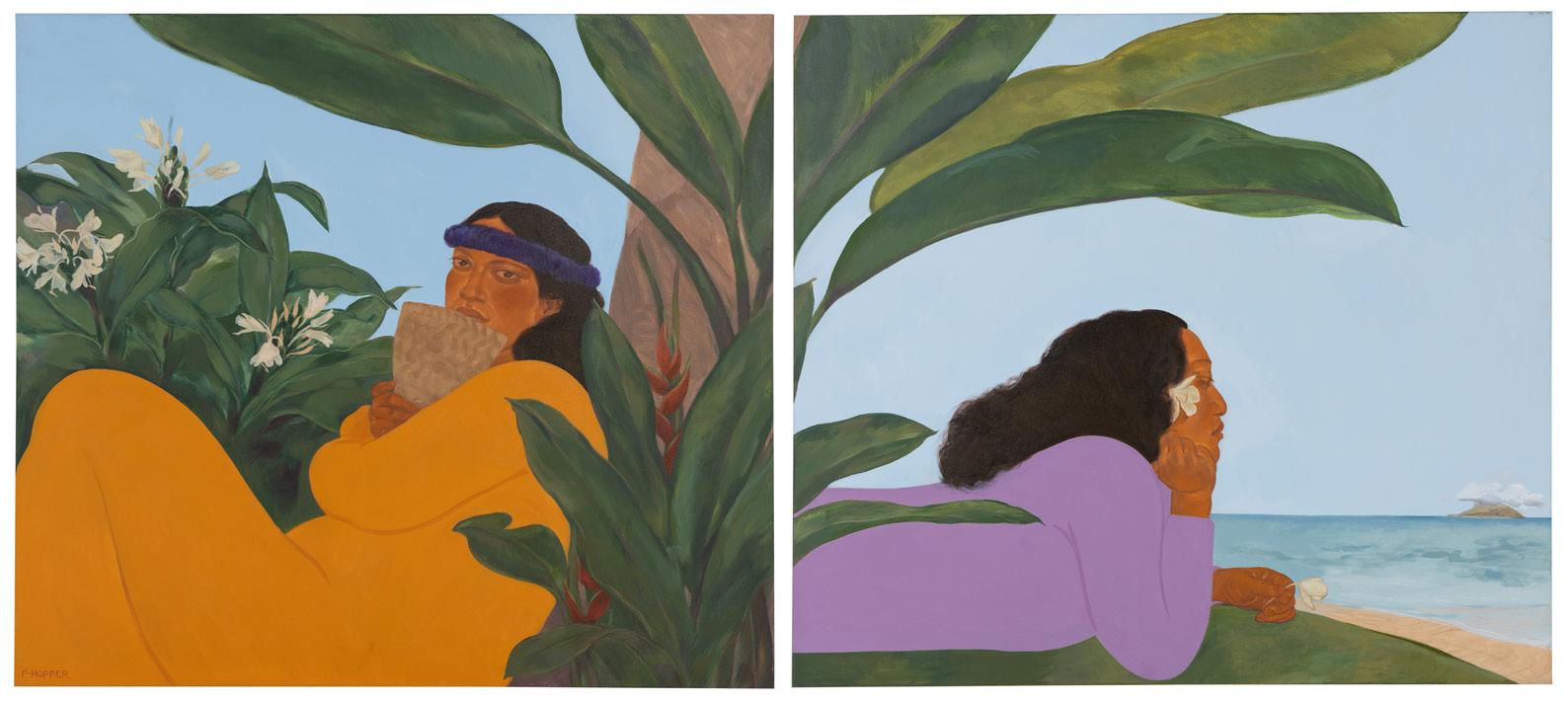
In addition to highlighting works by familiar favorites, the auction brought new artists to light that had their first offerings at Freeman’s. Paintings by Australian Aboriginal artist Emily Kame Kngwarreye and Hawaiian artist Pegge
Hopper led the way, with the Hopper attaining a new auction record for the artist. As we continue to celebrate the myriad contributions of women in the arts, we look forward to the opportunity to offer Women’s Work again next year!
Pegge Hopper (American, b. 1936) Walk Across the Sea (diptych)
Sold for $54,400 World Auction Record for the Artist
Emma Fordyce MacRae (American, 1887-1974)
The Decision (The Red Geranium) Sold for $51,200
OBJECTS OF POWER: A PRESIDENTIAL SALE TELLS AMERICA’S STORY
BY COURTNEY CHAPEL, ASSOCIATE VICE PRESIDENT, COMMUNICATIONS
How do you capture the story of a nation? At Freeman’s, Fathers and Saviors of Our Country: A Presidential Sale answered that question through objects that bring history into sharp, tangible focus. Spanning the era of the Founding Fathers through the Civil War and beyond, the sale assembled a compelling cross-section of material that traces the evolution of American leadership at pivotal moments in the nation’s history.
Rather than treating these figures as distant icons, the auction revealed them through the objects they left behind— campaign ephemera, portraiture, personal effects, and printed works that speak to both public ambition and private legacy. Together, these works offered a more immediate and human view of the presidency, one shaped as much by uncertainty as by triumph.
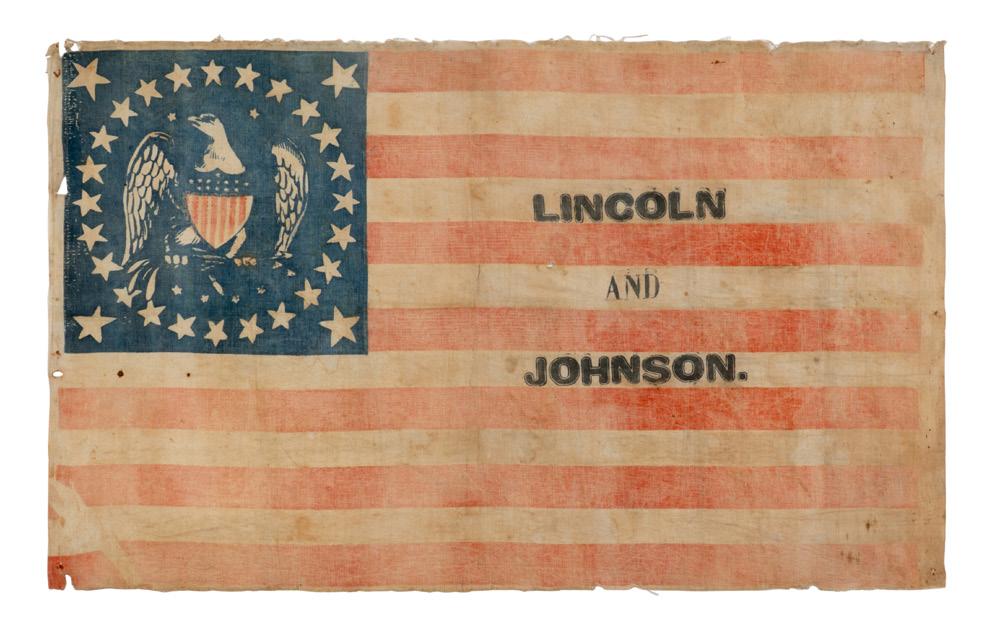
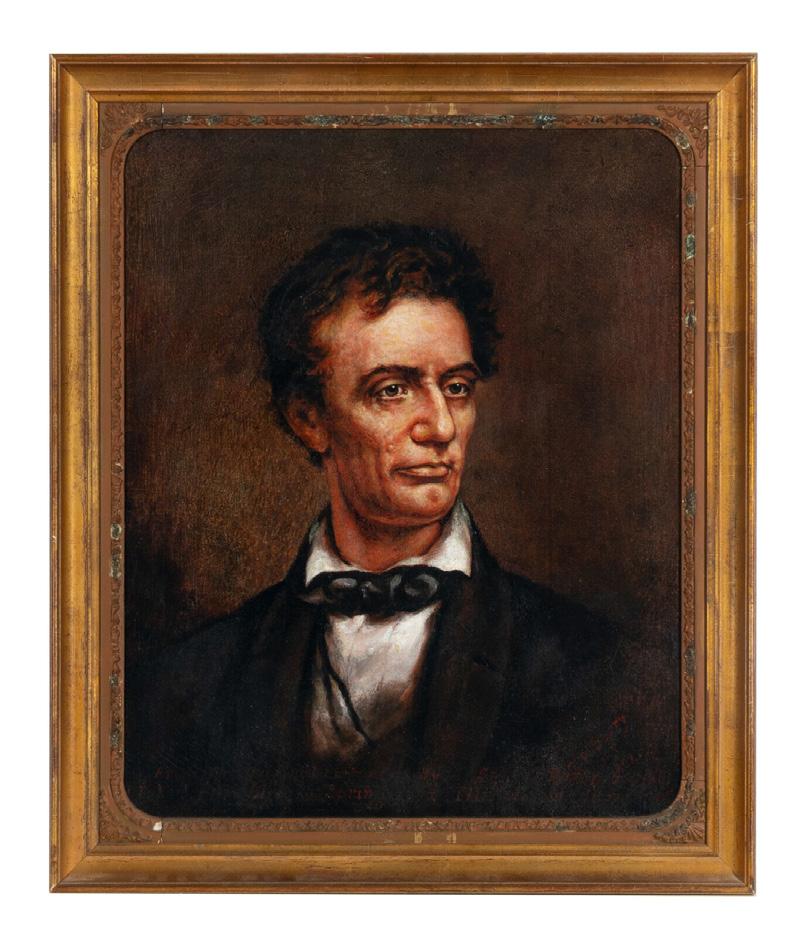
That sense of connection translated decisively in the saleroom. Held on March 26, 2026, the auction realized $1,582,080, achieving 175% of its pre-sale estimate with 97% of lots finding a buyer. Leading the sale was an exceedingly rare 34-star Lincoln-Johnson campaign parade flag, which achieved $281,600 and set a new auction record for an American campaign flag. With its striking graphic design and direct connection to one of the nation’s most pivotal elections, the flag exemplified the power of objects that collapse history into a single, compelling image. Elsewhere, Charles Alfred Barry’s Abraham Lincoln: The Greek God realized $102,400, while a rare tintype of Lincoln brought $76,800—results that speak to the enduring pull of figures who shaped the nation at its most critical junctures.
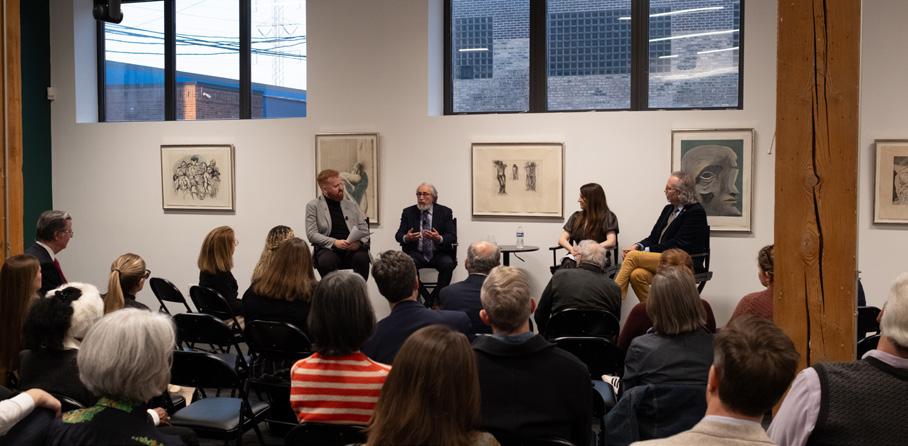
Preceding the sale, a series of panel discussions in New York and Chicago brought scholars and specialists into conversation, framing the material within a broader cultural and historical context. These discussions reinforced what the results would ultimately confirm: as the United States
approaches its 250th anniversary, interest in presidential material continues to deepen. Collectors are increasingly drawn to objects that offer a direct link to the people and moments that shaped the nation, reflecting a market that is both thoughtful and steadily expanding.
[LINCOLN-JOHNSON CAMPAIGN]. An exceedingly rare 34-star eagle parade flag, ca 1863-1864. Sold for $281,600
Charles Alfred Barry (American, 1830-1892) Abraham Lincoln: The Greek God, 1892 Sold for $102,400
FRESH FACES
Freeman’s is pleased to welcome David Walker as Managing Director of its Palm Beach office. With more than 15 years of experience as a specialist, auctioneer, and appraiser, David brings deep expertise in fine and decorative arts. Formerly a senior specialist at Sotheby’s New York and founder of Walker Decorative Arts, he is also a longtime appraiser on Antiques Roadshow. His appointment strengthens Freeman’s presence in the growing South Florida market.
Daisy Edelson joins the firm with more than three decades of experience across the international auction world. She began her career at Sotheby’s in 1989, ultimately serving in senior leadership roles across fine art categories in North America. Over the course of her tenure, she worked on landmark sales including the collections of Jacqueline Kennedy Onassis and the Duke and Duchess of Windsor, as well as record-setting works by Picasso, Monet, and Munch.
CELEBRATING AMERICA AT 250
A Yearlong Series of Auctions, Previews, and Events Honoring the Nation’s Artistic and Cultural Legacy
Now well underway, the United States’ 250th anniversary has sparked celebrations across the country—and Freeman’s marks the occasion with a dynamic series of auctions, previews, and public programs. Drawing on more than two centuries of expertise, the house is presenting works that bring the richness and complexity of the American story into focus.
Freeman’s welcomes Matthew Stavro as Senior Specialist for Prints & Multiples based in New York. With nearly 15 years of experience, Matthew brings deep knowledge of modern and contemporary prints, most recently serving in the Prints and Multiples department at Bonhams. His expertise has contributed to record-setting results for artists including Roy Lichtenstein, Keith Haring, and Pablo Picasso. In his new role, he will focus on expanding the category and strengthening client relationships.
Freeman’s appoints Alexis Vourvoulis as Vice President, Senior Specialist for Jewelry & Watches. With over 20 years of experience, she joins from Tiffany & Co.’s Landmark Flagship, where she led high jewelry client development. Her career also includes senior roles at Phillips and Bonhams. Alexis brings a strong combination of scholarly expertise and market insight to support the firm’s continued growth in jewelry in the New York market.
Highlights to date include participation in Americana Week in New York, where Freeman’s hosted a panel featuring Dr. Philip C. Mead, Daniel R. Weinberg, and specialists Darren Winston and Christopher Brink. In Chicago, a second panel preceded The Fathers and Saviors of Our Country: A Presidents Sale
Looking ahead, Freeman’s will present How History Unfolds on Paper: Important Americana from the Eric C. Caren Collection, Part X on June 30 in Philadelphia, alongside related programming. Additional sales throughout the year will continue to highlight American craftsmanship and cultural achievement.
View of the America’s 250th-themed panel discussion in Freeman’s Chicago gallery
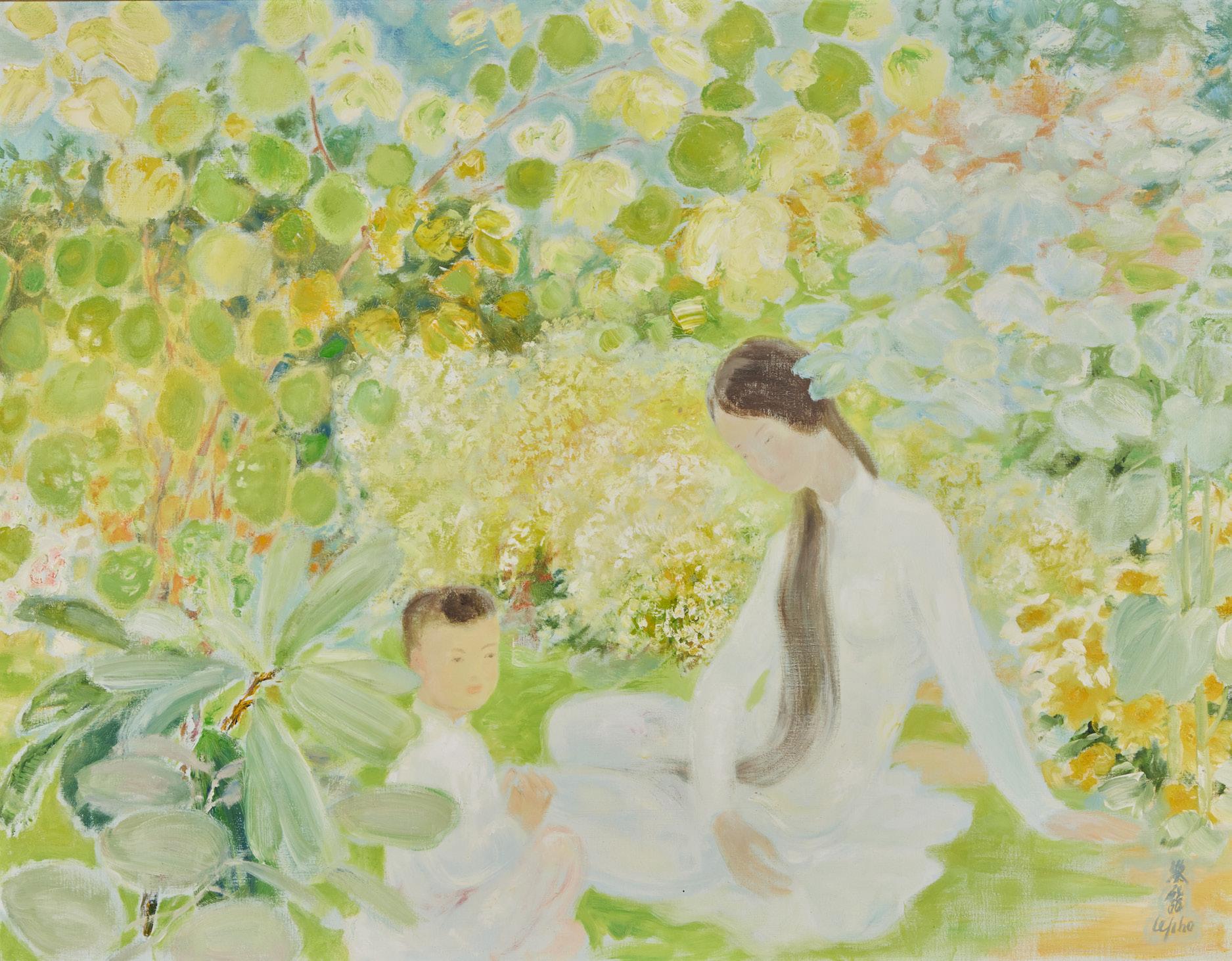
Lê Phổ (French/Vietnamese, 1907-2001)
La Clarté d’Été, c. 1975
Sold for $432,300
A NEW CHAPTER FOR VIETNAMESE MODERNISM
In response to growing international demand—and building on its established leadership in the market—Freeman’s will introduce a dedicated sale of Vietnamese Modernists in 2026. The debut auction will spotlight two of the category’s most sought-after figures, Lê Phổ and Vũ Cao Đàm, whose works have seen remarkable momentum among collectors in recent seasons.
Both artists, trained at the École des Beaux-Arts de l’Indochine and later shaped by French modernism, developed singular visual languages that bridge Eastern and Western traditions. Their works—lyrical, refined, and deeply evocative—continue to resonate with a global audience.
With this focused sale, Freeman’s not only reinforces its commitment to the category, but also signals the continued rise of Vietnamese modernism on the international stage, offering collectors a compelling opportunity to engage with two of its most influential voices.
LOOKING FORWARD
A FOCUS ON THE SIGNIFICANT AND NOTEWORTHY PROPERTY COMING UP FOR AUCTION THIS SEASON
ANTIQUITIES OF THE GARDEN: A COLLECTOR’S LIVING ANCIENT WORLD
BIZARRE BRILLIANCE: THE BOLD AND COLORFUL WORLD OF CLARICE CLIFF
THE COLLECTION OF A LIFETIME: THE LIBRARY OF STEPHEN J. FARBER
DRESS FOR SUCCESS: THE ART OF GRIGORY GLUCKMANN
HOW HISTORY UNFOLDS ON PAPER: THE ERIC C. CAREN COLLECTION, PART X
A MAJOR WORK BY JOSEF ŠÍMA RESURFACES IN PHILADELPHIA
TITANIC TREASURES: FROM THE RMS TITANIC TO THE AUCTION BLOCK—THE PERSONAL ARTIFACTS OF JOHN JACOB ASTOR IV
STAGE PRESENCE: BONNIE GLASS IMMORTALIZED IN PASTEL
GAVEL AND GRACE: THE ESTATE OF HONORABLE SANDRA SCHULTZ NEWMAN
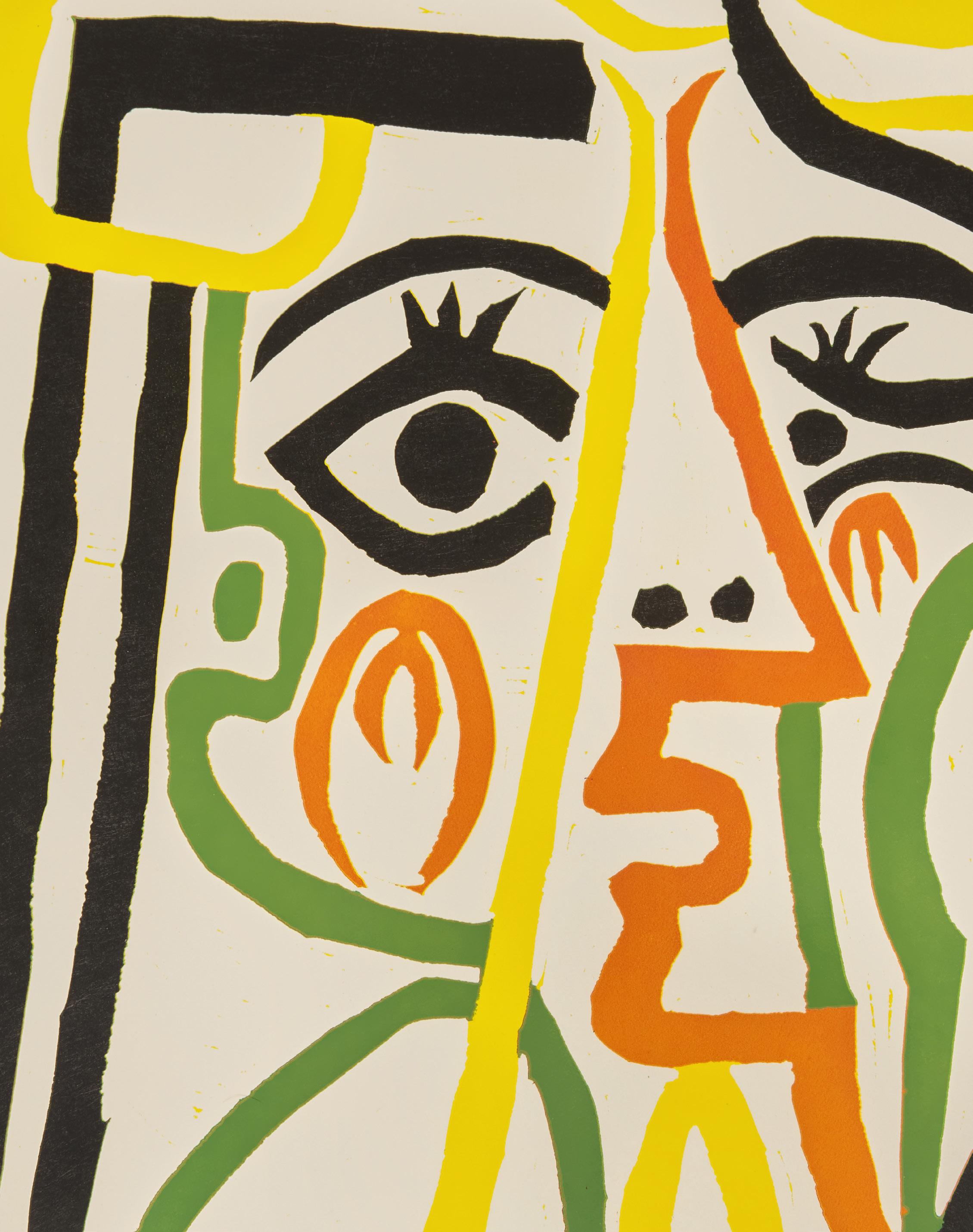
TO BE OFFERED APRIL 24, NEW YORK Pablo Picasso (Spanish, 1881–1973)
Portrait de Jacqueline au chapeau de paille , 1962
Estimate: $150,000 – 250,000
Antiquities of the Garden
A Collector’s Living Ancient World
BY JACOB COLEY, VICE PRESIDENT, HEAD OF DEPARTMENT, ANTIQUITIES & ANCIENT ART
Agreat collection is never only about ownership; it is about recognition. The more than 120 works in this single-owner collection span centuries and civilizations, from Roman marble sculpture and Greek arms and armor to Egyptian amulets, South Arabian works, Near Eastern votives, and precious objects in silver and gold. What unites them is not geography but feeling: each object seems to have been chosen for its ability to carry memory, presence, and character across time. As the anonymous collector himself put it, “I collected these antiquities because they
spoke to me. I felt that they were here with me, teaching me. I also chose some that were like me, as in ‘alike.’ This happens often with the flowers I plant in my garden too: Pelargonium hortorum. They too are, like my antiquities, alive.”
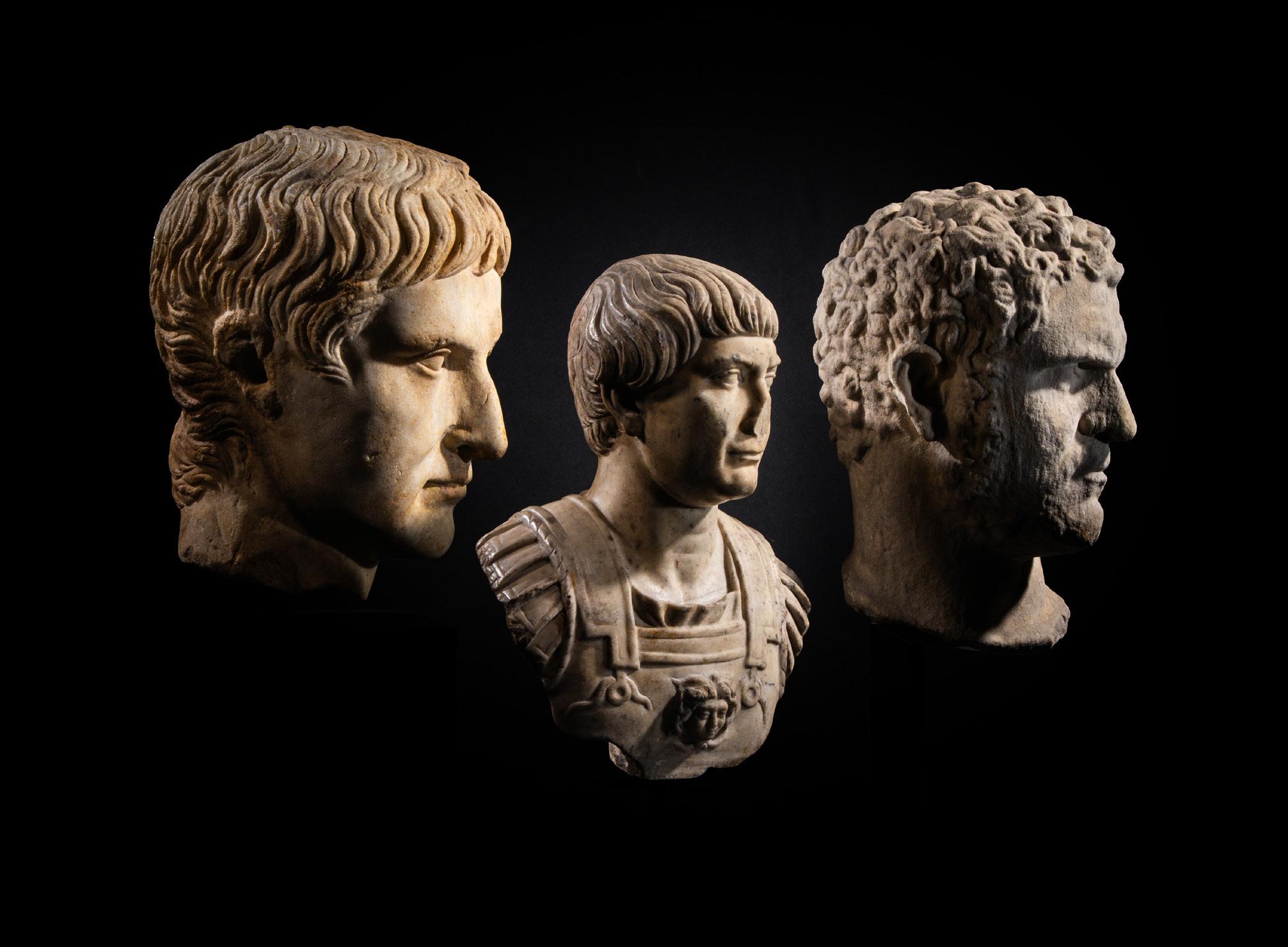
That sense of presence is perhaps strongest in the collection’s remarkable marble portrait heads, including likenesses of Augustus, Trajan, and Caracalla. In them, Roman history becomes startlingly human. Augustus still suggests the calm authority of the age that laid the foundations for the
OPPOSITE, TO BE OFFERED MAY 20, CHICAGO
Marble portrait heads, including likenesses of Augustus (Circa 1st Century A.D., Estimate: $40,000 – 60,000), Trajan (Circa 98-117 A.D.
Estimate: $40,000 – 60,000), and Caracalla (Circa 2nd-3rd Century A.D., Estimate: $30,000 – 50,000)
Pax Romana; Trajan, remembered among the Five Good Emperors, embodies imperial ambition joined to public duty; Caracalla, by contrast, carries the harder edge of rule, remembered both for brutality in the ancient sources and for the edict of 212 A.D. that extended Roman citizenship across the empire. Together, these faces do more than represent emperors. They present power as personality, and history as something that can still look back at us.
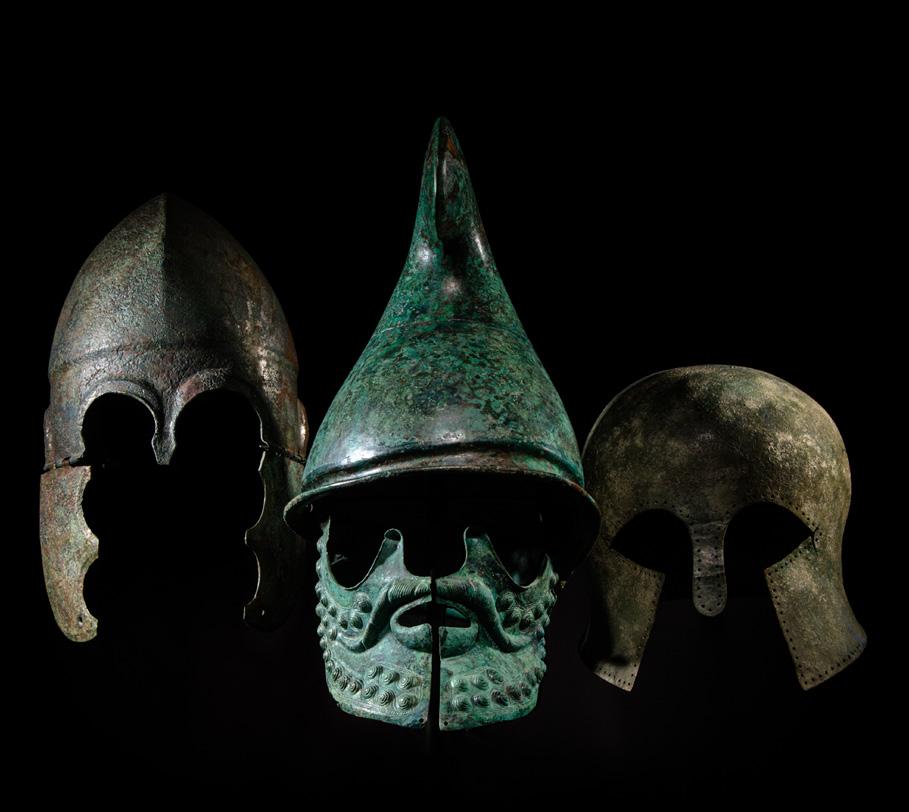
Elsewhere, the collection turns from the face to the body in armor: a Greek Bronze Phrygian Helmet, a Greek TinnedBronze Chalcidian Helmet, and a Greek Bronze Corinthian Helmet. Each is an object of defense, but also of identity. In the ancient Mediterranean, armor was never merely practical; it stood at the meeting point of danger, honor, and selfpresentation. These helmets remind us that the ancients did not separate the question of how to live from the question of what was worth defending. They are metaphors, even now, for the “good death” as the Greeks understood it: not death sought for its own sake, but a life made meaningful through courage, duty, and purpose.
TO BE OFFERED MAY 20, CHICAGO
A Greek Tinned-Bronze Chalcidian Helmet (BC 500-301, Estimate: $15,000 – 25,000), Greek Bronze Phrygian Helmet (Circa 350-300 B.C., Estimate: $80,000 – 120,000), and a Greek Bronze Corinthian Helmet (Circa 6th Century B.C., Estimate: $60,000 – 80,000)
TO BE OFFERED MAY 20, CHICAGO
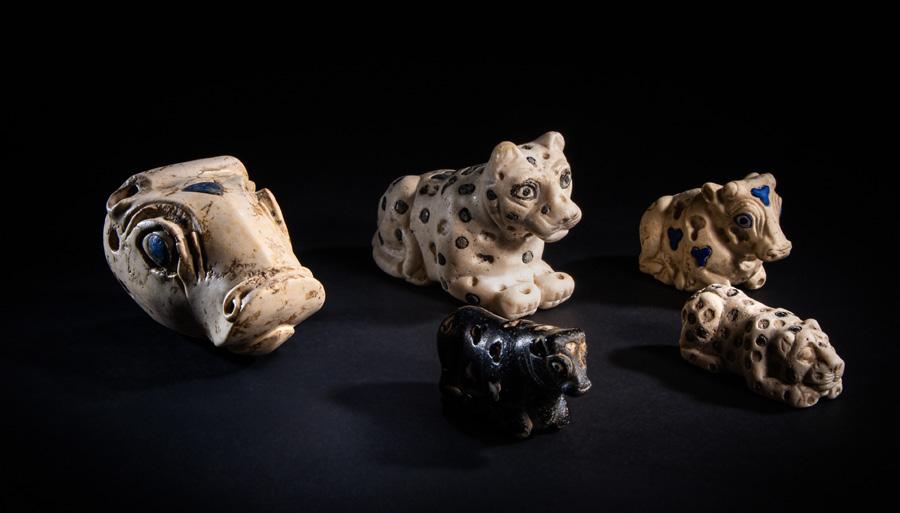
Mesopotamian statuettes of recumbent cows and felines including a Limestone and Lapis Lazuli Inlay Recumbent Calf (far right), Late UrukJemdat Nasr Period, Circa 3300-2900 B.C., Estimate: $5,000 – 7,000
The collection’s earliest voices may be its quietest: Near Eastern marble and lapis lazuli inlay statuettes of recumbent cows and felines from the 3rd millennium B.C. In their compact forms is a world being organized for the first time. Mesopotamia, long called one of the cradles of civilization, was shaped by farming, irrigation, and the domestication of animals; art from the region often reflects that close dependence on the natural world. These small creatures are therefore more than ornaments. They speak to the oldest bond between humanity and animal life, and to the twin foundations of settled civilization: animal husbandry and cultivation. For a collector deeply attuned to gardens and growth, it is easy to see how such works could feel vividly, almost tenderly, alive.
Seen together, the collection forms less a survey than a tapestry. Faces, helmets, animals, tools of devotion, and objects of luxury all speak in different registers, yet each reflects the same enduring human concerns: power, mortality, beauty, protection, memory, and life lived in relation to the world around us. That breadth is what makes this collection so compelling. It does not present antiquity as distant or inert, but as a living garden of encounter, where many cultures, many objects, and many histories are woven into one collector’s sustained passion for the ancient world.
This remarkable single-owner collection will be offered in Freeman’s Antiquities of the Garden: A Collector's Living Ancient World auction on Wednesday, May 20, 2026, at 9:00 am CT.
INQUIRIES: jacobcoley@freemansauction.com
Bizarre Brilliance: The Bold and Colorful World of Clarice Cliff
BY TYLER WILSON, CATALOGUER, DESIGN
TO BE OFFERED MAY 21, CHICAGO
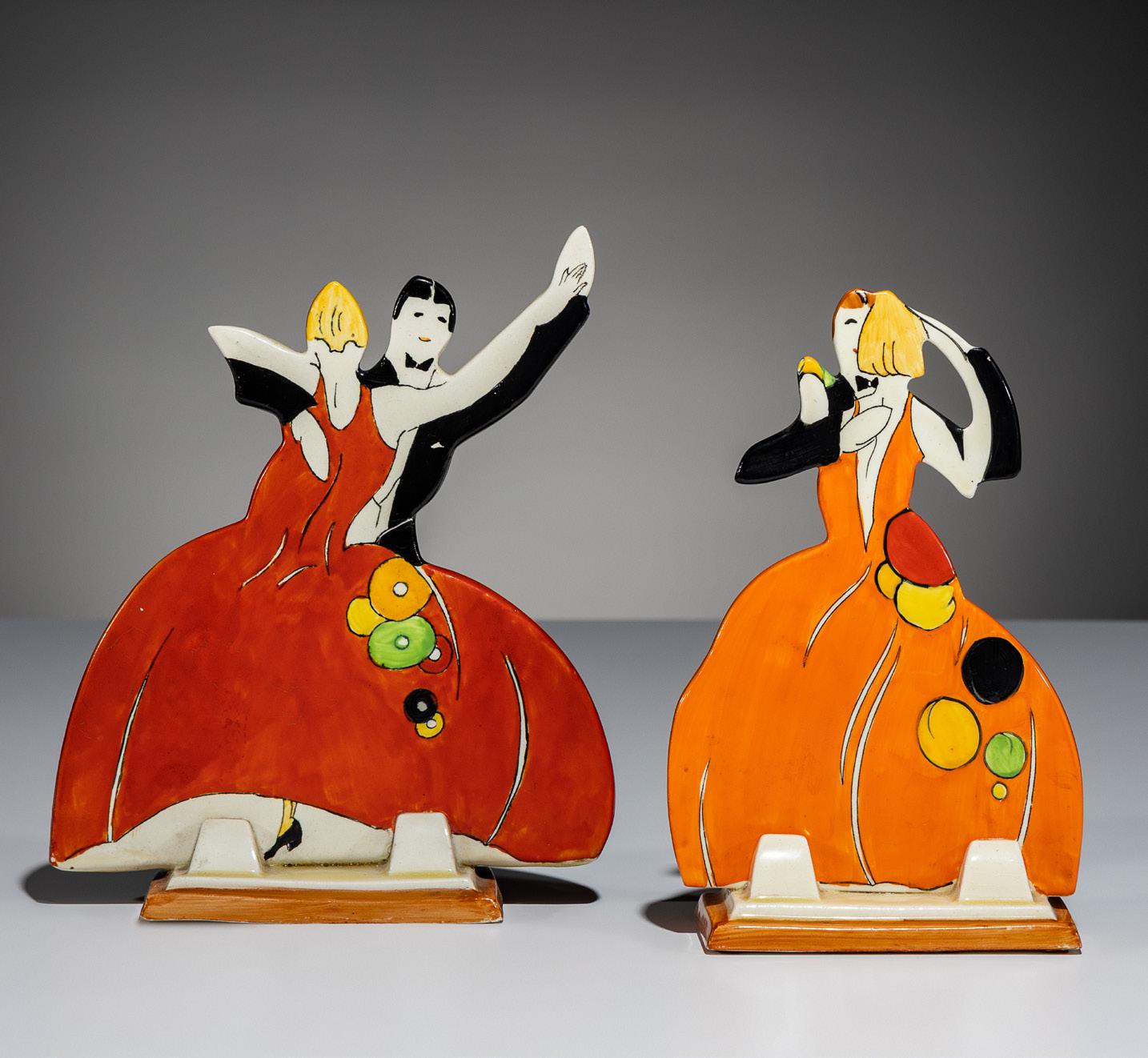
Clarice Cliff (English, 1899-1972)
Age of Jazz, Dancing Couple
Estimate: $3,000 – 5,000
Property from the Collection of Richard B. Kutner
Age of Jazz 3
Estimate: $3,000 – 5,000
Property from the Collection of Richard B. Kutner
The mention of Clarice Cliff evokes a kaleidoscope of imagery. One of the purest voices of the Art Deco movement, her painted pottery served as a respite of cheer and color in the homes of her collectors. Her revolutionary project was initially titled Bizarre, an aptly celebratory name for the unusual and expressive works. Breaking traditions and boundaries for women and designers, her name became her brand. In an era where factory sponsored designers were often uncredited, Cliff had her signature stamped on the bottom of each ceramic piece.
She worked her way into production pottery where she daringly painted a bad batch of earthenware forms destined for the trash. Covering imperfections with color, her first designs focused on simple triangles. These motifs of the early works were inspired by Egyptian patterns popular at the dawn of the Art Deco movement. They were a success, and production took off under her supervision.
An artist herself, Cliff possessed many talents. She invented new ceramic forms, taught hand painting, and illustrated
watercolor templates for new patterns. Ultimately, Cliff oversaw a team of sixty hand-paintresses, some as young as 14, who executed her joyous motifs onto hundreds of different ceramic shapes. The use of youth was intentional in showcasing an honest, charming naivete. Exaggerated brush strokes were encouraged to make it obvious that a piece was hand-painted, a selling point. Cliff’s personally crafted ceramic shapes were modern, bold, and often designed around the ‘feel’ of a form, and she made shapes with intentional broad planes to serve as canvases for her expressions.
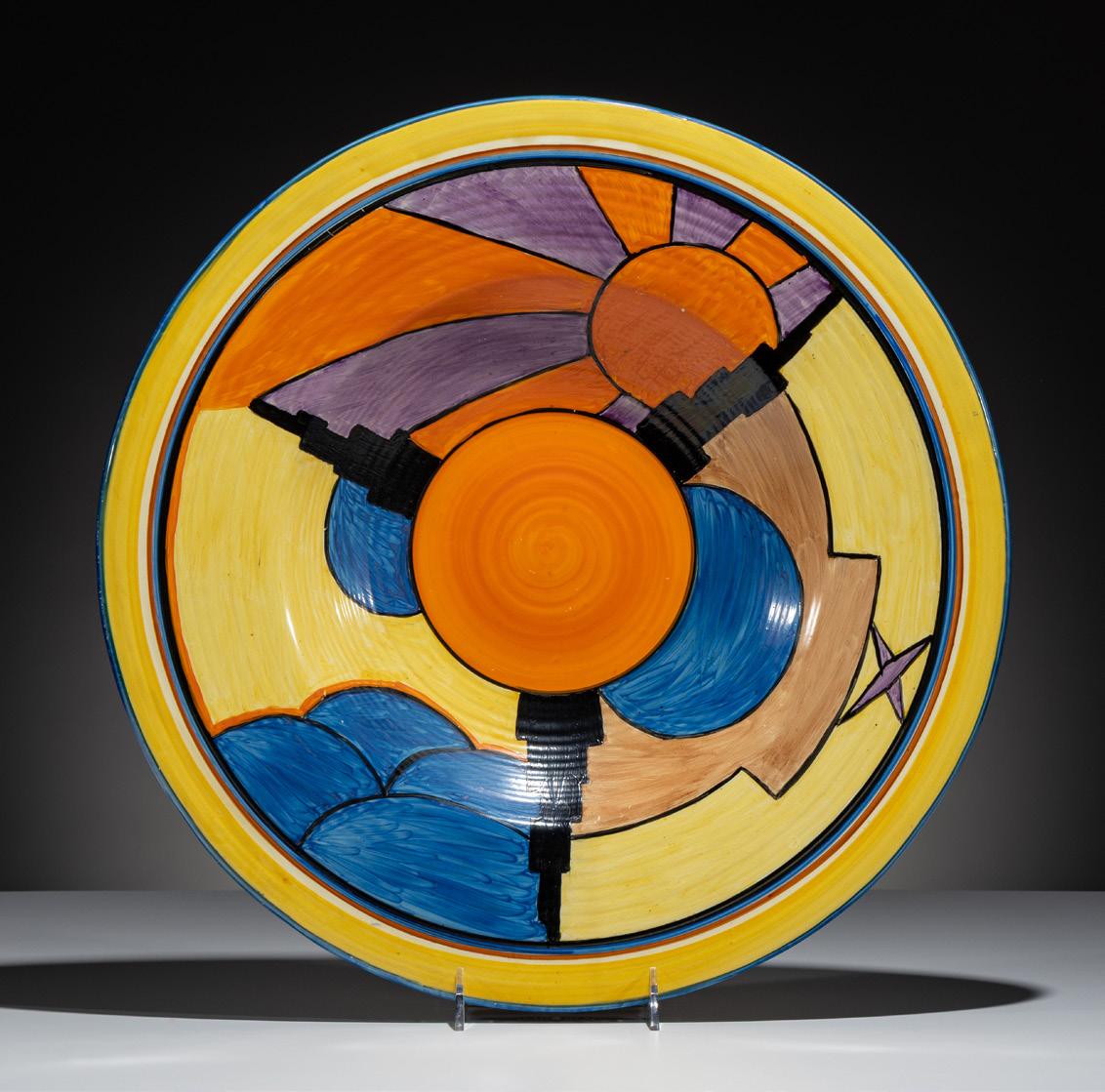
An opportunity to travel to Paris introduced her to the French influences of cubism and impressionism. She found inspiration in Edouard Benedictus and Serge Gladky whose works justified her brave inclinations of color and designs. The striking ‘Sunray’ pattern highlights Cliff’s Art Deco aesthetic. Stunning purple and orange sun rays are punctuated with black silhouettes of skyscraper forms under stars in a yellow sky.
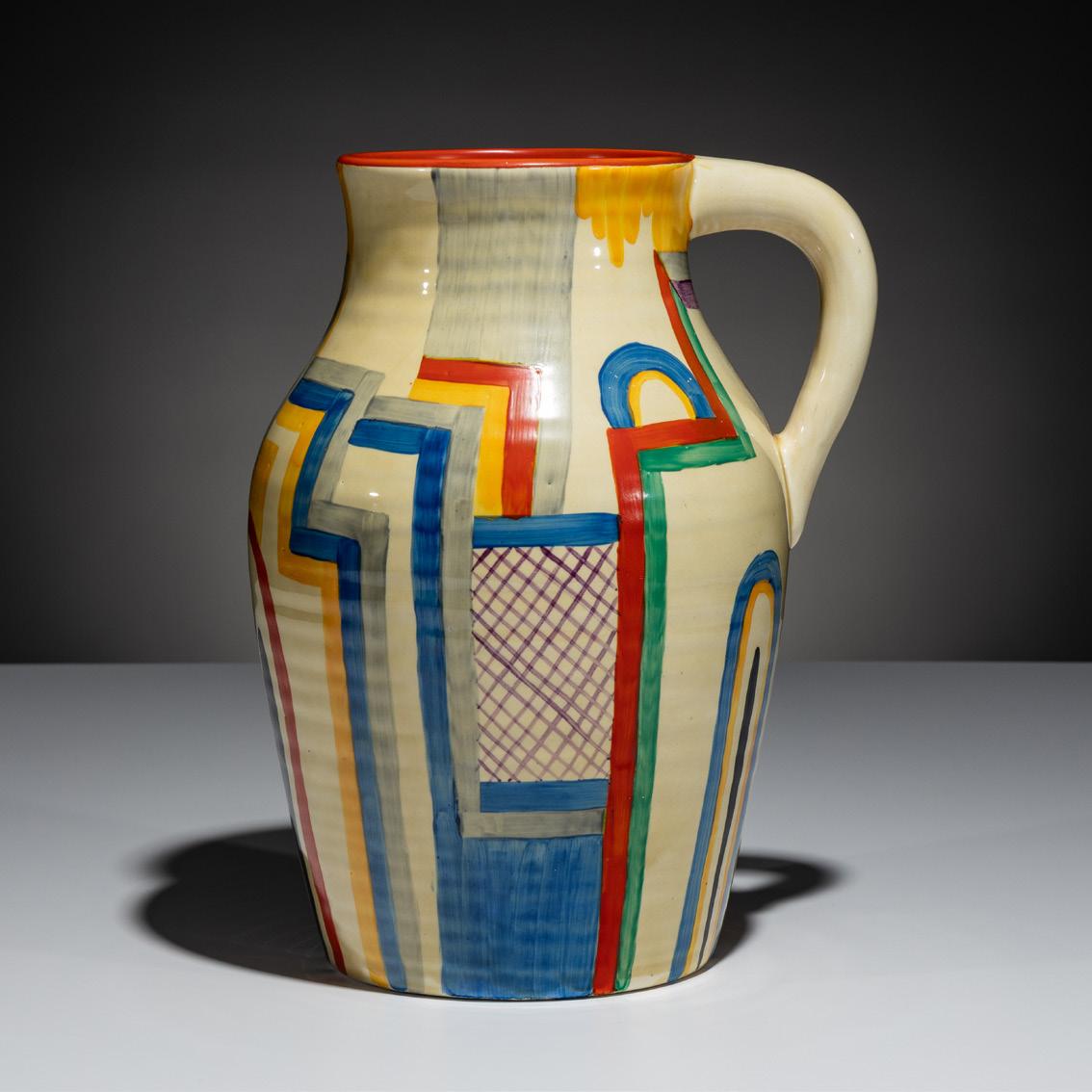
Another prominent form is the Lotus Jug, a panoramic vessel for images such as the buoyant ‘Tennis’ pattern. Visually akin to the popular ‘Football’ pattern, it is surprisingly complex. Abandoning black outlines, this broad-lined motif flaunts abstracted cubist motifs of fields, arches, and nets all sported artfully in a paneled grid.
Along with dynamic deco ceramic shapes, figural works emerged including the ‘Jazz Age’ statuettes. Waltzing into view in the summer of 1930, these ceramic caricatures were intended as centerpieces for dinner parties while listening to the radio. Crafted not to snap and printed for a seamless front-to-back transition, the two-dimensional silhouettes were admittedly a publicity push. They are now a highly collectible encapsulation of the brash, cartoonish energy of the 1920’s.
Even today, it is hard to look away from a Clarice Cliff piece as her works remain unapologetically bold. Her pioneering use of color and form was hyper-modern to buyers. As her career gained momentum in 1930 Cliff proclaimed what could serve as her mantra:
“Women today want continual change, they will have colour and plenty of it!”
INQUIRIES: tylerwilson@freemansauction.com
TO BE OFFERED MAY 21, CHICAGO
Clarice Cliff (English, 1899-1972)
Tennis Jug
Estimate: $2,000 – 4,000
Property from the Collection of Richard B. Kutner
Sunray pattern platter
Estimate: $400 – 600
Property from the Collection of Richard B. Kutner
“ As a kid I was a voracious reader. I was accumulating books through my twenties, and by my thirties I could afford the ones I really wanted.
STEPHEN FARBER
THE COLLECTION OF A LIFETIME: THE LIBRARY OF STEPHEN J. FARBER
BY CHRISTOPHER BRINK, SENIOR SPECIALIST, HEAD OF SALE, BOOKS & MANUSCRIPTS, CHICAGO
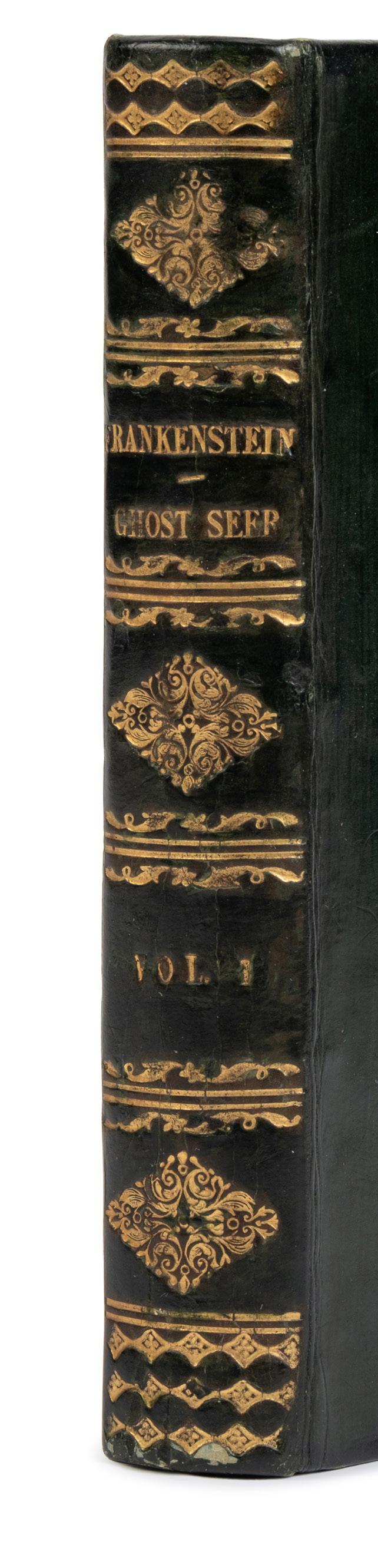
TO BE OFFERED MAY 14, CHICAGO Shelley, Mary Wollstonecraft (1797-1851). Frankenstein: or, The Modern Prometheus. [Bound with:] Schiller, Friedrich (1759-1805). The Ghost-Seer! London: Henry Colburn and Richard Bentley, 1831. Estimate: $4,000 – 6,000
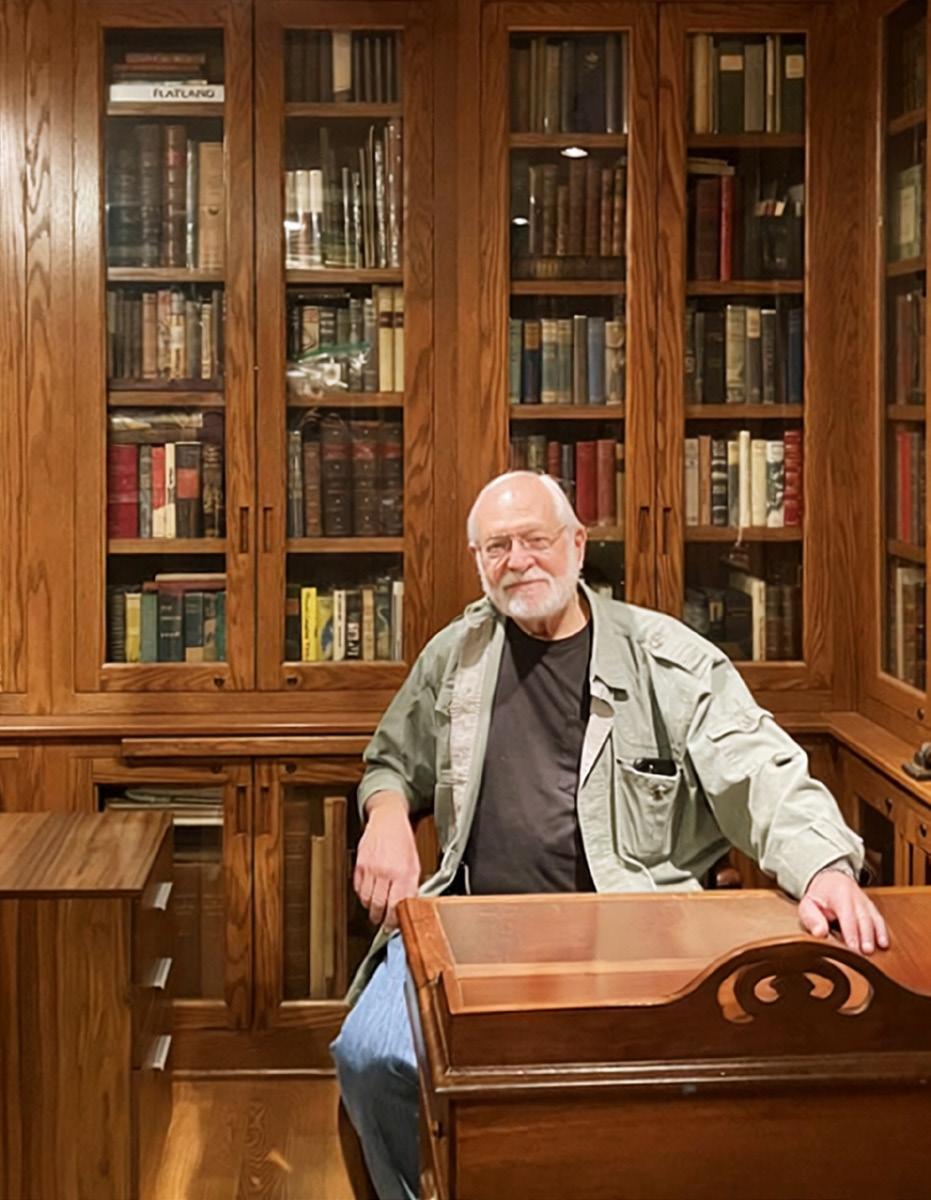
Steve Farber was born in New York City and raised in Miami Beach, Florida. His medical career included stops in New York, St. Louis, Ann Arbor, Charlottesville, and Toledo, along the way reading and accumulating books. When asked what sparks his enthusiasm the word that comes up every time is “whimsy.” Beginning with the classics, mysteries, and science fiction books he devoured in his youth, he has spent seven decades gathering the finest copies of some of the most important works of literature, science fiction, women’s rights, and other subjects ever printed. Yet it was his first love, Alice in Wonderland, to which he kept returning again and again. Accompanied by his wife, Nancy, Steve has logged thousands of miles driving back and forth across the United States visiting book fairs, rare book dealers, antique stores, and auction houses accumulating a collection to which even the word “extraordinary” does not seem to do enough justice.
The passion and love that built this collection is clear the moment Steve starts to talk about it, for this was not a collection built with an eye towards financial gain so much as filling his life with the books and materials that bring him joy, whether they’re important first editions, dust jackets, board games, globes, or playing cards. Among the highlights are a near-pristine first edition of George Orwell’s Nineteen Eighty-Four with the scarce original wraparound band, a first edition of H.G. Wells’s When the Sleeper Wakes, inscribed by its author to Oscar Wilde’s son Vyvyan Holland with an additional sketch of the sleeper in bed, numerous original printings of works by Edgar Allan Poe (including a first printing of The Raven in the exceptionally scarce original wrappers), a first edition set of J.R.R. Tolkien’s The Lord of the Rings, and the foundational feminist text A Vindication of the Rights of Women by Mary Wollstonecraft. Included also is the 1831 first singlevolume edition of Frankenstein which features the first illustration ever printed of the creature. Between these titans of literature, you’ll find other works by such eminences as Charles Darwin, Alfred Russel Wallace, and John Stuart Mill. All are in exceptional condition, and a quick glance at Steve’s library will tell you why: they have spent their time in his care safely locked away in solid wood built-in bookshelves with glass doors that radiate warmth and grandeur, the perfect environment for some of the greatest books ever printed.
When asked why he has decided to consign this collection to auction, Steve’s response is simple: “I would want to see these books go to people who will love them.” And so, it is with great honor and an echo of the collector’s hopes that we present to you the library of Stephen J. Farber.
INQUIRIES: christopherbrink@freemansauction.com
TO BE OFFERED MAY 14, CHICAGO Orwell, George (1903-1950). Nineteen Eighty-Four London: Secker & Warburg, 1949.
Estimate: $8,000 – 12,000
TO BE OFFERED MAY 14, CHICAGO Tolkien, J.R.R. (1892-1973). [The Lord of the Rings trilogy:] The Fellowship of the Ring. 1954. -- The Two Towers. 1954. -- The Return of the King. 1955. All London: Allen & Unwin Ltd.
Estimate: $15,000 – 20,000
Dress for Success: The Art of Grigory Gluckmann
BY RAPHAËL CHATROUX, VP, HEAD OF DEPARTMENT, IMPRESSIONIST & MODERN ART
OPPOSITE, TO BE OFFERED APRIL 29, NEW YORK
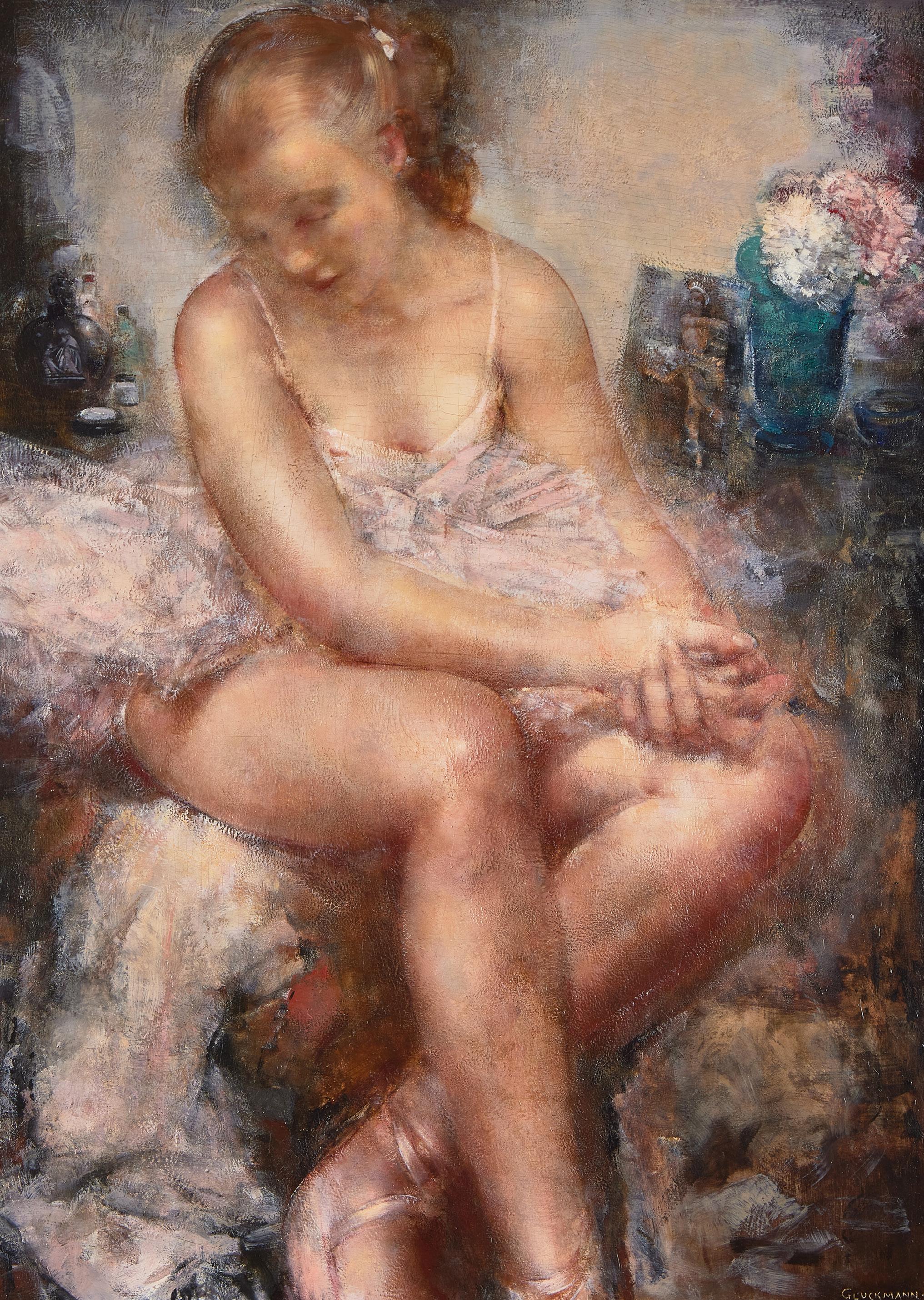
Grigory Gluckmann (Belarusian, 1898–1973)
Ballet Dancer
Estimate: $40,000 – 60,000
Following the success of Début in Freeman’s American Art and Pennsylvania Impressionists auction in December 2025, the firm is pleased to present several additional works by Grigory Gluckmann, including two large and important oils depicting ballerinas, among the artist’s most celebrated and sought-after subjects. Sourced from a respected private collection with a strong focus on Gluckmann’s work, the paintings will be featured in Freeman’s Impressionist and Modern Art sale on April 29.
Born in Russia, later active in Paris, and ultimately settled in the United States, Gluckmann developed a deeply personal and immediately recognizable style that bridged classical tradition with a distinctly modern sensitivity. Over the course of his career, such a blended approach found its most compelling expression in his depictions of ballerinas and dancers.
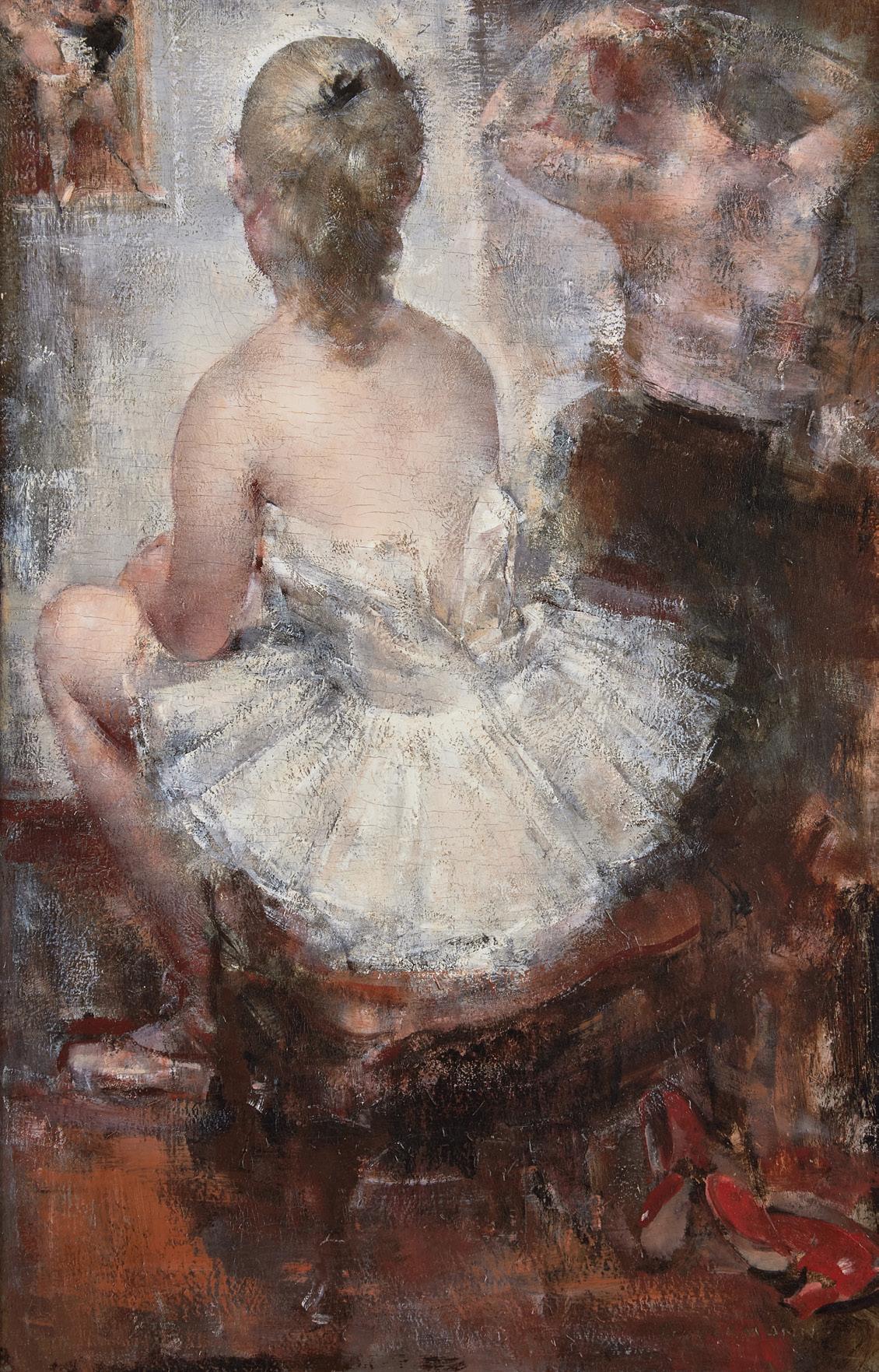
The theme of the ballerina has a long and familiar history in art. Yet unlike the theatrical, onstage dynamism most famously associated with Edgar Degas, Gluckmann offers a quieter, more introspective vision. His dancers exist in moments of pause rather than performance: seated backstage, stretching, or absorbed in thought. In works such as Seated Ballerina with Chrysanthemums and Seated Dancer, the emphasis shifts from spectacle to mood, inviting the viewer into an intimate and contemplative space. This restraint gives both paintings a subtle but powerful emotional depth.
A key element of their appeal lies in Gluckmann’s technique. After leaving Russia in the wake of the Russian Revolution in 1917, the artist spent formative years in Italy studying the Old Masters, an experience that left a lasting imprint on his work. In each painting, the figures emerge through delicate layers of thin, translucent glazes, producing a soft luminosity that echoes the diaphanous quality of the dancers’ tutus, and bathes the dancers in a gentle, almost glowing light. Critics
TO BE OFFERED APRIL 29, NEW YORK
Grigory Gluckmann (Belarusian, 1898–1973)
Seated Dancer
Estimate: $30,000 – 50,000
have compared this treatment of flesh to that of Giorgione, noting a similar sense of warmth and understated sensuality.
Gluckmann approached his work with patience and precision, often devoting many months (sometimes close to a year) to a single composition. These ambitious canvases were typically conceived as the centerpiece of his exhibitions, frequently held in Pomona at Dalzell Hatfield Galleries. They reflect not only his technical mastery but also his commitment to creating paintings of ethereal, yet enduring presence.
INQUIRIES: raphaelchatroux@freemansauction.com
VIEWING: April 20-28
32 East 67th Street, New York, NY
How History Unfolds on Paper
The Eric C. Caren Collection, Part X
June 30, Philadelphia
BY DARREN WINSTON, SVP, HEAD OF DEPARTMENT, BOOKS & MANUSCRIPTS, PHILADELPHIA
CHRISTOPHER BRINK, SENIOR SPECIALIST, HEAD OF SALE, BOOKS & MANUSCRIPTS, CHICAGO
Eric C. Caren, one of the foremost private collectors of historical paper and documentary material in the United States, is widely regarded as “The Babe Ruth of Historical Collecting,” reflecting both the scope of his holdings and the singular impact he has had on the market for primary-source history.
For more than 50 years, Mr. Caren has been assembling a world-class archive of contemporary documentation comprising well over one million original items, including rare newspapers, books, pamphlets, broadsides, manuscripts, early photographs, ephemera, and printed records documenting and illustrating pivotal moments in American and world history.
He is the author of twelve published books, many of which have become standard reference works within the fields of newspapers, ephemera, and historical documentation. His scholarship and advocacy have played a key role in elevating historical paper from a niche specialty to a recognized category within the broader markets of Americana and books and manuscripts.
This auction is Mr. Caren’s tenth single-owner sale, following nine earlier landmark dispersals. Each of these auctions has been distinguished by carefully curated material drawn entirely from his personal collection, reflecting his belief that context and provenance are as important as rarity. Appropriately aligned with the approaching 250th anniversary of the United States, he continues to demonstrate that history is not merely remembered, but preserved, contextualized, and re-experienced through the original documents that once carried it forward.
Perfectly illustrating Mr. Caren’s theme of “presenting history as it unfolds on paper,” the collection we are offering on
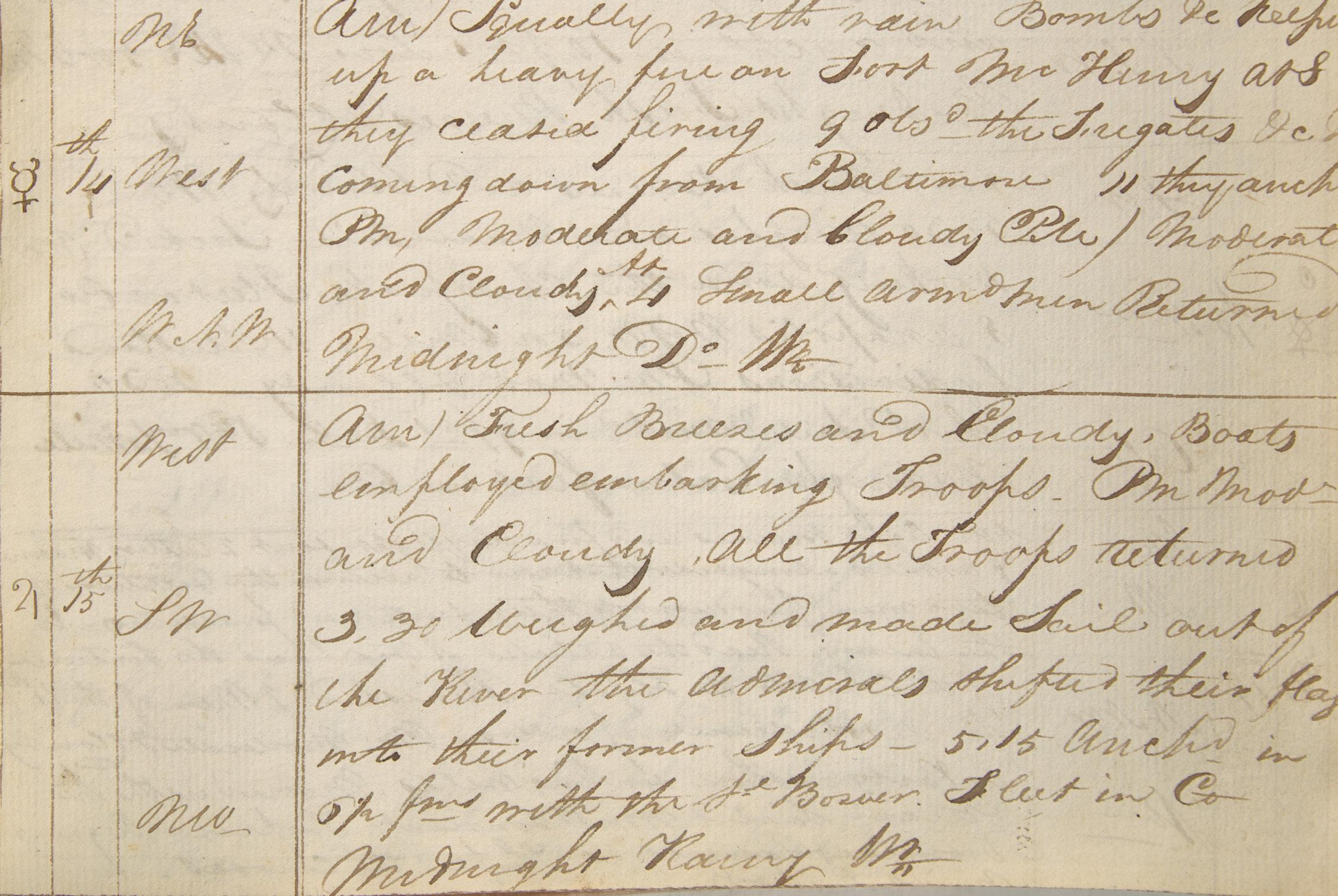
June 30 includes Thomas Jefferson’s “Birth of the Nation” letter carried to Paris with the Treaty of Peace, by a Jewish Patriot, January 16, 1784; the extraordinarily rare ship's log of a British midshipman recording the bombardment of Fort McHenry in September 1814, an event memorialized in Francis Scott Key’s “The Star-Spangled Banner”; a December 1966 contract for a performance by a young Jimi Hendrix in a London club; Oliver Hazard Perry’s War of 1812 Master Commandant in the Navy commission, signed by President James Madison, arguably one of the most important naval commissions still in private hands; and Postmaster General Ebenezer Hazard’s 1776 copy of one of the earliest procurable announcements that Independence has been declared, in the rare original wrappers.
Eric C. Caren is a member of The Grolier Club, The American Antiquarian Society, and The National Press Club; Director Emeritus of the Ephemera Society of America; a former member of the Antiquarian Booksellers’ Association of America (ABAA); and a consultant to the Newseum, where his collection was among the first to be featured.
INQUIRIES: christopherbrink@freemansauction.com
THIS PAGE, TO BE OFFERED JUNE 30, PHILADELPHIA
“Midnight squally with rain Bombs &c keeping up a heavy bombardment on Fort McHenry..." The simple words of a young British midshipman recorded in a ship’s log on September 13, 1814. What Francis Scott Key would later describe as “the rockets' red glare, the bombs bursting in air”
Estimate: $60,000 – 80,000
OPPOSITE PAGE, TO BE OFFERED JUNE 30, PHILADELPHIA
An extremely rare Type 1 Lou Gehrig photo, dated July 3, 1927, one of over 150 press photos offered for sale
Estimate: $8,000 – 12,000
A Major Work by Josef Šíma Resurfaces in Philadelphia
BY RAPHAËL CHATROUX, VP, HEAD OF DEPARTMENT, IMPRESSIONIST & MODERN ART
TO BE OFFERED APRIL 29, NEW YORK
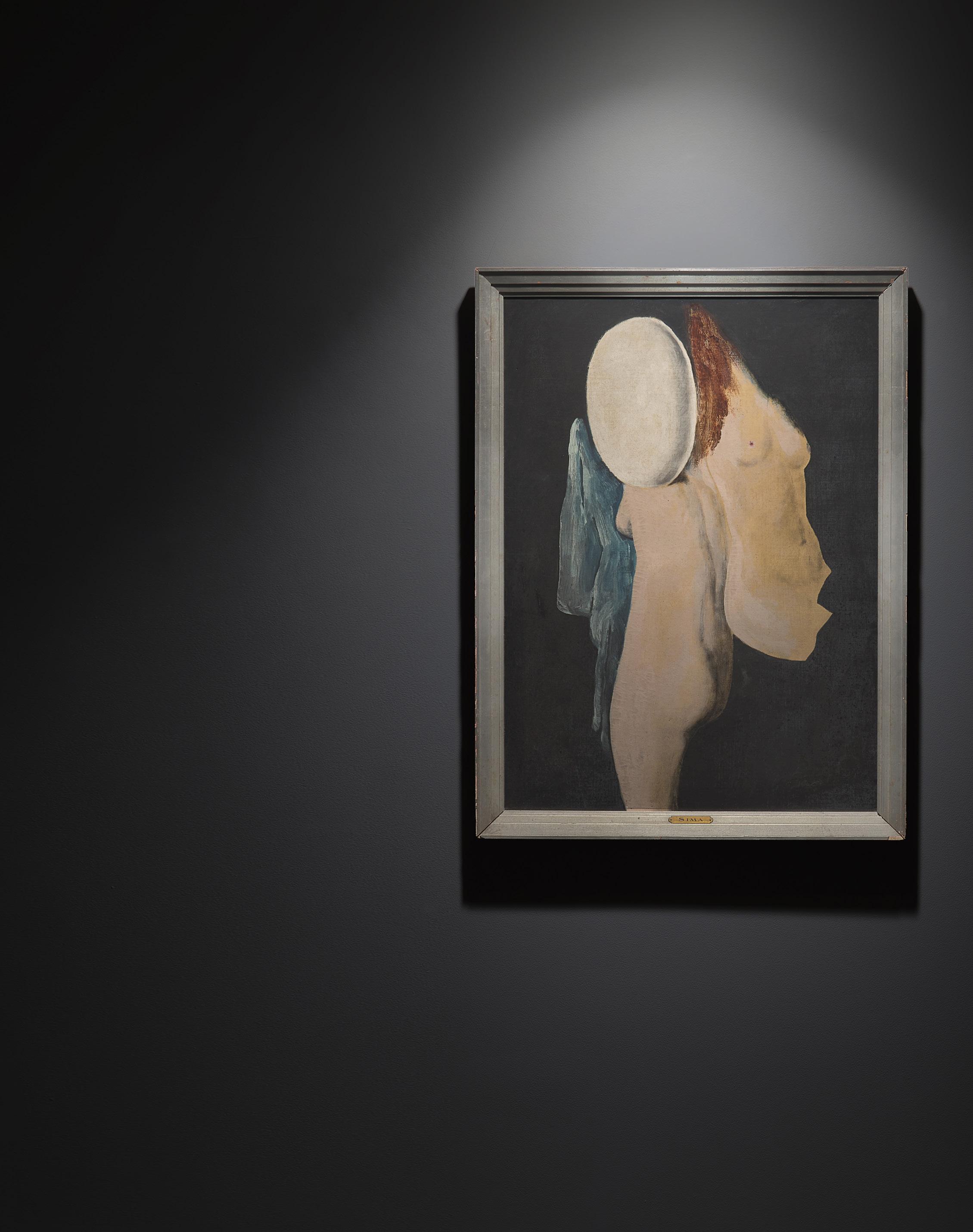
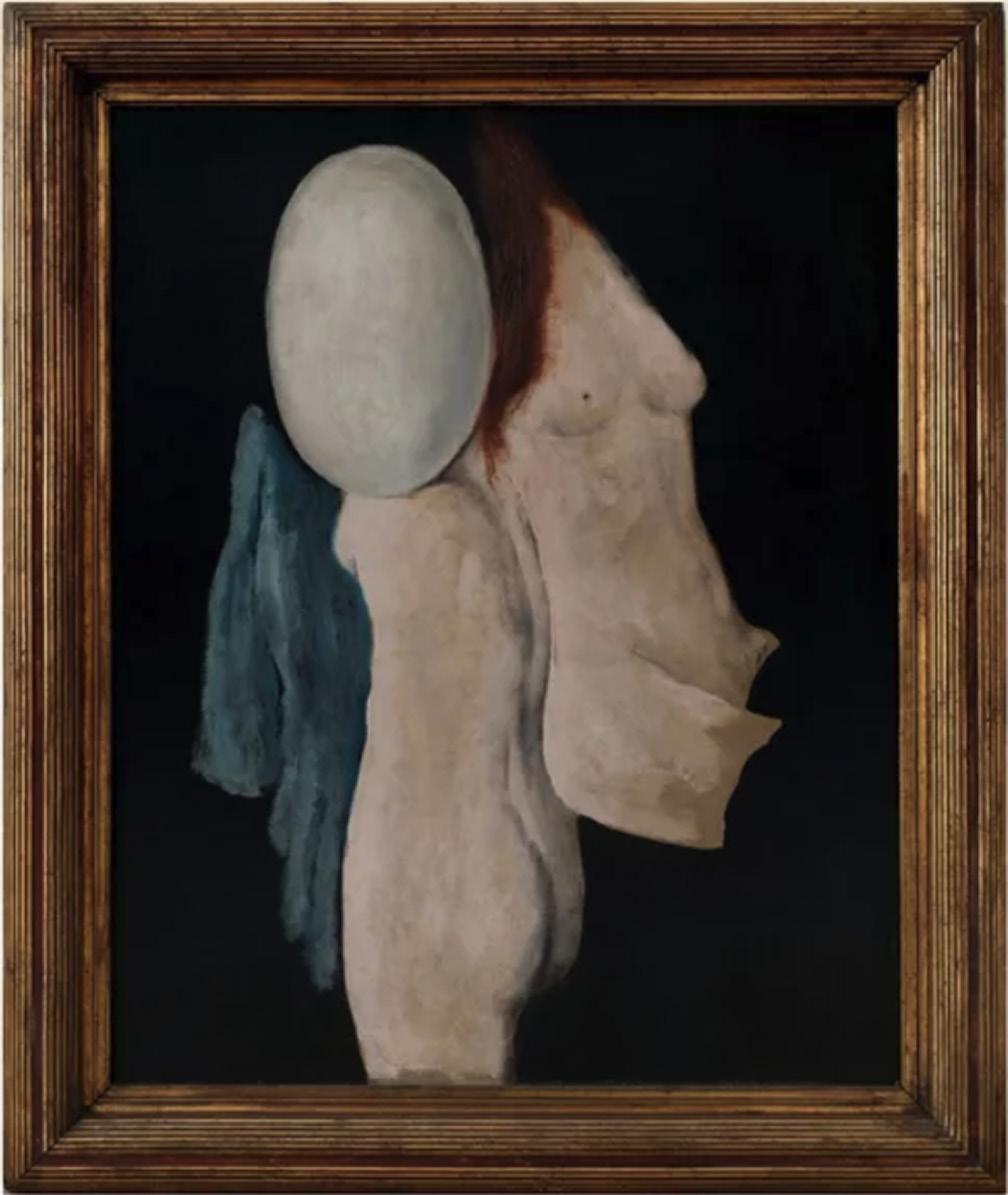
Josef Šíma (Czech, 1891-1971) Europa, 1927
Estimate: $300,000 – 500,000
Property from the Ingersoll Family Collection, Philadelphia, Pennsylvania
An extremely rare and important painting by Josef Šíma, one of the most prominent Czech painters of the 20th century, has resurfaced in a notable Philadelphia collection after nearly 100 years, prompting leading scholar and authenticator Dr. Rea Michalová, Ph.D. to call it “the rediscovery of the century.”
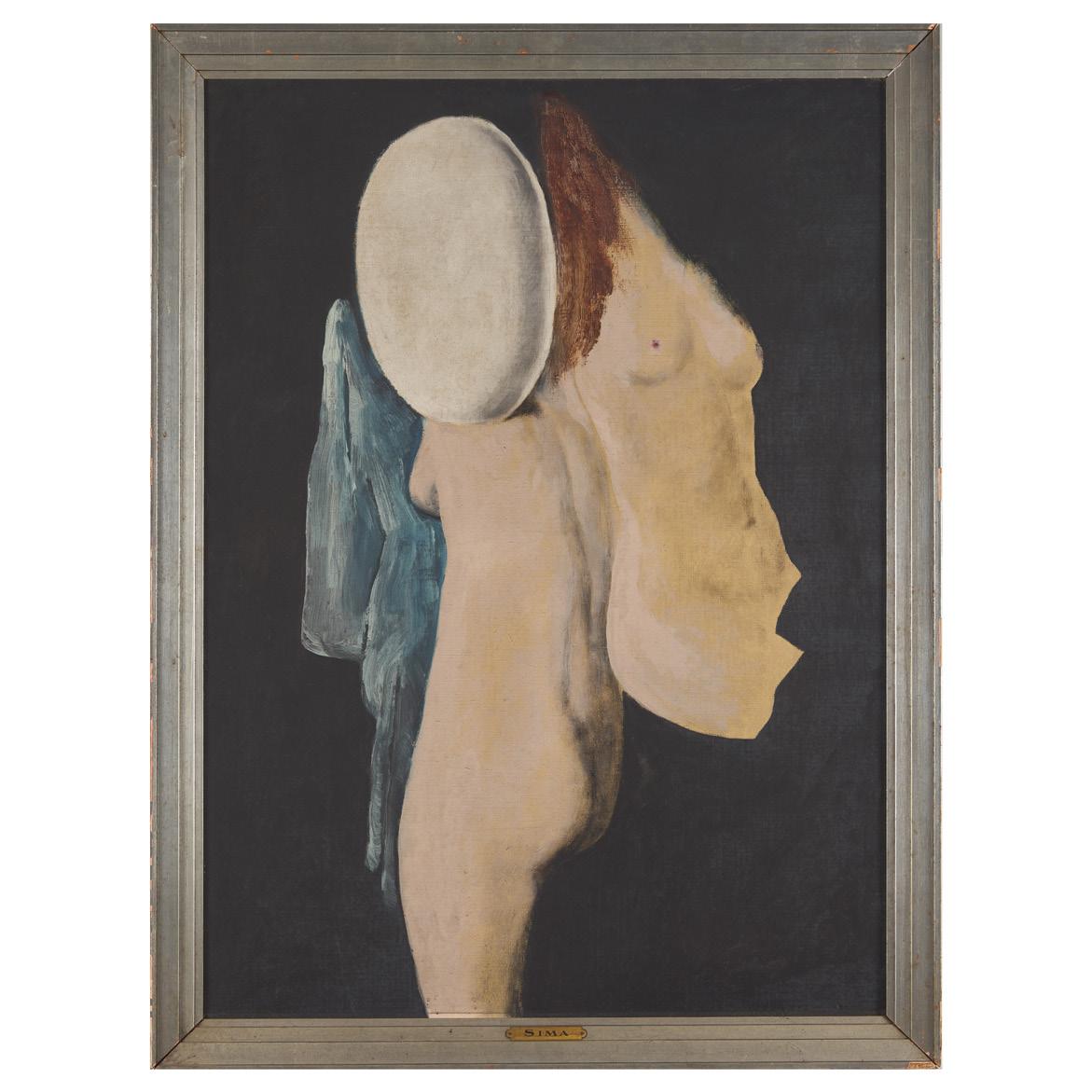
Entitled Europa, the oil was painted in Paris in the spring/ summer of 1927 and will be offered at auction on April 29 in Freeman’s New York galleries. Long unknown to scholars, the work has been identified as an almost identical counterpart to the version held in the Moravian Gallery in Brno, which is widely considered to be the most important painting of Šíma’s entire career.
A Pivotal Year
1927 marked a decisive turning point in Šíma’s artistic evolution. At first involved with Cubism, he began developing a new visual language rooted in myth, cosmology, and archetypal representation following his meeting with poet and critic Pierre Jean Jouve. In his late 1920s compositions, the artist sought to express on canvas his desire to become one with the universe, and turned increasingly toward symbolism to explore an interior, unknown mystical world.
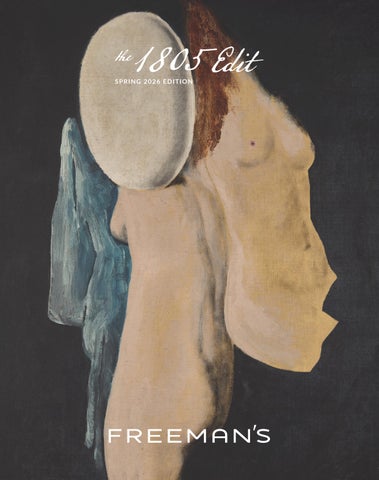
Europa embodies this breakthrough moment. The composition depicts two headless torsos over one of which hovers a monumental egg—one of the artist’s most potent symbols. Appearing in at least four other compositions from the same period, the egg represents both the origin of the world and the unity of existence. It is from this cosmic form that emerged the figures, interpreted as Adam and Eve, set against a black void evocative of primordial chaos.
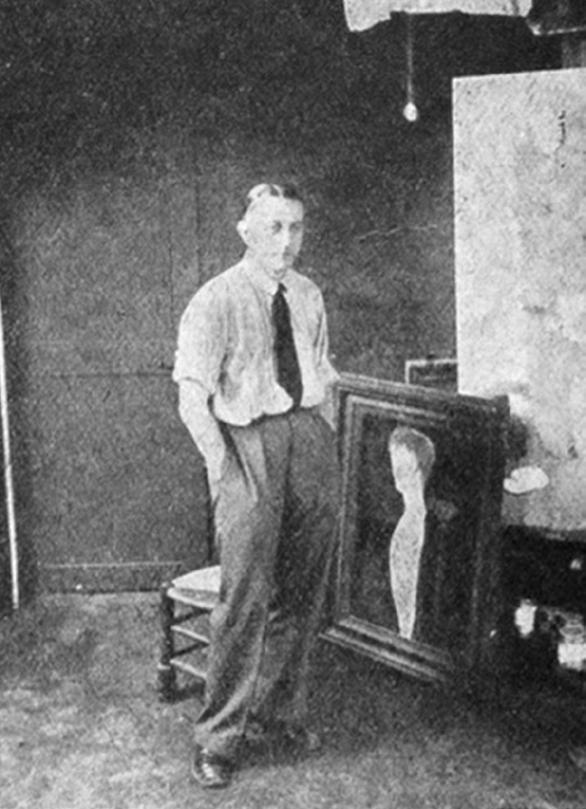
The importance of Europa within the artist’s body of work was recognized from the moment of its creation. The painting (in fact likely our version) even appears in a contemporary cartoon by Adolf Hoffmeister depicting Šíma’s Parisian studio: surrounded by four of his closest companions, the canvas stands in for the artist himself, whose presence is otherwise suggested by his dog.
A Landmark Rediscovery
First presented publicly last season, the work immediately generated global interest and intense scholarly debate due to its striking similarity to the celebrated Brno version, which was then believed to be unique. In response to mounting questions, specialists made the decision to postpone the sale to undertake comprehensive research and authentication.
A year later, following extensive study, rigorous provenance checks, forensics analysis, X-ray imaging, and infrared reflectography, which revealed a discreet signature in the bottom right corner of the canvas, Europa is recognized as “unquestionably authentic.” It now stands a major work in its own right, an extraordinary testimony from one of the most dynamic periods of the European avant-garde as well as a fascinating window into the artist’s creative process. According to Dr. Michalová, “none of the compared paintings were created through simple ‘copying’ as a replica of another. Each work stands out as entirely unique in its artistic style, crafted with the same skill, finesse, and expressive delicacy, demonstrating confident artistic bravura without hesitation.”
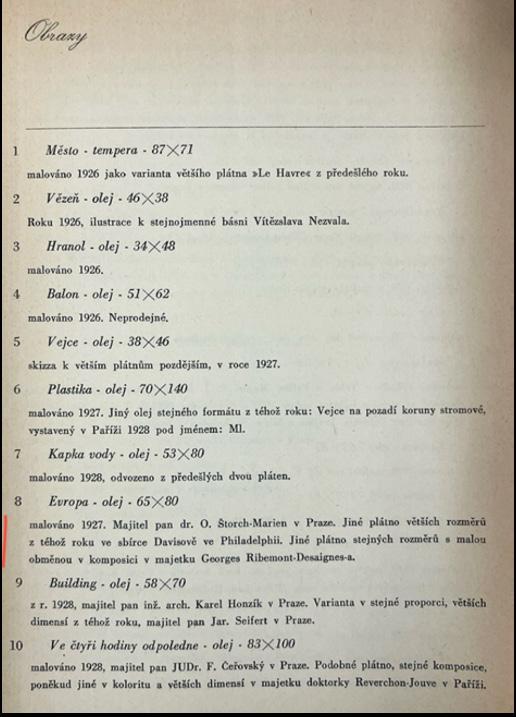
Archival research revealed that this specific version of Europa was already known during Šíma’s lifetime. Larger in size and slightly distinct in execution, it was first reproduced in 1928 in the Parisian art journal Cahiers d’Art, one of the leading publications promoting modern art in Europe, which firmly placed Šíma alongside Picasso, Matisse, and Chagall. The rediscovered painting also appears to correspond to the larger version of Europa mentioned in a 1936 Prague exhibition catalogue, which records another canvas of the same subject located in a Philadelphia collection.
Article continues on the next page
The artist in his studio 3, cour de Rohan, Paris, c. 1929
Exceptional Provenance
The painting’s retraced provenance connects it to two influential figures in American cultural life. The first owner of Europa was the Ukrainian-born collector Bernard M. Davis, an eccentric and visionary patron known for championing emerging modern artists. The painting later entered the collection of Robert Sturgis Ingersoll, a prominent lawyer, philanthropist, and longtime director of the Philadelphia Museum of Art from 1948 to 1964. Ingersoll was an early American collector of European modernism, acquiring works by artists such as Amedeo Modigliani, Chaïm Soutine, and Constantin Brâncuși. The painting has remained with the Ingersoll family ever since.
Josef Šíma: Not a Surrealist
Born in Bohemia and trained at the Academy of Fine Arts in Prague, Šíma was immersed in artistic culture from childhood. An admirer of the work of Paul Cézanne, he became an influential member of the Czech avant-garde group Devětsil before moving to France, settling permanently in Paris in 1921. Naturalized French in 1926, he emerged as one of the few Czech painters to achieve lasting international recognition.
Although he was on friendly terms with the Surrealists in Paris, Šíma charted his own path and refused to align himself with the movement. In 1927, the same year he painted Europa, he co-founded Le Grand Jeu with a circle of young poets originating from Reims, dedicated to metaphysical and spiritual exploration through art and literature. While the Surrealists sought the unknown by channeling an imaginary, inner world that would carry personal meaning, Šíma and his
Europa from the Moravian Gallery in Brno, 1927, oil, canvas, 80 x 65 cm
Europa from Philadelphia, 1927, oil, canvas, 100 x 73 cm. To be offered at Freeman's
peers aimed to break from reality to rediscover the pure, original state of existence from the origins of time. Šíma emerged as the group’s principal visual artist, and Europa stands among the most emblematic and defining images of this movement. “The rediscovery of this larger variant not only expands our understanding of Šíma’s creative process but also restores an important chapter of the European avant-garde—a moment when poetry, philosophy, and painting converged in search of new spiritual and artistic horizons.” says Dr. Michalová.
Censored for decades under the Communist regime in Czechoslovakia, Šíma was finally rehabilitated in 1968 with two major retrospectives in Paris and Prague. Today, his market is undergoing renewed attention, specifically in France and the Czech Republic, where his work (albeit from a later period) often resurfaces. His auction record was broken in 2024, and specialists suggest that Europa has the potential to set a new benchmark. As one expert recently observed: “Josef Šíma is on the rise and has not yet been completely discovered.”
INQUIRIES: raphaelchatroux@freemansauction.com
VIEWING: April 15-18; 2400 Market Street, Philadelphia, PA April 20-28; 32 East 67th Street, New York, NY
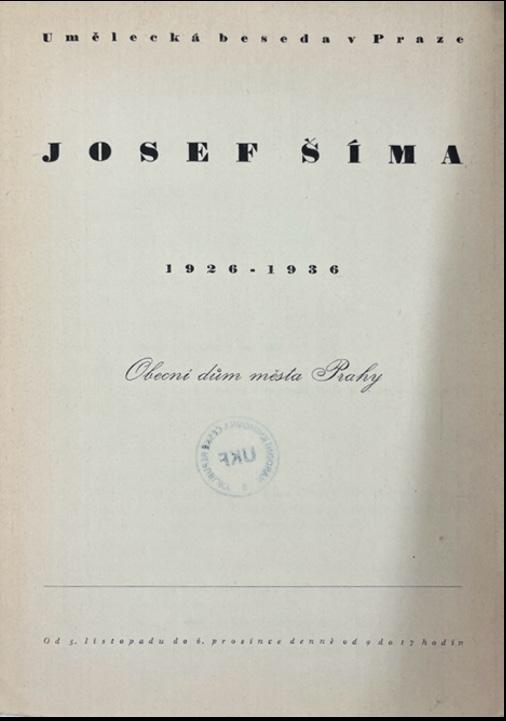
Exhibition checklist from the catalogue of the jubilee exhibition JOSEF ŠÍMA 1926–1936, organized by Umělecká beseda (Artistic Forum) in Prague from November 5 to December 6, 1936. This catalogue not only lists the exhibits displayed at the exhibition but also functions as a ‘working’, personal ‘inventory’ of Šíma, which, besides the works presented, in several cases also mentions other existing paintings with the same motif and their locations. Listed under #8 is the Moravian Gallery version of Europa. It later states the existence of ‘another larger canvas from the same year in the Davis Collection in Philadelphia.” A third canvas of the same size with slight variations in composition is also noted as in the collection of Georges Ribemont-Desaignes.
Marie Michaela Šechtlová (Studio Šechtl et Voseček) Portrait of Josef Šíma in Paris, c. 1968
Titanic Treasures
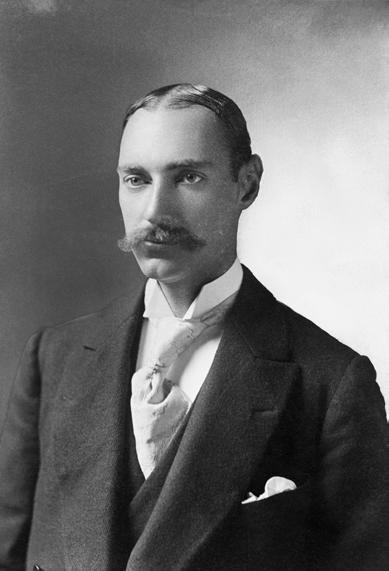
JFrom the RMS Titanic to the Auction Block: The Personal Artifacts of John Jacob Astor IV
BY DARREN WINSTON, SVP, HEAD OF DEPARTMENT, BOOKS & MANUSCRIPTS
ohn Jacob Astor IV and his eighteen-year-old wife, Madeleine, boarded the RMS Titanic at Cherbourg, France on April 10, 1912. One of the wealthiest men in the world, and by far the wealthiest man onboard, Astor and his wife had also attracted attention for his having divorced his wife of twenty years to marry the much younger Madeleine only seven months before the Titanic set sail. In the hopes of riding out the ensuing scandal, which was by now the talk of the American papers, the Astors left the United States and embarked on a months-long honeymoon tour through Europe and Egypt. The extended honeymoon might well have continued but after only a few months, Madeleine discovered that she was pregnant. It was decided that the couple would return to the United States so that their child could be born on American soil. It would be the Titanic’s maiden voyage. Accompanying the couple were Astor’s valet, Victor Robbins, Madeleine’s maid, Rosalie Bidois, her nurse Caroline Endres, and their Airedale Terrier Kitty.
The Titanic was the second of three projected Olympicclass liners built by the Belfast Harland & Wolff shipyards for the White Star Line. Intended to compete against the rival Cunard Line’s Mauretania and Lusitania, the White Star Line ships were designed by Thomas Andrews to compete with Cunard’s liners not so much in speed as in sheer size and luxury. The RMS Olympic commenced its maiden voyage from Southampton to New York on June 14, 1911 with Captain Edward J. Smith at the helm and immediately became a favorite of the rich and famous crossing back and forth between Europe and North America. The Titanic, as the younger sister, achieved slightly less attention for its maiden voyage, though as the newest and most luxurious ship in the world it nonetheless attracted the crème de la crème of the wealthy and the privileged; in addition to the Astors, the ship left Southampton with businessman Benjamin Guggenheim, co-owner of Macy’s department store Isidor Straus and his wife Ida, military officer and personal aide to President
William Howard Taft, Archibald Butt, and chairman and managing director of the White Star Line, J. Bruce Ismay.
When the Titanic struck the iceberg at 11:40 p.m. on April 14, 1912, the Astors had already retired to their suites on C-deck for the evening. Hearing commotion outside of their rooms, Astor left Madeleine to find out what was going on. Upon finding Captain Smith he said, “Captain, my wife is not in good health. She has gone to bed, and I don’t want to get her up unless it is absolutely necessary. What is the situation?” To this, Captain Smith advised him to wake his wife and come to the Boat Deck. Astor told Madeleine that the ship had been damaged but it didn’t appear to be anything serious, though the crew would be loading the lifeboats as a precaution.
While the crew began working on the lifeboats, the Astors socialized with other passengers and played with the mechanical horses in the ship’s gymnasium. Others, as it turns out, had received the same message from Captain Smith, so
OPPOSITE PAGE, TO BE OFFERED APRIL 22, CHICAGO
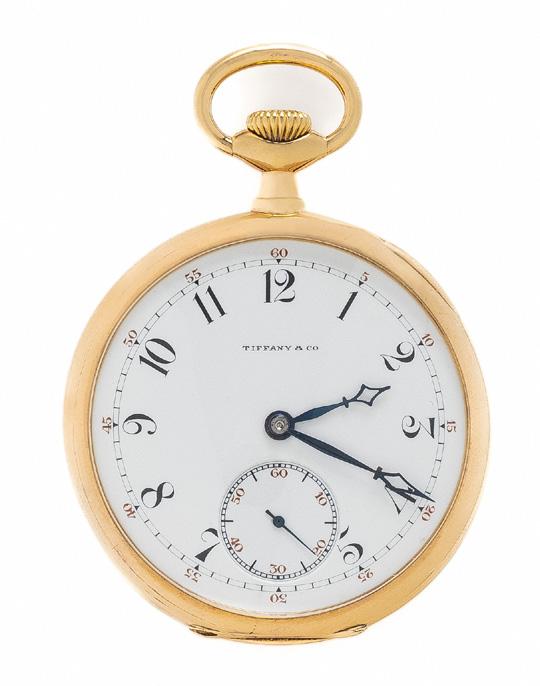
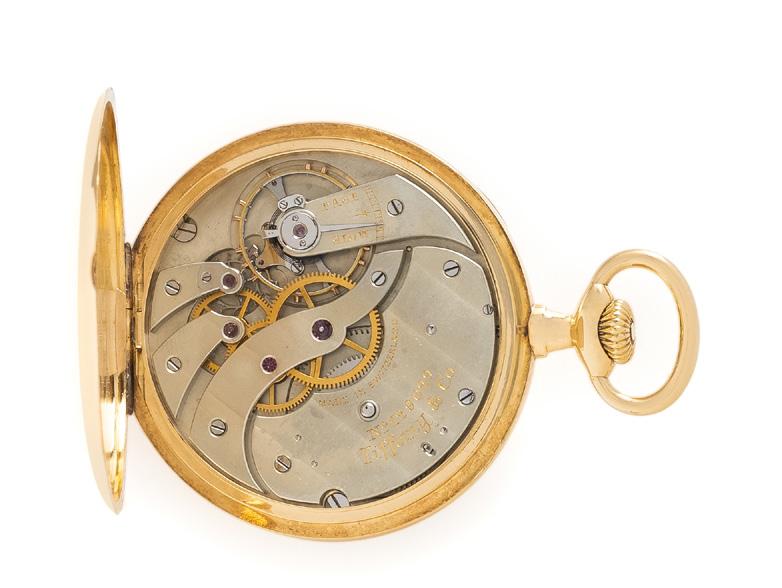
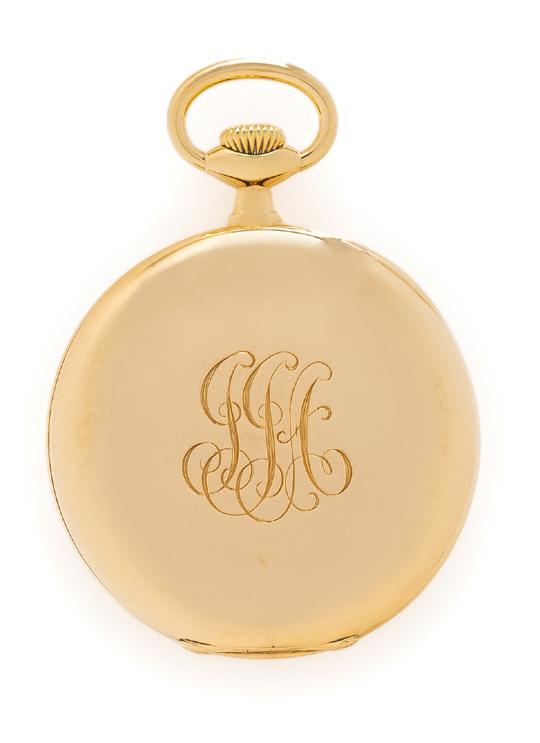
John Jacob Astor IV’s Patek Philippe for Tiffany & Co., 18K Yellow Gold Pocket Watch
Property of the Astor Family
Estimate: $300,000 – 500,000
THIS PAGE
John Jacob Astor IV in 1895
few first-class passengers saw the situation as anything but a potential annoyance. Astor himself was heard to remark at one point, “We are safer here than in that little boat.” The Astors made a move to board Boat No. 7, the first lifeboat to leave the stricken Titanic, at 12:45 a.m. but at the last minute appeared to decide against it. As the ship settled deeper and deeper into the Atlantic, however, it became clear that the situation was dire.
Less than an hour after stepping away from Boat No. 7, Astor helped Madeleine into Boat No. 4 on the port side from the A-deck windows. Astor’s decision to wait ultimately sealed his fate, as Second Officer Charles Herbert Lightoller had, unlike First Officer William Murdoch on the starboard side, interpreted Captain Smith’s order to load women and children first to mean women and children only. After helping Madeleine into the boat, he asked Lightoller if he might
Article continues on the next page
join his wife, noting that she was in a “delicate condition.”
Lightoller replied that no men would be loaded into lifeboats until all women and children were safely off the ship, to which, according to first-class passenger Colonel Archibald Gracie, Astor simply nodded, kissed his wife, asked for Madeleine’s lifeboat number, and stepped back into the crowd. Witnesses later claimed that the last anyone saw of Astor was him standing on deck with Arthur Ryerson, John B. Thayer, and Harry Elkins Widener, waving to Madeleine’s lifeboat.
In the days following the loss of the Titanic, Astor’s eldest child, Vincent, was frantic to recover his father’s body, at one point even proposing to charter a salvage ship out to the wreck’s position, use magnets to determine its exact location, and then blast open the hull in the hopes that doing so would send his father’s body to the surface. Ultimately this proved to be unnecessary, as the cable ship Mackay-Bennett, which had been chartered from Halifax by the White Star Line to recover what it could of the Titanic’s lost passengers, found Astor’s body on April 22. There is some controversy as to how Astor met his end, with Colonel Gracie claiming in The Truth About the Titanic (1913) that his body was found crushed and covered in soot, suggesting that Astor had been one of the unfortunate swimmers in the path of the Titanic’s number one funnel when it collapsed at 2:16 a.m., while Mackay-Bennett undertaker John Snow noted no such injuries. Vincent, and Astor’s executor, Nicholas Biddle, picked up his body and his effects in Halifax and returned to New York City where he was buried in Trinity Church Cemetery in Upper Manhattan. His was the first body to be claimed. Four months later Madeleine gave birth to their son, John Jacob Astor VI.
TO BE OFFERED APRIL 22, CHICAGO
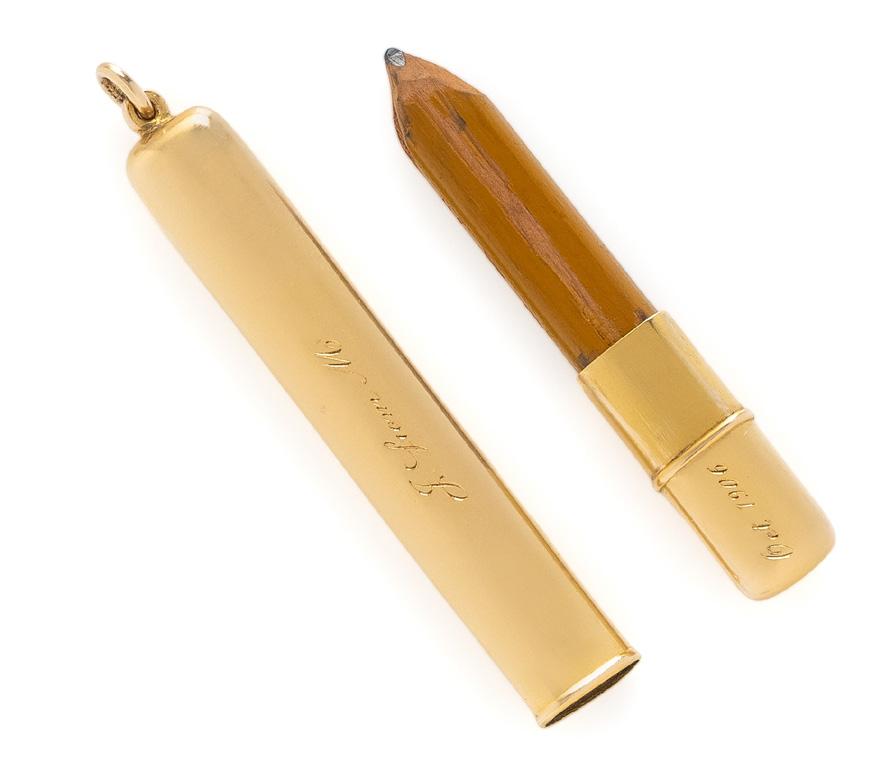
John Jacob Astor IV’s Battin & Co., Antique, Yellow Gold, Diamond, and Sapphire Pencil Case Property of the Astor Family Estimate: $10,000 – 20,000
Among the personal effects recovered was a “gold watch, cuff links gold and diamond, diamond ring with three stones…and gold pencil.”
For the last 114 years, two of those four family relics, the watch and the pencil, have been kept by John Jacob Astor IV’s descendants and now his gold Tiffany and Co. Patek Philippe pocket watch and his gold pencil have been consigned to Freeman’s by his family and are being offered for sale for the first time ever.
INQUIRIES: darrenwinston@freemansauction.com
VIEWING: April 14-15, 16; 32 East 67th St, New York, NY April 20-21; 1550 West Carroll Avenue, Chicago, IL
Stage Presence: Bonnie Glass Immortalized in Pastel
BY PAULINE ARCHAMBAULT, AVP, SENIOR SPECIALIST, FINE ART
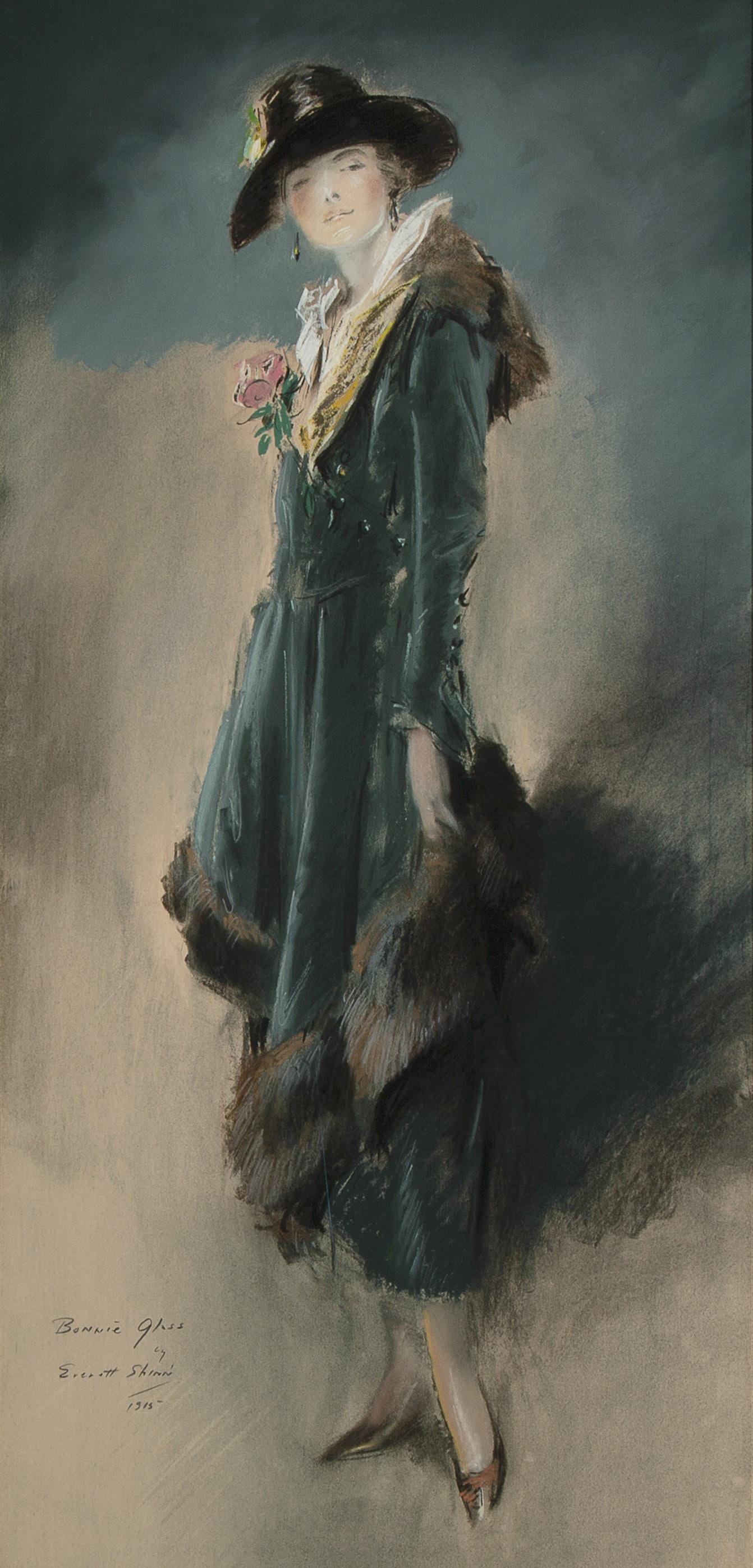
Bonnie Glass was a beloved exhibition and vaudeville dancer who headlined various venues in New York during the first quarter of the 20th century. Born Helen Roche in 1895, she was lauded for her theatrical routines and chic style and frequently performed alongside the likes of Clifton Webb and Rudolph Valentino. By 1915, she was managing Café Montmartre, a popular club in Manhattan, where she was responsible for choreography, design of costumes and sets, as well as discovering new talent.
Immersed in the world of theatre, Everett Shinn depicted countless performance scenes and occasionally portrayed performers as well. A painter of real life, he viewed the pastel medium, with its immediate and unset quality, as better suited to render movement and energy. Far from static, his compositions display dynamic fluidity instead. It is thus no coincidence that Shinn should have favored pastel over any other medium to elicit Glass’s vibrant personality.
The long, vertical portrait presents Glass as a confident, fashionable, and mesmerizing figure. Her standing posture, head tilted and chin slightly up, compels the viewer to return her peering gaze, arguably the focal point of the composition and a vehicle for her intensely magnetic demeanor. Her outfit, an elegant wide brimmed hat and fur-edged velvet coat with supple, undulating folds, further conveys her graceful persona as a dancer, emulating one of the perfectly choreographed performances that made her famous, while also underlining
TO BE OFFERED JUNE 7, PHILADELPHIA
Everett Shinn (American, 1876-1953)
Bonnie Glass, 1915
Estimate: $40,000 – 60,000
her stylistic acumen. In this portrait, Shinn suggests that, as a performer, cultural icon, or artistic subject, Glass always commands an audience.
Bonnie Glass will return to the stage in Freeman’s American Art & Pennsylvania Impressionists auction in Philadelphia on June 7th.
INQUIRIES: paulinearchambault@freemansauction.com
VIEWING: June 1 - 7; 2400 Market St, Philadelphia, PA
Gavel& Grace
The Estate of Honorable Sandra Schultz Newman
BY LAUREN COLAVITA, ASSOCIATE SPECIALIST, POST WAR & CONTEMPORARY ART
CHRISTINA KIRIAKOS, ASSOCIATE SPECIALIST, FINE ART
ARIEL BARKAN, SPECIALIST, JEWELRY & WATCHES
Freeman’s is honored to present Gavel & Grace: The Estate of Honorable Sandra Schultz Newman, a collection that reflects the life and legacy of one of Philadelphia’s most formidable figures. A native of the city, Justice Newman built a groundbreaking legal career defined by a series of firsts—from serving as Montgomery County’s first female assistant district attorney to becoming the first woman elected to the Pennsylvania Supreme Court. Her tenure on the bench and decades in private practice established her as a sharp, tenacious advocate and trailblazer for women in law.
Beyond her professional achievements, Newman was a commanding presence in Philadelphia’s cultural and social spheres. Frequently described as a “force of nature,” she moved effortlessly between the courtroom and the city’s most prominent gatherings, cultivating a reputation not only as a jurist, but as a discerning tastemaker.
That sensibility is evident throughout the collection she assembled over a lifetime. Spanning fine art, design, and jewelry, the series of sales reflects a keen eye for refined craftsmanship and objects of lasting presence.
Five Bertoia sculptures from Newman’s collection will be offered in June, illustrating the remarkable diversity of his practice—from monumental, free-standing forms to delicate, intimate works. Working across a range of metals and alloys, Harry Bertoia (1915–
TO BE OFFERED JUNE 23, PHILADELPHIA
Alex Katz (American, b. 1927)
Trishie and Lady, 1975
Estimate: $600,000 – 800,000
OPPOSITE PAGE
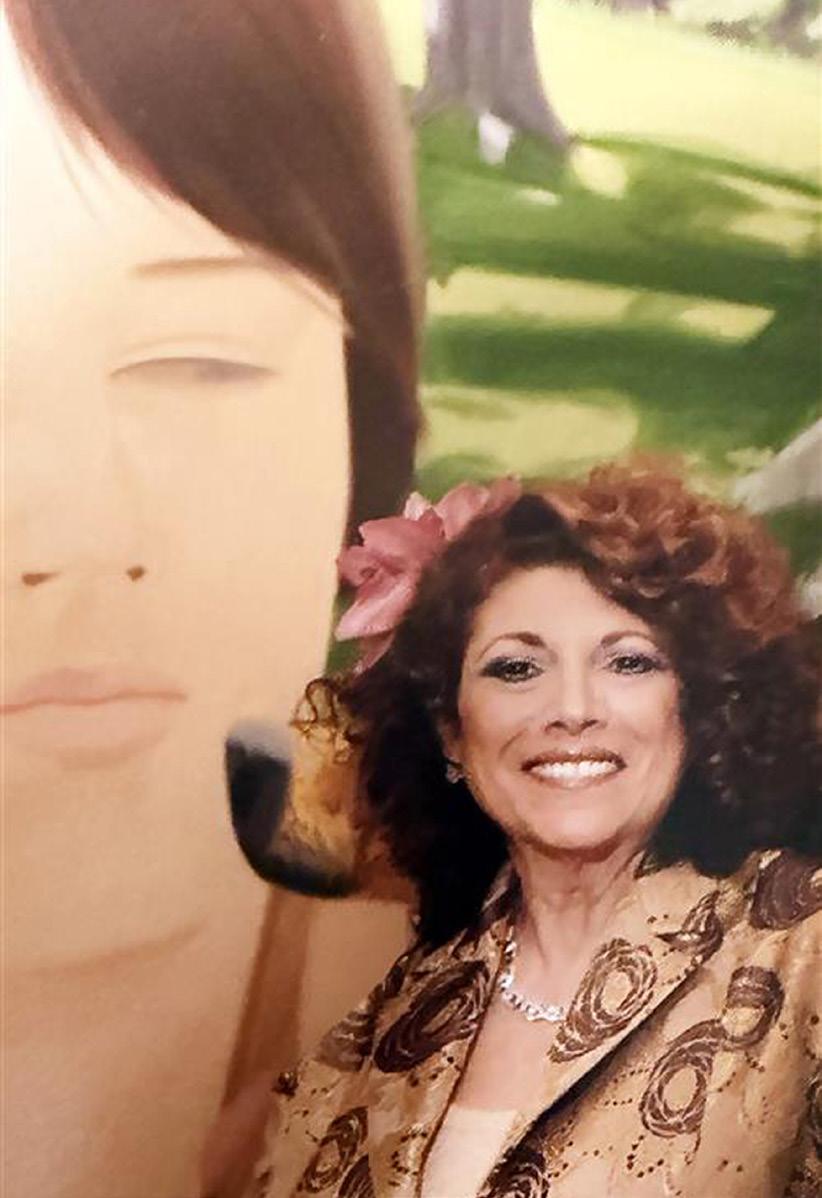
Honorable Sandra Schultz Newman in front of the Alex Katz painting
"My Mother started collecting Alex Katz and Harry Bertoia in the 1970s. Art was always a lifelong passion for her and was enjoyed by the entire family in her home."
JONATHAN NEWMAN, SON OF JUSTICE NEWMAN
1978) challenged the boundaries between design and art, developing a rich vocabulary of forms, motifs, and techniques.
Works include a finely wrought brass and copper wall hanging, whose airy lattice appears to float against the wall; a large, oxidized copper sculpture, Organic Form, with a verdigris patina that evokes natural, almost geological qualities; and a tall steel spray with upward-reaching branches, suggesting organic growth despite its industrial material.
Two bush forms—an intimate tabletop version and a slightly larger iteration—also highlight Bertoia’s exploration of
scale, showing how subtle changes in size can transform a sculpture’s presence.
Together, these five works underscore Newman’s vision as a collector, presenting a spectrum of Bertoia’s experimentation with line, texture, scale, and spatial engagement.
Additionally, Alex Katz’s 1975 painting, Trishie and Lady, of a close-cropped view of a woman and her dog amid a sunlit park, highlights Katz’s ability to distill personality and explore larger thematic types through portraiture.
Article continues on the next page
TO BE OFFERED JUNE 23, PHILADELPHIA
Harry Bertoia (American, 1915-1978)
Bush Form, c. 1970s
Estimate: $50,000 – 70,000
Katz has created several paintings and prints featuring dogs throughout his career, with his dog Sunny a frequent model. Vincent and Sunny (1967)—of Katz’s son and the Skye Terrier— even hangs in the Katz apartment foyer. With his typical flat handling of color and form bordering on abstraction, Katz strips away extraneous detail to center the personality and spirit of these animals. This is especially apparent in Trishie and Lady, where Katz utilizes a shared visual language between Trishie and Lady to contrast their personalities and emotional states within the snapshot moment of encounter.
Elements of Trishie and Lady are mirrored. The V-neck of the woman’s shirt echoes the triangular open mouth of the pup, possibly a Borzoi or other aristocratic hound. The soft fringes of Trishie’s bangs are reminiscent of the waves of Lady’s ears while the short dark strokes of the dog’s whiskers match the lashes covering the woman’s downcast eyes. Balanced by the complementary greens in the surrounding park, each is defined by a palette of pinks, warm oranges, and browns,
some white highlights, and only a hint of cooler grays in the dog’s nose and woman’s irises.
In highlighting the connection between Lady and Trishie, their different personalities are laid bare: Trishie’s shadowed eyes, bleary from sleep or otherwise unfocused in comparison to Lady’s exuberance, and Lady’s excited panting juxtaposed with Trishie’s closed mouth. The woman’s careful grooming, set off by her vertical beehive hairstyle, reiterates stillness and a sense of buttoned-up composure offset by the horizontal darting into the frame by Lady’s long snout.
Katz, when describing how he chooses his subjects, explained his goals of illustrating real people while also examining social types and themes through carefully presented pictorial information.ii This dual appeal of balancing the familiar with the universal is captured here. Apparently awoken and faced with the quotidian task of taking her ecstatic dog for a walk, the woman pauses, arranging and shellacking a complicated
hairstyle into place before heading off. Trishie and Lady reflect a generalized pair contrasting energy and composure, coolness and fervor, that might be encountered on New York City streets as well as a very specific woman and dog the viewer would like to know more.
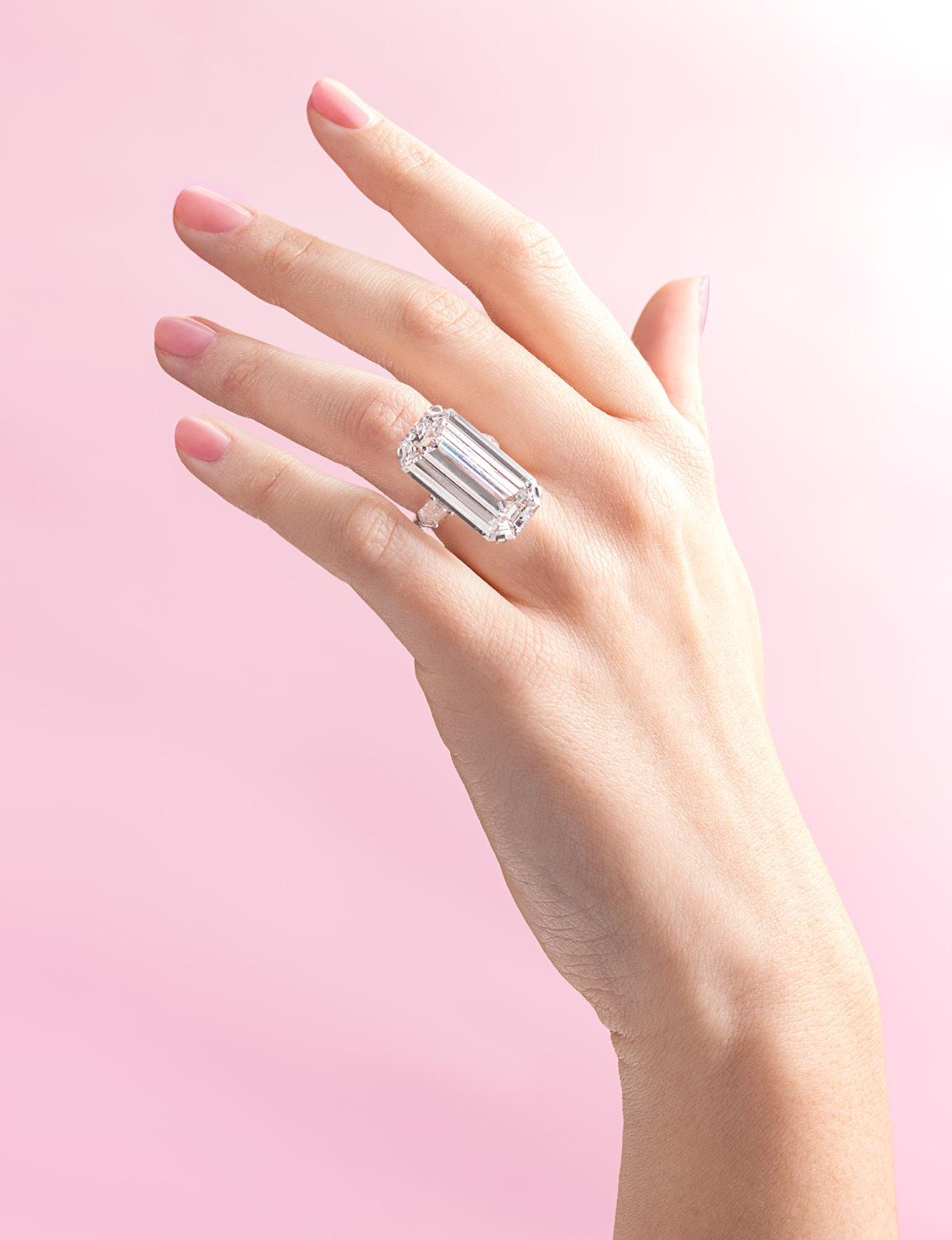
Furthermore, Justice Newman had a fierce eye for gemstones and jewelry design, and her vast collection conveys her individual sense of style at the most personal level. Newman’s most exceptional piece is the staggering 19.12 carat Emerald-Cut Diamond Ring, purchased with the winnings made from her record setting racehorse, Nihilator. She took an interest in horses alongside her son, as evidenced by the striking Diamond, Sapphire and Gold Horse Brooch, the Gold Equestrian Bracelet, and the charming Enamel and Gold Stick Pin depicting a harness race in action.
Justice Newman was also interested in collecting gemstones, and many of her pieces showcase these colorful specimens in beaded necklaces and bold, gold mountings. It is conveyed best by the extraordinary Retro gold and diamond brooch and matching earrings of asymmetrical, ribbon-like design, each centering a large amethyst with articulated pear-cut citrine drops.
While her jewelry collection is that of a well-traveled woman with a multitude of interests, there are also reminders of her trailblazing legal career. The 14K Gold Cufflinks and the Diamond and 14K Gold Ring with her monogram are a nod to the woman behind the jewelry. It is evident that Justice Newman built her jewelry collection over a lifetime of professional and personal achievements.
Freeman’s is proud to present this collection across a series of sales in June 2026, celebrating a life defined not only by historic achievement, but by confidence, taste, and enduring individuality.
TO BE OFFERED JUNE 10, NEW YORK 19.12 Carat Emerald Cut Diamond Ring Estimate: $350,000 – 450,000
INQUIRIES: laurencolavita@freemansauction.com
AUCTIONS: Important Jewelry, June 10; New York Gavel & Grace: The Estate of the Honorable Sandra Schultz Newman, June 23; Philadelphia Essential Jewelry, June 24; Online
SINGLE-OWNER SALE VIEWING: June 18-22
2400 Market St, Philadelphia, PA
[i] As of 2022. Amanda Fortini, “Alex Katz Is Still Perfecting His Craft,” T Magazine, The New York Times, August 18, 2022, https://www.nytimes. com/2022/08/18/t-magazine/alex-katz.html
[ii] Vincent Katz, “The Look of a Certain Person,” In Alex Katz Portraits. Silvana Editoriale, Milan, 2003. http://vincentkatz.net/abc2/books_abc2_ AK2.htm
Welcome back, readers. In the world of auctions, the fall of the hammer may mark the end of bidding—but it often signals the beginning of the story, revealing how collector confidence, global participation, and timing shape recordbreaking results.
For many, a sale’s conclusion feels like the finish line. For those of us watching the market closely, it’s when the real analysis begins. Which categories sparked the fiercest
UPDATES, HAPPENINGS, AND ADVICE FROM FREEMAN’S TRUSTS, ESTATES & PRIVATE CLIENTS TEAM
competition? Where did interest exceed expectations? And how much does timing really influence the final outcome?
Auction results are more than transactions—they’re signals of collector confidence, global participation, and shifting tastes. Observing them closely can be surprisingly revealing, especially as patterns emerge over multiple seasons.
Take Jean-Michel Basquiat as an example. In 2016, a major Basquiat painting sold for $57.3 million. Just a year later, another 1982 Basquiat sold for $110.5 million at Sotheby’s—a new record for an American artist, if you can believe it. The artist hadn’t changed, but the market had: international demand, collector confidence, and appetite for top-tier post-war works all accelerated almost overnight. Watching it happen felt like seeing a perfect storm of timing and momentum.
Similarly, Andy Warhol’s Shot Sage Blue Marilyn fetched $195 million at Christie’s in 2022. Exceptional provenance
Molly Morse Limmer, EVP, Deputy Chairman, auctioneering a sale
helped, yes, but it was the global competition and intense bidding that pushed the price into record territory—proof that collectors don’t just follow the rules. Moments like that remind me why auctions are never predictable, no matter how many times you’ve seen them.
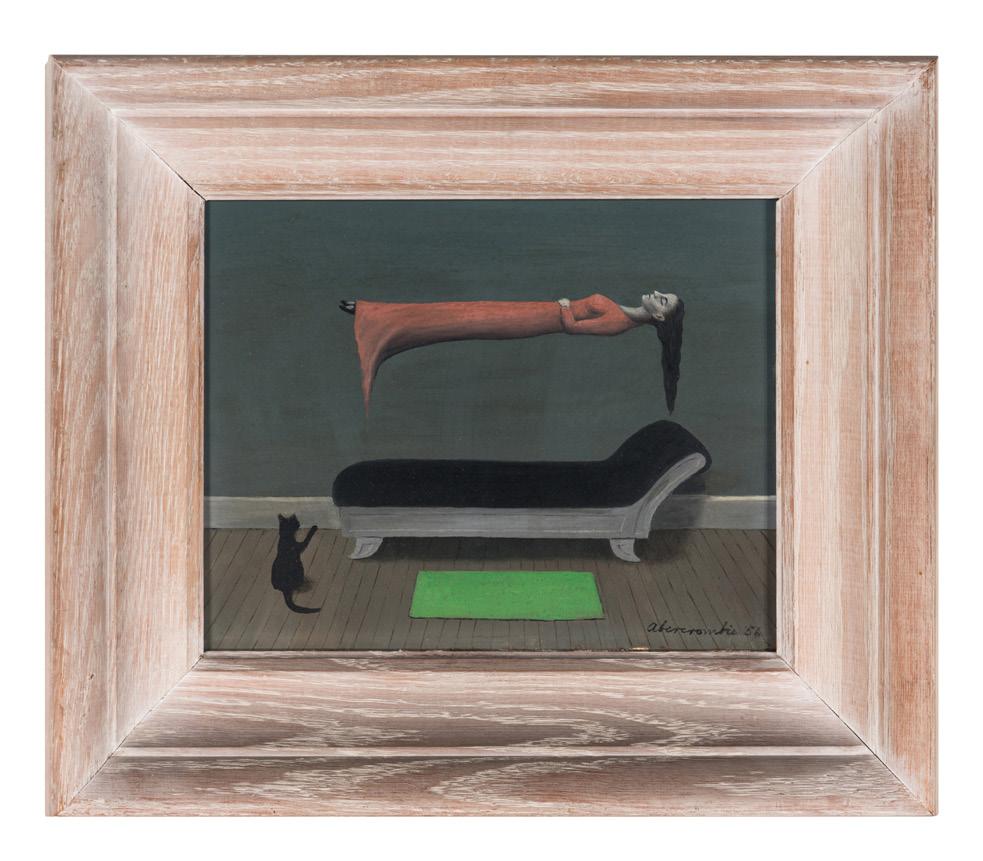
Closer to home, recent sales at Freeman’s tell the same story. In 2025, during Lincoln’s Legacy, a pair of Abraham Lincoln’s leather gloves sold for $1,512,500, contributing to nearly $7.9 million in total sales. In Post-War and Contemporary Art (2025), a painting by Gertrude Abercrombie achieved $469,900—six times its estimate—setting a new world auction record at the time of sale. Seeing these numbers, it’s clear that attention to timing and collector interest can make all the difference.
Timing plays a subtle but critical role. Objects offered when collectors are most engaged often spark stronger competition and more dynamic bidding. That’s why the post-sale period is so revealing. By paying attention to each season, you begin to notice the little signals—the moments when the market is ready, when a buyer’s confidence is high, and when interest is peaking.
For consignors, the key question rarely is whether to sell—it’s when. Timing may not determine if a sale happens, but it can make a remarkable difference in how well it sells. Observing these rhythms and understanding the signals behind the
hammer are what separate casual participants from true insiders—those who approach auctions like a
In Part IV of Auction Like a Pro, we’ll speak directly to those beginning to simplify—and show why the treasures your family doesn’t want may be exactly what the world is looking for
CHERISH THE PAPERWORK
BY THOMAS B. MCCABE IV, SVP, TRUSTS, ESTATES & PRIVATE CLIENTS; PENNSYLVANIA, MARYLAND, & DELAWARE
Paperwork and documentation have long been an important piece when valuing an item. This information, such as receipts, bills of sale, auction catalogues, letters or correspondence, and other documentation, often serves as the key component in authenticating and identifying items. In today’s global art market, fakes, copies, and replicas are abundant. Without this corresponding documentation, in many cases, it can make selling an item open to speculation.
When I visit a home to assess a collection or estate, having access to documentation—such as provenance and acquisition records—is extremely helpful and ultimately benefits the client. To my dismay, I find that there’s a good chance that the paperwork has been misplaced, or worse thrown away. But, some collectors are very good at keeping meticulous records and have them readily accessible.
As a firm, it is always our goal to serve our clients to the best of our ability and to achieve the highest price for an item. However, if there is no associated paperwork, this can suddenly pose several issues for the item, even preventing it from being sold. When the paper trail is omitted, bidders can go silent. Whether it’s a 19th century work of art, a modern piece of jewelry, a Ming vase, or antiquities, without the
Article continues on the next page
Gertrude Abercrombie (American, 1909-1977) The Magician, 1956 Property from the Estate of Charles H. Reich Sr. Sold for $469,900
PRO.
associated documents, an item’s authenticity and provenance can now be subject to review. For works of art, the value of the item may need to be reduced significantly. For antiquities, where issues of looting and possible repatriation often loom large, without clear evidence of an item’s history, we likely won’t be able to handle the sale.
Our buying clients want to see the history through the documented paper trail to confirm its authenticity for private collectors buying for their own collections or art dealers buying to resell in their markets. When clients are interested in bidding on an item, they typically ask for a few additional
details: “Can I see more pictures? Can I see a condition report? What’s the proof of provenance?” If the paperwork is not there, it’s very likely the buyer will significantly reduce the amount they are willing to spend or become disinterested entirely.
So, if you are a collector, keep all your paperwork together in a safe place. Let your family know about this paperwork, its location, and its importance. Many times, I will visit the home of an estate, and the executor and heirs know the paperwork exists but have no idea where it is. So, keep track of the paperwork. Cherish it as you would the lovely item you have acquired so its value isn’t lost to unfortunate carelessness.
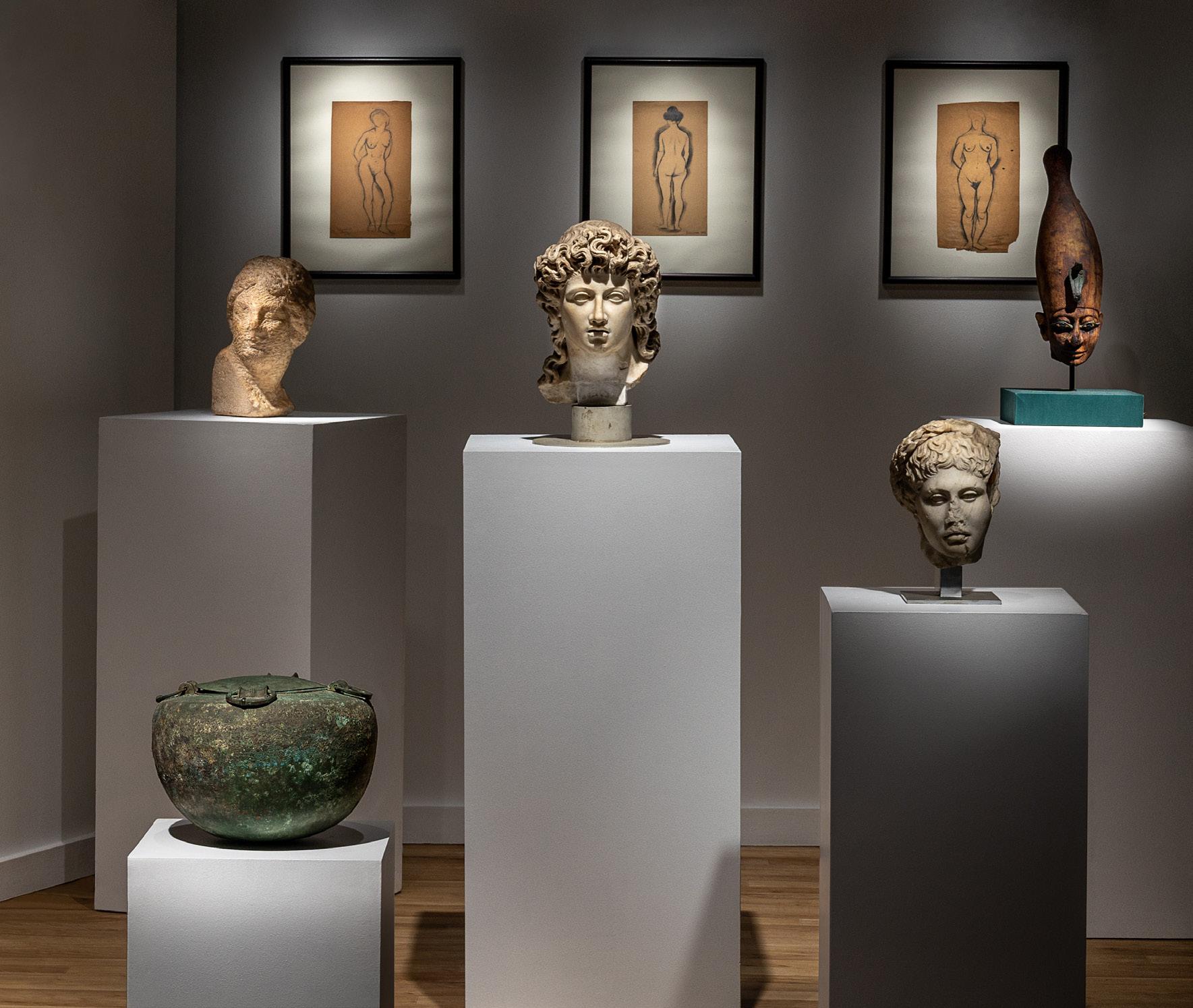
Antiquities from The Brummer Collection that generated intense interest given the impeccable provenance
LEGACY IN CONVERSATION: Aligning Families Around Collections and Tangible Personal Property
BY VAUGHN SMITH BRANDVOLD, ASSOCIATE VICE PRESIDENT, TRUSTS, ESTATES & PRIVATE CLIENTS; OHIO, INDIANA, & KENTUCKY
Collections often represent some of the most personal assets a family owns. Works of art, jewelry, historical manuscripts, and other tangible personal property frequently embody decades of curiosity, travel, and personal identity. These objects reflect not only financial value, but also the life and perspective of the collector who assembled them.
Yet despite their cultural and financial importance, collections are often among the least discussed assets during planning. Financial portfolios are typically reviewed regularly with advisors and structured with clear succession plans. Tangible assets, however, are often left to transition informally. Without early dialogue, families may face complex decisions under time constraints; uncertain about stewardship, philanthropic intent, or whether certain works should remain in the family at all.
Thoughtful conversations during a collector’s lifetime can transform inheritance into stewardship. When beneficiaries understand why a collection was built and what it represents, they are far better equipped to make informed decisions about its future. A painting, sculpture, or manuscript often carries a narrative beyond its market value. Sharing those stories provides context and helps the next generation appreciate both the objects and the legacy they represent.
BEGIN THE CONVERSATION EARLY
One of the most effective ways to prepare the next generation is simply to include them in the story of the collection.
Collectors rarely build collections in isolation. Over time, they develop relationships with museum curators, gallery directors, dealers, scholars, and advisors who help shape their collecting journey. Introducing family members to these trusted experts
can provide valuable insight into the intellectual and cultural landscape surrounding a collection. Simple experiences can make a meaningful difference:
• Attending exhibitions or gallery openings together
• Visiting museum collections or auction previews
• Sharing the story behind meaningful items, artists/ makers, and collection themes
• Discussing how and why certain objects were chosen
• Introducing heirs to the advisors who helped shape the collection
Article continues on the next page
View of Property from the Kay and Fred Krehbiel Collection
These moments transform collections from static objects into shared experiences, helping the next generation understand both the works themselves and the relationships that supported thoughtful collecting.
MAINTAIN CLEAR DOCUMENTATION
Alongside family conversations, maintaining clear documentation is essential. Many families discover that inventories and valuations have not been updated for years, creating uncertainty for both beneficiaries and advisors.
Well-organized records help ensure that collections can be properly understood, insured, located, and incorporated into broader planning strategies. Families should also understand the purpose of each valuation, as appraisal reports may be prepared for different needs such as estate tax reporting, insurance coverage, or charitable planning.
Families should consider maintaining:
• Updated appraisals prepared by a Uniform Standards of Professional Appraisal Practice (USPAP)-compliant appraiser
• A current inventory of objects
• Photographs and condition documentation
• Provenance records and acquisition history
Beyond their practical function, these records help preserve the intellectual history of a collection while providing clarity for future decision-making.
WORK WITH TRUSTED ADVISORS
Collections often intersect with multiple professional disciplines. Effective planning benefits from collaboration among advisors who understand both financial and cultural considerations, including estate planning attorneys, wealth advisors, insurance professionals, philanthropic and cultural advisors, and market specialists.
For many collectors, philanthropy may also play an important role. Some families choose to donate works to museums or cultural institutions, while others direct the proceeds of future sales toward charitable initiatives or foundations. Discussing these possibilities early allows families to align around shared values while preserving the collector’s vision.
Families may also benefit from open conversations about governance. Not all family members will share the same interest in maintaining a collection. Early discussions, guided by trusted advisors, can help determine whether works should remain together, be shared among heirs, donated, or eventually sold.
KEY TAKEAWAYS
• Share the story behind the collection
• Engage beneficiaries early in the collecting experience
• Obtain and maintain updated USPAP-compliant appraisals, clear inventories, and documentation
• Coordinate planning with trusted advisors
Ultimately, planning for the future of a collection is not simply about transferring ownership. It is about preserving the stories, values, and intentions that shaped the collection in the first place.
When approached thoughtfully, these conversations build bridges between generations and families, allowing collections to remain meaningful expressions of legacy and taste while adapting to the priorities of those who will steward them next.
A TRANSATLANTIC VIEW
A VIEW EXTENDING BEYOND THE SHORES OF THE UNITED STATES TO INCLUDE OUR SISTER AUCTION HOUSE IN THE UNITED KINGDOM, LYON & TURNBULL
THE WILTON HOUSE APHRODITE: A RARE IMPERIAL ROMAN PORTRAIT BUST
BY ALEX TWEEDY, CONSULTANT SPECIALIST IN ANTIQUITIES AND AFRICAN & OCEANIC ART
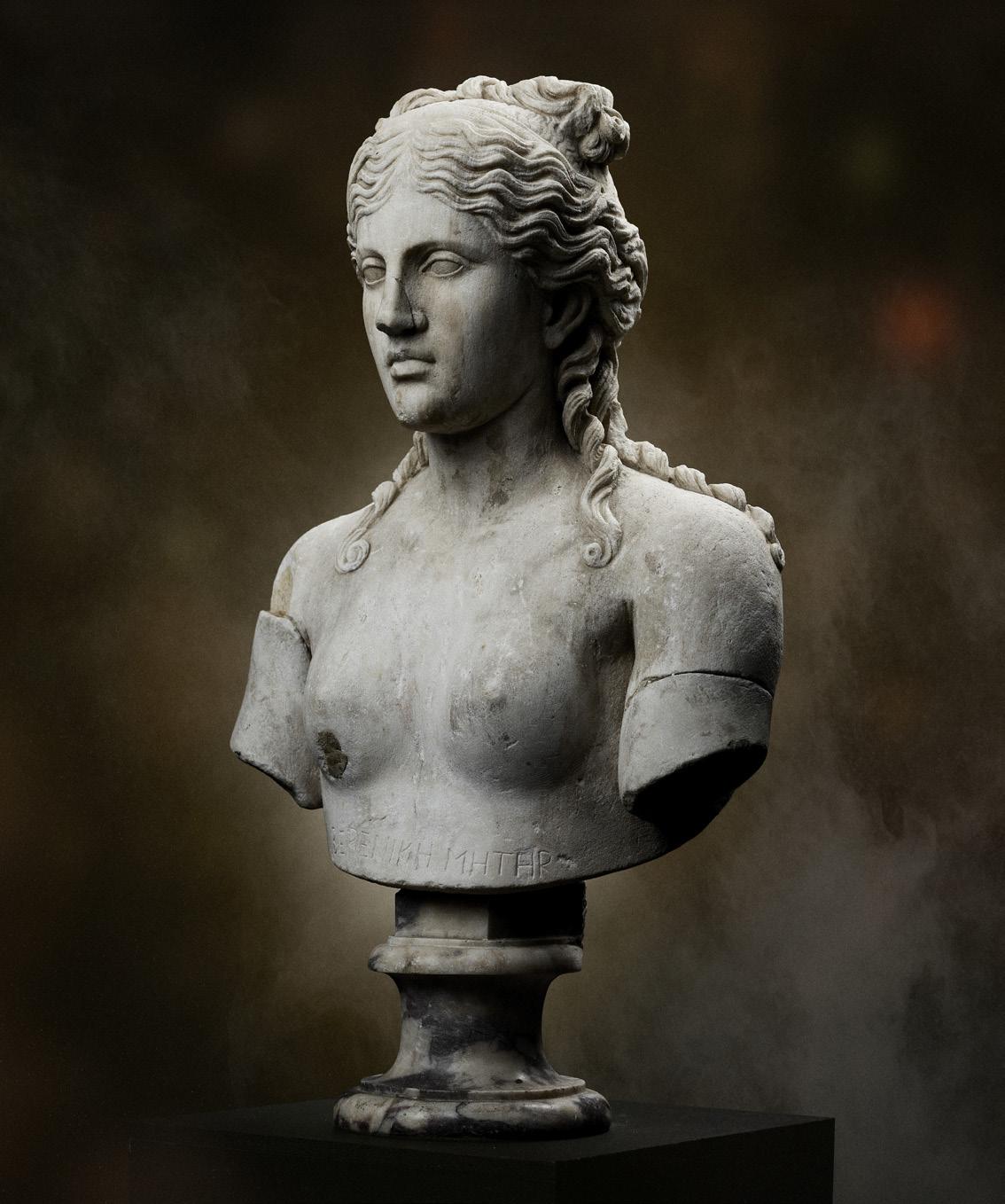
A rare Roman marble bust of Aphrodite dating to the 1st century A.D., formerly in the celebrated collection of Henry Herbert, 10th Earl of Pembroke at Wilton House, will be offered this May by Lyon & Turnbull in Form Through Time, an auction of exceptional antiquities, natural history objects, and works that speak across centuries.
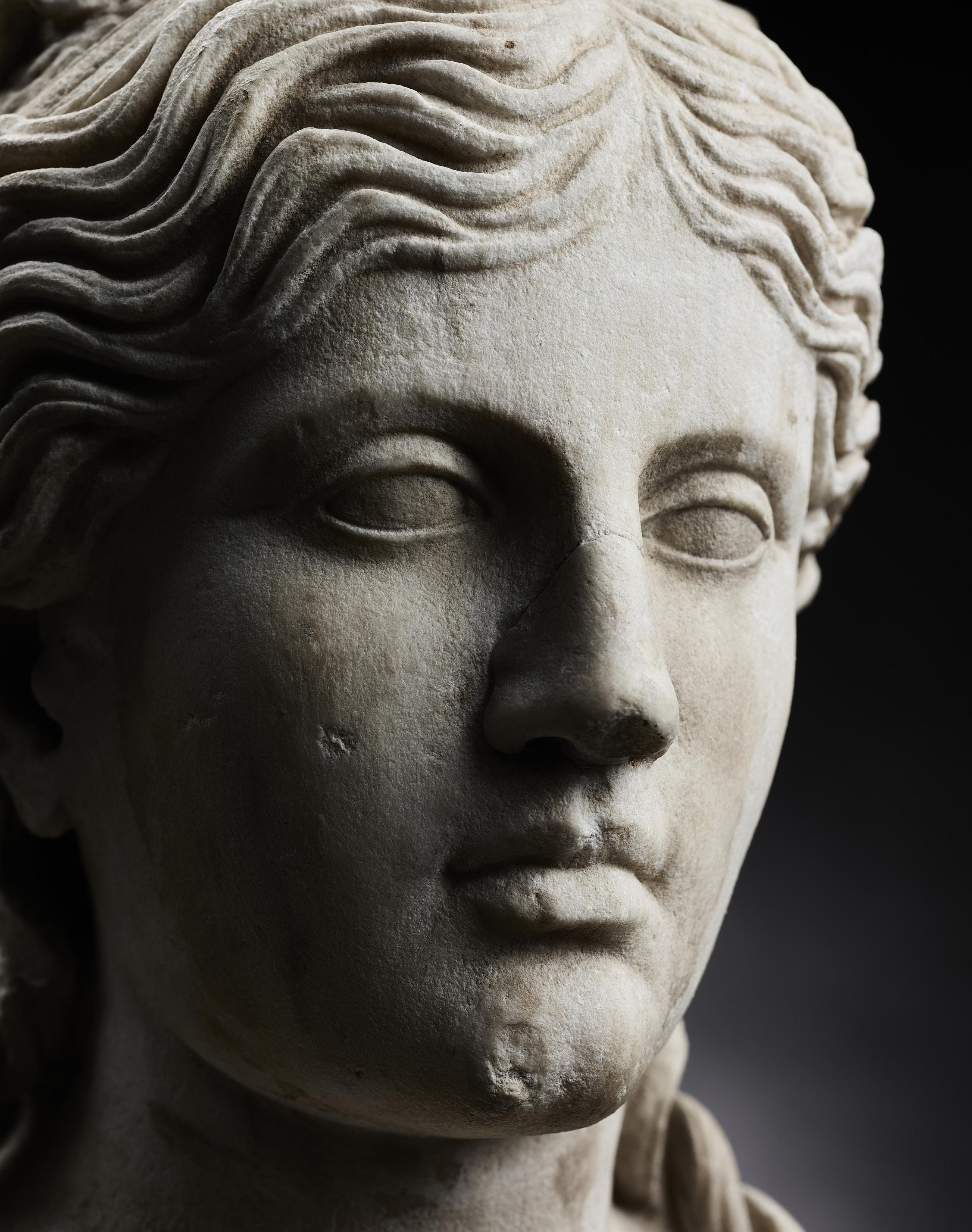
The finely carved sculpture presents the goddess Aphrodite with a composed and introspective gaze directed straight ahead. Her face is softly modelled, framed by gently arched brows, a straight, well-defined nose, and heavy-lidded eyes that convey a serene, idealized calm. The small mouth, with subtly articulated lips, lends the features a restrained sensuality typical of Roman interpretations of earlier Greek prototypes.
The hair is rendered with particular care and sophistication: parted at the center and drawn back in undulating waves that frame the face before being gathered behind the head. Loose strands appear in low relief along the temples, while longer locks descend over the shoulders and contrast with the shorter ringlets carved at the nape of the neck. The sculpture’s elegant balance of naturalism and idealization reflects the aesthetic sensibilities of the early Roman Imperial period.
A DISTINGUISHED ARISTOCRATIC PROVENANCE
The bust is first definitively recorded in the collection of Henry Herbert, 10th Earl of Pembroke by 1751, when it was published in A Description of the Pictures, Statues, Bustos, Basso Relievos, and Other Curiosities at the Earl of Pembroke’s House at Wilton by R. Cowdry. There it was described as “Berenice the Mother; her Hair in a particular Manner.”
The sculpture most likely entered the Wilton collection earlier under Thomas Herbert, 8th Earl of Pembroke, the
Estimate:
noted antiquarian responsible for assembling the majority of the antiquities at Wilton. A closely related bust illustrated in 1724 by the antiquarian William Stukeley in his manuscript catalogue of the Wilton marbles bears striking similarities to the present sculpture, particularly in the refined treatment and arrangement of the hair.
Later references by the scholar Adolf Michaelis in 1882 describe a bust identified as “Poppaea” within the Wilton collection. However, the description does not correspond to the sculpture illustrated by Stukeley. It is therefore most
Article continues on the next page
TO BE OFFERED MAY 28, LONDON
The Wilton House Aphrodite Late 1st – Early 2nd Century A.D. 51cm tall (excl. socle)
£60,000 – 90,000
plausible that Stukeley’s drawing represents the present bust and that the earlier inscription reflects a period misidentification.
Further insight into its early history is provided by a Greek inscription carved on the surface reading “BEPENIKH MHTHR” (“Berenice Mother”). The attribution is erroneous but aligns with the practice of the 8th Earl of Pembroke, who frequently reassigned identities to ancient sculptures in his collection according to his own interpretations. As noted by the scholar Peter Stewart, several inscriptions at Wilton were retrospectively added and, in some cases, so crudely cut that they may have been carved by the Earl himself.
A TESTAMENT TO ROMAN CLASSICISM
Combining refined workmanship with a compelling sense of calm idealization, the bust stands as a distinguished example of Roman portrait sculpture shaped by Classical Greek models. It reflects both the artistic tastes of the early Imperial period and the complex collecting history of one of Britain’s most significant aristocratic collections.
Objects from the Wilton House marbles have since been dispersed across the globe and are now held in major museums and distinguished private collections.
INQUIRES: alex.tweedy@lyonandturnbull.com
AUCTION: Form Through Time, May 28 | London
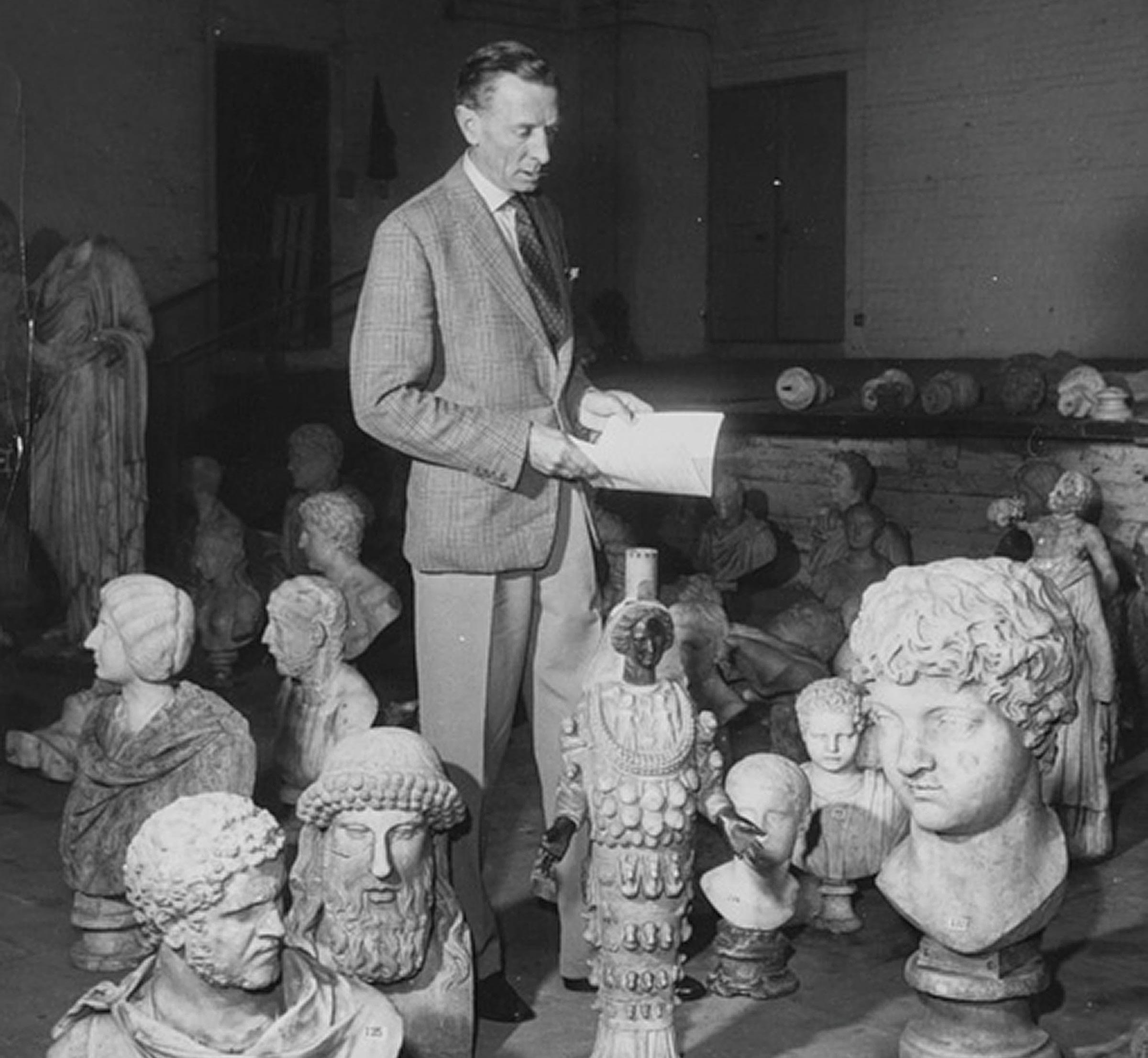
The Earl of Pembroke with his collection, Aphrodite is shown back left Image Chris Ware, Hulton Archive
THE EMOTIONAL PRECISION OF GUSTAVE KLIMT
BY SIMON HUCKER, ASSOCIATE DIRECTOR, SENIOR FINE ART SPECIALIST
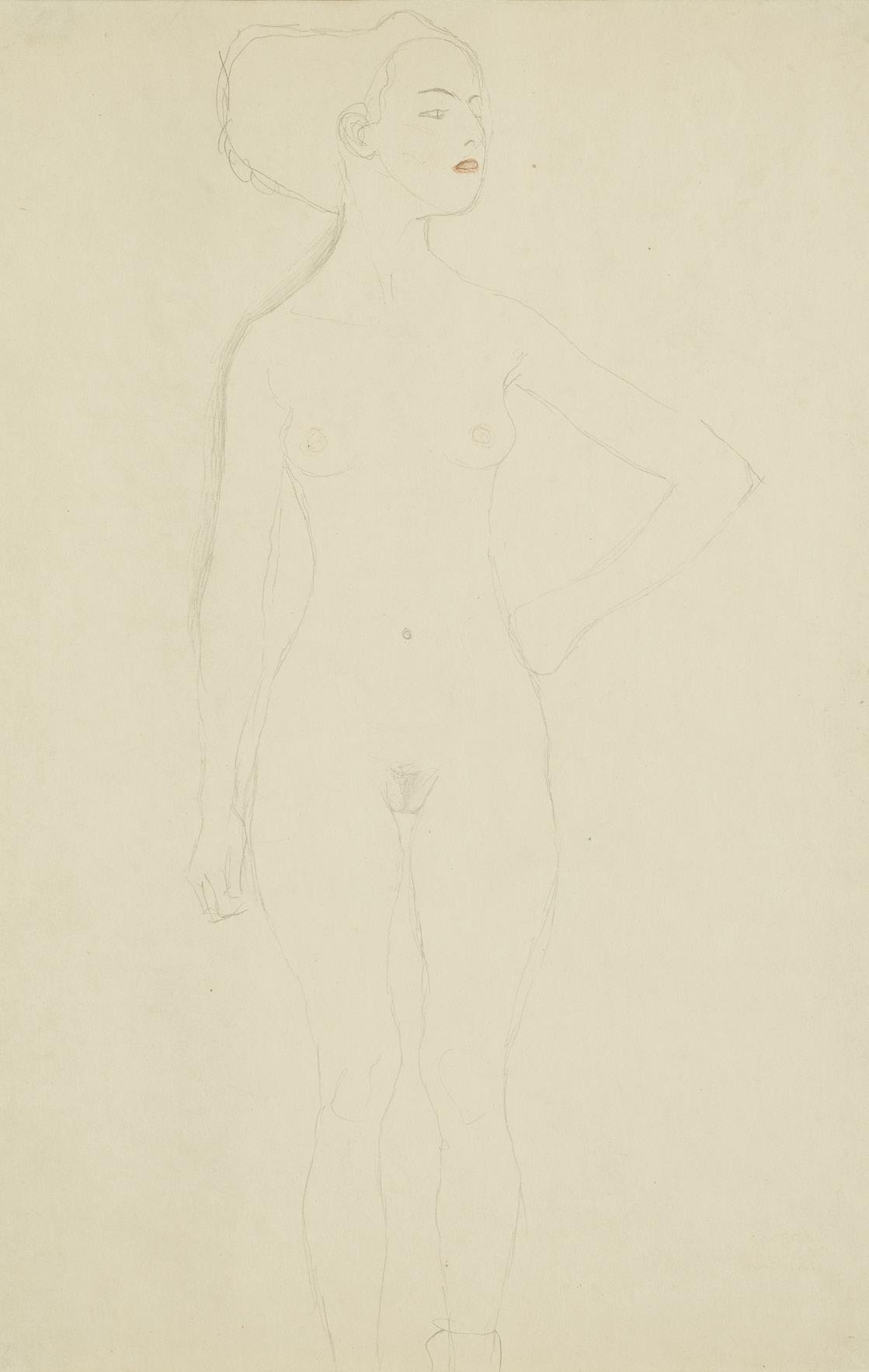
Standing Girl is a classic example of European artist Gustave Klimt’s drawing from the first decade of the 20th century, with its jagged but sure line that captures both the nervous energy of the sitter and the tension between artist and model.
As with his great contemporary, Egon Schiele, Klimt presents the naked rather than the nude, the Academic life class taken out of halls of perfection into the backstreets and garrets where life teems. This sense of being naked rather than nude is accentuated through the red lipstick, a symbol of the worldly, the real. This is no eternal goddess but a real woman. In Standing Girl, the face is beautifully drawn, with an emotional precision, the hair rendered almost as an abstract shape to keep our attention on the eyes and the arch of the eyebrows, the curve of the nose, the set of the chin.
In 1970, this drawing was included in a major exhibition of both Klimt and Matisse’s drawings at the Mathildenhöhe in Darmstadt, itself the architectural embodiment of the mad, syncretic spirit of the Vienna Secession and its dramatic expression of the modern. These two great masters of 20th century art couldn’t be more different. Matisse’s world of calme, luxe et volupté, in particular in his later years, situates modernity ‘elsewhere,’ in a universalist dreamscape of pareddown classicism and Orientalism. The simple as modern. Klimt, on the other hand, situates modernity in the here and now, in complexity, in a lust for life. In Standing Figure our eye is also drawn to the very bottom of the work, to a rolled down stocking or the top of a boot—the hint of the clothed reinforcing her nakedness. Our model doesn’t live in Matisse’s Arcadia. She will get dressed, take her fee, and step out into the streets of the modern world.
INQUIRIES: simon.hucker@lyonandturnbull.com
AUCTION: Modern Made, May 1 | The Mall Galleries, London
TO BE OFFERED MAY 1, LONDON
Gustav Klimt (Austrian 1862-1918)
Standing Girl [Frontal Stehender Mädchenakt, Den Linken Arm in Die Hüfte Gestützt], c.1906-7
pencil and coloured crayon on paper
Estimate: £40,000 – 60,000
A JEWEL IN DISGUISE: LALIQUE’S LIBELLULES BOX EMERGES
BY JOY MCCALL, ASSOCIATE DIRECTOR, SENIOR DESIGN SPECIALIST
TO BE OFFERED APRIL 30, LONDON
René Lalique (1860-1945)
Libellules box designed 1905-7, enamelled metal, stamped LALIQUE
6.3cm high, 17cm wide, 7.7cm deep
Estimate: £60,000 – 80,000
René Lalique designed about 45 metal and enamel boxes from 1890, however it is not known how many were realised and the whereabouts of very few can now be identified. Consequently, it is very rare for an example such as this beautiful Libellules box to appear on the open market.
As an innovator, Lalique had previously employed enameling in his jewelery utilizing its properties to realize his creative visions in a way that others before him had not done. However, his boxes now featured much larger surface areas of enameling—it was used almost like paint. Compositionally, depth was created through overlapping forms, but then surface relief achieved by the layering of enamel in a rich palette of turquoise, green, blue, and purple on to the base metal of the box. The arrangement of the dragonflies headto-head is not quite symmetrical in keeping with the near-mirroring of forms featured in his earlier jewelry of dragonflies, grasshoppers, and scarab beetles.
The subject of the dragonfly is a recurrent one in Lalique’s work, as well as in that of other Art Nouveau designers such as Émile Gallé, Hector Guimard, and Louis Comfort Tiffany. Probably Lalique’s most famous piece of jewelery is the dragonfly brooch, also in the Gulbenkian Museum, designed in 1897-98 and composed of gold, enamel, chrysoprase, chalcedony, moonstones, and diamonds. In place of an insect’s head, it features that of a woman. Dragonflies in Art Nouveau and the associated Symbolist movement were regarded for their natural beauty, curvaceous lines, iridescent coloration, and association with femininity. Simultaneously they were to be feared as sinister predators, femme fatales, and macabre harbingers of death. Underlying all of this is a message of transience and afterlife too.
INQUIRIES: joy.mccall@lyonandturnbull.com
AUCTION: Lalique, April 30 | The Mall Galleries, London
TO BE OFFERED JUNE 4, EDINBURGH
Francis Campbell Boileau Cadell RSA RSW (Scottish 1883-1937)
Interior: The Lady in Black
Signed upper right
Oil on canvas
62.2 x 75cm (24 ½ x 29 ½”)
From a Distinguished Private American Collection
Estimate: £150,000 – 200,000
A CENTURY OF SELLING THE SCOTTISH COLOURISTS 1926-2026
BY ALICE STRANG, ASSOCIATE DIRECTOR, SENIOR FINE ART SPECIALIST
Francis Campbell Boileau Cadell is one of the four artists known as the Scottish Colourists, along with John Duncan Fergusson, George Leslie Hunter, and Samuel John Peploe. They are recognized as the most celebrated Scottish artists of the twentieth-century.
Cadell can be considered the most Scottish of the group. Born in Edinbugh, he trained there as well as in Paris and Munich, and spent most of his life in the Scottish capital. Interior: The Lady in Black dates from the most important and successful period of his career.
The painting depicts the artist’s north-facing studio on the first floor of 6 Ainslie Place, a magnificent townhouse in Edinburgh’s Georgian New Town that Cadell purchased in 1920. It encapsulates the stylish decoration of his home. Signature lilac walls and a highly polished black floor establish the setting, which he animates with carefully arranged elements: a mirror at the upper left reflecting the space, elegant furnishings including a Louis XV-style armchair and pole screen, and curated props such as a blue-and-white coffee set and a ribbon-tied black fan resting on a white tablecloth.
Indeed, Interior: The Lady in Black is a splendid bringing together of many of Cadell’s most celebrated props and motifs, as an interior with his elegant model May Easter at the center of its composition. Throughout, Cadell’s expressive brushwork—which verges on the abstract in some passages—plays upon the canvas as he simplified
form, teased the viewer with hints of description, and used areas of brilliant color to create rhythm across the image. Interior: The Lady in Black was acquired by the present owner in New York in 1966. It epitomizes why Cadell is one of Scotland’s most revered artists, and why his work is so highly sought after for public and private collections alike.
2026 marks a century since Lyon & Turnbull began to sell the work of the Scottish Colourists, starting with a work by Cadell offered on 13 March 1926. Interior: The Lady in Black will be part of a dedicated section of their summer Scottish Paintings & Sculpture auction which will celebrate this auspicious anniversary.
INQUIRIES: alice.strang@lyonandturnbull.com
AUCTION: Scottish Paintings & Sculpture, June 4 | Edinburgh
BE OFFERED APRIL 24, NEW YORK
TO
Andy Warhol (American, 1928-1987)
Grace Kelly, 1984
screenprint in colors on Lenox Museum Board signed and numbered 1/225 in pencil