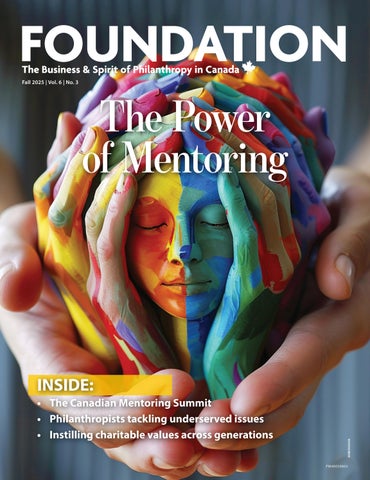
The Power of Mentoring

• The Canadian Mentoring Summit
• Philanthropists tackling underserved issues
• Instilling charitable values across generations


• The Canadian Mentoring Summit
• Philanthropists tackling underserved issues
• Instilling charitable values across generations
Creating a future where opportunities for innovation and transformation are boundless.
It’s possible that mentoring is one of the most important responsibilities that those in leadership roles have. The impact (or absence of) mentoring can be demonstrated at every age and career stage.
A survey of 2,838 young adults conducted by Mentor Canada revealed that:
❯ 44% of young adults in Canada grew up without the support of any mentor.
❯ Deeply entrenched systemic barriers fuel a mentoring gap, particularly for equity-deserving populations. Youth who faced at least one risk factor growing up were twice as likely to report unmet needs for a mentor.
❯ In contrast, mentored young adults were 53% more likely to report good or excellent mental health.
The role that philanthropy plays in mentoring is about more than financial support; it creates community where values drive innovation and foster belonging, all while championing meaningful change. At least, three examples of this are included in this issue:
❯ UHN shares how telesimulation in surgery is allowing surgical mentorship to happen anywhere in the world. When it comes to complex medical procedures, expert guidance is no longer limited by geography;
❯ Soundstreams, a charitable organization founded in 1982, demonstrates how it supports and showcases the arts in Canada by keeping diversity and mentorship central to all activities.
❯ Mentoring also takes on other forms, especially when tackling underserved issues. A profile by Vani Jain, shows how bringing other funders to the table is a priority for family-led philanthropy at The Peterson Foundation and Daymark Foundation.
So, what creates barriers for mentoring? Maybe some leaders aren’t feeling confident in their ability to mentor others, because—as Jenny Mitchell writes—“effective organizational leadership begins with self-leadership.”
Perhaps mentees must also take responsibility for connecting with that right leader who will help them to grow and thrive, as Mark Halpern reflects in his article on the power of mentoring.
There’s no question. Participating in mentoring is a win-win-win proposition for building a sustainable pipeline of next-gen leadership, as an area of personal development and satisfaction and for driving innovation that ensures a more equitable and self-reliant Canada for us all.
Foundation Magazine wants to focus on the big ideas that mean the most to you. What do you want to see more of? Less of? What topics have you been waiting for Foundation Magazine to cover? Do you have recommendations of writers you want to hear more from?
Let’s continue the conversation!
Lisa MacDonald Editor-in-Chief lisa@hilborn.com






Jim Hilborn Publisher
Lisa MacDonald Editor-In-Chief lisa@hilborn.com
Marlena McCarthy Copy Editor
Jasmine Stuart Production Manager
Chris Horne Director of Marketing chris@hilborn.com
Jennifer O’Neill Art Director/Design
CONTRIBUTORS
Paula Attfield
Lawrence Cherney Véronique Church-Duplessis
Mark Halpern Vani Jain
Tony Maiorino
Jenny Mitchell
Jill Nelson
Kathleen A. Provost
Julie Quenneville
Jessica Sims
Marla Smith
SCAN to subscribe
Foundation Magazine is published quarterly by The Hilborn Group.
Foundation Magazine is an independentlyproduced publication not affiliated in any way with any association or organized group. Unsolicited article submissions are welcome. Occasionally Foundation Magazine provides its subscriber mailing list to other companies whose product or service may be of value to readers. If you do not want to receive information this way, email Jasmine@hilborn.com.
PO Box 86, Station C Toronto ON, M6J 3M7 www.charityinfo.ca (416) 554-9403 mary@hilborn.com hilborn-charity-enews



BY DR. VÉRONIQUE CHURCH-DUPLESSIS, AND JESSICA SIMS
The inaugural Canadian Mentoring Summit in Calgary, Alberta, this November, is more than just a conference; it is a milestone event for the Canadian mentoring field. Uniting a diverse network of mentoring leaders, practitioners, researchers, and policymakers, the Summit provides an unparalleled opportunity to address a critical national challenge: Canada’s mentoring gap.
Mentor Canada’s foundational “Mapping the Mentoring Gap” study, based on a survey of 2,838 young adults aged 18 to 30, revealed that 44% of young adults in Canada grew up without the support of any mentor. More importantly, 54% of all survey respondents recalled a time when they wished they had access to one but did not. This includes 62% of youth who already had at least one mentor.
This data strongly suggests that the mentoring gap is not just about a lack of a single mentor; it is about the need for multiple, evolving, supportive relationships throughout childhood and adolescence and into adulthood. The Summit serves as the nexus for developing evidence-based strategies and crosssectoral partnerships needed to bridge this gap.
A core message from the research is the profound, lasting influence that mentoring has on young people’s lives. The study confirmed a clear statistical association between access to mentoring and a wide range of positive outcomes in early adulthood.
Mentored young adults were significantly more likely to report positive outcomes compared to their non-mentored peers:
❯ Mental Health and Well-being: They were 53% more likely to report good or excellent mental health.
❯ Educational Attainment: They were over twice as likely to have completed high school. They were also 95% more likely to have pursued further education after high school.
❯ Social Capital and Community: They were over two times more likely to report a very or somewhat strong sense of belonging to their local community.
Beyond these outcomes, mentored youth showed continued commitment to the movement, being more than twice as likely to have already served and be interested in serving as a mentor themselves compared to non-mentored youth.
The Summit is designed to address the deeply entrenched systemic barriers that fuel the mentoring gap, particularly for equity-deserving populations. The research illuminated where the greatest needs and disparities lie:
❯ Higher Need, High Demand: Youth who faced at least one risk factor growing up were twice as likely to report unmet needs for a mentor than youth who did not experience risk factors. Similarly, youth with a disability

were almost three times more likely to report unmet needs compared to youth without a disability.
❯ Reaching Vulnerable Youth: Formal programs demonstrate success in reaching these groups, with youth facing risk factors being twice as likely to have a formal mentor compared to youth who did not. Indigenous youth were also twice as likely to have access to a formal mentor compared to nonIndigenous youth. This data confirms that targeted interventions are reaching those who can benefit the most, but the demand greatly outstrips the supply, leading to high unmet needs.
❯ Barriers to Access: The single most common barrier to accessing a mentor was not knowing how to find one. Closely following was not understanding what mentoring was or its value. This highlights a national need for clarity and visibility in the mentoring field.
The Summit’s dedication to inclusive mentorship is vital in this context and will launch new Canadian research on racialized young adults and mentoring, bringing forward solutions that focus on youth-initiated mentoring, social capital, and culturally relevant practices—which are essential when addressing the lived experiences of racism and intergenerational trauma.
The study validates the central role of both informal connections and intentional programming:
Building national capacity: The cross-sectoral imperative To close the gap where over half of young people wish they had more mentorship, the focus shifts to national capacity building through cross-sectoral collaboration.
❯ Informal is key: The most meaningful mentor reported was often an informal or natural mentor (80% of the time), most frequently a teacher, other school staff, or family friend.
❯ Formal mentoring as the connector: While informal
mentors are prevalent, formal programs are positioned to strengthen a young person’s overall network. Youth reported that formal mentors were more likely than mentors overall to help them connect to other services and/or supports (55%), connect to their culture (49%), and attend community events or offerings (47%). Formal mentors act as vital connectors, strengthening the mentee’s overall ecosystem of supportive relationships and social capital.
The Canadian Mentoring Summit, featuring leading mentoring researchers from across Canada and North America, and partners like the Social Research and Demonstration Corporation, the Canadian Centre for Mentoring Research and the Students Commission Canada, is leveraging these insights to integrate mentoring more effectively into the youth employment ecosystem, ensuring that young Canadians have the supports they need to engage and succeed in the workforce. By bringing together the best in research and practice, the field is positioning itself to deliver intentional, quality, and multiple supports—the kind of relationships youth actually need and want—to all young Canadians.

To learn more about the Canadian Mentoring Summit and to register, click here.
Mentor Canada is the only national registered charity dedicated to supporting and building capacity for mentoring across the country, linking programs and initiatives to a comprehensive portfolio of leading-edge mentoring resources, research, training, and networking opportunities.
VÉRONIQUE CHURCH-DUPLESSIS,
Senior Director, Research and Impact. Véronique conducts vital research that illuminates realities, obstacles, and opportunities for mentoring in Canada. Her work enables practitioners to make informed decisions and Mentor Canada to deliver much-needed solutions that link research to practice. Committed to making research actionable, she helped create the Canadian Centre for Mentoring Research to facilitate exchanges between academics and practitioners. Véronique’s past studies and professional experiences centred on the development of modern gender norms, gender-based violence prevention, and healthy relationships for teens. veronique.church-duplessis@mentorcanada.ca
JESSICA SIMS, Marketing & Communications Strategist, Digital Content. A compelling storyteller in both official languages, Jessica is passionate about highlighting the human side of mentoring, engaging diverse audiences in recognizing why Canada needs a stronger mentoring field where no one is ever denied access to a mentor. A true digital native, Jessica loves weaving words and visuals into high-impact, relatable web and social media content. Daily, she channels her creativity, marketing experience and consummate organizational skills to propel Mentor Canada’s mission forward. jessica.sims@mentorcanada.ca
All Canadian nonprofits and charities with at least 10 employees are eligible to participate and the program is held annually to support a continuous improvement model for your organization.
“We highly recommend the NEOC program for the insights it can o er to nonprofits!”
CMHA York Region and South Simcoe
“This included an anonymous online employee survey done by NEOC, which gathered more and higher quality responses than the in-house surveys we did in the past.”
UNICEF Canada
“NEOC allows small organizations like ours to participate.”
Alberta Retired Teachers Association
Learn more about the Canadian Nonprofit Employer of Choice Award neoc.ca/overview






BY VANI JAIN
When the Peterson family started funding mental health and wellness in 2017, it seemed only natural to them that substance use and harm reduction would be part of this work. Yet, over time, they realized there was a significant gap in private philanthropy supporting substance use health—despite a growing need in this area and the strong link between mental health and substance use.
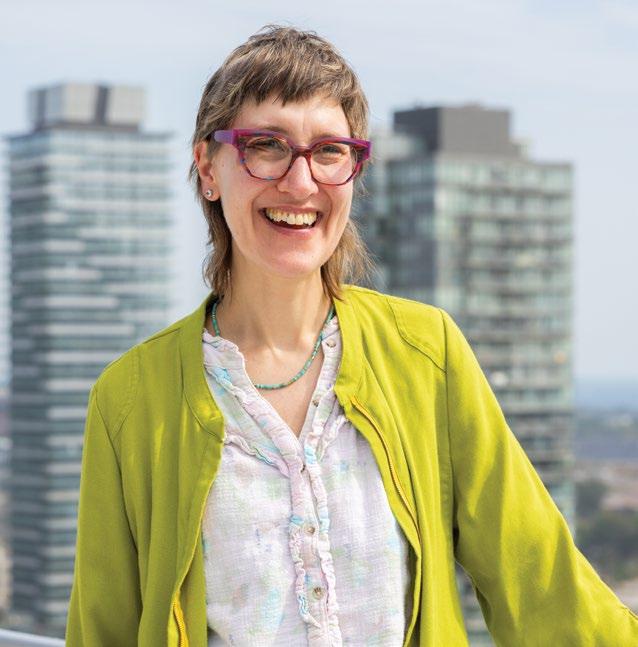
Kathryn Peterson has been leading her family’s foundation as Executive Director since 2017. As a self-described “feeler” who was drawn to this work due to her strong desire to help others, seeing people suffer due to stigma and barriers while also seeing an absence of funders was disappointing. “It’s really unfortunate that people’s needs aren’t being met, and in this case, people are dying at a critical rate. It’s just really sad that there are still so few funders intentionally supporting the space.”

The Peterson Foundation aren’t the only ones who have taken on an underserved issue.
Like the Petersons, the Michael McCain family’s philanthropic work has been directed to gaps in mental health funding. Lauren Jones-Davies, Michael’s daughter and the Executive Chair of the Daymark Foundation, describes her family’s early exploratory efforts as an attempt to find an overlap between the “white space” in mental health funding and the areas that pulled on their heart strings. “Like all families, we have experienced our share of mental health challenges, and we know how difficult it is to access care. We chose to
focus on women’s mental health and bipolar disorder because they are overlooked, underresearched and under-funded.”
Working on an underserved issue has a lot of benefits, according to Peterson and Jones-Davies. “It is hugely exciting to see the opportunity for real change in issue areas that we feel the impact of day in and day out,” says Jones-Davies. Indeed, whereas in some issue areas one might feel that their philanthropic contribution is a drop in the ocean, by focusing on “white space,” the Daymark Foundation is able to outsize their impact.
For Kathryn Peterson, the best thing about working on an overlooked issue is the opportunity to get meaningfully involved. “I like to roll up my sleeves and help out however I can—whatever that means to those in the substance—use space.” Without question, in these sparsely-funded areas, there is no dearth of roles that a funder could take on. Kathryn regularly checks in with grantees and tries to help them in large and small ways. She has also convened grantees and other stakeholders for conversations about system-level needs, with a commitment to funding these solutions.
Looking to lend your support to one of the issues discussed in this article?
Explore and learn more:
Substance Use & Harm Reduction: Thunderbird Partnership Foundation
Moms Stop the Harm CAPSA (Community Addictions
Peer Support Association) Centre on Drug Policy Evaluation (CDPE)
Convening is a role that the Daymark Foundation has taken on as well, with great results. For example, in women’s mental health, Daymark has chosen to focus specifically on perinatal mental health—that is, the mental health of a mother during pregnancy and postpartum. As a lone funder in this space, Daymark has taken it upon itself to bring stakeholders together for learning, connection and brainstorming. “At our first Perinatal Mental Health Symposium in 2023, we were shocked to hear that this was the first time that many of the long-time players in this space had ever been together face-to-face,” says Jones-Davies. “The passion and excitement in the room were palpable, as was the commitment to working together to solve the problem.”
Perinatal Mental Health: Mino Care
Life With a Baby
Bipolar Disorder: CREST.BD Relief
Of course, working in areas with limited philanthropic support comes with challenges as well.
For Kathryn, the lack of flexible philanthropic funding in the area of substance use and harm reduction is devastating and they alone, can only do so much. Kathryn recounts a metaphorical story she’d heard about a forest being on fire. Some people choose to escape, others look to the government to address the issue, and a small handful stay and fight the fire themselves. First, they use a bucket. Then when the bucket breaks, they’ll use a cup, and if the cups breaks, they use a teaspoon. “The worst
thing about being a funder in an underserved space like substance use is feeling stuck with a teaspoon. But a teaspoon is better than nothing, right?”
For both the Peterson and Daymark Foundations, bringing other funders to the table is a key priority.
In the case of substance use and harm reduction, recent government policy changes and funding cuts have created a desperate need for private funding sources. In response, the Peterson Foundation is helping to convene a funding table made up of philanthropic funders and community leaders to inform how private funding could be deployed on this topic for maximum impact.
In addition to exploring government funding collaborations, the Daymark Foundation has also made a concerted effort to educate private funders about the value of working in this space. “A mother’s mental health is the leading determinant of a child’s mental and physical health throughout their life course. Addressing this earliest form of mental health challenges is the real answer to shifting broader populationlevel mental health outcomes.” These objective proof points have helped Daymark bring other funders into the fold, including those focused on women’s health, early child development, and youth mental health.
At the end of the day, both Peterson and Jones-Davies feel fortunate to be able to spend their time working on these issues. As Lauren puts it, “I grew up with the immense privilege of being surrounded by people who have a fire in their belly for social change. It’s been a huge honour to be able to play this role in our family’s ecosystem.”
When Kathryn’s youngest son started school, she was at first nervous about getting back into the working world. When her parents offered her the opportunity to lead their family’s philanthropy, she felt like she had found her calling. Kathryn had always been sensitive and empathetic— traits that contributed to her own experience with mental health and substance use challenges. She discovered that working in philanthropy soon became not just a selfless thing she wanted to do, but something that drew upon her character traits as strengths. “This is something I can do that’s impactful. It’s created a lot of meaning in my life.”
VANI JAIN is the CEO of Catalyst Philanthropy, a social impact consultancy dedicated to maximizing philanthropic giving. Vani has had the good fortune of working with the Peterson Foundation as a client, and as the Founding Executive Director of the Daymark Foundation.

BY JENNY MITCHELL, ACC, DMA
Alfred Adler was the “other psychologist” of the 20th century, a former colleague of Freud and Jung. Adler’s research centred on the social aspects of human beings. He famously said, “All problems are interpersonal relationship problems.”
Adler’s model maps well to the not-for-profit world. He believed that humans are fundamentally social beings, motivated by a deep need for belonging and significance. The central concept of his theory is social interest: the innate desire of humans to connect, cooperate, and contribute to the well-being of others.
In today’s hybrid workspace, where leaders are tasked with building trust through a computer screen, the precious few faceto-face connection points become more important than ever. This article will explore how Adlerian principles can help today’s philanthropic leaders achieve systemic, sustainable impact.
“All problems are interpersonal problems”
Most of the difficulties people experience in life are rooted in their relationships with other people—how they relate, communicate, and perceive themselves within groups and society.
Effective organizational leadership begins with self-leadership. This practice begins with cultivating an acute awareness of one’s own motivations, unconscious biases, and habitual assumptions, and recognizing how these internal drivers shape interactions and decision-making. Leaders must create space to slow down, and critically examine their emotional responses and behaviours toward colleagues and stakeholders. This process might lead you to internal exploration, like these examples:
❯ I am reluctant to trust this person. Why is that?
❯ Suzie has missed four of the five deadlines I have set for
her. Where are my fingerprints in this situation?
❯ When I think of my senior leadership team, who challenges me the most? What is it about their approach that triggers me?
Self-leadership begins with the acknowledgement that “What got you here won’t get you there.” (Thank you, Marshall Goldsmith!). An individual’s skills are the starting point of a great leader, not the finish line.
The next evolution of leadership ascends into the interpersonal, the political, and the nuanced. Interpersonal challenges are never one-sided. Reactive tendencies and patterns from childhood will continue to exist until leaders are ready to unpack them and set free those unhelpful and learned behaviours. Left unaddressed, leaders continue to bring their 5-year-old baggage into the boardroom where they act out their 5-year-old personalities and habits. Without the awareness to notice their patterns, leaders will continue to behave in the same way without growth or experimentation. When you know better, you do better.
Curiosity is a powerful tool. It is available to you whether you are attending a Teams meeting online or sitting across from someone. Leaders who notice their own triggers can explore these unconscious feelings, bring them out in the open and decide for themselves if they are helpful to their future leadership.
Adlerian leadership moves away from hierarchical, top-down management to a more egalitarian approach, where everyone’s contributions are valued. Modern not-for-profit leaders have traditionally shied away from autocratic leadership styles,
preferring servant leadership or participatory leadership.
In the post-pandemic era—where real challenges exist to building community and cohesive teams at work—leaders must take the time to see, hear, and understand staff members. Dignity and respect, alongside kindness and firmness, will both inspire and hold teams accountable. Consider this way of thinking:
❯ What is this staff member seeking when he brings his agenda to our one-on-one meetings?
❯ How can I ensure that all voices are heard and valued in group meetings?
Another example finds a senior leader spending a lot of time talking with younger staff about aspects of their job. At the surface, it may sound like conversations about the tasks at hand, and how the organization runs. But under the surface, at the level of connection and meaningfulness, the younger staff member is asking, “Do you see me? Are you the kind of person whom I can trust and work hard for?” Rather than the senior leader seeing these conversations as a waste of time, and eroding productivity, he or she can reframe these discussions as an investment in each other’s relationship bank, setting up the younger staff for future successes.
Creating the climate of mutual respect—rather than authority or dominance—strengthens both individual growth and the collective good.
Like the impact of a motorboat on the shoreline, the ripple effect caused by a leader’s “wake” is felt by everyone in the room. Leaders must take responsibility for this by making space for other voices. A culture where dialogue and discussion is encouraged ensures that the best solution is uncovered. A leader asks open-ended questions like these, listening for meaning underneath words, and considering what other factors might be at play:
❯ Great point. What other options might we have not yet considered?
❯ I want to be sure to hear everyone’s thoughts on this before we make a decision.
❯ Are we in a place where we can move forward?
Within the parameters of the Adler framework, humans at work are just, well, humans! They act out their preconditioned social networks that they have been learning since birth. And they will continue to follow these behaviours until a curious leader interrupts and asks them about it. The courage to ask about the person, and not just the task, is the role of the modern leader.
Adler’s research lens focused on social interest, equality and encouragement. Mistakes are reframed as learning opportunities, and encouragement is more effective than criticism for developing others.
Taking a “coach” approach to leadership involves noticing themes, patterns and habits:
❯ I notice that when we come into our bi-weekly meetings, you have a long list of items, and we rarely get through all of them. How does that affect your ability to feel that you can accomplish everything you set out to do? Does this happen in any of your other meetings?
❯ May I offer an observation? You are quiet in team meetings. I’d love to hear more of your thoughts, and I am certain the team would benefit from your insights, too.
By acknowledging our socialness as humans, we can move past the “Zoom link happy hour team events” and start reconnecting as humans. The greatest human need is to feel seen, heard and valued. This looks different for everyone: an acknowledgement of the death of a favourite pet, a generous word on a job well done, a curious question to see if feedback is welcome after a key presentation. For Adler, change comes from encouraging personal growth and contribution to society. Taking the time for fact-tofact moments inside the cadence of online meetings is important. Zoom meetings have make work all business and no play. Inperson team events and taking the time to connect at the office are essential components of a socially aware leader’s toolkit.
Growth is not just an opportunity for a leader. It is an imperative. Whether this learning comes from books, or from coaching, or leadership training, adding to the toolkit of leadership is fundamental. Hybrid workspaces, global uncertainty and generalized loneliness mean that workers are feeling deeply disconnected from each other, and their leaders.
Being part of the development of others starts with developing yourself first. Staying curious and constantly considering “what else?” helps leaders to creatively seek out potential, rather than bowing to the tendency to be reactive.
In today’s times of fast-paced change and disruption, embracing and fostering true connections between humans in the workplace is not just important, for leaders, it is imperative.
JENNY MITCHELL is an executive coach, author, and professional fundraiser who is on a mission to help people master meaningful conversations. As founder of Chavender, Jenny has worked with hundreds of organizations across North America, empowering leaders to inspire their teams and donors for lasting impact. A sought-after keynote speaker and author of the leadership book Embracing Ambition, she brings her creativity, insight, and passion for excellence to the not-for-profit world. chavender.com
1. See the person in front of you
2. Be internally curious
3. Notice your “wake” in meetings and interactions
4. Offer coaching observations to others without judgment
5. Slow down now so that you can move faster later
To learn more about Alfred Adler and his work, read his Understanding Human Nature published in 1927.

BY LAWRENCE CHERNEY
Whether you’re a leader in the arts, an artist, a donor, or a lover of arts in any form, you know the arts matter to Canadians. According to the Canada Council, the arts make three impressive contributions: build the economy, express uniquely Canadian experiences, and improve quality of life and well-being.
Arts and culture leaders need to constantly communicate this importance to government decision-makers, potential sponsors, donors, community leaders and audiences.
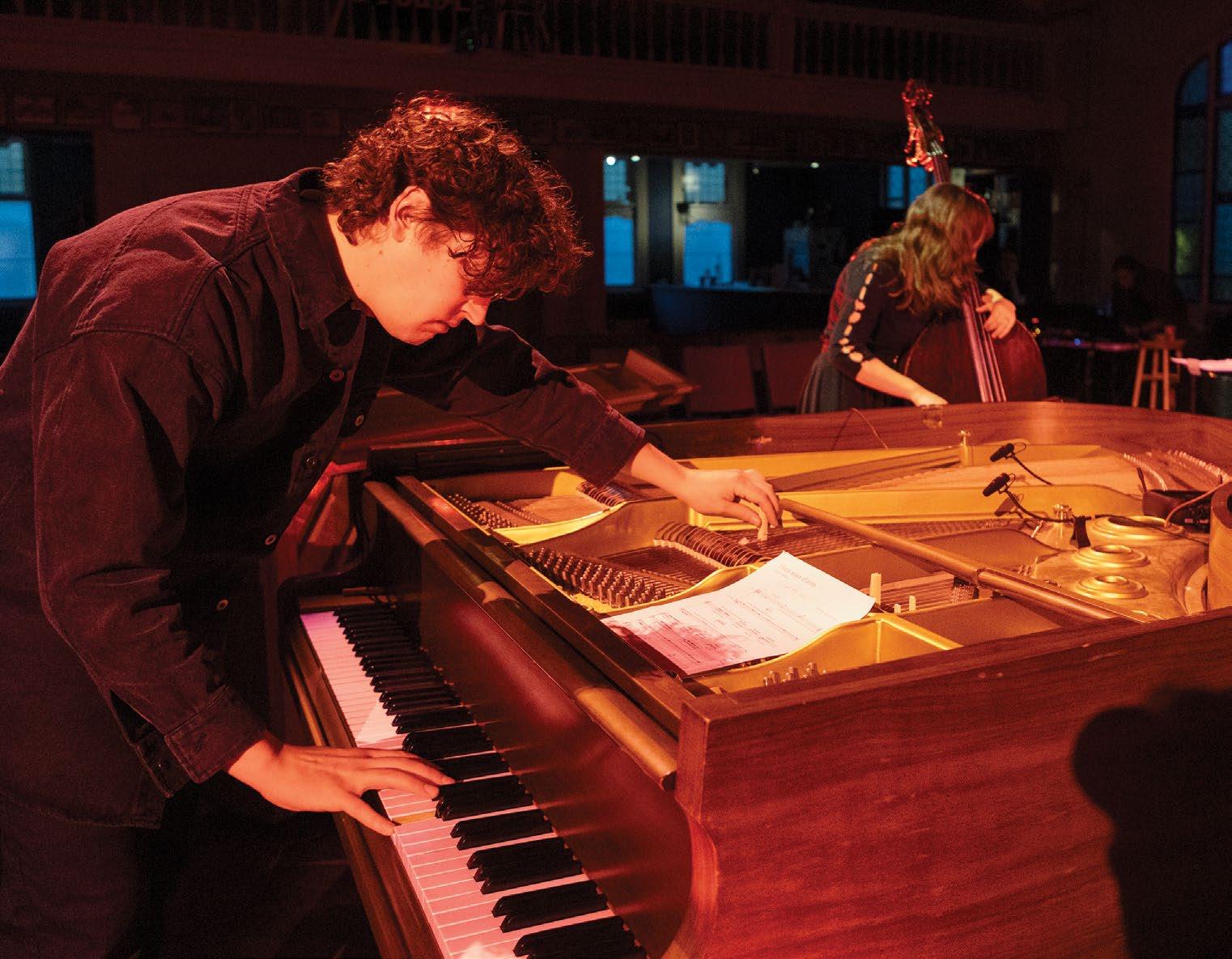
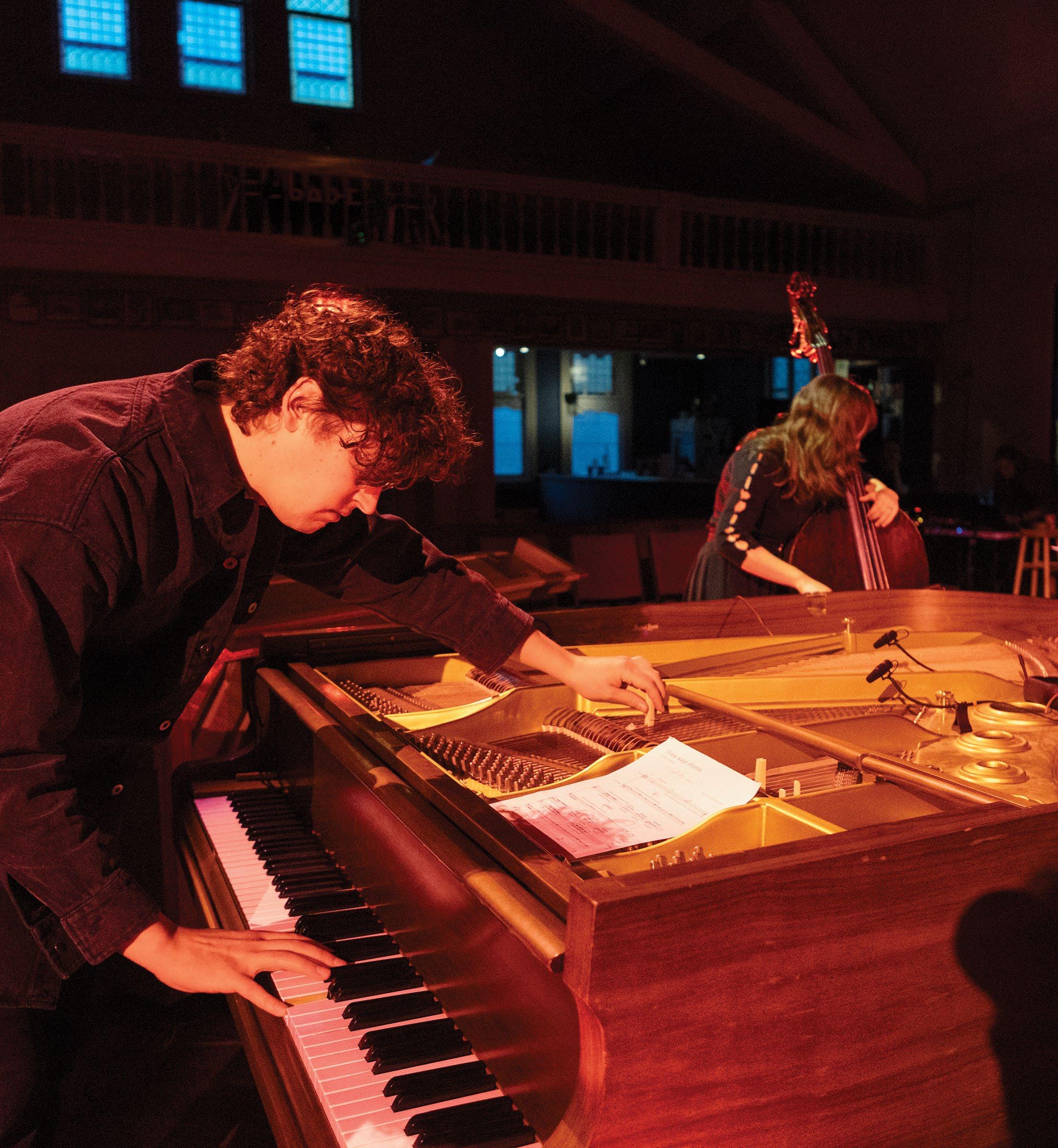
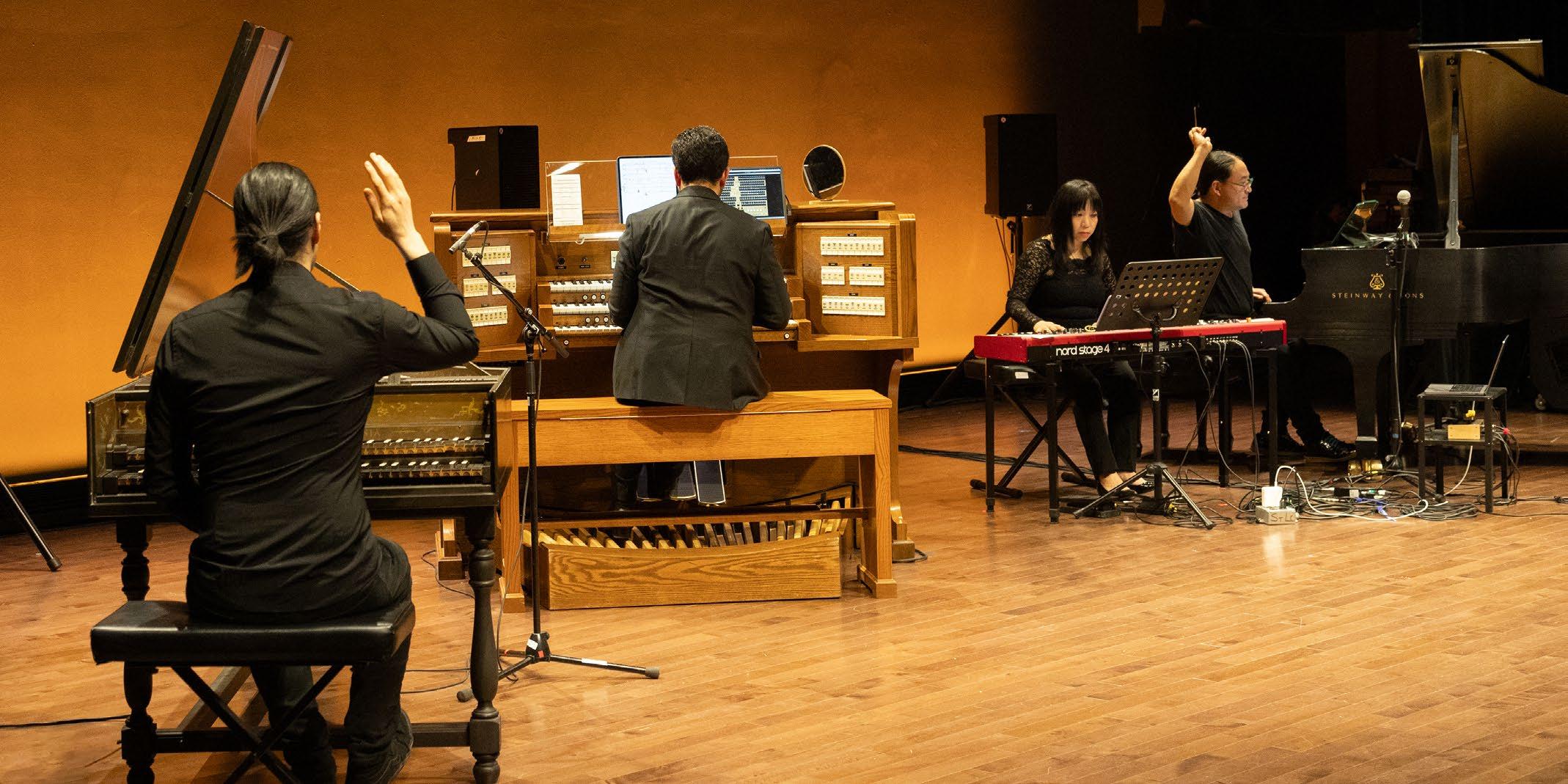
Soundstreams was founded as a charitable organization in 1982 with the goal of showcasing Canadian musicians and composers who fundamentally transform the way we hear our world. We have over 40 years of experience in the development and curation of new music, cultivating meaningful artistic and development relationships along the way. We’ve probed compelling Canadian themes and stories through new works in music and music theatre that resonate with our audiences, reflecting the times we live in, and where they live.
Year after year, diversity and mentorship remain central to our activities, enabling artists to create work that challenges norms and broadens perspectives. For audiences, this work offers access to a richer, more inclusive cultural narrative that reflects the complexity of our world. For donors, it allows for meaningful cultural engagement and impact.
This way of working resonates far beyond our own borders; our work is now sought after by the world’s most prestigious festivals and venues, including London’s Southbank Centre. One of our recently commissioned and produced works shed light on under-represented voices. Two Odysseys: Pimooteewin/Gállábártnit was the first-ever opera written in the Indigenous languages of Cree and Sámi.
We truly believe that our unique forms of mentorship and curation have been central to our success and relevance. Following are two major examples.
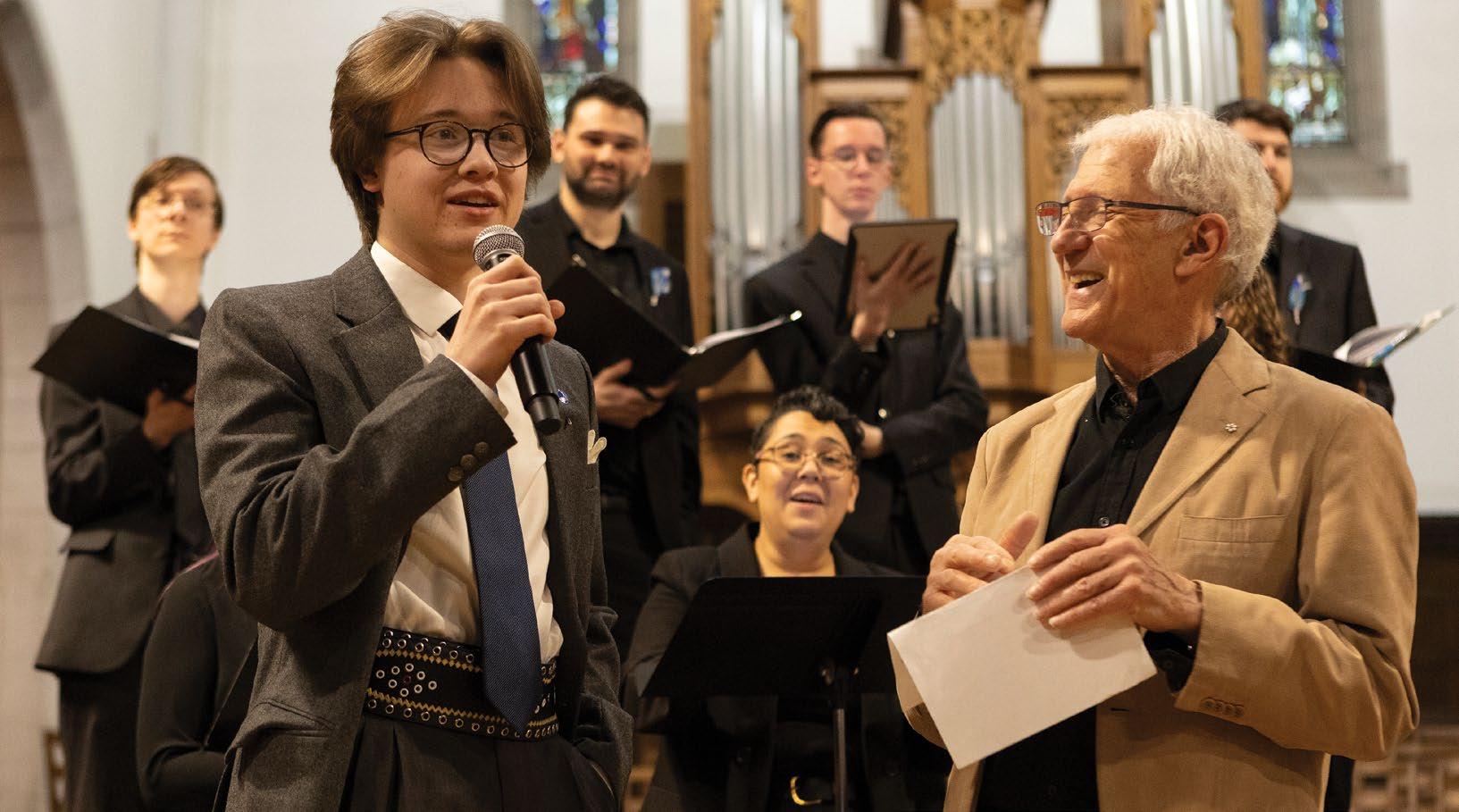
Bridges emerging composers program Bridges helps talented emerging national and international composers launch their careers. This week-long program is designed to further their professional development and equip them with the skills, networks, and mentorship needed to support their careers. It offers a unique combination of technical guidance, collaborative engagement, and individualized support. For example, this past season, musical composers benefited immensely from working with acclaimed composer Tarik O’Regan, whose mentorship style was approachable, insightful, and tailored to each composer’s distinct writing style and background. He fostered an environment of open dialogue and mutual respect, encouraging the composers to explore their own creative paths while offering expert guidance grounded in real-world industry experience.
The Bridges program is particularly effective in creating a sense of artistic community among the participants—fostering relationships that are likely to extend well beyond the program itself. For many participants, the experience was described as a pivotal moment in their artistic growth—one that affirmed their creative instincts and offered a meaningful pathway forward in their careers.
This notion of artistic community extends beyond the actual participants, bringing into its scope our audience and donor base. Each year, this program offers a public masterclass
that provides a rare glimpse into the rehearsal process and the collaborative relationship between musicians and composers as they work together to create a world premiere work. Audience members and donors appreciate a glimpse into the creative process, and the chance to meet artists on the cusp of renown.
Canadian composer Cecilia Livingston is a notable alumna of this program who has gone on to become a composer-in-residence at the Canadian Opera Company. One of this year’s international Bridges composers, Josema García Hormigo, was awarded First Prize and Gold Medal at the 2025 Rachmaninoff International Competition. These are powerful examples of the impact that Soundstreams has on emerging composers, and the national and international scope of the Bridges program.
New voices curator mentorship program
New Voices provides opportunities for emerging artists and arts professionals to curate largerscale productions, and to gain experience in the production and presentation of new music within a mid-size performing arts company. This is the only program of its kind in Canada, and another way that we build discovery into our offerings for donors and audiences.
For example, as a socializing and networking opportunity, Bridges and New Voices alumni were invited to a recent Bridges performance featuring the touring Vancouver Chamber
Choir, as well as the reception that followed the concert, giving our current cohort the opportunity to mingle with past professional development program participants. Our alumni were also invited to the 2025 New Voices concert, and the reception that followed. Our goal is to increase events where alumni, current, and upcoming participants can mingle freely, continuing to build this community fostered by Soundstreams.
Beyond these two programs, our free annual TD Encounters program allows a broad community of music lovers to discover new music through accessible outreach and education programs featuring performances, discussions, and audience participation.
Soundstreams believes that philanthropy is about more than financial support; it’s about joining a community that believes in the transformative power of new Canadian music. We offer our donors a chance to shape the future of music in Canada by directly supporting mentorship and exciting emerging composers, and the diversity of Canadian voices.
Our supporters share a common passion: ensuring that artists and audiences alike continue to discover fresh perspectives through sound. They are drawn to Soundstreams because we do things differently. We pair emerging talent with world-class
mentors, premiere their works in major venues, and create opportunities for donors to engage in conversations with composers and their artistic interpreters through pre- and postshow gatherings, salon-style fundraisers and donor appreciation events, and backstage access to the rehearsal process.
This approach resonates because it turns support into participation. Donors sustain concert programming by building meaningful relationships that can span decades. They help to grow a community where curiosity, imagination, and artistry thrive. In this way, values-driven philanthropy fuels mentorship, fosters belonging, and secures the future and legacy of new music in Canada.
The 2025-26 Soundstreams season in Toronto kicks off with the first of its free Encounters concerts October 28, and main stage concert Mass for the Endangered on November 22. Visit Soundstreams.ca to learn more.
LAWRENCE CHERNEY, Founding Artistic Director, Soundstreams - Lawrence began his career as an oboist, performing under the direction of Igor Stravinsky, and went on to achieve international distinction, commissioning over 150 works and touring worldwide. In 1982, he founded Soundstreams, where for more than four decades he has championed Canadian and global new music. Often called Canada’s “Ambassador of New Music,” Lawrence has led Soundstreams to become one of the world’s leading contemporary music organizations. His honours include the Order of Canada, and a Lifetime Achievement Award from the Toronto Musicians’ Association.
BY PAULA ATTFIELD
Leadership in fundraising has always been more than setting a vision and raising money. The best leaders inspire, guide, and develop the next generation of talent. But in today’s world—marked by digital acceleration, economic uncertainty, and increasing expectations of transparency— leadership also means mentoring teams to use data and digital tools with confidence and clarity.
Fundraisers have long balanced instinct with insight. Today, with powerful analytics at our fingertips, it’s not about replacing instinct; it’s about enriching it with evidence that sharpens strategy and deepens donor connections. Donors are asking harder questions. Boards expect measurable outcomes. And fundraising teams, especially younger professionals, are eager for coaching that connects numbers to insights. To help these younger professionals thrive, leaders must pair traditional mentorship, share wisdom, values, and encouragement with the ability to help others navigate analytics, KPIs, and digital trends.
The few face of fundraising leadership
A generation ago, strong fundraising leadership often meant being the best “closer”, namely the person who could inspire a room, land the big gift, or drive a campaign over the finish line. Those qualities are still essential, but they’re no longer enough. Today’s fundraising leaders must also be translators: taking complex data, emerging digital strategies, and shifting donor behaviours—and making them understandable, actionable, and motivational for their teams.
This is especially true in digital fundraising, where the pace of change can feel overwhelming. New platforms, AI-driven testing tools, and integrated multi-channel campaigns are quickly becoming a must-have in the fundraising toolbox. Yet staff—particularly early-career fundraisers—need guidance to see these not as intimidating unknowns, but as opportunities for learning and impact.
That’s where mentorship comes in. Leaders don’t just set direction; they equip teams with the skills and confidence to succeed in a digital-first, data-driven environment.
For many in fundraising, analytics can feel cold or intimidating. Rows of KPIs and dashboards can appear to reduce human generosity to numbers. But in the right hands, data becomes a teaching tool, a way to tell stories, and a compass to guide decision-making.
Effective leaders reframe analytics as coaching opportunities. Instead of saying, “Our retention rate dropped,” they ask, “What story is this metric telling us? What can we test to improve it?” By mentoring staff to see KPIs not as report cards but as learning signals, leaders encourage curiosity, experimentation, and growth.
Consider the value of monthly donors versus one-time donors. While one-time gifts offer immediate support, monthly donors, on average end up being roughly 7.5% more valuable over a fiveyear period—and even more so over their lifetime—assuming your stewardship practices are sound (and ideally excellent). Highlighting that upfront helps junior fundraisers understand why long-term relationships matter as much as short-term wins.
Mentorship today also means helping teams embrace digital fundraising as a space for innovation. Digital-first campaigns demand speed, adaptability, and a willingness to experiment. It’s essential to help teams understand that not every test succeeds. Leaders play a crucial role in mentoring staff to see “failures” as insights that can strengthen future campaigns, and therefore to approach digital challenges with resilience.
Take the case of Scouts Canada—an ST client through our digital fundraising division, STella! For years, their Christmas tree sale program was a beloved community initiative, but had plateaued in reach. By mentoring the team through a more integrated approach that combined online promotion, e-commerce functionality, and digital storytelling alongside traditional methods, Scouts tripled their sales. The transformation wasn’t just about technology; it was about leadership who encouraged staff to step into digital spaces confidently, with guidance and encouragement to try, learn, and adapt.
Similarly, Joybound People & Pets, based in California (and another ST client), embraced digital acceleration not as a side project but as a core fundraising strategy. Their team was mentored to lean into multi-channel integration, combining direct mail with digital advertising and email journeys. The mentorship didn’t just improve campaign results; it built internal capacity and confidence that will serve the organization for years to come.
Transparency, accountability, and trust
Analytics and KPIs aren’t just tools for internal learning; they’re also essential for building trust externally. Donors want to know that their gifts are making a difference, and boards want assurance that fundraising investments are well spent.
Here too, leadership means mentorship. By coaching staff on
how to frame KPIs in the context of impact, leaders help build a culture of transparency and accountability. A donor retention rate, for instance, isn’t just a percentage, it’s a reflection of relationships nurtured, and trust earned.
For another one of our STella! clients, we are reimagining and rebuilding their website. The new site will allow for real-time tracking of user journeys, conversion metrics, and engagement rates. Leaders on the project are already preparing to use these analytics as coaching tools to both improve site performance and to help their teams explain to boards and donors why digital investment matters.
In this way, analytics become more than a technical exercise. They are a form of mentorship; helping fundraisers at every level understand how to link strategy, performance, and impact.
The ripple effect of this approach is profound. When leaders mentor their teams to use data as a compass and digital fundraising as a platform for learning, they aren’t just building stronger campaigns—they’re building stronger fundraisers.
Mentorship in this era means blending vision with practical skills, showing that curiosity and accountability go hand in hand. It means modelling resilience when a test doesn’t land, and celebrating wins not just in dollars raised but in insights gained.

Most importantly, it means preparing the next generation of fundraisers to lead with confidence, integrity, and creativity.
The future of fundraising leadership will belong to those who can pair inspiration with analytics, and vision with mentorship. Leaders who can demystify data, embrace digital experimentation, and coach their teams through complexity will create fundraising organizations that are not only more effective but also more resilient.
Fundraising has always been about connecting people to causes. Today, it’s also about connecting people to the skills, tools, and confidence they need to thrive. Mentorship is where those two forms of leadership meet. And when today’s leaders invest in mentoring through data and digital, they are shaping not just campaigns, but the entire future of our sector.
PAULA ATTFIELD, CEO of Stephen Thomas Ltd (ST), is passionate about helping non-profits raise more through integrated direct response annual giving. She led the launch of STella!, ST’s digital fundraising division, following the acquisition of Deloitte’s digital fundraising team. Paula brings international fundraising insights to clients and staff and has participated in the Resource Alliance Leadership Programme (UK) and TNPA’s Leadership Lab. She serves as Associate Member of Rogare, volunteers with TNPA, and is a founding member and past chair of AFP Canada, now serving on its Fundraising Narrative Committee. paulaa@stephenthomas.ca





For over 20 years, Keys Marketing has been my trusted telefundraising partner. When I joined UHN Foundation, I continued that partnership — and they’ve consistently delivered strong results and helped build meaningful relationships with our donors.
Cheryl Rooney, Senior Development Officer, Monthly Giving UHN Foundation

BY JILL NELSON
Doyou know how others perceive your strengths or weaknesses?
Do you sometimes wonder what the “unwritten rules” are that guide your environment?
Do you have someone you can count on to give you objective and honest feedback regarding your challenges; someone you trust to ask for advice?
Maybe you could use a mentor.
At times, everyone can use a mentor
Quite some time ago—at a time when I already had considerable skill and expertise in fundraising as a gift planner—I received the gift of mentorship that got me through a difficult situation.
A prospective donor had emailed about setting up an endowment. They were adamant that they didn’t want a single cent of the money to be spent by our Foundation for administration. They instructed me to correspond only through email, and THEY WROTE THEIR EMAIL ALL IN CAPS, emphasizing their resolve. Knowing that our Foundation did not take a percentage of the gift, and that the capital in our endowed and expendable funds was directed entirely to the stated purpose, I wrote back explaining our fund management in some detail.
The response from the donor was AGAIN ALL IN CAPS, DEMANDING THAT THE FOUNDATION WOULD NOT
TOUCH A CENT OF THE GIFT.
I was ready to suggest that the donor put their gift in an institutional donor-advised fund, but first, I turned to a colleague for his feedback.
That colleague, Greg Lichti, has been a kind and steady mentor for many in the major gifts and gift planning world, and this was not the first (or last) time he talked me down when I wasn’t seeing the full picture. His words turned the situation around and taught me a valuable lesson.
He calmly said, “Jill, you haven’t actually answered his question.” In my lengthy and well-meaning explanation, there was actually nothing that said, “the Foundation will not spend any of your donation; it will be used entirely for the research you want to support.” In the end, the donor made that gift directly to our organization, and their satisfaction led to more generous gifts.
Mentorship is valuable anywhere people want to learn and grow: on the job, at home, in the community. It can be within a formal or informal arrangement. Many growth-oriented organizations and professional associations strive to develop a mentoring environment, where sharing knowledge, mutual respect and trust accelerate learning and performance.
Mentorship is particularly useful in the gift planning field because of the unique challenges gift planners face. Gift Planning is multi-faceted, spanning technical tax knowledge,
CRA regulations, marketing savvy, understanding of charity operations and governance systems, donor conversations, ethics, and relationship building. We can attend courses and conferences to learn theory, the Income Tax Act and CRA rules, but so much is learned, and judgment is developed through experience. Conversations with someone successful in the field can shorten the learning curve and make you more effective much sooner.
Mentorship can also help the mentee who is:
❯ the only gift planner in an organization, or when gift planning is just one of the hats you wear;
❯ starting a new job and wanting to learn how that organization operates;
❯ untangling an ethical issue;
❯ problem-solving within the unique challenges and opportunities in their organization.
Learning goes both ways
Being a mentor is truly rewarding. As we get more established, most of us inevitably want to shape the next generation and the future of our field. It’s also a powerful way to grow, both personally and professionally.
While leadership and mentorship are different, I think that all mentors are leaders. It certainly provides an opportunity to practice leadership skills, guiding, listening, and inspiring. Being a mentor can give you visibility, make new connections, and keep you fresh.
In his book From Strength to Strength, Arthur C. Brooks lays out his thesis that our brains change over time, and to stay mentally strong and healthy, we need to feel purpose. For many, that purpose lies in passing on our wisdom and helping the next generation. It is deeply rewarding to help someone navigate their journey.
This is echoed by Wharton School organizational psychologist and professor Adam Grant, who recently posted, “Being kind boosts mental health more than seeking joy…. Self-care feels good, but generosity builds lasting bonds.” (from a research study led by Maria Naclerio, PubMed ID 40875305). Mentoring is a wonderful act of other-kindness that by its very nature is generous and reduces feelings of isolation.
It’s important to approach the mentorship experience with an open mind. In my experience, the most effective attribute to cultivate in any endeavour is curiosity. It’s probably pretty obvious here: both the mentor and mentee are here to learn from others with different experiences. They both need to listen carefully, and think deeply about their own preconceptions.
The mentee must have the courage to seek out someone who will not simply reinforce what they already think. They have to be willing and eager to be given advice or guidance. The power in the mentorship experience is to have someone to ask questions, and help you see things from another angle.
The mentor must be more than a cheerleader. They play so many roles, like coach, adviser, role model, consultant and/or sounding board. So they must be prepared to give honest feedback, and
kindly challenge assumptions or misapprehensions. Their advice should be specific to the individual they are talking to, not generic or general. They must share the unwritten rules and norms, and support their mentee with warm introductions to others who can help them.
If you work in a fairly niche field, how do you find mentors, especially since not everyone you have respect for is going to have the time to be a mentor?
Consider these options:
❯ Find people who are established in the field (perhaps through LinkedIn). Don’t be afraid to ask…. You’re trying to be a better at your work, after all, and the “asking” is what it’s all about. Remember that a “no” is not about you. Also be prepared. A clear ask with reasons is essential.
❯ Ask to shadow someone for a day, if they are doing work you are curious about. Look to colleagues or peers who know more about something than you do. For example, build trust by spending a day with fellow employees in different departments whose work intersects with yours, to learn what their work is like.
❯ Engage in information-gathering conversations with established people in your field, and ask for warm introductions to others.
❯ Attend conferences, courses or social get togethers in your field, if you’re lucky enough to have a professional development budget. Learn to network!
If you are a gift planner, some local chapters (including the Greater Toronto Area and Vancouver chapters) of the Canadian Association of Gift Planners have a formal mentorship program that matches individuals early in their career with experienced gift planners. Check out other related professional associations (AFP, CASE) to see if they might have one that would work for you.
In my own transition to consulting, I have been fortunate to join a firm in which collaboration and mentorship are practiced constantly, both between staff and for clients, who benefit from having a consultant who can provide professional, knowledgeable mentorship.
In closing, mentorship is powerful, and a win-win. The mentee gains guidance and support, and the mentor gains insight, influence, and inspiration. A mentoring environment in an organization or professional association builds knowledge and culture, developing respect, trust, and driving growth. Mentorship enhances and speeds up learning, leading to effectiveness on the job sooner.
Don’t wait, start your mentorship journey today.
JILL NELSON CFRE has benefited from the mentorship of many colleagues and peers over 30+ years in fundraising for all sizes of Canadian charities. She is currently a Senior Consultant with Global Philanthropic Inc. (Canada), and is faculty for CAGP courses, including the Original Gift Planning course and Gift Planning Fundamentals. globalphilanthropic.ca/experts/jill-nelson/
WEALTH MANAGEMENT TONY MAIORINO
BY TONY MAIORINO
When hearing or reading the words “wealth transfer,” many naturally think of it strictly in the financial sense—the moving or shifting of wealth and assets from one generation to another. While that’s entirely accurate, there’s another facet that should also be top of mind: the passing down of knowledge and values.
In Canada, the “Great Wealth Transfer” is taking place. With an estimated $1 to $2 trillion of wealth transitioning in the coming years from Baby Boomers to next generations, thoughtful and detailed planning is critical.
To effectively prepare for an eventual transition of wealth, families also need to focus on the softer, human aspects such as communication and engaging younger family members. Alongside planning, it’s the open dialogue and passing down of knowledge that will ultimately help ensure success with wealth transfer and legacy intentions.
Understandably, having conversations with loved ones about wealth and one’s wishes and intentions can feel uncomfortable, as can discussions about estate planning. For families with strong charitable values, or where philanthropy is a pillar in the family value system, charitable giving may offer a softer entry point for wealth transfer conversations, also opening the door to broader financial education for younger family members.
Here are some opportunities at different life stages to help embed charitable values across family generations, and approach philanthropic planning with a multigenerational lens.
Encouraging a charitable mindset and instilling values in younger children
For families with younger kids, there are many ways to include charitable giving as part of early financial learning.
For example, we often refer to the concept of “Save, Spend, Share” where the goal is to help children establish good financial habits and make the most of their allowance or money they receive. Using this concept, the intention is to teach children how to budget their money, allocating a certain percentage or amount to spending, saving, and giving to charity. Their funds can be divided between jars or containers to help younger kids understand the concept in a tangible way. Starting early with this type of learning and making it fun can encourage
financial responsibility; it can also generate a child’s interest in philanthropy and giving back, helping instill the values of generosity and making a difference. Funds in their “sharing jar” can go to a charitable cause or organization of the child’s choice, with parents helping their children research and choose a cause or organization they’re passionate about and would like to support.
Each family’s approach will be different, but some may also want to consider other ways to foster charitable values through volunteering as a family, talking about causes that are meaningful to the family, or taking part in fundraisers or other charitable activities.
...open dialogue and the passing down of knowledge will help ensure success with wealth transfer and legacy intentions.
Incorporating family values and building engagement with
As children get older, there are many opportunities for families to further develop charitable values and participate in family philanthropy.
A few examples might be to encourage teens and young adults to research and recommend a charity that could be the recipient of a family donation, presenting the reasons they feel their choice deserves a portion of the family donation dollars.
Some families may also choose to have their teen or young adult children take part in family donation meetings, to see how the parents make decisions about charitable gifts. This creates the opportunity to have open discussions about family
A family’s charitable giving strategy or activities can also be good catalysts for creating charitable connections.
values, and help the youths develop a deeper understanding about how those values are connected to the family’s philanthropy.
A family’s charitable giving strategy or activities can also be good catalysts for creating charitable connections. This could be inviting older children to join the family on a site visit at a charitable organization, join an event hosted by a charity the family is supporting, or involve young adults in the parents’ charitable planning as part of overall wealth planning.
As individuals move into the phase where they’re beginning to carry out their own estate and legacy planning, including wealth transfer, it’s important to consider how charitable giving is or has been pursued in their life, and compare it to their vision for giving as part of their legacy.
There are many different options and strategies for including philanthropy as part of an estate plan, and to meet goals for continuing to give beyond one’s lifetime. This may include bequests made through a Will, or ongoing forms of giving like establishing a private foundation or donor-advised fund. For parents, open family dialogue and communication become even more important, so values and intentions can be shared and effectively carried through for generations to come.
As it relates to estate planning, some assume their Will functions as the communication piece for their ultimate wishes and intentions in passing down wealth. While a Will does contain the decisions and wishes, it’s important to remember that it won’t necessarily offer family members
the context behind decisions. This is another reason communication during one’s lifetime about legacy intentions and choices for philanthropic giving beyond one’s lifetime should remain a priority. Frequent conversations or family meetings can be so valuable in the process to help maintain family harmony and a collective motivation to carry on a multigenerational legacy.
Finding opportunities to introduce charitable giving with family members of all ages, and striving to make philanthropy a family endeavour, can be instrumental in fostering long-term shared values and building understanding from one generation to the next on the impact of philanthropy and including it as part of wealth and legacy planning.
Beyond this, charities can also do their part to connect with younger donors to instill values-based education and financial literacy. With recent research by CanadaHelps showing that less than one-quarter of Canadian charities have a strategic plan for engaging younger audiences, there may be an important opportunity for charities to help ensure philanthropy is a value built from an early age.
TONY MAIORINO, is Head of Family Office Services team RBC Wealth Management Canada. Tony has over 30 years of experience advising high-net-worth clients in Canada, and often contributes to publications on various topics within wealth planning. His team of over 250 professionals provides legal, tax and financial planning expertise to help advisor teams within the Wealth Management Canada segment deliver integrated wealth management and planning to high-net-worth clients and their families.
For more information, visit: rbcwm.com/en-ca/videos/our-approach

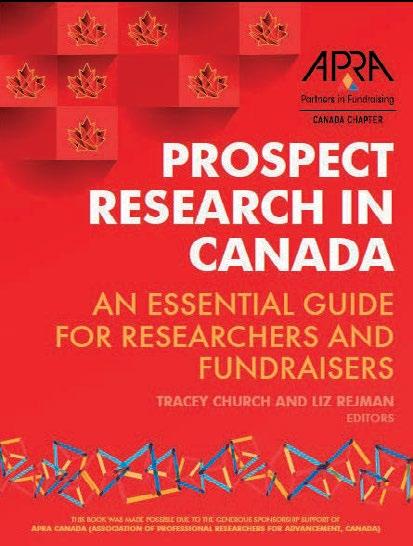
O ering professional prospect research, training, and fundraising strategy. Editor and contributor to “Prospect Research in Canada”, Canada’s first book on prospect research.
BY KATHLEEN A. PROVOST, CFRE, MAdEd
a professional fundraiser, I have always wondered how to pay it forward. I consider myself to be privileged, and for that reason, believe I should share with others
If you have read my previous articles in Foundation, you know that over the years, I have challenged fundraisers to reflect on the status quo, and question existing facts, structures and situations in our sector. I have also shared my opinion about our role in the sector, the role donors or governments play, and I have even advocated that we should be the change-makers.
I consider my writing to be a form of mentorship that enables change, and one way I pay it forward. Sharing my knowledge and expertise with readers is an altruistic way to do a good deed with no strings attached, and possibly inspire others.
23% of individuals between the ages of 15 and 24 said they felt lonely.
I also have experienced immense personal growth and gratification when sharing my expertise with mentees. To date, I have mentored five wonderful individuals; I am very proud two completed their CFREs. These individuals have all shared one common statement with me: they appreciated being entrusted with knowledge, information, and how much they benefited from this experience.
The fundraising sector encourages and benefits from mentorship. The best mentors enable their mentees to become their best selves.
To find out more about mentorship trends in Canada, I reached out to long-time mentor Tracy Luca-Huger, Executive Director
of Mentor Canada, an organization established in 2019.
The primary focus of Mentor Canada is to build a world-class mentoring ecosystem designed to transform the future of every young person.
When I asked Tracy about the trends she sees today, she said: “We know transition for young people into employment, or from adolescence into adulthood, is an unstable time. We are observing that young Canadians face complex problems, that they don’t necessarily have the connections they need, or the supports they need, and they don’t know where to find them.”
Tracy mentioned that when surveyed, 23% of individuals between the ages of 15 and 24 said they felt lonely. So, mentoring can play a critical role for young adults, whether in the formal role of mentor, or as an informal mentor, coach, teacher or neighbour. I have personally witnessed how mentoring is beneficial for young Canadians, given the complex issues they are currently facing.
According to Tracy, one in two young Canadians recalled a time when they wished they had a mentor but didn’t. This “mentoring gap” is what Mentor Canada addresses, focusing on three key areas:
1. The space: Mentoring should take place in accessible spaces, versus expecting young individuals to go and sign up for a mentoring program in a formal educational space. More Canadians should envision themselves as mentors, and foster opportunities to integrate mentoring into places where young people are present, and create ways to walk alongside and journey with them.
2. The training: Mentor Canada offers training to those considering mentorship to help them understand what mentoring entails. It focuses on the passing on of knowledge, skills and tools, and advises to keep these relationships positive.
3. The journey: Mentor Canada reminds mentors that it’s key to offer young individuals mentoring experiences throughout their journey, creating opportunities for them to gain insights.
Mentor Canada will host its first Summit on Mentorship in Canada on November 13th and 14th, 2025. This will provide organizations in the private and public sector, as well as individuals, a wide range of opportunities to further explore and understand mentorship.
On June 1, 2025, FindJobsCanada published “7 Inspiring Mentor Examples That Changed Lives in Canada.” It showcased seven inspiring Canadian mentors who changed countless lives, and illustrated why mentorship plays such a vital role in career growth, especially in ever-evolving professions like fundraising. It also mentioned the positive impact mentoring has on personal growth, confidence, and mental health.
The article revealed how organizations that encourage workplace mentorship benefit from keeping employees longer in their roles, and helping with the employee recruitment process.
Another key point was that “inclusive mentorship” helps to breaking down cultural barriers between employees. It is used in models like one-to-one mentoring, group circles, virtual networking sessions, and peer mentoring.
Making mentorship an integral part of our nonprofits reflects the values of collaboration and community support that organizations already embrace. Since philanthropy is in constant evolution, mentorship could be the best approach to take a journey with “the next generation,” which can help us understand how to transform fundraising to younger demographics.
Aisha Vernon helps us better understand Gen Z’s capacity to be “Canada’s next giving powerhouse” in her article, “GoFundMe—Targeting Younger Demographics: A Nonprofit’s Guide to Engaging Gen Z Donors.” She claims that while we are focusing our fundraising on Boomers and Millennials, Generation Z (born between 1997 and 2012) has become the third-largest generation in Canada, according to Statistics Canada
These young adults, raised with smartphones and social media, are more connected and socially aware, and express a desire for authenticity and trust
Mentorship reflects the values of collaboration and community support that nonprofit organizations already embrace.
has become a driving force for action. Mentorship relationships go two ways, and more than building new donors. It’s about sharing time, attention, and influence.
Luca-Huger believes there are multiple people along an individual’s life journey. Some will influence and shape who we are. I strongly believe we need to embed opportunities for young Canadians to have mentoring experiences and relationships. Beyond guiding their path to education, employment and giving, mentors have a meaningful impact on younger people’s mental health and confidence.
Former Senator Ratna Omidvar shared a key observation on our philanthropic sector’s evolving role in the July 2, 2025 issue of The Philanthropist Journal. She noted that the strength of Canada’s charitable sector lies in its capacity for renewal and reinvention to make the right decisions, and that training in governance ought to be available to the next generation of leaders. She said that a new wave of leaders should be able to champion the sector’s response to its ‘common needs’ including innovative governance and finance models.
building. They are making their mark on generosity by being values-driven supporters. Though their approach to giving may differ, their desire to make a difference is just as strong, if not stronger, than previous generations. They crave authenticity, social change, and measurable impact—and they are motivated to give back, but they don’t always know how to take the next step.
Right now, we have a huge opportunity to invest in young people through mentorship. By building more mentoring supports through programs, places of work, education or in community, we can turn our younger generation into passionate advocates and givers as we help shape their opinions on philanthropy.
In this world of overwhelming noise and information overload, social interaction
Providing mentorship opportunities to respond to our shared needs may be the best way for us to pay it forward. Let’s work together to build an ecosystem to provide mentoring opportunities, at work, at home, and within our own communities, which will enable individuals to become their best selves.
KATHLEEN A. PROVOST is the Vice President, Philanthropy and Communications at United for Literacy (previously Frontier College), a national organization working in partnerships with communities across Canada, offering free tutoring and mentoring to adults, youth, and children who are looking for literacy and numeracy support. Kathleen has over 30 years of experience in the charitable sector. She has been a Certified Fundraising Executive (CFRE) since 2007 and a long-time member and volunteer for the Association of Fundraising Professionals (AFP). She has received numerous recognitions during her career, including the Queen Elizabeth II Diamond Jubilee Medal for her contributions to the charitable sector and was recognized as 2021 Fundraiser of the Year in Nova Scotia. She writes this column exclusively for each issue of Foundation Magazine
BY MARLA SMITH
Ihave sat in too many meetings where average work gets celebrated. Someone hands in a plan that’s half-baked or just repeated from last year and instead of providing honest feedback, they get pats on the back and “great job” accolades. I get it. None of us likes awkward conversations or making people feel uncomfortable. I have always been someone who believes in building people up, celebrating achievements and creating positive workplaces where encouragement flows freely. Uplifting each other is vital.
But here’s the truth we need to face together: when we applaud mediocrity as if it’s excellence, we do a disservice to everyone— to those who put in extra effort, to those still growing and ultimately to the missions we serve.
When “good enough” becomes the gold standard, it sends a message that effort alone is enough. But for those who consistently push themselves to deliver high-impact results, it can feel like their hard work is invisible. They can start to wonder if their dedication matters at all. Over time, these dynamics drain motivation and stall innovation, especially in nonprofits where fresh ideas and impact are essential.
This issue goes beyond organizational culture; it’s deeply personal and affects people’s daily experience at work. High performers often carry a heavy emotional load. When their extra effort goes unnoticed or is lumped in with average work, they feel frustrated and invisible. They may begin to question their own worth or wonder if their expectations are too high.
At the same time, those still learning and developing can feel lost in the confusion. Without clear guidance or honest feedback, they struggle to understand what real excellence looks like, or why it matters to go beyond simply “getting by.” This uncertainty can leave them stuck, unsure how to improve or contribute at a higher level.
These individual feelings don’t stay isolated, they ripple
throughout the team and organization. Some people begin to quietly disengage. They do the bare minimum required, emotionally checking out while physically showing up. This is a signal that morale is slipping.
Meanwhile, the high performers who still care deeply feel the pressure of carrying more than their share of work. They may take on extra tasks, step in to solve problems, and try to push the organization forward. However, over time, this becomes exhausting. Without recognition or support, burnout looms, and the risk of losing these key people grows.
Together, these dynamics create a workplace where energy and creativity fade. Teams fracture between those who are checked out and those who feel overwhelmed, and the culture becomes less collaborative, less innovative, and less resilient.
Let me share a common example. Imagine a colleague is asked to develop a donor stewardship plan. The final product misses important donor groups, offers no new ideas, and feels recycled. Instead of honest guidance to help improve, leadership calls it “excellent” in front of the team.
Now imagine you are the one who stayed late researching trends, testing new engagement tactics, and crafting a plan that actually moves the needle. How do you feel watching work that falls short get the same applause as yours?
This isn’t just frustrating, it quietly erodes trust and sets a confusing tone. The person receiving the false praise hears, “This is good enough.” The high performer wonders if their effort is invisible. The organization sends a message that results matter less than the appearance of effort.
What successful leadership looks like
Real leadership looks beyond appearances. It recognizes and values both effort and results. It offers encouragement without losing honesty. It creates safe spaces for growth, where feedback is a gift, not a threat and it models the standards we want everyone to reach.
A vital part of this leadership is celebrating innovation. Innovation isn’t just about big breakthroughs; it’s about the
small, daily improvements, the creative solutions that strengthen donor relationships, improve programs, and streamline operations.
When leaders celebrate innovation, they recognize risk-taking and curiosity, even when experiments don’t succeed. They encourage people across teams to share ideas and build on each other’s strengths. This sends a powerful message: growth, creativity, and learning are valued here.
That leads us to another essential element: cross-team collaboration. Nonprofits often operate in silos: fundraising, programs, communications, and leadership. Each of these has its own pressures and priorities. But real impact happens when these teams work together, align their strategies, and support one another.
True leaders break down these silos by creating spaces where diverse voices are heard and valued. They encourage joint problem-solving, celebrate shared wins, and make it safe to challenge old ways of thinking.
When teams collaborate effectively, innovation flourishes. New ideas are tested faster, resources are used more efficiently, and the mission moves forward with greater momentum.
I have seen this in action. A leader I worked with inherited a team where praise was handed out indiscriminately. Over time, she reset expectations, pairing praise with clear, actionable feedback and rewarding creativity and results. It wasn’t
always easy, but within a year, innovation grew, project quality improved, and staff pride increased.
Leadership is not about maintaining comfort zones or handing out empty praise. It is about courage, the courage to be honest, to hold yourself and others accountable, and to raise the bar even when it feels uncomfortable.
When we stop applauding mediocrity, we send a clear message: excellence matters Not just for the sake of perfection, but because our missions, our communities, and the people who depend on us deserve nothing less.
The change starts with you, as a leader willing to speak the truth with kindness, to celebrate real achievement, and to inspire those around us to reach higher.
Let us be those leaders. Let us create nonprofit cultures where innovation thrives, collaboration is real, and every person feels seen, challenged, and valued. Because, in the end, real leadership is not about applause, it’s about impact. And the world is waiting for what we can achieve when we refuse to settle for anything less than our best.
MARLA SMITH, CFRE, AFP Master Trainer, and ACFRE candidate, is Director of Foundation and Communications at Pathstone Foundation. With over 15 years of experience in major gifts, corporate partnerships, annual giving, and legacy programs, she has led highimpact fundraising initiatives that advance organizational mission and sustainability. A frequent writer of philanthropic articles and host of
Here are some ways to start:
1. Define what excellence looks like so everyone knows the goal. Clear, shared expectations reduce confusion and create focus.
2. Be specific and authentic when recognizing work, say exactly what made it great and why it matters.
3. Offer honest, kind feedback to help people improve. Feedback should empower, not discourage.
4. Celebrate creativity and impact, not just effort or presence. Innovation, risktaking, and learning are key.
5. Encourage cross-team collaboration by creating opportunities for dialogue and shared problem-solving.
6. Save your highest praise for work that truly deserves it. This protects the value of recognition and motivates others to reach higher.
What’s New on Cogeco YourTV, Marla has earned national recognition for fundraising excellence, including the CharityVillage Award for Best Fundraising Program, and is known for her data-informed, ethical approach to donor engagement and leadership.

BY MARK HALPERN
It’s taken me working for almost 35 years, in an industry I love, to become an “overnight success”—and, frankly, most of us can say something similar. As Malcolm Gladwell pointed out in his book Outliers, it often requires 10,000 hours of dedicated practice for someone to become an expert. But can we fast-track that? And what can we do to make sure that when we get to the top of the ladder we’re climbing in our career, we don’t come to the unhappy realization that it’s propped up against the wrong building?
Mentorship is the answer to both questions. I’ve been blessed throughout my career to have incredible mentors who generously shared their “secret sauce” with me—strategies I’ve employed and adapted to build a successful career in life insurance, estate planning, and strategic philanthropy, advising business owners, entrepreneurs, corporate professionals and affluent families. Mentors both sped up my progress and helped me make decisions that ensured each step up the metaphorical ladder was getting me closer to my goals.
Paul.” When I asked why, they replied, “His integrity.”
I was determined to meet this person who had built such a rocksolid reputation—someone I aspired to be like one day. So, I coldcalled him. He was courteous but firm: he was really sorry but he was far too busy and just didn’t have the time to speak. Instead of hanging up like most people would do, I said, “Paul, I’ll meet you anywhere, at any time. Just give me 30 minutes. I really could use having a conversation with you as I’m at a bit of a crossroads in my career.” He acquiesced. “Fine,” he said. “There’s a track behind the ice-skating rink at Forest Hill arena. I walk there. I’ll meet you on Sunday morning at 9:30. We’ll walk and we’ll talk.”
That morning, we walked for ten and a half miles—four and a half hours. I actually had bruises on my shins. But the conversation was the start of a beautiful mentoring relationship that lasted for 25 years until Paul’s death. Paul gave me invaluable guidance as I built my professional career and family, and he eventually honoured me by choosing me to be the successor to his business! I never realized then how valuable one phone call could be, and how important it is to not hang up when rejected!
Mentors helped me make decisions that ensured each step up the (metaphorical) ladder was getting me closer to my goals.
A long walk that changed my life
One of my most important mentors was Dr. Paul Goldstein, of blessed memory. He died this past February at age 92. Paul was one of the very best in my profession—a 40-consecutive-year member of The Million Dollar Round Table’s “Top of the Table,” which recognizes fewer than 1% of advisors in the world. He also went back to school at age 80 to get his Master’s degree at the University of Toronto, followed by his PhD at age 86. He even published an academic text at age 88. He was a force of nature. I reached out to him when I had been in business for about 10 years. I had heard about him from someone I was trying to turn into a client who told me point blank, “We only do business with
When we think about mentoring, we tend to focus on how the mentor helps the mentee. But mentors are often the recipients of something greater than what they give. Sharing wisdom and knowledge is rewarding, in and of itself, of course. But there are also far-reaching benefits for mentors. One of the biggest benefits is to ensure that the next generation of professional advisors, charity and foundation leaders thrives, and continues to carry on the life’s work of their mentors.
Being religious, our family believes strongly in tithing at least 10% of our money to charity. Going beyond that, we also believe in tithing at least 10% of our time to help others, just because it’s the right thing to do.
In 2020, when everyone was at home because of COVID, I partnered with Jim Ruta, a well-known tactical coach to top advisors across North America, to run Zoom meetings focused on how to pivot and thrive through the crisis. We had 150 advisors sign up for the first session, and they told us they wanted more. So, we created a Masterclass first and then launched the one-year www.PowerofPlatinum.com program to mentor and coach insurance and investment advisors, as well as
fundraising professionals, to become experts in high-net-worth life insurance, estate planning, and strategic philanthropy.
More than 200 professionals have completed the program to date, and we’re starting with our fifth group on October 22, 2025. The results have been tremendous. I share everything I have learned, and advisors are having more success, multiplying their revenue by a factor or two to five-plus, and they are having big impacts in their communities.
Participants’ comments reflect the emphasis of the mentorship they receive. For example, “The most impactful benefit has been the collaboration and knowledge-sharing with other experts in the field.” (Sean Peach, with more than 20+ years of experience); “This business can be very lonely, but having access to Mark and his team means that help is only a phone call away.” (Chris Coulter, with nine years of experience); and “It provides tools and solutions to be successful in business and in life, making me a better advisor and a better community member.” (Derek Schaefer, with six years of experience).
We’re taking our philanthropic efforts a step further by working to create a national community of 100 professional advisors and charities, each striving to create $10 million in current and legacy donations every year. That’s an aspirational total of $1 billion per year in new charitable giving. It’s not pie in the sky. It’s like crowdfunding. We have what it takes to teach people how to do it. And we already have about two dozen professionals and charities signed on to this initiative.
More collaboration, less competition
One of the lessons I stress in the Power of Platinum program is that, while many hours engaged in any activity can—as Gladwell wrote—gradually build expertise, it isn’t possible to become an expert in everything, especially not overnight.
That lesson extends well beyond financial planning. If you’re managing a charity or foundation, you shouldn’t be expected to be an expert in tax planning for philanthropists. If you’re a donor, you shouldn’t be expected to know everything about maximizing your legacy to your family and favourite charitable causes. And if you’re a professional like a lawyer, accountant, insurance or investment advisor, you shouldn’t be expected to be familiar with the wide range of strategies and product solutions available to your clients.
That’s why it’s so important to build your bench strength, to support you in whatever your professional role. You can do that in one of two ways: build an internal team from scratch or develop meaningful partnerships with other experts. The latter tends to be better, faster, easier, and less expensive.
Our company is living this advice with a new strategic partnership we’ve established with PGgrowth. Ed Sluga, CFRE and his very capable team work with national nonprofits to help build sustainable planned legacy giving programs, and they’ll draw on the expertise we have working with foundation board members, major donors and fundraising staff to create the most costeffective and tax-effective gifts. It’s all about educating key people in nonprofits to help them learn how to identify opportunities
for “Accidental Philanthropy” (not coincidentally the name of my column in Foundation Magazine).
This isn’t about telling anyone to stick to their lane. Rather, it’s about making the most of every opportunity by surrounding yourself with others who complement your own expertise. It’s about resisting the temptation to be territorial and instead working alongside a carefully curated group of other professionals to achieve common goals. And it’s about actively seeking out chances to mentor and be mentored to share knowledge, wisdom, and creative ideas that achieve great aspirational goals.
I encourage you to reach out to my team to discuss any of the initiatives I’ve mentioned, including our Power of Platinum program and the myriad ways we support charities, foundations and philanthropically minded families with planned legacy giving. There is never a meter running. Let’s all do good and do well together!
MARK HALPERN, CEO at WEALTHinsurance.com is a Certified Financial Planner, a Trust and Estate Practitioner and faculty member of the Master Financial Advisor—Philanthropy program. He and his WEALTHinsurance team specialize in tax-advantaged insurance solutions to protect families, create charitable legacies and preserve estates. He volunteers for many Canadian charities, foundations and professional associations and was involved in the design of Canada Life’s innovative My Par Gift, the first insurance policy created for charities with ONLY one premium. He writes this column exclusively for each issue of Foundation Magazine

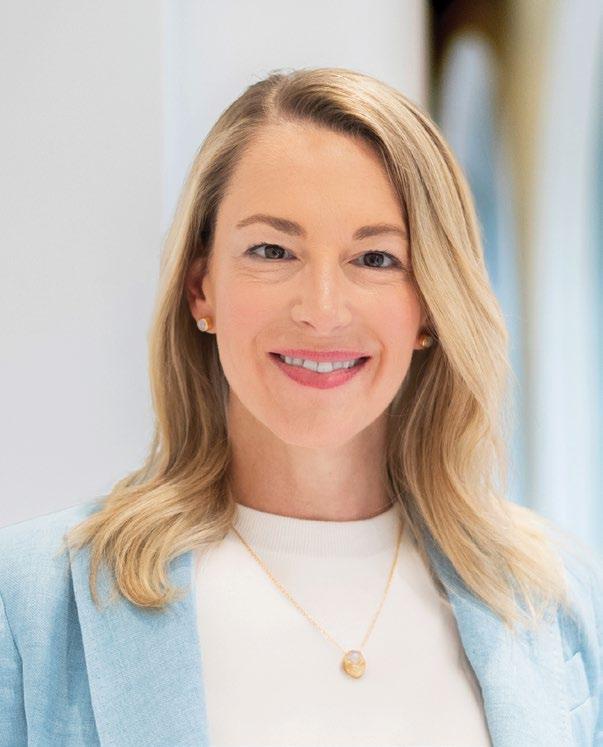
JULIE QUENNEVILLE
BY JULIE QUENNEVILLE
For me, leadership is about more than titles or accolades. It’s about nurturing the growth of the people around you, championing meaningful change, and guiding a team united by a shared mission to transform health care.
Some of the most rewarding moments in my career have come from mentoring others; watching them sharpen their skills, gain confidence, and step into their own leadership roles. In my own experience, and certainly for those in health care, this kind of guidance has traditionally happened in person.
The teams at UHN are continually redefining how knowledge is shared, and leadership is cultivated. One prominent example is through telesimulation in surgery.
Using a combination of high-fidelity surgical simulators, real-time video and audio feeds, and secure online platforms, the Temerty Advanced Surgical Education & Simulation Centre at UHN’s Michener Institute of Education is allowing surgical mentorship to happen anywhere in the world.
With it, a mentor can guide a learner through every step of a surgical procedure. Whether it’s suturing delicate tissue, practicing a complex laparoscopic procedure, or rehearsing the steps of a transplant, learners receive immediate feedback on their technique. Trainees can also ask questions in real time and repeat supervised exercises until their skills are sharp, all without needing to be physically in the same room as their mentor.
Telesimulation guarantees that expert guidance isn’t limited by geography, making it possible for a skilled surgeon in a Toronto UHN hospital to coach an emerging leader in a rural or underserved community anywhere around the globe. It gives learners access to mentorship they might never have otherwise, and it helps mentors multiply their impact far beyond their own hospital walls.
The new surgical tower at Toronto Western Hospital will be a cornerstone for expanding this kind of innovation. It’s purposebuilt environment will have 20 new operating rooms designed to integrate cutting-edge patient care with equally advanced training. The tower will be outfitted with the infrastructure to support telesimulation at the highest level with high-speed connectivity for real-time case sharing, meaning trainees in any country can learn in a setting identical to the ORs where they will one day operate, while also connecting virtually with their UHN mentors.
You might be wondering, “Why does this kind of mentorship matter?” Teaching complex procedures performed at UHN won’t just change lives in Toronto—they’ll benefit patients worldwide, transforming this Canadian institution into a physical and virtual hub of surgical excellence and skill-sharing.
The opportunity to expand and open UHN’s doors in this way is a product of philanthropy, which supports UHN doctors, researchers and health care professionals who lead these programs. They are able to innovate thanks to the generosity of our community who step up to help fund and support them. In this instance, philanthropy is the conduit for mentorship; it is a powerful tool being used to help nurture and grow future leaders of health care. Surgical fellowships are solely funded by philanthropy, which allows trainees from all over the world to come to UHN and learn from our team. Donors and their gifts also provide the technology, connectivity, and training environments that hone skills, build confidence and enable mentorship beyond our physical walls. Donor support helped build the world-class Temerty Advanced Surgical Education & Simulation Centre at UHN’s Michener Institute of Education, and will allow us to integrate these capabilities into the tower as well. Philanthropy is creating a future where the opportunities for mentorship and innovation are boundless.
I believe mentorship is one of the most important responsibilities that we leaders have. It is how we honour those who came before us, and how we continue to impact lives long after we’ve left. As we build the future of surgery at UHN in partnership with our community of supporters, we are not only constructing new walls and equipping them with advanced technology—we are creating the conditions for knowledge, skills, and leadership to be shared without limits. And that, to me, is how we transform health care.
JULIE QUENNEVILLE, CEO, University Health Network Foundation. Since 2023, under Julie’s leadership, UHN Foundation has achieved incredible success on milestone capital campaigns for a new surgical tower at Toronto Western Hospital. She also heads the Canada Leads 100 Challenge. In her past role as President and CEO of McGill University Health Centre Foundation, she grew revenue by 350 per cent, expertly navigated the integration of three foundations, and built a team recognized as one of Canada’s Most Admired Corporate Cultures. She writes this column exclusively for each issue of Foundation Magazine.
Each issue of Foundation Magazine provides a mini-profile of five people whose work and commitment make Canada a more liveable country. We thank them for their service.


1
WILFREDA EDWARD Executive Director – Canadian Centre for Nonprofit Digital Resilience | ccndr.ca
The nonprofit sector contributes 8% of Canada’s GDP, employs one in 10 Canadians, and serves communities across the country that few others reach. Yet despite its scale and impact, chronic underinvestment leaves many nonprofits vulnerable in the face of rapid digital change.
Wilfreda understands this challenge. With more than 13 years of experience in the Government of Canada, she witnessed how data and emerging technologies were transforming the way the country operated—and the risks and disruptions that came with them.
She joined the Canadian Centre for Nonprofit Digital Resilience (CCNDR) a year ago. Since then, Wilfreda has been building on the momentum created by CCNDR’s founders—working to ensure that nonprofit organizations have the digital tools and data capacity to connect their data to outcomes, and use emerging innovations to share their impact and take ownership of their stories.
To achieve this goal, CCNDR assesses sector needs through research, helps nonprofits access digital resources, acts alongside them to pilot solutions, and amplifies their learning and successes. This includes launching a collaboration with Imagine Canada & Microsoft to benchmark the level of AI adoption in the nonprofit sector and develop a Nonprofit AI Impact Hub.
Wilfreda serves on the Board of the Canadian Black Policy Network (CBPN) and her rich Creole heritage, deeply rooted in the art of storytelling, informs her work as well as her favourite travel destination, St. Lucia!
2
LAURA LAVIE Executive Director, The Globe and Mail Foundation www.canadahelps.org/en/charities/the-globe-and-mail-foundation/
The launch of The Globe and Mail Foundation in spring 2025 fulfills a long-held ambition to create a charitable organization that can promote strong ethical standards and excellence in the field of journalism. Leading this effort is Laura Lavie, the Foundation’s first executive director. Laura brings two decades of experience running programs, campaigns, and working with philanthropists to support organizations including Big Brothers Big Sisters of Toronto, Child Development Institute, Luminato, Aga Khan Museum and more recently, The Walrus
It was her five plus years working closely with the executive publisher and editorial staff at The Walrus that sparked in her a passion for the power of journalism to change minds, impact policy, and create better communities. Like many others in the industry, Laura believes that safeguarding independent, fact-checked media as a cornerstone of democracy has never been more important, and that more resources are needed to counter the many challenges the sector faces.
The foundation plans to support more high-quality journalism, including investigative work and beat coverage that will be accessible to all, as well as provide media literacy training to question and combat dangerous forms of misinformation. The foundation is also working on photojournalism training opportunities for emerging and established professionals, particularly those in underserved areas of Canada including New Brunswick. Laura lives in Toronto with her husband and three boys.
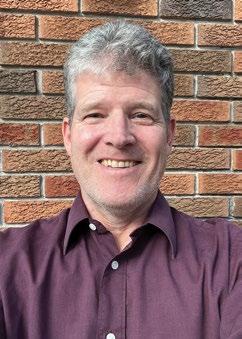
3
RICHARD MORGAN Vice President, AFP Canada | afpglobal.org/afp-canada
The Association of Fundraising Professionals (AFP) Canada recently welcomed Richard Morgan, CFRE, as its new vice president, effective September 8. He succeeds Lisa Davey, who served as VP of AFP Canada since 2018.
A bilingual leader based in Ontario, Richard joins AFP Canada from the Humanitarian Coalition, where he spent the last eight years as executive director, providing leadership to the collaborative humanitarian response and resource mobilization efforts of 12 member agencies. Prior to his work at the coalition, he held leadership and advancement roles at Trent University and Caritas Canada/Development and Peace, with a career-long focus on donor, volunteer and community relations.
His professional experience is complemented by numerous advisory and volunteer positions, including chair of the Catherine Donnelly Foundation, past chair of the Emergency Appeals Alliance, and guest lecturer at several universities across Ontario and Quebec. This extensive
resume of nonprofit service is grounded in a strong educational foundation, including degrees in sustainability studies and international relations, multiple certificates in nonprofit management, and the CFRE credential.
Morgan’s appointment comes at a pivotal time for AFP Canada, which continues to advance its mission to empower individuals and organizations to practice ethical fundraising through professional education, networking, research, and advocacy.
Alongside AFP Canada’s volunteer leaders, Morgan aims to expand and build upon key ongoing initiatives, such as working with government to create a dedicated secretariat for the charitable sector, raising the profile of the fundraising profession, leadership development, and promoting inclusion, diversity, equity, access and anti-racism.
4
PAIGE PHILLIPS Director of Philanthropy | www.kidsability.ca/
As KidsAbility Foundation’s Director of Philanthropy, Paige Phillips centres her passion around nurturing meaningful relationships to connect the community to the tremendous impact of financially supporting pediatric rehabilitation at KidsAbility. She engages with major donors and corporate giving leaders whose values and interests seek to fuel critical funding to advance KidsAbility’s initiatives in pediatric research, innovation and care for kids with disabilities and developmental delays and their families.
With a degree in nonprofit management and over 15 years of experience in developing philanthropic partnerships, Paige is recognized for her strategic approach to fundraising and her ability to align donor interests with projects that deliver meaningful impact. Her experience spans the arts, culture and healthcare sectors, which gives her a broad perspective on community needs and the unique challenges faced by each. She is known by colleagues and partners alike for her collaborative spirit, excellent communication skills, and unwavering dedication to advancing KidsAbility’s purpose and vision. As such, she is deeply committed to cultivating long-term partnerships and securing transformative gifts, all while ensuring donors feel deeply connected to the outcomes of their generosity.
Beyond her professional work, Paige enjoys supporting local nonprofits and participating in cultural events, underscoring her belief in the power of community and how it guides and inspires her.
Raising funds not just as a core business – but a core value
Our Services Include:
• Monthly Donor Conversion
• Donor Upgrade Programs
• Lapsed Donor Reactivation
• New Donor Acquisition
• Emergency Response Appeals
• Welcome & Stewardship Calls
• Donor Information Updates
Sectors we serve:
• Animal Welfare
• Environment
• Health and Hospital
• Social Services
• International Aid
• Education
• Arts & Culture
Non-Profit Tele-Fundraising at its Finest Voicelogic’s Non-Profit Fundraising Department was built on one belief – that charities deserve a partner they can rely on. We don’t just make calls; we represent your mission with passion, precision and integrity.
Through our integrated communication platform, we connect with your donors through phone, email, text messaging and voice broadcasting – creating a seamless and engaging experience that drives conversions and loyalty.
Our team is trusted by organizations across Canada to deliver exceptional donor experiences and maximize results.
We look forward to showing you the difference!

Non-Profit Tele-Fundraising at its finest!
To find out more visit: voicelogic.com/non-profit_services/
5
LEIGH SANDISON Managing Director, Real Path Experience Design | www.realpath.ca
Leigh Sandison has spent her career figuring out what makes people tick—and how organizations can respond in ways that inspire action. She began in fundraising in the UK, diving into donor strategy, innovation, and partnerships. Early on, she realized the best ideas don’t come from spreadsheets or assumptions—they come from listening closely to real people.
From there, she moved into research and strategy, and later into experience design for global companies—uncovering key customer and employee insights and turning them into actionable, insight-led strategies. Across sectors—from health, education and politics to tech, media, and sport—she has helped companies and organizations understand their audiences and designed experiences that make supporters feel seen, understood, and ready to act.
Through her company Real Path, Leigh brings a humancentered approach to the nonprofit sector. She works with organizations to surface real insights, uncover hidden motivations, challenge assumptions, and create supporter experiences that strengthen relationships and drive engagement. Her focus is on practical solutions that turn insight into impact, whether that means growing donors, members and advocates or improving outcomes for beneficiaries.
Leigh’s work is grounded in authenticity, clarity, and empathy. She isn’t interested in jargon or flashy trends—he’s interested in results: stronger connections, deeper engagement, and measurable impact. Her goal is to help nonprofits do what they do best—make a difference—while ensuring the people who support them feel seen, understood, and valued at every step.






























Mitigate Risk
Reduce Costs
Improve Analytics
Ensure Compliance

































Verify customer identities & receive proof of address to minimize fraud & reduce outside threats
Clean contact data to lower returned mail, address correction fees, & missed deliveries
Dedupe your database for a complete 360° view of customers for better prediction & analysis

Meets requirements for FedRAMP®, SOC2, HIPAA, CCPA, GDPR, & more











Not only do financial institutions have to find creative ways to retain customers and grow their business, they also have to meet stringent compliance requirements and avoid fraud while doing it. It’s a lot to juggle, considering 25% of a database decays each year, and that there’s been a 149% increase in digital fraud attempts targeting financial services. Melissa helps you clean and update your contact data to support all of your customer growth and retention goals, and comply with stringent security measures while you’re at it.