Issue 4, 2026

Page 1


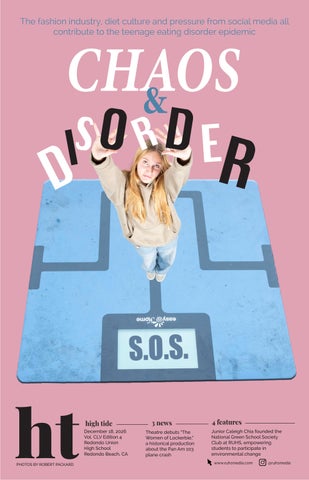
CHAOS DISOR D ER &

The fashion industry, diet culture and pressure from social media all contribute to the teenage eating disorder epidemic 3

PHOTOS BY ROBERT PACKARD

History, tragedy, hope

The theatre department debuts "The Women of Lockerbie," a historical production about the Pan Am 103 plane crash

The Scotland mountains, which house the remains of the terrorist attack Pan Am flight 103 and a tremendous amount of grief, were portrayed in RUHS’s own theater, alongside the first ever onstage running water feature at RUHS. The Women of Lockerbie, featuring sophomore Kiefe Takahashi as male lead Bill Livingston, is a story of tragedy, grief and healing.

“The Women of Lockerbie takes place in Lockerbie, Scotland. It's the story of me [Bill Livingston] and my wife, who lost our son in a plane crash, Pan Am 103. The story is that my son was one of the passengers and his body was never found, so my wife is trying to find his remains,” Takahashi said.

The play also introduced viewers to the women of Lockerbie, who were all locals and witnesses to the Pan Am 103 attack, a terrorist attack committed by Libyans Intelligence Operatives that killed 270 people over Lockerbie, Scotland in 1988. From

Link

The Women of Lockerbie, we see another perspective from that day and a different aspect of grief: the first person experience.

“The show is a lot about how to deal with grief, trauma, and how to learn to love again. How to win against hate,” Takahashi said.

The story also focuses on the retrieval and washing of the clothes that were worn by the victims at the time of the attack. The clothes were kept by the character George Jones, a U.S. State Department official, who had the burden of managing the clothing. Jones initially stopped the women of Lockerbie from retrieving the clothes per the United States’ government's orders. The reasoning behind burning the clothes, from the U.S. perspective, was to put the incident to rest and to assert U.S. property rights.

“There, they meet a bunch of women [whose] main goal is to get the clothes of the victims from the plane crash and wash

them and return them to their families,”

Senior Em Tran, the stage manager for the production of The Women of Lockerbie, said.

“The main meaning of the show, at least in our production, is that hate is not going to outlive anything. You have to triumphate love, and love is the most powerful thing you could provide in the world,” Tran said.

The Women of Lockerbie was able to feature an onstage running waterfall, a first for the theatre department. This realistic element added to the effect of the Lockerbie Mountain atmosphere.

“We all knew that we wanted it set with running water from day one. Eventually we got it to work. It's 100% student design,” Tran said.

The running water began at the back of the stage and ran down towards the front, mimicking a waterfall or stream, and was collected in a tub connected to a pump. The pump then cycled the water back to the

top, creating the effect of an endless river. Between waterfall effects, a compelling story of overcoming trauma and grief, and beautiful metaphoric ending, the Women of Lockerbie depicted by the department reflects much of our daily lives.

“The show is about community, about finding your community, about how community can help you, but also being a part of this production, it's one of the smallest ones that we've done,” Tran said.” It made me realize how important every single person in our show is.”

The

show is about community, about finding your community, about how community can help you, but it's also about being a part of this production. It made me realize how important

every single person in our show is."
EM TRAN SENIOR

Crew hosts prospective Redondo students on Shadow Day

As Mrs. De Collibus’ fourth period students sit in their biomed class, they are interrupted by senior Link Crew member Jacob Araujo, his partner and the five eighth graders following them. These middle schoolers come from private schools, and are visiting Redondo’s campus for an hour to learn about everything the school has to offer, held on Dec. 11.

“[We got to run] some tests, and the kids got to watch how the class went. They had this giant table that’s electronic and shows projections and stuff. So the kids were very interested in that. One of the students actually said they would want to take that class,” Araujo said.

Araujo and his fellow Link Crew members brought the students to observe other classes as well, including ceramics and Spanish. They also gave the students a tour of the school and played various different games with them. Although members of Link Crew and their advisor Emily Vose handled the students, Christina Sunada, one of the Assistant Principals, oversaw the parent presentation part of the Shadow Day.

“The parent presentation went over the statistics of our school, introduced the admin team to them and introduced the two soon to be freshman counselors. We also had six different Link Crew leaders talk about their experiences at Redondo Union,

some challenges they had, and we even got a few leaders to talk about their transition from a private school to Redondo as a freshman,” Sunada said.

Both Araujo and Sunada agreed that RUHS’ first Shadow Day was very successful and set a high standard for years to come. Sunada is planning to hold another Shadow Day the following week, hosted by ASB, for Japanese foreign exchange students, before expanding the event into a yearly occurrence.

“I personally think they should do it every year, because it would allow a range of students to come to Redondo. It would give those kids a good grasp of how public school is and how high school is as well,” Araujo said.

dents enrolled, Redondo may end up losing some teachers or classes.

they should come to our school,” Sunada said.

Sunada, inspired by her own past experiences, proposed the idea of a Shadow Day herself, after learning of the school’s declining enrollment. Without enough stu-

“I used to work up in Palos Verdes High School District, and the high schools up there, both PV High and Peninsula, do what we call a Private School Shadow Day. I was a counselor back then, so I would help my assistant principal and my principal advertise to students and explain why

Sunada contacted 15 different private schools and shared flyers detailing the Shadow Day, with hopes to attract more students. Aside from wanting to increase the school’s enrollment, Sunada wants to give private school students the opportunity to find their passion at Redondo.

“I think the biggest thing that I love about Redondo that draws a lot of people in is that we offer so much. Everything from a history pathway, to English pathways, to different levels of math. We have all these career technical classes and we're even starting to input more dual enrollment,” Sunada said. “It’s just the sheer variety of things that a student can do, and I think one of the Link leaders said it best, ‘There's so much here on campus that you can find something that fits you.’”

Senior Allison Sutton and cast members preform in "The Women of Lockerbie" PHOTO COURTESY OF RUHS THEATER ARTS

Dancing on Candy Cane Lane

The dance team held a fundraiser by selling food and other items

Bright lights and the smell of hot cocoa and peppermint fill the air alongside the chill of the December breeze, as Christmas music blasts from cars. On Dec. 6, the dance team held a fundraiser on Candy Cane Lane, where they performed their dance routines and sold food and merchandise. From all of the items sold, they raised a total of $1,300, which will contribute to the team’s competition funds, financing the costume and music production aspects of their event performances. Freshman Leah Cachola helped prepare treats to sell at the fundraiser.

“We all decided we were going to make something. A lot of people made food, like me,” Cachola said. “We made s’more cookies, and then other people made red velvet cookies, and muffins.”

According to Cachola, the team got the idea to perform at Candy Cane Lane from

their teammate and junior Alessia Isetta, who lives on Candy Cane Lane. Provided with the opportunity to perform there and sell concessions and merchandise, they were able to raise money by selling their products to Candy Cane Lane pedestrians. Handmade beaded bracelets, holiday themed socks, handmade ornaments, earmuffs, headbands, and dance team stickers accompanied the food items. The desserts themselves included brownies, muffins, different kinds of cookies, rice crispy treats, popcorn, and hot chocolate.

“At first, it was stressful because we had to get everything organized. Once there were people paying, and we were selling stuff, it was a really fun experience,” Cachola said. “It felt really nice to be able to spread the Christmas cheer, and seeing the Christmas lights was fun.”

Preparing for this event in multiple ways, the team, led by team captain and se-

nior Brielle Brown, learned the dance over the span of three to four weeks. According to Brown, they drilled the pom routine, created by dance team Coach Caitlin Curran, over and over again. The team also performed their Winter Rally routine, dancing to “Last Christmas.”

“We'll rehearse after school for about two or three hours. When we get there, we start with a warm-up and then full stretch, and we'll be learning choreography during practice,” Brown said. “Other times, we’re just cleaning the dance and making everything look the same and focusing on details, or we will be drilling and redoing the dancing so we can really get it in our bodies.”

According to Brown, the drilling of the routines can help the team to be more prepared and ready for a performance, becoming less nervous and more excited as a result.

“Throughout the team, there's definitely mixed emotions [before a performance],” Brown said. “I know a lot [of the members] are excited, whereas others are a little bit more nervous. Overall, I feel like we had a positive attitude towards [the performance], so a lot of the members that do get nervous sometimes can turn that into excitement and motivation.”

For Cachola, it wasn’t as daunting to perform at Candy Cane Lane as it is to perform in front of the entire school. She says that there was less pressure due to the eyes of supportive families rather than her fellow students, resulting in a less

nerve-wracking, anxiety-free environment.

“I love Christmas and [spreading the Christmas spirit] so much. I just felt really happy the whole time that I was at Candy Cane Lane,” Cachola said. “It was so nice to see everyone be happy, and also being a part of it was really nice. It was just really fun. I felt very jolly.”

At first, it was stressful because we had to get everything organized. Once there were people paying, and we were selling stuff, it was a really fun experience. It felt really nice to be able to spread the Christmas cheer, and seeing the Christmas lights was fun.

LEAH CACHOLA FRESHMAN

Around Redondo

Students discuss how their relationships with food impact their lives

“[As a volleyball player] the foods that I eat determine how I feel while playing. Before games I like to eat protein and fruit; my favorite are kiwis or bananas.”
-Elle Bradin, freshman
“Today I ate a Minimum Cinnamon, but most mornings at schooI eat a cinnamon crumble with some milk. It makes me feel joyous. You don’t want to know what happens [when I don’t eat a snack]."
-Charles Connoy, sophomore

“Being Italian, food has always been a way to bond with family. I eat dinner with my family every night. I cook often and my dad makes traditional Italian dishes for dinner for the family. It's a way to connect with my culture. It reminds me of my grandmother. My favorite thing to make is suppli, a typical Roman dish.”

Marraffa, junior

“Being able to cook is such an enjoyable and calming thing for me. I get to create new dishes I’ve never made before, and I have a good time cooking on my own.”

-Dru Cunanan, senior
1. PHOTO COURTESY OF BRIELLE BROWN

Screen to spotlight

Kamila Gomez was chosen to be in the Academy Award's Teen Council, assisting with teen programming in the award museum

For senior Kamila Gomez, filmmaking is more than just entertainment. It is a form of expression, passion, and creativity that brings a variety of new ideas to the world. Having an interest in film, Gomez helps with teen programming at the Academy Museum of Motion Pictures. Growing up, Gomez witnessed behind-the-scenes of film firsthand through her father, who is an actor, as well as her mother, who works in television preservation.

“I always felt like I was too creative for a nine-to-five. Whenever I would watch movies, I would always think, ‘Oh my goodness. Being a director seems so amazing.’ Being on set with my father as well, being able to see the directors who are able to curate right in front of your face and do exactly what they picture, to me, has been so mesmerizing to see,” Gomez said.

Following her dreams of partaking in the film industry, Gomez applied for the position as part of the museum’s teen council, one of the 30 students who were chosen for the year-long paid commitment. The teen council helps in developing and advising youth programs and workshops at the museum.

“We've done three sessions so far, including one workshop. On our second meeting, Celia Lopez, the head of the Academy Museum team council, allowed us to go and explore the Academy Museum for ourselves. She gave us a clipboard and told us to write down any ideas that we had or anything that we saw in the museum that we thought was special,” Gomez said.

The teen council program offers many different insights on film. Those participating not only have the chance to see screenings of a variety of movies, but also interview many big names in the industry. Gomez is looking forward to an upcoming

opportunity where the teen council members will have the chance to interview Oscar-winning makeup artist Yolanda Tousseing who has worked on many big movies such as “Beetlejuice” and “Edward Scissorhands.”

“I'm so excited to see what the rest of the Academy Museum will have for me. It's going to be so amazing to talk to [Tousseing] because when it comes to the film industry, [I’m not very educated on] the makeup and film part, even though it's such a big part of it," Gomez said. "How are you able to really make people feel things and really get the image that they want without the actual imagery itself?"

their own personal lives as well,” Soto said. “With a fresh mind, you can go beyond what's being done now, and her being part of that, [she] can bring on new stories that have never been told before, or even some of the same stories we've seen before, but shown in a different way.”

Gomez has shown her passion for the

Gomez’s mother, Marisa Soto, shares a similar passion for film with her daughter. Working for both the Time Warner Cable and the University of California, Los Angeles film and television archive, Soto has had a wide range of experience in the film industry. Soto believes this is a good opportunity for her daughter.

“I am proud to see [Gomez] do this because she wants to, not because she's been influenced, but because she sees the value of entertainment and storytelling. These stories have helped many people cope with

film industry in many ways, especially in her determination to pursue her interest, according to Soto.

“When [Gomez] sets her mind on something, she'll find a way to get it done. There's only so much I can do to help her, but she is taking on challenges. Her being passionate about film is something that came from her. I believe in her, and I'm extremely proud of her,” Soto said.

Having the opportunity to see the production of films and interacting with professionals in the industry has given her a newfound appreciation for all that actors

and filmmakers do.

“Being on set has shown me the real struggles of being an actor and just being anybody in production at all. They put their heart and soul into everything that they make. Being able to watch it firsthand is really exciting, but also it makes me feel for them a lot more,” Gomez said. “It makes you think, ‘If I ever want to do this in the future, how will I go about things a little bit differently? How will I make sure that everybody's being accommodated to the best that they can and making sure that everybody is getting to be seen and heard?’”

Gomez’s exposure to the production process of movies gave her a new perspective on what it means to work in a career in film. According to Gomez, film is something that people should not be afraid to pursue.

“If you're passionate about film and have the passion to drive you where you would like to be, I say go for it. Put your all into it, surround yourself with people who are into film, surround yourself with a community who's going to be able to uplift you,” Gomez said. “When you find that right group of people, they will be there to help you out and be there to see your visions into play.”

Caleigh Chia founded the National Green School Society Club at RUHS, empowering students to participate in environmental change.

Starting a movement takes more than just good intentions. It takes a structured plan, a cohesive team, and a leader ready to execute. Junior Caleigh Chia has always been concerned about the environment, and this year she founded a chapter of the National Green Student Society (NGSS) as a result. Through the club, she’s creating opportunities for her peers to participate in recycling efforts, beach cleanups and sustainability projects.

“I started NGSS at RUHS because I wanted to make our school greener and more eco-friendly,” Chia said. “With climate change and ocean pollution becoming larger issues, I felt the need to create an honor society that recognizes strong students and then empowers them to lead real change.”

Chia has always felt deep connection with the environment. Living her entire life in California has inspired her to take an active role in not only protecting nature but the physical health of Californians themselves.

“My ultimate goal is to improve the air quality at RUHS in light of the [Los Angeles] fires last year. By taking care of the ocean and the atmosphere, not only do we improve the environment, but we also care for our body's health because exposure to toxins will ultimately lead to disease. [We want to] mitigate those toxins in any way possible that we can,” Chia said.

In addition to coordinating projects that will impact the student body, Chia organizes opportunities to benefit the overall community. As NGSS president and junior class president, she has had the chance to

put her ideas in action on campus.

“We placed our recycling bins at the Homecoming football game, and there we collected bottles and cans that would have otherwise gone into the landfills,” Chia said. “We plan to recycle [the bottles] and put [the bins] at different school events for the [rest of the year].”

ing meetings, as signing tasks and motivating club

members, Chia has created a community that encourages participation and leadership. By hosting monthly meetings, she provides numerous service opportunities for the club's members and hopes to continue growing the club’s membership.

as a tradition,” Chia said.

Chia’s focus on environmental improvement is not one-sided. NGSS’ vice president, junior Ava To, also dedicates a significant amount of time supporting the club and helping it run smoothly.

“We schedule a lot of beach cleanups, and those are always fun because I can invite my friends and hang out with them while also helping the environment,” To said.

To’s commitment to the cause began long before her role in NGSS. It roots back to moments in her life that made environmental protection an urgent matter for her. Those moments continue to influence the time and energy she puts into the club today.

“I used to watch all these horrific YouTube videos about how climate change is affecting animals' environments, and I am a big animal person,” To said. “So [what I see online] hurts me badly, and [inspires me to help].”

After leading her NGSS chapter through a successful start to the year, Chia’s experience has shown her the power of leading a change in the community. “Try to find something you're passionate about because that's really all that will carry you through life. If you're passionate about something and you feel that there should be change, then physically do something,” Chia said. “It can be small steps, [but] be a good team player, and allow for other people [to] give you ideas too. Always keep improving and learn[ing] from others.”

1. Gomez and other members of the Teen Council practice filming by using Legos PHOTO COURTESY OF GOMEZ
2. Chia posing with Principal Marvin Brown during Cluc Rush PHOTO COURTESY OF CHIA

SWIFT SAILS

After discovering her interest in the sport on Instagram, Maya Cortez joined Redondo's sailing team

The ocean’s wind and rain pelting their faces, sophomore Maya Cortez and her partner struggle to keep the mast of their FJ sailboat above the surface of the water. After capsizing (flipping the boat) twice already, Cortez battles the elements of the ocean as they fight to make it to the finish line. Just a few months ago, she never would have expected to find herself in this heart-racing situation.

After DM'ing the King Harbor ¥outh Foundation about their sailing program over Instagram, Cortez and her friend, sophomore Meliah Medeiros, were invited to one of the practices. She and Medeiros decided to start sailing for the high school team shortly after. A month later, they found themselves in a "harrowing" experience while off of San Pedro, with only the knowledge they had from a month’s worth of sailing to help them.

people on the same boat. It was very windy, it was raining, and it was cold. We capsized three times, and [my friend] hit her head really hard. That was definitely the craziest we've ever had to get through.”

[At the race] we were short on people, so [Mederiros and I] were going to sail together. They put to really inexperienced people together on the same boat. It was very windy, it was raining, and it was cold. We capsized three times.

MAYA CORTEZ SOPHOMORE

“We were short on people, so [Medeiros and I] were going to sail together,” Cortez said. “They put two really inexperienced

Medeiros knows that San Pedro is known for its windy waters, which got up to 20 miles-perhour during the race. Now, with the experience nearly a year behind them, Medeiros has seen Cortez improve greatly at the sport.

“She's very attentive, and she's always asking the more experienced people for help because she wants to get better. She's very dedicated to the sport, which I really admire. On the Redondo team, she's definitely become one of our most experienced sailors,” Medieros said.

In contrast to the chaotic race they started with, they are now able to get through a typical day on the sailing team with ease.

Since daylight savings time has begun, they get on the water as soon as they can. They “rig” the boats, the sailing term for getting them ready, and leave the docks, doing drills, races and more. They then go over their coach's insight when they reflect on the day’s sailing. Cortez’s team also practices with other local high schools, including Chadwick and South High. While Redondo does not offer sailing as a sport, it is a club.

“We qualify for independent PE, but we don't get a free sailing period. We're technically a club at Redondo and when we compete at races, we sail for Redondo,” Cortez said. In addition to sailing for the

Cortez said.

In addition to sailing for the high school team, she also volunteers as a junior coach over the summer, supervising and helping to teach younger sailors. This involves answering questions and lending a helping hand whenever needed.

“It was really fun. I thought it was really great to get experience, using teamwork and helping younger kids learn how to sail, because working with younger kids tests your patience,” Cortez said. “You can learn a lot through trying to teach something that you love to do.”

After weeks of practice, Benjamin Harkness performed at Carnegie Hall in New York and won first place with his Romantic piano piece

Instead of growing up beside a piano, junior Benjamin Harkness sought it out. He believes this sparked a more natural, genuine passion and love for pia no, a spark that eventually carried him to winning first place overall at the Interna tional Autumn Piano Competition and ad vancing to play at the Carnegie Hall, New York.

“Piano is so much different than other music because it shows emotions without saying words, and that means a lot to me. You can look at sheet music and play your favorite song immediately, so it's more individual and I feel so personal with it,” Harkness said.

Along with this devotion, especially seen when practicing for his recording submis sion for the competition, Harkness's love for playing music has carried him far.

“The song [I played for the perfor mance] isn't technically challenging, be sides the cadenza (a virtuoso solo within a concerto). I had to play it really fast, and if you play the first part perfectly, and then make one mistake, you have to restart the whole recording. But once I got it down, it was rewarding,” Harkness said.

Practicing up to three hours daily, both individually or accompanied by his piano teacher, and practicing at school in the music room between breaks, his drive for piano is demonstrated in many ways. “[I was] constantly watching videos of people playing, and finding my

favorite interpretation of [the song I submitted for the competition] and then kind

straight and playing when I got home at 9:00 p.m. I probably recorded seven hours of footage of me just playing, and the song's only three minutes." Hark-

ness said. Harkness and his brother, Eddie Harkness, started playing piano around the same time. The encouraging dynamic they gained from this helped fuel Harkhis musicality and his technicality, he's good at the songs that he plays and works very hard,” Eddie Harkness said. They acknowledge a healthy competition between one another, and notice how practicing together is useful for both of their musical talents.

“When someone else is playing and their music is filling up the room as well, you can't hear the mistakes you make and [the other person’s playing] kind of softens them. It feels nice [practicing together],” Eddie Harkness says.

Harkness says “confidence, especially

as a later starter” wasn’t something he especially struggled with.

“I never doubt myself. Even the fact that I started later would hinder my progress, I didn't doubt that. I feel if I did, it might have been different, but I never thought about it like that. I like the fact that I started off later because my passion was coming from pure love for the music,” Harkness says.

This strong mindset helped secure Harkness the privilege of playing in Carnegie Hall in New York. He performed his favorite romantic musical piece,Liebestraum No.3, by his favorite romantic composer, Franz Liszt

“It's kind of nerve-wracking, but also, I wouldn't want it to be any other way, once I got over that bump [the cadenza, a challenging section], there was nothing else stopping me,” Harkness says.

Despite the nerves, this opportunity has also given Harkness a new sense of confidence and pride in his abilities.

Cheers from Chile

Senior Kendra Mura earned a spot on the Chilean National Softball Team, allowing her to connect with her heritage and bond with players from around the world

Varsity softball player Kendra Mura’s visit to Chile two years ago, initially just a family trip to her father’s home country, unexpectedly led to a life-changing athletic opportunity. During her travels, Mura tried out for the Chilean National Softball Team.

“After we did some research, we found out that there actually was a Chilean national team for softball. That's kind of how it all got started. In the beginning, I was really nervous and unsure about playing,” Mura said.

Despite her initial hesitation, Mura received a position on the team as a pitcher and shortstop. She then traveled to Peru for her first tournament with the team, giving her the opportunity to connect with new teammates. Most came from Chile, with the exception of a few being American, like herself.

“I've been in the dual immersion program since kindergarten, so I am fluent in Spanish. But the Chilean Spanish my teammates speak is really different from the Spanish that I was taught growing up in school, especially when they use slang. So it was kind of hard to understand at first,” Mura said.

Never having faced this challenge before, Mura’s inability to fully communicate with her teammates only pushed her to dive further into the culture her father raised her in.

“I've only ever experienced my [Chilean] culture through my dad and what he has told me, but it was really nice being able to actually experience what he's told me and enforced throughout my life, like

the importance of being Chilean and the small things that make the culture unique,” Mura said.

According to Mura, playing for the Chilean national team not only helped her in “improving her confidence,” but also allowed her to connect further with her culture by being surrounded by Chilean people like herself. The language, energy and celebrations all made her feel included in the culture and Chilean atmosphere. Her father, Francisco Mura, was especially appreciative of her commitment.

“I felt really proud of Kendra because she was able to connect my country with one of the sports she loves. Kendra worked really hard,” Francisco Mura said. “[Playing softball] was a really big part of her life since she was five years old, so connecting that sport to my country, I felt very sentimental. It was powerful.”

After that first tournament in the beginning of her junior year, Mura traveled to Colombia for another competition. She faced teams from various countries, including Canada, Venezuela and Guatemala, giving her more time and experience to further improve how she plays softball. While being exposed to more nationalities than ever before, Mura represented and celebrated her Chilean heritage by winning their games and making Chile’s softball team a team to watch and respect.

“Kendra has a lot of courage, and you don’t see [many] kids this age who are willing to go try out, meet new people or coaches and go into the unknown. She was super excited and willing to give it a try,” Francisco Mura said. “Kendra has no fear

about anything.”

With great support from her father and mother, who offered her encouragement and comfort no matter where she needed to go to stay with the team, Mura also received support from the rest of her family living in Chile.

“It was so nice seeing my family in the stands, holding the Chilean flag. My grandma was crying watching me up to bat, and my dad was too. I've never seen him cry, but he was just so moved and touched that I could represent a part of him that is so special. He [left] Chile when he was 30, so it's a huge part of him,” Kendra Mura said.

The connection to her culture furthered Mura's success as a team player, and winning the Iquique Tournament in Chile is a recent reflection of her dedication.

“It was one of the best experiences ever,” Mura said. “Even though I was scared, after, I felt a part of me that I

didn't even know really existed come out, and I understood way more about who I am, what I want to do in the future and what I really enjoy doing.”

Freshman Ashley Huh performs at the same venues as artists such as Billie Eilish and BTS through the School of Rock's performance program

Behind the same stage that once presented artists like Billie Eilish, BTS and Guns N’ Roses, freshman Ashley Huh prepares herself to step onstage with her bandamates. For four years, she has participated in the School of Rock’s performance program and has since auditioned her way into its highest level, House Band.

School of Rock’s House Band music program consists of a gigging band that performs live shows at various venues

throughout the year. One of the most notable includes Troubadour in West Hollywood, which has hosted many icons, including rising artists like Chappell Roan and Lizzy McAlpine, as well as all-time legends such as Elton John and Alicia Keys. Huh relives the opportunity to perform and holds the memory of performing there close to her heart. She compares it to the way some people might look up to going to Hollywood because some of their favorite actors have worked there.

“[I think it’s really cool that] we've gotten to go in these premiums, which is where the band gets ready for the show, and also where other famous bands have previously been. It's like Hollywood [for me],” Huh said.

As the guitarist and bassist in numerous performances with House Band over the past year, Huh quickly developed a sense of ease as a performer. This led to her recent participation in the RUHS Theater Arts department.

“I like performing because I think it's a way to express yourself without having to say a lot of words. [For me it’s] with a guitar. But theater is a different [kind of expression,]” Huh said.

Even after performing every month with House Band, Huh admits that she still gets stage fright before shows. Her nerves, however, dissipate once the show starts.

“I think once you start playing,

you think, ‘oh, wait, I know the songs.’

Then you know it's fine,” Huh said.

“Even if you mess up, it's not that big of a deal.”

Comfort on stage is reinforced through the bonds the band has gradually built through their journey to becoming a part of House Band. Senior Natalie Baker, another guitarist for House Band, feels that close connections have formed during the process of being accepted for House Band.

“You feel more close with the people in House Band because you're with them for all these gigs and lessons, so you [get to know them really well],” Baker said. “Since we also play the same songs, it feels more comfortable playing them.”

Before every show, the band prepares by chatting with each other as more members show up and clearing up any questions before heading on stage. Baker recounts Huh’s positive energy onstage despite her apprehension before the show.

“Ashley [is] composed on stage. She’s super nice and has a cool vibe. She plays so well, but she doesn't [realize] that she's as great as she is. That is something that I am trying to help her with,” Baker said.

Baker’s friendship with Huh began when they met through School of Rock’s performance program, where they bonded over playing the same instrument and enjoying similar music genres. Later, they both auditioned and made House Band.

“We got really close because we could bond over guitar playing, and we have a similar personality,” Baker said.

In addition to playing guitar for House Band, Huh has recently begun taking dance and vocal lessons. She does so in hopes of having a future in performance.

“I just love the arts. [I think] it's really fun to put yourself out there,” Huh said.

“You don’t always get a chance to.”

Mura celebrating her team's win COURTESY OF KENDRA MURA

The fine line between eating disorders and health or "diet" culture can promote unhealthy eating habits, restriction and negative self-perception

“I’m fat.” “I don’t deserve to eat this.”

When anonymous junior Lucy goes to eat, these are the first thoughts to pop into her head. Since seventh grade, Lucy has struggled with anorexia, which has led to hospitalization and health issues such as infertility, thinning hair, osteoporosis—a condition that weakens the bones—and poor circulation to the point of her “feet and toes [turning] purple.” According to the National Eating Disorder Association, 9% of the US population, or 30 million Americans, will have an eating disorder at some point in their lifetime. However, the causes behind an eating disorder can differ from person to person.

“A lot of the time, people think [eating disorders] are about losing weight, for anorexia specifically, but really, it’s a coping mechanism. A lot of people, they’re trying to cope with something that they might not have control over. So then they turn to food, because that is something they can control that’s tangible, that you can measure,” Lucy said.

With the prevalence of social media in daily life, it is much more likely to see content catered to teenagers concerning eating disorders. In “pro-ana” or pro anorexia communities online, eating disorders are glamorized and members encourage one another to restrict rather than seek help. According to Lucy, they operate on the belief that “thinness is the best way to look.”

“On my for you page stuff pops up and it’s very uncensored, like other people who are really emaciated [unusually thin or weak] or people who are eating really low amounts. As someone who struggles with food already, to keep looking at that, it’s hard to try to commit to recovery,” Lucy said. “It’s scary for younger people too, because it’s so easy to influence someone down that path, just from social media, even if you’re aware that you’re being influenced.”

Also coming across similar curated content, anonymous freshman Mia has struggled with anorexia for two years now. However, she adds that she was not initially motivated to restrict for aesthetic reasons. Instead, she used restriction as a coping mechanism when she began playing lacrosse and was managing high levels of stress, pursuing what she believed to be a healthier body type.

“A lot of social media, especially from the earlier years, was very diet culture-esque, promoting restricting and purging and horrible behaviors,” Mia said. “I thought if I was skinnier I would be better at my sport. I definitely [took] more of the healthy wannabe skinny route.”

Even when not directly promoting eating disorders, diet and health culture online can still give a platform to unhealthy eating habits. As reported by the US Department of Health and Human Services, the increasing number of outlets people source their information from has contributed to the spread of health misinformation. According to Jill Groves, an officer for the South Bay Eating Disorder Coalition and a private practice therapist, concerning diets may cut out “total food groups” or be fads that “come and go.”

“My philosophy is that all foods fit. So there are no good foods or bad foods and we don’t villainize foods,” Groves said. “There’s room in the way we eat for things that are made with sugar or things that are made with fat, all food groups are important and nothing is bad, it’s just about moderation and variety.”

Methods to lose weight can also extend beyond dieting and exercise. Recently, using prescriptions like Ozempic and other GLP-1 medications, originally intended to

treat type two diabetes, for weight loss has become much more common as prominent figures like Oprah Winfrey, Elon Musk and Serena Williams have taken the weightloss drugs. Other celebrities like Lizzo and Meghan Trainor, who have been associated with the body positivity movement, have also experienced dramatic weight loss recently, although not due to weightloss drugs. However, some like Lucy view this recent trend among celebrities in diet

Less than 6% of people with an eating disorder are medically underweight

According to the National Eating Disorder Association

culture as another push for thinness as the ideal standard, regardless of their individual motivations.

“Both of my parents are on Ozempic and it’s hard because I’m actually very against it. For one, I just don’t think there’s enough research because it was originally [meant] for diabetes,” Lucy said. “It’s setting a bad role model. Meghan Trainor, who was a model for midsize women, sang songs about how her body is fine just the way it is and she was healthy. And now, all of a sudden, she’s lost a bunch of weight. It’s hard because obviously celebrities are in the public eye and probably get shamed for their weight, but it’s an example of how [even] they can’t be happy at their weight. So why shouldn’t their audience, especially younger girls, [want] to follow in their footsteps?”

organic and green foods and everything in order to be healthy. It changes the idea of what health is and what it looks like, because it’s different for everyone,” Lucy said. Definitions of what “healthy” can look like also vary across cultures. Senior Jackson Lee grew up in an Asian household, mostly eating Korean food at home, and has found health culture to be “heavily Westernized.” Most of his meals growing up included rice, not salad, and hearing rice and carbs categorized as evil while trying to lose weight led him to question whether he was eating the right foods or doing something wrong.

“It messes with you and [can lead] you to have this weird relationship with your culture and food because it’s all you’ve grown up eating but now you’re hearing [that] it’s bad and unhealthy and maybe that’s why you’re fat or maybe that’s why you don’t look like the person you want to look like,” Lee said.

However, despite some of the flaws in broader diet culture, dieting itself is not inherently good or bad. Often, certain diets may be beneficial or necessary given different circumstances, including health issues, although these may appear different depending on a person’s needs.

“I get the importance of dieting, especially if it’s for your health or cleansing because I have a lot of family members with diabetes especially. So watching what they eat is crucial for their diet. But I think that’s all a diet should need to be, for your health. And that diet isn’t necessarily going to look the same [for everyone].Some people need to eat more sugar to raise their blood sugar. That’s not what our idea of a diet looks like but it’s a diet that’s

The overall lifetime prevalence of eating disorders is estimated to be

8.60% 4.07% among females among men

While thinner body types are often depicted as being inherently healthier in diet and health culture, with losing weight being the goal for many, the picture of health often differs from individual to individual. Genetics plays a role in determining one’s metabolism and what health will look like for them, so no one diet will ever apply to everyone.

from body dysmorphia, a disorder in which one has a distorted view of their own body or focuses excessively on perceived flaws.

“It can start out innocently, maybe somebody wants to lose weight or change the way they look or they feel like they’ll be more accepted if they look a certain way and then what happens is it starts to get taken to an extreme and they end up losing control of what they thought they

were managing in the beginning,” Groves said.

According to the National Eating Disorder Association

“The idea of health is honestly really subjective because health isn’t what you’re eating, it’s how it makes you feel. So if you’re eating and you feel fine and your body’s functioning, you’re healthy. Diet culture makes it seem like you need to eat

healthy for that person,” Lee said. According to Mia, diets can develop into eating disorders and cross the boundary of being healthy when they become “an addiction.” Even once some individuals with eating disorders hit their goal weight, they become unable to stop restricting, suffering

Despite continuing to work on healing a relationship with food, there are some lasting consequences that “never truly [go] away,” according to Mia. Both her and Lucy continue to struggle with recurring thoughts related to guilt and restriction, and Lucy has also had to deal with serious irreversible health issues.

“It’s definitely been a journey, so there [have] been lots of tears, lots of fights,” Mia said. “But [healing has] definitely [been] worth it in the end because I can see the progress I’ve made with improving my

relationship with food.”

Whether it is possible to make a full recovery following an eating disorder is debated among therapists who specialize in the subject, although Groves believes it is possible to develop a healthy relationship with food. According to Groves, eating disorder thoughts “don’t just disappear after you’ve gone to treatment or gone through therapy” and can resurface or quiet down over time. However, unlike other crutches such as alcohol or drugs, where abstinence is often considered the solution, “you always have to eat,” therefore dietitians and doctors can provide assistance when figuring out how to meet one’s health needs.

“I would say that if you are

Fashion trends and brands limit teenage shoppers

“Nothing tastes as good as skinny feels.”

Kate Moss, a model known for her pro-emaciation, “heroin chic” fashion trend, trademarked this motto in 2009 during an

concerned about yourself or a friend, that it’s worth reaching out and expressing

‘I’m worried about you’ or asking someone that you trust for help because there’s a lot of shame with eating disorders that people carry, and that stops them from asking for help,” Groves said. “I think that this is more common than people think and that you can get better. There’s support out there and there’s people that can help. So there’s no reason to suffer in silence because there’s nothing to be ashamed about. This is a medical and mental illness, it’s not just one or the other and it can be really serious if it goes untreated.”

and their faces are perfectly symmetrical. Pants and makeup and shorts are meant to look a certain way on these people, and I was sad that [they] didn’t look the same way on me,” Emma said.

The pressures inflicted by the trendiness of unhealthy eating habits online can often push audiences to follow suit. Junior Nova Hattingh noticed that as she grew up during the emergence of YouTube vloggers and Tumblr, many influencers set a poor example that she found to be personally harmful to her self-perception.

“I struggled with anorexia for quite some time, and I distinctly remember what started it. It was back in 2016, and Jake Paul was a huge thing. I remember his girlfriend at the time, whose name is Alyssa Violet, and she is this stunning model. I was like, ‘Screw Jake, I’m going to watch her,’ and so I was watching her and thinking, ‘She’s so cool and she’s everything I want to be.’ She talked about how she would only eat chicken, rice and broccoli for every meal, and nothing else, because she couldn’t eat carbs since ‘carbs were the devil.’

Among a group of models, 62% had been advised by industry professionals to lose weight or to change their body size or shape if they wanted to be more successful in their profession, according to the National Institute of Health.

interview with Women’s Wear Daily. The mantra was adopted by many “thinspiration” websites and communities, pushing the narrative that to fit into the world of high fashion and trendiness, you must resort to starvation.

After receiving heavy criticism for the quote, Moss apologized for the harm she may have inflicted. Even still, the catchline was found printed onto baby-tees by clothing retailers. This is just a small piece of a grander issue: the glamourization of eating disorders.

The frequent representation of malnourishment by role models in the fashion industry has perpetuated the ruinous cycle of eating disorders. Anonymous senior Bella notices yet another slogan that has catalyzed a new wave of pressure to meet societal beauty standards by whatever means possible, including undereating.

“When people say ‘Your body is the outfit,’ it makes it not even about clothes anymore, it’s just what you physically look like. We’re living with this idea that you can wear whatever clothes that you want, but it’s not going to look good until you have that ideal body that is advertised. Bodies have become fashion. The tiny model body is the trend,” Bella said.

With these influences in mind, some become wrapped up in comparing what clothing brands advertise and what is realistic to oneself, according to anonymous freshman Emma.

“Models are usually really skinny, with a lot of definition. I’m on the curvier side, and I used to weigh a lot more. I felt like I just wasn’t fit before. I would see all of these models, and they’re tall and skinny,

en who are diagnosed with eating disorders in comparison to men.

“I’ve always felt that because of my height, I’m much more masculine. I’ve always just associated femininity with being short and petite, and I probably got that from clothing brands because of the people that are modeling the clothing,” Hattingh said. “Clothes for girls have always been more revealing and tighter to demonstrate that you have this figure that appeals to society. Not everyone has that, and it gets really frustrating because I’m supposed to dress this way because that’s what [is] being advertised to me, but if I do, it’s not going to look as good.”

As a result, many experience insecurity in their bodies, as well as their gender identity and sense of self-expression.

“I’ve had a lot of friends who felt like if they didn’t fit a certain look, then they feel like they aren’t meant to be women. Especially when we were younger, I had friends who transitioned or changed pronouns, and then transitioned back to being girls, which is fine either way. It’s just a lot of pressure, and if you don’t look a certain way, it feels like you need to change. I have other friends who aren’t comfortable wearing crop tops because they ‘don’t look like other girls.’ You should be able to wear whatever you want,” Emma said.

Seeing that as a kid, I thought ‘Oh, if I want to look like her, this is what I need to do,’” Hattingh said. Hattingh describes how, in addition to online influencers, fashion trends that arose on TikTok during the COVID-19 pandemic also shaped

Even though some clothing brands are taking steps towards inclusivity, they still commit small microaggressions against body types that deviate from their standards.

“They’re trying to get better with it, but it’s just not working. Like in the Victoria’s Secret Fashion Show, they had people with different body types, but the people who were better dressed and therefore got more attention were the people who were on the skinnier side. And the models who were representing other body types were already famous for other reasons, like actresses and athletes. They don’t put regular people on the runway to show other body types, and I think they need to work on that,” Bella said.

In addition to the lack of representation of other body types, brands have also exhibited inconsistencies in sizing that emphasize their tendency to favor a specific type of physique.

of female athletes were at risk for anorexia nervosa and 38% for bulimia nervosa, according to the National Institute of Health

her perception of what an “attractive” body type looks like.

“I remember being really into the whole y2k thing in 2021 and 2022, and I was really into 2000’s fashion until I realized ‘I’m not as skinny as these girls’, and ‘if I wear this, it’s not going to look right’,” Hattingh said. “And the Brandy Melville thing was so awful. The ‘one size fits all’ and the exclusion of other body types was not okay.”

According to the University of Arkansas Medical Center, 90% of individuals diagnosed with anorexia or bulimia are women. Hattingh notes that the continued representation of a singular body type in the fashion industry has separated her from her sense of femininity, potentially contributing to the disproportionate ratio of wom-

“With homecoming and things like that, since I’m taller, trying on dresses has always been a literal nightmare. It’s always either the perfect length but way too tight or it actually fits right, and it’s way too long. It’s so annoying,” Hattingh said. “Clothing has always been catered to people who are physically smaller than me.”

Emma says that she has learned to embrace her body type without relying on clothing brands to reach acceptance.

“I feel like whenever someone buys a large, it’s like ‘Oh my gosh, I’m so big that I need a large,’ but clothing isn’t meant to be about size. Clothing is supposed to make you feel good and look good. If you don’t fit into a small, all you need to do is size up, and I had to learn that over time. I used to pretend that I could fit into smalls, but I was not comfortable,” Emma said.

Emma believes that the best way to discontinue the idealization of eating disorders and unhealthy body types is to stop it at its root.

“[The fashion and entertainment industries] shouldn’t be starving people. They shouldn’t say ‘Oh you’re pretty, but you’re five pounds overweight, so you can’t model.’ There are beautiful people with different body types, and if you really want to promote inclusivity, show all of the sizes,” Emma said. “If we want to say that everybody is beautiful, then that should be reflected by brands, and on social media. That encourages healthy eating habits.”

Illustration by Claudia Turner

Hidden influences

Globalization of Black culture reinforces systemic appropriation

Black Americans have been the center of pop culture for as long as anyone reading this can remember. Whether it be music, fashion or even food, it seems like the most memorable parts of each decade have stemmed from Black creativity. Yet, the general public rarely gives credit to how much this community has contributed to our culture worldwide, which often leads to the “culture vulture” phenomenon: cultural appropriation.

The Oxford Dictionary defines cultural appropriation as “the unacknowledged or inappropriate adoption of the customs, practices, ideas, etc. of one people by members of another and typically more dominant society.” The main difference between cultural appropriation and cultural appreciation stems from the word “unacknowledged.” Oftentimes people from other backgrounds admire Black culture, but instead of keeping things at admiration, they decide to copy parts of our culture without acknowledging the history behind it.

A common example of this is when non-Black people get traditionally Black hairstyles such as box braids, cornrows or dread locs. These hairstyles have a deep cultural importance to the Black community, so when others copy the same hairstyles, they almost always don’t understand the cultural significance. While other cultures also have their own cultural hairstyles that involve braiding, often only the Black community has been attacked for their hairstyles. Not only are these hairstyles specific to Black hair textures, but according to Tabitha Ajao, a Black Journalist, they’ve been used as a way to tell stories and have even been used as maps for enslaved people trying to escape. As Black people became more integrated into white society, they were often shunned for their hairstyles as a way to keep them subject to other races, and even to this day, some of these hairstyles are called “ghetto” by the mainstream. When people of other races then turn around and recreate the hairstyles and distance them from their origins, it is insensitive to the suffering these same communities have historically caused in the Black community.

While cultural appropriation has long been a problem in America especially, with the rise of social media and globalization, more people than ever worldwide have become exposed to Black culture. While it is extremely important for people to learn about Black customs, especially from the community itself, it often leads people to mistake appropriation for appreciation. Most commonly with African American Vernacular English (AAVE).

AAVE is a dialect of English created by and for Black Americans to be able to communicate. It was often used as a survival technique — a way for enslaved people to preserve small parts of their culture as they were forced to assimilate to American culture. Even as slavery was abolished, AAVE has always been a crucial part of Black Amer-

icans preserving their own community in a country that wants to forget the horrors they committed against them. However, due to racist rhetoric in schools, this dialect is often seen as improper grammar used by uneducated people, stripping the words from their intellectual value.

As Black media became more pop ular in Hollywood, so did some of these words, such as “cool” and “funky.” And since Black culture has be come even more glob ally mainstream in the modern era, due to social media apps like Tiktok, more words stemming from AAVE have become popularized. However, as these words become popu lar, non-Black people often begin improperly and with out acknowledging the meaning and importance of the same words white institutions used to label as “ghetto.” Words like “cap” and “finna,” and even abbreviations like “ts” have been appro priated by non-Black people online and re named “TikTok slang” or “brainrot.” It’s truly disheartening to see how clueless and in different people are to the harm that this re framing causes the Black community. The appro priation of AAVE creates a cycle of Black culture being shunned, then stolen by the same people who once hat ed it because Black culture is considered cool as long as it doesn’t come from a Black person.

Not only is AAVE being appropriated at an increas ing rate due to TikTok, but the same is happening to Black fashion and haircare. I will never forget when I

came across a video of a white creator with straight hair complaining about not being able to wear a bonnet in public. It was one of the most insensitive and ignorant videos I had seen in a while. She was so detached from the people who started the use of bonnets for hair care — Black women — that she didn’t even realize it was white people who made it unacceptable to wear bonnets in public in the first place. In fact, the entire curly hair acceptance movement was started by Black women who were struggling to take care of their natural hair due to eurocentric beauty standards. The trend then expanded to advocate for all women struggling with accepting their curly hair, which is great; however, as history repeats itself, and the movement has now begun to ostracize the very women who started it, calling Black women the “curl police,” or saying type four hair isn’t even curly.

Any group of people wants their culture to be appreciated, but when people begin to steal that very culture they once shunned without giving credit to the people who struggled to preserve it, it makes that community want to go back in hiding. Not only are non-Black people uneducated on where popular media and culture stems from, but they copy it in a way that is disrespectful and aggravating to witness. Even non-Black people who are educated on the customs they are appropriating often still refuse to give credit or respect to the Black community. While globalization has many positives, it simultaneously fuels the fire for cultural appropriation, leading Black Americans, and other minorities to become victims of continuous disrespect and dis-

editorial: fueling up by High Tide Editorial Staff

Following a late night of homework, a student may wake up just a little too late to get everything done in one morning. They'll get dressed and get ready for school, but the one thing they will forget to do is pack themselves sustenance. Soon, they’re sitting in their first period, tired and hungry, and therefore unable to pay attention. Why is it that eating is so low on a student’s priority list?

According to the Center of Disease Control and Prevention, only 27% of high school students consistently eat breakfast every day, while the other 73% would inconsistently eat in the mornings, if they even ate at all. In addition, around 25% of high school students also get into the habit of constantly skipping lunch. The study cites that students who keep themselves properly fed throughout the school day have found themselves to be more academically successful, and feel interconnected with their school.

So, while it might be convenient to skip a meal or two, making it a habit can ultimately be detrimental

to students’ physical and mental health and can eventually impact their academics.

Skipping meals throughout the school day is a slippery slope and may become increasingly dangerous once students are immersed in the high school social sphere. Throughout the past couple of years, the re-emergence of insensitive jokes about weight has occurred. It has become a habit for people to pick apart people’s bodies on social media. Trends like the “big back” nickname, or the casual use of the word “fat” have spread, especially amongst high school students.

With the normalization of this language, students may feel the pressure to starve themselves. Matters only worsen when these words are frequently used among friends. Competitive eating disorders can arise out of the constant comparison and jib-jab between friends. While it may not feel like jokingly calling someone a “big back” is harmful, using those negative phrases or words can inflict more harm than what was intended.

As a staff, we concluded that body image, eating habits

and health should be treated as if they’re medical records: private and personal. It is in no one’s jurisdiction to openly talk about someone’s body, or make passive aggressive comments about their eating habits (jokingly or not). It has become far too common to do so, especially with the added social sphere of social media, where bodies are analyzed as if they’re in petri dishes.

It is crucial that we begin to fade out the use of blunt language and teasing and encourage students to carve out time in the school day to eat, which will help them remain energized and attentive throughout their day.

We must recognize food as a means for energy, not extra carbs, or something that makes people “big.” If we can modify our perspective beyond what we see on social media, like the over-critical comments or the snide nicknames, we can finally view healthy eating habits for what it is: a tool for success.

PHOTOS VIA PEXELS

In defense of influence

AInstead of passively consuming content, students should embrace their creativity by creating and posting on their own

ustralia has just banned those age 16 and under from many popular social media apps, including Instagram, TikTok, X and YouTube. They’re prevented from making accounts, and accounts currently in this age range are being deactivated. The reasoning is, of course, to mitigate the harmful impact social media is perceived to have on youth.

There is no denying that yes, social media has more than a few detriments to it. We’ve all heard it before, be it from parents, teachers and even posts on social media itself. We feel it ourselves, when we spend hours doomscrolling, putting off more important work for quick dopamine hits. However, what’s also true is that social media isn’t all negative brainrot.

The most effective argument that teenagers make for our social media use is connection with friends, both local and far away. It’s a way to keep up with others’ lives, stay in touch, etc. As valid as that is, there’s another equally important second aspect to keep in mind when we consider our social media usage: the creative one.

The way I see it, there are two types of users across most of these popular platforms: givers and takers. Users that are takers make up the majority; we scroll, we like, we save, we repost, we comment. We take the content provided to us on a platform for entertainment. On the other hand, there are users who give to the algorithm; they produce the content that takers consume.

Content creation is vital for social media to thrive; and it builds communities that extend past the people who go to your high school or attended the same summer camp as you. Whether that’s participating in fandom, viral trends, or vlogs and get-ready-with-me’s, content creation connects you to a large group of like minded users and creates a space for even more creativity and connection. Creating your own content builds a variety of useful hard and soft skills for our digital age. Video editing, marketing, originality, an understanding of trends and the mechanics of the for you page, dedication and consistency all play a role

in successful content creation. The best part is that it’s just as accessible as doom scrolling is — every tool you need is often located within the app itself.

Of course, there’s always the worry of mockery from viewers online, or the fear of putting your face out there because of stress over your appearance. However, the biggest hurdle in beginning to post content, I would argue, is often the in-person com- munity around someone. Putting yourself out there in real life is often difficult and it’s ten there’s video a stubborn wanting to The world something of mock others online, as if usplatform in a way it’s intended to be used makes some one shallow or des perate for attention. The fear of judgement is enough to stop someone in their tracks be fore they even start. And it’s not the strangers on the internet who tend to induce this shame, but the people you see everyday. The algorithm isn’t the intimi dating part of posting; it’s the high school classroom.

But content creation, at the end of the day, no matter what type of content it is, is a form of self expression. The “influencer” label is a stereotype built on the loudest examples, not the average teenager post ing the type of videos that they themselves want to see. Making content you enjoy

isn’t embarrassing, but rather a way to participate in culture instead of just passively consuming it. Frankly, who cares what other people think? The great part about social media, when it’s used effectively, is that you get to curate your online presence around the things that inspire you. Through posting content that you yourself would like to see, you inevitably draw in people who share your humor, taste, and niche interests. The creation of that personalized corner of the internet where you’re not just a taker, but someone contributing to conversations, ideas and aesthetics, is what makes being on social media a much more enriching experience.

Content creation is a great opportunity for teens to explore their interests, form communities and curate what they see and interact with on the internet. But the ability to do so isn’t a guarantee; if Australia’s recent ban tells us anything, it’s that young people’s online presence is fragile. Since we’re lucky enough to be able to use these platforms to their full extent at our age, there’s no point in being afraid. Instead, just be yourself online; post whatever you want, and do it with confidence.

Micro-managing one another's interests is counterproductive

One time, I wore a Metallica shirt to school.

Apparently, that was a bad idea. I guess I don't have Metallica listener energy, which might be a good thing. I was asked to name five songs, which surprised me because I didn’t think in the big year of 2025, people wearing band shirts were still being asked that question. But alas, there I was, listing song names to some random guy. I could only list three. Thus, I was called “a poser.” Now, am I really a poser? Who knows. But the reality of the situation is that people have got a real moral high ground about their in terests, and anyone who is not equally or more obsessed is deemed a fake fan.

I think the most prominent sub ject that this pertains to is music, and who is "allowed" to listen to what. It’s worth considering that maybe not ev eryone knows the super niche song from a million years ago that you do. And what about it? Why are people so hot and bothered by surface lev el interactions with hobbies? Get a grip. Having a casual interaction with hobbies allows people to explore their interests, have a bit of fun and maybe in teract with new people. Reading a few books here and there, journaling now and again and listening to one popular Radiohead song lets people be curious and find out what they enjoy. There is literally no downside to this. One person is not better or more interesting because they listen to an artist more than an other. This seems to me like a bit of a kindness issue. Just be nice to people, and stop trying to convince yourself that you are better than someone. Chat about Ra diohead, or whatever.

sonally bothered by this. Having to meet certain criteria to be considered a real fan of something is so boring. Just let people enjoy the music. That's what it's there for, right? Speaking of moral high grounds, the poser discourse extends beyond music to books, where things get even more competitive about who is the most niche. Why is everyone so mad about what other people are reading? Please, stop trying to micromanage people you don’t know — and stop

Additionally, especially in this doomscrolling age, we are not in a position to critique people for not being “interested” enough in a band or “niche” enough in their music taste. Having any kind of interest outside of Instagram is something to be celebrated and encouraged, not dissuaded.

Back to the “name five songs” question. Yes, I am per-

I love classics, but I don’t think there's a metric for how many you need to read to be a serious reader. It’s ridiculous to me that there is a perceived standard for reading and dabbling in classics is not enough to be considered an intellectual or whatever buzzword you want to throw in there. It is not a crime to read YA romance in addition to Dostoevsky, and it's not being a “poser” to do so. Addition-

ally, someone can be a reader and exclusively read romcoms. They are also serious readers. The only thing that is genuinely poser behavior would be to fake reading any books. But that's a topic for another day. Back to the point, having a superiority complex about the kinds of books you read seems to me indicative of a larger insecurity about your own intelligence. And I promise, you are smart. Stop ragging on other people to prove it. In my opinion, any level of engagement with a source of critical thinking (like all books) is something to celebrate. If you don’t think so, please get off dark academia TikTok.

People care too much about what other people are doing. My suggestion is for everyone to take a deep breath and remember that not everything is a competition. Enjoy your hobby and interests to whatever degree you desire, but understand that being a casual Metallica listener when your dad plays his old CDs is not a crime. I am the number one advocate for casual hobbies, and I think you should be too. Spend less time trying to put people down for not participating in this interest as much as you do and instead just listen to the music or read the books. Leave people alone. Also, stop interrogating strangers. It’s weird.

by Leyla Evenson
Aspiring Influncer makes a video. PHOTO BY SAYAT BROOK

entertainment 12

WIDE AWAKE

The third installation of the "Knives Out" series lives up to its predecessors and provides engaging plotlines and characters

One of my favorite board games I used to play with my sister and friends was Clue. It required the perfect amount of thinking and the perfect amount of calculated fun. Although I haven’t had the chance to play in a while, I got to relive that same kind of enjoyment watching “Wake Up Dead Man: A Knives Out Mystery,” which was, of course, tailored more for a more mature audience than Clue.

This third installment of the “Knives Out” series was again directed by Rian Johnson and, like the previous two films, navigates the solving of a murder by genius detective Benoit Blanc (Daniel Craig). Opening with the former boxer Father Jud Duplencity’s (Josh O’Connor) narration of a letter he sent to Blanc, Jud describes his violent outburst against a deacon which has led to his reassignment to Our Lady of Perpetual Peace, a small upstate New York church, where there is only a singular priest, Monsignor Jefferson Wicks (Josh Brolin). As the two become acquainted, Jud begins disagreeing with much of Wicks’ preaching style, seeing how he controls his congregants, who all seem to worship him with anger and fear rather than welcoming others with compassion as Jud believes the church should be.

Jud is also introduced to Martha Delacroix (Glenn Close), Wicks’ right hand, and Samson (Thomas Haden Church), the groundskeeper and Martha’s lover, who both are with him and Wicks at the church throughout the week. Sunday comes and the congregants, who all have very Clue-esque names, are also introduced: Vera (Kerry Washington), Wicks’ lawyer who gave up

"Percy

her career to mother her illegitimate brother, Cy (Daryl McCormack), who is a failed politician and social media influencer; Nat (Jeremy Renner), a doctor whose wife recently left him; Lee (Andrew Scott), a sci-fi writer declining in popularity; and Simone (Cailee Spaeny), a disabled cellist hoping for a miracle cure.

During the Good Friday service, Monsignor Wicks, stepping away into a side room during his preaching, unexpectedly drops dead, appearing to have been stabbed. Being the first person to find Wicks dead on the ground and known to dislike him and his preaching style, Jud becomes the main suspect for Wicks’ murder. After he is inspected by local chief of police Geraldine Scott (Mila Kunis), detective Blanc finally enters the scene and assists Jud in solving the murder and proving his innocence.

This is a very oversimplified version of the exposition and character introductions, and in the movie, it took a while to set the stage: This movie was a long one (two hours and 24 minutes!). Because of that, coupled with lots of backstory and plot turns, the story was difficult to follow at times. Nevertheless, it kept me engaged. And, in true detective Blanc fashion, lots of the questions I had about what was going on were answered through his ultimate revelation of the murder mystery (but this time with a twist).

Visually, every shot of this movie could be framed as a photo and looked like something

that would come out of a vintage Clue set. The actors and actresses were all extremely well casted and gave formidable performances. To recognize a couple, Josh O’Connor did a superb job of portraying a man guilt-ridden with a crime that he was innocent of, and Glenn Close was impressively convincing as a seemingly harmless woman with dark secrets brooding behind. The soundtrack also perfectly captured a dark, suspenseful mood that followed throughout the film.

I will say: this movie contained darker themes than its predecessors. Having a Catholic undertone, the movie capitalized on those re-

ligious elements to contribute to the mystery of the murder. But on the note of religion, I think the creators did a good job of addressing and criticizing the misdeeds that some Catholic institutions have made, while still leaving space for the idea of church and collective faith.

Overall, this movie had a well thoughtout and intricate plot that I could tell required lots of creativity and revision. Though I didn’t enjoy it as much as the original film or “Glass Onion: A Knives Out Mystery,” which was my favorite installment, I could definitely see myself watching this film again in a weekend marathon of the franchise. And on a last note, I absolutely adore how they are coming up with NEW plotlines and NEW characters rather than just doing live action reboots of cartoons or existing franchises. To other movie makers, take notes!

Jackson and the Olympians" season two surpassed the first season in terms of plot, book accuracy and acting skills

After rushing to rewatch season one so I could start season two of “Percy Jackson and the

of Annabeth as much as I like the book Annabeth. Her and Walker Scobell (who plays the titular Percy Jackson)’s chemis

Grover, has also matured as an actor this season. I love how he’s become funny and likeable without overdoing it to the point of second hand embarrassment. Walker Scobell was always a flawless cast for Percy, and I never had a problem with his acting in the first season, but he has also improved a lot. His physical growth also matches so well with his character's age and heightened maturity this season, which is great because I was a bit worried that the audience would be struggling with mental gymnastics required to justify the ac-

Unfortunately, the plot of the second book was never my favorite, in comparison with the rest of the series, so this season will have to work a bit harder to explain and execute everything well. So far though, they have done a great job of keeping things as book-accurate as possible without boring people too much with details that are fine to be left in the book, such as the introduction of Tyson. While I do think they could have portrayed him as a bit more loveable and aloof, and I can't decide if the CGI on his eye is good or absolutely disgusting to look at, the fact that they pulled off his character even decently well is insanely impressive. He is one of those characters that I never thought I would

see on my TV and think “yes, this is what I imagined when I was reading.”

I also love how much every single scene actually looks like how I pictured it happening in the book, especially after the insane plot divergence that made the movies feel entirely unrelated to the books. Like, OMG the chariot race! The Grey Sisters! Grover in a wedding dress!! It’s such a fun experience to see all of these things included, especially after they were chucked aside in the movies. Although, if I were watching as someone who had never picked up the books in my life, I would probably have no idea what was happening, but it is pretty reasonable to assume the vast majority of the audience is composed of readers and rereaders of every Rick Riordan series ever written. Tantalus being the activities director was also such a fun thing to see, but I feel like he could have been more hateable, considering we have all thrown our books across our rooms during his scenes. I needed more of an urge to throw my remote at the TV when he was on screen.

This two episode premiere, taking everything into account, made me excited to watch the rest of the season and even more excited for the release of future seasons, even if they won’t exist until I’m a fully grown adult with kids who I force-read the Percy Jackson books to. If you guys haven’t caught on yet, I’m a pretty big fan of the series, so the fact that this season hasn’t disappointed me yet is honestly pretty cool. Even cooler yet, is that, despite a lack of Logan Lerman on my screen, I look forward to the next episode coming out.

1. Josh Brolin as Monsignor Jefferson Wicks PHOTO VIA NETFLIX
2. Walker Scobell as Percy Jackson and Leah Sava Jeffries as Annabeth Chase
PHOTO VIA THE WALT DISNEY COMPANY

The cocoa question

Entertainment Editor Marlena Lipan reviews five of the most popular instant hot chocolate mixes

The scent of burnt pinewood and freshly baked Christmas cookies wafts through the air of my household every holiday season, a constant throughout my childhood that now evokes nostalgia. Hot chocolate is a necessary element of my traditional Christmas, and I hold so many fond memories of enjoying a cup while relaxing by the fire with my family.

As a certified hot cocoa lover, I typically make my own by combining cacao powder, sugar syrup and almond milk in a pot. While I like to make my own, I sometimes indulge in pre-made hot cocoa due to its convenience. Throughout my childhood, my mom always bought the Whole Foods brand “Rich Chocolate Flavor” hot cocoa powder, which still remains my top choice.

Venturing out of the familiar, I've decided to compare multiple of the most popular brands side by side based on flavor and texture. Each component will be scored from one to five, making a combined score of up to 10. For the purpose of standardization, I used almond milk for each drink, as well as the recommended ratio of liquid to powder (considering that some said eight ounces, while others said six ounces).

Diving in with my childhood classic, the Whole Foods 365 brand, this hot cocoa is undeniably my favorite of the bunch. The gourmet, high quality chocolate flavor is evident from the first sip. Not only is the powder itself velvety and easily dissolves in milk, but it tastes like actual cacao, compared to some of the others that have a very artificial flavor. The powder uses organic ingredients as well as cane sugar for sweetening, which differs from the more highly

processed sources of sugar in other powders leading to a more palatable and natural sweetness. This sits with the highest rating of 9.5 out of 10, with a rating of 4.5/5 for the texture and 5/5 for the flavor.

Next is Nesquik. I have tried Nesquik chocolate and strawberry flavors previously cold, but never tried the chocolate flavor heated until I tested it for this review. To my disappointment, it wasn’t quite as good as I expected. This was primarily due to its artificial taste, which did taste somewhat like chocolate but lacked richness and complexity. The texture was good but didn’t make up for the flavor. Overall it is still a good option if nothing else is available, bringing me to rate it a four for texture and a 3.5/5 for taste, making the final rating a 7.5/10.

Coming from the same mother brand, I also reviewed the Nestle brand hot chocolate powder. I originally expected them to taste very similar, but as soon as I mixed them, I could already see a difference in color. More importantly though, when I tasted it, I recognized how much better the Nestle tasted. It was much more chocolate-y and slightly sweeter. Part of this was likely due to it containing milk solids, which gave it a richer flavor. This was in comparison to the Nesquik, which did not contain any milk powder. Also, the Nestle contained corn syrup, giving it a sweeter flavor, while the Nesquik just had regular sugar. While I prioritize consuming natural sugar, I objectively liked the flavor of the Nestle much more, earning it a flavor rating of 4.2/5. I would rate the texture a 4.5/5, making a combined rating of 8.7/10.

Ovaltine was next, which I liked more than the Nestle but less than the Nesquik.

Notably, these were my bottom two, while the others that I tried were significantly tastier. This powder had the lowest sugar content per serving, sitting at nine grams. For reference, the 365 brand has 22g per serving. The low sugar content was evident, giving this hot cocoa a much less strong chocolate-y flavor than the others. Ovaltine is known for its “malty” flavor. While the taste in general isn’t bad, in this beverage, it seemed artificial and lowered my rating. One thing to add is that this was the only powder with vitamins, which I appreciated. Ultimately though, it didn’t improve the taste whatsoever, so I did not consider it as a part of my rating. The texture was slightly grittier dry, but dissolved perfectly, gaining a rating of a 4/5. The worst part was the flavor, scoring 3/5, making the final score a 7/10.

Lastly, I tested the iconic Swiss Miss Brand, which is often served in public and can be seen at home football games, due to it being sold in packets. Sitting at the highest sugar content, this powder had a whopping 27 grams of sugar per serving. While shocking, this amount made the beverage very sweet and rich. Some may consider it too sweet, but in my book, too sweet is better than not sweet enough. I genuinely adore the flavor of Swiss Miss and found the texture creamier than the others. While it is more artificial than the Whole Foods brand, it is extremely delicious and is my second favorite of the bunch. I would rate the flavor a 4.7/5 and the texture a 4.7/5, making a combined score of 9.4/10.

although powdered chocolate also makes a great option. Evidently, it can sometimes get very close to the homemade version. As I continue this holiday season, I will be found reaching for the 365 brand hot cocoa over and over, marking the creation of new Christmas memories as my childhood comes to a close.

Ultimately, hot chocolate remains a classic, holiday tradition for so many. I always recommend trying to make it at home, 1

"Five Nights At Freddy's 2" is a disappointment to its original source material despite its stunning set and visuals

Surprisingly enough, I was hyped walking in to watch “Five Nights at Freddy’s 2” considering the fact that I wasn’t particularly fond of the first one. It wasn’t bad, per se. It was just kind of…meh. To be honest though, I’m not the biggest critic when it comes to movies. I tend to at least slightly enjoy almost everything I watch — save for a few particularly uninteresting films. So, imagine my surprise when I left the theater and checked online, only to find out the movie I had just seen has a 15% approval rating on Rotten Tomatoes.

Yikes.

A quick rundown of the important characters in the movie: The leads are Mike Schmidt (Josh Hutcherson) and his little sister, Abby (Piper Rubio). Introduced in the previous movie as well were the co-creator of the Freddy Fazbear’s Pizzerias and child serial killer, William Afton (Matthew Lillard), and his non-serial killer, police officer daughter, Vanessa Shelly (Elizabeth Lail).

In the first movie, Mike gets a job as a security officer at one of the pizzeria locations and brings his sister with him to work. These pizzerias are essentially Chuck-E-Cheese-esque party places with special animatronic suits. Created by Henry Emily and William Afton, the latter used these animatronics in order to lure children in and kill them. These children’s souls are then embedded into these animatronics which brings them to life (particularly at night, when the animatronics get … quirky). So, Abby comes to work with Mike and eventually befriends the animatronics (or, more accurately the children in them).

The second movie opens with bright colors and loud sounds as it brings the audience into a flashback at the original

Freddy Fazbear’s Pizza location. The flashback, which we find out later is Vanessa’s dream, reveals the story behind Henry Emily’s daughter, Charlotte Emily (Audrey Lynn-Marie), and how she became the Marionette (which is because, long story short, William Afton murdered her).

There’s an odd little cameo here with Mckenna Grace, David Andrew Calvillo and Teo Briones which I found completely unnecessary, but it shows that the Marionette, or Charlotte, is angry and out for blood.

Later on, Abby, grieving the loss of her animatronic friends, finds this original location and accidentally lets all the dangerous animatronics out including the Marionette.

As a lover of the original games, there were some weird inconsistencies in the movie that I didn’t like. For example, the main character’s name in the movie is Mike Schmidt, yet Michael Afton is also a character, and they have no relation in the movies despite being heavily implied to be the same person in the games. In addition, I wasn’t particularly fond of the plot point of Vanessa being William Afton’s daughter. I wasn’t sure if she was meant to be a replacement for William’s daughter in the games or if she was just an additional daughter.

I also don’t agree with the “horror” label. I’m not a big horror movie person (I tend to stick more to horror games rather than movies), but even I knew that this film doesn’t qualify as a horror flick. It did much better in the spooky department compared to the first one, but there wasn’t much of a scariness factor other than a few cheap jumpscares.

The plot and the acting: it didn’t really feel like there was much of it. While the

adults were fine, the child acting, which made up a good chunk of the movie, was subpar. I honestly hate Abby’s character and spent the whole time laughing with my friend any time she did anything. The plot itself didn’t feel like much, though maybe it was just because of my dislike of Abby that made me feel that way. Everything the characters did was upsetting to me (like Abby running off to the new animatronics or Vanessa going back to the Marionette).

It was just hard to believe that this simple storyline is what came out of these incredibly complex games.

That being said, (once again, as a lover of the video games) there were many things that I genuinely did like about the movie. For example, the set was absolutely beau-

animatronics were not only included but wonderfully made. I even admired Balloon Boy (one of, if not my least favorite animatronic in all the games). Mangle, one of my favorites, was also there, and was incredibly well made.

There were several things that were definitely just there for the fans to see (I went to see it with my friend who hadn’t been exposed to any Five Nights at Freddy’s media beforehand, so she definitely didn’t catch much). I nearly jumped out of my seat when I saw Circus Baby, even though it just strengthened my confusion with the whole Vanessa Afton thing. The Freddy mask made me laugh and seeing Shadow Bonnie was one of the highlights of the movie, even if nothing actually came out of it.

Overall, I wouldn’t go back to watch it for the plot or characters, but I would press play just to feel the sense of nostalgia I get

4. Nesquik "Hot Chocolate."
PHOTO VIA NESQUIK 5. Ovaltine "Rich Chocolate Drink Mix."
PHOTO VIA OVALTINE

A shootout victory

A commanding first half performance leads girls water polo to victory, 14-10 over Millikan

Tensions ran high as girls water polo battled it out against Millikan in their first home game of the season. Our girls defeated a strong Millikan opposition, with their quick passing and aggressive style earning them a 14-10 victory.

The girls went into the game expecting a tough matchup. Before the game, the girls had practiced plays and drives specific to Millikan's style of play, giving them a layer of confidence that benefited the play, according to junior Lucy Menschner.

“We knew which players were their strongest. Their defensive strategies and offensive strategies were pretty similar, so I think it was easier for us to adapt to them than it

was for them to adapt to us,” Menschner said.

The first quarter began with strong and aggressive press from Redondo, with early goals from Menschner and junior Emma Small helping them cement the lead. The Sea Hawks were able to easily adapt to Millikan’s long passes from the goalie, and their main focus was settling in, according to freshman Brianna Crecy.

“I think we were all nervous in the beginning because a lot of my teammates have played with them on club before, so we knew that they were good,” Crecy said. “We always [have to] kind of adapt to what the team does.”

The second quarter proved much better for the Sea Hawks, and while they still had some nerves, their improved focus allowed them to quickly shut down Millikan’s offense.

Compared to Millikan’s long passes from the back, the girls were able to play with faster and shorter passes that ended in goals from Menschner, senior Finley Murphy and senior Remy Errett.

“We ran some of the plays that we've been working on in practice, and that helped us get opportunities to shoot and score,” Crecy said.

“And the drives we did [in the game] and [plays] like that helped us, too.”

The second half was the real turning point in the game for the girls. According to Menschner, the Sea Hawks were able to use the events of the first half to play a stronger second half.

“[In the first half] they figured out our strong center really fast, and they were pressing her really hard, which threw us off a little bit, because we rely on her a lot, and then we were struggling to get a few drives going,” Menschner said. “But I think we finally turned our brains on, and we were like, ‘Okay, we gotta drive, we gotta finish this, and beat their defense,’ and I think after we started driving, they couldn't figure out how to block us.”

A skilled pass combo from Errett to Small to Menschner resulting in a goal, along with patient passes around the back, allowed Redondo to end the third quarter with a twopoint lead at 10-8.

“Our captains, Remy, Lucy and Finley were just unstoppable, and they really took advantage of the plays,” Crecy said. “We got lots of scores from that.”

The girls’ momentum picked up even more speed in the fourth quarter, with key saves in goal and goals from Errett and freshman Hannah Geil allowing them to keep their lead.

“Games can always be flipped around the other way,” Crecy said. “But I feel like, by that third quarter, I kind of knew we had it, and they weren't really gonna get the win.”

By the final buzzer, the Sea Hawks had accomplished what they set out to do: play aggressive, stay calm, and seal the win. Their shaky first half, while still solid, is beneficial to helping them improve for the later games in the season.

“One of the big things we need to work on is just taking deep breaths before we go into a game. Sometimes I think we get a little rushed or in our heads a little bit,” Menschner said. “Going forward, we just need to take a little bit of a deep breath, and then calmly figure out the team, and what their strategies are. Then from there, go on and get them.”

Boys soccer conquers an undefeated Torrance team 6-3

Thanks to a dominant first half, the Sea Hawks beat Torrance decisively, 6-3, in a high-scoring game. Boys soccer played Torrance on Tuesday, Dec. 9; the undefeated 3-0 Torrance team fell, while the 1-1 Sea Hawks successfully defended themselves. The key to the match was the high level of offense that outpaced and outmatched the Torrance defense.

“I think our pace and how fast our forwards are [won us the game]. I mean, their defense was looking a little slow, so we knew at halftime to just dump the ball in. We have so much pace up front that we just beat them every time, and we got a lot of counterattacks from it," senior Sebastian Lamb said.

After obtaining a commanding lead in the first few minutes, where they scored three goals before Torrance even took a shot, the boys relaxed on their defense and went goal for goal before finishing the first half with a score of 5-2.

“I do think [things slowed down] after we had that comfortable lead, because we did get a little complacent,” junior Alex Madatyan said.

The Sea Hawks made some positional changes before the second half, with Madatyan and Lamb playing farther back, and only conceded a single goal afterwards. Although this was at the expense of the Sea Hawks' offense, which also only scored once.

“I played right wing to start, and then towards the end of the 1st half, and the start of the 2nd half, we needed some help with the back, so I stepped in at right back," Lamb said.

The boys were feeling the pressure as Torrance was hot off a victory against Costa.

“They just beat our rivals, so they were pretty confident going into it,” Lamb said.

There were a couple of standout performances, one being senior Chayse Owens.

“I think our number nine, Chayse Owens, did really well. I mean, he created so many chances up front. I think he was all over them; the defense, offense, every position,” Lamb said.

Another great performance was from senior Matthew Edelstein who was in goal for both halves and came in clutch with several crucial saves.

“Yeah, he came up with some big saves in the first couple of minutes to keep us in the lead and keep our minds alive,” Lamb said.

There are still some things the Sea Hawks need to work on as their season progresses.

“I think we just need to work on not being so complacent, and then the silly mistakes at the back, because we're a solid team, and we score a lot of goals,” Madatyan said. “And I know we have the competency to defend at the back. So I think we just need to make each other more accountable and stay focused, and stay there the whole time,”

The Seahawks have faced tough competition during the season thus far, and hope the competition stays challenging as they head towards league, and eventually CIF.

“I think it's great. We've had some hard competition. The first game was a team in the open division, so that's the highest division,” Lamb said. “So I think we're playing good competition leading up to the League, which is the goal for CIF.”

1. Freshman Brianna Crecy looks to throw down the pool
PHOTO BY GRACE TAYAG
2. Junior Alex Madatyan passes defender. PHOTO BY GRACE TAYAG

Girls

wrestling participates in tournament named after Redondo alumni Carla Esparza

Putting her headphones on to play music, pacing the polished floors of the gym, sophomore Kendall Martinez puts herself in the right mindset as she prepares for her next wrestling match that's soon to begin. Martinez, a member of the girls wrestling team, frequently utilizes this strategy during her wrestling tournaments to grow her confidence before matches against her opponents. On December 13, the girls wrestling team played against other girls teams from California high schools including Paloma Valley, Warren and Palos Verdes Peninsula in the 2nd annual Carla Esparza girls invitational wrestling tournament. The girls wrestling teams were brought together for a momentous tournament, hosted by Carla Esparza, a retired UFC (Ultimate Fighting Championship) wrestler and mixed martial artist, and an RUHS Girls wrestling alumni.

“It was really cool to have someone who's really good at the sport be there. She's a big person for women's sports, especially wrestling, because women's wrestling is not a very big sport. She's able to inspire many people,” Martinez said.

Being a retired girls wrestler and a significant part of the female wrestling landscape, Carla Esparza's overarching presence in the wrestling tournament on the 13th made her an especially remarkable inspiration for the girls wrestlers. Senior Faith Bree, a captain and member of the girls wrestling team, also expressed what it means to her to have Esparza fronting the girls invitational tournament.

“It's very rare that you come across somebody from this area or a place where you're from that has gone so far and reached such high levels of success, and it's inspiring to see because [it shows that] it's possible. It's a great motivation for the girls because girls' wrestling is so small– it's good for girls to see that [wrestling] can actually go somewhere and that it is real and

can go into professional levels,” Bree said.

Wanting to grow the girls wrestling program and introduce new people to the sport, Bree was happy to see Esparza at the tournament and how her success in the wrestling industry operates as an example for redondo girls wrestlers on how they can turn wrestling into a thriving career. She explains the close connection wrestling has to her family dynamic, saying that a highlight of the match was seeing her grandpa come to watch it after coming to her finals match. For her, the biggest form of support is to see both family and other wrestlers recognizing her success.

“I was excited because I didn't get to go to our home tournament last year, and we had everyone there supporting us. And after [the tournament] I was super happy with how I did. It was just good overall because we had a lot of girls from good schools there, and we definitely all had to put in a lot of work,” Martinez said.

The tournament proved to be a definite success for Redondo, as they placed first against the plethora of high schools they went up against and several girls wrestlers placed individually. Martinez went into the match focused on “taking the first shot”, maintaining her strength of fighting while on her back, and preventing opponents from pinning her. After the fact, she was proud of both herself and the entirety of the team for their first place-overall win in the match.

“I was really proud of myself for placing, because I haven't placed too much–but I also was proud of myself for putting up fights when I needed to. I worked on taking shots, I got a few takedowns, and I just worked on the little things; In one of my matches, I was in control the whole time and I kept snapping the girl down and I was able to work [on] a lot of stuff, and I think that was good because it was one of the best matches I've ever had.” Martinez said.

Placing second and her success in quickly taking down opponents were the highlight of her match; as Martinez progresses through her season, she hopes to employ her success and aggressive attitude in this match and apply it to others. Martinez emphasizes that she hopes to “set the tone” in upcoming matches and assert dominance by taking opponents down first. Bree also discussed what she believes led to her success this past match.

“The key strategy I use is to hype myself up, just be confident in what I know I've been working on and [trust] that it'll work in my match, and that I'll win. Being tough and staying aggressive is a key factor in my success, because I'm good at it. It's worked so many times. The more that I get to work in my matches and the more I get to compete, the better I get.” Bree said.

Above all else, this match was important to the girls wrestling team considering that a successful match aids their growth and expansion as a team. Placing high and doing well in matches is often difficult with smaller teams, so success means everything in the context of this unique team of female wrestlers. Bree elaborates on this, and why the win makes her proud to be a wrestler and team captain.

“It made me appreciate wrestling because it's nice to see my team win something after falling short so many times due to a lack of people on the team, because girls wrestling is so small,” Bree said. "It's nice to see our name finally be at the top. It's nice to see our girls get their hands raised, go undefeated and have a good time while doing it and supporting each other. And I'm just glad and proud to be on this team.”

With a strong mix of experience and up-and-coming talents, girls wrestling won against Warren High School with a convincing 5130 victory. Senior Faith Bree led the way, with a match-winning pin in only 15 seconds, while sophomore Emily Warren and freshman Gianna Pagone both won their respective matches to contribute to the team's dominant win against Warren High School.

Redondo knew this would be a tough match, as they had lost to Warren High School last year. Additionally, Warren High School is slightly ahead of Redondo, being in Division 1, while Redondo is in Division 2; therefore, this is a significant win for the team. Warren adds on to that by saying,

“We knew it was going to be tough, but we kept our heads up high, and we just knew it was going to be a good match,” Warren said.

Pagone and the rest of the team have been putting in a lot of work at practice. Since Pagone was the very first wrestler to go for the girls' team, she set a good tone for the rest of the match.

“We've been practicing a lot on different formations at practice so we have been practicing on defense and offense,” Pagone said.

Bree believes that their win is a direct reflection of their coaches' advice and strategy.

“I think our coaches are really good at pinpointing what we need to work on and what adjustments we need to make as a team and individually,” Bree said.

Throughout the season, the team has improved not just physically, but also has been able to get into the correct mind space before and during matches.

“Our mental aspect of knowing and believing in ourselves that we were going to win [is important],” Warren said.

During each match, the team encourages each other by calling out what moves to do and how to execute them. They also try to motivate them by saying encouraging words.

“We support each other by yelling out what moves to do, and we're yelling things like 'You got this, come on, get up,” Pagone said.

Bree has been dominant all year with her impressive moves and her ability to get quick pins against her opponents. In the match against Warren, she used these moves and was able to get a quick pin in just 15 seconds.

“I always like to be aggressive, to kind of shock my opponent. I kind of just palmed her face a little bit. And then, I got to a move that I knew that I was really strong in, and I put her to her back, and that was it,” Bree said.

With their next two meets having a lot of schools competing, the girls are feeling super confident and excited to go into their next competition.

“21 teams are coming, so we're going to wrestle a bunch of different schools, and we're wrestling Downey at a dual meet next Tuesday. Downey’s going to be tough. We know it's going to be hard, but if all of our girls are healthy and everyone has good practices, we'll be fine,” Warren said.

“Even if we win or lose, at the end of the day, we all just want to be together and be good with each other,” Warren said “It gives you a ton of confidence when you hear people supporting you, even if you don’t know them.”

1. Sophomore Emily Warren celebrates after winning her match at the Carla Esparza invite. PHOTO COURTESY OF OLIVIA TANAKA
2. Sophomore Kendall Martinez forcing her opponent to the mat. PHOTO BY JADE MICHAEL
3. Senior Ranna Payamfar faces off against opponent. PHOTO BY SABRINA HINGLEY
4. Sophomore Thalia Lampkin pins her opponent to the mat against Warren. PHOTO BY SABRINA HINGLEY
5. Freshman Gianna Pagone gains advantage. PHOTO BY JADE MICHAEL 6. Sophomore Emily Warren cheers after pinning her opponent. PHOTO COURTESY OF OLIVIA TANAKA
by Andrew Diette

Comparing Plates

Recent legislation aims to increase social media age restrictions to limit young women's exposure to unhealty beauty standards

When teenage girls open their social media, their feeds erupt with endless videos of calorie-tracking tips and tricks, perfectly sculpted abs and what seems to be “perfect” women with “perfect” bodies. Legislation passed in Texas called the App Store Accountability Act, set to take effect Jan. 1, 2026, aims to limit this exposure by establishes new age verification and parental consent requirements beyond traditional app stores. According to Austin Chegini, a researcher from Pillsbury Law, the legislation requires app stores and de velopers like Apple and Google to verify users' age and get strict parental con sent for downloads, purchases and in-app purchases.

pared. Now it’s not just your neighbor, but you're comparing yourself to everyone on social media. It’s easy to fall into the trap of seeing someone on social media and just thinking they have a better life than you, even if you are only seeing what they post on social media."

When teens get to the point in an eating

dia outburst because it affects the way that they interact with others and connect with others. I see less communication and connection in friendships and such and more just how they come across in the social media world. Teens share with me that there is a lot of pressure on them to ‘compete’ with the other teens in their communities,

to learn from me because they’ve recovered and want to go on to help someone else. Once you’ve recovered and want to help someone else and other people in the world, it is rewarding to see other people recover.”

Age of Onset Eating Disorders Among Women

Sophomore Kamryn Wesley, an avid social media user, says she wishes rules like these would be implemented into her community and across the U.S. While she doesn’t want and doesn’t believe the apps need to be taken away entirely, she does feel action needs to be taken to make TikTok and Instagram teen-friendly.

According to Life Data Corporation, eating disorders, which destroy the mind, body and even relationships, stem from comparison. Once a social me dia-using teen sees a perfectly sculpted model pop up while scrolling and they compare their healthy body to another healthy but “picture perfect” one, the disap pointment and then later thirst to achieve social media standard sets in. Apps like TikTok and Instagram amplify societal pressures to fit in, even if beauty standards don't categorize the ma jority of the world.

Wesley feels that a big factor that can contribute to teens developing eating dis orders is what “side” of TikTok you are on. Diana Lipson-Borge, dietitian and owner of the Energy Resource clinic, which spe cializes in diagnosing and treating eating disorders, finds that increased social media use has increased the need for eating disorder therapists like her. Clients come in, struggling with eating, because they are following workout routines and diet plans that self-proclaimed fitness and wellness experts are advertising on their social media platforms. Trying to re-educate clients with real information that is beneficial for their bodies, Lipson-Borge feels it is like “fighting an uphill battle.”

According to the National Institutes of Health, since COVID-19 shut down schools and communities and drove teens inside and on their phones, the rise in eating disorder diagnoses increased by a shocking 107.4%. While it is impossible to pinpoint a specific motive for why content creators post and build fanbases, money is always an intriguing factor, and something that can motivate most creators who post consistently. There is one overall target: to make profit. Content creators' greed and addictive algorithms have made vulnerable women desperate for the “ideal” body image advertised on social media. Some women restrict eating so much that they can't even walk up a flight of stairs without seeing black spots.

“Eating disorders have been around for years, but with social media, it’s just quadrupled the diagnoses and the help needed to help patients recover. COVID was when it really exploded because everybody was home watching social media. There were tons of people that were then posting TikTok videos, and saying ‘eat this’ and ‘don’t eat that’ and saying things like ‘if you eat like me you’ll look like me.’ It really exploded then,” Lipson-Borge said. “Being human on earth, everybody’s always com-

there are committed therapists all over the world willing to help. One of those therapists is Cindy Kropp, a licensed clinical social worker at the Children's Hospital of Philadelphia. Kropp specializes in giving therapy to teens struggling with mental health disorders like anxiety and depression. Chop feels that teens are, more than anything, open to get help, which is the first step in getting care. With social media being such a private and isolated activity in teen’s lives, talking to a therapist is one of the only ways to instill human connection in developing minds and help teens through confusing times.

“I find that a lot of teens that do need my help or other clinicians help come into the office with open mindsets about getting help. They are open and honest with me which helps me understand them better and where they are coming from, which helps me treat them better,” Kropp said. “Teens are really being affected by this social me-

ruptive, impairing, toxic, and even lethal. Fortunately, there is one thing they aren’t, and that is incurable. With the right help, dedication, and social media detox, 50 to 60% of individuals treated for an eating disorder are said to fully recover, according to data from Koru Spring Health Clinic. With help like dedicated therapists like Lipson-Borge, there is a light at the end of the tunnel for women across the US and the world, and if the right restrictions can be put on social media, a light for future generations.

“I mean, helping people is what keeps me going. Just seeing people, especially those that I have been in practice with for a while, seeing them recover, it’s so rewarding, and reminds me why the help my clinic and every eating disorder treatment facility offers is so crucial,” Lipson-Borge said. “To see old patients come back after years being on the other side or they’re coming back in, wanting to be a dietitian and want

Scientists and governments are wary of teenagers being on social media. Bruce Goldman, a professor at Stanford University, conducted an experiment on Stanford students while they scrolled on social media to be able to identify the release of dopamine in the brain. He found that social media apps can cause large releases of domine in the brain all at once, specifically in the part of the brain that feels reward, similar to the effects of alcohol or methamphetamine. This means no matter how mentally or even physically unhealthy these apps are, teens keep going back, falling deeper and deeper into the social media trap. On top of the ways that social media apps are designed to addict both girls and boys, girls are even more susceptible to the dangers of these apps because of hormonal changes and the pressures that women put on each other in society.

Douglas Bunell at the Child Mind Institute, said that "We do know that objectification of women and premature or early sexualization of women is a risk factor for psychiatric illness in girls and women."

The App Store Accountability Act is one step torwards decreasing this risk, however more may be needed.

1. Pie photo via Freepik

Turn static files into dynamic content formats.

Create a flipbook