high tide
November 20, 2025 Vol. CLV Edition 3
Redondo Union High School
Redondo Beach, CA
news 2
The Youth Democrat Club canvassed for Proposition 50, urging the community to vote "yes."


![]()
high tide
November 20, 2025 Vol. CLV Edition 3
Redondo Union High School
Redondo Beach, CA
news 2
The Youth Democrat Club canvassed for Proposition 50, urging the community to vote "yes."


Boys varsity football concludes their regular season with a blowout win against South High, 58-21. sports 15
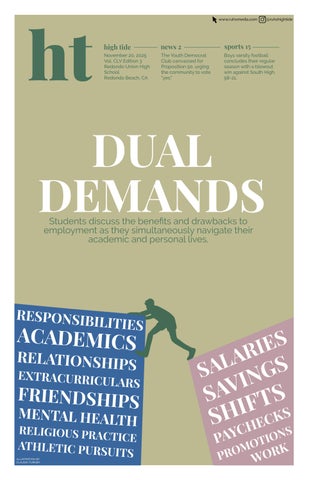
Students discuss the benefits and drawbacks to employment as they simultaneously navigate their academic and personal lives.

EXTRACURRICULARS
by Connor Brodeur
In the modern world, video gaming is considered by many as more than just a pastime. It is a passion and an art form that many people seek to explore in its entirety; however, not everyone can achieve these dreams of game development because they may not know how to design. The CTE (Career Technical Education) Game Design class seeks to do just that, and give students the opportunity to learn how to develop their own video games in the future. Manny Waters, teacher of the CTE Game Design class, created the class because he wanted to give students the opportunity to make an impact in the video game industry.
“The focus of my degree is CTE, which basically tries to teach students a skill or a profession that is opposed to just a subject like history, no offense to history, but [CTE] teaches you something that you could go to college for or you could go straight out of high school and get a career [with], which I think is absolutely great,” Waters said.
the main part of the curriculum begins. A freshman in the class, Derek Freisheim, said that the class is structured so that students have “a lot of time to be able to go at your own pace and do your work.”
“There are reasonable deadlines, and there is never much homework unless you didn’t finish [the] classwork,” Freishiem said.
to make it fun and engaging for players,” Freisheim said. “You'll learn about things like how to implement animation and how to script it into your game.”
One of the features of the class, the Unity Certified Programmer credential, is a possibility for students this year, and may be included next year.

The Game Design One class begins by discussing game design from a broader, global perspective, teaching students about the history of games and how they have been developed over time.
“When you look at the history, it kind of gives you an idea of how things started and it gives you an idea of where things might be going,” Waters said.
After the programming history lessons,
In class, students are taught how to use several programming languages, beginning with the fundamentals of JavaScript before moving to C Sharp (C#). The C# programming language can then be used within the Unity game engine, a tool that can help create games. Using these programming languages, students learn how to design the games themselves.
“You will be taught basic game structure and how games should be structured
“Unity credentials can be used on job applications, and since this class is meant to be specific towards getting a career in computer science and game development, being able to get beginner credentials is very useful,” Freisheim said.
The CTE aspect of the class also means that students are encouraged to think about how they could use their skills to further their horizons with careers and with other personal and creative projects. Mr Waters is working to collaborate with El Camino’s game design course to give students a “seamless transition” if they plan on going from RUHS Game Design class to designing games at El Camino.
“[This class has] definitely been a good thing for hopefully my career in Game Design,” Freisheim said. “I've learned one of the most common engines for making games, which is extremely useful. As I learn more C#, I'll be able to finally start coding things without help and I'll be able to do it on my own.”
The Young Democrats Club canvassed for Proposition 50, encouraging the community to vote "yes"
by Baran Taghvaei

After hours of going from house to house, knocking on doors with the sun beating down on him, senior Kevin Leedy, the Beach Cities Young Democrats (BCYD) president, rings a doorbell holding his “Vote yes on prop 50!” posters. Leedy, alongside other BCYD members, including junior Olivia Reeds, canvassed October 26 and November 2 in support of Proposition 50.
“[BCYD] works with Beach Cities Adult Democrats, which is a whole other organization, and they do a lot of canvassing. So I told Ann, the president of Beach Cities Democrats, that we were interested, and] I fell into this wormhole of Prop 50 and did a lot of research," Leedy said.
Prop 50 was a proposition for a new, legislatively drawn congressional map of California, which passed and created more spots for Democratic representation in Congress to create a balanced distribution
of representation between Republicans and Democrats in 2026.
“Me and Brayden [vice president of BCYD] talked about it, and we decided that it would be a good opportunity to get door-knocking experience,” Leedy said.
In order to canvas, Leedy underwent training on an online platform called LA Forward in 2021. After his training, he and his vice president taught the other members of BCYD how to canvas.
“They gave us a little spiel [and] a script of what to say and possible responses [to] what the people we knocked on the doors of said to us,” Reeds said.
After teaching the members how to canvas, Reeds, alongside others, went from door to door, from one to four pm, attempting to persuade the public about the importance of Prop 50.
“It was a little stressful for me. I feel like it was a really good experience to get out of my comfort zone,” Reeds said.
Leedy created BCYD and has served as president since 2024, followed by Young Democrats, a newly formed RUHS club version of the BCYD chapter, created by his Vice President, Brayden Colee. Sparked by the 2024 presidential election outcome, Colee created the chapter to bring democratic teens together.
“I was angry with how it turned out, and I had friends DMing me [that] were like, ‘I'm scared my family is going to get deported’,” Colee said.
After hearing his friends' concerns and having no way to directly comfort or reassure his friends, Leedy decided to create BCYD, which later turned into its own chapter with a focus on activism through protests. Similarly, Reeds decided to join BCYD after the election.
“I felt frustrated about the political state of our country. And so, it felt like a way that I could be doing something about it instead of just watching on the news or like seeing it on social media,” Reeds said.
Being in BCYD and participating in politics during high school has allowed Reeds to be aware of what’s going on around the world.
“I do a lot of political stuff outside school. I've gained only a level of professionalism that comes with doing politics,” Reeds said. “It's about me finding my voice and me doing public speaking.”

editors-in-chief
Daniella Gross
Claudia Turner
Ava Anzivino
Priya Ramcharan
digital director
Valentina Masoni
news editors
Leyla Evenson
Carly Jacecko
features editors
Aashka Bhuptani
Sanaya Bhatt
opinion editors
Payton Rothluebbers
Jayla Dorbor
entertainment editors
Fi Borgese
Emery Min
sports editors
Sophie Rebbeck
Sam Schwartz
writing & copy editors
Emery Min
Deeksha Prasad
Samantha Kim
online editors
Hayden McMahon
Isabella Nguyen
Kayli Mai
Kate Lanzdorf
Allison Sutton
Francisco Villegas
Marlena Lipan
Kate Brucia
Kaitlyn Chang
adviser
Kerri Eastham
staff writers
Violette Alshin
Declan Williams
Coco Yamane
Willamena Hod-
son
Amelie Kircher
Ryan Chamides
Martina ParraMalandrino
Mahro Siddiqi
Reya Conte
Landen Gould
Madelyn Bain
Brooklyn Hesse
Katelyn Min
Adelyne Cai
Stella Sato
Gala DeSanto
photographers
Robert Packard
Grace Tayag
Kevin Phung
Finn Williams
Amanda Harrison
Lorelai Land
Ignacio Perez
Oliver Cody
Rowyn Salazar
Andrew Diette
Sophie Farias
Mishka Shibata
Connor Brodeur
Issey Kubota
Kacie Brincat
Ayla Rodgers
Safi Hamilton-Torres
Haruto Kuroda
Eliza Prangnell
Julia Bradin
Baran Taghvaei
Francesca Masoni
Sophie Riddle
Martina Parra- Malandrino
Sayat Brook
illustrators
Claudia Turner
by Martina Parra Malandrino
Music plays out of the library speakers as students and their families come together to observe and admire Spanish students' work. On Nov. 5, the World Languages and Culture Department, in conjunction with Cervantes: Sociedad Honoraria Hispanica (Hispanic Honorary Society), held its 31st annual Día de los muertos event in the library. The event was facilitated by the students and the Spanish department and showcased projects made by students of all Spanish levels. Spanish teacher Amanda Duran was in charge of organizing. Senior Mia Higuchi, the president of Cervantes club this year, has aided in the planning of the event and other Cervantes events since her junior year.
“It's really fun to see it all come together, and all our work. It's worth it. I see a lot of new faces, and everyone is just really enjoying the event,” Higuchi said.
The event is open to all students and their families. Club members set up face painting stations, gave out cultural foods such as pan de muerte (bread of the dead), horchata, and agua fresca (fresh water), and even had students from the Sabor de Salsa club perform. The library was decorated with marigold flowers made from paper, papel picado, and drawings of la catrina, some of the most prominent components of Dia de los muertos culture. For Higuchi, being involved in Cervantes has been a special way to bond with other Spanish-speaking students and fellow members of the Latino/Hispanic community.
Higuchi said.
The Dia de los muertos event, along with other Cervantes-sponsored events, encourages students to learn about and celebrate Hispanic culture.
“It's a time for remembrance, celebrating our loved ones who have passed, and welcoming them back,” Higuchi said. “This event is for everyone. We want to welcome all students of all ethnic backgrounds, and that's what makes this event really special. We’re very inclusive and just celebrating
“It's just been wonderful to learn more and more about life and death, more of a celebration and just remembrance of how important these people and their impact. It's learning who these people were, their lives. Maybe we didn't know them, but through learning about their stories, we feel connected. We feel like there's this legacy that we continue to learn from them and make our own lives enriching and better,” Gonzalez said.
Cervantes aims to celebrate and hon-
inclusive,” Gonzalez said. “People are always welcome to drop into these events, inquire, find out, ask, and not be afraid, and hopefully their peers and the adults around them never make them feel, in any way, silly for asking or clarifying anything about the culture.”
Whether the student is Latino/Hispanic or not, being in a Spanish class means they will not only learn how to speak the language, but they will also be taught about the many different cultures involved.

Hispanic culture, and it really makes our school a diverse campus.”
“I'm Nicaraguan, and I feel like being a leader in part of this club, I'm around Hispanic kids and other people who aren’t Hispanic, but we bond, and we have a connection because we all speak Spanish. I'm able to celebrate my culture and promote Hispanic culture, and do other schoolwide events like these, and have other students engage in honoring the culture, too,”
While it is deeply rooted in Mexican culture, many families of all Latino/Hispanic cultures also partake in the celebration of life and honoring those who have passed. The holiday pays respects to loved ones who have passed and welcomes them back into the world of the living, complete with altars, all showcased at the event. Sara Gonzalez, AP and Spanish 2CP teacher, is the adviser of Cervantes. Gonzalez feels a personal connection to the celebration.
or Latino/Hispanic culture through celebrations and events similar to this one. Cervantes appreciates the community by having musicians and traditional folkloric dancers during Latino/Hispanic Heritage Month and plans to continue doing so by celebrating events such as Cesar Chavez Day, Cinco de Mayo, and Three Kings Day. The club aims to gather support for Latino/Hispanic communities while also sharing the beauty of the culture, according to Gonzalez.
“Our culture likes to celebrate and be
“When you learn a language, you don't just learn the mechanics, the grammar, of a language, you also have to learn about the culture, the people, the history, the art, the food. Every aspect of the language is important. It all comes together, and it gives [students] a better understanding of the culture and that experience to be part of the culture,” Gonzalez said.
Depending on the Spanish class they are in, students had different requirements for the project. Whether it was papier-mache, clay figures, essays, kites, masks, ofrendas, piñatas, all projects had one common goal: to celebrate and share the many different experiences of dia de los muertos, a traditional holiday aimed at honoring loved ones who have passed and celebrating their lives. Gonzalez was satisfied with the event and the students’ work in celebrating a major part of Latino/Hispanic culture.
“Seeing the projects come to fruition, seeing what the students came up with, who they're honoring, who they're celebrating, and then seeing them all come together in this space, every year, it just blows us away. It really fills our hearts. It fills the soul,” Gonzalez said. “Every year, those projects just get better and better, and we just keep expanding. I think students have done a great job at capturing the essence.”
by Haruto Kuroda

"I spend my money on Starbucks drinks and food, as well as decorations. The decorations are for my room at my dad's house because I don't have much stuff there, and I want my room to look cool. For me, a worthwhile purchase would be food that I feel like I need or something that I think is cool, but then I also waste money on things. Sometimes I'll think that something is cool and then I actually sit down after I already bought it and then I realize it's a waste of money."
-Ethan Kolb, freshman

"I spend my money on anime merch because I could resell it or just have it for fun. I think popular [anime] characters are worthwhile since their market value is high. Characters that I don't like and have less market value are less valuable to me."
-Kotaro Hashiudo, sophomore

"Usually I'll spend it on bead kits [since] I make key chains, phone charms and bracelets to give them to people. I think, [what makes something worthwhile is] definitely the quality of something, having both features as a good quality product that isn't too expensive."
-Ariella Barnas, junior

" I spend my money on a lot of things, but mainly I spend it on food, I spend it on entertainment, like games, and recently I bought a new computer and a PlayStation. I feel like a worthwhile purchase is something that means something. Like if you buy a souvenir, that's going to be a worthwhile purchase because it leaves memories."
-Ethan Lakandula, senior
by Addy Cai
Breathing in the earthy air, senior Charlotte Edwards digs into the ground with a spade, coaxing an invasive plant species out of the soil. This is simply another one of her weekly tasks as a habitat restoration volunteer at Madrona Marsh.
Every weekend for four years now, Edwards has spent her Saturdays at Madrona Marsh, located in Torrance. As a volunteer, Edwards works to educate vistors and restore the park alongside a team of experienced volunteers on the Advanced Restoration Crew (ARC).
“The group [of volunteers] has been something I’m really proud to be a part of because it's one thing, to help the environment, but it's more fun when you're with a group, and it's been great getting to know them,” Edwards said.
As part of the marsh’s habitat restoration team, ARC assists in the hands-on process of restoration and management of the plant wildlife.
“Every week, the employees who actually work [at Madrona] meet us at the restoration, and they'll tell us about a new species. Then they'll educate us on what the species looks like. For example, they'll tell us and show us the best way to remove curly dock or mule fat. So whether it's with a shovel or with hand pruners, we'll go tell the [newer] volunteers who show up how they're gonna get rid of this stuff,” Edwards said.
Within this ARC group, another volunteer, Leah Kim, has volunteered alongside Edwards for a year. She describes Edwards’ presence at the reserve as a very calm and helpful person to talk and work with at the marsh. She recalls the difficulty of tying the tarps around rogue tree branches in order to transport them.
“They've been getting very full and really hard to tie, but [Edwards] always helps me with them because you need a lot of slack and [Edwards] always sees me tying it. She'll come over immediately to help because it's a [two-person job.]. She's always that second or third person that I need,” Kim said.
Although Edwards recalls first volunteering at Madrona Marsh as a freshman for Key Club, she soon found a passion for its environment and the chance it gave her to be free of the crowded environment that school and its workload can occasionally provide.
“I spend a lot of time indoors in my room when it's very cramped,” Edward’s said. “For three hours on the weekend, it is nice to be out in nature with no screens, just talking to people and being out in the environment. ”
by Madelyn Bain
At a lab in the UCLA Harbor Medical Center, the clock strikes nine am — junior Ella Chung is already walking through the door, greeting doctors, and slipping on her white coat with determination set in her features — she is ready to make discoveries. Over the summer, Chung interned at the Lundquist Institute for Biomedical Innovation.
“I volunteered to be a control subject for an experiment because this allowed me to become involved with research, and also, it allowed me to understand the inner work ings of research,” Chung said.
Before her internship, she tried count less ways to become involved in medical work, but few doctors want to work high school students. Acting as a subject in multiple experi ments provided her with more opportunities to come into con tact with professionals. When she came into the lab, Chung was taken under doctors' wings, where she helped perform experiments to support the research.
“Right now, I'm working on the project that I started in the summer, which was investigating the effects of endoplasmic reticulum stress and mitochondrial dysfunction on senescence [cell death] in Tri 21 postnatal lung fibroblasts. It's basically just how stress in the cell affects Down Syndrome lung cells,” Chung said.
Rather than spend her internship passively observing professors, Chung became an important part of the process and was trusted by the doctors in her lab to perform certain procedures.
such small parts of the body, mistakes are inevitable. Chung and her coworkers have encountered obstacles in the lab and spent a significant amount of time revising their techniques to get the result they wanted.
“The one core value that I learned was that it's okay to fail. It's not going to go
my favorite part [of working at Lundquist]. Their community was so worth it because they're all so welcoming. As soon as you come in, [the doctors] say good morning to you, and they say goodbye to you when you walk out,” Chung said.

“I mainly do these two specific lab experiments. It's called RNA extraction and PCR. After we grow and culture our lung cells, then we extract the RNA [cell messenger] from it, so we can eventually put it into a PCR [lab technique], which helps us see which genes are expressed when we put in different types of primers,” Chung said.
In meticulous projects that work with
get used to the process,” Chung said.
Being in a domain that normalized failure not only taught her important skills of perseverance in the face of uncertainty but also promoted a comfortable work space that allowed Chung to develop strong bonds with her coworkers.
“By far, the environment of my lab was
According to Chung, the most essential part of the lab's prosperity is being able to bridge the gap among age, experience level, and background, and come together to make purposeful advancements. She spent her lunches awith 70-year-old doctors, research assistants in their twenties, and fellow students. Chung’s mother, Esther Chung, recognizes this unique environ-
“She felt like she was part of their research family. More than learning about the aspect of research, I liked seeing that growth in her where she felt comfortable talking with different types of people,” Esther Chung said.
Her participation in the project of stress damage to lung cells will improve long-term understanding of the human body and its many in-
“Learning how to do hands-on research with tissues and lungs and organs and being able to use those samples and turn them into research was a very important skill,” Chung Chung’s initiative to dive deeper into her passions has helped opened the field of biomedical research to her, and given her unique experiences, guides her on her path to becoming a doctor.
“I’m so proud to see her working towards something bigger than herself. The doctors in her lab trust her to do these complicated lab procedures accurately and on her own,” Esther Chung said. “The results will eventually be published and used to help countless patients with Trisomy 21 live a longer and healthier life so it’s amazing to witness Ella be a part of that process.”

by Katelyn Min
The rink is filled with the stac cato scrapes of metal on ice as the blades of freshman Chel sea Stone, freshman Adelaide Sloey and sophomore Caeli Chen hit the ice. The three founders of the Figure Skat ing Club and the rest of their members glide across the ice and admire the place they hope to compete in together one day.
“I think it's just honestly a fun sport. It’s fun to be able to skate around, do your spins, do little jumps. I wouldn’t pick any other sport, even if I had the choice to,” Stone said. “I feel like it’s also such a small sport. There really aren’t a lot of people that do it, so you know ev erybody around.”
and some encourage ment from her mom led Stone to found Redondo’s first fig ure skat
a tight-knit com and form an offi


school team through the U.S. Figure Skating program.
“Since [ice skating] is not a D1 sport, the only real professional level is the Olympics. University of South Florida has a collegiate program, so when you go to competitions, they’d introduce you as representing RUHS,” ey said. rently, the club training together, the Toyota Cenmonth on Saturday training. But a matheir time is spent ticing off the ice ter school every Wednesday in room 701.
“We start with warmups like jumping jacks, skips and jump-roping. Then we move on to rotations, which are jumps that you do on the ice. [For example], waltz jumps, salchows, toe loops, loops and
According to Stone, conditioning and practicing for rotations off-ice is just as important as drilling them on the ice. The club’s meetings give them a chance to correct each other without an instructor present and help each member improve
through constructive criticism.
“[Skating] is a perfectionist sport; you have to get everything down to the T. Everything counts, even your arms when you're going to jump. If they're slightly wrong, it's gonna throw you off balance. It's important to know how to tweak your moves to make sure that the next time you go to do it, you can do it right,” Chen said.
While all parts of skating, like spins and artistic elements, require precision, rotations are even more meticulous.
“You have to get the arms, the air position and the landing, and you only have around three seconds in the air. So it's all about setting it up correctly. You're trying to convert it to muscle memory so that you can just do it,” Stone said.
Outside of their club meetings, some members of the figure skating club spend up to 15 hours a week training to perfect their technique. But even after getting the perfect jump, a skater’s work is not over. They must continue to practice the skill to ensure it stays with them.
“The worst feeling in the entire world is getting a jump, getting it consistently and then losing it. It's a canon event that happens thousands of times in a person's skating career,” Stone said. “For me, there's no such thing as a consistent jump. No matter how long you have something, there’s always the possibility of losing it.”
Losing a skill can be quite discouraging for skaters, but it is simply part of the learning process. Despite the setbacks, Chen, Stone and Sloey have never let this get in the way of doing what they love and plan to skate through the rest of high school and into college, even if not competitively.
“You have to be self-motivated. You
have to practice the things you don't like and the stuff that you're not good at. You have to keep going, even if you're falling and not doing things right. You are the only one that has to push yourself, and it really teaches a great work ethic, but it’s also definitely a skill you have to learn,” Chen said.
Skaters also need to know when to stop and take a step back. While necessary, repetition may result in frustration instead of improvement. Sometimes the best course of action is taking a break and coming back to it later.
“It's definitely challenging, mentally and physically. But I think that’s nice because it's your job to overcome that mental block that a lot of us get when we do jumps. It can be really hard sometimes to overcome it, but it's cool because once you get it, [it feels] really good,” Chen said.
Even with how technical and repetitive figure skating can be, Chen, Sloey and Stone manage to find enjoyment in it and the people involved with it.
“When I go to the rink, I feel like it's a second family. You know everyone there, so you're not embarrassed to do anything,” Chen said. “You don't feel as scared to try things. It's nice to have a place where you can confide in other people and build a community. It makes me feel like this is my place. This is my home.”
by Safi Hamilton-Torres
In a garage lined with planks of wood and buzzing machines, two juniors are building more than just a woodworking school project; they are creating a business from scratch. Having gotten inspiration from Mike SooHoo’s Introduction to Business class, Jack Pasquale and Wyatt Andrade created their own woodworking company specializing in incense holders. Within their “carefully planned out” business, each of their roles is “crucial” for its success. Andrade is the handson woodworker, shaping the products with care and precision, while Pasquale is the marketer, ensuring their creations find the right audience. They went from classmates to business partners after they both found out about their shared passion for entrepreneurship and interest in woodworking.
“We didn't know each other before, and it was only until we had a business class together freshman year and bonded once we had to work on our first business project together,” Pasquale said.
They dedicate their free time after school from four to 10 o’clock to collaborating and working on growing their business. According to Pasquale, he is at Andrade’s house “all the time,” helping him sand wood and package products for shipping.
“I also have an interest in woodworking and entrepreneurship, so I enjoy helping [Andrade] with the physical demands of making the product, even if I’m mainly in charge of the marketing side, since it’s for the benefit and success of our company being able to work as a team," Pasquale said. Pasquale and Andrade didn’t come up with the idea of incense holders on their first try; it took multiple business ideas until they settled on creating incense holders. According to Andrade, they wanted to invest their time into creating something true
to themselves, not just with the purpose of gaining money.
“At first, we were cleaning windows, but it felt forced and didn’t feel as authentic. Then we tried to build tables, but it wasn’t fit for a long-term business for us,” Andrade said. “With woodworking, specifically with incense holders, we understand the value we’re adding. We’re making something real and personalized for our customers.”
Even if there is enough product, Pasquale’s online marketing and in-person networking help gain customers and build rapport with their partners.
“I’m really online, marketing on Etsy, Instagram and Pinterest. I take the photos, research keywords and make sure our listings pop up when people search for gifts. I also network in person with other small businesses to collaborate with them and help to gain customers, such as going to our local farmers market by the pier and collaborating with another small business,” Pasquale said.
With his room as the packing room and his garage converted into a complete woodwork shop, Andrade makes the custom physical product. Each incense is catered to the unique demands of each customer. 20 planks of wood are required to be cut by a three-dimensional cutting machine, a CNC machine (Computer Numerical Control), which is required to start preparing the products. After the products are cut by the CNC, they have to be moistened with mineral oil, stamped with the official woodworking company logo and shipped off to the customer.
“When I was about eight or nine years old, I got into woodworking, just off a bunch of videos I saw on YouTube, which I thought were pretty cool. I've always loved to work on hands-on stuff, so I thought it was perfect to create a woodworking busi-
ness,” Andrade said. “I’ve always wanted to turn it into a business, but I just never had the motivation or passion to push me. It was always just kind of on the side. But when I met Jack, I got more into it.”
Soohoo, Pasquale and Andrade's former business class teacher who “sparked their creativity in creating their own business,” observed their “dedication” firsthand.
“They didn’t just follow instructions; they figured out the whole process themselves. From planning to ex ecution, they were fully invested in making it work,” SooHoo said.
SooHoo has respect for their “commitment” to growing their company as well as their ability to evolve their business, actively bringing new ideas to improve it.
“What impressed me about Jack and Wyatt wasn’t just the business,” SooHoo said. “It’s the initiative. Most students stop after a class project, but they took that idea and turned it into something real.”

Inspired by her love for music, Vanessa Barnhart sings and songwrites in the hopes of soon releasing an album
by Mahro Siddiqi
In a corner of Project Barley Taps and Grill, surrounded by decorated walls of hanging guitars and bright strobe colored led lights, sophomore Vanessa Barnhart steps up to the microphone, guitar in hand, as crowds settle down and her voice fills the room. For Barnhart, what started as writing songs on her room floor has grown into sharing her music and passions with the world.
“Music was the first thing that ever interested me in my entire life. I've had this passion for music and a really big connection to it. In middle school, I got the idea to actually start pursuing something and started thinking of it as something that was realistic to do. So I started learning guitar and I spent a year working on songwriting and learning more about music,” Barnhart said.
Barnhart explains how she has always been a very creative person, from teaching herself piano when she was young to now owning almost five different types of guitars.
Due to this dedication to her art, she attended the Los Angeles College of Music for a two-week workshop, helping her with songwriting and performing.
“It was really tough. I had to learn a song on the guitar within an hour and then go perform it on stage. I'd never been pushed that hard music-wise. It was really scary and there was a lot of pressure, but I also feel like I improved a lot,” Barnhart said.
Barnhart’s mom, Martina Barnhart, has supported her ever since she picked up her first guitar, even mentioning how she would listen against the door of Barnhart’s room to hear the guitar strings play.
“I love it. I've always loved supporting those pieces; it’s a little scary that she's so invested in wanting to have this be a career path for her, but I just see her passion and love for it that I can't picture her without music in her life,” Martina Barnhart said.
According to Martina Barnhart, she and the family have been supportive throughout Barnhart’s musical career, recognizing the development she has made over time. Even though it is a competitive space, they see Barnhart making a name for herself.
“I like to start with emotions, concepts and metaphors [when starting to write a song]. Just because when you're writing about a situation that's super specific, it's hard to explore how you're feeling. I really like to translate my emotions with my soul. Then after that, I like to find some sort of,” Barnhart said.
According to Barnhart, "a long writing process is always one that pays off," as it is tough to translate emotions into a song, but she still continues to refine through her work. She draws artistic inspiration from indie-pop and alternative mu sic, genres she considers her music to be categorized in.
“I consider the music that I'm writing to be alternative pop, alternative rock, or pop rock, because I do like to incorporate mainstream elements,” Barnhart said.
Barnhart has had many public performances, including opening for a small band called The Orchids in San Gabriel and performing at Project Barley Taps and Grill.
nection to her music, as sharing her original music on stage brings her joy.
“There's something so incredible about being able to perform something that you wrote. It's just this memorable feeling. It's really nice to be able to share it with people, and also getting to meet people who have the
that was just a moment of ‘how did she do that?'” Martina Barnhart said.
Barnhart has big dreams and a big support system behind her. She aspires to be a producer one day as a backup for singing, connecting both her passions for song-writing and performing.

“Every other Tuesday, they do these teen nights, and through South Bay Music Connection, you can go and perform a 30-minute set there. It's really good practice getting out there. It's really low-key and also has good vibes, so I really enjoy performing there. That’s how I found the Project Barley Taps and Grills gig. I would definitely recommend it,” Barnhart said.
Barnhart’s experiences performing at local venues have also deepened her con-
“[she] has proved herself as a talented musician”, and can work well under pressure. Even though finding bookings can be challenging for young teen musicians, finding a crowd to play for can be very important and valuable. Barnhart’s mom details how proud she is of her daughter and her capabilities in the musical arts.
“She played her very first song. I was like ‘wow’ this sounds amazing and it sounded like she really picked [the acoustic guitar and singing] up beautifully and
“I'd like to be able to continue writing. I've been working on my own personal project that hasn't left my bedroom yet, and I've been working on an album for almost a year and a half now. And I'm working on finishing that, as I continuously improve. I would like to be able to become an artist and release my own music. Being signed or being an independent artist would be an amazing opportunity,” Barnhart said. Not only does Barnhart use her music and platform as a way to express her emotions for herself, her goal is also to let others feel too.
Whether it is anger or sadness, happiness or hopefulness, she wants to be able to convey these emotions to others too through her
“The thing that I love about artists and going to concerts and shows is that those artists can perfectly capture how you're feeling and make it into something beautiful. I think that's what I want to do with my music. I want to be able to make people feel less alone and feel those things in different ways,” Barnhart said.“I couldn't imagine myself doing anything else. It's always been such a big part of my life.”
by Rowyn Salazar
When there are kids trying to run around, it is freshman Rinka Sugiyama’s job to keep them where they need to be. Even though it may be challenging at times, Sugiyama has spent over 150 hours watching and teaching young kids at Nova Japanese and English Tutoring and Ballet des Petites Etoiles.
“The kids are very funny, they keep me busy, [and] it is very fun teaching and help-
According to Sugiyama, she plans to keep volunteering for a couple more years because it is good for her future.
“I mainly help the kids study, do their homework, and sometimes tutor them. I help them with math and writing, both Japanese and English,” Sugiyama said.
During a typical day at the Japanese school, Sugiyama teaches five kids at a time and up to around 20 kids per day. For
cause it is good for college applications, and you can make new friends. I would [recommend it] because you get to be more social with people. You also get used to [being around] young kids. It was very hard to understand what they were thinking and feeling. But now, I can understand what they're feeling, and it's easier to teach them,” Sugiyama said.

Sugiyama also decided to start volunteering at Ballet des Petites Etoiles because her younger sister used to dance there. It is a Japanese ballet studio for kids ages three to six, and ever since she started high school, she has thought volunteering there would be a fun experience.
“I help them get dressed into their performance costumes, and then I babysit them while we’re waiting backstage. I keep them quiet, and then I keep them where they're supposed to be. I take photos of the kids performing on the stage, and the photos go to the teacher, and from there it goes to the parents and the students,” Sugiyama
Eighth grader Mei Kajita, one of Sugiyama’s best friends, volunteers with her at Ballet des Petites Etoiles. They have volunteered together a couple of times and have known each other for more than two years. They both work together to help the kids stay focused and quiet when backstage.
“Rinka is really sweet and kind towards the kids; they like her very much,” Kajita
said. “I really enjoy working with Rinka because we're so close as friends, so it's easy to coordinate and plan what we're doing together.”
Volunteering at both the school and ballet studio is different because the kids aren’t the same. After volunteering in two separate environments, Sugiyama had gained different experiences from each, taking on challenges of managing kids who don’t always listen.
“Volunteering at the school is way easier because the kids are more mature, but at the ballet studio, it is very hard since they are younger. The kids at the school are more responsible, more quiet, so it's easier to teach them, while with ballet kids, it's chaos,” Sugiyama said.
Sugiyama has been speaking Japanese her whole life and English since she was in first grade. She loves that when she volunteers, she can connect with kids in multiple ways because she is bilingual.
“The kids speak Japanese, but mostly all of them are able to speak English fluently as well,” Sugiyama said. “Volunteering helps me improve my Japanese and English speaking skills, [and] being able to speak and know multiple languages can help me in the future. It can be beneficial for me because when I go to other countries, I can understand what people are saying."


by Kate Brucia
In spring of her junior year, senior Adriana Corral achieved what some would call a classic high school milestone: getting her driver’s license. Soon after, new gas expenses motivated her to seek another landmark life event: working at her first job. Going “door-to-door” at local businesses, Corral initially applied to “20 to 30” positions without success.
According to an article published by The New York Times in June, this past summer was one of the most difficult markets for teens seeking jobs due to a lack of available positions. This is due, in part, to increased automation, like self-checkout machines in stores, but employers’ desires to hire less seasonal employees also has an influence.
The U.S. Bureau of Labor Statistics Summer 2025 report found that unemployment of youth aged 16-24 rose by 1.0% between July 2024 and July 2025. Gaining work experience while in high school provides opportunities for personal growth and development beyond the type of education gained in class, yet this difficulty seeking jobs may deter students from pursuing employment.
Since finding success in her job search by being hired at Handel’s Homemade Ice Cream in April, Corral has noted benefits of working beyond the financial incentive that originally motivated her to seek a job.
“[Working has taught me] time management, especially because I have to get to work 10 minutes early to clock in. Also, I’ve learned customer service and how to deal with issues and find solutions for them. If someone is complaining or something isn’t working, you have to find a solution,” Corral said.
Corral’s experience is not unique: a study conducted by Dr. Jeylan T. Mortimer that uses data from the Youth Development Study, a longitudinal study that followed participants from adolescence to early adulthood, found that steady work in teens may promote time-management skills and healthy development. While some may express concerns about adolescents experiencing the stressors of having a real job, this study found that negative consequences resulting from adolescent work, like temporary decreased self-esteem, led to increased resilience later in life, having already learned valuable lessons about handling workplace difficulties.
According to Redondo’s Work Experience teacher Matt Ballard, having a job exposes students to the “real world.” The Work Experience class enables employed students to gain school credits for hours spent working, an opportunity Ballard acknowledges “not a lot of kids know is available.”
“With a job, you just build your work ethic and your resilience and willingness to get done what needs to get done,” Ballard said. “I think it's great for kids to start dipping their toe in that world and I think it's an eye opener for some.”
Ballard believes students who work learn to be “accountable” for themselves due to the increased responsibility and lack of flexibility.
“Most jobs don't accept late work. If you have to be absent, there's usually a consequence: you don't get paid, or if you're absent too much, you get fired. I think it's a good kind of stepway to the realities of life,” Ballard said. “At school, we’ll be a little more accommodating. You can have excused absences and we try to work through things, and you can turn in late work. It's different from how strict real life can be.”
Junior Sam Schreter, who began working at açaí bowl and smoothie store Paradise Bowls shortly after turning 16, considered quitting almost immediately due to the stress she experienced in her first few shifts. However, she decided to continue and has since become more comfortable in her role, demonstrating the chance to overcome challenges not presented in school that students attain from work experience.
“The environment [at Paradise Bowls] is so busy that I was asking myself if I made a big mistake working here, but it ended up being fun a couple of shifts later. I think I was just scared,” Schreter said. “I also got to know my coworkers a lot. A lot of them ended up going to Redondo, and I got really close with all of them. The working environment and my coworkers are all so nice, which was the one reason that motivated me to come back to work. As my training ended on day three or four, I [felt] so much better.”
peers. While most attainable jobs for high-schoolers are part-time and entry level, the skills and experience gained can translate into future jobs. For example, Corral is considering a career in business or finance, so she expects the “quick-thinking” and practice doing calculations in her head at the register to aid her in her professional life. In gen-


Most jobs don't accept late work. If you have to be absent, there's usually a consequence: you don't get paid, or if you're absent too much, you get fired."
MATT BALLARD WORK EXPERIENCE TEACHER
Both Schreter and Corral identified interacting with older coworkers as one of the most important benefits of their jobs. According to Corral, this exposure to a diversified age group has helped her learn to “connect with people that are not the same age and in the same school.” As the summer ended and she went into her junior year, Schreter remembers receiving advice from many of her coworkers about their experiences.
“Working with college students was actually so fun because you get to hear about all their stories and what they did in high school. [They told me] what to do now and what to not do and what to start doing. They were able to offer a lot of advice,” Schreter said.
Whether it is because of an increase of human capital, resilience, or guidance from coworkers in a mentorship role, having a job in high school sets students on a higher trajectory. According to a study published by non-profit research organization Employment Policies Institute, students that worked 20 hours a week at a part-time job in their senior year received 20% higher annual earnings six to nine years after graduation compared to their unemployed
eral, she says “most people” should consider working a job in high school.
“[Working] comes with a lot of great skills, and I think everyone needs those skills,” Corral said. “A lot of the things we learn in school can maybe help a little bit, but work is seriously all business, and I think that's really important.”


by Carly Jacecko

Healthy work-life balance.
lege and employment, she sees the firsthand challenges that come with managing school and a career.
Working
gave me a completely different perception of money. It made me realize it costs a lot
to keep my standard of living."
Kiara Esqueda SENIOR
An expression many don’t take the time to consider until adulthood, meant for busy 30-year-olds managing careers and mental health. Unfortunately, recent pollings show that teenagers across the United States are becoming familiar with this phrase far too early in life.


According to a study published on research website and blog, Motherly, summarized by reporter Christina Marfice, job reports from June 2024 show that the participation rate of teens aged 16 to 19 in the workforce has in-
“I know it’s really hard to manage [work and school], especially in [higher education]. A lot of my coworkers are in college and are freshman and sophomores. They have a decently balanced schedule, so I’m hoping that I can have that as well,” Esqueda said “But being a working teen has its own problems. There is so much extra stress having to manage my own money as a teenager, instead of having, say, a parent, provide it for me.”
Budgeting is another adult responsibility Esqueda must handle while working and making income. While managing her own finances does act as a source of stress, it also taught her valuable lessons about distinguishing between wants from needs. These experiences may help Esqueda as an adult by allowing her to build strong financial habits now, such as saving her money for necessities and maintaining a good credit score by not over-spending.


creased by 34.7% since June 2023, possibly suggesting how the worsening economic conditions and inflation have resulted in many teens being forced to work, not for spending money or saving for their future, but to help support their families.
students who worked 20 hours a week at a part-time job as a senior earned 20% more six to nine years after graduation than their unemployed peers.
Senior Kiara Esqueda, a student who works at a local American Multi-Cinema (AMC), takes as many shifts as her employer will allow, so that she can save for goals she has set for herself, such as getting her first car, and saving up for college. Before she started working at AMC over the summer, she babysat and did small gigs to earn money, but she had never had a prior job with a boss, co-workers, or scheduled pay. Surrounded by her co-workers at AMC who juggle col-
“If a young adult is in the situation where they’re needing to maybe forgo some of the typical teenage activities in order to work to contribute to their families, that’s a lot of pressure on a young adult. It’s nice to see teens have balance, for example, still being able to play sports and do some of the more social activities and have hobbies. When a teenager is forced to work I do think that they’re almost put into an adult role too soon,” Spector said.
An anonymous senior, Julie, was “fortunate” enough to have had the opportunity to get help finding jobs through WorkAbility throughout high school. Julie has worked with Senior Family Services, and she had a job working with children in the Beryl Elementary School afterschool program for almost a year, before transferring to Lincoln Elementary School, also to work in the afterschool program.
Ever since I got my job, I feel like it’s taught me skills that are showing in my commitment to my academics. I have all A’s this year, which I've never had before, which feels really good."
According to data from a study by Jack Caporal from financial advisory website, the Motley Fool, more than 38% of Americans have credit scores between 300 and 670, which are considered “poor” to “fair.” Poor financial habits like overspending often lead to lifelong debt and a permanently damaged relationship with credit card companies. Esqueda believes that learning about money through work has given her an advantage.
“I think that working now prepares me for entering the workforce, and provides a good foundation for my future. Especially when you get an actual, professional job as an adult, not just part time,” Esqueda said. “Working now, as a teenager, gave me a completely different perception of money. It made me realize how expensive everything is and how much it costs to buy things needed to keep my standard of living, like basic essentials. It also changed my perception of time, because time is money. Basic things like toothpaste can cost how much money you made working for two whole hours. So even though my situation isn’t ideal right now, I feel like it is really setting me up for success in the future because I’ve already learned those lessons.”
As more teens like Esqueda join the workforce, the demands of balancing jobs and academics are taking a toll. The National Library of Medicine’s teen psychology unit found that, on average, students who work more than 20 hours per week perform worse than their peers in school. But this is not necessarily because of the jobs themselves. Because teens who are getting jobs while in high school might already be struggling academically, they might end up trying to work as many hours as possible, taking more time away from their academic responsibilities. Teens forced to work long hours often miss out on sports, clubs, volunteering and family time, which are key components for healthy teen development.
Aimee Spector is a mentor, career coach and program coordinator of WorkAbility, a grant under School-To-Career. WorkAbility is an organization that guides and assists teens throughout their transition from high school to work life. Spector feels that even though teenage working provides teens with a sense of responsibility, having to balance a job and school does put most teens who are forced into work at a disadvantage.
Like Esqueda, Julie doesn’t work for the specific goal of supporting her family financially, she saves her money for college and for her retirement fund. Unlike other students, Julie feels her grades, mental health, and social life have benefitted from having a job because of the structure and responsibility working requires of her. This responsibility is unlike school for her, as she feels motivated everyday to do the best she can at her job.
“[Working] helped me with a bunch of skills, and the only issue with working at Lincoln is that they are kind of understaffed. I feel bad for not working as many hours, but I have to prioritize my academics. Ever since I got my job, I feel like it’s taught me skills that are showing in my commitment to my academics. I have all A’s this year, which I've never had before, which feels really good,” Julie said. “Working, I feel, has made me physically and mentally stronger, and my job has opened a lot of doors for me that I never really expected.”
While teenage employment does have its downsides, the mental and physical benefits some teens receive outweigh the cons, as they feel having a job gives them a head start with financial planning and adjusting to increased levels of responsibility early in life.
For Spector, seeing students desperate for a job because they feel they need one or to help support their families “breaks her heart,” but she also understands the benefits of teen employment, no matter the circumstances. She also feels grateful that she has a job that can help students in times like those.
“About once a year, we’ll have a student, they'll come up to us and just really need, they just really need to work because their families aren’t able to provide everything or their families are actually telling them, ‘Hey, you need to get work to help us out.’ It’s always unfortunate that students are put into situations where they have to work like this, but I feel so fortunate that I am able to be an outlet for finding work for students,” Spector said. Even if students are in distress and trying to find a job quickly, I know they adjust to working and the benefits in the long run make it all worth it.”

by Emery Min
If the devil took on a tangible form, I can only imagine it would resemble a Labubu. Since I’ve become aware of the ugly-cute (or, according to some, just plain ugly) dolls, it seems like I haven’t been able to escape them, no matter where I turn.
Despite that, Labubus weren’t always the sensation that they are now. In 2015, illustrator Kasing Lung took inspiration from Nordic mythology to create Labubus for his picture book series “The Monsters.” In 2019, Pop Mart, a Chinese toy company, began producing physical toys of the characters to be sold in blind boxes, in which you receive one out of several iterations of a product randomly.
Since then, Labubus have skyrocketed in popularity, along with blind boxes on a broader scale. According to Pop Mart CEO Wang Ning, the company is on track to reach its revenue goal of $2.78 billion for 2025, and it is likely that number will reach $4.18 billion. Pop Mart stocks are also valued at roughly 50% more than Mattel’s (the same company that created Barbie and Hot Wheels).
The question arises — why are blind boxes so popular? Before the blind box craze, I hadn’t witnessed nearly the same excitement over collectibles or figurines.
According to an article published in Psychology Today, blind boxes use variable ratio reinforcement—where you receive a reward or your desired response after an unpredictable amount of attempts—the same cycle that motivates gambling or scrolling on social media. The unpredictable nature of the reward is what keeps us hooked and tempts us to keep making new attempts. In videos of people opening their blind boxes online, they’ll often indicate which version they want, opening multiple boxes at a time to try and score their desired variation.
jing. Rare series and collaborations are also resold for high prices online. A quick glance at the secondhand prices for the Labubu x Vans Old Skool Vinyl Plush Doll had me gripping both my figurative pearls and my wallet a little tighter. Not only that, the popularity of blind boxes online can also transform certain figurines or products into a form of social currency. Even the satirical trend of the performative male now implies a man who carries around a Labubu matches certain desirable characteristics.


But as it turns out, the Labubu craze extends beyond blind boxes—a one-of-a-kind life-sized Labubu doll recently sold for approximately $150,000 at an auction in Bei-

by Leyla Evenson
Yet, if you only really want one or two versions of a figurine, is it really worth it to keep buying? Perhaps not. The fundamental nature of the blind box encourages people to continue buying, even if they don’t really want what they’ll end up unboxing. Purchasing simply to purchase, or the exaggerated obsession with making purchases matches the
definition of toxic consumerism exactly. While shoppers might not be fully satisfied with the result, the unpredictable rewarding system recompenses and provides temptation to make another attempt for the chance that you might experience even greater joy when you do achieve the desired outcome.
Take the example of buying a full set of figurines versus buying a blind box or two. The full set will be more expensive, and if you only really liked two or three of them there’s a high likelihood you wouldn’t buy it. On the other hand, buying a blind box where you only like a few of the varieties might be cheaper and therefore be more enticing, even if you don’t get the figurine you want, and end up making more attempts. Even if you stop after the first attempt of failing to get the outcome you wanted, you’ll still have spent money on a less than ideal product. In that event, was the purchase worth it simply for the three-second high you got from the unboxing?
To be completely transparent, I too have an assortment of Smiskis decorating my bookshelf. It was a painstaking venture to find a store that sold them in Japan because they were sold out everywhere. With a surface level assessment, it’s not very hard to understand the demand. To put it simply, they’re cute. Yet after the initial adrenaline rush of tearing each package open, I found myself a little disillusioned. What was I going to do with these again?
All of this is not to say that you should never buy a blind box or that figurines are completely worthless. But I’d say weigh the difference between owning one or three or twenty. Buy what you want, but do it for the actual product, not the momentary gamble or the sake of buying it. Do you really need a Labubu in every possible color of the rainbow or to collect that entire series, including the $2000 special edition only available on eBay? Whether or not you think they’re cute, the answer is probably not.
Listen, I’m familiar with college admissions pressure. As someone who has been on the phone with countless university’s offices trying to figure out the extremely difficult and complex process, I know why independent college counselors are an option people turn to. I would just like to offer up this perspective: what’s going on? Why have we turned an academic endeavor into a for-profit business?
average college counselor charges

I would like to start by saying, I am not against private college counselors. I think it makes sense to hire someone to help with the stress of college admissions. But every time I look further into this topic, I feel like things start getting a bit lost in the sauce. This is too much: too much pressure, too much money, too much everything.
First, let's talk about the elephant in the room: the cost of the counselors, which is sometimes a bit outrageous. While researching, I came across almost every number under the sun. According to Ivy Coach, a private college counseling firm, “The mean college counseling fees across the nation ranged from $850 to $10,000, with average prices in the $4,000-$6,000 range.” That is a suspiciously large range. Right below this comment was a frequently asked questions list. I read it,
of course, because I have many questions about the scope of prices they listed. The first question on the list they attempt to answer is “How can Ivy Coach justify charging more than the annual cost of college tuition?” That's just unacceptable.
First of all, charging that much money for a process that you can do yourself is wild. Second, this is clearly an indicator that the college admissions system that we have right now is far too complicated. The current admissions process is making people feel like they need to spend tons of money on organization and advice from third party firms in order to even be considered for their top schools. I knew the admissions process was reducing people to mental breakdowns, but this is something else.
We are losing the point of academic merit. College admissions has been a game of getting into the most prestigious and famous university for a while now, but adding expensive college counselors to the mix exacerbates this problem. It’s even more of a competition now, but instead of the game being about who has the most access to academic resources, the winners are now just people who have $10,000 to drop on a Harvard University acceptance letter. No hate, Harvard, but this contributes to a growing issue with money and college.
Universities are already charging tuition at prices that most people can’t afford, and by adding in expensive college counselors to the process of admissions, access to higher level education becomes even more unattainable for low-income families. College admissions has become not a competition of scores, or even a holistic review of someone’s success within the context of someone's academic environment, but solely a money game. The process of committing to a university is not about the passion that you have for your subject or how you created opportunities to demonstrate that interest. It's about the monetary investment you made into the admission process.
I am by no means instructing everyone to drop their counselors right now. I just think it's worth considering what the larger issue is that's causing this industry to dominate in the way it clearly is and the consequences of that.
As a final consolation, if you can’t afford a college counselor or just don’t want one, you don’t need to get one. It’ll be okay. You’ll build skills like organization and managing your own life through doing the admissions process solo: skills that you can actually use once you reach college.

DATA FROM A 2024 SURVEY BY THE INDEPENDENT EDUCATIONAL CONSULTANTS ASSOCIATION 3. Silhouette of a graduation cap.
Silhouette of a student studying. PHOTOS VIA FREEPIK
The High Tide encourages greater input of perspectives from both students and staff. If you have an opinion about one of the articles, letters can be sent to the editor at hightideonline@gmail.com
We reserve the right to edit for content, grammar and space constraints. Letters must be signed and are not guaranteed to be printed. Please keep letters to a maximum of 250 words. Longer guest opinions are also accepted.

Seating charts created by teachers are overall inadequate in providing a favorable learning environment for students
by Payton Rothluebbers
The awkward silence after getting newly assigned seats is often louder than the collective sighs of the entire class while saying their inevitable goodbyes to their friends. In the midst of slouchy posture and the hesitant introductions that represent the discomfort of sitting next to strangers, it’s easier to consider whether or not seating charts are really necessary than it is to consider befriending anybody new. Personally, I would prefer being assigned more work to being given assigned seating if it

happily next to my friends.

I understand why teachers create curated seating charts. Most kids aren’t disrup tive on purpose; a lot of them are just talkative and allowing their friends to be directly next to them often exacerbates the talking. There is no amount of scolding or pleading a teacher can do to hinder a kid’s de sire to chat, so naturally, a seating chart is born, at no fault of the teacher’s. One such teacher who utilizes seating charts in the classroom is AP En glish Language and Composition and 9 Honors En glish teacher Stephanie Geil.

Now, I am not here to complain about being sat next to people who I deem to be “uncool” or to say that I immediately hate anyone who I am sat next to by my teachers. In fact, I see the good in seating charts, in that they occasionally create new friendships, facilitate wider socialization between students and allow for kids to col laboratively learn from each other. My problem with seating charts is that most of the time, they punish innocent bystanders who act accordingly in class for the behavior of those who do not.

“Seating charts are beneficial because they allow teachers to pair students who have different skills and who can help one another. They’re beneficial with classroom management, when you need to separate friends or put talkers next to non-talkers,” Geil said. “Students might not feel comfortable sharing or col laborating with people they don’t know, so I do my best to help with that by joking around a lot and having everybody introduce themselves. It’s about building a classroom environment where everyone feels comfortable.”

It is normalized to reason that pairing disruptive kids and quiet kids will silence the loud one and everything will be sunshine and rainbows. But it’s not. Disruptive kids will stay disruptive no matter who they’re sitting next to, and quiet kids will often only get quieter or more uncomfortable. Why should quiet or well-behaved kids be treated, even unintentionally, as a living barrier? Is that not dehu manizing?


Tes, and is often necessary for ment. But


Pairing disruptive or talkative kids with quiet ones also causes even more disruption for those quieter kids’ learning experience. If this behavior was bothering them from across the classroom, I guarantee that it is even more bothersome to have this behavior directly next to them. Even if these louder kids aren’t acting malicious and are just innocently talkative, I doubt that sitting them next to people who aren’t very fond of talking will help, either. It’s frustrating for both parties involved.
Not to mention that collaboration and sharing work is an engrained
times when doing group work with a seating chart, in the moment, it feels like there’s nothing worse than trying to collaborate with a complete stranger. It’s a recipe for disaster.
Seating charts only work when there has been a high amount of thought and consideration put into them, and when classroom environments are made comfortable and positive for all students. A good seating chart is not created through pure randomization or by throwing quieter students next to disruptive students. A good seating chart is created by taking students’ personalities, skills and preferences into consideration, by being attentive and flexible when students remain obviously uncomfortable in their seating assignments for a prolonged amount of time.
een jobs—whether babysitting, walking dogs, or working retail—teach far more than how to clock in and out. They build soft skills that classrooms can’t fully replicate: communicating with customers, handling conflict, managing time, and taking responsibility for mistakes. Bosses' expectations differ from teachers' espectations, and meeting expectations at work offers students a real-world sense of accountability. Early work also widens a teenager’s financial awareness. Earning and spending in small amounts helps students learn budgeting, saving, and how to recover from inevitable missteps—much better to make a $20 mis-
take at 16 than a $2,000 one at 26.
But these benefits mean little if teens can’t access jobs in the first place. Schools should expand support structures that already exist. Our School-to-Career office offers résumé workshops, practice interviews, and job-hunting resources—but many students don’t know they’re available. Promoting these programs more aggressively would remove barriers and boost confidence.
We already have pockets of hands-on learning, like the Seahawk Marketplace, where students run small businesses and learn basic finance. But opportunities like this shouldn’t be limited or siloed. Students need widespread access to environments where they can practice networking—one
of the most important parts of getting hired. Finding a job, after all, is often about who you know. Schools can help teens identify and use their existing networks, from teachers to coaches to community mentors.
If we want teens to enter adulthood with confidence, financial literacy, and real-world experience, we have to treat teen employment as an essential part of education—not an afterthought. By demystifying the job search process and offering structured opportunities to build soft skills and connections, schools can open that locked door and prepare students for more than just a diploma.
Despite the online discourse, "Christy" is an insightful movie that spreads awareness about domestic abuse
by Jayla Dorbor

I’m usually not one to advocate for separating the art from the artist, but in this case I believe it is incredibly important. “Christy” follows famous boxer Christy Martin, played by Sydney Sweeney, as she navigates her career as a boxer and faces abuse from her trainer and husband Jim Martin, played by Ben Foster. While Sweeney has been in an array of controversies re -
cently, including her American Eagle ad that had a voice-over seemingly hinting her support for eugenics, her performance in this film is incredibly important to increase awareness on domestic violence. Although I understand how many people would want to boycott this movie because of Sweeney’s recent actions, I believe they should watch it anyway when it comes out on streaming services to see how even the toughest women can be manipulated and torn apart by a disgusting man.
When Christy first met Jim, she was being forced out of her relationship with then partner Rosie (Jess Gabor) by her mother Joyce Salters (Merritt Wever), who was very homophobic. Christy had just gotten into boxing and had a lot of natural talent; however, since women’s boxing was very new, she had limited options for trainers, forcing her to train with a man who greatly disrespected her and later became her husband despite their 25 year age gap.
From his very first moments, Jim is shown to be a misogynistic man who greatly disrespects women, especially Christy, even though she is a well-regarded fighter. The movie does an incredible job of showing how he uses that misogyny to manipulate Christy into thinking the same way as him. She frequently makes comments that are dehumanizing to the other women she fights against. It’s
clear that she is reflecting her own feelings towards herself, which have been perpetuated by Jim and her own mother, onto these other women, who she sees as less than, in order to prove to herself that she is no longer “one of them.” The two closest people to her reinforce this idea that the person she is on the inside is not a good one, which forces her into believing that she needs to change to live up to their ideals.
This form of manipulation allows Jim to begin not only emotional abuse, but eventually physical abuse as well. Even though Christy is clearly a better and stronger fighter than Jim, the misogyny that has been drilled into her mind allows him to hurt her, because she believes that men are less than women. And when Christy finally gets the courage to ask for help, her own mother tells her she sounds crazy.
While this story is incredibly tragic, it does an amazing job of representing the emotional manipulation that many people experiencing domestic violence have to go through and why it is often so difficult for them to escape. I think it’s so incredibly important for young women especially to learn about this story and watch this movie as it does a fantastic job of bringing awareness to this problem that is still very prevalent today.
A big part as to why this movie is so compelling is the amazing acting. Sitting in that movie theater I wanted nothing more than to punch Jim and the mom straight in the nose, and that just shows how disgustingly well Foster and Wever play these abusive, evil characters. Throughout the entire movie Foster had this emotionless creepy look on his face that solidified his lack of remorse and desire for power towards Christy. While his acting filled me with so much
rage, it did prove how great of a job he did taking on this role. Similarly, Wever always had this very innocent, cheery tone to her voice, no matter how sinister her words were. The one and only time she raised her voice, was when she found out Christy was in a relationship with another woman, revealing where her priorities were, which was on her own image, not Christy’s wellbeing.
While for the most part I did love the acting and the storyline, one problem I did have with the film was the pacing. The beginning of the film moves incredibly fast, which I assume is to mirror how Christy’s career began. However, within this fast-paced intro there were already two training/boxing montages in the first thirty minutes. So while the story line moved fast, the long drawn out fighting sequences were plopped in the middle, making it hard to stay engaged. Then towards the middle of the movie the pace slows down a lot, and there are at least three more boxing sequences. While I do understand this is a sports movie, many of these sequences were repetitive and felt the same. I honestly would not have minded them so much if there was some variety added to the filming or editing of these scenes, but there wasn’t. I would’ve much rather liked to see more of Christy's fiery personality outside the ring. Despite this, I cannot deny that it is very important and empowering. It did a wonderful job representing emotional and physical abuse and the effects it can have on even the strongest individuals. I would highly recommend watching this movie to learn about the amazing woman who is Christy Martin.
"Bugonia" is a bizzare and complex film that is a must-see for film lovers
by Francisco Villegas
“Bugonia” is so much crazier than I could ever encapsulate in this article. It's definitely more absurd than the trailer was able to prepare audiences for, hence why I wasn't even close to being ready to see “Bugonia” in theaters. In retrospect, some research into director Yorgos Lanthimos previous films, famous for their absurdism and dark humor, would have helped me to avoid the hour of disoriented reflection that followed the end of the movie.
As the trailer set to Chappell Roan's “Good Luck, Babe!” reveals, the film takes a deep dive into modern class division through the lens of an online conspiracy theorist. Specifically, the film follows Teddy Gatz (Jessie Plemons) who, as a result of trauma and a continuous fall into online echo chambers, develops the idea that the world is run by a group of aliens posing as high powered officials. With the help of his intellectually disabled cousin Don (Aidan Delbis), Teddy kidnaps the CEO of a massive pharmaceuticals corporation, Michelle Fuller (Emma Stone), in hopes of having her help him broker a deal to save the human race from her alien mothership.
As insane as that pure premise feels, today's political climate of complete polarization along with masterful performances from Plemons and Stone allow “Bugonia” to feel like reality in moments of the film. Plemons is able to play Teddy’s complete loss of belief as well as the anger resulting from his trauma perfectly.
The unexpected highlight of the film was first time actor Aidan Delbis’s perfor-
mance as Don. He ends up being the emotional guide of the film. Don’s attempts to keep Teddy’s plans from going too far and his comedic breaks in the film's high tension moments do a lot to keep things from becoming overly depressing or serious until Lanthimos is ready for the film to enter its climax.
While the plot and character performances throughout the film were more than enough to stick in your head well after the movie ended, the aesthetics of the film were honestly equally striking at points. From the beautifully ugly and lived in nature of the Gatz household, to the completely opposite look of Michelle’s high class designer home, everything is done with intention to make it plausible that these people really could be from two different worlds. More than just the terrific sets, the action is strong. At moments it's scarily indistinguishable from reality.
As I've said, “Bugonia” left me speechless. I came expecting an exploration of the dangers of class divide with an unnerving veil of a thriller, wacky character performances and sci-fi ideas placed over it. While I can't exactly say that any false advertising took place, that's really only a fraction of the film. “Bugonia” builds on that premise continually by not shying away from the complex aspects and discussions associated with it. As much as I appreciate Lanthimos’ decision to go all out artistically with an ending that had me looking over at my friend with a level of disbelief that I can't say any other film has given me, I don't think I would make the same choices. Some
of my favorite parts at the start of the film feel less heartfelt now knowing the ending. With that, if you're really interested in the basic premise, I think “Bugonia” is a near must-see just to have this unique moviegoing experience under your belt and for that bewildering feeling you’ll get as the final scene plays out.

Robin
DiAngelo's book "White
Fragility: Why It's So Hard for White People to Talk About Racism" emphasizes the importance of confronting internalized biases
by Kayli Mai
reading book, one in particular caught my eye and reeled me in: “White Fragility.” Af ter briefly reading some reviews and trying to dis tinguish if the book was worth reading, in addition to receiving a recommen dation from my school counselor, I decided to give it a go.
book is, as its full title would imply, “White Fra gility: Why It's So Hard for White People to Talk About Racism.” The 2018 novel mainly focuses on analyzing and breaking down various topics such as white supremacy, var ious forms of racism, bi naries, and the history of race in America. The book carries you through multi ple phenomena in which white fragility has been created. To DiAngelo, white fragility is a defense mechanism that white people will often fall back on when confronted about any racist acts they have commit ted. The book reads like a guide, address ing how white fragility has been created in America, and how to properly dismantle it in an anti-racist sentiment.

On the subject of people, DiAngelo writes about socialization, and how it’s not widely understood that people are socialized into various groups such as wealth, gender, sexuality, race, able/disabled, which all affects one’s perception of the world, as their perspective will be different depending on what groups someone is socialized into.

"White Fragility" begins with an au thor's note that sets up the book by explain ing how America was founded under the principle of freedom, but was anything but free, as marginalized communities and minorities suffered under racist laws and the absence of rights. In the following segment, DiAngelo explains how there’s not a chance
way you experience the world. In a way, reading about these concepts that affect my life daily was validating, as it gave me tools to not only integrate into my life, but also to share with like-minded individuals.
This ties into her next topic of white supremacy in America, focusing on the social construct of race and how eugenic ideology was adopted during slavery to search for answers of racial inferiority in white and Black people. I like how she highlights that white supremacy rests on the foundational premise that being white is standard, and being a person of color is a deviation of the norm. This is racial exceptionality, obscuring a reality of ongoing institutional white control that reinforces philosophies such as individualism and meritocracy. DiAngelo writes that when this racial entitlement is taken away or slowly dismantled, the people receiving this privilege get upset.
DiAngelo also focuses on the underlying foundation of white fragility by distinguishing how race shapes white people's lives. She focuses on the idea of belonging, in which the author explains that she’s never had to worry of a lack of representation or any racial discomfort that could be raised at the thought of not racially belonging. To her, this gives white people the freedom of movement in which they don’t have to worry about racism, pushing that whiteness has been socialized
All of the phenomena that DiAngelo discusses in her book end up resulting in white fragility, an outcome of the way white people have been socialized into white supremacy as a means to protect, maintain, and reproduce white supremacy. This blocks any
opportunity for reflection or understanding of one’s own actions. DiAngelo explains white fragility as a cocoon of racial comfort, centriality, superiority, entitlement, racial apathy and obliviousness.
The book almost paints this narrative that all white people have this system of extreme fragility ingrained socially, which is something I disagree with, as you cannot put a billion people into a neat little category, labeling them all as fragile. I agree, a lot of the content is beneficial for anyone and everyone to read, and yes, white people live in a society where they have innate privilege because of their race.
It is important to understand that racism committed by people of color isn’t backed by these powers, which is why I felt DiAngelo aimed the book at an audience of white people. I agree this book helped me to understand what white fragility is, along with tools to target the destruction of racism, but I am not the target audience. The main critiques I read online focus on this, as a white person may not be as inclined to pick up the book on their own and read it. If DiAngelo’s main purpose is getting white people to understand the racism they commit and how to effectively stop it, the book was not marketed correctly. While reading this in public, my friend’s Asian mom told me to put the book down in the presence of her white husband, so as to not offend him. If I—an Asian-American teenager—can’t even read this book in public without getting told to put it down, a white person may not even want to pick it up.
Rosalía's fourth studio album, "Lux," showcases her ethereal vocals but suffers from a repetitive sound throughout the album
by Fi Borgese
Going into Spanish artist Rosalía’s new album, I honestly thought I knew more about her than I actually did. I had heard her name on social media and assumed I knew at least one of her songs, so I was really surprised when I listened to her most popular tracks in preparation for this album and knew none of them. So, I did a little more research on her and listened to a few of her older songs before listening to her new album in order to gauge her music style a little better, and I found out I love her music.
Rosalía’s new 15 song album, “Lux,” made me feel like I was stuck in a fantasy book. In the first track of the album, “Sexo, Violencia, y Llantas,” or, “Sex, Violence, and Tires” in English, Rosalía starts off in an existential mood, singing of human corruption and religion. This song, as well as nearly every song following it, made me feel like I was up in the skies, ascending from the Earth. The violin and her soft voice blend to make a sort of classical-pop that I haven’t heard much of before, but made an unexpectedly good mix.
The second song, “Reliquia” (“Relic”), starts off more quickly and upbeat, though it keeps the violin, classical-pop sound going. Although it’s still very unique and I like the distinct sound of her voice, this song wasn’t as remarkable as the others in the album.
The third and fourth songs, “Divinize” and “Porcelana,” (“Porcelain”) respectively, really surprised me. The first thing
I noticed in “Divinize” was that I couldn’t understand it. Most of her songs are in Spanish, which, as a native speaker, was fine for me, but the beginning of this song was in a different language. It was similar enough to Spanish, so my immediate thought was Portuguese, but then I realized she’s from Spain and found out it was actually Catalan. The next song included Spanish, English, Latin and Japanese. The fact that she learned bits of all these languages alone was incredibly impressive, but being able to pronounce the words well and rhyme them in her music was even more incredible. After a little more research, I found out that she included 13 languages total in the album.
“Mio Cristo Piange Diamanti” (“My Christ Cries Diamonds”), the fifth song on the album, disappointed me. It had the same vibe as all the other songs, but was slow and frankly a bit mediocre. While all the songs before were dramatic and almost angelic, this one didn’t make me feel any different than any other average classical song out there. It could also just be the fact that I’m not the biggest fan of slower songs anyway.
The next song, “Berghain,” however, has to be my favorite off the album. It starts off incredibly dramatic, like a song meant to be played in the background of an ultimate sword-fight — the final battle between the light and dark side in an epic movie scene. The escalation at the very beginning was an amazing start to the song and the whole
rest of the song kept the same energy.
After “De Madrugá,” (“At Dawn”) I have to admit, I started getting a little bored. I definitely had to go back to some songs to relisten because I zoned out in the middle of them. It wasn’t that the sound itself was boring, it was just that every song kind of just sounded like the same thing.
The final song, “Magnolias,” felt like a satisfying ending to the album. While it did have the same problem, sound ing very similar to the other songs, the violin and vocalization in the background made it sound like the climax was resolved and the final scene was playing out. It felt like a bittersweet goodbye.
listens to rock, I definitely wouldn’t put this album on to get ready in the mornings, but if I sat down to write a fantasy book, this album would be a very fitting soundtrack.

Honestly, while all the songs were really good and I like the new style of orchestral pop that Rosalía incorporates in her music, all the tracks were melodically alike, and by the middle and end of the album, I could predict what the next song would sound like before I even hit play. As someone who primarily

by Sam Schwartz

As rain hammered them down, the cross country boys stayed up. The Sea Hawks brought first place home in the CIF (California Interscholastic Federation) Prelims on Nov. 15. In a race of 17 schools, they edged out the runner up by just two placement points, putting them in a great spot for CIF finals on Saturday Nov. 22.
Having a lot of confidence prior to the race, the Sea Hawks used practice as long term preparation for future races. According to senior Gavin Hasson the team didn’t save their bodies for the prelims very much.
“This week specifically, we did a really hard workout on Monday. It was very quick but with a lot of volume, meaning a lot of reps,” Hasson said. “Over the course of the week we didn’t drop our mileage off too much.”
Unlike other sports, cross country races don’t use their usual field of play when rain hits. The boys raced at Mt. Sac, which has both a normal course and a rain course.
“The normal course usually is all dirt or mud, and if it’s raining it can be a safety hazard,” Hasson said. “So [the race] changed to the rain course, which is pure
cement and basically a flat loop of a couple of parking lots.”
For the Sea Hawks, packing, meaning staying in a group, has been the deciding factor in their races. Knowing this, they knew that would be the key to success according to senior Mateo Figueroa.
“Our packing [was good]. We were all up towards the front of the race together. We were pretty consistent, [and] we just wanted to get our whole team across the finish line together,” Figueroa said. “That's what we were focusing on, and it went pretty well.”
If just one runner placed three places back then the boys would not have won. With Figueroa hitting a roadblock early in the race, the rest of the guys needed to kick it up a little.
Hawk’s confidence got a boost.
“Mario [Montoya] and Matteo [Sanchez] did a really good job of getting out well, so then me, Desmond [Vaughs], Miles [Billiris] and Mateo [Figueroa] could get up with them,” Hasson said. “We had to swerve around and cut some people off, but we ended up getting up. At that point, not even a mile in, [we knew] it was done.”
Our packing [was good]. We were all up towards the front of the race together. We were pretty consistent, [and] we just wanted to get out whole team across the finish line together.
“We just crossed the mile marker and we were going around a bend, and it [his shoe] just flew off,” Figueroa said. “Gavin [Hasson] really stepped up in this race, usually he’s a few places behind, but he put on a new leadership role and went up front helping the other guys.”
Hasson noted that the team was sure of their victory not just after the race concluded, but during the race. Knowing they executed their plan early in the race, the Sea
This race marked the beginning of what could be a long state stretch, putting more stress on the Sea Hawks according to Figueroa.
“This is the beginning of all our CIF [and state] stuff, so you have to show up and show out to make sure we make it to finals and state,” Figueroa said. According to senior Desmond Vaughs, the victory in prelims helped the boys feel more confident for CIF finals and future races.
“We feel confident about our place,” Vaughs said. “[We] are excited to show what we can do at finals.”
1.
2.
by Kaitlyn Chang
While many were still asleep to the sound of rain early in the morning, the boys wrestling team was focused inside the gym at West High School for their first tournament of the season, where they placed ninth and 10th overall with Varsity split into two teams for the tournament. Athletes who placed in their weight classes include Finn O’Brien, Kacey Niusuamalie, Cameron Shinkai, Sheamus Chesterton, Jonny Barbosa, Kosijo Mariscal and Jayden Dremy.
This tournament was the first one to kick off the season, but it was also the first one ever for junior Seamus Chesterton with this being his first year in the sport.
“strong” San Pedro opponent but after that won four consecutive matches.
“I think I came back [after the second
came back and won the match with a pin.

“I joined wrestling because a lot of my friends were on it, and I wasn't doing a sport. I just thought [I] might as well do it,” Chesterton said.
Despite being new to wrestling, Chesterton won five out of his six matches and placed third out of the 15 boys in his weight class including himself. Starting off strong, he won his first match by pinning his opponent early in the first period and continuing to dominate with consecutive takedowns, spending the majority of the match in top position.
“The first match was really, really nerve wracking,” Chesterton said. “Then after that, once the whistle blew, it kind of all went away.”
Chesterton lost his second match to a
match] because the kid that I wrestled was really good. So after I wrestled him, all the other kids were easier to deal with, and I knew what was coming since they were slower and not as strong as he was,” Chesterton said.
“Even after the loss, I wasn't very motivated. But it kept me going with everyone being on the sideline and cheering me on.”
“When I'm down, what's going through my mind is this person's really trying to hold you down. Your whole goal is getting up. It's more so just trying to be explosive,” Calderon said.
Unfortunately, Calderon was not able to pull out with wins in his next two matches, getting pinned early in the first periods. Nonetheless, Calderon and his teammates were excited to start the season and show the work they put in.
“We've been working since summer, since it's
to go for. So [I have] mixed emotions about it.”
As a whole, both Calderon and Chesterton thought the team could have done better in the tournament than how they performed.
“There's a lot we need to improve on [but I think] everyone just needs to do a little soul searching because [they didn’t have] the grit the other teams had,” Chesterton said. “[We] probably [need] a lot of conditioning because that was also a big problem. We were getting gassed out and all of these other kids were just go, go, go.”
Although there were some negatives during the tournament, the team still pushed through to start the season strong.

Another wrestler, senior Richie Calderon, also started off his first match strong. During his match, Calderon was down in the score after a takedown but
fun to finally [be] working with somebody else,” Calderon said. “I didn't do too well in the tournament, so I kind of feel like [the hard work] went to waste a bit, but I still got outside the rest of the season ahead. It's kind of sad, but I still have everything else
“I think everybody's just working as hard as [they] can so I think that's a great thing. We had a couple people miss weight, which is kind of bad, but our coach wasn't mad about it because a lot of people just worked through it and they kept [putting] their full effort into action,” Calderon said. Both athletes lost matches, but the support they received from their teammates made a big difference to them and how they moved forward.
“It's great to have a lot of people supporting you even if you're doing good or not because your team is always there for you,” Calderon said. “It's great to have that support and honestly [it] just helps you perform better.”
by Mishka Shabata
After beating South last year, boys football used a strong first half to handle the Spartans with ease. The Sea Hawks closed out their season with dominance, winning 58-21.
Going into Thursday’s game with the determination to beat South, senior running back Christian Zeno scored the first touchdown in the first quarter. Senior kicker Parker Blevins added on to the score with a successful PAT (Point after touchdown).
“The team energy was high because we went into the game excited [since] it was our last game before playoffs,” Zeno said.
By the end of the first quarter, Zeno had made two touchdowns, and seniors Bo Ausmus and Lincoln Esparza both had scored one. In addition to these plays, a safety occurred after South had kicked the ball out of bounds on their own side, and Blevins also kicked the boy’s four extra points, bringing the score up to 30-0.
“Everyone was really rallied up because we were up,” Ausmus said. “And then also, everyone was super encouraging when some of the guys who don't play as much got to play.”
Entering the new quarter, the team had its momentum going as Zeno racked up another touchdown. After the Sea Hawks' touchdown, South finally responded with one of their own.
As the end of the half neared, South scored another touchdown, bringing the score to 37-14; however, this didn’t keep the Sea Hawks from continuing to score. Ausmus and sophomore Rocky Martinez then scored two more touchdowns, closing the half up 51-14.
“It's a team sport, so you're always excited for everyone else's success. Being a senior and kind of a leader on the team, you want to celebrate everyone else like they’re your sons,” Ausmus said.
Beginning the third quarter, the boys had a large lead of 37 points. Although scoring in the first and second quarters, the boys weren’t able to score at all during the third. South, however, scored a touchdown, changing the score to 51-21 by the end of the third quarter. When playing a “weaker team” like South, Ausmus notes that you can’t “play down to their level.”
“You always need to stay focused in practice as a team, no matter who you’re playing. When you play certain teams, you know you're probably going to win, but you still gotta make sure you practice just as hard.” Ausmus said.
Despite not scoring any touchdowns in the third quarter of the game, junior Doug Moore scored a touchdown at the beginning of the fourth quarter, with the following point kicked by Blevins. At the end of the Oct. 30 game, the final score was 58-21. Zeno noted that the team has come a long way since their 0-3 record at the start of the season, and says it’s come with “good timing” as playoffs are on the horizon.
“I feel like our chemistry is better now, because it's towards the end of the season, so we have had more time to develop chemistry,” Zeno said. “I would say the first three games were rough, and then after that, [we] started building up more.”
Having a three-touchdown game, Zeno was “excited because it's a high school record.” He had said that he felt that the team did well at “passing the ball and catching the ball downfield.” After the high-scoring game, a special moment that Zeno wanted to highlight was not his own, but Doug Moore's, who made the last touchdown of the game.
“When Doug scored, it was special because when he came back on the sideline, we were all excited for him,” Zeno said. “When the other guys make touchdowns, it's exciting. I love seeing other people succeed in the same sport I play.”
Being ranked the highest only grew the target on their backs. After becoming first and second in the nation for the two-mile race several weeks ago, sophomores Mario Montoya and Matteo Sanchez have only gained mo mentum this sea son. Montoya ran a 14.09 minute in the three-mile race at the Bay League Cham pionships on November 5, a personal record and the fastest time of the day.
Sanchez ran his personal record of a 14.12 minute in the threemile at the 44th Annual Woodbridge Cross Country Classic a few weeks ago, putting them neck and neck for the state record, and even the national level.
Montoya has been a runner since the very beginning, starting in kindergar ten and upping the mileage and intensity as time went on. He ran his first 5k (three miles) in second grade, progressed to his first half marathon in 6th grade, and eventually ran his first marathon as a freshman, the same year he joined the cross country team.

“My parents were both marathoners, so they got me into the sport. I was put on the track when I was really young, and I just always loved it the same way they do,” Montoya said. “I plan on progressing even more after this, ideally running in college and continuing to do what I love.”
Sanchez also began running in elementary school, becoming hooked after just a few times at his school’s Friday Run program. According to Sanchez, there is more to running than just the medals and celebrations after high pressure races. The experience of running is anything but boring, especially with everything that there is to see around him and all the time it gives him to think.
“I have always loved running because I really like to see things. While running, I'll look around and just take in everything around me. It's kind of funny. But to me, that's always just been so much fun to
Mario Montoya and Matteo Sanchez are the fastest sophomore two-mile runners in the country
just run for long periods of time and notice what's around me. Trail runs specifically are my favorite for this reason with all the trees and scenery,” Sanchez said. According to Sanchez, com bating the high pressure of these races can be challeng ing, so he has developed his own methods for staying in the right mindset to avoid panic or overthought.
“It can be pretty nerve wracking, but I always like to start out hard. That's always been my job: get the hard parts out of the way by distracting myself so, instead of thinking about running, I'll focus on form. I'll think about where my hands are, where they are moving from my hip to around my chest, and then I’ll think about my breathing,” Sanchez said. “I'll start breathing in and out my nose, and if I get more tired, breathe in my nose, out my mouth. Eventually, I’ll let my self fully breathe out my mouth but that fo cus is really key to stay in the right mindset.”
Although both run ners have trained relent lessly so that their bodies and minds will not fail them on race day, they agree that getting through their races would be impossible without the cheers of their teammates.
by Hayden McMahon
According to Sanchez, “every victory from a Redondo runner is a victory for the whole Redondo team.”

2
“You end up being like family for these people, and you run with them for hours every day, seven days a week, and then you race with them. When you race, you're basically putting your life online, and when you're in that pain, you need to be able to trust them and know that they'll help you out sometimes, when it counts,” Montoya said. “To finish a race and have your team there cheering you on, running around the course, putting in time and effort to encourage you to do your best, that is honestly the best feeling in the world.”

Employed students use various resources to overcome challenges in the hiring process and juggle jobs with academics & extracuricculars
by Aashka Bhuptani
Today's high school hallways empty into workplaces as often as they do living rooms. For many students, the challenge of managing academics has expanded beyond homework and exams to include part-time jobs and internships. More and more teens are entering the workforce while balancing rigorous coursework. This trend of employment among youth allows them to navigate the competing demands of a job with the help of understanding employers and career advisors who recognize the unique pressures that face working students.
"Honestly, I'd say [student jobs are] pretty common," said Christina Jimenez, a Youth School Liaison who works with students in Career Technical Education (CTE) and Advanced Placement (AP)
has a job. He knows what it's like, and he doesn't try to act like he's too good for our problems."
According to Jimenez, this kind of employer flexibility is relatively common, particularly for high school workers. Most employers understand when students have exams, performances, or other academic commitments. However, she cautions that not all workplaces are equally supportive. Some employers, particularly in fast food and other typical part-time sectors, may try to take advantage of students' eagerness to work and gain experience.
In 2025, the youth labor force grew by 1.9 million, or 8.9 percent, from April (21.7 million) to July (23.7 million).
INFORMATION FROM BUREAU OF LABOR STATISTICS
courses. "I get a lot of students who are enrolled in AP classes or the CTE classes specifically because one of our main focuses is to work with students [who are enrolled in those challenging courses]."
The trend towards student employment is accelerating, according to Jimenez. She’s worked in youth employment services for a year, and observes that many students are actively seeking opportunities beyond traditional parttime work, including internships. The driving force behind this shift in working students isn’t just about earning more money — it’s about building competitive resumes and meeting the growing experience required by employers, even for entry-level positions.
"A lot of students are eager to get experience, to get that hands-on training, especially because it looks really good on your resume and for college applications," Jimenez said. "But also because a lot of jobs are requiring a lot more experience before you start applying. So I think that's really encouraging students to start working on that in high school."
For Carissa Herring, a sophomore who works backstage for theater, that desire for real-world experience came before the academic pressure. She applied for the position before enrolling in AP classes, drawn by the opportunity to work with friends in an environment she
loved. Now, she juggles advanced coursework with shifts that can total 8 to 10 hours during busy weeks, setting up sound equipment, lights, chairs, and music stands for band events and performances.
It's good for students to be able to learn to speak up for themselves, prioritize, and then have that work permit to protect them.
"I had a lot of free time, and I ap plied for this before I started taking AP European History," Herring said. "I had a really good handle on my homework at the time, and I really liked being around all the people in theatre. So I thought it'd be a really good idea to get a job at school, learn all the values, and mature in that way."

"That's where I would say there's kind of that misunderstanding," Jimenez said. "But that's why it's good for students to be able to learn to speak up for themselves, prioritize and then have that work permit to protect them."
Work permits can protect students
The reality of balancing both commitments can be overwhelming. Herring admits there are moments when she questions whether she can continue. But the nature of her job provides built-in relief: during shows, when she's either backstage or in the booth with little work, she can
from this manipulation, restricting the number of hours they can work to ensure they can maintain their academic responsibilities.
But Jimenez believes students need more than legal protection — they need practical skills in resume writing, job searching and networking that many schools don't adequately provide. That's where her role comes in, offering oneon-one services and workshops to fill these gaps.
"I think schools do a pretty good job with informing students of their rights to a work permit," Jimenez said. "If there are any gaps, it would be in teaching students the basics [in applying for jobs], which is kind of where my company steps in."
For Herring, the experience of working as a high schooler has been transformative despite the challenges. She feels she's grown significantly as a person and developed skills that classroom learning alone couldn't provide. The job

has taught her about professional communication, workplace expectations, and her own capabilities and interests.
"Absolutely work during high school if your schedule lets you," Herring said. "It's a great way to really understand the real world. School is great, but you won't learn a lot of those real-world qualities [that a job provides]. So being able to work, especially with adults, I think, is a great quality. It helps you really understand society and expectations."

53.1% of youth ages 16-24 are employed
Looking at the broader picture, Jimenez believes the key to supporting more working students lies in expanding access to apprenticeships and CTE programs. Currently, only select students participate in these structured programs
INFORMATION FROM BUREAU OF LABOR STATISTICS
complete homework assignments. This flexibility, combined with having an understanding employer keeps her committed to her passion for theatre. She can talk openly with her boss, Bob, about her situation.
"His best quality is he never treats us like kids; he treats us like colleagues," Herring says.
"When I say, ‘hey, I have a lot to do right now, I'm really stressed out’, he understands.
He has a family, he has a wife, he
that seamlessly integrate work experience with academic learning, while others must cobble together experience through volunteer work.
"Having more students involved in those apprenticeships or even the CTE classes would help to get even more students prepared for the workforce once they graduate," Jimenez said
As more high school students enter the workforce, the lessons they're learning extend far beyond their paychecks. With supportive employers, adequate resources, and careful prioritization, youth are discovering that the challenge of balancing competing demands can prepare them for the complex realities of adult life.
“I love theater and I've fallen in love with tech. [Working as a student] really helps me build a relationship with the people in the theater, and I feel like I've grown a lot as a person because of it,” Herring said. “School is great, but being able to work, especially with adults, is a great quality because it helps you understand society and expectations.”