Disability Visibility



































The first-ever RUHS college fair put on by Career Pathways brought new opportunities
by Kate Brucia
Where do you want to go to college? It is a question that plagues high school students each year. Some can recite their dream school without hesitation, but many more feel uncertain of where to even begin to look. For students like these in the South Bay and Los Angeles area, RBUSD Executive Director of Career Pathways Dr. Anthony Taranto set out to host the first-ever large-scale college fair at RUHS.
“I hope it's an opportunity for students to really see what's possible, and to maybe find a school that they never thought of before, and a school that's going to be able to meet all of their needs and what they want to do whenever they finish high school,” Taranto said. “They have these other opportunities that are there for them, and a chance to make those connections with those colleges and universities as well as even with their peers who are here today and really start to explore.”
talking to reps and presenting yourself in the way that you want to be represented to these college reps as you eventually apply to colleges.”
At the fair, there were 107 vendors, and over 1,200 attendees preregistered using the StriveScan program. This provided students with QR codes that could be
The fair even included some international schools with several from the United Kingdom. Taranto encourages students to think beyond California for what might be the college for them.
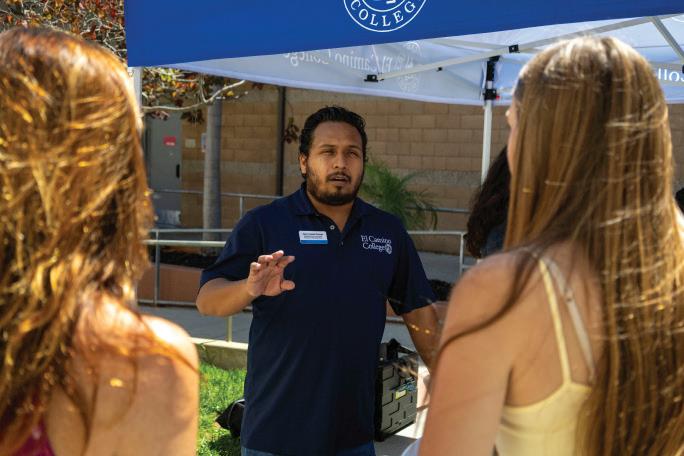
Taranto described the planning for the fair as a “total team effort,” being hosted in collaboration with the district, Redondo Beach Council PTA and the Western Association for College Admissions Counseling. On Sunday, Sept. 7, students, parents and alumni volunteered to set up and run the fair. One such student volunteer was junior Olivia Reeds, who also attended the fair after her shift.
“I researched most of the colleges beforehand. So then, based on that, I [talked to] schools that I was interested in,” Reeds said. “It was a really good experience
scanned by representatives they interacted with to collect their data. Many vendors represented four-year college alternatives, demonstrating the multiple pathways students can consider after high school. Some of these options included the Southern California Regional Occupational Center (SoCal ROC), El Camino College, the Universal Technical Institute and the Air Force Academy.
“[So Cal ROC and El Camino College] are very strong community partners of ours, and so we wanted to make sure they had a presence here today, so that way people know that there's other programs that are for you,” Taranto said.
“We naturally are going to gravitate to the [Universities of California] and [California State Universities], but there are so many amazing institutions across the country, as well as some international schools that may be the right fit for students. When you are looking at a school, you want to find a place that is the right fit as far as academics, the climate and culture, as well as a financial fit,” Taranto said.
Stephen McDowell, a regional admissions representative at the fair from Arizona State University, says the most insightful questions he answers at college fairs are in regards to the ways a college may be able to support students' professional lives.
“Think about your life after graduation. Ask questions about career development and career services. How is the university going to help you with your career? Those are really important questions to ask, above and beyond the typical questions,” McDowell said. Going to a college fair or meeting with a representative might not resolve all the uncertainty of college admissions, but McDowell hopes students who attended were reminded of the opportunities and the guidance available to them.
“Don't be afraid and keep your options and your horizons open. There's so many colleges, there's so many different choices, and we're here to help you,” McDowell said.
by Carly Jacecko
Attention all math lovers! A new course has been introduced to RUHS: Calculus 2/3. This challenging class, that takes a commited Sea Hawk, has swept through the math department and caught the interest and attention of many students. One of those students is senior Shiva Ploplys, who loves math and joined the class as soon as he heard about it.
“Before I knew about Calc 2/3, I was considering graduating a semester early because there wasn’t really anything ahead of Calc BC at Redondo, but when Calc 2/3 was created, it was really a turning point for me. I decided to stay at Redondo fulltime so I could take this class that I knew would be really great for me,” Ploplys said.
Ploplys feels accommodated by Calc 2/3 and finds the difficulty level of this class to be exciting and enriching. Unlike previous math courses he's taken, Calc 2/3 properly challanges and stimulates his mind and has all new material and class work.
“I was really glad that they introduced
this class because when I was a kid, I had the issue of not being properly challenged in math. I just never felt like I was doing work that was up to my level of understanding until this class,” Ploplys said.
This class caught the attention of one teacher: Michael Smith. Smith wanted to bring Calc 2/3 to RUHS for almost four years before it was finally approved. Now that the course is up and running and available to students, even though it is just a small zero-period class, Smith is “feeling excited and passionate about teaching the class.”
“I love the fact that it’s a free class to take. They don’t have to pay for an Advanced Placement test, and they don’t have to buy an expensive graphing calculator. It’s also very collaborative in the sense that I have them doing problems on the board, doing homework, learning a lot, and it’s just really cool to see it all come together,” Smith said.
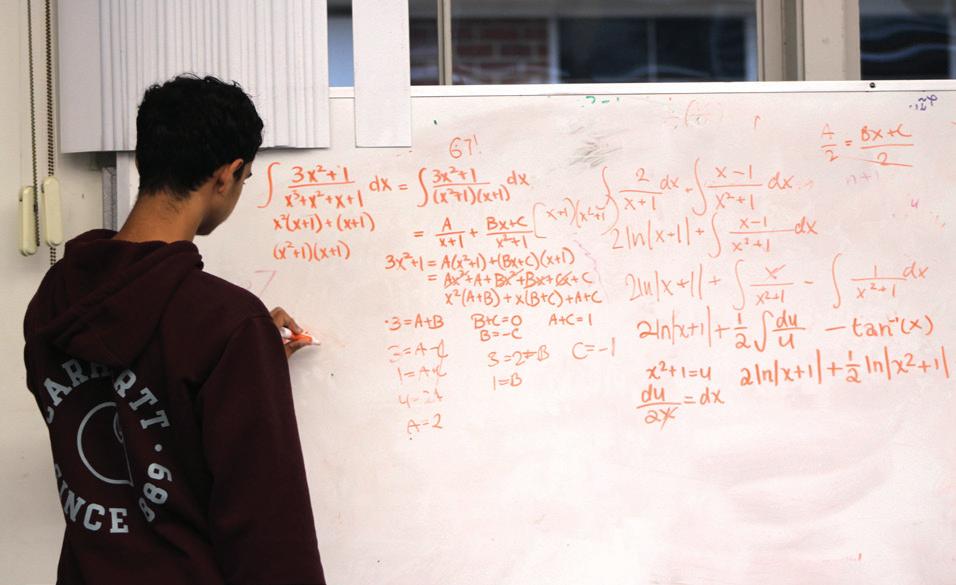
Ploplys loves every aspect of this class: the early start, the rigorous topics and the new techniques. Most of all, he loves the satisfaction that comes with solving the problems. While some problems are more challenging than others, Ploplys reveres the thrill of cracking the code on the tough problems.
“The most rewarding part of Calc 2/3 is that it feels super satisfying to take the class, not just because it's super hard but especially because once you find a new
editors-in-chief
Daniella Gross
Claudia Turner
Ava Anzivino
Priya Ramcharan
digital director
Valentina Masoni
news editors
Leyla Evenson
Carly Jacecko
features editors
Aashaka Bhuptani
Sanaya Bhatt
opinion editors
Payton Rothluebbers
Jayla Dorbor
entertainment editors
Fi Borgese
Emery Min
sports editors
Sophie Rebbeck
Sam Schwartz
writing & copy editors
Emery Min
Deeksha Prasad
Samantha Kim
online editors
Hayden McMahon
Isabella Nguyen
Kayli Mai
Kate Lanzdorf
Allison Sutton
Francisco Villegas
Marlena Lipin
Kate Brucia
Kaitlyn Chang
adviser
Kerri Eastham
staff writers
Violette Alshin
technique that gets you through a lot of hard problems, it feels immensely gratifying finally understanding that one concept that you struggled on for 40 minutes or 4 hours or even longer,” Plopyls said.
Calc 2/3 covers many calculus topics, including integration techniques, sequences and series, parametric equations, polar coordinates, Taylor series and vector-valued functions.
“I’m really excited for the sequences and series because you learn how to do calculations that would normally be impossible,” Smith said.
Calc 2/3 is one of the most advanced, levels of calculus, and it is also a rare class that is not offered to many students across schools. Mr. Smith expressed feeling “honored” to be teaching this class to the Sea Hawks, and has high hopes for student achievement, understanding and overall success in Calc 2/3.
“Calc 2/3 is only offered at our school right now. Other schools in our area or even in Orange County don’t offer classes this advanced. Normally, you would take them at night or online at community college, but this gives students an opportunity to be with their peers,” Smith said. “This class is great for collaboration, and it’s fun to feed off of their energy because they're all so into it, and then it gets me excited. It makes us all want to work harder and understand the material.”
Delcan Williams
Coco Yamane
Willamena Hodson
Amelie Kircher
Ryan Chamides
Martina Parra-
Malandrino
Mahro Siddiqi
Reya Conte
Landon Gould
Madelyn Bain
Brooklyn Hesse
Katelyn Min
Adelyne Cai
Stella Sato
Gala DeSanto
photographers
Robert Packard
Grace Tayag
Kevin Phung
Finn Williams
Amanda Harrison
Lorelai Land
Ignacio Perez
Oliver Cody
Rowyn Salazar
Andrew Diette
Sophie Farias
Mishka Shibata
Connor Brodeur
Issey Kubota
Kacie Brincat
Ayla Rodgers
Safi Hamilton-Torres
Haruto Kuroda
Eliza Prangnell
Julia Bradin
Baran Taghvaei
Francesca Masoni
Sophia Riddle
Martina Parra-Malandrino
illustrators
Claudia Turner
by Allison Sutton
Described by freshman Isabella Franco as an “upgraded version” of previous dances she attended as a younger student, the Welcome Back Dance provided students an opportunity to forge new connections with peers.
Conceptualized by the cheer team and organized by ASB, the dance was held on the quad Saturday, September 6, following the Friday night game against Costa. Activities Director Lisa Hedspeth oversaw the creation and execution of the event.
“[My favorite part about planning the dance] was knowing that another fun opportunity was being given to the Sea Hawks. I want them to have fun,” Hedspeth said. “It’s the start of the year. It’s an event open to everyone, and I want students to meet new people.”
Complete with a DJ, food truck, photobooth and games, the dance offers multiple diverse activities to attending students. According to Franco, the fun wasn’t limited to dancing.
“My favorite dance activity was the food. It was a really big step up from mid-
The dance gives [students] an opportunity to come and meet new people from across all grade levels. Everyone together is part of an interwoven community.
LISA HEDSPETH ACTIVITIES DIRECTOR “
dle school, and I really liked how it was catered. It felt really special,” Franco said.


“As a freshman going into high school, having fancier things just made [the dance] really exciting.”
The DJ for the dance, Lil G, was also very well received by those who attended. Transitioning between various upbeat, popular songs throughout the night, Lil G inspired many students such as freshman Ruby Goshow to spend their time “letting loose” on the dance floor.
“I think the most fun thing about [the event] was the dancing because everybody was getting really hyped,” Goshow said. “The DJ was really fun.”
Because it is attended by all grade levels, Hedspeth says the Welcome Back Dance promotes interconnectivity between all types of students.
“The dance gives [students] an opportunity to come and meet new people from across all grade levels,” Hedspeth said. “It’s not just freshmen hanging out with freshmen or sophomores hanging out with sophomores, but everyone together as part of an interwoven community.”
According to Goshow, dances like
these are important for motivating the student body and inspiring excitement.
“I think [school dances like this one are an important tradition] because every student should be able to have a little bit of fun here and there. Dances are good ways to interact with different people, [to] meet new people and learn about their interests,” Goshow said.
According to Hedspeth, the general response to the Welcome Back Dance after it took place was “very positive.” She hopes attendance will increase as the annual event becomes a more ingrained part of the student culture.
“If you want to start a new tradition, it takes time, so we’re hoping that within another few years, it’s going to be an event more students want to go to [...] To me, this Welcome Back Dance was even better than last year's,” said Hedspeth. “I really hope the Sea Hawks who came had a great time.”
by Francisco Villegas

“In
a full extra week to complete it because he knew I needed it. I appreciated that because it meant so much to my grade.”
-Cruz Ortadeveci, freshman

“As a sophomore, my math teacher rounded my grade up to an 80% both semesters, so I could get a B in the class. It might seem small, but it helped me keep my GPA up in a tough subject, and I don’t take that for granted because not everyone helps like that.”
-Jaxon Waul, junior
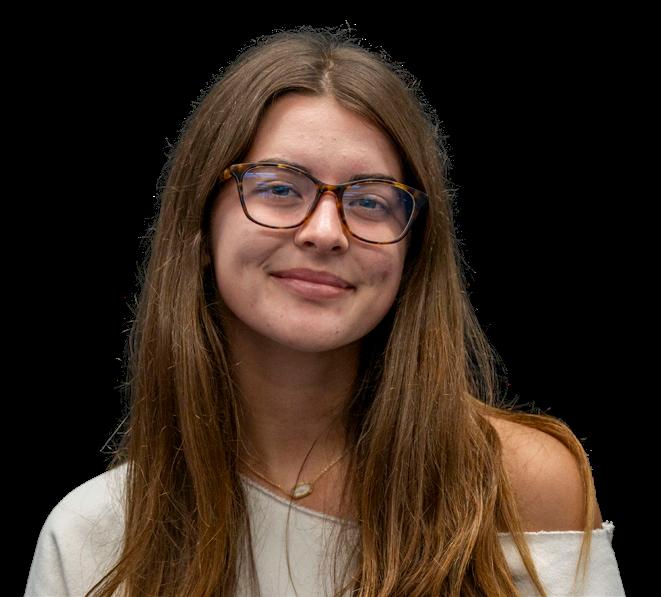
“As a junior my psych teacher cut me so much slack throughout the year because she knew how much I had going on in my life, but every time she always understood what help I needed. She was there for me when I needed help and once even let me leave class to repark my car, so I wouldn’t get a ticket.”
-Charlotte Watts, senior

“In my sophomore year English teacher’s class, I didn’t do great on an essay, which I needed a 90% on to get an A in the class. I asked him if there was any way he could help, and he actually told me we could work on it together and helped me fix a couple mistakes to bring my final grade up to an A. I really appreciated that.”
-Charlie Kokes, senior
by Safi-Hamilton Torres
From Hollywood lights to open house signs, senior Pari Bhatia spent her summer exploring two very different industries—film productions and real estate. Bhatia attended a Sony movie production internship as well as a real estate internship through a company called BrickFolios. Despite these internships differing, Bhatia used them to gain diverse experience within both industries she is interested in.
Bhatia has a passion for both the production industry, which she developed an interest in recently, and the real estate industry, which she has been interested in since she was a child. She has dedicated time to growing her passions for business, while also exploring her unfamiliarity with the production industry.
“Having the opportunity to work with such a big company as Sony motivates me even more to learn about the marketing aspects of production. BrickFolio’s internship meant so much to me since real estate has always been a big part of my life. I’ve always known I want to go into business, being inspired by my dad, who’s in real estate,” Bhatia said.
Both internships allowed Bhatia to attend exclusive tours and conferences. For her Sony internship, she got a behind-thescenes tour of Disney Studios, where she learned how Disney animators designed Moana. For her BrickFolio’s internship, she was faced with the challenge of presenting the case study that she and her team designed for real estate executives.
“We had to work as a team to present our real estate portfolios, regarding our case study. It was really nerve-racking having to present in front of all of those people. The conference was online, but I still knew I was in a conference room with my face on the screen. That experience definitely pushed me out of my comfort zone. In the end, my team and I placed ninth out of 50 other teams nationally. I’ve learned to just talk and not be shy since most of the time you're stressing more than you need to,” Bhatia said.
Mike SooHoo, Bhatia’s former business teacher, took Bhatia and her classmates on a field trip to a USC business expo, where she found the internship she took the following summer. She is described as an “outgoing” and "ambitious” student and was one of the few who took the next step to pursue business beyond the classroom.
“Watching Pari present in front of a group of business professionals who are judging her based on her presentation skills was already impressive enough. Seeing Pari’s growth, which turned into her graduating from my class and then actually coming back to me and looking to be a business leader, is really a proud moment,” SooHoo said. “She's truly passionate about business, and I hope that my class was a part of helping form the beginning parts of that passion.”

Moneyball Academy, a sports statistics program at the University of Pennsylvania, allowed junior Jaiden Mehta to combine his interest in math and sports
by Hayden McMahon
Living away from home for the first time, Jaiden Mehta traveled to the University of Pennsylvania Moneyball Academy, a three week sports statistics program. There, he met students from all over the country and learned to collaborate and work as a team under Professor Addy Wyner of the Wharton School of Business. Only about 75 out of over 700 applicants are accepted into Moneyball, making this program more selective than most universities.
The process to apply to this program
play fantasy football all the time and have a ton of leagues. I watch baseball and pretty much any sport in my free time as well. I’ve also always seen math as one of my better subjects. So [Moneyball] was just putting two and two together for my interests,” Mehta said. “Football and baseball are definitely my favorites to both watch and measure for data, but I've found myself interested in a less popular sport, Formula 1 because you can measure a lot of statistics with car balance and aerodynamic speed.”
One of the friends he met during his stay, Felix Soloway-Gilbert, also had an amazing experience at the university. According to Soloway-Gilbert, the data analysis aspect of the program really stood out to him, especially with such a great professor and several guest speakers.

was extensive, requiring several essays and a list of extracurriculars and accomplishments, similar to a full college application. Not only was this task “great practice for the real thing,” according to Mehta, but the entire experience was meant to mimic college life.
“It was really fun and a totally new experience for me. I’d never stayed away from home or done a boarding school or summer camp before. But it was really nice. It was actually full, college-style living. Living in dorms was really cool, especially because we all got our own separate rooms,” Mehta said. “It really got me excited to actually go to college and live in those dorms longterm.”
According to Mehta, Moneyball–and sports analytics in general–is the perfect combination of math and sports, both of which he has felt drawn to his whole life. This program helped to strengthen his plans to pursue this subject as a future career.
“I've always loved watching sports. I
“Professor Wyner had us look at intro to statistical analysis and statistical thinking probability, and then he brought that into the context of sports. So we got to look at how to think of statistics, and also how statistics mislead us a lot of the time, especially in the context of sports. Every day we would have guest speakers come in who would tell us how this applies in their lives and in their job,” Soloway-Gilbert said.
“Getting to see how we could use this knowledge in our lives and in a potential career was really interesting.”
During the second half of the time they were there, the participants were split into teams, each of them assigned to create their own project based on their lessons. After a little over a week, these were presented and ranked, adding an aspect of competition to the experience. Each team had about five people, making it inevitable for some ideas to conflict and ensuring that compromise was practiced.
“Even though everyone was there for the same reason and had a lot in common, once we got to the competition part, everyone’s relationship got a bit interesting, with people avoiding sharing their ideas. But the whole thing was really fun, and being grouped with Jaiden was a really great experience,” Soloway-Gilbert said.
Rather than viewing this as a mere resume builder, Mehta took away much more than that: skills applicable anywhere in life, practice being away from home and, most notably, fun memories with new friends.
“I really enjoyed listening to all of the guest speakers and their insight on any sport you could ever think of – they even had one on poker,” Mehta said. “I also
had so much fun with my group, making the project and presenting it at the end. Those were really cool memories I made there.”
"Essentially, Moneyball theory seeks to answer these two very basic questions - Can the player hit? Can the player create runs? If the answer to one or both of these questions is "yes," chances are you've got a good pick on your hands."
UNIVERSITY OF WISCONSIN
Naomi Kaplan helps to address discrimination and harassment on Hollywood movie sets through her internship with the Hollywood Commision, allowing her to work alongside her father
Faces new to the work environment know the feeling of nerves and shaking hands on their first day. But for senior Naomi Kaplan, all she had to do was go downstairs and say good morning to her boss–she calls him dad.
This summer Kaplan interned with her father, Todd Kaplan, who is a publicist. He was hired by the Hollywood Commission, an organization focused on providing resources and insight on the issues of discrimination, assault and harassment on the sets of Hollywood, especially for low-budget productions.
Todd Kaplan’s job as a publicist can look different day to day. This summer, working with the Hollywood Commission not only allowed him to make a difference but also introduced his daughter to what he does, allowing him to reflect on the social contrasts between to work. I hope it gave [Naomi] a really good impression of what the work world and communications itself is like.”
[I have more respect for my dad] in the sense that [publicity] is tedious work. Everyone has opinions, and the people that have opinions are very vocal about them.
Working with her dad this summer, Kaplan gained a different insight to what her father does and what the job of a publicist is really like.
up physically. Now, by working alongside her, he sees another way she has matured, as well as their bond. By seeing Kaplan taking on a new role, her dad is proud that he has raised someone with values he had wanted to pass down.
“To know that I've raised Naomi to be a person who cares about other people, who sees an opportunity in her work to make the world a better place, that's very gratifying and feels like I've done my job [in] at least one aspect of my job as a parent,” Todd Kaplan said. “Having raised a person that I can now work with as an adult as our relationship moves has also been very meaningful to see [as] that relationship changes.”
Although writing press releases isn’t the kind of writing Kaplan wants to go into in the future, the experience she had was a meaningful one because she learned a lot in the work aspect, and got to spend more time with her dad.
NAOMI KAPLAN SENIOR
“[I had] grown up hearing about what he did, and it sounded interesting,” Kaplan said. “I was more interested in the social justice aspect of the film industry, so I asked him if I could help out. Writing press releases, designing websites and going over all of their outward- facing documentation [are things I did].”
“I had a preconception of publicity as being this very outward-facing, ‘who knows who’ kind of role. While it definely is that, it also is very internal,” Kaplan. “There’s a lot of working with people whose names never get mentioned behind the scenes, [but] who are [still] very important to the process. That was a shift from the idea that publicity is managing stars and having the best news story into [understanding] everything is a process made up of people who do little [but still important] steps.”
From a father’s point of view, Todd Kaplan has watched his daughter grow
“[I have more respect for him] in the sense that it's tedious work. Everyone has opinions, and the people that have opinions are very vocal about them. Not that they're wrong, but things need to be a certain way. [By having] different perspectives on how [things] should be, there's a lot of back and forth. There's a lot of trying to make the best version of whatever you're working on. I think that is a lot harder than I had understood it to be,” Kaplan said. “I do think it strengthened our relationship [and] made us closer. We were spending three hours every day sitting and writing, having to work through problems and go back and forth on whether or which draft we liked better. That communication, I think, was very impactful.”


by Sophie Rebbeck
Butterflies flutter around junior Aleksandra Brzozowska as she guides guests through the butterfly pavilion at South Coast Botanic Garden. Pointing to each colorful species as they fly past her, she spends time helping at informational stations that give the pavilion its charm.
“My personal favorite station is the feeding station,” Brzozowska said. “People buy these little rings where you can feed the butterflies nectar, and it’s the best station for me because I can interact with kids and older people and help them out.”
Brzozowska regularly volunteers at the garden and loves that it provides an outlet to both her and her community, which is something she was looking for when she first sought out the position in June of last year.
“I’m really into nature, and I love being in forests or even at the beach,” Brzozowska said. “Nature is my passion, so I was looking around for volunteer opportunities in the South Bay area where I could help animals or do something that’s part of nature. Then I found the South Coast Botanic Garden,
and I’ve been volunteering there for a long time.”
A typical day for Brzozowska can vary depending on the time of year. Typically,
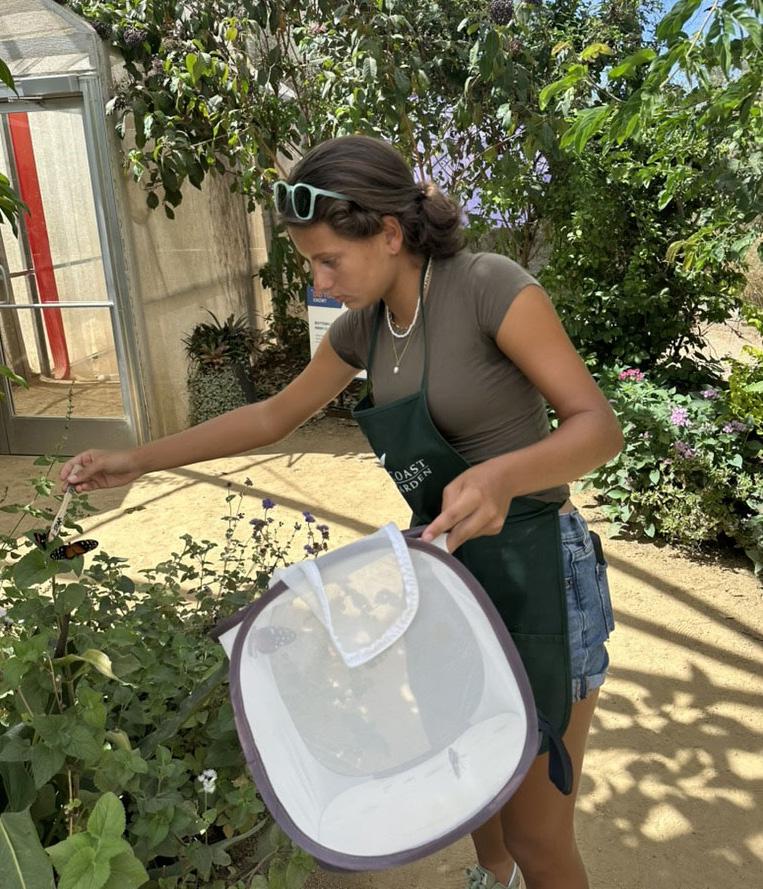
she can be found working at the garden’s butterfly pavilion, helping out with the garden’s monthly dog walking or planting dif-
ferent plants around the garden. She works alongside many other nature enthusiasts at the garden as she completes her volunteer work, one of whom is Vance Kalscheuer, an employee at the garden who collaborates closely with the volunteers each day.
“Volunteers are as much of a public-facing role as em ployees are because they’re dealing with guests and pro viding interpretive services and education,” Kalscheuer said. “Aleksandra is very knowledgeable about where she works, both the gar dens and the pavilion, and she’s very well-versed at interacting with the pub lic, which is so important when socializing with the garden’s visitors.”
Both Brzozowska and Kalscheuer’s efforts, along with those of other volunteers and employees, turn the garden into a place where the community can connect with nature.
“The goal of the garden is to provide the community with a rich educational experience that gets you away from the business of the city,” Kalscheuer said. “It's hidden and such a peaceful place for people. We’ve had so many people say that after the pandemic, they were looking for something
For Brzozowska, working at the garden not only bies, but also with her future
icine, but environmental science is sider it as a way to escape, but also to learn more, so it enhances my will zowska said.

Working at the garden has given Brzozowska a place to gain experience in a work-heavy environment while also being able to pursue her interests while being able to help her community.
“What’s so special about the South Coast Botanic Garden is the fact that it’s built on a landfill [...] and the history of it makes it so much more special,” Brzozowska said. “Seeing how it evolved into a place where animals, plants and every piece of wildlife is protected, it’s special because it's a beautiful place to really zone out and tune out the world for a little bit.”
by Kaitlyn Chang
Stepping off the plane after a long flight, senior Ava Danylyshyn spends her time getting into the water to practice with her team. Next thing she knows, she is crossing the finish line. For Danylyshyn, the realization that she was in Brazil, competing for Team USA in an international competition for outrigger canoeing, didn’t come to mind until the moment she and her teammates finished their race.
This summer, Danylyshyn traveled to the International Va’a Federation World Distance Championship off the coast of Niterói Beach in Rio de Janeiro—with a view of steep cliffs, and bountiful nature— along with her teammates. There, various canoe races took place among different age groups and team sizes. There were races with only one individual paddling, but also ones where there were six seats in a single canoe. This six-man race is what Dany-
Ocean because when you are getting in the [same] water multiple times a week for a year, you get a feeling of what the water is like. You can kind of predict it,” Danylyshyn said. “Then going and paddling in the Atlantic Ocean, you could get a feeling of, ‘Oh, this feels different.’”
This past season was only Danylyshyn’s second, having only started outrigger just over a year ago. Aimee Spector, Danylyshyn’s coach and school to career workability coordinator, describes how fast a learner she is and how her athletic ability is not the only thing that makes Danylyshyn a good athlete to coach.
“You can train up an athlete physically. You can send them to the gym or get them out into the canoe. But some of those [other] qualities are hard to teach, like motivation, or commitment or dedication. [...] It's easy to work with [Danylyshyn] because she already brought all that with her. I just
Hughes, Daelen Purohit, Ian McClain and Cole Crouch. One of Danylyshyn’s teammates, sophomore Georgia Hughes, who met Danylyshyn through outrigger canoeing, describes Danylyshyn as already being a strong athlete from the moment they met.
“The first day she got there, she completely rocked it. [...] We were training on one-person canoes and doing time trials. She showed up for the first day, and she absolutely smoked a bunch of people. It was so cool,” Hughes said.
In Brazil, Hughes and Danylyshyn, along with their four other teammates, competed in a 15-mile race. Team USA was competing against a lot of strong teams, but going into it, the team prioritized focusing on themselves.
“I really enjoyed the race because there was such a positive environment the whole time. I think we even set that up before the race: We discussed [that] we want this race
water, the teammates lift each other up.
“You have a safety net. You have people who you know will be there for you, and that is a comfort unlike any other. You know that there are people there and that you are not alone,” Hughes said.
According to the teammates, being part of a team means being there for each other. Danylyshyn acknowledges that being in a race can be tough, and it is inevitable to hit “a wall” at some point. However, she says that the positive energy that comes out of it all pushes her through. With her being responsible for calling out changes when team members alternate the sides they paddle on, she especially appreciates the support she receives.
“There was a lot of responsibility to make sure the timing was working, that I was working with my teammates, calling the changes loud enough and making sure I was still encouraging everyone,” Danylyshyn said. “But during the changes, I felt really inspired because when we would do a change, we would say, ‘This one's for Izzy,’ who is our steersman. Or we would say, ‘This is for Aimee, our coach.’ Thinking about those people in the back of my mind while I was paddling, I felt really inspired

by Sanaya Bhatt
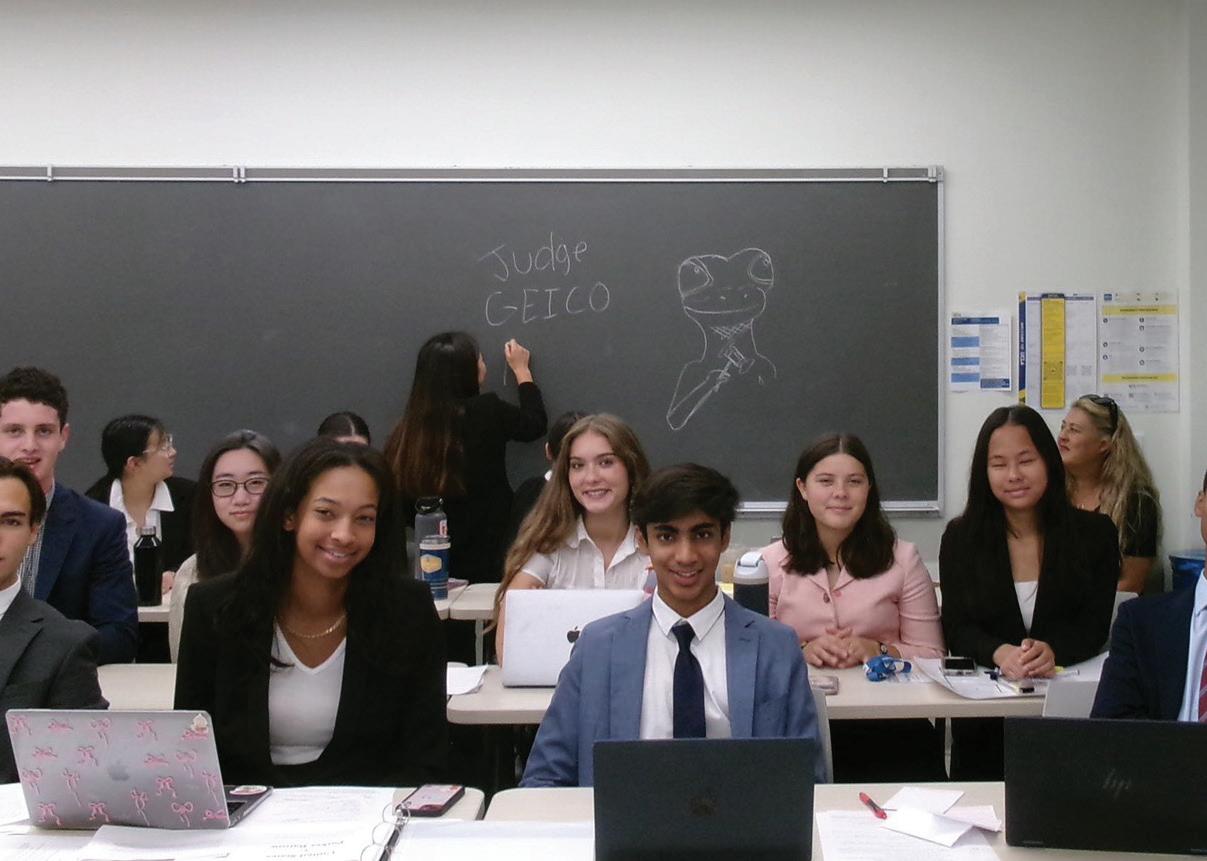
Since he was young, sophomore Arjun Modi has been fascinated by the courtroom. From legal debates to creating compelling, persuasive arguments, Modi has always felt drawn to a career in law. This past summer, his participation in University of California, Los Angeles’s (UCLA) Mock Trial Institute helped him solidify this passion, sharpen his skills and form a community with people who share his interests.
Modi has already decided the type of law he wants to go into and was initially encouraged to pursue it by friends and family who noticed his natural aptitude in areas associated with the legal field.
“My final goal is to become a business lawyer. I’ve always had a passion for both finance and business, and combining the two of them into something I could pursue for the rest of my life is exactly what I want,” Modi said. “Since I was young, I’ve loved to [debate] and argue about rules. I think a lot of my friends and family noticed that and pointed out that since I love those things, law should be something I consider. That’s what really got me into it, as well as having exposure to it from family friends who are in the field.”
Once his interest in law was solidified, Modi took many steps to further develop it and learn as much as he could.
“When I started at Redondo last year, I joined the school’s Mock Trial because I knew it would be useful for gaining experience [in law]. At the end of the year, I got the idea to participate in a college program as well, and I found one at UCLA, so I immediately applied,” Modi said.
Mauli Modi, Arjun’s mother, is also
grateful for the chance to watch her son’s growth over the years and for how he has been able to learn about various types of law.
“I’m so glad that RUHS gives students the ability to participate in Mock Trial on campus, along with a lot of other opportunities. Without them, I’m not sure how he would have gotten the exposure to have interested him in the UCLA program in the
gram. She observed that he learned more about law and evolved, not only in terms of his passion for law, but also in his overall confidence.
“Arjun was one of the youngest kids at UCLA, but I could still always feel his confidence. He learned so much, and it was also fascinating for my husband and I to hear him talk about the interesting people he met and everything he got to do,” Mauli Modi said.
first place,” Mauli Modi said. “In school, you usually just learn the textbook subjects, like history or science. So it’s really good to know that he was able to take Mock Trial on the side to better prepare him for the type of law career he might want to go into.”
As his mother, she also found pride in watching her son thrive within the pro-
In terms of Modi’s own experience while participating in the program, the days were “definitely tiring, but still so worth it.”
“The program was one week long, and typically, we’d get there around 8 am and leave around 5 or 6 pm. Every day was a combination of lectures and workshops, but the main focus was that we were given a case packet, and the objective was to make an entire trial out of that case. We were put into teams, and our case was focused on a bank robbery,” Modi said.
Much of the information he learned in lectures was presented by the supervisors
of the program, who were two UCLA law students themselves and served as mentors throughout the experience. However, there were many other people who Modi and other participants had the opportunity to learn from, too.
“Our professor used to be a lawyer himself, and now he serves as a professor at UCLA law. There were also some attorneys who came in to give us speeches, and it was good to have people with that much exposure to the field giving us information based on their actual experiences. I hope to keep in contact with both of my supervisors, as well as many of my teammates, because now that Mock Trial season has started, we’re all working on the same case,” Modi said.
While Modi learned many valuable tactical skills in this program, such as “logical analysis, time management and public speaking,” the experience also afforded him meaningful relationships while deepening his desire to pursue law.
“One of my favorite memories from the experience was getting to know the people on my team. We’re all passionate about law and it was great to have that in common with everyone there,” Modi said. “I initially signed up for this program because it was going to be a final step in determining if law was really what I wanted to go into. Now that it’s over, it really solidified in my mind and heart that this is what I want to do. If there’s anything that this program taught me, it's that no matter how daunting a task may seem, no matter how little time you have to complete it, if you have the right people around you and the right mindset, you can accomplish anything.”
by Sanaya Bhatt
Surrounded by seasoned Boeing engineers, seniors Emaad Moghal and Lorelei Choi found themselves immersed in an experience that fostered their love for engineering and exposed them to several real-life aerospace scenarios. Faced with challenges that many of those lifelong engineers are working to solve, their internship at Boeing this past summer gave them hands-on experience and proved to be an incredibly educational and enriching opportunity for both of them.
“I’ve done robotics since elementary school, and I always thought that I was going to go into something like math or business when I got older. But a lot of our robotics mentors actually came from the aerospace industry, and after talking with them, I realized that I wanted to pursue
aerospace engineering,” Choi said. “I took some tours of their workplaces, and I didn’t know anything about aerospace going into it, but I realized how interested I was in it and how much I could see myself doing it in the future.”
Choi’s experience in the internship itself was quite unique, as she was assigned with individual responsibilities, rather than group work. This was a change from the kinds of work she was typically used to, making her time at Boeing even more enriching and educational.
“My interest is primarily mechanical engineering, but I was assigned to a project that was mostly computer science. I was developing an inventory system for my mentor’s program. They were required to keep a separate inventory of parts separate from Boeing’s general inventory system, so I was
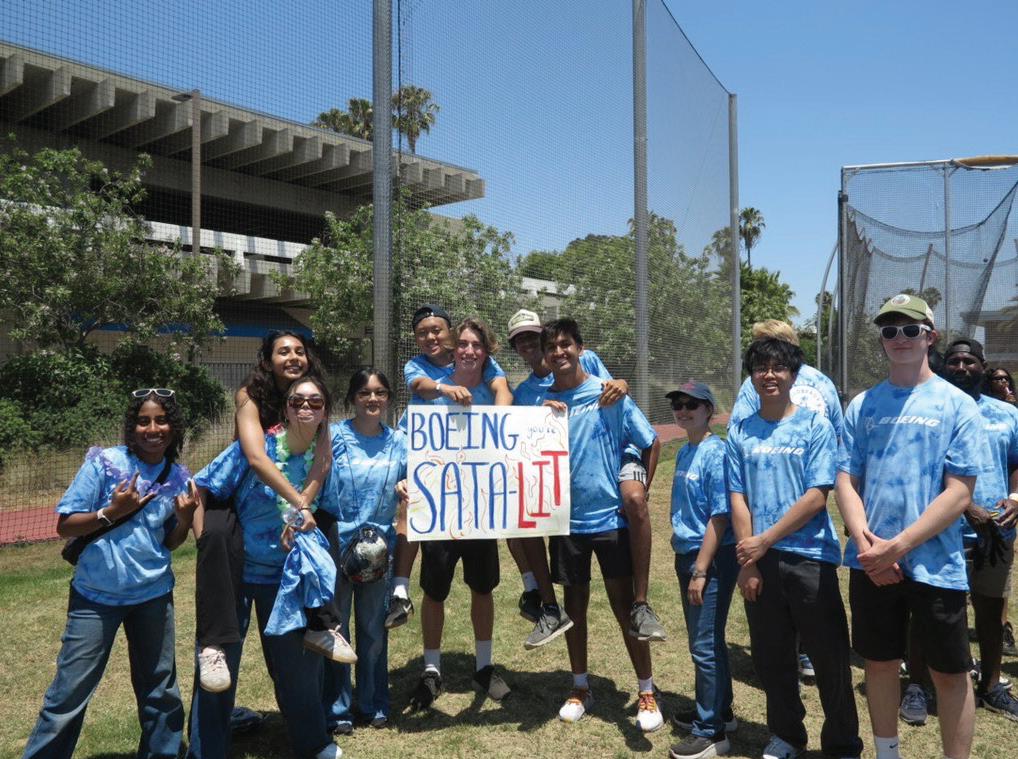
working on helping them flesh out the data storage they already had. I also had to learn a new coding language for this, which was a challenge but ended up being another thing that I can take away,” Choi said.
For Moghal, aerospace was something that he always knew he wanted to go into, but this internship helped him narrow down his options and focus on exactly what aspect of it he may want to pursue in the future.
“Growing up, my dream job was always to work at NASA as an aerospace engineer. When this opportunity came to me, I knew that it was something I really wanted to do and that I would get a lot out of,” Moghal said. “I can’t think of a specific moment when I became interested in aerospace, but I remember always questioning what was out there and being so curious to find out. This internship was a really big deal for me because it was an experience that actually helped me get closer to answering that question for myself.”
Choi and Moghal were exposed to a broad range of information and learning through their internships. They were surrounded by people with decades of experience in aerospace, which provided valuable firsthand information and allowed them to broaden their knowledge.
“We got to go to technical talks, where a very qualified speaker who’d been working at Boeing for decades would come and talk to the interns about a specific topic. These were on things like astrodynamics, or what makes space such an interesting environment, and it was information that ended up being really valuable,” Moghal said.
Like Choi’s, Moghal’s experience differed from the rest of the group’s because
of his mentors’ specific roles and the tasks he was assigned separately from his team.
“Most of the other people in the internship had an engineering based role, so their mentors were in the field and the lab, and they were helping to design stuff. But my mentors worked on the program and project management side, so I got to experience and learn about a lot of the collaboration, communication and teamwork that goes into it,” Moghal said. “My main task was also to create an artificial intelligence (AI) training guide, which I was doing myself, so I drafted it up and implemented it, and it’s for different Boeing employees to use.”
Overall, Moghal’s experience helped further his interest in aerospace engineering and solidified for him that going into this field was exactly what he wanted to do.
“A big moment for me was the SpaceX launch party we went to. All the interns came to this huge conference, and we were actually going to get to watch the launch happen. There were hundreds of people there who have spent years of their life on this one satellite, and somehow we were there too,” Moghal said. “All these people got to see it launch and know that it was going to benefit humanity, and I think that was such a big moment for me because it made me realize that I really want to be a part of something like that. I want to work on something with a group of people so we can all come together and celebrate when it succeeds.”
Students with education plans emphasize communication and advocacy between teacher and student
by Jayla Dorbor
Empathy can be taught and learned in many different ways. For students with accommodations, particpating in advocacy has taught them not only how to devlop their empathy, also about the lack of empathy that is available for student's with disabilities.
Accommodations are created for students with learning disabilities, whether that be physical or cognitive. These students receive legal documents (either a 504 or an Individualized Education Program [IEP]) that provide teachers and administration with information on the accommodations they receive. Special Education co-chair Cale Espinel explains how these documents are created for equity:
“The concepts behind these documents are not to give anyone an unfair advantage. It’s completely about equity. It’s giving students what they need to be on an even playing field with everyone else on campus. Equality would be like ‘we’re giving everyone glasses.’ Equity, and the idea behind having accommodations, is you would only give someone glasses if they have trouble seeing.” Espinel said.
However, these accommodations are not always followed perfectly. Senior Alina Rashidfarokhi, a student who is legally blind, has dealt with this firsthand.
“I’ve had experiences where teachers either constantly forget to enlarge certain things for me or give me extra copies of the notes, or they don’t try to work with me at all.” Rashidfarokhi said, “It sucks because it happens almost always in harder AP classes where it seems like the teacher doesn’t believe in my ability.”
Due to Rashidfarokhi’s disability, it is often hard for her to see the board, read print that isn’t enlarged or navigate her way across campus. According to her, this creates additional worries on top of what she already experiences at school.
“I’m super flexible, but there is also that weight of added stress on me from some aspect of my accommodations, like if I'm getting ready to take a test and I'm wondering if the teacher forgot to enlarge it,” Rashidfarokhi said, "My approach to this is always on the empathetic side. If [teachers] are forgetting to enlarge things, it’s fine, we’re all human, sometimes we forget things. I’m always aware I’m not the only student they have to do things for, so I always have to consider that.”
While Rashidfarokhi has had her fair share of good and bad experiences with ad vocating for her own accommodations, she believes the difference comes down to the education teachers are given.
“I think there should be more education for teachers and not just ‘This is a legal doc
ument you have to follow it, here's more things for you to do,’ but help the teachers understand that these students need these things, in order to access whatever it is, the same as any other person and they deserve the ability to do that. So implementing these accommodations isn’t just a legal thing but is truly about equal access,” Rashidfarokhi said.
“I do think certain issues or beliefs can come from a lack of education or ignorance or lack of experience, but it’s not always their fault.”
Espinel also agrees there is some ignorance that comes with the idea of accommodations; however, he sees it from the student side.
“There may be some confusion from students who don’t know about accommodations. It may be hard for us as teachers because we might be providing accommodations for a student that needs it and then someone might say ‘how come they get to use that?’,” Espinel said, “There is a lengthy, lengthy testing process to see to see if you’re eligible. It’s not just something you can get because you asked for it. We do very thorough testing of academics, social emotional learning, a lot of different things to see if there is a deficit in some area or that you have some sort of learning disability.”
manager or the counselor, and it says, ‘This person now has the following accommodations. Please review them,’ but I wouldn’t say it’s formal training,” Jones said, “I always think an extra explanation or extra training would be great.”
According to Jones, due to the classrooms she has received, it has been difficult for her to give accommodations like preferential seating. This connects to a larger issue surrounding the systemic restrictions that make certain accommodations difficult.
needs, that might not always be the case and you have to advocate for yourself.”
Advocacy is a crucial part of students with disabilities getting the accommodations they need. While it is a difficult task, Ms. Jones is very impressed and proud of her students that can do it.
ALINA RASHIDFAROKHI SENIOR “
You deserve to have equal access, and as much as society should be able to meet our needs, that might not always be the case, and you have to advocate for yourself.
“I don’t truly think it’s teachers on an individual level. I would say that a lot of the bigger issues come from the education and special ed systems. Teachers already have over 200 students with all very different needs and situations on top of multiple classes, so that already is a lot,“ Rashidfarokhi said, “This isn’t an excuse for why accommodations shouldn’t be followed through, but it is another thing to think about. The resources these teachers may look to, like case carriers and the special ed team, are also overwhelmed with students and a lack of resources, staffing and funding. It doesn't just happen at our school.”
“First of all, our students who require accommodations are always capable of so much; these things are in place just to help them further succeed. It’s always really interesting seeing students with accommodations at the high school level and hearing how many of them are their own advocate, I think that only comes with the high school age,” Jones said, “For example, if I entered an assignment late, they are never afraid to remind me that they have accommodation for late work, or tell me where they need to sit for preferential seating. I’ve always been really impressed and proud of students who are not afraid to advocate for themselves.”
AP Capstone teacher Cassandra Jones has had her fair share of students who require accommodations. She has had to give extra time on tests and assignments, giving students handouts of notes, and giving students preferential seating. Although she has not had much difficulty providing these accommodations, she agrees that there has been a lack of education for certain accommodations students need to receive.
“In my teacher credential
Since Rashidfarokhi understands the difficulties that teachers face when it comes to having to give accommodations, she pre viously found it hard to advocate for her self. But through her education, she has learned that she deserves the same educa tion as everyone else.
“When you get to higher levels of edu cation you realize there really isn’t anoth er way and sometimes you have to be the person that educates others or be the per son that stands up for yourself. It’s hard and it’s not something you learn overnight and even to this day I have trouble with it because I don’t want to both er others and I don’t know




by Claudia Turner
1.6 million 8.4 million students under section 504 in the U.S.
students with a disability not under section 504 in the U.S.

Bent over her math exam, anonymous senior Willa sneaks a glance at the phone in her lap. The testing center is particularly packed today, so Willa knows it’s likely she’s not the only one using her cellular device. According to Willa, cheating in room 211 “is so common” that getting caught isn’t something most kids are worried about.
“I definitely think it's easier to cheat with a 504. I've only done it once, but I've seen it happen a lot, especially during finals week when we’re all packed in the bingo room,” Willa said. “The people who supervise us are way less strict than regular teachers, and they aren’t really that thorough when checking if you’ve put everything away.”
Administrators have been aware of the “lax security” issue which has been present in alternative testing locations for a while, but altering procedures takes time to implement. In addition to making changes streamlining the process of delivering tests to room 211, Assistant Principal Christina Sunada has also taken it upon herself to walk the aisles during finals and APs to keep the level of scrutiny consistent between testing locations.
“I've known other school districts to pull back on giving certain accommodations and stop giving out as many written 504 plans because of cheating incidents," Sunada said. “That would never happen here, but we also still want to be wary and make sure we’re keeping testing conditions even for everyone.”
Part of that wariness comes into play during the process of assigning 504 plans, a form of accommodation which originates from Section 504 of the Rehabilitation Act of 1973, legislation that ensures accommodations for public school students with disabilities. Usually, either the parent, the student, or someone from the student’s school team will notice a disconnect between grades and a student's academic ability. The administrators will then hold an SST (student success team) meeting, where all parties come together and decide which accommodations to put in place for a trial run. If the stu-
dent brings in a diagnosis, a written 504 can be put into place that will follow the student to college. Despite the open communication emphasized by the admin, anonymous senior Conner says that his 504 meeting felt “more like an interrogation" than a team discussion.
“I felt that their general attitude towards me was a little hostile, as if they weren't sure I should get help despite my legal diagnoses,” Conner said. “I have to give props to my mom, because she came in with all of the legal documents, printed out versions of my diagnosis, and really everything that we would need to legally require them to give me a 504 plan. If I had been on my own, I think it would have been a lot harder for me to get accommodations, even if I had presented the same set of needs.”
stand the picture some people have in their heads of this imaginary student who gamed the system to get accommodations they don’t really need,” Conner said. “The idea that kids get 504 just so they can go there and cheat is perpetuated by people who have this stereotype that disabled students are lazy.”
3% of students used a 504 plan during the 2020-21 school year: a 2% increase from the 2009-2010 school year.
Luckily for Conner, his parents were able to get him a professional diagnosis, which allowed him to obtain a written 504 plan that will follow him to college. But not all families can afford to get their children tested by a professional psychologist. According to Dr. Carrie Jackson, in a report for Joon, a child behavioral health app specializing in ADHD, the minimal average price for testing as of 2022 is around $295-$375. A comprehensive evaluation with increased accuracy is on average priced at around $3,700-$4,500. This pricing is reflective of the disposable income needed to receive accommodations: a 2019 New York Times study of data released by the Department of Education found that in the top 1 percent of

According to the Civil Rights Data Collection, a subsection of the Department of Education, 3% of students used a 504 plan during the 2020-21 school year: a 2% increase from the 20092010 school year. Sunada says this isn't because of a perceived "overdiagnoses" in learning disabilities or a flippancy when deciding who gets a 504 plan; rather, schools have simply gotten better at identifying when students need support before their issues require serious intervention.
“Back in the day, our students would go from nothing to straight into the highest level of accommodation, an IEP (Individualized Education Plan), because we missed all the steps in between,” Sunada said. “But now, thanks to improvements in education, we're seeing the signs a little bit sooner, allowing us to implement accommodations more at the SST/504 level where it's like, ‘Okay, let's try these things out right now to help mitigate you from getting worse’. And then a lot of times, they get better, and then they can move on and they have better skills to handle [their challenges].”
Sunada also says a lot of students perceive an artificial increase in 504 plans from middle to high school because younger kids lack the perception to notice when others are also receiving accommodations.

ered applying for a 504 until she reached high school because her ADHD only began to impede her testing abilities once time limits were introduced.
“In middle school, there was really no sense of strictness with timed testing. But at RUHS, especially with our AP classes, time limits are everything,” Willa said. “That’s why a lot of kids get 504s once they enter freshman or sophomore year, because the timed testing becomes really overwhelming.”
Conner received his 504 plan freshman year for similar reasons to Willa, but because he has a dual diagnosis of autism and ADHD, the “typical 504 plan” doesn’t accommodate all of his needs. For example, his 504 plan doesn’t explicitly state he’s excused from ASB events, despite large gatherings being one of his meltdown triggers– thus Conner has taken to stretching the truth of what his 504 really grants him to avoid the crowds. This could be considered an abuse of accommodation services, and yet Conner defends his decision, saying that he only lies about the contents of his plan “when [he really needs it].”
“Rallies are very overwhelming, and can be sensory nightmares that drain me for the rest of the day,” Conner said. “So yeah, I’ve lied to teachers, but in doing so I’ve avoided a panic attack and could pay attention in class after the rally was over. To me, if it's something I think should’ve been included in my file in the first place, it’s no harm, no foul.”

Willa had never consid -

by Leyla Evenson
Iam the number one Labubu hater. Their freaky faces hanging from the straps of a performative man's tote bag always makes me feel like I’m being watched by a little monster. But the “performative male” trend on social media is more than a light-hearted criticism of guys who carry creepy plushies. Men drinking matcha and reading Sally Rooney books is not the problem. For those who don’t know, the “performative male” is a trope online about guys performing stereotypical female interests to get women’s attention. But being a “performative male” is not just the light-hearted trend that social media has turned it into. Instead, it is indicative of the continuous negative narrative around women and their interests.
The “performative male” concept entails that a man adopts “feminine” hobbies as a means to seem attractive. There is a lot to unpack here. First of all, this trend insinuates that the interests of performative males are inherently womanly, which is belittling. This is the same conversation about “boy interests” and “girl interests” that I have been hearing about since I was 5 years old and was told that pink is for girls and blue is for boys. Glitter pens and race cars are all grown up; now, reading is considered a “girl hobby.” I am sick of having this conversation.
There is a legitimate criticism in the performative male trend, but the notion that an activity can be inherently feminine and that that makes it trivial is a continuation of the bias against women’s interests that has existed forever. Performative males are a trend to laugh at, to have competitions for and to make fun of. But when these jokes are tied to men participating in activities like reading and listening to Clairo, it makes a joke out of interests that are commonly associated with women. Surprise, women's interests are being denoted as feminine, and by extension, unserious and silly. This is not a coincidence. Interests that are typically female are always viewed as inferior by general society, and this is a perfect example.
Additionally, I think it might do us all good to ask ourselves, why are men denoted as feminine for trying to be attractive to women? I think that’s worth pondering, be-
cause the reverse is absolutely not true. I would be willing to bet that most—if not all—girls I know have spent too long wor rying how they are perceived and whether they are pretty, attractive, et cetera. The pressure is omnipresent and aggressive.
This is the expectation for all women, and it is not widely criticized on social media. You could make an argu ment that the “pick-me-girl” trend, which made fun of girls for trying to seem different from other women to appeal to men, touched on this criticism, but I think the real pressure around women to seem attractive is much more covert.
When it comes to men, however, the narrative is different. To be nonchalant is masculine, and to care even a bit is not. This is evinced by the performative male trend, where being caught being purposefully appealing to women is a crime.
To be clear, I am not arguing for peo ple to be disingenuous for any reason, but the criticism of performative males is not just a criticism of men “pretend ing to be feminists” to get a few looks. It is about the same thing it always has been: criticism of men making them selves attractive to women, genuine or not. It would be awesome if men were genuinely interested in “female hob bies,” but how can anyone even explore that idea when the discouraging “perfor mative male” label is lingering over their heads?
I think it is worthwhile to be aware of the way we criticize each other on social media because most of the time it's in dicative of larger problems. The perfor mative male trend is only one way subtle

Crossing guards would be a beneficial addition to increase safety
by Allison Sutton
With newly-licensed drivers, unfazed e-bikers trying to pop a wheelie and frantic students dashing across busy roads to make it to class, the streets surrounding campus are the perfect places for traffic accidents before and after the school bell rings. Uncontrolled crossing is not only a serious safety hazard for all parties involved, but also a daily inconvenience.
Crossing guards can be found directing morning and afternoon traffic near local el ementary and middle schools, so why are they not present here at the largest and busiest school in the district? Even though high schoolers no longer need to “hold mommy’s hand” when we cross the street, leaving us to our own devices when it comes to navigating traffic is a terrible idea.
High schoolers are, by nature, easily distracted individuals. When a notification pops up on our phone, or when we are running late for a test in first period, our first thought usually is not “how can I cross this road at an ideal time to ensure optimal traffic flow while simultaneously serving the interests of both drivers and my fellow pedestri ans?” If any thought occurs before we recklessly venture out onto crosswalks, it is usu ally something along the lines of “I
probably have the right of way anyhow.”
While pedestrians may technically have the right of way, vehicles contain students and parents with places to be, too. Having to wait at a stop sign for a seemingly endless flow of high schoolers to solemnly drag themselves to morning classes one after the other is both irritating and unfair.

And do not even get me started on e-bikers. Not a day goes by that I don’t hear some sort of complaint, from adults and students alike, about these “wannabe-motorcyclists” causing numerous accidents and issues on the roads. Of course, not all e-bikers are troublemakers, and the e-bikes themselves are not the problem. In fact, because of the, albeit often justified, prejudice against e-bikers, the few of these individuals who are good samaritans and traffic law-abiders are often unfairly stereotyped. The root of the issue surrounding this group does not primarily lie in the corrupted morals of these individuals, but rather in the haziness surrounding traffic direction for these not-quite-bikers but also definitely-not-motorcyclists.
To prevent the majority of traffic incidents involving e-bikers, the expansion of routes with available bike lanes would be ideal. However, because there is such limited space in the streets, this solution is not feasible. A crossing guard is the next best thing, a much-needed solution to the constant aggravation and
safety risk surrounding electric vehicles.
The presence of crossing guards would make an immense positive impact on vehicle circulation and pedestrian safety here. Clear, timed and fair traffic direction for all modes of transportation would make getting to and leaving school far less complicated. A 2014 study from the “Journal of Transport & Health” found that “increased crossing guard presence is most likely to [positively] influence safe behavior,” thereby preventing the type of impulsive activity and recklessness that leads to most traffic incidents.
Of course, qualified crossing guards do not just magically appear out of nowhere. Notable financial re-budgeting would be required for their effective implementation, but the extensive list of benefits certainly outweighs any monetary expense. The implementation of crossing guards on streets surrounding campus would enhance student safety, decrease frustrations and promote efficient, timely traffic flow for those using a diverse range of transportative means: something we should all get behind.
DATA FROM AN @RUHSMEDIA SURVEY OF 132 PEOPLE
The High Tide encourages greater input of perspectives from both students and staff. If you have an opinion about one of the articles, letters can be sent to the editor at hightideonline@gmail.com We reserve the right to edit for content, grammar and space constraints. Letters must be signed and are not guaranteed to be printed. Please keep letters to a maximum of 250 words. Longer guest opinions are also accepted.
Quantifying one's goals can lead to an unhealthy prioritization of meeting the goal rather than enjoying the task

by Deeksha Prasad
No matter how you celebrate on New Year’s Eve, most of us have a striking commonality in our Jan. 1 plans: create a set of goals for the next calendar year.
In theory, detailed goal setting is great. It stands to reason that the most effective way to accomplish something is to map out a target in a quantifiable way. Read two books a month. Go to the gym three times a week. Save 15 dollars from each paycheck. Numbers make our goals checklistable—we can clearly visualize them and cross things off as we go.
But while numbers may be the easiest way for us to create goals to meet, they may not be the most effective method of actually following through on it.
The point of setting goals—or at least, what I believe the point is—is to better ourselves, and we can’t better ourselves by doing things that make us unhappy. Of course, some goals are more fun than others, but at the end of the day, we should be doing things we want to be doing, not things that make us miserable.
An article from the Harvard Business School discusses the risks associated with goal-setting, including neglecting non-target areas and reduced intrinsic motivation, both side effects we should be wary of when we commit ourselves to a long term goal.
The first point: neglecting everything but our goal. Now, nobody’s claiming you end up dropping everything in your life in order to knit an hour a day or go running every morning, but it is pretty easy to let something you want to accomplish overwhelm you. While trying to meet our goals is, of course, ideal, it should go without saying that sometimes, you simply can’t sacrifice an hour of homework on knitting.
The effect I’ve had the most personal experience with, however, is the second: goals reducing our intrinsic motivation. Intrinsic motivation is the drive to do something for your own personal growth, enjoyment, or interest, whereas extrinsic motivation is the drive to do something because of external factors, such as reward or punishment. For example, if you were to take a hard class because you wanted to challenge yourself, that would be intrinsic. If you did it because your parents offered to give you fifty bucks—extrinsic.
I could, getting through book after book as the school year drew to a close in June.
But then summer started, and all of a sudden, there
goal quickly became a chore. I was forcing myself through books I didn’t enjoy when I didn’t remotely feel like reading, and instead like sleeping. For some inane reason, I was dead set on meeting that number. In retrospect, that was complete-



were a lot more ways I wanted to use my free time. I was taking two summer classes, my friends wanted to go out and sometimes, I just wanted to watch brainless TV. Can you blame me? I tried to keep up my reading pace, but the consistency slipped, and I ended up barely finishing three books across the two months of summer break.
genuinely want to and because it brings us joy, not because we feel some invisible pressure forcing us to do something. That doesn’t mean that you shouldn’t do something because it’s hard. Ultimately, the level of difficulty of a task isn’t proportional with how much we actually like it or believe we should be doing it. Sometimes, you have to tough out an off day to accomplish something you want to accomplish. But give yourself grace, and remember you aren’t obligated to just hit numbers.
In 2024, I set a numbered goal for myself: I wanted to read a certain amount of books by the end of the year. And at first, I was on track to meet it — I was reading as much as
And then school started — and unlike the blissful May and June of the previous school year, August and September meant almost no free time at all; every hour being eaten up by homework, studying and extracurriculars. What little free time I had, I tried to put towards reading and meeting that number I’d written down in January. But that
By:
n 2023, the state of California established the Media Literacy Law, which required teachers to embed media literacy instruction into core subjects throughout grades K-12. To address the continued digitization of information, the law merely stated the obvious: students must learn how to evaluate sources and identify misinformation.
IAlthough research skills and media literacy are briefly touched on in some of our English and history classes, it is not sufficient enough to support students throughout their adulthood, especially during an age of political divisiveness. With propaganda and biases plaguing present day news, teachers must spend an adequate amount of instructional time to-
wards developing students’ research and critical thinking skills through exposure to a plethora of media sources.
Spending more time on the token “research unit” may suffice. What may be more beneficial is altering the amount of time allotted to RUHS Time. Reinstating a 20-minute RUHS Time period to allow students to browse the internet, including media outlets and advanced research engines, may allow for students to expand upon their objective evaluation skills while also keeping them well informed on the political landscape and other news.
This designated period, whilst also providing time to strengthen media literacy, could also include moderated discussion between students. This may enforce the idea that people can dis-
agree on political beliefs, and still be understanding and respectful to one another, refuting the taboo attitude towards political debate that has emerged. There is no safer place to spark up dialogue than in schools, where we come to learn from the abundance of perspectives that our peers and teachers offer.
Could this take away from instructional time? Well, unless you consider building crucial critical thinking skills a waste, no. Integrating media literacy and healthy debate into class time will prepare students to become active members in our nation’s democracy. The best thing RUHS can do for their students is give them ample opportunities for political socialization, and that starts in the classroom.
Big Thief's new album, "Double Infinity," has a distinct sound; however, it does not lend itself to easy listening
by Samantha Kim
Sing it with me! “There is no time / Round like a lime / Destiny.”
Do you have absolutely no idea what Adrienne Lenker meant by this? Me neither. This was a frequent experience I had while listening to Big Thief’s “Double Infinity,” an album with many of its lyrics being characterized by the title of the opening track, “Incomprehensible.” Though, on further replays, I came to respect the random yet poetic lyrics and appreciate the folky, interstellar hybrid sounds of the album, overall it just was not for me.
“Double Infinity,” alternative/indie band Big Thief’s sixth album, is a short 43 minutes long, and serves as another display of band frontwoman Lenker’s de-
opens with “Incomprehensible.” Lenker begins the song imploring to be as the title suggests then paints a vivid moment with her lover, ultimately transitioning to addressing society’s pressure against aging and her rebuke of that, closing the song in the same way as its opening. With its overall message and production, this was an enjoyable opening track. The following track, “Words,” containing a message regarding the extent and limitations of the power words carry, was equally enjoyable. The sudden change from the mellow closing of “Incomprehensible” to soulful guitar strumming was energizing, becoming a song I could picture a downtown girl listening to through corded headphones with a messenger bag slung over her shoulder.


Track three, “Los Angeles,” was one that I thought I would enjoy; that was, until Lenker began singing. Describing the revival of an old relationship, Lenker’s voice sounded a bit too conversational for my liking, as if she was not actually creating a melody. The production and the instrumental aspect of the song with its ambient sounds of people laughing and conversing, was nice, but it almost felt like Lenker’s voice was another one of those talking
The titular track, “Double Infinity,” sounded like poetry, but by this point, it was a poem that I had no desire to decode. It sounded nice, and I knew that if I gave it more time I’d probably find much more meaning in it, but by this point I was already wanting to retire this album. “No Fear” is where Big Thief really lost me. A song that only repeated the same stanza eight times for almost
seven minutes with lyrics like “round like a lime” or “mind so clear, mind so free,” it felt like a psychedelic levitation with kaleidoscopic limes floating in my head, and there was fear: fear that this song would never end.
Thankfully, the following track, “Grandmother,” with a tempo speed opposite of its title, served as a much needed pick me up for me, offering the beginning of the album’s second act. Featuring Big Thief collaborator Laraaji’s backing vocals, this time, the repetitiveness of the lyrics was an effective choice, evoking feelings of emotional liberation. The song's closing, featuring wordless vocalizations, felt warm and complete. Those feelings carried into the album’s final track, “How Could I Have Known,” which was my favorite song on the record. Singing about the uncertainty of love and life, nostalgic comfort was emphasized by a folky, around-the-campfire-esqe sound, providing a fulfilling end to this body of work.
All in all, I enjoyed the overarching sounds of the album, just not necessarily its parts in isolation, specifically some of the lyrics. To enjoy “Double Infinity” requires an element of sophistication and a deeper dig, but as I rarely get the urge to become a poetic visionary on a random Tuesday, it just was not for me. Would I listen to it again? Maybe, if I’m having a craving for a specific taste of nostalgia or need background studying music, but probably not. That being said, I wouldn’t be displeased hearing “Double Identity” playing at an eclectic coffee shop in the near future.
"The Conjuring: Last Rites" was over the top and disappointing compared to the previous movies
by Payton Rothluebbers
The risk of a heart attack from consuming movie theater popcorn is scarier than “The Conjuring: Last Rites.” I admit that as people are becoming more desensitized to gore, horror movies are getting harder to pull off. However, the movies in “The Conjuring” franchise just keep decreasing in quality regardless of their goriness. At this point, they seem more like cash grabs than films.
“The Conjuring: Last Rites,” directed by Michael Chavez, who worked on all the movies in the franchise, follows paranormal investigators Ed Warren (Patrick Wilson) and Lorraine Warren (Vera Farmiga) on their travels to Pennsylvania to relieve the Smurl family from their supernatural experiences at their home, with demonic possessions sprinkled throughout the film.
My favorite aspect of this movie, as well as the others in its franchise, is the cinematography. The colors are consistently beautiful, yet they push an underlying gloomy and scary feel. As a whole, the movie is certainly visually appealing.
I also enjoyed the acting, especially by the leads. Their chemistry is evident on screen after years of acting side by side in the franchise. They are both wonderful at portray-
ing outright terror. However, in this film, their characters, specifically Farmiga’s, required a more subtle portrayal of fear than was shown in order to execute a slow scare factor buildup. Both characters are very well-versed in paranormal activity at this point in the franchise, meaning that they shouldn’t be having gigantic reactions and screaming in horror over little things like a ghostly hand on someone’s shoulder. Their loud reactions took me out of the scenes and, counterintuitively, left me less scared.
Additionally, the storyline felt very cliché; it was nothing new. “The Conjuring,” released in 2013, has almost the exact same plot as “The Conjuring: Last Rites,” but despite its predictability, the jumpscares and overall scare factor are much more sophisticated in the original. “The Conjuring” includes the right balance of horror and plot to keep frightening scenes feeling fresh, but not overused or underdone. On the other hand, I almost forgot that “The Conjuring: Last Rites” was a horror movie at all while watching it.
There was too much focus placed on the characters’ personal lives when the audience was never given a reason to care. The audience walked into the theater to be scared, not to watch a dramatic film about family relations. There
were so few actual horror scenes, and when they did pop up, they seemed absolutely ridiculous.
Also, the use of CGI is horrendously done. It ruined the whole movie for me. I am easy to scare, yet this CGI was so bad that it evoked giggles instead of screams. The entire time, I was thinking about how these actors had to scream and cry at absolutely nothing on set just for the CGI to stick out like a sore thumb and not even be scary. It felt disrespectful that I was expected to be afraid of such wimpy technology.
The movie really felt like a cash grab. The creators know that their franchise is popular, and they know that people are going to go see a new addition to that franchise no matter what. Not to mention, it was released at a very intentional time. With the fall season approaching, horrors are rising in popularity again. The movie will also be available for streaming in October, meaning that it will be easily accessible right on time for Halloween.
I expected much more from the minds behind such a successful franchise. If you’re looking for a good scare, maybe stick to the originals this Halloween season.

The third season of "The Summer I Turned Pretty" was an entertaining yet disappointing end to the series
by Kate Brucia
Iliked this season of Jenny Han’s “The Summer I Turned Pretty” about as much as Jeremiah liked it when Belly messed up his wedding cake. If an irritating soundbite of Gavin Casalegno whining about chocolate terminology just played in your head, then allow me to first apologize, and then invite you to explore exactly why this season felt so much more unbearable than the first two.
The third and final season of “The Summer I Turned Pretty” premiered on July 16, 2025 after a twoyear hiatus, drawing 25 million views in its first week, a 40% increase from the last season. 11 episodes were released once per week, with the finale airing on Sept. 17. Based on the novel trilogy written by Jenny Han, the show follows main character Belly Conklin, played by Lola Tung, and her complicated relationships with brothers Conrad (Christopher Briney) and Jeremiah Fisher (Gavin Casalegno). Previously, the show was centered around time spent in the families’ summer house, and most of the characters were in high school; however, this season began with a four-year time jump, with Belly going into her senior year of college. Without the beach house as the primary setting, the show is taken in new and unfamiliar direc-
tions. In more mature settings, the characters’ actions and emotional immaturity felt decidedly juvenile even though they’re still in the young adult age range.
The most glaring issue I had with this season was the plot—or rather, the lack thereof. Of the 11 episodes, I can confidently say about half of them could’ve been removed from the season without significantly affecting the storylines or character development. Each episode is filled with meaningless dialogue, irrelevant side sto-
content still populating every platform on my phone, but it cheapened the writing and acting. The script is clearly targeted to younger generations, and makes hit-ormiss attempts to be relevant and reference modern trends and slang.
Another way the show appeals to its younger demographic is through a heavy reliance on incorporating pop songs that correlate to the plot: something that at first, felt clever, but quickly became overused this season. Across eleven episodes, eleven Taylor Swift songs made prominent appearances, along with songs by Olivia Rodrigo, Chappell Roan and Ariana Grande. Do these artists make up the majority of my playlist? Yes, absolutely. Does it feel lazy and predictable to blast “lacy” by Olivia Rodrigo as Belly reels from the discovery Jeremiah cheated on her with a girl not-so-coincidentally named Lacie? Yes, absolutely.

ries and one shameless AirTag commercial thinly veiled as a six-minute long backpack chase scene through Paris. By the end of the season, I felt bored to the point that I was disinterested in the ending I had waited three years and 26 episodes for.
The franchise has gained an immense amount of attention online, partially due to certain cringe-inducing scenes that almost felt like they were written with the intention of creating viral moments and sparking debates on social media. This strategy certainly worked, given the amount of
One component of the show that improved this season was Tung’s portrayal of Belly. Previously, I found her acting lacking, which was understandable, as her character had little to no personality apart from her relationships with each of the brothers. Tung’s performance was noticeably refined this season, which helped to make Belly feel more like a real person and a tolerable main character. Furthermore, I appreciated Belly’s journey of self-discovery in Paris. Some may view it as wasted screen time, but I saw it as a sort of meta acknowledgement from Belly herself that her character was underdeveloped and based her life around the Fisher brothers, something she sought to work on (with an arguable degree of success).
Unlike Tung, Casalegno’s poor performance as Jeremiah stood out negatively. Stiff delivery of lines and limited emotional range severely reduced his and Tung’s onscreen chemistry. Sorry, but you can’t deliver a line claiming losing your fiancee feels worse than when your mother died from cancer after acting more or less indifferently towards her.
Each character's processing of Conrad and Jeremiah’s mother Susannah’s death continued this season, one of the more serious plot points that manages to transcend the teenage love triangle. It’s one of my favorite aspects of the story, but I do wish the characters gave one another more grace in the way they dealt with the loss. There is a distinct lack of empathy, particularly from Belly towards Conrad. I did enjoy the open confrontations between the Fisher brothers and their dad, separately expressing their frustrations over his lack of support after Susannah’s death and a maternal hole he failed to fill. The characters are all maturing and still learning how to process their emotions and communicate in healthy relationships, something I believe is important to portray in coming-of-age media. While I clearly find many faults with season three of “The Summer I Turned Pretty,” I would be lying if I said I didn’t get together to watch it with my friends or come to school eager to debrief the new episodes every week. Consuming the same media is a unique form of connection, and one of the best parts of being a fan of this show is having a common interest with so many people, Team Conrad or Team Jeremiah aside. At its core, “The Summer I Turned Pretty” is a fun, teenage romance that’s successfully invested millions of viewers, including myself, in the slightly frivolous and unnecessarily complex lives of its characters. To my fellow fans, we’ll always have summer.
Season two of "Wednesday" fails to fully engage audiences and lacks the charm of the first season
by Fi Borgese
Season one of “Wednesday” really captured the creepy, kooky, mysterious and spooky vibe of the Addams family, staying in the top 10 shows on Netflix for several weeks. After a nearly three year wait, season two of “Wednesday” was released.
To recap the first season, we meet Wednesday Addams (Jenna Ortega), a teenage psychic, as she enrolls at Nevermore, a school for ‘outcasts,’ aka creatures and kids with powers. There, she meets her werewolf roommate, Enid (Emma Myers), and together, along with a disembodied hand named Thing, they try to solve the local town mystery—the identity of a monster that has been killing locals.
Wednesday finds herself communicating with an old ancestor as she tries to master her powers to help with her detective work. The season has several smaller storylines, most notably the love triangle between Wednesday, her classmate, Xavier, and local ‘normie’ and son of the police chief, Tyler.
By the end of the season, we find out that Tyler was actually the monster Wednesday was hunting all along, and that he was being controlled by a teacher at Nevermore who was trying to honor one of her own ancestors by ridding the world of outcasts. In season two, rather than just focusing on Wednesday, the plot expanded to include more side characters. We meet several additional characters including Principal Barry Dort (Steve Buscemi), who becomes entangled with Bianca (Joy Sunday) and
her mother (both of which we learned last season were involved with a cult named Morning Star). We also spend more time with the rest of Wednesday’s family: Pugsley, Wednesday’s younger brother, has just started his own time at Nevermore, Morticia and Gomez, Wednesday’s parents, are invited to stay on campus to help out, and even Wednesday’s grandmama, Hester Frump, is brought in for several episodes. So, yeah, there’s a lot going on this sea son.
The first episode introduces one of the most pressing issues: Wednesday’s psychic powers are going haywire. Usually, her visions are no more than a slight incon venience, but her most recent ones have caused her to cry black tears. Her latest vision, a scene of Enid’s grave, with the aforementioned girl blaming Wednesday for her death, leaves Wednesday seizing on the ground and ends the first episode on a suspenseful note.
It was a good start to the show, though I did get overwhelmed with the amount of expository information thrown at us, a trend I found was common throughout the whole season. Every character got their own storyline, which were all interest ing, but definitely too much to fit into eight episodes, even if each episode was an hour long. And, if I’m going to be honest, I didn’t care much for Bianca’s mother or Enid’s relationship with Bruno. Also, as entertain ing as it was, the body swap
episode felt incredibly out of place.
The technical parts of the show made up for a lot of it, though. I loved the set, the costumes, the special effects, (most of) the acting and even the main plot was enjoyable. There were several plot twists that left me staring wide-mouthed at my screen as I
made in the previous season was forgotten. She’s not the only one. Enid had a spout of confidence, which is great except for the fact that it leads to her ghosting and practically cheating on the boy she was obsessed with in season one, which I get it. She’s a teenage girl, she’s craving validation from others, but season one Enid’s best quality was her loyalty to Wednesday. Wouldn’t
All in all, the season was enjoyable as a ly invested. It felt unfinished, and I hope some of the problems with the writing can


With the Flock’s enthusiastic energy, the cheerleaders motivating everyone at the game, and the band’s electric tunes creating an air of motivation, varsity football played against the Orange Panthers, defeating them in their first win of the season, ending the game with a score of 14-8 on Sep. 19.
According to senior wide receiver, run-
ning back and defensive back Christian Zeno, after last week's “horrible loss” to Costa, Redondo kept spirits up and went into this game zoning in on different preparatory schemes.
“What helps the team is motivation,” explained Zeno. “When you see somebody down, not letting them get in their head and a negative headspace is crucial. Reminding
by Kayli Mai
them to take in the here and now is helpful. If someone made a good play, giving them that acknowledgement, and reminding them not to let their competitive side wear down their focus, and to keep doing what [they're] doing.”
In preparation for the game, junior quarterback Kyle Westbrook explained that “the defense watched over a lot of film to understand and recognize the way [Orange] plays.” Both Zeno and Westbrook explained that running various combination drills that Orange was known to play throughout the week benefited the team, giving everyone a solid game plan. Mimicking Orange’s defensive strategies in scrimmages helped Redondo's offense to familiarize themselves with the Panthers' tactics to get through their defense.
The first win of the season was credited to some key moments, according to Zeno. In the first half of the game, Redondo started strong, with Westbrook’s defensive interception play, which, according to him, he knew was coming due to the preparation he had done. After switching to offense, Westbrook ran and got the Sea Hawks a first down, which “kicked off the team’s momentum.”
six.
“Scoring a touchdown is always an adrenaline rush. With the Flock’s energy, it’s a very joyful experience. It brings hope and pushes me to go further, seeing all these people depend on me,” Zeno said. “Scoring the pick-six is already rare, especially since I was on the other side of the field, so that [touchdown] was exhilarating.”
When the team got back on the field after halftime, Westbrook explained that the Sea Hawks “let go of the gas pedal” when Orange scored a touchdown in the third quarter, where the Panthers showed up to the field with a “different drive and mentality” which Redondo “wasn't ready for.”
CHRISTIAN ZENO SENIOR “
What helps the team is motivation. When you see somebody down, not letting them get in their head and a negative headspace is crucial.
These key moments during the first half of the game continued with tight end Adrian Ortiz’s 78-yard catch and run and concluded the second quarter with Zeno scoring two touchdowns, his second being a pick-
“Keeping our composure and focusing on the present and not catching up to Orange helped our mindsets after halftime,” Zeno said. “In the future, looking back on how we played, we could benefit from staying in the moment, being patient and always keeping it one play at a time.” At the end of the game, Westbrook intercepted the ball one final time, ultimately wrapping up the game. Following the game, Zeno describes the atmosphere of the team to be “happy, fulfilled, and rewarded” from the practices full of hard work that paved the way for their win.
Girls volleyball triumphs over Palos Verdes under the guidance of new coach
by Carly Jacecko
Redondo's red and white bleachers filled with eager supporters, awaiting an intense girls varsity volleyball game against Palos Verdes on Sept. 16. After putting up a fight, the girls took the game by storm, defeating PV 3-0. After suffering a close loss to Los Alamitos the previous week, this was the “perfect” game to get the team back on track. Sophomore middle blocker Braunwyn Brown recognizes the team's progress throughout the season.
“We played really hard against Los Al, and it was, as it always is, sad to lose, but we all knew we put up a really hard fight against them and left everything on the court. Playing against PV and winning so soon after the game against Los Al was really great, especially with us heading off to the Durango tournament soon,” Brown said.
For this season, a new coach has joined the RUHS volleyball family: Coach Lacey Minzlaff. Prior to coaching at Redondo, Minzlaff coached girls varsity volleyball at Palos Verdes High School. Even though Minzlaff is new, according to junior Abbie Hairrell, she “fit in right away.”
multiple coaches and their perspectives to view the game in a sort of deeper way.”
The game started out with a few intense plays, including a kill from Hairrell, a set-
dictates how the rest of the game will go,” Hairrell said. “I think that starting off with a big kill and then the [bench] all going crazy was a great way to get the game off to a
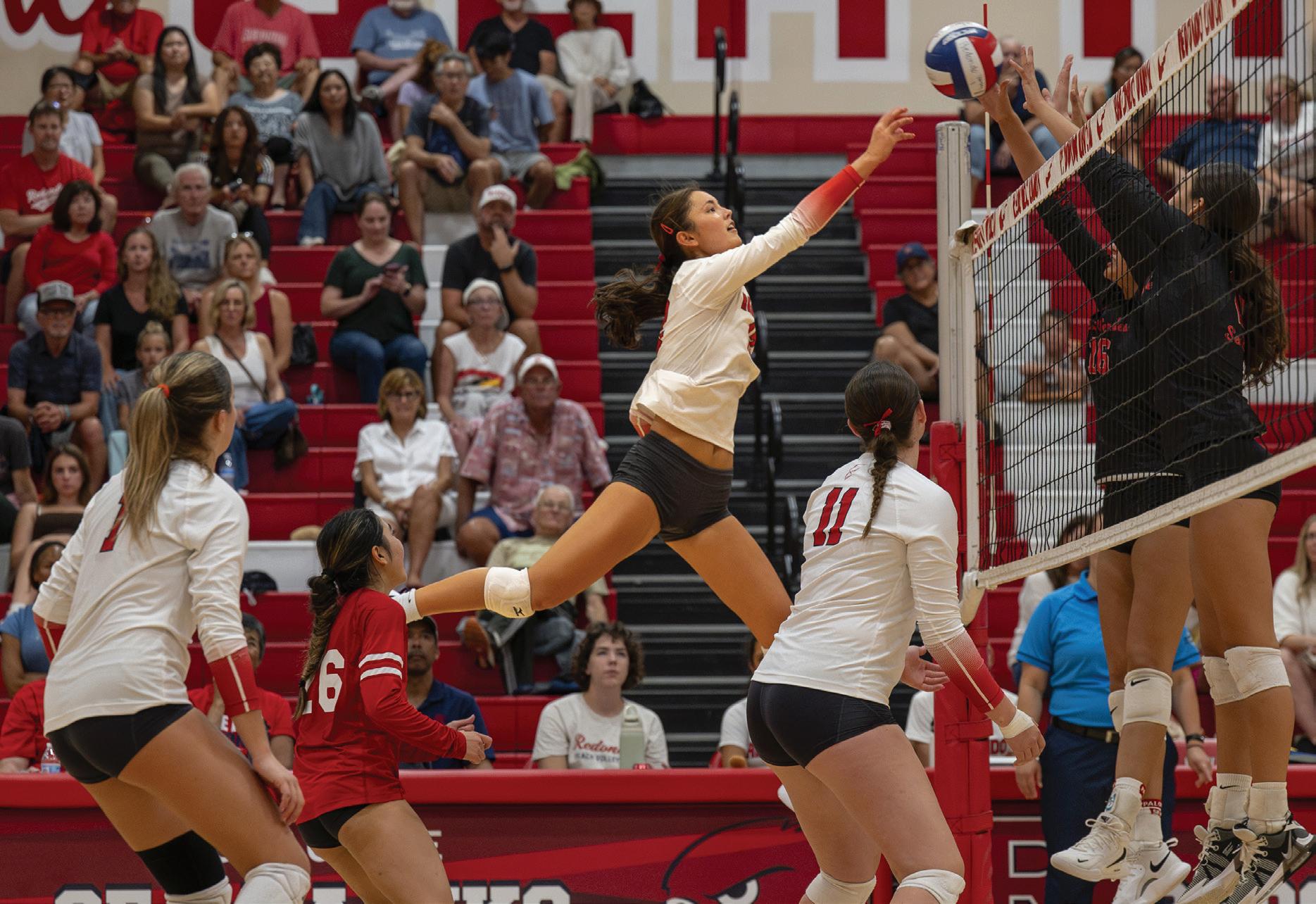
“One of Redondo’s pillars is competitiveness, and we like to win and compete. [Minzlaff] totally adds to that aspect. She came in and has made it clear that she will help lift us up,” Harriell said. “I think [Minzlaff] is an amazing coach and very personable with [the team]. I like having
ter dump from junior starting setter Marlo Libbey, and a back row attack and kill from junior outside hitter Leah Blair.
“[Head] Coach Tommy always says that we need to start off the game with a huge kill, or he calls a ‘big bang’ and I think that the first play of the game kind of always
good start.”
Brown, who was moved up to varsity mid-season after displaying great sportsmanship and athletic ability on junior varsity, was “flooded with emotions” when she got moved up, and is looking forward to the rest of the season.
“I was excited because I know varsity is competitive, so I was honored and super happy that [the varsity coaches] thought I was good enough to be a part of the varsity team. We always play super hard and the PV game was a great game to get us back on track and break those losses that we had,”xBrown said. “We talked in the huddle about not playing down to the level of the team we’re playing, going 100% always, no matter who’s on the other side of the net, and we definitely did that in [the PV] game.”
During warm ups before the match, Minzlaff was feeling “positive” about the team’s performance before the game and was hopeful that the game would get the team back on track to continue moving forward.
“I feel like we’re playing really good volleyball right now, and I don’t like making a prediction on the outcome of the game because I feel like it’s a jinx, but I’m feeling confident,” Minzlaff said.
After “crushing” PV, Brown has high hopes for the rest of the season as she continues to adjust to being a new varsity player.
“All of the girls on the team are so nice, and I love to play with them and watch them play from the sidelines. I’m honestly just so happy to be there, on the court or not. Just cheering them on, it feels like I’m playing too, and just having energy on the bench really does lift everyone up,” Brown said. “I’m really looking forward to the rest of the season.”
by Marlena Lipan
Battling against unpredictable winds and tight starts, the sailing team opened their season with their first regatta at Newport Harbor Yacht Club. Against a field of 20 schools, the best Sea Hawk team out of the five finished in fifth place, topping Mira Costa, who finished in 11th place.
The regatta marked the first major competition of the fall for Redondo. For head coach Sarah Smith who leads the program out of King Harbor Yacht Club with support from the King Harbor Youth Foundation, the event was as much about growth as it was results.
“We brought as many boats as we could to this one. We had about 20 sailors going, almost the whole team. It’s a good way to kick off the season and get some of the newer kids racing for the first time,” Smith said.
As the racing took place, Newport Harbor’s signature sea breeze filled in. The rising breeze necessitated physical strength, along with strategy. Short chops inside the harbor and tidal currents in the channel kept crews sharp, forcing split-second decisions on when to tack or hold their line.
“I think of sailing like playing chess, but the board is always changing because you can’t anticipate what the wind and water are going to do. You’ve got the same pieces every time, but your decision-making is different,” Smith said.
That steady improvement was clear in Newport, where the Sea Hawks showed speed in the lighter afternoon races and resilience throughout. Sophomore Meliah Medeiros reflected on the friendship opportunities sailing has provided her.
“It’s definitely a really unique group of people. I wouldn’t have thought these people would come together if it weren’t for our shared connection with sailing,” Medeiros said.
For Smith though, coaching goes beyond results and extends to the lessons she has taught her sailors.
“My favorite part of coaching is seeing the kids grow. I’ve been telling them a lot recently that their progress and their skills are leaps and bounds better than they were a year ago. Seeing their progression and watching sailors who go from never having touched a boat to being able to go out there and win competitions. It’s very cool to see everything click into place and then find the love for the sport,” Smith said.
Despite the presence of the sport since the year the school was founded, Smith noted that many of the team’s younger sailors have grown significantly within the past year, and are beginning to shape into mentors for the first year sailors.
“A lot of our members last year were brand new to the sport, and they have now taken up leadership roles.” Smith said. “Many of our returning sailors get to come in having more of a baseline, and so just improving upon our results from last year is big. Our number one goal is to go to the Pacific Coast Championship."
According to Smith, the consistency that the team puts into their practice helps them adapt to the harsh reality behind the sport of sailing.
“People have the misconception that this is a preppy sport. In reality, yacht clubs are grimy and can be rough places.” Smith said. “We are getting down and dirty in the water, and we’re sailing in every condition, rain or shine. It takes long days, a lot of stamina, and a lot of dedication.”
Boys waterpolo rebounds from a loss and beats Arcadia, 16-7
by Kate Lanzdorf
Coming off of their first loss of the season, boys water polo got back to their winning ways after defeating Arcadia 16-7. According to senior AJ Waldfogel, the team's effort and will to play together as a team contributed the most to the comeback story.
“We were all working for each other; there were no selfish plays,” Waldfogel said. “Everyone was trying to work for the other person. When we do that, we score a lot of goals. I think that was the best part of our game today.”
Head Coach Jase Emery acknowledged that the boys were strong in the first quarter, only giving up one, but let up in the second quarter allowing Arcadia to put up three more goals.
Despite an even second quarter, the boys managed to bring back their fire in the second half. Emery says this ability to bounce back gives him high hopes for the team, and is excited to watch them “take [the] us to the next level.”
“We’ve had really good rankings in CIF (California Interscholastic Federation), but not really executed past that. I think this is a year for us to really push past that barrier and make a good run in CIF and a good run in our league,” Emery said.
effort, but his apparent positive attitude, according to Emery, brought a lot of great energy into the game.
“This was my first game back [competing for a high school], so I was pumped to play with the boys, and was ready to ball […] We had a lot of good team chemistry today. We were working for each other a lot, and set-
transferred to matches with ease, and the team worked hard to fully fledge their efforts the entire game.
“The biggest challenge was not letting

We're always pushing each other to get better, not letting anyone get off easy, or taking any plays off," Waldfogel said. "We're always working and competing with each other to make everyone improve.
AJ WALDFOGEL SENIOR “
Emery gave a special shout-out to senior Jackson Lesnever, who had just played with Redondo for the first time after his transfer from South Pasadena. Not only did he bring a strong
ting each other up for plays, and I think that’s what helped us win,” Lesnever said.
Waldfogel also spoke on their consistent practice schedule. Practicing for two and a half hours every day undoubtedly prepared them for the game, but their personal motivation was what “truly brought them through.”
“We’re always pushing each other to get better, not letting anyone get off easy, or taking any plays off,” Waldfogel said. “We’re always working and competing with each other to make everyone improve.”
This discipline during practice was
ourselves get lazy,” Waldfogel said. “We had them in the first quarter, but you never want to take any place off. That’s when the other team starts coming back, getting momentum and [thinking] they can win the game. And you never want that.”
Considering their near perfect winning streak so far this season, Redondo came in with the confidence to defeat any kind of opponent. If this kind of certainty is carried throughout their next games, the boys will find themselves a great season.
“We always come in with a mindset that we’re going to go out and just kill whatever we’re playing, no matter how good or bad they are,” Waldfogel said. “We came out ready to play, and knew we could blow them out of the water.”

by Fi Borgese
With disability diagnosis rates in the United States on the rise (U.S. Center for Disease Control and Prevention), it is not uncommon to come across kids with accommodation plans at school. Disabilities range from visible to invisible, physical to mental. Many people, kids and adults alike, often do not understand the struggles these students go through.
These plans, in the form of 504 or Individual Education Program (IEP) plans, provide accommodations such as extra time on tests, quiet, separated test-taking sites, the ability to use headphones in a loud environment and more. These accommodations are made to support students and promote equal access to education, but they can oftentimes make the students feel out of place.
For senior Palani Richmond, using her accommodations brings feelings of being an outcast.
“
nia, 865,213 students have specialized education plans, and 198,546 of those are in Los Angeles County. Despite how common it seems to be, students such as senior Danielle Felixson still report feeling self-conscious about their disabilities.
“I feel embarrassed some of the time that I have to use them because they’re not accommodations that are standardized. So it stands out if there's a no electronics policy, and I have to use my noise-canceling headphones,” Felixson said.
Rather than saying 'disability,' ask , 'What is their ability? What can they do?'
The media can affect the perception of disabilities. Education specialist Doctor Monica Mallet believes programs such as “Love on the Spectrum” represent disabilities well. However, Felixson disagrees, believing that, although it helps in some cases, more work needs to be done to accurately depict disabilities.
DOCTOR MONICA MALLET EDUCATIONAL SPECIALIST
“When everyone else is taking a test, and I stand up, it just makes me feel like I’m dumb. Even though that’s not why I have the plan, it still makes me feel that way.” Richmond said. “I feel isolated. Like all these other kids are normal and I’m the ‘weird’ one because I can’t function like they do.”
According to the California Department of Education, in Califor-
7/8
“I do think that a lot of disability portrayal in [the] media is very skewed in its representation because disability is still something that society is getting accustomed to being around and being comfortable around,” Felixson said. “Media pushes more mild stuff that's more easy to understand, which I feel isn't a wrong approach for trying to desensitize before working up to bigger issues, but then the problem is that [the mild stuff] becomes stereotyped, and any
High school students with learning disabilities reported experiencing abelist microaggressions at school, according to researchers at California State University.
thing more extreme isn't as understood. Like with obsessive-compulsive disorder (OCD), for example, a lot of people assume that it's just about keeping things neat and tidy.”
Many agree that a simple solution is normalizing disabilities and education plans. Mallet believes understanding our similarities is as important as understanding differences.
“I think all students have challenges, and sometimes it’s just because people are different, and because people are different there isn’t an awareness of how we’re still the same. So they may not have the ability to do things that some of their typical peers can do, but they can do things that their typical peers cannot do at the same time. So it’s really about looking at people’s differences and celebrating people's differences.”
Mallet said.
They can verbally talk, but they may not know what to say,” Mallet said.
In her eyes, when celebrating differences, the focus then shifts to the potential of these kids, rather than how their disabilities inhibit them. Rather than saying ‘disability,’ “What is their ability? What can they do?” she said.
In California, 865,213 students have specialized education plans, and 198,546 of those students are in Los Angeles County.
INFORMATION FROM THE CALIFORNIA DEPARTMENT OF EDUCATION
Despite the struggles that come with these plans, students still believe that accommodations help them in school. Without them, these students face additional academic pressures that their typical peers would not.
“They’ve made school better, I will say. Having that ability to use them makes things less stressful. Especially [with having] extra time on tests, I don’t have to worry about rushing.” Richmond said.
According to Mallet, what society views as differences can also be viewed as similarities.
“Sometimes, our [atypical] students don't have the language to communicate what they are feeling or what they want, so that's a difference. But sometimes, typical peers are in a social setting, and they don't have the words or the language; they don't know what to

Felixson agrees, believing students should ask for help when they need it.
“The only way to get help is to ask for it first,” Felixson said. “So even though it is scary and it can be difficult depending on your situation, I recommend you find people that you can confide in, first with the issue and trying to network in a sort of way, until you find someone who's in a position to get you the