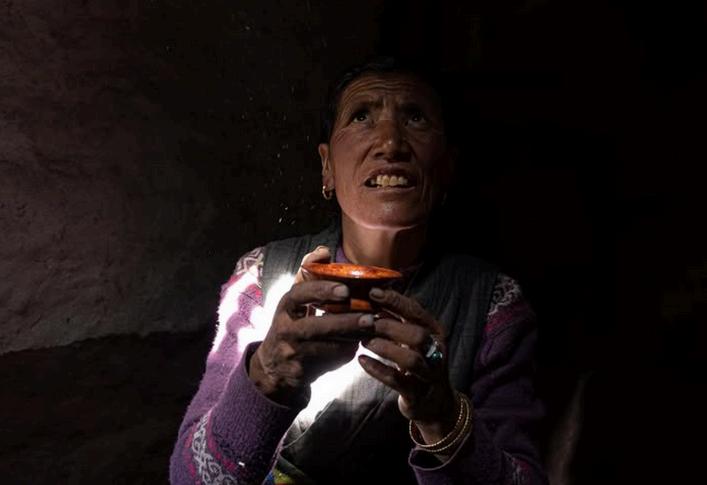
On a cold winter night in 2022, in the forests of eastern Nepal, Lhakpa Bhote settled into a rug in his small stone house, stretched his legs, and, as he had every night for forty-two years, fell asleep to the gushing song of the ChhujungRiver Thissoundhadbeenthesoundtracktohisentirelife hisfirst memoryasachild,thelullabythatsoothedhimthroughcountlessseasonsof sowingandharvesting.
Butatthreeinthemorning,somethingchanged.Therumbleofdistantthuds began to overpower the river's melody Lhakpa, whose family has tended these mountain pastures for over a millennium, sprang up from his bed, corralled his family, and stepped outside to find bulldozers crumbling the stone walls that had protected his house and land for more than half a century.Themachinesweredrowningouttheriver'svoice.
When Bhote approached the workers, a supervisor reached into a folder and withdrew several sheets of paper. The documents bore official seals and signatures,includingBhote'sname Bhotestaredatthesignature "Thisisnot mine," he told them. The supervisor for the Chhujung River Hydropower Projectshruggedandcontinued.
Thatnight,theriver'sgushingbegantofade.
When Bhote and other villagers examined the damage at dawn, they discoveredbulldozershadcarvedthroughsectionsofspiritualandprotected forest where Bhote could distinguish between twelve different medicinal plants that could treat altitude sickness, ease childbirth complications when the nearest medical facility lay five days' walk. What happened that night reflects patterns documented across Nepal's remote mountain valleys The countryhasembarkedonanunprecedentedhydropowerexpansion,withthe government promising to transform Nepal into a renewable energy powerhouse. Yet investigations reveal irregularities in multiple projects. The sectorinvolvesmillionsofdollarsinfundingandaffectssettlementsthathave existedforoveramillennium InSankhuwasabhadistrict,hometoBhoteand some of Nepal's most marginalised indigenous communities, construction continuesonthe63-megawattChhujungRiverHydropowerProject.
The planned hydropower construction threatens not just the Chhujung River, but also the sacred Chhunjam and Bakhang Rivers of the Lungba Samba valley. This region, located between Makalu and Kanchenjunga protected areas, represents one of Earth's last pristine places and serves as home to endangered snow leopards, red pandas, Asiatic black bears, and rare tree frogs
For generations, the Bhote Singsa and Lhomi Singsa communities have followed ancestral yak herding routes shaped by the sacred Chhujung River We perform rituals for safe passage in these holy rivers and surrounding forestswiththebeliefthatlivingspiritsresideinthem Nowweareatariskof losing our livelihoods," explains Bhote. “In the endless pursuit of energy,” he says,“onceagain,indigenouspeopleareintheeyeofthestorm.”
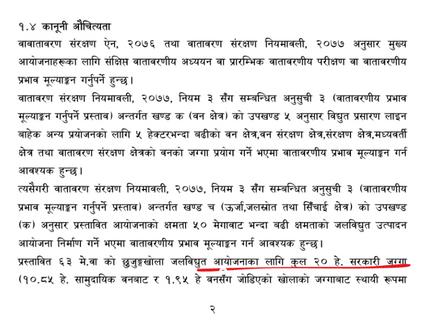
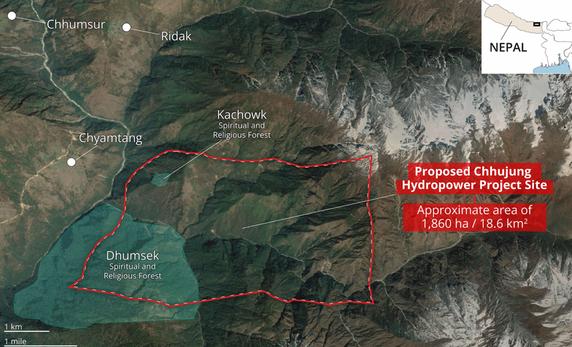
The environmental impact assessment filed with the Ministry of Environment contains numerous discrepancies, describing a twenty-hectare project with tropical chestnut trees that don't exist in these mountains. Local activist KarmaBhutiadiscoveredofficialshadcopiedpassagesfromlowlandprojects and changed names The project operates across 1,800 hectares, twenty times larger than the fraudulently approved one, encompassing rivers not mentioned in permits. These lands contain spiritual forests and habitat for endangered snow leopards, red pandas, Asiatic black bears, and rare medicinal plants. Company plans call for 192,000 tonnes of explosives within five kilometres of twenty-six glacial lakes, threatening this ecosystem and riversourcessustainingcommunitiesformillennia.
Image 1: Environmental Impact Assessment shows a 20-hectare project area. Community GPS verification reveals that the actual construction spans 1,800 hectares, 20 times larger than the approvedarea
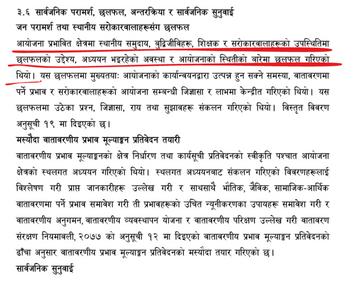
Companies have secured approval through documents containing these inaccuracies, then leverage those permits to attract both international climate funding and domestic investment from Nepal Stock Exchange-listed firmslikeGhalemdiHydro,whichraisescapitalbysellingsharestothepublic. The consultation process that followed contained similar irregularities. In Marchof2022,companydirectorsconvenedwhattheytermedaconsultation meeting in Chyamtang village, gathering signatures from only 61 of 232 households across three affected communities. All signatures came from Chyamtang residents; none from Thudam herders, whose ancestral pasturelands would be eliminated. Among the signatories was 10-year-old Yompang Bhote, showing a clear violation of Free, Prior and Informed Consent,alegalrequirementunderNepal'sconstitutionandinternationallaw that mandates genuine consultation with all affected adults before developmentprojectscanproceed
Bhote has long endured nature's extremes floods, landslides, and isolation whereaminorinjurycanbefatal Yethisgreatestfearisn'tnature,butthose disrupting his community's bond with it. Our expedition will follow him as he navigates between worlds, traditional ecological knowledge that encompasses indigenous livelihood and modern legal systems that fail to protecthismostfundamentalrights.Drawingonfouryearsofenvironmental reporting and profound trust with affected communities, we document not just policy failure, but lived experience: what it means to watch sacred landscapes become wiped out, to see thousand-year relationships with land slowly grip away We witness a community whose entire world—their stories, their knowledge, their very existence, hangs in the balance of an environmentalfraud
Source: Mongabay
Team
Tulsi Rauniyar
Expedition Leader, Co-director and Primary Cinematographer
Karma Bhutia
Local Liason, Community Leader
Barnaby Francis
Producer, Story Advisor
Secondary Cinematographer
Lhakpa Angjuk Bhotia
Legal Plaintiff, Character
Information TheTeam
Tulsi Rauniyar leads this expedition as co-director, writer, and primary cinematographer. As Hidden Compass's current Storyteller in Residence and an environmental journalist, she brings over four years of investigative experience and deep communitytrusttothisstory.tulsi.rauniyar@gmail.com
Barnaby Francis, our post-production director, brings awardwinning documentary expertise, including a Sheffield Doc/Fest win and BFI National Archive acquisition. barney.francis@googlemail.com
Karma Bhutia, our local leader and cultural expert, has spent years documenting these violations as a community organiser andadvocateforindigenousrights.karmabhutia757@gmail.com
Lhakpa Bhote, thecommunityvoiceattheheartofourstory,is the lead plaintiff challenging the project in Nepal's courts. His traditionalknowledgeencompassestwelvemedicinalplantsthat can save lives where modern medicine cannot reach. lakpabhotia@gmail.com
StorytellingApproach
The film will position the river as the central character, a living presence whosechangingflowreflectsthefateoftheIndigenouscommunityboundto it. For generations, villagers have read the river as a guide, interpreting its state as a sign of fortune or misfortune. Framing the narrative through this lensallowsthefilmtoexplorenotonlyenvironmentalchangebutalsocultural survival. My approach combines investigative journalism with cinematic immersion, in the spirit of Hidden Compass: balancing high-stakes intimacy with visual epicness. Access is a strength we bring, from government boardrooms where permits are negotiated, to sacred forests where water rituals are held, to seasons embedded with families like Lhakpa’s His traditional knowledge, reading weather patterns, identifying medicinal plants, and navigating ancestral routes will be filmed as both testimony and spectacle,revealingIndigenouswisdomasurgentandcinematic
Character-DrivenVisualStorytelling
The film will be rooted in character. We plan to live within the community, capturingtheeverydayrhythmsunderthreat yakmigrations,rituals,andthe transfer of knowledge across generations. These scenes will anchor the film emotionally, while cinematography will expose the staggering scale of encroachment, the gap between a 20-hectare permit and a 1,800-hectare reality. We understand that tension comes from contrast. Bulldozers arrive in the middle of the night, yet traditional rituals continue at dawn. Legal battles unfold in distant courtrooms while families gather for seasonal migrations. By holding both rupture and resilience in the story, the film will be an attempt to portraynotonlythepressuresofdevelopmentbutalsothespiritofendurance
Execution
We intend to create both a cinematic work and an archive, a record of knowledge, rituals, and stories that are at risk of being erased. The investigation into permits and forged documents provides a natural thriller arc,whilethevisuallanguageIenvisionisrootedinthebeautyandpoetryof Himalayan rivers, glaciers, and pastures shown with such care that their destruction feels almost unbearable. Rather than relying on conventional interviews,weplantoletbackstoryemergethroughpresentaction,aritualat the riverbank, a migration across pasture, or construction advancing with each season. We hope for the camera to feel less like an observer and more like a companion, walking, listening, and witnessing alongside the community Ourgoalisforaudiencestoexperiencetheintimacyofthisworld, as though they too are on an expedition to protect not just a river, but an entirewayofunderstandinglifeitself.
ProjectBudget
The $18,000 Pathfinder Prize grant enables fieldwork in Nepal's Sankhuwasabhadistrict,wheredocumentingtheintersectionofdevelopment pressuresandindigenouslifewaysrequiressustainedparticipant-observation and community-based research methods. This budget framework emerges from extensive consultation with Karma Bhutia, whose role as cultural intermediary and local collaborator proves essential for navigating the complexsocialdynamicsofthisresearchcontext.
ThegeographicisolationthathashistoricallyprotectedBhoteSingsacultural practices from outside influence shapes our transportation needs (approximately $5,400), requiring trekking permits to settlements unreachable by motorized transport, plus risk mitigation insurance appropriate for high-altitude filming environments Our embedded storytelling methodology depends on accommodation and subsistence expenses (estimated $4,500) that enable reciprocal relationships with host families, fair compensation for cultural guides, and material support recognizinghowourpresenceaffectssmall-scalesubsistencecommunities.
Alpine documentary work presents unique technical challenges. Specialized recording equipment must function in extreme conditions, redundant systems protect against data loss, and audio technology needs sensitivity to capture the nuanced soundscapes central to animist spiritual practice all reflected in our documentation budget (roughly $3,600). Local knowledge holders deserve compensation for their contributions to our story, while linguistic mediationservicesproveessentialfor accurateculturaltranslation, accountingforourpersonnelallocation(around$2,700)
Thefinalphaseinvolvescraftingourrawmaterialintoaccessiblemultimedia formats through post-production work (estimated $1,800), serving both documentary storytelling and community advocacy objectives. Throughout this process, we maintain journalistic rigor while upholding ethical standards of reciprocity with our subjects, ensuring our work serves the communities whomakeitpossible.
A Hidden Compass Pathfinder Prize Expedition
WhyThisMattersNow
InthefurthestcornersoftheHimalayas,whereroadscannotreachandcommunitiesremain disconnected from modern infrastructure, a different kind of development story is unfolding. Thisisnotthestoryofmeltingglaciersorrisingseasthatdominateheadlines.Thisisthestory of how renewable energy projects, designed to power a modern world, collide with communities whose relationship with their landscape spans millennia - raising questions aboutwhatwepreserveandwhatwesacrificeinpursuitofprogress.
The Bhote Singsa community represents one of the world's least documented peoples. Their animist spiritual practices and traditional knowledge have been passed down orally through generations, existing largely outside academic or anthropological study These mountain valleysholdstories,rituals,andwaysofunderstandingthenaturalworldthatremainvirtually unknown beyond their borders. As development reaches these remote regions, questions emerge about how such communities navigate change while maintaining their cultural identity.
Our expedition benefits from the deep local knowledge of team members Karma Bhutia and Lhakpa Bhote, both from the indigenous communities we'll be documenting. Their guidance offers rare insight into perspectives that have rarely been shared with outside audiences. Throughtheircollaboration,weexplorewhathappenswhentraditionalworldviewsencounter moderndevelopmentpressures,documentingnotjustaconflict,butaconversationbetween differentwaysofunderstandingprogress,preservation,andplace.
TheHiddenCompassPathfinderPrizerepresentstheidealplatformforthisstory,embodying the modern spirit of exploration that seeks understanding rather than conquest. Through a multimedia approach - combining documentary film, written dispatches, and photographywecansharetheBhoteSingsacommunity'sperspectivesacrossmultipleplatforms,ensuring their stories reach audiences who might never otherwise encounter these remote mountain valleys. This partnership transforms what could be extractive documentation into genuine cultural bridge-building, where exploration serves not just discovery, but meaningful connectionbetweenworlds.Wewouldbehonouredtocontributetothisprocess.
We intend to create both a cinematic work and an archive, a record of knowledge, rituals, and stories that are at risk of being erased. The investigationintopermitsandforgeddocumentsprovidesanaturalthriller arc,whilethevisuallanguageIenvisionisrootedinthebeautyandpoetry ofHimalayanrivers,glaciers,andpasturesshownwithsuchcarethattheir destruction feels almost unbearable. Rather than relying on conventional interviews,weplantoletbackstoryemergethroughpresentaction,aritual at the riverbank, a migration across pasture, or construction advancing witheachseason.Wehopeforthecameratofeellesslikeanobserverand more like a companion, walking, listening, and witnessing alongside the community. Our goal is for audiences to experience the intimacy of this world, as though they too are on an expedition to protect not just a river, butanentirewayofunderstandinglifeitself.