
HERALD SPRING 2026

Page 1


Orleans, La.

Editor’s corner: Liberty Further Extended

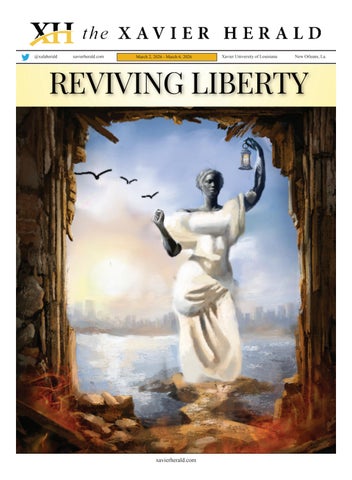
Dear readers, if the Fall 2025 edition of the Herald declared a “New Age of Xpression,” then for Spring 2026, we take it a step further, for expression without liberty is incomplete. The ability to speak freely, create boldly, and exist unapologetically requires more than visibility, but rather freedom. This issue is grounded in one central idea: “Reviving Liberty.”

To revive something is not to invent it but instead restore it to what has always belonged to us. In his essay titled Liberty Further Extended, Lemuel Haynes reminds us that true freedom must be universal. There are no selections and conditions that come with it. More importantly, it cannot fully exist if it does not extend to everyone. For Black Americans, including us at Xavier, liberty has always been something we have had to claim, defend, and reassert, even when it was already ours by human right.

It is ingrained in the very fabric of our university. Born as the only Black and Catholic institution in the nation, Xavier was established to create opportunity where there was exclusion. That legacy continues to live through us Xavierites. In addition to becoming beneficiaries of history, we are now participants in its continuation.

In our action to revive liberty, we are simply not asking for something new; we are indicating that freedom, expression, and opportunity are ours to begin with. We are reclaiming space in rooms that were not designed with us in mind. More significantly, we are continuously building rooms of our own that speak volumes to how excellence is being redefined.

As Xavierites, we carry this revival with intention. The increase in education, awareness, and intellectual confidence within our community is present, and there is urgency about knowing our history while also shaping its progression. We are highly aware of the systems around us, and nonetheless, we excel within and beyond them.

For generations, excellence for minorities has often meant survival plus superiority, being twice as good to get half as much. Yet today, excellence is no longer

confined to assimilation or outside validation. At Xavier, excellence looks like future physicians conducting groundbreaking research while artists fill stages with original work. It looks like journalists shaping narratives, entrepreneurs launching ventures, and students leading movements across campus and beyond. Excellence is intellectual ownership, cultural authority, and the ultimate confidence to define success on our own terms.

“Reviving Liberty” means understanding that we are not guests in history; we are authors of it. Every barrier we break strengthens the very foundation for those who follow, and each space we enter shifts what is considered normal and possible.

This edition is more of a declaration than a celebration. We are actively embodying liberty instead of waiting to receive it. Through resilience, excellence, scholarship, creativity, and community, Xavierites continue to defy odds that once seemed impossible. As The Xavier Herald, we pride ourselves on highlighting stories that represent these continuous narratives. Therefore, as you experience this edition, we ask that you join us in the mission of “Reviving Liberty.”

The Xavier Herald Staff Spring 2026

Editor-in-Chief: Ja’lyn Jones

Assistant Editor: Ivanna Washington

Managing Editor: Donovan Green

Creative Director: Melody Daniels

Chief Political Writer: keziah-yvonne smith

Sports Editor: daelyn house

Photo Editor: Daelyn House

Staff Writers

michael muse

nia moss

Alexia Anthony

JaCorey Law

Raygan Irvin

Madeline Bolden

Sean Brown

Page Designers ja’lyn jones

Cover Design

melody daniels

Comic Design

Melody Daniels

Special Thanks to ms. veronica favre, yearbook coordinator

Faculty Advisor: Dr. Quincy Hodges qhodges@xula.edu

Staff advisor: Annie Johnson ajohn211@xula.edu

Department head: Dr. Shearon Roberts srobert7@xula.edu

PRSSA Advisor: Dr. Nia Mason nmason1@xula.edu

HERALD CONTACT INFORMATION

Herald Office: Xavier South, 112B 504.520.5092

Email Stories: herald@xula.edu

Comic illustrated by Melody Daniels
Melody Daniels Cover Illustrator mdanie19@xula.edu

Herald Salutes NCF

Remembering NCF: The Herald Reflects

I had the honor of interviewing Dr. Norman C. Francis just a few years ago during my senior year at Xavier. Even at 92 years old, Dr. Francis’ love for his community, his people, and his mission was unmistakable.

What rang even truer was Dr. Francis’ gift to balance power and grace so admirably - a trait that was instrumental in his ability to help make Xavier University of Louisiana all that it is today. It’s because of Dr. Francis that so many thousands of students experienced a Xavier University that not only provided an education, but also taught steadfastness and servant leadership.

Dr. Francis’ dedication to and love for his people perfectly depict Dr. Martin Luther King’s words: “Power at its best is love implementing the demands of justice.” This is the graceful power Dr. Francis taught us to have, and the power we continue to carry out as his legacy.

Anthony Thompson is a medical student at the University of Pennsylvania. He graduated from Xavier as a Chemistry/Pre-Medicine major with minors in Biology, French and Health Communication.

My reflection: Some leaders shape an institution. Dr. Francis shaped generations. In 2015, when he retired, I was asked to reflect on his leadership as a budding journalist. More than a decade later, I never imagined I would be asked to do so again, now serving on staff at the university.

To the world, NCF was larger than life, yet he never outgrew his humble beginnings.

Rooted in faith, humility, integrity, and community, he did not just lead us—he walked with us. On the yard, in the café, in the barn on game day, or on stage at graduation, his steady presence made you feel seen and valued.

He fully embraced Mother Katharine’s belief that every student deserves opportunity and carried out that charge until his final days. With a century behind us and a century before us, the baton is in our hands. Xavierites, let’s carry the torch forward.

Best, Jimmie Johnson Class of 2013 Alumni Relations and Development Coordinator, Office of Institutional Advancement

Dr. Sharlene Sinegal-DeCuir

Class of 1999

Professor of History

Keller Family Endowed Professor Chair, African American and Diaspora Studies

Rest in eternal peace Dr. Francis!

Last year I had the honor of serving as the first African American chair of the Louisiana Endowment of Humanities Bright Lights Award Dinner. We honored Dr. Francis as the 2025 Humanist of the Year. It was one of the highlights of my career.

Over the years, I have interviewed Dr. Francis a few times and I have written a journal article about him published in Journal of African American History. His stories of growing up in Lafayette, and attending St. Paul Catholic Church resonated with me in so many ways as a Lafayette native whose family attended and still attends St. Paul Church.

This man was more than a legend. For those of us who went to Xavier, we understand what he truly means to the African-American community and to our Xavier family.

Dr. Michael White, retired Xavier professor of African American music and renowned jazz clarinetist, class of 1976.

“Dr. Norman Francis was always a hero in my family. My mother and aunt went to school with his wife, Blanche and they knew the family. I remember a lot of talk about him. A lot of pride people had when he became president of Xavier. In fact, my mother and aunt were active in the Alumni for many years. We went to the inauguration and I remember that.

I was a student under Dr. Francis, and I was a professor for 43 years under his leadership. And I always remember him as a very wise and balanced leader and I thought he was on of the most important people in New Orleans—not only just for Xavier but in terms of helping to fix some of the things that were wrong with the city, and helped to balance things like race relations, and the great efforts that he made with Katrina coming back.

I think he was a one-of-a-kind, special, blessed individual, and we were blessed to have him. And, I am just very happy to have served under his leadership and have been one of the many thousands of people that graduated from Xavier under his watch.

I worked with him on numerous occasions with many programs, and different things, and he was always a model and a mentor to me. So, seeing his passing - that transition - is a very difficult time, but again I feel blessed to have had him in my life.”

Dr. Michael White

During the week that I arrived at Xavier in 2012, I remember standing in the line at the cafeteria where Dr. Norman C. Francis was greeting the freshmen. We spoke for a minute, but what I remember most was the warm encounter he shared with me and all of the other students.

Three years later, I served as the editor-in-chief of the Xavier Herald when Dr. Francis announced his intent to retire at the end of the 2015 school year. Our newsroom planned a commemorative edition of the Herald to celebrate Francis’ 40-plus years of service. During one particular interview with Francis, we learned about his from his favorite color and hobby to the hardest decisions he made as the first layman president of Xavier University of Louisiana.

Dr. Francis was a pioneer, leader, and a friend to New Orleans. While his passing is a loss of a light for the Xavier University of Louisiana community, Dr. Francis’ legacy should encourage us all to live up of a standard of service, leadership, and love as we march forward in our own lives.

Eric M. Craig Class of 2016 The South LA Recap

NCF Reflection by Eric Craig
Jimmie Johnson (right) poses with Dr. Norman C. Francis. Johnson reflects on Francis’ leadership and impact at Xavier University. Photo courtesy of Jimmie Johnson
Anthony Thompson (right) poses with Dr. Norman C. Francis. Thompson reflects on Francis’ lasting influence on students and the Xavier community.
Photo courtesy of Anthony Thompson
Eric Craig (right) poses with Dr. Norman C. Francis. In his reflection, Craig recalls Francis’ welcoming presence and lasting example of leadership at Xavier. Photo courtesy of Eric Craig
Dr. Sharlene Sinegal-DeCuir, Class of 1999, poses with Dr. Norman C. Francis. In her reflection, Sinegal-DeCuir recalls Francis’ legacy and the personal connections that shaped her journey at Xavier.
Photo courtesy of Dr. Sharlene Sinegal-DeCuir
Dr. Michael White remembers Francis as a wise leader and mentor whose influence shaped generations of Xavier students and faculty. Photo courtesy of Dr. Michael White

Remembering Father Victor Laroche

Xavier University of Louisiana lost a key religious and familial presence when Father Victor Laroche, O.P., University Chaplain

The Legacy of Father Victor Laroche

and Special Assistant to the President for Catholic Identity, died Jan. 23. Known as a true shepherd, Laroche was often seen making dad jokes, being a listening ear and passing out flowers throughout campus.

“He was simply a good man,” Xavier University of Louisiana President Reynold Verrett said.

As the presiding Catholic

priest and keeper of the campus chapel, Laroche was known for his jubilant and consistent energy, especially regarding the Lord and the Bible.

“It is with deep sorrow that I share the sudden passing of Father Victor Laroche, who faithfully served Xavier University of Louisiana as university chaplain and special assistant to the president for Catholic identity,” Vice

President of Student Affairs

Curtis Wright said in a campuswide email the day of Laroche’s passing.

During his wake Jan. 28, multiple students and staff shared the same sentiment, noting that whether there was one person or 100 in attendance, Laroche would always celebrate Mass with the same enthusiasm.

“He kind of just walked up

to me one day and asked me how my studies were going,” said Warren Stevens II, the current Mister Xavier. Stevens smiled as he reminisced about their relationship.

“From that moment, we grew closer together, constantly joking, laughing, but most importantly, uplifting.”

From start to finish, this uplifting energy saturated the campus ministry office, where Laroche presided. His work included conducting Mass, participating in campus

“Since 1939, Dominican priests have been at Xavier, due to the nuns’ lack of access to teaching because of them being women,” said Father Herman Johnson, a fellow Dominican priest and associate professor of Spanish.

For nearly 90 years, the teachings of St. Katharine Drexel and the Dominican order have intertwined philosophies and principles on Christian education and embedded them within Xavier.

“Catholics served the people, not the religion, as God put them in control of His flock,” Johnson said.

Many in the Xavier community, from colleagues to students, remembered Laroche for his giving heart.

“That’s all I would hear from students. Even when he came into the office, he would give me flowers, and I still have all the cases he would give to me,” said the Rev. Mitchell J. Stevens, a former colleague.

“On a tabling event after he passed, a Muslim student walked up to the table and

religious retreats and leading Xavier’s Rite of Christian Initiation of Adults classes, helping guide students in their journey of faith and Catholicism.

Laroche had an essential role within Verrett’s cabinet as a Dominican priest, a member of a Catholic religious order that has long been part of Xavier’s campus and culture.

spoke about how much she will miss Father Laroche and all the flowers he gave her. He would text students during their religious holidays and provide them with food regardless of their religion,” Stevens said of Laroche’s connection with students.

Fr. Laroche addresses attendees during mass.
Photo courtesy of Xavier Yearbook
Fr. Laroche pictured with congregation during a day of service.
Photo courtesy of Xavier Yearbook
Fr. Laroche happily pictured with members of the Xavier community. Photo courtesy of Xavier Yearbook
Fr. Laroche delivers welcoming remarks during the Baccalaureate Mass. Photo courtesy of Xavier Yearbook

Remembering Father Victor LaRoche

Xavier community pays respects to Father Victor Laroche

In honor of a well-respected pillar of the New Orleans community, Xavier hosted a vigil service in memory of Father Victor Laroche, O.P., University Chaplain and Special Assistant to the President for Catholic Identity , at the St. Katherine Drexel Chapel on Jan. 27, 2026. Known for his comforting presence on Xavier’s campus

and his dedication to leading a Christ-like life, those impacted by Laroche’s love for others attended the service. Students, colleagues, friends, family, and administrators gathered in prayer and remembrance of his service to the university.

“Victor got called home as he has done his work,” said Xavier’s President Dr. Reynold Verret. “He was being the hand of Christ, wherever he went, whether it was in the cafeteria, or around the hall, or in the bookstore,” Verret added at the vigil.

The Port-au-Prince native was exceedingly proud of his Dominican heritage while also encouraging inclusivity. As a gifted linguist, he made a point to connect with every person he encountered using English, French, Haitian Creole, and Spanish. Upon arriving in New Orleans, Father Laroche surrounded himself with his brothers in the Catholic church, who said they will continue to uplift and engage spirits in Christ since his sudden departure.

“I’m still digesting it, but I do feel his spirit,” said Brother Herman Johnson, O.P., a Dominican friar and professor of Spanish at Xavier. “I feel him encouraging me to be joyful and to dance,” Johnson said.

Father Laroche had a large family both through blood and connected by faith.

Johnson said that after living with someone for six years, they become a part of your

family. His family members gathered the strength to speak to mourners after hearing the deep connections Father Laroche made in his lifetime.

“On behalf of the family, thank you all,” said Paul Laroche, the brother of Father Victor Laroche. “I never saw my life without him, and I never conceptualized life without him,” Paul said, reflecting on the lifetime they spent together since birth.

While Father Laroche’s reach began in Haiti, fostered by the love of his family, it extended to the United States with his migration. In 2022, he joined Xavier University’s Campus Ministry, allowing him to narrow his focus to college students.

“I didn’t know a Xavier without Father Victor,” said Darryllynn Sabbath, a piano performance major, and senior at Xavier from Shreveport, La. He has been a recipient of Father Laroche’s support since his first year in 2022.

The impact he made on students’ lives was instant, they said. Daily messages of affirmation, spontaneous blessings, and beautiful flowers were tokens he shared to students and those they said they will miss now that he is gone.

“Father Victor, get up, please,” said Evania Warner, a psychological science major, and sophomore at Xavier from Houston, Texas. “We love you so much,” Warner added towards the end of her speech,

expressing her gratitude for the imprint he left on her and her friends’ souls.

Fr. Laroche’s casket is carried by clergy and community members prior to memorial.
Photo courtesy of Xavier Yearbook
Xavier’s student choir performs during the memorial service honoring Fr. Laroche.
Photo courtesy of Xavier Yearbook
New chaplain Fr. Peter Damian Harris, O.P. gives regards during Fr. Laroche’s memorial service.
Photo courtesy of Xavier Yearbook
Xavier student Evania Warner mourns over Fr. Laroche during heartfelt speech. Photo courtesy of Xavier Yearbook
Rev. Mitchell J. Stevens delivers remarks during Fr. Laroche’s memorial service
Photo courtesy of Xavier Yearbook

Campus News

Xavier’s Crossroads: Generosity Meets Hard Reality

Xavier University of Louisiana is streamlining its finances, adjusting to current changes in the higher education landscape. In fall 2025, the university implemented staff layoffs, while at the same time, it also received a historic $38 million donation from philanthropist MacKenzie Scott, both in the same semester.

“Xavier’s finances are on solid ground,” said Xavier’s President Dr. Reynold Verret. “Some of the things that we had to do were also to make sure that we did not put ourselves at risk, given some things going on in the federal government right now.”

University leadership says these decisions reflect long-term financial planning rather than a fiscal crisis, citing federal policy shifts, enrollment risks and uncertainties in higher education funding.

This juxtaposition of staffing cuts and a major financial donation has raised questions among students and campus stakeholders about the university’s financial standing and priorities. While explanations offer context, they do not always provide reassurance.

The contrast underscores the tension many institutions face in balancing immediate operational needs with longterm financial strategy. University leaders maintain the restructuring was based on forward-looking fiscal planning, not short-term instability.

In an official campus-wide email, university leadership described the layoffs as

“very difficult but necessary decisions” aimed at aligning operations and resources with long-term financial sustainability. The statement emphasized no additional separations were planned at this time.

According to Verret, the staffing reductions were proactive, not a reaction to a budget deficit. He cited potential federal policy changes, including threats to Parent PLUS and Graduate PLUS loans, as major concerns affecting enrollment and affordability.

“Grad PLUS loans are being abolished,” Verret said.

He explained that many Xavier pharmacy students rely on Graduate PLUS loans. “Our graduate students in the PA program depend upon Grad PLUS loans - a significant number of them,” he said. Roughly 30 to 40% of graduate pharmacy students depend on these loans.

He also pointed to threatened reductions in federal Facilities and Administrative funding, along with broader economic pressures such as rising construction costs due to tariffs.

“We took a hard look with our finance team, with our CFOs, and also other leadership teams to see exactly what needed to be reduced to balance the budget as we began to forecast it,” Verret said.

The $38 million gift from MacKenzie Scott is the largest private donation in Xavier’s history. Verret explained that the funds are being invested with the university’s endowment to generate longterm returns for student financial aid, not immediate operational expenses.

“The money is going into an endowment, so that it produces yield to support student financial aid,” he said. Endowment funds are invested to generate returns while preserving the original gift, which would yield about $2 million each year to further strengthen support for financial aid.

“Our responsibility is both to the students who are here today, but also those who might arrive in the future,” he said. He added that the donation did not directly influence staffing reductions.

Beyond the Scott donation, Verret confirmed the university is engaged in conversations with additional donors, though details remain confidential. On the Centennial Campaign, Verret said, “We are on pace; we’re growing right now.”

Questions about tuition increases have surfaced. Verret said tuition changes occur periodically, but

the university approaches increases cautiously.

“If you think about it, Xavier’s tuition is less than two-thirds of its peer institutions,” he said.

Students have pointed to ongoing construction as a contrast to staffing cuts.

Verret explained that building projects are funded through a combination of debt financing, operational funds and longterm residential investment planning, separating those funds from day-to-day operations.

“Everything we do has been within our means,” he said.

When asked what the Xavier

community should expect over the next 12 to 24 months, Verret pointed to broader economic unpredictability, suggesting that flexibility will be crucial.

“The one term that you can use for this period of time is uncertainty,” he said.

Still, he rejected the notion that Xavier is in decline, instead citing new academic programs and expansion as indicators of growth.

“Xavier is in a very strong place,” he said. “Xavier has been growing. If you go nationally and listen to conversations about Xavier, it’s rather optimistic.”

University President Reynold Verret speaks during the kickoff of Xavier University of Louisiana’s Centennial Campaign in January 2025.
Photo courtesy of Xavier University of Louisiana

Xavier Eyes New Future for St. Mike’s

Xavier University plans to continue campus renovations following the completion of the new Xavier South residence hall. St. Michael Residence Hall, known to students as St. Mike’s, is currently a male residence hall located near the University Center. With intentions of preserving its historic significance, the university plans to transform the building to accommodate the increasing number of students interested in the prehealth academic track.

“What we wanted to be able to do was kind of expand some of the services that we can offer our students, but in an environment that would be a little more comfortable,” said Dr. Marguerite Giguette, Provost and Senior Vice

track is expanding.

As of now, Xavier has a premedical office located in the Norman C. Francis (NCF) Science Building.

“I think our campus actually offers a lot of strong resources for pre-health students, but many of them aren’t advertised well, so it can be hard to know what’s available or how to access them early on,” said Camden Howe, a sophomore Biology pre-med major. “Even if the resources already exist, having them in one centralized, visible space would make them easier to find, better promoted and more accessible for students who are still exploring their interests.”

According to Xavier Vice President of Student Affairs Curtis Wright, the plans for the renovations would consolidate all current resources from the premedical center into one central location, increasing the number of resources available. Currently, students have access to a premedical advisor, weekly emails notifying them of events, programs, opportunities and scholarships, alongside visits from health professionals and

President of Academic Affairs. “The pre-med office, if you go to it currently, it’s not very large and the number of students interested in that

matches what they’re producing,” Wright said. “Imagine the mountain of students that can get through to professional programs in the health field,” he added.

St. Michael Residence Hall was built in 1955 and holds significant historical importance for Xavier.

“We don’t want to forget in the building that the Freedom Riders were there because they are a part of Xavier’s history,” Giguette said.

The Freedom Riders were a group of civil rights activists who rode buses into the Southern United States, challenging the unconstitutional segregation of public buses. Following their arrival in New Orleans in 1961, the Freedom Riders were denied shelter and were requested to leave the city. In solidarity, Xavier University’s Dean of Men, Dr. Norman C. Francis, pushed for the Freedom Riders to shelter on campus, resulting in their stay at St. Michael Residence Hall.

representatives.

“I think the goal has always been to really support and build up the program and give it space so that the outcome

“We’re here to create a more just and humane society, and that moment in history for us was one of those examples of our former president leading with courage,” Wright said.

“Even when St. Mike’s is no longer a residence hall, we’ll still have more housing than what we had before,” Giguette said.

As of now, there is no set date for when renovations will begin. They are planned to start only after construction of the new residence halls is complete to ensure students have adequate housing.

There are also plans for Katharine Drexel Residence

Hall, currently a female-only residence hall, to become coed following the renovations. “So right now, the goal is to close that residence, and we won’t close it until the new residence hall is completely opened,” Wright said. “Those men would be redistributed either to LLC, Deporus, maybe the new residence hall or even having first-year students in KD.”

The entrance to St. Michael’s Residence Hall is shown on Xavier University of Louisiana’s campus.
Photo by Daelyn House
A sign marks St. Michael’s Residence Hall at Xavier University of Louisiana.
Photo by Daelyn House
St. Michael’s Residence Hall is an all-male dormitory that holds three stories. Photo by Daelyn House

Campus News

Students march in wake of ICE killings, raids across the nation

Xavier students marched in solidarity with protests across the country demanding the respect of constitutional rights and protection of citizens and residents after disruptive immigration raids and the killing of U.S. citizens in Minnesota by U.S. Immigration and Customs Enforcement agents.

Students chanted “Say it once, say it twice, we will not put up with ICE” as they marched along Washington Avenue on Jan. 30. They said that although the ICE-related deaths may not have occurred in New Orleans or on Xavier’s campus, participants felt compelled to stand up for affected communities nationwide.

with this. At the end of the day, this is not a Minneapolis issue; this is all of our issue,” she said.

Students say the recent walkout was the first significant act of collective resistance on campus for 2026. Last year, a student protest against university housing drew about nine students, yet faculty emphasize the importance of

important role in pushing issues like civil rights, war, and immigration into the public spotlight,” said Dr. Russell Frazier, the Department Head of Political Science and Sociology. “Even when policy doesn’t immediately change, protests can influence how people think, what questions get asked, and whose voices are taken seriously,” Frazier said.

Michael’s Residence Hall for a week as they faced violent backlash for challenging segregation across the South. Their presence on campus illustrated Xavier as a site of protection and resistance, a legacy that students continue to draw from today.

outside of yourself and stand for something bigger than you,” she said.

“With immigrant families, with innocent lives being taken, it’s not right,” said Jaelyn Stewart, a Junior, Public Health major from Louisiana. “We are showing that students have a voice, and we are not in agreement

Trinity Johnson, a senior mass communication major at Xavier and an organizer of The Black Student Resistance Network, which coordinated the solidarity march, said she was proud to see so many students taking collective action. “My voice started cracking. I had to give my friend the microphone because I was so emotional,” Johnson said. “The heart of Xavier is there; those who want to lead. If you look at Xavier’s archives, we were active. I feel like our sentiment towards activism has dwindled,” she said.

Johnson, a Massachusetts native, said she encourages students to move beyond online engagement and take tangible action when confronted with injustice.

Despite the nationwide demonstrations, immigration policy can be an everyday concern for members of Xavier’s international community, who must navigate complex immigration policies while still in school.

According to Dr. Yu Jiang, the director of Xavier’s Office of International Education, the office works to ensure students maintain their visa status so they can remain focused on their academic and professional goals. His office provides immigration guidelines that not only ensures compliance to the law, but also provides resources for those who may need it during this time.

“Historically, student movements have played an Xavier students march through the streets with signs during ICE protest.

student resistance, even if it seems insignificant.

Activism is not a new concept on Xavier’s campus. In 1961, members of the Freedom Riders were housed at St.

“We’ll repost on social media, but we won’t take action,” Johnson said. “I know it can feel embarrassing or scary to speak up, but so is being deported from your own country. Be able to step

“We are committed to providing the high-quality guidance and support necessary to maintain F or J visa status, enabling our international community to focus on academic excellence, professional growth, and meaningful contributions to our campus and society,” Jiang said.

Photo by Melody Daniels
Trinity Johnson, alongside fellow organizer Aniya Gresham, encourages protesters during anti-ICE march.
Photo by Deon Arnold

Senior Sendoff

Melody Daniels

Art Designer

mdanie19@xula.edu

Dear fellow Xavierite,

It’s true what they say. College may be the best four years of your life. It may also be the most challenging, but that’s where the growth is: in the middle of joy and struggle.

When many of my colleagues first stepped onto campus, many of us imagined our four years to resemble how the media portrays university: a predictable rhythm of classes during the day, building community in between, and weekends filled with adventures we’d reminisce about to our families well into the future.

What I did not yet understand was how much of college would involve learning things no one explicitly teaches you: how to ask for help, how to find opportunities, and how to trust that you belong in spaces you once only imagined.

Some lessons at Xavier were not written into the syllabus or announced during the first day of class. They appeared quietly often in moments when things felt confusing or uncomfortable. Independence once felt like the only option; but over time, it became clear that growth happens faster when you allow yourself to be supported. Xavier showed me that community is not just something you build through attending classes and events; it is something you rely on when you are trying to figure things out.

Opportunities rarely arrived with clear instructions or formal invitations. More often, they revealed themselves in passing conversations, after class discussions, or in moments when curiosity pushed me to speak up. It became clear that waiting to feel fully prepared meant missing chances to grow. Initiative, even when uncertain, opened doors that hesitation never could.

There were also moments when success felt unfamiliar. Achievements that should have felt validating sometimes brought doubt instead of confidence. That imposter syndrome feeling that we know all too well at HBCUs became a recurring character in my identity development. Xavier was as academically rigorous as it was personally transformative for me.

I am a first-generation college student. Being first-generation meant learning these lessons in motion without always having a clear example to follow. Progress did not always feel steady, but it was constant. With time, uncertainty became less frightening and more familiar.

Now, approaching graduation, those lessons feel like preparation rather than obstacles. The things that once felt difficult to understand now feel like part of who I am becoming. Xavier educated the Class of 2026 and taught us how to navigate, how to adapt, and how to continue forward even when the path was not clearly marked.

For those still walking this campus after us, understand that you are not supposed to know everything right away. There will be moments when you feel lost, behind, or unsure of where to begin. Keep going anyway. Ask questions anyway. Try anyway. The clarity you are searching for often comes through experience not instruction.

Trust that Xavier will shape you in ways you cannot yet see. One day, you will look back and realize that the lessons you learned outside the classroom were just as important as the ones within it. And when that moment comes, you will understand that growth was happening all along.

Keep going. Your time is coming.

Sincerly,

Sean Benton

- Class of 2026

Student Poem

To be Black and Excellent

As if we must separate the two— One be the clouds, the other concrete. Black people stacked

Like children in a trenchcoat to reach such heights. The shivering legs

Look like a dance being done. And sweating skin in the heat of the sun

Appears diamond studded. Who wouldn’t look to the sky?

And believe there be nothing to reach at all. Who wouldn’t crave the grace of the grass?

The give that it allows when we fall. Getting back up to find a body bruised and broken

And relent on the reaching altogether.

Arresting fear—that a breeze may break the formation at any moment

And we be forced, again, to begin climbing. In the grass we can all allow our wounds to heal And when we find our blood is no longer bleeding We share in our newfound wholeness.

Board of Trustees spotlight: Chairman Justin Augustine

When riding the Canal Street rail line in the heart of New Orleans, one may not realize that just 20 years prior, the entire transit system had been destroyed. There is one man to thank for the system seen today: Justin Augustine. Augustine is the chairman of the Xavier University of

Augustine attended Xavier from 1976 to 1980, studying accounting. According to Augustine, Xavier played a pivotal role in how he developed.

“Xavier was the focal point in my career in terms of what I ultimately became as a professional. But more importantly, it instilled in me an understanding that no matter what your endeavors are, you have the ability to succeed and be at the very top level,” he said.

While studying at Xavier, Augustine balanced both school and work despite the challenge of doing so.

“I was the eldest of four kids. My mom was a single mother, and I had to work to

commitment I made to myself that there would be nothing I would allow to get in my way of success. So, I did what I had to do and I persevered. It was hard; I was tired. But I had a goal I set for myself.”

Augustine started working in finance and later in transportation, serving as Regional Vice President at Transdev Services, Inc., the largest transportation company in the world. Through his experience in transportation, Augustine would embark on one of his biggest projects yet: rebuilding New Orleans’ transportation services after Hurricane Katrina.

“When Katrina hit New Orleans, everything was destroyed, including the transportation network. As I watched from afar and listened to all of my family members talk about the destruction of the city, the question became, ‘How can I help the city?’” Augustine said. “I remember my grandmother, who is now deceased and was 89 at the time, saying, ‘Justin, I want you to take that big old company you work for and come help put our city back together.’ I had to figure out a way I could help the city rebuild itself.”

With the help of partners, Augustine was able to restore infrastructure, build new streetcars, buy new buses, build three rail lines and more, all within 10 years. Augustine was recognized by former President Barack Obama with the Champion of Change Award in 2014 and was knighted by France, a moment he will never forget.

in the world you can’t do. When I was a kid at Xavier, I did not think I would be doing that kind of stuff. Who thinks about becoming a knight?”

In 2019, Augustine became the chairman of the Xavier Board of Trustees. Under his leadership, the board set numerous goals for the university, including expanding infrastructure, building a new dormitory, renovating a nearly 100-yearold administration building and launching a capital campaign with the goal of raising $500 million for the university.

campus innovation and faculty. For Augustine, the greatest value is the impact the board has on the student body.

Louisiana Board of Trustees, but he was a proud Xavier graduate long before that.

help support my mother, my brother and siblings,” he said.

“It was tough. But it was a

“I remember looking out into the crowd of probably 400 or 500 people at my event. I just looked at my kids, my son and my daughter, to see their dad standing there, one year receiving the presidential award, the next year being honored by the country of France,” he said. “It was a wonderful feeling. In the sense of accomplishment my kids could see, there’s nothing

“For the first time ever, we put up a capital campaign, which I set out to raise half a billion dollars. That was unheard of at Xavier. It had never attempted to do something like that,” Augustine said. “For me, it was simple. If Mother Katherine Drexel could spend every nickel she had from a trust fund 100 years ago, we can raise an equal amount of money.”

Augustine hopes the campaign will cover financial assistance for students, student well-being services such as mental health support,

“My favorite part of being board chair is just seeing the happiness on the faces of the students at Xavier University, knowing we play a vital role in providing resources, academic programs and a university that will give our student body everything they need,” he said. “More importantly, just seeing the impact our student body has on our nation as they graduate and become the professionals that they ultimately are.”

With all his accomplishments, colleagues say Augustine remains steadfast and inspiring.

“When you see Justin Augustine, or you are sitting on his back porch at a barbecue, you do not think he is a knight, but he is. He can sit with you, very simple and humble, but the range of his accomplishments means he has done great things and has chosen to give such a significant piece of his time to Xavier,” said University President Reynold Verret.

Justin Augustine is the chairman of Xavier University of Louisiana’s Board of Trustees.
Photo courtesy of Chairman Augustine
Chairman Augustine, right, stands with fellow board member Judge Ivan Lemelle.
Photo courtesy of Chairman Augustine
Chairman Augustine stands with fellow Board of Trustees members, from left, Gladstone Jones III, Dr. Derek Robinson, Chairman Augustine, Dr. Marguerite Giguette, University President Reynold Verret and James R. Swanson.
Photo courtesy of Chairman Augustine

Faculty Spotlight:

Dr. Shepard examines the state of her city in new book.

When Hurricane Katrina reshaped New Orleans, it also reshaped the questions that would guide Dr. Cassandra Shepard’s life work. When Shepard attended Xavier

of my experiences,” Shepard said. “I had watched Katrina destroy the whole city.”

A sixth-generation New Orleanian and Xavier alumna, Shepard has since become a leading voice examining how disaster recovery affects marginalized communities. Her work blends postcolonial theory, oral history and lived experience to document how rebuilding efforts shape Black communities in New Orleans and beyond.

As an undergraduate, Shepard conducted interviews in the Lower Ninth Ward, collecting stories from

Settler Colonialism is the Disaster: A Critique of New Orleans after Hurricane Katrina and During Covid-19 Pandemic, examines how rebuilding after Hurricane Katrina and during COVID-19 reinforced long-standing inequalities. Drawing from years of interviews and archival research, the book offers readers a deeper understanding of how policy, power and history intersect in times of crisis.

Because she is from New Orleans, Shepard says residents often feel comfortable sharing their

action. In addition to writing and teaching, she remains active in disaster preparedness initiatives, mutual aid networks and community education programs designed to help residents better navigate future crises. She frequently uses her platform to connect academic conversations with practical resources, encouraging preparedness while advocating for more equitable recovery policies.

Much of Shepard’s work challenges simplified portrayals of Black culture in the city and urges readers

after the storm. “Everything is marked by Katrina,” she said.

In addition to her research, Shepard remains active in disaster preparedness and mutual aid and community education initiatives. She uses her platform to connect scholarships with real-world support.

Her book represents only the beginning of a larger body of work. “I would just say that I’ll have more work coming out,” Shepard said. “This book is just the first of many.”

Shepard hopes readers, especially New Orleans residents, see the book as

a year after the storm, the campus was still recovering from Hurricane Katrina. Buildings were under repair; classrooms had been relocated, and the city around her was rebuilding alongside its students.

For Shepard, those early years became the foundation of a career rooted in research, community, and advocacy. “I was trying to make sense

residents navigating life after the storm. In graduate school at Northwestern University in Evanston, Ill., she expanded that work through courses on colonialism, trauma and memory.

“Postcolonialism argues that colonialism doesn’t disappear,” she said. “It lingers.”

Those ideas became the foundation of her 2026 book,

stories. “People see you differently when you’re from here,” she said. “You’re not an outsider.”

That connection has helped her produce research grounded in trust and mutual respect. It has also shaped her commitment to using scholarship as a tool for empowerment.

But Shepard believes research should lead to

to look beyond tourism and entertainment and beyond framing Black communities as one-dimensional symbols of strength and resilience.

“Resilience is real,” she said. “But it shouldn’t replace resources.”

Shepard also introduced the concept of “Katrina time,” describing how residents organize their memories around before, during and

both a reflection of their experiences and a tool for understanding them. Through research, teaching and community engagement, Shepard continues to honor the city that shaped her while helping shape its future.

“I wanted people to know their struggles weren’t random,” Shepard said. “There’s a structure behind it.”

Dr. Cassandra Shepard poses with her newly published book, Settler Colonialism Is the Disaster: A Critique of New Orleans After Hurricane Katrina and During the COVID-19 Pandemic. Photo by Alexia Anthony

Features Xavier kicks off Mardi Gras season with campus ball

Xavierites dusted off their suits, ties, dresses, and party hats to get fancy for Mardi Gras season. The Center for Student Involvement kicked off the carnival time on Friday, Jan. 30, 2026, with a formal Mardi Gras Ball for students on campus.

After an eventful day of classes and activities, students gathered to celebrate with friends through one of New Orleans’ most cherished traditions in an elegant setting. The event was organized by Center for Student Involvement staff members Sharrone Godfrey, the director of the Center for Student Involvement, and Charles Marlin III, the coordinator for events and programs, who dedicated weeks to planning

across campus throughout the week.

“Mardi Gras is so much more than just the parades, the floats, the beads; it is a very integral part of New Orleans culture,” Godfrey said. “And part of that culture is the balls and all the different parties.”

The ball brought together students from across the country to experience Mardi

and execution. Anticipation for the ball had been building

Gras culture in a meaningful way. Godfrey, a New Orleans

native, said Mardi Gras represents more than a holiday — it is a tradition rooted in family and community. In bringing the event to Xavier, organizers said it was an intentional effort to build community while introducing students to an important local tradition.

“We wanted the students to have the experience of going to one of these fancy balls that the city puts on around this time without having them spend the money,” Godfrey said.

Many popular Mardi Gras balls in New Orleans are invite-only or cost between $100 to $300 per ticket, making them inaccessible for many college students. Marlin shared Godfrey’s vision of making the experience available to students who might not otherwise have the opportunity.

Marlin, a two-time graduate of Xavier has lived in New Orleans for more than seven years. During that time, he attended Mardi Gras balls and events he had never experienced before moving to the city. This experience inspired him to create a similar opportunity for Xavier students.

“For some people, their only experience going to a ball is prom in high school,” Marlin

said. “And for the students coming to the Xavier Mardi Gras Ball, I really hope they get some of that experience at our ball.”

Among those in attendance

time ever.”

Guy said she appreciated the university’s effort to share Louisiana culture with students from outside the state.

“I would love for future

was Mya Guy, a senior public health major from St. James, La. While she is familiar with Mardi Gras celebrations, the ball marked her first time attending a formal Mardi Gras event.

“So far tonight, I think the event is going really well,”

Guy said. “I’m enjoying seeing students take part in Mardi Gras culture and experience this for what may be their first

Xavier students to experience this amazing event,” she said.

University organizers hope the Mardi Gras Ball will become an annual tradition that strengthens connections among students while celebrating the unique culture of New Orleans.

“Everybody is just here to have a great time,” Godfrey said. “You can meet people from anywhere and bond over that shared experience.”

Members of Delta Sigma Theta Sorority Inc. gather during the Xavier University Mardi Gras Ball.
Photo by JaCorey Law
Student host welcomes others as they enter the ball. Photo by JaCorey Law
Students take photos and socialize during the ball.
Photo by JaCorey Law

Features

Xavier Panel Encourages Students to Prepare for Career Pivots

Preparing for a career pivot requires confidence and a willingness to grow.

Xavier University’s Office of Alumni Relations hosted a panel and career pivot workshop on Tuesday, Feb. 10, where alumni and industry leaders shared strategies to help students, graduates and community members navigate unexpected career changes.

The event brought together professionals from education, entertainment, hospitality, and entrepreneurship to discuss how to adapt to a shifting job market and how to build a network that supports longterm success.

A key takeaway of the discussion was the importance of self-knowledge, especially for young professionals entering unfamiliar workplaces.

“Know who you are. If you don’t know who you are when you walk into organizations, they’ll make you who they want you to be,” said Ronicka Briscoe, Ph.D., the founder and CEO of Winning on the Road LLC.

The pressures young Black professionals face and the expectations placed on them in many work environments came into focus as the discussion expanded.

“To be young, Black, and brilliant, we can’t make mistakes,” Briscoe said. “We have to set a high bar for ourselves in the work we do and the product we put out,” she said.

The discussion also emphasized the role of relationships in long-term career success, highlighting the importance of building connections that support constant growth.

“Connections are everything,” Briscoe said.

“The people I’ve met in my life have taken me farther than any degree,” she added.

` Alumni emphasized understanding personal value when pursuing new opportunities, encouraging students to recognize their worth as they move forward.

“Luxury brands don’t apologize for their prices; they know their value,” said entertainment producer Steve Capers, the founder and executive producer of the Martha’s Vineyard Comedy Fest. “You should know your value,” he said.

The panelists also addressed how to navigate unexpected career changes, drawing from their own shifting career paths to highlight the importance of flexibility. They urged students to embrace change rather than fear it.

“If you approach life asking, ‘What am I to learn from this? How is this going to help move me forward?’

That changes everything,” said Tanja Davis, the human resources and community

engagement manager for Morrow Hospitality.

Students were also encouraged to embrace the discomfort that comes with choosing unconventional paths.

“Be okay with being misunderstood. Be okay with being disliked,” said Destinee Kerr, the founder and

executive director of HBCU Friendsgiving. “It’s a process, everything is a process,” she added.

As the discussion continued, panelists returned to the idea of creating opportunities rather than waiting for them to appear.

“If it doesn’t exist, then build it,” Briscoe said. “You can create your own lane,” she added.

Alumni urged students to remain consistent and professional as being essential no matter the career path.

“Excellence breeds visibility, and visibility breeds opportunity,” said Terrance King, director of event operations for The TAK Group. “We can’t do mediocre things on the job,” he added.

Panelists, from left, Steve Capers, Tanja Davis, Destinee Kerr, Dr. Ronicka Briscoe and Terrence King. Photo by Marissa Belle
Speaker Tanja Davis, left, and alumna Destinee Kerr pose beside a promotional display for the “Pitching Your ‘Plan B’” panel and career pivot workshop on Feb. 10, 2026.
Photo by Marissa Belle
Alumnus panelist Terrence King poses beside panel display.
Photo by Marissa Belle

Mystic Krewe of Femme Fatale celebrates feminine expression

Femmes just wanna have fun! Xavier joined in with the ladies of Femme Fatale on Feb. 8, 2026, as they transformed the city’s streets into a celebration of joy. This year’s theme, “Femmes Just Wanna Have Fun,” came to life as Tahj Williams, the New Orleans artist who was the first person to handcraft a Superbowl logo, served as

a retired special education teacher from Los Angeles, Calif.

“I love to see all the Black people together. It’s Black History Month, and we’re representing all the women out there. I love seeing my sisters,” Richardson said.

Marching bands from Southern University’s Human JukeBox, Xavier’s Golden Sound, and the George W. Carver High School marching band performed along the parade route. The procession began at the intersection of Napoleon Avenue and Magazine Street, continuing along St. Charles Avenue and Canal Street, and finished on Tchoupitoulas Street.

The krewe’s throws reflected the organization’s mission to

Grand Marshal of the parade.

The first krewe established by African American women for women, the Mystic Krewe of Femme Fatale is inclusive of all racial backgrounds and uses its platform to promote social awareness in the community.

“You don’t really get to see people, especially black people, come together like this. Where I am from, the city is really big, and it’s so spread out,” said Alisha Richardson,

support and empower women.

Decorated in its signature colors, candy apple red, black, and white, throws ranged from necklaces, purses, and stuffed animals.

“For one of the throws, I got a book,” said Elena Zhang from Philadelphia, Pa. “That was really nice because it advocates for educating children. I think it’s different, and it says a lot about the krewe’s values,” she said.

Floats rolled by in vibrant,

customized designs that brought the theme to life, with titles like “Femmes Love Shopping,” “Femmes Love Paint and Sip,” and “Femmes Love Spa Day,” displayed on the vehicles. Krewe riders wore colorful masks, wigs, hats, and glittery tops as they passed cheering crowds.

Marching krewes including Heart Beat, NOLA Heat and the Alter Ego Steppers, performed throughout the route, adding to the parade’s high energy. The Femme

Fatale Parade attracted many visitors outside of Louisiana, with some attending the parade to catch the Mardi Gras fun before the weekend was over.

“I’ve only been here for two days, so I’m trying to experience as much as I can,” said Avril Wigeratne,

an accountant visiting from Sri Lanka. “Being surrounded by such amazing, feminine energy is what makes it so great. You can feel the love out here,” she said.

A masked rider of Femme Fatale tosses beads from a float during the parade.
Photo by Melody Daniels
A float from the Mystic Krewe of Femme Fatale rolls through New Orleans during the parade.
Photo by Melody Daniels
A Femme Fatale member waves to the crowd and rides along the parade route.
Photo by Melody Daniels

A Legacy Remembered

In past editions, this photo spread has captured the moments that define our campus student life; but this time, we wanted to do something different. We wanted a sacred and sacrificial place to remember Norman C. Francis, a significant leader to Xavier University of Louisiana. Through these photographs, we reflect on a life devoted to education, community, and the students he so deeply believed in. More than memories, these images remind us of the lasting imprint he left on this university and the countless lives forever changed by his leadership, compassion and vision. So, for this edition of the Xavier Herald, we dedicate the photo spread to Dr. Norman C. Francis.

(Special thanks to the Xavier University of Louisiana Archives & Special Collections and the Herald Staff)

State News/Politics

Xavier students navigate funding cuts, immigration fears under Trump administration

Within the first year of the Trump administration, there have been many swift changes, especially within the Department of Education. Federal student loan cuts, the stripping of diversity programs and other policy shifts are directly impacting universities and students across the country.

“HBCUs remain heavily reliant on federal appropriations through Title III and other capacitybuilding programs,” said Dr. Russell Frazier, department chair for the political science and sociology department.

“Continued congressional negotiations over the federal budget, student aid and

discretionary spending will directly influence institutional stability, infrastructure improvements and student support services.”

With federal dollars uncertain for many universities, students are facing financial complications as well. According to Frazier, changes to federal aid programs, like Pell Grants, would have the most impact on low-income students, many

of whom attend HBCUs.

Financial questions are not the only concern for HBCU students. Frazier said there may be shifts in professional areas, impacting students immediately after graduation.

“Emerging debates about credential inflation and whether certain degrees qualify as ‘professional’ or workforceready are shaping how federal agencies and employers define career pathways,” Frazier

said. “HBCUs, which often prepare students for public service, education and social sciences careers, may feel the impact of shifting workforce funding priorities.”

For Sean Benton, a senior public health sciences major and president of the Public Health Student Organization from New Orleans, the current administration has impacted both his extracurricular activities and future plans.

“A lot of our funding and our programs that we do on campus have been impacted, receiving significantly less funding now because of the Trump administration. So, we had to pivot a lot of our programming and operations,” Benton said. “A lot of what we can advocate for in terms of public sexual health has definitely been impacted. We have had to find workarounds in order to still carry out the mission of reproductive justice while making sure that our university is in accordance with the Trump administration.”

There has been national

pushback on funding cuts from the Trump administration. In a 2026 lawsuit, four states: California, Colorado, Illinois and Minnesota, sued the administration over nearly $600 million worth of grant cuts within those states alone.

According to Reuters, by May 2025, the administration cut $1.8 billion in research funding. While these cuts worry Benton, he has decided to pivot and encourages other students to do the same.

“I think for public health we are going to have to shift from being dependent on the government to carry out this work,” Benton said. “We have to put the power back into the people and find innovative ways to make ends meet. I would say for me, I will try to persevere and use my voice.”

The Trump administration is also strengthening U.S. Immigration and Customs Enforcement. ICE operations have intensified over the past year, with many immigrant communities and international students being targeted by deportation efforts.

Gynia Prawl, a junior computer information systems major, is originally from Jamaica and worries the Trump administration is sending the wrong message about immigration.

“Most immigrants come to America for that American life, the American Dream, and for better opportunity. We are not who you think we are. And if you give us a chance, we actually can work together to make the country a better place,” Prawl said.

For Prawl, it is important that HBCUs remain steadfast in their support of students and diversity.

“Being able to see life from someone else’s point of view, or how they live, opens your eyes to a new understanding. There is no typical American because there is no state where it is solely one set of people,” Prawl said. “Immigrants bring life into the country.”

Xavier students push back against immigration injustice and funding cuts to HBCUs during a campus protest.
Photo by Deon Arnold
Xavier students advocate for increased HBCU funding and immigration reform.
Photo by Deon Arnold

Starlettes continue HBCU dance tradition on campus and in the city

They are more than just talent that light up the sidelines.

Xavier’s official dance team, The Golden Starlettes, made their presence felt during Mardi Gras season joining the Mystic Krewe of Femme Fatale parade and Krewe of Athena parade and performing at The HBCU Night Pelican

Twelve Starlettes currently make up the team assisted by two managers for the 20252026 season. Head Coach

Krystal Holmes said that it takes a mix of strong dance ability, confidence, discipline, and performance presence to be able to compete at this level. Students who love to dance with strong technique, perform with quality, and maintain good grades and conduct are encouraged to attend tryouts.

game on Friday, Feb. 20, 2026. Originally known as the Gold Star and Pom Squad, the Xavier’s official dance team has been around since 1984 carrying out their mission to represent culture, legacy, and discipline.

which is a dance style that is rooted in HBCU legacy and culture. As a Xavier Mass Communication alumna, former Golden Starlette herself, and a New Orleans native, Holmes said majorette groups connect deeply with HBCU legacy culture.

“Majorette is that HBCU style,” Holmes said. “That is something that we try to keep sacred, and we are excellent at that,” Holmes added.

The dance team mainly performs at Xavier men’s and women’s basketball games, but their talents and performances extend beyond dance. Holmes’ goal is to get the dance team exposure to different environments. Due to her previous experience as a Golden Starlette, she does not limit her responsibilities to the dance floor but exceeds them to ensure her girls excel in every aspect of their life.

“The Golden Starlettes is just about being able to dance and do something your passionate about; beauty, excellence, and leadership it’s all those words in one,” Holmes added.

“Not only are they talented in dance; they are talented in academics,” Holmes said. “They are well rounded individuals and as a Golden Starlette that is something I love about these girls,” she added.

The Golden Starlettes specialize in majorette,

“They are setting a great standard for young black girls who want to go to HBCUs, letting them know there are a multitude of things they can get involved in on that level,” said Dr. Ian Scott, the associate director of Athletics.

Finding balance in academics and performance is something The Starlettes value most. Dedicated to giving their best each game, their weekly preparation includes frequent practices, endurance, and precision. While the audience are entertained by polished and uniformed performances, behind the scenes hard work

is being put in mentally and physically for these successful outcomes. For the dancers, it is not just about dance but leadership and legacy. As they continue to represent Xavier, they hope their impact extends further than the sidelines.

“You have to put yourself first,” said Makaiya Loper, the senior captain of the team, and a Public Health Major. “You have to take a step back and be like, what are you here for? What do you want people to remember you for?” she added.

Those interested should follow the The Golden Starlettes Instagram page @xulagoldenstarlettes_ to learn more information about tryouts, which will be held at the end of April 2026.

The Golden Starlettes pose along Canal Street during a parade in New Orleans.
Photo courtesy of Rowan Mitchell
The Golden Starlettes perform along a parade route in New Orleans. Photo courtesy of Rowan Mitchell
A Golden Starlette raises her pom-poms during a performance at a home basketball game.
Photo by Daelyn House
A Golden Starlette performs in the stands during a basketball game.
Photo by Daelyn House

Second Chance Season: How “2Tall” Found His Way Back to the Game

On the court, they call him 2Tall.

The name fits. Long arms. Easy stride. The kind of presence that makes defenders hesitate before he even touches the ball. But the nickname did not come from highlight reels or recruiting rankings. It came from the West Bank of New Orleans, in the Fischer Projects, where Jamel Gibson grew up towering over the other kids in his neighborhood.

About six years ago, they started calling him “2Tall.”

The name stuck. So did the story.

most athletes his age were grinding through AAU circuits and varsity championships, Jamel wasn’t playing high school ball at all. Instead, life moved differently.

It wasn’t until he was 24, playing in a local men’s league, that everything shifted.

A student assistant coach from Southern University at New Orleans happened to be on the opposing team. After the game, he asked Jamel where he played.

“I told him I didn’t.” That answer opened a door.

Soon after, Jamel earned his GED and enrolled at SUNO.

Just like that, he went from a 10th-grade dropout to a college freshman athlete in his mid-twenties. And he was good. But Southern wasn’t the final stop.

“It had nothing to do with basketball,” he says about transferring. “It was academic.”

stretch, McNeil sees Gibson playing a major role.

“He’s going to be one of the biggest keys to our puzzle,” McNeil said. “We’re turning the corner at the right time, and it’s because he’s playing well. He’s getting comfortable, and his teammates are getting comfortable with him. The product is looking good on the court. He’s going to be a big part.”

Basketball is part of Gibson’s long-term vision, but not in the traditional fairytale sense.

“I think I’m gonna go overseas,” he says. “It’s more longevity.”

Jamel Gibson is 27 years old and a junior Center in college basketball. That alone makes people pause. His journey was not linear. It wasn’t polished. And it definitely wasn’t planned.

He wanted something stronger. He found it at Xavier University of Louisiana, majoring in Criminal Justice.

The biggest adjustment hasn’t been the game speed. It’s

“I stopped going to school in the 10th grade,” he says plainly. “I wasn’t focused.”

At 16, he walked away from high school. For years, college wasn’t even a thought. Basketball wasn’t either. While

sitting in a classroom.

For years at SUNO, he took online classes. At Xavier, classes are in person and more demanding. The last time Jamel regularly sat in a physical classroom before college was ninth or tenth grade.

“That’s probably been the biggest adjustment,” he admits. Still, he fit in almost immediately. What stood out first wasn’t Gibson’s size, it was his attitude.

“He came in ready to work with a really good attitude. He was a positive teammate,” said student assistant coach Iniko McNeil. “We had a tough start to the season. A lot of new faces, a lot of youth. And he brought exactly the kind of positive energy we needed.”

McNeil said adjusting mid-season isn’t easy for any transfer athlete.

“You’ve got the schoolwork and paperwork first. Then you’re adjusting to new teammates, new coaches, new plays, a whole new system,” McNeil said. “That’s a lot to put on somebody’s plate. But he’s handled it.”

His presence hasn’t gone unnoticed by his teammates either. Sean Brown, a combo guard in his first season alongside Gibson, remembers his first impression clearly.

“My first thought was that he was going to make us better and take us to another level,” said Brown, a Mass Communication major from Baton Rouge, La.

“His resume speaks for

itself. He’s a two-time Player of the Year and basically a walking double-double.”

Brown said Gibson’s impact goes beyond scoring.

“He’s able to do a lot of different things,” Brown said.

“He can score within the offense, rebound, create extra plays for us, and he’s a really good passer. That’s something people don’t always talk about.”

What stands out most, Brown says, is Gibson’s composure.

“He doesn’t get too high or too low,” Brown said. “He stays even-keeled. If he has a bad game or tough practice, he just fights through it.”

As the season turns its final

To him, overseas basketball feels steadier. Sustainable. A longer runway. Off the court, he’s layered. He bowls. He tattoos – not just collecting ink, but creating it. What started as getting tattoos turned into learning how to do them himself. Now it’s a side hustle and an art form.

He’s also a father. Two boys. Five and six, born on the same day, one year apart. When he talks about them, his tone shifts. Less playful. More grounded. His life doesn’t follow the typical recruiting story. There were no high school highlight tapes. No signing day photos at 18.

“It wasn’t a plan,” he says about basketball. “It just happened.”

But sometimes the stories that “just happen” carry the most weight. From the Fischer Projects to a college campus classroom he’s still adjusting to. From dropping out in the 10th grade to majoring in Criminal Justice. From men’s league pickup runs to college basketball. From being “Too Tall” in the neighborhood to ‘2Tall’ in a university jersey. Jamel Gibson’s story isn’t about a straight path. It’s about return.

“I’m finishing what I started,” Gibson said. “This time, I’m not walking away.”

Jamal “2Tall” Gibson makes his way onto the court during the men’s basketball game.
Photo courtesy of Xavier Athletics
Gibson drives to the basket through a defender.
Photo courtesy of Xavier Athletics
Gibson rises for a dunk during warmups before a game.
Photo courtesy of Xavier Athletics

Tumbling into the Battle in the Big Easy

Flipping, tumbling, dancing, and stunts filled Xavier University’s Convocation Center during the Battle in the Big Easy on Feb. 5, 2026. Cheerleading teams from Xavier, Dillard, Loyola, Texas A&M University–Texarkana, along with other National Association of Intercollegiate Athletics (NAIA) programs, brought high energy to the arena for a chance to take home the title of Big Easy champions.

The Battle in the Big Easy is an annual cheer and dance competition that brings teams from around New Orleans and the Red River Athletic Conference (RRAC) to compete for championship titles and more exposure.

routines. Xavier placed first during the third stage of the cheer competition.

said Caston.

Hosted by Xavier, the event highlights the athletic performance of cheerleading teams and school spirit.

“These are natural performers. This team has a performance drive that I’ve never seen before, and I’m very excited to see what they put out this season,” said Glenn Caston, the competitive cheer coach at Xavier. “Last year was a rough year for us as we were integrating into a large co-ed scene. We’re used to doing small co-ed stunts,”

Caston has been the coach at Xavier since 2019, winning the national championship in competitive cheer for the NAIA in 2022, winning the 2024 NCA championship, and finishing runner up in the 2025 season at the NCA championship.

“Us hosting the Battle in the Big Easy means a lot to me because we get to see how much the community supports us,” said Kelsea Allen, a junior public health major from

Atlanta, Ga.

“We’re coming in every day working hard to get better with the goal to win first place in Daytona,” Allen said.

During the first night of the tournament, the crowd roared as Xavier took the floor to showcase the routine the team worked on throughout the offseason. The XULA cheer team is preparing for the National Cheerleaders Association College Nationals in Daytona Beach, Florida, in April after finishing second last season.

“Coming off a loss, we knew we had work to do this year,” said Elias Cato, a junior sales and marketing major from Dallas, Texas

During the Battle in the Big Easy, Xavier performed at a higher difficulty level than other participating schools due to the complexity of its routines and stunts. According to the competition’s scoring system, minor mistakes such as miscalculated flips or trips did not impact the team’s score because of the higher point value assigned to its

“We’re the only HBCU competing at our caliber and

arguably one of the best in the nation. So, it’s very much an honor to get to do the skills that we’re doing,” Cato said.

Xavier’s cheer team execute synchronized stunts during performance.
Photo by Daelyn House
Xavier University cheerleaders perform midair tumbling passes during the Battle in the Big Easy.
Photo by Daelyn House
Two Xavier cheerleaders embrace one another following a performance at the Battle of the Big Easy.
Photo by Daelyn House

Xavier takes down Dillard for Spring Crosstown Classic

Xavier and Dillard are one of the more storied HBCU collegiate rivalries spanning across multiple sports and decades. The rivalry started in 1948 with the first ever Crosstown Classic basketball game and as time passed the rivalry expanded to all sports. Every date that is set for these two schools to face off on the court puts a very distinct mood and vibe in the air at both schools. This game is all that students, faculty and alumni talk about the day of the game. This rivalry continues to bring great culture and tradition to both universities, the city and sports fans.

Earlier this season Dillard’s Blue Devils traveled to Xavier’s Convocation Center to take on the Xavier Gold Rush on Nov. 8, 2025 for their Centennial Homecoming in which Xavier pulled out the 88-68 victory. On Feb. 2, 2026 the Goldrush traveled to Dent Hall to take on the Blue Devils for the Crosstown Classic in a highly anticipated rematch for Dillard.

Dillard was coming off a five-game winning streak while on the other hand Xavier had lost their previous game two days prior. This game was going to be pivotal for the Gold Rush because throughout the season they had managed to drop a few close ones and a big win versus Dillard would get them back on track to get in a good contending spot for the tournament. This was also the long-awaited return of Xavier’s starting point guard and Dillard transfer, senior, Bentravin Phillips, a Lafayette, La. native.

After a hard-fought game on both sides with the Blue Devils leading for most of the game, the Gold Rush were able to outlast the Blue Devils

74-71 with a game winning three pointer from Phillips at the buzzer. Phillips led the way for the Goldrush with 27 points and senior guard Nasir

DeGgruy also added 15 points.

“My mindset going into my old school was to really have fun,” Phillips said. “I didn’t really want to get into all the antics,” Phillips said. “I just wanted to focus on having fun, playing my game and doing the stuff I know, I know how to do.”

It looked like the game was going to go into an overtime period, but Phillips had other plans. He went on to create an iconic play in the match.

“We had three seconds left and I knew I had to get the ball,” Phillips said. “I had to get OC (out of control) and that’s what I did.”

Several players stepped up for the Gold Rush, like New Orleans native, and St. Augustine alumni DeGruy.

“We wanted to go out there and play free,” DeGruy said. “As a basketball player these are the types of games you want to play in,” DeGruy

added. “It just brings the best out of you as a competitor.”

Xavier graduate assistant

Rush, said there is a special atmosphere within this rivalry.

“The atmosphere in Dent

coach Terrence “TJ” Jones, who had an impressive fiveyear career for the Gold

Hall was better this past game than my last game in Dent Hall because a step back three

to win the game is crazy,” Jones said. “I would even say that it’s more exciting to compete as a coach being that whenever I was playing during the competitions a lot of times I was zoned out.”

Senior Guard Bentravin Phillips celebrates after hitting the game-winning shot during the Crosstown Classic rivalry matchup with Dillard University.
Photos courtesy Tay Visuals and Marlon Roundtree
Senior Guard Nasir Degruy brings the ball up court during Crosstown Classic game.
Photos courtesy Tay Visuals and Marlon Roundtree
Xavier graduate and assistant coach Terrence “TJ” Jones looks on from the bench during the Crosstown Classic. Photos courtesy Tay Visuals and Marlon Roundtree

Turn static files into dynamic content formats.
Create a flipbook
HERALD SPRING 2026 by Xavier Herald - Issuu