A Self-Compassionate Path to a Healthier You
Mastering the Art of Habit Formation


Anew year brings the perfect opportunity to reset, refocus and create positive change. In this edition, we explore how to build a healthier, more balanced life through intentional habits and self-compassion. We highlight the power of kindness towards yourself as the foundation for lasting growth and offer practical strategies to help you create meaningful habits that truly stick.

Self-compassion involves treating yourself with care and understanding when you face difficult moments, make mistakes or fall short of your goals.
The New Year often brings a sense of renewal and the desire to set goals for self-improvement. We make resolutions to eat better, exercise more or achieve new heights in our personal and professional lives. However, often these resolutions are rooted in self-criticism, driven by the idea that we’re not enough as we are.
What if this year, we take a different approach – instead of striving for perfection or punishing ourselves for falling short, we embrace selfcompassion? By being kinder and gentler with ourselves, we can create a sustainable path to improved mental and physical health. Here’s how you can embark on a self-compassionate journey to a healthier you.


Self-compassion, as defined by psychologist Dr Kristin Neff, involves treating yourself with care and understanding when you face difficult moments, make mistakes or fall short of your goals. It’s about recognising that being human means making mistakes and experiencing challenges, and that your worth is not tied to your achievements. It has three key components:
f Self-Kindness
Instead of being harsh or critical of yourself, self-kindness involves comforting your-self in the face of failure or difficulty. It’s the ability to say, “It’s okay, I’m doing my best.”
f Common Humanity
This is the understanding that everyone experiences struggles and that you’re not alone in your imperfections.
f Mindfulness
Being aware of your emotions and experiences in the present moment without judgement. Mindfulness helps you avoid strongly connecting with negative thoughts or feelings.
This mindset can have profound effects on your wellbeing, helping you build a healthier relationship with yourself and by extension, with your health goals.
Practicing self-compassion doesn’t happen overnight, especially if you’ve spent years entrenched in self-critical thoughts. However, with time and intentionality, it’s possible to rewire your mindset. Here are some steps to help you get started.
f Reframe Negative Self-Talk
Pay attention to your inner dialogue. When you catch yourself being critical, pause and ask, “Would I say this to a friend?” Replace harsh thoughts with words of encouragement and understanding. For example, instead of saying “I’m so lazy for skipping my workout” try “I needed rest today and that’s okay. I’ll try again tomorrow.”
f Focus on Progress, Not Perfection
Health is a continuous path, not a destination. Celebrate small victories, such as drinking more water, eating an extra serving of vegetables or going for a short walk. These seemingly minor steps add up over time and are more sustainable than all-or-nothing approaches.
f Embrace Rest and Recovery
Part of self-compassion is recognising when to rest. Listen to your body and honour its needs, whether that means taking a rest day or ensuring a good night’s sleep. Ignore the outside noise prompting constant activity.
f Practice Mindfulness
Mindfulness helps you stay present and aware of your thoughts and feelings without judgement. This can be particularly helpful when it comes to actions like emotional eating or impulsive decisions. By observing your current emotions and experience, you can respond intentionally instead of reacting out of habit.
f Seek Support
You don’t have to go on this journey alone. Surround yourself with people who encourage you. Whether it’s a friend, family member or a support group, having a network of support can make it easier to practice selfcompassion and share (fallible) human experiences.

be
and discover

Embarking on a self-compassionate path to health is about recognising that lasting health stems from a foundation of kindness and respect for yourself. When you approach your health with a sense of curiosity and care, without judgement and criticism, you can open the door to a more confident and fulfilling future.
Allow yourself to be imperfect and discover the freedom to grow, to experiment and to live authentically. You’ll find that you are more resilient in the face of challenges and you can cultivate a healthier relationship with yourself and others.
After all, the relationship you have with yourself is the longest and most important one you will ever have, so make it a kind and loving one.

The relationship you have with yourself is the longest and most important one you will ever have
Habits play a significant role in shaping our daily lives, influencing our productivity, health and overall wellbeing. From brushing our teeth every morning to exercising regularly, habits form the foundation of our routines. However, building and maintaining habits can often be challenging. Understanding the science behind habit formation and learning strategies to stick to them can help us create lasting positive changes.
At its core, habit formation is the process by which behaviours become automatic through repetition. This process is driven by a psychological pattern known as the ‘habit loop’ (Charles Duhigg) which consists of three key components:
f Cue
A trigger that initiates the behaviour. For example, seeing your running shoes by the door might prompt you to go for a jog or leaving a book next to the bed may encourage you to read.
f Routine
The action or behaviour itself, such as jogging, meditating or reading.
f Reward
A positive outcome or feeling that reinforces the behaviour, like the endorphins after a workout or the satisfaction of completing a chapter in a book.
When this loop is repeated consistently, the brain begins to associate the cue with the routine and reward, without any additional active assessment or decision-making on your part, making the behaviour feel natural and engrained over time.

Research suggests that the time required to form a habit can vary significantly depending on the individual and the complexity of the behaviour. A study conducted by University College London found that, on average, it takes 66 days for a new habit to become automatic, but the range can span anywhere from 18 to 254 days. The key takeaway is that consistency and patience are required when building habits.

f Start Small
One of the biggest mistakes people make when trying to form a habit is aiming too high or attempting too much at once. Instead, focus on small, manageable actions. For instance, if your goal is to start exercising, begin with a 10-minute workout each day rather than an hour-long gym session. Once the habit is established, you can gradually increase the intensity.
f Anchor Habits to Existing Routines
Linking a new habit to an existing one can make it easier to remember and follow through. This technique, known as habit stacking (popularised by James Clear in his book Atomic Habits), involves using a current habit as a cue for the new behaviour. For example, you could decide to meditate for five minutes right after brushing your teeth each morning.
f Be Consistent
Consistency is key to habit formation. Try to perform the habit at the same time and in the same context every day. This helps your brain associate the new behaviour with specific cues, making it easier to maintain.
f Track Your Progress
Keeping track of your habit can serve as a powerful motivator. Use a habit tracker, calendar or app to record your daily progress. Seeing a streak of successes can encourage you to keep going.
f Focus on Identity, Not Just Outcomes
Instead of focusing solely on the end goal, shift your mindset to align with the identity you want to embody. For example, instead of saying “I want to run a marathon” tell yourself “I am a runner.” When your habits align with your sense of self, you’re more likely to stick to them.
f Make It Enjoyable
If a habit feels like a chore, you are less likely to sustain it. Find ways to make the experience enjoyable. For instance, listen to your favourite music during workouts, attempts tasks for short periods or turn them into a game.
f Plan for Obstacles
Life is unpredictable and it’s important to anticipate challenges that may derail your progress. Have a plan in place for overcoming obstacles, such as bad weather, lack of motivation or a busy schedule. Flexibility, adaptability and self-compassion are helpful.
Life is unpredictable and it’s important to anticipate challenges that may derail your progress.
f Find an Accountability Partner
Sharing your goals with someone else can increase your commitment. An accountability partner can provide support, encouragement, and a gentle nudge when you are struggling to stay on track.
f Reward Yourself
Celebrate your achievements, no matter how small. Rewards reinforce habits and make the process of habit formation more enjoyable. For example, treat yourself to a relaxing evening or a small indulgence after achieving a milestone.
f Be Patient with Yourself
Building habits is not a linear process and setbacks are a natural part of the journey. Instead of being discouraged by slip-ups, view them as opportunities to learn and grow. Remember, progress is more important than perfection and perfection is unrealistic.
While forming good habits is desirable, breaking bad ones is equally important. The process of breaking a habit involves understanding its underlying cue and reward, then replacing the undesirable routine with a healthier one. For

Habits have the potential to transform our lives, but they require intention and effort to develop. By starting small, staying consistent and focusing on progress, you can create habits that support your goals and lead to long-term success. Think of it as changing the trajectory of a ship’s course by one degree and observing the change this makes over time. Whether they relate to exercise, eating or productivity, the habits you build today can shape the person you become tomorrow.

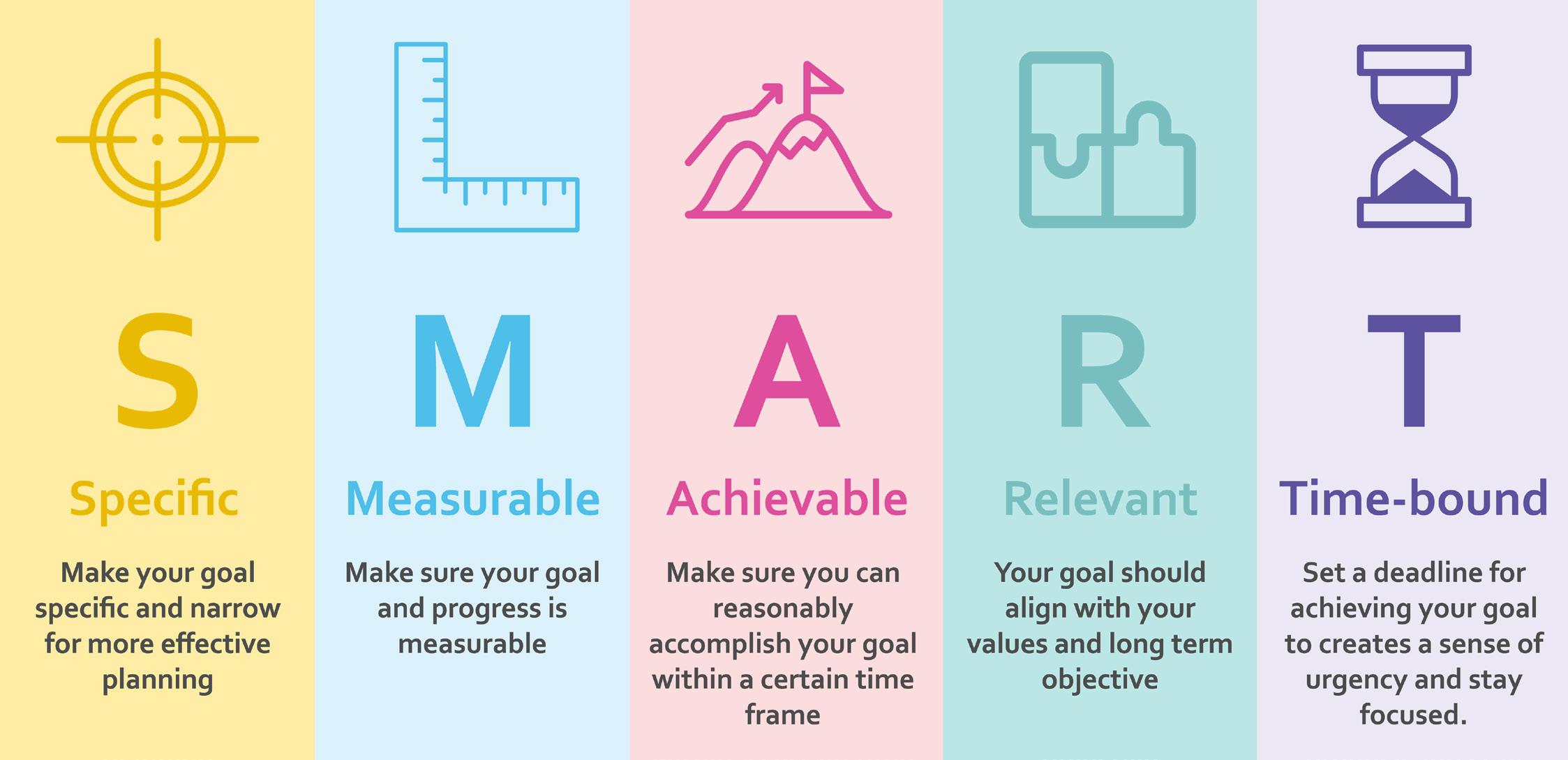
Making a goal specific, measurable, achievable, relevant and time-bound (SMART) is a great tactic to increase your chances of success. For many common New Year’s resolutions – like exercising more, changing eating habits and saving money - implementing this method can really help.
Here’s an example of a SMART goal: “I will exercise for 30 minutes two times a week.” The non-SMART version of that: “I will finally start exercising regularly.” The first one lays out a goal that is specific, measurable, achievable, relevant and timely, whilst the second is vague and provides no clear direction for how you’re going to do it.
You can write down your SMART goals for the areas in your life you are committed to changing:
f Specific
Your goals should answer the questions of what you want to accomplish exactly.
f Measurable
Quantify your goal in a way you can control and assess yourself. Don’t rely on someone else to measure your success, for example receiving a promotion. That is outside of your control regardless of your achievement.
f Achievable
Make sure your goal is realistic and achievable for you. Even the loftiest goals can be accomplished. It all starts with a single step.
f Relevance
Determine its relevance. Why is this important to you now? Is this goal relevant in your life right now? Relevance is particularly important when setting professional goals and considering career progression.
f Time
Time-bound means setting a specific deadline for accomplishment. A deadline creates a sense of urgency to motivate us to act.
f Self-Compassion | Kristin Neff
f Embracing Self-Compassion: A New Year’s Resolution for Personal Growth When Living with a Rare Disease | Know Rare
f Offering Yourself Self Compassion in the New Year | Power to Live Foundation
f Make Self-Compassion One of Your New Year’s Resolutions | Greater Good
f Creating Clarity for the New Year and Harnessing New Habits | Health Partners Group
f Set Goals, the SMART Way | Health Partners Group
f Habit Formation | Psychology Today
f How long does it take to create a habit (and how to do it)? | Calm Blog
f How long does it take to form a habit? | UCL News
f Habit Loop: What It Is and How to Break It | Healthline

f The best lifestyle for a healthy heart
f Time to Talk
At Health Partners we offer a full range of tailored health and wellbeing services.
Our thinking is innovative. We constantly develop new responses and tools designed to address the health and wellbeing challenges that face your business and people.
Our commitment is total. We invest in our services, creating new ones and keeping in step with every client. We constantly explore new ways of working and make no compromises in the quality of our services.
Simply put, we are here to help people be their best.