SoundOn is TikTok’s all-in one platform for music creators


Paul Watson CEO
Keith Watson Chairman
Rian Zoll-Kahn COO
Alice Gustafson Editor-in-Chief
Adam Protz Deputy Editor
Liz Wilkinson Content and Communications Manager
Rick Dickerson Reviews Editor
Marc Henshall Head of Digital
Grace Mcguigan Artist Relations Manager
Rae Gray Head of Design
Who says most interactions are on Zoom these days? In the last month alone, I was enticed to put in some good old-fashioned face time in Mexico City and Milan to experience one very special concert and interview the talented professionals who brought the vision to life, and to get to the heart of a thriving 50-year-old audio institution.
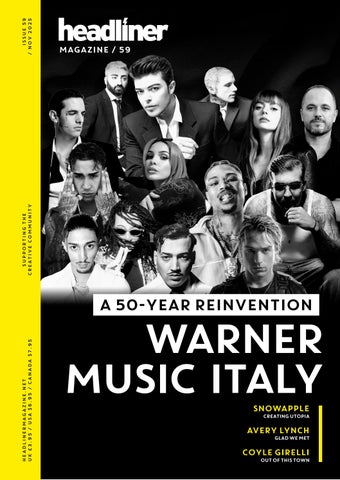
Our cover story this month shines a spotlight on Warner Music Italy, which recently marked its 50th anniversary with a bold new chapter by unveiling two brand-new labels – Warner Records Italy and Atlantic Records Italy – a strategic move designed to futureproof the business in an industry that never stops shifting.
At the company’s impressive Milan HQ, Pico Cibelli, President, Warner Music Italy and his team explained how the refreshed setup empowers the company to nurture homegrown stars and supercharge breakthrough talent. I also learned how the smallest of “the big three” record labels is closing the gap, and how Cibelli has steered the company to a growth rate of over 60% after just a few years at the helm. Could I have conducted the interview on Zoom? Sure, but then I wouldn’t have witnessed the genuine camaraderie between colleagues, witnessed that their passion and drive to keep growing the business at its current trajectory is genuine, or
observed a healthy amount of friendly rivalry between the two new labels.
Down in Mexico, I was lucky enough to attend an ambitious concert performed by the intriguinglynamed Snowapple Collective. A long flight and a few excellent tacos later, and I was seated in Mexico City’s historic Teatro de la Ciudad Esperanza Iris to experience a bold multidisciplinary performance fusing live music, theatre, dance and visual art. The following day, I caught up with Snowapple Collective’s artistic director and founder, Laurien Schreuder, to discover how she brought this ambitious project to life, and then it was over to the other side of the city to find out how Carolina Anton, one of Mexico’s leading female sound engineers, translated an experimental Snowapple album into a large-scale, orchestral experience.
Seeing the concert really was believing, as without clocking in those air miles, I wouldn’t have felt the hush of anticipation that fell over the audience before the show started, have soaked in the delight in the room, or have felt the heaviness of the show’s most poignant moment – or understood why it brought the audience and the FOH engineer to tears.
Elsewhere in this issue, we bring you the tech powering Oasis’ highly anticipated reunion tour, shine a spotlight on how AlphaTheta is championing women, LGBTQIA+ and POC DJs, while Earthworks Audio CEO Dan Blackmer reveals how he’s carrying forward the Blackmer legacy.
On the artist side, Avery Lynch opens up about her new album, Glad We Met, and BTS and Westlife co-writer Coyle Girelli reveals how he’s stepping out with a new solo project, Out Of This Town. And if getting up to speed on the world of composition is your thing, we’ve got you covered with Gary Lionelli, who delves into his epic score for the Oscar-winning film, O.J.: Made in America. Meanwhile, renowned video game composer, Sonic Mayhem, reveals how he scored the highly anticipated new game, Metal Eden.
I’m officially putting my passport away for the year now, though knowing this industry, it’s only a matter of time before I’m lured out again.
Alice Gustafson Editor-in-Chief

By Alice Gustafson

By Alice Gustafson
By Alice Gustafson


60 ARTIST
BTS & Westlife co-writer Coyle Girelli’s new project, Out Of This Town
66 SONIC MAYHEM ON BREAKING THE RULES WITH HIS METAL EDEN SCORE
72 VAN ROMAINE ON REUNITING WITH THE STEVE MORSE BAND
74 BEHIND OASIS LIVE ’25’S SUPERSONIC STADIUM SOUND
78 INSIDE GOSTYNIN MUNICIPAL CULTURE CENTRE’S AUDIO UPGRADE
80 HOW VIENNA MUSKVEREIN IS COMBINING HISTORY WITH CUTTING-EDGE SOUND
CREATING AN IMMERSIVE AUDIO INSTALLATION FOR NEW YORK MUSICAL, MASQUERADE
UNIVERSITY OF ARIZONA Scaling broadcast capabilities
CREATING PERIOD-ACCURATE SOUND FOR OSCAR-WINNING, I’M STILL HERE
ON TOUR WITH LINKIN PARK
INDUSTRY INSIGHT David Bowie and Pink Floyd FOH engineer on executing the artist’s vision


S by ALICE GUSTAFSON
CAN WE TALK?
ELIJAH WOODS
Fresh off his headline tour across Asia, L.A.-based pop artist and producer, elijah woods, discusses the misunderstandings that come with having a very similar name to a certain The Lord of the Rings actor, and delves into the inspiration behind his debut album, Can We Talk?.
With four JUNO Award nominations, multiple platinum and gold certifications, over 1 billion career streams, and high-profile performances including opening for Niall Horan in Jakarta, elijah woods has built a global following – and entirely as an independent artist. Across 11 songs, Can We Talk? blends raw vulnerability with irresistible hooks, affirming the singersongwriter as an artist who thrives in the space where honesty and undeniable pop energy meet.
Let’s address the Frodo-shaped elephant in the room: your name is very similar to a certain actor’s. You must have had a few instances where you were mistaken for him, or when it worked to your advantage?
Honestly, I’ve never really taken advantage of it in that way, and I probably should. That’s a mistake on my part! At the start of this artistic journey, it was a very conscious choice to keep my actual name. Obviously, there’s a huge actor
Photograph credit: Austin Calvello
“I FIGURED, WORST-CASE SCENARIO, I’D GET TAGGED IN SOME LORD OF THE RINGS POSTS. AND I DO – EVERY SINGLE DAY.”
named Elijah Wood, from The Lord of the Rings and Spy Kids. He’s very talented, and apparently a lovely guy. I did think, “Can I actually use this name?” Then I realised he’s not really active on social media or trying to stay hyper-present in pop culture, he just does his own thing.
So I figured, worst-case scenario, I’d get tagged in some Lord of the Rings posts. And I do – every single day. I’ll wake up and see I’ve been tagged in something from a Comic-Con appearance or a Frodo meme. People see “Elijah Woods” pop up, assume it’s him, and tag away. The funniest one happened on a plane. Honestly, it happens pretty much every other time I fly; it’s one of those names that makes people go, “Wait, I know that name… why do I know that name?” Which, to be fair, was kind of intentional, even though it’s literally just the name my mum gave me. When she picked it, he wasn’t famous yet. I think The Lord of the Rings came out when I was maybe 10, so kudos to my mum, it’s just a solid name. Anyway, on this one flight, the gate agent saw my passport, got really excited, and told all the flight attendants that Elijah Wood was on board. When we landed, they were all waiting at the gate, looking at pictures of the real Elijah Wood on their phones, trying to spot him.
I walked right past – six foot five, definitely not Frodo – and not a single person wanted a photo with me. They were just waiting for the wrong Elijah Wood. The crazy part is, he’s a DJ too! I think he plays at events or clubs, but
every so often, I’ll get tagged in posts like, “Elijah Wood’s music was DJing at this place,” and I’m just like, “Hell yeah, I was, brother!”
What do people not realise about what it takes to be an independent artist?
I was lucky enough to go through the major label system at a young age. I was in a band before, and we signed to Big Machine through this TV show we won, which taught me a lot about how the label infrastructure actually works. I’d also studied music business a long time ago, so I had a basic understanding of things like owning your masters, collecting publishing, and how artists actually generate income.
When I looked at my own skills – mainly production and making the music itself – I realised I’ve basically been a “100 percenter” my entire career. Even when I started singing, I taught myself how to do it. I record my own vocals, and I mix and master everything myself. Then I looked at what Republic was doing for me and our band at the time, and I thought, if I’m a mid-tier, growing artist, I need to do this independently. A company like that represents artists such as Ariana Grande and Taylor Swift — they’re obviously going to invest in them, not me, because they’re generating hundreds of millions. From a business standpoint, I understood that I wasn’t that profitable.
So while I’m building and scaling, I figured I could do this myself. I’ve built a great team – booking agents, social media people, and a few
management connections over the years – and I’ve found a good rhythm with releases, fan development, and social media, which has been massive. Without it, I’d just be some kid in a bedroom making music no one hears. So my thinking was, why give a company 80% of my income, even post-recoupment, when I make the music for free? I own all my gear. I can sit down, make a song, mix and master it, and release it through DistroKid for $12.99 a year. It’s not complicated maths. Why give that up for the slim chance of getting on a playlist that might bump my streams 10-20%? I’d rather keep building it organically, directly with fans.
I started thinking about the fashion choices I’d made as a young adult, before I met my wife. Then I looked Your recent single, Slicked Back Hair is a feel-good anthem about growth, vulnerability, and lasting connection. Where did this inspiration come from?
I wrote the song a few years ago, and it kind of just found its way onto the project. I wasn’t initially planning for it to be on the album. I’d always really loved it; I thought the melodies were great, but I didn’t fully understand what it was saying at the time. I’d had the chorus written for about a year and a half, during a period when I wasn’t really feeling like myself – a bit low, honestly. It was winter in Canada, which is always pretty bleak, and I just wanted something that felt summery, upbeat, and light.

Photograph
Austin Calvello

at photos from after we met, and I was like, “Damn, you definitely got better looking!” The correlation was pretty clear – it was about what I was wearing, how I was carrying myself, the whole vibe. So I wrote a song about how I used to look like that thing. It was actually inspired by the Tim Robinson show, I Think You Should Leave. That kind of absurd, self-aware humour definitely fed into it. He’s an incredible writer and actor, but the song’s actually based on one of his skits where he talks about how he used to be a piece of shit, with slicked-back hair and skinny jeans. I remember seeing that and thinking, That’s such a funny image. “ Then I looked at old photos of myself and was like, “Bro, that’s literally you; you’re such a loser,” [laughs]. So I ended up writing a song about it. It’s really about how someone came into my life and changed it for the better; not just my style or aesthetic, but even parts of my personality. Everything’s been elevated because of this good person being around me, and that’s ultimately what the song’s about.
Congratulations on the release of your debut album, Can We Talk?
Did you have a concept in mind for the album?
I wrote a bunch of songs last year that were meant to make up an album, but when I listened back, I realised they didn’t really say what
I wanted them to. So instead, I split them into two separate EPs – both a lot more concise than a fulllength record. Going into this new project, I decided to just write a lot – to experiment, to figure out what I actually liked, what spoke to me, and what held my attention. I ended up writing something ridiculous, like 150 songs, working with a ton of writers I really admire, and then narrowing it down to a few I collaborated with across the whole project.
About halfway through, I realised there was a really clear through line running through the songs — one about difficult conversations. The idea that when you face those hard talks in life, there’s always some kind of reward, at the very least, clarity. Sometimes it’s a better relationship, sometimes it’s a deeper understanding of yourself and how you handle conflict, whether that conflict is good or bad.
It’s everything from telling my wife I loved her for the first time, to telling a friend he’s a narcissist and I can’t deal with him anymore, to looking in the mirror and saying, “You need to do better. You need to take care of yourself.” It’s about those uncomfortable choices, and the growth that comes after. I didn’t really see that theme clearly until I wrote a song called Can We Talk. It’s probably
the least impactful song on the album in terms of commercial potential or lyrical weight, but it gave me the thread I needed – the conceptual backbone. Once I found that, the rest of the album poured out of me.
Do you have a favourite song on the album?
It’s like picking a favourite child! It changes every day. Today, based on my mood, I’d probably say a new one called I Miss You, which actually replaced another song on the album. It’s been doing really well online, and I wrote it in the style of an acrostic poem. Throughout the track, every lyric starts with the letters that spell out ‘Do you miss me? Because I miss you. Can we talk?’ – It runs all the way through the song like a hidden message. That one felt like a real button or bookend to the whole concept of the record, and funnily enough, I only wrote it a couple of weeks ago. The rest of the album was finished months back, so it was a last-minute addition, but I’m so glad it made it on. Seeing it connect with people online has been such a relief –it’s like, “Oh my god, now people are actually going to listen to this project I’ve poured so much life and energy into”. But then there’s another song, Exercise Your Demons, which
I originally wrote as a joke – and it turned into something I really love. We wrote it as a country demo at first, super twangy and kind of silly, just for fun. Then I listened back and thought, hang on, there’s something special here. I added these breakbeat drums, reworked the melodies to feel a bit more R&B and rhythmic than my usual stuff, and it suddenly clicked. Within the context of the album, it felt fresh – like something that pushed me into new territory.
Photograph credit: Austin Calvello

Bridging in-room and personal headphone monitoring
Our UNIO TM Ecosystem gives the ability to optimise, align and seamlessly navigate your monitoring options, for the exibility to work anywhere, anytime – from stereo to immersive.
Now, with the introduction of Personal Reference Monitoring – our pioneering new active monitoring headphone solution –UNIO offers the very highest level of headphone accuracy.
genelec.com/unio
HOW WARNER MUSIC ITALY IS CLOSING THE GAP WITH THE MAJORS
Marking its 50th anniversary with a bold new chapter, Warner Music Italy is shaking up its structure and doubling down on frontline creativity. The company recently unveiled two brand-new labels – Warner
Records Italy and Atlantic Records Italy – a strategic move designed to future-proof the business in an industry that never stops shifting.


Headliner visited Warner Italy’s impressive Milan HQ (all open-plan glass offices, natural light, two highend recording studios, and walls which are adorned with Platinum records of Warner’s biggest artists) to meet the dedicated team driving the success of the company.
What is evident during the in-depth and unguarded conversation with Pico Cibelli (President, Warner Music Italy), Marco Masoli (Label Director, Atlantic Records Italy), Gianluca Guido (VP Frontline, WM Italy), Raffaele Razzini (VP Finance & CFO, WM Italy), and Eleonora Rubini (Label Director, Warner Records Italy), is a genuine camaraderie between colleagues, a deep passion and drive to keep growing the business at its current trajectory, and a healthy amount of friendly rivalry between the two new labels.
Out of the “big three” record labels (after Universal Music Group and Sony Music Entertainment), Warner Music is the smallest, accounting for approximately 18-19% of the market share, but, as Headliner discovers, there’s room to close that gap. Since being appointed as President of Warner Music Italy in 2022, Cibelli has steered the company to a growth rate of over 60% by striking up some historic partnerships with the country’s biggest music festivals and talent-seeking TV shows, strategic acquisitions, and strengthening the label’s catalogue with breaking new artists, rather than relying on its back catalogue to do the heavy lifting.
“It’s really important to show that we are here because we have a history,” begins Cibelli on Warner Music Italy’s 50th year milestone. “That gives us credibility. We have a good catalogue – not amazing, but solid,” he acknowledges, “and we have an amazing team. The key is that when you have a strong story, you can build a new one for the future.”
On WM Italy’s catalogue not being as strong as perhaps he would like, Cibelli clarifies: “I’m not talking about the quality of the catalogue, because we have an amazing amount, I mean in terms of quantity.”
That key amount decreased in 2013 when WMG entered into a £487 million all-cash agreement to acquire PLG from UMG. While the acquisition expanded WMG’s international catalogue, it also obligated the company to sell portions of its historical artist roster to independent labels. “The big problem is that our competitors have historical catalogues that are huge,” admits Cibelli, seeing no reason to sugarcoat the facts. “Sony probably has the most important local catalogue in Italy. They have the historical catalogue from BMG, which includes the most important singer-songwriters from the ‘60s, ‘70s and ‘80s. And Universal also has an amazing catalogue, especially after the merger with EMI. The big difference is in the numbers. Competitors get around 75 to 80% of their revenue from catalogue and 20
to 25% from new releases. Our split is exactly the opposite: we have about 70% from new releases and 30% from catalogue. We’re trying to build our catalogue, and we’re making a lot of acquisitions. We’re really focused on this part of the business. But it’s not easy, because finding the right catalogue at the right price at the moment is difficult.”
It’s been paying dividends so far, though. Cibelli has secured distribution deals for Club Dogo’s repertoire and acquired the catalogues of Neffa, Co’Sang, and Sangue Misto, as well as signing collaboration deals with The Saifam Group and the late Mauro Farina, and alongside Warner Chappell Music, added the archives of the historic DWA Records and Extravaganza. Another strong focus for WM Italy is mining out every possible opportunity in the urban market. “We’re investing a lot of money in urban catalogues, and dance,” Cibelli confirms, using the recent acquisition of historical Italo disco label Extravaganza as an example. “For instance, the catalogue now includes Corona’s The Rhythm of the Night. We’re trying to make acquisitions that also have international potential. While we are looking for catalogues and new talent, we are also working a lot with indie labels because they are really important in Italy and there is a strong historical tradition of indie labels shaping the mainstream pop scene,” he adds.
This strategy is working, and WM Italy has gone from strength to strength. The all-important numbers don’t lie: “We started with a completely different structure compared to our competitors,” Razzini points out. “At the end of 2022, we had around a 12% market share, and now we’re around 18-19%. The acquisition of catalogues is important because when we sign an artist who already has a back catalogue, we always try to buy it or close a licensing or distribution deal for their previous albums. We see this as a way to maximise the investment we’re making in new releases. Working this way with artists creates a double benefit: the new release and the new album, but also growth across their back catalogue, contributing to the artist’s overall development. This increase shows a growing and stable trend, and it’s something that has allowed us to achieve this organic growth.”
The company’s recent momentum reflects a combination of strategic signings and internal restructuring. Among the additions is Geolier, who in 2024 became the first artist in Spotify Italy’s history to secure all three top year-end distinctions: most-streamed artist (1.4 billion streams), most-streamed album, and most-streamed track.
“We’ve also managed to develop a couple of artists from scratch,” Masoli points out. “When we signed Tony Boy and Artie 5ive, they were unknown, and now they’re superstars. We have two huge superstars in the urban scene who started from zero when we signed them.”


“This level of growth is also the result of the attention we gave to every single revenue stream,” Razzini clarifies. “We increased not just streaming, but also physical sales – we opened the D2C shop, which wasn’t in place before – and we developed activities around brand partnerships and sync. With this type of approach, planning everything and making it systematic, you don’t miss any opportunity, whether it’s from the back catalogue, reissues, or new releases. This is what enabled the revenue increase: consolidating existing streams while creating a foundation for further growth. It’s not just a random spike – it’s the result of focusing on every single revenue line.”
The two new frontline labels – Warner Records Italy and Atlantic Records Italy – were launched right at WM Italy’s 50-year mark, allowing the company to celebrate its legacy while repositioning for the future. The timing
couldn’t be better. Italy’s recorded music market posted solid growth in the first half of 2025, according to data from the labels’ association Federazione Industria Musicale Italiana. Turnover exceeded €208.1 million, marking a 9.7% year-on-year increase driven by revenue gains across nearly all segments. Italian repertoire continued to dominate, with domestic artists accounting for 90% of both the Top 10 albums and Top 10 singles during the period.
“The industry itself has become increasingly fragmented and fastmoving, so having two distinct labels with clearer identities enables quicker decision-making, more tailored artist development, and more precise market strategies,” Rubini explains. “This evolution strengthens WMI’s ability to support both established artists and new talent, ensuring it can capture emerging opportunities in a highly competitive landscape.”
“We needed an evolution, not just for artists, but for our teams,” Guido adds. “Each label has the autonomy to shape its own culture, sound, and way of working. I step in only to make sure we’re not duplicating efforts, missing opportunities, or drifting away from the bigger direction. In short, we agree on where we’re going, and each label is free to decide how to get there.”
The dual labels see the historic WM Italy roster split equally between Atlantic and Warner Records, with the idea of launching them both on equal footing – neither holds more artists of a given genre than the other. With urban being Italy’s most popular genre at the moment, one could imagine it would be tempting to dedicate one of the labels entirely to it. Cibelli points out that this would be to the detriment of the other label. They’re both his babies, after all, so they will be given equal opportunities in which to shine.
“IF YOU WANT TO MAKE A DIFFERENCE IN OUR MARKET, YOU NEED TO SIGN URBAN ACTS.”
“I don’t like starting with a ‘bad’ label and a ‘good’ label,” he reasons. “We split the team exactly according to the roster, also keeping a kind of balance. So, for example, if you have an artist like Annalisa on one side, who is a big superstar, we have Rose Villain on the other side. We decided to start without focusing on the genre of the label.”
That’s not to say that WM Italy won’t be investing in urban, quite the opposite. “Right now, without any doubt, if you want to make a difference in our market, you need urban artists on the label, and you need to sign urban acts,” asserts Cibelli. “Urban is the core at the moment. If you want to do the numbers, you must sign urban acts. We have urban experts in the label, and in my opinion, it’s fundamental to maintain this approach.”
“Beyond the two new labels, we can’t forget to mention ADA, which continues to play a crucial role in our distribution ecosystem,” furthers Masoli. “In the new organisational structure, ADA now falls under the Atlantic umbrella, led by its new director, Renato Tanchis, who reports directly to me. Through ADA, we distribute artists from several major independent labels, including NAR, Honiro, and Marta Donà’s LaTarma
Records, home to Angelina Mango, winner of the 2024 Sanremo Festival. In addition to its label-management work, ADA also serves as a sort of ‘talent academy’ for Atlantic – a place where we can sign the most promising emerging artists and keep a close eye on their development, evaluating potential opportunities for growth and for future licensing or roster inclusion within Atlantic.”
To keep WM Italy’s trajectory going strong, the teams stick religiously to a regular, consistent release schedule. “Thanks to the new roster, we have increased our release flow,” says Cibelli. “We have an important release every week, and one very important album every month. This strategy helped us build our numbers in market share on Spotify, but also in the wider market, on other digital providers, and on the physical side as well.”
Masoli shares that a pop act typically releases a small number of singles over the year, followed by an album. In the urban genre, however, it is common for them to issue a higher volume of singles, allowing for more frequent releases, particularly in periods of the year not addressed by the company’s summer strategy or Italy’s Sanremo Festival. These intervals are filled with urban
projects. “Since we don’t have a big catalogue compared to the other two companies, we depend a lot on new releases,” he says. “So we need to be consistent and to have plenty of new releases performing well to give us stability. Otherwise, the ups and downs in market share are huge, because we don’t have the passive market share that comes from the catalogue.”
The Sanremo Music Festival and the summer season are WM Italy’s two catalysts when it comes to success due to mass exposure, and artists making it onto the main streaming platform’s all-important summer playlists. Although it used to be considered uncool, due to the inclusion of mainstream superstars, Sanremo has become the most popular Italian song contest and awards ceremony, and the Sanremo Festival winner goes straight through to the Eurovision Song Contest. The two crucial periods are managed with different strategies for WM Italy: Sanremo involves detailed, longterm planning, while the summer season focuses on speed, timing, and impact.
Each label selects projects appropriate for each window, and coordination ensures that activities are aligned and do not overlap.

“Sanremo is something very unique,” says Cibelli. “I don’t think there are any festivals like it left in the world. In terms of impact, it’s huge. It’s really important, when planning for a pop or urban act, to understand whether Sanremo could be the first step or the culmination of an artist’s strategy. The impact on the charts and playlists is amazing; the push you get that week is incredible, because the show runs every night for five nights with 15 million people watching it. If you listen to the radio during those days or watch television, everyone is talking about Sanremo. It’s like the Super Bowl! The gamechanger has been the involvement of digital partners in Sanremo, which have the important playlists.”
Securing a spot on one of these playlists makes the difference between breaking a new song or artist or getting lost in a sea of digital releases. “The playlists have ranked between number one and number three globally over the last six years,” Masoli points out.
“During that specific week, it’s the most-streamed in the world. Yes, it’s an Italian playlist,” he acknowledges, “but it has become the most-streamed globally because of the sheer number of listeners. During that specific week, you can have songs in the top 50 globally on the day of release. The impact is huge. In terms of revenue, it has contributed around 3-4% over the last few years.”
Razzini shares that WM Italy’s revenue saw a huge growth in correlation with Sanremo in 2024.
“It was a real peak when we had the winner and all of the top five finalists being signed to WM Italy, from which we then started to build growth across everything,” he explains.
In terms of measuring the success of Warner Records Italy and Atlantic Records Italy over the next few years, the team is all in it together to see the new structure succeed.
“If we don’t increase Warner’s overall success, it means the label structure doesn’t make sense, and it worked better before,” says Masoli. “It’s not a matter of Atlantic or Warner Records being better than the other. Of course, there will be – and it’s useful – a bit of competition to push both labels to perform better,” he says, glancing at Rubini.
“Masoli and I work together with a very open, constant line of communication,” Rubini nods. “Even though the labels have distinct identities and teams, we’re aligned on the bigger vision for WM Italy, so we make sure our decisions move in the same direction. It’s a mix of clarity, collaboration, and trust: two independent structures that stay tightly connected so the whole machine runs smoothly.”
“BEFORE, WE WERE OUT OF THE PICTURE, BUT NOW THEY KNOW WE’RE AT THE SAME TABLE.”
admits Cibelli, “But it’s really important to remember that we receive our funding from one company.”
And if one label should do better than the other? “It will probably take one or two years to see the real impact and to understand the new balance and structure,” Cibelli answers. “We’re also looking at merchandising and live events, trying to expand our business beyond the core music business. Of course, the core is streaming and developing our artists’ careers, but at the same time, we’re exploring opportunities outside our comfort zone because the live side and additional revenue from other businesses will probably be key to growth. The next big leap will likely come from adding different revenue streams from other areas.”
And that’s not all. Cibelli has one main goal: he wants to break an international artist. “I think it’s possible because the company worldwide is very open to breaking hits from everywhere,” he states. “We have strong connections across all territories, with Simon Robson (EMEA President) and the European team, and an incredible connection with Alejandro Duque, President, Warner Music Latin America. We want to use these connections to develop and break an international act. That is our mission for the next two to three years. I want to add that we are crazy,” he laughs. “We love our job. We are completely addicted.”
The competition is surely watching this space, as WM Italy has already proved that the appetite for their new signings is there. Everyone loves an underdog, after all.
“Our competitors have big rosters that they have built over the years, and we’re trying to create an advantage by being as strong as possible on A&R side by signing the next potential superstars before the others,” says Masoli.
“We need to find the right balance and support each other,” nods Masoli. “For example, if Warner Records has a few months with fewer album releases, we can balance it by having more on our side. It’s about having processes in place and communicating a lot with each other. Even with signings, we already have processes to ensure we don’t conflict. Of course, both of us are very competitive people,” he grins.
“When I decided to build two labels, it was also to create a bit of competition within the team and the company,”
“We’re talking about two really big companies and we respect them a lot,” says Cibelli about Universal and Sony. “Universal is the biggest in Italy, but they know we’re now active in the market and present. Sony also sees us really close behind, but they know we’re very strong and recognise the value of our people. Before, we were out of the picture, but now they know we’re at the same table,” he smiles.
WARNERMUSIC.IT

LCT 240 PRO
The perfect microphone for home recording.
• Easy-to-use XLR microphone
• For recording vocals and instruments at home
• Professional sound quality
• Cardioid polar pattern


COMPOSING O.J.: MADE IN AMERICA
GARY LIONELLI
Gary Lionelli received a Primetime Emmy Nomination for his epic score for the Oscar-winning film, O.J.: Made in America. The composer reflects on his dramatic score for the documentary, which depicts the rise and fall of O.J. Simpson – from football legend to murder suspect. So does the music imply guilt or innocence? Lionelli explains that it’s all in the subtext...
O.J.: Made in America won the Oscar for Best Documentary Feature in 2017. Your score plays a pivotal role in weaving together this epic story of fame, race, tragedy, and justice. What were your first thoughts on how to approach the music?
I got a call from Ezra Edelman, the director. I’d worked with him before, and he’s a very particular and demanding director, and he’s brilliant. But at the same time as that was running through my head, I thought, “Do I want to immerse myself in the world of O.J. Simpson for that amount of time?” This was a five-part series. It was going to be half a year of me being involved in this dark world. I had to think about
it for a second. And this was one of the early true crime documentaries. Now they’re everywhere, but at that time, there weren’t many really dark documentaries like that. So I did think about it for a moment, but of course, it was a quick moment, and I said, “Yes, let’s do this”, and we just went forward.
It was a long project, and there was very little time to do it, as is always the case. The way I approached it, rather than having musical themes for individual characters, was more of a sequential, event-driven type of score. We had major elements: the crime itself, the LAPD, the legal system, and racial division in America. All sorts of things were being interwoven, and I was trying to unify them with the score.
Ezra Edelman’s vision for the documentary was layered and ambitious. How did you collaborate with him to align your music with such a dense and socially charged narrative?
Ezra appreciates music that’s a bit out of the ordinary and not falling into genres as much as you might expect in a film like this, which is all about a crime. A lot of the cues had unidentifiable sounds mixed with traditional instruments, just to keep things slightly off-kilter. It can be a time-consuming way to work. You might take a sound like banging your desk with a pencil and then manipulate it electronically in your software until it becomes something else. A lot of composers do that now, but back then, maybe not so much. We moved forward with these unusual sounds, the trumpet, and a big string section. It gave a real sense of depth to the score, much more than if I’d used sampled strings.
What were you trying to say with the music in terms of whether he was guilty or not, or were you aiming to steer clear of any implications and remain neutral for the audience?
That’s a good point. It was never predictive; it was always reactive. So there’s a scene where he’s stalking outside Nicole Brown Simpson’s apartment, and when you’ve got a scene like that, you score it literally. You take advantage of the tension that’s already there, and you do a cue that matches it. In other cases – and this is how I approached most of the film – you score the subtext of what you’re seeing on screen. In other words, you’re not scoring what’s happening in the picture; you’re scoring what’s happening in the minds of the people on the screen. What’s going on in O.J.’s mind, what’s happening for a lawyer, the police sergeant, all that sort of thing. Then you find some common ground for all those different characters through the subtext. And in this film, the subtext was pretty dark all the way through.

The film examines systemic racism, celebrity worship, domestic abuse, and legal spectacle. How did you musically differentiate between these thematic threads while keeping the score cohesive?
Back then, I think it was a surprise to everyone that the police could do anything wrong. It was like, “Wow, the lawyers are actually accusing the police of withholding evidence or tampering with evidence”. People were thinking, “How could that happen? They’re the police, they do everything right”. I think that was a turning point in how America sees the police force in general, and nothing was off limits for those lawyers. They would go after anybody. Because of that, I felt
we needed some themes that were recognisable and identifiable, not just a texture-driven score like you see a lot today, where themes are pushed to the background or not as prominent as they were in the past. In the golden age of film scoring, in the ‘30s and ‘40s, themes were overbearing and just one after another throughout the whole score. But for this particular film, I thought we needed thematic development and repeated themes that run through the film. These were dark melodies. That’s how I brought all these things together: the racial injustice, the sensationalism, and all that complicated mess happening in and around the case.
“OVER THE YEARS, EVEN WITH OTHER MANUFACTURERS COMING OUT WITH NEW MODELS, I’VE ALWAYS STUCK WITH GENELEC.”
How did you score the infamous “not guilty” moment?
For that scene, going back to the subtext, it was not what was going on in anybody’s mind at the time – the whole thing was just downright sad. That was sort of the overall feeling. Nobody wanted this. O.J. got off, two people were killed, the police were tarnished, the lawyers were overreaching, the jury was off the mark – everything was wrong. The overall force behind it all was just sadness. So I used that as a way to approach the scene. Not sadness in a clichéd, melodramatic sense, but more a heaviness and a sort of detached sadness.
the bigger 1037Cs, and then the 8341s with a 9320A SAM Reference Controller. The Genelecs let me keep the speakers closer without separating the highs, mids, and lows. I just love these speakers. I’ve always used them. Over the years, even with other manufacturers coming out with new models, I’ve always stuck with Genelec. You want to go in with something that covers as wide a spectrum as possible to account for all the different environments people might be listening in. If you don’t do that, you’re at a disadvantage. I know that if I’m listening on these speakers, I’m pretty much in the ballpark for any other speakers they might be using. Then they surprised me with the GLM system, which corrects any deficiencies in your room by analysing it and generating a compensating curve. For me, that’s invaluable. I’m a big fan and continue to be one. When it comes to playback and mixing, what studio monitors do you rely on?
I’ve used Genelecs almost from day one. I remember going to Coast Recording Equipment Supply in Los Angeles, and it was between Genelec and Dynaudio. I felt like the Genelecs were telling me more of the truth. A lot of the other speakers in the store had a bit of a hyped high end, and I didn’t want to deliver a score or any other type of music that was lacking in the high end because of what I was hearing through the monitors. The Genelecs had a well-balanced sound. My first pair was a set of 1030As, then I moved to the 1031s, and later

GOJNEA76 PUNISHER BRAILA Words
Romanian producer Gojnea76 isn’t just making music, he’s crafting a sonic autobiography powered by pain, perseverance, and pure adrenaline. Fiercely independent and rooted in the underground, Gojnea76 has forged a sound all his own; an unfiltered fusion of house, techno, and hardcore attitude. But behind the energy lies a deeper story: two life-altering accidents: a motorcycle crash in 2007 and a spinal fracture in 2018, which nearly ended his career. Years of rehab followed, culminating in a creative rebirth that’s now fuelling everything he does, from founding his own label Future Electronics in 2024 to launching FUEL, his party and release series. Now, he returns with his most personal work yet, the Punisher Braila EP. The four-track release rides a fine line between extroverted house energy and the gritty edges of techno, spliced with metal-flecked aggression and restless experimentation. Headliner catches up with him to find out more.

How did your early obsession with rock music influence your transition into electronic music, and how do you see those influences reflected in your current productions?
I’m still into rock music. I remember being a kid and slowly migrating from rock to drum & bass, then I discovered Café Del Mar Chillout Sessions and Terry Lee Brown Jr’s Terry’s Café . Going from rock to Terry’s Café is a wild leap, but those were the steps: rock–d&b–deep house. Rock still plays a big part in how I create today. It shapes my energy in the studio and what I want to hear. I get inspired by other electronic producers, but the flow and sound approach, that’s where the rock DNA shows up. If it doesn’t have a twist or a bit of heaviness, it doesn’t satisfy me. Motorsports played a significant role in your life, offering both thrills and challenges.
Reflecting on your challenging experiences, such as your motorcycle accident in 2007 and your spinal fracture in 2018, how have these moments shaped your perspective on life and your music career?
That was a tough one, especially the 2018 spinal fracture. That one stays with me for life because it’s irreversible, so I have to train daily. Luckily, things are really good now, but I’ve been down. I’ve been way past rock bottom vibes. When you can’t move and you’re stuck in bed for six months, then spend the next four years dealing with chronic pain from morning till night, it messes with your head. I saw countless doctors, top neurosurgeons, and nobody
could fix the pain. That’s when I had to carve my own path. I had to rebirth myself, and music came with that. My sound used to be super low, drained, shadowy, but now I’m bangin’ like there’s no tomorrow.
The 2022 car crash was another near-death experience. Did that incident fundamentally shift your mindset, not just in life but in how you approach music?
Even though the spinal fracture already forced me to start fresh, I truly think the 2022 car crash triggered something way deeper, something no therapy or practice ever could. I meditate every day, plus cold showers, ice baths in winter, tons of high-quality supplements, movement, and mental health work. I’ve built this whole system to stay grounded and keep my mind in check. But nothing compares to a near-death experience that shows you how fragile life really is. When you realise how quickly it can all end, it humbles your entire existence. And from that moment on, you stop taking anything for granted, in life or in music. The clarity I’ve had since that crash feels like I got a brain shower. No more mental fog, no more anxiety. Just energy, focus, and hunger for life.
A turning point in 2018 led to a period of rebuilding, both physically and creatively. How did this transformative experience influence the direction of your music and your approach to performance?
After the injury, I slowly got back into the studio and behind the decks. But when you’re in constant pain and your cortisol is all over the place from chronic inflammation, it’s wild to see how someone creates while suffering. Whether it’s heartbreak or pain, it still comes from the same place. People say the best songs are made by people in pain or heartbroken, maybe true, maybe not, but I’d rather make music while happy, healthy and chill. Back then, my music was low-energy and drained. My sets felt low too, and even the mixdowns in the studio were poor because I had no patience to deal with the details.
Now it is a totally different story. Speaking of the studio, my mixdowns hit hard; I’m always close to blowing up a speaker. And after years of not being able to dance, now I love making music that makes me dance, and the dancefloor too. Techno or house, I don’t care, I just want it to feel like someone’s birthday party.
Launching your own label, Future Electronics, in 2024 was a significant step. What inspired you to start your own label?
Starting fresh in my personal life naturally shifted my musical one, too. Future Electronics isn’t about futuristic music or revolutionising sounds, not at all. It’s actually a hidden thought; it’s about my story. About my transformation. All the stuff I couldn’t have even imagined between 2018 and 2023, but somehow got through. It wasn’t the hundreds of hours of rehab, fancy machines or expensive treatments that saved me. It was inner

power. Sounds cheesy, but it’s real. That’s the secret. The mind and soul are beautiful places.
Your new EP, Punisher Braila, showcases a blend of house and tech influences. What is the inspiration behind this EP?
Punisher Braila means a lot to me. I worked on it mostly while on the road, in hotel rooms, on flights, between gigs. Then, when I got home, I reworked the sketches properly on my gear. The first track, the title track, samples vocals from a US band I love called Psyopus. The lyrics reminded me of a typical kind of relationship from my hometown, Braila, but told in a funny way. On Sash, you can hear my Memphis rap influences. I love that stuff. Nights clearly shows my drum & bass roots –those raw basslines are addictive as hell. And Let’s Chat is probably the best representation of where I am now, that sweet spot between positive and aggressive.
What were some of the challenges and highlights during Punisher Braila’s production?
I didn’t make these four tracks specifically for this EP; I picked them out of a bigger batch because they shared a similar energy from the moment I created them. I wasn’t looking for similar vibes or style. Just that same spark when I started each one. Most of the EP was made on the road, finished in the studio. That’s something I’ve been doing more lately, making music while travelling, letting new places inspire me. No challenges, really, just good highlights. Like banging my head in aeroplanes for hours, working on new music while the flight attendants looked at me weirdly.
You’ve described your past productions as “heavy, drained, shadowy”, which were reflections of the physical and emotional pain you were in. How would you describe the emotional tone of Punisher Braila?
Punisher Braila is banging and fun. That’s the vibe. All four tracks are fun and powerful. I learned from hardcore how to make aggressive music sound fresh and even happy. If I compare Punisher Braila to my past stuff strictly in terms of energy, it’s an evolution, an expansion, a new level. It’s not a change in style, it’s just a new energy in my life, and it shows. Same music, different vibe.
With your catalogue now exceeding 100 tracks and counting, what sets Punisher Braila apart?
Even though almost a year passed between making these tracks and actually releasing this EP, I’ve grown a lot since then. I learn new stuff every day, and I love that. Punisher Braila might not be the last thing I produced, but it’s the most recent one I’ve officially put out. And compared to the rest of my releases, this one really hits the energy I was aiming for. I’ve been playing these

tracks all year, but now that the vinyl is out, it feels like I’m playing them for the first time again. I’m super proud of how this one turned out.
What does success mean to you? Has that definition changed since before your injuries?
Professionally, I feel like I’ve just started; I’m still a long way from going before I hit that career level I’m aiming for. But personally, as in the real me, the source of all the music and energy, I already feel successful. I feel like I already made it the moment I survived that crash in 2022. I felt successful the day I woke up without chronic pain. I felt successful when I could finally give protection and quality time back to my family and the people around me. I feel successful with the life I have.
If you met your 18-year-old self right now, what would you tell him?
I wouldn’t change a thing. Everything I am now and all this fire I have, it’s all because of my past, even the accidents. No regrets. I love my life and I fully embrace it. What would I tell my 18-year-old self and every young person out there? Enjoy yourself, have fun, and share only love. Also, to buy tickets at Sound and Fury 2022 to see Gulch’s last show.


WORDS BY ALICEGUST A F NOS
SNOWAPPLE’S UTOPIA BRINGING A CYBORG DREAMSCAPE TO LIFE
To do justice to a performance by the intriguingly named Snowapple Collective – an international, multidisciplinary group of artists creating original music, theatre, and film – one needs to experience it for oneself. In late October, that’s exactly what Headliner did, accepting an invitation to attend a special concert named Utopia, a bold multidisciplinary performance fusing live music, theatre, dance and visual art in a powerful and poetic 90-minute journey at Mexico City’s historic Teatro de la Ciudad Esperanza Iris.
Based on Snowapple’s 2025 album, Utopía, the concert invited its audience to ask themselves: What kind of world do we want to live in? And with the album’s themes being an experimental sonic exploration of cyborgs and our conflicted relationship with technology, identity, and embodiment, there surely would be no easy answer to that question.
Alongside a buzzing and bohemian crowd of all ages, Headliner joins the long queue forming outside of the stunning Teatro de la Ciudad Esperanza Iris theatre to experience a sold-out show that promised audiences to
transport them through the frozen world, a world without love, the cyborg world, and a world where everybody lives in peace…without a brain.
Confused? Once you learn more about Snowapple, who explore the emotional and political complexities of our time through experimental, collaborative performances, all soon becomes clear, and Utopia lives up to its promise of being more than just a show, but rather a performative experience beamed in from another dimension.

Photo credit: Conseulo Pagaza & Prometeo Lucero
This concert holds special meaning for Snowapple. With several members hailing from Mexico, the country feels like a second home to them – a place where their roots, music, and deep cultural connections come together. And, plentiful as the collective is, for Utopia, they’ve brought in reinforcements, with guest artists Regina Orozco, Denise Gutierrez, the delightful Chula the clown, and, bringing a sense of prestige and drama to the occasion, Snowapple is joined on stage by the spellbinding Minería Pops Symphonic Orchestra, renowned as one of Mexico’s finest. Mixing the action is one of Mexico’s top female live sound engineers, Carolina Anton, who has numerous Grammy and Latin Grammy nominations to her name, as well as being co-founder of 3BH and is SoundGirls.org’s representative in Mexico. Utopia is unpredictable, daring, and deeply thought-provoking – an avant-garde, eccentric ride that sweeps you through dreamscapes of cyborgs, life and beyond, leaving Headliner with a nagging question: in the context of cyborgs and human creativity, what does utopia look like in a world that’s being destroyed by humans whilst being overtaken by AI?
One performer one can’t fail to take one’s eyes off is Snowapple’s enchanting artistic director and founder, Laurien Schreuder, whom Headliner catches up with the following day at the tranquil Casa Snowapple Mx. Located in the heart of Mexico City’s vibrant Coyoacán area, Casa Snowapple is a calm oasis amongst a brightly-coloured, bustling neighbourhood. Born in 2021, Casa Snowapple Mx opened its doors as a creative sanctuary. It’s a place where artists from around the world can step away from daily noise and dive deep into research, experimentation, and creation. Run by women and rooted in inclusivity, it becomes immediately apparent that Casa Snowapple is
more than just a space; it’s a living, breathing (dog-friendly) community where everyone stands on equal ground. Here, music, art, and ideas intertwine through intimate concerts, talks, residencies (applications are open now!), wellness activities, dance, and more, all designed to nurture collaboration, spark imagination, and expand a vibrant global artistic network. “I am over the moon,” says Schreuder of the positive reaction to last night’s concert, immediately welcoming Headliner into the heart of the Collective’s HQ, which also houses a Genelec-equipped recording studio.
“Many artists dream of moments like this, and I had dreamt of it for a long time. This was truly the moment where everything came together in terms of complexity and the multiple layers of the show.”
Utopia is the biggest production Snowapple has ever turned into a reality, and Schreuder reveals that the collective had been perfecting the show for five years. “This was the cherry on top of the entire process,” she smiles. “It was a process of experimentation. It was like solving a puzzle; we had all these concepts,
though not all of them made it onto the album,” she points out. “
Schreuder is a key figure in the creation of Utopia, having coproduced and co-written the album, with lyrics by Eva Schumacher.
Translating the album into a live show was a fascinating challenge. “We wanted to reflect visually what was happening in the music – the tension between order and chaos, the interplay of organic and digital elements,” Schreuder enthuses, the memory of last night still fresh in her mind.
“That’s when we decided to incorporate ballet dancers as highly structured, almost robotic figures – like cyborgs, stewards, or flight attendants – alongside contemporary dancers. Or, there’s one character, the Angel [Caro Martin], who features in two songs on the album: Inter and Angel Lyrically, she’s an angel intent on destroying humanity to save the Earth. To reflect this in the show, we used a striking visual element: large wings salvaged from an opera production, enhancing the contrast between appearance and intent.”

Photo credit: Conseulo Pagaza & Prometeo Lucero

Photo credit: Conseulo Pagaza & Prometeo Lucero
“It was really fun and also a big challenge,” agrees Anton, who Headliner interviews at Mexico City’s Goro Goro immersive lab. “I realised it should be an immersive experience –not just about the technical equipment, but about how we could truly transmit this music.”
Indeed. Utopia doesn’t feel like a regular concert, but an avant-garde world; one has no choice but to take the plunge and immerse oneself in it. Through original music and powerful visual storytelling, the show reflects on disconnection, transformation, and the deep human need for connection. Schreuder reveals what she hopes audiences felt or questioned after the performance. “ I hope the audience sees these powerful people in their full strength, but also together, giving each other space and taking space,” she considers. “I really believe that’s how we should interact in the world. We should appreciate our differences.”
At the heart of Utopia is contrast. The soundscape merges the electronic with the orchestral, with Minería Pops Symphonic Orchestra joining Snowapple for this concert. This called for every song to be rearranged to suit the incorporation of an orchestra, which at first was not an easy process for Schreuder.
“I tend to want to be involved in everything, while at the same time I deeply want to respect everyone’s individual talent,” Schreuder admits, smiling. “So there’s a constant friction; it’s a difficult balance to maintain. It’s not the case that every pop artist’s work translates well with an orchestra, because it can easily overwhelm simple melodies. The conductor, Raúl Aquiles Delgado, did an incredible job, as did the orchestra, coming into it with such an open mind.”
Schreuder turned to Utopia’s arranger and musical collaborator, Alessandro Balderassi, for help with arrangements for the concert. As someone who was involved in the album’s design and
conceptualisation, he was the perfect person to scale the album up to an orchestral rendition.
“What impressed me most was that he wasn’t afraid to push to extremes,” she says. “For example, the song She Ella, which I composed on the piano, already had its melodies and emotional core. But as we layered in other musicians and Alessandro reworked the arrangement, he stretched certain sections, and it transformed the song. That allowed us to turn one section into a full theatrical moment in the live show. We were extremely fortunate to have a conductor so open-minded that he could follow the orchestra even when we integrated unusual samples.”
“I’d mixed Snowapple before, and I know the songs by heart,” Anton points out. “But for this show, the songs weren’t the same, as all the arrangements had been rewritten for orchestral performance. When I spoke with Alessandro, he sent me the new arrangements. When I listened to them, I thought, ‘Oh my God, this sounds like a Tim Burton film score!’ It was really interesting for me to explore how to translate the electronic sound into something that worked with the orchestra and the cinematic scoring. Everything sounded quite utopian, futuristic, and a bit mysterious – you don’t quite understand it, but you do feel it.”
Bringing sound to life at this scale was both a technical challenge and an artistic journey. Anton picked the rider herself, choosing DPA 4099 mics for the orchestra, while the vocalists utilised Beta 58A mics from Shure. At FOH, Anton was driving two DiGiCo Quantum 225 consoles and over 70 input channels, paired with a Meyer Sound house PA system. “I love DiGiCo – it’s one of my favourites,” Anton smiles. “For this show, we used all the available channels – the mixer was completely full! The effects were also changing all the time, especially because Laurien likes to have very
specific effects in some parts of a song, but not in others, so I had to adapt constantly. I needed a good strategy for arranging the faders, building my banks, and setting up all my shortcuts. I love this console because you can build your own layout, choose which channels you want, and customise it exactly how you like. The tactile response is great, and the sound quality is excellent. The sound is so precise, even when you’re just using the preamps. Also, the processing makes the sound incredibly clear and detailed. I especially love the Quantum because you can build and move things however you like. It’s really fast and flexible; you can get anywhere you need to go.”
Snowapple’s ambition, Schreuder concludes, isn’t about fame or scale; it’s about depth.
“That spirit of experimentation is central to Snowapple. We don’t copy anyone; we’re finding our own paths. We want to make beautiful, meaningful art, and we’re immersed in it 24/7. The lyrics matter. The music matters. How we connect matters.
Even the smallest details: the artwork, the stage outfits, the stories between songs – they all matter.”
If you think this all sounds meticulously planned, you’d be wrong: “We plan a lot, but we always leave room for the unexpected,” she smiles. “That’s where the magic happens.”
SNOWAPPLE.NL EN.CASASNOWAPPLE.MX SOUNDGIRLS.ORG


DRUM RE-SYNTHESIZER


A revolutionary way to design your own drums – Backbone is your new, innovative drum designer for single kicks, snares, hi-hats, percussion, rises, hits and more. Layer up to eight samples and shape them with classic subtractive synthesis, decompose samples into tonal and noise elements and re-synthesize samples to manipulate them in unheard ways.
steinberg.net/backbone


ROW D S BYALICE GUSTAFSON
ADE 2025 HOW ALPHATHETA IS CHAMPIONING WOMEN, LGBTQIA+ AND POC DJS
For five years, Start From Scratch has been quietly reshaping who gets to step behind the decks. What began in 2020 as AlphaTheta’s initiative to widen access to DJ culture has grown into one of the most impactful grassroots education programmes in electronic music – offering free, community-led workshops to women, LGBTQIA+ creatives, people of colour, and anyone historically pushed to the margins of the scene.
This year, that mission was amplified on its biggest stage yet. At ADE –where half a million people gather to define the future of electronic music – AlphaTheta celebrated the programme’s anniversary by bringing all three of its community partners together for the first time. Future Female Sounds, Boudica, and Homecoming – each a vital force within their own ecosystems – united to deliver a full day of workshops built on visibility, accessibility, and the simple belief that anyone should be able to start their DJ journey with nothing but curiosity.
Boudica, founded in 2019, is an organisation that empowers FLINTA+ and LGBTQIA+ communities through a platform spanning a record label, a series of international events, and educational initiatives, including the annual Boudica Music Conference. Boudica’s founder, Samantha Togni, shares why she founded a platform giving visibility to women, trans+, and non-binary people in music.
This year, Boudica led the Start From Scratch workshops for the LGBTQIA+ community at ADE. How did it feel to bring this initiative to one of the world’s most important electronic music events?
For Boudica, it’s all about creating safe and empowering spaces where women, trans+, non-binary and LGBTQIA+ individuals can explore electronic music without barriers. ADE is such an institution, being able to provide a platform for underrepresented voices in that context felt like a big step towards a more inclusive music world. Electronic music should be accessible to everyone, regardless of gender, identity or background. These initiatives ensure that no one is left behind and that everyone has the opportunity to learn, explore, and contribute to the scene. Initiatives like Start From Scratch show that inclusion isn’t just a buzzword; it’s a practice, and by providing these spaces at such a major industry event, we’re sending a message that

all voices matter. What we really admire is that AlphaTheta doesn’t just talk about supporting diversity; they put their resources and energy into it, and they just do it. That kind of commitment helps create real, lasting change in music.
What initially inspired you to start Boudica?
Boudica was about turning frustration into action. I’ve seen so many talented women, trans+ and non-binary artists, struggle simply because society undervalues them or doubts their abilities. Especially those from a lower socio-economic background. Starting Boudica was a way to give them a platform and create a community where these people are put on the front cover. It’s incredibly rewarding to see the impact it has, knowing that we’re helping people reclaim space in a world that often tries to tell them they don’t belong.
How does Boudica’s approach –combining visibility, education, and performance opportunities – help to dismantle those barriers?
We tackle barriers from multiple angles. Visibility shows the world that women, trans+ and non-binary people belong at every level of the industry. Education gives them the skills and confidence to take up space and innovate. Performance opportunities provide the stage to be heard and recognised. Together, these elements create a 360 loop of empowerment when people see themselves represented, gain the tools to grow and are given platforms to shine, and systemic barriers start to break down.
Founded in 2017, Homecoming is a cultural platform connecting Africa with the world through music, fashion, art, and community. Its mission is to celebrate African creativity while building long-term cultural infrastructure that supports talent, fosters collaboration, and inspires

future generations. Homecoming’s founder, Grace Ladoja, explains how the organisation is amplifying Black and POC voices in the DJ space.
ADE is often described as the most influential gathering in electronic music. Why do you think it’s important that programmes like Start From Scratch are part of that ecosystem?
Representation and access need to go hand in hand. ADE is a space that shapes the future of electronic music, so if Black and POC voices aren’t in that room, decisions about culture are being made without the people who created and inspired it.
You’ve built a bridge between the continent and its diaspora, creating space for exchange, collaboration, and celebration. Why do you think that connection between Africa and the wider world is so vital right now?
Africa has the youngest youth population in the world, and by 2030, 42% of the world’s youth will be African, and they will have a lot of power. The world knows that there’s so much creative innovation and
“THAT
talent coming out of Africa, but the next hurdle is making sure, through ownership and archiving, that Africa and Africans are benefiting from the creative economy.
Start From Scratch was created to give free access to DJ education for underrepresented communities. Why is that kind of access and visibility especially important for POC talent in electronic music?
Gatekeeping has defined electronic music for too long. Access shouldn’t be about who you know or how much equipment you can afford. For so many Black creatives, the talent is there; what’s missing is infrastructure.
Start From Scratch creates that entry point, offering tools, mentorship, and space to grow. When you change who has access, you change what the future sounds like.
For the young people attending your workshops – many from underrepresented backgrounds –what does it mean for them to see themselves reflected both behind the decks and in leadership roles like yours?
Representation is powerful, but reflection is even more powerful. When they see someone who looks like them not only playing but leading, teaching, and creating, it rewires what they think is possible. That visibility plants something lasting.
Founded in 2017, female-founded Future Female Sounds is a nonprofit organisation, community, and booking agency on a mission to make DJ culture accessible to girls, women, and gender minorities globally. Tia Korpe, founder and managing director of Future Female Sounds, explains how she’s making space for female and gender minority DJs in the music industry.
KORPE
The Start From Scratch programme focuses on providing access to DJ education for underrepresented communities. Why do you think this kind of access is so crucial right now?
Access to education and resources, especially hands-on decks, has always been crucial for anyone looking to learn the art of DJing, but I think it’s especially important in these times, where financial roadblocks to unleashing creativity and talent are very real for a lot of young people, especially those coming from underprivileged backgrounds.
Was there a moment in your own career when you realised how powerful it can be to see yourself represented behind the decks?
In the summer of 2017, when I was working at Northern Europe’s biggest music festival, I observed and documented as an equality consultant, the stats of gender diversity on the music festival’s lineup, and beyond observing how few women and non-binary main acts, musicians or singers there were, it was striking how few women DJs were booked. Not only by the festival itself, but by the acts themselves, including many women performers, who were all backed by male DJs. It made me realise, that lack of visibility in itself, holds such power over the influence of what we perceive as ‘normal’ or the standard in which we engage with pop culture and fandom, and especially how young girls, women and gender diverse individuals, lack public role-models to help shape their understanding and belief that “I can be a successful DJ too”.
Since its founding, how have you seen the landscape for women and gender minorities in DJing change,
and where do you think we still need to push for progress?
Much has happened, with a lot more non-male DJs emerging – but not by chance, it has come about by pressure, strategy, advocacy and hard work, to create sustainable long-term change. Future Female Sounds are not alone in this work, and many initiatives have sprung since 2017 that create both safer spaces and educational opportunities for women and gender diverse aspiring talent. But when it comes to supporting initiatives that prove the fruit of their labour, we are still lacking ongoing funding and prioritisation when it comes to both institutional support and support from the music industry at large.
The Start From Scratch workshops at ADE are all about accessibility, and no prior experience is required. Why is that so important?
Getting started is usually the hardest part. Once you have mentally overcome the doubts, the real work of skill-building starts, but for many, not having any prior experience means they often worry if they will be “good enough” to attend the workshop.
ALPHATHETA.COM
THEONLYBOUDICA.COM
OURHOMECOMING.COM
AMSTERDAM-DANCE-EVENT.NL FUTUREFEMALESOUNDS.ORG
A NEW HIGH IN THE LOW END
Designed and built in the UK, Ten Squared (Ten2) is a range of premium, low frequency loudspeakers. Engineered without compromise, they deliver consistently superior levels of performance in the most demanding professional sound reinforcement applications. All the time. Every time. 18, 21 and 24-inch models available. Discover Ten

celestion.com
WORDS BY ADAM PR O ZT
AVERY LYNCH GLAD WE MET
After dropping out of the Berklee College of Music and losing the confidence to pursue a career in music, Avery Lynch began uploading covers and songs for fun to TikTok. She quickly realised music wasn’t done with her yet. As her online following rapidly grew, she found that her songs would repeatedly go viral. 400 million streams later, her musical confidence is back. She speaks to Headliner about her new album, Glad We Met, and making raw and honest music with her producer boyfriend in their tiny home in Los Angeles.
It’s breathtaking to think Lynch almost packed music in completely, with 400 million international streams to her name, and a large, loyal fan base, comprising almost two million followers. Before relocating to California, Lynch grew up in Pennsylvania, where she began her classical music training at the age of seven, which led to her being deemed worthy of the highly prestigious Berklee College of Music.
Lynch joins the call while back home in Pennsylvania, visiting family. She says, “When I was very young, seven years old, we had a toy piano that I started playing songs on that I heard at school. My parents were like, ‘Oh, that’s weird. You can play songs by ear. We should probably get you piano lessons.’ I started writing compositions on the piano.
“As I got older, I started singing more and then writing lyrics and melodies. I originally thought I was going to be a songwriter. I applied to Berklee College of Music for songwriting, got in, and went there for a moment.
“I ended up transferring out during COVID to a business school right down the street. I still lived with all the Berklee kids, and nobody at Berklee really knew that I had left. But because COVID happened, I started posting covers on TikTok, and then everything kind of happened. My videos started doing well, and then I started releasing music. Now here I am five years later.”
While it might seem odd now that she almost quit music, when Lynch speaks of her time at Berklee, it’s easier to understand what caused that loss of confidence.

“At Berklee, I was surrounded by a lot of really, really talented people,” she reflects. “I was in the same semester as Laufey and Lizzie McAlpine, and it made me feel very, very small. And it actually suppressed a lot of my writing abilities. I didn’t write when I was there. When you’re put in a school with all of the best musicians of your age group, it’s really nuts. I have a small voice, and I’m not flashy when I’m performing. I can’t do the belting, the crazy runs and riffs. I don’t have a theatre voice. They really favour a classical theatre vocal. And since I was a voice student, I did badly.
“It was also way too expensive – I didn’t actually have the money to finish the course. So the plan was always to make connections and meet people and then go to the business school right down the street, and that’s what I did. Some of the things I learned there have been so helpful in the music industry.”
After becoming active on TikTok with her covers, the big turning point for Lynch was when her cover of Dua Lipa’s Don’t Start Now went viral on the platform. In fact, TikTok users reacted so strongly that there were multiple requests for her to formally release the track. With the success of that release, Lynch had gained enough confidence to release her debut single, I Put You First (& You Did Too), which also tapped into the kind of viral success that proponents of TikTok are so fond of.
On the Lipa cover, she recalls that, “People wanted me to release it. So I was like, ‘Okay, why not?’ And then, in June 2020, I released I Put You First (& You Did Too). That was fully written by me and produced and released, but it was definitely just down to the people in the comment section saying, ‘Hey, you should release this.’ I didn’t even show the song until the day that it came out, and then when I posted it,
it went viral on TikTok. That was when I thought, ‘Oh my god, this is crazy.’”
When music journalists talk about the bedroom pop sound and its DIY approach, it’s not always meant literally. But Lynch, who started making her covers and original material in her bedroom, is the perfect embodiment of it. She still makes raw vocal and piano demos on her own at home and then works on the songs with her producer boyfriend, Jordan Van Hecke. In fact, she has more recently tried working with other producers, away from this musical safe space she has cultivated, and it didn’t feel like the right fit for her.
“I’ve still never recorded in a real studio. I’ve gone to sessions, but they’re just in other people’s apartments versus mine,” she says.
“It’s always been a very DIY space to make the songs, but I really love it. I write all of my songs, and then I get them produced. I never write with a producer. I don’t really know why; I gave it a try once – it was really hard, and I ended up not loving it because I couldn’t make sure I was obsessed with every single line and every single melody. My writing is a very OCD process because I have to be absolutely in love with every single thing in it, or else it doesn’t come out. Otherwise, I don’t even finish the song. They just stay as a little voice memo or half a song in my notes.”
“I’ve never had the best reception with happier songs from my fan base. They always want very sad ballads.”

In fact, Lynch has little logistical choice besides making bedroom pop because her living space is so small. If you’ve ever come across one of those Tiny House videos on YouTube or social media, this is the life that she is living. And clearly, successfully.
“I record all of my songs myself, sitting on my bed. I live in a tiny house with
my boyfriend, who’s also my producer, so we make all of our songs in our tiny home. I can sit on the bed, and he can be 10 feet away, at his desk with his speakers, and my headphones can reach. There’s no other room except the bathroom. We have a Murphy bed. The couch sits under the Murphy bed, and inside the couch is storage. Everything has multiple purposes and
storage. I love it, he loves it too. It’s a perfect setup. We made half of it the studio, but our bed is right next to the refrigerator in the kitchen, so it’s very small. It’s great, it forces you not to be a big consumer.”

Autumn 2025 saw the release of Lynch’s new album, Glad We Met Piano, the instrument where the majority of her songs start, is at the heart of this LP. A soft piano opens the record on Rain, serving as the intro for both the song and album before Lynch’s Billie Eilish-esque vocals join the instrument.
One of the album’s lead singles, Lasting Effects, sees her vocals linking up with gentle folk guitars, and is a wonderful showcase of Lynch’s excellent vocal abilities – shame on Berklee for not recognising it and shattering her confidence. The song is like a warm, Autumnal hug.
Of the track, she says, “It’s been really cool to have this story keep progressing. Lasting Effects is definitely a turning point in the story.
“It was one of my favourites from the album, so I’m just excited that it’s out there. I’ve never had the best reception with happier songs from my fan base. They always want very sad ballads, and I can only do so much of that. So sometimes I just throw in these more fun ones for me, because I had such a good time writing it, recording it, and producing it.”
Glad We Met closes with its title track, seeing Lynch return to the piano stool. There’s a gorgeous moment where her vocals and piano are joined by a small group of strings, which couldn’t gel more happily with her understated singing if they tried.
As the call comes to a close, Lynch touches on her newfound confidence as a writer, singer, and in her coproducing relationship with Van
Hecke. You can certainly hear that confidence in spades across the album.
“This project is my favourite one ever at this point,” Lynch enthuses. “The production has definitely been the area that we’ve levelled up. Jordan and I used to do production just for the songs that were more ballad-y and kind of chill. So we said, ‘Maybe we should try more produced-out songs, just us, instead of looking out and reaching out to other producers to do those ones; we should give them a try.’ So we keep surprising ourselves with, ‘Wait, we’re kind of good at this. We can kind of produce whatever we want to produce.’ So it’s been really fun. I definitely feel like this is my strongest project yet.”
AVERYLYNCH.COM


THE BLACKMER LEGACY
DAN BLACKMER EARTHWORKS AUDIO CEO: CARRYING FORWARD
Before Earthworks Audio was founded in ‘95, there was dbx, the company that put David Blackmer’s name in the pro audio hall of fame. Now his son, Dan Blackmer, is carrying the torch. From discussing all things impulse responses at the family dinner table to watching his father experiment with homemade speakers, Dan has spent a lifetime immersed in audio innovation. Today, he’s stepping into the spotlight as CEO, guiding Earthworks into its next chapter while honouring the pioneering vision of his father.
Based in Milford, New Hampshire, every Earthworks microphone is designed, machined, and assembled in-house. Small-batch production, a skilled team of over 30 families, and a relentless commitment to transparency mean that every mic – whether a podium mic or a high-end measurement tool – lets the artist’s voice shine first. Dan’s mission is simple: preserve the legacy, empower creators, and push the boundaries of what microphones can do, all while keeping production in the U.S. and staying true to a family ethos of integrity, curiosity, and precision. In this interview, Dan reflects on growing up surrounded by audio ingenuity, carrying the Blackmer mantle, and steering a company where every product is as much a tool as it is a testament to a family’s lifelong pursuit of sonic excellence.
Your father, David Blackmer, changed the audio world once with dbx, and then again with Earthworks. What was it like growing up around that innovation and pursuit of audio excellence?
Interestingly enough, I didn’t really understand what my father did. From the time I was a young boy,
I’d hear all about impulse response, phase response, frequency response, transients and time coherency and all these terms. He’d talk about it over dinner. But of course, I had no idea what he was talking about. He was so passionate about his work, and about what he was really trying to do for the world – creating this new experience of sound – that he kind of lived it and tinkered all the time. I remember waking up one Saturday morning to the entire house vibrating. I walked outside, and he’d set up this massive speaker he’d built himself – this cabinet, maybe four feet tall and eight feet long – with an array of six-inch drivers in it. He was basically shaking the house, because that was just the sort of random thing he’d do!
Was there a defining moment when you realised, “This is my time to take the mantle and lead Earthworks into its next chapter”?
I began to struggle with the idea of even trying to find someone else to run the organisation. I kind of said, “You know what? It’s just time for us to recentre ourselves; to correct course and reaffirm who we are as a company”. We’re a team that’s
“WHEN I FELT INTERNALLY THAT WE WERE STARTING TO DRIFT FROM THAT MISSION, I THOUGHT IT WAS REALLY IMPORTANT TO HELP RIGHT THE SHIP.”
driven by integrity, curiosity, and a genuine desire to help artists elevate their art. That’s what we’re truly about as a company. When I felt internally that we were starting to drift from that mission, I thought it was really important to help right the ship and get us back on the path that actually matters to us.
dbx became synonymous with precision and quality; how did that ethos carry forward into Earthworks, and how have you built upon it?
Overall, I think about my father and the way he thought about things almost constantly. He was one of those people who was always tinkering, playing, and innovating around the edges in ways most people don’t even think about. I’ll give you a perfect example of this, which is something that, to this day, most people don’t understand about Earthworks. One of the things Earthworks has done historically is make microphones that go out to crazy frequencies: 30, 40, even 50 kilohertz. I’ve had people come up to me at trade shows and say, “Well, I know I can’t hear a 30-kilohertz tone.” And I’d say, “Yes, of course you can’t. Anyone could tell you that.” But what my father was after was something much more interesting: the decomposition of impulse response into magnitude and phase, and how the roll-off of frequency response in magnitude relates to phase response.
What he was trying to achieve was that, in a first-order system, they’re one decade apart. So, if your magnitude rolls off at, say, 20 kilohertz, your phase is rolling off at two kilohertz. So when my father made a microphone that went out to 30, 40, or 50 kilohertz – and he actually wanted to make one that reached 100 kilohertz – what he was really after was maintaining time coherence in the phase response around four, five, six kilohertz. Most people don’t get that. They just assume we make “snake oil”

microphones that reach these wild frequencies. In reality, what he was doing was all about phase and trying to preserve it, which is a pretty unusual approach. His philosophy plays into the day-to-day decisionmaking at Earthworks. A lot of it comes down to looking for the hidden layer underneath something that others might overlook, but which actually has a huge impact. That
was really the focus of much of his life’s work: to tinker until something meaningful came out of it.
Earthworks still makes things in an age where so much of manufacturing has gone overseas. Why is it so important to you to keep production in Milford, New Hampshire? What drives your decision to invest in domestic
craftsmanship rather than outsourcing?
In many cases, we’re making a very small-batch product. That allows us to make exactly the product we want, in the mix we want, without being beholden to overseas manufacturing. We’ve got a core team who’ve been with us a long time, and they’re all deeply passionate about what they do. You can tell they care; they
Credit: Warner Bros

care more about the work and the product than I think we’d ever get if we outsourced manufacturing. That sense of ownership, and the pride they take in what they make, really matters to me. When I talk about the company’s ethos – about maintaining integrity, curiosity, and all that – a lot of it comes down to having a cohesive team that’s passionate about what they do. That’s what I really like to foster.
Now that you’re leading Earthworks into its next generation, how do you balance innovation with honouring the legacy your father built?
The major thing for me is that we maintain that core integrity of the brand. Why are we doing this? At the
end of the day, what matters to me is that the reason we’re all here is to honour what my father was trying to do. To jump back a bit to his story, my father was a lifelong lover of classical music. Throughout his life, there was a constant stream of new technologies that people claimed would finally make a recording sound identical to a live concert.
For him, if he was sitting in the audience listening to Mozart, he wanted to be able to go home, play a recording, close his eyes, and have the same experience.
That’s what drove him: the desire to create that level of realism. Initially, he was focused on designing a
loudspeaker that could recreate that experience. While trying to build this loudspeaker, he bought every measurement mic he could get his hands on, and none of them were time-coherent enough.
He was using a spark generator as his primary reference source, sparking, for example, a B&K 4007. It had a relatively flat frequency response, but its impulse response wasn’t tight. It had this kind of muddied, long tail on it.
So he found himself unable to measure the loudspeaker accurately enough to achieve the time coherence he wanted. That’s when he decided to build his own measurement microphones. We still have them in our little museum. The

tips are made of modelling clay; they’re these wand-like things with a capsule on the end and a body behind it. To be perfectly honest, they’re pretty ugly [laughs], but they worked really well. A lot of what Earthworks became comes from
that moment. He didn’t have a tool that could do the job he needed, so he built the tool himself. At the time, Earthworks wasn’t really a “company” in the traditional sense; it was more of a self-funded research lab my father ran. People would come in because
they wanted to work with David Blackmer. They knew of dbx, and they’d tinker together. He’d pay them a bit, they’d do their thing, he’d do his, and every so often there’d be a bit of kismet, and a new product would come out of it.
Looking ahead, what excites you most about what Earthworks can do next?
I’ve been thinking about this quite a bit lately. Getting unexpectedly thrust into this role was definitely not what I originally anticipated, but I’ve spent a lot of time reflecting on it. Right now, a lot of what we’re trying to do is iterate on where we’ve been.
We’re very artist-centric as an organisation, and when I say “artist,” I really mean anyone who needs to capture or reinforce sound. Our goal is to make sure we’re solving their core problems.
For example, when people come to us and say, “Hey, your new generation of measurement microphones have lower self-noise, but they can only handle 136 dB SPL,” we look at that and say, “Alright, what if we change the capsule, adjust the sensitivity, make a few other modifications – now we can reach 140 dB SPL.” That’s more in line with what the market actually needs. So it’s that kind of solutionsfirst approach: identifying what isn’t working and figuring out how we can address it directly.
When we look at the broader market, what we don’t want to do is just make a “me too” product. Over the years, people have come to me suggesting we make headsets, lavaliers, and all sorts of other products. And while I’m not opposed to expanding, I want to make sure that when we do, it’s because we’re bringing genuine innovation to that space, not just copying what’s already out there. We need to have a real competitive advantage, ensure we can manufacture it properly, and, importantly, not resort to just buying something overseas, slapping our name on it, and reselling it. That’s never been who we are, and I have no intention of starting now.
At the moment, we’re focused on solving real problems as they come
up. As for specific products, I’ve only been in this role for about two weeks, so right now my focus is on getting my footing, resolving some internal issues that built up over time, and steadying the ship. Once that’s done, we can move into next year with a clearer direction and really start answering those bigger questions head-on.
When I graduated from college, I started working for the company. But obviously, I wasn’t going to start coming up with innovative ideas on day one. My father’s career spanned 50 years, and the culmination of that work was these incredible circuits and designs. What I did do was immerse myself in his notebooks. He had a very conversational style of writing, which made it really cool to read. By that point, he’d been gone for six years, so I was able to sit down and read the way he was talking to his future self. It was like being the recipient of the thoughts he had already had; I could hear his internal monologue because he’d written it down.
Seeing that process, understanding how he worked, and trying to stick with that same core concept is definitely something we’re trying to carry forward as we move ahead.
If your father were sitting across from you today, what do you think he’d say about where you’re steering the company?
What’s kind of funny to me is that there have been some trade-offs we’ve made over time, and when I say trade-offs, I don’t mean things you’d normally think of as compromises. For example, when my father was around, if you look at the product mix, we didn’t use a single metal mesh windscreen of any kind, even on our SR microphones. Everything was foam. That came from his purist approach.
I think he would be very proud of where the company is today. There are probably some decisions I’ve made that he’d raise an eyebrow at,
but overall, I think he’d be surprised and pleased that the company is still alive and that people genuinely respect the technology he created and the concepts he was developing.
Take, for example, the 30, 40, 50 kilohertz microphones I mentioned earlier. On the surface, the specs can seem abstract, and the market might ask, “Why do I care?” But there’s a real technical story behind why those microphones exist. I think he’d be proud of the fact that we’ve been able to navigate presenting those technologies in a way that highlights their benefits without just throwing specs at people. Over time, we’ve moved away from the pure “engineer’s approach”, saying, “Hey, look, we make a 40-kilohertz microphone,” and expecting people to understand why that matters.
Instead, we’ve reframed it in terms of transparency and accuracy, finding the right language and adjectives to describe the experience. It’s not about specs anymore; it’s about what the technology actually does for the artist or user, and I think that’s a place where we’ve done really well.

COYLE GIRELLI

Photo credit: Shervin Lainez
How does someone born in a West Yorkshire market town end up writing songs with huge Transatlantic 1960s influences? That man is Coyle Girelli, who, after finding success in previous bands Your Vegas and The Chevin, and co-writing for the likes of BTS and Westlife, has now fully stepped out as a solo artist with a classic songwriting sound. Girelli, alongside his timeless songwriting, has returned with Out Of This Town, a long-awaited collection of songs co-written with the legendary Elvis Presley collaborator Mac Davies, featuring duets with KT Tunstall and Cassandra Lewis. Headliner speaks to Girelli about his former band life, co-writing with pop stars, while seamlessly slipping into making an album steeped in nostalgia and a classic sound.
Girelli began writing songs very young, directly inspired by his parents’ love of ’60s music. His interest in music became an obsession when his ears were caught by bands like Nirvana and the wave of Britpop music in the ‘90s. His first forays into music, via rock outfits Your Vegas, which would then become The Chevin, saw the group signing major label deals in the UK and US. Heavy touring saw support slots with Duran Duran and Franz Ferdinand, and even a US Late Show appearance that left David Letterman saying, “If I had a voice like that, I’d run for President!”
In his role as a more background songwriter, Girelli has penned songs with the likes of Mac Davis (Elvis Presley, Kenny Rogers) and Linda Perry (Gwen Stefani, P!nk). He has also written songs for Macklemore and BTS, not that you’d ever be able to guess that from listening to his own solo music.
Girelli joins the call from a hotel room in Nashville, Tennessee, announcing, “I’m here just this week for Americana
Fest. It is lovely, it’s been a lot of fun. I was in Memphis at the start of the week, and went down to Sun Studios and did a little bit of recording. Which was amazing and a bit of a spiritual experience, being in the birthplace of rock and roll. So I’ve played a show, been seeing other people’s shows, and hung out with some friends, enjoying the whole thing this week.”
‘Spiritual experience’ seems very apt words indeed, perhaps Memphis had even been his home in a past life. Because, regarding this Yorkshire lad becoming obsessed with Stateside rock and roll from the ‘60s, he says: “I think you’re influenced by what your parents play, subconsciously, whether you like it or not. My dad always played a lot of Americana and American roots stuff in the house. He’s a big fan of Dylan, the Eagles, Jackson Browne, and Springsteen. So I grew up with a lot of that in the house.
“I don’t think I liked it as a kid, as you tend not to like your parents’ music. But as I grew up, and I started obsessing over and adoring music, I sort of dove back into all that. I’ve loved it since I was a teenager. Even in the band, there’s definitely a lot of Americana influence in everything.”
When The Chevin went on hiatus, a period of fairly intense songwriting for other artists began. Having been active in the music industry since 2007, Girelli’s first solo work appeared more than a decade later, beginning with the debut single, Where’s My Girl? This was his first real opportunity to write and release the music that shaped him as a youth — the unmistakable ‘60s-sounding guitar that wouldn’t sound amiss in a Spaghetti Western.
In fact, the track chimes its beginning with a bell that could also be announcing guns at dawn. All this is bolstered when the Ennio Morricone-
esque strings join the chorus.
Needless to say, it’s a very confident and fully-formed sound that can also be heard across the rest of his debut album, Love Kills. Of course, Girelli was stepping out on his own for the first time, away from bandmates and the comfort zone of co-writing in the background, so there was some trepidation.
“There’s always a little voice in your ear going, ‘Oh, here you go. What if no one likes it?” he reveals. “But it did feel pretty natural. I still love my first record, Love Kills. I was very excited about putting it out into the world at the time. It felt natural to me because it was the stuff I really wanted to sing, write, and record. I think I was excited about really feeling I was in the right place artistically. Obviously, I was a little nervous venturing out alone, and there were many times I wished I could lean on bandmates for certain things. But I just love the record. Love Kills really stands the test of time. I put it out eight years ago now, and I still love listening to it.”
During Girelli’s ventures writing songs for other artists, a fellow songwriter he formed a lifelong creative bond with was the aforementioned Mac Davis. This legendary songwriter, born in Texas in the early 1940s, achieved success when writing songs for Elvis Presley during the early years of the rock and roll megastar’s career. This collaboration would yield such timeless hits as A Little Less Conversation and In The Ghetto. He also worked with the likes of Johnny Cash and Roy Orbison, so it’s little wonder he and Girelli would become such kindred spirits. As if that wasn’t enough, he also found success as a solo artist and actor.
Having written together for other artists many times before, Girelli and Davis decided to work on an album together, during what were revealed to be the final years of Davis’ life. Recording the songs more than ten years ago now, Girelli decided that 2025 would be the year he brought the fruits of their most heartfelt collaboration to light. In fact, it was a collaboration that forever changed Girelli. HEADLINER MAGAZINE

“COMING FROM WEST YORKSHIRE, I ALWAYS FELT A LITTLE UNCOMFORTABLE: ‘AM I ALLOWED TO PUT A PEDAL STEEL ON A RECORD?’”
Photo credit: Shervin Lainez
Recording the songs more than 10 years ago now, Girelli decided that 2025 would be the year he brought the fruits of their most heartfelt collaboration to light. In fact, it was a collaboration that forever changed Girelli. “I actually wrote this album before Love Kills,” he says. “Mac Davis is somewhat of a legendary, iconic figure in country music and crossover country music from the ‘70s. He and I were introduced around the time that the band went on hiatus and started writing this music together. A lot of my confidence and finally moving into this area of music comes from him almost giving me permission to sing Americana music. Coming from West Yorkshire, I always felt a little uncomfortable: ‘Am I allowed to put a pedal steel on a record?’ He very kindly said that my voice was built to sing this sort of music.
“Coming from someone like him, who had worked with Elvis Presley and Roy Orbison and people like that, it was extremely flattering.”
In some respects, Out Of This Town was a case of Davis going into his treasure trove of unreleased song ideas and unused lyrics. Something which Girelli had deeply fortunate access to. “There are seven songs that we wrote together on here,” he recalls. “And then a couple of his songs that, one day, when we hit a creative wall, he pulled out a bag and said, ‘This is my publishing company.’ It was a swag bag of pieces of paper with lyrics on them. He just started singing me these songs that he thought would suit my voice. He’d say, ‘This one’s yours.’ And we did that with a few of them. It’s a collection of songs we wrote together and a couple of songs that he gave me. Working with him and this collection of songs changed the trajectory of me as an artist and as a writer.”
Keeping with the album’s spirit of collaboration, Out Of This Town also features guest spots from some very talented singer-songwriters:

KT Tunstall, who, similarly to Girelli, hails from Scotland but feels a strong connection to Americana and loves recording her music in the States. More talent is lent to the record by Cassandra Lewis and Jaime Wyatt. And with these songs locked away in the vault for a long period, releasing the collection was just a matter of timing for Girelli.
“A couple of years went by after we recorded it,” he says. “I started writing Love Kills just after working with Mac, and then released it. Then COVID happened, and Mac passed away in 2020. I really held this collection of songs very close personally; they mean a lot to me. With Mac no longer physically around, I wanted to make sure I found the right home for them. When Sun Records relaunched as a label a couple of years ago, they were already familiar with the songs and asked if we could put the record out through them. It felt like the perfect partner, with their Elvis connection and obviously being the birthplace of
American music and rock music. It felt like a good home for them.”
Out Of This Town is out now; it’s recorded in such a stunningly raw manner with such a classic sound, that it truly allows this special collaboration, and the legend who is no longer with us, to shine through these songs. Girelli signs off with almost a note of relief. “It’s been 10 years, really, for this collection of songs to get to this point, so it feels amazing to finally get them out into the world.”
COYLEGIRELLI.COM
Photo credit: Shervin Lainez


REPLAY FOR EVERYBODY, EVERYWHERE.
RiMotion is an easy-to-install replay solution that can be implemented almost instantly in broadcast environments of any scale. It streamlines traditional and modern workflows and provides real-time performance, even when working remotely.
• Intuitive touchscreen


SONIC MAYHEM BREAKING THE RULES ON METAL EDEN
Long before social media, viral videos, or streaming playlists, one Berlinborn composer was already rewriting the rules of video game music. Sascha Dikiciyan, better known as Sonic Mayhem, first made waves in 1997 with his industrial-electronic score for Quake II, a soundtrack that earned him a cult following and cemented his reputation as “the Quake II guy.”
Now based in Los Angeles, Dikiciyan has scored blockbuster franchises like Deus Ex, Mass Effect, Tron, and The Division, while continuing to push boundaries as a solo artist. His new gaming project, Metal Eden, exemplifies his fearless, rule-breaking approach: a high-intensity scifi FPS with a score that rejects safe, traditional compositions, fusing distorted techno, bass-heavy breaks, and cyberpunk atmospheres designed to exist both inside and outside the game. He shares the story behind his Quake II breakthrough, the philosophy of rebellion driving Metal Eden, and the tools and techniques that keep him at the cutting edge of game music composition.
Gamers are very passionate about soundtracks; what do you get asked about the most from gaming and music fans?
I get a lot of fan emails, both about old games and new ones. People ask stuff like, “What guitars did you use for Quake?” or “What synth was that?” and it’s always fun to answer those. Quake II launched at a time when there was no social media. I often wonder what would have happened if it had come out in today’s social media world. People are still discovering it, though, for example, my good friend Mick Gordon, who scored Doom in 2016. He told me that he started playing guitar because of that soundtrack. The fact that a lot of people got into metal, rock, or industrial metal because of that little score we did still blows my mind.
That game was such a small project – it was like imagining Steve Jobs and Steve Wozniak building the first Apple computer in a garage. We had speaker amps in my bedroom, covered with carpets because we thought, “We don’t want to annoy the neighbours.” Of course, it didn’t help;
they hated us anyway with all that metal stuff blasting out [laughs]. Even though it’s been over two decades now, I still enjoy getting these kinds of questions. I’m just happy that such a small thing has had such a huge impact on some people’s lives. At the time, we were just thinking, did we do a good job? It’s hard to tell after working on something for three or four months. You lose objectivity and end up thinking, “Is any of this any good?” At some point, you feel like it’s all crap. I’m just glad it’s endured.
You’ve said the industry favours safe, traditional scores, and that you saw Metal Eden as an opportunity to deliver rebellion in audio format. What did rebellion sound like to you on this project?
I grew up in Germany. My mum was a ballet dancer, so I grew up with classical music all my life – Wagner, Tchaikovsky, all that – plus learning piano and everything. I might get in hot water for saying this, but I’m personally not really entertained by orchestral scores, mainly because I feel like I’ve heard them all before. A lot of modern work is derivative of

music from a hundred years ago, or even less. My thing has always been wanting to create sounds you haven’t really heard before. That’s not to say I won’t use an orchestra. I prefer to use orchestra as a texture, rather than just doing another RPG score with big strings and all that. I’m aware I’m in a bit of a niche, because most games want to play it safe. Safe meaning: let’s just use orchestra. Electronic music still feels “too risky” for a lot of people. You even see it reflected in the last two Grammys. I’m not knocking any of the winners – they all deserved it – but there wasn’t a single game score nominated that was purely electronic.
I feel like a lot of the industry has slipped into what I call the Marvel trap: very generic music that sounds nice, but you’ve heard it all before. I want to do something that goes against that trend. I want to do my own thing. And if people don’t like it, that’s fine, but I need to make my own ears happy, and they’re happiest when I’m creating something I haven’t already heard. That’s really my whole approach, especially with Metal Eden and the new record. It was more like making an album with songs than doing a traditional score. A bit like Tron or Nine Inch Nails, where they approached it as, “How would Nine Inch Nails score this film?” That’s basically how I worked: how would I, as Sonic Mayhem, write tracks inspired by the game that can also live outside the game world?
Metal Eden’s soundtrack ranges from bass-heavy, futuristic and a noisy cinematic techno punk experience to more melodic, human moments. How did you strike that balance in a world built by machines?
Most of the tracks are pretty electronic-punk. There’s one track called Data Dreams where the melody really comes through. And that’s something a lot of people don’t actually know about me. On a lot of the games I’ve worked on,

especially The Long Dark, every track has a melody. It took me years to accept that I can do that. A lot of people struggle with melody. People are scared to write one. It took me a long time to feel comfortable with it. My rule now is: if I write something, leave it, then come back the next day, and if it sticks in my ear, then I know it’s good, even if it’s just four notes. The number of notes doesn’t
matter; simplicity is often what works best. That was the same approach I took for Metal Eden. Most of the tracks are techno-punk; they get your blood going, have some interesting breakdowns and plenty of melody. And there’s that one track with a slightly dreamier melody and a bit of drama. It’s something I love doing.
I just wish more people realised I can actually write that kind of stuff. Even the bass-heavy tracks on Metal Eden have a lot of melody.
It’s always important to me to have some sort of hook.

You have a new full album planned, which will be out soon. What can you reveal about its direction, mood, or sonic world?
This is the Metal Eden soundtrack, which I’m calling the Corrupted Memory Edition. There’s also going to be an official soundtrack with the full score of the game, but this release only includes my tracks, plus a new track I wrote for this release. I also have three remixers who helped reshape or reconstruct some of the tracks. I want to take it to another level – moving beyond just being “the composer” and exploring the record as a real art piece. I’ve worked on this for over a year. It takes that long because I’m obsessed with the process, creating unique sounds, not just using plugins anyone can grab. I want it to feel like something nobody’s done before, and that takes time. And with the whole conformity thing and pushing back against it, it means doing something you don’t necessarily expect, fighting against the idea that everything should sound exactly as imagined. If someone says, “This doesn’t sound like I expected,” that’s actually a compliment to me; I always try to be a bit of a rebel.
You’ve used Cubase across many of your major projects. What originally drew you to Cubase as your primary DAW all the way back in ‘89 with its first version?
In ’89, I read something about the sequencer on the Atari, which had a MIDI output built in, which was unheard of at the time. I stumbled
across some sequencing software, and somehow found Cubase. Around
1990, I bought an Atari ST 1040. I hooked it up to a single synth, looked at the screen, and realised I could play something and record it visually into the computer. Another one of those “mind-blown” moments.
For kids today, it’s hard to imagine. Back then, you had eight or 10 tracks at most, the screen was black and white, it was extremely simple, and there was no audio recording. That’s how I got into Cubase. I’ve used it ever since.
Which version are you using now?
Metal Eden was written on Cubase 14, which ended up being one of my favourite releases they’ve ever done. It had this brilliant new drum programmer that makes it unbelievably quick and easy to sketch out beats. For getting ideas down fast, nothing beats it. I arrived in Berlin in late October and immediately downloaded Cubase 15. It’s another fantastic update. The drum sequencer was one of the biggest improvements.
I’m also a drummer, so programming beats has always been something I did the old-school way – playing them on the keyboard and writing them out manually. Now, with this sequencer, I can hear the beat in my head and just input it. It’s kind of old-school in a way, but you can drop in samples and do so much more, so creating a beat now takes maybe a minute or two. Visually, they’ve
updated the GUI too, and I really love the cleaner look. Overall, Cubase 14 has been incredibly stable for me, and I’m looking forward to trying 15 when I get back to L.A.
Steinberg has really been on a roll. Cubase 14 was probably my favourite so far. When I boot it up, it just feels like home. I’ve spent so many hours with that software; probably more time than with any actual person, when you really think about it! Cubase feels like a playground to me. It’s open-ended, and I can do anything – which is crucial. You want to feel like you own the technology, not the other way around. Having used it for so long, I know it inside out, and the new features really helped. I’ve gone through all the Cubase versions. They’ve really innovated, especially with 14 and 15. Honestly, I can’t imagine what else they could add! It has all the tools you need to write a track in a day or two.
MYTH OR TRUTH?
The best sounding live console was originally designed for broadcast.


Hearing is believing – sign up and find out for yourself.
BYADAM PROTZ
REUNITING WITH THE STEVE MORSE BAND
VAN ROMAINE
Acclaimed drummer and musical director Van Romaine has built a storied career, working with legendary names that include Billy Joel and Enrique Iglesias. But the particular name that placed him on the drumming map was working on the 1991 album Southern Steel, in collaboration with the Steve Morse Band. And, after a lengthy hiatus, the band are making a long-awaited and triumphant return with a tour and new album. To suitably honour this landmark moment, Romaine has carefully assembled a comprehensive array of AUDIX microphones, including the D6X, D2, D4, i5, SCX25A, PDX720, and A133, both for his work on the new record and the accompanying tour.
“We thought we might never make another record again because Steve was so committed to his schedule with Deep Purple, and I had to be available for Enrique Iglesias,” shares Van Romaine. “I saw Steve in 2024, and I learned that he had taken a step back from touring globally with Deep Purple. Because he
wasn’t travelling as much, we had an opportunity. I smoothed things out with Enrique’s schedule and suggested we do some short runs with the Steve Morse Band.”
On the contemporary approach to collaborating with Morse, their first time working together in years,

he says, “We initially ran through arrangements at Steve’s studio/ aeroplane hangar in Ocala, Florida, but everyone agreed my drums would sound much better if recorded at Live Wire, my studio in New Jersey. While nothing beats being in a room with everyone to capture a vibe, this remote system works, and the record sounds incredibly cohesive.”
Romaine then set about recording drums and percussion for 11 songs on the new, entirely instrumental album, Triangulation. “My approach to remote tracking is that whatever I send out must have zero EQ, compression, or treatment, yet still sound amazing, which is where AUDIX comes in,” he shares.
overheads. They really open up the sound of the kit.”
“My room mic techniques might be considered non-traditional for drums. I emphasise high ceilings and specific room placement to get the right sound. When tracking and sending files, I want both a great close room and further room options. For that, I used a pair of AUDIX A133 as stereo microphones close in front of the kit and a single PDX720 as the far mono microphone for the room. I aim to give mixers all the options to ensure a great drum performance.”
southern twang. It’s beautiful and one of the few records I’ve played on that I’ve enjoyed listening to immediately after completion. I’m grateful we got this ‘next chapter’ as we thought we might never make another record together. I’m very excited for people to hear it.”
Triangulation was released on November 14th, 2025, through the Music Theories Recordings label. Its first single, Break Through, which offers a positive vibe to start the album, was released in early September and can be heard on all major music streaming platforms.
“I used an AUDIX D6X for the kick drum, two i5s for snares, a D2 on rack toms, a D4 on floor toms, and the SCX25A lollipop condenser mics, which are a major game-changer for AUDIXUSA.COM
On the new LP’s timeless sound, he remarks that, “Fans from Steve’s Dixie Dregs and Steve Morse Band periods will truly love this record. Both Steve and Dave are on fire. Eric Johnson will be on one of the first singles, and John Petrucci on another. The compositions are classic Steve Morse, and much of it has his signature

WORDS BY ALICEGUS T A NOSF
SUPERSONIC STADIUM SOUND
OASIS LIVE ’25
The reunion the world spent 16 years waiting for finally arrived this year. Oasis’ Live ’25 tour didn’t just mark the return of Liam and Noel Gallagher to the same stage – it became the defining live event of 2025. What began as a 41-date, all-stadium run across 17 cities from July to November quickly ballooned, with three extra shows added as millions scrambled for tickets (commiserations to those that missed out). And with every stop turning into a packed, roaring sea of fans, Headliner discovers how Britannia Row Productions – part of the Clair Global family – rolled out a full L-Acoustics K Series sound system to deliver the sound worthy of a once-in-a-generation comeback.
While this marks Oasis’ first tour with the French loudspeaker manufacturer, L-Acoustics has been part of the Gallagher brothers’ sonic evolution for well over a decade.
When Noel Gallagher’s High Flying Birds launched their touring career in 2011, FOH engineer Dan Lewis specified K1 and K2 arrays with precision-tuned subwoofer
arrangements to nail Noel’s signature controlled low-end. Meanwhile, Liam’s solo tours packed the same punch, deploying a K Series setup for his explosive Definitely Maybe 30th anniversary tour in 2024, with K1 over K2 arrays and flown K1-SB subs.
For the Oasis Live ’25 tour, the system deployment was even more grand in scale than either of the siblings’
separate ventures. The rig features main arrays of four L-Acoustics K1-SB subs over 14 K1 over two K2 per side, with left and right hangs of 16 K1-SB subs adjacent to each main, while rear 270° hangs add a dozen more K2 per side.
Out-fill hangs were identical to the main arrays for the European run, but the audio crew swapped out the four K1-SB with four K1 in North America due to the higher venue heights. On the ground, four dozen KS28 subs were deployed in 16 stacks of three, all in a cardioid configuration, with six K3 serving as front-fills. Twenty A15 were utilised as out-fills, while another eight A15 were used as FOH shadow-fills.
The tour’s delay system typically consisted of four towers of 12 K1 over four K2, although that was upscaled to six towers for the band’s hometown show in Manchester to cover the field. And in venues where a ring delay system can be hung from the stadium
roof, between eight and 11 hangs of eight K2 each have been flown.
The full system was more than amply driven by 136 LA12X amplified controllers, paired with a P1 processor at FOH, which were primarily used to run an analogue backup and to use M1 to tune the system.
The tour’s crew chief and systems engineer, Ben Webb, who has also worked with Peter Gabriel, Thirty Seconds to Mars, and the K-pop band ATEEZ in recent years, is highly familiar with L-Acoustics, having taken Brit Row’s first L-ISA-equipped L Series arena touring system out with Andrea Bocelli earlier in the year.
For Oasis, Webb was tasked with crafting the Soundvision design for each tour stop and rigging the system for co-FOH engineers Lewis, who mixes Noel and the band, and Sam Parker, who mixed Liam’s vocal and effects. “The original system design was done by Dan Lewis and Britannia Row head of engineering Josh Lloyd before the tour even went on sale,” says Webb, who estimates that he got in 35,000-plus steps a day walking each venue as he’s tuning the system, then again for soundcheck, and finally during the actual gig.

“LIAM,
NOEL, AND THE REST OF THE BAND DELIVERED AN AMAZING SHOW NIGHT AFTER NIGHT, WHICH CAME THROUGH LOUD AND CLEAR.”
“I’m tweaking Josh’s original designs to match venue characteristics and any production changes. That being said, I have to say that the new version of Soundvision is better than ever. Show consistency with Autofilter is spot on, and it’s a vital tool in my workflow. I strive to get that consistent, even frequency response throughout the entire venue, and Autofilter helps me do just that.”
“We were also completely outdoors with this run and touring through different climates, which can change drastically from soundcheck to showtime, so Autoclimate has played an integral part in helping us keep that consistency throughout the full show,” he notes, adding that the optimal delay tower placement has also kept the sound uniform across the massive stadiums they play.
“But, of course, Dan and Sam both did an incredible job with the mix, too, which certainly helped achieve that sonic consistency each night.”
Webb credits L-Acoustics as being an ideal equipment vendor to partner with for the tour.
“We’ve seen L-Acoustics ‘family’ at different shows all over the place, and it’s been great to meet some new faces and continue to provide feedback to help improve products and workflow,” he says.
“They’ve been very supportive, and we couldn’t have asked to be treated any better. But my favourite thing about L-Acoustics is that you get out of their systems exactly what you put in, and Liam, Noel, and the rest of the band delivered an amazing show
night after night, which came through loud and clear,” he enthuses.
L-ACOUSTICS.COM
BRITANNIAROW.COM
GOSTYNIN MUNICIPAL CULTURE CENTRE
The Municipal Culture Centre in the beautiful central Polish town of Gostynin, serving as a jewel in the community hub of the area for over three decades, recently completed an ambitious refurbishment project. This included levelling up the venue’s audio capabilities to meet the demands of its busy music, theatre, and cinema programme. As part of the meticulous plans to create a hybrid between the venue’s history next to tastefully-conceived modernity for its next chapter, CODA Audio was carefully chosen to be the audio solution for this refurbishment project.

A crucial element of this comprehensive project was upgrading the venue’s outdated technological infrastructure. Leading audio specialist Tommex was engaged to design, supply, and install a high-quality sound reinforcement system tailored to meet the demanding requirements of a varied program schedule, which regularly includes both theatre productions and live concerts.
Tommex determined that CODA Audio’s N-APS system was the optimal solution for the compact auditorium. The N-APS is classified as an ultra-compact arrayable point source, a unique system that successfully combines the versatile coverage patterns of a point source loudspeaker with the arraying capability of a line array. This design makes the dual 6.5-inch, 2-way system particularly well-suited for small to medium-sized venues requiring precise, high-definition sound. The flown main system
installed at the Centre comprises three N-APS units and two N-SUB compact 15-inch subwoofers deployed per side. This arrangement is acoustically supplemented by a single, centrally-mounted CODA Audio G512 full-range 12-inch unit positioned above the stage. Further coverage is achieved with four CODA Audio D5-Cube ultra-compact 2-way coaxial 5-inch loudspeakers, which are integrated at the stage lip to provide essential front-fill.
The entire system is powered and managed by two CODA Audio LINUS14D DSP amplifiers, operating on a Dante network. This digital audio networking ensures maximum flexibility in signal routing and guarantees consistent audio integrity. Thanks to this new implementation, the Gostynin Culture Centre is now equipped with next-generation audio technology capable of delivering clear, powerful sound across its broad range of stage events.
For the global sales and marketing director for CODA Audio, David Webster, the new audio system was determined to be another successful element of the project.
“Tommex continues to do great work deploying CODA Audio systems across a full range of installation projects in Poland,” he says. “CODA has a system for every size and scale of application, and our N-Series ultra-compact loudspeakers are perfect for small to medium-sized Centres like the one at Gostynin, giving them the versatility to stage every type of music and theatre production without compromise.”
CODAAUDIO.COM
Photo credit: MCK Gostynin

COMBINING HISTORY WITH CUTTING-EDGE SOUND
VIENNA MUSKVEREIN
The Austrian broadcaster, ORF, has unveiled its newly modernised and refurbished sound control room at the Vienna Musikverein. The historic hall is the home of the world-renowned Vienna Philharmonic orchestra. This project, which combines the concert hall’s rich history with modern audio requirements and capabilities, means the venue can provide sound befitting one of the world’s greatest orchestras, in the city that is arguably the historic home of classical music itself.
The upgrade is coinciding with the start of the 2025/26 concert season. The facility is now fully equipped with IP-based audio technology supplied by Lawo. This upgrade is intended to enhance live broadcast workflows and improve the precision and reliability of capturing orchestral performances.
Vienna Musikverein celebrated its inauguration and opening on January 6th, 1870. It was commissioned by the Society of Friends of Music in Vienna, on a piece of land given by Emperor Franz Joseph I of Austria in 1863. Its architecture came courtesy of Danish architect Theophil Hansen, and was built in the neoclassical style, with nods to ancient Greek temples of the classical world. Besides its famous great hall with its celebrated acoustics, the venue also has a smaller chamber music hall for smaller concerts as part of its busy music programme.
The smooth operation of this control room is central to mixing numerous high-profile events throughout the year, including the globally broadcast Vienna Philharmonic New Year’s Concert. The decision to integrate Lawo
technology was aimed at improving system compatibility and establishing synergies across ORF’s existing production infrastructure.
Reinhard Tomek, project manager audio technology at ORF, states:
“This new setup is more than just an upgrade—it’s our gateway into next-generation audio IP technology. It offers us tremendous flexibility for future expansions and seamless integration of external devices. The incorporation of Lawo’s HOME platform simplifies system management, while keeping interfaces to external IP-enabled systems open and adaptable.”
“THE SYSTEM IS INTUITIVE, AND THE TRANSITION WENT SMOOTHLY.”
Central to the new infrastructure is an mc²56 MkIII production console configured with 48 faders. This is powered by an A_UHD Core audio engine licensed for 256 DSP channels. Connectivity is established via two A_stage80 stageboxes, while signal architecture management relies on Lawo’s HOME platform, which is designed for IP-based production environments. The console is running software version 12.2, which introduces several key enhancements, including a new 7-band EQ featuring three dynamic bands for precise audio shaping.
Other improvements include optimised channel displays and more intuitive operation of audio crosspoints via the HOME API. The console provides full integration of Waves SuperRack V15. Extensive
Waves plug-in bundles can be loaded into the Immersive Wrapper and operated directly from the console, supporting immersive formats such as 5.1.4, 7.1.4, or 9.1.4.
Tomek explains the operational benefit of this integration: “Native control of Waves processing within the console streamlines live operations significantly.
It allows complex sound processing to be embedded directly into the workflow, eliminating the need for external workstations or workaround solutions.” Following commissioning in August, Lawo provided a threeday training session for ORF’s sound engineers.
The new system was first used on September 20, 2025, for the season-
opening concert featuring the Munich Philharmonic Orchestra, directed by Lahav Shani. Tomek notes the successful transition: “Despite the new technology, it was a routine production for our team — a clear sign that the system is intuitive, and the transition went smoothly.”
This renovation aims to ensure that future productions at the Vienna Musikverein are realised with maximum technical capabilities and operational reliability, capturing the exceptional acoustics of the Great Hall with high precision.
LAWO.COM


BY ADAM PRO T Z
MASQUERADE AN IMMERSIVE MUSICAL WORDS
Masquerade is one of the latest musicals to sparkle on New York’s Broadway — it’s directed by Tony Award-winner Diane Paulus, and has been enjoying a run in the Big Apple since July this year. It’s a reimagining of The Phantom of the Opera, but its innovative concept immerses the audience directly into the action.
Instead of being seated, guests move freely through a multi-storey building in Midtown Manhattan, experiencing the performance from constantly changing perspectives. This staging and the specific room architecture placed extreme demands on the sound system, a challenge managed by sound designer Brett Jarvis and solved using the most extensive LD Systems audio installation globally to date.
The former Lee’s Art Shop on 57th Street was completely remodelled for the production, transforming into a five-storey experiential world. Each floor features distinct settings, ranging from ballrooms to catacombs, where drama, music, dance, and set design merge.
This free-roaming format has generated significant attention and ensured sold-out performances since its premiere.
Jens Kleinhuis, pro audio field application engineer with the Adam Hall Group, details the project’s scale: “From the very first meeting with sound designer Brett Jarvis and Andrew Lloyd Webber producer Lee McCutcheon, it became clear that we had to pull out all the stops.”
Kleinhuis and Ivan Klepac, integrated systems field application engineer, designed an audio setup following extensive testing and training. The final installation comprises over 1,000 speakers, including approximately 660 CURV 500 satellites, 186 DQOR
loudspeakers, and over 80 MAILA array systems, ensuring the audience is consistently within the immersive soundfield.
The producers utilised a broad range of the LD Systems portfolio, including MAUI i1 in-line speakers and CFL in-ceiling systems, extending to the new ICOA PRO SUB 21 A highperformance subwoofer. The entire system is driven and controlled by 68 IPA 424 T 4-channel installation amplifiers, each equipped with an X-EDAI Ethernet & Dante expansion card for network integration.
Rob Olsen, sales director for Adam Hall North America, states, “Brett Jarvis was faced with the challenge of providing five completely different

floors with a stable and consistent sound throughout. When he discovered the LD Systems product range, tried it out and heard it at the Adam Hall headquarters, he knew he had found the perfect solution.”
Gabriel Medrano, president/ COO of Adam Hall North America, underscores the significance of
the project: “The collaboration with Brett Jarvis and the entire Masquerade team was inspiring and a partnership of the highest calibre. The use of MAILA in this unique environment marks a real milestone in the history of LD Systems.”
LD-SYSTEMS.COM
WORDS BY ADAM PRO T Z
SCALING BROADCAST CAPABILITIES
UNIVERSITY OF ARIZONA
The University of Arizona has undergone an upgrade of its communications infrastructure on an ambitious scale, levelling up the institution’s broadcasting ability in a way that is befitting of the sharp, academic minds who choose to study at the university.
This upscaling integrates advanced intercom technologies from Riedel Communications. The deployment, supporting the university’s increased production demands following its entry into the Big 12 Conference, includes 15 Bolero wireless beltpacks, over 20 PunQtum digital partyline beltpacks, the Riedel Artist-1024 matrix
intercom platform, and more than six 2300 Series SmartPanels.
With UofA now responsible for over 125 ESPN+ broadcasts annually — two to three times the volume of previous seasons — the need arose for a scalable, reliable, and user-friendly communication solution.

“We needed something that could grow with us, adapt to different types of productions, and be intuitive enough for both professionals and students,” says Mike Patton, multimedia specialist at the University of Arizona.
“Riedel offered that flexibility. Bolero gives us unmatched wireless freedom, and PunQtum has been a huge asset in getting more people on comms efficiently and affordably.”
The PunQtum wired beltpacks are now integrated into the core workflow, providing reliable communication for fixed operator positions such as replay and graphics. Bolero delivers full wireless mobility across multiple venues, including the McKale Centre and Arizona Stadium. A key operational improvement was the elimination of buzzing interference, particularly during long cable runs in the football facility. The Artist-1024 matrix ties the system together, facilitating rapid reconfiguration for simultaneous events.
Patton highlights the resulting efficiency gains: “The ability to rapidly
switch between sports and event modes, from ESPN+ streams to invenue live shows to external rentals like graduations, has been a gamechanger. Before, we were manually rewiring systems. Now, we just load a file and go.”
The main broadcast control room, which serves as the hub for ESPN+ productions, runs on Riedel’s SmartPanels. The system’s IP-based design allows for future expansion across the university’s fibre network, with the softball and track facilities next on the roadmap. The deployment showcases Riedel’s hybrid approach, combining high-end wireless capabilities with scalable, IP-based partyline solutions like PunQtum, supported by Dante and existing network infrastructure.
“As an alum of the University of Arizona, it’s a proud moment to see the Wildcats stepping confidently into the Big 12 with such a modern, flexible communications system,” says Ben Gabrielson, head of vertical sales at Riedel Communications. “What’s even more exciting is knowing that students are learning on the same professional
gear used across the industry. It’s not just an investment in production quality — it’s an investment in the future workforce.”
The network integration has dramatically reduced setup times. “With everything connected via Dante and deployed across our fibre backbone, setup times have been cut dramatically,” Patton explains. “For football, what used to take two hours now takes minutes. We just bring the packs, and they’re live.”
Riedel’s support team and systems integration partner AVI-SPL assisted in bringing the system online for the start of the football and basketball broadcast season. Further expansion of antennas, endpoints, and venue integrations is planned.
RIEDEL.NET

LAURA ZIMMERMANN

From the directorial mind of Walter Salles, 2024’s I’m Still Here marked itself as a historic moment for Brazilian cinema. Picking up the Oscar for Best International Feature Film earlier this year, it is the first-ever Brazilian film production to win big at the Academy Awards. Part of this incredible success is thanks to its production sound mixer, Laura Zimmermann, who also won the 2025 Brazilian Film Academy’s Grande Otelo Award for Best Sound.
I’m Still Here stars Fernanda Torres as Eunice Paiva, a mother and activist who must deal with the forced disappearance of her husband, the politician Rubens Paiva (Selton Mello), amidst the military dictatorship in Brazil in the 1970s. Zimmermann set about creating authentic, periodaccurate sound for the political and biographical drama film.
She relied on an extensive kit of Lectrosonics Wireless products, including SMQV, SSM, LMB and HMa transmitters, and DSR4, SRc, DCR822and DSQD receivers to capture the project’s uncommon audio requirements.
“Walter, the director, cares very deeply about the authenticity of sound in his films, which made for a great collaborative experience,” shares Zimmerman. “The film’s setting was from the 1970s through the present day, and he absolutely wanted the audio to match the time and have those vintage sonic textures. To achieve the acoustic environments Walter had in mind, I was given the opportunity to have full sets, solely dedicated to the capture of sound, without the camera rolling.”
“It was creatively so liberating,” Zimmermann recalls, “We travelled to a remote island to record the sound of ocean waves lapping, without the noise pollution that
had built up over the last 50 years in the region where the scene was set. The production team sourced vintage cars from the time, where all the motors were untouched, with all original parts, so the idling and accelerations of Eunice’s car would sound as close to the real experience of sitting in it.”
“I was able to work hand-inhand with the art department to acoustically prepare the sets, especially the main house, which was almost like another character of the movie,” Zimmermann notes. “They acoustically treated the tiles and walls to control reverberation. This preparation was key because Walter preferred the cast to be able to act more freely and spontaneously, and the treatment ensured I would capture the audio we needed without heavily marking the actors.”

The location sound work was split between Rio and São Paulo, so Zimmermann needed wireless systems that could deliver consistency in Brazil’s notoriously “messy frequency spectrum,” Zimmerman says.
“You have to care about frequency coordination when you work here in Brazil, but once I determined the best frequencies, Lectrosonics performed so consistently. We filmed in the house for six weeks, and I never had to change frequencies. It was great.”
Reflecting on the film’s international acclaim, Zimmermann acknowledges the magnitude of the project.
“It’s a big movie: the first film ever from Brazil to receive an Oscar. It was named one of the Top 5 International Films of 2024 by the National Board of Review and had the highestgrossing box office for a Brazilian film since the COVID-19 pandemic. I was honoured to be a part of something so significant,” she smiles.
“This was the biggest project I’ve ever worked on, so I needed rock-solid transmitters and receivers. That’s why I chose Lectrosonics,” she enthuses. “My kit for I’m Still Here included SMQV transmitters and SSM micro transmitters extensively for the cast, LMB transmitters for the cars and other objects, and HMA plug-on transmitters for directional and cardioid microphones and booms. We used DSR4, SRC, and DSQD receivers, and of course, DCR822 receivers, which are my favourites.”


LINKIN PARK FROM

The meteoric, nu-metal pioneers Linkin Park are one of the bestselling music acts of all time. This, and the fact that the band’s gargantuan From Zero tour is not only one of the biggest they’ve ever undertaken, but also the first since the rock outfit reformed with new vocalist Emily Armstrong after a seven-year hiatus, meant audio levels befitting the stadiums and the band’s untouchable status were essential.
Breaking through with nu-metal anthems such as Crawling and One Step Closer, Linkin Park’s debut album, Hybrid Theory (also one of the band’s
original names), is certified 12 times platinum by the Recording Industry Association of America, and is one of the best-selling records of all time. It also won at the 44th Grammy Awards, picking up Best Hard Rock Performance for Crawling
After seven hugely successful albums, Linkin Park took a significant break following the death of their iconic lead singer, Chester Bennington. The band, then consisting of members Mike Shinoda, Brad Delson, Joe Hahn, and Dave Farrell, took seven years to deal with this grief and reassess the group’s future. They announced their reformation in
2023, unveiling new frontwoman Emily Armstrong (the singer of Dead Sara) and drummer Colin Brittain. Shortly after, the new album From Zero was also announced, with its accompanying tour. The audio design and reinforcement were supplied by Sound Image, a brand of Clair Global. Joe Skarzynski, Linkin Park’s production manager, affirms the decision:
“The most important aspect of our production, regarding this artist, is the quality of their audio, and that’s why we chose our vendor.”
Tour director Jim Digby emphasises the need for audio consistency: “Our number one priority is establishing a sound that can be replicated in every city and in every stadium for fans across the world. We need competency, consistency, and customer value, and Sound Image and Clair Global understand those needs with total professionalism.”
FOH Engineer Jim Ebdon mixes the show on a DiGiCo Quantum 852 console, managing over 100 inputs
via an Optocore loop and extensive Dante networking. Primary inputs are split to both FOH and Monitor World via Neve RMP-D8 Dante mic preamps. Ebdon uses a dual Fourier Audio transform engine unit for processing, managed by a Prodigy.MX that also handles the 128 channels recorded to Pro Tools.
Vocalists Mike Shinoda and Emily Armstrong use DPA d:facto microphones. Ebdon notes: “It really suits them both, this capsule
doesn’t colour the sound in any way, and that’s perfect as we have very strong singers.” Audio systems engineer Bill Chase manages the substantial Adamson PA system, featuring over 300 VGt, VGs, and CS10 speakers. The system runs on a separate Milan network, with connectivity managed by Ricki Cook.
Chase remarks on how the sub-array configuration is custom: “The end-fire arrays place 12 VGs in front of another 12 VGs spaced 66 inches apart and angled outward. This really helps us get the low

“OUR NUMBER ONE PRIORITY IS ESTABLISHING A SOUND THAT CAN BE REPLICATED IN EVERY CITY AND IN EVERY STADIUM FOR FANS ACROSS THE WORLD.”
impact to the farthest seats without crushing the front row. Nothing is ever cookie-cutter with Sound Image; this rig in particular is probably one of the most intricate I’ve worked with as far as how we interface with backline and between monitors, front of house and the PA.”
Monitor engineer Pasi Hara uses a DiGiCo Quantum 338 console and a local immersive KLANG:konductor system for the band’s IEM mixes, which are Wisycom with JH Pearl packs. RF Tech Katlyn Mountain manages the complex RF system using Wisycom and Shure Axient Digital receivers.
The production prioritises crew
welfare, incorporating support from the mental health charity Music Support in the UK. Production manager Joe Skarzynski explains the rationale: “With such a busy schedule, everybody needs space to have their emotions heard and to be cared for as an individual within such a big team. It’s important, and we try to provide as much of a family-style relationship as we can.”
Digby concludes: “What we sometimes forget in our business is that as we are doing business, life goes on. The more you nurture a team of professionals, the more you can withstand the kind of rigours that we face out here without encountering a crisis. Adding
decompression moments into your schedule is a necessity now.”
Ebdon agrees: “We are a family because they’re very attentive to the small needs, and that means I never have to worry - I can do what the band wants me to do, which is to concentrate on mixing them in this new, exciting era.”


TRANSLATION IS THE HIGHEST FORM OF LEADERSHIP
BUFORD JONES
In his latest Headliner column, pro audio executive Mike Dias examines how legendary front-of-house engineer Buford Jones – whose career spans Bowie, Pink Floyd, and Faith Hill – turns translation into an art form. Through decades of touring, Jones perfected the discipline of aligning creative intent with flawless execution. His approach offers a playbook for leaders everywhere: proximity over assumption, iteration over theory, and fidelity over ego.
In live sound, every mix is a negotiation between intent and interpretation – between what the artist envisions and what the audience actually experiences. In speaking with legendary frontof-house engineer Buford Jones, I was struck by how his defining approach to music mirrors the challenge every executive faces in business: translating creative vision into executable reality. Whether you’re leading a product launch, managing cross-functional teams, or shaping brand strategy, the problem is the same. You’re handed someone else’s idea, and you’re responsible for making it real.
Jones’s craft was never just about sound. It was about translation.
“It’s my job to interpret what you say and put that to a technical solution,” he reveals. “Say it in your own words. I’ll figure out the rest.” He didn’t need artists to speak in frequencies or decibels. He needed honesty. He always reminded artists that they shouldn’t feel pressured to know the technical jargon, just describe what they hear and feel in their own words. Without that candour, it’s harder to narrow down problems and solve them. If someone said a mix felt white or boxy, he could decode that emotion into frequencies, balance, and movement. For him, the work wasn’t about being right. It was about being aligned.

Jones’s ability to translate a vision wasn’t abstract; it was earned through proximity. Once he became a freelance mix engineer, his contract included an unusual clause: he would travel and live with the band. Same hotels. Same buses. Same meals. Same pace. He built immersion into the job itself.
He did this because he needed to understand not just what they played, but what they meant. What they felt. That level of closeness transformed him from a technician into a translator – someone attuned to the smallest emotional cues. It gave him a superhuman grasp of tone, timing, and trust – insight that can’t be learned from the back of the room. For executives, the message is clear: proximity is intelligence. Proximity is trust. The closer you are to the work, the clearer the signal – and the more faithfully you can execute the vision. If you’re not putting in the work, what do you expect from your team?
show, he’d record the performance, listen back, and take notes. Then he’d play it for the band, asking for direct feedback. The next day, he’d apply what he’d learned. Then repeat. Even on the final night of a six-month tour, he was still refining. He called it “sneaking up on perfect”. Executives call it continuous improvement. The principle is the same: observe, assess, iterate, repeat. Great teams don’t rely on slogans or slide decks; they build disciplined feedback loops that turn experience into progress. Every playback becomes rehearsal for tomorrow’s performance.
ALIGNMENT AS A SYSTEM
Of course, translation scales well beyond sound. When a live show works, it’s because every department – audio, lighting, stage management, logistics, and crew – shares a single objective: the audience experience. If any one function adds something that doesn’t serve that outcome, it comes out of the mix. The rule is simple and absolute: Does this addition help achieve the vision? If not, scrap it.

Jones’ best story comes from a latenight cab ride in New York. He’d just finished a show, and the driver asked what he did for a living. When Jones said he mixed concerts, the driver laughed. “Oh, you mean Mama bakes the cake, and you serve it.” That line stuck with him for the rest of his career. The artist creates; the engineer delivers. No remixing. No reinterpretation. Just faithful execution of intent. It’s an idea that scales far beyond sound. In business terms, that’s fidelity over ego – servant leadership at its highest form. The best executives don’t reinvent the mission; they amplify it, clearly and cleanly, for everyone to hear. They don’t chase ownership; they chase alignment. You don’t get credit for rewriting the vision. You get credit for translating it without distortion.
But immersion was only step one. Presence without progress doesn’t build mastery. Jones understood that proximity created opportunity, but iteration created excellence. So he designed a system for feedback. Every night after the
That same discipline powers the best organisations. Whether you’re launching a product, producing a tour, or leading a transformation, alignment beats ambition every time. Because in both business and performance, clarity – not volume – is what carries.
Mike Dias writes and speaks about Performance Psychology and Why Nobody Likes Networking. This column series explores what entertainers can teach business leaders about presence, trust, and execution.