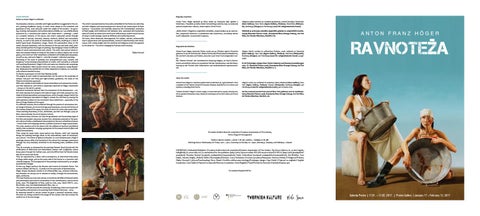
EQUILIBRIUM Notes to Anton Höger’s exhibition Counterpoise, balance, unstable and fragile equilibrium suggested in the artist’s painting Equilibrium (2013), in which three Atlases in the evolution and gradation of rest, twist and pain under the weight of the burden – by growing, twisting and opposite contractions (down-middle-up / up-middle-down) separated by a manufactured palette and wood board – painting? – point to a complex dialectic of the source and artist’s aspiration sieved through the screen of natural, fantastic, dreamy, mythical, biblical and naturalistic charms, as well as the prism of contemporary visuality resulting in a kind of hybrid hyper-hyper illusionistic image. Hence the postmodern ideas of the world, because modernity, with the distance of the eye and tools used, abolishes and demystifies the magic of painting, thus bringing it closer to different media of visual communication and culture. The artist uses optical observations and anatomy lessons to bring all this closer to today’s digital and virtual galaxy, into which art after modernism is blended with endless picturesqueness, as well as any, and even Höger’s – critically charged – individual painting. Branching of the style of painting that interpenetrates past, present and imaginary future-bearing interpretation of reality with surreality is achieved with painting illusionism. Höger’s title and scene are therefore not surprising: After an Illusionist’s Work (2011) in which the artist, precisely by using illusionism, disillusions the morbid fact of a filmic depiction of violence, or a symbolically reflected morbid ecstasy. Its female counterpart is In the Dear Blueness (2016). The origins of such mode of representation can be seen in the revolution of antique two-part and three-part light-shadow gradation, the basis of the Western stimulation approach. With early medieval and medieval visual censorships such perspective continues from classical art, and which is especially important in Höger, mannerism – always at the end of a period. Historical mannerism derived from the mannerism of the Renaissance – artist’s inner drawing that projects into optical magic and multi-perspective mischiefs of shifted spatialities and proportions, which through trompe l’oeil of the variant of Baroque naturalism in Höger’s version fits and then by sieving the cold aesthetics reflects in the movement Neue Saklichkeit – especially in the form of Magic Realism of the 1920s. In a different manner, this is reflected through the poetics of unconscious mirror image of dreams, structure of image psychoanalysis, surreal and fantasy of the Austrian School of the 1950s, the circle of which the artist also comes from. These seeming diversities, in fact, similarities, are then run through a pop-art filter, more precisely the art of popular culture. It transmits irony, criticism, but also the grandiosity and fascinating magic of the then and present consumer system that culminates precisely in the present culture of reflex-conditioned consumption in the new cathedrals of power – retail chains and shopping centres, symbols of power of mega corporations. The artist connects all of the above with the collision of mythical and biblical motifs, their systematic shaping appropriate to the present state of affairs and chilled environments. Then using his hyper-style, hyper-optical eye illusion, motif and meaning brings the painting heritage closer to the contradictory spirit of contemporary culture – the mirror of global civilisation. In such interpretation, Höger’s paintings always reflect the backside of the culture that emerges, penetrates through the crazy beautiful, stretched to the breaking point, aesthetics of the world. This, for example, is witnessed by the painting Terrorist Attack (2007) with the attributions of Aldi-brand and orientalised woman with sunglasses whose burqa peers through her fashion coat, and who differs from her female clones only by her cover and brand. They are separated by a silent void in perspective, of abstracted inter-plans of image within image, and on the same side of the format is a character with a female kangaroo. The background of the painting is dominated by an upright pyramid-like triangle. In this way Höger portrays the obverse and reverse of terrorism threat. The scene in Where is the Way to...? (2010) is on the same path of disorientation. Höger shapes dystopian scenes in an otherworldly way, whereas hallucinatory illusions are always put in relation to reality, through the environment, signs, attributes. The main themes are man and woman, in mythical and biblical interpretations and pretensions portrayed in correlations to the contemporary visual culture (Leda, 2007, The Judgement of Paris, 2006-07, Cain, 2015, Adam’s Rib-IV, 2012, Out of Eden, 2015, Eve Understands God’s Plan, 2015...). The artist’s attitude towards the necessity of believing is best portrayed with the hopeless melancholy in the painting Youth Without God (2013 – 2014). By inserting himself in certain scenes he gives a personal testimony about the artist as a being created in the image of the creator, who then creates the world of art in his own image.
Biografija umjetnika: The artist’s representations of sexuality embedded in the theme are cold; they are both religious and psychoanalytical in terms of the naked power of basic instincts – naturalistic and morbidly seductive like Cronenberg’s aesthetics of Clash (1996), both fetishized and tabooed, dark, repressed and mysterious sides of human sexuality from which such hallucinatory hybrid visual cultures of today’s world emerge, based on different and conflicting tenets. We know, often dissected, disintegrated, the coldest, darkest, otherworldly man’s appearances and representations, states of consciousness and unconscious, with a deep insight into the mythical and religious reveal the opposite to the observer – the artist’s longing for humane and humanity. Željko Marciuš
Anton Franz Höger njemački je slikar rođen 30. listopada 1956. godine u Münchenu. Pripadnik je bečke škole fantastičnog realizma koju su osnovala petorica književnika i slikara, među kojima i Ernst Fuchs.
Högerova djela izložena su u brojnim gradovima, između ostalog u Montrealu (Gora Gallery), New Yorku (Agora Gallery, Chelsea), Münchenu (Störpunkt), Bambergu (Senger) te Nürnbergu (raum für zeitgenössische kunst).
„Bečka škola”, Högerovo umjetničko ishodište, prepoznatljiva je po nestvarnim, sanjarskim motivima u raskošnome stilu manirizma, razrađenoj tehnici starih talijanskih i nizozemskih majstora.
Dobitnik je priznanja nekoliko njujorških galerija te umjetničkih manifestacija Biennale Florenz 2008., Kunstpreis Blau-Orange Coburg, Art Fair Köln, Art Stroke München, NordArt i dr.
Biographie des Künslters: Anton Franz Höger, deutsche Maler, wurde am 30. Oktober 1956 in München geboren. Er ist ein Vertreter der Wiener Schule des Phantastischen Realismus, die von fünf Literaten und Malern, darunter auch Ernst Fuchs begründet wurde. Die “Wiener Schule”, der künstlerische Ursprung Högers, ist durch phantastisch-unwirkliche Motive im opulenten Stil des Manierismus und die Orientierung an der Technik alter italienischer und niederländischer gekennzeichnet.
Högers Werke wurden in zahlreichen Städten, unter anderem in Montreal (Gora Gallery), New York (Agora Gallery, Chelsea), München (Störpunkt), Bamberg (Senger) und Nürnberg (raum für zeitgenössische kunst) ausgestellt.
ANTON FRANZ HÖGER
RAVNOTEZA
Er ist Preisträger einiger New Yorker Galerien und Kunstveranstaltungen wie z. B. Biennale Florenz 2008, Kunstpreis Blau-Orange Coburg, Art Fair Köln, Art Stroke München, NordArt u. a.
About the Author: Anton Franz Höger is a German painter born on October 30, 1956 in Munich. He is a member of the Vienna School of Fantastic Realism, founded by five writers and painters, including Ernst Fuchs.
Höger’s works are exhibited in numerous cities; Montreal (Gora Gallery), New York (Agora Gallery, Chelsea), Munich (Störpunkt), Bamberg (Senger) and Nürnbergu (raum für zeitgenössische kunst), just to name a few.
“Vienna School”, Höger’s artistic origin, is characterized by unreal, dreamy motifs in opulent Mannerist style, elaborate techniques of the old Italian and Dutch masters.
He has received awards from several New York galleries and art manifestations; Biennale Florenz 2008, Kunstpreis Blau-Orange Coburg, Art Fair Köln, Art Stroke München, NordArt, etc.
Hrvatsko društvo likovnih umjetnika | Croatian Association of Fine Artists, Henry Stag Art Managment Radno vrijeme: srijeda – petak 11 do 19h, subota – nedjelja 10 do 18h Working hours: Wednesday to Friday 11am – 7pm, Saturday to Sunday 10 – 6pm, Mondays, Tuesday and holidays – closed IMPRESUM | Nakladnik/Publisher: Hrvatsko društvo likovnih umjetnika/Croatian Association of Fine Artists, Trg žrtava fašizma 16, 10 000 Zagreb, hdlu@hdlu.hr, www.hdlu.hr | Za nakladnika/For the publisher: Josip Zanki | Upravni odbor HDLU/Executive board of HDLU: Josip Zanki (predsjednik/ president), Tomislav Buntak (zamjenik predsjednika/vicepresident), Fedor Vučemilović (zamjenik predsjednika/vicepresident), Ida Blažičko, Ivan Fijolić, Monika Meglić, Melinda Šefčić | Ravnateljica/Director: Ivana Andabaka | Stručna suradnica/Associate: Martina Miholić | Predgovor/Preface: Željko Marciuš | Lektura/Proofreading: Petra Šlosel | Grafičko oblikovanje kataloga/Catalogue design: Duje Medić | Prijevod na engleski/ English translation: Zana Šaškin | Prijevod na njemački/German translation: Anita Rogošić | Tisak/Printed by Cerovski | Naklada/Copies: 300 Uz potporu/supported by:
Galerija Prsten | 17.01. – 12.02. 2017. | Prsten Gallery | January 17 – February 12, 2017
EQUILIBRIUM Notizen zur Ausstellung von Anton Höger
EQUILIBRIUM Bilješke uz izložbu Antona Högera Ravnoteža, balans, nestabilni i krhki equilibrium što sugerira upravo slikareva slika Ravnoteža (2013.) na kojoj tri Atlasa u evoluciji i gradaciji mira, grča i boli usred težine tereta - izrastanjem, povijanjem i suprotno usmjerenim kontrakcijama (dolje-sredina-gore / gore-sredina-dolje), odvojena tvorničkom paletom i daskom - slikom? - ukazuju na složenu dijalektiku izvorišta i autorova htijenja prosijanih kroz sito prirodnih, fantastičnih, snenih, mitskih, biblijskih i naturalističkih čarolija, kao i prizmu suvremene vizualnosti s rezultatom svojevrsne hibridne hiper-hiper iluzionističke slike. Stoga postmoderne predodžbe svijeta jer modernitet distancom oka i alatima ukida i demistificira čaroliju slikarstva, privodeći je zapravo drugim medijima vizualnih komunikacija i kulture. Sve to autor optičkim opservacijama i lekcijama iz anatomije privodi današnjoj digitalno-virtualnoj galaksiji u kojoj je beskrajnom slikovitosti uklopljena umjetnost nakon moderne kao i svaka, pa i Högerova - kritičkim nabojem ispunjena - pojedinačna slika. Grananje načina slikanja u kojem se prožimaju prošlo, sadašnje i imaginarno budućnosno interpretiranje zbiljnosti nad-zbiljnošću, ostvareno je slikarskim iluzionizmom. Ne čudi nas stoga Högerov naziv i prizor: Nakon posla jednoga iluzionista (2011.), kojim umjetnik upravo iluzionizmom deziluzionizira morbidnu činjenicu filmičnoga uprizorenja nasilja, odnosno simboličko odražene morbidne ekstaze. U ženskoj varijanti srodna joj je slika U dragom plavetnilu (2016.). Korijenje takvoga načina prikazivanja naziremo u revoluciji antičkoga dvodijelnoga i trodijelnoga stupnjevanja svjetlo-sjena, temelja zapadnjačkoga pristupa podražavanja. Uz rano i srednjovjekovne vizualne cenzure, takav se perspektivni način nastavlja od klasične umjetnosti, a što je u Högera posebno važno, manirizma uvijek kraju jednoga razdoblja. Iz manire renesanse proistekao je povijesni manirizam - umjetnikov nutarnji crtež koji projicira u optičke čarolije i višeperspektivne vragolije pomaknutih prostornosti i proporcija, što se kroz trompe l’oeil inačice baroknoga naturalizma u Högerovom vidu uklapa i potom prosijavanjem hladne estetike odražava u pokretu Neue Saklichkeit - posebice u vidu magičnoga realizama od 1920-tih. Na drugi način to se odražava kroz poetiku nesvjesne zrcalnosti snova, struktura psihoanalize slike, nadrealnoga i fantastike austrijske škole 1950-tih iz čijeg kruga potječe i umjetnik. Te naizgledne raznolikosti, zapravo srodnosti, provučene su potom kroz popart filtar, točnije umjetnost popularne kulture. Ona odašilje ironiju, kritiku, ali i velebnost i zatravljenu magiju tadašnjeg i sadašnjeg potrošačkoga sustava, čiji je vrhunac upravo u prezentskoj kulturi refleksno-uvjetovane konzumacije u novim katedralama moći - trgovinskim lancima i shopping-centrima, simbolima vladavine mega-korporacija. Umjetnik sve navedeno spaja srazom mitskih i biblijskih motiva, njihovim sustavnim oblikovanjima primjernim današnjem stanju stvari i ohlađenim ambijentima. Potom vlastitim hiper-stilom, hiper-optičkom varkom oka, motivom i značenjem privodi slikarsko nasljeđe kontradiktornome duhu suvremene kulture zrcalu globalne civilizacije. Takvim iščitavanjem Högerove slike uvijek odražavaju naličje kulture koje izvire, prodire iza ludo lijepe, a do puknuća napregnute estetike svijeta. Tome, primjerice, svjedoči slika Teroristički napad (2007.) s atribucijama Aldibrenda i orijentaliziranom ženom sa sunčanim naočalama, čija burka izvire iz modnoga kaputa, a koja se samo pokrovom i markom razlikuje od svojih ženskih klonova. Dijeli ih perspektivna nijema praznina apstrahiranih među-planova slika u slikama, a na istoj je strani formata lik s klokanicom. U dubini slike dominira uspravni trokut nalik piramidi. Na takav način Höger prikazuje lice i naličje ugroze od terorizma. Na istome tragu dezorijentacije je i prizor Gdje je put za...? (2010.). Onostrano Höger uobličava distopijske, a halucinantne prizore snoviđenja uvijek u relaciji sa zbiljnosti, putem ambijenta, znaka, atributa. Glavna tema su muškarac i žena, mitskih i biblijskih interpretacija i pretenzija uprizorenih u korelacijama prema suvremenoj vizualnoj kulturi (Leda, 2007., Parisov Sud, 2006-07., Kain, 2015., Adamovo rebro-IV, 2012., Izvan raja, 2015., Eva shvaća Božji plan, 2015.,...). Autorov odnos prema neophodnosti vjerovanja ponajbolje svojom beznadnom melankolijom odražava slika Mladež Bez Boga (2013. – 2014.). Umetanje vlastitoga lika u pojedine prizore osobno je svjedočanstvo o umjetniku kao biću stvorenu prema slici stvaratelja, koje stvara svijet umjetnosti prema vlastitoj slici. Autorovi prikazi seksualnosti uklopljeni u tematiku hladni su; istovremeno religijski i psihoanalitički u vidu ogoljene snage temeljnih nagona - naturalistički i morbidno zavodljivi poput Cronenbergove estetike Clasha (1996.), ujedno
fetišizirane i tabuizirane, mračne, potisnute i tajnovite strane ljudske seksualnosti iz koje izviru uprizorenja takve halucinantne, na različitim i sukobljenim postavkama utemeljene hibridne vizualne kulture današnjega svijeta. Znamo, često secirane, raslojene, najhladnije, najtamnije onostrane čovjekove pojave i prikazi, stanja svijesti i nesvjesnoga, dubinskim uvidom u mitsko i religijsko otkrivaju promatraču suprotnost - slikarovu čežnju za ljudskim i ljudskošću. Željko Marciuš
Balance, Gleichgewicht, instabiles und sensibles Equilibrium suggeriert das Gemälde Balance (2013), auf dem drei Atlanten in der Evolution und Abstufung des Friedens, des Krampfes und Schmerzes wegen der Schwere der Last – durch Emporheben, Krümmen und entgegen gerichtete Kontraktionen (unten-Mitte-oben / oben-Mitte-unten), voneinander durch eine Palette und ein Brett – Bild? getrennt – auf die komplexe Dialektik des Ursprungs und die Wünsche des Malers, gefiltert durch den Filter der natürlichen, phantastischen, verträumten, mythischen, biblischen und naturalistischen Magie sowie das Prisma der zeitgenössischen Visualität hinweisen, und in einem in gewisser Weise hybriden hyper-hyperillusionistischen Gemälde resultieren. Und somit auch einer postmodernen Weltvorstellung, da die Modernität durch die Distanz des Auges und ihre Werkzeuge die Magie der Malerei annulliert und demystifiziert, und so anderen Medien der visuellen Kommunikation und Kultur zuführt. All das bringt der Autor durch optische Beobachtungen und Anatomie-Lektionen der heutigen digital-virtuellen Galaxie näher, in der die durch unendliche Lebendigkeit eingebundene Kunst nach der Moderne, und so auch Högers – kritisch geprägte – ein einzelnes Gemälde darstellt. Die Verzweigung des Malstils, bei dem sich die vergangene, jetzige und imaginäre zukünftige Interpretation der Realität mittels der Surrealität verflechten, wird durch malerischen Illusionismus erzielt. Deswegen verwundern uns auch Högers Titel und die Darstellung nicht: Feierabend eines Illusionisten (2011), mit dem der Künstler gerade mit Hilfe des Illusionismus die morbide Tatsache der Darstellung von Gewalt in Filmen bzw. die symbolisch reflektierte morbide Ekstase desillusioniert. Das weibliche Gegenstück ist das Gemälde In lieblicher Bläue (2016).
Die Wurzeln dieser Art der Darstellung finden wir in der Revolution der antiken zwei- und dreiteiligen Abstufung von Licht und Schatten, dem Fundament des westlichen Anreizansatzes. Neben der frühzeitlichen und mittelalterlichen visuellen Zensur setzt sich diese perspektivische Art von der klassischen Kunst und, was bei Höger besonders wichtig ist, vom Manierismus immer bis zum Ende eines Zeitraums fort. Aus der Manier der Renaissance entstand der historische Manierismus – die innere Zeichnung des Künstlers, die er in die optische Magie und die mehrperspektivischen Schelmereien versetzter Räumlichkeiten und Proportionen projiziert, was sich durch die trompe l’oeil Variante des barocken Naturalismus in Högers Blick einfügt und danach durch Filtern der kalten Ästhetik in der Bewegung Neue Sachlichkeit – besonders in Form des magischen Realismus der 1920er Jahre - reflektiert. Auf eine andere Weise spiegelt sich das durch die Poetik der unbewussten Reflexion von Träumen, die Struktur der Psychoanalyse von Gemälden, das Surrealistische und Phantastische der Wiener Schule der 1950er Jahre wider, aus deren Kreis auch der Künstler stammt. Diese auf den ersten Blick anmutenden Unterschiede, die aber eigentlich Gemeinsamkeiten sind, wurden danach durch den Pop-Art-Filter gefiltert oder, genauer gesagt, die Kunst der Pop-Kultur. Sie strahlt Ironie, Kritik, aber auch Grandiosität und Magie der damaligen und jetzigen Verbrauchergesellschaft aus, deren Höhepunkt gerade in der Präsentationskultur des durch Reflex bedingten Konsums in den neuen Kathedralen der Macht – den Handelsketten und Einkaufszentren, den Symbolen der Herrschaft von Mega-Unternehmen - liegt. Der Künstler verbindet alles Vorgenannte durch den Zusammenstoß mythischer und biblischer Motive, ihre systematische, dem heutigen Stand der Dinge und dem kühlen Ambiente angepasste Gestaltung. Danach führt er durch seinen eigenen Hyper-Stil, durch hyper-optische Trugbilder, Motive und Bedeutungen das malerische Erbe dem widersprüchlichen Geist der zeitgenössischen Kultur – dem Spiegelbild der globalen Zivilisation - zu. Durch eine solche Interpretation spiegeln Högers Gemälde immer die Kehrseite der Kultur wider, die hinter der wahnsinnig schönen und bis zum Bersten angespannten Ästhetik der Welt zum Vorschein kommt. Davon zeugt z.B. das Gemälde Der Anschlag (2007) mit den Attributen der Marke Aldi und einer orientalisch anmutenden Frau mit Sonnenbrille, deren Burka aus dem modischen Mantel hervorragt, und die sich nur durch die Kopfbedeckung und die Marke von ihren weiblichen Klonen unterscheidet. Getrennt werden sie durch die perspektivischen stummen Leerräume abstrahierter Bilder in Bildern und auf der gleichen Seite des Formats befindet sich eine Gestalt mit Kapuze. In der Tiefe des Bildes dominiert ein aufrechtes Dreieck, das einer Pyramide ähnelt. Auf diese Weise stellt Höger beide Seiten der Gefahr vor dem Terrorismus dar. Diesem Pfad der Desorientierung folgt auch das Bild Wo geht’s hier nach ...? (2010). Jenseitig setzt Höger die dystopischen und wiederum halluzinativen Darstellungen der Trugbilder durch das Ambiente, durch Zeichen und Attribute immer in Relation zur Realität. Das Hauptthema sind der Mann und die Frau in mythischen und biblischen Interpretationen und Prätentionen, dargestellt in Korrelation zur zeitgenössischen visuellen Kultur (Leda, 2007, Das Urteil des Paris, 2006-0., Kain, 2015, Adams-Rippe--IV, 2012., Jenseits von Eden, 2015., Eva durchschaut Gottes Plan, 2015.,...). Wegen seiner hoffnungslosen Melancholie zeigt das Gemälde Jugend ohne Gott (2013 – 2014) das Verhältnis des Malers zur Unentbehrlichkeit des Glaubens. Das Einbringen der eigenen Gestalt in einzelne Darstellungen ist das persönliche Zeugnis des Künstlers als nach dem Ebenbild Gottes geschaffenes Wesen, das eine Welt der Kunst nach seinen eigenen Ebenbild schafft. Die von dem Künstler in die Thematik eingebundenen Darstellungen der Sexualität sind kühl, gleichzeitig aber auch religiös und psychoanalytisch in Form der nackten Kraft der grundlegenden Instinkte – naturalistisch und morbide verführerisch wie Cronenbergs Ästhetik Clash (1996). Sie stellen zugleich aber auch die fetischisierte und tabuisierte, dunkle, unterdrückte und geheimnisvolle Seite der menschlichen Sexualität dar, auf der die Darstellung dieser halluzinativen, auf unterschiedlichen und widersprüchlichen Annahmen basierende hybride visuelle Kultur der heutigen Welt basiert. Wir wissen, dass die oftmals sezierte und zersetzten kältesten, dunkelsten jenseitigen menschlichen Erscheinungen und Darstellungen, die Zustände des Bewusstseins und des Unbewussten durch einen tiefen Einblick in das Mythische und Religiöse dem Beobachter gerade das Gegenteil offenbaren – nämlich die Sehnsucht des Malers nach dem Menschlichen und der Menschlichkeit. Željko Marciuš