FORCLOSURE SALES: 0
NOTICE OF SUITS: 7

PROBATE: 14
OTHER: 0

FORCLOSURE SALES: 0
NOTICE OF SUITS: 7
PROBATE: 14
OTHER: 0
Satellite technology has evolved significantly since the launch of the world’s first satellite on October 4, 1957. Since then, satellites have become a prominent topic of discussion in the news, with launches occurring weekly in the hopes of advancing communication methods for future generations. Satellites have numerous capabilities, including providing new pathways for consumers and businesses and opening the door for emerging technologies such as direct-to-device functionality.
Today, satellites have countless use cases, providing individuals with anything from GPS navigation in their cars and internet connectivity at home, to providing military personnel communication options on the battlefield and first responders the ability to communicate with essential services amidst an emergency or natural disaster. Satellites are crucial for staying connected, as they provide individuals beyond the reach of cable and fiber connectivity with necessary communication and fill the void of technologies that are exiting the market such as 3G and digital subscriber lines (DSL).
When considering the satellite industry holistically, three main satellite types provide the common connections and services the world is most familiar with:
Sitting 22,000 miles in the sky, satellites in geostationary orbit (GEO) are the workhorses of the connectivity ecosystem. GEO satellites rotate at the same speed as the Earth, staying over the same location and beaming coverage over entire continents. This makes them extremely efficient and able to deliver more bandwidth at a lower cost– making them perfectly suited for common consumer internet uses like surfing the web, sharing large files, watching videos or connecting multiple devices. Most recently, Hughes, the leading provider and inventor of satellite internet, launched JUPITER™ 3, the largest commercial communications satellite ever built. This satellite is uniquely engineered to meet customers’ needs and can target capacity where it’s needed most, such as rural regions of the Americas. This provides customers with more data and higher speeds so they can stay connected to the applications and services they depend on every day.
Satellites in Medium Earth Orbit (MEO) sit 3,000 to 12,000 miles above the Earth and specialize in covering areas far from the equator. MEO satellites are often used to power global navigation and other satellite systems. Newer MEO satellites can deliver more bandwidth and support some lower latency

AUCTIONS: 9
SPANISH NOTICES: 0 *Publish
59¢
applications.
Satellites in Low Earth Orbit (LEO) are closest to the Earth out of all three, with some only 300 miles above the ground. LEO satellite constellations can provide global coverage across oceans, mountains, and even the North and South Poles. Due to their close position to the Earth, it takes LEO satellites less time to send a signal back and forth to a user on the ground. This reduces the signal delay called latency and makes LEO satellites useful for supporting applications such as financial transactions, online video games and virtual private networks.
Every type of connectivity has relative advantages – and no one form of connectivity is going to be the single best solution for all use cases. For people who live outside the reach of cable, and where a wireless signal is too weak for a fixed service, you can now complement a satellite connection with a wireless signal to deliver the best of both – high speed and low latency. For example, Hughes recently launched HughesNet Fusion® plans, which combine satellite and wireless technologies to deliver a high-speed, low-latency, reliable and more responsive internet experience.
Meeting the growing demand for connectivity will take every kind of transport – across LEO, MEO and GEO as well as terrestrial options here on Earth. As satellites continue to stand strong as the backbone of the world’s connectivity ecosystem, smart enabling technologies will be key in integrating these tools to connect people in ways never thought possible.
-(NewsUSA)
STATE OF NEW MEXICO COUNTY OF BERNALILLO
SECOND JUDICIAL DISTRICT COURT
No. D-202-DM-2023-02383
SARA ANAHI MORALESSANCHEZ, Petitioner, v. JOSE RAUL ZEPEDARODRIGUEZ, Respondent. NOTICE OF PENDENCY OF ACTION
TO: Respondent, Jose Raul Zepeda-Rodriguez NOTICE OF PENDENCY OF ACTION IN THE STATE OF NEW MEXICO to Respondent JOSE RAUL ZEPEDA-RODRIGUEZ:
You are hereby notified that Sara Anahi Morales-Sanchez, Petitioner, has filed a Petition to Establish Paternity, Custody, and Child Support, requesting sole custody of the Minor Child, DZM. You have thirty (30) days to enter a response with the Second Judicial District Court at 400 Lomas Blvd. NW, Albuquerque, NM 87104 and send the same to Petitioner’s attorney. Regarding this petition, if you do not enter a response and send the same to Petitioner’s attorney, the Court may enter a default judgment in your absence.
Attorney for Petitioner is Linda
K. Wilson of the New Mexico Immigrant Law Center, PO Box 7040, Albuquerque, NM, 87194 (505) 288-1570. Honorable
Judge Debra Ramirez, District Judge of the Second Judicial District Court of the State of New Mexico, and the seal of the District Court of Bernalillo County, this 9/18/2023 day of September 2023.
KATINA WATSON CLERK OF THE COURT
Lupita x Hernandez
Deputy Clerk
Submitted by:
Linda K. Wilson, Esq.
Attorney for Petitioner HCS Pub. September 22, 29, October 6, 2023
PUBLICATION
GREETINGS to: Alfredo Garcia, Eloisa G. Garcia, Jose Gabriel Garcia, Elvira Garcia and/or the Unknown Heirs of Alfredo Garcia, Eloisa G. Garcia, Jose Gabriel Garcia, and Elvira Garcia as well as the Unknown Claimants of Interest in the Premises Adverse to Plaintiff. You are hereby notified that Daniel Garcia, Personal Representative of the estate of Ermenegildo “Herman” Garcia, Plaintiff in the instant cause of action, has filed a Verified Complaint to Quiet Title to Real Estate pertaining to the following described property in the County of Bernalillo, State of New Mexico as follows: THAT CERTAIN TRACT OF LAND BEING THE WESTERLY PORTION OF TRACTS 66B-2 AND 214-A AS SHOWN ON M.R.G.C.D. PROPERTY MAP NO. 27, AND BEING WITHIN THE VILLAGE OF LOS RANCHOS DE ALBUQUERQUE, BERNALILLO COUNTY, NEW MEXICO, ALSO BEING THAT TRACT OF LAND DESCRIBED BY QUITCLAIM DEED FILED AUGUST 16, 1971 IN VOLUME D900, FOLIO 415, AND BEING MORE PARTICULARLY DESCRIBED BY A SURVEY AS FOLLOWS:
BEGINNING AT THE NORTHWEST CORNER, AND BEING A POINT ON THE EASTERLY LINE OF RIO GRANDE BLVD. NW, AND ALSO BEING THE SOUTHWEST CORNER OF LANDS OF E. AND R. SANCHEZ, AS THE SAME IS SHOWN AND DESIGNATED ON THE PLAT THEREOF FILED IN THE OFFICE OF THE COUNTY CLERK OF BERNALILLO COUNTY, NEW MEXICO ON MAY 6, 1971; RUNNING FROM SAID BEGINNING POINT AND LEAVING SAID BLVD. LINE S.
81°36’19” E., 1234.57 FEET TO THE NORTHEAST CORNER;
THENCE S. 09°15’36” W., 118.87
FEET TO THE SOUTHEAST CORNER; THENCE N.
81°13’36” W., 388.99 FEET;
THENCE N. 08°32’10” E., 98.88
FEET; THENCE N. 81°40’43” W., 854.50 FEET TO THE SOUTHWEST CORNER, BEING A POINT ON THE EASTERLY LINE OF SAID RIO GRANDE BLVD. NW; THENCE ALONG SAID BLVD. LINE N. 37°53’11” E., 21.25 FEET TO THE POINT OF BEGINNING. CONTAINING
KATINA WATSON
SECOND JUDICIAL DISTRICT
COURT
CLERK OF THE COURT
/s/ Alyssa Garza
Deputy Clerk HCS Pub. September 29, October 6, 13, 2023
STATE OF NEW MEXICO COUNTY OF BERNALILLO SECOND JUDICIAL DISTRICT COURT NO. D-202-DM-2022-2731 CONNIE ARAGON

Petitioner, vs. MARTIN DE JESUS RAMIREZ
M Respondent, AMENDED NOTICE OF PENDENCY OF ACTION
STATE OF NEW MEXICO to the above-named Respondent(s).
Greetings:
You are hereby notified that the above-named Petitioner has filed a civil action against you in the above entitled Court and cause, the general object thereof being: DISSOLUTION OF MARRIAGE
Unless you enter your appearance in said cause on or before the day of 116-23, a judgment by default will be entered against you.
Name and address of Petitioner or Petitioner’s Attorney: WITNESS the Honorable JANE
C. LEVY, District Judge of the Second Judicial District Court of the State of New Mexico, and the seal of the District Court of Bernalillo County, this 15 day of SEPTEMBER 2023.
KATINA WATSON
CLERK OF THE DISTRICT COURT
By: /s/ Valerie S Begay
Deputy Clerk HCS Pub. September 29, October 6, 13, 2023
This is Notice to the natural father of Frankee Gianna L., a minor child. There is a pending adoption case in the 2nd Judicial District, D-202-SA-2023-88, In the Matter of The Adoption Petition of Desiree Lopez. At present, the natural father is unknown, and this is notice for the natural father that there is a petition to adopt the minor child. HCS Pub. October 6, 13, 20, 2023
STATE OF NEW MEXICO COUNTY OF BERNALILLO SECOND JUDICIAL DISTRICT COURT
NO. D-202-DM-2021-01676 Rel to D-202-DV-2021-0087 Cynthia J. Martinez-Davis Petitioner, vs. Earl W. Davis Jr. Respondent, Amended NOTICE OF PENDENCY OF ACTION
STATE OF NEW MEXICO to the above-named Respondent(s).
Greetings:
You are hereby notified that the above-named Petitioner has filed a civil action against you in the above entitled Court and cause, the general object thereof being: Dissolution of Marriage without children
Unless you enter your appearance in said cause on or before the 23 day of October, 2023, a judgment by default will be entered against you.
Name and address of Petitioner or Petitioner’s Attorney: Cynthia J. Martinez-Davis 2501 Sycamore St. S.E., Alb., NM 87106 WITNESS the Honorable JUDGE DEBRA RAMIREZ, District Judge of the Second Judicial District Court of the State of New Mexico, and the seal of the District Court of Bernalillo County, this 7th day of Sept., 2023.
/s/ Verenice Peregrino Pompa
Verenice Peregrino Pompa
Pegasus Legal Services for Children
505 Marquette Ave NW Suite 1350 Albuquerque, NM 87102
505-244-1101
SECOND JUDICIAL DISTRICT
COURT CLERK OF THE COURT
/s/ Ashley Padilla
Deputy Clerk HCS Pub. October 6, 13, 20, 2023
STATE OF NEW MEXICO COUNTY OF BERNALILLO
SECOND JUDICIAL DISTRICT COURT
NO. D-202-PB-2023-00672
IN THE MATTER OF THE ESTATE OF MANUEL J. MANCILLAS, DECEASED.
NOTICE TO CREDITORS
NOTICE IS HEREBY GIVEN that the undersigned has been appointed Personal Representative of this estate. All persons having claims against this estate are required to present their claims within two months after the date of the first publication of this Notice or the claims will be forever barred. Claims must be presented either to the undersigned personal representative at 15102 McConnell Glen Lane, Huntersville, NC 28078 or filed with the District Court, Post Office Box 488, Albuquerque, New Mexico, 87103.
DATED: , 2023.
/s/ Willie M. Dupriest III
WILLIE M. DUPRIEST III
BY: /S/ Cynthia Sikelianos
JOHANNA A. PICKEL, LLC
WILCOX, MYERS, & JONES
P.C. Attorneys for the Estate /s/ JEFFREY D. MYERS, M.S., J.D. Post Office Box 70238
Albuquerque, New Mexico 87197 (505) 554-1115
HCS Pub. September 22, 29, October 6, 2023
STATE OF NEW MEXICO COUNTY OF BERNALILLO SECOND JUDICIAL DISTRICT COURT No. D-202-PB-2023-00589
IN THE MATTER OF THE ESTATE ) OF BARBARA A. MORGAN, deceased )
NOTICE TO CREDITORS
NOTICE IS HEREBY GIVEN that the undersigned has been appointed personal representative of this estate. All persons having claims against this estate are required to present their claims within four months after the date of the first publication of this Notice if this Notice is given by publication as provided in Subsection A of Section 45-3-801 NMSA 1978, or within sixty (60) days after the mailing or delivery of this Notice for creditors who are given actual notice as provided by Subsection B of Section 45-3-801 NMSA 1978, whichever is later, or the claims will be forever barred. Claims must be presented either to the undersigned personal representative at 320 Osuna Rd NE, Unit G-1. Albuquerque, NM 87107, or filed with the Bernalillo County District Court.
DATED: 08/23/23
/s/ Katherine Clouatre
STATE OF NEW MEXICO COUNTY OF BERNALILLO
SECOND JUDICIAL DISTRICT COURT No. D-202-CV-2022-04335
DANIEL GARCIA, PERSONAL REPRESENTATIVE OF THE ESTATE OF ERMENEGILDO “HERMAN”
GARCIA, Plaintiff,
v.
ALFREDO GARCIA IF LIVING OR IF DECEASED
HIS UNKNOWN HEIRS, ELOISA G. GARCIA IF LIVING OR IF DECEASED HER
UNKNOWN HEIRS, JOSE
GABRIEL GARCIA IF LIVING OR IF DECEASED
HIS HEIRS, ELVIRA GARCIA
IF LIVING OR IF
DECEASED HER UNKNOWN
HEIRS, MARK G. GARCIA
IF LIVING OR IF DECEASED
HIS HEIRS, ANDREW J.
POPE IF LIVING OR IF
DECEASED HIS HEIRS, QUICKEN LOANS, LLC, MARGARET J.
HIRSCH IF LIVING OR IF
DECEASED HER HEIRS, WATERSTONE MORTGAGE CORPORATION, and THE UNKNOWN
CLAIMANTS OF INTEREST IN THE PREMISES
ADVERSE TO THE PLAINTIFFS, Defendants.
1.4019 ACRES MORE OR LESS. Plaintiff seeks the establishment of the estate in fee simple in and to the Property against the adverse claims of the Defendants; and each of them, and everyone claiming by, through, or under them, be barred and forever stopped from having or claiming any lien upon, or any right, title, or interest in or to the Property adverse to the estate of Plaintiff, that the title of Plaintiff thereto in fee simple be forever quieted and set at rest; and that Plaintiff have judgment against any Defendant who may appear other than by disclaimer.
You are required to file with the Clerk of the Court of Bernalillo County an Answer to Complaint or a responsive pleading, by November 22, 2023 or judgment or other appropriate relief may be rendered against you by default. The law firm Budagher & Tann, Guy W. Tann, whose address is 3500 Comanche, NE Building B, Albuquerque, New Mexico 87107, and whose telephone number is (505) 881-9060, represents Plaintiff in this matter. WITNESS the Honorable Joshua A. Allison, District Court Judge of said Court of the State of New Mexico and the Seal of the Second Judicial District Court of said County, this 9/18/2023, 2023.
OF THE COURT
STATE OF NEW MEXICO COUNTY OF SANDOVAL THIRTEENTH JUDICIAL DISTRICT COURT NO. D-1329-DM-2023-00179
IN THE MATTER OF THE KINSHIP GUARDIANSHIP OF E.R.R.M., a minor. AND CONCERNING
Brandi Leah Mondragon, Petitioner, and Katrina Ashley Mondragon and Rogelio Rosas, Respondents.
NOTICE OF PENDENCY OF ACTION
STATE OF NEW MEXICO to the above-named Respondents
Katrina Ashley Mondragon and Rogelio Rosas, GREETINGS:
You are hereby notified that the above-named Petitioner has filed a Petition for Kinship Guardianship of Evelynn Reyna Rosas-Mondragon, born February 2019, to Katrina Ashley Mondragon and Rogelio Rosas.
You are further notified that unless you file a written response to the Petition by no later than thirty days from this publication with the Court Clerk, Thirteenth Judicial District Court, Sandoval County, New Mexico, with a copy to the Petitioner’s attorney, or appear at the hearing, the Court may enter a default judgment in your absence.
Petitioner’s attorney:
/s/ Verenice Peregrino Pompa
Verenice Peregrino Pompa Pegasus Legal Services for Children 505 Marquette Ave NW Suite 1350 Albuquerque, NM 87102 505-244-1101
HCS Pub. October 6, 13, 20, 2023
KATINA WATSON CLERK OF THE DISTRICT COURT
By: /s/ Valerie Begay
Deputy Clerk HCS Pub. October 6, 13, 20, 2023
STATE OF NEW MEXICO COUNTY OF BERNALILLO SECOND JUDICIAL DISTRICT COURT NO. D-202-DM-2023-00894
IN THE MATTER OF THE KINSHIP GUARDIANSHIP OF N.C.M., minor child. AND CONCERNING Mirna Vazquez, Petitioner and Daneisi Ulibarri and Jose Macias, Respondents.
NOTICE OF PENDENCY OF ACTION
STATE OF NEW MEXICO to the above-named Respondent Jose Macias, GREETINGS:
You are hereby notified that the above-named Petitioner has filed a Petition for Kinship Guardianship of Natalia Constance Macias born September 2021, in Albuquerque, Bernalillo County, New Mexico to Daneisi Ulibarri and Jose Macias.
You are further notified that unless you file a written response to the Petition by no later than thirty days from this publication with the Court Clerk, Second Judicial District Court, Bernalillo County, New Mexico, with a copy to the Petitioner’s attorney, or appear at the hearing, the Court may enter a default judgment in your absence.
DATE ISSUED 10/3/23
Petitioner’s attorney:
Cynthia Sikelianos Attorney for Applicant 4801 Lang Avenue NE, Suite 110 Albuquerque, New Mexico 87109
(505) 798-2515
HCS Pub. September 22, 29, October 6, 13, 2023
SECOND JUDICIAL DISTRICT COURT
COUNTY OF BERNALILLO STATE OF NEW MEXICO
NO. D-202-PB-2023-00588
IN THE MATTER OF THE ESTATE OF HELEN L. TOWNE, Deceased.
NOTICE TO CREDITORS
NOTICE IS HEREBY GIVEN
that Steven W. Bare has been appointed as Personal Representative of this estate. Any person having a claim against this estate is required to present his/her claim within four (4) months after the date of the first publication of this Notice or his/her claim will be forever barred. Claims must be either (a) presented by mail or in person to the Personal Representative at the offices of the attorneys for the estate (Wilcox & Myers, P.C.. Post Office Box 70238, Albuquerque, New Mexico 87197, or 320 Osuna Road NE, Suite C-2, Albuquerque, New Mexico 87107, Attn: Jeffrey D. Myers, Esq.), or (b) filed with the Second Judicial District Court, Bernalillo County, Post Office Box 488, Albuquerque, New Mexico 87103, or 400 Lomas, N.W., Albuquerque, New Mexico 87102.
DATED: Sept. 12, 2023
/s/ Steven W. Bare
STEVEN W. BARE
KATHERINE CLOUATRE, Personal Representative of the Estate of Barbara A. Morgan 70089 Hirson Court Madisonville LA 70447 Strategic Legal and Wealth Advisory Group LLC
By: /s/ Sara M. Bonnell Sara M. Bonnell Attorney for Personal Representative 320 Osuna NE, Unit G-1 Albuquerque, New Mexico 87107 (505) 328-8143 HCS Pub. September 22, 29, October 6, 2023
STATE OF NEW MEXICO COUNTY OF BERNALILLO SECOND JUDICIAL DISTRICT COURT Case No. D-202PB-2023-00665 IN THE MATTER OF THE ESTATE OF MARILYN THERESA SHEPPARD, Deceased.
NOTICE TO CREDITORS NOTICE IS HEREBY GIVEN the undersigned has been appointed Personal Representative of the Estate of Marilyn Theresa Sheppard, Deceased. All persons having claims against this Estate are required to present their claims within four (4) months after the date of the first publication of this Notice or the claims will be forever barred. Claims must either be presented to the Personal Representative, c/o Pregenzer Baysinger Wideman & Sale, PC, 2424 Louisiana Boulevard NE, Suite 200, Albuquerque, New Mexico 87110, or filed with the Second Judicial District Court, Bernalillo County, 400 Lomas Blvd NW, Albuquerque, New Mexico 87102.
Dated: Sept. 14,2023.
/s/ Barbara McCulloch
2595 Mars Ave, Las Cruces, NM 88012; vintage leather sofas, flat screen tv, washer, dryer, household items, misc; and At Hadley: H77: Christina Gamboa, 1821 Poplar Ave, Las Cruces, NM 88001; TV stand, beautician supplies, tires, tools, misc. HCS Pub. September 29, October 6, 2023
BEGINNING ON TUESDAY OCT. 24, 2023 AT 10 A.M.
AND ENDING ON FRIDAY OCT. 27, 2023 AT 10 A.M.
THE ENTIRE CONTENTS OF STORAGE UNITS:
236, 286 & 619 (Tenant address is “last known”)
UNIT 236
CINDY M HALL
P.O. BOX 5212
PEORIA, AZ 85385
Unit items consist of: Totes, Boxes, Mattress, Bed frames, Water jugs, misc. items
UNIT 286
NOTICE OF PUBLIC SALE
Notice is hereby given that the following property shall be sold at public auction or otherwise disposed, of in satisfaction of lien, in accordance with the New Mexico Self Storage Lien Act.
To be held over the internet at: storagetreasures.com
By DISCOUNT SELF STORAGE2499 El Camino Real Las Cruces, NM 88007 575 382-0000
JONATHON BUNKER 1101 FORT SELDEN RD
LAS CRUCES, NM 88007
Unit items consist of: Boxes, Speakers, Kids toys, Shelving, misc. items.
UNIT 619
SAMANTHA N. BURKE
447 KEATHLEY DR.
LAS CRUCES, NM 88005
Unit items consist of: Furniture, Home décor, Camp, misc. items HCS Pub. October 6, 13, 2023
NOTICE OF PUBLIC SALE
Notice is hereby given that the following property shall be sold at public auction or otherwise disposed of, in satisfaction of lien, in accordance with the New Mexico Self Storage Lien Act. To be held over the internet at storagetreasures.com
By DISCOUNTSTORAGE
Notice of Public Sale
abd specifically at 109 Headingly Ave NW, Albuquerque NM 87107 the following vehicles will be sold to satisfy debt incurred. Terms cash in hand at time of auction.
2022 JBLC Scooter Vin # L2BB2NCC4NB322104
registered owner is Unknown. In the amount of $2212.38
Terms: Cash in hand at time of sale. A-Albuquerque Towing 305 Conchas ST SE Albuquerque, NM 87123 (505) 292-2880. HCS Pub. October 6, 13, 2023
SELF
5395 Bataan Memorial W LAS CRUCES, NM 88012 575 541-5760
BEGINNING ON TUESDAY, OCTOBER 24TH, 2023
AT 10 A.M. AND ENDING ON FRIDAY, OCTOBER 27TH, 2023 AT 10 A.M.
THE ENTIRE CONTENTS OF STORAGE UNIT: 502 Tenant address is “last known.”
Unit 502
MELINDA SALAS 12899 Central Ave NE #348 Albuquerque, NM 87123
Unit items consist of: Toys, Furniture, Boxes, Mattresses HCS Pub. October 6, 13, 2023
On December 04, 2023 at 08:30 am in the county of Bernalillo abd specifically at 109 Headingly Ave NW, Albuquerque NM 87107 the following vehicles will be sold to satisfy debt incurred. Terms cash in hand at time of auction.
2023 Jian Scooter Vin # LJ7TCA2D8PZ513742
Debt of $294.14 at date of submission for publication( debt will increase at the rate of $15.00 per day till 05:00pm (MDT) December 03,2023 HCS Pub. September 29, October 6, 2023
Notice of Public Sale
On December 06, 2023 at 08:30 am in the county of Bernalillo
Debt of $336.00 at date of submission for publication( debt will increase at the rate of $15.00 per day till 05:00pm
(MDT) December 05,2023
HCS Pub. September 29, October 6, 2023
NOTICE OF PUBLIC SALE
On December 14, 2023 at 2:00
PM the undersigned will offer to sell the following described motor vehicle in order to satisfy charges for towing, storage and/or labor charges incurred against same: 1978 Chevrolet Camaro VIN 1Q87L8N622893. No license plate. Last known

CMEGroup, the world’s leading derivatives marketplace, is reminding students that registration in its 20th Annual University Trading Challenge will remain open until Thursday, September 28 at 5 p.m., Central Time.
This year’s University Trading Challenge kicks off on Sunday, October 1 and concludes on Friday, October 27. Undergraduate and graduate students from colleges and universities around the world will be competing on student-lead teams, or in cooperation with a faculty advisor, to see who can best manage a variety of environmental, economic and other marketplace risks to protect their mock investment portfolio.
“As we celebrate the 20th anniversary of our University Trading Challenge program, we are extremely proud of the role we play in educating up-andcoming professionals on the significant impact risk management can have on the economy, as well as on businesses and individuals globally,” said Anita Liskey, Global Head of Brand Marketing and Communications at CME Group. “Through this engaging and competitive trading simulation, thousands of students around the world have been able to compete against each other, while learning about futures markets and the importance of hedging.”
During the month-long competition, students will experience the energy, excitement, disappointments and daily challenges of a real-world trading environment on a simulated, professional trading platform provided by CQG. They will also receive education, market-related data and news, including live updates from Dow Jones newsfeeds and The Hightower Report, that will test their abilities to evaluate and react to changing market dynamics in real-time.
Each eligible member of the winning team will receive a $2,000 cash prize*. Additional prizes will be awarded for second through fifth place.
NOTICE OF PUBLIC SALE
On November, 27, 2023 at 2:00 PM the undersigned will offer to sell the following described motor vehicle in order to satisfy charges for towing, storage and/ or labor charges incurred against same: 2000 Cadillac DeVille VIN 1G6KD54Y7YU271509. No license plate. Last known registered owner is Unknown. In the amount of $1695.00.
Terms: Cash in hand at time of sale. A-Albuquerque Towing 305 Conchas ST SE Albuquerque, NM 87123 (505) 292-2880 HCS Pub. October 6, 13, 2023
Student participants will also have the opportunity to attend CME Group’s Day of Market Education. This oneday forum will provide them with an exclusive look into CME Group and the derivatives industry.
More than 500 teams of nearly 2,000 students from 23 countries participated in last year’s University Trading Challenge, with the winning team coming from Mexico’s Universidad Anahuac UG.
CME Group is committed to educating the next generation of finance professionals on the significance of global derivatives markets and risk management. In addition to interactive events like the University Trading Challenge, CME Group also partners with other industry organizations to offer broad educational tools, such as Futures Fundamentals, a one-stop educational resource that explains the role of futures markets in everyday life. The goal of the site is to make financial education an engaging experience for anyone, regardless of how well versed they are in the world of finance.
To register and view details on eligibility, rules, regulations and requirements, please visit: https://www.cmegroup.com/events/ university-trading-challenge.html.
For social media updates throughout the competition, make sure to follow #TradingChallenge2023.
*Eligibility to receive competition prizes is only open to residents in the United States (US), Canada (CA) excluding Quebec, United Kingdom (UK), Germany (DE), Netherlands (NL), Switzerland (CH), Republic of Korea (KR), Taiwan (TW), and Japan (JP).
-(NewsUSA)
TheOffice of the Immigration Detention Ombudsman (OIDO) is here to help the immigration detention community. OIDO, an independent office within the U.S. Department of Homeland Security (DHS), is dedicated to promoting and supporting safe and humane conditions for people being held in immigration detention. As the only DHS oversight entity solely focused on immigration detention, OIDO has staff who regularly visit facilities to speak with detained individuals about their concerns. The Office also conducts inspections, provides recommendations, and proposes solutions to improve conditions in immigration detention.
OIDO has a team of medical experts that assess individual cases and advise on systemic and policy issues. The team is composed of physician assistants, registered nurses, psychologists, and pharmacists who work alongside OIDO’s case managers and investigators.
OIDO takes a neutral approach to observing and reviewing matters related to the conditions of immigration detention while calling attention to treatment issues in a timely manner. OIDO relies on announced and unannounced inspections from a team of dedicated investigators who visit both government-operated and privately contracted detention facilities throughout the country. The Office also places case managers within detention facilities across the country to handle complaints that range from physical needs such as access to blankets, toothbrushes, and improvements in food quality, to ensuring detention centers provide sufficient access to medical personnel, video conference areas, and law libraries.
When OIDO is called on to help with issues needing immediate attention that have not been resolved by U.S. Customs and Border Protection (CBP) or Immigration and Customs Enforcement (ICE), OIDO can call additional attention to these matters. Their work can lead to a formal recommendation for improvement to DHS Secretary Alejandro Mayorkas and Congress.
Last year, OIDO issued an Ombudsman Alert regarding an independent contractor’s critical medical understaffing at the Southwest border. OIDO’s medical experts worked with CBP’s Office of the Chief Medical Officer and DHS’s Office of Health Services to address medical care deficiencies nationwide, resulting in staffing rates that have increased 100 percent nationally this year. Following a thorough investigation, the final report, OIDO Review -- CBP Medical Support Contract for Southwest Border and Tucson, was issued in July.
When Title 42 lifted in May, OIDO surged staff to the southern border and was present at many Border Patrol locations, while continuing its regular oversight work at immigration detention facilities. “OIDO is committed to ensuring the best possible conditions for those in our immigration detention system,” said acting Immigration Detention Ombudsman David Gersten. “We position case managers and investigators across the Nation to have easy access to ICE and CBP facilities, enabling us to resolve detention issues proactively and as fast as possible.”
OIDO senior leadership also participated in these observations. One critical focus area was the care of unaccompanied children and families, along with appropriate facilities, hygiene, access to and quality of food and water, access to legal services, and the handling of personal property.
People who are detained should feel confident knowing that requesting assistance from an OIDO case manager doesn’t affect their immigration status. They should start by asking to speak with an OIDO case manager in their facility or having a representative complete a Case Intake Form for any issue related to their well-being that has not been addressed.

In one recent instance, a detained person requested assistance from an OIDO case manager, stating that he was not granted access to immigrationrelated paperwork that was in his possession when he first arrived at the facility. The individual informed OIDO that multiple requests for the paperwork had been made, but the documents had not been returned. According to ICE’s Detention Standards, immigration detention facilities must allow detained people to access their personal legal material. With the support of the OIDO case manager who relayed this complaint to the facility staff, the individual promptly received his documentation.
With a mission to serve as a neutral, objective, credible resource for everyone impacted by immigration detention, OIDO will continue to identify processes that are not operating as they should and work toward results. OIDO is on track to address over 20,000 cases about detention conditions by the end of the year.
“Our goal is to continue to effectively and swiftly improve conditions in all detention facilities, by working to mitigate problems and enhance processes for ICE and CBP,” Gersten said.
To learn more about OIDO or file a complaint, visit DHS.gov/OIDO. -(NewsUSA)

Instilling healthy habits for both physical and emotional wellbeing begins during childhood, and, according to experts, one of the best ways to promote emotional wellness is through play.
With recent data suggesting that today’s children are more emotionally stressed than ever, The Genius of Play, a nonprofit initiative dedicated to helping parents raise healthy and happy kids through the power of play, has developed a new “Emotional Wellness Playbook” for families.

“Studies show that children with high emotional intelligence earn better grades, stay in school longer, and make healthier choices overall, so it is more important than ever to talk about emotional development and how parents can help their kids build the skills needed to successfully navigate the increasingly complex world,” says Anna Yudina, senior director of marketing initiatives at The Toy Association™, which spearheads The Genius of Play.
Written in collaboration with Talia Filippelli, a leading mental health expert, founder of Starr Therapy, and Certified Holistic Health Coach, the “Emotional Wellness Playbook” features a variety of play-based activities to help kids ages 3 and up develop emotional intelligence and learn to express
their feelings in a healthy way while having fun.
“Play and toys are some of the most effective tools to help kids learn and practice the five key components of emotional intelligence: self-awareness, selfregulation, motivation, empathy, and social skills,” says Filippelli. “What’s more, play provides the stress reduction and relaxation both kids and adults need to promote emotional wellbeing.”
The playbook’s simple, yet effective activities help children develop their emotional skills in a variety of ways. Emoji Bingo offers a twist on a favorite game that helps improve emotional self-awareness by teaching kids to label their emotions and, therefore, not become overwhelmed by big feelings when they occur. Calming Bottle is a DIY activity that can help those who struggle with self-regulation. Puppet Play helps kids practice empathy and social skills and Vision Board helps build their motivation and self-confidence.
Families looking to capitalize on the emotional benefits of play can visit thegeniusofplay.org to download the “Emotional Wellness Playbook” for free.
-(NewsUSA)
Spooky season is upon us, and if you were part of the one in five people who, according to the National Retail Federation, planned to dress up their pet last year, you’re probably already thinking about how you and your pet will celebrate Halloween this year. To make sure the season is full of treats— and a few (good) tricks—follow these tips for a safe and fun Halloween with your pets:
• Safety First: Earlier sunsets mean pet parents should take a few additional precautions to keep their pets safe while out and about. Dogs should be secure and visible on evening walks with a well-fitting, durable harness, collar and lead with night safety features such as reflective fabric or LED lighting. Consider an LED accessory and GPS tracker for pets.
• Don’t Get Ghosted: It’s easier for pets to go missing as front doors are repeatedly opened and closed for trick-or-treaters and houseguests. Microchip your pets, ensure their collars have the proper identification and register them on Petco Love Lost, a free national lost and found database that uses patented image-recognition technology to help reunite lost pets with their families.
• Tricks and Treats: Shocking sights and ghoulish sounds outside of their normal routine may startle pets during trick-or-treating and Halloween parties. Many pets may benefit from a training refresh with the help of a Petco-certified dog trainer. A few practical tips:
• If your costume involves a mask or other disguises that may make you look or smell unfamiliar to your furry family member, slowly introduce each piece to your pet before the big day and pair this with a few training treats to help them adjust.
• Frequent knocks on the door and screams or cackles coming from Halloween decorations could be alarming for your pet. Create a quiet zone inside your home with a cozy bed, interactive toy, and calming aids such as a weighted jacket and calming chews to keep your pet comfortable during the festivities.
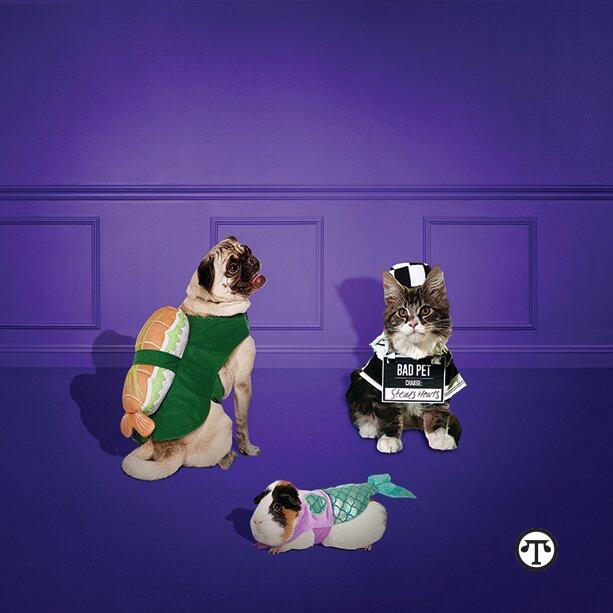
• While the rest of the town might be overindulging on candy, make sure your pet’s treats are pet-friendly (not from the candy bag) and stay below 10% of their daily calories to help them stay happy and healthy.
• Celebrate in Style: Petco offers costumes for all types of pets, including cats, dogs, guinea pigs, rabbits and bearded dragons. New costumes such as the fish taco, sushi, UFO and mermaid join classic favorites such as the banana, prisoner and skeleton for a wide assortment of fun disguises. For those looking for something more glamorous, the “Doggy Parton” collection features a stylish wig, feathered cowgirl hat and matching dress inspired by everyone’s favorite country star. And if a costume isn’t quite your pet’s vibe, they can still get into the holiday spirit with Halloween-themed cozy PJs, treats, beds and blankets.
• Find Spook-tastic Value: Petco’s Halloween Bootique features over 200 items under $20 so pet parents can get in the spooky spirit minus the scary price tag with affordable items such as seasonal bandanas and headpiece costumes including the lobster, cow or box of popcorn. Pet parents can also find great value on everyday essentials such as nutrition and supplies, as well as services including veterinary care and grooming. Upcoming promotions include:
• 30% off freeze dried and frozen cat food, and select cat treats that are buy two, get one free on petco.com the last week of Happy Cat Month from Sept. 24 to 30.
• 50% off reptiles at Petco pet care centers and 50% off Zoo Med frontopening terrariums in-store and at petco.com during Petco’s Reptile Rally from Oct. 21 to 22.
For more information, seasonal guides and expert-reviewed recommendations to help you and your pets safely celebrate Halloween, visit a Petco pet care center or petco.com/Halloween.
• Darris Cooper is the National Dog Training Manager at Petco. He has worked in the industries of animal training and behavior, pet lifestyle and broadcast journalism, and has been a professional dog trainer for more than 10 years.
-(NAPSI)
Chances are, you’re not among the roughly 600 people who’ve been into outer space—but you can still learn about some of the products and discoveries of those who have.
For example, according to NASA, many products firms made for space travel have their earthly uses today. These include:


•Memory foam: It was originally designed by NASA-funded researchers to keep test pilots cushioned during flights. Now, it’s used in beds, couches, shoes, and many other everyday items.
•CMOS image sensor: When NASA needed miniature cameras for interplanetary missions, it created the CMOS active pixel sensor. Today, it can be found inside your DSLR camera, cell phone cameras, and in medical imaging and dental x-ray devices.
•Scratch-resistant glass: Created to protect astronaut helmet visors and increase their ability to filter out UV rays and enhance colors, it’s now found on sunglasses, ski goggles and welder masks.
•GPS: No one wants to be lost in space, or anywhere else, so NASA created the satellite navigation system called GPS with an accuracy of up to five centimeters.
•Cold weather wear: NASA found a way to make light warm clothing, often used by hikers.
Hisamitsu Pharmaceutical Co., Inc., the makers of the world’s bestselling OTC Salonpas pain relieving patches, applied their patented patch technology to help astronauts keep objects from floating around in zero-gravity conditions. They proposed a product called Fixpace® to the Japan Aerospace Exploration Agency’s (JAXA) application for ideas for daily necessities, and it was adopted. It was recently installed on the International Space Station where it keeps knives, forks, pens, scissors and similar stuff from floating around in outer space, because their adhesive properties enable items to stick to the patches on the wall or other surfaces.

As for the future, the comforts of space that you can have around the house may just be getting started. NASA expects its engineers will develop new technologies to meet the challenges of advanced space exploration and that will improve air transport and much else here on Earth.
Hisamitsu Pharmaceutical Co., Inc will work towards developing products to solve issues for living in Space and living on Earth via the company’s 176 years of experience and expertise in developing patches whether for adhesion purposes in outer space or effective OTC pain relief around the world here on planet earth. For a deeper look into the patches used for space and here on planet earth, go to us.hisamitsu.com.
-(NAPSI)